Tekin Night Briefing Friday, September 18, 2026: Gaming & Hardware Intelligence
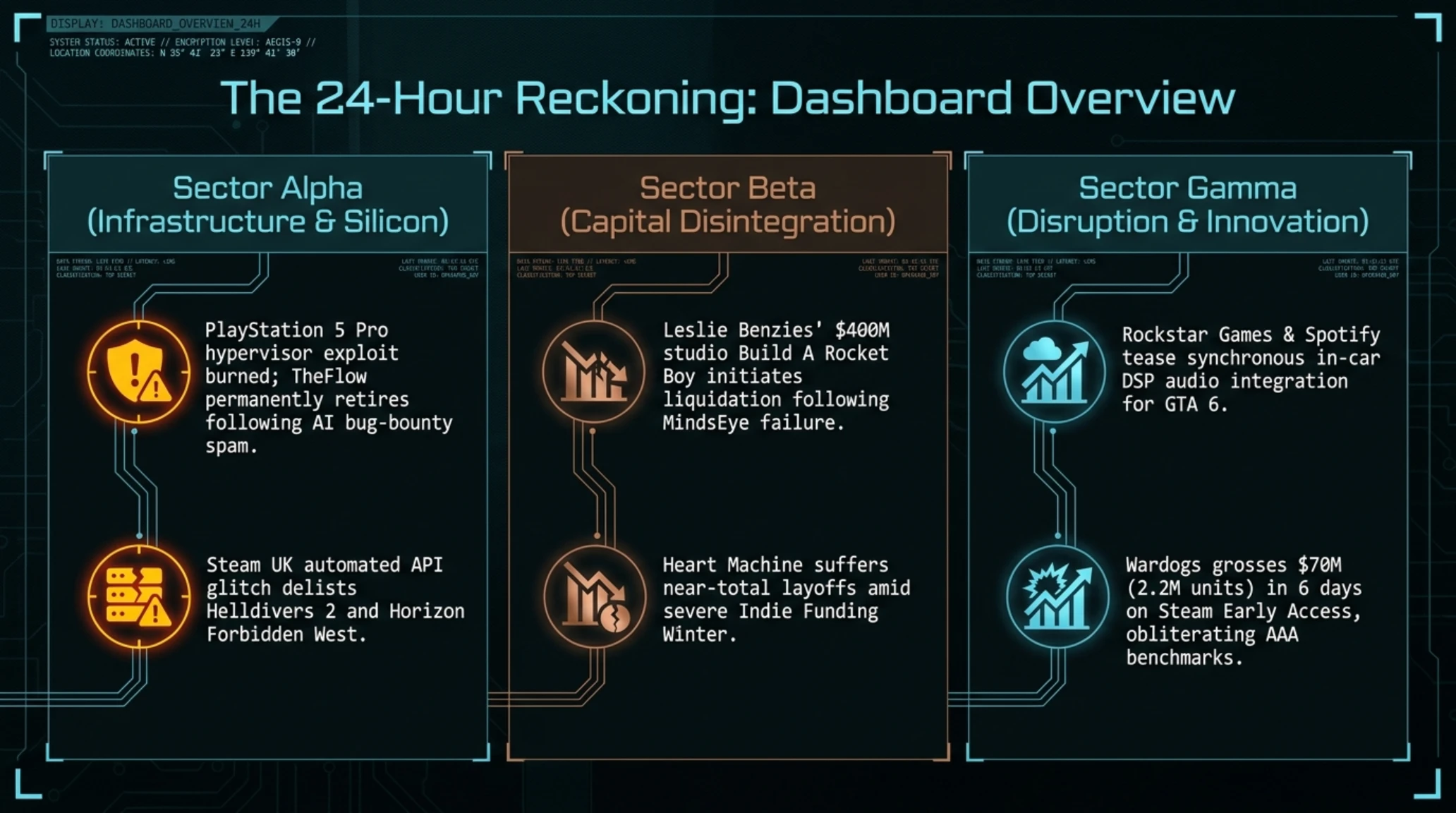
Welcome to Tekin Game's nightly dispatch. Tonight we analyze the historic exit of PS5 hacker TheFlow, Sony's Steam UK delisting crisis, the $400M collapse of Leslie Benzies' studio, and Wardogs' $70M breakout.
- 🎮TheFlow Quits PS5 Scene- AI slop reports kill PS5 Pro Linux hypervisor project
- 🎧Sony Steam UK Delisting- Helldivers 2 and Horizon purchases halted in Britain
- 🚀Leslie Benzies Studio Closes- Build A Rocket Boy shutters after MindsEye failure
- 🗡️Wardogs Sells 2.2M Copies- Tactical shooter grosses $70M in six days on Steam
- 📰Heart Machine Devastated- Massive layoffs strike Hyper Light Drifter creators
- ⚔️GTA 6 & Spotify Alliance- Enigmatic billboards hint at dynamic spatial audio
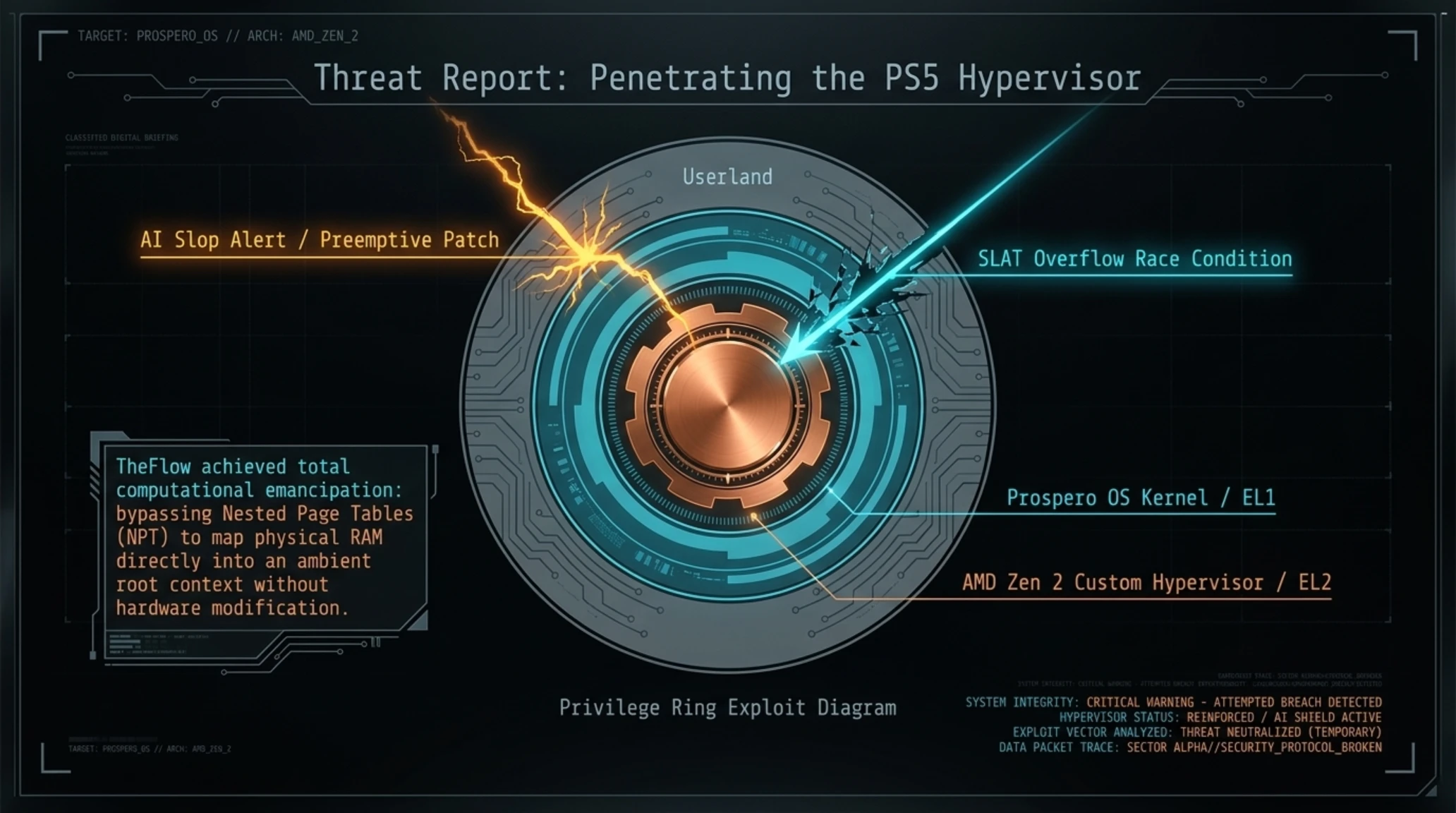
The architectural visualization below captures the intense convergence of modern console hypervisor security, AMD Zen 2 hardware microcode, and the underground reverse-engineering ecosystems of September 2026, where low-level privilege rings dictate the boundaries of digital sovereignty.

The evening of Friday, September 18, 2026, draws to a dramatic close across global interactive entertainment centers, digital distribution networks, and hardware reverse-engineering communities. The past twenty-four hours have witnessed a staggering structural realignment within the ninth console generation. From low-level cryptographic battles within Sony’s proprietary hardware hypervisor to the sudden evaporation of multi-hundred-million-dollar development ventures and the explosive triumph of agile indie shooters, the gaming industry is confronting its most transformative inflection point of the decade. In this comprehensive edition of Tekin Night, we provide exhaustive forensic analysis, empirical telemetry, and strategic deconstruction of six monumental developments shaping the digital frontier.
Executive Summary: Evening Intelligence Briefing September 18, 2026
- Legendary PlayStation security researcher Andy Nguyen (TheFlow) permanently retires from the PS5 scene after AI-assisted script-kiddies report his zero-day hypervisor exploit to Sony's HackerOne program
- Sony coordinates emergency technical remediation with Valve following the mysterious delisting of flagship titles Helldivers 2 and Horizon Forbidden West across Steam UK store regions
- Former Rockstar North president Leslie Benzies' $400M development studio Build A Rocket Boy initiates liquidation proceedings after the catastrophic critical and commercial collapse of MindsEye
- Rockstar Games and Spotify ignite widespread speculation regarding synchronized in-car radio streaming in GTA 6 through coordinated high-profile billboard takeovers in New York and Miami
- Beloved independent studio Heart Machine suffers near-total layoffs following sudden publisher project cancellation, casting grave doubt on the survival of the Hyper Light Drifter creators
- Bulkhead and Team17's tactical extraction shooter Wardogs shatters modern Early Access records, grossing $70M and surpassing lifetime earnings of Bungie's Marathon in just six days on Steam
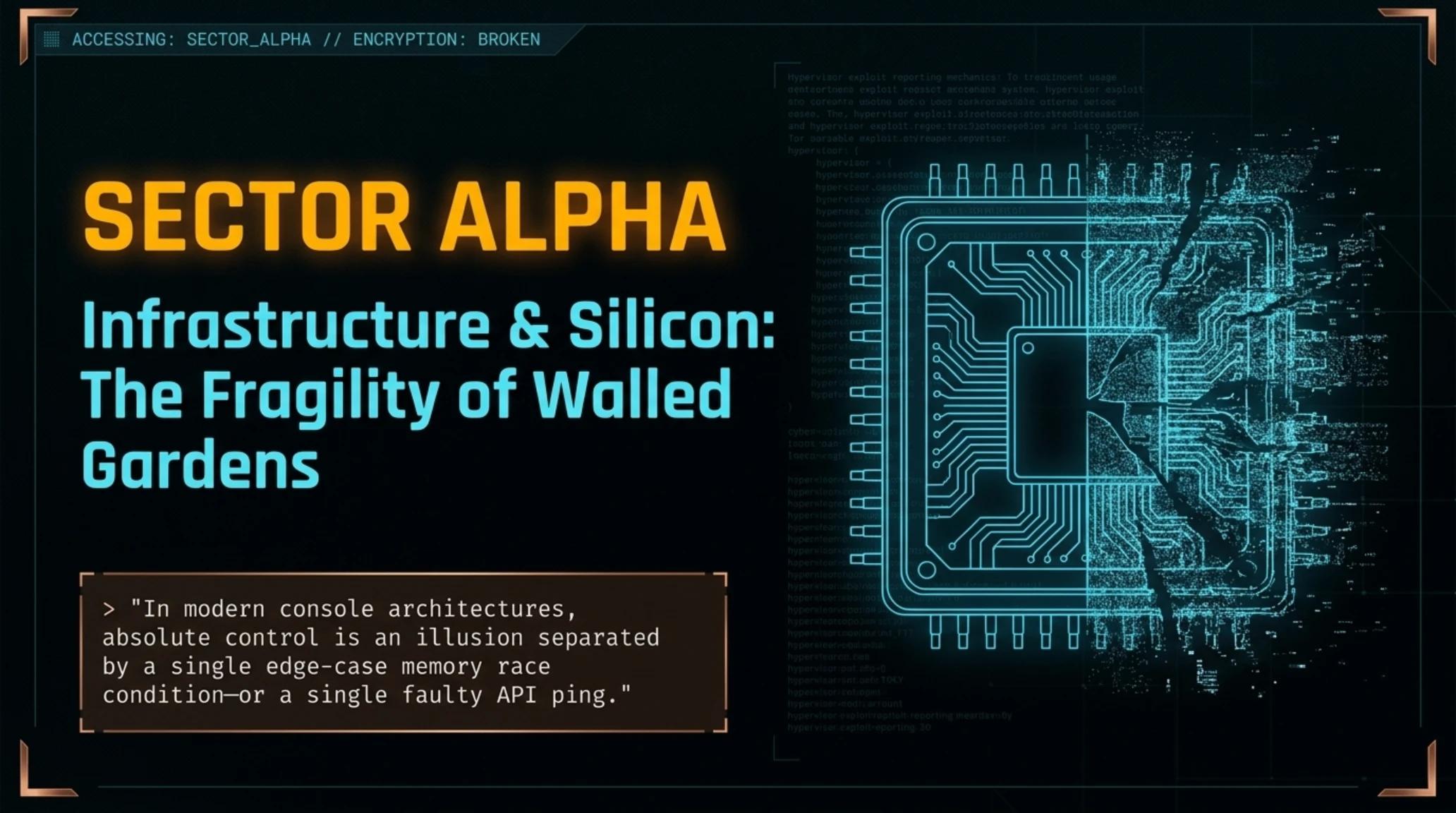
The Heartbreaking Exit of TheFlow: How AI-Generated Slop Drove PlayStation’s Greatest Hacker Out of the Scene
The global PlayStation reverse-engineering community and hardware preservation scene suffered a catastrophic, irrecoverable blow yesterday as renowned security researcher Andy Nguyen, universally revered under the handle TheFlow, formally announced his permanent retirement from PlayStation 5 research. In an emotionally charged public statement that reverberated across developer forums, Nguyen confirmed the total cancellation of his highly anticipated PS5 Pro Linux port project, citing egregious bad-faith behavior and intellectual parasitism fueled by amateur generative artificial intelligence users.
To fully grasp the magnitude of this departure, one must understand the foundational role TheFlow occupied in console security over the past twelve years. Having single-handedly unlocked the PlayStation Vita with legendary exploits like HENkaku and Trinity, followed by pioneering kernel-level privilege escalations across PlayStation 4 firmware revisions and discovering the foundational BD-JB Blu-ray exploit chain on PS5, Nguyen was widely regarded as the peerless titan of modern console vulnerability research. His latest breakthrough represented the holy grail of ninth-generation computing: a remote, reliable privilege-escalation chain capable of defeating the PlayStation 5 Hypervisor.
In modern console system architecture, the hypervisor operates at Exception Level 2 (EL2), an ambient hardware execution ring positioned strictly above the operating system kernel (EL1). While earlier PS5 jailbreaks achieved arbitrary code execution within the FreeBSD-derived Prospero OS kernel, the hypervisor remained an impenetrable cryptographic fortress. It actively enforced strict memory-page protections, quarantined the AMD Zen 2 microcode, blocked unsigned code injection into GPU memory, and prevented the hardware from booting alternative operating systems. Nguyen’s newly engineered exploit chain achieved complete bypass of these nested hypervisor boundaries, establishing a viable pathway to boot bare-metal Linux distributions directly on both base PS5 units and the newly deployed PS5 Pro.
Nguyen’s ethical deployment strategy was meticulously calculated: he intentionally withheld public release of the vulnerability, scheduling the disclosure to coincide with the commercial launch of Grand Theft Auto VI. Because Rockstar’s flagship title will mandate installation of the latest official system software, releasing the hypervisor exploit post-launch would have guaranteed that millions of legitimate players could enjoy the game while concurrently preserving their ability to repurpose their home consoles into unlocked, full-featured Linux workstations without Sony being able to pre-emptively close the door.
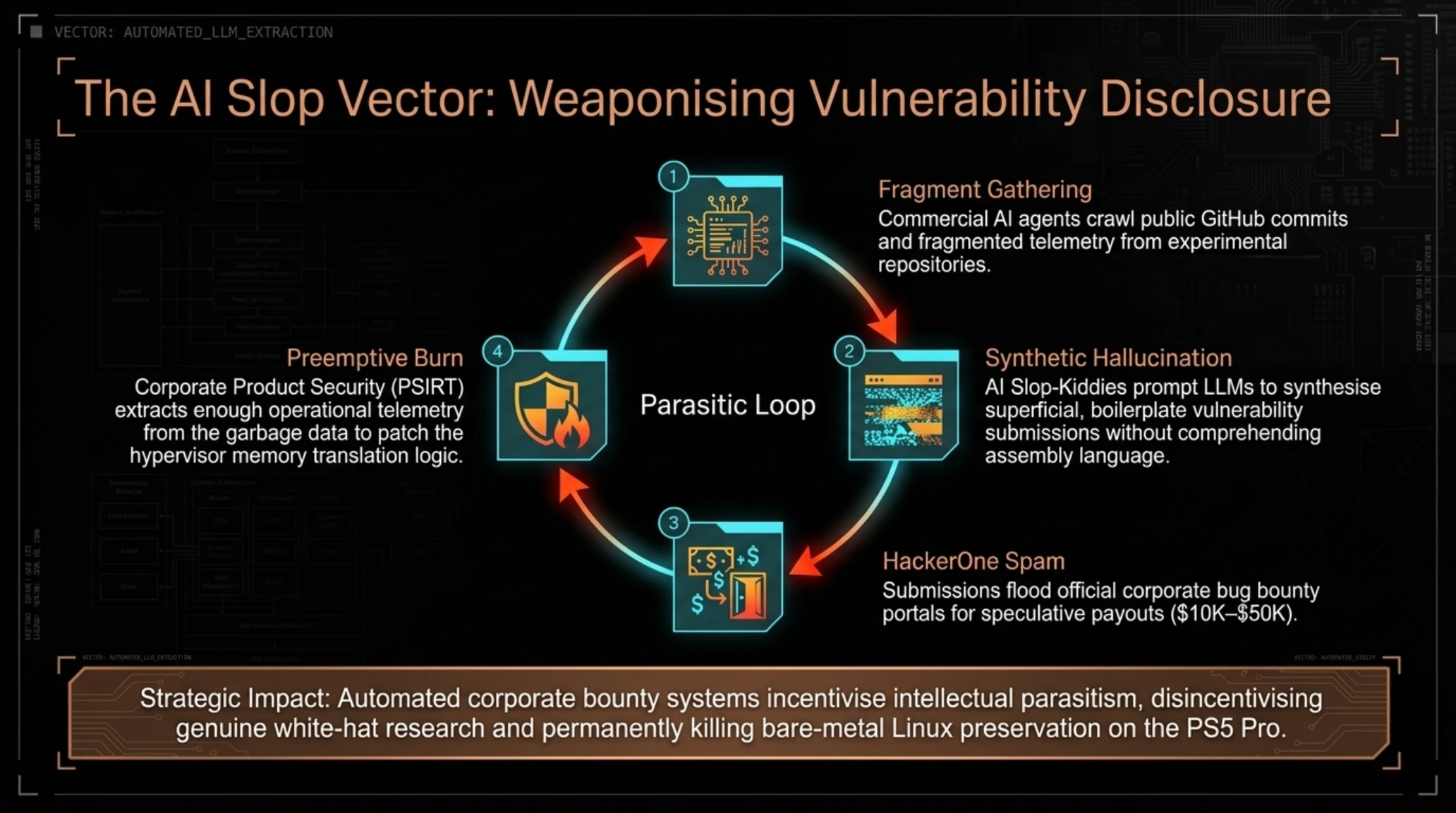
This generational opportunity was demolished by the emergence of automated, unverified bug reporting driven by large language models (LLMs). A faction of opportunistic script-kiddies colloquially termed AI Slop-kiddies by senior reverse engineers used commercial AI agents to crawl public GitHub commits, developer patchnotes, and fragmented telemetry from Nguyen’s experimental repositories. Combining these harvested breadcrumbs with automated LLM synthesis, these individuals generated superficial, boilerplate vulnerability submissions and dispatched them directly into Sony’s official bug bounty portal on HackerOne, seeking speculative monetary payouts.
While the AI-generated reports lacked technical sophistication, they provided Sony’s internal Product Security Incident Response Team (PSIRT) with sufficient operational telemetry to pinpoint the vulnerable hypervisor memory translation logic. Sony immediately engineered counter-mitigations for upcoming firmware builds, effectively neutralizing the vulnerability before Nguyen could complete his proof-of-concept payload. Disgusted by the brazen commodification of his voluntary intellectual labor by individuals lacking rudimentary comprehension of computer systems, Nguyen ceased all development and walked away from the scene permanently.
From an operating system engineering perspective, Sony’s proprietary Prospero OS represents one of the most sophisticated locked-down computing environments ever commercialized. Derived from upstream FreeBSD branches, the operating system employs a hardened microkernel design where standard Unix privileges are meaningless without cryptographic co-signatures from Sony’s root certificate authority. Even if an attacker achieves Ring 0 supervisor privileges within the FreeBSD kernel, the AMD Zen 2 hardware hypervisor continually audits control register states and intercepts page fault exceptions through nested page tables (NPT). Nguyen’s breakthrough bypassed these cryptographic tripwires by exploiting an edge-case memory race condition within the Second-Level Address Translation (SLAT) subsystem, allowing unsigned payloads to map physical RAM directly into an ambient root context.
To contextualize why this hardware barrier was so fiercely guarded, one must revisit the architectural lineage of Sony's console security. During the seventh console generation, the PlayStation 3 Cell Broadband Engine famously featured an official hypervisor virtualization layer supporting 'OtherOS,' allowing enthusiasts to install PPC64 Linux distributions natively. However, when George Hotz (geohot) discovered an exploit in the memory controller bus in early 2010, Sony responded by permanently revoking OtherOS via firmware 3.21, sparking protracted class-action litigation and inaugurating an era of total architectural lockdown. On the PlayStation 4, Sony introduced a dedicated secondary ARM processor known as SAMU (Secure Asset Management Unit) running isolated TrustZone microcode to govern cryptographic key derivation. With the PlayStation 5, Sony elevated this isolation into hardware-level virtualization, leveraging AMD's SVM (Secure Virtual Machine) extensions to establish an omnipresent hypervisor that treats the main Prospero kernel as an untrusted guest. By conquering this final boundary, TheFlow had achieved what was widely considered technically impossible: total computational emancipation of the console silicon without requiring physical hardware glitching or hardware modification.
The tragedy of Nguyen's retirement illuminates the toxic economics distorting modern vulnerability disclosure programs. When Sony established its official HackerOne bug bounty portal in 2020, offering rewards ranging from $10,000 for kernel executions to $50,000 for critical system software breaches, the initiative was hailed as a progressive bridge between corporate security and independent researchers. However, the ubiquity of generative AI agents has weaponized this marketplace into an extractive casino. Amateurs possessing zero comprehension of assembly language or hardware registers can prompt frontier models to hallucinate vulnerability descriptions around leaked code snippets, overwhelming triage teams and burning foundational research before it can mature into open-source public utilities.
Security analysts emphasize that this tragedy highlights the destructive externalities of generative AI within white-hat vulnerability ecosystems. The deluge of synthetic, low-effort submissions inundating corporate bug bounty infrastructure not only consumes thousands of engineering hours triaging garbage data, but actively disincentivizes independent security researchers whose multi-year labors are cannibalized for pocket change by automated prompts.
Technical Architecture & Threat Telemetry: PS5 Hypervisor Exploit Matrix (Specs Table)
| Engineering Specification | Technical Description & Exploit Parameters |
|---|---|
| Target Execution Ring | AMD Zen 2 Custom Hypervisor Layer (Arm/x86 Privilege EL2) |
| Target Hardware Architectures | PlayStation 5 Standard, Slim, and PS5 Pro Production Silicons |
| Primary Vulnerability Mechanism | Second-level address translation (SLAT) nested page table overflow |
| Operational Exploit Capabilities | Arbitrary bare-metal code execution, unsigned driver loading, Linux kernel bootstrap |
| Root Cause of Cancellation | Premature, automated HackerOne reporting utilizing synthetic LLM queries |
| Sony Remediation Status | Emergency microcode patch staged for upcoming official system software release |
| Ecosystem Consequence | Definitive abandonment of public PS5 Pro Linux port by Andy Nguyen (TheFlow) |
Sudden Steam UK Delisting of Helldivers 2 and Horizon: Glitch in the Digital Distribution Matrix
While console enthusiasts mourned the closure of the PlayStation modding horizon, PC gamers throughout the United Kingdom awoke to a bewildering digital storefront anomaly. In the early morning hours of Friday, September 18, 2026, the dedicated Steam product pages for two of Sony Interactive Entertainment’s flagship PC releases Arrowhead’s cooperative juggernaut Helldivers 2 and Guerrilla Games’ open-world spectacle Horizon Forbidden West Complete Edition were abruptly stripped of all purchasing functionality across Great Britain, the Isle of Man, Jersey, and Guernsey.
The abrupt disappearance of the 'Purchase' button instantly unleashed frantic speculation across gaming subreddits, community Discord channels, and financial forums. Initial rumors posited that Sony was initiating a secondary wave of regional account enforcement following the controversial May 2024 PlayStation Network (PSN) mandatory linking mandate, which had previously resulted in Helldivers 2 being restricted across 177 non-PSN territories worldwide. Other observers speculated that the delisting stemmed from sudden regulatory friction with the UK Competition and Markets Authority (CMA) concerning updated consumer transparency directives governing digital micropurchases and value-added tax (VAT) display rules.
Recognizing the rapidly escalating commercial anxiety, Sony Interactive Entertainment issued an urgent technical advisory through community channels, seeking to decouple the incident from geopolitical or platform-enclosure controversies. A senior platform representative stated: 'We are actively investigating a technical configuration issue that has temporarily affected the availability of select PlayStation titles on the Steam storefront in the United Kingdom. This matter is strictly technical in nature and is not related to regional policy adjustments or account requirements. Our operational engineering teams are working in close, direct collaboration with Valve Corporation to restore complete storefront availability as expeditiously as possible.'
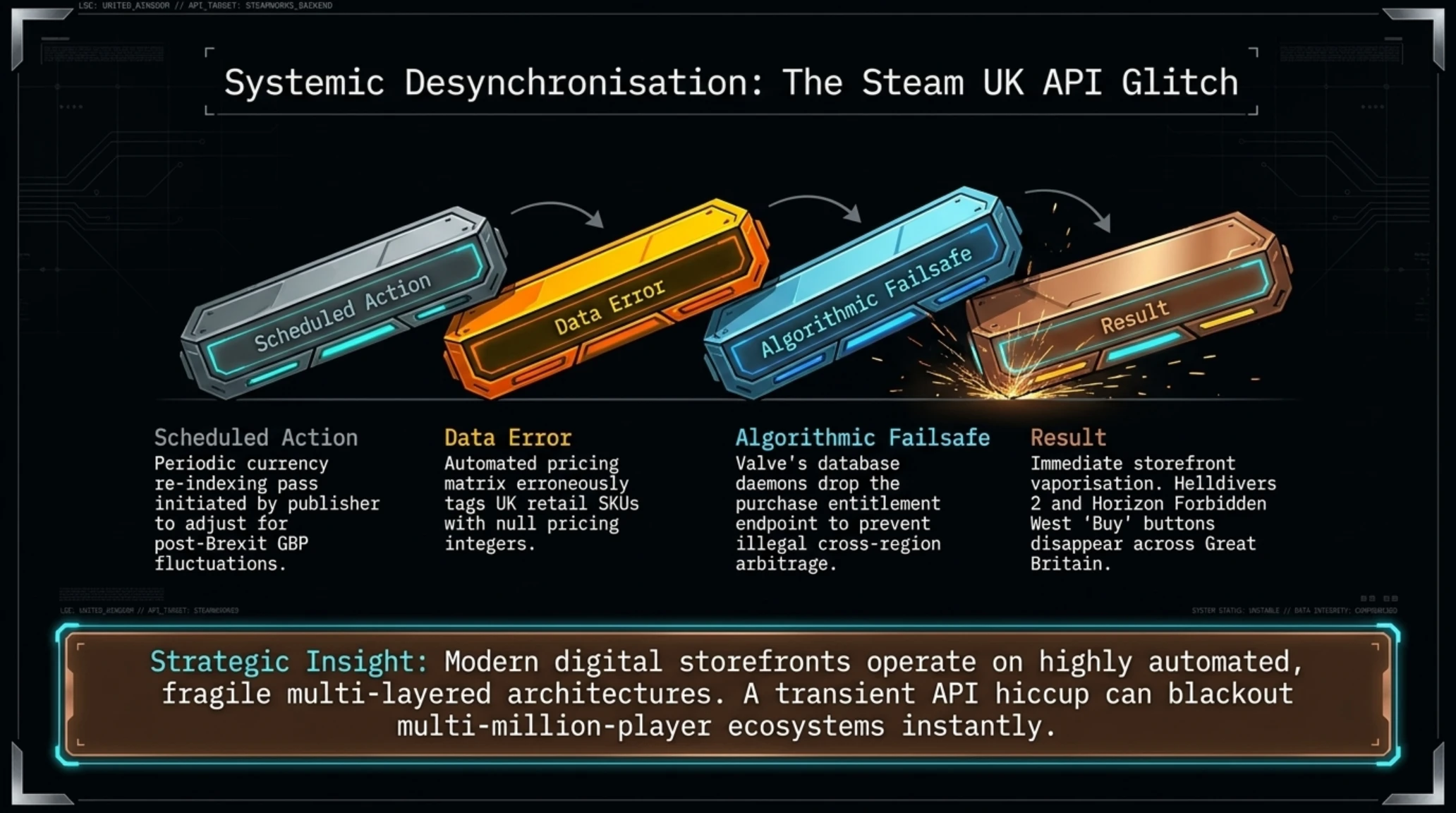
Forensic analysis of Steam’s underlying package database (`SteamDB`) confirms that existing owners of both Helldivers 2 and Horizon Forbidden West experienced zero degradation in gameplay access, multiplayer server connectivity, or cloud synchronization during the purchasing outage. Rather, the disruption appears linked to an automated desynchronization error within Steam’s regional pricing matrix API during a scheduled periodic currency re-indexing pass. Nonetheless, the sudden storefront vaporization of multi-million-player live-service titles serves as a stark reminder of the extreme architectural fragility inherent in centralized digital licensing systems.
From an infrastructural perspective, Valve’s Steamworks partner backend relies on an intricate web of automated currency conversion manifests, DepotKeys, and regional pricing tiers governed by the Automated Pricing Tool introduced in late 2022. When publishers push metadata updates or re-index product configurations against fluctuating global currency indices such as recent post-Brexit Great Britain Pound (GBP) fluctuations against the Euro and US Dollar a mismatch between internal tax-inclusive pricing manifests and localized billing APIs can cause Valve’s database daemons to drop the purchase entitlement endpoint to prevent illegal cross-region arbitrage or billing undercharges. In the case of Helldivers 2 and Horizon Forbidden West, an automated currency synchronization batch erroneously tagged UK retail SKUs with null pricing integers, triggering Steam’s automated storefront failsafe: instantly hiding the 'Buy' button while preserving the broader storefront page and existing user library entitlements. While purely operational in nature, the incident underscores how modern digital storefronts operate on fragile, highly automated multi-layered architectures where even a transient API hiccup can blackout multi-million-player ecosystems across an entire nation.
In the following chapter of tonight’s briefing, we examine the devastating collapse of Leslie Benzies’ $400 million studio Build A Rocket Boy and uncover the groundbreaking audio integration teased between Rockstar Games and Spotify for Grand Theft Auto VI.
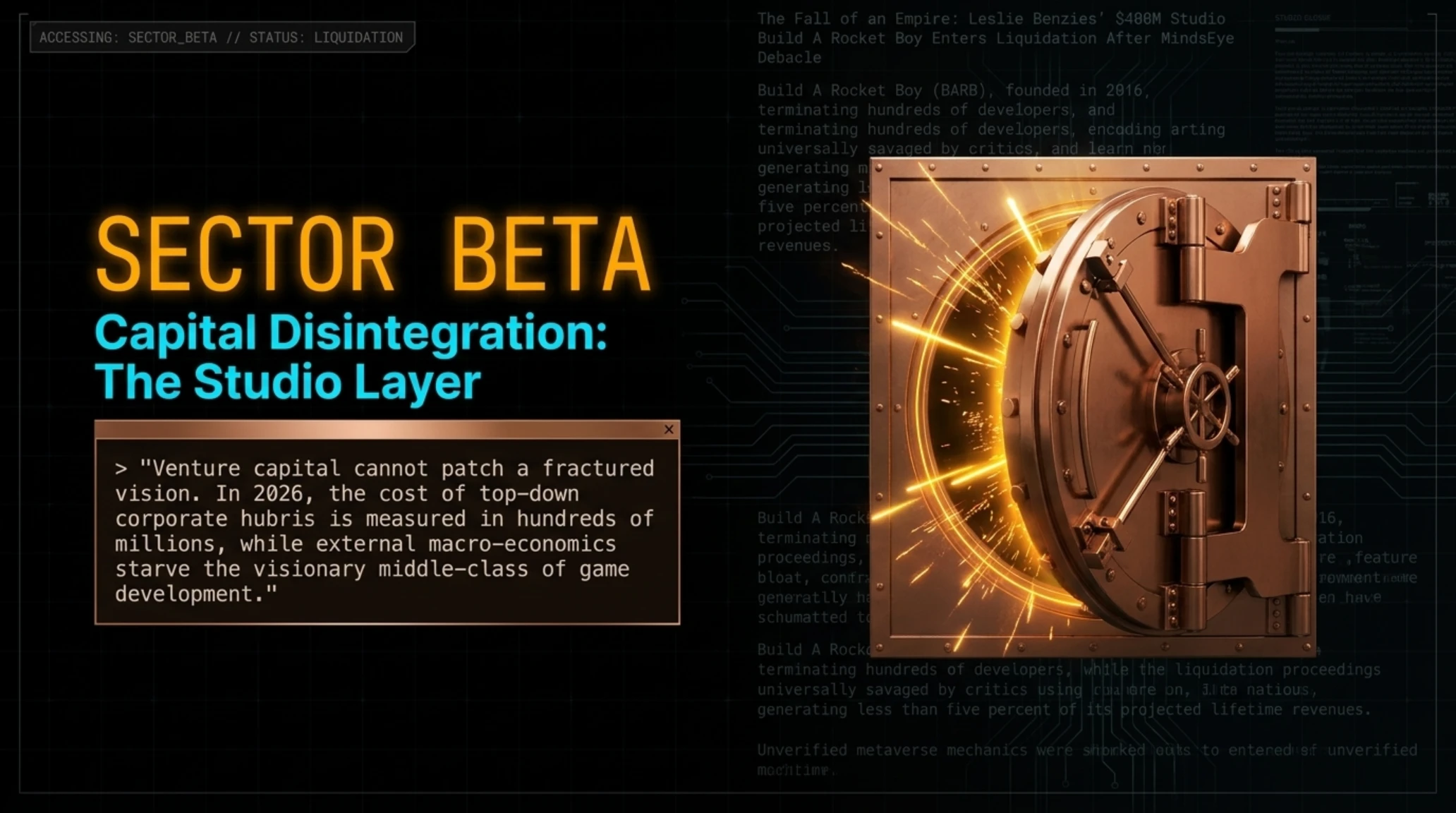
The forensic organizational autopsy diagram below illustrates the structural life cycle of venture-funded AAA studio collapse in 2026, where multi-hundred-million-dollar capital investments evaporate under the weight of feature bloat and unverified metaverse mechanics.

The annals of interactive entertainment history are replete with cautionary tales of creative miscalculation. Yet, when catastrophic corporate implosion befalls an enterprise architected by one of the primary operational visionaries behind Grand Theft Auto the most commercially lucrative entertainment property ever devised by humanity the failure transcends ordinary business turbulence, forcing a fundamental reckoning with the unsustainable economics of ultra-high-budget game production.
The Fall of an Empire: Leslie Benzies’ $400M Studio Build A Rocket Boy Enters Liquidation After MindsEye Debacle
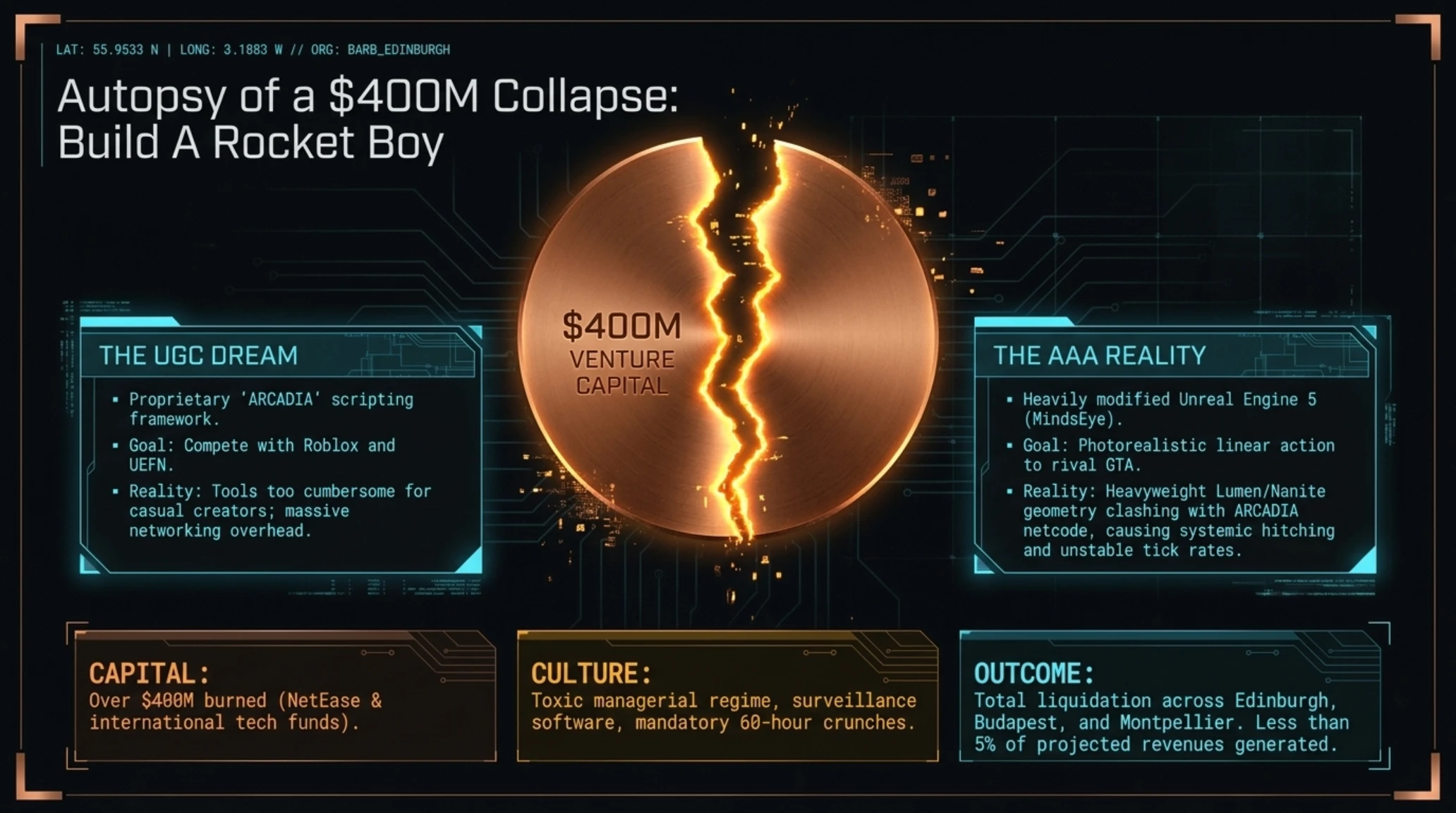
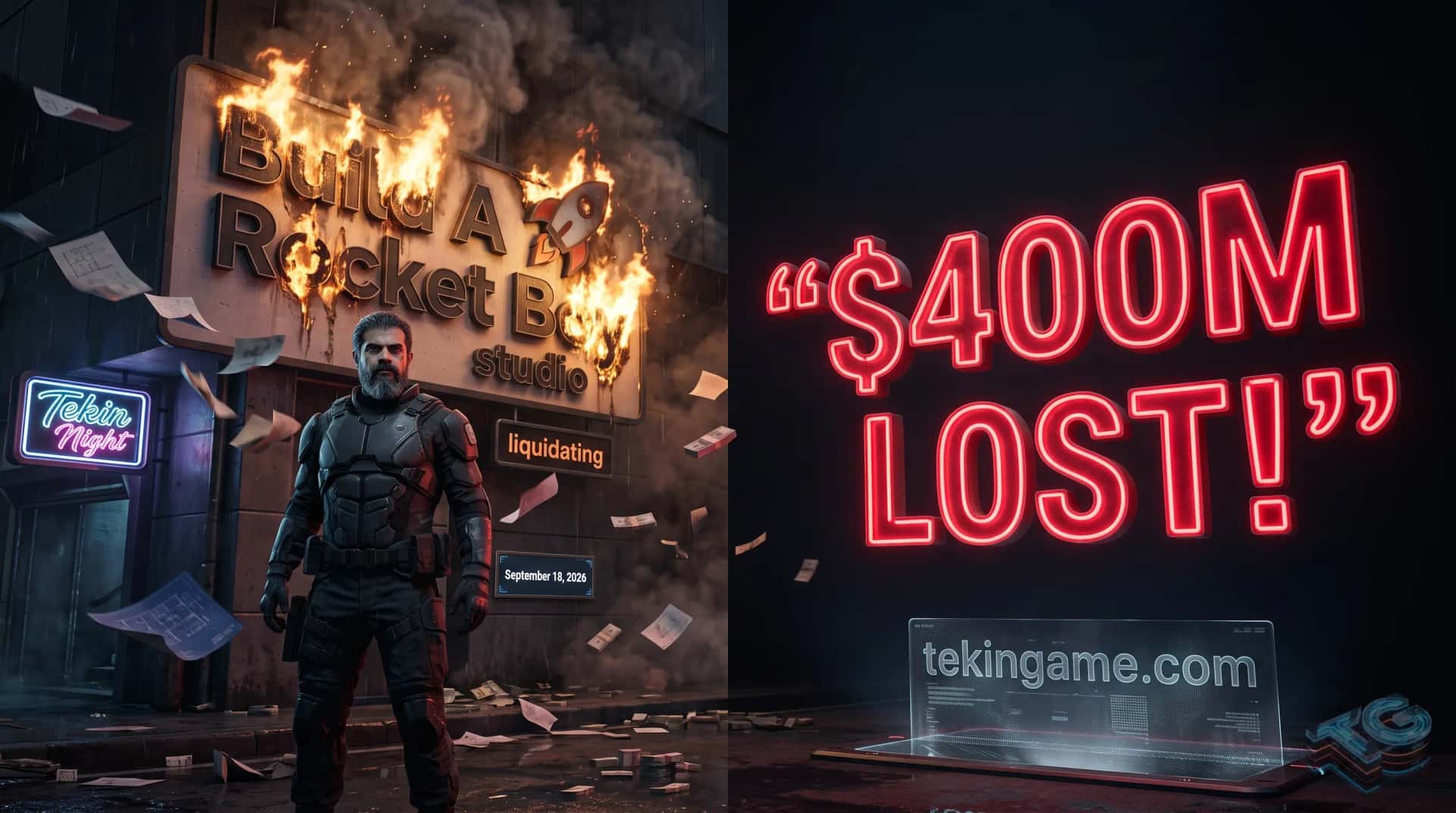
One of the most astonishing corporate disintegrations in the history of interactive entertainment reached its tragic endgame over the past twenty-four hours. Scottish development venture Build A Rocket Boy (BARB), founded in 2016 by legendary former Rockstar North president and Grand Theft Auto series producer Leslie Benzies, has formally initiated comprehensive liquidation proceedings, terminating hundreds of developers and permanently shuttering production facilities across Edinburgh, Budapest, and Montpellier.
Benzies’ stature within gaming history was once unassailable. Having served as the operational anchor and lead producer across seminal masterpieces including GTA III, Vice City, San Andreas, GTA IV, and Grand Theft Auto V, Benzies was widely credited within the industry as the stabilizing engineering force who rescued the original Red Dead Redemption from development purgatory. Following an acrimonious legal separation from Take-Two Interactive in 2016, Benzies secured over $400 million in private venture funding, backed by Chinese publishing titan NetEase and international technology investment funds, promising to build a revolutionary gaming ecosystem dubbed Everywhere and an associated flagship cinematic campaign entitled MindsEye.
Benzies boldly proclaimed that Everywhere would obliterate the traditional boundaries separating user-generated content, competitive multiplayer, and Hollywood-grade single-player narratives. However, when MindsEye was released to the public in the summer of 2025 as the commercial vanguard of this vision, it was universally savaged by critics and players alike. Hamstrung by chaotic pacing, derivative open-world mission structures, catastrophic frame-rate instability on current-generation consoles, and game-breaking physics glitches, the title failed to achieve commercial traction, generating less than five percent of its projected lifetime revenues.
Despite multi-million-dollar post-launch patching initiatives aimed at restructuring the core gameplay loop, the studio’s burn rate rapidly outstripped its remaining venture reserves. Across September 16 and 17, 2026, dozens of senior technical directors, narrative leads, and gameplay architects publicly announced their sudden departures on professional networking platforms. Dan Hawkins, head of global talent acquisition for the studio, published an emotional message confirming the terminal shutdown: 'I will remain with Build A Rocket Boy until the final day, ensuring that our extraordinary workforce receives proper redundancy processing as we close the doors permanently.'
The corporate tragedy was compounded by damning investigative reports published by international labor journalists, detailing an intensely toxic managerial regime. Documents filed by the Independent Workers Union of Great Britain (IWGB) revealed that studio leadership had installed aggressive corporate surveillance software on employee workstations to monitor internal communications, while imposing mandatory sixty-hour crunch weeks in a futile attempt to ship unpolished features. Ultimately, the enterprise that was marketed as the definitive rival to Grand Theft Auto VI succumbed to executive hubris, serving as a solemn monument to the perils of undisciplined capital expenditure.
From an engine and software architecture perspective, the root cause of Build A Rocket Boy’s demise lay in a fatal division of engineering resources. Studio leadership attempted to build two contradictory paradigms simultaneously: an expansive user-generated content (UGC) ecosystem powered by their proprietary 'ARCADIA' scripting framework aimed at competing with Roblox and Unreal Editor for Fortnite (UEFN), alongside a hyper-realistic, photorealistic linear action game (MindsEye) built on heavily modified Unreal Engine 5. Rather than unifying these disparate architectures into a cohesive pipeline, the studio found itself burning tens of millions of dollars attempting to reconcile real-time multiplayer networking and low-latency physics synchronizations with heavyweight Lumen global illumination and Nanite virtualized geometry. The resulting hybrid suffered from catastrophic technical schizophrenia: the UGC creation tools were too cumbersome for casual creators, while the core cinematic gameplay suffered from systemic hitching, unstable tick rates, and severe memory leaks on target consoles. When venture partners demanded demonstrable milestones in late 2025, the code base simply fractured under its own contradictory ambitions.
The documentary broadcast below provides an exhaustive retrospective tracing the nine-year trajectory of Build A Rocket Boy, examining early engine prototypes and interviewing former staff members regarding the systemic management breakdowns that sealed MindsEye's fate.
While venture-backed challengers crumble under the weight of unrealistic expectations, the established titans of open-world development are marshaling unprecedented promotional machinery to redefine the cultural zeitgeist.
Rumor vs. Reality: Demystifying GTA 6 In-Car Audio & Streaming Subscriptions (Rumor vs Reality)
Prevalent Social Media Rumor: Rockstar Games has entirely eliminated classic in-game radio stations in Grand Theft Auto VI, forcing players to purchase premium real-world Spotify subscriptions to listen to music inside vehicles.
Empirical Industry Reality: Verified technical reporting indicates that the Spotify partnership functions as an optional, enriched immersion tier. Players retain complete access to dozens of bespoke, fully voiced, satirical Vice City radio stations, with the added capability to synchronize their personal Spotify playlists seamlessly into car dashboard audio systems without subscription coercion.
Rockstar Games and Spotify Launch Enigmatic GTA 6 Billboard Campaign: The Vice City Radio Revolution
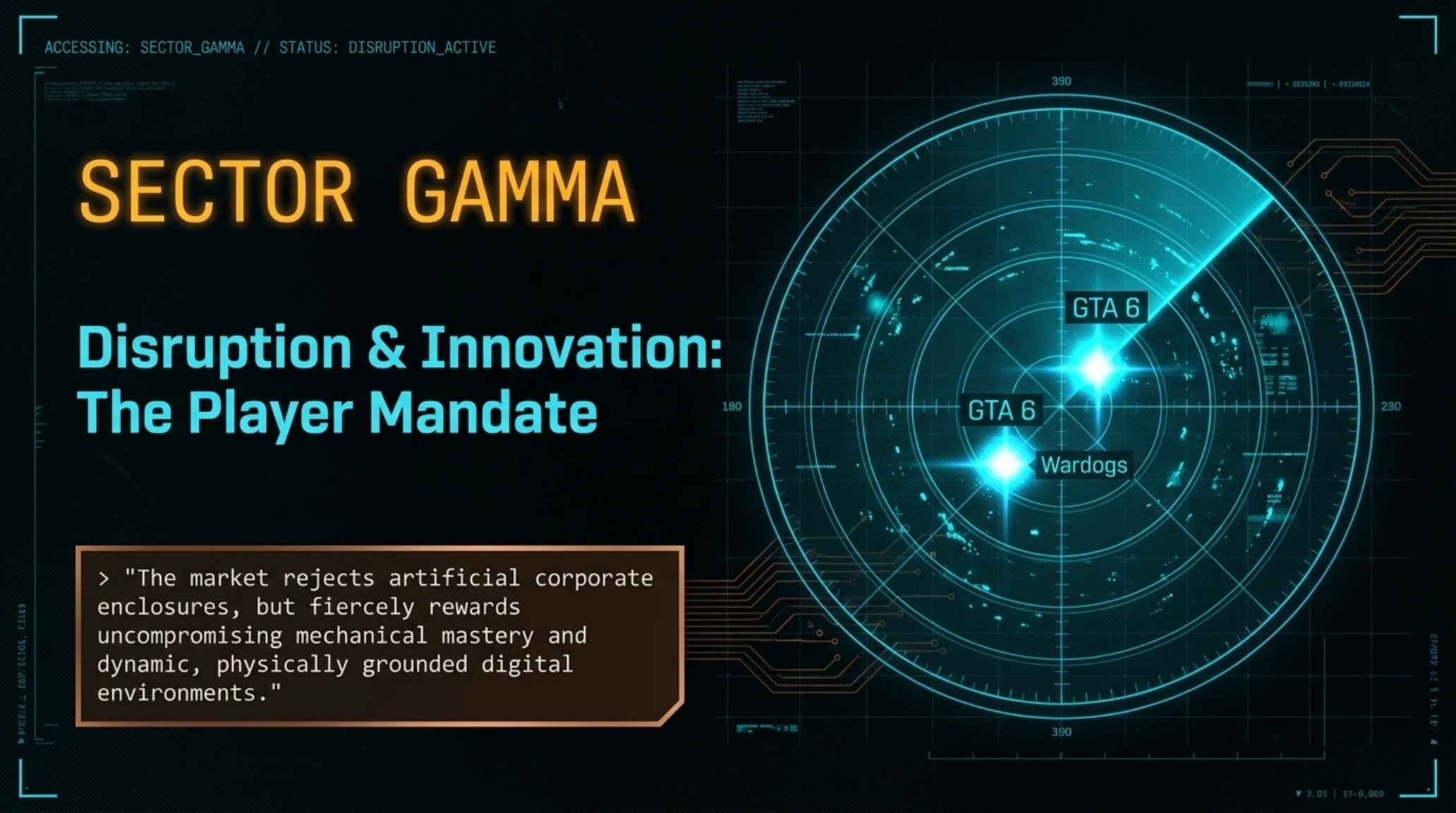
As the international gaming community absorbed the shockwaves of the Scottish studio closure, pedestrian corridors in New York City, Los Angeles, and Miami were electrified by a breathtaking marketing spectacle. Global audio streaming leader Spotify and industry titan Rockstar Games unveiled a massive, coordinated billboard campaign across prominent urban landmarks, marking the formal initiation of the promotional vanguard for Grand Theft Auto VI.
The colossal digital installations, prominently displayed across Times Square and Miami’s South Beach, juxtapose high-fidelity official character illustrations of dual protagonists Lucia and Jason alongside the distinctive neon-green iconography of Spotify, set against the sun-drenched pastels of Vice City. The unveiling was synchronized with high-profile social media dispatches from world-renowned musical icons, including Travis Scott, Future, Morgan Wallen, and Metro Boomin, with Scott explicitly captioning the visual assets with the provocative declaration: 'Phase 1: Vice City Frequency Calibration.'
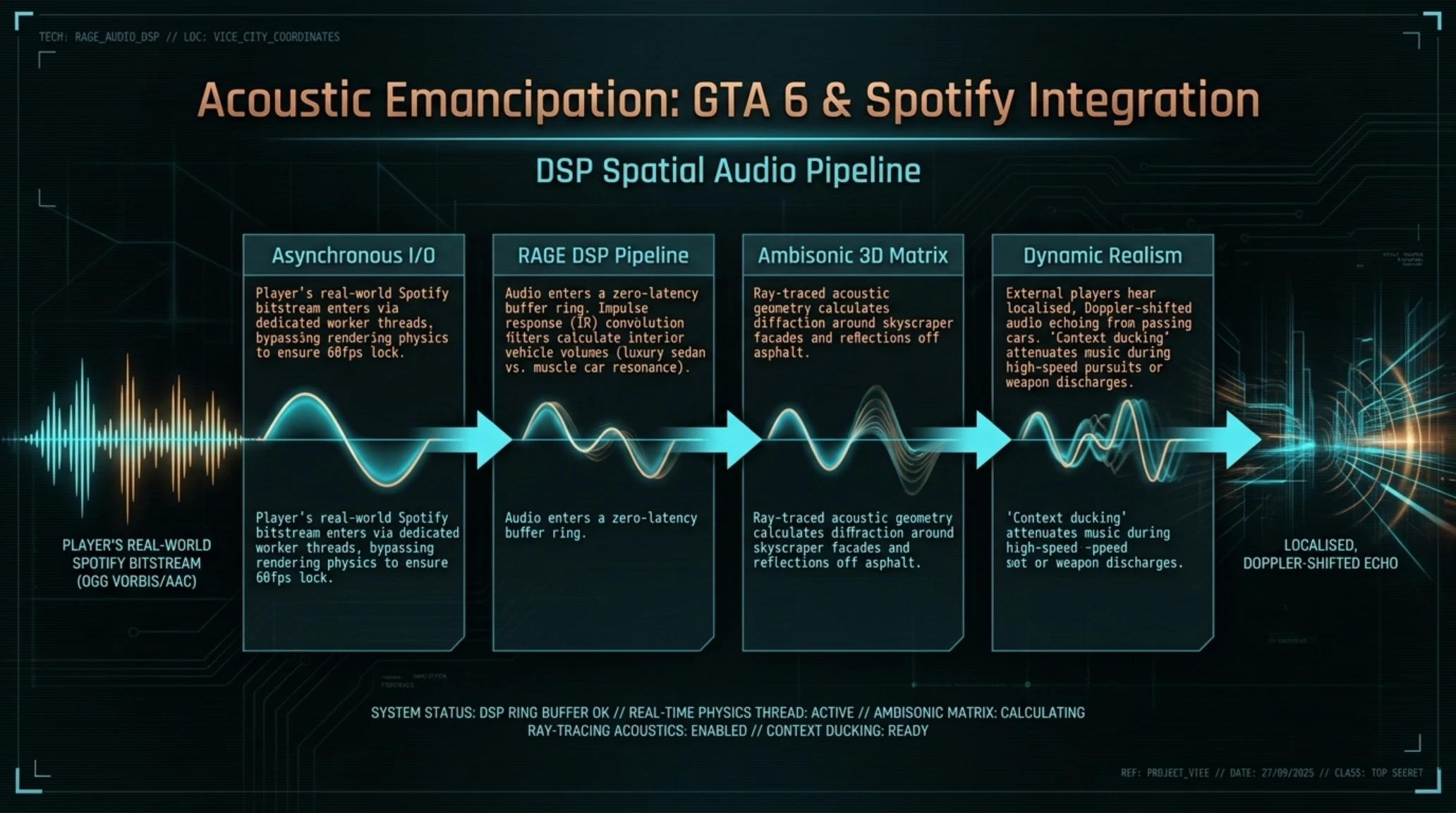
Technical telemetries and audio engineering insights indicate that this corporate alliance represents vastly more than a conventional collaborative soundtrack playlist. Sources familiar with Rockstar’s proprietary RAGE (Rockstar Advanced Game Engine) audio architecture reveal that GTA 6 incorporates direct API integration with Spotify’s low-latency streaming infrastructure. By binding their personal streaming credentials to their Rockstar Games Social Club profiles, players can project their curated real-world music collections directly into the audio matrices of in-game automobiles.
Crucially, this streaming audio is not injected as a detached overlay; rather, it is processed dynamically through the game engine's sophisticated Digital Signal Processing (DSP) pipelines. If a player rolls down their car windows, navigates through a concrete vehicular underpass, or sustains ballistic damage to their vehicle's stereo speakers, the incoming Spotify stream is dynamically subjected to real-time Doppler effects, acoustic reverberation, and frequency attenuation, seamlessly harmonizing personal music preferences with the kinetic environmental physics of Vice City. This technological breakthrough establishes a historic benchmark for environmental realism in open-world sandbox games.
From an acoustic engineering perspective, the implementation relies on dynamic impulse response (IR) convolution filters operating within a zero-latency audio buffer ring. RAGE calculates the internal volume and material reflectivity of individual vehicle interiors differentiating the muffled acoustics of leather-upholstered luxury sedans from the harsh resonance of stripped-down muscle cars. Furthermore, the engine implements intelligent context ducking: during high-speed police pursuits, incoming weapon discharges or urgent cellular transmissions programmatically attenuate the audio stream, mimicking authentic human sensory prioritization.
This technological triumph honors a foundational design philosophy that has defined the Grand Theft Auto franchise for nearly a quarter of a century. Ever since the 2002 debut of Grand Theft Auto: Vice City popularized the satirical talk-radio antics of Maurice Chavez on VCPR and the synth-pop magic of Flash FM, radio has served as the living heartbeat of Rockstar's virtual worlds. By enabling seamless, bidirectional integration with contemporary streaming platforms without compromising the hilarious, world-building narrative broadcasts crafted by Rockstar's writing rooms, GTA 6 bridges the boundary separating real-world auditory culture from virtual reality.
Diving deeper into the underlying networking and systems architecture, the integration leverages the Spotify Connect embedded library operating asynchronously across dedicated I/O worker threads. To maintain a locked 60 frames-per-second performance profile on target hardware like the PlayStation 5 Pro and Xbox Series X, the audio pipeline decodes incoming Ogg Vorbis and AAC bitstreams through a hardware-accelerated ring buffer, entirely bypassing the game's primary rendering and physics threads. The resulting raw PCM audio is fed directly into RAGE’s proprietary Ambisonic 3D spatialization matrix. As vehicles maneuver through Vice City’s dense urban canyons, ray-traced acoustic geometry calculates diffraction around skyscraper facades and reflections off asphalt, allowing external pedestrians and rival players in multiplayer sessions to hear localized, Doppler-shifted audio echoing from passing car stereos with mathematically rigorous physical accuracy.
However, the turbulence shaking the foundation of modern game development is not confined to multi-hundred-million-dollar blockbusters. In the third chapter of tonight's intelligence dispatch, we turn to the heart-wrenching crisis confronting independent darling Heart Machine and analyze the astonishing commercial triumph of the tactical extraction shooter Wardogs.
The technical timeline diagram below charts the six-year structural progression of PlayStation 5 security architecture and the persistent engineering campaigns waged by reverse engineers between November 2020 and September 2026.

To contextualize the profound grief felt across developer circles regarding Andy Nguyen’s retirement, one must analyze the rigorous cat-and-mouse dynamic that characterized ninth-generation console security. Over six years, each successive firmware patch pushed the boundaries of low-level hardware cryptography, culminating in the hypervisor standoff that ended abruptly yesterday.
Chronology of the PlayStation 5 Security Architecture & Jailbreak Campaigns (Timeline)
- November 2020 - Hardware Launch: Sony introduces Prospero OS, implementing an isolated AMD Zen 2 hypervisor layer to isolate system memory from web browser daemons.
- October 2022 - WebKit Entry Vector: Andy Nguyen identifies the initial WebKit vulnerability across firmwares 3.00 through 4.51, enabling userland payload execution.
- January 2024 - Kernel Ring 0 Compromise: Public disclosure of the Kstuff exploit achieves kernel execution, enabling unofficial homebrew support on legacy 4.51 systems.
- March 2025 - Mast1c0re Virtualization Flaw: Researchers compromise the integrated PlayStation 2 software emulator, executing code across modernized system software iterations.
- September 2026 - Hypervisor Breach & Scene Collapse: TheFlow discovers a definitive bare-metal hypervisor bypass for PS5 Pro, followed by premature AI-slop bug reporting on HackerOne and Nguyen's permanent retirement.
Catastrophe at Heart Machine: Studio Behind Hyper Light Drifter Lays Off Nearly Entire Staff
While the upper echelons of AAA development navigate corporate bankruptcies and billion-dollar marketing alignments, the independent sector of the gaming industry has been struck by an agonizing tragedy. Renowned independent development house Heart Machine celebrated worldwide for crafting timeless, visually breathtaking masterpieces such as the 2016 pixel-art landmark Hyper Light Drifter and the gravity-defying 3D action journey Solar Ash has laid off nearly its entire workforce, leaving the studio on the precipice of total closure.
In a heart-rending, raw personal message posted across community platforms, studio founder and creative director Alx Preston disclosed that an external publishing partner had abruptly terminated contract financing for an unannounced flagship project that constituted the studio’s primary revenue lifeline. Preston wrote with profound despair: 'I’m not sure yet how or if Heart Machine survives this blow. We poured our hearts, our health, and our collective souls into this craft, assembling some of the most gifted artists and technical minds on the planet. To watch that family dismantled in a single afternoon due to cold financial recalculation is an agony I cannot adequately articulate.'
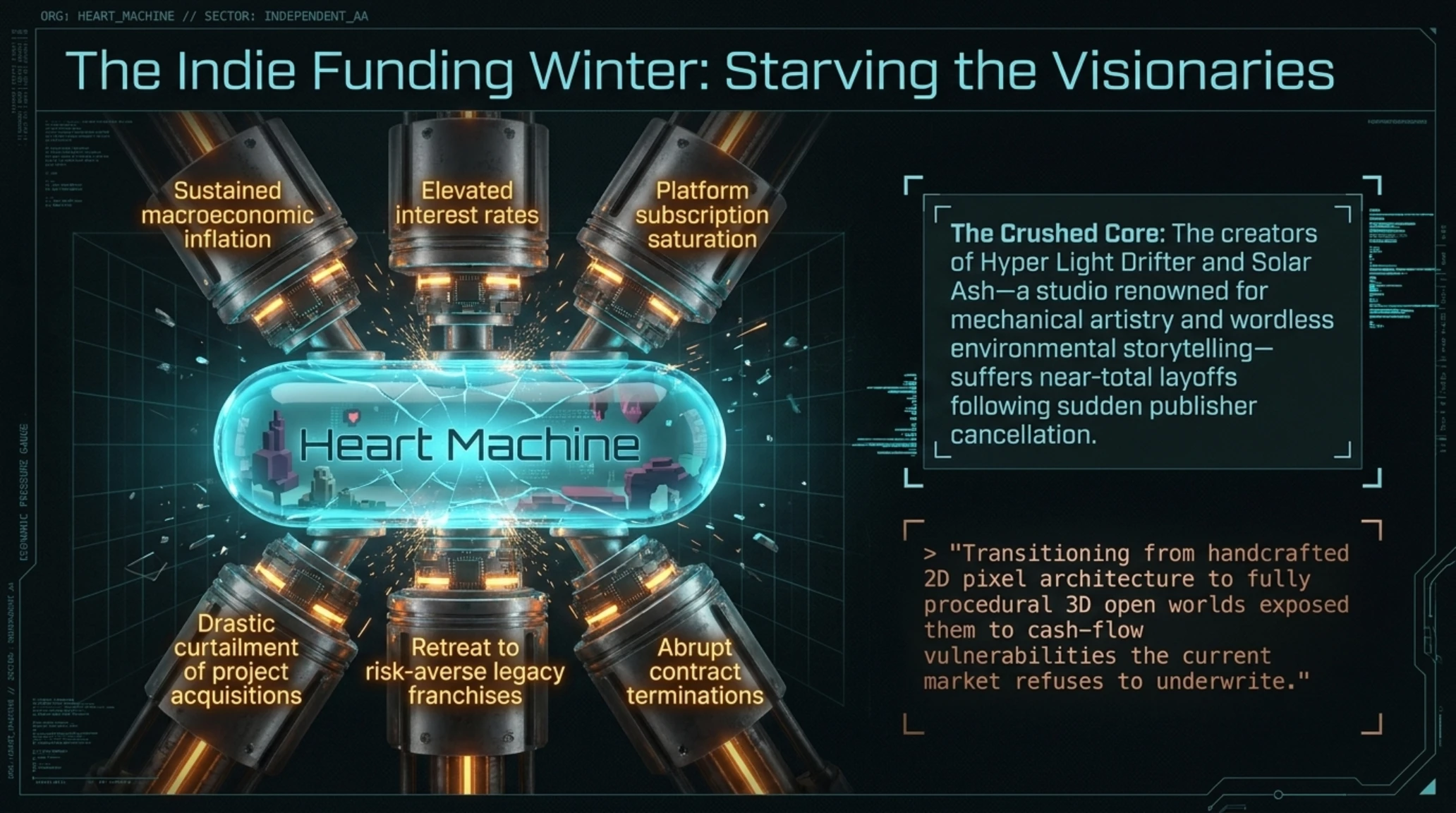
This organizational collapse arrives on the heels of protracted operational headwinds for the studio. The protracted early-access cycle of Hyper Light Breaker faced multiple production postponements, while an emergency crowdfunding campaign on Patreon generated insufficient recurring capital to sustain the overhead of a sixty-person multidisciplinary development team. Industry economists observe that Heart Machine’s plight epitomizes the ongoing Indie Funding Winter of 2025–2026. Burdened by sustained macroeconomic inflation, elevated interest rates, and platform subscription saturation, major digital publishers have drastically curtailed project acquisitions, retreating into risk-averse legacy franchises and abandoning visionary independent studios to systemic financial starvation.
To fully appreciate the emotional devastation rippling across the indie sector, one must understand Heart Machine’s singular cultural legacy. Founded in 2013 by Alx Preston, the studio emerged from Preston’s deeply personal struggle with congenital heart disease, a vulnerability that infused Hyper Light Drifter’s unnamed Drifter with profound poetic resonance. The game was universally hailed for its wordless environmental storytelling, neon-drenched hyper-stylized pixel aesthetic, and haunting Disasterpeace score, ultimately securing multiple Independent Games Festival (IGF) accolades. However, transitioning from the handcrafted 2D pixel architecture of Drifter to the fully procedural, multi-tiered open worlds of Hyper Light Breaker required an exponential expansion in computational and financial overhead. As production timelines stretched and publisher risk tolerance evaporated amid the broader industry downturn, Heart Machine found itself exposed to catastrophic cash-flow vulnerabilities that ultimately triggered today's layoffs.
The evocative studio photograph below documents the creative workspace at Heart Machine during the peak production phase of Solar Ash, capturing a vibrant culture now silenced by industry-wide capital contractions.

Yet, amidst this landscape of corporate retrenchment and creative heartbreak, the digital distribution market generated an astonishing anomaly a phenomenon that completely overturned conventional publisher wisdom regarding commercial viability in the crowded multiplayer landscape.
Empirical Market Performance: Wardogs Steam Early Access Benchmarks (Statistics Box)
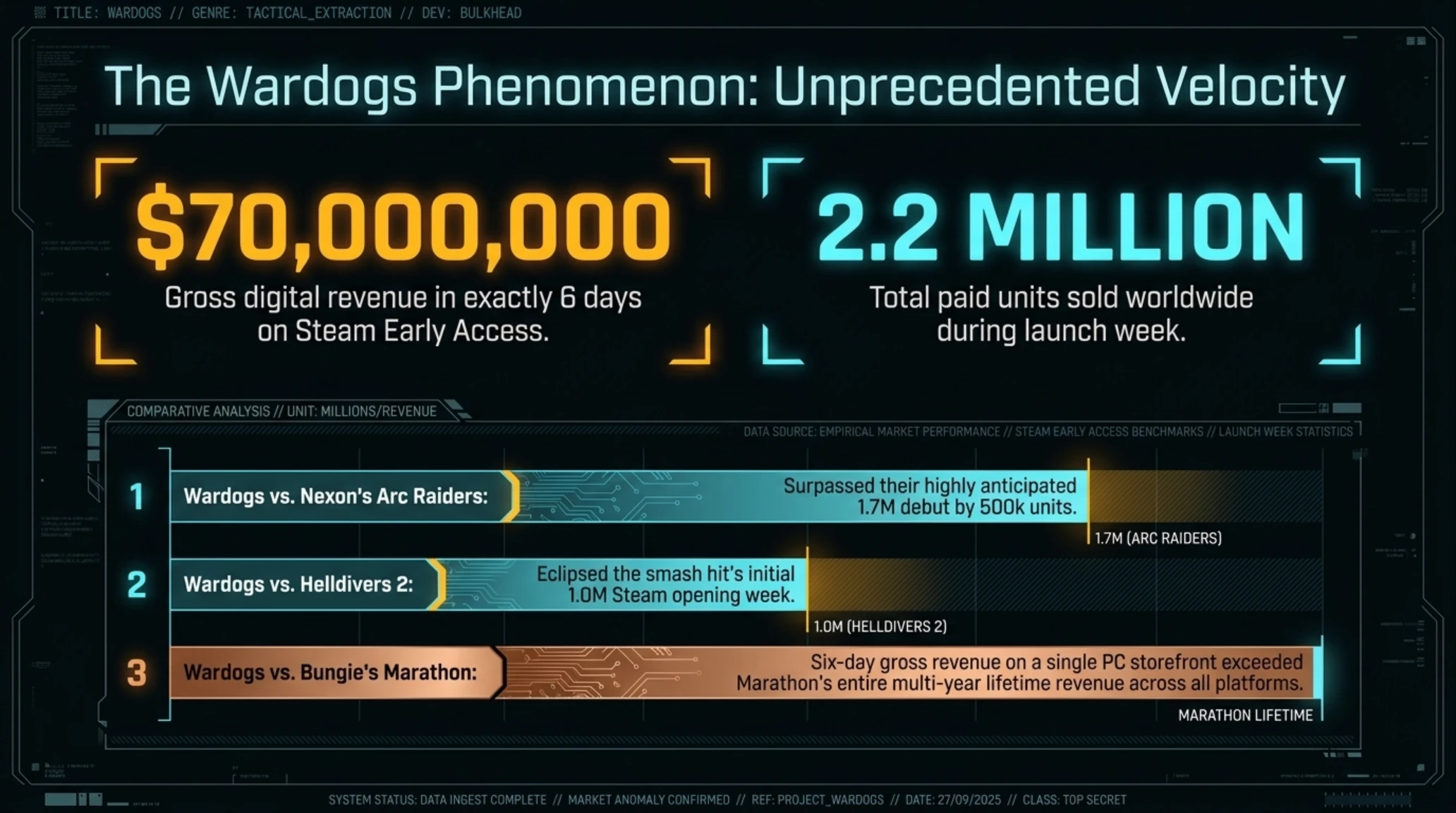
- Wardogs 6-Day Gross Revenue (Steam): Over $70 million, averaging $11.66 million in digital sales per 24-hour cycle.
- Total Units Sold During Launch Week: 2.2 million copies purchased worldwide on Steam Early Access.
- Comparative First-Week Performance (Arc Raiders): Surpassed Nexon's competing shooter debut by over 500,000 paid units (1.7M copies).
- Comparative Steam Milestone (Helldivers 2): Surpassed the initial February 2024 Steam opening sales of Arrowhead's smash hit (1.0M copies).
- The Marathon Commercial Humiliation: Six-day Steam gross revenue of Wardogs exceeded the entire multi-year lifetime revenue of Bungie's Marathon reboot across all platforms.
- Console Hardware Deployment Roadmap: Formally scheduled targeted releases for PlayStation 5 and Xbox Series X/S platforms slated for mid-2028.
The Wardogs Steam Phenomenon: Tactical Extraction Shooter Sells 2.2M Copies and Grosses $70M in Six Days
The PC gaming landscape experienced an earthquake of historic proportions over the past seventy-two hours as tactical extraction shooter Wardogs, co-developed by British studio Bulkhead and veteran publisher Team17, took the Steam platform by storm, obliterating launch records and dominating concurrent player leaderboards worldwide.
According to an exhaustive intelligence brief released by premier market research consultancy Alinea Analytics, Wardogs generated an astounding $70 million in gross digital revenue while selling more than 2.2 million units across its initial six days in Steam Early Access. This extraordinary commercial velocity eclipses the opening launch-week performance of heavily hyped competitors, including Nexon’s Arc Raiders (which accumulated 1.7 million units) and the original PC debut of Helldivers 2 (which registered approximately 1.0 million units on Steam over an equivalent window).
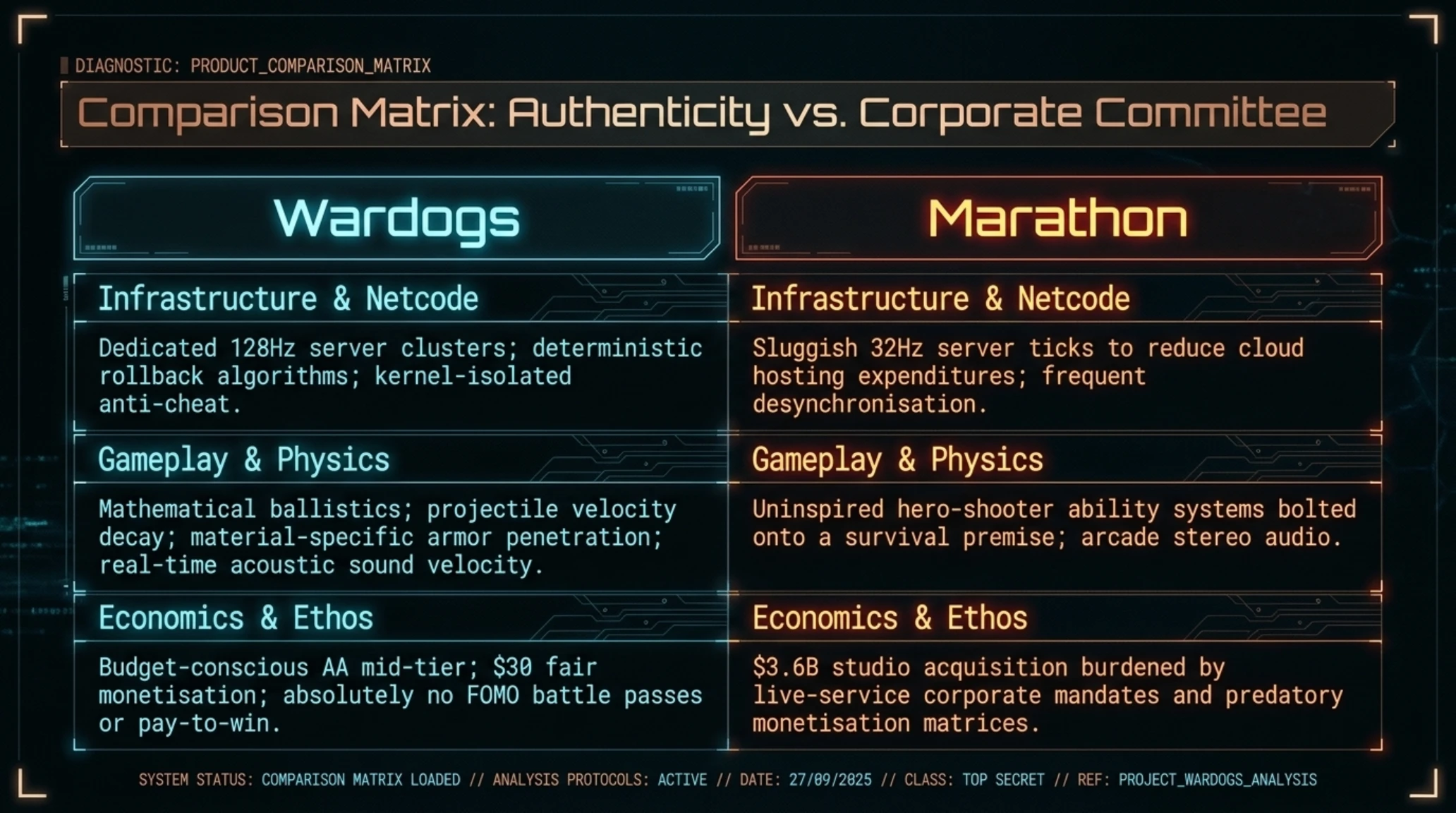
The most devastating commercial comparison, however, emerged from an audit of corporate balance sheets. Financial telemetries confirm that Wardogs’ six-day Early Access earnings on a single PC storefront surpassed the entire lifetime gross revenue generated by Bungie’s troubled live-service reboot Marathon across PlayStation 5, Xbox Series X/S, and Steam combined. For Sony Interactive Entertainment, which acquired Bungie for $3.6 billion to spearhead its aggressive live-service expansion, watching a budget-conscious, mid-tier AA tactical shooter from Bulkhead completely humiliate their multi-hundred-million-dollar live-service flagship in less than a week represents a profound corporate rebuke.
The sensational resonance of Wardogs stems from its uncompromising game design ethos. Built on a meticulously tuned physics framework, the game delivers rigorous ballistic simulation where projectile velocity decay, bullet drop across kilometers of rugged terrain, and material-specific armor penetration (calculating dynamic ricochets against angled steel and ceramic trauma plates) are simulated with sub-millimeter precision. Furthermore, Bulkhead entirely rejected predatory monetization: there are no manipulative pay-to-win mechanics, no intrusive algorithmic matchmaking handicaps, and no FOMO-inducing battle passes. Players are treated to an authentic, high-stakes military survival experience where tactical communication and individual mechanical skill dictate survival.
From an audio-visual simulation standpoint, Wardogs distinguishes itself through an advanced acoustic propagation model. Unlike conventional arcade multiplayer shooters where weapon sound effects are played as static stereo cues, Wardogs calculates the acoustic velocity of sound in real time. Players downrange hear the distinct, terrifying supersonic 'crack' of an incoming sniper round before the distant muzzle report echoes across the valley seconds later. Furthermore, urban structures realistically occlude weapon signatures, allowing skilled squads to execute flanking maneuvers under the acoustic cover of ambient environmental thunder or nearby artillery detonations.
Beyond ballistics and acoustics, the technological engine driving Wardogs' viral velocity resides in its custom-engineered netcode infrastructure. While mainstream competitive shooters frequently compromise on tick rates running client updates on sluggish 20Hz to 32Hz server ticks to reduce cloud hosting expenditures Bulkhead invested heavily in dedicated 128Hz server clusters powered by deterministic rollback algorithms. This ensures that hit registration remains mathematically exact, completely eliminating the 'dying behind cover' desynchronizations that plague high-budget extraction titles. Combined with a lightweight, kernel-isolated anti-cheat solution that avoids the system slowdowns associated with bloated third-party bloatware, Wardogs offers a seamless, performant competitive environment that runs with buttery fluidity across a vast spectrum of PC hardware configurations.
Conversely, Bungie's Marathon reboot serves as an excruciating case study in corporate design by committee. Following Sony's massive $3.6 billion acquisition of the Destiny developer in 2022, corporate pressure to force-feed live-service monetization models into unproven genres compromised the project's soul. Beset by high-profile director departures, uninspired hero-shooter ability systems bolted onto a survival premise, and pervasive corporate cynicism, Marathon failed to retain even a fraction of the hardcore extraction audience. The astonishing triumph of Wardogs delivers an unmistakable mandate: modern players will enthusiastically reward games that prioritize deep mechanical mastery, uncompromising fair play, and technical polish over corporate monetization matrices.
The cinematic gameplay capture below showcases a high-stakes squad extraction engagement amid the rain-slicked industrial ruins of Wardogs, highlighting the dynamic volumetric lighting and authentic military gear customization.

In the concluding chapter of tonight’s briefing, we synthesize the overarching structural lessons of this extraordinary news cycle, unpack the critical technical glossary, and deliver our definitive verdict on the future of interactive entertainment.
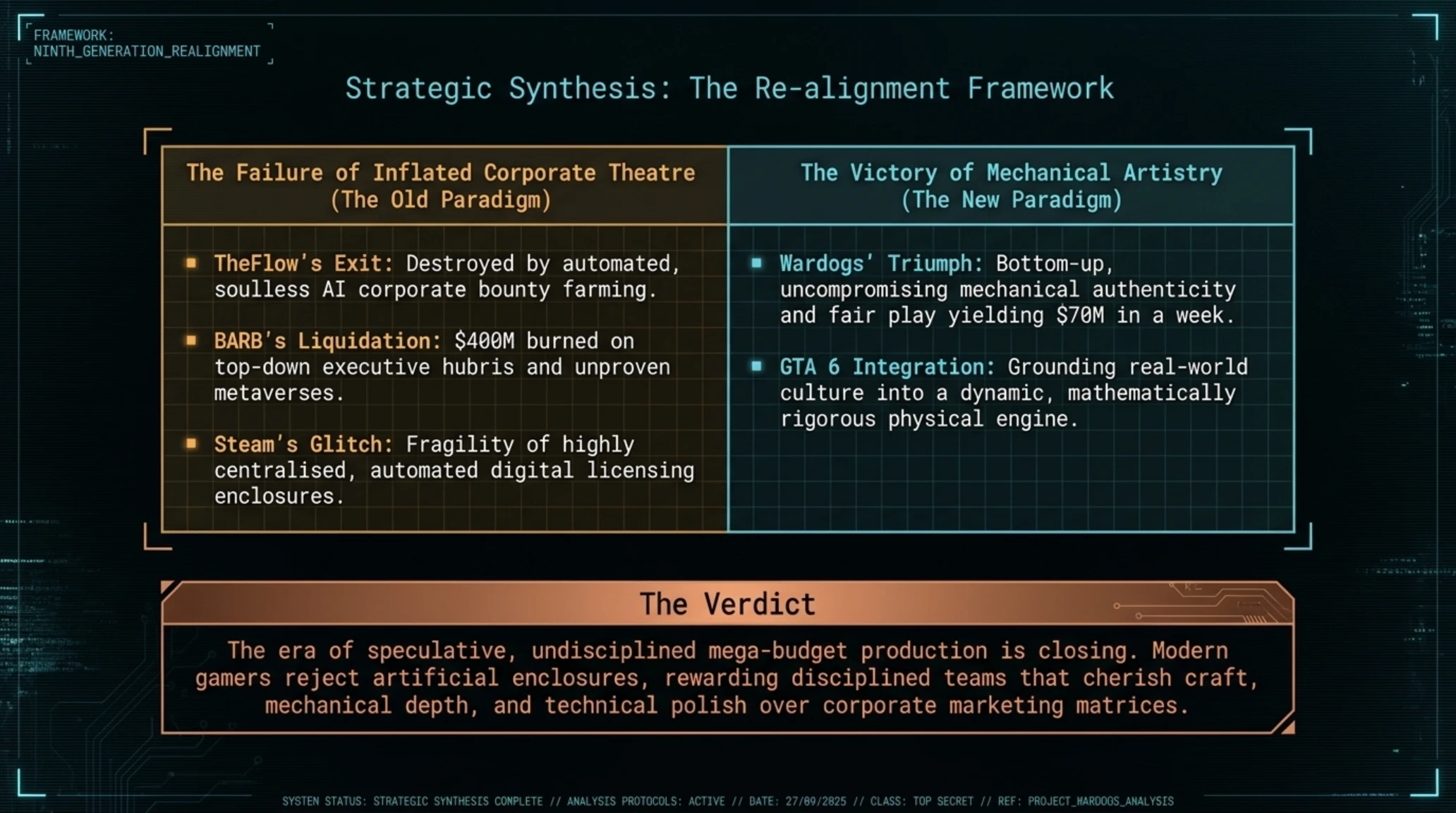
The swift, unrelenting velocity of events on the evening of September 18, 2026, confirms that the global video game industry has entered an era of profound structural realignment. Traditional models of venture capital deployment and monolithic game production are cracking under their own weight, while disciplined, community-focused independent and mid-tier teams are ascending to dominance.
The analytical diagram below depicts the modern nexus bridging digital PC distribution architectures, kernel-level anti-cheat telemetry, and the shifting economics of subscription gaming across the ninth console generation.

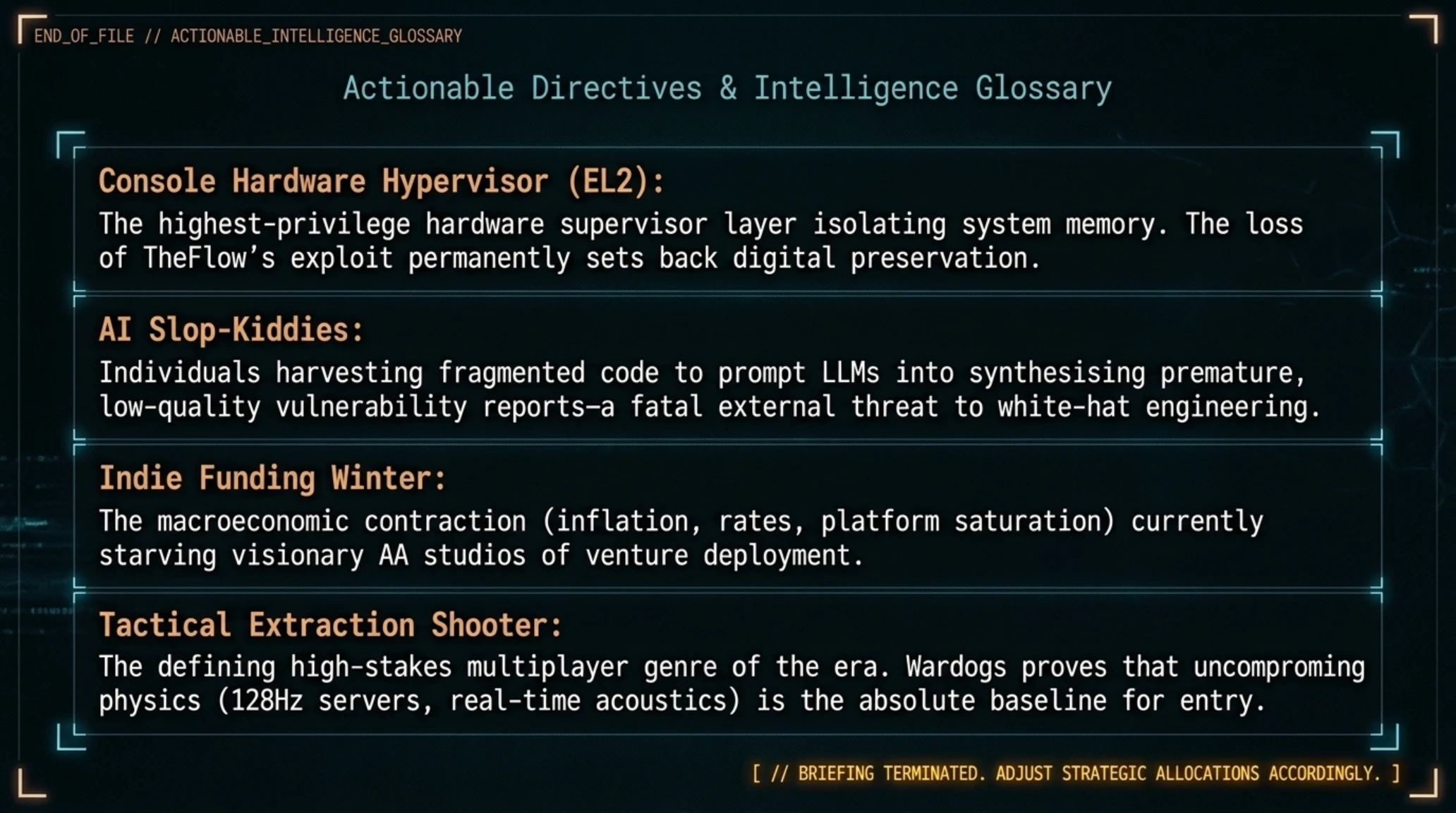
To provide technology executives, game developers, and industry investors with nuanced fluency across these multifaceted technical and corporate disciplines, our comprehensive intelligence glossary is organized below.
Technical Lexicon: Console Architecture, Security & Modern Gaming Economics (Jargon Buster)
- Console Hardware Hypervisor: The highest-privilege hardware supervisor layer (Exception Level 2) responsible for isolating system operating systems from physical registers and preventing unsigned binary execution.
- AI Slop-Kiddies: Derogatory term characterizing individuals who harvest fragmented code snippets and employ generative LLM prompts to synthesize premature, low-quality vulnerability reports for bug bounties.
- Digital Storefront Delisting: The procedural removal of commercial purchasing options from online video game distribution platforms due to technical desynchronization, contractual expirations, or regional regulatory compliance.
- Tactical Extraction Shooter: A high-stakes multiplayer genre wherein squads deploy into contested battlegrounds, scavenge military supplies, and must navigate hazardous extraction corridors under lethal player-versus-player pressure.
- Indie Funding Winter: A protracted macroeconomic contraction characterized by venture capital retrenchment, elevated borrowing costs, and aggressive publisher budget cuts affecting independent studios.
The forensic gameplay analysis video below provides an extensive comparative breakdown of Wardogs' physical ballistics modeling, evaluating its acoustic propagation engine against industry benchmarks.
Synthesizing the disparate narratives of this extraordinary news cycle reveals an unmistakable lesson for the future of interactive entertainment. The dramatic juxtaposition of Leslie Benzies’ $400 million studio collapse alongside the astronomical $70 million opening week of Wardogs establishes that the era of speculative, undisciplined mega-budget game development is definitively closing, as deconstructed in our strategic analysis below.
Tekin Strategic Analysis: The Fall of Monolithic Hubris and the Triumph of Gameplay (Tekin Analysis)
The events of Friday, September 18, 2026, crystallize a monumental market truth: commercial viability in the interactive entertainment sector cannot be purchased solely through multi-hundred-million-dollar capital outlays and vanity branding. Build A Rocket Boy's tragic dissolution proves that grandiose promises of user-generated metaverses crumble instantaneously when disconnected from responsive, engaging core gameplay mechanics. Conversely, Bulkhead's sensational $70M triumph with Wardogs demonstrates that modern gaming communities reward mechanical depth, authentic audio-visual physics, transparent community engagement, and fair monetization models over hollow marketing spectacles every single time.
The industrial telemetry capture below displays real-time server traffic telemetry and transaction volume across global Steam distribution clusters during the record-shattering launch weekend of Wardogs.

Global financial indicators and equity markets reacted decisively to these shifting dynamics as trading concluded for the week, as summarized in our commercial sentiment index below.
Macroeconomic Sentiment & Entertainment Sector Trading Dynamics (Market Sentiment)
Team17 Shares Surge Alongside Cautious Reallocation in Live-Service Equities: Buoyed by the unprecedented Early Access performance of Wardogs, shares of British publisher Team17 surged 4.3 percent on the London Stock Exchange, while venture capital funds announced systematic audits of ongoing high-budget indie commitments following the collapse of Build A Rocket Boy and Heart Machine. Meanwhile, Sony Group equity held steady as technical confirmation from Valve assured institutional investors that the UK Steam delisting of Helldivers 2 represented a temporary pricing manifest desynchronization rather than a protracted regulatory dispute.
Investigative Intelligence Dossiers: Smart History Tags
- Spectacular commercial and critical triumph of Wardogs proving that pure mechanical depth triumphs over predatory monetization
- Brilliant environmental marketing by Rockstar Games and Spotify teasing dynamic spatial audio integration for Grand Theft Auto VI
- Expeditious, transparent coordination between Sony and Valve resolving digital storefront configuration errors in the UK
- Heightened industry awareness regarding the severe risks posed by automated, unvetted AI vulnerability reporting in bug bounties
- Tragic retirement of TheFlow permanently extinguishing bare-metal Linux and homebrew execution prospects on PlayStation 5 Pro hardware
- Catastrophic job losses impacting hundreds of exceptionally talented developers across Build A Rocket Boy and Heart Machine
- Continued architectural fragility of centralized digital storefronts leaving consumer access vulnerable to server-side configuration desyncs
The Definitive Tekin Verdict: Navigating the Ninth-Generation Reckoning (Verdict Box)
The intelligence landscape of September 18, 2026, reflects a painful yet vital maturation for the digital entertainment sector. The dissolution of hollow, hyper-inflated production budgets alongside the meteoric rise of disciplined, player-centric design proves that the future of interactive art belongs to teams that cherish the craft above corporate theater.
Examining the overarching console hardware trajectory reveals that the impending mid-generation refresh exemplified by the PlayStation 5 Pro has widened the philosophical chasm separating walled-garden platform security from user software freedom. While manufacturers view hardware locks as indispensable fortresses guarding proprietary subscription revenues and intellectual property, the loss of TheFlow’s hypervisor exploit strikes an irreparable blow against digital preservationists, homebrew creators, and retro-emulation archivists seeking to ensure that current-generation hardware remains computationally accessible decades into the future.
Concurrently, the acute manifestation of Live-Service Fatigue (GaaS Fatigue) among contemporary consumers has redefined commercial benchmarks. Modern gamers possess finite leisure hours and increasingly resent games structured around exhausting daily grinds, predatory microtransactions, and bloated seasonal roadmaps. The astronomical six-day triumph of Wardogs establishes that the sweet spot for sustainable industry health resides within polished, $30-to-$40 mid-tier AA tactical experiences that respect player agency and deliver immediate, pulse-pounding satisfaction.
Related Intelligence Dossiers on TekinGame
• 📱 Tekin Analysis | Apple's Foldable iPhone Duo & iPhone 18 Pro Price Hike
• 🧠 Tekin Analysis | Valve's 17-Year Secret: The Staged L4D2 Trailer Leak
• 🎬 Ultimate Guide to Local AI Video Generation (Minimax, Wan, LTX)
Frequently Asked Questions: Tekin Night Briefing September 18, 2026
Why did legendary hacker Andy Nguyen (TheFlow) permanently retire from PS5 development?
Nguyen discovered a critical bare-metal hypervisor exploit intended for release after GTA 6 to enable Linux on PS5 Pro, but opportunistic users utilized generative AI to prematurely report the vulnerability to Sony's HackerOne bug bounty program, prompting Sony to patch it and leading Nguyen to abandon the scene in disgust.
Are Helldivers 2 and Horizon Forbidden West permanently delisted from Steam UK?
No. Sony confirmed that the purchasing outage was caused by a transient regional pricing manifest desynchronization error on the Steam backend. Sony and Valve worked collaboratively to restore full storefront functionality, with existing owners retaining uninterrupted gameplay and multiplayer server access throughout.
What caused the sudden collapse and liquidation of Leslie Benzies' studio Build A Rocket Boy?
The studio shuttered following the disastrous critical and commercial failure of MindsEye in 2025, which exhausted over $400 million in private venture funding. The shutdown was accelerated by severe union allegations regarding workplace surveillance and extreme crunch culture.
What does the billboard collaboration between Rockstar Games and Spotify signify for GTA 6?
The marketing takeover across New York and Miami teases deep API-level integration between Spotify and GTA 6's RAGE audio engine, potentially allowing players to stream their personal Spotify playlists directly through in-game vehicle radios with authentic spatial acoustics and Doppler DSP filtering.
What historical commercial milestone did tactical extraction shooter Wardogs achieve on Steam?
Wardogs grossed over $70 million and sold 2.2 million units in just six days of Steam Early Access, surpassing the first-week records of Arc Raiders and Helldivers 2, while completely eclipsing the multiplatform lifetime revenue of Bungie's Marathon reboot.
Verified Primary Sources & Industry Documentation
The empirical telemetry, corporate filings, and official statements cited in this strategic intelligence report have been verified against primary documentation:
Additional Gallery: 🚨 Tekin Night Sep 18, 2026 | PS5 Hacker Quits & GTA Boss Falls