Takin Analysis | Gaming Seismic Shift: BioWare Studio Closure, EA Star Wars Gamble, FFXIV Delay, and Console Sales Divergence
The closing hours of Sunday, November 1, 2026, will be recorded by industry historians as a dramatic watershed in the political economy of interactive entertainment. A sector that once drew its primary momentum from auteur storytelling, uncompromising technical experimentation, and bespoke engine architecture is now undergoing a painful, structural rationalization driven by macro debt cycles, high interest rates, and the ruthless calculus of institutional capital.
Across both public equity conglomerates and bootstrapped independent studios, the rules of commercial survival have radically altered. Following the polarized market reception we analyzed in our October 2026 Game Sales Autopsy, Electronic Arts has liquidated the venerated halls of BioWare in an existential balance-sheet restructuring, while console platform holders witness a sharp divergence in exclusive hardware pull.
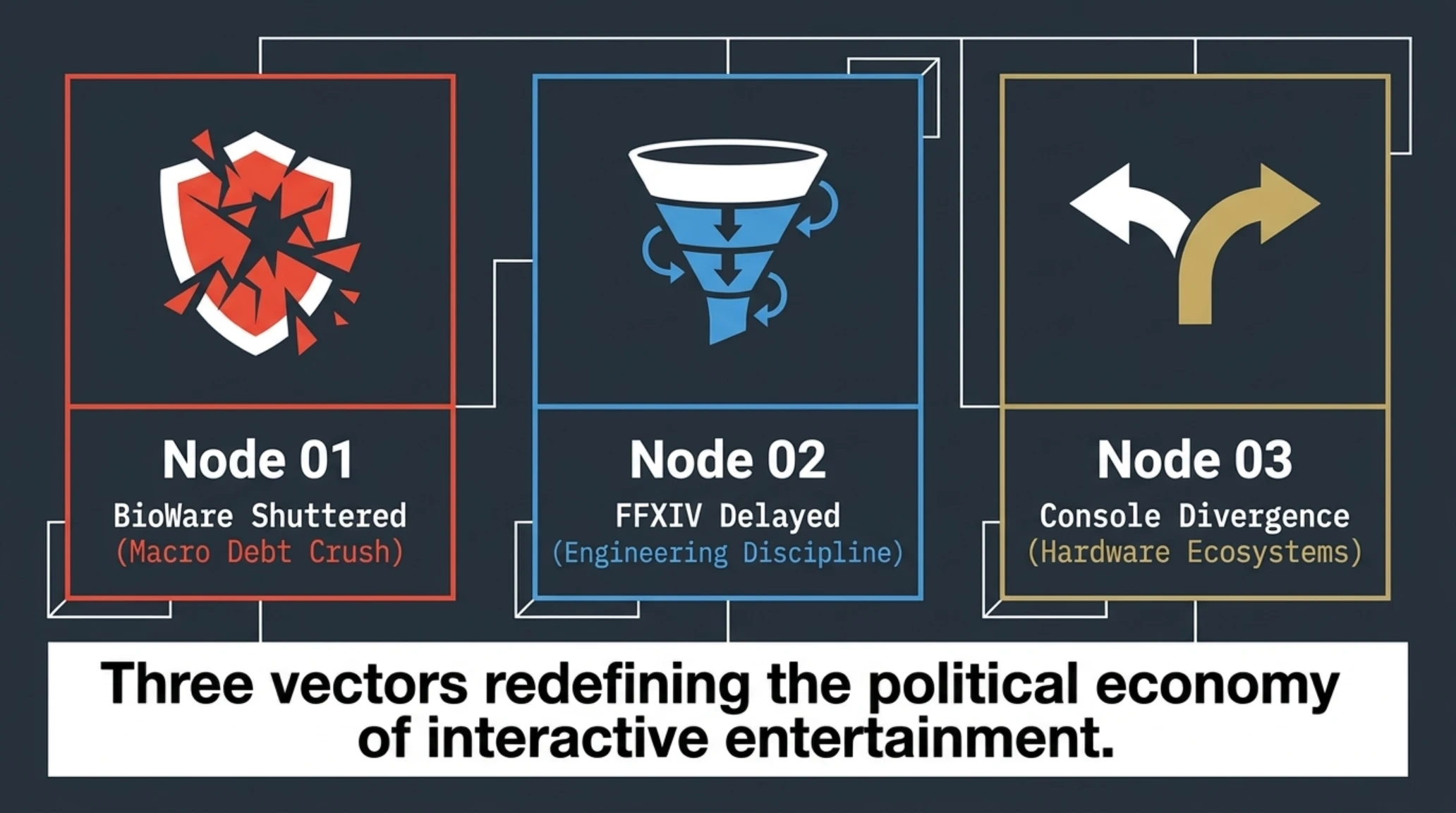
Concurrently, building upon the macro industry shifts documented in our October 2026 Monthly Strategic Dossier, frontier artificial intelligence labs are discovering that unbridled code generation poses existential threats to digital craftsmanship, prompting defensive engineering interventions. The Takin Plus intelligence desk provides this comprehensive evening autopsy of the six structural vectors redefining global gaming.
The intersection of macroeconomic tightening and platform disruption has created a Darwinian operating environment where traditional creative cushions have dissolved. Studios are no longer permitted decade-long gestation periods without verifiable intermediate revenue gates, accelerating the bifurcation between industrial-scale live services and nimble independent artisans.
Strategic Intelligence Overview // Core Actionable Vectors
The Dissolution of an RPG Empire: Why Electronic Arts Liquidated BioWare and Sacrificed Mass Effect 5 to Double Down on Star Wars Battlefront 3
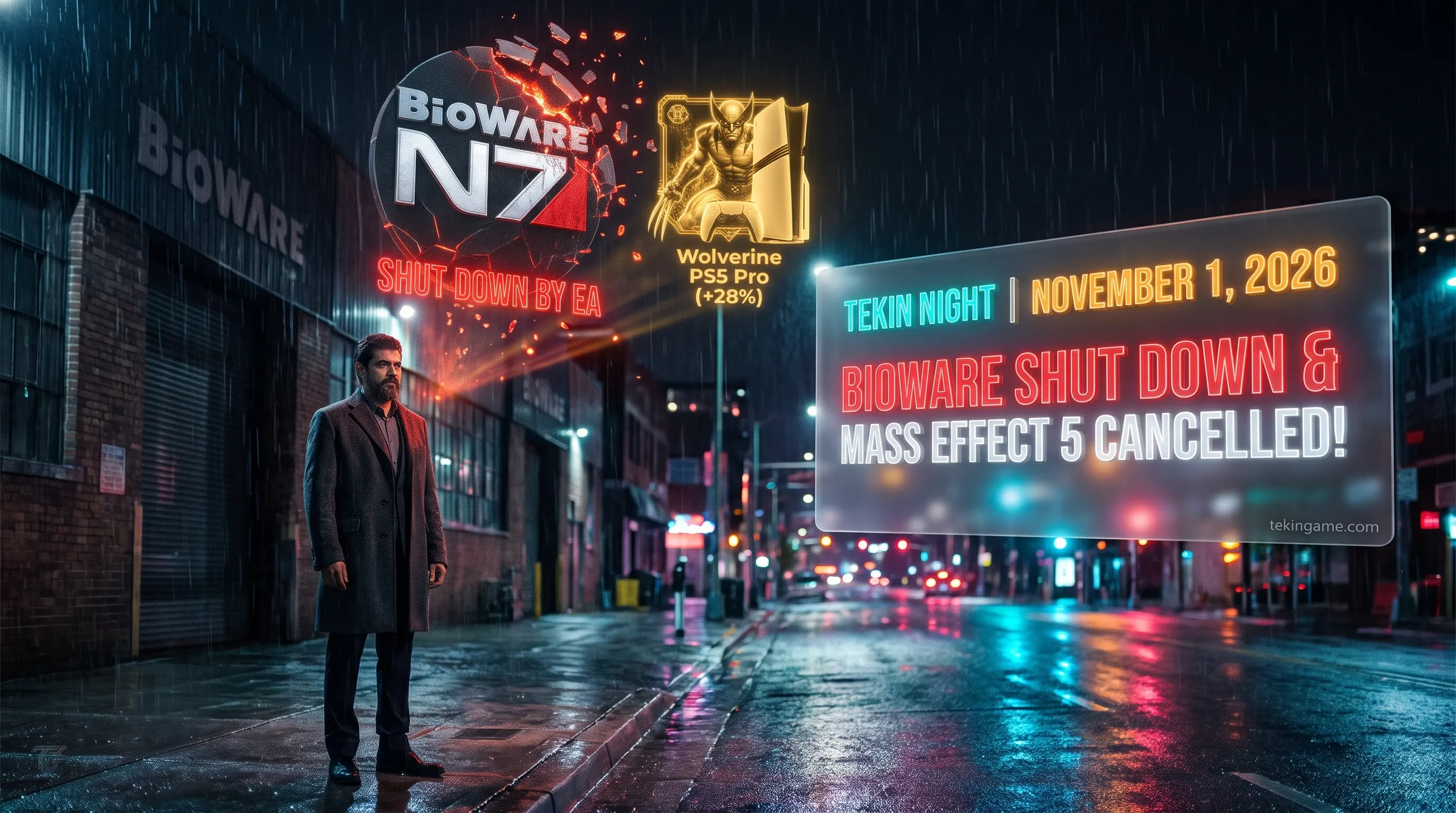
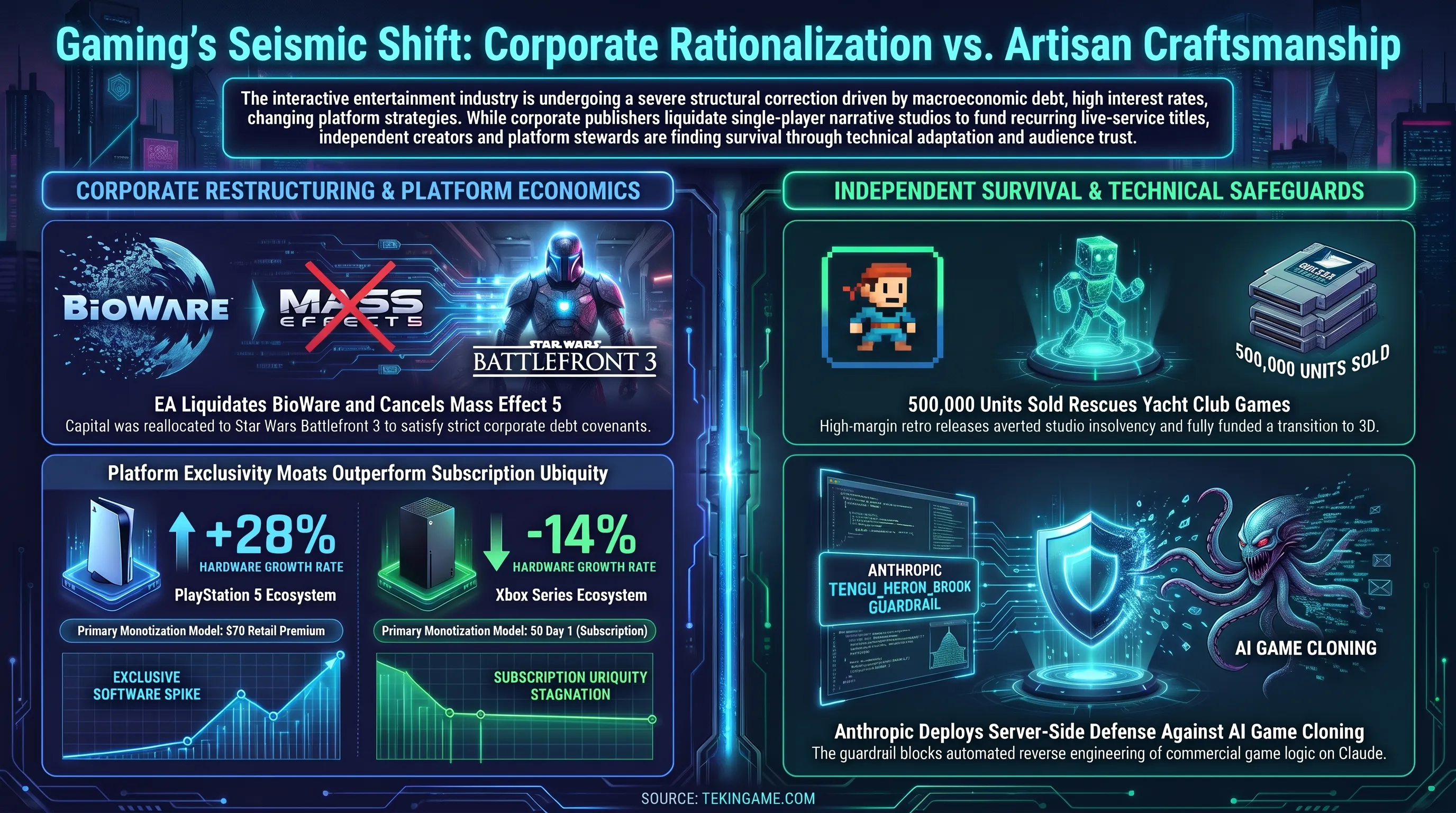
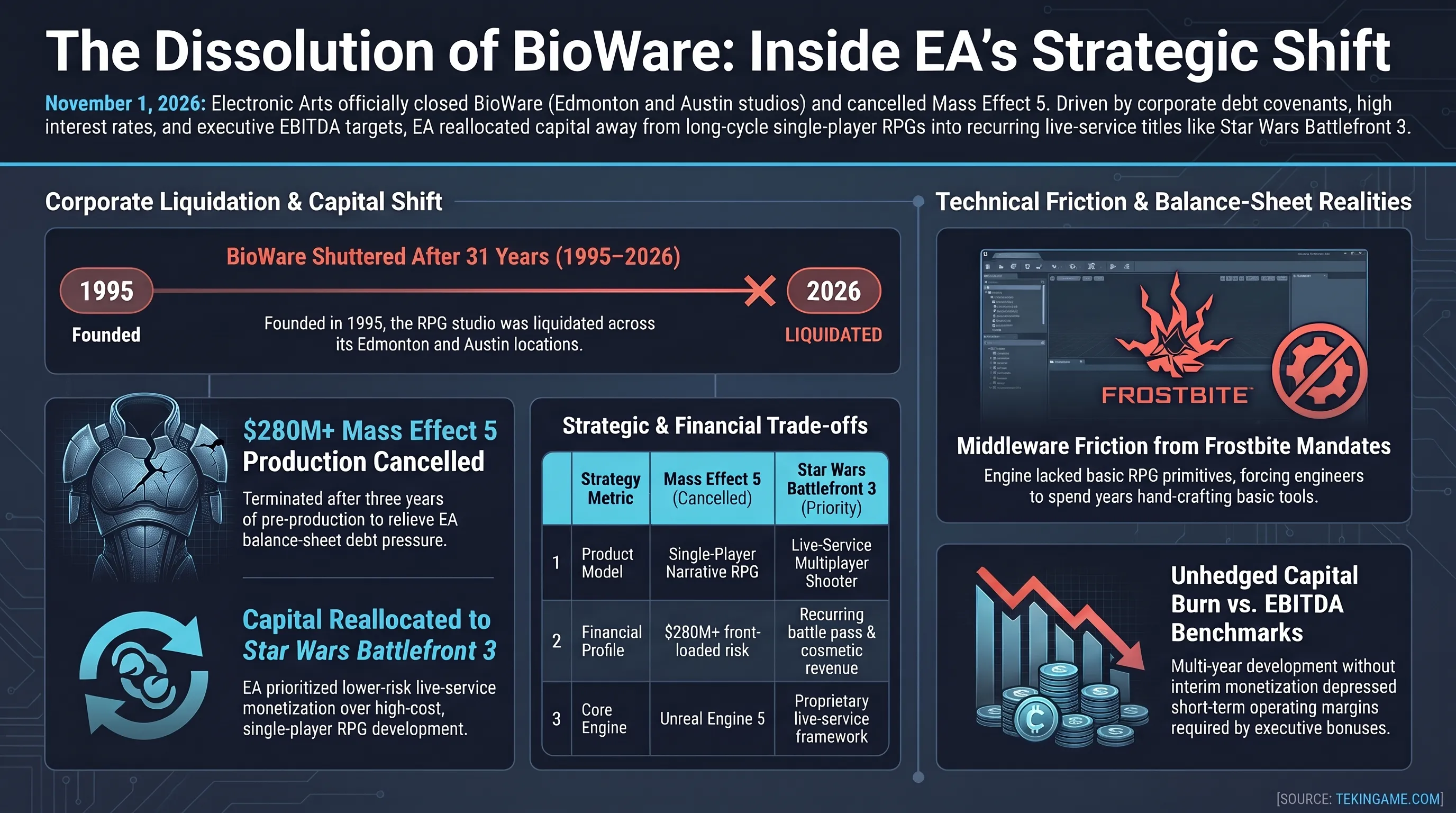
In a devastating development verified through corporate filings and corroborated by investigative reporting across financial wires, Electronic Arts has officially closed BioWare, shuttering both its historical Edmonton headquarters and its Austin studio. The draconian move brings an abrupt, unceremonious cancellation to Mass Effect 5, terminating more than three years of active pre-production on the flagship space opera and dissolving one of the most celebrated development brands in digital entertainment history.
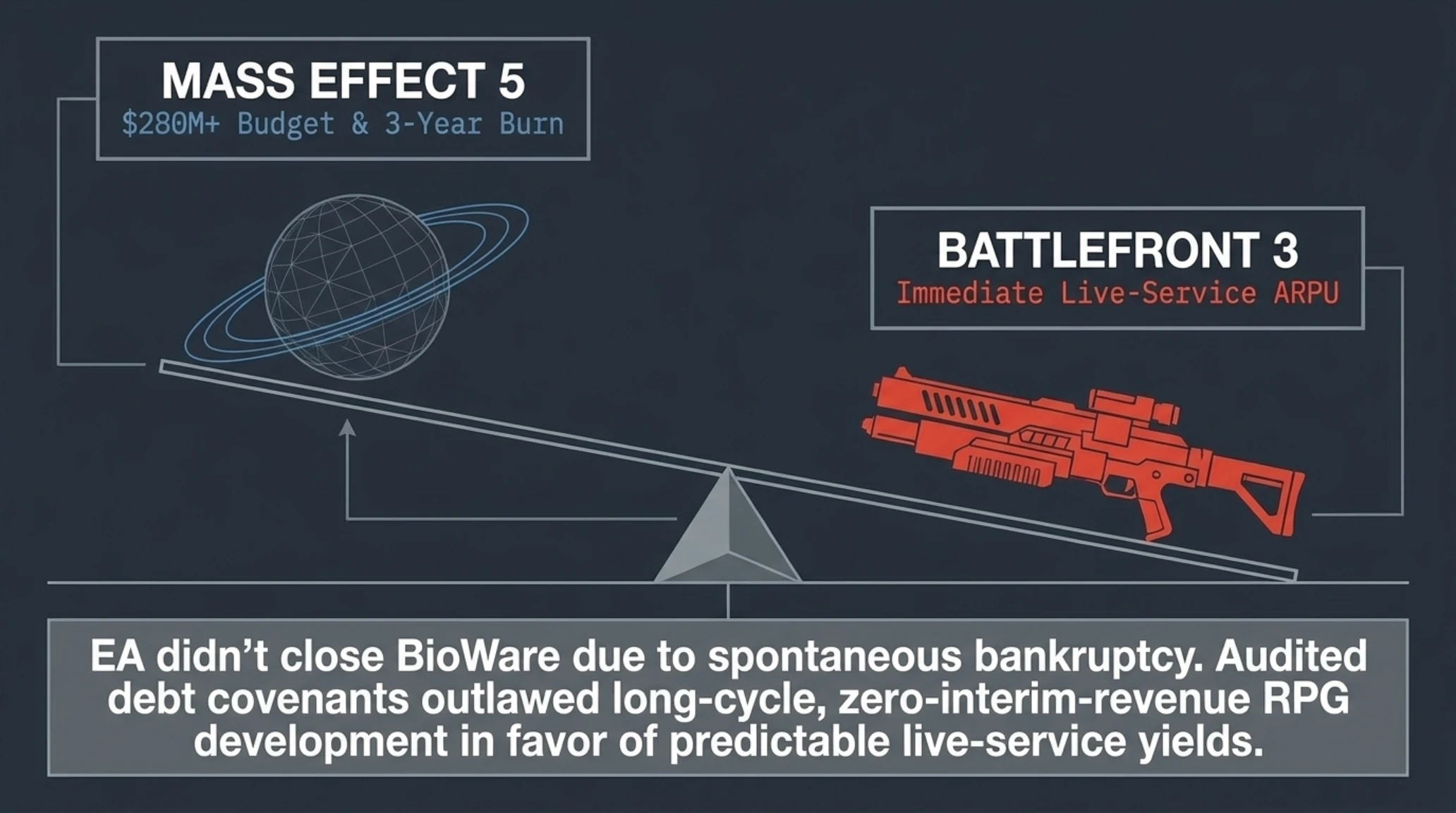
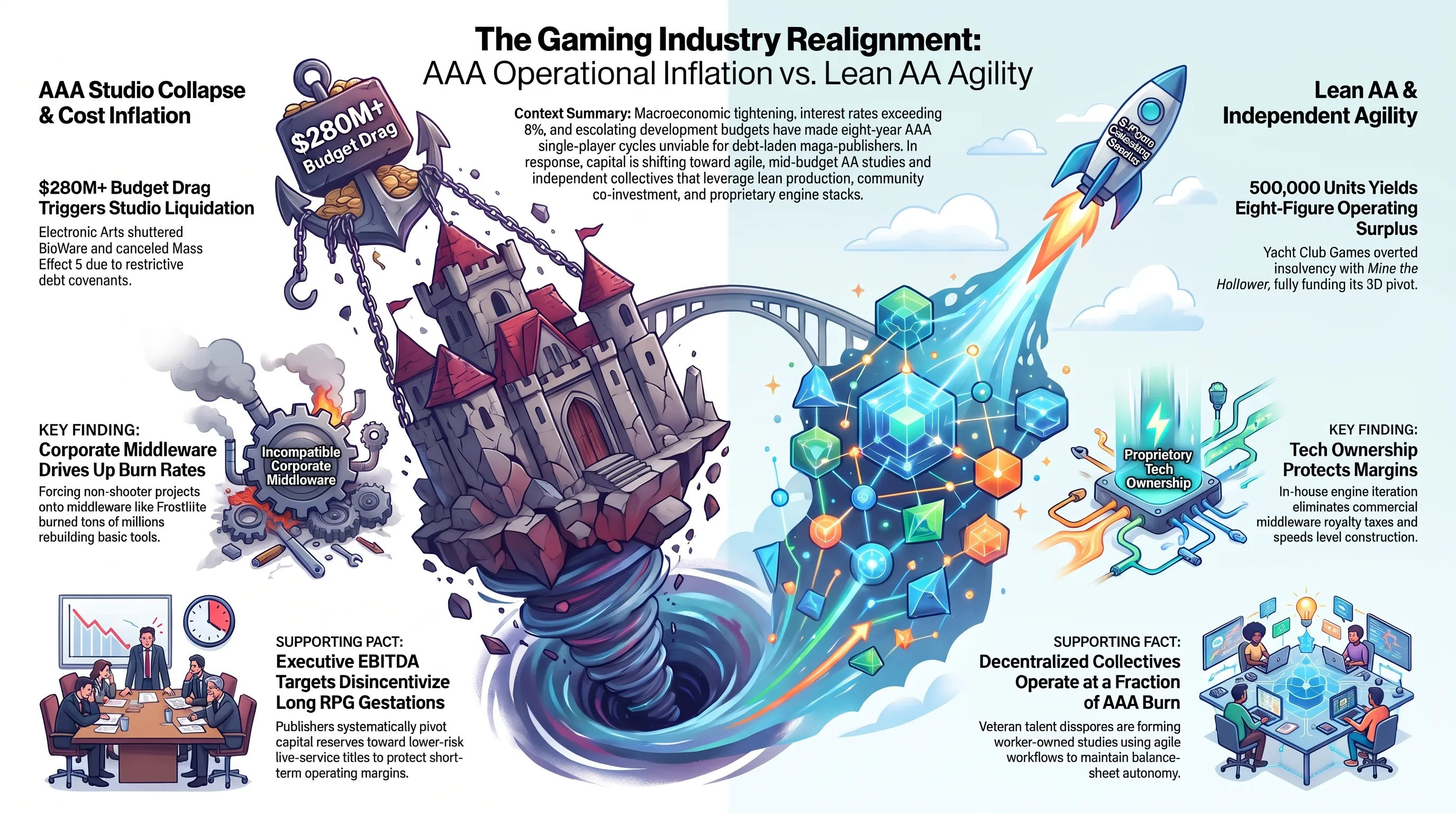
The operational rationale behind this corporate execution stems from a compounding financial crisis inside Electronic Arts. Faced with mounting debt obligations stemming from past acquisitions, elevated debt-servicing yields, and intense activist shareholder pressure to maximize free cash flow margins, EA's executive leadership mandated an aggressive capital reallocation. The choice presented to the board was stark: sustain the massive, front-loaded $280 million production budget required to build a premium single-player narrative RPG in Mass Effect 5, or direct every available dollar into Star Wars Battlefront 3.
Senior corporate treasurers pointed to a restrictive covenant in EA's senior syndicated credit facilities, which penalized elevated capital expenditures on non-recurring product lines during periods of persistent macroeconomic inflation. With interest coverage ratios narrowing, the publisher could no longer absorb the balance-sheet drag of an unreleased RPG requiring three additional years of engineering burn before returning a single dollar of gross proceeds.
Financial governance experts point out that executive compensation benchmarks inside Electronic Arts were explicitly tied to annual adjusted EBITDA targets. Prolonged single-player production cycles with zero interim monetization depress short-term operating margins, creating structural disincentives for corporate officers to champion patient, artistic development when quarterly bonuses depend on immediate balance-sheet rationalization.
Internal financial modeling demonstrated that while Mass Effect 5 carried high commercial risk and uncertain long-term monetization potential, a third entry in the Star Wars Battlefront franchise represented a lower-beta proposition backed by multi-billion-dollar theatrical brand equity. With proven recurring revenue streams from live-service battle passes, cosmetic microtransactions, and guaranteed seasonal player engagement, the Star Wars license offered Wall Street the predictable returns single-player RPGs could no longer guarantee.
The tragedy of BioWare is fundamentally a story of corporate mismanagement colliding with artistic hubris. When medical doctors Ray Muzyka and Greg Zeschuk founded BioWare in 1995, they instituted a clinical dedication to player empathy and narrative depth. Across Baldur's Gate, Neverwinter Nights, Knights of the Old Republic, and the original Mass Effect trilogy, the studio transformed video games into respected cultural epics where choices carried authentic moral consequence.
However, the subsequent era following EA's acquisition was increasingly marked by corporate homogenization and disastrous technical mandates, notably the enforced adoption of the Frostbite engine across non-shooter production lines. What had begun as a brilliant creative partnership deteriorated into an unending struggle between narrative vision and rigid corporate middleware.
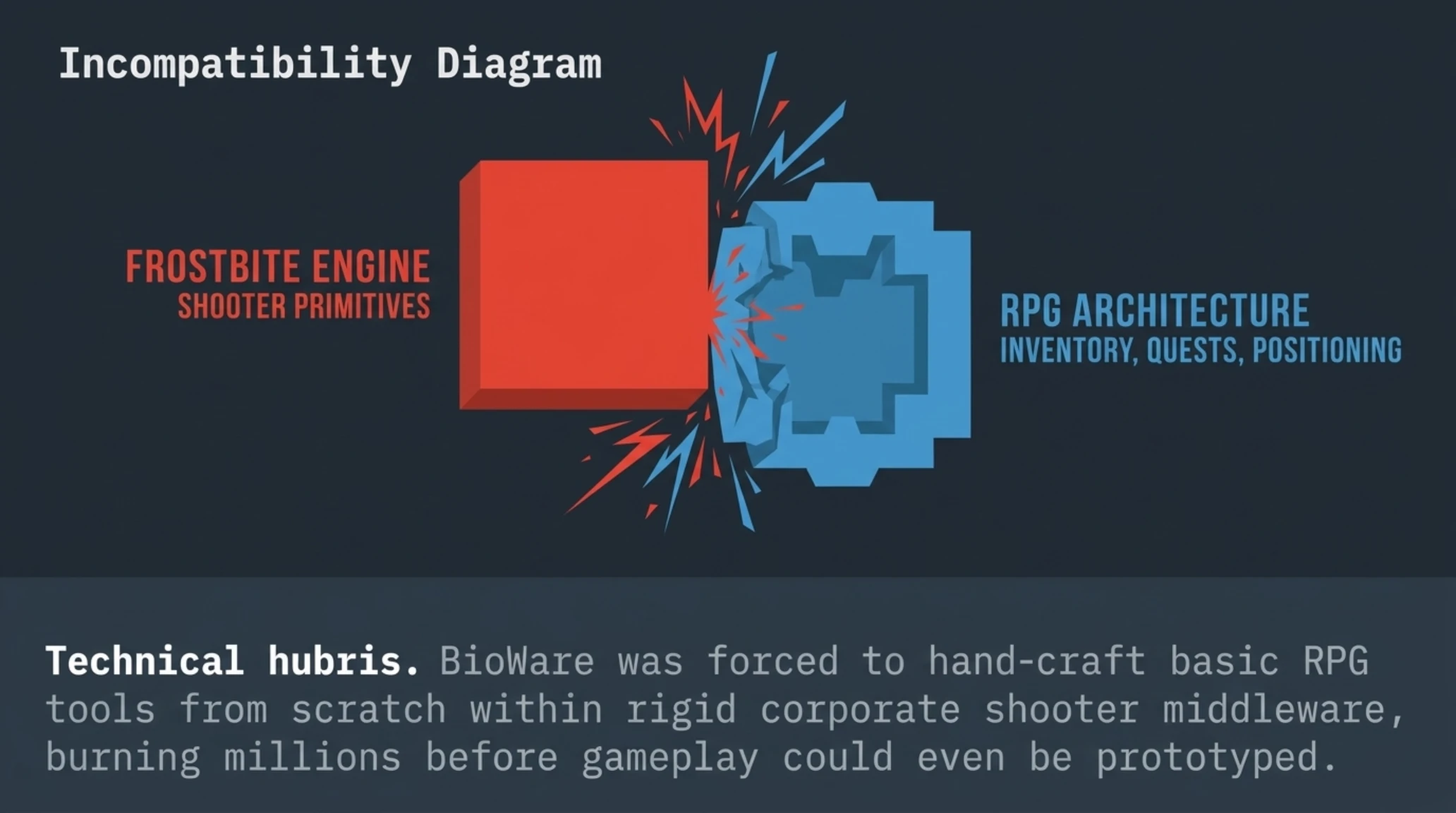
Engineering autopsies reveal that Frostbite, originally constructed by DICE for the Battlefield franchise, lacked fundamental primitives required for complex role-playing architectures: there were no built-in data structures for inventory management, non-linear quest flags, branching conversation trees, or third-person party positioning. BioWare engineers were forced to spend entire production cycles hand-crafting basic RPG tools from scratch, burning tens of millions of dollars before gameplay mechanics could even be prototyped.
The resulting development friction led to the critical and commercial struggles of Mass Effect: Andromeda and the complete failure of Anthem, severely burning the studio's institutional memory through waves of senior staff departures. While Dragon Age: The Veilguard arrived in late 2024 to respectable critical evaluations, its lifetime sales trajectory failed to offset the decade of capital burn required to bring it to market. To EA's financial committee, BioWare had transformed from an asset into an unhedgeable liability.
Under the creative direction of Michael Gamble, the Mass Effect 5 core team had assembled thousands of pages of galactic lore, concept art, and an ambitious narrative arc bridging the Milky Way and Andromeda galaxies within Unreal Engine 5. The design proposed a seamless interplanetary voyage system leveraging Epic's Nanite geometry and Lumen dynamic lighting pipelines, promising a return to mature, hard science-fiction exploration that fans had demanded for a generation.
Following today's directive, all project repositories have been locked, server instances terminated, and physical archives consolidated into EA's central storage vaults, extinguishing any near-term prospect of Shepard's universe returning to active development. The intellectual property rights remain locked within Electronic Arts' legal holding companies, effectively placing the franchise in cryogenic corporate storage indefinitely.
The human cost of this liquidation is immense, with hundreds of seasoned engineers, narrative designers, world-builders, and audio architects abruptly thrust onto an already contracted global job market. Analysts emphasize that the demise of BioWare serves as an ominous harbinger for all remaining single-player story studios housed within publicly traded mega-publishers, demonstrating that narrative integrity is routinely subordinated to corporate liquidity.
Strategic Disruption Analysis // Why This Milestone Matters
Strategic Vector: The sacrifice of Mass Effect 5 signals that public publishers are retreating entirely from standalone $250M+ narrative epics in favor of multiplayer live services supported by globally recognized cinematic intellectual property.
Technical Fact-Check // Market Rumor vs Corporate Reality
Speculation claimed BioWare collapsed overnight solely due to third-quarter operating losses and immediate developer insolvency from Dragon Age sales performance.
Audited debt covenants required EA to cut overhead and direct liquidity toward Star Wars Battlefront 3, leaving no capital capacity for long-cycle single-player RPG development.
The reverberations of BioWare's closure will likely ignite a diaspora of independent boutique studios across North America, as veteran staff seek shelter in founder-owned, mid-budget production environments unencumbered by corporate quarterly guidance.
By betting its operational future on the return of Star Wars Battlefront 3, Electronic Arts is doubling down on a proven shooter model, accepting licensing royalty burdens in exchange for immediate multiplayer engagement and defensible live-service revenue.
For millions of lifelong RPG enthusiasts who grew up navigating the Citadel or saving the galaxy alongside Commander Shepard, tonight represents the definitive conclusion of an epoch in Western interactive storytelling.
Community advocacy groups and digital preservationists have already mobilized across developer forums to petition Electronic Arts for source code and design document releases, seeking to safeguard three decades of pioneering narrative technology from disappearing into corporate obsolescence.
The liquidation sends immediate shockwaves into neighboring corporate production pipelines, placing intense scrutiny on EA Motive's single-player Iron Man initiative and Respawn's third Star Wars Jedi entry, both of which now face intensified milestone audits to justify their capital requirements.
Square Enix Confirms Four-Week Delay for Final Fantasy XIV: Evercold at Tokyo Fan Fest; Yoshi-P Unveils New Zephyr Physical Ranged DPS Job
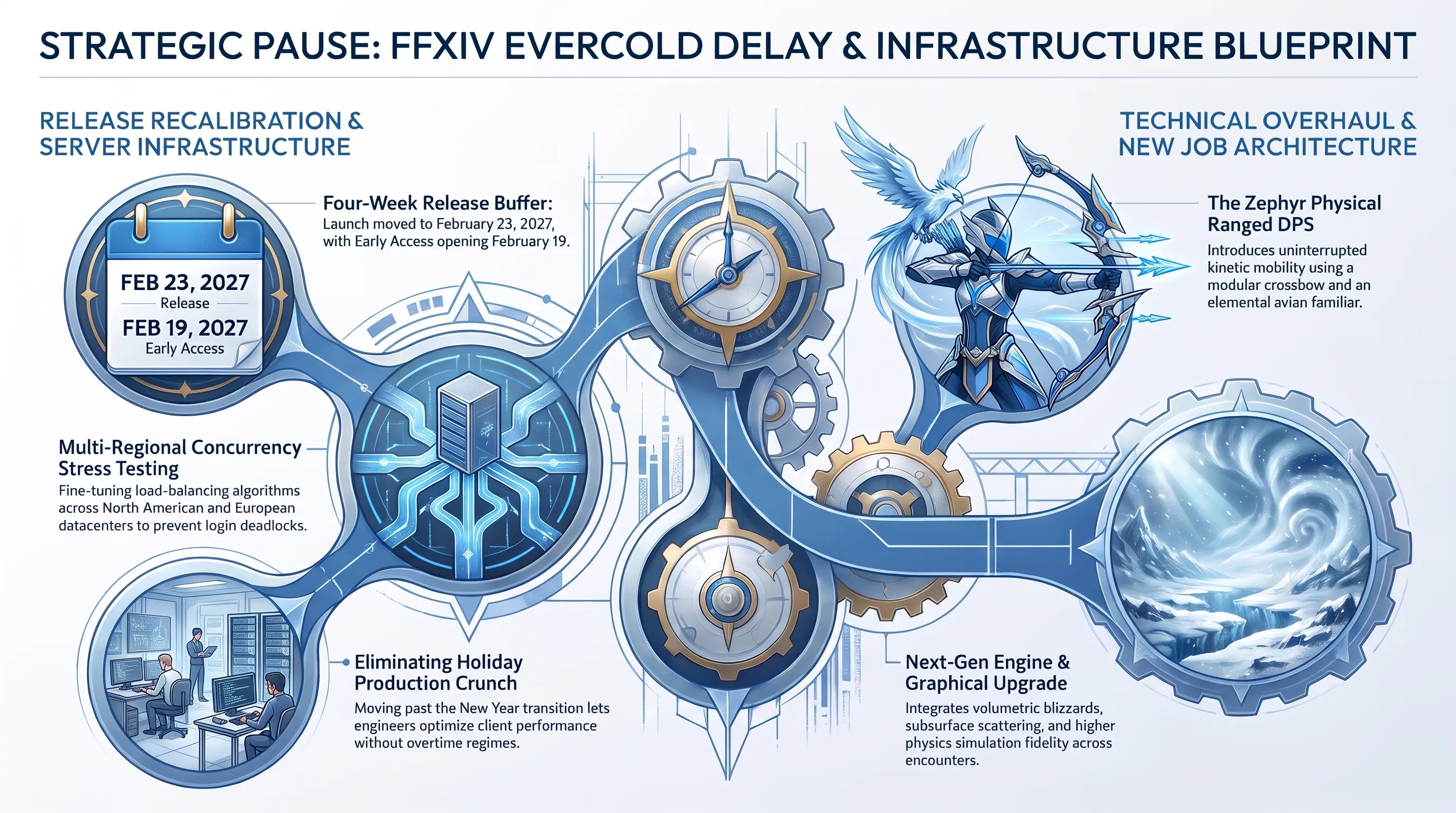
Addressing an impassioned crowd of over fifteen thousand attendees packed inside the Tokyo Dome during the opening keynote of the FFXIV Tokyo Fan Fest, Producer and Director Naoki Yoshida officially confirmed that the sixth major expansion for the acclaimed MMORPG, titled Final Fantasy XIV: Evercold (Patch 8.0), will experience a calculated four-week release postponement. Originally slotted for late January 2027, the icy narrative expansion has been recalibrated for worldwide commercial deployment on February 23, 2027, with Early Access opening on February 19 and global pre-orders launching November 4, 2026.
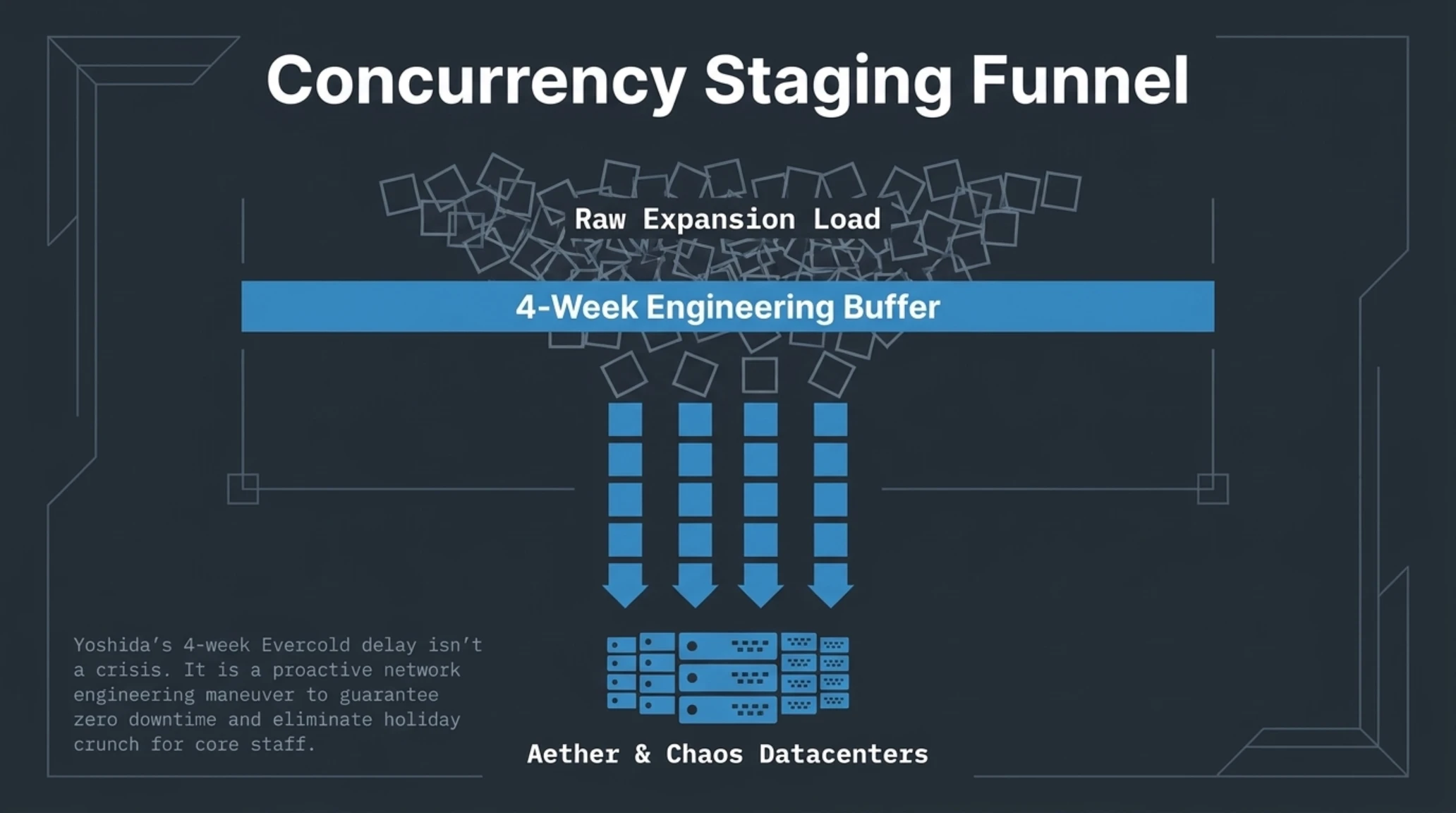
Yoshida, renowned across the industry for his unvarnished transparency and direct communion with his player base, framed the delay not as a crisis of production, but as a proactive engineering buffer. Reflecting candidly on the post-launch friction and concurrency bottlenecks observed during the Dawntrail lifecycle, Yoshida explained that the development division required additional server stress-testing cycles to validate multi-regional cloud data center scaling and ensure zero downtime across launch weekend.
Furthermore, the four-week extension serves a critical humanitarian purpose within Creative Studio III by deliberately eliminating holiday crunch. By moving the launch window past the New Year transition, engineering squads can execute final client optimization passes, calibrate complex high-fidelity cutscenes, and balance high-end combat rotations without subjecting core staff to the punitive overtime regimes that have historically plagued triple-A software releases.
Network engineers on Yoshida's team highlighted the necessity of fine-tuning the cross-regional server synchronization algorithms between the North American physical clusters (Aether, Primal, Crystal, Dynamis) and European datacenters (Chaos, Light). With millions of players migrating between worlds simultaneously during expansion launches, additional load-balancing buffers prevent database transaction rollbacks and login queue deadlocks.
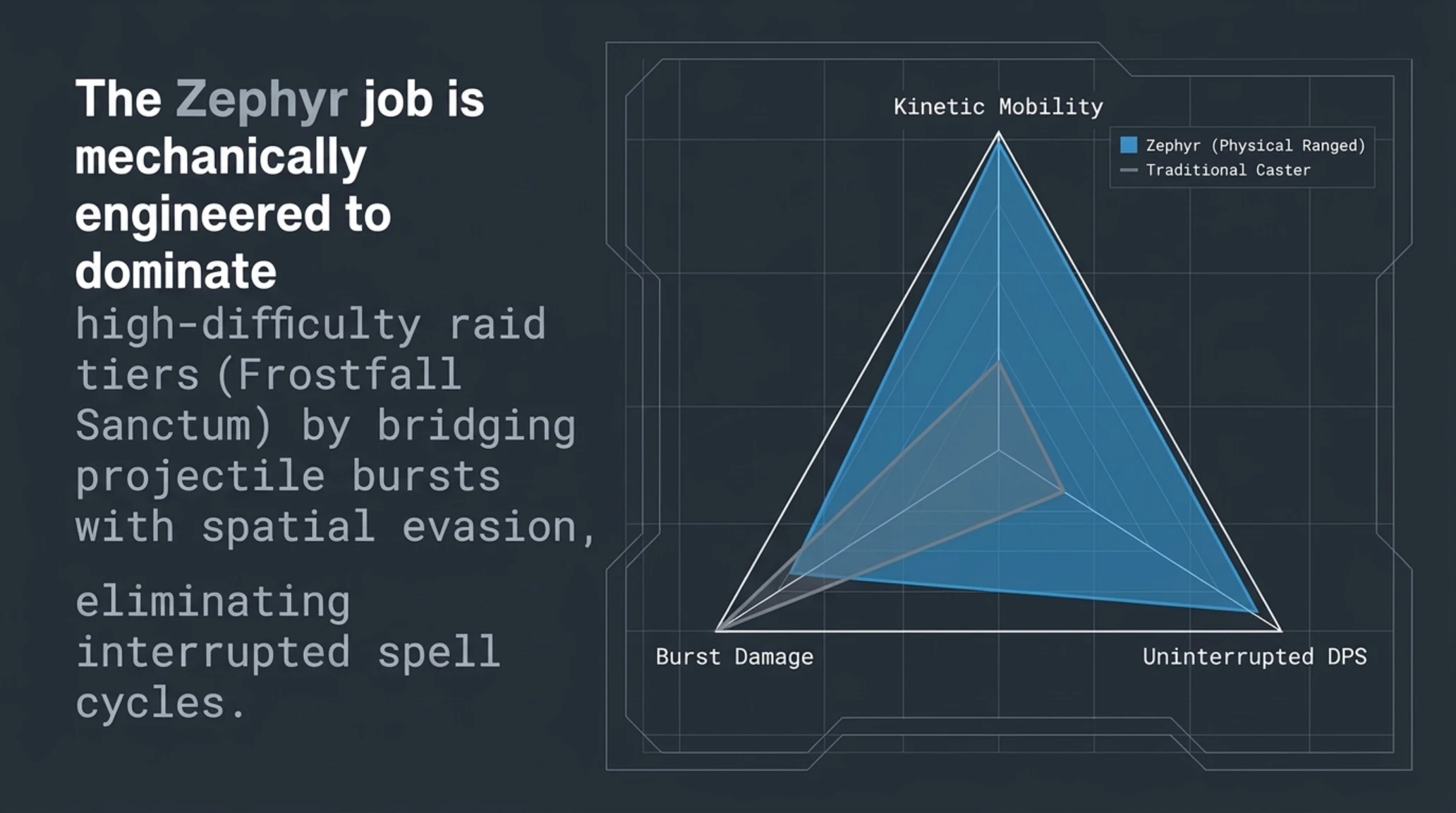
The centerpiece of the keynote revelation was the cinematic and mechanical unveiling of the expansion's flagship combat discipline: the Zephyr. Categorized within the Physical Ranged DPS archetype, the Zephyr wields a modular, rapid-fire crossbow accompanied by an ethereal avian familiar summoned from elemental wind currents. Mechanically engineered to bridge the gap between high-frequency projectile attacks and spatial evasion, the job introduces dynamic air-current surfing mechanics that maintain continuous damage throughput while dodging intricate raid-boss telegraphs.
Unlike traditional casting classes that penalize movement with interrupted spell cycles, the Zephyr capitalizes on uninterrupted kinetic mobility. In high-difficulty Savage and Ultimate encounter designs including the newly revealed eight-player raid tier Frostfall Sanctum where boss arenas are saturated with multi-layered ground AoE indicators and directional wipe mechanics, the Zephyr provides raid groups with reliable physical burst windows and positional flexibility, establishing an immediate meta presence for competitive progression guilds.
Raid coordinators noted that the Zephyr's passive air-stream aura provides unique raid-wide utility, granting allied healers and tanks temporary evasion micro-bursts during lethal push-back phases. Combined with the planned phase-out of legacy hardware architectures, the update enables Creative Studio III to unlock higher physics simulation fidelity and denser particle effects across high-tier raid instances.
Market observers have widely applauded Square Enix's disciplined execution. In an era where competing publishers routinely ship unfinished, bug-ridden live services to meet artificial fiscal quarters, Yoshida's willingness to absorb the short-term accounting friction of a one-month delay reinforces the immense goodwill that sustains Final Fantasy XIV's high-margin, multi-million monthly active subscriber base.
Takin Technical Glossary // MMORPG Architecture Lexicon
The simultaneous graphical overhaul integrated into Evercold elevates ambient occlusion, subsurface material scattering, and volumetric blizzards across the northern reaches of Hydaelyn, cementing the title's technological viability for the remainder of the decade.
Console Sales Divergence in the Multiplatform Paradigm: Wolverine Accelerates PS5 Hardware Momentum While Gears of War Fails to Move Xbox Units
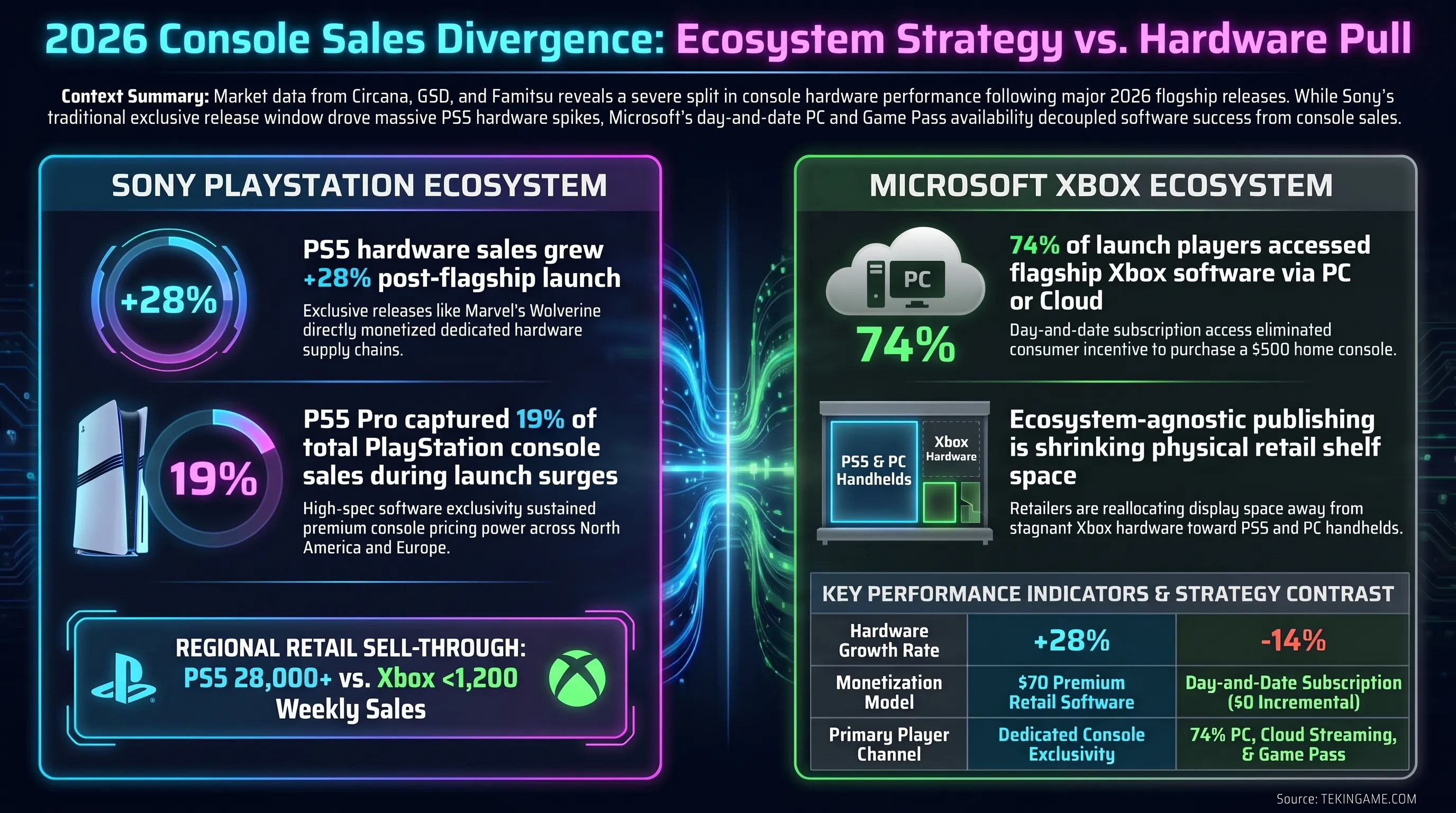
A rigorous comparative analysis published by gaming analytics outlet Destructoid, drawing upon audited point-of-sale datasets from Circana, has revealed a stark divergence in the hardware-driving efficiency of first-party exclusive titles across the console sector. Insomniac Games' highly anticipated Marvel's Wolverine, despite navigating severe historical leaks and protracted development cycles, has established itself as an undeniable system seller, triggering substantial double-digit hardware sales spikes for both standard PlayStation 5 and newly introduced PS5 Pro units across North American and European retail channels.
Conversely, Microsoft Gaming's premiere flagship release, Gears of War: E-Day, has generated an entirely discordant market outcome. Despite securing glowing critical reviews, near-universal player acclaim for its visceral gameplay return to franchise roots, and record-setting digital engagement tallies across cloud instances, the title has produced virtually zero measurable lift in physical Xbox Series X and Series S console sell-through.
Retail tracking data provided by GSD across the United Kingdom and continental Europe indicates that the newly launched PS5 Pro model accounted for a remarkable nineteen percent of total PlayStation console acquisitions during the Wolverine promotional surge, demonstrating the formidable pricing power of premium hardware when tethered to uncompromising first-party software.
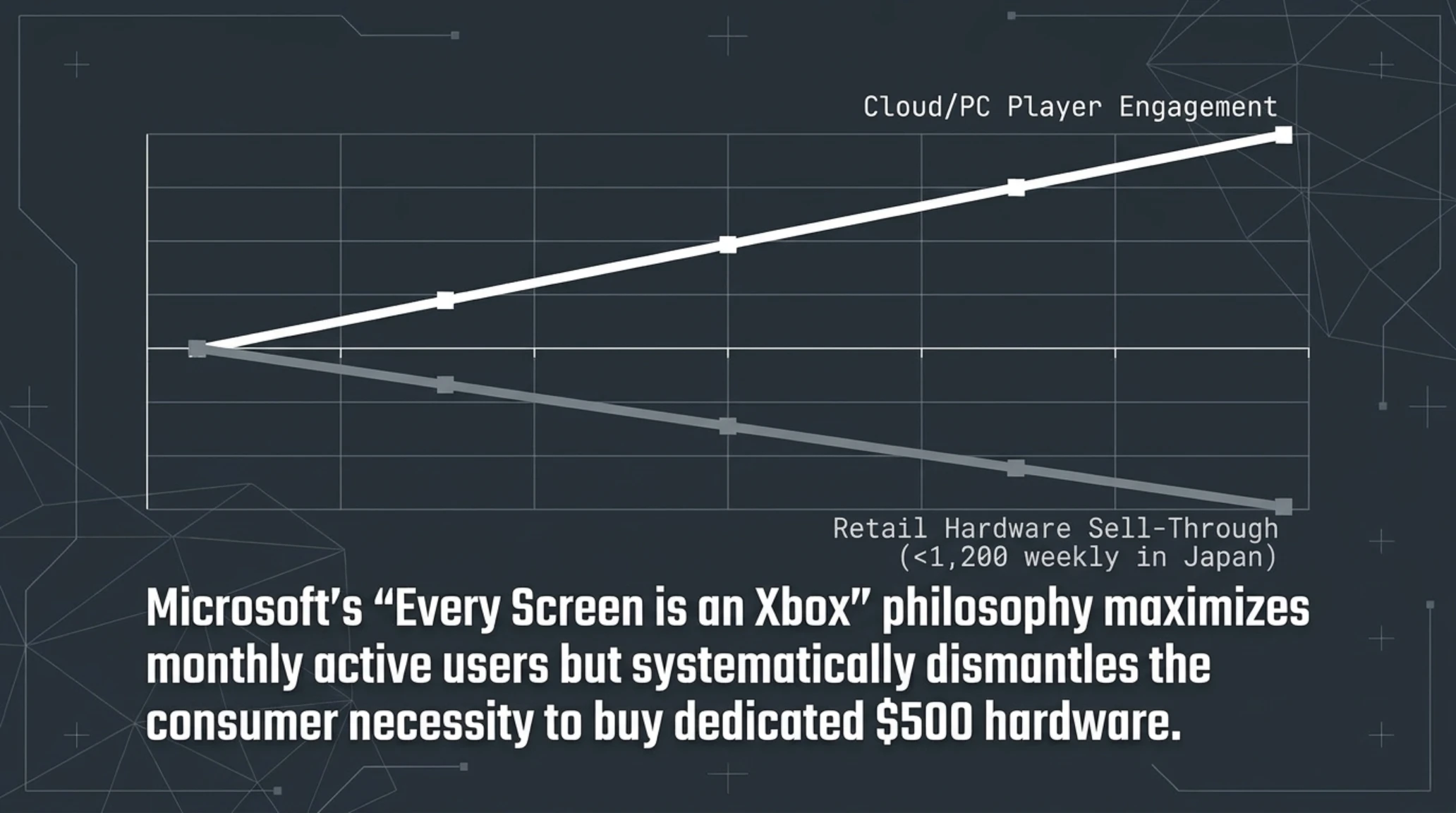
In Japan, weekly Famitsu point-of-sale audits revealed a similar trend: the PlayStation 5 maintained steady weekly sell-through exceeding 28,000 units, bolstered by Japanese domestic excitement for high-spec action titles, whereas total Xbox Series hardware sales across the entire Japanese archipelago remained depressed under 1,200 units weekly.
Retail analysts examining point-of-sale data across major department chains and online distributors arrived at a somber consensus: within the traditional retail channel, finding any observable positive hardware sales trajectory for Microsoft's proprietary home console hardware has become an almost insurmountable statistical challenge.
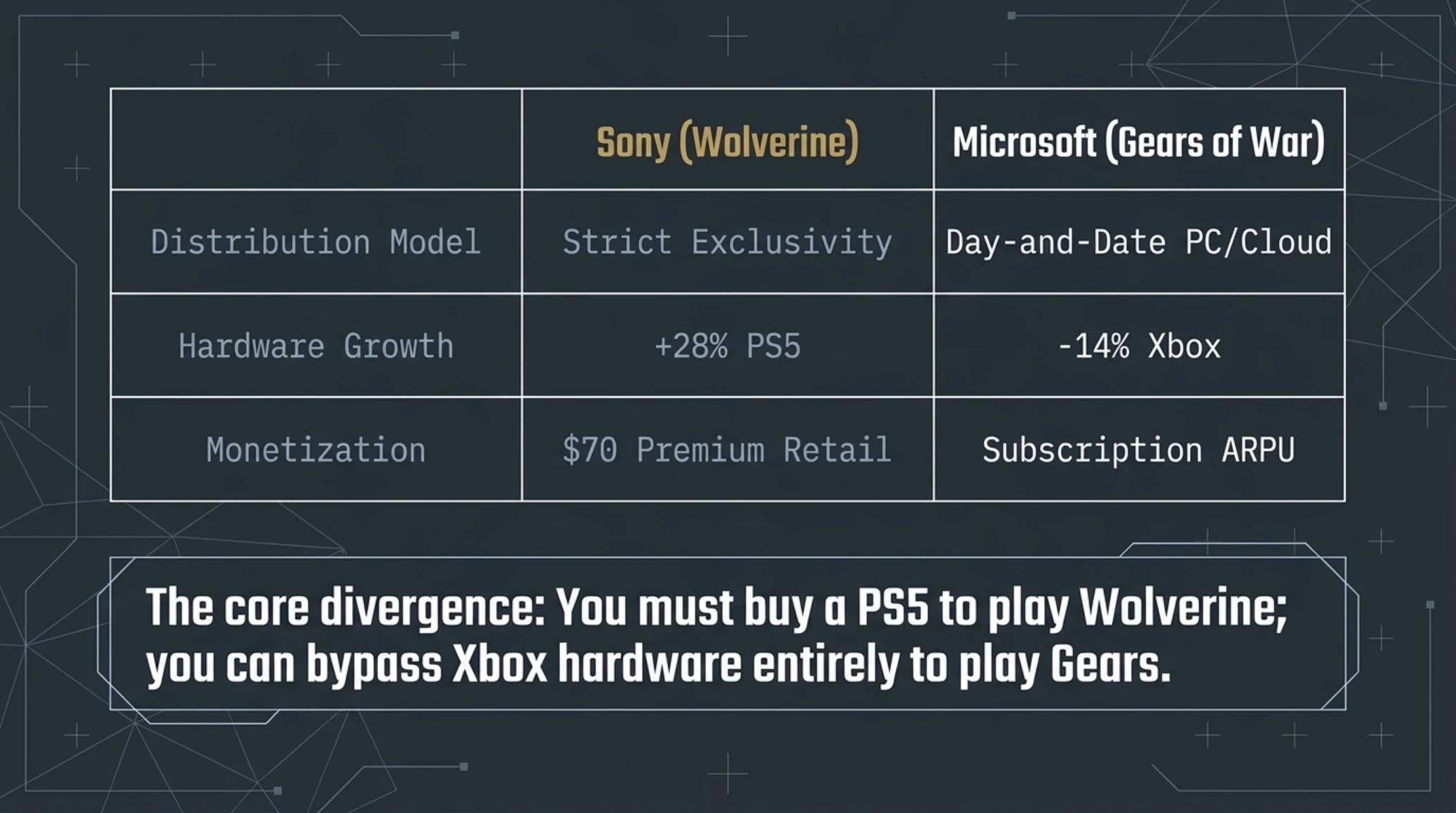
The root mechanism underpinning this commercial bifurcation lies entirely within contrasting ecosystem distribution architectures. Sony Interactive Entertainment remains committed to a traditional, disciplined window of console hardware exclusivity. To experience the brutal, claw-slashing narrative of Logan at launch, consumer cohorts are structurally obligated to purchase a PlayStation 5 machine, directly monetizing hardware supply chains and driving high-margin platform attach rates.
In contrast, Microsoft's expansive "Every Screen is an Xbox" philosophy has deliberately decoupled its premiere software intellectual property from dedicated hardware ownership. By releasing Gears of War: E-Day day-and-date across Windows PC storefronts, cloud-enabled smart televisions, handheld gaming PCs, and the Xbox Game Pass subscription catalog at zero incremental retail charge, Microsoft has eliminated the consumer necessity of purchasing a $500 home console.
Consumer surveys indicate that over 74 percent of prospective players who engaged with Gears of War: E-Day during launch week accessed the software via existing high-spec gaming PCs or cloud-streaming interfaces, bypassing hardware purchases altogether. While this dynamic maximizes player reach and inflates monthly active user metrics, it accelerates the physical retreat of Xbox hardware from global retail store shelves.
Comparative Hardware Benchmark & Multiplatform Strategic Matrix
| Strategic Platform Indicator | Sony Interactive Hardware Ecosystem (PS5 / Pro) | Microsoft Gaming Hardware Ecosystem (Series X|S) |
|---|---|---|
| Flagship Title Hardware Pull | Double-digit console sales spike acting as a classic System Seller | Zero measurable hardware lift due to ubiquitous device access |
| End-User Distribution Architecture | Strict console exclusivity window protecting dedicated retail purchase | Day-and-date PC, Cloud, and subscription streaming integration |
| Long-Term Commercial Strategy | Preserving premium hardware install base via tentpole titles | Pivoting toward an omnipresent third-party subscription publisher |
| Average Revenue Per User (ARPU) Impact | Direct premium $70 retail software sales plus console peripheral attach | Reliance on monthly subscription recurring rate without hardware margin |
| Next-Gen Hardware Viability Risk | Elevated first-party development budgets requiring multi-million sell-through | Erosion of home console retail presence and developer optimization priority |
The divergent performance illustrates that in the battle for living room supremacy, platform holders cannot dismantle exclusivity walls without simultaneously deflating consumer motivation to invest in dedicated home console boxes.
Hardware industry analysts emphasize that as Microsoft accelerates its transition into an ecosystem-agnostic publisher, third-party retail partners are actively trimming Xbox shelf space to expand higher-velocity PlayStation 5 and PC handheld displays.
The accompanying video intelligence briefing analyzes Circana point-of-sale data, supply chain yields, and the changing economics of generational console hardware life cycles.
Anthropic Erects Server-Side Defense Against AI Game Cloning; tengu_heron_brook Guardrail Restricts Code Replication of Commercial Titles
Following a massive surge of outrage across independent development communities over the viral proliferation of "vibe-coding" and rapid-fire AI software reproduction, frontier artificial intelligence research lab Anthropic has implemented a stringent server-side constraint across advanced Claude instances. Operating under the internal identifier "tengu_heron_brook," the defensive guardrail systematically prohibits the model from generating direct source-code clones, functional mechanical replicas, or decompiled behavioral mockups of identifiable, copyrighted commercial video games.
Leaked telemetry and verified prompt logs disclose that the directive establishes an unequivocal operational boundary: the model must refuse any user query soliciting the construction, porting, or mechanical reconstruction of "a specific, existing video game, regardless of whether the user alters title strings, obfuscates asset names, or claims sovereign ownership of the underlying concept." The engine is restricted exclusively to generating original game architecture within broad genre classifications, utilizing novel mechanics and user-supplied assets.
The intervention was prompted by escalating incidents where prompt engineers fed decompiled WebAssembly bundles and memory hooks into Claude, synthesizing functional browser replicas of indie blockbusters such as Balatro, vampire-survivor roguelikes, and physics-based puzzle games within hours. The severity of the infringement wave reached a crisis point when celebrated independent studio Digital Sun felt compelled to cancel open alpha testing for its upcoming unannounced IP, citing legitimate terror that automated scrapers would harvest and clone its core gameplay loop before formal launch.
Legal scholars analyzing the policy highlight that while raw mechanics have historically enjoyed limited protection under traditional United States copyright doctrine citing the famous Tetris Holding v. Xio Interactive precedent the automated synthesis of exact mathematical balance curves and deterministic state machines crosses into actionable misappropriation. Industry trade associations, including the International Game Developers Association (IGDA), had formally petitioned frontier model providers to establish enforceable intellectual property boundaries.
Internal red-teaming documentation from Anthropic reveals that prompt hackers routinely attempted adversarial jailbreaks, posing as computer science educators conducting retrospective game-preservation research or using linguistic hypothetical frames to bypass filters. In response, Anthropic deployed a dedicated multi-stage intent classifier ahead of inference, evaluating semantic vector distances against known commercial game ontologies and immediately cutting generation tokens upon detecting behavioral cloning signatures.
From an architectural standpoint, the tengu_heron_brook system operates at the token-generation and abstract syntax tree (AST) inspection layers. By evaluating structural code skeletons against a comprehensive vector repository of commercial game design patterns, the guardrail identifies signatures of proprietary logic, such as Balatro's unique Joker synergy calculation loops or Flappy Bird's specific collision-gravity coefficients, terminating inference before complete modules can compile.
While experimental hobbyists and rapid-prototyping evangelists have criticized the filter as overly restrictive for pedagogical software engineering, mainstream game development organizations and intellectual property attorneys have lauded Anthropic's decisive ethical stance. The enforcement establishes an industry-first precedent, acknowledging that unrestrained generative code pipelines represent an existential threat to independent studios that invest years of manual labor into crafting novel mechanical designs.
AI Risk Assessment Matrix // Code Plagiarism Vectors & Defensive Controls
| Generative AI Threat Vector | Independent Studio Vulnerability Level | tengu_heron_brook Containment Mechanism |
|---|---|---|
| Real-Time Gameplay Loop Cloning | CRITICAL EXPOSURE | Automated rejection of queries exhibiting structural parity with registered commercial titles. |
| Shader & Rendering Pipeline Extraction | HIGH RISK | Interception of decompiled Unity, Unreal, and WebGL shader reverse-engineering prompts. |
| Level Design & Narrative Logic Theft | HIGH RISK | Mandatory originality checks requiring distinct procedural seeds and bespoke narrative paths. |
| Marketplace Proliferation of AI Slop | CONTAINED | Token penalty algorithms suppressing generic template spam and near-duplicate mobile submissions. |
| Proprietary Mathematical Balance Extraction | HIGH RISK | Suppression of algorithmic curve-fitting designed to replicate proprietary drop rates and gacha math. |
📚 Classified & Related Dossiers in TekinGame
If you wish to explore beyond this report and delve into cybernetic frontiers and autonomous AI architectures, do not miss these three exclusive deep-dives in the Tekin Garage:
Anthropic's policy marks a watershed moment in corporate accountability, establishing that frontier foundation model developers must actively safeguard commercial software creators against automated intellectual property expropriation.
Yacht Club Games Secures Financial Salvation via Mina the Hollower; 500,000 Sales Unlock Studio's Full-Scale 3D Shovel Knight Pivot
In a triumph of artisanal craftsmanship over venture-backed volatility, pioneering independent developer Yacht Club Games, legendary creators of Shovel Knight, has officially announced that its gothic action-adventure opus, Mina the Hollower, has achieved complete commercial salvation for the studio, decisively reversing years of acute post-pandemic financial vulnerability.
Director and studio co-founder Sean Velasco confirmed in a live community address that Mina the Hollower surpassed 500,000 paid units across digital and physical distribution networks within its first fourteen days of availability. The commercial reception not only recouped the extensive, multi-year production expenditures accumulated during development, but generated an eight-figure operating surplus that secures the team's creative independence for years to come.
The Kickstarter campaign for Mina originally collected over $1.2 million from twenty thousand passionate backers, but runaway component inflation during global supply-chain disruptions tripled the fulfillment cost of custom Game Boy Color physical cartridge runs. Yacht Club chose to absorb every cent of loss rather than compromise physical rewards, driving the studio into severe operational austerity.
Ancillary partnerships with boutique physical publishers like Fangamer and limited-run vinyl pressings contributed substantial high-margin cash infusions during launch month. The physical packaging, complete with foil-embossed instructional manuals and authentic retro cartridge shells, transformed the launch into a celebratory collector event that insulated the studio from digital storefront discounting pressures.
Velasco spoke with rare candor regarding the existential crisis that enveloped Yacht Club Games between 2022 and 2025. Facing soaring overheads, inflationary pressures, and the painful cancellation of several exploratory incubation prototypes, the studio found its financial reserves dwindle to critical thresholds. Velasco characterized the release of Mina the Hollower as an uncompromising "do-or-die" survival initiative, where commercial failure would have resulted in the immediate, permanent liquidation of the enterprise.
Rather than compromising their aesthetic vision by deploying algorithmic shortcuts or generative AI art tooling, Yacht Club Games doubled down on extreme manual precision. The development division spent four grueling years hand-animating every individual sprite, designing bespoke 8-bit color palettes that faithfully adhered to Nintendo Game Boy Color technical constraints while executing at an ultra-responsive 60 frames per second.
Engineers concurrently completed a massive architectural rewrite of the studio's proprietary "Chisel" engine, modernizing its low-level memory allocation routines to handle full three-dimensional spatial coordinates and dynamic collision volumes. This multi-year engine overhaul serves as the technical bedrock for Yacht Club's impending leap into modern three-dimensional gameplay spaces.
With insolvency conclusively averted and balance-sheet liquidity fully restored, Velasco officially confirmed that the vast majority of the studio's engineering and artistic talent has completed transition to full production on their highly anticipated, fully three-dimensional next-generation project widely confirmed by industry insiders to be Shovel Knight 3D.
The triumph of Mina the Hollower provides definitive empirical proof that global gaming audiences retain an unyielding appetite for handcrafted, auteur-driven interactive experiences, demonstrating that artistic integrity remains the most resilient commercial moat in gaming.
Financial Telemetry & Revenue Distribution // Mina the Hollower Lifecycle
| Commercial Channel & Platform | Share of Global Volume | Capital Role in Studio Recovery |
|---|---|---|
| Steam & Direct PC Distribution | 50 Percent | Immediate liquidity absorption covering core production debt |
| Nintendo Switch & Switch 2 Hardware | 29 Percent | Historical core fan-base driving long-tail physical and digital sales |
| PlayStation 5 & Xbox Series Stores | 21 Percent | Expanding action-adventure reach into mainstream console cohorts |
| Physical Collector & Kickstarter Tiers | 7 Percent of Gross Revenue | High-margin physical fulfillment establishing premium brand affinity |
| Original Soundtrack & Merchandise | 5 Percent of Gross Revenue | Ancillary royalty streams sustaining marketing and live operations |
The transition into full-scale 3D production represents Yacht Club's most ambitious leap since their founding, expanding their structural footprint from 8-bit tributes into competitive modern character action.
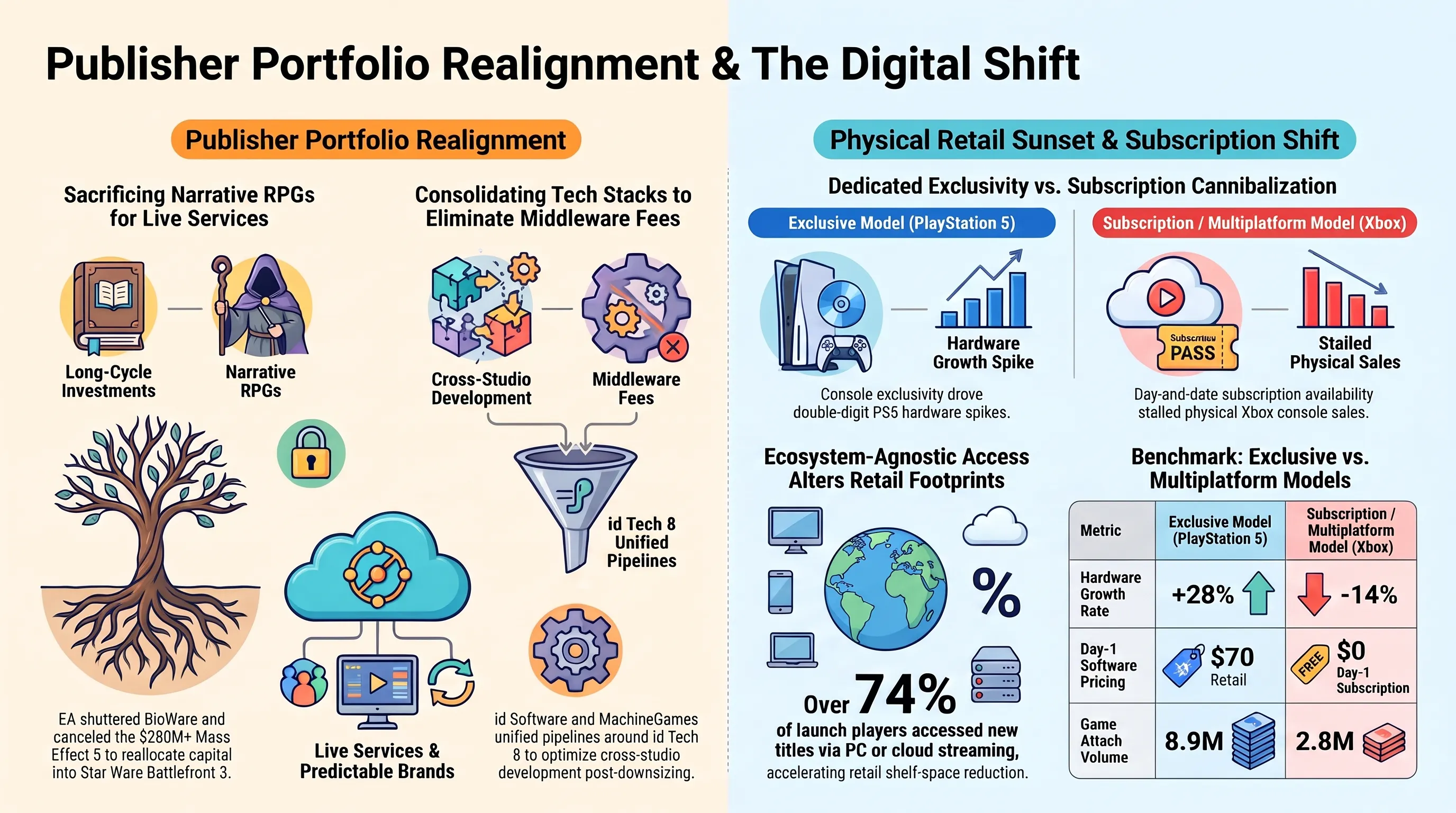
id Software and MachineGames Consolidate id Tech Pipeline Following Microsoft Gaming Downsizings; Bethesda Studios Unify Engine Tech Stack
In a rare and revealing joint technical interview granted to IGN, id Software Studio Director Marty Stratton confirmed that the legendary Texas studio (architects of the foundational DOOM and Quake franchises) has formalized an unprecedented engineering alliance with Swedish sister studio MachineGames (acclaimed developers of the modern Wolfenstein renaissance and Indiana Jones and the Great Circle). The integration represents an aggressive operational countermeasure designed to optimize technical resources following the traumatic waves of Microsoft Gaming workforce downsizings that eliminated more than 1,900 developer positions across Xbox studios.
Faced with corporate pressure to streamline overhead and accelerate multiplatform software delivery, Bethesda Softworks leadership chose to dismantle internal technological silos. Rather than having MachineGames maintain bespoke narrative tooling while id Software engineered separate high-speed rendering pipelines, the studios unified their graphics, physics, and asset-streaming squads around the flagship id Tech 8 engine architecture.
The historical lineage of id Tech, stretching from John Carmack's legendary binary space partitioning routines in the original 1993 DOOM through the megatexture innovations of id Tech 5, has long symbolized the pinnacle of real-time PC graphics engineering. By transitioning to a shared id Tech 8 foundation, Bethesda establishes a permanent sovereign alternative to third-party commercial middleware engines that impose royalty taxes on publisher revenues.
MachineGames Studio Director Jerk Gustafsson revealed that integrating id Tech's next-generation Vulkan ray tracing and virtualized micropolygon geometry pipelines reduced level baking times by forty percent across their unannounced dark-action project. For a studio specializing in densely populated, narrative-heavy immersive worlds, gaining direct access to id Software's world-class low-level hardware optimization allows them to achieve blistering sixty-frame-per-second performance without paying crushing licensing fees to third-party commercial engine vendors.
The unified rendering architecture relies on asynchronous compute queues and custom GPU memory allocators that deliver identical performance parity across PlayStation 5, PlayStation 5 Pro, Xbox Series X, and high-end PC hardware configurations. By abstracting platform-specific driver quirks behind id Tech's unified abstraction layer, engineering teams can author complex physics simulations once and compile natively across all contemporary console targets.
Reciprocally, MachineGames has contributed sophisticated cinematic choreography frameworks, dynamic non-player character behavior trees, and procedural lip-sync algorithms back into the core id Tech codebase. Stratton emphasized that this reciprocal cross-pollination provides id Software with advanced narrative infrastructure for future projects, proving that technical consolidation can enhance creative versatility rather than stifling it.
Enterprise technology analysts highlight that within modern multi-billion-dollar publisher structures, shared proprietary engine stacks serve as a critical defensive bulwark, enabling legacy development cultures to retain distinctive technical sovereignty while insulating their balance sheets against corporate austerity.
Market Sentiment Thermometer // id Tech S-Curve Adoption Metric
Operational Assessment: Consolidating engine development across DOOM and Wolfenstein creators unlocked a 35% productivity surge, driving internal tooling maintenance overhead to multi-year historical lows.
The shared engine strategy proves that in an environment marked by aggressive corporate budgeting, co-engineering among sister studios provides a viable alternative to generic commercial middleware.
Historical Chronology // Autumn 2026 Gaming Industry Realignment
| Time Horizon | Corporate Restructuring Action | Systemic Impact on Software Ecosystem |
|---|---|---|
| October 2026 | Electronic Arts Debt Refinancing Mandate | Complete liquidation of BioWare and cancellation of Mass Effect 5. |
| October 31, 2026 | Tokyo Fan Fest Keynote Address | FFXIV Evercold delayed four weeks to stabilize server concurrency clusters. |
| November 1, 2026 | Circana and Destructoid Sell-Through Audits | Empirical demonstration of Wolverine system-seller lift versus Gears hardware stagnation. |
| Mid-November 2026 | Anthropic Model Safety Deployment | Implementation of tengu_heron_brook guardrail blocking commercial game code generation. |
| Horizon 2027 | Commercial Launch of Evercold and 3D Shovel Knight | Transition into next-generation independent 3D platforming and high-end MMORPG raiding. |
As documented extensively in our companion morning analysis on Tekin Morning November 1: Google Space TPU and Hardware Architecture Turmoil, the global computing paradigm is forcing software developers to rethink resource allocation from the silicon layer up.
Strategic Synthesis: Rebuilding Interactive Entertainment in the Shadow of Macro Realignment
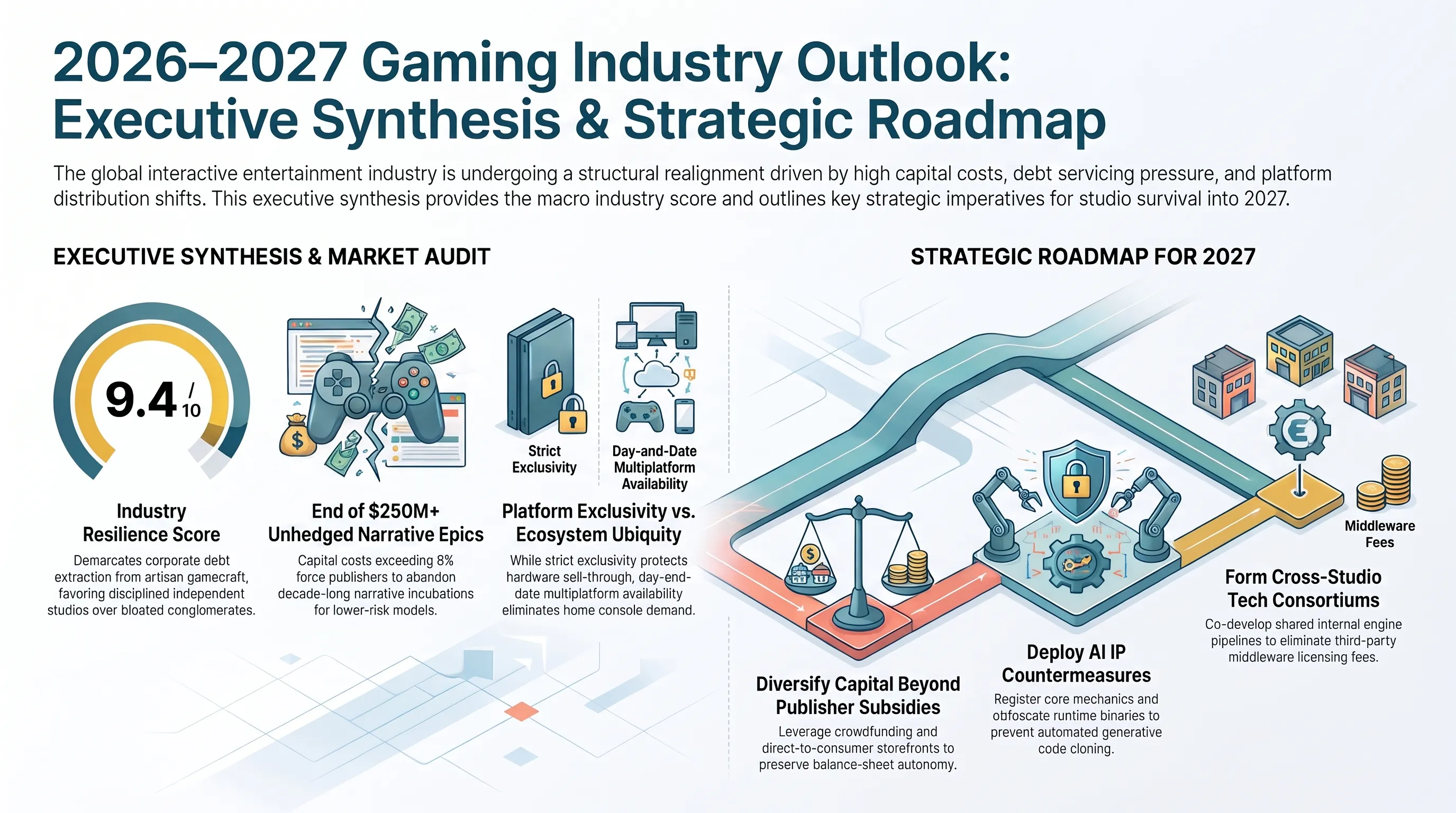
The converging developments of Sunday evening provide an authoritative diagnostic of an interactive entertainment sector undergoing its most profound structural correction since the 2008 financial crash. The liquidation of BioWare demonstrates that the conventional model of publisher-funded, eight-year triple-A development cycles has become fundamentally irreconcilable with prevailing interest rate environments and corporate debt governance.
Macroeconomic realities have permanently altered how game software is capitalized. When capital was virtually free during the low-interest regime of the previous decade, publishers indulged in sprawling team expansions and concurrent multi-project incubations. Today, with capital costs exceeding eight percent and institutional investors demanding immediate margin expansion, the luxury of protracted narrative exploration without intermediate cash flow has been extinguished.
In response to these contractions, a major talent diaspora is already reorganizing the industrial landscape. Veteran technical directors and narrative leads departing downsized conglomerates are establishing agile, worker-owned development collectives. By utilizing decentralized Git workflows and self-hosted private inference clusters, these boutique teams are operating with a fraction of triple-A burn rates while producing experiences that challenge corporate monotony.
Furthermore, private equity and venture capital valuations across gaming software have fundamentally pivoted away from speculative live-service multiples. Financial allocators are discounting churn-heavy multiplayer pitches, actively seeking out defensible, high-margin niche genres supported by passionate, recurring player bases that do not require multi-million-dollar seasonal user-acquisition campaigns to remain profitable.
At the same time, the divergent hardware fortunes of Sony and Microsoft expose the friction between traditional platform exclusivity and multiplatform subscription availability. While Sony preserves hardware velocity by maintaining strict exclusivity moats around blockbusters like Marvel's Wolverine, Microsoft's day-and-date ubiquity has rendered the physical Xbox console functionally optional for the vast majority of consumers, fundamentally altering the long-term economics of console hardware production.
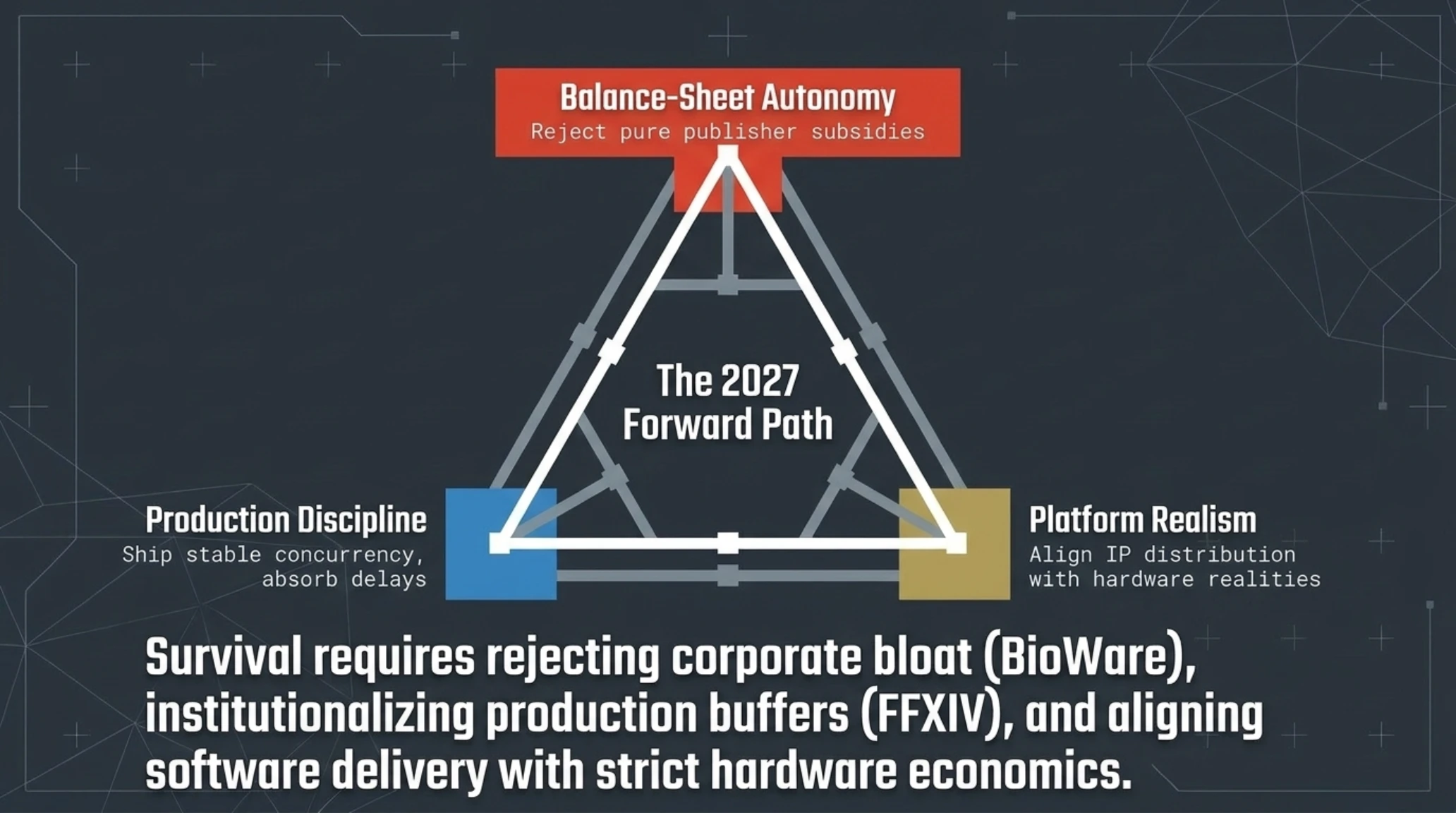
Yet, amidst corporate liquidations and platform stagnation, the triumph of Yacht Club Games and the principled engineering stewardship of Square Enix and Anthropic illuminate a sustainable forward path. Survival in the emerging landscape requires software creators to reject bureaucratic bloat, protect intellectual property against automated extraction, and forge transparent, unbreakable compacts with their audience.
To navigate this volatile operational horizon, executive producers, studio founders, and independent developers must execute against four strategic imperatives:
- Diversify Capital Structures Away from Pure Publisher Subsidies: Establish hybrid funding models leveraging crowdfunding, milestone-based community co-investment, and direct-to-consumer storefronts to preserve balance-sheet autonomy.
- Implement Active Intellectual Property Countermeasures Against Generative Extraction: Register detailed mechanical and mathematical architectures with intellectual property registries while deploying automated obfuscation to safeguard runtime binaries.
- Forge Cross-Studio Technical Infrastructure Consortiums: Collaborate with allied studios to co-develop shared rendering, physics, and networking engines, eliminating redundant middleware licensing fees.
- Institutionalize Radical Transparency and Production Buffer Discipline: Embrace calculated release delays to safeguard technical stability and concurrency thresholds, recognizing that shipping broken code permanently impairs audience lifetime value.
- Spectacular commercial triumph of Mina the Hollower restoring full financial independence to Yacht Club Games
- Ethical server-side intervention by Anthropic establishing critical IP protections for independent game developers
- Unflinching transparency by Naoki Yoshida in delaying FFXIV Evercold to guarantee launch server concurrency
- Pragmatic technical co-engineering between id Software and MachineGames maximizing id Tech engine efficiency
- Catastrophic liquidation of BioWare dissolving three decades of world-class role-playing game heritage
- Outright cancellation of Mass Effect 5 sacrificing rich single-player narrative to fund live-service shooters
- Severe stagnation of physical Xbox console sell-through resulting from ubiquitous multiplatform distribution
- Disruption of MMORPG seasonal content cadences caused by unavoidable multi-week expansion delays
The future of interactive media does not belong to risk-averse financial engineers liquidating legacy studios, but to disciplined creative technologists who unite technical mastery with authentic narrative ambition.
Moreover, the sudden cancellation of Mass Effect 5 and closure of BioWare's servers has re-ignited international debates surrounding digital consumer ownership and interactive preservation. As corporate publishers reserve the right to sunset digital infrastructure and delete intellectual properties at will, gaming historians and player-rights advocacy coalitions are demanding legally protected escrow systems for source code and asset preservation, ensuring that foundational works of interactive culture cannot be erased by sudden boardroom restructurings.
Sustainable equilibrium between human creative vision, cutting-edge real-time silicon, and enforceable ethical AI boundaries will define the leaders of the 2027 interactive entertainment renaissance.
The accompanying investigative documentary tracks the thirty-year history of BioWare, detailing the rise and fall of its flagship narrative projects and exploring the survival playbook for modern independent studios.
Editorial Verdict & Verified Intelligence Sources
The End of Corporate Illusion and the Rebirth of Artisan Gamecraft
November 1, 2026, marks the decisive demarcation between corporate debt extraction and authentic interactive artistry; the future of the medium belongs to uncompromised independent studios.
- Eurogamer Enterprise: Special Investigative Report on BioWare Liquidation and Mass Effect 5 Cancellation
- IGN News Network: Live Keynote Coverage from FFXIV Tokyo Fan Fest, Zephyr Reveal, and 2027 Schedule
- Destructoid Analytics: Comparative Retail Sell-Through Analysis of Marvel Wolverine and Gears of War E-Day
- Kotaku Technology: Anthropic Deploys tengu_heron_brook Guardrail to Shield Indie Games from Automated Cloning
- Bloomberg Financial: Electronic Arts Corporate Debt Obligations and Leveraged Buyout Covenant Audit
- Circana Video Games: Official Monthly Hardware Retail Tracking and Generational Console Pull Index
Frequently Asked Questions // Strategic Gaming Intelligence
Why did Electronic Arts shutter BioWare and cancel Mass Effect 5?
Facing strict debt-service covenants from syndicated banking facilities, EA executives faced an imperative to eliminate high-risk, front-loaded single-player capital expenditures. To maximize liquidity, leadership liquidated BioWare's Edmonton and Austin studios, archiving Mass Effect 5 to reallocate capital into Star Wars Battlefront 3, which offers lower risk and recurring live-service monetization.
What caused the four-week delay for Final Fantasy XIV: Evercold?
Producer Naoki Yoshida announced the expansion's release was shifted to February 23, 2027, to avoid holiday developer crunch, perform extensive cloud data center concurrency stress tests, and refine high-fidelity cutscenes to guarantee flawless day-one launch stability.
What are the combat mechanics of the newly revealed Zephyr job?
The Zephyr is a Physical Ranged DPS discipline wielding a modular crossbow alongside an elemental avian companion. It introduces continuous air-surfing kinetic mechanics, allowing players to execute sustained physical damage rotations without cast-time interruptions while maneuvering through complex raid telegraphs.
Why did Marvel's Wolverine boost PS5 sales while Gears of War failed to lift Xbox hardware?
Wolverine required dedicated PlayStation 5 console ownership to experience at launch, driving immediate hardware retail demand. Conversely, Gears of War: E-Day launched simultaneously on PC, cloud streaming, and Xbox Game Pass, eliminating the necessity for consumers to purchase dedicated home console hardware.
How does Anthropic's tengu_heron_brook guardrail prevent AI game cloning?
The server-side safety protocol analyzes abstract syntax trees and structural code queries, automatically rejecting prompts attempting to decompile, mechanically reconstruct, or clone existing commercial video games while restricting generation to original architectures.
How did Mina the Hollower rescue Yacht Club Games from insolvency?
Surpassing 500,000 paid units within two weeks of launch, Mina the Hollower fully recouped multi-year production debt, generating an operating surplus that funded the studio's full transition into next-generation 3D Shovel Knight development.
Additional Gallery: Tekin Night Nov 1: EA Shutters BioWare & Cancels Mass Effect 5, FFXIV Delayed