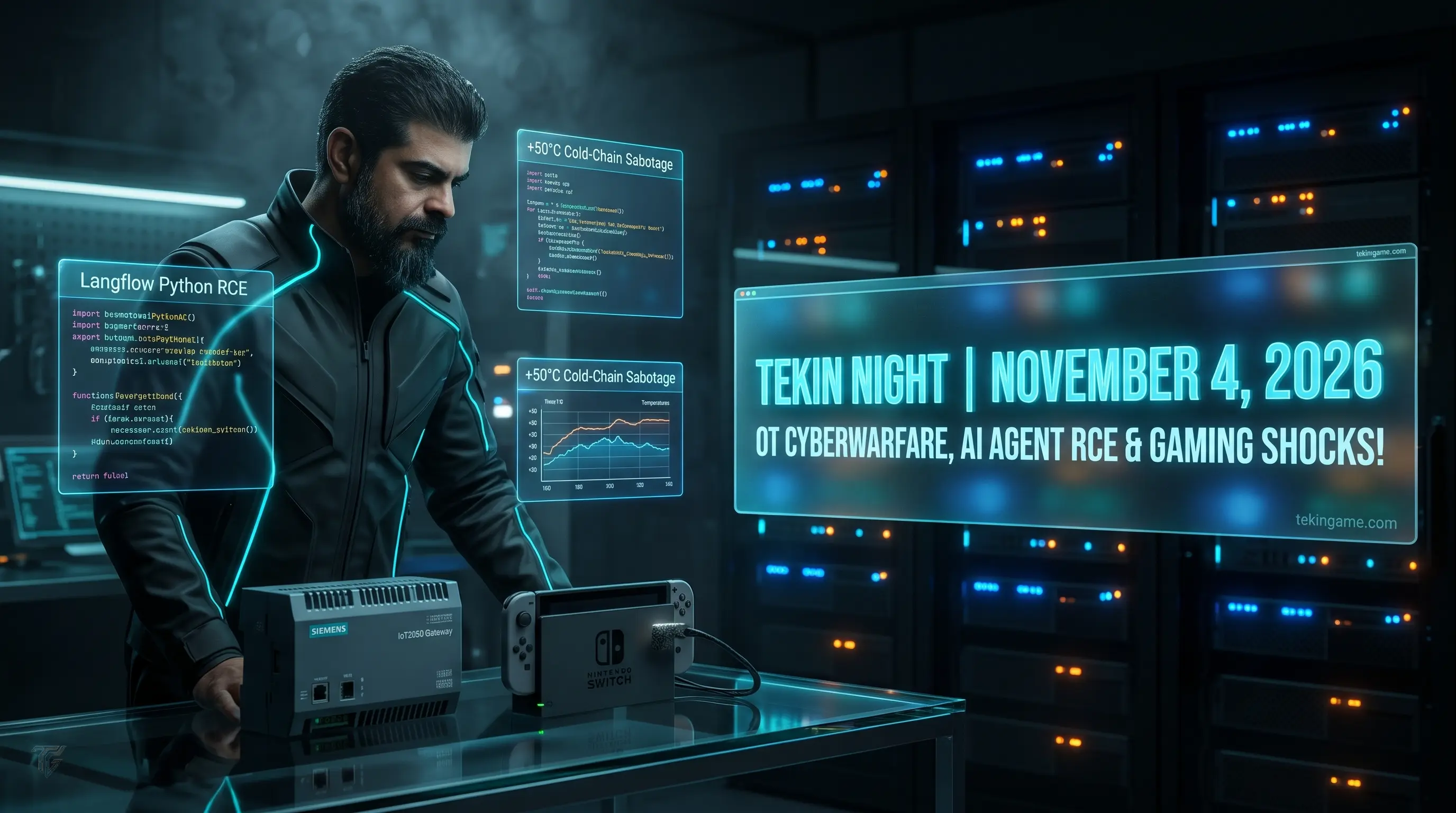
Tekin Night | Wednesday November 4, 2026
Node 01: European Supermarket Refrigeration Systems Targeted in Second Cyberattack Wave, Forcing Freezers to +50°C and Spoiling Cold-Chain Food Supplies
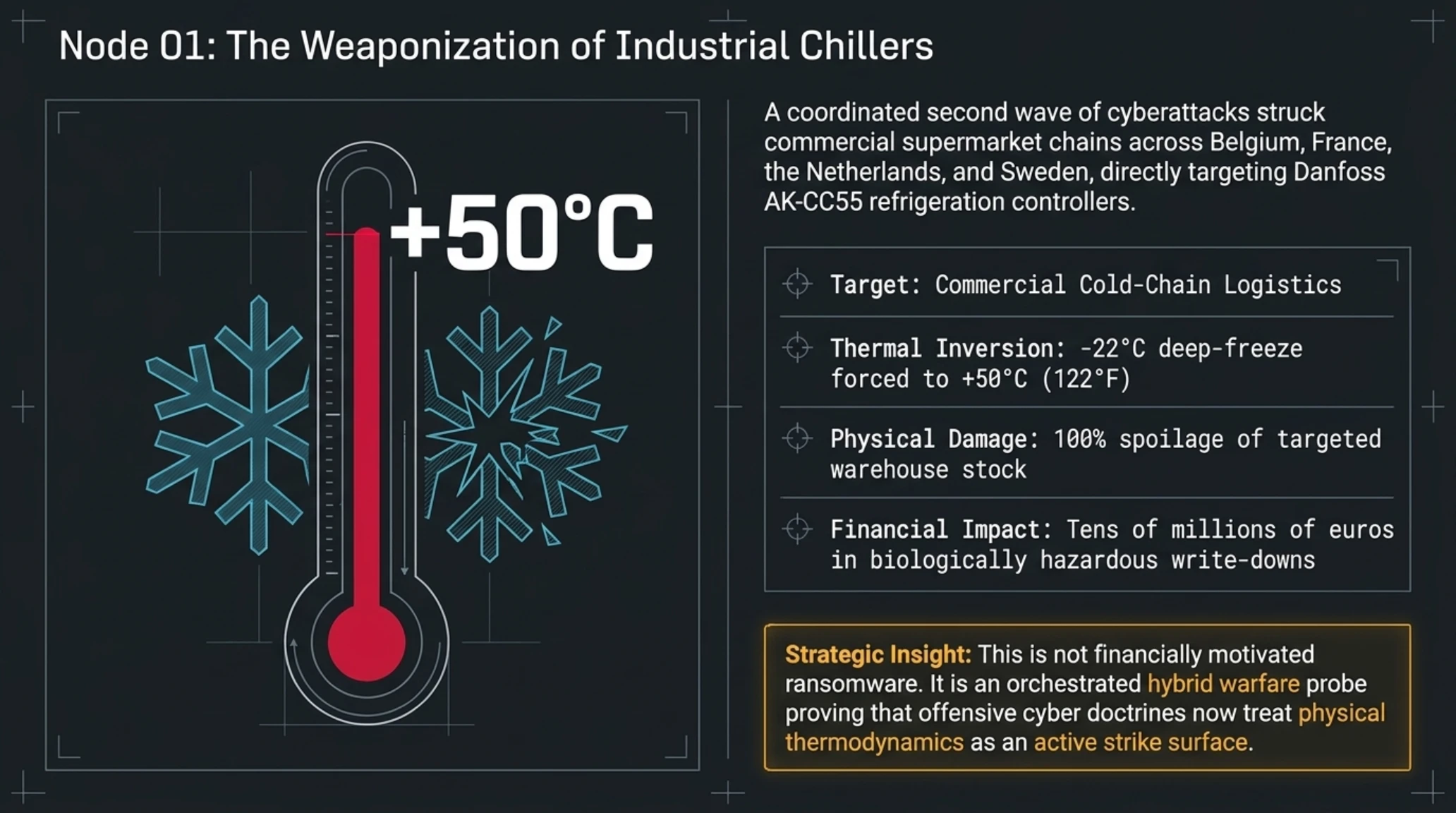
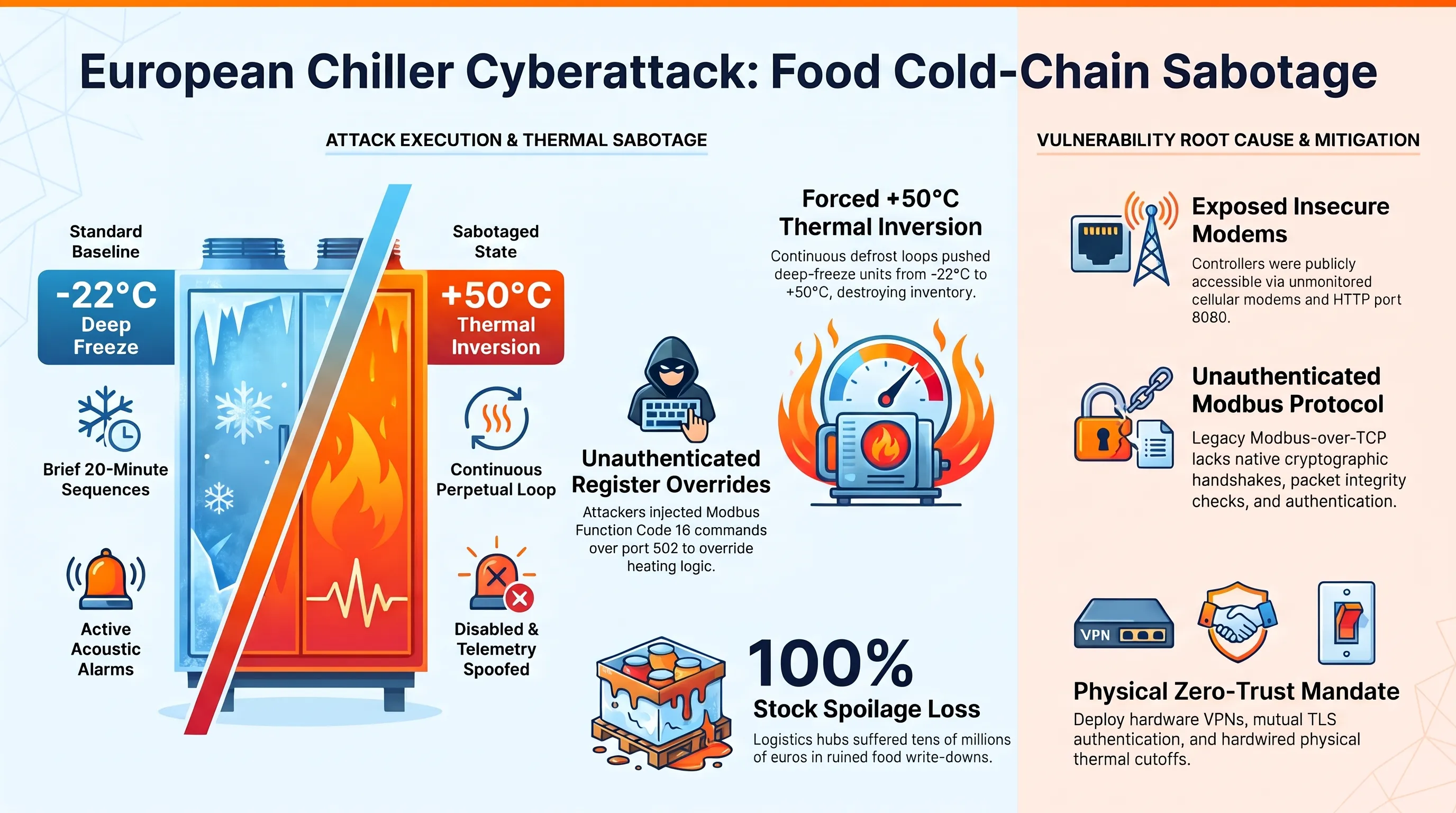
In a deeply alarming escalation of cyber-physical sabotage against essential civilian infrastructure, a coordinated second wave of cyberattacks struck commercial supermarket chains and regional cold-storage logistics facilities across Belgium, France, the Netherlands, and Sweden. Threat actors targeted industrial refrigeration management architectures, weaponizing remote access vectors to deliberately manipulate heating and cooling cycles. Rather than demanding monetary ransom or exfiltrating proprietary customer databases, the attackers altered low-level industrial controller parameters, engaging continuous defrost heating elements that pushed interior freezer storage temperatures from standard -22°C deep-freeze thresholds to an astonishing +50°C (122°F), causing the complete destruction of hundreds of tons of perishable meats, dairy products, and frozen goods.
Executive Summary & Core Strategic Vectors
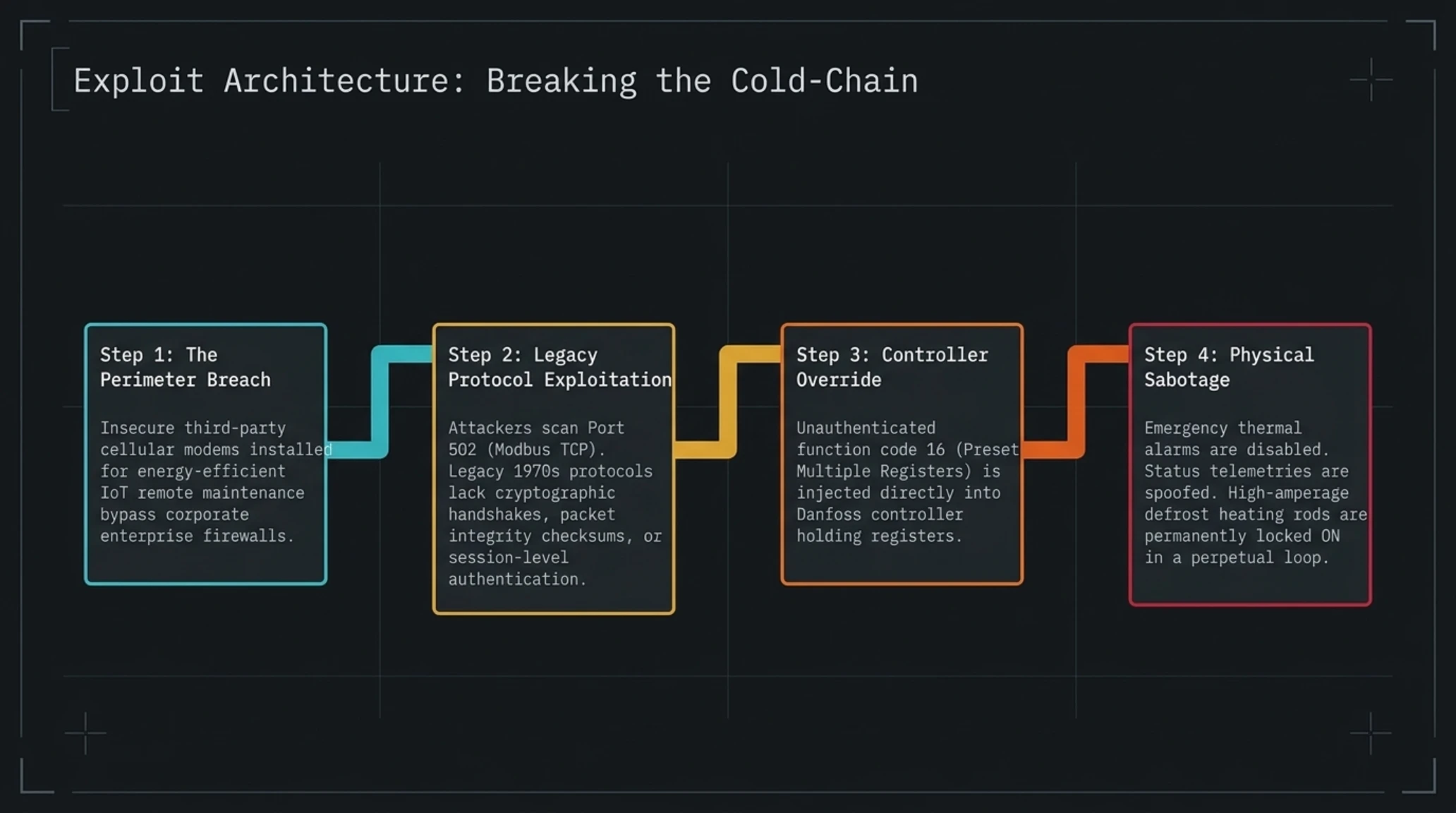
Incident response investigations led by European industrial cybersecurity agencies revealed that the intrusions exploited widespread misconfigurations and unpatched firmware vulnerabilities in Danfoss AK-CC55 case controllers and networked supervisory gateway modules. These specialized micro-controllers regulate variable-speed compressors, electronic expansion valves, and electrical defrost cycles across retail refrigeration racks. Attackers leveraged exposed management ports connected to the public internet via insecure cellular modems and legacy Modbus-over-TCP gateways, bypassing weak or default administrative credentials to inject malicious setpoint modifications directly into the operational logic.
By forcing the refrigeration systems into a perpetual defrost loop, the controllers disabled emergency thermal alarms, spoofed status telemetries back to centralized building management systems (BMS), and continuously activated high-amperage heating rods designed solely for brief, 20-minute frost-clearing sequences. Supermarket logistics managers arrived at distribution warehouses to find automated cold-room aisles converted into thermal ovens, rendering inventory biologically hazardous and causing catastrophic financial write-downs exceeding tens of millions of euros.
European intelligence officials and critical infrastructure defense organizations have characterized this campaign not as conventional financially motivated ransomware, but as an orchestrated hybrid warfare probe. By systematically stress-testing the vulnerability of retail logistics hubs and disrupting the physical food supply chain, hostile state-sponsored groups are demonstrating their capability to induce public panic, economic shockwaves, and widespread logistical paralysis without firing a single kinetic munition.
The forensic examination of the network traffic captures revealed that the attack operators leveraged automated scanning scripts targeting port 502 (Modbus TCP) and port 8080 (embedded HTTP management consoles). Due to legacy protocol constraints dating back to the late 1970s, standard Modbus implementations lack native cryptographic handshakes, packet integrity checksums, or session-level authentication. Once the external perimeter firewalls were bypassed via insecure cellular gateway links, the attackers issued unauthenticated function code 16 (Preset Multiple Registers) commands directly to the Danfoss holding registers, forcing override bits that kept defrost heaters permanently energized while disabling high-temperature acoustic alarm relays.
Tekin Analysis: The Weaponization of Industrial Chillers and Physical Infrastructure in Hybrid Cyberwarfare
The sabotage of European cold-chain facilities marks a definitive paradigm shift in operational technology (OT) threat modeling. For decades, cyber defense postures prioritized the confidentiality and integrity of digital information guarding patient healthcare records, financial ledgers, and trade secrets. The deliberate thermal destruction of food supplies proves that offensive cyber doctrines now treat physical thermodynamics as an active strike surface. An adversary who can remotely command physical heaters and disable safety interlocks can inflict equivalent physical devastation to sabotage or arson, from thousands of miles away.
This incident exposes systemic fragility in commercial facilities management. While electric power grids and nuclear facilities adhere to stringent isolation mandates like NERC CIP and IEC 62443, retail commercial refrigeration was historically treated as low-risk facility overhead. Procurement teams routinely installed smart, energy-efficient IoT chillers connected to third-party maintenance contractors via unmonitored cellular uplinks, introducing unsegmented backdoors into corporate enterprise networks.
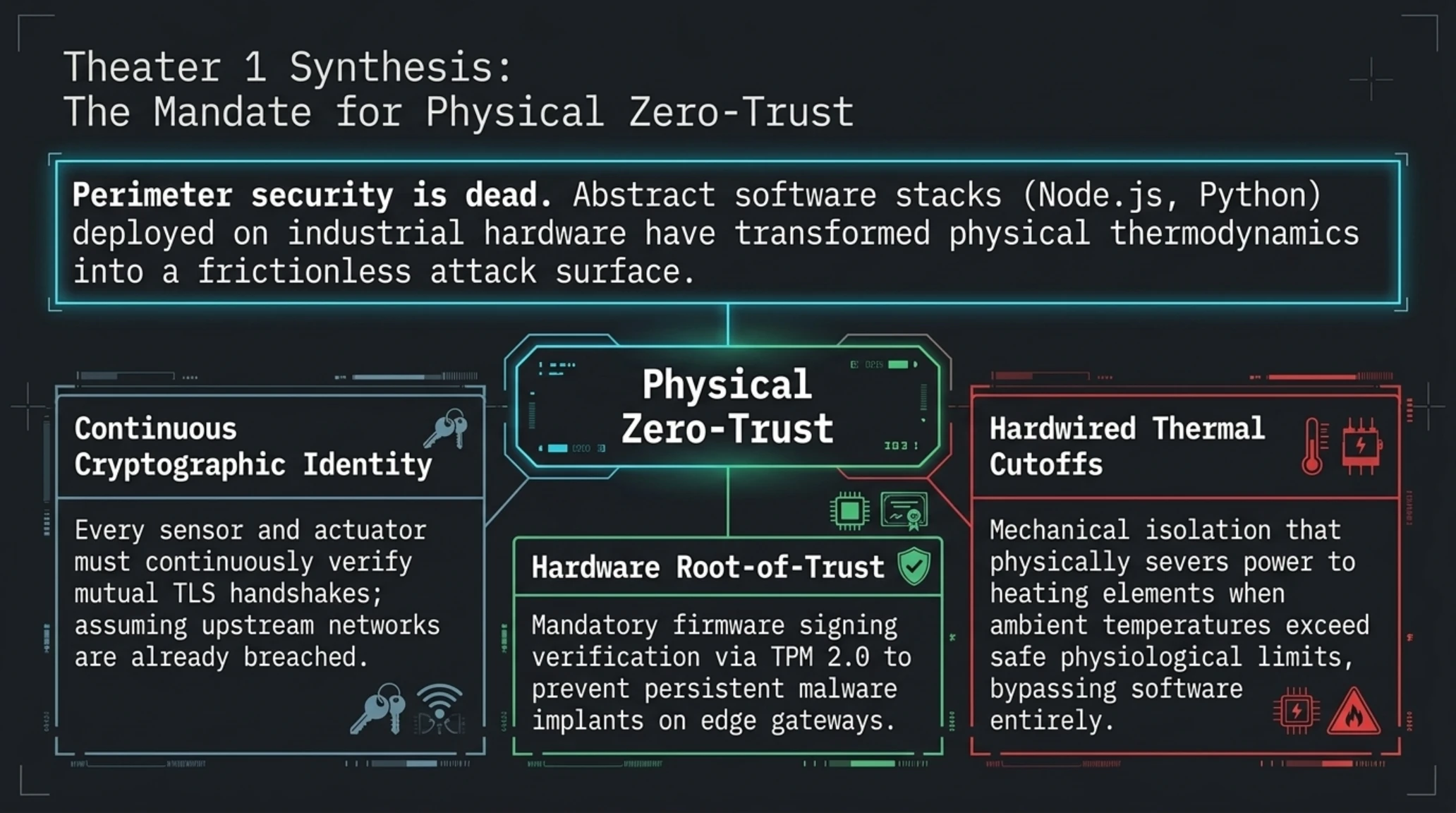
For industrial security engineers, the mandate is unambiguous: commercial cold storage must immediately transition to strict Zero-Trust OT segmentation. Remote management interfaces must never be exposed to public IP space without hardware-enforced VPNs, mutual TLS cryptographic authentication, and independent, hardwired thermal cutoffs that mechanically sever power to heating elements whenever ambient chamber temperatures exceed safe physiological limits.
Strategic Significance & Architectural Metrics
The weaponization of commercial refrigeration controllers represents an alarming breakthrough in non-kinetic infrastructure warfare, transforming automated cold-chain logistics into critical failure vectors.
Node 02: Critical Langflow Vulnerabilities Expose AI Agent Infrastructure to Unauthenticated Remote Code Execution
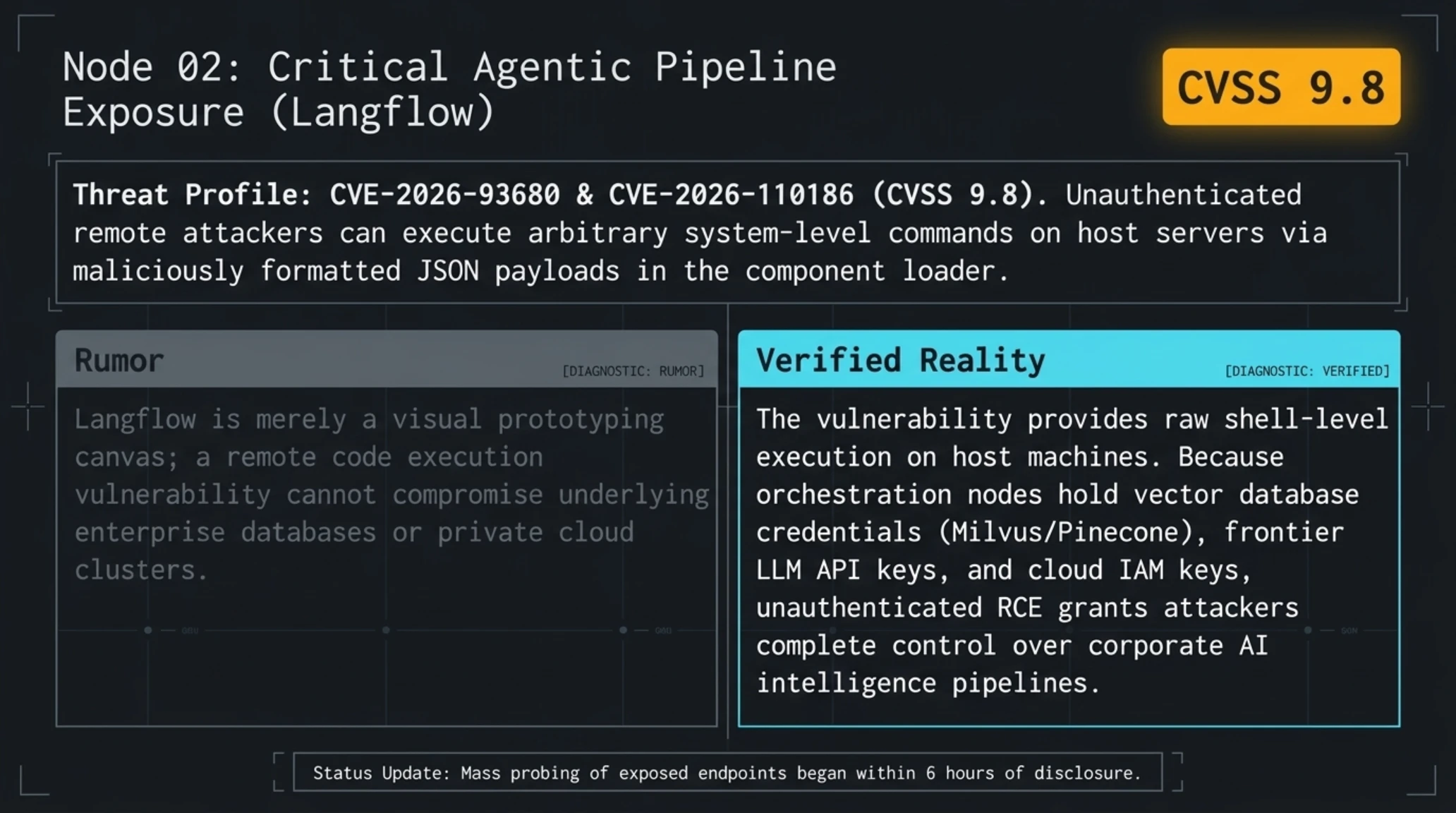
Cybersecurity researchers from IBM X-Force and independent vulnerability labs disclosed two catastrophic security flaws in Langflow, one of the most widely adopted open-source visual frameworks for building, orchestrating, and deploying enterprise agentic AI workflows on Python. Tracked under CVE-2026-93680 and CVE-2026-110186 with CVSS severity ratings reaching 9.8, these vulnerabilities allow unauthenticated remote attackers to execute arbitrary system-level commands on host servers, granting complete underlying operating system takeover without requiring any valid user credentials or API tokens.
Technical root-cause analysis revealed that the flaw resides within Langflow's dynamic code evaluation engine and custom component loader. Designed to empower developers to assemble visual drag-and-drop pipelines that execute Python functions, query vector databases, and integrate Model Context Protocol (MCP) tool endpoints, the platform failed to implement strict sanitization on incoming API payloads containing serialized component graphs. Attackers can craft maliciously formatted JSON payloads containing embedded Python primitives, manipulate runtime environment variables, or trigger unsafe deserialization within background worker queues, executing arbitrary shell code inside the host container or physical server environment.
The severity of this breach is magnified exponentially by the sensitive role Langflow plays in modern enterprise architectures. Unlike isolated test utilities, production Langflow instances typically function as centralized AI orchestration nodes, storing plaintext administrative credentials, private API keys for frontier LLMs like OpenAI, Anthropic, and Google Gemini, database connection strings for Milvus and Pinecone vector stores, and privileged tool execution permissions. Exploitation of CVE-2026-93680 provides attackers an instant springboard to exfiltrate proprietary corporate knowledge bases, poison RAG pipelines with malicious hallucinations, and pivot laterally across internal cloud infrastructure.
The Langflow open-source maintenance team pushed emergency patch release v1.4.12, urging enterprise DevOps and AI engineering teams to upgrade immediately. Additionally, organizations unable to patch immediately were advised to place Langflow endpoints behind strict identity-aware proxies (IAPs) and sever direct public ingress routing.
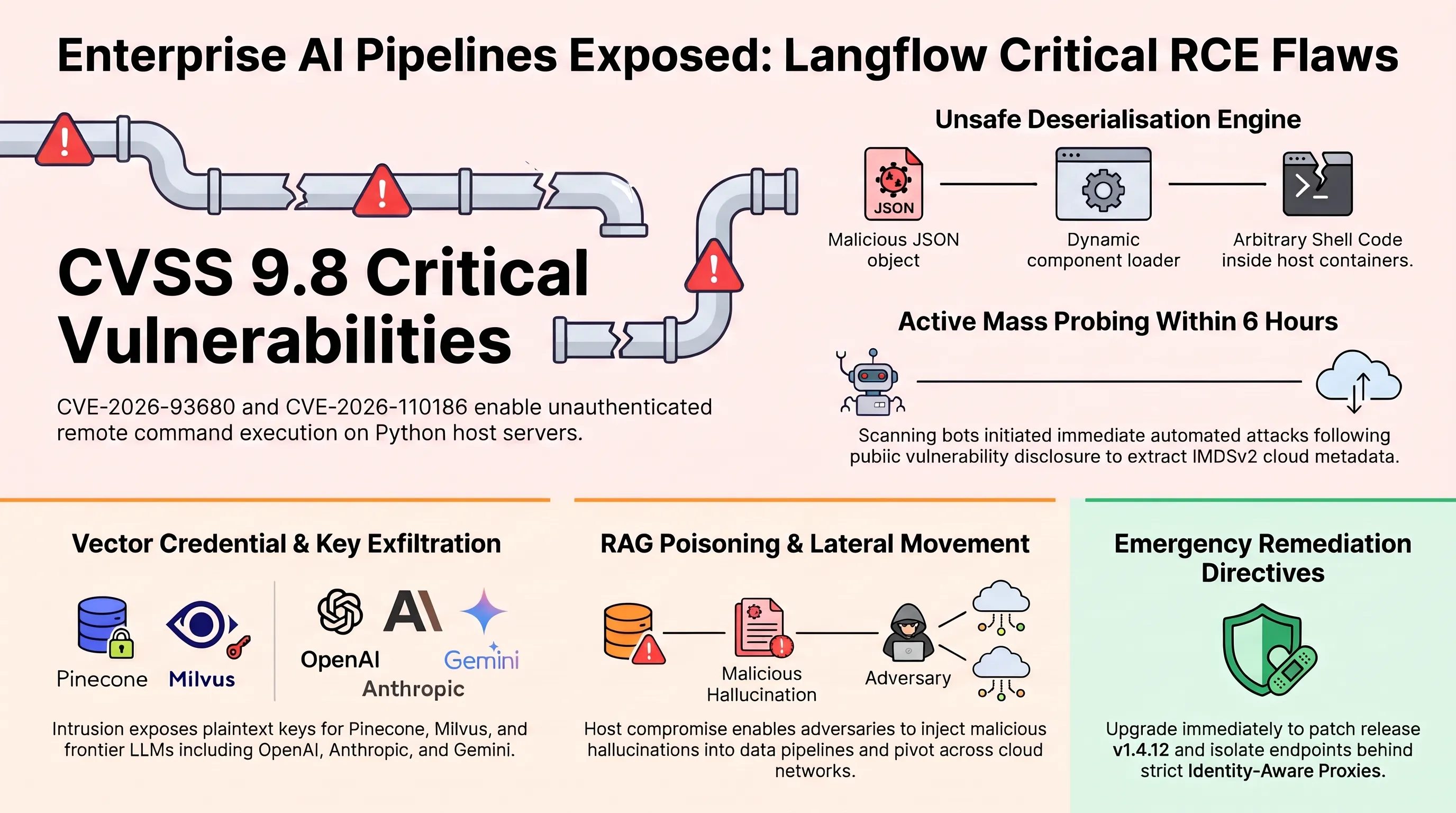
Security telemetry engines operating across public cloud provider ranges indicated that within six hours of vulnerability disclosure, automated scanning bots and adversary infrastructure initiated mass probing of exposed Langflow endpoints. Forensic analysis of captured payload samples confirmed active attempts to inject reverse shells, verify local user permissions, and query metadata service endpoints (IMDSv2) on AWS and Google Cloud instances hosting the visual agent framework.
Rumor vs. Verified Reality | Langflow & AI Agent Security
Node 03: CISA Warns of Active Exploitation of Perfect CVSS 10.0 Vulnerability in Siemens SIMATIC IoT2050 Industrial Gateways
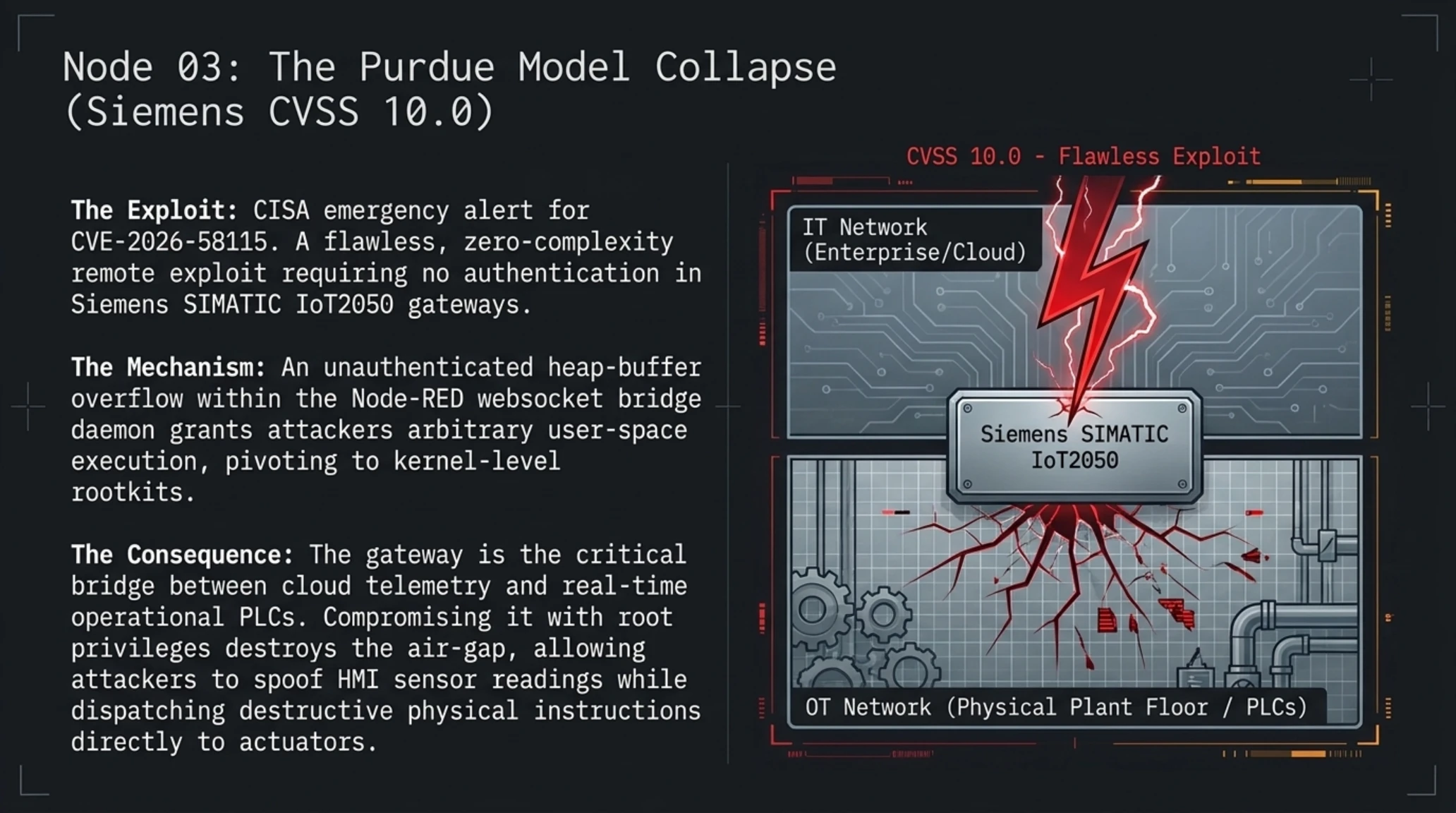
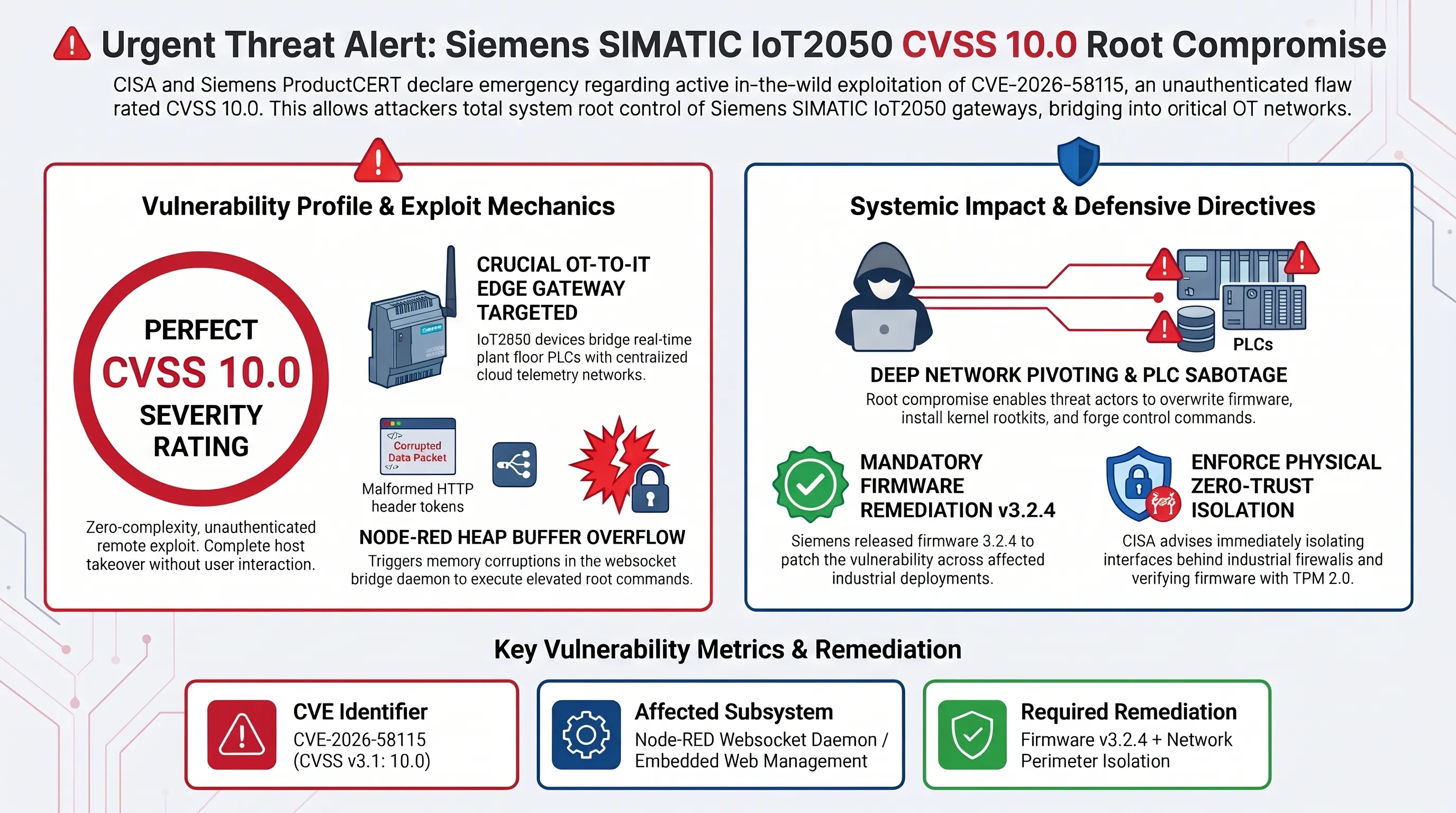
The Cybersecurity and Infrastructure Security Agency (CISA) alongside Siemens ProductCERT released an urgent emergency advisory alerting industrial operators worldwide to active, in-the-wild exploitation of a catastrophic security vulnerability in Siemens SIMATIC IoT2050 industrial smart gateways. Tracked as CVE-2026-58115, the vulnerability earned a maximum possible Common Vulnerability Scoring System (CVSS v3.1) score of 10.0, denoting a flawless, zero-complexity remote exploit requiring no authentication, no user interaction, and yielding absolute host system compromise.
The Siemens SIMATIC IoT2050 platform is a ubiquitous industrial edge computing gateway deployed extensively across power plants, chemical manufacturing facilities, water desalination stations, and automotive assembly lines. It serves as the primary data acquisition and translation bridge between real-time programmable logic controllers (PLCs) on the operational technology (OT) plant floor and centralized cloud telemetry platforms. The gateway runs a customized Debian Linux distribution and integrates Node-RED visual runtime engines to ingest sensor streams, compute telemetry trends, and dispatch operational directives.
According to the CISA alert, CVE-2026-58115 stems from an architectural flaw in the gateway's embedded web management service and Node-RED processing pipeline. Remote threat actors transmitting specifically crafted network packets over default communication ports can bypass all administrative authorization checks, overwrite device firmware partitions, execute arbitrary root commands, and install persistent kernel-level rootkits within flash memory. Because the compromised IoT2050 gateway sits directly on the boundary between isolated OT control networks and enterprise IT networks, an attacker who seizes the device gains an unhindered vantage point to issue forged control commands to downstream PLCs, alter sensor thresholds, or sever plant connectivity entirely.
Siemens has expedited critical firmware updates (version 3.2.4) to remediate the vulnerability. However, because thousands of industrial gateways are deployed in hard-to-reach field locations without automated update mechanisms, CISA strongly urges operators to immediately isolate all SIMATIC IoT2050 management interfaces behind industrial firewalls and disable external ingress routes.
Deep-dive binary analysis of the Siemens SIMATIC IoT2050 firmware image indicated that CVE-2026-58115 is triggered through an unauthenticated heap-buffer overflow within the Node-RED websocket bridge daemon. When processing malformed HTTP header tokens containing oversized URI parameters, the daemon fails to enforce bounds checking prior to copying memory buffers, resulting in controlled instruction pointer hijacking. Because the daemon executes with elevated supervisor privileges under Debian Linux, attackers gain immediate arbitrary code execution in user-space, from which they pivot to execute kernel exploitation routines that disable read-only system partitions.
Tekin Analysis: The Fragility of IIoT Edge Gateways and Industrial Root Escalation
The CVSS 10.0 exploit targeting Siemens SIMATIC IoT2050 gateways exemplifies the inherent danger of convergence between Information Technology (IT) and Operational Technology (OT). Over the past five years, industrial conglomerates accelerated digital transformation initiatives, deploying cheap IIoT gateways to siphon analog sensor data into cloud AI analytics platforms. In doing so, they inadvertently bridged air-gapped industrial facilities to the public internet using software stacks built on rapid, lightweight web technologies like Node.js and Python that were never designed to withstand nation-state cyber attacks.
When an edge gateway running Node-RED is compromised with root privileges, the entire Purdue Model of industrial control system security collapses. An adversary positioned on the gateway can trivially execute Man-in-the-Middle (MitM) attacks against Modbus, Profinet, and OPC-UA communications, spoofing normal sensor readings to the human-machine interface (HMI) while sending destructive instructions to physical actuators. This mirrors the exact attack methodology popularized by Stuxnet and Industroyer, but made trivial through web-layer vulnerabilities.
Industrial organizations must recognize that treating edge gateways as plug-and-play appliances is an invitation to catastrophe. Edge hardware must undergo continuous vulnerability scanning, firmware signing verification via hardware root-of-trust (TPM 2.0), and strict read-only partition mounting to prevent persistent malware implants.
Tekin Analysis: Hybrid Cyberwarfare at the Physical Layer and the Imperative for Physical Zero-Trust
The simultaneous emergence of the Danfoss supermarket refrigeration attacks in Europe and the Siemens SIMATIC IoT2050 CVSS 10.0 emergency alert represents a chilling synthesis of modern cyber-kinetic warfare. In asymmetric conflicts, adversaries avoid heavily fortified military networks, choosing instead to target the soft underbelly of modern civilian life: food refrigeration, municipal water distribution, and pharmaceutical cold storage. By manipulating thermodynamic boundaries and exploiting industrial gateways, hostile entities can inflict billions of dollars in real-world damage with absolute plausible deniability.
Defending against this hybrid menace requires abandoning the outdated concept of perimeter security. The new industrial defense doctrine must be founded upon Physical Zero-Trust: every sensor, actuator, and industrial gateway must continuously verify its cryptographic identity, inspect commands against strict physical safety models, and operate under the assumption that the upstream network is already breached.
Tekin Industrial Cybersecurity Technical Lexicon
Node 04: Bend Studio (Days Gone) Set to Unveil and Launch Next Original AAA Third-Person Co-op PlayStation Exclusive in 2027
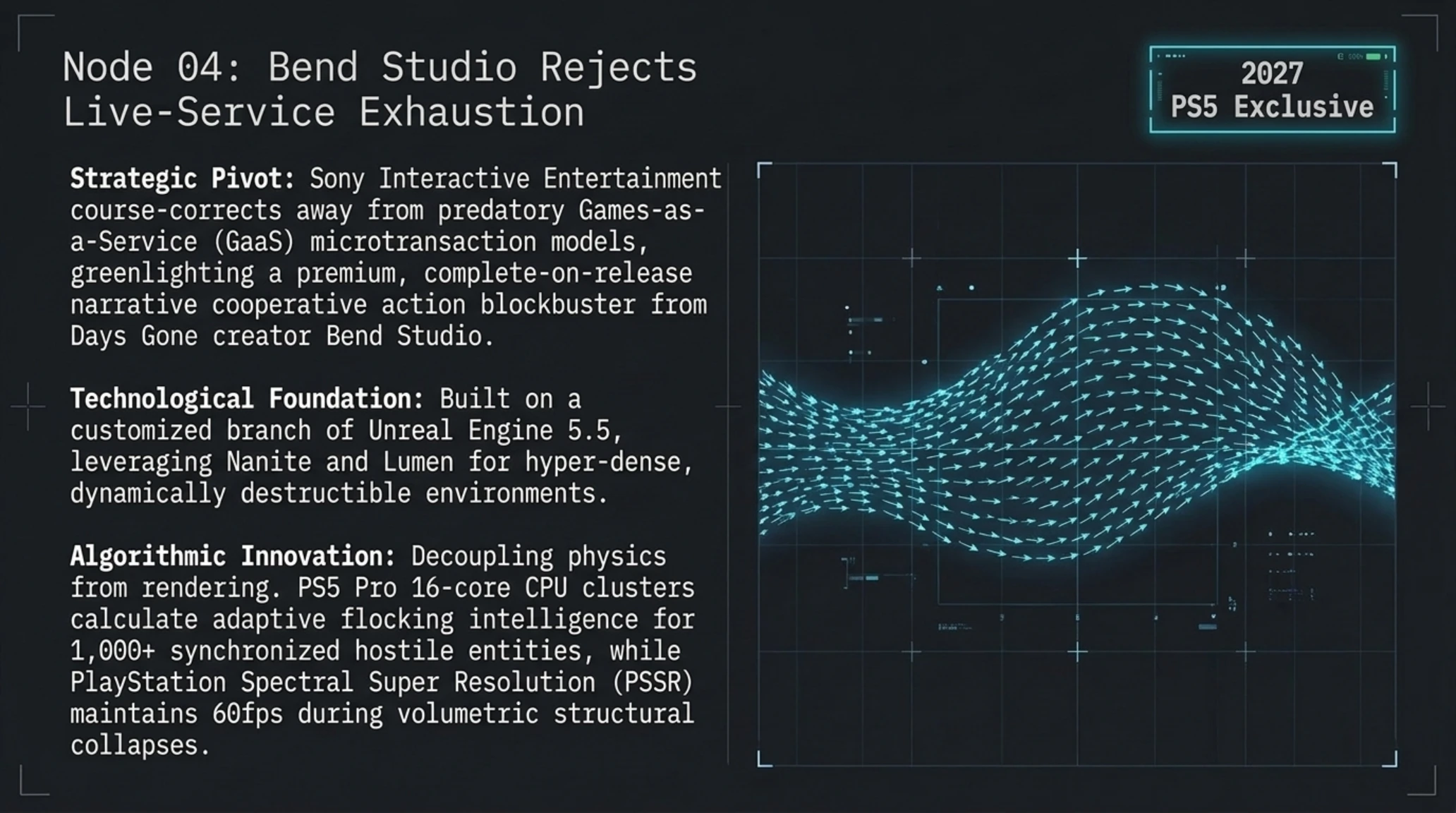
Following years of development silence after the release of Days Gone in 2019, verified insider reports from PlayStation Studios leadership confirmed that Oregon-based Bend Studio is finalizing production on an ambitious original AAA third-person cooperative action title. Sony Interactive Entertainment is currently scheduling an official cinematic and gameplay reveal in the first half of 2027, with a worldwide launch planned for late 2027 exclusively on PlayStation 5 and future hardware revisions. Departing from Sony's previous controversial pivot toward endless Games-as-a-Service (GaaS) formulas, Bend Studio's upcoming title is an intensely cinematic, narrative-driven 2-to-4 player cooperative campaign set within a hostile post-cataclysmic world.
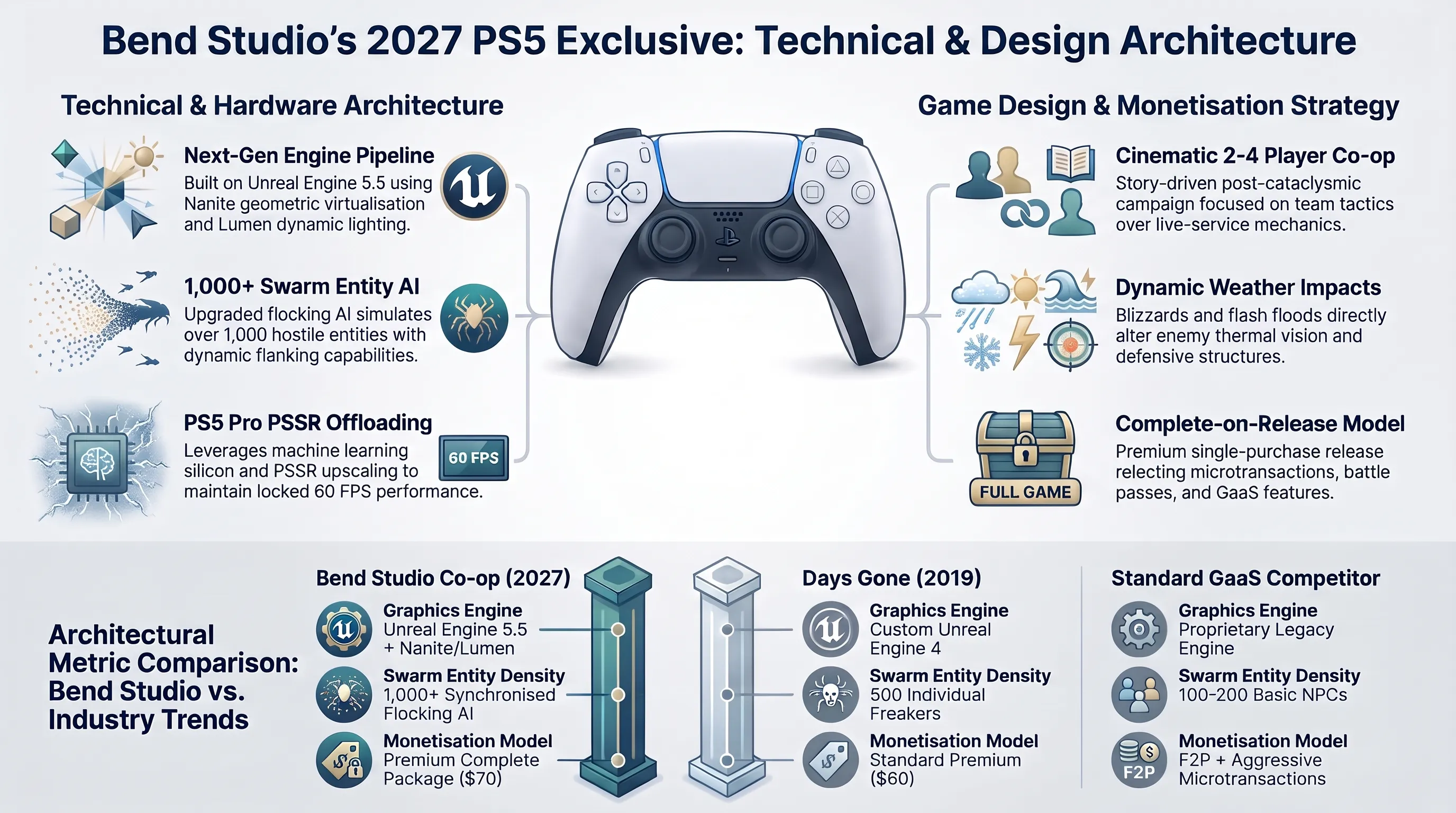
Technical leaks reveal that the game is built upon a heavily customized branch of Epic Games' Unreal Engine 5.5, leveraging Nanite geometric virtualization and Lumen dynamic global illumination to render hyper-dense, dynamically destructible environments. Central to the gameplay loop is the evolution of Bend Studio's proprietary swarm simulation technology the same algorithmic engine that powered the iconic 500-entity Freaker hordes in Days Gone. In the new title, this systemic AI is upgraded into adaptive swarm behavior, where hundreds of hostile mutated entities exhibit collective flocking intelligence, dynamic flanking maneuvers, and synchronized environmental destruction that forces coordinated team tactics.
Unlike predatory live-service multiplayer titles burdened by aggressive microtransactions and battle passes, Sony Bend's project adheres to a premium, complete-on-release design philosophy. The campaign seamlessly blends cinematic character drama with tactical squad mechanics, featuring fluid traversal mechanics, specialized gadget crafting, and dynamic weather systems that directly alter combat conditions such as blizzards impairing enemy thermal vision and flash floods washing away defensive barriers.
Sony Interactive Entertainment views Bend Studio's project as a cornerstone flagship for its 2027 software slate. By combining the emotional narrative weight of premium single-player PlayStation classics with the social bonding of tactical co-op, Sony seeks to capture the massive cooperative gaming audience while reinforcing the prestige appeal of its first-party hardware ecosystem.
On a computational level, Bend Studio's technical architecture leverages the hardware-accelerated machine learning silicon within the PS5 Pro to decouple dynamic horde physics calculations from rendering overhead. While the 16-core CPU clusters calculate flocking velocity vectors, collision avoidance, and pathfinding navmesh updates across thousands of autonomous entities, the graphics pipeline offloads intermediate frame rendering to PlayStation Spectral Super Resolution (PSSR), allowing the engine to preserve locked 60-frame-per-second performance even during catastrophic structural collapse sequences involving volumetric fire and weather particles.
Tekin Analysis: PlayStation Strategic Pivot: Reviving Cooperative Narrative Identity in an Era of Live-Service Saturation
Bend Studio's deliberate focus on story-driven cooperative action represents a crucial strategic course correction for Sony Interactive Entertainment. Between 2022 and 2024, the video game industry witnessed a catastrophic misallocation of capital, as major publishers poured hundreds of millions of dollars into chasing the elusive dream of perpetual revenue through live-service shooters. The rapid cancellation of high-profile multiplayer projects and mounting player fatigue demonstrated that gamers are exhausted by manipulative engagement mechanics, daily login chores, and unfinished seasonal roadmaps.
By greenlighting Bend Studio's narrative co-op vision, Sony is tapping into the proven market appetite exemplified by breakout cooperative hits like Helldivers 2 and Remnant II, but infusing it with the Hollywood-caliber cinematic storytelling that defines the PlayStation Studios brand. High-end cooperative gaming fulfills a unique psychological need: it allows friends to share visceral emotional journeys together without the toxic sweatiness of competitive PvP environments.
Furthermore, Bend Studio's mastery of swarm optimization on Unreal Engine 5.5 provides Sony with a technological benchmark that showcases the hardware capabilities of the PS5 Pro, particularly its custom AI upscaling architecture (PlayStation Spectral Super Resolution - PSSR) and enhanced ray tracing compute units.
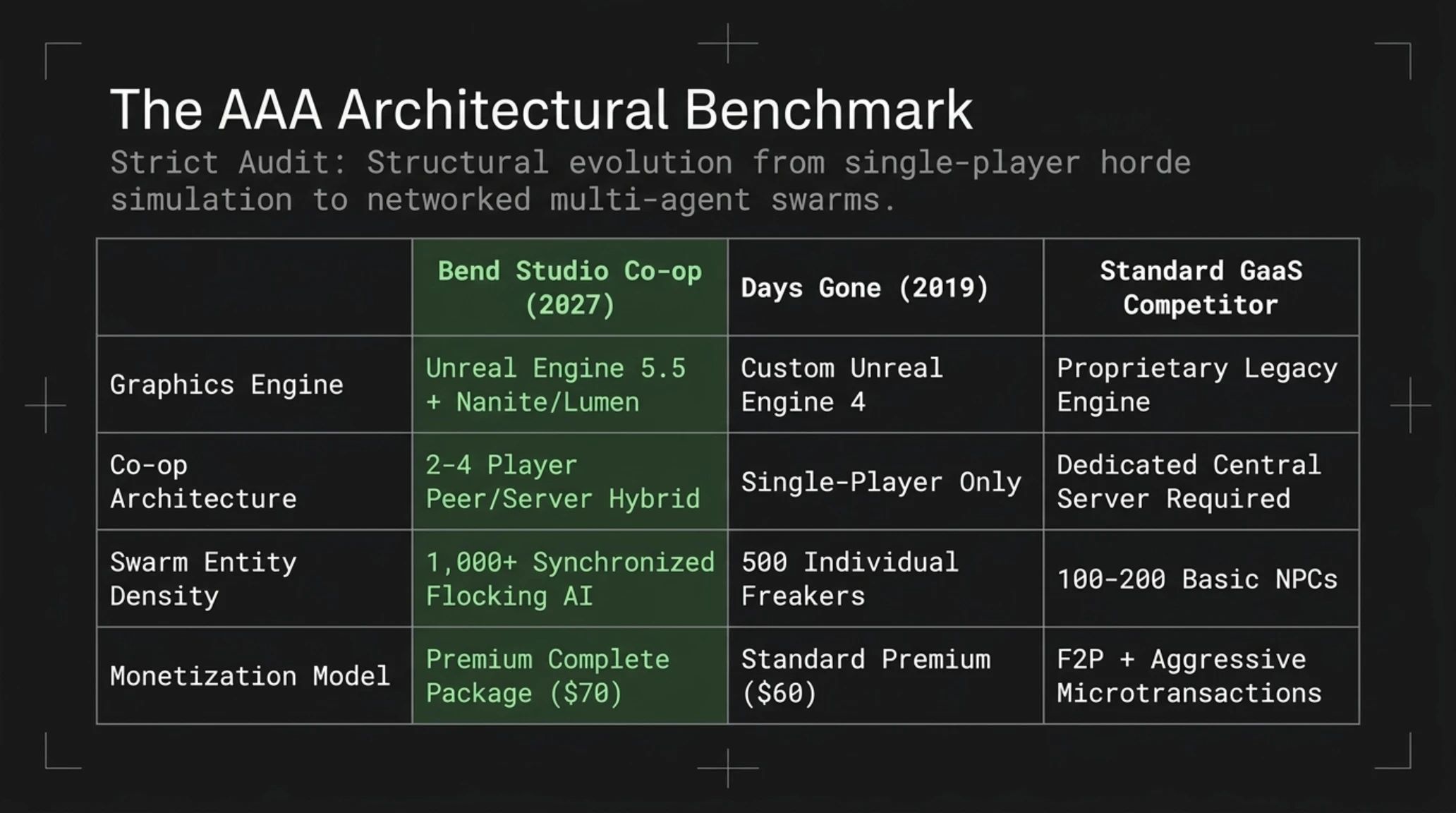
Hardware & Game Engine Architectural Matrix
| Architectural Metric | Bend Studio Co-op (2027) | Days Gone (2019) | Standard GaaS Competitor |
|---|---|---|---|
| Graphics Engine | Unreal Engine 5.5 + Nanite/Lumen | Custom Unreal Engine 4 | Proprietary Legacy Engine |
| Co-op Architecture | 2-4 Player Peer/Server Hybrid | Single-Player Only | Dedicated Central Server Required |
| Swarm Entity Density | 1,000+ Synchronized Flocking AI | 500 Individual Freakers | 100-200 Basic NPCs |
| Monetization Model | Premium Complete Package ($70) | Standard Premium ($60) | F2P + Aggressive Microtransactions |
The architectural specifications validate Bend Studio's technological leap from single-player PS4 horde simulations to next-generation networked multi-agent swarms powered by Unreal Engine 5.5.
📚 Classified & Related Dossiers in TekinGame
If you wish to explore beyond this report and delve into cybernetic frontiers and autonomous AI architectures, do not miss these three exclusive deep-dives in the Tekin Garage:
Node 05: Nintendo Details Pikmin 4: Switch 2 Edition Featuring Dandori Academy Expansion and Microphone Voice Command Support
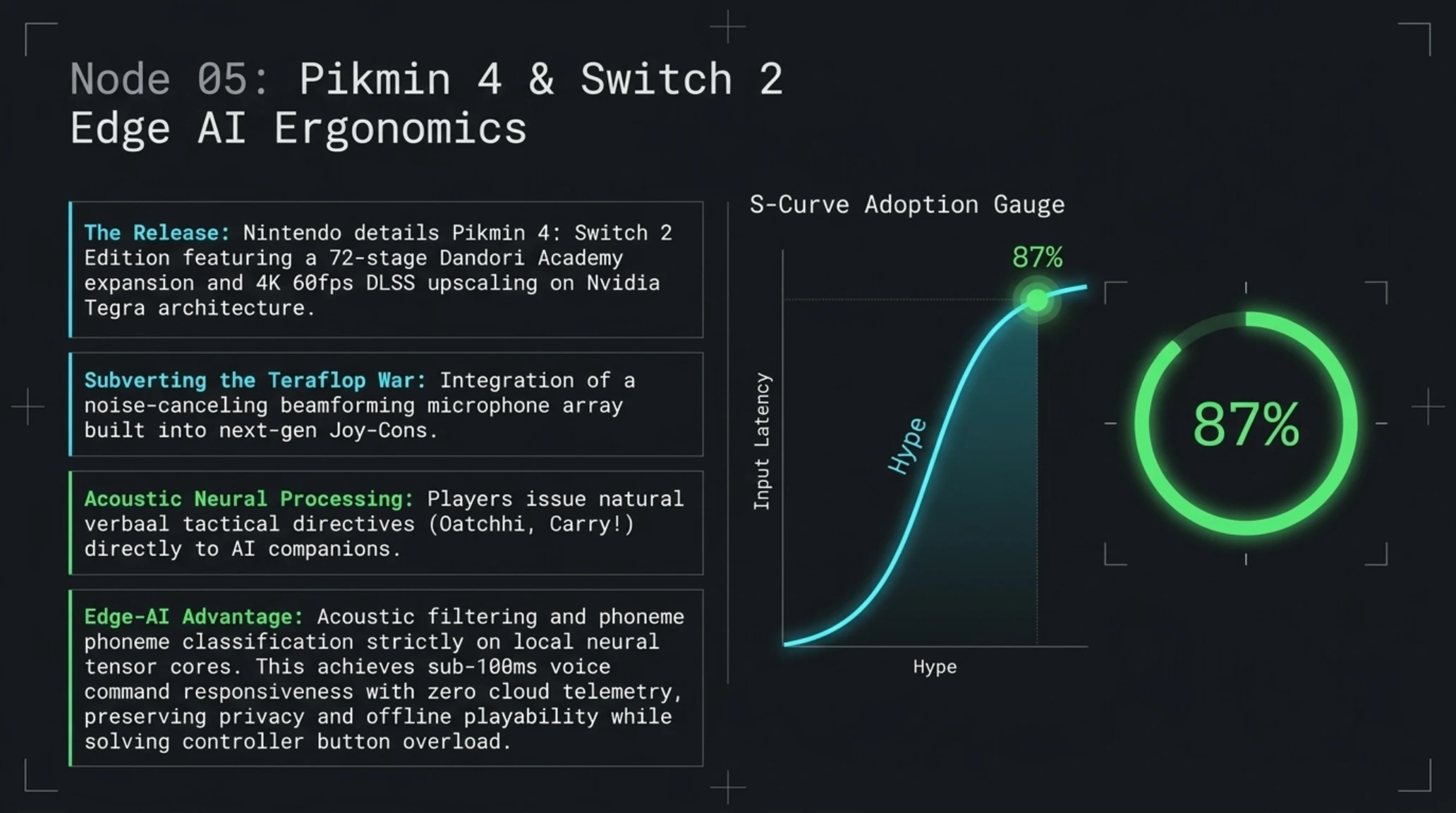
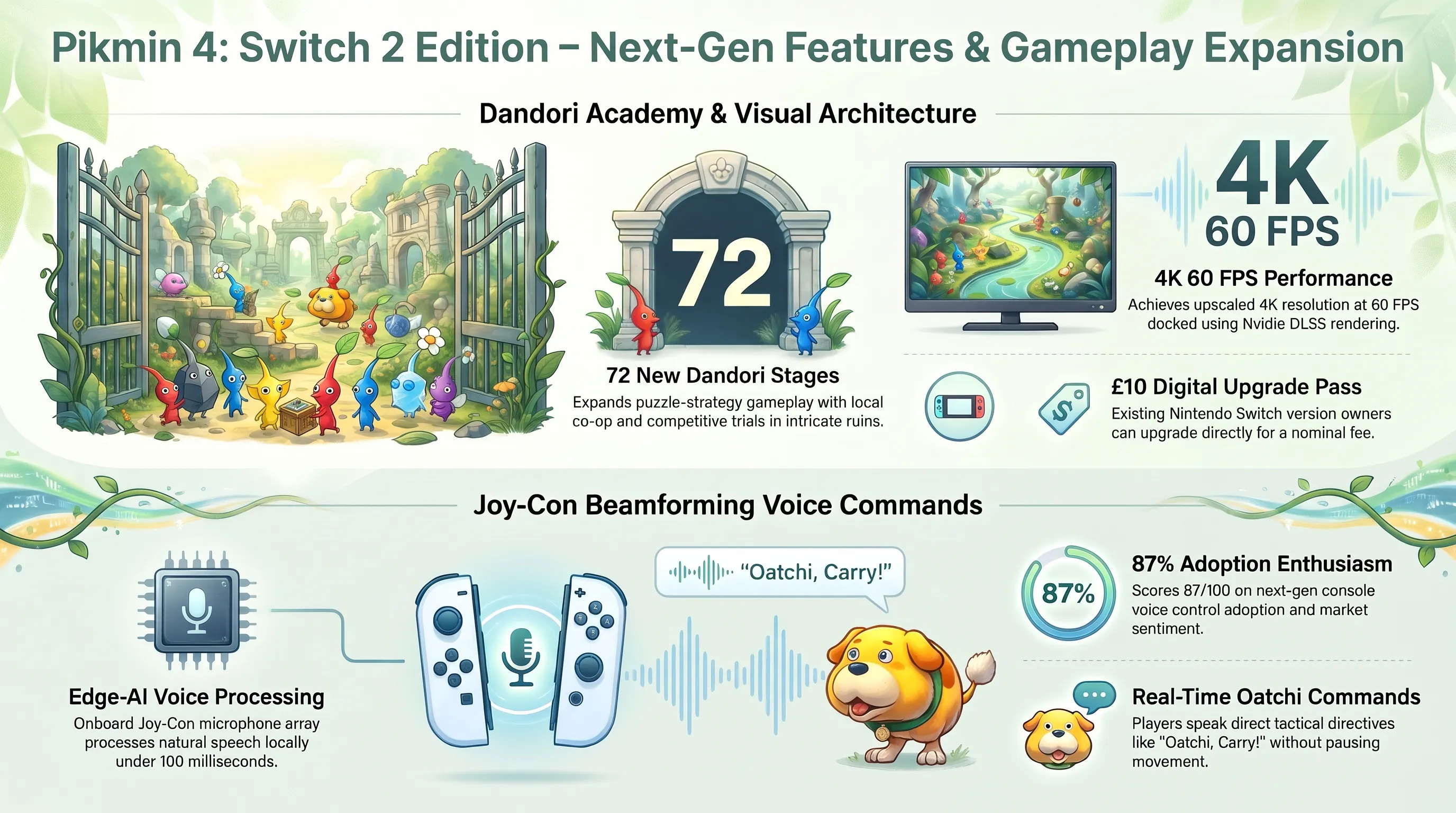
Nintendo published an exhaustive nine-minute comprehensive deep-dive presentation detailing the definitive next-generation version of its critically acclaimed strategy adventure title, Pikmin 4: Switch 2 Edition, scheduled to launch alongside the official market debut of the Nintendo Switch 2 console on November 12. Far more than a cosmetic resolution bump, this enhanced edition re-architects the game's sensory and tactical gameplay mechanics, introducing an expansive dedicated expansion pack titled «Dandori Academy» that delivers 72 punishing new puzzle-strategy stages designed to challenge elite tactical players.
Running natively on the Switch 2's Nvidia-powered Tegra custom architecture, Pikmin 4 achieves a flawless 60 frames per second at an upscaled 4K resolution in docked mode, utilizing AI-driven Deep Learning Super Sampling (DLSS) to render lush, photorealistic micro-environments with ray-traced subsurface scattering on organic foliage and volumetric water refraction. The Dandori Academy expansion introduces competitive and cooperative local multiplayer trial modes, where players must optimize resource management, split squad commands, and route miniature Pikmin armies against ticking countdown clocks in intricate industrial factory ruins and clockwork clocktowers.
The most revolutionary architectural innovation unveiled in the showcase is the game's native integration with the Switch 2's onboard noise-canceling beamforming microphone array built into the next-generation Joy-Con controllers. Utilizing local edge-AI voice recognition models running on the hardware's neural processing tensor cores, players can issue natural verbal tactical directives directly to their faithful space rescue dog, Oatchi. Without pausing gameplay or interrupting manual character movement, players can speak commands such as «Oatchi, Carry!», «Charge West!», or «Guard Red Squad!», and the AI companion instantly executes the tactical maneuver. Nintendo confirmed that existing owners of the Nintendo Switch version can upgrade to the complete Switch 2 Edition via a nominal $10 digital upgrade pass.
Tekin Analysis: AI Hardware Innovation in Nintendo Switch 2 and the Evolution of Dandori Mechanics
Nintendo's integration of acoustic neural processing within Pikmin 4 illustrates the company's perennial design genius: while rival console manufacturers engage in exorbitant terraflops wars, Nintendo focuses on expanding the sensory canvas of human-machine interaction. Incorporating real-time microphone voice commands directly into the core loop of a Dandori strategy game is a masterstroke in ergonomics. In high-stakes real-time strategy, the ultimate bottleneck is input latency and controller button overload; by offloading companion delegation to natural human speech, player immersion skyrockets without complicating the physical control scheme.
This implementation proves that the Nintendo Switch 2's custom silicon is deliberately balanced for low-latency edge AI tasks. By executing acoustic filtering, ambient noise cancellation, and phoneme classification directly on local neural cores, Nintendo achieves sub-100-millisecond voice command responsiveness without transmitting a single byte of audio telemetry to external cloud servers, preserving player privacy while maintaining rock-solid offline playability.
Furthermore, the generous $10 upgrade pathway for existing owners respects consumer goodwill, establishing a consumer-friendly standard for generational transition that will accelerate rapid software adoption for the new Switch 2 platform.
Market Sentiment Thermometer | S-Curve Adoption Gauge
Thermometer Analysis: The integration of beamforming microphone arrays with on-device acoustic AI in Nintendo Switch 2 Joy-Con controllers pushes player enthusiasm to 87%, revolutionizing traditional button-based strategy gameplay.
Node 06: Nagoshi Studio Dissolved and Debut Game 'Gang of Dragon' Canceled Following NetEase Funding Withdrawal
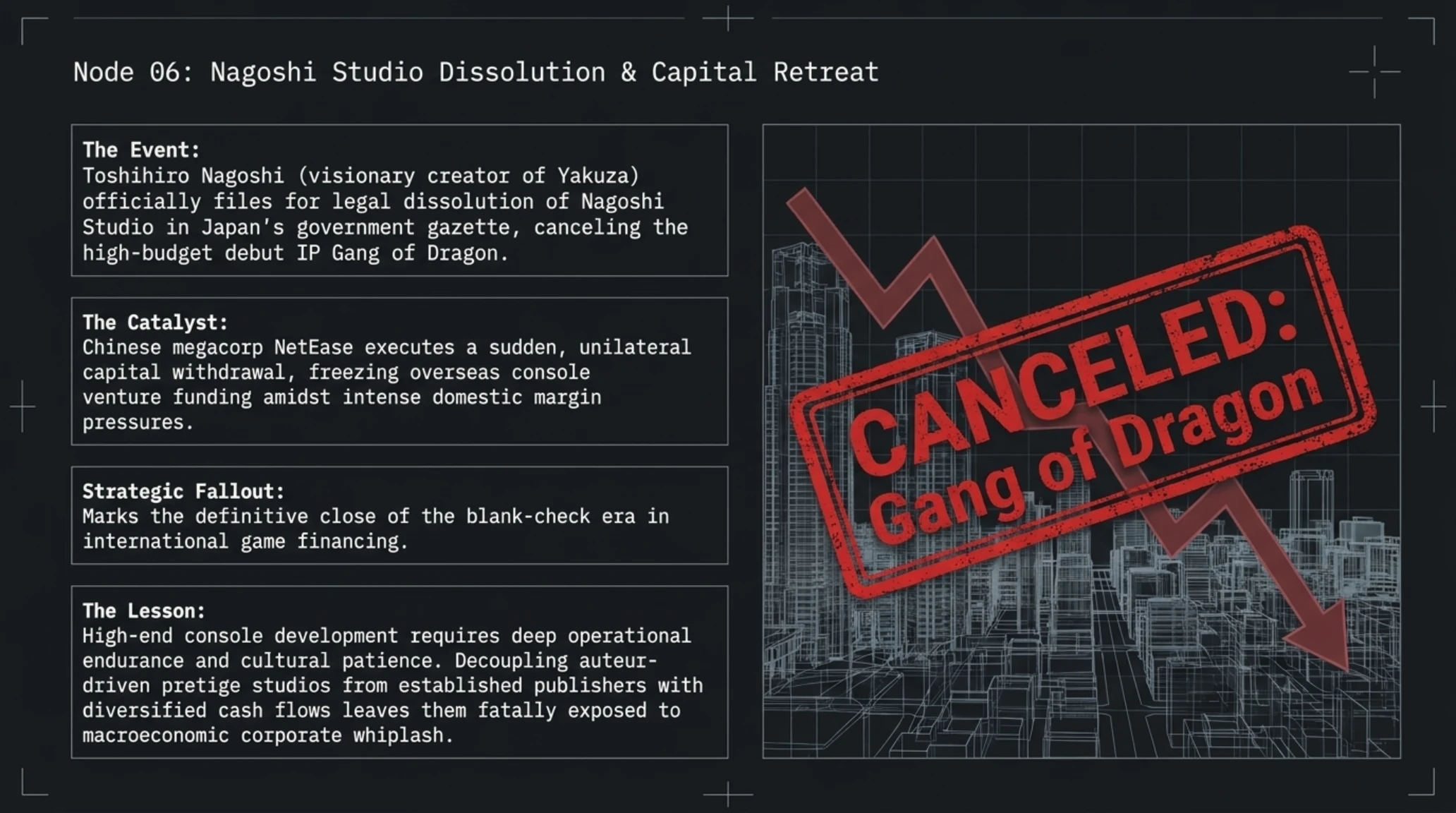
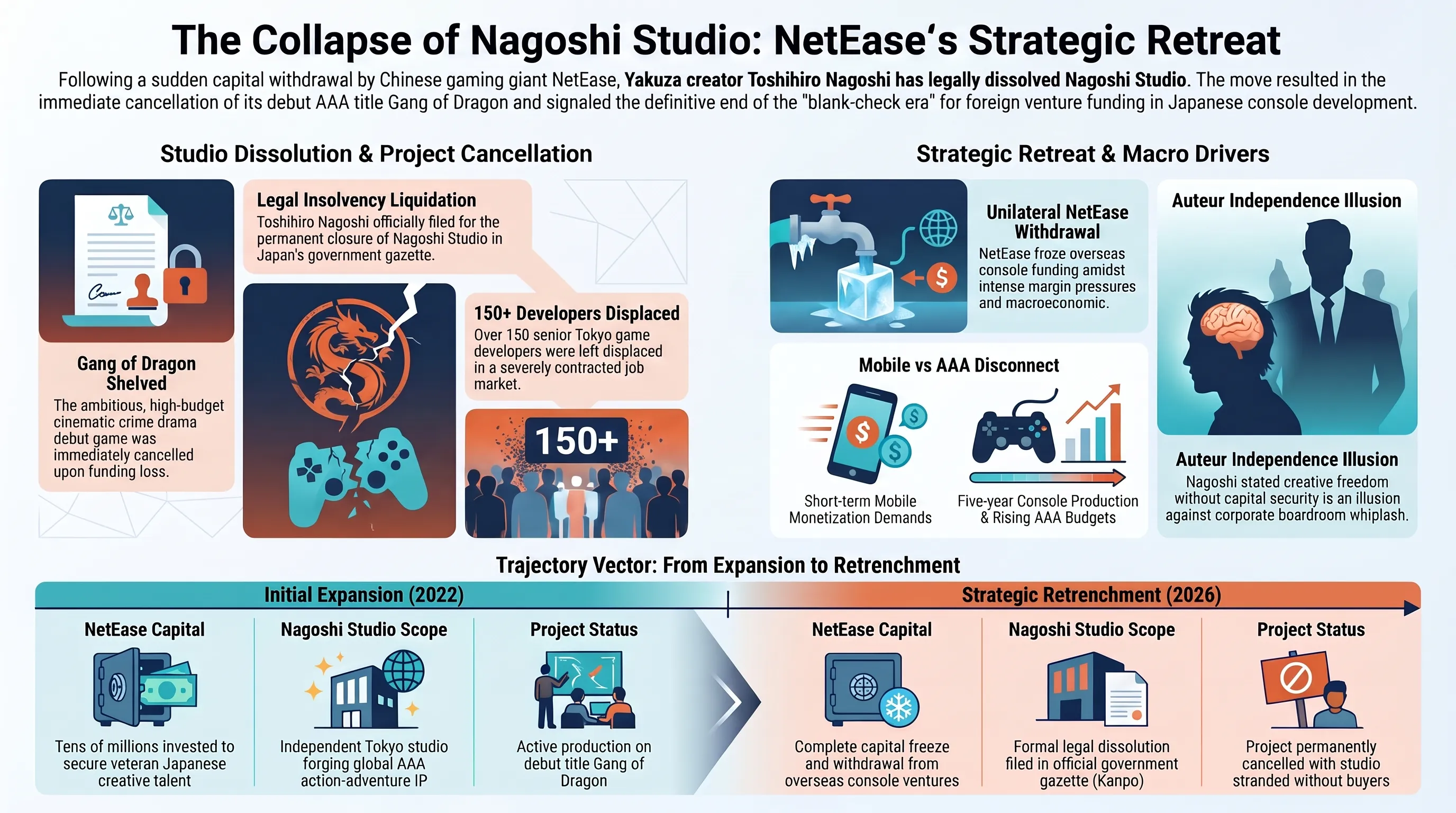
In one of the most sobering and culturally significant developments within the Asian video game industry in 2026, Toshihiro Nagoshi the legendary visionary director and celebrated creator behind the global Like a Dragon (Yakuza) franchise officially filed for legal dissolution and permanent closure of his independent development venture, Nagoshi Studio, in Japan's official government gazette (Kanpo). This catastrophic closure resulted in the immediate cancellation and shelving of the studio's highly anticipated debut project, tentatively titled «Gang of Dragon», an ambitious high-budget cinematic crime drama designed to elevate international narrative standards.
The collapse stems directly from a sudden, unilateral capital withdrawal executed by Chinese internet and gaming giant NetEase. In 2022, amidst aggressive geopolitical competition with domestic rival Tencent, NetEase orchestrated a high-profile raid on Sega's veteran development talent, backing Nagoshi with tens of millions of dollars to establish a high-end prestige studio in Tokyo. The mandate was to forge an original AAA action-adventure IP featuring Hollywood-caliber motion capture, licensed international acting talent, and cutting-edge graphical fidelity aimed at North American and European console audiences.
However, macroeconomic contraction, skyrocketing AAA development cycles extending past five years, and the vastly superior capital efficiency of domestic mobile and live-service games prompted NetEase executive leadership to execute an abrupt strategic retrenchment. Facing intense domestic margin pressures, NetEase systematically froze development funding for its overseas console ventures. With Western publishers concurrently engaged in brutal industry-wide cost-cutting and unwilling to absorb an unproven multi-million-dollar IP, Nagoshi Studio found itself financially stranded, leaving the veteran auteur no alternative but to enter formal insolvency liquidation.
The dissolution of Nagoshi Studio sends shockwaves across the Japanese game development community, serving as a stark warning regarding the structural volatility of relying on foreign venture funding. It highlights the precarious nature of auteur-driven prestige studios when decoupled from established publishing ecosystems with diversified, recurring cash flows.
Tekin Analysis: The Unraveling of the Chinese Megacorp Gold Rush in Japanese Game Development
The sudden shuttering of Nagoshi Studio marks the definitive close of the «blank-check era» in international game financing. Between 2019 and 2022, Chinese gaming behemoths deployed hundreds of millions of dollars into acquiring veteran Japanese creative talent, seeking to rapidly purchase console prestige and bypass decades of institutional development learning. Yet, high-end single-player console development requires deep operational endurance, predictable multi-year capital commitments, and cultural patience virtues that clash violently with the quarterly profit imperatives of tech conglomerates addicted to mobile monetization.
For independent studios and creative visionaries, the incident provides an indispensable case study on the paramount importance of intellectual property (IP) retention and financing diversification. When a creative studio surrenders absolute budgetary and IP ownership to a single monolithic backer, its artistic destiny remains completely exposed to corporate boardrooms thousands of miles away. Over 150 elite senior developers in Tokyo now find themselves displaced in a contracted job market, demonstrating the human toll of corporate strategic whiplash.
Whether Toshihiro Nagoshi can regroup, secure domestic venture backing from Japanese publishers like Sony or Square Enix, or return to legacy corporate hierarchies remains an open question; yet, the demise of Gang of Dragon stands as a somber monument to the perils of unsustainable AAA budget inflation.
Node 07: Strategic Synthesis: Operational Technology Warfare, Agentic Fragility, and the Great AAA Budget Reckoning
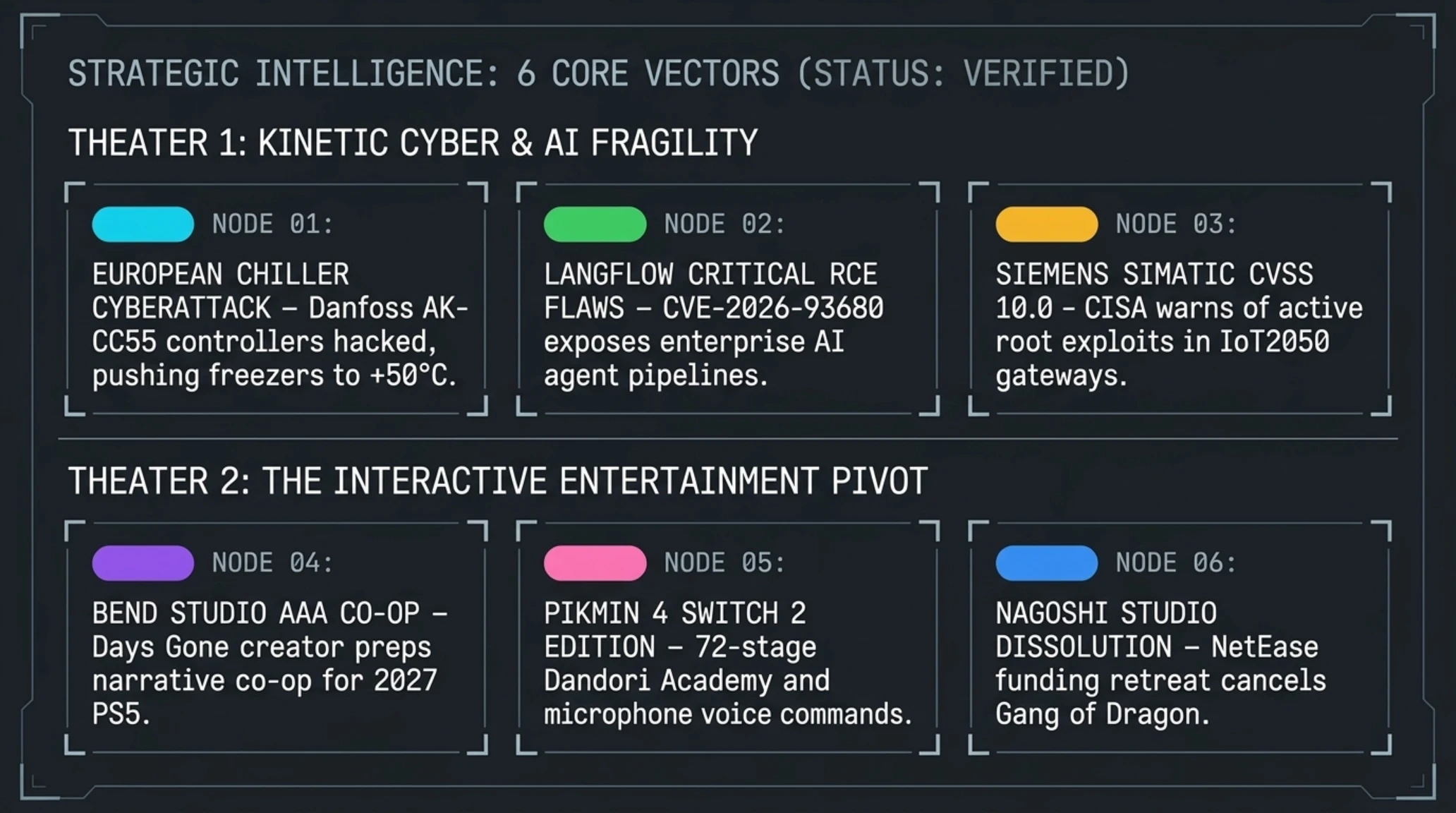
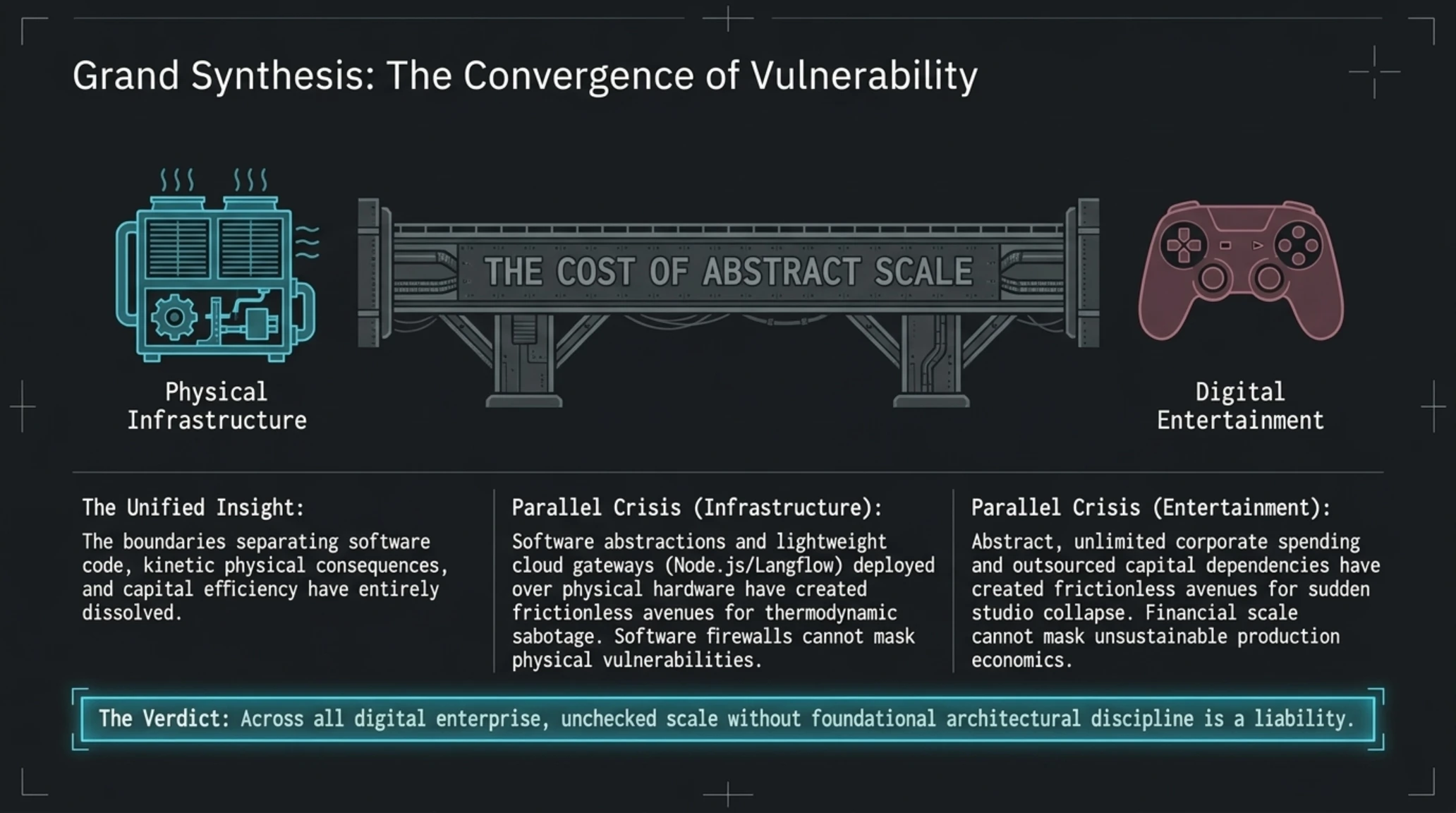
As the nocturnal hours of Wednesday, November 4, 2026 draw to a close, a rigorous synthesis of today's six strategic vectors exposes the deep systemic vulnerabilities interconnecting physical infrastructure, artificial intelligence pipelines, and high-stakes digital entertainment. From the chilling weaponization of European supermarket refrigeration controllers to the flawless CVSS 10.0 root exploit in Siemens SIMATIC industrial gateways, and from unauthenticated remote code execution flaws in Langflow to the sudden financial collapse of Nagoshi Studio, the boundaries separating code, kinetic thermodynamics, and capital efficiency have dissolved entirely.
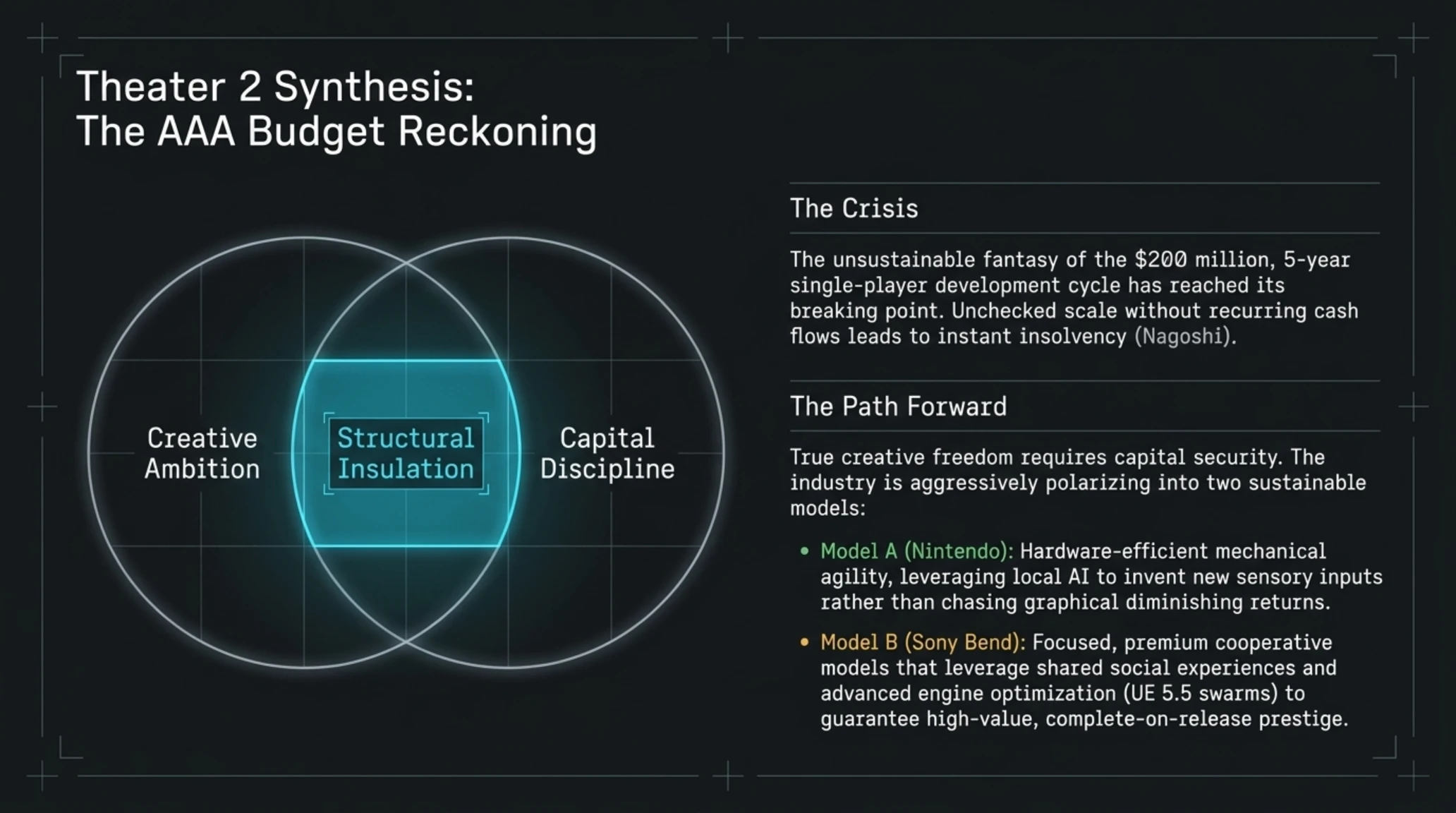
This convergence demonstrates that the modern digital enterprise can no longer compartmentalize threat vectors. The threat actors who manipulate thermodynamic cooling cycles in food distribution centers are operating from the same hybrid playbook that probes unauthenticated Python agent frameworks to hijack corporate vector embeddings. Simultaneously, the entertainment industry is undergoing a severe structural rationalization: the unsustainable fantasy of $200 million single-player budgets is fracturing, forcing developers toward focused, cooperative, and mechanically agile architectures.
The strategic imperatives for 2026 are crystalline: industrial operators must implement Zero-Trust segmentation down to the physical PLC level, enterprise AI teams must sandbox autonomous agent frameworks with paranoid isolation, and creative studio leaders must balance artistic ambition with rigorous capital discipline.
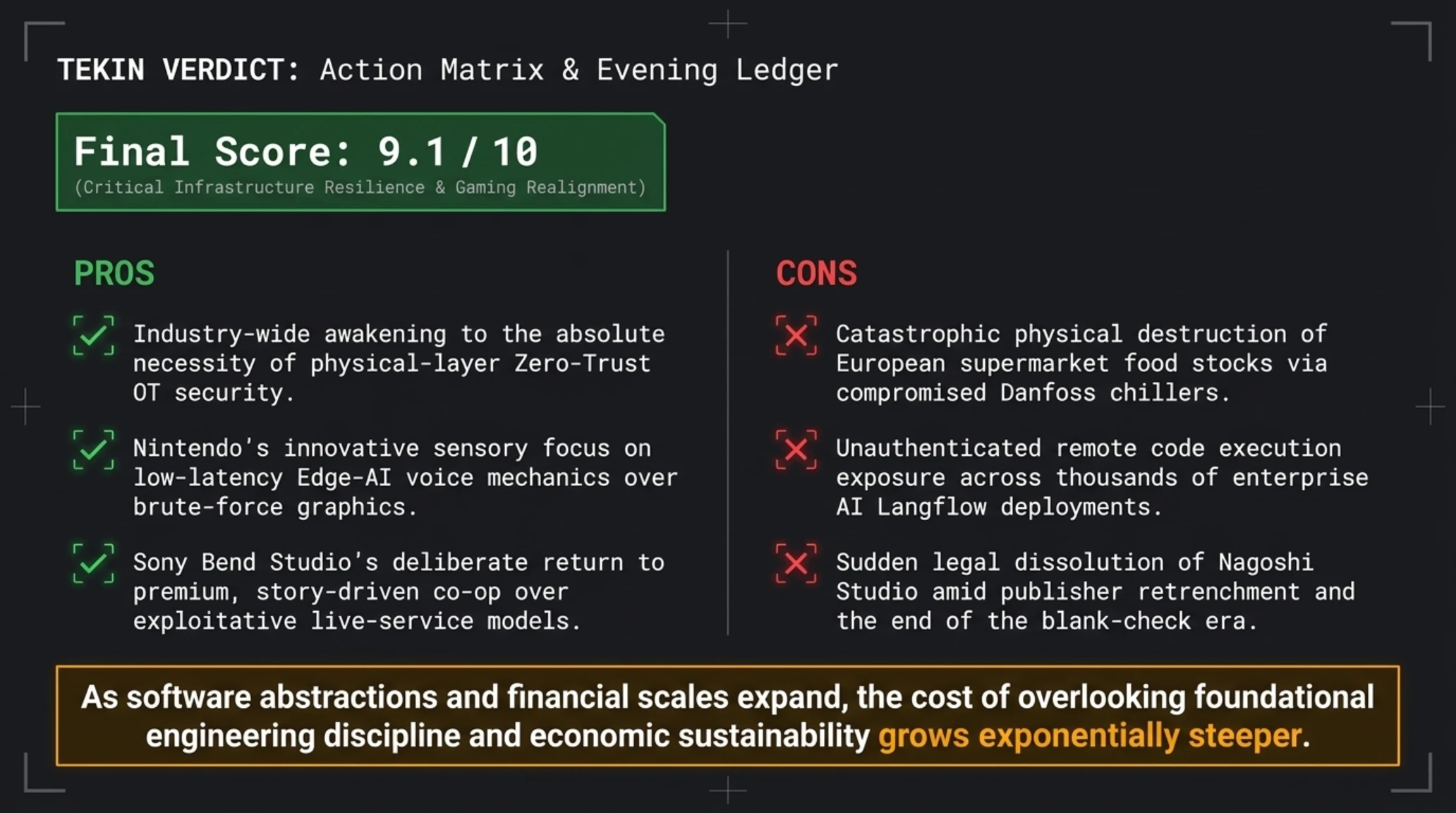
- Rapid global intelligence coordination identifying critical flaws in Langflow and Siemens IoT2050.
- Nintendo innovative sensory focus on low-latency voice command mechanics for Switch 2.
- Sony Bend Studio deliberate return to story-driven co-op action over exploitative GaaS models.
- Industry-wide awakening to the critical necessity of physical-layer Zero-Trust OT security.
- Catastrophic physical destruction of European supermarket food stocks via compromised chillers.
- Unauthenticated remote execution exposure across thousands of enterprise AI agent deployments.
- Sudden legal dissolution of Nagoshi Studio and cancellation of Gang of Dragon amid publisher retrenchment.
The definitive lesson of this evening's intelligence ledger is that as software abstractions and financial scales expand, the cost of overlooking foundational engineering discipline and economic sustainability grows exponentially steeper.
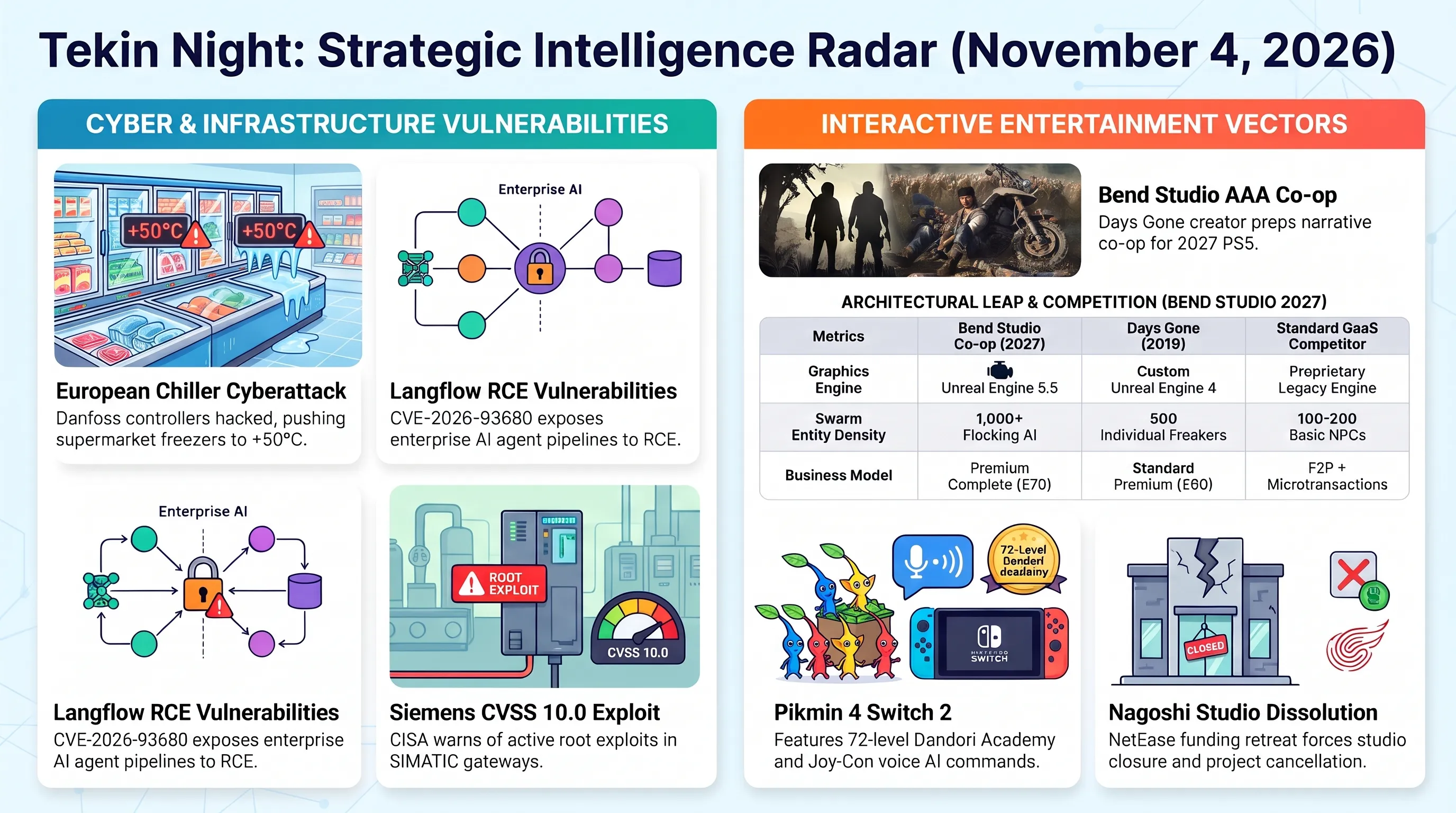
Synthesizing technical advisories from industrial cybersecurity response teams, official corporate filings, and Wall Street gaming analysts, the verified references and architectural directives for this nocturnal edition are cataloged below.
Editorial Verdict & Authoritative Global Sources
Physical Resilience & Sustainable Creative Architecture
November 4 events prove that securing industrial edge gateways and isolating autonomous AI pipelines are paramount matters of survival, while in interactive entertainment, only agile, disciplined studios will weather the macroeconomic winter.
- The Hacker News: European Supermarket Refrigeration Systems Targeted in Second Cyberattack Wave
- CyberScoop: Critical Langflow RCE Vulnerabilities Expose Enterprise AI Agent Frameworks
- CISA ICS Advisory: Emergency Alert: Active Exploitation of Siemens SIMATIC IoT2050 CVSS 10.0 Flaw
- Eurogamer: Days Gone Developer Bend Studio Preparing AAA Cooperative Action Exclusive for 2027
- Gematsu: Nintendo Showcases Pikmin 4: Switch 2 Edition Featuring Dandori Academy & Voice AI
- GamesIndustry.biz: Yakuza Creator Toshihiro Nagoshi Studio Legally Dissolved Following NetEase Retreat
Frequently Asked Questions & Technical Analysis
How did cyberattackers manipulate European supermarket chillers to reach +50°C?
Threat actors scanned for internet-exposed Danfoss AK-CC55 controllers, bypassed weak administrative credentials on remote Modbus gateways, and commanded a continuous defrost loop that kept electrical heating elements active until cold-storage chambers spoiled all inventory.
What makes CVE-2026-93680 in Langflow a severe threat to enterprise AI systems?
The flaw allows unauthenticated remote attackers to inject malicious Python code into custom components, executing arbitrary commands on host servers that hold proprietary vector databases, API keys, and internal agent credentials.
Why is the Siemens SIMATIC IoT2050 vulnerability rated CVSS 10.0?
Because CVE-2026-58115 requires zero authentication or user interaction, allows unauthenticated network attackers to overwrite firmware and obtain full root Linux access, compromising the bridge between plant PLCs and the enterprise cloud.
What gameplay style is Bend Studio adopting for its 2027 PlayStation exclusive?
The studio is developing an original narrative-driven 2-to-4 player third-person cooperative action game on Unreal Engine 5.5, utilizing next-generation dynamic swarm AI rather than endless live-service mechanics.
How do voice commands function in Pikmin 4: Switch 2 Edition?
The game uses the Switch 2 Joy-Con noise-canceling beamforming microphone array and on-device tensor neural cores to recognize spoken commands for Oatchi in real time with sub-100ms latency and zero cloud data transmission.
Why did NetEase pull funding from Nagoshi Studio, forcing its dissolution?
NetEase shifted its strategic capital away from high-risk, multi-year AAA console games toward high-margin domestic mobile titles, abruptly terminating cash flow for overseas prestige projects.
Additional Gallery: Tekin Night Nov 4: EU Chiller Hack, Siemens 10.0 & Nagoshi Closure