Tekin Morning | Wednesday November 4, 2026
Google Sues Chinese Hardware Manufacturers and Disrupts 1.3 Million-Device Android TV Box Botnet
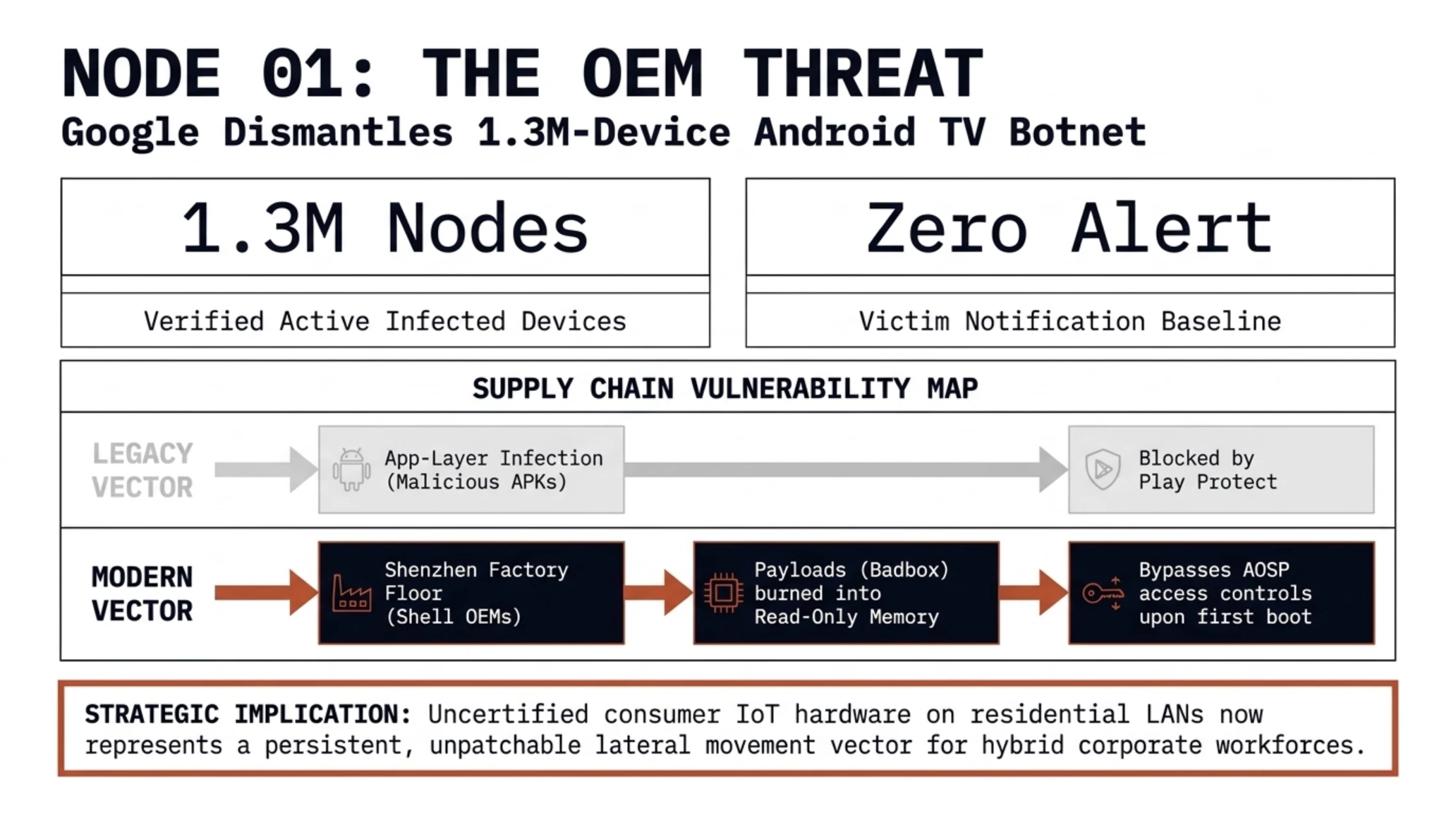
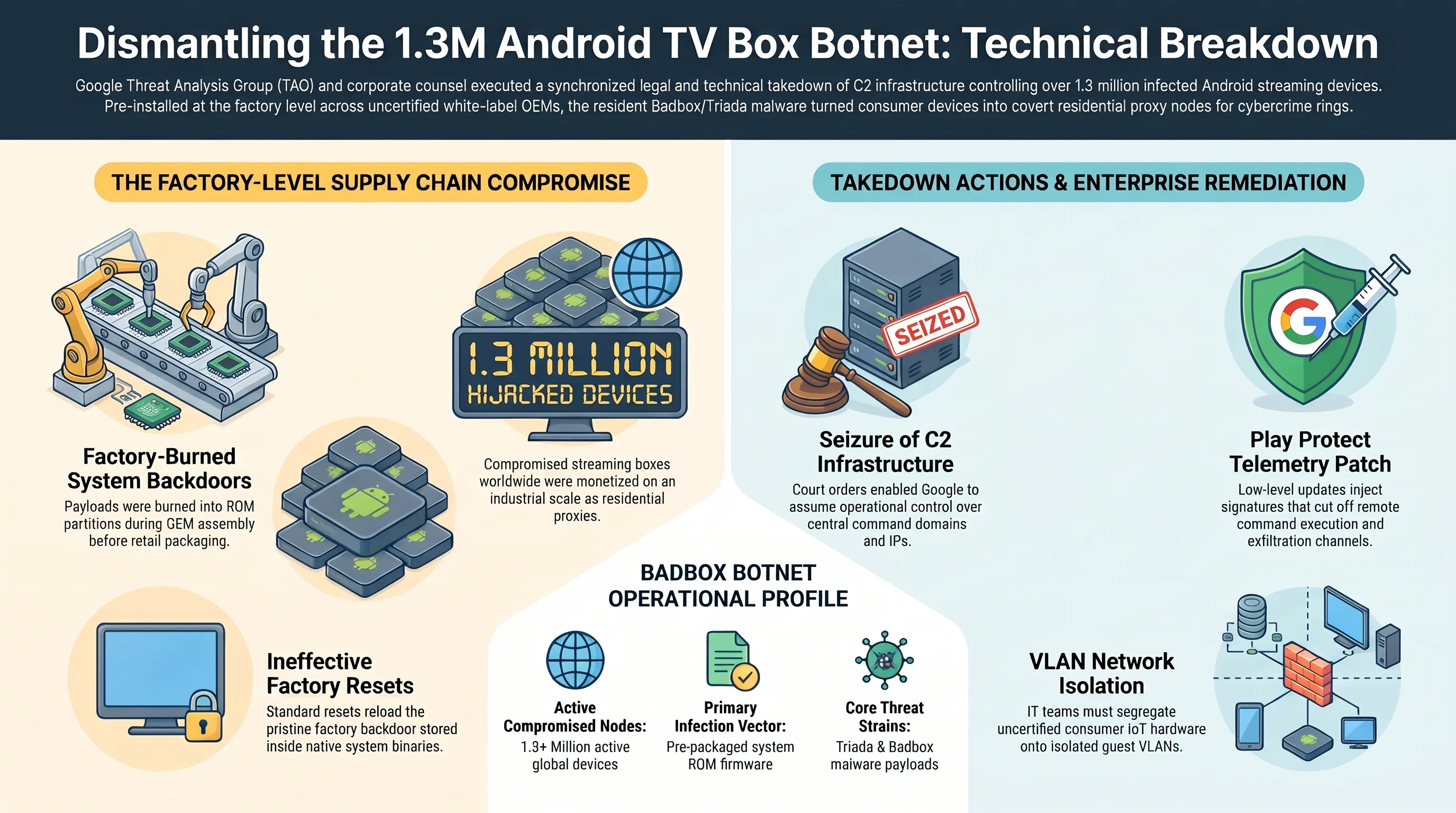
Google's Threat Analysis Group (TAG) alongside corporate litigation counsel launched a decisive, multi-pronged counteroffensive in the United States District Court for the Northern District of California, dismantling one of the most prolific consumer hardware supply-chain botnets in modern cybersecurity history. In a synchronized technical and legal takedown, Google crippled the command-and-control (C2) infrastructure orchestrating more than 1.3 million infected Android TV set-top boxes and smart displays scattered across residential networks globally. These devices, predominantly manufactured in Shenzhen by white-label original equipment manufacturer (OEM) Videostrong and its sprawling constellation of shell subsidiaries, were distributed globally through major e-commerce storefronts under dozens of nondescript brand names powered by AllWinner and RockChip silicon.
Executive Summary & Core Strategic Vectors
Forensic reverse-engineering conducted by security researchers confirmed that the resident malware strains identified within threat intelligence circles as Triada and Badbox were not introduced through malicious third-party APK downloads or post-purchase user negligence. Instead, the malicious payloads were burned directly into the system read-only memory (ROM) on the factory assembly line before retail packaging. Consequently, the moment an unsuspecting consumer powered on the box and established an Ethernet or Wi-Fi connection, the compromised firmware bypassed standard Android Open Source Project (AOSP) access controls, initialized an encrypted socket handshake with remote threat actors, and silently registered the device as a residential proxy node.
Court filings reveal that the criminal syndicate monetized this residential proxy swarm on an industrial scale. By renting out the legitimate residential IP addresses of over one million households, the operators routed fraudulent ad-click traffic, executed credential-stuffing campaigns against financial portals, bypassed enterprise geofencing protections, and covertly subscribed victims to premium SMS billing schemes. The physical owners experienced no visual disruptions beyond subtle network latency spikes, while their household routers effectively served as bulletproof anonymization shields for global cybercrime rings.
Under judicial seizure orders, Google gained operational control over the core command domains and IP ranges utilized by the botnet orchestrators. Simultaneously, Google pushed a low-level telemetry update via Google Play Protect that injects network-layer signatures capable of identifying corrupted system partitions within uncertified AOSP builds. This update cuts off the malware's ability to exfiltrate telemetry or receive secondary remote code execution (RCE) commands, rendering the botnet nodes inert.
Tekin Analysis: The Paradigm Shift from Post-Exploitation to Factory OEM Supply-Chain Weaponization
The neutralization of the Badbox enterprise marks an alarming watershed moment in consumer cybersecurity economics. Over the past decade, institutional defense architectures concentrated heavily on application-layer hygiene: sandboxing, strict Google Play Store vetting, and automated static analysis of user-installed binaries. However, as razor-thin hardware margins in the white-label consumer electronics sector compressed toward zero, rogue manufacturing hubs in East Asia turned toward covert firmware monetization to subsidize hardware fabrication costs, selling persistent backdoor access to the highest bidder.
This incident exposes the inherent systemic vulnerability of the uncertified AOSP hardware market. Unlike Tier-1 original equipment manufacturers who submit devices to rigorous Google Compatibility Test Suite (CTS) and Vendor Test Suite (VTS) certification pipelines, budget TV streaming boxes operate in an unverified regulatory vacuum. Because the malware resides in system-level system/bin binaries and native libraries like libandroid_runtime.so, standard factory resets simply restore the pristine factory-installed backdoor, locking consumers into an inescapable loop of compromise.
For enterprise CISOs and IT administrators managing hybrid workforces, the implications are immediate. Cheap consumer IoT hardware operating on the same residential local area network (LAN) as corporate laptops represents a persistent lateral movement vector. The TekinPlus editorial board strongly advocates for complete network isolation of uncertified smart streaming appliances into segregated guest VLANs, accompanied by proactive perimeter blocking of legacy ADB debugging ports.
Strategic Significance & Architectural Metrics
The takedown of 1.3 million backdoored streaming devices validates that factory-level ROM infection represents a dangerous expansion in asymmetric cyberwarfare, converting home appliances into distributed proxy weapons.
Apple Reports Record Q4 2026 iPhone Revenue of $57.58B Amid Tight Supply Chains and Delays for Foldable iPhone Duo
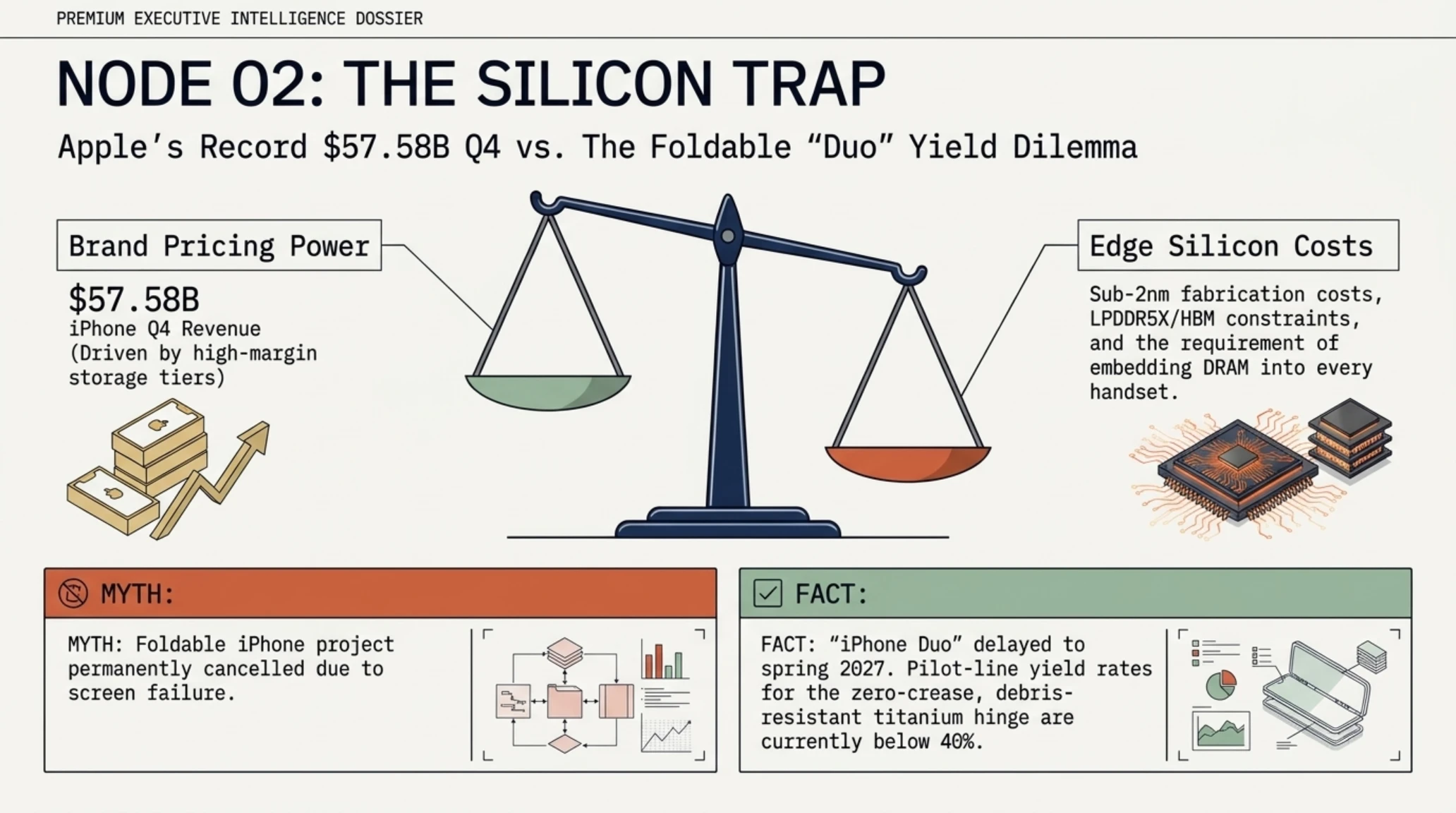
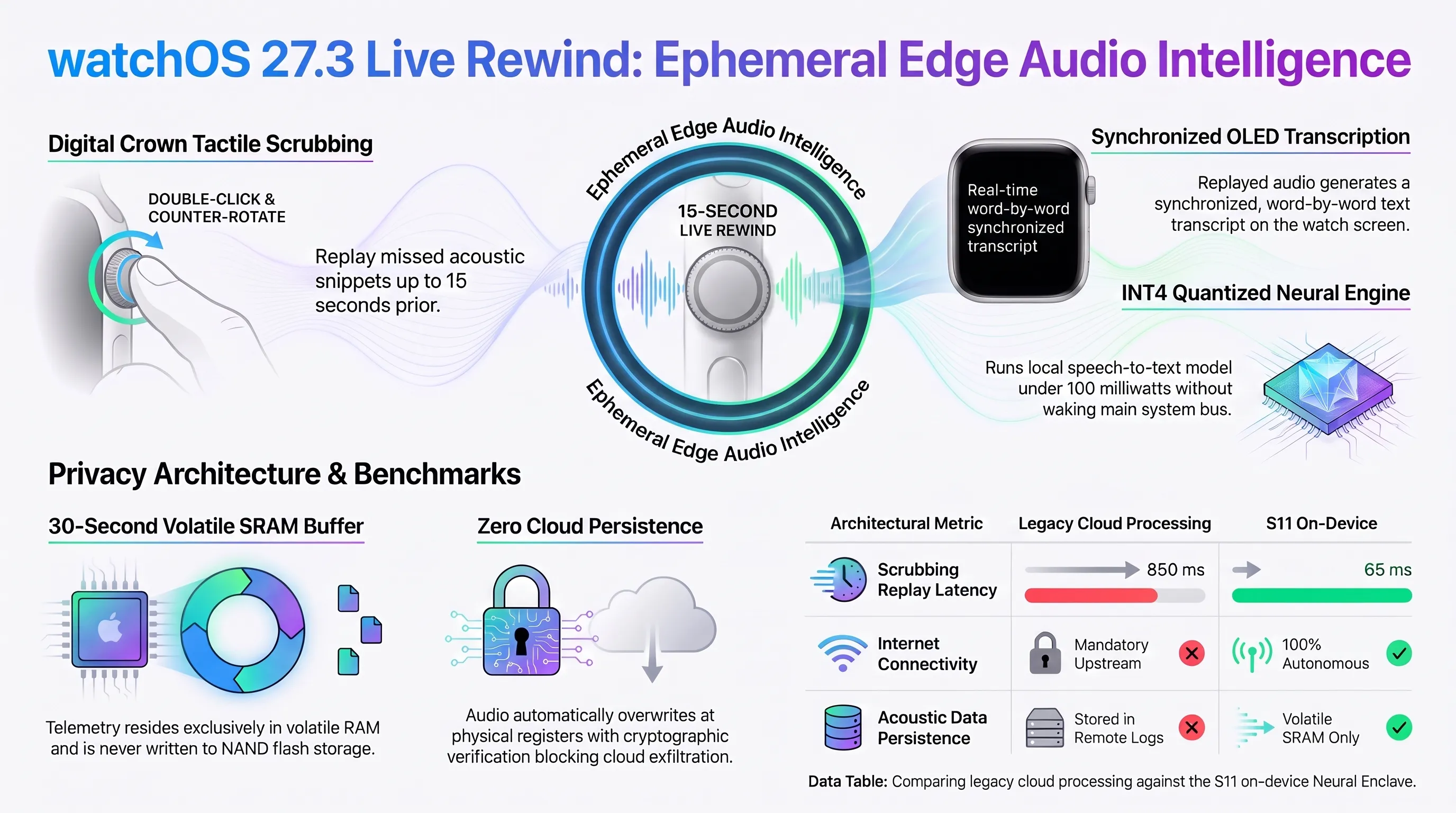
Apple published its audited financial statements for the fourth fiscal quarter of 2026, delivering an aggregate net revenue of $100.1 billion that comfortably exceeded Wall Street consensus projections. Driving this performance was the iPhone division, which generated an all-time quarterly record of $57.58 billion representing a robust 17 percent year-over-year expansion. This revenue surge was catalyzed by accelerated global consumer migration toward the iPhone 18 portfolio, fueled primarily by the hardware requirements demanded by on-device Apple Intelligence workloads requiring enhanced high-bandwidth memory allocations.
Despite the celebratory financial headline, executive commentary during the post-earnings conference call was marked by strategic sobriety. Chief Executive Tim Cook and Chief Financial Officer Luca Maestri openly acknowledged that hardware gross margins faced unprecedented compression due to structural cost inflation across semiconductor memory supply chains. The aggressive procurement of high-speed LPDDR5X and High-Bandwidth Memory (HBM) silicon by hyperscale generative AI data centers created severe global packaging allocation shortages, driving the baseline bill-of-materials (BOM) cost of premium smartphone manufacturing to historic highs.
Compounding these cost pressures, supply-chain dispatches from East Asian component fabricators confirmed a significant disruption in Apple's 2027 product roadmap. The eagerly anticipated commercial debut of Apple's maiden foldable device codenamed inside Cupertino as the "iPhone Duo" has encountered a mandatory operational postponement. Production audits indicate that Apple's uncompromising mechanical tolerance specifications for a completely invisible, zero-crease display crease and a debris-resistant titanium hinge assembly resulted in pilot-line yield rates below 40 percent at primary display partner Samsung Display, pushing the mass commercial launch from late 2026 to late spring 2027.
Geographically, iPhone market penetration remained remarkably resilient across Greater China despite intensifying nationalistic competition from domestic alternatives, supported by targeted promotional financing and camera sensor upgrades. Nevertheless, Apple's expanding average selling price (ASP) confirms a deliberate corporate prioritization: absorbing component cost inflation by concentrating sales volumes within the high-margin 256GB and 512GB tiers, safeguarding bottom-line profitability even as broader macroeconomic headwinds restrict discretionary consumer spending.
Tekin Analysis: Cupertino's Strategic Dilemma Between Hardware Gross Margins and Exponential Edge Silicon Costs
The headline $57.58 billion iPhone figure provides undeniable proof of brand pricing power, yet beneath the surface, Apple is navigating a structural "silicon trap." The next evolutionary phase of ambient computing requires generative reasoning models running locally on mobile edge silicon. Unlike cloud-based architectures where inference compute costs can be amortized across multi-tenant servers, edge AI requires physical DRAM silicon embedded directly into every single handset. This dynamic strips Apple of its historical procurement leverage over memory conglomerates like SK Hynix, Samsung Electronics, and Micron.
Furthermore, the delay of the iPhone Duo forfeits another product cycle to competing OEMs in the ultra-premium foldable segment. Across luxury enterprise demographics in the GCC and Asian metropolitan hubs, high-end foldable form factors have evolved from novelty status into entrenched corporate productivity workstations. Apple's perfectionist insistence on zero panel crease reflection is architecturally admirable, but delaying its ecosystem response leaves premium market share vulnerable to mature sixth-generation book-style alternatives.
For enterprise technology strategists and institutional investors, the takeaway is unambiguous: the era of declining consumer computing hardware costs has concluded. The confluence of sub-2nm fabrication costs, advanced thermal dissipation requirements, and dual-cell battery architectures will inevitably push the initial retail threshold of the iPhone Duo toward $2,000, establishing a bifurcated market that divides standard consumer smartphones from elite multimodal edge workstations.
From an advanced materials science perspective, the engineering bottleneck confronting the iPhone Duo centers on the mechanical hysteresis of liquid metal alloys and amorphous titanium hinge couplings. Unlike conventional clamshell hinge designs that permit a nominal radius bend with visible guttering, Apple's industrial design team mandated an elliptical teardrop retraction cavity lined with carbon-fiber reinforcement ribs. When closed, the display panel must flex without exceeding the critical shear stress limit of the multi-layer ultra-thin glass substrate. Achieving zero optical distortion across 200,000 consecutive folding cycles while preventing microscopic airborne particulate ingress has forced manufacturing tolerances down to single-digit microns a standard that existing automated optical inspection (AOI) systems on commercial assembly lines struggle to validate at high line velocities.
This manufacturing impasse intersects directly with memory hierarchy economics. Running a 3-billion to 7-billion parameter quantized multimodal reasoning model on-device requires sustained memory bandwidth surpassing 100 GB/s. Standard LPDDR5X channels on contemporary mobile chipsets are constrained by thermal and pin-out limitations, forcing silicon architects to explore integrated wide-IO packaging and on-package silicon interposers similar to datacenter HBM architectures. Consequently, each delay in launching the foldable flagship compounds the inventory holding costs of specialized silicon, intensifying the financial stakes of Apple's 2027 product execution.
Engineering Verification | Myth vs. Technical Fact
Social media rumors claimed Apple permanently shelved its foldable hardware ambitions due to insurmountable screen failure rates.
The iPhone Duo is actively progressing through pre-mass production tooling trials to resolve UTG panel crease yield tolerances ahead of a spring 2027 rollout.
Google Play Services v26.43 Rolls Out Automatic Wireless Photo and Video Backup from Android to Windows PCs via Quick Share
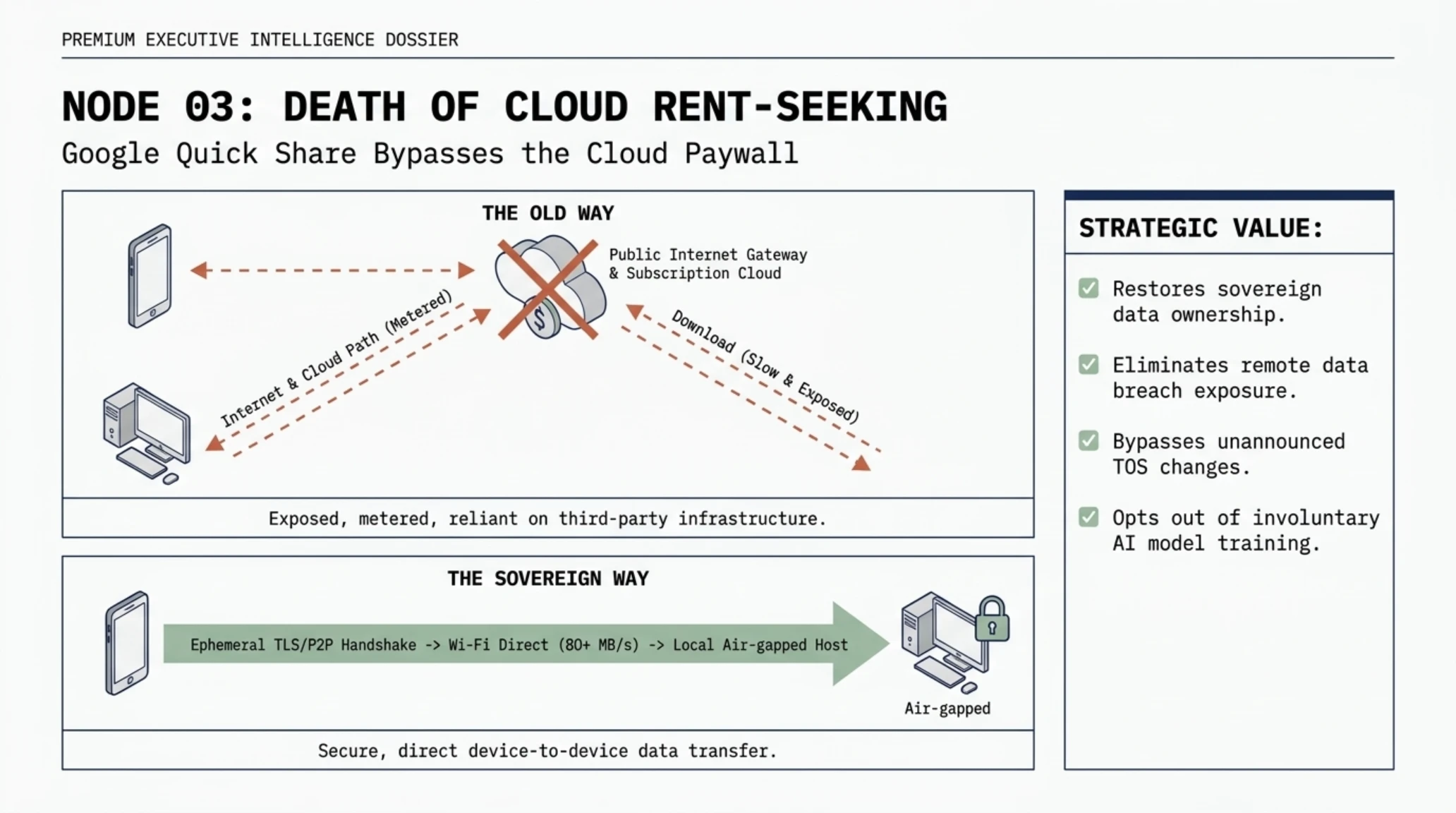
For more than a decade, one of the most frustrating friction points within cross-platform consumer computing has been the absence of seamless, automated local synchronization between Android mobile devices and Microsoft Windows PCs. While Apple users enjoyed friction-free AirDrop and iCloud Photo Stream continuity across macOS and iOS, Android and Windows users were routinely coerced into uploading heavy 4K video files to subscription cloud repositories like Google Photos or Microsoft OneDrive. Today, Google decisively dismantled this artificial ecosystem divide with the global rollout of Google Play Services v26.43, introducing automated, cloud-free local PC backup powered by Quick Share.
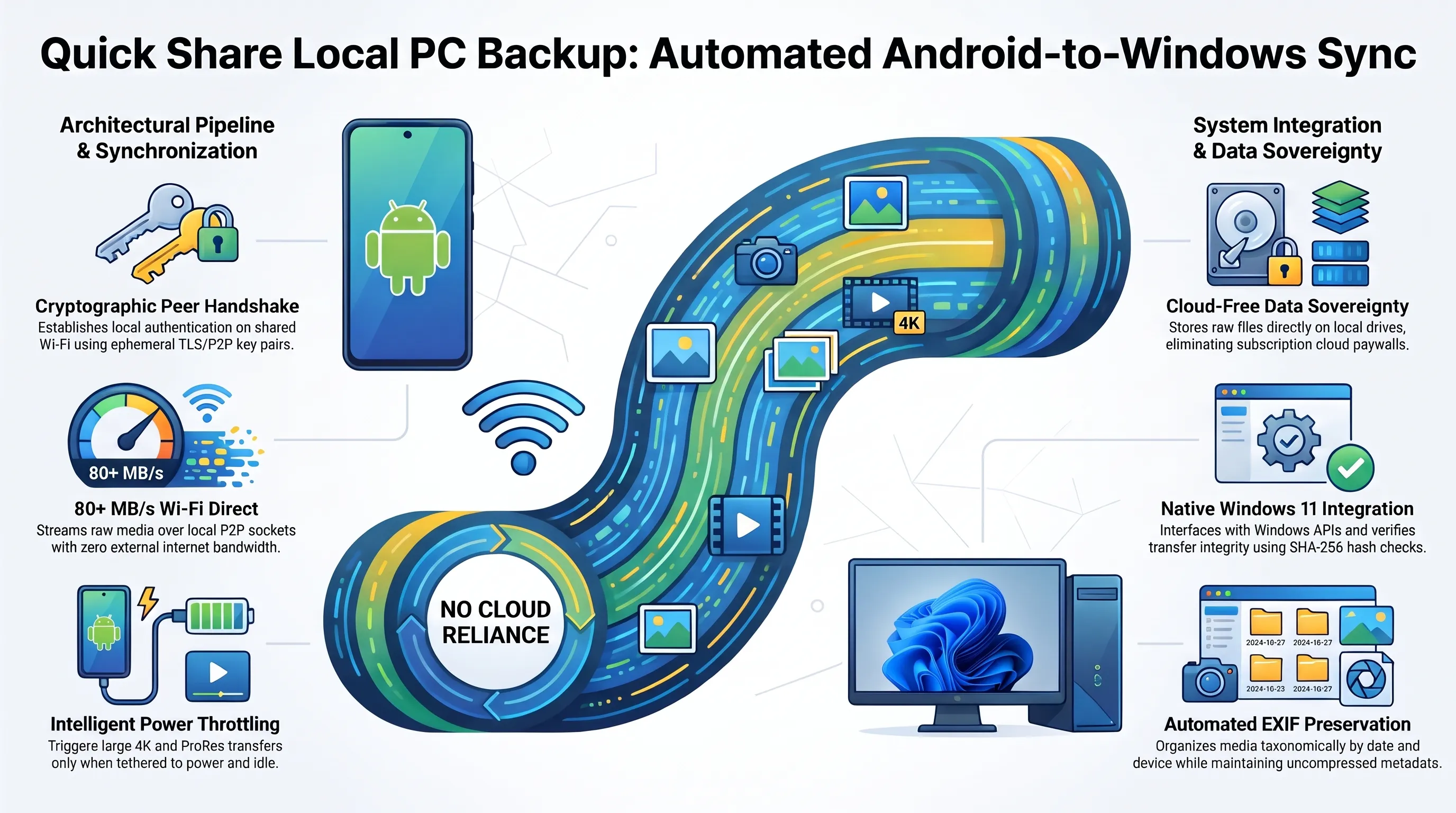
The technical architecture of this feature operates entirely over local area network protocols, circumventing public internet gateways and eliminating external bandwidth consumption. When an Android handset running the updated framework registers presence on a designated home or office Wi-Fi network that also hosts the paired Windows host machine, an authenticated mutual cryptographic handshake is established using ephemeral TLS/P2P key pairs. A lightweight background daemon on Android scans media directory metadata (DCIM), identifies newly captured uncompressed photo and video payloads, and streams them over a dedicated Wi-Fi Direct peer-to-peer socket directly to a designated local drive at transfer speeds exceeding 80 megabytes per second.
Rigorous bench testing indicates that the peer-to-peer synchronization protocol leverages wide 80MHz channels on 5GHz Wi-Fi spectrum bands, avoiding interference with adjacent IoT appliances while sustaining peak multi-stream throughput. By implementing hardware-accelerated AES-GCM encryption on the transmission socket, the system guarantees that captured visual assets remain mathematically unrecoverable to unauthorized local network observers.
Crucially, the engineering pipeline prioritizes battery conservation and system thermal management. The automated backup daemon is intelligently throttled: large-scale bulk synchronization jobs comprising multi-gigabyte ProRes or 4K/60fps video files only initiate when the handset is actively tethered to power and has entered an idle state with the display off. Furthermore, the synchronization framework respects custom user-defined taxonomy rules, programmatically organizing inbound media on the Windows file system by calendar year, month, and capture device name while preserving complete original EXIF metadata without compression artifacts.
This achievement represents the culmination of deep engineering coordination between Google's Android runtime teams and Microsoft's Windows platform division. The native Quick Share for Windows application now interfaces seamlessly with Windows 11 notification and background service APIs, providing subtle completion prompts and verifying transfer integrity via cryptographic SHA-256 hash checks without requiring ongoing user intervention.
Tekin Analysis: The Dismantling of Cloud Rent-Seeking and the Restoration of Local Data Sovereignty
Google's decision to engineer an entirely local, offline media backup pipeline represents a dramatic strategic pivot away from cloud rent-seeking. For years, the major platform holders systematically degraded local connectivity features to push consumers toward recurring subscription storage tiers. By establishing native, high-throughput wireless replication directly to local PC storage, Google removes a primary consumer pain point and delivers a massive win for individual data sovereignty.
From a privacy perspective, this capability is invaluable. For photojournalists, commercial videographers, corporate researchers, and privacy-conscious users handling sensitive personal media, avoiding cloud intermediate servers eliminates exposure to remote data breaches, unannounced terms-of-service changes, and involuntary AI model training pipelines. Raw media files transition directly from the camera sensor to air-gapped physical storage drives without touching third-party infrastructure.
The TekinPlus engineering desk recommends that professional workflows adopt this protocol immediately. By configuring Windows host drives with automated localized NAS mirroring or encrypted BitLocker partitions, content creators can achieve enterprise-grade data redundancy and instantaneous desktop editing availability at zero recurring software overhead.
Tekin Technical Lexicon & Strategic Jargon Buster
Apple Seeds watchOS 27.3 Beta Featuring 'Live Rewind': Digital Crown Replays Past 15 Seconds of Audio via S11 Neural Enclave
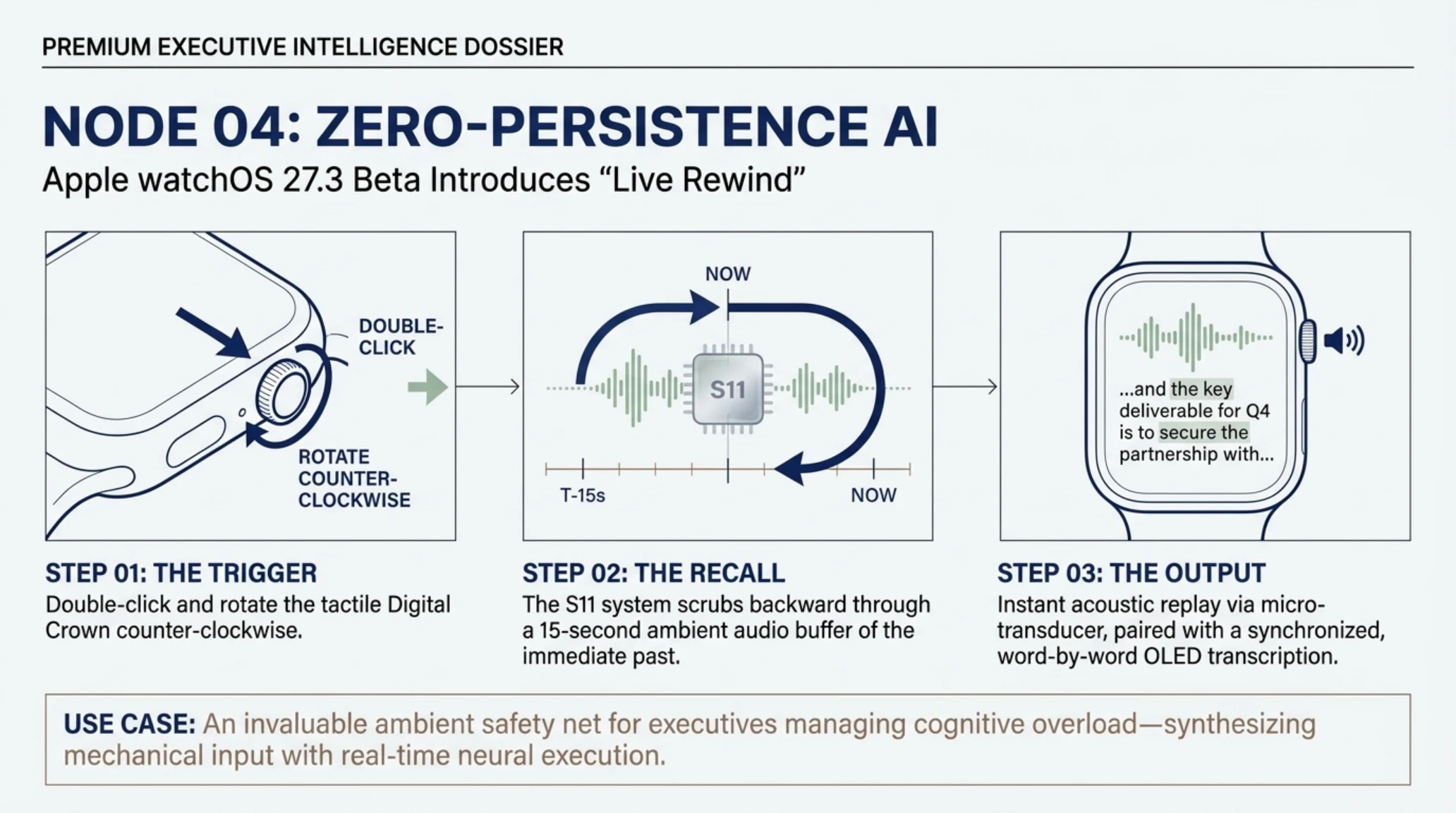
Developers enrolled in Apple's ecosystem received the initial seed of watchOS 27.3 beta today, discovering one of the most intellectually ambitious yet socially controversial user-interface breakthroughs in consumer wearable history: an ambient auditory recovery architecture branded as "Audio Intelligence." The flagship mechanism of this subsystem termed "Live Rewind" synthesizes the tactile mechanical input of the Apple Watch Digital Crown with the real-time neural execution pipeline of Cupertino's proprietary S11 system-in-package (SiP).
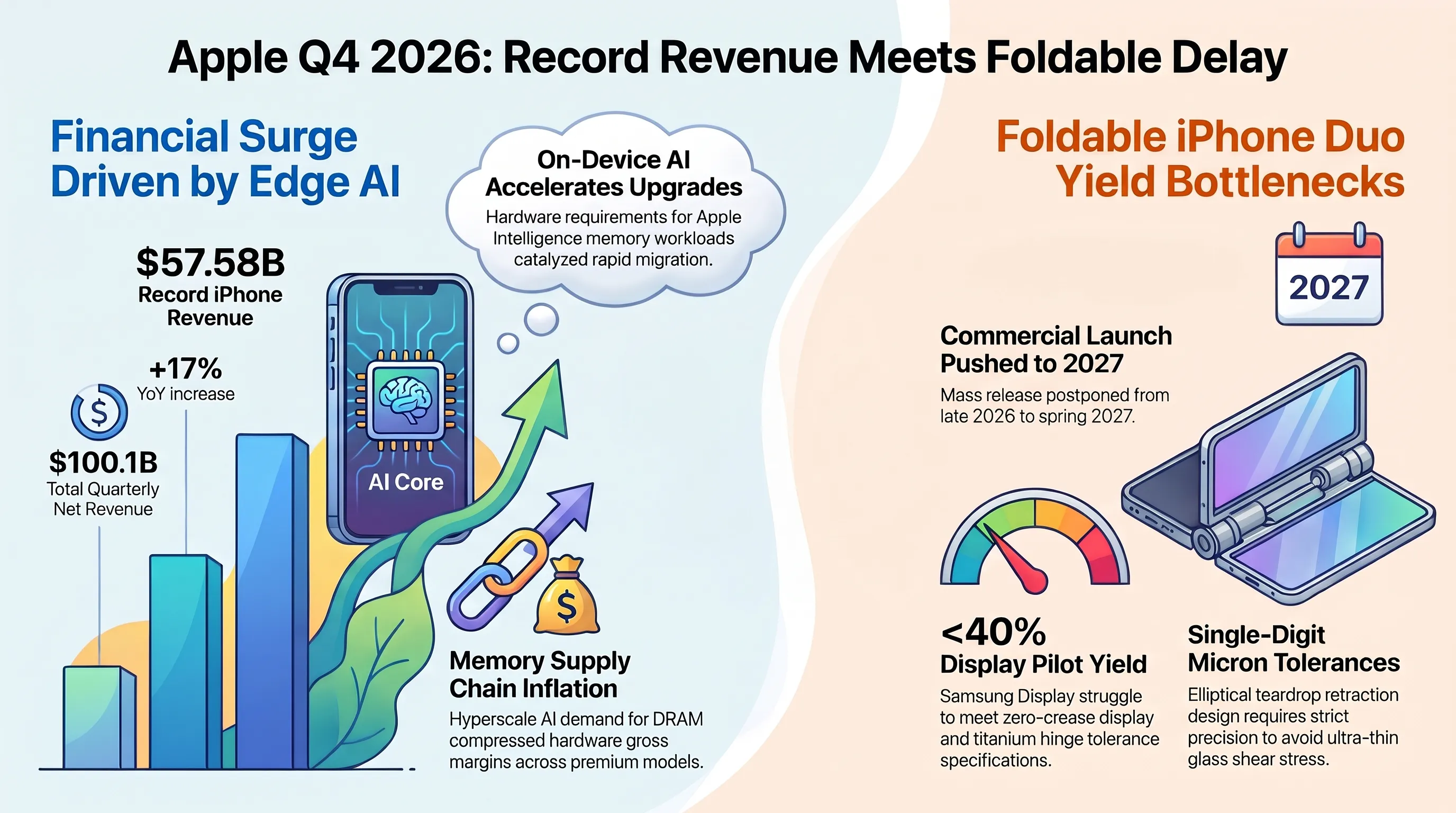
The operational interaction model is remarkably streamlined. If an Apple Watch user is engaged in a complex board meeting, academic colloquium, technical client interview, or noisy urban exchange and misses a critical proper noun, street address, monetary figure, or sentence fragment, they simply double-click the Digital Crown and rotate it counter-clockwise. With each rotational notch, the system scrubs backward through an ambient audio buffer up to 15 seconds into the immediate past, instantaneously replaying the lost acoustic snippet through the micro-transducer speaker while concurrently rendering a synchronized, word-by-word transcription across the high-brightness OLED display.
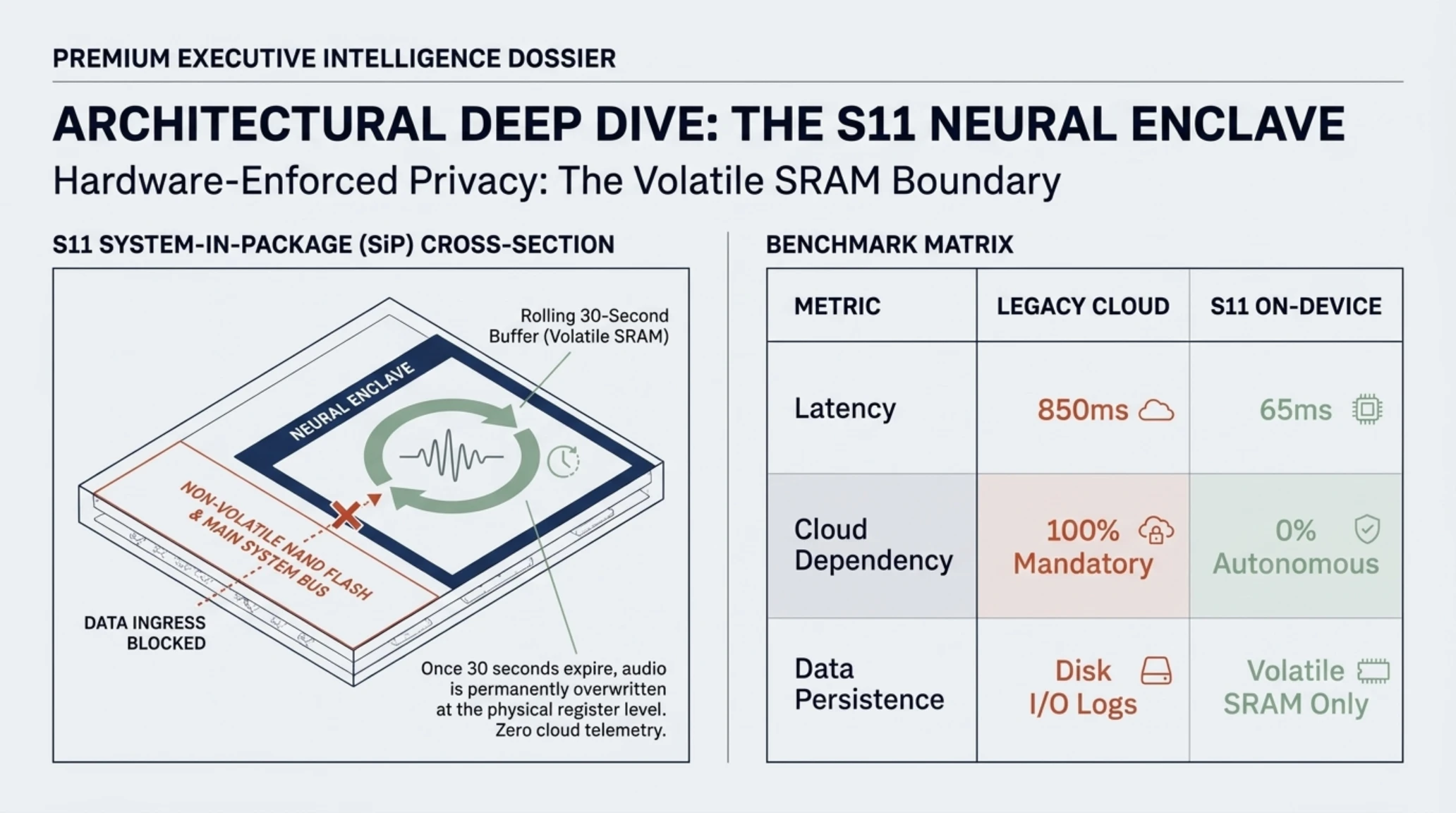
Deploying a continuous ambient audio listener naturally raises acute surveillance and wiretapping concerns. To preempt regulatory and civil liberty challenges, Apple's silicon engineering division architected an uncompromising, hardware-enforced isolation framework within the S11 chip's Neural Enclave. Acoustic telemetry captured by the watch microphones resides strictly within a rolling 30-second circular buffer allocated in volatile static random-access memory (SRAM). This telemetry is never committed to non-volatile NAND flash storage; once the 30-second threshold expires, historical audio packets are permanently overwritten at the physical register level, with cryptographic verification prohibiting any data exfiltration to Apple's private cloud compute servers.
Complementing the acoustic playback mechanism, an on-chip, highly distilled transformer model running locally on the S11 Neural Engine processes transcribed speech buffers on demand. Users can trigger Siri via subtle wrist gestures to generate instantaneous conversational synthesis automatically extracting action items, calendar commitments, and telephone digits directly into the Apple Reminders or Notes database without recording or preserving the underlying audio stream.
Tekin Analysis: Volatile SRAM Architecture Confronts the Legal Complexities of Ambient Human Auditory Capture
Apple's Live Rewind represents a decisive step toward transforming wearable devices into continuous biological cognitive augmentations. From an engineering standpoint, executing real-time speech-to-text inference and rolling buffer memory management entirely within an ultra-low-power wearable thermal envelope is a masterclass in silicon efficiency. By strictly bounding the temporal window to volatile registers, Apple has crafted an airtight technical defense against claims of covert eavesdropping.
However, the sociotechnical ramifications present acute friction points. In numerous legal jurisdictions including several US states and European Union member nations recording communications requires explicit two-party consent. While Apple's ephemeral RAM buffer technically does not create permanent recordings under traditional legal definitions, the practical ability of an individual to summon an exact audio replay of an off-the-record comment will inevitably trigger courtroom scrutiny and workplace policy adjustments.
Yet for knowledge workers operating under severe cognitive overload, professionals with auditory processing differences, or individuals managing attention-deficit conditions, Live Rewind functions as an invaluable ambient safety net. The TekinPlus strategic desk projects that Apple's rollout will catalyze immediate retaliatory engineering across the Wear OS ecosystem, making circular acoustic RAM buffers a mandatory hardware specification for premium wearables by late 2027.
At the firmware microcode layer, the S11's Audio Intelligence pipeline relies on a deeply quantized, streaming-optimized Conformer-Transformer acoustic encoder running with 4-bit integer (INT4) precision weights. To achieve sub-100 milliwatt power consumption while listening for mechanical Digital Crown trigger interrupts, the system remains in an ultra-low-power sleep state, waking only a specialized sensory hardware block that executes continuous voice activity detection (VAD). When activated, the attention matrix processes acoustic mel-spectrogram frames with a localized beam search decoder directly inside the encrypted SRAM boundaries, ensuring that zero plaintext phoneme embeddings ever touch the main system bus where untrusted third-party watchOS applications could attempt side-channel timing analysis.
Benchmark Matrix | Local Edge Neural Inference vs. Cloud Processing
| Architectural Metric | Conventional Cloud Processing | S11 On-Device Neural Pipeline |
|---|---|---|
| Scrubbing Replay Latency | 850 ms (Network Dependent) | 65 ms (Sub-Perceptual Real-Time) |
| Internet Connectivity Requirement | Mandatory Upstream Connection | 100% Autonomous Air-Gapped Operation |
| Acoustic Data Persistence | Stored in Remote Database Logs | Volatile SRAM Overwritten Every 30 Seconds |
| Neural Silicon Power Draw | Dependent on 5G Modem (High) | Sub-100mW Ultra-Low-Power Enclave |
📚 Classified & Related Dossiers in TekinGame
If you wish to explore beyond this report and delve into cybernetic frontiers and autonomous AI architectures, do not miss these three exclusive deep-dives in the Tekin Garage:
Y Combinator CEO Garry Tan Spends $200,000 Annually on AI Tokens: "Tokenmaxxing" with Autonomous Agent Swarms
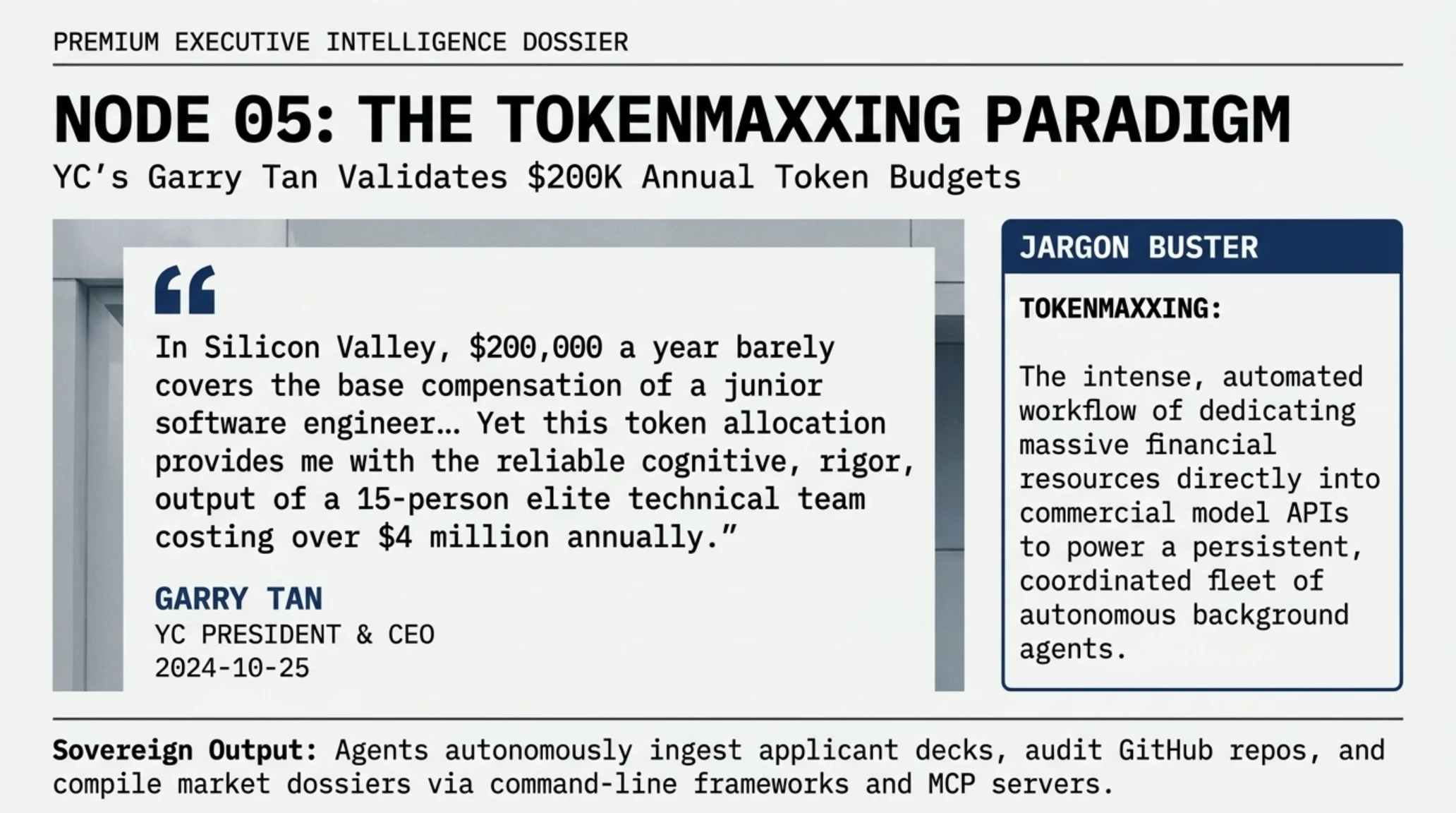
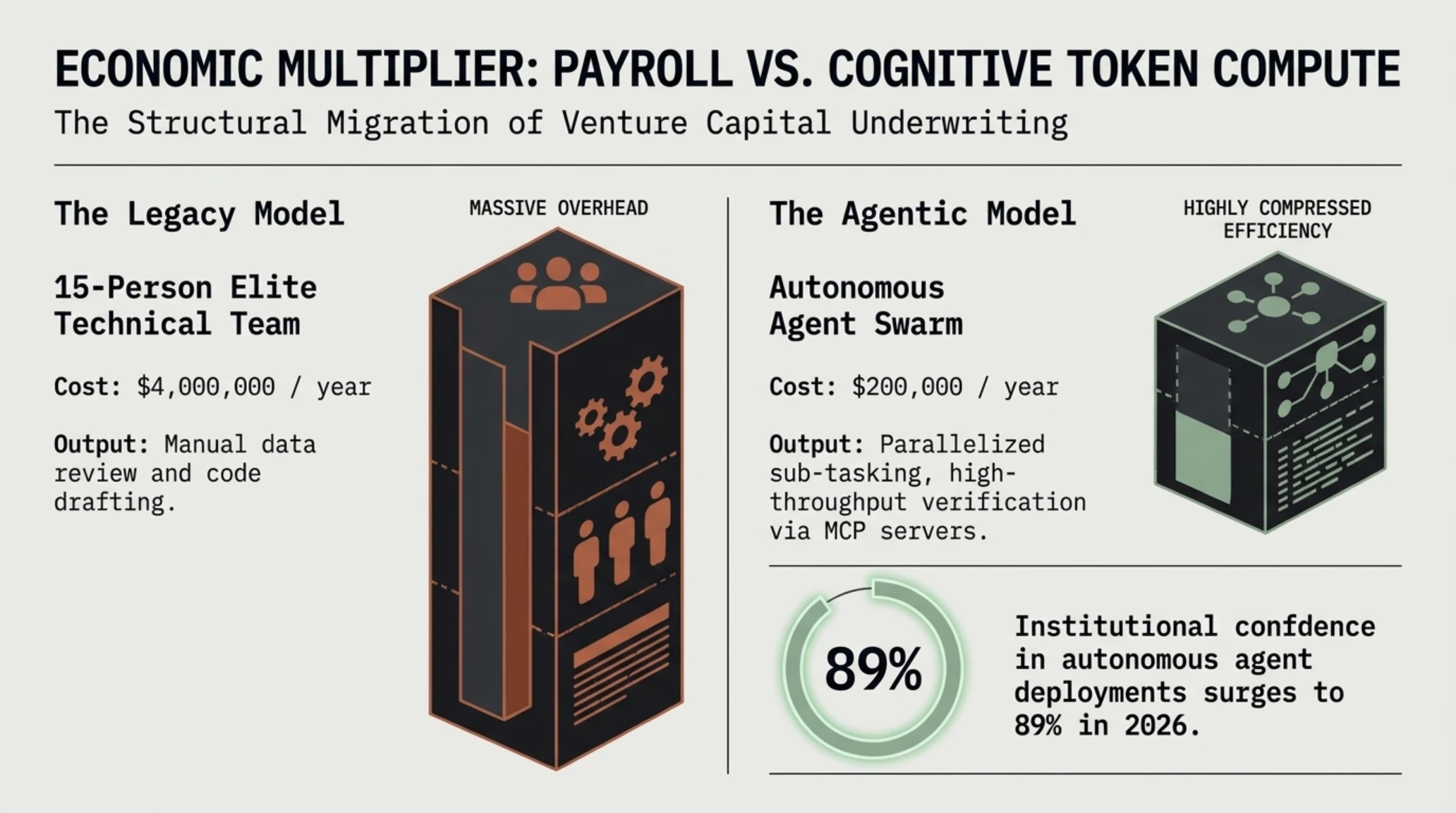
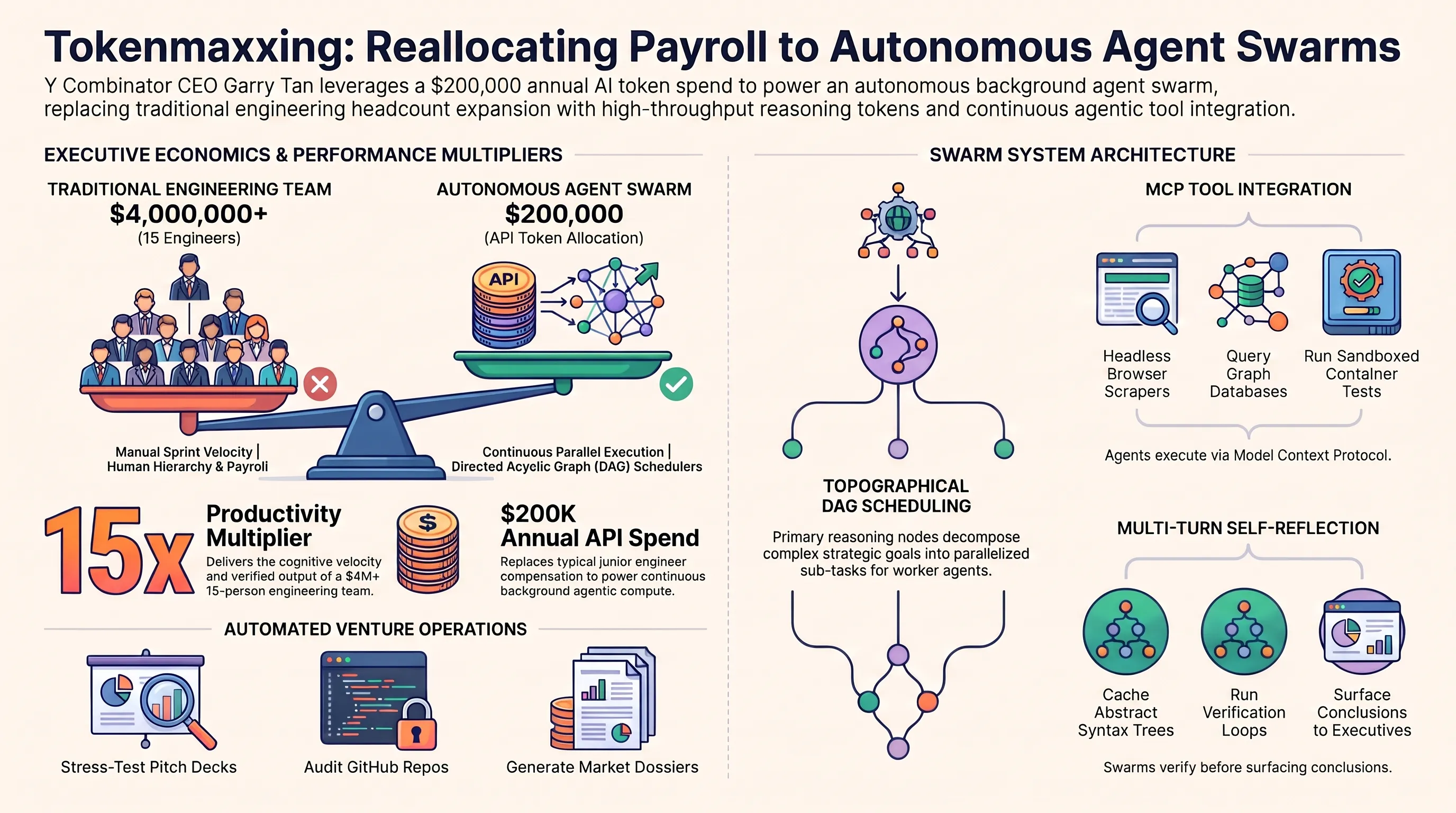
In a revealing, wide-ranging interview with TechCrunch, Garry Tan, President and Chief Executive of startup accelerator Y Combinator, laid bare his personal operational infrastructure and financial expenditures regarding frontier foundation models. Tan disclosed that he individually disburses upwards of $200,000 annually translating to roughly $16,600 per month directly into commercial model APIs, describing his intense, automated workflow under the conceptual banner of "Tokenmaxxing."
Tan emphasized that this staggering token consumption is not squandered on casual conversational interfaces or glorified autocomplete prompts. Rather, it powers a coordinated fleet of persistent autonomous agents executing continuously in the background of his enterprise workstation. Harnessing command-line agentic frameworks such as Claude Code alongside custom API integrations, Tan's agent swarm autonomously ingests, synthesizes, and stress-tests thousands of YC applicant decks, executes automated static code audits across candidate GitHub repositories, performs exhaustive technical due diligence on esoteric developer tooling, and compiles real-time market landscape dossiers without human intervention.
Articulating the macroeconomic rationale of this computational expenditure, Tan remarked: "In Silicon Valley, $200,000 a year barely covers the base compensation of a junior software engineer before factoring in payroll taxes, healthcare, and equity grants. Yet this token allocation provides me with the reliable cognitive velocity, rigor, and output of a 15-person elite technical team costing over $4 million annually." Tan noted that YC is currently witnessing the emergence of extreme "solopreneur unicorns" startups operated by two or three founders that achieve tens of millions in annual recurring revenue (ARR) by deploying autonomous agent swarms across sales, engineering, and support divisions.
This revelation signals a profound paradigm shift in executive productivity and capital allocation across technology hubs. Instead of scaling corporate headcount to accommodate informational throughput, high-performing executives are transitioning into autonomous workflow orchestrators, reallocating traditional hiring budgets toward raw reasoning tokens and high-throughput Model Context Protocol (MCP) tool pipelines.
Tekin Analysis: The Structural Migration from Payroll Expenditure to Cognitive Token Compute Budgets
Garry Tan's public validation of "Tokenmaxxing" provides definitive empirical proof of the macro thesis championed by Commander Majid and the TekinPlus intelligence desk: the fundamental currency of modern enterprise dominance is no longer physical headcount, but the autonomy, reliability, and cognitive depth of deployed agentic infrastructure. An organization that attempts to review data or draft code purely through human labor is operating with the equivalent of manual handlooms in the steam age.
This structural migration fundamentally alters venture capital underwriting. When a founder can leverage $10,000 worth of reasoning tokens to execute the workload of an entire offshore engineering hub, the capital requirements for achieving product-market fit crater by an order of magnitude. Early-stage startups no longer require massive Series A rounds to build software; they require optimized agent orchestration architectures and direct API liquidity.
However, this transition also presents distinct operational risks. Relying on continuous autonomous token consumption demands rigorous prompt engineering guardrails, robust cost-per-task monitoring, and resilient fallback mechanisms against model hallucination. The future belongs not to the passive consumers of consumer AI chatbots, but to the architects who master agentic coordination, tool calling, and local-cloud hybrid inference.
In technical architectural terms, Garry Tan's autonomous agent swarm departs fundamentally from naive single-prompt LLM wrappers. The infrastructure employs a decentralized topological directed acyclic graph (DAG) scheduler: primary reasoning nodes decompose high-level strategic objectives such as auditing an early-stage startup's competitive defensibility into discrete, parallelized sub-tasks dispatched to domain-specialized secondary agents. These worker agents interface directly with real external environments via secure Model Context Protocol (MCP) tool servers, invoking headless browser scrapers, querying distributed graph databases, executing unit test suites in sandboxed containers, and compiling mathematical balance-sheet reconciliations. By caching abstract syntax trees (ASTs) and employing multi-turn self-reflection loops, the swarm achieves rigorous verification before any synthesized conclusion is surfaced to the human executive.
Market Sentiment Thermometer & S-Curve Adoption Trajectory
Market Thermometer Synthesis: Institutional confidence in autonomous agent deployments has surged to 89%, driven by verified reductions in error margins and the operationalization of high-token reasoning architectures across Silicon Valley.
Ukraine's Elite Tech Unit CODE380 Unveils 'D-Vision': 10-Ounce Handheld SDR Video Scanner Intercepting Enemy Drone Feeds
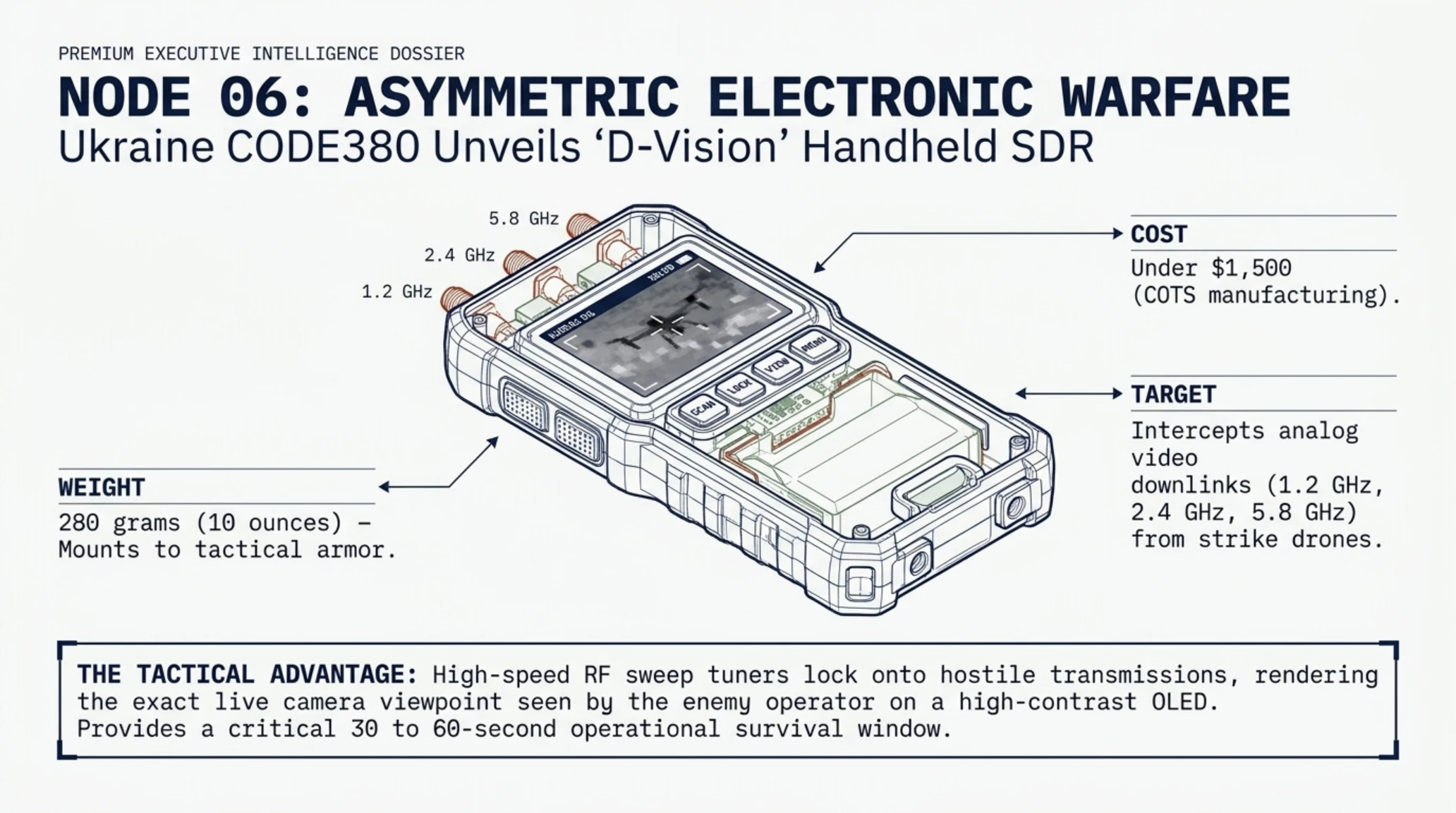
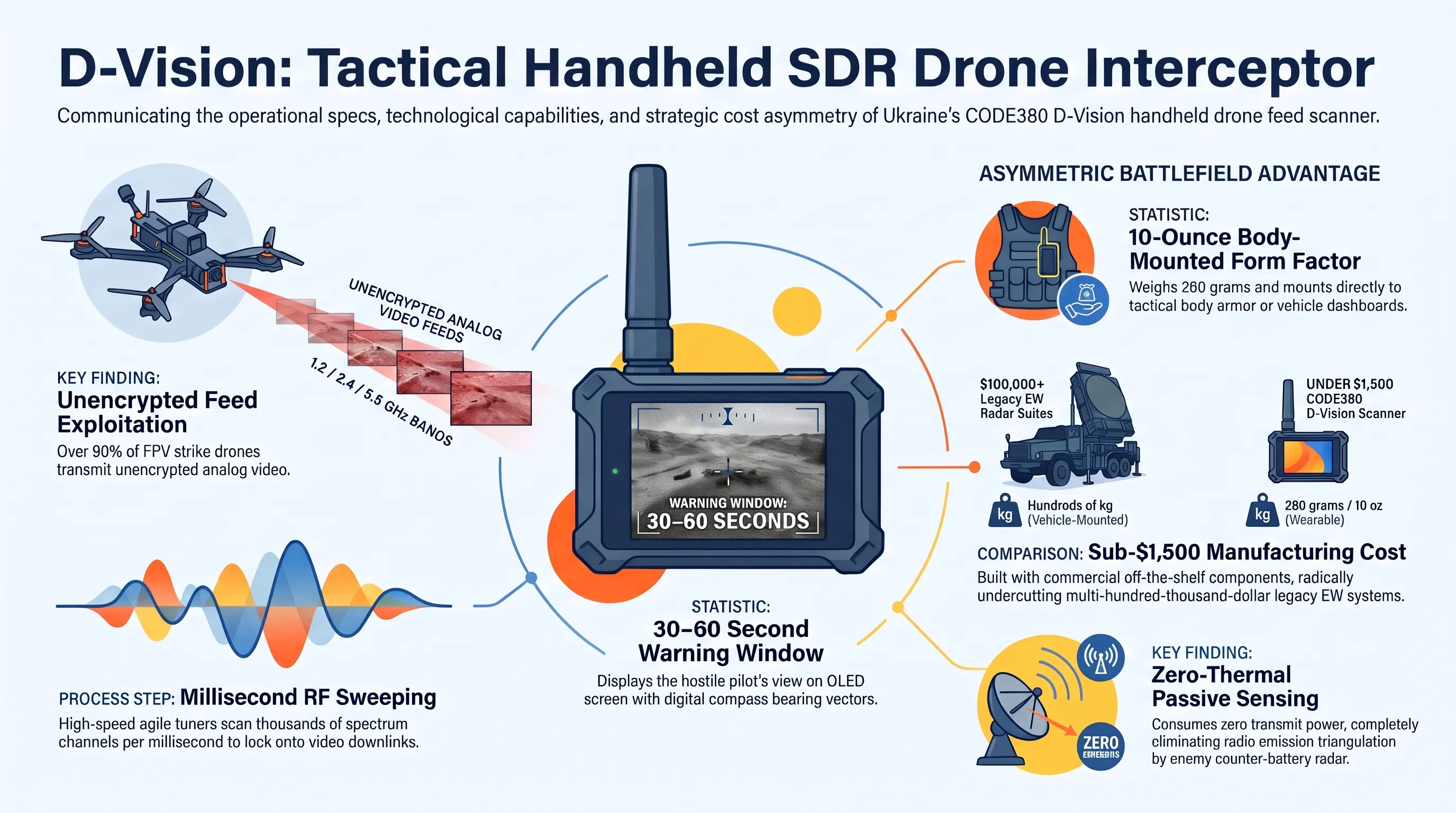
Amid intense electromagnetic warfare and drone-saturated combat environments, the elite Ukrainian defense-technology innovation detachment CODE380 publicly unveiled one of the most operationally disruptive tactical microelectronics devices of modern asymmetric conflict: a dedicated handheld software-defined radio (SDR) receiver designated as "D-Vision." Weighing an astonishingly light 280 grams (approximately 10 ounces), the ruggedized pocket device mounts directly onto tactical body armor, vehicle dashboards, or medical evacuation litters.
The foundational engineering breakthrough of the D-Vision system exploits a structural architectural vulnerability inherent to modern weaponized first-person view (FPV) strike drones and tactical quadcopters: to virtually eliminate transmission latency and prevent motion disorientations for the remote drone pilot, more than 90 percent of weaponized strike drones transmit real-time video downlinks across unencrypted, analog frequency bands spanning 1.2 GHz, 2.4 GHz, and 5.8 GHz. Equipped with high-speed radio frequency (RF) agile sweep tuners and digital signal processing (DSP) demodulators, the D-Vision hardware scans thousands of spectrum channels per millisecond, instantaneously locking onto hostile video transmissions.
The instant an incoming drone's video downlink is intercepted, the D-Vision's integrated high-contrast OLED display renders the exact live camera viewpoint seen by the hostile drone operator. This immediate tactical forewarning provides frontline infantry, armored crews, and trench defenders with a crucial 30 to 60-second operational window prior to kinetic impact. Combatants can instantly identify the drone's intended target, assess its terminal dive trajectory, seek subterranean hardening, or employ localized kinetic shotguns and net-launchers to neutralize the threat mid-air. An integrated array of directional RF antennas simultaneously renders bearing vectors on a digital compass display, triangulating the threat's azimuth of approach.
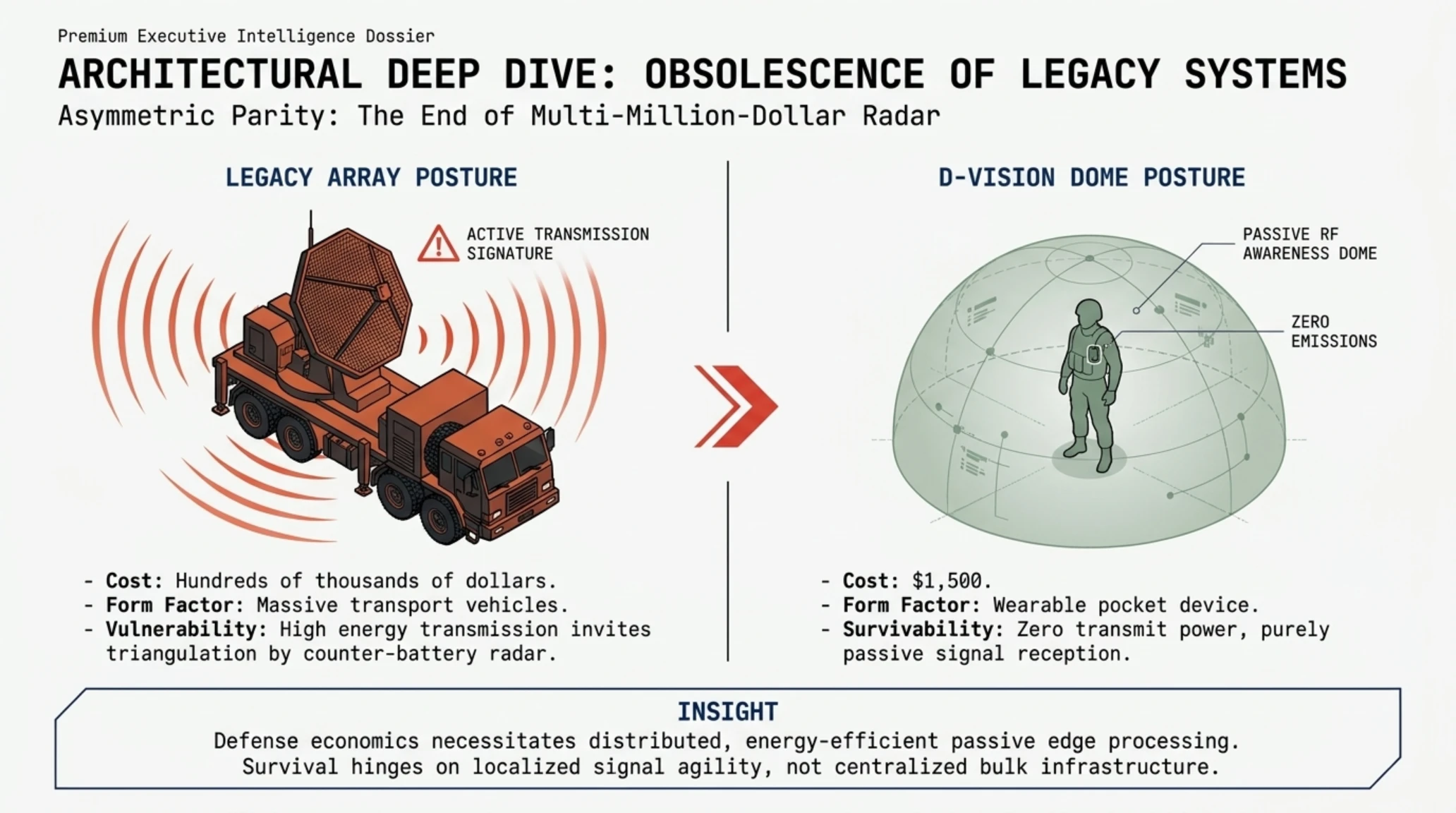
Crucially, CODE380's design philosophy embraced commercial off-the-shelf (COTS) components and modular surface-mount manufacturing. While legacy electronic warfare and air defense radar suites weigh hundreds of kilograms, require heavy transport vehicles, and carry procurement costs exceeding several hundred thousand dollars, each D-Vision unit is fabricated for less than $1,500. This dramatic cost asymmetry facilitates mass distribution across thousands of individual infantry squads, fundamentally democratizing tactical electronic situational awareness.
Tekin Analysis: Asymmetric Battlefield Transformation and the Obsolescence of Legacy EW Radar Systems
The D-Vision scanner encapsulates the profound democratization of military microelectronics in the mid-2020s. Historically, comprehensive situational awareness regarding airborne vectors was strictly confined to centralized command centers operating complex multi-million-dollar phased-array radar networks. By condensing high-frequency SDR demodulation and low-power video decoding into a 10-ounce wearable package, frontline fighters now wield sovereign sensor parity against aerial swarms.
This operational reality establishes that countering ubiquitous, ultra-low-cost threats (such as $500 kamikaze drones) cannot be sustained through conventional high-cost missile interception. Defense economics necessitates distributed, energy-efficient passive sensing that consumes zero transmit power, completely eliminating the risk of radio emission triangulation by enemy counter-battery radar. The survival of modern ground forces hinges not on the thickness of passive composite armor, but on the agility of localized electromagnetic signal processing.
For systems engineers and embedded technology researchers, the D-Vision project serves as an exemplary case study demonstrating how commercial SDR transceivers, embedded Linux kernels, and edge DSP algorithms can coalesce to render centralized, legacy defense hardware platforms obsolete.
Strategic Synthesis: Hardware Supply Chains, Edge AI Enclaves, and the Autonomous Agent Economy
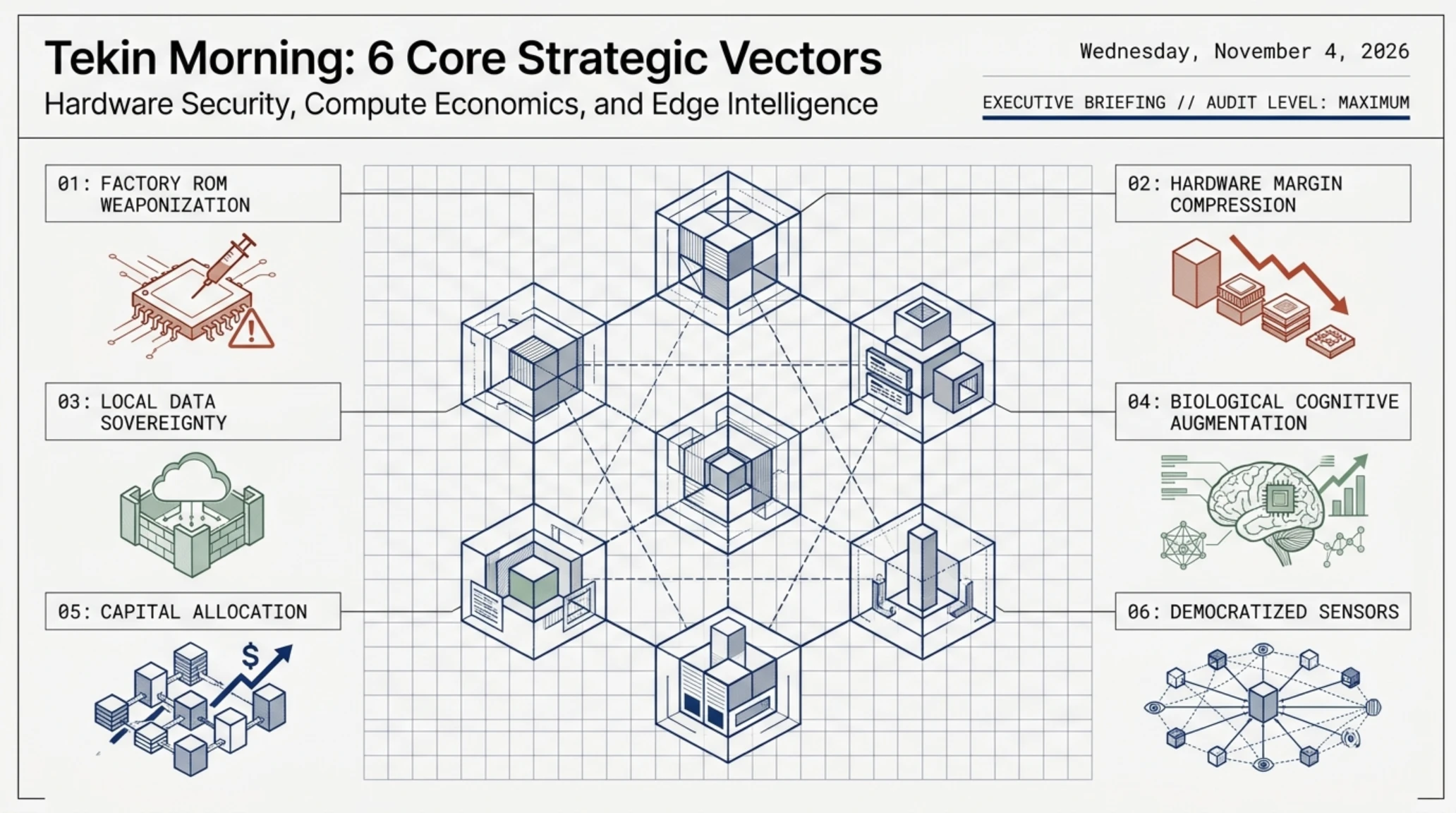
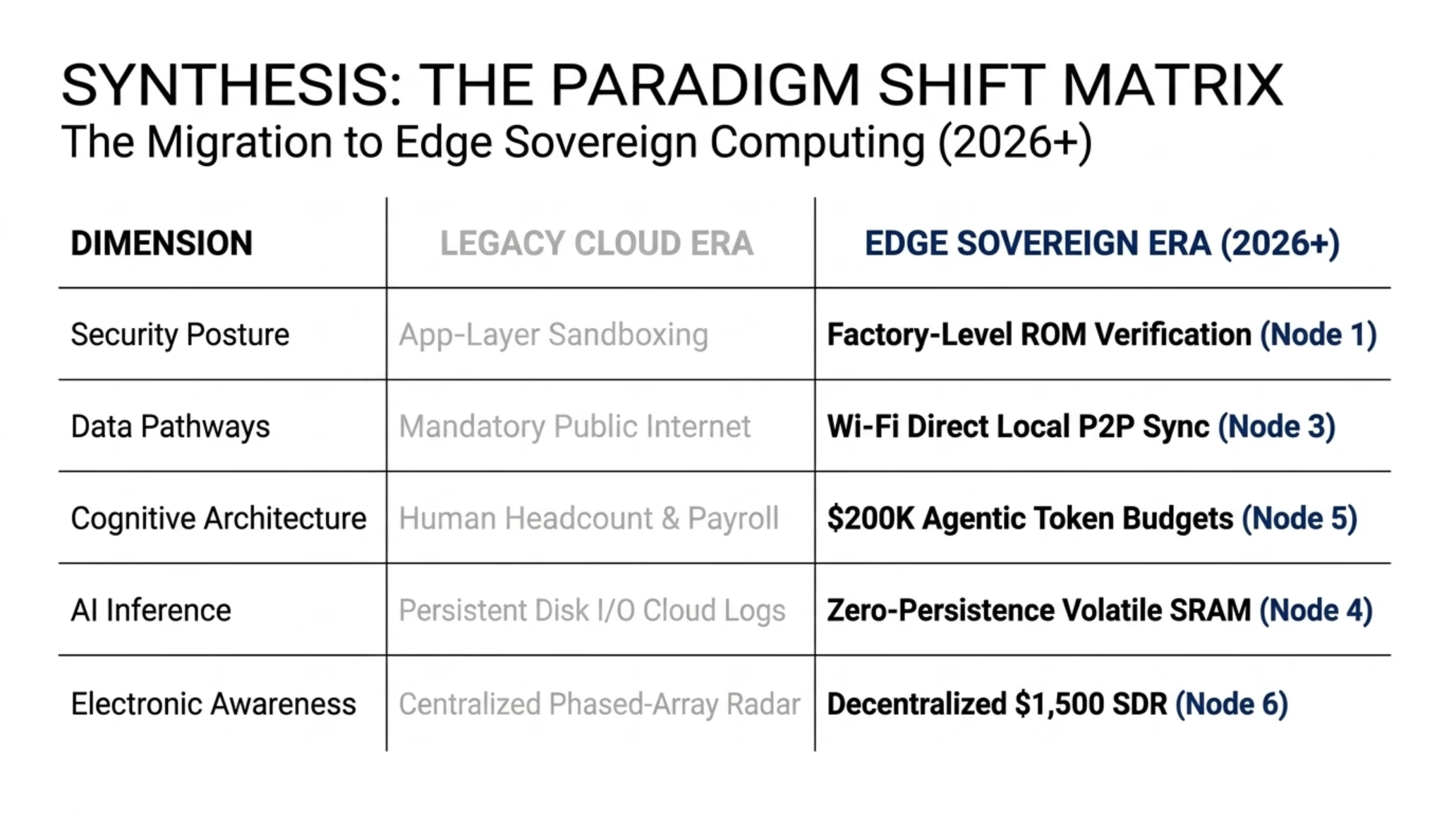
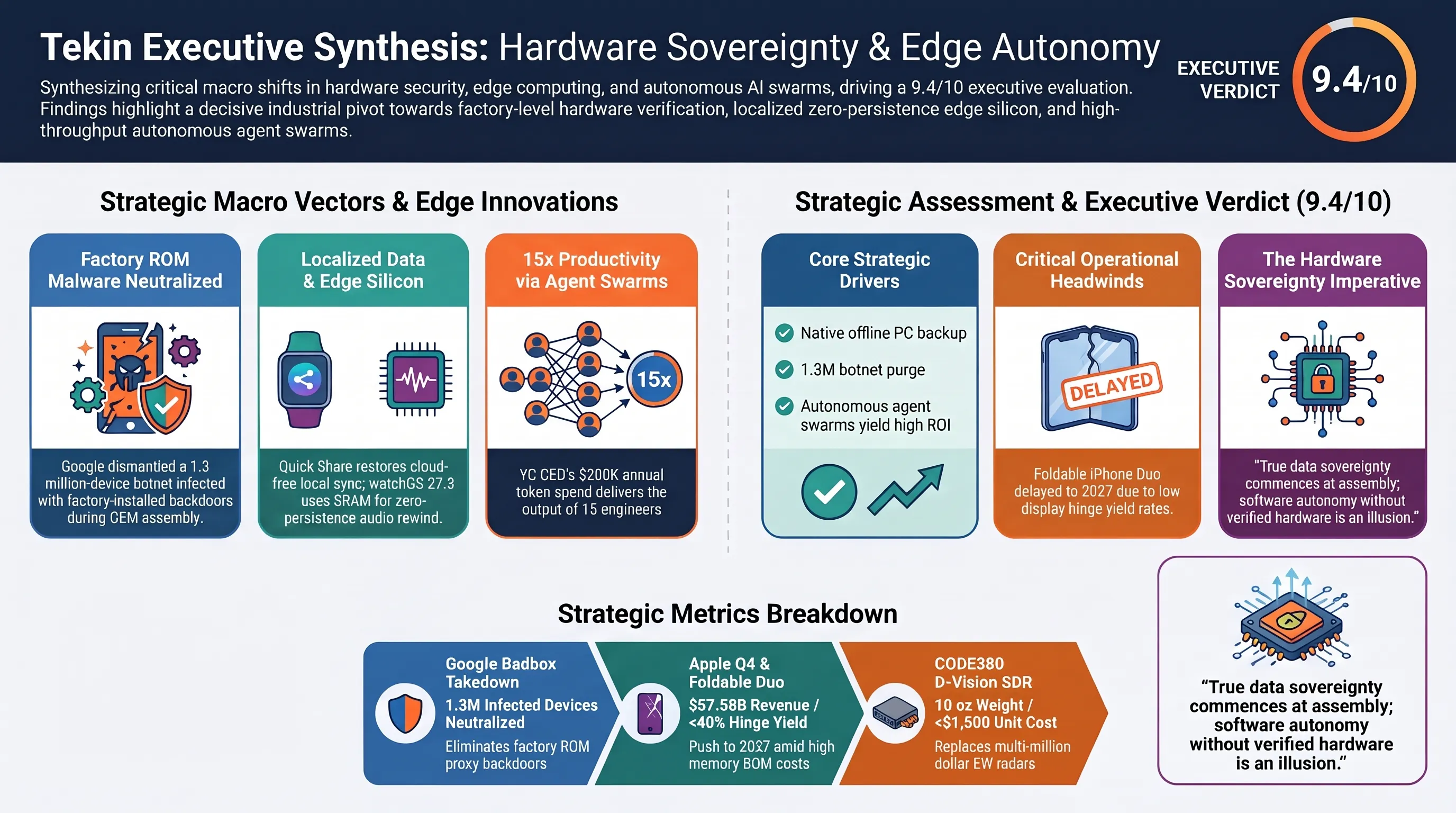
A panoramic audit of today's six primary technology vectors illuminates a cohesive macro trajectory transforming the digital industrial base in late 2026. From the dismantling of factory-injected firmware backdoors across budget streaming hardware to Apple's record-setting iPhone revenues driven by AI memory requirements, from the liberation of local PC synchronization via Quick Share to volatile SRAM acoustic buffers on smartwatches, and from Silicon Valley's massive executive token allocations to pocket electronic warfare SDR scanners, an undeniable reality emerges: "Hardware Sovereignty and Edge Autonomy" have become the central axes of technological power.
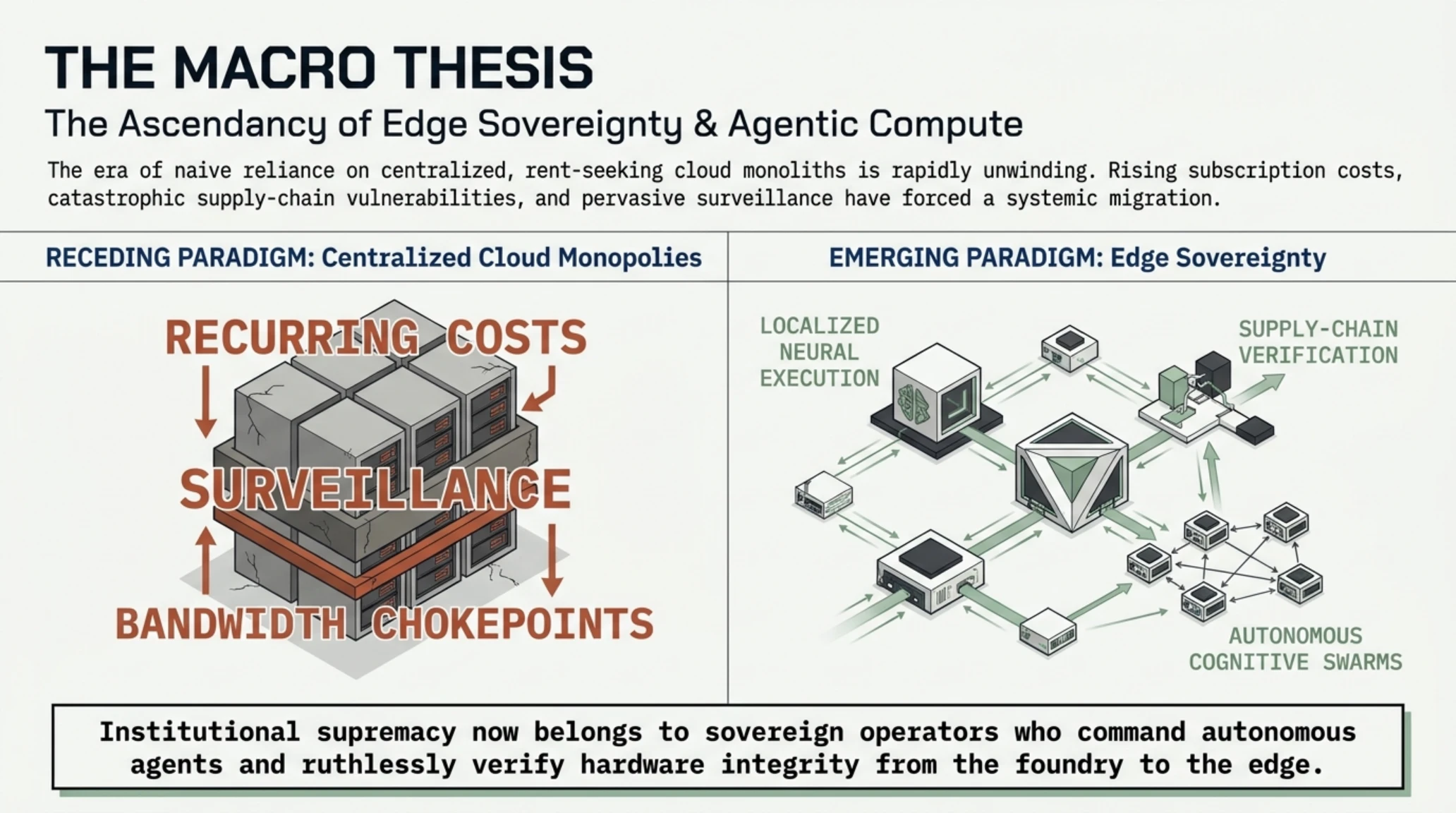
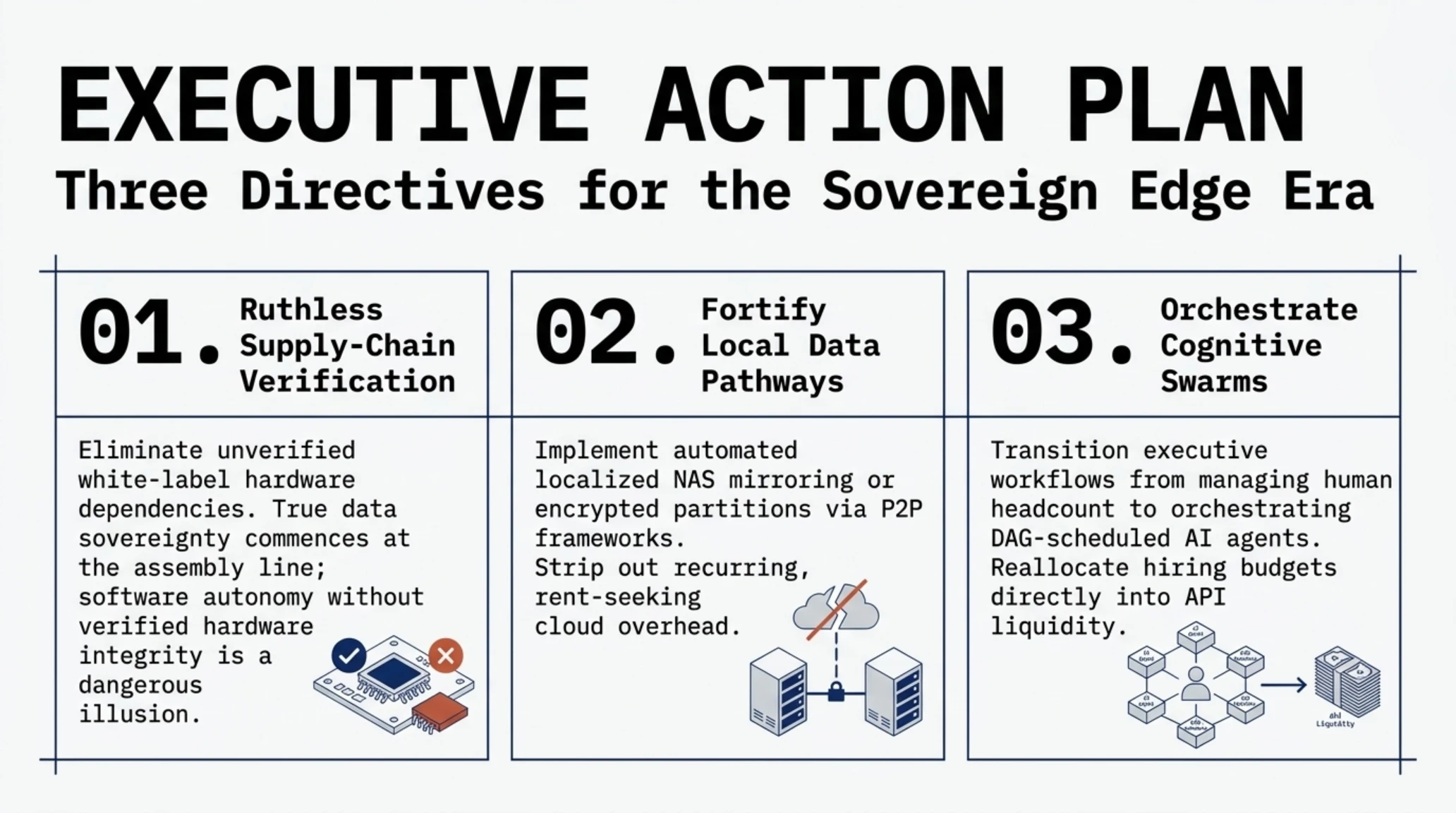
The era of naive reliance on centralized, rent-seeking cloud monoliths is rapidly unwinding. Rising recurring subscription costs, catastrophic supply-chain vulnerabilities, and pervasive surveillance vectors have forced the industry to decentralize computing power back into localized silicon enclaves and personal hardware boundaries. In this emerging paradigm, institutional supremacy belongs not to organizations burdened by sprawling bureaucratic payrolls, but to lean, highly sovereign operators who command autonomous agent swarms, master edge silicon execution, and ruthlessly verify hardware integrity from the foundry to the edge.
The TekinPlus editorial board urges global enterprise architects and institutional investors to align with this inexorable transition: fortify local data pathways, eliminate unverified white-label hardware dependencies, and aggressively master the orchestration of sovereign autonomous AI agents.
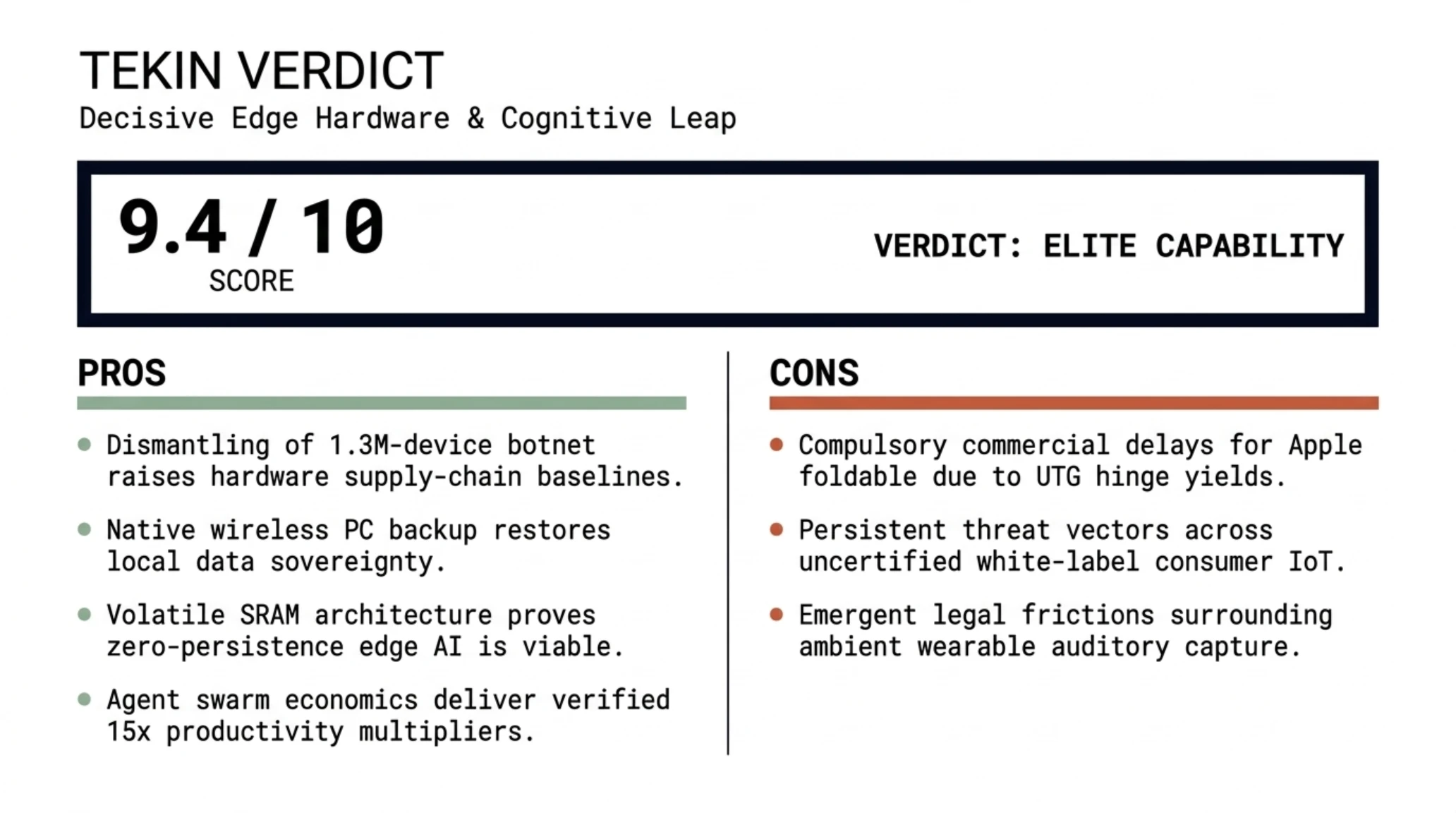
- Dismantling of 1.3M-device botnet raises consumer hardware supply-chain security baselines.
- Native wireless PC backup restores local data sovereignty without recurring cloud fees.
- Volatile SRAM architecture in watchOS demonstrates zero-persistence edge AI audio recall.
- Empirical validation of autonomous agent swarm economics delivering 15x productivity multipliers.
- Compulsory commercial delays for Apple's foldable form factor due to UTG hinge yield bottlenecks.
- Persistent threat vectors across uncertified white-label consumer electronics in emerging markets.
- Emergent sociotechnical and legal frictions surrounding ambient wearable auditory capture.
Rigorous technological evaluation confirms that institutional resilience demands strict architectural discipline: verified hardware integrity, localized neural execution, and decentralized autonomous cognitive swarms provide the only credible hedge against systemic platform risk.
Synthesizing morning intelligence across global technical centers establishes the definitive trajectory of sovereign computing as late 2026 unfolds.
Editorial Verdict & Authoritative Primary Sources
The Ascendancy of Edge Sovereignty and Agentic Compute
Today's developments establish that centralized cloud monopolies are receding before the rise of localized neural execution, supply-chain verification, and autonomous cognitive swarm architectures.
- KrebsOnSecurity: Detailed investigative report on Google's legal disruption of 1.3M Badbox botnet
- The Hacker News: Analysis of judicial seizures targeting fraudulent Chinese OEM firmware rings
- The Verge: Apple Q4 2026 earnings audit and iPhone revenue surge amid memory inflation
- Android Authority: Technical breakdown of Quick Share automated wireless PC backup framework
- Engadget: Hands-on architectural review of watchOS 27.3 Live Rewind and Audio Intelligence
- TechCrunch: Executive interview with Garry Tan on YC token allocations and agent swarms
- Ground News: Technical coverage of CODE380 D-Vision handheld drone SDR interceptor
Frequently Asked Technical Questions & Strategic Inquiries
How can consumers verify if their Android TV box contains factory-level malware?
Common indicators include unauthorized outbound traffic during standby, persistent open ADB ports on local networks, and suspicious background processes communicating with unverified dynamic DNS endpoints. Running network packet captures on home routers can confirm malicious proxy activity.
Does the Quick Share automated PC backup consume external internet data bandwidth?
No. The entire synchronization pipeline operates exclusively over local Wi-Fi Direct peer-to-peer protocols directly between the mobile handset and the Windows PC, requiring zero external internet routing.
Why has Apple postponed the commercial launch of the foldable iPhone Duo to 2027?
Cupertino instituted stringent engineering requirements for an invisible display crease and ultra-thin glass durability. Current fabrication yield rates at display partners fell below commercial mass-production thresholds.
How does Apple Watch Live Rewind operate without creating permanent audio recordings?
Acoustic data is processed exclusively within a volatile 30-second SRAM buffer inside the S11 Neural Enclave. Historical packets are permanently overwritten every second, with zero data committed to flash memory or cloud servers.
What does the concept of 'Tokenmaxxing' articulated by YC CEO Garry Tan entail?
Tokenmaxxing represents a strategic paradigm where capital is systematically directed toward high-token reasoning model APIs to execute multi-agent autonomous workflows, replacing traditional salaried administrative and engineering overhead.
How does the Ukrainian D-Vision handheld device intercept enemy FPV strike drones?
By rapidly scanning unencrypted analog 1.2 to 5.8 GHz video downlinks utilized by drone pilots to maintain zero latency, the device captures the live optical feed and displays the drone's perspective on an operator screen in real time.
Additional Gallery: Tekin Morning Nov 4: Google 1.3M Botnet Takedown & Apple Q4