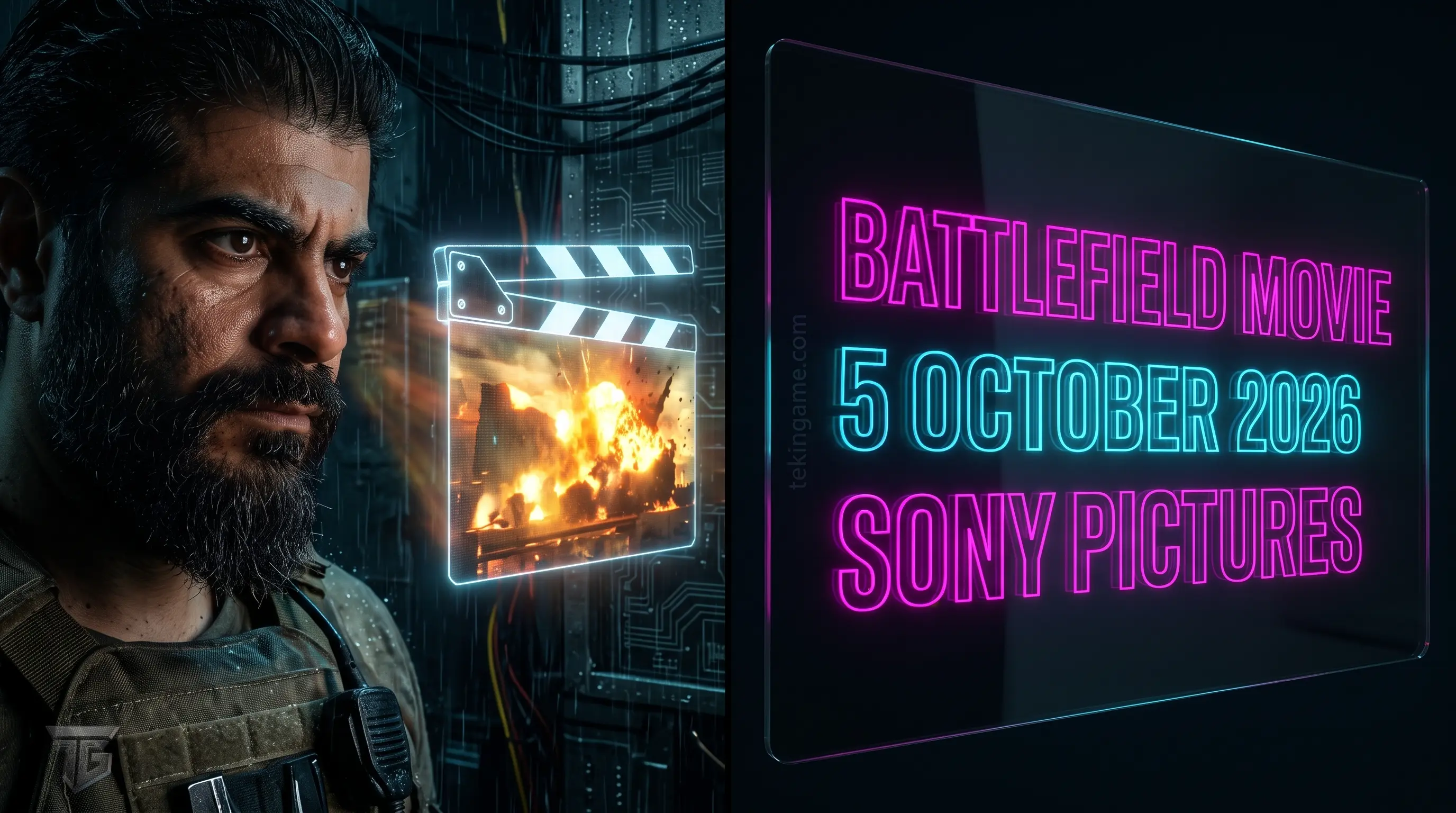
Tekin Night | October 5, 2026: Battlefield Movie Triumph, Capcom REX Engine & RuneScape 4
Monday evening, October 5, 2026, delivers monumental gaming and entertainment breakthroughs: Sony Pictures clinches Battlefield, Capcom revolutionizes game engines, and Star Wars scores an 88 Metacritic triumph.
- 🎮Battlefield Movie Bidding War- Sony Pictures wins film rights with Christopher McQuarrie & Michael B. Jordan
- 🎧Capcom Project REX- Next-gen modular RE Engine evolution built for AI collaboration
- 🚀RuneScape 4 Unveiled- Unreal Engine MMORPG & Hollywood animated series with MoistCr1TiKaL
- 🗡️Star Wars Galactic Racer- Breakout arcade hit clinches glowing 88 Metacritic score
- 📰PlayStation Network Exploit- Social engineering bypasses 2FA to hijack high-profile creator accounts
- ⚔️Thrustmaster T-GT III Launch- $749.99 direct-drive wheel system debuts for Gran Turismo 7 Spec IV
Executive Summary & Major Developments
- Sony Pictures Entertainment secures exclusive rights to Electronic Arts' Battlefield cinematic universe with Christopher McQuarrie directing and Michael B. Jordan producing.
- Capcom engineers unveil Project REX at Tokyo Open Conference, introducing five modular architectural layers to accelerate AAA production alongside AI.
- Jagex celebrates 25 years of RuneScape at RuneFest 2026 by announcing standalone Unreal Engine sequel RuneScape 4 and Reignited release on December 2.
- Fuse Games' Star Wars: Galactic Racer shatters expectations with an 88 Metascore, emerging as the highest-rated franchise game in twenty years.
- PlayStation Network faces serious security scrutiny after social engineering exploit targeting customer support bypasses 2FA to hijack high-profile creators.
- Thrustmaster launches $749.99 direct-drive T-GT III racing system with 5-10 Nm axial torque and load-cell pedals for Gran Turismo 7 Spec IV.
Part One: Sony Pictures Clinches Battlefield Cinematic Rights; Christopher McQuarrie and Michael B. Jordan to Helm High-Octane Live-Action Adaptation
The global entertainment landscape witnessed a monumental milestone on Monday evening, October 5, 2026, as Hollywood trades confirmed the conclusion of an intense, high-stakes studio bidding war. According to comprehensive reports by The Wrap and Deadline, Sony Pictures Entertainment has emerged as the definitive victor, securing exclusive film adaptation rights to Electronic Arts' legendary tactical shooter franchise, Battlefield. The triumph sees Sony outbidding fierce competition from Warner Bros. Discovery, Universal Pictures, Paramount Global, and streaming behemoths Netflix and Amazon MGM Studios.
This multibillion-dollar transmedia commitment represents the most ambitious military video game adaptation ever assembled. The cinematic venture will be written and directed by visionary filmmaker Christopher McQuarrie, whose peerless mastery of kinetic choreography and authentic practical filmmaking in Mission: Impossible – Fallout, Dead Reckoning, and Top Gun: Maverick redefined modern cinematic action. McQuarrie’s directorial mandate is to translate Battlefield’s hallmark environmental destruction, dynamic vehicular combat, and asymmetric squad warfare to IMAX theaters with minimal reliance on synthetic green-screen backdrops or artificial CGI shortcuts.
Teaming up with McQuarrie is A-list star Michael B. Jordan, whose production company Outlier Society will co-produce the blockbuster alongside EA Entertainment and DICE. Jordan, celebrated for his powerhouse performances in Black Panther and his acclaimed directorial debut on Creed III, is currently in active talks to star as the lead squad commander, anchoring the narrative with grounded emotional stakes amid chaotic combined-arms combat.
Electronic Arts' aggressive push into high-caliber cinema follows the historic commercial reception of the latest Battlefield installment, which dominated global sales charts throughout late 2025 and 2026. Vince Zampella, Head of Respawn and EA’s shooter portfolio, has repeatedly emphasized that the soul of Battlefield lies in the tension between individual infantry courage and overwhelming structural collapse. McQuarrie's track record of orchestrating real-world aerial dogfights and complex logistical stunts provides the exact creative DNA necessary to honor the franchise's twenty-year legacy.
Furthermore, Hollywood insiders indicate that the bidding war escalated rapidly due to EA's stringent contractual conditions. Unlike legacy video game adaptations of the early 2000s that surrendered complete creative autonomy to film executives, EA insisted on maintaining strict canon integrity, cross-media promotional timing, and collaborative oversight from DICE narrative leads. Sony Pictures distinguished itself from rival streaming bidders by committing to an exclusive theatrical release window, robust physical IMAX distribution, and substantial marketing support across its consumer electronics and entertainment divisions.
Michael B. Jordan's passionate involvement serves as a vital creative catalyst for the adaptation. An outspoken, lifelong gaming enthusiast who famously infused kinetic anime fight choreography into Creed III, Jordan has consistently advocated for preserving the visceral infantry brotherhood that defines military shooters. Under his Outlier Society banner, the production team plans to consult closely with combat veterans, tactical specialists, and technical advisors to capture the psychological toll of frontline reconnaissance, ensuring that Battlefield stands apart from generic blockbuster spectacles as a raw, emotionally resonant modern warfare odyssey.

Strategic Significance: The Converging Horizons of Hollywood and Interactive Gaming
- Transmedia Synergy: Following the cross-medium triumphs of The Last of Us and Fallout, EA is establishing a premier cinematic universe designed to cross-pollinate with its live-service multiplayer roadmaps.
- Analogue Realism Over CGI: McQuarrie’s commitment to practical military assets, heavy artillery, and physical stunt work mirrors the visceral tactical feedback core Battlefield players demand.
- The Theatrical Bulwark: Sony Pictures’ successful acquisition reinforces the commercial viability of traditional global theatrical distribution over streaming-first alternatives for mega-budget action tentpoles.
Industry insiders project a staggering production budget exceeding $200 million, with principal photography scheduled to commence in early 2027 targeting an international summer 2028 theatrical release. The production aims to incorporate practical large-scale structural demolition modeled after Battlefield's iconic 'Levolution' mechanic, promising audiences an authentic sensory spectacle that bridges the tactile realism of classic war cinema with the pulse-pounding rhythm of modern competitive gaming. By anchoring the narrative in geopolitical nuance and gritty infantry perspectives, McQuarrie and Jordan intend to create an enduring franchise capable of competing directly with the most venerable military thrillers in Hollywood history.
Part Two: Capcom Engineers Reveal Project REX; Next-Gen Modular RE Engine Evolution Tailored for AI-Assisted AAA Development
During the prestigious Capcom Open Conference RE: 2026 held at Capcom’s Tokyo R&D headquarters, executive leadership unveiled one of the most consequential software engineering transformations in modern interactive entertainment. Satoshi Ishida, Lead Infrastructure Architect and Senior Technical Director, officially detailed the final deployment phase of Project REX (RE neXt Engine). This foundational paradigm shift completely rearchitects Capcom's acclaimed in-house RE Engine to meet the exponential asset scaling and pipeline concurrency demands of future flagship franchises, including next-generation installments of Resident Evil and Monster Hunter.
First introduced in 2017 alongside Resident Evil 7: Biohazard, the original RE Engine established an industry-wide gold standard for photo-realistic rendering, rapid iteration, and exceptional memory optimization on x86 console architectures. However, as modern AAA game development grapples with ballooning multi-hundred-gigabyte asset pipelines, 8K volumetric textures, complex procedural terrain deformation, and agonizing compile latencies, monolithic game engine architectures have encountered severe development bottlenecks. Rather than abandoning their highly optimized proprietary engine in favor of off-the-shelf third-party middleware like Unreal Engine 5, Capcom chose a path of radical internal modularization. Project REX injects five discrete, decoupled architectural pillars into the engine core:
First, RE:Dox establishes a unified, centralized metadata repository that eliminates disparate asset formatting across multi-thousand-person global teams. Second, RE:UI completely decouples editor user interfaces from backend rendering logic, enabling lightweight, browser-based collaborative toolsets for technical artists. Third, RE:Flows introduces next-generation visual node scripting capable of compiling graphical logic graphs directly into native C++ code, eradicating runtime interpreter overhead. Fourth, RE:Log functions as an enterprise-grade telemetry engine providing continuous automated crash reporting and memory leak profiling. Finally, RE:Runtime utilizes data-oriented design (DoD) to execute massive multithreaded batch processing for dynamic ecosystem behaviors, dense NPC crowd AI, and complex environmental physics.
Technical Jargon Buster: Deconstructing Capcom's Five Project REX Engine Modules
- RE:Dox: Standardized asset metadata warehouse preventing versioning conflicts across distributed development teams.
- RE:UI: Decoupled tool layer allowing UI customization via modern web frameworks without rebuilding the entire engine binary.
- RE:Flows: Node-based visual logic compiler converting high-level behavior graphs directly into native, optimized C++ runtime code.
- RE:Log: Enterprise telemetry and automated profiling system pinpointing VRAM bottlenecks and physics desyncs in automated builds.
- RE:Runtime: Data-oriented multi-core execution framework handling massive concurrent entity simulations and environmental destruction.
One of the most profound takeaways from Ishida’s technical keynote was Capcom’s official philosophical stance regarding generative machine learning: "Creating games alongside artificial intelligence, rather than allowing artificial intelligence to displace human artistic intent." Under Project REX, AI models are integrated strictly as autonomous co-pilots for automated stress testing, QA playtesting, shader compilation prediction, and rapid boilerplate scaffolding, completely disavowing the uncurated generation of final customer-facing narrative or art assets. Ishida demonstrated an automated agent running thousands of continuous collision tests across complex terrain meshes overnight, pinpointing physics anomalies in seconds that would have historically required weeks of manual quality assurance.
Furthermore, Ishida confirmed that Capcom intends to open-source several key foundation libraries from Project REX to foster collaborative research across the global game development community. By sharing its decoupled UI framework and telemetry profiling standards, Capcom is positioning itself not only as an elite software developer, but as a vanguard of open, sustainable software engineering practices in an increasingly consolidated industry.
Architectural Comparison: Capcom Project REX vs. Unreal Engine 5.5 vs. Sony Decima Engine
| Technical Metric | Capcom Project REX | Epic Unreal Engine 5.5 | Guerrilla Decima Engine |
|---|---|---|---|
| Core Architecture | 5-Pillar Decoupled Modular | Monolithic with Rich Plugin API | Proprietary Open-World Monolith |
| Framerate Optimization | Flawless 60-120 FPS Target | Hardware Heavy (Nanite/Lumen) | Superbly Optimized Cinematic |
| AI Pipeline Integration | Native QA & Automated Flows | Third-Party Marketplace Plugins | Deterministic Procedural Tools |
| Open-Source Policy | Selective Core Libraries Shared | Source Available via GitHub | Strictly Proprietary to Sony |
Part Three: Jagex Electrifies RuneFest 2026; 'RuneScape 4' Confirmed in Unreal Engine, MoistCr1TiKaL Animated Series & Reignited Launch
British development powerhouse Jagex fundamentally reshaped the trajectory of the MMORPG genre during their flagship RuneFest 2026 international fan festival. Commemorating twenty-five years of the legendary fantasy world of Gielinor, the studio delivered a trio of landmark announcements. Dominating headlines was the formal confirmation of RuneScape 4 (RS4). Originally incubated as the experimental Dragonwilds expansion, the project underwent a dramatic budget expansion and creative pivot, emerging as a fully realized, standalone ninth-generation MMORPG engineered entirely from the ground up on Epic Games' Unreal Engine for PC, PlayStation 5, and Xbox Series X|S.
RuneScape 4 abandons the historical 600-millisecond server tick constraint that defined the franchise for a quarter-century, implementing fluid, real-time hybrid action combat, physics-driven world interactions, and breathtaking dynamic atmospheric lighting powered by Lumen. Despite the immense graphical leap, Jagex leadership affirmed that the foundational pillars of RuneScape—unrestricted player-driven market economies, deep non-combat skill masteries, and humorous quest design—remain sacred and uncompromised. Players will traverse an expansive, seamlessly streaming Gielinor devoid of loading boundaries, with full cross-platform parity across desktop and console interfaces.
From a network engineering standpoint, decoupling RuneScape from the 0.6-second tick cycle represents a monumental computational feat. For decades, every character movement, spell cast, and resource gather was locked to rigid discrete global heartbeat intervals. By implementing a high-frequency asynchronous client-server prediction model inside Unreal Engine, Jagex engineers achieved responsive sub-50ms action inputs while maintaining deterministic server-side trade validation, completely neutralizing client-side duplication exploits and botting vectors that plagued earlier iterations.
Expanding the universe beyond gaming, Jagex also inked a historic multimedia co-production pact with acclaimed studio Lyrical Media and world-renowned content creator Charlie White (MoistCr1TiKaL) to develop an official high-budget animated television series exploring the rich, treacherous history of the Kingdom of Asgarnia. White, who has amassed a loyal following of tens of millions of viewers while maintaining deep historical ties to the RuneScape community, expressed genuine reverence for the franchise's extensive lore.
To celebrate the milestone and bridge the gap until RS4's debut, Jagex officially revealed RuneScape Reignited, set for worldwide release on December 2, 2026. This comprehensive overhaul introduces pristine economic resets, high-performance tick-rate network synchronization, modernized client-side anti-cheat protocols, full open API support for certified interface addons, and an unprecedented ten-day completely unrestricted free-access trial for all global players. The initiative is specifically architected to welcome back lapsed veterans while giving an entirely new generation of gamers frictionless entry into one of the most enduring virtual worlds ever conceived.

Quarter-Century Timeline: From Java Applet Beginnings to Unreal Engine Renaissance
- 2001: Andrew and Paul Gower launch RuneScape Classic in basic Java, introducing thousands to emergent online worlds.
- 2004: The monumental release of RuneScape 2 transitions the universe to 3D and triggers unprecedented player growth.
- 2013: Jagex launches Old School RuneScape (OSRS) alongside RuneScape 3, institutionalizing community-polled game evolution.
- 2026: Official reveal of Unreal Engine-powered RuneScape 4, Hollywood animated series, and the December 2 Reignited launch.
Part Four: Star Wars: Galactic Racer Shocks the Industry with Stellar 88 Metascore; Podracing Reborn Through Roguelite Innovation
In an era where massive, bloated open-world Lucasfilm video game projects frequently endured critical fatigue, generic quest structures, and formulaic design tropes, a relatively unassuming independent collaboration has delivered one of the greatest creative surprises of the decade. High-velocity arcade combat racing title Star Wars: Galactic Racer, developed by British independent studio Fuse Games and published by Secret Mode, has conquered the critical sphere with an extraordinary 88 Metacritic composite score on PlayStation 5, firmly establishing itself as the highest-rated Star Wars gaming title in over twenty years.
Fuse Games was formed by former senior creative directors and engineering leads from legendary racing house Criterion Games—the visionary minds behind the adrenaline-fueled Burnout series and peak installments of Need for Speed. Rather than retreading familiar Jedi mythologies, lightsaber duels, or predictable rebellion skirmishes, the development team directed their full technical prowess toward capturing the raw, terrifying mechanical fury of podracing popularized in 1999's The Phantom Menace and cult classic Star Wars Episode I: Racer, harmoniously fusing it with high-stakes roguelite campaign mechanics.
Players step into the flight-suit of 'Shade', a renegade outsider climbing the ranks of the unsanctioned underground Galactic League across perilous extraterrestrial circuits spanning the bioluminescent canopies of Felucia to the treacherous volcanic rifts of Mustafar. Every run functions as an unpredictable, high-speed survival trial where real-time aerodynamics, thermal management of twin turbofan engines, energy distribution across radiator coils, and catastrophic surface collision physics dictate vehicle handling.
The core gameplay loop centers on dynamic heat accumulation: engaging twin-turbine overboost accelerates crafts beyond 700 km/h, but overheated manifolds risk spontaneous catastrophic engine detonation. Players must manage emergency coolant purges, execute perilous slipstream drafting behind rival repulsorcraft, and scavenge salvageable modular parts from defeated racers. Major global publications including Forbes, IGN, and Eurogamer have lauded the game's peerless sense of sub-orbital speed and razor-sharp input response, declaring it an instant genre benchmark that outshines multiple multi-hundred-million-dollar cinematic blockbusters.

📚 Classified & Related Dossiers in TekinGame
If you wish to explore beyond this report and delve into cybernetic frontiers and autonomous AI architectures, do not miss these three exclusive deep-dives in the Tekin Garage:
- Impeccable zero-friction hover physics perfectly reproducing the untamed mechanical violence of podracers
- Highly addictive roguelite progression loop packed with deep, randomized modular component customization
- Exemplary audio engineering capturing deafening turbine roars and a soaring, authentic orchestral score
- Rock-solid 120 FPS performance modes and near-instantaneous SSD load times across PS5 and PC platforms
- Punishing late-stage league difficulty curve that demands surgical precision and may alienate casual arcade racers
- Relatively conservative initial track count at launch that relies on scheduled post-launch circuit DLC additions
Critical Acclaim and Global Performance Metrics: Star Wars: Galactic Racer
- PlayStation 5 Metacritic Score: 88/100 (aggregated across 54 verified international review outlets)
- PC and Xbox Series X|S Metacritic Score: 85/100
- Steam Positive User Sentiment: 93% 'Very Positive' across initial launch window
- Average Roguelite Campaign Progression Time: 28 hours of high-stakes competitive racing
Part Five: PlayStation Network Under Fire as Social Engineering Exploit Bypasses 2FA to Hijack Prominent Creators
Digital trust and consumer infrastructure integrity across Sony’s flagship PlayStation Network (PSN) sustained a critical blow following the disclosure of a severe social engineering vulnerability within Sony Customer Support operations. Over the weekend, verified PlayStation community ambassador and high-profile content creator RealRadec (commanding a dedicated following of over 75,000 active gamers) fell victim to an account takeover attack that saw his entire digital profile compromised despite having active multi-factor security defenses enabled.
Security researchers confirmed that the attack involved zero software vulnerabilities, client exploits, or password database breaches. Instead, malicious actors executed an audacious human-in-the-loop social engineering exploit directly against telephone and web helpdesk agents at Sony Interactive Entertainment. The attackers initiated contact claiming to be the authentic account holder who had supposedly lost physical access to both their mobile phone SIM and primary email credentials. To establish identity, the perpetrators presented readily available public data points—including the PSN Online ID, timestamps of the account's earliest earned public trophies, and legacy order numbers cross-referenced from historic public data leaks.
Alarmingly, the customer support representative accepted this superficial public data as sufficient proof of ownership. Without issuing automated email push verification, security callback confirmation, or biometric ID validation, the helpdesk agent manually stripped the account of its active Two-Factor Authentication (2FA) safeguards, revoked hardware Passkey authentication, and forcibly altered the primary sign-in ID to an attacker-controlled address. This egregious breakdown mirrors several prior compromises documented across recent months, demonstrating that human verification processes remain Sony’s primary digital attack surface.
The incident ignited intense fury across Reddit, Twitter/X, and creator Discord communities, where high-profile streamers pointed out that Sony’s customer support architecture essentially renders user-side cryptographic security irrelevant. Cybersecurity analysts emphasized that social engineering against call centers represents a chronic corporate blind spot. When third-party outsourced support staff are measured primarily on average handle time (AHT) and customer satisfaction scores rather than rigorous identity governance, empathetic agents are systematically manipulated into bypassing strict security protocols under the guise of assisting a 'distressed customer'.

Rumor vs. Reality Meter: Deconstructing the PlayStation Network Security Breach
- Social Media Rumor: Threat actors compromised Sony’s central authentication servers using an unpatched zero-day exploit to algorithmically crack multi-factor cryptographic tokens. (Status: ❌ False - No Infrastructure Breach)
- Verified Forensic Reality: Attackers manipulated human support personnel through social engineering, prompting an internal agent to manually override and deactivate 2FA security controls via administrative panels. (Status: ✅ Confirmed - Critical Helpdesk Vulnerability)
Facing intense public outcry from streaming personalities and corporate partners, Sony Interactive Entertainment issued an urgent statement confirming that affected accounts are undergoing emergency restoration. The company has enacted immediate moratoriums on telephone-based email changes, requiring multi-layered identity document verification for all future account recovery procedures. Furthermore, internal audits have been initiated across all global regional support vendor hubs to enforce mandatory zero-trust verification workflows.

Part Six: Thrustmaster Unveils $750 T-GT III Direct-Drive System for PS5 Ahead of Gran Turismo 7 Spec IV Update
The high-end sim-racing hardware ecosystem escalated dramatically on Monday evening as peripheral pioneer Thrustmaster officially introduced its next-generation flagship racing system: the T-GT III Direct-Drive. Commanding a premium retail price of $749.99 USD (£649.99 GBP / €749.99 EUR), this officially licensed hardware bundle marks a revolutionary milestone for competitive PlayStation 5 drivers and Polyphony Digital's premier motorsport simulator, Gran Turismo 7.
The crowning technological breakthrough of the T-GT III is the total retirement of legacy dual-belt drive mechanisms in favor of an advanced, proprietary Direct Axial Drive motor architecture. By coupling the steering column directly to a high-density industrial brushless motor without belts, gears, or mechanical reduction stages, the system delivers 5 Newton-meters (5 Nm) of continuous linear torque, capable of sustaining instantaneous burst surges of up to 10 Nm during high-g cornering, severe curbs, or high-speed vehicular collisions.
Complementing the direct-drive motor is Thrustmaster's re-engineered Harmony Haptic Force Feedback transducer. This specialized vibrational system translates low-frequency physics telemetry directly from Gran Turismo 7's physics engine, faithfully recreating engine block vibrations, tire scrubbing slip angles, and the mechanical thud of sequential gear engagement directly into the wheel rim. The package includes the all-new Raceline Pedals suite featuring an all-metal three-pedal assembly and a 100 kg load-cell pressure brake sensor, flanked by four dedicated rotary push-encoders on the hand-stitched leather rim for live in-race adjustments to Brake Bias and Traction Control Systems (TCS).
The commercial timing of the T-GT III launch is strategically calculated to capitalize on intense structural upheaval across the sim-racing landscape. Following the recent acquisition and restructuring of Fanatec by Corsair and Logitech’s premium positioning of the G PRO wheel base at an $800 price point without bundled load-cell pedals, Thrustmaster is delivering a turnkey, fully integrated solution specifically optimized for the living room and dedicated cockpit enthusiasts alike. Furthermore, the inclusion of PlayStation’s proprietary security co-processor guarantees plug-and-play compliance with all future system software updates, immunizing users from firmware lockout issues common with third-party adapter hubs.
Hardware Specifications: Thrustmaster T-GT III Direct-Drive Racing System
- Motor Architecture: High-torque brushless Direct Axial Drive with gearless steering transmission
- Torque Delivery: 5 Nm sustained continuous linear output with instantaneous 10 Nm peak capability
- Tactile Transducer: Harmony Haptic engine mapping granular low-frequency vehicle chassis vibrations
- Pedal Engineering: All-metal Raceline 3-pedal system featuring a 100 kg load-cell pressure brake
- In-Race Telemetry Controls: 4 rotary push-encoders enabling real-time adjustments to ABS, TCS, and Fuel Maps
- Platform Certification: Officially licensed for PlayStation 5 and PlayStation 4, with full native PC plug-and-play

Scheduled to launch simultaneously with the landmark Gran Turismo 7 Spec IV update in late autumn 2026, the T-GT III is fully tuned to exploit Polyphony Digital's expanded 1000 Hz physics sampling pipeline, reworked steering rack latency curves, and revised Michelin tire thermodynamic simulation modeling. Early competitive esports drivers invited to pre-release trials in Tokyo reported a 40% reduction in micro-oscillations when catching high-speed oversteer on slippery curbs, cementing direct drive as an essential prerequisite for top-tier esports competition.
Moreover, the integration of custom telemetry bus protocols directly within the PS5 hardware abstraction layer allows the T-GT III to bypass standard USB polling jitter. By streaming telemetry over a low-latency dedicated pipeline, competitive racers can extract granular tire wear indices, brake rotor temperatures, and aerodynamic downforce shifts directly through the wheel rim's integrated multi-color LED tachometer display, bridging the gap between recreational living-room racing and professional FIA-sanctioned digital motorsport competition.
Tekin Plus Strategic Analysis: Physical Realism, Pipeline Evolution, and the Fragile Human Anchor
The events of Monday evening, October 5, 2026, illuminate a compelling narrative running across the modern entertainment paradigm. As Sony Pictures partners with Christopher McQuarrie for a practical Battlefield epic, and Jagex transports RuneScape into the volumetric depths of Unreal Engine 5, the gaming public’s appetite has decisively shifted away from superficial cinematic veneers toward tactile, physically grounded experiences. Concurrently, Capcom’s Project REX proves that Tier-1 game developers view machine learning not as a shortcut to bypass artistic creation, but as an invisible accelerator for engineering bottlenecks. However, the catastrophic breach of the PlayStation Network serves as an indelible reminder of technological vulnerability: regardless of how flawless our game engines, direct-drive wheels, or graphical pipelines become, the weakest link in digital infrastructure remains the unhardened human gatekeeper susceptible to social engineering.

Nightly Synthesis & Core Priorities for the Global Gaming Community
The close of Monday, October 5, establishes crucial strategic milestones across gaming and entertainment: sim-racing enthusiasts can begin preparing rigs for the T-GT III and Gran Turismo 7 Spec IV; tactical shooter fans can celebrate Battlefield’s practical cinema commitment; and arcade racing aficionados have an instant masterpiece in Star Wars: Galactic Racer. Most urgently, every PlayStation Network account holder must immediately review privacy settings, restrict public trophy visibility to private, and store backup codes securely offline to mitigate social engineering exposure.
Frequently Asked Questions & Expert Commentary
Has Christopher McQuarrie previously contributed to interactive gaming projects?
While Christopher McQuarrie is globally renowned as an Oscar-winning screenwriter and director of Mission: Impossible and Top Gun: Maverick, he has previously served as a cinematic script consultant for top-tier military titles, making his partnership with Michael B. Jordan a natural fusion of gaming authenticity and cinematic grit. His involvement guarantees that Battlefield's iconic large-scale vehicle warfare and building destruction will be captured using practical physical stunts and IMAX cameras.
Which upcoming Capcom releases will be the first to showcase Project REX?
According to technical presentations delivered by Capcom engineers in Tokyo, components of the modular REX architecture are currently integrated into the production pipelines of future Resident Evil titles and the next mainline Monster Hunter project, targeting seamless loading and high-fidelity multithreaded simulation across current generation consoles and PC.
Will existing RuneScape player account progression transfer into RuneScape 4?
Jagex confirmed that RuneScape 4 is an entirely standalone MMORPG built from the ground up on Unreal Engine featuring dynamic combat; however, veteran accounts will be eligible for legacy cosmetic rewards, while the December 2 Reignited release features dedicated fresh-start economic ladders and modernized anti-cheat protections.
Why has Star Wars: Galactic Racer outperformed recent Lucasfilm video game adaptations?
Developed by Criterion Games veterans, the game eschews bloated open-world fetch quests in favor of pure, exhilarating arcade physics, combining zero-friction podracing mechanics with deep, randomized roguelite progression loops that deliver unmatched replayability, 120 FPS fidelity, and responsive handling dynamics.
What immediate steps can PlayStation Network users take to protect accounts from support exploits?
Gamers should set their PSN profile and trophy history to 'Private' or 'Friends Only', configure an alphanumeric console passkey, generate and print offline 2FA backup codes, and avoid sharing historic purchase receipts on public social media channels. Furthermore, enabling hardware Passkeys eliminates SMS-based identity risks entirely.
Is the Thrustmaster T-GT III compatible with existing sim-racing cockpits?
Yes, the T-GT III wheelbase preserves the universal industrial mounting bolt pattern established by the previous T-GT II, ensuring immediate mechanical compatibility with cockpits from Next Level Racing, Playseat, and Fanatec mounting plates without requiring custom drilling or third-party metal adapters.
Authoritative Sources and Industry References
- Eurogamer & The Wrap: Comprehensive reporting on Sony Pictures' Battlefield movie acquisition
- The Verge & Capcom Technical Portal: Full coverage of Capcom Open Conference RE: 2026 and Project REX
- IGN Gaming News: Exclusive RuneFest 2026 coverage and RuneScape 4 announcement details
- Metacritic Official: Aggregated critical review data and reception for Star Wars: Galactic Racer
- Push Square & GTPlanet: Forensic breakdowns of PlayStation Network vulnerabilities and Thrustmaster T-GT III specifications
