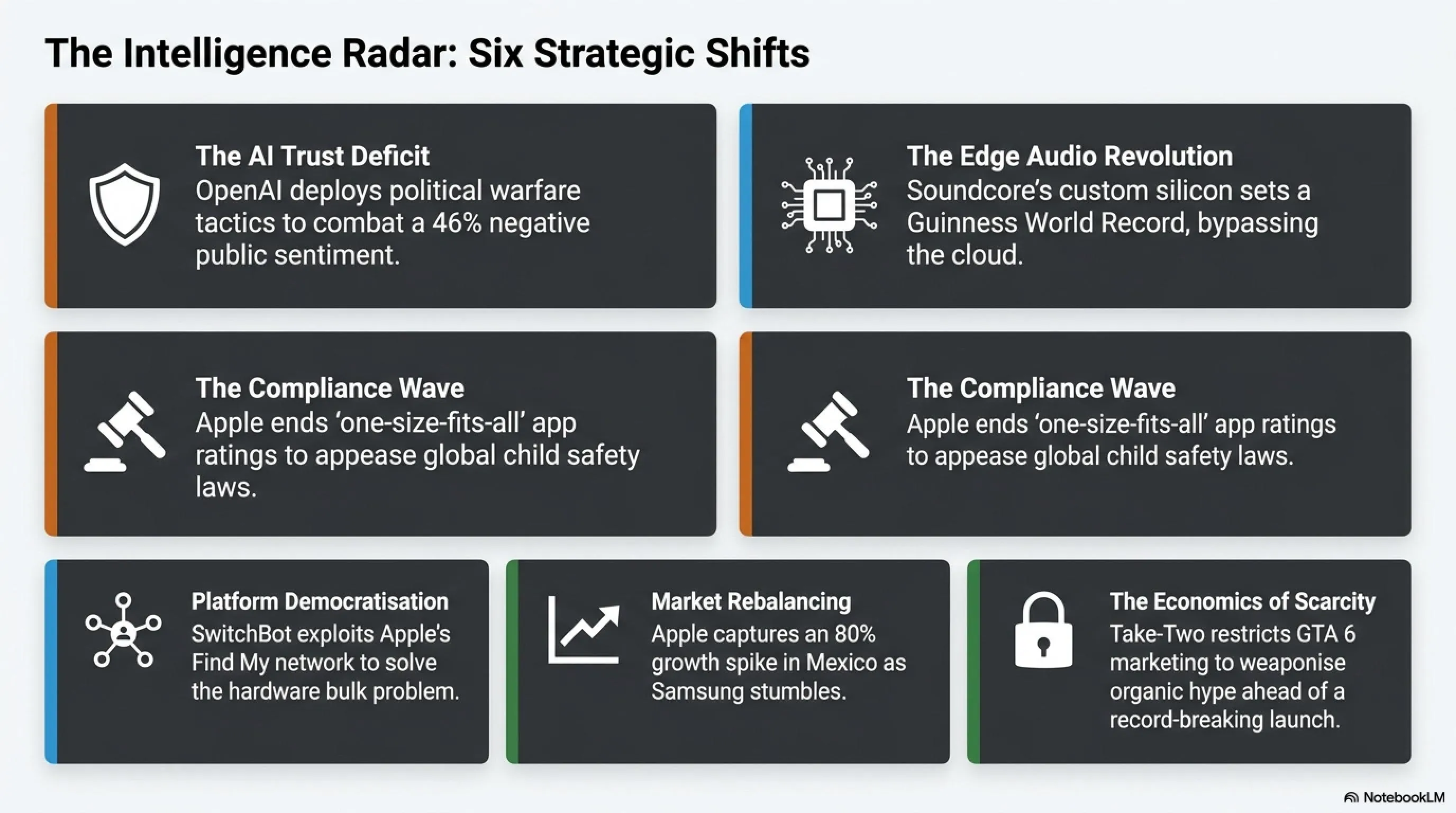
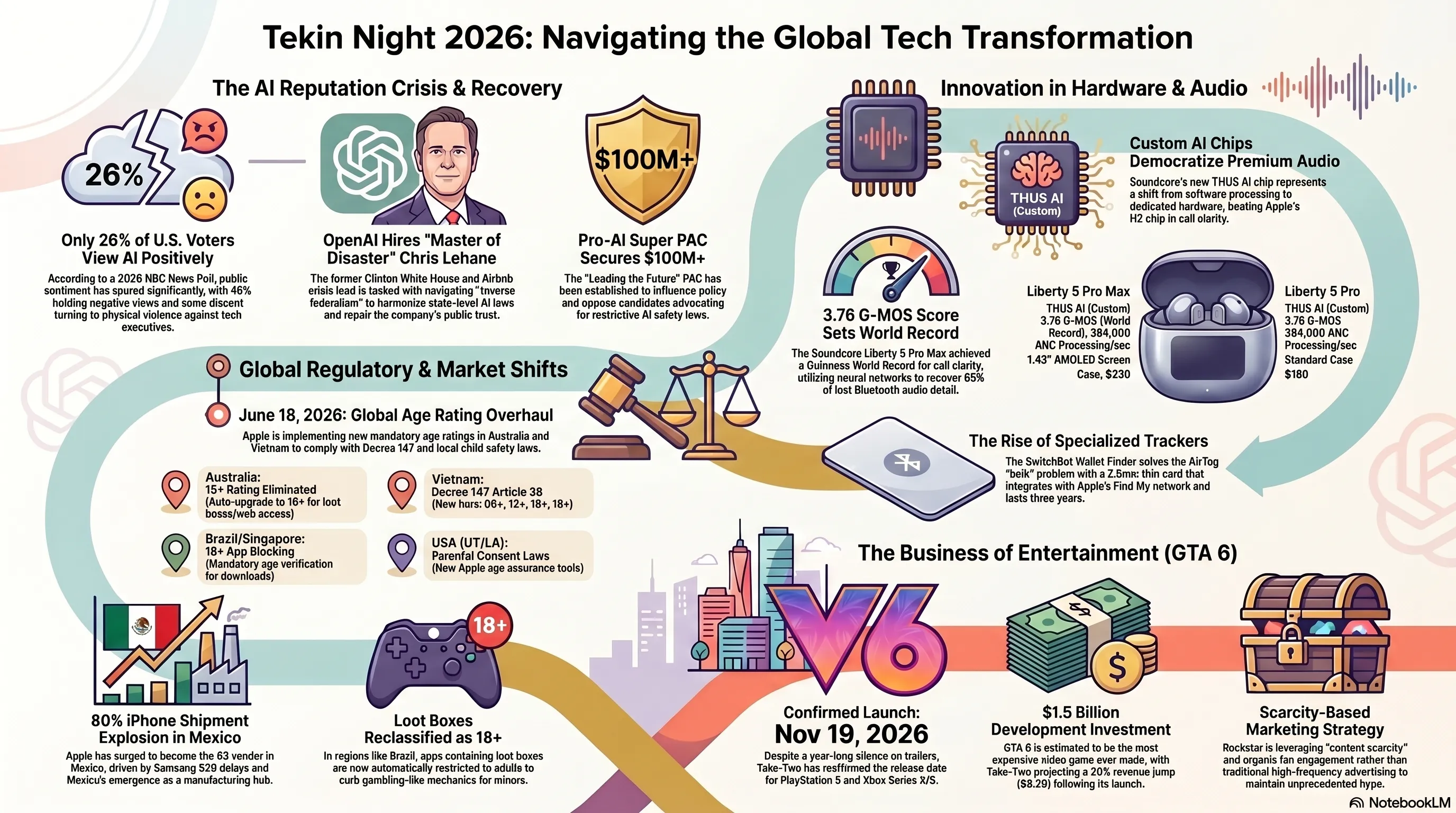
The May 22, 2026 Tekin Night briefing dissects six high-stakes technology and gaming developments. We analyze OpenAI's aggressive political maneuver hiring Clinton's former crisis manager, Chris Lehane, to salvage its crashing trust score. We also perform a hardware autopsy on Soundcore's Liberty 5 Pro earbuds setting a Guinness World Record via the proprietary THUS AI chip. Furthermore, we explore Apple's sweeping global App Store age rating changes, SwitchBot's ultra-thin Wallet Finder card integration with Find My, Apple's explosive 80% iPho
🌙 Welcome to Tekin Night May 22, 2026 — Friday Evening Edition
Good evening, tech enthusiasts! Tonight, Friday May 22, 2026, we're diving into six strategic stories that reveal how the technology industry is navigating unprecedented challenges and opportunities. From OpenAI's desperate attempt to salvage AI's reputation by hiring the "Master of Disaster," to Soundcore's groundbreaking AI chip that just set a Guinness World Record for call clarity, Apple's age rating overhaul in Australia and Vietnam, a stunning 31% iPhone sales surge in Latin America, SwitchBot's innovative wallet tracker, and the ongoing debate about GTA 6's marketing strategy — tonight is all about deep analysis and strategic insights!
⚡ Tonight's Headlines:
🎭 OpenAI Hires "Master of Disaster" — Can Chris Lehane Fix AI's Reputation Crisis?
🎧 Soundcore's THUS AI Chip — Guinness World Record for Call Clarity
📱 Apple Updates App Store Age Ratings in Australia & Vietnam
💳 SwitchBot Wallet Finder — Credit Card-Sized Tracker with iPhone Find My
🌎 iPhone Sales Surge 31% in Latin America — 80% Explosion in Mexico
🎮 Take-Two on GTA 6 Marketing — Where's Trailer 3?
🌃 Grab your evening beverage and let's explore the tech world together!
🎭 OpenAI's "Master of Disaster" — Can Chris Lehane Rescue AI's Collapsing Public Trust?
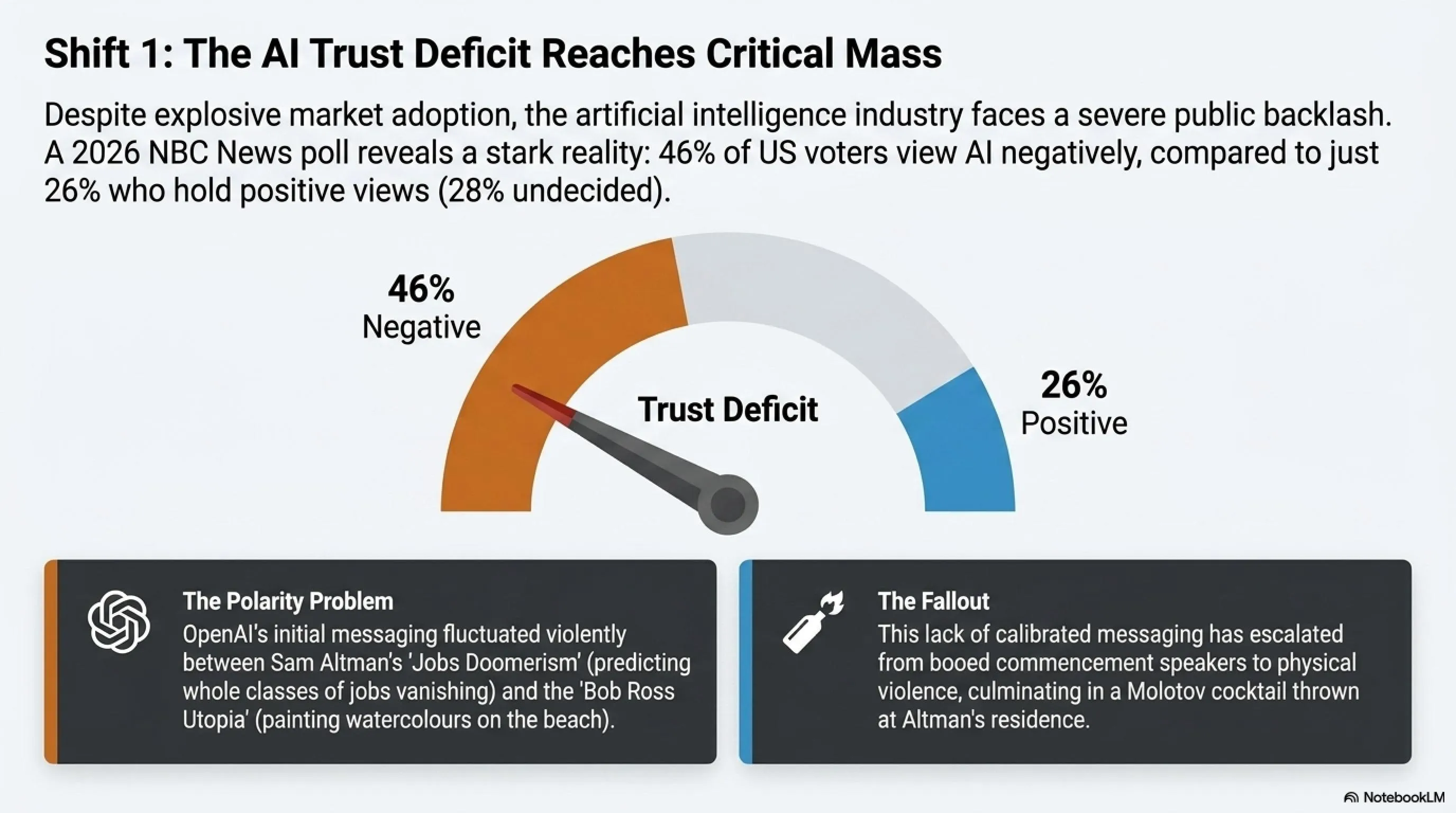
Three months ago, OpenAI cofounder Greg Brockman sat down with Wired to voice a concern that's been keeping Silicon Valley executives up at night: despite ChatGPT's explosive popularity, an increasingly large share of the population views artificial intelligence negatively. Since that interview, the backlash hasn't just intensified — it's turned violent. College commencement speakers now get booed for expressing optimism about AI. Last month, someone threw a Molotov cocktail at OpenAI CEO Sam Altman's San Francisco home and published a manifesto advocating for crimes against AI executives. The message is clear: AI has a serious image problem, and no company has more to lose than OpenAI.
Enter Chris Lehane, OpenAI's chief of global affairs and the man tasked with what might be the most challenging PR crisis of the decade. Lehane isn't new to impossible missions — after cutting his teeth on crisis communications in Bill Clinton's White House, he earned himself the nickname "Master of Disaster." His track record speaks volumes: he helped Airbnb navigate regulatory minefields in cities that viewed short-term rentals as existing in a legal gray area (or as he diplomatically puts it, "ahead of the law"). He played an instrumental role in forming Fairshake, a powerful crypto industry super PAC that worked to legitimize digital currencies in Washington. Since joining OpenAI in 2024, he's quickly become one of the company's most influential executives, now overseeing both communications and policy teams.
📊 The AI Trust Crisis — By The Numbers
In his recent interview with Wired, Lehane argues that public narratives about AI's societal impact are often "artificially binary." On one extreme sits what he calls the "Bob Ross view of the world" — a utopian future where nobody has to work anymore and everyone lives in "beachside homes painting in watercolors all day." On the other extreme lurks a dystopian nightmare where AI becomes so powerful that only a small elite can control it. Neither scenario, Lehane insists, reflects reality. But here's the uncomfortable truth: OpenAI itself has been guilty of promoting exactly this kind of polarizing rhetoric.
Consider Sam Altman's messaging evolution. Last year, he warned that "whole classes of jobs" would vanish when the singularity arrives — a statement that sent shockwaves through labor markets and fueled anxiety about AI-driven unemployment. More recently, he's softened his tone, declaring that "jobs doomerism is likely long-term wrong." This whiplash messaging exemplifies the communication crisis Lehane inherited. Now, he wants OpenAI to convey a more "calibrated" message about AI's promises, one that avoids both extremes and focuses on practical solutions to legitimate concerns like job displacement and AI's impact on children.
🎯 Tekin Analysis: Lehane's Three-Pronged Strategy to Save OpenAI
Chris Lehane's approach to rehabilitating OpenAI's reputation rests on three interconnected pillars, each borrowed from his previous crisis management playbooks:
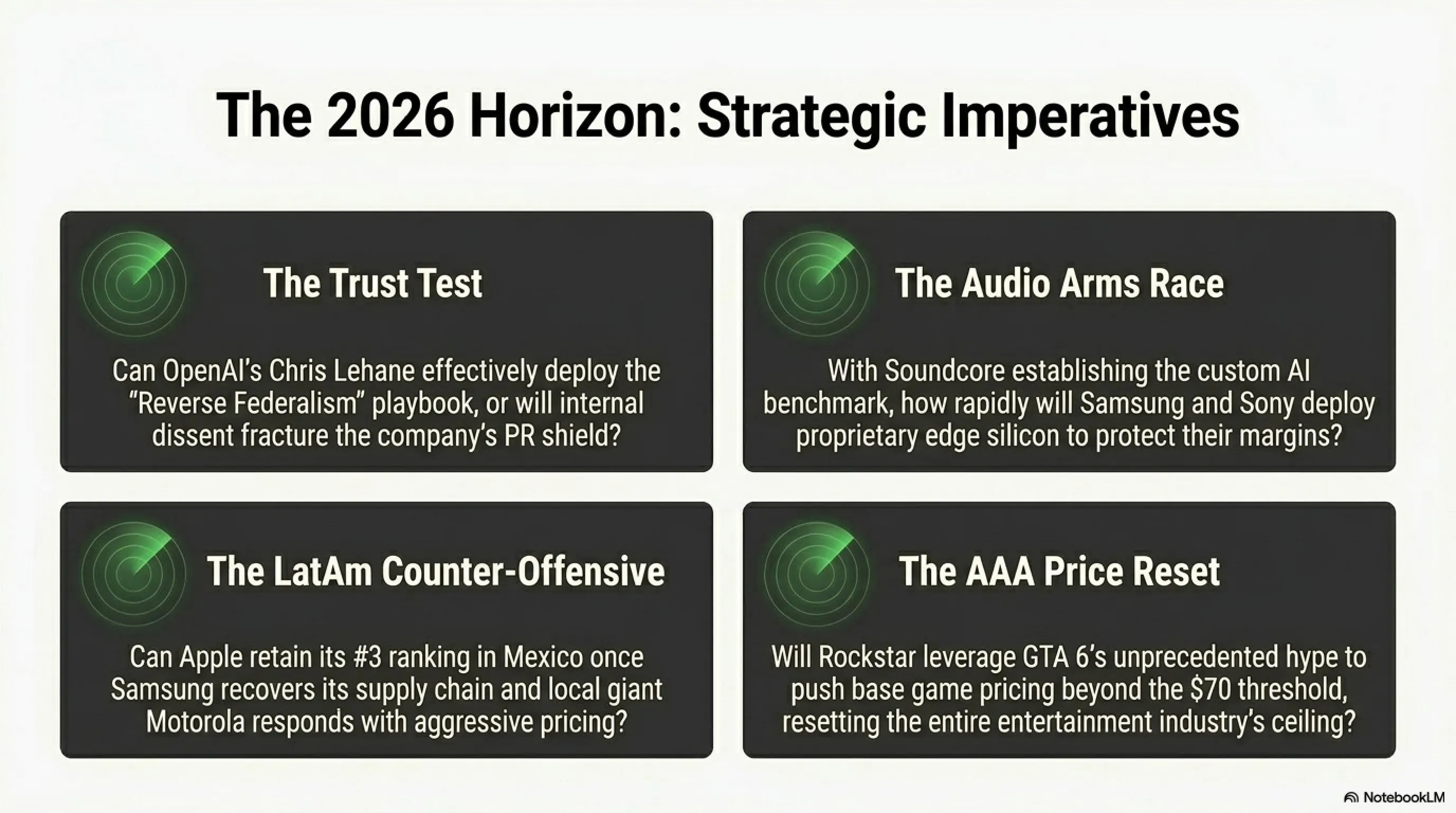
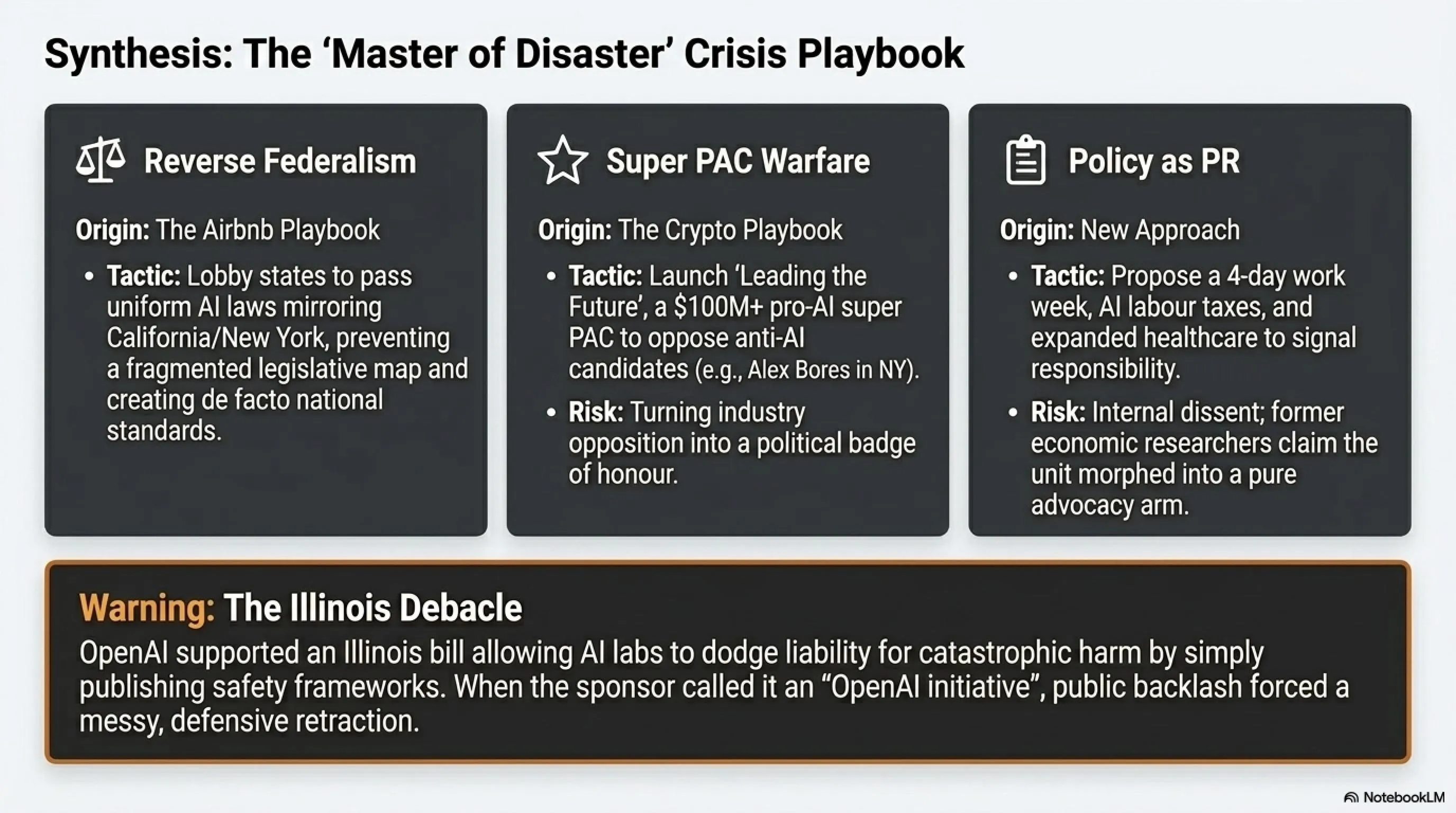
1. Reverse Federalism — The Airbnb Playbook: In the absence of meaningful federal AI legislation, Lehane is pursuing what he calls "reverse federalism" — lobbying states to pass AI laws that essentially mirror one another. The goal is to "harmonize" new bills with legislation already on the books in California and New York, preventing a patchwork of different rules across the country that would, he argues, derail innovation. This is classic Lehane: when you can't win at the federal level, build a coalition of states that creates de facto national standards.
2. Super PAC Warfare — The Crypto Playbook: Lehane helped establish Leading the Future, a pro-AI super PAC that launched last summer with over $100 million in funding commitments from tech industry figures, including Greg Brockman. The group has opposed candidates like Alex Bores, author of New York's strongest AI safety law, who's running for Congress in the state's 12th district. Critics argue this move backfired spectacularly — some candidates now campaign on the fact that AI super PACs oppose them, turning industry opposition into a badge of honor.
3. Policy Proposals as PR — The New Approach: OpenAI recently published a list of policy proposals that include creating a four-day work week, expanding access to healthcare, and passing a tax on AI-powered labor. Lehane frames this as fulfilling an obligation: "If you're going to go out and say that there are challenges here, you also then have an obligation — particularly if you're building this stuff — to actually come up with the ideas to solve those things." Whether these proposals represent genuine commitment or sophisticated PR remains to be seen.
But Lehane's strategy faces significant headwinds. Some former OpenAI employees have accused the company of downplaying AI's potential downsides. Wired previously reported that members of OpenAI's economic research unit quit after becoming concerned that it was morphing into an advocacy arm for the company. These former employees argued that their warnings about AI's economic impacts may have been inconvenient for OpenAI, but they honestly reflected what the company's research found. This internal dissent suggests that OpenAI's credibility problem runs deeper than messaging — it may reflect fundamental tensions between the company's commercial interests and its stated mission to ensure AGI benefits all of humanity.
Lehane compares OpenAI to companies that built earlier foundational utilities like railroads and electricity. While OpenAI hasn't yet proven its products are as critical as those technologies, it's already working hand-in-hand with the U.S. government. In practice, OpenAI has also advocated for policies that would give even more deference to the AI industry. The company recently supported a bill in Illinois that would, among other things, let AI labs dodge liability if their models caused catastrophic harm, so long as the companies published safety frameworks on a public website. Tech industry groups have lobbied for AI liability shields for years, arguing that only bad actors — not model developers — should be on the hook if their products are used to commit crimes.
⚠️ The Illinois Debacle: A Case Study in Failed Messaging
When the Illinois bill first attracted attention, its sponsor said it was "an initiative of OpenAI." After widespread criticism, including from Illinois's governor, OpenAI released a statement claiming it had never supported the liability safe harbor provision. In the Wired interview, Lehane seemed to suggest OpenAI's blanket support was an oversight: "I don't think we were explicit at all on what we were definitely for and what we were not supporting. That was on us." This episode perfectly encapsulates OpenAI's communication problem: even when trying to do damage control, the company's messaging remains muddled and defensive. OpenAI has since endorsed a different Illinois bill requiring leading AI companies to have their safety practices audited by outside third parties — a move that's been praised by rivals like Anthropic but viewed skeptically by critics who see it as too little, too late.
🎧 Soundcore Liberty 5 Pro & Pro Max — Guinness World Record for Call Clarity with THUS AI Chip
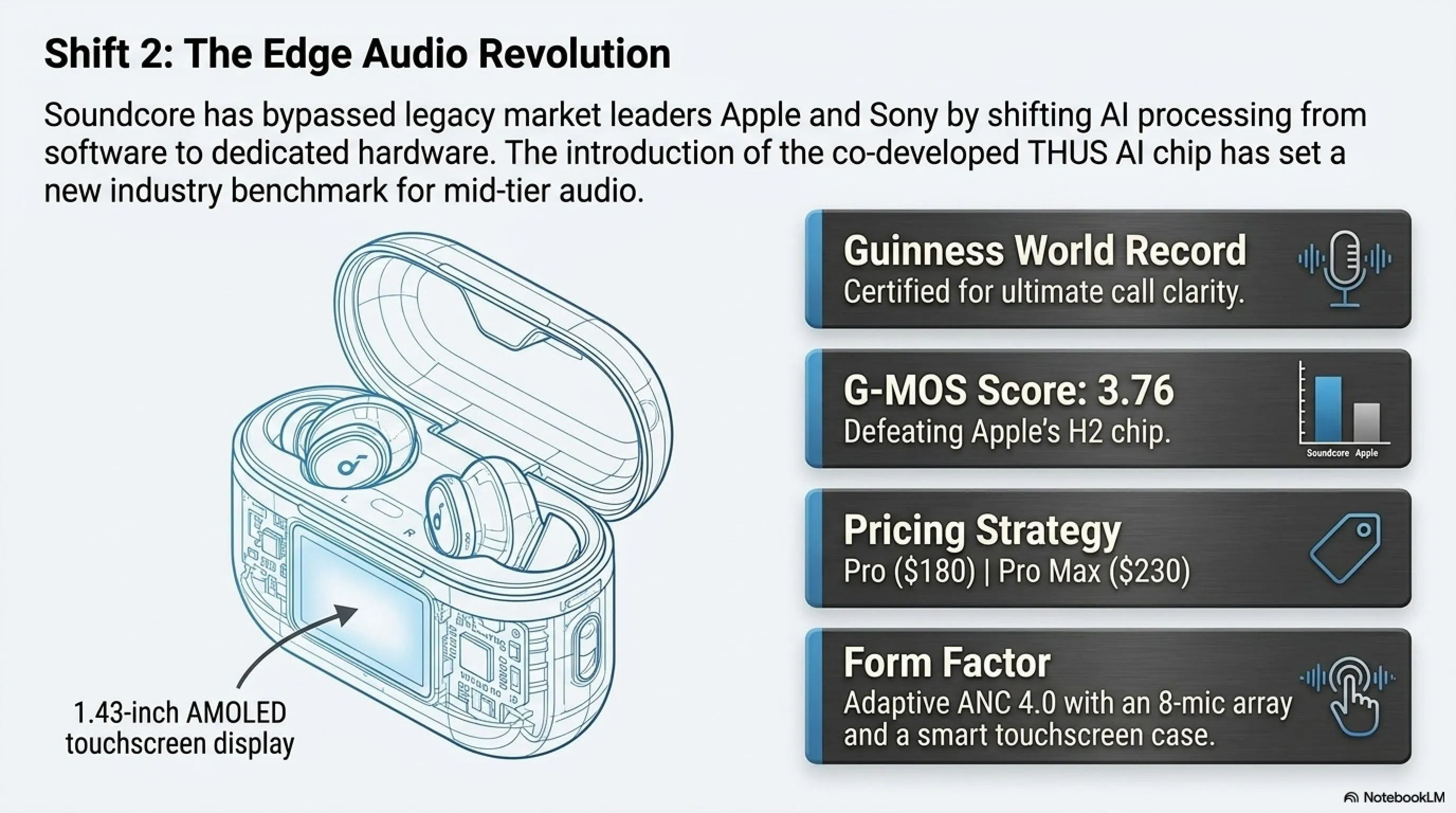
In a market dominated by Apple's AirPods and Sony's premium offerings, Soundcore (Anker's audio brand) just threw down a gauntlet that's impossible to ignore. The company has unveiled two new earbuds — the Liberty 5 Pro and Liberty 5 Pro Max — that claim to deliver the world's best call quality. And unlike most marketing hyperbole, this claim comes with receipts: a Guinness World Record for call clarity and a G-MOS score of 3.76 that beats every other earbud on the market, including Apple's AirPods Pro with their vaunted H2 chip.
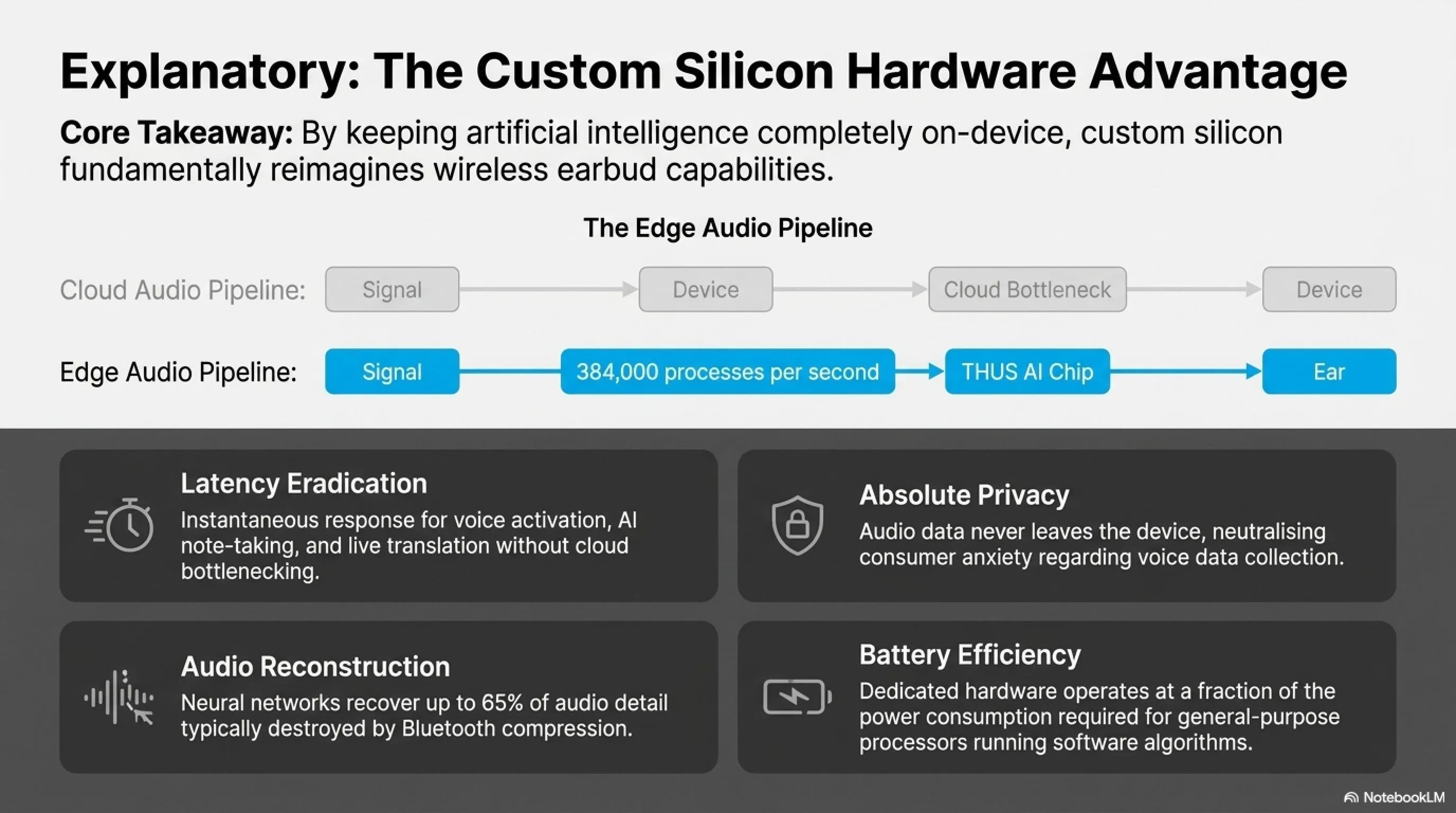
The secret sauce? The THUS AI chip — a custom-designed artificial intelligence processor co-developed by Anker specifically for audio applications. This marks the first time Soundcore has deployed its own silicon, and the results are nothing short of remarkable. According to The Verge's hands-on review, "Soundcore earbuds have outperformed their price for years, but now with vastly improved call quality, the Liberty 5 Pro set the bar." The THUS AI chip doesn't just boost microphone performance for call quality — it enables advanced features like live translation, AI note-taking, and neural network-based audio reconstruction that recovers up to 65% of audio detail typically lost through Bluetooth compression.
🏆 Soundcore Liberty 5 Pro Max — Technical Specifications
| AI Processor | THUS AI (Anker co-developed) |
| G-MOS Score | 3.76 (World Record) |
| ANC System | Adaptive ANC 4.0 with 8-mic array |
| Audio Processing | 384,000 times per second |
| AI Features | Live translation, AI note-taking, audio reconstruction |
| Audio Recovery | Up to 65% of Bluetooth-compressed detail |
| Pricing | Pro: $180 | Pro Max: $230 |
| Pro Max Case | 1.43" AMOLED touchscreen display |
The Adaptive ANC 4.0 system processes audio data up to 384,000 times per second using an eight-microphone array, continuously adjusting noise cancellation in real-time as conditions change. It targets everything from low-frequency engine rumble to mid-range office chatter. According to Cult of Mac, "Both earbuds feature Adaptive ANC 4.0. It processes audio data up to 384,000 times per second using an eight-microphone array. The system continuously adjusts noise cancellation in real time as conditions change." This level of computational power in such a small form factor was unthinkable just a few years ago.
The Liberty 5 Pro Max, priced at $230, adds a smart touchscreen case with a 1.43-inch AMOLED display that lets you adjust settings, control music, and even use the AI note-taking feature — all without pulling your phone out of your pocket. The standard Liberty 5 Pro at $180 offers the same earbuds with a conventional charging case. Both models are now available, and early reviews suggest Soundcore has delivered on its ambitious promises. As Mashable noted in their hands-on, "The earbuds are the first Soundcore products to feature the new THUS AI chip, designed to boost the performance of the earbuds' microphone for call quality, voice activation, and smart features like live translation and AI note-taking. Spoiler alert: the mic performance is no joke on these earbuds."
🎯 Tekin Analysis: Why Custom AI Chips Are the Future of Audio
Soundcore's introduction of the THUS AI chip represents a critical inflection point in the audio industry: the shift from software processing to dedicated AI hardware. This isn't just about better call quality — it's about fundamentally reimagining what wireless earbuds can do.
Why This Matters for the Industry:
1. Reduced Latency: On-device processing means AI features respond instantly, without the lag inherent in cloud-based solutions. This is crucial for real-time translation and voice commands.
2. Privacy Preservation: Your audio data doesn't need to be sent to the cloud, addressing growing consumer concerns about voice data collection.
3. Better Battery Life: Dedicated chips are far more power-efficient than general-purpose processors running AI algorithms in software.
4. Competitive Pressure on Apple: AirPods Pro with Apple's H2 chip still lead the market, but Soundcore is offering comparable (or superior) features at half the price. This forces Apple to innovate or risk losing market share.
5. Democratization of Premium Features: Custom AI chips were once the exclusive domain of tech giants. Soundcore proves that mid-tier brands can now compete on technology, not just price.
What to Watch Next:
Expect Samsung, Sony, and other major players to announce their own custom audio AI chips within the next 12-18 months. The race is on to see who can deliver the most compelling AI-powered audio experience. The real winner? Consumers, who'll benefit from rapid innovation and competitive pricing.
📱 Apple Updates App Store Age Ratings in Australia & Vietnam — Global Child Safety Push Intensifies
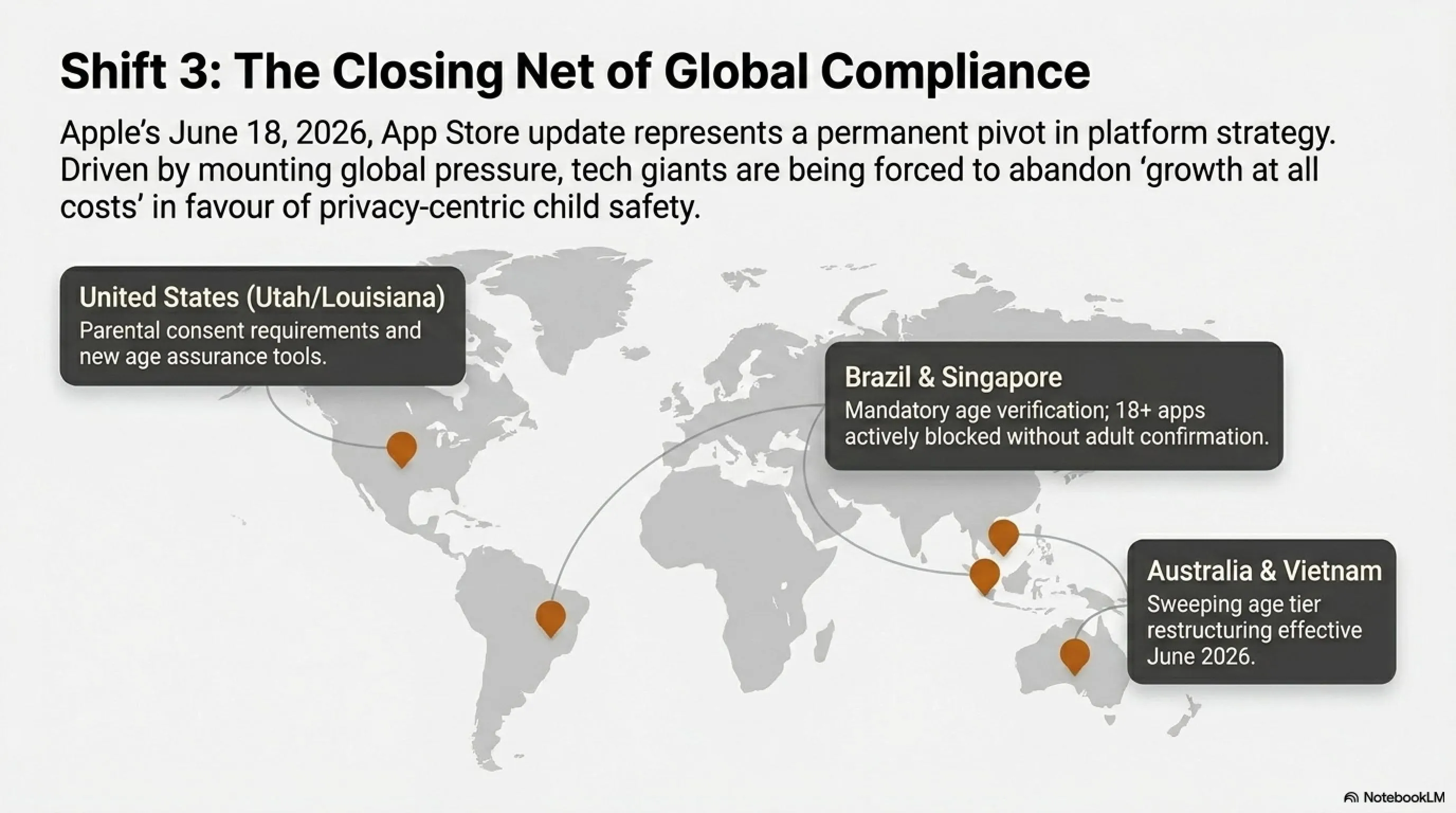
Apple today alerted developers that starting June 18, 2026, age ratings on the App Store will be updated in Australia and Vietnam to comply with local regulations. This marks the latest move in Apple's ongoing effort to adapt to a rapidly evolving global regulatory landscape focused on protecting children online. Over the past year, several countries have introduced new rules affecting how apps, features, and even entire app categories are made available to minors on the App Store. While this isn't a new issue, only recently have multiple countries — as well as U.S. states — started passing laws, guidelines, and restrictions aimed at addressing online safety for minors, especially around social media, mental health, and potentially harmful gaming practices.
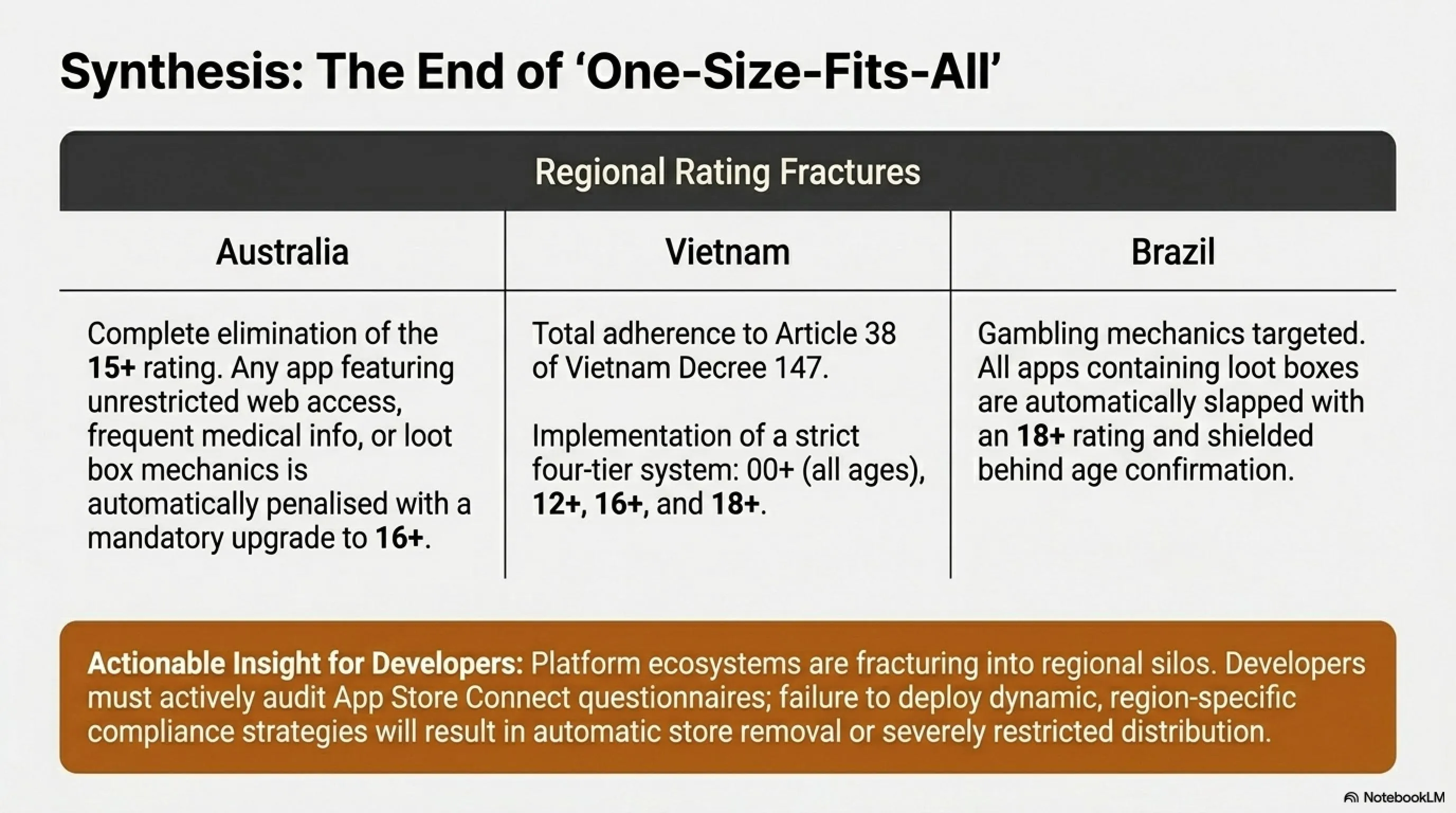
According to 9to5Mac, "Today, Apple updated its Developer blog with a notice that 'starting June 18, 2026, in accordance with local regulations, age ratings on the App Store will be updated in Australia and Vietnam.'" The changes vary by country but share a common goal: making it harder for children to access age-inappropriate content. In Australia, the 15+ age rating will no longer be available on the App Store. Apps currently rated 15+ with specific content descriptors — including unrestricted web access, frequent medical or treatment information, and loot boxes — will be automatically updated to 16+. In Vietnam, apps will require a region-specific age rating based on Article 38 of Vietnam Decree 147, with four ratings: 00+ (all ages), 12+, 16+, or 18+.
🌏 Age Rating Changes by Country — A Global Overview
| Country/Region | Key Changes | Effective Date |
| 🇦🇺 Australia |
• 15+ rating eliminated • Apps with unrestricted web access, medical info, or loot boxes upgraded to 16+ |
June 18, 2026 |
| 🇻🇳 Vietnam |
• New rating system per Decree 147, Article 38 • Four tiers: 00+ (all ages), 12+, 16+, 18+ |
June 18, 2026 |
| 🇧🇷🇸🇬 Brazil, Singapore |
• 18+ apps blocked without age confirmation • Loot box apps automatically rated 18+ (Brazil) |
Feb 24, 2026 |
| 🇺🇸 Utah, Louisiana |
• New age verification tools • Parental consent requirements for minors |
Feb 24, 2026 |
Apple has been updating how age ratings work across the App Store to accommodate this regulatory shift, including with the more granular rating system introduced last year and new age assurance tools that can block users from downloading 18+ apps in certain regions unless they've been confirmed to be adults. As TechCrunch reported earlier this year, "Apple is launching new tools to comply with the growing number of age-verification laws both in the U.S. and abroad. As part of the changes, Apple will block the downloads of apps rated 18+ in Brazil, Australia, and Singapore, while also rolling out other features to comply with laws in Utah and Louisiana in the U.S."
🎯 Tekin Analysis: The Global Wave of Online Child Protection
Apple's changes are part of a much larger global trend: governments worldwide are pressuring tech companies to better protect children in online spaces. This includes:
1. Kids Online Safety Act (KOSA): The U.S. is considering federal legislation that would require social media companies to protect children. OpenAI recently endorsed KOSA, drawing criticism from 90 civil rights groups who called it "regulatory capture."
2. Mandatory Age Verification: Countries like Australia, Brazil, and Singapore now require age verification for adult content, with Apple implementing "reasonable methods" to confirm users are adults before allowing 18+ app downloads.
3. Loot Box Restrictions: Brazil has upgraded all apps containing loot boxes to 18+, recognizing the gambling-like mechanics that can be particularly harmful to minors.
4. Privacy-Centric Design: Apple has designed its age verification systems to avoid exposing users' personal data, setting a standard for privacy-friendly compliance.
What This Means for Developers:
App developers must now navigate an increasingly complex web of regional regulations. The days of one-size-fits-all age ratings are over. Developers need to carefully review their age rating questionnaire responses in App Store Connect to ensure compliance across all markets. Failure to do so could result in apps being automatically upgraded to more restrictive ratings or even removed from certain regional storefronts.
💳 SwitchBot Wallet Finder — Credit Card-Sized Tracker with 3-Year Battery Life
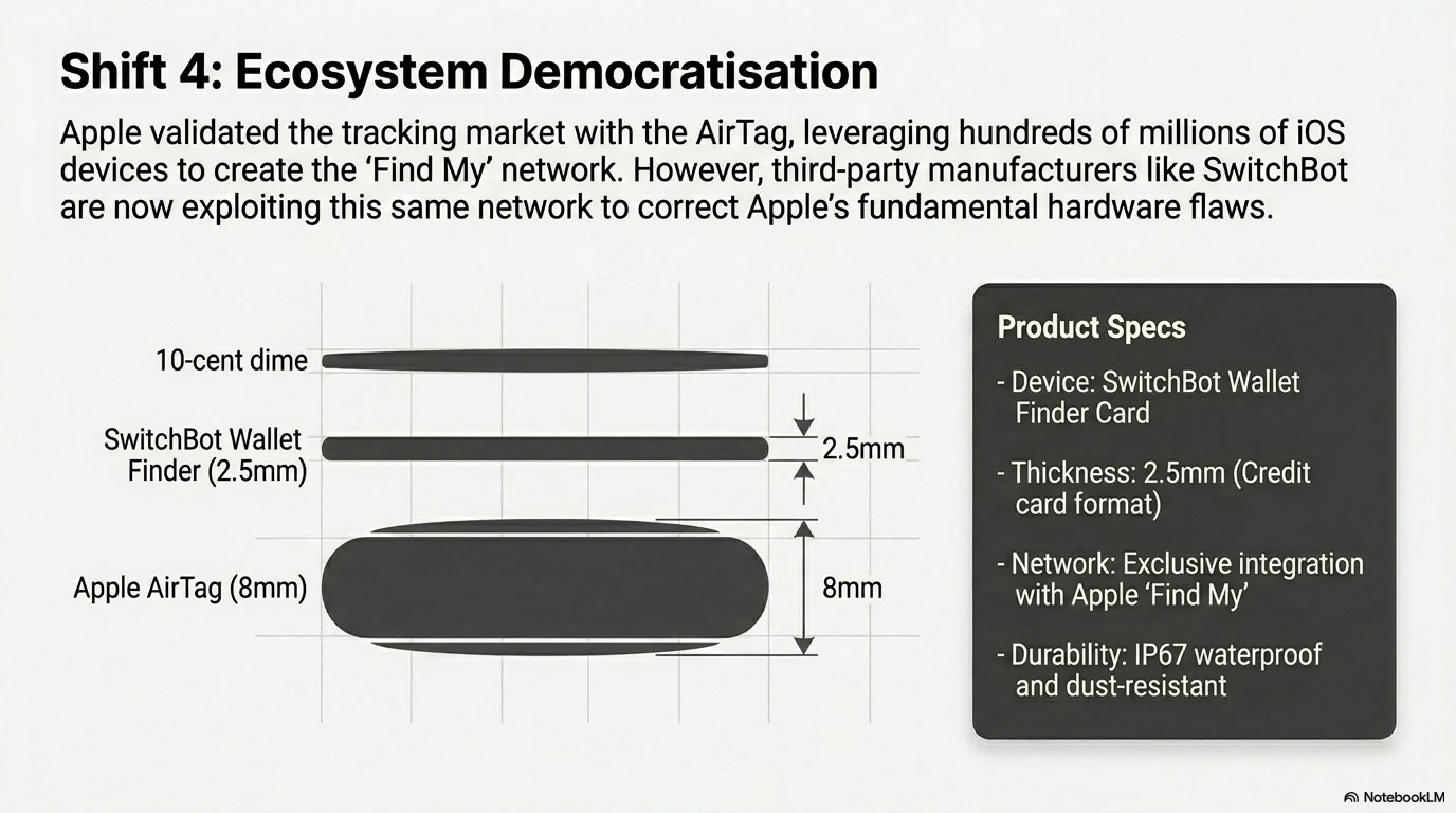
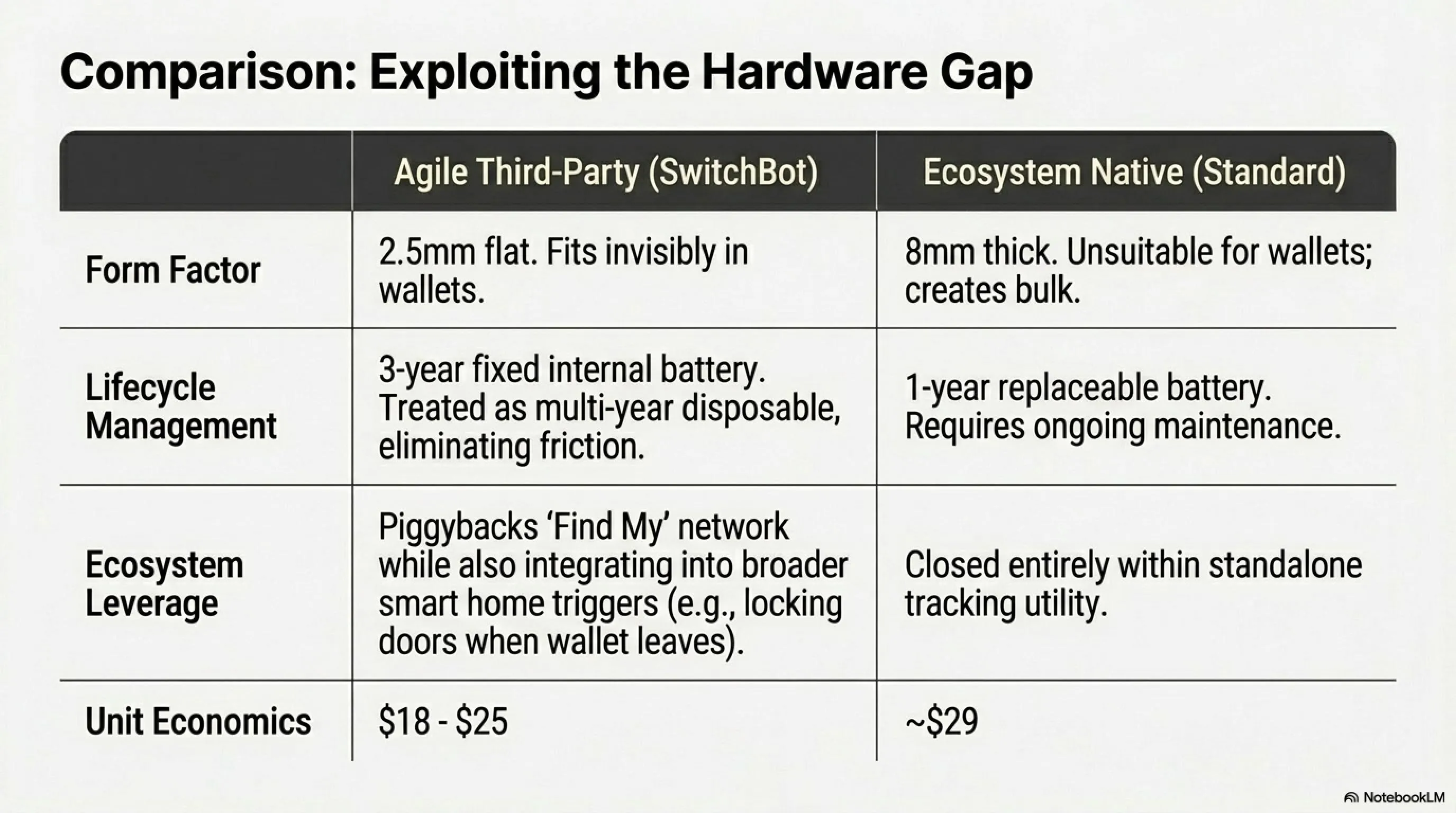
If you've ever experienced the panic of losing your wallet, you know that sinking feeling all too well. SwitchBot offers an elegant solution: the Wallet Finder Card — a credit card-sized tracker that works with Apple's Find My network, allowing you to track your wallet with your iPhone. At just 2.5mm thick (thinner than a dime), it slips easily into your wallet without adding noticeable bulk. As 9to5Mac noted in their review, "Disguised inside a thin, credit-card form factor, the SwitchBot Wallet Finder connects to the Find My app on your iPhone, so you can follow its location, and it even houses a speaker so you can make it beep to help you find your wallet when it inevitably gets lost somewhere in your home."
The standout feature of the SwitchBot Wallet Finder is its exceptional three-year battery life from a non-replaceable battery, eliminating the need for frequent battery changes that plague many competing trackers. This tracker works exclusively with Apple's Find My network, providing reliable location tracking through hundreds of millions of iOS devices. According to ZDNET's review, "This slim wallet tracker works with Bluetooth and the Apple Find My network, is IP67 waterproof, and is almost as reliable as an Apple AirTag." The IP67 rating means it can withstand dust and water immersion up to 1 meter for 30 minutes — perfect for everyday accidents.
📋 SwitchBot Wallet Finder — Complete Specifications
| Thickness | 2.5mm (thinner than a dime) |
| Tracking Network | Apple Find My (hundreds of millions of iOS devices) |
| Battery Life | 3 years (non-replaceable battery) |
| Water Resistance | IP67 (dust and water resistant) |
| Speaker | Yes (for beeping/locating) |
| Compatibility | iOS only (not Android) |
| Smart Home Integration | Full SwitchBot ecosystem compatibility |
| Price | $18-25 (depending on retailer) |
The SwitchBot Wallet Finder also integrates with the SwitchBot smart home system, meaning you can combine it with other SwitchBot devices like smart locks, sensors, and switches. For example, you could set up an automation that turns off lights or locks the door when your wallet leaves the house. As Android Central noted in their review, "SwitchBot is a brand dedicated to smartening up the dumb things in your home and integrating them all together to create a cohesive ecosystem. I have used many of the brand's smart home accessories over the years and they never disappoint, both in terms of quality and price."
🎯 Tekin Analysis: Why Personal Trackers Are Becoming Essential
The personal tracker market is exploding, and the SwitchBot Wallet Finder demonstrates why:
1. AirTag's Success Validated the Market: Apple proved with AirTag that the Find My network is incredibly effective. SwitchBot leverages the same network but in a form factor that actually fits in a wallet.
2. AirTag's Form Factor Problem: At 8mm thick, AirTag is too bulky for most wallets. SwitchBot's 2.5mm thickness solves this fundamental design flaw.
3. Competitive Pricing: At $18-25, SwitchBot undercuts AirTag ($29) and many competitors while offering comparable functionality.
4. Smart Home Integration: Unlike AirTag, SwitchBot integrates with a broader smart home ecosystem, adding utility beyond simple tracking.
5. Three-Year Battery Life: The non-replaceable battery might seem like a limitation, but three years is long enough that most users will upgrade before it dies. This eliminates the hassle of battery replacement.
Market Implications:
Expect to see more specialized trackers for different use cases: luggage tags, pet collars, bike locks, and more. The Find My network has created a platform that third-party manufacturers can leverage, democratizing location tracking technology that was once the exclusive domain of expensive GPS devices.
🌎 iPhone Sales Surge 31% in Latin America — 80% Explosion in Mexico Reshapes Regional Market
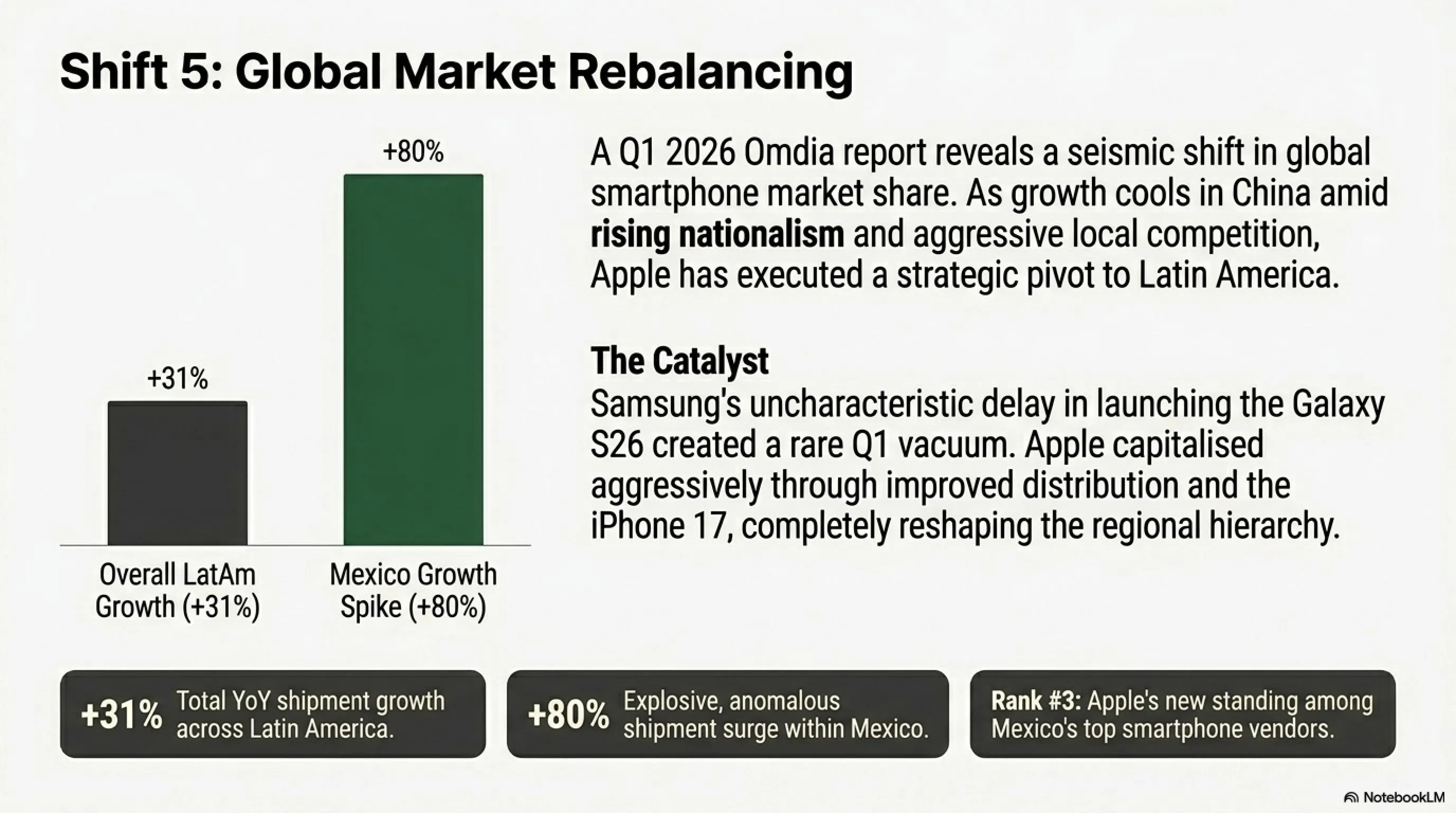
A new Omdia report reveals that iPhone shipments jumped 31% year-over-year in Latin America during Q1 2026, driven by strong iPhone 17 performance and a staggering 80% surge in Mexico. This growth places Apple among the top five smartphone vendors in the region and signals a significant shift in Latin American consumer preferences. According to 9to5Mac, "A new Omdia report shows iPhone shipments jumped 31% year over year in Latin America during Q1 2026, driven by strong iPhone 17 performance and a whopping 80% jump in Mexico."
This growth is particularly noteworthy because it comes at a time when the overall smartphone market in many regions faces challenges. Several factors contributed to this dramatic surge. First, the iPhone 17 series has seen strong adoption in the region, with new features and performance improvements resonating with Latin American consumers. Second, Samsung's delay in launching the Galaxy S26 (which typically releases in early year) gave Apple an opportunity to capture market share in Q1 2026. Third, Apple has improved its pricing and distribution strategies in Latin America, making iPhones more accessible to a broader range of consumers.
📊 iPhone Growth in Latin America — Q1 2026 Breakdown
The 80% growth in Mexico is especially significant. According to Apfelpatient, "iPhone shipments increased by 31 percent compared to the previous year – driven primarily by a one-off effect in Mexico, where Apple boosted its sales by 80 percent and rose to third place among the most important vendors." This growth has made Apple the third-largest smartphone vendor in Mexico, a remarkable achievement in a market traditionally dominated by more affordable Android devices. The "one-off effect" mentioned likely refers to a combination of factors including improved distribution partnerships, aggressive promotional campaigns, and the timing advantage created by Samsung's delayed S26 launch.
🎯 Tekin Analysis: Why Latin America Matters for Apple's Future
Apple's 31% growth in Latin America represents a critical strategic shift:
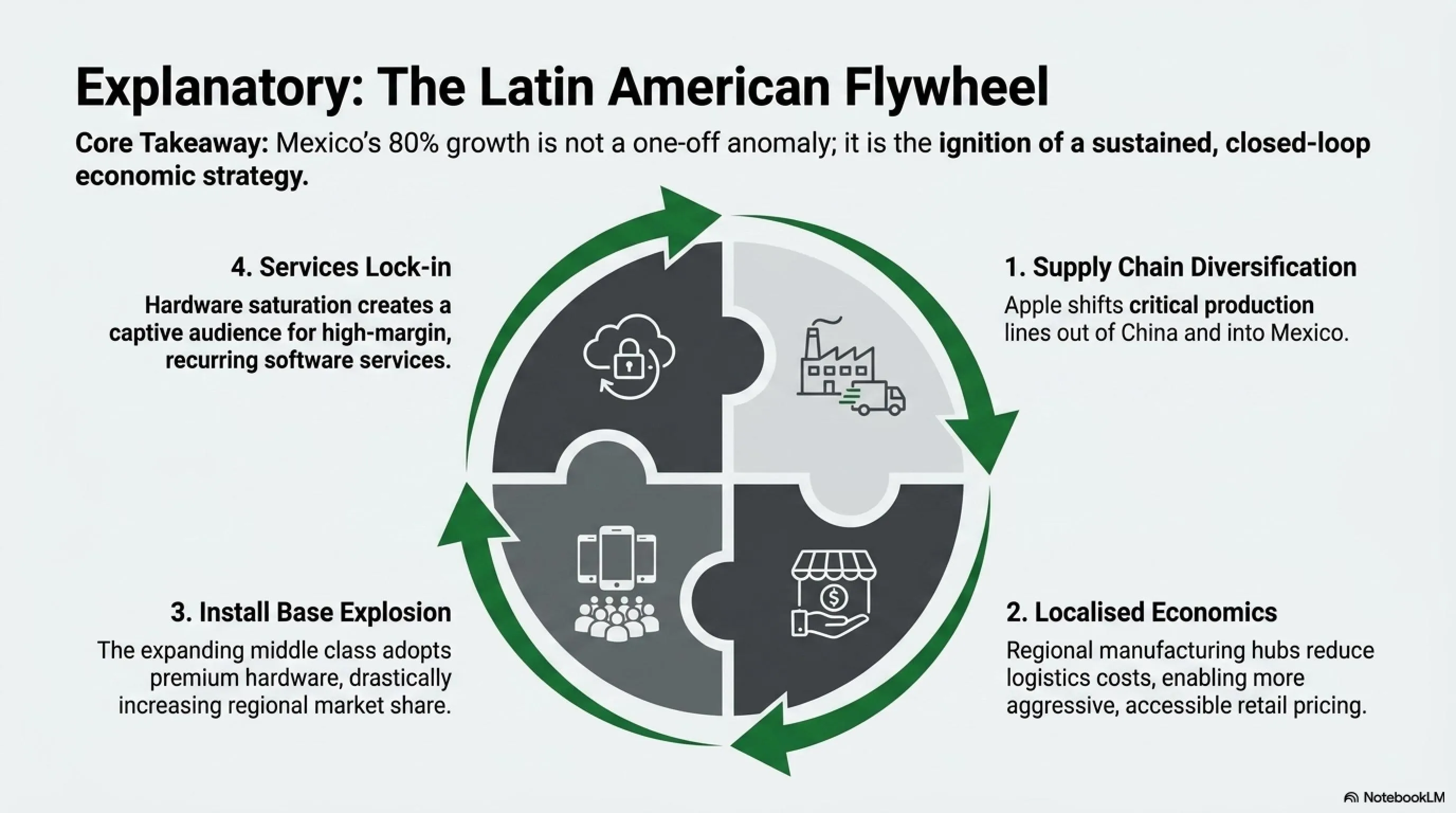
1. Massive Addressable Market: With a population of 650 million, Latin America represents one of the world's largest growing smartphone markets. As middle-class populations expand, more consumers can afford premium devices like iPhones.
2. Diversification from China: With iPhone sales declining in China due to rising nationalism and strong local competitors like Huawei and Xiaomi, Apple desperately needs new growth markets. Latin America offers that opportunity.
3. Mexico as Manufacturing Hub: Apple is shifting some production to Mexico as part of its supply chain diversification strategy. This could lead to lower prices and better availability in the region, creating a virtuous cycle of growth.
4. Services Revenue Opportunity: iPhone sales are just the beginning. Apple's real profit comes from services like Apple Music, iCloud, and the App Store. A growing iPhone installed base in Latin America creates a foundation for long-term services revenue growth.
5. Competitive Dynamics: Samsung's misstep with the delayed S26 launch shows that even market leaders can stumble. Apple capitalized on this opportunity brilliantly, demonstrating the importance of consistent execution.
What to Watch:
Can Apple sustain this growth when Samsung returns with the S26? Will local competitors like Motorola (strong in Latin America) respond with more aggressive pricing? And most importantly, can Apple maintain its premium positioning while expanding market share in price-sensitive markets?
🎮 Take-Two on GTA 6 Marketing — Does the Biggest Game Ever Even Need Trailer 3?
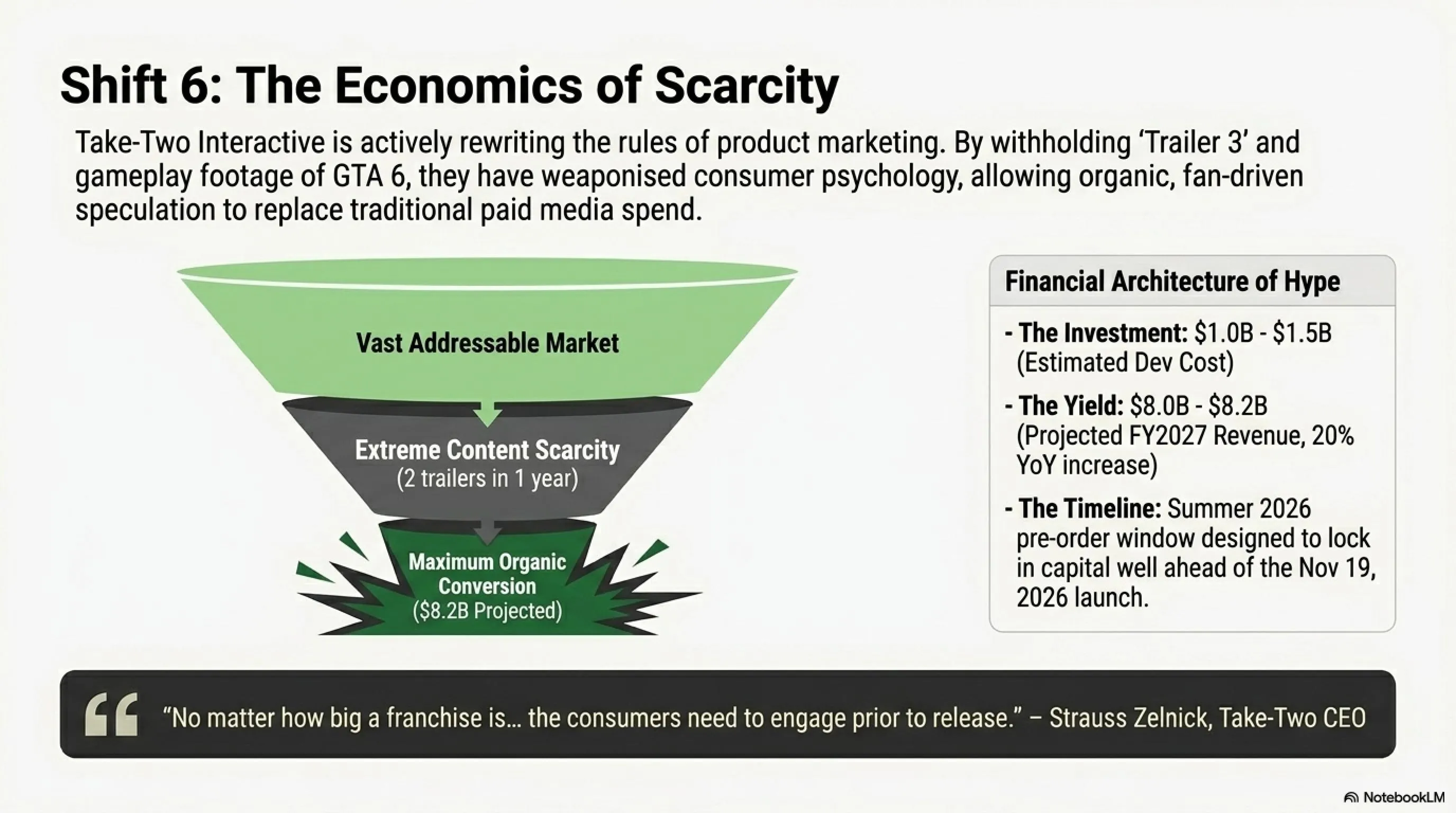
GTA 6 has gone a full year without releasing a new trailer. It was May 2025 when Rockstar set the internet ablaze with the release of GTA 6 Trailer 2, which itself came over a year after Trailer 1. The wait for Trailer 3 continues, and fans have certainly struggled to cope with the silence. But here's the provocative question: does GTA 6 even need a Trailer 3 to be successful? As the most anticipated entertainment property of all time, is GTA 6 uniquely positioned to succeed without showing gameplay footage before launch?
That's the question IGN put to Strauss Zelnick, Take-Two's CEO, ahead of the company's fiscal year 2026 financial report. While he kept his cards close to his chest during his response, he spoke generally about all entertainment properties needing to engage consumers ahead of launch, no matter how big. And he used Mission: Impossible and Tom Cruise to make his point. "Well, look, I mean, Rockstar is going to talk about all things GTA in the fullness of time," Zelnick began. "So I can speak conceptually only about the marketing of entertainment properties. And I do think no matter how big a franchise is, the consumers need to engage with that prior to release. And I think the motion picture business reflects that as well."
💬 Strauss Zelnick on Marketing Philosophy
"So if you put out a sequel to Mission: Impossible, trust me, the studio is still going to spend a whole lot of money marketing that title, even though we kind of know what we're going to get and we know we're going to see Tom Cruise, and we're thrilled that we will. Marketing is still an important part of any entertainment release."
Take-Two has said Rockstar Games will kick off GTA 6 marketing this summer (pre-orders are expected at the same time), and today it committed to the game's November release date, putting to bed any concerns about a delay. Take-Two said it expects to record revenue of $8-8.2 billion during the 2027 fiscal year, which would amount to a 20% increase on the prior year, primarily due to the launch of GTA 6. Take-Two saw revenue of $6.72 billion during the 2026 financial year, so the GTA 6 effect could be up to $1.5 billion in additional revenue.
💰 GTA 6 Financial Projections — The Biggest Launch Ever
Earlier this month, Business Insider reported that Take-Two is estimated to have spent $1-1.5 billion so far on GTA 6, making it potentially the most expensive video game ever developed. It's also expected to be the biggest entertainment launch of all time, breaking records for video game sales and revenue. Rockstar has yet to announce the price of the game, with the industry waiting to see if GTA 6 will go above $70 — a move that could set a new standard for AAA game pricing.
GTA 6 is set for launch on PlayStation 5 and Xbox Series X and S on November 19, 2026. According to Dexerto, ahead of an investor call on May 21, Zelnick spoke to GamesIndustry about the marketing blitz planned for GTA 6 this summer, with VI still on pace to launch on November 19. The timing is strategic: a summer marketing campaign gives Rockstar five months to build hype before the November launch, while pre-orders opening simultaneously allows Take-Two to gauge demand and optimize supply chains.
🎯 Tekin Analysis: Rockstar's Unprecedented Marketing Strategy
Rockstar's approach to GTA 6 marketing is unlike anything we've seen in entertainment:
1. Scarcity Creates Value: By releasing only two trailers in over a year, Rockstar has maintained hype at unprecedented levels. Every trailer becomes a cultural event, analyzed frame-by-frame by millions.
2. Word-of-Mouth as Primary Marketing: Fans are doing the marketing for free. Every post, every theory, every trailer analysis generates millions of views. This organic engagement is worth more than any paid advertising campaign.
3. The Summer Offensive: Starting marketing in summer 2026 gives Rockstar five months to build momentum. This is long enough to saturate the market but short enough to maintain urgency.
4. Strategic Pre-Orders: Opening pre-orders in summer allows Take-Two to measure demand and optimize supply chains. It also locks in sales months before launch, providing financial certainty.
5. Price Point Mystery: By not announcing the price, Rockstar keeps speculation alive. Will it be $70? $80? $100 for a special edition? The uncertainty itself generates discussion.
The Risk:
This strategy only works if the game delivers. If GTA 6 disappoints, the backlash will be proportional to the hype. Rockstar is betting everything on execution — a bet they've won before with GTA V, but the stakes have never been higher.
⚔️ PROS & CONS: GTA 6's Marketing Strategy
✅ Advantages
- Unprecedented hype and free marketing
- Content scarcity increases value of each trailer
- Saves early marketing costs
- Complete control over narrative and timing
- Organic fan engagement worth millions
❌ Disadvantages
- Risk of fan fatigue from long wait
- Competitors have time to capture market
- Pressure to show actual gameplay
- Ongoing delay concerns damage trust
- Expectations may become impossible to meet
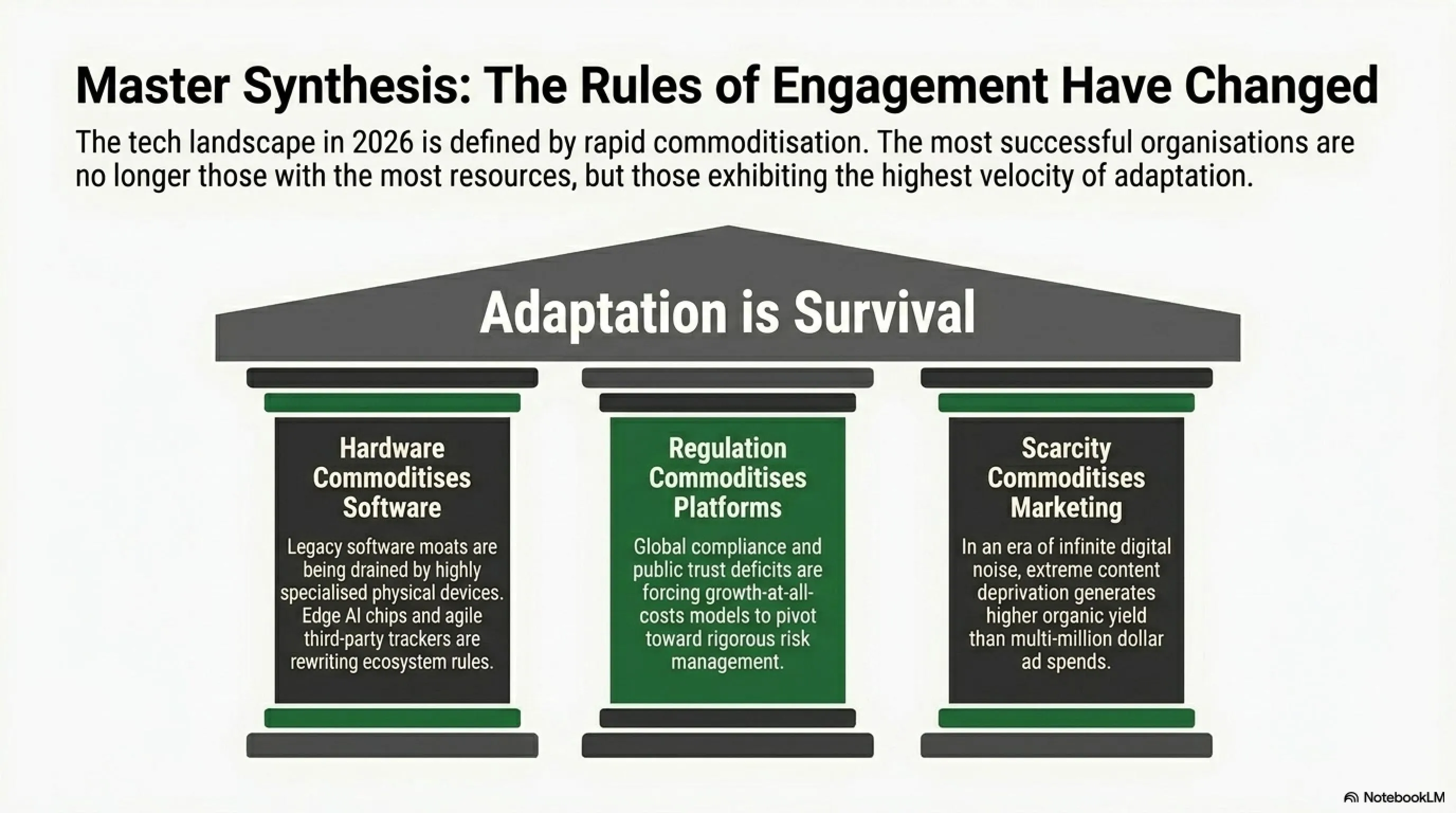
🌟 Final Thoughts — Six Stories, One Message: Adaptation is Survival
Tonight's six stories paint a vivid picture of an industry in flux. OpenAI's desperate attempt to salvage AI's reputation by hiring the "Master of Disaster" reveals just how serious the trust crisis has become — when only 26% of Americans view AI positively and Molotov cocktails are being thrown at executives' homes, you know the problem runs deeper than messaging. Soundcore's THUS AI chip and Guinness World Record demonstrate that custom silicon is no longer the exclusive domain of tech giants — mid-tier brands can now compete on technology, not just price. Apple's age rating overhaul across Australia and Vietnam reflects a global regulatory wave that's forcing tech companies to prioritize child safety over growth. SwitchBot's wallet tracker shows how Apple's Find My network has created a platform economy for location tracking. The 31% iPhone surge in Latin America (and 80% explosion in Mexico) proves that emerging markets are critical for Apple's future as China cools. And Take-Two's comments on GTA 6 marketing reveal a company so confident in its product that it's rewriting the rules of entertainment marketing.
Key Takeaways:
🎭 AI's reputation crisis is real and requires serious communication strategies
🎧 Custom AI chips are the future of audio technology
📱 Child online safety has become a global regulatory priority
💳 Personal trackers are evolving from luxury to necessity
🌎 Emerging markets like Latin America are critical for Apple's growth
🎮 GTA 6 is redefining entertainment marketing standards
❓ Can OpenAI Actually Restore Public Trust in AI?
This is the billion-dollar question. With only 26% of Americans holding positive views of AI, OpenAI faces an uphill battle. Chris Lehane's track record with Airbnb and crypto suggests he has the tools and experience needed, but success depends on actions, not just words. The policy proposals — four-day work weeks, expanded healthcare, AI labor taxes — show OpenAI is serious, but critics argue these are PR moves rather than genuine commitments. The Illinois bill debacle demonstrates how easily OpenAI's messaging can backfire. Time will tell if Lehane can pull off what might be the most challenging PR rescue in tech history. The stakes couldn't be higher: if OpenAI fails to restore trust, it could trigger a regulatory backlash that hampers the entire AI industry.
❓ Do Custom AI Chips in Earbuds Have a Future?
Absolutely. The THUS AI chip in Soundcore Liberty 5 Pro proves that on-device processing can dramatically improve call quality, noise cancellation, and AI features. With a Guinness World Record for call clarity and pricing at half of AirPods Pro, Soundcore has demonstrated that custom chips are no longer exclusive to companies like Apple. Expect Samsung, Sony, and other major players to announce their own custom audio AI chips within 12-18 months. The race is on to deliver the most compelling AI-powered audio experience, and consumers will benefit from rapid innovation and competitive pricing. The real question isn't whether custom AI chips have a future — it's how quickly they'll become standard across all price points.
❓ Why Is Apple Changing Age Ratings Now?
Global regulatory pressure. Governments worldwide — from Australia and Vietnam to the United States — are passing new laws to protect children online. Apple is updating its age rating system and introducing age verification tools to comply with local regulations while preserving user privacy. This trend will likely expand to more countries as concerns about social media's impact on children's mental health intensify. For developers, this means navigating an increasingly complex web of regional regulations. The days of one-size-fits-all age ratings are over. Developers must carefully review their content and ensure compliance across all markets, or risk having their apps automatically upgraded to more restrictive ratings or removed from certain storefronts entirely.
❓ Will GTA 6 Actually Launch in November 2026?
Take-Two reaffirmed the November 19, 2026 release date today and dismissed delay concerns. With projected revenue of $8-8.2 billion for fiscal year 2027 (largely due to GTA 6), the company is clearly confident. However, given Rockstar's history of delays and the game's complexity, some skepticism remains. The summer marketing campaign and pre-order opening are positive signs. If Rockstar were planning a delay, they wouldn't commit to a major marketing push just months before launch. That said, the gaming industry has seen plenty of last-minute delays. The real test will come this summer when we (hopefully) see Trailer 3 and actual gameplay footage. Until then, cautious optimism seems warranted.
❓ Why Did iPhone Sales Explode 80% in Mexico?
A perfect storm of factors: 1) Samsung's delayed Galaxy S26 launch gave Apple an opportunity to capture market share, 2) Apple improved its pricing and distribution strategies in the region, 3) The iPhone 17 series resonated strongly with Latin American consumers, and 4) Mexico's growing middle class can increasingly afford premium devices. Additionally, Apple is shifting some production to Mexico as part of its supply chain diversification strategy, which could lead to lower prices and better availability. This creates a virtuous cycle: more local production → lower prices → higher sales → more investment in the region. Mexico's 80% growth isn't just a one-time spike — it could be the beginning of a sustained expansion in Latin America.
📚 Sources
Primary Sources: Wired (Chris Lehane Interview), IGN (Take-Two GTA 6), 9to5Mac (Apple App Store, iPhone Latin America, SwitchBot), Mashable (Soundcore AI Earbuds), The Verge (Soundcore Review), Business Insider (GTA 6 Budget), Omdia (iPhone Shipments Report), ZDNET (SwitchBot Review)
Additional Sources: Axios, Fortune, TechCrunch, Dexerto, Variety, Cult of Mac, iClarified, Apfelpatient, Android Central, Sound Guys, Business Insider Markets, Yahoo Tech, Gadget Guy Australia, IT Wire, The Direct, GTA Boom, AS.com, Screen Rant, Indy100
Research & Analysis: Tekin Editorial Team — Tekin Night May 22, 2026
🌐 Stay Connected With Us 🎮✨
For the latest tech, gaming, and gadget news, follow us on our official social media channels:
Additional Gallery: 🌙 Tekin Night May 22, 2026: OpenAI's Crisis Hire, Anker's Guinness Record, iPhone Mexico Surge & GTA 6 Secrets