Tekin Night | The Silicon Lord to Sony's $2.7B Ransom; A Midnight Autopsy of Hardware & AI
In March 2026, the hardware and technology sectors experienced a seismic shift that permanently rewrote the power dynamics of Silicon Valley. NVIDIA, once the undisputed king of graphics and AI, has aggressively invaded the traditional x86 CPU market with the highly anticipated NVIDIA X1 platform. Simultaneously, Sony finds itself in the eye of a hurricane following the unprecedented leak of its 3nm PlayStation 6 architectural secrets and an earth-shattering $2.7 billion antitrust lawsuit.
This Tekin Night dossier is a meticulous autopsy of the six core vectors dictating the future of interactive entertainment, neural processing, and the digital economy for the next decade. From AI mega-corporations hoarding vital components to Valve's silent but lethal return, we are standing on the precipice of a hardware apocalypse.

Strategic Evaluation & Key Takeaways at a Glance
The New Silicon Lord (NVIDIA X1) and the End of Traditional Processing
NVIDIA's monumental foray into the Central Processing Unit (CPU) market with the highly anticipated NVIDIA X1 platform is a magnitude 9.0 earthquake striking the core of Silicon Valley. For years, Intel and AMD engaged in a predictable waltz across the desktop CPU market, but NVIDIA has aimed the X1 directly at the jugular of the traditional x86 bottleneck using a highly advanced, proprietary ARM architecture.
A technical autopsy reveals the X1 adopts a "Unified Memory Architecture," obliterating the latency between the CPU and GPU. When paired with an RTX 5090 graphics card and the exclusive X1 motherboard, standard PCIe communication protocols are abandoned for a hyper-fast proprietary data path. The result? AI-hallucinated frames via DLSS 4.5 drop to sub-millisecond latencies, creating an unprecedented level of fluidity.
Black Swan Risk: NVIDIA's Lethal Walled Garden
| Monopoly Level | Hardware Repercussions | Severe Cost to End-User |
|---|---|---|
| The Triad Monopoly (GPU, CPU, AI) | Forging an inescapable 'Walled Garden' identical to Apple's ecosystem, but within PC Gaming. | AMD and Intel users face permanent lockout from critical features like DLSS 5 and Ray Reconstruction. |
| Death of the Upgradeable PC | Forced dependency on the proprietary X1 Motherboard, custom RAM, and RTX GPUs. | Extorting a $1,500 premium for mandatory full-platform swaps during upgrade cycles. |
This unchecked vertical integration grants NVIDIA the power to gatekeep crucial features exclusively for users who purchase their complete proprietary silicon package an economic suicide mission for mid-range gamers.

PS6 Architectural Secrets Leaked and the Birth of the Canis Handheld
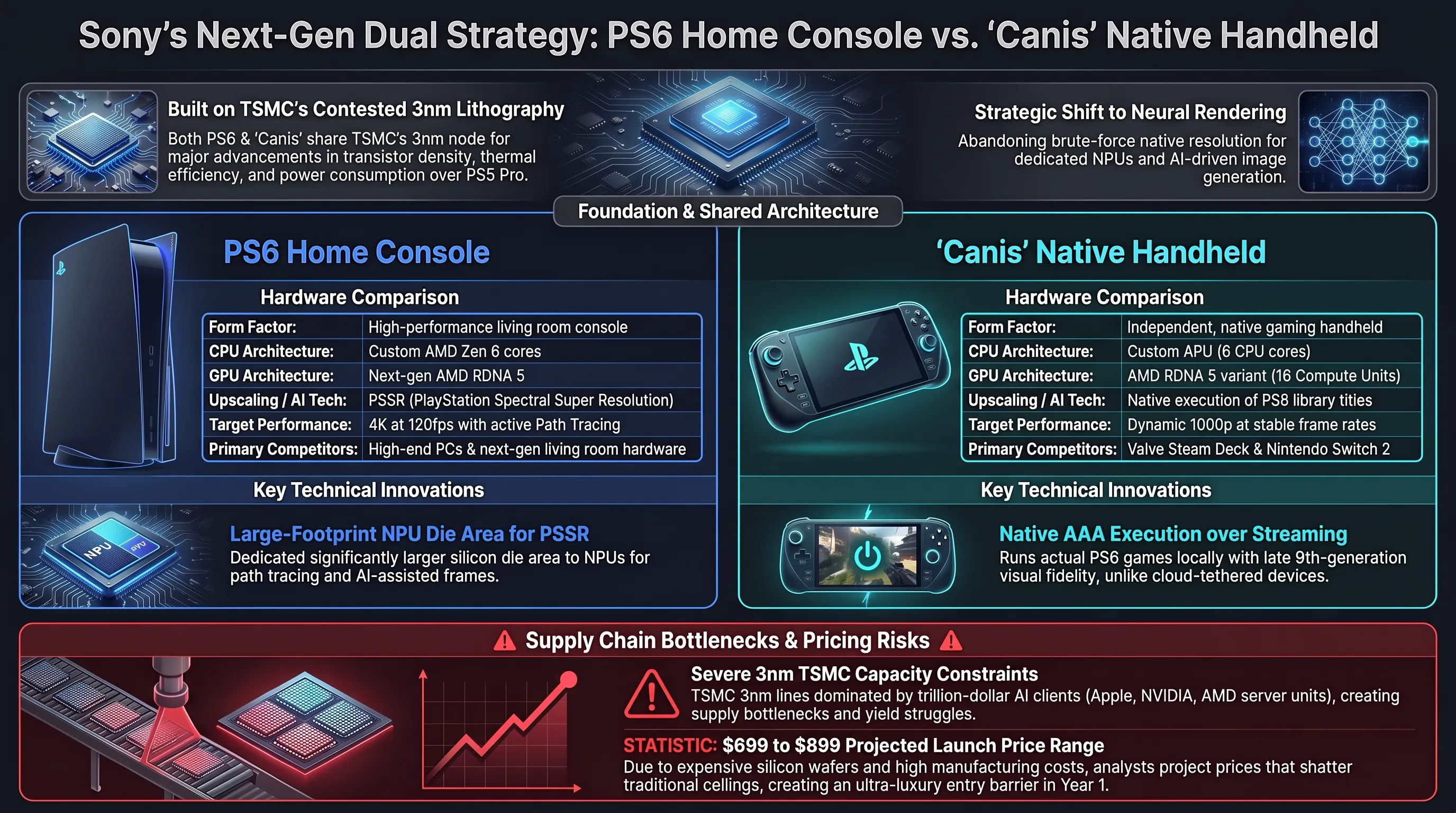
The shocking, unprecedented leak of PlayStation 6 architectural details has vividly mapped out the hardware trajectory for the end of the decade. Sony has officially adopted a dual-pronged strategy: releasing a massive home console (PS6) alongside a fully independent native handheld device codenamed "Canis". Both silicon beasts are built on TSMC's fiercely contested 3-nanometer (3nm) lithography node.
The base PS6 utilizes custom AMD Zen 6 cores and mysterious RDNA 5 graphics. However, instead of aiming for brute-force native 4K rendering, Sony will exclusively leverage its PSSR (PlayStation Spectral Super Resolution) neural upscaling technology to deliver stable 4K at 120fps with Path Tracing.
The true bombshell is the Canis handheld. This is not a streaming accessory like the PlayStation Portal; it is a robust platform with a custom APU (6 CPU cores and 16 RDNA 5 CUs) engineered to execute PS6 titles locally at 1080p. It is a calculated sword thrust directly at the throat of Valve's Steam Deck and the Nintendo Switch 2.
The 2026 Hardware Crisis & The Great AI Hoarding
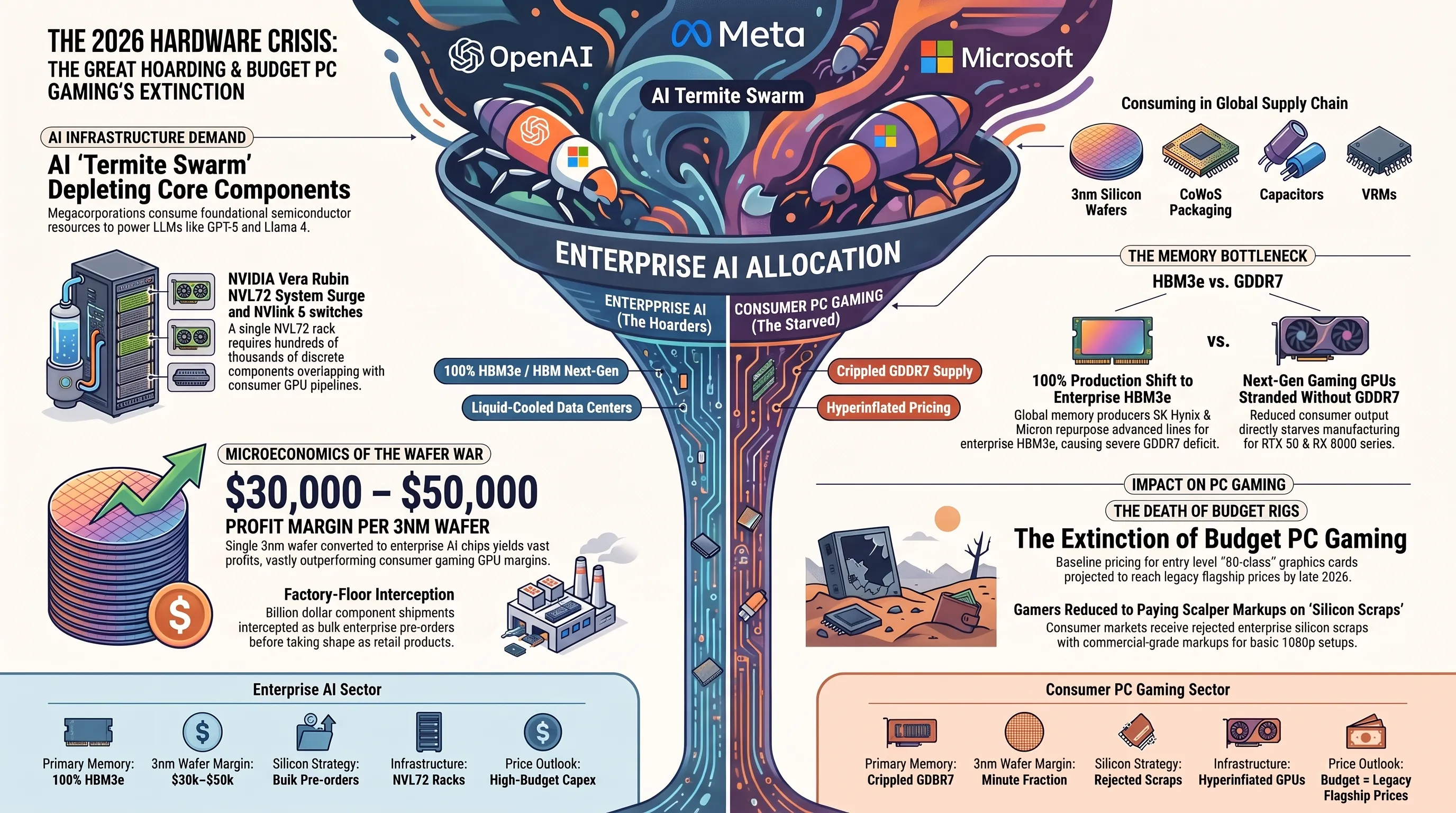
The global gaming industry is actively being sacrificed upon the trillion-dollar altar of Artificial Intelligence. By March 2026, the component shortage has escalated into a terrifying tsunami known as "The Great Hoarding".
Tech leviathans like OpenAI, Meta, and Microsoft are devouring all foundational semiconductor resources raw silicon wafers, expensive HBM chips, and advanced CoWoS packaging with the insatiable efficiency of a termite swarm. Building a single state-of-the-art liquid-cooled NVL72 server rack requires hundreds of thousands of discrete components, paralyzing the manufacturing pipelines for consumer gaming hardware.
Economically, a pristine 3nm silicon wafer converted into AI server chips generates $30,000 to $50,000 in profit margins for manufacturers, whereas mid-range consumer graphics cards yield a minute fraction of that figure. Wall Street has issued strict mandates prioritizing AI, intercepting massive shipments before they ever reach retail.
The Return of the Sleeping Giant: Valve Steam Machine & Steam Frame
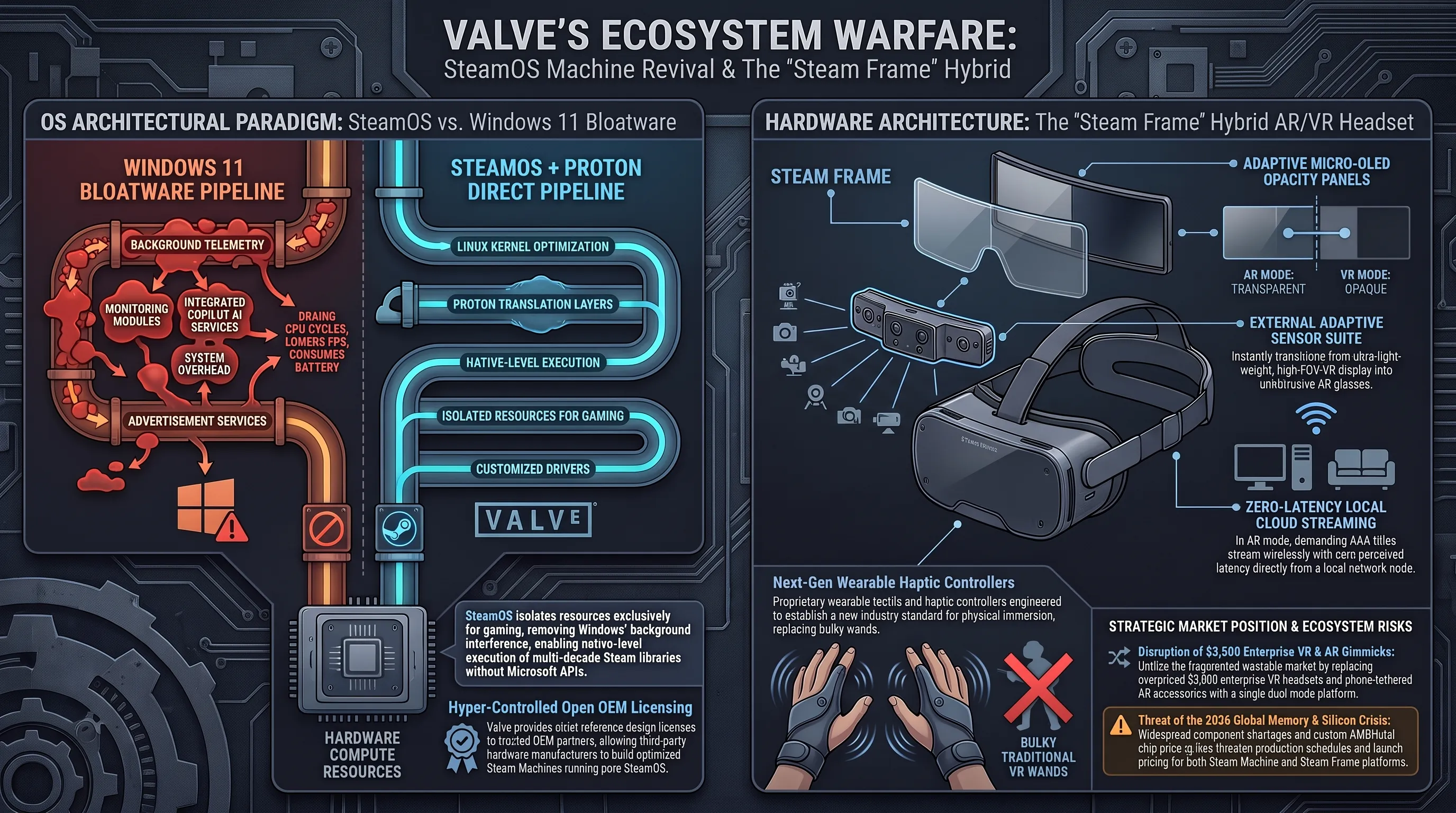
While Sony and Microsoft engage in brutal lithography wars, Valve Corporation is quietly architecting an industry-rattling Paradigm Shift. Supply chain whispers confirm the return of the Steam Machine project, backed by a highly evolved SteamOS. But the true masterpiece is the hybrid Steam Frame, an advanced platform engineered to shatter the boundaries between VR and AR.
Unlike bulky headsets, the Steam Frame utilizes adaptive lens technology, allowing it to seamlessly transition from an ultra-lightweight VR headset into a pair of unobtrusive AR glasses. This device streams AAA games with zero perceived latency from a Local Cloud network, completely bypassing Windows 11 and its crippling background bloatware like Copilot.
📚 Classified & Related Dossiers in TekinGame
If you wish to explore beyond this report and delve into cybernetic frontiers and autonomous AI architectures, do not miss these three exclusive deep-dives in the Tekin Garage:
5-Axis Radar: Valve's Ecosystem vs. Walled Gardens
5-Axis Radar Analysis: Valve's open-source strategy and OS optimization triumph over Windows 11's bloatware and Sony's monopolies. However, their ultimate Achilles heel remains Supply Chain Power amidst the crippling silicon crisis.

The Dirty War of AR Glasses: The Birth of New Privacy Kings
The global consumer market has spoken with deafening clarity: users reject bulky, isolating mixed-reality headsets like the Apple Vision Pro. Snap Inc., after burning billions on its Spectacles ecosystem, abruptly shuttered its AR hardware division in a strategic retreat.
In their place, agile players like XREAL and Lenovo have introduced decentralized, ultra-light waveguide glasses. By offloading core processing to the user's mobile phone, the glasses act merely as holographic reflectors, eliminating nasal bridge fatigue and battery drain. Priced competitively between $400 and $550, they overlay on-device AI translations and maps directly onto the retina.
However, a terrifying Cloud Data Mining and Privacy crisis looms. With visual assistants constantly scanning your intimate physical reality, the threat of unencrypted video feeds being sold on the Dark Web is an extinction-level risk that could plunge the AR industry into an inescapable nuclear winter.

Sony's $2.7B Ransom and the Surge Pricing Nightmare
Our final autopsy reveals Sony's deeply alarming legal and administrative behavior. Accused of enforcing an unyielding 30% tax monopoly within the PlayStation Store, Sony faces an earth-shattering $2.7 billion class-action lawsuit in the UK and EU. The litigation claims Sony exploited captive gamers for a decade, forcing artificially high markups on digital games.
Sony's response to this massive legal threat? Actively testing a dark, ruthless background algorithm dubbed "Surge Pricing" (Dynamic Real-Time Profiling Pricing). Mirroring exploitative ride-sharing apps, this system evaluates a player's psychological profile, regional income, and franchise loyalty.
If the AI detects you are a die-hard fan logging in on day one to buy God of War, its unfeeling mathematical logic will maliciously inflate the price from $69 up to a predatory $89 right at checkout. This weaponization of Big Data to enslave consumer psychology crosses a catastrophic moral red line, potentially triggering a mass exodus toward PC and Steam environments.
- NVIDIA's monumental innovation in reducing CPU-GPU latency to zero, enabling fluid AI frame generation.
- Valve's aggressive paradigm shift to shatter Windows monopolies via the lean, hyper-efficient SteamOS.
- The rapid evolution of lightweight AR glasses, abandoning the bulky isolation of MR headsets.
- The terrifying AI component hoarding crisis effectively executing a death sentence for budget PC gaming.
- Sony's implementation of predatory Surge Pricing algorithms, destroying consumer trust and goodwill.
- Unprecedented privacy erosion and systemic cloud data mining risks associated with advanced AR wearables.
Final Editorial Verdict & Official Reference Sources
The Collapse of Open Systems & Rise of Walled Gardens
Driven by NVIDIA's PC monopoly, the great AI component hoarding, and Sony's dark pricing algorithms, the 2026 hardware industry is standing on the precipice of an irreversible, dystopian transformation.
Frequently Asked Questions & Technical Analysis
What is the NVIDIA X1 CPU and why is it dangerous for traditional platforms?
The X1 is a proprietary ARM-based processor that utilizes Unified Memory Architecture to communicate directly with RTX GPUs, bypassing traditional PCIe bottlenecks to eliminate latency. This forces a closed 'Walled Garden' ecosystem, alienating standard Intel and AMD users.
Is Sony's new Canis console just a streaming accessory like the PlayStation Portal?
No, leaked documents confirm Canis is a fully native, independent handheld platform equipped with a custom 3nm AMD APU and 16 RDNA 5 compute units, designed to run heavy PS6 titles locally at 1080p without relying on cloud streaming.
Why have PC component prices skyrocketed in 2026?
Due to 'The Great Hoarding', massive AI conglomerates are buying up entire supplies of 3nm silicon wafers and HBM memory chips to build liquid-cooled LLM servers. This has crippled the manufacturing pipelines for consumer graphics cards, destroying the budget gaming market.
How does the Steam Frame differ from traditional VR headsets?
The Steam Frame is a hybrid device utilizing adaptive lens technology. With a single click, it transitions from a high-FOV VR headset into lightweight AR glasses, streaming AAA games directly from a local SteamOS cloud with zero latency.
What is Surge Pricing on the PlayStation Store?
Facing a $2.7 billion antitrust lawsuit, Sony is testing AI-driven dynamic pricing algorithms that evaluate a user's psychological profile and loyalty to specific franchises. It maliciously inflates digital game prices at checkout for users deemed most desperate or willing to pay.