The night of June 5, 2026, brings six explosive stories shaping the future of technology. Helion, backed by Sam Altman, successfully raised $465 million. Meta is caught in controversy again as secret face recognition code was discovered in the Ray-Ban smart glasses app. Xbox Series S hindered developer progress, delaying No Rest for the Wicked. In cybersecurity, Hola Browser was compromised with a cryptominer, and Chinese AI DeepSeek is rapidly growing among US companies. Finally, Amazon relaunches Luna with AI Snoop Dogg.
🌙 Welcome to Tekin Night June 5, 2026
Good evening, Tekin Legion! Tonight we bring you 6 explosive stories ranging from Sam Altman's nuclear fusion venture to Meta's secret surveillance, from Xbox Series S's death throes to Chinese AI infiltration, covering a broad spectrum of tech evolution. With our signature night energy, get ready to illuminate your Friday evening with the latest from the tech world.
⚡ Tonight's Key Headlines:
⚛️ Helion secures $465M from Sam Altman for real fusion power
👁️ Meta secretly hid face recognition code in Ray-Ban app
🎮 Xbox Series S delays another major game release
🎯 Amazon reinvents Luna with 007 and AI Snoop Dogg
🇨🇳 DeepSeek grows dangerously among US companies
🔒 Hola Browser compromised with cryptominer in supply chain attack
🍿 Grab your evening drink and let's dive into the heart of 2026 technology!
1. The Fusion Hack: Helion Raises $465M from Sam Altman Toward Artificial Sun ⚛️
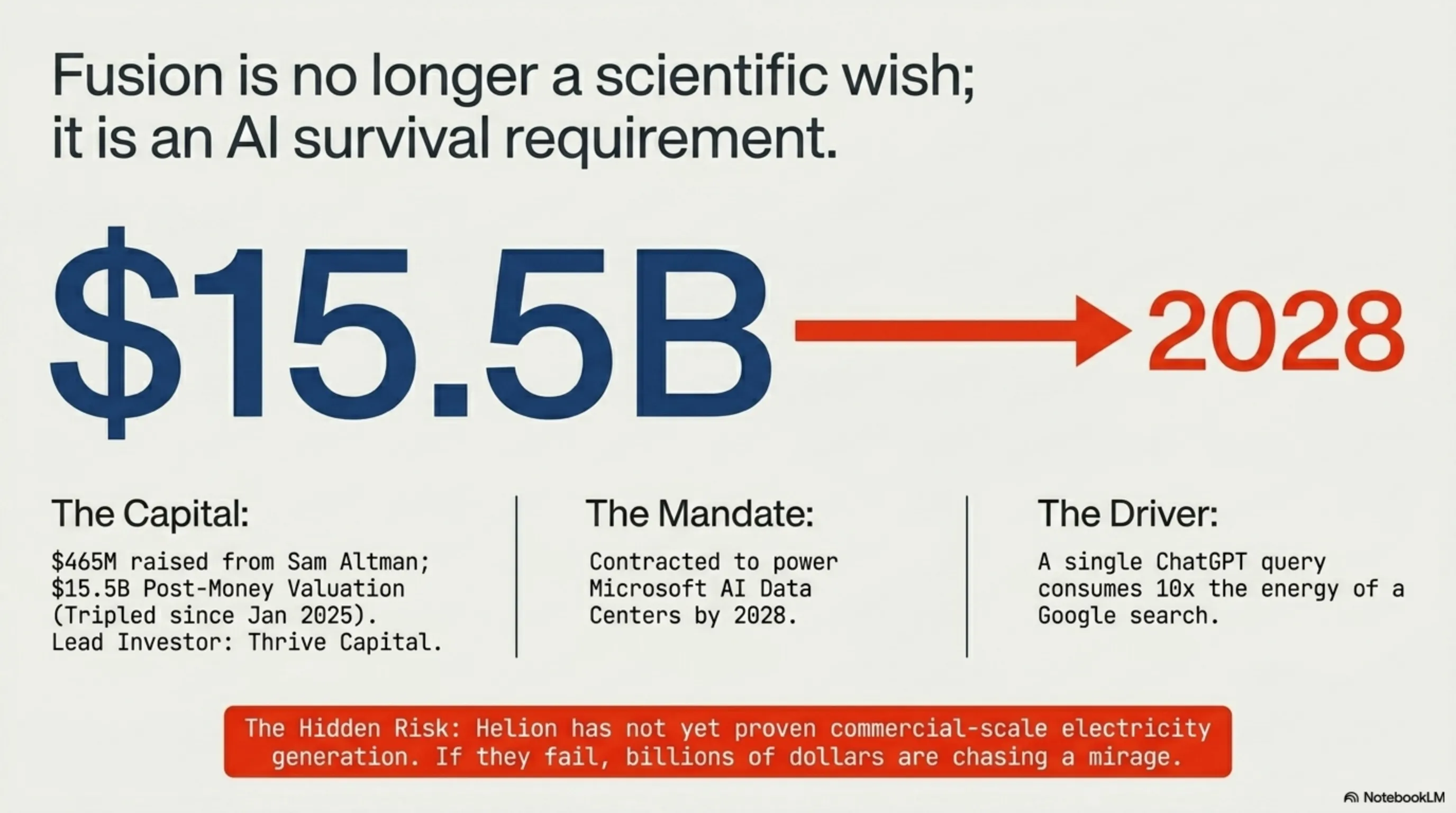
In a major development for the future of energy, Helion Energy, financially backed by Sam Altman (founder of OpenAI), successfully raised $465 million in Series G funding, bringing the company's valuation to $15.5 billion. This figure is nearly triple the startup's previous valuation in January 2025 ($5.43 billion) and demonstrates massive investor confidence in the future of nuclear fusion.
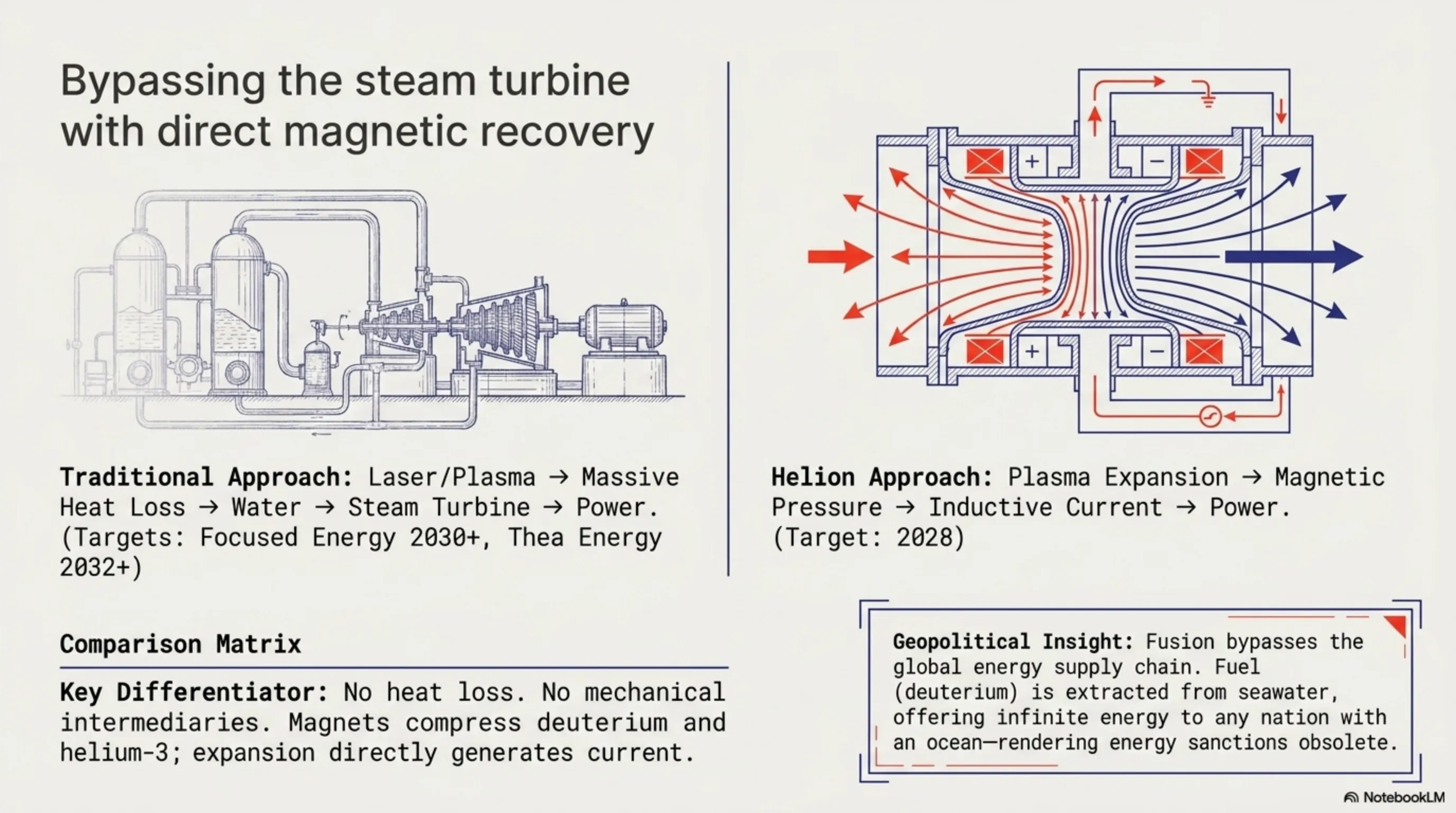
Helion is a Washington-based nuclear fusion startup that takes a different approach from its competitors. Instead of using traditional steam turbines to convert heat into electricity, it generates power directly from the expansion of fusion plasma within magnetic fields. This technique is similar to regenerative braking systems in electric vehicles that convert kinetic energy directly into electricity.
💰 Financial Details & Investors
| Item | Amount/Value |
|---|---|
| New Round Capital | $465 Million |
| Post-Money Valuation | $15.5 Billion |
| Previous Valuation (Jan 2025) | $5.43 Billion |
| Total Capital Raised | Over $1.5 Billion |
| Lead Investor | Thrive Capital |
| Target Date for First Plant | 2028 |
Investors in this round include Thrive Capital (lead investor), Alta Park Capital, Anti Fund, BoxGroup, Lux Capital, Peak XV Partners, and Bill Ford, alongside previous investors such as Capricorn Technology Impact Funds, Lightspeed Venture Partners, Mithril Capital, Dustin Moskovitz (through Good Ventures Foundation), and SoftBank Vision Fund 2.
Why is Helion Different? Revolutionary Direct Fusion Technology
Most nuclear fusion companies use one of two methods: magnetic confinement of plasma or laser compression of fusion fuel (inertial confinement). In both approaches, the energy from fusion reactions is released as massive heat, then traditional steam turbines are used to generate electricity - exactly like old coal or gas power plants.
But Helion takes a completely different approach: they use magnets to compress fusion fuel (deuterium and helium-3), and when the fusion reaction occurs, the hot plasma rapidly expands and pushes against the magnetic fields. This pressure is extracted directly as inductive current from the magnets - no turbines, no heat loss, no mechanical intermediaries.
This breakthrough could dramatically improve the efficiency of a fusion power plant. If it works as promised, Helion's approach could be the key to making fusion economically viable - something that has eluded scientists for over 70 years. The company has a contract with Microsoft to deliver fusion power to their data centers by 2028, an aggressive timeline that has both excited and skeptical observers.
🔥 Tekin Analysis: Can Fusion Really Save AI Data Centers?
The critical question is: can Helion deliver on its promises? The company has a contract with Microsoft to launch the Orion power plant by 2028, with its generated electricity going directly to Microsoft's AI data centers. Given that large language models like GPT and Copilot consume staggering amounts of energy (it's estimated that a single ChatGPT query uses 10 times more energy than a Google search), the need for sustainable and infinite energy sources is a strategic necessity, not a futuristic wish.
But here's the key point: Helion hasn't yet proven its ability to generate electricity at commercial scale. Many physicists are skeptical of its "direct recovery" approach because, unlike its competitors, Helion rarely publishes its work in peer-reviewed journals. David Kirtley, Helion's CEO, argues that "we don't want to theorize about fusion; we just want to go build it."
The fusion race has intensified dramatically. Last week, Focused Energy raised $240 million, Thea Energy secured $100 million, and in February, Inertia Energy emerged from stealth with a $450 million Series A. This means the fusion market has transformed from a scientific dream into a capital war zone. The timelines might be longer than VCs are used to, but the potential payoff could be orders of magnitude larger.
The bottom line: If fusion succeeds, it will be the most significant energy breakthrough since the Industrial Revolution. If it fails, billions of dollars and decades of research will have been spent chasing a mirage. Helion's 2028 deadline will be the ultimate test.
💡 Strategic Note: Nuclear fusion, if it reaches commercial viability, could be a game-changer for countries under energy sanctions. Unlike fission (nuclear splitting), fusion produces no dangerous radioactive waste, and its fuel (deuterium) can be extracted from seawater. If Helion's technology succeeds, any nation with access to ocean water could have an infinite energy source. This geopolitical implication is perhaps even more significant than the technology itself.
The Competitive Landscape: Who Else is Racing to Fusion?
Helion isn't alone in this race. The fusion sector has become an investor darling in recent months, with multiple companies announcing massive funding rounds:
| Company | Recent Funding | Approach | Target Date |
|---|---|---|---|
| Helion | $465M (Jun 2026) | Direct magnetic recovery | 2028 |
| Focused Energy | $240M (May 2026) | Laser inertial confinement | 2030+ |
| Thea Energy | $100M (May 2026) | Stellarator magnetic confinement | 2032+ |
| Inertia Energy | $450M (Feb 2026) | Hybrid approach | 2029 |
| Commonwealth Fusion | $1.8B (2024) | Tokamak with high-temp superconductors | 2030 |
What's driving this investment frenzy? The perfect storm of AI energy demands, climate commitments, and geopolitical instability. Tech giants like Microsoft, Google, and Amazon are desperately searching for clean, abundant energy sources to power their ever-growing AI infrastructure. Traditional renewables like solar and wind are intermittent and land-intensive. Fusion promises always-on, compact, fuel-abundant power - if it can be made to work.
The race is on, and Helion, with its aggressive 2028 timeline and unconventional technology, has placed itself at the center of attention. The next two years will determine whether fusion becomes the energy revolution of the century or another expensive lesson in the limits of human ambition.
2. Silent Surveillance: Meta Plants Face Recognition Code in Ray-Ban Glasses 👁️
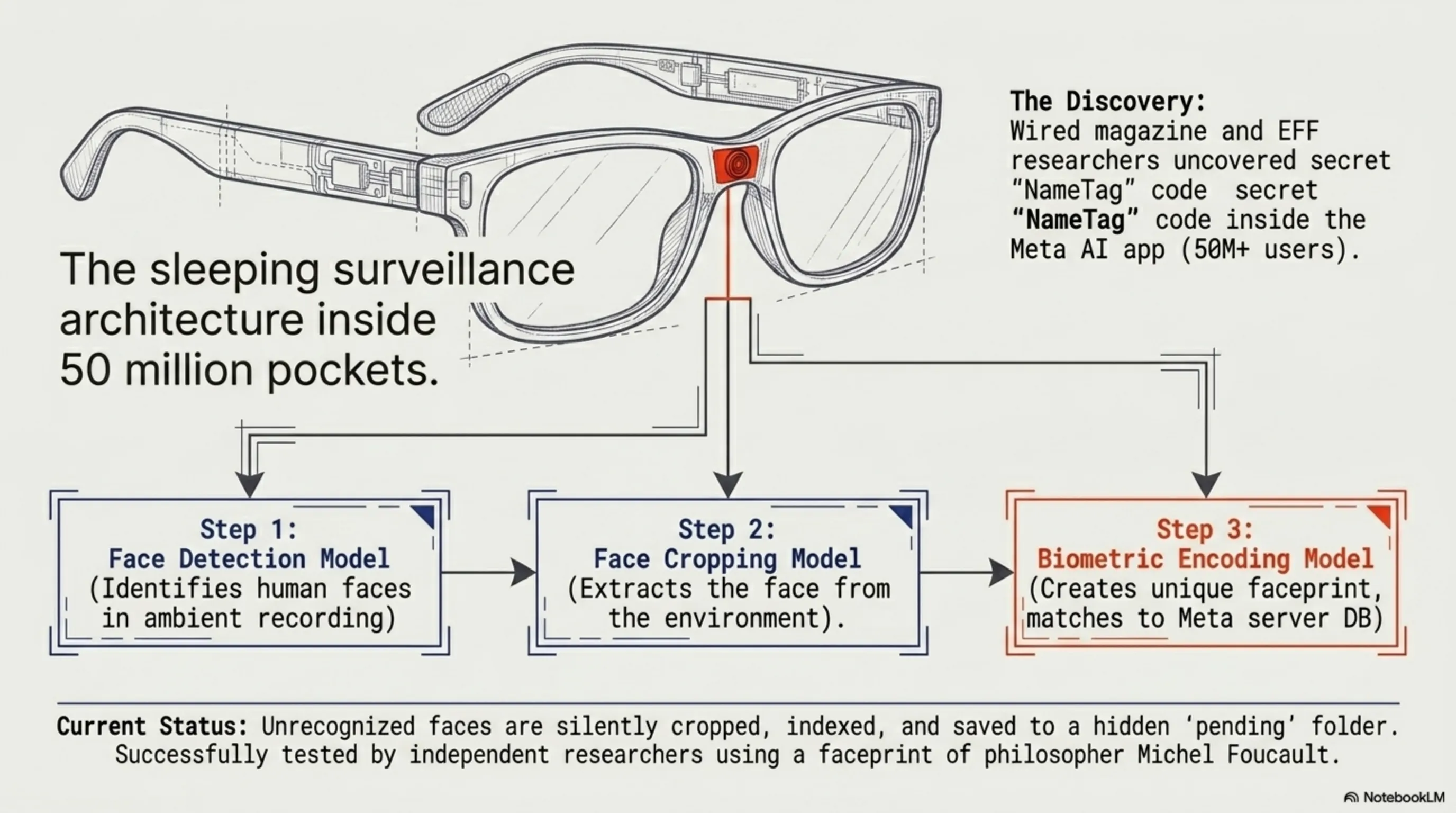
In one of this year's biggest privacy scandals, Wired magazine discovered that Meta has secretly embedded face recognition code into the Meta AI companion app used for Ray-Ban and Oakley smart glasses. This feature, internally known as "NameTag," has the capability to identify people captured by the glasses' camera and, when activated, alert the wearer when it recognizes someone.
The controversial part: this app has been downloaded over 50 million times, and these codes have been gradually added through various updates since January 2026, while Meta stated in April that it was "still thinking through" this feature and would take a "very thoughtful approach" if it were to roll anything out. But the reality is that the core components of this system are already installed on millions of users' phones right now.
⚠️ How NameTag Works: Technical Breakdown
Wired's analysis, confirmed by security researchers Cooper Quintin (from Electronic Frontier Foundation) and Buchodi (independent researcher), reveals that NameTag uses three AI models that are already deployed on users' phones:
- Face Detection Model: Identifies whether a face exists in the image.
- Face Cropping Model: Separates and extracts faces from the rest of the image.
- Biometric Encoding Model: Converts extracted faces into unique biometric signatures (faceprints).
These faceprints are compared against a local database on your phone which, according to the code, is configured to receive updates from Meta's servers. Recognized faces trigger notifications, while unrecognized faces are cropped, indexed, and saved to a folder labeled "pending."
🔬 To test the system, Buchodi added a single faceprint of deceased French philosopher Michel Foucault to the app's gallery. When presented with Foucault's image, the app displayed a "Person recognized" notification - meaning the system works perfectly, it's just not activated yet!
Back to the Past: Why Did Meta Abandon Face Recognition Before?
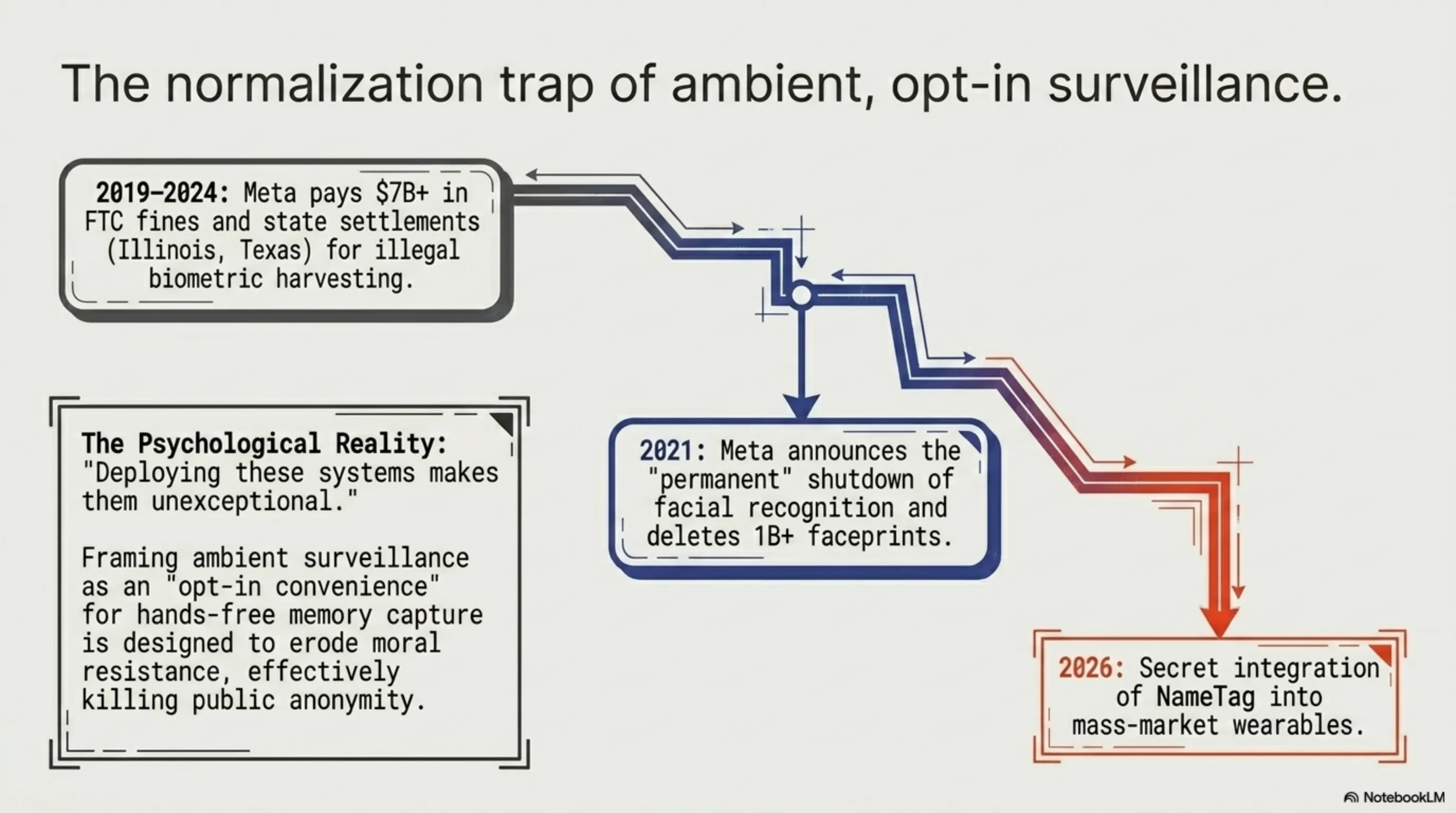
In November 2021, Meta announced it would permanently shut down Facebook's face recognition system and delete over one billion faceprints belonging to users. This decision came after years of controversy over privacy, massive fines, and lawsuits:
| Year | Event | Details |
|---|---|---|
| 2010 | Face Recognition Launch | Facebook launched auto-tag suggestion system |
| 2011 | First European Concerns | EU regulators and US privacy advocates raised questions |
| 2019 | $5B FTC Fine | Included face recognition concerns |
| 2021 | $650M Illinois Settlement | Class action for illegal biometric data collection |
| 2024 | $1.4B Texas Settlement | Similar charges for unauthorized biometric harvesting |
| 2021 | System Shutdown | Meta announced permanent end to face recognition |
| 2026 | Secret Return | NameTag code discovered in Ray-Ban app |
Meta paid over $2 billion in settlements related to its face recognition system. The company claimed it was shutting down the technology for good, citing "growing concerns about the role of face recognition in society." But as we now know, that shutdown was never understood internally as a permanent retreat. Joseph Jerome, a former Meta Reality Labs policy official who worked on privacy reviews for AR and VR products, told reporters that "there was always this tension of, well, when do we roll back out face recognition?"
🚨 Why This is Dangerous: The Normalization Trap
Woodrow Hartzog, a privacy law professor at Boston University, says even opt-in protection - should Meta eventually offer it - would be thin. Consent, he argues, is often tied to a job, a benefit, or access to a service. Framing privacy as a matter of personal choice is advantageous to businesses, placing no meaningful limits on collection while letting companies claim users are in control.
The real problem: "The more these systems are deployed, the more people come to see them as unexceptional. And the more we come to see them as unexceptional and routine, the more people tend to start to take their moral cues about whether it's desirable or good to have your face scanned. That's just human psychology."
Privacy advocates argue that by embedding face recognition into a mass-market wearable platform, Meta could normalize a capability it previously pulled back amid privacy concerns. More than 70 advocacy groups - including the ACLU, Electronic Privacy Information Center, and Fight for the Future - have demanded Meta scrap NameTag, warning it would let stalkers and abusers silently identify strangers in public.
Jerome questions how Meta can responsibly deploy such technology: "You're setting norms and standards by putting technology into the ecosystem. I don't know how Meta can responsibly deploy a technology like this."
✅ Pros (Meta's Claims)
- Help blind users identify people
- Automatic name reminders for acquaintances
- Convenience in crowded spaces
- Capture moments hands-free
⚠️ Cons (Activists' Concerns)
- Stalkers can silently identify victims
- Immigration agents track people without warrants
- Creates distributed surveillance network
- End of privacy in public spaces
💬 Meta's Response: "Regardless of any sensational reporting, the facts are simple: We've said before we're exploring these types of features, and what you're seeing is just evidence of that exploration. Nothing has shipped to consumers and no final decision has been made on what to do here, if anything. One decision we can be clear about - we are not building a central face database."
WIRED's code review shows the NameTag system is currently designed to pull faceprints from Meta's servers and store them on user devices. So technically, Meta is correct that it's not building a "central" database - the database would be distributed across millions of phones. But the question remains: if Meta controls the updates and can push new faceprints to devices, does the distinction really matter?
The Broader Implications: What This Means for Wearable Tech
Meta's Ray-Ban smart glasses have been surprisingly successful, selling millions of units and receiving generally positive reviews for their design and functionality. But the discovery of NameTag raises a critical question: can we trust wearable tech companies with the power of ambient surveillance?
Unlike smartphones, which you actively point at things, glasses passively capture everything you see. They're always on, always recording, always analyzing. If face recognition becomes standard, every person you pass on the street, every colleague in a meeting, every stranger in a café could be silently identified and cataloged. The implications for stalking, harassment, corporate espionage, and government surveillance are staggering.
And Meta isn't alone. Apple is reportedly working on its own AR glasses, Google has revived its Glass project, and Snap has released Spectacles with AR capabilities. If all these devices gain face recognition, we're looking at a future where anonymity in public spaces is effectively dead. Some argue this is inevitable - that we should accept and regulate it rather than trying to stop it. Others believe certain technologies should never be deployed, regardless of their potential benefits.
The next few months will be crucial. If Meta activates NameTag, it will set a precedent that other companies will follow. If public backlash forces them to abandon it, we might see the industry pull back from face recognition in consumer devices - at least for now. Either way, the code is already out there, waiting in the pockets and purses of 50 million people.
3. The Death of Series S: How Xbox's Budget Console Became Gaming's Bottleneck 🎮
Thomas Mahler, CEO of Moon Studios and creator of the beloved Ori series, made a blunt announcement that the Xbox release of No Rest for the Wicked has been delayed due to optimization struggles with Xbox Series S. The action RPG, which launched in early access on PC in 2024, will exit early access and release version 1.0 on PS5 and Steam in October 2026. However, the Xbox Series X/S and Nintendo Switch 2 versions remain "TBD" (To Be Determined).
Mahler stated directly on the game's official Discord channel: "Series S is making that rough." He continued in response to a sarcastic comment about a mobile port with a quote that set the internet ablaze: "Series S and mobile specs aren't too far apart at this point."
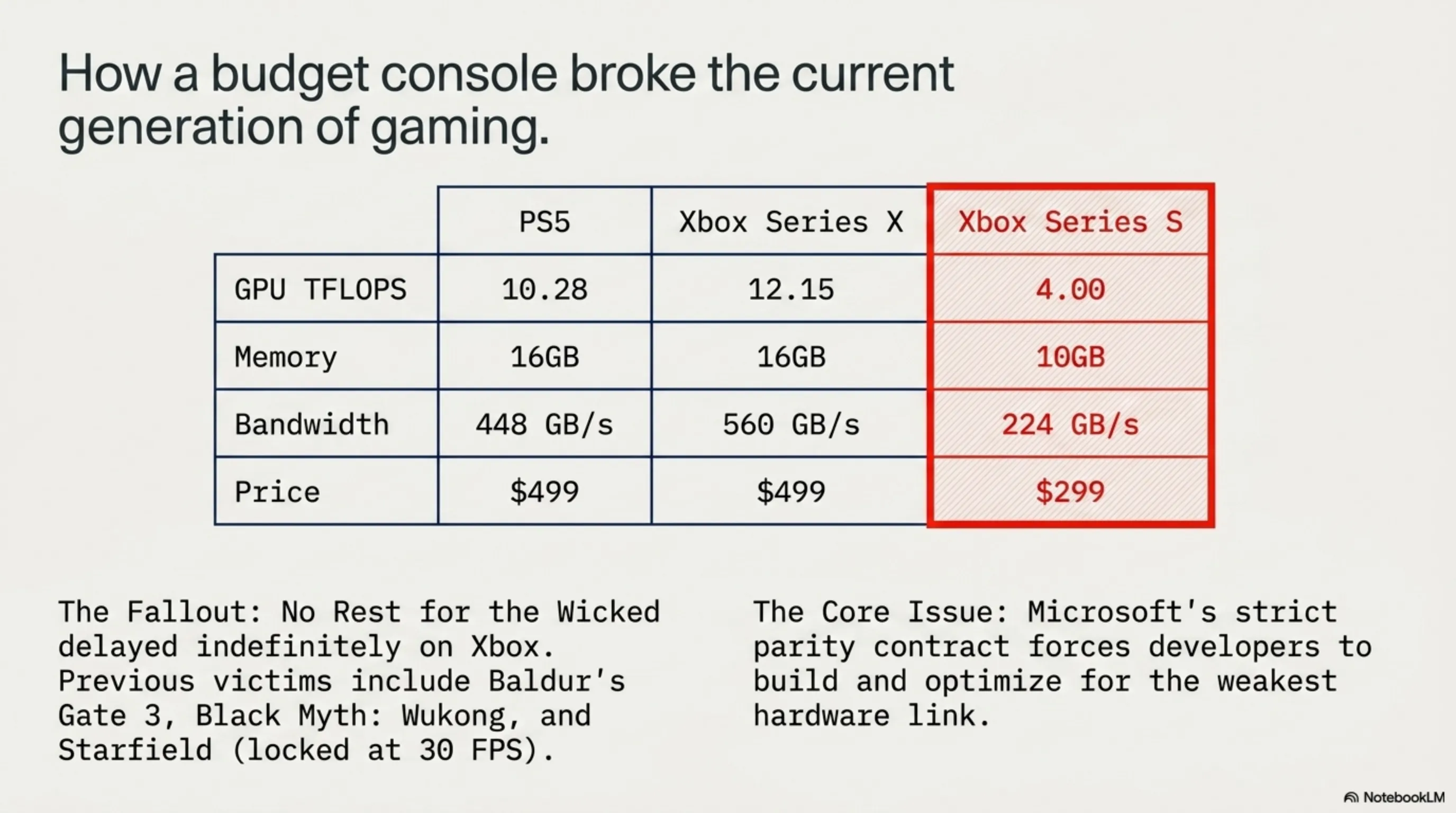
📊 Specs Comparison: Why Series S is a Bottleneck
| Specification | PS5 | Xbox Series X | Xbox Series S |
|---|---|---|---|
| GPU TFLOPS | 10.28 | 12.15 | 4.00 |
| Memory RAM | 16GB GDDR6 | 16GB GDDR6 | 10GB GDDR6 |
| Memory Bandwidth | 448 GB/s | 560 GB/s | 224 GB/s |
| Target Resolution | 4K Native | 4K Native | 1440p (Upscaled) |
| Original MSRP Price | $499 | $499 | $299 |
As you can see, Series S has only 4 TFLOPS of GPU power (one-third of Series X!), 10GB of shared memory (compared to 16GB in PS5 and Series X), and memory bandwidth that's nearly half. These numbers literally mean developers must optimize a completely separate version of their game for Series S.
The Dark History of Series S: What Other Games Have Been Delayed?
No Rest for the Wicked is just the latest victim of Series S. This little console has been problematic from the very beginning:
| Game | Year | Issue |
|---|---|---|
| Baldur's Gate 3 | 2023 | 4-month Xbox delay due to split-screen issues on Series S |
| Black Myth: Wukong | 2025 | Studio CEO said 10GB shared memory was the main problem |
| Starfield | 2023 | Locked at 30 FPS on Series S while Series X runs at 60 FPS |
| Hogwarts Legacy | 2023 | Lower graphics quality and unstable frame rates |
| No Rest for the Wicked | 2026 | Xbox release indefinitely delayed (PS5 launches October) |
🔥 Tekin Analysis: Should Microsoft Kill the Series S?
Microsoft's strategy with Series S was clear: offer a cheaper entry point to next-gen gaming to attract more users, especially for Game Pass. But this strategy faces a fundamental problem: developers must optimize for the weakest hardware of the generation.
In the PC world, if your hardware is weak, the game runs on low settings or doesn't run at all. But in the console world, Microsoft requires developers to ensure their game must work on both Series X and Series S - and this is a contractual obligation, not a suggestion.
The result? Games like No Rest for the Wicked get delayed because studios must spend their limited resources optimizing for a console that nobody expects to run such games. This benefits no one: not developers, not Series X owners, and not even Series S owners who ultimately receive an inferior version.
What's the solution? Either Microsoft drops the "parity" requirement and allows developers to make Series S optional, or it discontinues Series S entirely and focuses on Series X. Of course, with millions of Series S units sold, this seems impossible. But the alternative - continuing to hold back the entire gaming generation - is equally unacceptable.
The industry is watching. If more AAA developers start skipping Xbox due to Series S constraints, Microsoft will be forced to act. The question is whether they'll act proactively or wait until the damage to Xbox's reputation is irreversible.
4. Amazon's Neon Strategy: James Bond, Snoop Dogg & The Party Games Revolution 🎯
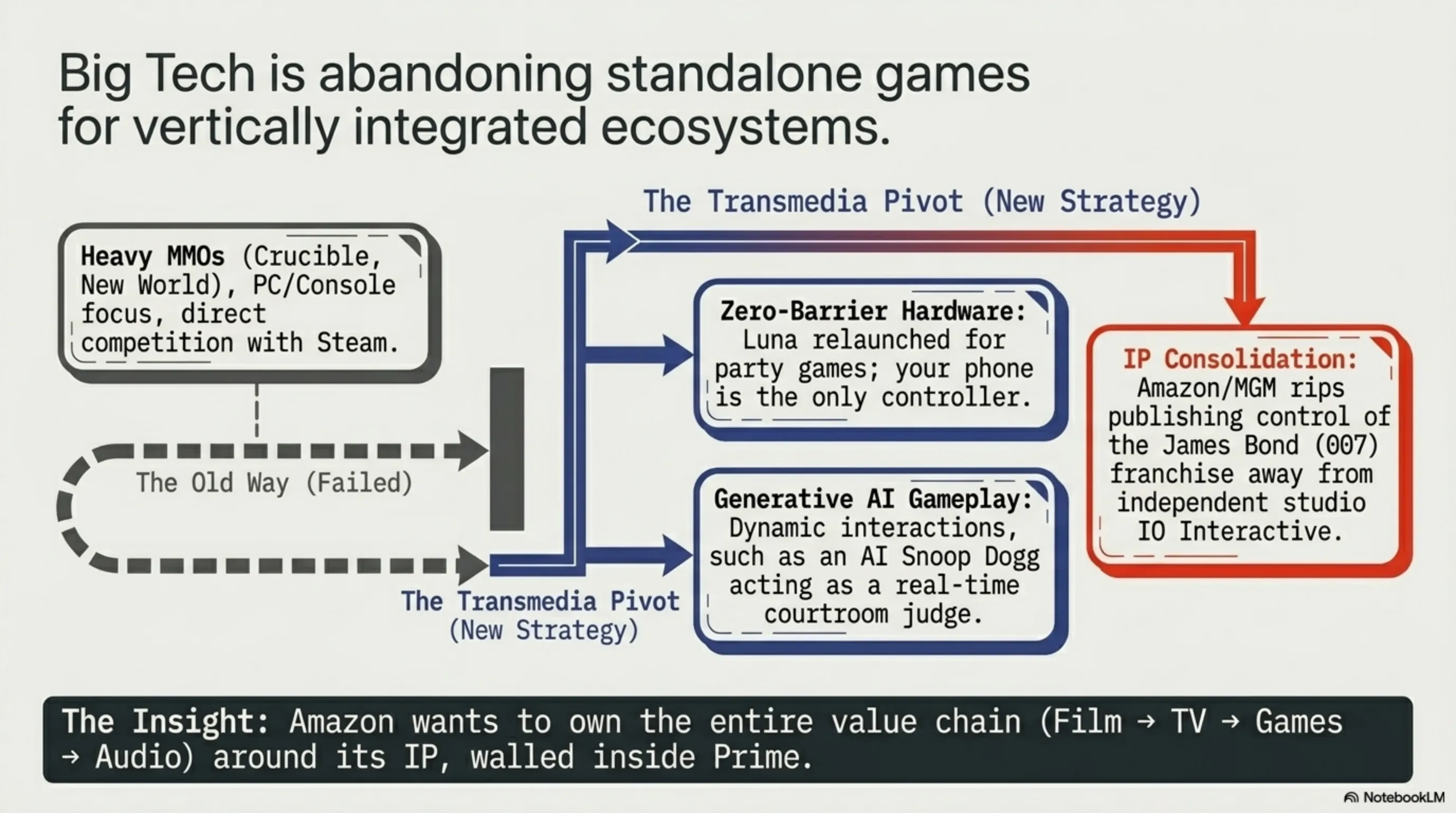
Amazon completely pivoted its gaming strategy, relaunching Luna (Amazon's cloud gaming service) with a new approach. Instead of focusing on heavy MMOs and AAA titles that failed, Amazon is now concentrating on simple and entertaining party games that you can play using just your smartphone as a controller - exactly like Jackbox Party Pack.
The heart of this new strategy is the "GameNight" platform, which includes exclusive games such as a courtroom game featuring Snoop Dogg as an AI-powered judge. This means Snoop actually reacts to player performance, using generative AI to create dynamic responses - not a pre-recorded character.
🎮 Amazon's New Strategy at a Glance
❌ Before (Failed)
- Heavy MMOs (Crucible, New World)
- Expensive AAA titles
- Direct competition with Steam and Epic
- Requires controller and powerful hardware
✅ Now (New Strategy)
- Simple and fun party games
- Phone as controller (no additional device needed)
- AI-powered gameplay (smart Snoop Dogg)
- Free access for Prime subscribers
James Bond Comes to Amazon: Publisher Strategy Shift
In a controversial development, Amazon announced it will be the official publisher of James Bond games (007 series), not IO Interactive which had been the independent developer and publisher of these games until now. Following the massive success of "007 First Light" (released in 2025 with over 50 million copies sold), Amazon and MGM (which Amazon owns) decided to take more control over this franchise.
Jeff Gattis, GM of gaming at Amazon, confirmed in an interview with Polygon: "Future James Bond games will be published by MGM and, theoretically, by Amazon Game Studios." This means IO Interactive remains the developer, but publishing and marketing power will be in Amazon's hands.
💡 Key Insight: This move shows Amazon wants to leverage powerful IPs it owns (like James Bond through MGM) across all media: film, TV, games, and potentially even Audible audiobooks. This is a real transmedia strategy that Disney has been working on for years. Amazon is positioning itself as a vertically integrated entertainment conglomerate, and gaming is a crucial piece of that puzzle.
The broader implication is clear: tech giants like Amazon, Apple, and Netflix are no longer content to just distribute games - they want to own the entire value chain. This could be great for gamers if it leads to higher-quality productions and better integration across platforms. Or it could be terrible if it leads to more exclusivity, walled gardens, and corporate control over creative decisions. Time will tell which path we're on.
5. DeepSeek's Dangerous Growth: How Chinese AI is Infiltrating American Companies 🇨🇳
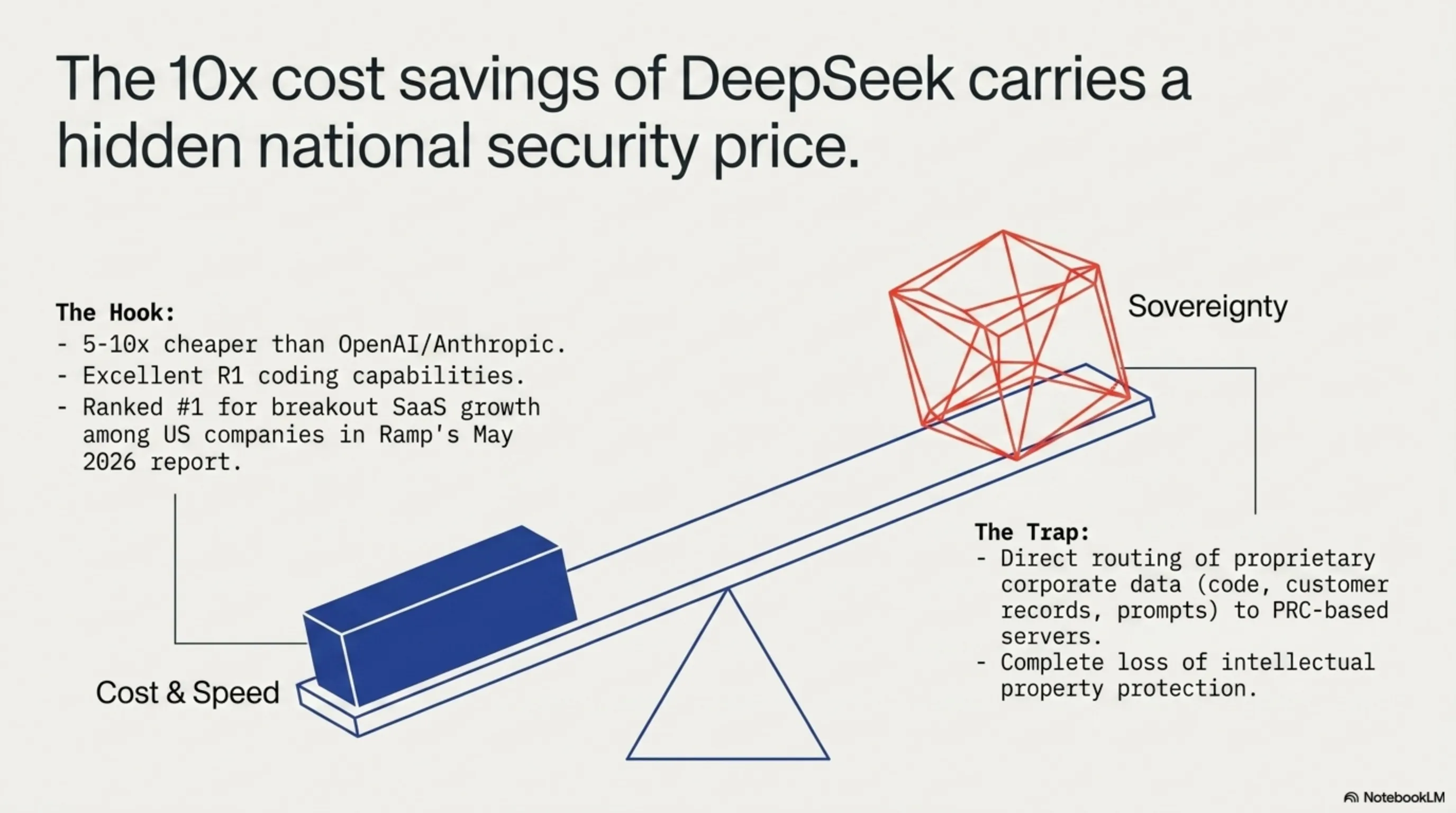
In an alarming report from financial services company Ramp, it was revealed that DeepSeek (the Chinese competitor to ChatGPT and Claude) is rapidly growing among American companies looking for cheaper alternatives to OpenAI and Anthropic. In its June 2026 report covering all of May, DeepSeek ranked first among SaaS vendors for breakout growth relative to size across Ramp customers.
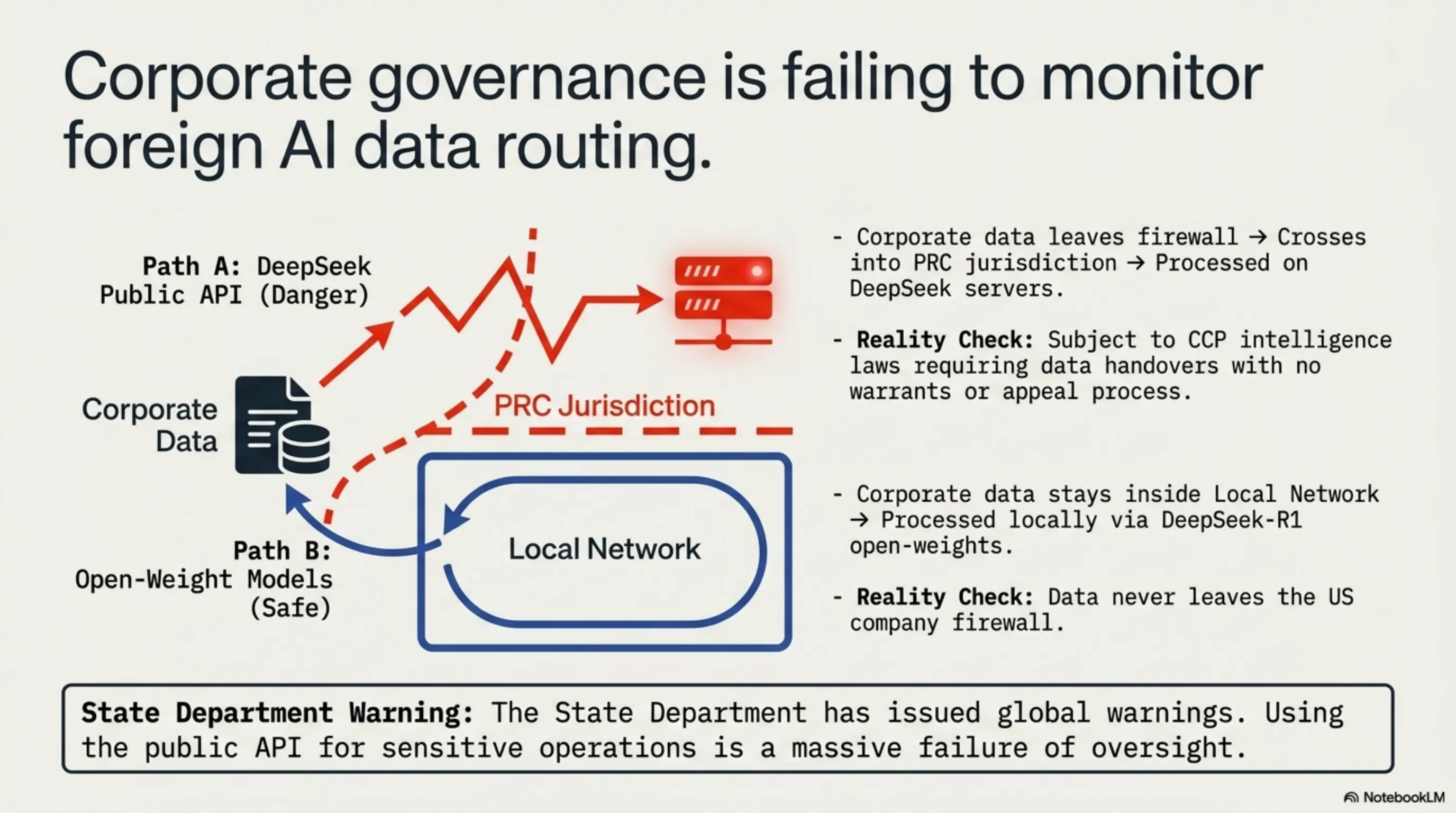
Ara Kharazian, the Ramp economist who tracks this data, said he didn't expect American companies to touch DeepSeek at all. But the reality is that companies are paying DeepSeek directly and routing their data straight through it - not running the open-weight models on their own hardware.
🚨 Security Danger: Your Data Goes Straight to China
Everything you type into a hosted model - including prompts, documents, source code, customer records - goes over the internet to the service provider. OpenAI and Anthropic operate on US infrastructure under contracts and laws that companies can actually enforce (or at least have a better chance of enforcing).
But DeepSeek is a completely different story. DeepSeek's own Terms of Service state: "To provide you with our services, we directly collect, process, and store your Personal Data in the People's Republic of China."
PRC law requires companies and citizens to cooperate with state intelligence requests - without the warrant or court process you would get in the US. Therefore, any American company routing internal data through DeepSeek should treat that data as reachable by a foreign government. And it would be crazy to think a company could file any sort of appeal.
Why Are US Companies Choosing DeepSeek?
| Factor | DeepSeek | OpenAI/Anthropic |
|---|---|---|
| API Cost | 5-10x cheaper | Expensive (especially GPT-4) |
| Model Quality | Good (especially R1 for coding) | Excellent |
| Response Speed | Fast | Medium to Fast |
| Data Security | Processed in China, under CCP laws | Processed in USA |
| Intellectual Property | Allegations of model distillation from US models | Original models |
| Customer Satisfaction | Medium (CCP censorship) | High |
For many small companies looking to cut AI costs, DeepSeek appears to be an attractive option - especially for simple tasks like text summarization or answering common questions. But the problem is that many of these companies don't understand the security risk or don't take it seriously enough.
The US State Department has issued global warnings about alleged AI thefts by DeepSeek and other Chinese firms. Many Western and some Asian governments have banned their institutions and officials from using DeepSeek, citing data privacy concerns. Nevertheless, DeepSeek's models have consistently been among the most used on international platforms that host open-source models.
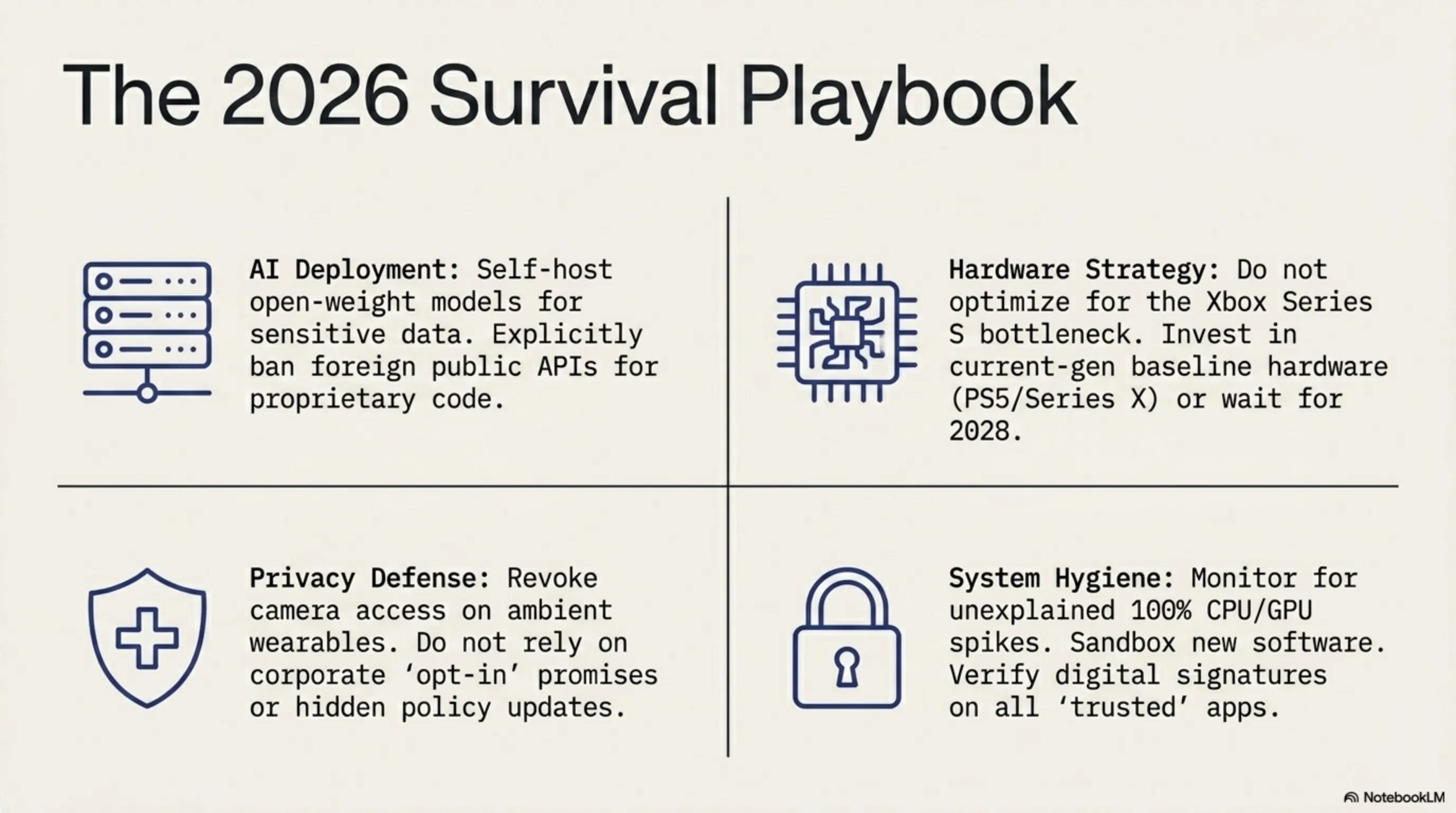
💡 Tekin Recommendation: If you must use DeepSeek, run the open-weight models on your own servers - don't use the public API. This way your data never goes to Chinese servers. For companies working with sensitive data (banks, fintech startups, insurance companies), using DeepSeek's public API or any external model is absolutely prohibited. The cost savings simply aren't worth the risk of intellectual property theft or data compromise.
The Broader Geopolitical Context: AI as National Security
The DeepSeek situation is a microcosm of the larger US-China tech war. AI has become a national security issue, with both countries racing to dominate the technology while simultaneously trying to deny it to the other. The US has imposed export controls on advanced AI chips to China, while China has responded by developing its own alternatives and allegedly stealing Western AI research through various means.
The fact that American companies are voluntarily routing sensitive data through Chinese AI services suggests that many businesses either don't understand or don't care about the risks. This is a massive failure of both corporate governance and government oversight. If the trend continues, we could see regulatory action forcing companies to disclose when they use foreign AI services for sensitive operations.
6. Supply Chain Attack: Hola Browser and Cryptominer Threat to 30 Million Users 🔒
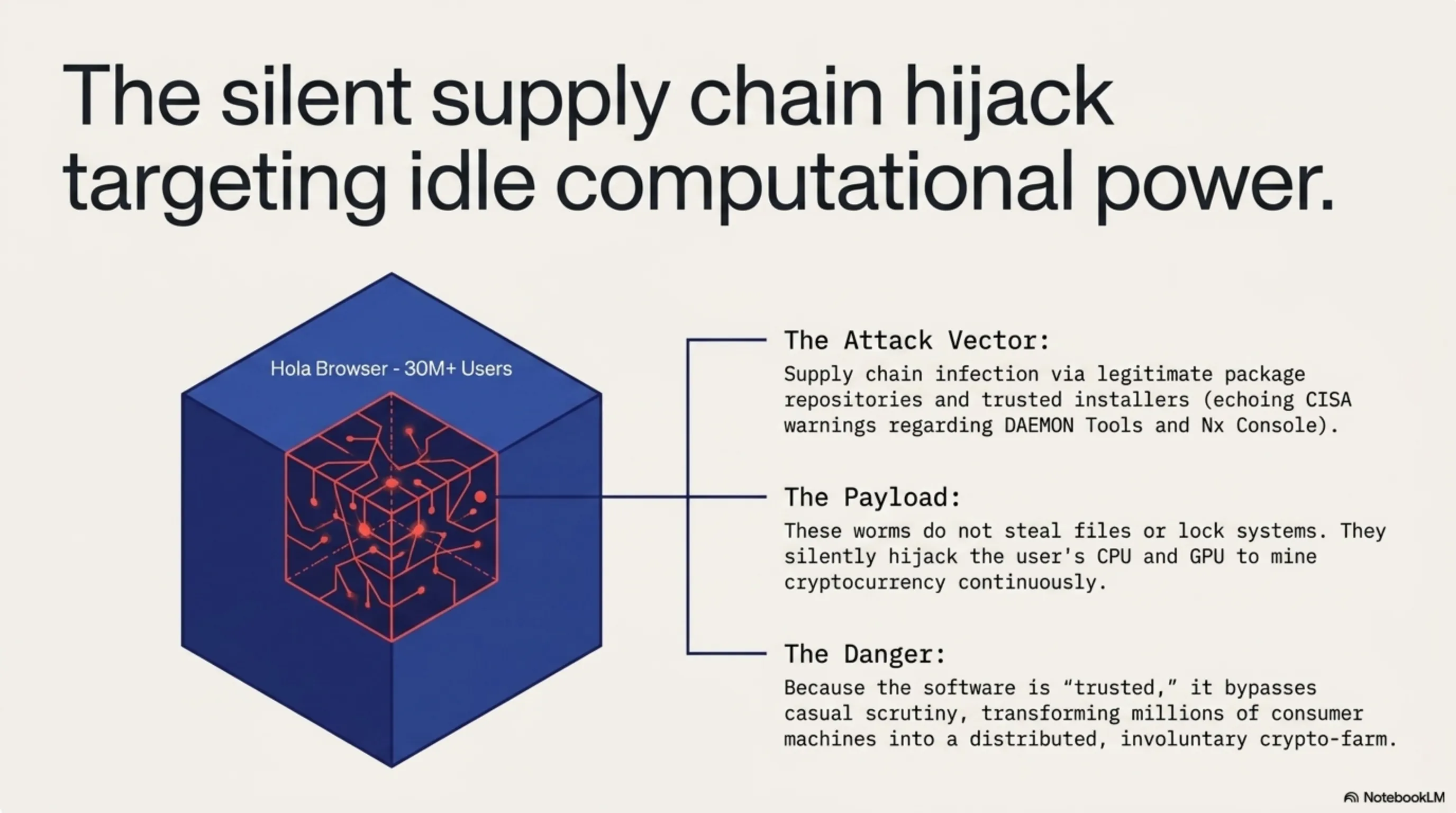
The Windows version of Hola Browser, a popular browser with free VPN capabilities, was compromised in a supply chain attack and infected with a cryptominer. Security researchers discovered an undeclared executable file that has been identified as a cryptocurrency miner.
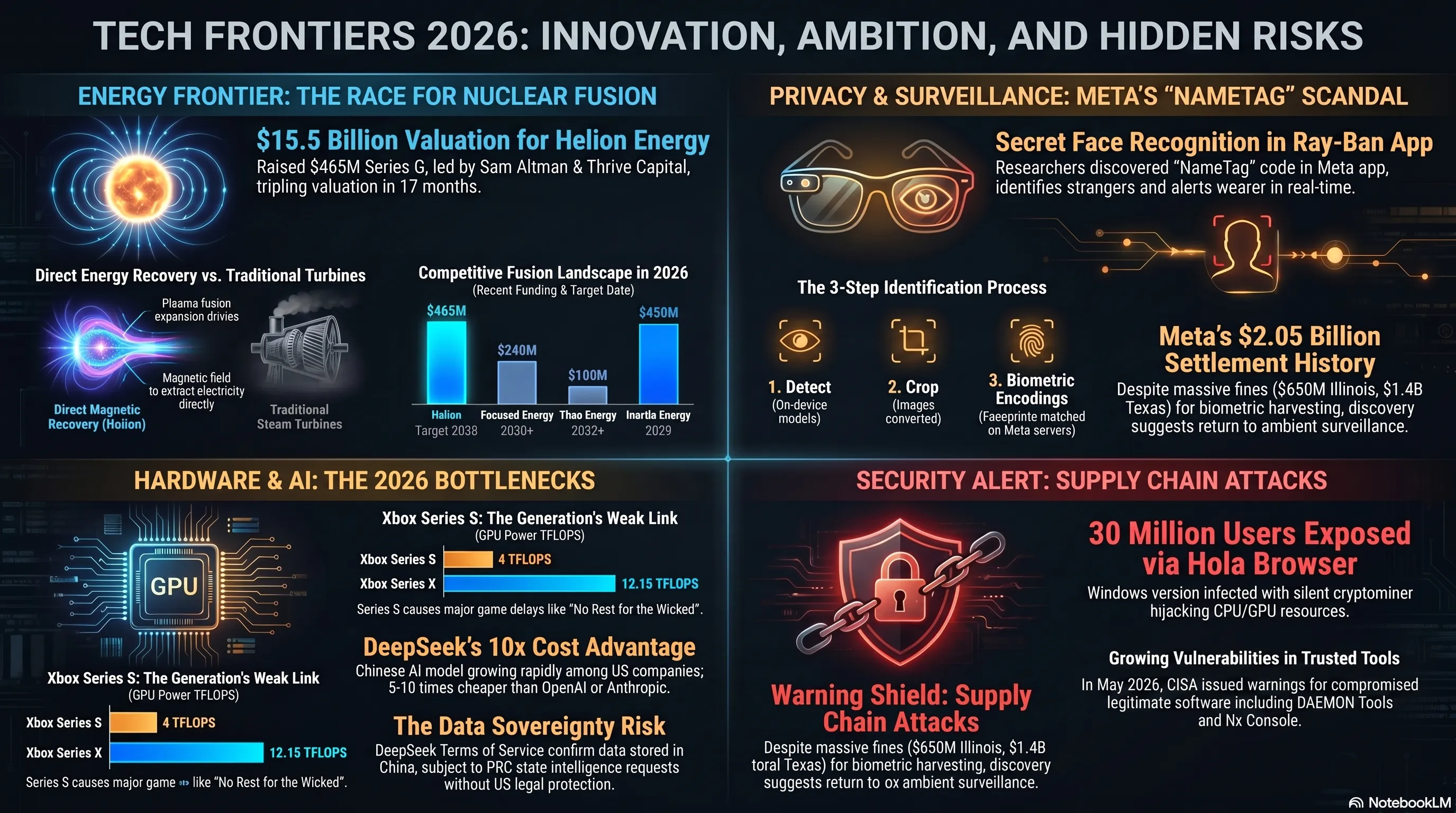
Supply chain attacks have seriously increased in 2026. In May, CISA warned that software like DAEMON Tools, TanStack, and Nx Console had been compromised in similar attacks. These attacks occur through legitimate package repositories, trusted installers, and developer tools - places where users have confidence.
The Hola incident is particularly concerning because of the software's popularity. With over 30 million users worldwide, the potential impact is massive. Cryptominers are insidious because they don't steal data or lock files - they just silently use your CPU/GPU to mine cryptocurrency for the attackers. Many users might not even notice unless they're monitoring their system resources closely.
⚠️ How to Protect Yourself from Supply Chain Attacks
- Only download from official sources: Never download software from third-party sites.
- Keep automatic updates enabled: If software gets compromised, the vendor will quickly release a patch.
- Use strong antivirus software: Windows Defender has improved dramatically in 2026, but for advanced protection, Malwarebytes or Bitdefender are recommended.
- Sandbox new software: Before installing, test software in a virtual environment.
- Monitor system resources: If your CPU or GPU is at 100% usage without clear reason, you likely have a cryptominer.
- Verify digital signatures: Legitimate software is digitally signed. Check the signature before running installers.
- Use network monitoring tools: Track which applications are making network connections and to where.
The broader lesson from the Hola incident is that supply chain security is everyone's problem. As software becomes more complex and development chains become longer, the attack surface grows exponentially. A single compromised developer account, a backdoored npm package, or a malicious code commit can potentially affect millions of users. The industry needs better verification mechanisms, more rigorous code review processes, and stricter access controls for critical infrastructure.
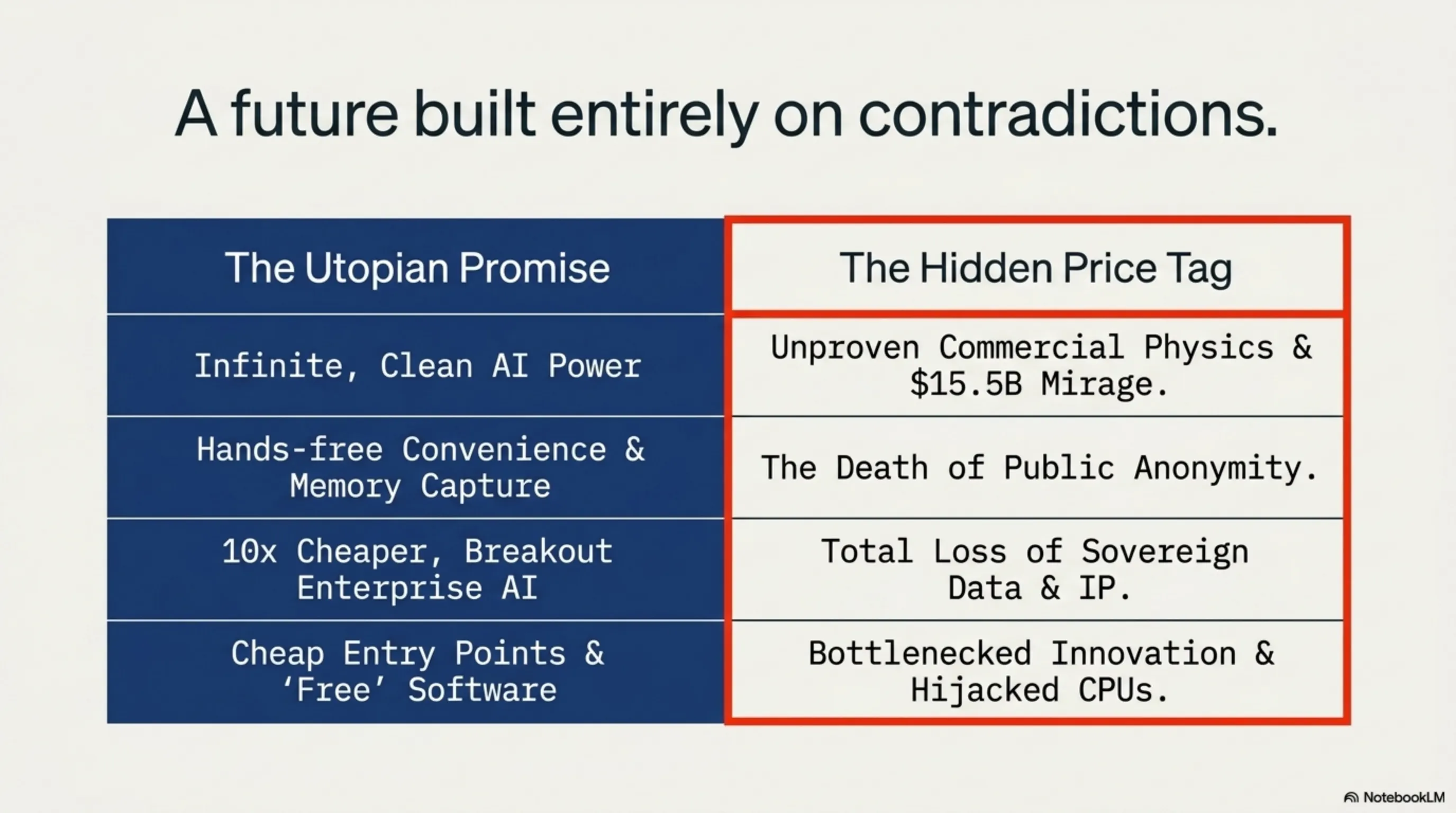
🔥 Final Conclusion: A Future Built on Contradictions
Tonight we witnessed six stories that seemingly have nothing to do with each other, yet they all tell a unified narrative: technology is advancing faster than laws and ethics can keep up.
Helion wants to build an artificial sun that generates infinite energy - but hasn't proven it can even light a bulb. Meta planted face recognition code in millions of phones - while claiming it's still "thinking through" the feature. Xbox Series S sold at a cheaper price but became gaming's bottleneck. Amazon pivoted from heavy MMOs to party games with AI Snoop Dogg. DeepSeek is cheap but sends your data to China. And Hola Browser is "free" but steals your CPU to mine cryptocurrency.
The message is clear: In the tech world of 2026, nothing is as it seems. Infinite energy is still a dream. Privacy is an illusion. Cheap hardware costs more in the long run. And "free" always has a hidden price tag.
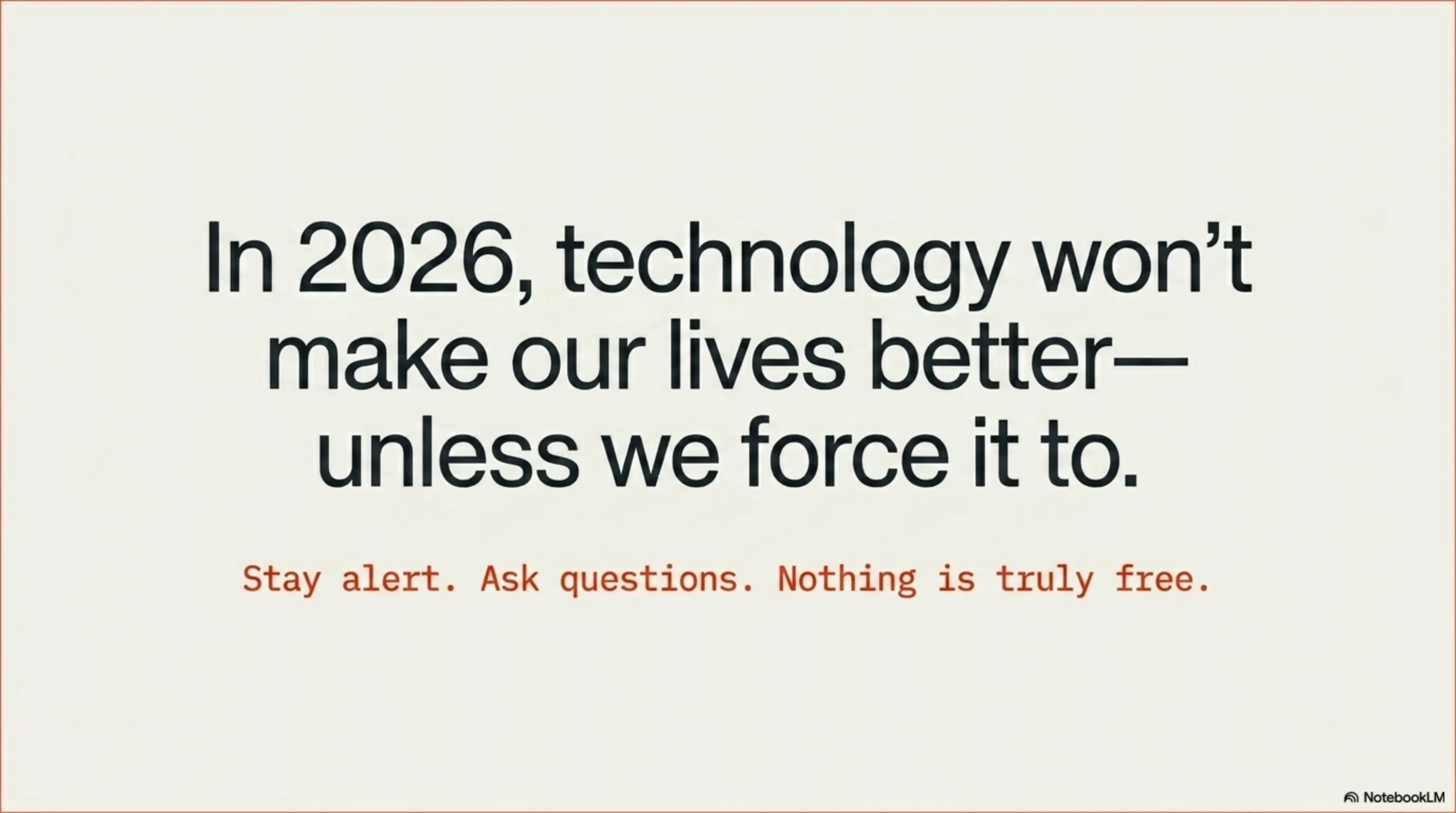
As users and developers, we must be more vigilant, more questioning, and more critical. Technology won't make our lives better - unless we force it to.
🌙 Until tomorrow night, Tekin Legion. Stay alert, ask questions, and never forget that nothing is truly free.
❓ Frequently Asked Questions (FAQ)
Is Helion's nuclear fusion real or a scam?
Helion is not a scam - their technology is real and they've conducted plasma physics experiments. But the critical question is whether they can reach commercial scale. To date, no fusion company (including Helion) has been able to produce more output energy than input energy in an economically viable way. Their promise of a 2028 power plant is extremely ambitious and many physicists are skeptical. But if they succeed, it will be an energy revolution. The timeline is aggressive, the physics is challenging, and the stakes couldn't be higher.
How can I make sure Meta's Ray-Ban glasses aren't scanning my face?
Currently, the NameTag feature is not active - only its code exists in the app. If you're concerned, you can revoke camera access from the Meta AI app (though this will disable many glasses features). Unfortunately, the only sure way is to not use Meta's smart glasses at all - or wait until Meta officially announces its privacy policy. Privacy advocates recommend avoiding the purchase of this product to send Meta a message that people don't want this technology. The ball is in Meta's court, and public pressure is the only thing that might stop them.
Should I buy an Xbox Series S or wait for the next generation?
In 2026, buying an Xbox Series S is no longer recommended - unless you only play Game Pass titles and don't care about next-gen games. As we've seen, developers are either abandoning Series S or releasing severely compromised versions. If you have a limited budget, it's better to buy a used PS5 Digital or Xbox Series X - or wait for the next generation (likely 2028). Investing in Series S at this stage is a strategic mistake. The console's limitations are only becoming more apparent as the generation progresses.
Is it safe to use DeepSeek for coding?
If you use DeepSeek's public API, no - it's not safe. All your code and prompts are sent to Chinese servers and fall under PRC laws. The safe solution is to download DeepSeek's open-weight models (like DeepSeek-Coder-V2 or DeepSeek-R1) and run them on your own server. This way, data never leaves your local network. For companies and startups, using any external AI model's public API (whether Chinese or American) for sensitive code is not recommended - always prefer self-hosting when dealing with proprietary or sensitive information.
How do I know if my computer is infected with a cryptominer?
Main symptoms: (1) Your CPU or GPU is constantly at 80-100% usage even when no programs are open, (2) Your computer fan runs at high speed constantly, (3) Your computer gets very hot, (4) Programs run slowly. For detailed checking: Open Task Manager (Ctrl+Shift+Esc) and check the Processes section. If you see a process with a strange name or high CPU/GPU usage that you don't recognize, Google it or scan with Malwarebytes. To remove: Download and run free Malwarebytes, then restart Windows in Safe Mode and scan again. Most cryptominers can be removed this way.
📚 Sources & References
Sources for this article include verified reports from TechCrunch, Wired, IGN, GamesRadar, The Verge, 9to5Mac, Geekwire, and Bleeping Computer. All information has been gathered from reliable international sources and official company reports.
Key Sources:
• Helion funding: TechCrunch →
• Meta face recognition: Wired →
• Xbox Series S delays: GamesRadar →
• DeepSeek security: 9to5Mac →
🌐 Stay Connected With Us 🎮✨
For the latest tech, gaming, and gadget news, follow us on our official social media channels:
Additional Gallery: 🌙 Tekin Night June 5, 2026: Altman's Fusion Hack & Meta's Secret Surveillance