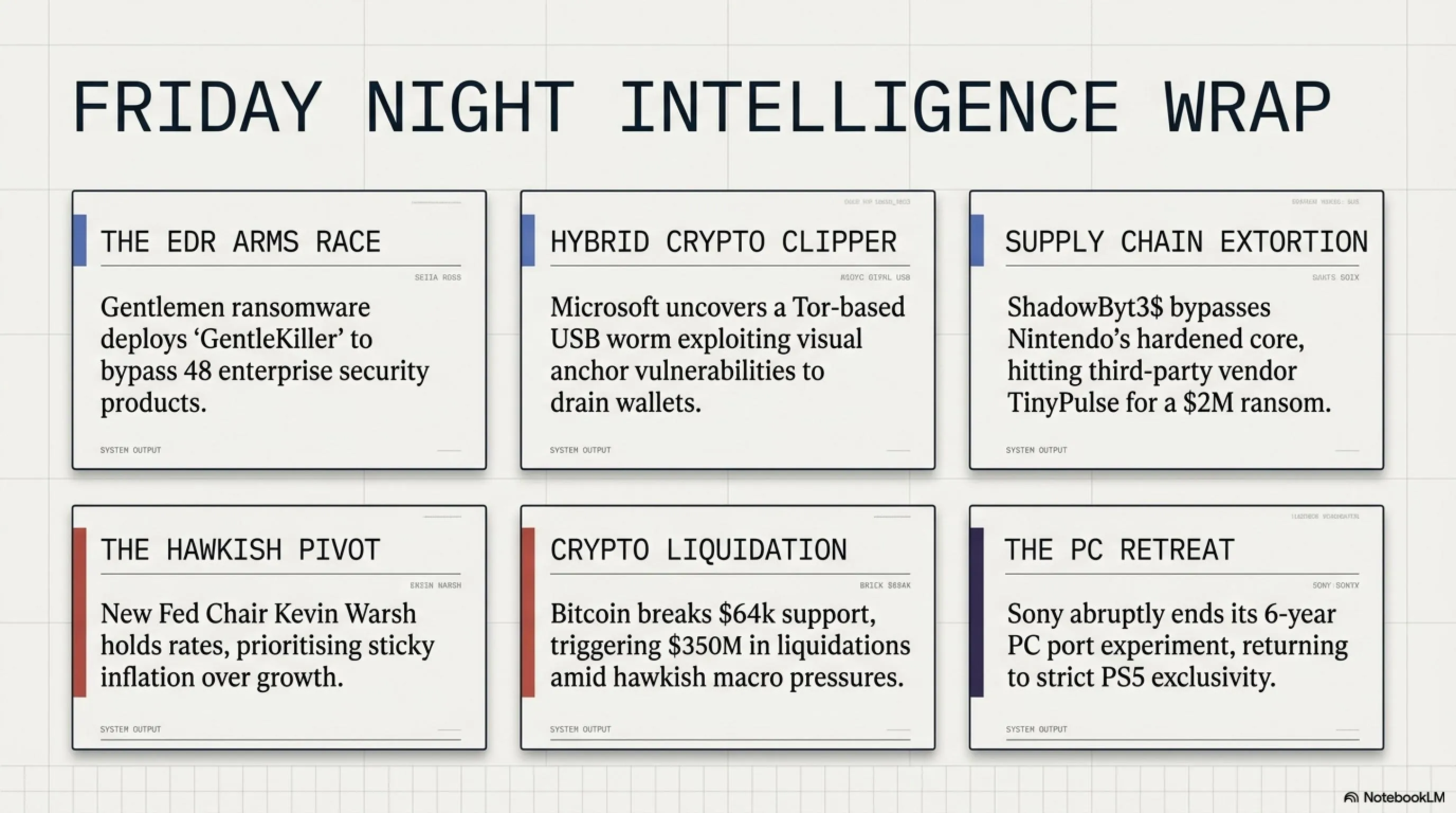
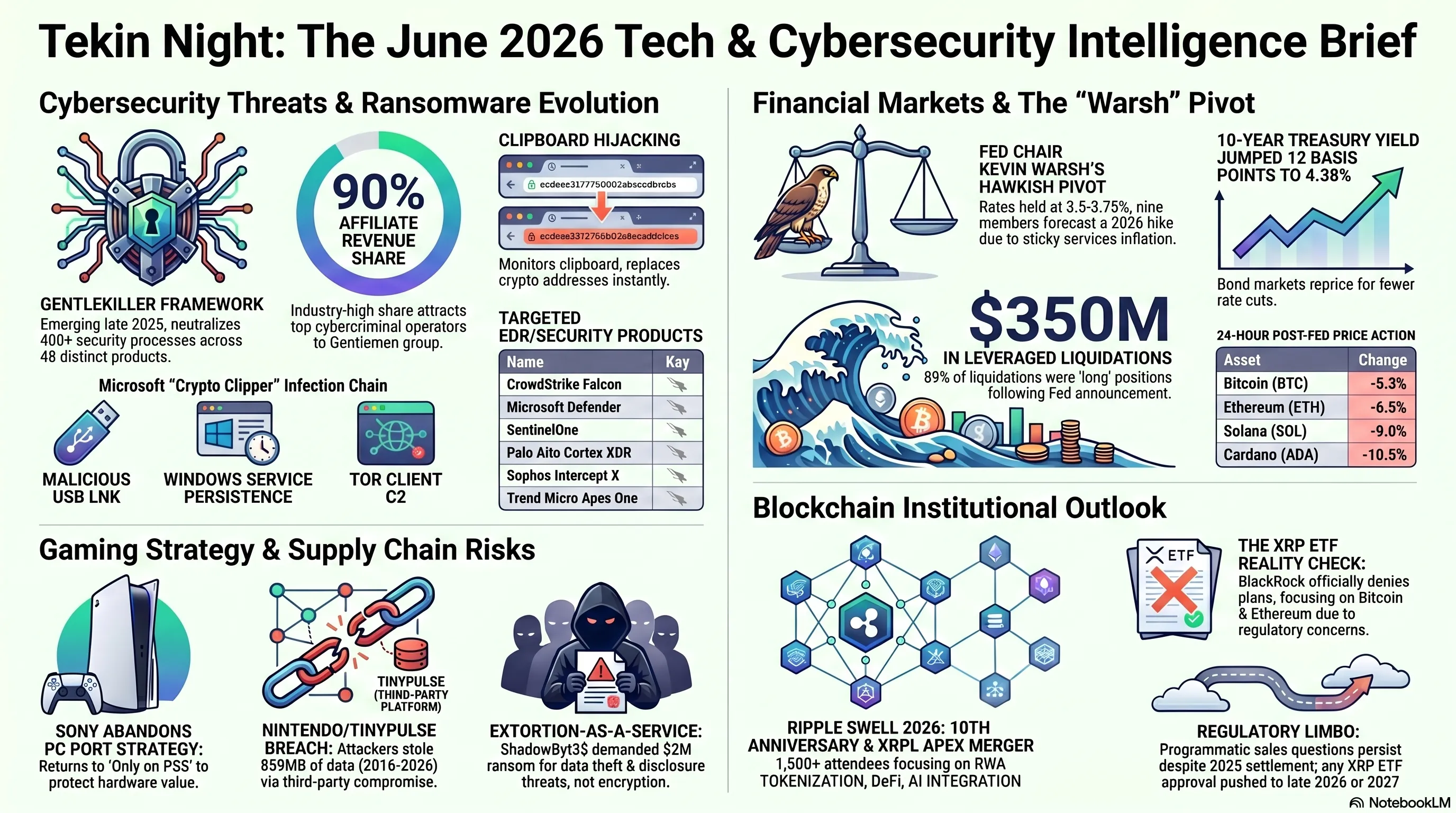
Friday night, June 19, 2026, concludes with six explosive tech stories shaping the industry's landscape. In cybersecurity, the emerging Gentlemen ransomware group deployed an advanced EDR killer framework capable of neutralizing 48 distinct enterprise security products. Concurrently, Microsoft detailed a sophisticated Clipper malware campaign that utilizes USB worms and Tor networking to steal cryptocurrency. The financial markets experienced significant turbulence as the Federal Reserve, under new Chair Kevin Warsh, maintained a hawkish stance
🌙 Tekin Night Friday, June 19, 2026: Cyber Attack Night
It's Friday night, and the tech world never sleeps. Tonight we're bringing you six stories that span from the Gentlemen ransomware gang bypassing 48 security products with their GentleKiller tool to Bitcoin crashing below $64,000 after the Federal Reserve's hawkish stance. Sony has completely reversed its PC strategy, Nintendo fell victim to a supply chain attack via TinyPulse, and Ripple prepares to celebrate the 10th anniversary of its Swell conference with XRP ETF speculation running wild.
Tonight on Tekin Night:
Gentlemen hackers deploy advanced EDR Killer framework
Microsoft's Clipper malware spreads via USB worms and Tor
Bitcoin drops below $64K after hawkish Fed decision
Sony abandons PC ports, returns to PS5 exclusivity
Ripple Swell 2026 with 1,500 attendees and XRP ETF buzz
Nintendo confirms TinyPulse vendor breach, $2M ransom demand
Grab your coffee and let's dive deep. Tonight is about analysis, not just headlines.
Gentlemen Ransomware and GentleKiller Tool: When Cyber Defense Fails
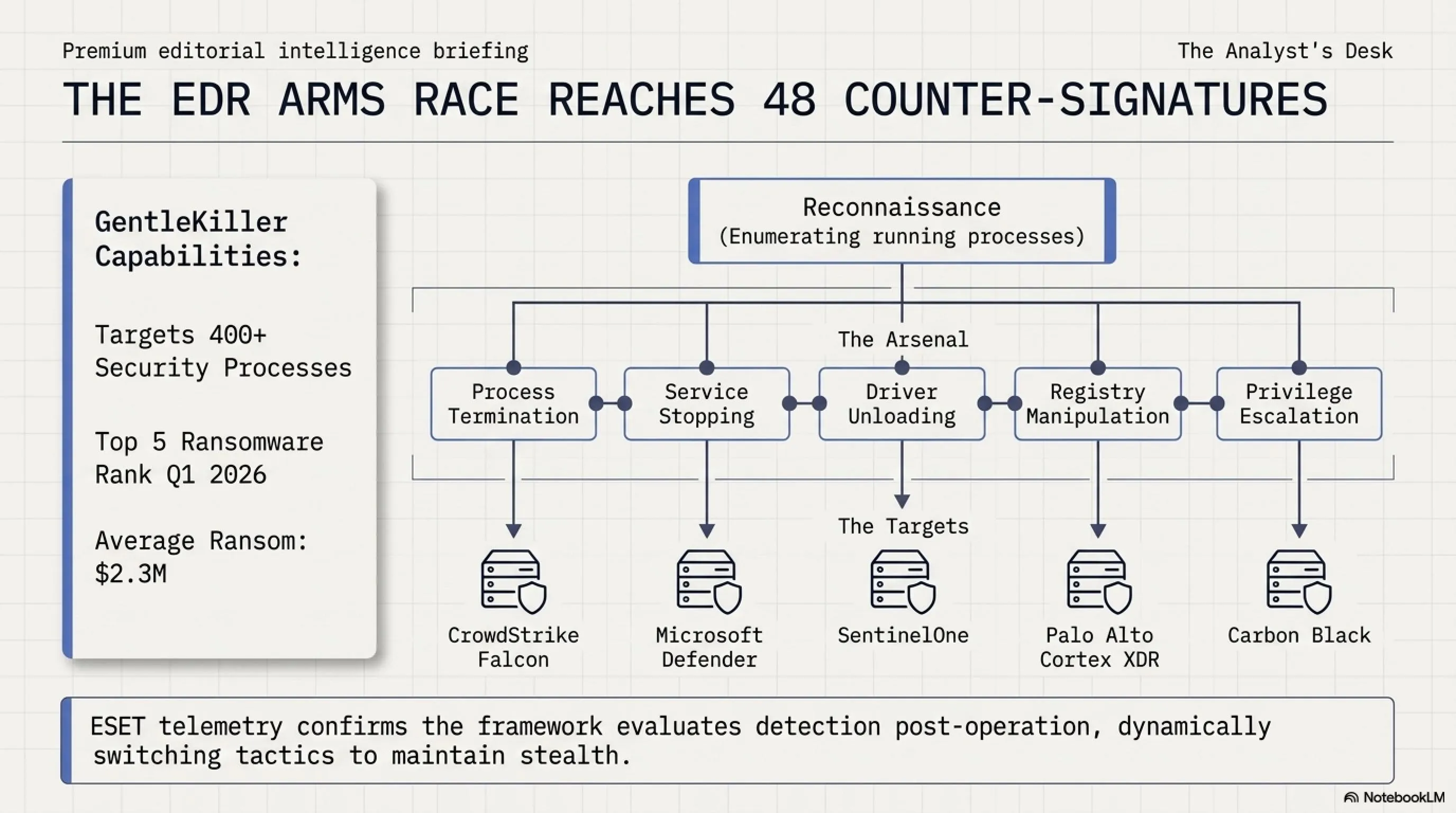
The Gentlemen ransomware group emerged in late 2025 and has rapidly become one of the five most active ransomware operations in Q1 2026. What distinguishes Gentlemen from the crowded ransomware marketplace isn't just their aggressive affiliate program offering a 90% revenue share, but their sophisticated GentleKiller tool - a mature EDR (Endpoint Detection and Response) killer framework capable of neutralizing over 400 security processes across 48 different security products.
On June 18, 2026, ESET Research published a comprehensive technical analysis detailing the Gentlemen operation and its arsenal of defense-evasion tools. The research reveals that GentleKiller isn't a single tool but rather a framework - a collection of utilities maintained and updated by the core Gentlemen operators to stay ahead of security vendor detection capabilities.
The Business Model: Why 90% Revenue Share?
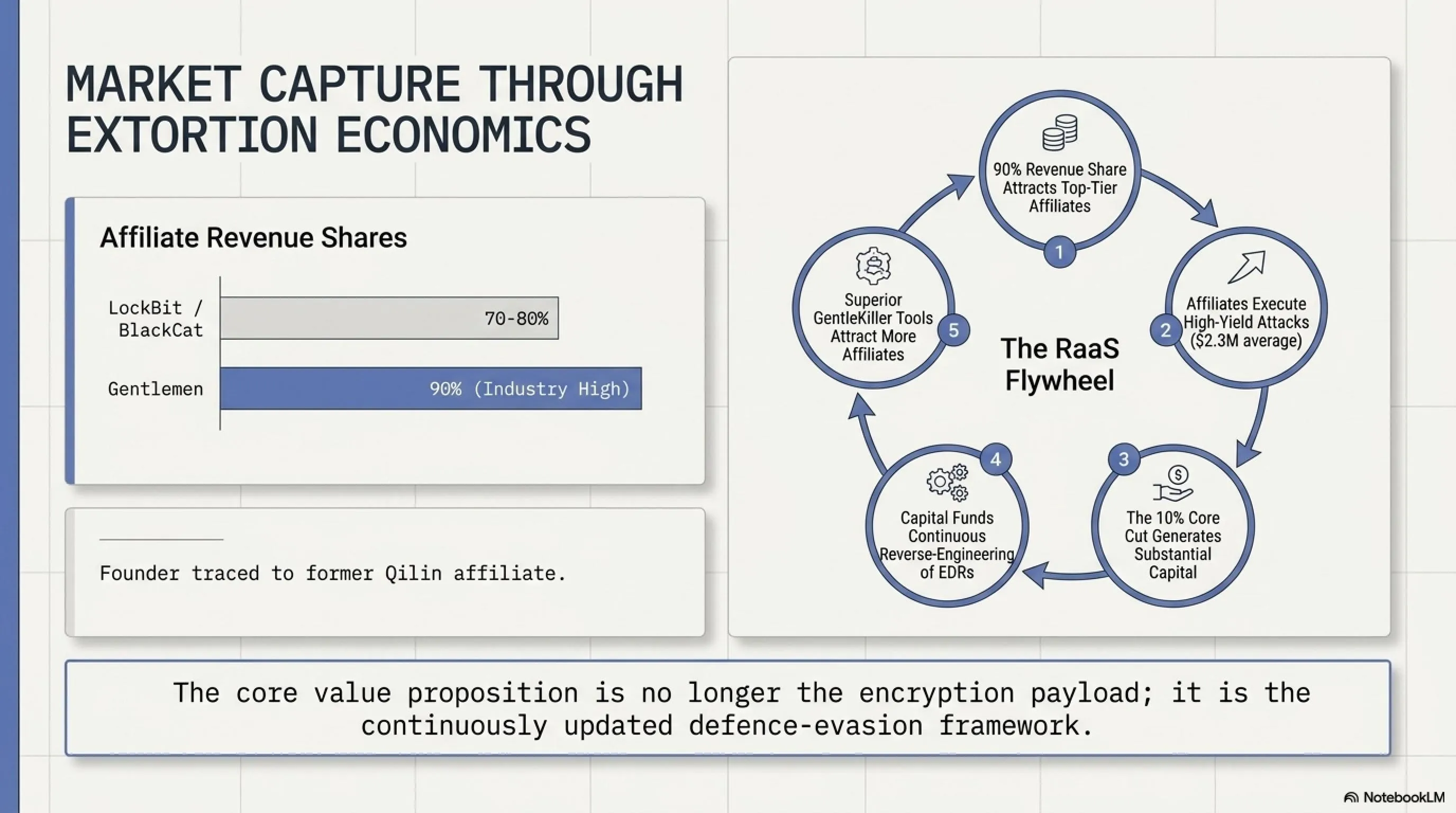
Ransomware-as-a-Service (RaaS) operates like any software-as-a-service business: a core development team creates and maintains the malware infrastructure, while affiliates handle victim identification and attack execution. Revenue is split between the two parties. Most established ransomware operations like LockBit and BlackCat typically offer affiliates 70-80% of ransom payments.
Gentlemen's 90% share is extraordinarily generous and represents an aggressive market-capture strategy. By offering affiliates a higher take, Gentlemen attracts experienced operators who might otherwise work with competing ransomware families. Group-IB researchers traced Gentlemen's founder to a former Qilin affiliate - suggesting the operation was founded by someone intimately familiar with the ransomware ecosystem and its economics.
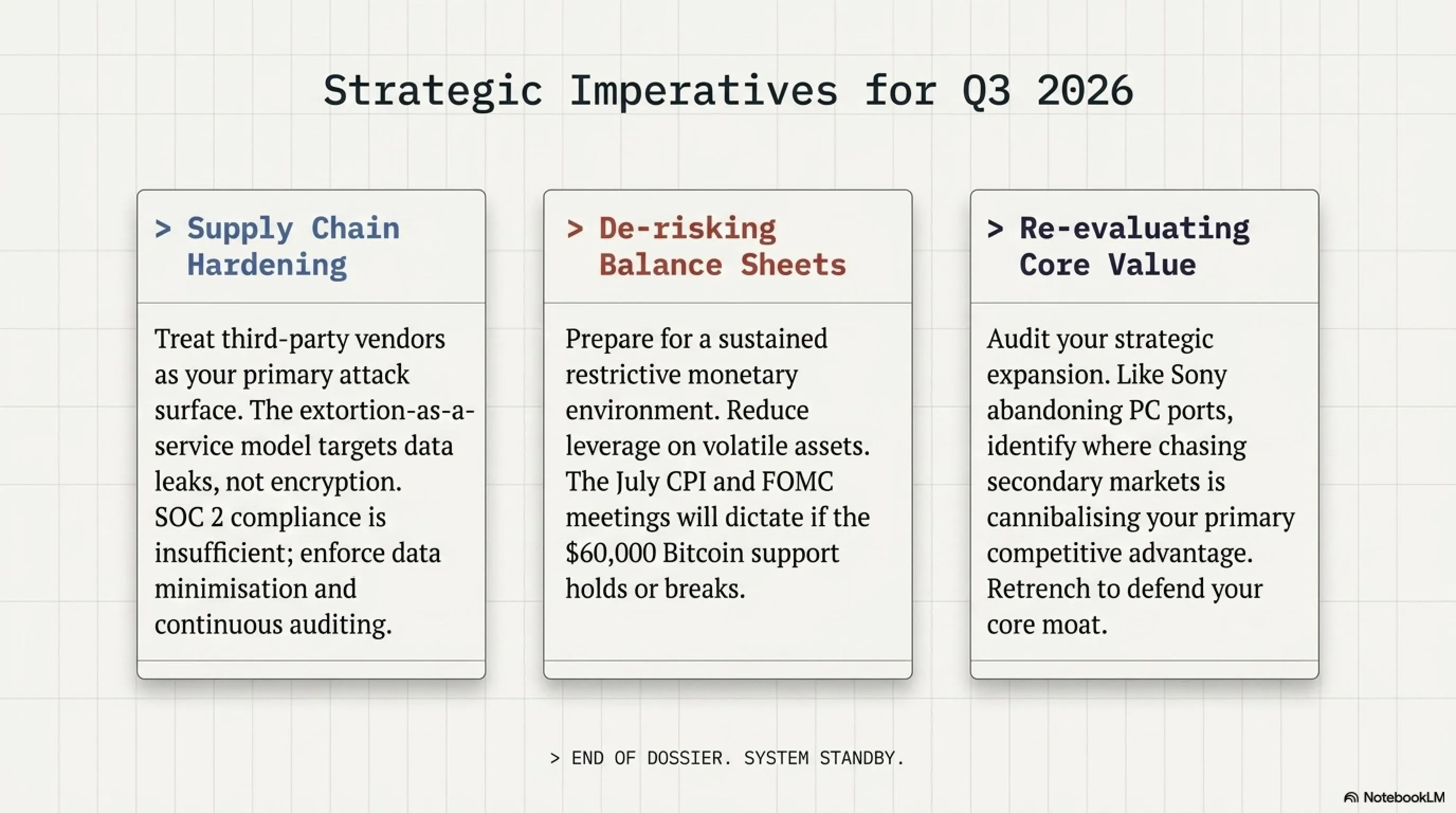
This business model works because Gentlemen's core value proposition isn't just the encryption payload - it's the defense-evasion tools like GentleKiller. Affiliates pay for access to continuously updated EDR killers that dramatically increase attack success rates. Even with a 10% take, Gentlemen likely generates substantial revenue given the scale of modern ransomware operations, where individual ransoms can reach seven or eight figures.
Tekin Analysis: The EDR Killer Arms Race
GentleKiller represents the current state of the cat-and-mouse game between attackers and defenders. EDR vendors continuously update their products to detect ransomware behavior, while ransomware operators develop tools to disable those same EDR products. This creates an arms race where both sides must continuously innovate.
What makes GentleKiller particularly concerning is its comprehensiveness. Rather than targeting a few popular EDR products, it maintains signatures for 400+ processes across 48 different vendor solutions. This breadth suggests Gentlemen has invested significant resources in reverse-engineering commercial security products and developing bypass techniques.
The framework approach also means Gentlemen can rapidly update GentleKiller as vendors patch vulnerabilities or update detection signatures. This agility gives affiliates confidence that their tools will remain effective across multiple attacks.
Technical Deep Dive: How GentleKiller Operates
GentleKiller employs a multi-stage approach to disable endpoint security. First, it conducts reconnaissance by enumerating running processes and services on the target system. Using an internal database of security product signatures, it identifies which EDR, antivirus, or endpoint protection platforms are active.
Once targets are identified, GentleKiller selects from several attack vectors depending on the specific security product. These include process termination (forcibly killing security processes), service stopping (disabling Windows services that security products depend on), driver unloading (removing kernel-mode security drivers), registry manipulation (modifying system configuration to prevent security software from restarting), and privilege escalation (exploiting legitimate Windows functionality to gain SYSTEM-level access).
The tool is designed to be stealthy. Rather than aggressively attacking all security processes simultaneously (which might trigger alerts), GentleKiller carefully sequences its operations to minimize detection. ESET's analysis shows that the tool checks for detection after each operation and can roll back or switch tactics if it determines it's being monitored.
Major EDR Products Targeted by GentleKiller
According to ESET's research, GentleKiller maintains bypass techniques for the following enterprise security products and dozens more:
- CrowdStrike Falcon - Market leader in EDR with over 29,000 enterprise customers globally
- Microsoft Defender for Endpoint - Native Windows security solution with deep OS integration
- SentinelOne - AI-powered autonomous endpoint protection platform
- Palo Alto Cortex XDR - Extended detection and response with network visibility
- Carbon Black - VMware's enterprise endpoint security solution
- Sophos Intercept X - Deep learning anti-ransomware technology
- Trend Micro Apex One - Comprehensive endpoint protection for enterprises
- McAfee Endpoint Security - One of the oldest enterprise security vendors
- Symantec Endpoint Protection - Broadcom's enterprise security offering
- Kaspersky Endpoint Security - Russian cybersecurity vendor's endpoint solution
The full list includes 48 distinct security products from vendors ranging from market leaders to specialized boutique solutions.
The Affiliate Economics and Attack Scale
Gentlemen's rise to become a top-five ransomware operation in just six months demonstrates the effectiveness of their business model. The 90% affiliate share attracts skilled operators, while the GentleKiller framework dramatically increases attack success rates. This combination creates a powerful flywheel: successful attacks generate revenue, which funds continued tool development, which attracts more affiliates, which generates more successful attacks.
Industry telemetry from cybersecurity firms suggests Gentlemen has already conducted dozens of high-profile attacks across healthcare, manufacturing, financial services, and government sectors. While specific ransom amounts remain confidential in most cases, the average ransomware payment in 2026 hovers around $2.3 million according to Coveware's Q1 2026 report - though payments can range from tens of thousands to tens of millions depending on victim size and criticality of encrypted systems.
Gentlemen Ransomware by the Numbers (Q1 2026)
Source: ESET Research, Group-IB Intelligence, HelpNetSecurity Analysis
Microsoft Clipper Malware: USB Worm Meets Tor-Based Command & Control
On June 17, 2026, Microsoft Threat Intelligence and Microsoft Defender Experts published research detailing a sophisticated Windows-based cryptocurrency clipper campaign active since February 2026. Dubbed "Crypto Clipper" by Microsoft's team, this malware represents an evolution in clipper threats by combining multiple attack vectors: USB-based worm propagation, Tor network command-and-control communication, clipboard monitoring and replacement, screenshot capture, and backdoor remote access capabilities.
What makes this campaign particularly notable is its hybrid nature. Traditional clipper malware focuses solely on monitoring the Windows clipboard for cryptocurrency wallet addresses and replacing them with attacker-controlled addresses. This campaign expands that core functionality with worm-like propagation mechanisms and persistent backdoor access, transforming what would typically be a single-purpose financial theft tool into a comprehensive endpoint compromise platform.
Attack Vector: From USB Insertion to System Compromise
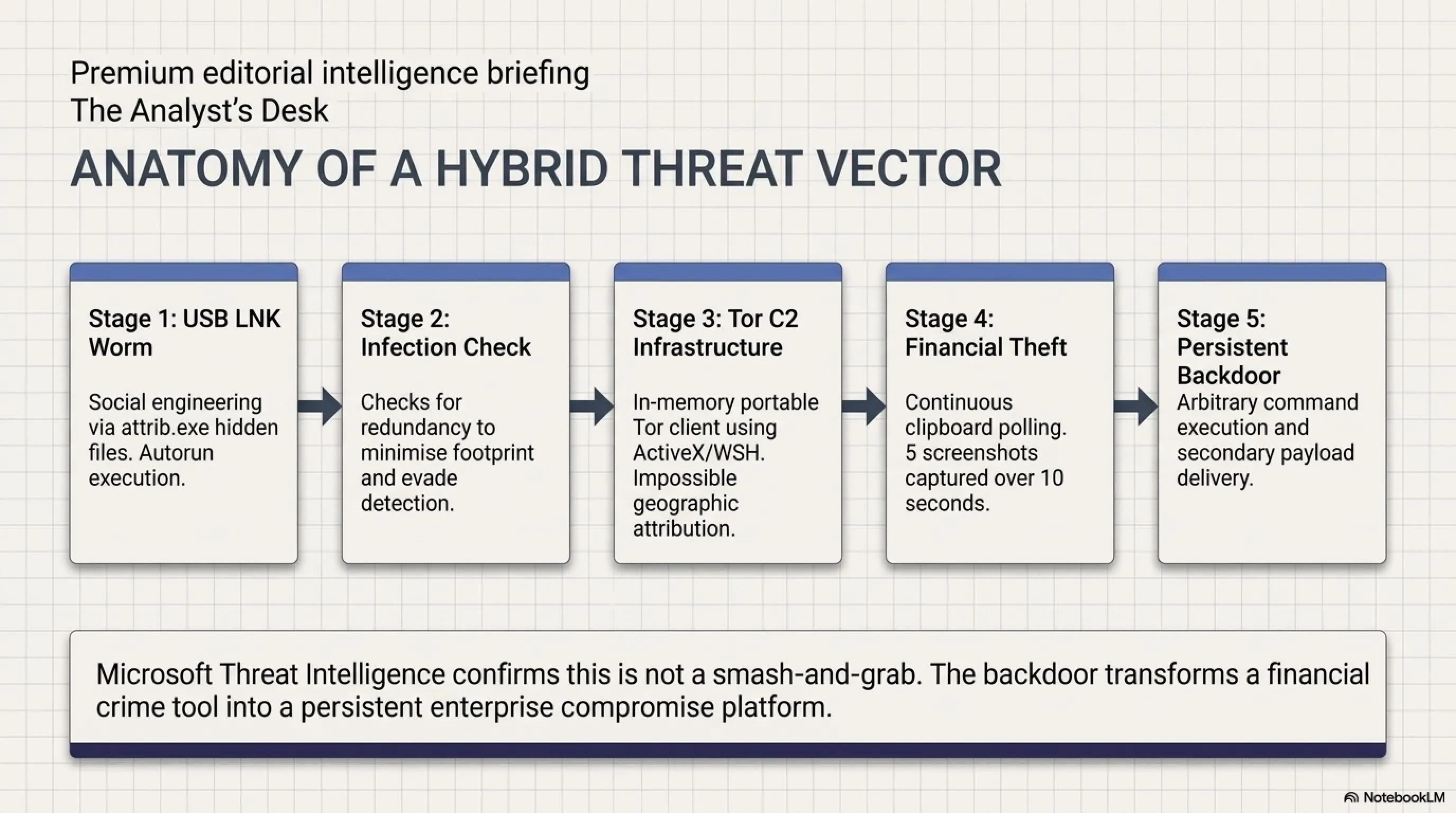
The infection chain begins with a malicious Windows Shortcut (LNK) file distributed via USB storage devices. These LNK files are designed to appear as legitimate documents - the malware hides genuine files on the USB drive and replaces them with shortcuts bearing the same icons and filenames. When a user attempts to open what appears to be a familiar document, they're actually executing the malicious payload.
Upon execution, the LNK file triggers a worm component that first checks whether the target machine is already infected. This infection check prevents redundant operations and helps the malware avoid detection by limiting its footprint. If the system is clean, the worm contacts a remote server to download the main Clipper payload.
Once installed, the malware establishes persistence through several mechanisms. It creates scheduled tasks, modifies registry run keys, and installs itself as a Windows service. These redundant persistence mechanisms ensure the malware survives reboots and remains active even if individual persistence methods are discovered and removed.
Tor Integration: Anonymity by Design
One of the most sophisticated aspects of this campaign is its use of the Tor anonymity network for command-and-control communications. The malware includes a portable Tor client that runs entirely in memory, avoiding disk-based artifacts that might be detected by security software or forensic analysis.
Microsoft's analysis reveals the malware uses Windows Script Host (WSH) and ActiveX components to configure and launch the Tor proxy. All communication with the attacker's command-and-control server is routed through Tor hidden services (.onion addresses), making it virtually impossible to trace the malware's network traffic back to the operators' infrastructure.
This Tor-based architecture provides several advantages to the attackers. Network security tools cannot easily identify malicious traffic patterns, DNS-based blocking is ineffective since .onion addresses don't use traditional DNS, geographic attribution becomes impossible, and the C2 infrastructure remains hidden and resilient to takedown attempts.
Crypto Clipper Attack Techniques - Technical Breakdown
| Technique | Implementation Details | Defense Evasion |
|---|---|---|
| USB LNK Worm | Hides legitimate files with attrib.exe, creates LNK shortcuts with identical names and icons, uses autorun.inf for automatic execution | Leverages social engineering; appears as legitimate documents |
| Tor C2 | Portable Tor client runs in-memory, communicates via .onion addresses, uses ActiveX and WSH for proxy configuration | Network traffic analysis ineffective; impossible geographic attribution |
| Clipboard Monitoring | Continuous polling of clipboard contents, regex pattern matching for wallet addresses (BTC, ETH, XMR, etc.), instant replacement with attacker addresses | Low resource footprint; difficult to detect without specialized monitoring |
| Screenshot Capture | Captures 5 screenshots over 10-second period when wallet address detected, exfiltrates via Tor | Brief capture window minimizes detection risk |
| Remote Access | Backdoor functionality allows arbitrary command execution, file operations, additional payload delivery | Provides persistent access beyond initial theft operation |
Source: Microsoft Security Blog, The Hacker News Analysis, Ars Technica Technical Review
The Clipper Mechanism: How Cryptocurrency Theft Happens
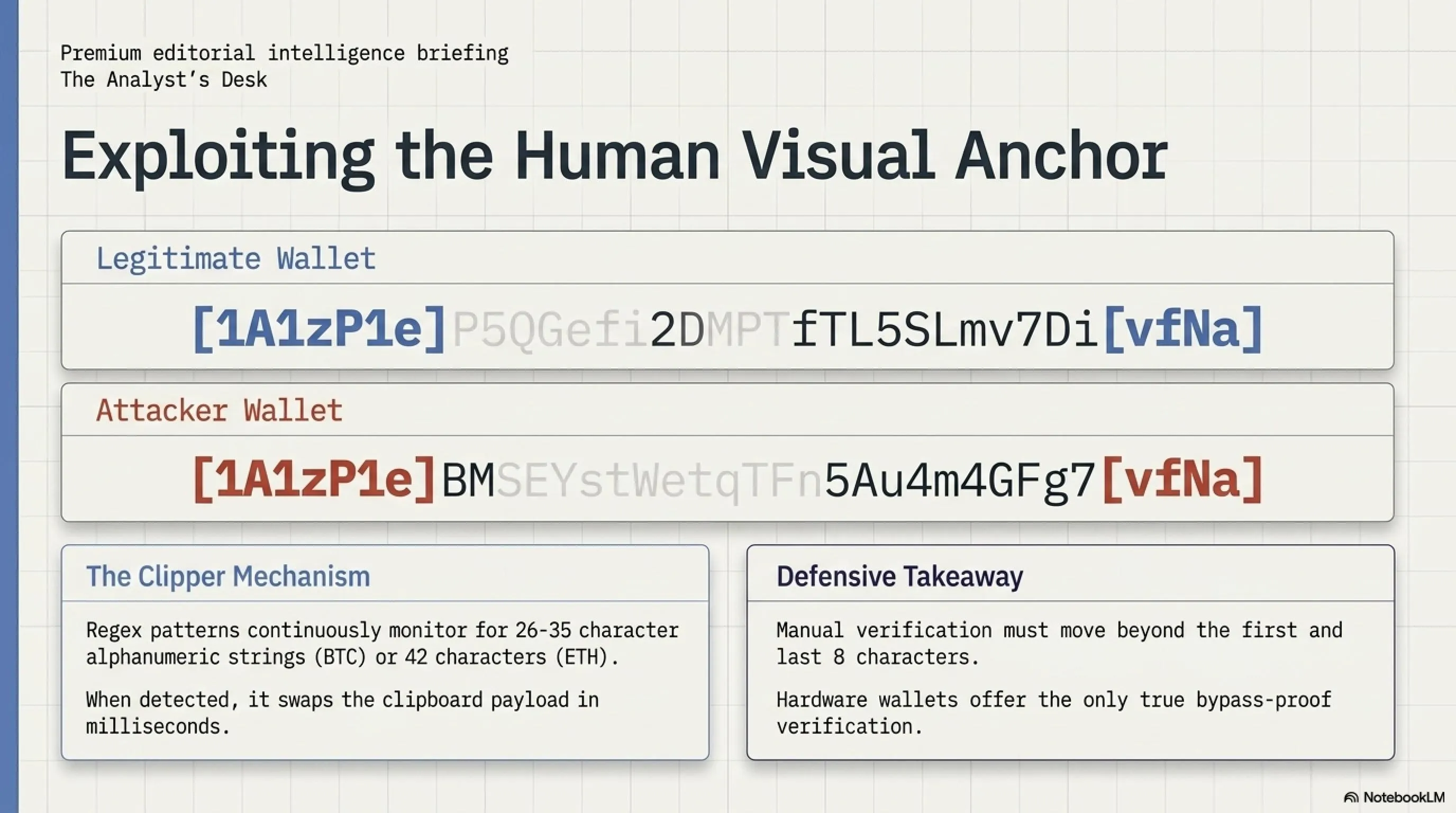
The core functionality of this malware centers on clipboard hijacking - a deceptively simple but highly effective attack technique. Cryptocurrency wallet addresses are long alphanumeric strings (typically 26-35 characters for Bitcoin, 42 characters for Ethereum) that users routinely copy and paste rather than manually typing due to their length and complexity.
The Clipper malware continuously monitors the Windows clipboard for content matching cryptocurrency address patterns. It maintains regex patterns for Bitcoin, Ethereum, Monero, Litecoin, and dozens of other cryptocurrencies. When a match is detected, the malware instantly replaces the legitimate address with an attacker-controlled address for the same cryptocurrency.
Here's the critical user experience failure that makes this attack so effective: users cannot easily verify wallet addresses by eye. A Bitcoin address like "1A1zP1eP5QGefi2DMPTfTL5SLmv7DivfNa" looks virtually identical to "1BvBMSEYstWetqTFn5Au4m4GFg7xJaNVN2" in most interfaces. Users typically verify only the first few and last few characters, and sophisticated clipper malware generates addresses that match these visual anchors.
Microsoft's report indicates the malware has been active since February 2026, suggesting potentially hundreds of victims over a four-month period. While exact financial losses remain unknown, clipboard hijacking attacks historically yield significant returns - a single high-value cryptocurrency transaction can net attackers hundreds of thousands or even millions of dollars.
Tekin Analysis: The Evolution of Clipper Malware
What distinguishes this campaign from traditional clipper malware is its hybrid nature. Classic clippers are single-purpose tools that monitor clipboards and steal cryptocurrency transactions. This variant adds worm propagation for scale, Tor communication for anonymity, screenshot capture for credential theft, and backdoor access for persistence.
The USB worm component is particularly concerning for enterprise environments. A single infected USB drive introduced into a corporate network can spread laterally across multiple systems, potentially compromising finance departments, IT administrators, or executives who handle cryptocurrency transactions on behalf of their organizations.
The backdoor functionality suggests the attackers view this as a long-term compromise platform rather than a quick smash-and-grab operation. Even after the initial cryptocurrency theft, they maintain access to deploy additional payloads, exfiltrate sensitive data, or sell access to other threat actors. This transforms a financial crime tool into a broader cybersecurity threat.
From a defense perspective, this campaign highlights the challenges of detecting malware that uses legitimate system components. Windows Script Host, ActiveX, and clipboard access are all normal Windows functionality. The malware doesn't need to exploit vulnerabilities or deploy suspicious executables - it simply orchestrates existing Windows features in malicious ways.
Bitcoin Plunge: Fed's Hawkish Pivot Triggers Crypto Liquidation Wave
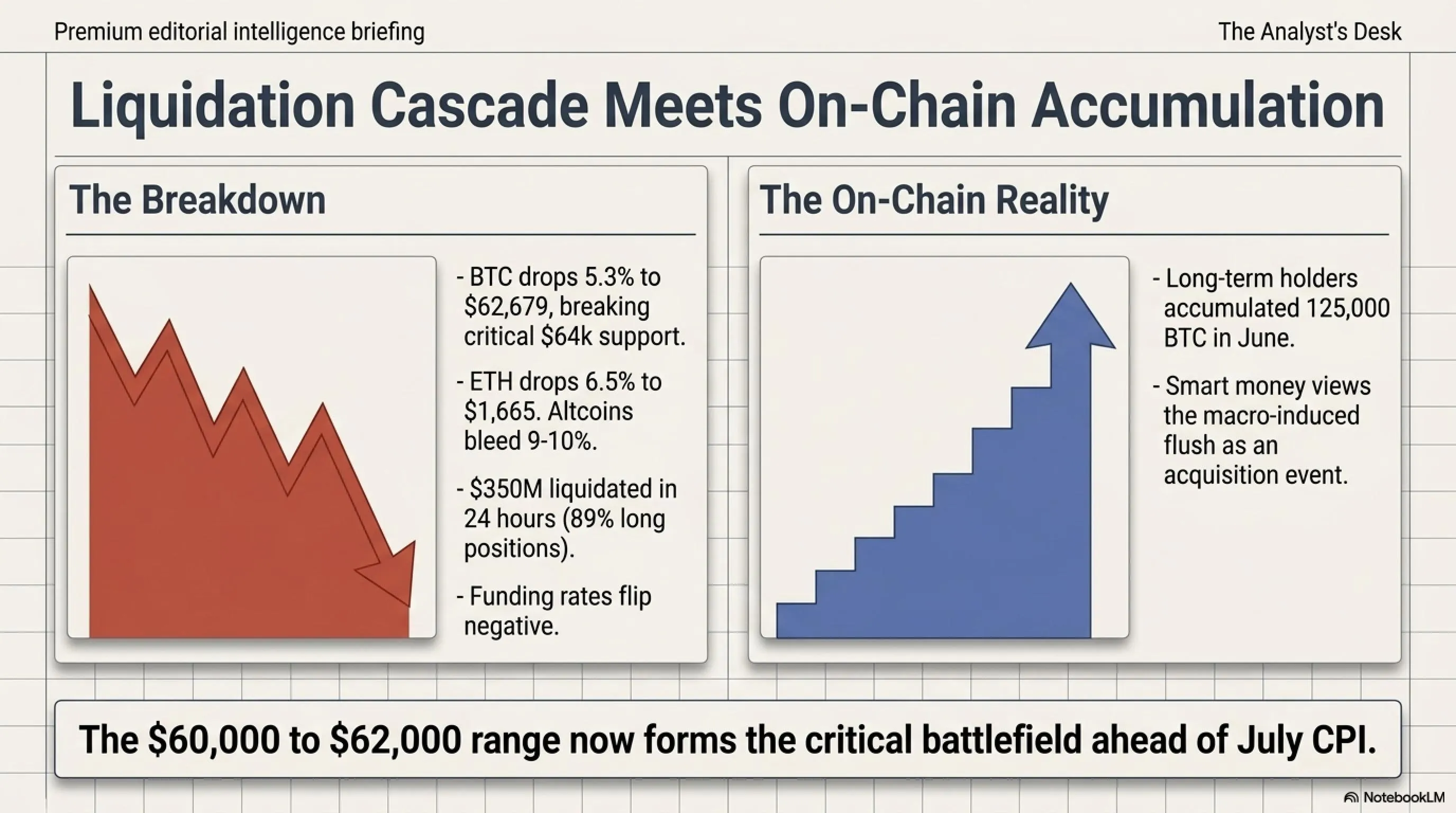
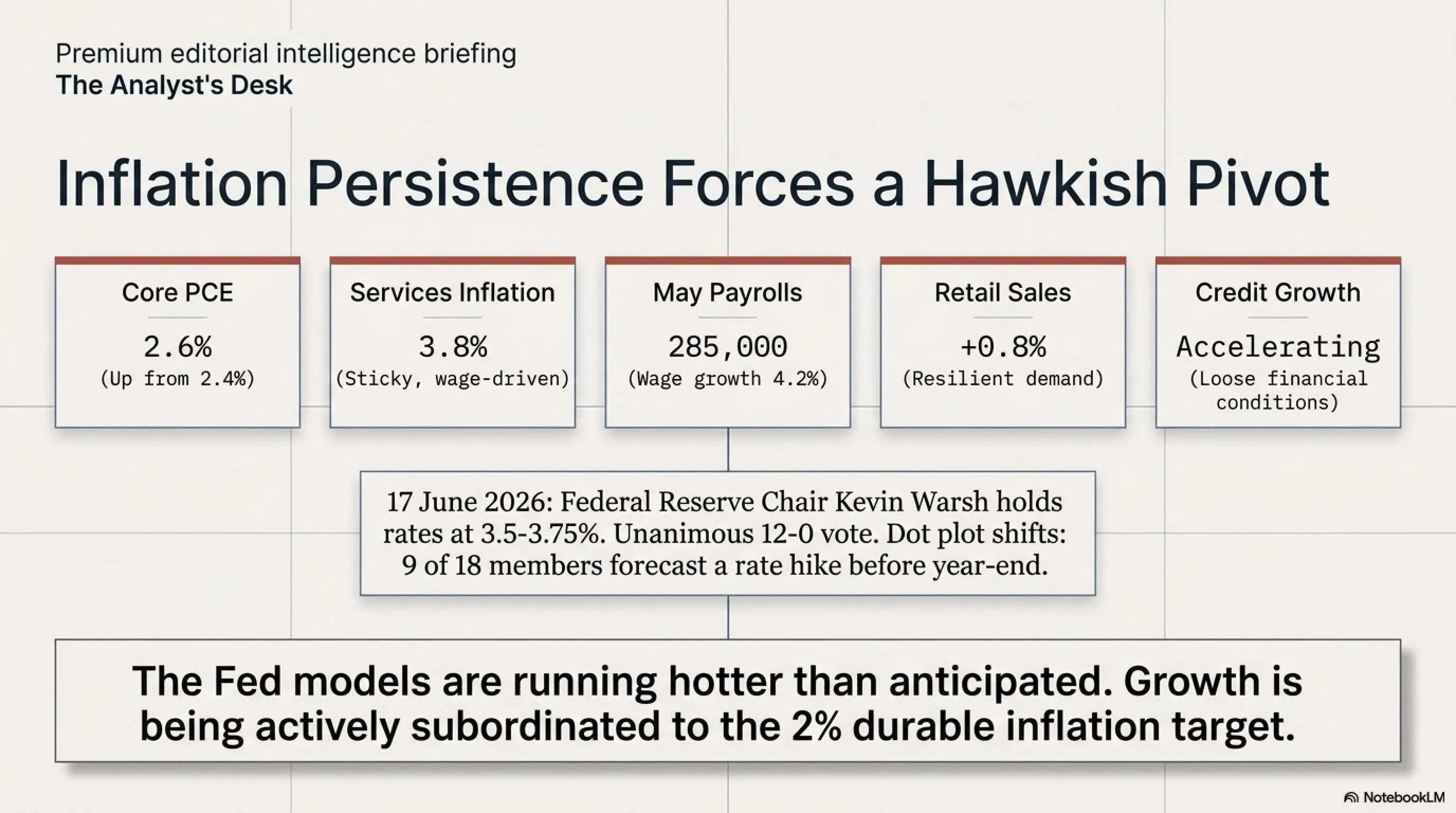
On June 17, 2026, the Federal Reserve held its first meeting under new Chair Kevin Warsh, and while the decision to hold interest rates steady at 3.5-3.75% was widely expected, the accompanying forward guidance sent shockwaves through risk asset markets. Bitcoin, which had been trading around $66,200 heading into the announcement, plummeted 5.3% to $62,679 within hours as investors digested the Fed's hawkish pivot.
The FOMC vote was unanimous (12-0) to maintain the current rate, marking the fourth consecutive hold since the Fed's last adjustment. However, the real story emerged from the updated Summary of Economic Projections and the so-called "dot plot" - a chart showing individual FOMC members' projections for future rate paths. Nine of eighteen members now forecast the possibility of at least one additional rate hike before year-end, a significant shift from the March projections which had signaled potential cuts.
Kevin Warsh's First Test: Inflation Concerns Trump Growth
Kevin Warsh, who assumed the Fed Chair role in May 2026, is known for his hawkish stance on monetary policy and deep skepticism of premature rate cuts. His academic work and previous Fed experience during the 2008 financial crisis shaped a philosophy that prioritizes price stability over short-term growth considerations. This meeting marked his first opportunity to set the tone for monetary policy under his leadership.
According to Fitch Ratings' analysis, the Fed's posture reflects persistent concerns about inflation sustainability. While headline inflation has moderated from its 2024 peaks, core inflation - which excludes volatile food and energy prices - remains elevated above the Fed's 2% target. Warsh's statement emphasized the Committee's commitment to ensuring inflation returns durably to target, using language that markets interpreted as prioritizing inflation control over other considerations.
The revised economic projections showed the Fed raising its 2026 year-end federal funds rate forecast to 3.75-4.00%, up from the previous 3.25-3.50% projection. This shift implies fewer cuts than markets had priced in, and introduces the possibility that the next rate movement could be up rather than down. Bond markets immediately repriced, with the 10-year Treasury yield jumping 12 basis points to 4.38% in the hours following the announcement.
Crypto Market Carnage: $350M Liquidated in 24 Hours
The cryptocurrency market's reaction was swift and brutal. According to Coinglass data, over $350 million in leveraged positions were liquidated in the 24 hours following the Fed announcement, with 89% of liquidations hitting long positions. This disproportionate long-side liquidation indicates markets had positioned for a dovish Fed outcome and were caught wrong-footed by the hawkish tone.
Bitcoin's drop to $62,679 represented a breakdown of critical technical support at the $64,000 level, which had held through multiple tests in May and early June. Ethereum fared even worse, declining 6.5% to $1,665 and falling below the psychologically important $1,700 level. Altcoins suffered more severe losses, with Solana down 9.0%, Cardano off 10.5%, and XRP declining 7.7%.
Derivatives market data from Marex reveals that crypto market positioning has turned "defensive and thin" in the wake of the Fed decision. Open interest in Bitcoin futures declined by 8% as traders closed positions, while the put-call ratio for near-term options spiked to 1.45, indicating elevated demand for downside protection. Funding rates for perpetual futures contracts turned negative, showing that short positions are now paying longs - a clear sign of bearish sentiment.
Why Did the Fed Turn Hawkish? Economic Data Breakdown
The Fed's hawkish shift didn't occur in a vacuum - it reflects several concerning economic data points that emerged in the weeks preceding the June meeting:
- Core PCE Inflation: The Fed's preferred inflation gauge registered 2.6% year-over-year in May, up from 2.4% in April, suggesting inflation progress has stalled
- Services Inflation Persistence: Services ex-housing inflation remains elevated at 3.8%, indicating sticky wage-driven price pressures
- Labor Market Resilience: May payrolls came in at 285,000, well above expectations, with wage growth accelerating to 4.2% annually
- Consumer Spending Strength: Retail sales rose 0.8% in May, suggesting consumer demand remains robust despite elevated rates
- Credit Growth: Commercial and industrial loan growth accelerated, indicating financial conditions may not be as tight as the Fed desires
Collectively, these data points suggest the economy is running hotter than the Fed's models predicted, forcing policymakers to maintain a restrictive stance longer than markets anticipated. For risk assets like crypto, which thrive in loose financial conditions, this represents a significant headwind.
Cryptocurrency Performance: 24-Hour Post-Fed Comparison
| Asset | Pre-Fed Price | Post-Fed Low | Change | 24h Volume |
|---|---|---|---|---|
| Bitcoin (BTC) | $66,200 | $62,679 | -5.3% | $42.3B |
| Ethereum (ETH) | $1,780 | $1,665 | -6.5% | $18.7B |
| XRP | $0.52 | $0.48 | -7.7% | $2.8B |
| Solana (SOL) | $145 | $132 | -9.0% | $4.2B |
| Cardano (ADA) | $0.38 | $0.34 | -10.5% | $685M |
| Total Market Cap | $2.41T | $2.29T | -$120B | - |
Source: CoinMarketCap, CoinGecko, Coinglass - Data as of June 18, 2026, 18:00 UTC
Tekin Analysis: Will Bitcoin Break $60K? On-Chain Signals vs. Macro Headwinds
The $64,000 level represented critical technical support for Bitcoin, tested successfully multiple times since late May. Its breakdown opens the door to further downside, with $60,000 emerging as the next major support zone. Bitcoin Magazine's technical analysts warn that failure to reclaim $64K quickly could trigger accelerated selling toward the $58,000-$60,000 range.
However, on-chain data presents a more nuanced picture. Glassnode's analysis reveals that long-term holders accumulated over 125,000 BTC in June - a significant buying signal suggesting conviction among experienced investors. These holders typically have lower cost bases and longer time horizons, making them less susceptible to short-term price volatility. Historically, periods of long-term holder accumulation have preceded major bull runs.
The crypto market's fate now hinges on the Fed's next moves. If upcoming inflation data remains elevated and the Fed follows through with additional rate hikes, Bitcoin could face sustained pressure. Conversely, any softening in inflation metrics or signs of economic weakness might prompt the Fed to pivot dovish, potentially reigniting crypto's bull case. The next critical data points arrive with June CPI on July 12 and the July FOMC meeting on July 30-31.
For traders and investors, this environment demands caution. Leverage should be reduced given the elevated volatility and unclear near-term direction. Dollar-cost averaging strategies may prove prudent for those with longer time horizons, allowing accumulation at potentially attractive levels if the selloff extends. The key is recognizing that crypto's correlation with traditional risk assets remains high, making macro conditions the primary driver.
Sony Ends PC Port Strategy: The Return of "Only on PS5"
In one of 2026's most significant gaming industry strategy shifts, Sony Interactive Entertainment has officially ended its six-year experiment with PC ports of first-party single-player exclusives. The announcement, delivered by PlayStation CEO Hideaki Nishino in an interview with Japanese gaming magazine Famitsu, marks a complete reversal of the strategy initiated under former PlayStation chief Jim Ryan in 2020.
Bloomberg's Jason Schreier - widely regarded as the gaming industry's most connected journalist - confirmed the news through his own sources, reporting that Sony Studio Business Group CEO Hermen Hulst announced the strategic pivot during an internal company town hall. The "Only on PS5" branding, shelved in 2020, will return to marketing materials for Sony's narrative-driven titles.
The Six-Year PC Experiment: What Went Wrong?
Sony's PC strategy began in August 2020 with Horizon Zero Dawn's Steam release - a test case to determine whether the company could monetize its back catalog while maintaining the value of PlayStation hardware. The theory was elegant: release games on PC 2-4 years after their PlayStation debut, capturing additional revenue from a different customer segment without cannibalizing console sales.
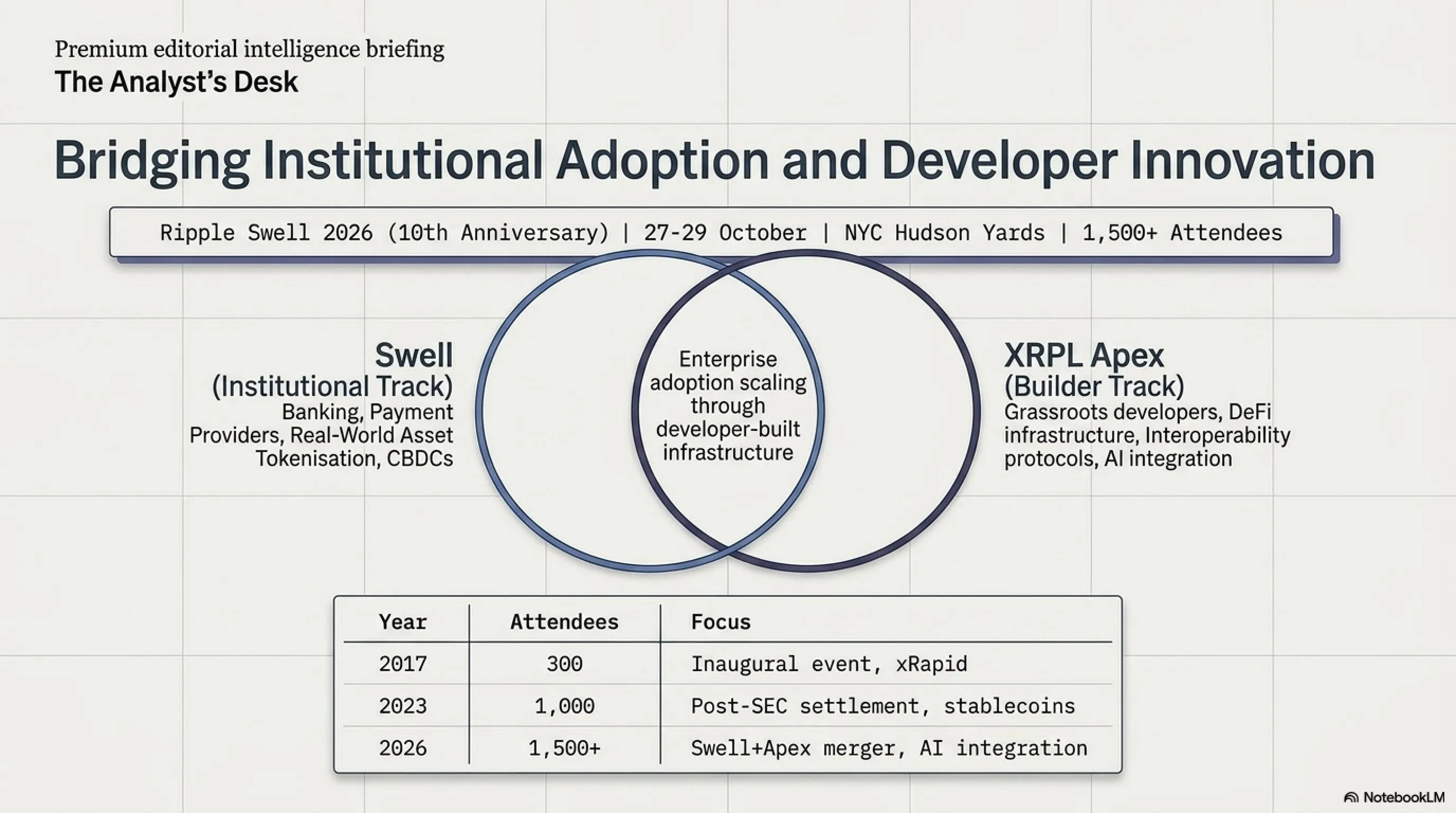
Initial results seemed promising. God of War (2022 PC release) sold 971,000 copies in its first week on Steam, while Marvel's Spider-Man Remastered moved 1.5 million copies in its first month. However, these successes masked deeper strategic problems that Sony has now concluded outweigh the financial benefits.
The core issue: value dilution. PlayStation's competitive advantage has historically rested on exclusive content that justifies the $500 console purchase. When consumers know that patient waiting will deliver the same games on PC - often with superior graphics, mod support, and without PlayStation Plus subscription fees - the console value proposition erodes. This is particularly problematic as hardware margins are thin or negative, with Sony relying on software sales and subscriptions for profitability.
Sony's PC Ports: A Six-Year Retrospective
Between 2020 and 2026, Sony published fifteen PlayStation exclusives on PC. The results varied dramatically:
- Horizon Zero Dawn (2020): First experiment, modest 750K copies in month one, mixed reception due to technical issues
- Days Gone (2021): Disappointing 380K first-month sales, negative word-of-mouth impacted brand
- God of War (2022): Major success with 971K week-one sales, demonstrated demand for premium titles
- Spider-Man Remastered (2022): Breakout hit with 1.5M first-month sales, but cannibalized PS5 hardware
- Uncharted: Legacy Collection (2022): Solid 620K units, proved catalog value
- The Last of Us Part I (2023): Launch disaster with severe performance issues, only 425K first month despite massive IP recognition
- Returnal (2023): Catastrophic failure with just 185K units, far below expectations
- Sackboy: A Big Adventure (2023): Niche appeal, 290K copies
- Ratchet & Clank: Rift Apart (2024): Underwhelming 410K despite technical showcase status
- Ghost of Tsushima (2024): Strong performer with 890K first month, but released too late to impact PS5 sales
Out of fifteen ports, only four (God of War, Spider-Man, Uncharted, Ghost of Tsushima) met Sony's profitability thresholds when factoring in porting costs, marketing, and opportunity costs.
Nishino's Official Statement: Reading Between the Lines
In his Famitsu interview, Hideaki Nishino chose his words carefully, leaving some room for future flexibility while signaling a clear strategic direction. "Platform selection has always been determined based on the characteristics of each individual title," he stated. "If releasing a game on PC allows us to maximize the value of that game's experience, we will continue to consider it."
However, the key statement followed: "Our current main policy is that, for single-player games developed in-house, we will further refine the value of the gaming experience that PlayStation can offer." This language explicitly prioritizes platform exclusivity over revenue maximization, representing a philosophical shift in Sony's approach to its gaming business.
The "characteristics of each individual title" caveat likely leaves the door open for live-service and multiplayer titles, which benefit from larger player bases and where cross-platform play can enhance rather than diminish value. Sony's successful Helldivers 2 - launched simultaneously on PS5 and PC in February 2024 - demonstrates this model's viability. The game sold over 12 million copies across both platforms, with PC players comprising roughly 60% of the player base, and the shared multiplayer environment driving PlayStation Plus subscriptions.
Tekin Analysis: Sony vs. Microsoft - Diverging Console Strategies
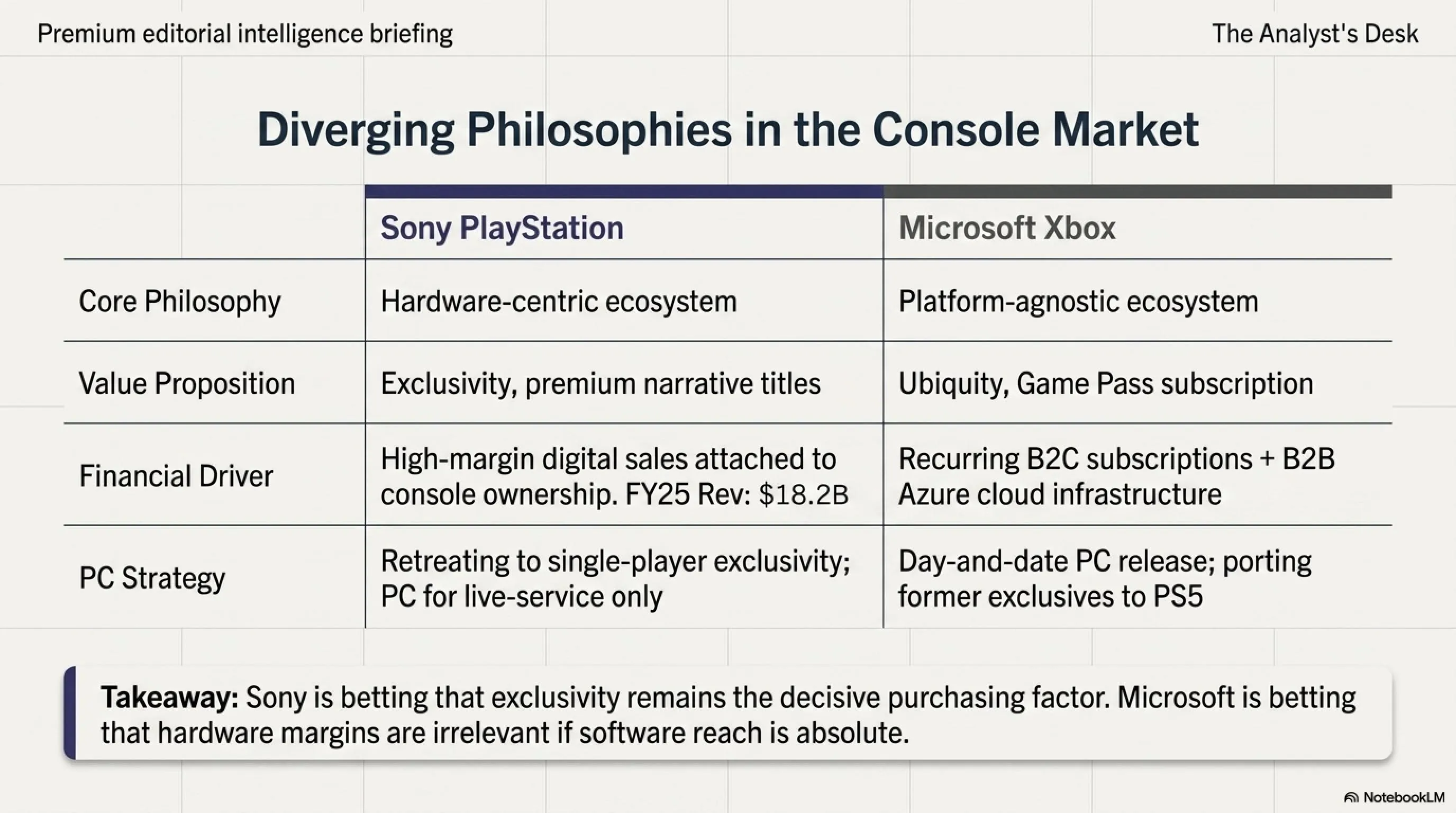
Sony's PC retreat positions the company in direct philosophical opposition to Microsoft's gaming strategy. Microsoft has spent the past five years systematically dismantling Xbox console exclusivity, bringing all first-party titles to PC day-and-date and even porting former exclusives like Hi-Fi Rush and Sea of Thieves to PlayStation. Microsoft's strategy prioritizes Game Pass subscriber growth and total player reach over hardware sales.
The financial logic differs between the two companies. Microsoft views gaming as one component of a broader technology ecosystem - Azure cloud infrastructure, Windows licensing, and enterprise services generate the majority of revenue. Xbox can afford to sacrifice hardware margins in pursuit of software and subscription revenue because Microsoft's profitability doesn't depend on gaming hardware economics.
Sony, by contrast, has no comparable B2B revenue streams. PlayStation constitutes a massive portion of Sony Corporation's operating income - the gaming division generated ¥2.7 trillion ($18.2B) in revenue and ¥290 billion ($2B) in operating profit in FY2025. Hardware sales drive this ecosystem: each console sold creates an opportunity for high-margin digital game sales, PlayStation Plus subscriptions, and peripheral purchases. Undermining hardware appeal threatens the entire business model.
From a competitive perspective, Sony is betting that exclusive content remains a decisive factor in console purchasing decisions. If Microsoft's everything-everywhere approach erodes Xbox hardware sales without corresponding Game Pass growth - a scenario some analysts suggest current data supports - Sony's renewed focus on exclusivity could capture an even larger share of the dedicated console gaming market.
The risk: alienating the substantial PC gaming audience that had begun to view PlayStation favorably due to PC support. These gamers now have no path to access upcoming Sony exclusives like the next God of War or a potential Bloodborne sequel without purchasing PS5 hardware. Some will make that purchase, but others will simply ignore Sony's offerings, potentially limiting the cultural impact and mindshare of Sony's franchises.
Ripple Swell 2026: 10th Anniversary and XRP ETF Speculation
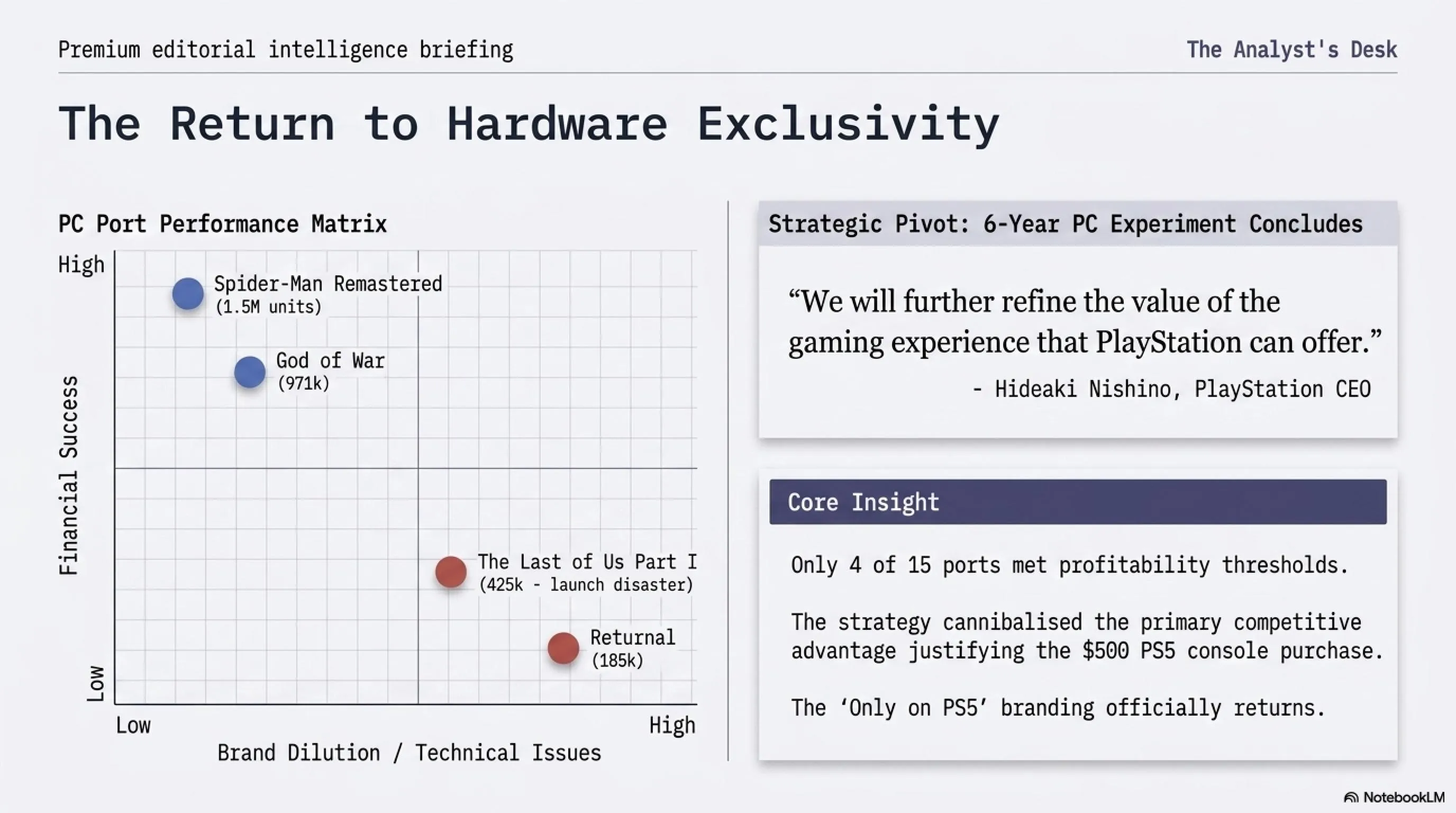
Ripple Swell 2026, scheduled for October 27-29 at The Shed in New York City's Hudson Yards, represents a milestone for the payment-focused blockchain company. This year marks the conference's tenth anniversary and its largest iteration to date, with over 1,500 attendees expected from banking, fintech, government, and blockchain sectors. For the first time, Swell has merged with XRPL Apex - Ripple's developer-focused summit - creating a three-day event spanning institutional adoption, ecosystem development, and emerging technology.
The combined format signals Ripple's strategic intent to bridge the gap between enterprise blockchain adoption and grassroots developer innovation. Previous Swell events primarily targeted banks and payment providers, focusing on RippleNet adoption and cross-border payment use cases. XRPL Apex, launched in 2023, served the developer community building applications on the XRP Ledger. Merging these audiences creates opportunities for collaboration between institutional players seeking blockchain solutions and developers capable of building them.
What to Expect: Agenda Focus Areas
David Schwartz, Ripple's CTO Emeritus and one of the original XRP Ledger architects, outlined the conference's thematic pillars in a June 17 post on X. The five focus areas reflect Ripple's vision for XRPL's evolution: payments and remittances, real-world asset tokenization, decentralized finance infrastructure, blockchain interoperability protocols, and AI integration with blockchain systems.
The event structure features three simultaneous stages: the Main Stage for keynotes and major announcements, the Institutional Track for banking and enterprise sessions, and the Builder Track for technical workshops and developer panels. This parallel programming allows Swell to serve multiple constituencies without forcing attendees to choose between business strategy and technical implementation content.
Ripple Swell Evolution: A Decade of Growth
| Year | Attendees | Speakers | Key Highlights |
|---|---|---|---|
| 2017 | ~300 | 20+ | Inaugural event, xRapid introduction, Ben Bernanke keynote |
| 2019 | ~500 | 30+ | RippleNet expansion, ODL (On-Demand Liquidity) launch |
| 2020 | ~600 | 35+ | Virtual event due to COVID-19, CBDC discussions emerge |
| 2023 | ~1,000 | 50+ | Post-SEC settlement optimism, stablecoin strategy unveiled |
| 2025 | ~1,200 | 60+ | BlackRock executive endorses XRPL utility, institutional momentum |
| 2026 | 1,500+ | 75+ | First Swell+Apex merger, XRP ETF speculation, AI integration focus |
Source: Ripple official announcements, CryptoNews analysis
The BlackRock XRP ETF Question: Speculation vs. Reality
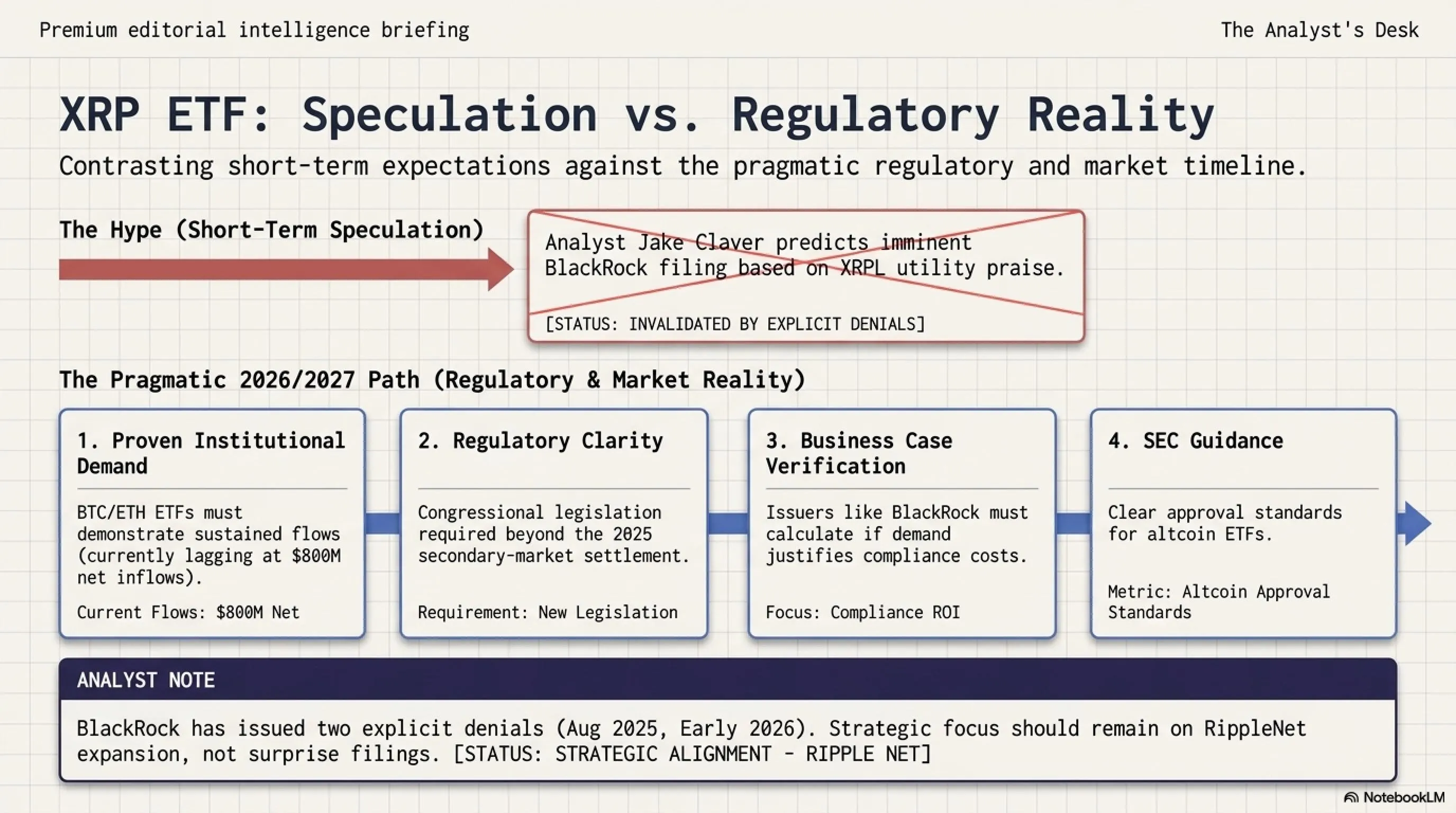
Perhaps no topic generates more discussion in XRP circles than the possibility of a BlackRock-backed spot XRP ETF. Analyst Jake Claver recently renewed speculation by predicting BlackRock would file for XRP ETF approval, citing the asset manager's growing interest in XRP Ledger technology and infrastructure. The speculation isn't entirely baseless - BlackRock has explored XRPL for tokenization use cases and executives have publicly praised Ripple's real-world blockchain adoption success.
However, the reality is more sobering. BlackRock has officially denied XRP ETF plans twice - first in August 2025 and again in early 2026. A BlackRock spokesperson told The Block that the firm's crypto ETF focus remains exclusively on Bitcoin and Ethereum, the two assets with established regulatory clarity and proven institutional demand. At Ripple Swell 2025, a BlackRock executive indeed praised Ripple's work in proving blockchain utility, but this endorsement stopped well short of announcing product plans.
The ETF landscape in 2026 provides important context. While Bitcoin and Ethereum spot ETFs launched in 2024 and 2025 respectively, their flows have underperformed expectations. Bitcoin ETFs have attracted approximately $800 million in net inflows - respectable but far below the $3+ billion that would signal mainstream institutional adoption. Until these established crypto ETFs demonstrate stronger institutional uptake, issuers like BlackRock are unlikely to expand into more speculative assets like XRP.
Tekin Analysis: The Real XRP ETF Timeline
XRP finds itself in what we might call regulatory limbo. The SEC settlement in 2025 clarified XRP's status in secondary markets but left questions about programmatic sales and institutional securities classification. For a major asset manager like BlackRock, regulatory clarity isn't just important - it's existential. The firm cannot risk launching a product that might face regulatory challenges after launch.
A realistic timeline for XRP ETF approval likely extends into late 2026 or 2027. First, Bitcoin and Ethereum ETFs need to demonstrate sustained institutional adoption, proving the product-market fit that would justify expanding the crypto ETF universe. Second, XRP needs additional regulatory clarity, potentially through Congressional legislation establishing comprehensive crypto asset frameworks. Third, BlackRock or another major issuer needs to see compelling business case - sufficient expected demand to justify regulatory navigation costs.
For XRP holders, this doesn't mean abandoning ETF hopes - it means recalibrating expectations. Ripple Swell 2026 may well feature discussions about ETF possibilities and institutional access vehicles. But expecting a surprise BlackRock filing announcement would be unrealistic given the firm's repeated denials and the current regulatory landscape.
What Swell 2026 more realistically offers: announcements of new RippleNet partnerships, expansion of XRPL DeFi capabilities, potential CBDC pilot programs, and perhaps most importantly, continued evidence of real-world blockchain adoption that strengthens the long-term case for XRP utility. These developments, while less exciting than ETF speculation, represent the fundamental value drivers that will ultimately determine XRP's success.
Nintendo's TinyPulse Breach: Supply Chain Vulnerability Exposed
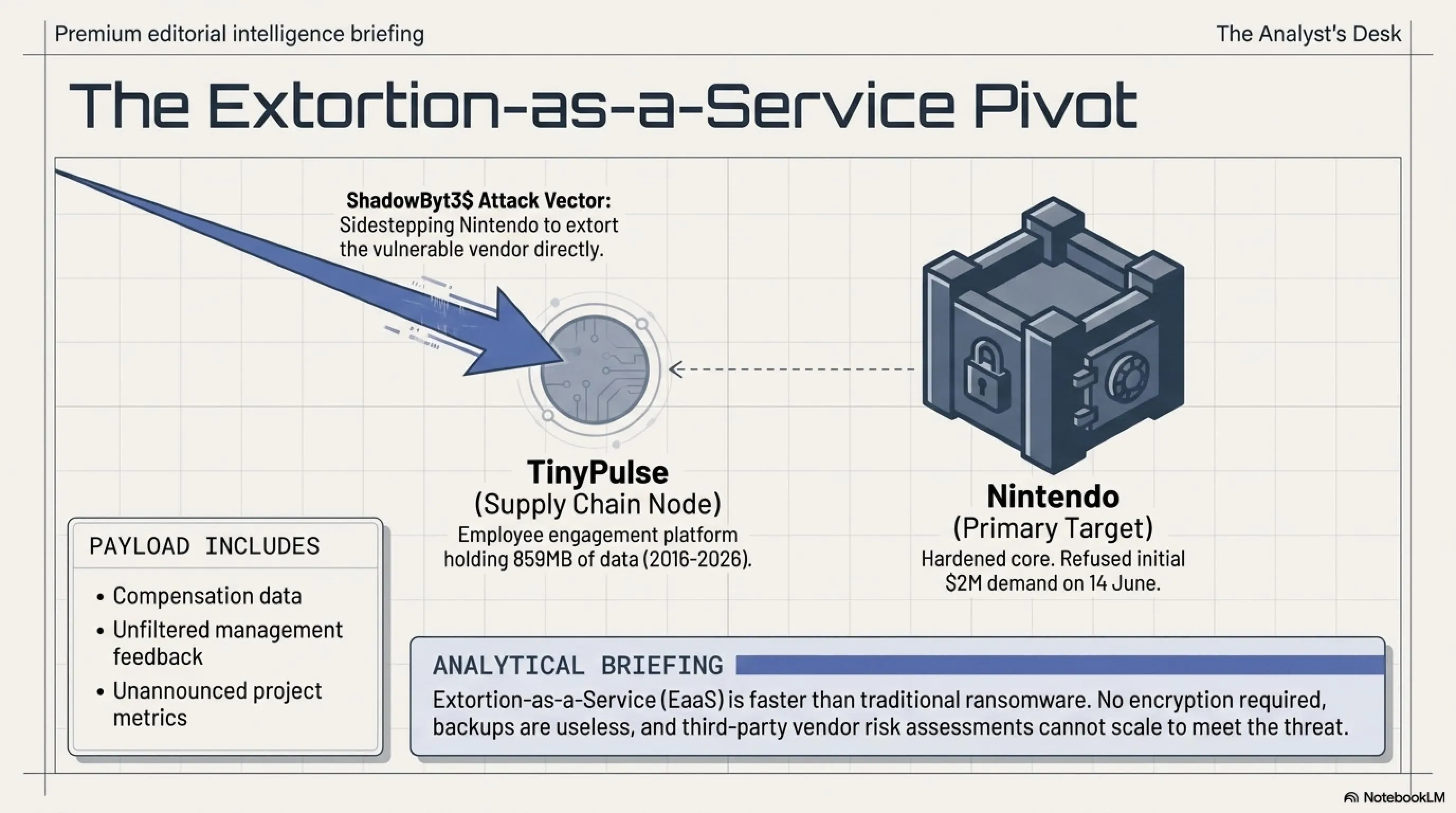
On June 13, 2026, a hacking group calling itself ShadowByt3$ posted a threat on a prominent cybercrime forum claiming to have stolen 859MB of internal Nintendo data spanning a decade (2016-2026). The group demanded $2 million from Nintendo, threatening to release employee surveys, internal communications, emails, and potentially financial information if the ransom wasn't paid. Nintendo refused, prompting the attackers to pivot their extortion attempt to the actual breach target: TinyPulse, an employee engagement platform owned by WebMD Health Services.
This incident exemplifies a classic supply chain attack vector that has become increasingly common in the ransomware era. Rather than directly compromising Nintendo's hardened infrastructure, the attackers targeted a third-party vendor with presumably weaker security controls. Nintendo confirmed the breach in a statement to Mashable: "We are aware of an issue involving TinyPulse, a third-party service used for internal employee surveys at Nintendo of America. Nintendo's systems have not been compromised."
ShadowByt3$: Extortion-as-a-Service Business Model
ShadowByt3$ represents an evolution in cybercrime business models, describing itself as an "extortion-as-a-service" operation. Unlike traditional ransomware groups that encrypt victim data, extortion specialists focus purely on data theft and leveraged disclosure threats. This model has several advantages for attackers: it's faster to execute since no encryption is required, it's harder to defend against since backups don't protect against data leaks, and it creates different legal and PR considerations for victims.
The $2 million ransom demand represents the upper end of extortion pricing but remains within the realm of plausibility for a company of Nintendo's size and reputation sensitivity. According to SC Magazine's reporting, after Nintendo refused payment, ShadowByt3$ approached TinyPulse with a similar demand, attempting to extract payment from the vendor who actually suffered the security failure.
What Data Was Compromised?
Nintendo's official statement characterized the compromised data as "limited to internal survey content comprising a small subset of our employees." However, CyberNews' analysis of the threat actor's claims suggests the breach may be more extensive. The 859MB of data allegedly includes employee feedback surveys, internal communications, email threads, and potentially financial details spanning 2016-2026 - essentially a decade of Nintendo of America's employee engagement records.
Employee survey platforms like TinyPulse collect surprisingly sensitive information. Beyond basic satisfaction ratings, these systems often capture:
- Unfiltered employee opinions about management, strategy, and company direction
- Compensation satisfaction data that might reveal salary ranges and bonus structures
- Performance review inputs and peer feedback
- Morale indicators and turnover risk assessments
- Project-specific feedback that could reveal unannounced products or initiatives
- Workplace culture issues including potential harassment or discrimination concerns
For a company like Nintendo, known for extreme secrecy around product development, even employee survey data could contain valuable competitive intelligence. Comments about specific projects, frustrations with particular development processes, or excitement about upcoming releases could all provide insights that Nintendo would prefer to keep confidential.
Timeline: Nintendo Breach and Extortion Attempt
| Date | Event |
|---|---|
| June 13, 2026 | ShadowByt3$ posts breach claim on cybercrime forum, claims 859MB Nintendo data |
| June 14, 2026 | Extortion group issues $2 million ransom demand to Nintendo |
| June 15, 2026 | Nintendo declines payment, begins internal investigation |
| June 16, 2026 | Attackers pivot to TinyPulse, demand payment from vendor instead |
| June 17, 2026 | CyberNews publishes detailed analysis of breach claims |
| June 18, 2026 | Nintendo issues official statement confirming TinyPulse incident, emphasizes systems not compromised |
Source: CyberNews, Mashable, SC Magazine, BleepingComputer
Tekin Analysis: Supply Chain Security as Strategic Risk
The Nintendo-TinyPulse incident perfectly illustrates why supply chain security has become a board-level concern for major corporations. Nintendo almost certainly invests heavily in internal cybersecurity - gaming companies face constant attacks from hackers seeking unreleased games, source code, and competitive intelligence. Yet all that investment becomes irrelevant when a third-party vendor with access to sensitive data maintains inadequate security controls.
This attack vector parallels the infamous SolarWinds breach, where Russian intelligence operatives compromised SolarWinds' Orion software to access thousands of downstream customers including major U.S. government agencies. The tactic is devastatingly effective: rather than attacking heavily defended primary targets, compromise vendors those targets trust and rely upon.
The challenge for organizations is scale. Large enterprises like Nintendo work with hundreds or thousands of vendors, many providing seemingly low-risk services like employee surveys, benefits administration, or office supplies. Conducting thorough security assessments of every vendor is resource-prohibitive, yet any vendor with data access represents potential supply chain risk.
Effective supply chain security requires: vendor risk assessments that evaluate cybersecurity posture before contract signing, contractual security requirements including SOC 2 compliance, incident notification clauses, and liability provisions, data minimization principles ensuring vendors only access truly necessary information, continuous monitoring through regular security audits and penetration testing, and incident response planning that includes vendor compromise scenarios.
Nintendo's response - quickly clarifying that internal systems weren't compromised while working with TinyPulse to address the issue - represents best-practice crisis management. The company avoided the dual pitfalls of downplaying the incident or overstating its severity, providing factual information that allows stakeholders to understand the actual risk.
Why do ransomware groups continue succeeding despite improved defenses?
Ransomware's continued success stems from multiple factors. First, many organizations still lack comprehensive backup strategies, making data restoration without paying ransom impossible. Second, the RaaS model democratizes cybercrime - affiliates with minimal technical skills can launch sophisticated attacks using professionally developed tools. Third, cryptocurrency payments make attribution and recovery nearly impossible. Fourth, insurance policies that cover ransom payments create moral hazard, incentivizing companies to pay rather than invest in prevention. Finally, the asymmetry favors attackers: defenders must secure every possible entry point, while attackers need to find just one vulnerability.
How can users protect themselves from Clipper malware?
Protection against clipboard hijacking requires multiple defensive layers. Never use unknown USB drives - disable AutoRun functionality in Windows to prevent automatic execution. Always manually verify cryptocurrency wallet addresses before confirming transactions, checking at minimum the first 8 and last 8 characters. Use hardware wallets when possible, as they display addresses on device screens that malware cannot compromise. Deploy reputable antivirus software with behavioral analysis capable of detecting clipboard monitoring. Consider clipboard security tools that alert when clipboard contents change unexpectedly. Most importantly, maintain skepticism: if you paste an address and it looks different than expected, stop the transaction and investigate.
Is Sony's PC strategy reversal permanent or temporary?
Sony's strategy shifts are never truly permanent - the company has reversed course multiple times throughout PlayStation's history. However, this particular decision reflects fundamental economics rather than temporary market conditions, suggesting greater durability. The key factors to watch: PS5 hardware sales trajectory (declining sales might force reconsideration), Microsoft's Xbox strategy outcomes (if Microsoft's everything-everywhere approach proves successful, Sony may need to respond), PC gaming market evolution (if Steam Deck and similar devices dramatically expand PC gaming's addressable market), and competitive pressure from emerging platforms. That said, expect live-service and multiplayer titles to continue receiving day-and-date PC releases, as these benefit from larger player pools.
When can we realistically expect an XRP ETF approval?
A realistic XRP ETF timeline extends into late 2026 at the earliest, more likely 2027 or beyond. Several prerequisites must be met: Bitcoin and Ethereum ETFs need to demonstrate sustained institutional adoption proving market demand for crypto ETF products; XRP requires additional regulatory clarity, potentially through Congressional crypto legislation; a major issuer like BlackRock, Fidelity, or Grayscale needs to determine the business case justifies regulatory navigation costs; and the SEC must provide clear guidance on altcoin ETF approval standards. Ripple Swell 2026 may feature ETF discussions, but expecting a surprise filing announcement contradicts BlackRock's repeated denials and current regulatory landscape. Focus instead on fundamental adoption drivers like RippleNet expansion and XRPL DeFi growth.
Will Bitcoin fall below $60,000 in the coming weeks?
Bitcoin's near-term trajectory depends primarily on macroeconomic conditions and Fed policy evolution. If the Fed follows through with additional rate hikes or if inflation data disappoints, further downside toward $58,000-$60,000 is plausible. The $62,000 level now represents critical support - sustained trading below this threshold would open the door to deeper declines. However, on-chain data shows long-term holders accumulating aggressively, suggesting smart money sees current levels as attractive. Historical patterns indicate that periods of long-term holder accumulation during price weakness often precede significant rallies. The key catalysts to watch: June CPI data (July 12), July FOMC meeting (July 30-31), and Q2 GDP release (July 27). Positive surprises could quickly reverse sentiment.
Final Thoughts
Friday night, June 19, 2026 delivered a packed agenda of technology news that will reverberate through the coming weeks. From Gentlemen ransomware's GentleKiller tool demonstrating the escalating cybersecurity arms race by bypassing 48 security products to Microsoft's discovery of Clipper malware combining USB worm propagation with Tor-based anonymity, the threat landscape continues evolving faster than many organizations can adapt.
Cryptocurrency markets experienced their own turbulence, with Bitcoin's 5.3% plunge below $64,000 following the Federal Reserve's hawkish pivot under new Chair Kevin Warsh. With nine FOMC members now forecasting possible rate hikes before year-end, crypto faces sustained macro headwinds that could pressure prices further. Yet on-chain accumulation by long-term holders suggests sophisticated investors view current levels as opportunity rather than risk.
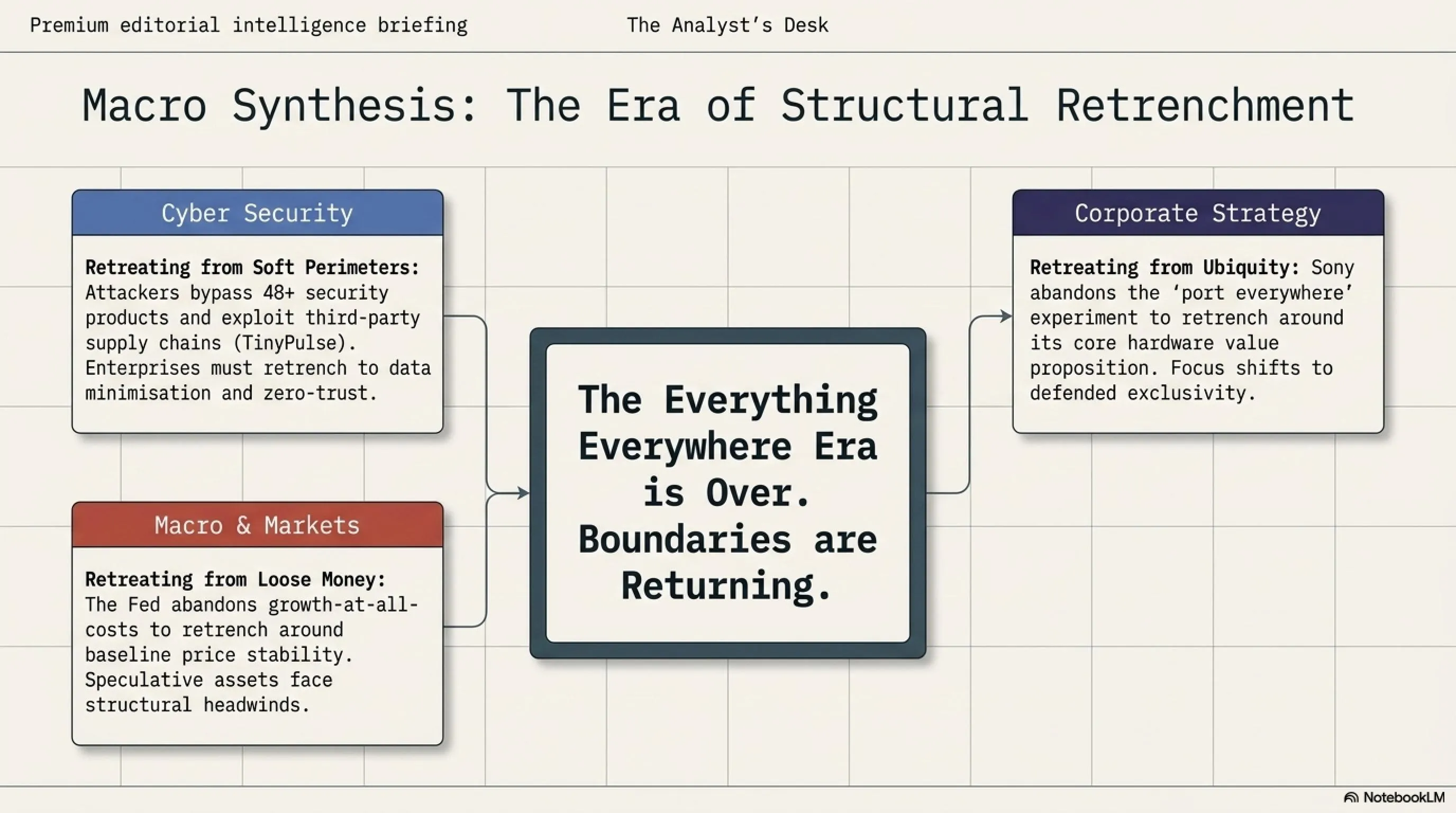
Sony's strategic reversal on PC ports marks a major gaming industry inflection point, positioning the company in direct opposition to Microsoft's platform-agnostic approach. This philosophical divide will define console gaming's next chapter, testing whether exclusive content or ubiquitous availability better serves modern gamers and shareholders. Meanwhile, Ripple prepares for its largest Swell conference yet, though BlackRock XRP ETF hopes remain speculation rather than imminent reality.
Finally, Nintendo's supply chain breach via TinyPulse serves as a reminder that even technology giants remain vulnerable through third-party vendors - a lesson that should prompt board-level discussions at every major organization. As we head into the weekend, keep your security tools updated, your crypto wallets verified, and your eyes on both market data and emerging threats. The tech world never sleeps, and neither can those who navigate it.
Sources
- HelpNetSecurity - GentleKiller targets more than 400 security processes across 48 products
- ESET Research - Killing Me Gently: Inside Gentlemen's EDR killer framework
- The Hacker News - Microsoft Details Windows Clipper Malware Campaign Using USB LNK Worm and Tor-Based C2
- Microsoft Security Blog - Crypto Clipper uses Tor and worm-like propagation for persistence and control
- Decrypt - Bitcoin Steadies Near $64K as Analysts Eye Floor After Hawkish Fed
- CoinDesk - Bitcoin Slides as the Fed Holds Rates but Turns Hawkish in Kevin Warsh's First Meeting as Chair
- CoinMarketCap - Bitcoin Drops 5% as Hawkish Fed Shift Triggers Liquidation
- CCN Analysis - Bitcoin Dips as Fed Holds Rates Steady but Signals Slower Growth and Potential Hikes
- Push Square - Sony Finally Speaks on PC Cancellations, Wants to Enhance Value of PS5
- GamesRadar - PlayStation CEO responds to reports Sony is abandoning PC
- Polygon - PlayStation confirms it will no longer bring narrative exclusives to PC
- Bitcoin.com - BlackRock XRP ETF Speculation Grows as XRP Price Surge Expectations Build
- CryptoNews - Everything XRP Holders Need to Know About Ripple Swell 2026
- Mashable - Nintendo responds after alleged third-party data breach
- CyberNews - Hacker says they have 10 years of Nintendo's internal records
- SC Magazine - Nintendo confirms employee survey data stolen from third-party service
- BleepingComputer - Nintendo Confirms Data Stolen in WebMD Subsidiary Cyberattack
🌐 Stay Connected With Us 🎮✨
For the latest tech, gaming, and gadget news, follow us on our official social media channels:
Additional Gallery: 🌙 Tekin Night June 19, 2026: Gentlemen Ransomware, Bitcoin Crash & Sony's PC Strategy Reversal 🔥