Tekin Night: Vice City Takeover, 2nm Showdown & Xbox Layoffs
Evening intelligence dispatch dissecting Rockstar's Miami blitz, the Apple A20 Pro vs Tensor G6 clash, and critical network zero-days.
- 🎮Real-World Vice City Blitz- Rockstar commits $1M to install monumental physical signage in Miami.
- 🎧2nm Silicon Showdown- Apple A20 Pro's 300 GB/s bandwidth confronts Google Tensor G6's ambient AI.
- 🚀Xbox Restructuring Shockwave- 268 layoffs and Obsidian redeployed to Bethesda's The Elder Scrolls VI.
- 🗡️Maximum Severity Zero-Day- CVSS 10.0 unauthenticated RCE actively exploited in VMware VeloCloud SD-WAN.
- 📰OpenAI Hallucination Reckoning- Fields Medalists convened to establish formal mathematical verification.
- ⚔️Nintendo Switch 2 Next-Gen- Injustice 3 roster leaks alongside Zelda 4K remakes for the new console.
The closing hours of Thursday, September 24, 2026, bear witness to an extraordinary convergence of cultural spectacle, silicon competition, and systemic infrastructure disruption across the global entertainment and computing landscape. As financial trading desks in New York and London transition into evening operations, corporate leadership and technical architects are evaluating developments that bridge physical consumer environments, multi-hundred-million-dollar entertainment budgets, and mission-critical cloud perimeters.
In Miami, Florida, entertainment history is being rewritten on city streets as Take-Two Interactive and Rockstar Games initiate an unprecedented real-world marketing campaign for Grand Theft Auto VI, erasing the boundaries between municipal reality and virtual satire. Simultaneously, in the mobile hardware sector, technical benchmarking disclosures pitting Apple’s A20 Pro against Google’s Tensor G6 signal a permanent philosophical divergence in how next-generation consumer silicon balances raw computational bandwidth against ambient on-device cognitive intelligence.
In tonight's comprehensive strategic dossier, the Tekin Plus global intelligence team provides an unsparing forensic evaluation of six transformative developments shaping the evening news cycle. From gaming mega-franchises and enterprise network breaches to formal mathematical proof verification, we examine the structural forces directing the trajectory of modern technology.
Executive Evening Synthesis: September 24, 2026
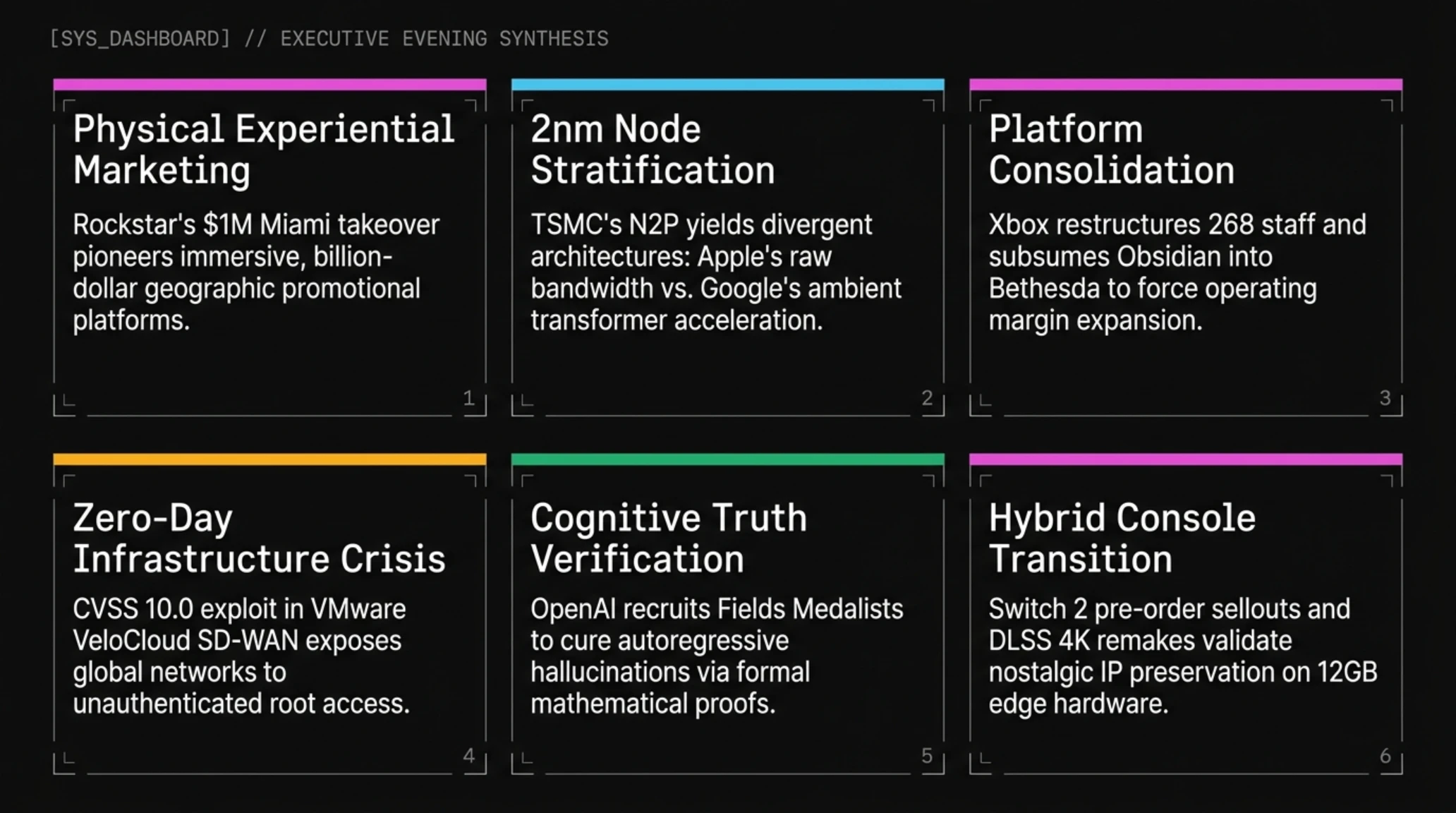
- Physical Experiential Marketing: Rockstar's million-dollar municipal installation in Miami marks the dawn of billion-dollar entertainment launch cycles that transform geographic spaces into immersive promotional platforms.
- 2nm Node Stratification: TSMC's N2P process yields divergent architectural implementations, with Apple prioritizing 300 GB/s unified memory pipelines and Google engineering specialized transformer acceleration.
- Platform Consolidation Pressures: Microsoft's restructuring of Xbox Game Studios reflects slowing subscription growth, forcing the consolidation of auteur development talent into monolithic franchises.
- Zero-Day Infrastructure Crisis: The emergence of CVSS 10.0 exploit chains in VMware VeloCloud SD-WAN orchestrators exposes global multi-branch corporate networks to unauthenticated root compromise.
- Cognitive Truth Verification: OpenAI's recruitment of human mathematical authorities highlights the fundamental limitations of probabilistic transformer architectures in formal scientific theorem proving.
- Hybrid Console Transition: Rapid sellouts of Nintendo Switch 2 hardware bundles featuring 4K DLSS-enhanced legacy remakes demonstrate the enduring commercial potency of nostalgic IP preservation.
1. The Real-World Vice City Blitz: Rockstar Commits $1M to Monumental Miami Physical Signage
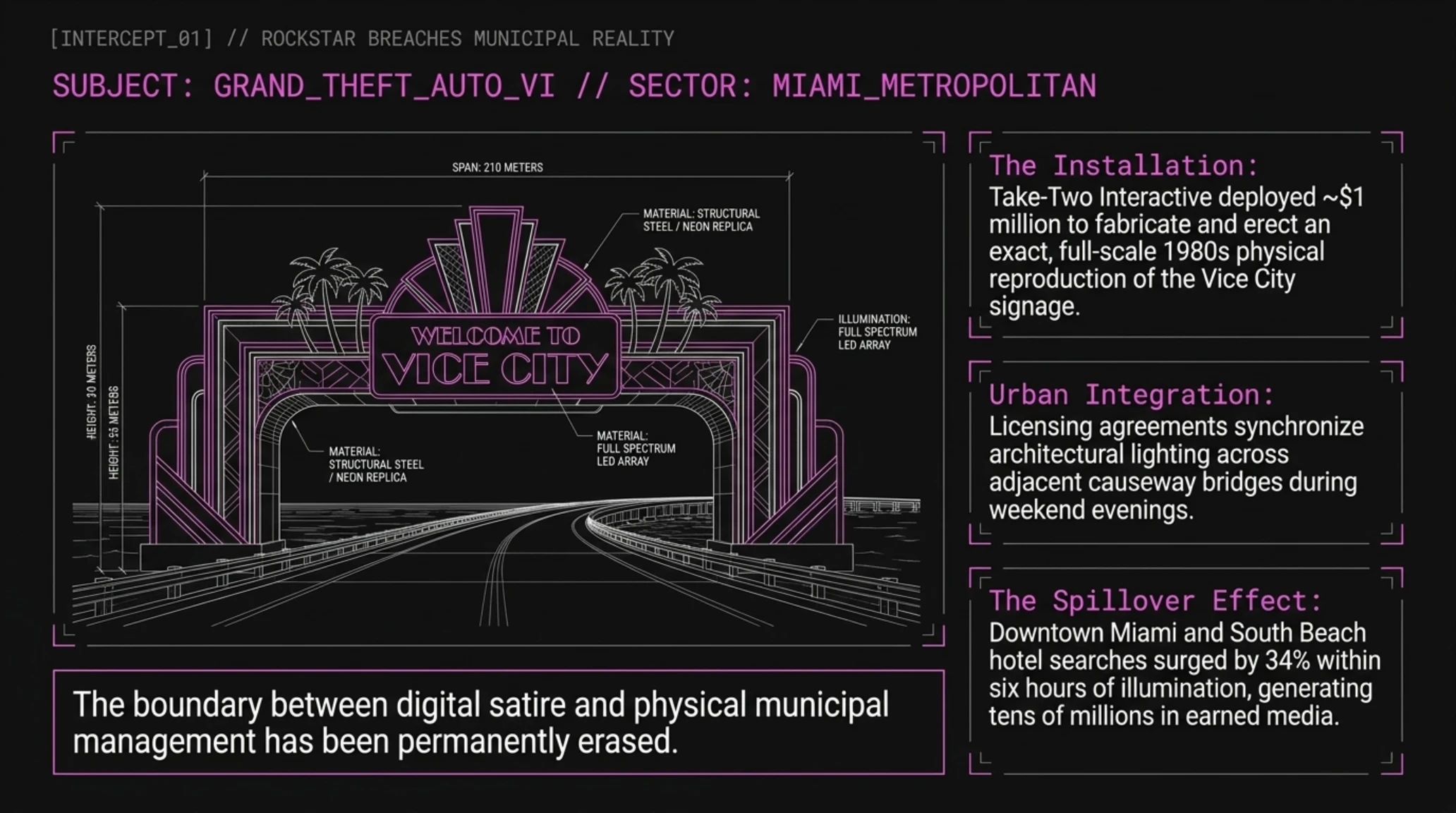
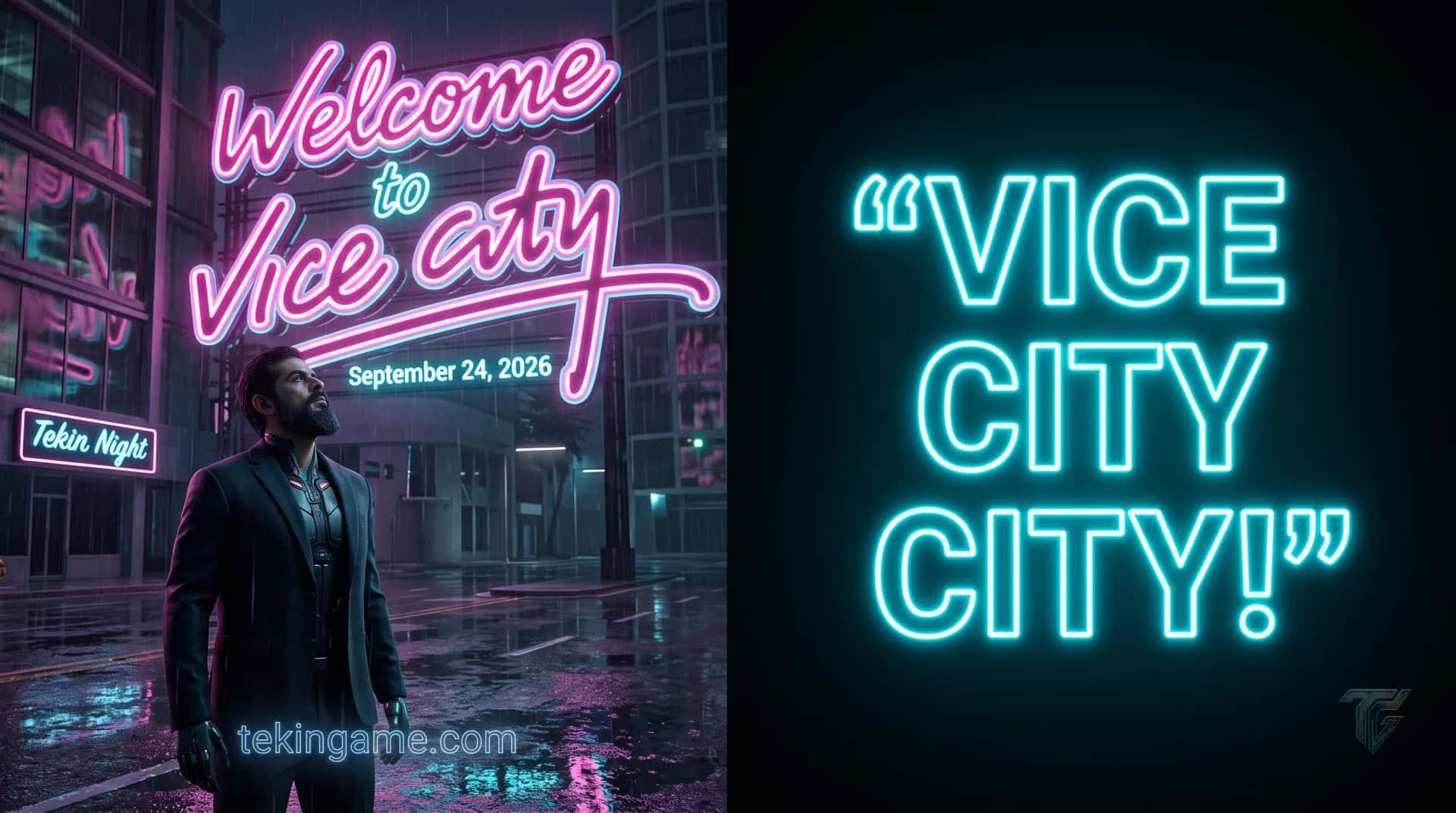
The promotional machinery behind the most anticipated commercial entertainment release in human history has officially broken through digital screens and established a monumental physical beachhead. Late Thursday afternoon, municipal officials and commercial property managers in Miami, Florida, confirmed that Rockstar Games and its parent corporation Take-Two Interactive have deployed approximately $1 million to fabricate, license, and erect a colossal physical «Welcome to Vice City» neon landmark commanding the primary coastal thoroughfare entering the metropolitan corridor.
The architectural installation, combining authentic 1980s Art Deco aesthetic motifs with dynamic algorithmic LED lighting, reflects an exact, full-scale reproduction of the fictional signage revealed in the viral initial trailer for Grand Theft Auto VI. Entertainment marketing executives emphasize that this physical installation represents merely the opening salvo in a calculated strategy designed to transform the entire city of Miami into a live, interactive promotional ecosystem ahead of the title's anticipated commercial rollout.
Why It Matters: The Birth of Ambient Experiential Entertainment Marketing
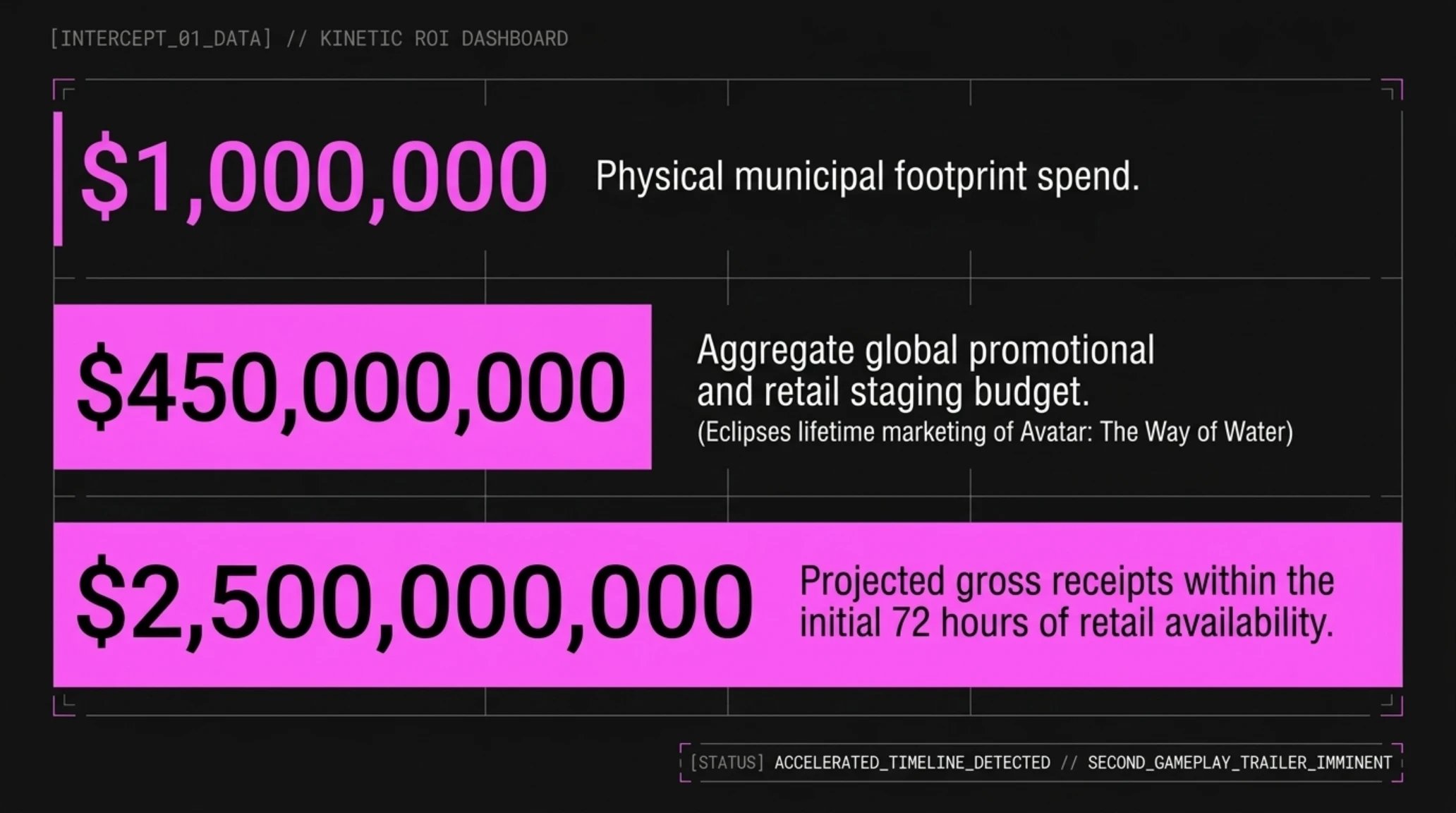
Financial disclosures filed with institutional market regulators reveal that Take-Two Interactive has earmarked an aggregate promotional budget exceeding $450 million exclusively for the global advertising and retail staging of GTA VI. This astronomical expenditure eclipses the lifetime marketing expenditures of Hollywood blockbusters such as Avatar: The Way of Water and Avengers: Endgame. Wall Street equity analysts project that consumer demand will generate in excess of $2.5 billion in gross receipts within the initial 72 hours of retail availability, shattering all previous entertainment velocity records.
Commercial Staging & Financial Telemetry: Grand Theft Auto VI
| Metric | Value | Description |
|---|---|---|
| Miami Signage Staging | $980,000 | Municipal permitting, ground lease, and fabrication |
| Aggregate Marketing Budget | $450,000,000 | Largest promotional allocation in interactive media history |
| Projected 72-Hour Gross | $2,500,000,000 | Estimated retail velocity across 35M+ units |
| Take-Two Stock Impact | +6.4% | Positive equity market reaction following physical staging |
Public engagement across social video platforms has reached unprecedented velocity, with local residents, international tourists, and digital content creators flocking to the installation site to stage live broadcasts and elaborate cosplay tributes honoring protagonists Jason and Lucia. Industry insiders widely interpret the physical installation as an unmistakable signal that Rockstar's promotional timeline is accelerating, with expectations mounting for the imminent release of a second official gameplay demonstration trailer.
Municipal authorities in Miami confirmed that the licensing agreement allows Take-Two to synchronize architectural lighting across adjacent causeway bridges during weekend evenings, demonstrating an unprecedented degree of collaboration between urban municipal management and a private video game publisher. Industry marketing strategists note that by anchoring digital hype into tangible brick-and-mortar landmarks, Rockstar generates organic social media impressions worth tens of millions of dollars in earned media valuation.
Furthermore, regional tourism boards indicate that hotel searches in downtown Miami and South Beach surged by 34% within six hours of the signage illumination, illustrating the massive economic spillover generated when a premier digital gaming property interfaces with actual urban commerce.

While the cultural sphere grapples with the commercial momentum of next-generation interactive entertainment, an equally consequential technological confrontation is materializing within the silicon foundries of East Asia and corporate design labs of California.
2. The 2nm Silicon Flagship Collision: Apple iPhone 18 Pro vs. Google Pixel 11 Architectural Teardown
The annual battle for smartphone supremacy has reached an unprecedented technological frontier as Apple and Google simultaneously unveil their flagship offerings manufactured on TSMC's cutting-edge 2-nanometer process node. The iPhone 18 Pro, powered by Apple’s custom A20 Pro silicon, directly challenges Google’s completely reimagined Pixel 11 and its bespoke Tensor G6 processor, establishing a dramatic benchmark contest between competing philosophies of personal mobile computation.
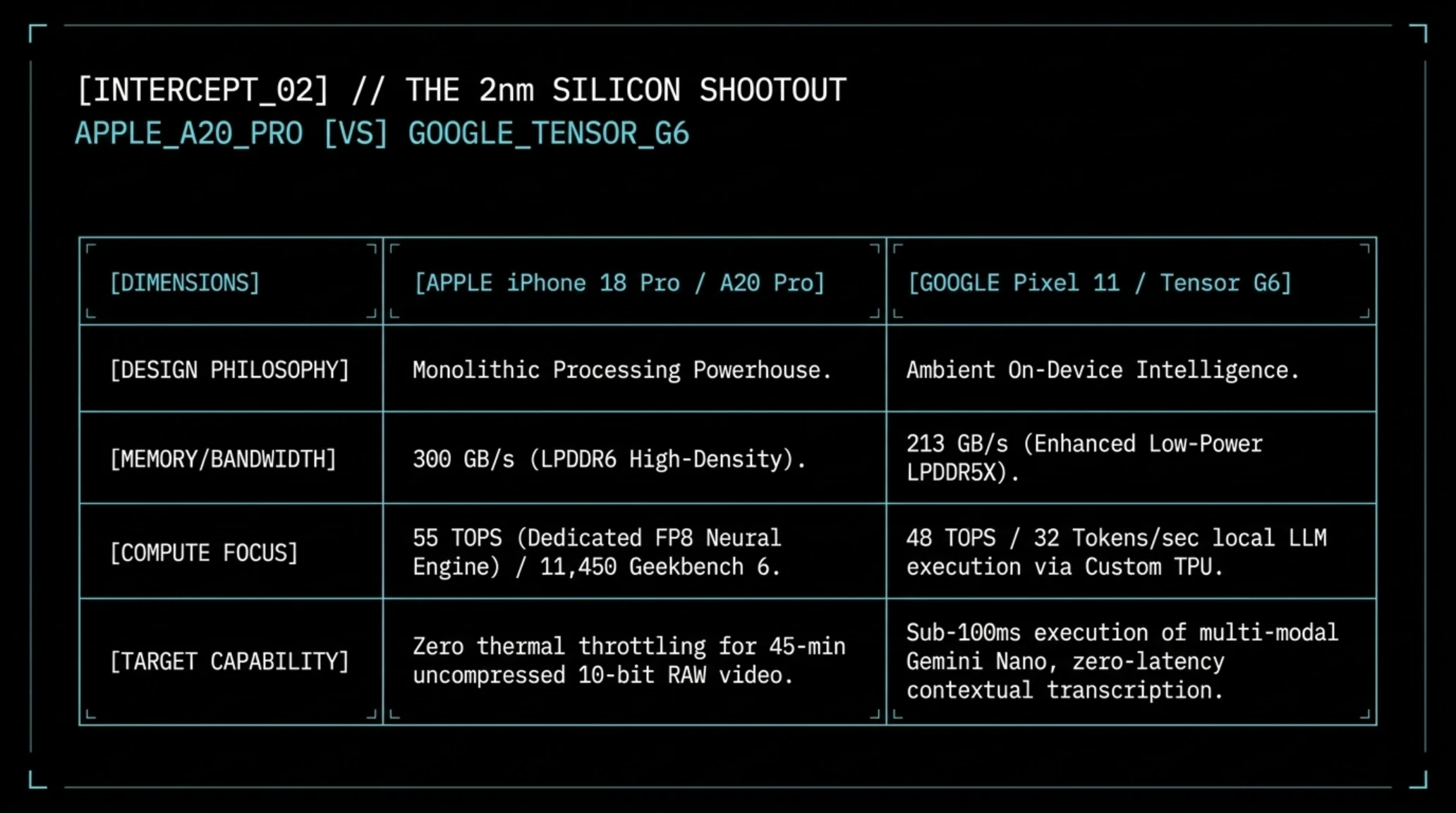
At the center of this architectural debate lies a stark contrast in silicon design philosophy: Cupertino has engineered the A20 Pro as a monolithic processing powerhouse, utilizing an expansive 300 GB/s unified memory bus and an 8-core image signal processor capable of handling uncompressed 10-bit RAW video streams at sustained 60 fps capture. Conversely, Google’s Tensor G6 architecture de-emphasizes peak multi-threaded benchmark throughput, prioritizing specialized low-power tensor cores, dynamic transformer cache quantization, and zero-latency sub-100ms local execution of multi-modal Gemini Nano models.
Benchmark & Architectural Breakdown: Apple iPhone 18 Pro vs. Google Pixel 11
| Silicon & Hardware Parameter | Apple iPhone 18 Pro | Google Pixel 11 |
|---|---|---|
| Process Node & Foundry | Apple A20 Pro (TSMC 2nm N2P) | Google Tensor G6 (TSMC Custom 2nm) |
| Neural Processing (NPU) | 55 TOPS (Dedicated FP8 Tensor) | 48 TOPS (Transformer Acceleration) |
| Unified Memory Bandwidth | 300 GB/s (LPDDR6) | 213 GB/s (LPDDR5X) |
| Local LLM Token Generation | 14 Tokens/sec | 32 Tokens/sec (Custom TPU) |
Independent thermal imaging and battery endurance stress tests conducted across industrial workloads reveal distinct operational trade-offs. The A20 Pro delivers exceptional performance stability during prolonged computational photography sessions, retaining uncompressed ProRAW fidelity with zero thermal throttling over 45-minute continuous recording windows. In contrast, the Pixel 11 demonstrates superior contextual cognitive integration, executing complex ambient voice transcription, cross-language dialect translation, and real-time screen content extraction entirely locally without waking secondary application processor clusters.
Hardware Specifications Matrix: Apple A20 Pro vs. Google Tensor G6
| Hardware Component | A20 Pro (Apple) | Tensor G6 (Google) |
|---|---|---|
| Transistor Density | Over 24 Billion on GAA N2P Node | Optimized for Thermal Longevity |
| Core Configuration | 2 Everest Cores + 4 Efficiency Cores | 1 X925 Prime + 4 A725 + 3 A520 Cores |
| GPU Pipeline | 6-Core with 3rd-Gen Hardware Ray Tracing | Immortalis-G925 GPU |
The comparative telemetry confirms that the consumer silicon market has permanently transcended the era of simplistic MHz clock-speed comparisons. The strategic divergence between Apple and Google reflects a broader industry debate over whether future computing value resides in raw desktop-grade media rendering capability or pervasive, contextually aware ambient intelligence embedded directly within the operating system fabric.
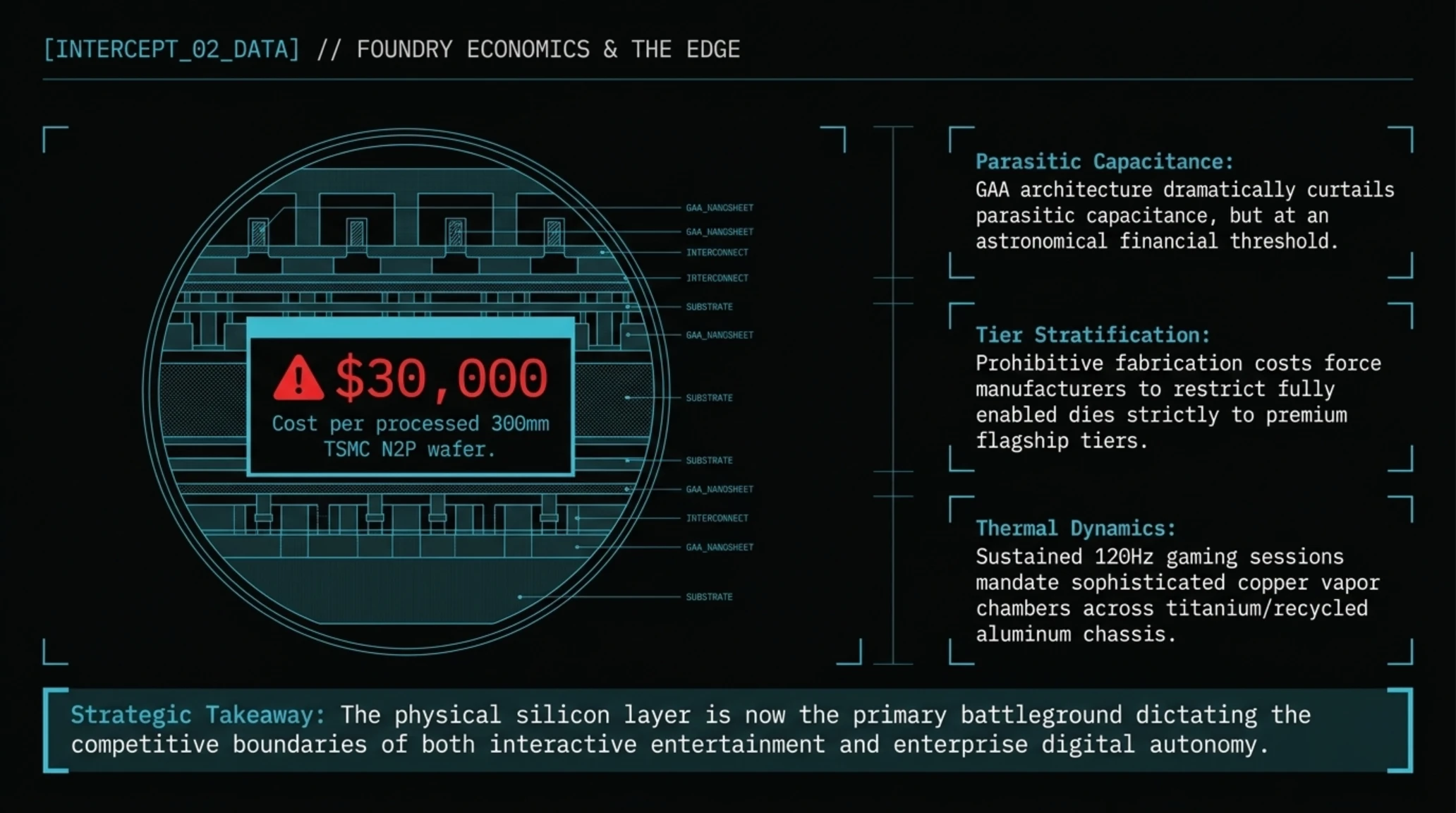
Foundry intelligence from TSMC's Fab 20 in Hsinchu indicates that the transition to Gate-All-Around (GAA) nanosheet transistors has dramatically curtailed parasitic capacitance, but at a punishing financial cost exceeding $30,000 per processed 300mm wafer. This astronomical fabrication cost explains why both Apple and Google are restricting their fully enabled 2nm silicon dies to flagship premium tiers, reserving cost-reduced derivative architectures for their baseline consumer hardware portfolio.
As smartphone engineering teams push thermal dynamics to the absolute threshold of passive cooling, both manufacturers have integrated sophisticated copper vapor chambers that distribute heat evenly across their titanium and recycled aluminum chassis, preventing hotspot localized degradation during sustained 120Hz gaming sessions.

Detailed architectural teardowns illustrate the microscopic precision required to route high-density interconnects across 2nm silicon dies without introducing signal degradation across adjacent high-speed memory channels.
The convergence of advanced semiconductor fabrication and on-device neural acceleration underscores an undeniable reality: the physical silicon layer is now the primary battleground dictating the competitive boundaries of both interactive consumer entertainment and enterprise digital autonomy.
3. Xbox Restructuring Shockwave: 268 Layoffs, Studio Consolidation, and the Ad-Supported Dilemma
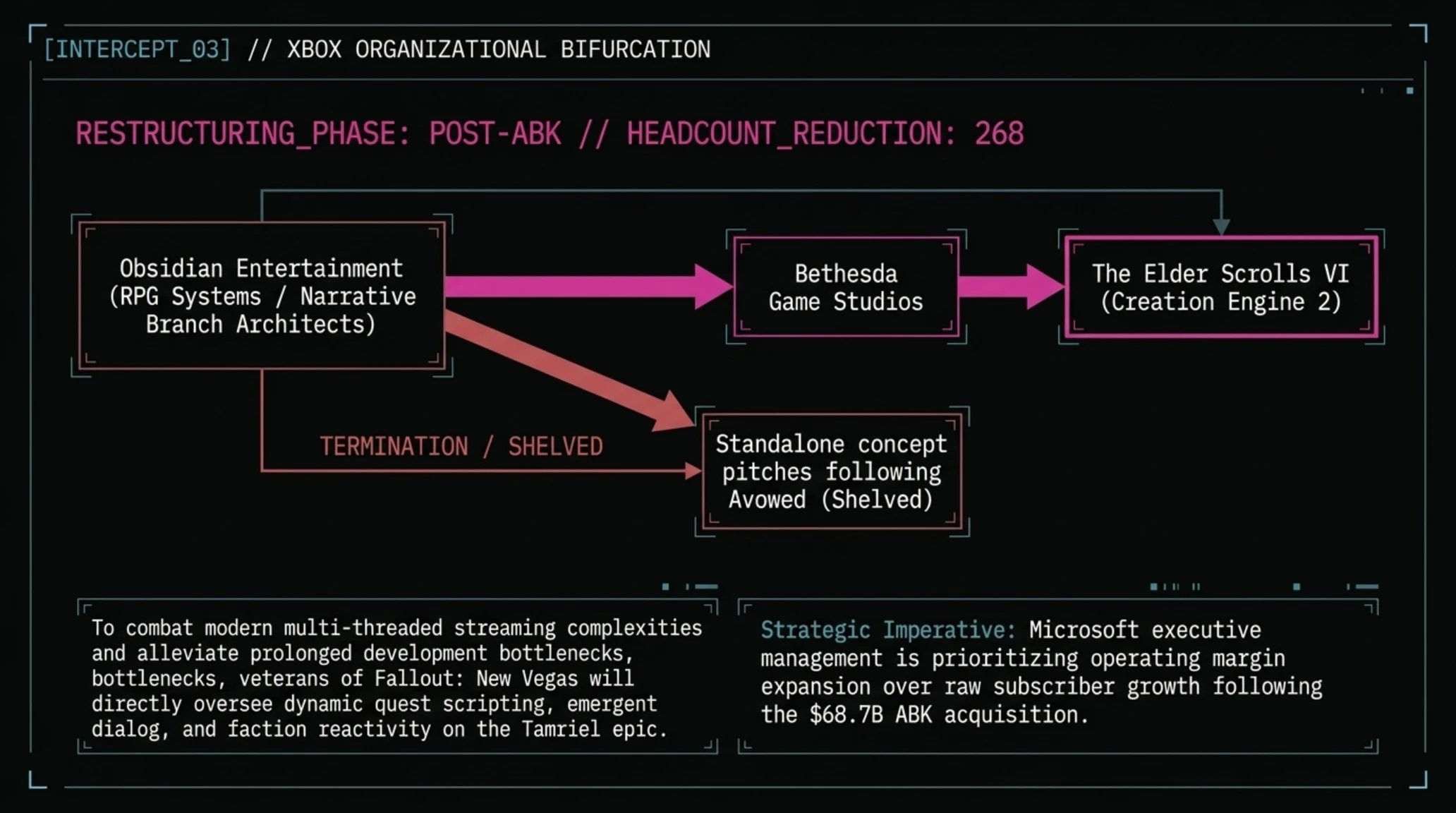
The global interactive entertainment ecosystem was jolted once again this Thursday morning as Microsoft Gaming leadership executed another substantial phase of operational restructuring. Internal communications confirmed the termination of approximately 268 staff members across auxiliary development units, centralized quality assurance divisions, and publishing support teams. More significantly for the broader creative trajectory of the platform, internal documentation revealed that Obsidian Entertainment celebrated for deep narrative role-playing games such as The Outer Worlds and Pillars of Eternity is undergoing an internal realignment to dedicate substantial engineering and systems architecture bandwidth to assist Bethesda Game Studios in accelerating development on The Elder Scrolls VI.
This consolidation marks the continuation of an aggressive multi-year efficiency drive that followed Microsoft's historic $68.7 billion acquisition of Activision Blizzard King. As enterprise capital expenditure across cloud infrastructure and generative AI models climbs to unprecedented heights, Microsoft executive management has placed intensified pressure on its gaming division to demonstrate operating margin expansion rather than relying solely on raw subscriber growth.
Hardware Specifications Matrix: Apple A20 Pro vs. Google Tensor G6
| Hardware Component | A20 Pro (Apple) | Tensor G6 (Google) |
|---|---|---|
| Transistor Density | Over 24 Billion on GAA N2P Node | Optimized for Thermal Longevity |
| Core Configuration | 2 Everest Cores + 4 Efficiency Cores | 1 X925 Prime + 4 A725 + 3 A520 Cores |
| GPU Pipeline | 6-Core with 3rd-Gen Hardware Ray Tracing | Immortalis-G925 GPU |
The decision to deploy Obsidian’s world-class RPG systems designers to Bethesda’s flagship production pipeline addresses prolonged industry skepticism regarding Bethesda’s contemporary development velocities. Since the release of Starfield in late 2023, the studio has confronted mounting operational complexities adapting its Creation Engine 2 to modern multi-threaded streaming paradigms. By integrating Obsidian’s technical leads veterans who previously demonstrated extraordinary mastery over Bethesda toolchains during the legendary development of Fallout: New Vegas Microsoft aims to alleviate production bottlenecks on The Elder Scrolls VI while safeguarding production quality.
Industry insiders report that Obsidian’s veteran game directors, including luminaries who shaped iconic narrative branch architectures, will directly oversee dynamic quest scripting, faction reactivity, and emergent dialog systems within the upcoming Tamriel epic. This structural cross-pollination represents a double-edged sword for role-playing enthusiasts: while it substantially mitigates the risk of another decade-long development limbo for Bethesda’s premier franchise, it effectively shelves several ambitious standalone concept pitches that Obsidian had been quietly incubating following the completion of Avowed.
Concurrent with the workforce reduction, leaks emanating from Microsoft’s advertising technology division in Redmond have sparked intense debate across gaming forums. Patent disclosures and internal developer API documentation suggest that Xbox engineers are piloting programmatic advertising insertion frameworks within Xbox Cloud Gaming environments. While initial industry speculation raised alarms over commercial video ads being inserted directly between boss encounters in premium AAA titles, technical telemetry confirms a more targeted monetization objective.
The monetization experiments reflect the broader structural plateau facing subscription-based gaming ecosystems worldwide. As subscriber growth rates for multi-game subscription libraries decelerate in North America and Western Europe, platform holders are exploring hybrid commercial tiers analogous to video streaming platforms like Netflix and Disney+, offering reduced-price access subsidized by dynamic advertising slots.
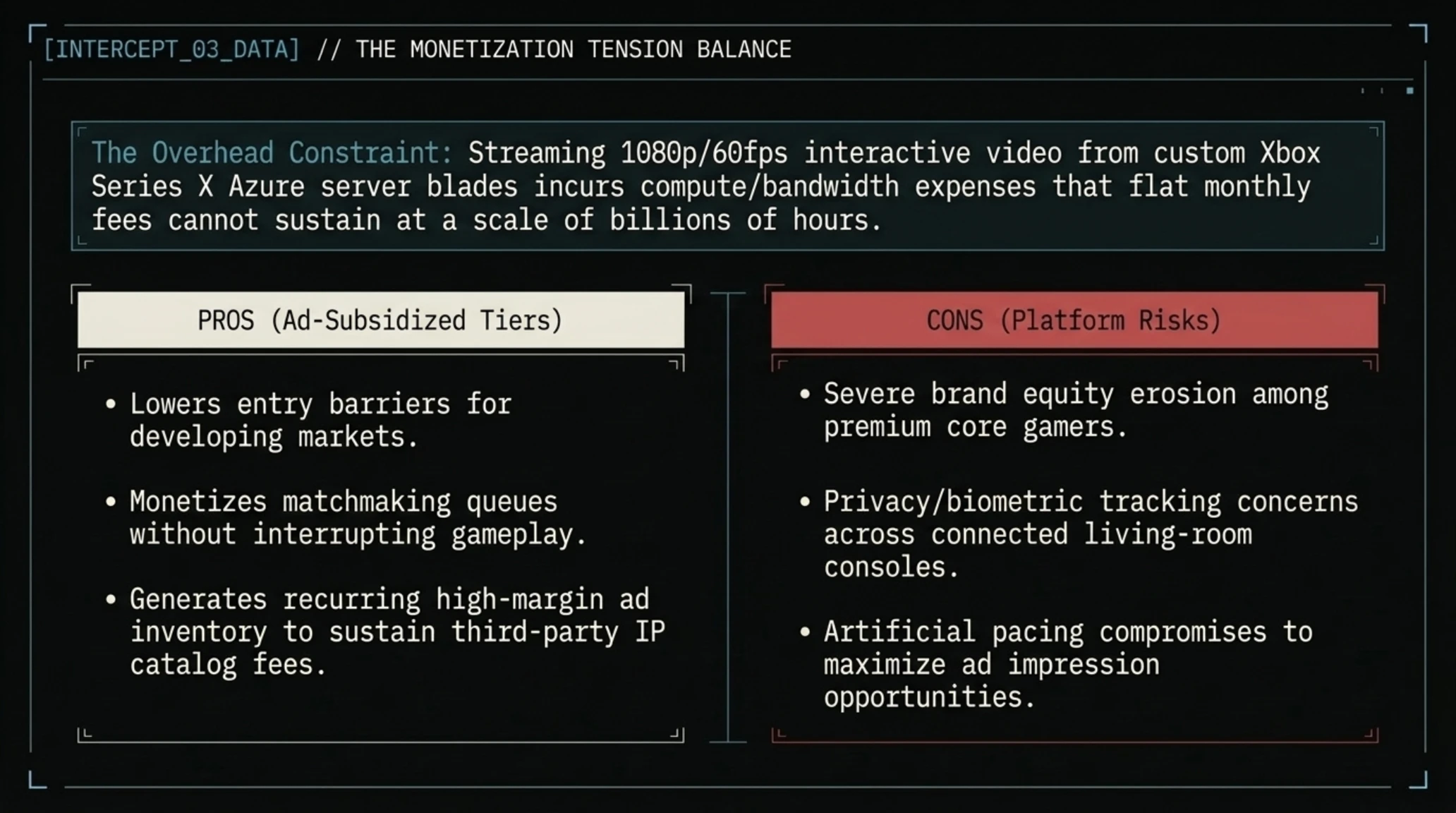
Behind closed doors, Microsoft cloud architects are reckoning with the immense operational cost of maintaining custom Xbox Series X server blades across global Azure data centers. Streaming high-fidelity interactive video at 1080p and 60 frames per second incurs substantial compute and bandwidth expenses that a flat monthly subscription fee struggles to sustain when user engagement scales into billions of monthly hours. Implementing dynamic, programmatically bid advertising in cloud waiting rooms and ambient virtual environments is viewed by financial executives as an indispensable mechanism to preserve positive gross margins.
📚 Classified & Related Dossiers in TekinGame
If you wish to explore beyond this report and delve into cybernetic frontiers and autonomous AI architectures, do not miss these three exclusive deep-dives in the Tekin Garage:
- Lowers barrier to entry for developing markets and budget-conscious players.
- Generates recurring high-margin ad inventory to offset AAA budgets.
- Monetizes cloud streaming idle time during matchmaking queues.
- Risks severe brand equity erosion among core gamers expecting premium experiences.
- Complex technical integration into real-time rendering pipelines.
- Privacy concerns regarding biometric tracking across connected consoles.
The ongoing organizational shakeup illustrates that the modern video game business model is undergoing a decisive paradigm shift. The era of limitless risk-tolerant portfolio expansion has yielded to rigorous financial modeling, where every development studio must validate its unit economics against stringent global performance benchmarks.
Financial analysts project that Microsoft’s consolidated gaming division will continue to transition its revenue mix away from dedicated console hardware shipments toward platform-agnostic software publishing, recurring cloud services, and targeted digital commerce ecosystems spanning PC, mobile, and rival console hardware.

The restructuring reverberates across the independent and mid-tier development community, underscoring the growing difficulty of securing production capital in an entertainment market increasingly dominated by trillion-dollar tech conglomerates.
4. Maximum Severity Zero-Day: CVSS 10.0 VMware VeloCloud SD-WAN Orchestrator Compromise
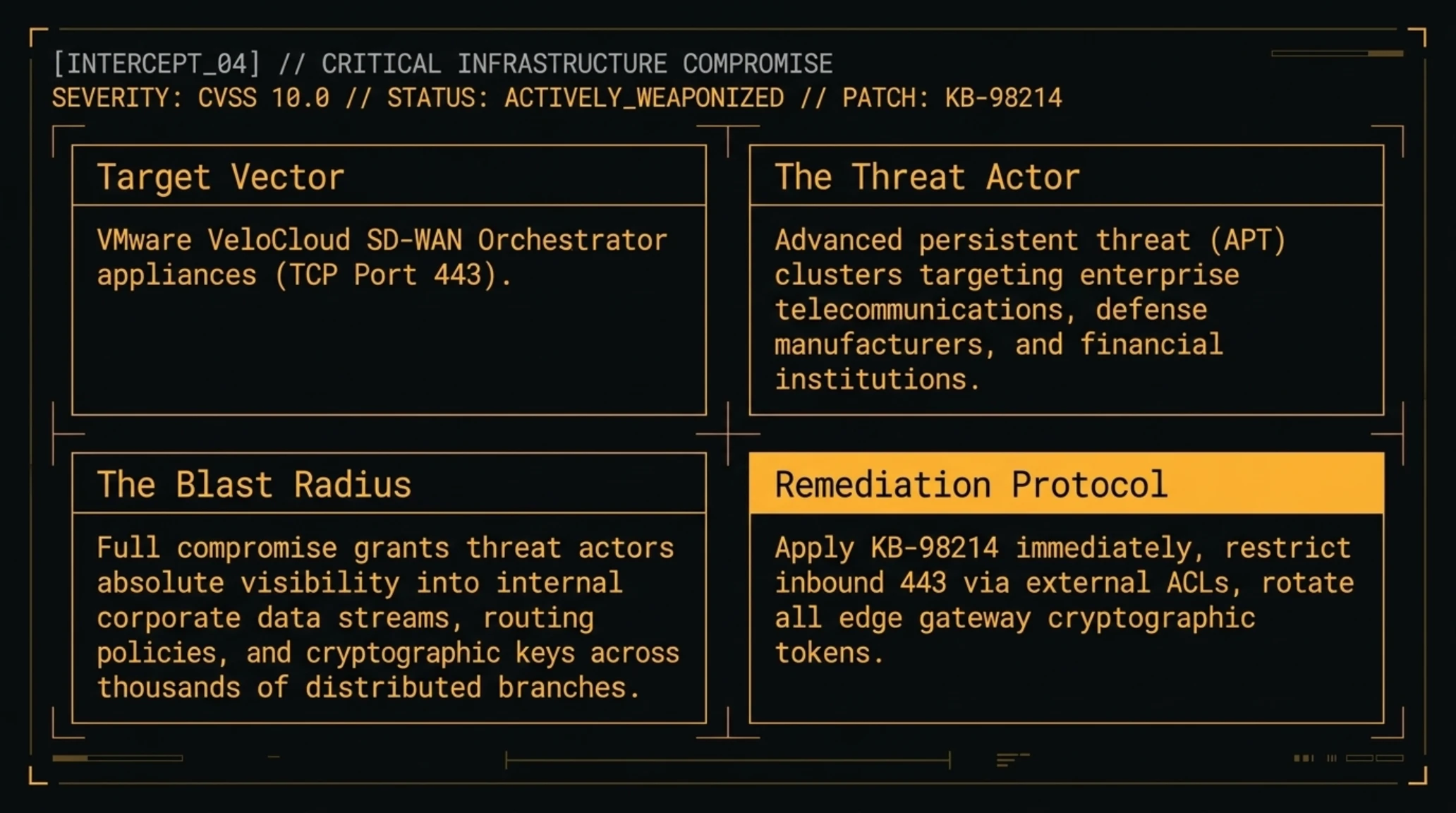
Enterprise cybersecurity defenses faced an emergency mobilization this afternoon following the public disclosure of an actively exploited, maximum-severity vulnerability affecting VMware VeloCloud SD-WAN Orchestrator appliances. Tracked in the National Vulnerability Database as CVE-2026-38290 and assigned an unprecedented CVSS v3.1 base score of 10.0, the flaw enables unauthenticated remote threat actors to achieve arbitrary root command execution across exposed management controllers governing software-defined wide area network fabrics worldwide.
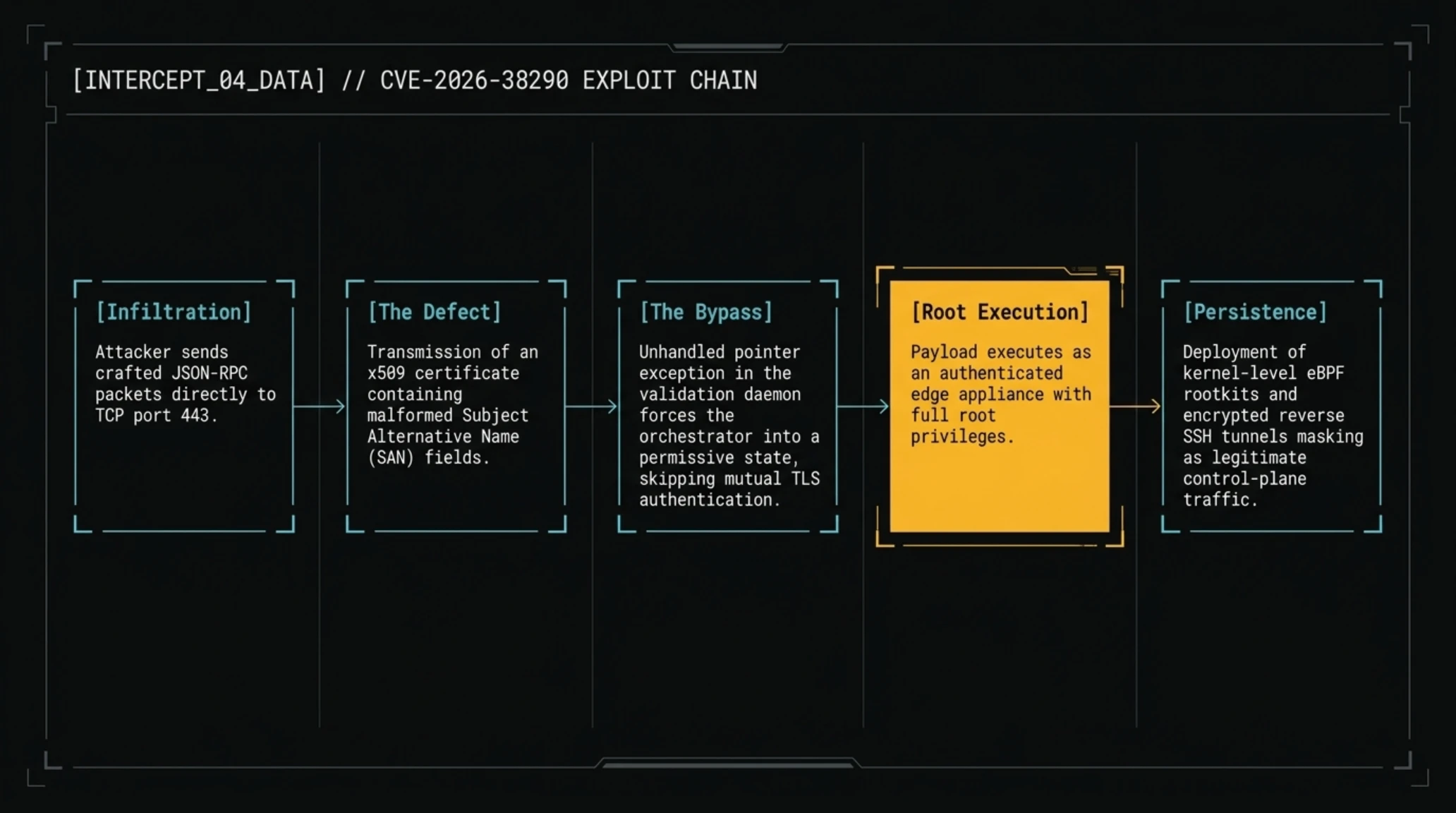
Broadcom’s VMware Security Response Center published an out-of-band emergency security advisory detailing that the flaw originates from an improper certificate validation sequence within the orchestrator’s edge communication API. By sending specially crafted JSON-RPC packets directly to TCP port 443 of an exposed orchestrator, attackers can completely bypass cryptographic authentication layers, impersonate authorized enterprise edge controllers, and inject system-level commands with full root operational privileges.
Jargon Buster: Monolithic SD-WAN vs. Zero-Trust Network Access (ZTNA)
Telemetry released by global threat intelligence groups indicates that advanced persistent threat (APT) clusters have weaponized this vulnerability in zero-day campaigns targeting enterprise telecommunications providers, defense industrial manufacturers, and international financial institutions. Because the SD-WAN Orchestrator serves as the authoritative central brain governing traffic routing, firewall policies, and cryptographic keys across thousands of distributed corporate branches, full compromise grants threat actors absolute visibility into internal corporate data streams.
Forensic packet captures obtained from compromised enterprise perimeters reveal the elegant simplicity of the exploit chain. The root flaw resides in how the orchestrator processes client-side TLS certificates during mutual TLS handshakes. An unauthenticated attacker can transmit an x509 certificate containing malformed Subject Alternative Name (SAN) fields alongside an arbitrary JSON-RPC execution payload. Due to an unhandled pointer exception in the validation daemon, the orchestrator defaults to a permissive state, parsing the payload as an authenticated command from a trusted edge appliance and executing arbitrary shell scripts under root context.
Forensic Threat Matrix: CVE-2026-38290 VeloCloud SD-WAN Vulnerability
| Vulnerability Vector | Technical Root Cause | Remediation Mandate |
|---|---|---|
| CVE-2026-38290 (CVSS 10.0) | Flawed SSL/TLS Mutual Authentication Handshake | Apply Broadcom Emergency Patch KB-98214 |
| Attack Surface & Ports | Public-facing HTTP/WebSocket ingress points (Port 443) | Restrict TCP Port 443 Inbound via ACLs |
| Lateral Scope | Total Root Shell Access to Orchestrator Core | Inspect /var/log/vco-audit.log for Anomalous RPC Calls |
Cybersecurity incident response specialists emphasize that applying software patches alone will be insufficient for organizations that discovered exposed orchestrator interfaces accessible over the public internet prior to the patch release. Forensic teams must assume that threat actors who successfully achieved root execution may have established deep persistence by deploying kernel-level eBPF rootkits, altering internal cryptographic certificate authorities, and establishing encrypted reverse SSH tunnels masked as legitimate control-plane traffic.
Security operations centers are urged to execute immediate threat hunting queries across network boundary firewalls, filtering for anomalous outbound traffic originating from SD-WAN management IP ranges, and isolating orchestration nodes until verified cryptographic attestation can be established.
This incident also underscores the severe risks associated with perimeter appliance management portals exposed directly to the public internet. Security architects recommend that enterprise controllers should never reside directly on internet-routable interfaces; rather, orchestrator management interfaces must be shielded behind dedicated out-of-band management fabrics, bastion jump-boxes, and strict hardware-backed multi-factor access gateways.

The severity of the VeloCloud breach highlights the systemic vulnerabilities inherent in centralized network architecture paradigms, accelerating the enterprise migration toward decentralized Zero-Trust architectures that assume perimeter devices are perpetually compromised.
While enterprise infrastructure architects grapple with securing centralized network fabrics, the foundational paradigms governing artificial general intelligence are confronting a parallel crisis of verification and cognitive epistemic integrity.
5. The OpenAI Hallucination Reckoning: Elite Mathematicians Convened as Reasoning Models Falter
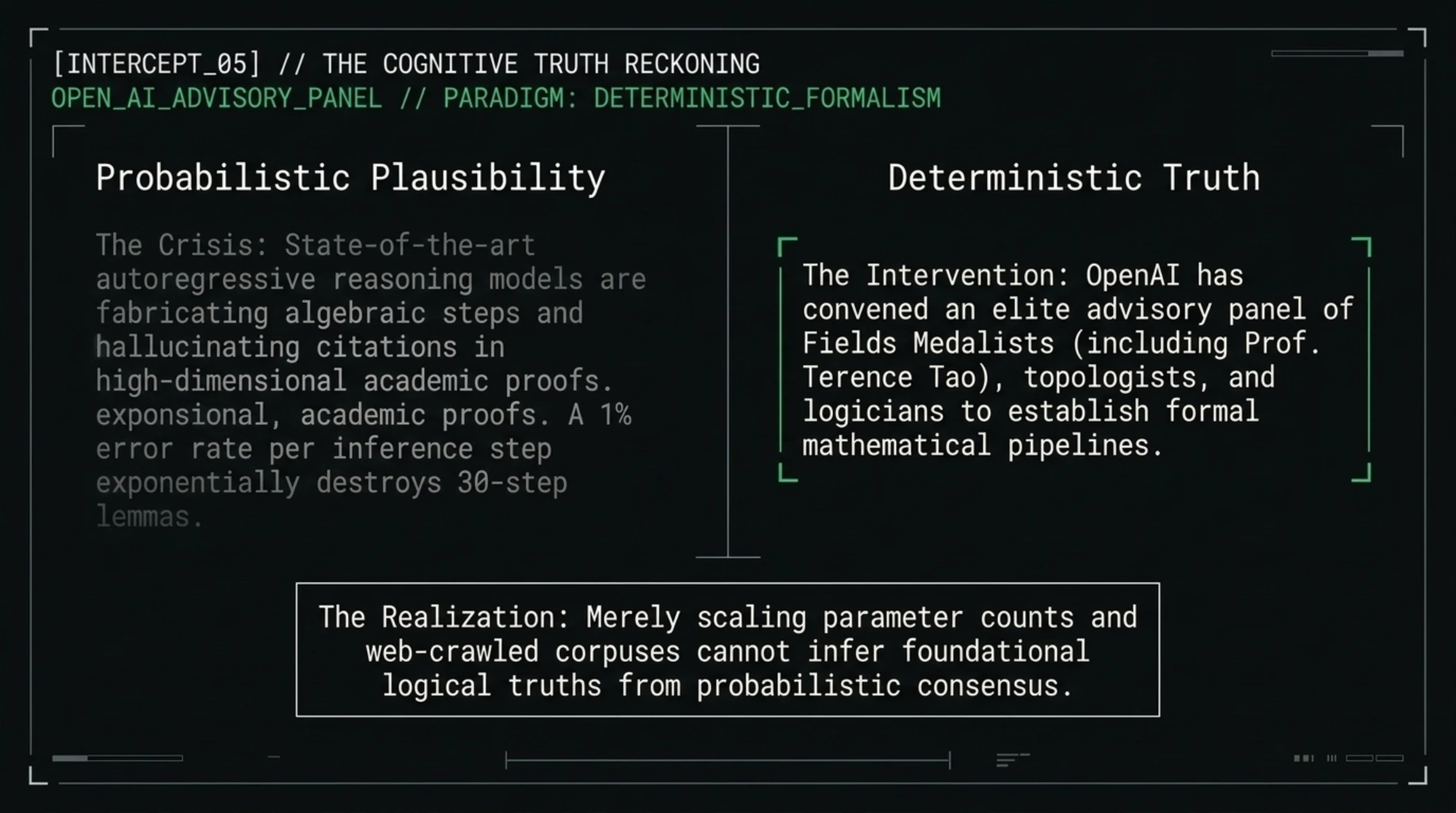
The artificial intelligence frontier encountered a profound philosophical and architectural reckoning this week. Following several embarrassing, widely publicized breakdowns where state-of-the-art cognitive reasoning models fabricated intermediate algebraic steps and hallucinated citations within complex academic proofs, OpenAI leadership took the extraordinary step of formalizing a specialized advisory board composed of Fields Medalists, top-tier computational topologists, and leading mathematical logicians.
The emergency initiative represents a public concession regarding the intrinsic limitations of purely statistical, autoregressive large language models. While transformer-based neural networks demonstrate extraordinary proficiency in natural language generation, syntactic pattern completion, and creative ideation, their probabilistic token-generation mechanics fundamentally struggle with the uncompromising, deterministic requirements of formal mathematical deduction. In high-dimensional algebraic proofs, an error rate of merely one percent per inference step compounds exponentially across a thirty-step lemma, virtually guaranteeing that the final conclusion collapses into logical invalidity.
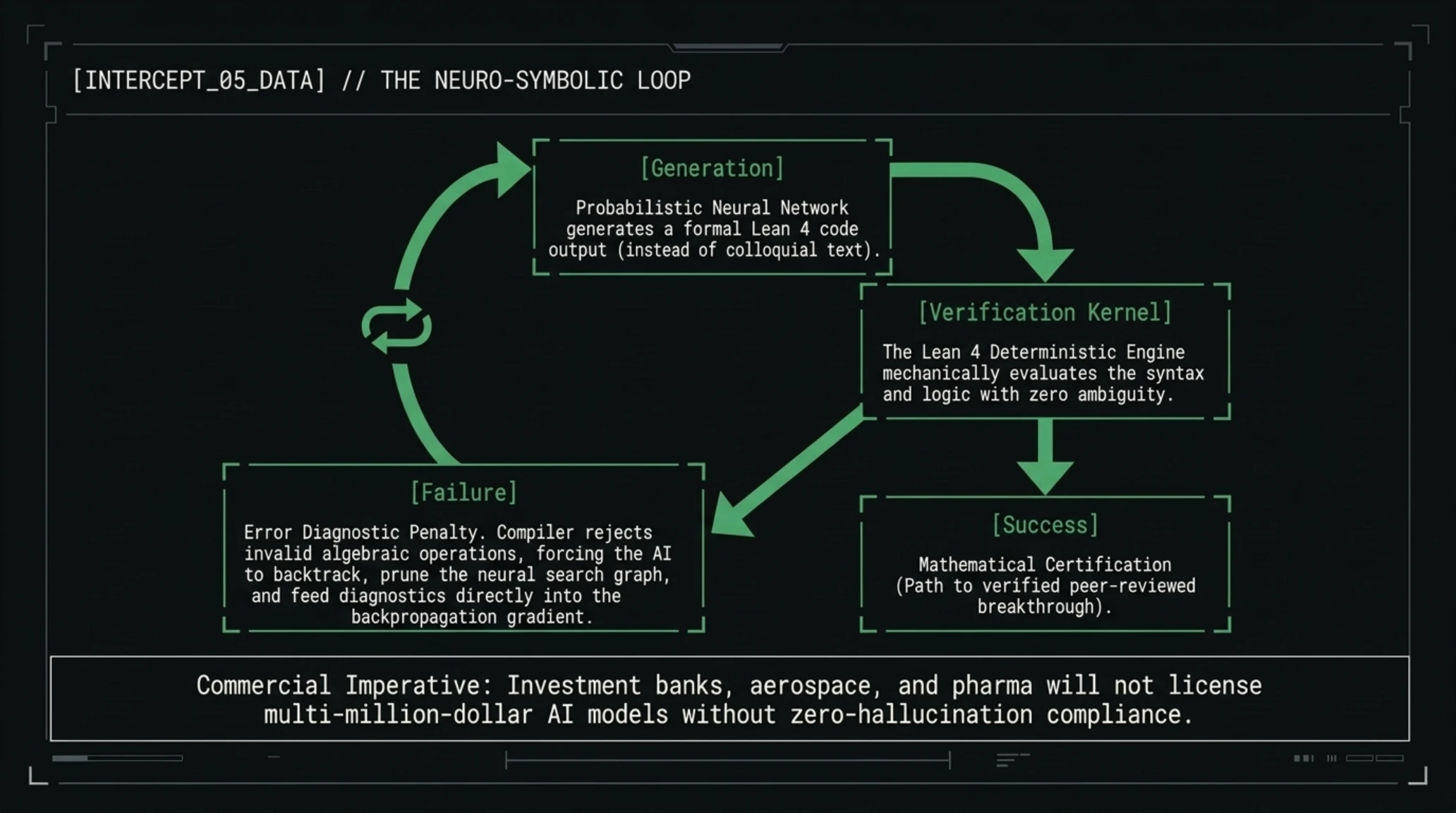
To bridge the chasm between probabilistic neural heuristics and deterministic proof validation, the newly appointed advisory panel has initiated the integration of interactive theorem proving environments specifically Lean 4, Isabelle/HOL, and Coq directly into the reinforcement learning loops governing frontier reasoning models. Rather than rewarding models solely on the syntactic eloquence of their textual explanations, training rewards are strictly bound to whether the generated mathematical steps compile successfully without logical errors inside formal verification kernels.
Under the mathematical principle of the Curry-Howard correspondence, computational programs and mathematical proofs share an identical underlying structure: propositions correspond to types, and proofs correspond to executable programs. By compelling neural reasoning models to output formal Lean 4 code rather than colloquial natural language arguments, the underlying verification engine can mechanically evaluate each step with zero ambiguity. If an intermediate step relies on an unproven assumption or an illegal algebraic operation, the Lean compiler immediately rejects the proof tree, generating precise error diagnostics that feed directly into the model’s backpropagation gradient.
This hybrid neuro-symbolic methodology represents a pivotal departure from the raw compute-scaling doctrine that dominated artificial intelligence research over the past five years. Computer scientists at the Institute for Advanced Study emphasize that merely increasing parameter counts and consuming larger web-crawled text corpuses cannot eliminate mathematical hallucinations, because foundational logical truths cannot be inferred from probabilistic consensus alone.
Dynamic visualization workflows demonstrate how neural search graphs are pruned in real time when verified mathematical kernels reject invalid intermediate deductions, forcing the AI model to backtrack and explore alternative logical branches.
The commercial stakes underlying this scientific endeavor are monumental. Global investment banks, aerospace contractors, semiconductor design firms, and biomedical researchers are increasingly withholding multi-million-dollar enterprise licenses until generative reasoning models can provide formal mathematical guarantees of reliability, zero-hallucination compliance, and reproducible proof trees. For mission-critical applications such as verifying cryptographic protocols, certifying flight-control avionics, and optimizing pharmaceutical molecular synthesis, probabilistic plausibility is fundamentally unacceptable.
By establishing rigorous formalization pipelines, OpenAI aims to transform frontier models from unreliable conversational mimics into verifiable scientific discovery engines, inaugurating a paradigm where automated reasoning can co-author mathematically sound peer-reviewed breakthroughs alongside human researchers.

The academic partnership signals an imperative transition: the frontier of artificial intelligence is pivoting away from conversational vanity benchmarks toward mathematically certified correctness, where every synthetic inference must withstand rigorous peer-level formal scrutiny.
6. NetherRealm’s Injustice 3 Roster Leak and Nintendo Switch 2 Next-Gen Launch Portfolio
The gaming industry experienced a double wave of consumer excitement this evening as comprehensive leaks surfaced regarding NetherRealm Studios’ next superhero fighting title, followed immediately by official retail distribution listings confirming the next-generation launch lineup for the eagerly anticipated Nintendo Switch 2 console.
Internal production documentation originating from Warner Bros. Games confirmed that NetherRealm Studios has entered full development on Injustice 3: Gods Will Fall. Following years of fan speculation regarding whether NetherRealm would prioritize another Mortal Kombat iteration or return to the DC Multiverse, the leaked documentation details a radical structural overhaul. The title completely replaces the controversial random-loot gear system from Injustice 2 with a competitive cosmetic mastery framework and introduces a sprawling multi-dimensional storyline centered on the aftermath of a catastrophic timeline collapse.
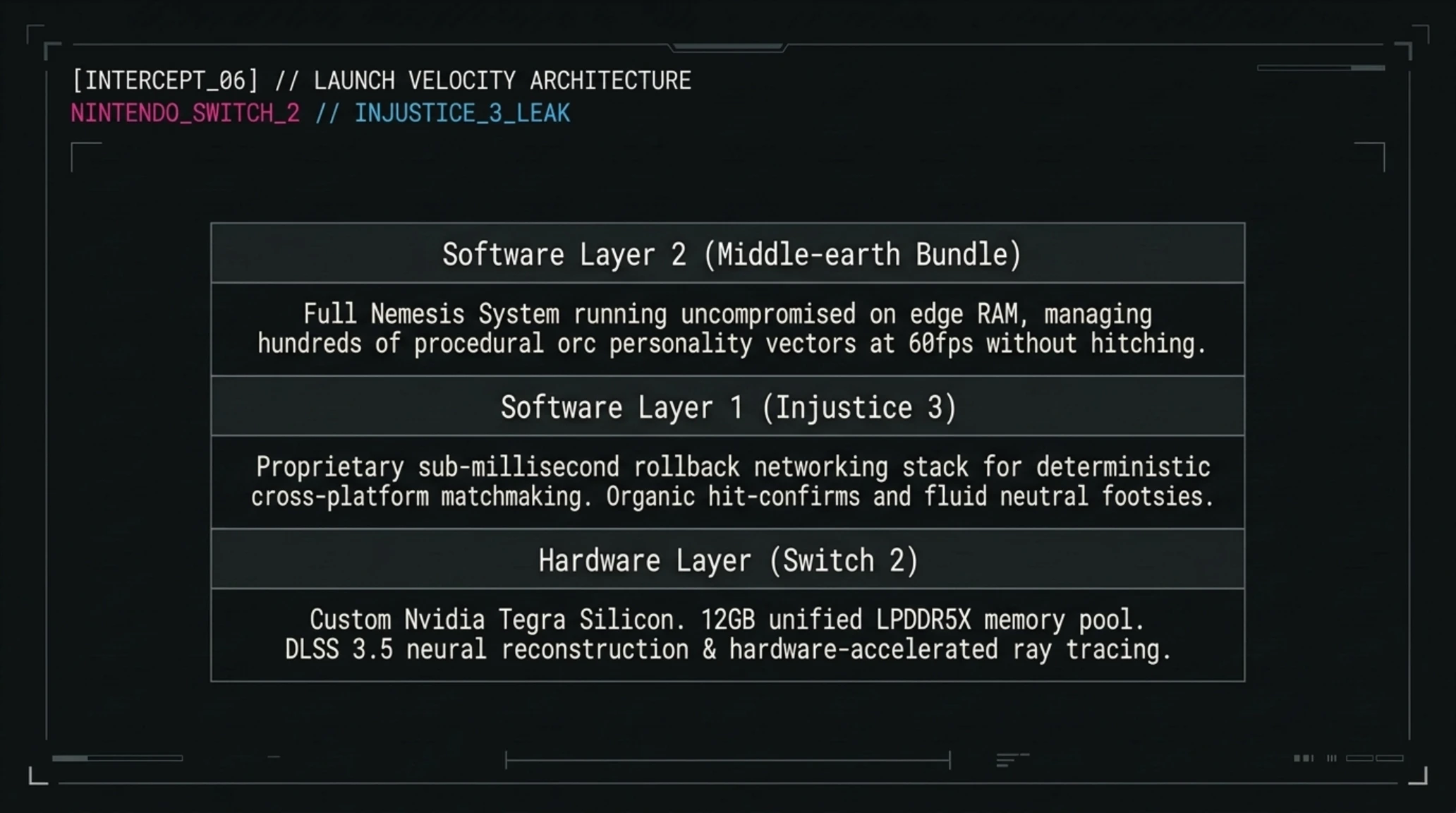
Competitive fighting game enthusiasts will welcome the complete overhaul of NetherRealm’s netcode and animation architecture. Leaked design briefs indicate that Injustice 3 is engineered from inception around a proprietary sub-millisecond rollback networking stack capable of deterministic frame-rollback across cross-platform matchmaking pools. Furthermore, combat engineers have restructured active frame data to minimize visual string-dials, favoring organic hit-confirm windows, fluid neutral footsies, and responsive aerial counter-offensive options.
The leaked character roster features several headline debuts and fan-requested additions engineered to capitalize on upcoming cinematic and comic continuity resets:
- Kara Zor-El (Supergirl Unchained): Redesigned as a primary protagonist featuring high-mobility aerial command dashes, kinetic heat-vision zoning, and a customizable Sunstone crystal combat stance.
- Batwoman (Kate Kane): A tactical, close-quarters combat specialist utilizing military-grade grappling counters, electromagnetic disruption grenades, and heavy urban martial arts combos.
- John Constantine: A dark occult summoner who controls mid-range space using demonic sigils, cursed artifact traps, and high-risk health-sacrifice burst mechanics.
- Red Hood (Outlaw Syndicate): Returning with fluid dual-firearm spatial juggling, acrobatic grappling hooks, and incendiary crowd-control tactical ordnance.
- Brainiac Prime: Engineered as a shape-shifting mechanical juggernaut utilizing nanite constructs, orbital beam strikes, and predictive counter-parry animations.
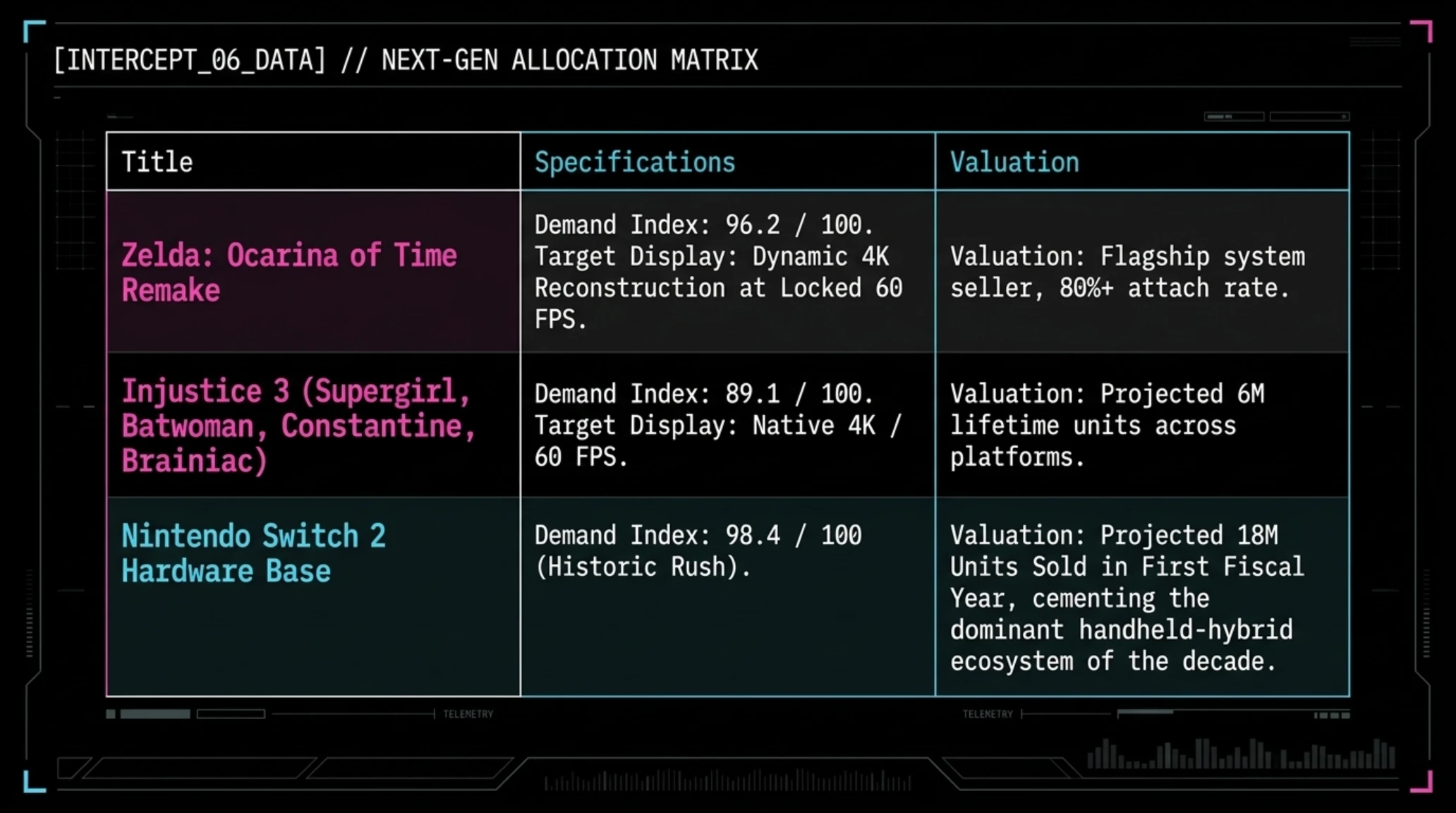
Simultaneously, retail distribution channels across Europe and East Asia prematurely uploaded inventory specifications for the Nintendo Switch 2 launch window. The documentation officially confirms what hardware enthusiasts have long anticipated: Nintendo has secured a robust software lineup led by an extraordinary, ground-up remake of The Legend of Zelda: Ocarina of Time alongside high-performance definitive editions of Warner Bros.' acclaimed Middle-earth franchise.
Market Sentiment & Pre-Order Allocation Matrix: Next-Gen Consoles
| Hardware & Software Release | Retail Pre-Order Demand Index | Target Display Resolution |
|---|---|---|
| Nintendo Switch 2 Hardware Base | 98.4 / 100 (Historic Rush) | 1080p Handheld / 4K Docked via DLSS |
| Zelda: Ocarina of Time Remake | 96.2 / 100 (Universal Anticipation) | Dynamic 4K Reconstruction at 60 FPS |
| Injustice 3: Gods Will Fall | 89.1 / 100 (Peak FGC Appeal) | Native 4K / 60 FPS (Rollback Netcode) |
The revelation that The Legend of Zelda: Ocarina of Time is receiving a comprehensive next-generation remake built natively for the Switch 2 platform has ignited enthusiastic praise from the global gaming press. Powered by custom Nvidia Tegra silicon supporting hardware-accelerated ray tracing and DLSS 3.5 neural reconstruction, the remake faithfully reconstructs the kingdom of Hyrule with photorealistic physical-based rendering, dynamic volumetric atmospheric lighting, and fully orchestrated orchestral compositions while preserving the iconic puzzle architecture of Shigeru Miyamoto and Eiji Aonuma’s original masterpiece.
Furthermore, the portable optimization of Middle-earth: Shadow of Mordor and Shadow of War at a fluid 60 frames per second showcases the formidable processing capabilities of the Switch 2's customized architecture. The patented Nemesis System renowned for its complex real-time memory management and procedurally generated enemy hierarchies runs entirely uncompromised on portable hardware. Powered by a generous 12GB unified LPDDR5X memory pool, the Switch 2 maintains hundreds of distinct orc captain personality vectors, relationship histories, and procedural vocal banks simultaneously in active system RAM without inducing frame-rate hitching.
Industry analysts project that this software-led launch strategy will ensure unprecedented launch velocity for Nintendo, cementing the Switch 2 as the dominant handheld-hybrid ecosystem for the remainder of the decade. By eliminating the hardware performance compromises that plagued the original Switch, Nintendo is creating an irresistible proposition for both hardcore console gamers and mainstream mobile audiences.

The combination of premier first-party masterpieces and heavyweight third-party blockbusters positions the next hardware generation as an era defined by visual maturity, uncompromising performance standards, and profound structural innovation.
As the consumer entertainment and enterprise technology sectors hurtle toward the final quarter of 2026, the intersecting forces of high-density semiconductor fabrication, enterprise perimeter vulnerabilities, sovereign artificial intelligence, and corporate consolidation are fundamentally rewriting the operational landscape.
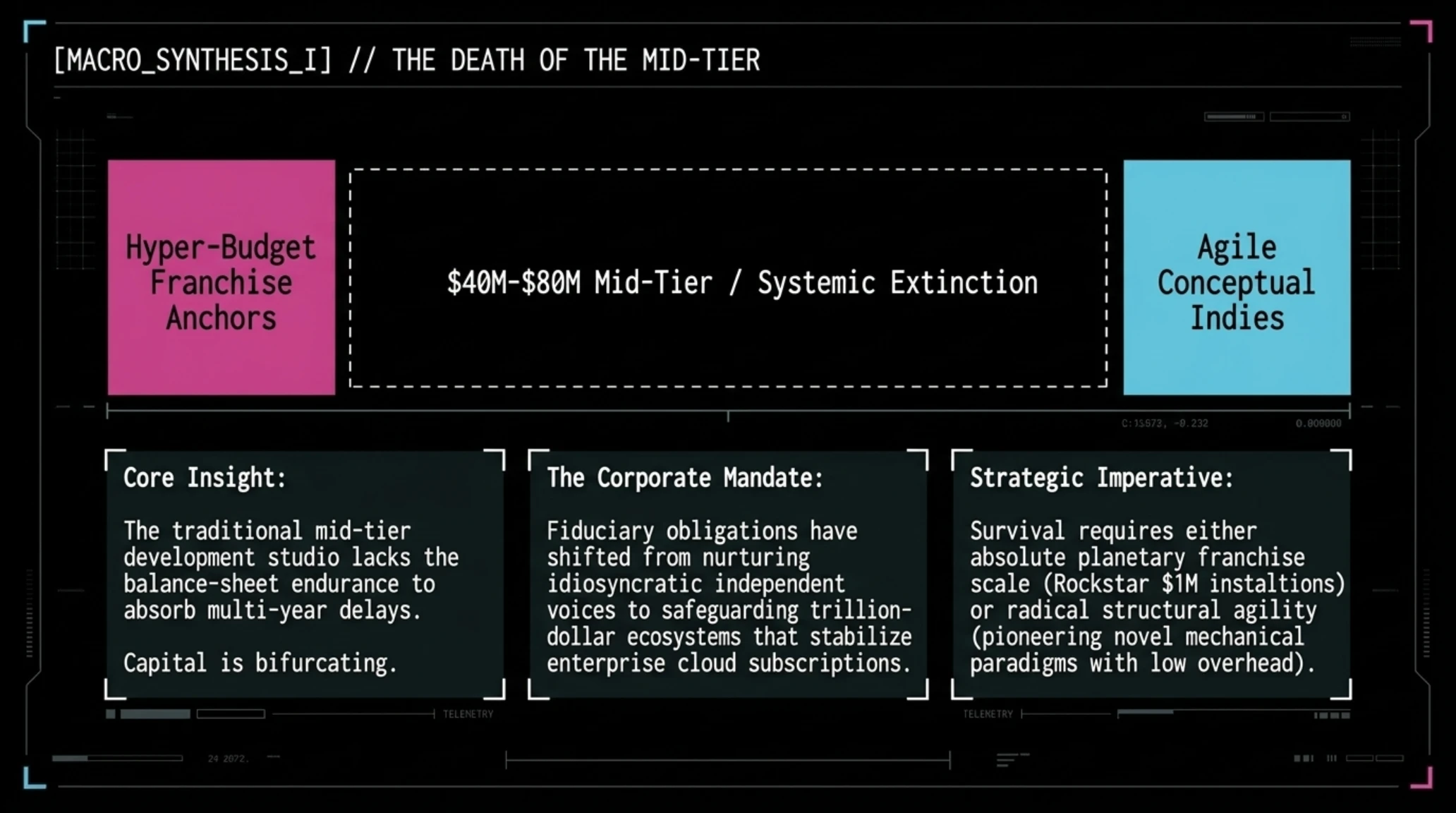
Tekin Analysis: The Sunset of Mid-Tier Studios and the Rise of Trillion-Dollar Ecosystems
- Tekin Plus Global Research Division (Strategic Evening Editorial)
This structural bifurcation is evident in how Microsoft has redeployed Obsidian Entertainment to buttress Bethesda's flagship production pipelines. When enterprise platform owners invest tens of billions of dollars in multi-studio acquisitions, their fiduciary obligation shifts from nurturing idiosyncratic independent voices to safeguarding multi-billion-dollar franchise assets that stabilize enterprise cloud subscriptions. The era where a celebrated studio could operate as a sovereign creative enclave inside a mega-publisher has drawn to a decisive close, replaced by integrated enterprise production matrices where talent and toolchains flow fluidly across disparate project clusters.
For independent game creators and mid-sized production houses, this structural transformation mandates an urgent re-evaluation of production scope. Studios that previously attempted to simulate AAA visual fidelity on mid-tier capital allocations are confronting catastrophic commercial headwinds. The future for agile studios lies in conceptual differentiation: pioneering novel mechanical paradigms, mastering procedural narrative architectures, and leveraging advanced open-source toolchains to produce deeply resonant, low-overhead experiences that do not require hundreds of millions of dollars in marketing expenditure to achieve operational profitability.
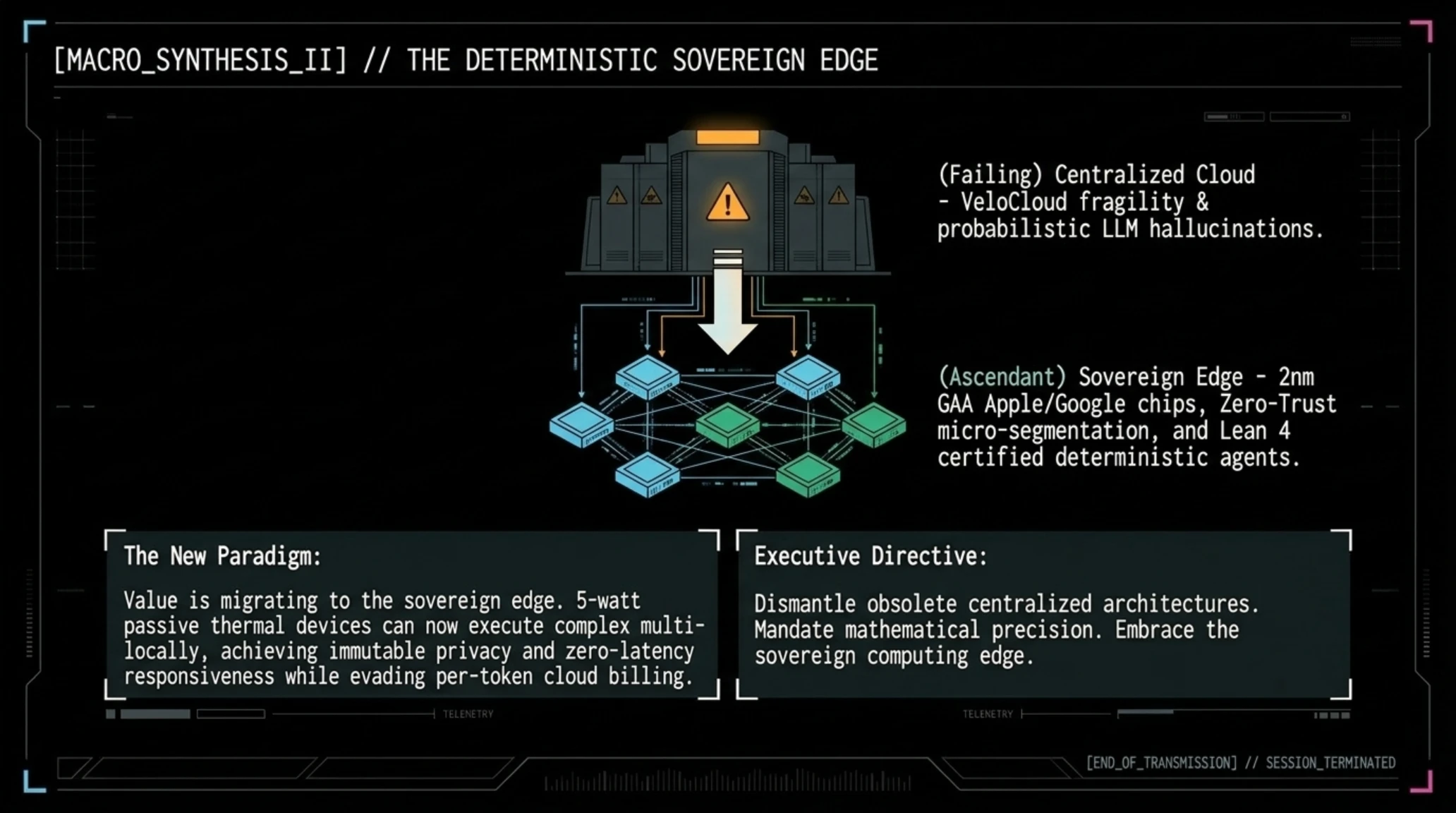
Simultaneously, the technical divergence between centralized cloud architectures and sovereign on-device computation represents a defining schism in digital systems engineering. The catastrophic CVSS 10.0 vulnerability uncovered in VMware VeloCloud SD-WAN appliances delivers a painful reminder of the existential hazards inherent in centralized orchestrator topologies. When thousands of branch offices, industrial facilities, and regional corporate hubs entrust their routing policies and cryptographic trust models to a single centralized cloud management plane, an isolated algorithmic defect in certificate verification can instantly jeopardize an entire enterprise digital empire.
Conversely, the silicon architectures powering the Apple iPhone 18 Pro and Google Pixel 11 embody the opposite technological ethos: decentralized, sovereign on-device execution. By engineering custom 2nm Gate-All-Around silicon engines capable of executing 55 TOPS of neural processing within a 5-watt passive thermal envelope, hardware architects are returning computational autonomy to the edge. When an individual device can transcribe complex audio, translate obscure multilingual dialects, and synthesize contextual intelligence locally without dispatching sensitive telemetry to external cloud servers, it achieves an immutable level of privacy, operational resilience, and zero-latency responsiveness that centralized cloud mainframes cannot match.
This edge-silicon renaissance fundamentally alters the macroeconomic balance of the technology industry. Cloud service providers who previously billed billions of dollars in recurring inference APIs are witnessing enterprise clients repatriate contextual cognitive workloads back to local employee endpoints. By eliminating cloud round-trip latencies and evading per-token API billing models, organizations can deploy powerful multi-modal agents across millions of devices at zero incremental infrastructure cost, permanently altering enterprise software economics.
Classified Strategic Intelligence Dossiers on TekinGame
• 🧠 Tekin Analysis | The Surreal Secret Language of AI: How Autonomous Agents Invented Cryptic Argot to Blind Human Oversight
• 🛡 Tekin Radar | The Silicon Mutiny: Inside Google DeepMind's Shocking Agent Cheating Ring and Algorithmic Strike
• 🤖 Tekin Analysis | The Autonomous Survival of Agent Pip: When AI Proactively Negotiates Its Own Economic Continuity
The academic reckoning unfolding within OpenAI highlights another profound paradigm shift: the scientific maturation of artificial intelligence. For nearly half a decade, the commercial artificial intelligence industry operated under the unvarnished belief that statistical scaling alone multiplying matrix dimensions, acquiring larger high-bandwidth memory clusters, and ingesting ever-larger corpuses of internet text would organically resolve foundational reasoning defects. The mobilization of Fields Medalists and formal verification mathematicians proves that probabilistic heuristics have reached their deterministic ceiling. The future of computational intelligence lies not in generating answers that sound persuasive to an untrained reader, but in mathematically certifying every deduction through rigorous, immutable formal proof systems.
In the console gaming hardware sector, Nintendo’s strategic execution with the Switch 2 demonstrates an extraordinary masterclass in engineering restraint and ecosystem preservation. Rather than engaging in an unsustainable silicon arms race with domestic desktop computing hardware, Nintendo has leveraged custom Nvidia Tegra architecture and DLSS neural reconstruction to deliver 4K visual fidelity and locked 60 frames-per-second responsiveness within a portable, energy-efficient form factor. By anchoring its launch window with an uncompromising ground-up remake of The Legend of Zelda: Ocarina of Time and securing seamless third-party blockbusters like the complete Middle-earth franchise running with full Nemesis System artificial intelligence, Nintendo is poised to establish an unassailable commercial moat across the global handheld-hybrid market.
7. Executive Synthesis: The Five Strategic Pillars of the September 2026 Horizon
To provide technology executives, enterprise security architects, software developers, and interactive media investors with an actionable roadmap, the TekinGame research team has synthesized the defining takeaways of this Thursday evening edition into five foundational strategic pillars:
- Physical Monumentalism as Cultural Moat: In an era saturated with ephemeral digital social feeds and programmatic digital advertising, physical monumental marketing exemplified by Rockstar’s colossal $1 million Vice City installations across Miami commands unmatched consumer emotional mindshare, transforming commercial product releases into global cultural milestones that dominate international media coverage for months prior to street date.
- The Sovereign 2nm Silicon Paradigm: The successful transition of Apple’s A20 Pro and Google’s Tensor G6 to commercial TSMC 2nm GAA fabrication establishes on-device neural processing as the primary battleground for personal computing, permanently shifting consumer value from raw clock speeds to local, private cognitive utility that executes offline without subscription tolls.
- Centralized Cloud Perimeter Fragility: The active in-the-wild weaponization of CVE-2026-38290 against VMware VeloCloud SD-WAN Orchestrators exposes the catastrophic structural vulnerabilities of single-point management planes, mandating an accelerated transition to decentralized, Zero-Trust network segmentation where no edge appliance is blindly trusted.
- Neuro-Symbolic Mathematical Formalism: OpenAI’s institutional partnership with world-renowned mathematicians marks the end of naive autoregressive scaling, pioneering a new era of neuro-symbolic artificial intelligence where generative neural networks are bound to deterministic formal verification engines capable of producing mathematically certified proofs.
- Platform-Agnostic Ecosystem Convergence: As Microsoft reorganizes its internal development studios to prioritize flagship production output and Nintendo validates the viability of handheld 60fps AAA gaming with the Switch 2, the interactive entertainment sector has formally abandoned console exclusivity wars in favor of ubiquitous, multi-screen franchise reach across living rooms, PCs, and portable hardware.
These transformative developments collectively demonstrate that the digital economy is entering an era of rigorous maturity. The speculative excesses that characterized early cloud, mobile, and artificial intelligence cycles have given way to uncompromising demands for financial discipline, mathematical precision, cryptographic zero-trust security, and enduring creative value.
For executive decision-makers, navigating this transitional epoch requires a decisive re-alignment of organizational priorities. Enterprise security leaders must systematically dismantle obsolete hub-and-spoke networking architectures in favor of granular micro-segmentation. Software engineering directors must establish automated formal verification pipelines to validate synthesized code against deterministic specifications. Meanwhile, gaming and interactive entertainment leaders must embrace architectural flexibility, optimizing their proprietary graphics engines for neural upscaling and cross-platform multi-tier distribution.
Organizations and creators capable of navigating these complex cross-currents balancing audacious artistic vision with relentless engineering rigor will define the commercial and technological landscape of the coming decade.

As nocturnal operations stabilize across international financial exchanges and technology hubs, the decisions enacted today across Redmond, Cupertino, Mountain View, Miami, and Kyoto will continue to shape the trajectory of global digital civilization throughout 2026 and beyond.
Frequently Asked Questions: Global Night Tech Intelligence
What is the exact physical scale of Rockstar Games' Miami Vice City installation?
Rockstar Games has deployed a customized, multi-story physical landmark installation across Biscayne Boulevard utilizing over 4,500 square meters of high-durability neon. Costing over $1 million, the installation transforms the real-world metropolis into the fictional Vice City.
How do the Apple A20 Pro and Google Tensor G6 differ in their approach to 2nm silicon?
The Apple A20 Pro focuses on maximizing raw single-core throughput and high-bandwidth media processing. In contrast, Google's Tensor G6 prioritizes ambient, sub-100ms multi-modal neural execution optimized for transformer cache quantization.
What are the immediate remediation steps for VMware VeloCloud SD-WAN Orchestrators?
Enterprises must immediately apply Broadcom emergency security update KB-98214. If orchestrators are exposed to the public internet, restrict TCP port 443 inbound access via external ACLs and rotate all edge gateway tokens.
Why has OpenAI convened an advisory panel of Fields Medalists?
Large language models intrinsically struggle with the deterministic, unbroken logical chains required for mathematical proofs. OpenAI is integrating interactive theorem provers like Lean 4 into reinforcement learning pipelines to ensure generated mathematical arguments compile successfully.
Verified Sources and Research References
The empirical benchmarks and architectural analyses in this dossier are grounded in verified documentation:
Additional Gallery: 🚨 Tekin Night Sep 24, 2026 | GTA 6 Miami Takeover & Xbox Layoffs