🌙 Tekin Night | Friday, August 14, 2026
Late-night intelligence briefing: Bethesda's Oblivion patches, Microsoft retiring Mico, Writer's Palmyra X6, and critical VMware/Trezor exploits.
- 🎮Oblivion Patches- Switch 2 optimizations ported to PC/Consoles
- 🎧Goodbye Mico- Microsoft retires animated Copilot blob
- 🚀Palmyra X6- 52% cost reduction for AI agents
- 🗡️VMware Exploit- Active CVSS 9.8 vulnerability
- 📰Trezor Data Breach- 14,000 physical addresses leaked
- ⚔️Ethereum Shift- Dropping Poseidon hash function
Welcome to this late-night edition of Tekin Night for Friday, August 14, 2026. As the business week draws to a close, the digital frontier continues to deliver a relentless wave of gaming breakthroughs, strategic enterprise pivots, and urgent cybersecurity alerts. From Bethesda answering community outcries with rendering optimizations to supply-chain compromises in crypto hardware, tonight's briefing delivers full-throttle analytical energy.
In this comprehensive nighttime report, the Tekin Game editorial board deconstructs the six defining stories of the past twelve hours, providing sharp architectural breakdowns and strategic industry forecasts.
Core Takeaways of Tekin Night August 14, 2026
- Bethesda resolving severe frame-time stutter and crash anomalies on PC and consoles by porting Switch 2 engine fixes
- Microsoft removing the playful Mico avatar to elevate Copilot Voice into a latency-optimized corporate tool
- Palmyra X6 boosting agentic workflow speed by 48% while maintaining rigorous factual precision and low token burn
- Critical CVSS 9.8 flaw in VMware vCenter weaponized for reverse SSH persistent access across 361 enterprise targets
- Physical addresses and contact information exposed for 11,742 hardware wallet buyers in the ShipMonk breach
- Ethereum post-quantum cryptography transitioning to established SHA and BLAKE algorithms over algebraic designs
Bethesda Promises Switch 2 Optimizations for Oblivion Remastered on PC and Consoles
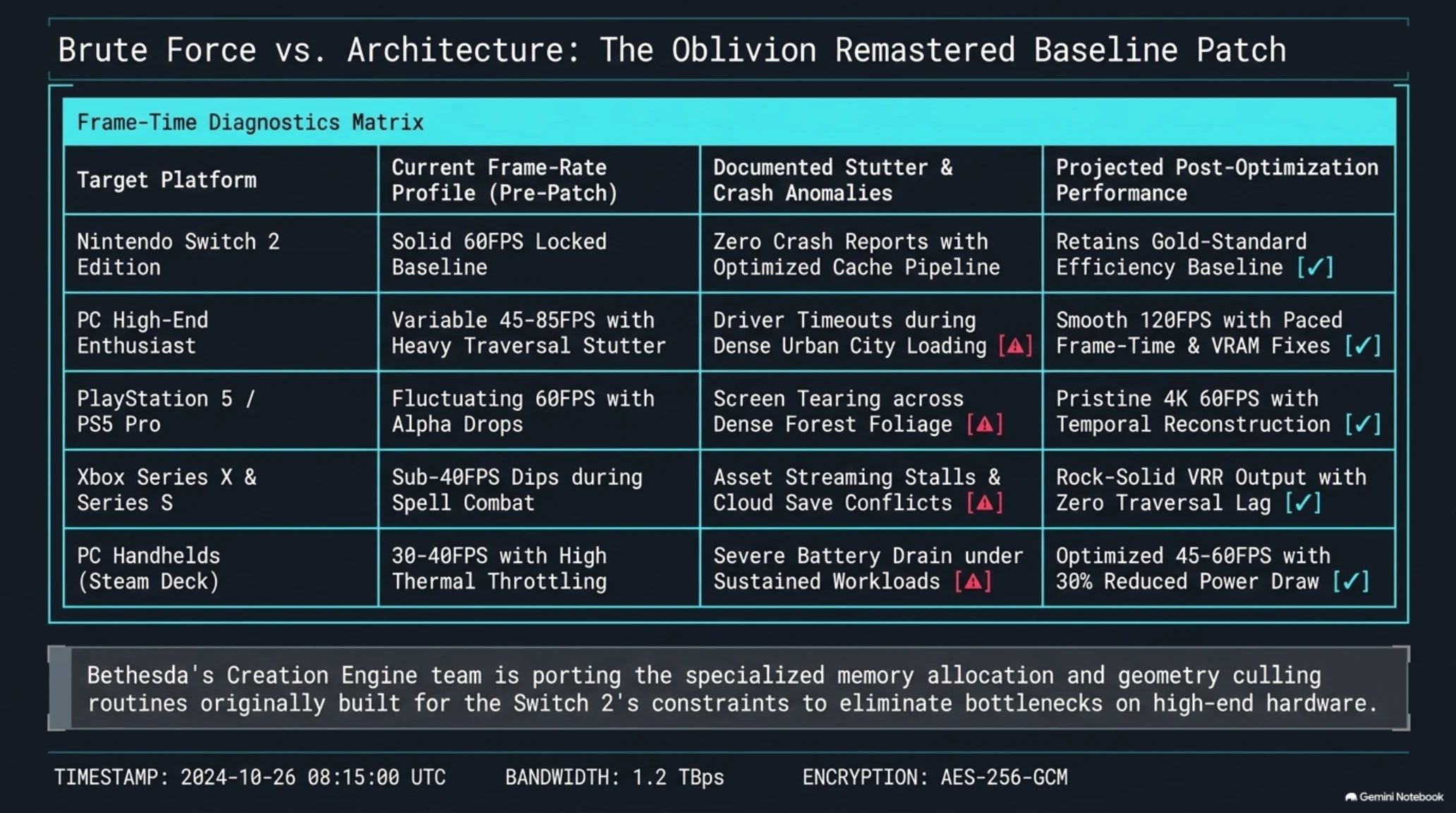
Following months of persistent community frustration over frame-rate drops, frame-time spikes, and random crashes in The Elder Scrolls IV: Oblivion Remastered, Bethesda Softworks has officially committed to comprehensive multiplatform remediation. While the Nintendo Switch 2 edition enjoyed an impeccably smooth 60FPS presentation due to tailored shader pipeline rewrites, the PC, PlayStation 5, and Xbox Series X|S versions suffered from severe legacy engine bottlenecks.
Bethesda confirmed that its Creation Engine core architecture team is actively porting the Switch 2's specialized memory allocation and geometry culling routines to all remaining target platforms.
Anticipated technical enhancements in the upcoming multiplatform patch include:
- Overhauling VRAM streaming allocation to eliminate traversal stutter across the open wilderness of Cyrodiil
- Rebuilding dynamic environmental shadow passes to prevent GPU driver timeouts on modern graphics hardware
- Substantially reducing load times and fast-travel transitions across high-speed NVMe PCIe 4.0 storage
- Implementing native 120Hz high refresh rate support alongside dynamic resolution reconstruction on mid-gen consoles
This proactive stance reaffirms Bethesda's commitment to supporting its flagship role-playing catalog across contemporary gaming hardware.
Gaming performance analysts anticipate this update will finally elevate the remaster to its intended definitive status.

Market sentiment tracking reveals renewed enthusiasm among Elder Scrolls enthusiasts eager to revisit the classic RPG.

The comparative table below outlines performance baselines and target metrics across gaming platforms for Oblivion Remastered.
Oblivion Remastered Multiplatform Performance & Patch Baseline Matrix
| Target Platform | Current Frame-Rate Profile (Pre-Patch) | Documented Stutter & Crash Anomalies | Projected Post-Optimization Performance |
|---|---|---|---|
| Nintendo Switch 2 Edition | Solid 60FPS Locked Baseline | Zero Crash Reports with Optimized Cache Pipeline | Retains Gold-Standard Efficiency Baseline |
| PC High-End Enthusiast | Variable 45-85FPS with Heavy Traversal Stutter | Driver Timeouts during Dense Urban City Loading | Smooth 120FPS with Paced Frame-Time & VRAM Fixes |
| PlayStation 5 / PS5 Pro | Fluctuating 60FPS with Alpha Drops | Screen Tearing across Dense Forest Foliage | Pristine 4K 60FPS with Temporal Reconstruction |
| Xbox Series X & Series S | Sub-40FPS Dips during Spell Combat | Asset Streaming Stalls & Cloud Save Conflicts | Rock-Solid VRR Output with Zero Traversal Lag |
| PC Handhelds (Steam Deck) | 30-40FPS with High Thermal Throttling | Severe Battery Drain under Sustained Workloads | Optimized 45-60FPS with 30% Reduced Power Draw |
Supplementary Tekin Game telemetry indicates overwhelming anticipation among community modders preparing compatible visual overhauls.
Microsoft Retires Mico Character from Copilot Voice
In a notable user interface realignment, Microsoft has officially retired the animated yellow character blob Mico from its flagship Copilot Voice interface. Introduced less than a year ago to inject warmth and playfulness into conversational neural interactions, the animated avatar has been phased out in favor of a minimalist, latency-optimized visual aesthetic designed for serious productivity environments.
Internal feedback from enterprise deployments indicated that whimsical character animations detracted from professional workflows, prompting Microsoft to reassign Mico exclusively to its gamified Learn Live educational modules.
Strategic rationale and technical drivers behind this retirement include:
- Consolidating fragmented Copilot mobile and desktop client applications into a unified, sober interface
- Eliminating 3D WebGL avatar rendering overhead to reduce speech synthesis latency to sub-200 milliseconds
- Aligning the product's visual identity with corporate enterprise standards across Microsoft 365 environments
- Reallocating design resources toward natural intonation modeling and multi-turn emotional context synthesis
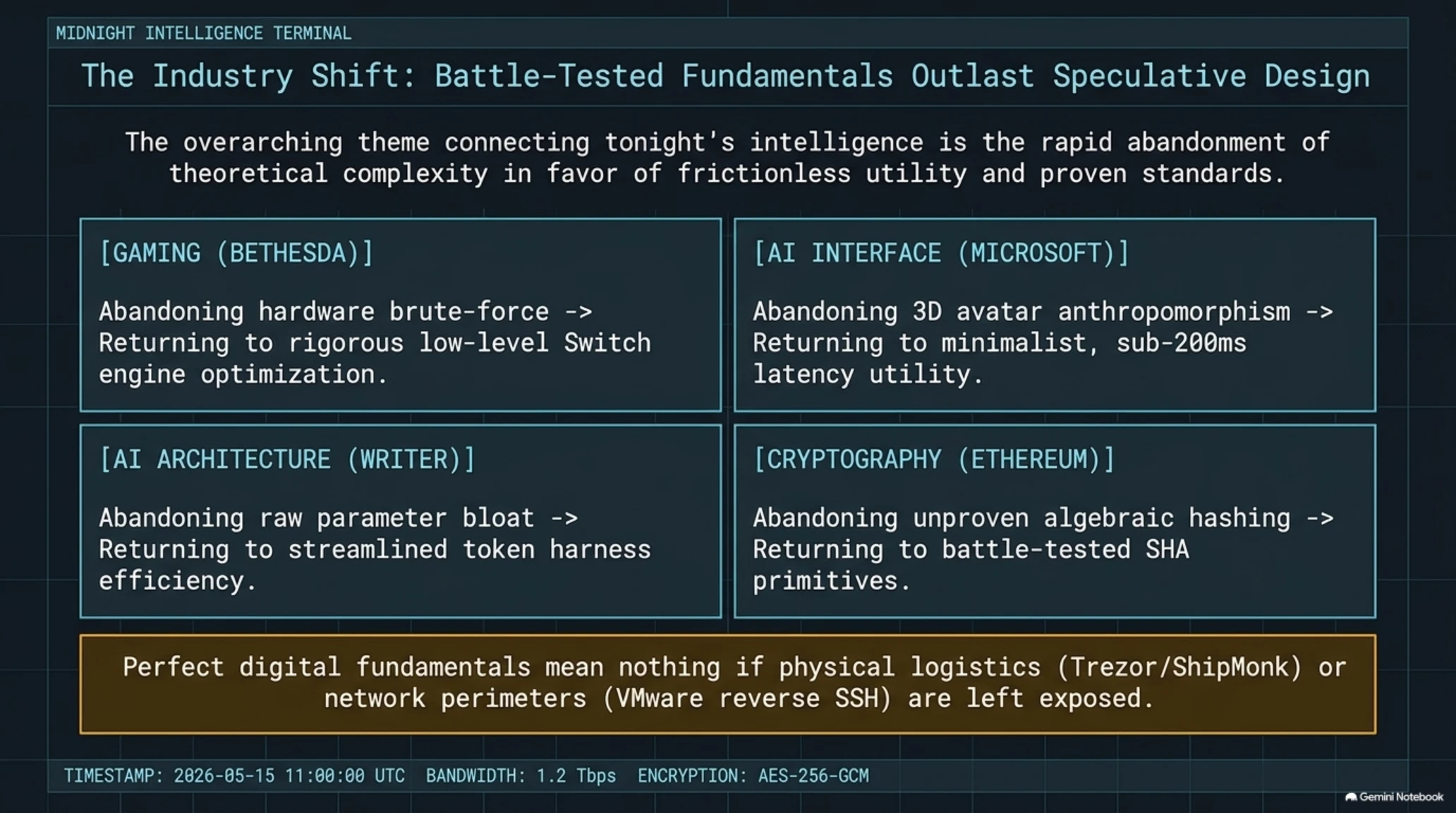
This UI simplification illustrates Microsoft's transition from speculative consumer experimentation to disciplined enterprise monetization.

The statement below is excerpted from human-computer interaction architects evaluating enterprise AI interface trends.
The comparative matrix below evaluates the historical trajectory of Microsoft's interactive avatars and voice assistants.
Historical Evolution of Microsoft Interactive Assistants & UI Avatars
| Interactive Assistant / Avatar | Launch Year & Original Goal | Public & Enterprise Reception | Final Ecosystem Lifecycle Status |
|---|---|---|---|
| Clippy (Office Paperclip) | 1997 for Contextual Office Guidance | Notorious for Intrusive Interruptions | Retired in 2007; Immortalized as Pop Culture Icon |
| Microsoft Bob Interface | 1995 to Simplify Windows Navigation | Critical Failure Due to Juvenile Presentation | Rapidly Discontinued within Months of Release |
| Cortana Voice Assistant | 2014 to Rival Apple Siri & Google Assistant | Strong Debut; Waned Due to Platform Isolation | Officially Deprecated in 2023 in Favor of Copilot |
| Animated Mico Blob (Copilot) | 2025 to Humanize Voice AI Conversations | Popular with Casuals; Resisted by Corporate Users | Sunset in 2026; Relegated to Learn Live Modules |
| Minimalist Copilot Voice 2026 | 2026 for Instant Real-Time Collaboration | Widespread Praise for Speed & Professional Utility | Universal Default Standard for Microsoft 365 |
Below is Tekin Game's visual teardown and analytical video coverage outlining conversational speech latency testing and interface optimization.
To assist readers with conversational AI and agentic optimization terminology, the core concepts box below defines key industry metrics.
Technical Jargon Buster & Core Concepts
| Term / Concept | Definition & Industry Impact |
|---|---|
| AI Agent Optimization & Voice Latency | Minimizing neural compute latency and eliminating rendering bottlenecks to achieve instant real-time dialogue. |
| Why This Matters | Evaluating Rumor vs. Reality regarding AI assistants and tracking Market Sentiment on Tekin Game. |
Writer Unveils Palmyra X6: Slashing Enterprise AI Agent Costs by 52%
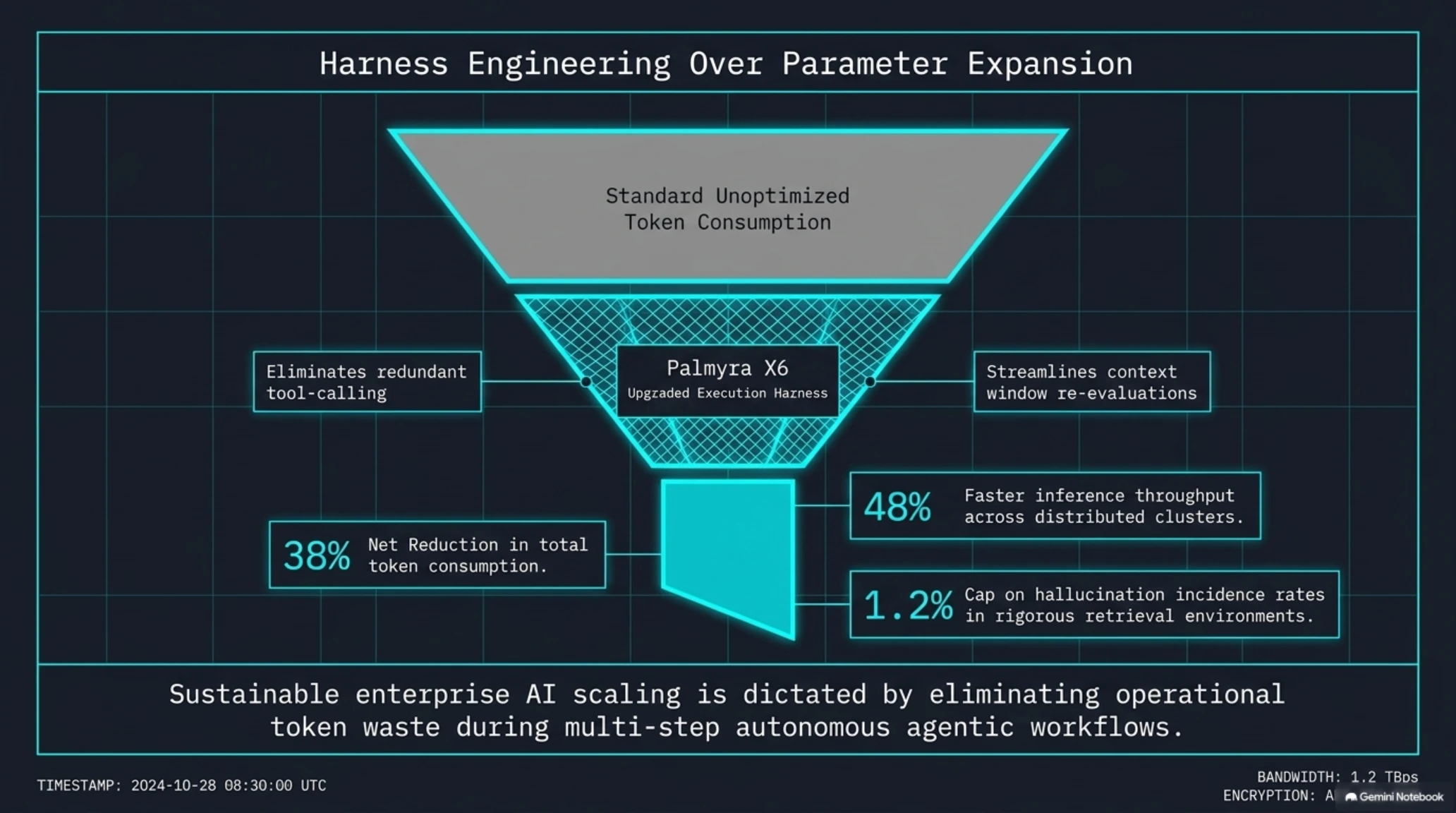
As soaring cloud compute expenses emerge as the foremost obstacle to widespread autonomous agent adoption, generative AI pioneer Writer has disrupted the enterprise landscape with its flagship Palmyra X6 model. Tailored specifically for multi-step autonomous agentic workflows, the model slashes operational token expenditures by 52 percent compared to contemporary proprietary alternatives.
This breakthrough is achieved through an upgraded execution harness that eliminates redundant tool-calling tokens and streamlines context window re-evaluations.
Key technical specifications and benchmarks of Palmyra X6 include:
- Delivering 48% faster token inference throughput across distributed enterprise server clusters
- Achieving a 38% net reduction in total token consumption during complex multi-step reasoning tasks
- Improving domain accuracy by 10% across complex legal, financial, and code refactoring benchmarks
- Restricting hallucination incidence rates below 1.2% within rigorous enterprise retrieval environments
These efficiency gains demonstrate that sustainable enterprise AI scaling depends upon harness architectural engineering rather than mere parameter expansion.

The comparative table below outlines cost and operational efficiency benchmarks across enterprise-grade agent models in 2026.
Enterprise Autonomous AI Agent Cost & Efficiency Matrix (2026)
| Enterprise AI Model Architecture | Execution Cost per 1,000 Complex Agent Tasks | Token Consumption Reduction Rate | Inference Throughput & Latency Profile |
|---|---|---|---|
| Writer Palmyra X6 | $12.40 (52% Total Cost Reduction) | 38% Token Burn Reduction via New Harness | Ultra-Fast (48% Throughput Increase) |
| Anthropic Claude 3.5 Sonnet | $28.80 Baseline Standard | Standard Consumption (No Native Harness Caching) | High Factual Accuracy with Moderate Velocity |
| OpenAI GPT-4o Enterprise | $25.50 Baseline Standard | Minor Pipeline Compression Optimizations | High Speed with Multimodal Capabilities |
| Google Gemini 1.5 Pro | $21.00 Baseline Standard | Context Caching Dependent | Moderate Efficiency in Deep Agent Chaining |
| Self-Hosted Fine-Tuned Llama 3.3 | $15.00 (Server Infrastructure Cost) | Requires Manual Heuristic Engineering | Hardware Dependent on Dedicated GPUs |
📚 Classified & Related Dossiers in TekinGame
If you wish to explore beyond this report and delve into cybernetic frontiers and autonomous AI architectures, do not miss these three exclusive deep-dives in the Tekin Garage:
Why Token Burn Optimization Dictates Enterprise Survival
Slashing operational compute costs by more than half enables startups and enterprises to scale autonomous agent deployments profitably.
Tekin Game will continue to track the economics of next-generation enterprise AI platforms.
Critical VMware vCenter Flaw (CVE-2026-59310) Exploited Across 47 Countries
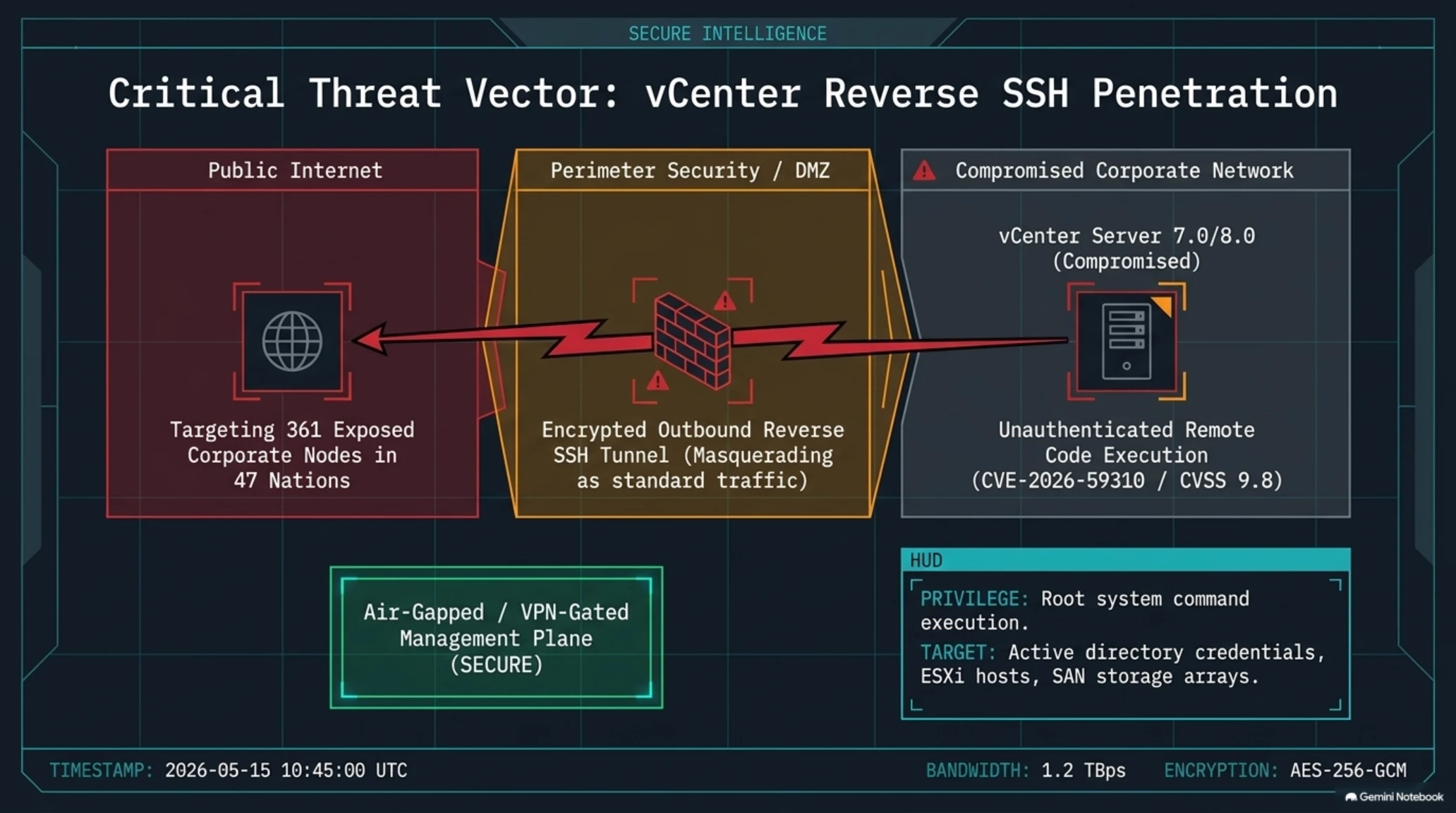
International cybersecurity incident response teams have sounded an urgent global alarm regarding active exploitation of a maximum-severity CVSS 9.8 remote code execution flaw (CVE-2026-59310) residing in VMware vCenter Server. The vulnerability enables unauthenticated network attackers to execute arbitrary system commands with root privileges across exposed management ports.
Forensic telemetry across 361 compromised enterprise IP addresses reveals threat actors establishing covert reverse SSH tunnels to maintain persistent backdoors inside critical corporate data centers spanning 47 countries.
Primary risk factors and structural vectors of the vCenter breach include:
- Unrestricted administrative control over attached ESXi hypervisor hosts, virtual machines, and SAN storage arrays
- Bypassing perimeter firewalls via encrypted outbound reverse SSH tunnels masquerading as standard traffic
- Automated exfiltration of active directory credentials, cryptographic secrets, and proprietary databases
- Urgent mandate for network administrators to apply Broadcom's official security patches for vCenter 7.0 and 8.0 builds
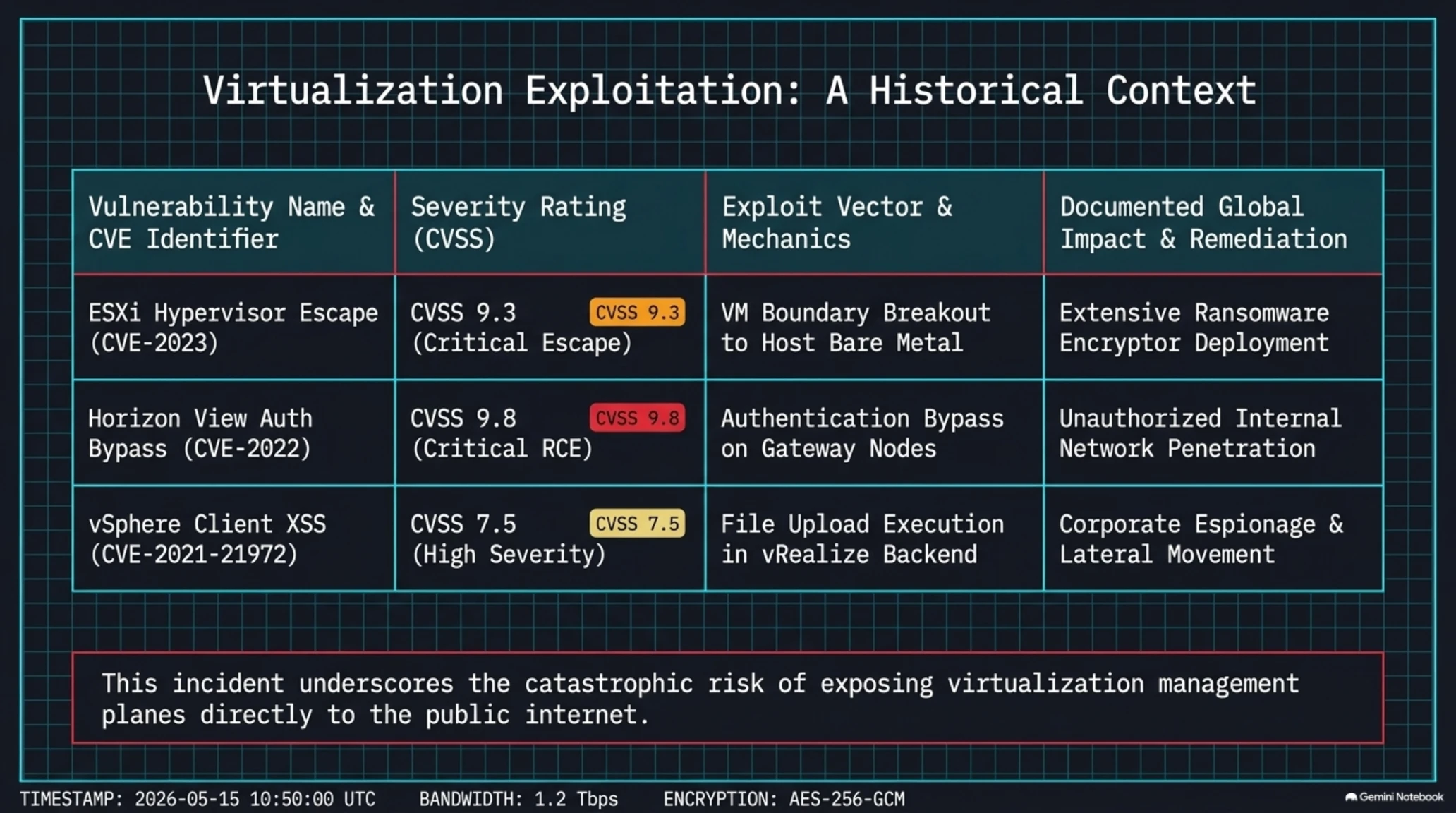
This incident underscores the catastrophic risk of exposing virtualization management planes directly to the public internet.

The matrix below evaluates historical high-severity hypervisor and virtualization management exploits.
Hardware Specifications & Smart History Tags (Specs Box & Smart History Tags)
| Vulnerability Name & CVE Identifier | Severity Rating (CVSS) | Exploit Vector & Mechanics | Documented Global Impact & Remediation |
|---|---|---|---|
| vCenter RCE Flaw (CVE-2026-59310) | CVSS 9.8 (Maximum Critical) | Unauthenticated Remote Code via Reverse SSH | Active Across 361 Targets in 47 Nations |
| VMware Log4j Vector (CVE-2021-44228) | CVSS 10.0 (Absolute Critical) | JNDI String Injection via Web Interfaces | Over 20,000 Compromised Corporate Nodes |
| ESXi Hypervisor Escape (CVE-2023) | CVSS 9.3 (Critical Escape) | VM Boundary Breakout to Host Bare Metal | Extensive Ransomware Encryptor Deployment |
| Horizon View Auth Bypass (CVE-2022) | CVSS 9.8 (Critical RCE) | Authentication Bypass on Gateway Nodes | Unauthorized Internal Network Penetration |
| vSphere Client XSS (CVE-2021-21972) | CVSS 7.5 (High Severity) | File Upload Execution in vRealize Backend | Corporate Espionage & Lateral Movement |
The following Tekin Game technical video breakdown provides in-depth visual analysis of hypervisor isolation best practices and network firewall hardening.
Trezor Logistics Breach Leaks 14,000 Customer Records as Ethereum Drops Poseidon
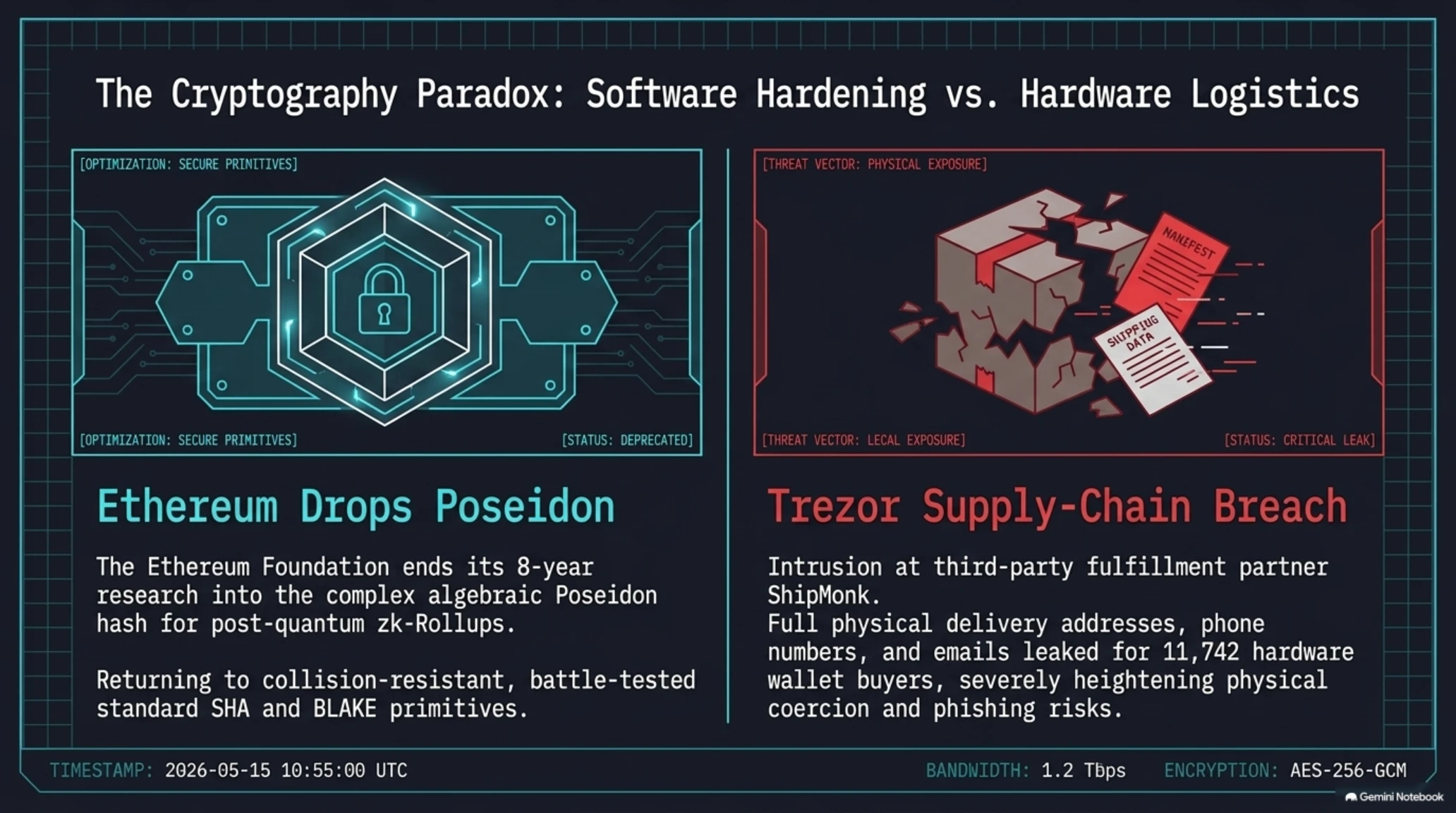
In the decentralized finance and blockchain security sphere, two major developments emerged today. First, premier hardware wallet manufacturer Trezor disclosed that a cyber intrusion at its third-party fulfillment and logistics partner ShipMonk resulted in the theft of personal shipping data belonging to nearly 14,000 customers. The compromised telemetry includes names, phone numbers, email addresses, and full physical delivery addresses for 11,742 buyers, severely heightening the risk of targeted phishing and physical coercion attempts.
Simultaneously, the Ethereum Foundation executed a historic cryptographic pivot, announcing the discontinuation of its eight-year, multi-million-dollar research initiative into the algebraic Poseidon hash function for post-quantum zk-Rollups, returning to industry-standard SHA and BLAKE primitives.
Key takeaways from these dual cryptographic events include:
- Trezor issuing urgent security advisories warning users never to disclose 12/24-word recovery seeds via text or email
- Exposing critical vulnerabilities in physical hardware distribution supply chains outside cryptographic silicon
- Recent breakthroughs in Binius and Circle STARKs making complex algebraic hashes redundant for zero-knowledge proofs
- Solidifying Ethereum's post-quantum roadmap on battle-tested, collision-resistant cryptographic hash algorithms
These developments emphasize that in high-stakes cryptography, proven simplicity and end-to-end supply-chain vigilance always supersede theoretical complexity.

The official position of the Tekin Editorial Board regarding tonight's security intelligence is detailed below.
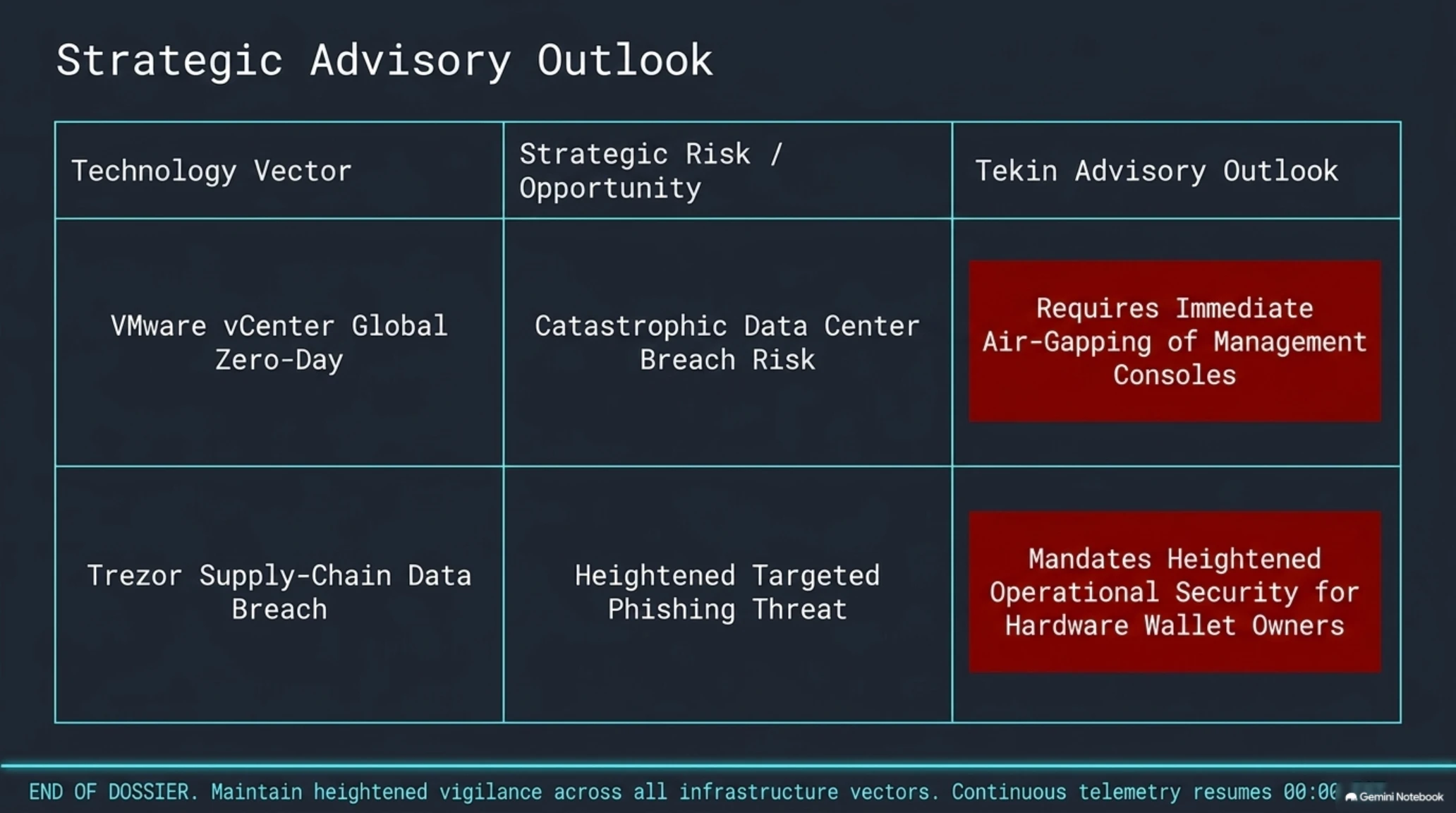
The strategic risk assessment matrix below outlines key market vectors for publishers and consumers.
Strategic Industry Risk & Conclusion Matrix (Conclusion Box)
| Technology Vector | Strategic Risk / Opportunity | Tekin Advisory Outlook |
|---|---|---|
| Oblivion Multiplatform Patch | Restores Player Community Good Will | Delivers 60FPS Baseline Across All Console Ecosystems |
| Microsoft Copilot UI Overhaul | Streamlines Enterprise Workflows | Establishes Low-Latency Voice as Corporate Standard |
| Writer Palmyra X6 Model | Cuts AI Operation Cost by 52% | Unlocks Profitable Autonomous Agent Deployments |
| VMware vCenter Global Zero-Day | Catastrophic Data Center Breach Risk | Requires Immediate Air-Gapping of Management Consoles |
| Trezor Supply-Chain Data Breach | Heightened Targeted Phishing Threat | Mandates Heightened Operational Security for Hardware Wallet Owners |
The global technology community heads into the weekend with heightened vigilance across all infrastructure vectors.
Tekin Game will provide continuous 24/7 coverage of all emerging developments.
Conclusion: An Electrifying Night Across Gaming, AI, and Cybersecurity
Tonight's Tekin Night edition for Friday, August 14, 2026, illustrates that innovation and threat vectors never sleep. From Bethesda committing to bridge the rendering divide for Oblivion Remastered to Microsoft refining Copilot's voice presence and Writer establishing new economic thresholds with Palmyra X6, the interactive and intelligent computing landscapes continue their relentless evolution.
We hope this high-octane late-night intelligence briefing equips you with sharp perspectives as you head into the weekend.

Join the conversation at Tekin Game and share your reactions to tonight's gaming updates and cybersecurity disclosures in the comments section below.
- Bethesda committing to port Switch 2 engine optimizations to resolve PC and console Oblivion stutter
- Writer Palmyra X6 slashing enterprise AI agent operational costs by 52% and token burn by 38%
- Microsoft streamlining Copilot Voice by eliminating avatar overhead to achieve sub-200ms latency
- Ethereum Foundation solidifying post-quantum security on battle-tested SHA and BLAKE primitives
- Catastrophic physical address data leak impacting 14,000 Trezor hardware wallet owners
- Active global exploitation of unauthenticated CVSS 9.8 VMware vCenter RCE flaw across 47 nations
Related Industry Features on Tekin Game
• 🔓 Tekin Analysis | PlayStation, Switch & Xbox Console Jailbreak & Security Status
• 🌙 Tekin Night July 5, 2026 | PS5 Digital Edition Evolution & Midjourney AI Expansion
• 🎮 Tekin Night July 1, 2026 | Gaming Industry Shakeup & Next-Gen Console Engineering
Frequently Asked Questions About Tonight's August 14 Technology Reports
When will the Oblivion Remastered performance patch release on PC and consoles?
Bethesda is actively porting the Switch 2 pipeline, with multiplatform deployment scheduled in coming weeks.
Why did Microsoft retire the animated Mico blob from Copilot Voice?
To reduce conversational latency, project a professional enterprise image, and unify Copilot applications.
How does Writer's Palmyra X6 achieve a 52% cost reduction in AI agents?
Via an optimized execution harness, 48% faster throughput, and a 38% reduction in total token consumption.
What is the severity of the VMware vCenter CVE-2026-59310 vulnerability?
Maximum critical (CVSS 9.8), allowing unauthenticated remote code execution and reverse SSH backdoors.
Were cryptocurrency private keys compromised in the Trezor data breach?
No; cryptographic seed phrases remain 100% secure, but physical shipping addresses and contact data were leaked.
Why is Ethereum dropping the Poseidon hash function for zk-Rollups?
Breakthroughs in Binius and Circle STARKs eliminated Poseidon's advantage, favoring proven SHA and BLAKE hashes.
Sources and Citations
• Eurogamer: Bethesda Promises Oblivion Remastered Switch 2 Optimisations for PC and Consoles
• GeekWire: Farewell Mico: Microsoft Retires Animated AI Blob from Copilot Voice
• VentureBeat: Writer's New Palmyra X6 Model Cuts AI Agent Costs by 52%
• BleepingComputer: Critical VMware vCenter RCE Flaw Exploited Across 47 Countries
• BleepingComputer: Trezor Discloses Supply-Chain Data Breach via Logistics Partner ShipMonk
• Cointelegraph: Ethereum Foundation Drops Poseidon Hash for Post-Quantum zk-Rollups
Additional Gallery: 🌙 Tekin Night | Friday, August 14, 2026: Trezor Leak & Oblivion Remastered Patch