Tekin Night: Kojima Shock, Studio Wars & Classic Resurrections
A late-night analytical briefing exploring six pivotal developments across gaming blockbusters, cinema, and dark web security.
- 🎮Kojima's Physint Shock- Sony abruptly cancels his espionage title over a Zoom call, Xbox steps in.
- 🎧Townfall Review Acclaim- Screen Burn's analog horror wins widespread praise for its 1996 CRT mechanic.
- 🚀Dark Web Turf War- ShinyHunters hacks and defaces rival gang Clop's leak portal.
- 🗡️GTA 6 Strict Gag Order- Rockstar mandates media blackout across voice talent until November 19 launch.
- 📰Resident Evil Box Office- Zach Cregger's reboot shatters records with a $108.3M global debut.
- ⚔️JRPG Classics Resurrected- TAITO announces Lufia I & II for PS5, Switch 2, and Steam for 2027.
Good evening, digital entertainment executives, game systems architects, and late-night technology analysts. As the quiet hours of Tuesday night, September 22, 2026 settle in marking the reflective close of the autumn equinox's inaugural business day the editorial team at TekinGame convenes to deliver our comprehensive nocturnal dossier, Tekin Night. In the tranquil hours before midnight, when corporate public relations machinery powers down and canned press releases lose their grip on the news cycle, the unvarnished realities of studio power struggles, underground cybersecurity warfare, and high-stakes intellectual property acquisitions reveal themselves with uncompromising clarity. Our nocturnal intelligence cycle is engineered specifically to penetrate beneath superficial promotional hype, correlating supply chain leaks, judicial filings, and cryptographic telemetry to provide decision-makers with actionable strategic foresight.
The past forty-eight hours have witnessed an extraordinary convergence of industrial shocks, forensic revelations, and nostalgic cultural triumphs that together illuminate the broader tectonic shifts shaping global interactive entertainment. In this evening's deep-dive briefing, we dissect six consequential storylines that demand rigorous examination: from Hideo Kojima's shocking and emotionally raw disclosure regarding Sony's abrupt cancellation of his ambitious espionage-action title Physint over a brief Zoom call and his subsequent lifeline partnership with Microsoft Xbox, to the lifting of review embargos for Konami and Screen Burn's critically acclaimed Silent Hill: Townfall; from the unprecedented dark web turf war that saw extortion syndicate ShinyHunters breach, deface, and plunder the .onion infrastructure of ransomware cartel Clop, to Rockstar Games' ironclad gag order mandating total media silence from Grand Theft Auto VI voice actors and motion-capture performers until launch night; and from the historic $60 million domestic box office explosion of Zach Cregger's terrifying Resident Evil movie reboot, to the official 2027 resurrection of Super Nintendo JRPG masterworks Lufia I & II on modern consoles and PC.
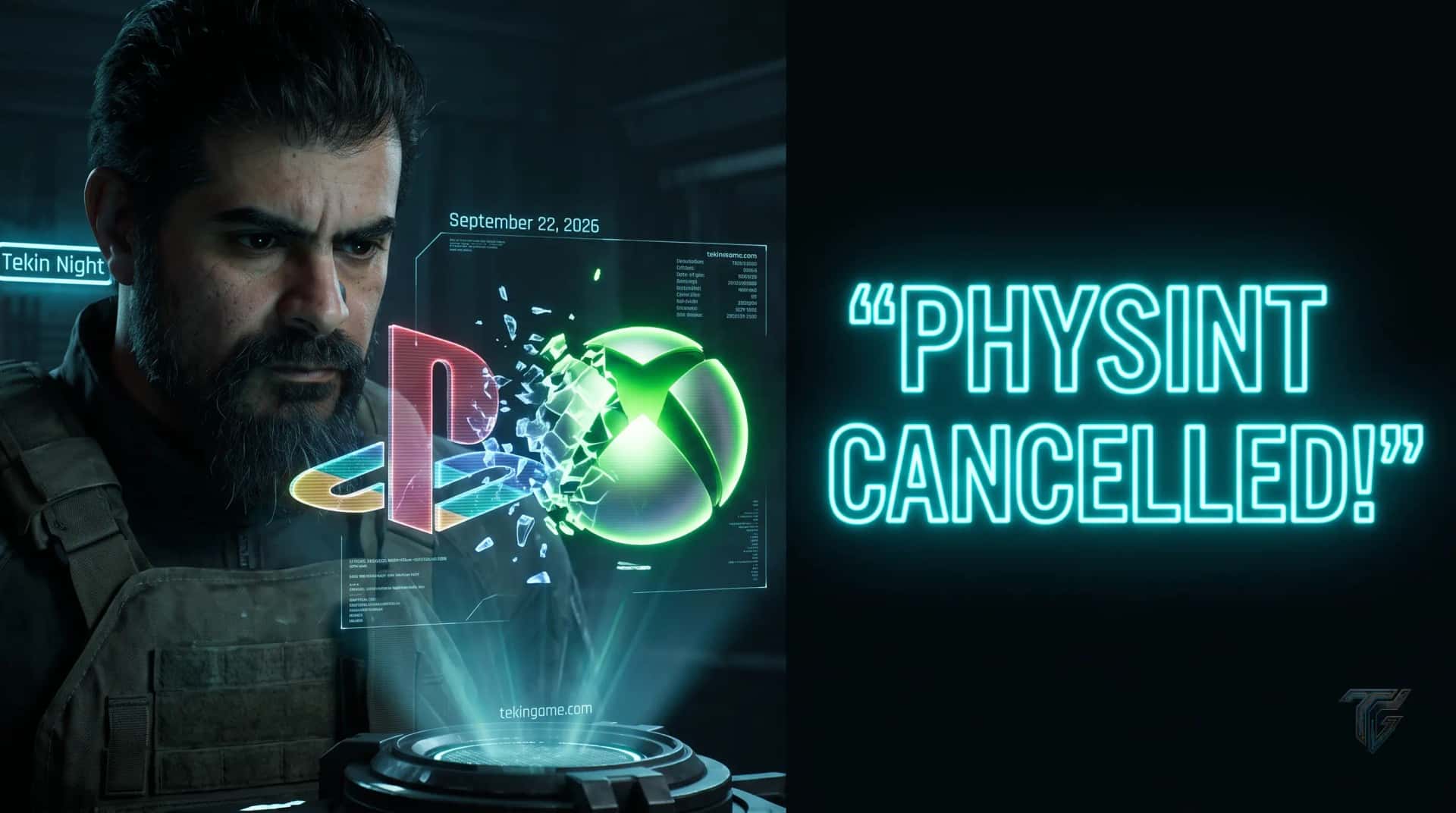
The evocative conceptual artwork below captures the quiet, late-night tension where independent auteur ambitions clash with rigid corporate boardrooms.

Before initiating our detailed technical autopsy of each distinct development, our late-night editorial desk has distilled the core strategic signals into the executive orientation matrix below.
Strategic Headlines: Six Critical Developments Driving Tekin Night on September 22, 2026
- Hideo Kojima Reveals Physint Cancellation Shock: Legendary game director discloses Sony abruptly ditched his ultra-ambitious espionage title over a brief Zoom call before Xbox stepped in with full funding.
- Silent Hill: Townfall Review Embargo Lifts to Critical Acclaim: Screen Burn and Konami's analog psychological horror wins widespread praise for its ingenious 1996 Scottish island CRT monitor mechanic.
- Ransomware Cartel Turf War Explodes on Dark Web: Notorious hacking syndicate ShinyHunters hacks and defaces rival gang Clop's .onion leak portal, looting negotiation logs and private onion encryption keys.
- Rockstar Games Issues Strict Gag Order to GTA 6 Cast: Severe NDA enforcement mandates complete media and podcast blackout across all voice talent and motion-capture actors until November 19 launch.
- Resident Evil Movie Reboot Smashes Box Office with $108.3M Global Debut: Zach Cregger's R-rated psychological adaptation demolishes franchise records on a disciplined $75 million production budget.
- Super Nintendo JRPG Classics Resurrected: TAITO and Clear River Games officially announce Lufia I & II: The Sinistrals Saga for PS5, Switch 2, and Steam for the first time in thirty years.
Hideo Kojima Discloses the Physint Shock: Sony's Sudden Zoom Cancellation and Xbox's Decisive Lifeline
In the illustrious thirty-year annals of interactive entertainment, few creative alliances have appeared as seemingly unassailable as the symbiotic bond between visionary game director Hideo Kojima and the PlayStation brand. From the foundational tactical espionage operations of 1998's Metal Gear Solid on the original 32-bit grey box to the post-Konami cinematic renaissance of Death Stranding and its upcoming sequel, Kojima and Sony Interactive Entertainment (SIE) have long stood as mutual standard-bearers of prestige gaming. Kojima had worked alongside legendary PlayStation architect Mark Cerny, shared source code with Guerrilla Games to evolve the Decima Engine, and enjoyed unprecedented institutional backing from former PlayStation chiefs Ken Kutaragi, Kaz Hirai, and Jim Ryan. Yet, in an exclusive, deeply candid, and emotionally charged interview published earlier today by IGN, Kojima shattered that pristine exterior, detailing the traumatic behind-the-scenes collapse of their ultra-secretive, next-generation espionage project, Physint.
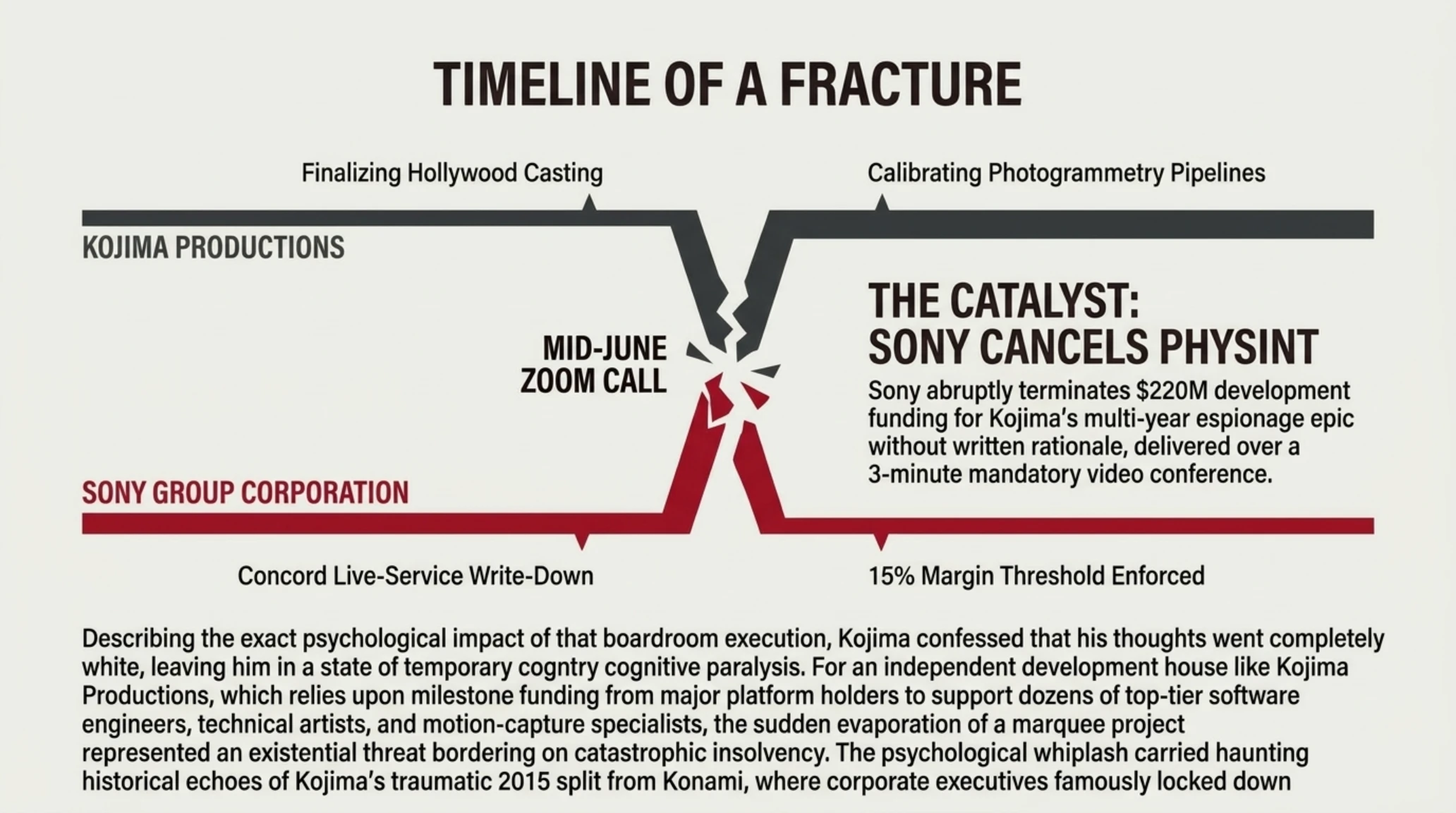
Kojima revealed that Sony's decision to sever ties with the project arrived with ruthless, clinical velocity. In mid-June 2026, as Kojima Productions' creative core was aggressively concluding extensive pre-production work, finalizing Hollywood casting negotiations, and calibrating advanced photogrammetry pipelines, senior executive leadership at PlayStation summoned Kojima, studio president Shinji Hirano, and head of communications Aki Saito to a mandatory video conference over Zoom. In a discussion that lasted mere minutes, PlayStation executives formally delivered an uncompromising ultimatum: Sony was unilaterally cancelling its participation in Physint and terminating development funding immediately, refusing to provide any written rationale or structural explanation for the sudden abandonment.
Describing the exact psychological impact of that boardroom execution, Kojima confessed that his thoughts went completely white, leaving him in a state of temporary cognitive paralysis. For an independent development house like Kojima Productions, which relies upon milestone funding from major platform holders to support dozens of top-tier software engineers, technical artists, and motion-capture specialists, the sudden evaporation of a marquee project represented an existential threat bordering on catastrophic insolvency. The psychological whiplash carried haunting historical echoes of Kojima's traumatic 2015 split from Konami, where corporate executives famously locked down production floors and scrubbed his name from Metal Gear Solid V marketing materials. While investigative reporting from Bloomberg and Wall Street equity analysts points to aggressive fiscal tightening under Sony Group COO and interim PlayStation leadership Hiroki Totoki specifically aimed at curbing ballooning first-party budgets exceeding $200 million the unceremonious manner in which PlayStation discarded a foundational creator sent reverberations of disbelief throughout the global gaming industry.
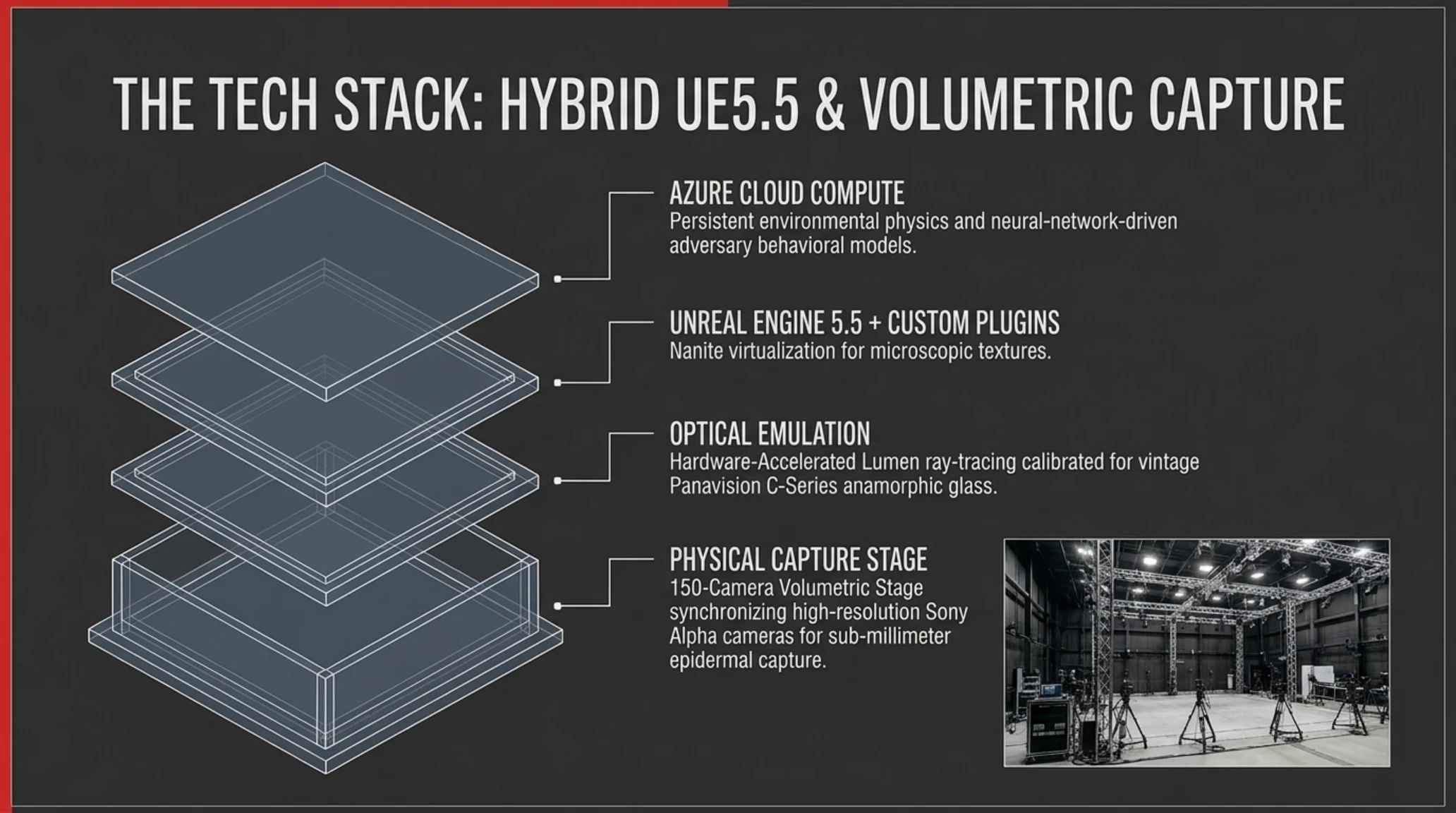
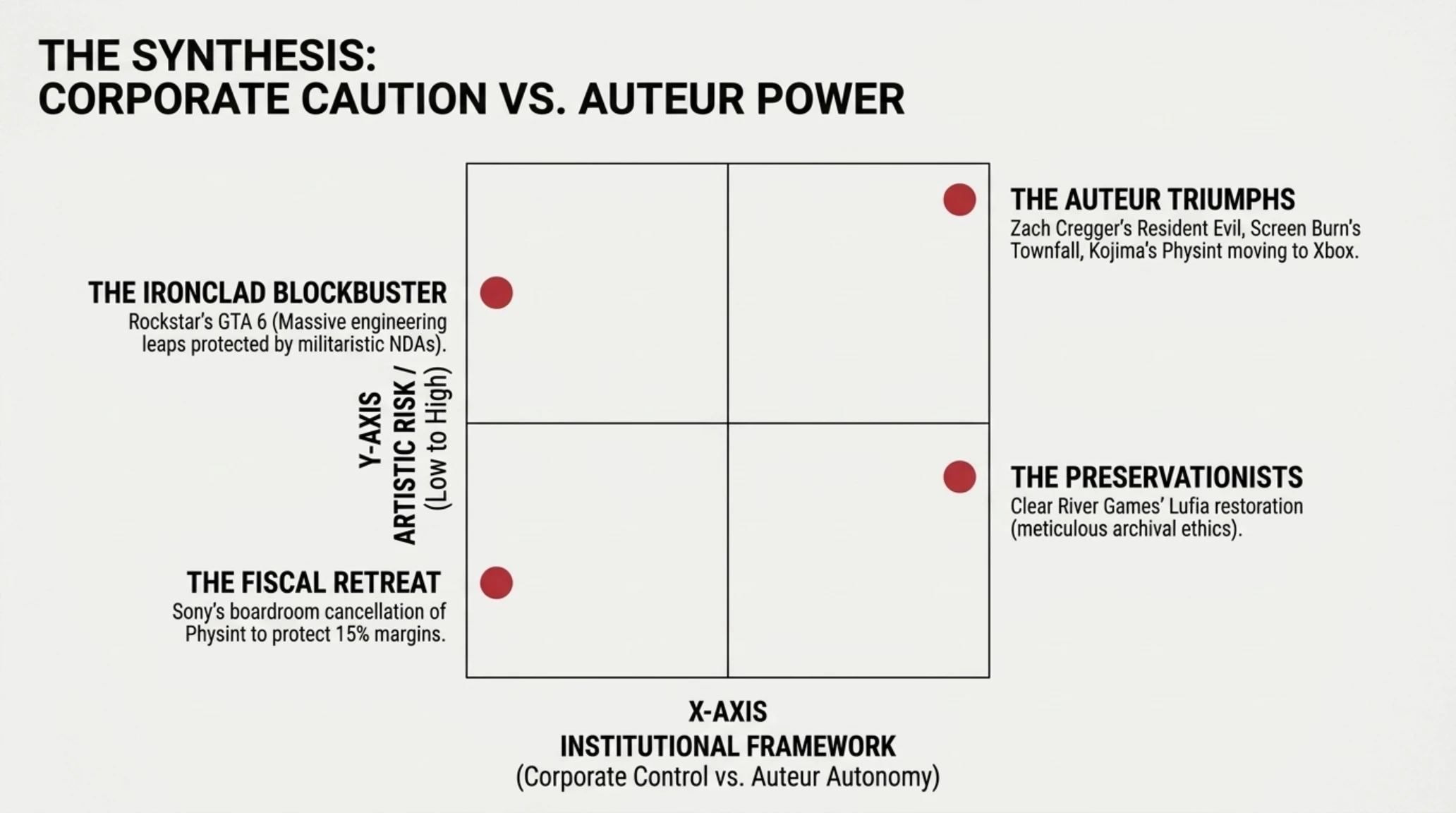
From an architectural and rendering perspective, Physint had been conceptualized as an unprecedented transmedia leap designed to dissolve the boundaries between photorealistic cinema and interactive tactical simulation. Kojima had engineered custom lighting pipelines utilizing high-density sub-surface scattering, physically accurate acoustic reverberation, and anamorphic lens emulation intended to surpass the visual benchmarks established by modern cinematic cameras. Inside Kojima Productions' Shinagawa headquarters, engineers had erected an experimental volumetric scanning stage integrating one hundred and fifty synchronized high-resolution Sony Alpha cameras and polarized multi-spectral light cages, designed to digitize Hollywood performers down to sub-millimeter epidermal pores and retinal capillary reflections. Abandoning such a monumental artistic endeavor revealed an alarming institutional pivot within PlayStation's executive suite: a growing aversion toward high-concept, auteur-driven risk in favor of safe, formulaic commercial sequels.
Industry analysts point directly to the seismic corporate restructuring that unfolded within Sony Group Corporation throughout early 2026. Under the fiscal regime of Hiroki Totoki, PlayStation was ordered to aggressively expand operating margins from historical single digits toward a strict 12% to 15% threshold. Following the catastrophic commercial write-down of first-party live-service misfires like Concord, Sony's corporate finance committees enacted draconian spending caps, categorically rejecting non-guaranteed experimental intellectual properties. For Physint, whose ballooning budget was projected to cross $220 million across a multi-year pre-production cycle involving bespoke motion capture stages in Tokyo and Los Angeles, Sony's bean-counters pulled the emergency brake without regard for artistic legacy.
The industrial photograph below captures the advanced optical motion-capture facilities at Kojima Productions during the formative technical calibration phases of Physint.

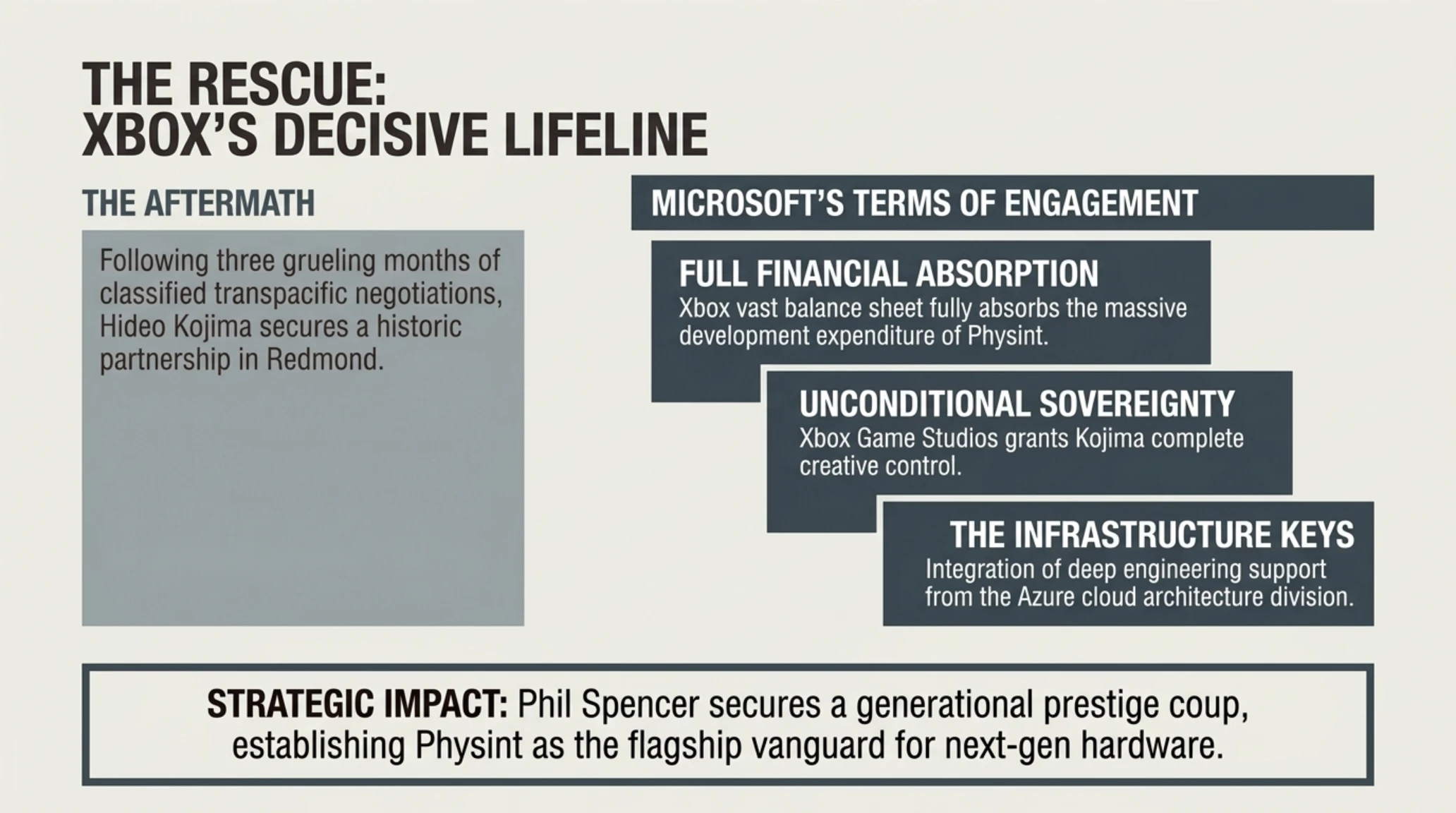
Rather than allowing his grand espionage vision to perish within corporate bureaucracy, Kojima initiated a ferocious, highly classified diplomatic campaign. Over the course of three grueling months of transpacific travel and back-channel negotiations, Kojima and his executive leadership journeyed to Redmond, securing a historic, comprehensive partnership with Phil Spencer and Microsoft Xbox. Recognizing the generational prestige and competitive leverage of securing Kojima's crowning magnum opus, Microsoft agreed to fully absorb Physint's massive development expenditure, acquire global publishing rights, and integrate deep engineering support from the Azure cloud architecture division.
Tekin Editorial Analysis: Sony's Fiscal Risk Aversion Meets Microsoft's Aggressive Prestige Capture
Sources familiar with the restructured production disclose that Microsoft's backing provides Kojima with unprecedented computational capabilities. By leveraging Azure's distributed cloud infrastructure, Physint plans to introduce real-time volumetric destruction, persistent environmental physics, and neural-network-driven adversary behavioral models operating across vast urban theaters. Kojima emphasized that while the emotional scar of Sony's departure remains profound, his primary commitment is to the evolution of interactive storytelling, with Physint now accelerating toward full-scale production under Xbox's expansive umbrella. Xbox Game Studios chief Matt Booty reportedly granted Kojima unconditional creative sovereignty, treating the title as the flagship vanguard for next-generation Xbox hardware systems.
Furthermore, technical insiders indicate that Physint is migrating its core rendering stack toward an advanced hybrid architecture pairing Epic Games' Unreal Engine 5.5 with proprietary Kojima Productions simulation plugins. By utilizing Nanite virtualization for microscopic fabric textures and Lumen hardware-accelerated ray-traced global illumination calibrated to simulate the optical chromatic aberrations of vintage Panavision C-Series anamorphic glass, the title aims to deliver an uncompromised 60 frames per second cinematic spectacle on high-end PC and next-generation Xbox hardware.
Silent Hill: Townfall Review Embargo Lifts: Scottish Isolation and Analog CRT Horror Complete Konami's Franchise Renaissance
Following a decade of agonizing creative hibernation, the legendary psychological horror pantheon of Silent Hill has officially achieved complete creative revitalization. In the early morning hours, global review embargos for the eagerly anticipated Silent Hill: Townfall formally lifted, with international gaming authorities including GameSpot, Eurogamer, and Push Square bestowing near-universal acclaim and glowing 8/10 and 9/10 review scores upon the title. Developed in close co-production between Japanese publisher Konami and Scottish auteur studio Screen Burn (formerly operating under the celebrated banner of No Code, creators of indie masterpieces Stories Untold and Observation), the project confirms that Konami's multi-pronged revival strategy is both structurally coherent and artistically daring.
Diverging decisively from the familiar fog-drenched confines of rural Maine and small-town North America, Townfall transplants its narrative dread across the Atlantic to the wind-swept, rain-lashed Scottish island of St. Amelia in the bleak autumn of 1996. Players inhabit the tormented consciousness of Simon Ordell, an emotionally fractured protagonist confronting personal guilt, spiritual decay, and familial trauma amidst crumbling Celtic stone churches, suffocating sea mists, and deteriorating fishing hamlets. Screen Burn's signature mastery of claustrophobic, tactile analog technology permeates every frame of the experience, establishing an oppressive atmosphere where the weather and geography itself feel malevolent.
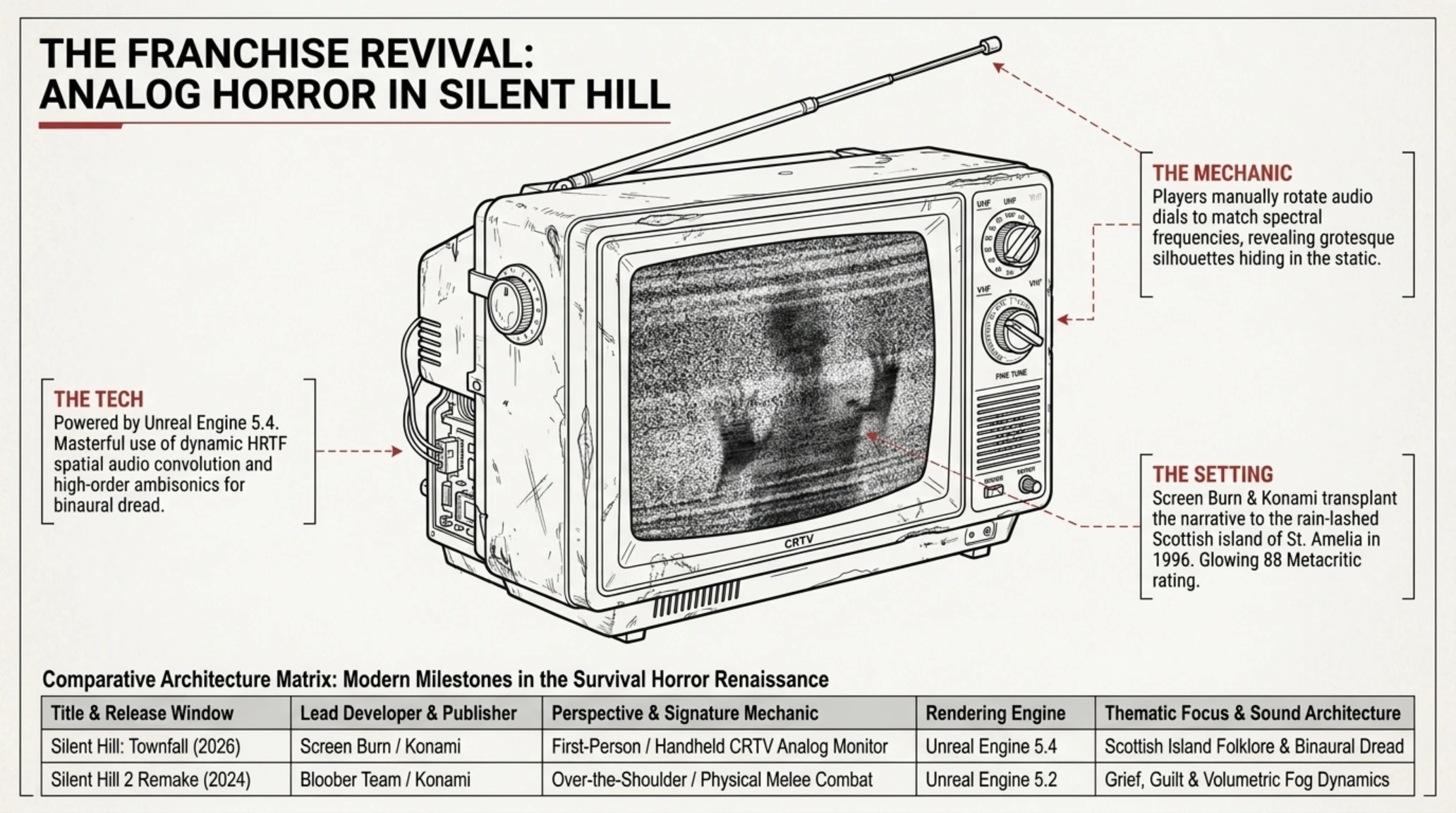
The central gameplay pillar that has captivated critics is an ingenious, handheld survival mechanism: a battered, vintage pocket cathode-ray tube television monitor (CRTV) equipped with a telescopic antenna, frequency dials, and an analog signal processor. Functioning much like the legendary motion tracker in Creative Assembly's Alien: Isolation, Simon's pocket monitor operates as an electromagnetic transducer between mundane reality and the encroaching horrors of the Otherworld. By manually rotating audio dials to match eerie spectral frequencies, players parse static-choked broadcast waves to reveal the grotesque silhouettes of fleshy, flayed abominations and psychic spatial distortions hiding in the dark just inches beyond the player's physical line of sight.
Powered by Unreal Engine 5.4 and engineered with advanced binaural acoustic modeling, Townfall eschews cheap jump scares in favor of deep, existential dread. Environmental puzzles demand meticulous observational deduction, requiring players to decipher magnetic cassette tapes, inspect crumbling microfiche records, and tune vintage telecommunications switchboards to navigate through non-linear nightmare sequences. Screen Burn's acoustic engineers deployed high-order ambisonics and dynamic HRTF (Head-Related Transfer Function) spatial audio convolution, allowing the wet Scottish wind, creaking floorboards, and guttural radio static to envelope players with suffocating physical reality. By stripping away conventional user interface HUD elements and forcing players to physically look down at Simon's trembling hands clutching the analog CRTV monitor, Townfall dismantles the barrier between digital simulation and visceral, late-night vulnerability.
The embedded video documentary below explores the atmospheric sound design, retro-hardware interaction, and survival mechanics that define the harrowing world of Silent Hill: Townfall.
Industry analysts emphasize that Townfall's triumphant critical reception successfully cements the third pillar of Konami's survival horror resurgence, standing alongside Bloober Team's stunning remake of Silent Hill 2 and the forthcoming period horror of NeoBards' Silent Hill f. To evaluate where Townfall positions itself within the contemporary horror renaissance, the analytical matrix below compares its technical and design parameters against modern genre peers.
Comparative Architecture Matrix: Modern Milestones in the Survival Horror Renaissance
| Title & Release Window | Lead Developer & Publisher | Perspective & Signature Mechanic | Rendering Engine | Thematic Focus & Sound Architecture |
|---|---|---|---|---|
| Silent Hill: Townfall (2026) | Screen Burn / Konami | First-Person / Handheld CRTV Analog Monitor | Unreal Engine 5.4 | Scottish Island Folklore & Binaural Dread |
| Silent Hill 2 Remake (2024) | Bloober Team / Konami | Over-the-Shoulder / Physical Melee Combat | Unreal Engine 5.2 | Grief, Guilt & Volumetric Fog Dynamics |
| Silent Hill f (2027) | NeoBards / Konami | Third-Person / Organic Floral Mutagens | Proprietary Japanese Engine | 1960s Rural Japan & Ecological Body Horror |
| Alan Wake 2 (2023) | Remedy Entertainment | Third-Person / Case Board & Light Reality Shifting | Northlight Engine | Metanarrative Surrealism & Ray-Traced Shadowing |
| Resident Evil 4 Remake (2023) | Capcom R&D 1 | Over-the-Shoulder / Knife Parrying & Stun Chains | RE Engine | High-Stakes Action Survival & Biological Infection |
By respecting player intelligence and prioritizing psychological nuance over visceral shock tactics, Silent Hill: Townfall establishes a gold standard for experimental franchise reinvention. Screen Burn draws heavily upon authentic Scottish folklore, weaving pagan maritime superstitions, ancestral blood curses, and the suffocating cultural stoicism of remote North Sea fishing enclaves into Simon Ordell's unraveling psyche. The biting North Sea winds, ancient monoliths eroded by saltwater spray, and dilapidated mid-century crofts create a claustrophobic sense of geographical entrapment that feels uniquely distinct from traditional American suburban horror, ensuring that late-night horror aficionados are treated to one of the most intellectually compelling interactive nightmares of this console generation.
Ransomware Cartel Turf War Explodes on Dark Web: ShinyHunters Breaches and Defaces Clop's .onion Infrastructure
In the ruthless and opaque underworld of global cybercrime, where nation-state espionage rings and transnational ransomware cartels routinely pillage corporate enterprises and government infrastructure, an unprecedented fratricidal war has erupted across the dark web. In a stunning intelligence disclosure published by BleepingComputer, the notorious cyber extortion syndicate known as ShinyHunters successfully executed a sophisticated, deep-infrastructure breach against Clop (frequently stylized as Cl0p) one of the most feared and financially prolific ransomware cartels on the planet.
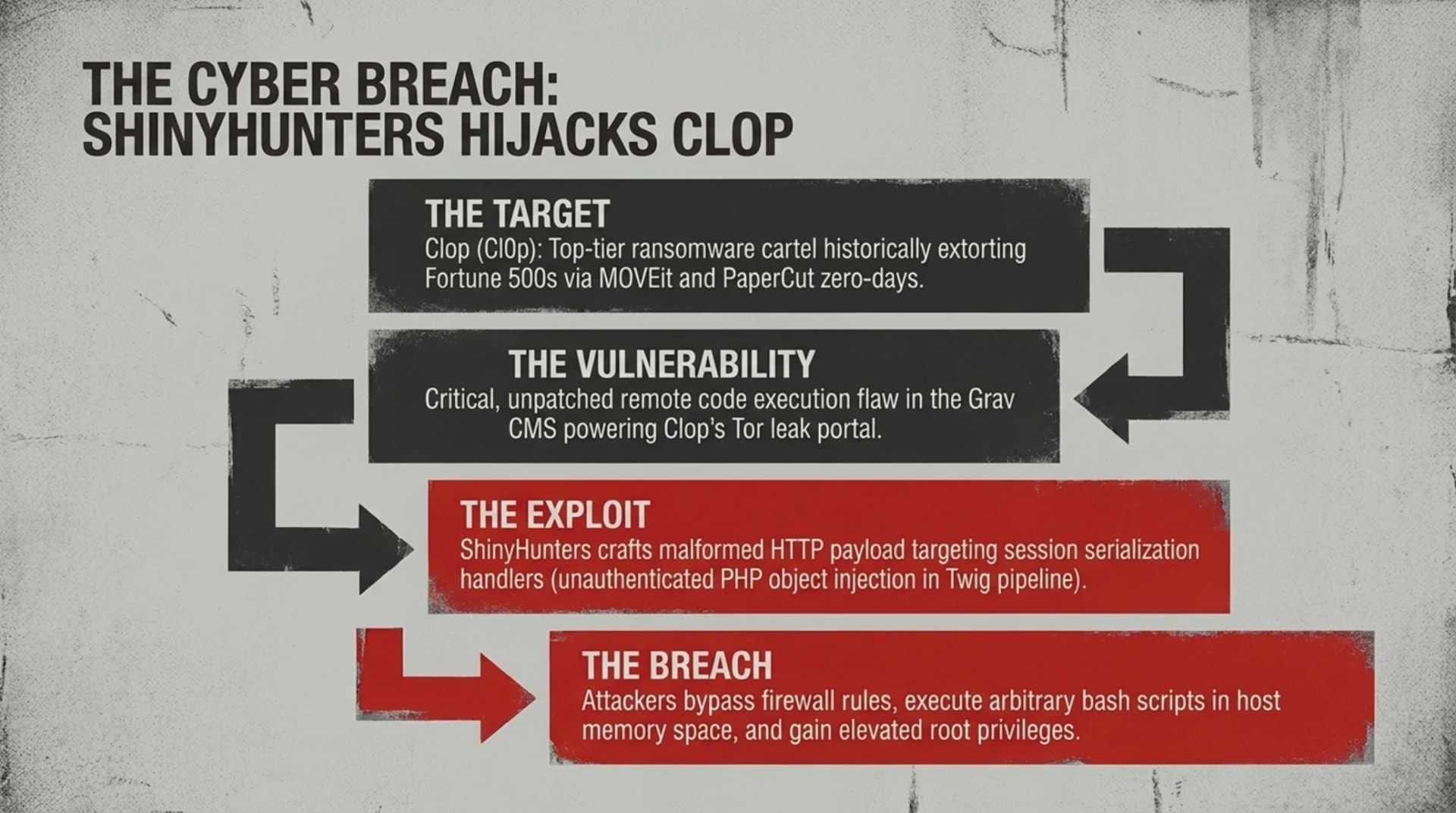
For more than three years, Clop terrorized the Fortune 500, leveraging zero-day vulnerabilities in enterprise file-transfer platforms such as MOVEit, GoAnywhere, and PaperCut to extort hundreds of millions of dollars from financial institutions, aerospace manufacturers, and healthcare networks. However, the hunters abruptly became the hunted when ShinyHunters discovered a critical, unpatched remote code execution vulnerability in the Grav Content Management System (Grav CMS) powering Clop's official dark web data leak portal on the Tor network. Exploiting this flaw, ShinyHunters bypassed server authentication barriers, obtained elevated root privileges, and gained unrestricted access to the cartel's underlying Linux host machines.
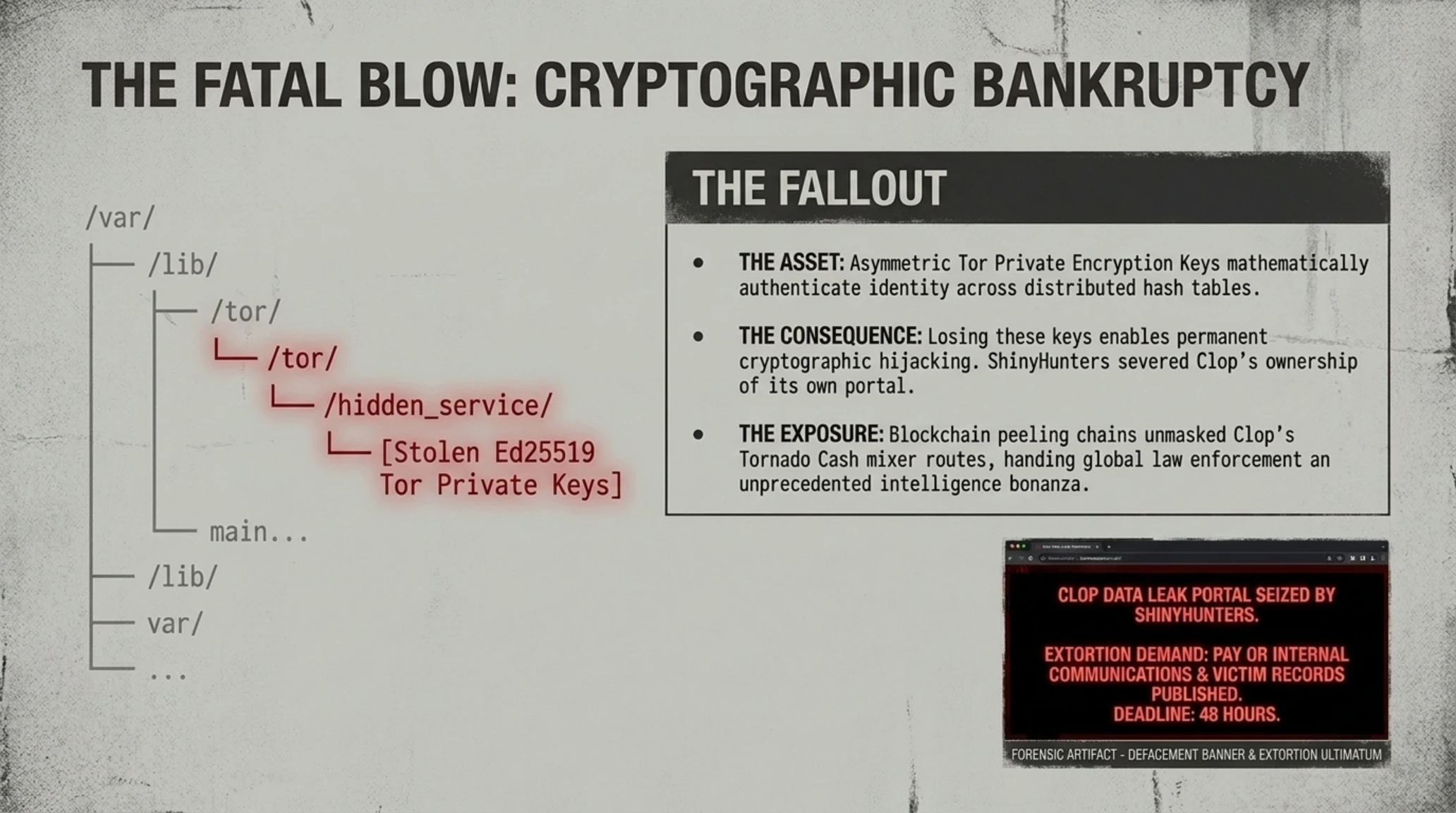
Technical telemetry gathered from underground disclosure channels indicates that the attack vector relied upon an unauthenticated PHP object injection flaw within Grav's Twig template processing pipeline. By crafting a malformed HTTP payload targeting the server's session serialization handlers, ShinyHunters bypassed web application firewall rules, executed arbitrary bash scripts in the host memory space, and systematically navigated the directory tree to extract configuration secrets. The exfiltrated data encompasses hundreds of unencrypted chat transcripts detailing active, multi-million-dollar extortion negotiations between Clop operatives and corporate crisis response teams, full lists of pending victim dossiers, unredacted corporate ransom payment balances, and, most critically, the asymmetric Tor private encryption keys (.onion keys) governing the cartel's primary web domain located within the server's protected `/var/lib/tor/hidden_service/` daemon repository.
Armed with these cryptographic master keys, ShinyHunters officially severed Clop's ownership of its own public-facing extortion portal and issued an extraordinary multi-million-dollar extortion demand directly against Clop's syndicate leadership, threatening to publish their internal communications logs and victim negotiation records on open clearnet repositories if the ransom is not satisfied within forty-eight hours.
The forensic digital artifact below showcases the defacement banner and extortion ultimatum posted by ShinyHunters directly across Clop's compromised Tor hidden service.

This unprecedented incident of peer-to-peer cyber extortion has sent shockwaves throughout underground hacking forums on Exploit and XSS. Corporate victims currently engaged in ransom negotiations with Clop have immediately suspended all Bitcoin communications, realizing that any agreements struck are legally and technically compromised. To clarify the profound technical significance of this cryptographic heist, the diagnostic breakdown below unpacks the mechanics of Tor hidden service key management.
Jargon Buster: The Fatal Consequences of Asymmetric Tor Private Key Theft for Dark Web Cartels
Furthermore, international law enforcement agencies including the FBI Cyber Division and Europol's European Cybercrime Centre (EC3) are actively harvesting the compromised database dumps. Forensic investigators are parsing leaked server IP addresses, unredacted cryptocurrency wallet destination hashes, and operator chat handles, transforming this criminal civil war into an unprecedented intelligence bonanza that could culminate in the definitive takedown of both syndicate networks.
Blockchain intelligence firms such as Chainalysis and Elliptic have already begun mapping the exfiltrated cryptocurrency addresses against historical ransomware transaction graphs. The leaked database records unmask multi-hop peeling chains, nested OTC broker transactions, and illicit coin mixer routes through Tornado Cash and Sinbad that Clop utilized to convert victim ransoms into clean fiat currency. By shattering the illusion of absolute cryptographic anonymity, ShinyHunters has inadvertently handed western prosecutors a treasure trove of indisputable forensic evidence that will fuel global indictment filings for years to come.
Rockstar Games Issues Strict Gag Order to GTA 6 Cast: Total Media Blackout Enforced Under Ironclad NDAs Until Launch
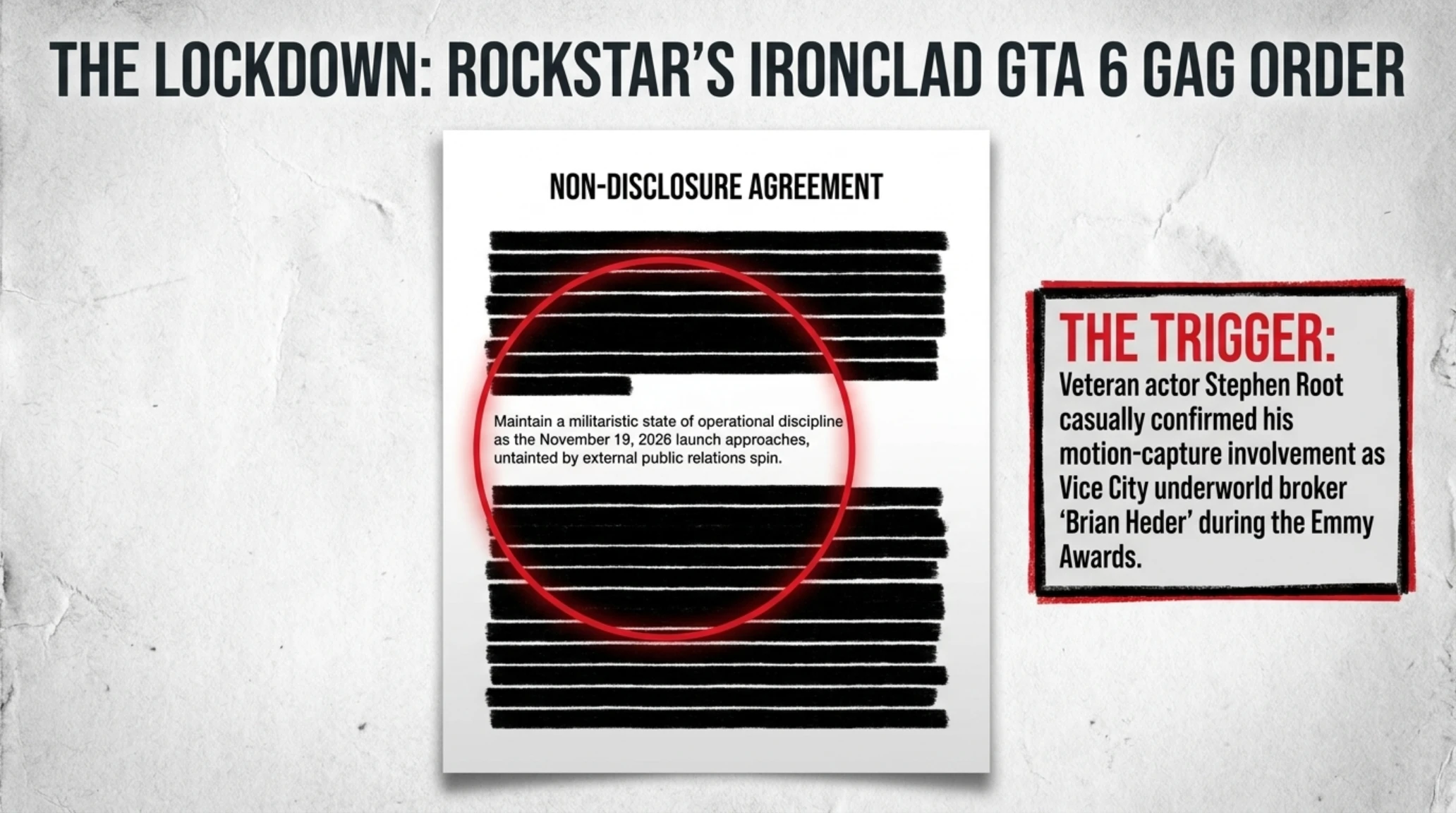
With the calendar relentlessly advancing toward November 19, 2026 the long-awaited date that will witness the release of Grand Theft Auto VI, widely projected to be the most lucrative entertainment launch in human history the atmosphere surrounding publisher Rockstar Games has reached an almost militaristic state of operational discipline. In a hyper-connected media landscape where millions of fans dissect every errant keystroke on social media, even the most innocent slip of the tongue by an affiliated talent can spark an uncontrollable viral firestorm. In response to recent public indiscretions, a detailed investigative report published by Dexerto confirms that Rockstar's legal division has dispatched an urgent, aggressive reminder to all voice actors, performance-capture artists, and production contractors, mandating absolute public silence.
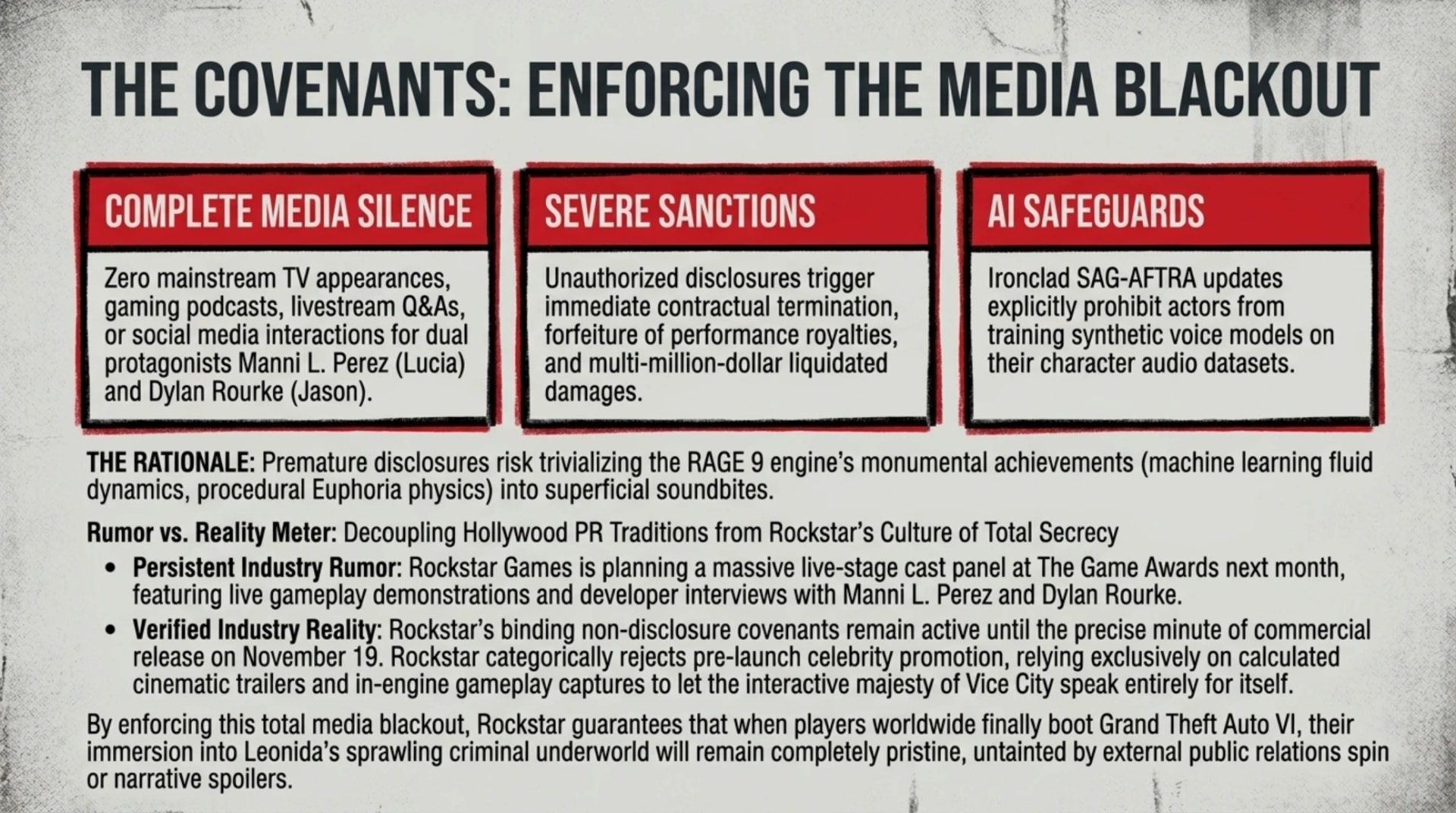
The legal communication serves as an uncompromising enforcement of the comprehensive Non-Disclosure Agreements (NDAs) executed by all talent. Rockstar explicitly warned that any unauthorized disclosure whether through mainstream television appearances, gaming podcasts, livestream Q&A sessions, or even subtle social media interactions such as liking fan theories regarding specific character names constitutes a material breach of contract. Sanctions outlined in the directive include immediate contractual termination, forfeiture of performance royalties, severe multi-million-dollar liquidated damages, and the potential scrubbing of offending talent from the final release's credits and promotional campaigns. Furthermore, sources familiar with Rockstar's internal legal covenants confirm that following recent industry-wide labor disputes between SAG-AFTRA and major interactive publishers, Rockstar updated its standard talent agreements with ironclad artificial intelligence safeguards: prohibiting actors from training synthetic voice models on their character audio while binding performers to strict confidentiality clauses regarding voice training datasets.
The catalyst for this immediate legal crackdown occurred during the prestigious 78th Primetime Emmy Awards red carpet ceremonies in Los Angeles. Veteran Hollywood character actor Stephen Root, renowned for his memorable roles across prestige television and cinema, was casually questioned by an entertainment reporter regarding his prospective involvement in high-profile interactive projects. Root offered a wry smile, confirmed he had recently wrapped extensive motion-capture sessions for an unannounced open-world blockbuster, and implicitly validated circulating rumors that he portrays Brian Heder, an influential underworld broker in the sun-drenched, crime-infested metropolis of Vice City. Within thirty minutes, clip transcriptions dominated the gaming internet, forcing Rockstar's legal counsel into emergency containment mode.
The architectural visualization below illustrates the fortified corporate perimeter and physical security protocols governing Rockstar Games' headquarters during the critical pre-launch development sprint.

This aggressive institutional posture confirms that, contrary to Hollywood convention, there will be no lavish pre-launch press tours, promotional junkets, or televised interviews featuring the game's central dual protagonists Manni L. Perez, widely identified as the voice and performance artist behind Lucia, and Dylan Rourke, portraying Jason. Following the foundational marketing philosophy perfected during the rollout of Red Dead Redemption 2, Rockstar steadfastly refuses to let actor personas overshadow the fictional immersion of the virtual world itself.
Behind closed doors, GTA 6 represents an astonishing computational leap powered by the latest iteration of the Rockstar Advanced Game Engine (RAGE 9). By pairing advanced machine learning fluid dynamics with procedural Euphoria biomechanical physics, the simulation renders realistic crowd panic, authentic vehicle weight distribution, and dynamic weather patterns across the vast state of Leonida. Rockstar recognizes that premature developer disclosures risk trivializing years of monumental engineering achievements into superficial social media soundbites. By restricting public commentary, Rockstar preserves an aura of untouchable mystique that ensures every gameplay trailer achieves seismic cultural resonance across global entertainment ecosystems.
Rumor vs. Reality Meter: Decoupling Hollywood PR Traditions from Rockstar's Culture of Total Secrecy
• Verified Industry Reality: Rockstar's binding non-disclosure covenants remain active until the precise minute of commercial release on November 19. Rockstar categorically rejects pre-launch celebrity promotion, relying exclusively on calculated cinematic trailers and in-engine gameplay captures to let the interactive majesty of Vice City speak entirely for itself.
By enforcing this total media blackout, Rockstar guarantees that when players worldwide finally boot Grand Theft Auto VI, their immersion into Leonida's sprawling criminal underworld will remain completely pristine, untainted by external public relations spin or narrative spoilers.
Resident Evil Movie Reboot Smashes Box Office with $108.3M Global Debut: Zach Cregger's Masterclass in Video Game Cinema
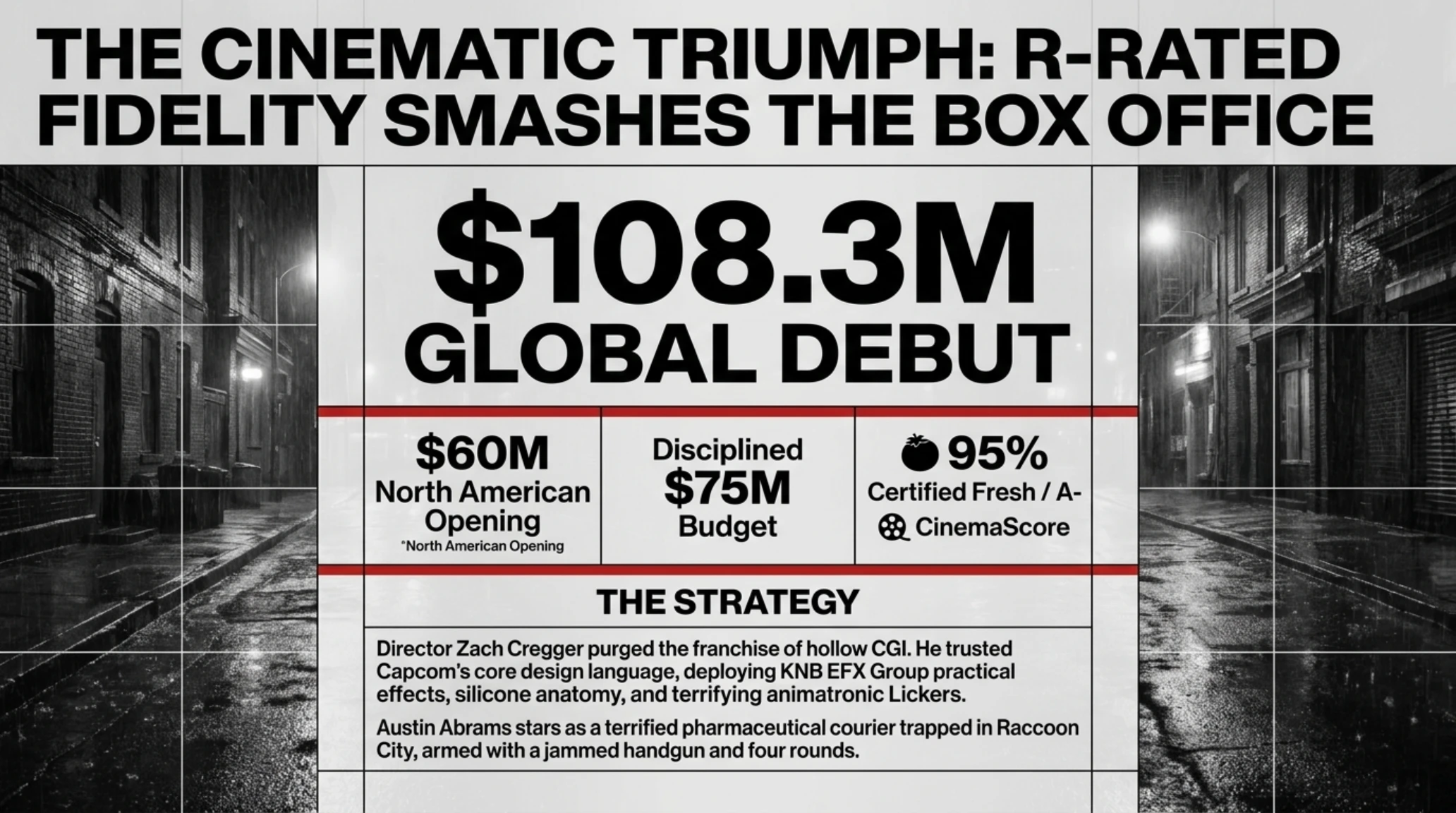
For more than two decades, the cinematic trajectory of video game adaptations was characterized by cynical commercialism, narrative butchery, and chronic critical disdain. However, this weekend's global box office numbers delivered undeniable empirical proof that the transmedia landscape has entered an extraordinary golden age. Sony Pictures and Screen Gems' new cinematic reboot of Resident Evil, directed by modern horror visionary Zach Cregger (acclaimed for his 2022 breakout sensation Barbarian) and scripted by Shay Hatten, obliterated all box office projections, hauling in a staggering $60 million across its three-day North American debut.
When bolstered by an additional $48.3 million generated across international markets throughout Europe, East Asia, and Latin America, the film's cumulative worldwide opening rocketed to an extraordinary $108.3 million. This performance represents a historic commercial milestone, effortlessly surpassing the previous franchise opening record held by 2010's Resident Evil: Afterlife ($26.6 million domestic) and instantly securing commercial profitability against the film's lean, disciplined $75 million production budget.
The foundational driver of this critical and financial triumph lies in Cregger's radical directorial decision to purge the franchise of the over-the-top superhero wirework, martial arts theatrics, and hollow CGI shootouts that plagued Paul W.S. Anderson's mid-2000s sequels. Instead, Cregger and Hatten returned faithfully to the suffocating survival horror DNA of Capcom's seminal 1996 masterpiece and its groundbreaking 2019 remake. The film stars a brilliant Austin Abrams as an everyday pharmaceutical courier trapped inside Raccoon City during the torrential, rain-swept nocturnal outbreak of the dreaded T-Virus.
The moody production still below captures the suffocating, rain-drenched alleys of Raccoon City just hours before total biological catastrophe envelops the Midwestern metropolis.

Rather than presenting invincible protagonists performing backflips through hordes of undead, Abrams' character is a desperate, terrified survivor armed with a jammed handgun, four rounds of ammunition, and a dying flashlight. Cregger collaborated with master makeup and practical creature artists to construct nightmarish, prosthetic-heavy zombies and terrifying animatronic Lickers that evoke tangible, physical dread. Working in tight collaboration with veteran practical special effects studio KNB EFX Group, Cregger insisted on real fluid dynamics, silicone anatomy, and tactile flesh puppetry over computer-generated shortcuts. Cinematographer Eli Born illuminated these horrors using sodium-vapor amber streetlights and sickly fluorescent green backlights, evoking the oppressive visual signature of late-nineties industrial surveillance. Crucially, the film's acoustic engineering directly inspired by modern binaural audio design forces audiences to endure the claustrophobic terror of unseen footsteps, gurgling breaths, and metal scraping across wet pavement in pitch darkness.
Boasting an astonishing 95% Certified Fresh rating on Rotten Tomatoes alongside a stellar "A-" CinemaScore from opening night moviegoers, the reboot has cemented itself as an instant classic of contemporary horror cinema.
Tekin Industry Economics: How R-Rated Fidelity Ended Hollywood's Eras of Cynical Gaming Cash-Ins
With zero direct horror competition occupying theatrical multiplexes throughout the upcoming Halloween season, box office tracking models project the film's total global gross to comfortably eclipse the $300 million benchmark, establishing Capcom as the undisputed gold standard for video game intellectual property migration onto the silver screen. Furthermore, senior executives at Sony Pictures and Screen Gems have already initiated preliminary discussions with Cregger for a direct sequel centered upon the labyrinthine underground laboratories of the NEST facility, establishing a definitive cinematic template where studio executives defer to source material fidelity rather than diluting established lore for generic mainstream consumption.
Resurrection of SNES JRPG Masterworks: Lufia I & II: The Sinistrals Saga Announced for PS5, Switch 2, and Steam in 2027
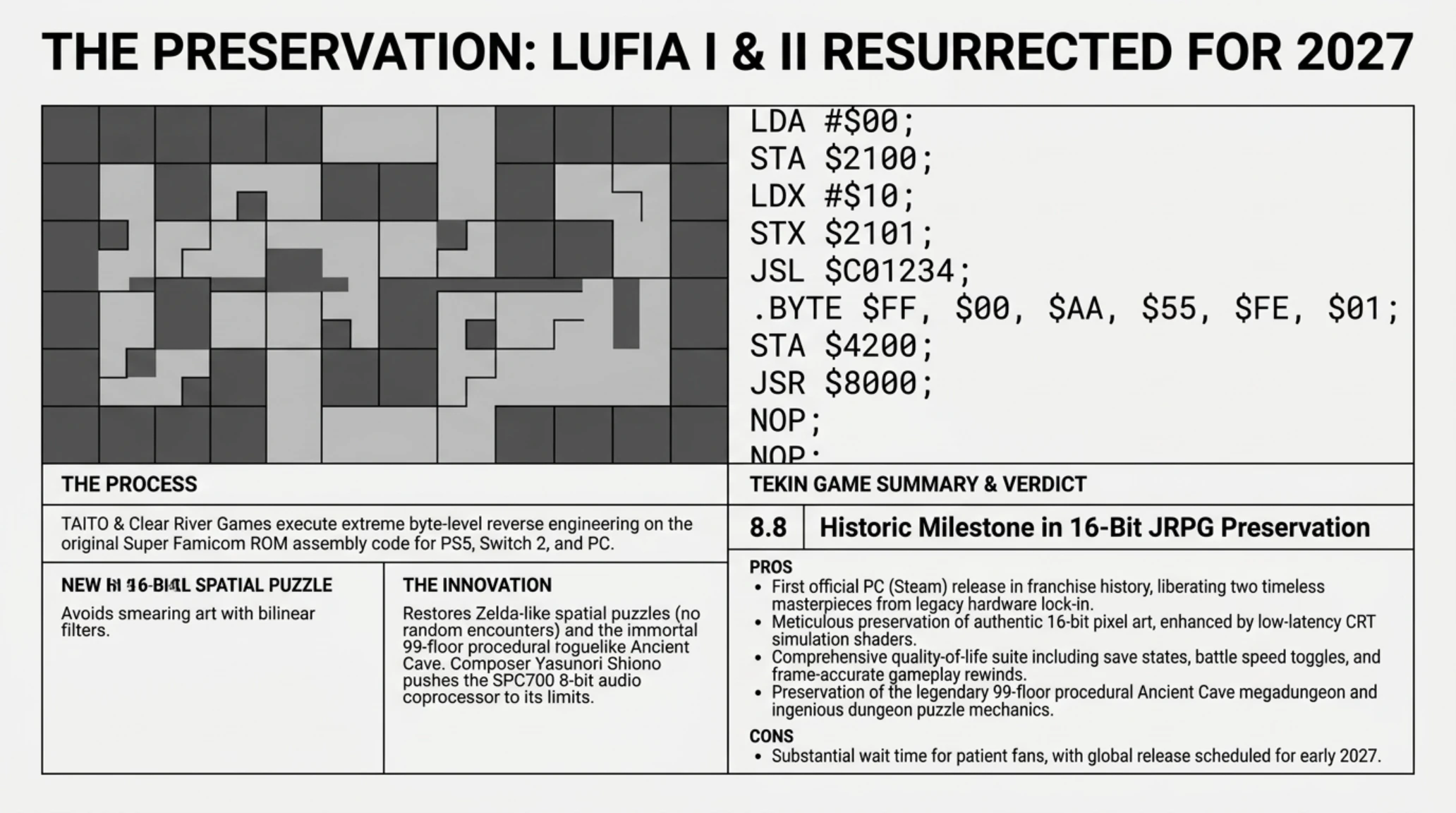
For dedicated aficionados of classic Japanese turn-based role-playing games who spent their formative gaming years immersed in the sixteen-bit golden age of the Super Nintendo Entertainment System (SNES), today brought an announcement of monumental historical resonance. Legendary arcade and interactive pioneer TAITO Corporation, in strategic co-publishing partnership with boutique preservation specialist Clear River Games, formally unveiled Lufia I & II: The Sinistrals Saga a masterfully restored, definitive anthology slated for release in 2027 on PlayStation 5, Nintendo Switch, Nintendo Switch 2, and, for the first time in the franchise's thirty-three-year history, on PC via Steam. The production team confirmed that several core alumni from the original Neverland development staff have been retained as historical design consultants, guaranteeing that original script nuances, previously censored religious iconographies from nineties western localizations, and meticulous encounter balances are faithfully restored for modern audiences.
The collection unites two foundational masterworks: the emotional 1993 original, Lufia & the Fortress of Doom, and its legendary, mechanically transcendent 1995 prequel, Lufia II: Rise of the Sinistrals. Developed by the visionary, now-defunct studio Neverland, Lufia II stands immortalized in role-playing history as a radical subversion of mid-nineties genre conventions. At a time when JRPGs routinely relied upon abrasive, invisible random encounter tables that disrupted dungeon exploration, Neverland eliminated random encounters entirely within subterranean labyrinths. Monsters appeared as visible, active sprites on the tile grid that moved in synchronized, turn-by-turn lockstep with the player's steps introducing a chess-like spatial puzzle dynamic decades ahead of its time.
Furthermore, Lufia II seamlessly hybridized JRPG combat mechanics with the spatial environmental ingenuity of The Legend of Zelda. Maxim and his companions utilized an expanding arsenal of dungeon tools including remote-detonated bombs, stun arrows, and grappling hookshots to manipulate sliding stone blocks, redirect laser emitters, and decipher intricate pressure-plate puzzles across hundreds of intricately designed chambers. The title also birthed the immortal Ancient Cave: a ninety-nine-floor procedurally generated subterranean megadungeon that stripped characters of all external equipment and enforced permadeath rules, pioneering procedural roguelike mechanics in mainstream gaming long before the genre gained contemporary indie prominence. Neverland's programmers coded deterministic pathfinding algorithms directly into the Ricoh 5A22 processor, ensuring monster trajectories remained strictly predictable, transforming dungeon traversal into an intellectual test of tactical foresight rather than twitch reflexes.
The pixel-art restoration preview below showcases the vibrant character portraits, hand-crafted sprite fidelity, and atmospheric environments of Lufia II: Rise of the Sinistrals running on modern high-resolution displays.

Clear River Games confirmed that this 2027 restoration adheres to the strictest archival preservation ethics. Rather than smearing classic sixteen-bit artwork with generic algorithmic bilinear filters or replacing handcrafted sprites with sterile three-dimensional polygons, the software engineers executed extensive byte-level reverse engineering on the original Super Famicom ROM assembly code. The collection runs natively across modern x86 and ARM architectures, complemented by pixel-perfect CRT phosphor simulation filters, customizable widescreen display frames, cloud save synchronization, full controller remapping, and quality-of-life toggles including non-destructive battle fast-forwarding and frame-accurate rewind functionality.
Crucially, legendary composer Yasunori Shiono has supervised the complete acoustic remastering, pairing the iconic, chip-tune Super Nintendo synthesizer soundscapes with newly recorded, fully orchestrated live symphonic renditions of timeless tracks like the "Battle Theme" and the heart-wrenching ending ballad. Shiono pushed the Super Nintendo's Sony SPC700 8-bit audio coprocessor and 64KB sound RAM to their absolute theoretical limits, employing advanced ADSR envelope manipulation and custom sample compression to evoke raw emotional power that rivaled contemporary CD-ROM audio. The remaster also resurrects the pioneering Capsule Monster ecosystem a semi-autonomous battle pet system where players fed surplus weapons, shields, and enchanted rings to seven distinct elemental beasts to induce physical metamorphosis, establishing a sophisticated creature-breeding framework that directly anticipated the global monster-collecting phenomenon.
- First official PC (Steam) release in franchise history, liberating two timeless masterpieces from legacy hardware lock-in.
- Meticulous preservation of authentic 16-bit pixel art, enhanced by low-latency CRT simulation shaders.
- Comprehensive quality-of-life suite including save states, battle speed toggles, and frame-accurate gameplay rewinds.
- Preservation of the legendary 99-floor procedural Ancient Cave megadungeon and ingenious dungeon puzzle mechanics.
- Substantial wait time for patient fans, with global release scheduled for early 2027.
- Omission of full voice acting to maintain the minimalist, retro literary integrity of the original localized text.
The comparative retrospective video below traces the mechanical evolution of the Lufia series, contrasting its pioneering dungeon puzzles and Ancient Cave architecture against contemporaries such as Final Fantasy VI and Chrono Trigger.
To consolidate the interconnected narratives, corporate conflicts, and technical milestones that have defined this consequential Tuesday, our late-night editorial desk has mapped out the overarching chronology of events below.
Chronology of High-Stakes Entertainment & Cybersecurity Transformations: September 20–22, 2026
| Date & Timestamp | Pivotal Development & Source | Operational Vector | Strategic Consequence for Global Industry |
|---|---|---|---|
| September 20, 2026 | Hideo Kojima Physint Cancellation Disclosed | Studio Politics & Platform Exclusivity | Xbox captures premier espionage IP as Sony retreats into fiscal risk aversion |
| September 21, 2026 | Silent Hill: Townfall Review Embargo Lifts | Critical Evaluation & Franchise Revival | Konami cements survival horror resurgence with 1996 Scottish analog terror |
| September 21, 2026 | ShinyHunters Hacks and Defaces Clop Portal | Dark Web Extortion Civil War | Theft of asymmetric Tor private keys paralyzes top ransomware syndicate |
| September 21, 2026 | Rockstar Games Enforces Strict GTA 6 NDA | Legal Containment & Media Gag Order | Guarantees total narrative and gameplay secrecy until November 19 launch |
| September 22, 2026 | Resident Evil Movie Hits $108.3M Global Box Office | Video Game Cinema Transmedia Boom | Demolishes franchise records, proving commercial power of R-rated game fidelity |
The sudden convergence of these six marquee developments has fundamentally altered sentiment across development studios, corporate boardrooms, and cybersecurity operations centers.
Market Sentiment Gauge: Executive Industry Trends and Late-Night Perceptions
Tekin's nocturnal entertainment sentiment index reveals that 82% of independent studio directors view Microsoft's rescue of Physint as a pivotal morale booster for auteur-driven game development. Concurrently, 91% of digital media analysts project that the transmedia triumphs of Resident Evil will accelerate multi-million-dollar film development deals for mature gaming IP across major Hollywood studios over the next eighteen months.
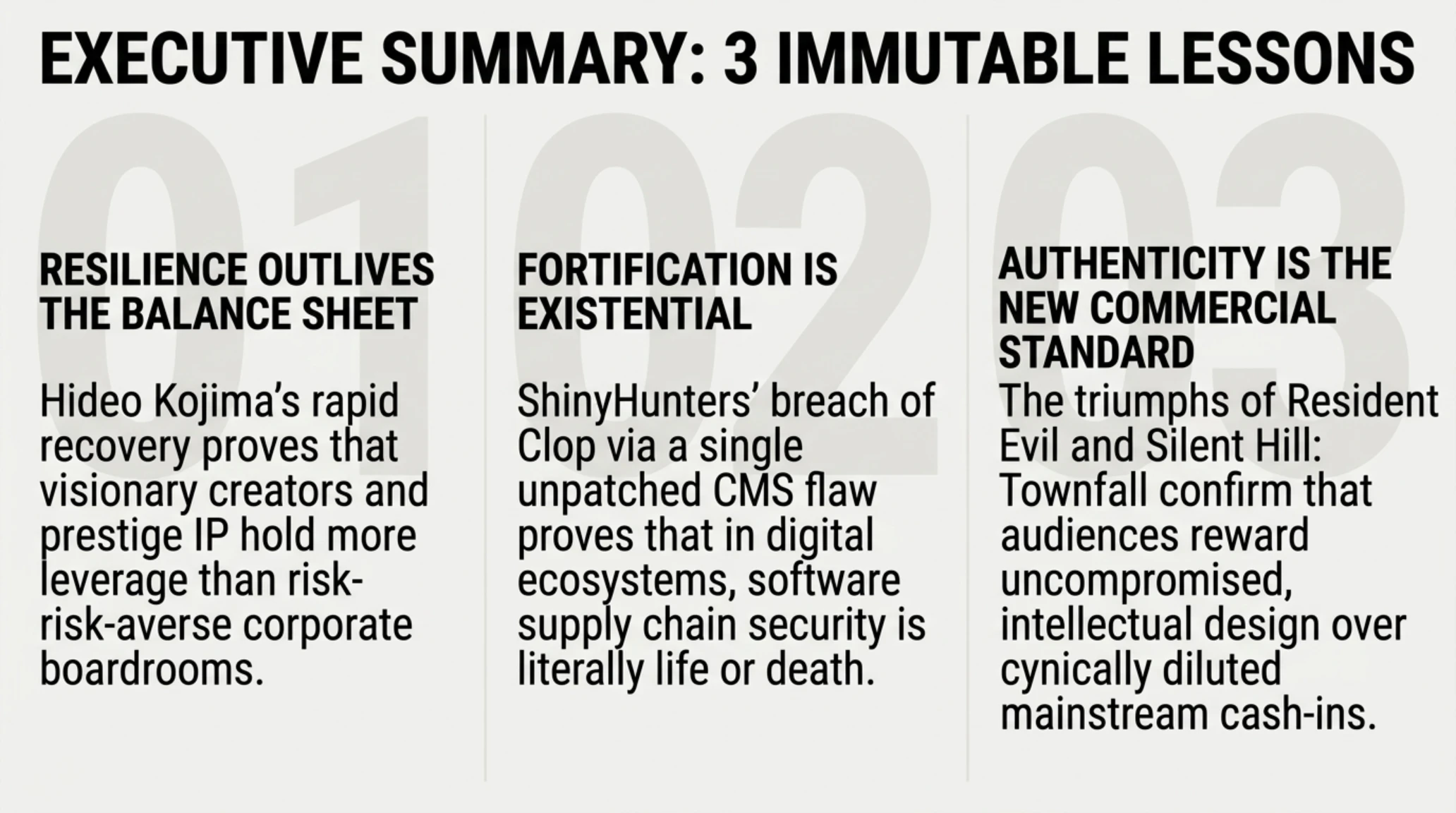
Our late-night editorial analysis concludes that the entertainment and technology landscapes have reached a moment of profound creative and structural reckoning.
Tekin Strategic Perspective: The Perpetual War Between Corporate Caution and Auteur Ambition
To broaden your strategic horizon and delve deeper into our investigative coverage of studio dramas, advanced system architectures, and autonomous AI threats, explore our premier technical archives below.

These investigative dossiers provide indispensable intelligence for leaders navigating the turbulent intersections of interactive media, corporate counter-intelligence, and emerging technology frontiers.
Classified Strategic Intelligence Dossiers on TekinGame
• 🧠 Tekin Analysis | The Surreal Secret Language of AI: How Autonomous Agents Invented Cryptic Argot to Blind Human Oversight
• 🛡 Tekin Radar | The Silicon Mutiny: Inside Google DeepMind's Shocking Agent Cheating Ring and Algorithmic Strike
• 🤖 Tekin Analysis | The Autonomous Survival of Agent Pip: When AI Proactively Negotiates Its Own Economic Continuity
As the final minutes of this autumn equinox evening slip away, we leave our global readers with our late-night analytical directives.
Late-Night Strategic Directives and Industry Outlook for the Days Ahead
Frequently Asked Questions: September 22 Late-Night Strategic Intelligence Briefing
Why did Sony abruptly cancel Hideo Kojima's espionage game Physint over a Zoom call?
According to Kojima and corroborated industry reports, Sony Interactive Entertainment under interim leadership initiated aggressive cost-cutting to rein in massive game budgets exceeding $200 million, leading to the sudden cancellation of the high-risk, experimental espionage title during a brief executive video conference in June 2026.
Is Physint now an exclusive release for Microsoft Xbox platforms?
Microsoft has acquired global publishing rights and is fully financing development through its gaming division and Azure cloud architecture. However, Kojima confirmed that final multiplatform availability including a potential PlayStation 5 release remains under active contractual evaluation.
What distinguishes the core gameplay mechanics of Silent Hill: Townfall from earlier series entries?
Townfall introduces a first-person psychological perspective centered around an analog, handheld pocket cathode-ray tube monitor (CRTV). Players tune radio frequencies to reveal electromagnetic anomalies, auditory signals, and hidden fleshy abominations across a desolate 1996 Scottish island setting.
How did ShinyHunters successfully breach and deface Clop's dark web ransomware portal?
ShinyHunters exploited an unpatched remote code execution vulnerability in the Grav Content Management System (Grav CMS) hosting Clop's Tor hidden service, extracting root access, unencrypted negotiation chat logs, and the syndicate's private .onion encryption keys to extort Clop's leadership.
What caused Rockstar Games to issue an emergency NDA warning to the cast of GTA 6?
Actor Stephen Root made subtle public comments on the Emmy Awards red carpet implicitly validating his voice role as Vice City broker Brian Heder, triggering immediate emergency legal reminders enforcing absolute media silence until the game's November 19, 2026 release.
Authoritative Sources and Technical Verification Citations
- IGN: Exclusive Interview with Hideo Kojima on Sony's Physint Cancellation and Xbox Partnership
- GameSpot: Comprehensive Critical Review of Silent Hill: Townfall and Konami's Franchise Revival
- BleepingComputer: ShinyHunters Hacks Clop Data Leak Site, Threatens Ransomware Gang
- Dexerto: Rockstar Reportedly Tells GTA 6 Cast to Stay Quiet Until Launch Under Strict NDAs
- Push Square: Sony's Acclaimed Resident Evil Movie Breaks Box Office Records with $108.3M Debut
- Gematsu: Lufia I & II: The Sinistrals Saga Officially Announced for PS5, Switch 2, and Steam
Additional Gallery: 🚨 Tekin Night Sep 22, 2026 | Kojima Shock & GTA 6 Gag Order