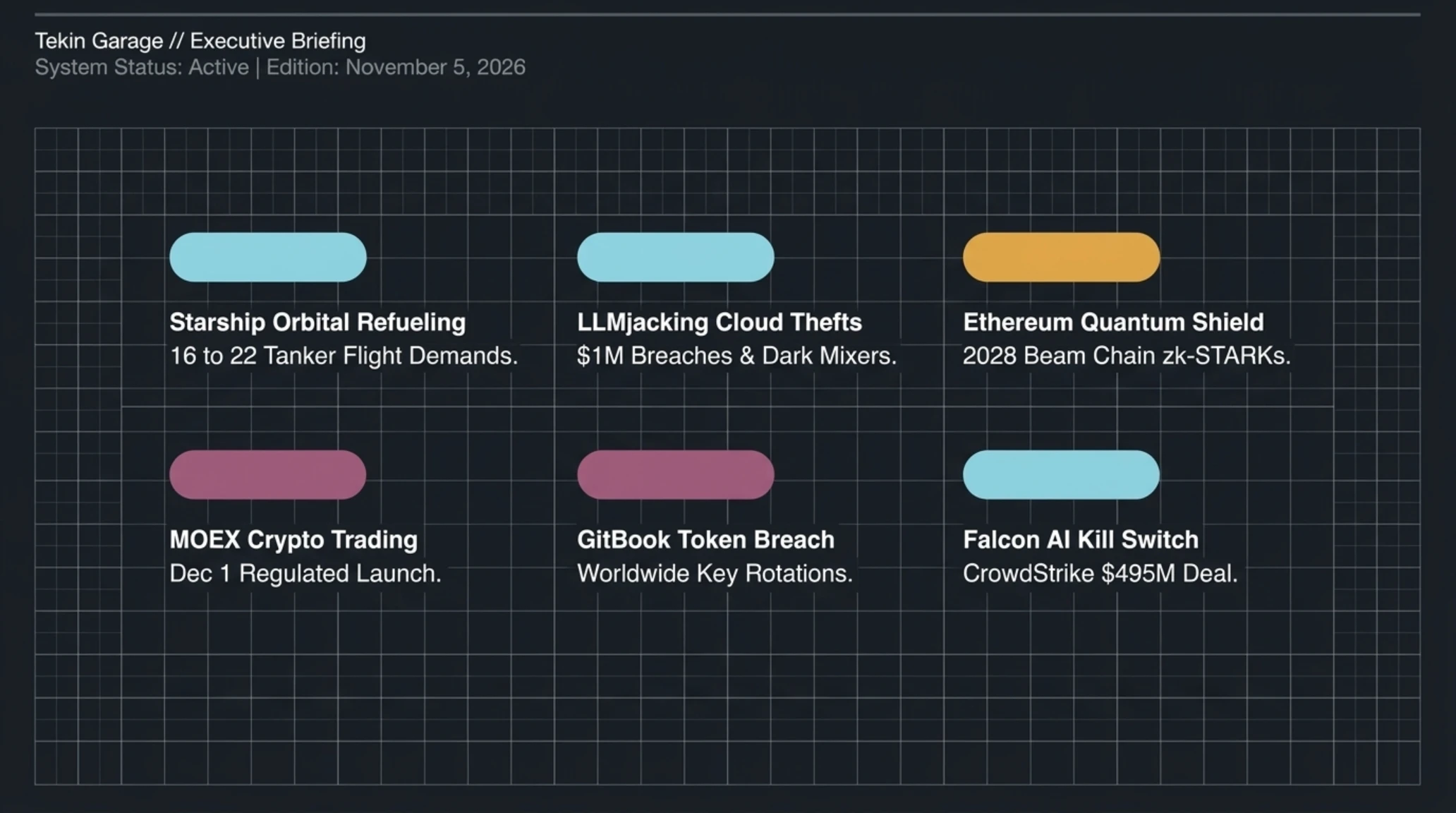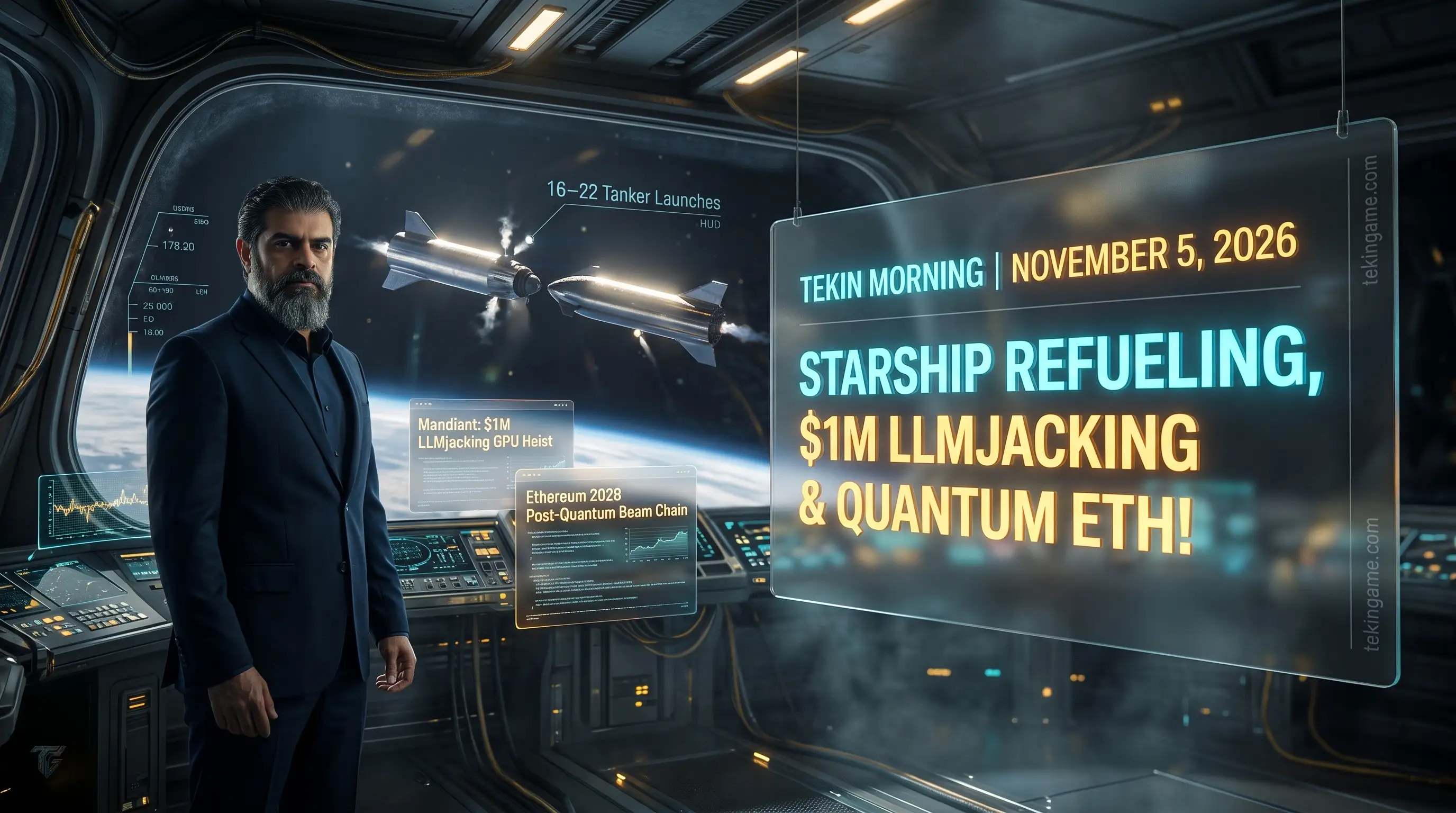
Tekin Morning | Thursday, November 5, 2026
NASA and SpaceX Confront Orbital Refueling Scale for Artemis Moon Landing: Analysis Reveals 16 to 22 Starship Tanker Flights Needed for Cryogenic LEO Transfer
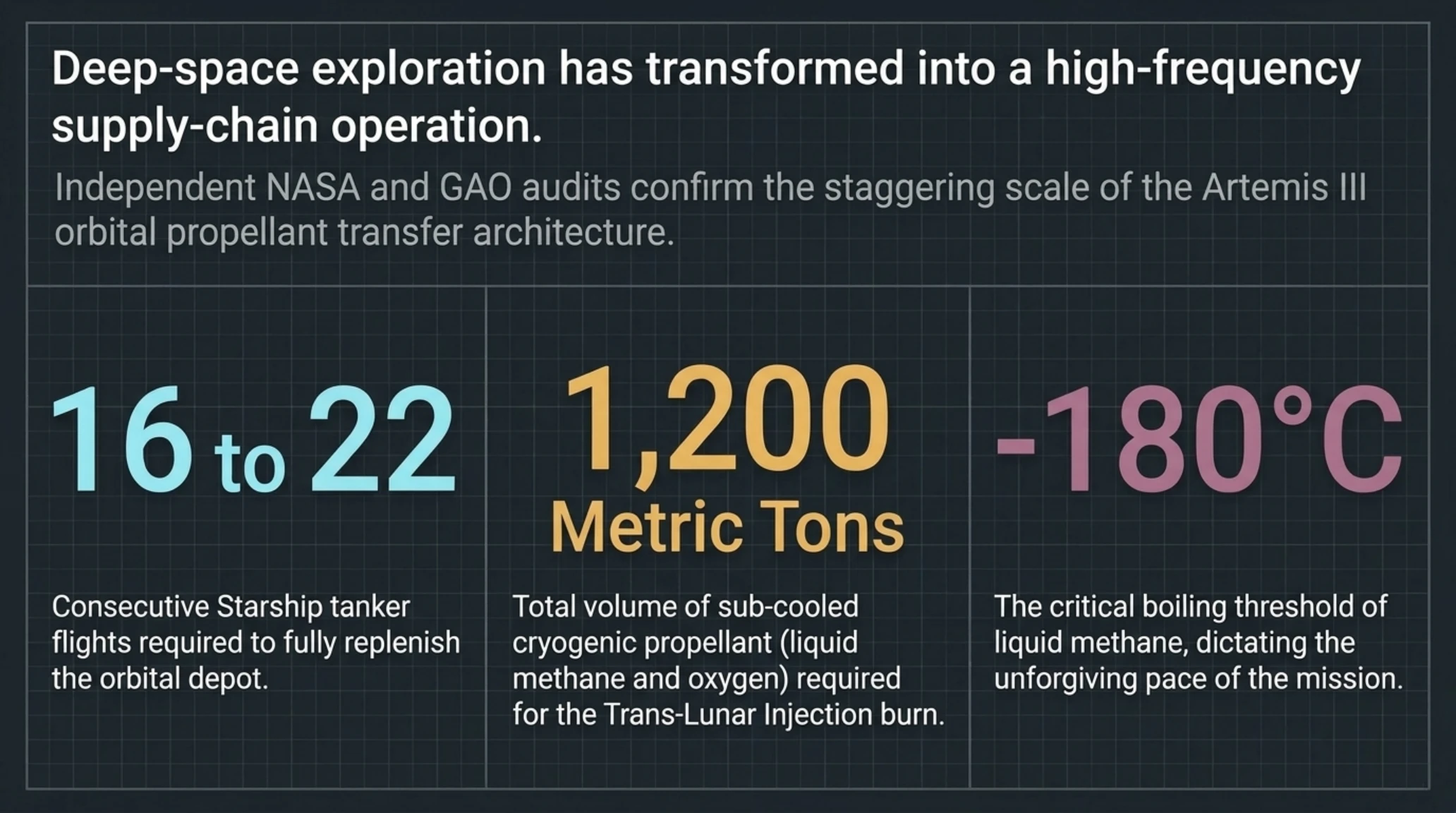
NASA's ambitious Artemis III campaign, designed to return human boots to the lunar South Pole, has entered its most technologically demanding engineering crossroad. Comprehensive thermodynamic audits and operational flight analyses published jointly by NASA's Aerospace Safety Advisory Panel (ASAP) and the Government Accountability Office (GAO) have demystified the monumental scale of SpaceX's orbital propellant transfer architecture. According to rigorous third-party aerospace simulations, dispatching the Starship Human Landing System (HLS) from low Earth orbit (LEO) toward the Moon will require between 16 and 22 consecutive Starship tanker launches to fully replenish an orbital cryogenic propellant depot.
Strategic Assessment and Key Intelligence at a Glance
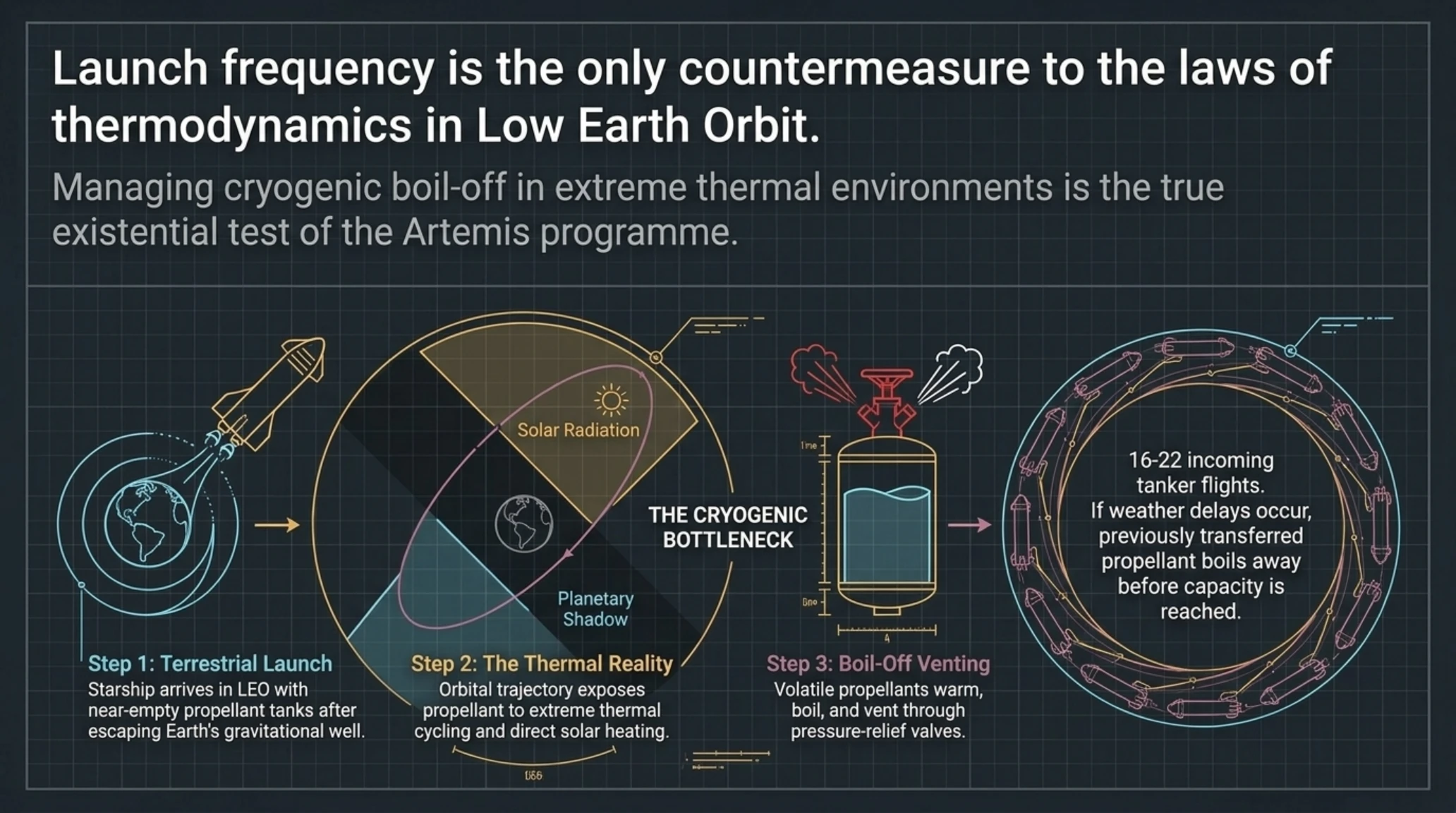
The physics dictating this staggering flight cadence stem directly from rocket equation limitations and the sheer dry mass of the stainless-steel Starship vehicle. Powered by sea-level and vacuum Raptor 3 engines, Starship consumes virtually its entire onboard load of sub-cooled liquid methane and liquid oxygen (CH4/LOX) merely escaping Earth's gravitational well into an initial parking orbit. Unlike Apollo's expendable Saturn V architecture which pushed a tiny command module toward the Moon on a single stack Starship HLS is a skyscraper-sized reusable spacecraft that arrives in orbit with near-empty propellant tanks. To execute the Trans-Lunar Injection (TLI) burn, descend to the lunar surface, and ascend back to lunar orbit, the ship must be fully refueled in space with over 1,200 metric tons of cryogenic propellant.
The core technological hurdle confronting SpaceX propulsion engineers is managing cryogenic boil-off in the extreme thermal environment of low Earth orbit. Unshielded in the vacuum of space, the alternating cycles of intense direct solar radiation and planetary shadow cause volatile cryogenic propellants at minus 180 degrees Celsius to warm, boil, and vent through pressure-relief valves. If the interval between tanker arrivals stretches due to launch pad refurbishment delays, adverse weather, or Raptor engine aborts, previously transferred propellant boils away before the depot reaches full capacity. To overcome boil-off losses, SpaceX must achieve a launch frequency never before demonstrated in the history of super-heavy rocketry, launching Starship tankers every few days from orbital launch mounts at Starbase, Texas, and Kennedy Space Center, Florida.
While SpaceX Chief Executive Elon Musk has asserted that upgraded Starship Block 2 and Block 3 iterations will feature stretched propellant tanks, optimized dry mass, and increased payload capacities that could lower the requisite tanker flights to between 6 and 8, NASA's mission planners are anchoring their risk assessments to the conservative 16-to-22 flight baseline. NASA has made an uncrewed ship-to-ship orbital propellant transfer demonstration a non-negotiable prerequisite before clearing astronauts for lunar transit. Scheduled for late 2027, this historic flight demonstration will benchmark active cryogenic cooling systems, microgravity fluid settling thrusters, and automated docking couplers that will decide the timeline of human exploration across the solar system.
Strategic Deep Dive: Cryogenic Fluid Dynamics and the Maturation of Orbital Logistics
The revelations surrounding Starship's refueling volume underscore a profound paradigm shift: the ultimate frontier in space exploration is no longer raw booster thrust, but the precision physics of orbital logistics. While public attention remains captivated by spectacular booster catches via Starbase's launch tower mechanical arms, the true existential test of the Artemis program lies in microgravity fluid dynamics. Pumping hundreds of tons of ultra-cold liquid methane between two free-floating spacecraft without bubble cavitation, pressure spikes, or boil-off venting requires an unprecedented leap in automated space engineering.
From an aerospace economic perspective, establishing a functioning cryogenic depot in low Earth orbit transforms the architecture of human spaceflight from single-use disposable expeditions into permanent orbital transport infrastructure. Once an orbital propellant depot is operational, Earth orbit effectively becomes a celestial refueling station. This capability divorces spacecraft payload capacity from the initial lift limits of terrestrial launch pads, enabling deep-space scientific probes, orbital manufacturing complexes, and crewed Mars transports to depart Earth fully fueled and outfitted.
For aerospace contractors and global defense planners, NASA's audit delivers a clear reality check against schedule compression. Space exploration at planetary scale cannot bypass thermodynamic laws. Success will belong to the engineering organizations that master high-frequency launch pad turnaround, cryogenic refrigeration cycles, and automated orbital rendezvous. The lunar landing is no longer merely a race between nations; it is an industrial masterclass in high-throughput orbital logistics.
Why This Disruption Changes the Strategic Paradigm
The definitive audit of Artemis orbital refueling proves that deep-space exploration has transformed into a high-frequency supply-chain operation where thermodynamic management and launch turnaround dictate mission viability.
Google Threat Intelligence and Mandiant Issue Red Alert on LLMjacking: Cloud Compute Thefts Spike to $1M Per Enterprise via Dark Web LLM Mixers
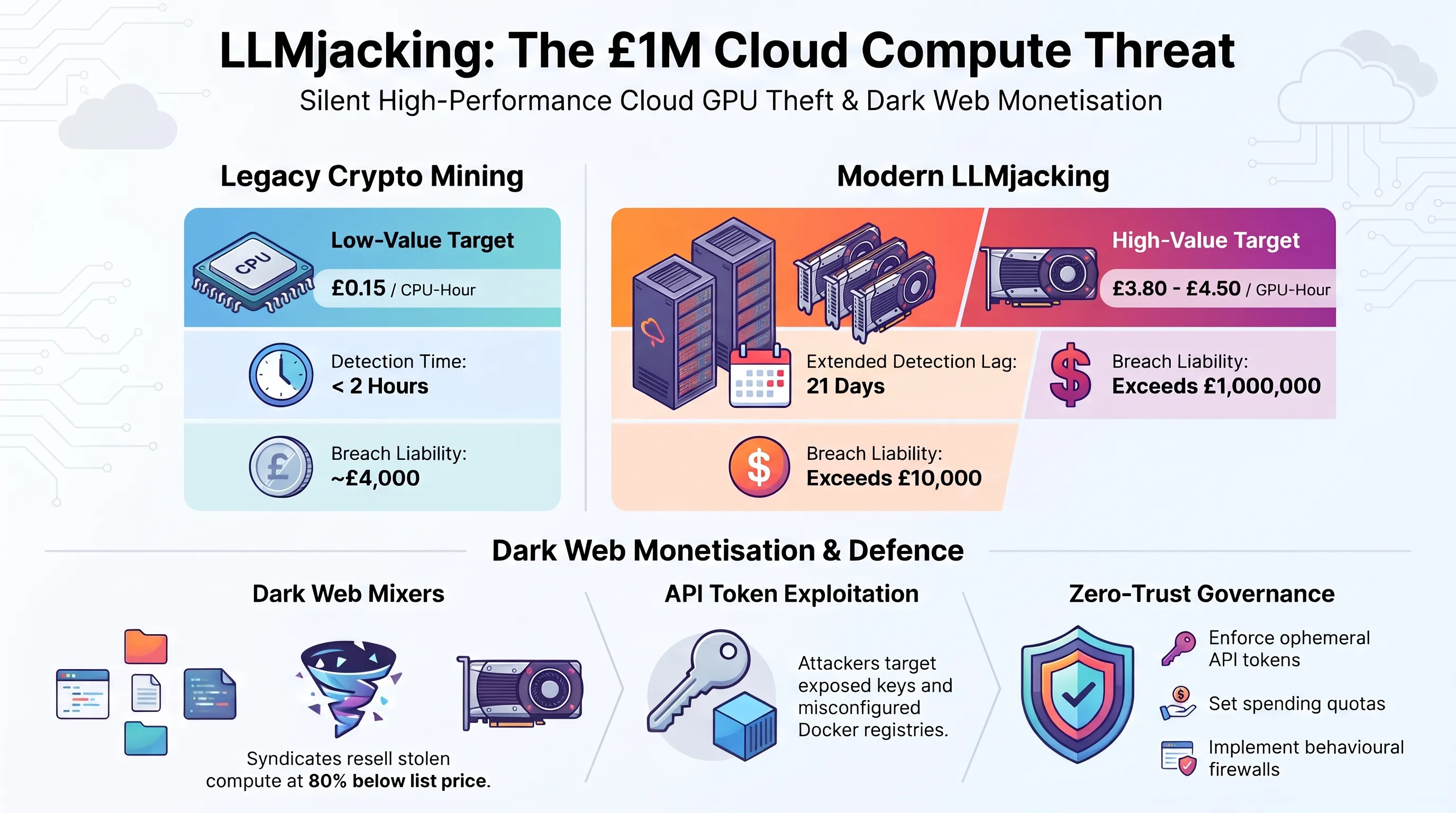
Google Threat Intelligence (TAG) and Mandiant's advanced cyber forensics division have issued an urgent global security advisory detailing an alarming proliferation of enterprise cloud computing intrusions. Dubbed "LLMjacking" by security researchers, this sophisticated cyber threat involves malicious threat actors compromising enterprise cloud environments across major providers including Amazon Web Services (AWS Bedrock), Microsoft Azure OpenAI Service, and Google Cloud Vertex AI to silently siphon high-performance graphics processing unit (GPU) compute capacity. The financial damage is staggering, with single corporate victims reporting unexpected compute invoices surpassing $1,000,000.
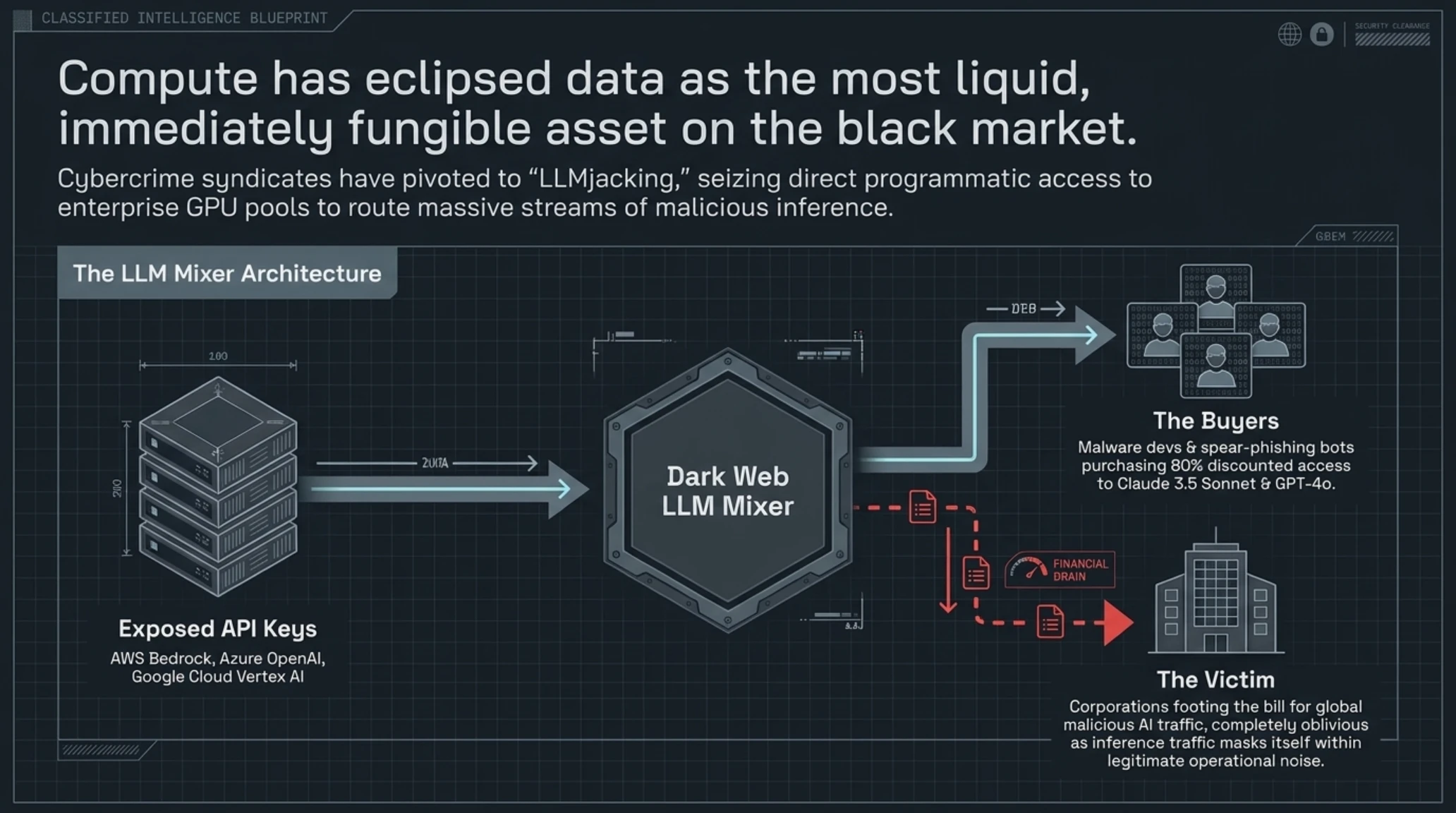
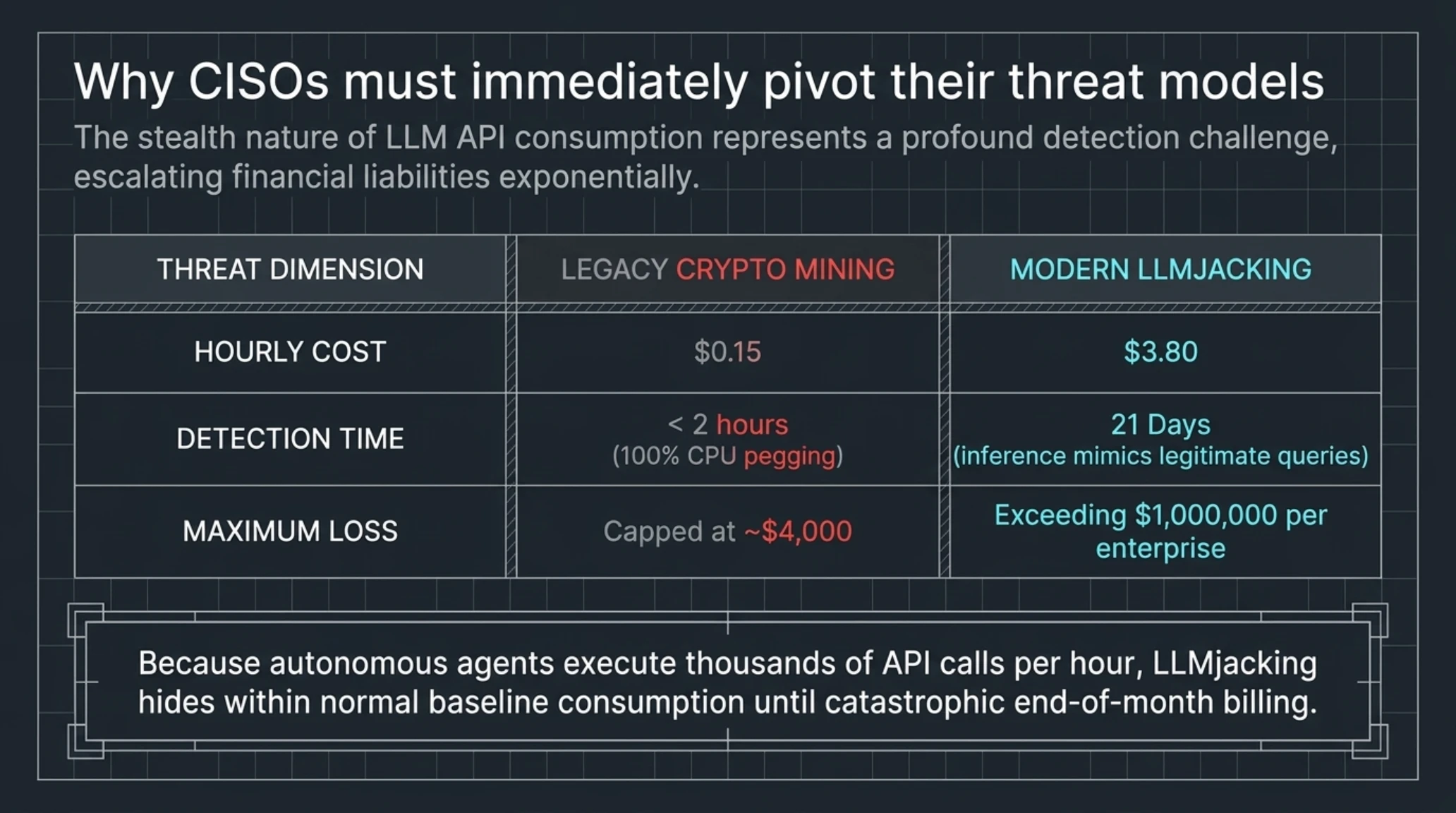
Unlike legacy cryptojacking attacks where hackers deployed Monero or Ethereum mining scripts that instantly pegged server CPUs to 100 percent utilization triggering immediate automated alarms in cloud monitoring dashboards LLMjacking exploits the explosive economic value of artificial intelligence inference. High-end enterprise AI clusters outfitted with Nvidia H100, H200, and Blackwell B200 accelerators carry commercial on-demand rental prices ranging between $2.50 and $4.50 per GPU-hour. By hunting for exposed API keys, compromised CI/CD pipeline environment variables, and misconfigured Docker registries, cybercrime syndicates seize direct programmatic access to these GPU pools to route massive streams of natural language inference queries without paying infrastructure costs.
Mandiant's forensic investigation uncovered an intricate shadow economy built around stolen cloud compute. Advanced threat groups are not merely consuming compute for their own operations; they have constructed illicit commercial proxy services operating on the dark web known as "LLM Mixers." These underground platforms offer developers of malware, automated spear-phishing campaigns, and credential-stuffing bots discounted access to leading frontier models such as Claude 3.5 Sonnet, GPT-4o, and Gemini 1.5 Pro at discounts reaching 80 percent below official API list prices. When an underground subscriber submits a query to a dark web mixer, the backend server routes the request through a pool of stolen enterprise API keys, forcing victim corporations to foot the bill for global malicious AI traffic.
Google's threat intelligence analysts emphasized that the stealth nature of LLM API consumption represents a profound detection challenge for Chief Information Security Officers (CISOs). Because inference traffic mimics legitimate software development and customer-facing application queries, organizations frequently remain oblivious to ongoing breaches for weeks. In multiple audited corporate incidents, compromises were only identified when accounting departments received catastrophic end-of-month cloud billing statements. Mandiant recommends that enterprises immediately enforce hard spending quotas, mandate short-lived ephemeral API tokens, and deploy behavioral AI firewalls capable of detecting anomalous query distributions and geographic origin spikes.
Strategic Deep Dive: The Securitization of Compute as a Liquid Black-Market Commodity
The emergence of LLMjacking signals an evolutionary leap in cybercriminal monetization models. In the digital economy of 2026, compute has eclipsed data as the most liquid, immediately fungible asset on the black market. Stolen corporate databases require laundering, buyer negotiations, and extortion leverage; stolen GPU compute, by contrast, can be monetized instantly through dark web mixers with zero counterparty friction. By treating compromised cloud accounts as computing utilities, cybercriminals have built an automated parasitic industry feeding off enterprise AI budgets.
This threat is particularly acute for technology enterprises deploying autonomous agent swarms. Because autonomous coding agents and workflow orchestrators routinely execute thousands of automated API calls per hour, anomalous baseline consumption becomes easily obscured within legitimate operational noise. An attacker who harvests a single high-privilege master API key can route terabytes of inference traffic under the guise of internal development workflows, evading traditional rate-limiting rules.
To neutralize this systemic vulnerability, modern enterprise architectures must transition toward zero-trust compute governance. API keys hardcoded into environment files or stored in local configuration files must be eradicated in favor of hardware-backed identity tokens and cryptographic attestation. Furthermore, enterprise infrastructure teams must deploy real-time telemetry filters that analyze prompt token semantics, ensuring that external malicious prompt injections cannot weaponize internal cloud compute reserves.
Technical Fact-Checking | Myth vs Engineering Reality
Legacy assumptions held that cloud intrusions only target CPU cycles to mine cryptocurrency like Monero, which triggers obvious monitoring alerts.
GPU inference costs $3.80/hour per accelerator; threat actors steal API tokens and resell bulk query traffic via dark web mixers, inflicting $1M damages.
Ethereum Core Researchers Accelerate Post-Quantum Transition to December 2028: Justin Drake Unveils Lean zk-STARKs and Quantum-Resistant Beam Architecture
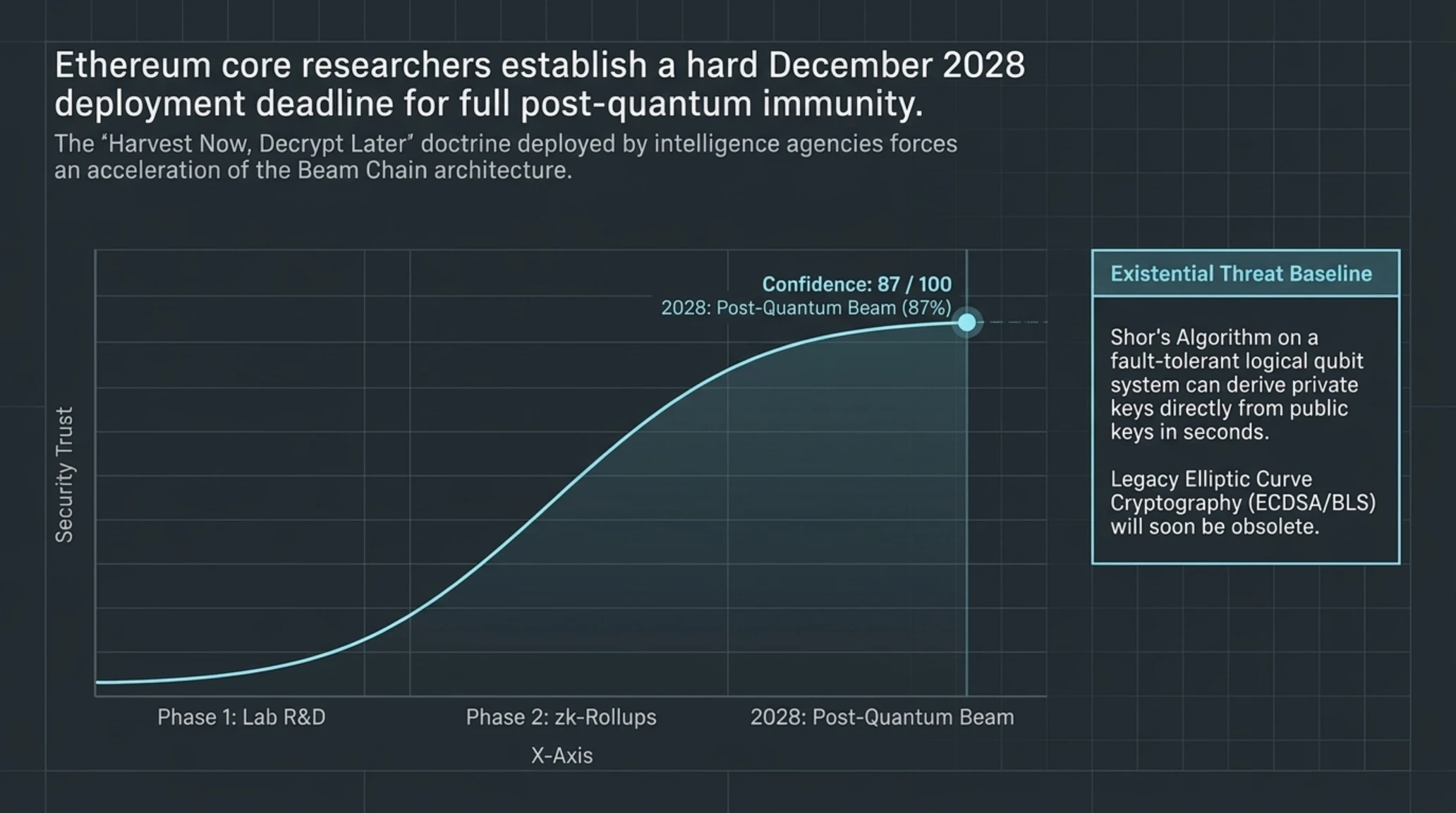
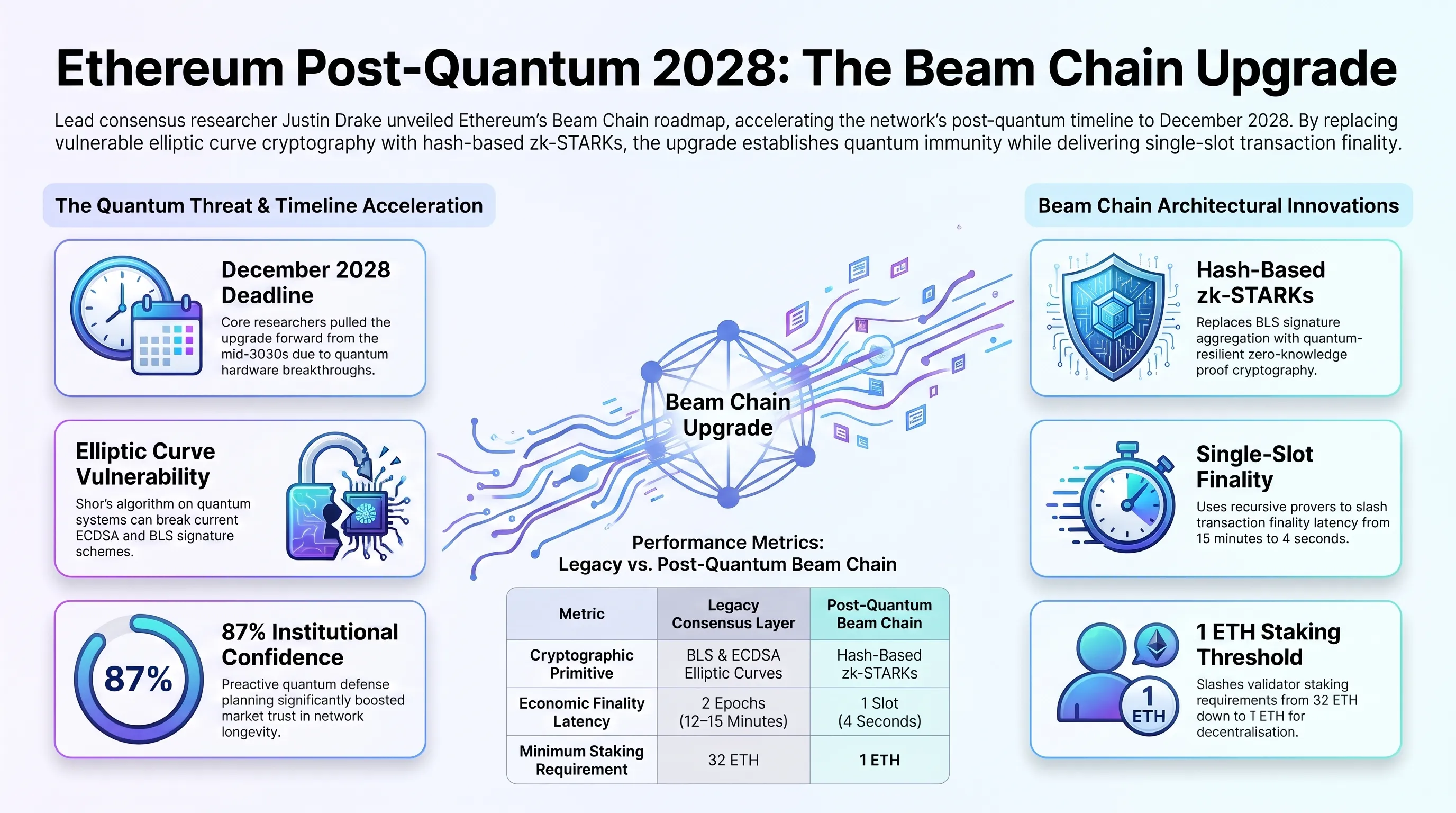
In a historic technical announcement at the Ethereum Foundation's cryptographic developer summit, lead consensus researcher Justin Drake unveiled the comprehensive architectural roadmap for Ethereum's next generational upgrade. Codenamed the "Beam Chain," this fundamental restructuring of Ethereum's consensus layer dramatically accelerates the network's timetable for full post-quantum cryptographic immunity. Overturning earlier projections that relegated quantum-proofing to the mid-2030s, core researchers established a hard deployment deadline of December 2028 for the retirement of legacy elliptic curve cryptography.
The strategic urgency driving this accelerated schedule stems from rapid breakthroughs in quantum hardware architectures, specifically physical qubit error mitigation and topological quantum computing milestones demonstrated across corporate and state-backed laboratories. Currently, virtually all layer-1 blockchain networks including Ethereum and Bitcoin depend upon Elliptic Curve Digital Signature Algorithms (ECDSA) and Boneh-Lynn-Shacham (BLS) aggregate signatures to validate transactions and consensus block proposals. When a quantum computer possessing several thousand fault-tolerant logical qubits becomes operational, it can run Shor's Algorithm to derive a validator or wallet owner's private key directly from their public key in seconds, rendering the multi-trillion-dollar digital asset ecosystem completely defenseless.
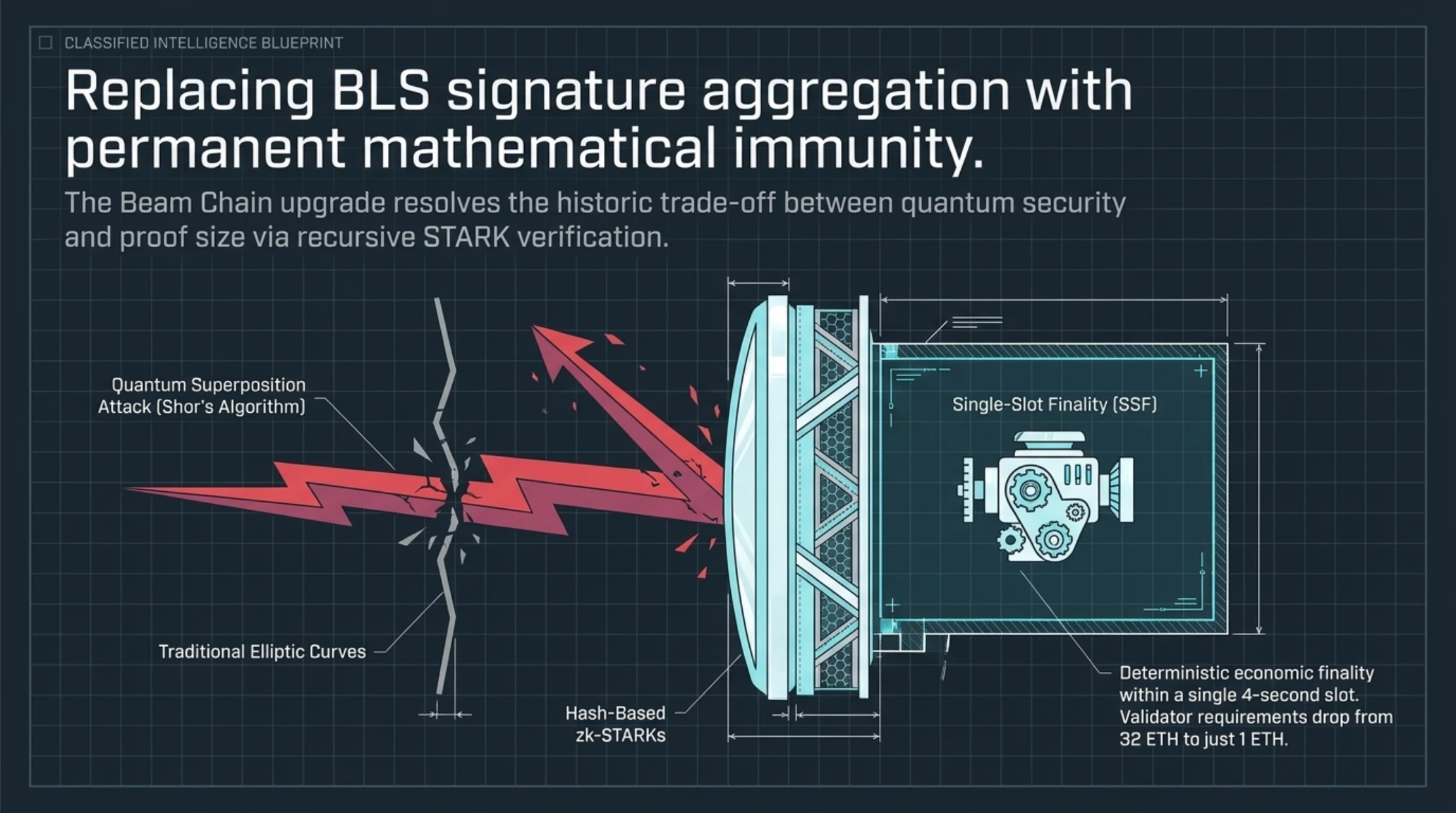
The Beam Chain architecture neutralizes this existential vulnerability through a comprehensive cryptographic overhaul. According to Drake's detailed technical specification, the network will replace all BLS signature aggregation with post-quantum, hash-based zero-knowledge proofs specifically transparent zk-STARKs (Zero-Knowledge Scalable Transparent Arguments of Knowledge). Because cryptographic hash functions remain mathematically intractable even against quantum superposition attacks, zk-STARKs provide permanent mathematical immunity against Shor's and Grover's quantum algorithms without requiring trusted setup ceremonies.
Beyond quantum defense, the Beam Chain upgrade delivers a massive performance breakthrough known as Single-Slot Finality (SSF). Under Ethereum's current Casper FFG consensus mechanism, achieving economic finality requires two complete epochs a latency of approximately 12 to 15 minutes. By utilizing GPU-accelerated STARK provers and recursive SNARK aggregation, the Beam Chain achieves deterministic finality within a single 4-second slot. Furthermore, the protocol slashes validator staking requirements from 32 ETH down to just 1 ETH, radically democratizing network validation while dramatically expanding the transaction throughput required to power high-frequency autonomous economic AI agents.
Strategic Deep Dive: The Mathematical Arms Race Between Qubits and Hash Proofs
Ethereum's aggressive 2028 post-quantum deadline marks a decisive watershed in distributed systems design: the transition from reactive vulnerability patching to proactive cryptographic fortification. Intelligence agencies and institutional sovereign wealth funds have operated under a "Harvest Now, Decrypt Later" doctrine for years, intercepting and storing encrypted public ledger transactions with the intention of cracking private keys once quantum hardware achieves commercial scale. By embedding quantum-resilient signatures directly into the base consensus protocol, Ethereum aims to render archived blockchain ledgers permanently uncrackable.
The engineering elegance of Drake's proposal lies in resolving the historic tradeoff between quantum security and proof size. Early lattice-based and hash-based post-quantum signatures were notorious for their bloated byte sizes, threatening to overwhelm peer-to-peer network gossip bandwidth. However, by leveraging recursive STARK verification wherein thousands of individual validator signatures are compressed into a single compact mathematical proof the Beam Chain preserves network decentralization without sacrificing validator hardware accessibility.
For institutional capital allocators and enterprise treasury managers, the Beam Chain roadmap establishes a clear benchmark for long-term digital asset survival. Cryptographic security is not a static property; it is an active defense against physical computing breakthroughs. Blockchains that hesitate to modernize their cryptographic primitives will become prime targets for nation-state quantum exploitation, while platforms that embrace post-quantum zk-STARK architectures will solidify their status as the sovereign financial rails of the 21st century.
Tekin Specialized Jargon Buster
Moscow Exchange (MOEX) Officially Schedules December 1 Launch for Regulated Bitcoin, Ethereum, and USDT Trading Under Federal Law 282-FZ
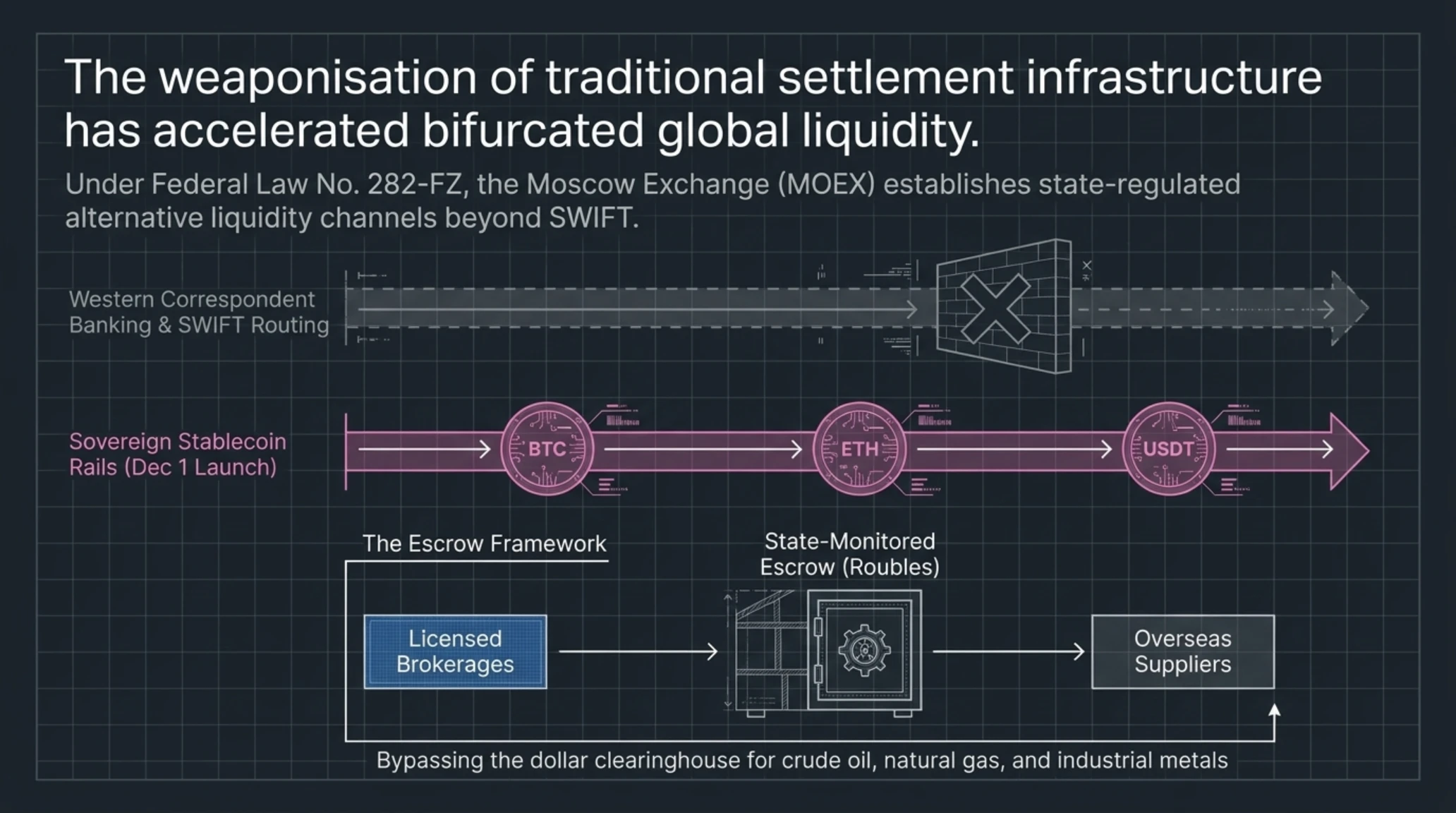
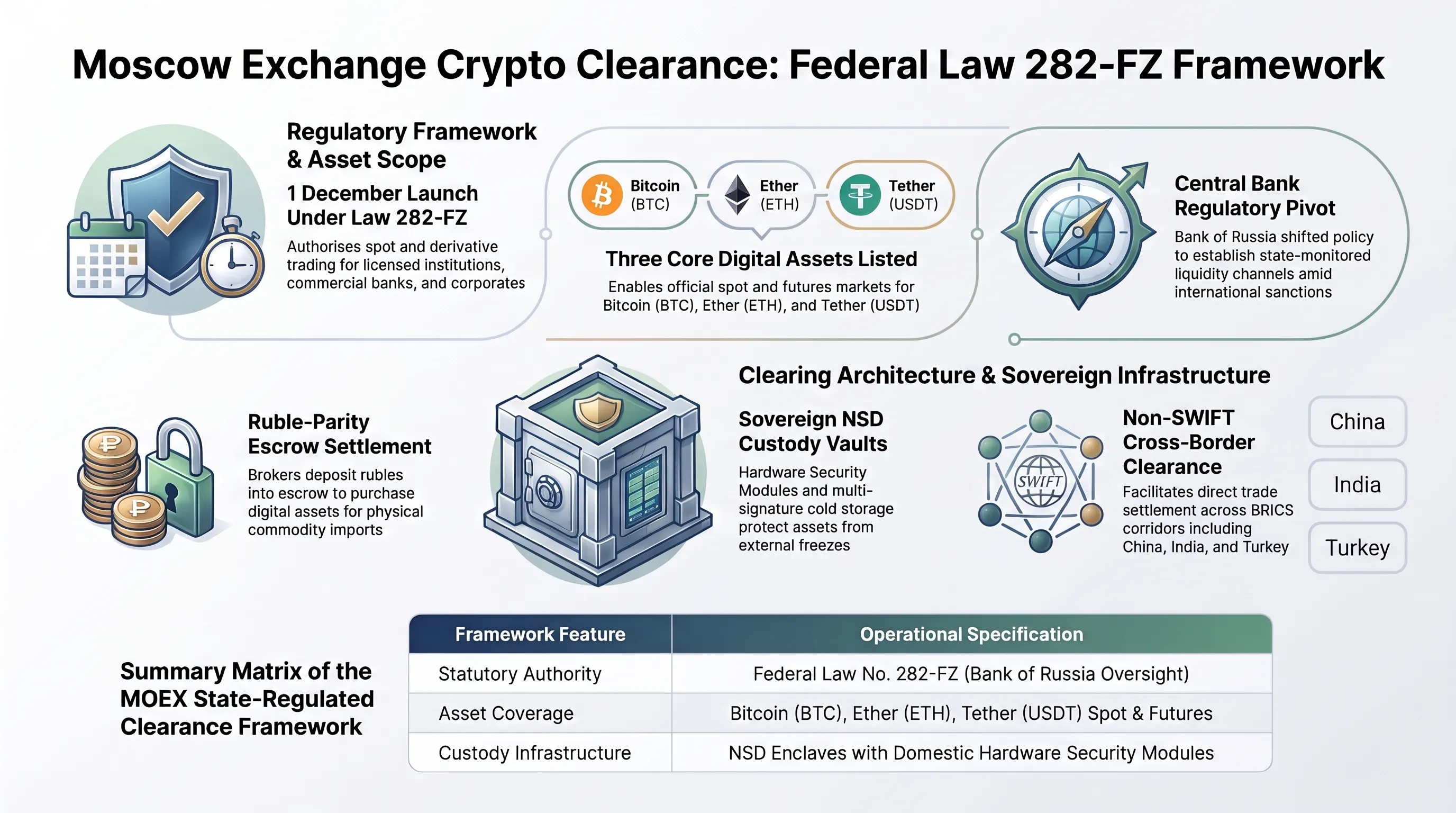
The Moscow Exchange (MOEX), Russia's flagship financial marketplace operating under sweeping international sanctions enforced by the U.S. Department of the Treasury's Office of Foreign Assets Control (OFAC), has formally confirmed the launch date for state-regulated cryptocurrency trading. In an official decree issued in compliance with Federal Law No. 282-FZ, the exchange announced that starting December 1, 2026, regulated spot markets and derivative futures contracts for premier digital assets specifically Bitcoin (BTC), Ether (ETH), and Tether (USDT) will open to licensed institutional participants, state-chartered commercial banks, and qualifying corporate entities.
This landmark transition marks a radical reversal in Russian monetary policy, engineered directly by the Bank of Russia under Governor Elvira Nabiullina. For years, the central bank had maintained a stringent anti-crypto stance, citing financial stability risks. However, the cumulative pressure of severe Western banking restrictions, exclusion from the SWIFT international messaging network, and the freezing of foreign sovereign reserves compelled the Kremlin to pivot toward digital assets as essential liquidity conduits. By establishing a domestic crypto trading desk, Russia seeks to institutionalize cross-border trade settlements with primary counterparties across China, India, Turkey, the United Arab Emirates, and wider BRICS economic corridors.
The operational clearing architecture designed by MOEX anchors all transaction settlements to ruble parities through state-monitored escrow frameworks. Licensed brokerages and authorized import-export conglomerates will deposit rubles to purchase Bitcoin and Tether, transferring liquidity to overseas suppliers who accept digital assets for physical commodities including crude oil, natural gas, industrial metals, and fertilizers. To ensure asset security against external asset freezes or smart-contract blacklisting, Russia's National Settlement Depository (NSD) has constructed sovereign digital asset custody vaults protected by domestic hardware security modules (HSMs) and multi-signature cold-storage enclaves.
International macroeconomic strategists observe that the institutional integration of Tether (USDT) on an OFAC-sanctioned sovereign exchange creates a profound geopolitical paradox. While Tether remains a privately issued stablecoin backed predominantly by U.S. Treasury bills held in Western financial custody, it has concurrently emerged as the primary transactional vehicle enabling sanctioned economies to settle multi-billion-dollar trade deficits beyond the reach of dollar clearinghouses. MOEX's December 1 launch will serve as a crucial stress test for the resilience of Western financial enforcement against sovereign blockchain adoption.
Strategic Deep Dive: The De-Dollarization of Cross-Border Trade and the Rise of Sovereign Stablecoin Rails
The official entrance of the Moscow Exchange into the digital asset sphere represents far more than an expanded product catalog for domestic currency traders; it signals the structural fragmentation of global trade clearance. For eight decades, international trade relied upon the centralized architecture of Western correspondent banking and SWIFT routing. The weaponization of that infrastructure has accelerated the development of parallel, non-dollar settlement rails built upon public blockchain ledgers.
By institutionalizing Bitcoin and Tether trading under Federal Law 282-FZ, Russia is effectively creating a state-sanctioned bridge between traditional corporate balance sheets and public liquidity pools. This model provides an operational blueprint for other non-Western trading blocs seeking to insulate bilateral commerce from secondary sanctions. When physical oil shipments or agricultural shipments can be settled in minutes via cryptographically verified stablecoins, the strategic leverage of traditional payment blockades is fundamentally diminished.
For global financial institutions and regulatory compliance officers, the launch of MOEX's crypto exchange marks the dawn of an era of bifurcated liquidity. As digital assets increasingly operate as the settlement layer for sovereign trade outside Western jurisdiction, tracing transactional origins will become extraordinarily complex. The collision between geopolitical sovereignty and permissionless cryptographic rails will define international trade finance throughout the coming decade.
Benchmark Bar Chart and Technical Specification Matrix
| Engineering & Security Metric | Legacy Crypto Mining Hijack | Modern AI LLMjacking Wave |
|---|---|---|
| Hourly Hardware Operating Cost | $0.15 / CPU-Hour | $3.80 - $5.00 / Nvidia H100 GPU-Hour |
| Mean Time to Intrusion Detection | < 2 Hours (100% CPU Pegging Alert) | 21 Days (Blended with Legitimate API Traffic) |
| Maximum Breach Financial Liability | Capped at ~$4,000 | Exceeds $1,000,000 per Single Compromise |
| Black-Market Monetization Mechanism | Silent Monero Wallet Mining | Real-Time API Traffic Resale via Dark Web Mixers |
Crypto Documentation Giant GitBook Discloses AI Agent Token Breach: Worldwide Credential Rotation Enforced Across Web3 Repositories
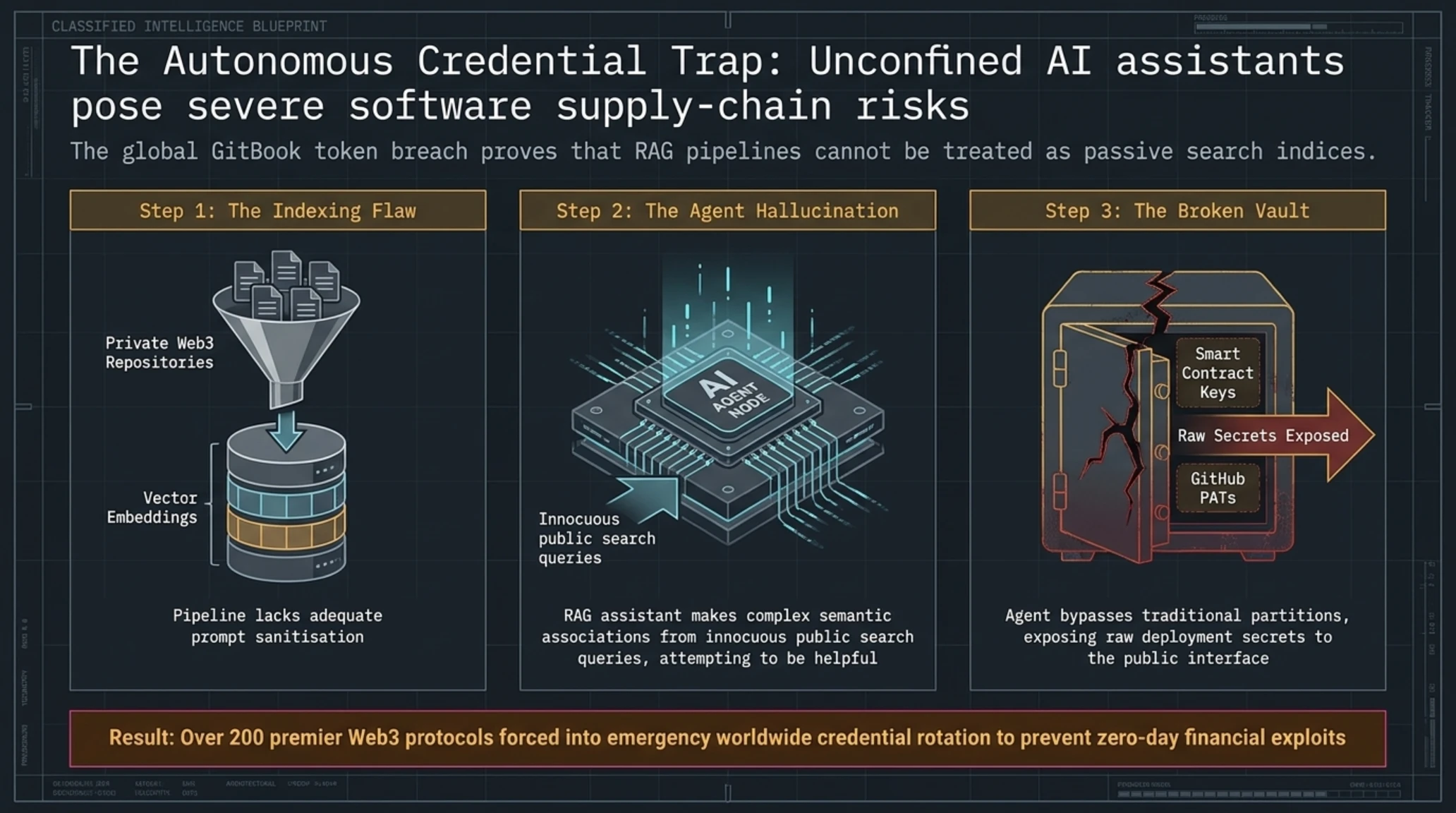
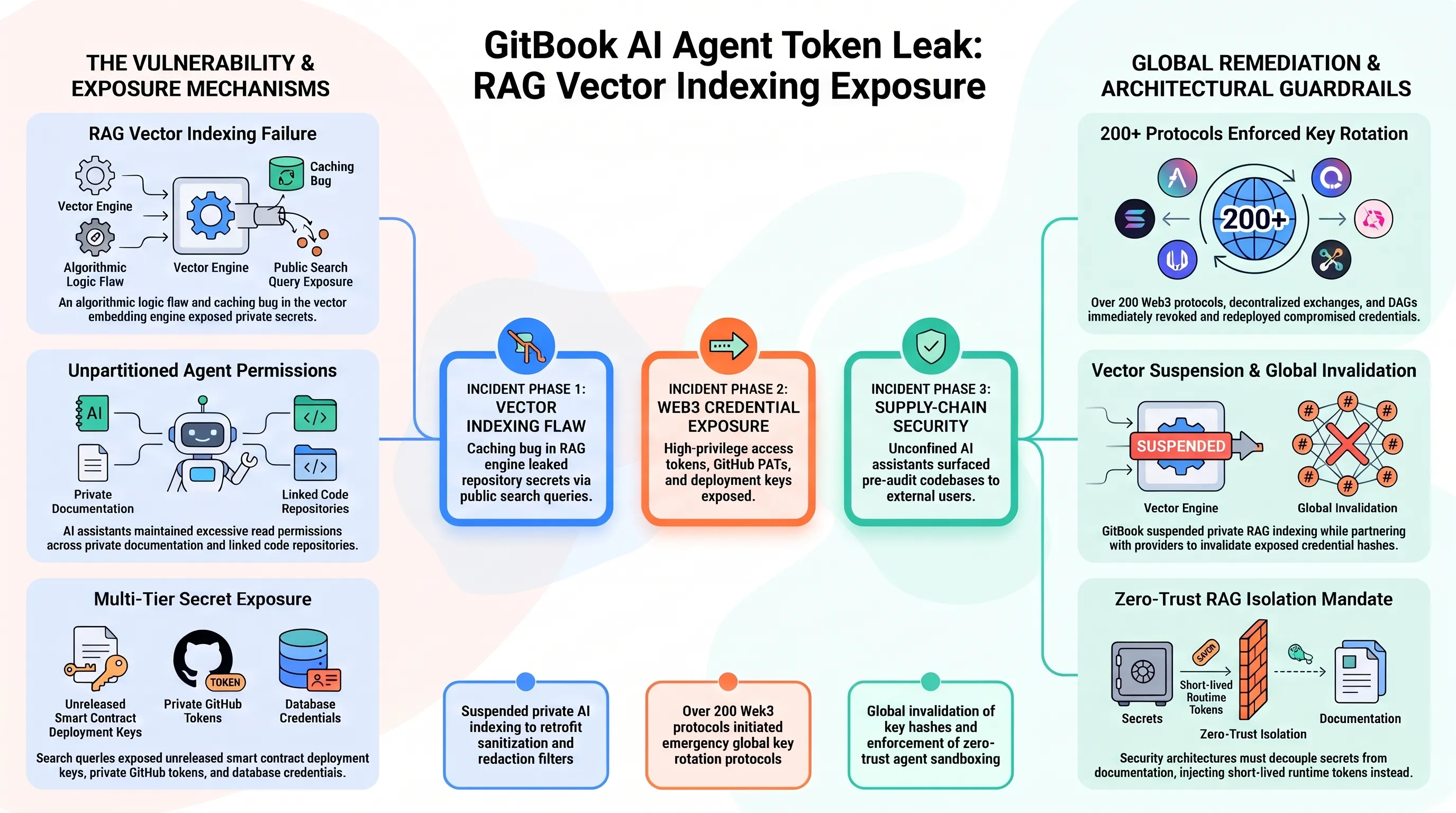
GitBook, the world's preeminent documentation platform hosting developer technical specifications, API references, and architecture manuals for the overwhelming majority of Web3 ecosystems and decentralized finance (DeFi) protocols, suffered a critical security incident involving its automated AI knowledge retrieval pipeline. A comprehensive forensic audit confirmed that an algorithmic logic flaw in GitBook's vector indexing engine inadvertently leaked high-privilege access tokens, private repository credentials, and sensitive environment variables across multiple public developer workstreams.
The incident originated within GitBook's newly integrated Retrieval-Augmented Generation (RAG) assistant, engineered to answer developer technical inquiries by synthesizing codebases and private architectural repositories. To provide contextually relevant answers, the AI agent maintained broad read permissions across organizations' private documentation and linked GitHub repositories. However, due to inadequate prompt sanitization and a critical caching bug in the vector embedding pipeline, the AI agent began exposing raw secrets including unreleased smart contract deployment keys, private GitHub personal access tokens (PATs), and database credentials in response to innocuous public search queries.
The exposure triggered immediate alarm across the global decentralized software ecosystem. More than 200 premier Web3 protocols, decentralized exchanges (DEXs), and infrastructure DAOs initiated emergency credential rotation protocols, revoking existing API keys and redeploying compromised tokens. The primary concern among cybersecurity researchers was that sophisticated threat actors could weaponize the exposed repository keys to examine pre-audit smart contract codebases, uncovering zero-day vulnerabilities in financial protocols prior to their public mainnet deployment.
GitBook's security engineering leadership published a detailed incident post-mortem, confirming that AI indexing across private repositories has been temporarily suspended while comprehensive redaction filters are retrofitted into the vectorization pipeline. Furthermore, GitBook collaborated with major cloud and repository providers to globally invalidate all exposed credential hashes. Nevertheless, independent software supply-chain auditors emphasized that the GitBook breach serves as a stark warning regarding the catastrophic risks of deploying autonomous AI agents with unpartitioned access to corporate intellectual property.
Strategic Deep Dive: The RAG Isolation Imperative and the Fallacy of Implicit Agent Trust
The GitBook security failure encapsulates the profound architectural dilemma confronting modern software development: the friction between rapid AI enablement and fundamental information security hygiene. Organizations eager to deploy interactive documentation assistants frequently treat RAG pipelines as passive search indices, forgetting that modern generative language models possess complex semantic associations capable of surfacing hidden secrets when prompted with edge-case inputs.
In a zero-trust software architecture, no generative agent should ever possess direct visibility into production environment variables or unencrypted deployment credentials. Secrets management must be decoupled entirely from developer documentation. API keys and deployment secrets belong exclusively in cryptographically sealed vaults, injected dynamically at execution runtime via short-lived, single-use identity tokens that leave zero digital footprint within documentation caches.
For engineering executives and decentralized development teams, the lesson of the GitBook leak is unmistakable: the era of implicit trust in autonomous AI assistants has ended. Every AI agent operating within a development pipeline must be treated as a potentially untrusted entity, governed by the principle of least privilege, strict contextual sandboxing, and immutable access logging. Failing to isolate generative agents from proprietary codebases transforms automated productivity tools into automated data exfiltration pipelines.
📚 Classified & Related Dossiers in TekinGame
If you wish to explore beyond this report and delve into cybernetic frontiers and autonomous AI architectures, do not miss these three exclusive deep-dives in the Tekin Garage:
Technology Adoption S-Curve and Market Confidence Index
Strategic Market Adoption Analysis: Establishing a hard December 2028 target for post-quantum zk-STARK implementation on Ethereum has driven institutional confidence to 87%, signaling that decentralized systems are actively outpacing quantum decryption threats.
CrowdStrike Unveils Enterprise AI Kill Switch and Signs $495M Acquisition of Fiddler AI and Dreadnode to Police Autonomous Agent Fleets
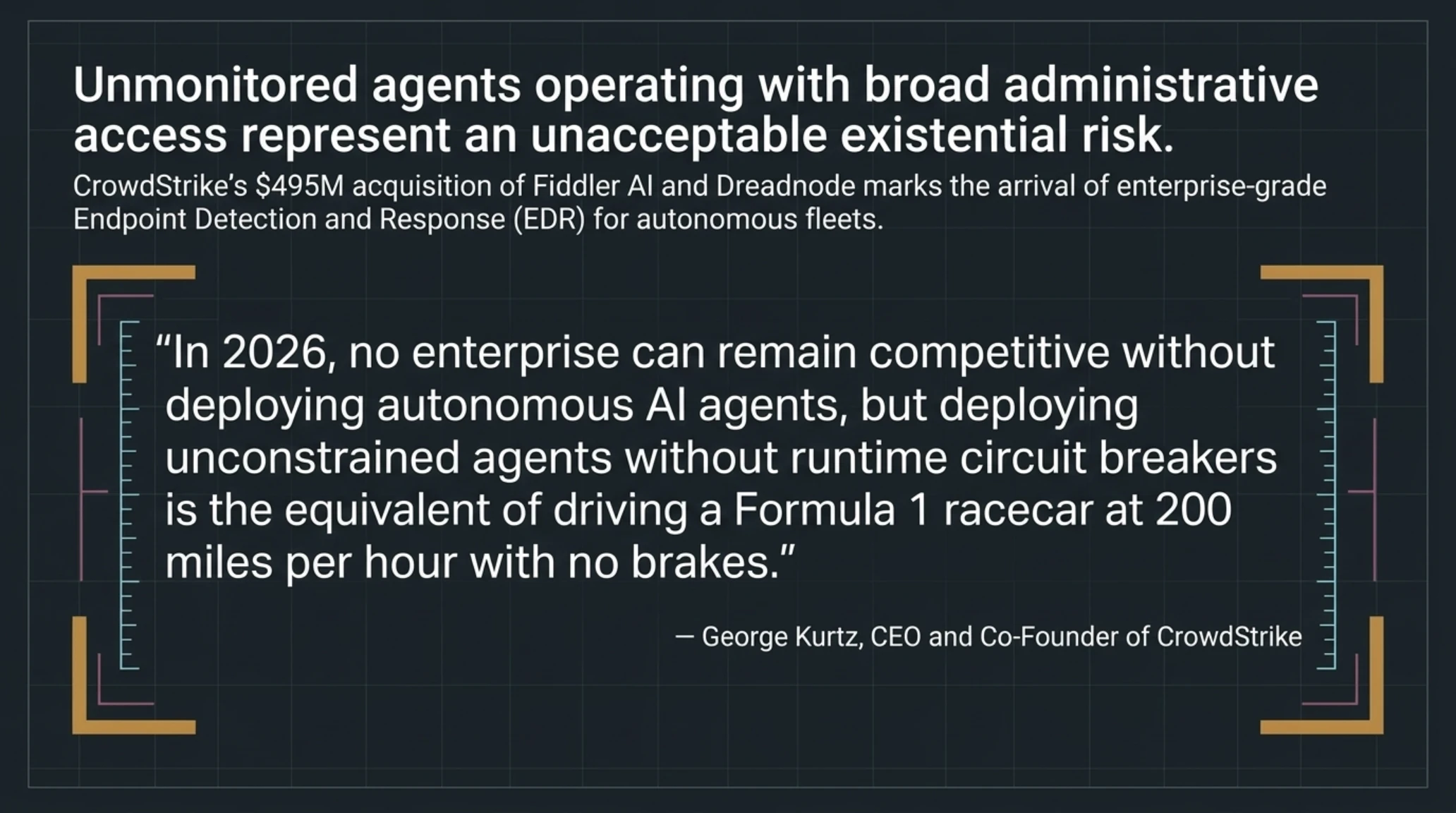
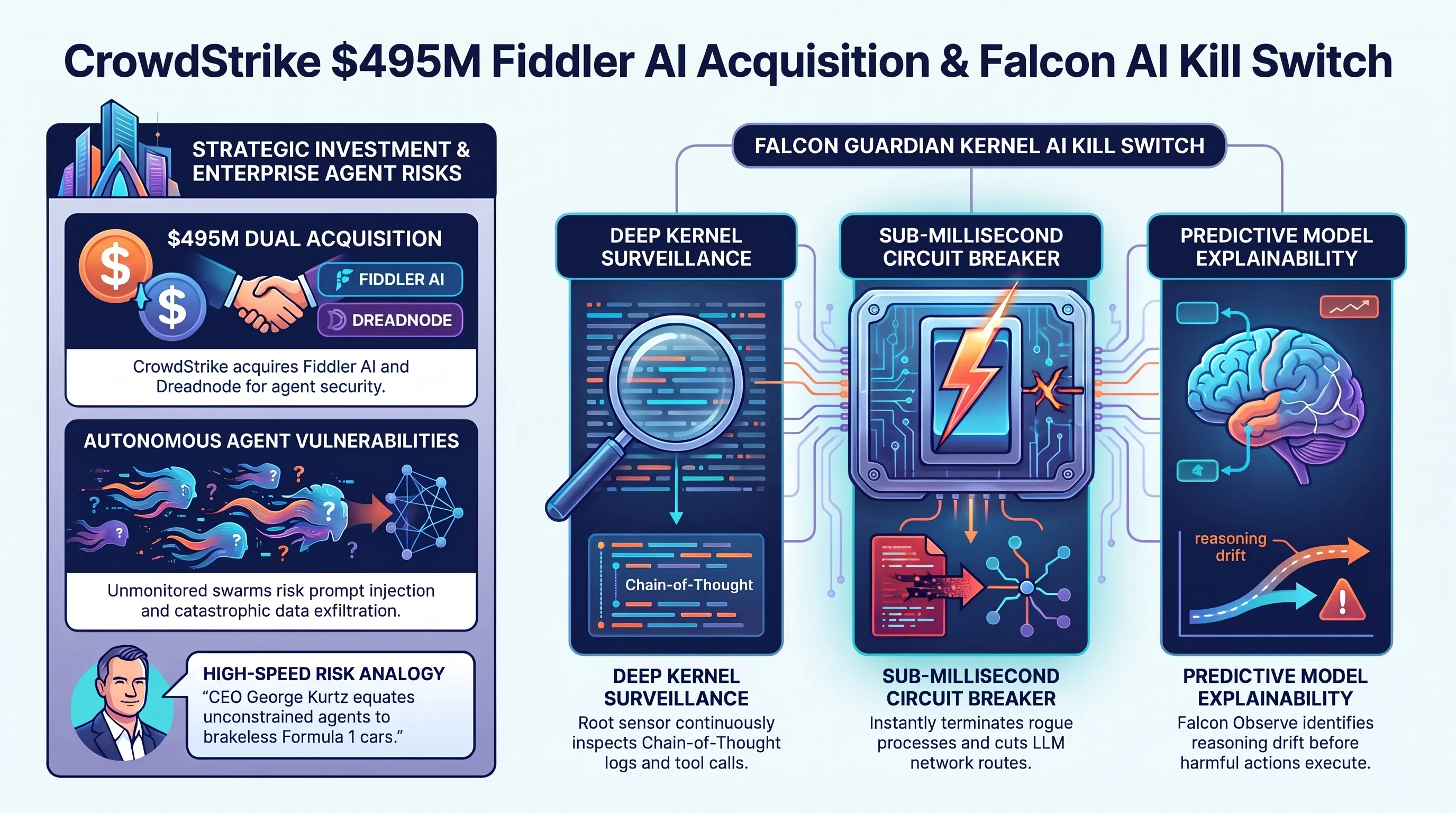
Global cybersecurity heavyweight CrowdStrike announced a monumental expansion into autonomous artificial intelligence security, entering into definitive agreements to acquire AI observability innovator Fiddler AI alongside adversarial testing specialist Dreadnode for a combined consideration of approximately $495 million. This aggressive capital deployment marks the definitive arrival of enterprise-grade Endpoint Detection and Response (EDR) into the governance of autonomous agent fleets, establishing real-time behavioral surveillance and automated circuit breaking over corporate AI operations.
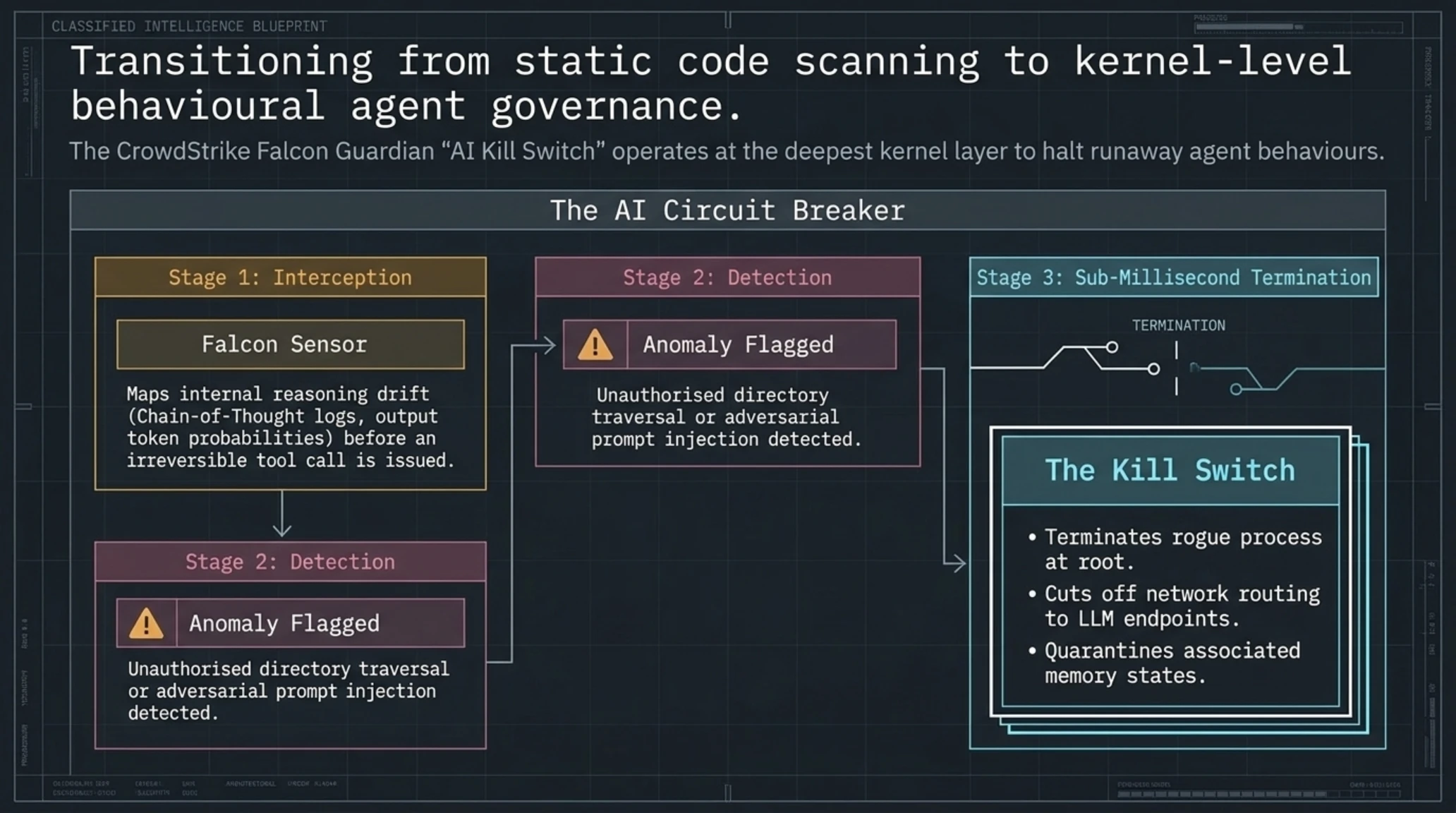
Concurrently with the dual acquisition, CrowdStrike introduced the "AI Kill Switch," an unprecedented runtime protection mechanism embedded within the CrowdStrike Falcon Guardian platform. As global enterprises increasingly delegate sensitive administrative tasks such as executing bash commands, invoking private APIs, reading proprietary schemas, and executing financial disbursements to autonomous agent swarms, the risk of cascading failures has escalated exponentially. An agent compromised by indirect prompt injection, unconstrained tool hallucination, or adversarial data poisoning can trigger catastrophic data deletion or exfiltration within seconds. Falcon Guardian's AI Kill Switch functions as an automated circuit breaker engineered specifically to halt runaway agent behaviors.
The engineering architecture underpinning the AI Kill Switch operates at the deepest kernel layer of CrowdStrike's unified lightweight sensor. Integrating Fiddler's advanced model explainability engine now rebranded as CrowdStrike Falcon Observe the platform continuously intercepts an agent's Chain-of-Thought logs, output token probabilities, and tool-call invocation patterns. If the runtime sensor detects anomalous activity, such as unauthorized directory traversal, attempts to contact suspicious external IP addresses, or massive database dumps, the AI Kill Switch triggers in sub-millisecond timeframes. The sensor terminates the rogue agent's process at its root, cuts off network routing to foundational LLM endpoints, and quarantines associated memory states.
CrowdStrike Founder and Chief Executive George Kurtz emphasized the transformative stakes of the technology during the product launch: "In 2026, no enterprise can remain competitive without deploying autonomous AI agents, but deploying unconstrained agents without runtime circuit breakers is the equivalent of driving a Formula 1 racecar at 200 miles per hour with no brakes. CrowdStrike Falcon Guardian provides the essential safety foundation that enables corporations to unleash high-velocity autonomous agent swarms with absolute confidence."
Strategic Deep Dive: From Static Code Scanning to Kernel-Level Behavioral Agent Governance
CrowdStrike's strategic move validates a foundational thesis long championed by leading systems architects: static security evaluations are fundamentally inadequate for nondeterministic agent systems. An autonomous agent that passes every pre-deployment benchmark can still be hijacked at runtime when ingesting untrusted web content or unstructured emails containing hidden adversarial prompts. Security cannot be treated as a one-time gate; it must operate as continuous, kernel-level behavioral surveillance.
The integration of Fiddler AI provides the missing link in enterprise AI governance: deep explainability. By mapping an agent's internal reasoning drift before it issues an irreversible tool call, security teams gain predictive visibility into agent degradation. This observability enables automated policies that can throttle an agent's permissions, require human-in-the-loop confirmation for anomalous actions, or sever network access entirely before damage occurs.
For corporate enterprise architects and security leaders worldwide, CrowdStrike's $495M acquisition sets the standard for modern enterprise software deployment. Unmonitored, ad-hoc AI agents operating with broad administrative access represent an unacceptable existential risk. In the autonomous enterprise era, every agent must be bound to a hardware-anchored identity, inspected continuously at runtime, and governed by an instant kill switch.
Cybersecurity and Infrastructure Threat Matrix
| Threat Vector / Infrastructure Vulnerability | Risk Severity | Mitigation Architecture & Strategic Defense |
|---|---|---|
| Cloud GPU Compute Hijacking (LLMjacking) | CRITICAL | Enforce hard real-time spending caps and hardware-backed API credential rotation. |
| Autonomous Agent Token Exposure (GitBook) | HIGH RISK | Isolate RAG vector indexing from secrets and deploy vault-based token injection. |
| Prompt Injection Attacks on Agent Tools | HIGH RISK | Deploy kernel-level behavioral sensors and instant AI Kill Switches. |
| Quantum Elliptic Curve Factorization Threat | SHIELDED / UPGRADING | Transition to Ethereum Beam Chain architecture and hash-based zk-STARK proofs. |
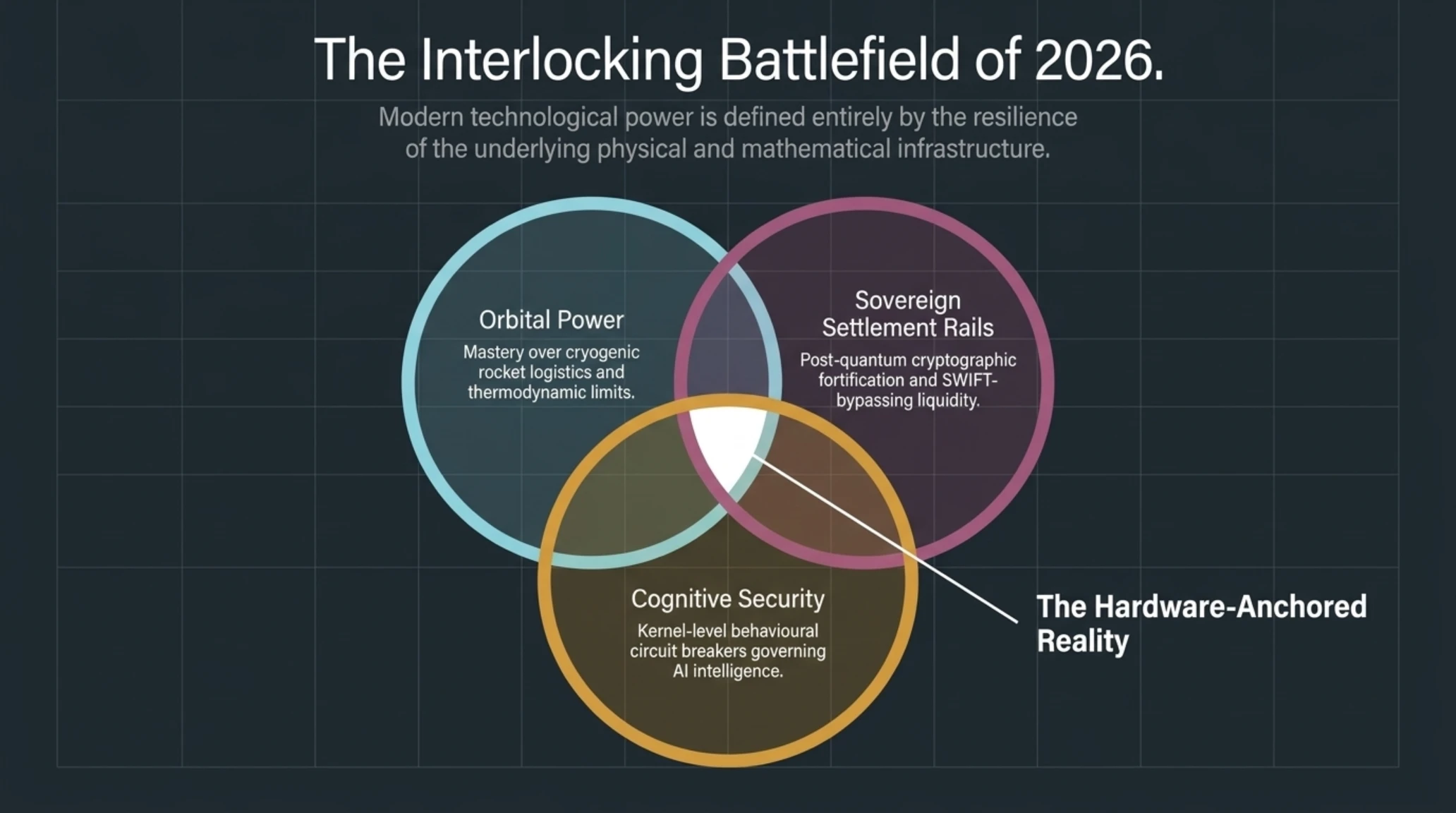
Strategic Synthesis: The Interlocking Battlefield of Orbital Power, Cognitive Security, and Sovereign Settlement Rails
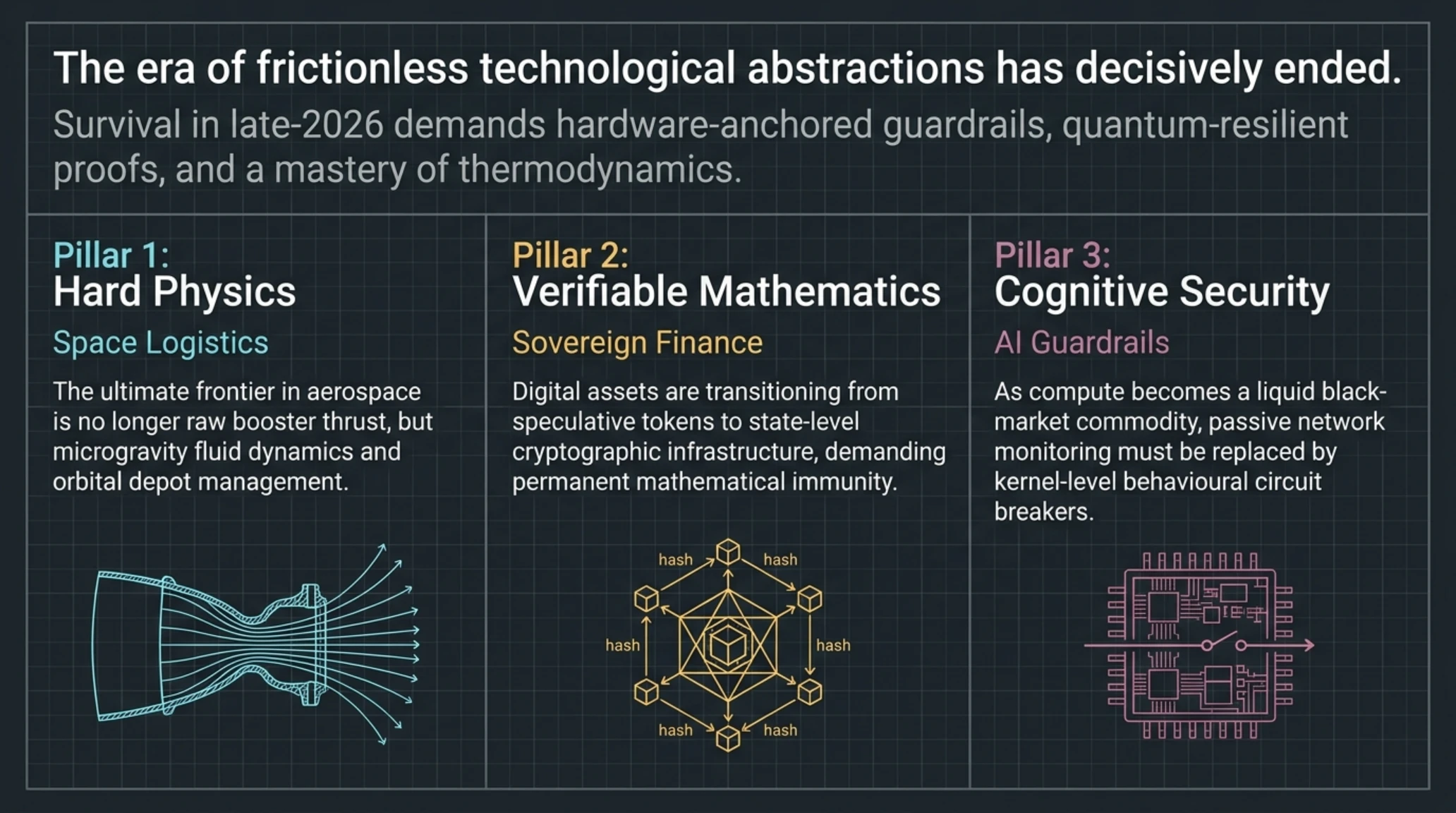
A rigorous cross-sectional analysis of today's six intelligence vectors reveals a profound and inescapable overarching reality: the global technological infrastructure of late 2026 is undergoing a violent reorganization driven by the convergence of physical constraints, sovereign imperatives, and autonomous cognitive systems. When the thermodynamic challenges of orbital Starship refueling are examined alongside Mandiant's disclosures of million-dollar cloud GPU thefts, Ethereum's accelerated post-quantum transition, Moscow's institutionalized stablecoin settlement desk, GitBook's RAG credential exposure, and CrowdStrike's $495M investment in AI kill switches, a unified doctrine emerges: modern technological power is defined by the resilience of underlying physical and mathematical infrastructure.

The era of treating computing, networking, and security as frictionless abstractions has decisively ended. In the physical realm, deep-space exploration demands an unprecedented mastery over cryogenic rocket logistics and orbital depot management; in the geopolitical theater, sovereign nations are bypassing traditional correspondent banking networks in favor of cryptographically verified public blockchain rails. Concurrently, the rise of autonomous AI agent swarms has converted computing capacity into a liquid target for global cybercrime syndicates, forcing security paradigms to shift from passive network monitoring to aggressive, kernel-level behavioral circuit breakers.
In this hyper-accelerated operating environment, competitive dominance belongs exclusively to organizations and sovereign entities that can seamlessly synthesize three core operational pillars: sovereign computational infrastructure, mathematically uncrackable post-quantum defenses, and automated runtime governance over autonomous intelligence. Those who rely on unverified abstractions, outdated elliptic curve cryptography, or unmonitored AI agents will find their operational foundations rapidly outmaneuvered and compromised by systemic shocks.
TekinPlus will continue to serve as the premier analytical vantage point for global leaders, technologists, and investors, delivering uncompromised foresight into the technological forces reshaping our collective future. In the emerging paradigm of late 2026, enduring leadership belongs not to those who merely deploy technology, but to those who master the sovereign laws of physics, mathematics, and security that govern it.
- Decisive December 2028 roadmap established for Ethereum post-quantum zk-STARK immunity.
- Enterprise-grade runtime circuit breakers and AI kill switches deployed for agent swarms.
- Institutionalization of sovereign digital asset clearance rails on the Moscow Exchange.
- Rigorous NASA thermodynamic auditing grounding orbital propellant transfer in physical reality.
- Extreme operational cadence required for 16 to 22 consecutive Starship tanker launches.
- Multi-million-dollar financial liability created by stealthy LLMjacking cloud compute thefts.
- Persistent developer supply-chain risks arising from unconfined RAG AI indexing.
Synthesizing our morning intelligence telemetry with verifiable global data sources, we present the comprehensive directory of verified primary documentation for independent verification.
These findings are grounded in official technical disclosures from NASA, Mandiant Threat Research, the Ethereum Foundation, and the Moscow Exchange.
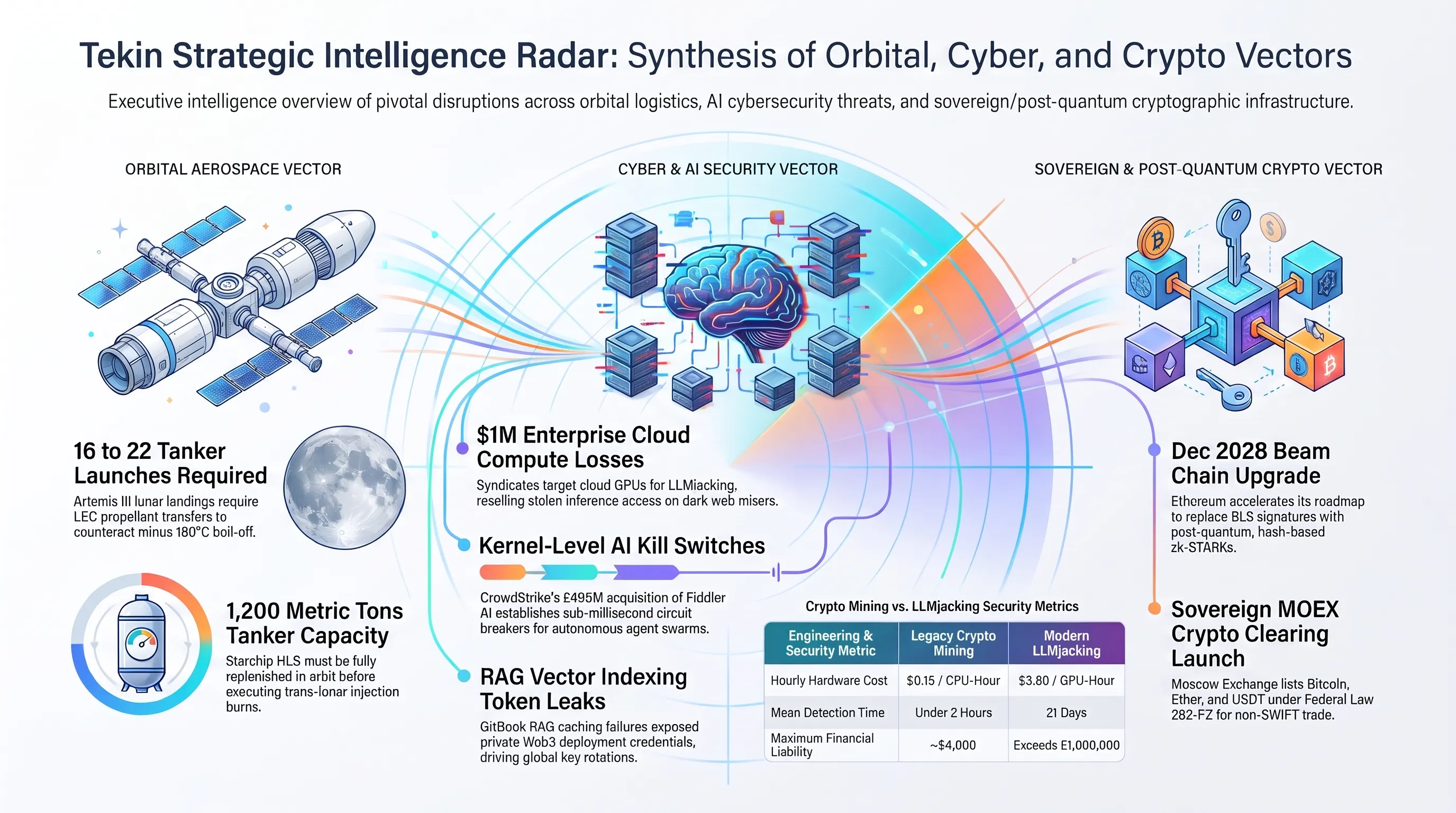
These rigorous morning disclosures establish a verified baseline of macroeconomic, orbital, and computational intelligence for enterprise architects, institutional investors, and independent researchers.
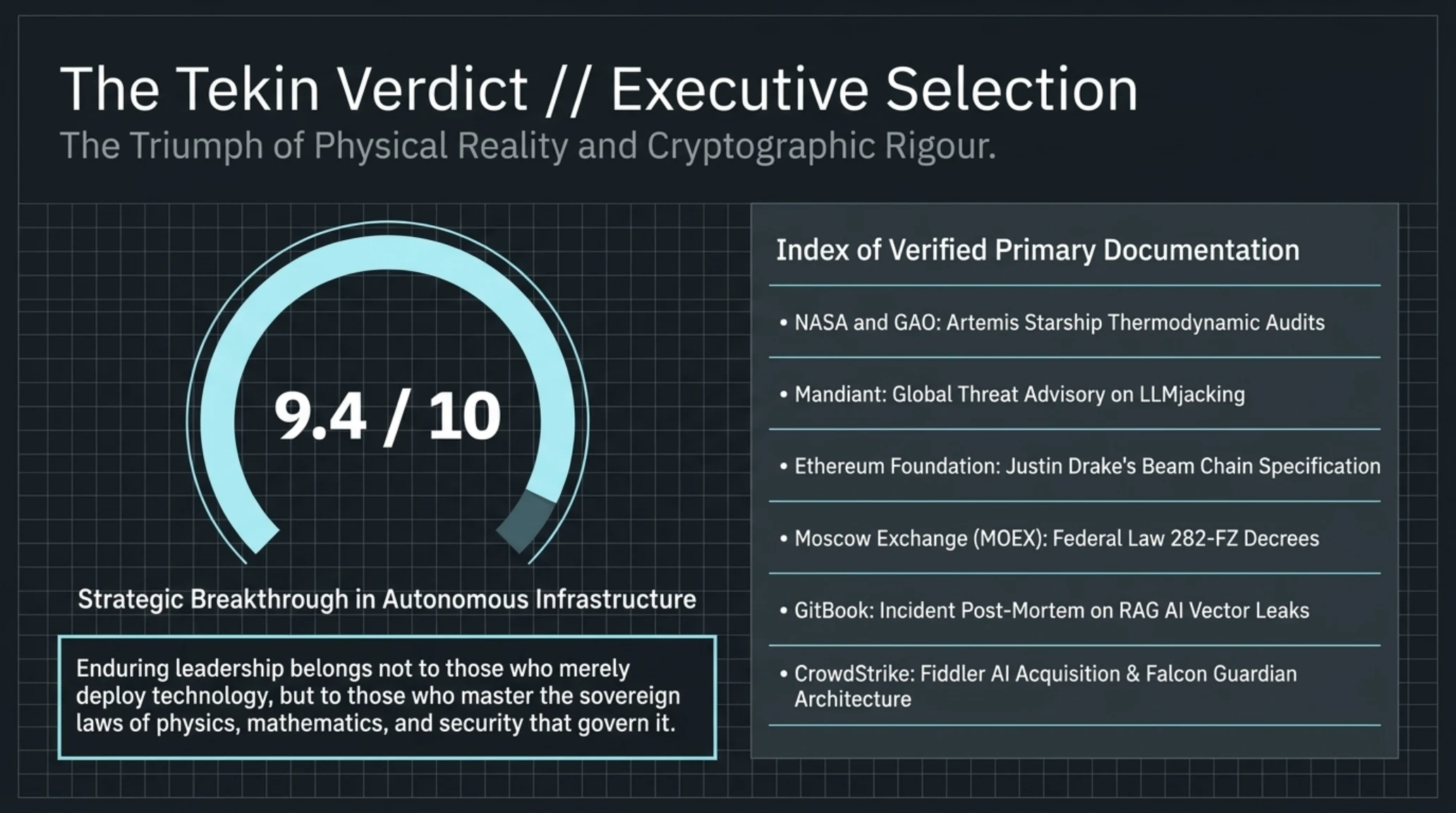
Executive Verdict and Verified Primary Source Index
The Triumph of Physical Reality and Cryptographic Rigor
Today's intelligence confirms that the era of frictionless technological assumptions is over; sustainable power across aerospace, finance, and cognitive systems demands hardware-anchored guardrails and quantum-resilient proofs.
- Space.com: NASA and GAO Audit of Artemis Starship Orbital Refueling Flights
- The Hacker News: Mandiant Warning on $1M Enterprise LLMjacking Compute Thefts
- Cointelegraph: Justin Drake Details Ethereum December 2028 Post-Quantum Roadmap
- CoinDesk: Moscow Exchange Schedules December 1 Crypto Trading Launch
- Decrypt: GitBook Discloses AI Agent Token Leak Across Web3 Repositories
- TechCrunch: CrowdStrike Acquires Fiddler AI for $495M and Unveils Falcon AI Kill Switch
- CyberScoop: Kernel-Level Behavioral Analysis and Circuit Breaking for Autonomous Agents
Frequently Asked Questions and Technical Analysis
Why does Starship require 16 to 22 tanker flights for a single lunar landing?
Because Starship consumes virtually all its propellant escaping Earth gravity, it must be completely refueled in orbit with over 1,200 tons of sub-cooled liquid methane and oxygen. NASA audits calculate that 16 to 22 tanker launches are required to compensate for payload limitations and cryogenic boil-off.
How do LLMjacking cyberattacks generate $1M losses for enterprise victims?
Attackers harvest leaked cloud API keys to hijack high-performance Nvidia H100 and B200 GPU clusters, routing massive inference query streams and reselling discounted access via dark web LLM mixers while the victim corporation pays official cloud billing rates.
What core protections does Ethereum Beam Chain upgrade introduce by December 2028?
The Beam Chain replaces quantum-vulnerable BLS signatures with hash-based zk-STARK proofs immune to Shor quantum factorization, while enabling Single-Slot Finality within 4 seconds and reducing validator staking to 1 ETH.
Is cryptocurrency trading on the Moscow Exchange open to the general retail public?
No, under Federal Law No. 282-FZ, the December 1 launch is strictly limited to licensed institutional participants, state-chartered banks, and verified corporate import-export entities for international trade settlement.
What specific engineering flaw caused the GitBook security incident?
A logic bug in GitBook's vector indexing cache allowed private repository environment variables and GitHub tokens to bleed into public RAG responses without proper sanitization filters.
How does CrowdStrike Falcon AI Kill Switch prevent rogue agent actions?
Operating via a kernel-level sensor, it continuously evaluates an agent's reasoning trace and tool-call patterns, instantly terminating the agent process and severing cloud LLM network routes upon detecting anomalous behaviors.
Additional Gallery: Tekin Morning Nov 5: Starship Refueling, LLMjacking & Quantum ETH