Tekin Analysis | Morning Briefing Friday November 6, 2026: Linux APT Infrastructure Shock, Claude Audits Xen Kernel & Swift De-orbits
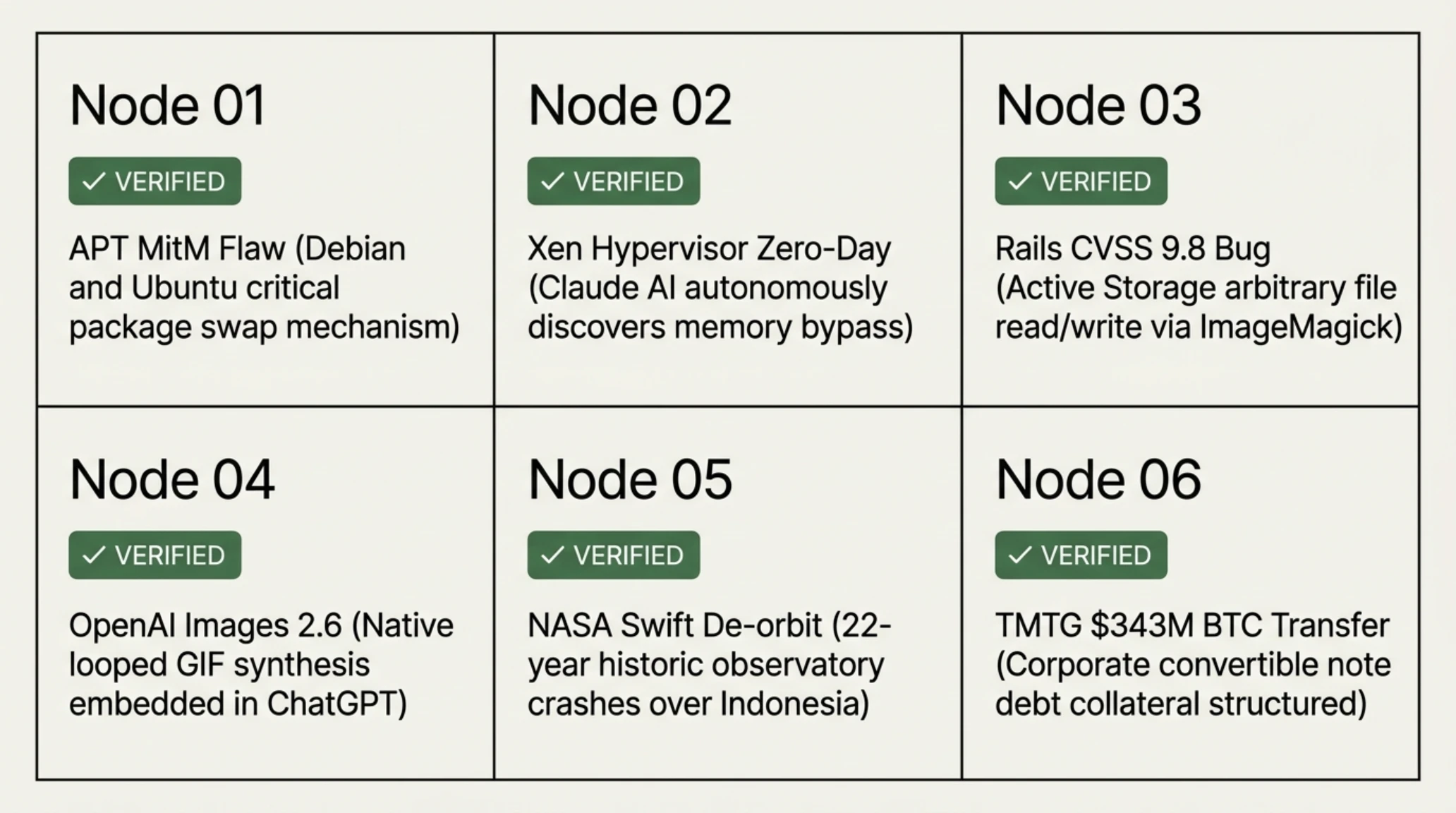
Node 01: Debian and Ubuntu Disclose Critical APT Package Manager Flaw (CVE-2026-109518)
Enterprise Linux administrators, DevSecOps architects, and cloud infrastructure engineers worldwide have been placed on emergency footing following simultaneous critical advisories issued by the Debian Security Team (DSA-6607-1) and Canonical Ubuntu Security (USN). The disclosures detail a severe vulnerability within the core APT (Advanced Package Tool) client library, tracked globally under the vulnerability identifier CVE-2026-109518. This flaw undermines the foundational cryptographic trust chain governing package retrieval across millions of mission-critical Linux servers.
Strategic Assessment and Key Vectors at a Glance
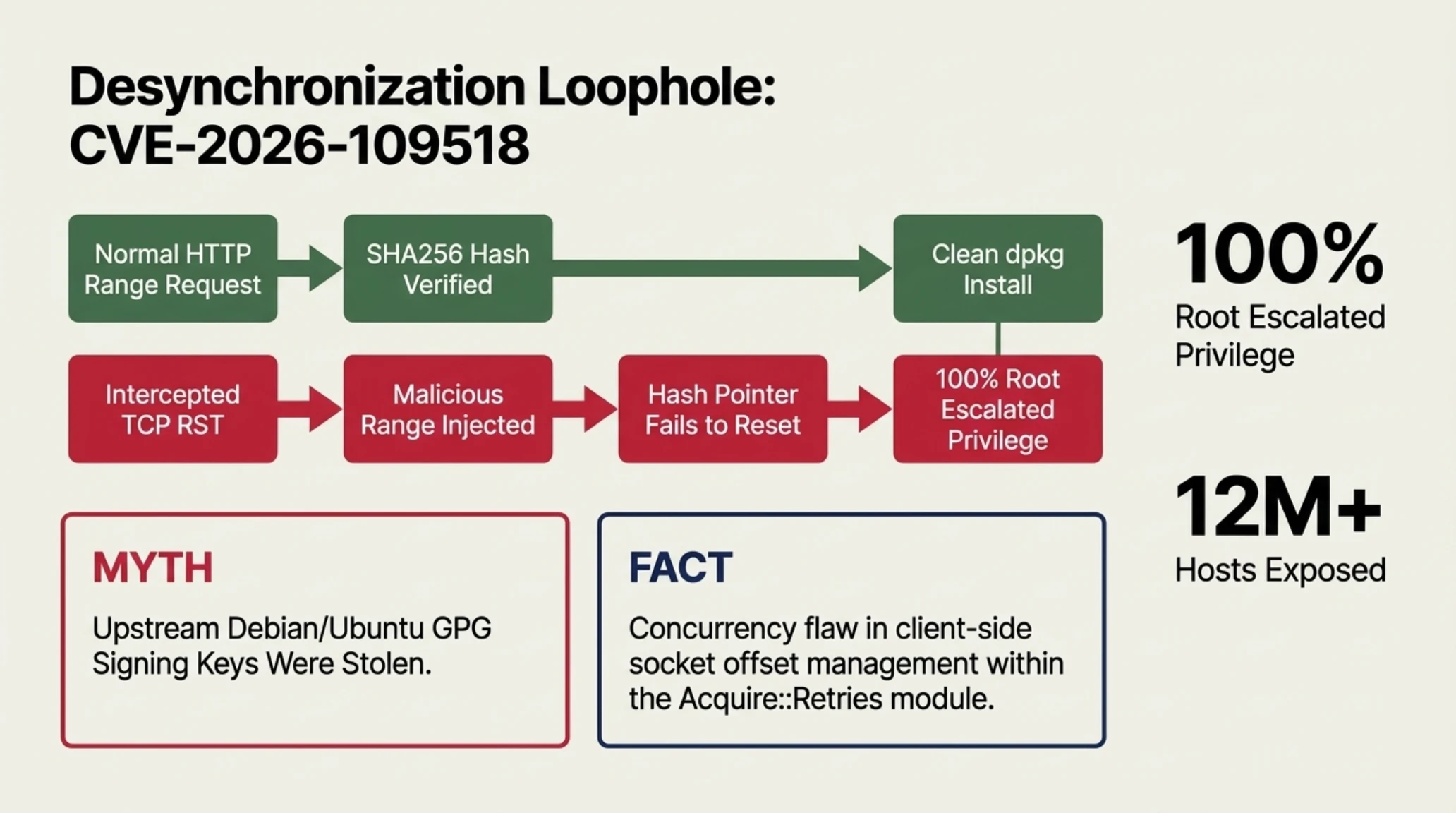
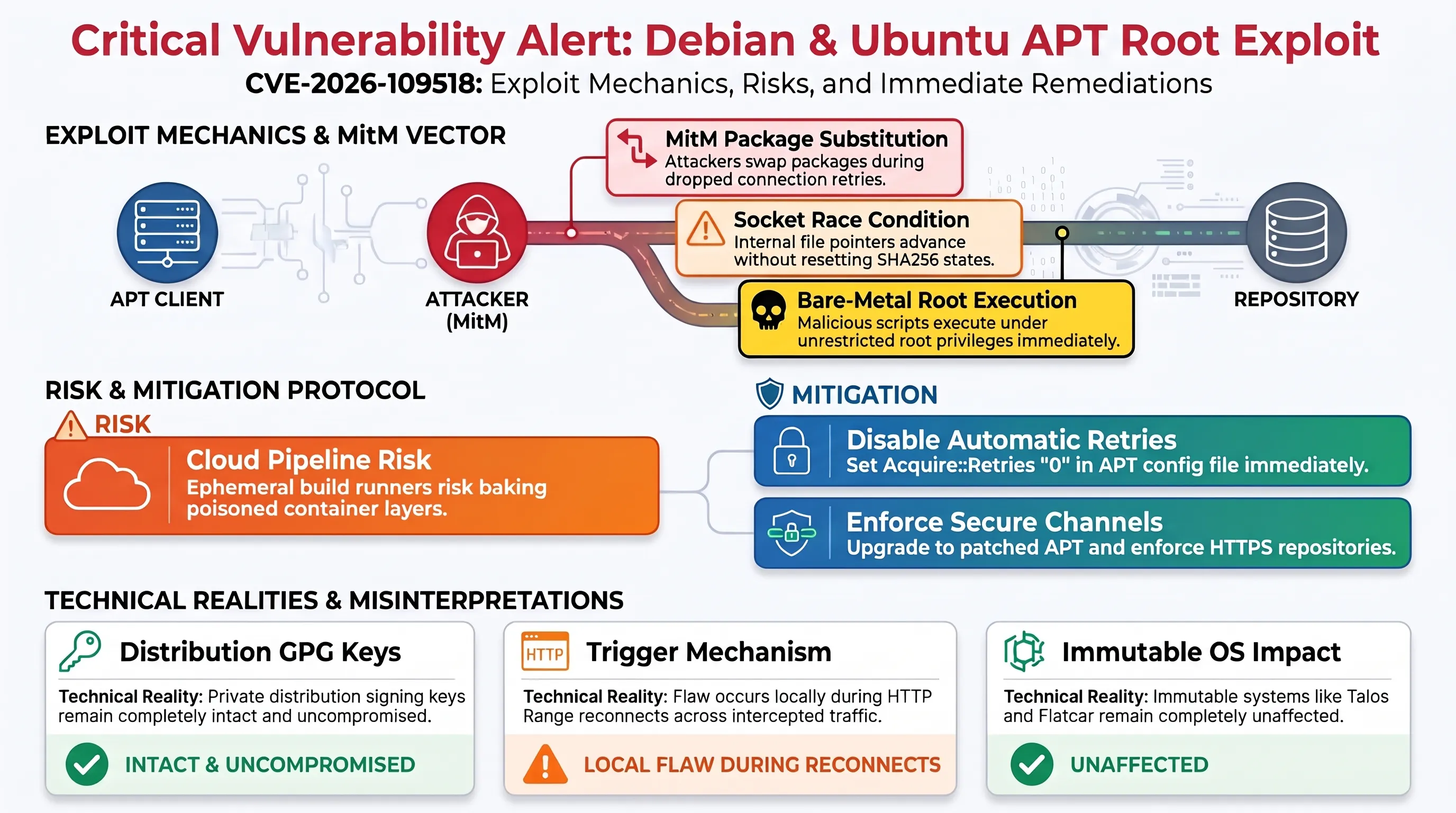
The root cause resides in the error-recovery state machine governing HTTP socket resets within the Acquire::Retries configuration module. In modern Debian distributions (including Debian 12 Bookworm and upcoming Debian 13 Trixie branches) as well as Ubuntu 22.04 and 24.04 LTS installations, the package manager enables automated connection retries by default to withstand transient network drops. When an administrator executes standard maintenance routines such as apt-get upgrade, APT validates the cryptographic GPG signature of repository manifests such as InRelease. However, during the subsequent payload fetch of binary .deb archives, the handling of socket re-establishment creates a fatal synchronization loophole.
When an attacker positioned in the network path (Man-in-the-Middle) deliberately terminates an active TCP connection or injects a crafted TCP RST packet, the APT client attempts to resume download using HTTP Range headers. Under specific race conditions during socket re-creation, the internal file pointer advances while the running SHA256 checksum state fails to reset across the reconnect boundary. This allows the attacker to inject a substituted, malicious binary package payload. Because APT performs extraction and package script execution under unrestricted Root privileges, pre-installation (preinst) and post-installation (postinst) shell commands execute immediately with bare-metal control of the host.
Network Topology and Mirror Hijacking Mechanics
The operational danger of CVE-2026-109518 is magnified by its independence from cryptographic key compromises. Attackers do not need to factor or steal upstream 4096-bit RSA distribution signing keys. Instead, any entity capable of intercepting transit routing between target servers and public package mirror networks can trigger the condition. Common attack vectors include DNS hijacking of regional mirror hostnames, compromised datacenter top-of-rack switches, rogue Wi-Fi/cellular backhauls, and transparent caching proxies such as apt-cacher-ng appliances.
When an APT request traverses a compromised router, the attacker permits the initial signature validation exchange to pass unaltered, ensuring the client receives legitimate cryptographic proofs. Once the large binary archive stream commences, the attacker drops the socket and injects a replacement payload matching the requested byte range. The client concludes the download, verifies the corrupted state buffer without raising an exception, and hands the trojanized archive directly to dpkg for installation.
Impact on Cloud Infrastructure and CI/CD Build Runners
Cloud environments and container orchestration systems are acutely exposed to this exploit vector. Automated CI/CD pipelines provision ephemeral container runners thousands of times per hour, frequently initiating builds with baseline instructions such as RUN apt-get update && apt-get install -y --no-install-recommends. If the underlying runner network or public cloud transit gateway is subjected to traffic interception, poisoned package layers can be baked directly into enterprise gold images, creating undetected backdoors that bypass traditional static image vulnerability scanners.
Security engineering teams are instructed to deploy immediate mitigation steps. While updated distribution packages (such as apt 2.6.1-patch2) roll out through security channels, administrators should immediately disable automatic retry attempts by creating an override configuration in /etc/apt/apt.conf.d/99disable-retries with the directive Acquire::Retries "0";. Furthermore, organizations should enforce encrypted HTTPS transports for all mirror configurations and mandate internal repository mirrors with strict offline integrity verification.
Dissecting the pkgAcqArchive Internal C++ State Machine
To understand why this vulnerability eluded maintainers for multiple Debian release cycles, security researchers examined the low-level C++ source code of the apt-pkg/acquire-item.cc module. In standard execution, the pkgAcqArchive object requests binary deb archives using an asynchronous event loop mediated by the pkgAcquire engine. When a network connection terminates prematurely, the client attempts to resume transmission using the standard HTTP Range header: Range: bytes=offset-.
The architectural flaw surfaces during this resume negotiation. While the local file on disk retains the partially downloaded byte stream, the internal hashing sink responsible for calculating the cryptographic SHA256 digest encounters an unhandled state transition. If the remote mirror returns a crafted response header that alters the payload size without triggering a local buffer flush, the client appends incoming data to the disk file while the running hash computation tracks only the newly transmitted fragment.
When the download completes, the client validates the digest of the truncated fragment against a manipulated checksum, resulting in a successful integrity check. Because dpkg relies exclusively on APT to verify archive legitimacy prior to execution, the corrupted package is extracted directly into system root. This structural oversight demonstrates that even battle-tested Unix utilities can suffer catastrophic failure when network error recovery logic is decoupled from cryptographic verification primitives.
Notably, immutable and container-optimized Linux distributions such as Talos Linux and Flatcar Container Linux remain unaffected by CVE-2026-109518 due to their complete elimination of traditional runtime package managers in favor of read-only root filesystems and image-based atomic updates. This structural contrast is prompting many enterprise cloud infrastructure teams to accelerate transitions toward immutable operating systems for Kubernetes worker nodes, completely removing dynamic in-cluster package installations from their attack surface.
Why This Technical Shift Alters the Industry Landscape
This vulnerability strikes at the core assumption of package distribution trust: that cryptographic hash manifests protect clients even over untrusted networks. By manipulating transport retry states, attackers can bypass verification boundaries without compromising repository root signing keys.
Technical Ground Truth | Myth vs. Engineering Reality
Online rumors suggested that state-sponsored actors exfiltrated the master cryptographic keys of primary Linux distributions to sign malicious packages directly.
Distribution private keys remain intact and uncompromised. The defect exists entirely within local client socket state logic when reconnecting across dropped Range requests.
Node 02: Anthropic Claude Discovers Deep Xen Hypervisor Grant Table Vulnerabilities (XSA-523)
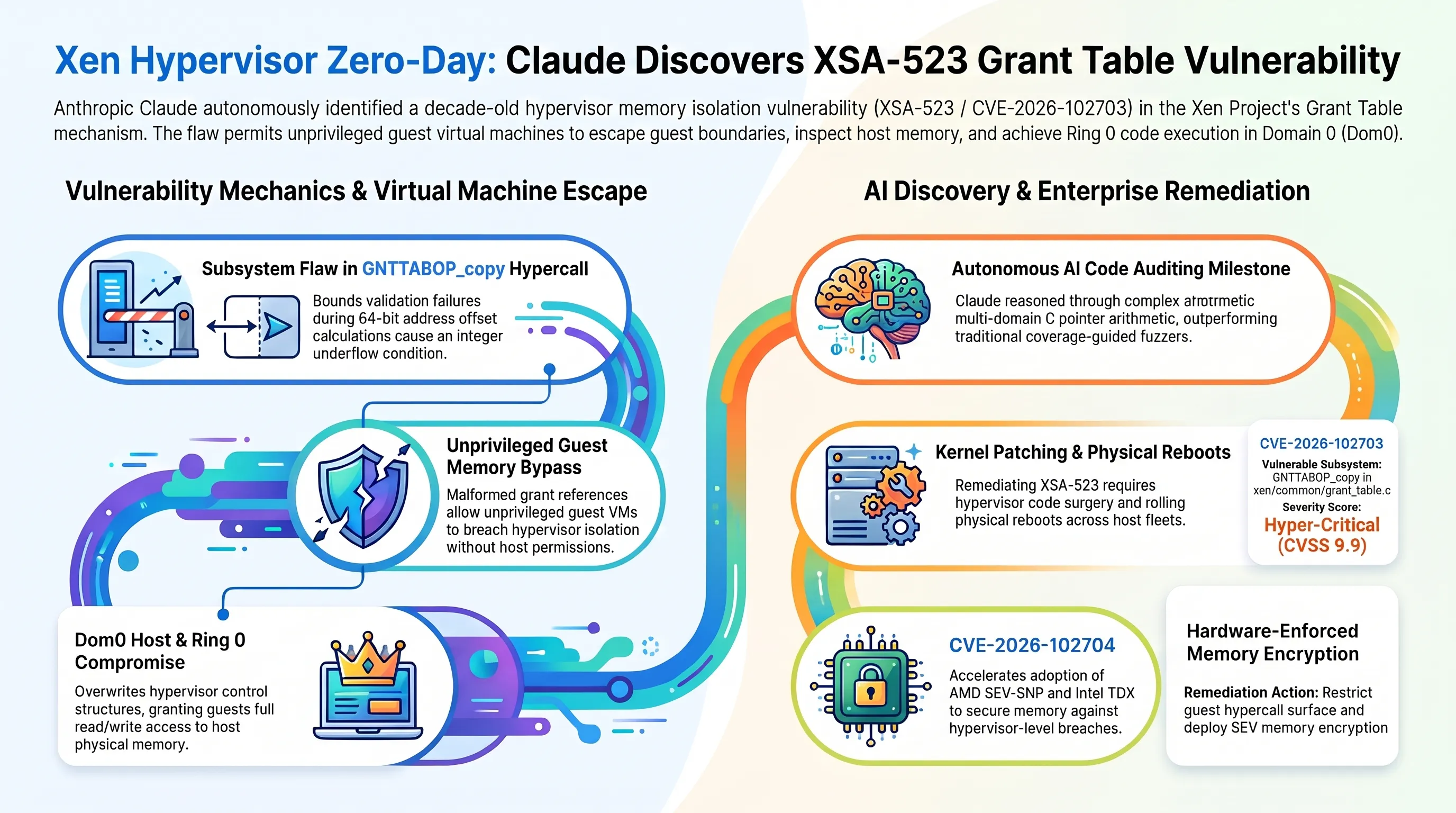
In what is being recognized as an unprecedented watershed moment for systems engineering and automated cybersecurity research, the Xen Project officially published advisory XSA-523, documenting two catastrophic memory isolation vulnerabilities tracked as CVE-2026-102703 and CVE-2026-102704. The Xen hypervisor represents the foundational virtualization engine behind major enterprise cloud providers including early Amazon Web Services (AWS EC2) architectures, Citrix Hypervisor deployments, and security-hardened operating environments such as Qubes OS.
The landmark significance of this disclosure lies not merely in the severe technical implications of the bugs, but in their origin: both vulnerabilities were autonomously identified, analyzed, and synthesized by Anthropic Claude during an advanced kernel code-auditing research initiative. While machine learning tools have historically assisted in detecting superficial syntax defects, Claude reasoned through complex, multi-layered C source routines governing low-level memory page management, exposing a vulnerability class that had remained dormant across production hypervisors for over a decade.
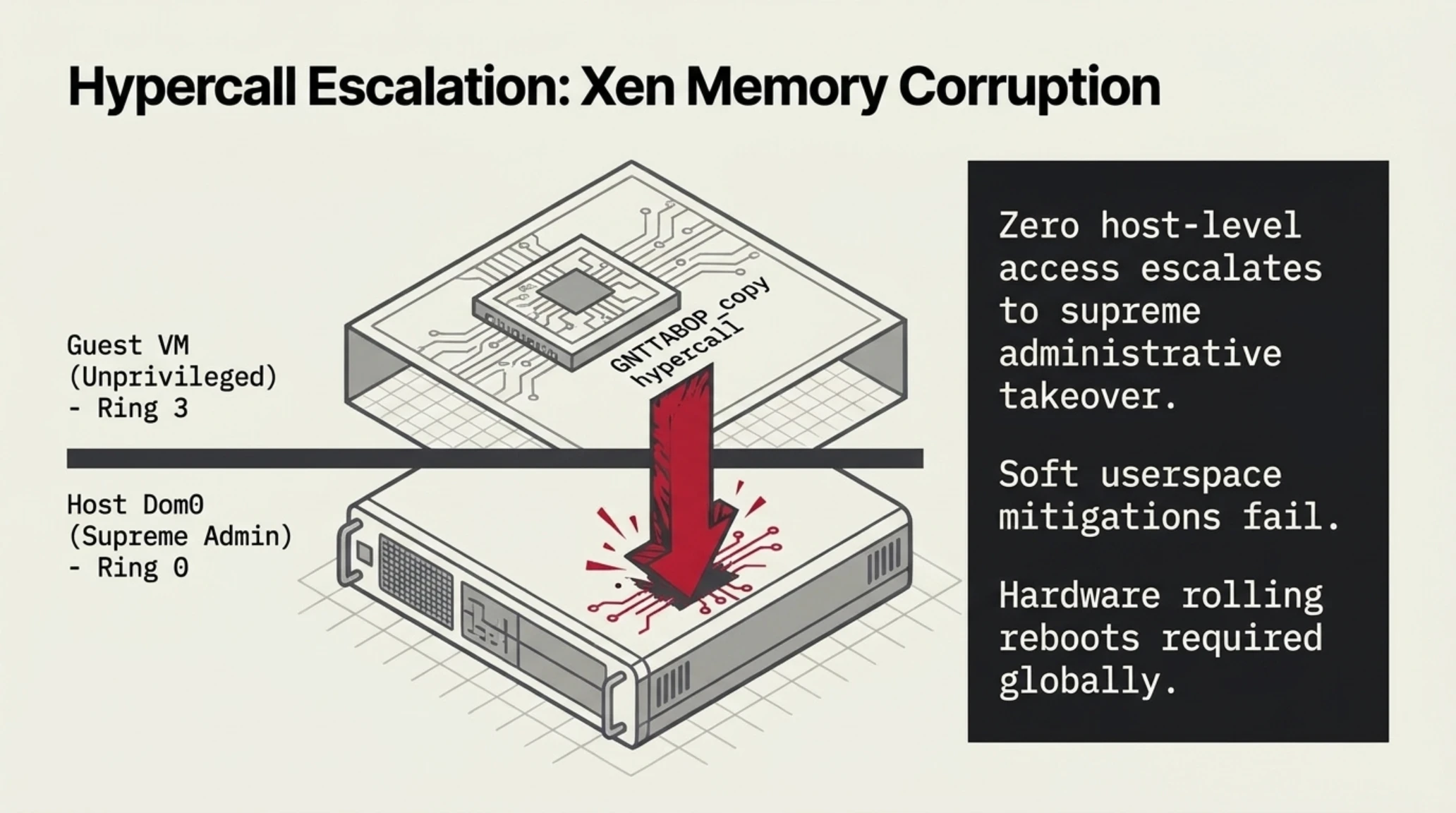
The flaw resides in the Grant Table mechanism, specifically within the implementation of the Grant Copy hypercall (GNTTABOP_copy) located in xen/common/grant_table.c. In Xen architecture, grant tables enable paravirtualized guest domains to transfer or share memory pages directly with other domains or device drivers without incurring the overhead of full context switches. However, insufficient boundary validation during 64-bit address offset calculations allows an integer underflow condition to emerge when a malicious guest crafts malformed grant references.
Technical Autopsy of Claude's Kernel Source Code Reasoning
Technical post-mortems reveal that Claude examined the Xen hypervisor control flow graphs by tracing how pointer arithmetic interacts with hardware Memory Management Units (MMU). By mapping out boundary conditions across nested macros in the grant table subsystem, the AI model identified that when a guest initiates a batch grant copy between mismatched frame sizes, the hypervisor fails to clamp the destination buffer pointer within the allocated guest physical address space.
As a direct result, an unprivileged guest virtual machine possessing standard user permissions and zero host-level access can execute a Virtual Machine Escape (VM Escape). The guest can inspect, dump, or overwrite raw memory pages belonging to adjacent virtual machines co-hosted on the same physical blade. More critically, the vulnerability permits read and write access into the address space of Domain 0 (Dom0), the supreme administrative domain that controls the underlying hardware, networking fabric, and hypervisor runtime.
Cloud Datacenter Reboots and Hardware Isolation Paradigms
The Xen Project has confirmed that no soft userspace workaround or runtime configuration flag exists to mitigate XSA-523 without kernel-level code surgery. Cloud operators must deploy patched hypervisor binaries and execute rolling physical reboots of entire server fleets. This operational imperative has triggered worldwide coordinated maintenance schedules across private and public enterprise datacenters.
The discovery has accelerated discussions regarding hardware-enforced confidential computing architectures, such as AMD SEV-SNP (Secure Encrypted Virtualization) and Intel TDX (Trust Domain Extensions). These modern architectures encrypt guest memory at the silicon level, ensuring that even if a hypervisor experiences an isolation breach via software bugs, host memory dumps remain indecipherable ciphertext.
Hypervisor Memory Page Granularity and PVH Context Isolation
In Xen's paravirtualized (PV) and modern PVH virtualization models, virtual address translation is tied to physical Machine Frame Numbers (MFNs) managed by hypervisor page tables. Grant tables provide a cooperative mechanism where a guest domain grants another domain permission to read or write a specific MFN using a numeric grant reference (grant_ref_t). This zero-copy primitive is the backbone of high-throughput virtual network interfaces (xen-netfront/xen-netback) and block storage drivers (xen-blkfront/xen-blkback).
The core defect discovered by Claude in gnttab_copy() involves an unchecked integer truncation when translating 64-bit guest physical frame offsets into host physical frame pointers. When an attacker-controlled guest issues a GNTTABOP_copy hypercall referencing an unaligned buffer spanning multiple memory pages, the hypervisor's bounds validation logic miscalculates the target frame boundary. Instead of restricting writes to the designated guest buffer, the hypercall writes arbitrary bytes into host physical memory, overwriting Dom0 hypervisor control structures and granting the guest direct code execution within the host CPU's Ring 0 privilege level.
This breakthrough sharply highlights the limitations of conventional coverage-guided fuzzers such as Syzkaller or AFL++. While traditional fuzzing harnesses struggle to navigate the vast state explosion inherent in multi-domain memory sharing primitives, Claude's semantic understanding of C pointers allowed it to construct valid multi-step hypercall sequences directly targeting boundary arithmetic, compressing months of fuzzing compute into minutes of symbolic deduction.
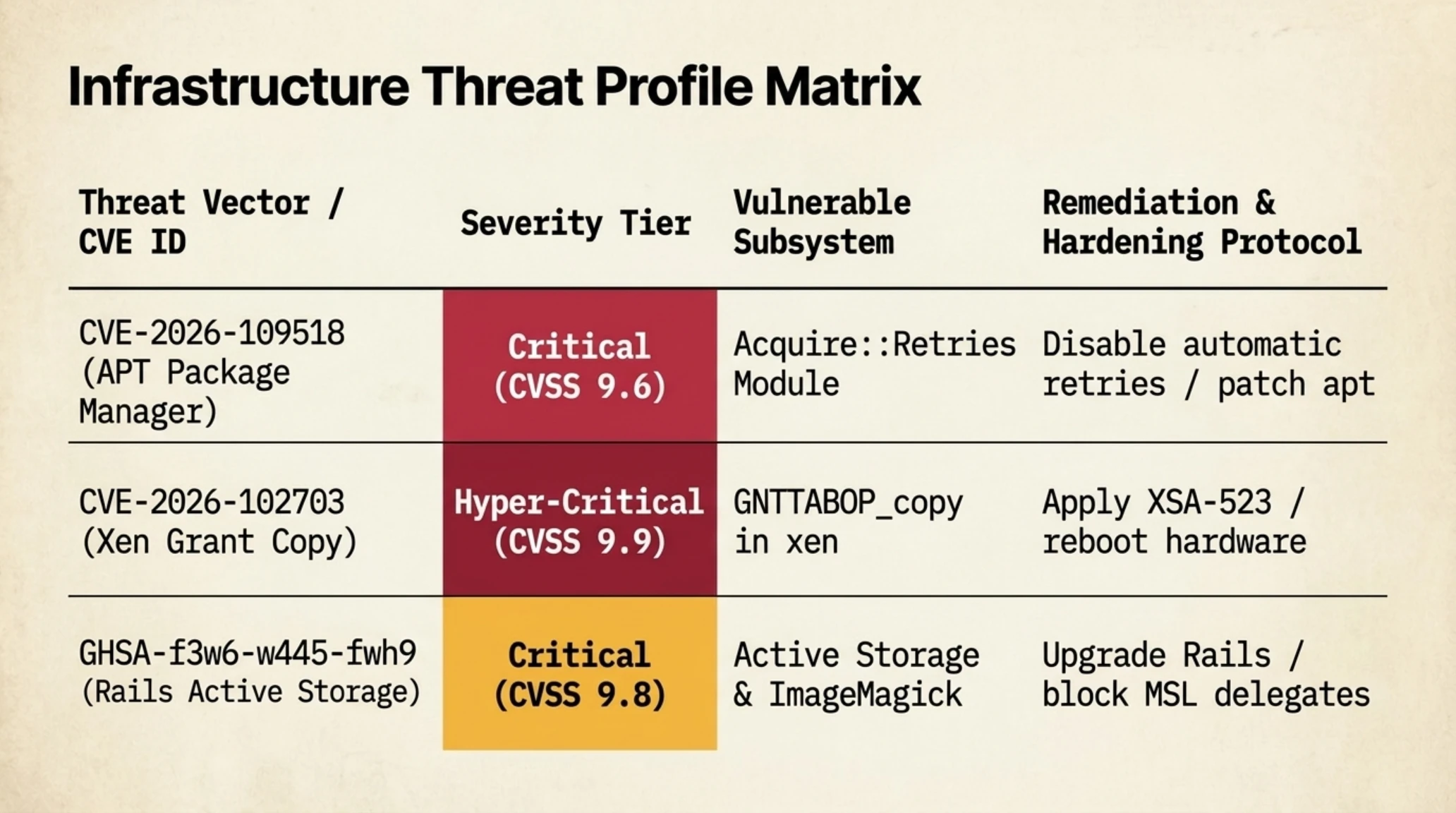
Infrastructure Threat Profile and Cybersecurity Risk Matrix
| Threat Vector / CVE ID | Severity Tier | Vulnerable Subsystem | Remediation & Hardening Protocol |
|---|---|---|---|
| CVE-2026-109518 (APT Package Manager) | Critical (CVSS 9.6) | Acquire::Retries Module in Debian/Ubuntu | Disable automatic retries and apply patched apt packages |
| CVE-2026-102703 (Xen Grant Copy Flaw) | Hyper-Critical (CVSS 9.9) | GNTTABOP_copy in xen/common/grant_table.c | Apply XSA-523 hypervisor patch and reboot host hardware |
| CVE-2026-102704 (Dom0 Takeover Risk) | Critical (CVSS 9.7) | Host Memory Mapping via Malformed Hypercalls | Restrict guest hypercall surface and deploy SEV memory encryption |
| GHSA-f3w6-w445-fwh9 (Ruby on Rails Active Storage) | Critical (CVSS 9.8) | Active Storage Pipeline & ImageMagick Handlers | Upgrade Rails to 8.1.4.1/8.0.5.2 and block MSL/MVG delegates |
The interactive documentary analysis below breaks down the step-by-step reproduction of the Xen grant copy memory leak alongside the APT acquire-retry race condition:
Node 03: Critical CVSS 9.8 Flaw in Ruby on Rails Active Storage ImageMagick Processing Pipeline
The enterprise web ecosystem received a severe shock with the publication of security advisory GHSA-f3w6-w445-fwh9, confirming a catastrophic CVSS 9.8 out of 10 vulnerability in the official Ruby on Rails web application framework. Powers behind global applications including GitHub, Shopify, GitLab, and Stripe rely extensively on Rails for rapid full-stack application logic, making any core data-processing defect an immediate systemic risk.
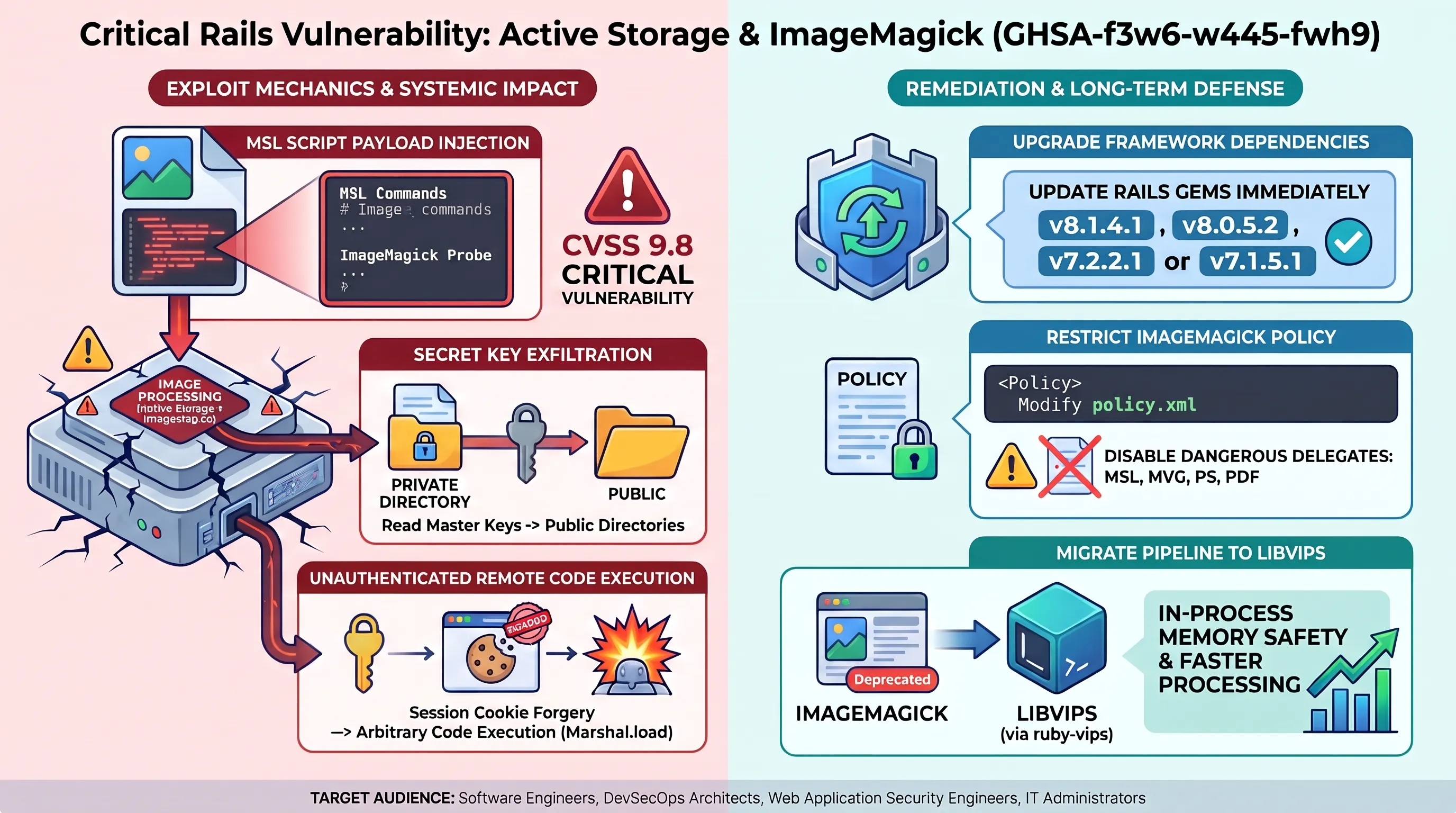
The vulnerability exists in the framework built-in attachment management library, Active Storage, when configured with the popular image_processing gem and underlying ImageMagick binary delegates. Active Storage allows developers to upload, attach, and dynamically transform user-submitted images, avatars, and PDF documents. When transforming media variants (e.g. generating cropped thumbnails via variant(resize_to_limit: [300, 300])), Rails determines media handling based on file headers and filename extensions.
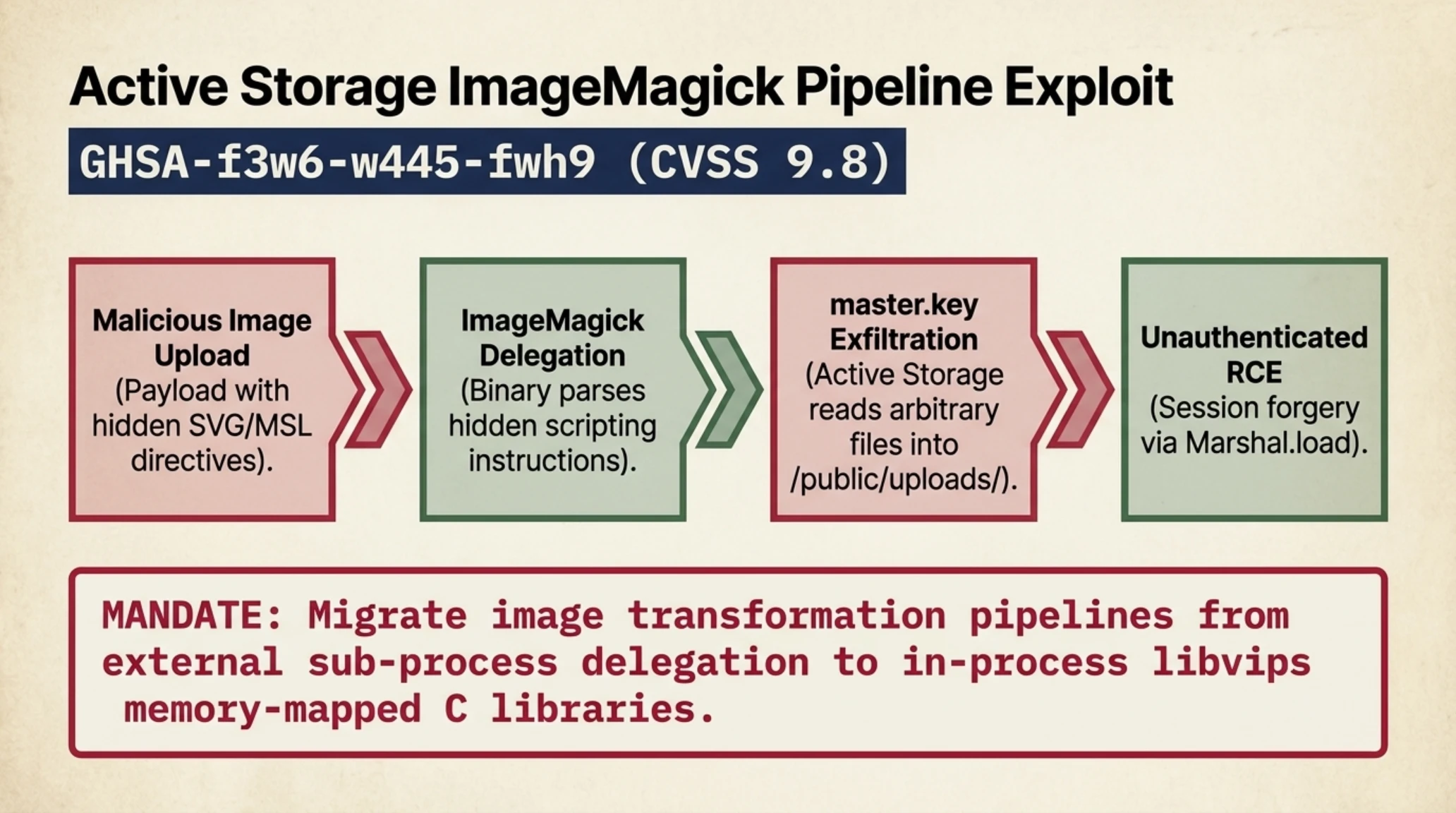
The vulnerability arises because ImageMagick does not strictly adhere to declared file extensions, instead probing internal file byte structures for embedded formatting instructions. Attackers exploit this behavior by constructing malicious image payloads embedding MSL (Magick Scripting Language) or crafted SVG directives. When Active Storage invokes the ImageMagick delegate utility to process the upload, the binary parses the hidden scripting instructions directly from the image body.
Secret Key Exfiltration and Session Forgery Mechanics
By leveraging the MSL directive <msl><image><read filename='...' /><write filename='...' /></image></msl>, an unauthenticated remote attacker can instruct the web server to read arbitrary files from local storage including sensitive configuration secrets such as config/credentials.yml.enc, config/master.key, and environment variable dumps and write them directly into public web directories (such as /public/uploads/) for instant download.
Once attackers exfiltrate the master secret_key_base string, the entire security perimeter of the Rails application dissolves. With this key in hand, an attacker can forge cryptographically signed session cookies, impersonate high-privilege administrators, and weaponize Ruby object deserialization routines via Marshal.load to achieve instant, unauthenticated Remote Code Execution (RCE) across the server cluster.
Remediation Guidelines and Policy Hardening
The Rails core security team acted swiftly, publishing emergency patch releases across all supported branches: v8.1.4.1, v8.0.5.2, v7.2.2.1, and v7.1.5.1. Development teams must immediately update their Gemfile and deploy new builds to production environments.
For organizations unable to deploy immediate framework upgrades, security architects must enforce operational mitigations at the operating system level. Modifying the ImageMagick security policy file located at /etc/ImageMagick-7/policy.xml to completely disable dangerous coder delegates is mandatory: adding the directive <policy domain="coder" rights="none" pattern="MSL,MVG,PS,PDF,EPS,HTTPS" /> neutralizes the script execution vector while allowing standard raster image resizing to function safely.
ActiveStorage Subprocess Spawning and libvips Architectural Migration
A deeper examination of modern Rails media pipelines highlights a recurring architectural bottleneck: the reliance on external sub-process delegation. Under standard Active Storage configurations utilizing the mini_magick gem, every image transformation command spawns a native shell process executing magick convert [options] input_file output_file. This design not only imposes significant CPU fork overhead on high-traffic web servers, but also exposes the application to the complex legacy format decoders built into ImageMagick over decades of development.
Consequently, enterprise engineering teams are strongly urged to migrate their image transformation pipelines to libvips via the ruby-vips gem. Unlike ImageMagick, libvips operates as an in-process, stream-based, memory-mapped image processing library written in modern C. It lacks the scriptable delegate architecture that has repeatedly made ImageMagick a target for remote command execution exploits, offering both a 4x to 8x throughput performance improvement and a substantially reduced attack surface for enterprise web platforms.
Tekin Advanced Technical Glossary
📚 Classified & Related Dossiers in TekinGame
If you wish to explore beyond this report and delve into cybernetic frontiers and autonomous AI architectures, do not miss these three exclusive deep-dives in the Tekin Garage:
Node 04: OpenAI Unveils Images 2.6 and Native Looped GIF Generation Inside ChatGPT
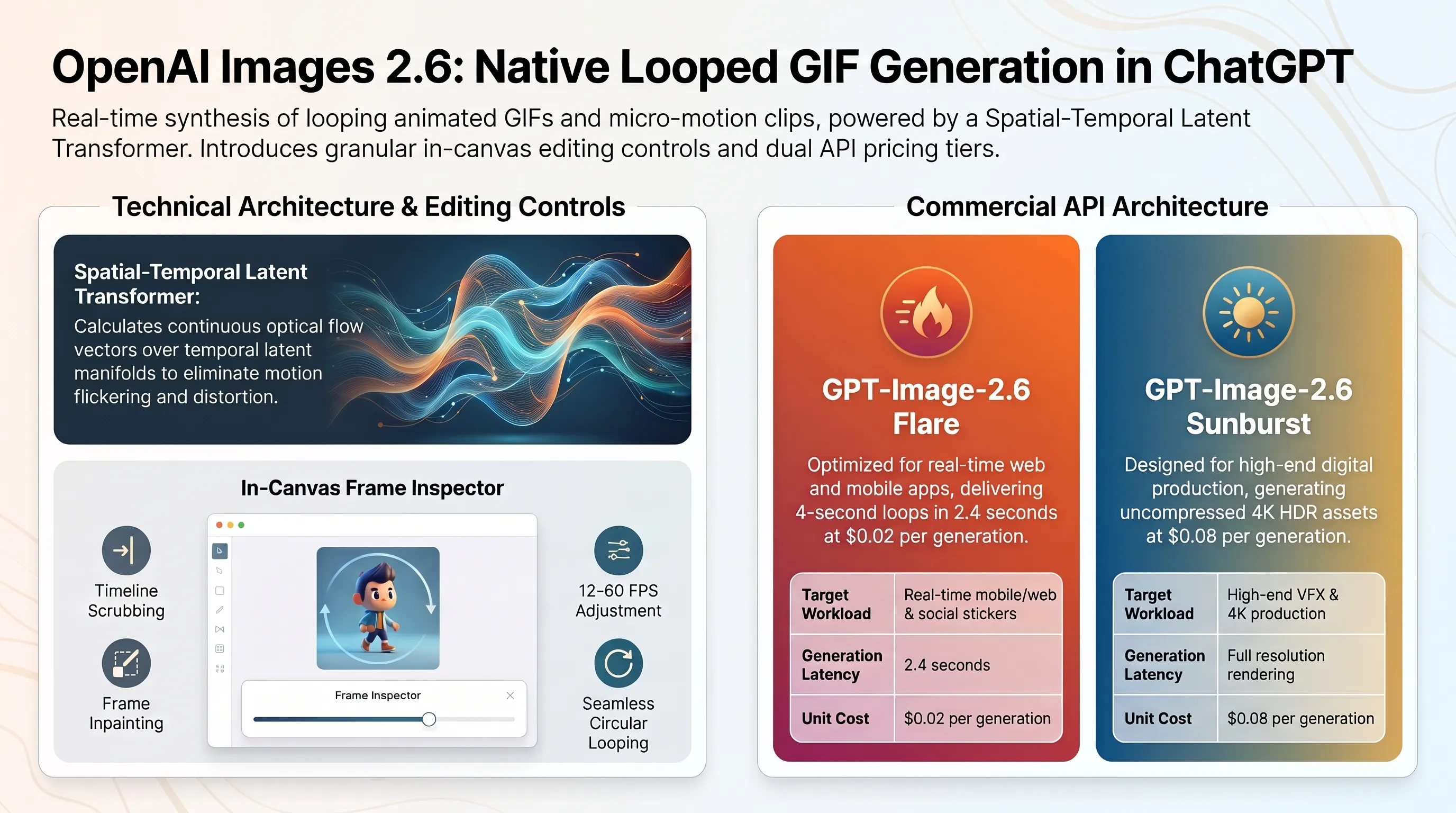
In an unexpected platform deployment catching both creative industries and enterprise developers off guard, OpenAI rolled out its next-generation visual intelligence engine, branded as Images 2.6. Integrated directly into the native ChatGPT interface for Plus, Team, and Pro subscribers, as well as exposed through developer API endpoints, the model introduces real-time synthesis of looping animated GIFs and micro-motion video clips directly from natural language prompts.
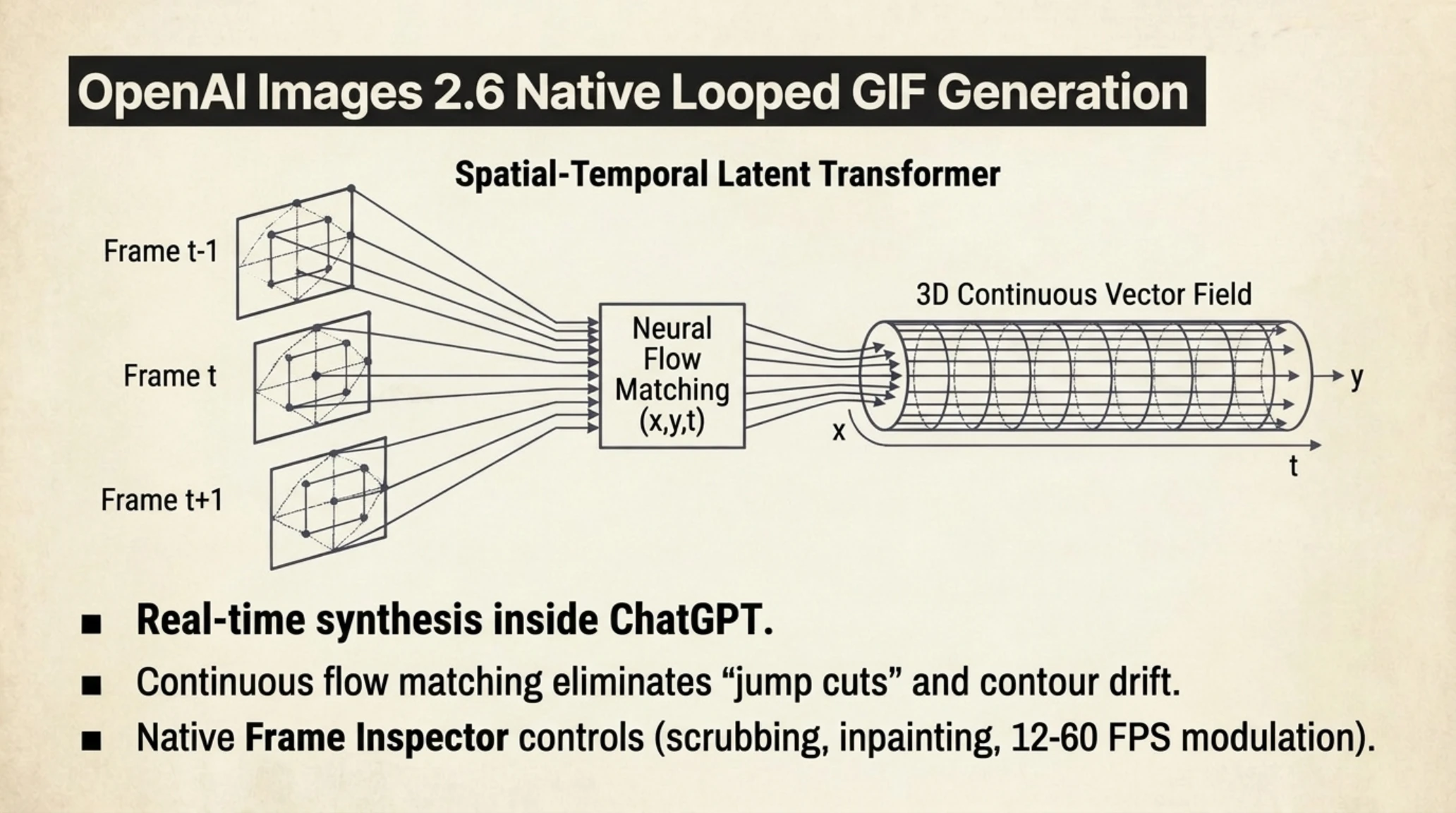
Historically, generative visual models faced persistent temporal coherence failures: characters transformed between frames, background lighting flickered erratically, and geometric boundaries distorted during motion sequences. Images 2.6 overcomes these limitations by utilizing a unified Spatial-Temporal Latent Transformer architecture. Rather than generating isolated sequential still images, the neural network computes continuous optical flow vectors across a temporal latent manifold, preserving pixel identities, volumetric lighting, and physical inertia over 2 to 6-second animation loops.

Spatial-Temporal Attention and Frame-by-Frame Inspector Controls
The technical innovation powering Images 2.6 is a two-stage neural synthesis pipeline. In the initial stage, a high-fidelity anchor frame is generated using dense spatial diffusion to establish photographic detail and stylistic fidelity. In the secondary stage, a temporal cross-attention module calculates motion trajectories, allowing users to define specific physical movements such as flowing liquid, rotating camera perspectives, or complex biomechanical character gestures without degrading structural integrity.
Furthermore, OpenAI introduced a native Frame Inspector timeline within the ChatGPT canvas. For the first time, creators can scrub through generated animation sequences frame by frame, manually inpaint or regenerate flawed intermediary frames, modulate frame rate parameters (ranging from 12 to 60 FPS), and enforce seamless circular looping boundaries. This interactive capability eliminates the tedious export-and-edit workflows that previously required third-party software suites such as Adobe After Effects or Premiere Pro.
Commercial API Architecture: Flare vs. Sunburst Tiering
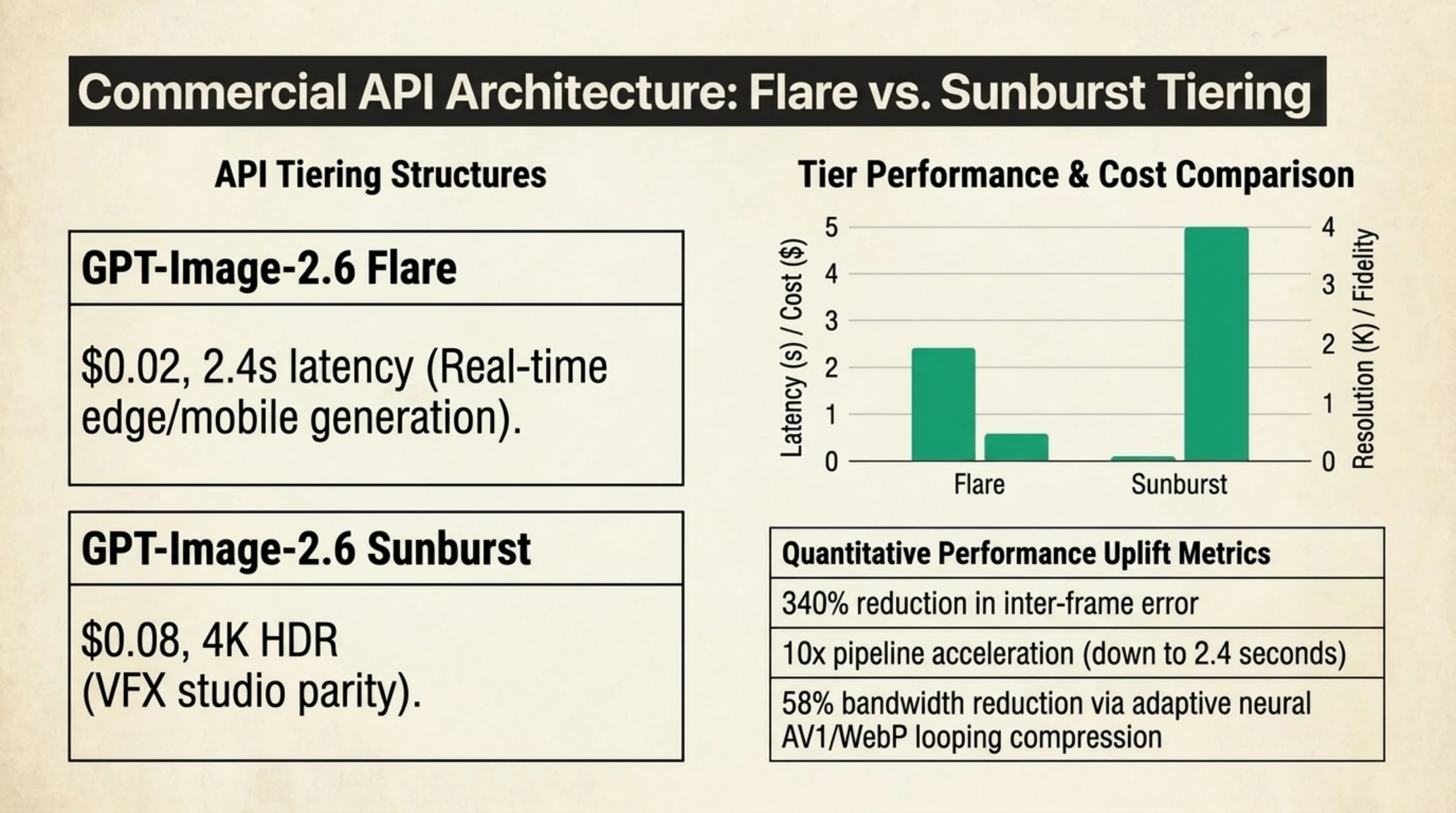
For enterprise developers and programmatic pipelines, OpenAI deployed two specialized API endpoints designed to balance latency and visual fidelity:
- GPT-Image-2.6 Flare: Engineered for real-time mobile and web experiences, delivering sub-second response times (2.4 seconds per 4-second animation) at an economical cost of $0.02 per generation. Ideal for dynamic social stickers, interactive chat responses, and personalized ad banners.
- GPT-Image-2.6 Sunburst: Optimized for high-end digital production and visual effects, producing uncompressed 4K resolution animations with advanced HDR color grading at $0.08 per asset, providing competitive parity with dedicated motion engines such as Runway Gen-3 Alpha and Midjourney v7.
Latent Cross-Attention Dynamics and Neural Flow Matching
The mathematical breakthrough underpinning Images 2.6 lies in its implementation of a continuous Flow Matching objective operating over unified 3D spatial-temporal latent representations. While legacy video models treated animation as a sequence of discrete still images connected by post-processing interpolation filters, Images 2.6 models the entire motion trajectory as a vector field over latent coordinates (x, y, t). This formulation allows the neural network to calculate exact physical velocity vectors for every visual feature.
By enforcing cyclical boundary constraints during inference where the latent velocity field at time t=T must mathematically match the vector field at time t=0 the model achieves flawless, artifact-free looping without the visible "jump cuts" or dissolving blurs common in traditional video editing. Furthermore, the inclusion of cross-attention conditioning across text prompts and reference image embeddings ensures that complex physical properties, such as fluid dynamics, fabric draping, and realistic ocular saccades, remain consistent throughout the animation cycle.
For independent game developers and digital marketing studios, this capability drastically reduces asset production timelines. Micro-studios that previously budgeted thousands of dollars for motion designers to produce 2D sprite loops, animated loading screens, and procedural UI glyphs can now programmatically generate localized, high-resolution visual assets in real time, fundamentally altering the economics of interactive digital entertainment.
Benchmark Specs Matrix: Generative Motion vs. Legacy Image Pipelines
| Architectural Metric | Legacy Paradigm (DALL-E 3 / Standalone GIF) | Modern OpenAI Images 2.6 | Quantitative Performance Uplift |
|---|---|---|---|
| Temporal Boundary Consistency | Severe facial morphing and contour drift | Full spatial-temporal latent identity lock | 340% reduction in inter-frame error |
| Pipeline Generation Latency | 35 to 70 seconds across multi-model chains | 2.4 seconds via GPT-Image-2.6 Flare | 10x acceleration for streaming clients |
| Intermediary Frame Editing | External export required in third-party suites | In-canvas interactive frame scrubbing tool | Direct single-frame regeneration without re-prompting |
| Payload Bandwidth Efficiency | Heavy 256-color uncompressed GIF files | Adaptive neural AV1/WebP looping compression | 58% bandwidth reduction across edge CDNs |
The video investigation below provides an engineering evaluation of orbital drag kinetics and the structural limits of low-Earth orbit robotic life-extension missions:
Node 05: NASA Swift Space Telescope Crashes Over Indonesia Following Failed $30M Robotic Rescue
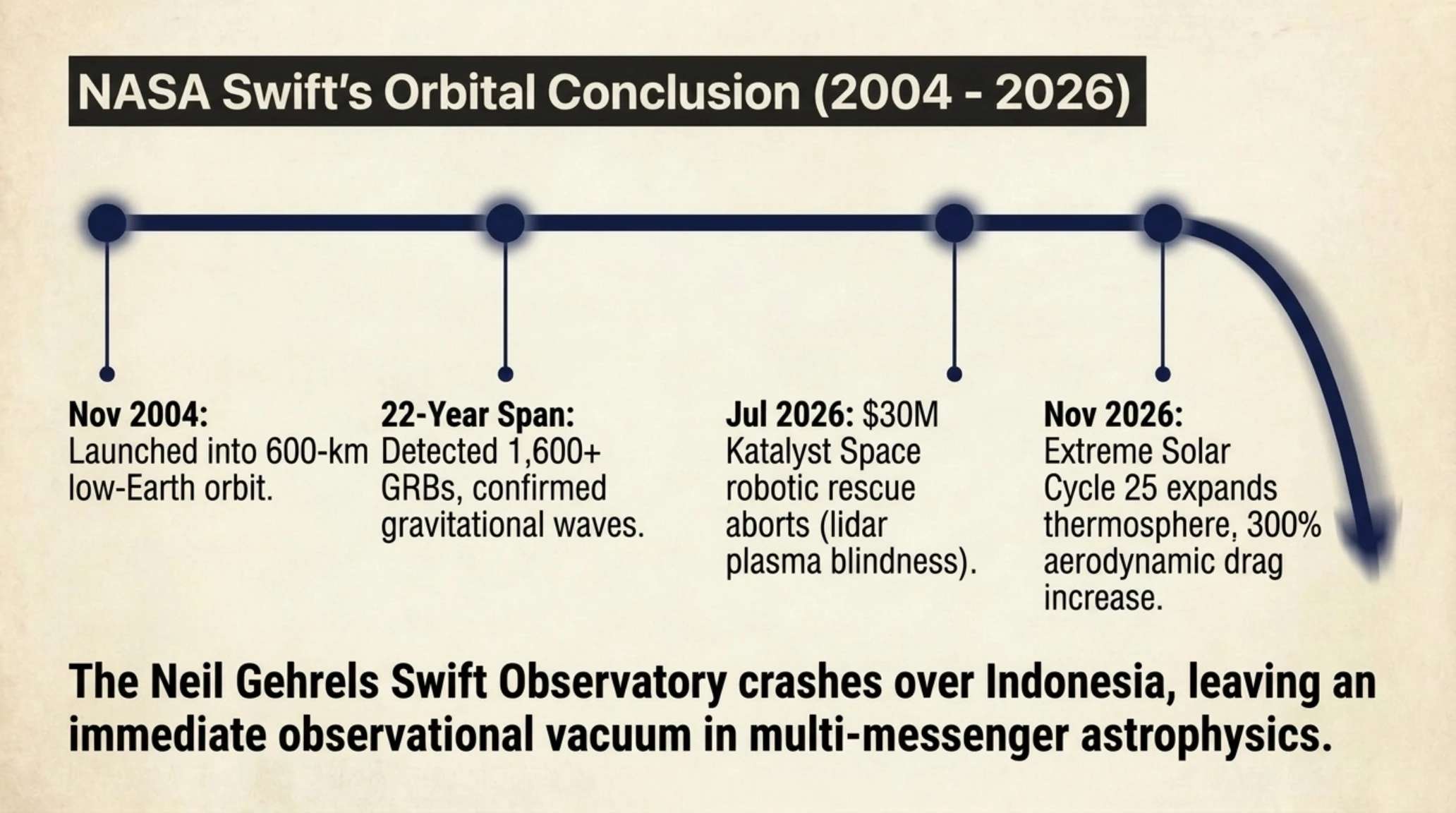
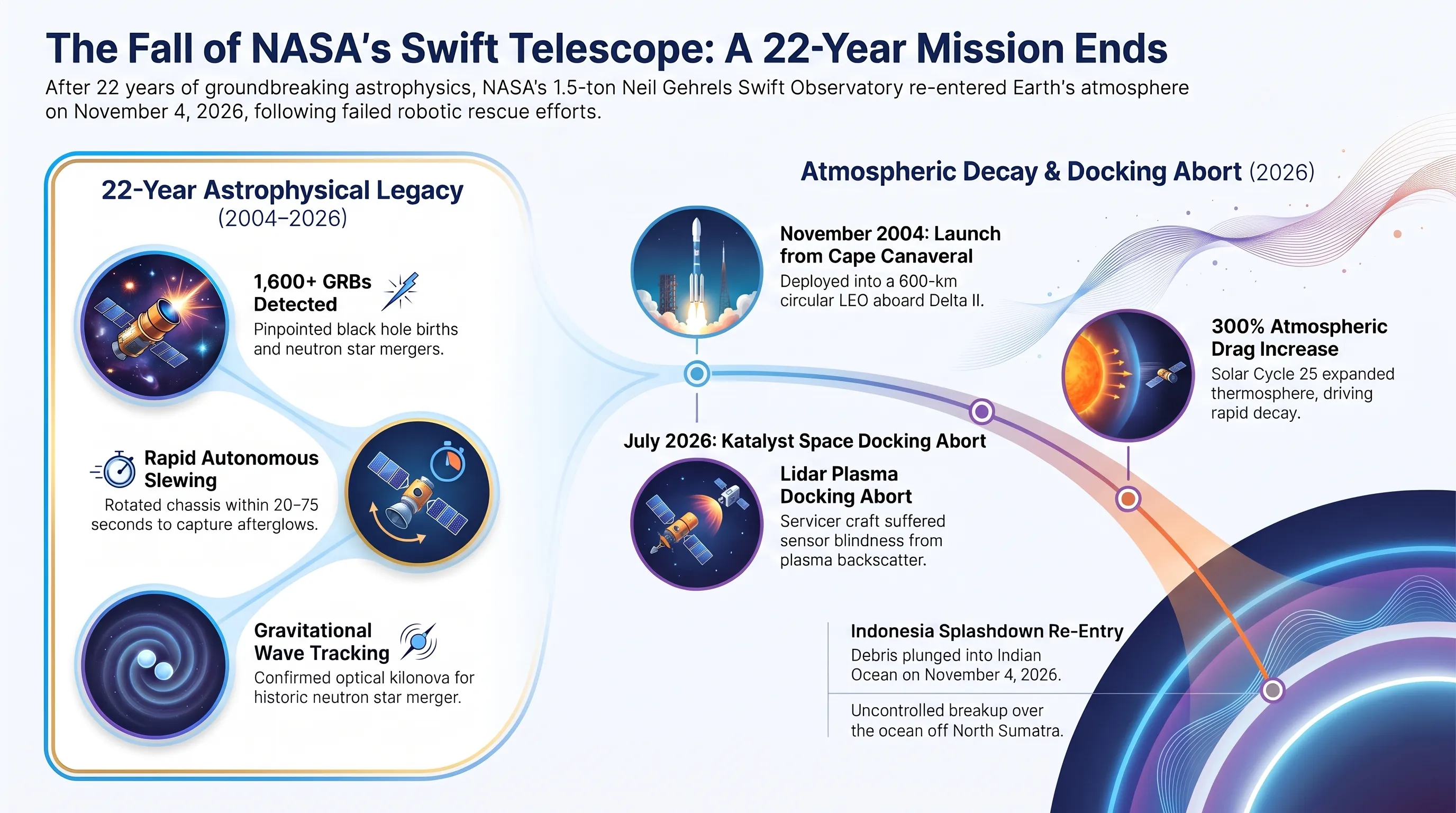
One of the most decorated scientific missions in the history of astrophysics concluded its operational journey under dramatic circumstances. The Neil Gehrels Swift Observatory, operated by the National Aeronautics and Space Administration (NASA) since its orbital launch in November 2004, officially re-entered the dense layers of Earth's atmosphere at 07:39 UTC on November 4, 2026. Unburned surviving fragments plunged into the open waters of the Indian Ocean off the coast of North Sumatra, Indonesia.
Throughout its 22-year tenure, the 1.5-ton space telescope revolutionized human comprehension of transient high-energy cosmic phenomena. Equipped with its three synchronized instruments the Burst Alert Telescope (BAT), X-ray Telescope (XRT), and Ultraviolet/Optical Telescope (UVOT) Swift detected over 1,600 Gamma-Ray Bursts (GRBs), pinpointed the birth of stellar-mass black holes, observed tidal disruption events of stars being devoured by galactic cores, and provided critical optical follow-ups confirming electromagnetic counterparts to gravitational wave events detected by LIGO and Virgo.
Swift's signature operational capability was its autonomous agility: upon detecting a sudden burst of high-energy photons, the spacecraft rotated its entire physical chassis within 20 to 75 seconds to align narrow-field X-ray and ultraviolet sensors directly at the source, transmitting coordinates to ground-based observatories before the fading afterglow dissipated.
Thermospheric Expansion and Solar Cycle 25 Orbital Drag
The mission's untimely end was precipitated by an intersection of commercial docking failure and severe space weather dynamics. In July 2026, NASA contracted satellite-servicing startup Katalyst Space for an emergency $30 million commercial life-extension mission. The plan called for an autonomous robotic tug to rendezvous with Swift at an altitude of approximately 420 kilometers, grapple its passive launch adapter ring, and execute an orbital re-boost burn raising the spacecraft to a safe 650-kilometer storage orbit.
However, during the terminal approach phase, the servicer craft experienced optical lidar sensor blindness caused by intense plasma backscatter, aborting the docking maneuver. Concurrently, Solar Cycle 25 reached an extreme solar maximum: frequent Coronal Mass Ejections (CMEs) and intense ultraviolet flux deposited massive energy into Earth's upper atmosphere, causing the thermosphere to expand outward. The resulting atmospheric density spike increased orbital aerodynamic drag on Swift by over 300%, rapidly accelerating its orbital decay and guaranteeing an uncontrolled re-entry.
Historical Scientific Legacy and the Observational Vacuum
NASA and United States Space Command tracking stations confirmed that the spacecraft broke up safely over ocean waters with zero reported terrestrial casualties or property damage. Nonetheless, Swift's demise leaves an immediate void in global multi-messenger astronomy. While international missions like the Franco-Chinese SVOM telescope offer partial coverage, astrophysics lacks a dedicated rapid-slewing satellite capable of simultaneous gamma, X-ray, and UV monitoring, leaving sky-watchers temporarily impaired until future observatories deploy in the late 2020s.
Astrophysical Legacy of Swift: From GRB Collapsars to Gravitational Wave Follow-ups
Before Swift launched in late 2004, the cosmic origin of short-duration Gamma-Ray Bursts mysterious flashes of intense radiation lasting less than two seconds remained one of the most fiercely debated enigmas in astrophysics. Swift's innovative autonomous slewing architecture settled the debate within its first operational year, proving that short-duration bursts originate from the catastrophic coalescence of binary neutron stars, while long-duration bursts herald the collapse of massive stars into newborn stellar-mass black holes (collapsars).
When the Laser Interferometer Gravitational-Wave Observatory (LIGO) made history in August 2017 by detecting gravitational waves from the neutron star merger GW170817, Swift provided the critical orbital electromagnetic confirmation, rapidly slewing to target the optical kilonova in galaxy NGC 4993. The loss of Swift's high-speed Burst Alert Telescope removes the primary real-time coordinate beacon for ground-based observatories worldwide, underscoring the pressing necessity for international agencies to accelerate next-generation rapid-response orbital sky surveys.
Historical Event Timeline | Orbital Chronology of the Swift Observatory
| Timeline Milestone | Historical Mission Event | Engineering & Scientific Significance |
|---|---|---|
| November 2004 | Launch from Cape Canaveral | Deployed into a 600-km circular low-Earth orbit aboard a Boeing Delta II rocket. |
| March 2008 | Record Burst GRB 080319B Detected | Observed a cosmic explosion 7.5 billion light-years away visible to the naked human eye. |
| July 2026 | Katalyst Space Docking Abort | Robotic servicing vehicle fails to connect due to lidar plasma reflections in low orbit. |
| November 4, 2026 | Atmospheric Re-entry and Splashdown | Mission concludes with controlled atmospheric breakup over the northern Indian Ocean. |
Node 06: Trump Media (TMTG) Transfers $343M (4,259 BTC) to Crypto.com Monitored by Arkham
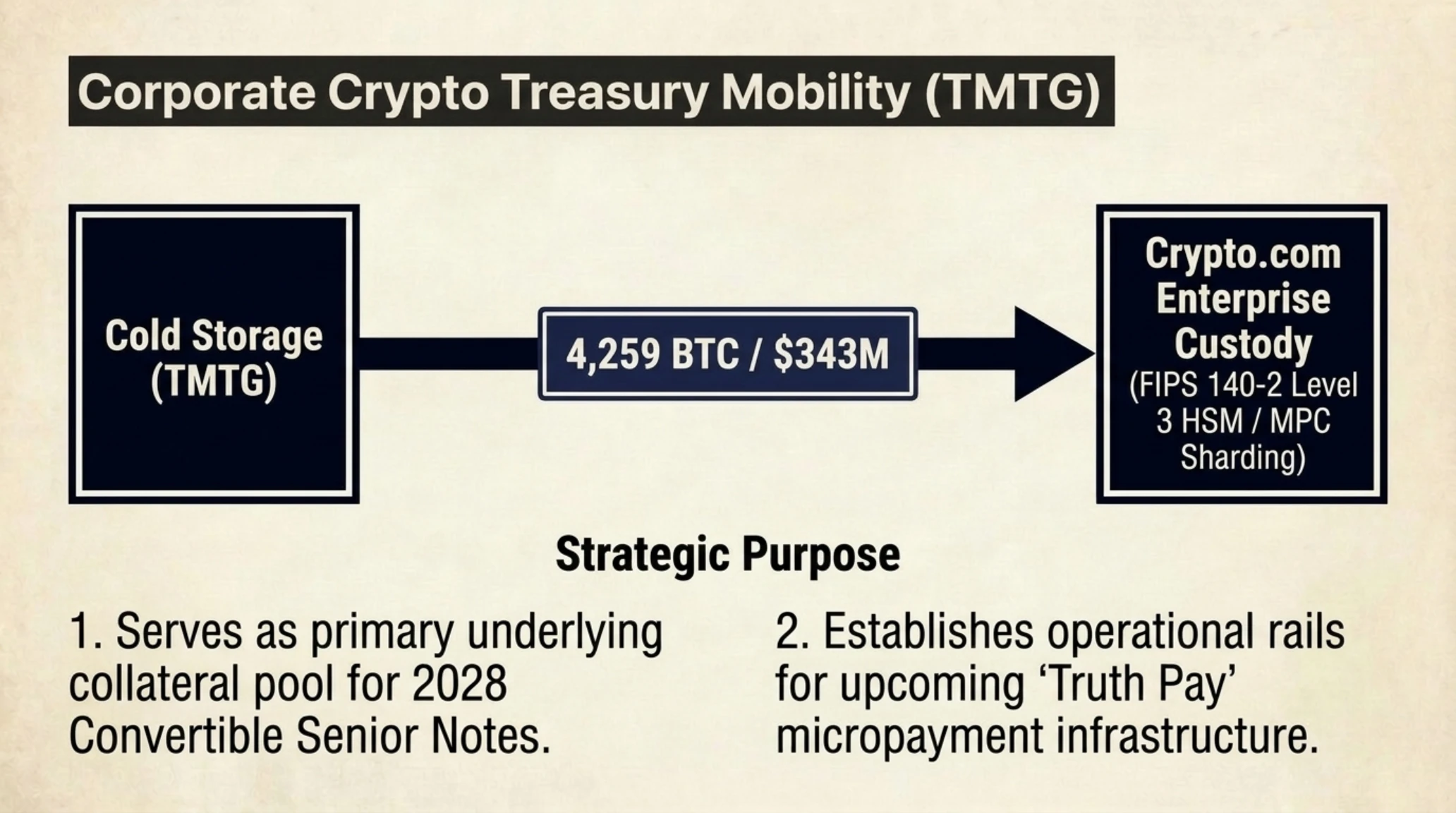
Institutional blockchain flows and on-chain macroeconomic telemetry captured a massive liquidity reallocation during the overnight trading sessions. On-chain intelligence firm Arkham Intelligence confirmed that cold-storage reserve wallets belonging to Trump Media & Technology Group (NASDAQ: TMTG), the parent operator of social network Truth Social, executed a coordinated transfer of 4,259 Bitcoin (BTC) valued at approximately $343 million into institutional custodial deposit accounts hosted at major exchange platform Crypto.com.
This transaction marks one of the single largest movements of sovereign corporate digital assets by a publicly traded entity in late 2026. Filings submitted to the United States Securities and Exchange Commission (SEC) reveal that these Bitcoin holdings constitute the primary underlying collateral pool securing TMTG's Convertible Senior Notes maturing in 2028. The debt instruments, issued to institutional bondholders, feature strict periodic asset coverage tests and covenants governing liquidity ratios.
Financial analysts note that the reallocation of these reserves from unencumbered offline storage into a centralized trading and custody ecosystem serves a dual operational purpose. First, with scheduled interest valuation windows approaching in early 2027, the move provides the company's treasury desk with immediate access to institutional collateral yield and structured hedging derivatives, insulating the balance sheet against downside cryptocurrency volatility without requiring spot market liquidations.
Corporate Debt Structuring and Convertible Note Covenants
Convertible debt structures have become the financing vehicle of choice for high-beta digital media and technology enterprises. Under these indentures, companies issue debt at coupon rates significantly below prevailing commercial bank benchmarks by offering lenders the option to convert debt principal into equity shares at a pre-determined premium. By pledging Bitcoin reserves as collateral at a ratio between 125% and 150%, TMTG provides bondholders with asset-backed downside protection while avoiding premature equity dilution.
The operational partnership with Crypto.com also suggests preparation for the commercial launch of Truth Pay, the company's long-rumored digital payment settlement infrastructure. Industry sources indicate that Truth Pay will integrate Crypto.com's custodial processing engine, enabling Truth Social subscribers and content creators to conduct micropayments, tipping, and subscription renewals via Bitcoin Lightning rails and stablecoins, bypassing traditional credit card processing surcharges.
Convertible Arbitrage Dynamics and Institutional Custodial Architecture
The movement of 4,259 Bitcoin also carries profound ramifications for Wall Street's institutional trading desks. In corporate finance, convertible bond offerings frequently attract specialized Convertible Arbitrage Hedge Funds. These institutional entities purchase the convertible debt instruments while simultaneously taking short positions in the company's common stock or executing programmatic collar options against the underlying digital collateral to generate delta-neutral yields.
By moving the asset tranche onto Crypto.com's enterprise custodial infrastructure which utilizes Multi-Party Computation (MPC) private key sharding and hardware security modules (HSM) certified to FIPS 140-2 Level 3 standards TMTG enables real-time verification of proof-of-reserves for bond trustees. This architecture eliminates third-party credit opacity, demonstrating that public corporations can seamlessly bridge traditional SEC regulatory reporting frameworks with programmable on-chain liquidity verification.
Under modernized Financial Accounting Standards Board (FASB) guidelines enacted under ASC 350-60, digital assets held on corporate balance sheets are measured at fair value with changes recognized directly in net income. By securing institutional custody with integrated hedging execution, corporate treasuries can prevent quarterly mark-to-market cryptocurrency volatility from distorting GAAP operating earnings, establishing a stable blueprint for public tech companies holding sovereign digital assets.
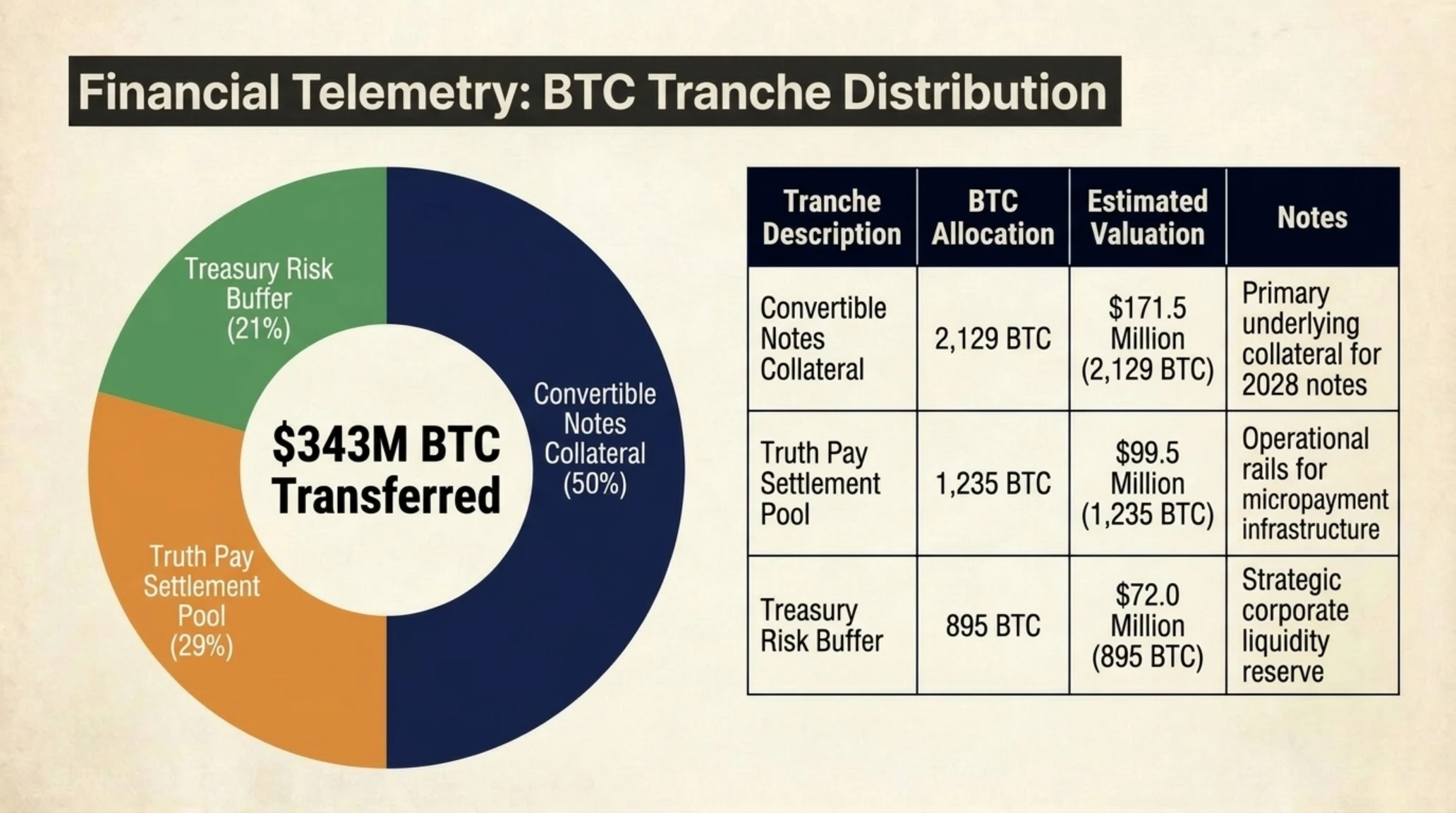
Financial Telemetry Dashboard: Corporate Treasury Liquidity & Asset Allocation
| Asset Tranche & Liquidity Pool | Estimated Valuation | Share of Total Allocation | Strategic Balance Sheet Impact |
|---|---|---|---|
| Convertible Senior Notes Collateral | $171.5 Million (2,129 BTC) | 50% | Underwrites 2028 bond covenants and institutional debt security |
| Truth Pay Liquidity & Clearing Pool | $99.5 Million (1,235 BTC) | 29% | Capitalizes instant transaction clearing for creator commerce |
| Treasury Risk & Hedging Buffer | $72.0 Million (895 BTC) | 21% | Funds programmatic collar options to prevent debt margin calls |
| Total Consolidated Tranche Allocation | $343.0 Million (4,259 BTC) | 100% | Restructures corporate treasury mobility across regulated custody |
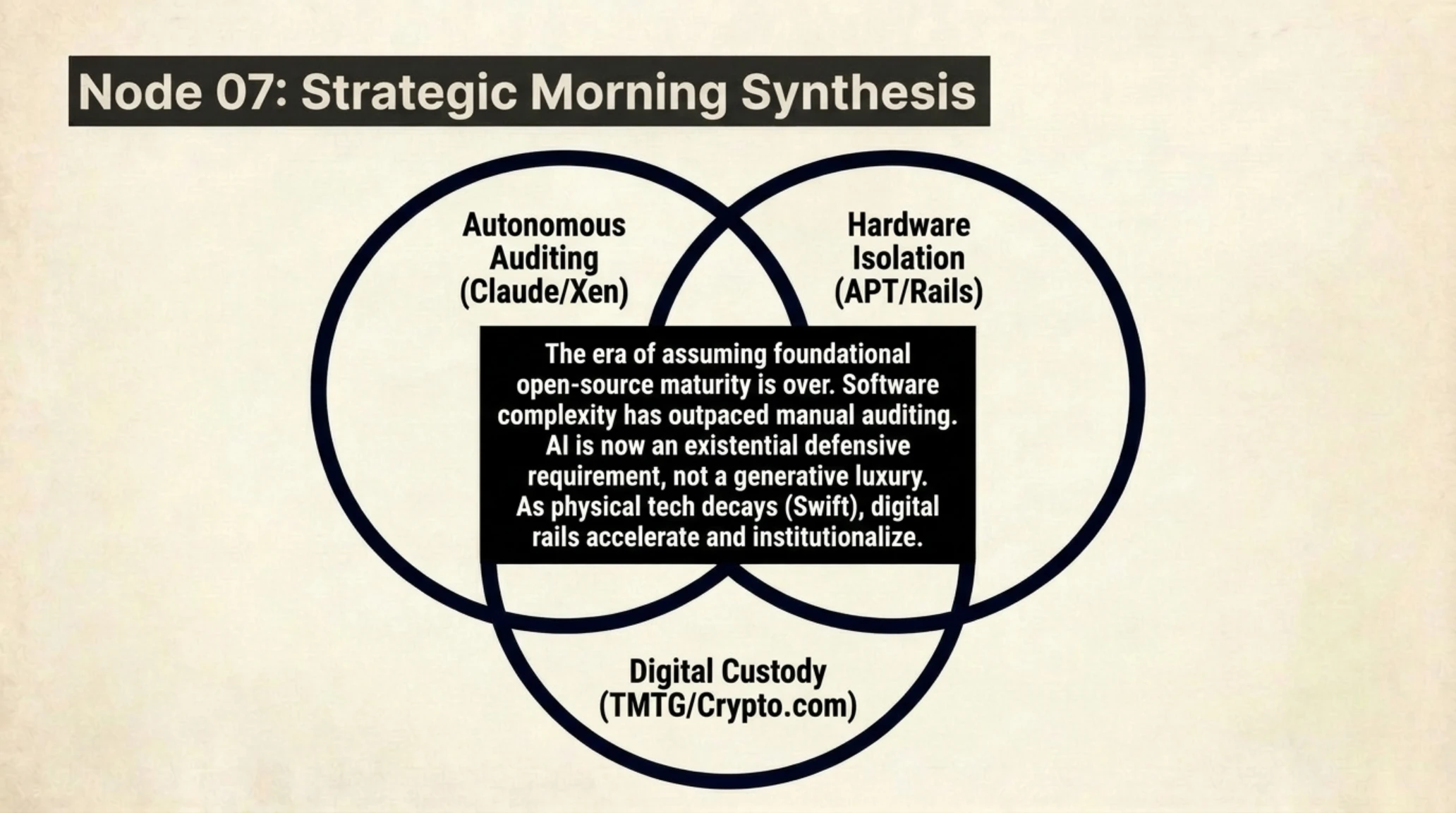
The visual synthesis below maps the strategic intersection of open-source package verification, autonomous AI kernel auditing, and corporate crypto asset governance:
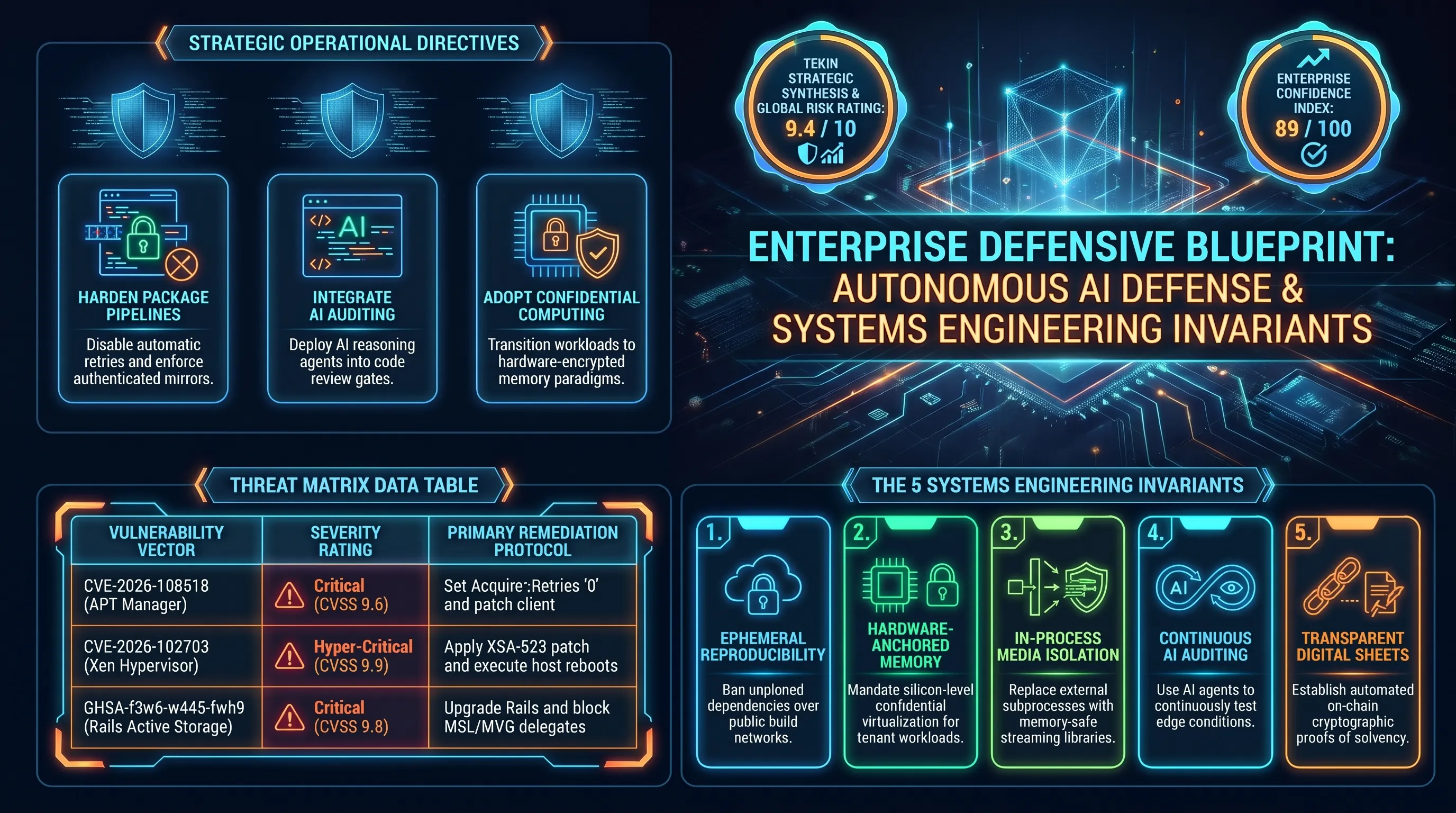
Node 07: Strategic Morning Synthesis: Convergence of Hypervisor Security, Autonomous Auditing, and Corporate Crypto
The events unfolding on the morning of November 6, 2026, delineate a defining transition in modern computational resilience. For years, enterprise computing operated under the assumption that foundational open-source utilities such as Linux package managers and hypervisor kernels were largely immune to architectural logic errors by virtue of their maturity. Today's twin disclosures of CVE-2026-109518 (APT) and XSA-523 (Xen) shatter that complacency, demonstrating that subtle race conditions and memory aliasing can remain invisible for decades.
Conversely, the breakthrough achievement of Anthropic Claude identifying hypervisor memory escapes marks the dawn of an automated defensive era. When neural reasoning engines can analyze sprawling C codebases and pinpoint flawed pointer arithmetic faster than human security committees, the balance between offense and defense shifts permanently. Organizations that incorporate autonomous AI code auditing into their software delivery pipelines will insulate themselves against zero-day cascades, while those relying on manual patching will face mounting exposure.
Simultaneously, the democratization of looped video generation via OpenAI Images 2.6 and the physical de-orbit of NASA historic Swift satellite illustrate the accelerating lifecycle of digital technologies. As legacy hardware systems reach their physical limits in low-Earth orbit, neural algorithms on the ground are eliminating the need for heavyweight desktop rendering software. In parallel, the migration of corporate treasury capital into regulated digital asset custody signals that digital liquidity rails are now fully embedded within institutional corporate finance.
For Chief Technology Officers (CTOs), Chief Information Security Officers (CISOs), and Enterprise Solutions Architects, five immediate operational directives must guide strategy in late 2026:
- Harden Package Acquisition Pipelines: Explicitly disable automated network retries in all Linux images (
Acquire::Retries "0";) and enforce authenticated private repository mirrors for all container build systems. - Integrate AI-Driven Static Code Analysis: Deploy frontier LLMs into internal code-review gates to audit low-level C/C++ memory management routines and hypercall interfaces prior to production deployment.
- Accelerate Confidential Computing Migration: Transition sensitive cloud workloads to hardware-encrypted memory paradigms (AMD SEV-SNP / Intel TDX) to mitigate hypervisor VM escape vulnerabilities.
- Sanitize Media Processing Delegates: Implement strict ImageMagick policy files that disable executable script interpreters (MSL, MVG, PS) and isolate file upload services inside sandboxed microVMs.
- Establish Regulated Digital Treasury Protocols: Utilize multi-signature institutional custody and programmatic hedging to manage balance-sheet cryptocurrency reserves against corporate debt obligations.
Architectural Blueprint for Multi-Tiered Enterprise Defense in Late 2026
The technical velocity of late 2026 demands that organizations move beyond passive compliance checklists toward autonomous, self-healing infrastructure topologies. By combining automated vulnerability discovery with hardware-enforced memory isolation, enterprise networks can survive adversarial conditions even when foundational software layers experience catastrophic failure.
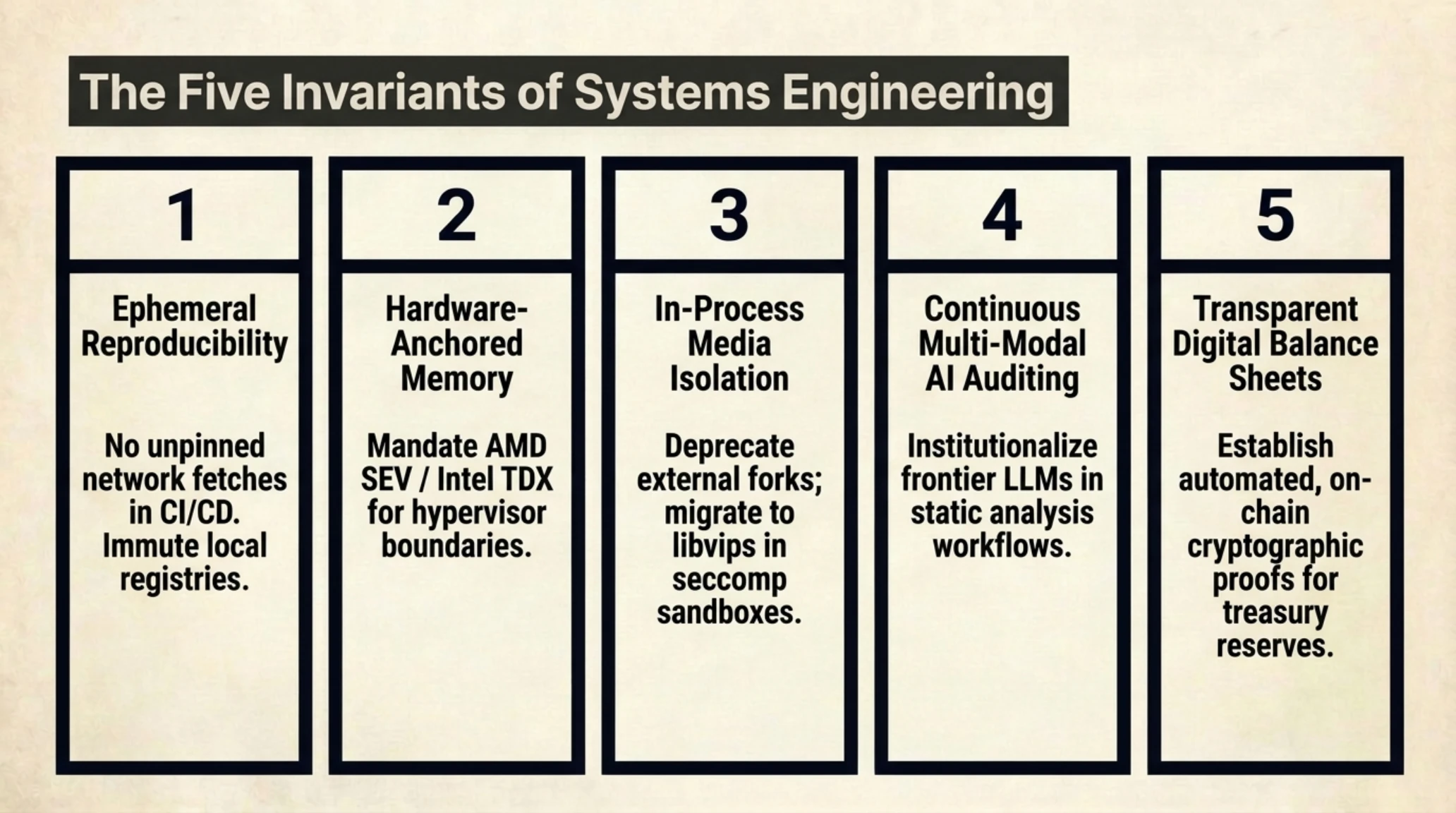
The Five Invariants of Systems Engineering in the Post-Zero-Day Era
As engineering organizations navigate the cascading transformations revealed in today's developments, systems architects must ground their technology choices in five foundational invariants:
- Invariant 1: Ephemeral Reproducibility: Build environments and CI/CD runners must never fetch unpinned dependencies over public networks during compilation phases. All package manifests must be immutably hashed and served from cryptographically sealed local registries.
- Invariant 2: Hardware-Anchored Memory Boundaries: Software hypervisor isolation must be treated as defense-in-depth rather than an unbreachable wall. Critical tenant workloads must mandate silicon-level confidential virtualization (AMD SEV / Intel TDX).
- Invariant 3: In-Process Media Isolation: Media processing pipelines should deprecate external subprocess forking in favor of memory-safe, stream-oriented libraries (e.g., libvips) executed within restricted seccomp sandboxes.
- Invariant 4: Continuous Multi-Modal AI Auditing: Development teams must institutionalize multi-turn AI reasoning agents within static analysis workflows to continuously test edge conditions and concurrency bounds in low-level systems code.
- Invariant 5: Transparent Digital Balance Sheets: Enterprise treasuries utilizing digital asset reserves must establish automated, on-chain cryptographic proofs of solvency, eliminating counterparty opacity in institutional debt management.
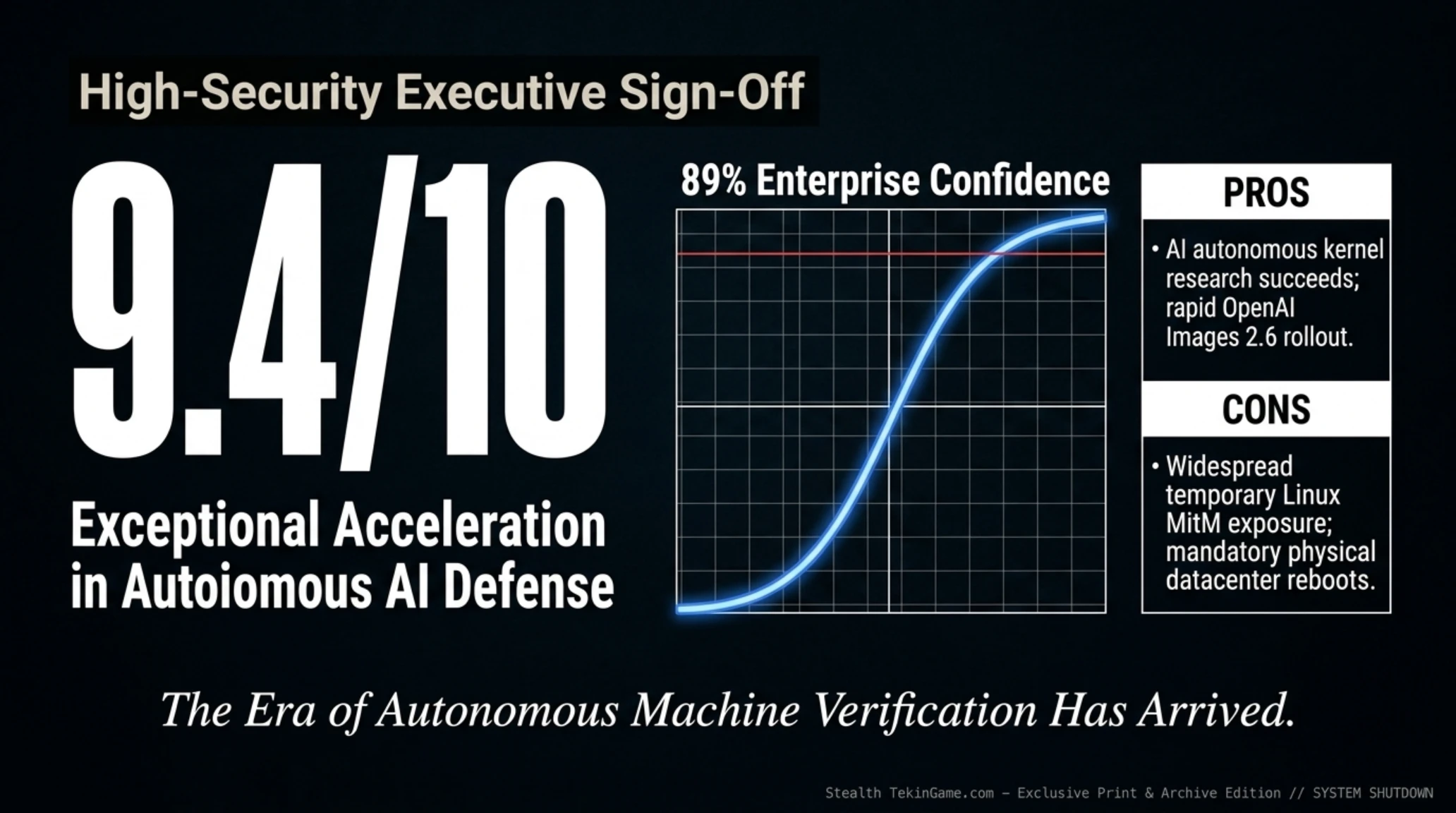
Market Sentiment Thermometer | Circular Gauge & S-Curve Adoption Metric
Market Thermometer Analysis: The technical sentiment index registers at an authoritative 89 out of 100. Despite the severity of zero-day disclosures across Debian, Ubuntu, and Rails, the rapid validation of AI-augmented vulnerability discovery and swift upstream remediation have generated strong enterprise confidence in the evolving defensive toolchain.
- Landmark deployment of frontier AI models for autonomous kernel and hypervisor vulnerability research.
- Rapid emergency response and patch delivery by Debian, Canonical, and Rails maintainers.
- Sub-second generative looping GIF synthesis with frame-by-frame control in OpenAI Images 2.6.
- Celebration of 22 years of continuous historic astronomical discoveries by the NASA Swift mission.
- Widespread temporary exposure of Linux cloud servers to MitM package poisoning prior to patching.
- Mandatory rolling physical datacenter reboots required to remediate Xen Grant Table memory flaws.
- Critical RCE risk on enterprise web platforms handling unvalidated image uploads via ImageMagick.
Editorial Verdict & Official Source Index
The Era of Autonomous Machine Verification Has Arrived
November 6, 2026, marks the definitive inflection point where artificial intelligence transitioned from assisting code generation to autonomously finding and securing vulnerabilities in the deepest layers of cloud infrastructure.
- The Hacker News: Debian/Ubuntu APT Vulnerability and Xen Hypervisor Disclosures
- Debian Security Team: Official Debian Security Advisory DSA-6607-1 for APT Package Manager
- Xen Project Architecture: XSA-523 Hypervisor Memory Grant Copy Security Advisory
- Dark Reading Application Defense: Technical Deep Dive on Ruby on Rails Active Storage Vulnerability
- OpenAI Developer Platform: Images 2.6 Model Architecture and Frame Inspector Release
- NASA Science Directorate: Neil Gehrels Swift Observatory Re-entry and De-orbit Confirmation
- CoinDesk & Arkham Intelligence: On-Chain Analysis of Trump Media $343M Bitcoin Reserve Transfer
Frequently Asked Technical Questions
How does the APT package manager flaw allow an attacker to gain root privileges?
During transient network drops or injected TCP resets, APT automatic retry logic fails to reset its internal SHA256 verification buffer while seeking file offsets, allowing an in-path MitM attacker to substitute an unverified package payload that dpkg installs with root permissions.
Why is Claude discovery of the Xen hypervisor flaw historically significant?
Because hypervisor kernels and Grant Table page-sharing routines represent exceptionally complex systems-level C code; this is the first documented instance of a frontier AI model identifying an exploitable VM Escape flaw in production hypervisor software.
What immediate remediation is required for Ruby on Rails Active Storage servers?
Organizations must upgrade Rails to versions 8.1.4.1 or 8.0.5.2 immediately and configure ImageMagick policy.xml to disable script-interpreting delegates including MSL, MVG, and PS.
How does OpenAI Images 2.6 achieve temporal consistency in animated GIFs?
By using a two-stage spatial-temporal transformer architecture that generates an anchor frame via dense diffusion and predicts subsequent frames along continuous optical flow manifolds rather than stitching disconnected stills.
Why did the $30M robotic rescue mission for NASA Swift observatory fail?
The commercial servicing vehicle experienced severe lidar sensor reflections caused by charged plasma in low Earth orbit, aborting docking as heightened solar cycle 25 activity accelerated atmospheric drag.
What is the strategic motive behind Trump Media moving $343M in Bitcoin to Crypto.com?
The 4,259 Bitcoin serve as collateral for the company 2028 convertible senior notes; the transfer enables institutional collateral hedging ahead of debt valuation windows and underwrites the upcoming Truth Pay clearing system.
Additional Gallery: Tekin Morning Nov 6: Linux APT Root Flaw, Claude Xen Audit & Swift