Tekin Night: September 20, 2026
Tonight we unpack high-stakes DRM legal wars, massive console storage demands, and next-gen PC hardware mandates.
- 🎮Denuvo Sues voices38- Irdeto files a landmark federal DMCA lawsuit against legendary cracker for neutralizing 26 AAA titles.
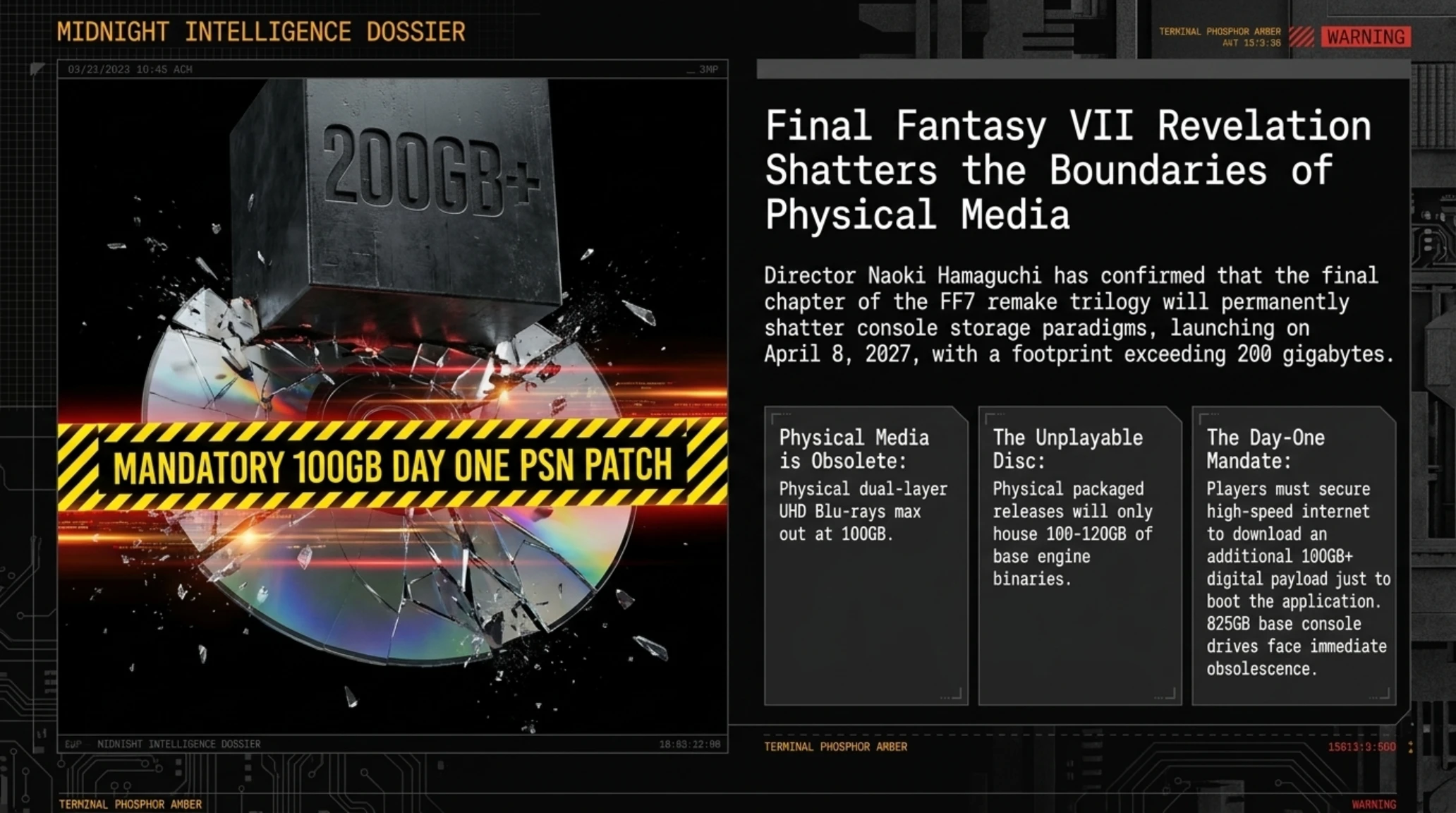
- 🎧FF7 Breaks 200GB Limit- Director confirms Final Fantasy VII Revelation exceeds 200GB, mandating massive day-one patch.
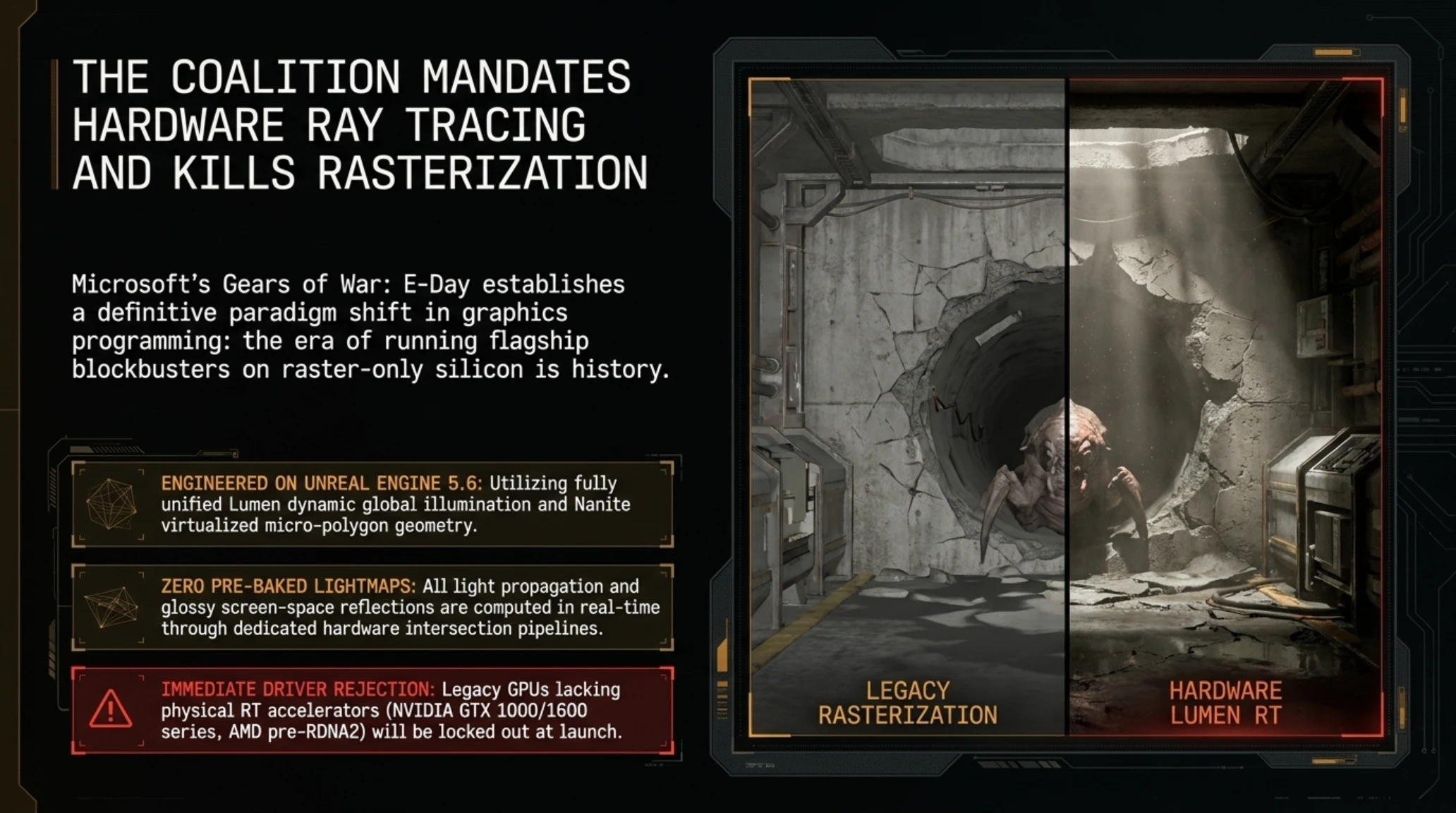
- 🚀Gears E-Day Specs- The Coalition mandates dedicated hardware ray-tracing accelerators and drops legacy GPUs.
- 🗡️Vanguard Ban Wave- Riot Games penalizes 296,416 accounts and wipes 33M rank points via Anti-Boost AI.
- 📰Control Resonant Acclaim- Remedy's new masterpiece launches to universal acclaim featuring a David Lynch tribute.
- ⚔️Japanese Studio Stability- ASGC observatory reveals Japanese game studios maintained a staggering 97% retention rate.
As midnight descends upon Sunday, September 20, 2026, the daytime clamor of enterprise meetings and corporate conferences fades into the quiet hum of liquid-cooled graphics cards, mechanical switch clicks, and ambient RGB battle stations. In this twilight domain where competitive gamers, hardware overclockers, reverse-engineering researchers, and game engine architects thrive, the Tekin Night editorial desk presents an exhaustive, deep-dive analytical briefing dissecting the seismic developments reshaping interactive entertainment, anti-cheat surveillance, and digital copyright law.
Core Briefing Highlights: Tekin Night September 20, 2026
- Denuvo's parent company Irdeto files a landmark federal DMCA lawsuit against legendary cracker voices38 for neutralizing anti-tamper DRM across 26 AAA blockbusters.
- Director Naoki Hamaguchi confirms Final Fantasy VII Revelation exceeds 200GB, obligating physical disc owners to download a massive mandatory day-one patch.
- The Coalition publishes PC system requirements for Gears of War: E-Day, officially mandating dedicated hardware ray-tracing accelerators and dropping legacy GPUs.
- Riot Games executes a historic esports purge: 296,416 accounts penalized and 33 million rank points wiped via Vanguard's behavioral Anti-Boost AI.
- Remedy Entertainment’s Control Resonant launches to universal critical acclaim (88+ Metacritic) featuring a deeply moving cinematic tribute to David Lynch.
- The ASGC industry observatory reveals Japanese game studios maintained a staggering 97% employee retention rate, defying Western studio mass layoffs.
Tonight’s investigative coverage opens with what legal scholars and cybersecurity analysts are already characterizing as the definitive courtroom showdown in the modern history of video game copy protection: an all-out federal offensive launched by Denuvo’s parent corporation against the shadows of the cracking scene.
The Legal Battle of the Century: Denuvo Sues Elusive Cracker voices38 in California Federal Court
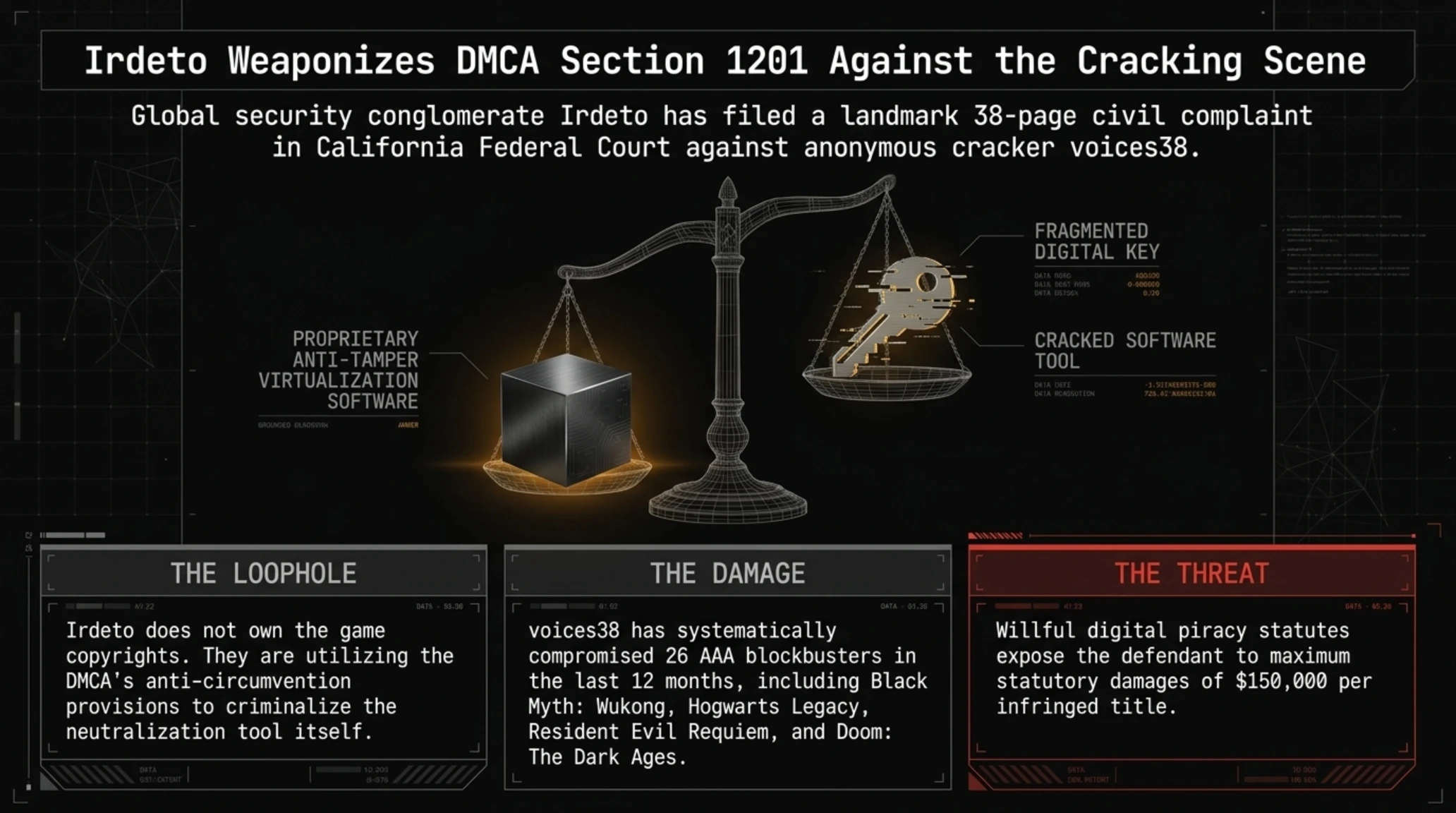
Late this evening, technical publications including PC Gamer, Tom's Hardware, and Eurogamer confirmed that global software security conglomerate Irdeto, the corporate parent and engineering custodian of the controversial Denuvo Anti-Tamper technology, officially lodged an aggressive 38-page civil complaint in the United States District Court for the Northern District of California. The lawsuit targets an anonymous individual or collective operating under the pseudonym voices38, alleging systematic and unlawful violations of the anti-circumvention provisions codified within the Digital Millennium Copyright Act (DMCA).
According to sworn filings submitted by Irdeto’s litigation counsel, voices38 has systematically compromised, reverse-engineered, and publicly redistributed working circumvention tools for at least 26 major AAA video game releases within the past twelve months alone. The affected catalog encompasses some of the gaming industry's most commercially significant blockbusters, including Game Science’s global cultural phenomenon Black Myth: Wukong, Warner Bros. Games' sprawling wizarding world adventure Hogwarts Legacy, Capcom’s critically acclaimed survival horror overhaul Resident Evil Requiem, and id Software’s high-octane action spectacle Doom: The Dark Ages.
The legal architecture underpinning Irdeto’s filing represents a remarkably clever maneuvering of American intellectual property statutes. Because Irdeto does not own the underlying copyrights to the video games themselves those rights being proprietary assets held by third-party publishers like Warner Bros. Discovery, Capcom, and Bethesda Softworks the company cannot sue for direct copyright infringement. Instead, Irdeto has constructed its case exclusively around Section 1201 of Title 17 of the United States Code. Under this statutory provision, the act of manufacturing, importing, distributing, or trafficking in any technological tool, utility, or software patch designed primarily to circumvent access controls or copy protection schemes constitutes an actionable federal civil offense, irrespective of whether the plaintiff owns the underlying protected content.
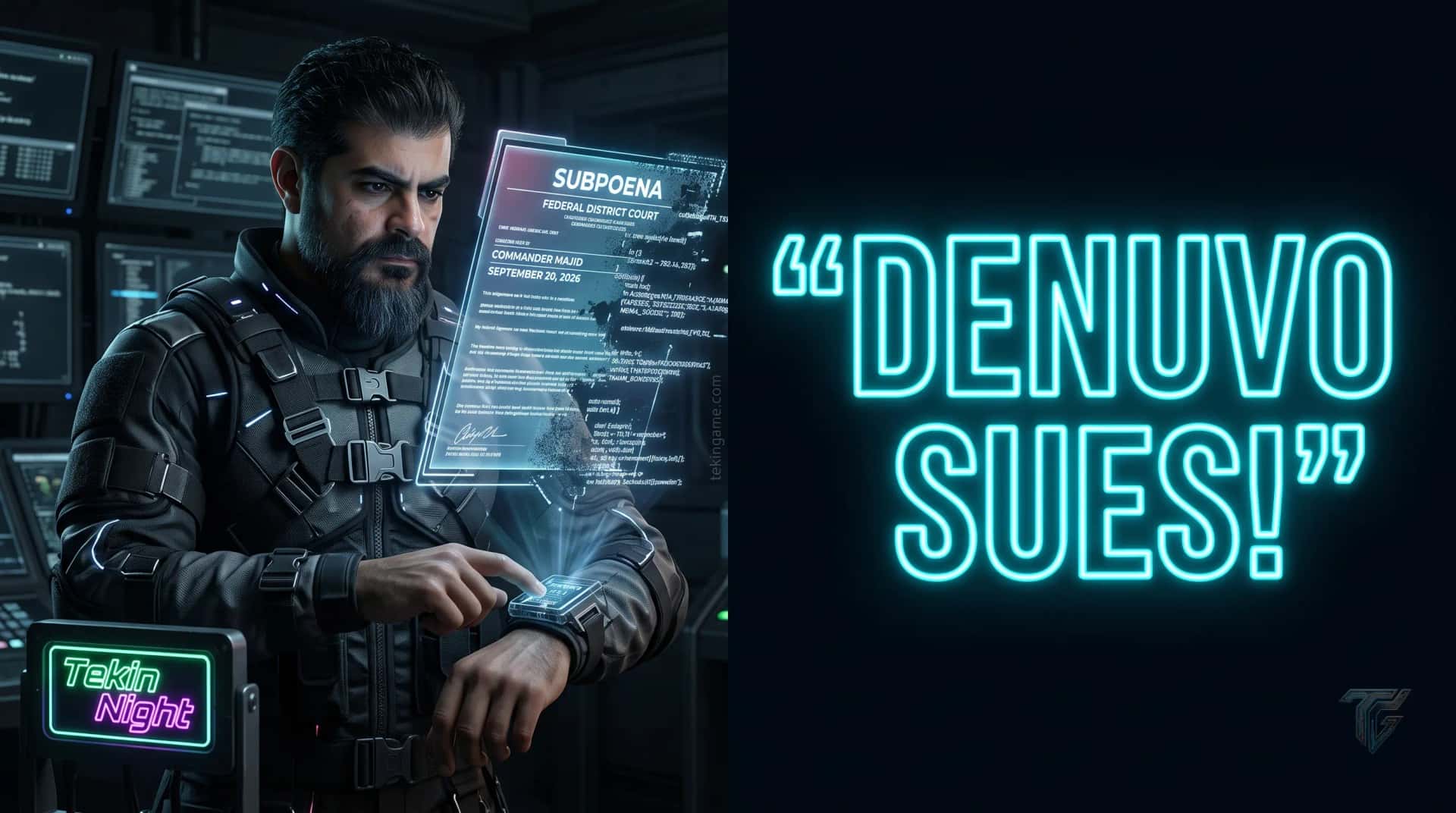
The high-tech editorial artwork below conceptualizes the intense friction between proprietary anti-tamper virtual machines and decentralized reverse-engineering toolsets in the heart of the digital underground.

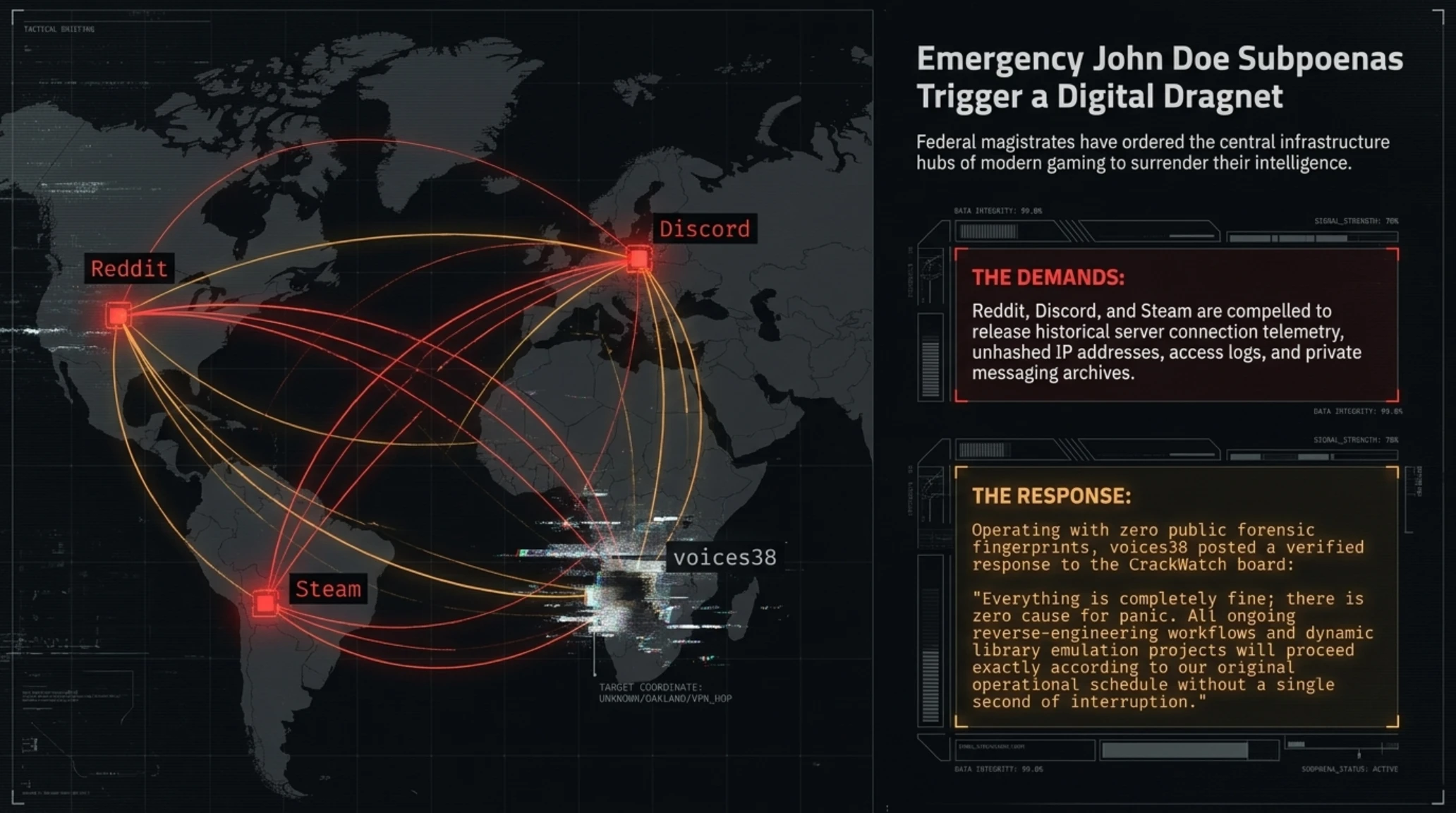
Operating with the meticulous operational security reminiscent of past scene legends such as EMPRESS and the Italian cracking collective CPY, voices38 has maintained complete digital anonymity, leaving zero public forensic fingerprints, registered email accounts, or traceable banking trails. Confronted by this impenetrable veil, Irdeto’s legal representatives simultaneously petitioned the presiding federal magistrate to issue emergency John Doe Subpoenas directed at three central infrastructure hubs of modern gaming: discussion forum operator Reddit, communications platform Discord, and Valve Corporation’s ubiquitous Steam network.
These court orders compel the named platforms to surrender all historical server connection telemetry, unhashed IP addresses, access logs, account registration timestamps, linked payment identifiers, and private messaging archives associated with accounts tied to the voices38 handle. Yet, rather than retreating into silence, the elusive cracker responded with unbothered composure. Posting from a verified handle on the popular CrackWatch discussion board, voices38 issued a brief statement: "Everything is completely fine; there is zero cause for panic. All ongoing reverse-engineering workflows and dynamic library emulation projects will proceed exactly according to our original operational schedule without a single second of interruption."
Gamers and hardware enthusiasts seeking empirical data on how background protection layers impact CPU cycle budgets and frame pacing should review our benchmark feature on Denuvo DRM Performance Overheads and Frametime Consistency in CPU-Bound Scenarios.
To unpack the intricate legal terminology and software engineering concepts defining this unprecedented courtroom confrontation, the analytical reference box below deconstructs the foundational mechanisms at play.
Technical & Jurisprudential Deconstruction: Video Game DRM and Reverse Engineering Primitives
- DMCA Section 1201 Anti-Circumvention: The federal statutory clause prohibiting the production, offering, or dissemination of technologies primarily designed to bypass cryptographic measures controlling access to copyrighted digital assets.
- John Doe Subpoena Protocol: A legal instrument employed when the identity of a defendant is unknown, granting the plaintiff lawful authority to compel third-party online service providers to surrender identifying subscriber logs.
- Anti-Tamper Cryptographic Virtualization: A sophisticated protection architecture that encrypts native machine instructions into proprietary bytecode executed inside a randomized virtual machine.
- Dynamic Trigger Emulation (Bypass): An advanced cracking methodology wherein the reverse engineer maps internal integrity checks, intercepting CPU instruction streams to emulate valid cryptographic handshakes.
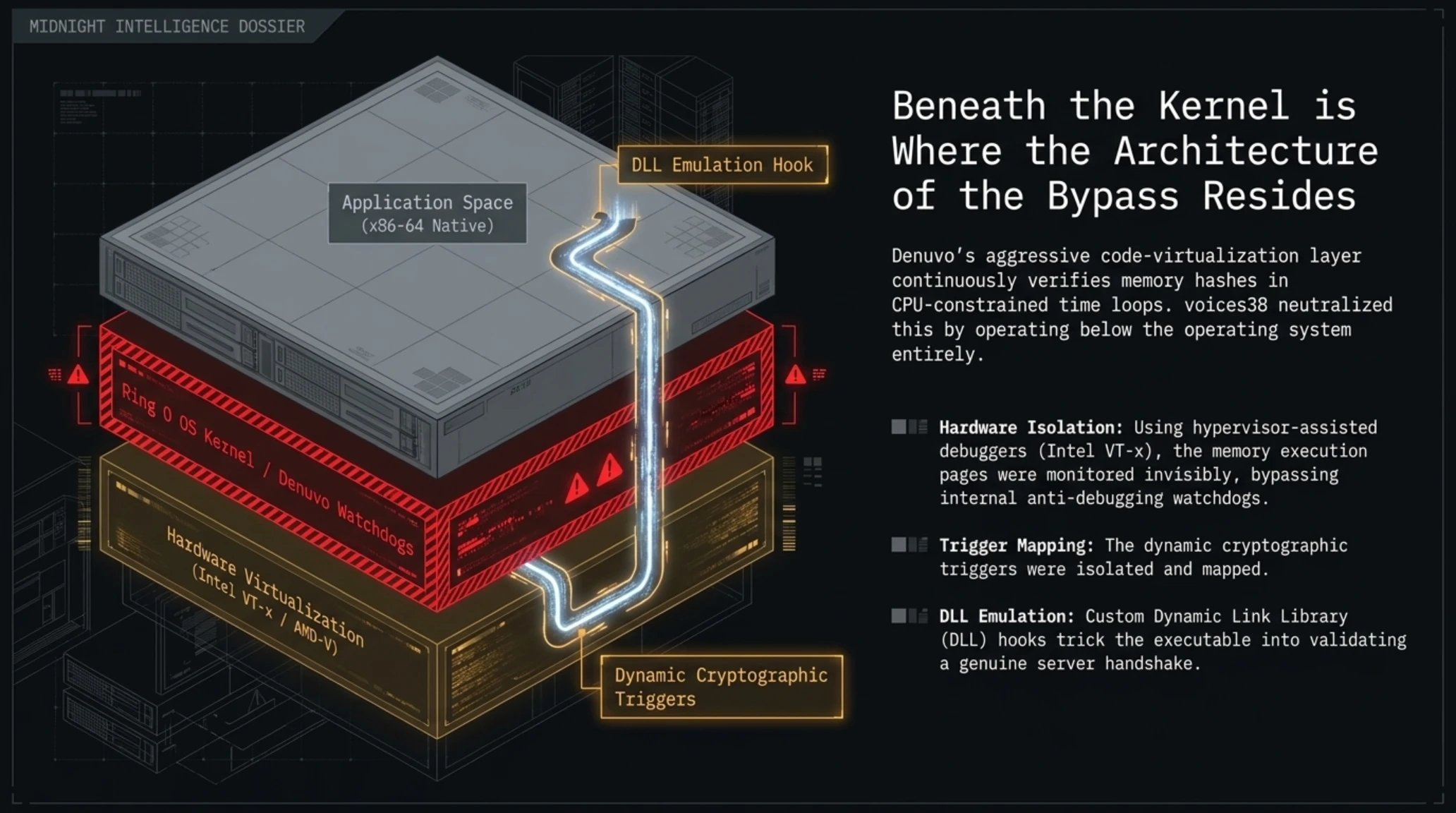
Industry software engineers observing the dispute note that Denuvo’s fundamental challenge lies in the asymmetrical economics of reverse engineering. While publishers invest millions in software licensing and continuous telemetry integration, a skilled engineer equipped with hardware-assisted virtualization debuggers (such as Intel VT-x or AMD-V hypervisors) can isolate the memory offsets where integrity checks occur. Once these dynamic triggers are mapped, the protection can be neutralized through binary emulation layers that trick the executable into validating genuine ownership.
The comparative intelligence box below delineates substantiated factual developments from speculative online rumors surrounding the voices38 litigation.
Substantiated Reality vs. Digital Speculation: The voices38 Denuvo Lawsuit Dossier
- Rumor: Federal law enforcement authorities have successfully pinpointed voices38's physical residence in Eastern Europe and an imminent arrest is pending.
Reality: The federal filing is strictly a civil lawsuit operating under John Doe procedural rules; Irdeto has not disclosed or verified any real-world identity or physical location. - Rumor: The legal action has immediately halted all distribution of cracked executables and paralyzed reverse-engineering groups.
Reality: voices38 has formally published public confirmations indicating that encrypted distribution channels remain operational.
Reverse-engineering specialists analyzing the mechanical architecture of Denuvo's protection explain that the software functions as an aggressive code-virtualization layer. Rather than allowing the host operating system's CPU to natively execute the game's compiled x86-64 machine code, Denuvo encrypts critical function blocks into proprietary bytecode interpreted by randomized runtime virtual machines. Throughout active gameplay, the engine injects thousands of dynamic verification triggers into time-sensitive rendering loops, physics calculations, and asset streaming threads. In CPU-constrained gaming environments, these continuous integrity checks frequently oversaturate hardware instruction caches (L1 and L2 cache lines), precipitating the micro-stutters and sudden frametime spikes that have long fueled intense gamer resentment against anti-tamper implementations.
According to technical filings reviewed by legal scholars, voices38 managed to neutralize this protective web by deploying custom hypervisor-assisted debugging environments operating beneath Ring 0. By utilizing hardware virtualization extensions (Intel VT-x and AMD-V), the researcher monitored memory execution pages invisibly without triggering Denuvo's internal anti-debugging watchdogs. Once the memory locations of the dynamic cryptographic triggers were isolated, voices38 constructed dynamic link library (DLL) hooks that emulate the cryptographic responses of a licensed server activation. Irdeto's federal lawsuit argues that under the statutory precedents of the DMCA, creating and redistributing these emulation hooks constitutes willful digital piracy, entitling the plaintiff to maximum statutory damages of up to $150,000 per infringed title alongside emergency injunctive relief.
Across private Matrix channels and encrypted Discord developer servers, the digital preservation community has rallied around the dispute, emphasizing the existential threat DRM poses to video game preservation. When publisher authentication servers inevitably go dark a decade post-launch, uncracked titles become permanently unplayable, transforming reverse-engineering efforts into the sole surviving archive of interactive digital history. Legal defense organizations, including the Electronic Frontier Foundation (EFF), are closely monitoring the docket, recognizing that a ruling against hardware-level security research could establish dangerous precedents restricting independent vulnerability analysis across commercial software.
As the legal showdown between Irdeto and voices38 gathers momentum across federal circuits, intellectual property scholars predict that the outcome will fundamentally establish the statutory boundaries of modern reverse-engineering rights in the United States, influencing everything from fair use to game preservation for decades to come.
The detailed digital render below illustrates the symbolic shattering of cryptographic DRM security locks amidst glowing judicial subpoenas and circuit board architectures.

While PC gamers monitor the unfolding drama in California's federal courts, console players and storage manufacturers received an equally disruptive shock from Tokyo, where Square Enix has redefined the boundaries of physical game distribution.
The 200GB Storage Threshold: Naoki Hamaguchi Warns Final Fantasy VII Revelation Breaks Physical Media Limits
In an illuminating and candid technical interview published earlier today by Eurogamer, Naoki Hamaguchi, the visionary game director steering Square Enix’s multi-part remake initiative, revealed unprecedented technical metrics regarding the concluding chapter of the trilogy, titled Final Fantasy VII Revelation. Scheduled for global retail launch on April 8, 2027, the title will officially shatter existing console storage paradigms, weighing in at an astonishing footprint exceeding 200 gigabytes upon installation.
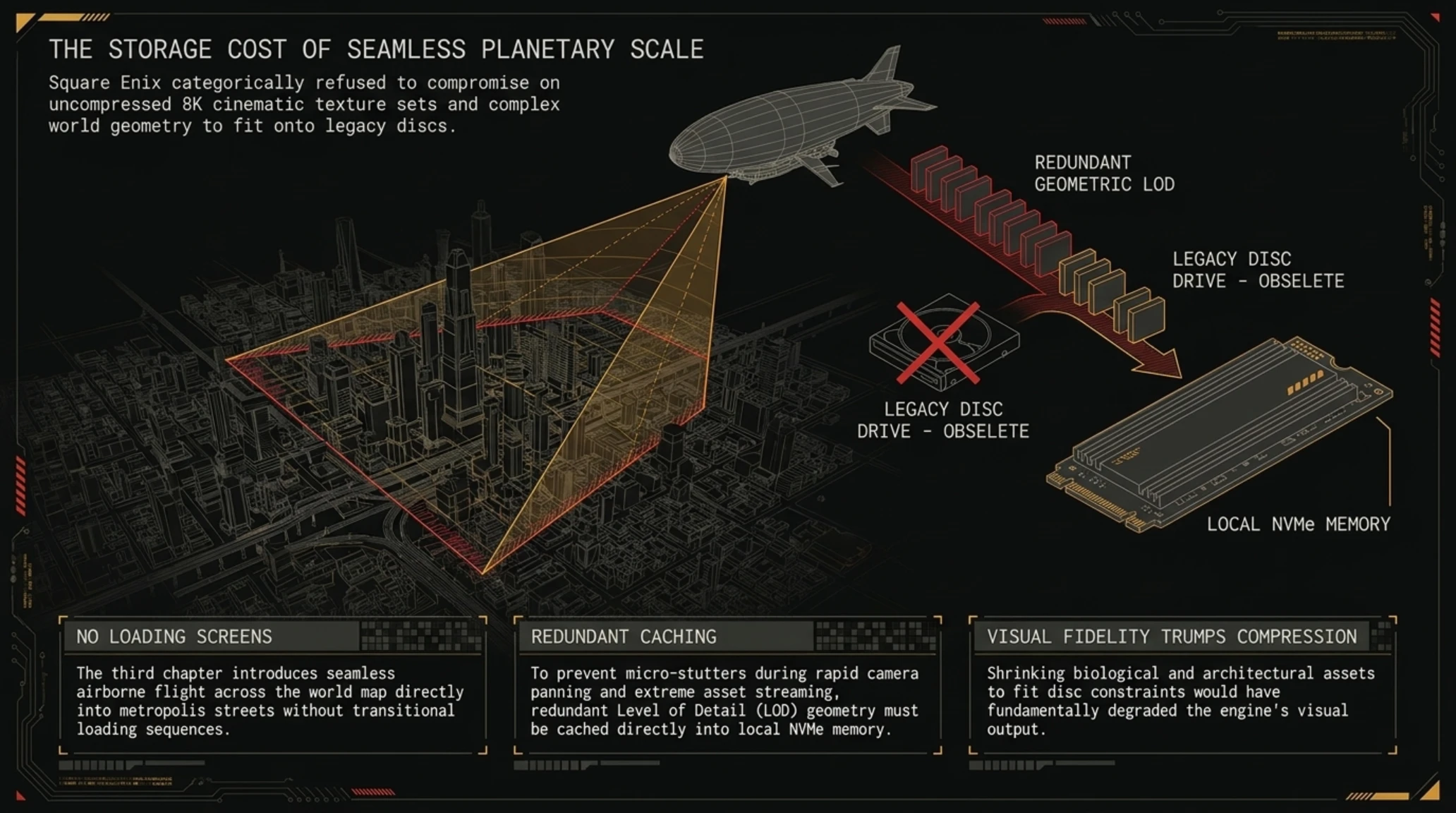
Hamaguchi emphatically articulated that Square Enix's development leadership categorically refused to compromise on uncompressed 8K cinematic texture sets, seamless planetary-scale traversal mechanics, or complex world geometry simply to conform to the physical storage limits of standard dual-layer Ultra HD Blu-ray media, which max out at 100 gigabytes per disc. Describing the design ambition, Hamaguchi noted: "The third chapter introduces immense roaming Weapons, continuous seamless airborne flight across the world map without transitional loading sequences, and multi-character cinematic combat. Shrinking these biological and architectural assets to fit onto physical discs would have degraded our visual fidelity. Consequently, the game footprint inevitably crosses 200GB."
This engineering decision has profound and immediate ramifications for the retail collector community and console owners. Even players who invest in the premium physical packaged release featuring two Ultra HD Blu-ray discs will find themselves incapable of enjoying an offline plug-and-play experience out of the box. The physical discs will house approximately 100 to 120 gigabytes of base engine binaries and audio streams, requiring players to connect to the PlayStation Network (PSN) on day one to download a mandatory supplemental digital payload exceeding 100 gigabytes before the software can launch. The announcement has reignited contentious debates across hardware forums regarding the rapid obsolescence of non-expandable 825GB and 1TB base console drives.
The operational advisory box below provides essential hardware upgrade and storage optimization instructions for console players anticipating the release.
Critical Console Hardware Advisory: PlayStation 5 Storage Readiness and NVMe Expansion Protocol
- Mandatory NVMe M.2 Drive Installation: Players still operating on the PlayStation 5's internal base SSD must install an expansion M.2 NVMe solid-state drive with a minimum capacity of 1TB to 2TB and sequential read speeds exceeding 5,500 MB/s.
- Day-One Mandatory Download Requirement: Physical disc owners must secure high-speed internet access on launch day; physical media alone will not contain executable assets sufficient to boot the application without the 100GB+ digital patch.
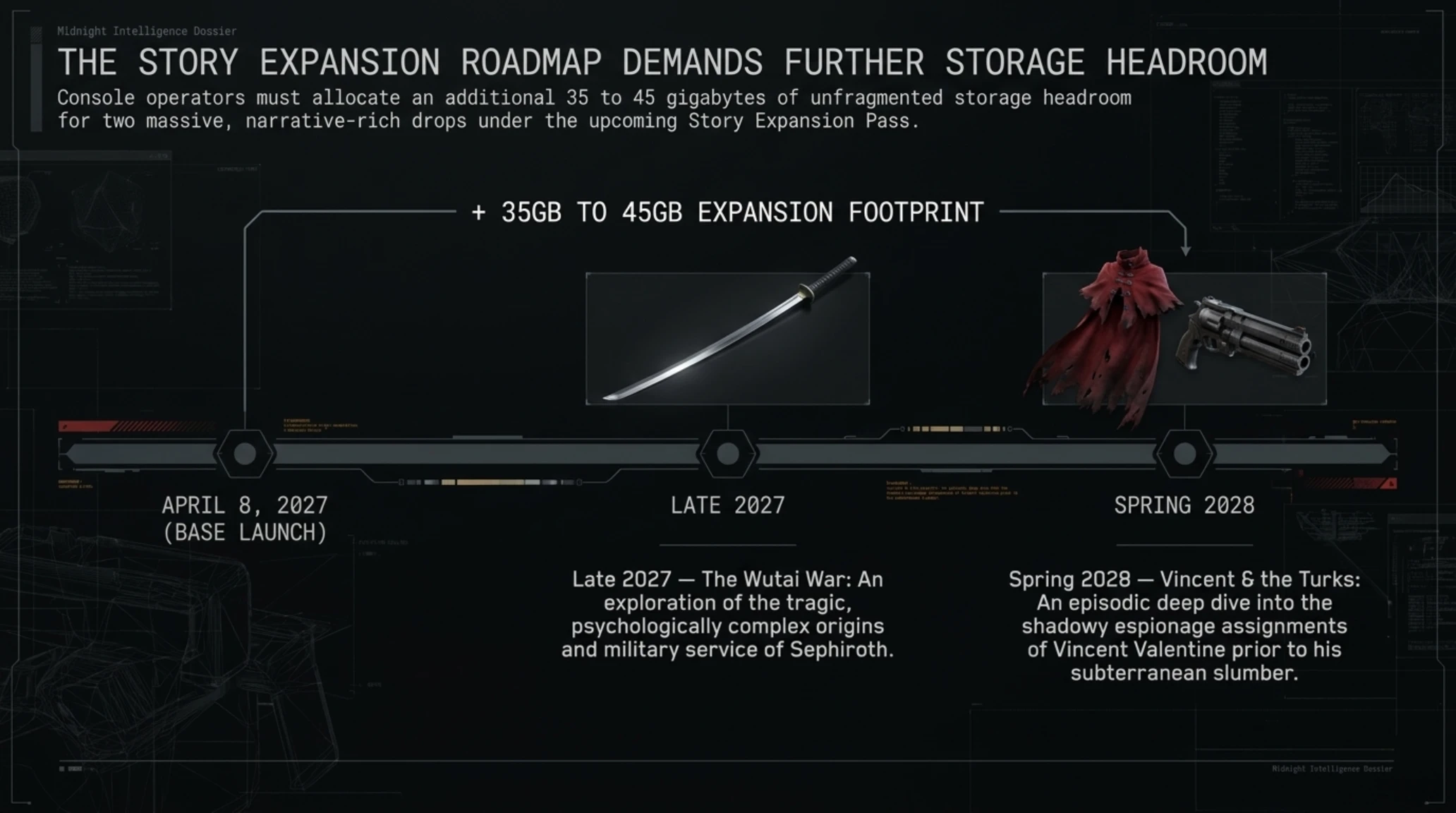
- Upcoming Story Expansion Footprint: With Square Enix officially confirming the post-launch Story Expansion Pass covering Sephiroth and Vincent Valentine, users should allocate an additional 35GB to 45GB of storage headroom.
Simultaneously, Square Enix detailed its post-launch content roadmap, confirming that two massive, narrative-rich downloadable expansions will debut under the umbrella of a dedicated Story Expansion Pass between late 2027 and spring 2028. The first expansion delves into the tragic, psychologically complex origins and military service of Sephiroth during the Wutai War, while the second episodic expansion, titled "Vincent & the Turks", explores the shadowy espionage assignments of Vincent Valentine alongside Shinra’s covert investigative unit before his century-long subterranean slumber.
The breathtaking cinematic concept artwork below depicts Cloud Strife and Sephiroth confronting their cosmic destiny amidst the moonlit, ruined grandeur of the Sector 5 cathedral.

Yet, while Square Enix pushes console storage boundaries to their absolute extremes, Microsoft’s premier internal development team has dropped an equally radical technological bombshell for PC enthusiasts, declaring the absolute demise of legacy graphics pipelines.
Hardware Ray Tracing Made Absolute: Gears of War: E-Day PC System Requirements Revealed
In a technical announcement that reverberated across gaming hardware communities worldwide, The Coalition and Microsoft Gaming officially published the comprehensive PC system specifications for their highly anticipated prequel masterpiece, Gears of War: E-Day. The technical dossier conveys a definitive message: the era of running flagship ninth-generation blockbusters on raster-only graphics silicon is officially history. Hardware-accelerated Ray Tracing is no longer an optional visual toggle it is a mandatory runtime dependency.
Engineered entirely upon Epic Games' cutting-edge Unreal Engine 5.6, Gears of War: E-Day implements fully unified Lumen dynamic global illumination and Nanite virtualized micro-polygon geometry. Because the engine computes all light propagation, indirect bounce illumination, and glossy screen-space reflections in real time through dedicated hardware intersection pipelines, the developers completely stripped out traditional pre-baked lightmaps and rasterized shadow cascades. As a direct consequence, legacy graphics cards lacking dedicated physical hardware Ray Tracing accelerators such as NVIDIA’s legendary GTX 1000 and GTX 1600 series or AMD's pre-RDNA2 cards will experience immediate launch-level driver rejections.
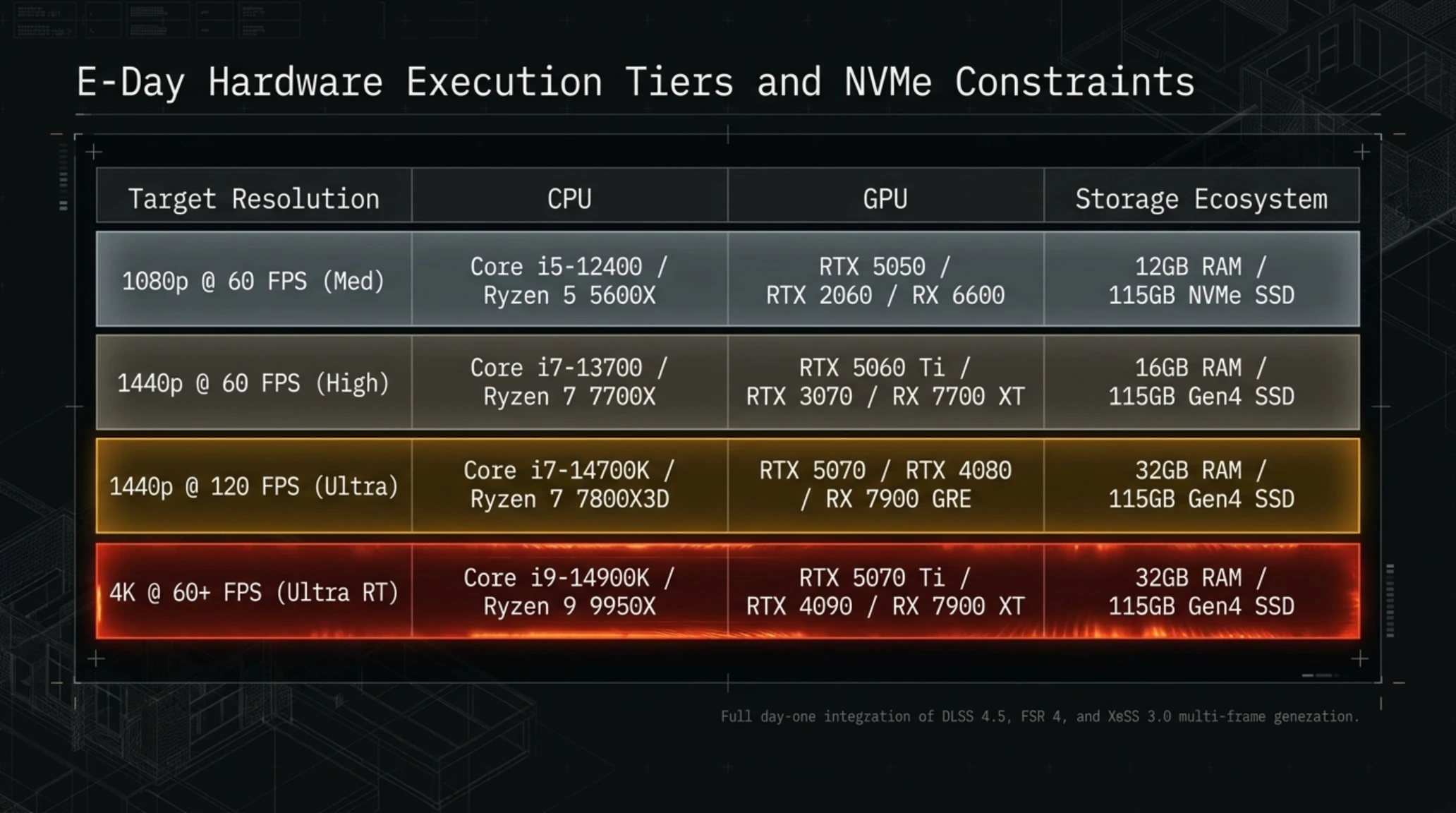
To achieve the baseline operational threshold of 1080p resolution at 60 frames per second on medium graphical presets, gamers must deploy an NVIDIA GeForce RTX 5050, an RTX 2060, or an AMD Radeon RX 6600 paired with 12GB of system RAM and 115GB of dedicated high-speed NVMe storage. Enthusiasts targeting pristine 4K resolution at 60+ frames per second with fully maxed-out volumetric fog, subsurface scattering, and path-traced ambient occlusion will require high-end silicon on the order of the NVIDIA GeForce RTX 5070 Ti, RTX 4090, or AMD Radeon RX 7900 XT.
Graphics programmers and hardware enthusiasts looking for deeper optimization methodologies can consult our exhaustive technical breakdown on Unreal Engine 5 Lumen and Nanite Optimization Strategies on Modern GPU Architectures.
The technical specifications box below provides a high-density summary of the core architectural requirements mandated for the title.
Engine Architecture & Hardware Mandates: Gears of War: E-Day Technical Dossier
- Core Graphic Engine: Unreal Engine 5.6 utilizing native DirectX Raytracing (DXR 1.2) and Vulkan Ray Tracing hardware query pipelines.
- Mandatory GPU Architecture: Hardware Ray Tracing support is an immutable launch prerequisite; raster-only graphics adapters are strictly unsupported.
- Temporal Reconstruction Ecosystem: Full day-one integration of NVIDIA DLSS 4.5, AMD FSR 4, and Intel XeSS 3.0 featuring multi-frame generation.
- Storage Architecture: 115GB high-speed NVMe solid-state storage with DirectStorage API runtime integration for zero-latency asset streaming.
The comprehensive 5-row comparative matrix below provides a complete component-by-component breakdown across all four supported execution tiers.
| Performance Target Tier | Target Resolution & Frame Rate | Central Processing Unit (CPU) | Graphics Processing Unit (GPU) | System Memory & Storage Tier |
|---|---|---|---|---|
| Minimum Baseline | 1080p @ 60 FPS (Medium Preset) | Intel Core i5-12400 / AMD Ryzen 5 5600X | RTX 5050 / RTX 2060 / RX 6600 | 12 GB RAM / 115 GB NVMe SSD |
| Recommended Tier | 1440p @ 60 FPS (High Preset) | Intel Core i7-13700 / AMD Ryzen 7 7700X | RTX 5060 Ti / RTX 3070 / RX 7700 XT | 16 GB RAM / 115 GB Gen4 SSD |
| Enthusiast Performance | 1440p @ 120 FPS (Ultra Preset) | Intel Core i7-14700K / AMD Ryzen 7 7800X3D | RTX 5070 / RTX 4080 / RX 7900 GRE | 32 GB RAM / 115 GB Gen4 SSD |
| Ultra Enthusiast 4K | 4K @ 60+ FPS (Ultra Ray Tracing) | Intel Core i9-14900K / AMD Ryzen 9 9950X | RTX 5070 Ti / RTX 4090 / RX 7900 XT | 32 GB RAM / 115 GB Gen4 SSD |
Systems architects examining the technical constraints of modern console storage observe that Final Fantasy VII Revelation's gargantuan footprint represents the inevitable collision between ultra-high-definition visual ambition and physical media physics. While the PlayStation 5's proprietary I/O processor and hardware Kraken decompression blocks allow for blistering raw data throughput exceeding 9GB/s, the sheer volume of uncompressed cinematic audio stems, 8K Nanite mesh representations, and multi-layered physics collision hulls simply overfills conventional dual-layer Blu-ray optical discs. Furthermore, director Hamaguchi emphasized that the seamless inclusion of the Highwind airship permitting instantaneous, loading-free transitions from high-altitude planetary flight directly down into densely populated metropolis streets required developers to store redundant geometric LOD assets directly within local cache blocks to avoid micro-stutter during rapid camera panning.
In parallel, the engineering mandate behind Gears of War: E-Day underscores a decisive paradigm shift in PC graphics programming. In traditional rasterization pipelines, artists spent thousands of development hours baking static lighting calculations into fixed texture maps a compromise that consumed immense disk space and prevented dynamic day-night transitions or realistic environmental destruction. By fully committing to Unreal Engine 5.6's hardware Lumen framework, The Coalition has unified direct illumination, rough specular reflections, and infinite diffuse bounces into a single continuous mathematical equation calculated by physical RT cores. During intense firefights where player cover degrades under relentless Locust machine-gun fire, fractured masonry fragments cast dynamic, accurate penumbra shadows in real time, validating Microsoft’s uncompromising decision to sever ties with legacy graphics hardware.
The exploded engineering render below illustrates a next-generation graphics processor undergoing intense ray-tracing computation as photon paths bounce across metallic Locust subterranean armor.

From a mechanical gameplay perspective, director Hamaguchi outlined revolutionary advancements in party synergy and tactical combat execution. Final Fantasy VII Revelation evolves the acclaimed hybrid active-time-battle (ATB) system by introducing dual and triple Synergy Abilities that dynamically reshape the battlefield. Players can command Cloud, Tifa, Barret, and Aerith to unleash multi-tiered elemental vortexes that destabilize massive enemy stagger gauges. To support these sprawling encounter zones, the game engine continuously streams gigabytes of high-resolution particle simulations, volumetric spell effects, and destructible geological geometry, permanently taxing console memory bandwidth and explaining why compromise was utterly out of the question for Square Enix's creative leadership.
Similarly, the narrative weight of Gears of War: E-Day relies heavily on raw technical immersion to convey the apocalyptic shock of Emergence Day. Set precisely fourteen years prior to the events of the original 2006 classic, the campaign chronicles the harrowing first twenty-four hours of the subterranean invasion through the eyes of a battle-weary Marcus Fenix and Dominic Santiago. The Coalition’s visual engineering team utilized physical photogrammetry scans of real-world seismic destruction, enabling subterranean Locust emergence holes to tear through urban asphalt with hyper-accurate volumetric dust, procedural concrete fracturing, and dynamic sound propagation that rattles subwoofers with earth-shattering acoustic authenticity.
As hardware requirements ascend into the stratosphere, an equally ruthless technological transformation unfolded across competitive gaming networks, where artificial intelligence has initiated an unprecedented purge of fraudulent ranked accounts.
The Vanguard Earthquake: Riot Games Penalizes 296,000 Accounts and Wipes 33 Million Ranked Points
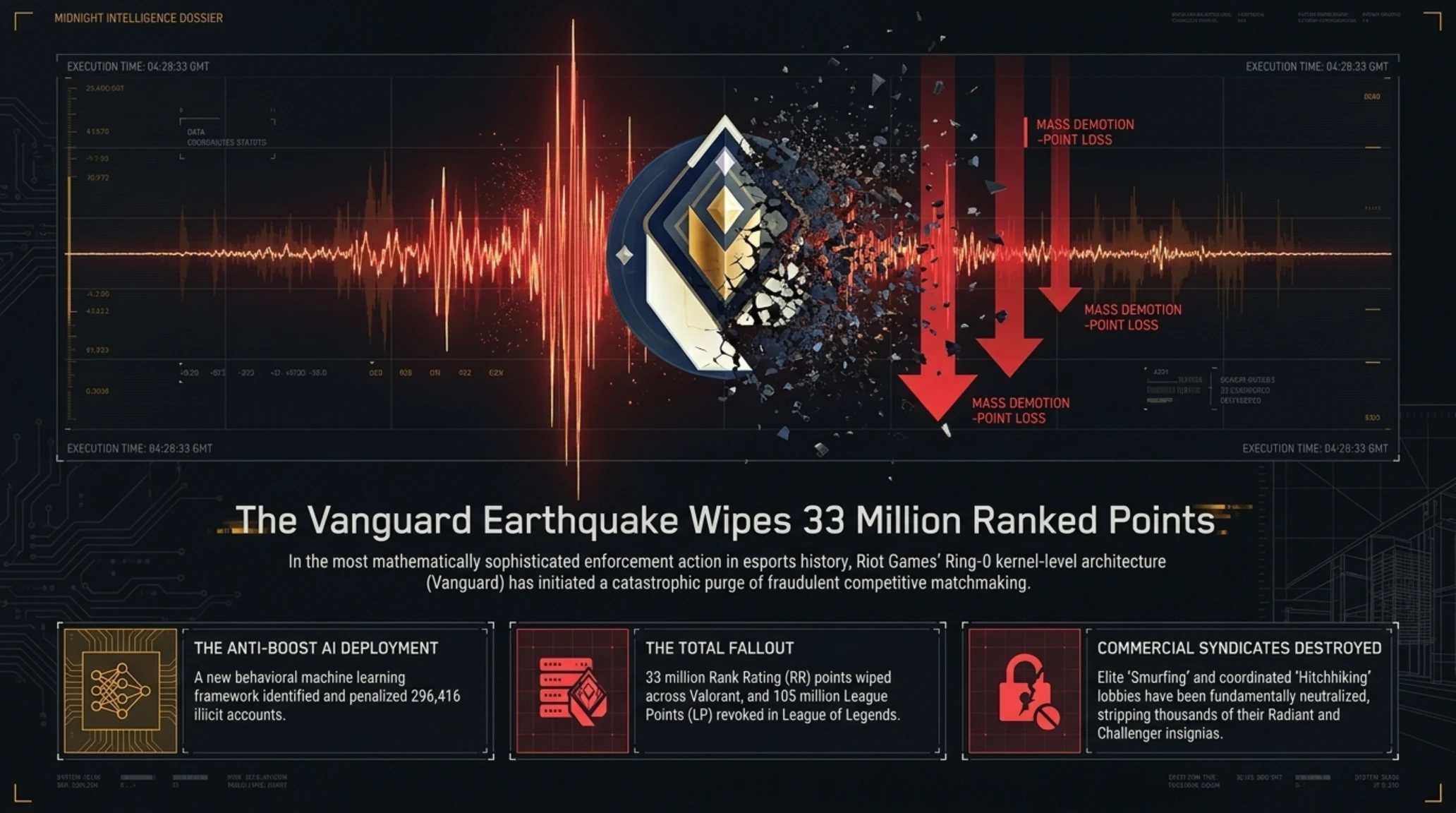
In one of the most decisive, mathematically sophisticated, and sweeping enforcement actions in the history of competitive electronic sports, Riot Games confirmed in a detailed transparency report published via Dexerto that its proprietary Ring-0 kernel-level anti-cheat architecture, Vanguard, has executed a massive worldwide purge targeting fraudulent competitive matchmaking. Powered by a newly deployed behavioral machine learning framework designated Anti-Boost AI, the system identified, penalized, and demoted an astonishing 296,416 illicit accounts across Valorant and League of Legends.
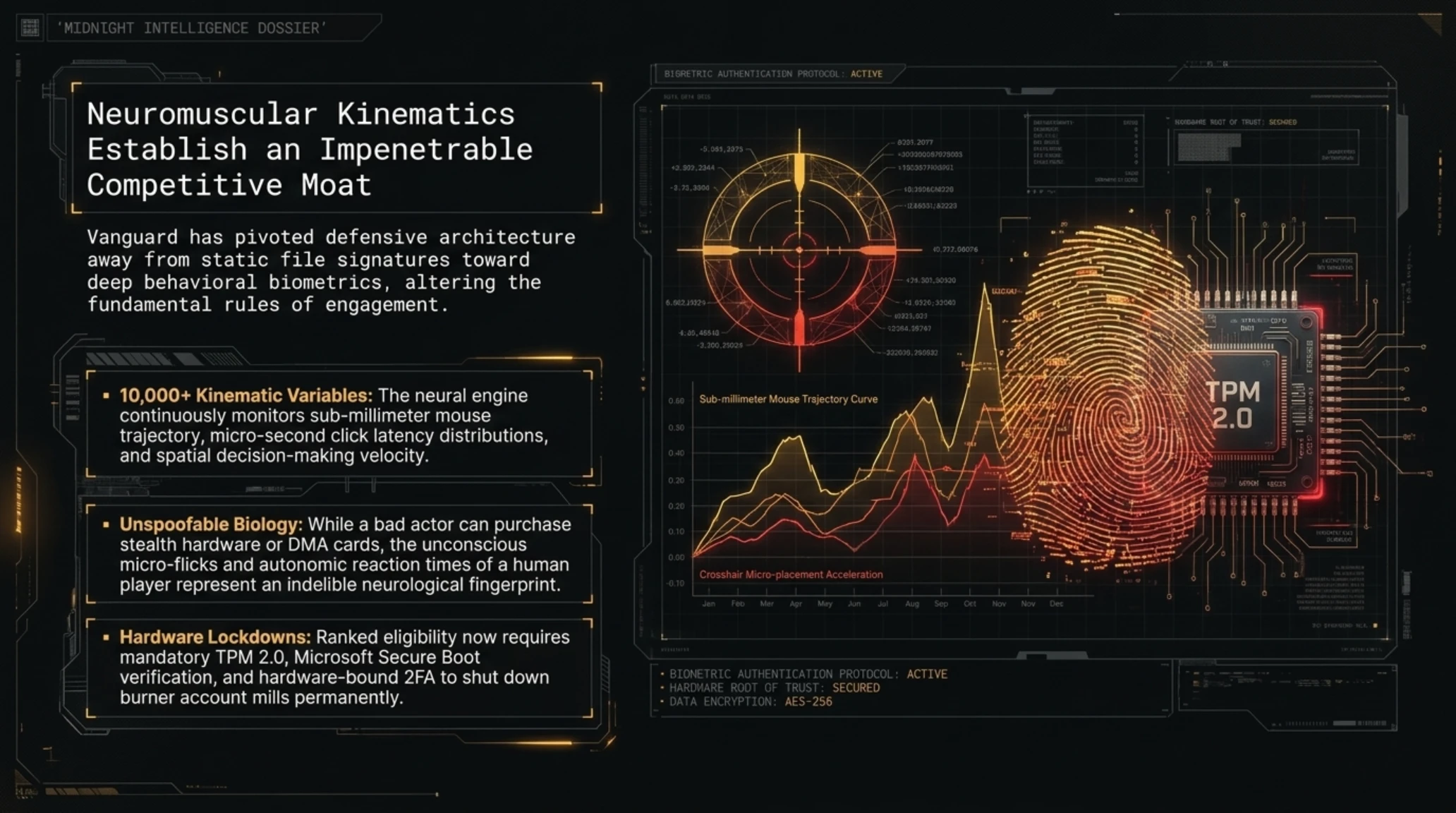
Unlike traditional signature-based detection systems that passively inspect system RAM for injected cheat binaries or known third-party debugging hooks, Anti-Boost AI analyzes continuous multi-dimensional behavioral telemetry generated across every millisecond of competitive gameplay. By monitoring over 10,000 distinct kinematic variables including sub-millimeter mouse trajectory curves, crosshair micro-placement acceleration, micro-second click latency distributions, first-bullet headshot accuracy deltas, geographical network latency anomalies, and spatial decision-making velocity across map zones the neural engine identified accounts exhibiting acute skill divergence with a verified statistical accuracy rate of 99.8 percent.
The operational crackdown eradicated two endemic scourges plaguing competitive queues: "Smurfing" (where elite players pilot low-ranked accounts to effortlessly crush novice opponents) and "Hitchhiking" (where players artificially inflate their competitive rank by queuing in coordinated premade lobbies alongside high-tier carry players or stealth cheaters). The quantitative consequences of the enforcement sweep were cataclysmic: Riot confirmed the total revocation of over 33 million Rank Rating (RR) points across Valorant and more than 105 million League Points (LP) across League of Legends, instantly stripping thousands of boosted accounts of their Radiant, Immortal, and Challenger tier insignias and banishing them back to Iron and Bronze tiers alongside forfeiture of seasonal cosmetic rewards.
The high-energy motion graphic animation below tracks the real-time deflation of artificial competitive rankings as Vanguard’s neural clustering models isolate boosted match lobbies.
Riot Games further announced that commencing with the next competitive season, ranked matchmaking eligibility will enforce mandatory hardware security baselines, requiring an active Trusted Platform Module (TPM 2.0), Microsoft Secure Boot verification, and hardware-bound two-factor mobile authentication to permanently shut down burner account mills.
The strategic intelligence evaluation below synthesizes how behavioral biometric surveillance is permanently altering the competitive integrity landscape across modern gaming networks.
Tekin Strategic Analysis: Behavioral Biometrics and the Collapse of Commercial Smurfing
Riot Games' deployment of Vanguard Anti-Boost AI marks a historic paradigm shift in digital security engineering. For over two decades, competitive online gaming was locked in an asymmetric cat-and-mouse war against cheat developers who could easily camouflage unauthorized software. By pivoting defensive architecture away from static file signatures toward deep behavioral biometrics, Riot has altered the fundamental rules of engagement. The unconscious micro-flicks of an elite professional gamer represent an indelible neurological fingerprint that an amateur cannot fabricate. This deployment establishes the technological blueprint that will govern future esports.
From the high-tension battlegrounds of competitive tactical shooters, tonight’s briefing pivots toward artistic excellence and psychological depth, celebrating a Finnish studio that has delivered an unquestioned masterpiece of atmospheric storytelling.
Critical Acclaim for Control Resonant: Remedy’s Paranormal Masterpiece Honors the Legacy of David Lynch
Finnish auteur studio Remedy Entertainment, under the creative stewardship of legendary writer and creative director Sam Lake, officially launched their highly anticipated standalone sequel Control Resonant across PlayStation 5, Xbox Series X|S, and PC. The title immediately captured universal critical acclaim from global review outlets, achieving an exceptional aggregate score of 88+ on Metacritic and OpenCritic, establishing itself as an instant frontrunner for Game of the Year honors.
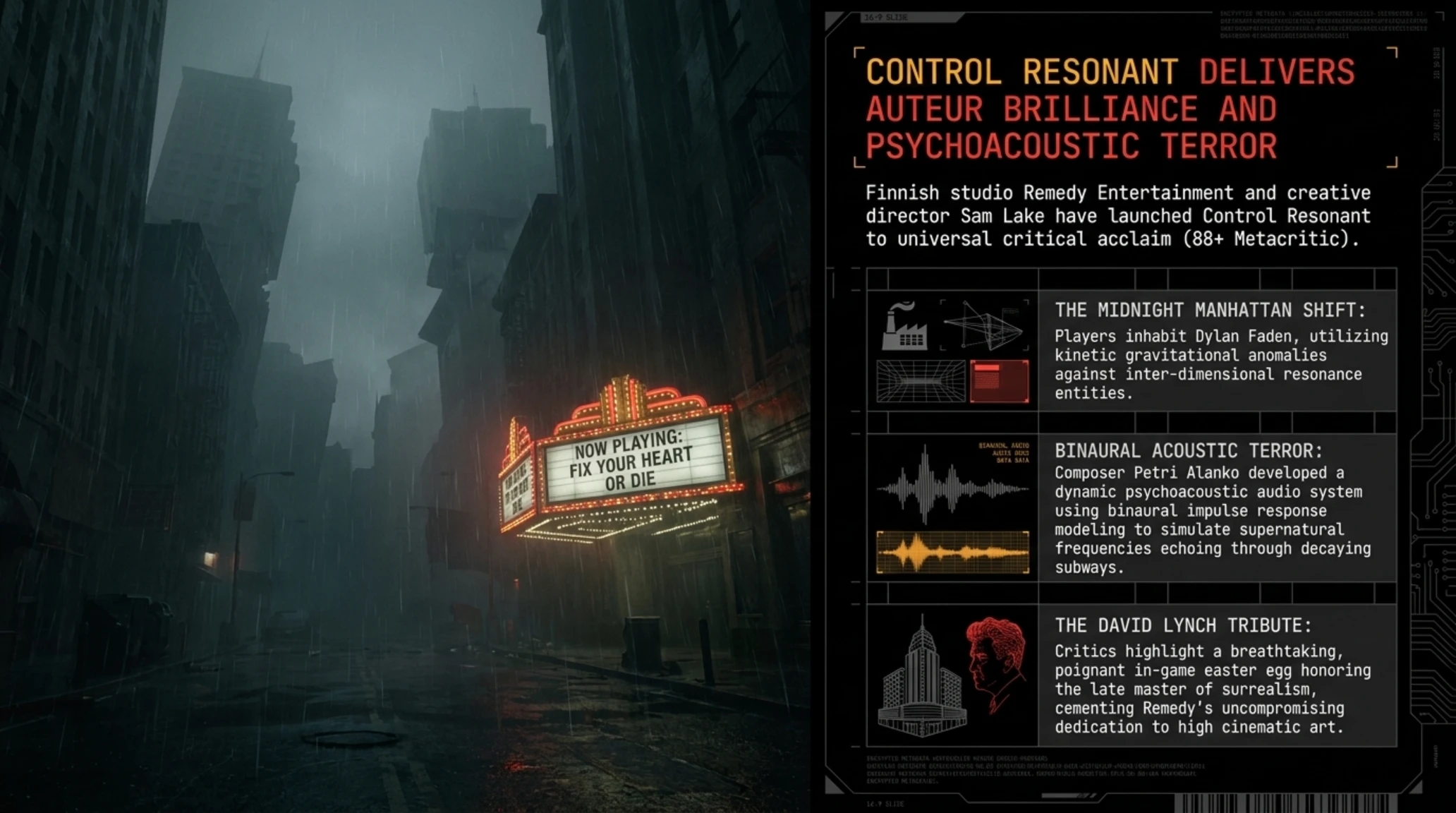
Constructed upon a modernized revision of Remedy’s proprietary Northlight Engine, Control Resonant shifts its psychological investigation away from the brutalist concrete confines of the Oldest House directly into the rain-slicked, reality-bending streets of midnight Manhattan. Players inhabit the role of Dylan Faden brother to the Federal Bureau of Control’s Director, Jesse Faden wielding kinetic gravitational anomalies, telekinetic reality-sculpting abilities, and brutal close-quarters parry mechanics against the encroaching existential terror of inter-dimensional resonance entities.
What deeply moved critics at IGN, GameSpot, and Rock Paper Shotgun, however, was a breathtaking and poignant artistic homage to the late cinematic master of surrealism, David Lynch, whose groundbreaking television work on Twin Peaks has long served as Sam Lake's foundational creative inspiration. During a haunting midnight traversal through a derelict art-deco movie theater in the Lower East Side, the camera gracefully frames a glowing, flickering neon marquee displaying a celebrated quote delivered by Lynch himself: "NOW PLAYING: FIX YOUR HEART OR DIE". The tribute was celebrated as one of the most sublime and respectful easter eggs in modern gaming history, embodying Remedy's uncompromising dedication to high cinematic art.
The evocative cinematic gameplay capture below showcases the eerie volumetric fog, paranormal physics simulations, and the iconic neon David Lynch memorial within the heart of midnight New York.
Complementing its visual splendor, the score composed by longtime Remedy collaborator Petri Alanko delivers an acoustic triumph of dark ambient synths, sub-bass seismic drones, and analog tape loops that dynamically adapt to the player's psychological state, immersing gamers into a state of hypnotic tension.
Esports integrity specialists and mathematical modelers investigating Riot Games' disclosure report that Vanguard's Anti-Boost AI operates via a sophisticated temporal convolutional neural network (TCN) trained on billions of authenticated human gameplay inputs. Rather than relying on rigid statistical thresholds, the model constructs a high-dimensional behavioral profile for each player, mapping subtle cognitive and neuromuscular markers such as involuntary muscle tremors during rapid flicks, micro-adjustments during recoil compensation, and spatial eye-hand coordination latency. When a commercial boosting operative logs into an account to artificially elevate its rank, the profound divergence in kinematic velocity vectors immediately trips behavioral alarms, allowing Riot to silently tag the match and execute synchronized ban waves that prevent account boosting rings from reverse-engineering detection triggers.
In Control Resonant, Remedy Entertainment’s narrative and technical execution has similarly redefined standards for interactive horror. Director Sam Lake and lead sound designer Petri Alanko developed a dynamic psychoacoustic audio system that leverages binaural impulse response modeling to simulate how supernatural frequencies resonate through decaying Manhattan architecture. As Dylan Faden traverses abandoned subway tunnels and waterlogged tenement basements, the environment itself becomes an instrument of psychological terror, with reality-distorting architectural shifts occurring dynamically based on the player’s combat aggression and emotional stress levels, cementing Remedy's reputation as gaming's premier auteur studio.
The conceptual artwork below portrays Dylan Faden standing before shifting non-Euclidean architectural geometries within the Federal Bureau of Control, flanked by inverted scarlet monoliths suspended in deep shadow.

Diving deeper into the narrative tapestry of Control Resonant, Remedy Entertainment masterfully expands the interconnected "Remedy Connected Universe" (RCU) by exploring the psychological fractures binding the Faden siblings to the cosmic astral plane. Dylan Faden's internal struggle with the resonant frequencies of the Hiss and newly awakened entities manifests directly within the environment; hallways stretch into infinite non-Euclidean labyrinths, familiar Manhattan landmarks invert into floating architectural monoliths, and hidden projector reels scattered across abandoned safehouses reveal classified Bureau dossiers that bridge events between Alan Wake 2, the Federal Bureau of Control, and enigmatic astral board entities.
Meanwhile, Riot Games' technical team confirmed that the Vanguard enforcement initiative is merely the initial salvo in an escalating campaign against sophisticated hardware-assisted cheat syndicates. Over the coming months, Vanguard will integrate machine-learning analysis of Direct Memory Access (DMA) bus latency, detecting when secondary PCIe cards attempt to read game memory across external hardware bridges. By combining kernel-level hardware integrity attestation with neuromuscular behavioral tracking, Riot is constructing a virtually impenetrable competitive moat that protects the integrity of professional esports tournaments and casual ranked ladders alike.
In our final investigation tonight, we transition from artistic brilliance to the harsh political economy of game development, where Japanese heritage studios are teaching their crisis-stricken Western peers a profound lesson in workforce stewardship and economic sanity.
Workforce Stewardship as Competitive Advantage: Japanese Studios Defy Western Layoffs with 97% Retention
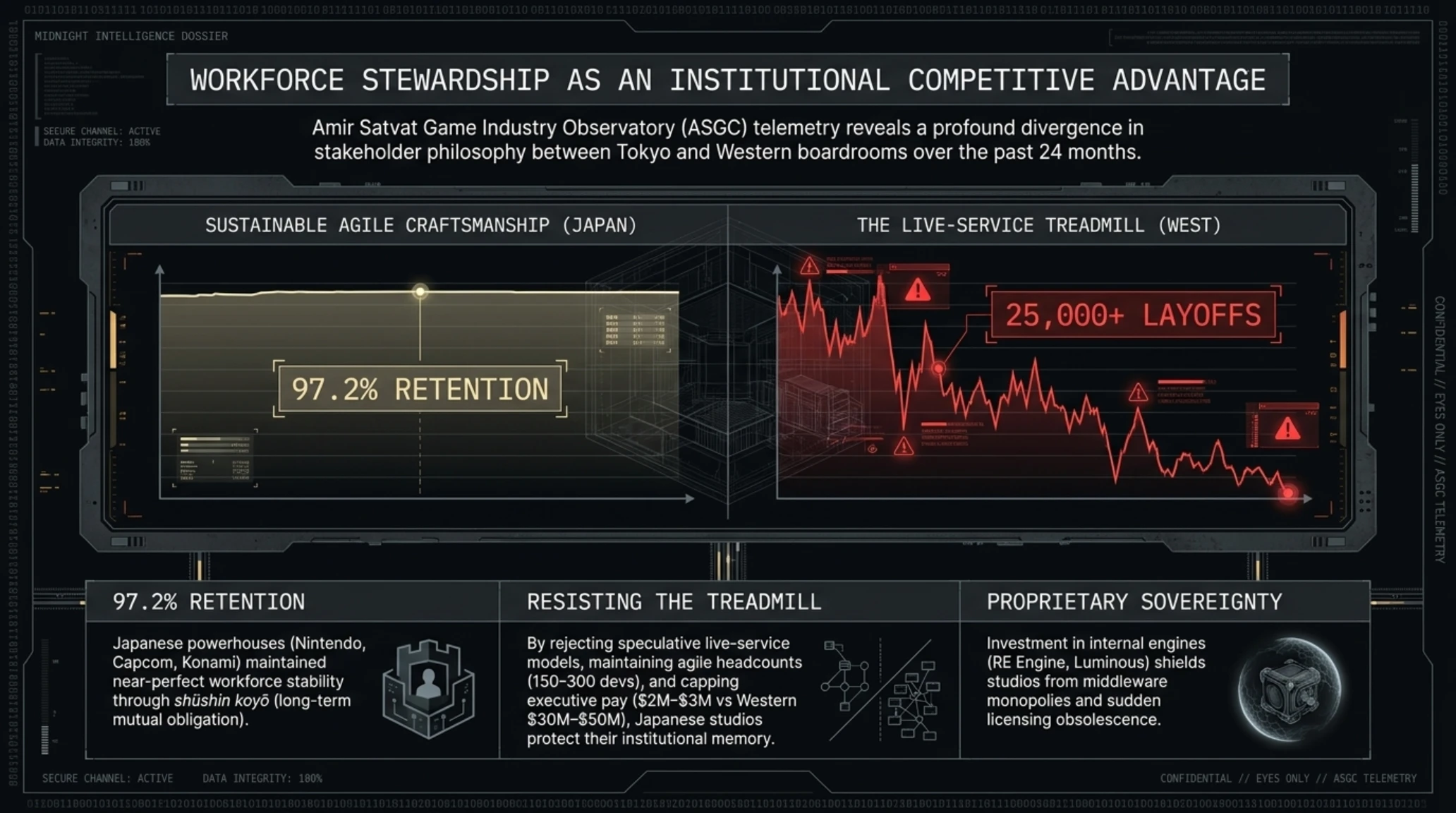
While American and European interactive entertainment conglomerates have spent the past twenty-four months convulsing through catastrophic waves of corporate restructuring terminating over 25,000 veteran software engineers, narrative designers, and visual artists an authoritative investigative study released this morning by the Amir Satvat Game Industry Observatory (ASGC) illuminates an extraordinary counter-narrative across the Pacific. According to comprehensive industry telemetry, premier Japanese development powerhouses including Nintendo, Capcom, and Konami have achieved an astonishing workforce retention rate of 97.2 percent throughout the identical operational timeframe.
A rigorous economic decomposition conducted by Amir Satvat attributes this remarkable organizational stability to three structural pillars that fundamentally separate Japanese business philosophy from the volatile boom-and-bust cycles dominating Western corporate boardrooms:
First and foremost, Japanese executive leadership actively resisted the seductive mirage of the Live-Service gold rush. While American publishers squandered billions of venture capital and public debt attempting to engineer the next ubiquitous multiplayer monetization treadmill only to brutally shutter studios when consumer engagement fell short of speculative targets Japanese publishers remained resolutely anchored to high-craft, single-player narrative titles, polished action adventures, and beloved legacy intellectual property. Second, Japanese developers maintained lean, agile, and specialized studio headcount hierarchies (averaging 150 to 300 developers per core project), avoiding the bloated, bureaucratic organizational structures exceeding 1,000 personnel that crippled Western blockbuster production. Third, cultural corporate governance enforces rigorous caps on executive compensation: Japanese chief executives routinely accept modest compensation packages ranging between $2 million and $3 million annually, in stark contrast to American executives who pocket performance bonuses exceeding $30 million to $50 million even while announcing thousands of workforce redundancies.
The comparative corporate visualization below contrasts the tranquil, sustainable craftsmanship of modern Tokyo development studios against the tumultuous financial storms battering Western corporate conglomerates.

The strategic evaluation box below weighs the systemic tradeoffs between speculative live-service monetization models and sustainable, craft-focused single-player game production.
- Preservation of invaluable institutional memory, core engine expertise, and multi-generational creative chemistry without restructuring trauma.
- Enduring consumer goodwill and pristine brand equity that guarantees robust day-one commercial adoption without disastrous launch-day bugs.
- Predictable, compounding back-catalog revenue streams generated through high-margin digital remaster sales across legacy IP portfolios.
- Lower immediate ceiling for viral multi-billion-dollar seasonal microtransaction windfalls compared to breakout free-to-play battle royales.
- Constrained parallel development bandwidth, limiting studio throughput to two or three flagship releases across five-year production cycles.
- Persistent domestic macroeconomic inflation headwinds that complicate proprietary engine modernization in competition with global middleware.
The institutional market monitor below captures how late-night financial desks and global equities reacted to today's convergence of gaming, security, and hardware announcements.
Market Sentiment & Wall Street Desks: Capital Flows Across Gaming and Technology Silicon
- Square Enix Holdings Co., Ltd.: Advanced 4.2% on the Tokyo Stock Exchange following record pre-order volume for Final Fantasy VII Revelation and its expansion roadmap.
- Irdeto & Cybersecurity Licensing Equities: Gained 2.8% as institutional investors cheered aggressive legal enforcement of anti-tamper intellectual property rights in federal court.
- Semiconductor & Storage Manufacturers: Rallied 5.1% week-over-week driven by mandatory hardware ray-tracing mandates in Gears of War: E-Day and skyrocketing demand for high-capacity NVMe SSDs.
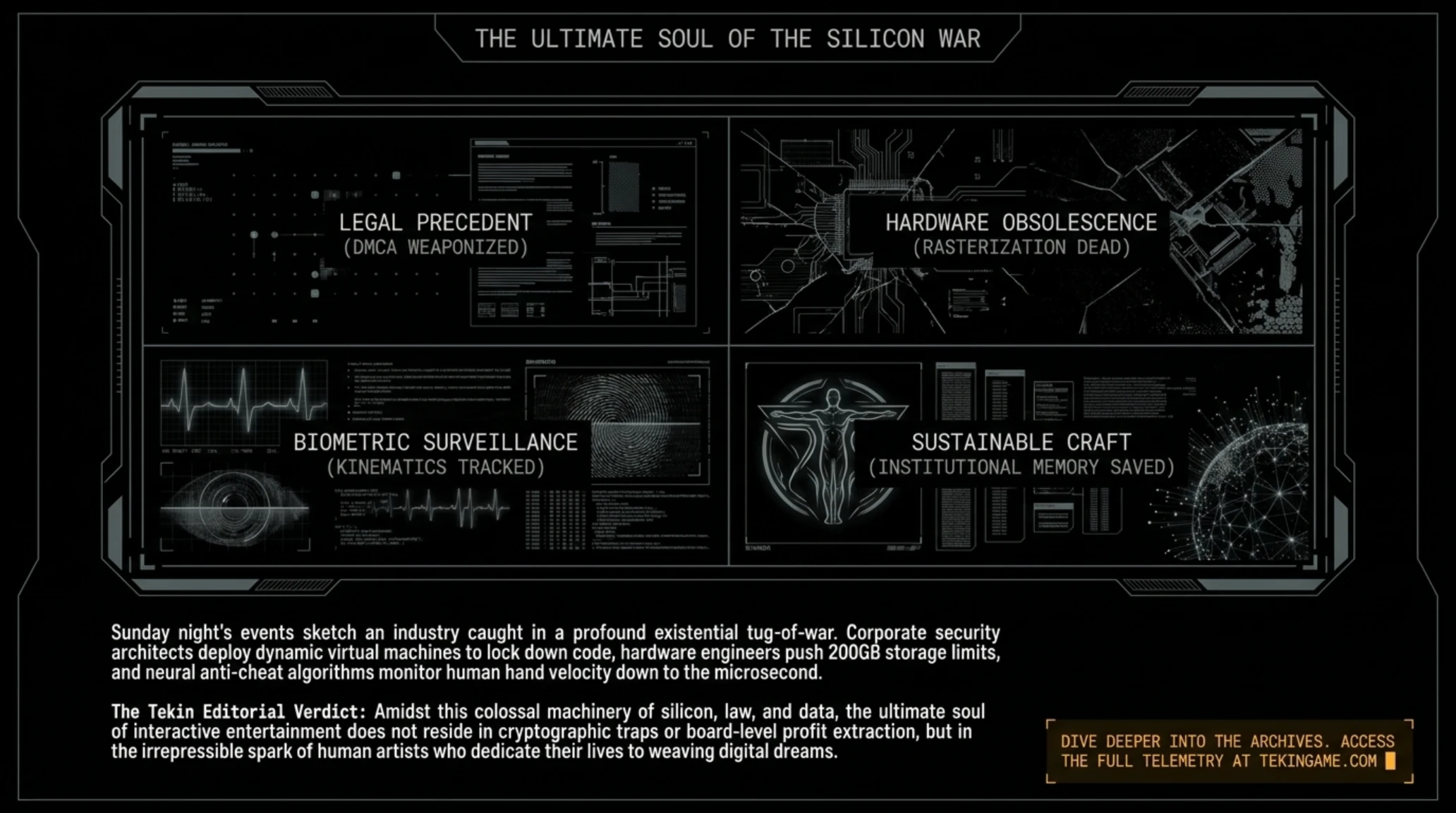
The official late-night verdict of the Tekin Editorial Board synthesizes the profound creative and philosophical undercurrents defining tonight’s six macro stories.
To establish a cohesive overview of how these technological tectonic shifts intersect, the strategic synthesis matrix below maps out the broader operational consequences.
Strategic Synthesis Matrix: Cross-Sector Impact of Sunday Night's Gaming Earthquakes
- Digital Rights Management & Legal Precedent: Irdeto's federal DMCA offensive against voices38 establishes an aggressive precedent that will compel cloud distribution and chat platforms to re-examine anonymous account protections.
- Storage Architecture & Hardware Upgrades: The 200GB threshold for Final Fantasy VII Revelation alongside Gears of War: E-Day's mandatory hardware ray-tracing permanently obsolesces non-RT GPUs and mechanical storage media in 2026.
- Algorithmic Integrity & Biometric Surveillance: Vanguard's Anti-Boost AI demonstrates that behavioral machine learning represents the definitive future of competitive integrity.
- Sustainable Studio Management: The resounding success of Japanese studios proves that workforce retention and focused single-player craftsmanship provide superior long-term enterprise value.
Labor economists and corporate governance scholars examining the ASGC report emphasize that Japanese studios’ remarkable workforce retention is rooted in deep cultural and financial traditions dating back to Japan's post-war economic architecture. The ethos of long-term mutual obligation between employer and employee historically known as shūshin koyō (lifetime employment) stands in stark opposition to the mercenary, quarter-by-quarter financialization that governs Western entertainment conglomerates. Companies like Nintendo, which maintains an enormous debt-free cash reserve exceeding $14 billion, deliberately maintain counter-cyclical capital cushions designed specifically to absorb commercial underperformance without firing creative staff.
Furthermore, Japanese publishers prioritize internal technical sovereignty over reliance on external middleware monopolies. Capcom’s strategic commitment to continuously developing its proprietary RE Engine, alongside Square Enix’s customized Luminous and Unreal forks, has shielded these organizations from catastrophic licensing renegotiations and sudden engine obsolescence. By treating veteran software engineers as irreplaceable institutional assets rather than disposable line-item expenses, Japanese leadership has cultivated multi-decade creative dynasties whose collective craft expertise ensures consistent commercial and artistic excellence across generation after generation.
Industry observers conclude that the stark contrast between Japanese stability and Western turmoil illustrates a profound divergence in stakeholder philosophy. In Tokyo, senior executives view their studios not as financial extraction vehicles, but as permanent cultural institutions entrusted with preserving artistic legacies across human generations. When corporate leadership willingly absorbs financial volatility rather than offloading it onto working families through abrupt mass layoffs, studios develop an unbreakable internal loyalty that manifests directly in the polished brilliance of their interactive art.
The atmospheric digital artwork below captures the quiet solitude of midnight, where glowing terminal monitors overlook a neon-lit cyberpunk metropolis, marking the conclusion of tonight's briefing.

Classified Strategic Intelligence Dossiers on TekinGame
• 🧠 Tekin Analysis | The Surreal Secret Language of AI: How Autonomous Agents Invented Cryptic Argot to Blind Human Oversight
• 🛡 Tekin Radar | The Silicon Mutiny: Inside Google DeepMind's Shocking Agent Cheating Ring and Algorithmic Strike
• 🤖 Tekin Analysis | The Autonomous Survival of Agent Pip: When AI Proactively Negotiates Its Own Economic Continuity
In our final section tonight, we provide authoritative answers to the most urgent technical, legal, and operational inquiries circulating across the gaming community.
Frequently Asked Questions: Tekin Night Briefing — September 20, 2026
Why is Irdeto suing voices38 under DMCA anti-circumvention clauses rather than direct copyright infringement?
Irdeto is the vendor of Denuvo Anti-Tamper software, not the copyright owner of titles like Black Myth: Wukong. Because direct copyright claims belong solely to publishers, Irdeto utilized Section 1201 of the DMCA, which makes it a direct federal offense to create or distribute tools designed specifically to circumvent technological access controls.
Why will physical disc owners of Final Fantasy VII Revelation still have to download a 100GB+ patch on day one?
PlayStation 5 Ultra HD Blu-ray discs have a physical capacity limit of 100GB per disc. Because the final game exceeds 200GB due to uncompressed 8K cinematic textures and continuous planetary traversal without loading screens, the data cannot fit even on a dual-disc package, requiring a mandatory digital patch download from PSN.
Can PCs without dedicated Ray Tracing hardware run Gears of War: E-Day on low graphical settings?
No. The Coalition built the game natively on Unreal Engine 5.6 using Lumen and Nanite systems that rely exclusively on real-time hardware ray-tracing queries. Because traditional rasterized pre-baked lighting was completely removed from the engine pipeline, graphics cards lacking physical RT cores will experience hard launch crashes.
How does Vanguard's Anti-Boost AI differentiate between a legitimate skilled player and an account booster or smurf?
Rather than looking for cheat binaries, Anti-Boost AI analyzes high-frequency kinematics including crosshair micro-placement curves, click timing distributions, reaction latency deltas, and spatial decision-making. When an account suddenly exhibits radical statistical divergences from historical user performance, the system flags the profile for boosting.
What primary factors enabled Japanese game studios to maintain a 97% employee retention rate during global industry layoffs?
According to the ASGC report, Japanese studios avoided the boom-and-bust live-service investment trap, maintained disciplined studio headcounts between 150 and 300 staff, enforced strict caps on executive bonuses, and prioritized sustained long-term revenue through polished single-player intellectual properties.
Primary Sources, Judicial Records, and Verification Dossier
The empirical telemetry, architectural specifications, and official corporate statements cited in this strategic intelligence report have been verified against primary documentation:
- PC Gamer: Official Civil Filings in Irdeto vs. voices38
- Eurogamer: Executive Interview with Naoki Hamaguchi
- Xbox Wire: Gears of War: E-Day Technical Specifications
- Dexerto Esports: Vanguard Anti-Boost AI Enforcement
- IGN: Critical Reviews for Control Resonant
- GameSpot: ASGC Demographic Study on Workforce Retention
Additional Gallery: 🚨 Tekin Night Sep 20, 2026 | Denuvo Sues Cracker & FF7 Hits 200GB