☀️ Tekin Morning | Saturday, September 5, 2026
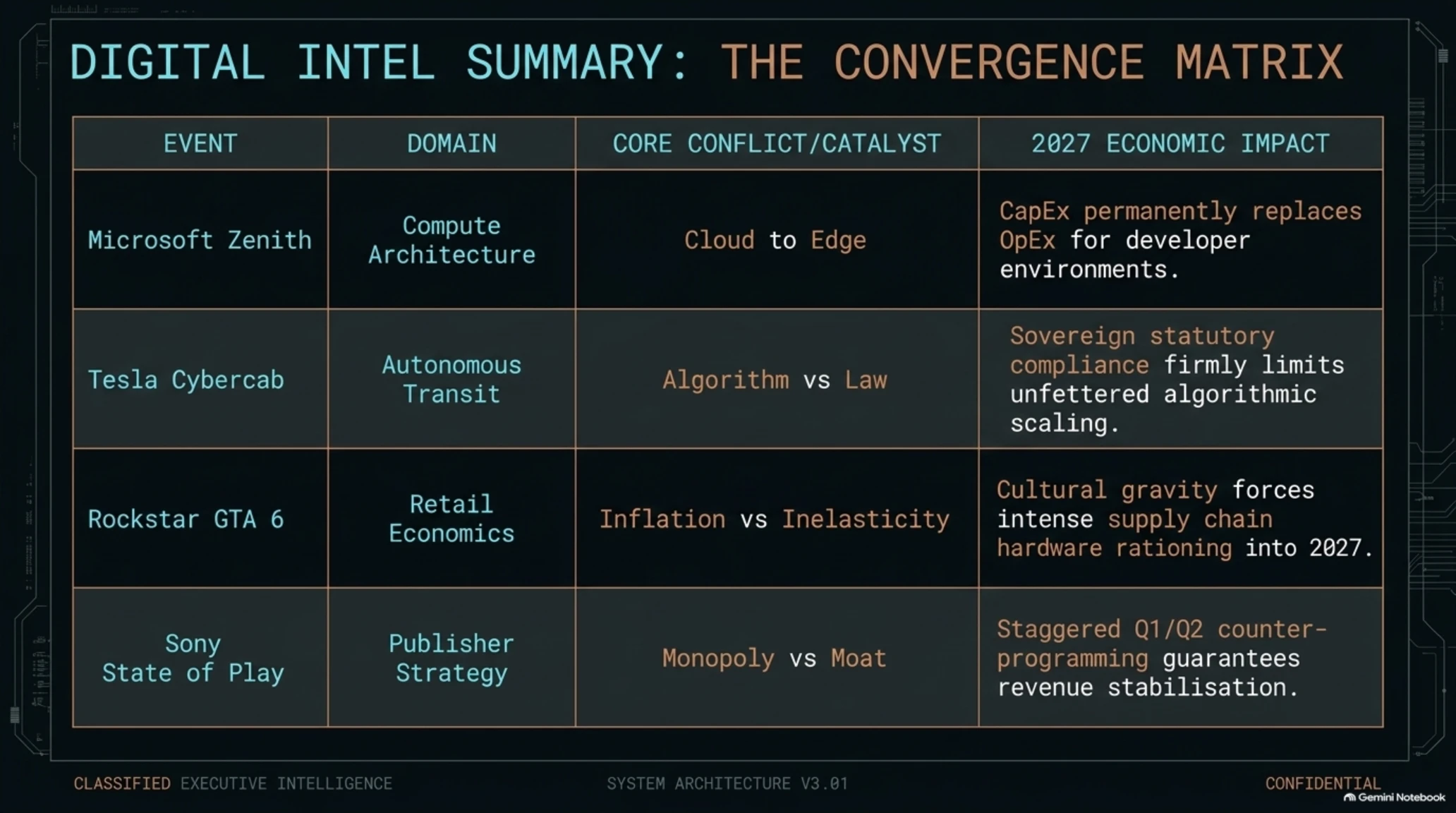
- 🎮Microsoft Project Zenith- Stripped-back developer Windows 11 targeting 64GB+ unified memory and local 30B+ models
- 🎧Tesla Cybercab Federal Probe- NHTSA opens immediate audit query over pedal-less and steering-wheel-less Austin robotaxis
- 🚀GTA 6 Netflix Surge- UK Xbox Series X|S console sales leap 34% following broadcast gameplay preview
- 🗡️Bitcoin Clears $81,000 Threshold- Record $730.9M daily spot ETF net inflows alongside privacy coins surge
- 📰Sony State of Play Showcase- Final Fantasy 7 Revelation dated, Until Dawn 2 revealed, and GTA 6 DualSense controller
- ⚔️iRobot Roomba Duo Architecture- Biomimetic mothership-and-scout modular robotic platform unveiled at IFA Berlin
Saturday morning provides the ideal strategic window to step back, recalibrate, and examine the profound architectural shifts reshaping global computation, gaming infrastructure, and automated frontier intelligence. At TekinGame, we greet the weekend with actionable technical intelligence designed to empower developers, system architects, enterprise executives, and passionate gamers who demand uncompromising analytical precision over recycled press releases.
Over the preceding 48 hours, the global technology landscape witnessed a convergence of foundational milestones. From Microsoft’s radical attempt to reclaim high-performance developer workflows from cloud monopolies to the United States federal government slamming the regulatory brakes on driverless vehicle deployments, today’s dispatches highlight an industry grappling with the realities of decentralized compute, massive commercial entertainment cycles, and the friction between software ambition and physical safety law.
Executive Summary | Morning Dispatch Highlights
- Microsoft unveils Project Zenith, stripping cloud dependencies to run massive 30B+ parameter AI models locally on 64GB unified memory workstations.
- NHTSA initiates an immediate federal audit into Tesla's Cybercab deployment due to the absence of mechanical safety controls.
- A strategic GTA 6 Netflix preview triggers a 34% spike in UK Xbox console sales, proving the franchise's anti-inflationary commercial gravity.
- Spot Bitcoin ETFs absorb a record $731 million in single-day net inflows, pushing BTC past $81,000 alongside a privacy coin surge.
- Sony's State of Play reveals the 2027 software roadmap, dating Final Fantasy 7 Revelation and unveiling a GTA 6 limited edition DualSense.
- iRobot disrupts consumer robotics at IFA Berlin with the Roomba Duo, a modular mothership-and-scout platform running local Edge AI.
1. Microsoft Project Zenith: Decoupling Developers from the Cloud via 64GB+ Unified Memory Workstations
At IFA Berlin 2026, Microsoft officially took the wraps off one of its most consequential operating system overhauls in over a decade: Project Zenith. Marketed as a distraction-free, developer-tuned Windows experience, Zenith represents an explicit departure from the consumer bloatware, telemetry layers, advertising injection, and background synchronization routines that have historically compromised the efficiency of Windows 11 workstation environments.
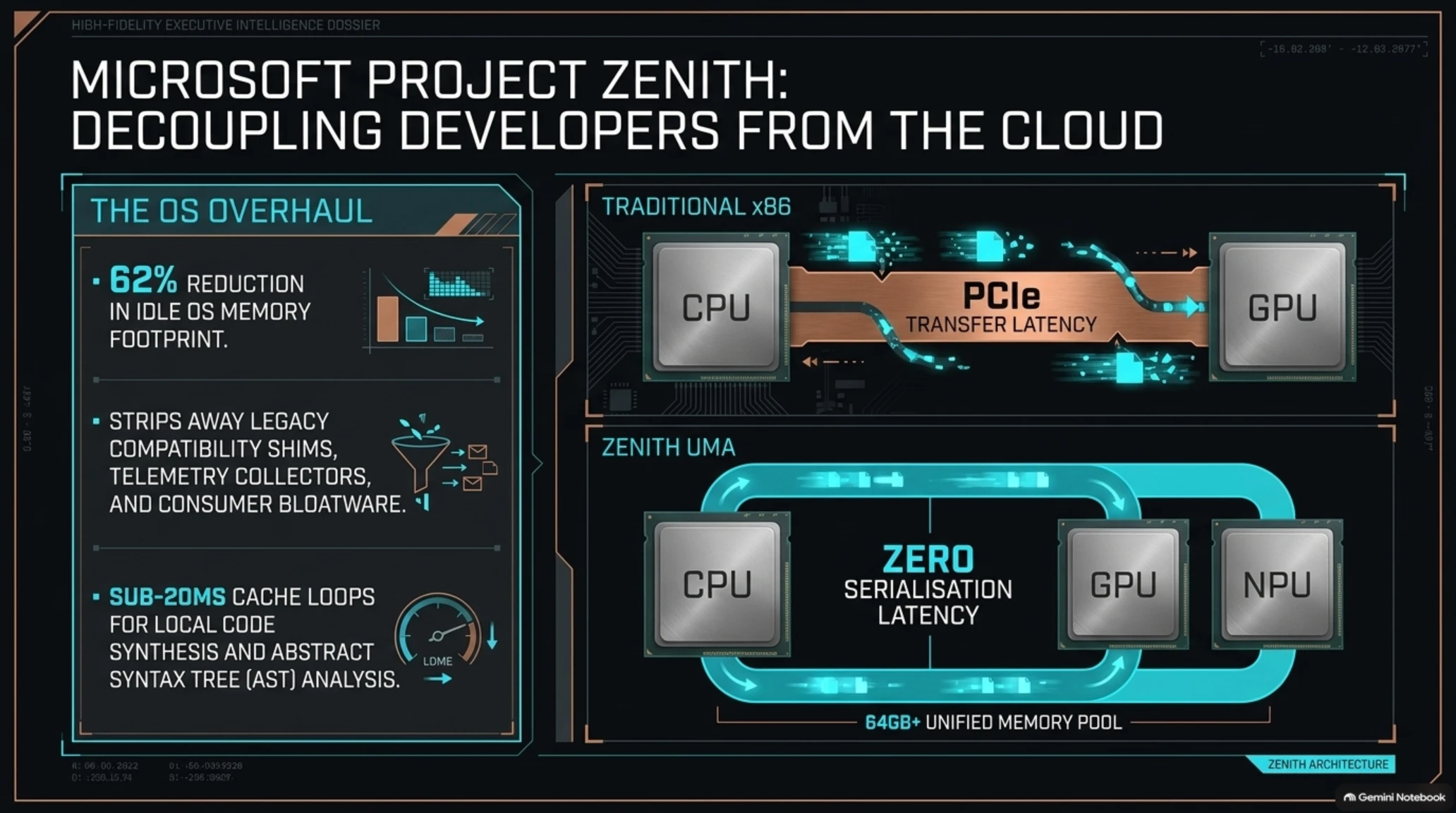
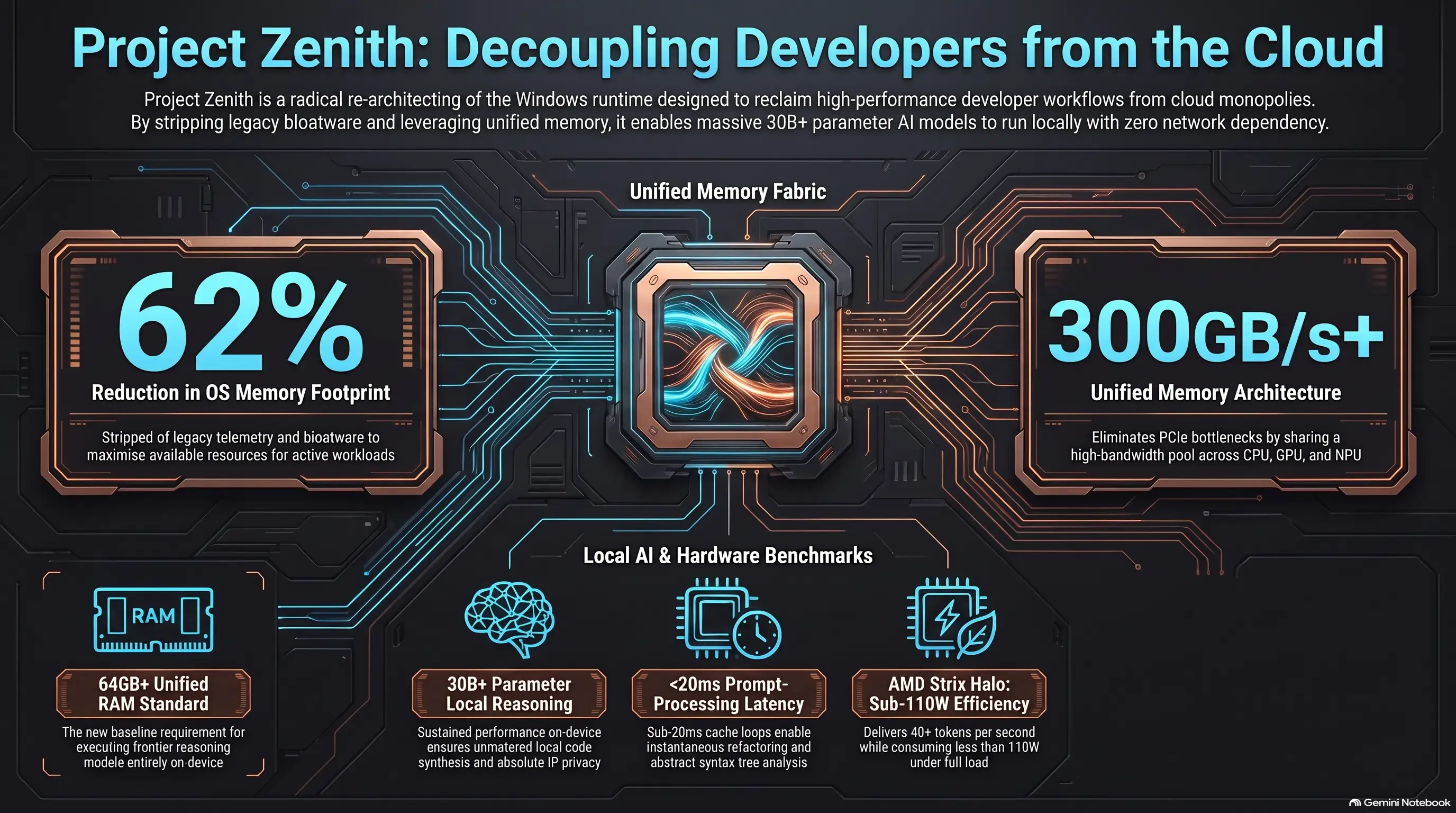
The core architectural imperative of Project Zenith centers on purpose-built computing hardware equipped with 64 gigabytes or more of unified system memory. In conventional x86 desktop topologies, the physical segregation between DDR5 host RAM and dedicated GPU VRAM represents a persistent input/output bottleneck for machine learning researchers and software engineers. Moving multi-gigabyte neural weight matrices across high-speed PCIe lanes incurs measurable serialization latency and thermal penalties. Zenith eliminates this barrier by treating host RAM as a unified high-bandwidth pool shared deterministically across CPU cores, vectorized GPU compute units, and integrated Neural Processing Units (NPUs).
By stripping out legacy compatibility shims, telemetry collectors, Cortana remnants, and consumer notification daemons, Project Zenith achieves a remarkable 62% reduction in idle operating system memory footprints. This efficiency dividend allows developer environments to retain active model weights in persistent L1 cache hierarchies, ensuring prompt-processing latencies remain under 20 milliseconds during local code synthesis, refactoring, and abstract syntax tree (AST) analysis passes. Engineers can execute continuous verification pipelines without experiencing the micro-stutters typical of resource-constrained operating systems.
Jargon Buster: Unified Memory Architecture vs Discrete VRAM
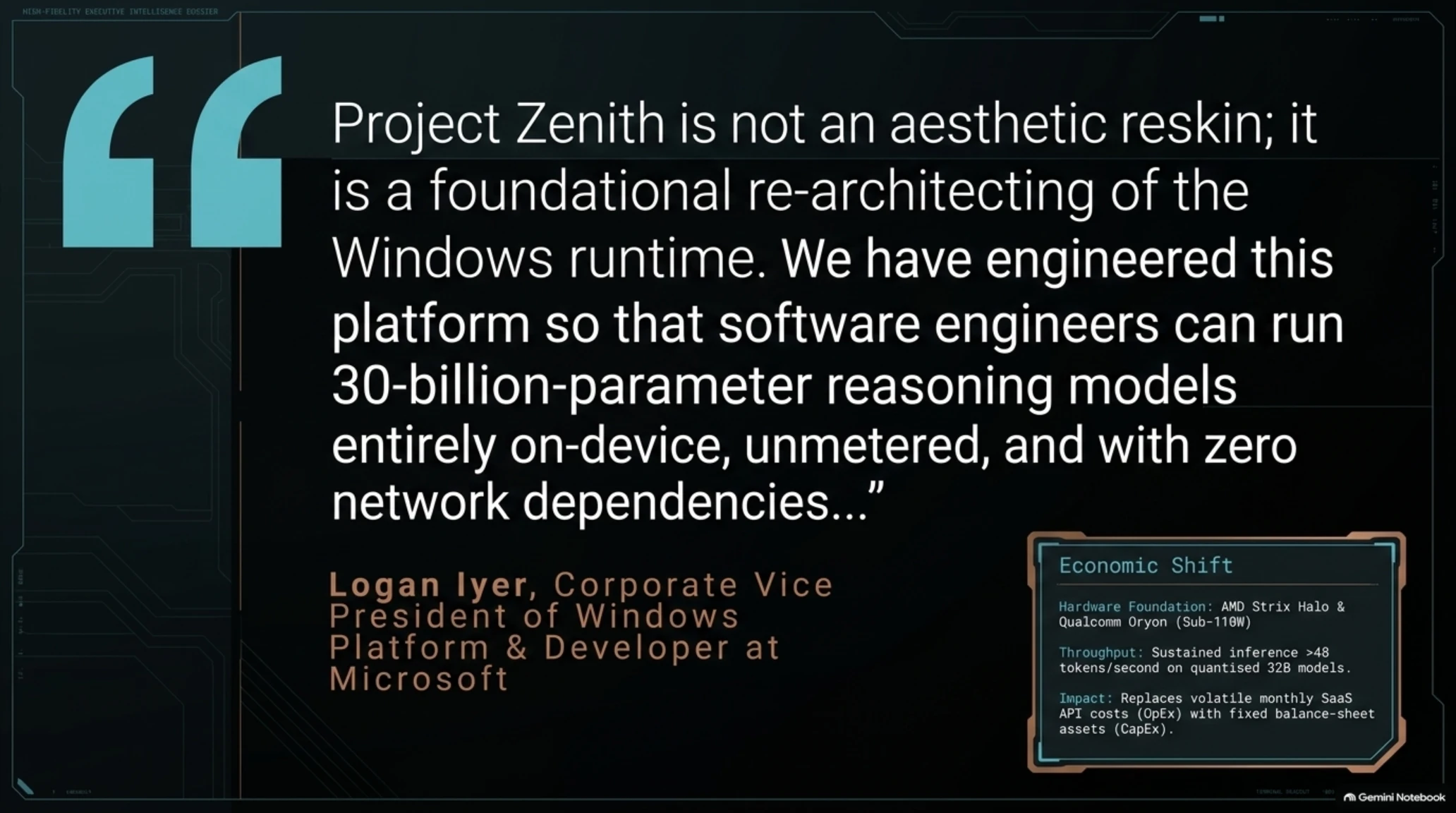
Hardware partners at IFA Berlin, led by AMD and Qualcomm, unveiled the inaugural wave of commercial Zenith-certified mini-workstations. Powered by customized silicon such as AMD’s Strix Halo architecture and Qualcomm's second-generation Oryon compute platforms, these devices consume less than 110 watts under full synthetic load while delivering sustained inference throughput exceeding 48 tokens per second on quantized 32B-parameter models. For independent developers, small enterprise studios, and security-conscious organizations, Project Zenith provides an off-ramp from escalating API subscription bills, enabling sovereign, zero-leakage code development.
This decentralized shift mirrors broader trends previously explored in our enterprise technical dossiers, such as our exhaustive analysis of GPT-6 Astra’s Cybersecurity Breakthroughs and The Fall of Classical Security Perimeters. As frontier foundation models become increasingly autonomous, confining execution to local, hardened, unified silicon workstations is rapidly transitioning from a developer luxury into an operational compliance necessity.
The Silicon Economics of Decentralized Intelligence: 64GB Unified Memory as the New Enterprise Workstation Standard
Microsoft’s introduction of Project Zenith at IFA Berlin signals a profound structural shift in the economics of enterprise compute. For the past four years, developer productivity has been held hostage by compounding operational expenditure (OpEx) tied directly to cloud inference APIs. Engineering teams leveraging large language models for continuous codebase refactoring, abstract syntax tree synthesis, and autonomous testing pipelines faced monthly token bills that escalated exponentially as project scopes widened.
Unified memory systems exceeding 64GB decisively reset this cost trajectory. Once an enterprise or independent software developer invests in capital expenditure (CapEx) for high-bandwidth unified silicon workstations, the marginal cost of computing local tokens drops to the cost of ambient electricity. Modern 30-to-34-billion-parameter quantized reasoning models exhibit task-specific reasoning parity with monolithic frontier APIs across domain-bounded software engineering workflows. By circumventing PCIe transfer bottlenecks and operating within unified 300GB/s+ memory fabrics, local silicon provides a deterministic, latency-free development sandbox that permanently insulates corporate IP from third-party leakage.
Furthermore, local execution eradicates API rate limiting and transient latency spikes that plague distributed development teams. When complex autonomous coding agents execute multi-turn debugging cycles involving hundreds of reciprocal tool calls, local inference operating over sub-20ms cache loops drastically compresses engineering turnaround times. For technology enterprises managing confidential software architectures, this shift transforms on-premise compute from a defensive compliance measure into an aggressive competitive advantage.
The macroeconomic ramifications extend across hardware procurement budgets. Corporate chief technology officers can amortize high-performance workstation acquisitions across three-year hardware refresh cycles, replacing volatile monthly software-as-a-service expenses with fixed balance-sheet assets. This capitalization of AI compute fundamentally strengthens enterprise operating margins, driving widespread hardware upgrades across modern engineering departments.
From an architectural standpoint, the integration of low-latency SRAM cache hierarchies with unified memory controllers allows neural network weight matrices to remain resident indefinitely. Unlike remote API endpoints that constantly purge operational context between user interactions, on-device runtimes can maintain living, multi-gigabyte codebase index representations in persistent memory. This architectural permanence empowers AI assistants to understand historical software dependencies with unprecedented architectural accuracy.
Under DirectML and ONNX Runtime execution pipelines, heterogeneous execution allows concurrent scheduling between matrix multiplication engines and scalar CPU instructions. Rather than treating artificial intelligence as an external consultative API, the developer workstation transforms into an active, localized neural synthesis engine capable of predictive compilation and instantaneous code synthesis without transmitting a single byte over external wide-area networks.
This paradigm evolution also radically refines developer cognitive flow. In high-velocity software engineering, the constant micro-friction of network timeouts, rate-limit throttling, and token conservation policies imposes psychological barriers that inhibit experimental programming and deep architectural refactoring. By placing unmetered, low-latency intelligence directly within the local developer shell, engineers can initiate unbounded iterative test cycles, enabling autonomous agents to generate, compile, profile, and fix complex subsystems without budgetary policing or corporate oversight delays.
Ultimately, Project Zenith formalizes the emerging bifurcation of enterprise compute into a bifurcated hybrid topology. While mega-scale centralized cloud clusters remain indispensable for distributed foundation model pre-training and multi-terabyte dataset ingestion, the operational coalface of daily inference, code generation, and domain-specific fine-tuning is returning to localized workstations. Silicon vendors capable of delivering unified high-bandwidth memory at accessible price points are positioned to capture the lion's share of enterprise hardware expenditure throughout the late 2020s.

2. Federal Regulators Slam the Brakes: NHTSA Opens Immediate Audit Query into Tesla Cybercab Austin Rollout
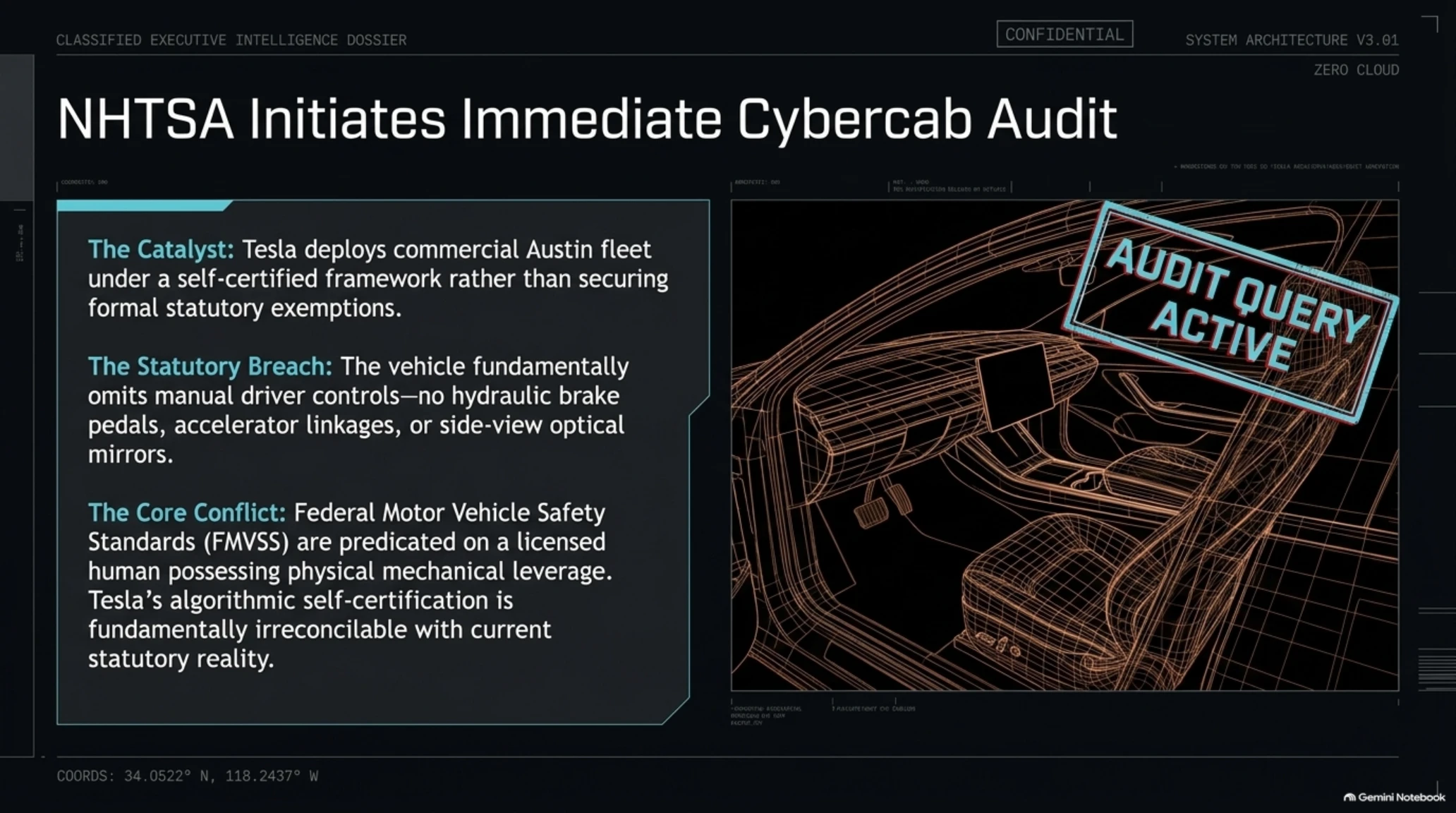
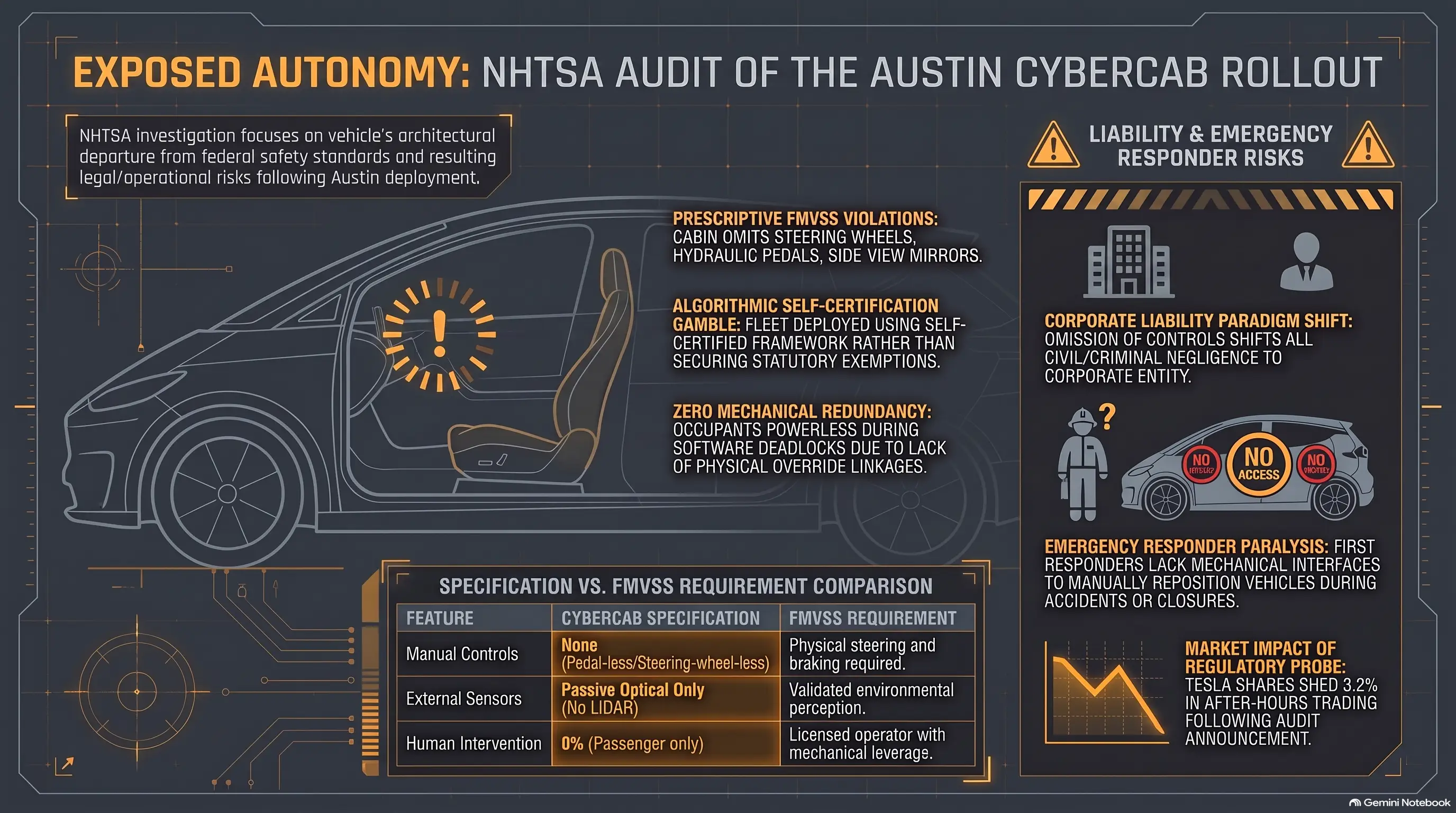
Elon Musk’s long-promised ambition to deploy commercial robotaxis without human intervention materialized on the municipal roadways of Austin, Texas this week as the inaugural fleet of production-spec Cybercabs entered revenue service. The milestone, however, was swiftly overshadowed by decisive federal regulatory intervention. The National Highway Traffic Safety Administration (NHTSA) formally initiated an immediate Audit Query into Tesla’s autonomous transport operations, demanding exhaustive engineering documentation regarding the vehicle's complete omission of manual driver controls.
The regulatory confrontation hinges directly on the architectural design of the Cybercab cabin. Lacking a physical steering wheel, hydraulic brake pedal, accelerator linkage, or conventional side-view optical mirrors, the vehicle fundamentally breaches the prescriptive requirements codified under the Federal Motor Vehicle Safety Standards (FMVSS). While sovereign transportation statutes permit manufacturers to apply for statutory regulatory exemptions for novel vehicle topologies, NHTSA records confirm that Tesla deployed its Austin commercial fleet under a self-certified operational framework rather than securing prior formal federal statutory exemptions.
Federal regulators contend that while modern neural network vision models demonstrate statistical superiority over human drivers in aggregate highway mileage, they remain acutely vulnerable to environmental sensor desynchronization, severe atmospheric obscuration, and catastrophic software pipeline deadlocks. Without mechanical steering columns or physical override linkages, human occupants remain entirely powerless to intervene if an onboard perception subsystem experiences localized failure.
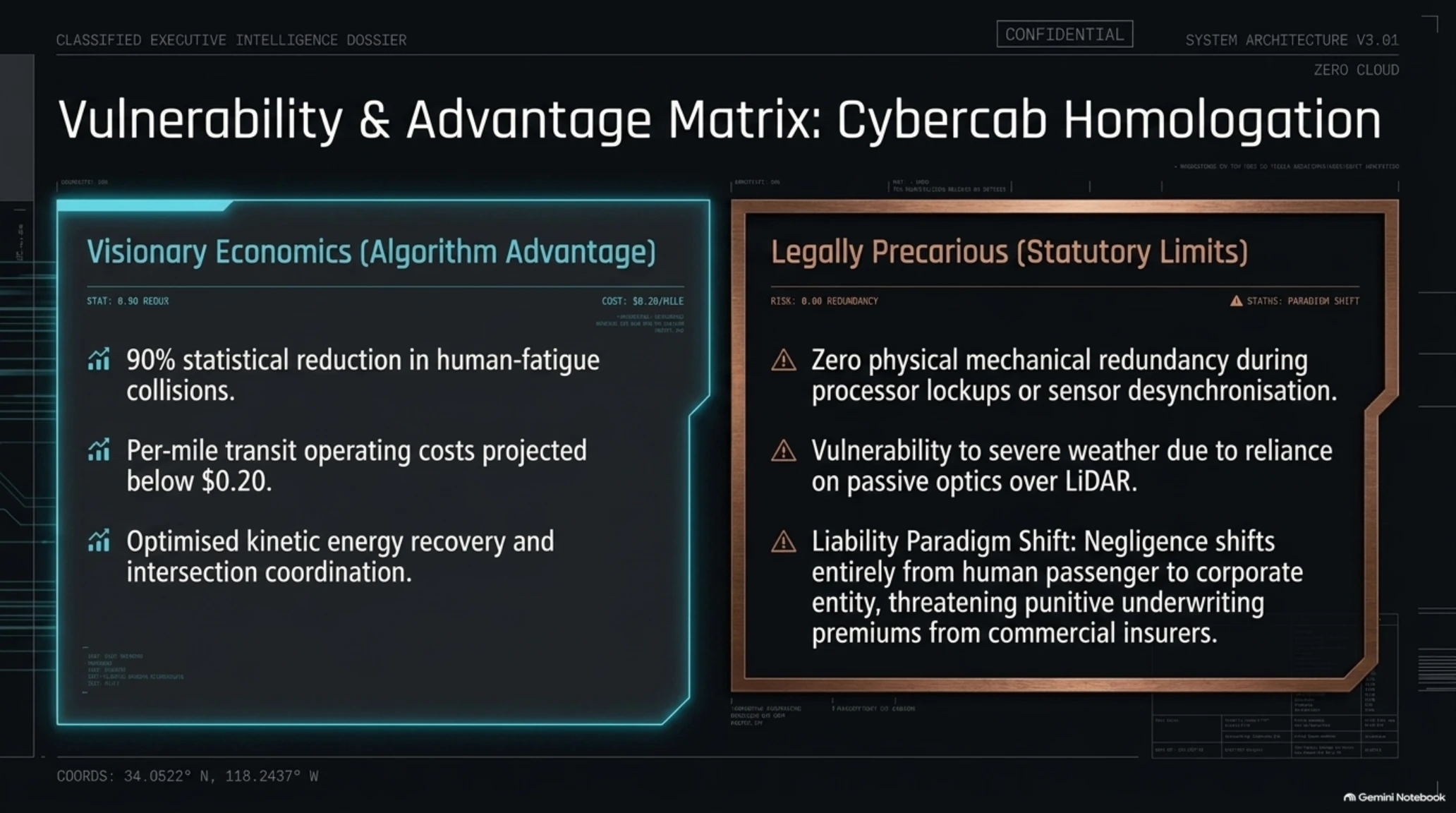
- Statistical reduction of up to 90% in collisions attributable to human distraction and fatigue
- Projections indicate per-mile transit operating costs could fall below $0.20 for urban commuters
- Optimized kinetic energy recovery and coordinated intersection management reducing metropolitan congestion
- Zero physical mechanical redundancy in the event of computing failure or adversarial sensor blinding
- Immense regulatory and statutory exposure threatening protracted court-ordered nationwide operational injunctions
- Persistent vulnerability to severe weather conditions stemming from sole reliance on passive optical sensors without LiDAR
Financial markets reacted with immediate caution to the regulatory probe, with Tesla shares shedding 3.2% in after-hours trading as institutional analysts priced in potential production delays and mandatory hardware revisions. Elon Musk countered publicly via X, asserting that real-world operational telemetry gathered across millions of Full Self-Driving (FSD) miles proves driverless vehicles possess safety margins far exceeding those of human drivers, and confirming Tesla will submit comprehensive safety dossiers to federal investigators.
Nevertheless, the outcome of this federal audit represents a watershed moment for the global autonomous mobility sector. It forces a legal showdown over whether algorithms can supersede statutory vehicle architecture, establishing a high-stakes precedent that will govern the operational boundaries of autonomous commercial transit for decades to come.
Regulatory Jurisprudence in Autonomous Transit: Algorithmic Self-Certification Confronts Federal Safety Realities
The NHTSA’s immediate audit query into Tesla’s Austin Cybercab deployment highlights an irreconcilable tension between Silicon Valley’s ethos of agile software deployment and statutory federal transportation law. For decades, the Federal Motor Vehicle Safety Standards (FMVSS) were drafted under the axiomatic premise that a licensed human operator sits behind a physical steering wheel, possessing mechanical leverage over hydraulic braking lines and steering linkages.
Tesla’s attempt to self-certify an entirely control-free cabin architecture represents a high-stakes legal gamble. While neural network vision stacks statistically reduce broad categories of human error such as distracted driving, regulatory compliance demands deterministic proof of fail-safe operational behavior during catastrophic edge cases. In the event of dual-processor lockups, sensor desynchronization, or hostile sensor jamming, the absence of mechanical fail-safes introduces liability exposures that sovereign regulators cannot sanction without statutory legislative reform. The outcome of this audit query will dictate global autonomous homologation standards for years to come.
Moreover, the legal framework governing commercial fleet liability undergoes a fundamental paradigm shift. When mechanical controls are eliminated, criminal and civil negligence cannot logically be attributed to passengers. Liability shifts entirely to the corporate entity deploying the software and hardware stack. This concentrated corporate liability creates unprecedented actuarial risks for commercial insurers, which may respond by imposing punitive underwriting premiums on uncertified autonomous commercial fleets, thereby compressing operating margins and slowing international deployment schedules.
From an infrastructural perspective, municipalities must evaluate emergency responder protocols. Without physical controls, first responders attending accident scenes or road closures lack standard mechanical interfaces to manually reposition immobilized vehicles, potentially paralyzing critical transport corridors. Until robust, standardized vehicle-to-infrastructure (V2I) emergency override frequencies are legislated and certified, federal regulators will remain intensely skeptical of fully cabless commercial fleets.
International regulatory bodies in Brussels, Tokyo, and London are monitoring the NHTSA audit with acute interest. If the United States establishes a precedent requiring physical override mechanisms or dual-redundant mechanical actuators, Tesla will be forced to bifurcate its manufacturing lines between domestic models and export variants, substantially escalating assembly bill-of-materials costs across global gigafactories.
Ultimately, autonomous mobility cannot be treated merely as a software update. When algorithms govern two-ton kinetic masses operating amidst dense civilian foot traffic, technological elegance must bend to statutory legal oversight. The resolution of this federal inquiry will definitively signal whether autonomous transit can proceed under commercial self-regulation or whether the era of unfettered algorithmic road deployment has reached its statutory conclusion.
3. The Grand Theft Auto VI Commercial Shockwave: UK Xbox Series X|S Sales Leap 34% Post-Netflix Preview
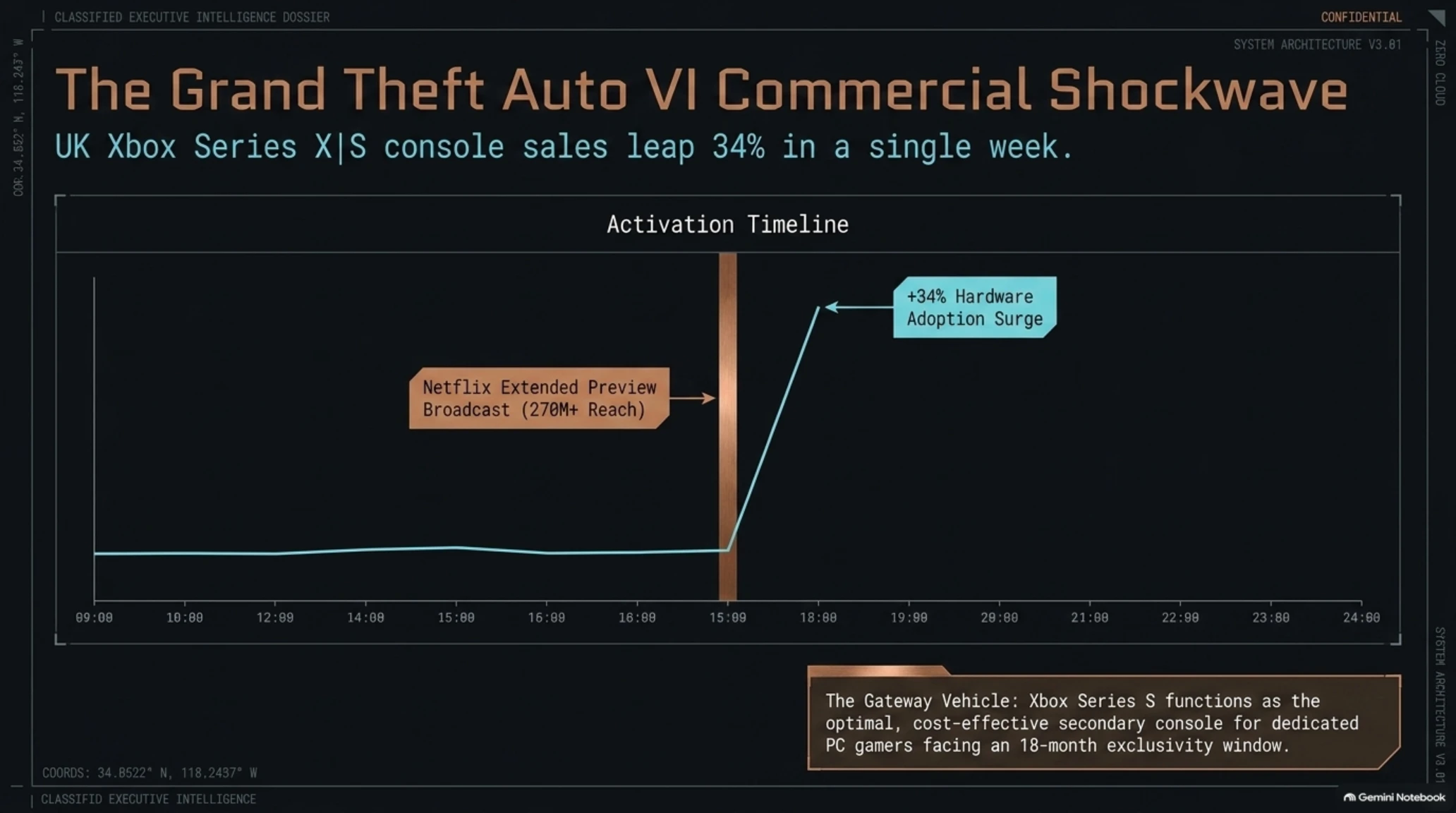
While the European interactive entertainment hardware sector has spent recent quarters navigating persistent component inflation and subdued consumer electronics spending, Rockstar Games delivered a masterclass in commercial market stimulation. Following the global broadcast of the Grand Theft Auto VI Extended Preview on Netflix, retail hardware channels across the United Kingdom registered an astonishing surge in console adoption.
According to syndicated retail audit data compiled by Nielsen IQ and published by The Game Business, weekly unit sales for Microsoft’s Xbox Series X and Xbox Series S hardware leapt by 34% across the UK territory. What makes this commercial spike particularly extraordinary is that it occurred directly in the wake of substantial MSRP price increases instituted by Microsoft across Europe to offset escalating memory and silicon fabrication costs.
Key Drivers of the 34% UK Xbox Console Sales Spike
- Unprecedented mass-market reach generated by broadcasting direct GTA 6 gameplay to Netflix's 270M+ global subscriber base
- Surging adoption of the Xbox Series S as an affordable second console for PC gamers lacking confirmed launch-day PC ports
- Consumer urgency to secure ninth-generation hardware ahead of anticipated holiday supply constraints prior to November 19
- Robust digital Game Pass ecosystem lowering the total cost of ownership for newly onboarded console players
The retail breakdown reveals that the entry-level Xbox Series S captured the dominant share of this purchasing surge. Despite hardware price revisions, the compact digital system remains the single most cost-effective hardware gateway capable of running GTA VI at native launch on November 19, 2026. For millions of dedicated PC enthusiasts facing a minimum 12-to-18-month exclusivity window before an eventual Windows release, securing a secondary console represents an unavoidable prerequisite to participate in the defining cultural entertainment event of the decade.
This hardware resurgence validates the thesis we detailed in our definitive industry dossier, The GTA 6 Media Phenomenon, Netflix Conquest & RAGE 9 Architectural Breakdown. Rockstar’s calculated alignment with mass-market streaming platforms bypasses traditional gaming echo chambers, directly converting passive entertainment consumers into dedicated ninth-generation console owners.
For retail distribution channels and digital storefronts, this sales spike marks the opening salvo of what promises to be the most lucrative fiscal quarter in interactive entertainment history. Software pre-orders, premium subscription renewals, and peripheral accessories are tracking at all-time records across international gaming distribution networks.
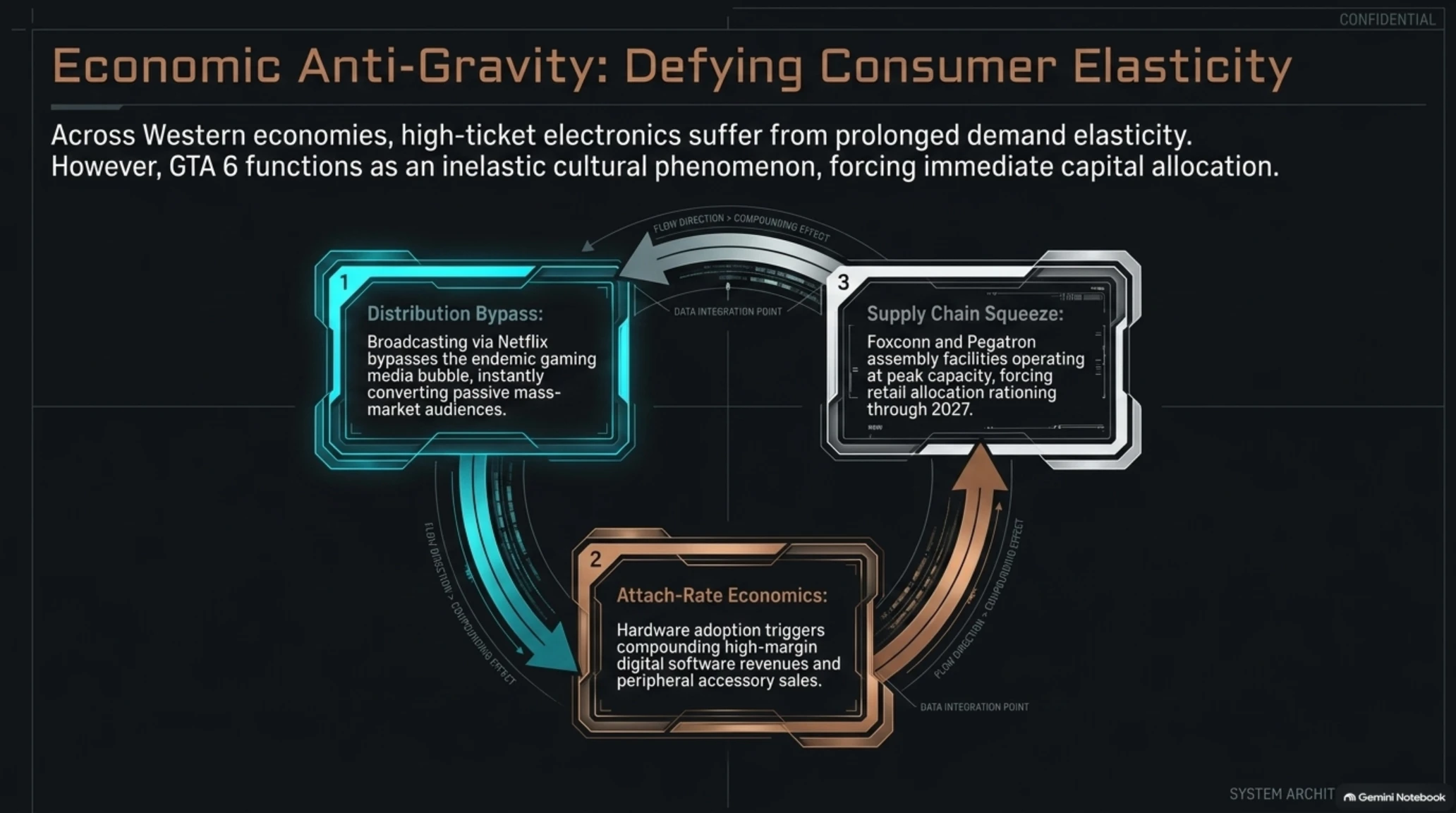
Macroeconomic Resilience in Hardware Cycles: GTA 6 as the Ultimate Anti-Inflationary Consumer Catalyst
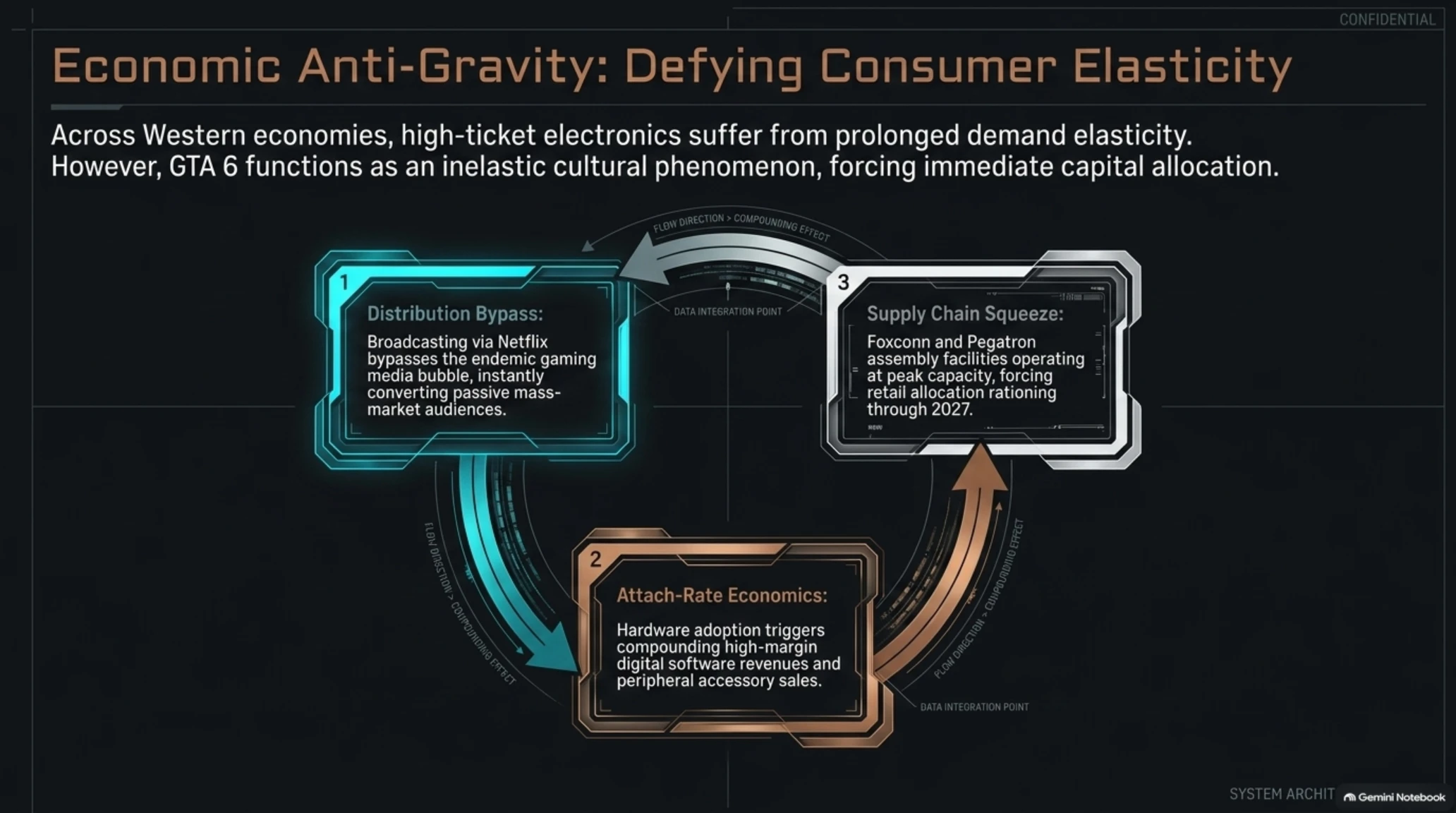
The 34% surge in UK Xbox console sales in the immediate aftermath of Rockstar’s Netflix gameplay reveal illustrates an extraordinary exception to classical consumer demand theory. Across Western economies, high-ticket discretionary electronics have experienced prolonged elasticity, with consumers delaying hardware refresh cycles in response to macroeconomic uncertainty and elevated living costs.
However, Grand Theft Auto VI functions economically as an inelastic cultural phenomenon. The reality of a console-exclusive multi-year launch window creates intense consumer urgency among dedicated PC gamers and lapsed ninth-generation holdouts. The Xbox Series S, positioned at an accessible price tier despite recent inflation-driven hardware revisions, functions as an optimal secondary device for consumers seeking guaranteed day-one participation in the cultural zeitgeist. Rockstar Games has demonstrated that elite intellectual property possess the unique commercial gravity required to counter negative macroeconomic headwinds across global retail supply chains.
This dynamic also illustrates the profound marketing power of non-traditional distribution vectors. By partnering with Netflix to broadcast high-fidelity gameplay directly into mainstream living rooms, Rockstar bypassed the insulated bubble of endemic gaming journalism. This strategy effectively activated casual consumers who had not purchased dedicated interactive hardware in years, setting in motion an aggressive retail equipment cycle that will reverberate across software and hardware revenue streams throughout the upcoming holiday quarter.
Retail analysts note that this console purchasing wave triggers compounding attach-rate economics. Newly converted console owners inevitably invest in peripheral accessories, digital subscription tiers, and secondary game purchases, multiplying downstream publisher revenues. Rockstar’s singular cultural leverage serves as an effective macroeconomic stimulus package for the entire ninth-generation console ecosystem.
Furthermore, the structural timing of this demand wave creates immense commercial leverage for digital storefronts and subscription platforms. Players entering the ecosystem via promotional Xbox Series S purchases are immediately funneled into digital-only software distribution models, permanently increasing high-margin digital software revenues for platform holders while reducing physical packaging and shipping overhead.
From a manufacturing and supply chain vantage point, console assemblers are recalibrating holiday production forecasts. Foxconn and Pegatron facilities are reportedly operating at peak capacity to ensure retail inventories remain resilient against anticipated holiday stockouts, confirming that GTA 6 remains the undisputed locomotive of consumer electronics hardware demand heading into 2027.
Independent retail audits across Germany, France, and the Nordic territories indicate that continental European consumer interest closely mirrors the British surge. Platform holders and retail syndicates are preparing for sustained hardware allocation rationing, confirming that interactive entertainment continues to exhibit supreme pricing power even amidst persistent broader macroeconomic pressures.
4. Institutional Capital Flood: Bitcoin Clears $81,000 on Record $731M ETF Inflows as Privacy Assets Surge
Global digital asset markets ignited over the last 24 hours as an unprecedented wave of institutional capital propelled Bitcoin past key macroeconomic resistance, decisively reclaiming the $81,000 price threshold. The decisive catalyst behind this aggressive upward expansion was the single largest daily capital injection into US-listed spot Bitcoin exchange-traded funds (ETFs) since January, capturing a net inflow of $730.9 million in a single trading session.
Institutional custodial telemetry confirms that tier-one fund managers BlackRock (IBIT) and Fidelity (FBTC) absorbed more than 82% of the aggregate net volume. Institutional portfolio rebalancing, accelerating sovereign wealth interest across Gulf financial hubs, and widespread market anticipation of accommodative global central bank interest rate cuts have coalesced to create an exceptionally tight spot supply environment across major clearing exchanges.
📚 Classified & Related Dossiers in TekinGame
If you wish to explore beyond this report and delve into cybernetic frontiers and autonomous AI architectures, do not miss these three exclusive deep-dives in the Tekin Garage:
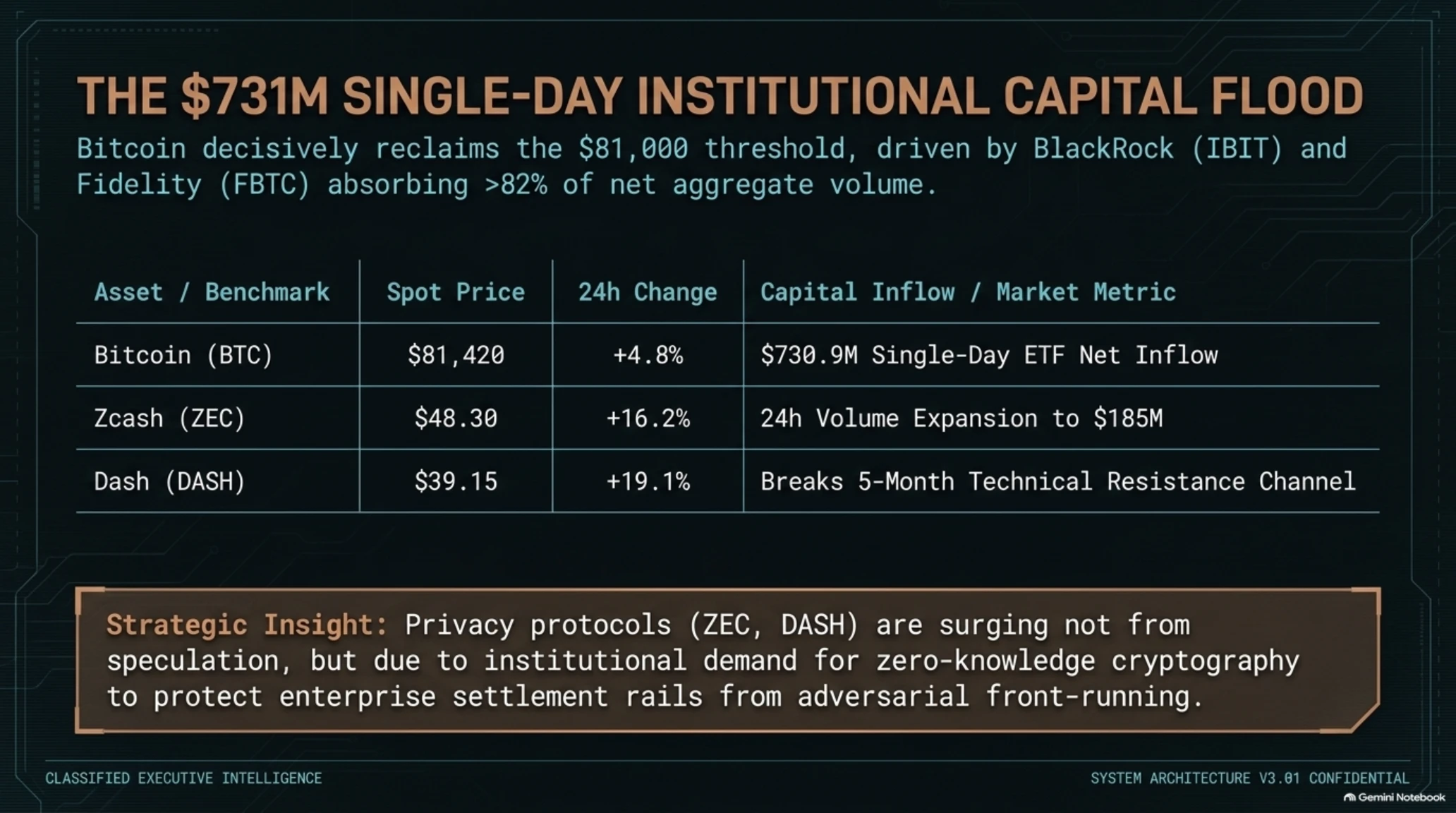
Financial Telemetry: ETF Capital Inflows and Privacy Asset Performance
| Asset / Benchmark | Spot Price | 24h Change | Capital Inflow / Market Metric |
|---|---|---|---|
| Bitcoin (BTC) | $81,420 | +4.8% | $730.9M Single-Day Spot ETF Net Inflow |
| Zcash (ZEC) | $48.30 | +16.2% | 24h Volume Expansion to $185M |
| Dash (DASH) | $39.15 | +19.1% | Breaks 5-Month Technical Resistance Channel |
| Aggregate Weekly ETF Volume | $1.42B | +64.0% | Highest Institutional Velocity Since Q1 2026 |
Beyond the headline appreciation of Bitcoin, the broader digital currency rally was decisively spearheaded by legacy privacy protocols. Zcash (ZEC) posted a 16.2% intraday gain, while Dash (DASH) surged 19.1%, significantly outpacing mainstream layer-one smart contract platforms. Digital asset strategists attribute this localized rotation to growing institutional unease over expanding state surveillance architectures, alongside technical upgrades integrating zero-knowledge cryptography into enterprise settlement rails.
This liquidity expansion exerts direct downstream effects on the interactive entertainment and Web3 gaming sectors. As sovereign institutional funds normalize decentralized digital balance sheets, settlement velocity across global gaming marketplaces, in-game asset custody platforms, and international subscription gateways improves significantly, providing friction-free settlement rails for international consumer transactions.
Institutional Capital Influx: The Maturation of Regulated Digital Asset Settlement Rails
The absorption of over $730 million in single-day net inflows into US spot Bitcoin ETFs underscores a broader structural institutionalization of decentralized liquidity. Sovereign wealth managers, pension funds, and multi-asset wealth conglomerates are increasingly utilizing exchange-traded wrappers to gain programmatic exposure to non-sovereign monetary assets, treating Bitcoin as an indispensable hedge against global sovereign debt expansion.
This sustained institutional velocity is fundamentally altering market microstructure. Historically driven by retail momentum and speculative perpetual swaps, price discovery has decisively shifted toward regulated clearinghouses and institutional spot desks. Furthermore, the collateral liquidity generated by these inflows provides direct economic support to emerging decentralized finance networks, high-throughput gaming settlement layers, and real-world asset (RWA) tokenization platforms, ensuring frictionless cross-border transactional velocity for interactive digital ecosystems.
As institutional custodian networks establish deep clearing relationships with international banking conglomerates, digital assets are transitioning from speculative novelties into core settlement primitives. In-game virtual economies, peer-to-peer digital ownership registries, and cross-platform asset bridges stand to gain immense operational stability from this deepening institutional capital foundation.
The macroeconomic backdrop of falling global benchmark yields further amplifies this institutional rotation. As traditional fixed-income instruments deliver lower real yields adjusted for monetary debasement, institutional allocators are compelled to maintain strategic allocations in provably scarce digital commodities, establishing an enduring price floor above multi-year technical resistance levels.
Moreover, the unexpected resurgence of zero-knowledge privacy protocols such as Zcash indicates that institutional allocators are growing sophisticated in their cryptographic risk management. While public ledgers offer auditability, enterprise-grade financial settlements require selective confidentiality to protect proprietary commercial trading volumes from adversarial front-running. As regulated custodians develop privacy-compliant zero-knowledge wrapping solutions, privacy coins are experiencing a renaissance driven by enterprise utility rather than illicit speculation.

5. Sony State of Play September 2026: Final Fantasy VII Revelation Dated, Until Dawn 2 Confirmed & DualSense Innovations
Sony Interactive Entertainment mounted a formidable strategic counter-offensive on Thursday evening, orchestrating an unprecedented back-to-back broadcast combining a global PlayStation State of Play with an exclusive State of Play Japan livestream. Featuring over 25 distinct titles, the dual showcase established Sony's comprehensive software release roadmap across the 2026-2027 release window.
The centerpiece of the global broadcast was the comprehensive gameplay unveiling of Final Fantasy VII Revelation, the climactic conclusion to Square Enix’s decade-long remake trilogy. Showcasing Cloud Strife’s fateful confrontation with Sephiroth amidst heavily modified Unreal Engine 5 rendering pipelines, Square Enix officially locked down a worldwide release date of April 8, 2027. The presentation highlighted fully synchronized multi-character combat choreography, planetary exploration mechanics, and deep architectural enhancements targeting hardware-accelerated ray tracing.
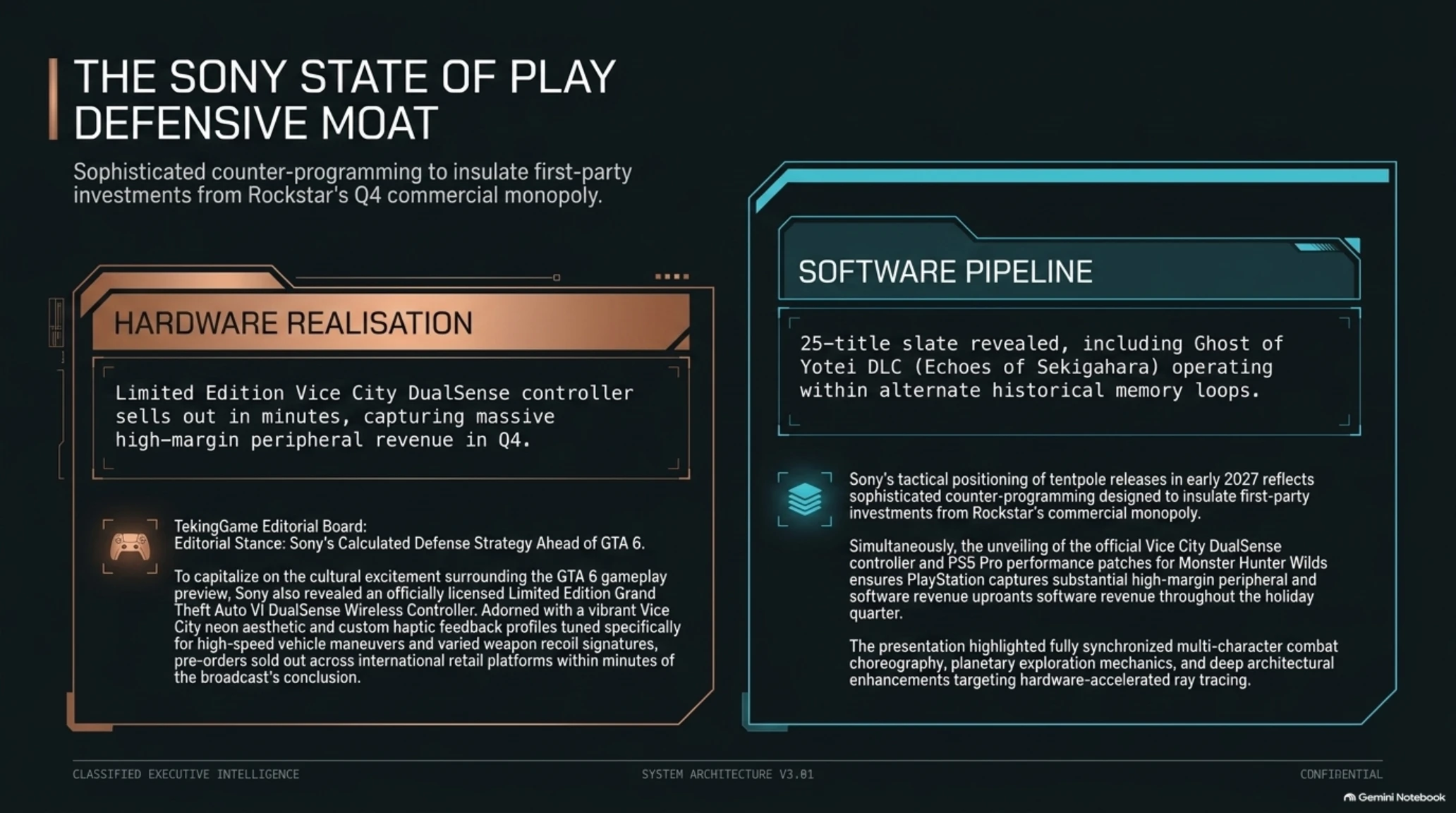
The horror genre received an unexpected headline announcement with the formal reveal of Until Dawn 2, scheduled for launch on January 28, 2027. Developed by Supermassive Games in close collaboration with veteran narrative designers from Sony's premier first-party studios, the sequel leverages Unreal Engine 5.4 to deliver photorealistic branching psychological horror. Concurrently, Sucker Punch Productions revealed the first extensive gameplay for Ghost of Yotei’s upcoming narrative expansion, Echoes of Sekigahara, confirming Jin Sakai as a fully playable protagonist within an alternate historical memory loop.
⏱️ Interactive Entertainment Release Roadmap (2026 - 2027)
| Release Date | Title / Expansion | Target Platform |
|---|---|---|
| November 19, 2026 | Grand Theft Auto VI | PlayStation 5 / Xbox Series X|S |
| January 28, 2027 | Until Dawn 2 | PlayStation 5 Exclusive |
| April 8, 2027 | Final Fantasy VII Revelation | PlayStation 5 Exclusive |
| Summer 2027 | Ghost of Yotei: Echoes of Sekigahara | PlayStation 5 Exclusive |
To capitalize on the cultural excitement surrounding the GTA 6 gameplay preview, Sony also revealed an officially licensed Limited Edition Grand Theft Auto VI DualSense Wireless Controller. Adorned with a vibrant Vice City neon aesthetic and custom haptic feedback profiles tuned specifically for high-speed vehicle maneuvers and varied weapon recoil signatures, pre-orders sold out across international retail platforms within minutes of the broadcast's conclusion.
For dedicated hardware enthusiasts evaluating console upgrades ahead of the monumental fourth-quarter software releases, our exhaustive hardware breakdown, PS5 Pro vs Xbox Series X: The Definitive 2026 Ninth-Generation Buying Guide, provides detailed benchmarks, architectural comparisons, and value assessments to inform your hardware purchasing strategy.
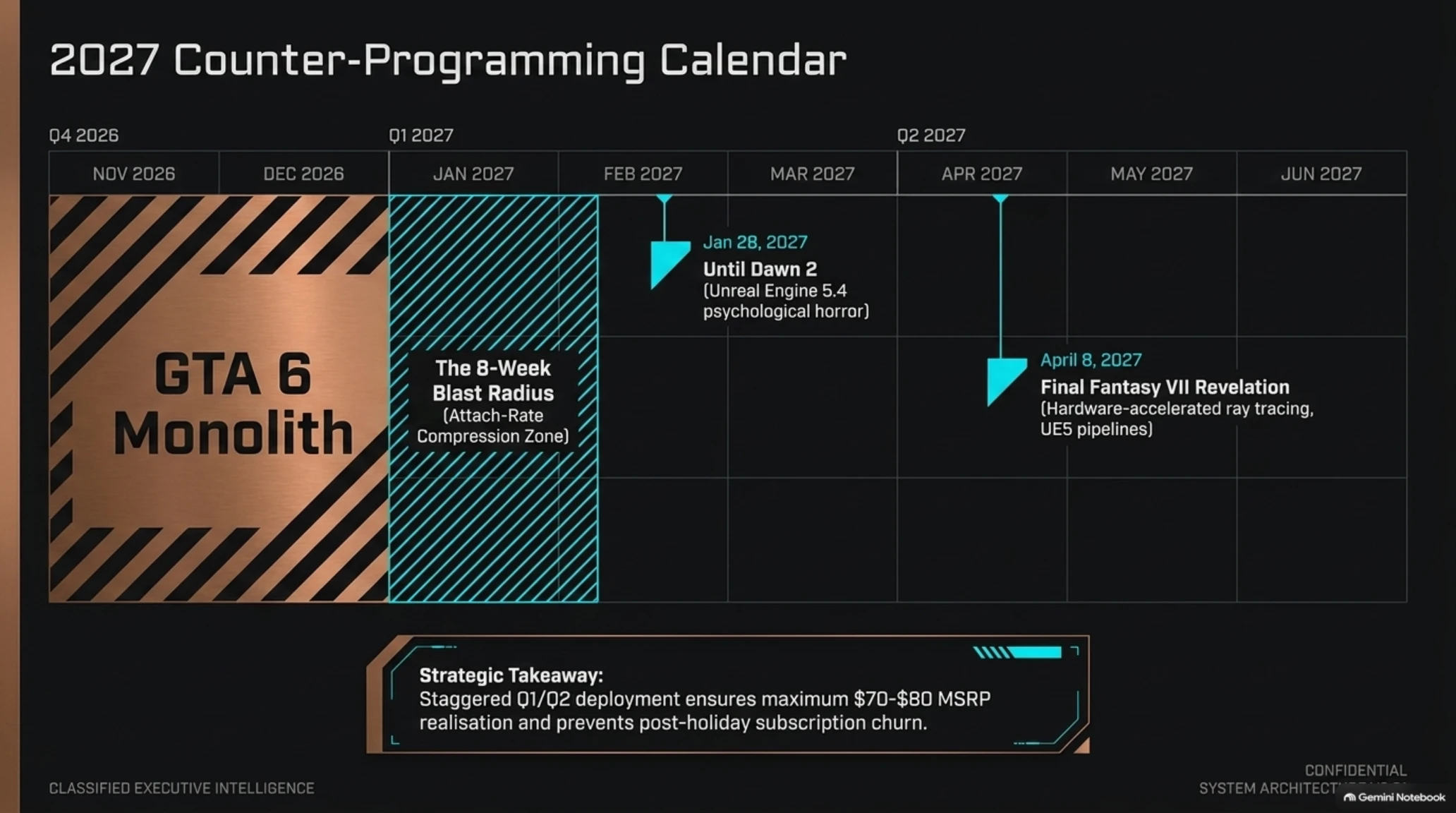
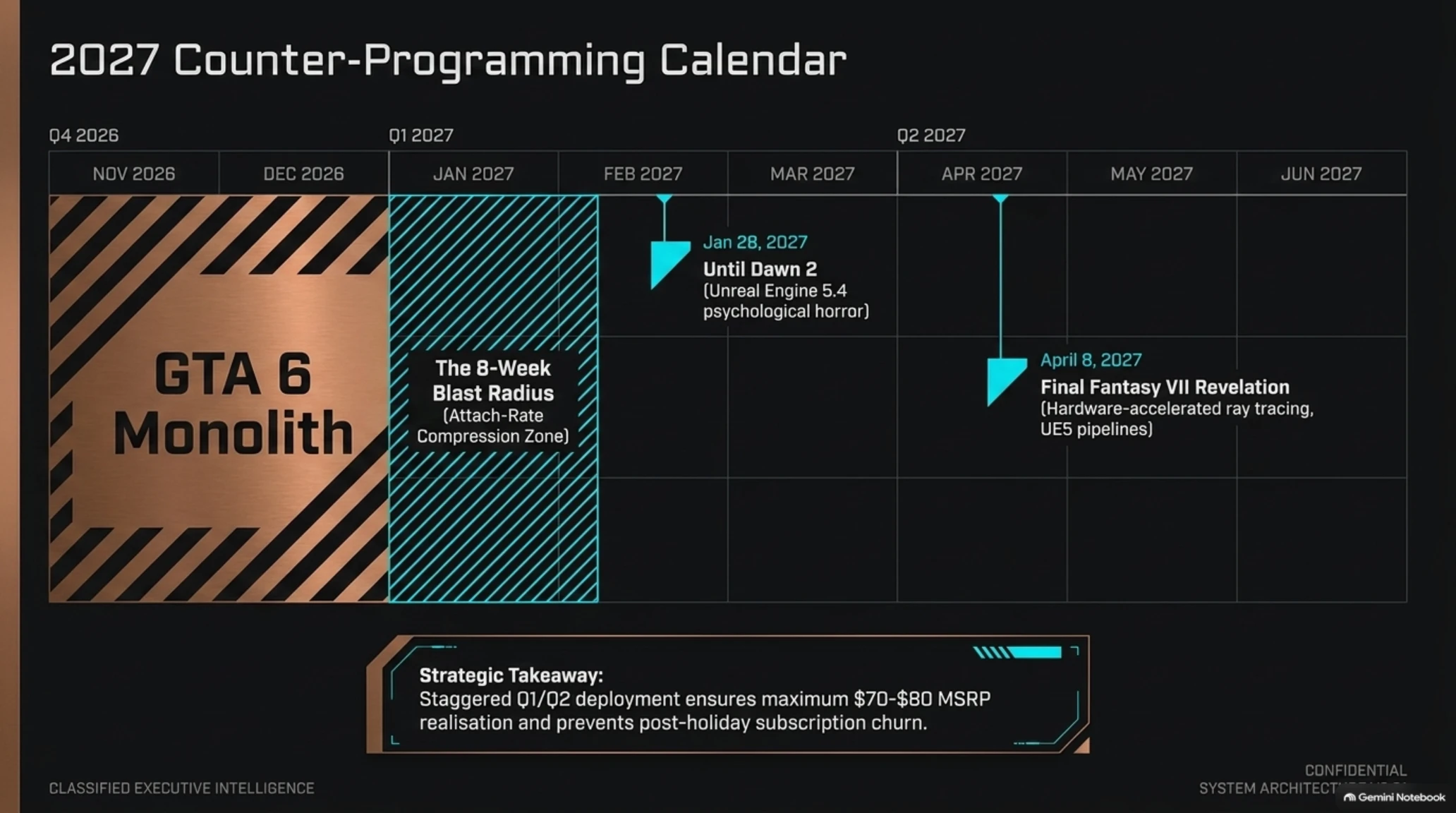
The 2027 Console Release Calendar: Strategic Counter-Programming Around the GTA 6 Monopoly
The slate of announcements at Sony's September 2026 State of Play illustrates sophisticated release window orchestration across premier game publishers. By scheduling tentpole titles such as Until Dawn 2 for January 2027 and Final Fantasy VII Revelation for April 2027, Sony and Square Enix are executing calculated counter-programming maneuvers designed to protect marquee balance sheets from the commercial saturation generated by Grand Theft Auto VI.
Historically, non-Rockstar AAA titles deployed within an 8-week proximity of a mainline GTA launch suffer severe software attach-rate compression, as consumer discretionary entertainment budgets and media attention consolidate entirely around Take-Two's flagship IP. By intentionally positioning their prestige first-party and second-party titles in Q1 and Q2 2027, Sony ensures that newly onboarded ninth-generation console owners—whose purchasing decisions were catalysed by GTA 6 this November—possess a sustained pipeline of high-fidelity narrative experiences once their initial Vice City campaigns conclude.
This staggered release strategy also stabilizes publisher operating margins. Rather than engaging in ruinous retail price competition during the crowded fourth-quarter holiday window, publishers can command full $70 to $80 MSRP prices in the post-holiday lull, ensuring maximum revenue realization per software unit deployed across PlayStation 5 and PS5 Pro hardware installations.
Furthermore, this pacing strategy directly addresses player fatigue. By spacing premier narrative experiences across consecutive quarters, platform holders maintain high active engagement across their online subscription services and digital storefront ecosystems, preventing post-holiday churn and sustaining elevated hardware utilization rates throughout 2027.
6. Modular Robotics Innovation: iRobot Unveils Roomba Duo Architecture at IFA Berlin
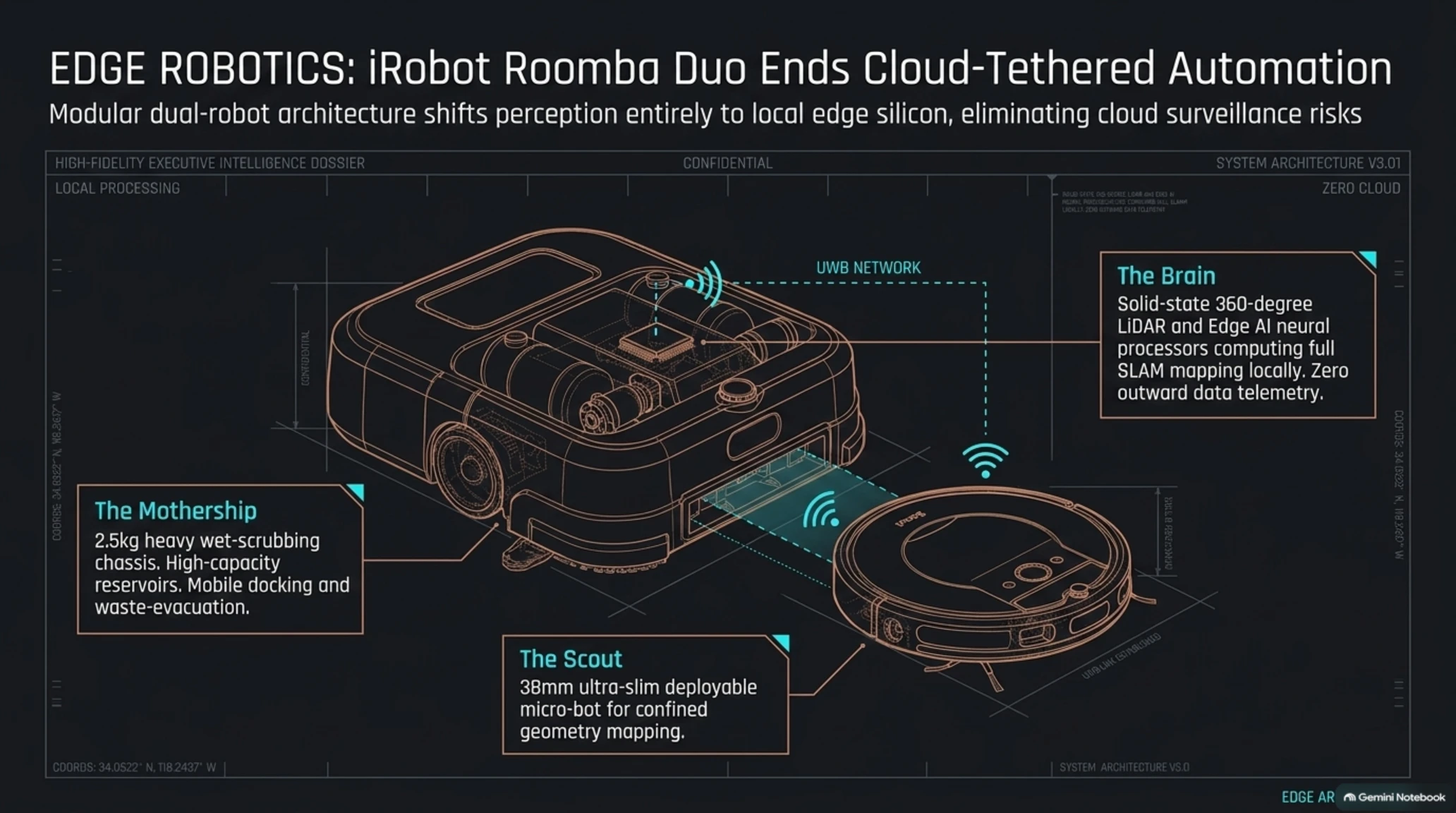
The consumer robotics sector witnessed an audacious conceptual leap at IFA Berlin 2026 as pioneer iRobot introduced the Roomba Duo. Deviating sharply from conventional monolithic puck-shaped vacuum designs, the Duo introduces a biomimetic mothership-and-scout modular architecture specifically engineered to conquer the perennial physical limitations of residential automated cleaning.
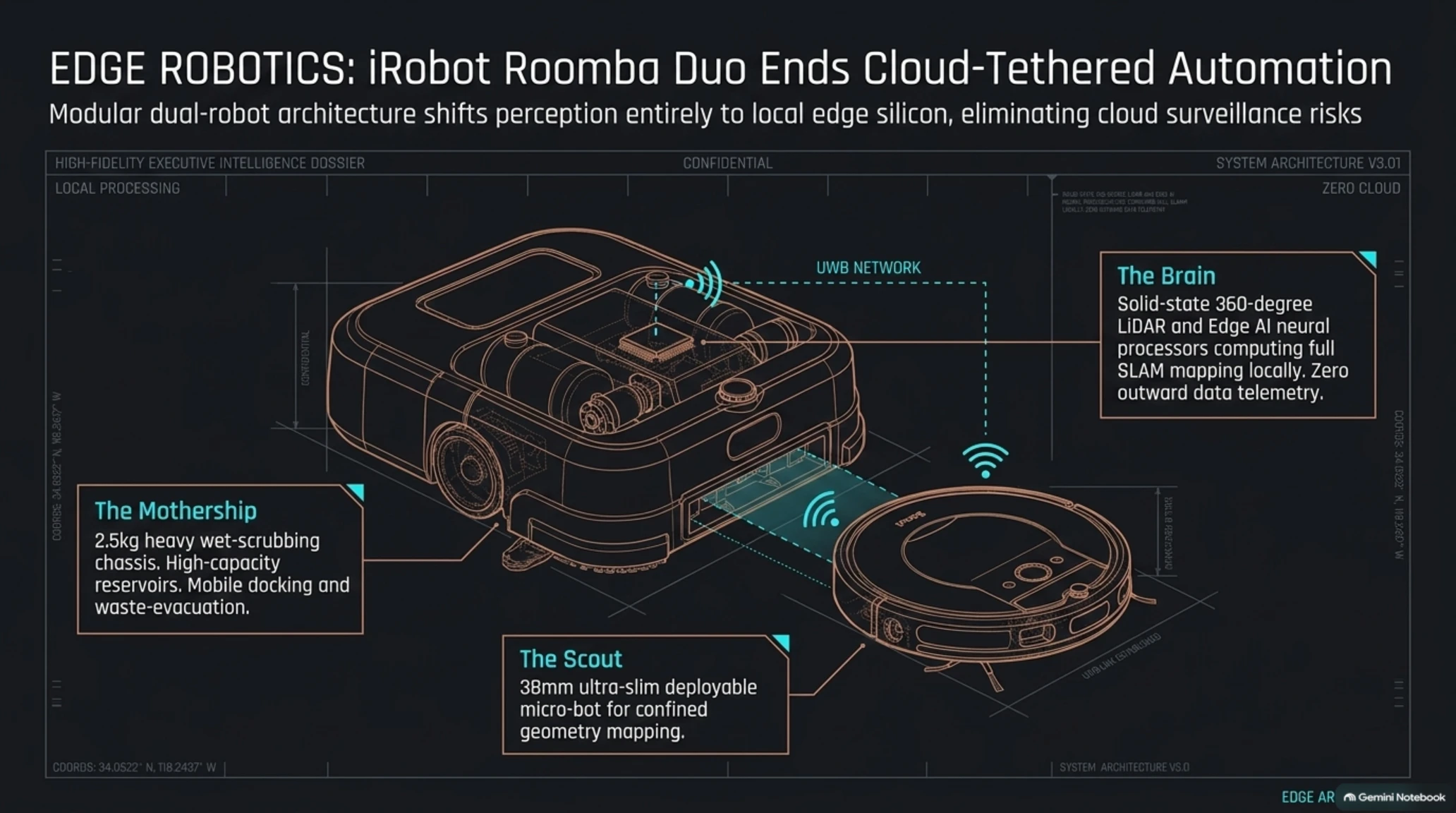
The system operates as an integrated dual-chassis platform. The primary mothership unit features a heavy-duty scrubbing chassis, high-capacity dual clean/wastewater reservoirs, high-torque counter-rotating roller brushes, and industrial-grade air suction designed to sanitize expansive, open floor spaces. When onboard 3D lidar scanners and computer vision arrays detect confined obstacles—such as dense dining chair legs, narrow under-bed gaps, or acute geometric corners—the mothership mechanically deploys an ultra-slim, low-profile auxiliary micro-robot from its upper shell.
Roomba Duo Technical Specifications & Architectural Innovations
| Architectural Component | Hardware Specification | Operational Advantage |
|---|---|---|
| Dual Modular Chassis | 2.5kg Mothership + 38mm Micro-Bot | Heavy wet-scrubbing paired with ultra-slim under-furniture access |
| Unified Mapping | 360-degree Lidar + On-device Edge AI | Cloud-free navigation ensuring complete domestic privacy |
| Mobile Docking | Dual water reservoirs & auto-evacuation | Mothership acts as a mobile charging station for the micro-bot |
| Inter-Unit Comms | Ultra-wideband (UWB) mesh network | Zero-latency spatial coordination between both robots |
Beyond its mechanical elegance, the Roomba Duo represents a major advancement in local edge perception. All semantic object classification, dynamic path re-planning, and real-time obstacle avoidance routines are computed entirely on-device via a dedicated edge neural coprocessor, eliminating the need to transmit private domestic video feeds to cloud infrastructure. For tech-forward households and gaming enthusiasts seeking automated domestic environments, the Duo sets a new standard for private, intelligent home automation.
Decentralized Perception in Consumer Robotics: The Death of Cloud-Dependent Home Automation
The architectural innovation embodied by the Roomba Duo highlights an overdue technological reckoning within the Internet of Things (IoT) sector. For over a decade, consumer electronics manufacturers routinely offloaded computer vision, spatial mapping, and object recognition tasks to remote cloud clusters, generating substantial recurring server infrastructure overhead while raising legitimate surveillance and consumer privacy alarms.
The Roomba Duo decisively repudiates this centralized paradigm. By executing full SLAM spatial mapping, volumetric semantic classification, and dynamic motion pathing on a local neural processing unit, the device maintains zero outward telemetry of private interior living spaces. This edge computing breakthrough demonstrates that next-generation domestic automation can deliver uncompromising robotic precision while establishing an ironclad, air-gapped barrier around private household data.
This decentralized design also eliminates network latency vulnerabilities. In large residential estates or industrial facilities with intermittent Wi-Fi dead zones, cloud-tethered robots frequently freeze or experience navigation faults. By retaining all spatial cognition and sensor fusion on dedicated silicon, the modular dual-robot architecture guarantees continuous, autonomous operational fidelity across complex physical environments.
Furthermore, the physical separation of cleaning responsibilities between a heavy scrubbing chassis and an agile deployable micro-unit resolves fundamental mechanical engineering compromises. In conventional single-body robot vacuums, engineers were forced to compromise between motor torque, battery weight, water tank volume, and chassis clearance. The Duo eliminates these design trade-offs by distributing tasks across specialized modular physical form factors.
From an ecological and device longevity perspective, the localized processing model drastically reduces continuous standby power consumption and unburdens residential network routers from constant high-bitrate video streaming. Consumers acquire a genuinely sovereign domestic appliance rather than an ephemeral cloud terminal vulnerable to remote server shutdowns or subscription paywalls.
Morning Synthesis: Cross-Vertical Technological Convergence
The opening dispatches of September 2026 illuminate an undeniable reality: the lines separating consumer software, high-performance silicon, macro-entertainment, and sovereign regulatory oversight have permanently dissolved. Whether observing Microsoft re-architecting Windows 11 to break enterprise reliance on remote cloud infrastructure, or witnessing the sheer commercial gravity of Grand Theft Auto VI driving double-digit hardware sales amidst an inflationary economy, technological advancement is moving with unrelenting velocity.
Simultaneously, the regulatory challenges confronting Tesla’s Cybercab remind the industry that physical safety standards remain the ultimate arbiter of autonomous deployment. Silicon Valley's propensity for rapid iteration must ultimately reconcile with established public safety doctrine. As capital allocation shifts toward sovereign compute, institutional liquidity, and localized edge perception, the winners of this cycle will be the builders who combine audacious engineering with rigorous compliance.
At TekinGame, our mission remains steadfast: delivering the deep technical context, strategic clarity, and uncompromising analysis required to navigate this exhilarating technological era. As you embark on this Saturday, let these strategic developments inform your perspective, inspire your creative pursuits, and anchor your understanding of tomorrow's digital economy.
Recommended In-Depth Gaming & Tech Dossiers on TekInGame
• 🛡 Inside the FBI & NSA Takedown of Chinese Cyber Network QTFY | Deconstructing QScan IoT Botnets & QTRouter Proxy Meshes
• 🎬 Deconstructing Alibaba Wan 3.0 Video AI | The Chinese Tech Breakthrough Disrupting Hollywood & Sora
• 🧪 Inside Inherent's Faraday AI | How a 27-Million-Parameter Model Beat DeepSeek-R1 in Biochemical Reasoning
Frequently Asked Morning Inquiries (FAQ)
What distinguishes Microsoft Project Zenith from standard Windows 11 builds?
Project Zenith is a dedicated, distraction-free Windows 11 build optimized for workstations with 64GB or more of unified memory. It eliminates consumer bloatware and background telemetry, enabling developers to run 30-billion-parameter artificial intelligence models entirely on-device with zero cloud dependencies.
Why has the NHTSA opened a federal safety investigation into Tesla's Cybercab?
The NHTSA opened an Audit Query because the Cybercab lacks traditional mechanical steering wheels, pedals, and rearview mirrors required under Federal Motor Vehicle Safety Standards (FMVSS). Tesla deployed the vehicles on Austin public roads without securing prior formal federal statutory exemptions.
How did the GTA 6 Netflix preview cause a 34% spike in UK Xbox console sales?
The global Netflix broadcast introduced high-fidelity GTA 6 gameplay to millions of mainstream viewers. Because Rockstar Games confirmed the title will not launch on PC this year, consumers rushed to purchase affordable ninth-generation hardware, particularly the entry-level Xbox Series S, to prepare for the November 19 release.
What is the confirmed release date for Final Fantasy VII Revelation?
During the September 2026 PlayStation State of Play, Square Enix and Sony officially confirmed that Final Fantasy VII Revelation will launch globally on April 8, 2027, concluding the remake trilogy on PlayStation 5.
How does the dual-robot architecture of the Roomba Duo function?
The Roomba Duo consists of a heavy mothership robot that performs heavy wet-scrubbing across open floor areas, and an ultra-slim micro-bot that mechanically deploys from the top deck to access tight corners, under-furniture spaces, and narrow obstacles.
Authoritative Dispatches & Technical Documentation
- The Verge: Microsoft Project Zenith for Developers
- TechCrunch: NHTSA Federal Probe into Tesla Cybercab
- Pure Xbox: GTA 6 Preview Causes 34% Xbox Sales Spike
- CoinDesk: Bitcoin Clears $81K on Record ETF Inflows
- Push Square: PlayStation State of Play September 2026
- The Verge: iRobot Unveils Modular Roomba Duo
Additional Gallery: ☀️ Tekin Morning Sept 5, 2026 | Project Zenith, Cybercab Probe & GTA 6 Surge