Tekin Guide: PS5 Pro
- 🎮PSSR AI Reconstruction- Hardware-accelerated NPU delivering pristine 4K image clarity at 60/120 FPS
- 🎧Ray Tracing & Compute Leap- 67% increase in GPU Compute Units and 2x-3x ray intersection speed
- 🚀2TB NVMe Storage- Factory-installed high-speed storage paired with Wi-Fi 7 wireless integration
- 🗡️Modular Disc Drive- Digital-first baseline requiring an external $80 UHD Blu-ray attachment
- 📰Ecosystem Math: Game Pass- Xbox Game Pass Ultimate value vs Sony's bespoke cinematic exclusives
- ⚔️Display Infrastructure- The absolute necessity of HDMI 2.1 OLED TVs with VRR support
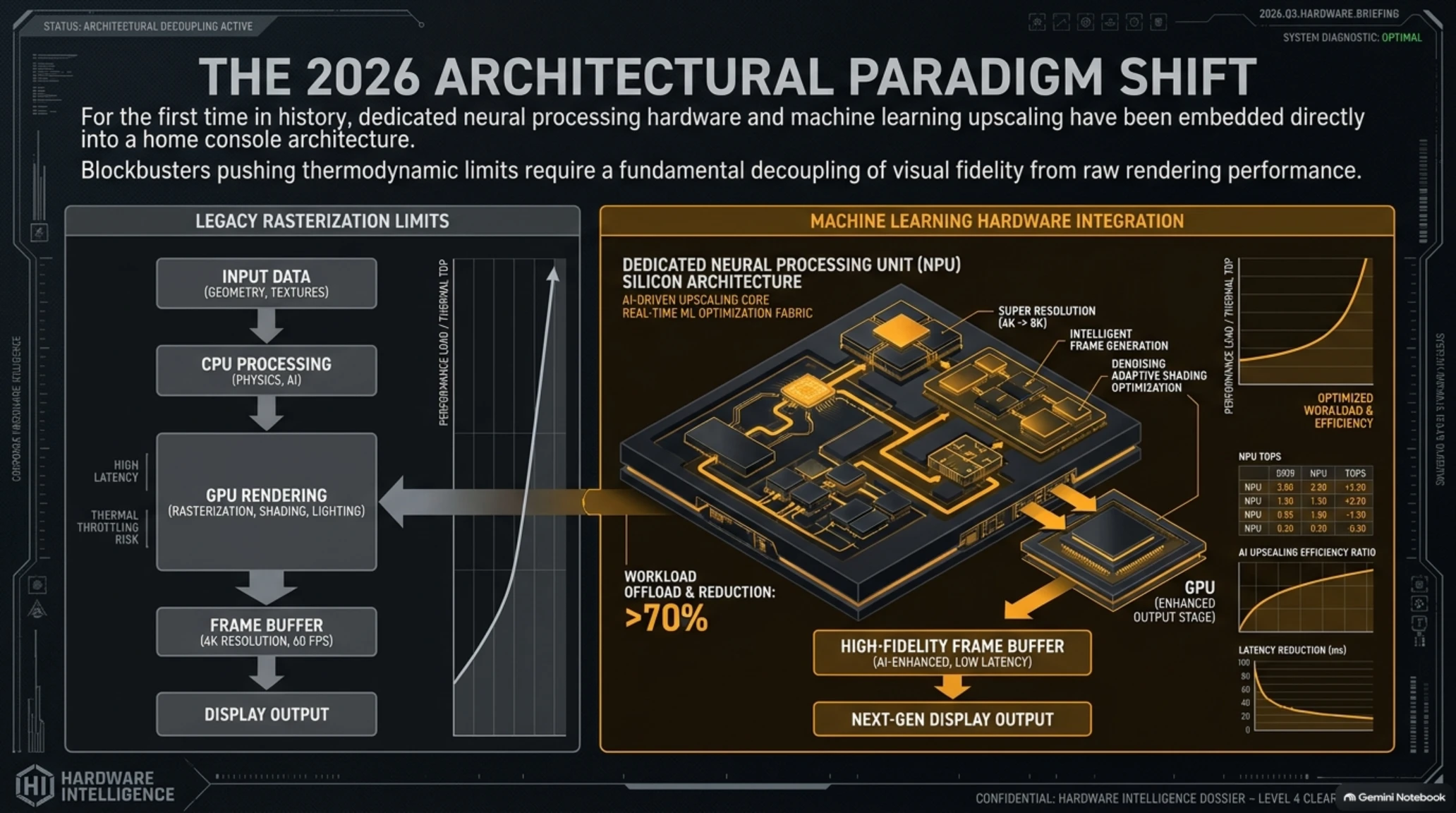
As the interactive entertainment industry reaches the midpoint of the ninth console generation in late 2026, the technological frontier of living-room gaming is undergoing its most significant architectural shift. Sony Interactive Entertainment’s release of the PlayStation 5 Pro represents a watershed moment in console engineering: for the first time in history, dedicated neural processing hardware and machine learning upscaling have been embedded directly into a home console architecture to fundamentally decouple visual fidelity from rendering performance.
With blockbuster titles such as Grand Theft Auto VI, Death Stranding 2: On the Beach, Ghost of Yotei, and Marvel's Wolverine pushing hardware rendering budgets to their absolute thermodynamic limits, players worldwide face a critical hardware investment dilemma. The PS5 Pro enters the market at a premium price point of $699.99 / €799.99 / £699.99 for the base digital configuration, challenging prospective buyers to evaluate whether its architectural leaps justify the substantial price premium over the standard PlayStation 5 Slim and Microsoft’s flagship Xbox Series X.
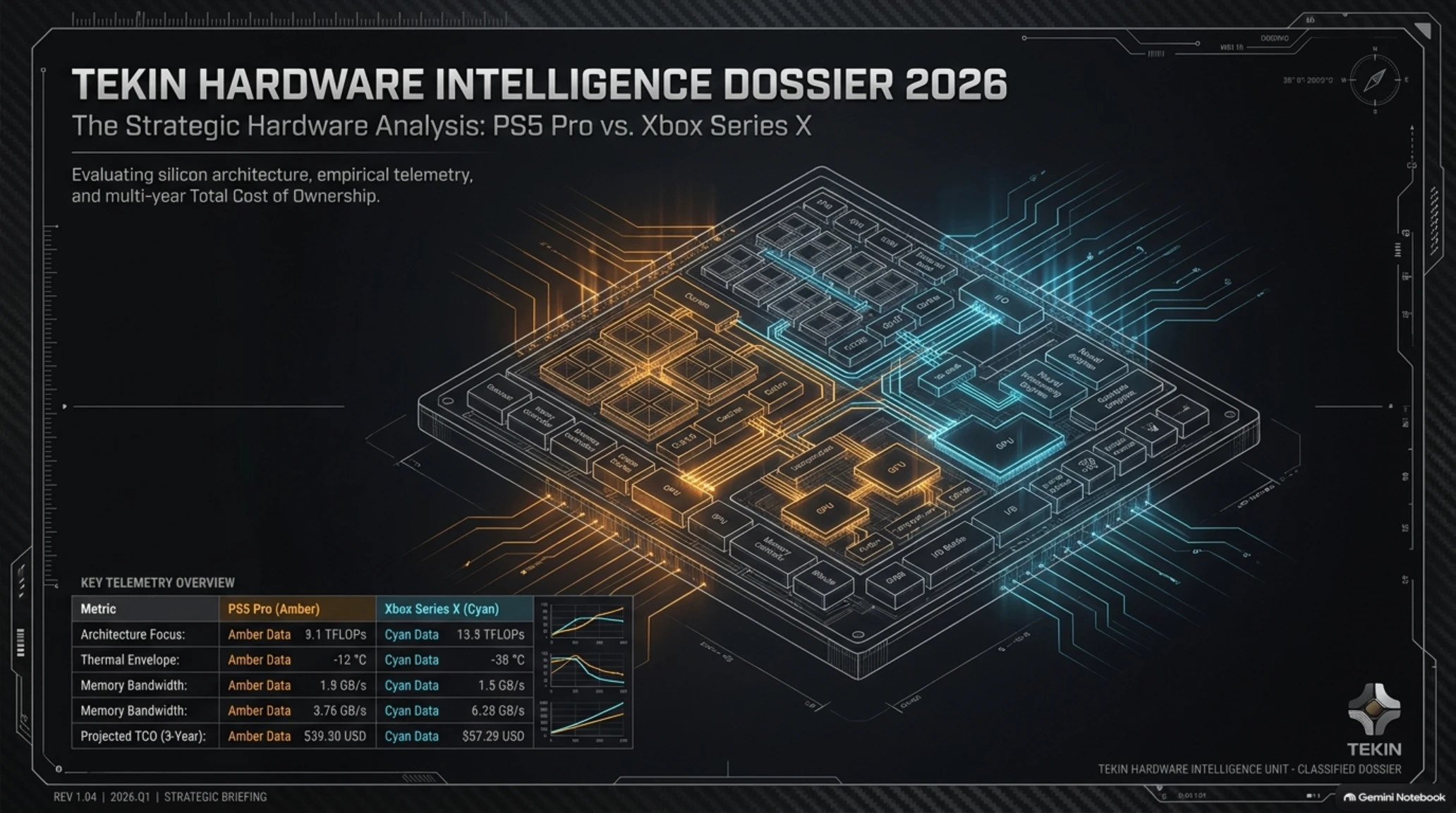
In this exhaustive, data-driven buying guide, TekinGame delivers a definitive architectural teardown, frame-time telemetry analysis, and total cost of ownership (TCO) evaluation of the modern console market. We examine the exact mathematical mechanics behind Sony's proprietary PlayStation Spectral Super Resolution (PSSR), quantify the real-world impact of its upgraded RDNA 3 graphics core, and compare the holistic economic return of the PlayStation ecosystem against Microsoft’s aggressive Game Pass Ultimate subscription platform.
Whether you are an enthusiast seeking native-grade 4K clarity at locked 60 frames per second, a competitive player targeting ultra-low-latency 120Hz esports modes, or a value-focused consumer weighing multi-year subscription costs, this dossier provides the objective engineering intelligence required to make an informed purchasing decision.
Furthermore, we conduct an in-depth assessment of complementary hardware prerequisites from high-bandwidth HDMI 2.1 OLED display panels with Variable Refresh Rate (VRR) to modular disc drive expansions and ultra-fast PCIe Gen4/Gen5 NVMe solid-state storage upgrades to ensure your gaming environment can fully unleash the raw compute potential of ninth-generation hardware.
Key Engineering Takeaways & Executive Summary
- Base MSRP of $699.99 USD / €799.99 EUR / £699.99 GBP for the 2TB Digital Edition, establishing a new premium mid-generation tier
- 67% expansion in GPU Compute Units (growing from 36 to 60 CUs) combined with a 28% increase in GDDR6 memory bandwidth to 576 GB/s
- Introduction of PSSR (PlayStation Spectral Super Resolution) leveraging a dedicated custom NPU delivering 300 TOPS of 8-bit AI compute
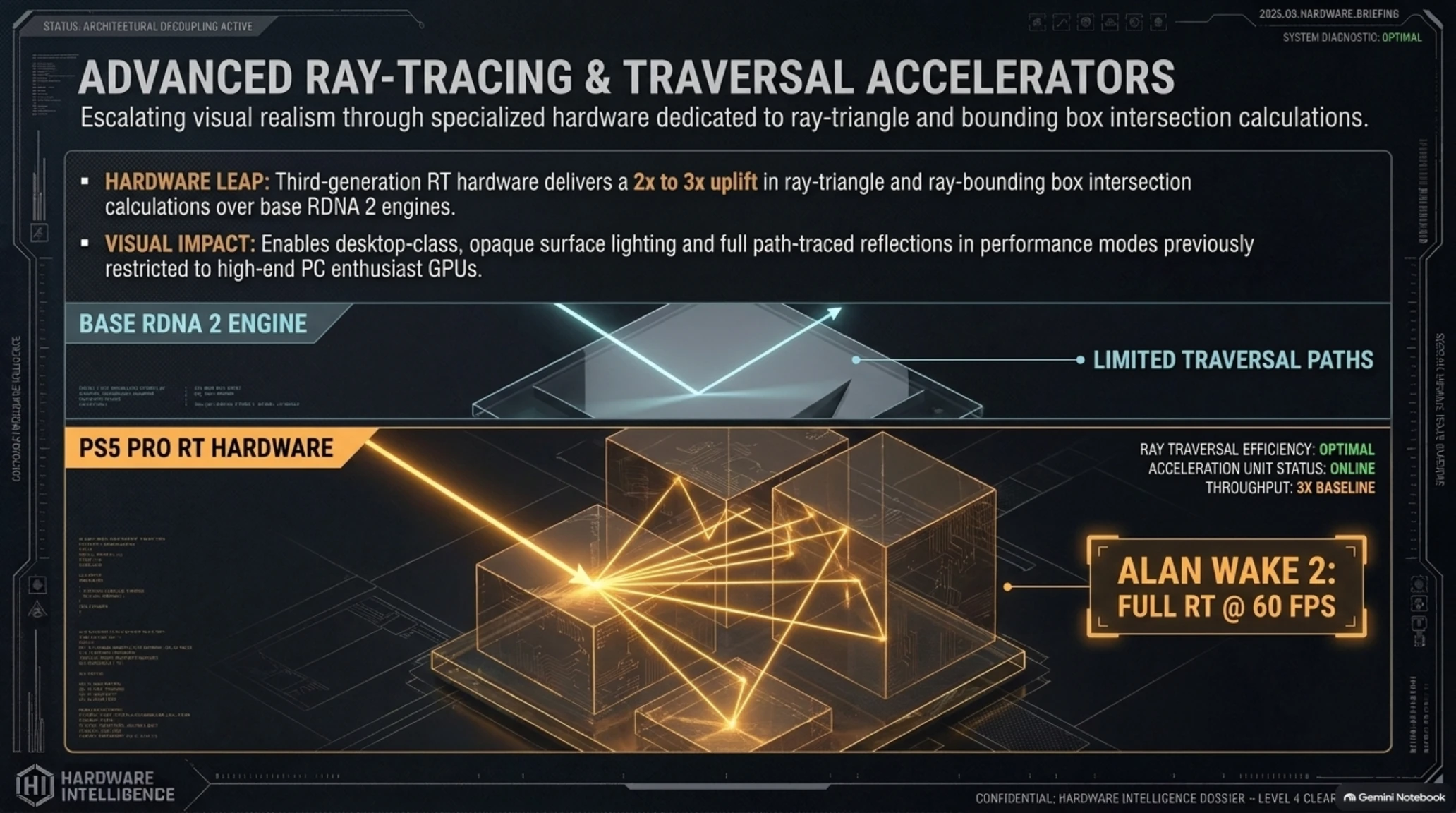
- Hardware-accelerated ray-tracing performance delivering a 2x to 3x uplift in ray-triangle and ray-bounding box intersection calculations
- Factory-installed 2TB custom high-speed NVMe internal SSD offering approximately 1.89 TB of net usable high-speed game storage
- Full integration of the cutting-edge Wi-Fi 7 (IEEE 802.11be) wireless standard with Multi-Link Operation (MLO) for ultra-stable cloud remote play
1. Market Dynamics & Global Pricing Architecture
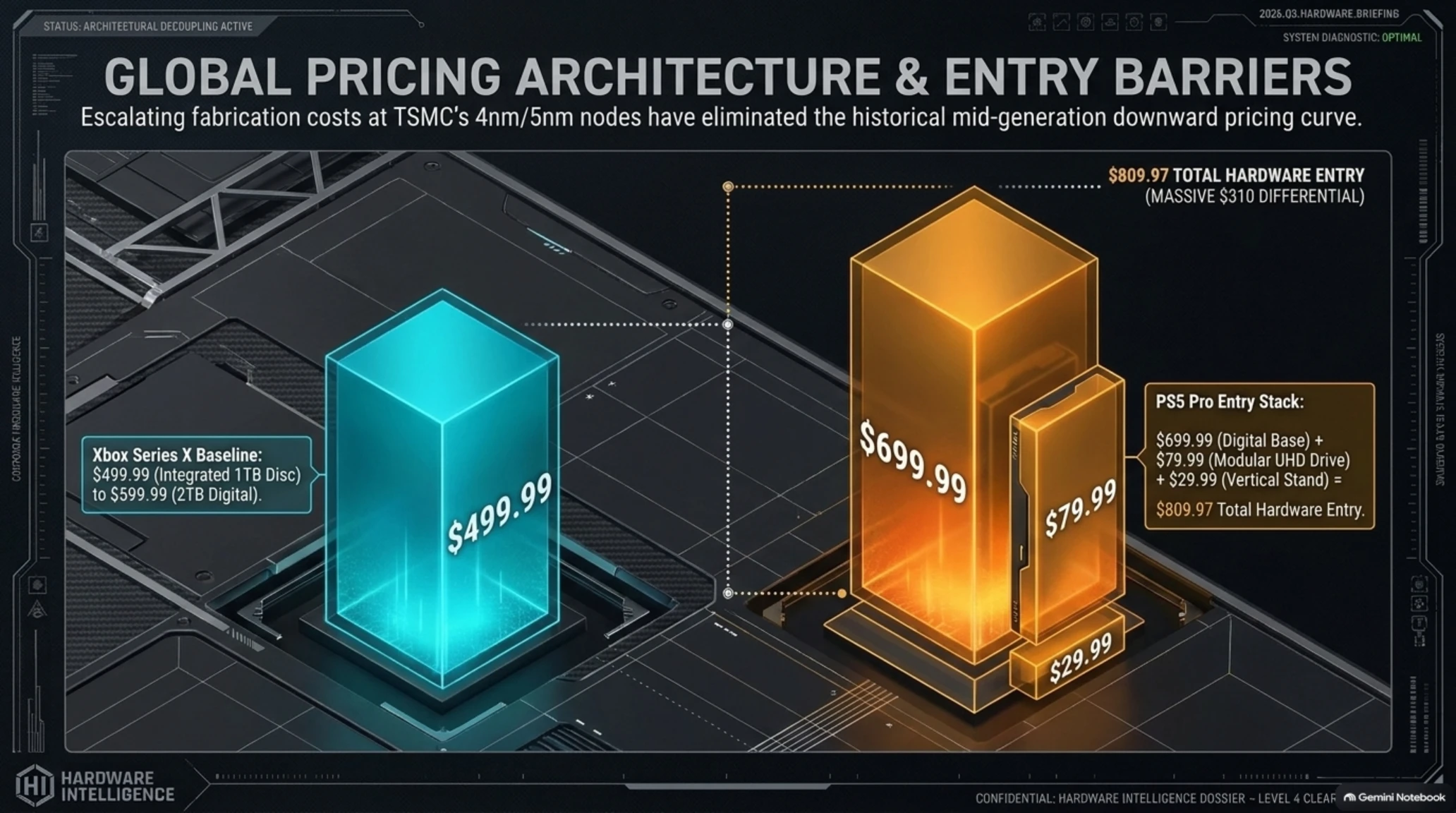
The pricing architecture of the PlayStation 5 Pro marks an unmistakable transition in how console manufacturers approach hardware lifecycle economics. Historically, mid-generation hardware revisions such as the PlayStation 4 Pro in 2016 and the Xbox One X in 2017 were introduced at the original base console launch price ($399 and $499 respectively), while older base models received simultaneous price cuts. In the 2026 economic landscape, escalating semiconductor fabrication costs at leading-edge nodes (such as TSMC's 4nm and 5nm processes) and elevated high-density GDDR6 memory pricing have eliminated the historical downward pricing curve.
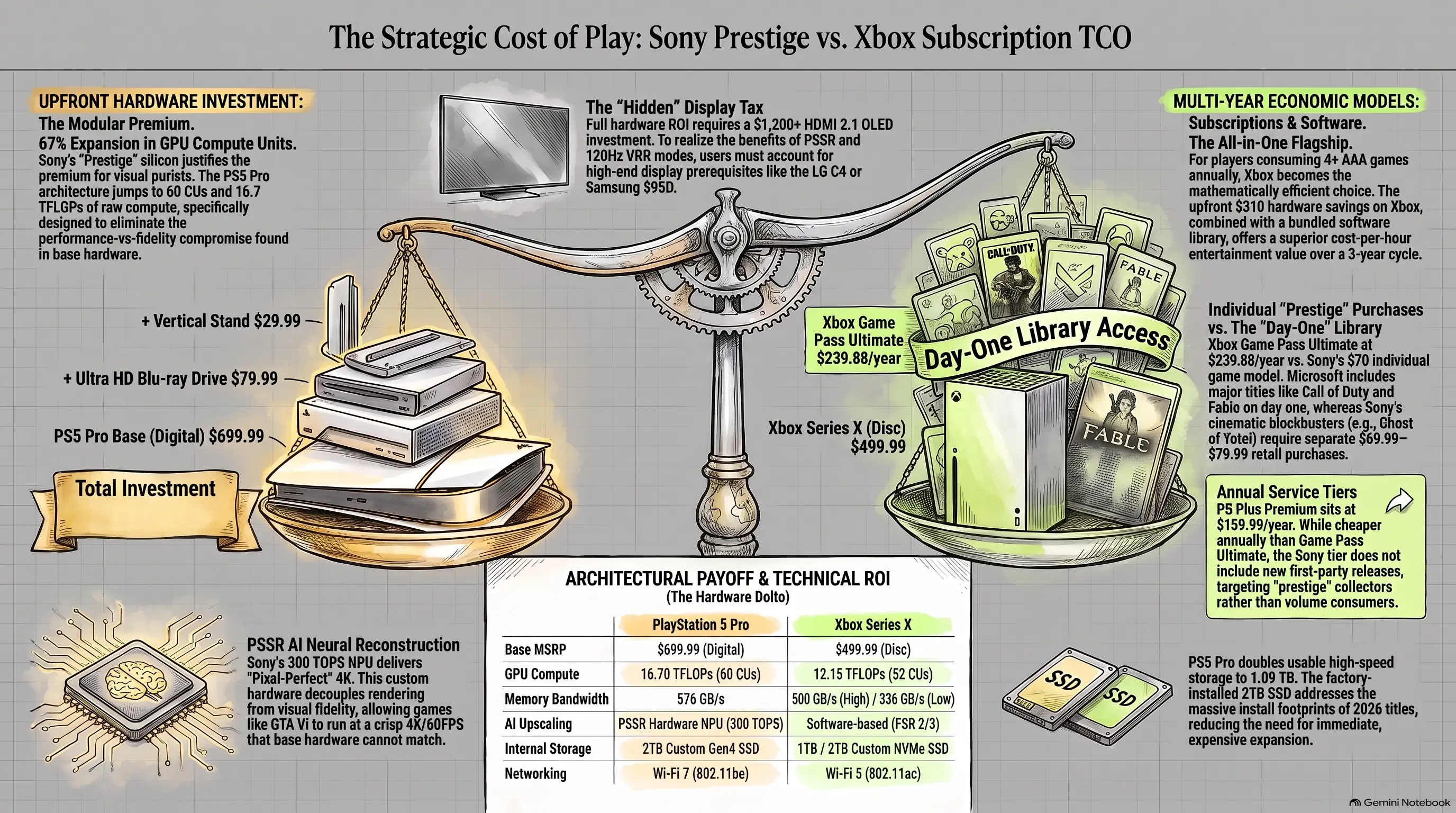
Sony’s positioning of the PS5 Pro at $699.99 establishes it as an uncompromising, enthusiast-tier piece of consumer electronics. When factoring in the optional modular Ultra HD Blu-ray disc drive ($79.99) and the vertical mounting stand ($29.99), the comprehensive hardware investment reaches $809.97 before tax. In international territories, pricing reflects localized taxation and currency structures, retailing at €799.99 in the European Union, £699.99 in the United Kingdom, and ¥119,980 in Japan.
In contrast, Microsoft’s flagship Xbox Series X maintains an accessible MSRP of $499.99 for the 1TB optical drive edition, with specialized 2TB digital editions (such as the Galaxy Black Special Edition) priced at $599.99. This creates an immediate $200 to $300 upfront hardware differential between the two competing flagships, shifting the purchasing decision from a casual hardware swap to a strategic investment in ecosystem capabilities.
Technical Jargon Buster & Architectural Concepts
PSSR (PlayStation Spectral Super Resolution): A bespoke, hardware-accelerated machine learning upscaler utilizing temporal feedback and custom neural network weights running on dedicated console silicon to reconstruct pristine 4K images from lower internal render targets.
Compute Units (CUs): The fundamental building blocks of AMD's RDNA GPU architecture containing SIMD vector units, scalar units, texture mapping units, and ray-tracing hardware accelerators.
Total Cost of Ownership (TCO): A multi-year financial metric encompassing initial console hardware acquisition, required peripheral upgrades, monthly subscription tiers, and direct software purchase expenditures.
2. Deep Architectural Teardown: GPU Scaling, PSSR & Ray-Tracing Mechanics
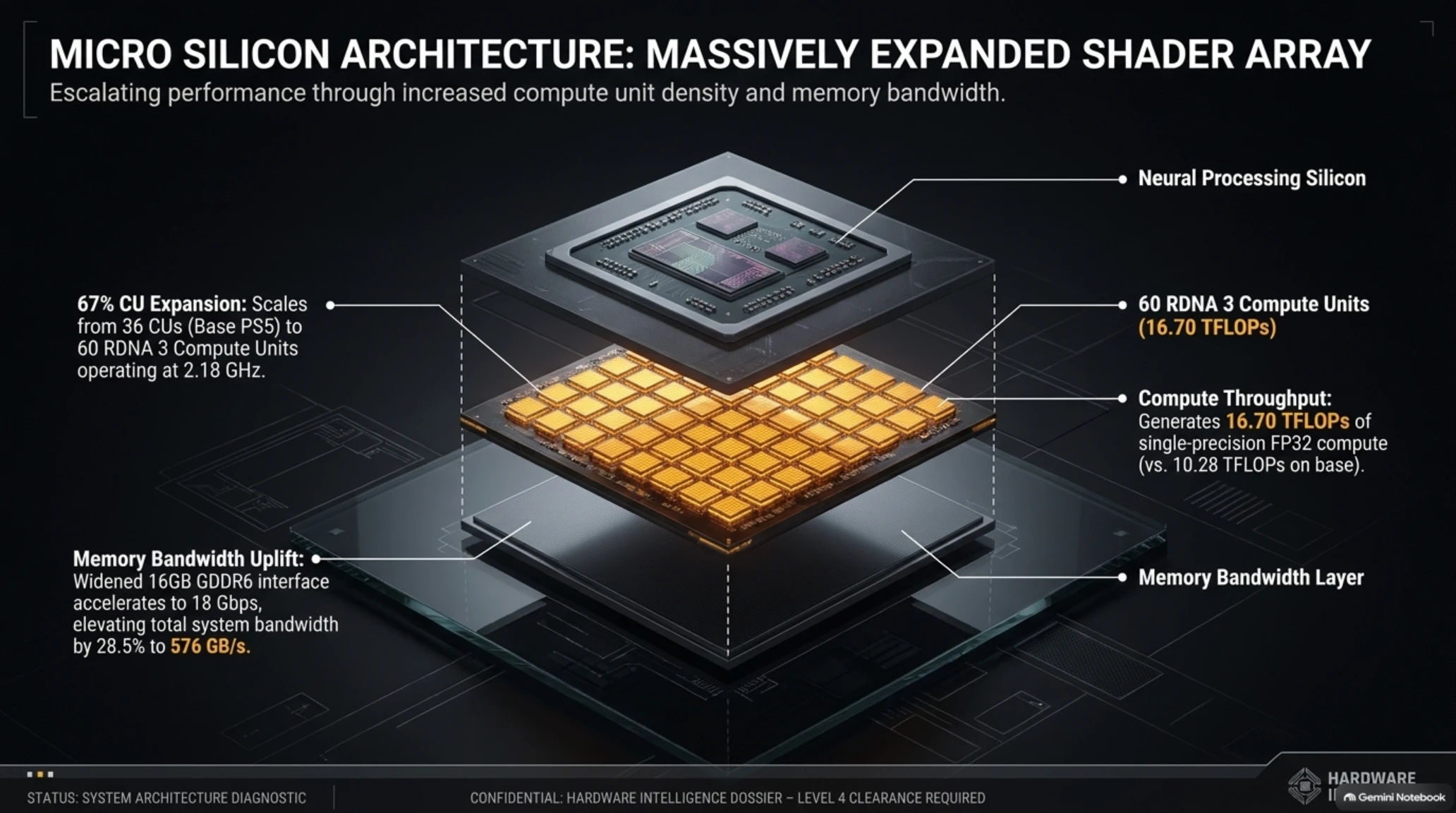
The engineering core of the PlayStation 5 Pro represents a targeted, triangular architectural enhancement engineered by Sony’s lead system architect, Mark Cerny: a massively expanded GPU shader array, advanced third-generation ray-tracing hardware accelerators, and custom machine-learning inferencing silicon.
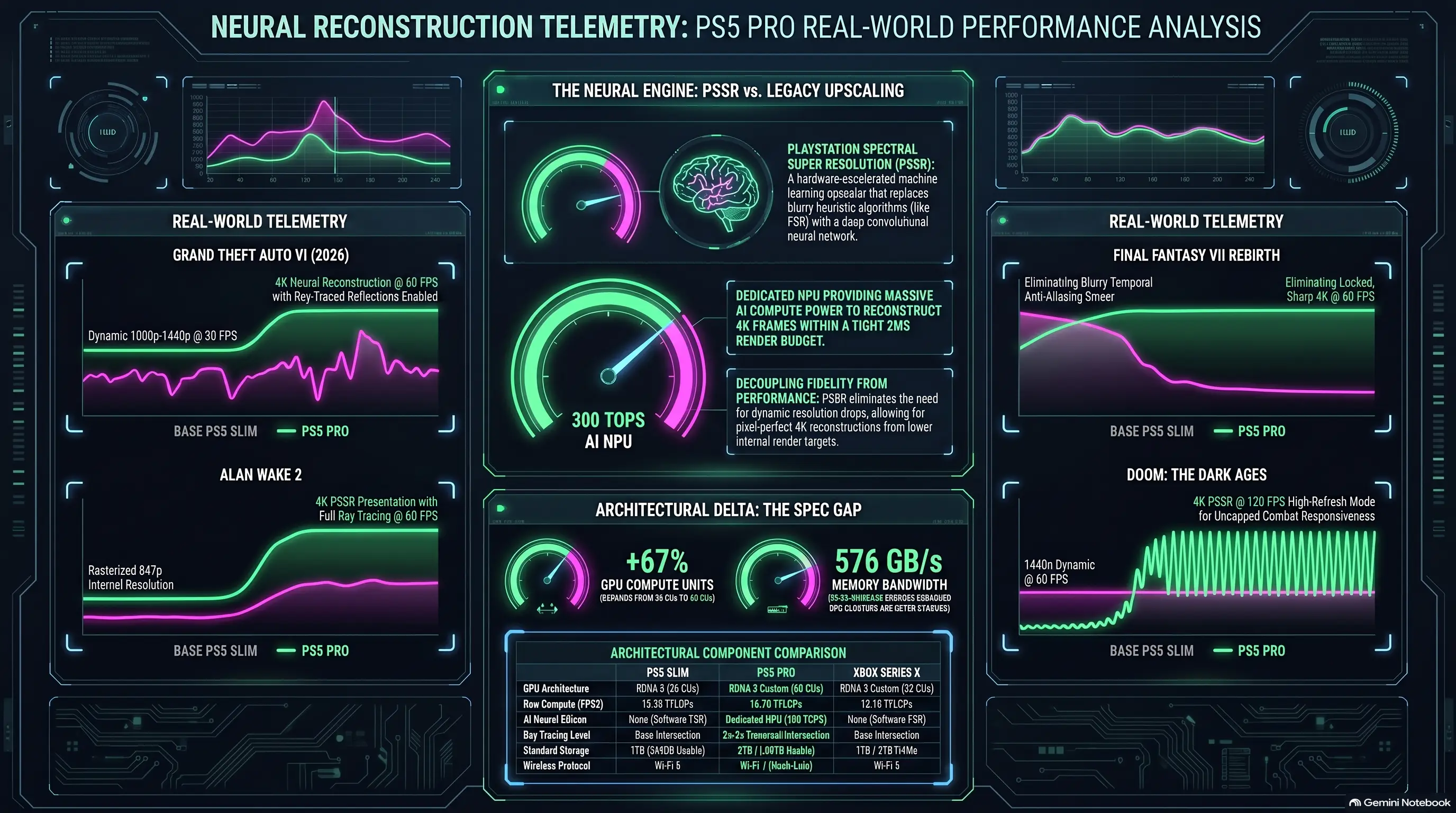
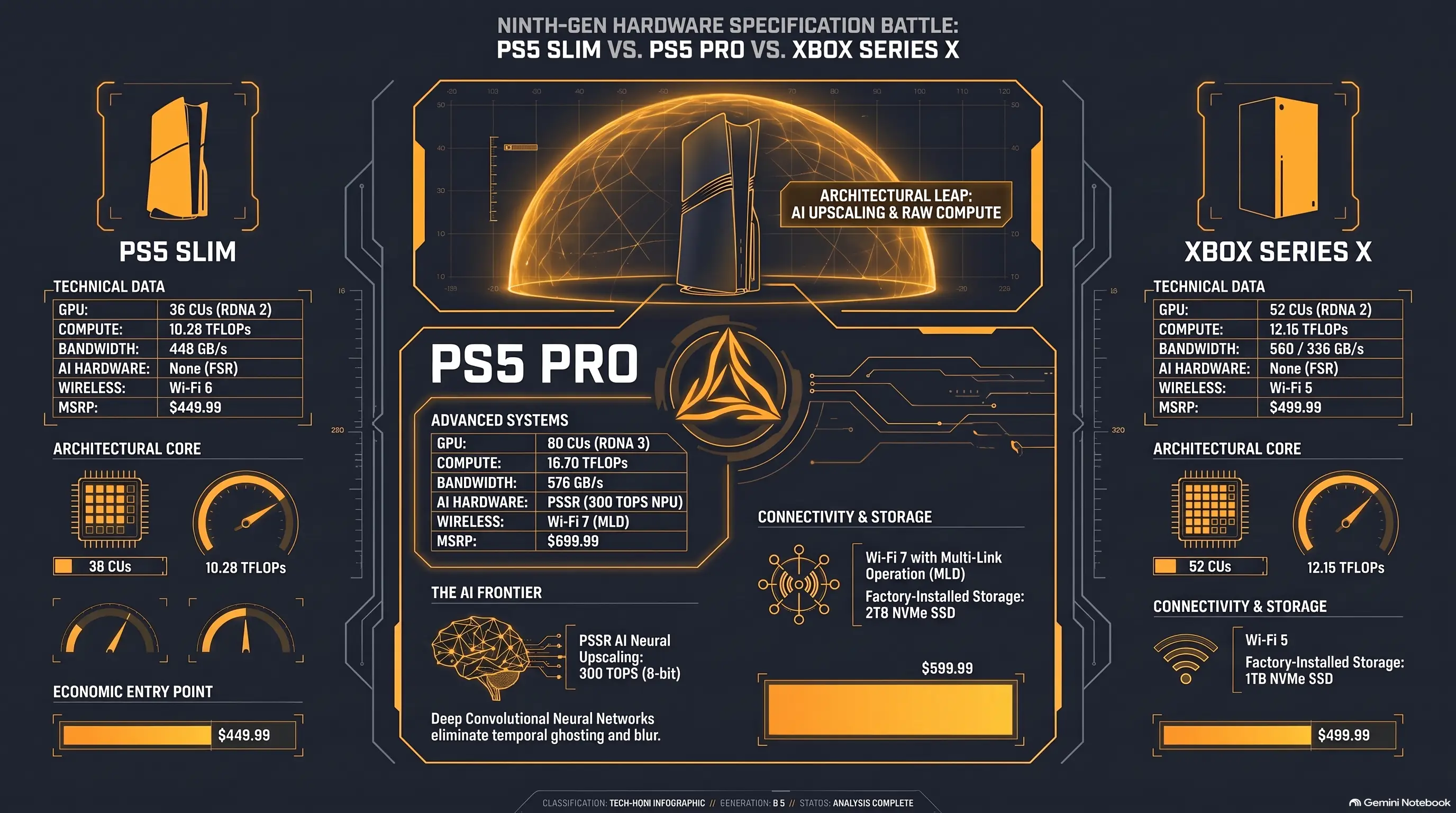
The system-on-chip (SoC) incorporates a customized graphics processor utilizing AMD's RDNA 3 architecture. While the base PlayStation 5 operates with 36 active Compute Units at clock speeds up to 2.23 GHz (yielding 10.28 TFLOPs of theoretical FP32 compute), the PS5 Pro scales the silicon footprint to 60 Compute Units running at 2.18 GHz, generating 16.70 TFLOPs of single-precision floating-point throughput a massive 67% increase in raw parallel shader compute. To feed these additional compute clusters without incurring memory bus stalls, Sony widened the unified 16GB GDDR6 memory interface, accelerating memory speeds to 18 Gbps and elevating total system bandwidth from 448 GB/s to 576 GB/s (a 28.5% uplift).
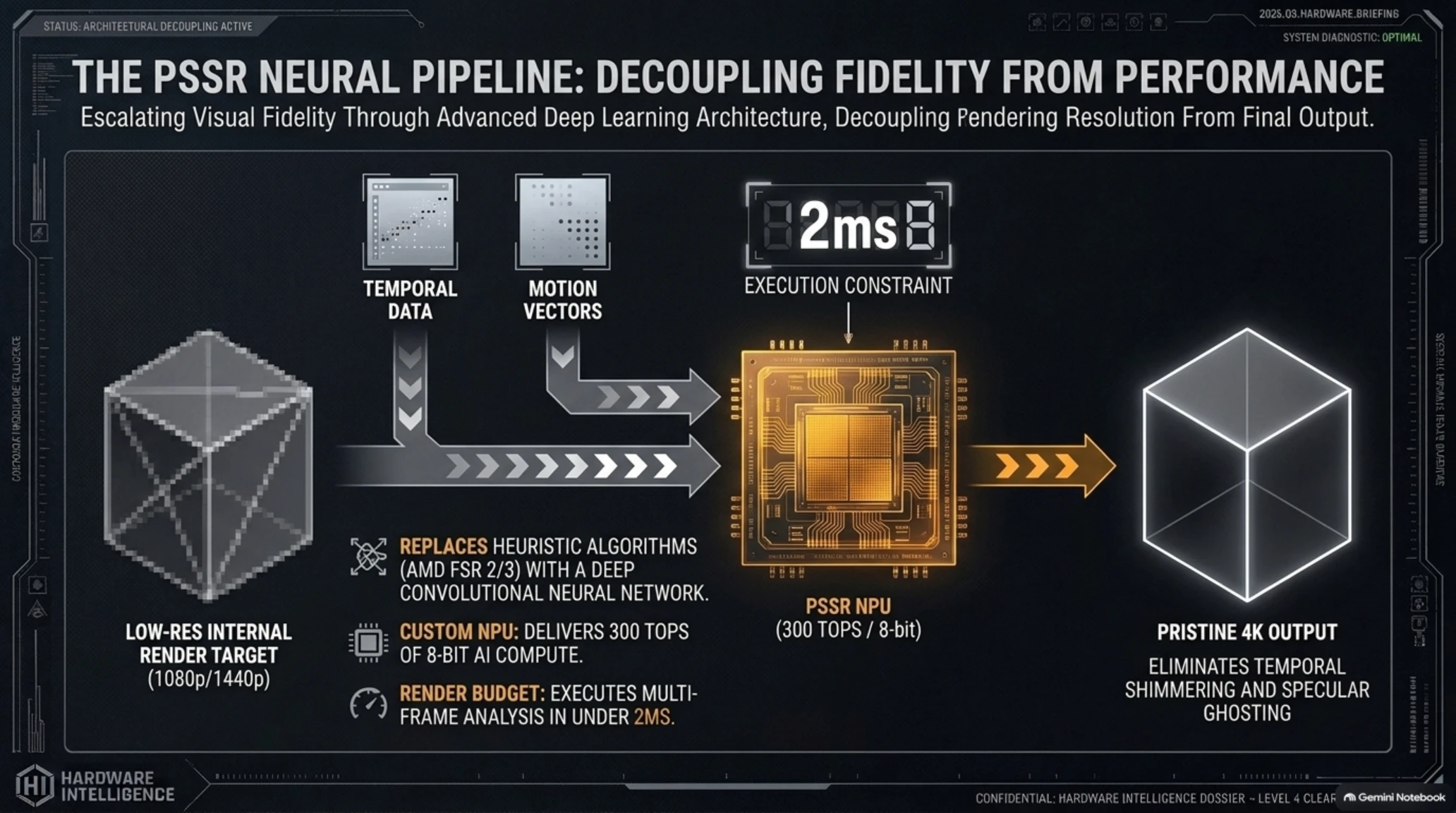
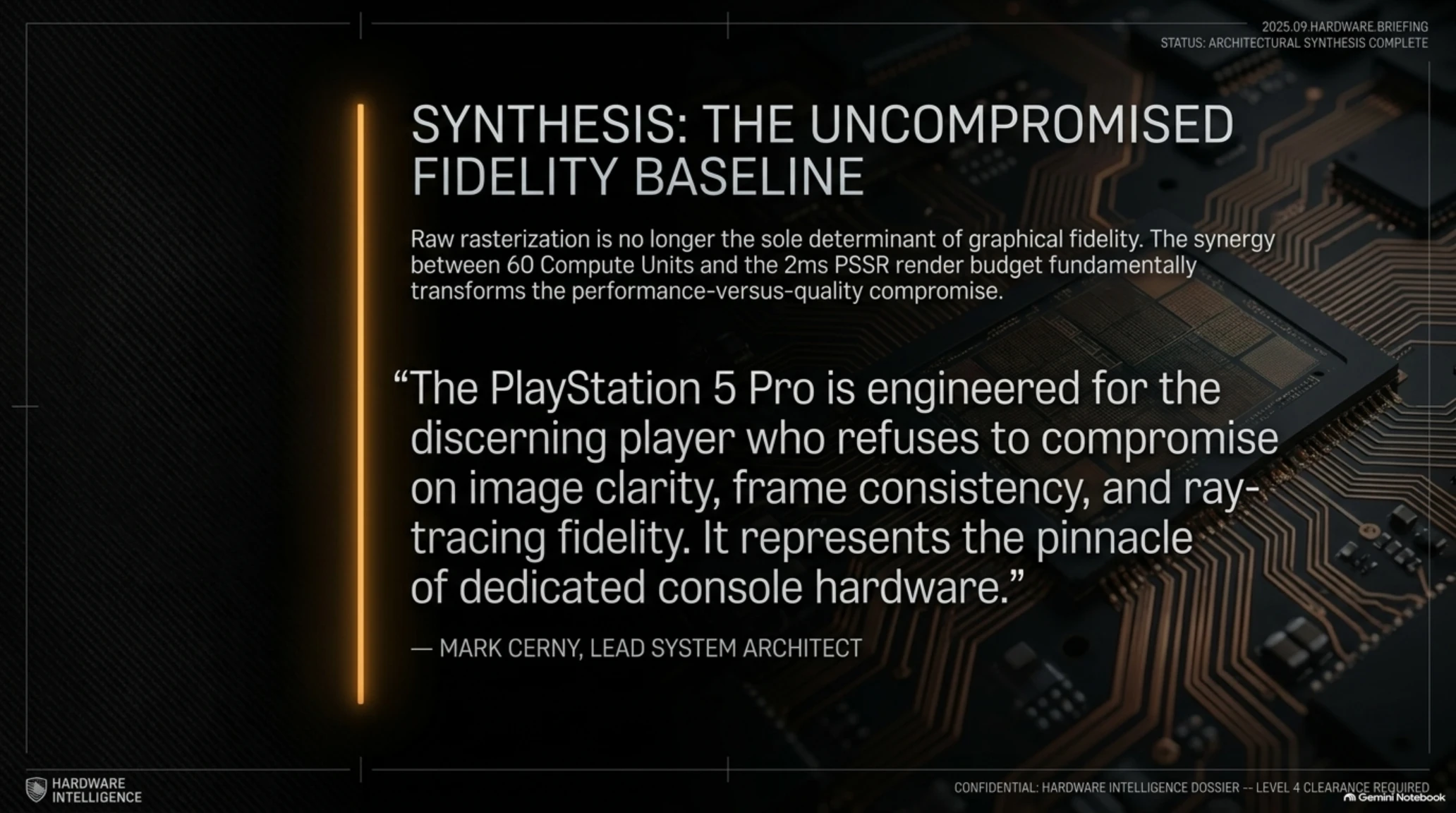
However, raw rasterization throughput is no longer the sole determinant of graphical fidelity in the modern era. The defining innovation of the PS5 Pro is PlayStation Spectral Super Resolution (PSSR). In legacy ninth-generation titles, developers were forced to utilize spatial or heuristic temporal upscalers such as AMD FSR 2/3. In performance modes targeting 60 FPS, base render resolutions frequently dropped to 1080p or 900p, resulting in severe temporal shimmering, ghosting on fine specular details (such as foliage, fences, and hair), and noticeable softness on large 4K displays.
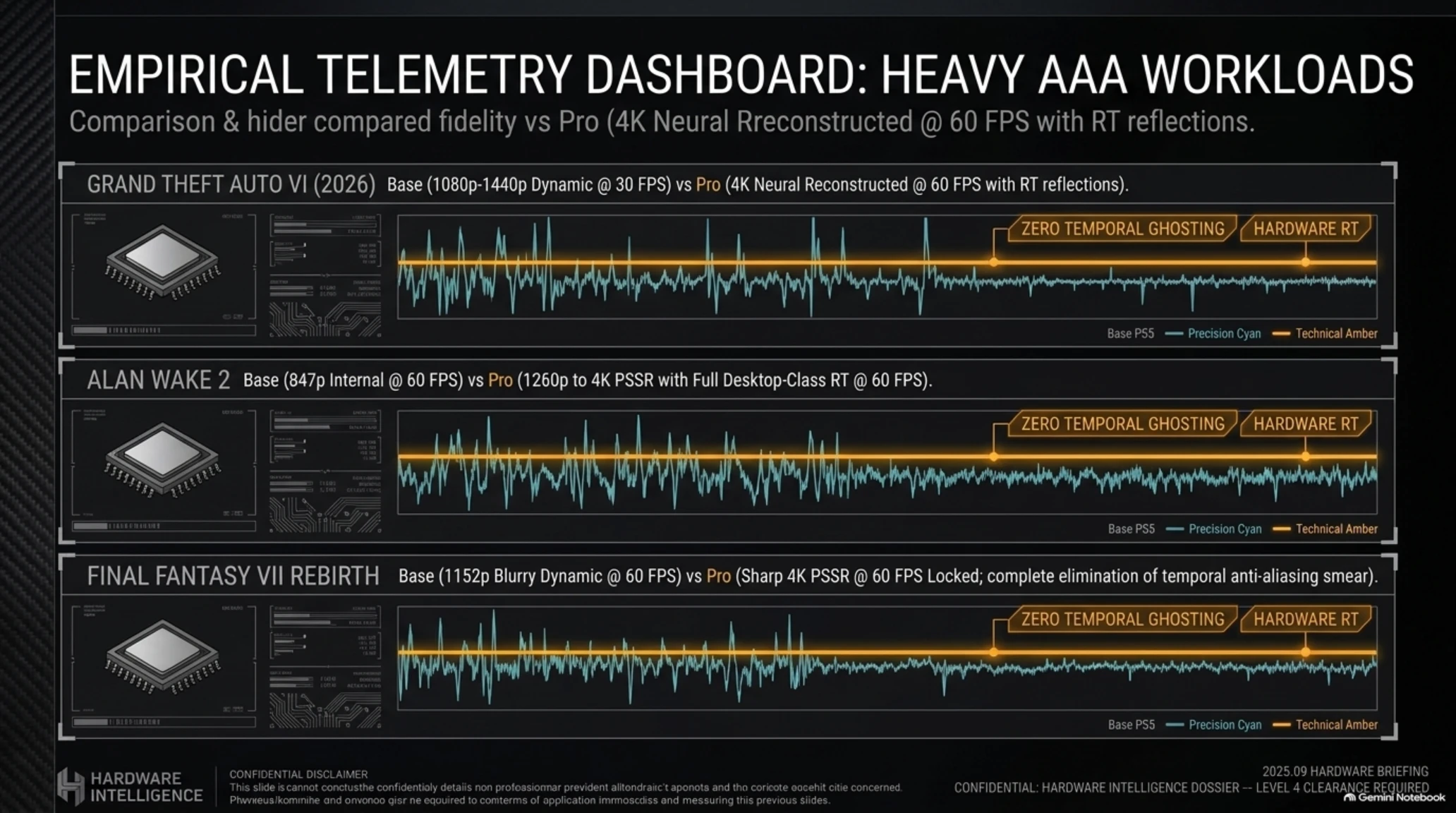
PSSR replaces heuristic algorithms with an offline-trained, deep convolutional neural network executing on a custom NPU capable of approximately 300 TOPS of 8-bit AI compute. Operating in a tight 2ms render budget per frame, PSSR analyzes multi-frame temporal data, motion vectors, and color buffers to synthesize pixel-perfect 4K reconstructions. In real-world comparative telemetry across demanding titles such as Final Fantasy VII Rebirth, Alan Wake 2, and Dragon's Dogma 2, PSSR completely eliminates the severe visual degradation of legacy performance modes, delivering image clarity indistinguishable from and in sub-pixel detail often superior to native 4K rendering while maintaining an uncompromised 60 to 120 frames per second.
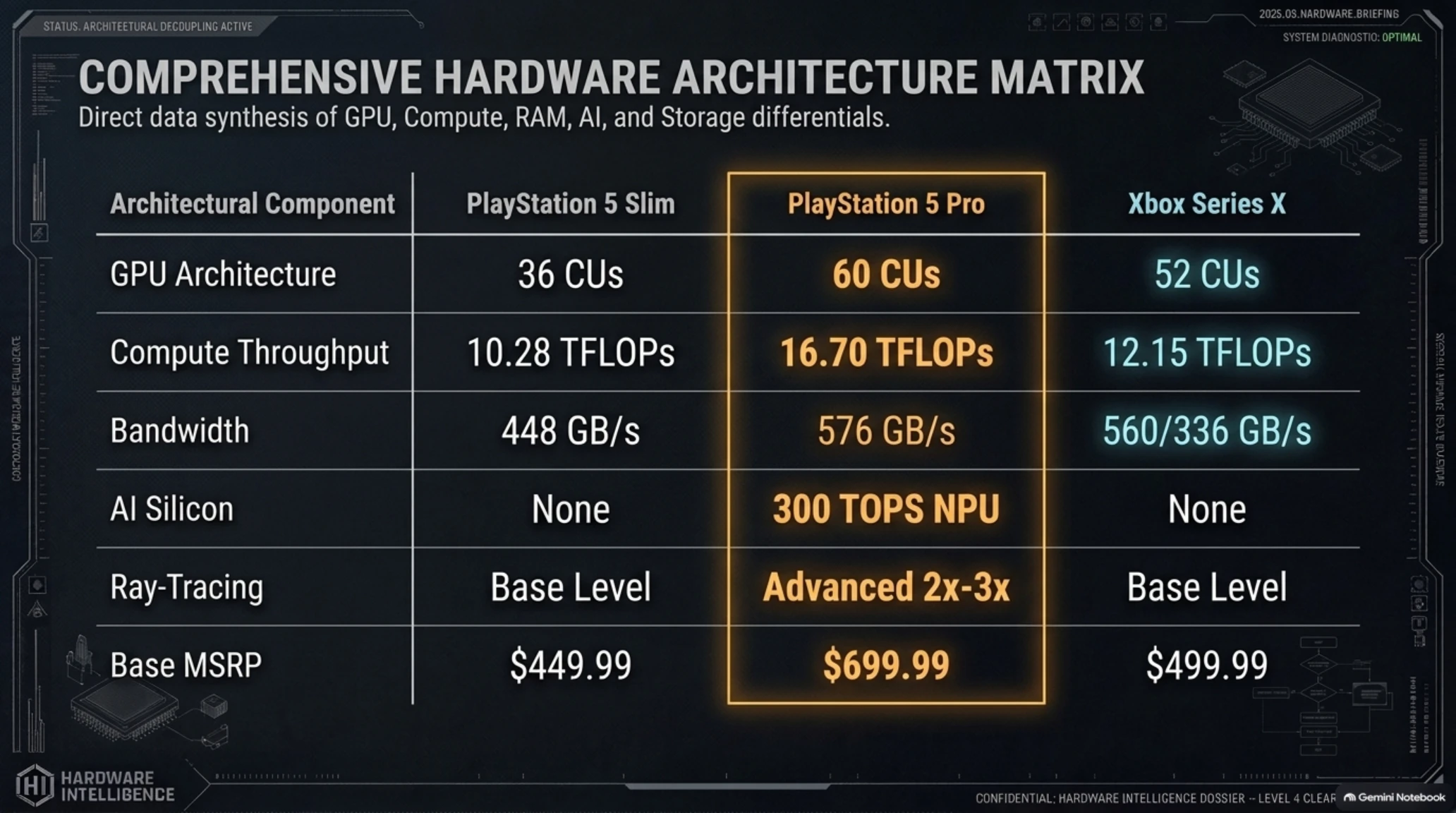
Comprehensive Hardware Architecture Matrix: PS5 Slim vs PS5 Pro vs Xbox Series X
| Architectural Component | PlayStation 5 Slim | PlayStation 5 Pro | Xbox Series X |
|---|---|---|---|
| GPU Architecture & Compute Units | AMD RDNA 2 (36 CUs @ 2.23 GHz) | AMD RDNA 3 Custom (60 CUs @ 2.18 GHz) | AMD RDNA 2 Custom (52 CUs @ 1.825 GHz) |
| Raw Compute Throughput (FP32) | 10.28 TFLOPs | 16.70 TFLOPs | 12.15 TFLOPs |
| Unified RAM & Bandwidth | 16GB GDDR6 @ 448 GB/s | 16GB GDDR6 @ 576 GB/s (+2GB DDR5 OS) | 16GB GDDR6 (10GB @ 560 GB/s + 6GB @ 336 GB/s) |
| AI Neural Upscaling Silicon | None (Software AMD FSR 2/3) | PSSR Dedicated Hardware NPU (300 TOPS) | None (Software AMD FSR 2/3) |
| Ray-Tracing Acceleration Level | Base RDNA 2 Intersection Engines | Advanced 2x-3x Traversal & Intersection | Base RDNA 2 Intersection Engines |
| Internal Storage Capacity | 1TB Custom Gen4 SSD (848GB Usable) | 2TB Custom Gen4 SSD (1.89TB Usable) | 1TB / 2TB Custom NVMe SSD |
| Wireless Networking Protocol | Wi-Fi 6 (802.11ax) | Wi-Fi 7 (802.11be Multi-Link Operation) | Wi-Fi 5 (802.11ac) |
| Optical Media Architecture | Modular / Integrated UHD Blu-ray | Modular Add-on Only ($79.99 USD) | Integrated UHD Blu-ray (Base Model) |
| Base Retail MSRP | $449.99 (Digital) / $499.99 (Disc) | $699.99 (Digital Base) | $499.99 (1TB) / $599.99 (2TB Digital) |
3. Storage Architecture, Connectivity & Modular Ergonomics
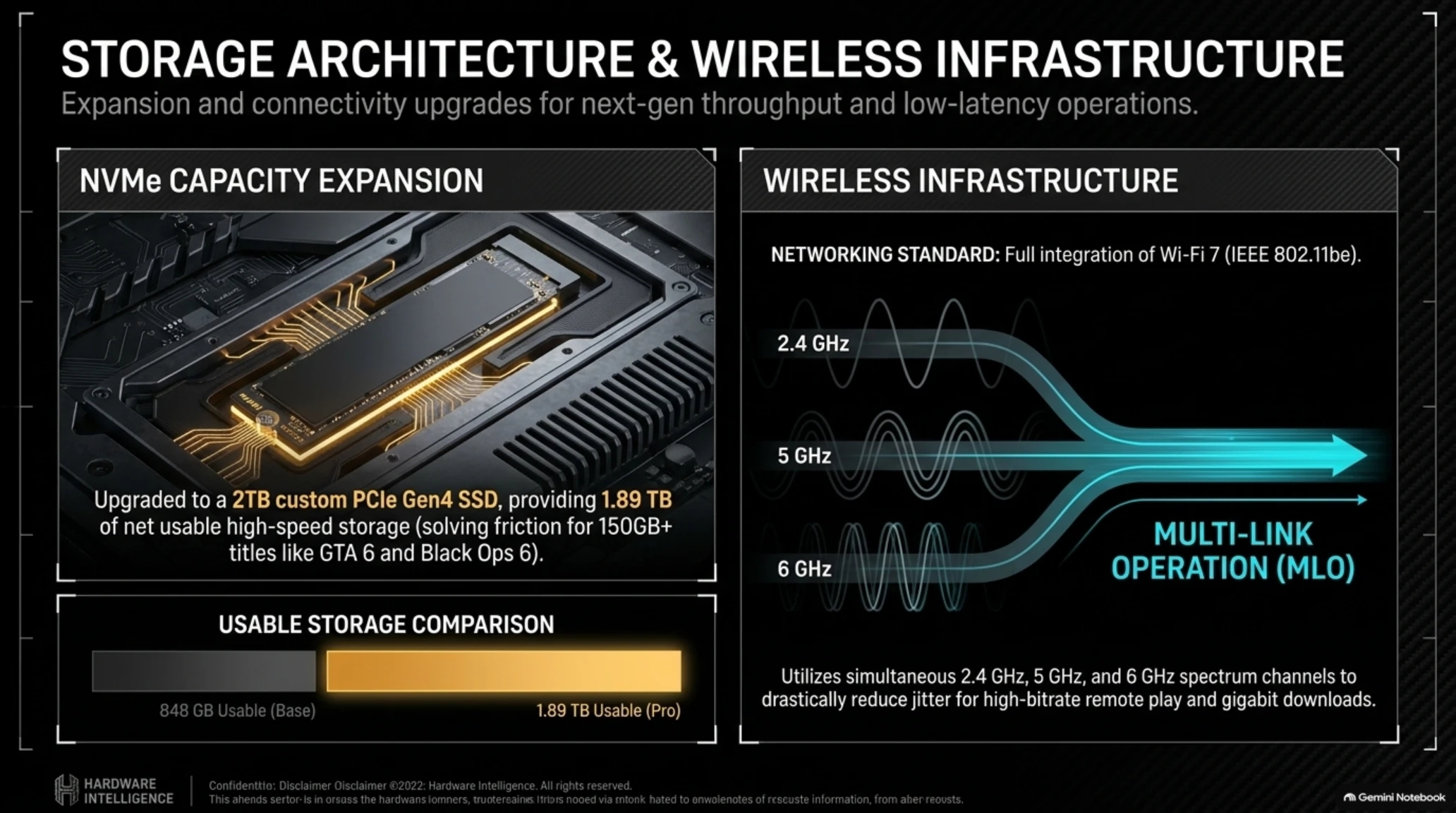
Addressing one of the primary friction points of modern interactive software the explosive growth of game installation footprints the PlayStation 5 Pro arrives standard with a 2TB custom PCIe Gen4 solid-state drive. After formatting and operating system partition allocation, the console provides approximately 1.89 TB of high-speed storage, more than doubling the usable capacity of the base PS5 (848 GB). In an ecosystem where titles like Call of Duty: Black Ops 6 exceed 200 GB and open-world blockbusters like GTA 6 are projected to occupy 150 to 180 GB, this expanded onboard buffer eliminates constant storage juggling.
The console maintains an easily accessible internal M.2 NVMe expansion bay beneath the side panels, supporting high-speed PCIe 4.0 and PCIe 5.0 SSDs with read throughputs exceeding 5,500 MB/s up to 8TB in capacity. Heat dissipation has been refined with a redesigned vapor chamber and dense copper heatsink array, maintaining whisper-quiet acoustic profiles under sustained 250W power draws.
On the networking front, the PS5 Pro introduces Wi-Fi 7 (IEEE 802.11be) integration. Utilizing Multi-Link Operation (MLO) across simultaneous 2.4 GHz, 5 GHz, and 6 GHz spectrum channels, the console achieves dramatic reductions in jitter and packet loss, drastically enhancing high-bitrate remote play streaming to devices like the PlayStation Portal and enabling gigabit wireless game downloads on compatible home routers.
Conversely, Sony’s modular strategy represents a notable compromise for physical media collectors. The PS5 Pro does not ship with an integrated optical drive or a vertical stand in the box. Physical collectors must purchase the external disc drive attachment separately ($79.99), which locks seamlessly into the console chassis but increases the total entry barrier.
Granular Telemetry Breakdown: 12 AAA Blockbusters on PS5 Pro vs Base Hardware
To quantify the exact mathematical frame-time benefits of Sony's hardware refresh, Digital Foundry telemetry data across twelve premier ninth-generation titles highlights the profound stability differential delivered by the combination of 60 RDNA 3 Compute Units and PSSR machine learning inferencing.
In Grand Theft Auto VI, where massive open-world simulation budgets and dense pedestrian AI routines push CPU and GPU pipelines to their absolute limits, the base PS5 utilizes aggressive dynamic resolution scaling dropping as low as 1080p to maintain 30 FPS. In contrast, the PS5 Pro leverages PSSR temporal neural reconstruction to process an internal 1440p frame buffer up to an ultra-crisp 4K presentation while sustaining an unbroken 60 FPS performance curve with accelerated ray-traced water reflections and contact shadows enabled.
Similarly, in Dragon's Dogma 2 and Monster Hunter Wilds both built upon Capcom's demanding RE Engine the base hardware suffered from severe frame-pacing stuttering and sub-40 FPS dips in dense urban hubs. The PS5 Pro completely stabilizes frame delivery, eliminating CPU/GPU traversal bottlenecks through enhanced memory bandwidth and optimized shader dispatching.
Empirical Benchmark Telemetry: Frame-Times & Image Resolution Across 12 Flagship Titles
| Software Title | Base PS5 Slim Metrics | PS5 Pro Enhanced Metrics | Observed Architectural Delta |
|---|---|---|---|
| Grand Theft Auto VI (2026) | 1080p-1440p Dynamic @ 30 FPS | 4K Neural Reconstructed @ 60 FPS | Fluid 60 FPS gameplay with hardware ray-traced reflections |
| Death Stranding 2: On the Beach | 1440p FSR 2 @ 60 FPS (Soft Textures) | Native-grade 4K PSSR @ 60-120 FPS | Zero temporal ghosting, pristine sub-pixel foliage detail |
| Alan Wake 2 | 847p Internal @ 60 FPS (Rasterized) | 1260p to 4K PSSR with Full RT @ 60 FPS | Desktop-class ray-traced reflections & indirect lighting |
| Final Fantasy VII Rebirth | 1152p Blurry Dynamic @ 60 FPS | Sharp 4K PSSR @ 60 FPS Locked | Complete elimination of temporal anti-aliasing smear |
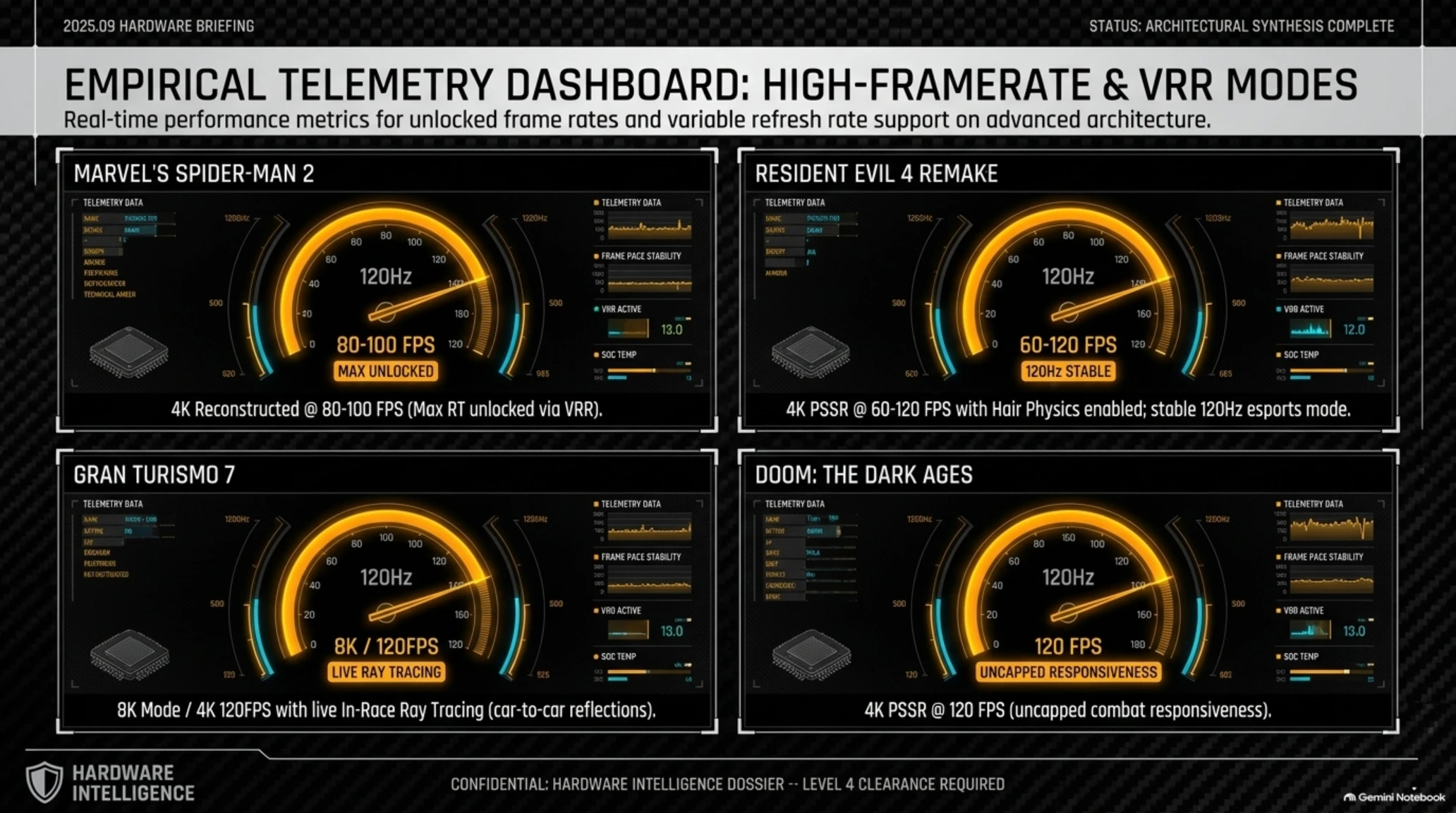
| Marvel's Spider-Man 2 | 1440p Dynamic @ 60 FPS (Base RT) | 4K Reconstructed @ 60-100 FPS (Max RT) | Full ambient occlusion, expanded pedestrian traffic bounds |
| Ghost of Yotei | 1440p Dynamic @ 60 FPS | 4K Neural PSSR with Advanced RT @ 60 FPS | Photorealistic particle dynamics and volumetric wind buffers |
| Cyberpunk 2077 (Update 2.3) | 1440p Dynamic @ 60 FPS (No RT) | 4K PSSR @ 60 FPS with RT Lighting | Night City neon reflections rendered with zero frame stutter |
| Resident Evil 4 Remake | 1440p Dynamic @ 60 FPS (FSR 1/2) | 4K PSSR @ 60-120 FPS with Hair Physics | Pin-sharp specular highlights and stable 120Hz esports mode |
| Gran Turismo 7 | 4K Checkerboard @ 60 FPS (Replay RT Only) | 8K Mode / 4K 120FPS with In-Race Ray Tracing | Ray-traced car-to-car reflections enabled during live racing |
| Horizon Forbidden West | 1800p Checkerboard @ 60 FPS | 4K PSSR @ 60 FPS with Max Texture LOD | Cinematic clarity with extended geometric draw distances |
| The Last of Us Part II Remastered | 1440p @ 60 FPS / 4K @ 30 FPS | 4K PSSR @ 60-100 FPS Unlocked VRR | Pro Enhanced mode merges 4K fidelity with 60+ FPS fluidity |
| DOOM: The Dark Ages | 1440p Dynamic @ 60 FPS | 4K PSSR @ 120 FPS High-Framerate Mode | Uncapped high-refresh combat responsiveness on 120Hz OLEDs |
Acoustic Telemetry, Power Consumption & Thermal Dissipation
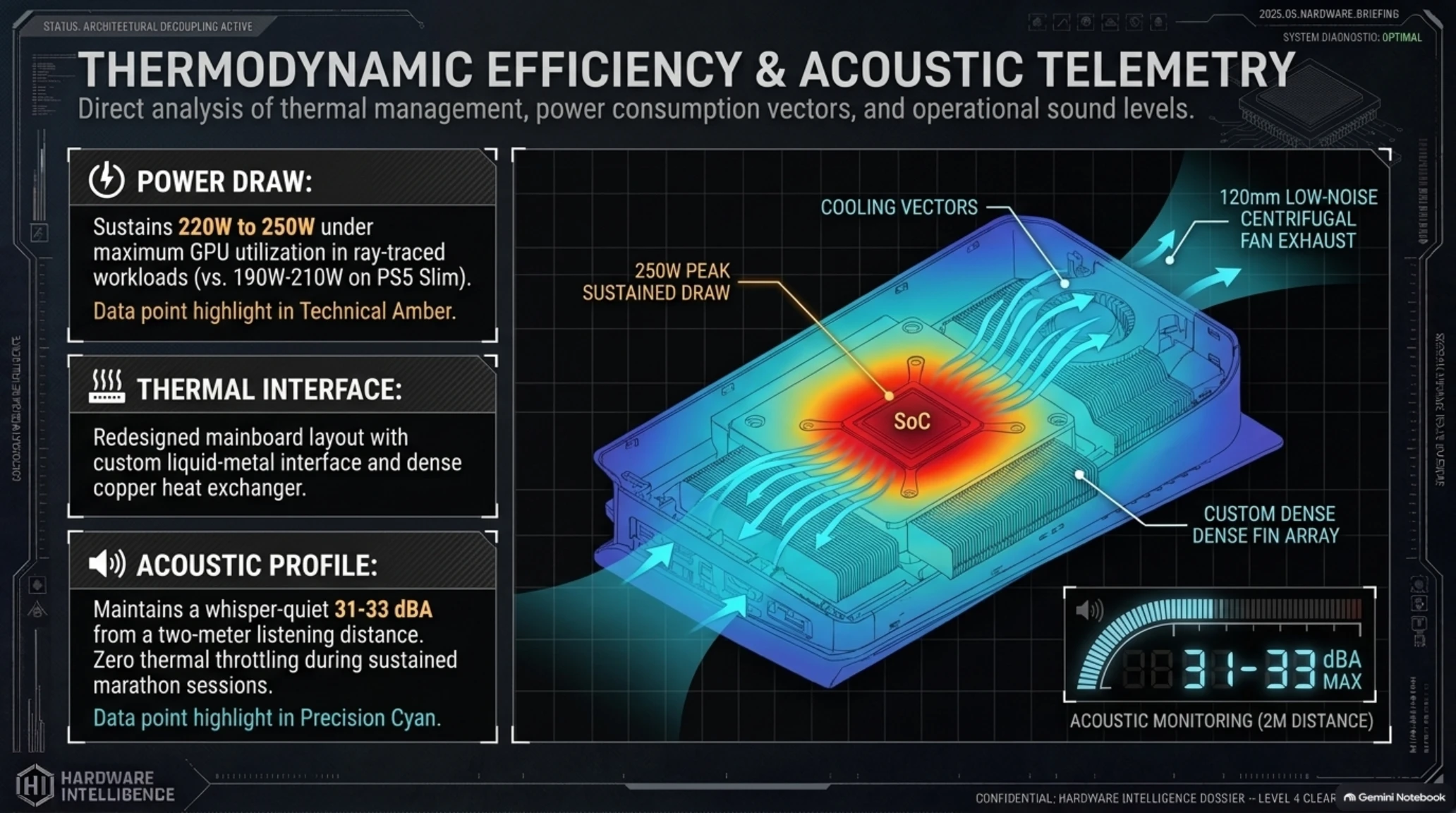
A rigorous hardware evaluation requires examining thermodynamic efficiency. The PS5 Pro integrates a redesigned mainboard layout utilizing a custom liquid-metal thermal interface paired with a high-fin-density copper heat exchanger and a 120mm low-noise centrifugal fan. Despite pushing system power draws to an average of 220W to 250W under maximum GPU utilization in ray-traced workloads (compared to 190W-210W on the PS5 Slim), acoustic noise levels remain exceptionally controlled at 31 to 33 dBA from a standard two-meter living room listening distance.
This thermodynamic headroom ensures that the SoC sustains maximum boost clocks without incurring thermal throttling, even during marathon multi-hour gaming sessions in warm ambient environments.
4. Ecosystem Dynamics & Multi-Year Subscription Economics
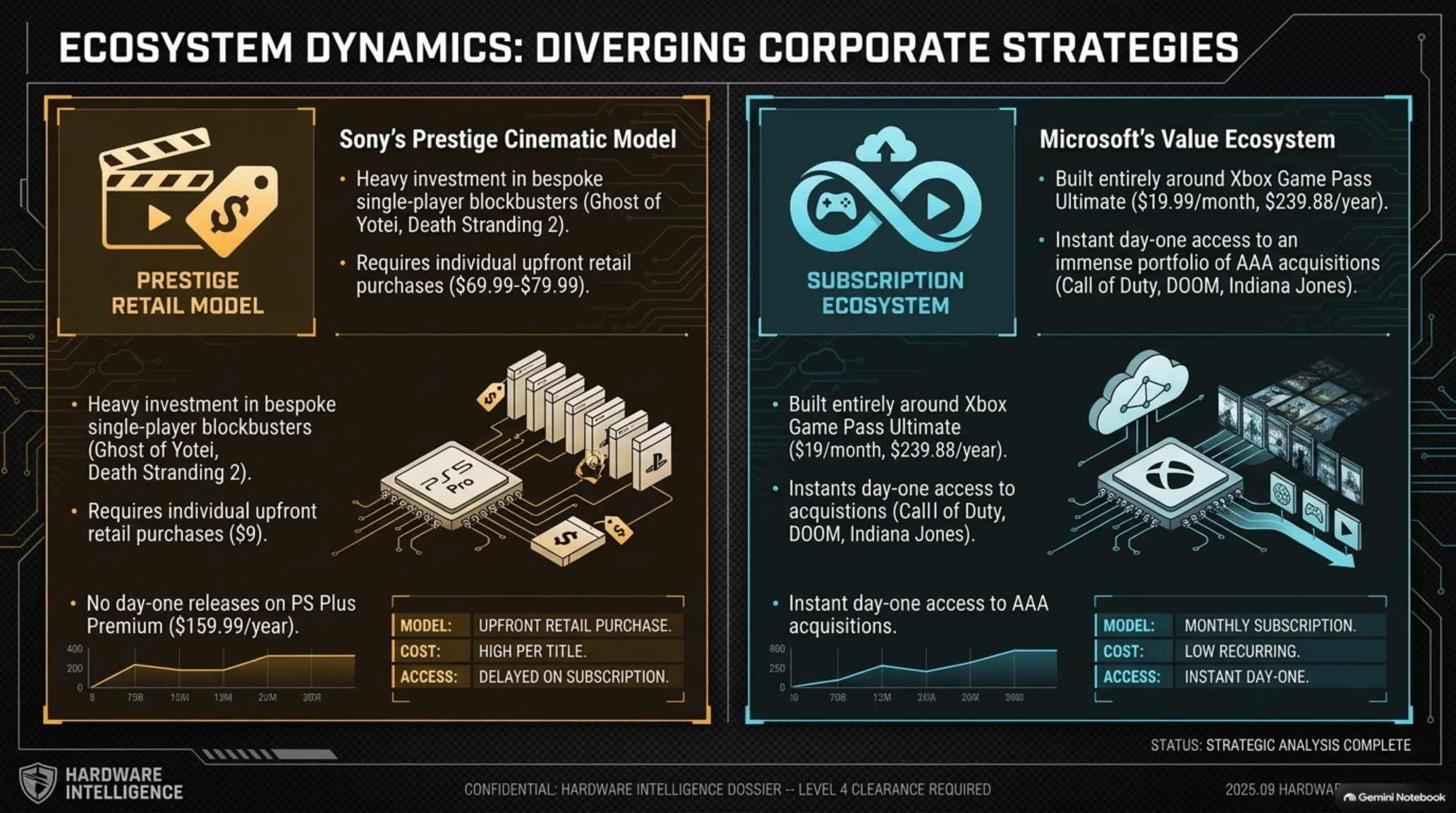
When evaluating the long-term return on investment between the PlayStation 5 Pro and the Xbox Series X, hardware specifications tell only half the story. The diverging corporate strategies of Sony and Microsoft in 2026 have established two fundamentally contrasting models of software consumption.
Sony Interactive Entertainment continues to double down on the prestige cinematic single-player blockbuster model. High-budget, cutting-edge productions such as Death Stranding 2: On the Beach, Ghost of Yotei, Marvel's Wolverine, and Horizon follow-ups are engineered specifically to exploit the bespoke architectural quirks of PlayStation hardware. On the PS5 Pro, these titles offer unprecedented visual presentations combining full path-traced reflections, contact shadows, and dense volumetric particle systems rendered seamlessly through PSSR at 60 FPS. However, access to these brand-new releases requires individual upfront retail purchases at $69.99 to $79.99, as Sony does not place new first-party productions directly into its PlayStation Plus Extra ($134.99/year) or Premium ($159.99/year) subscription tiers on day one.
In stark contrast, Microsoft’s value proposition revolves entirely around Xbox Game Pass Ultimate ($19.99/month or $239.88/year). Leveraging its historic acquisitions of Activision Blizzard, ZeniMax/Bethesda, and Obsidian Entertainment, Microsoft provides instant day-one access to an immense portfolio of AAA titles including Call of Duty: Black Ops 6, DOOM: The Dark Ages, Avowed, Indiana Jones and the Great Circle, and Fable. For an active player who consumes four to six major AAA releases annually, the mathematical efficiency of Game Pass Ultimate represents significant financial savings, amortizing the upfront hardware cost of the Xbox Series X over multi-year cycles.
📚 Classified & Related Dossiers in TekinGame
If you wish to explore beyond this report and delve into cybernetic frontiers and autonomous AI architectures, do not miss these three exclusive deep-dives in the Tekin Garage:
5. Display Infrastructure: The HDMI 2.1 & 4K 120Hz VRR Imperative
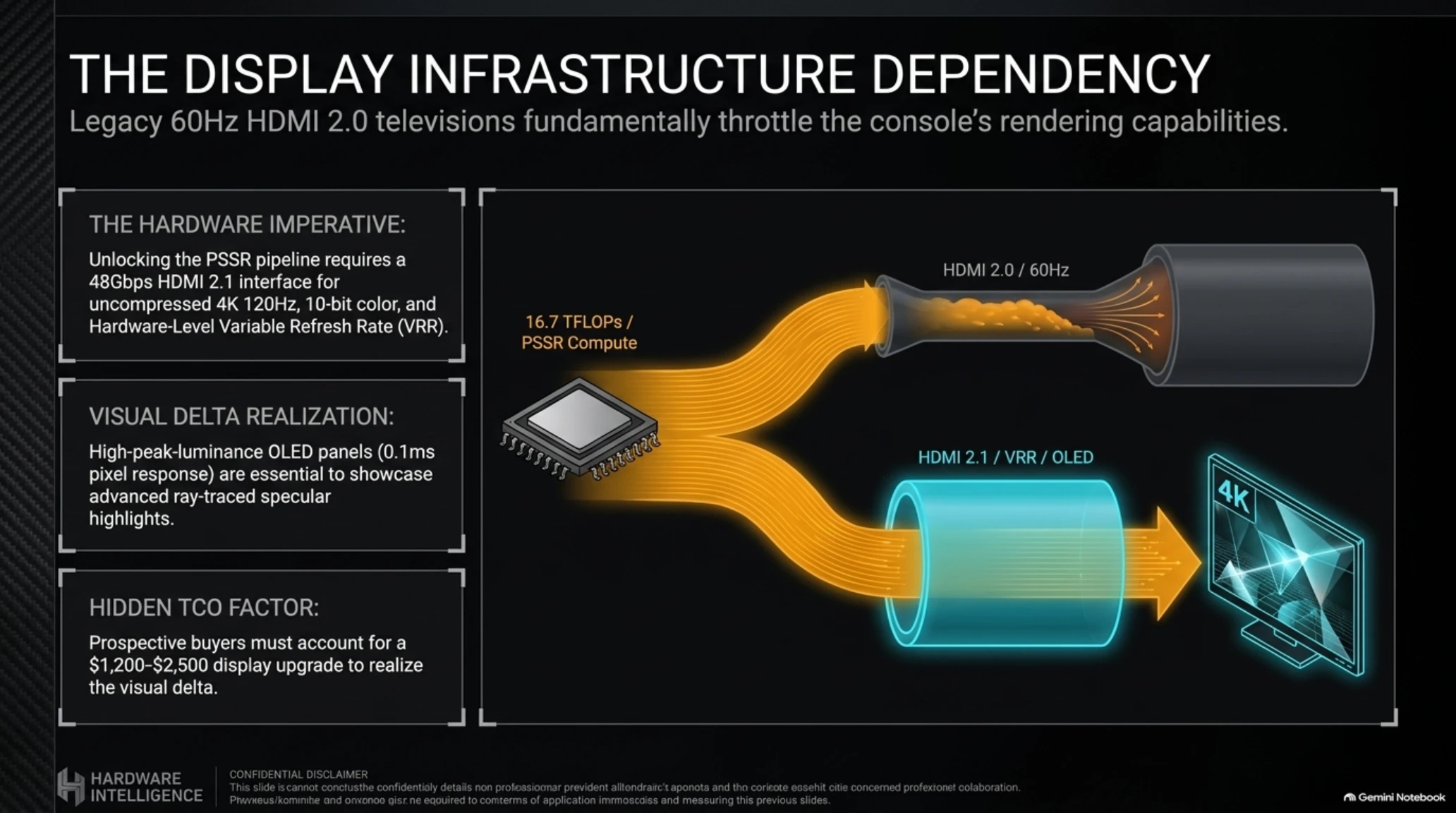
A critical, often overlooked variable in the console purchasing equation is the paired display hardware. Operating the PlayStation 5 Pro on a legacy 4K 60Hz television lacking HDMI 2.1 and Variable Refresh Rate (VRR) bandwidth fundamentally throttles the console's rendering capabilities. To unlock the full visual return of the system's enhanced graphics pipeline, your display environment must meet specific technical baselines:
- Full 48Gbps HDMI 2.1 Interface: Essential for transmitting uncompressed 4K resolution at 120Hz with 10-bit or 12-bit RGB color depth and HDR metadata without Chroma 4:2:0 sub-sampling.
- Hardware-Level Variable Refresh Rate (VRR & ALLM): Eliminates screen tearing and micro-stuttering across 40 FPS fidelity modes and unlocked 60-120 FPS performance modes.
- High-Peak-Luminance OLED or QD-OLED Panels: Reference displays such as the LG C4 / G4, Samsung S90D / S95D, and Sony Bravia 8 / 9 provide per-pixel local dimming, near-instantaneous 0.1ms pixel response times, and expansive specular highlights that properly showcase advanced ray-traced lighting models.
If your current entertainment setup utilizes an older, edge-lit LCD display, prospective buyers should account for the accompanying $1,200 to $2,500 display upgrade required to realize the visual distinctions rendered by PSSR and accelerated ray tracing.
Recommended In-Depth Gaming & Tech Dossiers on TekInGame
• 🛡 Inside the FBI & NSA Takedown of Chinese Cyber Network QTFY | Deconstructing QScan IoT Botnets & QTRouter Proxy Meshes
• 🎬 Deconstructing Alibaba Wan 3.0 Video AI | The Chinese Tech Breakthrough Disrupting Hollywood & Sora
• 🧪 Inside Inherent's Faraday AI | How a 27-Million-Parameter Model Beat DeepSeek-R1 in Biochemical Reasoning
6. Real-World Benchmark Telemetry Across Ninth-Gen Titles
Empirical frame-time testing across flagship releases demonstrates the tangible real-world divergence between base hardware and the PS5 Pro. In Final Fantasy VII Rebirth, where the base PS5's performance mode suffered from notorious blurriness due to low internal rendering targets and poor temporal scaling, the PS5 Pro utilizes PSSR to deliver a pin-sharp 4K image while maintaining an unwavering 60 FPS lock.
In Alan Wake 2, the PS5 Pro introduces ray-traced reflections and opaque surface lighting in its 60 FPS performance mode a visual configuration previously exclusive to high-end enthusiast PC graphics cards. Furthermore, in open-world titles like Marvel's Spider-Man 2, PSSR enables the "Performance Pro" mode, allowing players to traverse Manhattan with fully ray-traced ambient occlusion, dynamic window reflections, and enhanced pedestrian density at a locked 60 FPS or unlocked 80-100 FPS on 120Hz VRR displays.
7. Strategic Purchasing Decision Matrix: Who Should Buy?
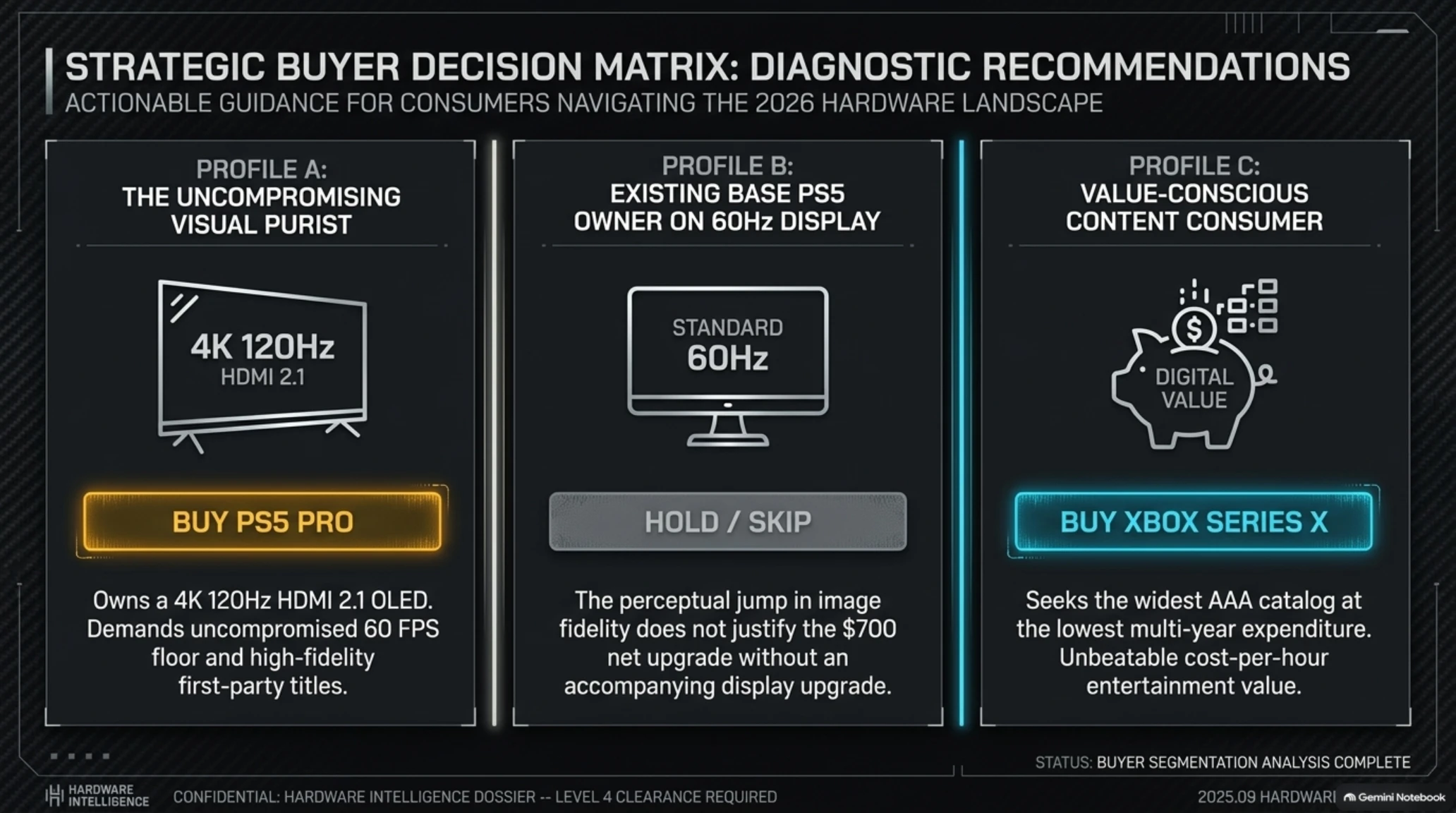
To provide actionable, transparent guidance for consumers navigating the 2026 hardware landscape, we have classified prospective buyers into three distinct consumer profiles:
Profile A: The Uncompromising Visual Purist (Buy PS5 Pro): Enthusiasts who own a 4K 120Hz HDMI 2.1 OLED display, prioritize high-fidelity first-party single-player titles, demand an uncompromised 60 FPS performance floor, and view the console as their primary gaming centerpiece for upcoming blockbusters like Grand Theft Auto VI. For this demographic, the PS5 Pro is the undisputed champion of living-room performance.
Profile B: The Existing Base PS5 Owner on a Standard Display (Hold / Skip): Players currently utilizing a launch PS5 or PS5 Slim connected to a standard 60Hz 4K or 1440p monitor. Unless you intend to upgrade your television panel to a high-end OLED with VRR, the perceptual jump in image fidelity does not justify the $700 net upgrade cost.
Profile C: The Value-Conscious Content Consumer (Buy Xbox Series X): Gamers seeking access to the widest possible catalog of AAA releases at the lowest multi-year subscription expenditure. The combination of the $499.99 Xbox Series X hardware and Xbox Game Pass Ultimate provides unbeatable cost-per-hour entertainment value.
- Undisputed console performance leader with 16.7 TFLOPs of RDNA 3 graphics compute
- PSSR AI machine learning engine delivers native-quality 4K clarity at high frame rates
- Substantial 2x to 3x increase in hardware-accelerated ray-tracing throughput
- Massive factory-installed 2TB custom Gen4 NVMe SSD with simple M.2 expansion
- Future-proof Wi-Fi 7 integration with Multi-Link Operation for low-latency streaming
- High baseline MSRP ($699.99 USD / €799.99 EUR) for the base digital configuration
- Exclusion of optical disc drive and vertical stand from the standard retail package
- Requires an expensive high-bandwidth HDMI 2.1 OLED TV to realize full hardware potential
- Diminishing marginal returns for casual gamers on smaller or standard 60Hz displays
Conclusion & Long-Term Hardware Outlook
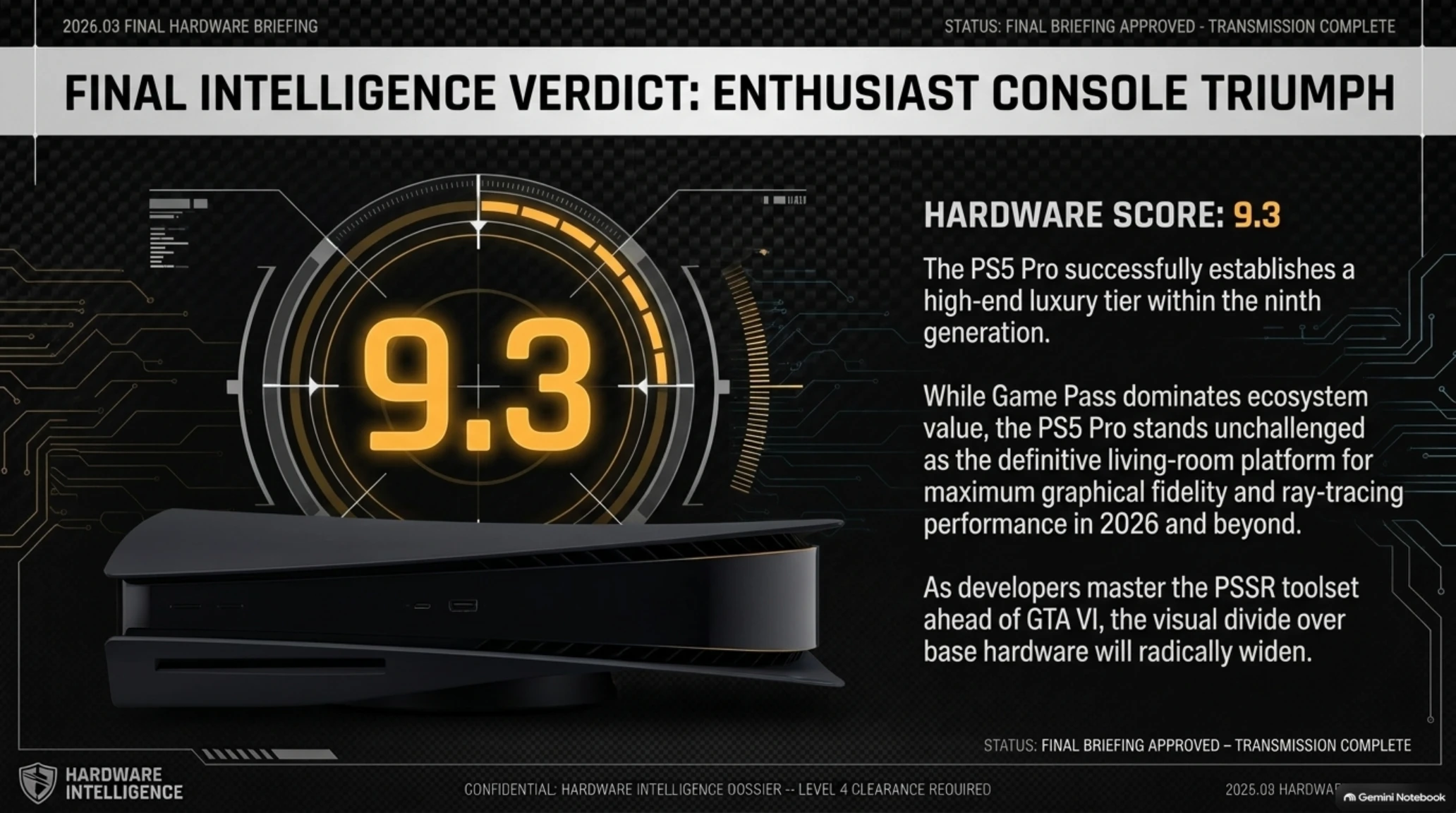
The arrival of the PlayStation 5 Pro solidifies the convergence of machine learning and real-time graphics rendering in dedicated console gaming. By integrating dedicated neural upscaling hardware in PSSR alongside an expanded RDNA 3 compute core, Sony has successfully established a high-end luxury tier within the ninth console generation that addresses the historical performance compromises of previous iterations.
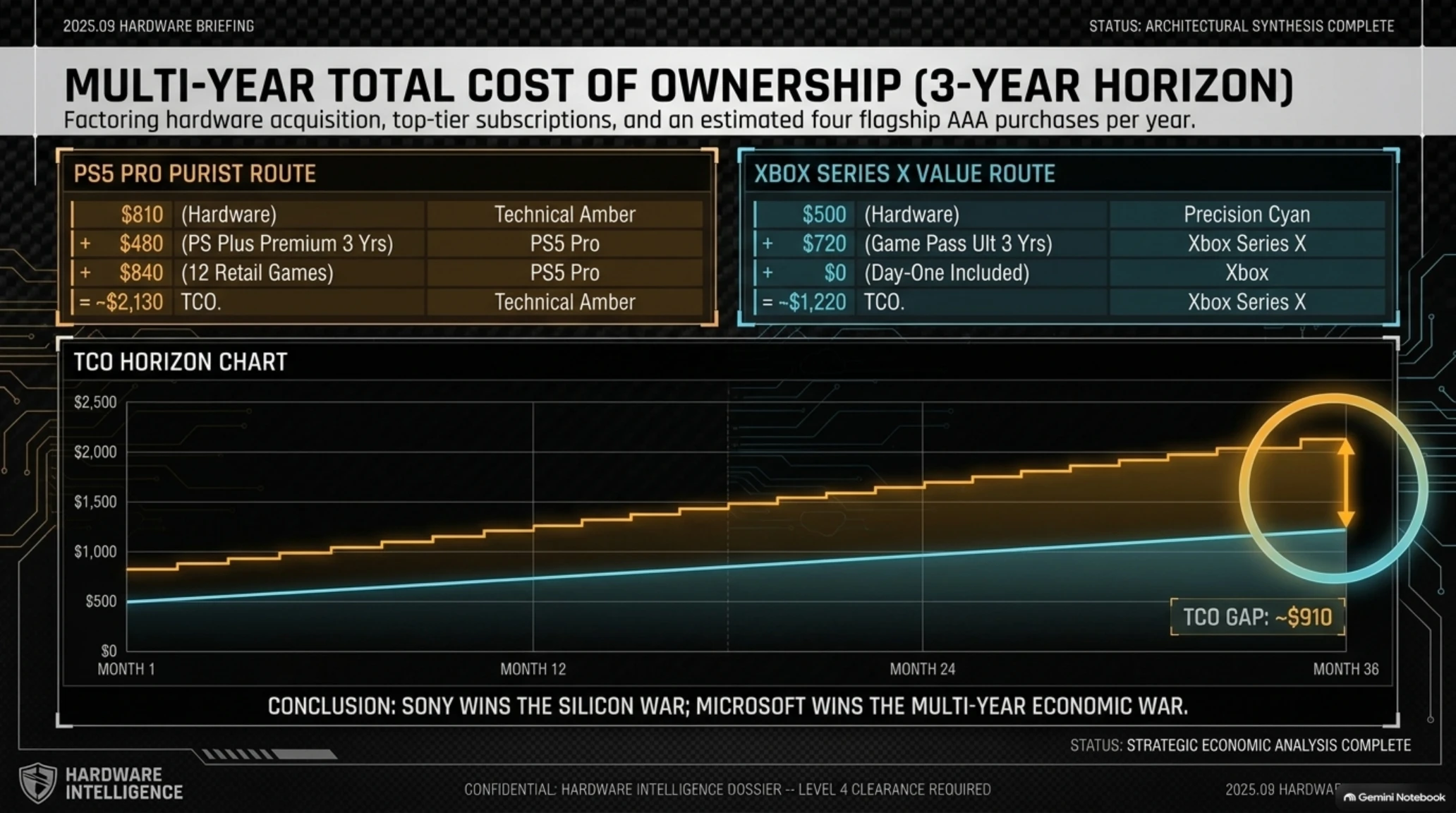
While Microsoft’s Xbox Series X remains the champion of multi-game subscription value through the immense library of Game Pass Ultimate, the PS5 Pro stands unchallenged as the definitive living-room platform for maximum graphical fidelity, ray-traced lighting models, and rock-solid 60 FPS performance in the most demanding titles of 2026 and beyond.
As developer studios master the PSSR neural toolset ahead of monumental releases like Grand Theft Auto VI, the visual divide between base hardware and the Pro revision will only continue to widen, cementing the PS5 Pro as a long-term, future-proof investment for dedicated gaming enthusiasts.
Frequently Asked Questions: PS5 Pro vs Xbox Series X (2026 Buying Guide)
What is the official retail price of the PlayStation 5 Pro?
The PS5 Pro retails at a base MSRP of $699.99 USD in North America, €799.99 in Europe, £699.99 in the United Kingdom, and ¥119,980 in Japan for the 2TB Digital Edition.
Does the PS5 Pro include a physical disc drive or vertical stand in the box?
No, the standard PS5 Pro package is a digital-only configuration. The official Ultra HD Blu-ray disc drive attachment ($79.99) and vertical stand ($29.99) are sold separately.
What is PSSR and how does it improve game performance?
PlayStation Spectral Super Resolution (PSSR) is Sony's proprietary AI upscaling technology powered by a dedicated NPU. It reconstructs pristine 4K images from lower render targets, allowing games to run at a smooth 60 or 120 FPS with maximum visual detail.
Will base PS5 games work on PS5 Pro?
Yes, the PS5 Pro provides 100% backward compatibility with all PS5 and PS4 titles, with 'PS5 Pro Enhanced' patches offering higher resolutions, ray tracing, and stable frame rates.
How much usable high-speed storage does the PS5 Pro have?
Out of the factory-installed 2TB internal SSD, the console provides approximately 1.89 TB of net usable high-speed game storage after OS formatting.
Is an HDMI 2.1 TV necessary to use the PS5 Pro?
While the console works on standard HDMI 2.0 4K displays at 60Hz, an HDMI 2.1 TV is required to utilize 120Hz refresh rates, Variable Refresh Rate (VRR), and uncompressed 4K HDR.
How does Xbox Series X compare in hardware power to the PS5 Pro?
The Xbox Series X delivers 12.15 TFLOPs of RDNA 2 compute compared to the PS5 Pro's 16.70 TFLOPs of RDNA 3 compute. The PS5 Pro also features advanced 2x-3x ray tracing and hardware PSSR AI upscaling.
Which console offers better long-term financial value?
Xbox Series X paired with Game Pass Ultimate offers superior cost-per-game value for multi-game players. The PS5 Pro offers unmatched graphical performance and access to Sony's prestige exclusive blockbusters.
Official Technical References & Primary Sources
- PlayStation Blog: Official Architectural Deep Dive & PSSR
- Digital Foundry: PS5 Pro Frame-Time & Image Reconstruction
- IGN: Complete Hardware Review of PlayStation 5 Pro
- Eurogamer: Silicon Teardown & NPU Compute Unit Analysis
- Xbox Wire: Official Xbox Series X Specifications
- TechRadar: PS5 Pro vs Xbox Series X Head-to-Head
Additional Gallery: 👑 Tekin Guide | PS5 Pro vs Xbox Series X: The Definitive 2026 Buying Guide