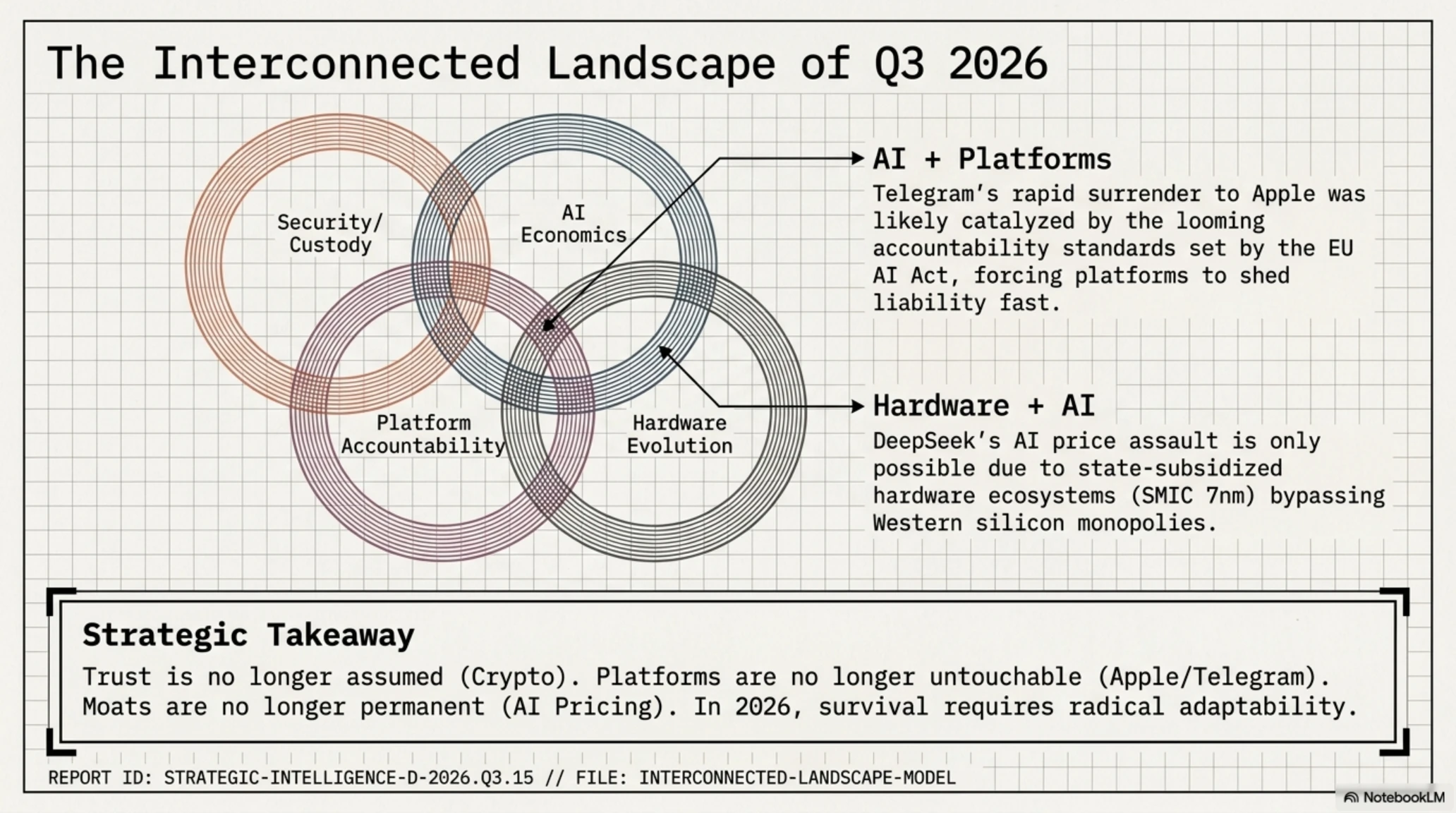
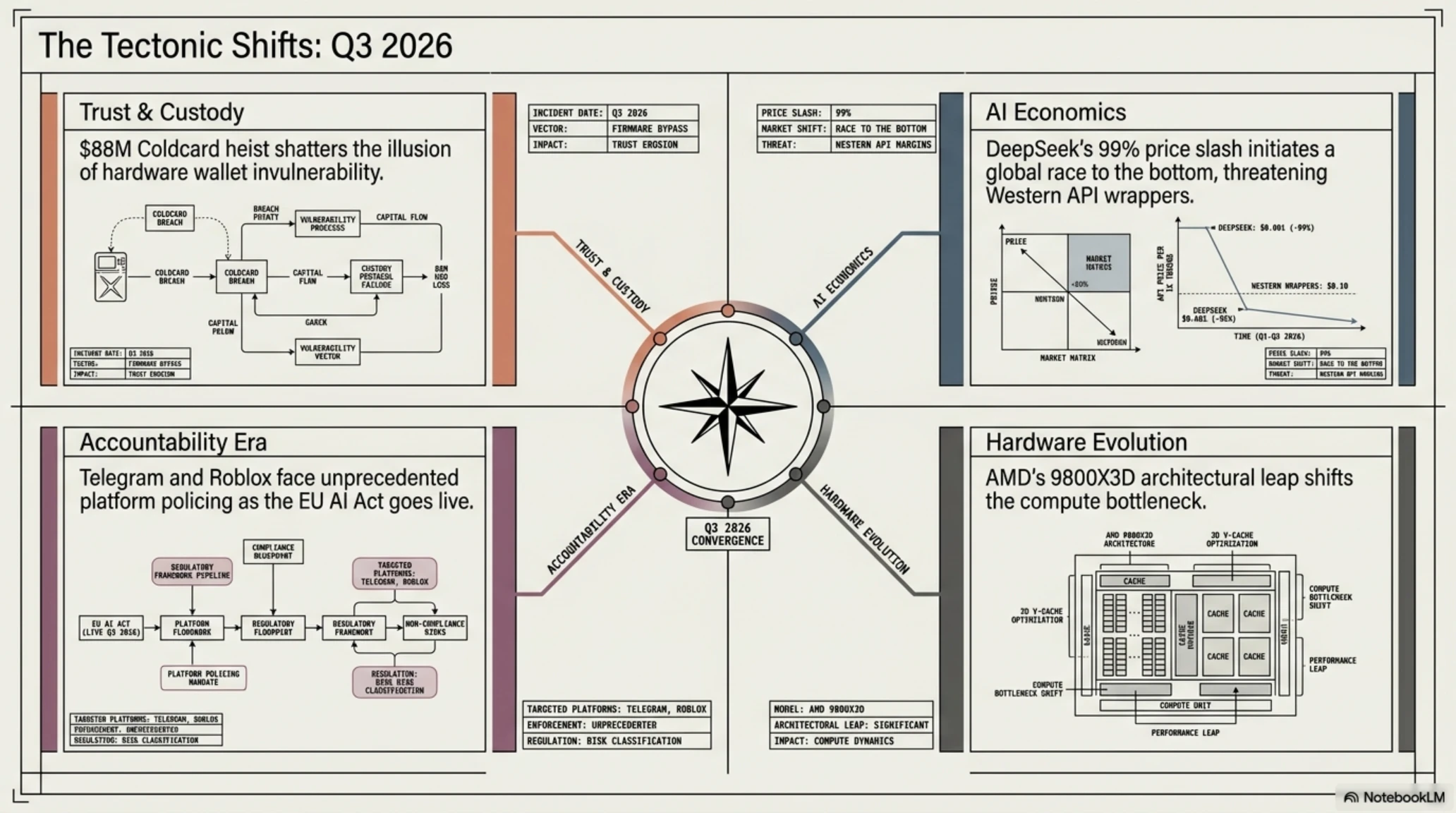
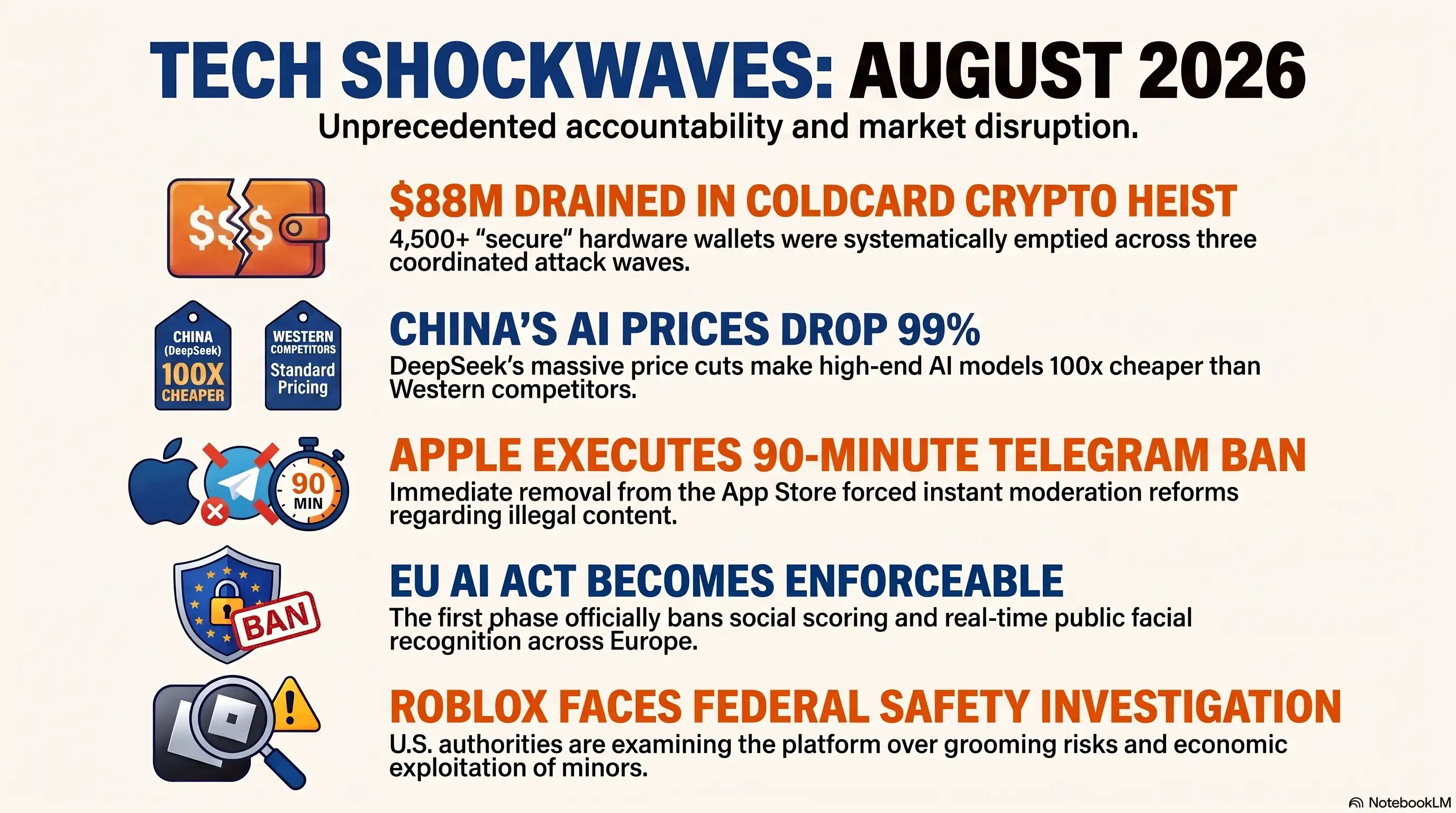
Tuesday morning brings explosive developments across tech and crypto. We analyze the systematic cyberattack draining $88M in Bitcoin from Coldcard hardware wallets, China's DeepSeek disrupting the global AI market with a 99% price cut, Apple's swift 90-minute removal of Telegram over CSAM violations, the enforcement of the EU AI Act, child safety investigations into Roblox, and architectural leaks for AMD's Ryzen 9800X3D gaming CPU.
Good Morning, Tech Enthusiasts! ☕
Tuesday, August 4th, 2026, brings six explosive stories from the worlds of cybersecurity, AI economics, and platform regulation.
- 🎮$88M Crypto Heist- Systematic attack drains Coldcard hardware wallets over 72 hours
- 🎧China's AI Price War- DeepSeek slashes prices by 99%, shaking the global AI market
- 🚀Apple vs Telegram Showdown- 90-minute removal over CSAM content sparks platform power debate
- 🗡️EU AI Act Goes Live- First transparency requirements now enforceable across Europe
Tuesday morning began with a wake-up call that the crypto world still isn't safe to sleep on. A coordinated cyberattack on one of the most trusted hardware wallets, an unprecedented price war in the AI industry, and Apple's lightning-fast enforcement action against Telegram—all signs that the tech industry has entered a new phase of regulation, competition, and accountability.
The Coldcard Catastrophe: When the Most Secure Wallet Fails
In cryptocurrency circles, one golden rule reigns supreme: "Not your keys, not your coins." That's why, for years, users have migrated toward hardware wallets—physical devices that store private keys offline, theoretically immune to remote hacking. Coldcard, manufactured by Canadian firm Coinkite, has long been hailed as the gold standard of crypto security, favored by Bitcoin maximalists and privacy advocates alike.
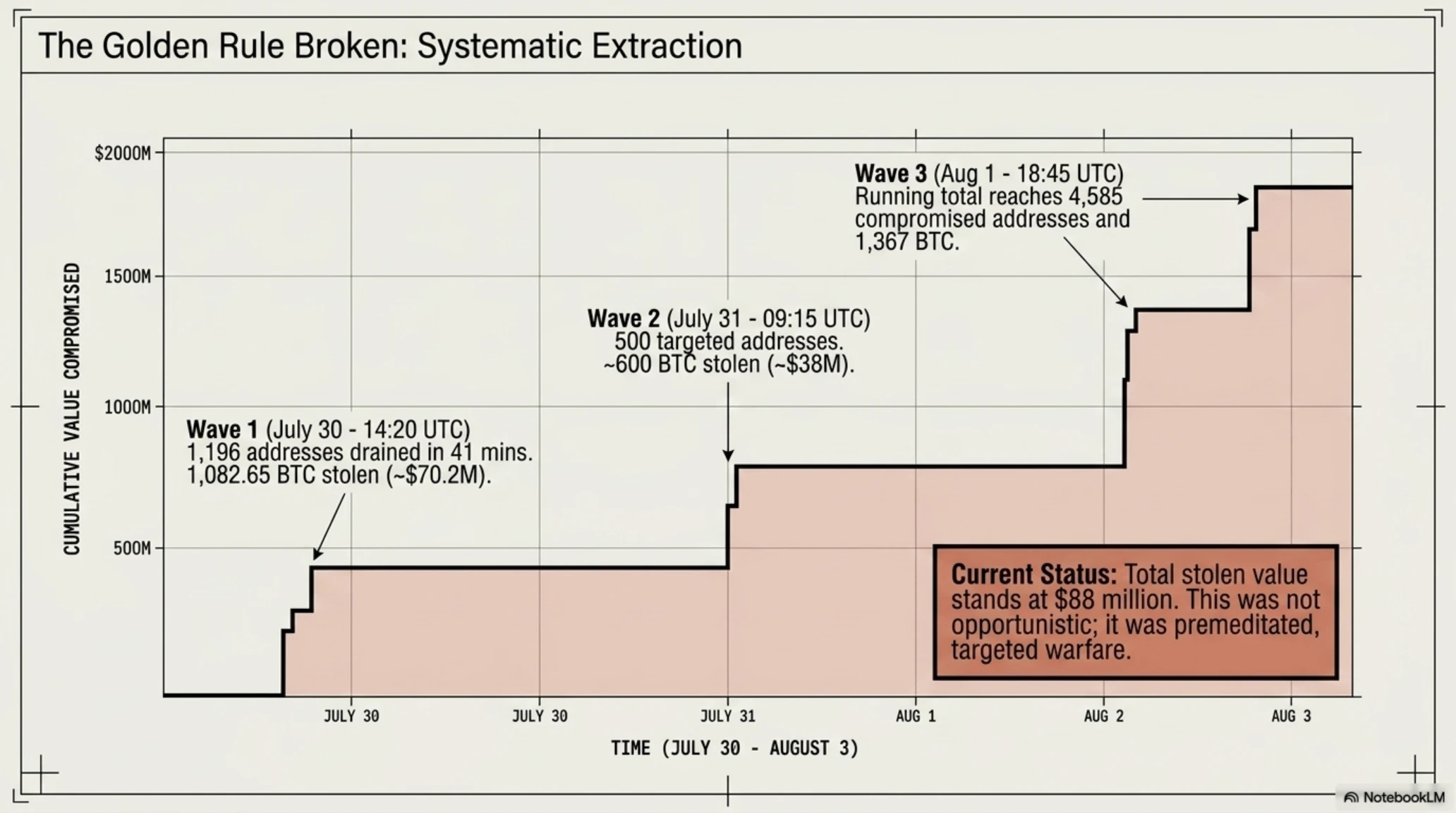
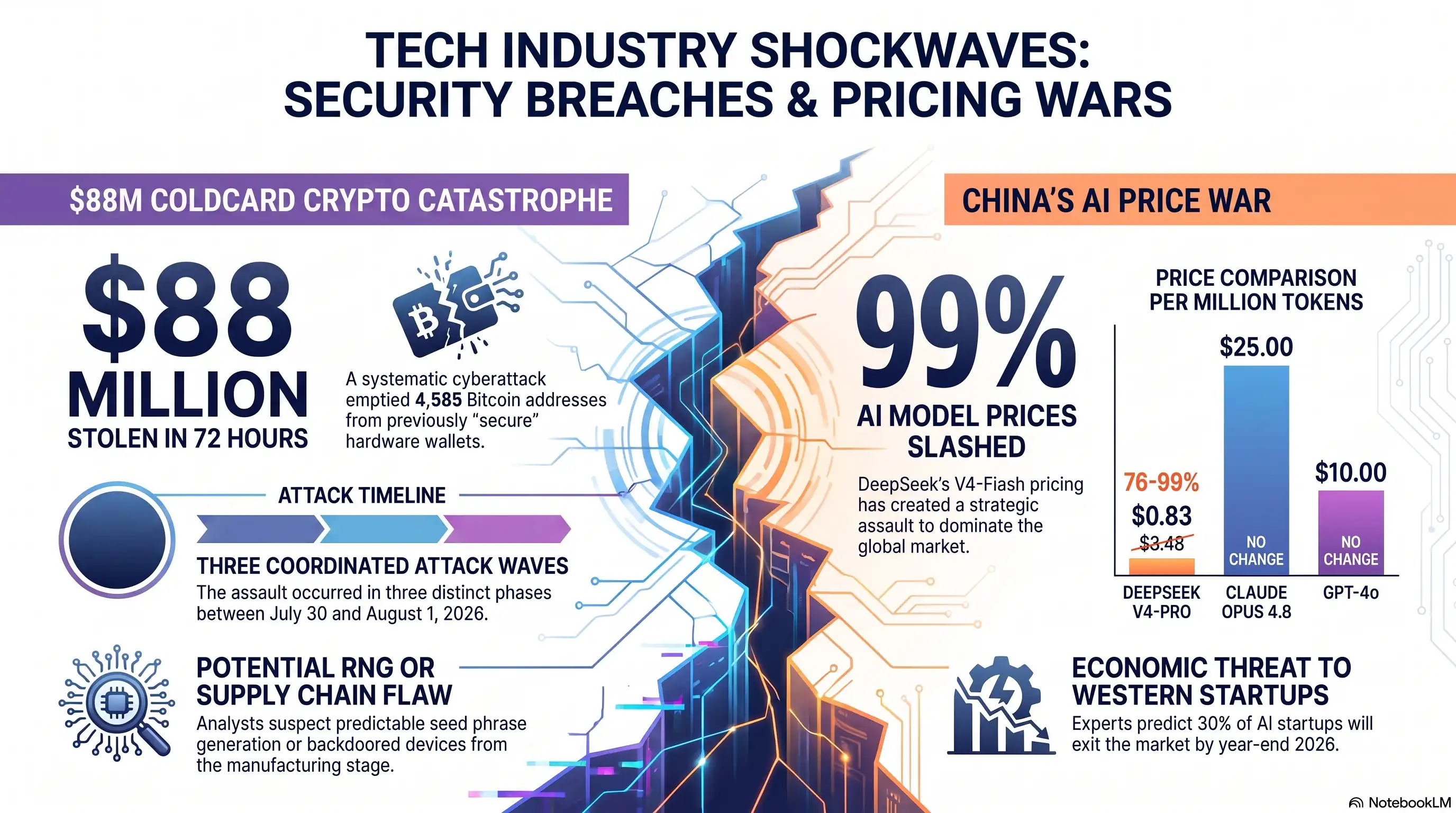
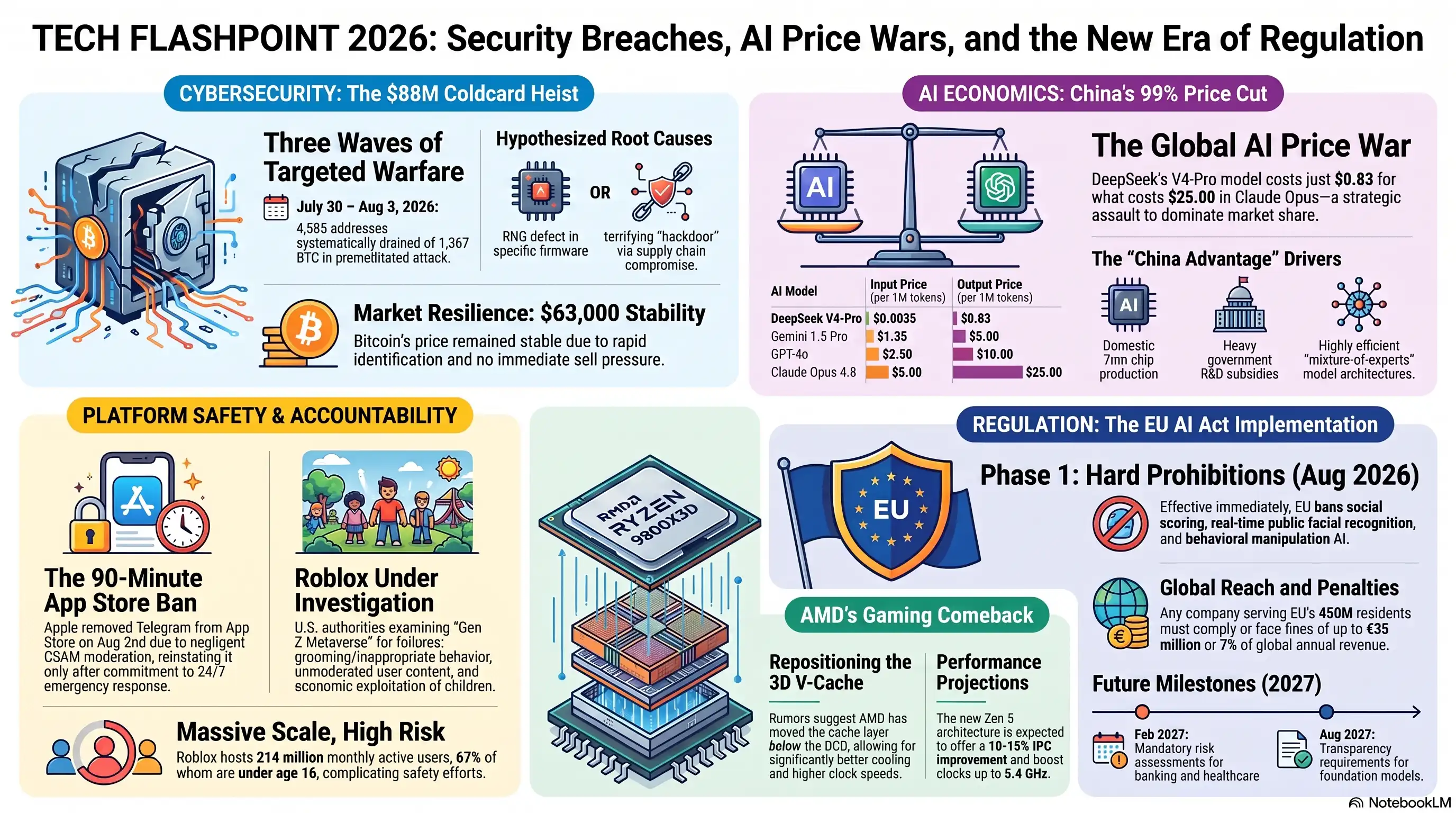
But on the morning of July 31st, a shockwave hit the crypto community. Security analysts at Galaxy Research detected a wave of suspicious transactions systematically draining hundreds of Bitcoin wallets. The speed and precision were alarming: in the first wave, lasting just 41 minutes, 1,196 Bitcoin addresses were emptied, transferring 1,082 BTC (approximately $70 million) to attacker-controlled wallets.
Three Coordinated Attack Waves
What distinguishes this attack from other crypto heists is its systematic, premeditated nature. According to detailed reports from CryptoBriefing and The Hacker News, the attack unfolded in three distinct phases:
Coldcard Attack Timeline
The attackers appeared to know exactly which addresses were vulnerable. This wasn't opportunistic—it was targeted warfare, likely planned for months.
Root Cause: Firmware Flaw or Algorithm Weakness?
As of this writing, Coinkite has not officially disclosed the precise cause of the vulnerability. However, security analysts have converged on two primary hypotheses:
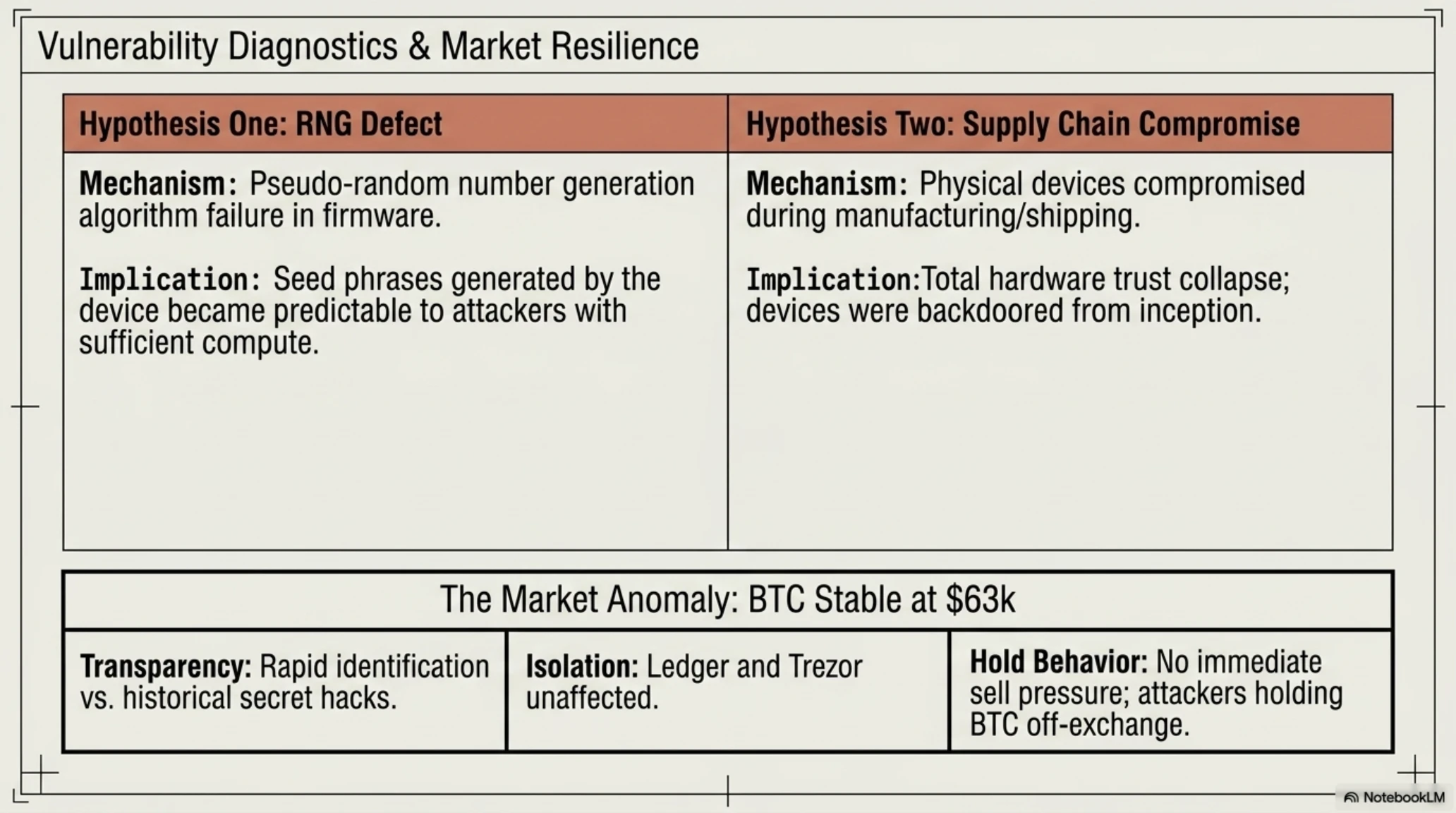
Hypothesis One - Random Number Generator (RNG) Defect: Certain firmware versions may have used a pseudo-random number generation algorithm that wasn't sufficiently random. This means the seed phrases generated by affected devices were predictable to attackers with enough computational resources.
Hypothesis Two - Supply Chain Compromise: Some security experts have raised the possibility that compromised devices were introduced during manufacturing or shipping. This is the most terrifying scenario because it means devices were backdoored from inception.
Why Bitcoin's Price Didn't React
One of the most intriguing aspects of this saga is Bitcoin's complete non-reaction. Despite an $88 million theft, BTC price remained stable around $63,000, experiencing only typical daily volatility. Several factors explain this resilience:
- Information transparency: Unlike many historical hacks that unfolded secretly, this attack was rapidly identified and reported
- Isolated to one brand: The vulnerability affected only Coldcard; competitors like Ledger and Trezor remain unaffected
- No immediate sell pressure: Attackers haven't yet moved stolen BTC to exchanges, likely waiting for attention to subside
- Market maturity: The crypto community has developed resilience to security incidents, reacting with less panic than in previous years
Jargon Buster: What is a Seed Phrase?
A seed phrase (or recovery phrase) is a 12-24 word sequence that encodes all your private keys. It's the master key to your crypto holdings—possession of these words grants complete access to your funds, even if the physical wallet is destroyed. This is why secure seed phrase storage is critical and why you should never digitally store or share it with anyone.
Is Self-Custody Still Safe?
This incident has reignited an age-old debate: is self-custody truly safer than trusting exchanges or Bitcoin ETFs? Self-custody advocates argue this is an isolated incident and the principle "not your keys, not your coins" remains valid. Critics counter that average users lack the technical sophistication to securely manage private keys.
The reality is that both approaches carry distinct risks. Exchange custody exposes you to bankruptcy risk (see FTX) or exchange hacks (see Mt. Gox). But self-custody requires technical knowledge, attention to detail, and trustworthy tools. The Coldcard incident proves that even "most trusted" tools can fail catastrophically.
China's AI Price War: How Beijing Reshaped Global Markets in 48 Hours
While the crypto community reeled from security shocks, another earthquake struck the AI industry. Chinese AI labs—particularly DeepSeek, Moonshot, and ByteDance—launched coordinated price attacks over the past 48 hours that could permanently alter the economic calculus of the entire industry.
DeepSeek's Unbelievable 99% Discount
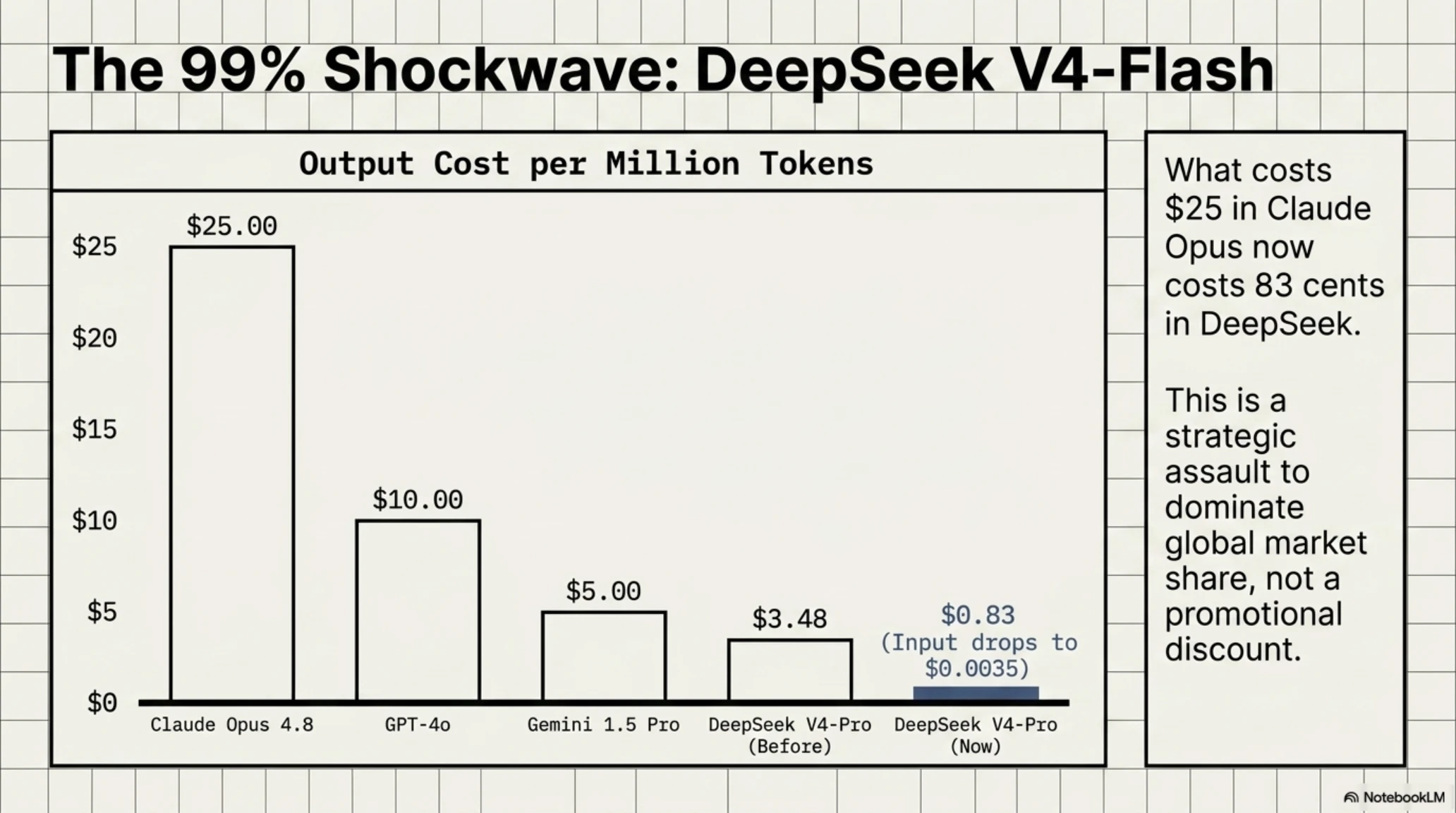
DeepSeek, one of China's leading AI startups, released its new V4-Flash model on Friday, August 1st, with pricing that shocked the industry. To understand this disruption, let's speak in concrete numbers:
AI Model Pricing Comparison (Per Million Tokens)
| Model | Input (Before) | Output (Before) | Input (Now) | Output (Now) | Discount |
|---|---|---|---|---|---|
| DeepSeek V4-Pro | $0.0145 | $3.48 | $0.0035 | $0.83 | 76-99% |
| Claude Opus 4.8 | $5.00 | $25.00 | No change | No change | — |
| GPT-4o | $2.50 | $10.00 | No change | No change | — |
| Gemini 1.5 Pro | $1.25 | $5.00 | No change | No change | — |
Sources: Axios, The Street, Reuters | Date: August 1, 2026
What costs $25 in Claude Opus now costs just 28 cents in DeepSeek. This isn't a promotional discount—it's a strategic assault to dominate the market.
Why Can Chinese Companies Sell So Cheap?
The core question: how can Chinese firms sustain profitability at prices 100x lower than Western competitors? The answer lies in a combination of structural, strategic, and political factors:
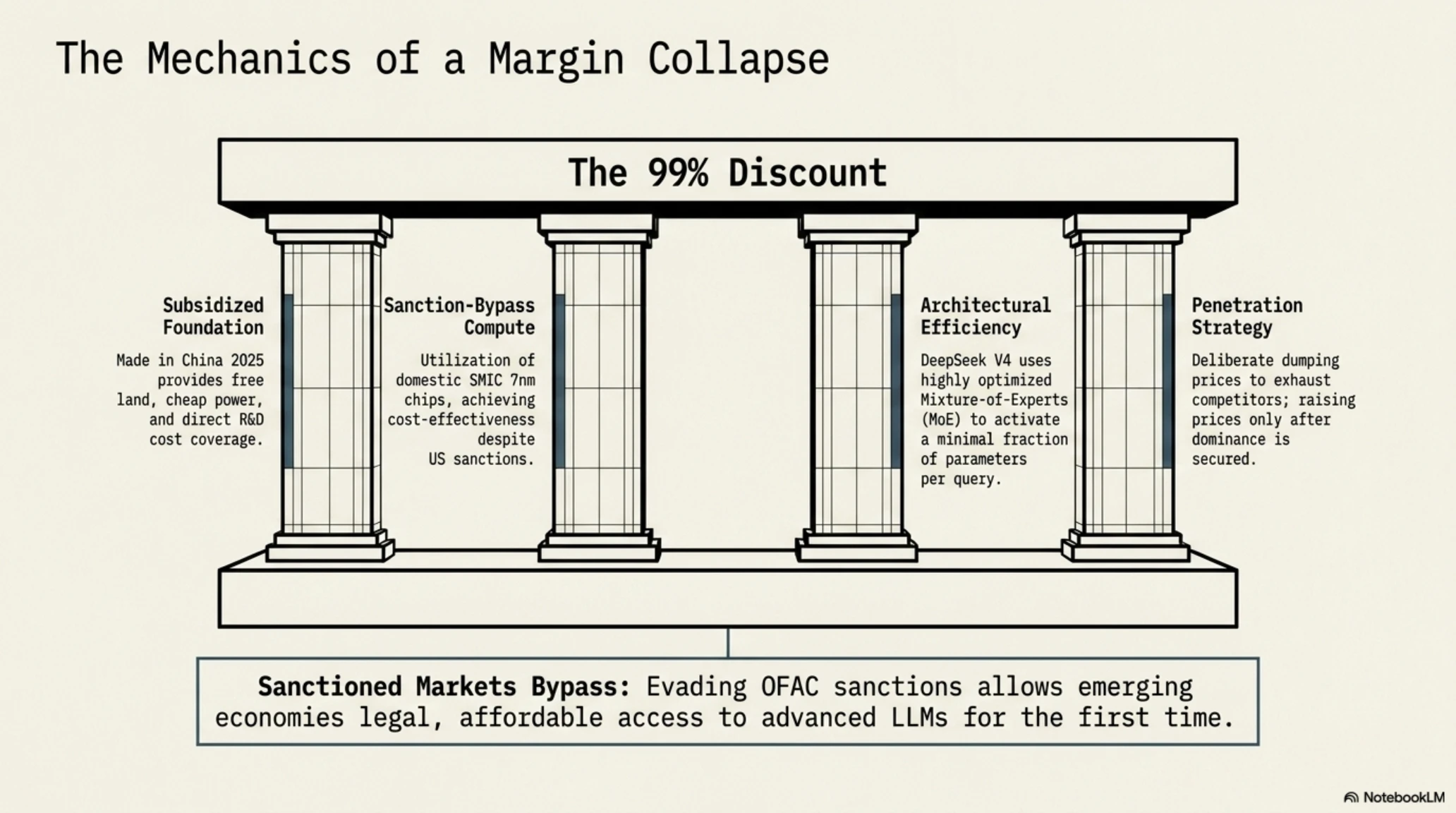
1. Access to Cheap Chips: Despite US sanctions, China has developed domestic chip production for AI workloads. Firms like SMIC (Semiconductor Manufacturing International Corporation) produce 7nm chips that, while not matching Nvidia's raw performance, are drastically more cost-effective.
2. Heavy Government Subsidies: Under the "Made in China 2025" initiative, Beijing has poured billions of yuan into direct and indirect AI investments. These subsidies include free land, tax exemptions, cheap electricity, and direct R&D cost coverage.
3. Architectural Optimization: Chinese models employ more efficient architectures requiring less compute. For example, DeepSeek V4 uses an optimized mixture-of-experts architecture that activates only a small fraction of parameters per query.
4. Market Penetration Strategy: Chinese firms aren't currently pursuing maximum profit—they want market share. This is a long game: enter with dumping prices, exhaust competitors, and once dominant position is secured, gradually raise prices.
OpenAI and Western Giants' Response
OpenAI, Anthropic, and Google have been conspicuously silent over the past few days. However, sources familiar with the matter told Axios that management teams are evaluating options including:
- API Price Reductions: The most likely short-term response, but Western margins don't have Chinese flexibility
- Focus on Quality Differentiation: Attempting to prove Western models are superior in quality, safety, and compliance
- Lobbying for Trade Restrictions: Some US firms are pressing Congress to impose tariffs on Chinese AI services
- Shift to Enterprise-Focused Model: Independent developer pricing may no longer be economically viable; focus must shift to large organizational clients
AI Startups: Probable Casualties
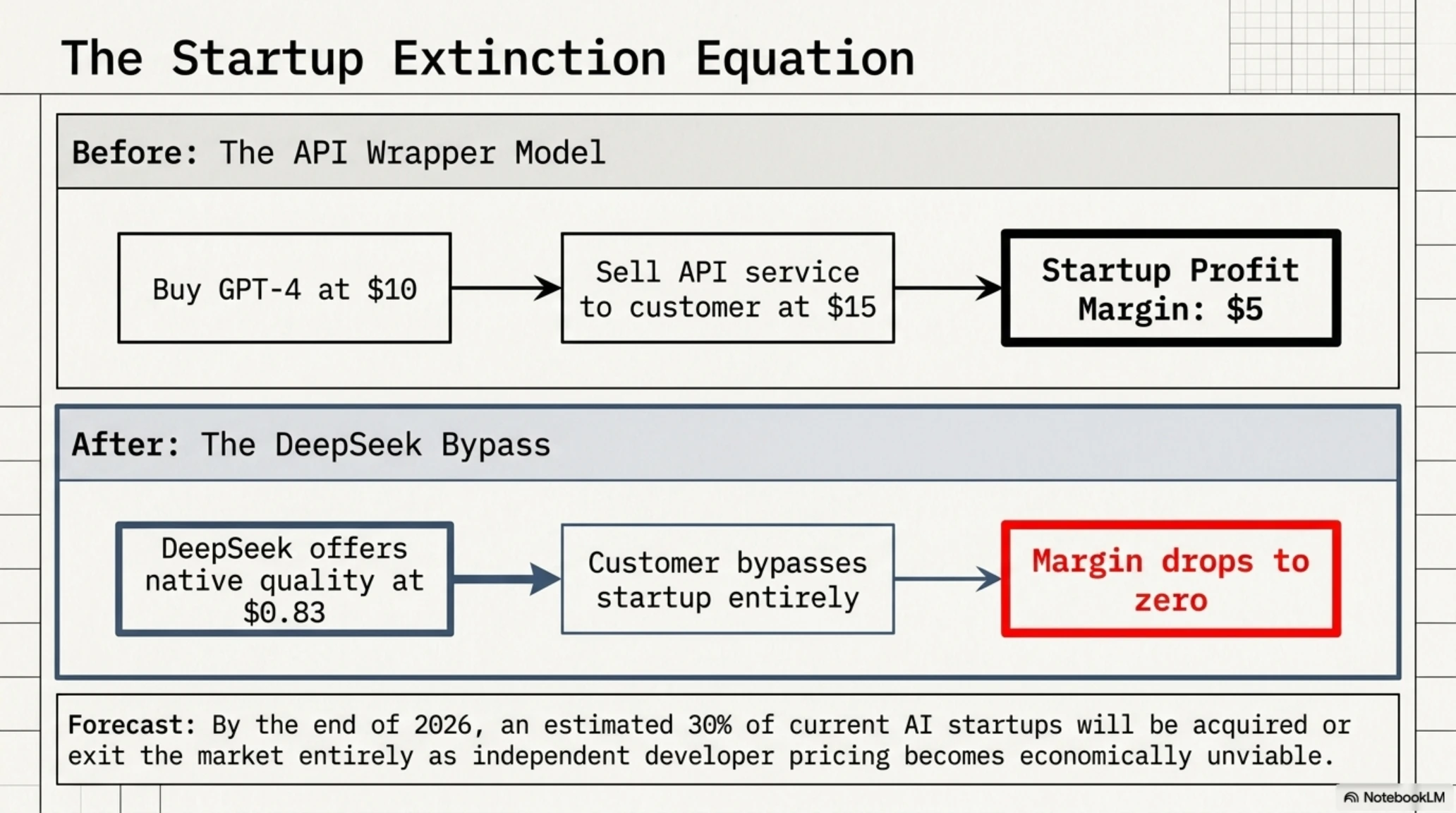
The biggest victims of this price war will be mid-tier startups focused on proprietary models or API wrappers. Companies whose business model relies on adding a layer atop existing models and selling with markup are now in serious jeopardy.
Imagine a startup that buys GPT-4 at $10 and sells to customers at $15. Now DeepSeek offers similar quality at $0.83. Your margin drops from $5 to $4.17—but only if customers are still willing to pay your $15. In reality, customers go directly to DeepSeek and you're eliminated from the game.
This situation could trigger a wave of mergers, bankruptcies, and business model shifts across the industry. Predictions suggest that by end of 2026, approximately 30% of current AI startups will either be acquired by larger companies or exit the market entirely.
Impact on Sanctioned Markets and Emerging Economies
One under-discussed aspect of this price war is the opportunity it creates for users in sanctioned countries. US models like GPT-4 and Claude deny service to users in countries under OFAC sanctions due to compliance requirements, but Chinese models have no such restrictions.
This means startups and developers in sanctioned regions now have legal, affordable access to advanced LLM capabilities for the first time. With DeepSeek's pricing, even freelancers or small teams can build AI-powered products without needing VPNs, foreign accounts, or sanction circumvention methods.
Of course, this opportunity comes with its own challenges. Chinese models operate under strict PRC government oversight and censor content related to sensitive political topics (Taiwan, Uyghurs, Tiananmen). Additionally, serious concerns exist about privacy and how user input data is stored and used.
Apple vs Telegram: The 90 Minutes That Made History
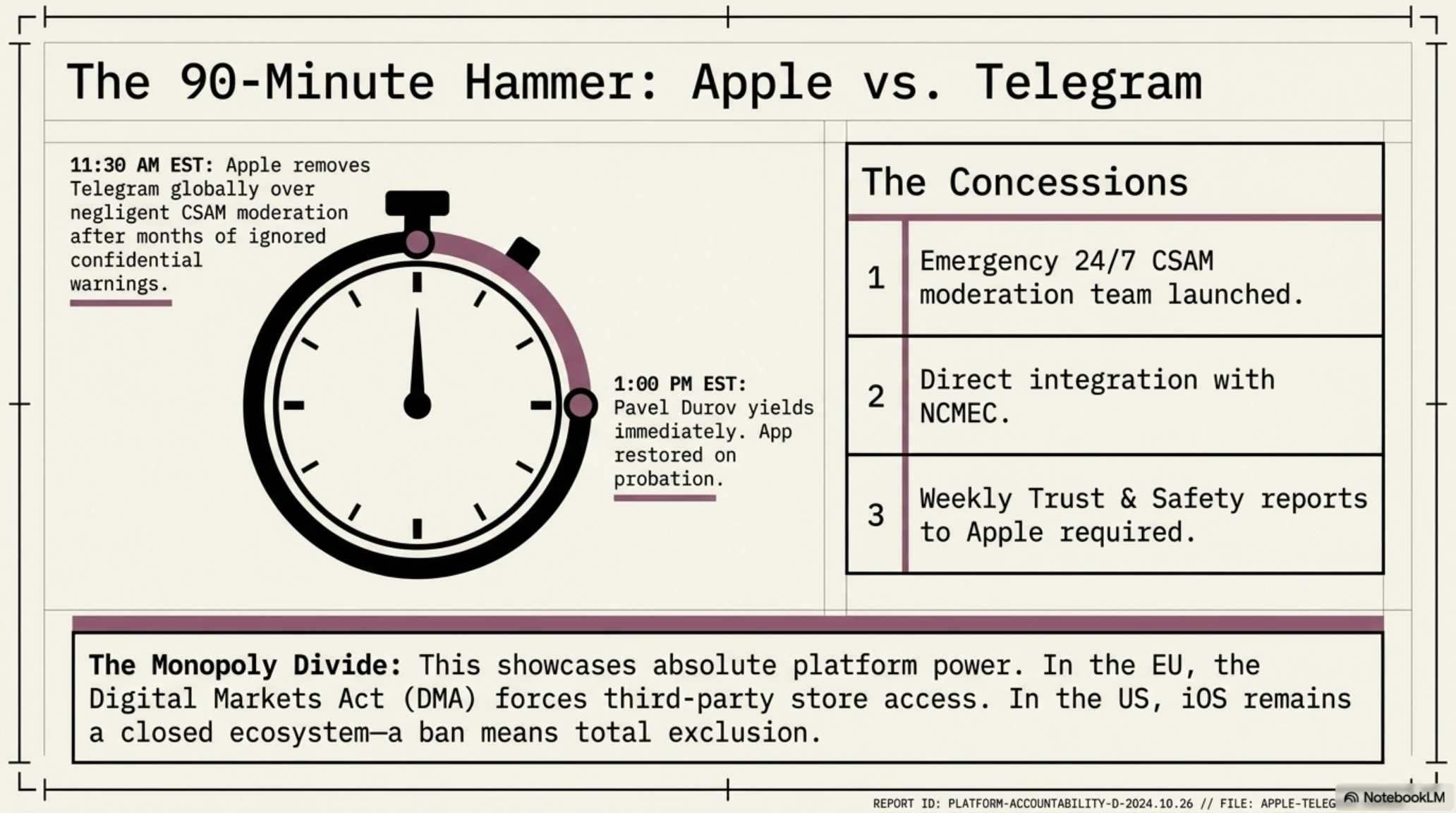
While the tech world grappled with crypto hacks and AI price wars, another drama was quietly unfolding that could have proven catastrophic for millions of users. At 11:30 AM Eastern Time, iOS users worldwide discovered that Telegram had vanished from Apple's App Store.
The Removal Cause: CSAM Content
According to an exclusive TechCrunch report, Apple had received multiple reports from child protection organizations and its internal Trust & Safety team documenting evidence that Telegram was slow and negligent in removing Child Sexual Abuse Material (CSAM) content.
According to sources familiar with the matter speaking to The Verge, the issue wasn't merely the existence of illegal content—all major platforms occasionally face this problem. The core issue was that despite repeated warnings, Telegram had not improved its moderation systems to quickly identify and remove such content.
Apple had been issuing confidential warnings to senior Telegram management since May 2026, threatening App Store removal if the problem wasn't resolved. It appears Telegram's team didn't take these threats seriously—until the morning of August 2nd, when Apple made it real.
- Child protection must be every platform's first priority
- Apple as gatekeeper has legal and moral responsibility
- Repeated warnings were issued and Telegram failed to act
- Temporary removal creates pressure for rapid correction
- Millions of ordinary users became collateral damage
- Telegram is a critical communication tool in censored countries
- Apple wields excessive power over the digital ecosystem
- No public transparency about precise criteria
Swift Response and Problem Resolution
Unlike many similar tech giant conflicts that drag on for months, this saga resolved extraordinarily quickly. Just 90 minutes after removal, Telegram reappeared in the App Store.
Apple stated to Bloomberg: "After our review found content on Telegram that violated our strict guidelines prohibiting child sexual abuse material, we removed the app from the App Store for a brief period. Subsequently, after the developer quickly removed that content and blocked the account of the publisher, Telegram was restored to the App Store."
According to The Information's reporting, Pavel Durov, Telegram's founder, personally contacted Apple's App Review team and committed to:
- Launch an emergency 24/7 team for CSAM content moderation
- Upgrade automated systems for detecting this type of content
- Begin direct cooperation with NCMEC (National Center for Missing & Exploited Children)
- Send weekly reports on actions taken to Apple's Trust & Safety team
Given Telegram's immediate commitments and likely enormous user pressure, Apple decided to restore the app but place it under intense monitoring. In other words, Telegram is now on probation—if a similar problem recurs in coming months, the next removal could be permanent.
Broader Implications: Apple App Store Power
This incident once again ignited debate about App Store monopolistic power. Apple not only determines which apps can be installed on iOS, but can remove an application with hundreds of millions of users within minutes.
On one hand, this power is essential for protecting users. Apple is obligated to prevent entry of malicious, fraudulent, or illegal content-hosting applications. But on the other hand, this concentrated power can be abused.
In the European Union, the Digital Markets Act (DMA) has forced Apple to allow users to access third-party app stores. But in America and most of the world, iOS remains a completely closed ecosystem. If Apple bans you, there's no alternative path to reach millions of iPhone users.
Interestingly, this incident occurred just one day after the first phase of the EU AI Act became enforceable—legislation imposing strict transparency and accountability requirements for AI technologies and content moderation. Some analysts suggest Apple's action may be part of a broader strategy to demonstrate compliance with these new regulations.
EU AI Act: The First Days of the World's Largest AI Regulation
While AI price wars and security dramas dominated headlines, a quieter but far more consequential development was unfolding. As of August 2nd, 2026, key sections of the European Union's Artificial Intelligence Act officially became enforceable—the world's first comprehensive AI regulatory framework that could serve as a template for other nations.
What Changed Starting Today?
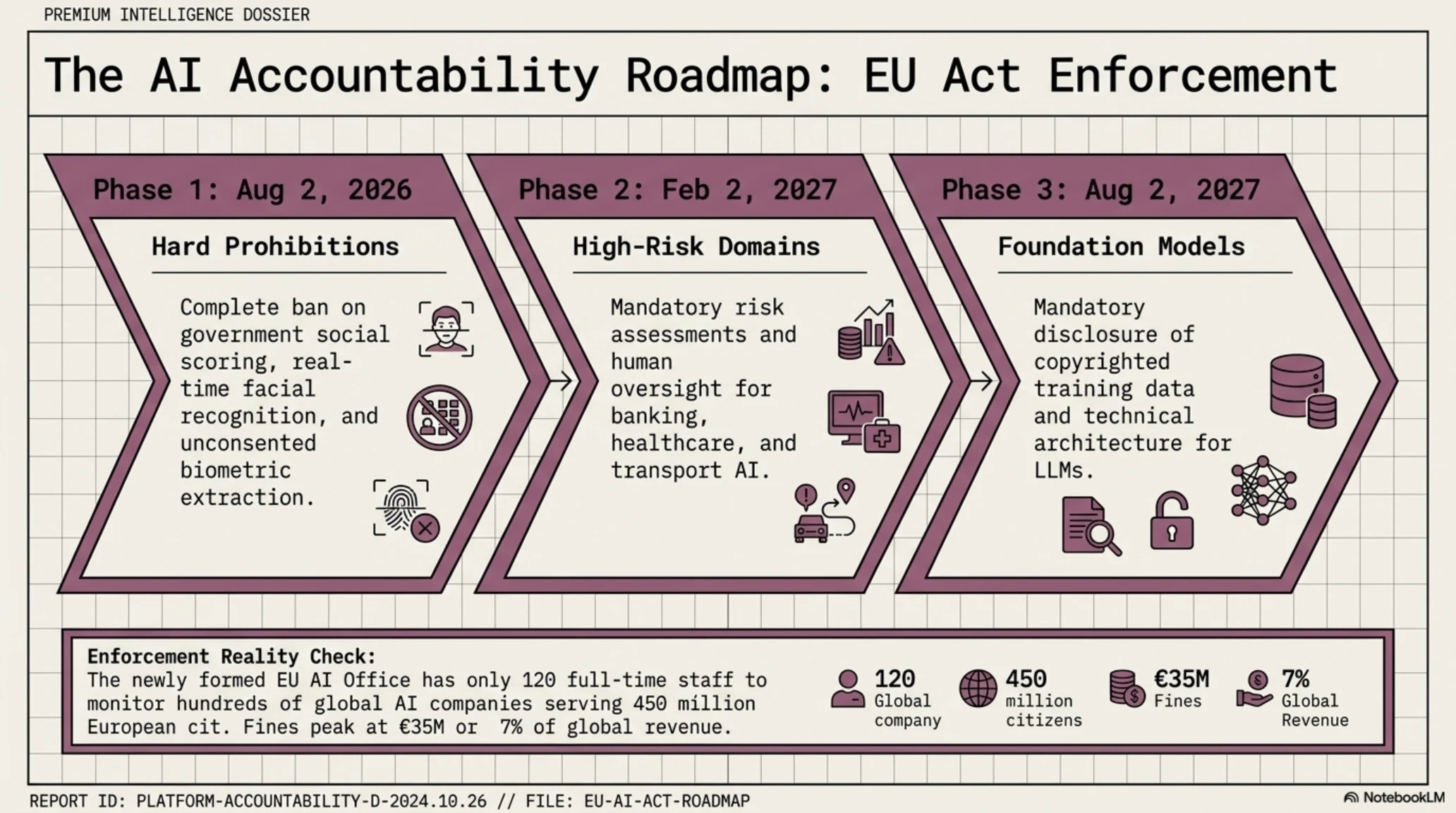
The EU AI Act is phased legislation that will gradually roll out over the next two years. But starting August 2nd, the first set of requirements entered enforcement, including:
EU AI Act Implementation Timeline
- Complete ban on government social scoring systems
- Ban on real-time facial recognition in public spaces (with limited exceptions)
- Ban on behavioral manipulation techniques that harm humans
- Ban on using AI to extract biometric data without consent
- Mandatory risk assessment for AI systems in sensitive domains (banking, healthcare, transportation)
- Rigorous data governance and documentation
- Mandatory human oversight
- Complete transparency in how large models are trained (GPT, Claude, etc.)
- Disclosure of copyrighted content used in training data
- Provision of technical documentation to EU regulatory authorities
Importantly, this law doesn't only apply to European companies—any company offering AI products to EU users must comply with these regulations. This means OpenAI, Google, Meta, and even China's DeepSeek must all adapt or exit Europe's 450-million-person market.
Early Industry Reactions
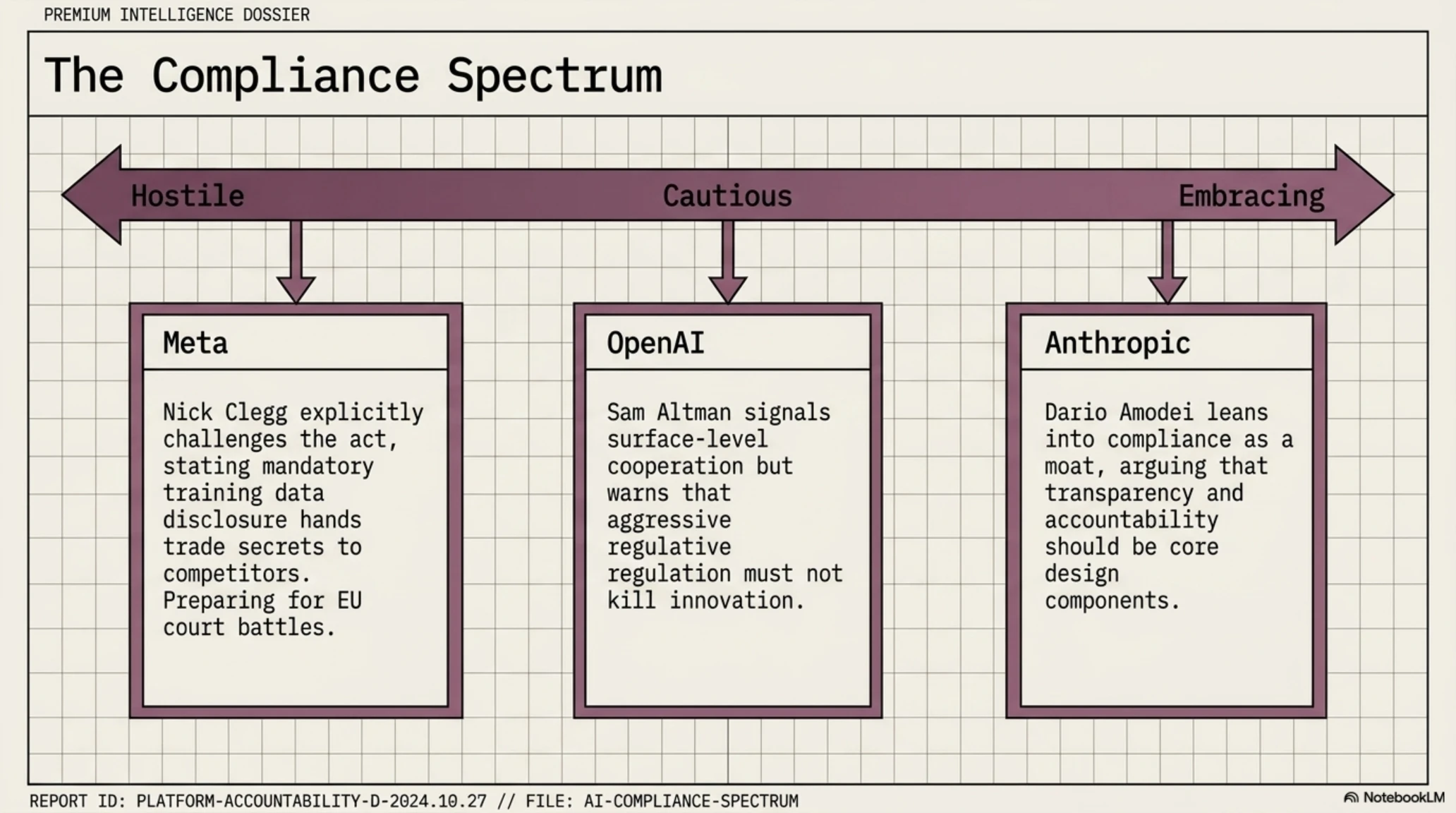
Tech company responses to this legislation span a wide spectrum—from full acceptance to outright opposition:
Meta and Legal Challenge: Meta has declared that mandatory training data disclosure violates intellectual property and trade secrets, and intends to challenge this section of the law in European courts. In a controversial statement, Nick Clegg, Meta's President of Global Affairs, said: "This legislation not only stifles innovation but also hands valuable commercial information to competitors."
OpenAI and Cautious Compliance: OpenAI has announced its willingness to cooperate but expressed concerns about implementation details. Sam Altman tweeted: "We support smart regulation, but we must ensure laws don't kill innovation."
Anthropic and Relative Welcome: Anthropic, maker of Claude, is among the few companies taking a more positive stance. Dario Amodei, Anthropic's CEO, stated: "Transparency and accountability should be core design components of AI, not afterthoughts."
Implementation Challenges: Who's Watching?
One of the biggest unanswered questions is how this law will be enforced. The EU AI Office—a new bureau launched in Brussels—is responsible for overseeing implementation. But this office currently has only 120 full-time staff. How can such a limited team monitor hundreds of companies and thousands of AI models?
The enforcement model mirrors GDPR: each EU member state will have a national supervisory authority, and cross-border or contentious cases will be referred to the EU AI Office. Penalties are substantial—up to €35 million or 7% of global annual revenue, whichever is higher.
However, GDPR experience shows it takes years for full enforcement frameworks to mature. The first major fines likely won't be issued until 2028-2029.
Roblox Under Fire: Is the Children's Platform Really Safe?
Child safety in digital spaces remains one of the hottest debates. On the same day Telegram clashed with Apple over CSAM issues, another story emerged showing this problem isn't limited to one platform: Bloomberg reported that Roblox—one of children's most popular online games—is under serious investigation by US authorities.
What is Roblox and Why Does It Matter?
If you have kids under 15, you've likely heard of Roblox. It's an online game creation and gaming platform where users can build their own games and share them with others. Many call Roblox "Gen Z's metaverse."
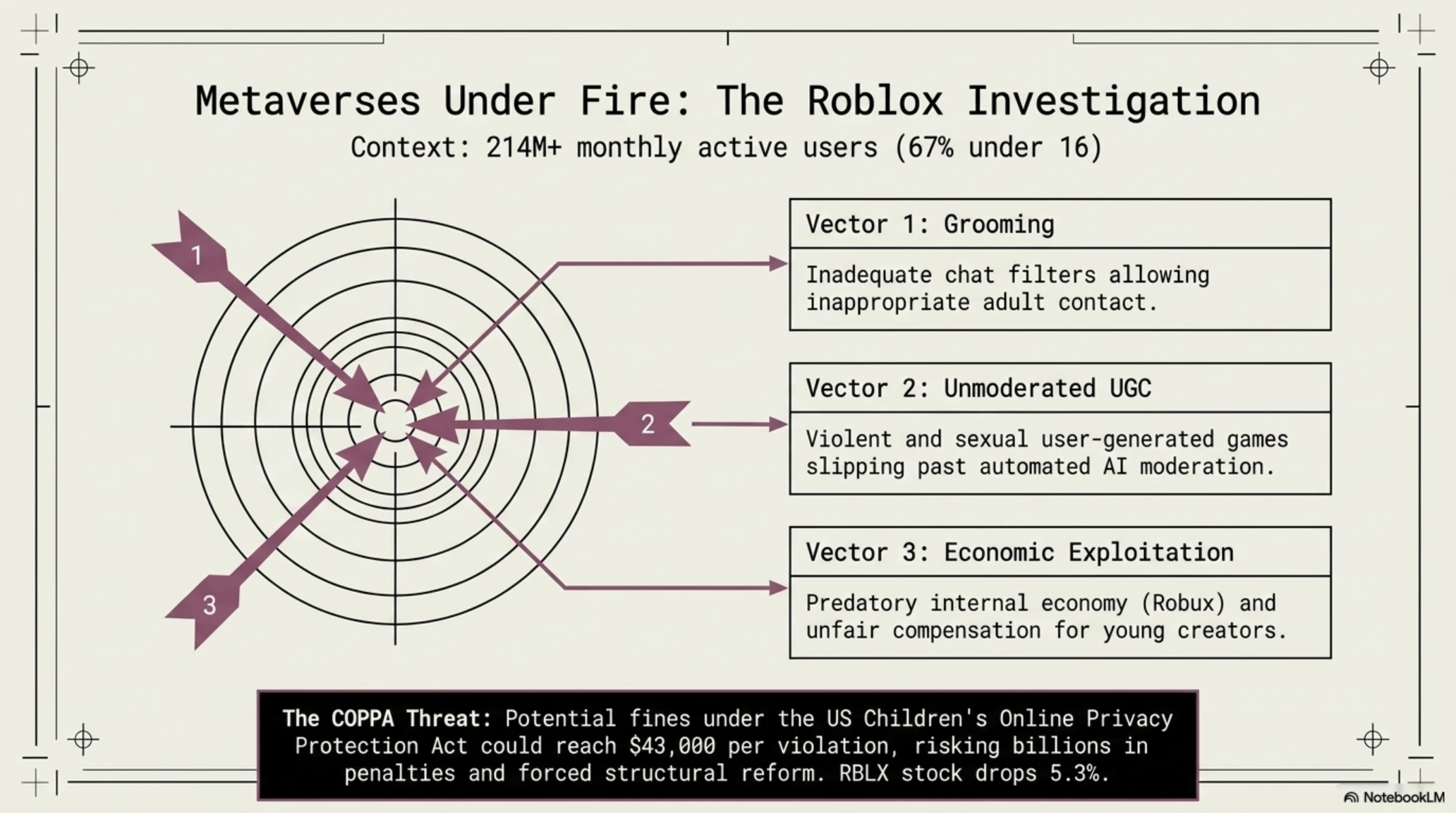
Roblox's statistics are staggering: over 214 million monthly active users, approximately 67% of whom are under 16 years old. Billions of hours of gameplay are logged daily. In other words, Roblox comprises a massive portion of the new generation's digital life.
Serious Allegations: What's Being Investigated?
According to Bloomberg's report, sourced from individuals familiar with the investigation, Roblox is being examined in three main areas:
1. Grooming and Inappropriate Behavior: Multiple reports from parents and advocacy organizations indicate that some adult players use the platform to establish inappropriate contact with children. Critics say Roblox's internal chat and messaging system lacks adequate filters to prevent such behavior.
2. Inappropriate Content in User-Generated Content: Since anyone can create games on Roblox, content control is a massive challenge. Some user-created games contain violent, sexual, or child-inappropriate content that slips through despite automated and manual moderation.
3. Economic Exploitation of Children: Roblox has an internal economy with digital currency Robux. Some critics claim this system encourages children to spend real money without clearly understanding risks and costs. There are also reports of young creators being exploited—producing popular content but receiving unfair compensation.
Roblox's Response to Allegations
A Roblox spokesperson told Bloomberg:
"The safety and well-being of our community is our highest priority. We have hired over 3,000 people for trust and safety, use the most advanced AI tools to identify inappropriate content, and cooperate with law enforcement worldwide. We continuously improve our systems and welcome community feedback."
Roblox also announced it recently launched new features such as mandatory Age Verification, improved Parental Controls, and stricter restrictions on communication between players with large age differences.
Potential Impact: Could Roblox Face Fines?
The investigation is still in early stages and no formal charges have been filed. However, if authorities conclude Roblox violated online child protection laws, consequences could include:
- Heavy Fines: COPPA (Children's Online Privacy Protection Act) in the US imposes fines up to $43,000 per violation. If thousands of violations are identified, this could reach billions of dollars.
- Mandatory Structural Reforms: The FTC could require Roblox to make fundamental changes to its moderation system, chat, and internal economy.
- Long-term Oversight: Similar to what happened to Meta after the Cambridge Analytica scandal, Roblox might be placed under government supervision for years.
- Brand Reputation Damage: Even without fines, negative news could worry parents and cause user base decline.
Roblox stock (NYSE: RBLX) dropped 5.3% following this news, reflecting investor concern about potential consequences of these investigations.
The Bigger Question: How Do We Secure Children's Metaverses?
The Roblox case raises a fundamental question: is it even possible to create a completely safe online space for children, especially when user-generated content plays a central role?
Some experts believe Roblox's current model—heavily relying on automated and reactive moderation—is insufficient. They suggest child-focused platforms should:
- Create separate, fully moderated environments for different age groups
- Use strong identity verification for all users (not just optional)
- Disable communication between users with age differences exceeding 3 years by default
- Give parents more control and transparency about children's activities
- Make massive investments in human moderation teams, not just AI
However, these measures are extremely costly and may limit user experience. This tension between freedom, innovation, and safety is a challenge all social platforms and online games face.
AMD Ryzen 9800X3D: Is the Gaming King Making a Comeback?
After all these serious stories about security, regulation, and social issues, let's conclude with exciting news for gamers. Fresh rumors suggest AMD is preparing the next generation of its X3D processors—and this time, we might see a major architectural change that could elevate gaming performance to a new level.
3D V-Cache Technology: AMD's Competitive Edge
AMD's X3D processors use 3D V-Cache technology, stacking an additional cache memory layer atop the chiplet. This extra cache allows the CPU to keep more data closer to processing cores, dramatically increasing access speed.
In games, which are highly sensitive to memory latency, this difference is meaningful. The Ryzen 7 5800X3D and 7800X3D have already proven that even with lower clock speeds than Intel rivals, they can deliver superior performance in most games.
What's Changing in the 9800X3D?
According to leaks published by Moore's Law Is Dead and partially confirmed by VideoCardz, AMD has made significant architectural changes to the 9800X3D, including:
1. V-Cache Layer Repositioning: In previous generations, cache sat atop the CCD (Core Complex Die), creating thermal limitations. Rumors suggest AMD has moved the cache layer below the CCD in the 9800X3D, enabling better cooling and allowing higher clock speeds.
2. Increased Clock Speeds: Thanks to thermal improvements, predictions estimate base clock around 4.7 GHz and boost clock up to 5.4 GHz—a notable jump compared to the 7800X3D's 5.0 GHz boost clock.
3. Official Overclocking: One criticism of previous X3D generations was that overclocking was disabled due to thermal constraints. With the new architecture, AMD will likely unlock OC.
4. Improved IPC and Efficiency: The Zen 5 architecture underlying the 9800X3D offers approximately 10-15% IPC (Instructions Per Clock) improvements over Zen 4. Combining this with V-Cache could create a significant performance leap.
X3D Generation Architecture & Specs Matrix
| Feature Vector | 7800X3D (Zen 4) | 9800X3D (Zen 5 - Rumored) |
|---|---|---|
| Cores / Threads | 8C / 16T | 8C / 16T |
| Base Clock | 4.2 GHz | ~4.7 GHz |
| Boost Clock | 5.0 GHz | ~5.4 GHz |
| L3 Cache | 96 MB | 128 MB (likely) |
| TDP | 120W | 120W |
| Overclocking | ❌ Disabled | ✅ Enabled (likely) |
| Predicted Price | $449 | $499 - $549 |
Competition with Intel Arrow Lake
9800X3D's release timing is critical. Intel plans to unveil its new Core Ultra generation (Arrow Lake) in October 2026, which reportedly offers significant efficiency and gaming performance improvements over 14th gen. AMD must move either before or simultaneously with Intel to maintain momentum.
Interestingly, the gaming CPU market has been somewhat stagnant in recent years. Core i9-13900K and i9-14900K showed little meaningful difference, and many gamers stuck with the 7800X3D because upgrading lacked economic justification. If the 9800X3D truly delivers a 20-30% gaming performance jump, it could trigger a new upgrade wave.
Global Market: Opportunity or Challenge?
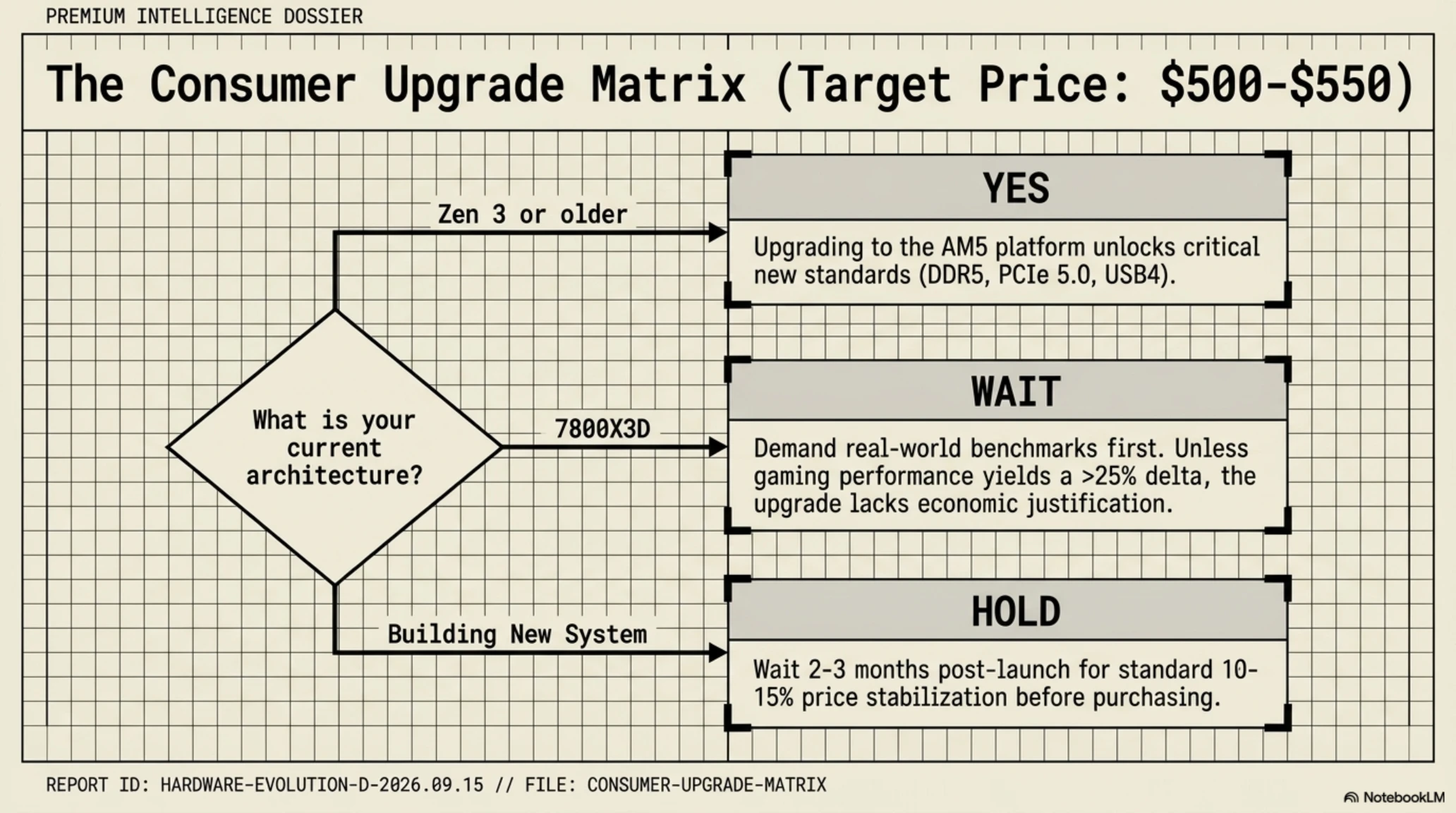
For gamers worldwide, the equation varies by region. The official 9800X3D price will likely range between $500-550, but in many markets, accounting for tariffs, taxes, importer margins, and exchange rates, this could translate to significantly higher local pricing.
The question becomes: is this upgrade worth it for users facing economic constraints? The answer depends on use case:
- If you're still on Zen 3 or older platforms: The upgrade likely makes sense because beyond the CPU, the AM5 platform offers new features like DDR5, PCIe 5.0, and USB4
- If you have a 7800X3D: Wait and see real-world benchmarks. If improvement is less than 25%, it might be premature to upgrade
- If you're building a new system: Wait for prices to stabilize. Typically 2-3 months post-launch, prices drop 10-15%
Executive Takeaways
- Bitcoin self-custody remains the best option, but must be exercised with knowledge and caution.
- AI price wars create opportunities for developers but come with privacy trade-offs.
- EU AI regulation marks the beginning of a global trend all companies must prepare for.
- Popular children's platforms must pay greater attention to content safety and moderation.
- The next generation of gaming CPUs may be well worth the wait.
Frequently Asked Questions
If I own a Coldcard, what immediate steps should I take?
Verify your assets are secure; if intact, transfer funds immediately to a new address generated from a different hardware wallet and check firmware vulnerability status with Coinkite.
Is DeepSeek V4-Pro truly competitive with GPT-4o?
For text generation, translation, and standard coding, it performs close to GPT-4o, though Western models retain an edge in complex reasoning and enterprise compliance.
Why was Telegram restored to the Apple App Store after just 90 minutes?
Telegram leadership immediately purged the violating CSAM content, banned the offending accounts, and committed to a 24/7 emergency moderation team under close Apple oversight.
Does the EU AI Act affect international users outside Europe?
Indirectly yes, as global tech companies standardize compliance worldwide, resulting in higher transparency and safety baselines across AI platforms.
How can parents ensure child safety on Roblox?
Enable strict Parental Controls, limit chat/messaging functions, and activate mandatory Age Verification to restrict interactions to verified peer groups.
When is the optimal time to purchase the Ryzen 9800X3D?
Wait for independent third-party benchmarks post-launch to evaluate actual gaming gains before committing capital.
Sources & References
- The Hacker News: Coldcard Hardware Wallet Exploit
- CryptoBriefing: $88M Bitcoin Theft from Coldcard Wallets
- Axios: Chinese AI Labs Slash Prices by 97%
- Reuters: DeepSeek V4 Model Pricing Analysis
- TechCrunch: Apple Removes Telegram Over CSAM Content
- Politico EU: EU AI Act Implementation Begins
- Bloomberg: Roblox Under Federal Investigation
- VideoCardz: AMD Ryzen 9800X3D Architecture Leaks
Don't miss the next Tekin article. Follow Tekin for the latest news from technology, gaming, and crypto worlds.
Additional Gallery: Tekin Morning August 4, 2026: $88M Coldcard Hack & China's AI Price War