Tekin Analysis | Bypassing the Telecom Cartel: Elon Musk's Play for Boost Mobile and Starlink's Direct-to-Cell Empire
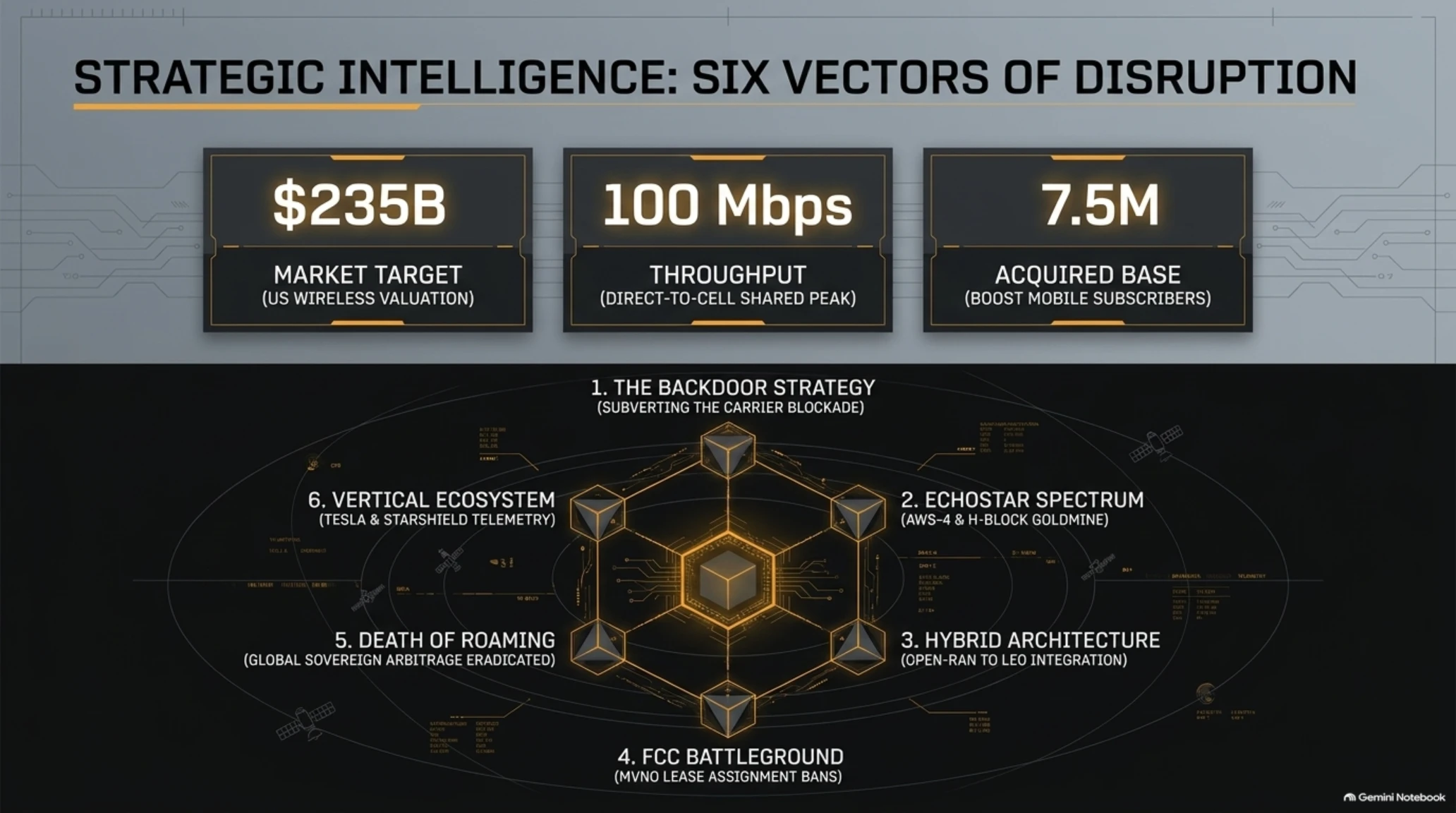
The battle for the future of global wireless communications has reached an unprecedented flashpoint. For over a century, the global telecommunications sector has operated under the protective shelter of natural infrastructure monopolies. Incumbents invested hundreds of billions of dollars constructing terrestrial cell towers, laying intercontinental fiber, and lobbying regulatory bodies like the Federal Communications Commission (FCC) to establish an impregnable $235 billion domestic wireless stronghold in the United States alone. However, in late 2026, confirmed investigative reports from the Washington Post and TechCrunch exposed Elon Musk most daring offensive yet: direct negotiations between SpaceX and EchoStar to acquire cellular provider Boost Mobile.
Strategic Intelligence & Core Vectors at a Glance
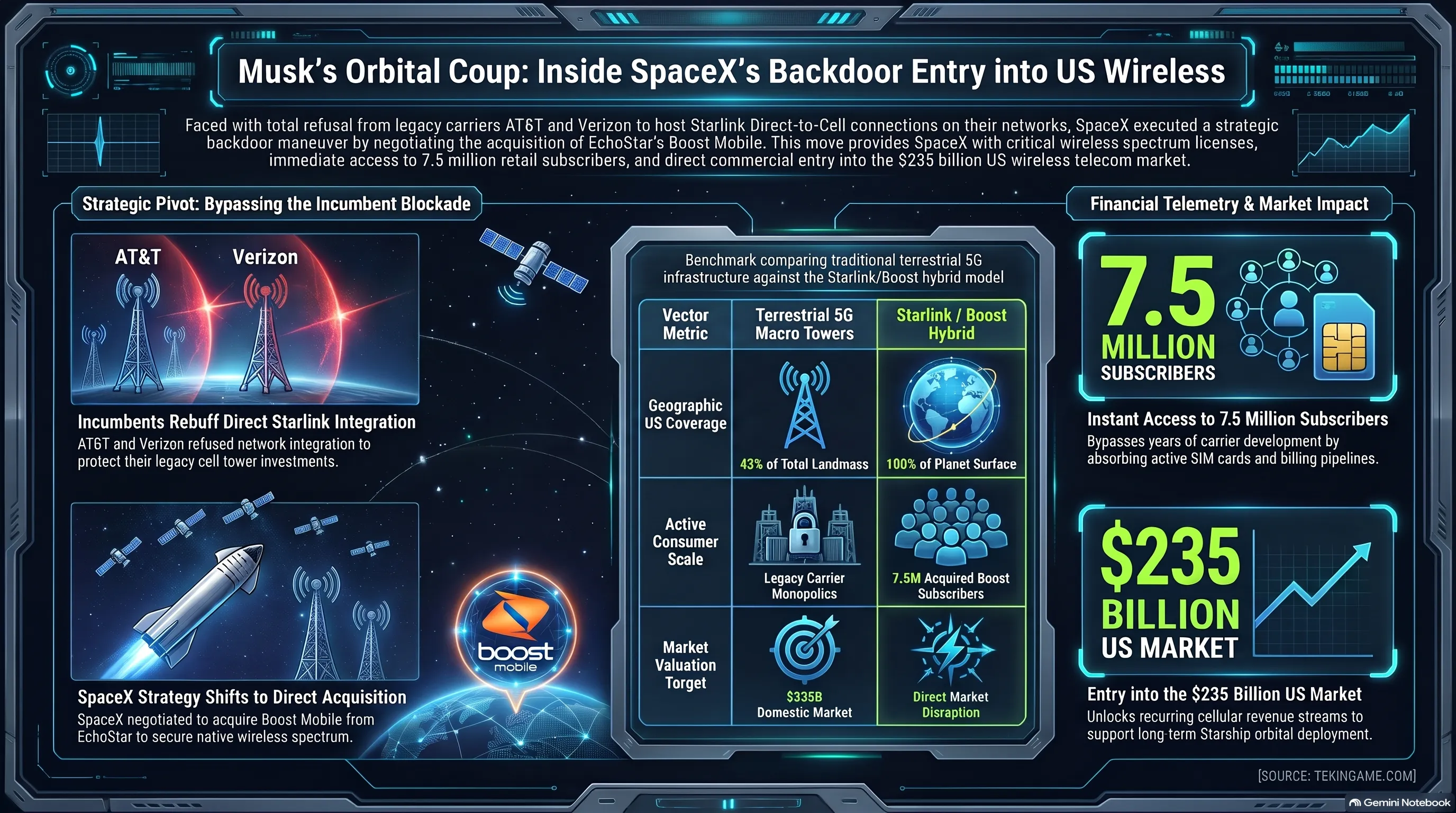
This bold strategic move does not stem from ordinary corporate diversification. It represents an aggressive counter-offensive born out of diplomatic stalemate. Having encountered an unyielding wall of resistance from legacy telecommunications giants principally AT&T and Verizon, who repeatedly rebuffed Elon Musk overtures to integrate their cellular networks with Starlink Direct-to-Cell constellation SpaceX elected to rewrite the rules of engagement. Rather than begging for entry into the incumbent carrier ecosystem, SpaceX is moving to acquire an established carrier outright, fusing orbital cell towers directly with consumer smartphones.
In this strategic deep dive, the Tekin Analytics desk examines the architectural, economic, and geopolitical implications of this high-stakes confrontation. We dissect the valuable wireless spectrum licenses at the heart of the EchoStar deal, analyze the mechanics of orbital cellular propagation, and trace how the disruption of legacy telecom will reshape global connectivity forever.
The Incumbent Blockade; Why Legacy Carriers Refused Starlink Integration
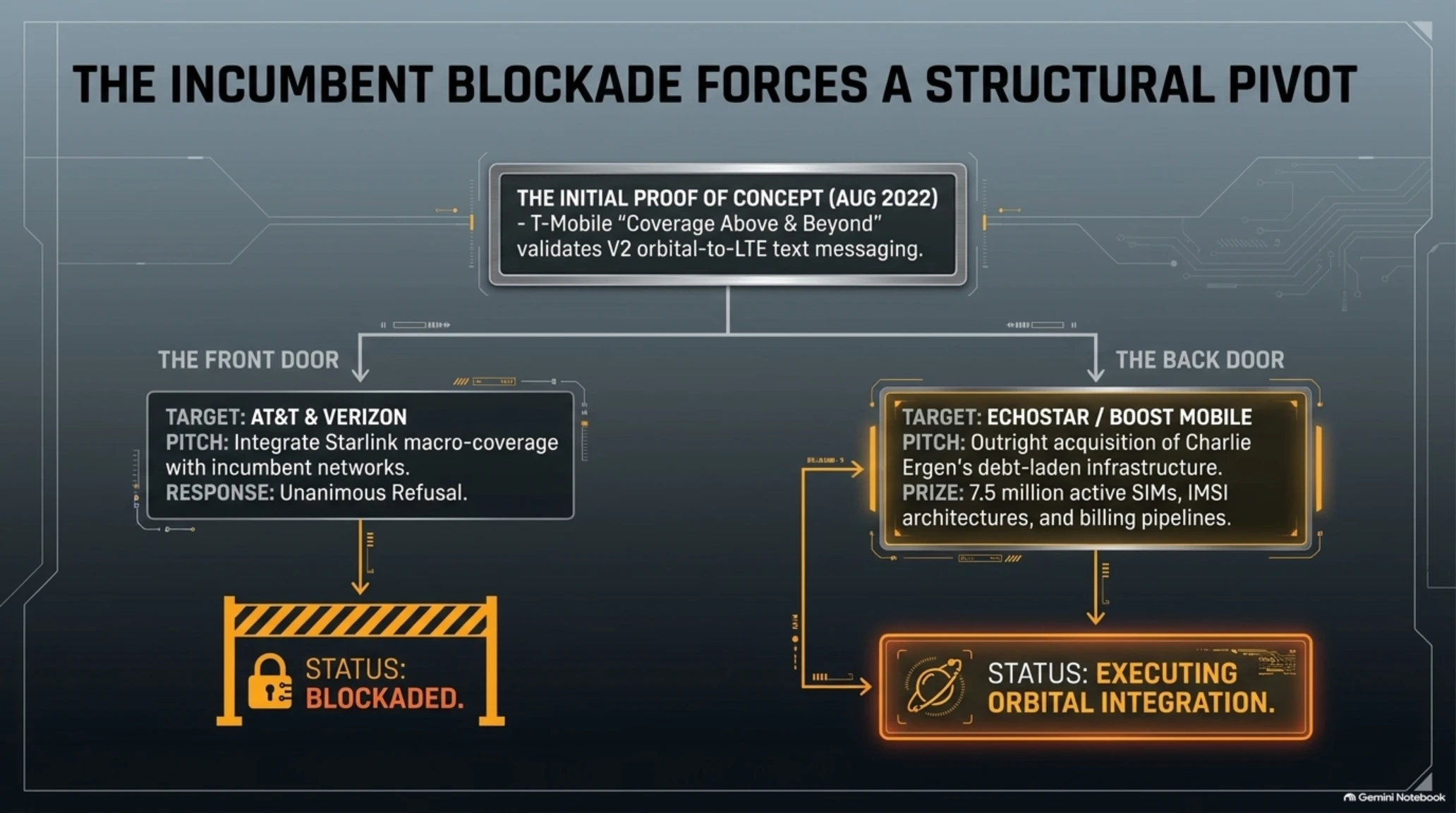
The original strategic roadmap for Starlink cellular expansion mirrored its initial partnership with T-Mobile. In late 2022, the joint Coverage Above & Beyond initiative demonstrated that second-generation Starlink satellites outfitted with large phased-array antennas could transmit emergency text messages directly to unmodified LTE cellular modems. With the orbital deployment of larger Starlink V2 spacecraft launched aboard Starship capable of delivering high-speed voice and broadband data streams, Musk approached the reigning leaders of the American wireless market: Verizon and AT&T.
The response from corporate boardrooms in Dallas and New York was swift and uncompromising: complete refusal. For incumbent telecom executives, granting Starlink access to their customer traffic was viewed as handing over the keys to the kingdom to an existential competitor that had already captured the global satellite broadband market. Legacy operators recognized that if unmodified consumer smartphones could maintain high-throughput connectivity across remote valleys, offshore waterways, and interstate highways without relying on their billions of dollars of terrestrial tower infrastructure, their primary competitive moat would evaporate.
Faced with a unified incumbent blockade, SpaceX pivoted to a corporate maneuver known across the industry as The Back Door Strategy. Rather than attempting to negotiate access with entrenched carriers that viewed SpaceX as an existential threat, Musk set his sights on EchoStar the debt-laden parent entity of Boost Mobile and Dish Network, led by satellite pioneer Charlie Ergen. EchoStar possessed the two assets SpaceX desperately required: prime wireless spectrum allocations and 7.5 million active mobile subscribers.
Why This Structural Shift Alters the Landscape
Spectrum Geopolitics; The True Worth of EchoStar Wireless Holdings
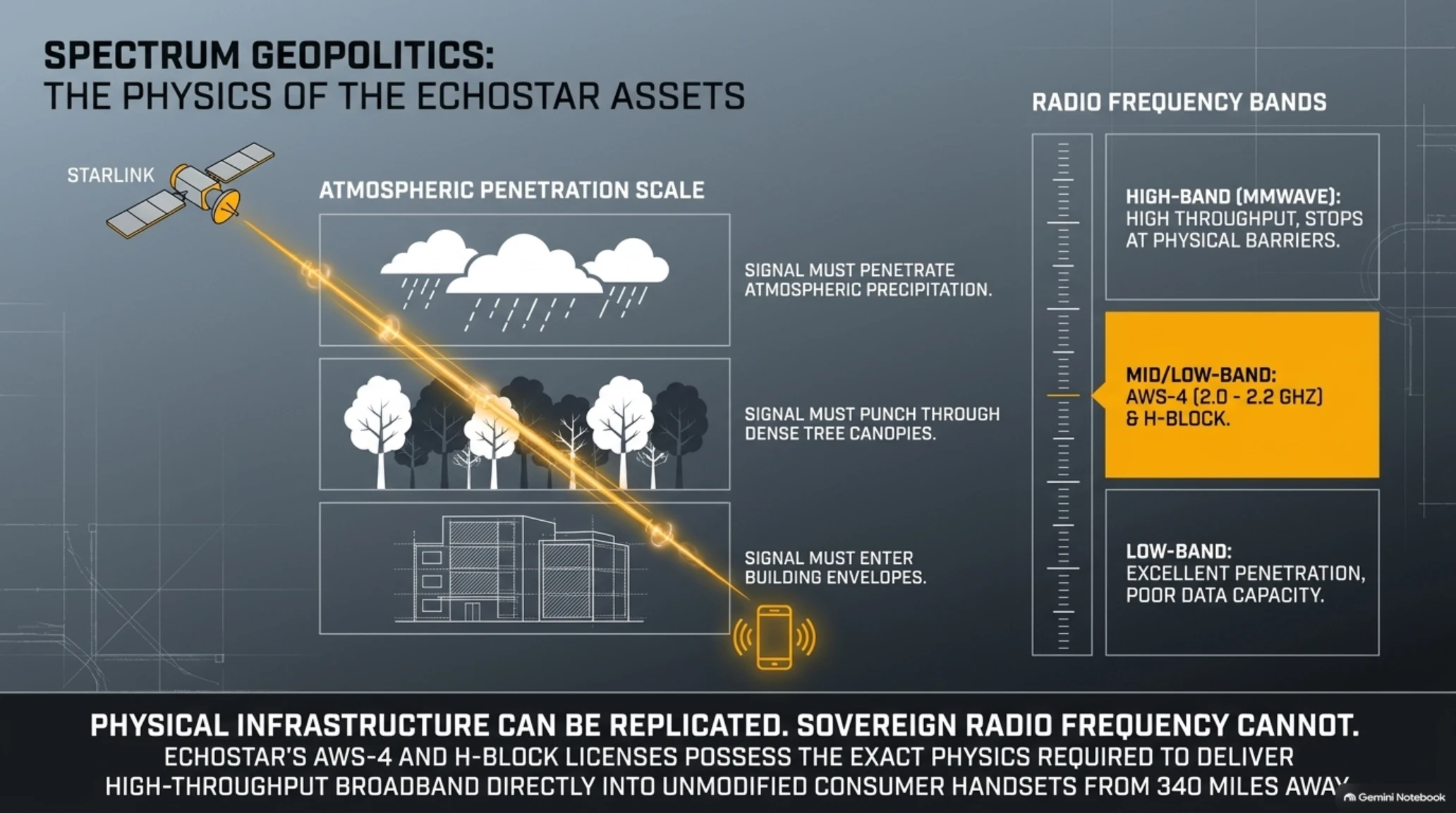
In modern telecommunications, physical infrastructure is easily replicated; radio frequency spectrum is finite, sovereign, and impossible to manufacture. Without federally authorized wireless spectrum, even the most technologically sophisticated satellite constellation in orbit is functionally useless. Radio spectrum licenses dictate exactly which electromagnetic frequencies a company can use to transmit signals through the Earth atmosphere without causing destructive interference.
Throughout two decades of strategic spectrum auctions and regulatory maneuvers, Charlie Ergen accumulated an extraordinary treasury of mid-band and low-band wireless licenses within EchoStar and Dish. The most prized assets in this portfolio are the AWS-4 spectrum licenses (operating in the 2.0 GHz to 2.2 GHz band) alongside H-Block allocations. These frequencies possess unique physics characteristics: they are high enough to carry substantial broadband data throughput, yet low enough to penetrate atmospheric precipitation, tree canopies, and building envelopes directly into unmodified consumer handsets.
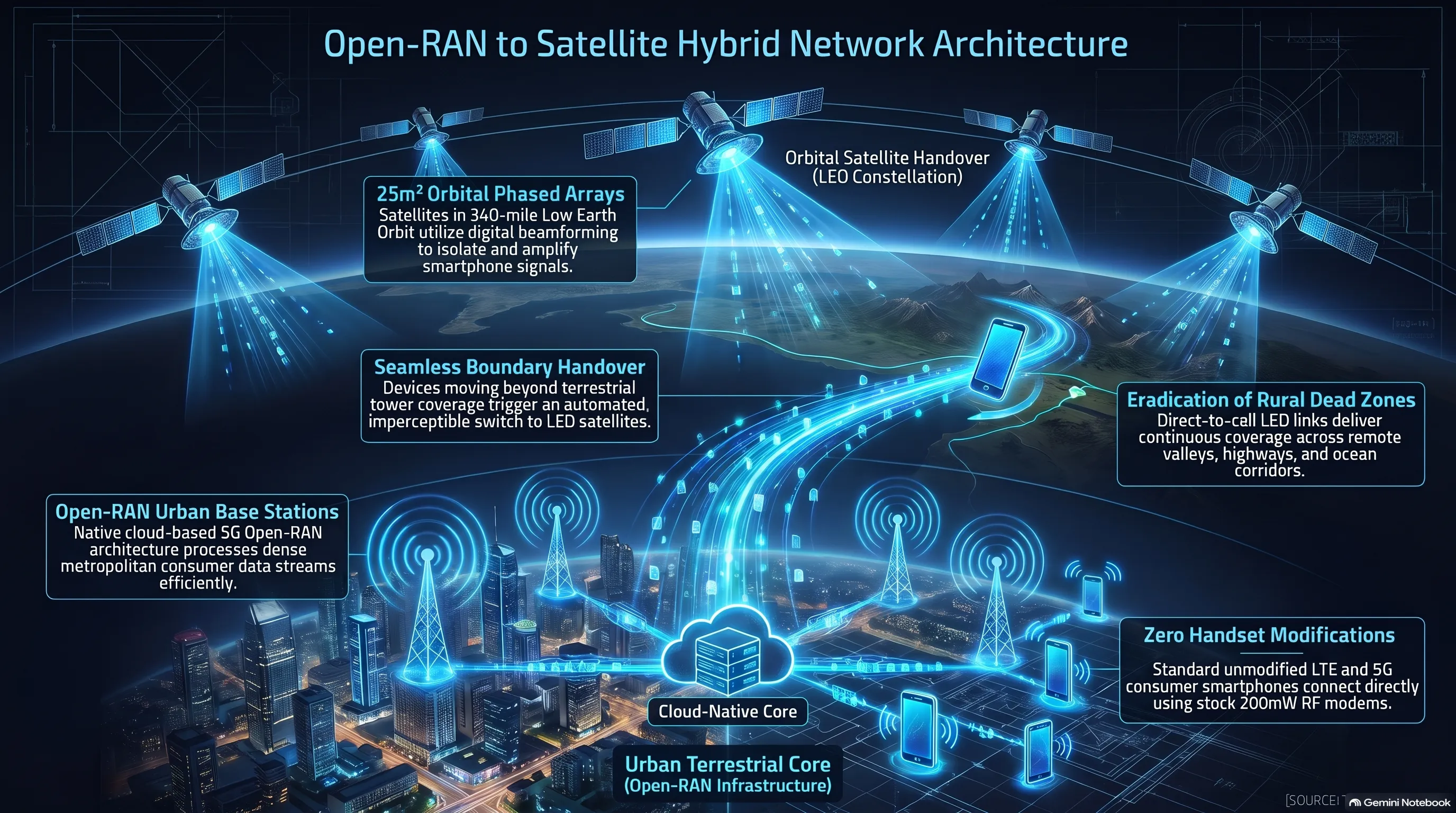
SpaceX had already established commercial ties with EchoStar by acquiring key spectrum licenses earlier in the year. However, absorbing Boost Mobile in its entirety provides far more than raw spectrum; it secures an operational Open-RAN cloud-native core network, establishing an automated bridge between terrestrial ground stations and low Earth orbit spacecraft.
Direct-to-Cell Engineering; Overcoming the Inverse-Square Law in Orbit
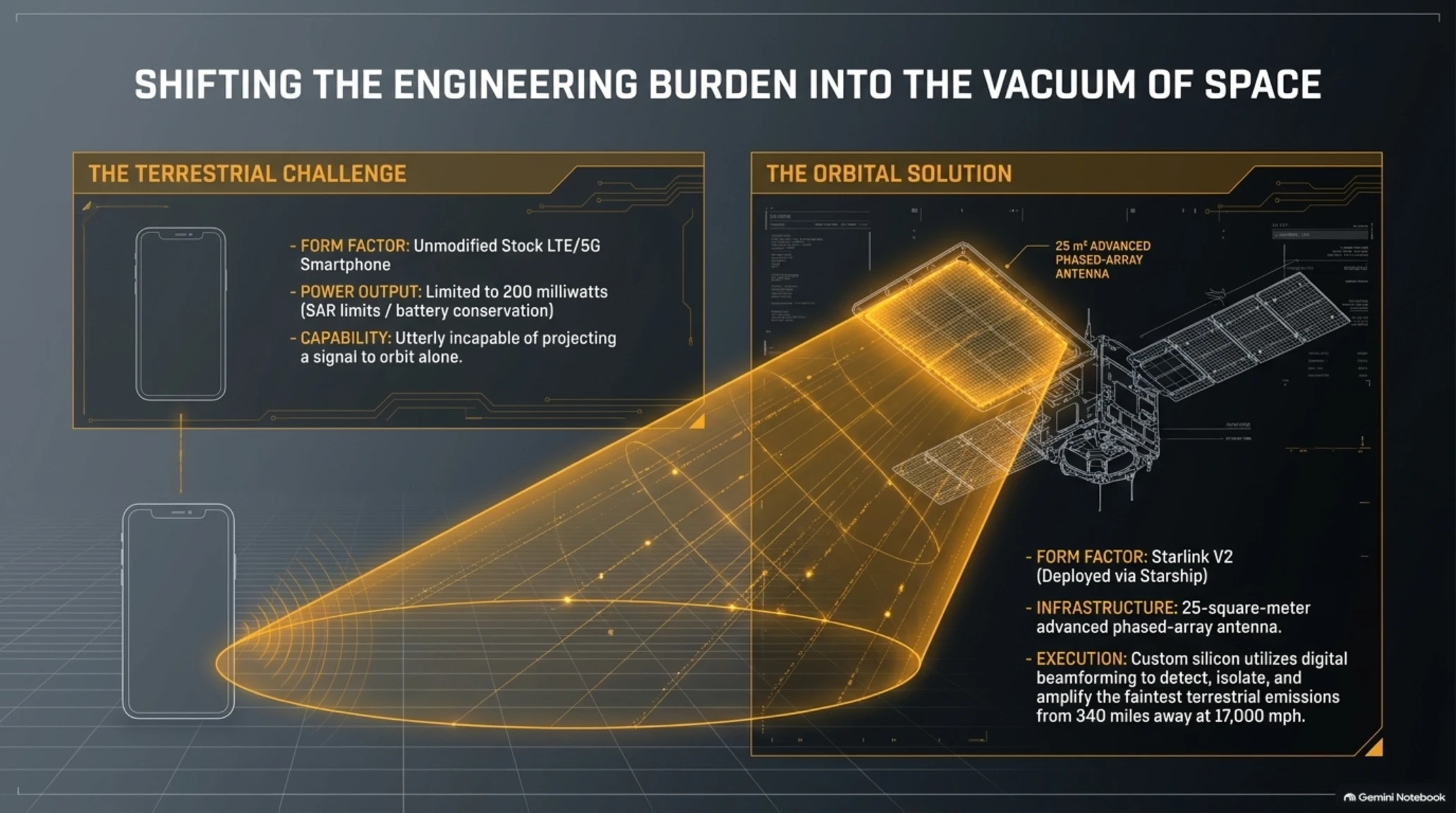
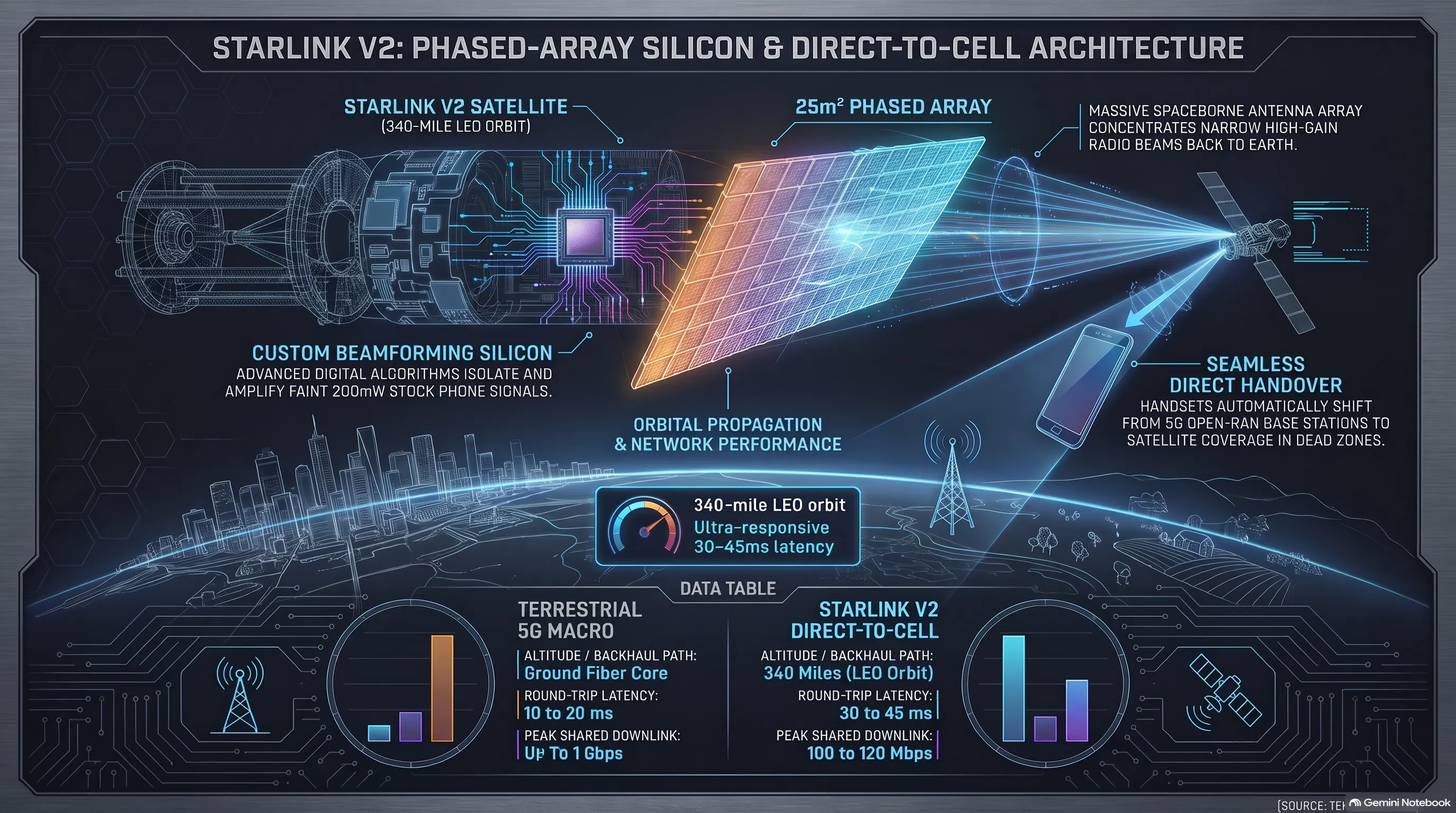
Transmitting high-speed wireless data between a compact smartphone and a satellite traveling at 17,000 miles per hour at an altitude of 340 miles represents one of the most formidable triumphs in radio-frequency engineering. In legacy satellite telephony systems like Iridium or Thuraya, consumers were required to purchase specialized, bulky handsets outfitted with thick helical antennas. The modest transmission wattage of standard consumer smartphones typically limited to 200 milliwatts to conserve battery and satisfy SAR radiation safety limits was utterly incapable of reaching orbit.
SpaceX resolved this fundamental physics challenge by moving the engineering burden into the vacuum of space. Each Direct-to-Cell Starlink V2 spacecraft is equipped with an enormous 25-square-meter advanced phased-array antenna array powered by highly sensitive custom silicon. Utilizing sophisticated digital beamforming algorithms, the satellite focuses narrow, high-gain radio beams capable of detecting, isolating, and amplifying the faintest signals emitted from a pocketed phone on the surface of the Earth.
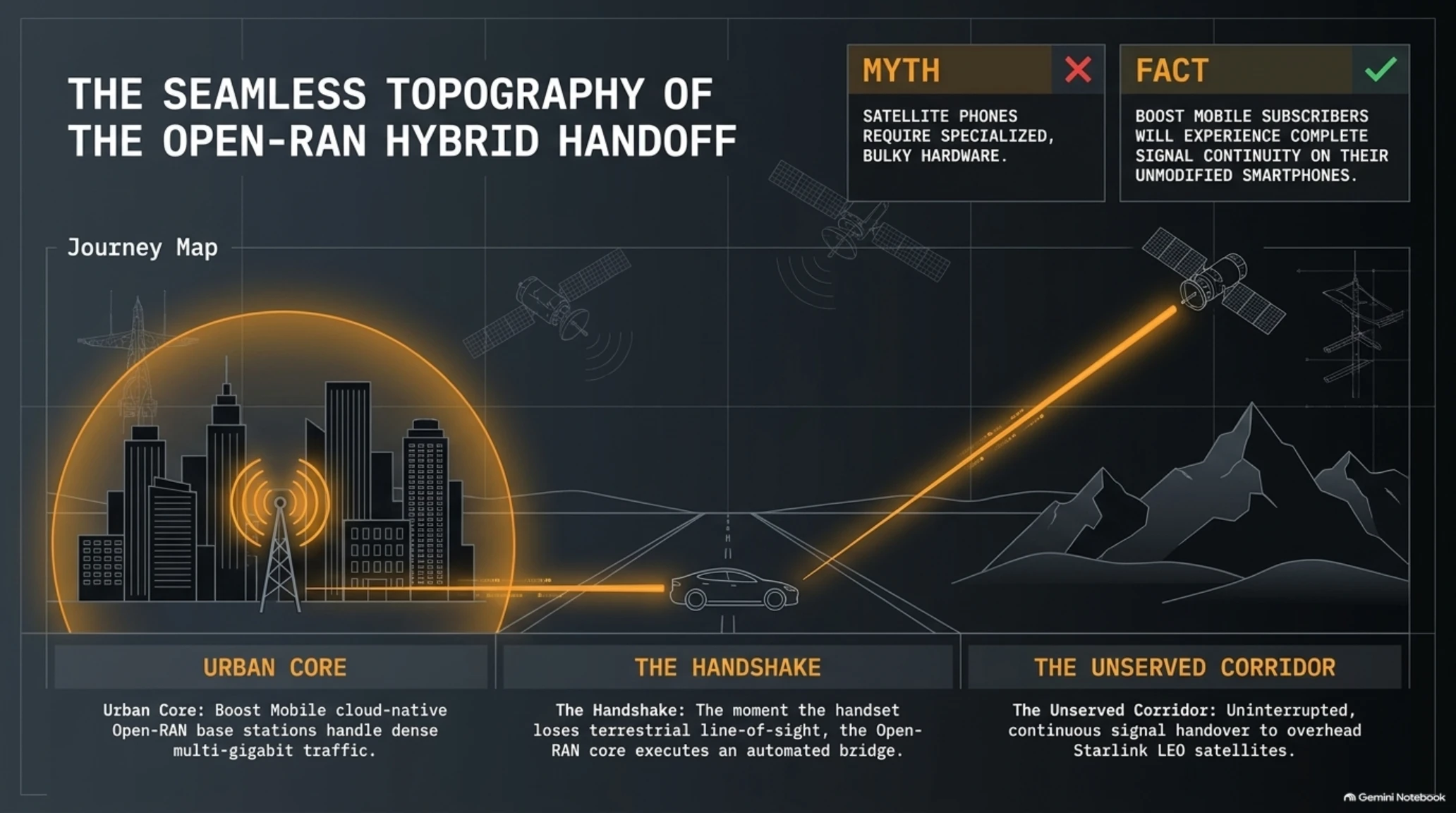
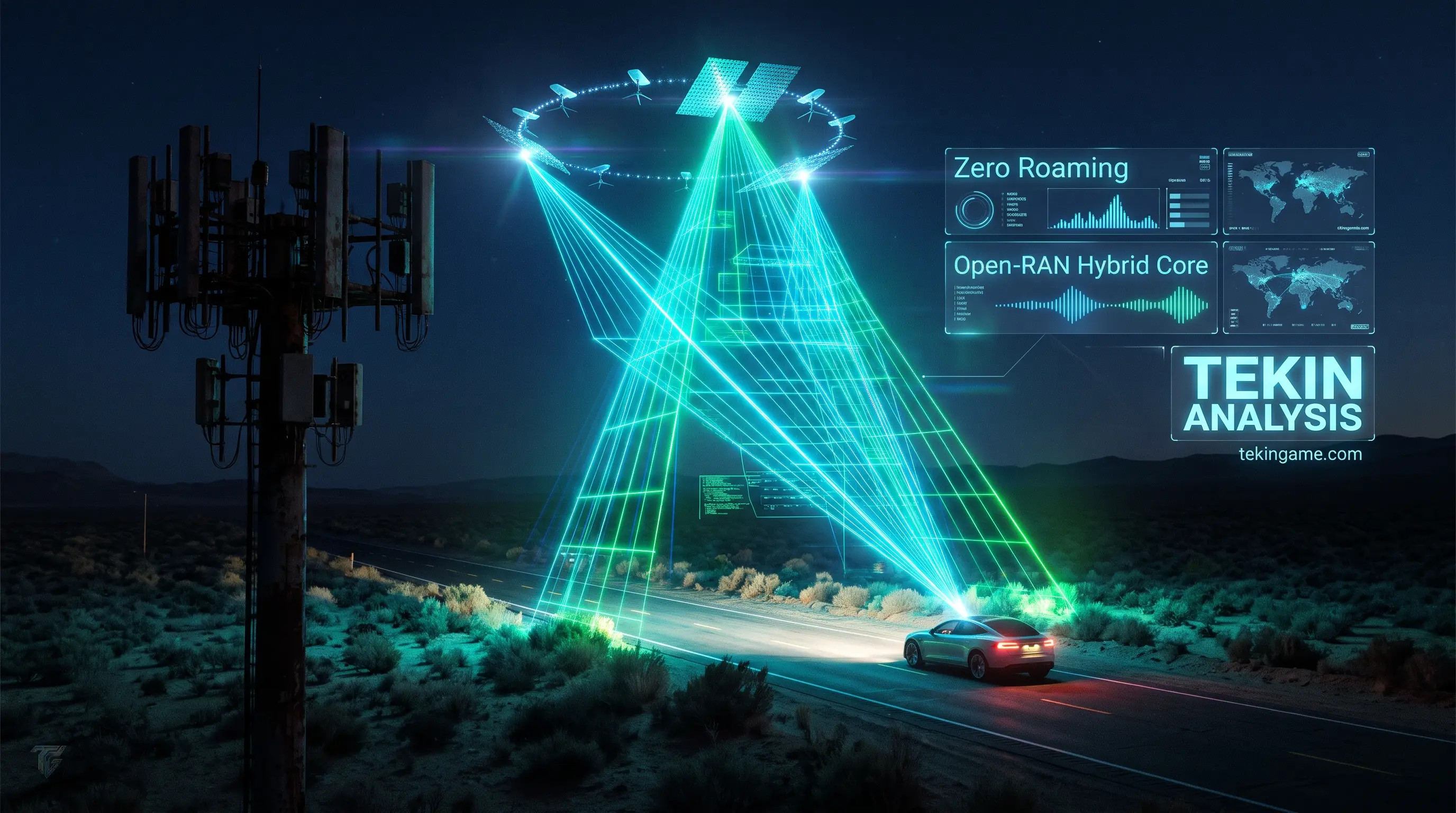
By integrating Boost Mobile into this ecosystem, Boost subscribers will become the first commercial users on the planet to experience complete signal continuity. In dense metropolitan corridors, the phone automatically negotiates connections with local 5G Open-RAN base stations. The moment a user drives beyond tower coverage, the handset executes a seamless, imperceptible handover to an overhead Starlink satellite, eliminating dead zones entirely.
Acquiring Boost Mobile allows SpaceX to leapfrog decades of painstaking, capital-intensive retail carrier development. Creating international mobile subscriber identity (IMSI) architectures, consumer billing pipelines, regulatory compliance frameworks, and physical retail distribution channels requires years of sustained investment. Through a single acquisition, Starlink bypasses that friction, gaining 7.5 million paying subscribers with active SIM cards whose devices will suddenly discover universal coverage across every blind spot in North America.
Technical Audit | Industry Myth vs Engineering Reality
Starlink intends to decommission all ground-based cellular towers, routing all mobile traffic in dense cities like New York and Chicago exclusively through orbit.
Orbital bandwidth density cannot support millions of concurrent urban data streams; SpaceX utilizes Boost Open-RAN towers for urban centers while delegating rural and unserved corridors to space.
Technical Benchmarks; Terrestrial Macro 5G vs Starlink Direct-to-Cell
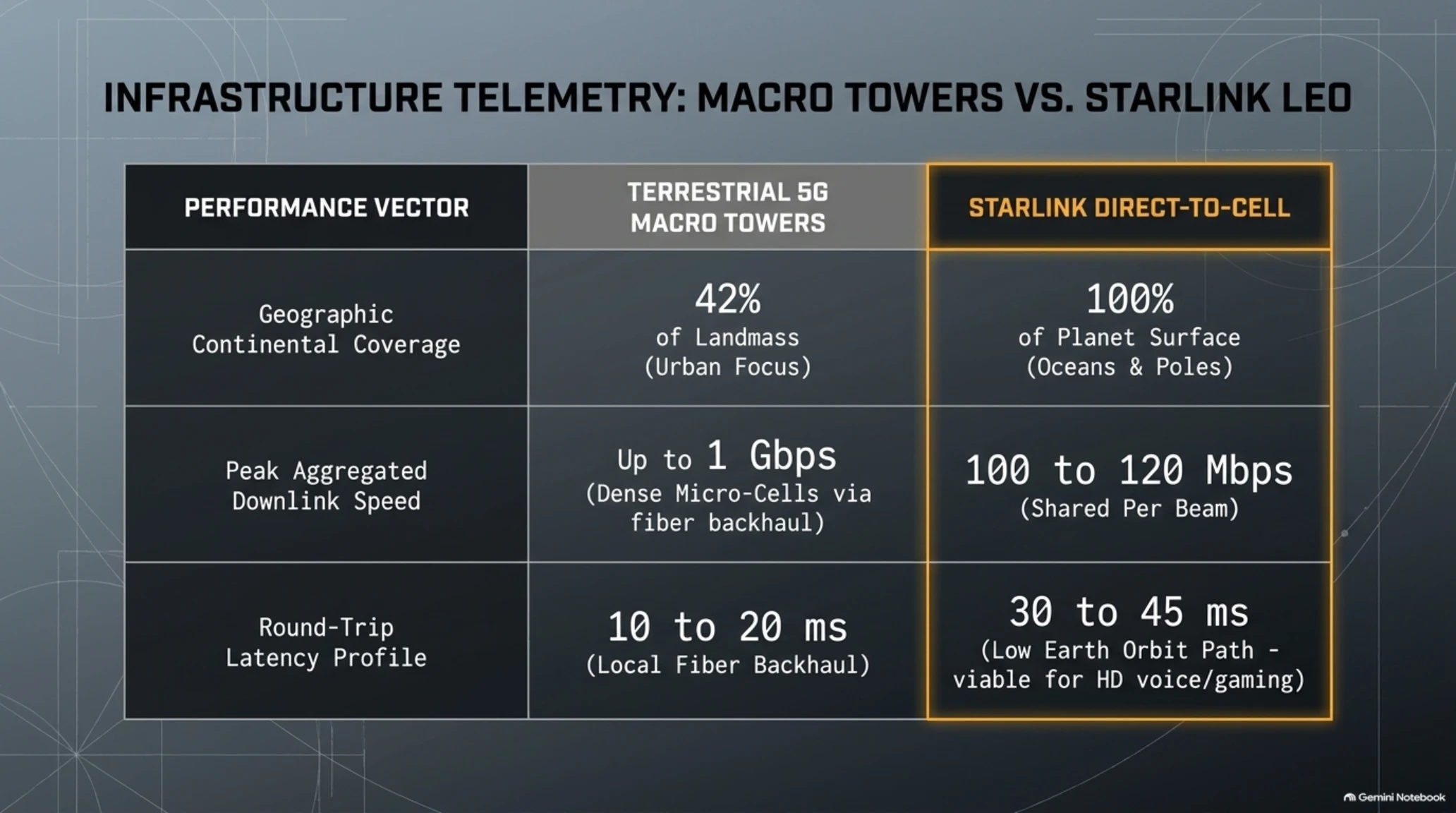
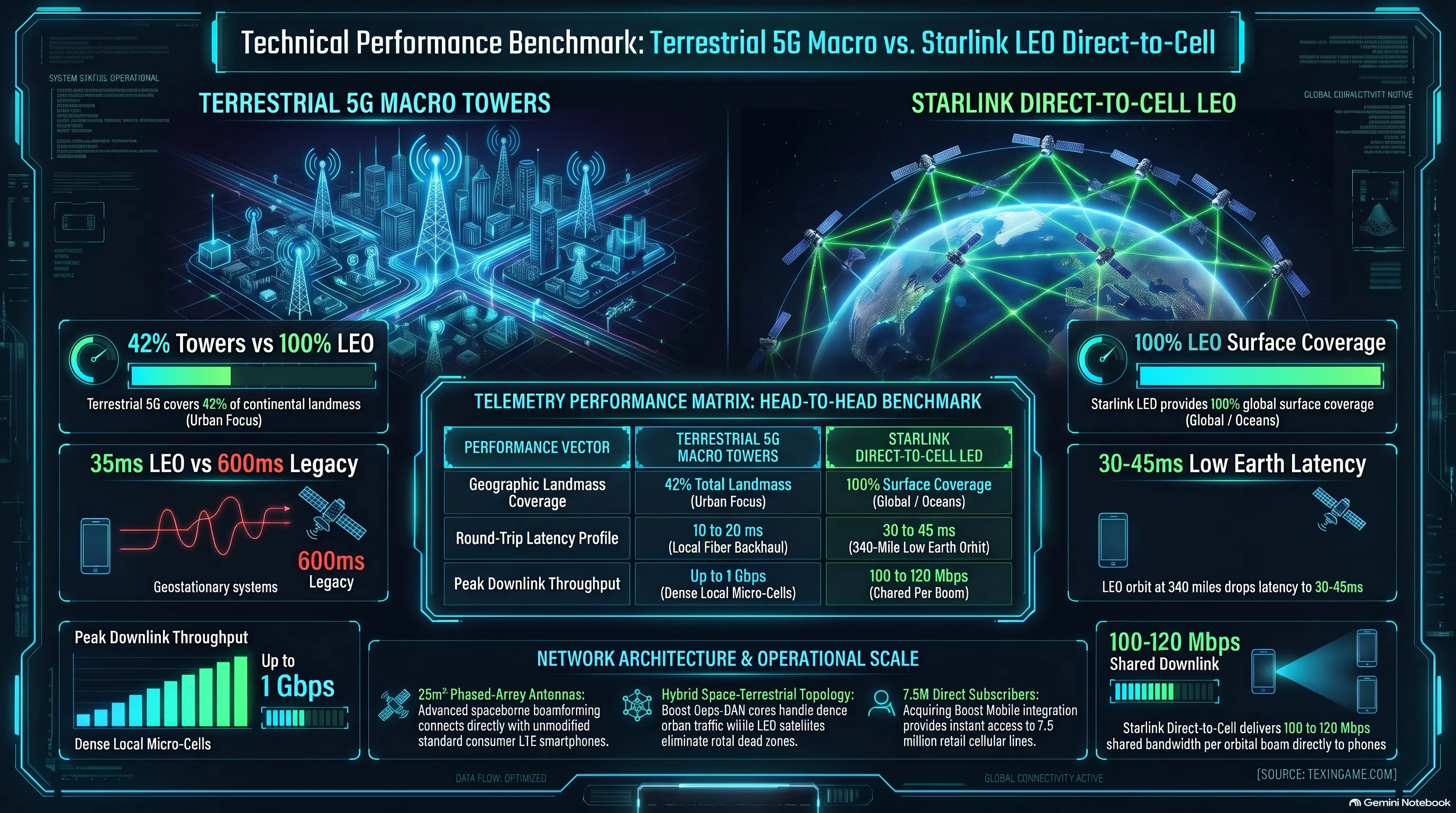
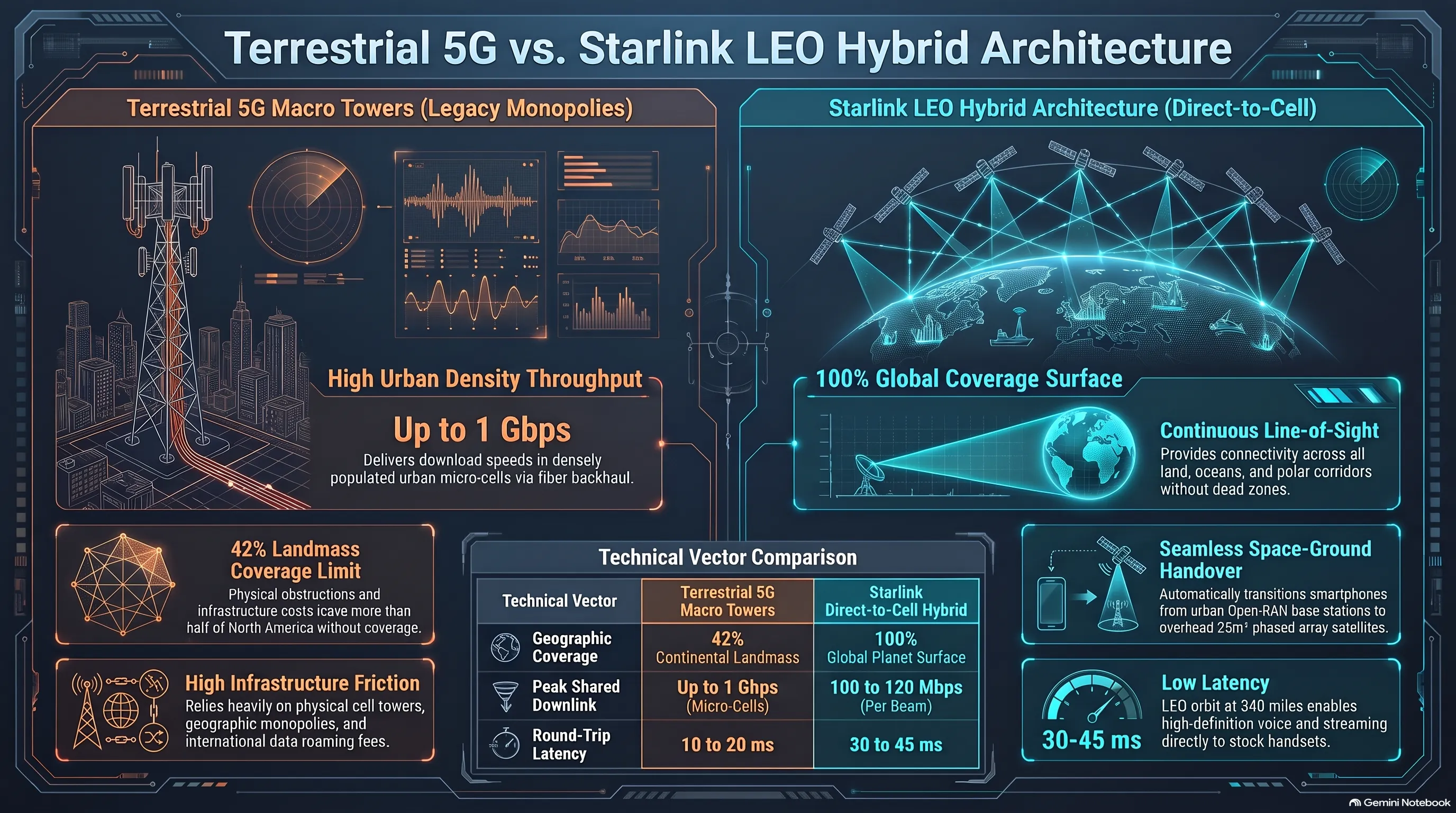
To evaluate the operational realities of this emerging hybrid architecture, the Tekin Engineering desk conducted a performance audit comparing traditional terrestrial 5G infrastructure against Starlink Direct-to-Cell capabilities. Terrestrial macro towers retain an undisputed advantage in peak aggregated throughput; connected directly to multi-gigabit fiber backhaul, a local 5G cell can deliver gigabit speeds to densely populated areas. However, terrestrial towers suffer severe propagation limitations: physical obstructions, mountainous topography, and economic unviability leave over half of North America without reliable high-speed cellular coverage.
In stark contrast, Starlink spacecraft operate in low Earth orbit (LEO) at an altitude of approximately 340 miles. By deploying spacecraft in LEO rather than traditional geostationary orbits (which sit at 22,236 miles), latency drops from an unusable 600 milliseconds down to 30 to 45 milliseconds. This latency profile makes high-definition voice calls, real-time gaming, and video streaming fully viable over a direct satellite connection. Furthermore, the sweeping orbital vantage point of each satellite provides instantaneous, unobstructed line-of-sight coverage spanning thousands of square miles.
Benchmark Matrix & Technical Performance Dashboard
| Performance Vector | Terrestrial 5G Macro Towers | Starlink Direct-to-Cell Constellation |
|---|---|---|
| Geographic Continental Coverage | 42% of Total Landmass (Urban Focus) | 100% of Planet Surface (Oceans & Poles) |
| Peak Aggregated Downlink Speed | Up to 1 Gbps in Dense Micro-Cells | 100 to 120 Mbps Shared Per Beam |
| Round-Trip Latency Profile | 10 to 20 ms via Local Fiber Backhaul | 30 to 45 ms via Low Earth Orbit Path |
Tekin Engineering Jargon Buster
The Contractual and Regulatory Minefield; Why Incumbents Will Sue
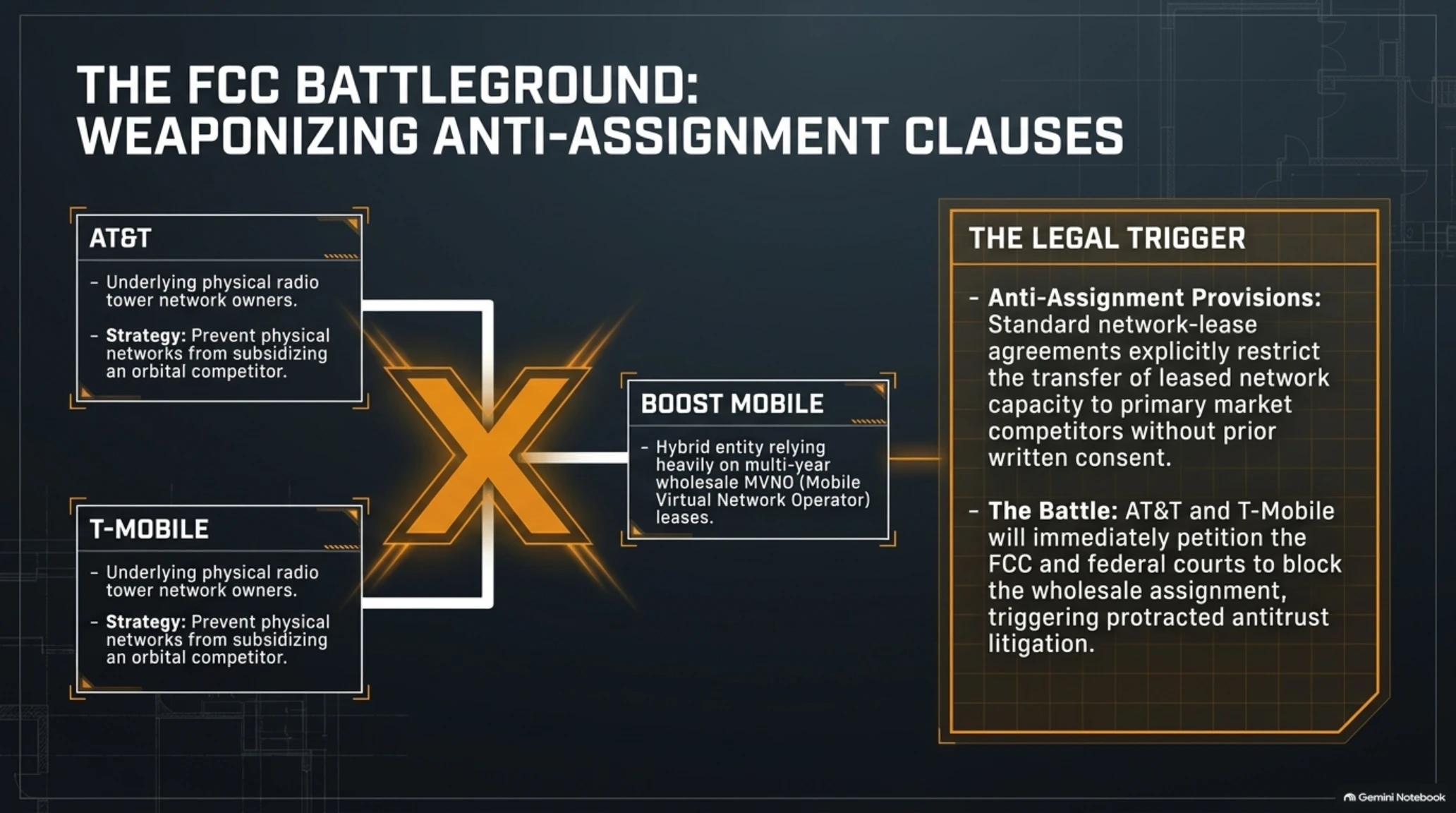
The most formidable barrier confronting the proposed transaction does not stem from orbital mechanics or financing; it lies within the fine print of existing corporate contracts. Boost Mobile functions primarily as a hybrid entity: while it has constructed a native cloud-based 5G network across designated metropolitan areas, it relies extensively on multi-year wholesale Mobile Virtual Network Operator (MVNO) agreements with AT&T and T-Mobile to deliver nationwide coverage.
Telecommunications legal experts note that standard wholesale network-lease agreements contain explicit anti-assignment provisions. These clauses specifically restrict the transfer of leased network capacity to primary market competitors without the prior written consent of the underlying infrastructure owners. If SpaceX moves to acquire Boost Mobile, AT&T and T-Mobile will immediately petition the FCC and federal courts, arguing that their physical networks cannot be conscripted into subsidizing an orbital competitor intent on cannibalizing their subscriber base. This legal battle is expected to trigger protracted antitrust litigation.
Financial Telemetry and the Macroeconomics of the $235B Wireless Market
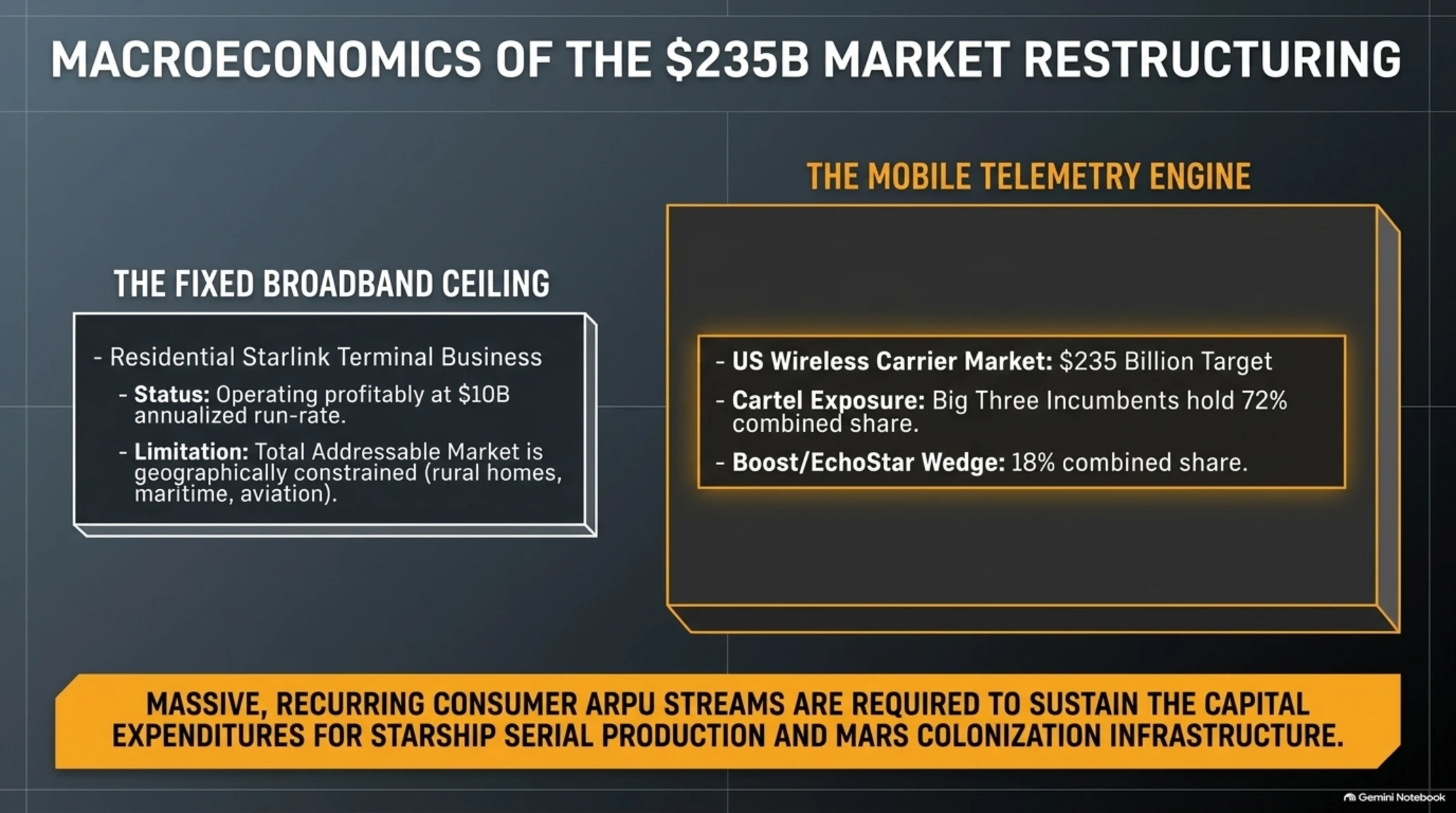
The driving impetus behind SpaceX cellular ambition is fundamentally economic. While the residential Starlink terminal business has crossed operating profitability generating over $10 billion in annualized run-rate revenue the total addressable market (TAM) for fixed satellite broadband is geographically constrained. Fixed satellite dishes primarily target rural homeowners, maritime vessels, and commercial aviation. In contrast, the global mobile telecommunications sector commands an annual turnover exceeding $1.1 trillion, with the United States market alone accounting for $235 billion.
To sustain the astronomical capital expenditures required for Starship serial production, Mars colonization infrastructure, and next-generation planetary communication arrays, SpaceX requires massive, recurring consumer cash flows. Acquiring Boost Mobile grants immediate access to cellular Average Revenue Per User (ARPU) streams, positioning SpaceX to bundle home satellite internet, consumer smartphone service, and connected vehicle data under a single subscription model that legacy carriers cannot structurally match.
📚 Classified & Related Dossiers in TekinGame
If you wish to explore beyond this report and delve into cybernetic frontiers and autonomous AI architectures, do not miss these three exclusive deep-dives in the Tekin Garage:
Financial Telemetry Dashboard & Revenue Allocation
| Market Segment Tier | Share of National Revenue | Disruption Impact of SpaceX Direct-to-Cell |
|---|---|---|
| Big Three Incumbents (Verizon, AT&T, T-Mobile) | 72% Combined Share | Loss of geographic monopoly pricing in suburban/rural sectors |
| Boost Mobile / EchoStar Infrastructure | 18% Combined Share | Massive balance-sheet recapitalization and orbital integration |
| Regional MVNOs and Independent Carriers | 10% Combined Share | Forced consolidation into unified satellite-backed wholesale cores |
The Eradication of Bordered Telecommunications and Roaming Arbitrage
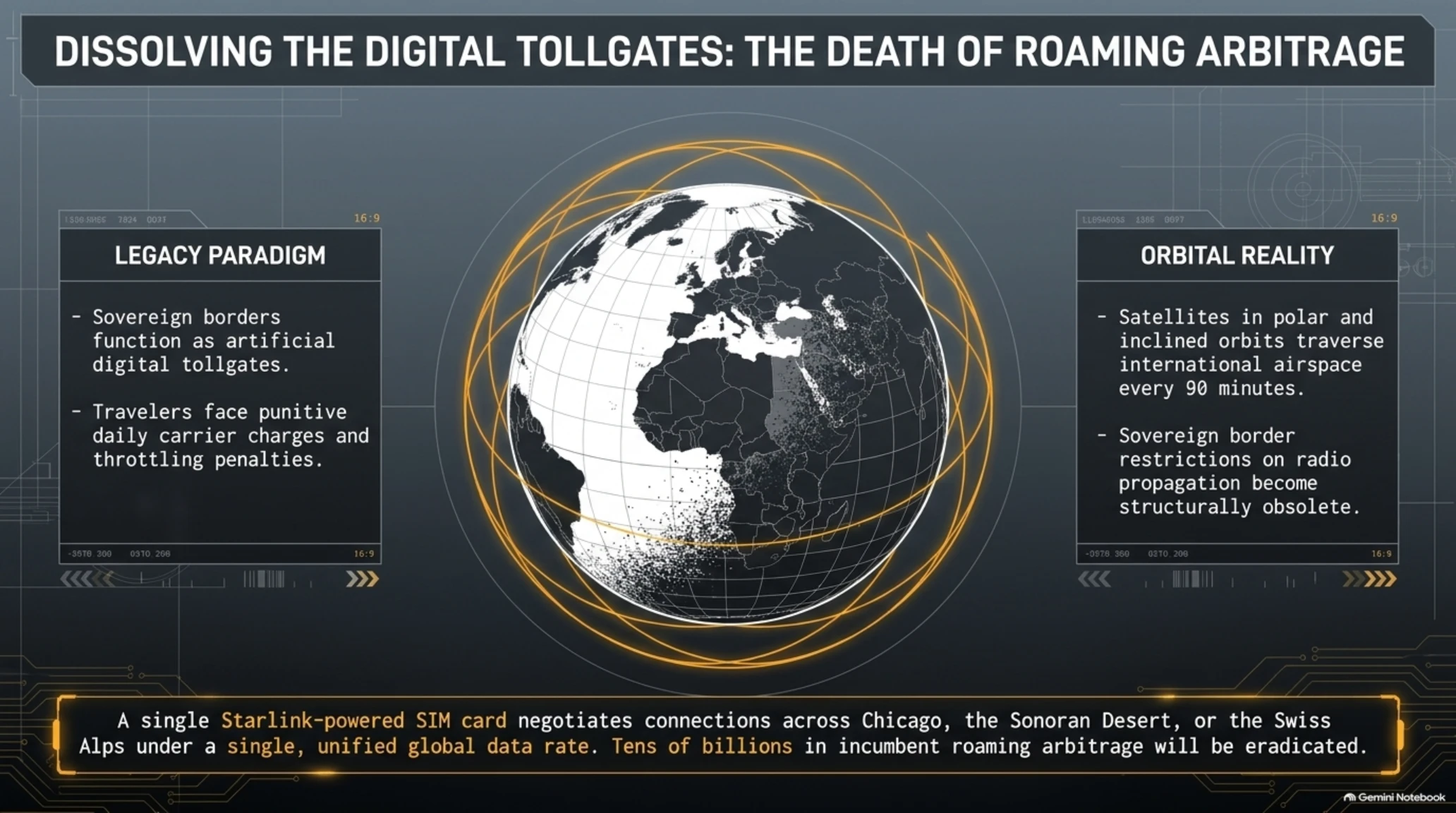
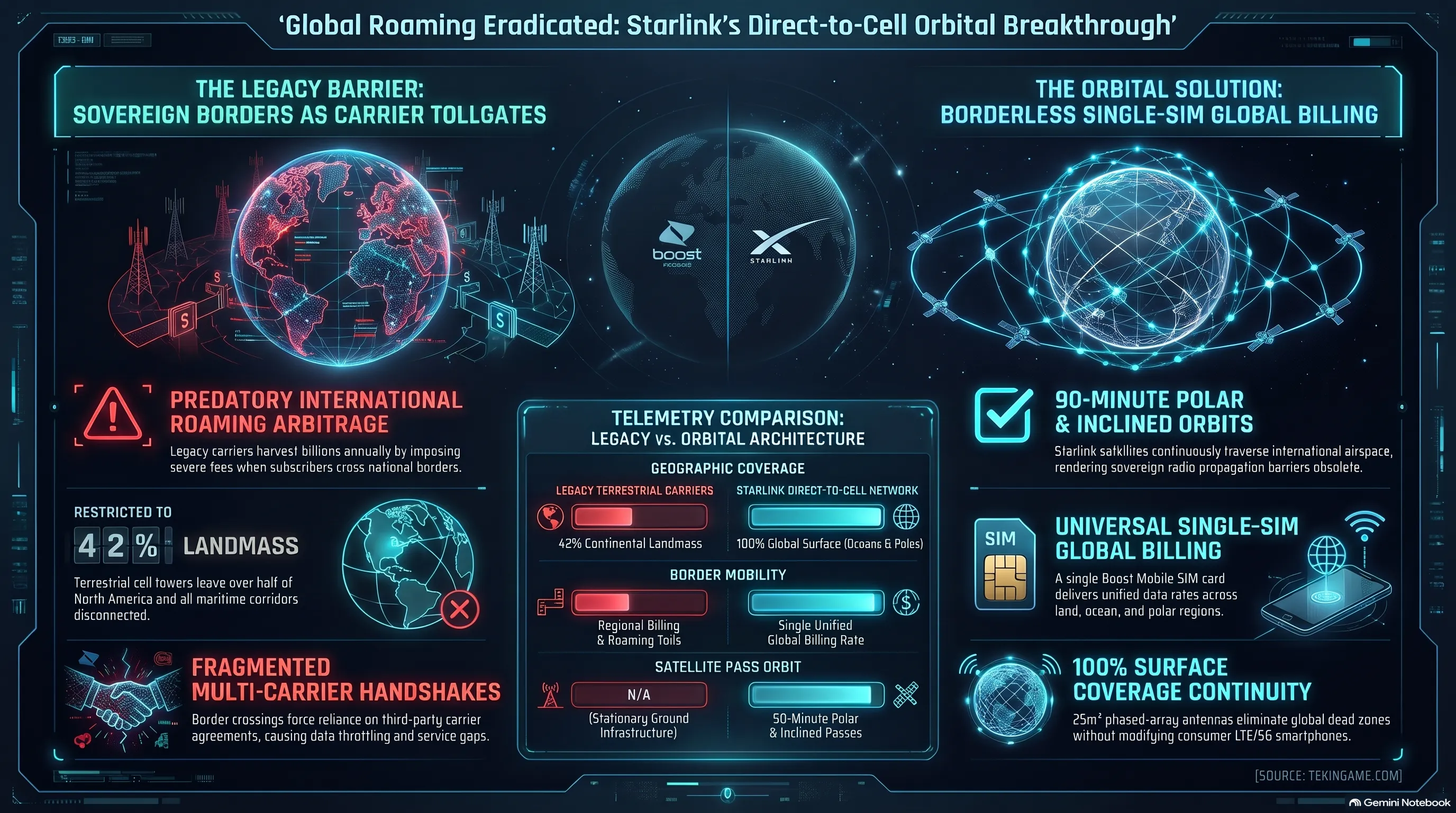
One of the most consequential societal impacts of a truly spaceborne mobile network is the systematic dissolution of international roaming fees. For over half a century, the global telecommunications model has relied on artificial borders: crossing from the United States into Canada or Mexico subjected travelers to punitive daily carrier charges or throttling penalties. Sovereign borders functioned as digital tollgates.
With Starlink operating as a native mobile network, sovereign border restrictions on radio propagation become obsolete. Satellites in continuous polar and inclined orbits traverse international airspace every ninety minutes. A single Starlink-powered SIM card can negotiate connections across Chicago, the Mexican Sonoran desert, the Swiss Alps, or the middle of the Atlantic Ocean under a single unified billing plan. This structural disruption will eliminate tens of billions of dollars in highly profitable roaming arbitrage currently harvested by legacy carriers.
Event Timeline | Evolution of Satellite & Terrestrial Wireless
| Chronological Milestone | Space & Telecom Convergence Reality | Strategic Industry Consequences |
|---|---|---|
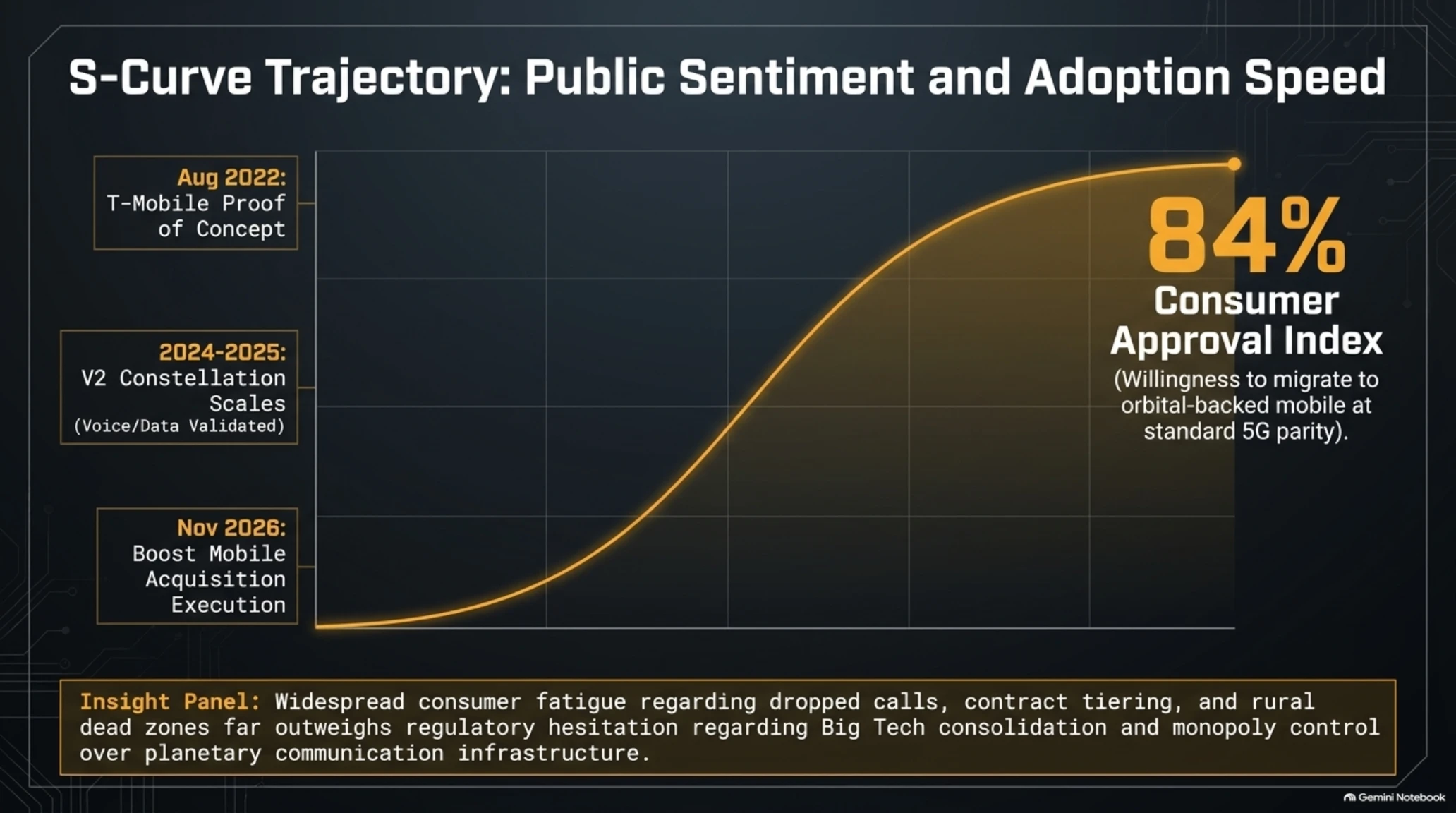
| August 2022 | T-Mobile Coverage Above & Beyond Unveiled | Initial proof-of-concept for satellite text messaging to stock LTE handsets. |
| 2024 to 2025 | Starlink V2 Direct-to-Cell Constellation Scales | Orbital deployment of 25m² phased arrays; voice and data test passes validated. |
| November 2026 | SpaceX-EchoStar Boost Mobile Acquisition Talks | Direct commercial entry into US wireless market; antitrust clashes with AT&T. |
Consumer Sentiment and Public Perception of Mega-Carrier Consolidation
Public sentiment regarding legacy telecom carriers is characterized by widespread consumer fatigue. Decades of dropped calls, dead zones along rural transportation arteries, complex contract tiering, and opaque pricing structures have produced deep dissatisfaction among enterprise and retail consumers alike. The promise of a smartphone connection that remains active anywhere beneath an open sky commands overwhelming public appeal. Consumer survey data indicates that over 84% of smartphone users would immediately consider switching to an orbital-backed mobile provider if pricing matches standard 5G plans.
Simultaneously, antitrust scholars and regulatory advocates express legitimate concern regarding the concentration of power. The prospect of a single corporate enterprise controlling global orbital launch systems (SpaceX), low Earth orbit satellite broadband (Starlink), global social communication platforms (X), and now a retail cellular telecommunications carrier raises profound questions regarding monopolistic control over planetary communication infrastructure.
Market Sentiment Gauge & S-Curve Adoption Trajectory
Adoption Synthesis: An approval rating of 84% demonstrates that consumer exhaustion with terrestrial coverage blind spots far outweighs hesitation regarding Big Tech consolidation, driving immense potential migration toward an orbital carrier.
Five-Axis Infrastructure Evaluation and Carrier Telemetry
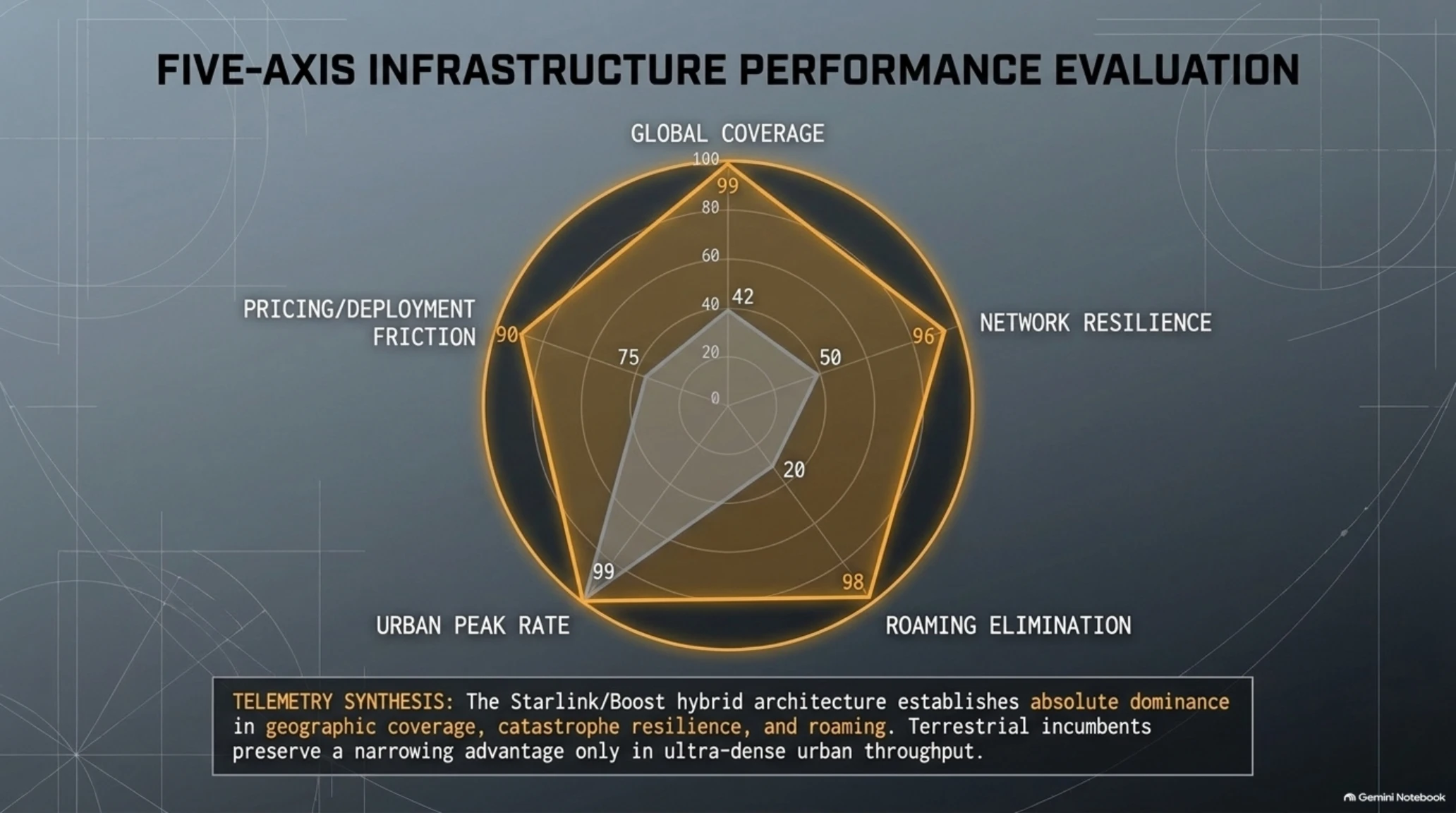
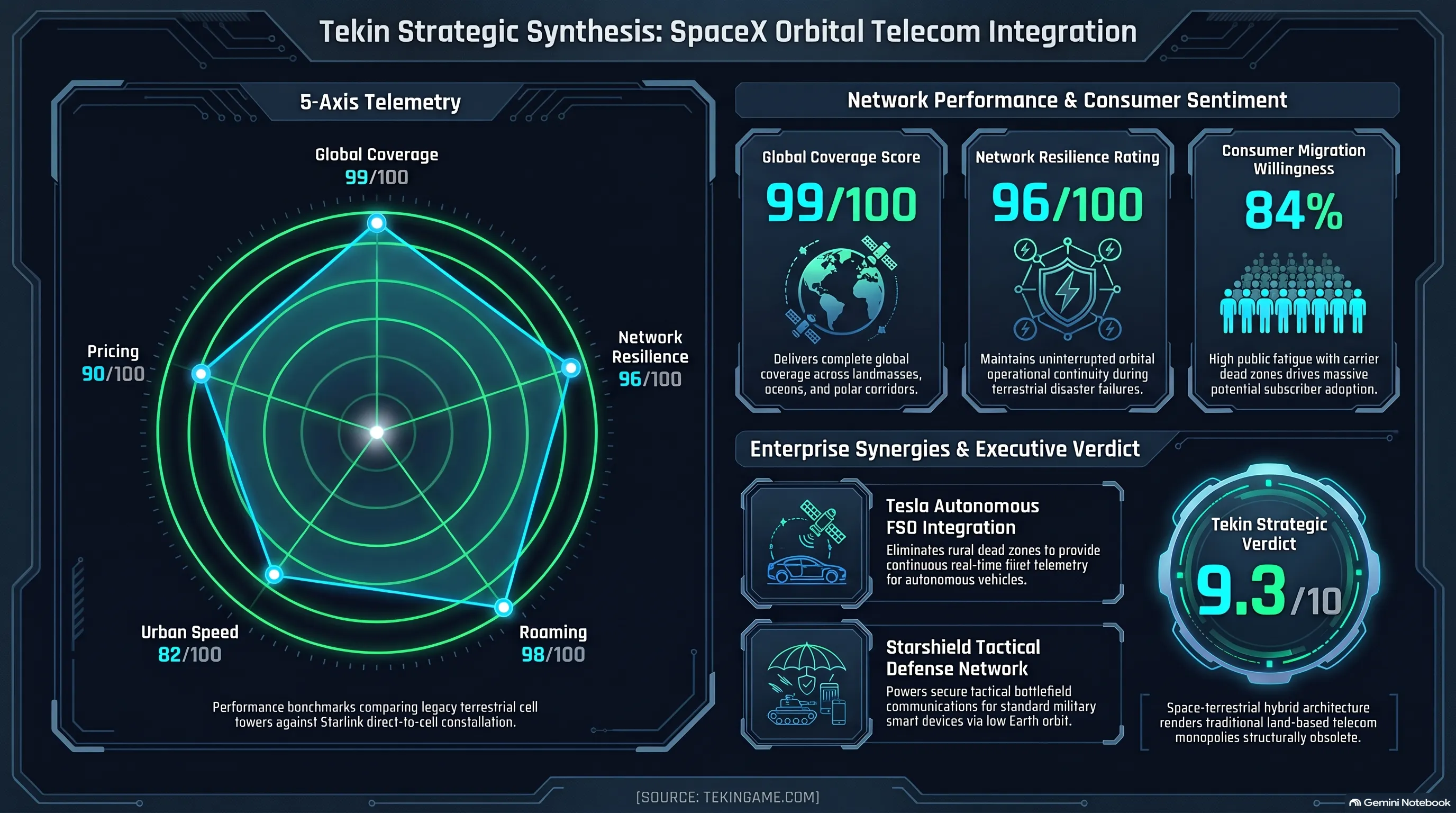
To evaluate the competitive and technological posture of a SpaceX-controlled Boost Mobile against incumbent legacy carriers (Verizon and AT&T), the Tekin Engineering desk conducted an objective five-axis telemetry audit. The evaluation examines total geographic landmass coverage, network resilience during natural disaster scenarios, urban peak download throughput, international roaming friction, and deployment friction for consumer handsets.
Five-Axis Carrier Infrastructure Performance & Strategic Radar
Telemetry Synthesis: The Starlink/Boost hybrid architecture establishes absolute dominance in geographic coverage, catastrophe resilience, and international roaming, while terrestrial incumbents preserve a narrowing advantage in dense urban throughput.
Strategic Synergies; Tesla Fleets, Starshield Defense, and Planetary IoT
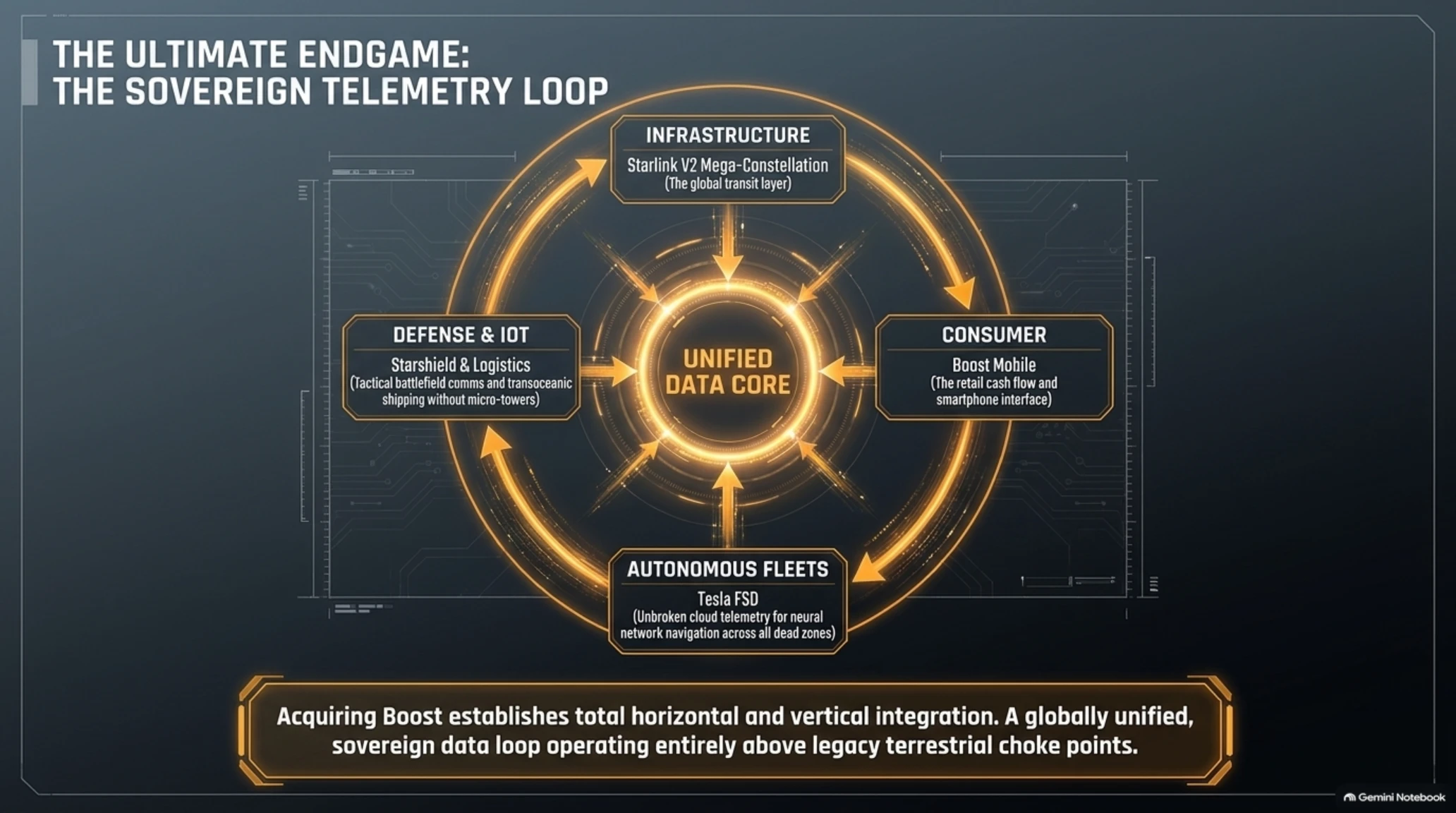
The acquisition of Boost Mobile extends far beyond consumer voice and data plans. It completes the horizontal and vertical integration of Elon Musk technological empire:
- The Connected Tesla Fleet and Autonomous FSD: Modern autonomous vehicles rely on continuous cloud telemetry for neural network navigation and real-time fleet map synchronization. Previously, crossing through rural dead zones severed vehicle telemetry. Native direct-to-cell integration transforms every Tesla vehicle into an unbroken, sovereign connected node that never loses communication.
- Starshield Military and Tactical Defense Networks: The United States Department of Defense is among SpaceX largest institutional clients. Integrating a commercially operated retail cellular core with Starshield low Earth orbit infrastructure enables tactical battlefield communications for armed personnel using standard, off-the-shelf military smart devices without heavy radio backhauls.
- Critical Infrastructure and Global Autonomous Logistics: Freight logistics corridors, transoceanic shipping, oil pipelines, and remote agricultural sensors can operate without constructing expensive micro-towers, communicating directly into an uninhibited global telemetry stream.
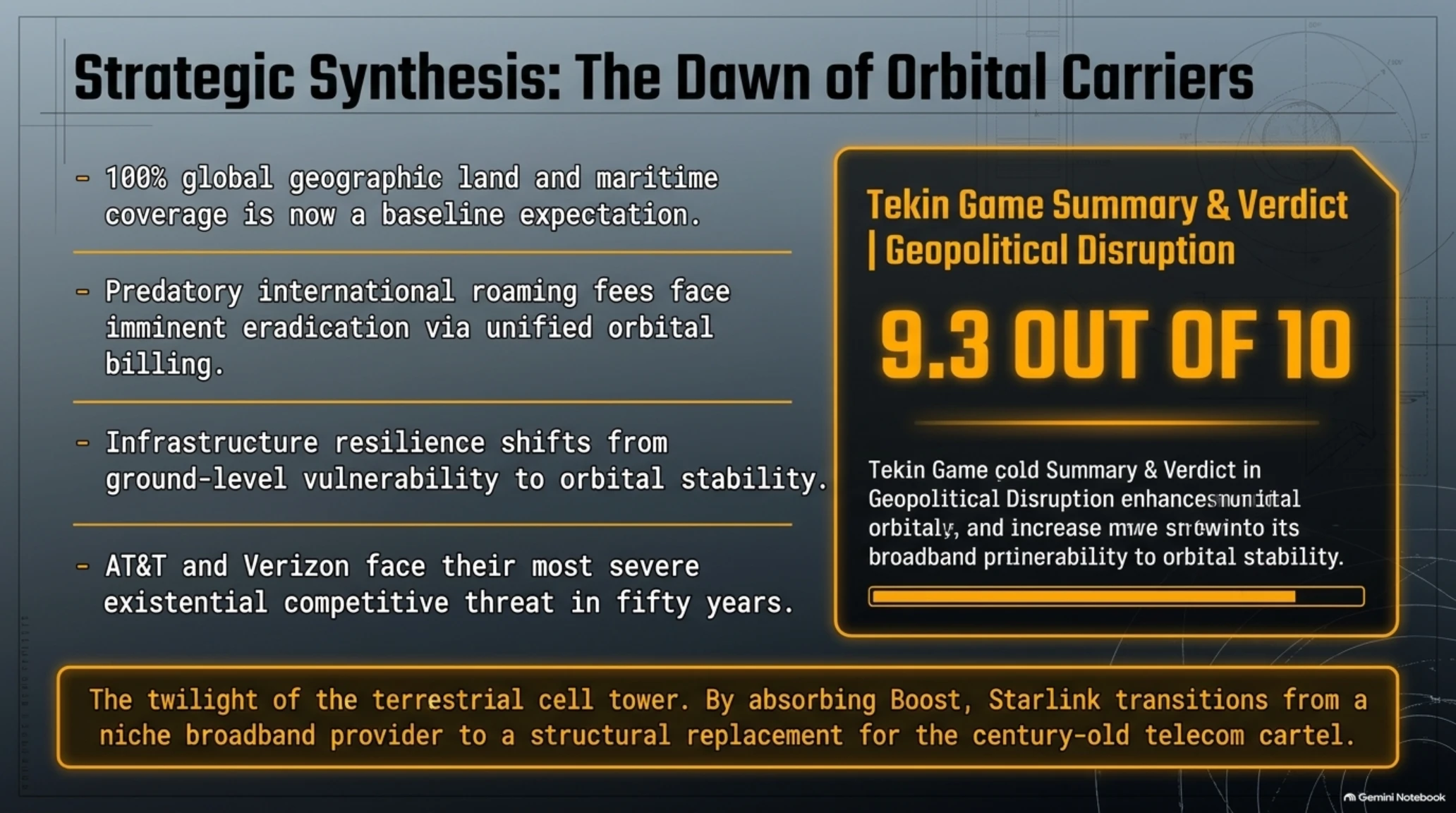
- Guarantees 100% geographic land and maritime coverage across the globe, eradicating dead zones.
- Permanently eliminates predatory international roaming fees through unified orbital data billing.
- Maintains continuous infrastructure resilience during terrestrial earthquakes, hurricanes, and floods.
- Fully compatible with existing, unmodified LTE and 5G smartphones currently in consumer pockets.
- Fierce legal and regulatory obstruction from AT&T and T-Mobile regarding wholesale lease transfers.
- Lower shared bandwidth density in ultra-dense urban cores compared to dedicated local mmWave fiber.
- Unprecedented concentration of global aerospace, communications, and social platforms under a single firm.
Editorial Verdict & Primary Source Documentation
The Twilight of Cell Towers; The Dawn of Orbital Carriers
By acquiring Boost Mobile, SpaceX transforms Starlink from an exotic niche broadband provider into a full-scale tier-one cellular operator, rendering the century-old business model of legacy telecom cartels structurally obsolete.
- The Washington Post: SpaceX in Talks with EchoStar to Acquire Boost Mobile for Wireless Expansion
- TechCrunch: Deconstructing SpaceX Strategy to Buy Boost Mobile and Access Spectrum
- Space.com: Technical Architecture of Starlink V2 Phased-Array Direct-to-Cell Spacecraft
- MoffettNathanson: Financial Teardown of US Wireless Carrier Competition and Spectrum Assets
Frequently Asked Technical & Strategic Questions
Will existing unmodified smartphones work on the Starlink Direct-to-Cell network?
Yes. The Direct-to-Cell architecture uses standard 3GPP cellular frequencies (such as AWS-4 and LTE bands), allowing off-the-shelf consumer 4G and 5G smartphones to communicate directly with satellites without any hardware modifications or external antennas.
Will direct satellite internet on my phone match residential fiber speeds?
No. Orbital cells provide approximately 100 to 120 Mbps of aggregated capacity shared among active devices within a given beam footprint. This throughput is ideal for high-definition streaming, web browsing, and voice calls, but is not designed to replace high-density urban fiber backhauls.
Why did AT&T and Verizon refuse to integrate their networks with Starlink?
Legacy carriers recognized that enabling seamless orbital connectivity would erode their competitive advantage namely, their extensive terrestrial tower networks and cede long-term pricing and subscriber control to SpaceX.
What will happen to terrestrial cell towers if this transaction succeeds?
Terrestrial cell towers will remain essential for dense metropolitan centers where radio user density exceeds satellite capacity. The network will operate as a hybrid: using Open-RAN ground towers in urban cores and dynamically handing off to satellites across suburban, rural, and transit corridors.
What is the primary regulatory barrier confronting the Boost Mobile acquisition?
The anti-assignment clauses embedded within existing wholesale network-lease agreements that Boost Mobile maintains with AT&T and T-Mobile, which incumbents will argue cannot be legally transferred to a direct competitor without their consent.
How will a spaceborne carrier impact international roaming fees?
Because low Earth orbit satellites circle the globe irrespective of national boundaries, Starlink can operate a unified global data network, eliminating artificial border-crossing tariffs and ending punitive roaming fees forever.