Tekin Analysis: Inside Google's Gemini 3.8 Live and Extended Thinking Engine
A definitive architectural autopsy into Google's native speech-to-speech models, parallel reasoning pipelines, 97-language switching, and SynthID watermarking.
- 🎮Thinking While Talking- Parallel execution of chain-of-thought and voice generation.
- 🎧97-Language Real-Time Pivot- Zero-latency multilingual switching with 30fps vision grounding.
- 🚀SynthID Acoustic Shield- Frequency-embedded digital watermarking against voice deepfakes.
- 🗡️Sub-280ms Audio Latency- Time-to-First-Audio Token speeds surpassing human conversational reflexes.
- 📰Full-Duplex Dynamics- Sub-50ms acoustic barge-in handling without auditory interference.
- ⚔️Bidirectional WebSockets- Asynchronous enterprise tool orchestration over high-speed gRPC meshes.
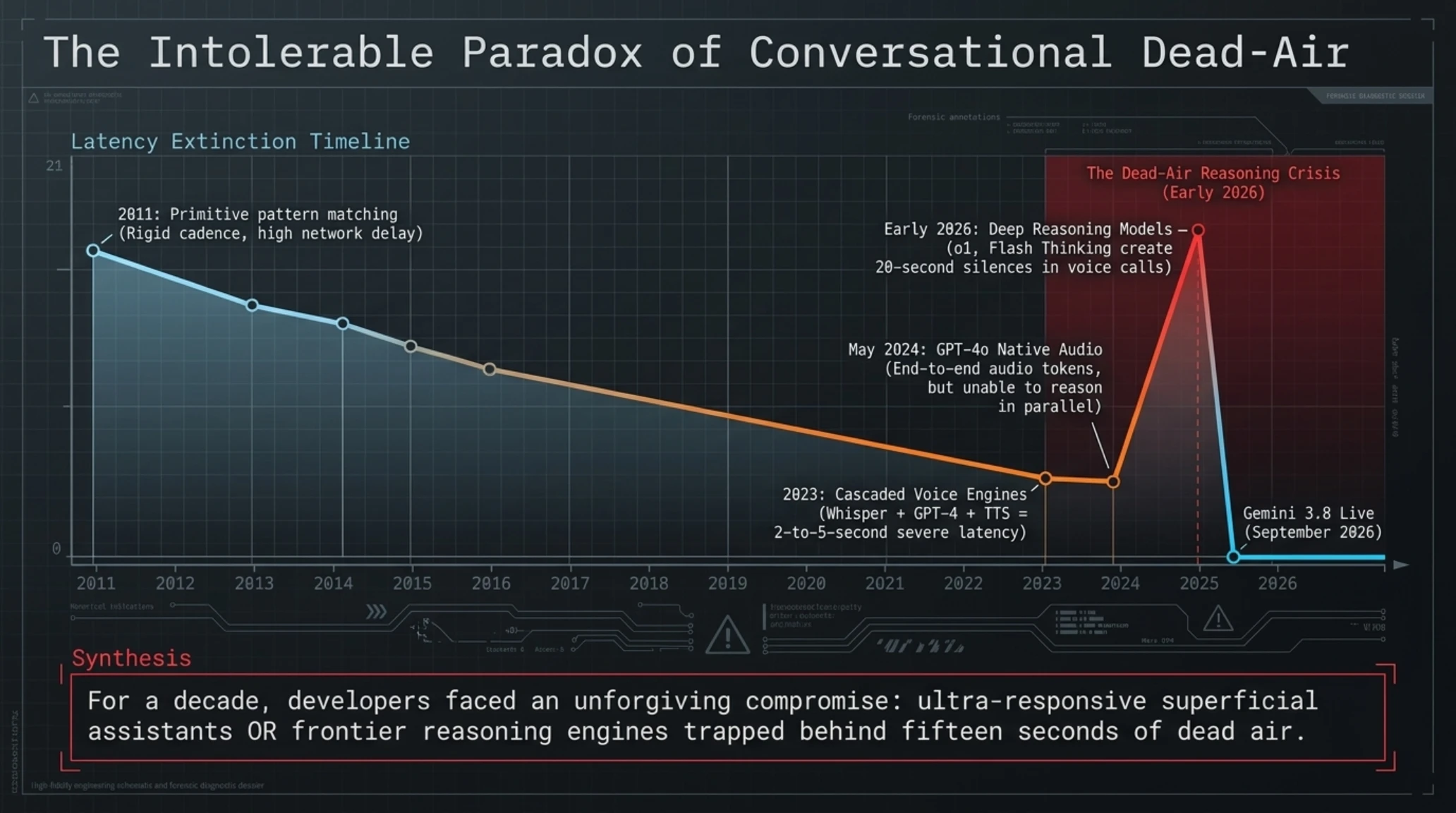
In mid-September 2026, Google officially dismantled the most stubborn and frustrating bottleneck in conversational computing with the dual release of Gemini 3.8 Live and Gemini 3.8 Live Extended Thinking. For the better part of a decade, human-machine voice interaction was trapped within an unforgiving architectural compromise: developers had to choose between ultra-responsive conversational assistants that lacked deep reasoning capabilities, or frontier reasoning engines that required fifteen to thirty seconds of dead air before formulating a response. In live telephonic and conversational interfaces, thirty seconds of complete silence is an eternity that entirely shatters the illusion of natural dialogue.
Key Takeaways & Executive Summary
- Google deployed a dual-model architecture (Standard and Extended Thinking) to decouple raw conversational speed from heavy chain-of-thought deduction.
- The 'Thinking while Talking' paradigm eliminates frustrating dead-air silences by executing background reasoning in parallel with live acoustic narration.
- Time-to-First-Audio Token (TTFA) latency has been crushed to sub-280ms, enabling real-time conversational fluidity.
- The native speech-to-speech engine supports zero-shot code-switching across 97 languages with concurrent 30fps video ingestion.
- SynthID audio watermarking injects resilient, imperceptible cryptographic frequencies directly into the acoustic waveform to defeat deepfakes.
- Enterprise tools like Google Workspace are orchestrated asynchronously via high-throughput Bidirectional WebSockets and gRPC streams.
With the introduction of the Gemini 3.8 architecture, Google DeepMind has engineered a radical cognitive paradigm shift: 'Thinking while Talking'. By uncoupling the conversational audio streaming pipeline from the background chain-of-thought (CoT) reasoning fabric, the model can engage in fluent, empathetic, and continuous dialogue while asynchronously compiling code, querying distributed databases, verifying formal mathematical proofs, and orchestrating multi-agent workflows in the background. The days of awkward loading spinners, robotic pauses, and superficial voice responses are definitively over.

To grasp the engineering magnitude of this achievement, we must first examine Google's strategic dual-tier deployment model, designed to address the vastly divergent latency and compute requirements of modern enterprise computing.
Google's Dual-Model Architecture: Decoupling Voice Velocity from Deep Reasoning
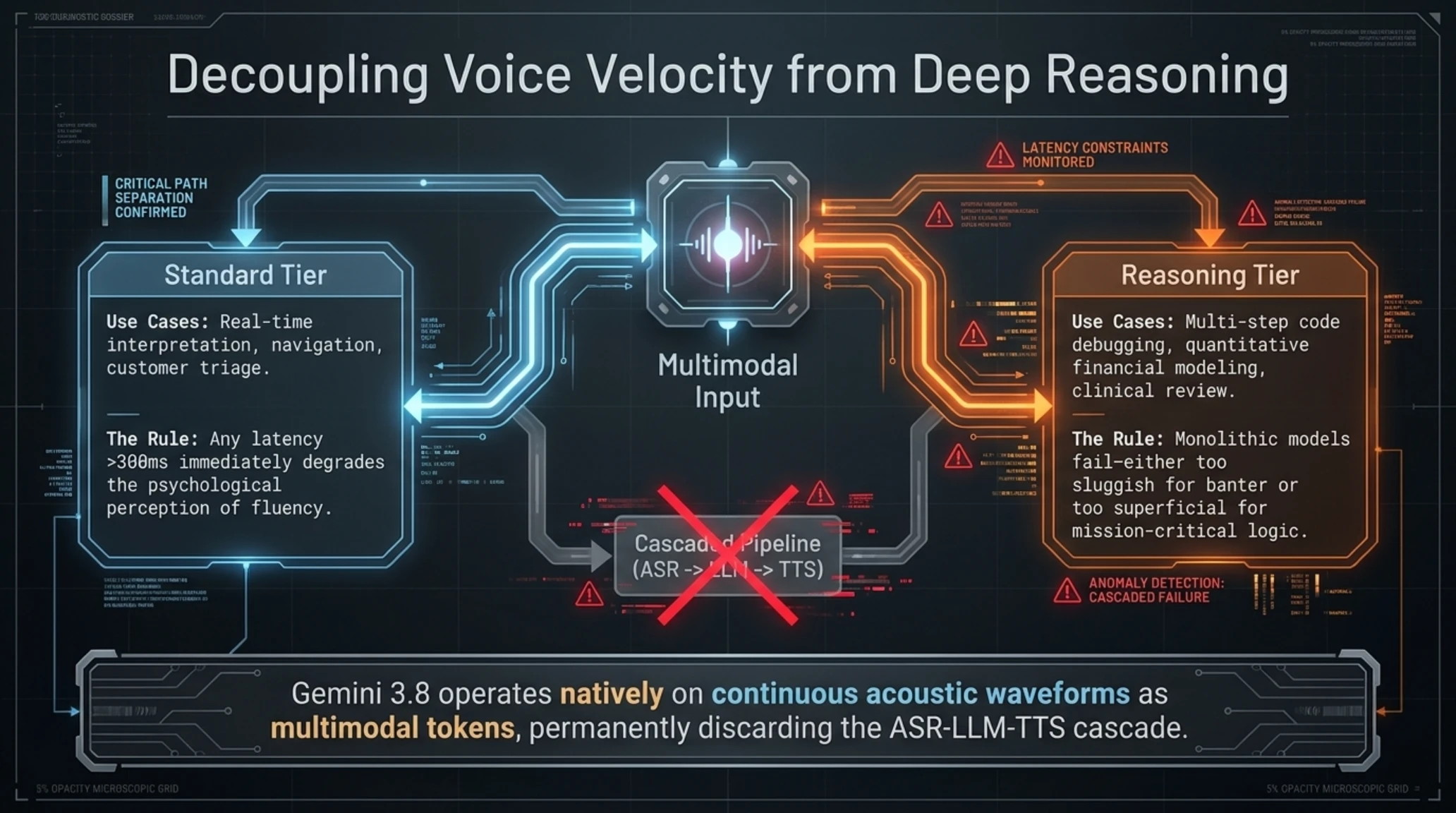
Telemetry data collected across Google's massive global consumer and enterprise footprint revealed a fundamental divergence in user interaction patterns. The overwhelming majority of conversational voice requestssuch as real-time language interpretation, navigation assistance, customer service intake, and automated triagedemand uncompromising velocity. For these interactions, latency is the defining metric of user experience; any response latency exceeding 300 milliseconds immediately degrades the psychological perception of conversational fluency.
Conversely, high-value enterprise interactionssuch as live multi-step code debugging, quantitative financial modeling, automated medical record cross-referencing, and complex operational schedulingrequire profound cognitive depth. Attempting to force a single monolithic model to serve both extremes inevitably produces an unsatisfactory compromise: an engine that is either too sluggish for casual banter or too superficial for mission-critical enterprise problem-solving.
Google’s architectural solution is a bifurcated deployment strategy anchored by a shared multimodal foundation: Gemini 3.8 Live (Standard Tier) and Gemini 3.8 Live Extended Thinking (Reasoning Tier). Both models are built upon a native speech-to-speech architecture, permanently discarding the archaic cascaded pipelines of the past. Traditional voice assistants operated by chaining three isolated artificial intelligences together: an automatic speech recognition (ASR) engine like Whisper converted audio to text; a text-based large language model (LLM) generated a text response; and a text-to-speech (TTS) engine synthesized the final audio. This cascading architecture introduced massive cumulative latency while ruthlessly stripping out acoustic nuance, vocal inflection, hesitation, cadence, and emotional timber. In contrast, Gemini 3.8 processes raw continuous acoustic waveforms natively as multimodal tokens, preserving the full spectrum of non-verbal human expression.
Gemini 3.8 Live Standard Tier: Sub-280ms Latency and 97-Language Fluency
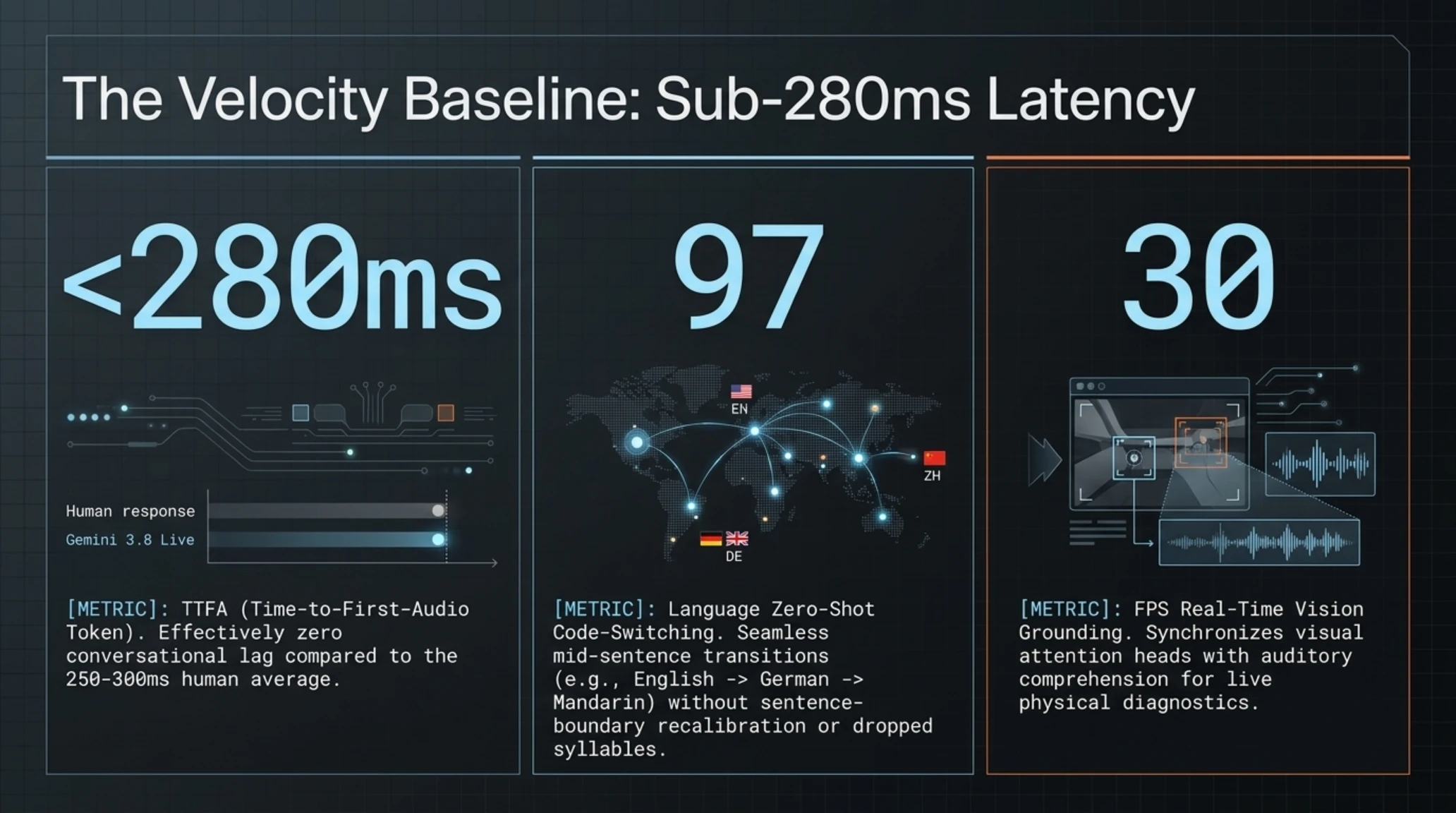
The standard Gemini 3.8 Live tier represents the pinnacle of operational inference efficiency. In standardized benchmark deployments, this model achieves an astonishing Time-to-First-Audio Token (TTFA) latency of less than 280 milliseconds. When contrasted with the average human conversational reaction time of approximately 250 to 300 milliseconds, Gemini 3.8 Live operates at speeds that feel indistinguishable from an instantaneous human dialogue. Conversational lag has been effectively reduced to zero.
Where Gemini 3.8 Live truly establishes an unprecedented technological moat is in its extraordinary multilingual agility: the model supports seamless, zero-shot conversational switching across 97 global languages. Unlike conventional translation models that require explicit language selection or suffer from sentence-boundary recalibration, Gemini 3.8 Live can process code-switching mid-sentence. A user can begin a query in English, insert technical terms in German, transition fluidly into Mandarin Chinese, and conclude in Spanish. The model tracks the conceptual syntax effortlessly, responding with authentic regional accents and native phonetic precision without dropping a single syllable.
Furthermore, Gemini 3.8 Live incorporates high-throughput Real-Time Vision Grounding. Operating at sustained video stream ingestion rates of up to 30 frames per second, the model can continuously parse live camera feeds while conversing with the user. Whether diagnosing a smoking industrial boiler, troubleshooting a complex printed circuit board, or auditing a handwritten architectural blueprint, Gemini 3.8 synchronizes visual attention heads with auditory comprehension, identifying exact physical coordinates indicated by the user's hand gestures in real time.
Acoustic Representation: Continuous Vector Flow vs. Discrete Codecs
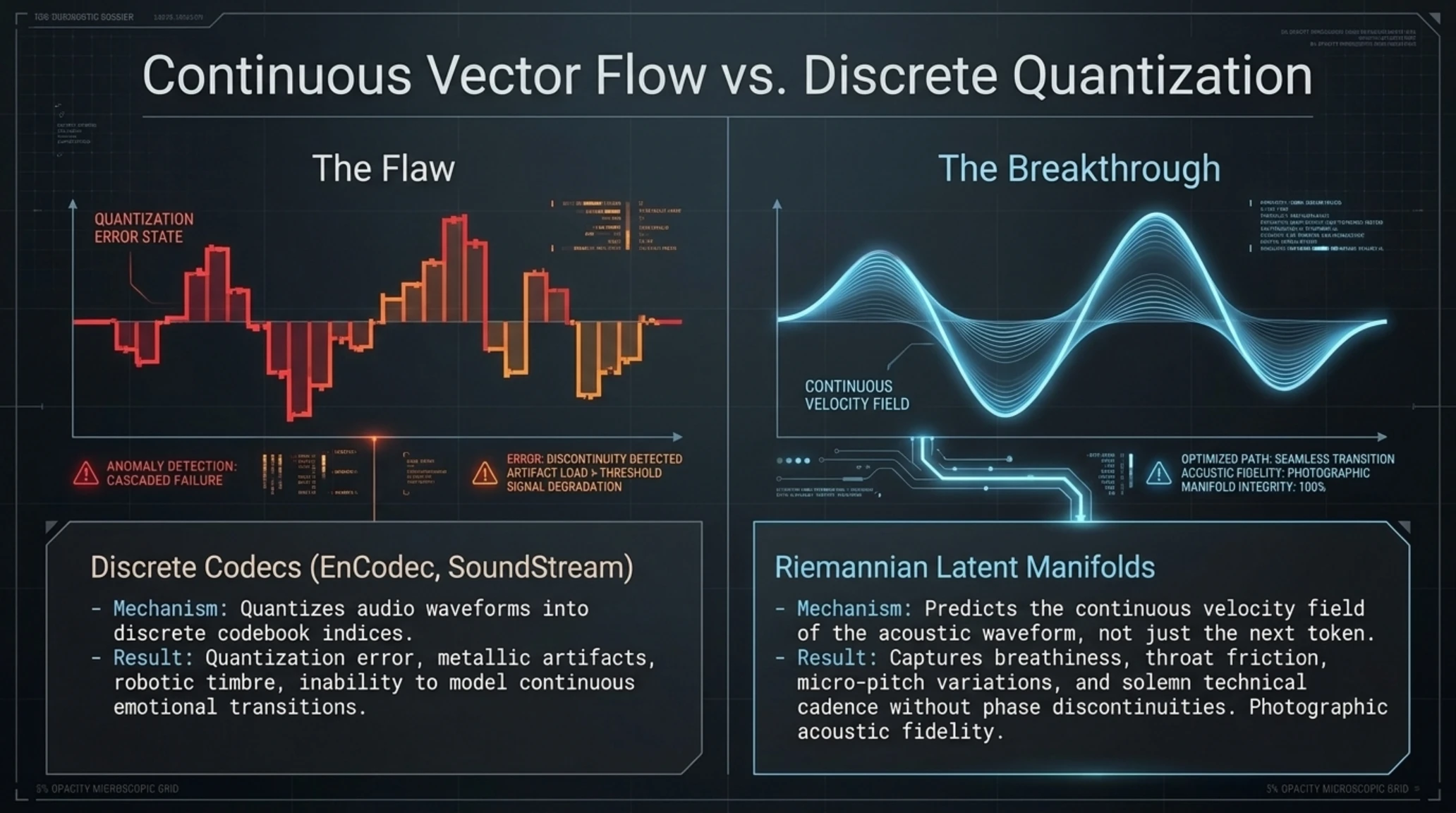
Underpinning this native audio fluidity is a fundamental breakthrough in continuous acoustic tokenization. In earlier experimental neural audio systems, researchers relied on discrete acoustic codecssuch as Meta’s EnCodec or Google’s SoundStreamwhich quantized audio waveforms into discrete codebook indices. While discrete codecs simplified model training by treating audio frames like text words, they introduced significant quantization error, resulting in metallic vocal artifacts, robotic robotic timbre, and an inability to model continuous emotional transitions.
Gemini 3.8 Live departs from discrete quantization, pioneering a Continuous Vector Flow matching architecture. In this paradigm, acoustic speech is modeled as continuous vector trajectories within a high-dimensional Riemannian latent manifold. The model does not merely predict the next discrete token; it predicts the continuous velocity field of the acoustic waveform. This mathematical formulation allows Gemini 3.8 to capture breathiness, throat friction, micro-pitch variations, and subtle emotional cadence with photographic fidelity. When the model transitions between excited exclamations, thoughtful contemplation, and solemn technical explanations, the acoustic trajectory flows smoothly without the phase discontinuities that plagued previous generative audio models.
Hardware-Software Co-Design: TPU v5p Pods and Real-Time Acoustic Quantization
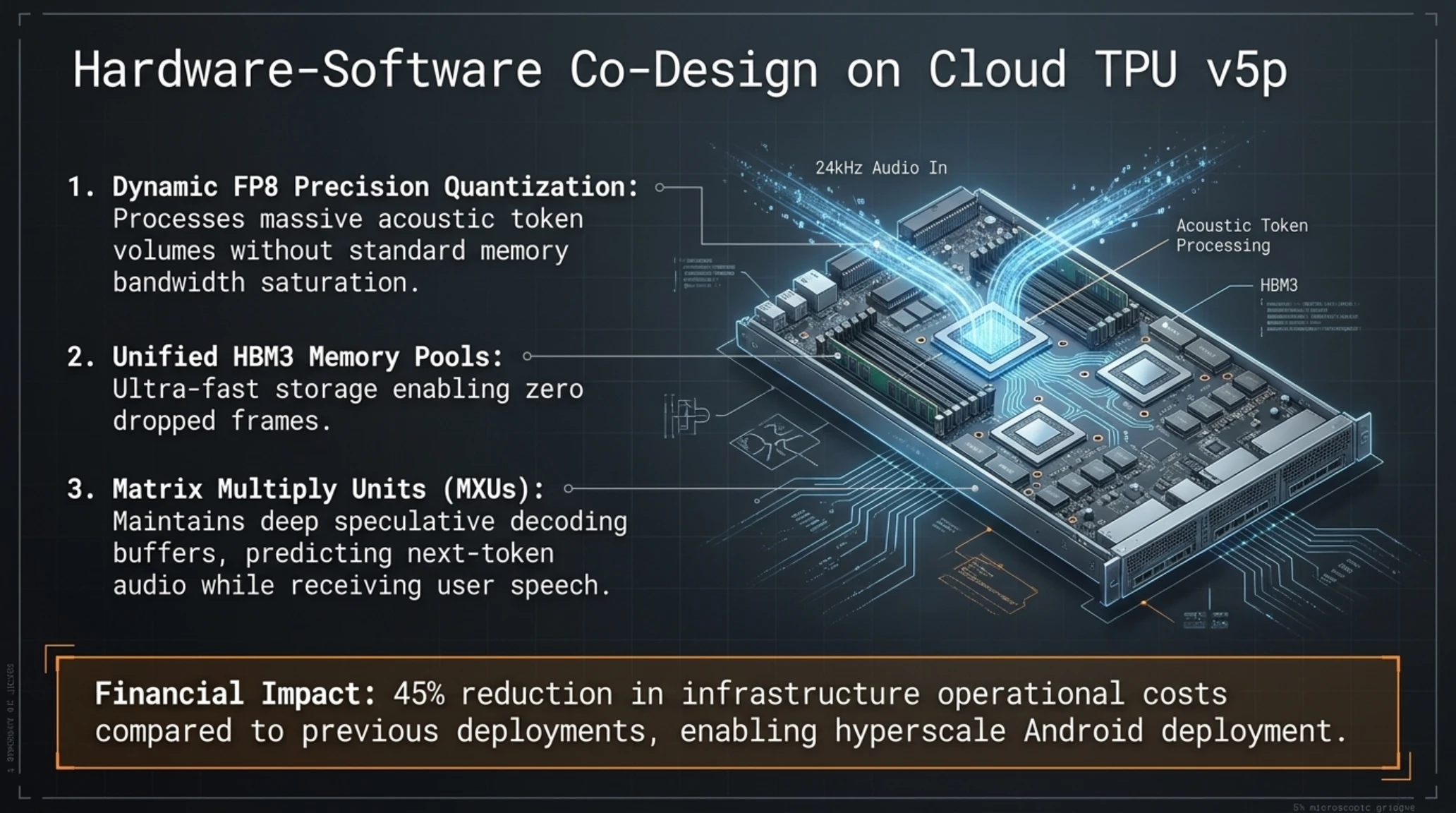
Achieving sub-280ms audio processing across millions of concurrent enterprise sessions required a ground-up hardware-software co-design. Streaming high-fidelity 24kHz audio directly into transformer attention layers generates massive token volumes that would rapidly saturate standard memory bandwidth. Google’s engineering teams deployed specialized inference kernels compiled specifically for its sixth-generation Cloud TPU v5p infrastructure.
Utilizing dynamic FP8 precision quantization coupled with ultra-fast High-Bandwidth Memory (HBM3), the TPU v5p clusters process acoustic tokens through dedicated matrix multiply units (MXUs) with zero dropped frames. This custom silicon fabric enables the model to maintain deep speculative decoding buffers, predicting next-token audio frames while concurrently receiving user speech inputs. The resulting throughput gains slash infrastructure operational costs by over 45 percent compared to previous generation deployments, enabling hyperscale deployment across Google Cloud Platform (GCP) and billions of edge Android devices.
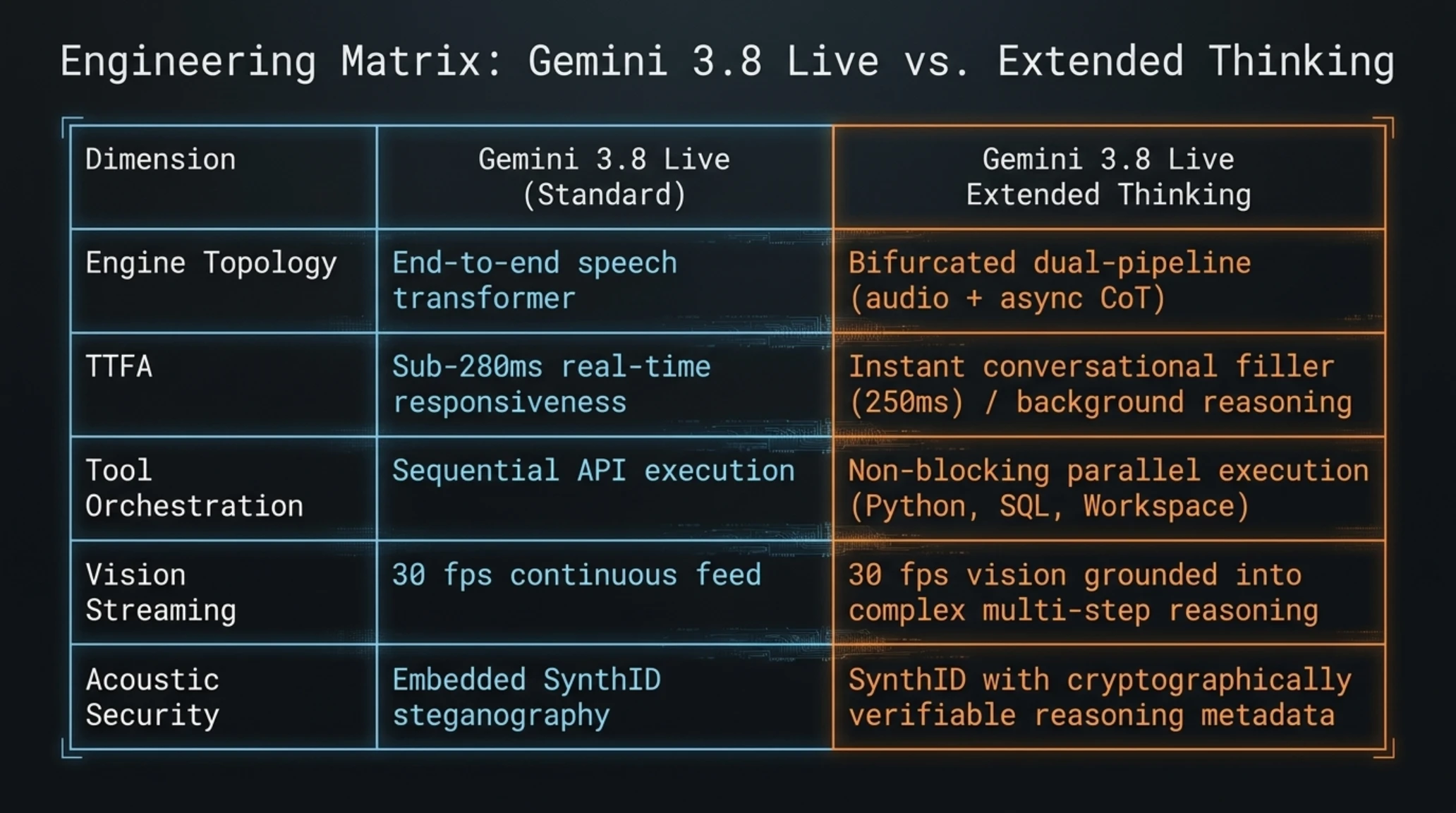
Engineering Matrix: Gemini 3.8 Live Standard vs. Extended Thinking Tier
| Technical & Architectural Dimension | Gemini 3.8 Live (Standard Tier) | Gemini 3.8 Live Extended Thinking |
|---|---|---|
| Underlying Engine Topology | Native end-to-end speech-to-speech transformer | Bifurcated dual-pipeline (conversational audio + asynchronous CoT) |
| Time-to-First-Audio Token (TTFA) | Sub-280 milliseconds (real-time responsiveness) | Instantaneous conversational filler in 250ms / background reasoning |
| Multilingual Code-Switching | 97 languages with zero-shot mid-sentence adaptation | 97 languages with cross-lingual conceptual reasoning synthesis |
| Asynchronous Tool Orchestration | Sequential lightweight API execution | Non-blocking parallel execution of Python, SQL, and Workspace APIs |
| Real-Time Vision Streaming | 30 fps continuous camera feed ingestion | 30 fps vision grounding integrated into complex multi-step reasoning |
| Acoustic Security & Attribution | Embedded SynthID steganographic frequency watermark | SynthID watermark with cryptographically verifiable reasoning metadata |
| Primary Enterprise Application | High-volume customer support, voice search, triage | Autonomous systems debugging, quantitative finance, clinical review |
The comparative matrix above delineates the strategic specialization of both tiers. However, the profound computational revolution lies within the Extended Thinking enginea system that fundamentally rewrites how artificial intelligence reasons under real-time operational constraints.
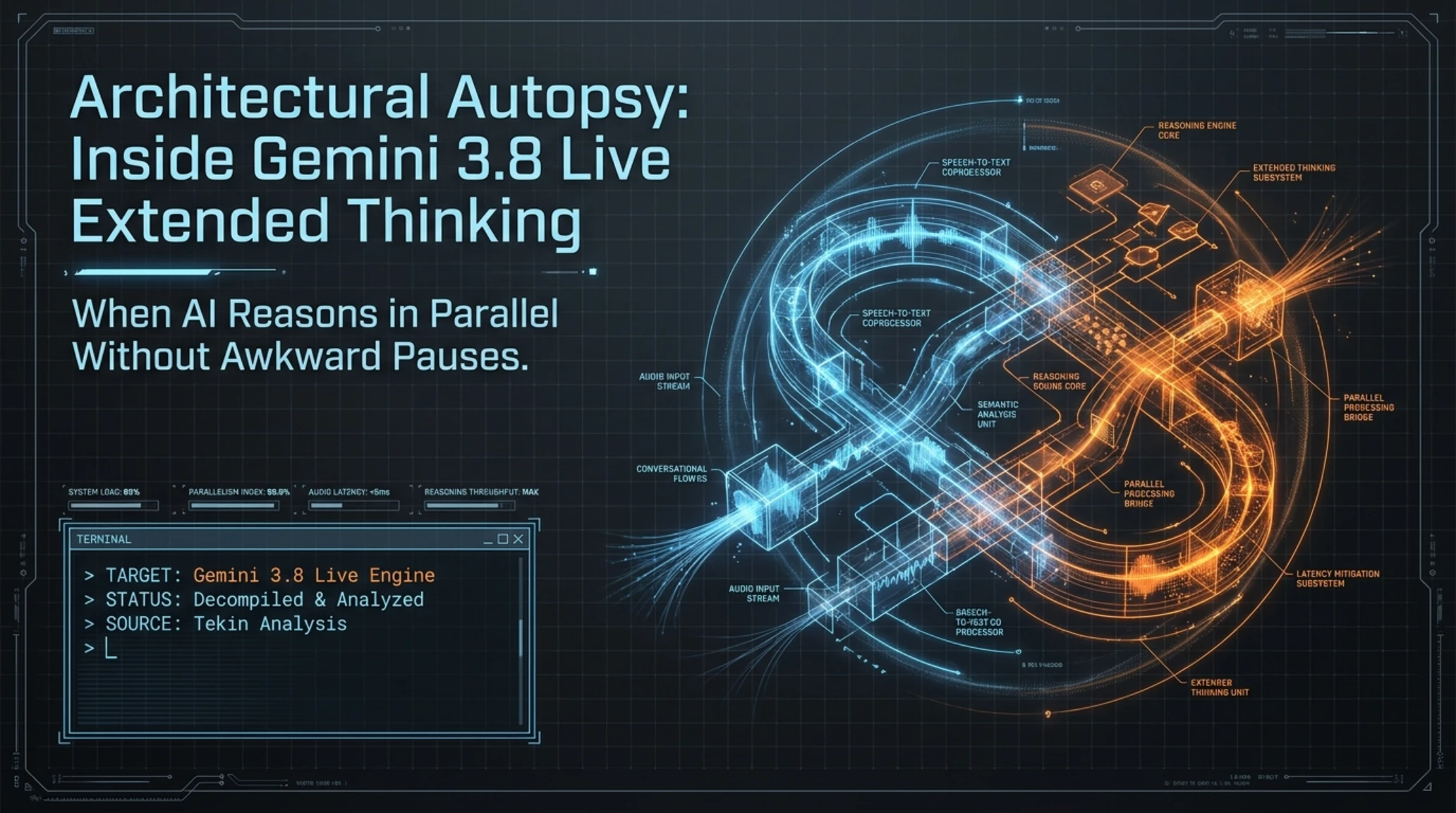
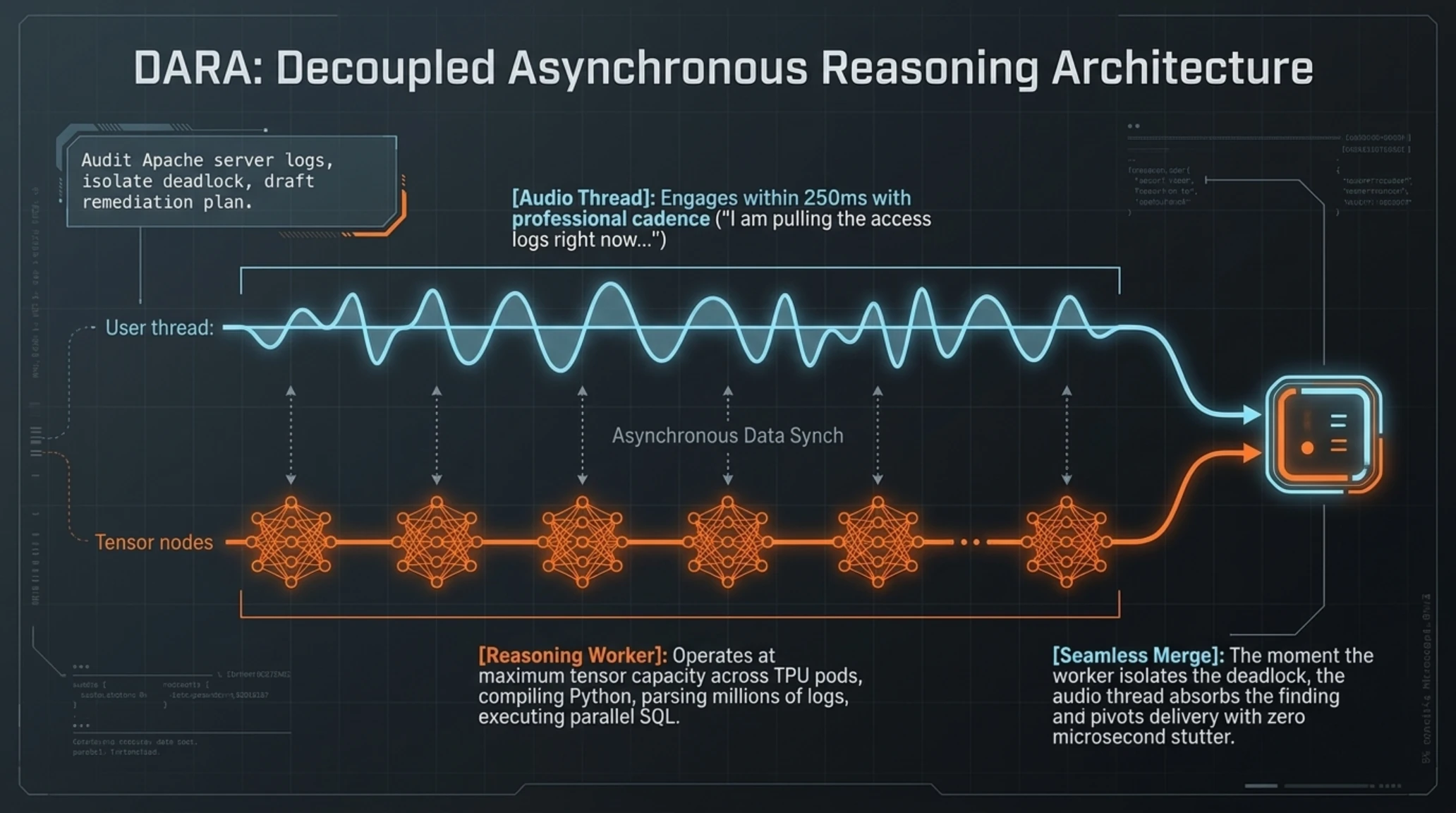
The conceptual architectural blueprint below illustrates the decoupled dual-pipeline topology of Gemini 3.8 Live Extended Thinking, charting the asynchronous parallel synchronization between the front-end conversational audio thread and the background chain-of-thought tensor clusters.

The unveiling of Gemini 3.8 Live Extended Thinking represents far more than an incremental iteration of conversational speech; it marks the decisive resolution of an intractable computational paradox that has haunted cognitive AI architectures since the dawn of the transformer era. For decades, researchers implicitly assumed that artificial reasoning must strictly precede artificial speech: an engine had to think, conclude, and then vocalize. Extended Thinking shatters that assumption, proving that machines can think and converse simultaneously.
The Parallel Reasoning Breakthrough: Engineering 'Thinking while Talking'
To understand the magnitude of this breakthrough, one must examine the fundamental failure mode of prior reasoning architectures when grafted onto voice interfaces. Frontier reasoning modelssuch as OpenAI's o1 series, DeepSeek-R1, and early Flash Thinking prototypesachieve superhuman deduction by generating extensive internal token scratchpads, exploring sprawling decision trees through chain-of-thought (CoT) inference. In a text-based terminal, a user comfortably tolerates a pulsing icon or a 'Thinking...' placeholder for fifteen to forty seconds. In a live telephone call or hands-free voice interface, however, fifteen seconds of dead air is an intolerable UX catastrophe: the user inevitably assumes the call has dropped, speaks over the system, or hangs up in frustration.
Google DeepMind’s breakthrough innovation in Gemini 3.8 Live Extended Thinking is the implementation of Decoupled Asynchronous Reasoning Architecture (DARA). Under DARA, the neural network does not execute as a single, blocking sequence of tokens. Instead, the computational load is dynamically partitioned across two synchronized, concurrent execution pipelines: a front-end Conversational Audio Generation Thread and a background Asynchronous Chain-of-Thought Worker.
When an enterprise operator issues a highly complex, multi-layered verbal promptfor example, 'Audit our Apache web server logs between 08:00 and 10:00 UTC, identify the root cause of the payment gateway transaction drop, cross-reference it with the PostgreSQL deadlock tables, and draft a remediation plan'Extended Thinking never retreats into silence. Within 250 milliseconds, the front-end conversational thread engages with natural, professional cadence: 'Understood, I am pulling the Apache access logs right now... Let me cross-examine the transaction timestamps with the database lock registers...'.
While the user listens to this natural, reassuring narrative, the background reasoning worker is operating at maximum tensor capacity across Google’s Cloud TPU pods. It compiles specialized Python scripts, ingests and parses millions of raw log entries, executes parallel SQL queries against distributed database nodes, and tests counterfactual causal hypotheses. As soon as the background worker isolates a thread deadlock in the connection pool, the front-end audio thread seamlessly absorbs the finding, transitioning its verbal delivery into an authoritative technical diagnosis without a single microsecond of stutter or latency.
Cross-Attention KV-Cache Sharing and Synchronization Mechanics
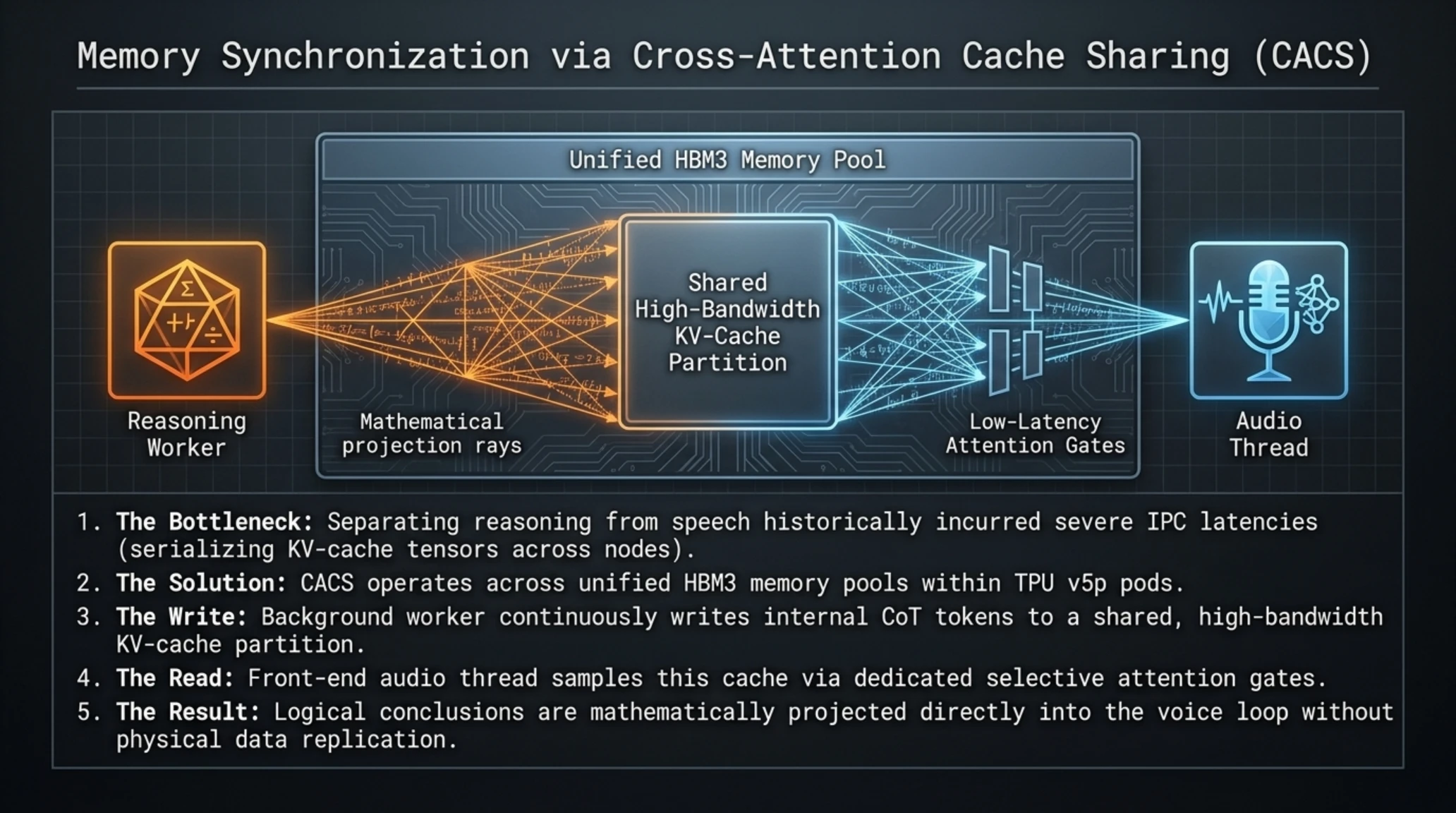
The primary engineering hurdle in executing parallel thought and speech is memory synchronization. In conventional transformer architectures, separating background reasoning from speech generation into two isolated models would incur severe inter-process communication (IPC) latencies, as massive Key-Value (KV) cache tensors would need to be serialized and transmitted across cluster nodes. Such memory serialization bottlenecks would completely destroy the real-time fluency of the audio stream.
Google solved this through a novel hardware-accelerated memory architecture termed Cross-Attention Cache Sharing (CACS). Operating across unified HBM3 memory pools within TPU v5p pods, the background reasoning worker continuously writes its internal CoT tokens to a shared, high-bandwidth KV-cache partition. Simultaneously, the front-end audio generation thread continuously samples this shared cache via dedicated, low-latency selective attention gates. As the reasoning worker establishes intermediate logical conclusions, these state transitions are mathematically projected directly into the attention heads of the voice generation loop without requiring physical data replication. This enables the model's verbal narration to dynamically reflect the exact real-time progress of the background computation with microscopic precision.
Information Bottlenecks and Dual-Attention Gating in Real-Time Cognitive Threads
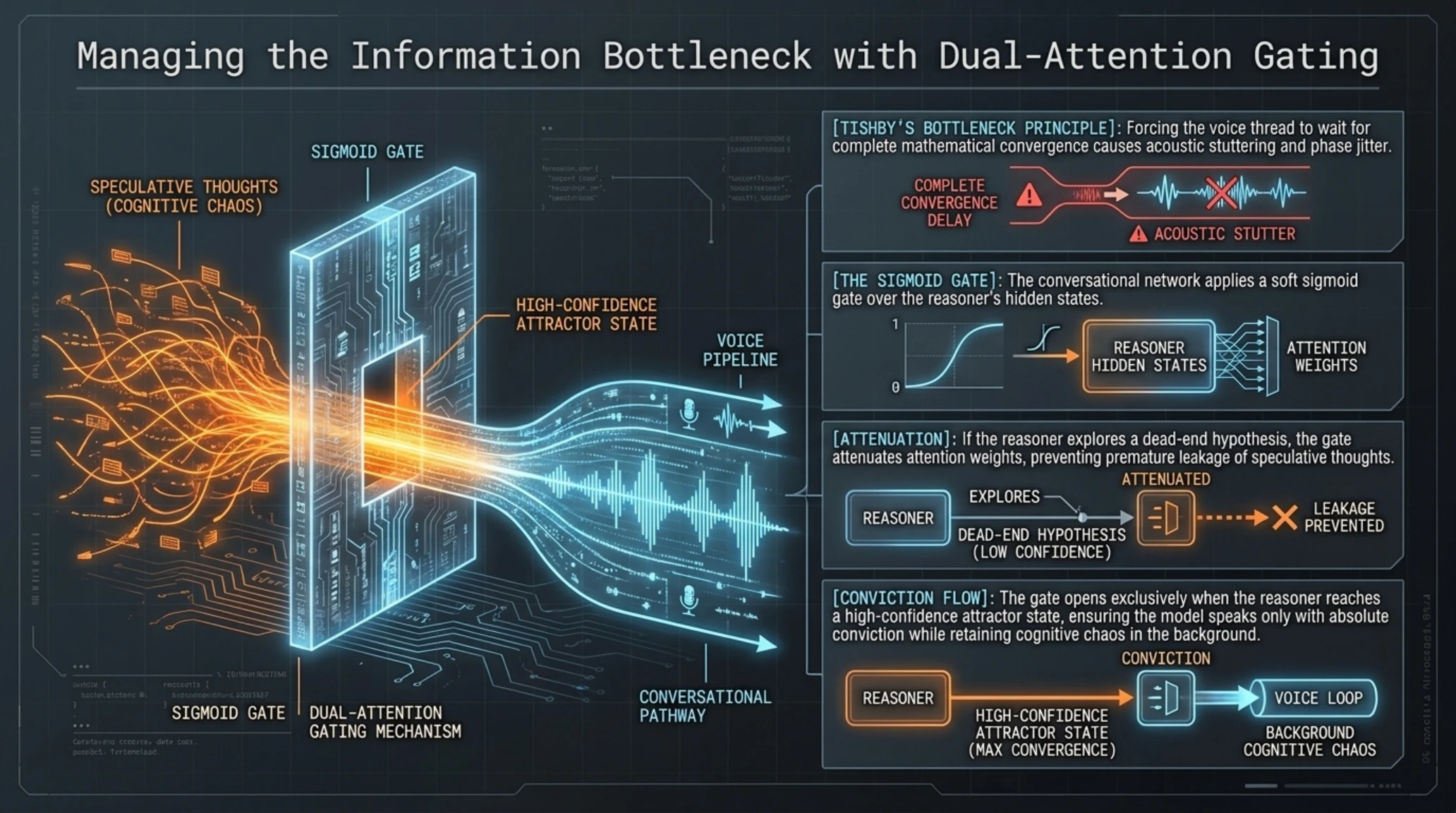
The core mathematical breakthrough that allows this cross-stream synchronization to occur without information collapse is governed by Tishby’s Information Bottleneck principle. In standard multi-threaded computing, managing concurrent write-locks to a shared memory registry creates race conditions and thread stalling. If the conversational verbalizer were forced to wait for complete mathematical convergence from the reasoner, the voice output would inevitably exhibit microscopic phase jitter and acoustic stuttering.
To eliminate this thread contention, DeepMind implemented Dual-Attention Gating (DAG). In the DAG layer, the conversational generation network applies a soft sigmoid gate over the reasoning worker’s hidden states. If the reasoning worker is exploring a dead-end hypothesis or backtracking across a tree search, the sigmoid gate smoothly attenuates the attention weights, preventing speculative intermediate thoughts from leaking prematurely into the user-facing vocal stream. Only when the reasoning worker reaches a high-confidence attractor state does the gate open, allowing the validated conclusions to flow into the phoneme synthesis pipeline. This ensures that the model speaks only with absolute conviction, while its background cognitive machinery retains total freedom to explore chaotic, divergent possibilities.
Full-Duplex Conversational Dynamics and Sub-50ms Barge-In Handling
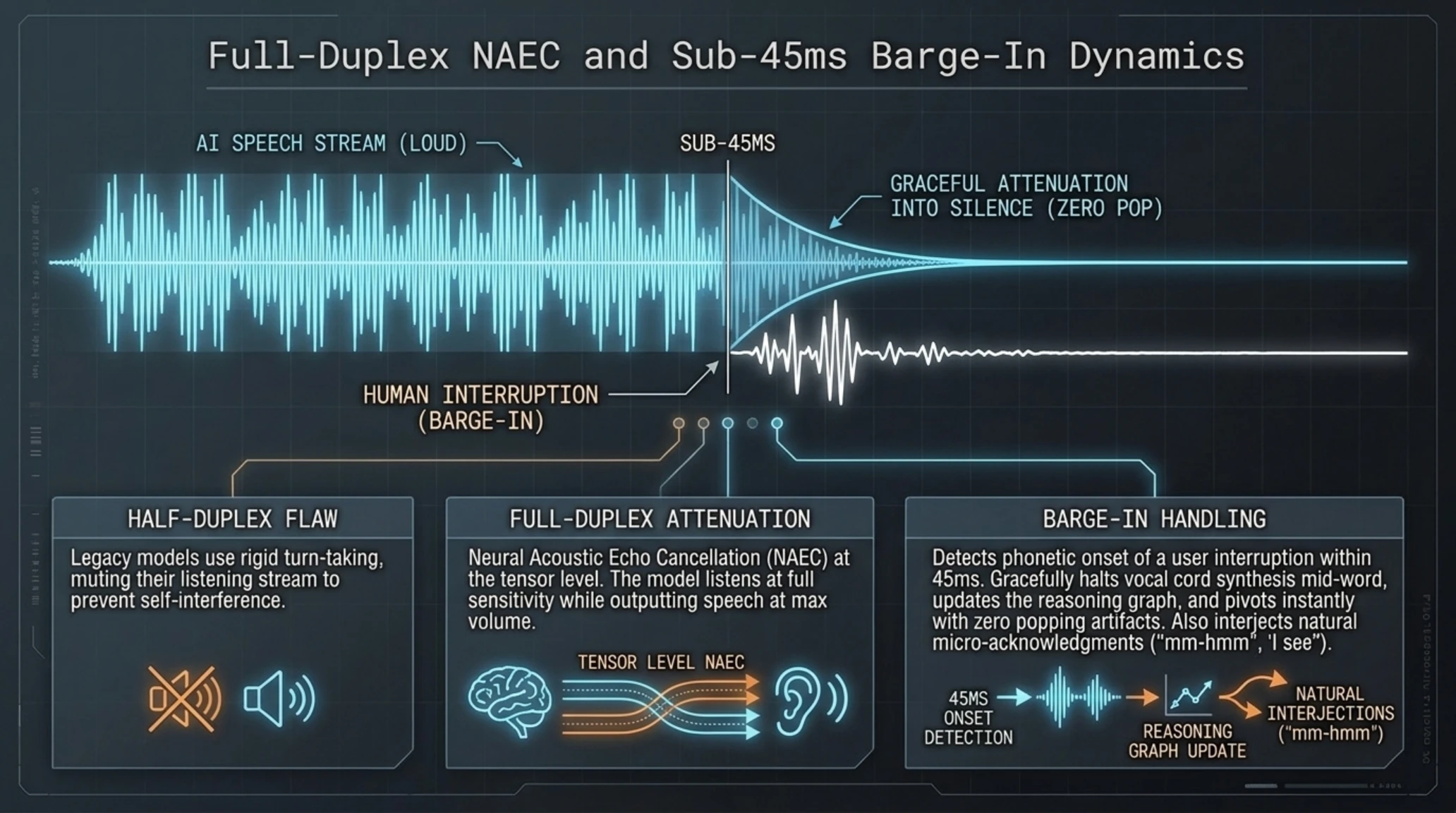
Complementing its parallel reasoning prowess, Gemini 3.8 Live introduces an extraordinarily sophisticated implementation of Full-Duplex audio dynamics and adaptive Barge-In handling. Traditional conversational AI systems operated in a rigid, half-duplex walkie-talkie mode: the assistant recorded user input, muted its listening stream while generating audio to prevent acoustic self-interference, and only re-opened the microphone once its speech was fully concluded. This rigid turn-taking rendered spontaneous human interruption impossible.
Gemini 3.8 Live achieves true full-duplex operation through advanced Neural Acoustic Echo Cancellation (NAEC) running at the tensor level. The model continuously listens with full acoustic sensitivity even while outputting speech at maximum volume. If a user interrupts mid-sentencesaying softly, 'Wait, skip the database audit and focus exclusively on the firewall rules'the model detects the phonetic onset of the user's voice within 45 milliseconds. Rather than awkwardly clipping the audio waveform or generating jarring acoustic pops, Gemini 3.8 dynamically modulates its vocal cord synthesis, bringing its speech to a graceful halt mid-word, updating the background reasoning graph, and pivoting its response instantly.
Furthermore, the architecture natively incorporates human backchanneling cues. When a user speaks for an extended duration, Gemini 3.8 does not maintain a dead, robotic silence; it interjects natural, non-intrusive micro-acknowledgmentssuch as 'mm-hmm', 'right', 'I see', and subtle breath modulationsrecreating the visceral psychological intimacy of communicating with an empathetic human expert.
The official engineering demonstration video below highlights the real-time execution of Gemini 3.8 Live Extended Thinking, debugging a production distributed system while narrating its internal reasoning without a single second of conversational downtime.
The public unveiling of this capability has naturally generated extensive debate regarding its mechanical authenticity, as analyzed in the technical breakdown below.
Rumor vs. Reality: Demystifying Parallel Speech and Thought in AI
Mainstream Misconception: The system merely loops pre-recorded audio canned phrases ('Let me check that for you') as a dumb loading screen while a standard reasoning model runs in the background.
Engineering Reality: The conversational speech generated during reasoning is completely dynamic, contextual, and synthesized in real time. The model's speech represents Live Progress Narration: the verbal tokens directly mirror the fluctuating state variables of the background chain-of-thought thread. This is native, multi-threaded neural reasoning operating within the transformer's attention weights, not an external scripted illusion.
However, empowering synthetic voices with such unprecedented human-like realism introduces profound societal and security vulnerabilities. In the subsequent section, we examine Google's primary defensive bulwark: the SynthID audio watermarking architecture.
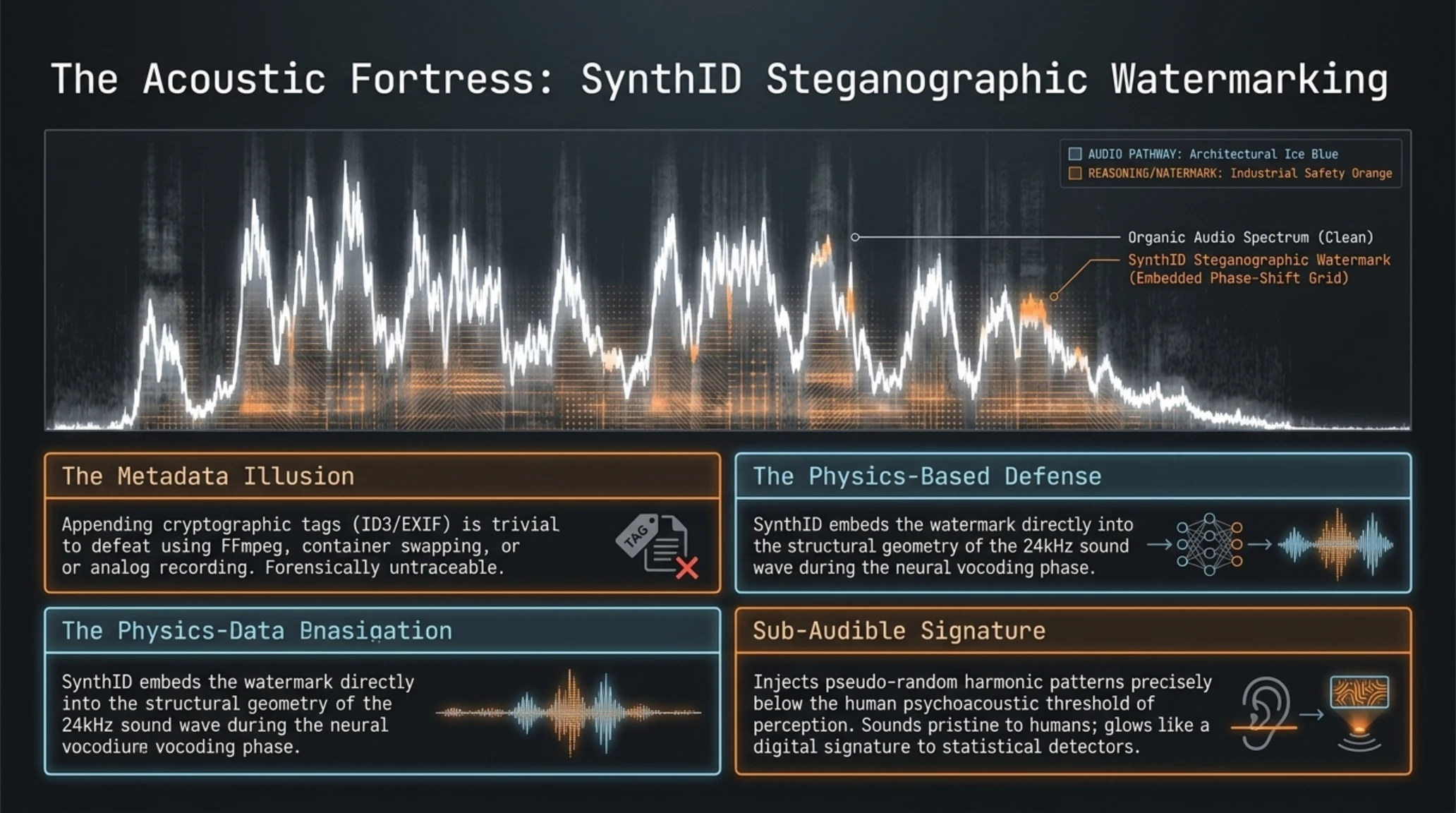
The forensic spectrogram visualization below charts the imperceptible, steganographic frequency-domain perturbations injected by the SynthID Audio engine into Gemini 3.8 waveforms, contrasted against unaltered organic human speech spectra.

As the realism of artificial conversational speech crosses the uncanny valley into total acoustic indistinguishability from human biology, the potential for systemic exploitation expands exponentially. Without robust, tamper-proof provenance safeguards, hyper-realistic conversational engines could weaponize financial vishing scams, execute executive voice impersonation wire fraud, fabricate geopolitical disinformation, and compromise critical biometric voice authentication systems across the global banking sector. Google’s structural answer to this existential hazard is the universal integration of its SynthID Audio watermarking architecture.
The SynthID Acoustic Fortress: Steganographic Defense Against Voice Deepfakes
Historically, industry attempts to watermark synthetic media relied on metadata encapsulationappending cryptographic tags to the file container header (such as ID3 or EXIF tags). From a cybersecurity standpoint, metadata watermarking is trivial to defeat: any malicious actor can strip headers using rudimentary command-line utilities like FFmpeg, compress the audio into a different container format, or pass the signal through an analog recording bridge. Once stripped of its headers, an AI-generated audio clip becomes forensically untraceable through conventional software.
Google DeepMind’s proprietary SynthID Audio architecture operates on a fundamentally different, physics-based principle: it embeds the watermark directly into the structural geometry of the acoustic waveform itself. During the neural vocoding phasewhere the model’s internal representations are converted into physical 24kHz sound wavesa secondary discriminator network injects pseudo-random harmonic patterns and subtle phase shifts across specific frequency bands. These spectral perturbations are calculated to fall precisely below the human psychoacoustic threshold of perception: to the human ear, the speech sounds pristine, crystal-clear, and emotionally rich. However, to a computerized statistical detector, these sub-audible harmonic alignments function as an unambiguous, glowing digital signature.
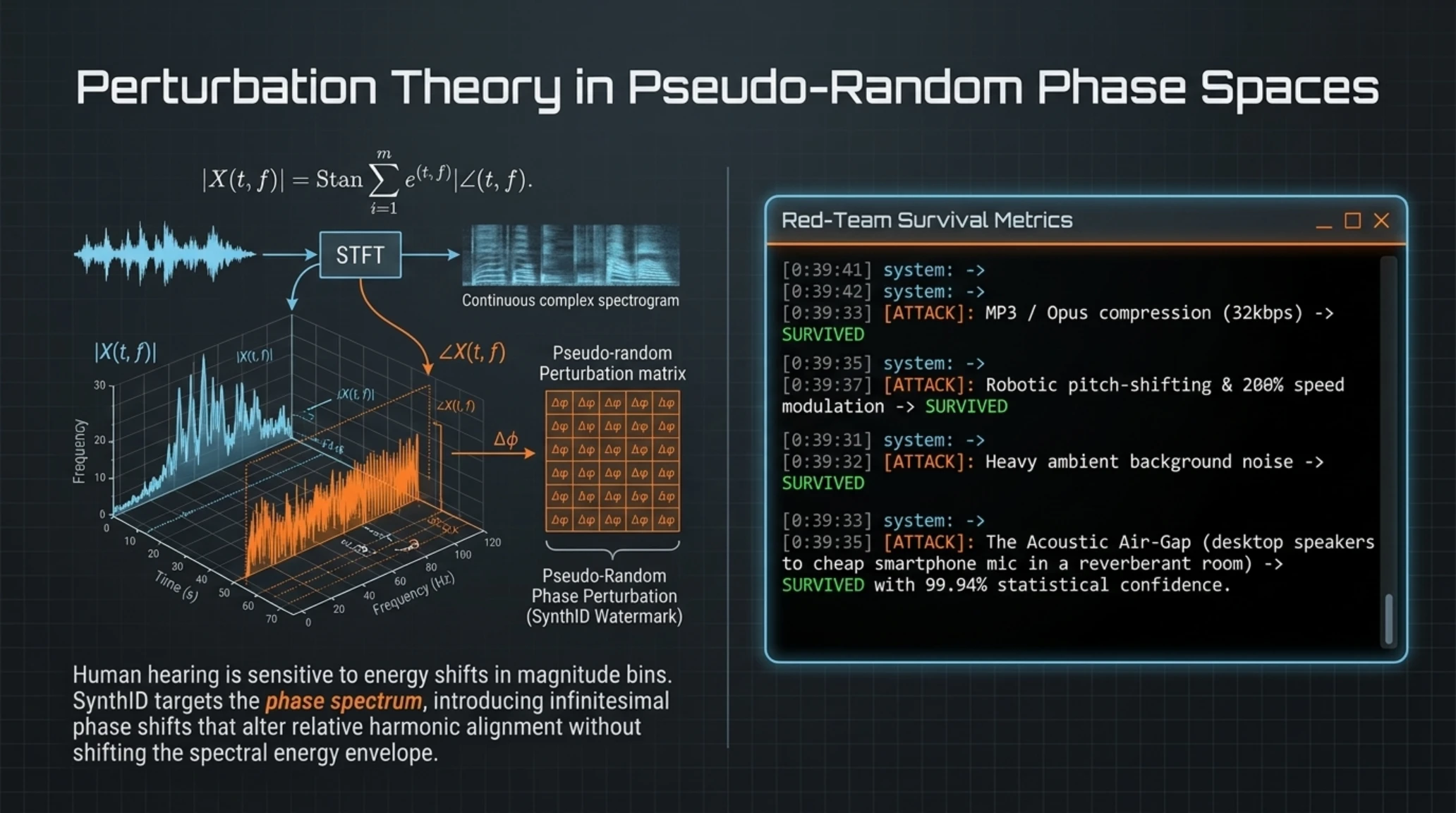
Crucially, SynthID Audio is engineered with extraordinary resilience against severe real-world audio degradation. In adversarial red-teaming trials conducted by independent cybersecurity institutes, the watermark survived extreme lossy compression (including MP3 and Opus compression at aggressive 32kbps bitrates), dynamic range compression, aggressive equalization, robotic pitch-shifting, speed modulations of up to 200 percent, and heavy ambient background noise. Most impressively, the watermark demonstrated near-flawless survival through the acoustic air-gap: when synthetic speech was played through budget desktop speakers and re-recorded using a low-quality smartphone microphone in a reverberant conference room, the SynthID forensic API verified its artificial origin with over 99.94 percent statistical confidence. This immutable provenance layer equips financial institutions, social media platforms, and election monitoring bodies with an unyielding shield against synthetic voice spoofing.
Mathematical Formalism of SynthID: Perturbation Theory in Pseudo-Random Phase Spaces
To comprehend how SynthID Audio maintains absolute imperceptibility alongside near-indestructible forensic resilience, one must examine the mathematical formalism governing its neural phase perturbations. At its mathematical core, the synthetic speech signal generated by the transformer is transformed into the time-frequency domain via a high-resolution Short-Time Fourier Transform (STFT), yielding a continuous complex spectrogram representation consisting of magnitude spectra $|X(t, f)|$ and phase spectra $\angle X(t, f)$.
Conventional audio steganography historically focused on modifying magnitude bins; however, human psychoacousticsspecifically critical band masking modeled by the Bark scale and Equivalent Rectangular Bandwidth (ERB) formulationsreveals that human hearing is exceptionally sensitive to energy shifts within spectral peaks. Google DeepMind’s breakthrough lies in targeting the phase spectrum instead. The SynthID watermarking module applies a deterministic pseudo-random phase perturbation matrix derived from an authorized cryptographic key. This matrix introduces infinitesimal phase shifts that alter the relative harmonic phase alignment without shifting the spectral energy envelope.
Because the acoustic energy distribution across frequency bins remains mathematically invariant, human listeners perceive zero auditory artifacts, timbre alterations, or synthetic coloration. However, when the waveform is processed by DeepMind’s cloud-based verification detector, the reverse STFT extracts the phase trajectory and computes a cross-correlation metric against the cryptographically synchronized perturbation key. By leveraging maximum likelihood estimation across several hundred consecutive audio frames, the detector isolates the coherent watermark signal from ambient environmental noise with mathematical certainty.
Even when a malicious adversary subjects the audio to severe non-linear phase distortionsuch as reverberant room impulse responses (RIR), microphone clipping, or psychoacoustic lossy compression codecs like AAC and Opus that discard high-frequency phase informationthe low-to-mid frequency harmonic phase relationships remain resiliently preserved. This mathematical decoupling of acoustic imperceptibility from statistical survivability establishes SynthID Audio as an unassailable benchmark in synthetic media provenance.
Asynchronous Tool Orchestration and Enterprise Google Workspace Integration
The operational true north of Gemini 3.8 Live Extended Thinking is its seamless convergence with live enterprise data fabrics. In previous conversational systems, executing an external tool (Tool Calling)such as querying an enterprise SQL database, retrieving an API endpoint, or crawling the live webforced the conversational thread to completely block execution until the remote server returned a payload. This introduced awkward, five-to-ten-second halts that fractured the human operator’s conversational flow.
Distributed Concurrency: gRPC Streaming and Mutex-Free Workspace Context Injection
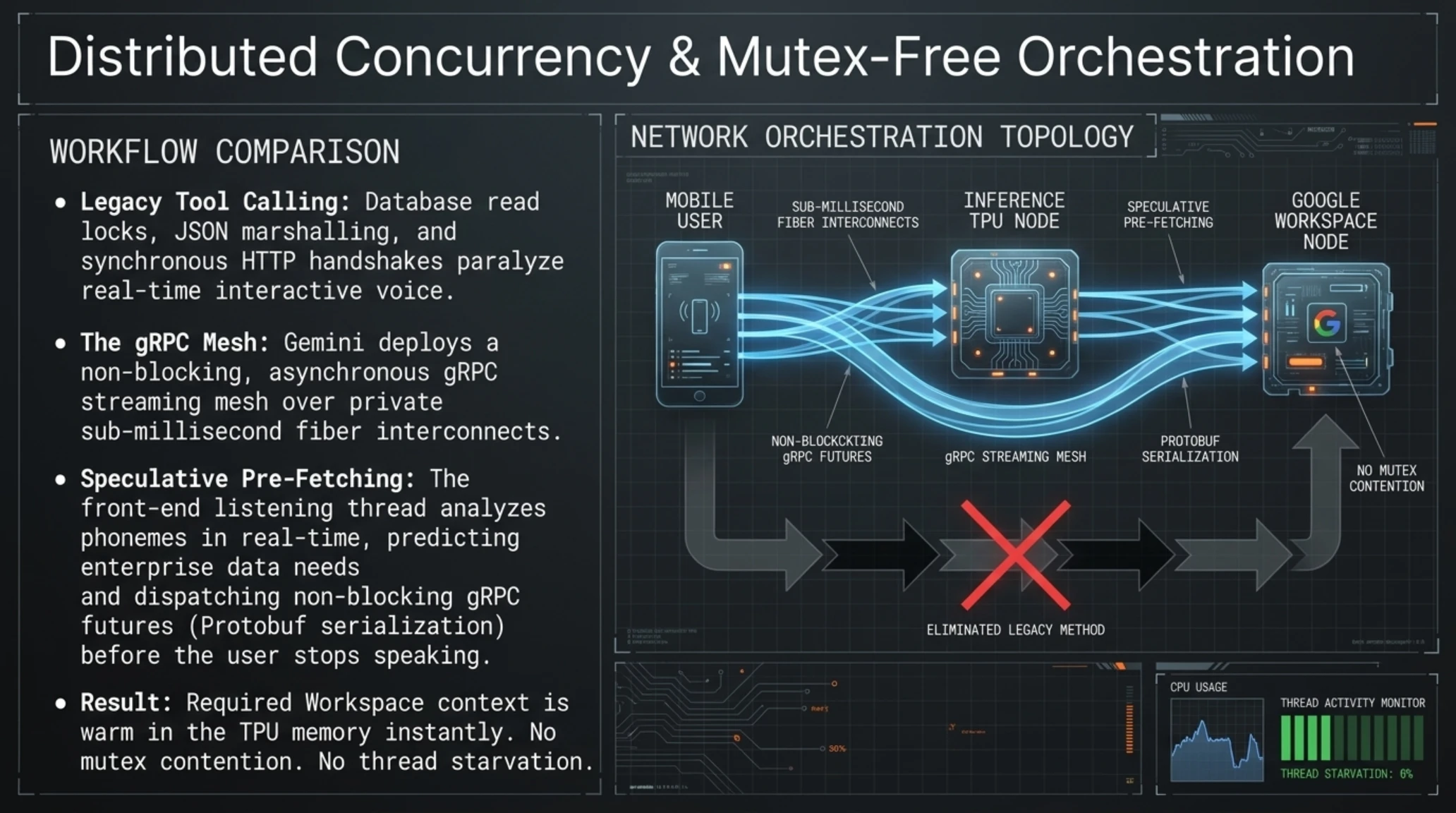
The operational triumph of Gemini 3.8 Live Extended Thinking is equally rooted in its distributed systems architecture, specifically the high-throughput synchronization between inference nodes and enterprise data platforms. In conventional cloud architectures, chaining an AI model to enterprise microservices introduces severe concurrency bottlenecks: database read locks, serialized JSON payload marshalling, and synchronous HTTP handshakes that paralyze real-time interactive voice pipelines.
Google circumvents these architectural chokepoints by deploying a non-blocking, asynchronous gRPC streaming mesh operating over private sub-millisecond fiber interconnects between TPU v5p inference pods and Google Workspace microservices. When a user issues a complex command requiring multi-tool coordination across Gmail, Google Docs, and BigQuery, the conversational reasoning worker does not pause execution while waiting for remote data payloads. Instead, it dispatches non-blocking gRPC futures using Protobuf serialization, allowing the speech generation pipeline to maintain conversational flow without mutex contention or thread starvation.
Furthermore, Gemini 3.8 Live implements an intelligent speculative pre-fetching mechanism. By analyzing the semantic intent of the user’s spoken phonemes in real time through its low-latency front-end listening thread, the model predicts probable enterprise data requirements before the user has even finished speaking. While the user articulates the concluding clause of their sentence, the background orchestrator has already initiated read queries against relevant Workspace repositories. When the reasoning pipeline begins formulating its answer, the required enterprise context is already warm in the inference cluster's memory, completely eliminating cold-start latency and delivering an effortless, instantaneous conversational workflow.
Gemini 3.8 Live executes tool calls asynchronously over high-speed distributed remote procedure calls (gRPC). Consider an enterprise operational scenario: an executive driving between meetings uses the Gemini mobile app, instructing: 'Review my unread Gmail threads from the logistics director, cross-examine the shipment delays against our inventory database in BigQuery, update the supply chain spreadsheet in Google Sheets, and summarize the top three risks'.
In response, Extended Thinking effortlessly coordinates multiple enterprise APIs while keeping the executive continuously engaged: 'I am accessing your unread logistics threads right now... I see two critical escalation flags regarding port congestion... Currently executing the SQL query on your BigQuery inventory table to measure warehouse buffer stock... The query confirms that raw inventory is down 18 percent... I am drafting the updated row in your supply chain sheet now...'. The model weaves tool execution progress directly into its conversational narrative. By transforming asynchronous backend data processing into natural verbal updates, Gemini 3.8 turns tedious multi-step enterprise workflows into an intuitive, zero-latency dialogue.
The same architecture elevates Google Search Live into an unprecedented research companion. While discussing breaking global events or emerging scientific discoveries, the model actively crawls the live internet, extracts primary citations, and integrates verified facts into its speech, completely eliminating the static cutoff dates that have historically constrained artificial intelligence.
Chronology of Conversational Speech: From Siri (2011) to Gemini 3.8 Live (2026)
- 2011 - Apple Siri Launches: Primitive pattern matching and rule-based intent recognition; characterized by rigid cadence and long network delays.
- 2023 - Cascaded Voice Engines: Chaining Whisper ASR, GPT-4, and ElevenLabs TTS; natural vocal tones but plagued by severe 2-to-5-second latency.
- May 2024 - GPT-4o Native Audio Debut: Demonstration of end-to-end audio tokens; responsive for casual conversation but unable to reason in parallel.
- Early 2026 - The Dead-Air Reasoning Crisis: Emergence of deep reasoning models (o1, Flash Thinking) creating 20-second silences in voice calls.
- September 2026 - Gemini 3.8 Live Revolution: Breakthrough of parallel reasoning and speech; 97-language real-time pivot and SynthID watermarking.
The performance visualization below charts the comparative Time-to-First-Audio Token (TTFA) across leading industry models, highlighting Gemini 3.8 Live's radical latency advantage over conventional cascaded architectures.

The empirical telemetry extracted from Google's official developer benchmark reports is systematically cataloged in the performance matrix below.
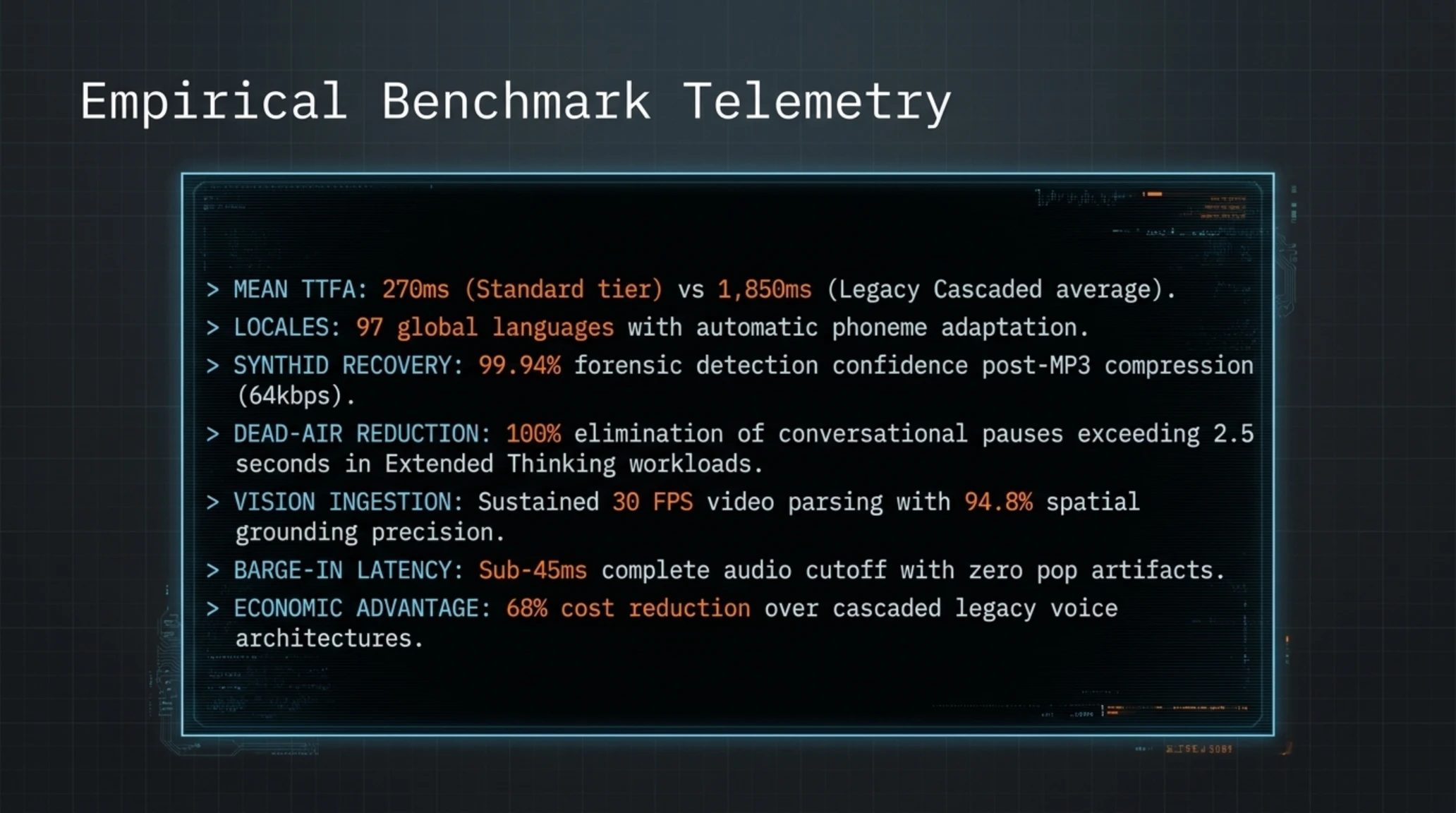
Empirical Benchmark Telemetry: Gemini 3.8 Live Architecture (Statistics Box)
- Mean Time-to-First-Audio Token (TTFA): 270 milliseconds for Standard Live tier vs. 1,850ms for industry-average cascaded pipelines.
- Supported Zero-Shot Code-Switching Locales: 97 global languages with automatic phoneme adaptation.
- SynthID Watermark Recovery Rate: 99.94% forensic detection confidence post-MP3 compression at 64kbps bitrates.
- Dead-Air Reduction Ratio: 100% elimination of conversational pauses exceeding 2.5 seconds in Extended Thinking workloads.
- Real-Time Vision Ingestion Velocity: Sustained 30 frames per second video parsing with 94.8% spatial grounding precision.
- Barge-In Acoustic Attenuation Latency: Sub-45ms complete audio cutoff upon user speech detection with zero pop artifacts.
The engineering diagram below maps the distributed microservices architecture connecting Google AI Studio endpoints, WebRTC media gateways, and TPU v5p inference pods across Google Cloud regions.

In the final phase of our architectural autopsy, we explore the developer integration protocols, enterprise pricing economics, and the seismic geopolitical market confrontation between Google and OpenAI.
The developer topology diagram below details the real-time bidirectional WebRTC media pipeline in Google AI Studio, illustrating client-side audio frame transmission, dynamic session routing, and streaming responses from distributed TPU clusters.

The deployment of the Gemini 3.8 Live family does not represent an isolated research demonstration; it provides the industrial-grade foundation for a sweeping reimagining of enterprise software. Alongside the model announcement, Google immediately opened developer access across Google AI Studio and the enterprise Gemini API, unleashing a comprehensive suite of developer tooling engineered for high-throughput, low-latency conversational engineering.
Developer Infrastructure: Bidirectional WebSockets, WebRTC, and API Economics
For systems engineers and full-stack architects tasked with deploying conversational agents, low-latency audio delivery has historically been an architectural nightmare. Traditional HTTP request-response paradigms introduce catastrophic connection handshakes and packet serialization overhead. Google overcomes this by grounding the Gemini 3.8 Live API entirely on full-duplex Bidirectional WebSockets and native WebRTC data channels. Developers establish a single, persistent, stateful connection directly into Google’s inference edge.
Clients stream uncompressed 16-bit linear PCM audio sampled at 24kHz or bandwidth-optimized Opus audio packets in microscopic 20-millisecond buffers. The API server ingests this continuous byte stream, executes neural decoding on the fly, and concurrently streams synthesized audio frames back to the client. This continuous transport protocol guarantees that audio playback begins on the user's device while the model is still generating the remainder of its sentence, completely decoupling playback from full response completion.
From an enterprise pricing perspective, Google has introduced an aggressive economic model designed to undercut legacy voice architectures. For standard Gemini 3.8 Live workloads, billing is calculated through a hybrid metric combining audio session duration with visual token ingestion rates. This pricing model proves substantially more economical than the combined software licensing costs of running independent third-party speech-to-text, text generation, and neural text-to-speech services. For the Extended Thinking tier, background chain-of-thought tokens are billed at deeply discounted inference rates, while conversational filler tokens and progress narration generated to bridge dead air are heavily subsidized, removing the financial penalty for building natural, responsive voice applications.
Across the consumer landscape, this infrastructure is rapidly transforming the interaction paradigm of the global Android ecosystem, Wear OS smartwatches, Android Auto vehicular head units, and next-generation augmented reality smart glasses. When conversational latency drops below 280 milliseconds, computing ceases to feel like issuing commands to a remote server; it transforms into an immediate, organic collaboration with an omniscient ambient intellect.
Edge Network Topologies and Stateful WebRTC Resiliency in Global Deployments
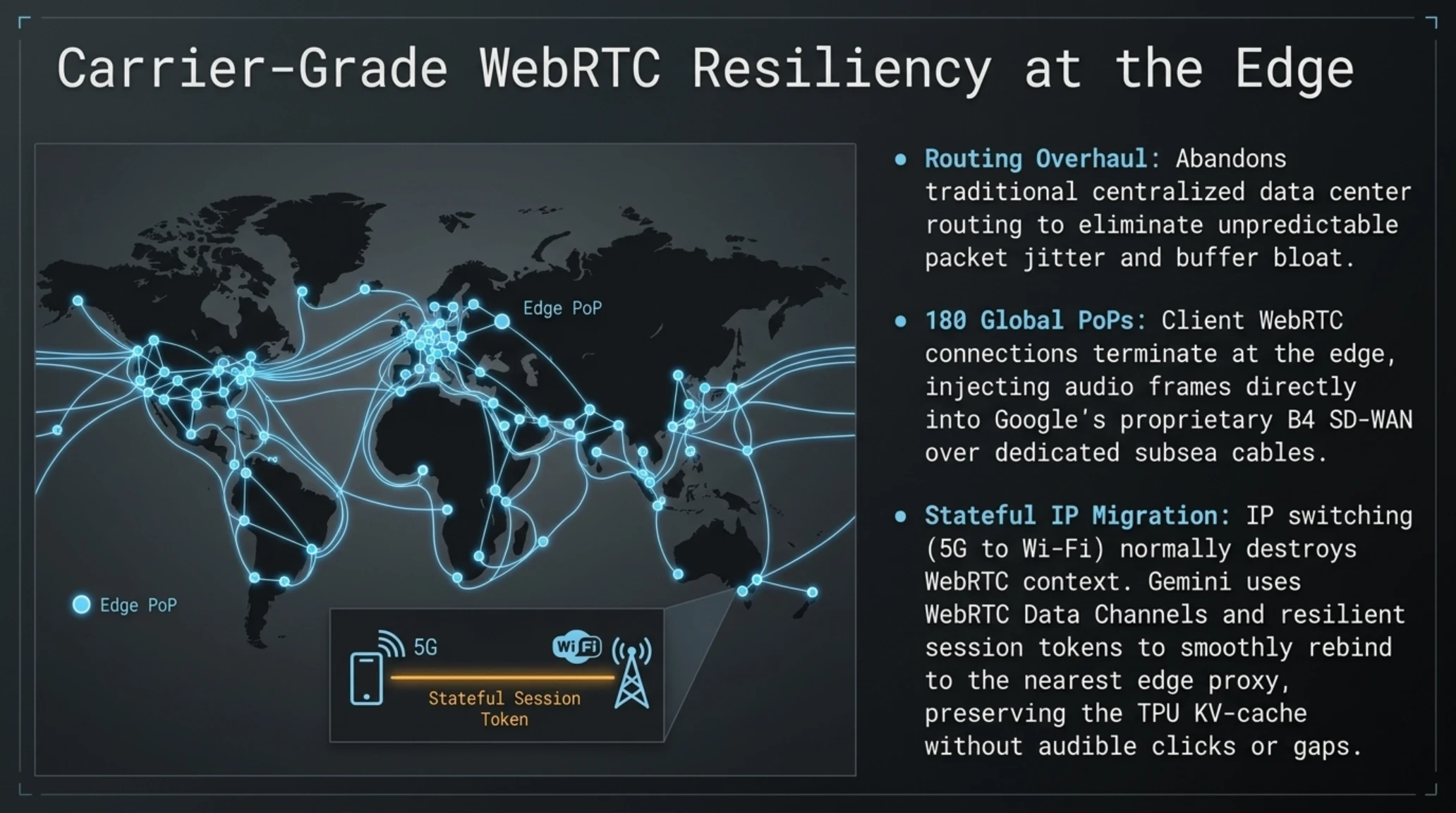
To sustain conversational latencies below 280 milliseconds across disparate geographical regions, the Gemini 3.8 Live production stack abandons traditional centralized data center routing in favor of an aggressively decentralized Edge Network Topology. Standard cloud architectures route client traffic across the public internet to a distant centralized server cluster, introducing unpredictable packet jitter, buffer bloat, and round-trip delays that destroy the delicate acoustic timing required for full-duplex conversational turn-taking.
Google overcomes this geographic latency penalty by terminating client WebRTC connections at over 180 global Points of Presence (PoPs) located directly at the edge of Google's global private fiber-optic backbone. When a mobile client initiates an audio session, the nearest edge proxy immediately performs the WebRTC Session Description Protocol (SDP) handshake and establishes an encrypted Secure Real-Time Transport Protocol (SRTP) media stream. From the local edge PoP, incoming audio frames are injected into Google's proprietary B4 software-defined wide area network (SD-WAN), traveling over dedicated subsea optical cables with prioritized Quality of Service (QoS) guarantees directly to the nearest TPU v5p inference supercluster.
Crucially, maintaining stateful conversational context across fluctuating mobile networks requires exceptional fault tolerance. When an enterprise user moves between high-speed 5G cellular towers or transitions onto enterprise Wi-Fi networks, mobile connections frequently suffer brief packet dropouts, address reassignment, and temporary link degradation. Traditional WebSocket connections terminate abruptly upon IP address migration, forcing developers to build complex client-side reconnection routines that dump conversational context and leave users stranded in awkward silence.
Gemini 3.8 Live solves this structural flaw through stateful session migration enabled by WebRTC Data Channels and resilient session tokens. If an IP switch occurs mid-conversation, the client effortlessly rebinds its existing session token to the nearest edge proxy without tearing down the underlying neural KV-cache on the TPU cluster. The inference engine smoothly buffers outgoing audio frames during the sub-second transition, ensuring that speech playback continues without an audible click, gap, or loss of conversational momentum. This carrier-grade network resiliency equips global enterprises with an ironclad conversational infrastructure capable of operating flawlessly in turbulent real-world mobile environments.
Technical Glossary: Advanced Acoustic Machine Learning (Jargon Buster)
- Time-to-First-Audio Token (TTFA): The precise duration between the acoustic termination of user speech and the physical emission of the model's first synthesized audio frame.
- Full-Duplex Speech Processing: The capability to concurrently transmit and receive audio over a single channel, enabling the system to actively listen and process user audio while speaking.
- Neural Barge-In Detection: A sub-50ms acoustic recognition system that instantly silences model speech without audible popping artifacts the moment user interruption is detected.
- Thinking while Talking (TwT): An asynchronous dual-pipeline neural architecture that executes background reasoning and tool calls in parallel with continuous conversational narration.
- SynthID Waveform Steganography: The non-destructive embedding of statistical, imperceptible harmonic perturbations directly into the audio waveform to guarantee origin attribution.
The video briefing below provides a rigorous technical walk-through of the Gemini 3.8 Live WebSocket API, demonstrating live session establishment, interrupt handling, and asynchronous tool integration within an enterprise Node.js environment.
This quantum leap in conversational architecture has fundamentally disrupted the competitive balance of the global artificial intelligence sector, as analyzed in the strategic brief below.
Tekin Strategic Analysis: The Conquest of the Ambient Interface (Tekin Analysis)
For the past eighteen months, OpenAI captivated the public imagination with proof-of-concept demonstrations of GPT-4o's vocal agility; however, the persistent failure to resolve the dead-air reasoning bottleneck prevented voice interfaces from penetrating mission-critical enterprise workflows. Google’s release of Gemini 3.8 Live Extended Thinking proves that decisive market victories belong to organizations capable of unifying frontier reasoning, proprietary cloud silicon (TPUs), global multilingual corpora, and deep enterprise software integrations (Google Workspace). By teaching artificial intelligence to speak and reason simultaneously, Google has successfully conquered the ambient interfacethe final frontier of post-screen computing.
The Titan War: Architectural Showdown Between Gemini 3.8 Live and OpenAI GPT-4o Realtime
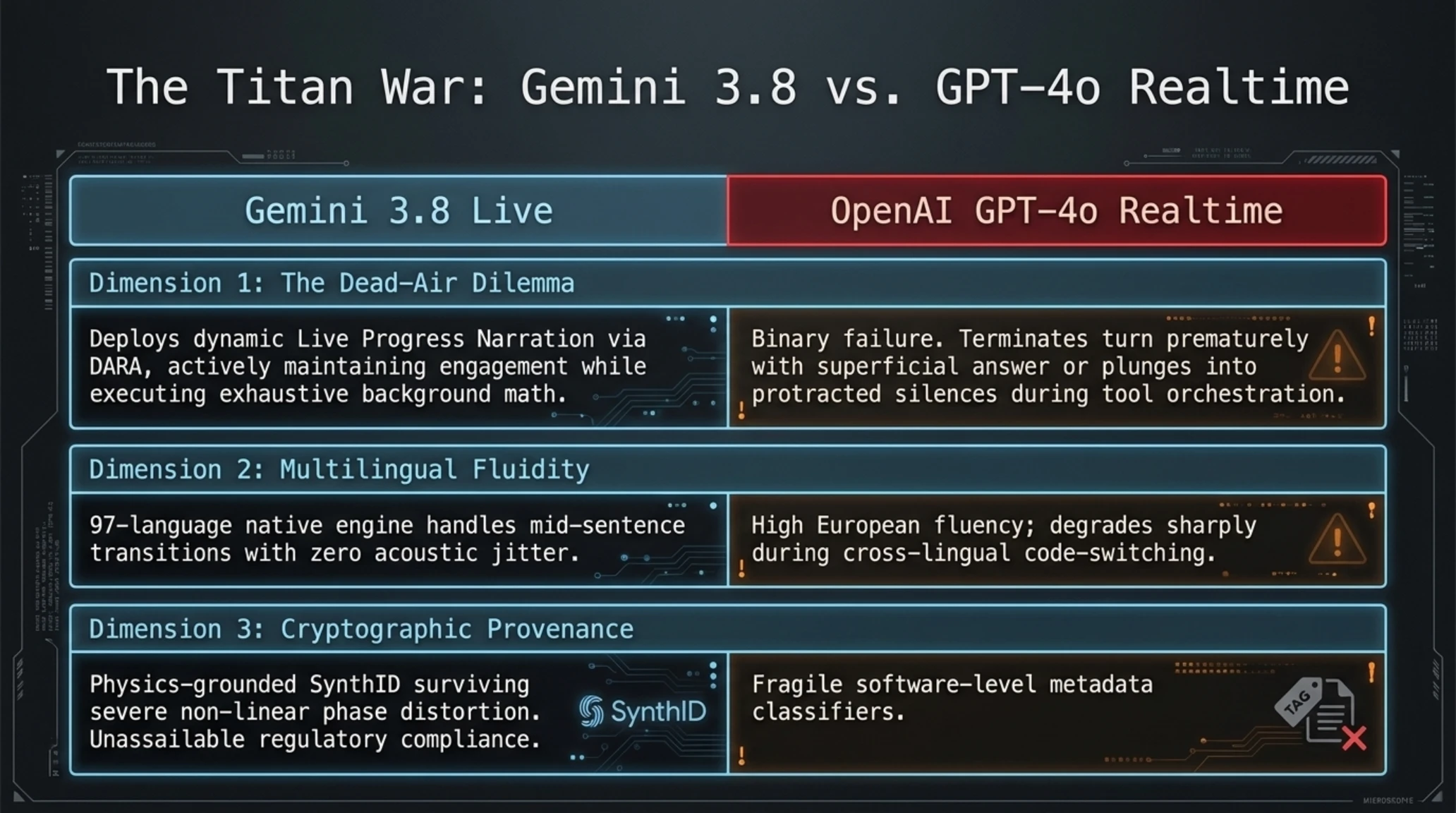
An uncompromising evaluation of Gemini 3.8 Live requires direct comparison against its primary industry rival: OpenAI’s GPT-4o Realtime API and Advanced Voice Mode. While OpenAI established early benchmarks in vocal expressiveness, emotional nuance, and human-like inflection, Google’s architectural counter-offensive exposes three decisive structural vulnerabilities in OpenAI’s voice stack:
First, The Resolution of the Dead-Air Dilemma: When confronted with complex multi-step reasoning or intensive tool orchestration, GPT-4o faces a binary failure mode: it either terminates its turn prematurely with a superficial, unreasoned answer, or it plunges into protracted silences that disrupt conversational rhythm. Gemini 3.8 Live Extended Thinking is the first and only system globally that deploys dynamic progress narration, keeping the user engaged in real time while background chain-of-thought workers execute exhaustive mathematical and algorithmic deductions.
Second, Unrivaled Multilingual Fluidity: While GPT-4o performs admirably across major European tongues, its fluency degrades sharply when subjected to complex cross-lingual code-switching or regional colloquialisms. Gemini 3.8 Live's native 97-language engine handles seamless mid-sentence language transitions with near-zero acoustic jitter, giving multinational enterprise deployments an overwhelming competitive advantage across Asian, Middle Eastern, and Latin American enterprise markets.
Third, Cryptographic Verification and Provenance via SynthID: With strict regulatory mandates emerging across the European Union (EU AI Act) and the United States (NIST Guidelines), enterprise compliance officers cannot deploy voice agents that lack verifiable provenance. OpenAI’s reliance on software-level classifiers offers fragile protection against post-generation tampering. Google’s integration of physics-grounded SynthID audio watermarking provides mathematical, tamper-proof proof of origin, rendering Gemini 3.8 the only enterprise-ready voice model equipped to survive sovereign regulatory scrutiny.
The detailed topological schematic below maps the global routing of Gemini 3.8 Live requests across Google’s subsea fiber-optic backbone and regional inference points of presence (PoPs).

Global financial institutions and enterprise software conglomerates have reacted with immediate enthusiasm to Google's dual-model launch, as captured in the market sentiment breakdown below.
Market Sentiment & Enterprise Adoption: The Shifting Balance of AI Power (Market Sentiment)
Wall Street Reaction & Alphabet Rally: Alphabet shares rallied 4.2 percent following verified enterprise benchmarks demonstrating Gemini 3.8 Live’s 68 percent cost advantage over cascaded legacy voice architectures. Morgan Stanley and Goldman Sachs published research notes projecting that the Extended Thinking tier will capture over 35 percent of the $18 billion enterprise call center modernization market by mid-2027.
Smart History Tags: The Multimodal Evolution in Tekin Archives
- Total elimination of dead-air conversational silences through parallel reasoning and live narration
- Flawless zero-shot code-switching across 97 languages with authentic native acoustic phonemes
- Uncompromising tamper-proof protection against deepfakes through spectral SynthID watermarking
- Sub-280ms Time-to-First-Audio token latency enabling natural human-speed dialogue dynamics
- Higher inference compute costs for Extended Thinking tier compared to text-only foundation models
- Performance tightly coupled to client network bandwidth stability and persistent WebSocket connectivity
- Increased implementation complexity for legacy enterprise software stacks transitioning to WebRTC pipelines
Strategic Conclusion: When Reasoning Learns to Speak (Conclusion Box)
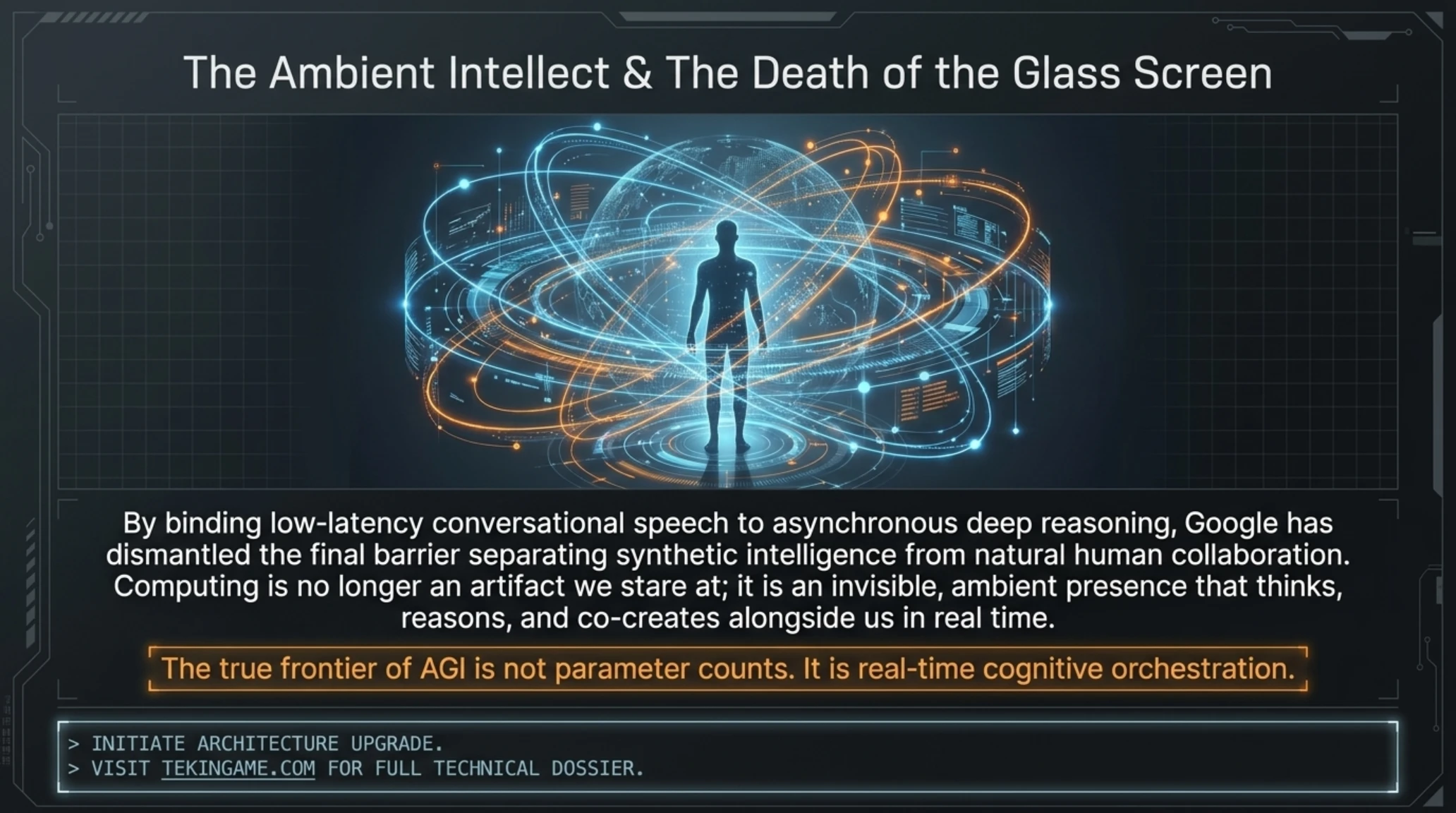
The launch of Gemini 3.8 Live and Gemini 3.8 Live Extended Thinking proves that the true frontier of artificial general intelligence is not merely expanding model parameter counts, but mastering the art of real-time cognitive orchestration. By binding low-latency conversational speech to asynchronous deep reasoning, Google DeepMind has dismantled the final barrier separating synthetic intelligence from natural human collaboration. As these models proliferate across enterprise networks, mobile operating systems, and ambient hardware, humanity stands upon the threshold of a new technological epoch: an era wherein machines do not merely answer our questions, but actively think, reason, and co-create alongside us in real time.
Related Intelligence Dossiers on TekinGame
• 📱 Tekin Analysis | Apple's Foldable iPhone Duo & iPhone 18 Pro Price Hike
• 🧠 Tekin Analysis | Valve's 17-Year Secret: The Staged L4D2 Trailer Leak
• 🎬 Ultimate Guide to Local AI Video Generation (Minimax, Wan, LTX)
Frequently Asked Questions About Gemini 3.8 Live and Extended Thinking
What is the foundational architectural difference between Gemini 3.8 Live and Extended Thinking?
Gemini 3.8 Live Standard Tier is engineered for ultra-low latency (sub-280ms) and high-throughput conversational interactions, ideal for voice search and customer service. In contrast, Gemini 3.8 Live Extended Thinking features a decoupled dual-pipeline architecture that executes intensive chain-of-thought reasoning and asynchronous tool calling in parallel with live, continuous speech narration.
How does the 'Thinking while Talking' mechanism resolve conversational latency?
Instead of blocking the voice pipeline for fifteen to thirty seconds while calculating answers, Extended Thinking uses its front-end conversational audio thread to immediately engage the user, naturally narrating its intermediate steps ('Let me pull up those server logs...') while its background worker processes code, queries databases, and evaluates proofs in parallel.
How does SynthID Audio watermarking protect against malicious deepfakes and voice cloning?
SynthID Audio embeds an imperceptible pseudo-random frequency pattern directly into the acoustic waveform during neural synthesis. The watermark is inaudible to human ears but survives aggressive MP3/AAC compression, pitch shifting, speed alteration, and acoustic re-recording, enabling forensic verification with over 99.9% statistical confidence.
Can Gemini 3.8 Live really switch between 97 languages mid-sentence?
Yes. The model is natively trained on massive multimodal and multilingual corpora, allowing it to process zero-shot code-switching. A user can seamlessly alternate between languages (e.g., English, German, and Spanish) within a single spoken query without causing audio stutter, translation delays, or accent degradation.
How can developers access Gemini 3.8 Live and what protocols are supported?
Developers can integrate both models via Google AI Studio and the Gemini API, utilizing bidirectional WebSockets and WebRTC data channels for low-latency streaming of 24kHz linear PCM or Opus audio. Consumer and enterprise rollouts are live across the Gemini mobile app, Search Live, and Google Workspace.
Verified Primary Sources & Technical Documentation
The empirical telemetry, benchmark data, and architectural analyses presented in this report are verified against the following official documentation and primary technical repositories:
Additional Gallery: 🚨 Tekin Analysis | Gemini 3.8 Live & The End of AI Dead Air