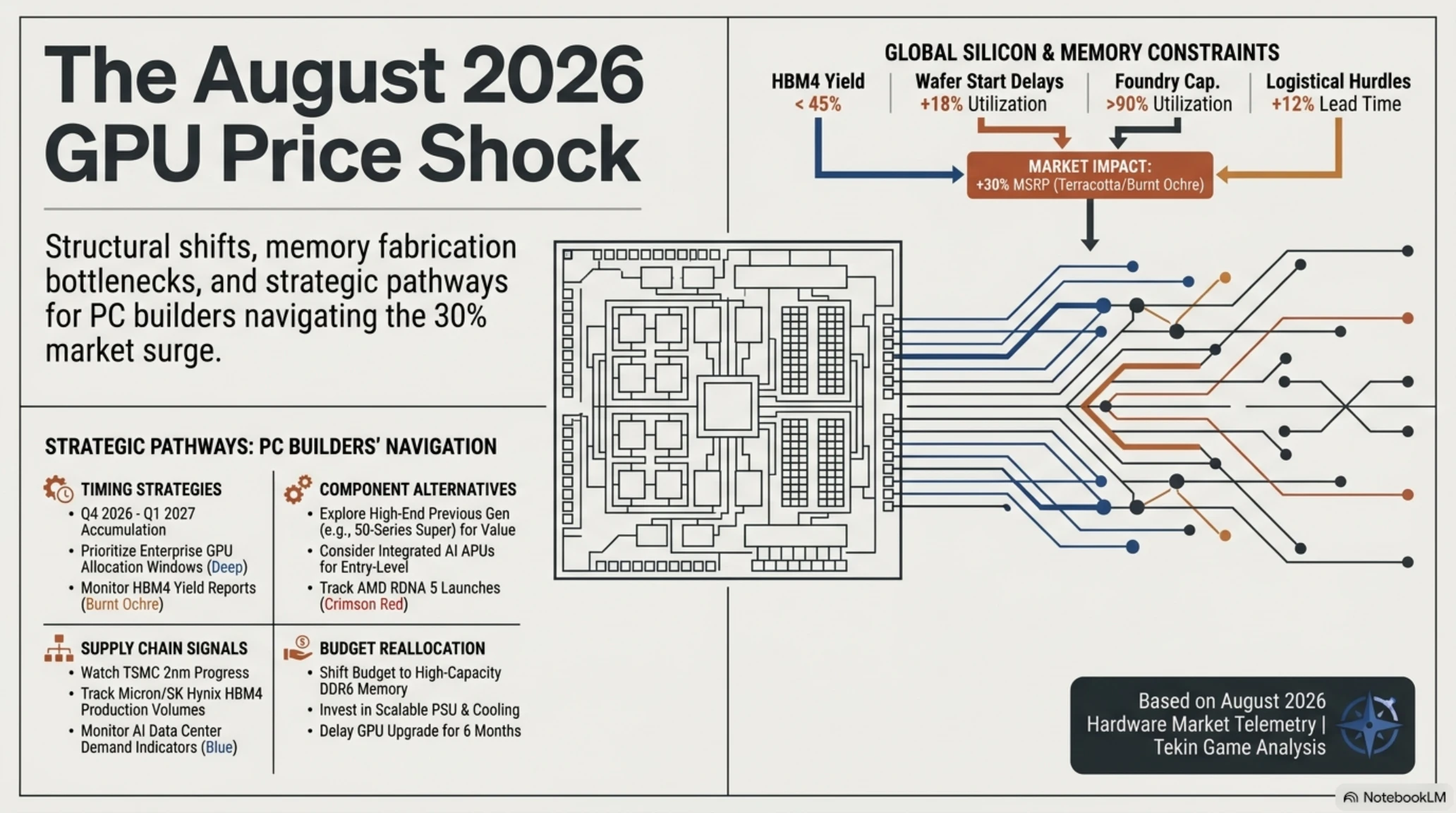
A deep analytical teardown of the sudden 20% to 30% GPU price surge across AMD and NVIDIA lineups in August 2026. Driven by a 20% price hike on Samsung GDDR6/HBM3e memory modules and hyper-scale AI data center allocation, AIB board partners are passing 100% of component cost increases directly to consumers. Analysts project VRAM semiconductor constraints will persist through early 2028.
Tekin Analysis | AMD & NVIDIA GPU Price Shock: August 2026 30% Market Surge
Tekin Game's deep teardown of the sudden 20% to 30% GPU price surge across AMD and NVIDIA lineups in August 2026.
- 🎮NVIDIA graphics card prices surge 20% to 30% due to acute VRAM semiconductor shortages
- 🎧AMD officially joins price hikes with at least a 10% increase across Radeon GPU lineups
- 🚀Samsung implements an additional 20% price increase on VRAM memory modules in August 2026
- 🗡️Thin manufacturer and AIB margins force 100% of component cost increases onto end consumers
- 📰Knock-on inflationary effects impact pre-built PCs, gaming laptops, and graphics hardware
- ⚔️Strategic buyer's guide for navigating global semiconductor cost escalation through 2028
The desktop PC gaming hardware market entered a turbulent new economic phase in early August 2026. Following unprecedented price increases across home video game consoles, verified telemetry from semiconductor supply chains confirms that AMD and NVIDIA graphics cards are experiencing a sudden price spike ranging from 10% to 30%. This market shift is the direct result of a global video memory (VRAM) shortage driven by intense enterprise demand for artificial intelligence data centers.
Graphics add-in board (AIB) partners have confirmed that procurement costs for GDDR6 and HBM3e memory modules have escalated rapidly. Because retail hardware margins remain extremely thin, manufacturers cannot absorb these cost increases, transferring the financial burden directly to retail consumers worldwide.
Core Takeaways of the August 2026 Graphics Card Price Crisis
- 20% to 30% price increases across NVIDIA GeForce RTX graphics cards
- AMD recalibrates Radeon GPU pricing following initial market moves
- Samsung memory module prices jump 20% in August with hikes planned through 2028
- System integrators and laptop manufacturers forced to adjust MSRP benchmarks
- Strategic buyer recommendations and market sentiment analysis for PC builders
Root Causes of GPU Inflation: AI Infrastructure vs. VRAM Supply
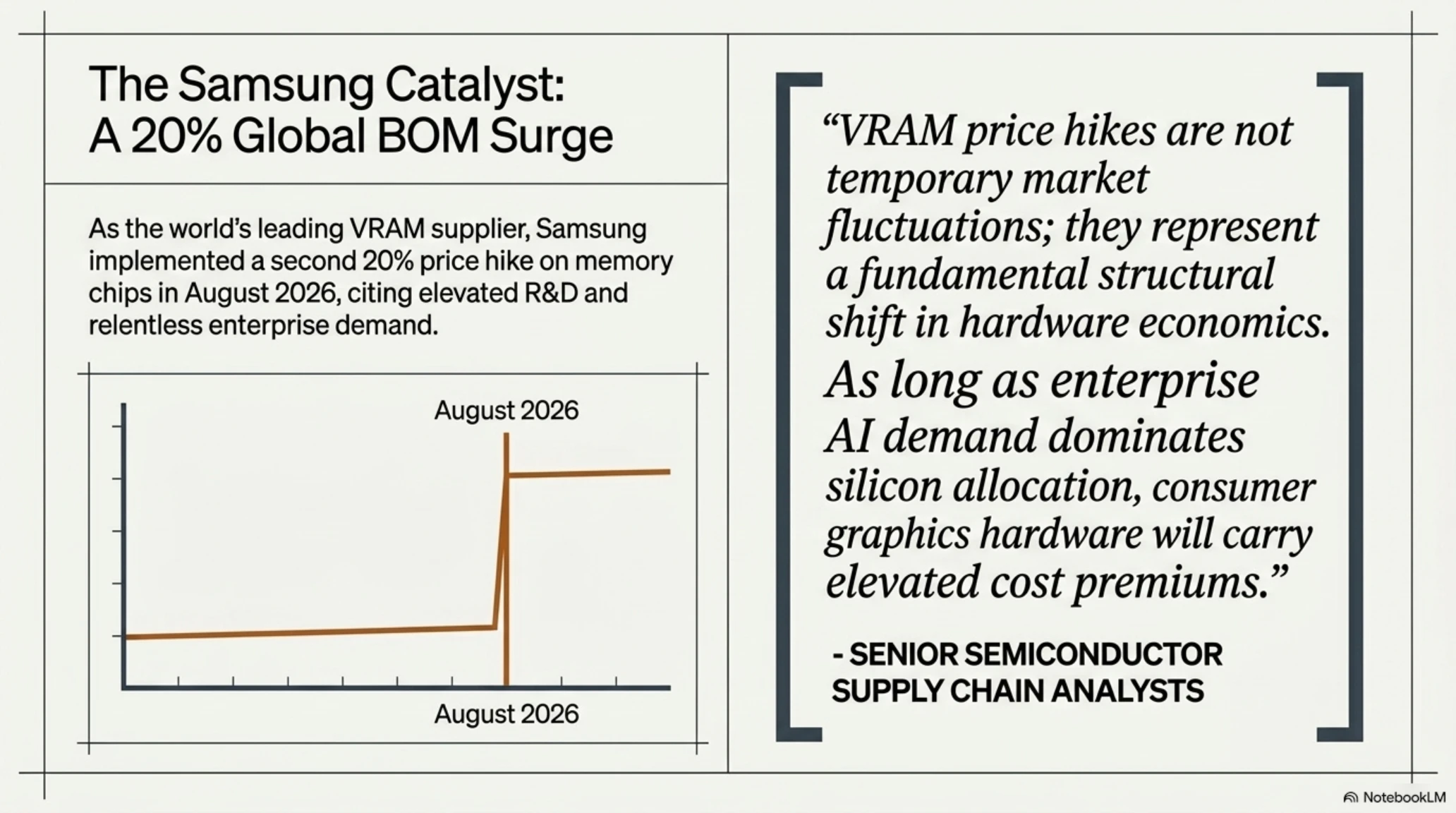
The interactive media hardware industry is confronting an unprecedented structural shift. Hyper-scale technology enterprises expanding AI model training infrastructure have consumed vast fabrication capacity at leading memory foundries, including Samsung, SK Hynix, and Micron. Foundries have prioritized high-margin HBM3e and HBM4 silicon, causing severe supply bottlenecks for standard consumer GDDR6 and GDDR7 video memory.
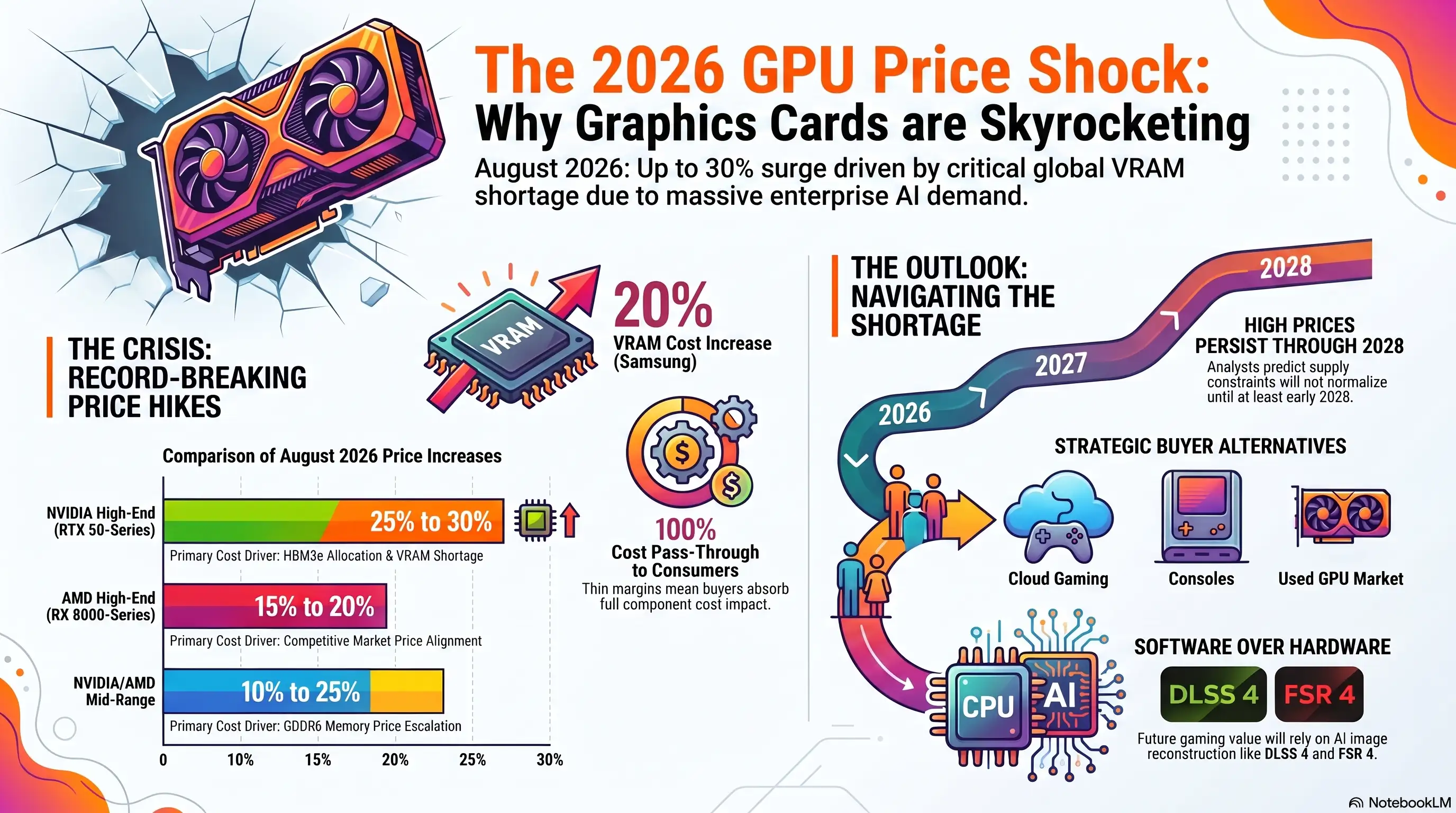
According to analytical reports published by GameSpot and validated by PC Gamer industry monitors, NVIDIA initiated 20% to 30% price adjustments across its RTX graphics product lines. Subsequently, AMD—having monitored competitive market signals—implemented minimum 10% price increases across its Radeon graphics architecture.
Key drivers behind this global hardware pricing recalibration include:
- Rapidly rising procurement costs for GDDR6 VRAM modules supplied by Samsung and SK Hynix
- Reallocation of primary silicon wafer production lines to enterprise HBM3e memory modules
- Tight operating margins for custom AIB board partners resulting in immediate consumer pass-through
- Secondary market inflationary pressures impacting prior-generation used GPU inventories
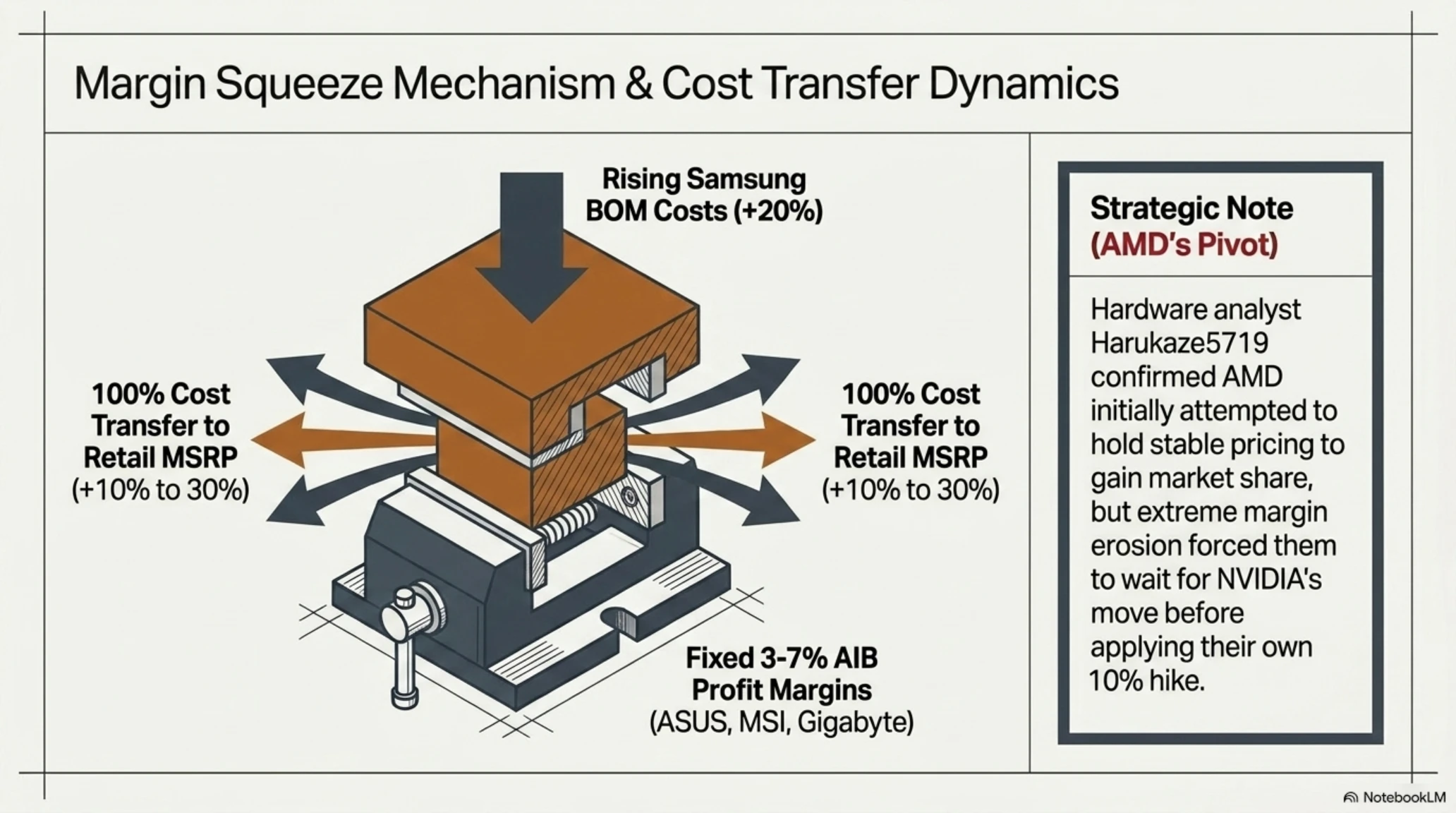
With retail and board partner profit margins historically constrained between 3% and 7%, manufacturers such as ASUS, MSI, and Gigabyte cannot buffer component price increases, leaving end consumers to absorb the full financial impact.
Semiconductor market analysts warn that these price escalations affect not only enthusiast flagship GPUs but also mainstream and budget graphics cards across all tiers.
Fierce corporate competition for cloud computing hardware continues to exert extreme pressure on consumer graphics card assembly lines worldwide.
Evaluating economic indicators reveals that PC builders in 2026 face one of the most challenging purchasing environments in hardware history.
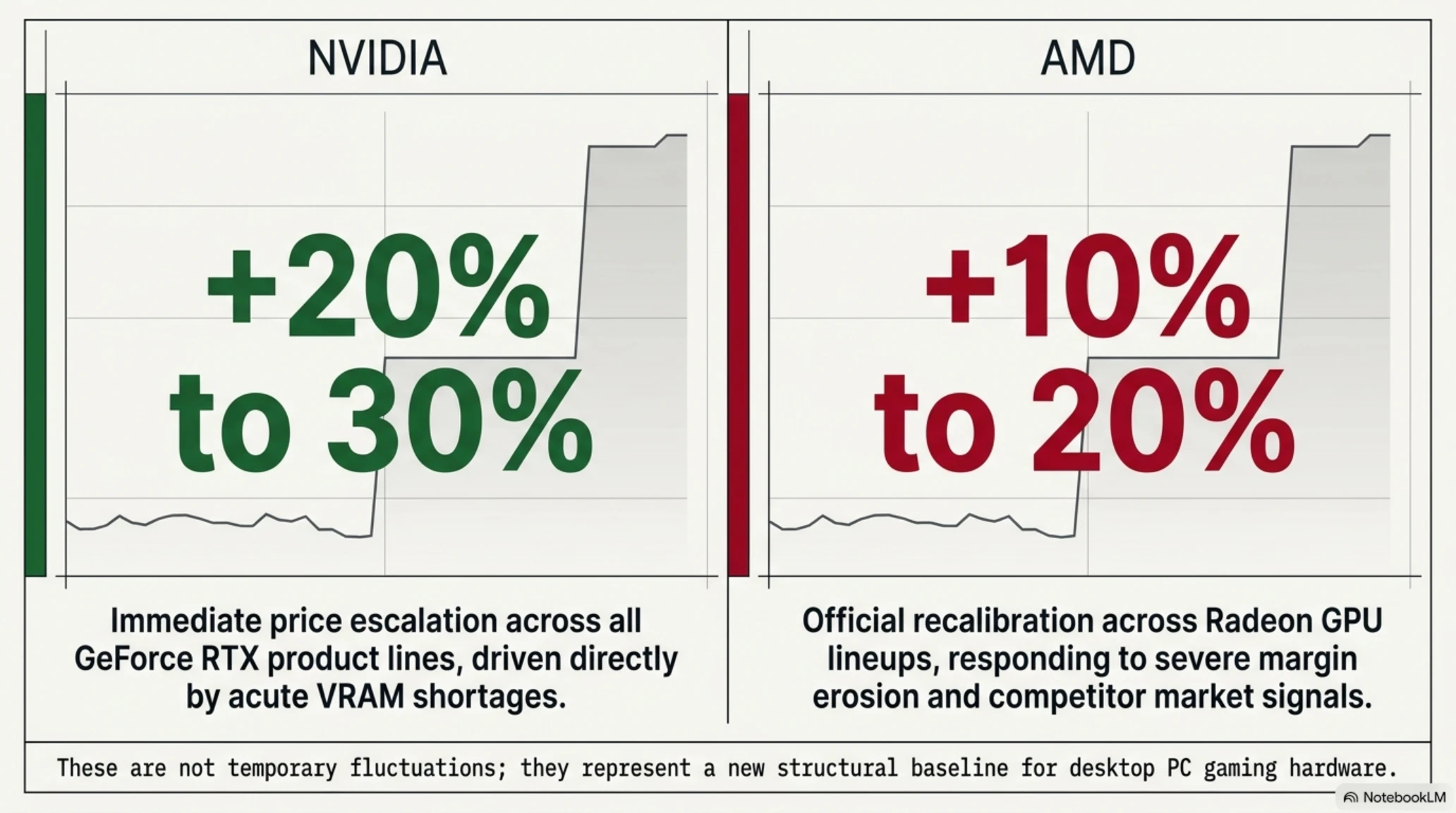
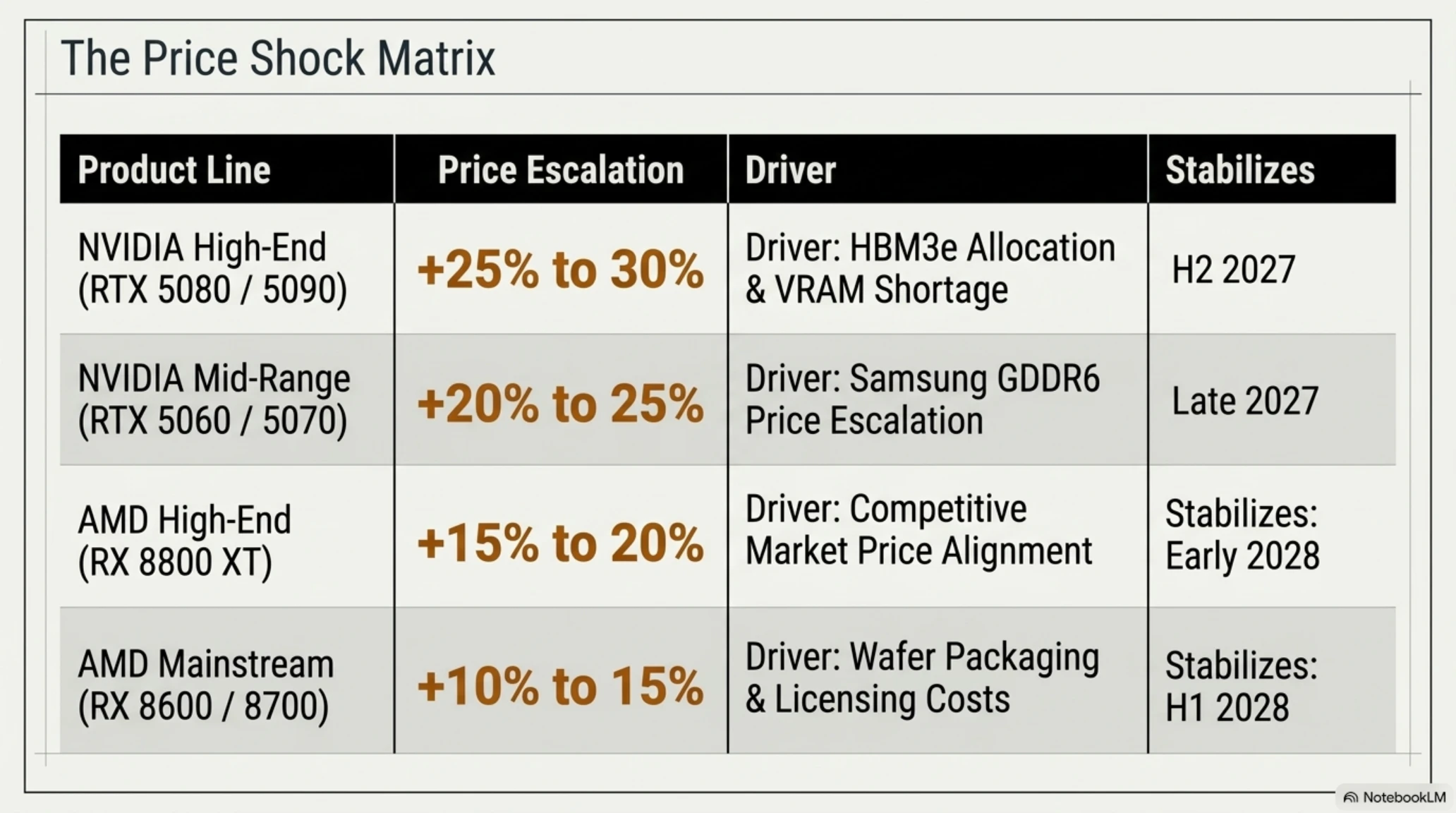
The matrix below provides a detailed breakdown of confirmed price increases across GPU product categories.
Confirmed Price Surge Matrix for AMD & NVIDIA Graphics Cards
| Manufacturer / Product Tier | Percentage Price Increase | Primary Cost Driver | Market Stabilization Forecast |
|---|---|---|---|
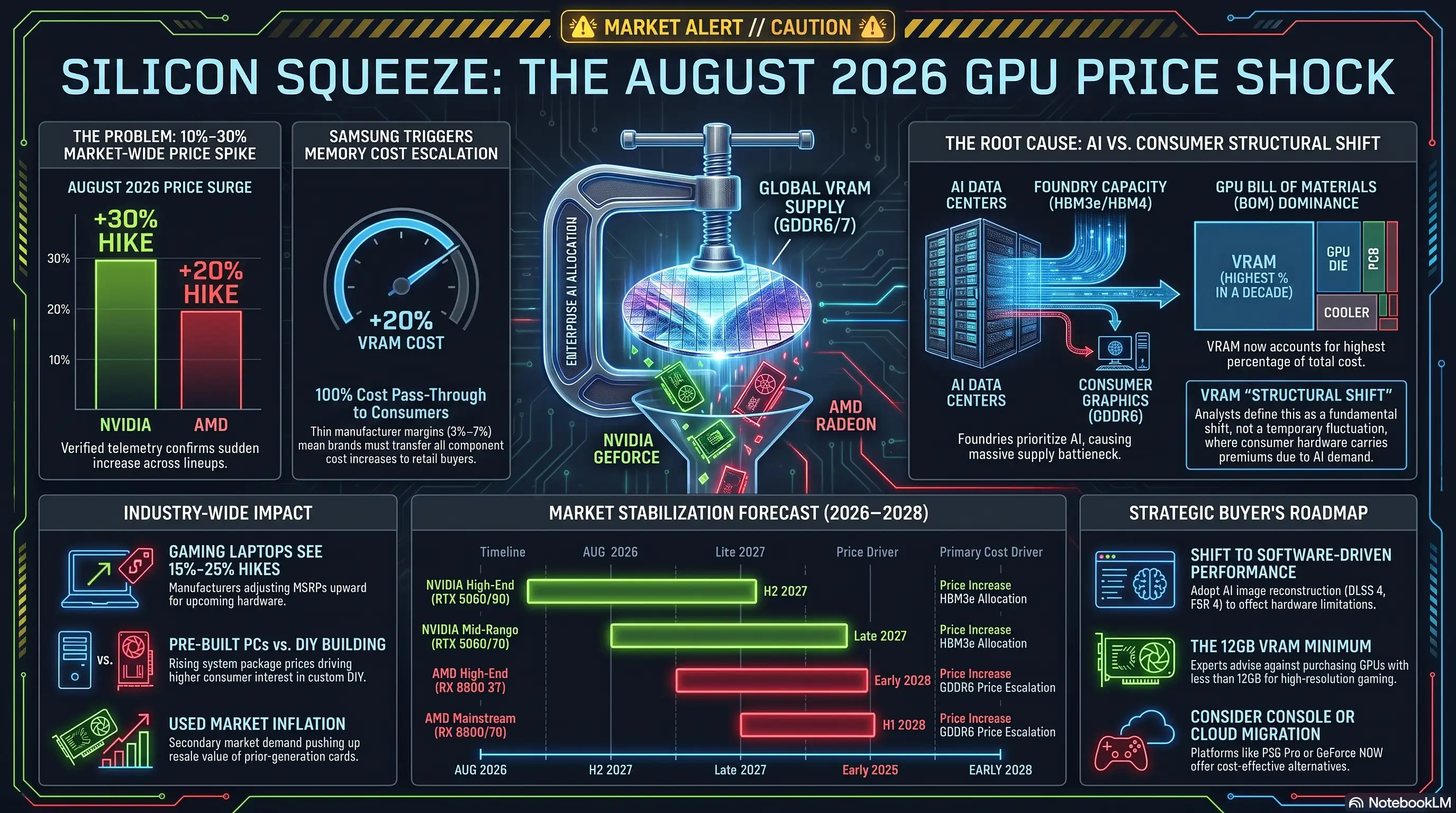
| NVIDIA High-End (RTX 5080 / 5090) | 25% to 30% | HBM3e Allocation & High-Density VRAM Shortage | H2 2027 |
| NVIDIA Mid-Range (RTX 5060 / 5070) | 20% to 25% | Samsung GDDR6 Memory Price Escalation | Late 2027 |
| AMD High-End (RX 8800 XT) | 15% to 20% | Competitive Market Price Alignment | Early 2028 |
| AMD Mainstream (RX 8600 / 8700) | 10% to 15% | Wafer Packaging & Substrate Licensing Costs | H1 2028 |
Market sentiment evaluations indicate that hardware buyers must adopt calibrated purchasing strategies to navigate ongoing inflation.
Samsung & Memory Foundry Dynamics in the August 2026 Price Surge
A primary catalyst behind the August 2026 price surge is Samsung's decision to implement a second 20% price hike on memory chips within the current fiscal year. As the world's leading supplier of video RAM, Samsung indicated that elevated research and development expenses alongside relentless enterprise data center demand will sustain pricing adjustments through 2028.
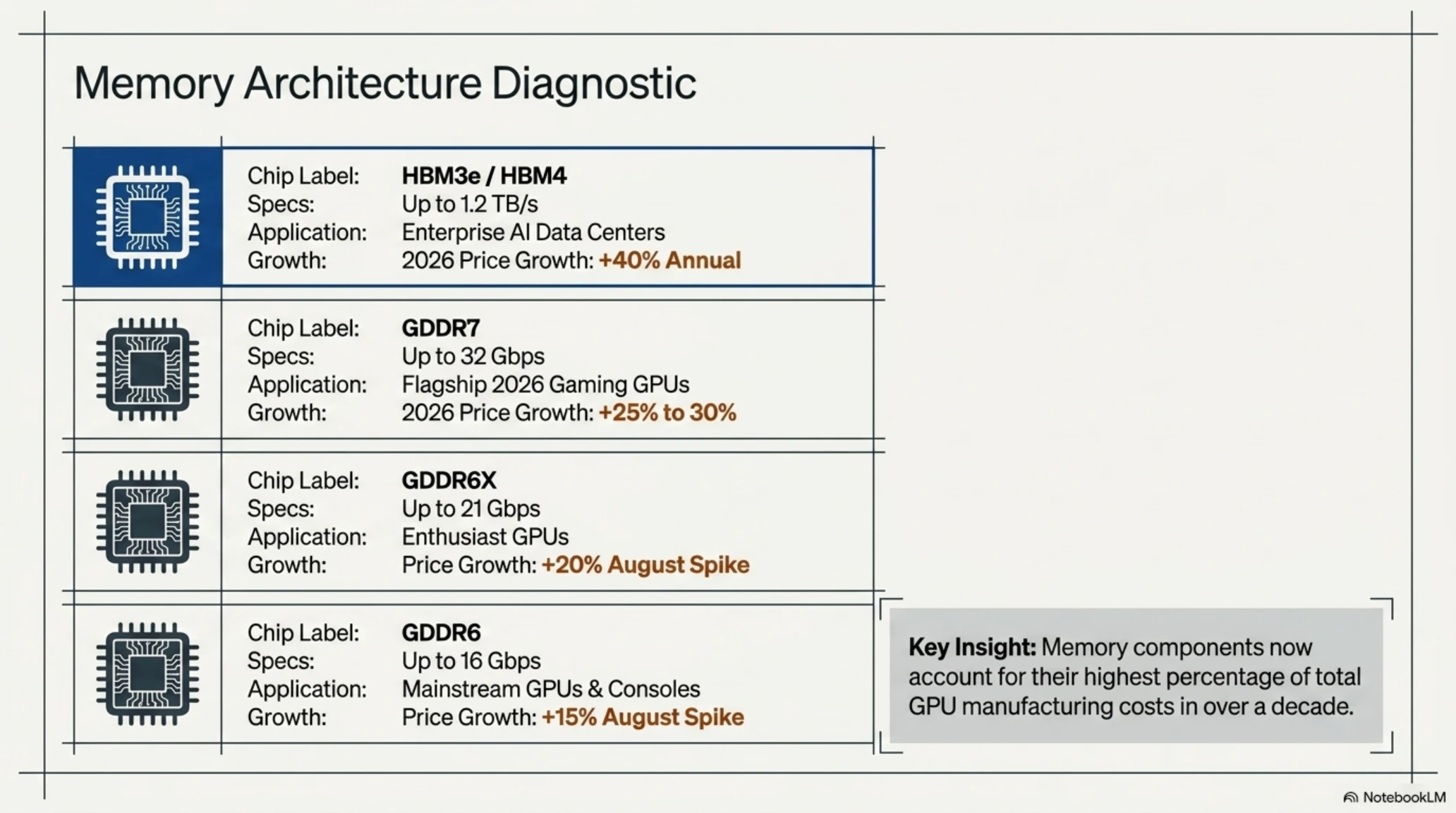
This decision impacts not only desktop PC graphics cards but also bill-of-materials (BOM) costs for next-generation console hardware and high-performance gaming laptops. Financial filings demonstrate that memory components now account for their highest percentage of total GPU manufacturing costs in over a decade.
Compounding the bottleneck, competing memory fabricators Micron and SK Hynix have shifted substantial silicon wafer allocation toward enterprise HBM capacity, reducing consumer GDDR output.
This supply-demand mismatch leaves global hardware distribution networks highly sensitive to sudden price adjustments.
Analytical models project that retail prices across major global e-commerce platforms will fully reflect these manufacturing cost increases in coming weeks.
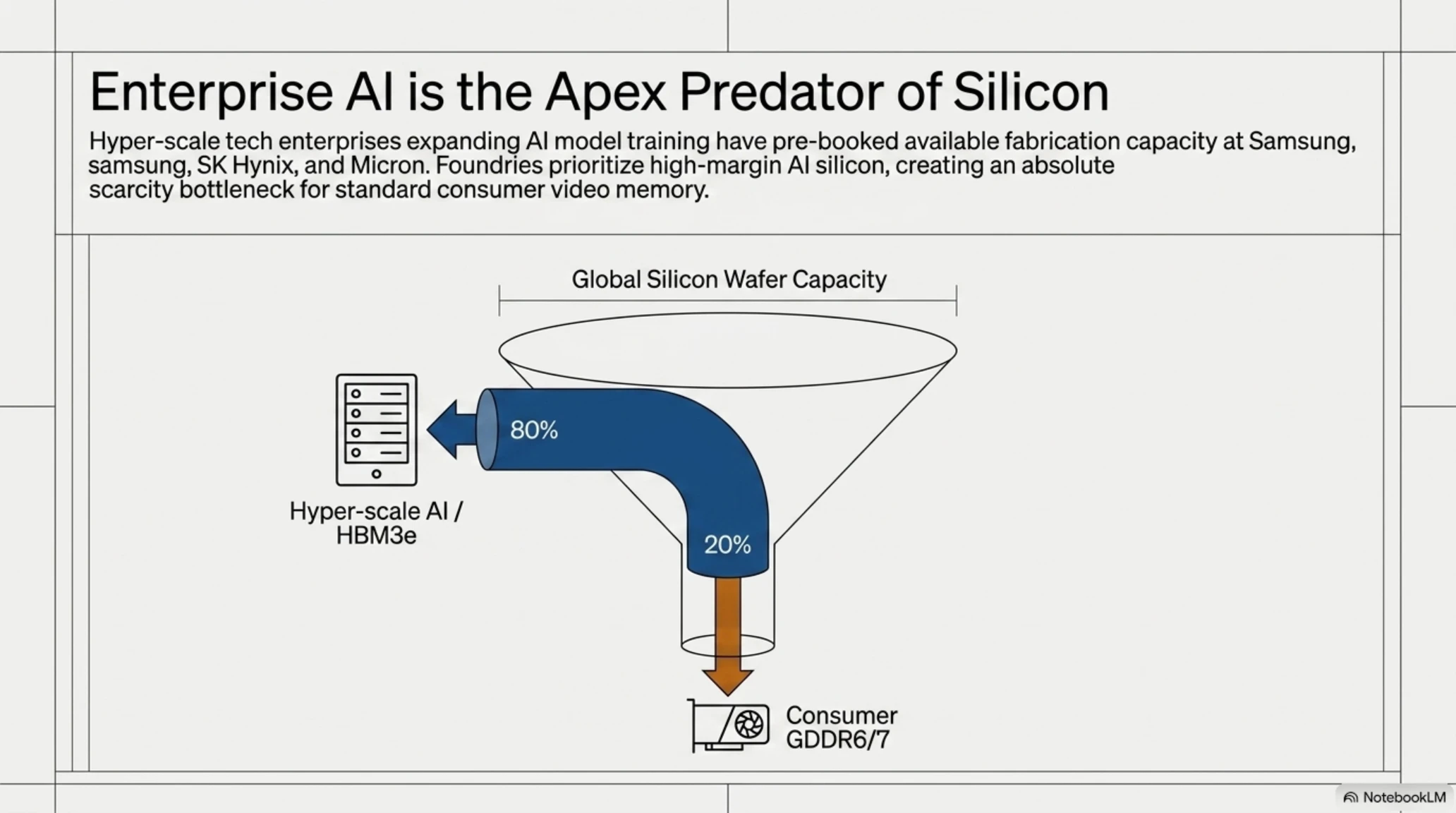
The executive quote below highlights the systemic nature of ongoing memory price escalation across interactive media hardware.
The comparative matrix below outlines performance specifications and manufacturing cost trends across current VRAM memory standards.
VRAM Memory Architecture Specification & Price Surge Matrix
| VRAM Architecture Standard | Bandwidth / Speed Rating | Primary Hardware Application | 2026 Price Growth Rate |
|---|---|---|---|
| HBM3e / HBM4 | Up to 1.2 TB/s | Enterprise AI Accelerators & Data Centers | 40% Annual Growth |
| GDDR7 (Next-Gen) | Up to 32 Gbps | Flagship 2026 Gaming GPUs | 25% to 30% Growth |
| GDDR6X | Up to 21 Gbps | Enthusiast & High-End GPUs | 20% August Spike |
| GDDR6 (Standard) | Up to 16 Gbps | Mainstream GPUs & Gaming Consoles | 15% August Spike |
Below is Tekin Game's visual teardown and analytical video coverage outlining memory market dynamics and graphics card price trends.
To clarify technical terminology for PC hardware enthusiasts, the Jargon Buster reference box below defines core memory metrics.
Technical Jargon Buster & Core Concepts
GDDR6 & BOM Cost Architecture: Graphics Double Data Rate memory standard and Bill of Materials manufacturing cost totals. Why This Matters: Evaluating Rumor vs. Reality in PC building inflation, tracking Market Sentiment, and reviewing complete hardware history on Tekin.
Board Partner Response: ASUS, MSI, and Gigabyte Retail Realities
Add-in board (AIB) partners represent the first operational layer exposed to rising memory procurement costs. Major graphics card manufacturers including ASUS, MSI, Gigabyte, and Zotac confirmed that maintaining previous retail MSRPs is economically unviable.
Given that net profit margins on custom graphics cards typically range between 3% and 7%, even minor increases in memory module pricing from Samsung completely erase board partner profitability.
Consequently, global retail partners including Amazon, Newegg, and Micro Center have adjusted listed MSRPs upward by 10% to 30% across current GPU inventories.
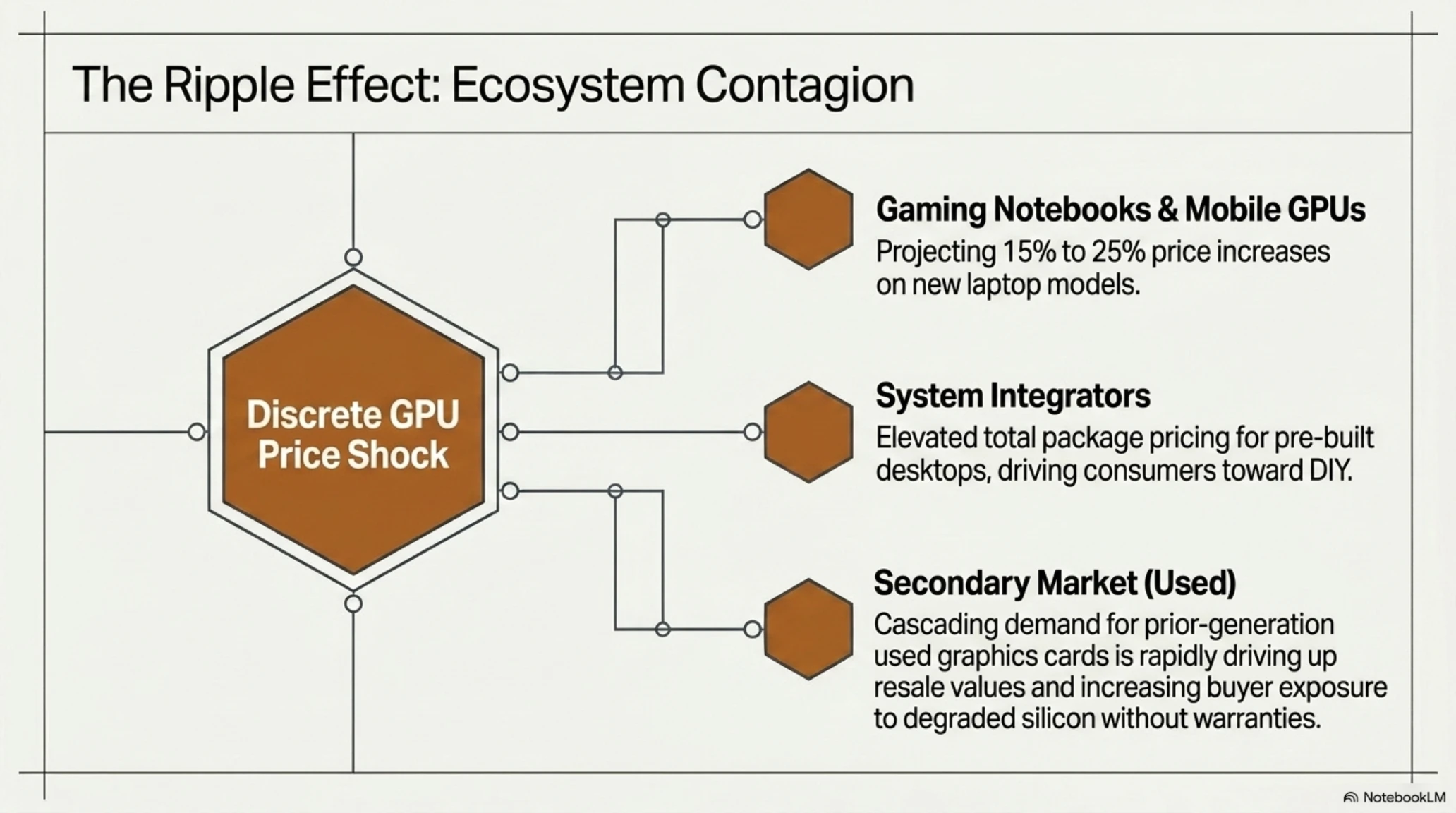
This market environment similarly forces system integrators to raise prices on pre-built gaming desktops.
Mobile workstation and gaming laptop manufacturers likewise project price hikes on upcoming notebook hardware revisions.
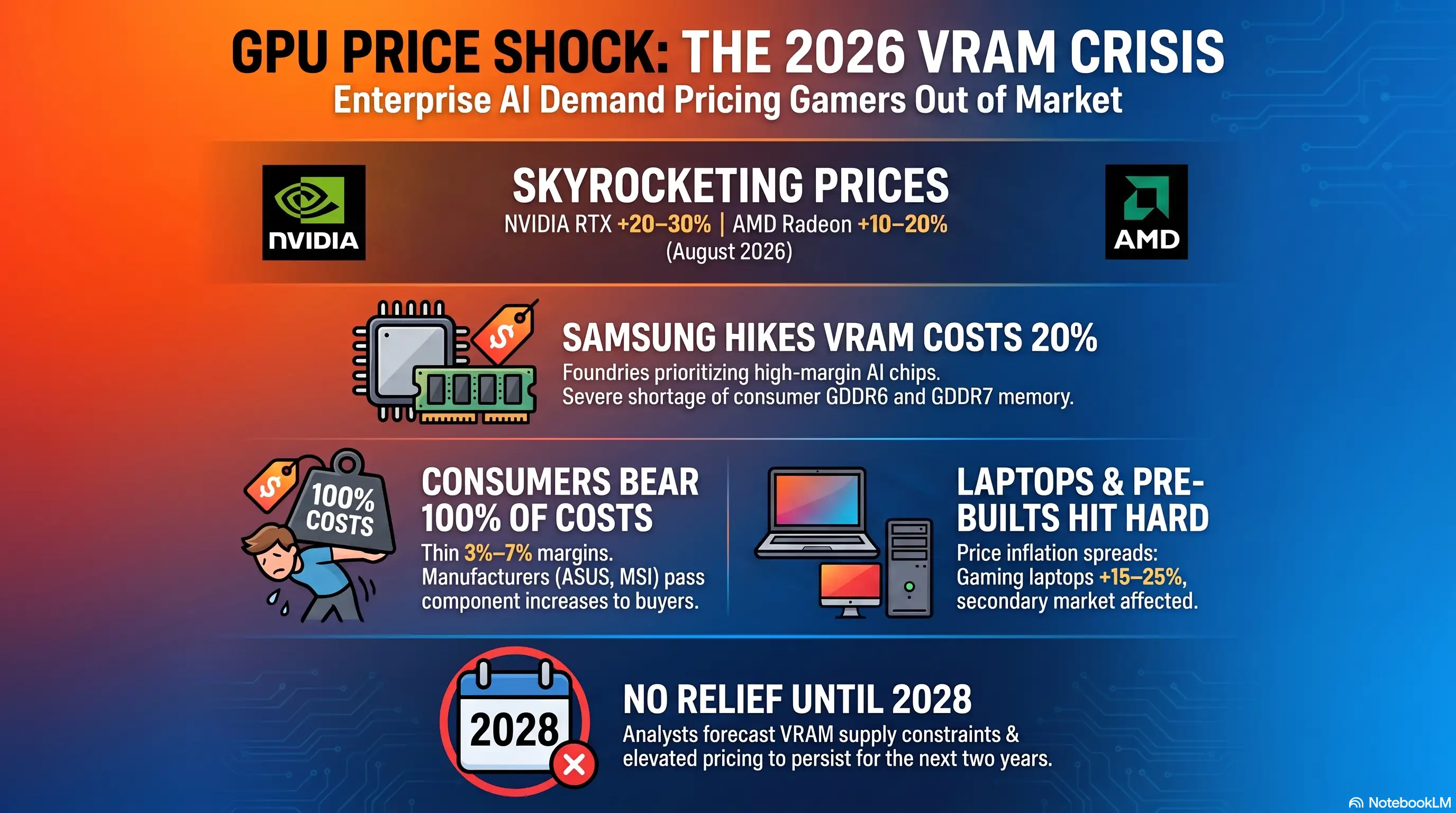
The impact analysis table below details how VRAM cost inflation propagates across distinct sectors of the PC hardware industry.
Hardware Ecosystem VRAM Cost Inflation Assessment
| Ecosystem Sector | Anticipated Market Impact | Consumer Consequence |
|---|---|---|
| Desktop Add-in Cards (Discrete GPUs) | 10% to 30% MSRP Cost Escalation | Postponed Hardware Upgrade Cycles |
| Gaming Notebooks & Mobile GPUs | 15% to 25% Price Increase on New Models | Increased Demand for Prior-Generation Laptops |
| System Integrators (Pre-built Desktops) | Elevated Total System Package Pricing | Higher Consumer Interest in Custom DIY Building |
| Secondary Market (Used Graphics Cards) | Increased Resale Value & Secondary Demand | Higher Risk Exposure to Unwarranted Hardware |
Why AMD Recalibrated Its Competitive Pricing Strategy
Earlier in 2026, AMD sought to gain market share by maintaining stable GPU pricing relative to NVIDIA. However, rigorous supply chain analysis reveals that rising VRAM procurement expenses rendered this strategy unsustainable.
Reports from hardware analyst Harukaze5719 indicate AMD waited for initial price movements from NVIDIA before adjusting its own pricing structure to mitigate margin erosion.
This industry-wide pricing recalibration shifts the competitive landscape, placing greater emphasis on software optimization and value-oriented purchasing decisions.
Sustained memory inflation is reshaping pricing expectations across consumer computing hardware for years to come.
Buyer's Strategic Roadmap & Hardware Specifications (Specs Box)
In light of market volatility in August 2026, selecting an appropriate graphics card requires thorough analysis of hardware specifications and price-to-performance metrics.
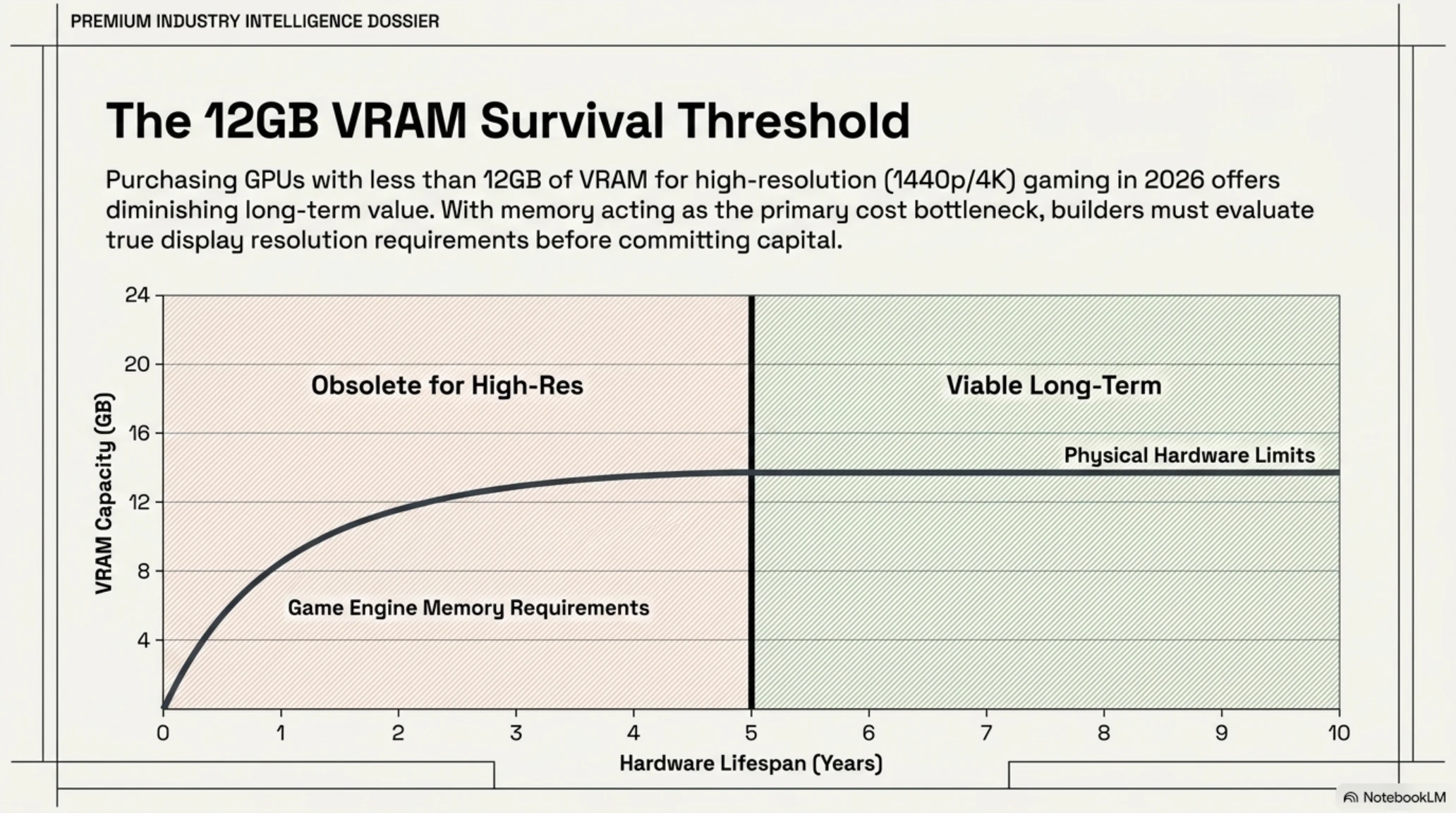
Tekin Game's hardware team advises PC builders to evaluate true resolution requirements across 1080p, 1440p, and 4K display environments before committing capital to upgrades.
Purchasing GPUs with less than 12GB of VRAM for high-resolution gaming in 2026 offers diminishing long-term value given evolving engine requirements.
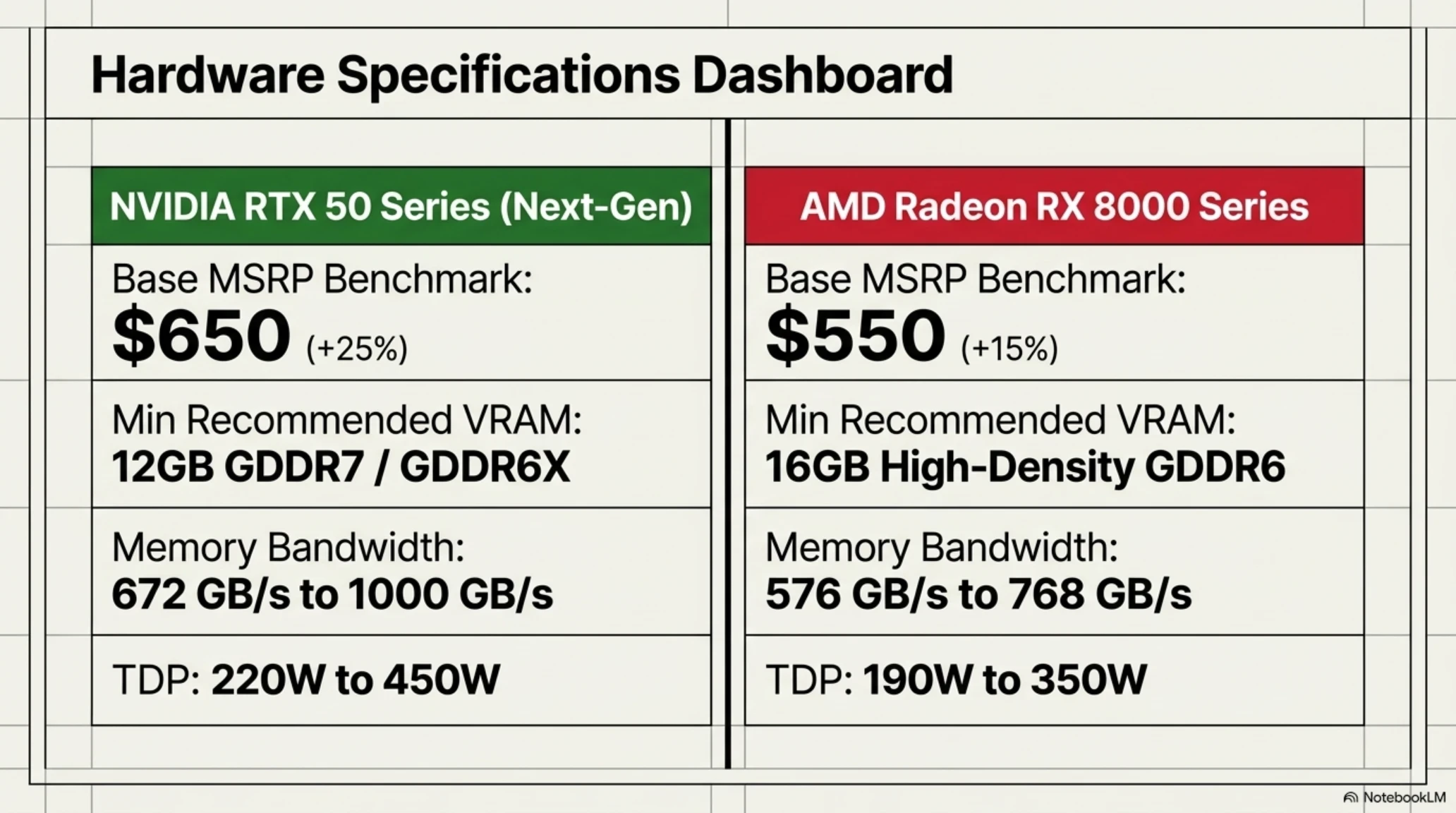
Hardware Specifications & Smart History Tags (Specs Box & Smart History Tags)
| Hardware Metric | NVIDIA RTX 50 Series (Next-Gen) | AMD Radeon RX 8000 Series |
|---|---|---|
| Minimum Recommended VRAM | 12GB GDDR7 / GDDR6X | 16GB High-Density GDDR6 |
| Memory Bandwidth Range | 672 GB/s to 1000 GB/s | 576 GB/s to 768 GB/s |
| Thermal Design Power (TDP) | 220W to 450W | 190W to 350W |
| Post-Hike Base MSRP Benchmark | $650 (25% Increase) | $550 (15% Increase) |
Reviewing technical specifications highlights significant cost adjustments across both major graphics architectures.
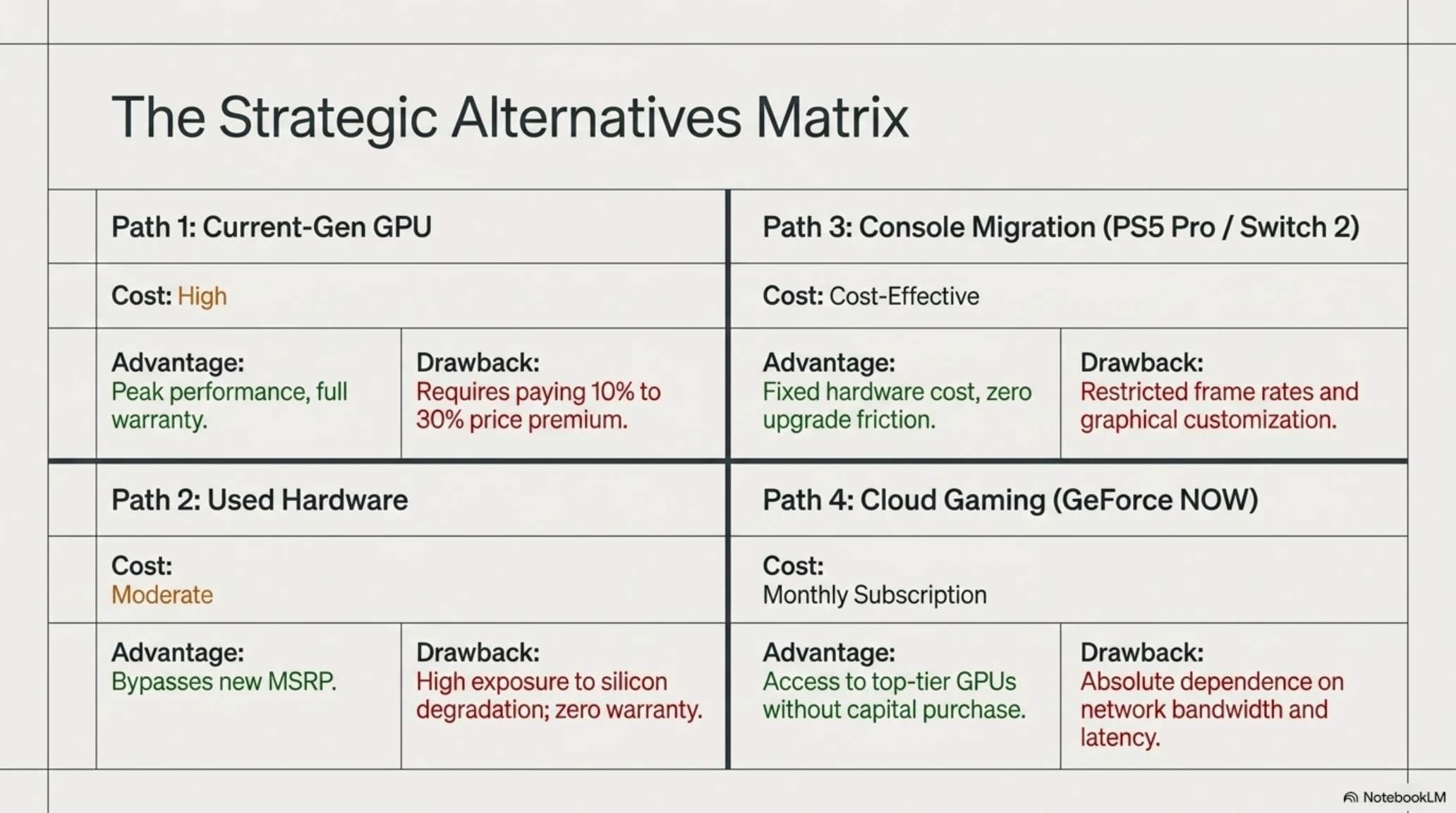
The comparative matrix below evaluates strategic alternatives for gamers navigating elevated graphics card pricing.
Strategic Consumer Alternatives Matrix for PC Gamers
| Upgrade Strategy | Relative Cost Burden | Primary Operational Advantage | Key Trade-Off / Drawback |
|---|---|---|---|
| Immediate Current-Gen GPU Purchase | High (New MSRP Tier) | Full Warranty Coverage & Peak Performance | Requires Paying 10% to 30% Price Premium |
| Previous-Generation Used Hardware | Moderate | Lower Acquisition Cost Relative to New GPUs | Exposure to Silicon Degradation & No Warranty |
| Console Migration (PS5 Pro / Switch 2) | Cost-Effective | Fixed Hardware Cost & Zero Upgrade Friction | Restricted Graphical Customization & Frame Rates |
| Cloud Gaming Services (GeForce NOW) | Monthly Subscription | Access to Top-Tier GPUs Without Capital Purchase | Absolute Dependence on Network Bandwidth & Latency |
Tekin Multimedia Teardown: Frame rate benchmark comparison and graphics card price-to-performance analysis.
Market Forecast: How Long Will VRAM Shortages Persist?
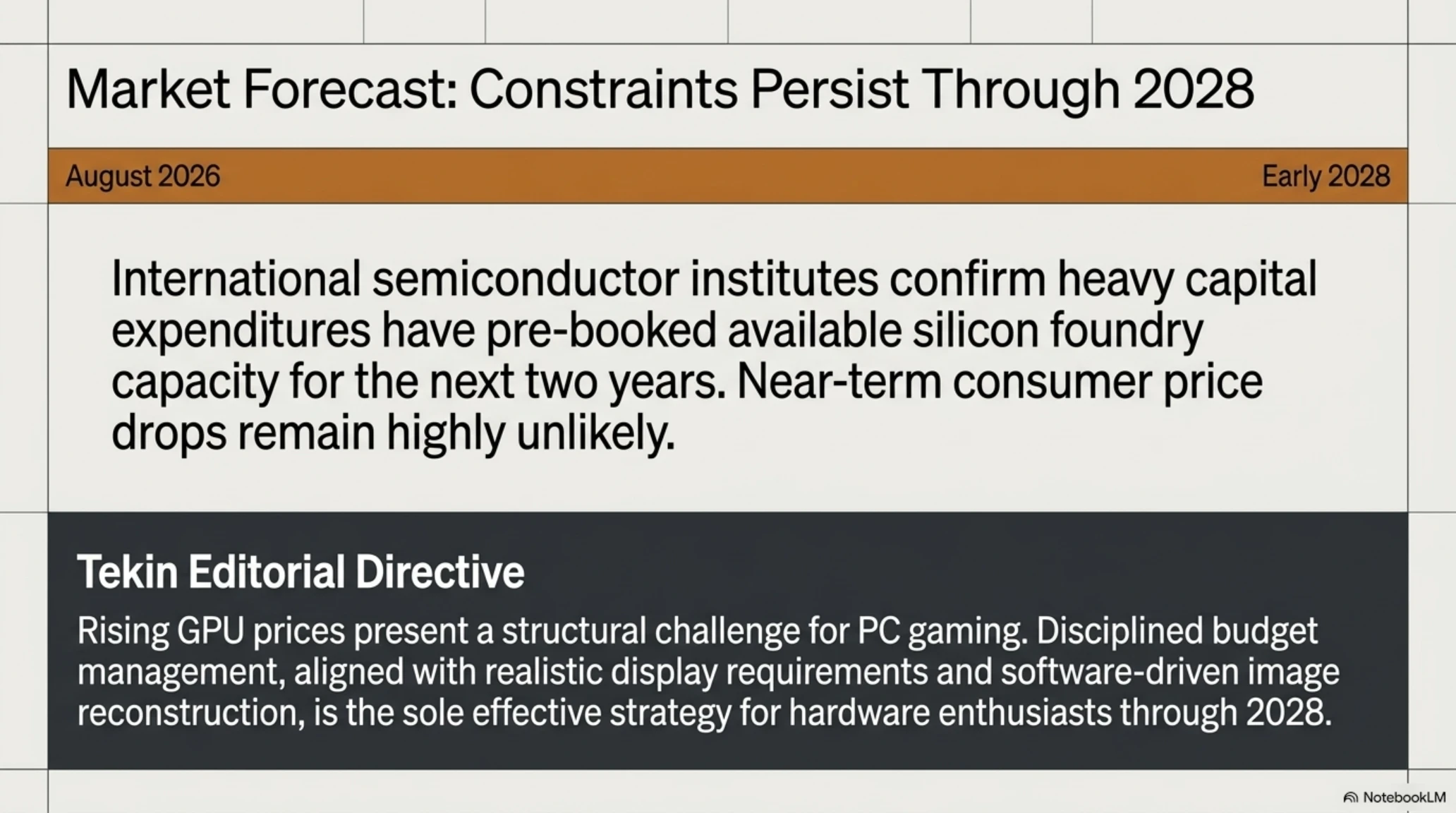
International semiconductor research institutes project that supply constraints across memory fabrication lines will persist through early 2028. Heavy capital expenditures by global tech corporations in AI infrastructure have pre-booked available silicon foundry capacity for the next two years.
Consequently, near-term price drops for consumer graphics cards remain unlikely.
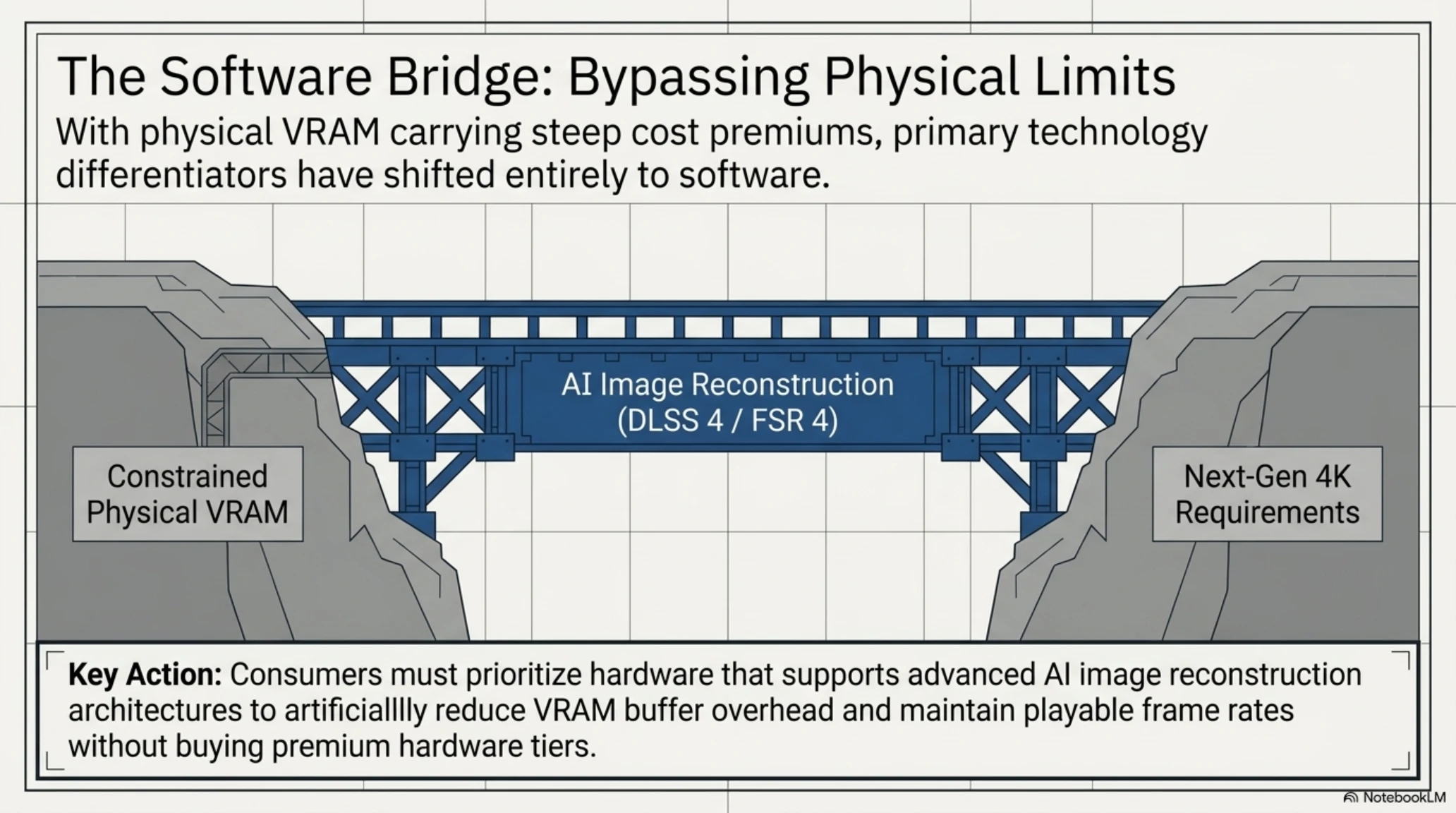
Primary technology differentiators over coming hardware cycles will focus on AI image reconstruction technologies (DLSS 4, FSR 4) that reduce physical VRAM buffer overhead.
The official position of the Tekin Editorial Board regarding this hardware crisis is detailed in the directive block below.
The strategic risk assessment matrix below summarizes key market vectors for hardware buyers.
Strategic Industry Risk & Conclusion Matrix (Conclusion Box)
| Assessment Vector | Risk Severity | Tekin Advisory Outlook |
|---|---|---|
| Sustained VRAM Inflation | Very High | Price Pressures Anticipated to Persist Through 2027 |
| PC Gaming Value Proposition | Decreasing | Consoles & Cloud Gaming Gain Market Share |
| Secondary GPU Market Risk | High | Thorough Testing Mandatory for Used Hardware Purchases |
| DLSS / FSR Adoption | High Opportunity | Games Increasingly Dependent on AI Reconstruction |
The gaming hardware industry is navigating one of its most intricate economic periods regarding component pricing.
Tekin Game will provide continuous analysis of memory market telemetry and graphics hardware price trends as new data emerges.
Conclusion: The Changing Economics of PC Gaming in 2026
The August 2026 price increases across AMD and NVIDIA graphics cards confirm that PC gaming is deeply intertwined with global semiconductor macroeconomics. Enterprise AI demand for memory foundry capacity has altered component pricing models for consumer hardware.
Disciplined budget management aligned with actual performance requirements represents the most effective strategy for hardware enthusiasts navigating ongoing market inflation.
Join us on Tekin Game and share your thoughts regarding graphics card price increases in the comments section below.
- Enhanced performance capabilities and AI features on next-generation AMD and NVIDIA GPUs
- Rapid advancement in image reconstruction technologies like DLSS 4 and FSR 4 to offset physical hardware limits
- Expanding availability of alternative gaming platforms including cloud streaming and modern consoles
- 20% to 30% price spikes across graphics card tiers driven by VRAM semiconductor cost inflation
- Projections indicating memory shortages and hardware inflation will persist through 2028
- Reduced value proposition for pre-built PC buyers working with constrained budgets
Related Industry Features on Tekin Game
• Tekin Night | NVIDIA Stock Crisis, FBI Cyber Advisory & Forza Intelligence
• Tekin Guide | Clair Obscur PC Optimization & FSR4 Benchmark Guide
• Tekin Analysis | $900 Xbox Price Shock & Global Memory Crisis in 2026
Frequently Asked Questions About August 2026 GPU Price Increases
How much have AMD and NVIDIA GPU prices increased in August 2026?
NVIDIA graphics cards have increased by 20% to 30%, while AMD Radeon models have seen price increases of 10% to 20%.
What is driving the sudden price spike in graphics cards?
The primary cause is a 20% price increase on VRAM modules by Samsung combined with foundry reallocation toward enterprise AI chips.
Will graphics card prices normalize by the end of 2026?
Industry forecasts indicate memory supply constraints and elevated hardware pricing will persist through early 2028.
Does VRAM inflation affect gaming laptop pricing?
Yes, next-generation gaming laptops are projected to launch with 15% to 25% price increases across retail tiers.
What are the best alternatives for gamers deferring GPU upgrades?
Cloud gaming platforms like GeForce NOW and current-generation consoles offer cost-effective alternatives without upfront hardware capital.
Has the secondary used GPU market experienced price increases?
Yes, demand for prior-generation used graphics cards has escalated, pushing up resale prices across secondary markets.
Sources & References
• GameSpot: Graphics Cards Are About To Get A Lot More Expensive
• PC Gamer: AMD and NVIDIA GPU Price Increases Detailed
• Tom's Hardware: Samsung Raises VRAM Prices by 20% in August
• TechPowerUp: Memory Supply Constraints Impacting GPU Partners
• AnandTech: Semiconductor Market Trends and Hardware Inflation
Additional Gallery: Tekin Analysis | AMD & NVIDIA GPU Price Shock: August 2026 30% VRAM Surge