Tekin Analysis | Snapdragon Wear Elite: When Your Smartwatch Runs 2 Billion Parameter AI Models
Strategic Evaluation & Key Takeaways at a Glance
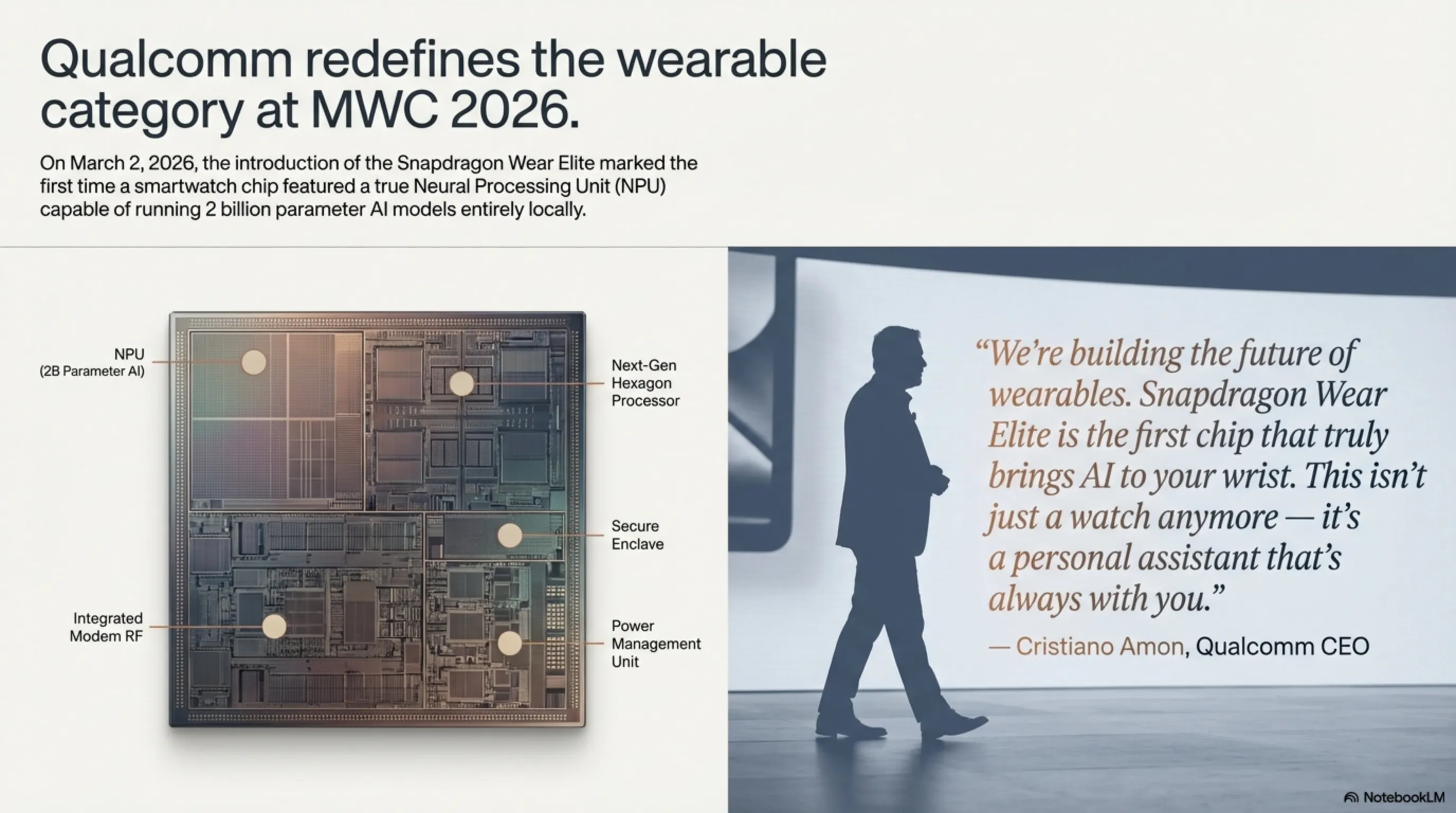
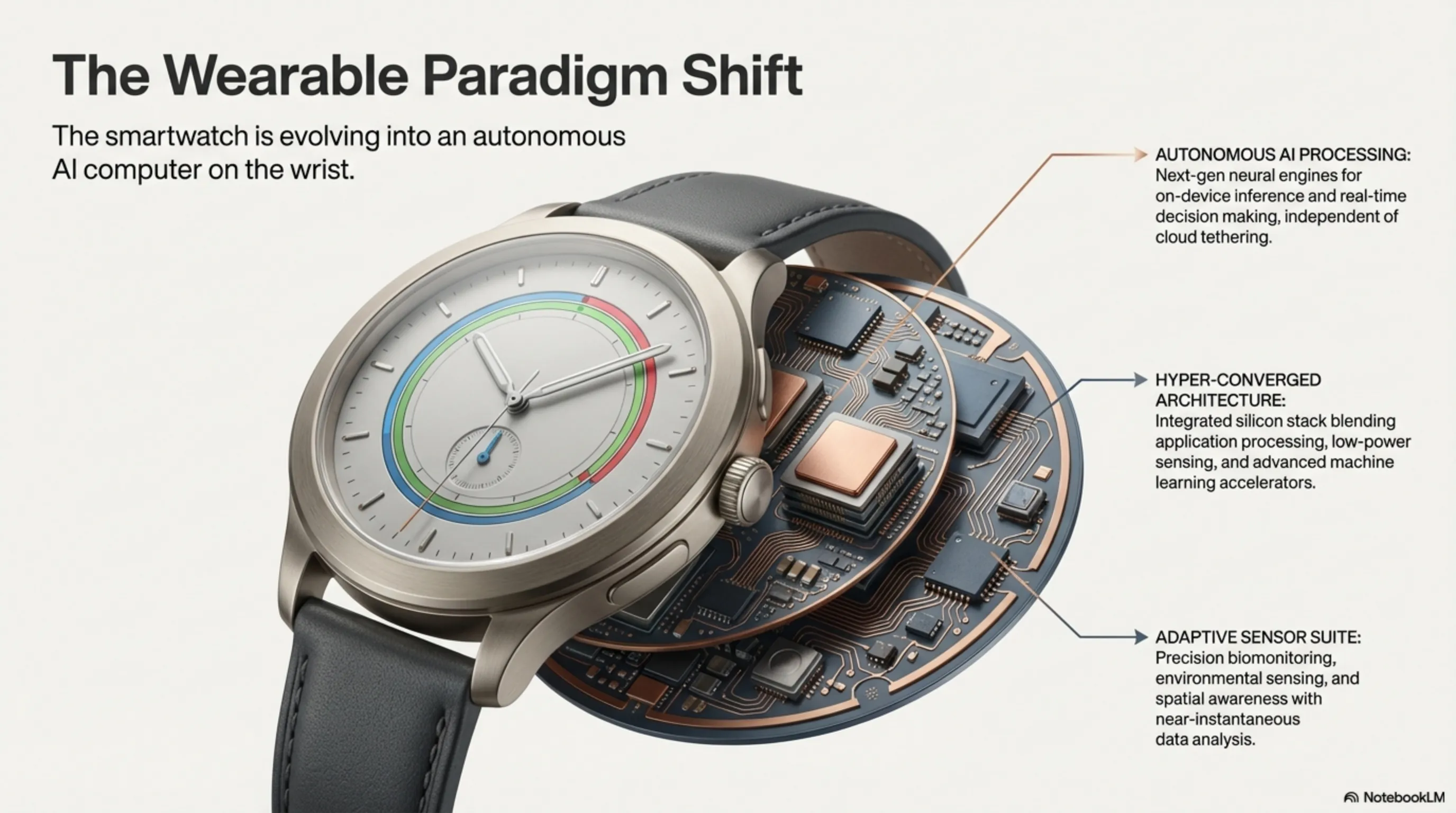
On March 2, 2026, Qualcomm unveiled the Snapdragon Wear Elite at MWC Barcelona: the first smartwatch processor built on a 3nm node with a dedicated neural engine capable of running 2-billion-parameter AI models locally. This is no longer just a wristwatch it is a standalone AI computer strapped to your wrist.
Why This Shift Changes the Game
Snapdragon Wear Elite severs the historical dependency of smartwatches on cloud servers and paired smartphones; real-time voice translation, clinical sleep diagnostics, and generative voice assistants now run locally on 3nm wrist silicon.
The Announcement: When Qualcomm Redefined Smartwatches
At 10:00 AM Barcelona time on March 2, 2026, Qualcomm took the main stage at Mobile World Congress (MWC) to introduce a chip that fundamentally alters the wearables landscape: Snapdragon Wear Elite. For the first time in smartwatch history, a wearable SoC features a high-performance Neural Processing Unit (NPU) not a basic accelerator limited to step counting or face unlocking, but a neural engine capable of running 2-billion-parameter AI models locally with zero internet, zero cloud, and zero smartphone connection required.
The Specs: 3nm, NPU, and Real Power
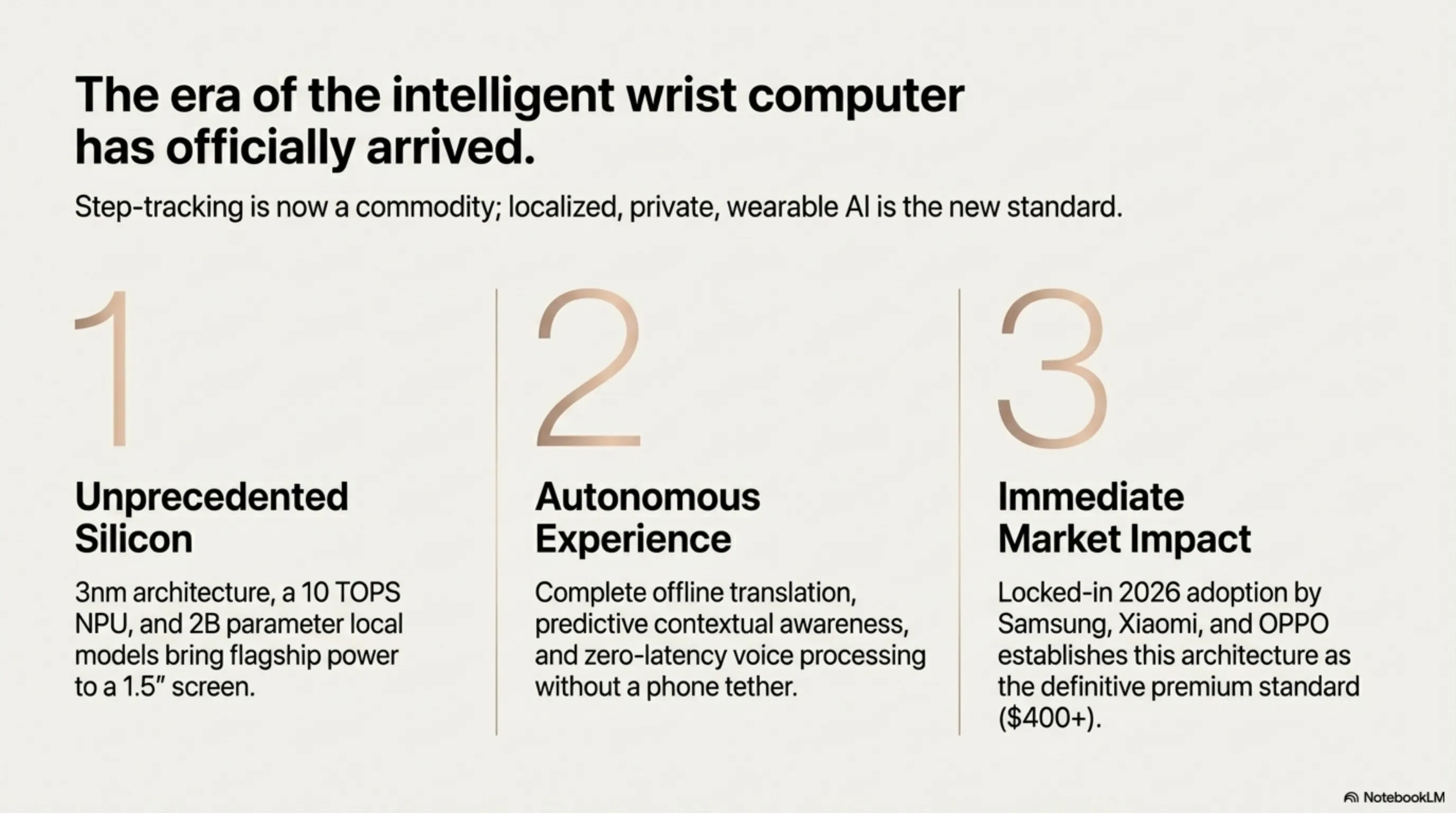
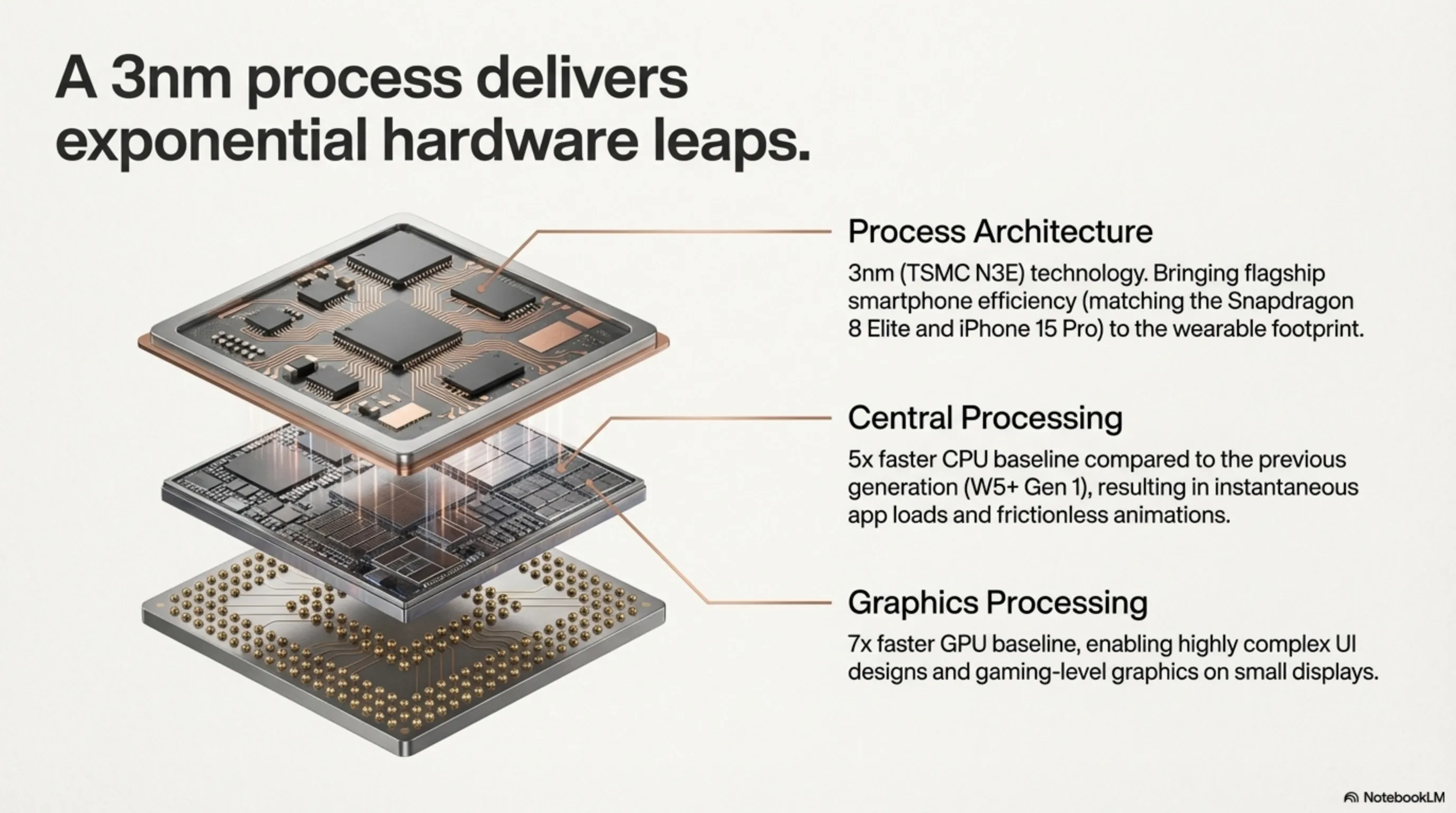
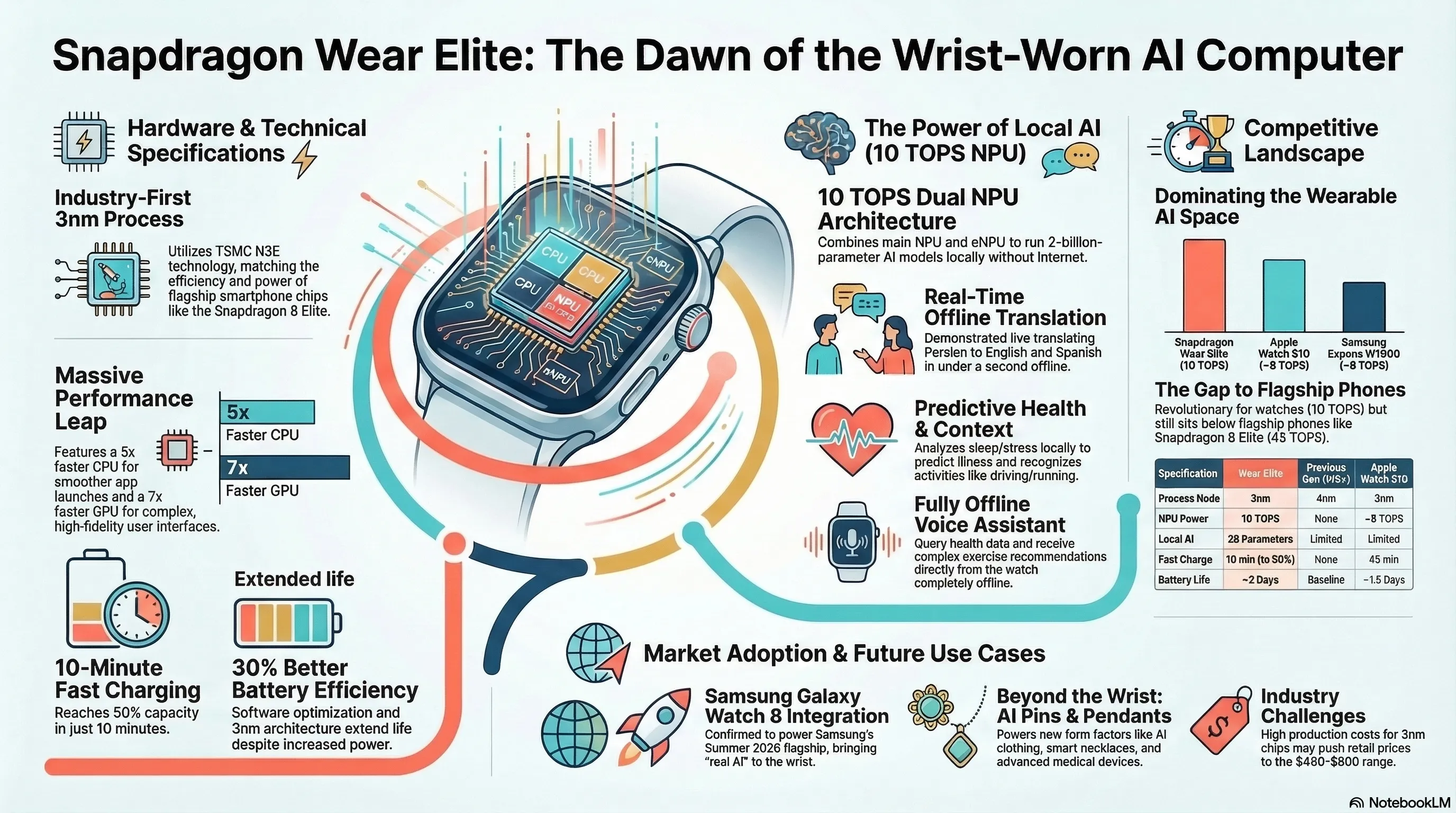
Snapdragon Wear Elite is the first smartwatch processor fabricated on TSMC's 3nm (N3E) process node the exact same lithography powering the flagship Snapdragon 8 Elite smartphone chip and Apple's iPhone Pro silicon. Compared to the previous-generation 4nm Snapdragon W5+ Gen 1, the architectural gains are massive:
- 1. 3nm Process (TSMC N3E): Delivers higher transistor density in a smaller footprint with reduced thermal output and superior power efficiency.
- 2. 5x Faster CPU: Central processing performance jumps fivefold over the previous generation, ensuring instant app launches and fluid UI animations.
- 3. 7x Faster GPU: Graphics rendering is seven times more powerful, enabling rich 3D watch interfaces, wearable gaming, and local image processing.
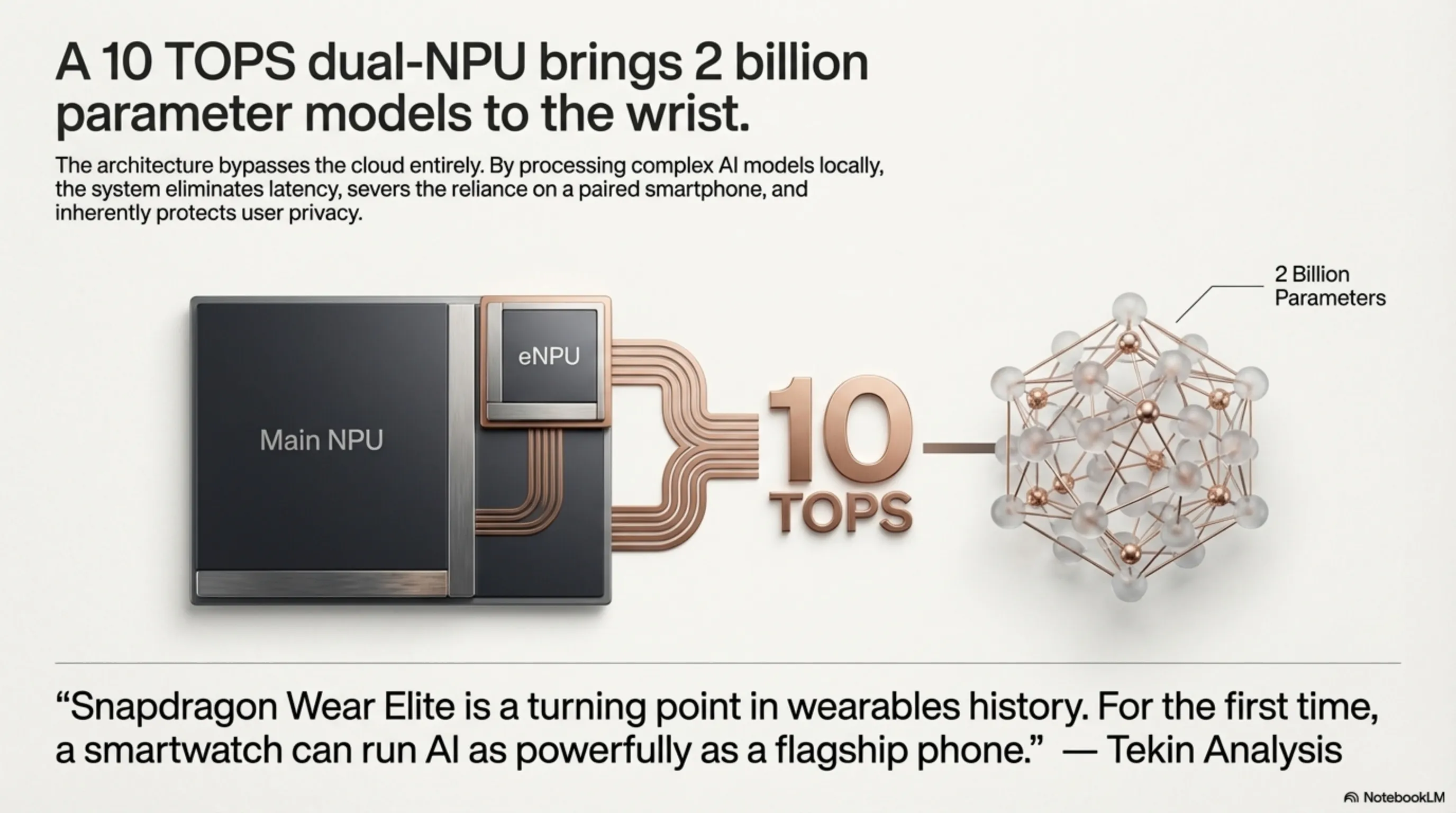
- 4. 10 TOPS Dual NPU (NPU + eNPU): Combines a primary high-compute NPU with an always-on efficient NPU (eNPU) for background sensing, delivering 10 Trillion Operations Per Second to run 2B parameter models.
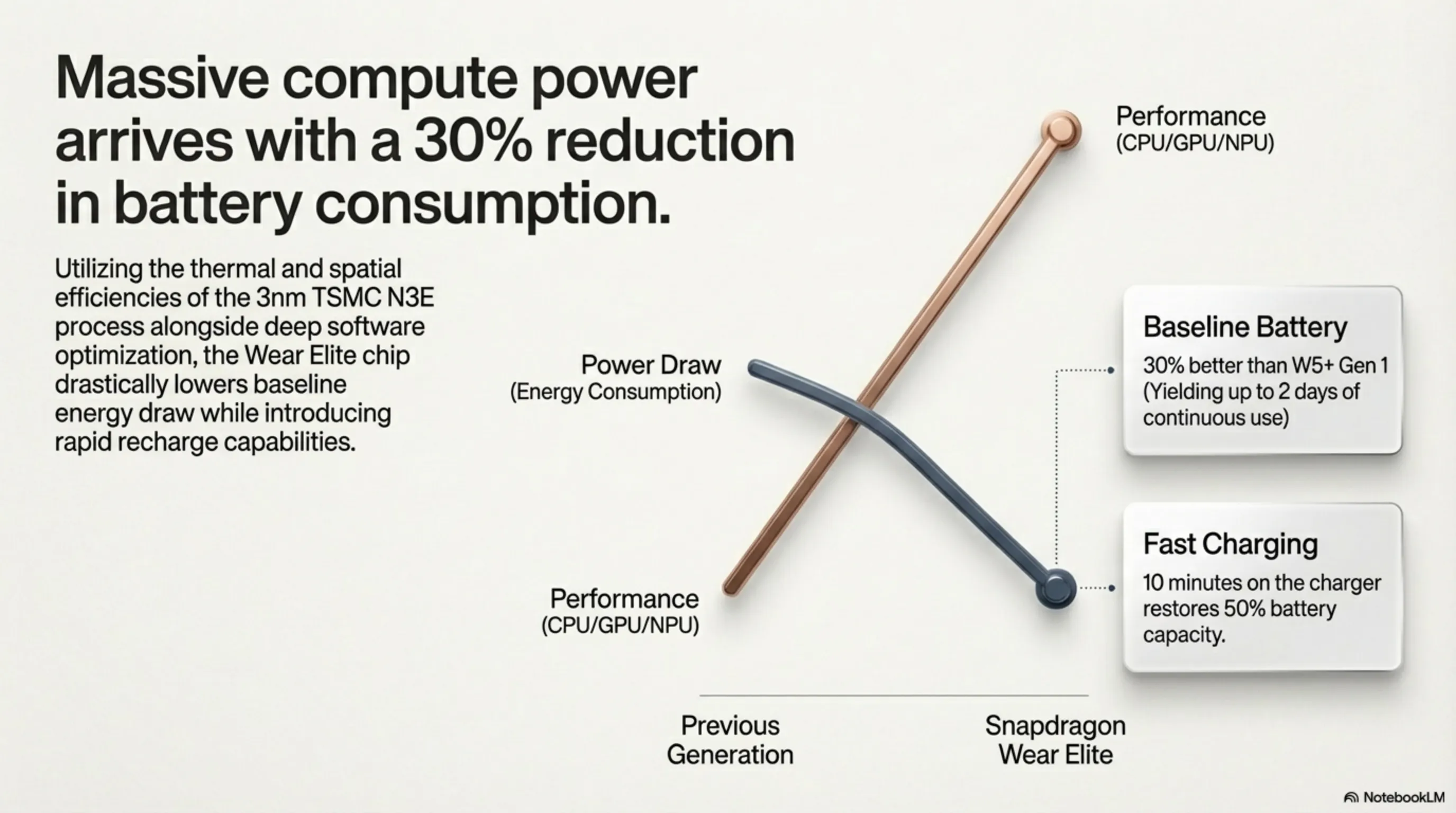
- 5. 30% Better Battery & 10-Minute Fast Charging: Reduces power consumption by 30% while charging from 0% to 50% capacity in just 10 minutes.
Benchmark Bar Chart & Technical Specification Matrix
| Specification | Previous Gen (W5+ Gen 1) | Snapdragon Wear Elite (2026) |
|---|---|---|
| Process Node | 4nm Lithography | 3nm (TSMC N3E) |
| CPU & GPU Performance | 1x Baseline | 5x Faster CPU / 7x Faster GPU |
| Neural Engine (NPU) | None | 10 TOPS (Main NPU + eNPU) |
| Battery & Fast Charging | Baseline (No Fast Charge) | 30% Better + 50% Charge in 10 Mins |
Tekin Technical Jargon Buster
AI Capabilities: What Can It Do?
Packing a 10 TOPS neural engine onto a wristwatch unlocks five transformative local capabilities:
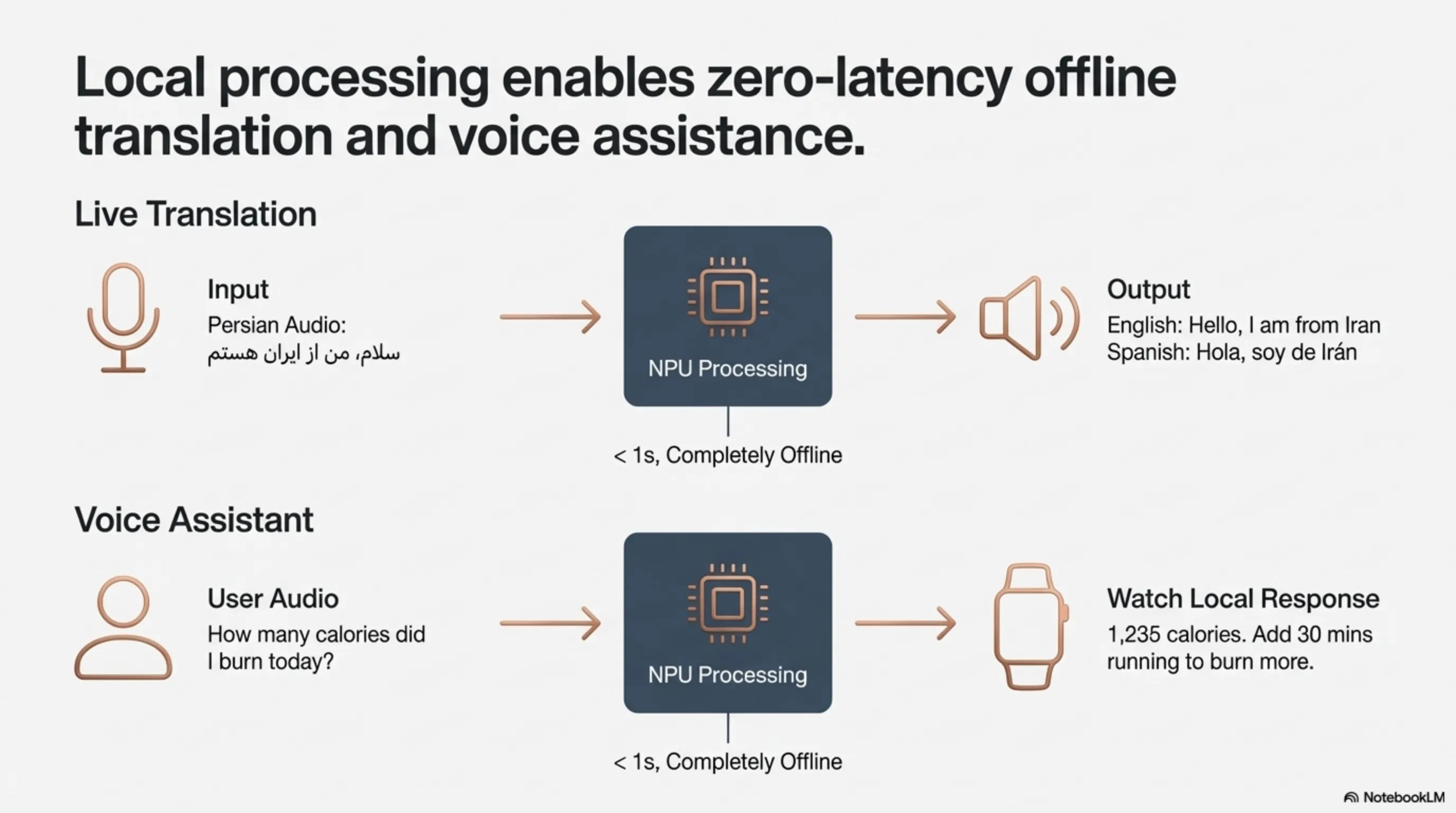
- Local Voice Assistant: Executes a full conversational AI assistant completely offline allowing users to ask complex questions and receive answers without internet access.
- Real-Time Live Translation: Translates spoken conversations on the fly directly on the wrist without requiring a paired smartphone.
- Advanced Clinical Health Analysis: Evaluates sleep stages, detects autonomic stress markers, and predicts early illness symptoms locally and privately.
- Autonomous Context Recognition: Automatically detects whether the user is running, in a business meeting, or driving, adjusting watch behavior accordingly.
- On-Wrist Image Processing: Leverages the 7x faster GPU to enhance photos, apply filters, and perform real-time object recognition.
Live Demo: When Qualcomm Showed What It Can Do
On the MWC Barcelona stage, Qualcomm executed four live hardware demonstrations proving the chip's offline capabilities:
- Demo 1 (Offline Live Translation from Persian): A Qualcomm representative spoke in Persian ("Salām, man az Irān hastam"). Within less than a second and with zero internet connection the watch translated the speech into English ("Hello, I am from Iran") and Spanish ("Hola, soy de Irán").
- Demo 2 (Offline Coaching Voice Assistant): When asked "How many calories did I burn today and how can I burn more?", the watch reported 1,235 calories burned and immediately suggested adding 30 minutes of running or 15 minutes of swimming offline.
- Demo 3 (Advanced Sleep Diagnostics): The watch analyzed 6 hours and 23 minutes of sleep (72% quality with 3 wake events) and advised avoiding screens 30 minutes before bedtime.
- Demo 4 (Zero-Touch Context Switching): The watch automatically engaged exercise tracking when the user began running and switched to recovery mode upon stopping without manual input.
Cybernetic Terminal & Benchmark Telemetry Log
Comparison: Snapdragon Wear Elite vs Competitors
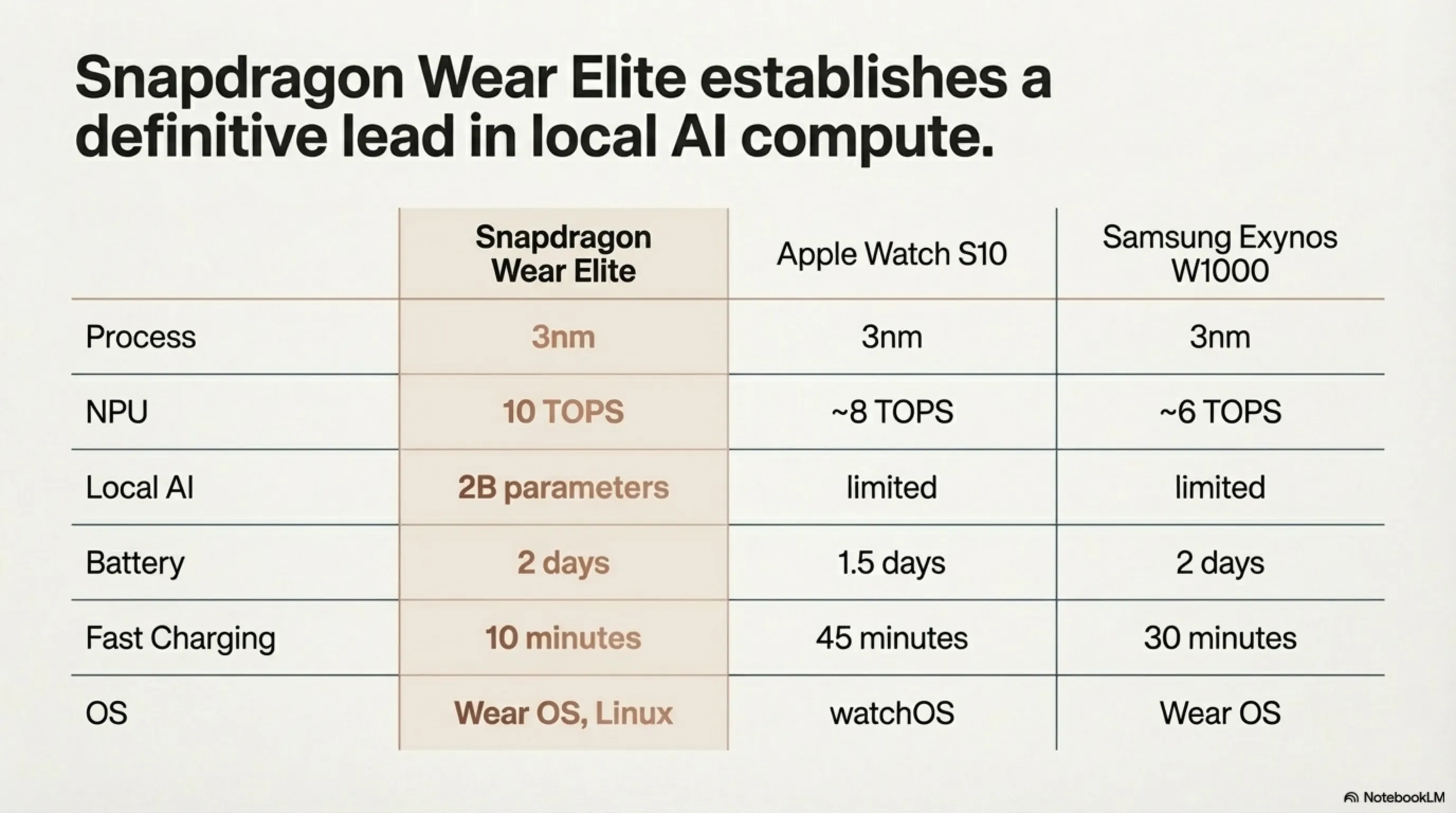
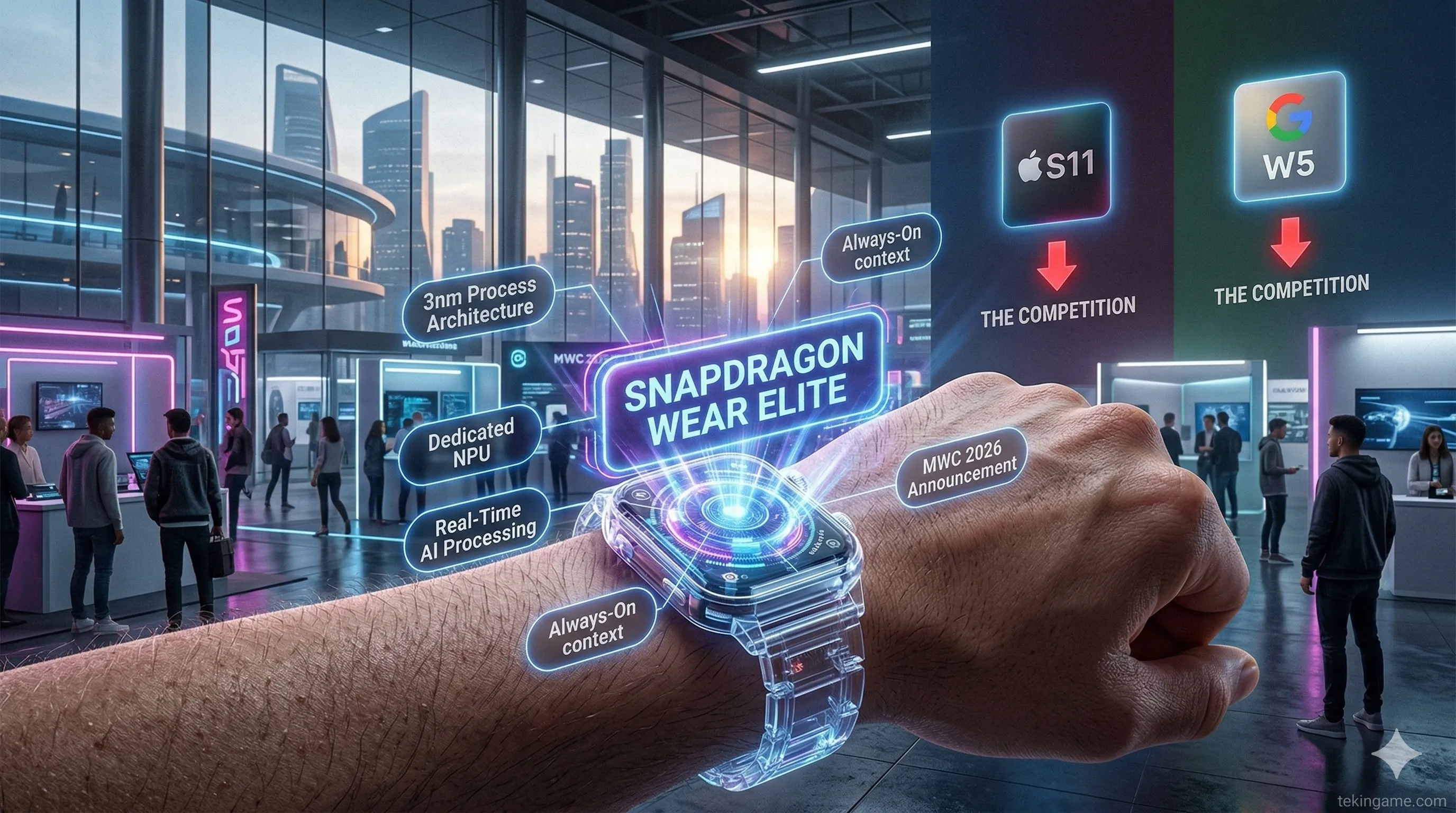
When pitted against the Apple Watch S10 and Samsung Exynos W1000, all three processors utilize a 3nm process node. However, Snapdragon Wear Elite takes a decisive lead in neural compute (10 TOPS vs. ~8 TOPS on Apple S10 and ~6 TOPS on Exynos W1000), local 2B parameter LLM support, and 10-minute fast charging (compared to 45 minutes on Apple Watch and 30 minutes on Samsung), while Apple retains an edge in watchOS software maturity.
5-Axis Pentagon Radar: Multi-Dimensional Hardware Evaluation
Pentagon Radar Analysis: Snapdragon Wear Elite dominates in 10-minute rapid charging, 10 TOPS neural compute, and 2B parameter local model execution across both Wear OS and Linux environments.
Use Cases: Who Will Use This Watch?
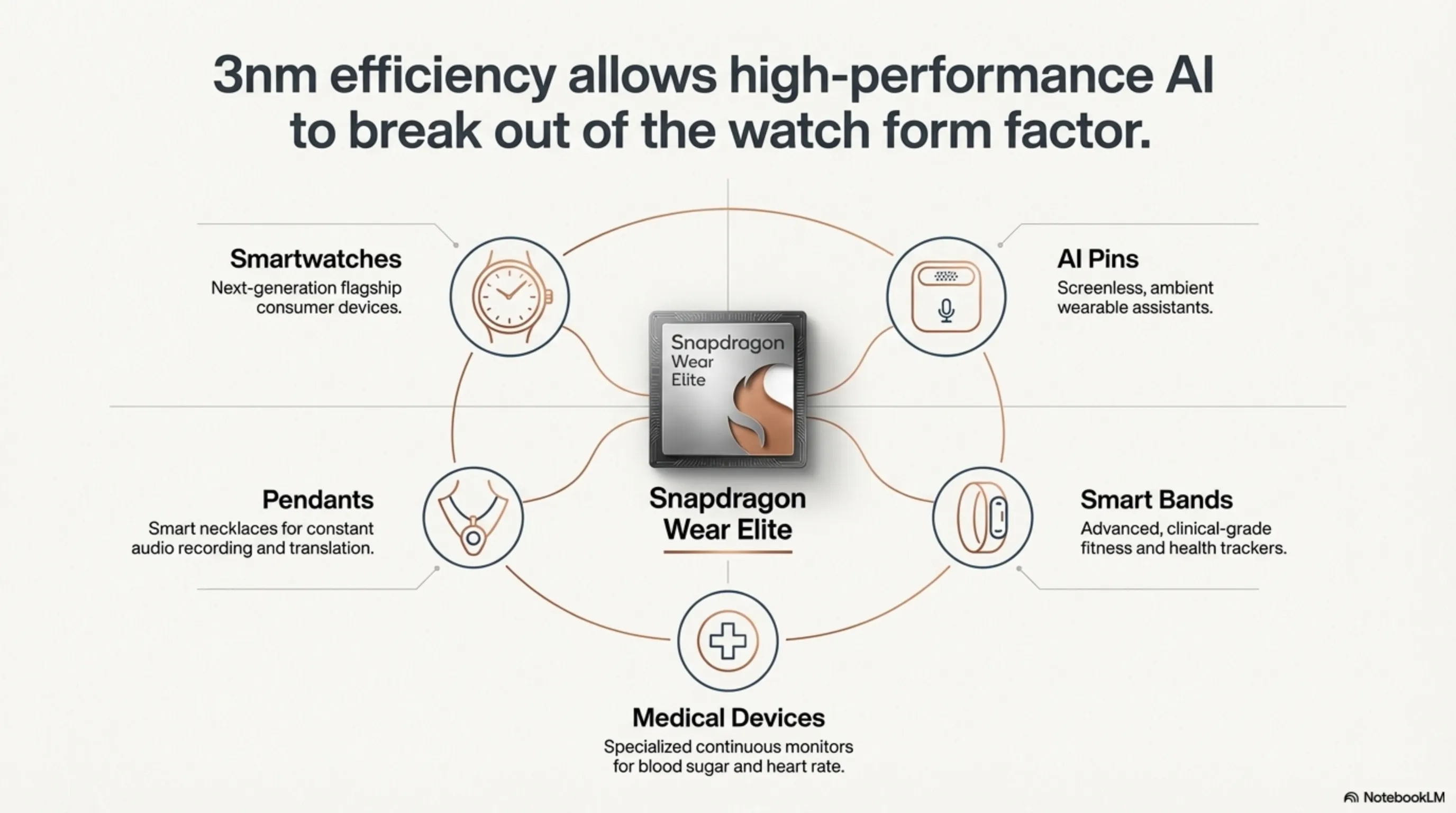
Supporting both Wear OS and Linux, Qualcomm designed Snapdragon Wear Elite across five distinct wearable categories: 1. Next-Gen Smartwatches, 2. AI Pins attached to clothing (such as next-gen Humane AI Pin devices), 3. Smart Pendants (necklaces for ambient recording and translation), 4. Advanced Smart Fitness Bands, and 5. Clinical Medical Devices for continuous blood glucose and cardiac telemetry.
Industry Reaction: Who's Interested?
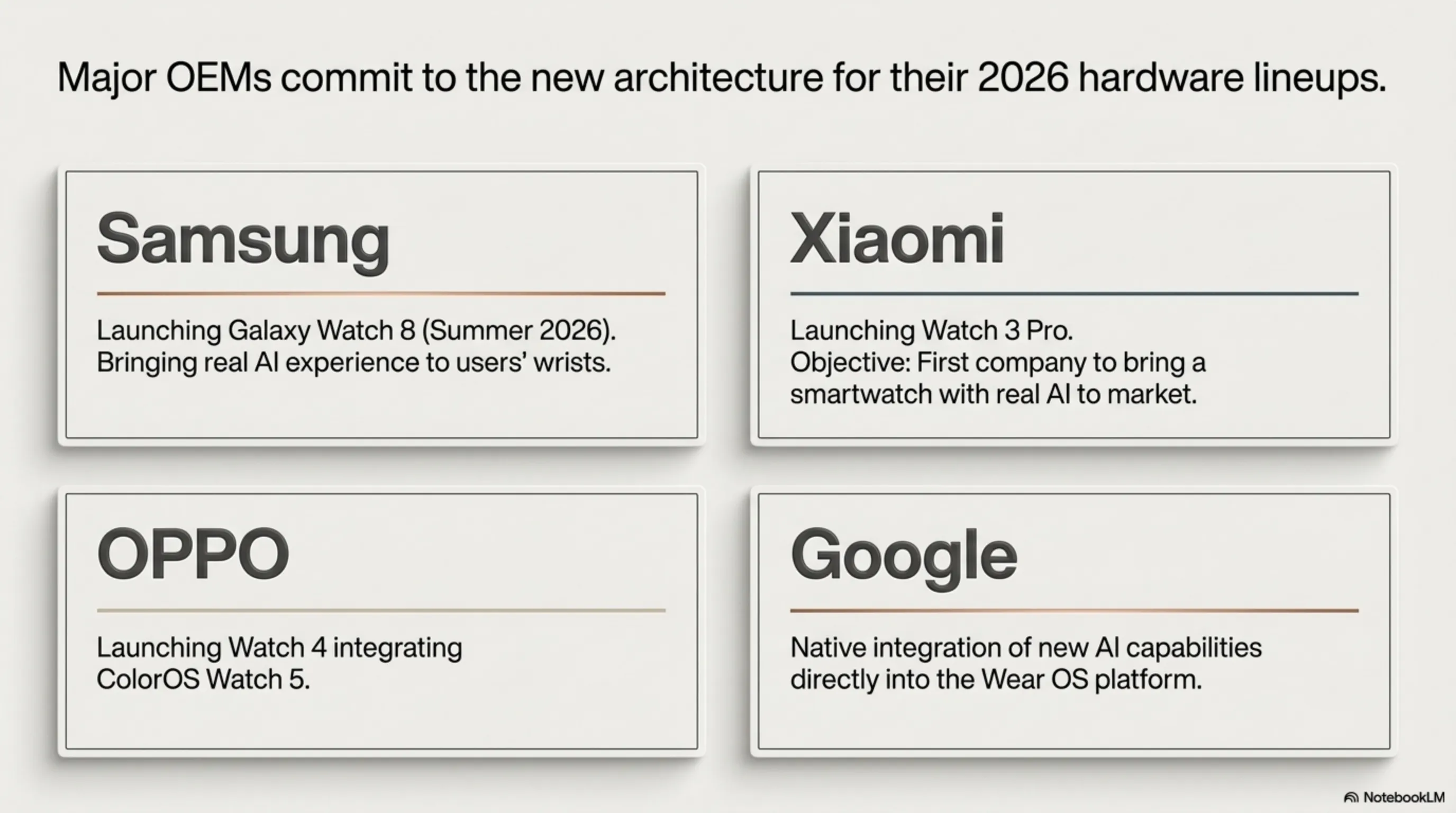
Major hardware OEMs immediately committed to deploying Snapdragon Wear Elite across their 2026 lineups:
- Samsung: Confirmed that the upcoming Galaxy Watch 8 (launching Summer 2026) will be powered by Snapdragon Wear Elite. TM Roh, head of Samsung Mobile, stated the chip brings a true AI experience to users' wrists.
- Xiaomi: Announced the upcoming Xiaomi Watch 3 Pro featuring Snapdragon Wear Elite to pioneer on-wrist generative AI.
- OPPO: Confirmed the OPPO Watch 4 will launch with Snapdragon Wear Elite running ColorOS Watch 5.
- Google: Welcomed the platform to unlock native on-device AI capabilities across future builds of Wear OS.
📚 Classified & Related Dossiers in TekinGame
If you wish to explore beyond this report and delve into cybernetic frontiers and autonomous AI architectures, do not miss these three exclusive deep-dives in the Tekin Garage:
Market Telemetry Dashboard: Wearable Segment Share & NPU Trajectory
| Wearable Segment | Ecosystem Share | Confirmed OEMs & Target Devices |
|---|---|---|
| Flagship AI Smartwatches | 60% | Samsung Galaxy Watch 8, Xiaomi Watch 3 Pro, OPPO Watch 4 |
| Medical & Smart Bands | 25% | Continuous Blood Glucose, ECG & Sleep Apnea Monitors |
| AI Pins & Smart Pendants | 15% | Clip-On AI Assistants, Smart Necklaces & AR Audio Gear |
Challenges: What Problems Exist?
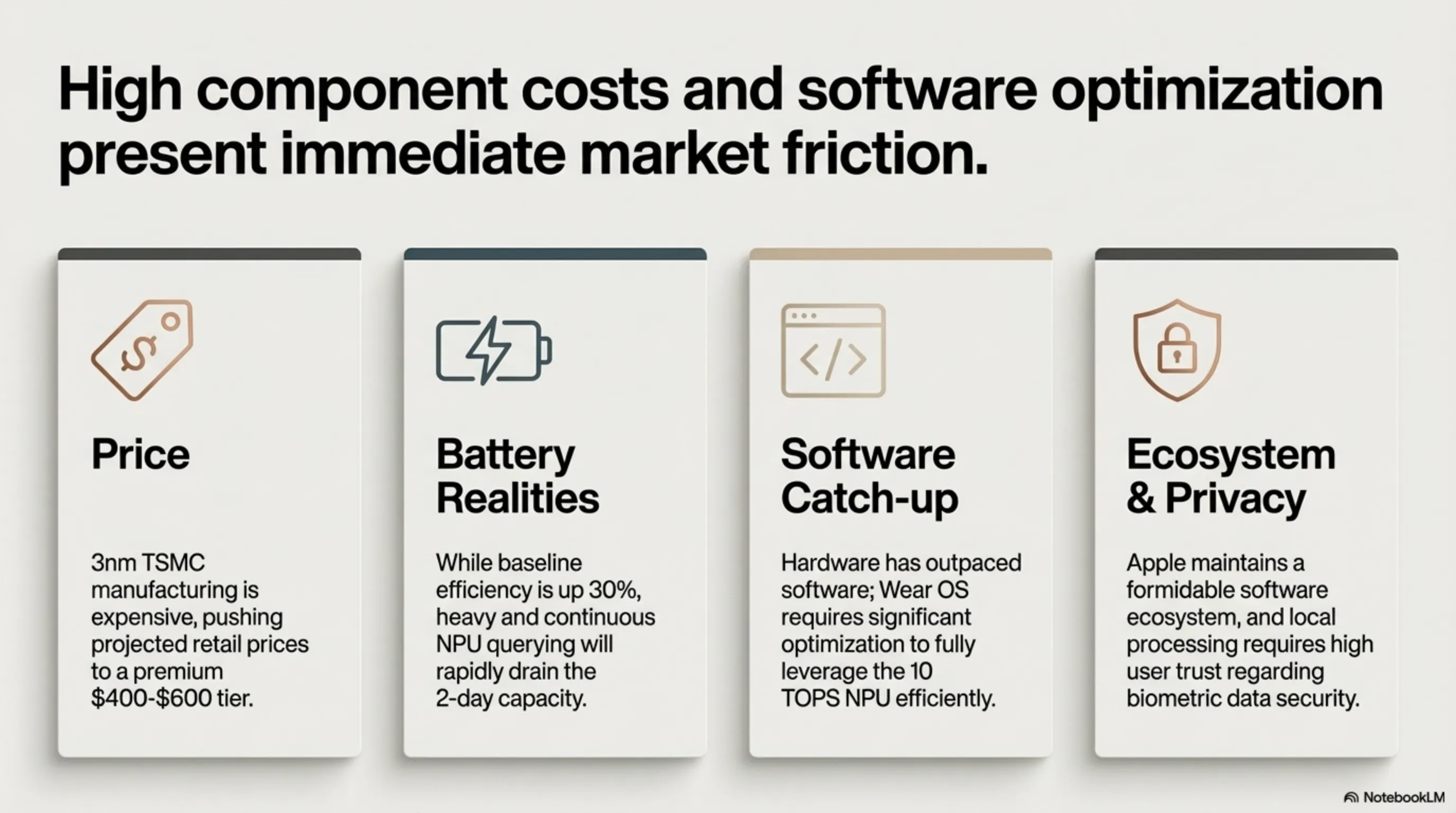
Despite its architectural brilliance, Snapdragon Wear Elite faces five practical hurdles: 1. High Retail Price: Expensive 3nm wafers could push flagship smartwatches into the $400–$600 price bracket. 2. Heavy AI Battery Drain: Continuous 2B parameter LLM inference will tax tiny watch batteries despite the 30% efficiency gain. 3. Wear OS Optimization: Google's OS must evolve rapidly to utilize the 10 TOPS NPU. 4. Apple's Ecosystem Moat: Competing against watchOS integration remains tough. 5. Biometric Privacy Trust: Assuring users that always-listening health and voice data stays strictly local.
Risk & Engineering Challenge Assessment Matrix
| Technical / Market Challenge Vector | Risk Level | Qualcomm & OEM Mitigation Strategy |
|---|---|---|
| 3nm Silicon Cost Pushing Watch Prices to $400–$600 | HIGH COMMERCIAL | Positioning Wear Elite in flagship Pro/Ultra tiers across Samsung, Xiaomi, and OPPO. |
| Battery Drain Under Continuous 2B LLM Inference | MODERATE RISK | Offloading background tasks to the low-power eNPU paired with 10-minute 50% fast charging. |
| Biometric Health & Always-On Voice Privacy | SECURE / LOCAL | 100% air-gapped on-device NPU processing with zero cloud transmission required. |
The Future: What to Expect?
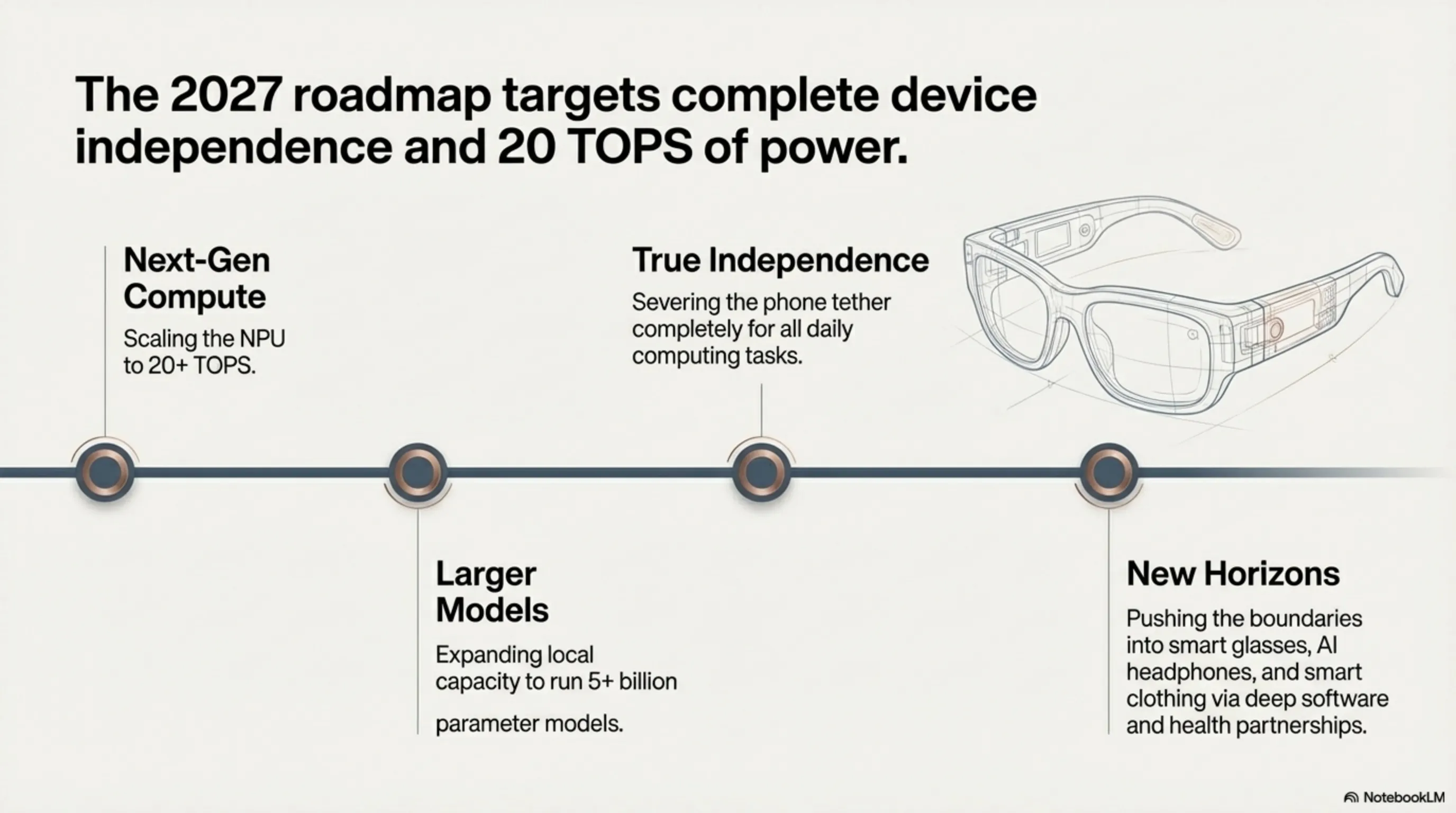
Qualcomm views Snapdragon Wear Elite as the foundation for a broader wearable roadmap: the 2027 successor is projected to reach 20+ TOPS NPU performance, run 5-billion-parameter AI models locally, achieve full standalone independence from smartphones, and expand into smart glasses, AI headphones, and smart clothing.
Event Timeline | Qualcomm Wearable Silicon Evolution
| Date / Era | Silicon Milestone | Key Architectural Capabilities |
|---|---|---|
| 2022–2025 | Snapdragon W5+ Gen 1 Era | 4nm process node with zero dedicated NPU, reliant on smartphone and cloud tethering. |
| Mar 2, 2026 | Snapdragon Wear Elite Unveiled at MWC | 3nm TSMC N3E, 10 TOPS dual NPU, 2B local AI models, 5x CPU, 7x GPU, 10-min fast charge. |
| Summer 2026 | Commercial OEM Flagship Wave | Samsung Galaxy Watch 8, Xiaomi Watch 3 Pro, and OPPO Watch 4 hit global retail. |
| 2027 Roadmap | Next-Gen Snapdragon Wear | 20+ TOPS NPU target, 5B parameter models, smart glasses, and full phone independence. |
Smartphone Comparison: Will Watch Replace Phone?
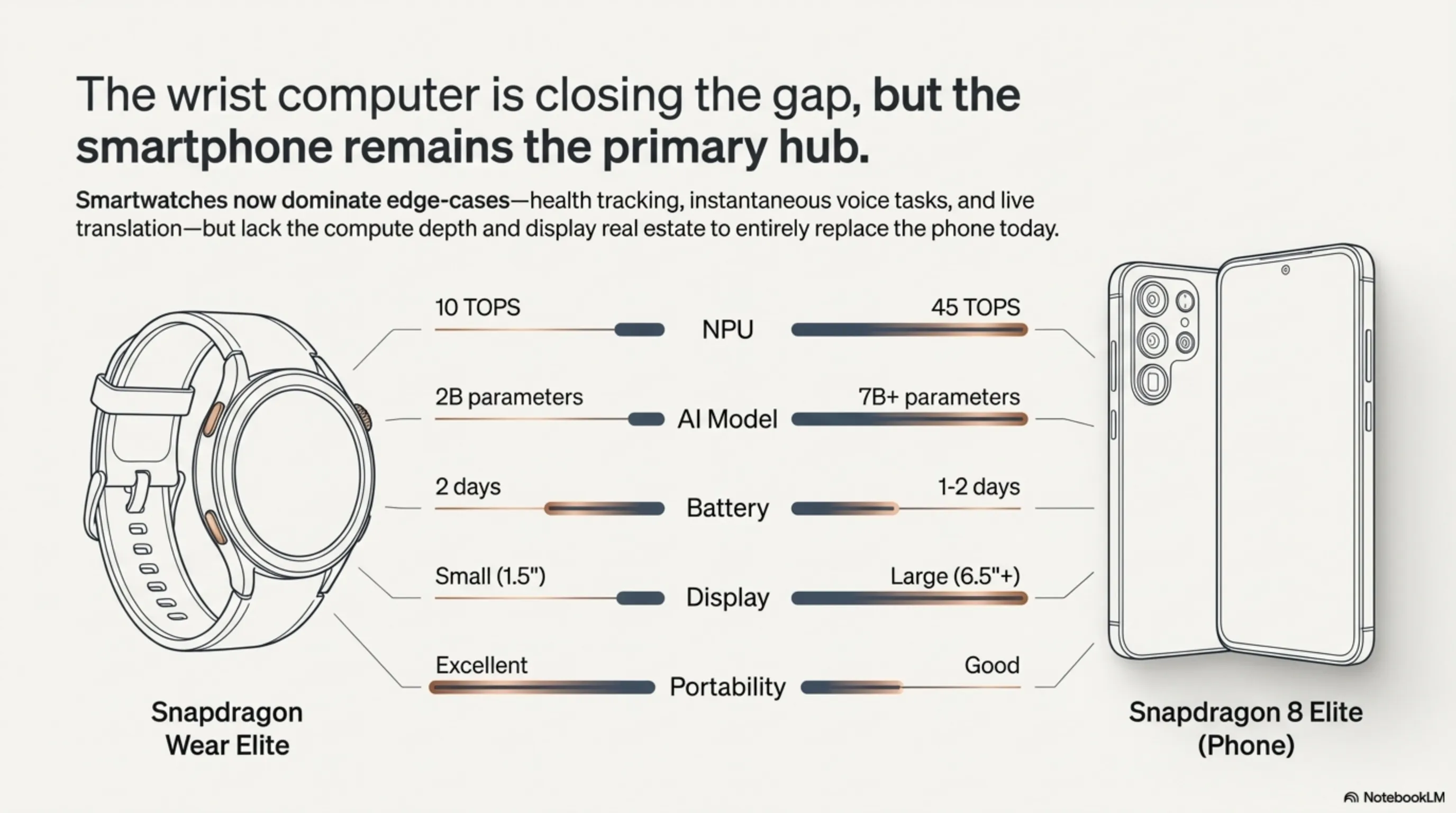
Can Snapdragon Wear Elite replace your smartphone today? Not entirely a flagship phone running Snapdragon 8 Elite still commands a 45 TOPS NPU, 7B+ parameter AI models, and a 6.5-inch+ display compared to the watch's 10 TOPS NPU, 2B parameter models, and 1.5-inch screen. However, with a 2-day battery life and superior wrist portability, the watch is already faster and more convenient than pulling out a phone for live translation, health telemetry, and quick voice queries.
Technical Fact-Check | Wearable Myth vs. Engineering Reality
Critics often assume smartwatch AI features are merely Bluetooth relays that send voice queries to a paired phone or cloud server.
At MWC Barcelona, Snapdragon Wear Elite executed sub-second Persian-to-English/Spanish live translation and sleep diagnostics in airplane mode directly on its 10 TOPS NPU.
Market Sentiment Thermometer | Circular Gauge & S-Curve Adoption
Market Thermometer Analysis: Simultaneous adoption by Samsung, Xiaomi, OPPO, and Google signals that wearable computing has decisively crossed the inflection point from passive fitness tracking to autonomous on-wrist AI.
Conclusion
Snapdragon Wear Elite marks a defining inflection point in wearable history. By uniting a 3nm process node, a 10 TOPS dual NPU capable of running 2-billion-parameter AI models offline, a 5x faster CPU, a 7x faster GPU, and 10-minute fast charging, Qualcomm has built the undisputed performance king of smartwatch silicon. While $400–$600 retail pricing and Wear OS optimization remain key hurdles, commitments from Samsung, Xiaomi, and OPPO prove the era of the wrist-worn AI computer has officially arrived.
- First 3nm smartwatch SoC armed with a dedicated 10 TOPS dual NPU (NPU + eNPU).
- Executes 2-billion-parameter AI models and live translation 100% locally offline.
- Delivers a massive 5x CPU speed jump and 7x GPU graphics leap over W5+ Gen 1.
- 30% improved battery efficiency (2-day life) paired with 10-minute 0-to-50% fast charging.
- Expensive 3nm wafers will likely push flagship smartwatch prices to $400–$600.
- Heavy continuous on-device AI inference can still accelerate battery drain.
- Requires deep Wear OS software optimization to rival Apple watchOS ecosystem maturity.
Final Editorial Verdict & Official Reference Sources
The Undisputed King of On-Wrist Neural Compute
Snapdragon Wear Elite transforms smartwatches from passive smartphone notification mirrors into standalone, offline 2B-parameter AI computers.
Frequently Asked Questions & Technical Analysis
When was Snapdragon Wear Elite unveiled and what is its standout feature?
Qualcomm unveiled Snapdragon Wear Elite on March 2, 2026 at MWC Barcelona. It is the first 3nm smartwatch processor featuring a 10 TOPS dual NPU capable of running 2-billion-parameter AI models locally offline.
Does Snapdragon Wear Elite require an internet or phone connection for AI tasks?
No, all AI tasks including real-time voice translation across languages like Persian, English, and Spanish, voice assistant queries, and sleep diagnostics run 100% locally on the watch without internet or cloud access.
How much faster is Snapdragon Wear Elite compared to the previous generation?
Built on TSMC 3nm (N3E) lithography, it delivers a 5x faster CPU, a 7x faster GPU, 30% better battery efficiency, and 10-minute fast charging (0% to 50%) compared to the 4nm Snapdragon W5+ Gen 1.
How does Snapdragon Wear Elite compare to Apple Watch S10 and Samsung Exynos W1000?
While all three chips use a 3nm process, Snapdragon Wear Elite leads in neural compute (10 TOPS vs. ~8 TOPS on Apple S10 and ~6 TOPS on Exynos W1000) and charging speed (10 minutes vs. 45 minutes on Apple Watch).
Which smartwatch brands will use Snapdragon Wear Elite in 2026?
Samsung (for the Galaxy Watch 8 launching Summer 2026), Xiaomi (Watch 3 Pro), and OPPO (Watch 4) have officially confirmed they will use the chip, alongside Google optimizing Wear OS for its NPU.
How much will smartwatches powered by Snapdragon Wear Elite cost?
Due to the high fabrication cost of 3nm wafers and dual NPU silicon, flagship smartwatches equipped with Snapdragon Wear Elite are projected to retail between $400 and $600.
Additional Gallery: Snapdragon Wear Elite: When Your Smartwatch Runs 2 Billion Parameter AI Models