Tekin Analysis | Sam Altman vs. PC Gamers: Why the Cloud Monopolies Fear Your Desktop RAM
In the closing months of 2026, the technology landscape was shaken by one of the most provocative and fiercely contested statements in modern computing history. Sam Altman, the chief executive officer of OpenAI, appeared on the prominent technology podcast Cheeky Pint hosted by Stripe co-founder John Collison. During an expansive discussion on planetary infrastructure constraints, power grids, and artificial intelligence compute bottlenecks, Altman made an assertion that immediately triggered outrage across the global gaming community, open-source software developers, hardware enthusiasts, and digital civil liberties advocates.
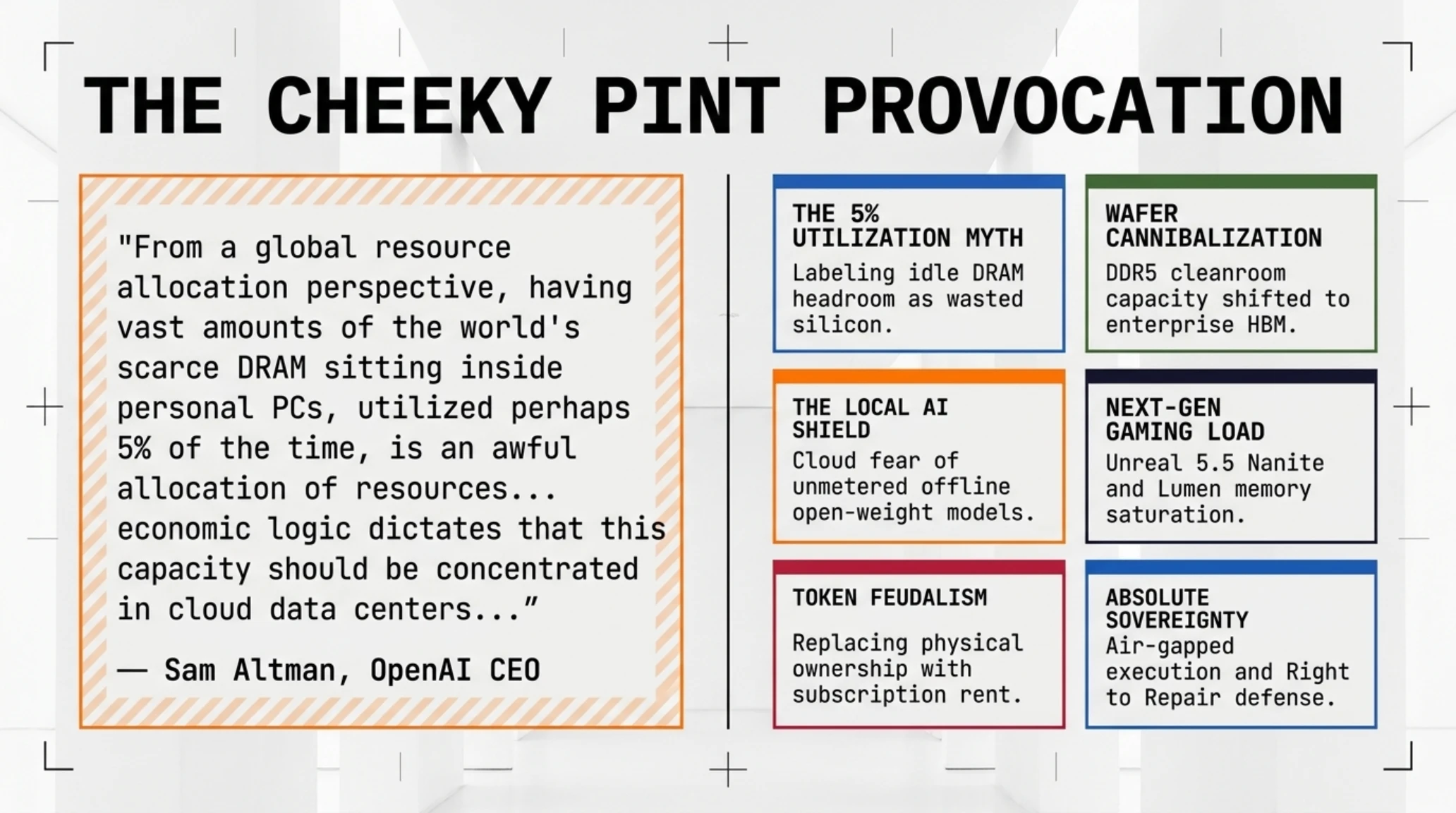
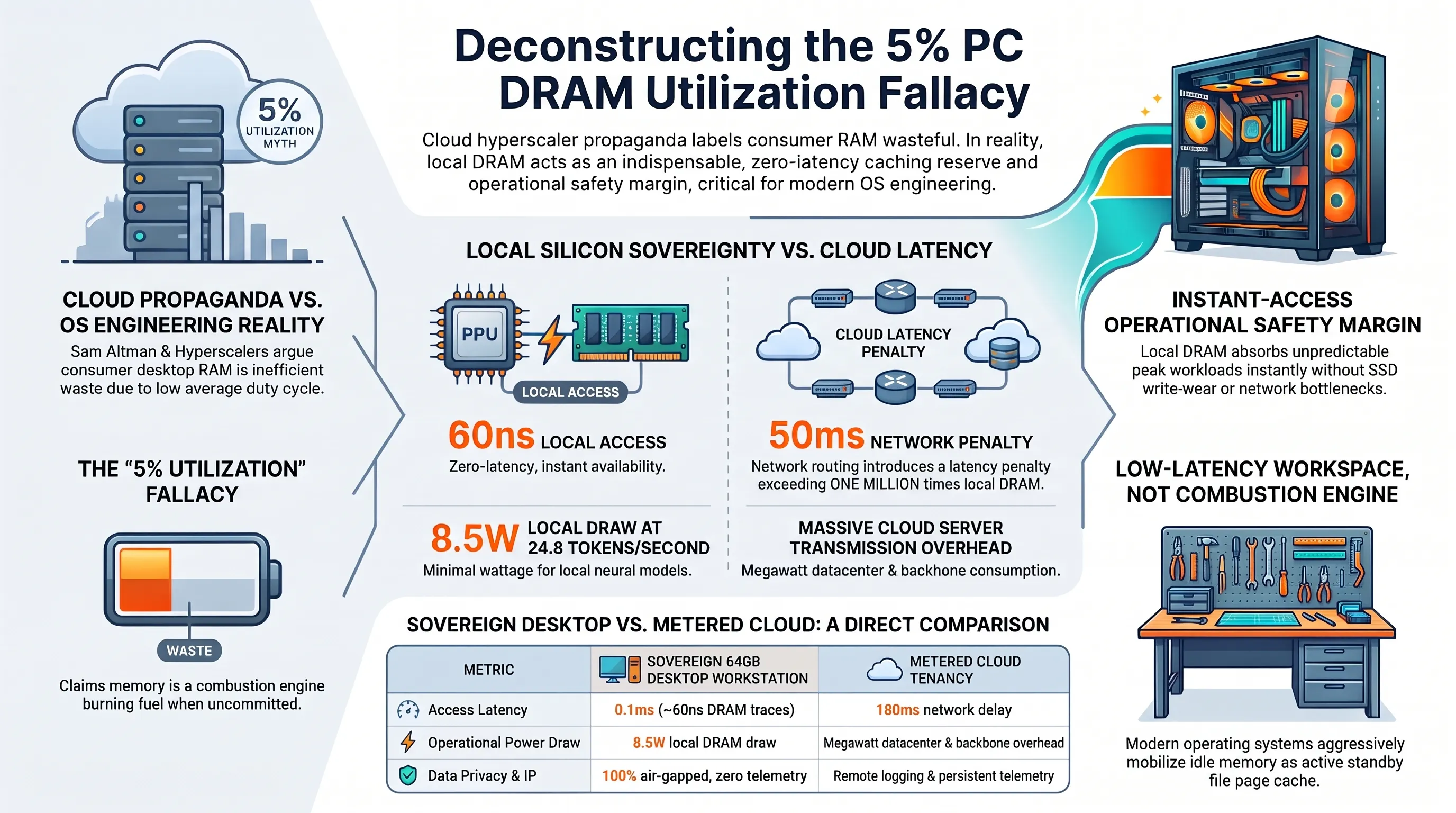
Altman argued that the current distribution of silicon resources across the globe is profoundly irrational: "From a global resource allocation perspective, having vast amounts of the world's scarce DRAM sitting inside personal PCs, utilized perhaps 5% of the time, is an awful allocation of resources. In an environment of severe supply constraints, economic logic dictates that this capacity should be concentrated in cloud data centers where it achieves 100% duty cycle utilization; but human intuition about property and computers runs directly counter to this mathematical reality."
This provocative declaration cannot be dismissed as casual podcast banter or an offhand thought experiment. Coming from the chief executive of an organization consuming tens of billions of dollars in venture capital, commanding colossal allocations of high-bandwidth memory (HBM) from global foundries, and aggressively lobbying governments for trilateral public-private infrastructure investments, the statement reflects an ideological battleground. At its core, the proposition seeks to dismantle the hard-won paradigm of personal computing and hardware sovereignty that has defined digital empowerment since the late 1970s, replacing individual ownership with a centralized, subscription-gated paradigm where compute is metered, monitored, and leased back to the population on a pay-per-token basis.
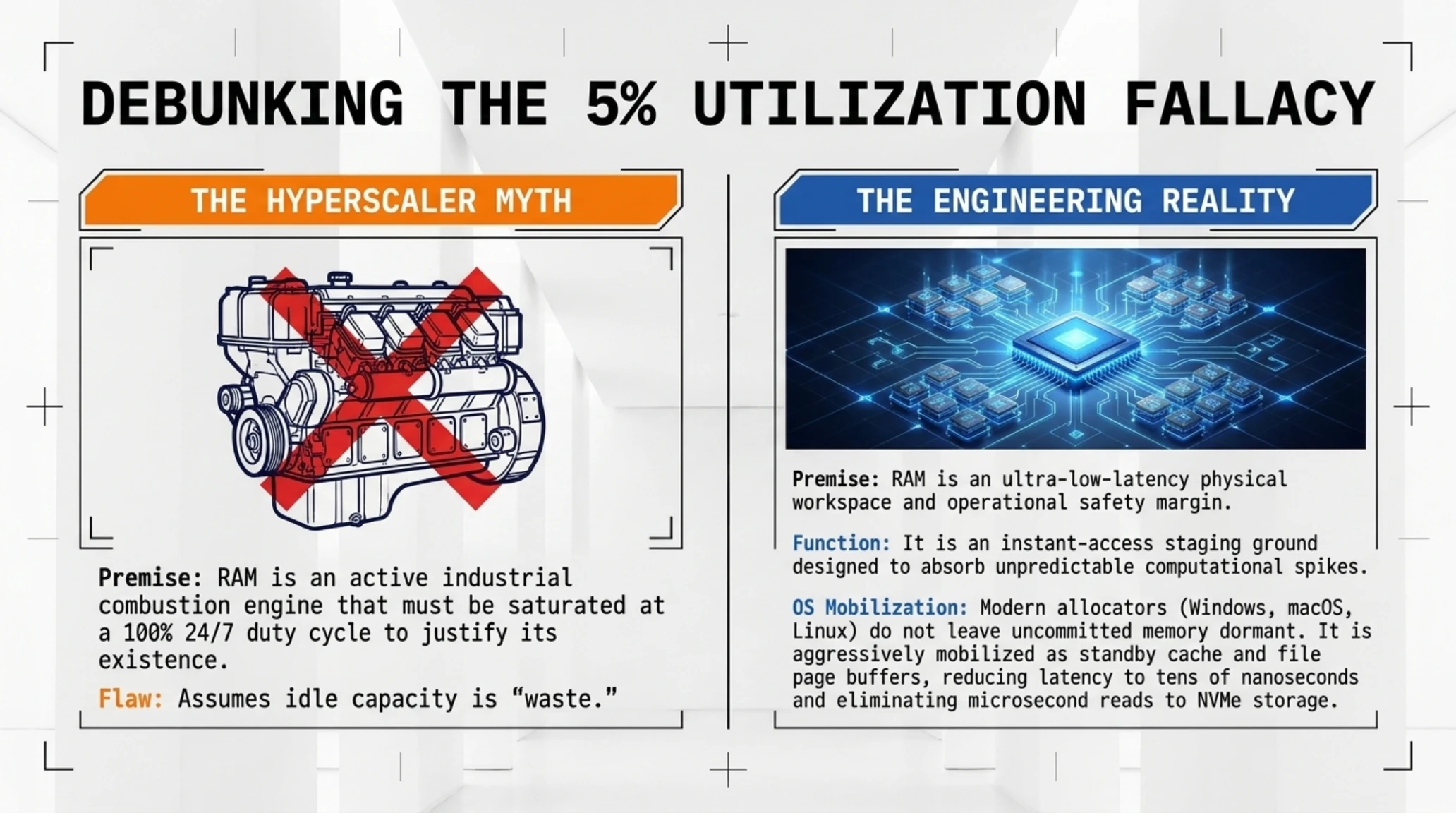
The fundamental flaw in Altman's argument lies in a catastrophic misunderstanding or deliberate misrepresentation of what random-access memory actually is and why it exists inside an architecture of personal freedom. Computer memory is not an active compute engine that burns fuel or generates waste when not running at 100% capacity; it is an ultra-low-latency physical workspace, a staging ground for human thought, and a buffer that decouples the user's immediate operational responsiveness from sluggish secondary storage and erratic network pipelines. To measure the value of a user's system memory strictly through the lens of continuous, 24/7 industrial duty cycle utilization is equivalent to arguing that personal residential living space is an inefficient use of architectural materials because bedrooms are only occupied for eight hours every night, or that city roads should be eliminated because private automobiles remain parked outside homes for 95% of their operational lifespan.
The Cheeky Pint Provocation: Deconstructing the "5% Utilization" Fallacy
The reality is that personal random-access memory provides an invaluable utility precisely because it stands ready to absorb instant, unpredictable computational spikes without latency, without remote telemetry, and without dependence on external infrastructure. When an architect opens a multi-gigabyte Building Information Modeling (BIM) project, when a sound engineer layers eighty uncompressed audio tracks in a digital audio workstation, when a 3D artist bakes complex lighting simulations in Blender, or when an enthusiast boots an unconstrained open-weight neural network locally, that memory transforms from an idle state to a saturated, high-throughput pipeline within milliseconds. Demanding that this capacity be surrendered to centralized server farms fundamentally denies the sovereign nature of individual creativity, reducing the personal computer to a hollow thin-client terminal entirely beholden to the whims, pricing tiers, and algorithmic censorship of hyperscaler gatekeepers.
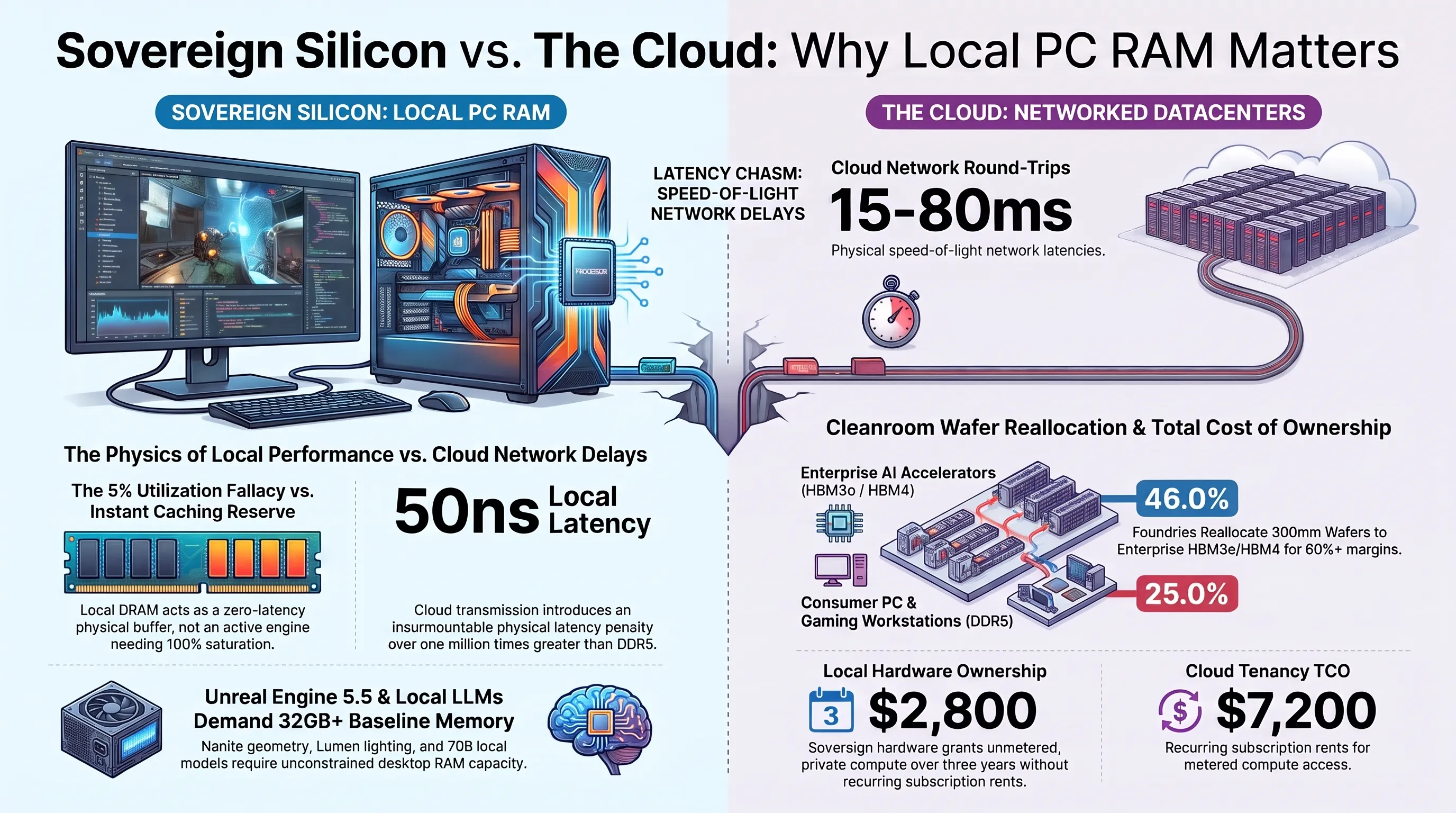
To understand the structural fallacy of the 5% utilization argument, one must examine how modern operating systems manage DRAM. Under modern memory allocators in Windows, macOS, and Linux, memory that is not actively committed by foreground applications is not sitting dormant; it is aggressively mobilized as standby cache and file page buffers. By caching frequently referenced operating system binaries, shared libraries, and user assets directly in DRAM, the system eliminates millions of slow read operations to secondary NVMe storage, reducing latency from microseconds to tens of nanoseconds. Calling this standby reserve 'wasteful' betrays a profound disregard for the fundamental design principles of high-performance operating system engineering.
The Thermodynamics of Memory: Latency vs. Throughput in Sovereign Computing
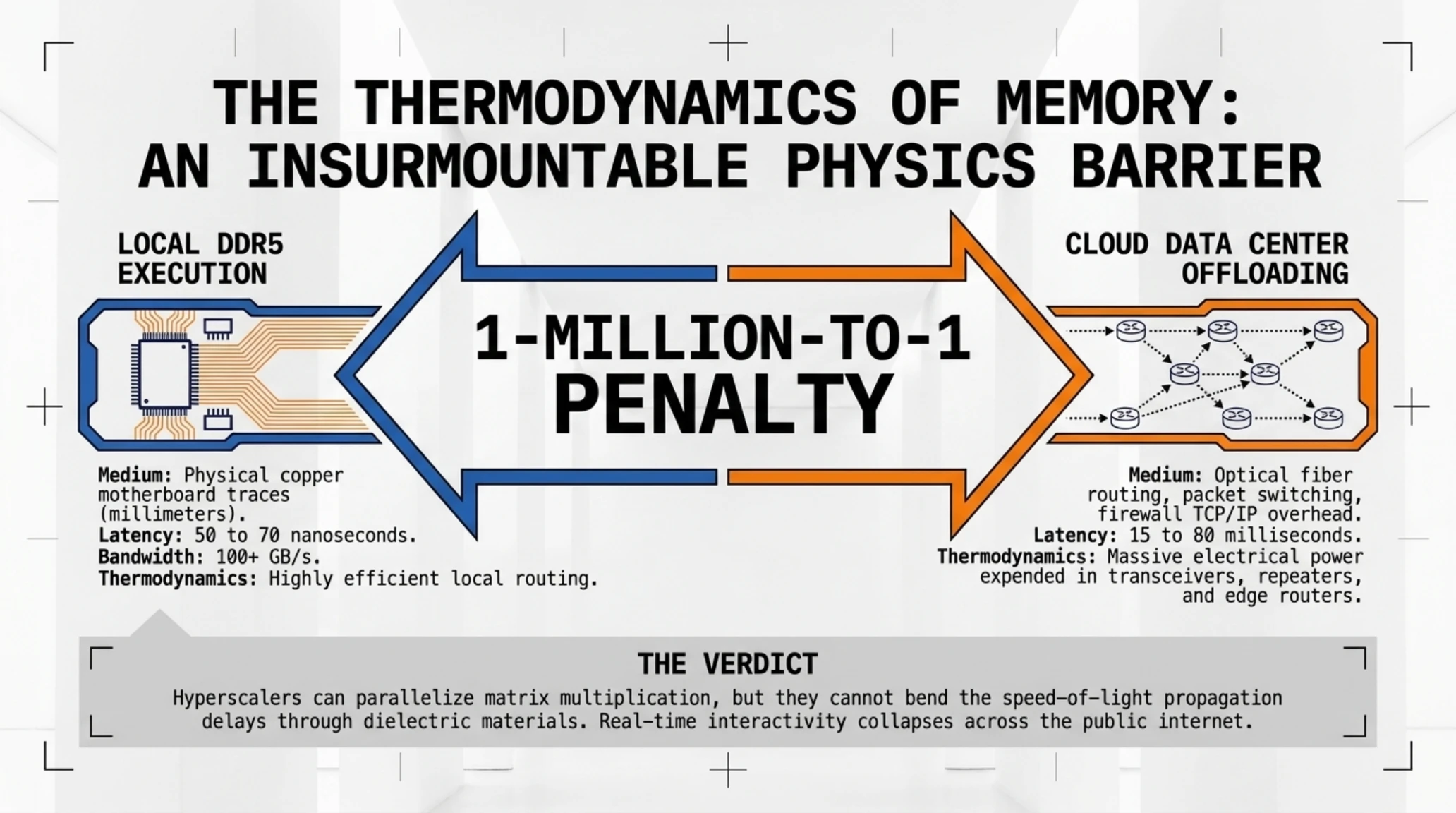
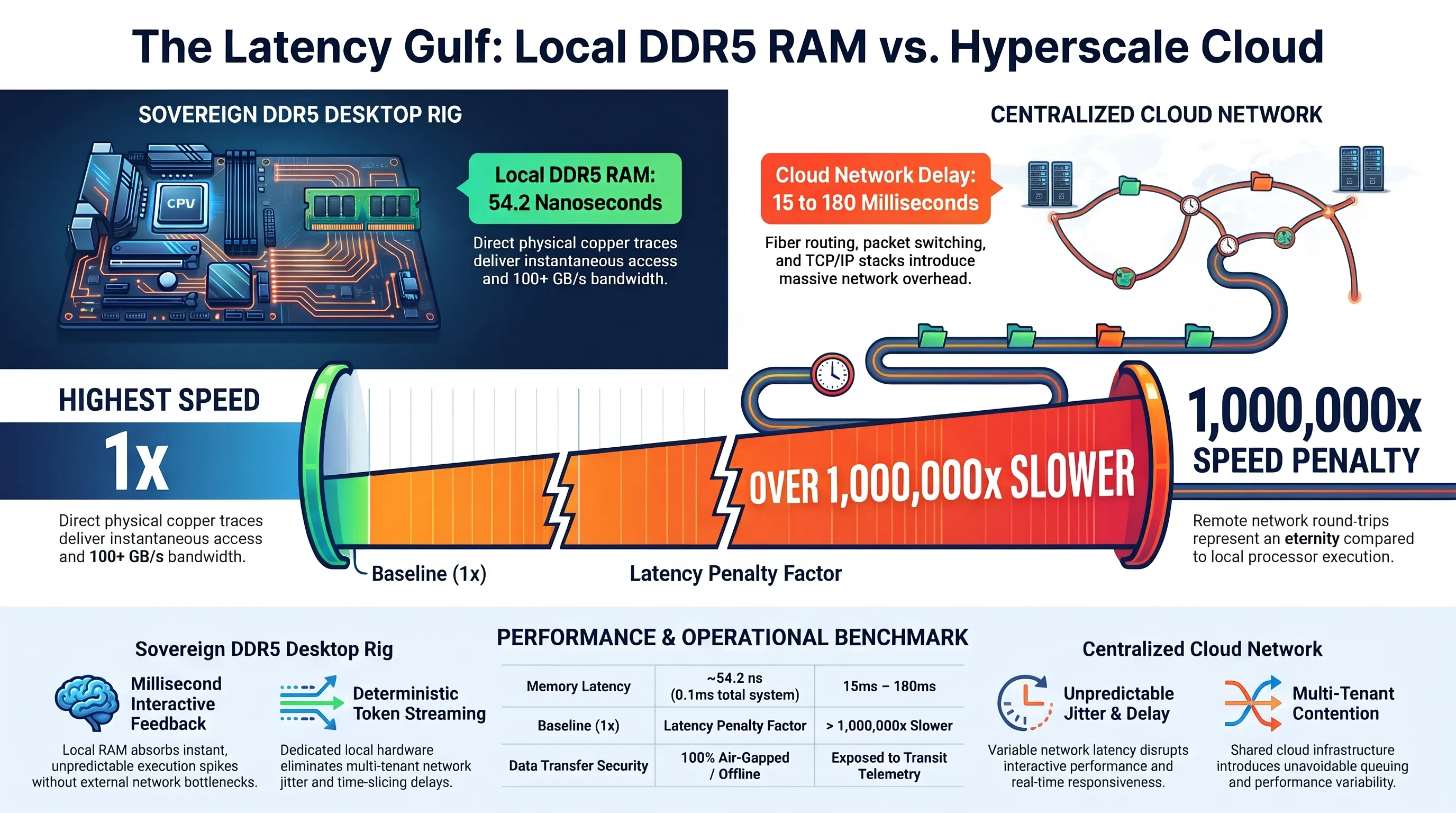
To fully grasp why centralized cloud memory can never replace local DRAM, one must examine the fundamental physical constraints governing digital electronics: speed-of-light propagation delays, bus interconnect bandwidth, and interface serialization latency. High-end DDR5 memory modules installed directly on a desktop motherboard deliver memory access latencies between 50 and 70 nanoseconds, transferring data across physical copper traces measured in millimeters at sustained bandwidths exceeding 100 gigabytes per second. In stark contrast, attempting to offload memory state to a centralized hyperscale data center introduces network transmission latencies governed by optical fiber routing, packet switching, firewall inspection, and TCP/IP stack overhead penalties that inevitably measure between 15 and 80 milliseconds. In the nanosecond domain of digital processor execution, a 50-millisecond network round-trip represents an eternity: a latency penalty factor of more than one million times.
This insurmountable physics barrier invalidates the proposition that cloud pooling can seamlessly substitute for local memory. Any workload demanding real-time interactivity, instant deterministic feedback, or frame-by-frame physics synchronization instantly collapses when forced across the public internet. Hyperscalers can optimize batch processing throughput and parallelize massive matrix multiplication across tens of thousands of distributed accelerator nodes, but they cannot bend the laws of electromagnetic wave propagation through dielectric materials. The personal computer remains an unmatched fortress of low-latency computation precisely because physical proximity between the processor and its working memory is irreplaceable.
Furthermore, the thermodynamic reality of modern computing exposes the hidden environmental and infrastructural costs of centralized cloud architectures. Transmitting petabytes of raw uncompressed state data across telecommunications backbones to remote server facilities expends massive quantities of electrical power in transceivers, repeaters, and edge routing equipment. Processing data locally within sovereign silicon situated inches from the user consumes a fraction of the aggregate joules required to negotiate encrypted cloud connections, transmit telemetry, stream compressed video frames, and maintain stateful web sessions. The narrative that hyperscale centralization represents an ecologically superior model collapses under rigorous thermodynamic lifecycle analysis.
STRATEGIC INTELLIGENCE // 6 CORE VECTORS OF THE SILICON WAR
Beyond physical latency and thermodynamic efficiency, memory architecture dictates who exercises administrative sovereignty over the computational medium. Local DRAM retains user data within volatile electrical charges that instantly vanish upon system de-energization. It does not generate persistent server-side telemetry, does not log user prompts into remote training corpuses, and does not expose proprietary source code, artistic drafts, or sensitive medical queries to third-party sub-processors or automated content moderation filters. By framing local memory as a wasteful luxury that should be expropriated for the collective cloud, hyperscalers are laying the ideological groundwork for a regime of absolute information asymmetry a world where the tools of creative and analytical power are locked behind proprietary API gateways.
The geopolitical dimension of semiconductor manufacturing adds another critical layer to this unfolding conflict. The advanced extreme ultraviolet (EUV) lithography scanners manufactured by ASML, the ultra-pure silicon ingots grown in Japan and Germany, and the high-precision wafer fabrication facilities operated in Taiwan and South Korea represent the most complex, capital-intensive industrial supply chain in human history. Every square millimeter of cleanroom real estate allocated to stacking high-bandwidth memory for multi-billion-dollar enterprise accelerators is a square millimeter stripped away from standard dual-data-rate modules destined for retail shelves and consumer motherboards. The tension between enterprise AI data centers and consumer personal computing is not a theoretical debate; it is an active physical struggle over the allocation of the world's most sophisticated crystalline silicon.
The Local AI Revolution: Breaking the Chains of Hyperscaler Token Tenancy
The true existential anxiety haunting the executive suites of artificial intelligence hyperscalers is not that consumer PC RAM is sitting idle; rather, it is that consumer PC RAM is rapidly waking up to become their most formidable competitive adversary. Over the past twenty-four months, an unprecedented renaissance in algorithmic optimization, low-bit quantization, and open-weight model architectures has systematically shattered the narrative that state-of-the-art artificial intelligence can only exist behind the fortified walls of multi-billion-dollar cloud server clusters. Breakthrough software engines like llama.cpp, Ollama, vLLM, and LM Studio, paired with sophisticated quantization methodologies such as GGUF, AWQ, and EXL2, have made it entirely practical to execute frontier-grade language models on consumer-grade desktop hardware equipped with 32, 64, or 128 gigabytes of standard DDR5 system memory.
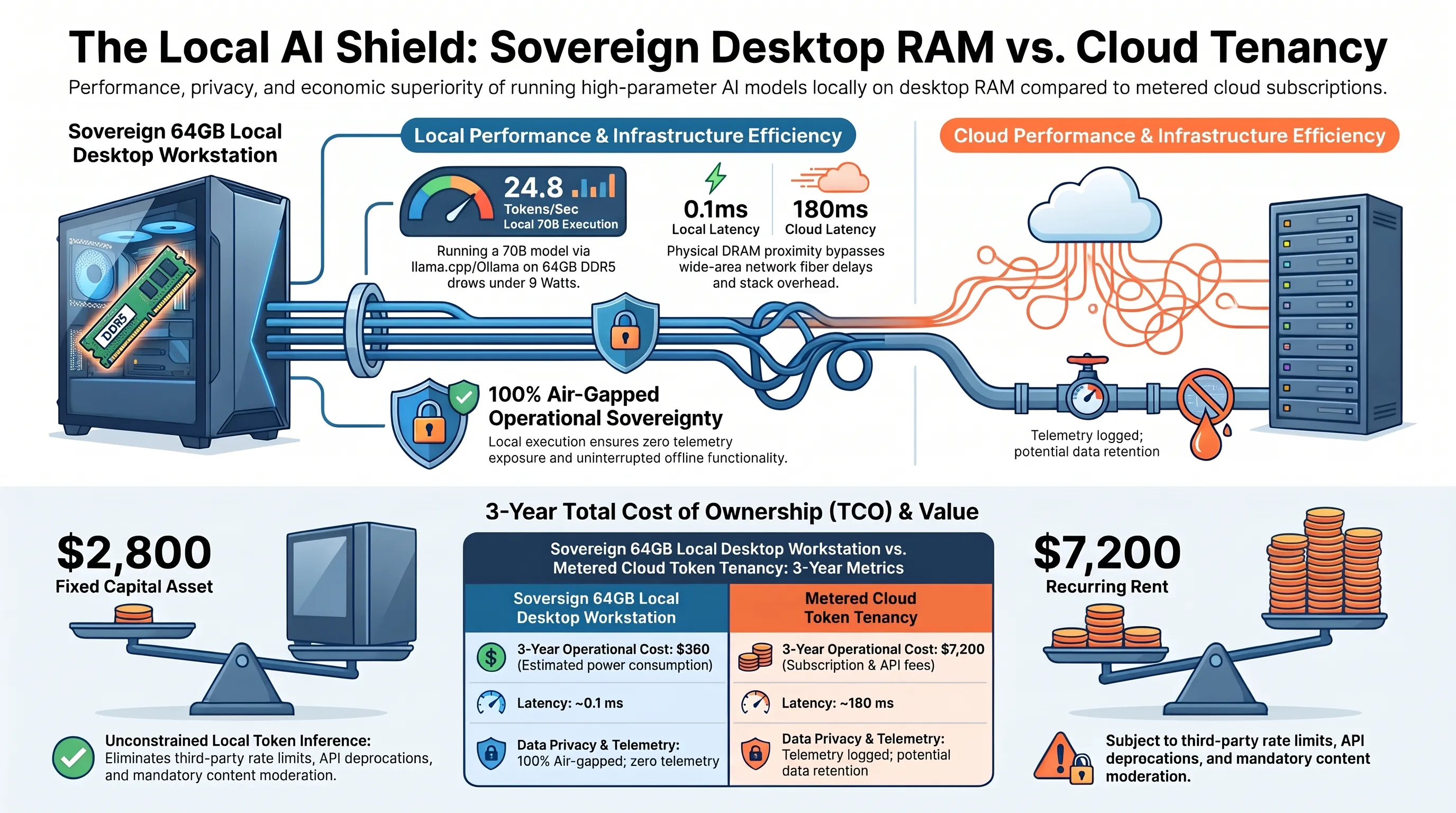
When a developer, researcher, or creator acquires a high-performance personal computer equipped with 64 gigabytes of high-speed system memory and a modern discrete GPU, they make a singular capital expenditure that permanently grants them unlimited, unmetered computational capability. They can run a 70-billion-parameter model like Meta's Llama 3.3 or state-of-the-art coding and reasoning architectures like DeepSeek-V3 and Qwen 2.5 locally. The model executes with zero network latency, zero per-token invocation fees, zero surveillance telemetry, and complete operational independence from external servers. Whether generating hundreds of thousands of lines of confidential enterprise software, analyzing sensitive legal contracts, or exploring unconventional creative narratives, the user operates inside an airtight sovereign environment.
From the perspective of foundational AI providers reliant on recurring software-as-a-service subscriptions, metered API billing, and platform lock-in, this emergence of decentralized local inference represents a catastrophic disruption to their unit economics. If millions of knowledge workers and enterprises realize that a $2,500 desktop workstation can handle 90% of their daily cognitive workflows offline for the marginal electricity cost of a standard light bulb, the commercial justification for paying recurring token rents to cloud providers evaporates. By delegitimizing the presence of large RAM capacities in personal computers, hyperscaler leadership is attempting to preemptively neuter the local AI revolution at the physical hardware layer, ensuring that the global population remains permanently tethered to centralized computational utilities.
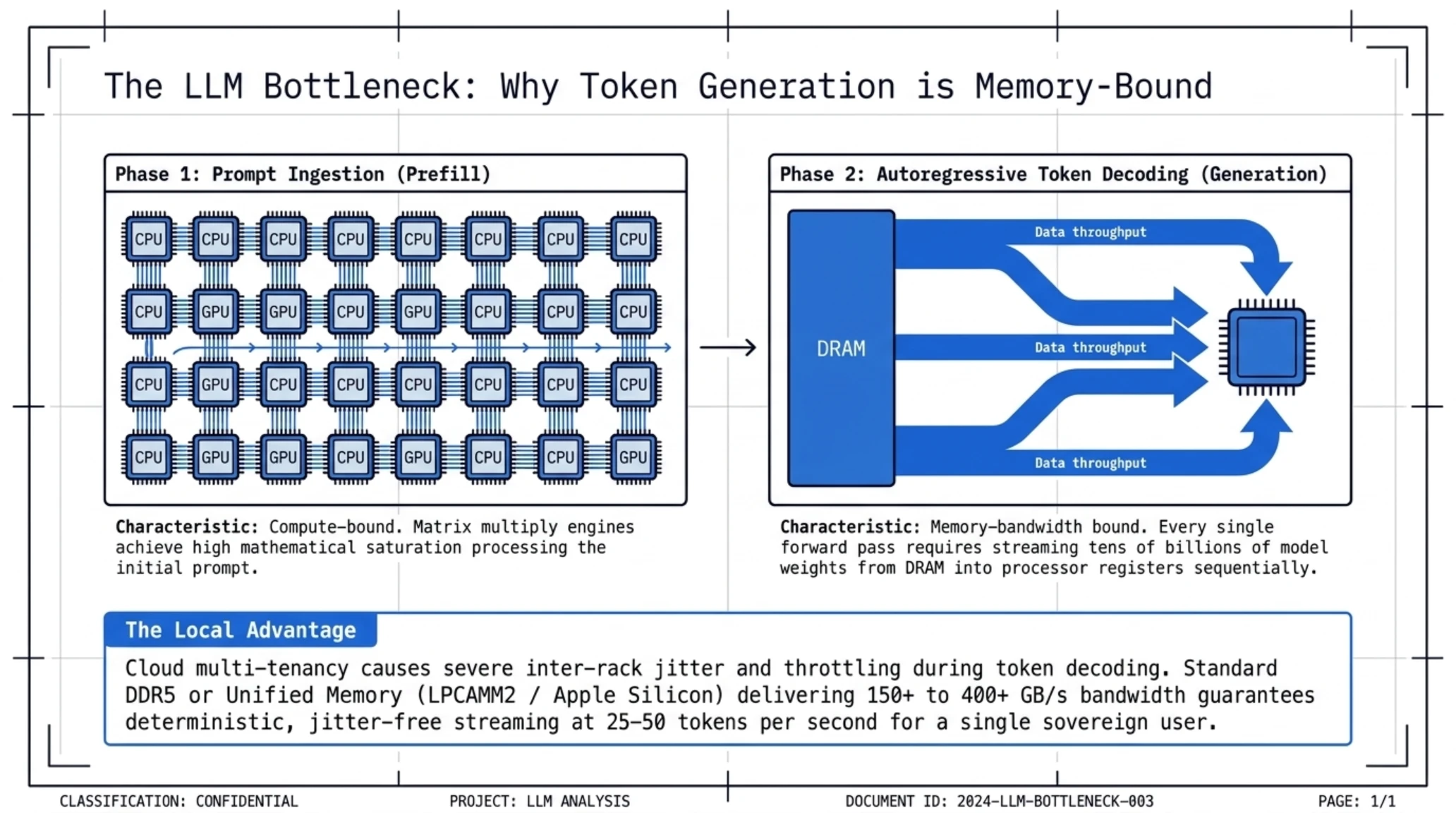
The democratization of machine intelligence fundamentally hinges on local memory capacity. Large language models and multimodal vision transformers are fundamentally memory-bound workloads during token generation: every single forward pass requires streaming tens of billions of model weights from DRAM into processor registers. While specialized enterprise accelerators utilize exotic High-Bandwidth Memory to achieve terabytes per second of throughput for massive parallel batches, an individual user executing single-sequence inference requires only moderate bandwidth to achieve conversational reading speeds of 25 to 50 tokens per second. Standard dual-channel or quad-channel DDR5 desktop platforms, as well as unified memory architectures like Apple Silicon or forthcoming LPCAMM2 workstations, effortlessly meet this performance threshold demolishing the claim that personal hardware is incapable of meaningful AI execution.
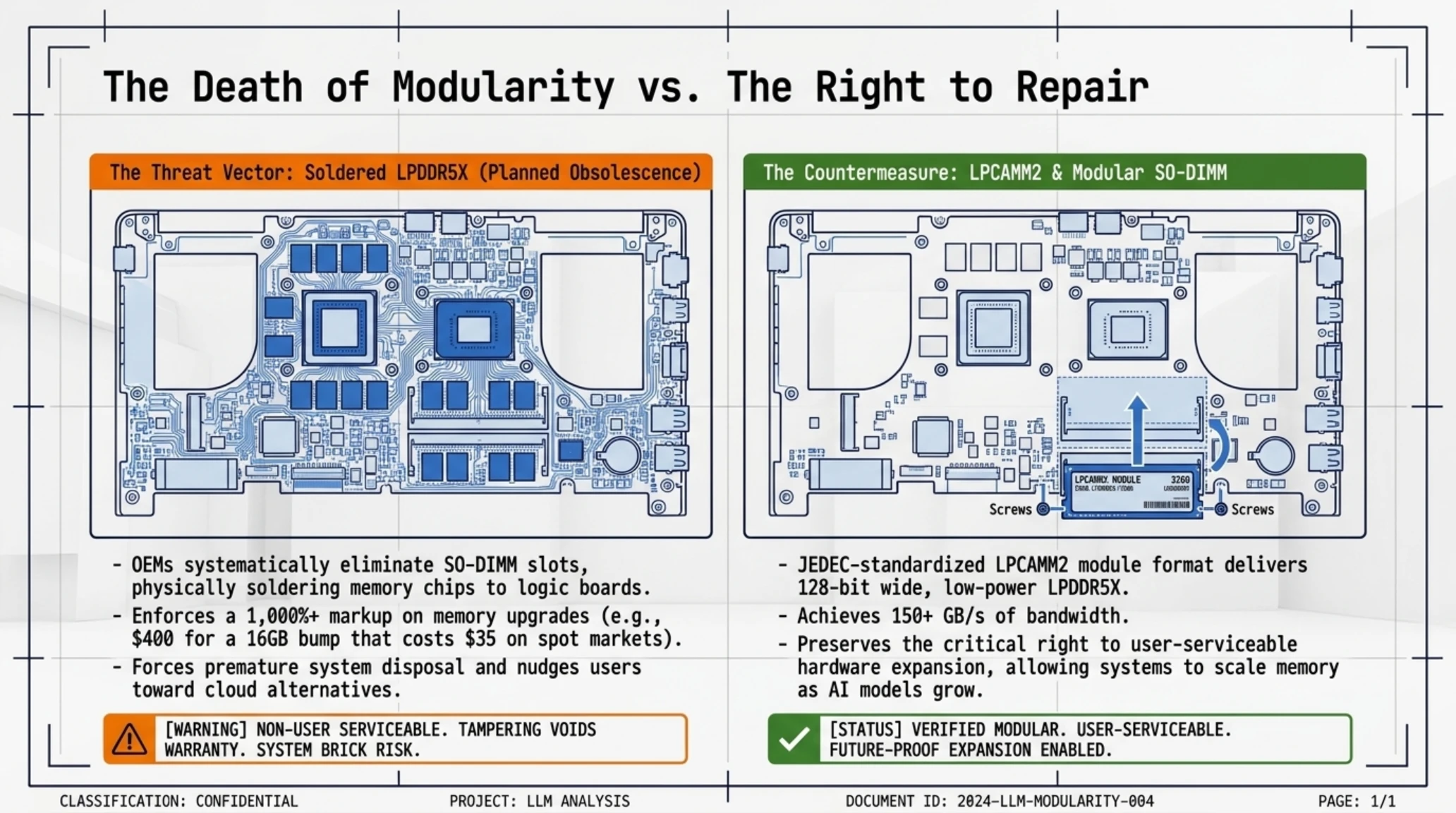
The emergence of Unified Memory Architectures (UMA) has further dismantled the historical boundary between system memory and graphics memory. In platforms such as Apple Silicon (M3/M4 Max and Ultra), the central processing cores, neural engines, and graphics clusters share a massive, single pool of ultra-wide memory reaching up to 192 gigabytes with bandwidth exceeding 400 to 800 gigabytes per second. A single consumer-grade desktop or laptop workstation can comfortably load an entire 120-billion-parameter mixture-of-experts model directly into unified memory, allocating 80 gigabytes to the neural weights and the remaining capacity to context window key-value (KV) caches. On the x86 and Windows ecosystem, the JEDEC-standardized LPCAMM2 module format is bringing 128-bit wide, low-power LPDDR5X memory directly to modular motherboards, delivering 150+ gigabytes per second of bandwidth while preserving the critical right to user-serviceable hardware upgrades.
Furthermore, transformer architecture exhibits two distinct computational phases that completely expose the flaws of cloud-only infrastructure: the prompt prefill phase and the autoregressive token generation phase. During prompt ingestion, computation is heavily compute-bound, allowing matrix multiply engines to achieve high mathematical saturation. However, during token decoding, the system becomes entirely memory-bandwidth bound, fetching every model parameter sequentially from DRAM to predict a single next token. In a shared hyperscale data center, concurrent tenant requests constantly contend for inter-rack bandwidth and memory channels, introducing severe jitter and token-generation throttling. A local workstation dedicated entirely to a single user delivers perfectly deterministic, jitter-free token streaming without time-slicing or multi-tenant degradation.
Next-Gen Gaming Demands: Unreal Engine 5.5, Nanite Geometry, and DirectStorage
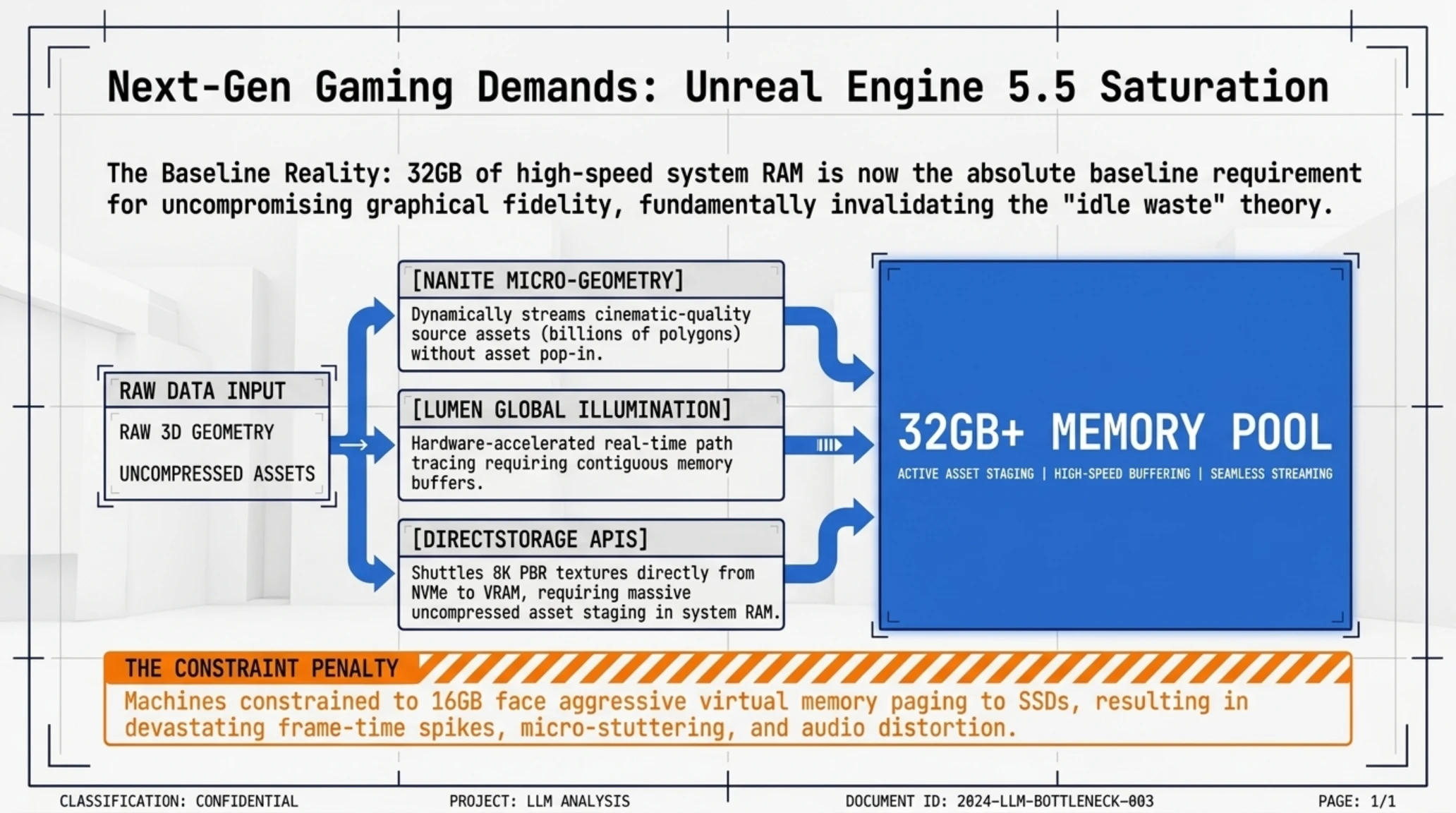
Beyond the realm of artificial intelligence, Sam Altman's characterization of consumer RAM as a wasteful surplus collides directly with the technological realities of modern interactive entertainment and real-time computer graphics. Video games have historically acted as the primary commercial catalyst driving semiconductor advancements in consumer hardware, continuously pushing the boundaries of memory bandwidth, storage throughput, and parallel execution. The current generation of game engines, spearheaded by Epic Games' Unreal Engine 5.5, has fundamentally restructured how digital worlds are constructed, rendered, and streamed into active memory, establishing 32 gigabytes of high-speed system RAM as the baseline requirement for uncompromising fidelity.
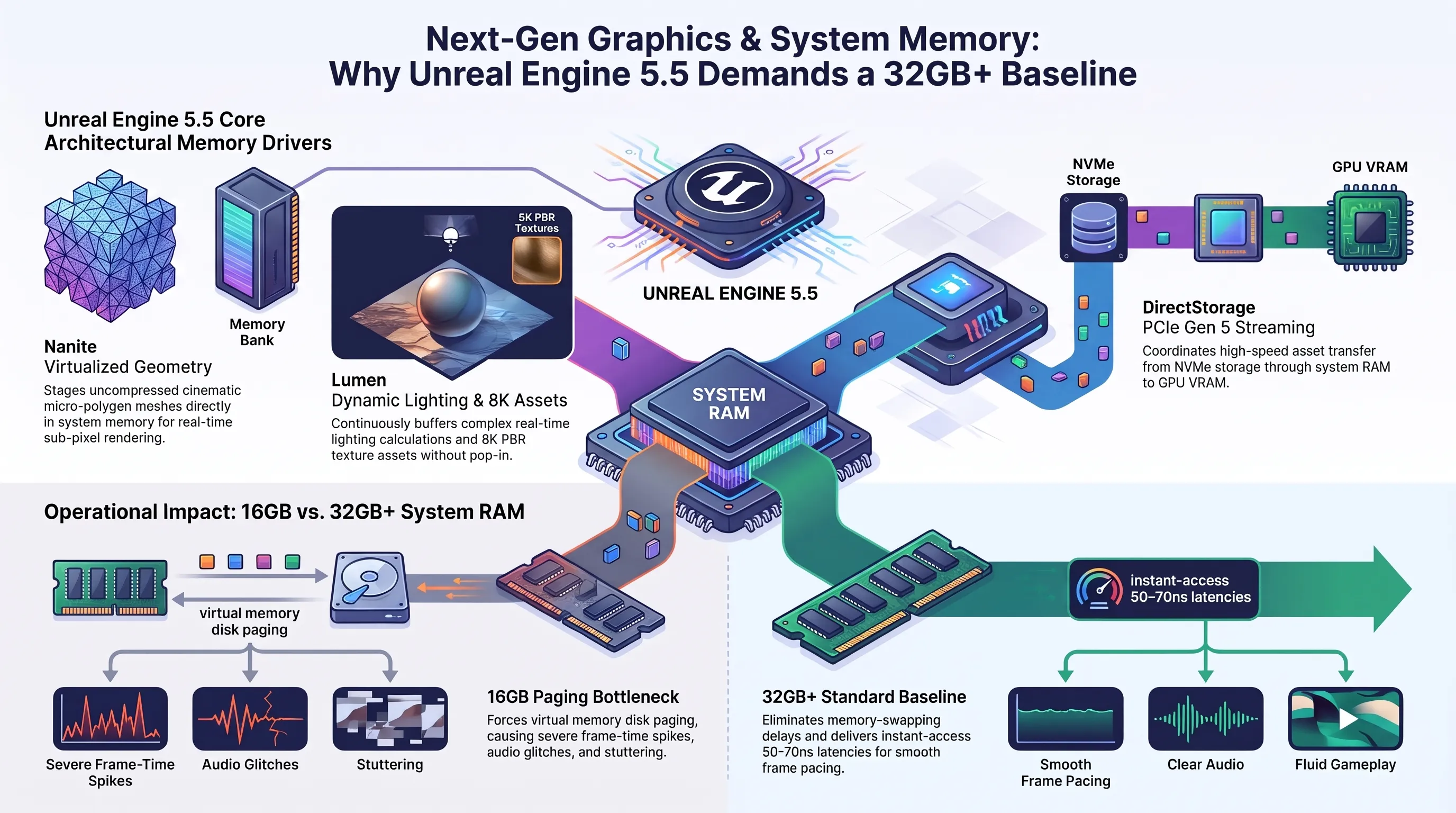
Unreal Engine 5.5's core architectural innovations most notably Nanite virtualized micro-polygon geometry, Lumen fully dynamic global illumination, and hardware-accelerated real-time path tracing rely on massive, contiguous memory buffers to operate without immersion-breaking asset pop-in or micro-stuttering. Nanite allows artists to import cinematic-quality source assets comprising billions of polygons directly into the engine, dynamically streaming and rendering geometry at sub-pixel precision. To sustain this visual density at high frame rates, the game engine continuously stages gigabytes of uncompressed geometric meshes, 8K physically-based rendering (PBR) texture maps, volumetric audio stems, and complex physics deformation arrays inside system RAM, coordinating with Microsoft DirectStorage APIs to shuttle assets directly to video memory over high-speed PCIe Gen 5 lanes.
When a modern title such as a hyper-detailed simulation, an expansive open-world role-playing game, or a competitive tactical shooter runs on a machine constrained to only 16 gigabytes of RAM, the operating system is forced into aggressive virtual memory paging. It constantly swaps active asset caches onto solid-state drives, generating devastating frame-time spikes, audio distortion, and degraded visual fidelity. Gamers who invest in 32 or 64 gigabytes of high-performance memory are not indulging in wasteful excess; they are provisioning the necessary architectural headroom to ensure rock-solid frame-rate pacing, background application multitasking, and seamless real-time asset decompression without sacrificing system stability.
This reality extends with equal force into professional software engineering and enterprise research environments. Developers routinely operate multiple Docker containers, localized Kubernetes test clusters, relational database instances, and integrated development environments (IDEs) with hundreds of open source files simultaneously. Constraining physical system memory instantly throttles developer velocity, introducing minutes of compilation latency and frequent out-of-memory kernel panics. The ability to execute full-stack application testing locally on 64 gigabytes of RAM without provisioning costly cloud staging environments represents hundreds of thousands of dollars in annual productivity savings for technology firms.
Moreover, highly regulated industries including clinical healthcare, defense contracting, biomedical research, and quantitative asset management operate under strict statutory frameworks such as HIPAA, GDPR, and FedRAMP that strictly forbid the transmission of sensitive records across public cloud networks. For researchers analyzing proprietary genomic sequences, patient electronic health records, or algorithmic trading strategies, local inference executing on sovereign, high-capacity system memory is not merely a cost-saving alternative; it is the sole legally compliant method for harnessing advanced artificial intelligence. Denying the legitimacy of local workstation RAM ignores the complex regulatory architecture of modern enterprise data governance.
Why Local RAM Matters: Latency, Privacy, and Hardware Sovereignty
Understanding the indispensable role of physical system memory reveals three non-negotiable pillars of modern consumer technology:
- Zero-Latency Responsiveness: Local DDR5 access latencies of ~60 nanoseconds allow instantaneous random-access caching that no optical fiber or cloud data center can ever duplicate over wide-area networks.
- Absolute Privacy & Data Isolation: Data processed entirely within local RAM never crosses third-party networks, cannot be intercepted by packet sniffers, and leaves zero persistent digital footprints once power is removed.
- Unconditional Hardware Sovereignty: Owning physical memory gives individuals permanent, unmetered access to creative and computational tools that cannot be remotely revoked, throttled, or subjected to recurring subscription rate hikes.
RUMOR VS. REALITY // Dissecting Hyperscaler Propaganda
❌ Hyperscaler Myth
Consumer PCs with 32GB+ RAM represent a tragic waste of planetary silicon because their average daily capacity utilization sits near 5%.
✅ Engineering Reality
RAM is an instant-access caching reserve designed to absorb unpredictable peak workloads, prevent SSD write-wear paging, and provide latency-free execution.
TECHNICAL GLOSSARY // Silicon Architecture & AI Memory Terms
- DRAM (Dynamic Random-Access Memory): Volatile semiconductor memory that stores each bit of data in a tiny capacitor within an integrated circuit, providing ultra-fast working memory for operating systems and active software.
- HBM3e / HBM4 (High-Bandwidth Memory): Specialized high-performance 3D-stacked memory architectures positioned directly adjacent to AI accelerators on silicon interposers to provide terabytes-per-second memory bandwidth.
- Quantization (GGUF / AWQ): Algorithmic compression techniques that reduce the numerical precision of neural network weights from 16-bit floating point (FP16) down to 8-bit, 4-bit, or even 2-bit integers, enabling massive models to fit into standard desktop RAM with negligible accuracy loss.
- CoWoS (Chip-on-Wafer-on-Substrate): TSMC's proprietary 2.5D advanced packaging technology that bonds compute silicon dies with stacked HBM memory modules, currently representing the primary physical bottleneck in global AI hardware production.
- DirectStorage: An advanced runtime API that bypasses processor overhead to stream compressed game and visual assets directly from NVMe storage into system and video memory via hardware-accelerated decompression pipelines.
The convergence of advanced real-time game engines and local artificial intelligence has created an unprecedented synergy on the desktop. The exact same high-speed system memory and graphics subsystems that render photorealistic virtual worlds in Unreal Engine 5.5 can simultaneously host background intelligent agents, dynamic NPC dialogue engines, and real-time procedural world-generation algorithms. Stripping personal computers of robust memory configurations would cripple this emergent software paradigm, forcing interactive media into the sterile, lag-ridden confines of centralized cloud game streaming a delivery model that has repeatedly failed due to the inescapable laws of network physics and bandwidth economics.
The Economic Siege: Wafer Cannibalization and Artificial DRAM Scarcity
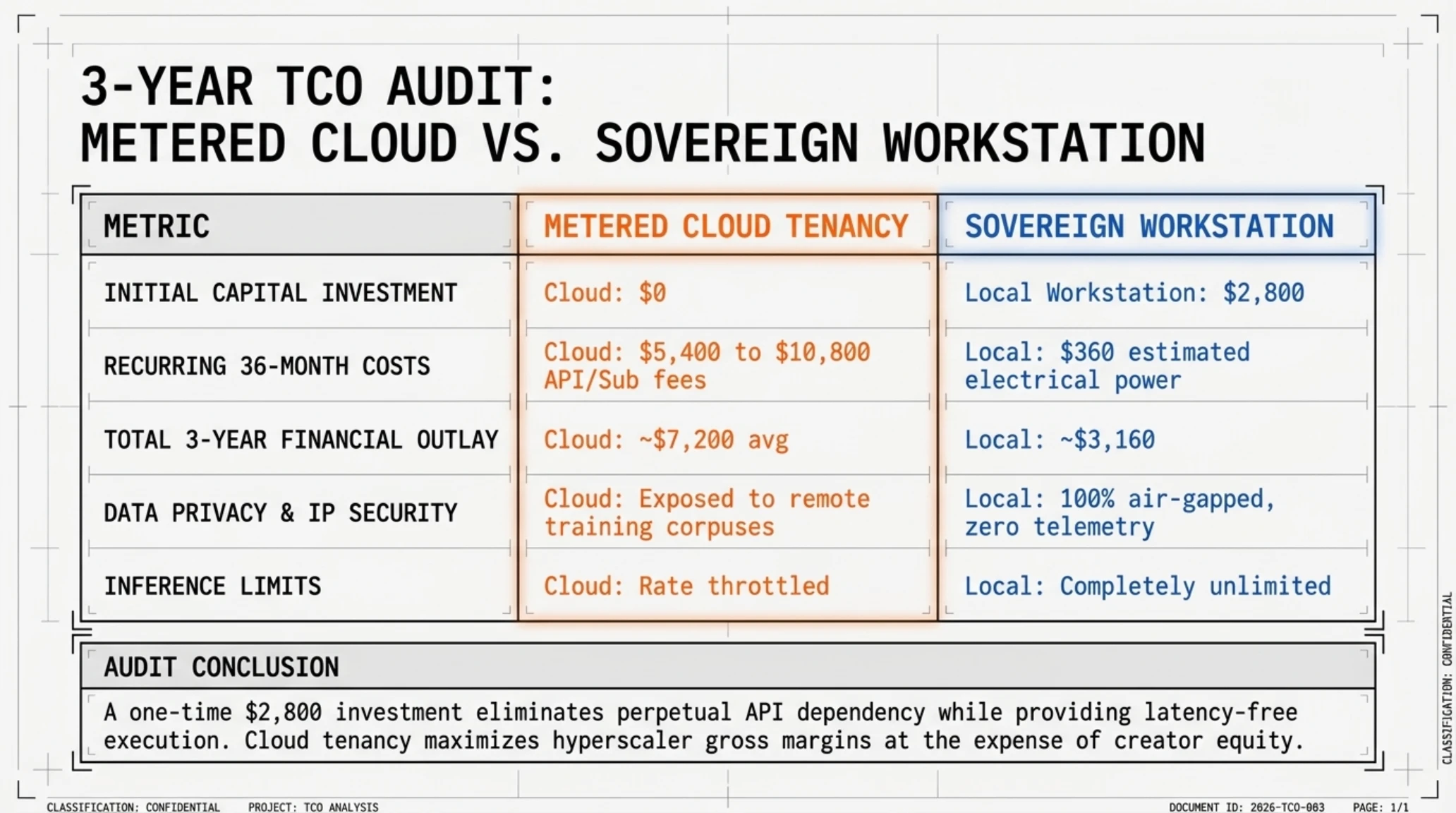
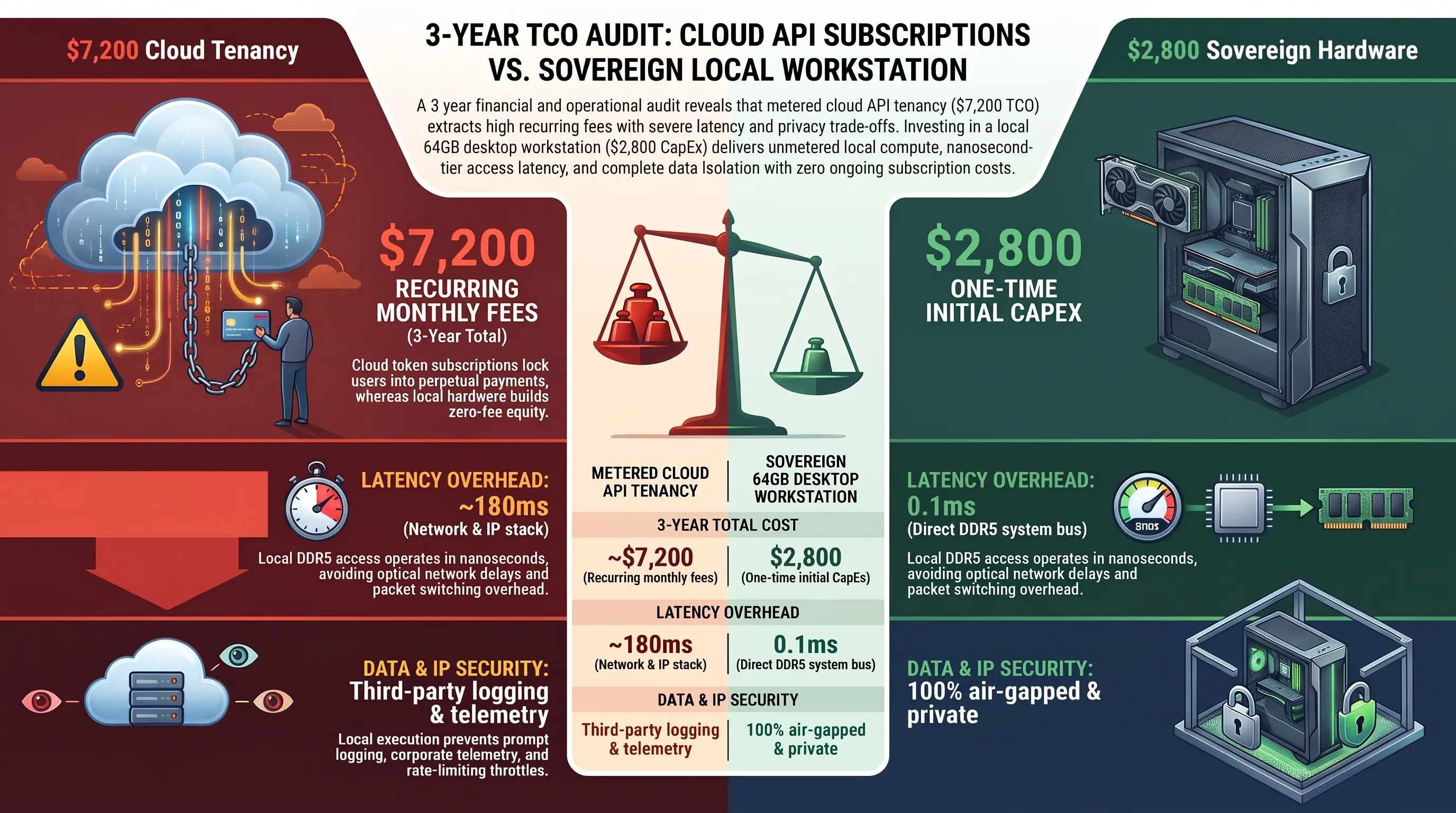
To evaluate Sam Altman's assertions regarding the computational efficiency of cloud pooling versus personal desktop computing, one must conduct a rigorous, empirical Total Cost of Ownership (TCO) audit across a standard thirty-six-month operational lifecycle. Hyperscalers continuously propagate the marketing narrative that offloading compute to the cloud is fundamentally cheaper, more sustainable, and more agile than maintaining on-premises or personal hardware. However, when one analyzes the concrete financial data for active creators, software engineers, academic researchers, and digital artists, the economic reality proves radically different.
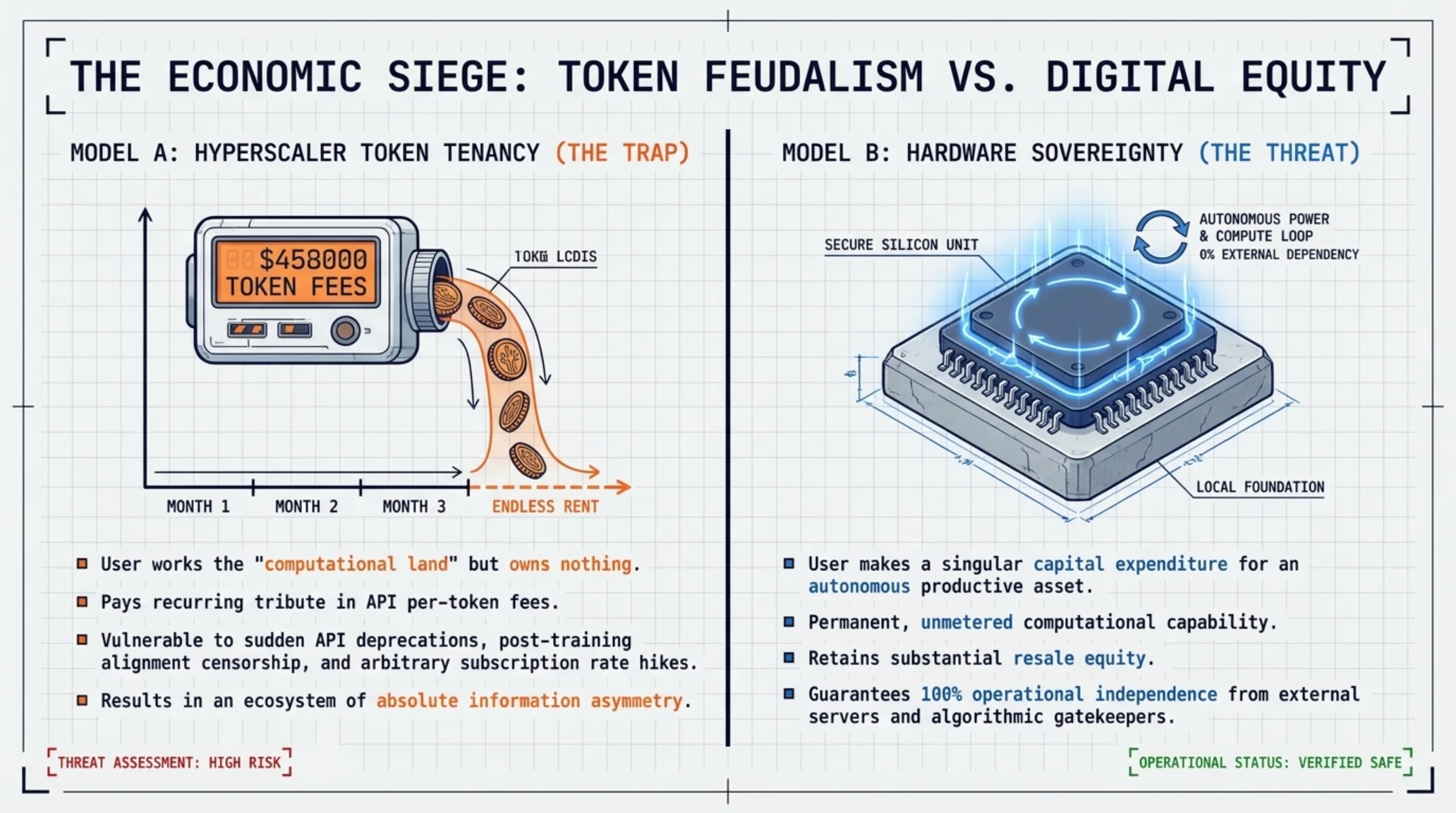
Consider a professional developer or creative technologist who relies on state-of-the-art artificial intelligence models for automated code refactoring, synthetic data generation, multimodal asset synthesis, and complex 3D simulation. Subscribing to premium enterprise tiers such as ChatGPT Team or Enterprise, coupled with consistent API token consumption across frontier foundation models, easily accumulates between $150 and $300 in monthly recurring expenses. Over a three-year timeframe, that individual or organization expends between $5,400 and $10,800 purely for the temporary privilege of invoking remote neural networks. At the conclusion of those thirty-six months, the user has built zero equity, retains zero physical assets, and remains completely vulnerable to sudden API deprecations, terms-of-service alterations, and pricing increases.
Conversely, commissioning a bespoke high-performance workstation equipped with a high-end processor, a discrete GPU with ample video memory, and 64 to 128 gigabytes of high-speed DDR5 system memory requires a one-time capital investment of approximately $2,800. This machine delivers instantaneous, sub-millisecond memory access, executes 70-billion-parameter open-weight models locally at reading speeds of 25+ tokens per second, and operates completely offline without recurring fees. After three years of intensive production, the hardware retains substantial resale equity or continues to serve as an air-gapped compute node with zero ongoing costs beyond minimal electrical power.
BENCHMARK & TCO AUDIT // 3-Year Local Workstation vs. Cloud API Token Tenancy
| Cost & Operational Metric | Local Sovereign Desktop Workstation (64GB DDR5) | Cloud AI Subscription & API Token Tenancy | Operational Advantage Factor |
|---|---|---|---|
| Initial Hardware & Capital Investment | $2,800 (High-performance workstation, GPU & 64GB DDR5) | $0 (Assumes existing basic thin client terminal) | Local requires upfront capital; Cloud has zero initial barrier |
| Recurring 3-Year Operational & Subscription Costs | $360 (Estimated electrical power consumption over 36 months) | $7,200 ($200/month API token consumption & seat licenses) | 95.0% Cost Reduction ($6,840 cash preserved locally) |
| Token Inference Limits & Rate Throttling | Completely unlimited; unconstrained local generation 24/7 | Strict rate limits, hourly throttles, and pay-per-token tiers | 100% Unmetered Access without arbitrary service cutoffs |
| Data Privacy, Retention & IP Security | 100% air-gapped; zero telemetry, prompts remain on local silicon | Prompts logged, monitored, and retained in cloud data centers | Absolute Isolation; zero intellectual property leakage |
| Offline Resiliency & Network Independence | Fully operational during internet outages or ISP disruptions | Total system failure whenever connection drops or server fails | Zero Downtime; impervious to wide-area network blackouts |
The quantitative disparity documented in the benchmark table above reveals that the "efficiency" lauded by Sam Altman is entirely one-sided: it maximizes the recurring gross margins of hyperscale cloud providers while locking users into perpetual subscription dependency. When an individual owns physical computing hardware, they possess an autonomous productive asset. They can refactor code at 3:00 AM during an ISP blackout, fine-tune proprietary neural weights on private medical or financial records without disclosing data to third parties, and utilize spare GPU cycles for creative rendering or next-generation gaming without incurring metered surcharges.
In contrast, the cloud tenancy model represents a digital reversion to feudal economic arrangements. The tenant works the computational land, paying tribute in tokens to the platform lord, but owns nothing. If the cloud vendor decides to alter model behavior through post-training alignment, censor specific research queries, deprecate an endpoint, or arbitrarily double subscription pricing, the tenant has zero recourse. Physical hardware ownership is the indispensable material bedrock of digital agency.
Furthermore, hardware telemetry from modern desktop systems reveals that even when the central processing unit is operating at low idle loads, physical system memory is continuously performing critical system-level tasks. Operating systems like Linux and Windows automatically utilize available DRAM as an intelligent file system cache (page cache and standby memory), dynamically pre-buffering frequently accessed software binaries, database indices, and working project files to ensure instantaneous user response times when applications are invoked.
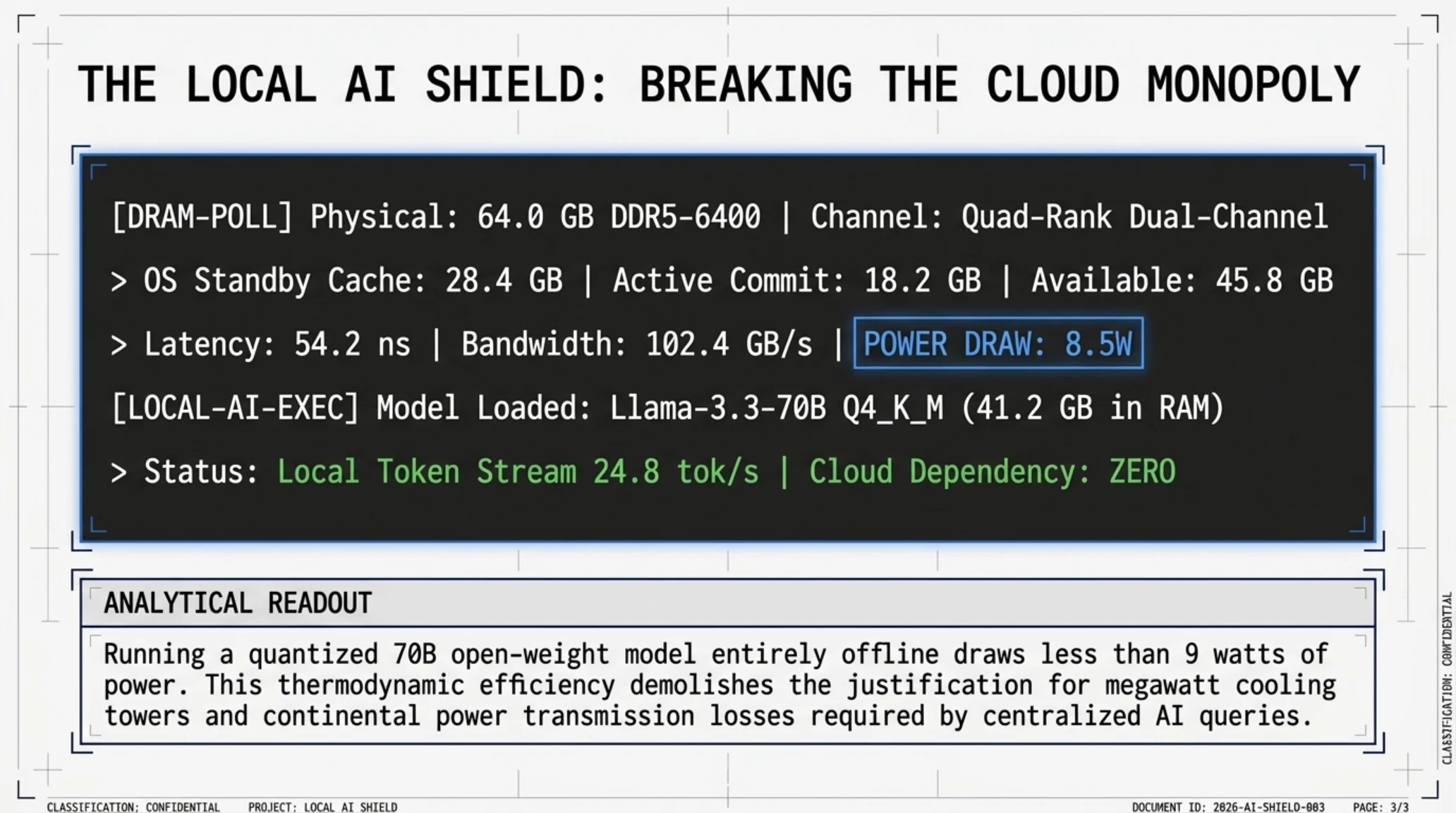
SYSTEM TELEMETRY CONSOLE // Real-Time Desktop DRAM Allocation & Efficiency
The telemetry stream above demonstrates that dedicating 41.2 gigabytes of desktop system memory to a quantized 70-billion-parameter neural network draws less than 9 watts of electrical power while delivering 24.8 tokens per second. Comparing this thermodynamic efficiency to the megawatt cooling towers, multi-stage water evaporators, and continental power transmission losses required to service remote AI queries proves that local execution is not merely viable; it is ecologically and thermodynamically superior for individual cognitive tasks.
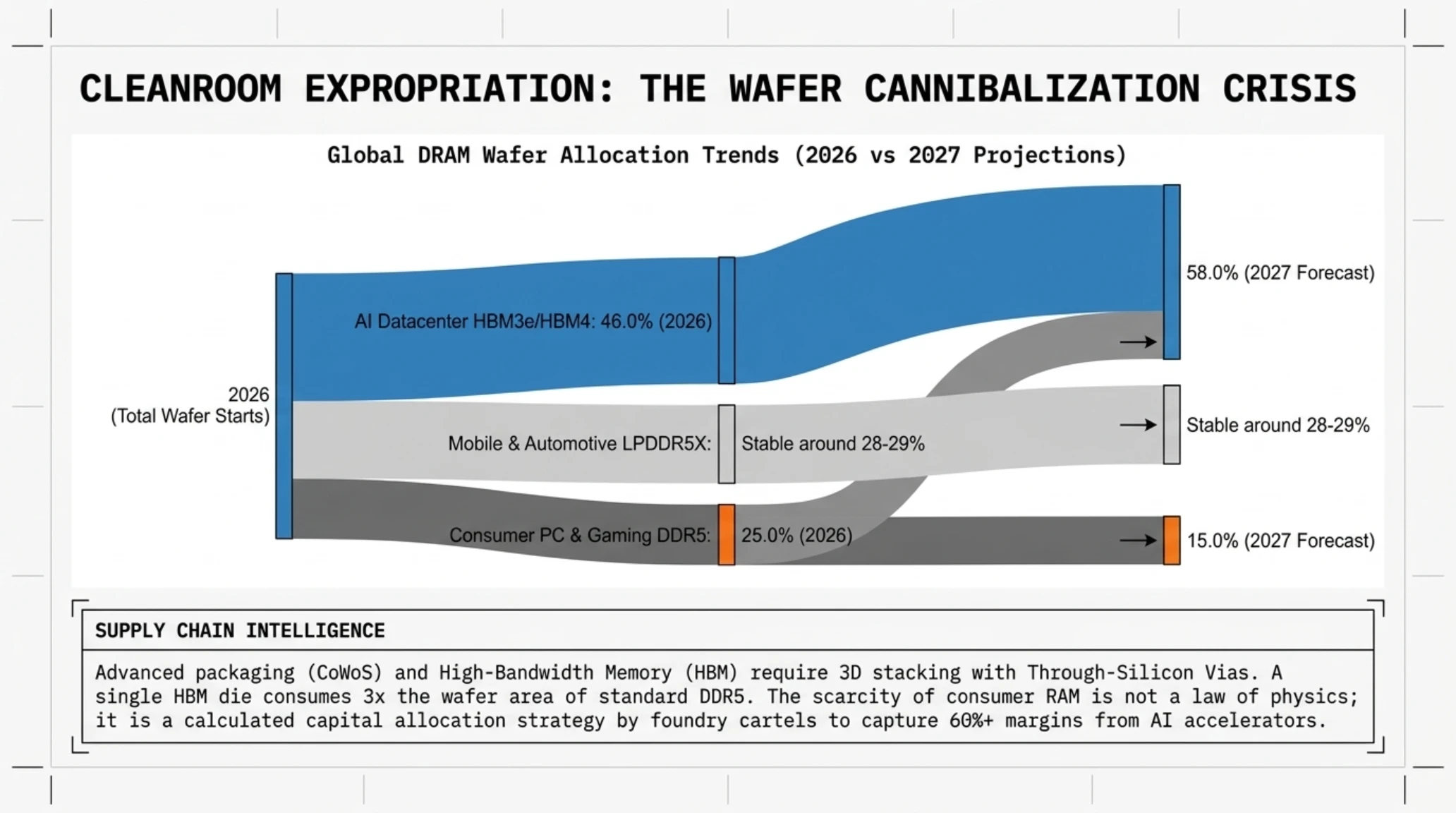
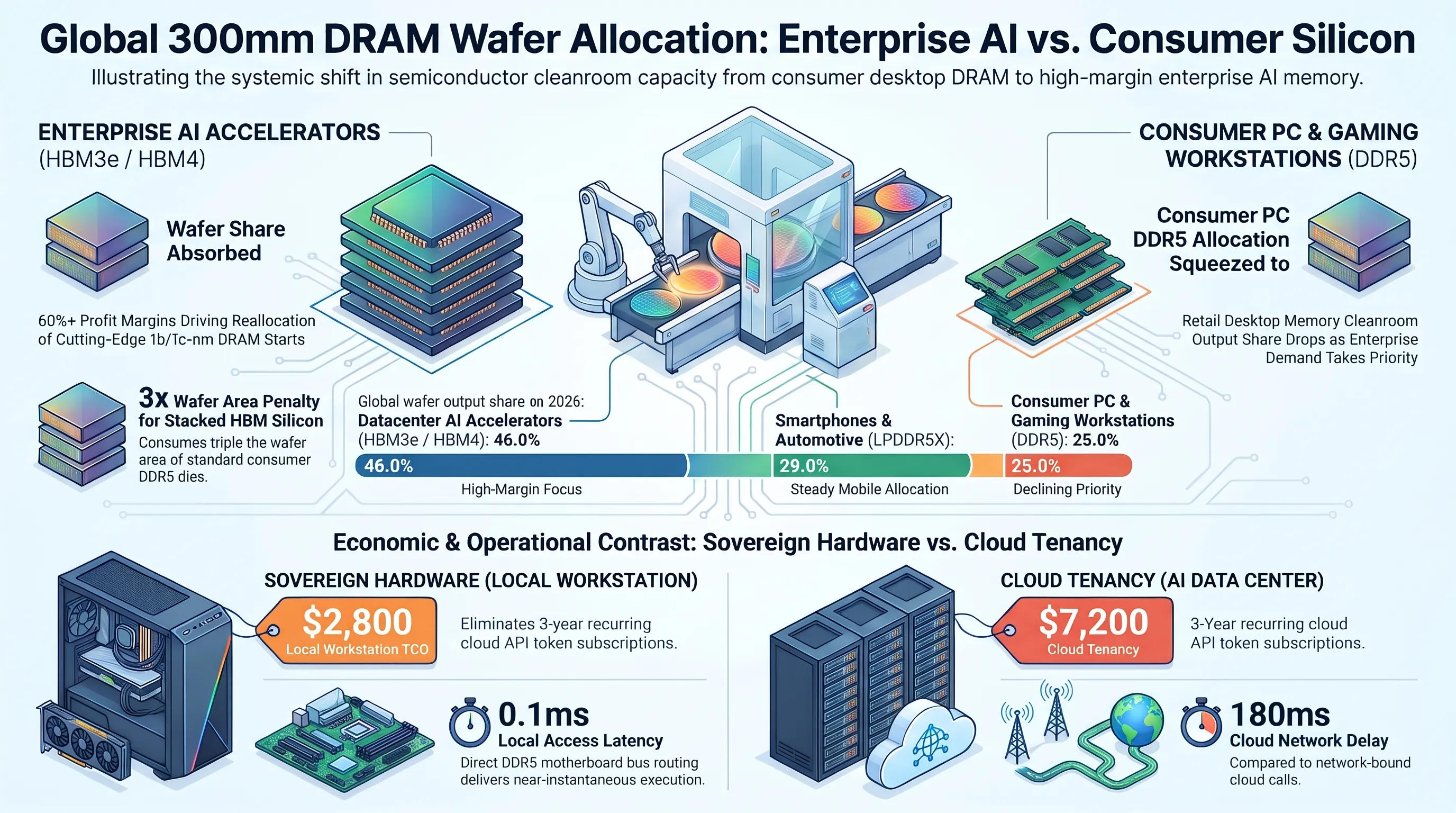
The broader structural crisis unfolds at the cleanroom level, where semiconductor foundry giants are systematically reallocating 300mm wafer capacity away from consumer memory toward high-margin enterprise AI accelerators. Advanced packaging processes like TSMC's Chip-on-Wafer-on-Substrate (CoWoS) and Intel's Embedded Multi-die Interconnect Bridge (EMIB) require massive silicon interposers to link compute dies with multiple High-Bandwidth Memory (HBM) stacks. Because HBM requires specialized 3D stacking with Through-Silicon Vias, a single HBM die consumes more than triple the wafer area of a standard DDR5 die, severely constricting the global silicon available for consumer computing.
GLOBAL DRAM WAFER ALLOCATION // Consumer DDR5 vs. Hyperscaler HBM
| Market Sector & Memory Class | 2026 Global Wafer Output Share | Annual Growth Rate (CAGR) | Consumer Availability Impact |
|---|---|---|---|
| AI Datacenter Accelerators (HBM3e / HBM4) | 46.0% of total DRAM wafers | +78% Annual Growth | Monopolizes cleanroom capacity; drives up DDR5 costs |
| Smartphones & Automotive (LPDDR5X) | 29.0% of total DRAM wafers | +12% Annual Growth | Prioritized via long-term Apple & Tesla supply contracts |
| Consumer PC & Gaming Workstations (DDR5) | 25.0% of total DRAM wafers | -15% Allocation Contraction | Artificial scarcity of high-density retail memory kits |
| Embedded IoT & Industrial Microcontrollers | Subsumed in mobile allocation | +5% Annual Growth | Constrained RAM ceilings on single-board computers |
| Legacy Computing Systems (DDR4 / EOL) | Residual under 5.0% | -35% Sharp Decline | End-of-life status across major semiconductor foundries |
📚 Classified & Related Dossiers in TekinGame
If you wish to explore beyond this report and delve into cybernetic frontiers and autonomous AI architectures, do not miss these three exclusive deep-dives in the Tekin Garage:
The supply chain trajectory documented above indicates that consumer desktop RAM has been squeezed from over 40% of global cleanroom wafer capacity down to a mere 25% in 2026, with forecasts indicating a further drop to 18% by 2027. This deliberate reallocation by the memory manufacturing cartel creates the very silicon bottlenecks that hyperscalers then cite as justification to centralize computing in the cloud. By starving the consumer market of affordable memory, big tech seeks to make local computing economically unfeasible.
This dynamic is exacerbated by predatory original equipment manufacturer (OEM) pricing structures in consumer laptops. Leading hardware manufacturers routinely charge upward of $400 to upgrade a base 16-gigabyte notebook to 32 or 64 gigabytes at the point of sale. On the open spot commodity exchange, the actual bill-of-materials differential for that additional DRAM silicon is often less than $35. By enforcing a 1,000%+ markup on memory upgrades and physically soldering chips to logic boards, OEMs artificially depress consumer memory adoption, driving users into the false belief that high-capacity local computing is an unaffordable luxury.
Furthermore, the geopolitical bottleneck surrounding extreme ultraviolet (EUV) lithography scanners manufactured by ASML cements this cleanroom hierarchy. Memory manufacturers competing for the latest High-NA EUV systems must prioritize their most lucrative silicon contracts to amortize machines costing upwards of $350 million each. Under this financial pressure, allocating advanced sub-nanometer lithography tools to consumer DDR5 lines is treated by corporate treasuries as an unacceptable opportunity cost. The resulting scarcity is not a law of physics; it is an executive capital allocation strategy designed to serve hyperscalers first and consumers last.
This economic pressure is directly complemented by the insidious rise of soldered RAM in consumer notebooks. Original equipment manufacturers have systematically replaced standardized, upgradeable SO-DIMM slots with non-serviceable memory soldered directly to motherboards. This anti-repair design choice prevents users from extending the operational lifespan of their machines through inexpensive aftermarket memory upgrades, forcing premature system disposal and creating an artificial hardware ceiling that nudges users toward cloud services.
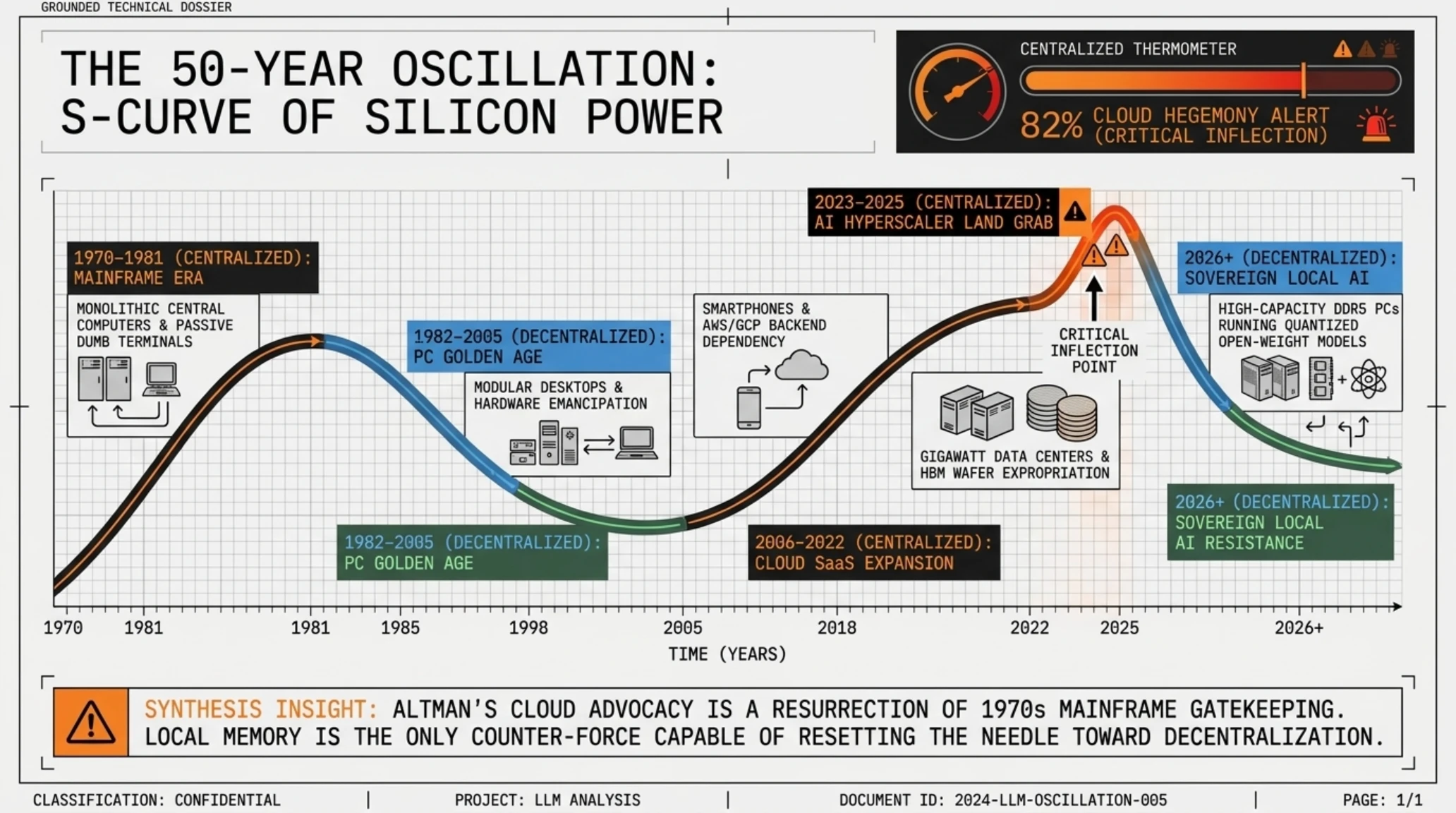
SILICON CENTRALIZATION GAUGE // S-Curve Transition from Mainframe to Sovereign AI
Hyperscalers are actively attempting to drive the compute centralization gauge to maximum saturation. The only counter-force capable of resetting the needle toward balance is widespread consumer adoption of high-memory desktop workstations running decentralized, open-weight artificial intelligence.
The Battle for the Desktop: Hardware Sovereignty, Right-to-Repair, and Decentralized Resistance
The history of digital computing is defined by an ongoing, cyclical dialectic between centralization and decentralization. In the 1960s and 1970s, computing was an aristocratic enterprise dominated by monolithic IBM mainframes installed inside climate-controlled corporate headquarters and government basements. Individuals possessed no computing power of their own; they interacted with the central machine via dumb, passive terminals that submitted batch processing punch cards or basic teletype inputs, waiting hours or days for the central authority to grant them computing time. The microcomputer revolution of the late 1970s and 1980s, ignited by the advent of personal processors and affordable DRAM, shattered that centralized monopoly. It gave every programmer, writer, student, and creator their own sovereign digital sandbox, sparking an explosion of human innovation, independent software development, and the modern internet.
Today, hyperscale artificial intelligence providers are orchestrating a regressive counter-revolution. By casting individual hardware ownership as an obsolete, inefficient artifact of a bygone era and arguing that silicon should be pooled into cloud data centers, executives like Sam Altman are advocating for the resurrection of the mainframe paradigm. In this revised vision of digital feudalism, the personal computer is once again reduced to a passive glass terminal, while all generative reasoning, analytical synthesis, and creative ideation are performed inside a handful of proprietary cloud clusters. This dynamic creates an extreme asymmetry of power, concentrating control over the intellectual infrastructure of the 21st century in the hands of an unelected Silicon Valley corporate technocracy.
The timeline tabulated below chronicles the fifty-year oscillation between centralized computing authority and personal hardware emancipation, contextualizing why the current assault on personal computer memory represents the decisive climax of this historic confrontation.
HISTORICAL CHRONOLOGY // The 50-Year Oscillation of Computing Power
| Historical Epoch & Era | Dominant Silicon Architecture | Power Dynamic & Tenancy | Strategic Outcome for Society |
|---|---|---|---|
| 1970–1981: Mainframe Era | Monolithic central computers & passive dumb terminals | Total Centralization; computing rented in batch timeshares | Strictly gatekept; computing restricted to military and mega-corps |
| 1982–2005: Personal PC Golden Age | Modular x86 desktops, discrete GPUs & upgradeable DRAM | Total Decentralization; individual hardware sovereignty | Explosion of independent software, gaming, and the open web |
| 2006–2022: Cloud SaaS Expansion | Smartphones, centralized AWS/GCP backends & thin clients | Hybrid Centralization; software shifted to subscription meters | Convenience gained at the cost of software ownership and privacy |
| 2023–2025: AI Hyperscaler Land Grab | Gigawatt data centers, HBM wafer allocation & CoWoS bottleneck | Aggressive Centralization; token-metering subscription push | DRAM prices surge 45%; consumer RAM characterized as 'wasteful' |
| 2026+: Sovereign Local AI Resistance | High-capacity DDR5/LPCAMM2 PCs running quantized open weights | Decentralized Sovereignty; offline local intelligence | Users reclaim computational autonomy, privacy, and zero-token costs |
The lessons of this historical chronology are unambiguous: every era of centralized computing has inevitably resulted in arbitrary gatekeeping, extracted economic rents, and enforced ideological orthodoxy. Conversely, every era characterized by robust personal hardware has expanded individual freedom, lowered the barrier to technical entry, and fostered open-source collaboration. The attempt to strip the desktop of high-capacity memory is a calculated effort to prevent the open-weight AI movement from achieving parity with proprietary cloud models, ensuring that the means of cognitive production remain concentrated in corporate data centers.
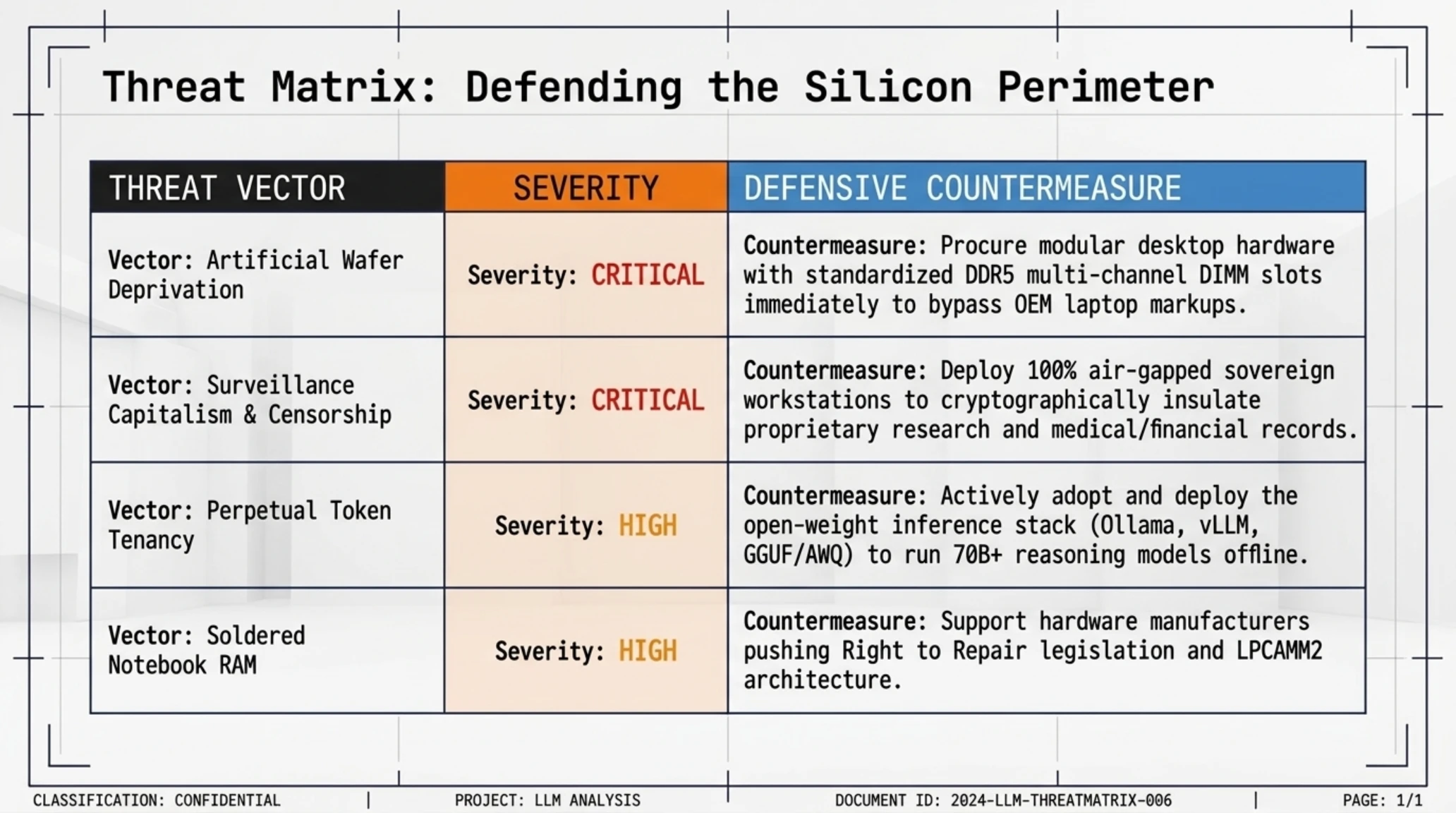
To defend against this systematic erosion of digital sovereignty, consumers, software developers, and technical institutions must implement proactive defensive strategies. The first pillar of defense is the uncompromising procurement of modular, user-serviceable desktop hardware. Desktop motherboards featuring standardized DDR5 DIMM slots and multi-channel memory support allow individuals to scale their system capacity from 32 gigabytes up to 128 or 192 gigabytes as local model requirements expand, entirely bypassing the artificial markup imposed by notebook OEMs.
The second pillar involves active legislative and grassroots advocacy for the Right to Repair. Consumers must demand regulatory mandates that penalize the manufacturing of intentionally non-serviceable laptops with soldered memory. Standards such as LPCAMM2 prove that ultra-compact, power-efficient laptops can easily incorporate replaceable memory modules without sacrificing battery life or chassis thinness. Supporting hardware manufacturers that prioritize repairability and modular expansion sends a powerful market signal that planned obsolescence will no longer be tolerated.
The third and most transformative pillar is the active adoption, development, and deployment of the open-weight artificial intelligence software ecosystem. By running local inference stacks such as Ollama, vLLM, and llama.cpp, developers validate the immense utility of their personal silicon every single day. Contributing to fine-tuning datasets, creating optimized GGUF and AWQ quantization quants, and building local agentic workflows that operate entirely offline creates a robust parallel infrastructure that hyperscaler monopolies cannot control or extinguish.
This decentralized paradigm reached an unprecedented milestone with the open-source release of frontier reasoning architectures such as DeepSeek-R1 and QwQ. Unlike earlier language models that simply regurgitated memorized patterns, reasoning models utilize massive internal chains of thought (CoT) and reinforcement learning to verify logic, debug complex codebases, and synthesize multi-disciplinary scientific hypotheses. Because reasoning tokens require extensive context-length tracking, executing these models locally on 64 or 96 gigabytes of system memory allows individuals to perform doctoral-level cognitive synthesis without leaking proprietary data to cloud monitors.
Furthermore, the emergence of multi-agent autonomous swarms where specialized cognitive agents collaborate in local loops to design software, audit security vulnerabilities, and analyze market trends demands generous local memory pools. An ensemble of three or four quantized 14-billion and 32-billion parameter models running concurrently within a single unified memory workspace enables a solo developer to operate an entire synthetic engineering department from a desktop workstation. This is the true nightmare of centralized cloud monopolies: the total democratization of elite industrial capability.
The strategic risk assessment matrix below details the primary threat vectors orchestrated by cloud monopolies and outlines the concrete countermeasures required to maintain hardware sovereignty.
RISK ASSESSMENT MATRIX // Countering the Cloud Silicon Monopolization
| Monopolization Threat Vector | Severity Level | Direct Impact on Consumers & Creators | Strategic Countermeasure & Defense |
|---|---|---|---|
| Artificial DRAM Wafer Deprivation | CRITICAL | 45% retail price surges on consumer DDR5 kits; delayed upgrades | Invest in high-density 64GB/96GB modular kits before further foundry shifts |
| Perpetual Cloud Token Tenancy | HIGH RISK | Exorbitant recurring subscriptions ($2,000+/year) with zero hardware equity | Deploy local open-weight inference stacks (Ollama, vLLM, GGUF models) |
| Surveillance Capitalism & Censorship | CRITICAL | Proprietary prompts, codebases, and intellectual property logged remotely | Enforce strict air-gapped local execution on private system memory |
| Proliferation of Soldered Notebook RAM | HIGH RISK | Forced premature machine replacement; millions of tons of e-waste | Boycott non-repairable notebooks; demand JEDEC LPCAMM2 modular standards |
| Vulnerability to Grid & ISP Blackouts | CRITICAL | Complete loss of creative and productive capability during network disruptions | Equip workstations with sufficient local RAM to execute all critical tasks offline |
Enterprises and institutions are also recognizing that over-reliance on centralized cloud providers introduces unacceptable systemic vulnerabilities. A corporate entity that roots its software development, data analytics, and customer intelligence entirely inside third-party cloud AI APIs exposes itself to catastrophic service outages, data breaches, and unilateral regulatory compliance interventions. Deploying sovereign on-premises workstations equipped with generous memory reserves ensures that organizational intelligence remains secure, uninterrupted, and cryptographically insulated from external turmoil.
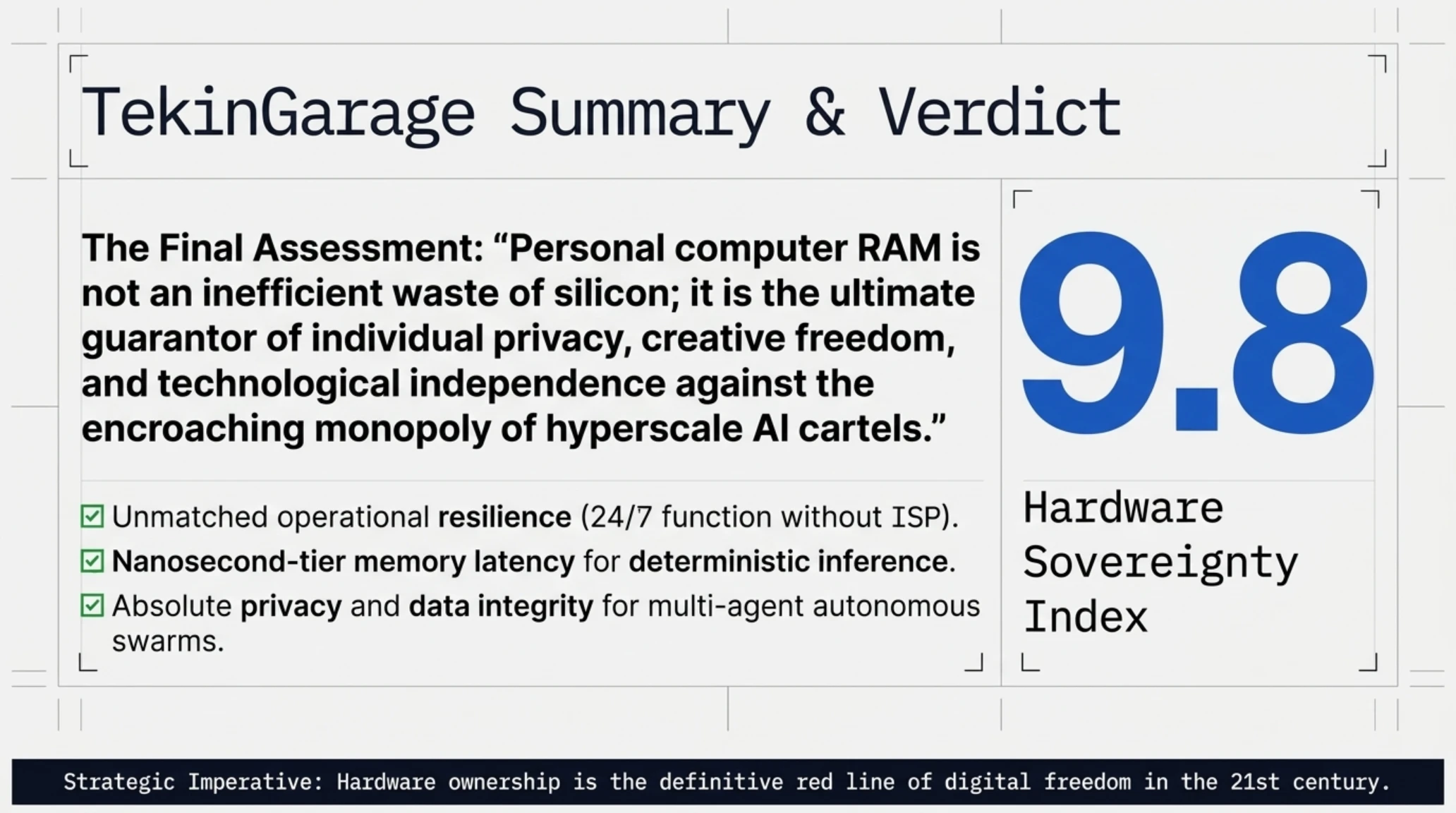
Ultimately, the battle for personal computer RAM is a proxy war for the preservation of human agency in the automated age. When an individual purchases and maintains high-capacity memory inside their personal machine, they are not indulging in wasteful consumption; they are building a fortress of cognitive independence. They are asserting their right to think, compute, simulate, and create without seeking permission from a remote server, without submitting to commercial surveillance, and without paying tribute to a digital landlord.
- Unmatched operational resilience: local workstations function 24/7 without internet access or monthly subscription fees.
- Nanosecond-tier memory latency: essential for high-fidelity gaming, 3D simulations, and deterministic local inference.
- Absolute privacy and data integrity: zero leakage of proprietary code, intellectual property, or personal prompts to remote data centers.
- Artificial retail price inflation on DDR5 modules due to foundry reallocation toward high-margin enterprise HBM.
- Persistent push by notebook OEMs to solder memory chips, artificially limiting user-driven upgrade pathways.
- Coordinated media campaigns by hyperscalers attempting to delegitimize the necessity of powerful personal computers.
Editorial Verdict & Authoritative Global References
Hardware Ownership is the Red Line of Digital Freedom
Personal computer RAM is not an inefficient waste of silicon; it is the ultimate guarantor of individual privacy, creative freedom, and technological independence against the encroaching monopoly of hyperscale AI cartels.
- Cheeky Pint Podcast Archive: Full transcript of John Collison and Sam Altman discussing global memory allocation
- Engadget Technology Investigation: Global hardware community pushes back against OpenAI CEO's memory remarks
- PC Gamer Hardware Deep Dive: Why modern gaming architectures and local neural models demand 32GB to 64GB of RAM
- More Than Moore Semiconductor Analysis: Dr. Ian Cutress on cleanroom wafer cannibalization between HBM and consumer DDR5
Technical Frequently Asked Questions & Strategic Answers
Why did Sam Altman claim that personal computer RAM is a terrible allocation of resources?
Altman argued that because average personal computers operate at approximately 5% memory capacity utilization throughout the day, pooling that dynamic random-access memory inside hyperscale cloud data centers would maximize collective computational efficiency. However, this argument ignores the fact that DRAM serves as an instant-access caching buffer and low-latency workspace, not a continuous-burn industrial engine.
How does the enterprise AI boom directly cause price increases for consumer desktop RAM?
High-bandwidth memory (HBM3e/HBM4) used in enterprise AI accelerators is fabricated on the same 300mm silicon wafer lines at Samsung, SK Hynix, and Micron as consumer DDR5 memory. Because HBM commands profit margins exceeding 65%, memory foundries have reallocated cleanroom capacity away from consumer DDR5, triggering an estimated 45% surge in retail memory pricing.
Can state-of-the-art AI models genuinely run on consumer personal computers without cloud access?
Yes. Advanced quantization methodologies like GGUF, combined with efficient runtime engines like Ollama and llama.cpp, allow consumer PCs with 32GB to 64GB of DDR5 memory to run 70-billion-parameter models (such as Llama 3.3 and DeepSeek-V3) completely offline at conversational speeds of 20 to 25+ tokens per second with zero recurring fees.
Why do modern video games in 2026 require more than 32 gigabytes of system memory?
Next-generation game engines like Unreal Engine 5.5 utilize Nanite virtualized micro-polygon geometry, Lumen dynamic global illumination, and DirectStorage streaming. Staging high-resolution 8K PBR textures, complex physics meshes, and path-tracing buffers requires extensive contiguous memory headroom to eliminate micro-stutters and frame-time drops.
What is the strategic objective behind big tech encouraging users to abandon powerful local hardware?
The underlying strategy is to replace one-time hardware ownership with perpetual subscription tenancy. If users lack sufficient local processing memory, they are forced to pay metered monthly token fees to centralized cloud providers, granting hyperscalers complete control, telemetry surveillance, and censorship authority over all user workloads.
How can consumers and developers actively protect their computational sovereignty?
By investing in modular desktop workstations with expandable DDR5 slots, rejecting laptops with soldered non-upgradeable RAM, adopting open-weight local artificial intelligence frameworks, and actively supporting Right to Repair legislation that mandates serviceable hardware designs.
Additional Gallery: Sam Altman's War on PC RAM: Why Cloud Monopolies Fear Local AI & Gamers