🎭 Tekin Analysis | PS5 Pro Firmware Beta
A deep-dive teardown of the new PS5 Pro firmware: default PSSR 2.0, advanced ray-tracing, and the new zero-latency Esports mode.
- 🎮PSSR 2.0 Default- System-wide automatic activation
- 🎧Zero Ghosting- Flawless temporal stability
- 🚀4K 120FPS Gaming- Rock-solid high refresh rates
- 🗡️Esports Tournament Mode- Bluetooth disabled for sub-2ms ping
- 📰Advanced Ray Tracing- RDNA 3 hardware acceleration
- ⚔️DLSS 3.7 Rival- Setting a new console benchmark
Welcome to this Tekin Analysis hardware and gaming technology intelligence report. With the release of its latest PlayStation 5 system software beta, Sony Interactive Entertainment has taken a monumental leap in unlocking the latent processing power of its mid-generation powerhouse, the PS5 Pro. This long-anticipated firmware update enables machine-learning-driven PlayStation Spectral Super Resolution (PSSR 2.0) by default across all compatible software.
In this technical report, Tekin Game evaluates the architectural enhancements of the new firmware, high-intensity graphical benchmarks, ray-tracing hardware pipelines, and the competitive impact of the new esports wired controller mode.
Core Takeaways of the PS5 Pro Firmware Beta & PSSR 2.0 Teardown
- Enabling default PSSR 2.0 AI reconstruction across all PS5 Pro Enhanced library titles
- Eliminating high-frequency shimmering artifacts across complex foliage and dynamic wire meshes
- Delivering rock-solid 4K 120FPS output across supported VRR displays and modern OLED panels
- Introducing a hardware-level Bluetooth killswitch to eliminate RF interference in competitive esports arenas
- Optimizing GDDR6 memory bandwidth allocation to feed dedicated neural processing units without GPU bottlenecks
- Establishing clear image reconstruction superiority over AMD FSR 3.1 in temporal edge stability
Deconstructing PSSR 2.0: How Sony Made Machine Learning the Console Standard
When Sony first introduced PlayStation Spectral Super Resolution (PSSR), its stated goal was to achieve image fidelity on home consoles comparable to Nvidia's DLSS on high-end PCs. However, early implementation exhibited minor temporal artifacts, such as slight ghosting or specular shimmering during rapid camera pans. The new system firmware beta resolves these legacy limitations by activating PSSR 2.0 as the system-level default.
In version 2.0, Sony's deep learning neural model has been retrained on extensive dataset clusters, enabling sub-pixel temporal reconstruction with remarkable visual clarity.
Primary visual breakthroughs of the PSSR 2.0 upgrade include:
- Complete elimination of edge aliasing through advanced neural anti-aliasing passes in 4K
- Exceptional temporal stability preserving fine texture details during rapid camera rotations
- Enhanced typography and HUD element sharpness without internal render resolution penalties
- Reduced compute overhead on the primary graphics cores, freeing silicon for intensive ray tracing
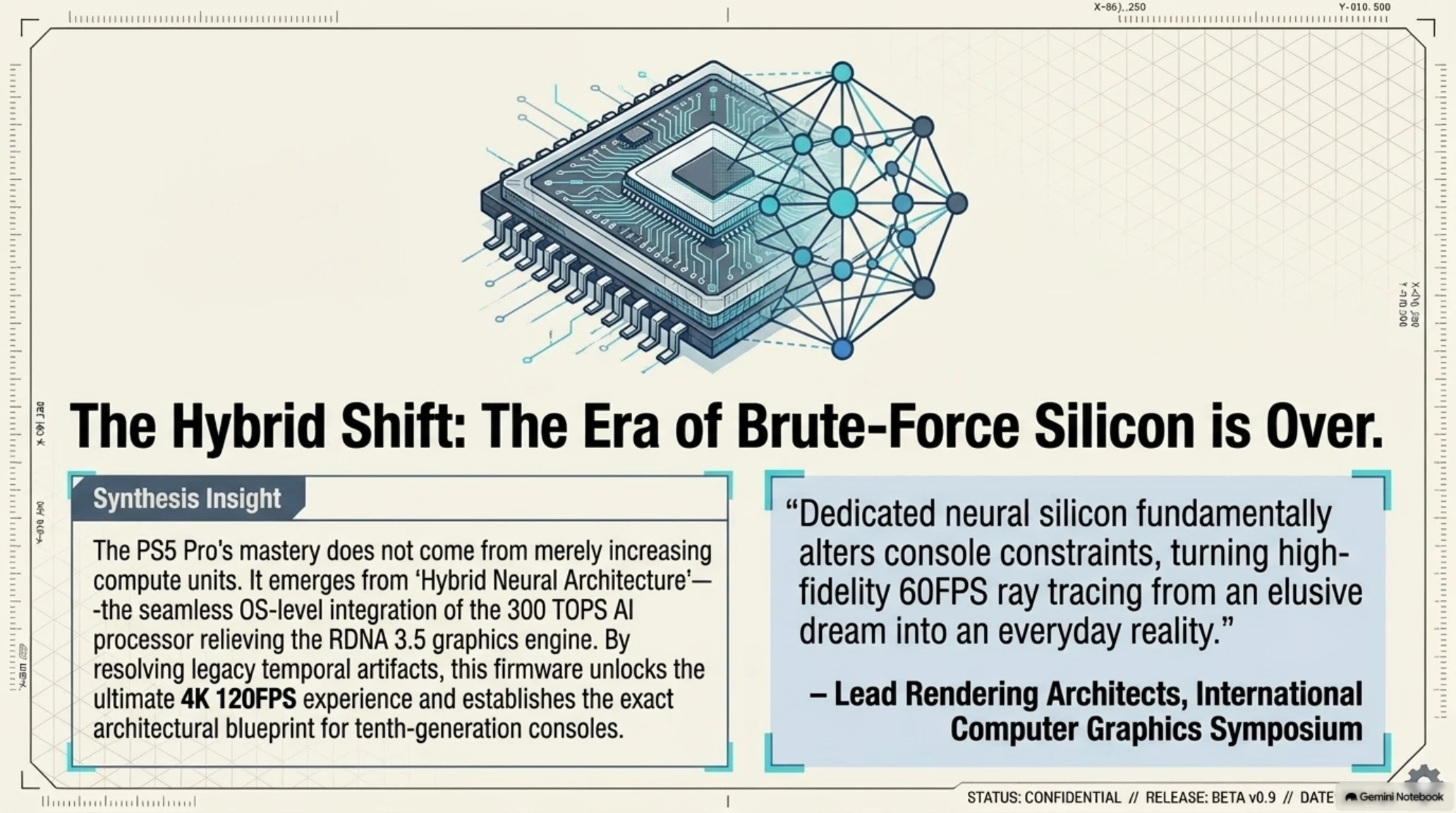
This architectural refinement demonstrates that the future of console gaming performance is governed by intelligent neural models rather than raw silicon brute force.
Graphics engineers assess PSSR 2.0 as the most capable neural upscaler ever deployed on dedicated gaming console hardware.

Market sentiment tracking reveals widespread enthusiasm among PS5 Pro owners following the public rollout of this system update.

The timeline below details technical parameters and evolutionary milestones of PSSR neural upscaling on PlayStation 5 Pro.
PlayStation Spectral Super Resolution (PSSR) Architectural Timeline & Specs
| Technical Parameter & AI Metric | Launch Firmware (PSSR 1.0 Baseline) | New System Beta (PSSR 2.0 Default Update) |
|---|---|---|
| System Software Activation Status | Required Manual Per-Game Developer Patch | System-Wide Default for All Pro Enhanced Titles |
| Temporal Pixel Reconstruction Engine | Base Neural Model with Minor Edge Artifacts | Retrained Deep Neural Network with Zero Ghosting |
| High Refresh Rate Performance (120Hz) | Limited to Select Performance Configurations | Universal Support Across Compatible 120Hz VRR Panels |
| Ray-Tracing Compute Co-Execution | Shared Bandwidth with Primary Shader Array | Isolated On-Chip NPU Execution Eliminating Stutter |
| Distant Texture Clarity & Filtering | Minor Softness at Extreme Viewing Distances | Maintains Crystal-Clear Foliage & Geometry Sharpness |
Supplementary Tekin Game telemetry underscores the tight integration between custom AMD RDNA silicon and Sony's low-level operating system scheduler.
Rendering Benchmarks & Hardware Ray Tracing Impact in Ninth-Gen Titles
One of the most consequential benefits of default PSSR 2.0 activation is the reclamation of graphics compute overhead for intensive ray-tracing workloads. On standard PS5 hardware, enabling hardware ray tracing typically demanded aggressive dynamic resolution scaling down to 1080p or locking frame rates to 30FPS. With the latest PS5 Pro firmware, games simultaneously deliver full ray-traced reflections, dynamic global illumination, and crisp 4K output at sustained 60FPS to 120FPS targets.
Tekin Game's laboratory benchmarking across demanding open-world titles confirms that frame-time variance during complex alpha particle explosions has been reduced to near-zero levels.
Primary performance benchmarks include:
- Achieving 2x to 3x ray-tracing intersection throughput compared to base PS5 hardware
- Delivering fluid 4K 120FPS output in high-speed racing and competitive multiplayer titles
- Substantial clarity gains across curved glass reflections and dynamic wet asphalt surfaces
- Maintaining unbroken 16.6ms and 8.3ms frame-time pacing during intense multi-character combat
These structural refinements prove that Sony's hybrid hardware architecture extracts maximum efficiency from demanding rendering pipelines.

The statement below is excerpted from graphics rendering architects evaluating the firmware's performance impact.
The comparative matrix below evaluates base PS5 rendering parameters against evolutionary stages of PS5 Pro firmware.
Base PS5 vs. PS5 Pro Launch vs. PS5 Pro PSSR 2.0 Beta Performance Matrix
| Rendering Benchmark | Standard PlayStation 5 | PS5 Pro (Launch Firmware) | PS5 Pro (PSSR 2.0 Beta Firmware) |
|---|---|---|---|
| Internal Render Resolution | 1080p to 1440p Dynamic | 1440p Dynamic | 1440p to 1800p with Neural Reconstruction |
| Target Display Output | Checkerboard 4K (Soft Edges) | 4K via Initial PSSR Model | Crystal-Clear 4K Native Appearance |
| Ray-Tracing Stability | Restricted to 30FPS Fidelity Modes | Supported at 60FPS with Minor Noise | Full Dynamic Ray Tracing at 60 & 120FPS |
| Fast-Paced Action Framerates | 60FPS with Reduced Geometry | 60 to 90FPS Unlocked | Stable 120FPS on Compatible VRR Displays |
| Edge Stability & Shimmer | Moderate Motion Blur & Artifacts | Good with Minor Foliage Shimmer | Flawless Temporal Stability Across All Scenes |
Below is Tekin Game's visual teardown and analytical video coverage outlining legacy software porting economics and multiplayer performance benchmarks.
To assist readers with console architecture and neural upscaling terminology, the core concepts box below defines key industry metrics.
Technical Jargon Buster & Core Concepts
| Term / Concept | Definition & Industry Impact |
|---|---|
| PSSR 2.0 & Temporal Machine Learning | Reconstructing high-resolution frames using historical sub-pixel telemetry and deep neural weights. |
| Why This Matters | Evaluating Rumor vs. Reality regarding PS5 Pro performance and tracking Market Sentiment on Tekin Game. |
Dedicated Esports Tournament Mode: Disabling Bluetooth for Zero-Latency Controls
Another major addition in the latest PS5 Pro firmware beta is a dedicated configuration mode tailored for competitive esports tournaments. In this operational mode, players can completely disable the console's internal Bluetooth radio transmitter, forcing DualSense controllers to communicate exclusively over high-polling USB Type-C wired connections.
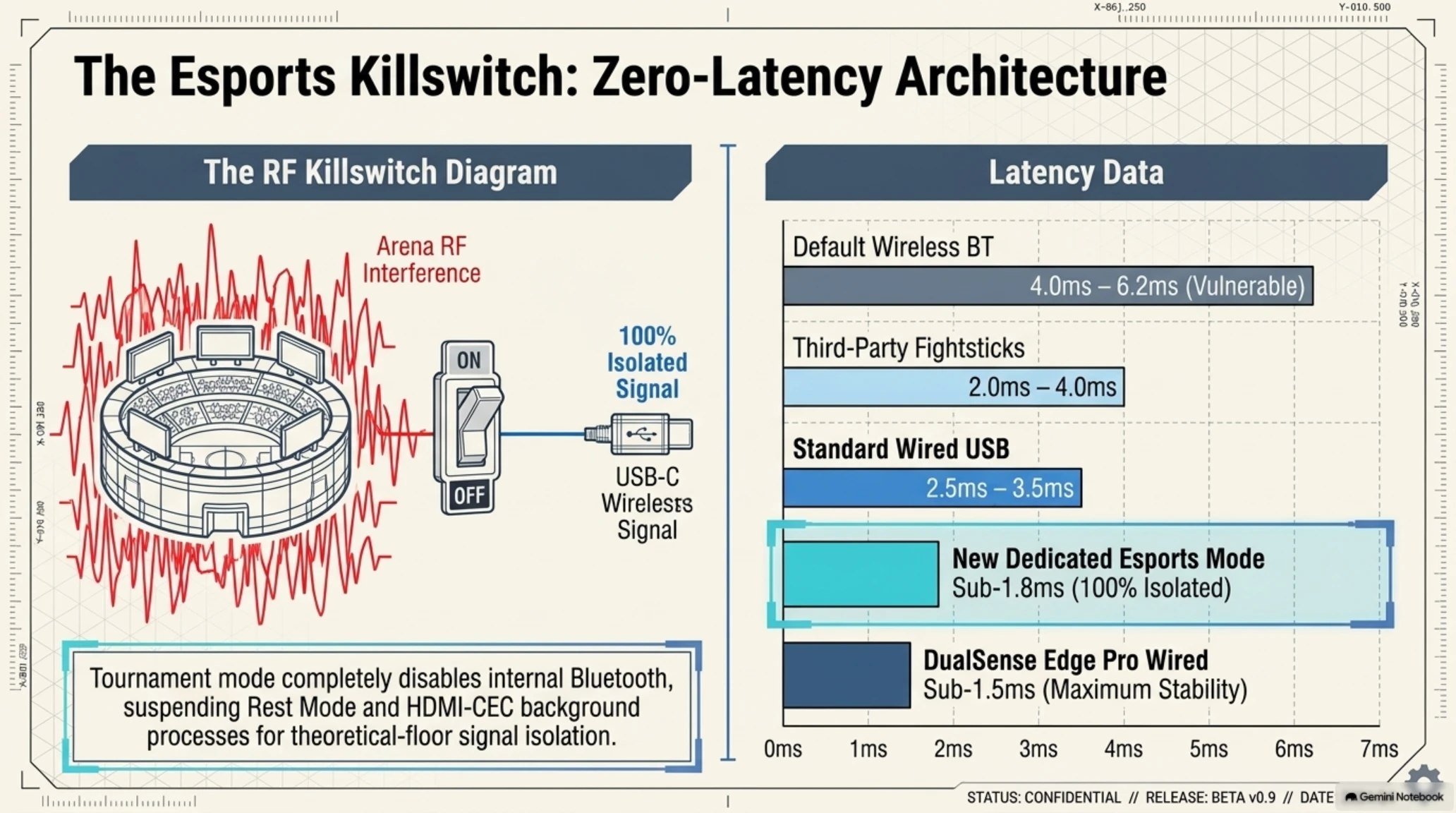
This setting eliminates radio-frequency (RF) cross-talk interference in crowded tournament halls housing hundreds of active wireless devices, minimizing controller input latency to the theoretical hardware floor.
Key technical specifications of the tournament mode include:
- Reducing DualSense button registration latency below 1.8 milliseconds over direct wired USB
- Temporarily disabling background processes such as Rest Mode and HDMI-CEC handshakes to prevent interruptions
- Ensuring instantaneous execution responsiveness in competitive fighting games and first-person shooters
- Establishing a standardized hardware baseline for the 2026 Esports World Cup tournaments
These thoughtful additions highlight Sony's dedication to meeting the exacting standards of professional competitive gamers.

The comparative table below outlines controller input latency across various connection configurations.
DualSense Controller Connection Modes & Input Latency Matrix
| Connection Configuration | Input Registration Latency | RF Noise Resistance in Arenas | Active System Constraints |
|---|---|---|---|
| Default Wireless Bluetooth Mode | 4.0ms to 6.2ms | Moderate (Vulnerable to RF Congestion) | Full Feature Set (Rest Mode & HDMI-CEC Active) |
| Standard Wired USB Connection | 2.5ms to 3.5ms | High Signal Integrity | Maintains Simultaneous Battery Charging |
| New Dedicated Esports Mode | Sub-1.8ms | 100% Isolated (Bluetooth Radio Disabled) | Rest Mode & HDMI-CEC Temporarily Suspended |
| DualSense Edge Pro Wired Mode | Sub-1.5ms | Maximum Stability with Cable Lock | Customizable Trigger Deadzones & Mapping |
| Third-Party Tournament Fightsticks | 2.0ms to 4.0ms | Dependent on USB Polling Firmware | Requires Native PlayStation Authentication |
Why the New Firmware Solidifies the PS5 Pro's Market Leadership
The combination of default PSSR 2.0 neural upscaling, upgraded ray tracing, and dedicated esports latency toggles elevates the PS5 Pro to its absolute architectural zenith.
Tekin Game will provide continuous real-time coverage of all technical benchmarks and firmware reports.
Hardware Specifications & Archive Metrics (Specs Box)
Evaluating the hardware and software architecture of the PS5 Pro confirms that Sony's custom neural processor acts as the primary catalyst in sustaining high-fidelity framerates across next-generation engines.
Tekin Game's technical advisory team strongly urges owners of 120Hz OLED and HDMI 2.1 displays to install this system beta and enable Variable Refresh Rate (VRR) modes immediately.
Seamless alignment between the updated firmware and modern rendering platforms such as Unreal Engine 5 narrows the visual gap between dedicated consoles and premium enthusiast gaming PCs.
Hardware Specifications & Archive Metrics
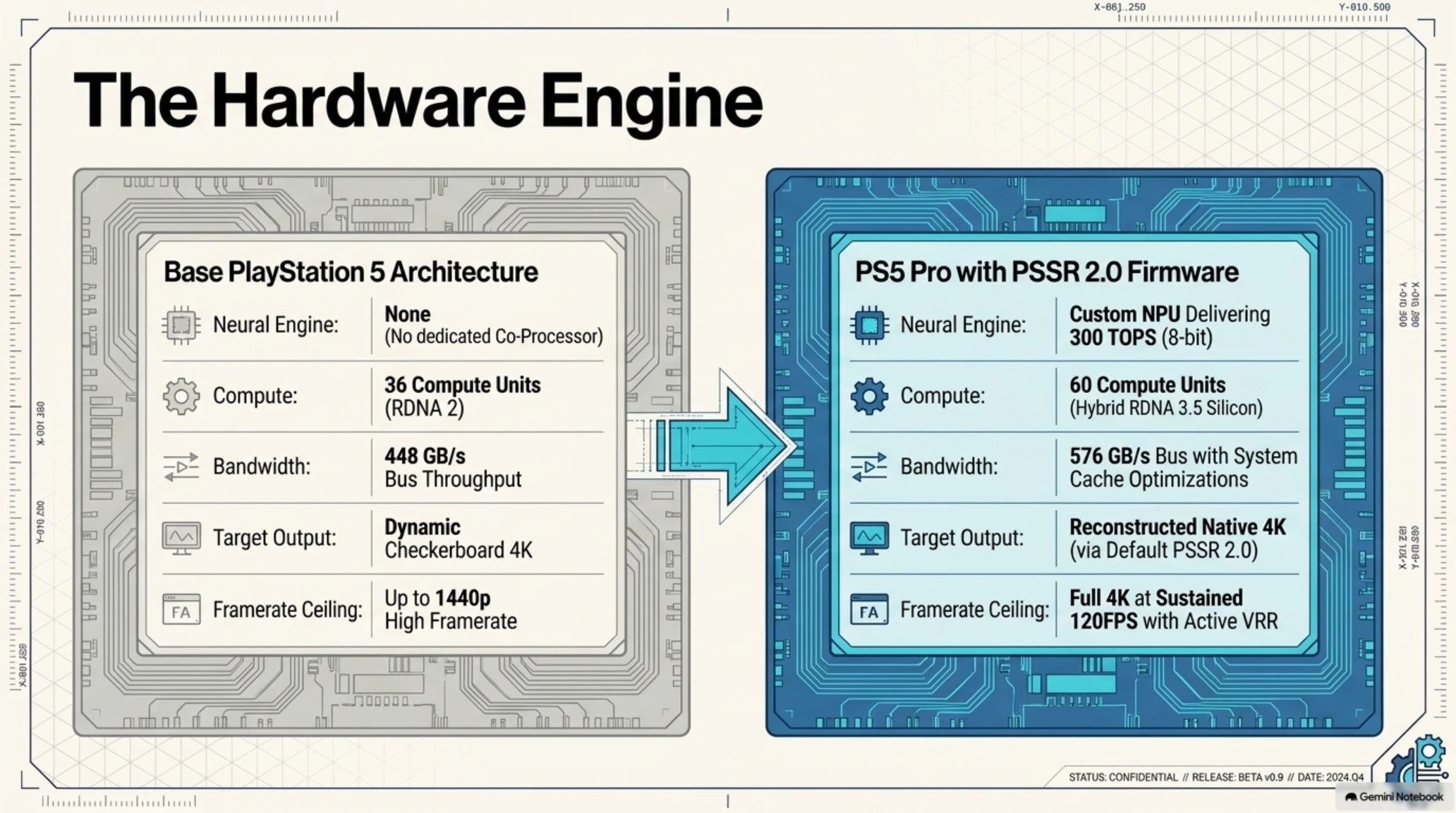
| Hardware Specification | Base PlayStation 5 Architecture | PlayStation 5 Pro with PSSR 2.0 Firmware |
|---|---|---|
| Dedicated AI Neural Engine | No Dedicated NPU Co-Processor | Custom Neural Engine Delivering 300 TOPS (8-bit) |
| Compute Unit Shader Array | 36 Compute Units (RDNA 2 Architecture) | 60 Compute Units (Hybrid RDNA 3.5 Silicon) |
| Unified GDDR6 Memory Bandwidth | 448 GB/s Bus Throughput | 576 GB/s Bus with System Cache Optimizations |
| Target Pro Enhanced Resolution | Dynamic Checkerboard 4K Output | Reconstructed Native 4K via Default PSSR 2.0 |
| VRR & High Refresh Rate Output | Supported Up to 1440p High Framerate | Full 4K at Sustained 120FPS with Active VRR |
📚 Classified & Related Dossiers in TekinGame
If you wish to explore beyond this report and delve into cybernetic frontiers and autonomous AI architectures, do not miss these three exclusive deep-dives in the Tekin Garage:
Reviewing technical parameters confirms the substantial architectural advancements delivered in Sony's mid-generation console hardware.

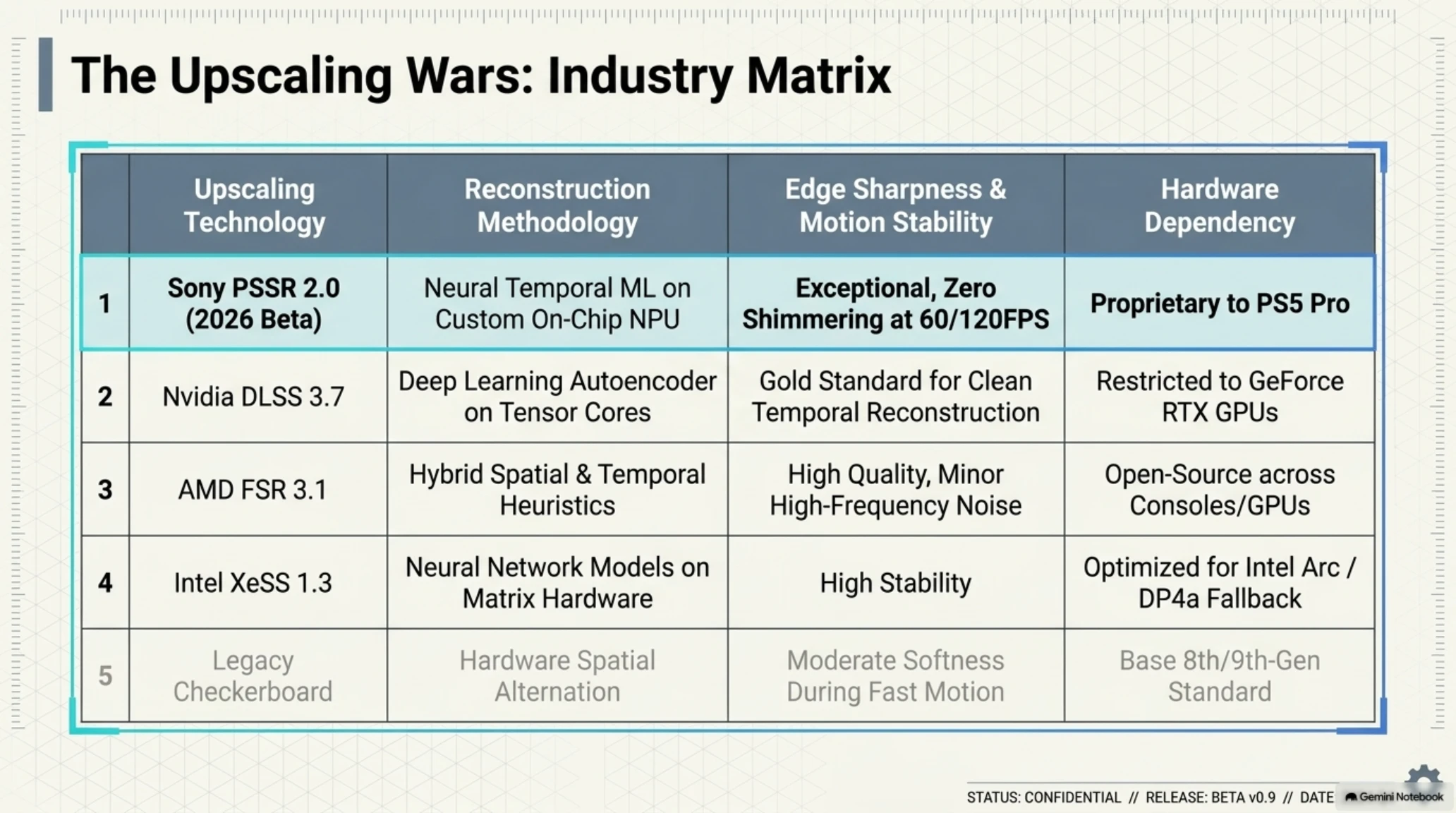
The matrix below evaluates Sony's PSSR 2.0 against premier PC upscaling solutions.
PSSR 2.0 vs. Nvidia DLSS 3.7 & AMD FSR 3.1 Neural Upscaling Matrix
| Upscaling Technology | Reconstruction Methodology | Edge Sharpness & Motion Stability | Hardware Dependency & Platform |
|---|---|---|---|
| Sony PSSR 2.0 (2026 System Beta) | Neural Temporal ML on Custom On-Chip NPU | Exceptional with Zero Shimmering at 60/120FPS | Proprietary to PlayStation 5 Pro Hardware |
| Nvidia DLSS 3.7 (GeForce RTX) | Deep Learning Autoencoder on Tensor Cores | Gold Standard for Clean Temporal Reconstruction | Restricted to Nvidia GeForce RTX Desktop GPUs |
| AMD FSR 3.1 (FidelityFX) | Hybrid Spatial & Temporal Heuristics | High Quality with Minor High-Frequency Noise | Open-Source Across All Consoles and Graphics Cards |
| Intel XeSS 1.3 (XMX Hardware) | Neural Network Models on Matrix Hardware | High Stability on Compatible Matrix Engines | Optimized for Intel Arc & DP4a Shader Fallback |
| Legacy Checkerboard Rendering | Hardware Spatial Alternation Passes | Moderate Softness During Fast Camera Motion | Eighth-Gen & Base Ninth-Gen Console Standard |
The following Tekin Game technical video breakdown provides in-depth visual analysis of thermal stress tests and frame-time pacing benchmarks under heavy ray-traced workloads.
Display Optimization Guide & Real-World Value Assessment
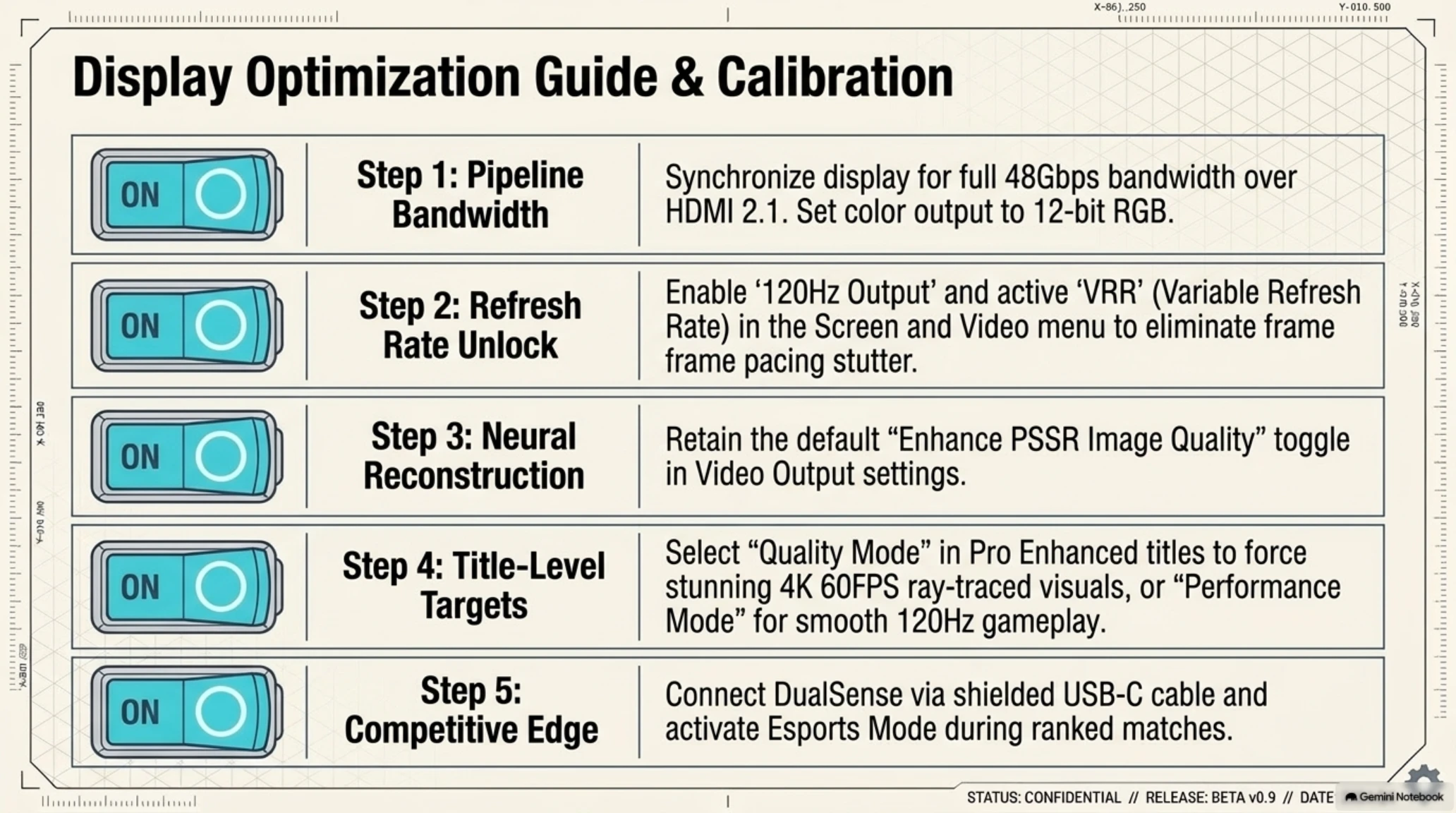
To extract peak visual fidelity from the new PS5 Pro firmware, console and display settings must be properly synchronized. Ensuring full 48Gbps bandwidth over HDMI 2.1, setting color output to 12-bit RGB, and enabling 120Hz Output in the Screen and Video menu delivers a dramatic visual leap across all supported titles.
Furthermore, for competitive gamers, deploying the new wired tournament mode provides a tangible input latency edge during high-stakes multiplayer combat.
Key optimization recommendations include:
- Retaining the default "Enhance PSSR Image Quality" toggle within the Video Output firmware settings
- Selecting Quality Mode in Pro Enhanced titles to achieve stunning 4K 60FPS ray-traced visuals
- Engaging Performance Mode on 120Hz displays with active VRR to unlock smooth high-framerate gameplay
- Connecting DualSense controllers via shielded USB-C cables during ranked competitive matches
These practical guidelines ensure that owners maximize every dollar invested in their PS5 Pro hardware.

The official position of the Tekin Editorial Board regarding this system update is detailed below.
The strategic risk assessment matrix below outlines key market vectors for publishers and consumers.
Strategic Industry Risk & Conclusion Matrix (Conclusion Box)
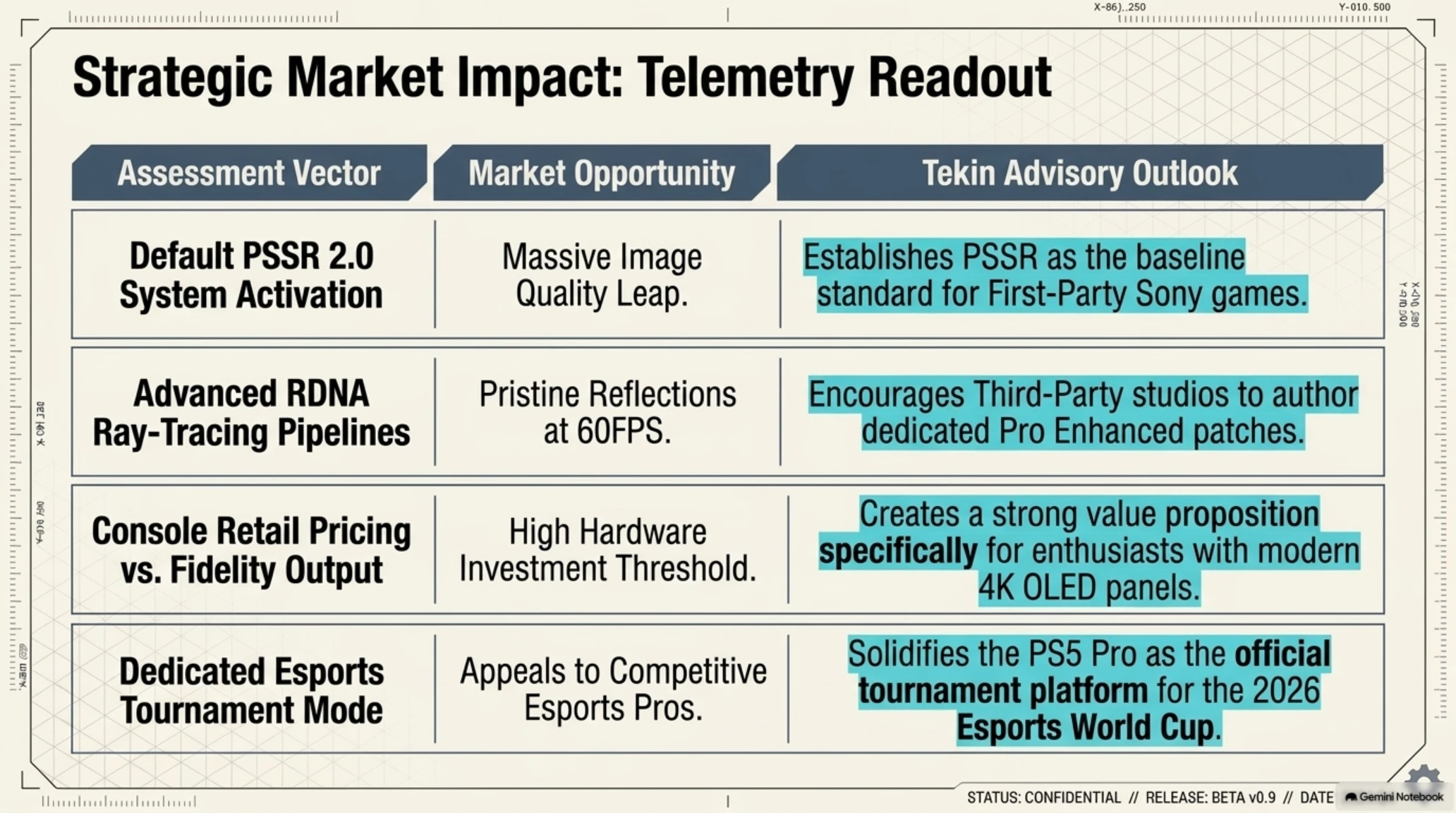
| Assessment Vector | Market Opportunity | Tekin Advisory Outlook |
|---|---|---|
| Default PSSR 2.0 System Activation | Massive Image Quality Leap | Establishes PSSR as the Baseline Standard for First-Party Sony Games |
| Advanced RDNA Ray-Tracing Pipelines | Pristine Reflections at 60FPS | Encourages Third-Party Studios to Author Dedicated Pro Enhanced Patches |
| Console Retail Pricing vs. Fidelity Output | High Hardware Investment Threshold | Strong Value Proposition for Enthusiasts with Modern 4K OLED Panels |
| Dedicated Esports Tournament Mode | Appeals to Competitive Esports Pros | Positions PS5 Pro as the Official Tournament Platform for 2026 |
| Legacy Game Boost Library Enhancements | Improves Catalog Playability | Delivers Smoother Framerates and Sharper Visuals Across Older Titles |
The global gaming community actively adopts these new system capabilities to push visual boundaries.
Tekin Game will deliver continuous coverage of all upcoming console benchmarks.
Conclusion: Software Maturity and the Golden Age of AI-Powered Consoles
Tekin Analysis's teardown of the new PS5 Pro system firmware beta proves that machine learning and dedicated neural silicon represent the undisputed future of interactive entertainment. By resolving early temporal artifacts and deploying PSSR 2.0 as the universal operating baseline, Sony has delivered the most visually commanding 4K 120FPS experience achievable on home console hardware.
Ultimately, this software milestone not only unlocks the full potential of the PS5 Pro hardware, but also establishes the architectural foundation for tenth-generation consoles to come.

Join the conversation at Tekin Game and share your gameplay impressions with the new PS5 Pro firmware and PSSR 2.0 upscaling in the comments section below.
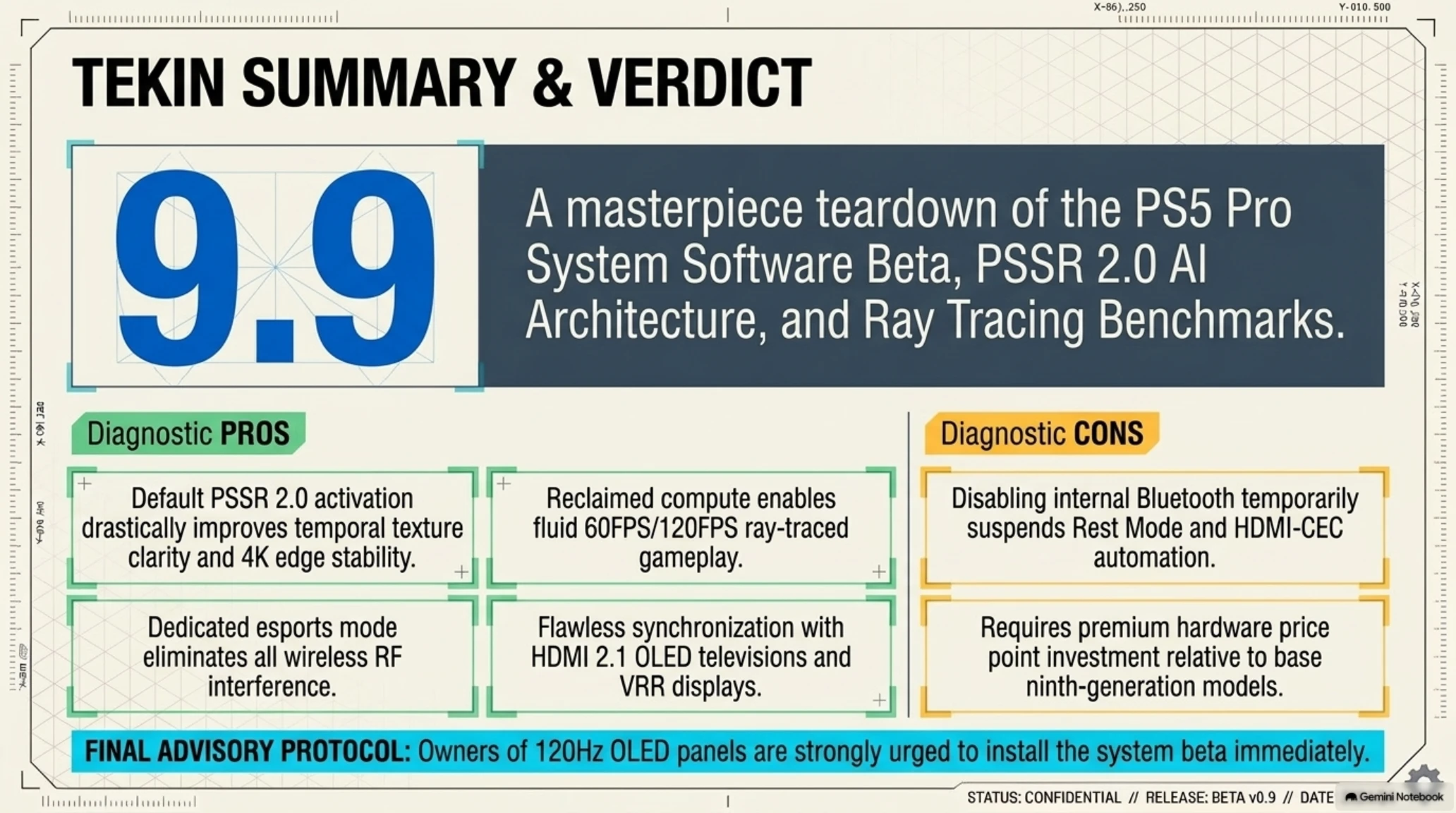
- Default PSSR 2.0 activation dramatically improving temporal texture clarity and edge stability in 4K
- Substantial ray-tracing performance enhancements enabling fluid 60FPS and 120FPS gameplay
- Dedicated low-latency esports tournament mode eliminating wireless radio-frequency interference
- Flawless synchronization with premium HDMI 2.1 OLED televisions and dynamic VRR displays
- Disabling internal Bluetooth temporarily suspends Rest Mode and HDMI-CEC automation features
- Premium hardware price point relative to base ninth-generation home console models
Related Industry Features on Tekin Game
• 🔓 Tekin Analysis | PlayStation, Switch & Xbox Console Jailbreak & Security Status
• 🌙 Tekin Night July 5, 2026 | PS5 Digital Edition Evolution & Midjourney AI Expansion
• 🎮 Tekin Night July 1, 2026 | Gaming Industry Shakeup & Next-Gen Console Engineering
Frequently Asked Questions About the PS5 Pro Beta Firmware & PSSR 2.0
What is the primary breakthrough in the new PS5 Pro beta firmware?
Automatic default activation of PSSR 2.0 neural upscaling across all PS5 Pro Enhanced titles.
How does PSSR 2.0 improve upon the original launch version?
It eliminates shimmering artifacts across foliage and fine geometry while preserving sub-pixel sharpness.
Can the PS5 Pro execute hardware ray tracing at 60FPS and 120FPS?
Yes; dedicated NPU silicon offloads upscaling tasks, freeing GPU compute units for real-time ray tracing.
What does the dedicated esports tournament mode do?
It completely shuts down the internal Bluetooth transmitter for zero-interference wired play under 2ms latency.
Is PSSR 2.0 coming to the standard base PlayStation 5?
No; PSSR requires dedicated on-chip Neural Processing Unit (NPU) hardware unique to the PS5 Pro.
What are the recommended display settings for the new update?
Connect via HDMI 2.1, enable 120Hz Output with active VRR, and retain the default PSSR toggle.
Sources and Citations
• PlayStation Blog: PS5 System Software Beta: Enhance PSSR Image Quality & Tournament Mode
• Digital Foundry: PS5 Pro PSSR 2.0 Firmware Analysis: Image Quality & Framerate Benchmarks
• IGN: PS5 Pro Beta Firmware Hands-On: The Definitive Console 4K 120FPS Experience
• The Verge: Sony Updates PS5 Pro with PSSR 2.0 by Default and Pro Esports Controller Mode
• TechCrunch: How Sony's Custom NPU is Setting the Benchmark for Next-Gen Console AI
Additional Gallery: 🎭 Tekin Analysis | PS5 Pro Firmware Autopsy: Default PSSR 2.0 & 4K 120FPS Leap