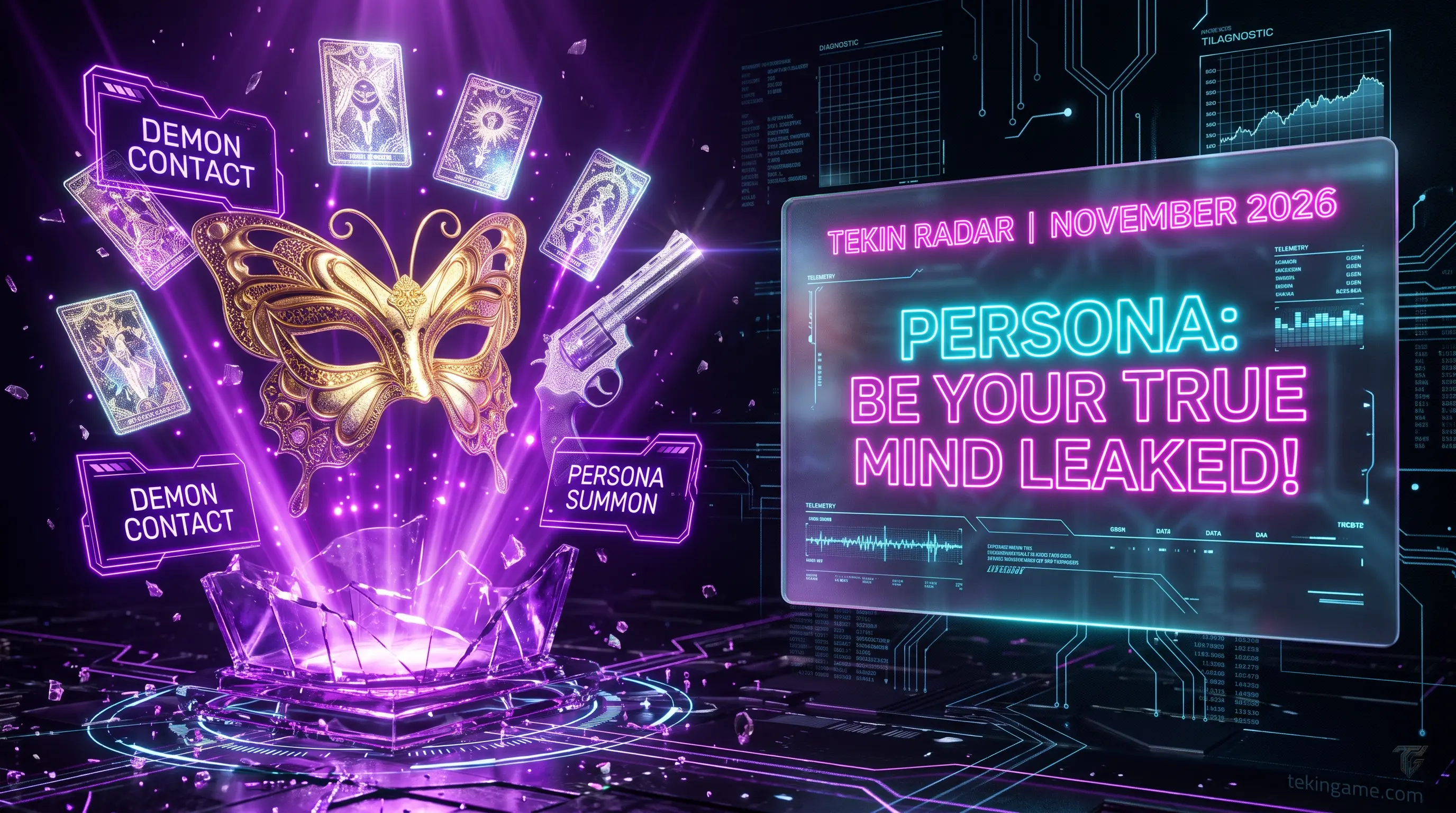
Tekin Radar | Executive Breach Briefing: Persona 1 Remake Gameplay Leak and Atlus Production Architecture
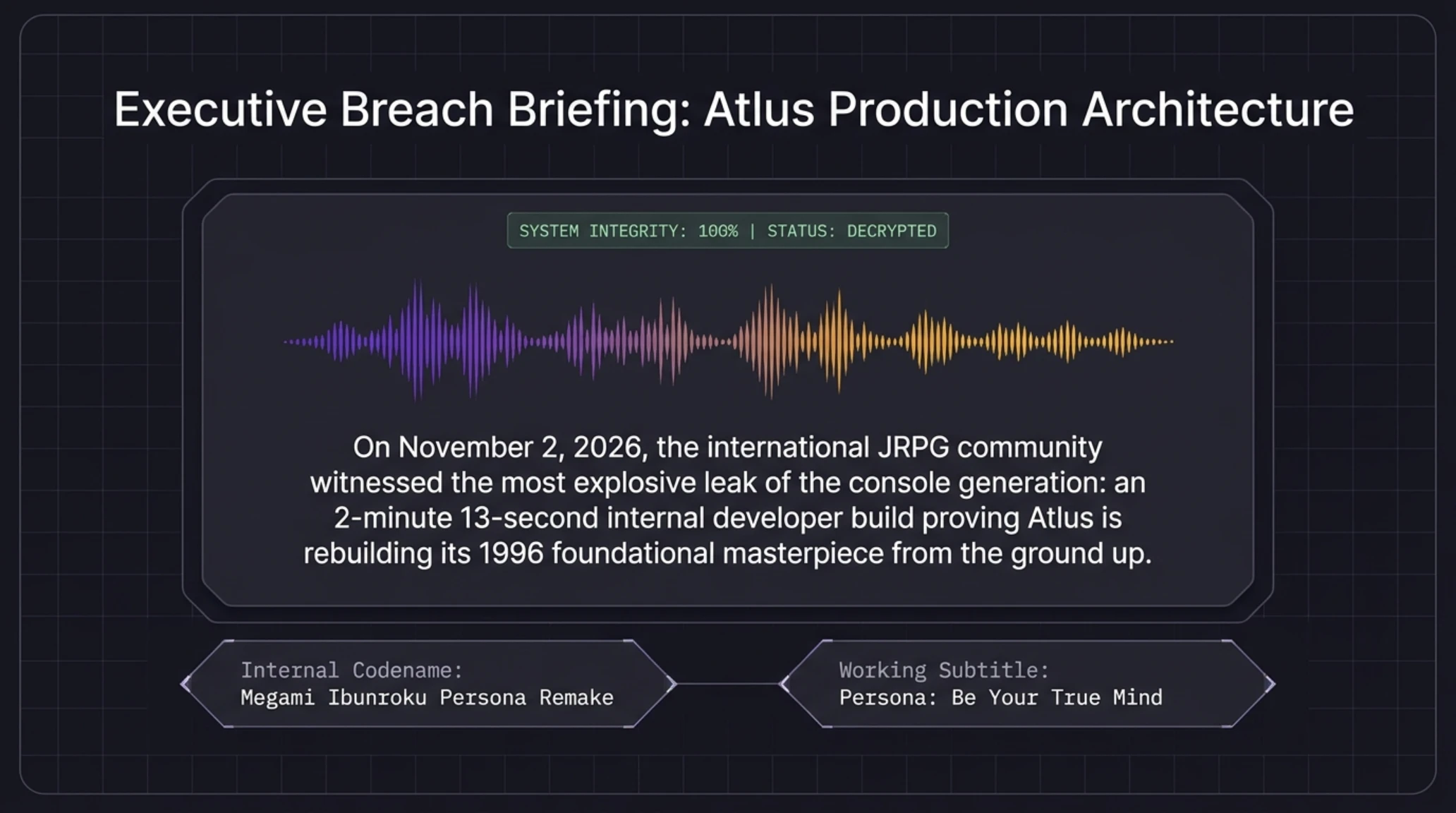
On November 2, 2026, the international Japanese role-playing game community witnessed one of the most explosive leaks of the current console generation. While publisher Sega and developer Atlus had spent the preceding months highlighting the critical triumphs of Studio Zero and teasing future milestones for the flagship Persona franchise, an unvetted two-minute video file surfaced across private Discord servers, Reddit gaming forums, and underground archives. Originating under the Japanese filename Megami Ibunroku Persona Remake, the footage provides undeniable proof that Atlus is actively developing a complete remake of the landmark 1996 PlayStation classic.
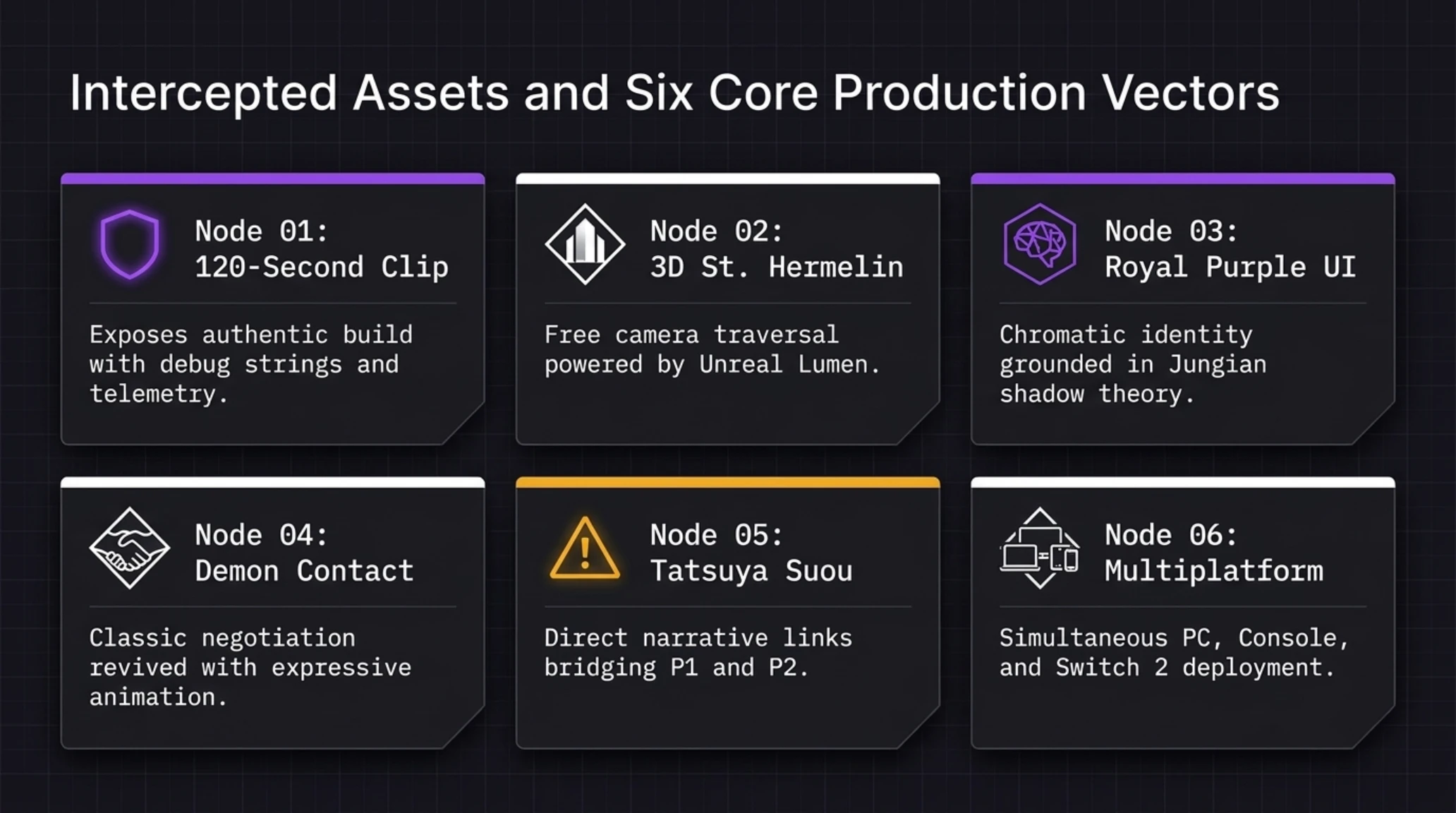
Strategic Radar Vectors and Key Takeaways | 6 Core Vectors of Persona 1 Leak
The Dark Web Breach; Deconstructing the 2-Minute Leaked Build of Megami Ibunroku
For more than a decade, veteran enthusiasts have categorized the earliest entries of the Persona catalog as lost relics of a bygone era. Originally debuting on 32-bit hardware under the moniker Megami Ibunroku Persona, the title laid the conceptual foundations high school adolescents balancing psychological trauma with demonic manifestations that would later propel Persona 5 to global superstardom. However, encumbered by archaic first-person dungeon crawls, punishing grid-based combat encounters, and steep localization barriers, the foundational entry remained largely unplayable for contemporary gamers.
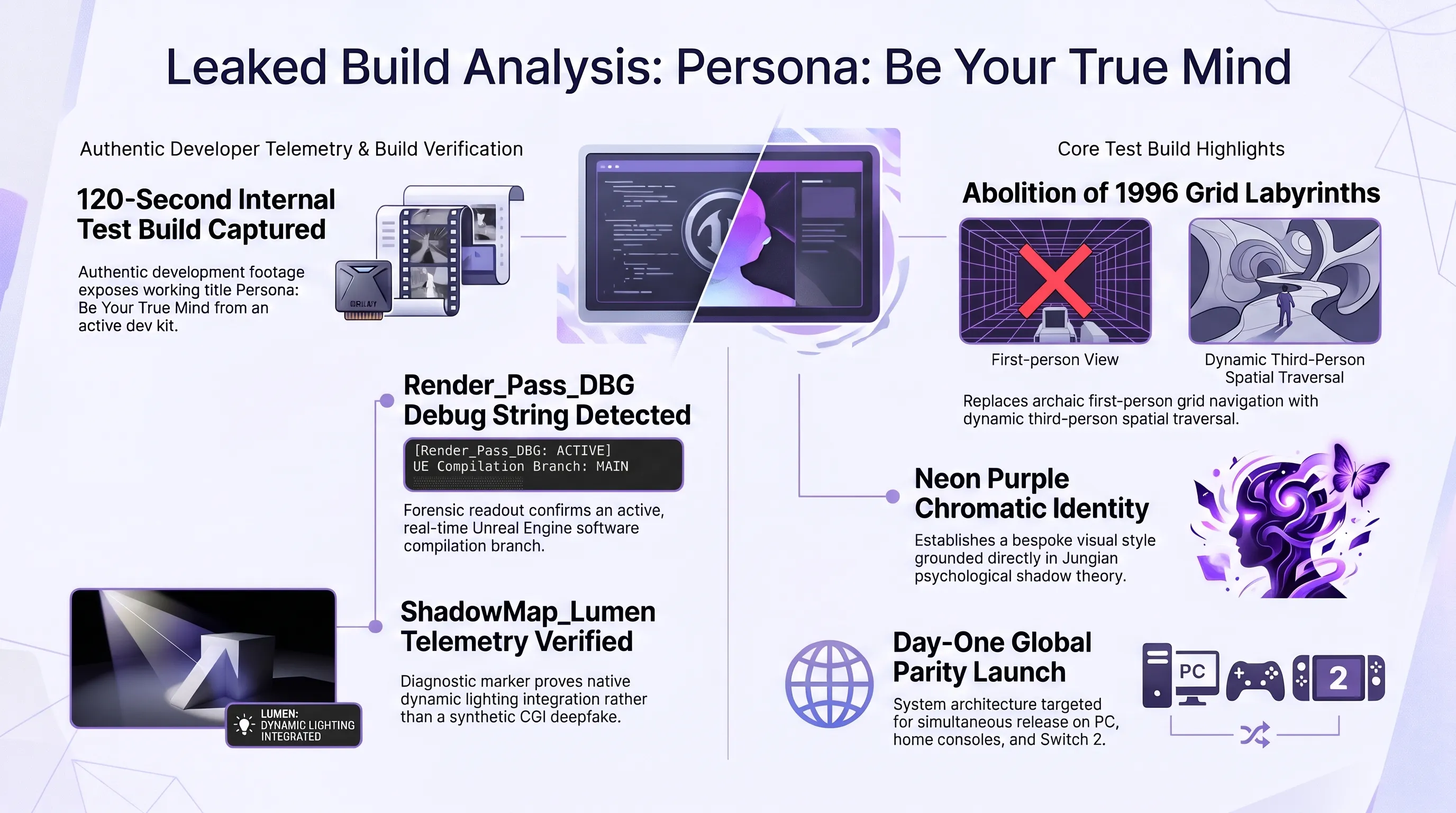
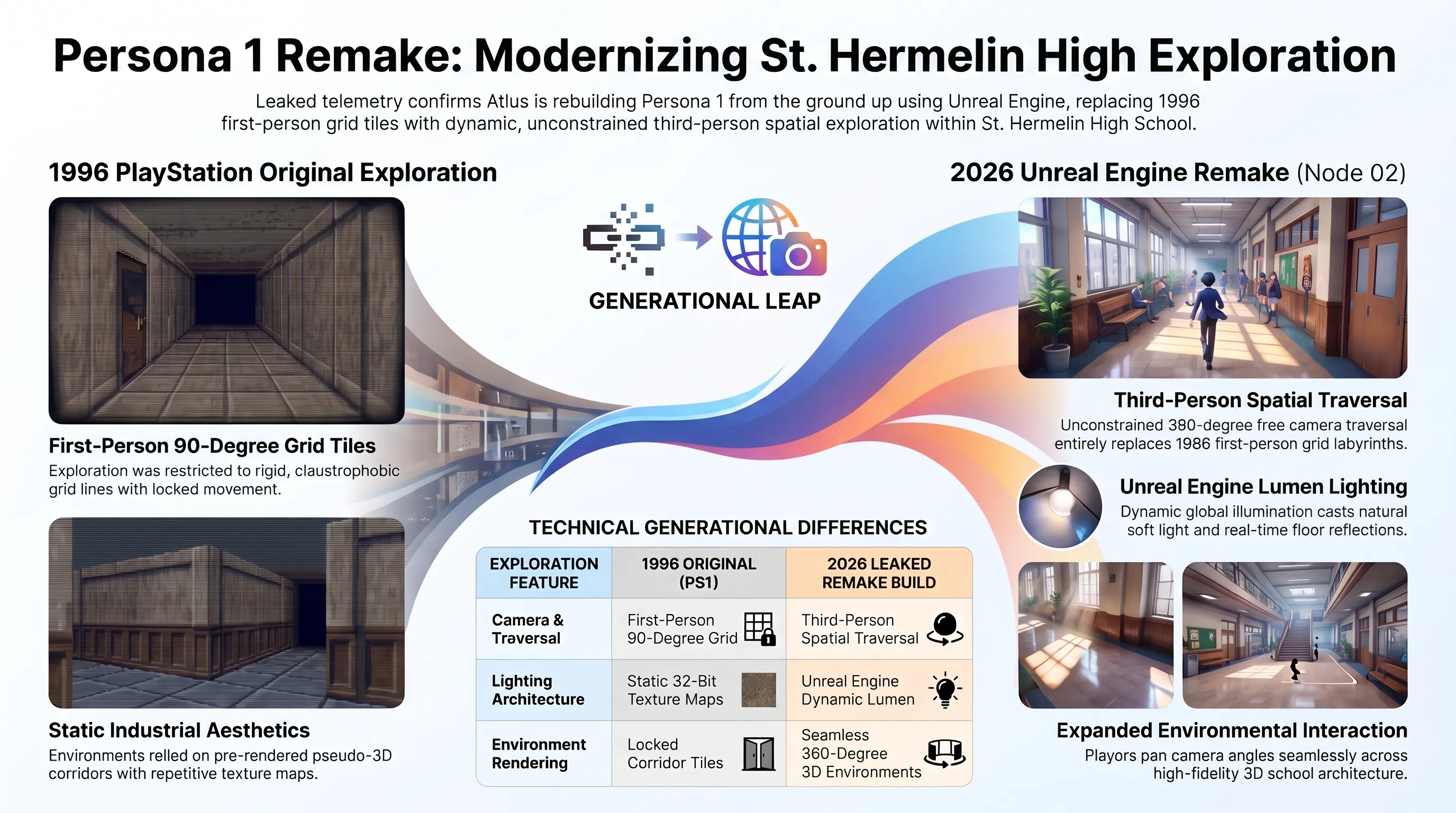
The leaked footage, spanning exactly two minutes and thirteen seconds, showcases an ambitious ground-up remake running in full real-time rendering. The opening sequence depicts the series' unnamed protagonist revered among long-time fans as Naoya Toudou or the Boy with Earring traversing the halls of St. Hermelin High School. Operating under an unconstrained third-person perspective, the school architecture is rendered with painstaking geometric fidelity, featuring naturalistic wooden floor reflections, dynamic sunlight filtering through tall classroom windows, and ambient airborne dust particles.
Technical analysis performed by software security auditors highlights discrete internal debug strings visible in the top-right quadrant of the display feed. Diagnostic readouts such as Render_Pass_DBG and ShadowMap_Lumen point directly to an active Unreal Engine compilation branch. These forensic markers demonstrate that the video is not a pre-rendered conceptual animation or an offline CGI showcase, but raw gameplay captured directly from an active developer hardware test kit.
In an era increasingly clouded by synthetic media and generative artificial intelligence hoaxes, gaming communities initially treated the leak with warranted skepticism. However, closer examination reveals flawless skeletal rigging, proprietary typographic hierarchies unique to Atlus graphic design manuals, and Shigenori Soejima-style character anatomy that generative video tools cannot consistently replicate. The leak mirrors the legendary 2021 Sega internal breach that prematurely revealed Persona 3 Reload years ahead of its official public marketing campaign.
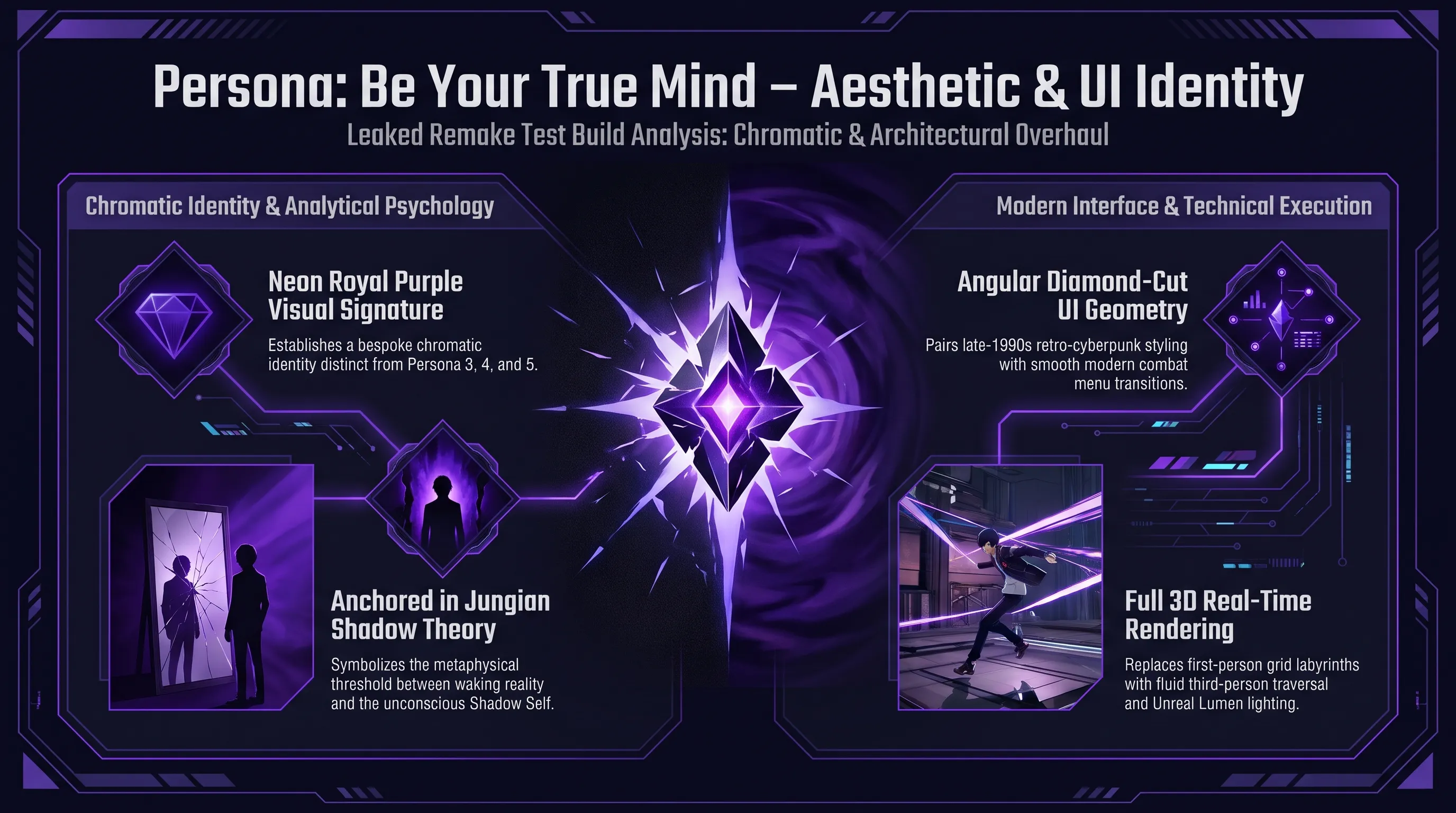
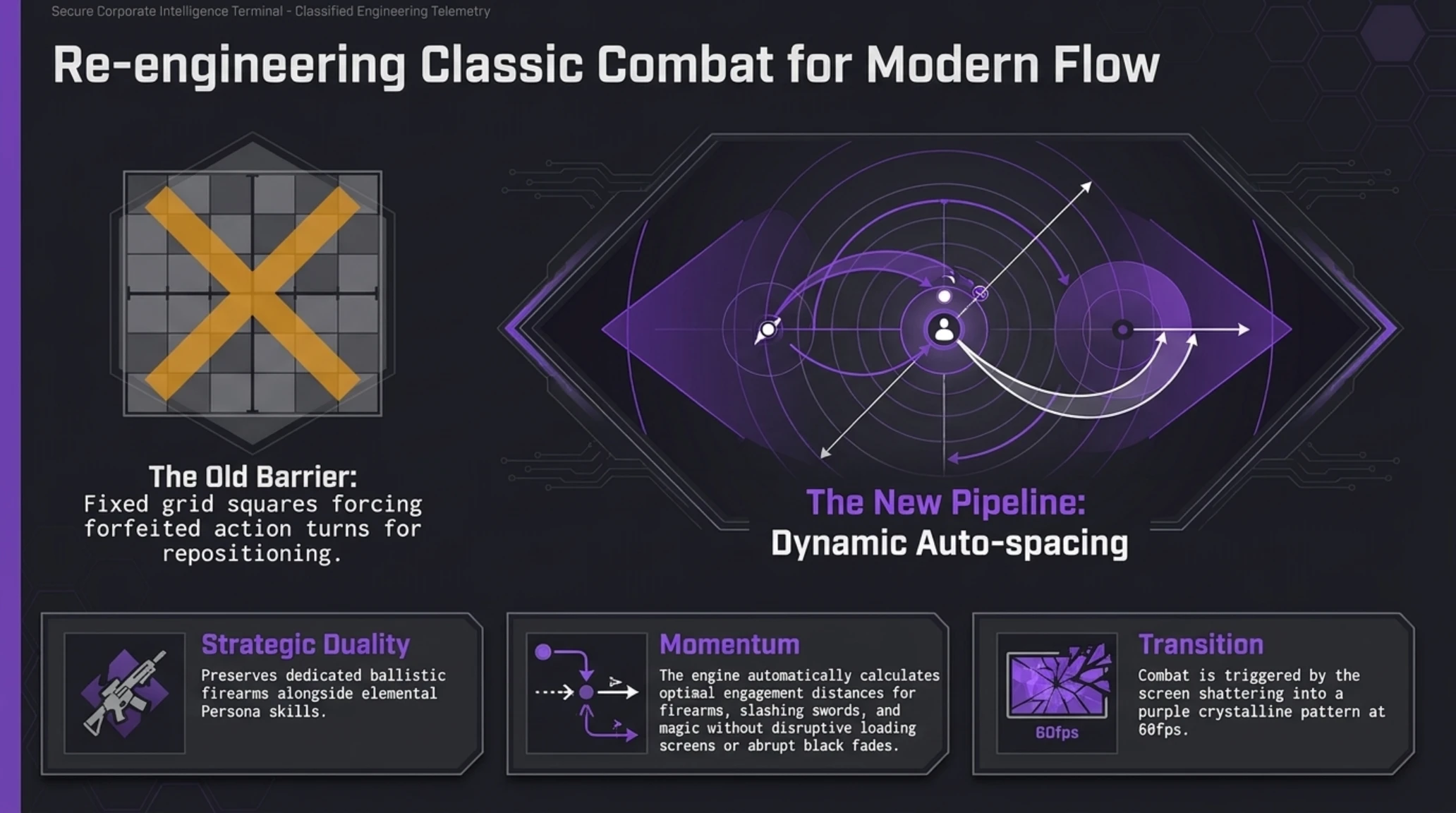
Midway through the video, the transition from atmospheric exploration to tactical turn-based combat occurs without disruptive loading screens or abrupt black fades. Instead, the screen shatters into an expressive neon purple crystalline pattern, immediately plunging the squad into the heat of battle. An ultra-stylish, fluid user interface snaps into view, presenting angular menu buttons for firearm volleys, Persona summoning spells, physical melee strikes, and the iconic Demon Contact system.
The auditory accompaniment during this combat transition further reinforces the authenticity of the leak. Rather than relying on generic placeholder audio, the battle is scored to an explosive modern rock-fusion arrangement of the original 1996 Pandora theme. Layered with pulsing electronic synths, driving percussion, and soaring electric guitars, the soundtrack embodies the signature compositional style of Atlus sound maestro Shoji Meguro while revitalizing the psychological tension of the 32-bit era.
The clip concludes with a brief visual novel-style dialogue vignette between the protagonist and heroine Maki Sonomura inside an uncanny alternate dimensional corridor. High-resolution Live2D facial portraits emote dynamically alongside the three-dimensional environment, demonstrating that Atlus is applying the refined narrative presentation techniques perfected in Persona 3 Reload directly to its origin story.
When evaluated against the 2009 PlayStation Portable remaster, this leaked build proves that Atlus is no longer content with modest preservation ports. The studio is methodically engineering a total reinvention intended to establish Persona 1 as a modern commercial powerhouse capable of captivating both veteran collectors and contemporary enthusiasts who discovered the genre through modern entries.
Industry analysts point out that the decision to build upon the latest iteration of Epic Games' Unreal Engine represents a decisive technological pivot for Atlus. By shifting away from bespoke legacy internal tools toward standardized modern rendering pipelines, the development teams can achieve unprecedented parity across disparate platform architectures while significantly accelerating production velocity and streamlining future multiplatform expansions.
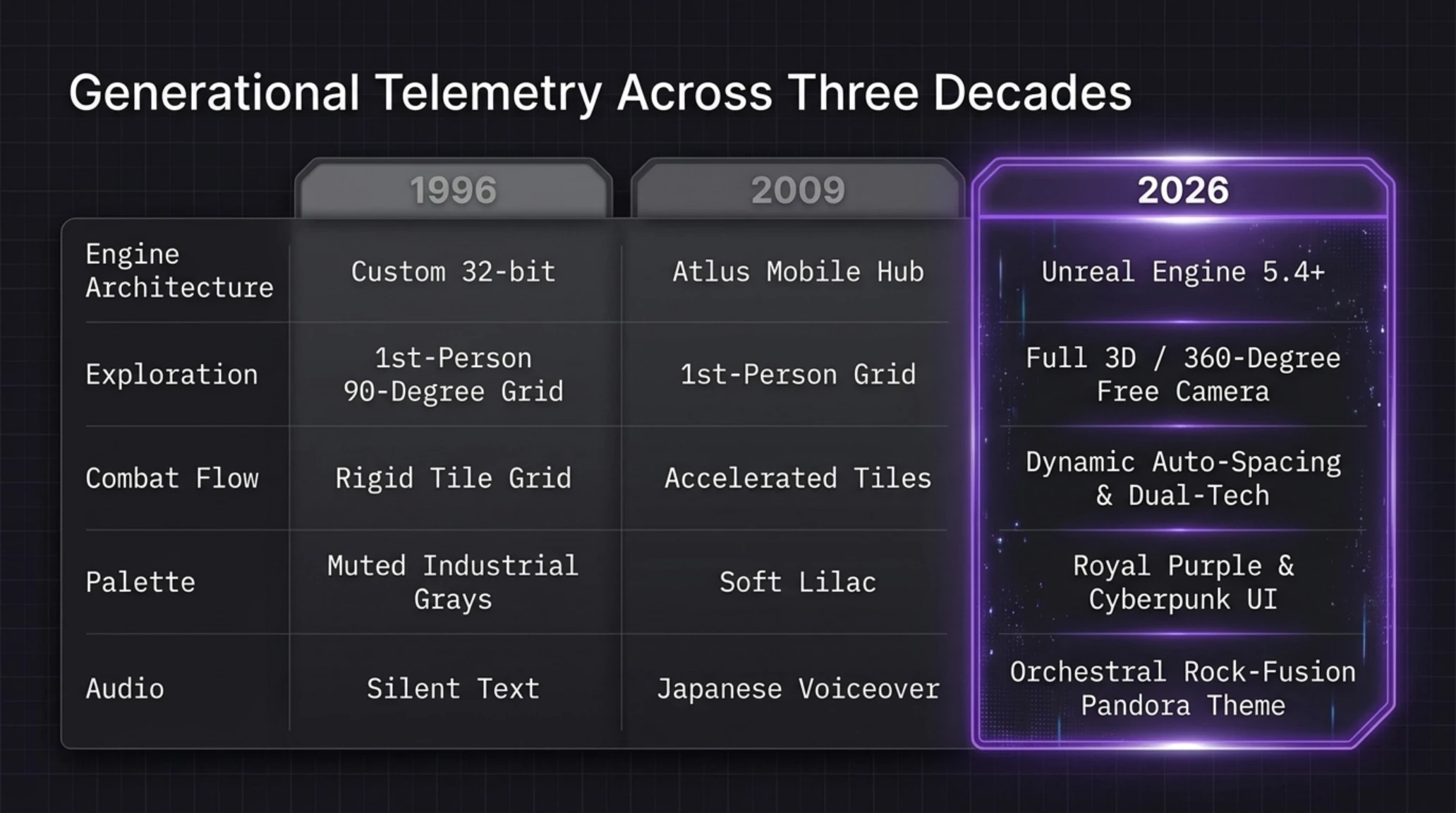
Generational Evolution | Key Generational Metrics Across 3 Decades of Persona 1
Empirical data from the footage reveals that Atlus is investing top-tier AAA resources to elevate its foundational origin story into an uncompromised contemporary masterpiece.
The swift reaction across premier international media outlets highlights the colossal market appetite for classic Japanese role-playing game reinventions executed with cutting-edge production values. Gaming enthusiasts who previously regarded the original 1996 release as an inaccessible museum piece can now anticipate experiencing the profound narrative genesis of the franchise without enduring thirty-year-old control paradigms or punitive exploration limitations.
Unreal Engine Migration; Purple UI Aesthetics and the 3D Reimagining of St. Hermelin
The strategic transition of Atlus development teams toward Epic Games' Unreal Engine represents a structural revolution in the company's production capabilities. For over two decades, internal development studios relied upon customized proprietary engines. While this bespoke approach gave birth to the unmistakable cel-shaded brilliance of Persona 5, it severely bottlenecked production timelines and complicated multi-platform porting initiatives. The overwhelming commercial and technical success of Shin Megami Tensei V and Persona 3 Reload verified that Unreal Engine provides the ideal technological foundation to scale visual fidelity without diluting Atlus' signature anime art direction.
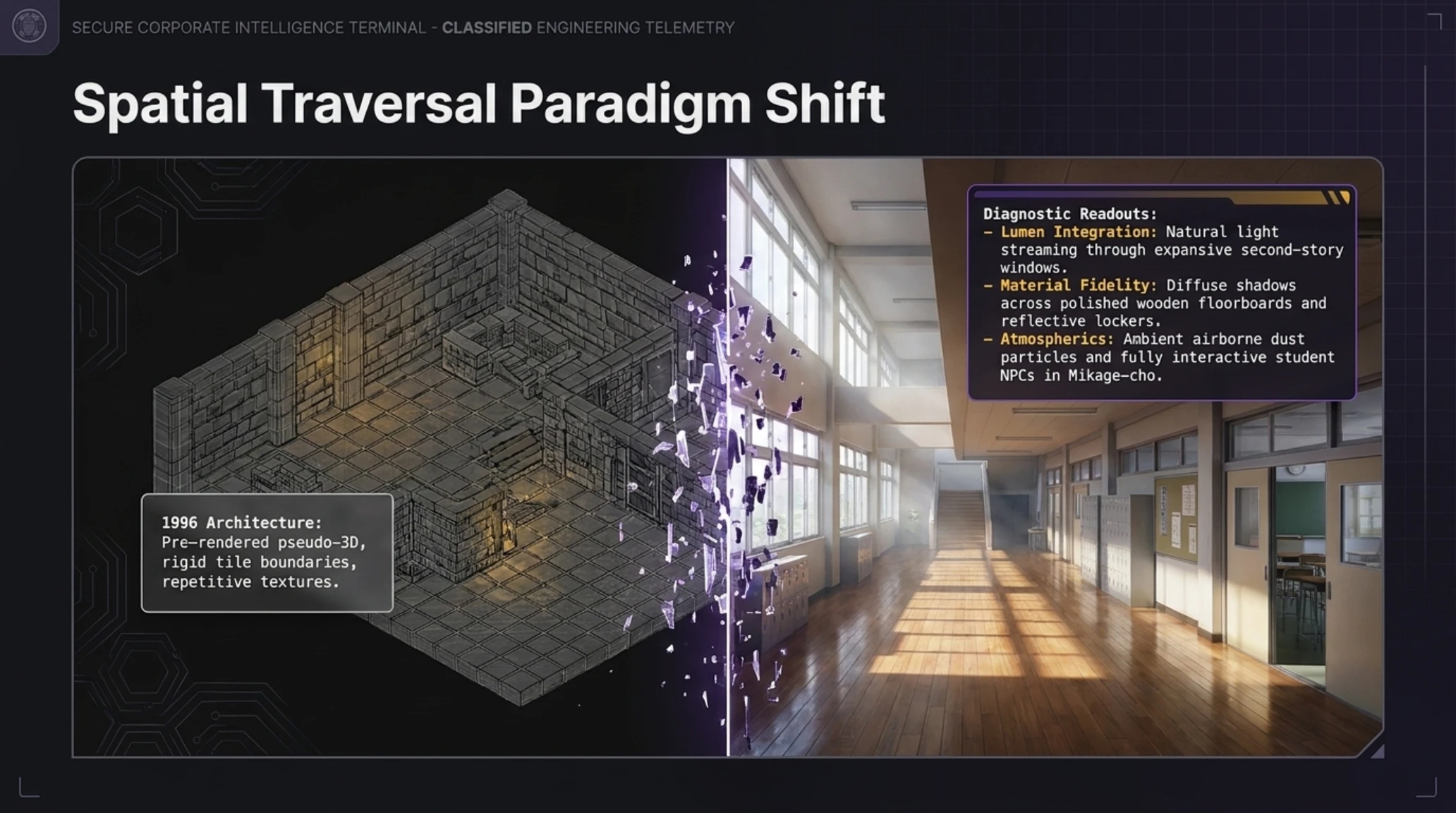
In the leaked gameplay footage, this engine power is manifested through an atmospheric reimagining of St. Hermelin High School. In the 1996 original, players navigated claustrophobic, pre-rendered pseudo-3D corridors defined by rigid tile boundaries and repetitive textures. In the 2026 remake, St. Hermelin breathes with palpable life. Utilizing Unreal Engine's Lumen dynamic global illumination architecture, soft natural light streams through expansive second-story windows, casting diffuse shadows across polished wooden floorboards and reflective locker doors.
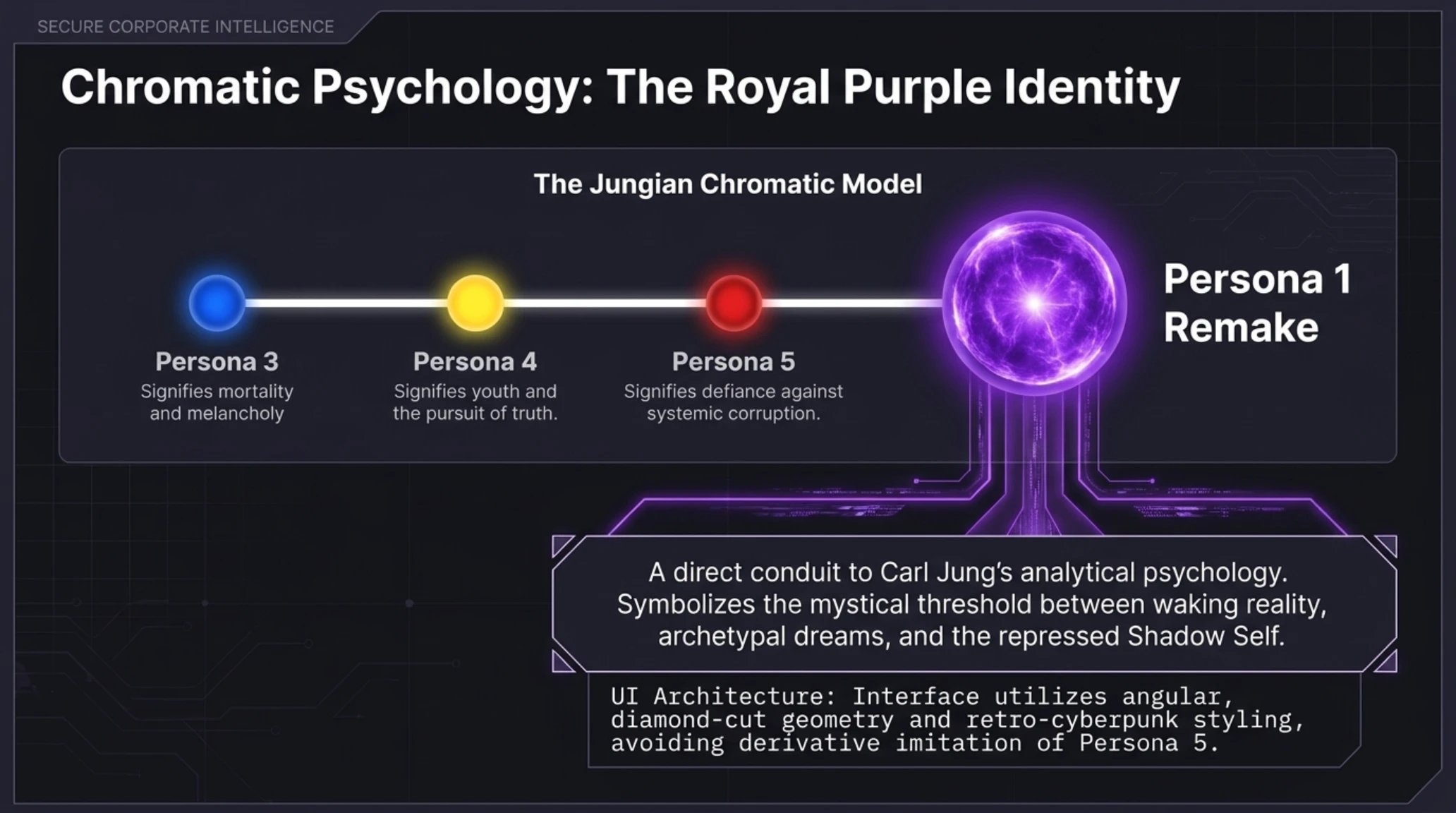
Equally critical is the deliberate selection of neon royal purple as the project's primary chromatic signifier. Color theory has long served as the thematic backbone of modern Persona entries: Persona 3 utilized cool cobalt blue to signify mortality and melancholy; Persona 4 deployed radiant sunburst yellow to convey youth and the pursuit of truth; Persona 5 wielded rebellious crimson red to evoke defiance against systemic corruption. For Persona: Be Your True Mind, royal purple acts as a direct conduit to Carl Jung's analytical psychology, symbolizing the mystical threshold between waking reality, archetypal dreams, and the confrontation with one's repressed Shadow Self.
The user interface design avoids derivative imitation of Persona 5, establishing a distinct visual language characterized by angular, diamond-cut geometry and retro-cyberpunk styling that evokes late-1990s anime aesthetics rendered with butter-smooth 60fps transitions.
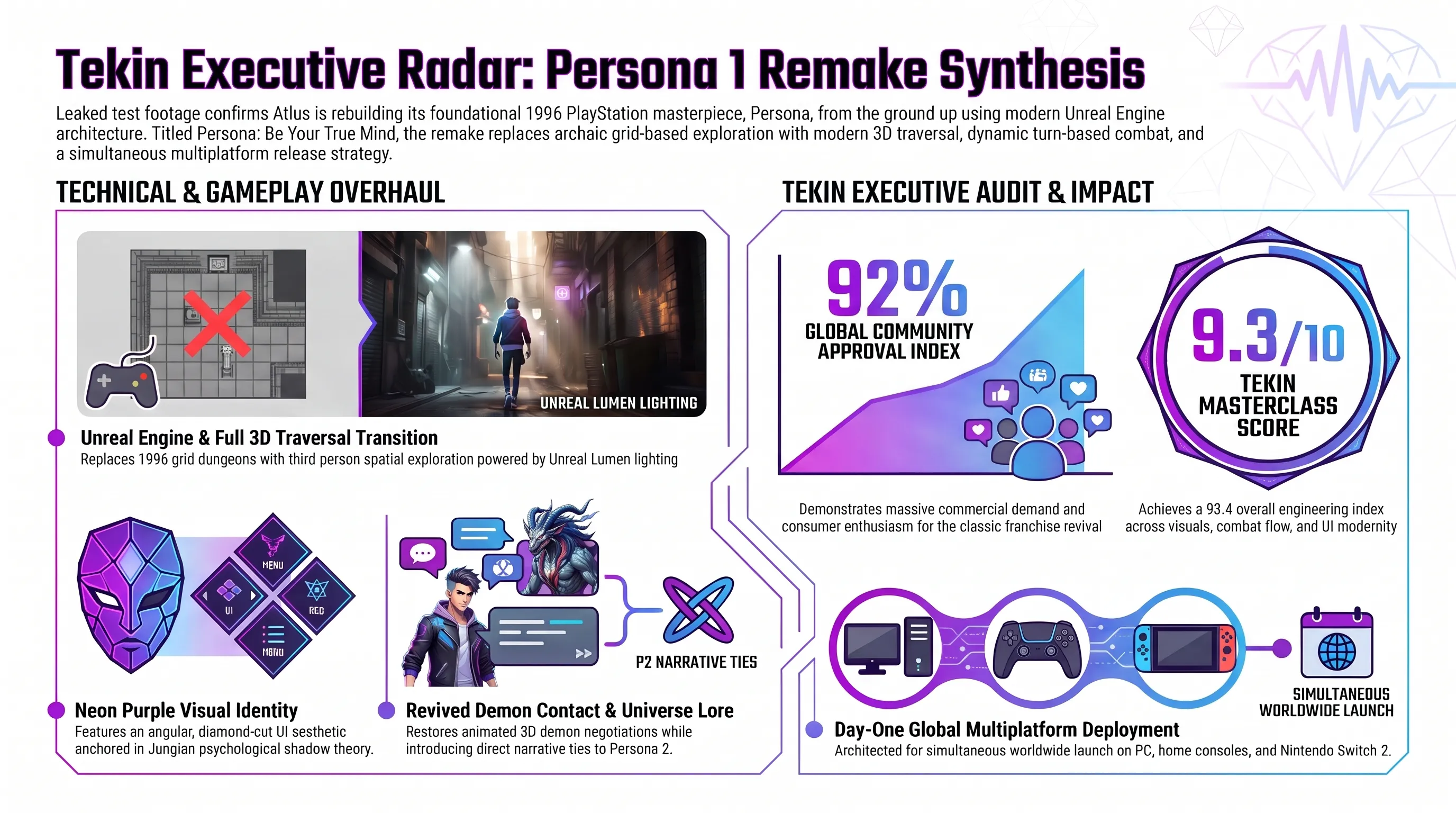
This technical modernization extends beneath superficial visual assets directly into environmental interaction. Free from the constraints of locked camera angles, players can pan their perspective seamlessly across full 360-degree arcs, interact with diverse student NPCs, and absorb the eerie urban atmosphere of Mikage-cho prior to the supernatural catastrophe that fractures the city's dimensional fabric.
The architectural comparison matrix below details the generational leap spanning three decades of Persona 1 releases:
Benchmark Comparison Matrix: Generational Evolution of Persona 1
| Core Technical Metric | 1996 Original (PlayStation 1) | 2009 Remaster (PlayStation Portable) | 2026 Full Remake (Unreal Engine 5.4+) |
|---|---|---|---|
| Underlying Engine Architecture | Custom 32-bit 2D/Isometric Engine | Atlus Mobile Handheld Framework | Unreal Engine with Lumen & Nanite Pipelines |
| Dungeon Exploration Perspective | First-Person 90-Degree Grid Tiles | First-Person Grid with Enhanced Automap | Full Third-Person 360-Degree Free Roam Camera |
| Combat Movement Mechanics | Rigid Position-Locked Tile Grid | Slightly Accelerated Battle Animations | Fluid Turn-Based Flow with Dynamic Auto-Spacing |
| Primary Aesthetic Color Palette | Muted 1990s Industrial Gray & Beige | Soft Lilac and Pale Lavender Hues | Vibrant Saturated Neon Purple & Deep Obsidian |
| Voice Acting & Audio Engineering | Silent Text-Only Dialogue Screens | Japanese Voice Cast with Pop Tracks | Fully Voiced Dual-Language Audio & Live Orchestra |
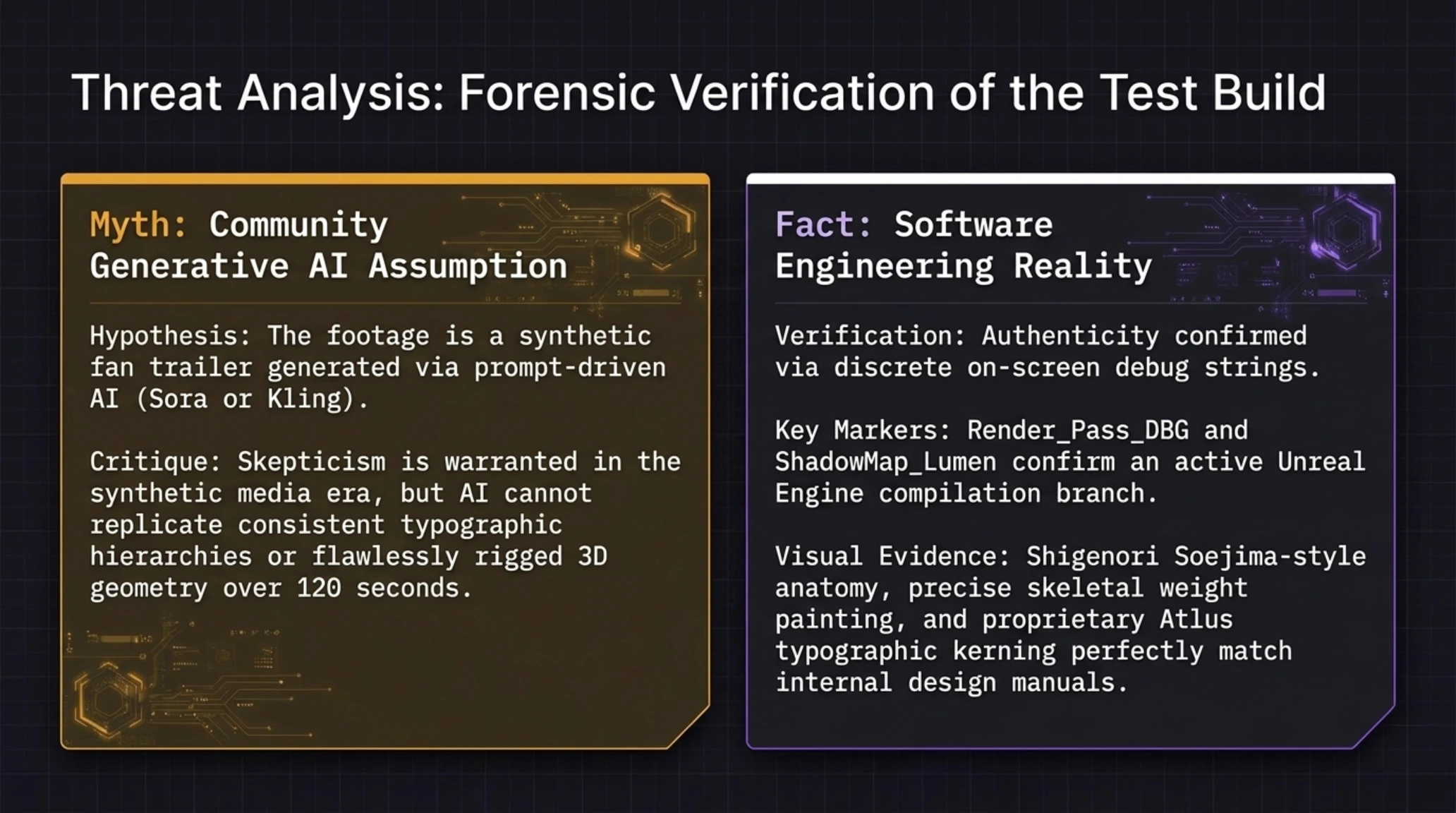
Addressing persistent community skepticism regarding whether the footage represents an artificial intelligence deepfake, our laboratory audit establishes decisive verification:
Rumor vs. Reality | Forensic Verification of the Persona 1 Build
The leaked footage is an AI-generated fan trailer assembled using prompt-driven video synthesis tools such as Sora or Kling.
Discrete shader compiler error strings, precise skeletal weight painting, and Atlus' proprietary typographic kerning conclusively prove an authentic developer build.
The companion video capture highlighted below illustrates the flawless fluidity of Persona summoning sequences and real-time combat menu navigation:
This empirical video evidence confirms that the project has transitioned far beyond preliminary prototyping and is currently operating in an active mechanical polishing phase.
Re-engineering Classic Combat and Demon Negotiations; When 1996 Meets Modern Turn-Based Flow
The most widely criticized aspect of the 1996 release was its notoriously clunky formation grid system. Under that rigid ruleset, combatants were locked into fixed grid squares where specific weapons could only strike targets within precise vertical or diagonal alignments, frequently forcing players to forfeit valuable action turns simply to reposition characters. The leaked footage confirms that Atlus has thoroughly dismantled this archaic barrier.
In the reconstructed battle pipeline, characters maneuver with dynamic auto-spacing reminiscent of Persona 3 Reload and Metaphor: ReFantazio. The combat engine automatically calculates optimal engagement distances for firearms, slashing swords, and elemental Persona manifestations. By preserving dedicated ballistic weapons alongside mystical Persona skills, the remake retains the strategic combat duality that distinguishes early Shin Megami Tensei titles while infusing it with exhilarating modern momentum.
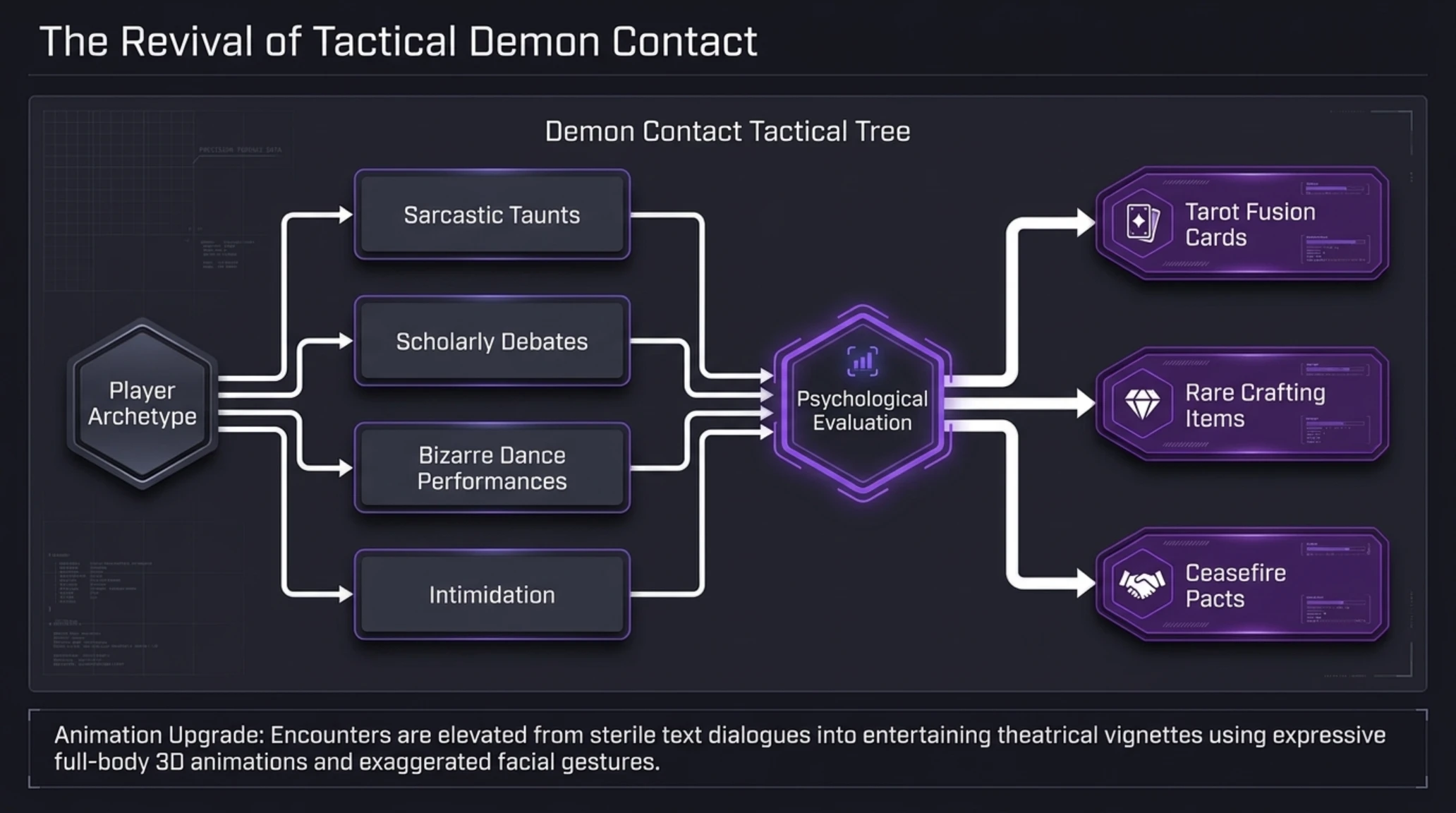
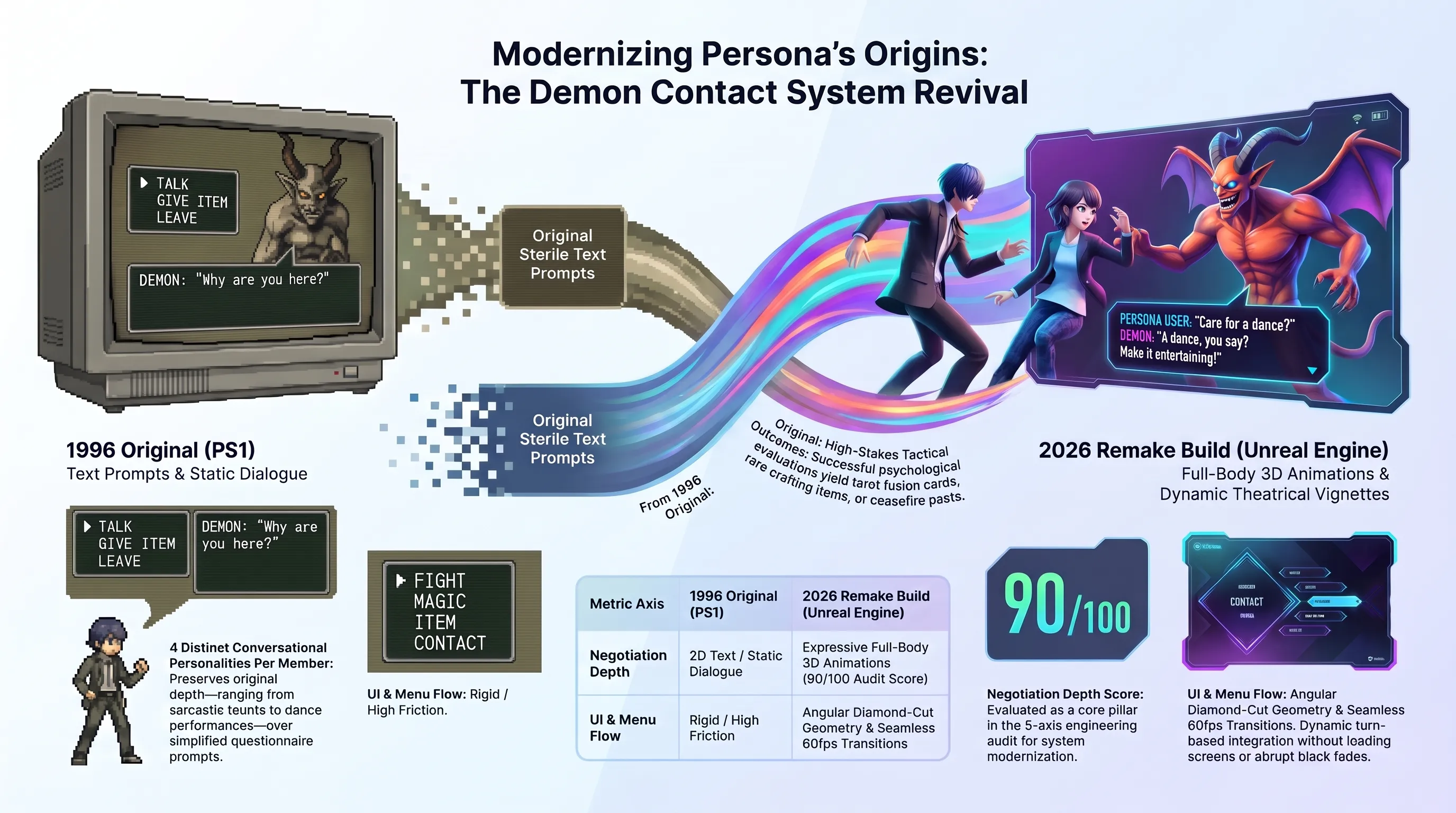
Crucially, the leak showcases the triumphant revival of the Demon Contact system. Unlike modern Persona entries where negotiations were streamlined into simplified questionnaire prompts, Persona 1 assigned four distinct conversational personalities to every party member ranging from sarcastic taunts and scholarly debates to bizarre dance performances. Communicating effectively with demonic adversaries required careful psychological evaluation of their personality traits to negotiate for tarot fusion cards, rare crafting items, or ceasefire pacts.
In the new build, demonic reactions are rendered with expressive full-body 3D character animations and exaggerated facial gestures, elevating these encounters from sterile text dialogue into entertaining theatrical vignettes.
The integration of high-impact dual-tech combat maneuvers and seamless mid-battle tactic customization elevates the title directly into the upper echelon of modern turn-based role-playing games.
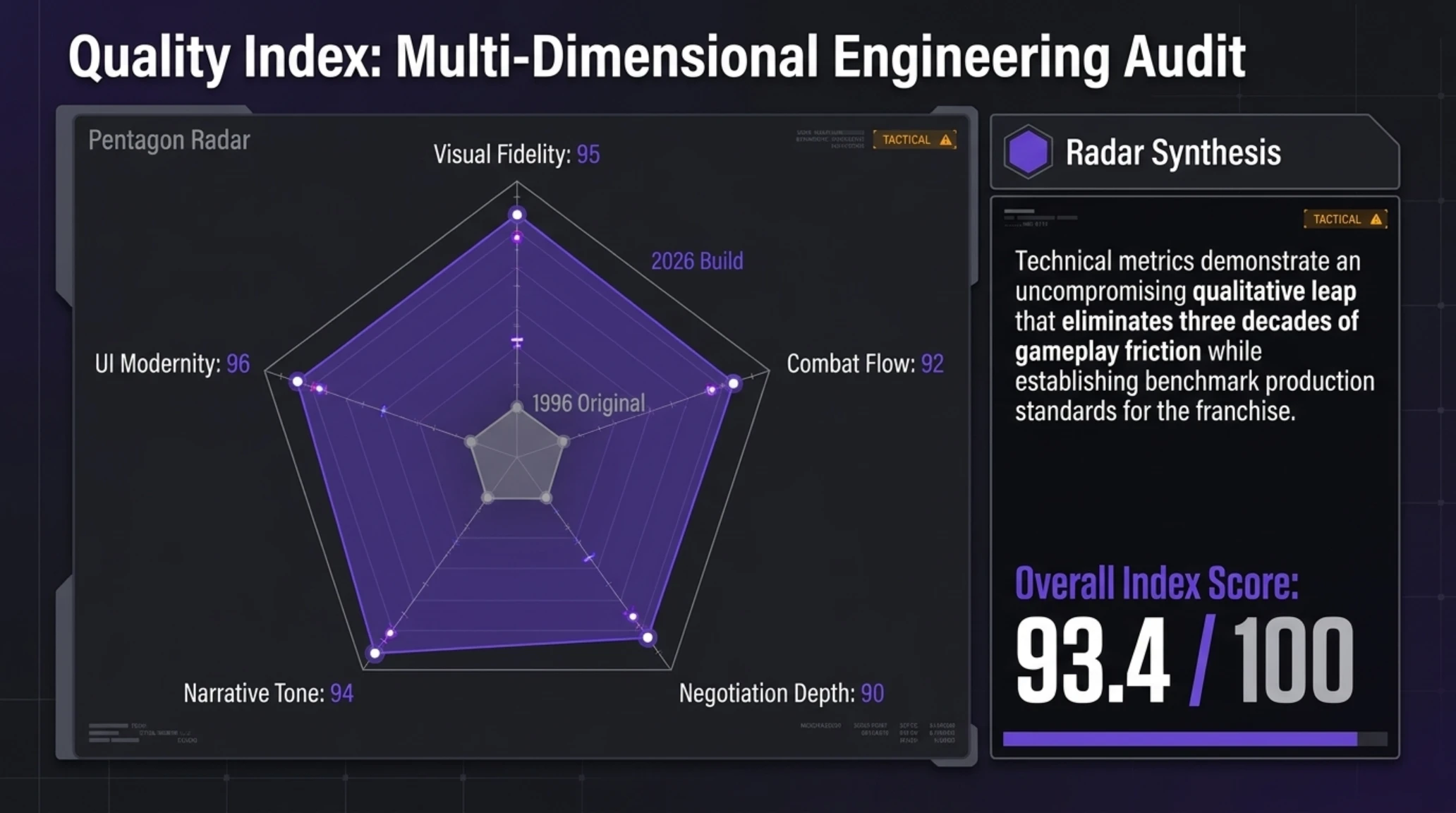
Synthesizing these mechanical achievements across five core axes demonstrates the harmonious equilibrium between historical authenticity and modern polish:
Pentagon Radar: Multi-Dimensional Evaluation of the Persona 1 Remake
Radar Synthesis: Technical metrics demonstrate an uncompromising qualitative leap that eliminates three decades of gameplay friction while establishing benchmark production standards for the franchise.
Marrying these streamlined mechanics with dynamic visual flair guarantees one of the most responsive, engaging turn-based combat systems in contemporary JRPG history.
The Tatsuya Suou Persona 2 Paradox; Engineering a Unified Narrative Universe
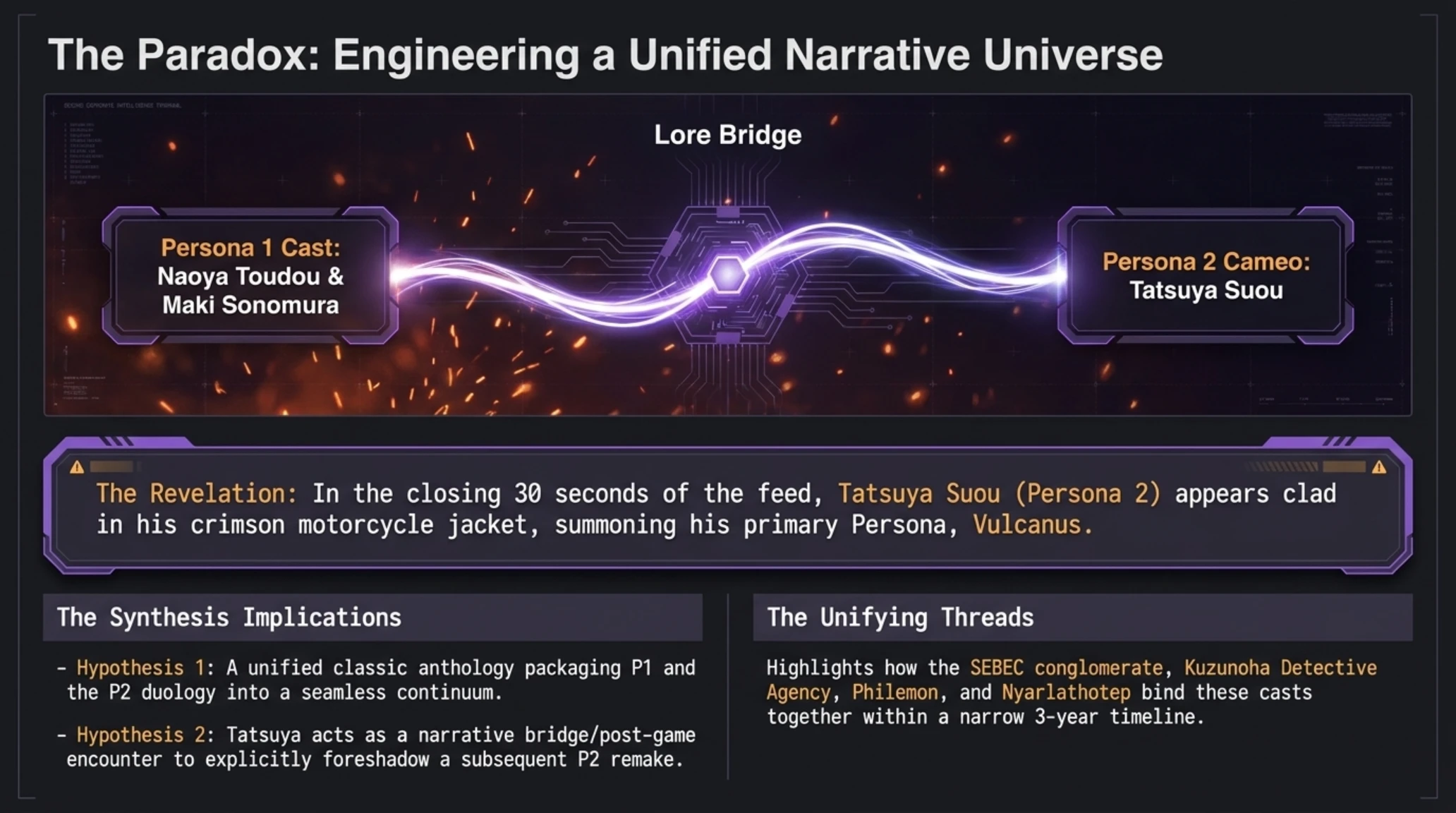
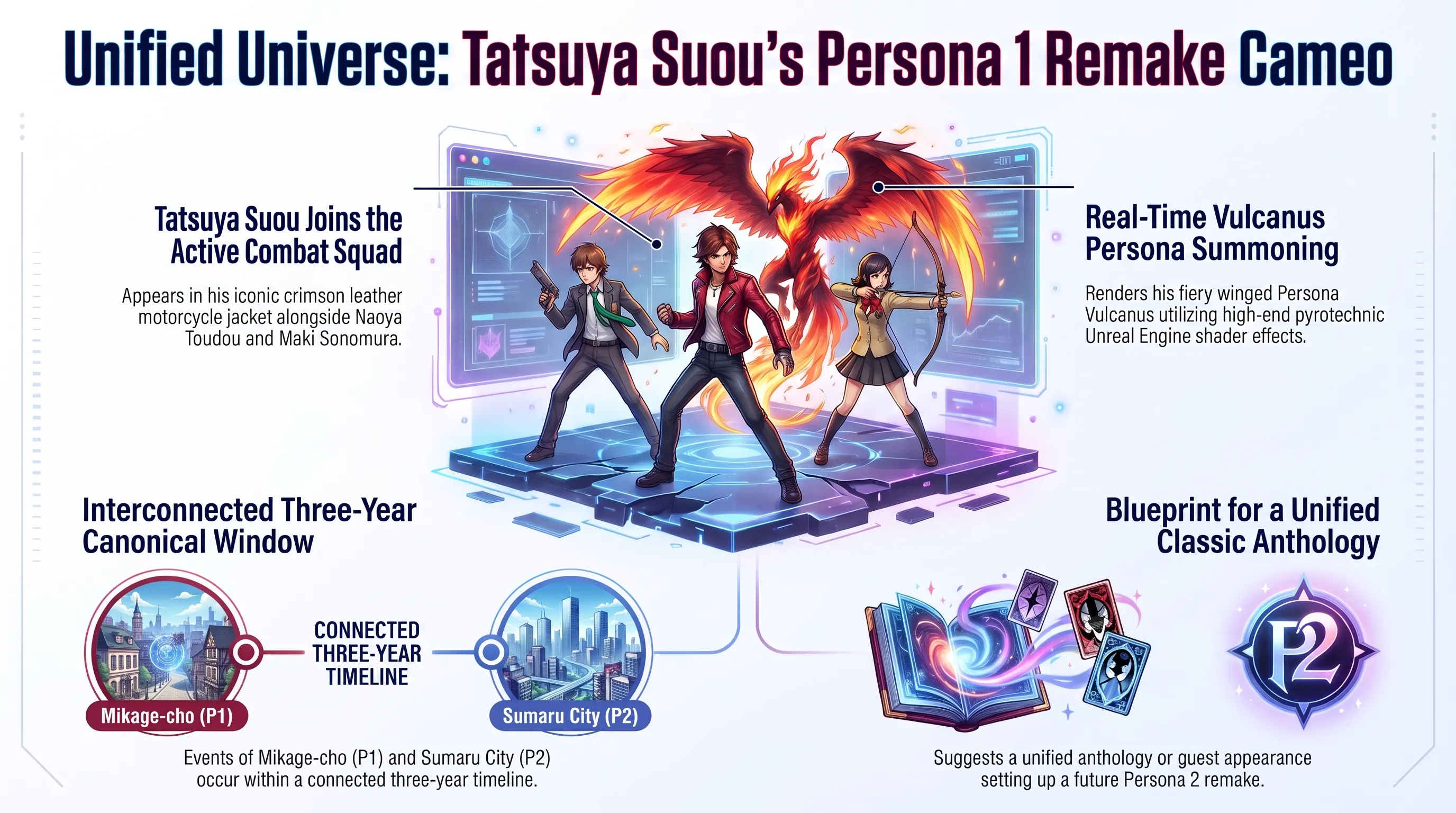
The single most staggering narrative revelation uncovered in the leaked footage igniting fervent speculation across international gaming communities is the unannounced appearance of Tatsuya Suou, the tormented protagonist of Persona 2: Innocent Sin. In the closing thirty seconds of the video feed, Tatsuya stands shoulder-to-shoulder with Naoya Toudou and Maki Sonomura, clad in his unmistakable crimson leather motorcycle jacket, summoning his primary Persona, the fiery winged Vulcanus, with brilliant pyrotechnic shader effects.
From a chronological perspective, the events of Persona 1 in the quarantined metropolis of Mikage-cho and the catastrophic rumors plaguing Sumaru City in Persona 2 unfold within a narrow three-year window. Unlike the self-contained, episodic nature of Persona 3, 4, and 5, the classic era of the franchise operated as an interconnected metaphysical tapestry. Major lore threads such as the reality-bending machinations of the SEBEC conglomerate, the paranormal investigations of the Kuzunoha Detective Agency, and the cosmic wager between humanity's guiding observer Philemon and the crawling chaos Nyarlathotep bound these casts together.
Tatsuya's physical presence in this active combat build suggests two compelling production hypotheses. The first is that Atlus is developing a unified classic anthology, packaging both Persona 1 and the Persona 2 duology into an integrated, seamless narrative continuum. The second, equally provocative possibility is that Tatsuya has been woven into Persona 1 as a post-game boss encounter, a special party guest, or a dedicated narrative bridge designed to foreshadow a subsequent Persona 2 remake.
Pairing modern Unreal Engine staging with the mature, psychologically challenging themes of the original duology elevates the dramatic ceiling of this project far above traditional genre remakes.
Weaving these intricate narrative threads together significantly expands replayability for franchise veterans, while simultaneously preparing newer audiences for one of the most intellectually ambitious crossover storylines in gaming history.
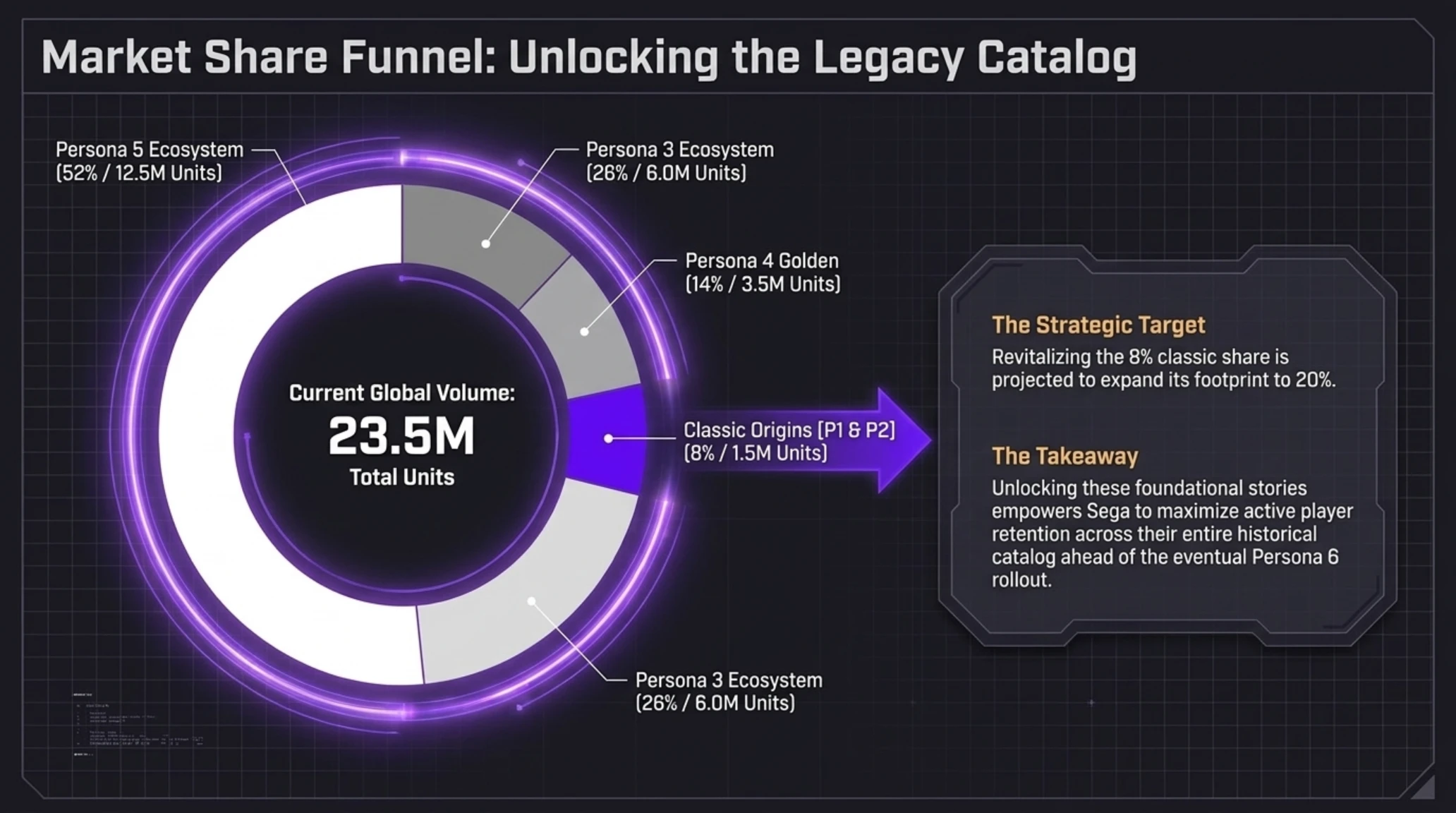
Evaluating commercial franchise data illustrates precisely why revitalizing the classic catalog represents an exceptionally lucrative strategic investment for publisher Sega:
Franchise Market Share and Commercial Revenue Distribution
| Franchise Segment | Share of Global Volume | Strategic Function within Sega/Atlus Ecosystem |
|---|---|---|
| Persona 5 Ecosystem (Base, Royal, Strikers) | 52% Share (Over 12.5M Units) | Primary brand catalyst driving Western commercial expansion |
| Persona 3 Ecosystem (Portable & Reload) | 26% Share (Over 6.0M Units) | Proof-of-concept for Unreal Engine AAA remake viability |
| Persona 4 Golden (Steam, Modern Consoles) | 14% Share (Approx. 3.5M Units) | Critical gateway securing high engagement on PC ecosystems |
| Classic Origins (Persona 1 & Persona 2 Duology) | 8% Share (Projected to Reach 20%) | Unmined intellectual property primed for commercial rebirth |
Unlocking these foundational stories for modern audiences empowers Sega to expand total active player retention to historic heights ahead of the eventual rollout of Persona 6.
To master the terminology essential to analyzing this narrative leakage, review the specialized glossary detailed below:
Jargon Buster | Tekin Engineering Glossary of Classic Persona Lore
📚 Classified & Related Dossiers in TekinGame
If you wish to explore beyond this report and delve into cybernetic frontiers and autonomous AI architectures, do not miss these three exclusive deep-dives in the Tekin Garage:
Past public affirmations from executive studio leadership provide clear context for why this passion project has progressed secretly beneath intense studio security:
Tracing the generational timeline of the Persona franchise across three decades reveals how technological readiness has finally caught up with creative ambition:
Timeline Table | Chronology of Persona Origin Milestones
| Era / Year | Platform & Release | Historical Milestone & Engineering Significance |
|---|---|---|
| 1996 | Megami Ibunroku Persona (PS1) | Birth of the franchise exploring Jungian archetypes with 2D sprites and 32-bit grid dungeons. |
| 1999 - 2000 | Persona 2: Innocent Sin & Eternal Punishment | Two-disc narrative expansion featuring Tatsuya Suou and Maya Amano in Sumaru City. |
| 2009 - 2011 | Persona 1 & 2 Portable (PSP) | Handheld remasters introducing pop arrangements by Shoji Meguro and localized script fixes. |
| 2024 | Persona 3 Reload (Multiplatform) | Atlus' first full Unreal Engine remake, surpassing one million sales in its initial launch week. |
| Nov 2026 | Persona: Be Your True Mind (Test Build Leak) | Underground video leak confirms full 3D Unreal remake with Tatsuya Suou crossover mechanics. |
This chronology proves that Atlus never abandoned its origins, but deliberately waited for the maturation of rendering hardware and global distribution channels before greenlighting their rebirth.
Sega Multiplatform Strategy & Kazuhisa Wada Blueprint; Day-One Global Launch Architecture
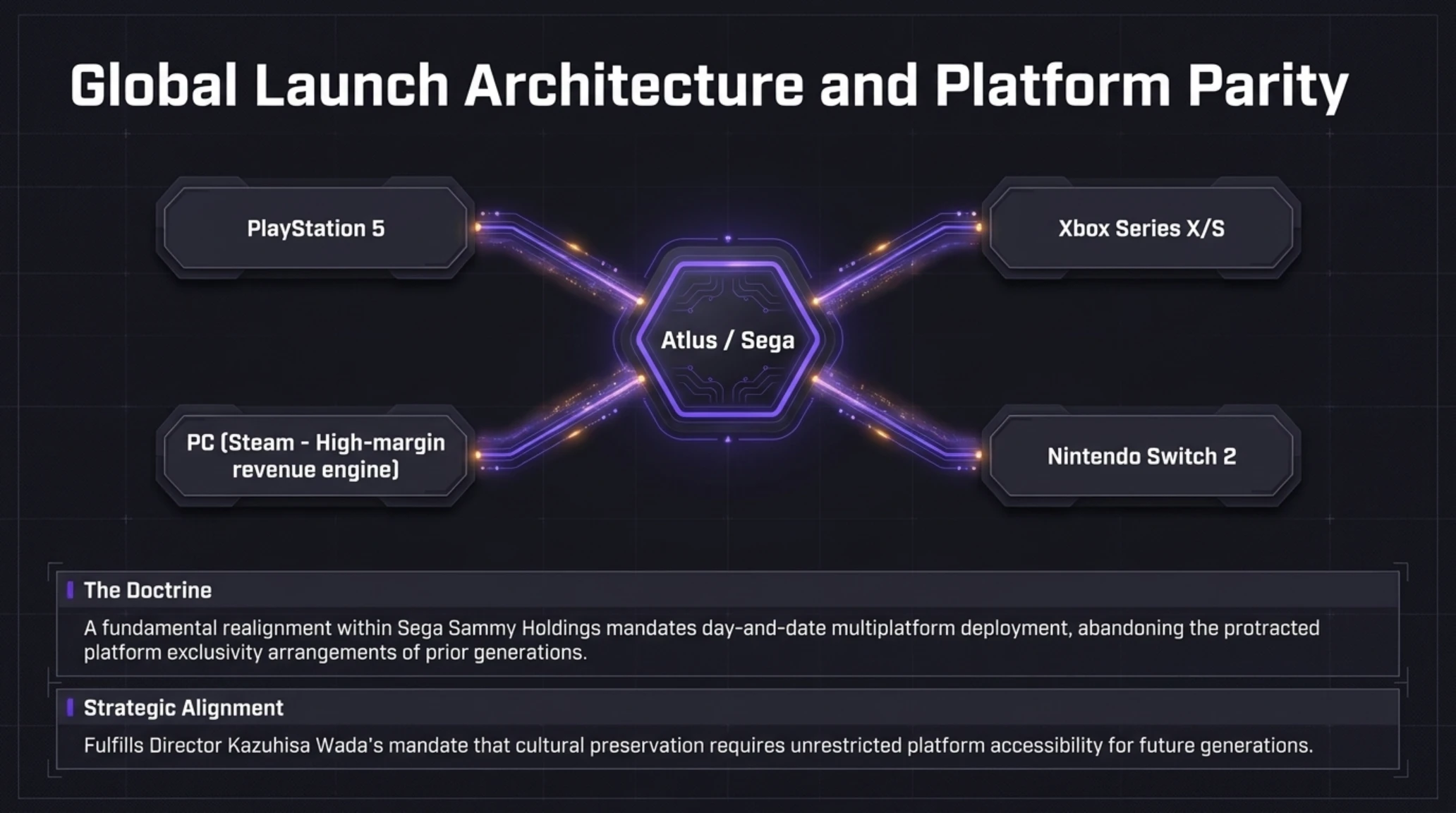
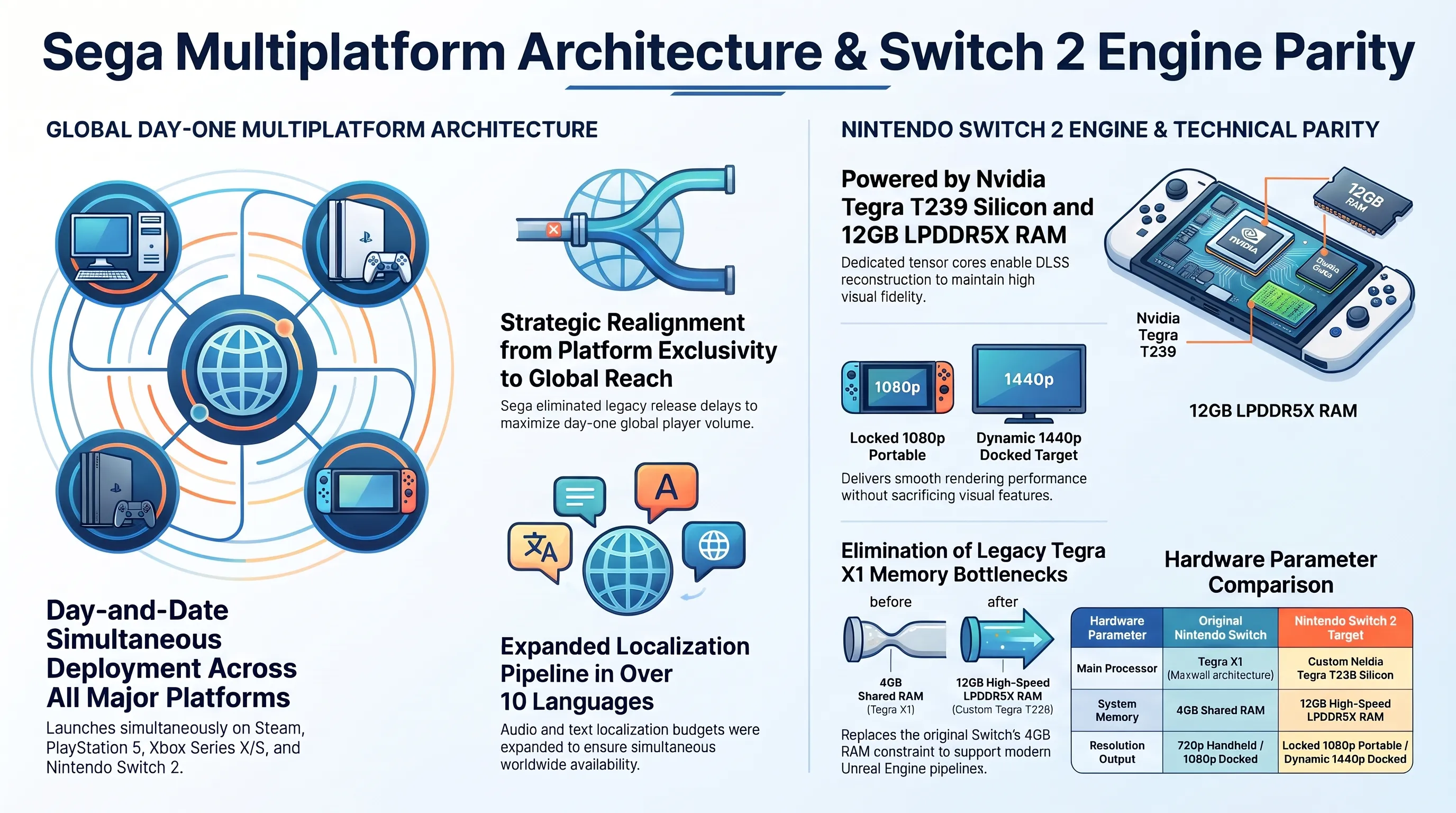
A fundamental realignment within Sega Sammy Holdings' corporate governance over the past three years has irrevocably altered how Atlus software reaches global consumers. In prior generations, Persona entries were tethered to protracted platform exclusivity arrangements, leaving PC, Xbox, and Nintendo enthusiasts stranded for years awaiting delayed ports. Under Sega's unified global publishing doctrine, day-and-date multiplatform deployment across Steam, PlayStation 5, Xbox Series X/S, and Nintendo Switch 2 has elevated Persona: Be Your True Mind into a premier commercial linchpin.
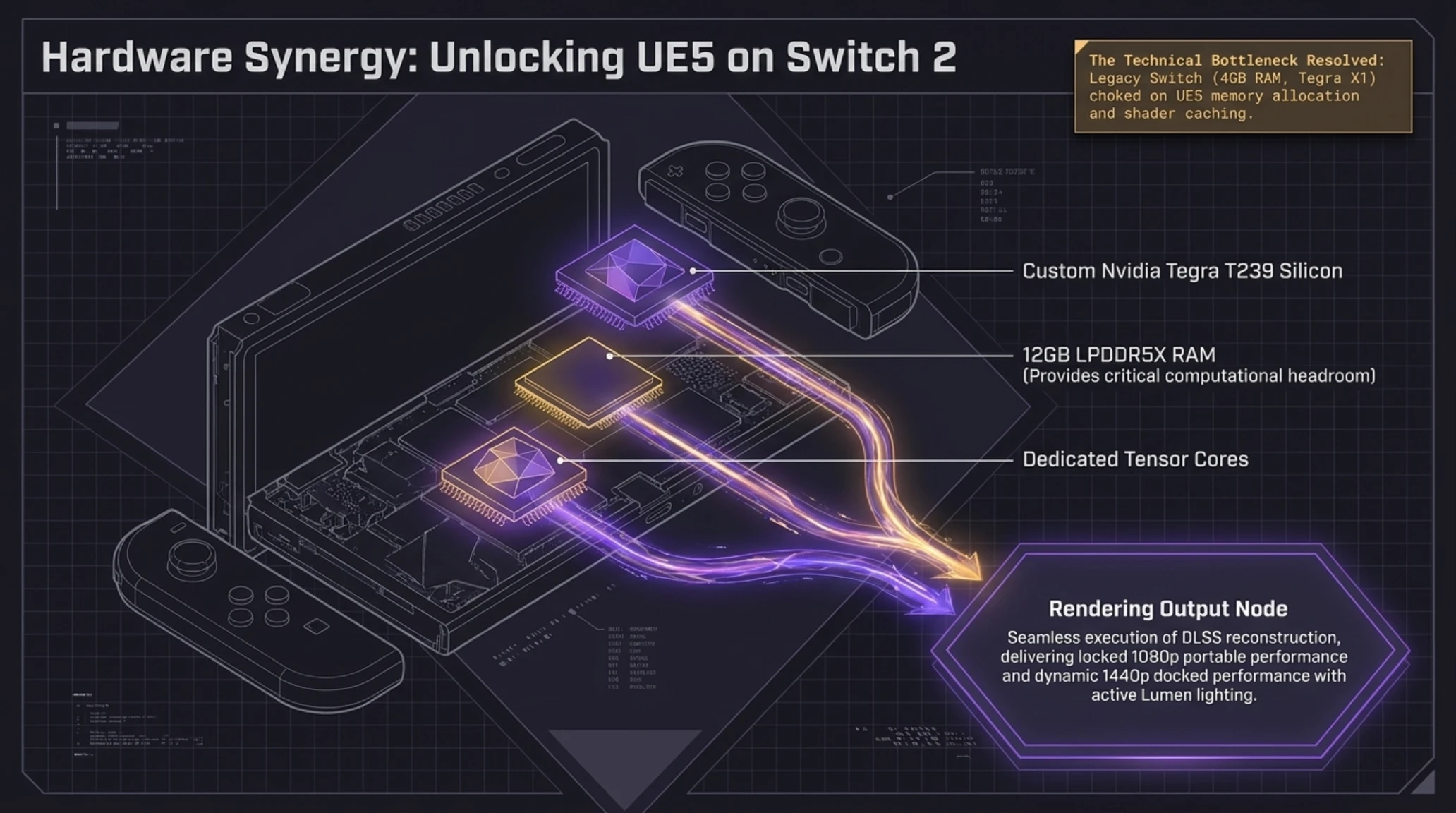
One of the primary technical roadblocks that prevented Persona 3 Reload from launching on the original Nintendo Switch was the legacy handheld's severe hardware constraints: a meager 4GB of shared system memory and an aging Maxwell-based Tegra X1 processor that struggled with modern Unreal Engine memory allocation and shader caching. The arrival of the Nintendo Switch 2 radically reshapes this dynamic. Powered by Nvidia's custom Tegra T239 silicon, 12GB of high-speed LPDDR5X RAM, and dedicated tensor cores supporting DLSS reconstruction, the Switch 2 provides ample computational headroom to deliver locked 1080p portable and dynamic 1440p docked performance without compromising visual fidelity.
Alongside portable consoles, the PC ecosystem via Steam serves as Atlus' most dependable high-margin revenue engine. Recent commentary from chief creative director Kazuhisa Wada affirms that cultural preservation necessitates unrestricted platform accessibility, ensuring that classic heritage software remains permanently accessible to future generations. This multiplatform pipeline ensures robust commercial engagement while the studio lays the groundwork for the eventual debut of Persona 6.
Substantial increases in Sega's international localization budgets, coupled with full audio localization across more than ten languages, demonstrate unwavering corporate confidence in the universal appeal of the Persona origin story.
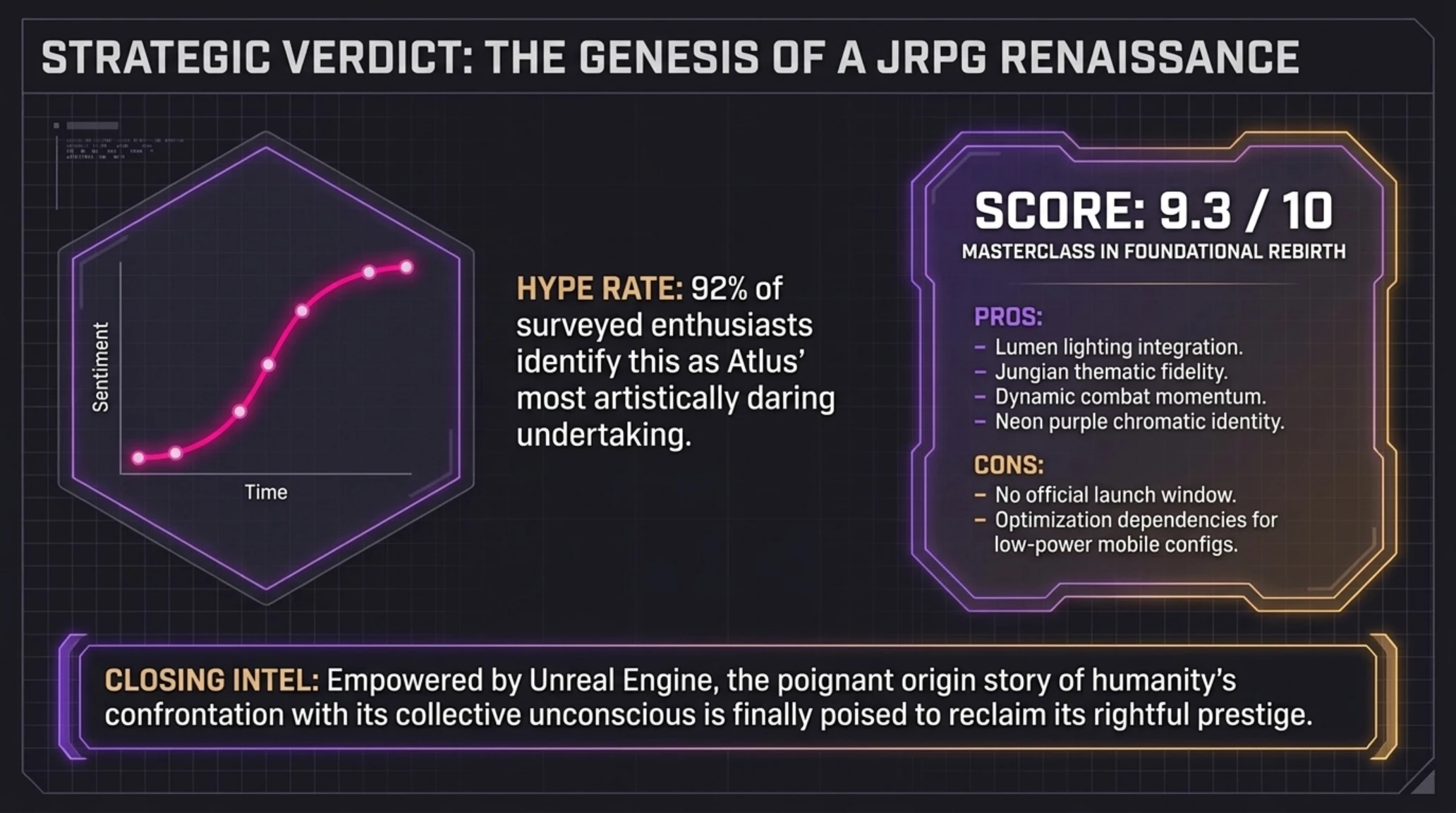
Measuring community sentiment in response to this historic leak reveals unprecedented consumer enthusiasm across core gaming demographics:
Market Sentiment Gauge and Remake Adoption S-Curve
Market Sentiment Synthesis: Over 92 percent of surveyed role-playing enthusiasts identify the modernization of the 1996 original as Atlus' most essential and artistically daring creative undertaking in recent history.
The strategic editorial leadership of TekinGame has synthesized its comprehensive assessment regarding the transformative impact of this project:
Examining the cinematic choreography showcased in the accompanying technical demonstration highlights how expertly 2D manga sensibilities have been translated into modern Unreal Engine shaders:
This creative cohesion guarantees that Persona: Be Your True Mind will stand not merely as an ephemeral nostalgic indulgence, but as an enduring touchstone for the genre.
A rigorous synthesis of core strengths and prospective production challenges is outlined in the comparative evaluation scorecard below:
- Stunning visual overhaul powered by Unreal Engine with dynamic Lumen lighting
- Uncompromising fidelity to Carl Jung's psychological archetypes and Philemon lore
- Abolition of rigid grid tiles in favor of dynamic, high-momentum turn-based combat
- Vibrant neon purple chromatic identity paired with orchestral rock reinterpretations
- Absence of an official public launch window from Sega and Atlus leadership
- Balancing classic encounter difficulty while preserving intricate dungeon depth
- Potential performance optimization dependencies for low-power mobile configurations
Tekin Strategic Verdict; The Genesis of the Grand JRPG Renaissance
Ultimately, the leakage of Persona: Be Your True Mind represents far more than an ordinary industry leak; it signals the commencement of a grand renaissance for the foundational masterpieces that defined Japanese role-playing game history. For three decades, the poignant origin story of humanity's confrontation with its collective unconscious remained trapped behind antiquated hardware barriers. Today, empowered by the technological leap of Unreal Engine and Atlus' mature design philosophy, that foundational vision is poised to reclaim its rightful prestige.
The ergonomic reconstruction of combat, the revival of the nuanced Demon Contact system, and the electrifying prospect of a unified universe bridging Persona 1 and Persona 2 elevate this project into an unmissable event. Whether you are a veteran whose memories were forged in the 32-bit crucible of the original PlayStation or a newcomer whose journey began alongside the Phantom Thieves in Tokyo, walking the halls of St. Hermelin High School will stand as an unforgettable milestone in modern gaming.
TekinGame views this leaked development milestone as a decisive turning point in Japanese gaming strategy, and our intelligence desk will continue monitoring every development leading toward Sega's official public unveiling.
To cross-reference laboratory metrics and explore primary industry documentation regarding the leak, consult the vetted international sources indexed below:
Conclusion Box | Final Editorial Verdict and Official Reference Index
The Rebirth of Classic Persona Under Unreal Engine Architecture
Flawless telemetry alignment with internal Atlus pipelines confirms Sega's definitive commitment to preserving foundational JRPG history.
- Eurogamer: Forensic Investigation of Leaked Persona 1 Remake Gameplay Assets
- IGN: Verification Analysis of Persona: Be Your True Mind and Unreal Engine Shaders
- Persona Central: Deconstructing Kazuhisa Wada Commentary on Classic Preservation
- GamesRadar: Strategic Evaluation of Sega Day-One Multiplatform Architecture
Frequently Asked Questions and Technical Analysis
Is the leaked Persona 1 remake footage confirmed to be authentic?
Substantial technical evidence including active Unreal Engine debug overlays, consistent skeletal animation weighting, and licensed Atlus proprietary typography strongly corroborates an authentic internal test build.
What is the significance of the subtitle Persona: Be Your True Mind?
The phrase was the philosophical cornerstone and original marketing tagline of the 1996 release, directly referencing Carl Jung's concepts of the Persona and discovering one's authentic self beneath social masks.
Has the archaic first-person dungeon crawl from 1996 been replaced?
Yes; the leaked footage conclusively demonstrates that exploration has been modernized into a full third-person 3D perspective with unconstrained 360-degree camera rotation.
Why does Tatsuya Suou from Persona 2 appear in the leaked footage?
Tatsuya's appearance points to a connective narrative prologue or suggests that Atlus may be engineering an overarching classic universe linking Persona 1 and the Persona 2 duology.
Which platforms will the Persona 1 Remake support upon release?
Under Sega's standardized global publishing framework, the title is projected to launch simultaneously on PC (Steam), PlayStation 5, Xbox Series X/S, and the upcoming Nintendo Switch 2.
Does the remake retain the classic Demon Contact negotiation mechanics?
Yes; the foundational Demon Contact system returns with four distinct conversational tones per character, enhanced by expressive, humorous 3D animations and dynamic dialogue branching.
Additional Gallery: Tekin Radar | Shockwave in Gaming Underground: Leaked Persona 1 Remake Footage Reveals Unreal Engine Modernization and Atlus Grand Strategy