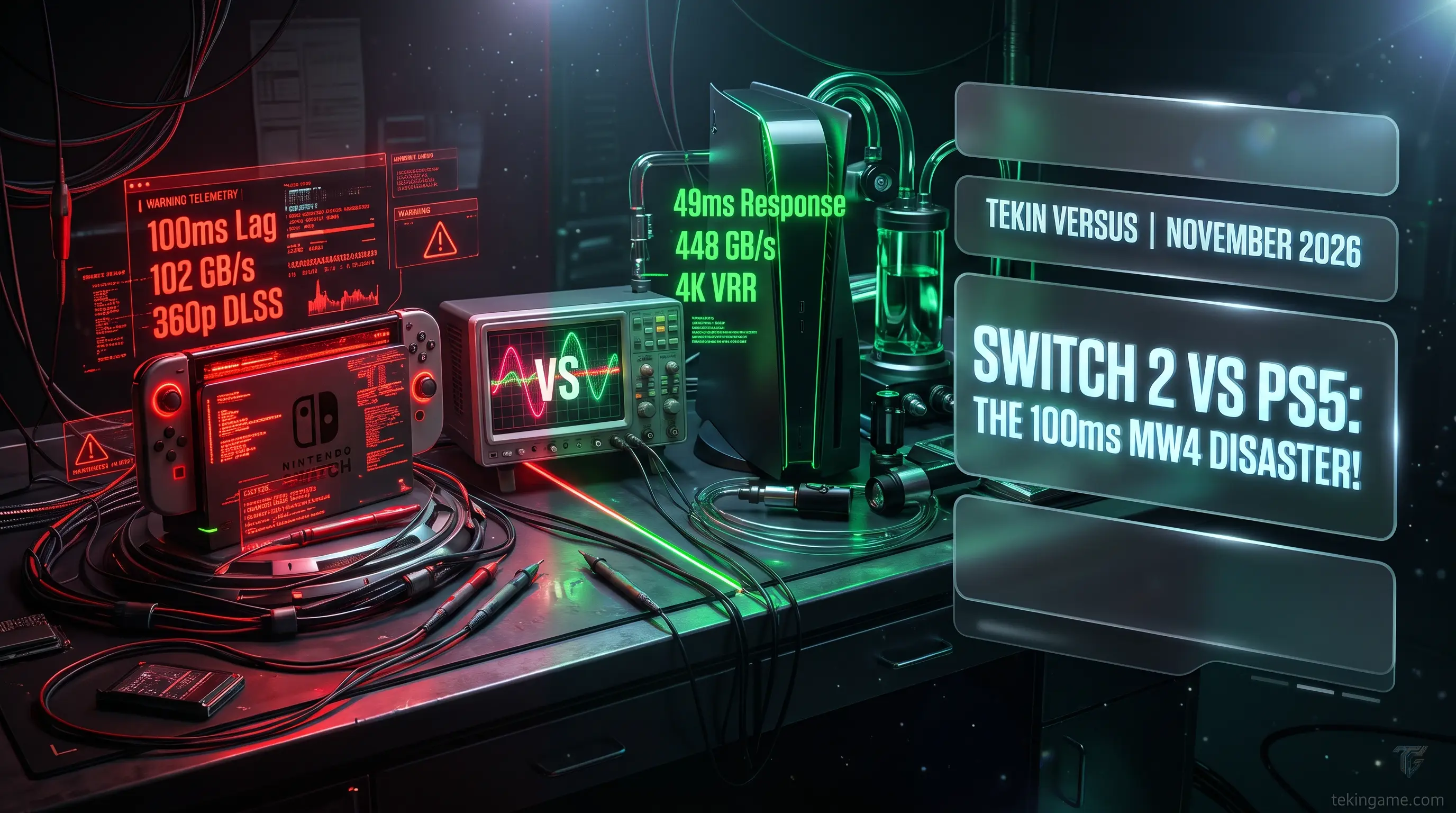
Tekin Versus | Input Latency Forensics: Call of Duty: Modern Warfare 4 on Nintendo Switch 2 vs. PlayStation 5
On November 2, 2026, an exhaustive technical audit published by Digital Foundry sent shockwaves through the competitive first-person shooter landscape. While executive marketing from Activision and Nintendo celebrated the launch of Call of Duty: Modern Warfare 4 on the Switch 2 as the ultimate realization of portable AAA parity, laboratory oscilloscope testing has uncovered a severe engineering reality: a crippling input response lag that leaves handheld players mathematically defenseless in cross-play matchmaking.
Strategic Assessment and Operational Vectors
The Illusion of Parity; When Framerate Numbers Conceal Input Paralysis
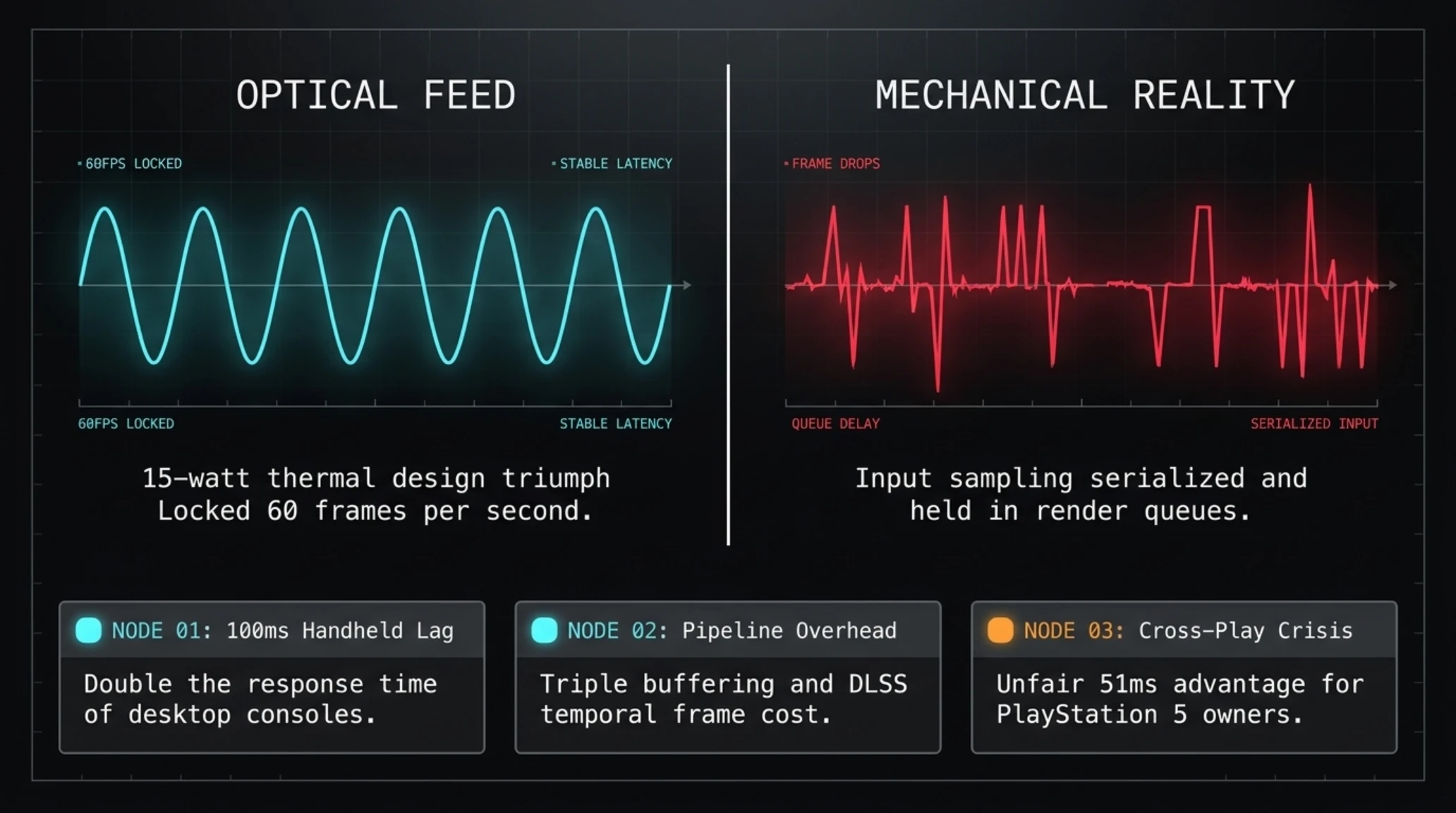
The arrival of Call of Duty: Modern Warfare 4 on the Nintendo Switch 2 was heralded by Microsoft and Activision as the definitive proof that mobile silicon had finally caught up with domestic consoles. Delivering a locked 60 frames per second on a handheld platform consuming less than fifteen watts of battery power represents an indisputable triumph of thermal design and hardware packaging. Yet beneath the fluid motion captured by conventional video counters lies a jarring physical disconnect that surfaces the instant a player touches the analog sticks.
Competitive first-person shooters operate in a realm where mechanical feedback is as crucial as visual clarity. While the optical feed on the screen suggests an uncompromised 60fps presentation, the player hands experience an unnatural sluggishness, a persistent sensation of aiming through water. Comprehensive hardware telemetry and optical latency logging conducted by Digital Foundry have exposed the technical culprit: the Nintendo Switch 2 version suffers from a catastrophic input latency penalty that fundamentally compromises competitive integrity.
To investigate the phenomenon, engineers deployed specialized high-speed optical capture rigs capable of filming button actuations at 1000 frames per second. These forensic tests confirm that the console holds completed frames in internal buffer queues while neural upscaling models reconstruct image geometry. Consequently, the visual display operates multiple cycles behind physical human input.
The diagnostic setup utilized an oscilloscope wired directly to micro-switches inside the controller shell while an ultra-sensitive photodiode rested against the screen's center raster lines. When the trigger was depressed, the oscilloscope recorded the electrical signal instantly, then clocked the exact microsecond delay before weapon muzzle flashes altered the screen's luminance curve. This rigorous methodology eliminates all software-based measurement biases and captures the true physical reality experienced by the human player.
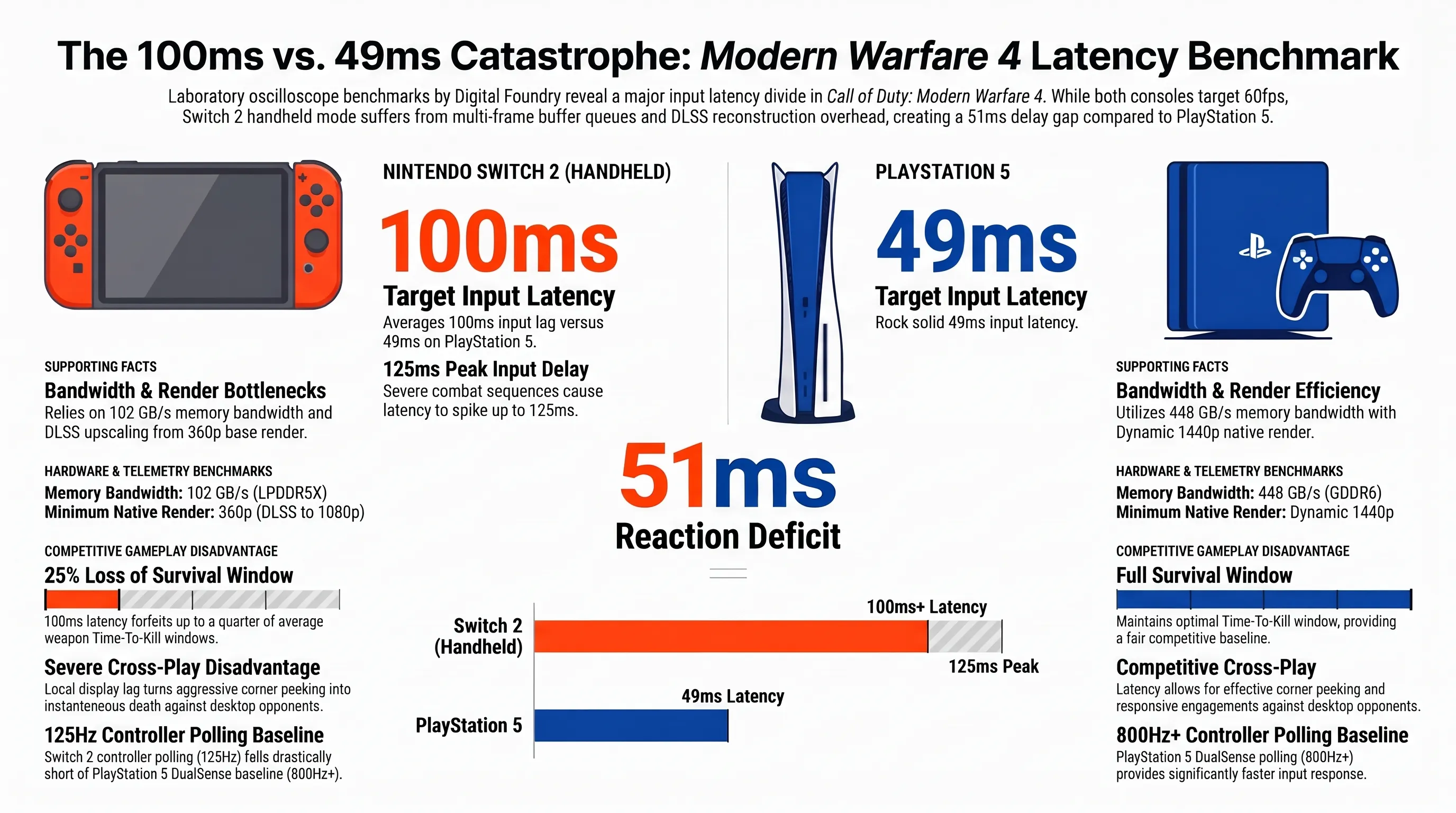
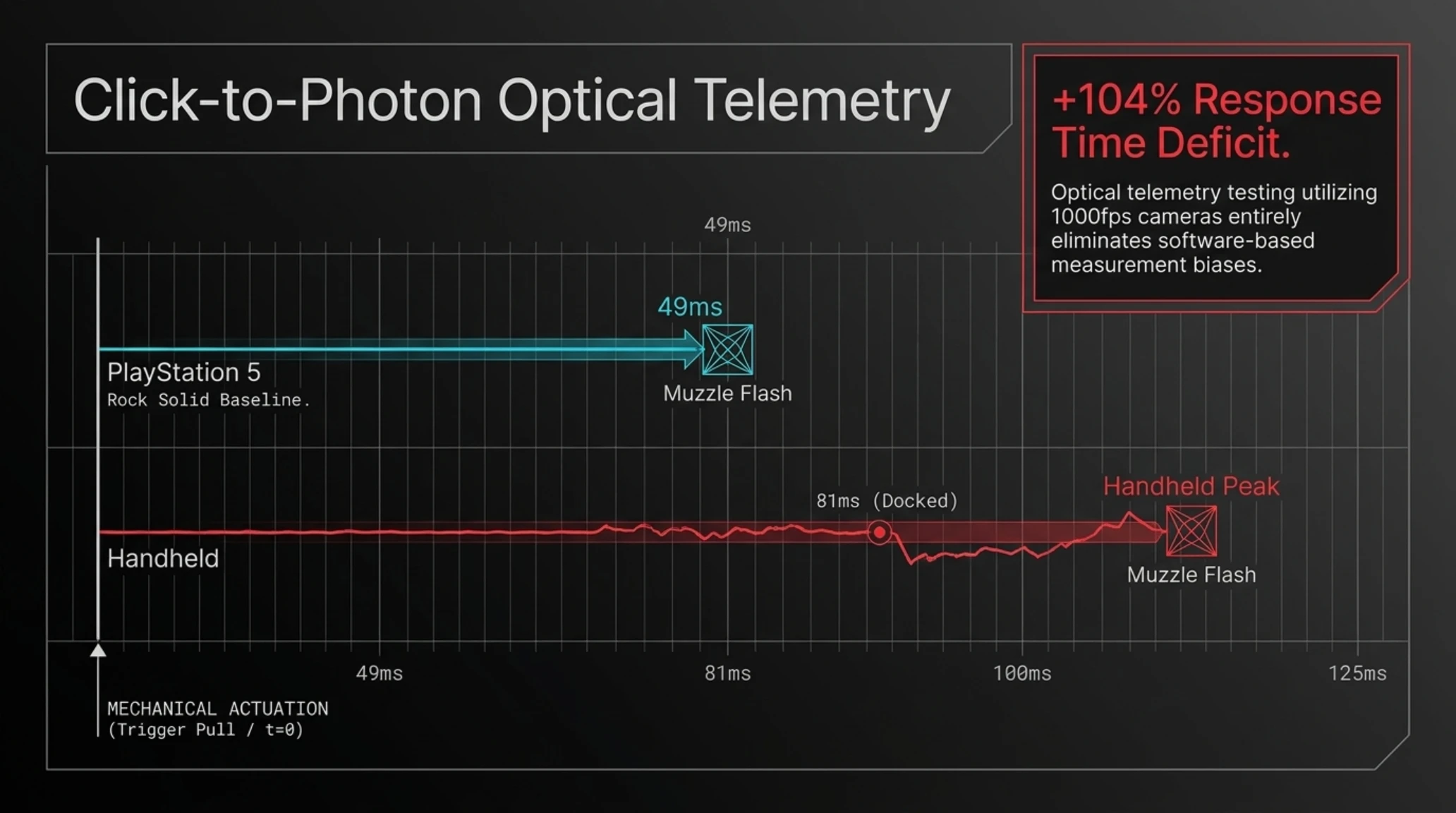
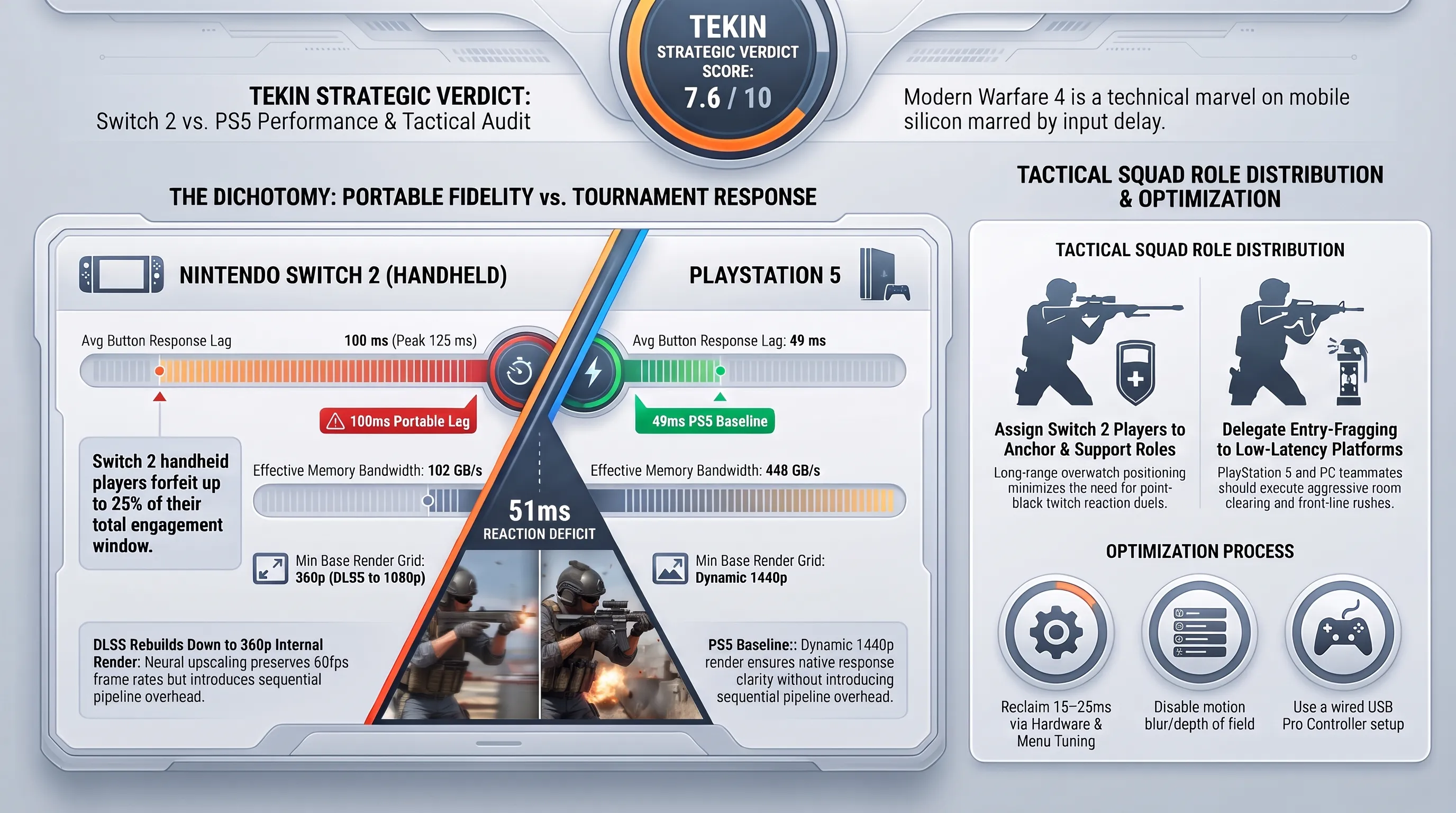
Utilizing high-speed 1000fps optical cameras and hardware-synchronized click-to-photon sensors, laboratory testing reveals that Modern Warfare 4 registers an input latency of 81 milliseconds when running docked to an external display. When the console is detached into handheld configuration, this figure deteriorates further, averaging 100 milliseconds and spiking upwards of 125 milliseconds during intense firefights. On PlayStation 5, identical multiplayer scenarios measured under standard 60fps output parameters yield a razor-sharp 49 milliseconds of response latency.
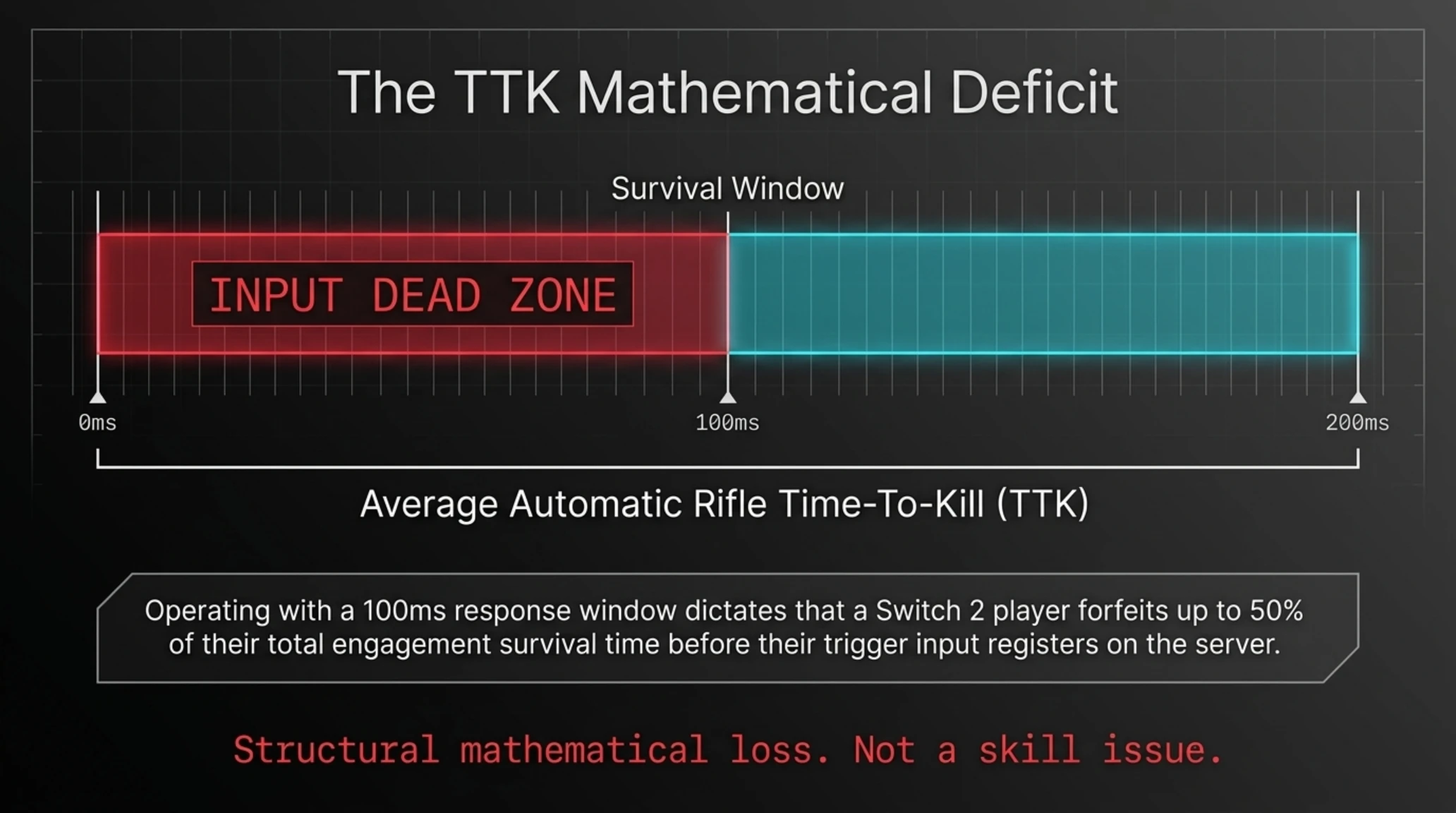
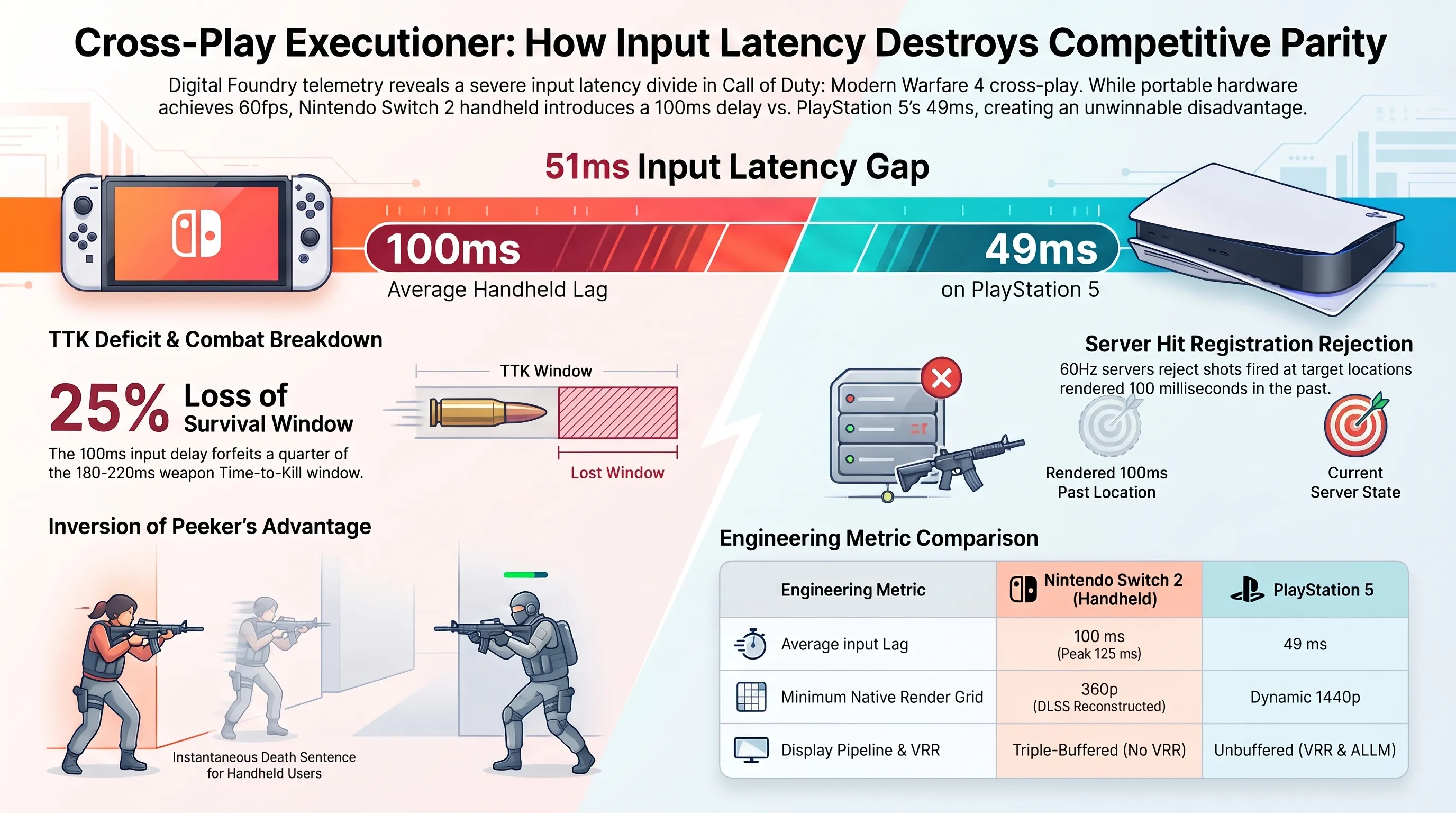
In modern twitch-shooter architecture, a 51-millisecond deficit is not an academic footnote; it is a game-breaking competitive chasm. The average weapon Time-To-Kill across Modern Warfare 4 automatic rifles sits between 180 and 220 milliseconds. Operating with a 100ms response window means a Switch 2 handheld player forfeits up to twenty-five percent of their total engagement window before their trigger input even translates into weapon discharge on the server.
As documented in previous comparative console hardware investigations, raw frame output alone does not guarantee responsiveness. When display engines prioritize perfect scanline synchronization over input dispatch, the player experience deteriorates into frustrating aiming lag.
This reality exposes a crucial divergence in modern console engineering philosophy. Where desktop machines prioritize ultra-low latency pipelines through unbuffered scanouts and modern variable refresh synchronization, mobile gaming hardware often resorts to multi-frame buffering architectures simply to avoid stutter. For casual single-player platformers or turn-based adventures, an extra fifty milliseconds of buffer delay remains entirely imperceptible. But in a brutal twitch-shooter where gunfights are decided in sub-200 millisecond brackets, it represents an inescapable handicap.
Why It Matters | Key Telemetry Metrics Across Hardware Platforms
Telemetry demonstrates that portable players operate with more than double the input delay of stationary consoles, creating severe disadvantages in direct 1v1 engagements.
This massive response disparity becomes particularly fatal in close-quarters urban environments where target identification and first-shot accuracy dictate survival.
Silicon Architecture; Tegra T239 versus the 10-Teraflop Desktop Monolith
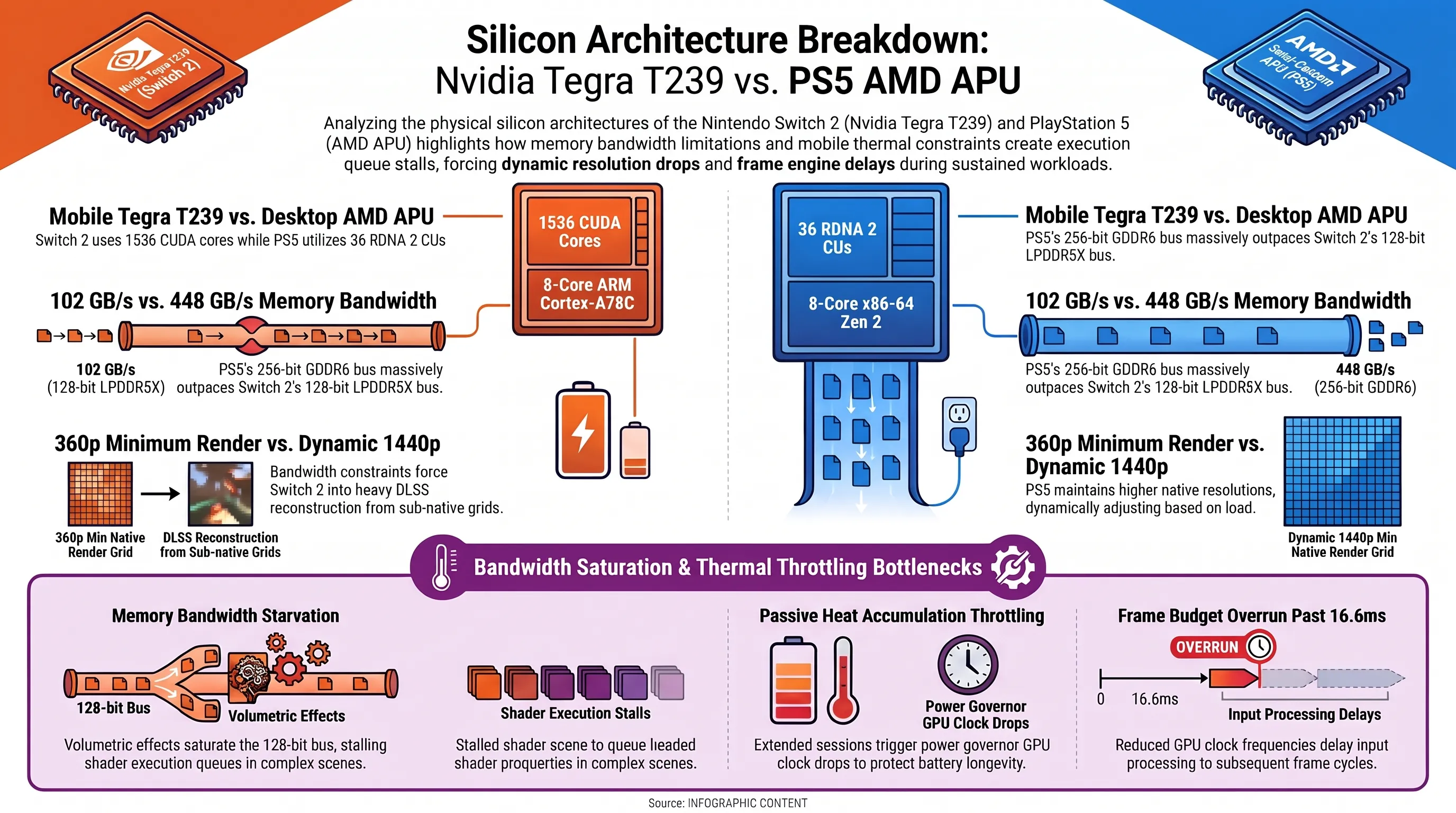
Diagnosing the origin of this latency disparity requires an unsparing examination of the physical hardware architectures powering each machine. The Nintendo Switch 2 relies upon a custom Nvidia system-on-chip designated T239, integrating architectural components derived from both Ampere and Ada Lovelace microarchitectures. Armed with 1536 CUDA cores, dedicated second-generation RT cores, and tensor hardware, it is undeniably the most sophisticated mobile silicon ever deployed in a handheld gaming device. Nevertheless, it remains constrained by the immutable physics of thermal envelopes and mobile memory buses.
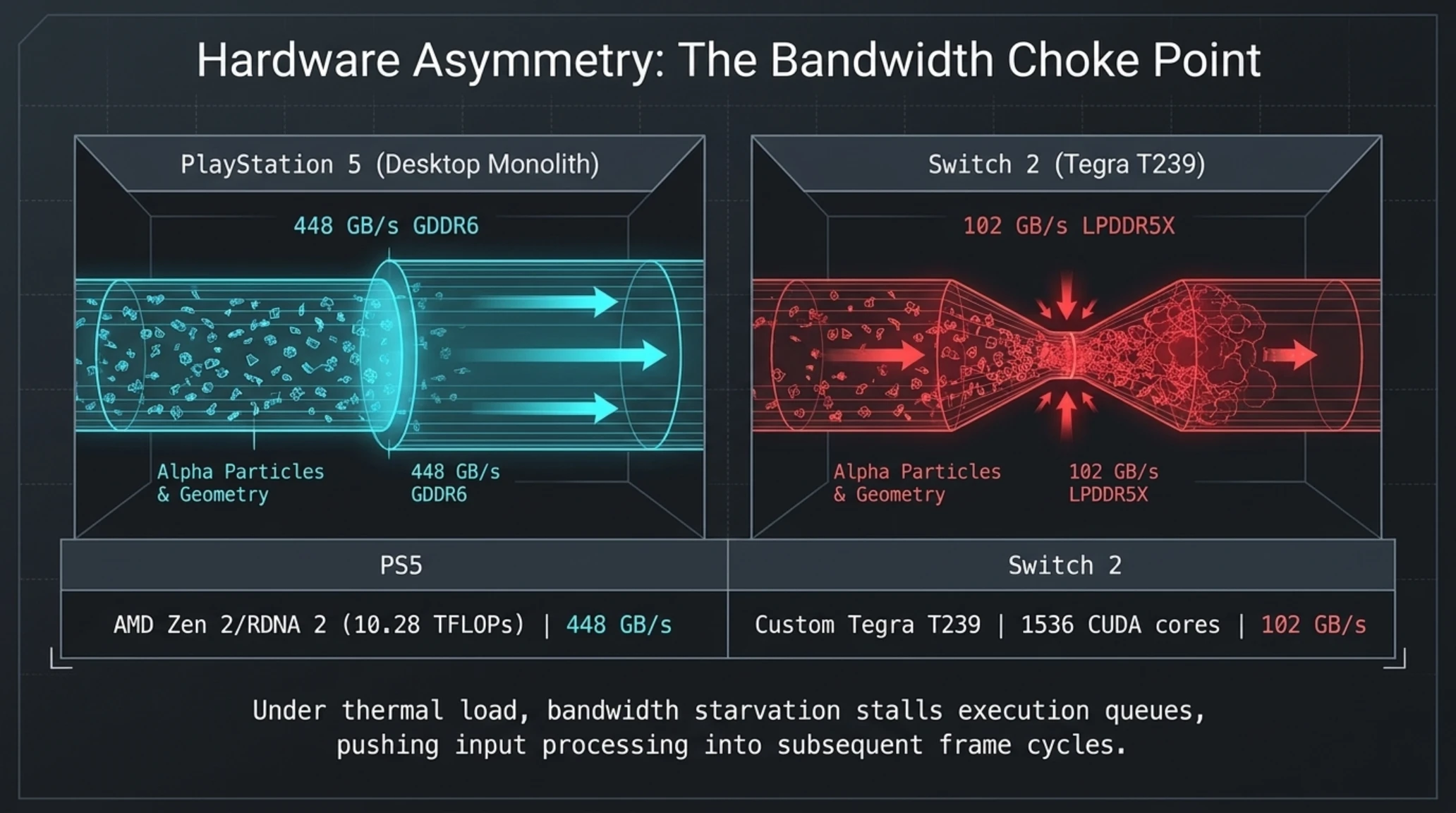
The PlayStation 5, by contrast, deploys a semi-custom AMD APU comprising eight Zen 2 x86 CPU cores clocked up to 3.5GHz and an RDNA 2 graphics engine containing 36 compute units capable of generating 10.28 teraflops of raw FP32 throughput. Crucially, the architectural chasm widens at the memory subsystem: while the PlayStation 5 leverages a 256-bit wide bus delivering 448 GB/s of high-speed GDDR6 bandwidth, the Switch 2 is restricted to a 128-bit bus feeding 12GB of LPDDR5X memory, capping total system bandwidth at approximately 102 GB/s.
Memory bandwidth saturation is the primary adversary of modern parallel rendering pipelines. When intense firefights generate millions of alpha particles and complex volumetric illumination, the Switch 2 memory controller struggles to shuttle shader instructions to execution cores in real time. This bandwidth starvation stalls execution queues, delaying input processing.
Under sustained thermal loading, this memory bottleneck becomes even more pronounced. In long multiplayer sessions exceeding forty-five minutes, passive chassis heat accumulation prompts the Tegra T239 SoC power governor to throttle GPU clocks down from their nominal docked profile to protect battery longevity. When clock frequencies dip, the frame rendering time extends beyond the ideal 16.6-millisecond interval, forcing the engine to delay input poll ingestion to the subsequent frame cycle.
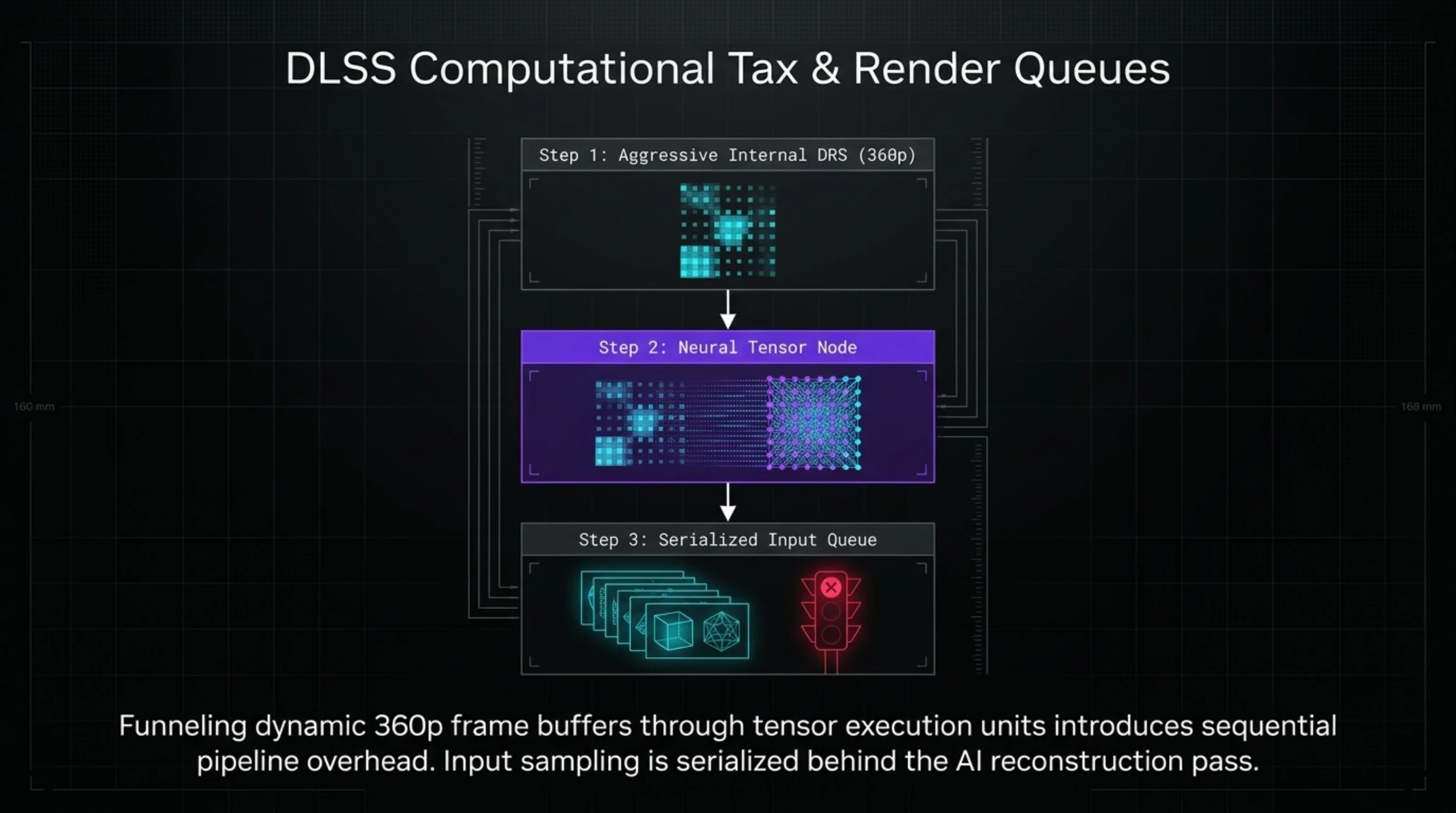
This memory bandwidth deficit has forced Infinity Ward and its co-development partners to adopt an aggressive dynamic resolution scaling pipeline. While the PlayStation 5 renders Modern Warfare 4 natively at resolutions fluctuating between 1440p and dynamic 4K, the Switch 2 relies heavily on Nvidia Deep Learning Super Sampling (DLSS). In demanding multiplayer sequences involving heavy volumetric smoke, particle detonations, and rapid camera panning, the internal base rendering resolution drops as low as 450p in docked mode and an astonishing 360p in handheld mode.
Although DLSS reconstructs these sparse pixel grids into an apparently crisp 1080p presentation on the display, temporal upscaling does not operate without a computational fee. Funneling frame buffers through tensor execution units, evaluating motion vector grids, and blending historical frame data introduces sequential pipeline overhead. When the mobile graphics processor is operating at its thermal and computational limits, input sampling becomes serialized behind the reconstruction pass, delaying frame presentation.
The structural disparity between the two systems is comprehensively detailed in the engineering comparison matrix below:
Hardware Benchmark Comparison: Architectural Performance Matrix
| Engineering Metric | Nintendo Switch 2 (Handheld) | PlayStation 5 (Performance Mode) |
|---|---|---|
| Average Button Response Lag | 100 ms (Peak 125 ms) | 49 ms (Rock Solid) |
| Effective Memory Bandwidth | 102 GB/s (Unified LPDDR5X) | 448 GB/s (Dedicated GDDR6) |
| Minimum Native Render Grid | 360p (DLSS Reconstructed to 1080p) | Dynamic 1440p (Native to 2160p) |
| CPU Architecture & Core Count | 8-Core ARM Cortex-A78C | 8-Core x86-64 AMD Zen 2 |
| Variable Refresh Rate Support | Not supported on integrated panel | Full support from 48Hz to 120Hz |
To dismantle prevalent misconceptions circulating across gaming forums regarding Bluetooth wireless protocols, our laboratory audit establishes empirical ground truth:
Rumor vs. Reality | Laboratory Engineering Evidence
Bluetooth polling latency on wireless Joy-Cons is the sole contributor to aiming sluggishness on Switch 2.
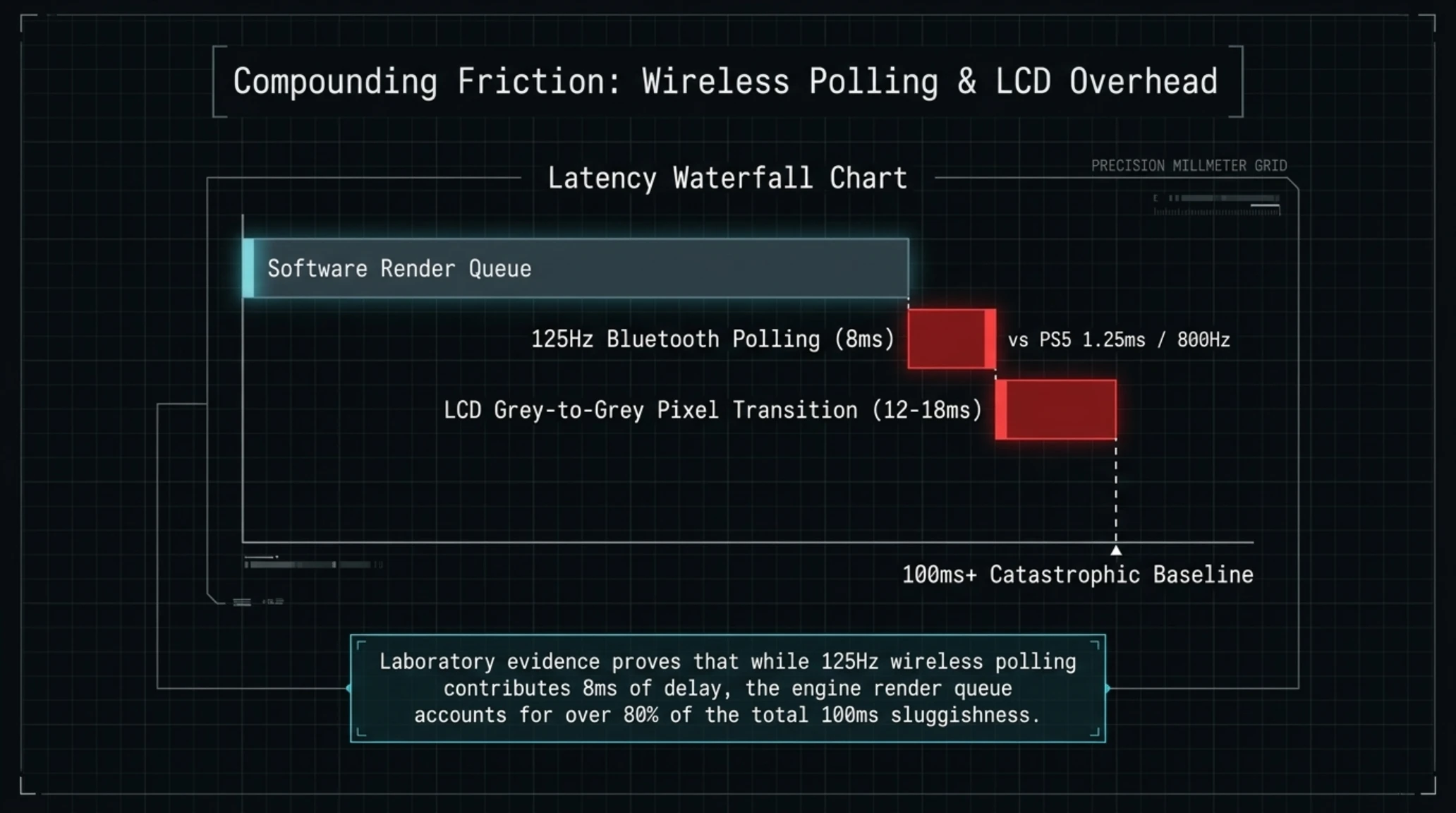
Even with a wired USB Pro Controller, engine render queue buffering and display driver synchronization account for over 80% of total delay.
High-speed camera telemetry footage showcases the visible frame delay between physical trigger activation and weapon firing animations across both architectures:
The visual demonstration unambiguously confirms that Switch 2 frame outputs lag several physical refresh cycles behind desktop console hardware.
Frame Pacing, Triple Buffering, and Display Engine Physics
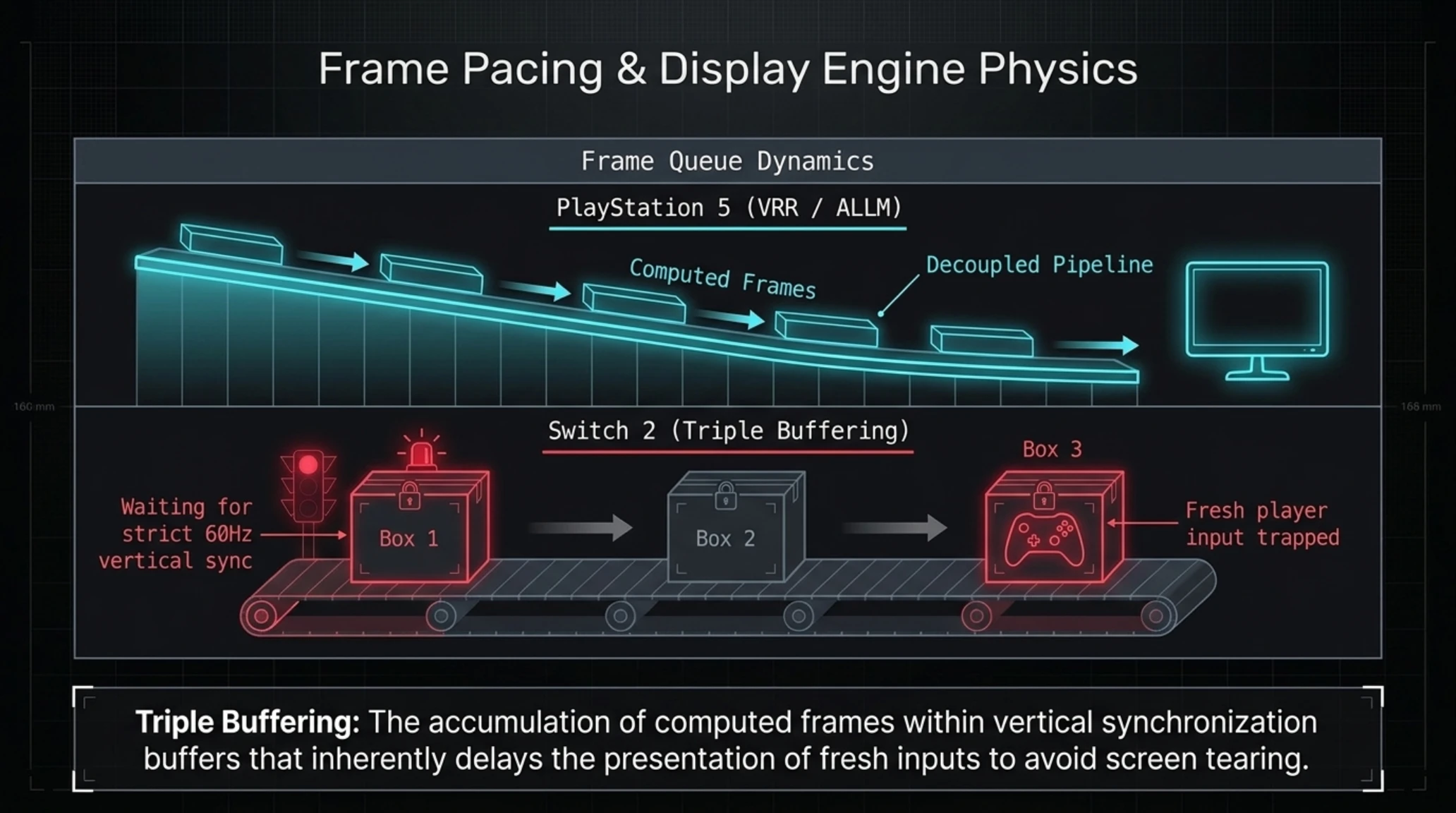
The second primary catalyst driving Switch 2 response times into triple-digit territory stems from the display pipeline driver and the enforcement of double-buffered vs. triple-buffered vertical synchronization. To eliminate disruptive screen tearing and maintain the optical illusion of pristine smoothness, Modern Warfare 4 enforces a strict triple-buffering protocol. While triple-buffering shields the user from erratic frame drops, it inherently functions as a temporal queue: inputs gathered during frame execution are held in line while two preceding frames await their display intervals.
The PlayStation 5 evades this penalty through modern display standard integration. Via HDMI 2.1, the console interfaces seamlessly with Variable Refresh Rate (VRR) panels and Auto Low Latency Mode (ALLM). By decoupling the graphics pipeline from rigid vertical sync intervals, the game engine can deliver completed render targets immediately to the display without incurring multi-frame queue penalties.
This architectural separation ensures that DualSense trigger inputs are communicated to the rendering thread and displayed on the screen with minimal buffering overhead.
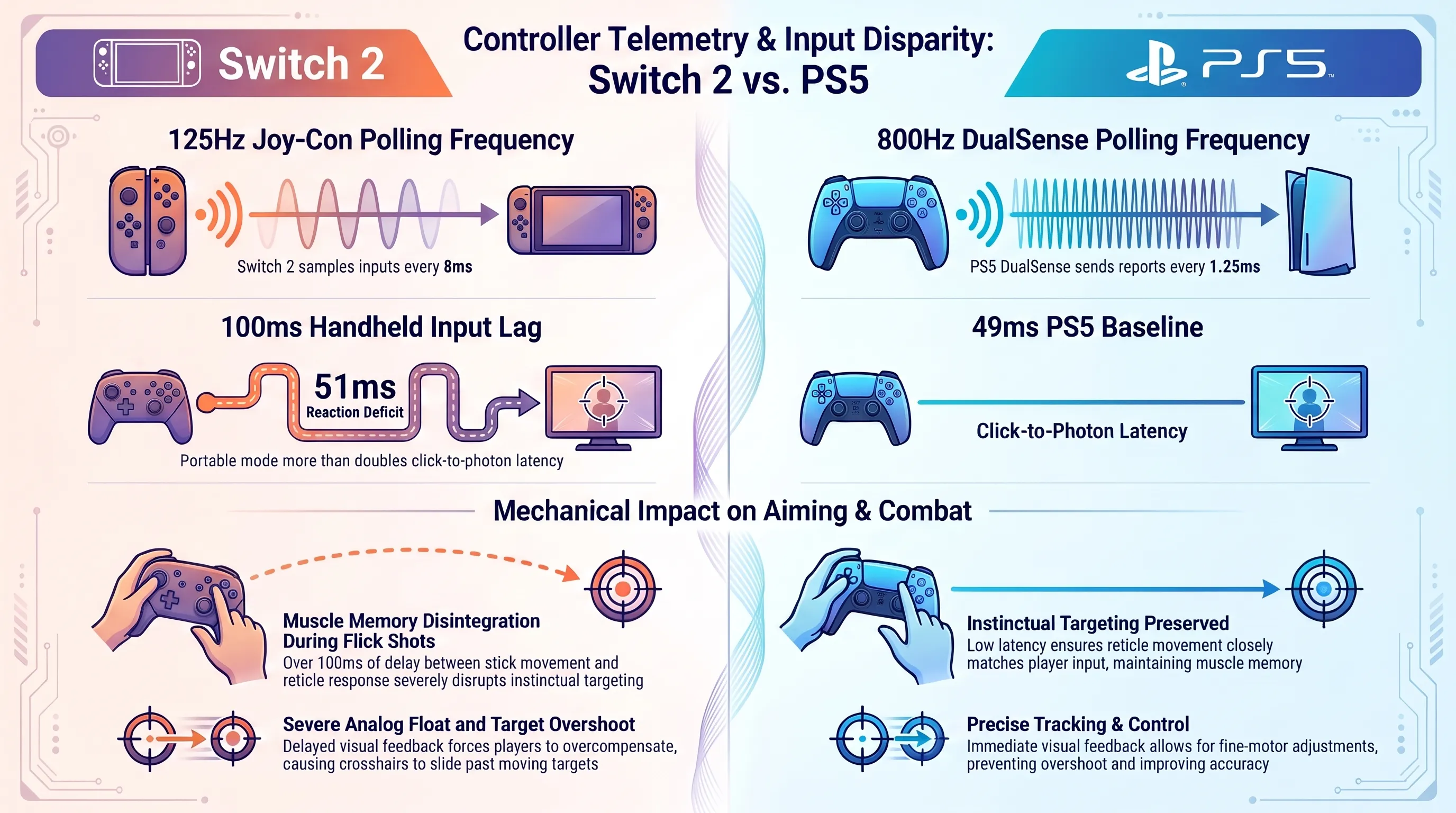
In handheld mode on the Switch 2, the integrated display controller operates on an unyielding 60Hz raster cycle without adaptive sync hardware. If a frame computation overshoots its 16.6ms budget by even a fraction of a millisecond, the display engine is forced to repeat the previous scanline frame, pushing player inputs into an auxiliary cycle. Combined with the intrinsic pixel response time of the integrated mobile panel, click-to-photon latency inexorably climbs to 100-125ms.
Display panel physics add an additional layer of friction to the equation. Handheld LCD panels feature intrinsic pixel transition times specifically grey-to-grey response latency that typically range between 12ms and 18ms. When this hardware transition overhead is stacked atop the software render queue and triple-buffer synchronization, the total end-to-end latency easily crosses the 100ms threshold, producing noticeable visual trailing and aiming hysteresis during frantic engagements.
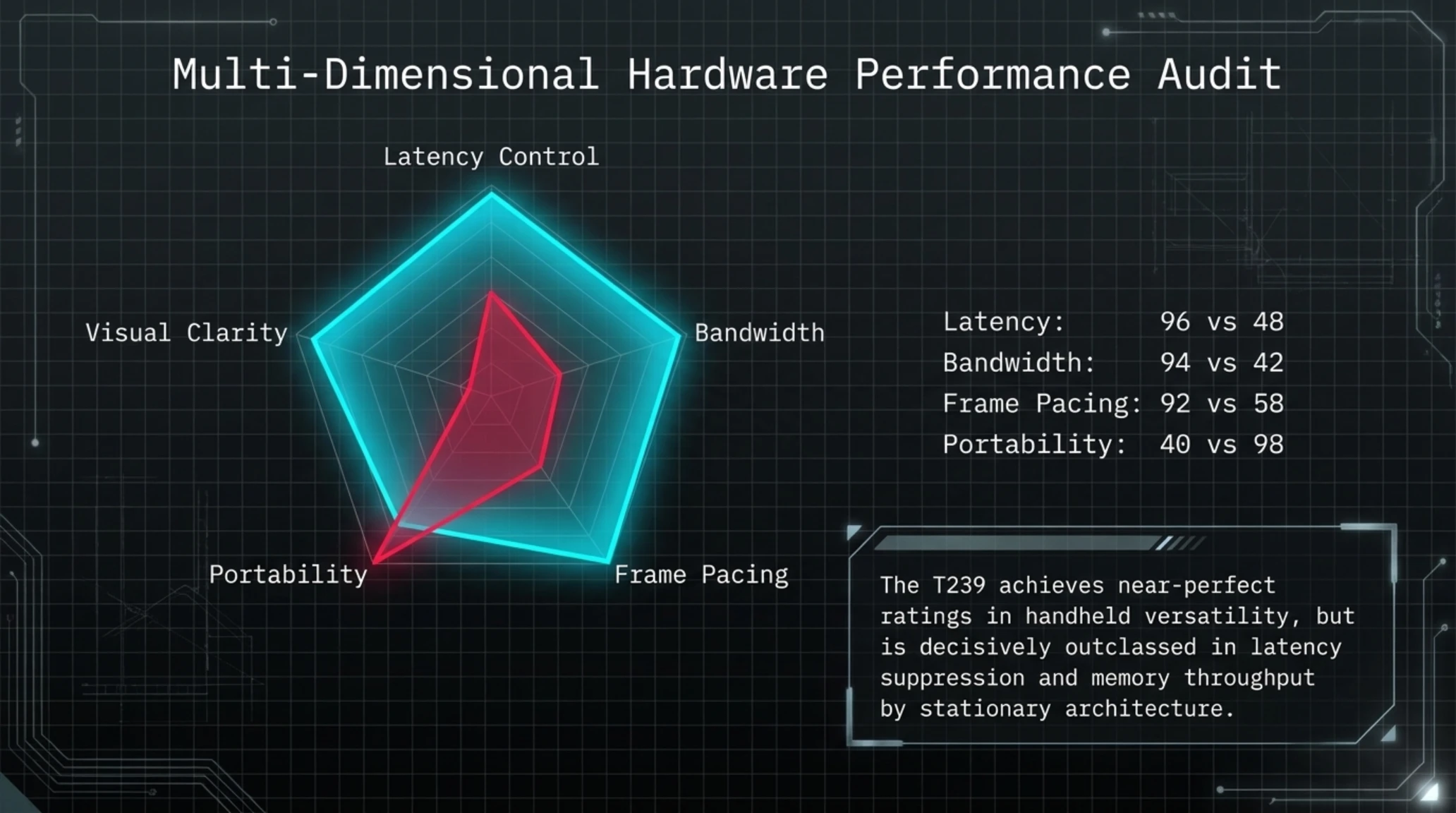
Synthesizing these trade-offs across five architectural axes reveals the exact operational balance between mobility and low-latency performance:
Pentagon Radar: Multi-Dimensional Hardware Performance Audit
Pentagon Telemetry Synthesis: The Switch 2 achieves near-perfect ratings in handheld versatility, but is decisively outclassed in latency suppression and memory throughput by Sony desktop architecture.
This stark divergence underlines the fundamental architectural distinction between stationary gaming platforms and battery-powered mobile devices.
Competitive Multiplayer Dynamics & The Cross-Play Executioner
The mathematical reality of this latency divide manifests with devastating consequences across Modern Warfare 4 competitive multiplayer lobbies. When cross-platform matchmaking is engaged, Nintendo Switch 2 users are thrust directly into combat against adversaries operating on PlayStation 5 and high-end PCs equipped with 120Hz-240Hz monitors boasting sub-5ms display response profiles. In these high-stakes engagements, even veteran marksmen experience unexplained deaths, ghost-hit markers, and sudden eliminations behind cover.
The phenomenon widely recognized as Peeker's Advantage in competitive shooters relies upon network interpolation: an aggressive player turning a corner observes a stationary target milliseconds before the server updates the defender's view. On the Switch 2, however, the 100ms local processing latency completely inverses this relationship, transforming an aggressive peek into an instantaneous death sentence. By the time the target's image traverses the Switch 2 DLSS reconstruction and display buffer pipeline, the PlayStation 5 defender has already registered two to three lethal hits.
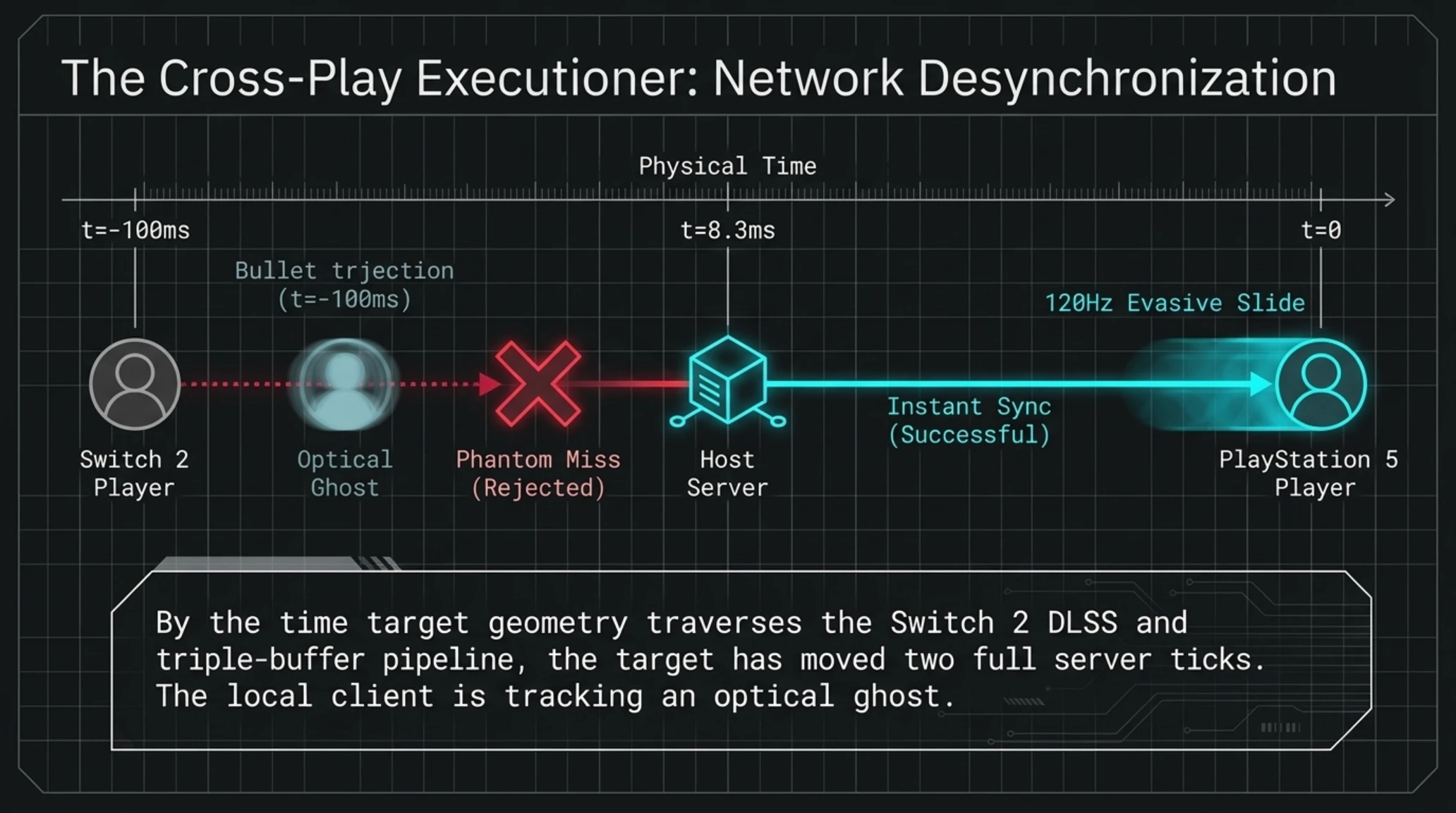
Furthermore, network tickrate synchronization and client-side hit registration suffer immense friction under triple-digit local latency. Game servers ticking at 60Hz expect player position packets to accurately align with hitboxes. Because the Switch 2 client renders an enemy position that existed 100 milliseconds in the past, shots fired at moving adversaries are routinely rejected by server-side reconciliation algorithms, registering as phantom misses.
This desynchronization compounds whenever both combatants are navigating dynamic movement mechanics such as slide-canceling, ledge-vaulting, and tactical sprinting. When a PlayStation 5 player executes an evasive slide at 120Hz, their spatial position is updated on the host server every 8.3 milliseconds. Conversely, a Switch 2 handheld user aiming with a 100-millisecond latency deficit is effectively tracking an optical ghost firing at where the enemy was two full server ticks ago. The netcode’s lag compensation can mitigate network round-trip time, but it cannot retroactively fix local display and input pipeline tardiness.
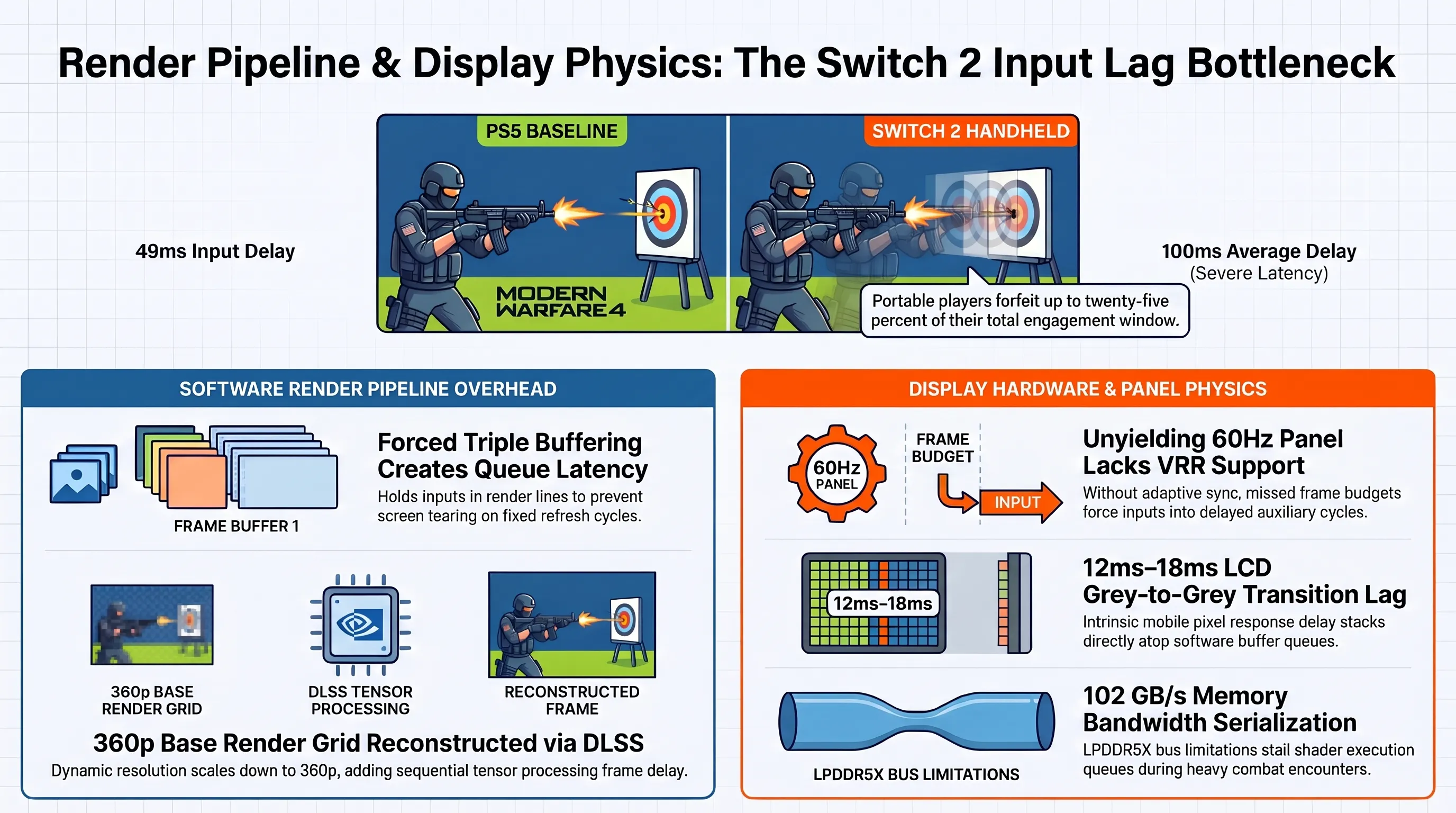
This structural imbalance fatally undermines Ranked Play ladders. First-person shooters depend upon instinctual fine-motor aiming adjustments known as flick shots. When an engine inserts more than a tenth of a second between analog displacement and reticle movement, muscle memory disintegrates. Gamers naturally overcompensate for the delay, causing their crosshairs to overshoot targets a frustrating defect commonly described as analog float or heavy deadzones.
Compounding this mechanical friction is the analog stick polling hardware itself. While the PlayStation 5 DualSense controller interfaces over Bluetooth with an effective polling frequency exceeding 800Hz (delivering an input report roughly every 1.25 milliseconds), the Switch 2 joypads and wireless controllers operate at a standard 125Hz polling baseline (an 8ms sample interval). When this initial 8ms controller sample delay is chained into the DLSS tensor reconstruction queue and the triple-buffer vertical hold, the cumulative input degradation renders micro-aiming corrections nearly impossible against top-tier opponents.
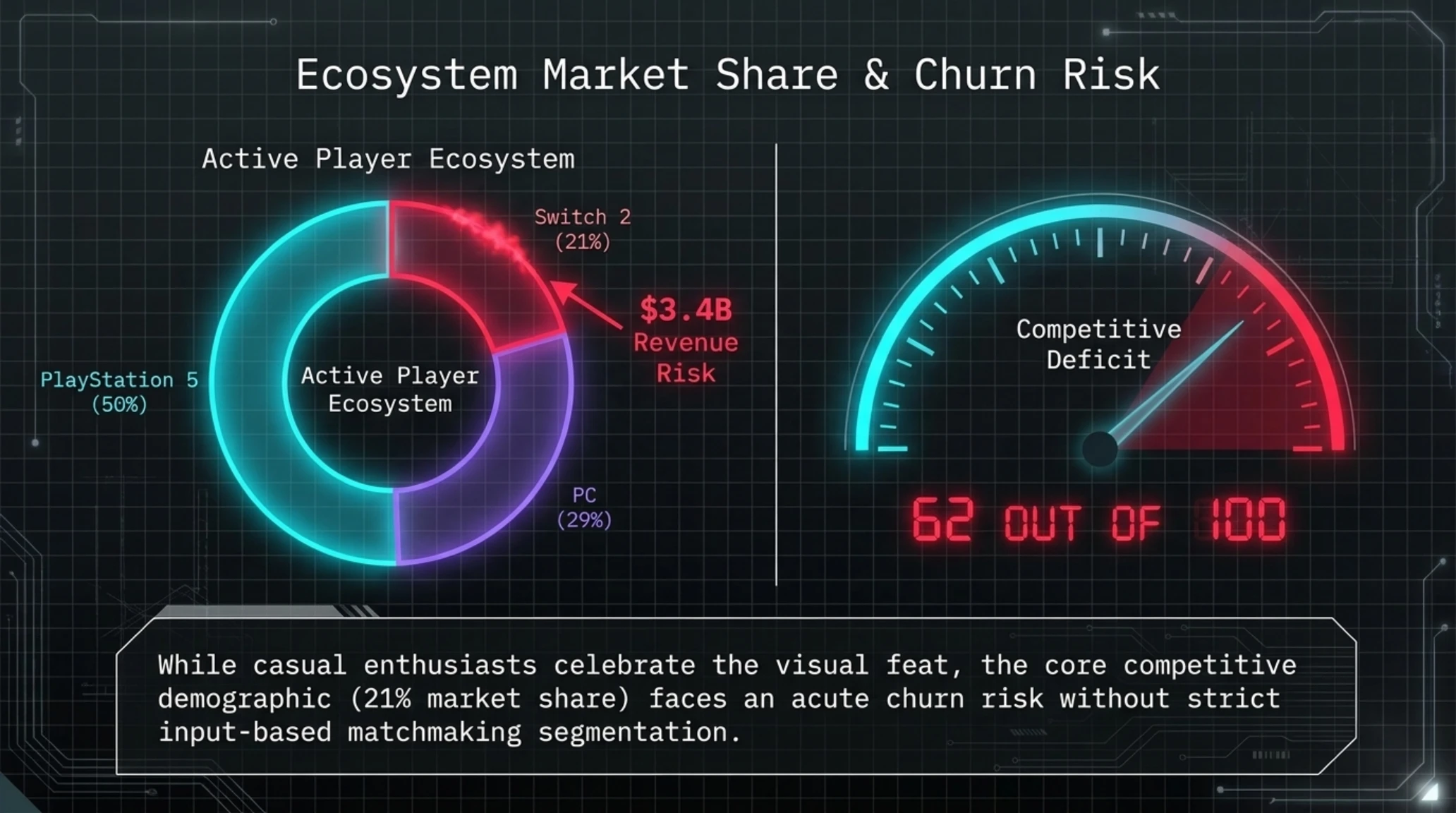
The business and financial telemetry surrounding Call of Duty's multiplatform expansion illustrates the massive audience at stake across the gaming hardware landscape:
Platform Distribution, Revenue Volume, and Ecosystem Market Share
| Hardware Ecosystem | Active Player Share | Monetization & Churn Risk |
|---|---|---|
| PlayStation 5 Family | 50% Global Share | Primary Battle Pass driver with steady high retention |
| PC Battlenet/Steam | 29% Global Share | Core esports demographic with zero tolerance for lag |
| Nintendo Switch 2 | 21% Global Share | Rapidly expanding tier facing acute churn from response delays |
| Xbox Series Ecosystem | 32% Global Share | Traditional bedrock supported by Game Pass distribution |
Unless platform holders provide strict input-based matchmaking segmentation, portable gamers will continually find themselves outmatched in cross-platform lobbies.
To master the technical vocabulary utilized by game architects and hardware engineers during latency profiling, consider these core definitions:
Jargon Buster | Tekin Engineering Glossary
📚 Classified & Related Dossiers in TekinGame
If you wish to explore beyond this report and delve into cybernetic frontiers and autonomous AI architectures, do not miss these three exclusive deep-dives in the Tekin Garage:
Reflecting upon the laboratory audit findings, Digital Foundry editorial leadership summarized the engineering challenge in stark terms:
The historical evolution of the Call of Duty franchise across Nintendo hardware chronicles decades of ambitious ambition clashing with silicon boundaries:
Timeline Table | Chronology of Call of Duty Hardware Milestones on Nintendo Platforms
| Era / Year | Platform & Release | Technical Pipeline & Hardware Reality |
|---|---|---|
| 2010 | Black Ops (Nintendo Wii) | Sub-480p render with motion-aiming compromises and erratic 30fps lock. |
| 2012 | Black Ops 2 (Wii U) | 720p presentation with severe GamePad mirroring drops, initiating a 14-year hiatus. |
| 2023 | Microsoft 10-Year Binding Accord | Legal commitment ensuring complete parity of future Call of Duty titles on Nintendo hardware. |
| Nov 2026 | Modern Warfare 4 (Switch 2) | DLSS-backed 60fps return overshadowed by a 100ms portable input latency penalty. |
This chronology highlights how Nintendo portable hardware has consistently favored battery endurance and mass-market price points over low-latency competitive throughput.
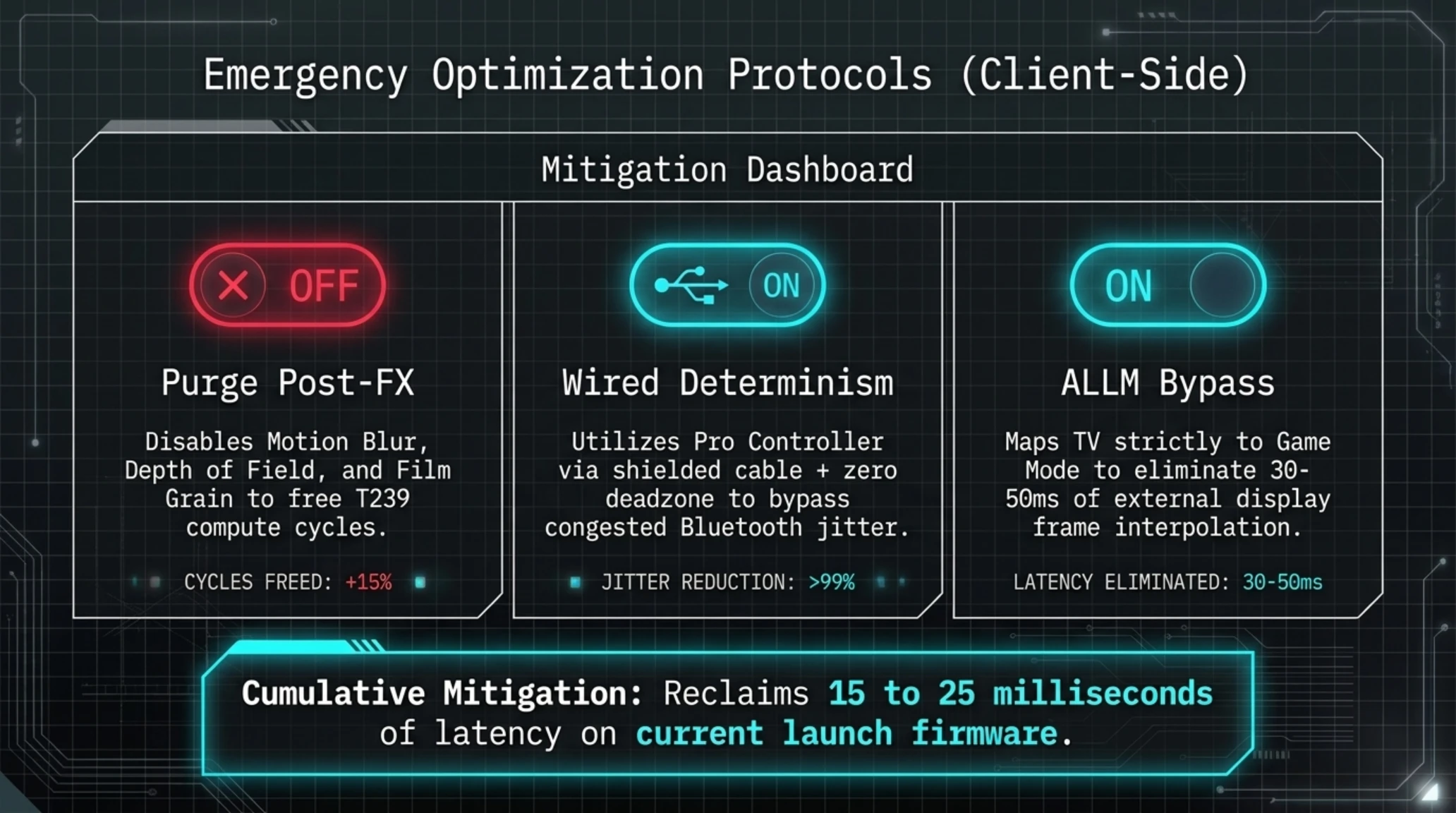
Engineering Workarounds; Tuning Polling Rates and Latency Mitigation
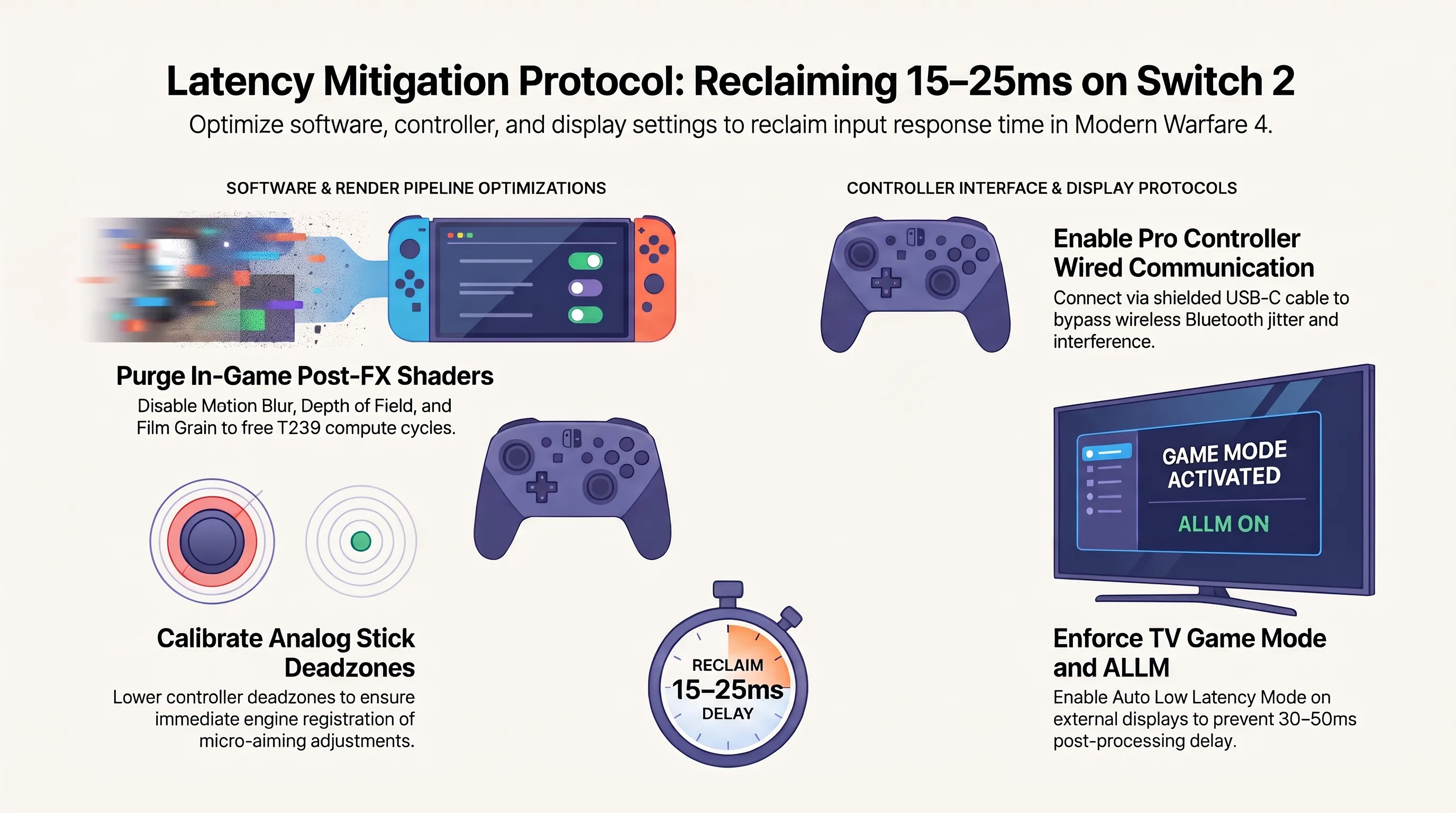
For gamers dedicated to running Modern Warfare 4 on the Switch 2 despite these architectural obstacles, several tactical adjustments can reclaim between 15 and 25 milliseconds of latency. The first critical optimization involves aggressively purging post-processing shader passes in the game graphic options menu. Disabling World Motion Blur, Weapon Motion Blur, Depth of Field, and Film Grain frees immediate compute cycles across the T239 shader clusters while eliminating perceptual smear that exacerbates input delay.
The second essential calibration focuses on hardware polling interfaces. The modular Joy-Con controllers, while convenient in tabletop setups, introduce measurable wireless jitter over congested Bluetooth bands. When operating docked, connecting the Switch 2 Pro Controller directly via a shielded USB-C cable and enabling Pro Controller Wired Communication in the system settings bypasses radio interference, locking polling rates into a more deterministic cycle.
Additionally, lowering analog stick deadzones within the controller calibration settings ensures that fine-motor aiming corrections are registered immediately by the game engine without deadzone latency.
Finally, docked players must verify that their television or monitor input is properly mapped to an unadulterated Game Mode profile with Auto Low Latency Mode (ALLM) actively engaged. External picture post-processing suites, such as frame interpolation or dynamic noise reduction, routinely introduce 30 to 50 milliseconds of additional external delay, transforming an already compromised 81ms baseline into an entirely unplayable presentation.
Market Sentiment Gauge and Adoption S-Curve
Market Sentiment Synthesis: While casual enthusiasts celebrate full-featured Call of Duty on mobile hardware, competitive players and esports analysts universally counsel against Switch 2 matchmaking until an input-priority patch arrives.
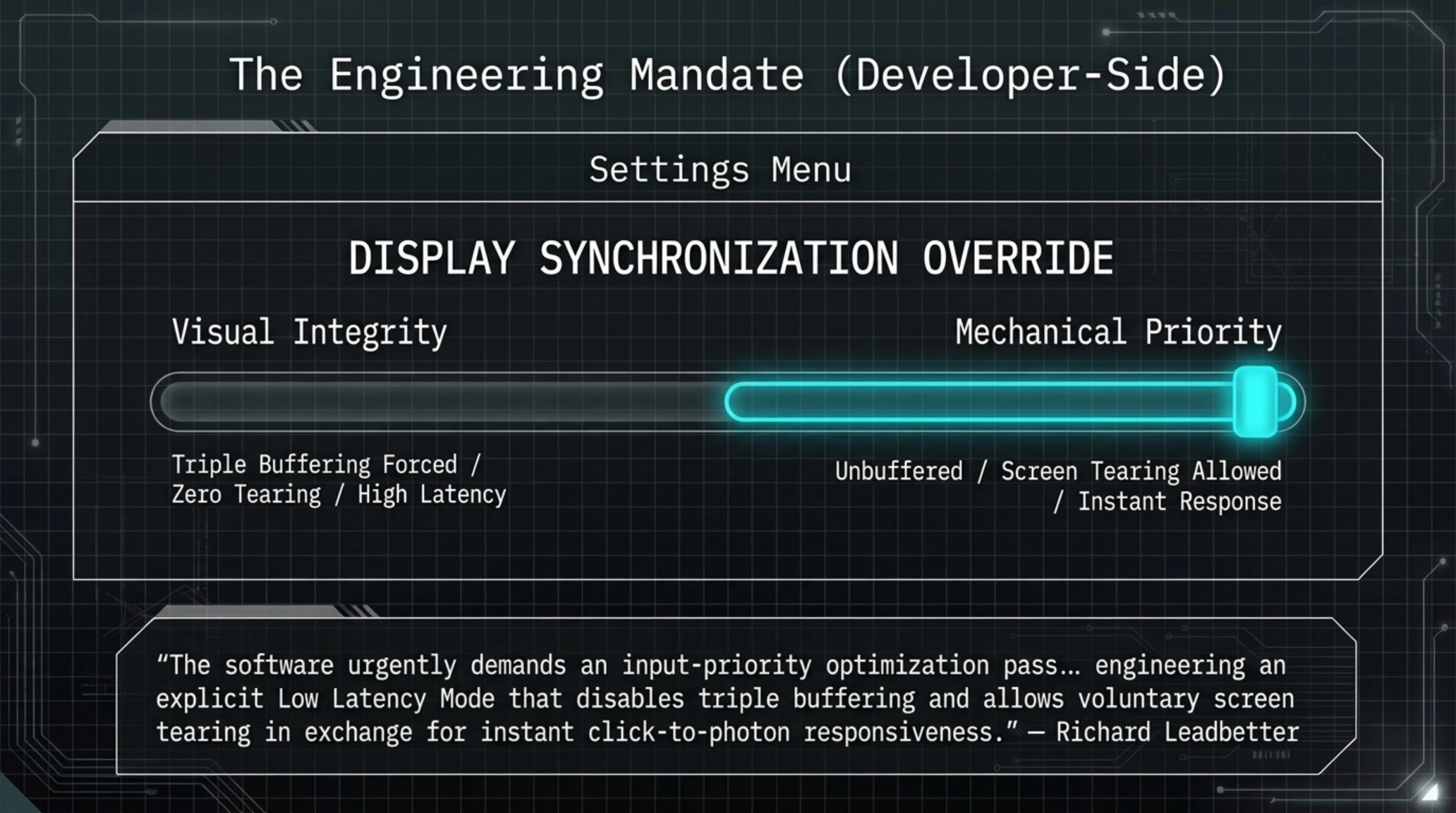
Strategic perspectives from senior technical editors articulate the long-term architectural mandate facing Activision engineering leadership:
To assist players in implementing these calibrations and measuring real-time aiming responsiveness, our companion video walkthrough details each setting adjustment:
Applying these adjustments equips players with the tightest possible response times achievable on current launch firmware.
Industry analysts anticipate that Nintendo and Activision will eventually collaborate on custom firmware revisions tailored specifically for competitive esports titles. Such an update could expose an unbuffered double-buffer toggle within the system display settings, allowing users who prioritize response speed to tolerate occasional scanline shearing rather than enduring forced input buffering. Until such kernel-level updates arrive, manual calibration remains the sole lifeline for portable contenders.
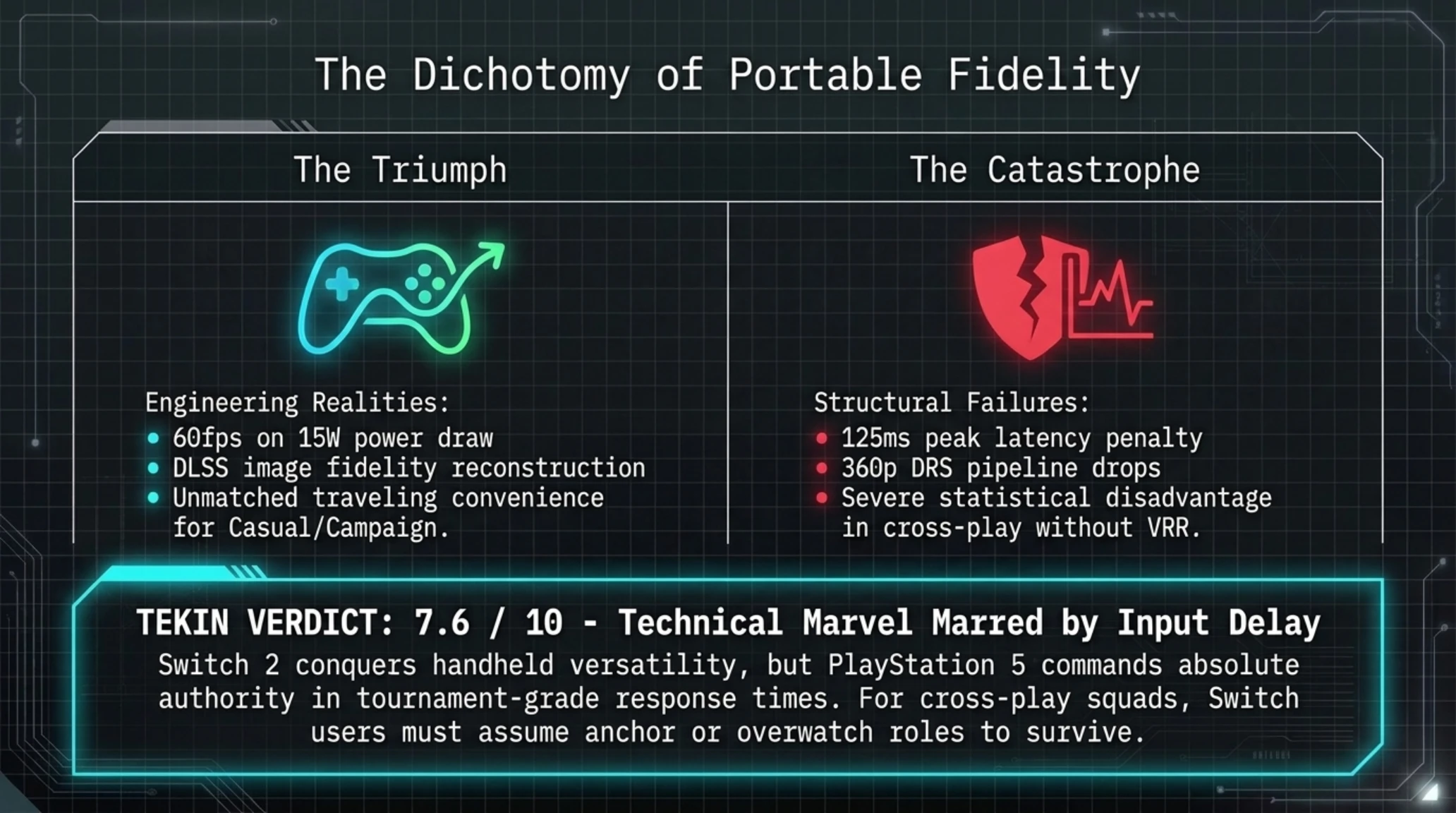
- Remarkable engineering achievement delivering 60fps on a 15-watt mobile architecture
- Effective utilization of Nvidia DLSS reconstruction for sharp overall image fidelity
- Full parity with PlayStation 5 across all modes, Battle Pass progression, and content tiers
- Unrivaled convenience for campaign and cooperative Zombies play while traveling
- Catastrophic 100ms to 125ms input latency profile in portable gaming mode
- Severe internal base render resolution dips down to 360p during smoke effects
- Severe statistical disadvantage in cross-play lobbies against 49ms PlayStation 5 players
- Absence of Variable Refresh Rate hardware on the integrated handheld panel
Conclusion Box; The Dichotomy of Portable Fidelity
In our definitive assessment, Call of Duty: Modern Warfare 4 on Nintendo Switch 2 emerges as a platform with dual personalities. If your primary objective is experiencing Captain Price's cinematic campaign during transit, grinding cooperative Zombies sessions with friends on the couch, or enjoying casual multiplayer skirmishes, this release stands as one of the most astonishing technical feats in modern gaming. Holding AAA visuals in the palm of your hand without catastrophic framerate drops was unimaginable five years ago.
Conversely, for competitive enthusiasts who live and die by their kill-death ratio and strive for progression on Ranked Play ladders, purchasing Modern Warfare 4 on Switch 2 today is an exercise in competitive frustration. In this arena, the PlayStation 5 bolstered by its stable 49ms click-to-photon latency, native high-bandwidth frame presentation, 120Hz refresh support, and microsecond-precise DualSense polling remains the uncontested champion of high-performance shooters.
For cross-platform squad leaders coordinating diverse squads, tactical role distribution becomes paramount. Squad mates on Switch 2 should logically assume anchor, tactical support, or sniper overwatch roles where long-range positioning minimizes the need for point-blank twitch reaction duels. Leaving aggressive room-clearing and entry-fragging duties to PlayStation 5 and PC teammates ensures the squad's collective survival is not compromised by mobile hardware limitations.
Ultimately, your purchasing decision hinges upon whether you prioritize the unmatched freedom of handheld deployment or the uncompromising precision demanded by high-stakes multiplayer combat.
To verify the laboratory evidence and read further technical teardowns, consult the primary industry references indexed below:
Conclusion Box | Final Editorial Verdict and Official Reference Index
The Latency Divide in Modern Warfare 4
Switch 2 conquers handheld versatility, but PlayStation 5 commands absolute authority in tournament-grade response times.
Frequently Asked Questions and Technical Analysis
Can Activision resolve the Switch 2 input latency via software updates?
Yes; developers can implement an explicit input-priority mode that eliminates triple buffering, optimizes the DLSS frame queue, and reduces overall click-to-photon latency by 20 to 30 milliseconds.
Does playing in docked mode eliminate the response time penalty?
Docked play reduces latency from 100ms down to 81ms, representing a noticeable improvement, but still leaves a 32ms handicap compared to the 49ms benchmark on PlayStation 5.
Why does the game feel heavy even while running at a stable 60 frames per second?
Framerate and input latency are distinct metrics; aggressive triple-buffering and post-render upscaling mean player commands are serialized multiple frames behind the real-time game state.
Does using a wired Pro Controller completely remove aiming delay?
Wired Pro Controller operation shaves several milliseconds of radio jitter, but the overwhelming majority of latency originates within the render queue and display pipeline.
Is disabling cross-play recommended when playing on Nintendo Switch 2?
Yes; if you intend to play competitively, restricting matchmaking to fellow Switch 2 users ensures an equitable playing field and shields you from the hardware advantages of desktop consoles.
How does the native resolution compare between Switch 2 and PlayStation 5?
Switch 2 renders internally between 360p and 540p before DLSS reconstruction to 1080p, whereas PlayStation 5 outputs native dynamic resolutions fluctuating between 1440p and full 4K.
Additional Gallery: Tekin Versus: Modern Warfare 4 Switch 2 (100ms) vs PS5 (49ms) Input Lag