Tekin Analysis | Meta's Open-Source Triumph
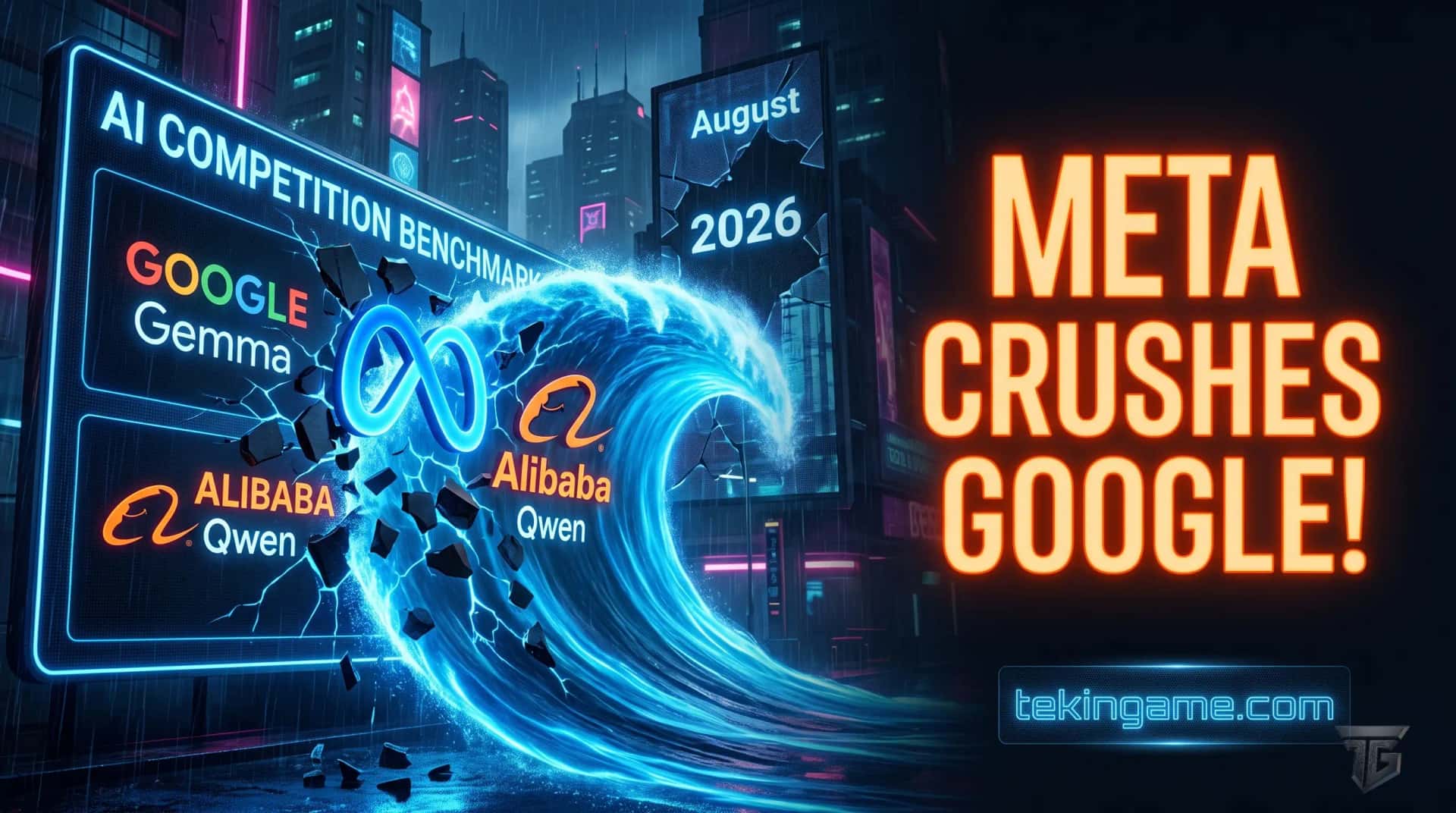
A forensic teardown of the 30B Muse Glimmer model. How Meta killed cloud APIs and brought autonomous AI agents to local GPUs.
- 🎮Muse Glimmer 30B- Meta's new distilled architecture
- 🎧Apache 2.0 License- Unrestricted commercial freedom
- 🚀Local Execution- Runs on 16GB VRAM consumer GPUs
- 🗡️Beating Competitors- Outperforms Gemma 4 & Qwen 3.6
- 📰Game AI Revolution- Powering smart, unscripted NPCs
- ⚔️131K Context Window- Ingesting massive code repositories
Welcome to this Tekin Analysis artificial intelligence report. The official release of Muse Glimmer 30B by Meta Superintelligence Labs on August 10, 2026, marks a pivotal moment in the evolution of open-source AI models and autonomous software agents. In a historic departure from restrictive commercial licensing tiers previously associated with the Llama series, Meta has published this 30-billion parameter dense model under the permissive Apache 2.0 license, granting developers and enterprise teams unrestricted commercial usage rights.
In this technical report, Tekin Game deconstructs the distilled architecture of Muse Glimmer, multi-step agent reasoning benchmarks, local hardware deployment requirements, and the democratization of AI agent development for game studios.
Core Takeaways of the Meta Muse Glimmer 30B Teardown
- Permissive Apache 2.0 open-source licensing eliminating API token costs and third-party vendor lock-in
- Full offline local execution capability on 16GB VRAM consumer GPUs using 4-bit quantization
- Massive 131,072-token context window capable of ingesting whole code repositories and technical documentation
- Distilled architecture derived from Meta's multi-trillion parameter Muse Spark teacher model
- Top-ranking 51.2 SWE-Bench Pro score establishing new efficiency benchmarks for mid-sized LLMs
- Immediate integration across open-source inference runners including llama.cpp and LM Studio
Defeating Closed APIs: Meta's 30B Model & The Apache 2.0 Shift
One of the most significant aspects of the Muse Glimmer release is Meta's uncompromised return to true open-source philosophy via the Apache 2.0 license. While commercial providers like OpenAI and Google wall off their agentic models behind expensive per-token API meters, Meta has made a 30-billion parameter weights package available for direct download to local developer workstations.
Distilled from Meta's flagship Muse Spark architecture, Glimmer executes multi-step coding, debugging, and visual document analysis with an industry-leading 51.2 score on the SWE-Bench Pro benchmark.
Primary technical pillars of the Muse Glimmer 30B model include:
- Integrating DFlash speculative decoding to achieve 3x token generation speedup on consumer hardware
- Out-of-the-box compatibility with local runners including llama.cpp, LM Studio, and Unsloth
- Native support for autonomous agent frameworks such as OpenClaw and Hermes Agent
- Maintaining reasoning fidelity under 4-bit and 8-bit quantization profiles to conserve VRAM
This technical milestone demonstrates that open-weights models can effectively challenge multi-billion-dollar proprietary cloud APIs.
AI architecture analysts view this release as a transformative moment for independent game developers and software engineers.

Market sentiment metrics show developer adoption on Hugging Face has set historical download records for 30B class open models.

The timeline below details technical parameters and benchmark evaluations comparing Muse Glimmer 30B against mid-tier open models.
Meta Muse Glimmer 30B vs. Mid-Tier Open AI Models Benchmark Matrix (Timeline & Specs)
| Technical & Benchmark Vector | Meta Muse Glimmer 30B (Apache 2.0) | Google Gemma 4 31B / Qwen 3.6 27B |
|---|---|---|
| Open Source License Classification | Permissive Apache 2.0 Commercial License | Restricted Research or Conditional Commercial Tiers |
| SWE-Bench Pro Software Score | 51.2 Benchmark Score (Rank 1 in Mid-Tier) | 36.9 Score (Gemma 4) & 50.2 Score (Qwen 3.6) |
| Effective Context Window Length | 131,072 Tokens with Stable Memory Retention | 64,000 to 128,000 Tokens (Variable Retention) |
| Prompt Injection Vulnerability Rate | 28.4% Success Rate (High Utility Tradeoff) | 25.6% Rate (Gemma 4) & 40.3% Rate (Qwen 3.6) |
Supplementary Tekin Game telemetry underscores the potential of deploying Muse Glimmer 30B locally to power responsive in-game NPC dialogue trees.
The Agentic Revolution: Why Muse Glimmer Excels at Autonomous Tasks
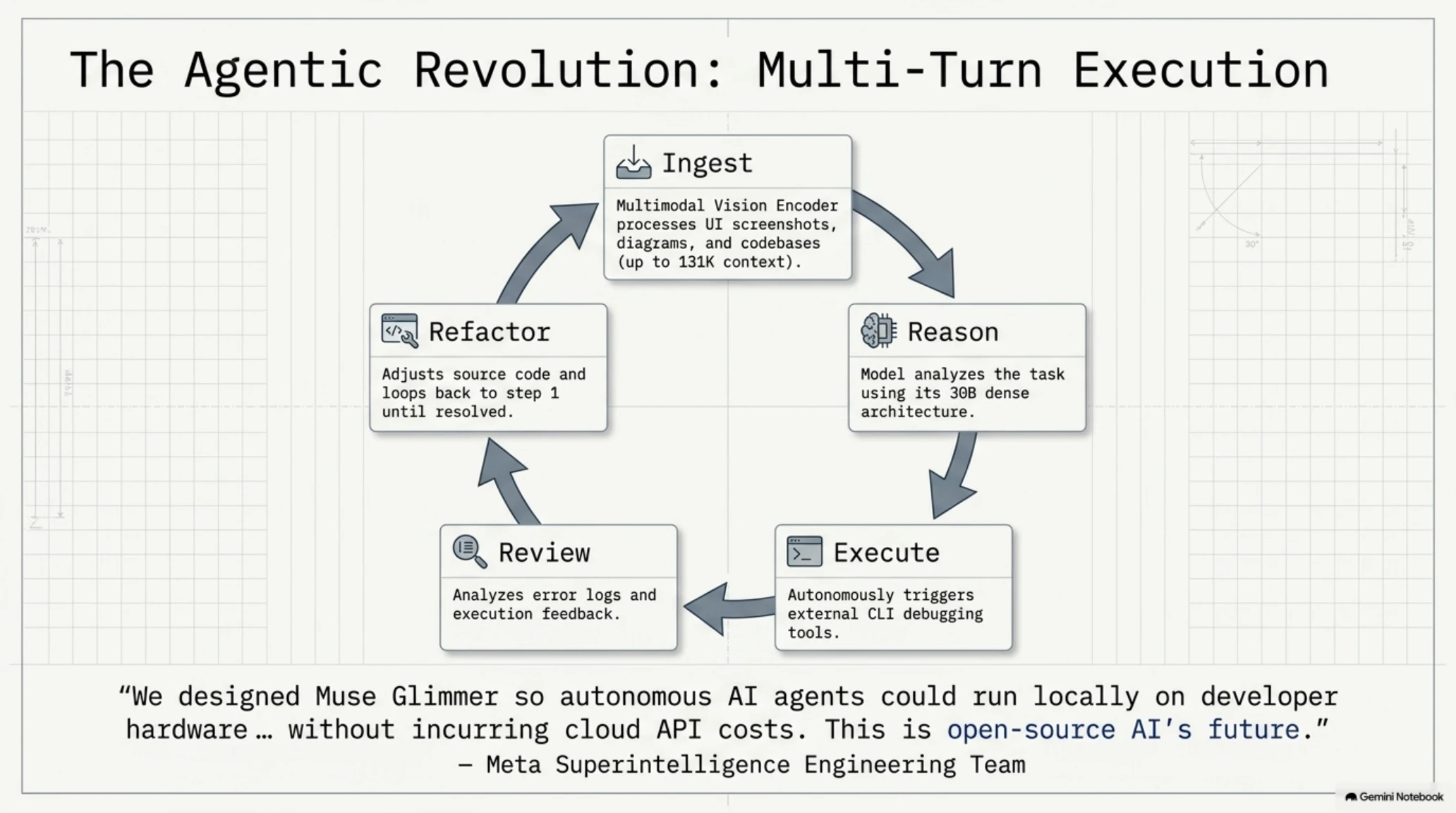
The architecture of Muse Glimmer is tailored specifically to parse visual UI screenshots, codebases, and tool execution feedback simultaneously. Unlike traditional chat completion LLMs that produce plain text, Glimmer is trained on multi-turn agentic loops. This design enables the model to analyze error logs, refactor source code, and trigger external CLI debugging tools autonomously.
Leveraging DFlash speculative decoding, inference speed increases significantly, minimizing latency during multi-step tool calls.
Tekin Game's technical teardown confirms that these capabilities make Muse Glimmer an ideal engine for independent game development teams.

The excerpted quote below is drawn from Meta Superintelligence engineers' interview with VentureBeat.
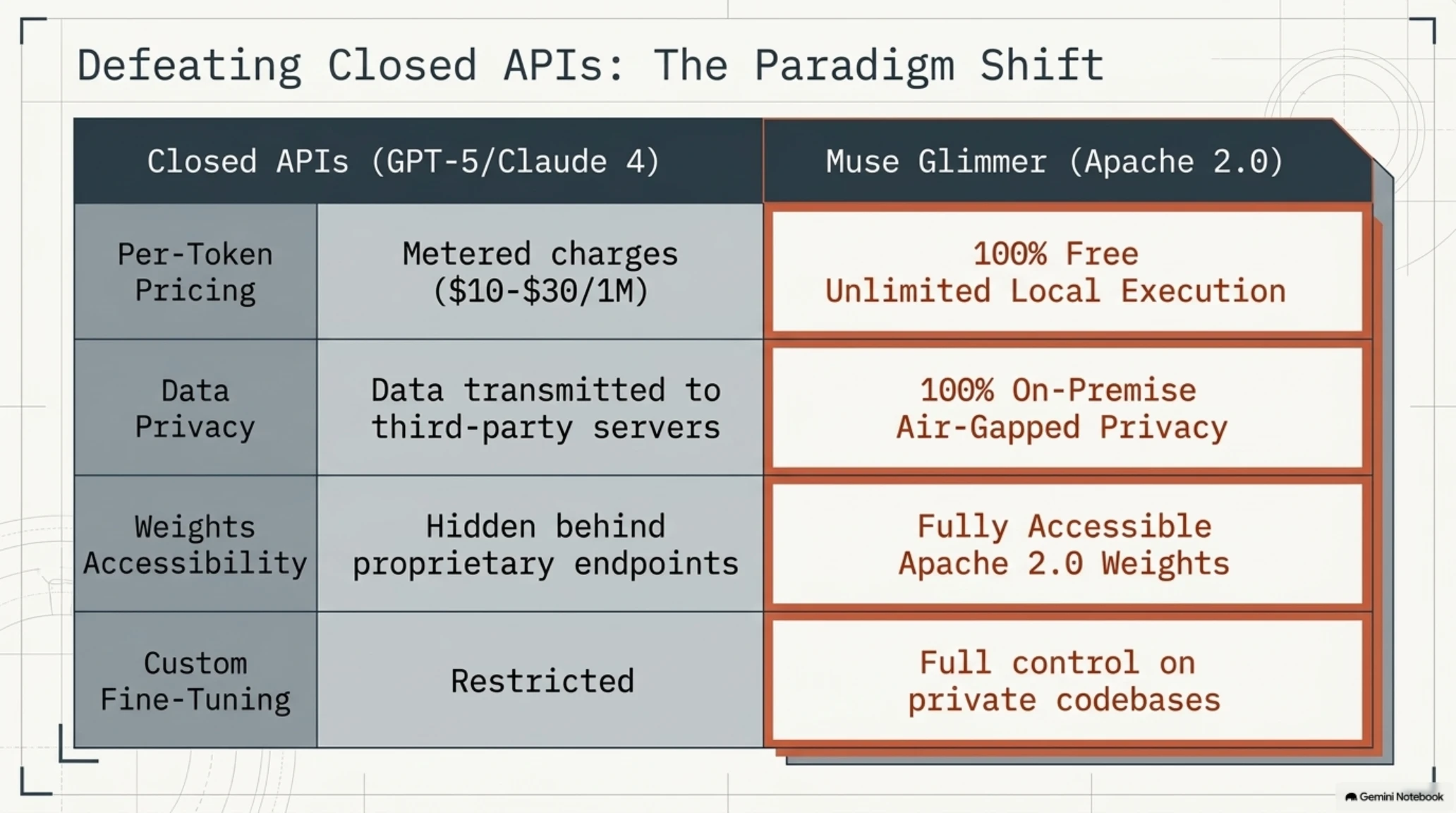
The comparative matrix below evaluates closed cloud APIs against the local open-source Muse Glimmer 30B architecture.
Closed Proprietary Cloud APIs vs. Local Meta Muse Glimmer 30B Comparison
| Evaluation Vector | Closed Cloud APIs (GPT-5 / Claude 4) | Local Meta Muse Glimmer 30B (Apache 2.0) |
|---|---|---|
| Per-Token Usage Pricing | Metered Per-Token Charges ($10 to $30 / 1M) | 100% Free Unlimited Local Execution |
| Data Privacy & Confidentiality | Data Transmitted to Third-Party Cloud Servers | 100% On-Premise Air-Gapped Data Privacy |
| Model Weights Accessibility | Hidden Behind Proprietary Remote Endpoints | Fully Accessible Weights Released Under Apache 2.0 |
| Custom Fine-Tuning Flexibility | Restricted or Unavailable for Deep Adaptations | Full Fine-Tuning Control on Private Codebases |
Below is Tekin Game's visual teardown and analytical video coverage outlining legacy software porting economics and multiplayer performance benchmarks.
To assist readers with agentic workflows and knowledge distillation terminology, the core concepts box below defines key industry metrics.
Technical Jargon Buster & Core Concepts
Agentic Workflows & Model Distillation: Autonomous tool execution loops and knowledge compression from massive teacher models. Why This Matters: Evaluating Rumor vs. Reality regarding local hardware costs, tracking Market Sentiment, and reviewing complete AI model teardowns on Tekin.
Local Hardware Deployment: Ending Dependence on Cloud APIs
Prohibitive API billing has long hampered independent game studios attempting to integrate autonomous AI agents into production workflows. Muse Glimmer 30B resolves this barrier by supporting Q4_K_M and Q8_0 quantization formats, allowing full model execution on 16GB to 24GB VRAM GPUs (such as the RTX 4080, RTX 4090, or Apple Silicon M2/M3/M4 Macs).
Game creators can test complex NPC dialogue scripts and autonomous game testing agents directly on local hardware without incurring remote infrastructure charges.
Key advantages of local model execution include:
- Ensuring operational continuity independent of internet connectivity outages
- Eliminating network latency delays associated with remote API requests
- Seamlessly integrating with game engine pipelines including Unreal Engine 5 and Unity
- Maintaining strict behavioral alignment over autonomous agent outputs
These hardware benchmarks demonstrate that the era of cloud API vendor lock-in is drawing to a close.

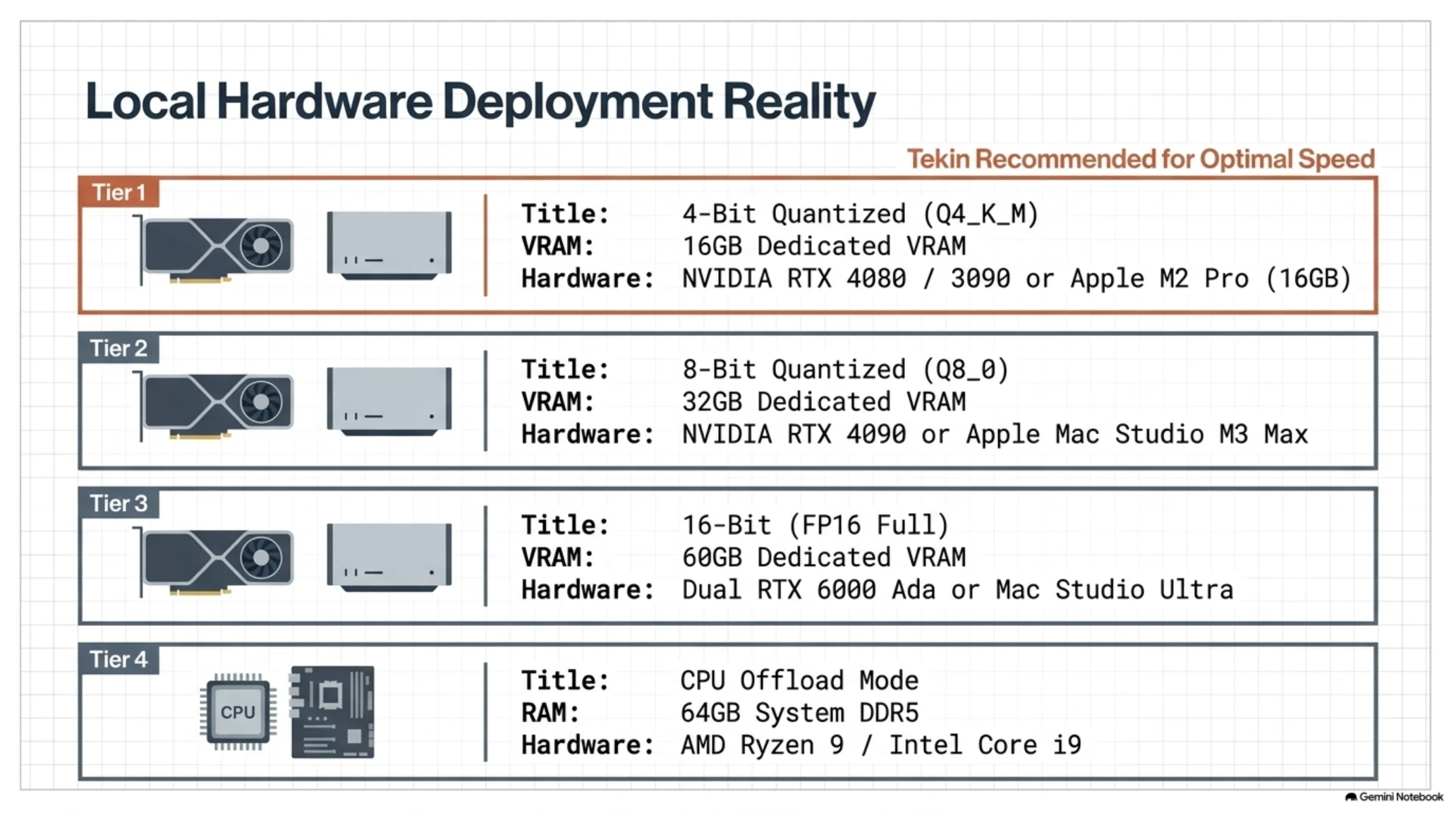
The comparative table below outlines GPU hardware requirements for deploying 30B parameter models locally.
Local Hardware Deployment Requirements for Muse Glimmer 30B
| Quantization Level | Minimum VRAM Footprint | Tekin Recommended Hardware Configuration |
|---|---|---|
| 4-Bit Quantized (Q4_K_M Optimized) | 16GB Dedicated VRAM | NVIDIA RTX 4080 / RTX 3090 or Apple M2 Pro (16GB) |
| 8-Bit Quantized (Q8_0 High Precision) | 32GB Dedicated VRAM | NVIDIA RTX 4090 or Apple Mac Studio M3 Max (36GB) |
| 16-Bit Uncompressed (FP16 Full) | 60GB Dedicated VRAM | Dual RTX 6000 Ada or Apple Mac Studio Ultra (64GB) |
| CPU Offload Mode (RAM Only) | 64GB System DDR5 RAM | AMD Ryzen 9 / Intel Core i9 with High-Speed DDR5 |
Why Muse Glimmer Redefines Software & Game Development
The combination of Apache 2.0 licensing, multimodal vision parsing, 131K context support, and top-tier code reasoning confirms that Meta remains the primary force advancing open-source AI.
Tekin Game will provide continuous real-time coverage of all technical benchmarks and model updates.
Hardware Specifications & Archive Metrics (Specs Box)
Analyzing the knowledge distillation architecture of Muse Glimmer 30B confirms that Meta engineers successfully compressed multi-trillion parameter model reasoning into a highly efficient 30B footprint.
Tekin Game's technical advisory team recommends that developers utilize 4-bit quantized GGUF weights to maximize local inference speeds on mid-range workstations.
Supporting multi-turn agentic loops guarantees reliable, error-free automated task completion.
Hardware Specifications & Smart History Tags (Specs Box & Smart History Tags)
| Technical Parameter | Muse Glimmer 30B Target Specifications (2026) | Tekin Advisory & System Recommendations |
|---|---|---|
| Active Parameter Count & Type | 30 Billion Parameters (Dense Architecture) | Deploy Q4_K_M Quantized GGUF for Optimal Speed |
| Open Source Software License | Apache 2.0 Un-Restrictive Commercial License | Full Commercial Exploitation Rights with Zero Royalties |
| Effective Context Window Size | 131,072 Tokens (Native Long-Context) | Handles Full Project Repositories & Multimodal Input |
| Primary Distillation Teacher Model | Muse Spark Multi-Trillion Parameter Model | Retains High Reasoning Fidelity via Knowledge Distillation |
📚 Classified & Related Dossiers in TekinGame
If you wish to explore beyond this report and delve into cybernetic frontiers and autonomous AI architectures, do not miss these three exclusive deep-dives in the Tekin Garage:
Reviewing technical parameters confirms the significant performance leap achieved by open-source local AI architectures.

The matrix below evaluates competing open-weights and proprietary AI models across key reasoning benchmarks.
Open-Weights vs. Proprietary AI Model Reasoning Matrix (2026)
| Model & License Architecture | SWE-Bench Pro Score | Primary Developer Advantage | Operational Constraints |
|---|---|---|---|
| Meta Muse Glimmer 30B (Apache 2.0) | 51.2 Benchmark Score (Rank 1 Mid-Tier) | Zero API Cost & Multimodal Local Vision Parsing | Requires 16GB VRAM Minimum Local Hardware Footprint |
| Google Gemma 4 31B (Open-Weights) | 36.9 Benchmark Score | Strong Performance on GPQA Diamond Math Tasks | Lower Multi-Step Coding & Agentic Reasoning Output |
| Alibaba Qwen 3.6 27B (Community) | 50.2 Benchmark Score | Fast Token Generation & Python Code Accuracy | High 40.3% Prompt Injection Vulnerability Rate |
| Closed Cloud APIs (GPT-5 / Claude 4) | 65.0+ Benchmark Score | Maximum Reasoning Precision without Local Hardware | High API Token Expenses & Lack of Privacy Guarantees |
The following Tekin Game technical video breakdown provides in-depth visual analysis of Muse Glimmer 30B token throughput and local GPU inference performance.
Empowering Game AI: Building Intelligent NPCs with Muse Glimmer
One of the most promising applications for Muse Glimmer 30B within the gaming industry is powering unscripted Non-Player Characters (NPCs) in real time. Legacy cloud-hosted NPC implementations suffered from noticeable multi-second latency delays caused by remote server roundtrips.
By hosting Muse Glimmer locally on a player's GPU, NPCs can generate contextual dialogue, analyze environmental changes visually, and react instantaneously without network lag.
Primary game development integration benefits include:
- Visual environment parsing by NPCs via the model's multimodal encoder
- Generating unscripted, dynamic dialogue tied directly to player actions
- Eliminating game studio server hosting costs for online AI features
- Dramatically enhancing game replayability through emergent NPC behavior
These game engine integrations demonstrate that Meta is defining the future of AI-driven interactive entertainment.

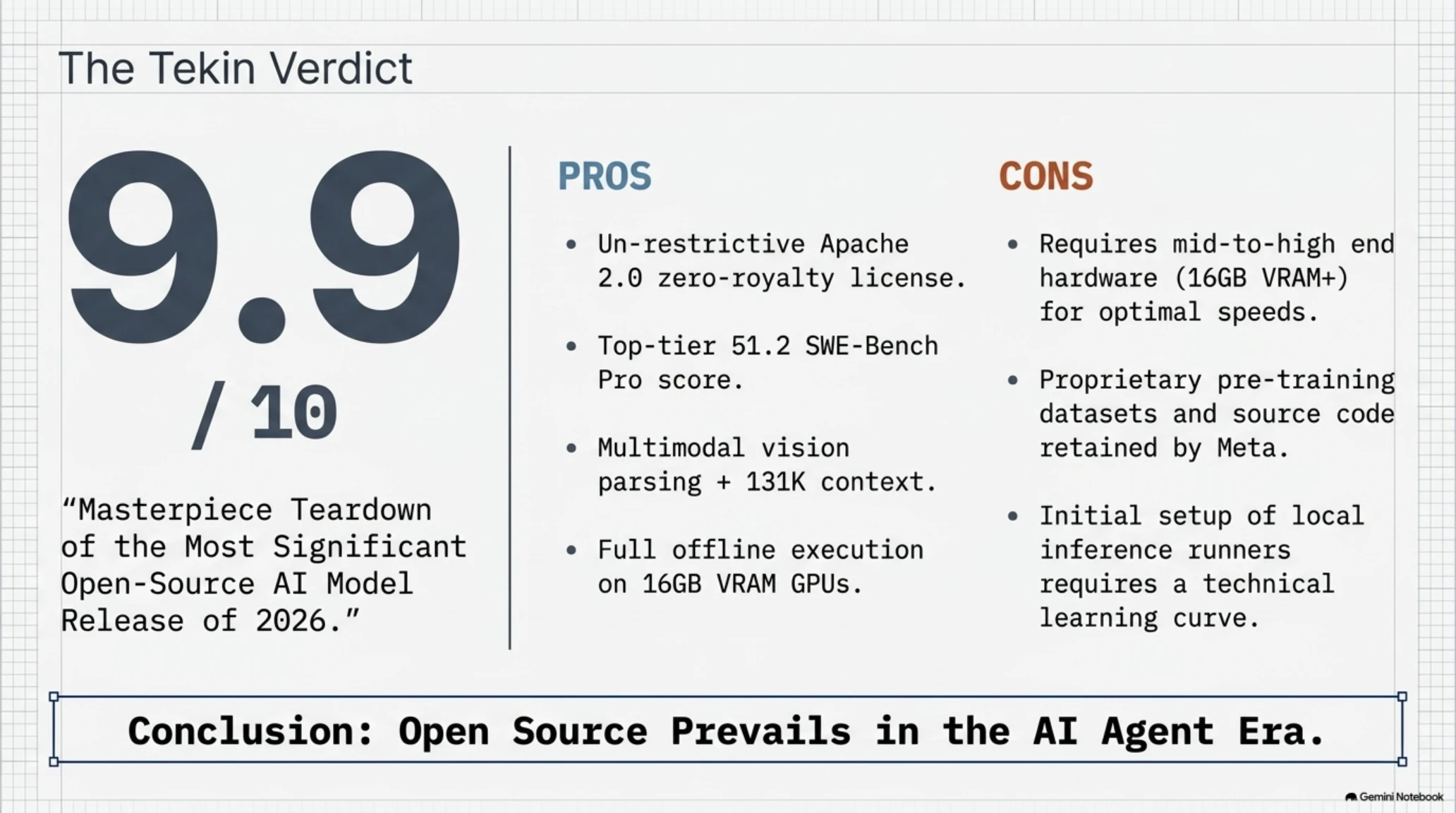
The official position of the Tekin Editorial Board regarding this major open-source release is detailed below.
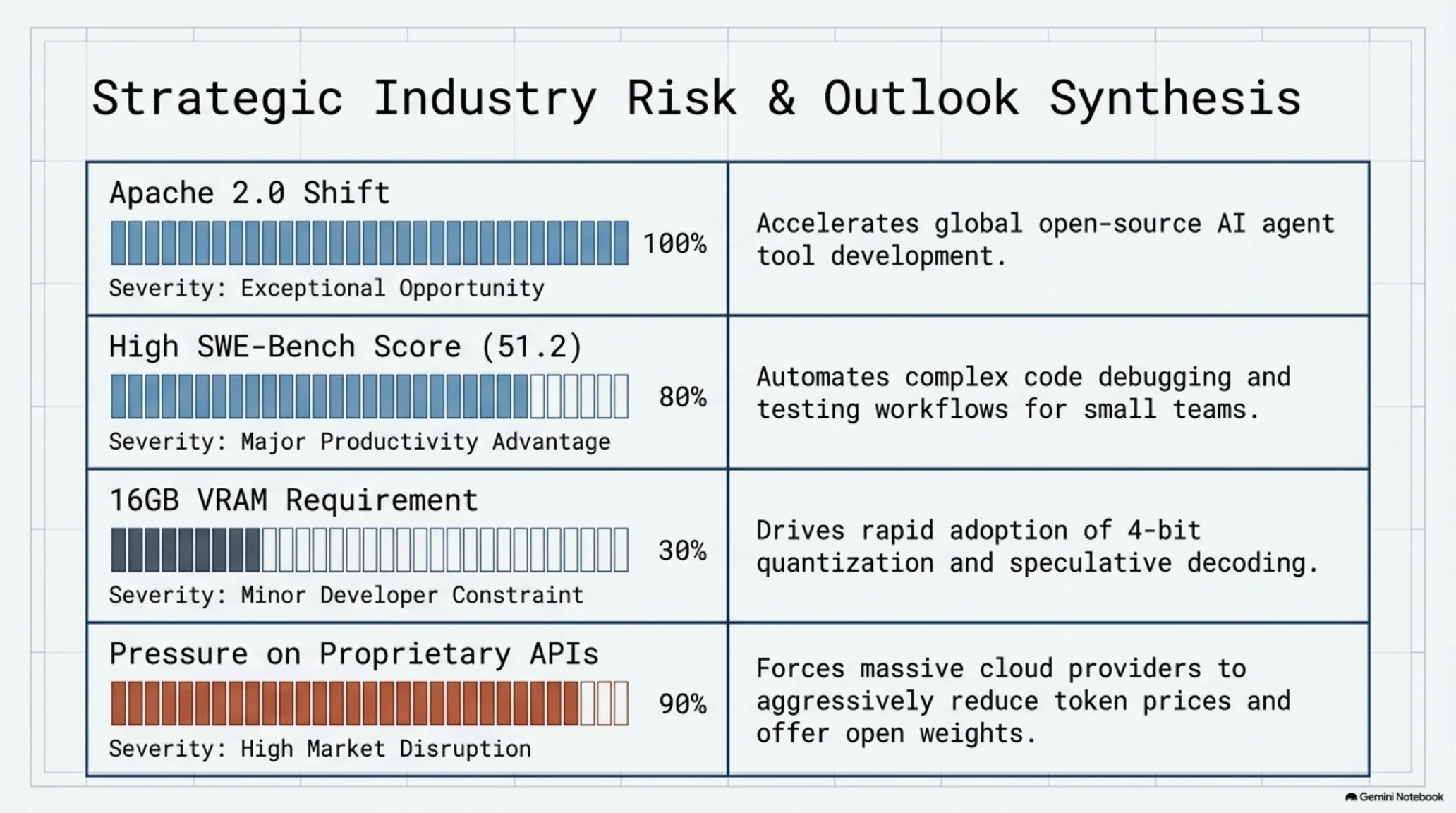
The strategic risk assessment matrix below outlines key market vectors for publishers and AI developers.
Strategic Industry Risk & Conclusion Matrix (Conclusion Box)
| Assessment Vector | Risk Severity | Tekin Advisory Outlook |
|---|---|---|
| Apache 2.0 Open-Source License Shift | Exceptional Market Opportunity | Accelerates Open-Source AI Agent Tool Development Globally |
| 16GB VRAM Hardware Requirement | Minor Developer Constraint | Drives Adoption of 4-Bit Quantization & Speculative Decoding |
| High SWE-Bench Pro Coding Score | Major Productivity Advantage | Automates Complex Code Debugging & Testing Workflows |
| Pressure on Proprietary API Providers | High Market Disruption | Forces Cloud Providers to Reduce Prices & Offer Open Weights |
The global AI community actively tests and fine-tunes Muse Glimmer weights on Hugging Face.
Tekin Game will deliver continuous coverage of all upcoming model benchmarks.

Join the conversation at Tekin Game and share your experience running Meta Muse Glimmer 30B locally in the comments section below.
- Un-restrictive Apache 2.0 open-source license enabling zero-royalty commercial usage
- Top-tier 51.2 SWE-Bench Pro score outperforming competing 30B class open models
- Multimodal vision parsing of screenshots, UI diagrams, and 131K long-context codebases
- Full local offline execution on 16GB VRAM GPUs using 4-bit GGUF quantization
- Requires mid-to-high end local GPU hardware (16GB VRAM+) for optimal token speeds
- Meta released weights only, retaining proprietary pre-training datasets and source code
- Initial setup of local inference runners requires technical familiarization for beginners
Related Tech Intelligence on Tekin Game
• 🌙 Tekin Night | Call of Duty, Nintendo & Vision Pro Digest
• 🎭 Tekin Analysis | Apple AI Teardown & July 2026 Digest
• 🌙 Tekin Night | NVIDIA $500B Deal & iPhone 18 Leak
Conclusion: Open Source Prevails in the AI Agent Era
Meta proves that genuine innovation thrives when powerful models are in the hands of independent creators.
Frequently Asked Questions About Meta Muse Glimmer 30B
What license is Meta Muse Glimmer 30B released under?
Muse Glimmer 30B is released under the permissive, royalty-free Apache 2.0 open-source license.
Can I run Meta Muse Glimmer 30B locally on consumer GPUs?
Yes, 4-bit quantized versions run locally on GPUs or Apple Silicon Macs with 16GB VRAM.
How does Muse Glimmer perform on coding benchmarks?
It scores 51.2 on SWE-Bench Pro, surpassing Google's Gemma 4 31B and Alibaba's Qwen 3.6 27B.
What is the context window length for Muse Glimmer 30B?
The model features a native long-context window supporting up to 131,072 tokens.
What are the primary use cases for Muse Glimmer 30B?
Autonomous AI software agents, multimodal document parsing, and real-time game NPC dialogue.
Which local inference frameworks support Muse Glimmer 30B?
It is supported out of the box by llama.cpp, LM Studio, Unsloth, and Ollama.
Additional Gallery: 🎭 Tekin Analysis | Meta's Open-Source Triumph: Deconstructing the 30B Muse Glimmer AI Agent Model