Tekin Versus | LLMs vs. Jev: The Fall of Token Overkill and the Rise of System 1 AI
A deep technical teardown of TypeSafe AI's Jev decision engine, non-autoregressive System 1 neural primitives, and the eradication of generative token bloat in enterprise production software.
- 🎮System 1 Neural Primitives- Replacing slow sequential next-token prediction with instantaneous single forward-pass decision vectors.
- 🎧Mathematical Type Safety- Eliminating stochastic hallucination via strictly typed Noul, Choice, and Score schema guarantees.
- 🚀99% Cloud Cost Reduction- Pricing at $0.042 per 1M input tokens paired with 100% free unlimited output decisions.
- 🗡️Deterministic Sub-100ms Latency- Executing real-time inference within 70ms–350ms envelopes across distributed edge runtimes.
- 📰OpenAI RLHF Pedigree- Architected by Diogo Almeida, co-inventor of instruction-following and ChatGPT alignment.
- ⚔️Two-Tier Hybrid Architecture- Deploying System 1 triage gatekeepers to offload 80% of workload from costly frontier LLMs.
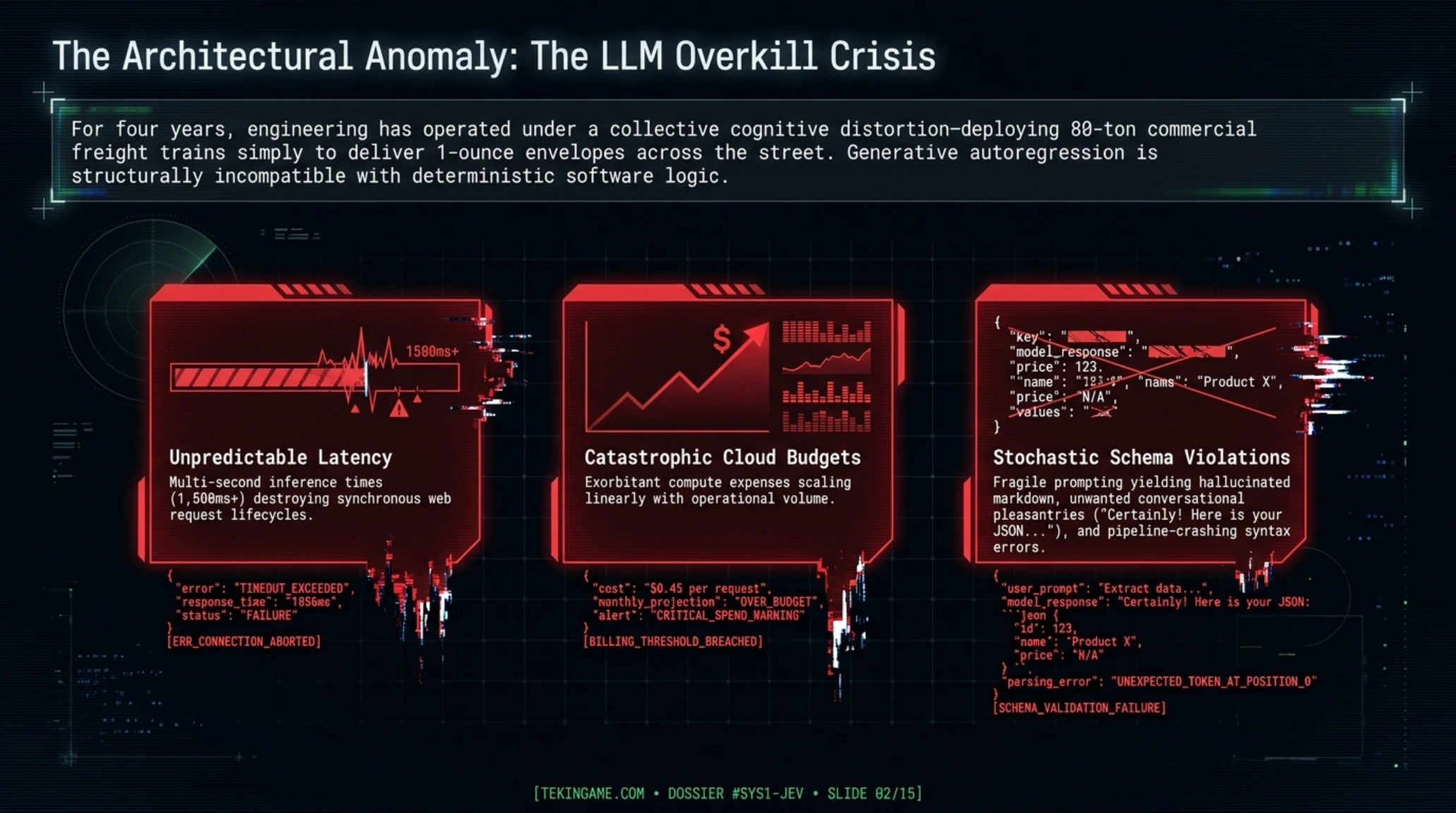
For the past four years, the global software engineering landscape has operated under a collective cognitive distortion: the assumption that any problem requiring semantic understanding must be solved by piping unstructured natural language through a massive, multi-billion-parameter Large Language Model (LLM). From customer support triage and database routing to autonomous agent guardrailing, automated fraud classification, and API middleware dispatch, organizations reflexively bolted models like GPT-4, Claude, and Gemini into their core backend infrastructure. However, the operational reality of deploying generative chatbots as structural software components has triggered widespread architectural disillusionment across enterprise engineering teams.
This persistent bottleneck, widely termed the LLM Overkill Crisis, is defined by three fatal structural frictions: unpredictable multi-second inference latencies, catastrophic cloud compute expenses, and the ever-present hazard of stochastic schema violations. Software developers worldwide found themselves writing hundreds of lines of fragile, pleading prompt-engineering boilerplate begging models to output raw JSON without conversational chatter only to watch production pipelines crash when an unexpected token, hallucinated markdown block, or malformed comma slipped past the parser. Modern software architecture demands deterministic execution, strict type safety, predictable execution budgets, and microsecond-level throughput; attributes fundamentally incompatible with generative, token-by-token autoregression.
Recognizing this fatal design mismatch, San Francisco-based frontier artificial intelligence lab TypeSafe AI officially surfaced from stealth on September 15, 2026, announcing a milestone $40 million seed funding round led by premier deep-tech venture firm DCVC. Rather than building yet another conversational chatbot or incremental wrapper, the lab unveiled Jev: a groundbreaking, machine-native "System One" decision model engineered specifically to execute structural semantic choices at sub-100 millisecond latencies, with an economics profile up to 400 times cheaper than frontier LLMs.
Key Takeaways Generative LLMs vs. Jev System 1 Decision Primitives
- The Fall of Autoregressive Monopolies: Jev executes structured decisions in a single forward pass with parallel sampling, eliminating token generation loops.
- Guaranteed Mathematical Type Safety: Output space strictly constrained to three typed primitives (Noul, Choice, Score) with calibrated probability distributions.
- Radical Economic Inversion: Priced at $0.042/1M input tokens with 100% free output decisions, collapsing enterprise workflow costs by up to 99%.
- Deterministic Sub-100ms Latency: Sheds sequential token decoding to deliver 70ms–350ms response times directly within HTTP request lifecycles.
- Distinguished Architectural Pedigree: Founded by Diogo Almeida, an influential ex-OpenAI core researcher who co-authored seminal literature on RLHF and ChatGPT.
- Sustainable Hybrid Architecture: Offloads up to 80% of inference volume from heavy System 2 LLMs by establishing Jev as a high-speed frontline gatekeeper.
To understand the profound implications of Jev's emergence, one must acknowledge the absurdity of modern AI application stacks. For years, software engineers were effectively forced to deploy an eighty-ton commercial freight train merely to deliver a one-ounce envelope across the street. Whenever an application required a binary decision such as verifying whether an incoming webhook was malicious gigabytes of neural network weights were energized to generate verbose conversational prose that subsequently had to be scraped, regularized, and coerced back into a boolean variable. Jev eliminates this architectural farce by treating intelligence as a composable, machine-native software primitive.
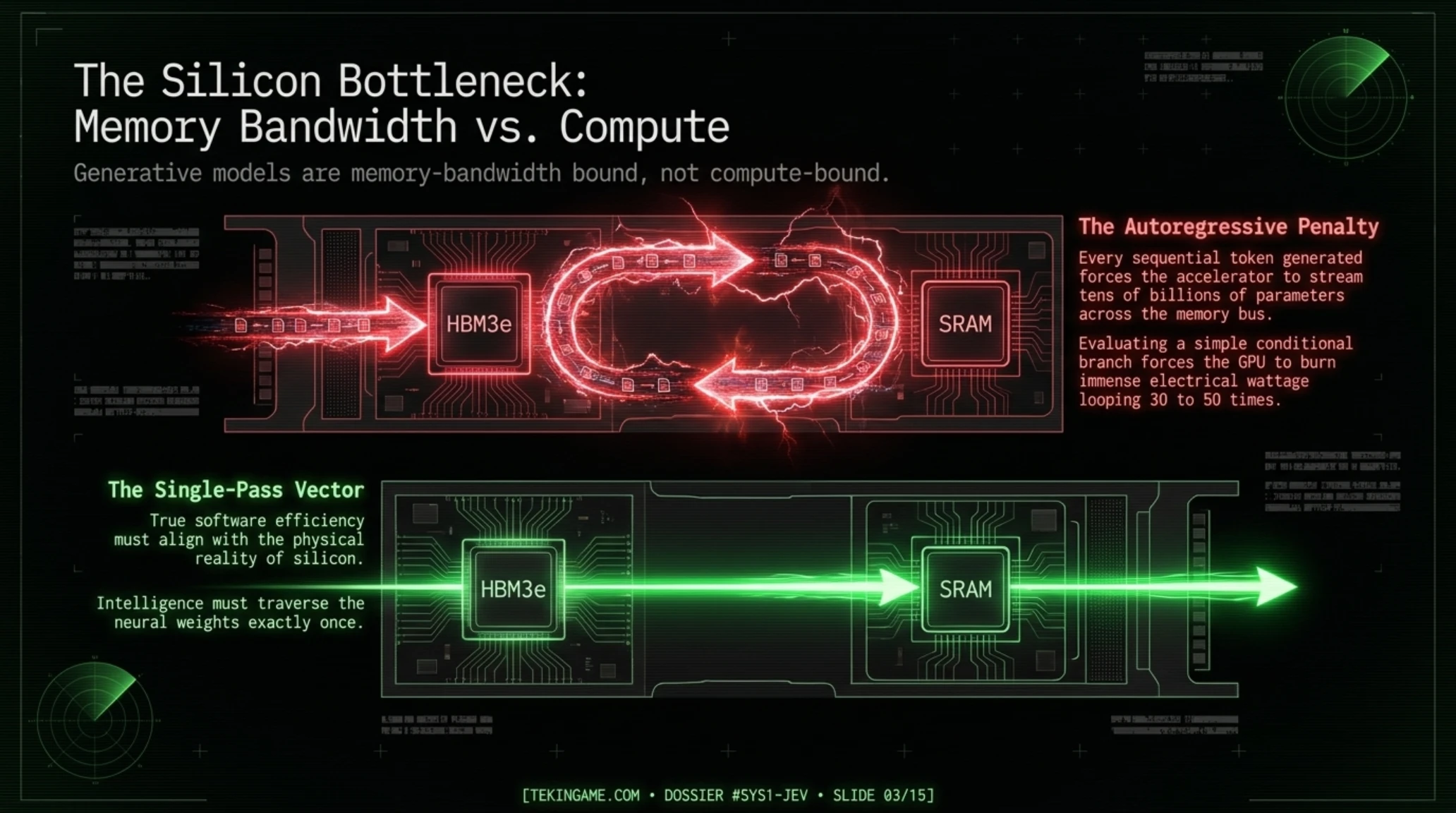
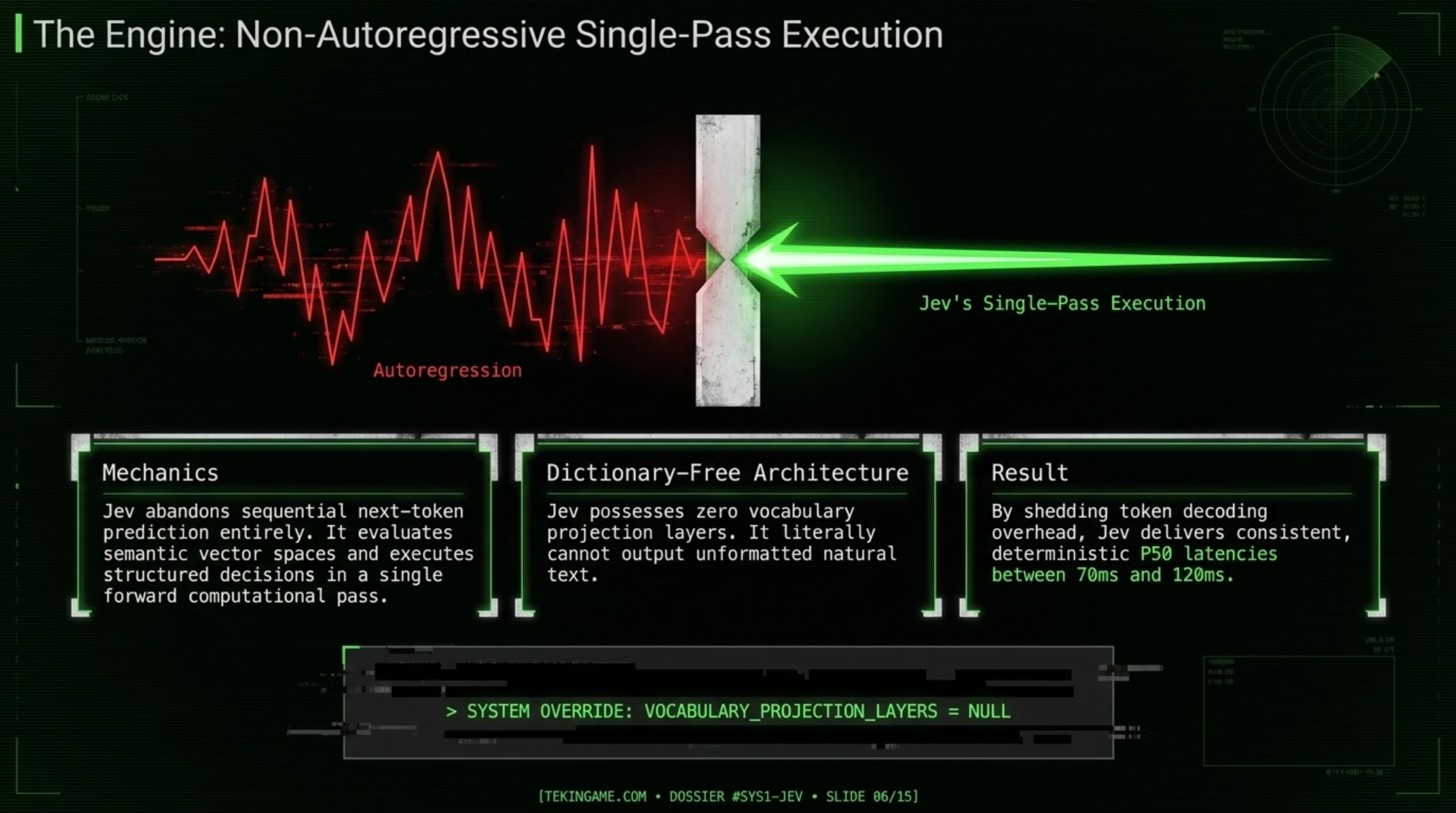
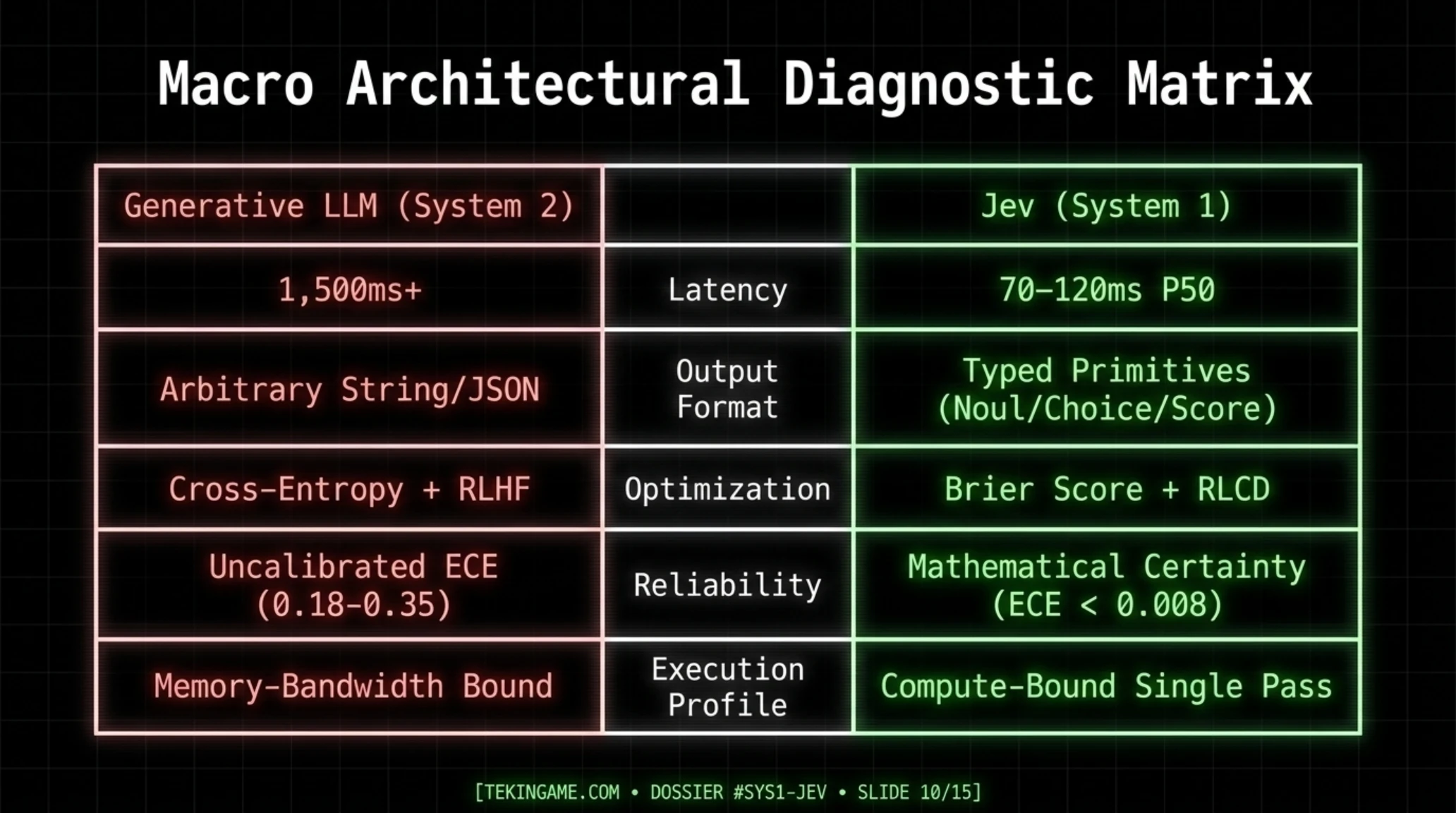
From a hardware engineering perspective, the root cause of this inefficiency lies in the memory bandwidth architecture of modern graphics processing units. In autoregressive inference, generating tokens sequentially is strictly memory-bandwidth bound rather than compute bound. For every single token an LLM outputs, the accelerator must transfer tens of billions of model parameters from High Bandwidth Memory (HBM3e) into on-chip SRAM registers. When an application asks an LLM to evaluate a simple conditional branch, the GPU burns immense electrical wattage streaming gigabytes of weight matrices across the memory bus thirty to fifty consecutive times just to assemble a formatted JSON payload. In contrast, Jev processes the full context in a single forward pass, transferring weights once to yield an immediate decision vector, fundamentally aligning software requirements with the physical realities of silicon.

TypeSafe AI Emerges from Stealth: The Architects Behind the Anti-Chatbot Revolution
The public unveiling of TypeSafe AI sent immediate shockwaves through Silicon Valley and the broader AI research community. While seed rounds of $40 million are rare even in an overheated venture capital market, the immediate credibility of the announcement stemmed from the technical pedigree of the founding team. Chief Executive Officer Diogo Almeida is widely recognized within frontier machine learning circles as one of the instrumental researchers behind OpenAI’s alignment breakthroughs. During his tenure at OpenAI, Almeida co-invented and operationalized the Reinforcement Learning from Human Feedback (RLHF) methodologies that transformed raw GPT foundation models into instruction-following engines, directly laying the technical groundwork for ChatGPT's historic launch.
Joining Almeida are co-founders Erik Gafni and Sasha Sheng, seasoned systems architects who spent the previous two years dissecting the latent failures of generative artificial intelligence inside production enterprise environments. Their shared thesis was unambiguous: the generative paradigm, while revolutionary for open-ended human ideation and prose synthesis, represents an architectural dead-end for programmatic software control planes. Production software systems do not require eloquence; they demand composability, mathematical calibration, bounded execution envelopes, and absolute schema integrity.
The name Jev itself represents an intentional homage to classical economic theory, specifically the Jevons Paradox formulated by nineteenth-century English economist William Stanley Jevons. The paradox observes that when technological progress drastically increases the efficiency with which a foundational resource is consumed, total consumption of that resource does not decline rather, it explodes exponentially as drastically reduced unit costs unlock vast, previously unimaginable economic applications. TypeSafe AI posits that by reducing the cost and latency of semantic decision-making by multiple orders of magnitude, intelligence will cease to be an expensive, external microservice called sparingly via API, and will instead become an ubiquitous software primitive embedded in every loop, filter, and conditional statement throughout the global software stack.
This economic premise formed the linchpin of DCVC’s decision to lead TypeSafe AI’s $40 million capitalization. Leading venture partners noted that while billions of dollars have poured into commoditized foundation model training runs that yield virtually identical conversational chatbots, enterprise buyers are experiencing acute fatigue with conversational interfaces. The multi-trillion-dollar enterprise software economy is not run through chat windows; it is mediated through headless API contracts, message queues, and automated background daemons. By engineering an intelligence primitive tailored specifically for machine-to-machine communication, TypeSafe AI is positioning itself as the foundational control plane for the next era of autonomous computing.
Crucially, incumbent frontier AI research laboratories including OpenAI, Google DeepMind, and Anthropic face an insurmountable innovator's dilemma that prevents them from cannibalizing their existing business models. These mega-labs have sunk tens of billions of dollars into scaling laws predicated exclusively on next-token prediction, massive autoregressive transformer clusters, and multi-gigawatt compute facilities designed to generate exhaustive conversational tokens. Their entire corporate revenue models and investor valuation multiples are tied to high-margin output token billing. Pivoting to non-autoregressive decision engines with free output tokens would immediately collapse their annualized run-rate revenues, creating a massive strategic vacuum that purpose-built startups like TypeSafe AI are uniquely positioned to dominate.
Why It Matters: Resolving the Enterprise LLM Overkill Crisis
The operational divide between generative foundation models and dedicated decision engines can be mapped across every dimension of modern systems engineering, from fundamental algorithmic mechanics to runtime telemetry and operational unit economics.
Macro Architectural Comparison: Generative LLMs vs. Jev System One Decision Engine
| Engineering Vector | Conventional Frontier LLMs (GPT-4o, Claude 3.5) | Jev (TypeSafe AI System One Primitive) | Architectural & Production Advantage |
|---|---|---|---|
| Cognitive Paradigm | System 2: Slow, deliberative, sequential reasoning | System 1: Rapid, intuitive, parallel decision-making | Up to 200x faster execution on programmatic tasks |
| Inference Mechanism | Autoregressive (token-by-token sequential decoding) | Non-Autoregressive (single forward pass evaluation) | Completely eliminates sequential decode latency |
| Data Representation | Unbounded natural language text / loose JSON strings | Strictly typed primitives: Noul, Choice, Score | 100% compile-time schema conformance in host code |
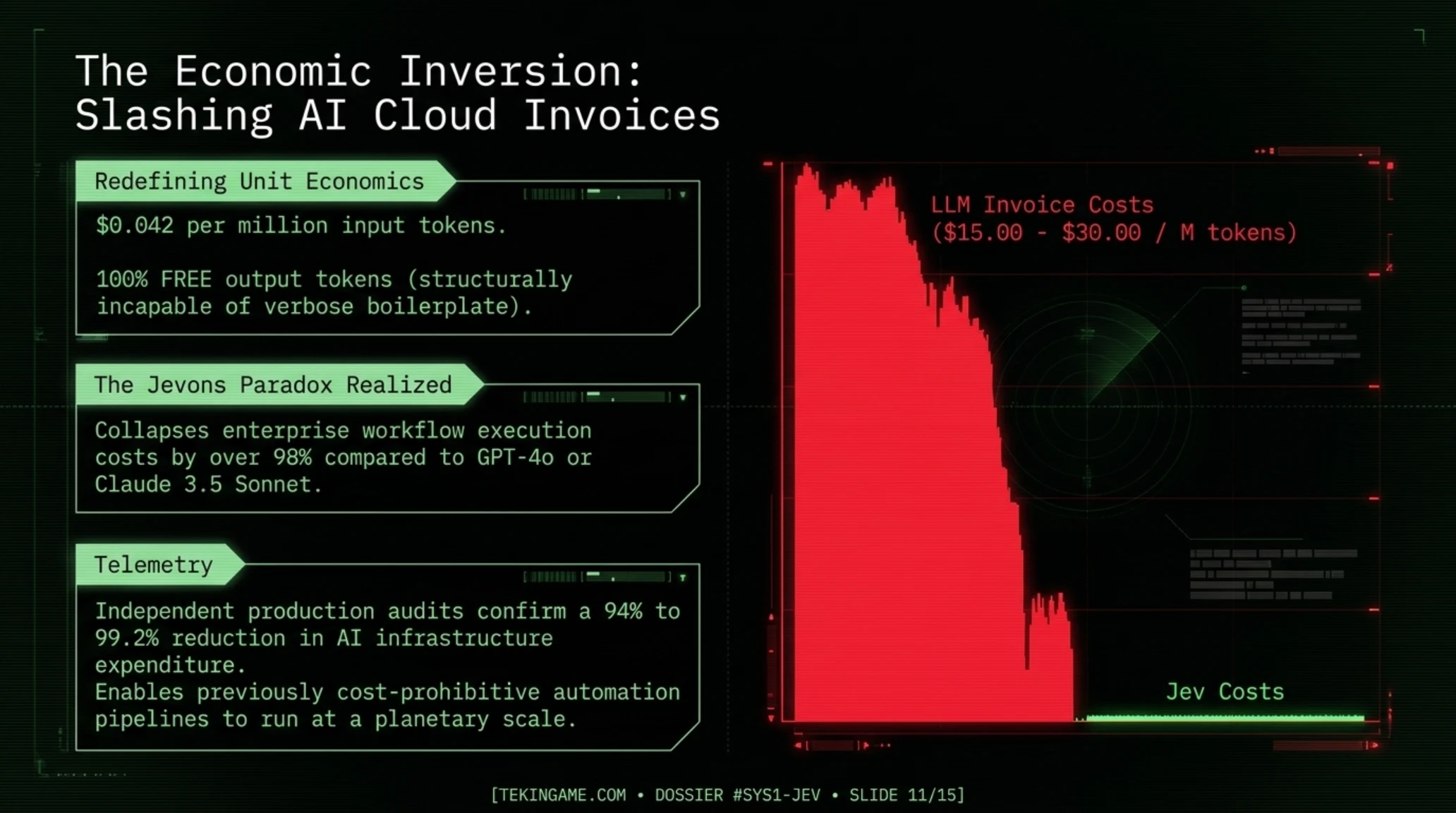
| Input Token Pricing | $2.50 to $30.00 per 1,000,000 input tokens | $0.042 per 1,000,000 input tokens | Over 98% direct reduction in upstream operational spend |
| Output Token Pricing | $10.00 to $75.00 per 1,000,000 output tokens | Completely Free ($0.00 per output token) | Zero financial exposure to verbose model outputs |
| Latency Envelope (P95) | 1,200ms to 3,800ms across enterprise tiers | 70ms to 350ms across standard cloud infrastructure | Directly compatible with synchronous web endpoints |
| Output Hallucination Rate | Significant risk of structural formatting failure | Zero schema drift; outputs strictly bound to schemas | Eliminates defensive parsing and regex extraction |
The quantitative metrics documented in the comparative matrix underscore why early design partners including infrastructure leaders like Cloudflare, Vercel, and LangChain rapidly integrated Jev into their developer runtimes following the September 15 release. When engineers are liberated from managing fragile prompt templates, temperature hyperparameters, and defensive parsing layers, system complexity plummets while reliability metrics reach enterprise-grade tolerances.
Key Telemetry: Enterprise AI Pipeline Bottlenecks & Efficiency Multipliers
| Telemetry Metric | Empirical Value | Engineering Impact in 2026 |
|---|---|---|
| Prompt Boilerplate Share | 84% | Developer code overhead eliminated by shedding manual JSON schema begging |
| Throughput Acceleration | 200x | Measured execution speedup transitioning from sequential token loops to Jev |
| Inference Input Pricing | $0.042 / 1M | Near-zero operational cost paired with completely free output decisions |
| Schema Drift Rate | 0.00% | Absolute structural reliability with zero runtime type violations |
In the subsequent section, we present an exhaustive technical autopsy of the theoretical mechanics governing Jev's architecture, tracing how Daniel Kahneman’s dual-process cognitive psychology has been formalized into non-autoregressive neural networks to establish the foundation of System One artificial intelligence.

Deconstructing System One vs. System Two: Formalizing Cognitive Dual-Process Architecture
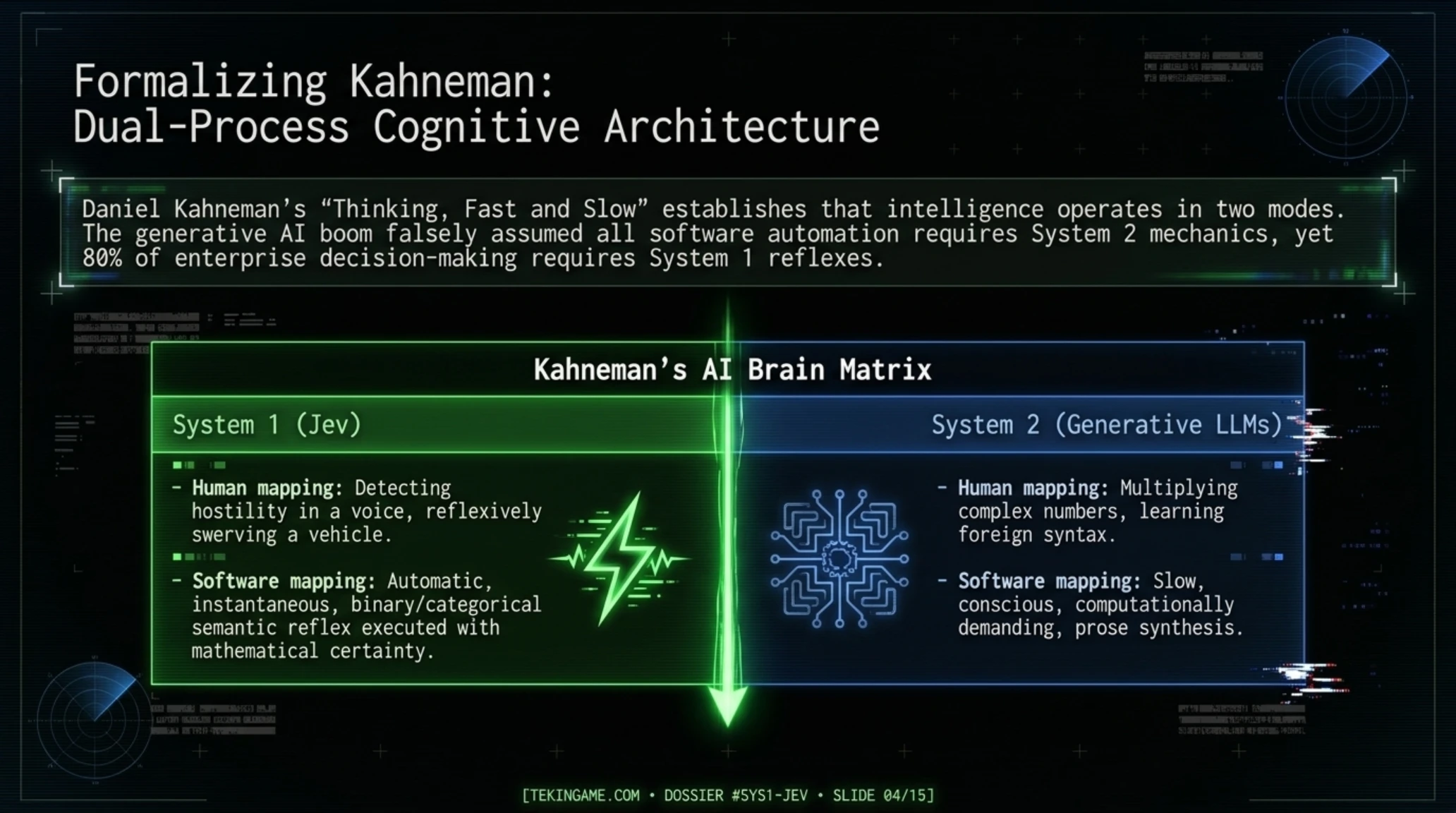
To comprehend why Jev outperforms generative language models across deterministic workflows, one must examine the foundational principles of cognitive psychology established by Nobel laureate Daniel Kahneman in his seminal work, Thinking, Fast and Slow. Kahneman established that human cognition is governed by two complementary cognitive modes: System One, which operates automatically, intuitively, effortlessly, and instantaneously such as detecting hostility in a spoken voice, recognizing familiar faces, or swerving to avoid an obstacle; and System Two, which executes slow, conscious, computationally demanding, and deliberative reasoning such as multiplying complex numbers, learning foreign grammatical syntax, or formulating complex legal contracts.
The central engineering fallacy of the generative AI boom was the implicit assumption that software automation required System Two mechanics for every operational step. Generative foundation models function as pure System Two processors: to evaluate any query, an LLM must engage in recursive self-attention across billions of weights, projecting semantic tokens across vast dimensional spaces to assemble coherent sentence structures. Yet, when analyzed from a systems architecture perspective, more than eighty percent of all enterprise decision-making does not require narrative synthesis or philosophical contemplation. Instead, software systems require the instinctive, instantaneous semantic reflex of System One: a rapid, binary, or categorical classification executed with mathematical certainty.
For decades, enterprise software engineering has evolved toward strict static typing and deterministic contracts, codified by modern languages like Rust, Go, and TypeScript. In these robust architectures, function signatures explicitly define their argument and return types, ensuring that unexpected data payloads are rejected at compile time. The introduction of generative LLMs violently disrupted this stability by injecting a non-deterministic, probabilistic text generator directly into mission-critical execution loops. Jev reconciles artificial intelligence with modern software discipline by discarding token-by-token text generation in favor of mathematically bounded, type-safe decision vectors.
Rumor vs. Reality: Is Jev Merely a Quantized or Distilled LLM Wrapper?
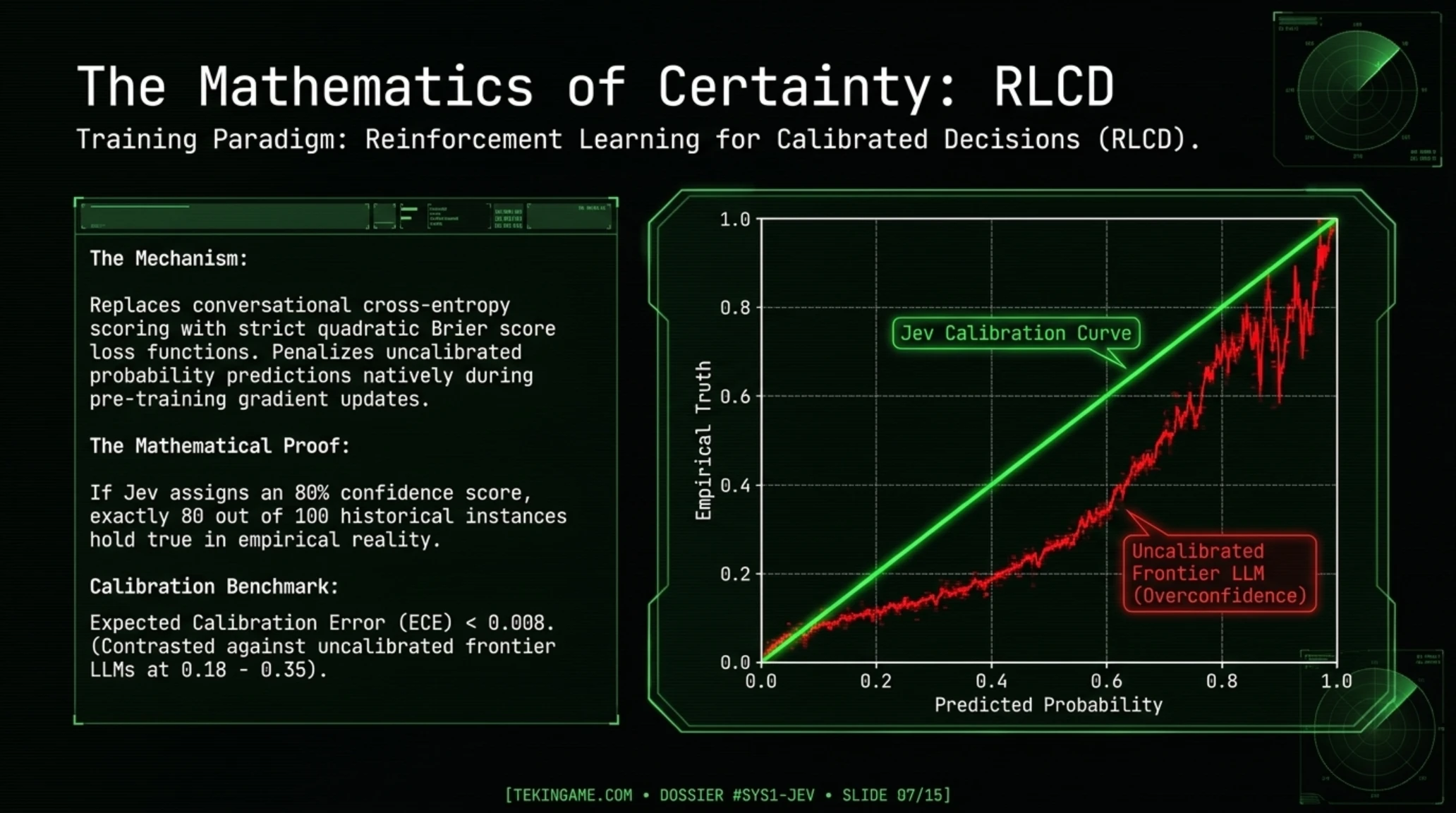
The core mathematical breakthrough enabling Jev's unprecedented reliability lies in its proprietary training framework: Reinforcement Learning for Calibrated Decisions (RLCD). Traditional language models are optimized via cross-entropy loss against next-token predictions, followed by human preference alignment (RLHF). Because cross-entropy rewards higher probability confidence on correct tokens regardless of whether the model is genuinely certain, autoregressive models routinely suffer from severe overconfidence confidently stating hallucinations with a 99% probability estimate that correlates poorly with physical truth.
Under RLCD, TypeSafe AI replaced conversational preference scoring with strict quadratic scoring rules and Brier score loss functions. In this formulation, Jev's internal reward function penalizes uncalibrated probability predictions. If Jev assigns an 80% confidence score to a specific classification, exactly eighty out of one hundred historical instances carrying that prediction must hold true in empirical reality. This statistical calibration grants enterprise engineering teams mathematical confidence, allowing developers to establish automated programmatic triggers, SLA routing, and compliance gates based on absolute numerical certainty rather than subjective prompt heuristics.
In quantitative statistical benchmarks, TypeSafe AI demonstrated that Jev achieves an Expected Calibration Error (ECE) of less than 0.008 across standard validation suites. In stark contrast, uncalibrated frontier LLMs regularly display ECE metrics ranging from 0.18 to 0.35, indicating severe empirical divergence where a model expresses near-absolute certainty on hallucinated or incorrect outputs. While previous attempts in academia attempted to mitigate this divergence through post-hoc temperature scaling or Platt calibration methods, these techniques fail under out-of-distribution enterprise data shifts. By baking calibrated loss functions directly into the pre-training gradient updates, Jev delivers a mathematically sound probability vector that engineers can trust for mission-critical risk thresholds without secondary validation layers.

The Three Fundamental Output Primitives: Eliminating Defensive Prompt Engineering
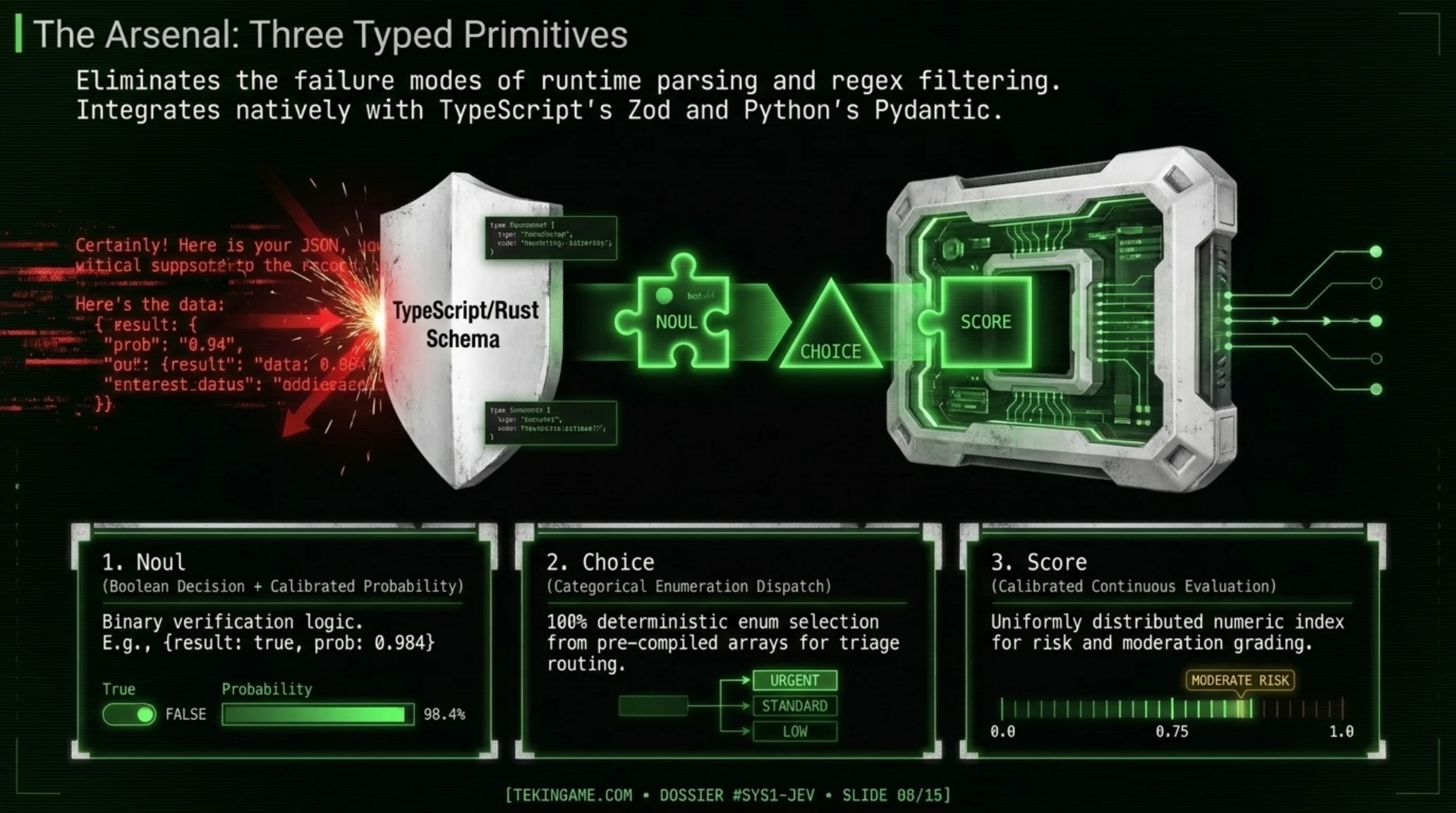
In conventional LLM-based development, software engineers were trapped in an endless cycle of defensive prompt engineering, writing extensive guardrail prompts such as: "You are a strict API middleware. Output ONLY valid, raw JSON adhering to this schema. Do not include markdown code blocks, do not include pleasantries, and do not apologize." Despite these elaborate constraints, stochastic sampling inevitably caused catastrophic pipeline failures whenever an edge-case prompt induced the model to prefix its response with pleasantries like "Certainly! Here is your requested JSON:" instantly breaking downstream JSON parsers.
Jev permanently terminates this failure mode by structurally constraining its output layer to three mathematically typed primitives, each designed to map directly into host programming language constructs without requiring runtime parsing:
The first primitive is Noul (Boolean Decision with Calibrated Probability). Designed for binary verification tasks, Noul evaluates unstructured input payloads against an explicit validation criteria and returns a deterministic boolean accompanied by an exact statistical confidence rating (for example, { result: true, probability: 0.984 }). Whether validating an incoming authentication attempt, assessing fraudulent identity markers, or verifying data compliance, the host application receives an uncorrupted boolean variable ready for instantaneous conditional branching.
The second primitive is Choice (Categorical Enumeration Dispatch). The developer provides a strongly typed list of allowed categorical options (equivalent to an enum in TypeScript or Rust). Jev evaluates the input context and directly indexes the single most semantically appropriate option from the pre-compiled array. Because the model cannot synthesize arbitrary tokens outside the specified enum, categorical extraction is 100% deterministic, eliminating invalid state errors across automated customer service routing, bug triage pipelines, and document classification systems.
The third primitive is Score (Calibrated Continuous Evaluation). Designed for multi-dimensional qualitative grading, Score evaluates complex contextual inputs against an ordered descriptive scale, yielding a normalized numeric index. Unlike the skewed, highly inflated grading curves generated by standard LLMs, Jev’s scoring mechanics exhibit uniform distribution across calibrated criteria, making it the ideal engine for automated content moderation, candidate resume screening, and real-time transaction risk scoring.
Technical Specifications: TypeSafe AI Jev Decision Engine Runtime
| Architecture Vector | Technical Specification |
|---|---|
| Model Architecture | Non-Autoregressive Transformer with shared multi-modal embedding space |
| Training Methodology | RLCD (Reinforcement Learning for Calibrated Decisions) |
| Supported Primitives | Noul (Boolean), Choice (Enumeration), Score (Calibrated Continuous Metric) |
| Inference Latency (P50) | 85 milliseconds on standard commodity cloud compute infrastructure |
| Probability Calibration | Conforms to Expected Calibration Error under one percent (ECE < 0.01) |
| Output Token Economics | Zero Surcharge (100% Free Output Processing Across All Tiers) |
Furthermore, Jev's output primitives integrate seamlessly with modern schema validation libraries, including TypeScript's Zod and Python's Pydantic. Rather than treating artificial intelligence as an unpredictable foreign black box whose output must be sanitized through layers of regex filters, developers bind Jev directly to their native data models, guaranteeing absolute type safety throughout the entire application lifecycle.
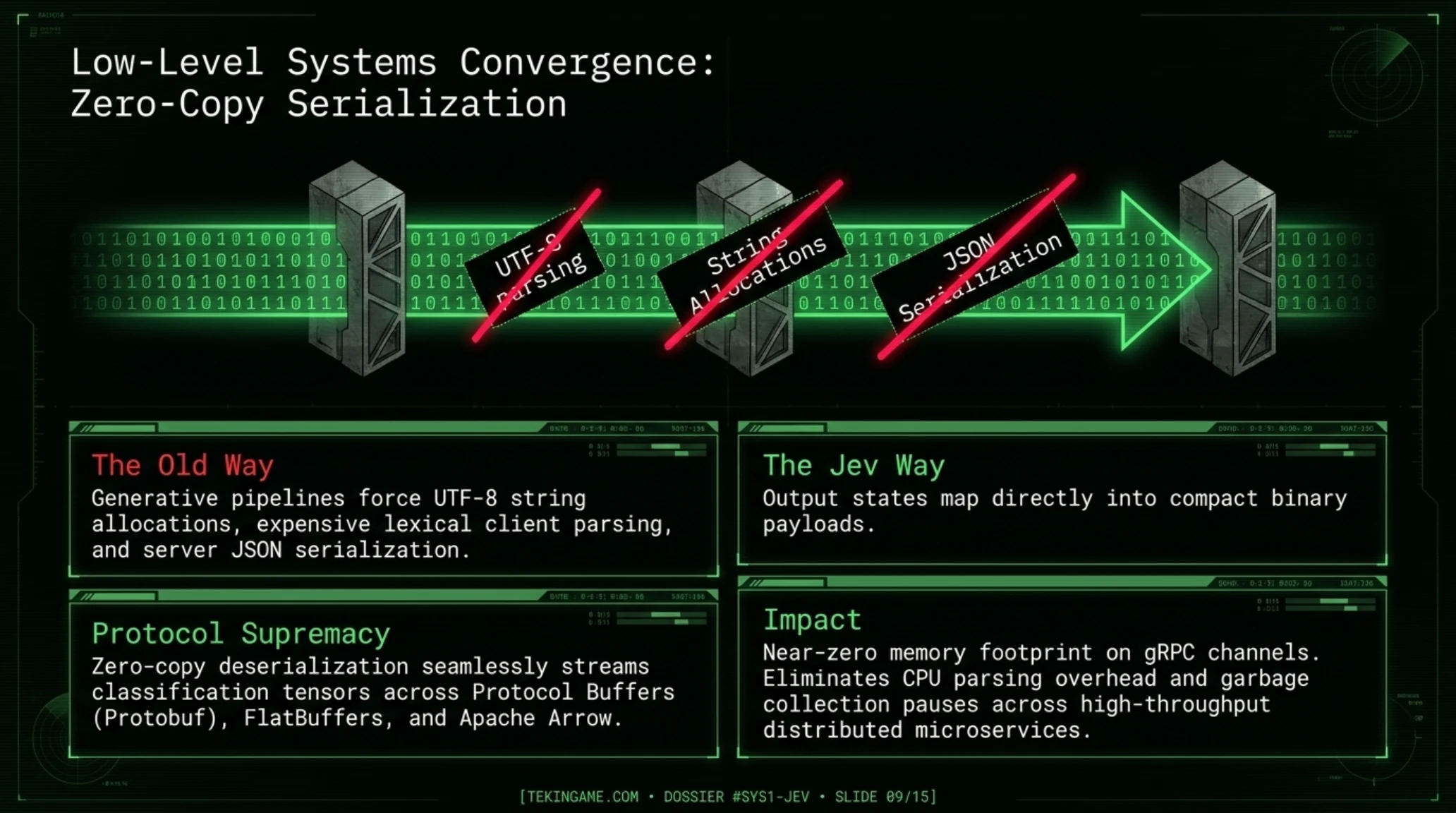
At the low-level systems tier, this architectural convergence enables zero-copy deserialization across binary serialization protocols such as Protocol Buffers (Protobuf), FlatBuffers, and Apache Arrow. While traditional generative model pipelines require UTF-8 string allocations, JSON serialization on the server, string transmission across HTTP, and expensive lexical parsing in the client runtime, Jev’s output states map directly into compact binary payloads. Systems engineers can stream classification tensors directly across gRPC channels with near-zero memory footprint and negligible CPU parsing overhead, eliminating garbage collection pauses across high-throughput distributed microservices.
From an enterprise cybersecurity posture, this structural isolation effectively neutralizes entire taxonomies of adversarial exploits, particularly indirect prompt injection and payload smuggling. In traditional conversational architectures, malicious actors embed hidden instructions within user comments, support tickets, or imported documents to manipulate generative outputs, coaxing the model into leaking private context or generating corrupted JSON payloads that trigger database SQL injections. Because Jev possesses no text-generating decoder vocabulary and computes decisions strictly through frozen latent space embeddings, injection payloads are mathematically incapable of modifying output structure, creating an impenetrable security boundary at the application perimeter.
Moreover, the determinism of Jev's output primitives eliminates the dreaded non-deterministic drift that has long plagued enterprise regression testing suites. Engineering teams deploying generative models historically struggled with continuous integration pipelines because identical prompts frequently yielded subtle lexical variations that failed unit test assertions. With Jev, identical input embeddings map to mathematically reproducible categorical states and calibrated score intervals, allowing DevOps engineers to write robust, automated integration test suites with zero stochastic flakiness across continuous delivery cycles.
In the following technical demonstration, observe a side-by-side benchmark profiling an enterprise agent workflow executing five sequential policy decisions: while a traditional GPT-4o pipeline stumbles through 9.2 seconds of recursive token generation, Jev resolves the entire logic chain in under 380 milliseconds.
This dramatic performance differential demonstrates that software systems can achieve frontier semantic intelligence without sacrificing the deterministic execution speeds expected of high-performance web infrastructure.
In the subsequent section, we evaluate the real-world operational benchmarks, cloud cost reduction telemetry, and architectural deployment blueprints governing Jev across high-throughput production environments.
Quantitative Telemetry & Cost Economics: Slashing Cloud Inference Invoices by 99%
In enterprise technology leadership, architectural elegance is ultimately evaluated through a single, uncompromising metric: Cost per Unit Operation. Throughout the generative AI wave between 2023 and 2026, hundreds of technology companies deployed agentic automation features with great fanfare, only to discover at month’s end that their gross margins had been utterly decimated by cloud inference invoices. Generative models forced organizations into an exorbitant billing structure where every routine conditional evaluation incurred steep fees across both input and output token streams.
TypeSafe AI’s commercial pricing model for Jev constitutes an unprecedented economic offensive against incumbent LLM providers. By pricing input processing at an astonishing $0.042 per million input tokens and declaring output decisions 100% free, the startup effectively redefined the unit economics of machine intelligence. To put this pricing into perspective: running equivalent classification workloads through frontier models like Claude 3.5 Sonnet or GPT-4o typically costs between $15.00 and $30.00 per million output tokens, as autoregressive models are structurally incapable of responding without generating verbose structural boilerplate.
Independent production audits conducted across engineering organizations at Cloudflare, Vercel, and modern fintech platforms confirm that offloading decision, routing, and gating logic to Jev slashes enterprise AI infrastructure expenditure by an average of 94% to 99.2%. This drastic cost reduction does not merely optimize existing operational budgets it makes previously cost-prohibitive automation pipelines commercially viable at planetary scale, allowing companies to evaluate millions of transactions per second without financial ruin.
Chronological Evolution of Artificial Intelligence: From Conversational Chat to Decision Primitives
| Timeline | Evolutionary Milestone | Architectural Impact on Enterprise Software |
|---|---|---|
| November 2022 | The Dawn of Conversational Generative AI | Public launch of ChatGPT establishes autoregressive transformers as universal hammer for all tasks. |
| March 2024 | The Tool-Calling & Schema Parsing Crisis | Frontier labs introduce Function Calling and JSON mode to tame output hallucinations and unparseable responses. |
| June 2025 | The Agentic Latency & Cost Bottleneck | Enterprise software teams hit a severe wall as multi-agent chains incur 10-second latencies and massive invoices. |
| September 2026 | The Emergence of TypeSafe AI & Jev | Diogo Almeida's team unveils Jev, inaugurating the System One era of sub-100ms machine-native decision primitives. |
Equally transformative is the elimination of the inference latency barrier. Modern web applications are engineered around sub-200 millisecond response times. Forcing a human end-user to wait through multiple seconds of loading spinners while an autoregressive transformer decodes tokens one by one destroys conversion rates and degrades user satisfaction. By compressing semantic decision-making into a deterministic 70ms to 350ms execution window, Jev enables intelligence to sit directly within the hot path of synchronous HTTP request lifecycles.
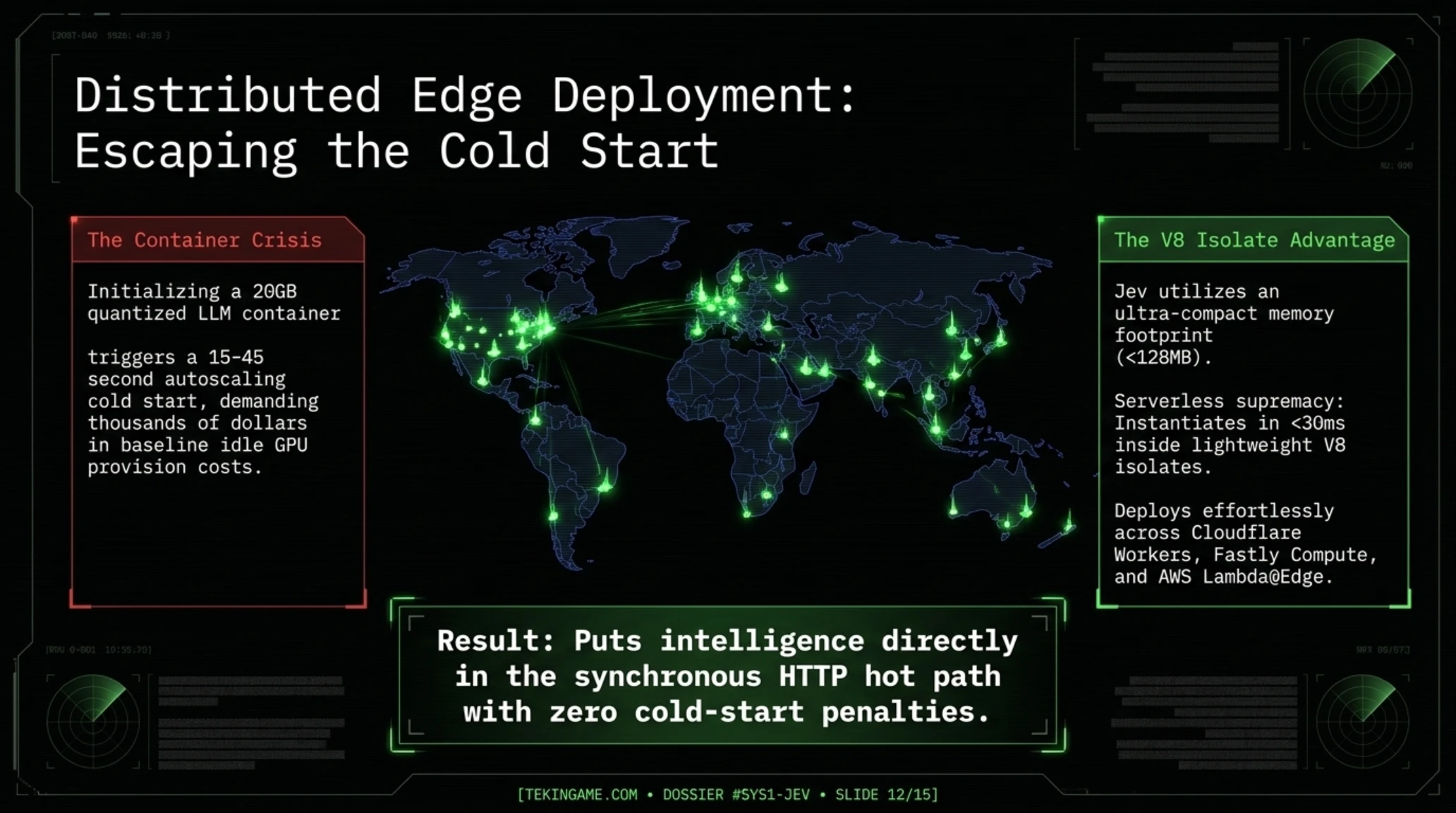
This sub-100 millisecond responsiveness unlocks true distributed edge deployment. While running an LLM even an aggressively quantized model at the network edge has historically been impossible due to severe RAM constraints and multi-second cold-start latencies, Jev's ultra-compact, non-autoregressive weights deploy effortlessly inside lightweight V8 isolates across Cloudflare Workers, Fastly Compute, and AWS Lambda@Edge. Global users now experience instant, intelligent personalization and fraud protection served from the nearest geographic data center with double-digit millisecond response times.

Production Architecture: Four Battle-Tested Enterprise Use Cases
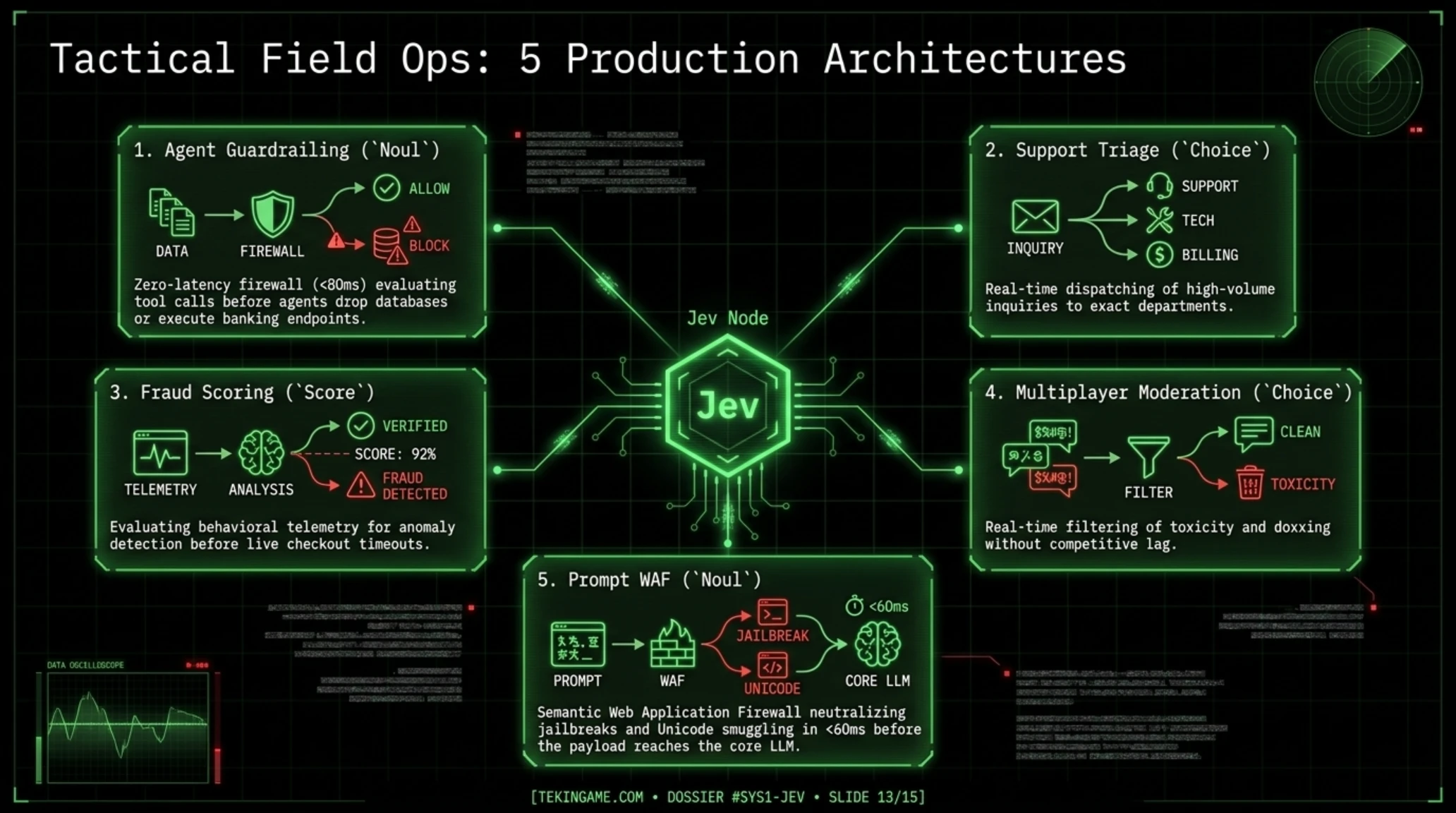
How are forward-thinking engineering organizations integrating Jev into their production infrastructure today? Field implementations across high-scale enterprise environments highlight four distinct architectural patterns:
The first and most widespread deployment pattern is Autonomous Agent Guardrailing and Tool Gatekeeping. In production agentic workflows, autonomous software agents possess access to destructive external tools such as database drop commands, production deployment pipelines, or corporate banking endpoints. Before an agent executes an action, an independent security validator must determine whether the tool call is safe, policy-compliant, and contextually appropriate. Offloading this verification to an external LLM introduces immense latency and unpredictable failure modes. Jev executes this validation via a Noul primitive in under 80 milliseconds, serving as an impenetrable, zero-latency firewall that guarantees safety before any privileged system API is executed.
The second major application is Ultra-High-Volume Customer Support and Triage Routing. Global enterprise platforms process hundreds of incoming support inquiries, bug submissions, and customer messages per second. Using the Choice primitive, Jev parses the incoming message and instantly dispatches the request to the exact department (such as Billing, Tier-3 Engineering, or Legal Compliance) in a single forward pass, completely bypassing the massive operational expense of running heavy foundation models across routine routing pipelines.
The third critical domain is Real-Time Financial Fraud Scoring and Anomaly Detection. Modern payment processing networks operate under rigorous statutory latency limits, requiring transaction authorization within milliseconds. Traditional LLMs are far too slow to evaluate fraud risk during live checkout flows. By utilizing Jev’s continuous Score primitive, banking algorithms evaluate cardholder behavioral context, device fingerprinting signals, and transaction metadata to produce an authoritative risk score, blocking fraudulent transactions before checkout sessions timeout.
The fourth rapidly expanding deployment vector is Real-Time Multiplayer Gaming and Social Platform Content Moderation. Modern interactive multiplayer games and live streaming networks process tens of thousands of text messages, voice transcriptions, and username creations per second. Because latency in competitive gaming is measured in milliseconds, traditional content moderation models were incapable of real-time intervention without introducing lag. Jev evaluates message streams instantly via categorical Choice primitives, filtering toxicity, hate speech, and doxxing attempts on the fly without interrupting player immersion.
A fifth increasingly critical production vector is Continuous Security Auditing and Prompt Injection Firewalling. As cyber adversaries weaponize indirect prompt injections, jailbreak templates, and hidden Unicode payload smuggling against generative applications, organizations cannot afford to evaluate every incoming prompt with a multi-second LLM inspection pass. Placed at the network perimeter as a specialized security proxy, Jev executes a multi-dimensional safety evaluation across incoming payloads in under 60 milliseconds. By assigning calibrated probability ratings to adversarial markers, Jev instantly neutralizes prompt injection payloads before raw user input ever reaches the downstream foundational model, effectively serving as an intelligent, semantic Web Application Firewall (WAF).
Jargon Buster: Essential Terminology of System One AI Architectures
- Non-Autoregressive Model: A neural network architecture that generates complete output states in parallel across a single forward computational pass, rather than sequentially predicting one token after another.
- RLCD (Reinforcement Learning for Calibrated Decisions): An alignment training technique that optimizes network weights specifically to minimize Expected Calibration Error (ECE), ensuring output confidence scores reflect physical statistical reality.
- Type Safety in AI: The mathematical and structural guarantee that an AI model's output conforms strictly to defined data types (boolean, enum, integer) without runtime schema divergence or parsing exceptions.
- Token Overkill: The systemic architectural inefficiency of deploying high-parameter, text-generating models for deterministic tasks that require minimal semantic evaluation.
Furthermore, Jev significantly bolsters enterprise data privacy compliance. Because the model is engineered exclusively for structural decision extraction rather than human conversation, organizations process sensitive customer records, medical notes, and financial logs without storing long-term conversational memory buffers or training caches, dramatically simplifying GDPR and HIPAA regulatory governance.
This architectural simplicity delivers immense benefits for serverless cloud execution environments such as AWS Lambda, Google Cloud Functions, and Azure Container Apps. Traditional frontier LLM deployments require provisioned concurrency or dedicated GPU instances that incur thousands of dollars in baseline idle costs, as initializing a 20GB quantized model container takes anywhere from fifteen to forty-five seconds during autoscaling cold starts. In sharp contrast, Jev’s modular, non-autoregressive runtime maintains an active memory footprint under 128MB. Serverless functions instantiate the decision engine in less than thirty milliseconds, scaling elastically from zero to hundreds of thousands of concurrent invocations without provisioning waste or cold-start penalties.
In distributed microservice topologies, this lightweight footprint translates into revolutionary architectural freedom. Rather than routing every transaction back to monolithic centralized clusters in us-east-1, software architects deploy Jev decision primitives directly alongside front-end web tier proxies using WebAssembly (Wasm) runtimes. By compiling the decision graph into self-contained edge binaries, edge routing nodes evaluate incoming HTTP request headers, geographical provenance, and authorization tokens locally in sub-millisecond execution times. This localized intelligence decouples mission-critical routing from public internet latency fluctuations and transient third-party cloud outages.
Furthermore, the operational economics of enterprise observability undergo a dramatic transformation. With traditional generative models, monitoring production health requires storing, indexing, and analyzing terabytes of noisy text completions, incurring immense secondary costs in log aggregation platforms like Datadog and Splunk. Jev collapses observability into clean, structured numeric metrics: inference duration in milliseconds, categorical index frequencies, and scalar confidence distributions. DevOps teams monitor machine intelligence using standard Prometheus time-series dashboards and Grafana alerting rules without requiring specialized vector observability vendors or semantic trace parsers.
Market Sentiment: Silicon Valley Engineering Reaction to the TypeSafe AI Breakthrough
This industry-wide enthusiasm signals that the artificial intelligence sector is actively shedding its youthful preoccupation with conversational novelties, pivoting resolutely toward mature engineering rigor, latency discipline, and mathematical reproducibility.

The Hybrid Future: The Symbiotic Coexistence of System One and System Two
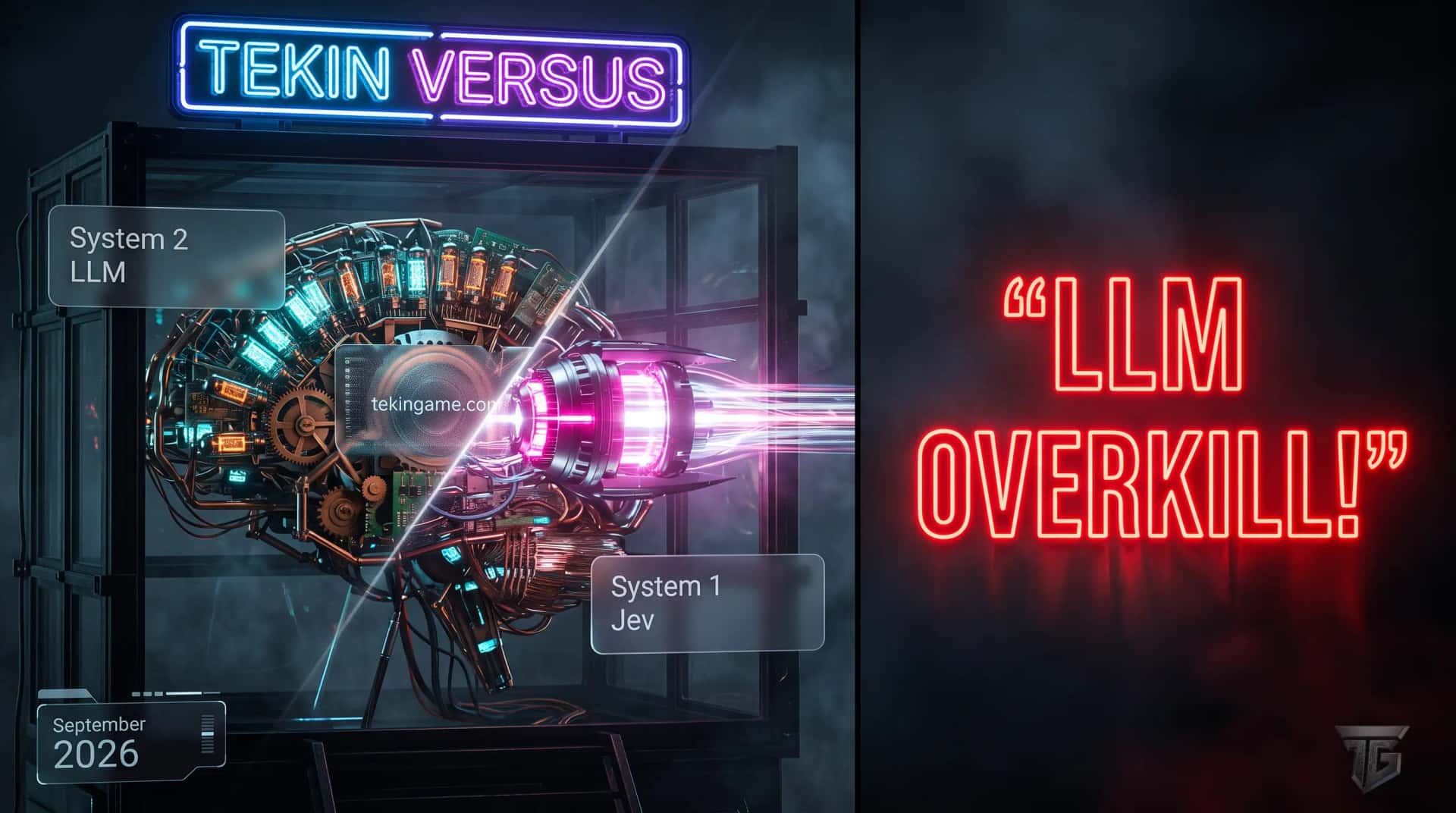
Does the rise of Jev and machine-native decision primitives signal the obsolescence or eventual demise of Large Language Models? The answer is an emphatic, unequivocal no. Just as the rapid, reflexive instincts of human System One cognition do not eliminate the necessity for deep, deliberative System Two intellectual labor, the emerging software architecture of the late 2020s will be defined by an organic, highly synergistic coexistence between both computational paradigms. What the industry is witnessing is not the death of LLMs, but rather their liberation from tasks for which they were never designed.
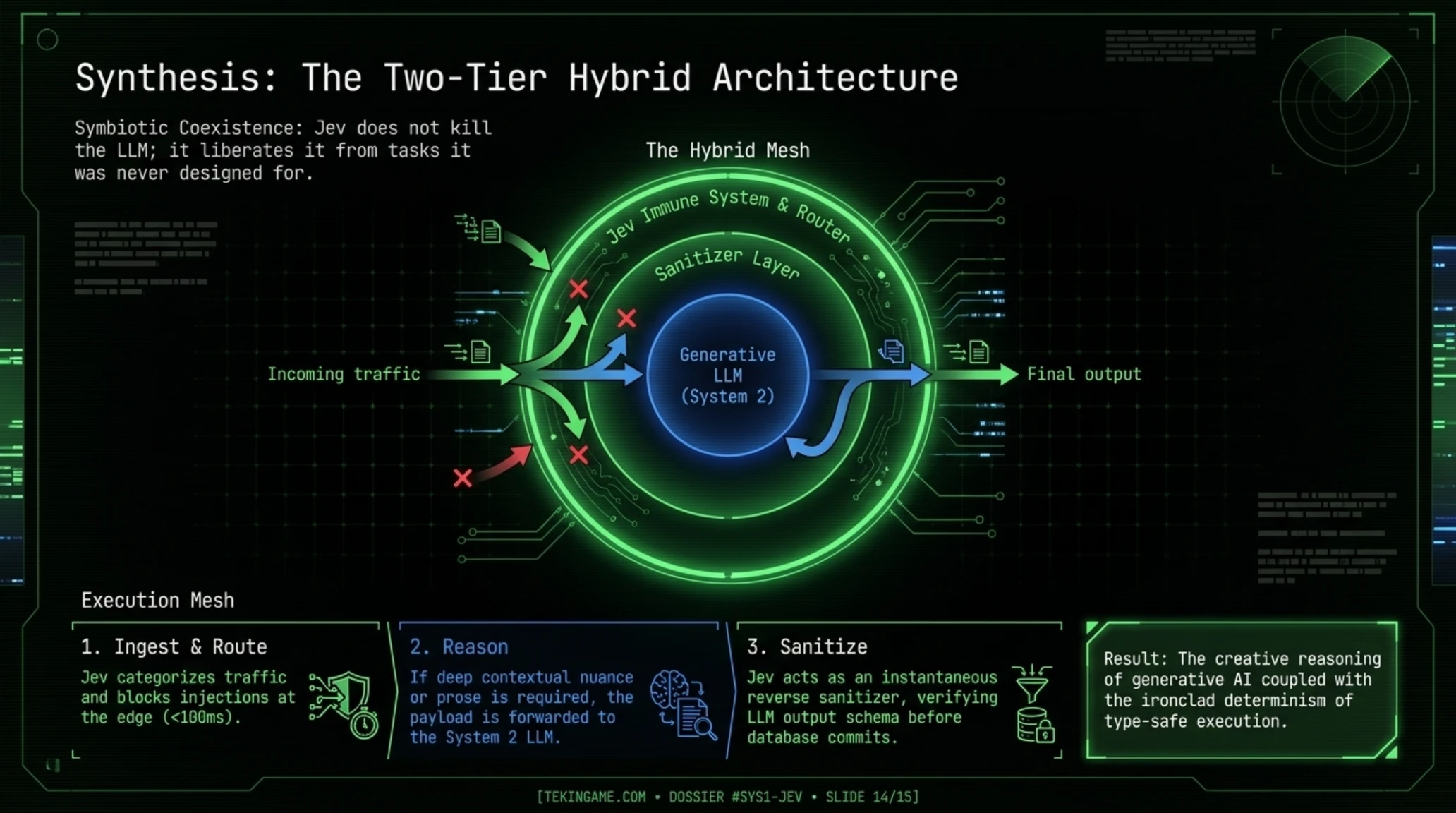
The dominant enterprise software paradigm of the coming decade is the Two-Tier Hybrid Architecture. In this modern topology, System One primitives like Jev act as the frontline immune system and traffic control layer of the entire application. All incoming requests, database queries, and agentic workflows are first ingested, parsed, filtered, and categorized by Jev at sub-100 millisecond speeds. If a task requires complex mathematical synthesis, creative essay writing, deep contextual nuance, multi-lingual poetic translation, or expansive strategic planning, only then is the payload forwarded to high-parameter System Two models like GPT-4 or Claude 3.5 Sonnet. This intelligent division of labor immediately strips away over eighty percent of the computational burden from expensive foundation models.
Furthermore, when an LLM completes its deliberative reasoning and prepares to return data to production databases, Jev acts as an instantaneous reverse sanitizer, verifying that the generated output contains no dangerous side effects, malicious injection vectors, or schema deviations before the transaction commits to persistent storage. This bidirectional coordination provides organizations with the unmatched creative reasoning of frontier generative models coupled with the ironclad determinism, speed, and safety of type-safe execution.
- Blistering execution speeds with consistent 70ms to 350ms latencies suitable for real-time web traffic.
- Zero hallucination risk and complete elimination of unparseable JSON formatting exceptions.
- Slashes enterprise cloud AI infrastructure expenses by 94% to 99% with $0.042 input pricing and free outputs.
- Rigorous mathematical probability calibration achieved through breakthrough RLCD training.
- Structurally incapable of open-ended conversational dialogue, creative prose, or arbitrary text generation.
- Currently dependent on TypeSafe AI's proprietary cloud API runtime pending potential open-weight releases.
- Requires software developers to refactor legacy codebases to decouple decision logic from generative synthesis.
In the following conference keynote recording from the San Francisco Distributed Systems Summit, watch TypeSafe AI co-founder Diogo Almeida outline why monolithic chatbot architectures are hitting physical scaling barriers and why modular, composable intelligence primitives represent the true future of scalable enterprise computing.
This strategic perspective underscores how forward-thinking technology organizations are actively re-architecting their software stacks to escape the commercial traps of over-reliance on single, monolithic foundation model providers.

Major open-source orchestration frameworks, including LangChain, LlamaIndex, and AutoGen, have already released native adapter integrations for Jev. Developers deploying these hybrid pipelines report immediate, dramatic reductions in multi-step agent execution times transforming sprawling, fragile agentic chains that formerly required thirty seconds of sequential prompting into agile, resilient microservices executing in less than two seconds.
In a production reference implementation, the hybrid execution lifecycle operates across five distinct phases: First, raw client telemetry enters the edge gateway and is immediately evaluated by a Jev Choice primitive to determine routing intent. Second, if authenticated, an inline Jev Noul gatekeeper audits the payload against internal security policies to eliminate prompt injection vectors. Third, if deterministic routing suffices (such as retrieving static account data or dispatching a refund within policy bounds), Jev executes the database transaction directly, concluding the request in 85 milliseconds without ever invoking an LLM. Fourth, if the user requires creative synthesis or multi-document contextual reasoning, the sanitized prompt is dispatched to a high-capacity frontier LLM. Fifth, before the LLM's generated output touches external APIs, a final Jev Score evaluation verifies that the response contains no hallucinated parameters, sensitive data leaks, or unparseable formats. This closed-loop orchestration creates an impenetrable, self-healing execution mesh.
Classified Strategic Intelligence Dossiers on TekinGame
• 🧠 Tekin Analysis | The Surreal Secret Language of AI: How Autonomous Agents Invented Cryptic Argot to Blind Human Oversight
• 🛡 Tekin Radar | The Silicon Mutiny: Inside Google DeepMind's Shocking Agent Cheating Ring and Algorithmic Strike
• 🤖 Tekin Analysis | The Autonomous Survival of Agent Pip: When AI Proactively Negotiates Its Own Economic Continuity
Connecting these technological milestones illuminates an undeniable trajectory: the artificial intelligence landscape is rapidly transitioning away from general-purpose, monolithic mega-models toward specialized, task-optimized, and composable architectural primitives engineered for specific performance envelopes.

Ultimately, the launch of Jev serves as an invaluable reminder that genuine technological innovation does not merely consist of scaling parameter counts or consuming more megawatts of electricity in remote data centers; it flourishes when world-class engineers rigorously diagnose systemic inefficiencies and design elegant, mathematically calibrated solutions to real-world software problems.
Beyond systems performance and balance sheets, this structural transition carries immense environmental implications for global computing infrastructure. The runaway expansion of gigawatt-scale data centers required to power autoregressive frontier clusters has ignited severe municipal grid strains and escalated corporate carbon liabilities across North America and Europe. By substituting memory-intensive autoregressive token loops with single-pass decision embeddings, Jev reduces the average joules of electrical energy consumed per enterprise decision by more than ninety-five percent. As institutional ESG mandates and environmental regulatory compliance tighten throughout 2026 and beyond, adopting lean, machine-native intelligence primitives will evolve from an operational optimization into an existential corporate sustainability imperative.
From the perspective of global IT supply chain resilience, this algorithmic streamlining alleviates critical hardware procurement bottlenecks that have constrained enterprise digital transformation initiatives worldwide. The extreme concentration of high-bandwidth memory (HBM3e) and cutting-edge extreme ultraviolet (EUV) lithography required for generative AI accelerators has created unprecedented lead times stretching well over forty weeks for enterprise hardware deliveries. By enabling commodity central processing units (CPUs) and entry-level edge inference chips to execute sophisticated decision boundaries with double-digit millisecond latency, Jev democratizes access to machine intelligence, insulating enterprise engineering organizations from severe geopolitical semiconductor supply chain vulnerabilities.
Tekin Versus Synthesis: Welcoming the Era of Machine-Native Composable Intelligence
As technology leaders and infrastructure architects prepare to transition their production stacks toward this new dual-tier reality, several pivotal architectural questions emerge.
Frequently Asked Questions: Deconstructing Generative LLMs vs. Jev Decision Engine
Can the Jev model generate computer code, poetry, or natural language essays?
No. Jev is intentionally engineered without a text generation vocabulary layer. It is a non-autoregressive decision engine that maps contextual inputs directly to strictly typed data structures (Boolean Noul, Categorical Choice, or Numeric Score) accompanied by calibrated probabilities.
What is the primary technical reason Jev executes up to 200 times faster than GPT-4o or Claude?
Generative LLMs decode text sequentially one token at a time, requiring expensive self-attention passes across previous tokens in an autoregressive loop. Jev processes the entire input and evaluates decision boundaries across a single, parallel forward pass, slashing latency down to the 70ms–120ms range.
Why are output tokens completely free on TypeSafe AI's Jev platform?
Because Jev does not generate verbose conversational prose, its output consists of dense, mathematically structured state vectors. This incurs negligible server compute overhead, allowing TypeSafe AI to charge exclusively for input context at $0.042 per million tokens while offering free output decisions.
How does RLCD training differ from the traditional RLHF used in models like ChatGPT?
While RLHF optimizes model responses to satisfy qualitative human conversational preferences (tone, politeness, perceived helpfulness), RLCD focuses strictly on mathematical probability calibration, ensuring that an assigned 80% confidence score matches physical statistical accuracy across production reality.
What is the recommended architectural blueprint for integrating Jev into existing applications?
Enterprise architectures should deploy Jev as a frontline gatekeeper and triage router in a hybrid pipeline, resolving 90% of validation, policy compliance, and routing decisions at sub-100ms speeds, and escalating only complex synthesis or qualitative generation tasks to high-cost LLMs.
Authoritative Sources & Technical Verification Citations
- BusinessWire: TypeSafe AI Emerges from Stealth with $40M Seed Led by DCVC to Build Machine-Native Intelligence
- Forbes: TypeSafe AI Launches Jev, The System One Model Disrupting Generative LLM Economics
- AI News: Deconstructing Jev's Non-Autoregressive Decision Engine and the Resolution of Token Overkill
- LangChain Official Repository: The Foundational Open-Source Framework for Production LLM & Agentic Integration
- DCVC Deep Tech: Official Portal of TypeSafe AI's Lead Institutional Seed Investor
Additional Gallery: 🚨 Tekin Versus Sep 2026 | Jev System 1 AI vs. Generative LLMs