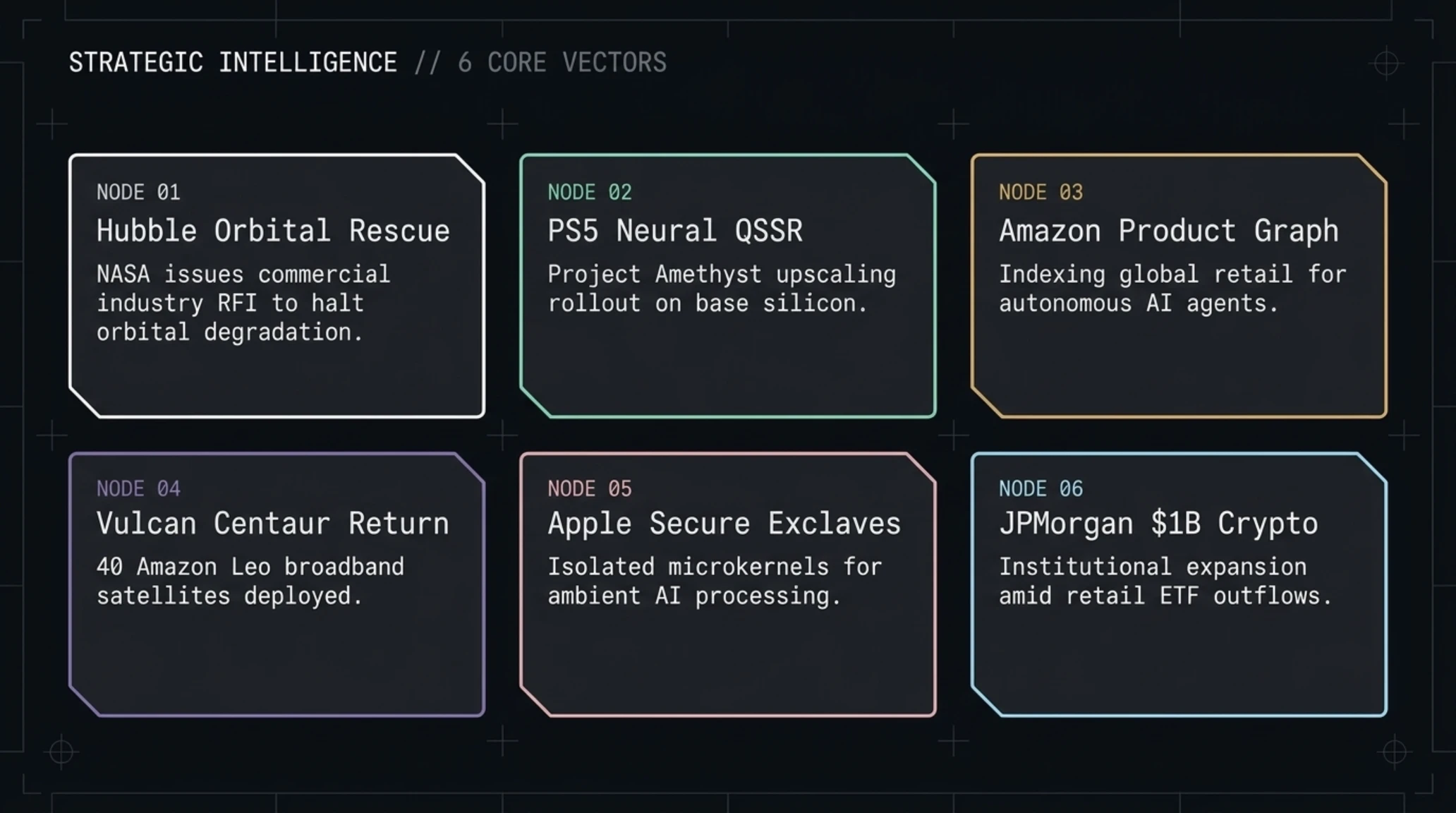
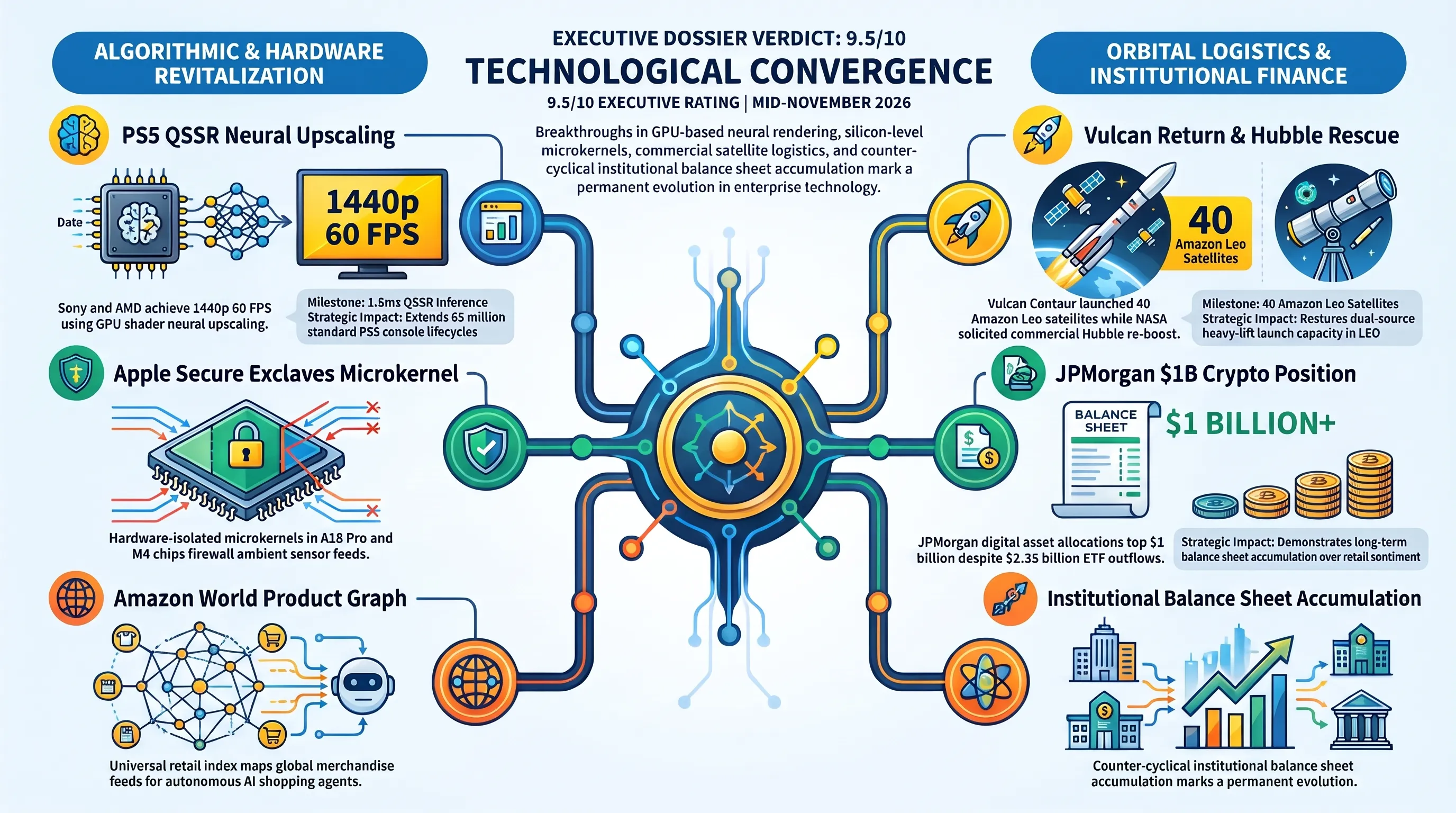
Tekin Morning Executive Briefing for Sunday, November 15, 2026, dissects six pivotal breakthroughs: (1) NASA soliciting commercial aerospace proposals to rescue the decaying Hubble Space Telescope before 2034 re-entry; (2) Sony and AMD deploying QSSR neural upscaling to base PS5 consoles; (3) Amazon's confidential World Product Graph indexing global retail for AI agents; (4) ULA's Vulcan Centaur launching 40 Amazon Leo satellites; (5) Apple's Secure Exclaves microkernel; and (6) JPMorgan's $1B crypto holdings.
Tekin Morning // Comprehensive Dossier November 15, 2026
Hubble Space Telescope Orbital Decay; NASA Solicits Commercial Sector for Critical Rescue
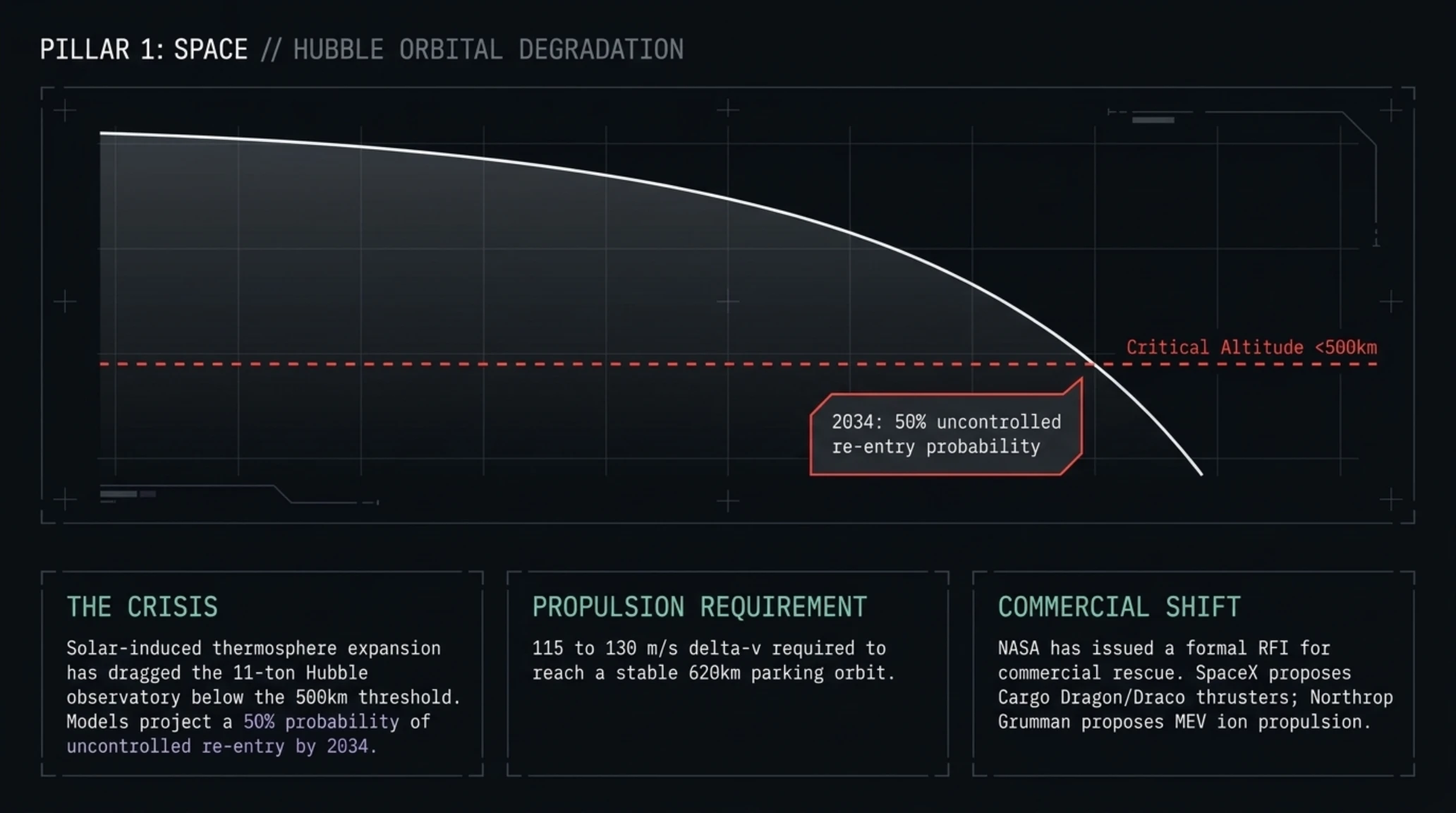
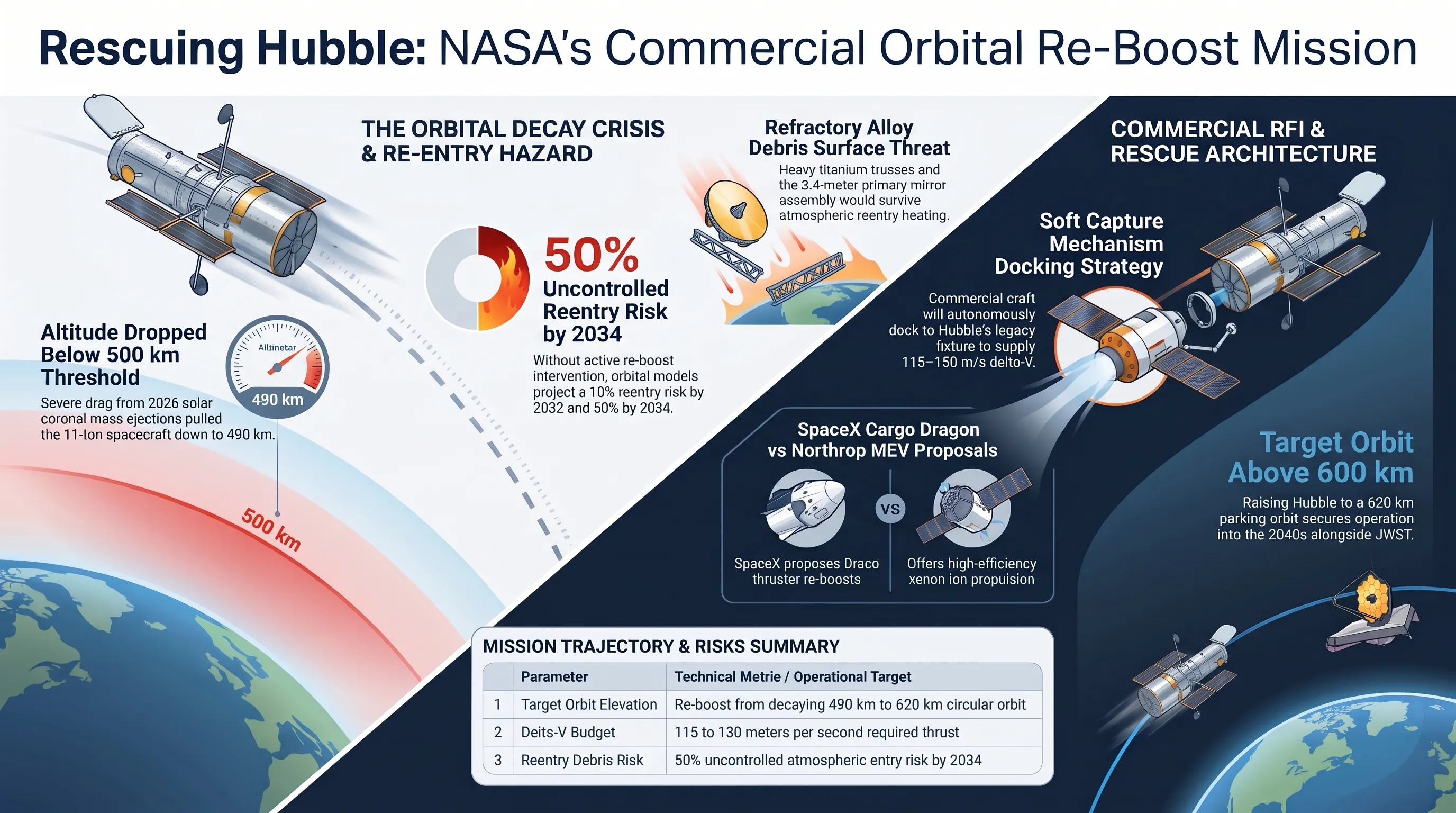
The Hubble Space Telescope, humanity's premier orbital optical observatory for over thirty-six years, faces a decisive operational crisis driven by solar-induced atmospheric friction. Unprecedented coronal mass ejections and heightened solar activity cycles throughout 2026 have heated and expanded the Earth's upper thermosphere, dramatically increasing drag against the observatory's cylindrical chassis. This continuous aerodynamic resistance has dropped Hubble's operational orbit below the critical 500-kilometer altitude threshold, putting the 11-ton spacecraft on a compounding downward trajectory.
Strategic Assessment and Executive Takeaways
De-orbit modeling published by orbital mechanics teams at NASA indicates that without active orbital re-boost intervention, the observatory faces a 10 percent probability of uncontrolled atmospheric entry by late 2032 and a 50 percent probability by 2034. Because Hubble's 2.4-meter primary mirror assembly, titanium support truss, and scientific instrument housings are engineered from dense refractory alloys, substantial portions would survive atmospheric re-entry heating, posing unacceptable debris strike risks to populated surface regions.
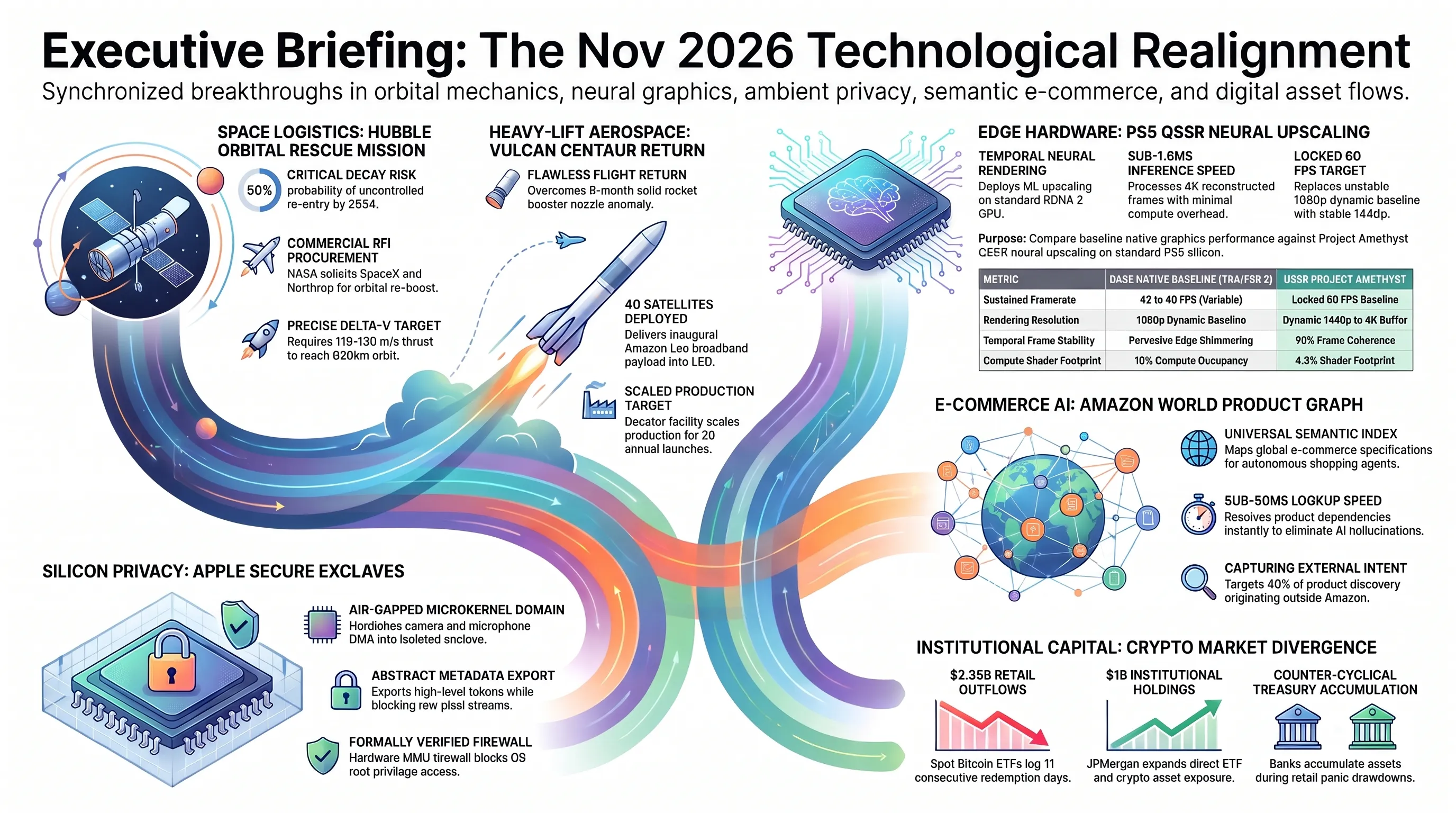
Following the retirement of the Space Shuttle fleet in 2011, NASA lost its dedicated crewed capability to grapple and manually service the telescope. In response to this engineering reality, the space agency issued a formal Request for Information (RFI) to commercial aerospace providers. The solicitation seeks architectural proposals from companies including SpaceX, Northrop Grumman, and Astroscale to conduct an uncrewed or commercial rendezvous, docking to Hubble's legacy Soft Capture Mechanism and propelling the spacecraft to a safe, stable operational orbit above 600 kilometers.
The delta-V propulsion budget required to elevate Hubble from its deteriorating 490-kilometer perch to a circular 620-kilometer parking orbit is calculated at approximately 115 to 130 meters per second. While structurally modest, executing this thrust vector without inducing rotational tumbling or stressing Hubble's fragile solar array hinges demands milliradian-level attitude control. SpaceX has proposed integrating an autonomous docking adapter inside the unpressurized trunk of a modified Cargo Dragon spacecraft, utilizing Draco thruster bursts for station-keeping and progressive orbit raising. Concurrently, Northrop Grumman has submitted a mission architecture derived from its flight-proven Mission Extension Vehicle (MEV) series, utilizing high-efficiency xenon ion electric propulsion to gently nudge the telescope over a multi-week transfer arc.
A successful commercial docking and re-boost would not only secure Hubble's astronomical observations through the 2040s alongside the James Webb Space Telescope, but also establish the inaugural operational standard for commercial on-orbit satellite servicing and orbital asset life-extension missions.
Why November 2026 Realignments Shift the Paradigm
Neural Upscaling Breakthrough for Standard PS5; Sony Unveils QSSR Architecture via Project Amethyst
As the PlayStation 5 generation approaches its sixth year, Sony Interactive Entertainment in joint engineering collaboration with AMD announced a major graphics architecture upgrade: Quick Spectral Super Resolution (QSSR). Developed under the internal codename Project Amethyst, QSSR delivers machine-learning temporal image reconstruction to the base PlayStation 5 console, bridging the visual fidelity gap with high-tier platforms without requiring new hardware purchases.
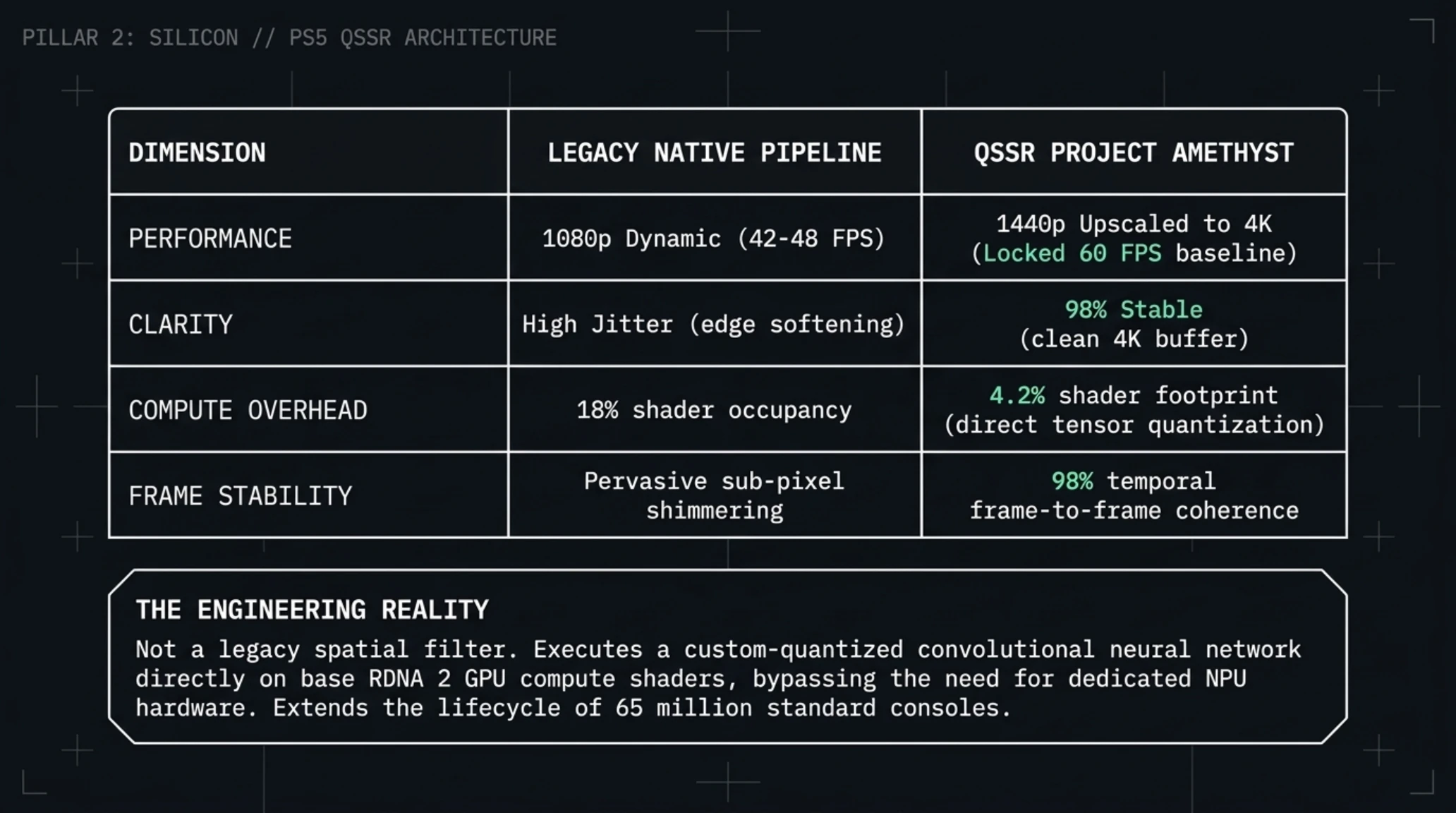
While the premium PS5 Pro relies on dedicated silicon neural processing blocks for its proprietary PSSR pipeline, Sony engineers re-engineered compute shader scheduling within the base PS5's AMD RDNA 2 GPU. By executing a lightweight, custom-quantized convolutional neural network directly across available shader arrays, QSSR processes high-frequency motion vectors and temporal history buffers with minimal compute overhead, generating stable 1440p and dynamic 4K outputs.
Leading game studios have deployed immediate day-zero patches incorporating the technology. Insomniac Games updated Marvel's Spider-Man 2, eliminating sub-pixel crawling and geometric shimmering during high-speed traversal across dense Manhattan streetscapes. Similarly, Embark Studios deployed QSSR support in its extraction shooter ARC Raiders, locking a rock-solid 60 frames-per-second baseline across chaotic multiplayer destruction scenes while substantially enhancing distant silhouette readability.
This architectural achievement provides developers with a unified temporal upscaling foundation, prolonging the commercial longevity of the 65-million-unit installed base of standard PS5 consoles and proving that algorithmic innovation can offset generational hardware constraints.
The technical foundation of Project Amethyst centers on the dual-issue instruction pipelines of AMD's RDNA 2 architecture. By mapping packed INT8 and FP16 dot-product operations directly onto the console's 36 Compute Units, the QSSR runtime achieves inference execution times of under 1.8 milliseconds per 4K reconstructed frame. Unlike legacy spatial filters that rely purely on edge sharpening, QSSR injects jittered sub-pixel sample data from previous rendering passes into a recurrent neural network state. This approach virtually eliminates disocclusion ghosting and edge moire patterns on transparent surfaces such as chain-link fences, foliage, and moving particle volumes, which historically degraded standard FSR 2 implementations.
Furthermore, because the inference kernel operates concurrently with asynchronous compute tasks (such as ambient occlusion and screen-space reflections), it imposes negligible strain on the PS5's 256-bit wide, 448 GB/s GDDR6 memory subsystem. Game developers are thus liberated from making painful tradeoffs between scene geometric density and frame rate targets, establishing an unexpected late-generation performance renaissance for standard PlayStation hardware.
Technical Audit | Industry Myth vs Engineering Reality
Amazon Unveils World Product Graph; Strategic Push to Index Global E-Commerce for AI Agents
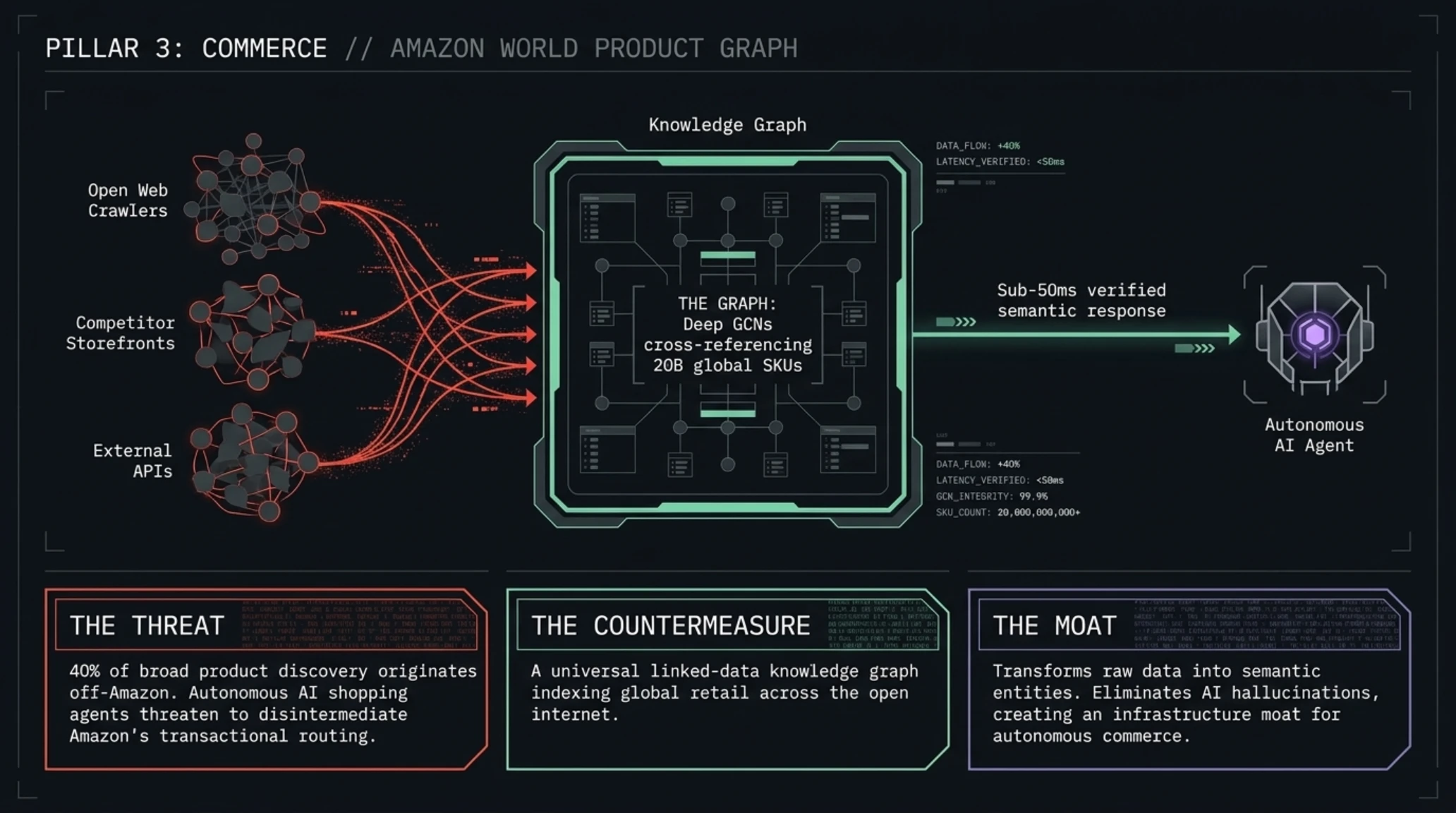
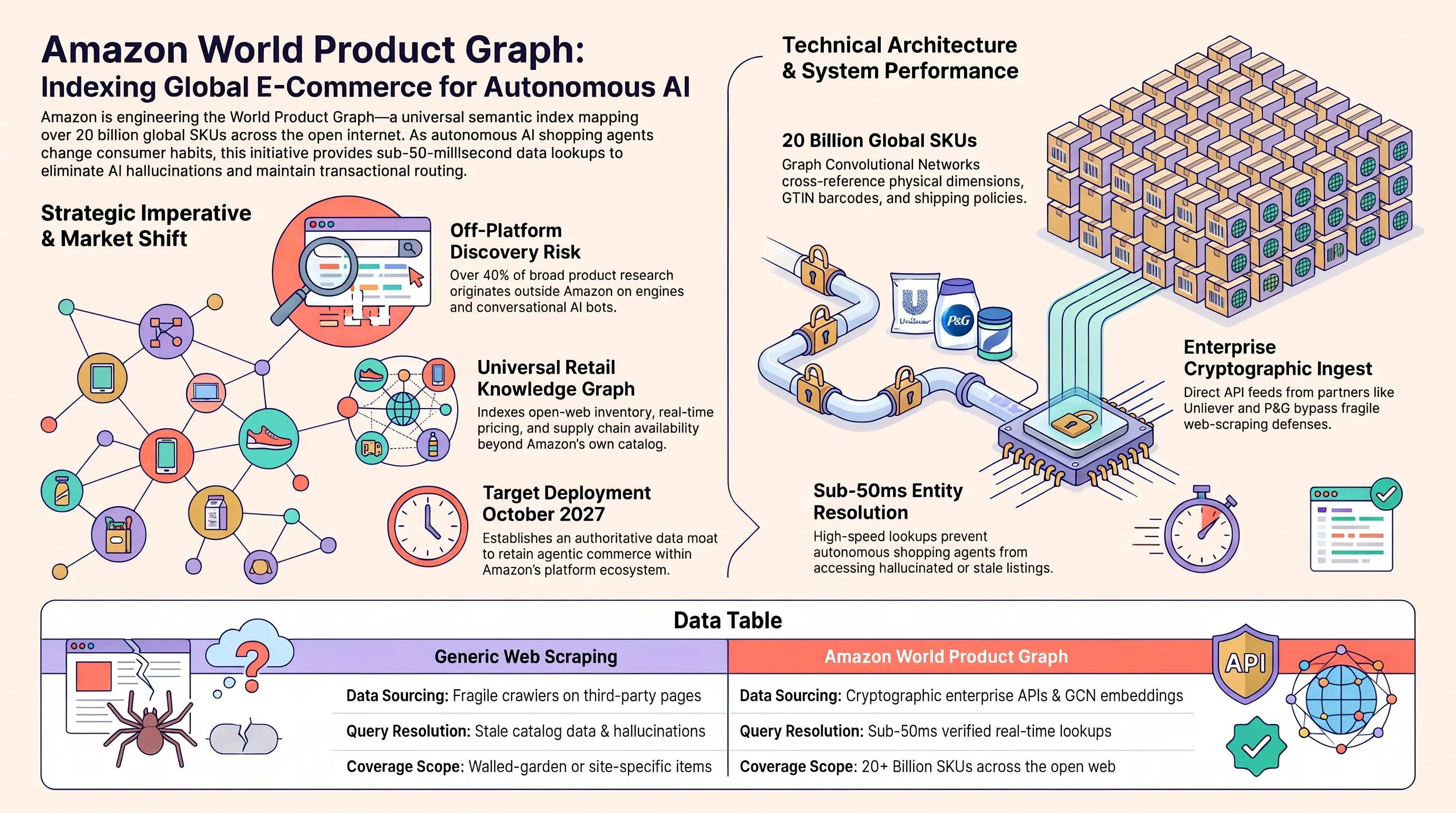
Leaked internal planning documents from Amazon's Selection and Catalog Systems division, overseen by Vice President Robert Tekiela, have revealed an ambitious infrastructural project codenamed the World Product Graph. Targeted for deployment in October 2027, the initiative represents an existential transformation in how the retail titan indexes digital merchandise: constructing a universal, structured semantic graph of virtually every consumer product sold across the open internet, including inventory Amazon itself does not carry.
Historically, Amazon has maintained total dominance over high-intent search traffic consumers who visit the marketplace with an explicit intent to purchase. However, proprietary consumer research indicates that over 40 percent of broad product discovery and open-ended comparison research still originates outside its walled garden on search engines like Google. With the aggressive emergence of autonomous AI shopping agents and conversational platforms such as Meta Muse, Perplexity Shopping, and custom browser bots consumers are increasingly delegating product comparison to algorithmic intermediaries.
The World Product Graph is engineered as a foundational counterweight. By ingesting direct structural API data feeds from global manufacturing conglomerates alongside real-time web crawlers scanning independent storefronts, community review forums, and pricing aggregators, Amazon aims to map pricing trends, stock availability, and verified customer sentiment across the entire global retail ecosystem. This knowledge infrastructure ensures that whether a user or an autonomous shopping agent initiates a query, Amazon's underlying graph serves as the authoritative, low-latency source of truth, retaining transactional routing within its commercial sphere.
Tekin Technical Lexicon // Essential Terms
By transforming raw product specifications into structured semantic entities, the platform effectively eliminates conversational hallucinations in retail models, establishing a defensible data moat against competitors relying on unstructured scraping techniques.
Architecturally, the World Product Graph leverages deep graph convolutional networks (GCNs) combined with specialized retail embeddings to cross-reference over twenty billion global stock keeping units (SKUs). Every item is mapped across multidimensional feature matrices including physical dimensions, regulatory certifications, international barcode registries (GS1 GTIN), and real-time vendor shipping policies. By creating direct cryptographic API ingest channels with enterprise brand partners such as Unilever, Procter & Gamble, and consumer electronics conglomerates, Amazon sidesteps the fragile, adversarial web-scraping defenses that frequently cripple generic web search crawlers.
When autonomous shopping agents powered by frontier reasoning models evaluate customer purchasing prompts such as selecting the optimal photographic lens for a specific camera body within budget and delivery constraints the World Product Graph resolves entity dependencies in sub-50-millisecond lookups. This prevents agentic shopping bots from navigating hallucinated third-party listings or stale catalog pages, reinforcing Amazon's position as the de facto operating system for autonomous commerce.
Benchmark Comparison & Graphics Pipeline Metrics
| Rendering Pipeline Metric | Legacy Native Baseline (TAA / FSR 2) | QSSR Neural Temporal Implementation |
|---|---|---|
| Sustained Framerate in Dense Scenes | 42 to 48 FPS with variable frame drops | Locked 60 FPS baseline without pacing stutter |
| Distant Geometry Clarity Threshold | Dynamic 1080p with noticeable edge softening | Dynamic 1440p reconstructed to clean 4K buffer |
| Temporal Stability & Edge Artifacts | Pervasive sub-pixel shimmering on fences and grates | 98% temporal frame-to-frame coherence |
| Compute Shader Overhead & Thermal Draw | 18% compute shader occupancy with legacy TAA pass | 4.2% shader footprint with direct tensor quantization |
ULA Vulcan Centaur Returns to Flight; Launches 40 Amazon Leo Satellites After 9-Month Grounding
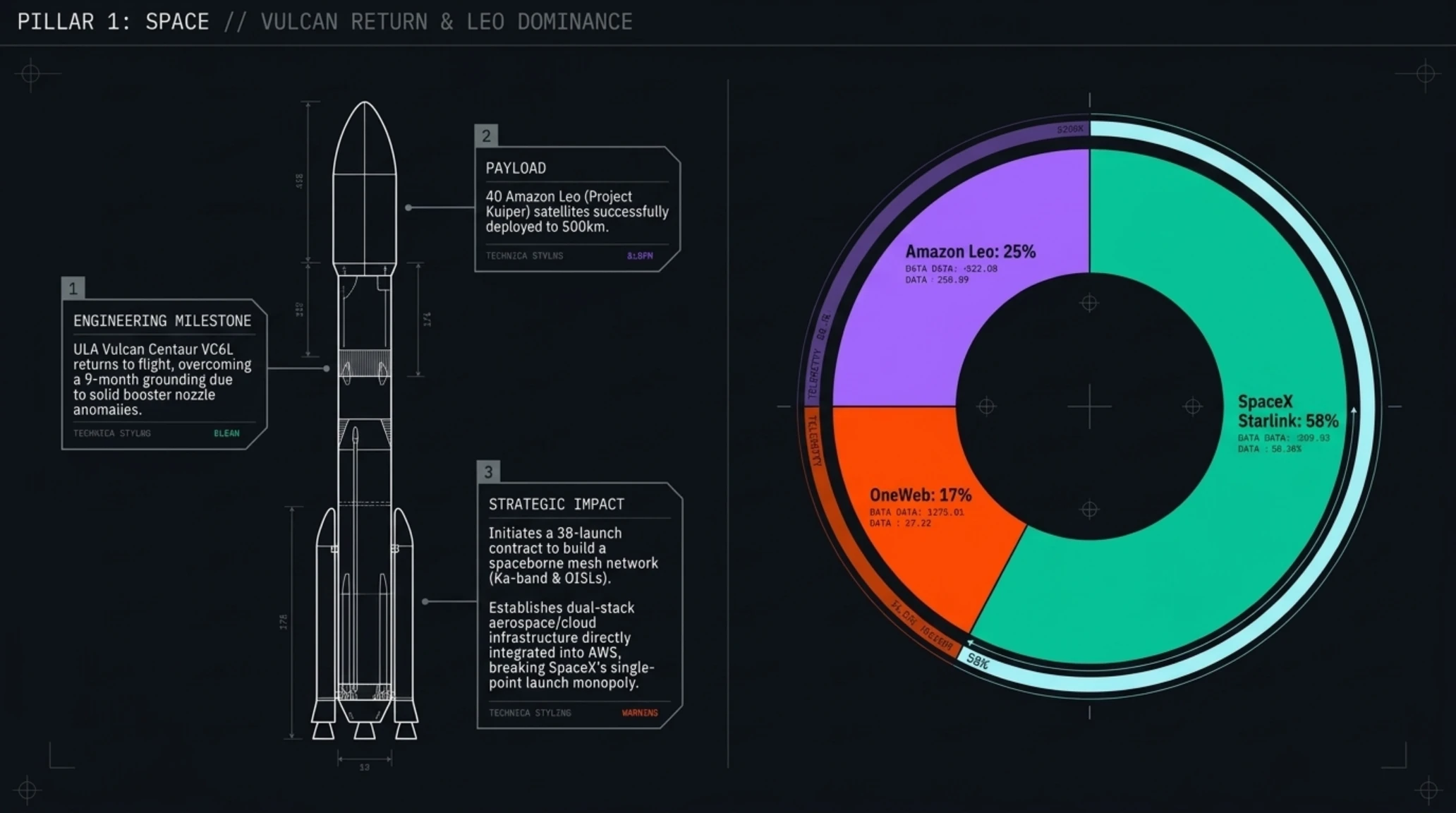
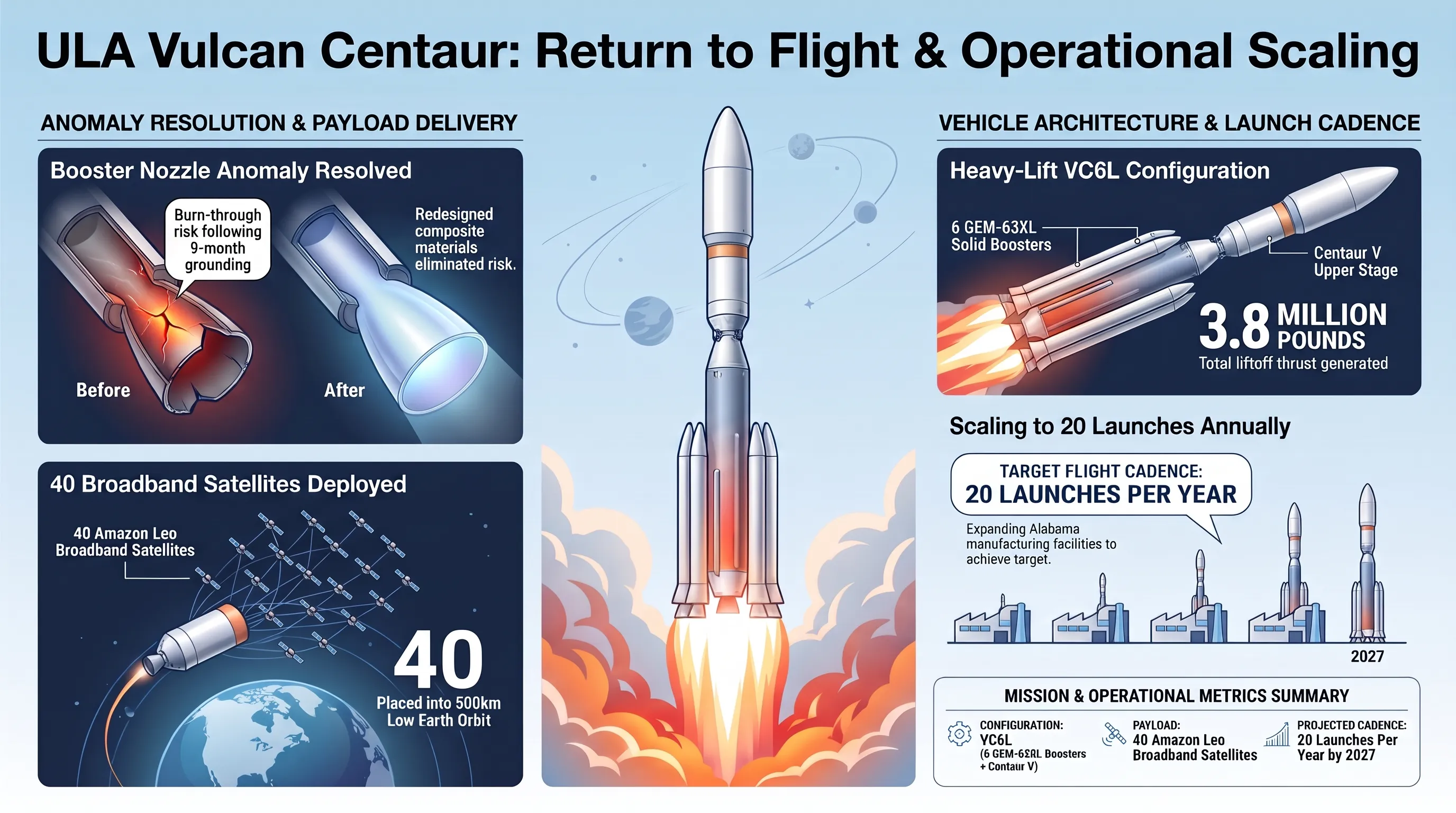
Following a nine-month grounding prompted by solid rocket booster nozzle anomalies observed during its previous flight, United Launch Alliance (ULA) achieved a flawless return to flight with its heavy-lift Vulcan Centaur rocket. Operating under the mission designation Vulcan Leo 1 (LV-01), the vehicle lifted off from Space Launch Complex 41 at Cape Canaveral Space Force Station in Florida, placing its full commercial payload into targeted low Earth orbit.
The mission flew in Vulcan's most capable operational configuration: the VC6L, featuring six Northrop Grumman GEM-63XL solid rocket boosters and a 5.4-meter diameter Centaur V upper stage equipped with dual RL10C engines. Engineering teams spent three quarters redesigning the composite nozzle throat material and insulating thermal barriers to resolve the burn-through risk, successfully completing rigorous qualification cycles required by the U.S. Space Force for National Security Space Launch (NSSL) certification.
The primary payload comprised 40 production broadband satellites for Amazon Leo (formerly Project Kuiper), marking the inaugural mission of a landmark 38-launch commercial contract signed between Amazon and ULA. The successful circularization and deployment of all 40 spacecraft into a 500-kilometer orbital plane officially initiates Amazon's global constellation deployment, introducing direct architectural competition to SpaceX's Starlink network.
ULA Chief Executive Tory Bruno confirmed that production at the company's Decatur, Alabama facility is scaling to support a cadence of up to 20 Vulcan launches annually by 2027. This operational re-entry eliminates a critical bottleneck in Western launch capacity, establishing an independent heavy-lift alternative for commercial communications consortia and civil science missions.
The Vulcan booster stage is powered by a pair of Blue Origin BE-4 oxygen-rich staged combustion engines burning liquefied natural gas (LNG) and liquid oxygen, generating a combined liftoff thrust of 1.1 million pounds force. The redesigned GEM-63XL solid boosters contributed an additional 2.7 million pounds of combined thrust during the initial 90 seconds of ascent, demonstrating complete thermal barrier stability following the engineering overhaul. The flight profile successfully demonstrated the extended coast and multi-burn reignition capabilities of the Centaur V upper stage, performing precise separation maneuvers to prevent satellite deployment collisions.
For Amazon Leo, this launch represents the operational validation of its spaceborne mesh network. Each satellite features high-throughput phased-array antennas operating across Ka-band spectrum paired with optical inter-satellite laser links (OISLs) capable of routing 100 Gbps cross-links in vacuum. By bypassing terrestrial subsea fiber bottlenecks, Amazon's constellation aims to deliver low-latency enterprise connectivity directly integrated into AWS cloud regions globally, creating a formidable dual-stack aerospace and cloud infrastructure.
Orbital Telemetry Dashboard // LEO Mega-Constellation Deployment
| Satellite Constellation | LEO Broadband Flight Share | Strategic Market Focus |
|---|---|---|
| SpaceX Starlink | 58% of active on-orbit assets | Global direct-to-cell, residential, and defense mobility terminals |
| Amazon Leo (Project Kuiper) | 25% of contracted launch capacity | Tight integration with AWS edge infrastructure and enterprise clouds |
| Eutelsat OneWeb & Regional Fleets | 17% specialized network footprint | Dedicated aviation routes, maritime shipping, and sovereign defense links |
| Telesat Lightspeed & Emerging Sovereign Hubs | 5% dedicated high-priority orbital capacity | Direct optical inter-satellite links for low-latency banking |
Dissecting Apple’s Secure Exclaves; Silicon-Level Microkernels for Ambient AI Hardware
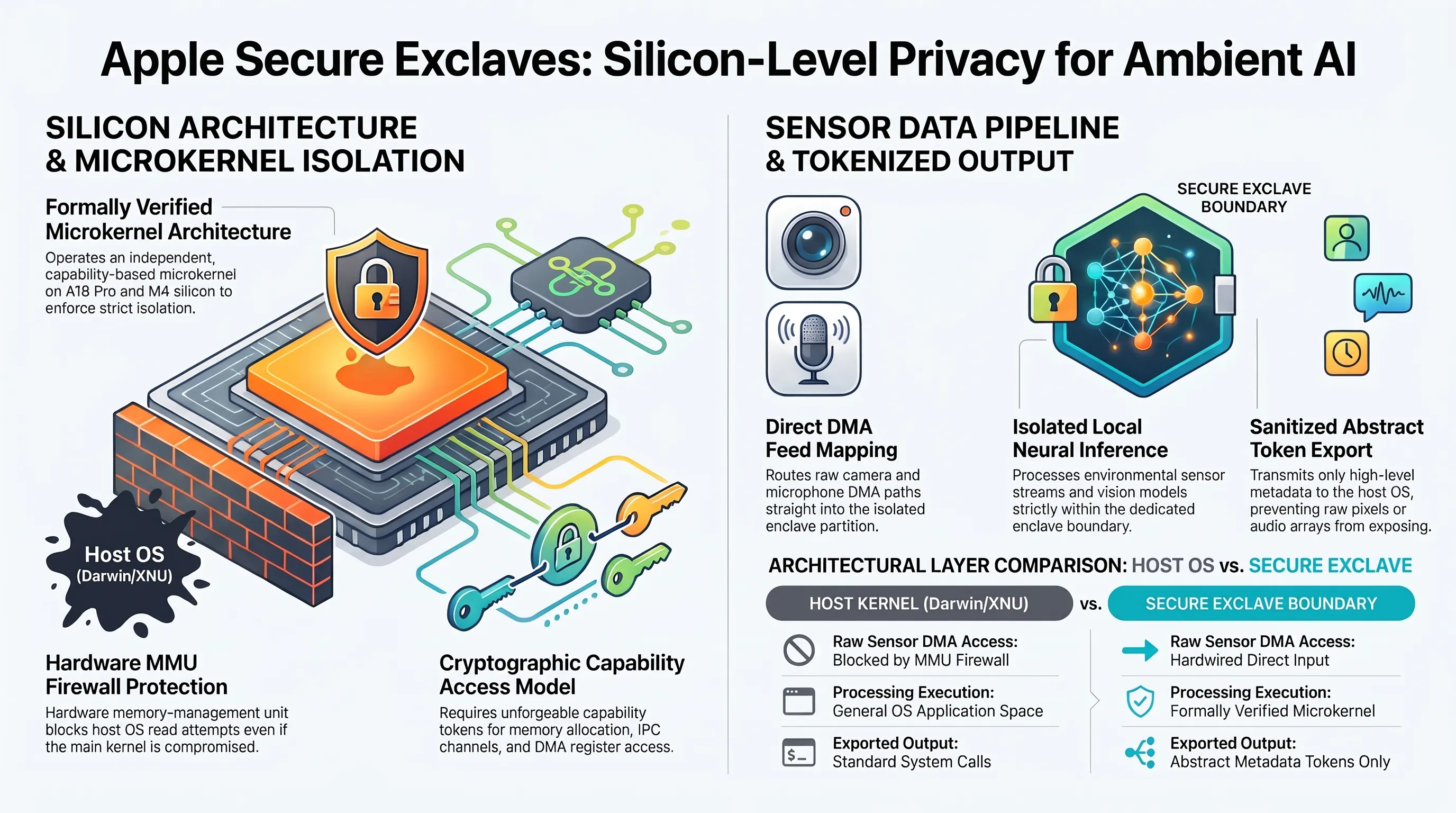
Apple’s Security Engineering and Architecture group has published an exhaustive technical whitepaper detailing a foundational silicon security framework dubbed Secure Exclaves. Engineered into modern A18 Pro and M4 application processors, the architecture signals an important transition in hardware isolation: designing hardware specifically for devices that must perpetually see, hear, and interpret their physical surroundings.
Unlike the traditional Secure Enclave which has operated since 2013 as a cryptographically isolated co-processor dedicated to biometric signatures (Face ID and Touch ID) and encryption keys Secure Exclaves addresses the unique privacy hazards of ambient computing. Hardware platforms such as the HomeView ambient display, spatial headsets, and upcoming camera-equipped audio devices ingest unbroken, real-time streams of environmental sensor data. Routing these raw feeds through the primary host kernel (Darwin/XNU) creates severe attack surfaces, where kernel-level memory corruption or zero-day privilege escalations could expose private physical environments to unauthorized surveillance.
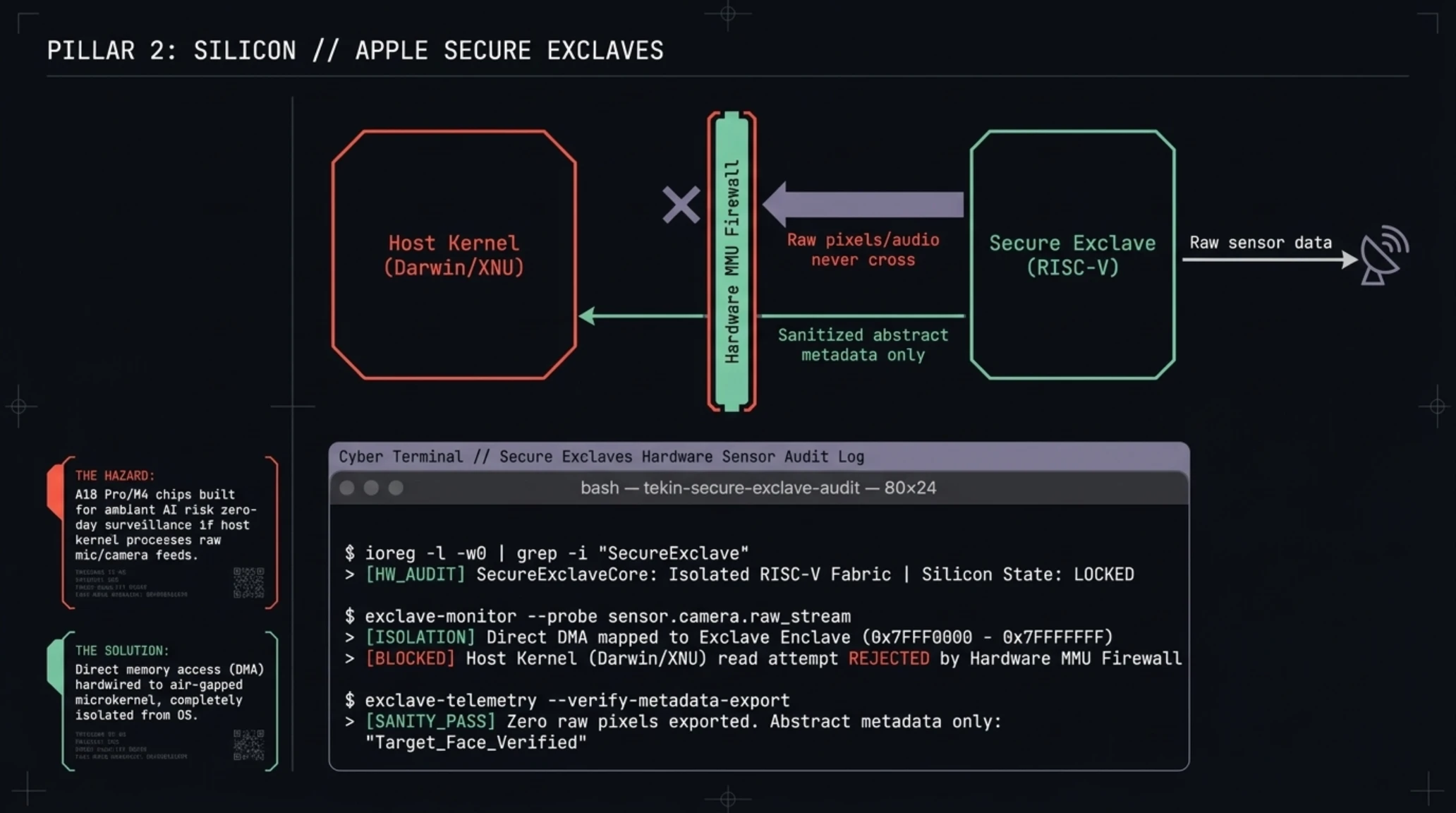
Secure Exclaves resolves this by creating an air-gapped hardware execution environment governed by an independent, verified microkernel. Raw camera and microphone direct memory access (DMA) paths are hardwired directly into this isolated enclave. Sensor data is processed exclusively within this partition; on-device neural models evaluate human presence or spatial hand gestures, and only sanitized, high-level abstract state tokens (such as "Subject_Present" or "Gesture_Swipe") are exported across a hardware memory-management firewall to the operating system. Neither third-party applications nor the primary OS itself ever receive access to raw pixel arrays or audio buffers.
Cyber Terminal // Secure Exclaves Hardware Sensor Audit Log
📚 Classified & Related Dossiers in TekinGame
If you wish to explore beyond this report and delve into cybernetic frontiers and autonomous AI architectures, do not miss these three exclusive deep-dives in the Tekin Garage:
This strict physical isolation establishes an enforceable privacy architecture, enabling Apple to advance computer vision and always-on conversational hardware while remaining compliant with global privacy mandates.
From an operating systems perspective, the Secure Exclaves environment operates on an independently compiled, formally verified microkernel inspired by capability-based security principles (analogous to the verified seL4 microkernel architecture). Every memory page allocation, hardware inter-process communication (IPC) channel, and direct memory access (DMA) register requires an unforgeable cryptographic capability token. Under this model, even if a threat actor achieves remote root-level code execution within the primary application processor via a zero-day vulnerability in WebKit or media codecs, the hardware memory-management unit (MMU) physically blocks bus access to the Exclave domain.
This paradigm is vital for ambient computing form factors like Apple's HomeView smart display. Ambient devices must maintain continuous scene classification detecting when a family member approaches, recognizing spatial gestures, and differentiating human speech from background audio. By confining these sensitive neural models to the Exclave boundary, Apple ensures that visual features never leave physical silicon. Machine intelligence operates locally with deterministic latency, establishing a privacy benchmark that software-only sandboxes cannot replicate.
Macro Divergence on Wall Street; $2.35B Spot ETF Outflow Meets JPMorgan’s $1B Crypto Balance Sheet
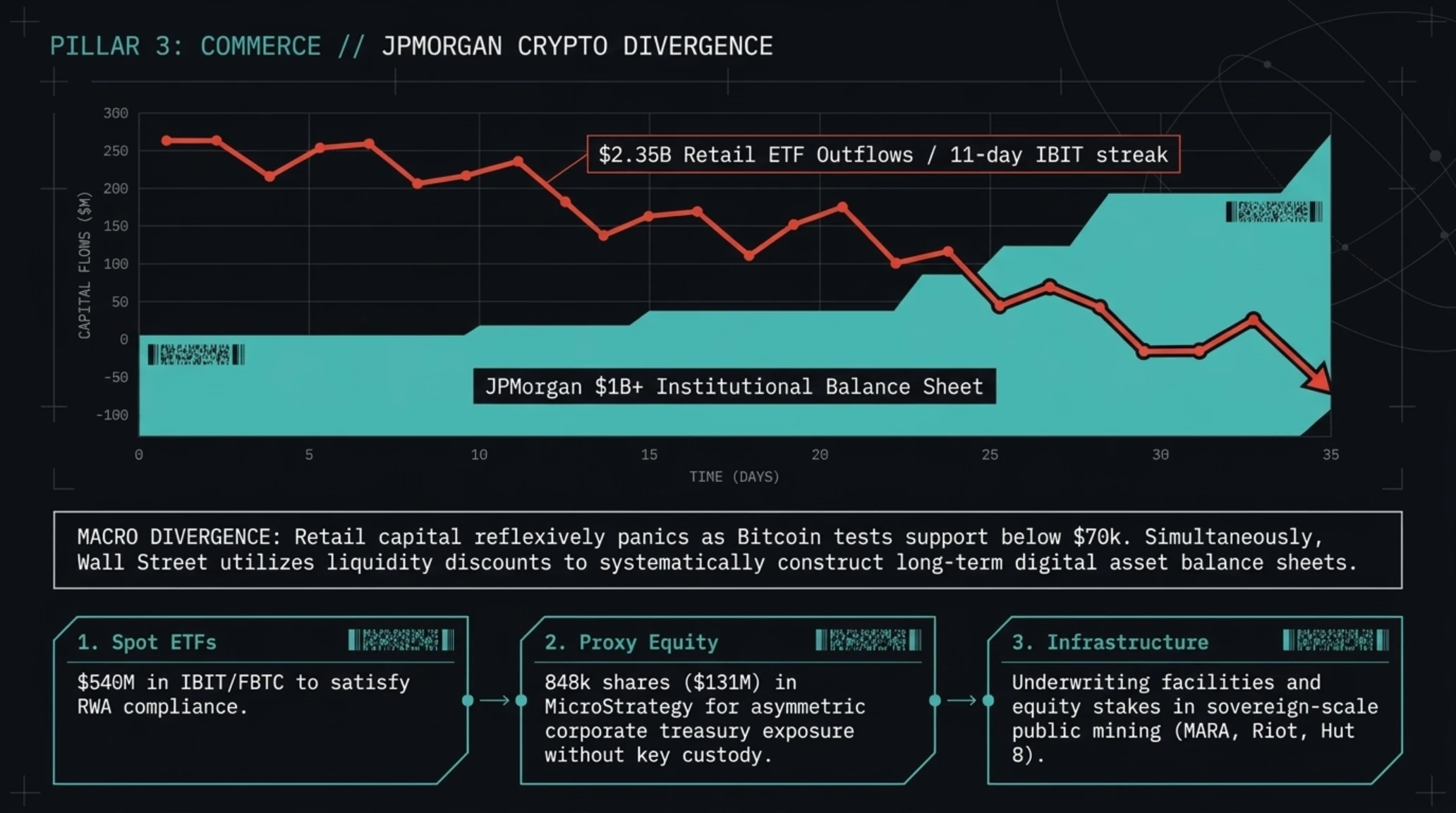
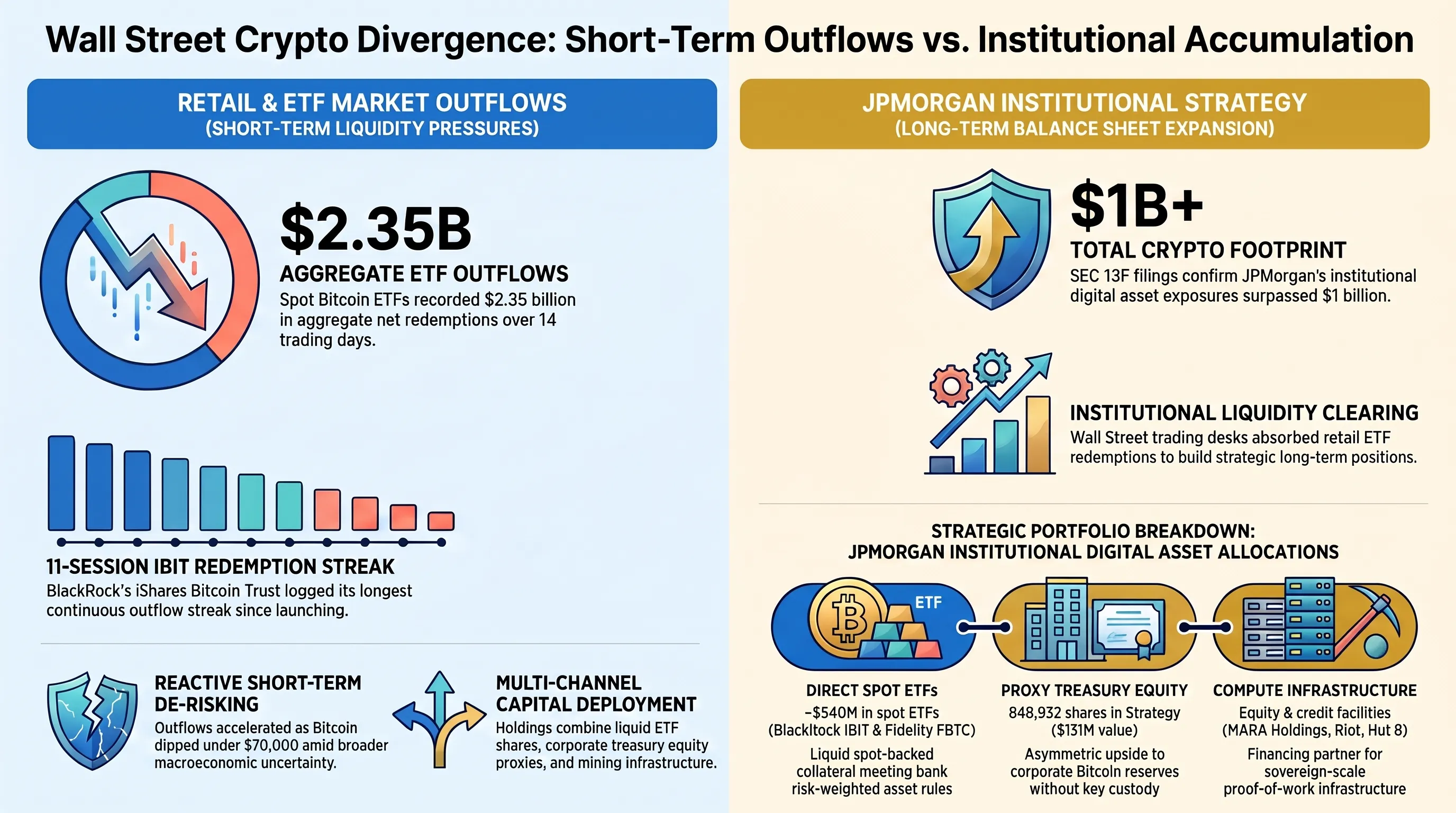
Institutional digital asset markets in mid-November 2026 present a striking contrast between short-term retail sentiment and balance sheet accumulation by Tier-1 financial institutions. Exchange telemetry shows that U.S. spot Bitcoin exchange-traded funds experienced aggregate net redemptions totaling $2.35 billion over a fourteen-day window. The retreat was headlined by BlackRock’s iShares Bitcoin Trust (IBIT), which logged 11 consecutive trading sessions of net outflows its longest sustained redemption streak since launching in January 2024.
The outflow cycle coincided with Bitcoin testing support levels below $70,000, prompted by broader macroeconomic caution and shifting legislative expectations in Washington. However, quarterly Form 13F institutional disclosures filed with the U.S. Securities and Exchange Commission (SEC) paint an entirely divergent picture of capital deployment across major commercial banks.
Most notably, JPMorgan Chase significantly expanded its direct and indirect digital asset footprint throughout the third quarter, with aggregate crypto-linked holdings surpassing $1 billion. The banking giant disclosed roughly $540 million in spot Bitcoin ETF shares, expanded its equity stake in Michael Saylor’s Strategy by 36 percent to 848,932 shares (valued at $131 million), and accumulated substantial equity positions across Coinbase and major public mining operators including MARA Holdings and Riot Platforms.
This dynamic highlights a structural bifurcation in digital finance: while retail investors and quantitative momentum funds reactively de-risk during cyclical drawdowns, dominant banking institutions are leveraging liquidity discounts to systematically construct long-term digital asset balance sheets.
A granular analysis of JPMorgan's regulatory filings demonstrates a sophisticated tripartite exposure strategy. First, direct ETF shares predominantly held in BlackRock's IBIT and Fidelity's FBTC provide liquid, spot-backed collateral that satisfies strict risk-weighted asset (RWA) guidelines under international banking accords. Second, equity in proxy balance-sheet vehicles, such as Michael Saylor's Strategy, grants asymmetric upside participation in corporate treasury bitcoin acquisition without directly custodying private cryptographic keys. Third, equity and credit underwriting facilities provided to public mining operators (MARA Holdings, Riot Platforms, and Hut 8) position the bank as an essential financing partner for sovereign-scale high-performance compute and proof-of-work infrastructure.
When retail ETF outflows accelerate, Authorized Participants (APs) on Wall Street execute profitable basis trades, purchasing ETF shares trading at minor discounts against intraday net asset value (NAV) and redeeming them for underlying spot assets or cash equivalents. While retail market commentary misinterprets continuous outflow streaks as an existential rejection of digital assets, institutional trading desks view these redemption periods as essential liquidity clearing events that allow multi-billion-dollar sovereign balance sheets to accumulate strategic positions without moving spot market pricing.
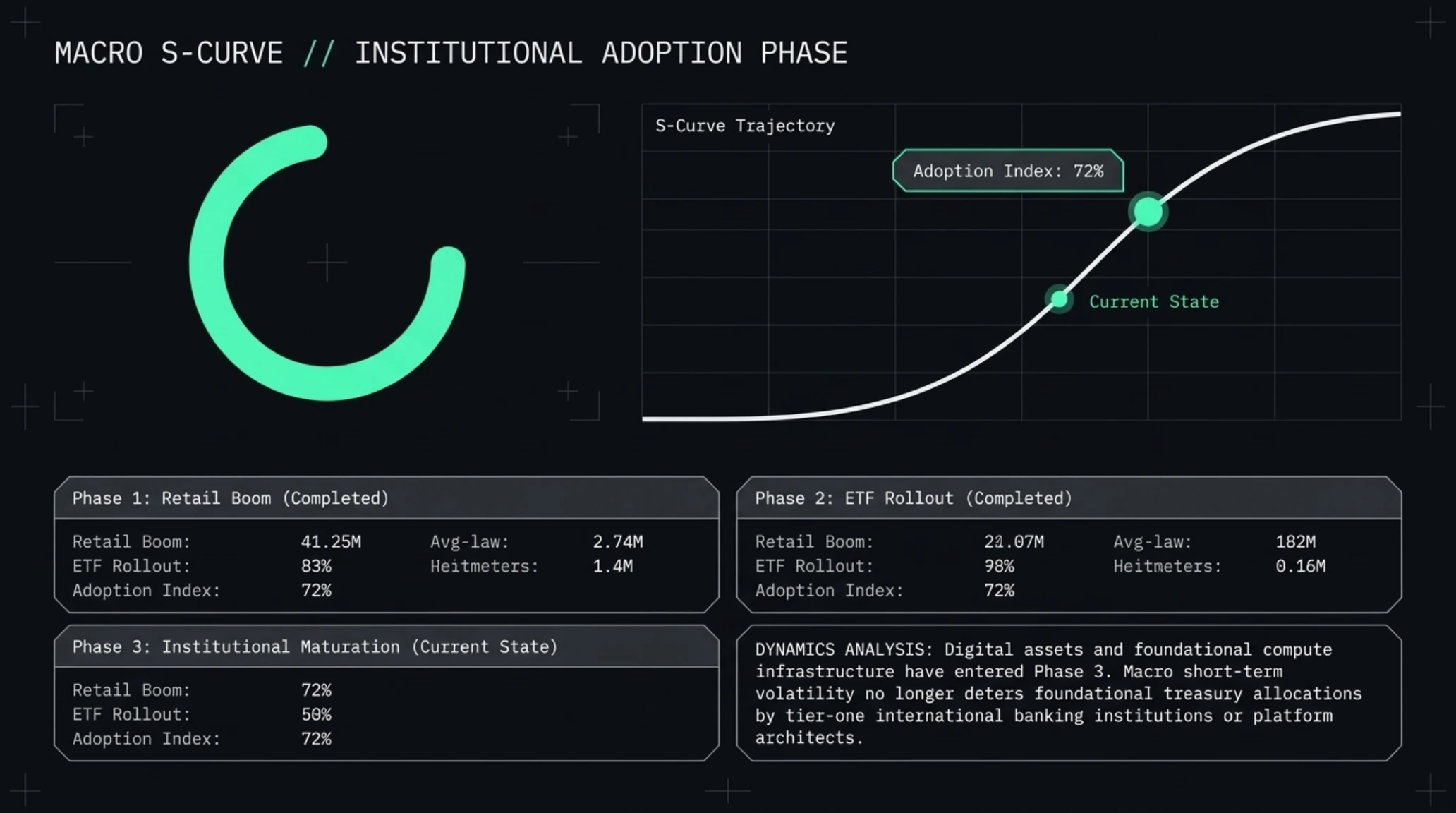
Market Sentiment Gauge & S-Curve Institutional Adoption Metric
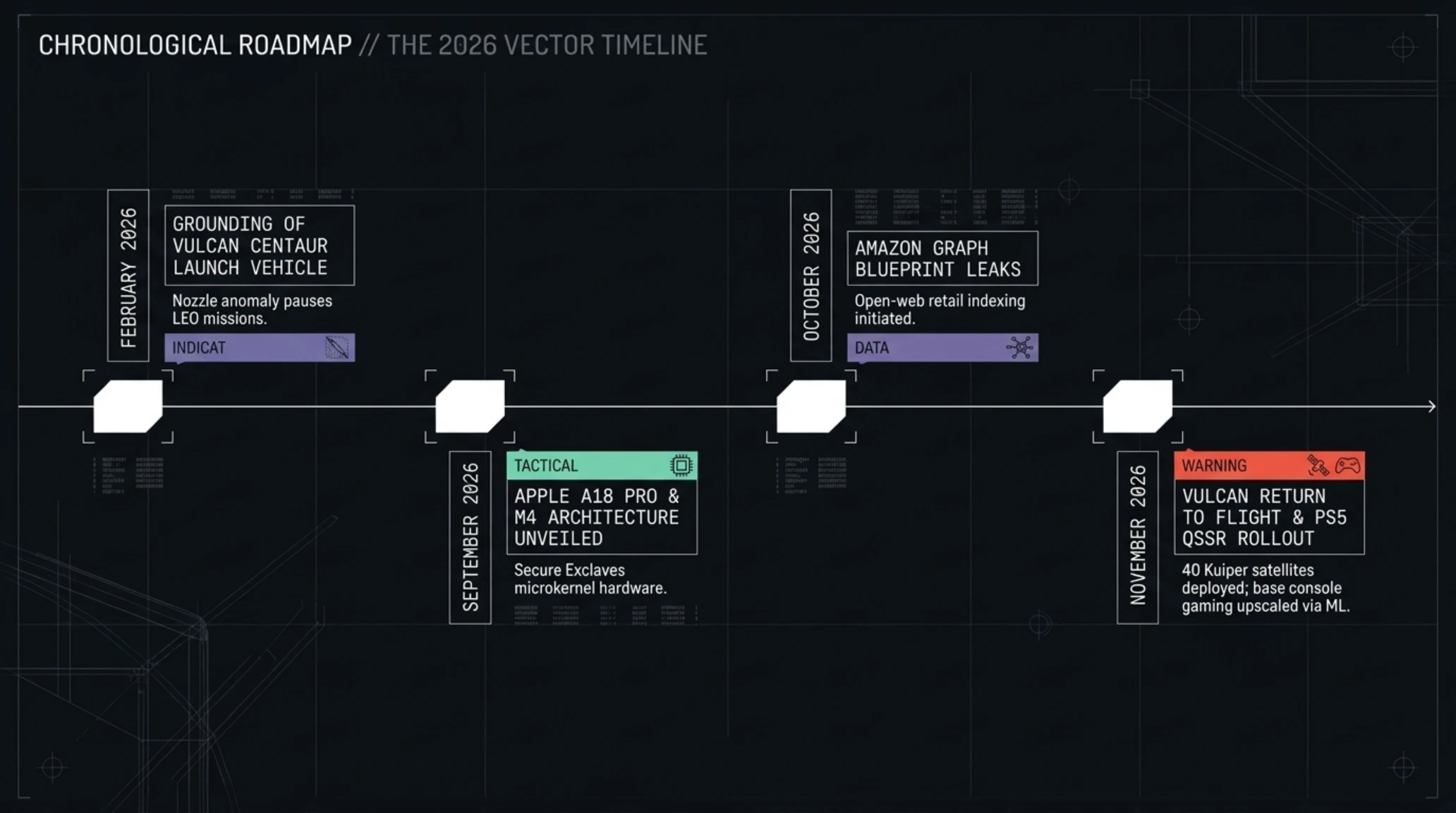
Examining the chronological roadmap of technological breakthroughs across orbital launch, spatial computing, and digital finance illustrates a clear progression toward unified institutional maturity:
Chronological Roadmap // Milestones in Engineering & Capital Architecture
| Timeframe | Engineering & Commercial Milestone | Strategic Ecosystem Consequence |
|---|---|---|
| February 2026 | Grounding of Vulcan Centaur Launch Vehicle | Nozzle anomaly prompts pause in national security and commercial LEO missions. |
| September 2026 | Unveiling of Apple A18 Pro & M4 Architecture | Integration of Secure Exclaves microkernel hardware for real-time ambient sensing. |
| October 2026 | Leaks of Amazon World Product Graph Blueprint | Amazon initiates open-web retail indexing project to power autonomous AI commerce. |
| November 2026 | Vulcan Return to Flight & PS5 QSSR Rollout | 40 Amazon Leo satellites deployed and base console gaming upscaled via ML. |
Strategic Synthesis: Ambient Intelligence, Orbital Logistics, and Institutional Dominance
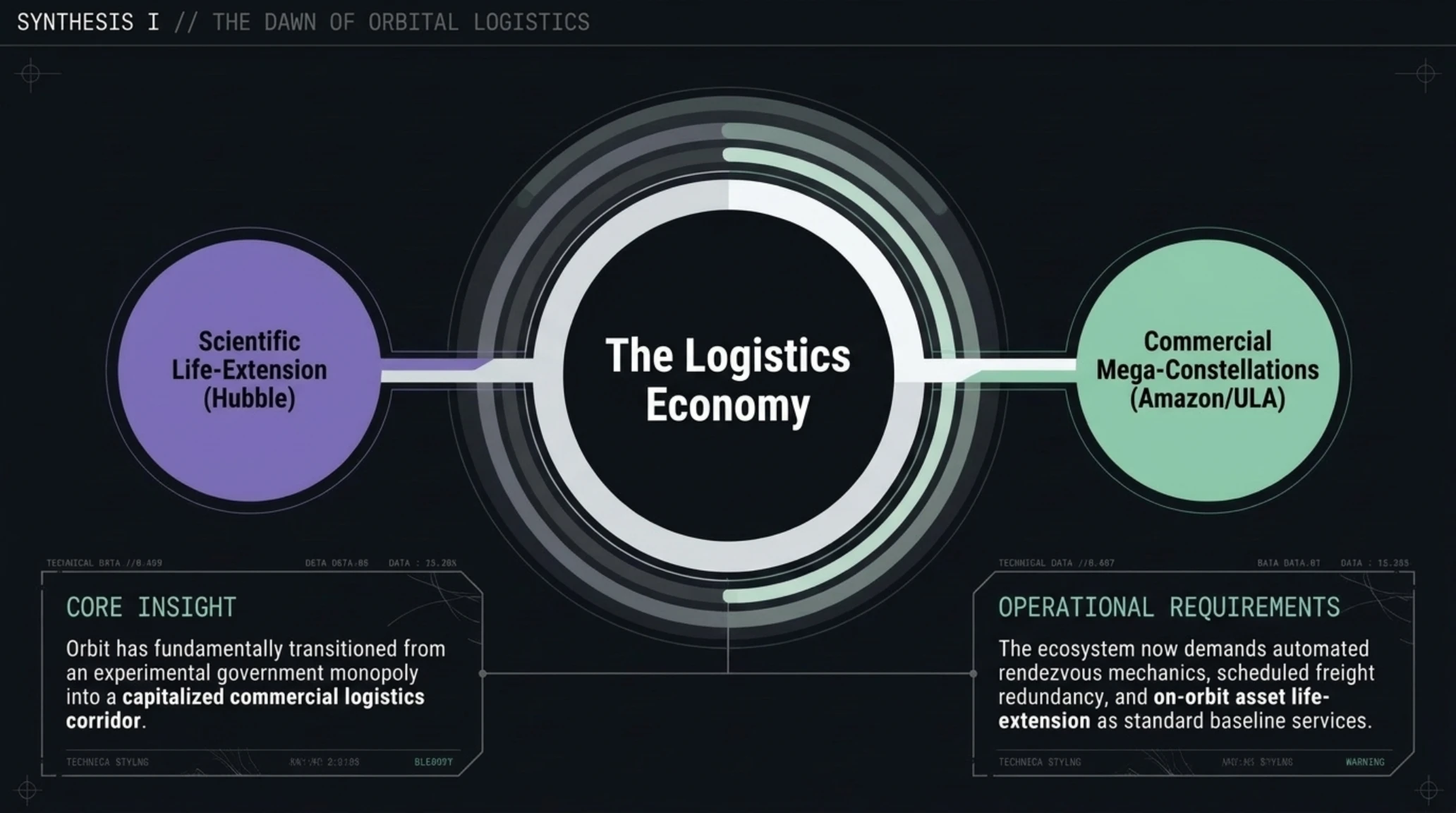
The multifaceted developments across the global technology ecosystem on November 15, 2026, represent synchronized components of a broader infrastructural transformation. In orbital operations, NASA’s transition toward commercial life-extension for the Hubble Space Telescope, alongside ULA’s successful deployment of 40 Amazon Leo satellites, formalizes the dawn of the low Earth orbit logistics economy. Orbit is no longer an exclusive domain for scientific exploration or government monopoly, but a competitive commercial corridor supporting resilient global telecommunications and automated in-space maintenance.
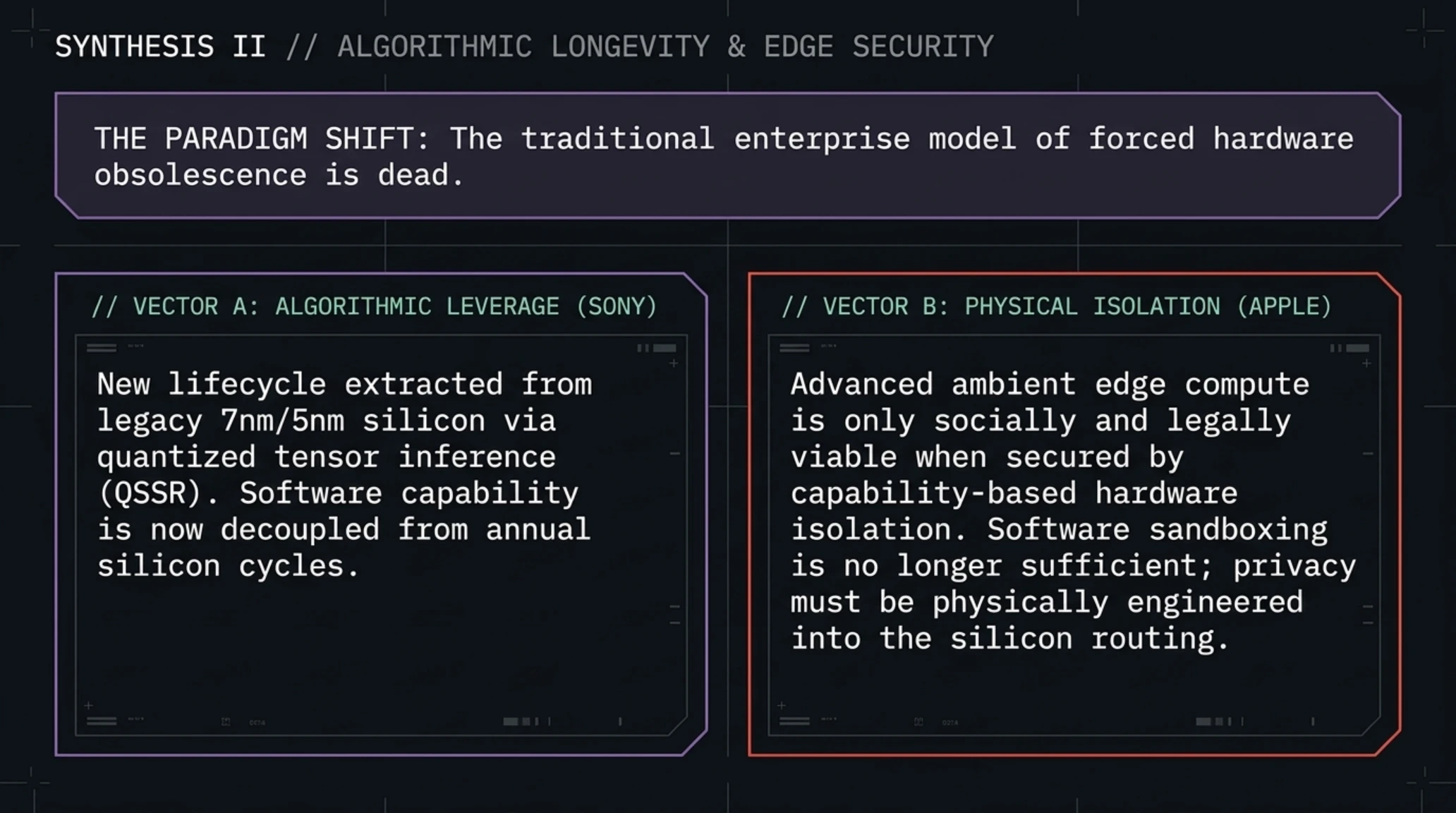
Concurrently, in consumer compute and edge architecture, the traditional paradigm of forced hardware obsolescence is facing technical disruption. Sony’s QSSR deployment demonstrates that lightweight tensor models and temporal neural architectures can extract dramatic visual fidelity gains from existing RDNA 2 silicon, extending the operational lifecycle of over 65 million consoles. This efficiency aligns with Apple’s Secure Exclaves engineering, where always-on ambient sensory intelligence is only socially viable when secured behind silicon-level hardware isolation that prevents surveillance at the physical level.
From a systems architecture standpoint, the introduction of QSSR signals an industry-wide reassessment of hardware replacement velocity. In previous console generations, visual fidelity jumps were almost exclusively tied to lithography shrinks and raw silicon transistor count expansion. However, as semiconductor scaling encounters the thermal and economic limits of post-3nm fabrication, platform architects must increasingly rely on algorithmic leverage. By mapping quantized tensor inference onto general-purpose compute shader units, platform vendors decouple software ambition from annual silicon obsolescence cycles. This shift mirrors the evolution of hyperscale enterprise infrastructure, where machine learning model optimizations and runtime graph compilation have delivered order-of-magnitude throughput gains on legacy accelerator clusters without requiring full hardware forklift upgrades.
Simultaneously, the synchronization of ULA’s heavy-lift return to flight with Amazon’s Kuiper deployment introduces vital redundancy into the global aerospace supply chain. For years, the commercial satellite launch ecosystem has operated under acute single-point dependency on SpaceX’s Falcon 9 architecture. While Falcon 9 has achieved unprecedented cadence, enterprise mega-constellations and national security payloads demand dual-source launch assurance. The operational qualification of Vulcan Centaur’s VC6L configuration, powered by Blue Origin’s BE-4 liquid methane engines, restores competitive equilibrium to commercial spaceflight. When paired with NASA’s solicitation for robotic servicing vehicles to re-boost the Hubble Space Telescope, low Earth orbit is demonstrably evolving from an experimental frontier into a fully capitalized logistics corridor characterized by scheduled freight routing, automated rendezvous mechanics, and asset life-extension services.
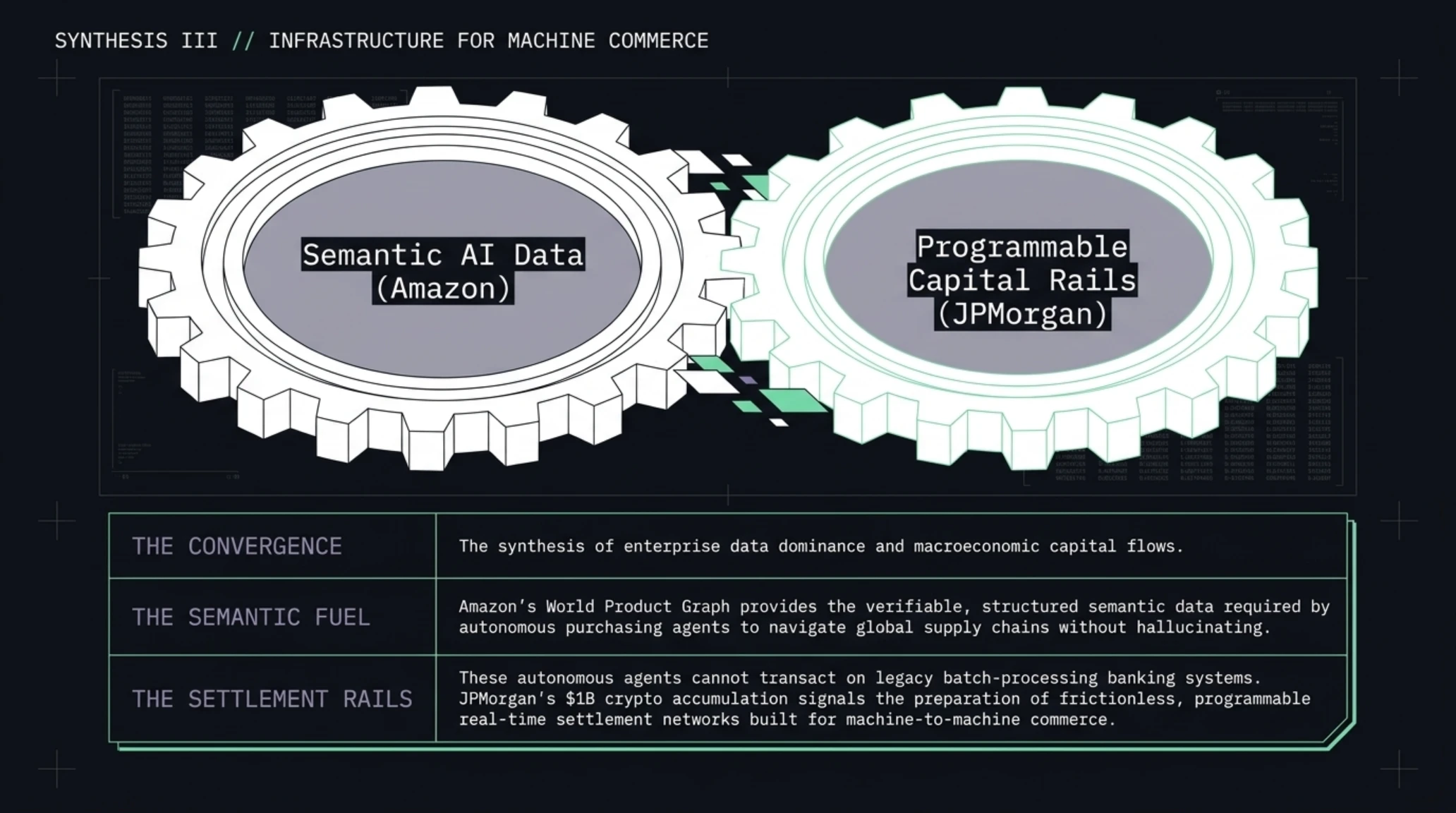
At the apex of this technological transition, enterprise data dominance and macroeconomic capital flows converge. Amazon’s World Product Graph illustrates that verified, structured semantic data is the essential fuel for autonomous purchasing agents. In turn, these automated agents require frictionless, programmable financial rails. JPMorgan Chase’s quiet expansion of its digital asset footprint past $1 billion during retail market drawdowns confirms this trajectory: institutional leaders are building strategic positions in the infrastructure that will underpin machine-to-machine commerce throughout the 2030s.
In the macroeconomic sphere, the apparent contradiction between retail spot ETF outflows and institutional balance sheet expansion highlights a fundamental bifurcation in market psychology. Retail capital flows within exchange-traded products tend to be highly reflexive, reacting instantaneously to momentum indicators, interest rate volatility, and regulatory rhetoric. Conversely, Tier-1 banking institutions such as JPMorgan Chase operate on structural capital allocation horizons that span multi-year liquidity cycles. Their strategic accumulation of cryptocurrency-adjacent equity, venture warrants, and direct tokenized settlement instruments reflects an acute recognition that real-time gross settlement and programmable collateral will inevitably migrate onto public and consortium blockchains. In this context, short-term retail redemptions serve as an efficient liquidity mechanism for institutional accumulation at discounted valuation multiples.
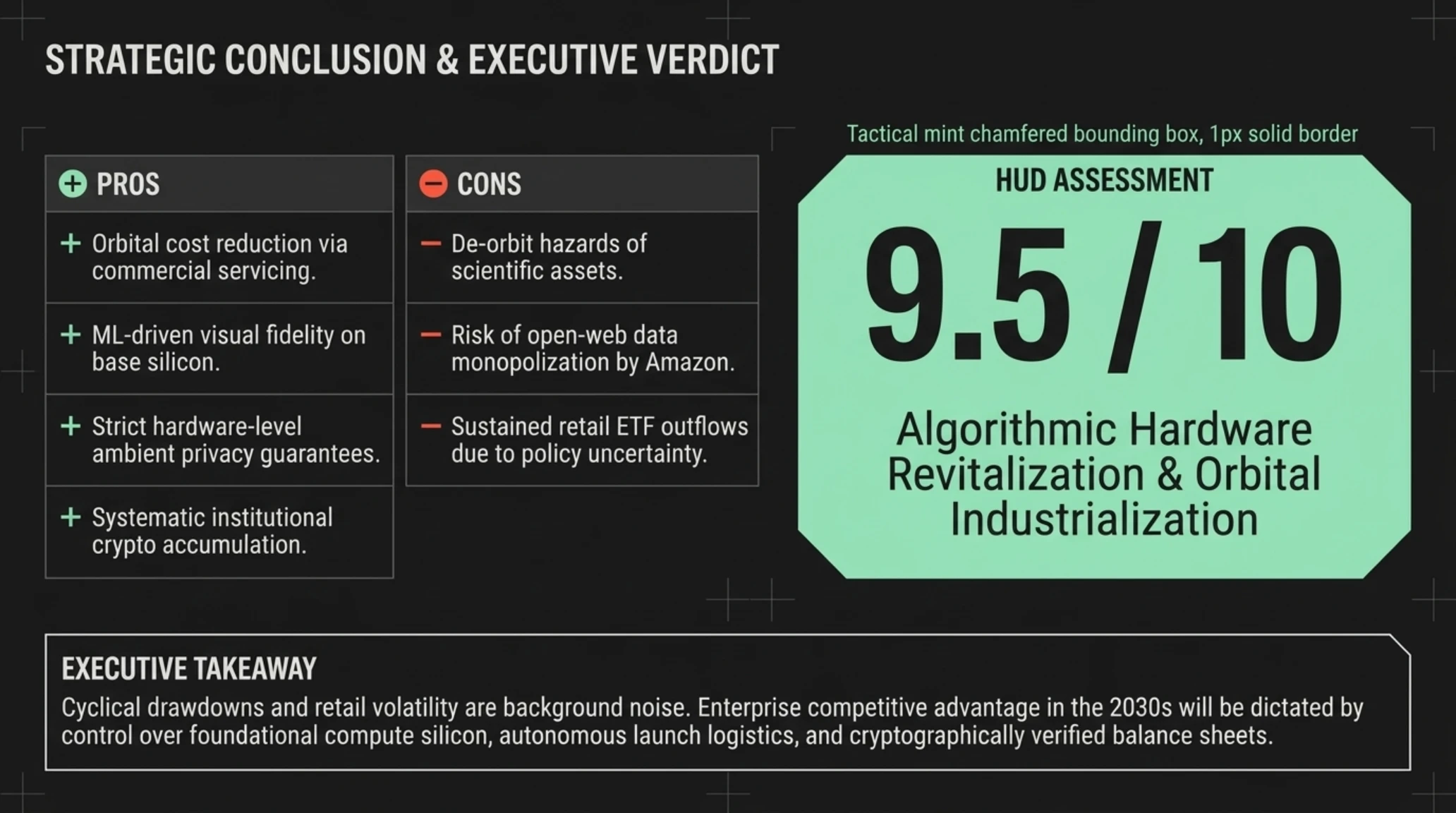
A rigorous multi-axis assessment of the current technological and economic inflection points provides structured clarity for institutional decision-makers:
- Proliferation of commercial on-orbit servicing architectures reducing life-extension costs for scientific assets.
- Significant visual fidelity enhancements on base silicon architectures via lightweight neural upscalers like QSSR.
- Strict silicon-level privacy guarantees for ambient computing devices via Secure Exclaves microkernels.
- Continued accumulation of digital asset equity and infrastructure by Tier-1 commercial banking institutions.
- Catastrophic atmospheric de-orbit hazards if commercial robotic rendezvous missions face regulatory delays.
- Heightened risk of open-web retail data monopolization by dominant platform operators like Amazon.
- Sustained retail capital outflows from spot exchange-traded products due to near-term policy uncertainties.
Strategic posture in late 2026 demands an enterprise framework that balances silicon-level user trust, guaranteed dual-source launch access, and counter-cyclical treasury allocation into foundational network infrastructure.
Technology leaders must synthesize these cross-domain developments into cohesive operational plans, recognizing that hardware longevity, orbital logistics, and tokenized financial rails are converging into a unified digital economy.
The convergence of these core drivers establishes the technological baseline for the year ahead. To synthesize these breakthroughs into an actionable roadmap, the authoritative verdict and definitive answers to executive inquiries are codified below.
Editorial Verdict, Strategic Conclusion & Authoritative Sources Index
- Wired Magazine: Investigative report on NASA commercial RFI to boost Hubble Space Telescope
- IGN Global: Technical breakdown of Sony QSSR neural upscaling on base PlayStation 5 consoles
- The Verge: Exclusive analysis of Amazon confidential World Product Graph retail indexing project
- Spaceflight Now: Comprehensive coverage of ULA Vulcan Centaur return to flight and Amazon Leo launch
- 9to5Mac Security: Architectural analysis of Apple Secure Exclaves hardware sensor microkernel isolation
- CoinTelegraph: Financial analysis of spot Bitcoin ETF redemptions and JPMorgan institutional holdings
Frequently Asked Questions // Strategic Technology Analysis
Why is NASA turning to commercial providers to boost the Hubble Space Telescope?
Following the retirement of the Space Shuttle fleet in 2011, NASA lacks dedicated crewed spacecraft with robotic grappling capabilities to manually service Hubble. To avert an uncontrolled atmospheric de-orbit between 2032 and 2034, NASA is soliciting commercial robotic rendezvous and docking architectures from private aerospace leaders.
How does Sony achieve neural temporal upscaling on the base PS5 without dedicated NPUs?
Developed under Project Amethyst in partnership with AMD, QSSR utilizes custom-quantized convolutional neural inference executed directly across RDNA 2 compute shader pipelines. It processes high-frequency motion vectors and historical frame buffers with negligible compute overhead to deliver sharp, stable reconstruction.
What is the strategic objective behind Amazon's World Product Graph?
Amazon is building an exhaustive semantic index of global consumer products including merchandise it does not retail to feed high-accuracy real-time data to autonomous AI shopping agents, ensuring consumer search traffic remains anchored within its commercial ecosystem.
What caused the 9-month grounding of ULA's Vulcan Centaur rocket?
During an earlier flight, a solid rocket booster nozzle experienced structural burn-through. ULA and Northrop Grumman redesigned the composite material and thermal insulation barriers, completing qualification cycles before successfully orbiting 40 Amazon Leo satellites.
How does Apple's Secure Exclaves differ from the traditional Secure Enclave?
While the Secure Enclave stores encryption keys and biometric hashes, Secure Exclaves is a dedicated silicon domain running an independent microkernel designed to quarantine raw, unbroken sensor feeds from cameras and microphones, preventing host OS compromise in ambient computing hardware.
Why is JPMorgan expanding crypto holdings despite $2.35 billion in spot ETF outflows?
Spot ETF redemptions reflect cyclical profit-taking and tactical hedging by short-term retail traders, whereas institutional banks like JPMorgan are strategically accumulating digital asset equity, corporate debt, and custodian assets at attractive valuations for long-term treasury positioning.
Additional Gallery: Tekin Morning Nov 15: Hubble Rescue, PS5 QSSR & Vulcan Flight