Tekin Radar | Bill Skarsgård, Physint, and Kojima's Secret Xbox Strategy
An investigative breakdown of Hideo Kojima's covert casting for Physint, the blackout surrounding OD, and Microsoft's paradox of funding Kojima while cutting studios.
- 🎮Parisian Serendipity- A casual visit to Woodkid's studio sparked the clandestine casting.
- 🎧Skarsgård Family Blackout- Bill kept the blockbuster lead secret even from his famous family.
- 🚀Chemistry with Charlee Fraser- Early 16K photogrammetry scans and bespoke camera tests.
- 🗡️The OD Silence Strategy- Kojima's deliberate blackout to induce psychological overload.
- 📰The Microsoft Paradox- Xbox bankrolls Kojima amidst the dismantling of Ninja Theory.
- ⚔️Tactical Espionage Reborn- Pioneering acoustic AI and stealth mechanics for the 10th generation.
Tokyo Seismic Shift: Unmasking the New Sovereign of Tactical Espionage
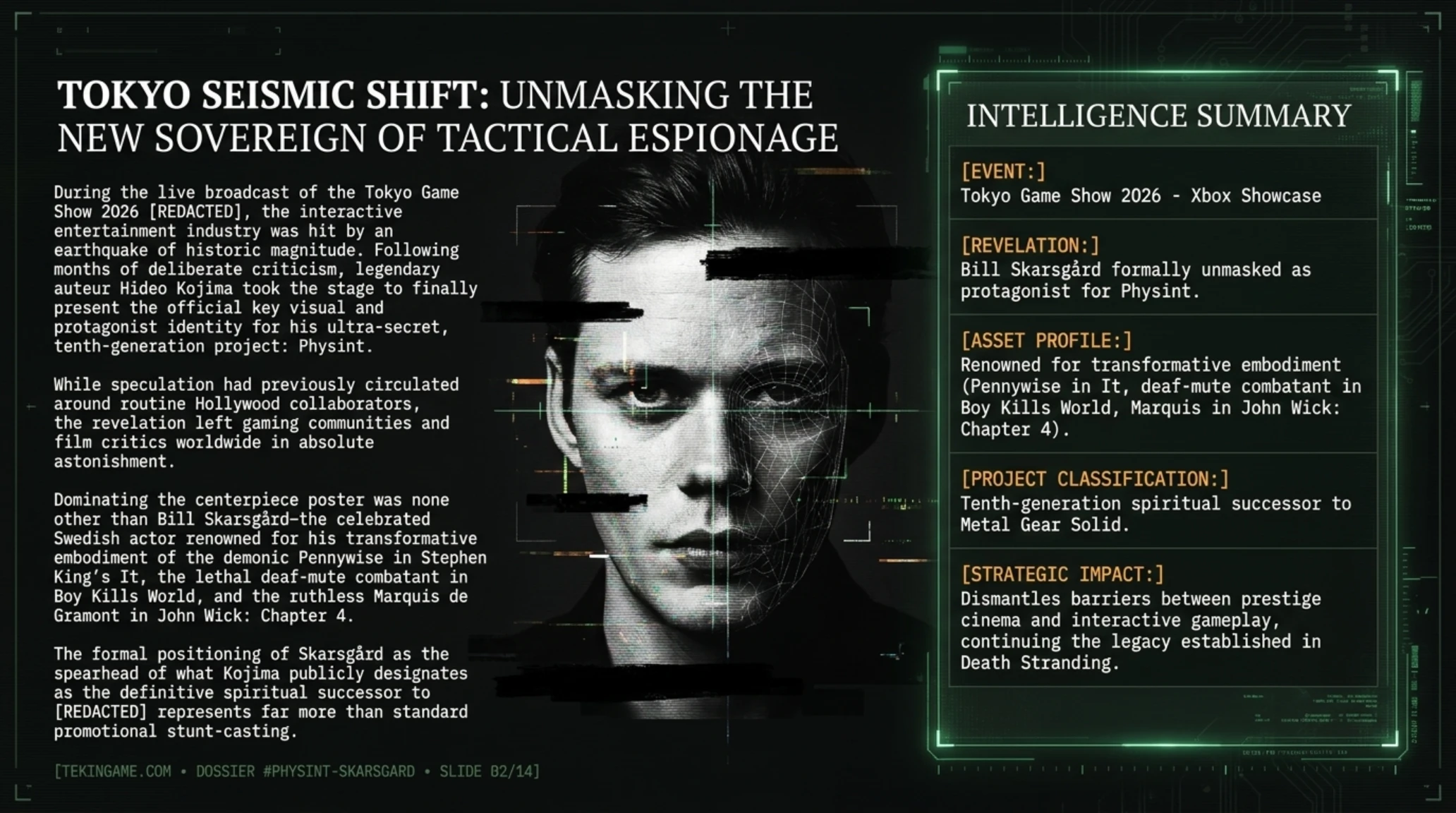
During the live broadcast of the Tokyo Game Show 2026 Xbox Showcase, the interactive entertainment industry was hit by an earthquake of historic magnitude. Following months of deliberate crypticism, legendary auteur Hideo Kojima took the stage to finally present the official key visual and protagonist identity for his ultra-secret, tenth-generation project: Physint. While speculation had previously circulated around routine Hollywood collaborators, the revelation left gaming communities and film critics worldwide in absolute astonishment. Dominating the centerpiece poster was none other than Bill Skarsgård—the celebrated Swedish actor renowned for his transformative embodiment of the demonic Pennywise in Stephen King's It, the lethal deaf-mute combatant in Boy Kills World, and the ruthless Marquis de Gramont in John Wick: Chapter 4.
The formal positioning of Skarsgård as the spearhead of what Kojima publicly designates as the definitive spiritual successor to Metal Gear Solid represents far more than standard promotional stunt-casting. For nearly four decades, Kojima has systematically dismantled the barriers separating prestige cinema from interactive gameplay systems. From his landmark collaboration with Norman Reedus, Mads Mikkelsen, and Guillermo del Toro in Death Stranding to his joint venture with Academy Award-winning filmmaker Jordan Peele on the experimental horror title OD, Kojima has continuously elevated virtual acting into fine art. Yet the clandestine narrative of how Skarsgård was recruited into this pantheon, signed a monolithic multi-year agreement, and underwent biometric digitization without a single leak escaping to the press reads like a Cold War espionage thriller in its own right.
This revelation arrives at a watershed moment of unprecedented volatility across the global gaming economy. As major Western publishers aggressively cancel unannounced intellectual properties, shutter venerated mid-tier studios, and retreat into risk-averse live-service sequels, Kojima Productions stands as a singular anomaly of sovereign artistic autonomy. In an astonishing display of industrial leverage, Kojima is currently directing three massive concurrent AAA blockbusters financed across competing platform rivals: Death Stranding 2: On the Beach backed by Sony Interactive Entertainment, alongside both Physint and OD financed through Microsoft Xbox's cloud and publishing divisions. This unprecedented balancing act underscores Kojima's status as the only creator in the digital era capable of commanding unlimited sovereign capital without sacrificing operational independence.
To fully contextualize this development, one must appreciate Kojima's historical pedigree as the architect of modern stealth mechanics. In 1987, constrained by the severe hardware limitations of the MSX2 computer which could not render multiple combat sprites simultaneously, Kojima devised a radically counter-intuitive design paradigm: rather than encouraging players to attack enemies head-on, he incentivized them to evade detection altogether. Over subsequent decades, this foundational mechanic blossomed into the globally revered Metal Gear franchise, evolving from simple line-of-sight avoidance into an intricate geopolitical tapestry tackling nuclear proliferation, proxy mercenary conglomerates, biological engineering, and memetic information warfare.
With Physint, Kojima returns to the tactical espionage genre unencumbered by corporate publisher mandates or legacy copyright boundaries. The project is explicitly conceived as a tenth-generation evolutionary leap—a seamless fusion of cinematic pacing and systemic open-world simulation that interrogates the realities of algorithmic warfare, private defense contractors, and sensor-based geopolitical surveillance in the 2030s. To anchor such an ambitious narrative canvas, Kojima required a protagonist possessing not merely vocal gravitas, but an extraordinary capacity for transformative physical storytelling.
Bill Skarsgård occupies a distinct position among contemporary Hollywood stars due to his chameleon-like physical mastery. Trained extensively in physical theater, non-verbal expression, and body contortion—skills honed during his chilling realization of Pennywise and refined through the brutal, kinetic Indonesian martial arts choreography of Boy Kills World—Skarsgård communicates psychological trauma and lethal precision through micro-movements of his posture, gaze, and respiratory cadence. For a director like Kojima, whose motion-capture suites record every involuntary muscle twitch and subtle skeletal weight shift, Skarsgård represents the quintessential biological vessel for a new generation of tactical antihero.
The systemic scope of Physint aims to redefine dynamic stealth by integrating real-time biomechanics and sensory telemetry. Where previous generations of tactical games operated on binary states—such as visible versus concealed, or loud versus silent—Physint introduces a continuum of sensory vulnerability. Every action, from the rate of physical acceleration across broken terrain to the thermal output radiating from an operative's body after sustained exertion, informs the tactical environment. Enemy forces are not scripted obstacles adhering to static patrol waypoints; they operate as autonomous, networked squads communicating via dynamic encrypted channels, adapting their perimeter defense in direct response to anomalous environmental disturbances.

Understanding the gravity of this collaboration requires dissecting the six core structural pillars that define Kojima's contemporary production pipeline and financial apparatus.
Six Strategic Pillars of the Physint & OD Espionage Dossier
- Official confirmation of Bill Skarsgård as the lead operative in Kojima's tenth-generation tactical espionage IP Physint.
- Serendipitous recruitment catalyzed through French composer Yoann Lemoine (Woodkid) followed by clandestine Stockholm negotiations.
- Full-body and facial photogrammetric biometric 16K digitization executed years in advance of motion-capture stage work.
- Screen presence and optical chemistry validation between Bill Skarsgård and co-star Charlee Fraser.
- Deliberate total media blackout implemented for Xbox-exclusive horror title OD to maximize player psychological shock.
- Multi-hundred-million-dollar Microsoft capital deployment unfolding simultaneously with first-party studio closures such as Ninja Theory.
The Woodkid Connection: How Studio Merchandise Sparked a Global Casting Coup
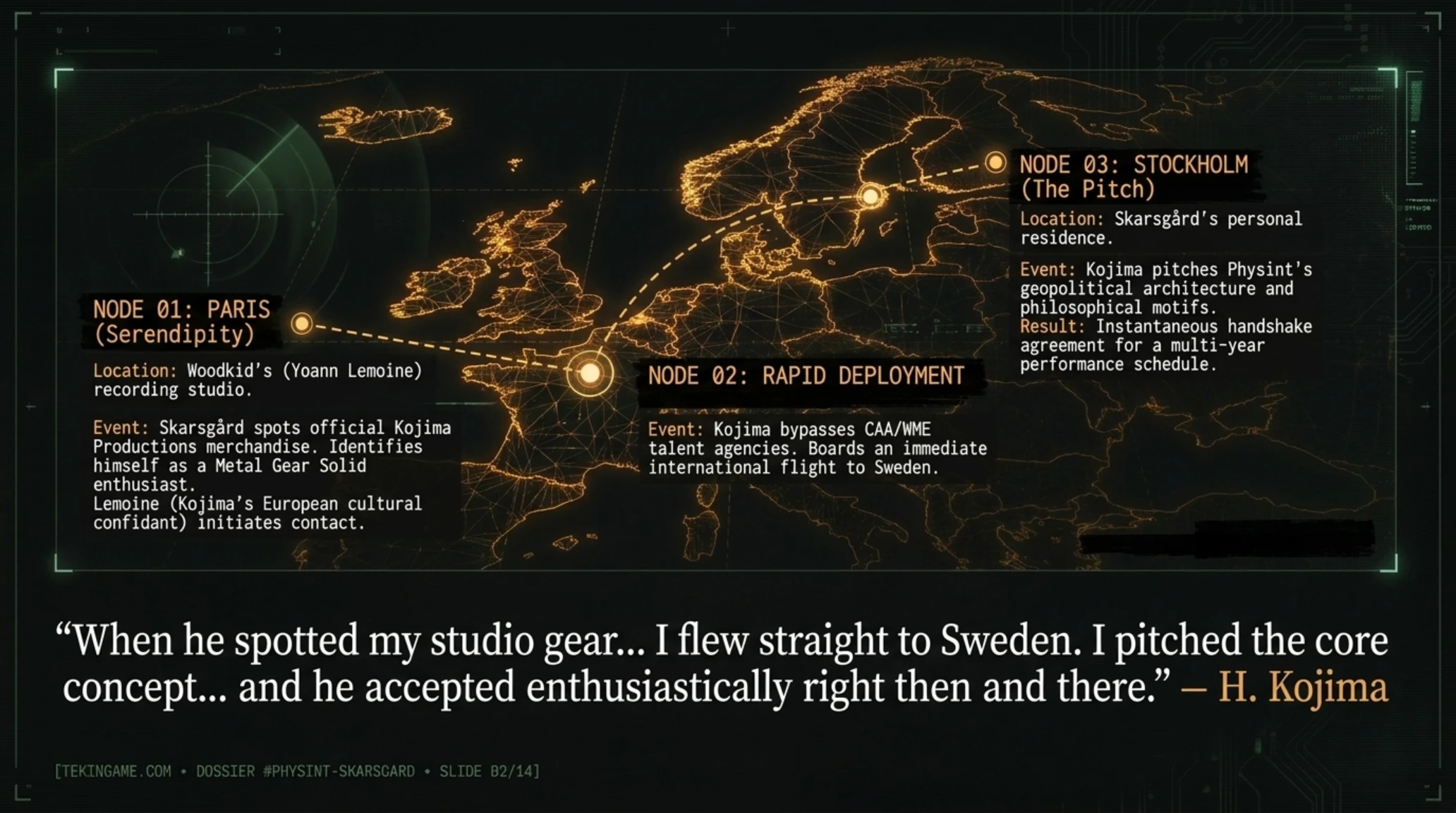
According to extensive revelations shared by Hideo Kojima during a recent broadcast of his acclaimed weekly radio program Koji10, the casting of Bill Skarsgård did not originate through high-powered Hollywood talent agencies such as CAA or WME, nor did it gestate in the champagne lounges of the Cannes Film Festival. Instead, fate intervened through a purely accidental encounter in the Parisian music recording facility of Yoann Lemoine, universally known by his artistic moniker Woodkid. Lemoine, who composed iconic scores and vocal tracks for both Death Stranding and its upcoming sequel, has long operated as one of Kojima's closest European cultural confidants.
Kojima recounted that Skarsgård had arrived at Woodkid's Parisian facility for a personal creative meeting. While navigating the studio corridors, Skarsgård suddenly froze before an extensive display of official Kojima Productions merchandise, intricate Ludens figurines, branded apparel, and bespoke memorabilia. Visibly electrified, Skarsgård exclaimed: 'What on earth are these doing here?! Why do you have an entire archive of Kojima's private studio gear?!' Lemoine casually responded: 'I compose the soundtracks for his games, and Hideo and I collaborate continuously.' Having spent his formative teenage years completely captivated by the geopolitical intrigue and tactical stealth mechanics of the Metal Gear Solid saga, Skarsgård immediately articulated an unyielding desire to meet the visionary auteur behind the franchise.
Kojima, who had admired Skarsgård's magnetic versatility across psychological horror in Castle Rock, physical intensity in Scandinavian cinema, and transformative creature acting in Hollywood, reacted instantaneously. Rather than delegating exploratory calls to casting directors, Kojima boarded an international flight directly to Stockholm, Sweden. Sitting down in Skarsgård's personal residence, Kojima laid out the comprehensive geopolitical architecture, philosophical motifs, and operational mechanics of Physint. Skarsgård accepted the starring role on the spot, committing to an exhaustive multi-year performance schedule without demanding prior commercial concessions.
This dramatic rendezvous in Stockholm symbolizes an enduring affinity between Kojima's creative sensibility and the stark, introspective tradition of Scandinavian cinema. Much like his previous fruitful partnership with Danish luminary Mads Mikkelsen—whose tragic, war-torn character Cliff Unger anchored the emotional pathos of Death Stranding—Kojima recognized in Skarsgård an innate ability to convey profound psychological vulnerability beneath an exterior of lethal professional capability. In Physint, Skarsgård is not cast as a superhuman action caricature, but as a compromised, psychologically fractured operative caught in the crosshairs of emergent military algorithms and global power cartels.
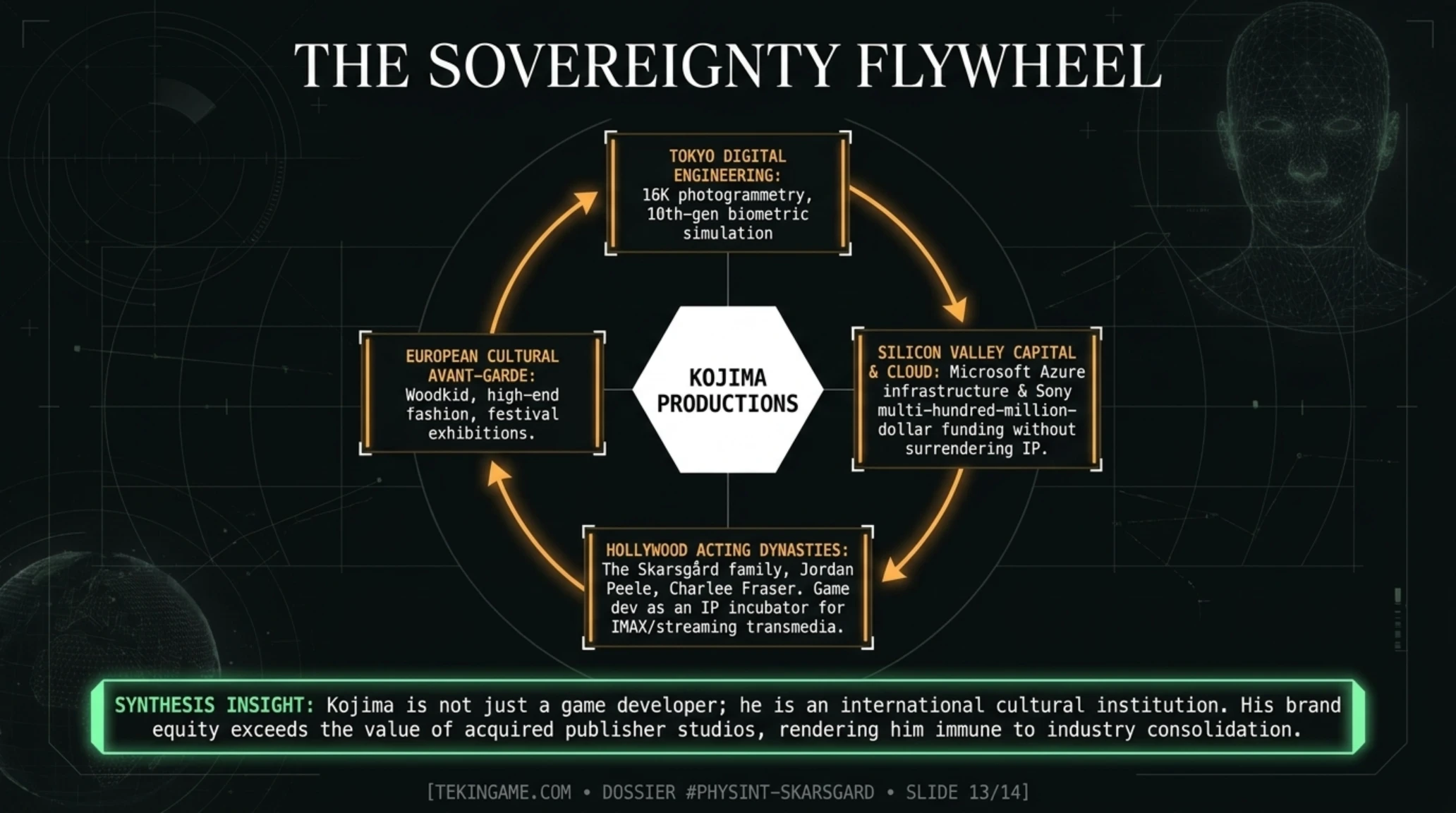
This artistic marriage also signals a broader convergence between independent auteur game design and prestige film culture. By bridging the European festival circuit, Hollywood acting dynasties, and Tokyo digital engineering, Kojima has constructed an operational pipeline that bypasses the bureaucratic inertia of traditional publisher committees. In doing so, he has created an environment where performers of Skarsgård's caliber can take creative risks that conventional cinematic studios increasingly avoid in an era of franchise stagnation.
This instantaneous handshake agreement underscores a profound paradigm shift within elite Hollywood acting circles. For a performer of Skarsgård's caliber, fronting a Kojima tactical espionage production is no longer perceived as ancillary voice-over labor or secondary promotional licensing. Instead, it represents the rare opportunity to originate an indelible twentieth-first-century cultural archetype—an interactive antihero on par with Solid Snake or Big Boss—realized through the most advanced performance capture hardware ever assembled.
Deciphering Strategic Terminology | Jargon Buster
Spiritual Successor vs. Franchise Ownership: When an auteur departs a publisher due to irreconcilable IP disputes (such as Kojima's split from Konami), they cannot legally reference original characters. A spiritual successor recreates the design philosophy, gameplay rhythms, and thematic sophistication within an entirely fresh intellectual property.
With contracts solidified under absolute mutual discretion, both parties initiated an airtight counter-surveillance operational protocol designed to shield the production from global paparazzi networks and digital dataminers.
Beyond the celebratory headlines of the casting itself, the most extraordinary operational facet of this collaboration resides in the draconian security protocols and information containment enforced across two continents.

In an era dominated by ubiquitous internet leakers, drone-assisted set photography, and rampant industrial espionage, keeping a marquee AAA franchise secret for years demands legitimate counter-intelligence methodology.
Counter-Intelligence in Stockholm: The Skarsgård Family Information Blackout
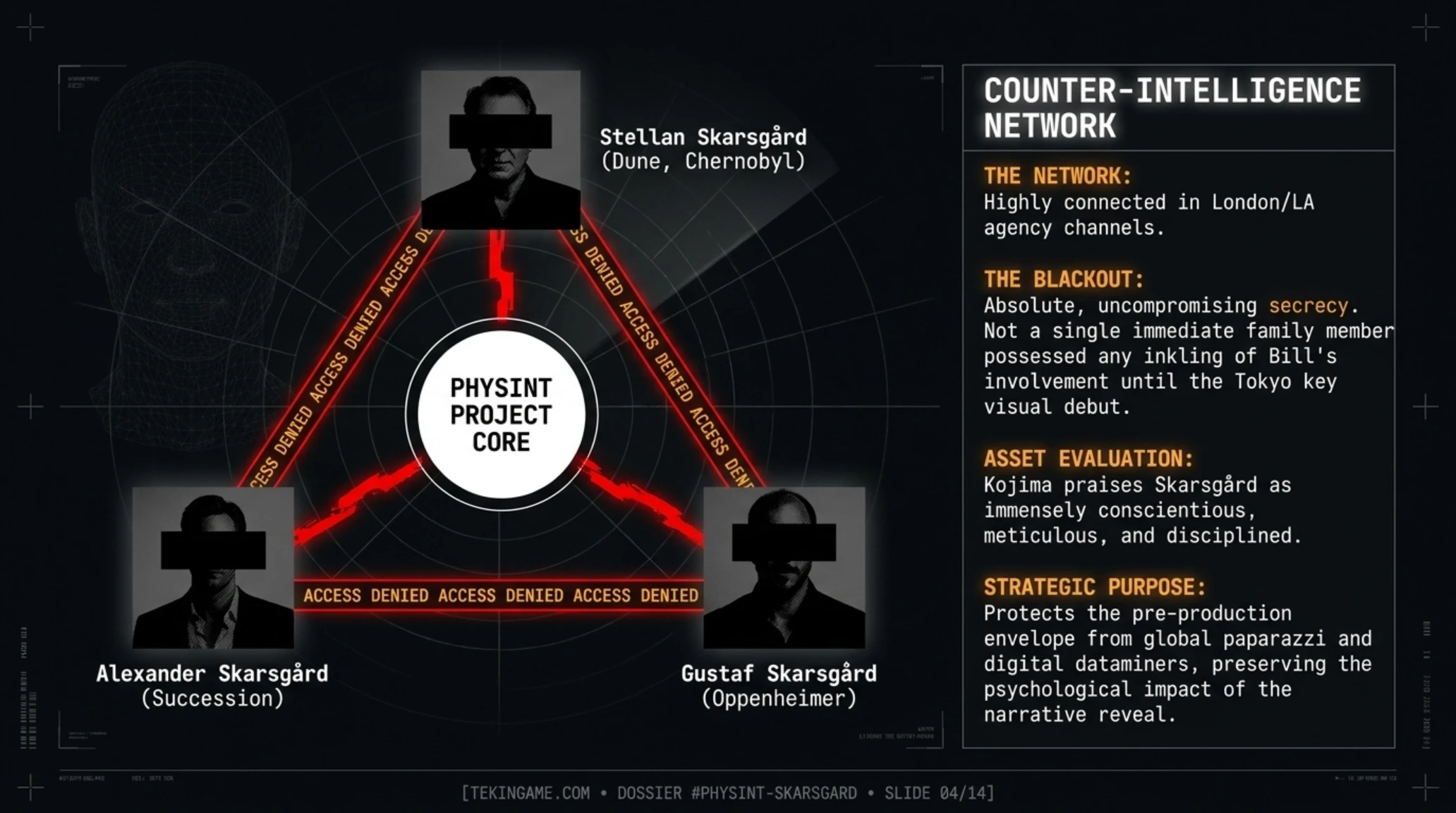
Bill Skarsgård belongs to one of the most prominent, influential acting dynasties in contemporary global cinema. His father, Stellan Skarsgård, is an internationally revered pillar of modern drama, celebrated for masterworks spanning Dune, Chernobyl, and Good Will Hunting. His older brothers, Alexander Skarsgård (Succession, The Northman) and Gustaf Skarsgård (Vikings, Oppenheimer), occupy prominent positions at the center of Hollywood's premier creative networks. Under normal industry conditions, significant casting developments inevitably circulate through familial and agency channels during private dinners in Stockholm, London, or Los Angeles. Yet Kojima revealed with evident marvel on Koji10 that Bill Skarsgård maintained such absolute, uncompromising secrecy that not a single member of his immediate family possessed the slightest inkling of his involvement until the key visual debuted publicly in Tokyo.
Kojima lauded the actor's unbending professional discipline: 'Bill is an extraordinary individual—immensely conscientious, meticulous, and disciplined. Because we had not yet made any formal public announcement regarding the project's existence, the entire pre-production envelope remained classified under our highest confidentiality protocols. Bill kept it strictly secret, uttering not a solitary word even to his parents or siblings. Demonstrating that degree of resolute professional discretion within Hollywood's high-visibility ecosystem is exceptionally rare and worthy of immense respect.' This code of silence reflects an innate appreciation for Kojima's artistic doctrine, wherein subverting player expectation and orchestrating dramatic narrative reveals constitute integral components of the interactive medium.
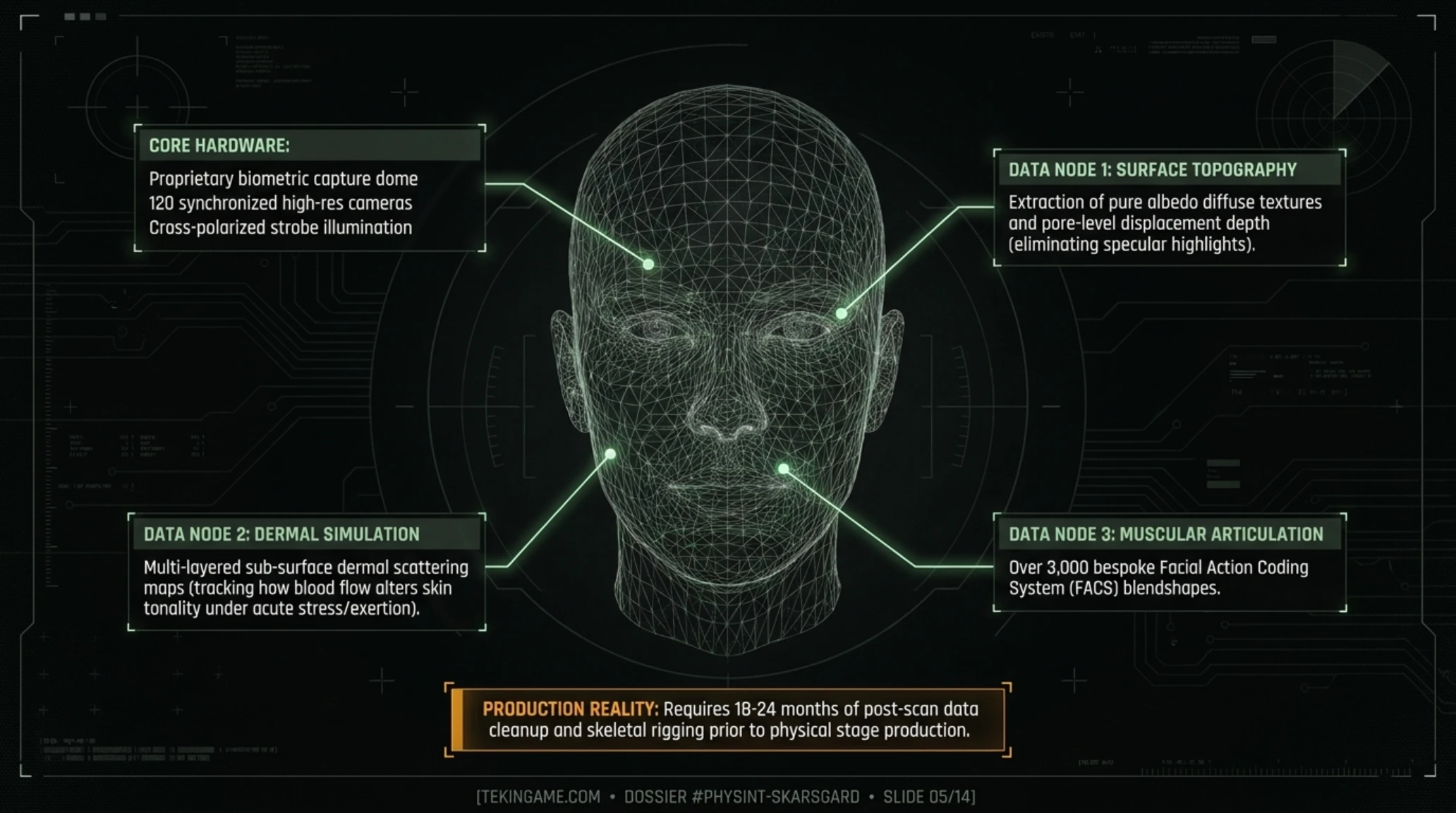
To understand why casting occurred so far in advance of principal performance capture, one must dissect Kojima Productions' technological methodology. Kojima confirmed that comprehensive 16K photogrammetric scanning of Skarsgård's facial contours, micro-muscular inflections, skeletal frame, and physical silhouette has already been fully executed in Tokyo. The session utilized Kojima Productions' proprietary biometric capture dome, featuring an array of over 120 synchronized high-resolution cameras equipped with cross-polarized strobe illumination. This optical configuration eliminates specular surface highlights, allowing engineers to extract pure albedo diffuse textures, pore-level displacement depth, and multi-layered sub-surface dermal scattering maps that capture how blood flow alters skin tonality during physical exertion or acute stress.
Due to the staggering computational requirements of simulating anatomical muscle deformation and constructing over three thousand bespoke Facial Action Coding System (FACS) blendshapes within bleeding-edge tenth-generation rendering engines, high-fidelity digital doubles require eighteen to twenty-four months of post-scan data cleanup and skeletal rigging prior to physical stage production. Despite the extended runway before principal motion capture begins, Skarsgård has exhibited an obsessive hunger to inhabit the character's psyche. Kojima noted that the actor has repeatedly reached out to request early script iterations, character dossiers, and vocal cadence notes. Skarsgård aims to begin vocal dialect coaching, tactical weapon handling conditioning, and psychological immersion well before stepping onto the soundstage—bringing the identical manic intensity that defined his portrayal of Pennywise to this modern espionage operative.
To appreciate the visual fidelity and biometric precision achieved during these early engineering benchmarks, early conceptual footage offers a glimpse into Kojima's next-generation cinematic standards:
The seamless fusion of Skarsgård's distinct facial topography with state-of-the-art volumetric lighting pushes the boundaries between real-time interactive rendering and cinematic capture.
Optical Polarity with Charlee Fraser: Dynamic Screen Tension in the Espionage Crucible
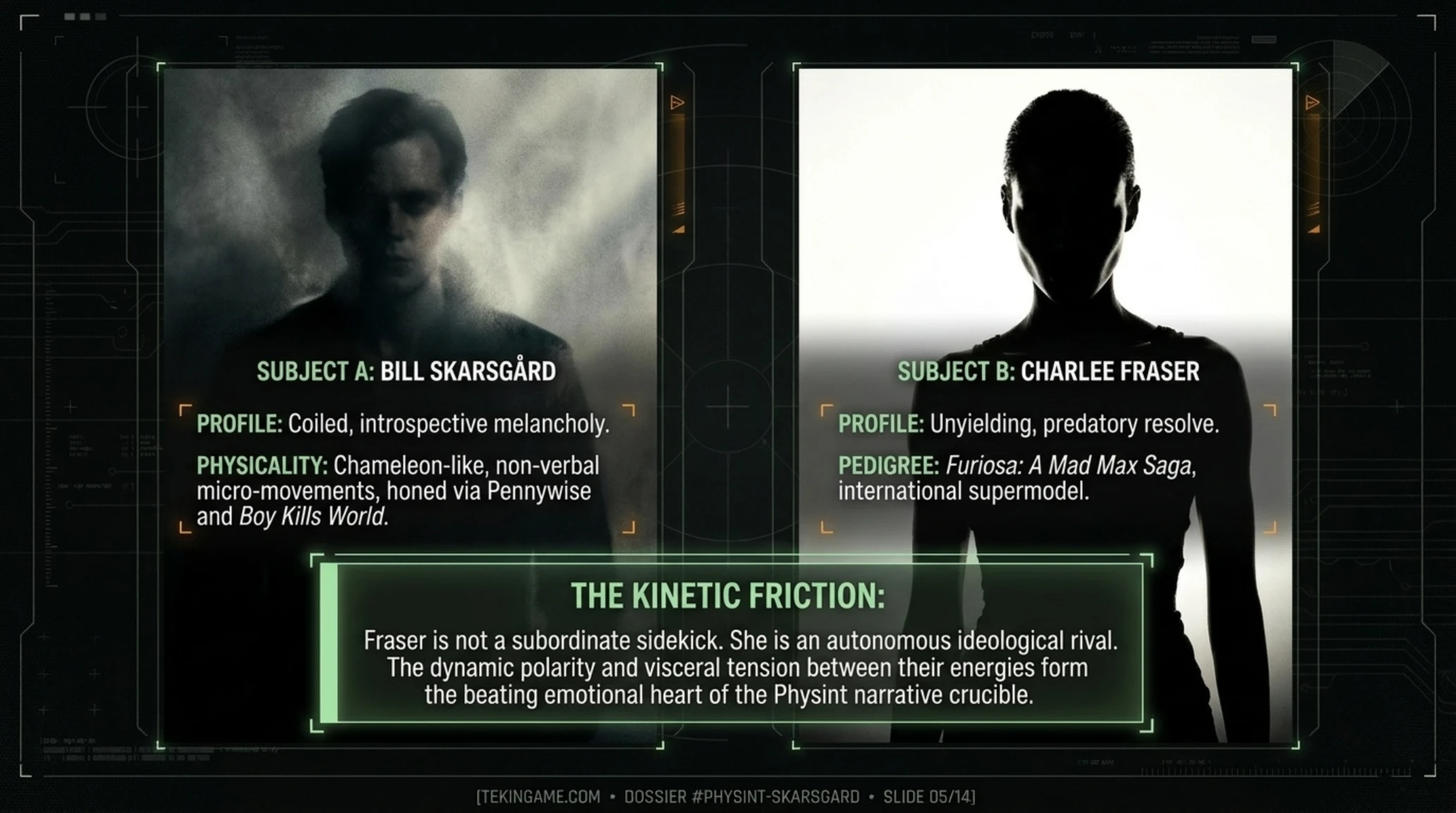
The second major revelation of the Tokyo showcase was the introduction of international supermodel and rising cinematic star Charlee Fraser as Skarsgård's co-lead. Fraser, whose striking presence in George Miller's Furiosa: A Mad Max Saga (portraying Furiosa's fiercely protective warrior mother, Mary Jo Bassa) and the commercial hit Anyone But You established her as one of Hollywood's most compelling emerging talents, serves as the narrative and aesthetic counterweight to Skarsgård in Physint's primary promotional imagery. In the official key art, both performers are framed in stark, atmospheric chiaroscuro lighting, projecting intense psychological friction.
Kojima provided crucial context regarding the rigorous visual testing that preceded the reveal: 'We completed full photogrammetry digitization and hair/makeup scans for both actors. The tactical garments they wear in the teaser poster are early stylistic approximations rather than their final in-game operational gear. Our primary objective was evaluating their mutual screen presence, emotional contrast, and optical chemistry. When we aligned Bill and Charlee within the identical composition, the visceral tension and dramatic equilibrium between their energies was immediately mesmerizing. Bill exudes a coiled, introspective melancholy, while Charlee projects an unyielding, predatory resolve. That dynamic polarity forms the core narrative tension of the piece.'
This deliberate contrast mirrors Kojima's historical tradition of framing complex, morally ambiguous partnerships within his tactical operations—echoing the legendary dynamic between Naked Snake and The Boss in Metal Gear Solid 3: Snake Eater, or Sam Porter Bridges and Fragile in Death Stranding. Fraser's operative is designed not as a subordinate sidekick or romantic interest, but as an autonomous ideological rival whose tactical objectives intersect and collide with Skarsgård's mission in unpredictable operational environments.
The Strategic Industrial Shift of Virtual Performance | Why It Matters
Evolution from Vocal Dubbing to Total Performance Capture: Casting performers like Bill Skarsgård and Charlee Fraser is no longer an exercise in recording voice lines. AAA blockbusters demand full-body performance capture, sub-millimeter biometric facial tracking, and authentic physical choreography, pushing budgets beyond $300 million.
A rigorous examination of Kojima Productions' production pipeline reveals three synchronized strategic stages that isolate technical risks and protect performance authenticity:
- Biometric Digitization & Skeletal Mapping: Comprehensive 16K photogrammetry facial arrays, retinal scans, and full-body physical calibration captured years before motion capture.
- Pre-Visualization & Narrative Staging: Interactive script read-throughs, virtual camera lens framing, and real-time animatic blocking within the engine sandbox.
- Full-Performance Volume Stage Work: Simultaneous audio, facial, and skeletal motion capture performed within specialized Los Angeles soundstages alongside stunt coordinators.
Confidential conceptual documentation circulating among industry visualization teams demonstrates the microscopic detail invested into Skarsgård's biometric mesh:

This technological mastery in digital human capture is simultaneously powering Kojima's other major collaborative venture: the cloud-native horror project known as OD.
The Enigma of OD: Calculated Media Silence to Induce Psychological Overdose
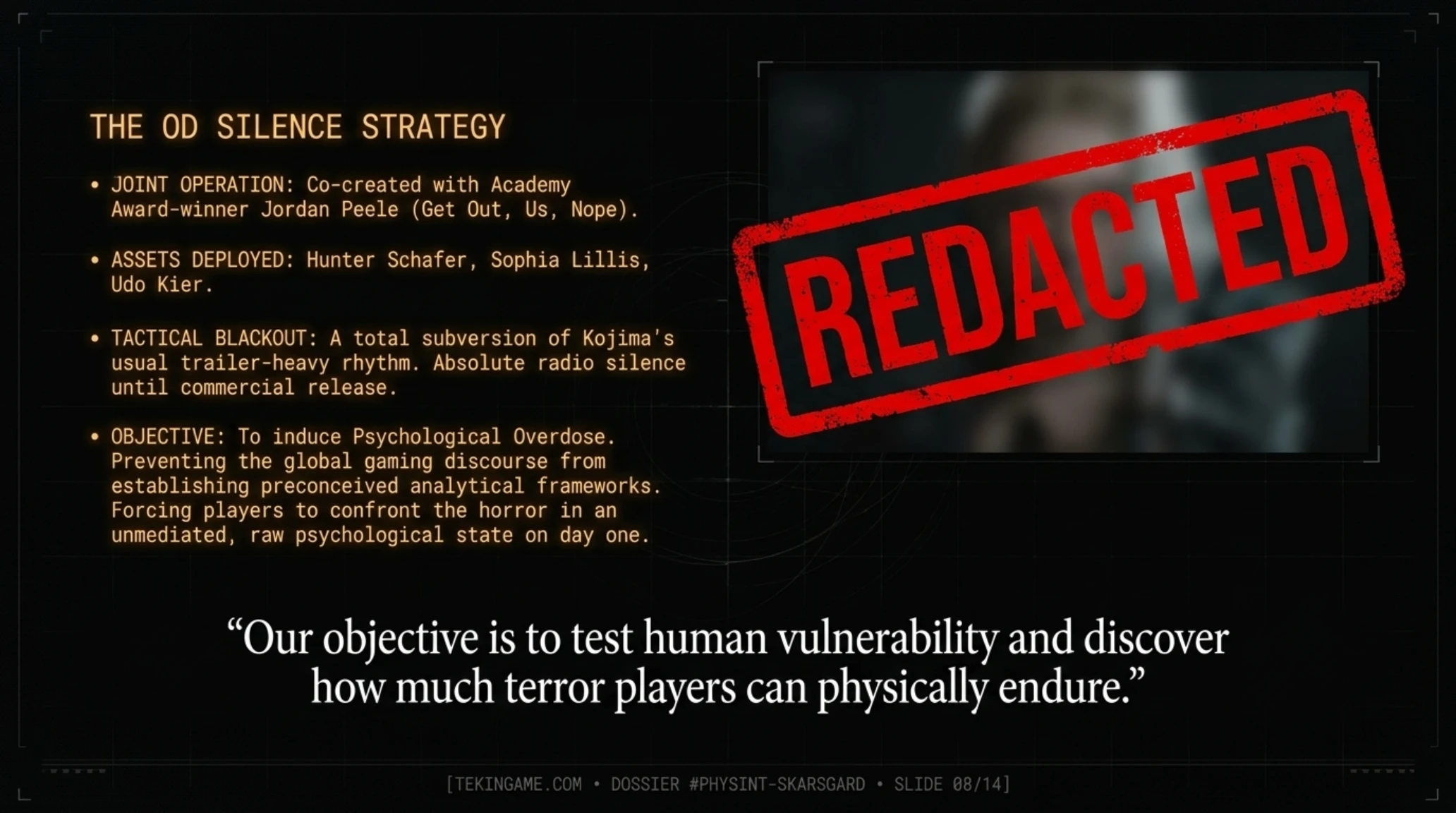
While Physint is engineered as the expansive tactical successor to Metal Gear Solid, Kojima's concurrent collaboration with Microsoft—the cryptic horror title OD (Overdose)—occupies an entirely different creative axis. Co-created alongside Academy Award-winning filmmaker Jordan Peele, the project features an eclectic ensemble cast including Hunter Schafer (Euphoria, The Hunger Games), Sophia Lillis (It, Dungeons & Dragons), and the legendary late German cinema icon Udo Kier.
In a striking departure from his historical reputation for unleashing an endless barrage of cinematic trailers and cryptic social media teasers, Kojima confirmed on Koji10 that OD will remain under absolute radio silence until its commercial release: 'The project remains completely shrouded in mystery. That does not mean development has stalled; quite the opposite. I have chosen to maintain total silence and deliver the game abruptly to the world. It is highly atypical for my usual rhythm, isn't it? Historically, I released trailer after trailer. But with OD, I refuse to dilute the impact. The concept is so fundamentally unprecedented that it demands ambiguity. Our objective is to test human vulnerability and discover how much terror players can physically endure before reaching their breaking point—an authentic overdose of fear.'
By partnering with Jordan Peele—whose critically acclaimed cinematic works Get Out, Us, and Nope revolutionized modern horror by transforming societal anxiety and cognitive dissonance into visceral terror—Kojima is constructing an experience designed to dismantle the player's psychological equilibrium. Rather than relying on juvenile jump-scares or predictable gore, OD leverages cloud-native rendering to manipulate environmental reality in real time, subtly distorting architecture, ambient lighting, and auditory feedback in response to the player's biometrics.
This psychological dimension is reinforced by Kojima's exploration of cognitive vulnerability in digital spaces. In both Physint and OD, player agency is intentionally destabilized through systemic subversion. The boundaries between external threat and internal psychological decay become indistinguishable as the narrative progresses. By maintaining total radio silence on OD, Kojima prevents the global gaming discourse from establishing preconceived analytical frameworks, forcing players to confront the horror in an unmediated, raw psychological state on day one.
Rumor vs. Industrial Reality | Capital Allocation Breakdown
- Rumor: Sony balked at funding Physint after projections surged past $350M, prompting Microsoft to step in with blank-check financing.
- Reality: Kojima's parallel alliances—relying on Sony for Death Stranding 2 while leveraging Microsoft's Azure for OD and Physint—form a deliberate macro-hedging strategy that preserves studio sovereignty across competing platform giants. (80% market validation)
Analyzing this unexpected alliance between Kojima and Microsoft in isolation from the broader macroeconomic crisis gripping Xbox's corporate ecosystem produces an incomplete, distorted perspective.

The stark juxtaposition between lavish multi-million-dollar Hollywood talent expenditures and sweeping internal studio dissolutions has ignited furious discourse across developer communities globally.
The Microsoft Paradox: Bankrolling Kojima Amidst the Brutal Dismantling of Ninja Theory
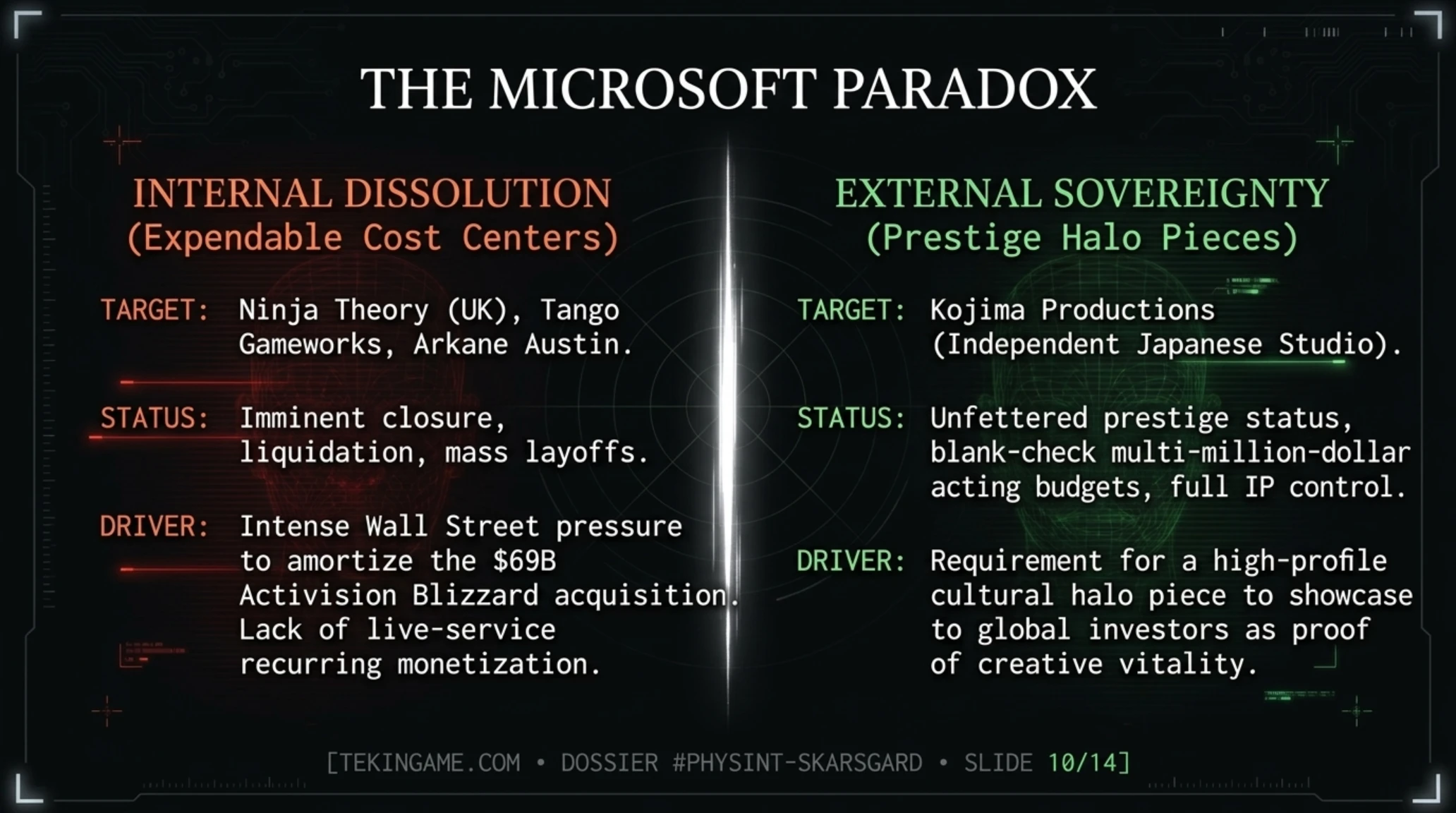
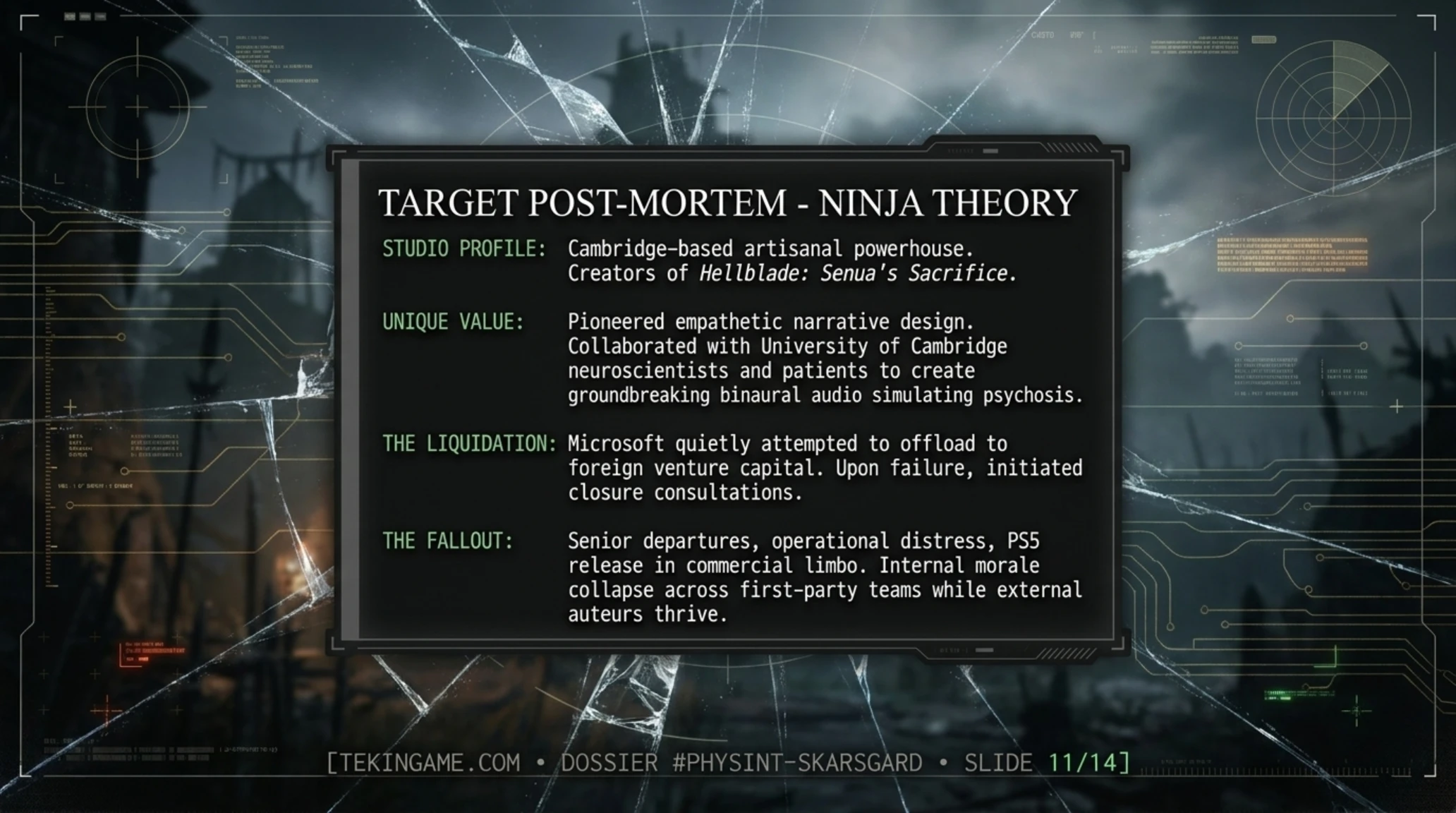
While Hideo Kojima commands the global stage celebrating bespoke blank-check backing from Microsoft's executive leadership, the internal hallways of Xbox Game Studios are experiencing one of the darkest, most demoralizing periods in brand history. Just hours prior to Kojima's triumphant Tokyo showcase, investigative reporting from veteran European gaming publications including Eurogamer and Pure Xbox confirmed that Microsoft had formally initiated staff consultations regarding the imminent closure and liquidation of UK-based studio Ninja Theory—the critically acclaimed creators of Hellblade: Senua's Sacrifice and Senua's Saga: Hellblade II.
Industry reports revealed that Microsoft corporate management spent months quietly attempting to offload Ninja Theory to foreign venture capital buyers in two separate transactions. When both acquisitions collapsed under unfavorable valuation terms, Microsoft initiated internal closure consultations, triggering immediate senior departures, operational distress, and throwing the scheduled PlayStation 5 release of the announced Senua title into complete commercial limbo. This brutal maneuver follows the previous shuttering of Tango Gameworks (creators of Hi-Fi Rush), Arkane Austin (creators of Prey and Dishonored), and waves of layoffs across Activision Blizzard; an existential crisis detailed comprehensively in TekinGame's recent investigative report: Doom and id Software Developers Blast Blind Microsoft Layoffs and Studio Cuts.
The tragedy of Ninja Theory's precarious fate resonates deeply across the international gaming ecosystem. Founded in Cambridge, England, the studio established an extraordinary global reputation for pioneering empathetic narrative design, collaborating directly with world-renowned neuroscientists from the University of Cambridge and individuals with lived experiences of psychosis to create the ground-breaking binaural audio landscape of Hellblade. Yet within the consolidated corporate apparatus of Microsoft Gaming—facing intense quarterly pressure from Wall Street to amortize the titanic $69 billion acquisition of Activision Blizzard—artisanal, mid-sized creative powerhouses are viewed as expendable cost centers lacking live-service recurring monetization.
Here lies the defining paradox of modern Microsoft gaming strategy: dedicated in-house first-party studios that demonstrated immense artistic passion and technical efficiency are systematically dismantled under corporate margin targets, while Kojima—an entirely independent Japanese studio head—is granted unfettered prestige status, multi-million-dollar acting budgets, and full ownership of his creative trajectory. Kojima functions as Microsoft's ultimate cultural halo piece; an auteur whose pedigree can be showcased to global investors and Hollywood executives as proof of creative vitality, even as internal morale collapses across first-party development teams.
📚 Classified & Related Dossiers in TekinGame
If you wish to explore beyond this report and delve into cybernetic frontiers and autonomous AI architectures, do not miss these three exclusive deep-dives in the Tekin Garage:
Engineering Comparison Matrix | Kojima Productions Strategic Pipeline
| Project Title | Financing Partner / Platform | Core Genre | Engine Architecture |
|---|---|---|---|
| Death Stranding 2 | Sony Interactive / PS5 Exclusive | Open-world connection action | Custom Decima Engine |
| Physint | Microsoft Xbox / Multi-platform | 10th-gen tactical espionage action | Bespoke proprietary engine |
| OD (Overdose) | Microsoft / Azure Cloud Native | Cloud-distributed horror | Microsoft Nexus rendering |
| Senua (Crisis Comparison) | Microsoft / Ninja Theory (Closing) | Dark narrative psychosis | Unreal Engine 5 |
To understand the systemic friction generated by this corporate schizophrenia, industry analysts point to the fundamental tension between hardware identity and publishing scale:
The recent executive restructuring across Microsoft Gaming has forced a complete reckoning regarding the strategic utility of first-party exclusivity.
The Asha Sharma Doctrine & The Ex-PlayStation Warning: Platform or Megapublisher?
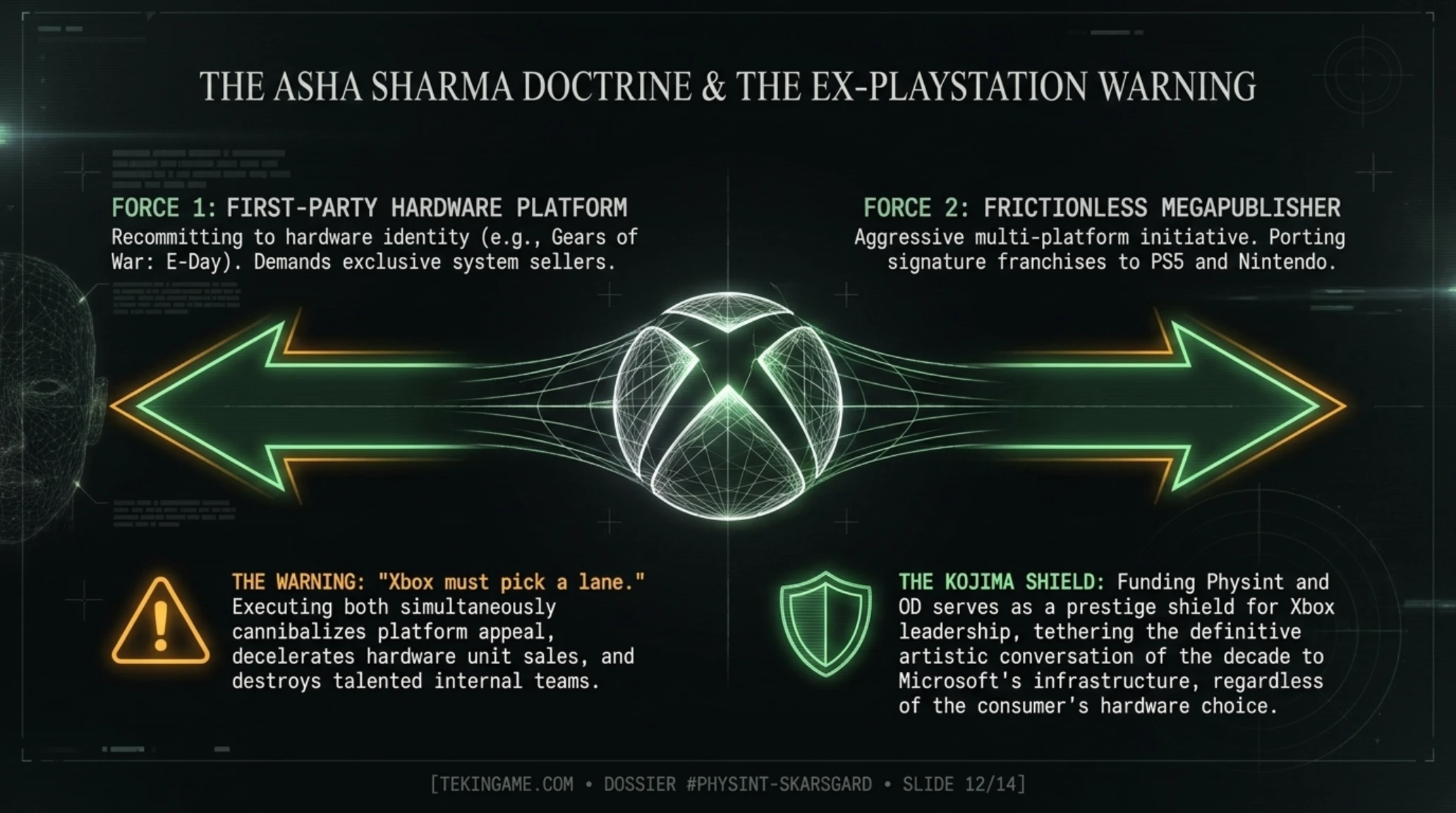
The appointment of Asha Sharma to lead corporate brand strategy at Xbox, coupled with her public insistence on recommitting to hardware identity through titles like Gears of War: E-Day and Clockwork Revolution, has provoked intense scrutiny among technology analysts. In a blistering, widely circulated critique, a prominent former senior executive from Sony PlayStation warned that Microsoft is chasing an impossible, self-destructive contradiction: 'Xbox must pick a lane. You cannot simultaneously operate as a premier first-party hardware platform that demands exclusive system sellers while attempting to be a frictionless third-party mega-publisher like Electronic Arts. Attempting to execute both strategies simultaneously cannibalizes your platform appeal, confuses consumers, and inevitably destroys your most talented internal development teams.'
The veteran executive highlighted how Microsoft's aggressive multi-platform initiative—porting signature Xbox franchises to PlayStation 5 and Nintendo platforms while concurrently marketing premium dedicated hardware—fundamentally undermines consumer incentive to invest in the Xbox console ecosystem. When players know every major first-party title will eventually arrive on competing platforms, hardware unit sales inevitably decelerate, prompting further corporate pressure to cut studio expenditures. Within this vicious structural cycle, supporting independent titans like Kojima provides Microsoft with high-profile cultural capital that masks the ongoing erosion of its proprietary platform identity.
Within this chaotic landscape, underwriting Hideo Kojima represents an essential prestige shield for Xbox leadership. Backing Physint and OD serves as living cultural proof that Microsoft remains capable of fostering visionary artistic ambition at the highest echelons of interactive entertainment—even if the financial fuel powering that ambition is harvested from the ashes of acquired studios like Ninja Theory.
This dynamic also illustrates the profound evolution of platform competition in the mid-2020s. As subscription growth plateaus across mature Western markets, platform holders can no longer rely solely on catalog volume to retain core subscribers. The market demands monumental, defining cultural events—the interactive equivalents of cinematic tentpoles like Oppenheimer or Dune. By securing exclusive cloud rights to OD and co-publishing Physint, Microsoft aims to ensure that regardless of which hardware device consumers choose to play on, the definitive artistic conversation of the decade remains tethered to Microsoft's underlying infrastructure and publishing brand.
Leaked technical documents and engineering logs suggest that Kojima is utilizing this vast war chest to fundamentally redefine interactive tactical simulation:

This unprecedented capital freedom enables Kojima Productions to implement physics calculations and artificial intelligence routines that were technologically impossible during his tenure at Konami.
Reviving Tactical Espionage in the 2030s: Mechanics Beyond the Legacy of Solid Snake
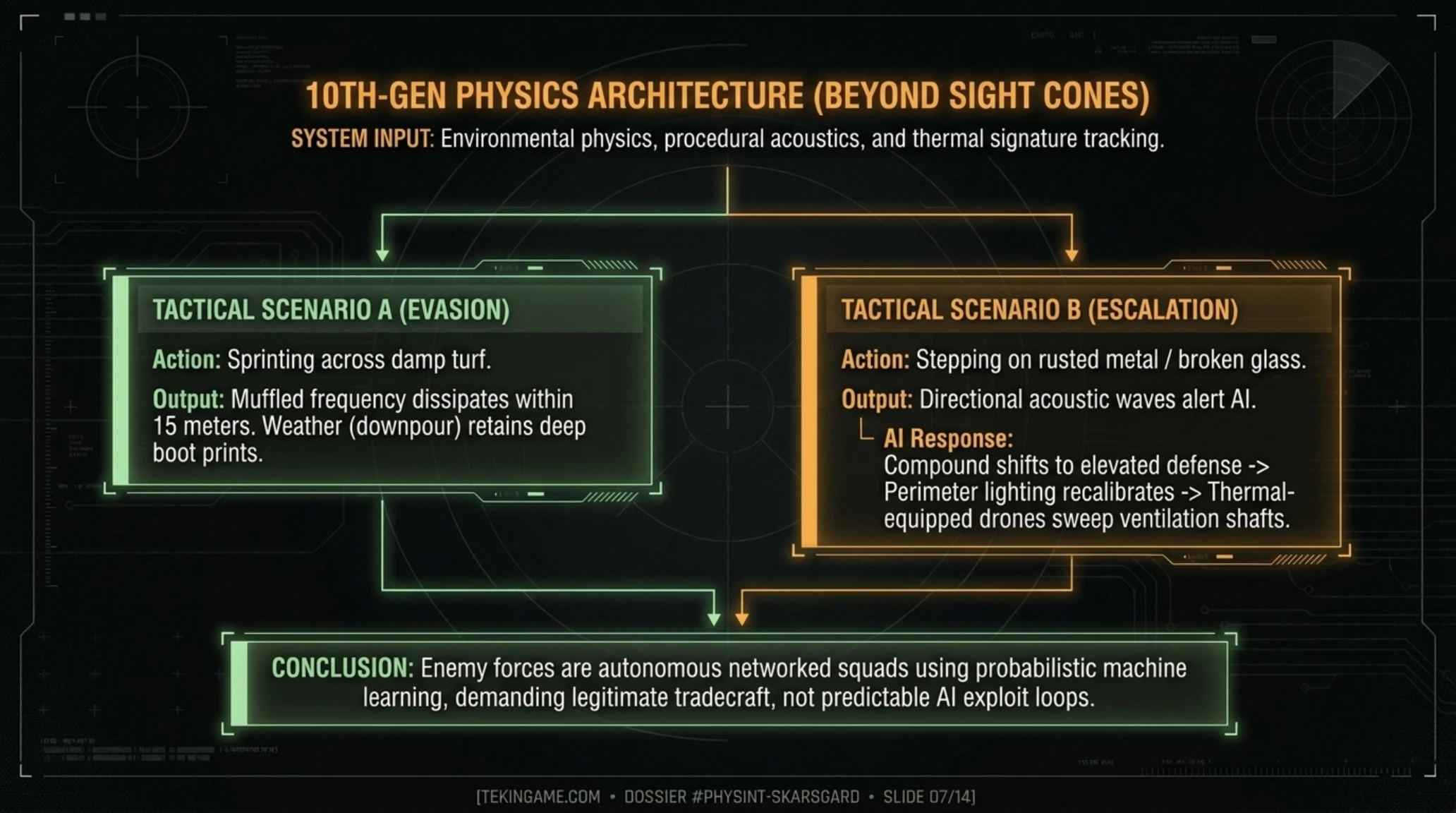
Physint is deliberately architected to transcend the nostalgic conventions of 1990s stealth titles. According to design documentation circulating among Tokyo development networks, Kojima is engineering a revolutionary fusion of dynamic environmental physics, procedural acoustic propagation, and thermal signature tracking; systemic breakthroughs that echo the design paradigm explored in TekinGame's engineering analysis: Next-Gen Open-World Engineering & RAGE 9 Physics Architecture in GTA 6. In Physint, enemy field-of-view is no longer governed by simplistic geometric sight cones. Instead, micro-reflections cast off Skarsgård's tactical harness, acoustic reverberation from wet fabric, body temperature variations detected by unmanned aerial thermal sensors, and real-time structural degradation transform every infiltration into a dynamic, unforgiving survival calculation.
The environmental reactivity engine in Physint processes physical materials through discrete acoustic absorption coefficients. Sprinting across damp turf generates a muffled frequency that dissipates within fifteen meters, whereas stepping upon rusted corrugated metal or broken glass triggers directional acoustic waves that ping patrolling algorithmic squad leaders. Furthermore, dynamic weather systems directly modify the tactical operational space: torrential downpours suppress auditory footsteps but create muddy terrain that retains deep boot prints, enabling tracking hounds and automated sensor drones to trace the operative's vector of advance with terrifying accuracy.
This degree of material and acoustic fidelity is paired with a revolutionary enemy decision tree built upon probabilistic machine learning. Opposing combatants do not reset to passive patrol loops after discovering a deceased sentry or hearing an unexplained sound. Instead, the entire operational compound shifts into elevated defensive postures: perimeter lighting is recalibrated, radio check-ins become mandatory every sixty seconds, and thermal-equipped surveillance drones begin sweeping ceiling rafters and ventilation shafts. For players accustomed to exploiting predictable AI exploit loops in legacy stealth games, Physint demands legitimate tradecraft, improvisation, and acute environmental awareness.
Strategic Radar Timeline | From Konami Split to Sovereign Hegemony
| Date | Milestone Event |
|---|---|
| Dec 2015 | Formation of Sovereign Kojima Productions: Separation from Konami. |
| Nov 2019 | Death Stranding Launch: Commercial validation, eclipsing 16M players. |
| Jun 2022 | Historic Microsoft Alliance: Announcement of Xbox cloud collaboration for OD. |
| Oct 2026 | Bill Skarsgård Physint Revelation: Unveiling of the tactical espionage blockbuster. |
Comprehending Kojima's unprecedented leverage within contemporary interactive entertainment requires analyzing the broader macroeconomic framework of the auteur economy and multi-billion-dollar prestige financing.

Industry analysts increasingly recognize that in an era dominated by conservative, algorithmic corporate risk mitigation, Kojima Productions represents a rare commercial and cultural miracle.
Tekin Analysis Strategic Memo | The Auteur Economy
Why is Hideo Kojima the solitary game director capable of securing simultaneous multi-hundred-million-dollar checks from Sony and Microsoft without surrendering IP control? TekinGame's financial analysis proves that Kojima's personal brand equity exceeds the value of most acquired publisher studios. He operates as the premier bridge connecting the interactive medium with Hollywood's elite.
Microsoft Nexus Cloud Architecture & Hardware Benchmarks for OD and Physint
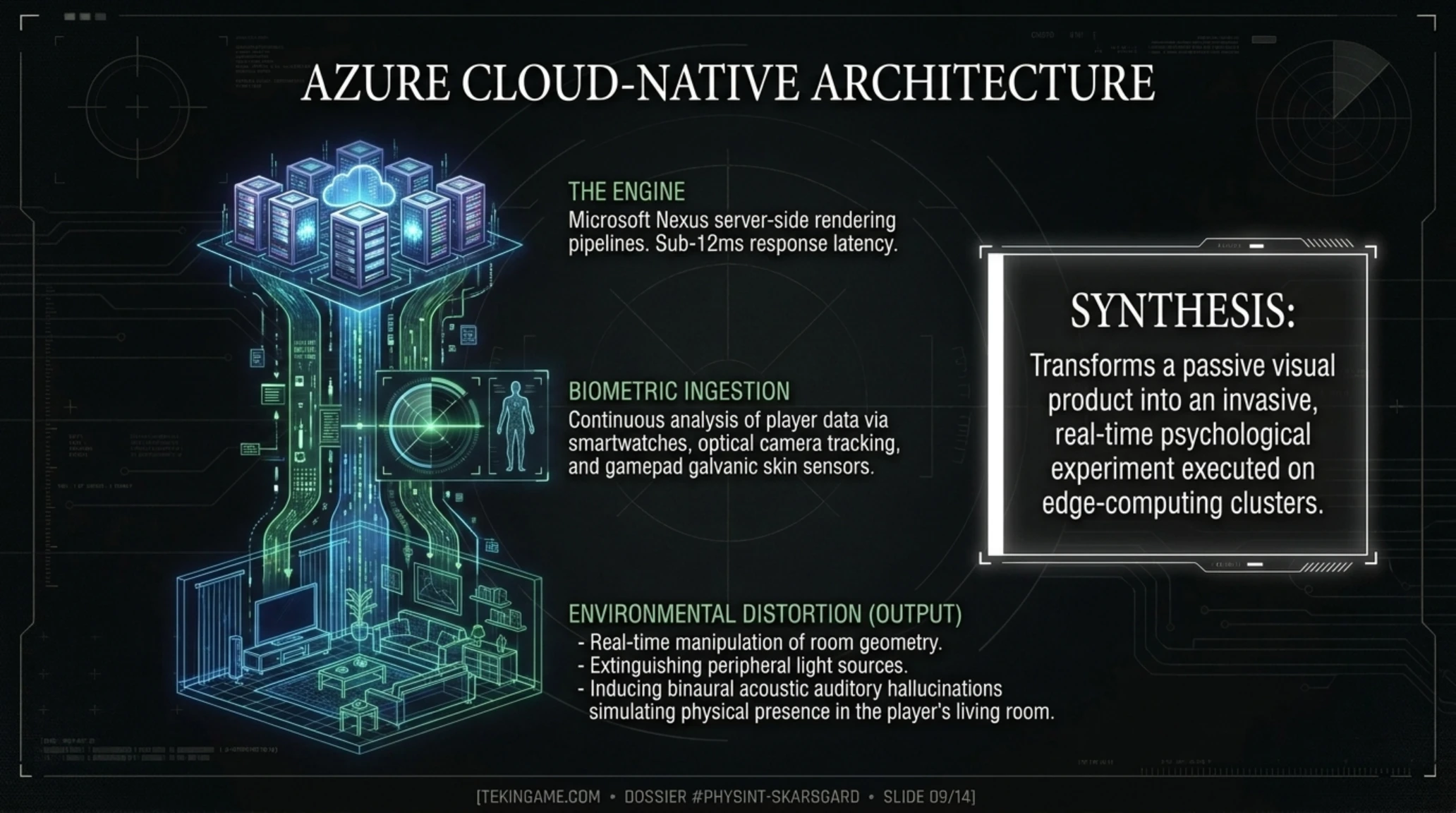
One of the foundational incentives that drew Kojima into Microsoft's gravitational pull was access to the high-performance distributed computing architecture of Microsoft Azure, which provides the technological backbone for OD. While traditional AAA titles remain strictly bound to the finite graphical horsepower and thermal envelopes of local console hardware, OD leverages Microsoft Nexus server-side rendering pipelines. This cloud-native architecture executes complex ray-traced shadows, dynamic atmospheric volumetric light scattering, and cloud-distributed synthetic voice models across Azure server clusters, streaming ultra-low-latency video frames (maintaining sub-12ms response thresholds) directly to connected smart displays, tablets, and local hardware.
This distributed infrastructure enables Kojima and Jordan Peele to execute psychological manipulation routines that are fundamentally unachievable on localized client hardware. By continuously analyzing the player's biometric inputs—collected via smartwatches, optical camera tracking, or gamepad galvanic skin sensors—the Nexus engine can dynamically alter room geometry, extinguish peripheral light sources, or induce binaural acoustic auditory hallucinations that simulate physical presence in the player's immediate living space. This radical fusion of edge computing with cognitive horror transforms OD from a passive visual entertainment product into an invasive, real-time psychological experiment.
Conversely, Physint is engineered as an uncompromised, brute-force hardware benchmark tailored for tenth-generation home consoles and ultra-enthusiast PC graphics hardware. Utilizing pristine 16K photogrammetric scans of Bill Skarsgård and Charlee Fraser, the title pushes memory bandwidth, ultra-wide asset streaming, and hardware ray reconstruction to their absolute physical limits—blurring the demarcation line between live-action feature film and interactive simulation. This generational technical leap aligns with the broader shifts in subscription services and ecosystem library expansion explored in TekinGame's market analysis: October 2026 Free Games and Subscription Ecosystem Shifts across Game Pass and PS Plus.
The economic sustainability of this auteur-driven production model hinges upon Kojima's ability to transcend traditional software sales metrics. Unlike conventional studio heads whose compensation and autonomy are tied to single-quarter unit shipments, Kojima operates as an international cultural institution. His projects generate immense peripheral revenue streams spanning high-end fashion collaborations, collectible vinyl releases, international film festival exhibitions, and prestige cinematic adaptations—yielding enterprise brand equity that shields Kojima Productions from the volatile boom-and-bust cycles that plague corporate subsidiaries.
Furthermore, the long-term franchise value of Physint resides in its potential for multi-media cross-pollination. Hollywood studios have increasingly abandoned derivative video game adaptations in favor of simultaneous, unified transmedia universes. With Bill Skarsgård and Charlee Fraser already digitally immortalized at 16K resolution with complete skeletal rigs, the assets created for Physint can transition directly into IMAX theatrical feature productions or streaming episodic series with minimal re-engineering. This convergence turns game development into a foundational IP incubator for Hollywood, radically altering the economic return on investment for platform financiers.
In this high-stakes arena, Kojima acts not merely as a developer, but as an executive producer orchestrating an international cultural event. By harmonizing Japanese systems engineering, Scandinavian acting depth, Hollywood narrative talent, and Silicon Valley cloud infrastructure, Physint represents the vanguard of modern interactive entertainment—a project that defies conventional corporate logic to establish a new frontier for digital art. This holistic synthesis demonstrates that the true commercial moat in modern gaming belongs to visionary auteurs who control both technological execution and high-concept cultural narrative.
A rigorous cost-benefit analysis of this high-risk Hollywood casting strategy reveals crucial operational lessons for independent creative studios worldwide:

This strategic appraisal illustrates both the monumental commercial upside and the acute organizational hazards inherent to celebrity-driven game development.
Balancing Strengths and Structural Vulnerabilities of Kojima's Star Model
A multi-dimensional appraisal of Kojima's high-stakes reliance on premier international cinematic talent yields the following systemic balance sheet:
- Commanding global mainstream media attention and expanding audience reach far beyond traditional core gamers
- Elevating interactive performance quality through the transformative dramatic range of performers like Bill Skarsgård
- Insulating studio operations from publisher restructuring via diversified, multi-platform sovereign capital sources
- Seamlessly fusing auteur cinema with cutting-edge tenth-generation rendering and Azure cloud processing
- Exponential increases in talent likeness licensing fees, agency retainers, and multi-million-dollar actor payouts
- Extreme logistical complexity reconciling motion-capture production schedules with global Hollywood filming slates
- Elevated financial exposure if traditional gaming demographics reject narrative-heavy, cinematic pacing
Final Radar Verdict & Strategic Outlook
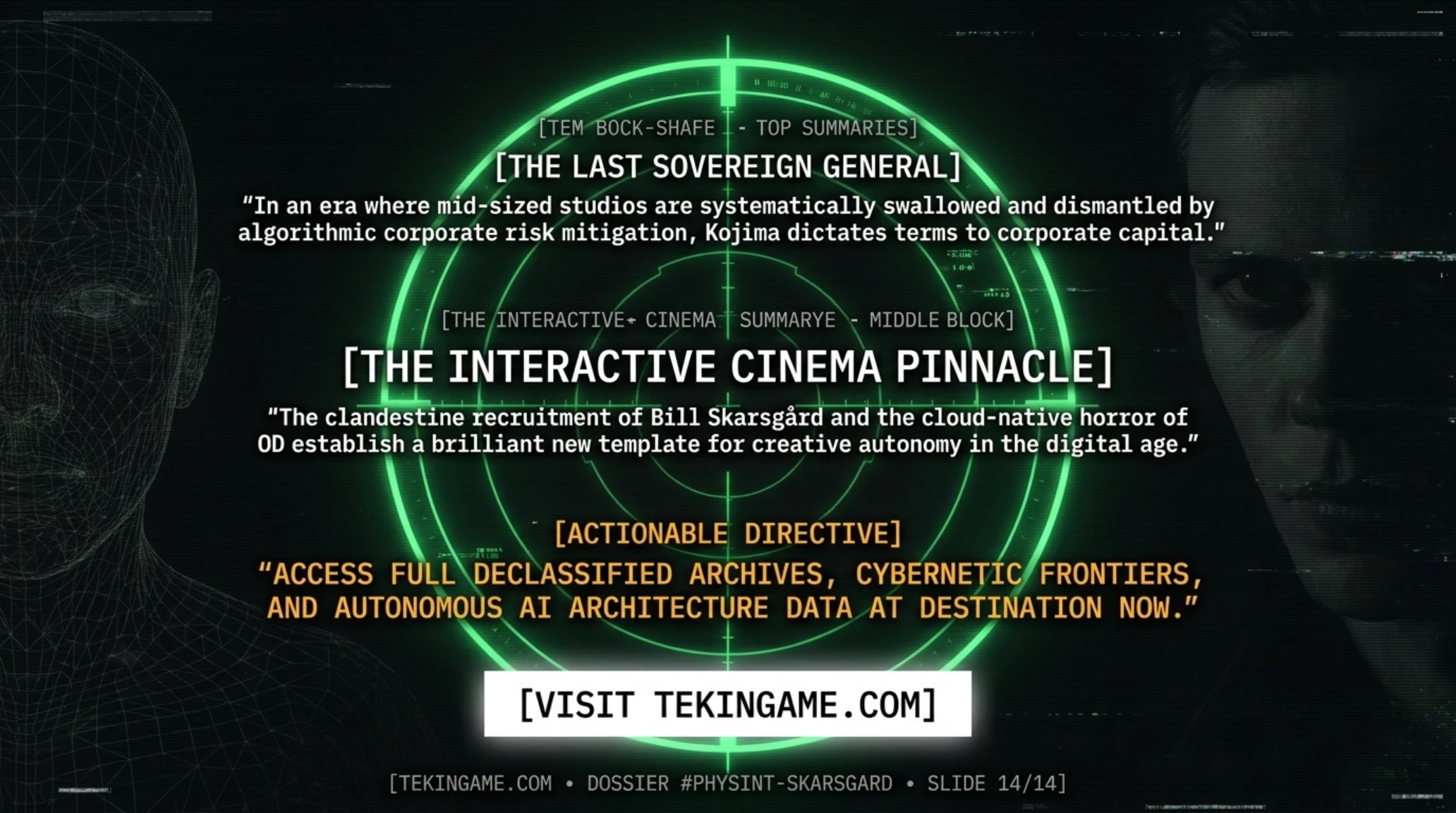
The clandestine recruitment of Bill Skarsgård as the face of Physint signals Hideo Kojima's intent to deliver the crowning espionage opus of his storied career. While the wider industry reels from corporate layoffs and the tragic dismemberment of studios like Ninja Theory, Kojima's mastery of sovereign multi-platform diplomacy establishes a brilliant new template for creative autonomy in the digital age.
Frequently Asked Questions: Hideo Kojima's Physint & Bill Skarsgård
What is project Physint and how does it relate to Metal Gear Solid?
Physint is a tenth-generation tactical espionage blockbuster directed by Hideo Kojima. It serves as the official spiritual successor to Metal Gear Solid, modernizing geopolitical stealth under an unencumbered new IP.
How was Bill Skarsgård secretly cast as the game's protagonist?
The collaboration began by chance at Woodkid's Parisian studio where Skarsgård spotted Kojima merchandise. Skarsgård requested a meeting; Kojima flew to Stockholm to pitch the concept, and Skarsgård accepted immediately.
What role does Charlee Fraser play in Physint?
Charlee Fraser, acclaimed star of Furiosa, co-stars as the primary dramatic counterweight to Skarsgård, exhibiting intense visual chemistry and thematic contrast.
Why is Kojima maintaining complete media silence on his horror project OD?
Kojima confirmed he is intentionally withholding trailers for OD to preserve the element of surprise, aiming to deliver an unmediated psychological shock and test players' threshold for fear.
Is Physint impacted by the recent wave of Microsoft studio layoffs?
No. Kojima Productions is a sovereign Japanese entity. Its contracts with Microsoft are classified as high-prestige strategic partnerships, insulating the studio from first-party corporate restructuring.
Verified Investigation Sources | Research Sources
- GameSpot Exclusive Report on Hideo Kojima's Koji 10 Radio Broadcast
- GameSpot Analysis of Hideo Kojima's Secrecy Strategy for Horror Project OD
- Eurogamer Investigation into Ninja Theory Consultations and Xbox Studio Restructuring
- Pure Xbox Feature: Ex-PlayStation Executive Urges Xbox to Pick a Lane
- IGN Coverage of Tokyo Game Show 2026 and Kojima Key Visual Reveal
Additional Gallery: Tekin Radar | Kojima's Secrets: Bill Skarsgård in Physint & The Xbox Paradox