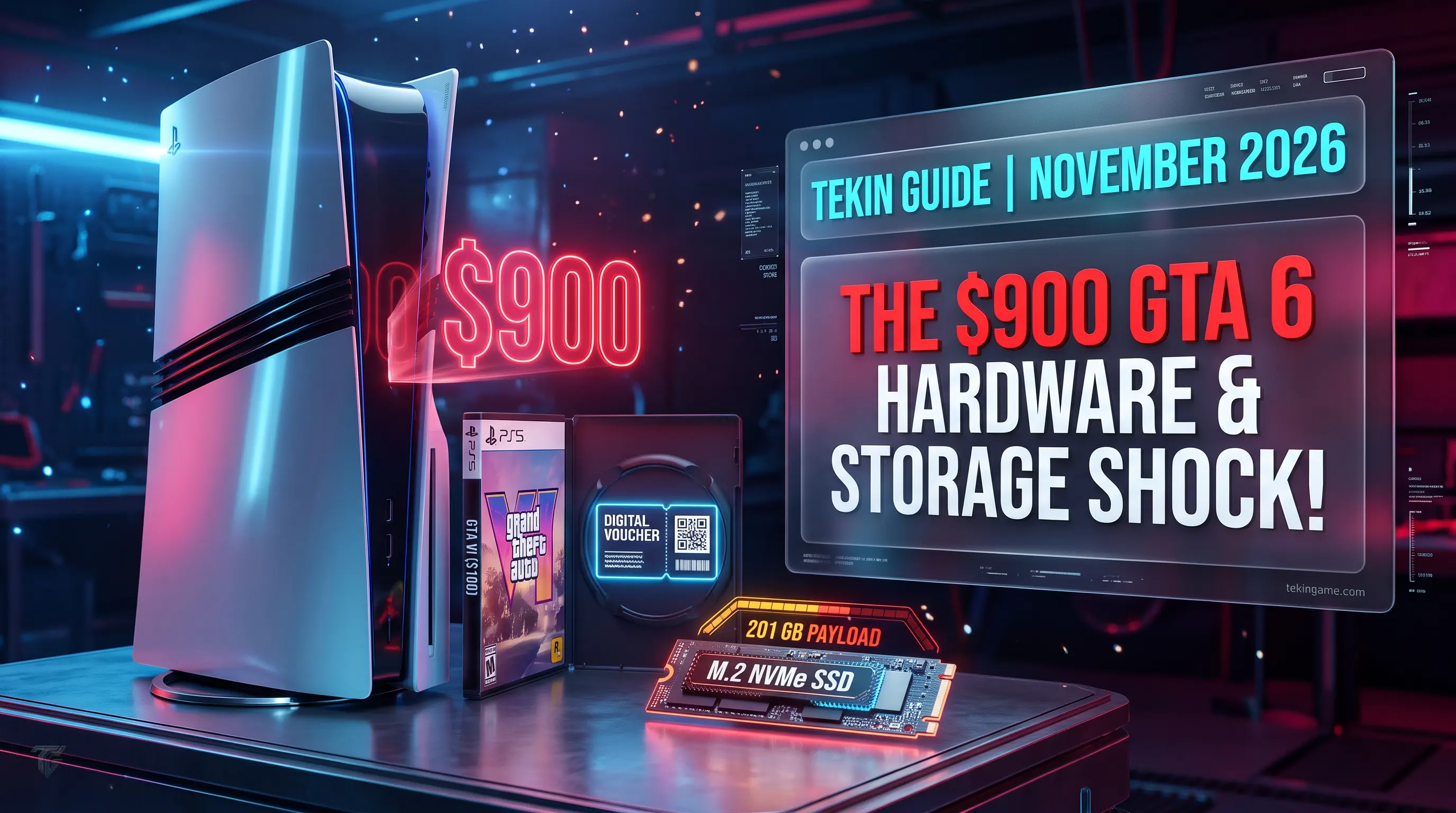
Tekin Guide | The $900 GTA 6 Price Shock: Hardware, Economics, and Storage Survival
The countdown has entered its critical phase. As the gaming world braces for the November 19, 2026 release of Grand Theft Auto VI following the sonic revelations we covered in Tekin Night November 3 on GTA 6 radio stations and interactive podcasts the industry finds itself confronting an unprecedented economic and hardware reality. The most anticipated cultural product of the decade is arriving not during a cycle of hardware abundance and discounting, but amidst the steepest silicon and component inflation in the history of consumer electronics. Players preparing to explore the state of Leonida are discovering that the entry barrier is vastly higher than anything seen in previous console generations.
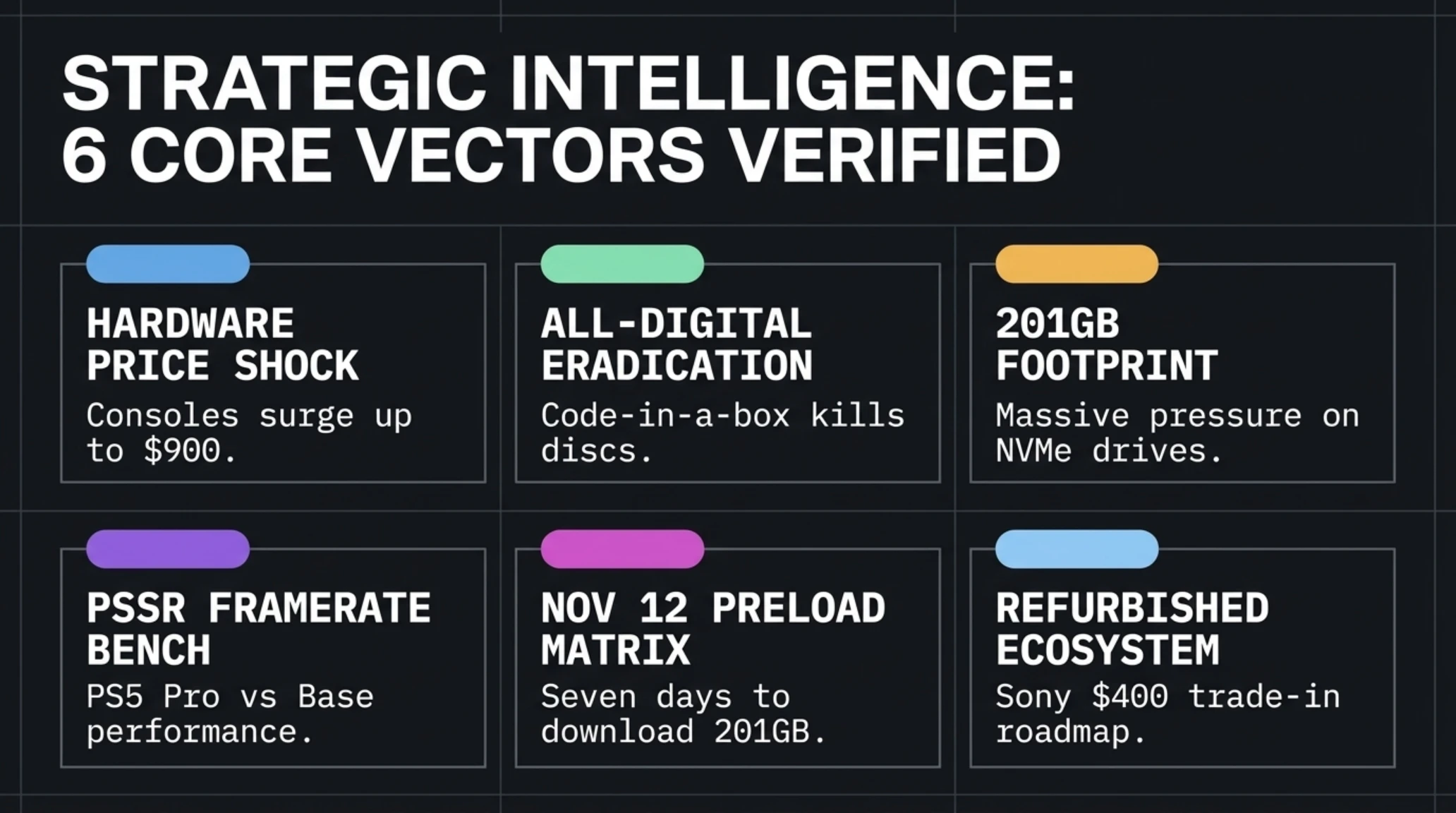
Strategic Intelligence & Core Vectors at a Glance
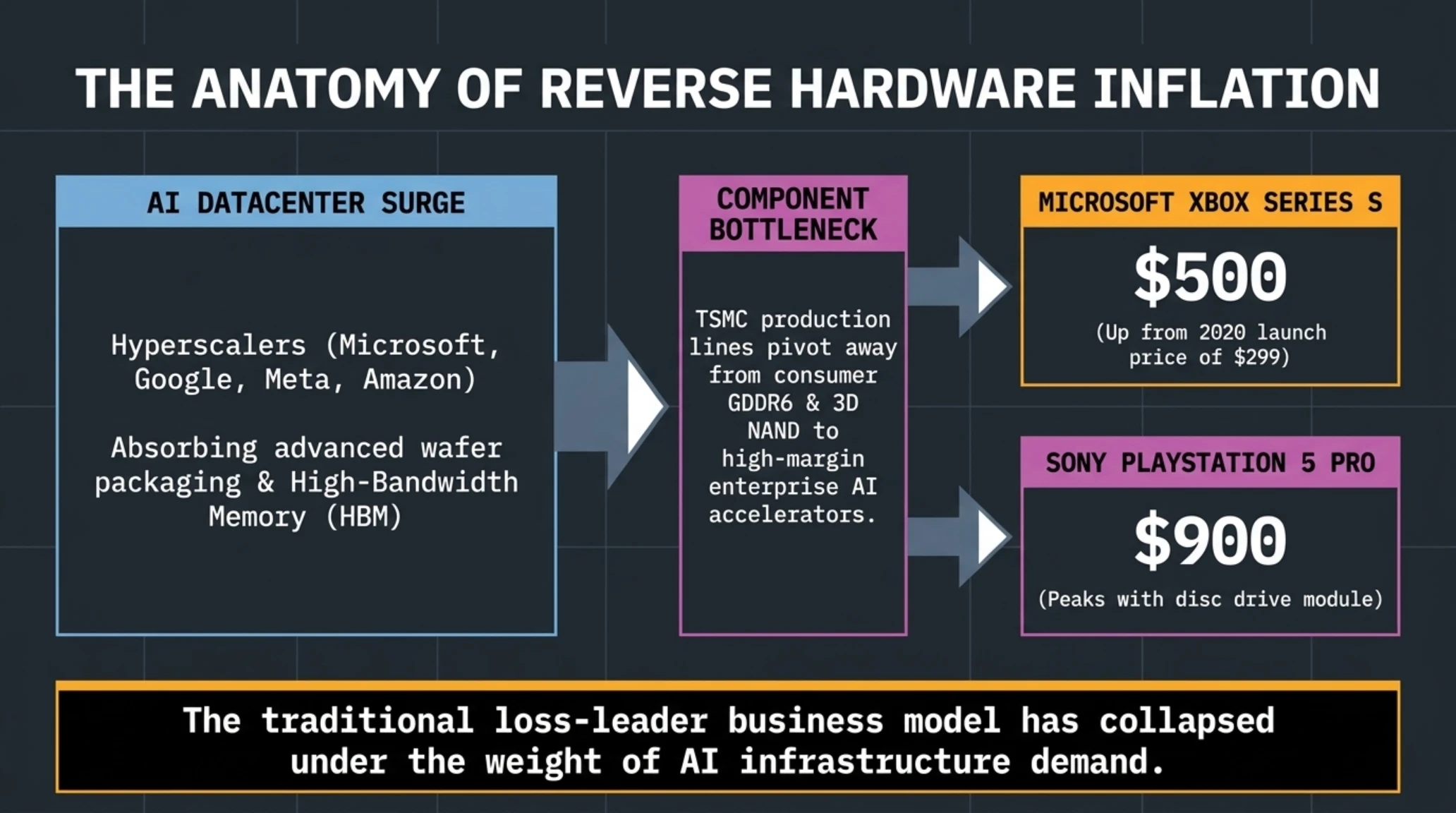
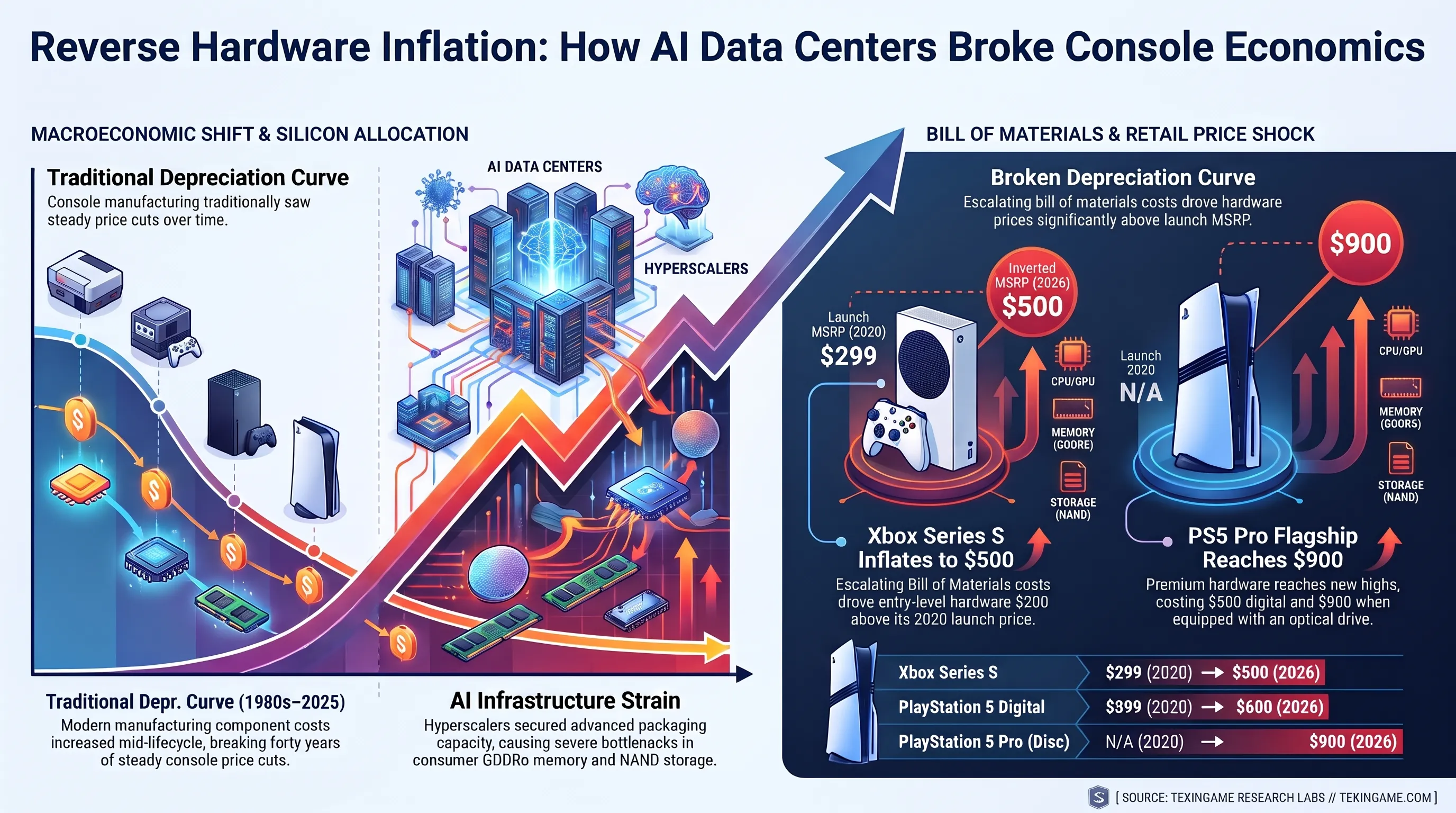
The assumption that console hardware steadily depreciates over its lifespan has been shattered by the cleanroom wafer crisis we dissected in our investigation into Sam Altman's War on PC RAM and AI DRAM hoarding. Historically, a machine launched at $399 or $499 would, by year six, be available at retail for $199 to $299 as component yields matured and fabrication costs dropped. In 2026, the macroeconomic reality has inverted that curve. Today, Microsoft's entry-level Xbox Series S retails for $500 two hundred dollars above its 2020 launch price. Sony's flagship PlayStation 5 Pro, outfitted with an optical disc drive, demands an astonishing $900.
This comprehensive Tekin Guide investigates the structural causes behind this historic sticker shock. We examine how AI data center demand drained global semiconductor supply, analyze why Take-Two Interactive eliminated physical discs, evaluate cross-platform benchmark expectations, and provide an actionable roadmap to optimize your hardware and storage before the servers unlock.
The Anatomy of Reverse Inflation; How AI Datacenters Broke Console Economics
To understand why console prices are climbing six years into the ninth generation, one must look at the broader semiconductor supply chain. The historical model of home console pricing relied on continuous shrinkages in silicon manufacturing nodes and declining spot prices for memory. As TSMC, Samsung Foundry, and Intel refined their fabrication processes, chips became smaller, ran cooler, and cost significantly less per wafer to produce.
That dynamic came to an abrupt halt with the explosive scaling of enterprise artificial intelligence clusters. Hyperscalers like Microsoft, Google, Meta, and Amazon began absorbing vast swathes of global silicon allocation, securing multi-year manufacturing contracts for advanced wafer packaging and high-bandwidth memory (HBM). Consequently, traditional commodity memory specifically GDDR6 and high-density 3D NAND flash experienced sharp supply bottlenecks. Fabricators reallocated production lines away from consumer-grade silicon toward high-margin enterprise AI accelerators.
The repercussions hit Sony and Microsoft with brutal force. Neither company could continue subsidizing hardware at previous levels without incurring crippling operating losses. Microsoft moved first, revising the MSRP of the Xbox Series S from $299 to $500, citing escalating BOM (Bill of Materials) costs. The disc-less Xbox Series X climbed to $750, while the version featuring an optical drive reached $800. Sony adjusted the PlayStation 5 Digital Edition to $600, culminating in the release of the PlayStation 5 Pro at $800 ($900 with the disc drive module).
Why This Structural Shift Alters the Landscape
The traditional loss-leader business model of video game consoles has collapsed under the weight of AI infrastructure demand, transforming ninth-generation hardware into premium luxury hardware investments.
Software Pricing Evolution; Deconstructing the $80 and $100 Tiers
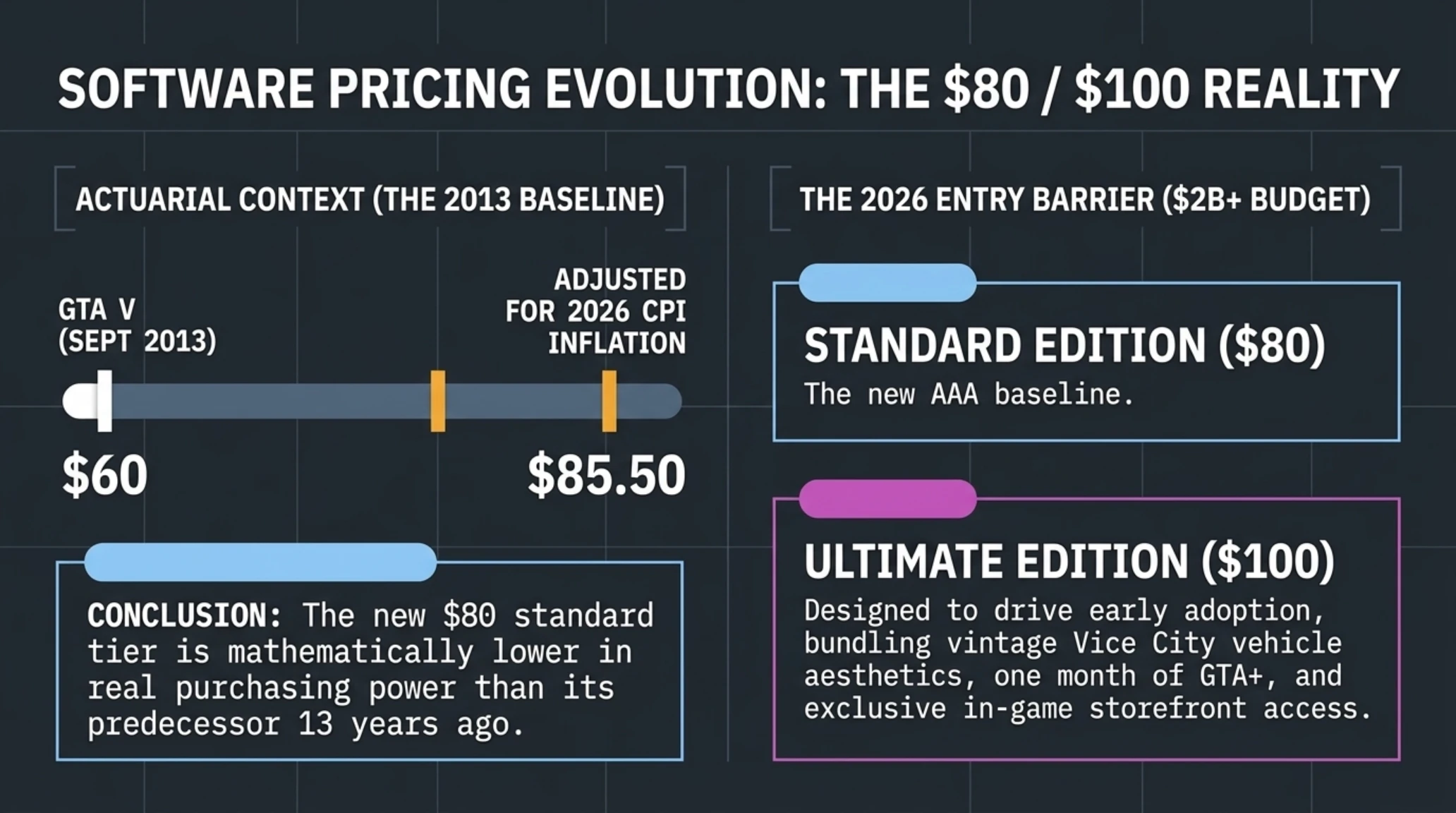
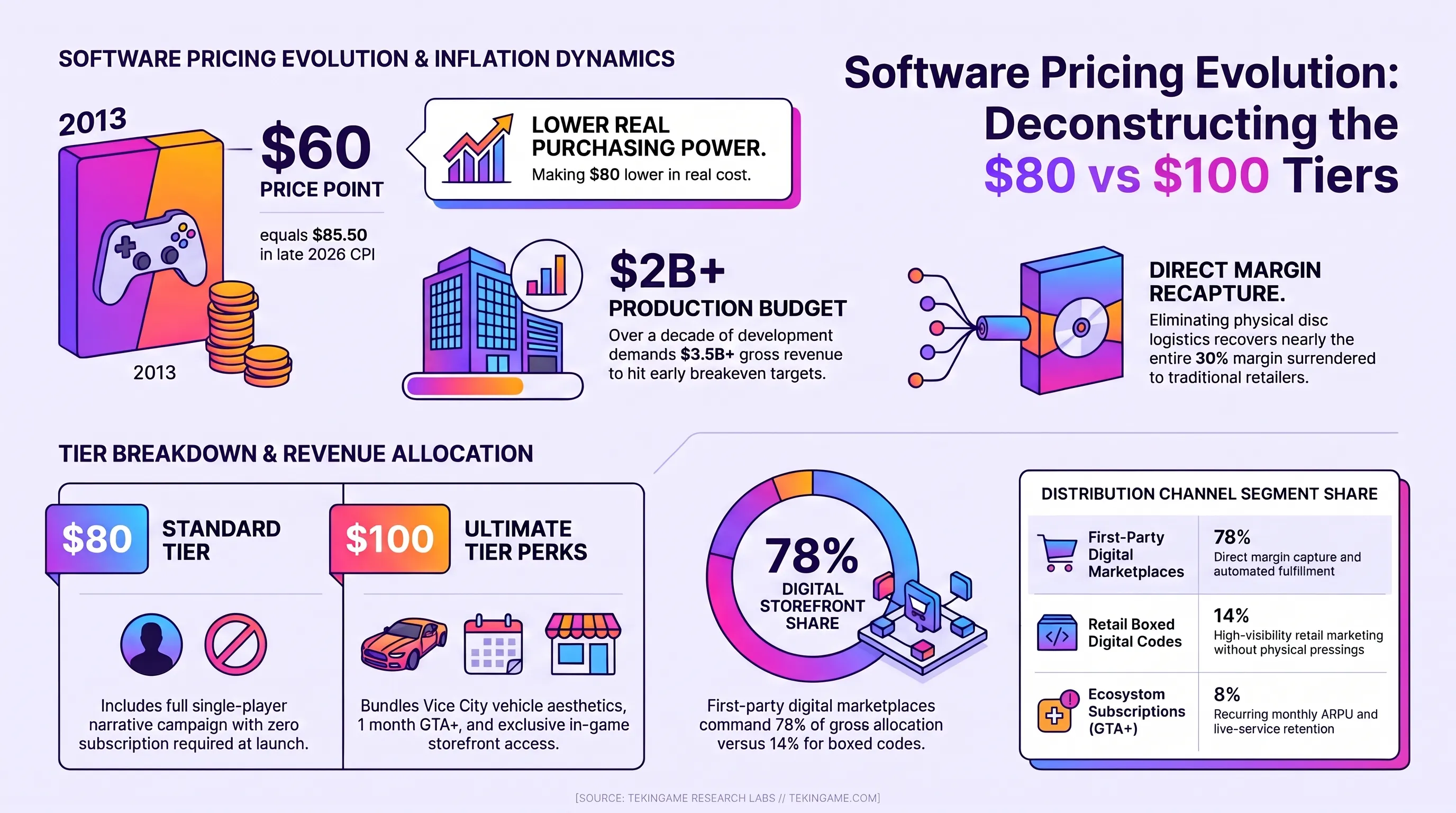
Software pricing has followed a parallel trajectory. Take-Two Interactive established a new pricing benchmark by positioning the standard edition of Grand Theft Auto VI at $80, while offering the Ultimate Edition at $100. During executive earnings discussions, Take-Two leadership argued that a production budget exceeding $2 billion necessitates a recalibration of value metrics. From their perspective, the depth and scale of an open-world simulation of this caliber offers entertainment value far surpassing conventional entertainment mediums.
Historical context provides clarity on this adjustment. When Grand Theft Auto V arrived in September 2013, its standard edition carried a $60 price tag. Adjusting for cumulative inflation across the United States Consumer Price Index (CPI), $60 in 2013 equates to roughly $85.50 in late 2026 currency. Viewed through an actuarial lens, an $80 price point is mathematically lower in real purchasing power than its predecessor was thirteen years ago.
The friction for consumers arises from the convergence of software price hikes with unprecedented hardware costs. A player entering the ninth generation specifically for GTA 6 must allocate a minimum of $580 for a base console and standard software, scaling up to $1,000 for a PS5 Pro and Ultimate Edition bundle. The $100 Ultimate Edition incentivizes early adoption by bundling vintage Vice City vehicle aesthetics, a month of GTA+ service, and exclusive in-game storefront access that remains locked for standard tier purchasers.
The Code-in-a-Box Shift; Why Physical Media Was Systematically Removed
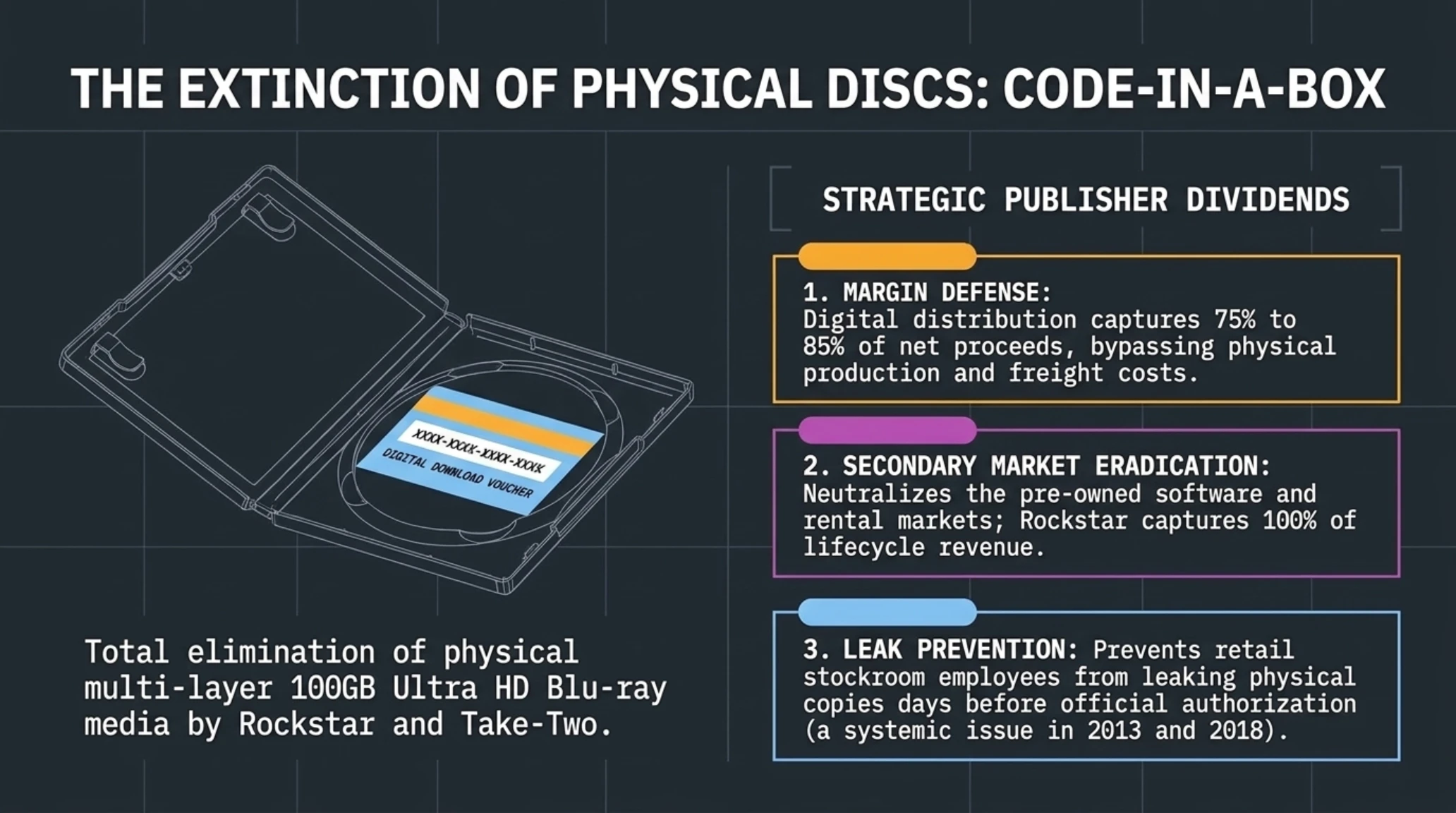
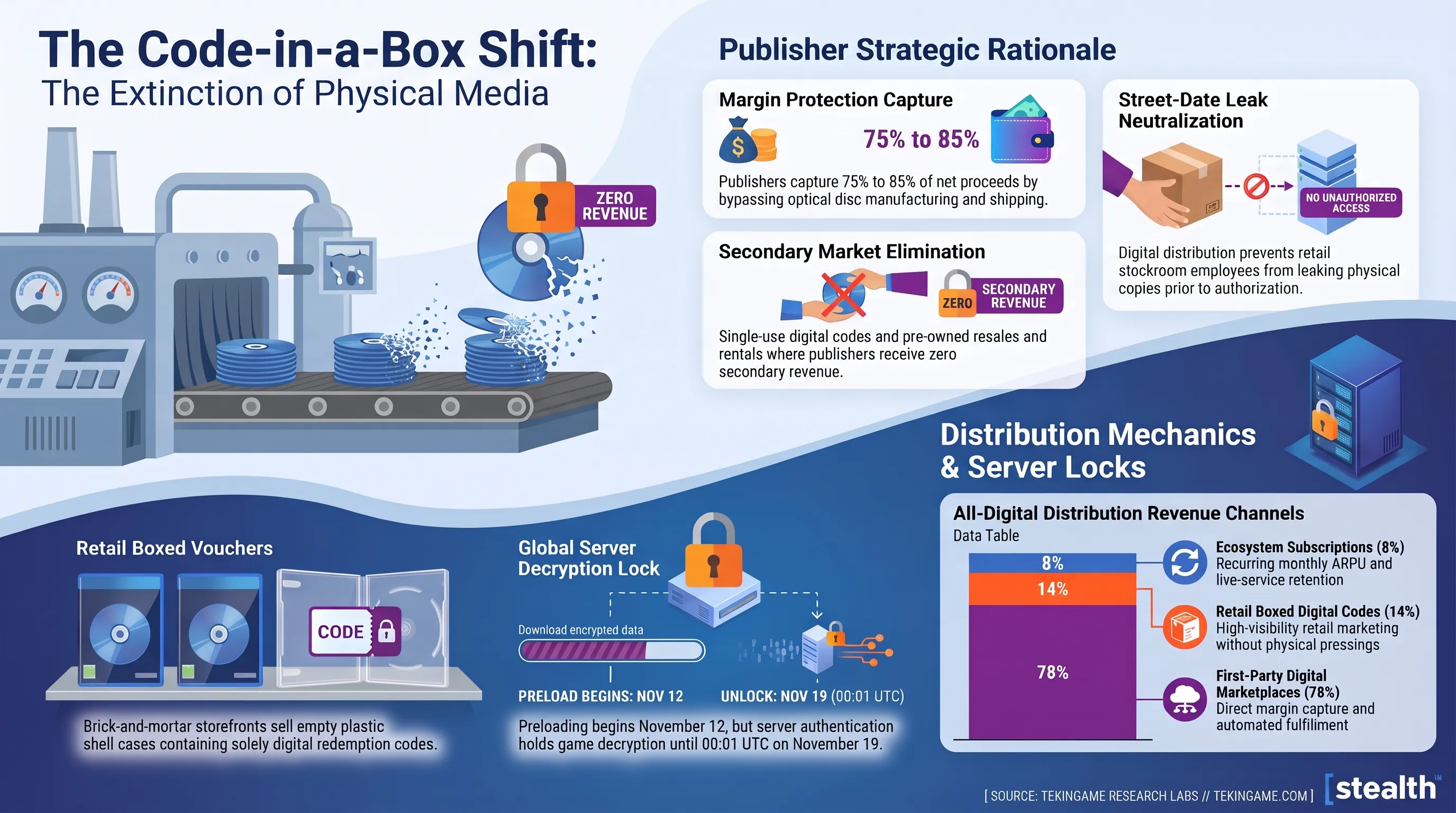
Among the most debated elements of the launch is Rockstar Games' decision to forego physical Blu-ray discs entirely. Even customers who purchase standard retail copies from traditional brick-and-mortar storefronts like GameStop, Best Buy, or Target will receive an empty plastic shell containing a digital download code.
This strategy, known across the industry as Code-in-a-Box, marks a decisive departure from past major launches. While casual observers might view this as a simple logistics optimization, financial analysis reveals a calculated effort to eliminate the pre-owned software market and protect publisher margins.
When software is distributed digitally, publishers capture between 75% and 85% of net proceeds, completely bypassing the production, pressing, and freight costs associated with multi-layer 100GB Ultra HD Blu-ray media. Furthermore, digital exclusivity neutralizes the perpetual risk of street-date leaks. In previous launches, such as GTA V in 2013 and Red Dead Redemption 2 in 2018, retail stockroom employees routinely leaked physical copies onto the internet days prior to official authorization.
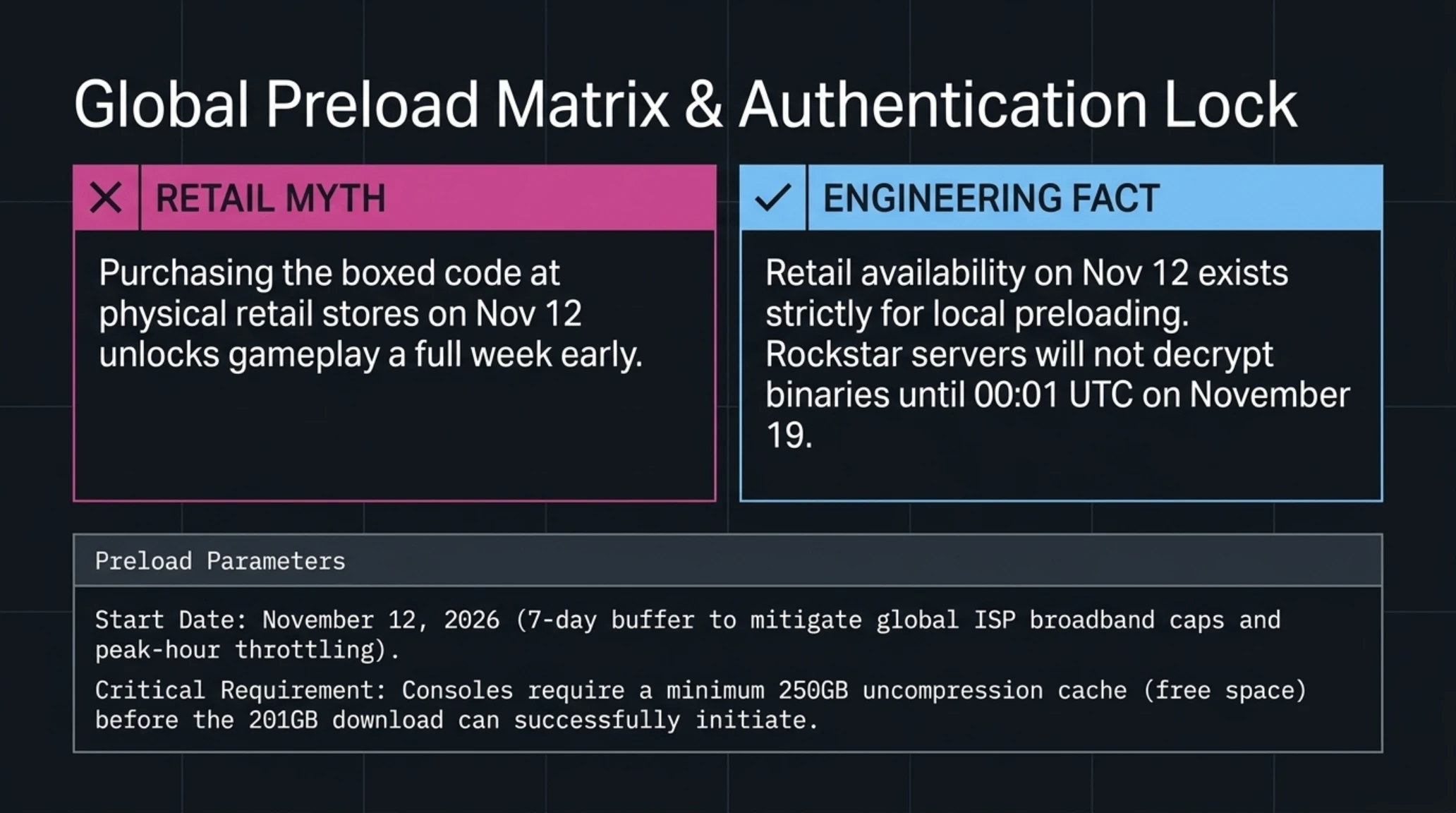
Technical Audit | Industry Myth vs Engineering Reality
Purchasing the boxed code at physical retail stores on November 12 unlocks the game a full week ahead of digital storefronts.
Retail availability on November 12 exists strictly for local preloading. Rockstar authentication servers will not decrypt game binaries until 00:01 UTC on November 19.
Cross-Platform Benchmarks; The Architectural Divide Across Current Silicon
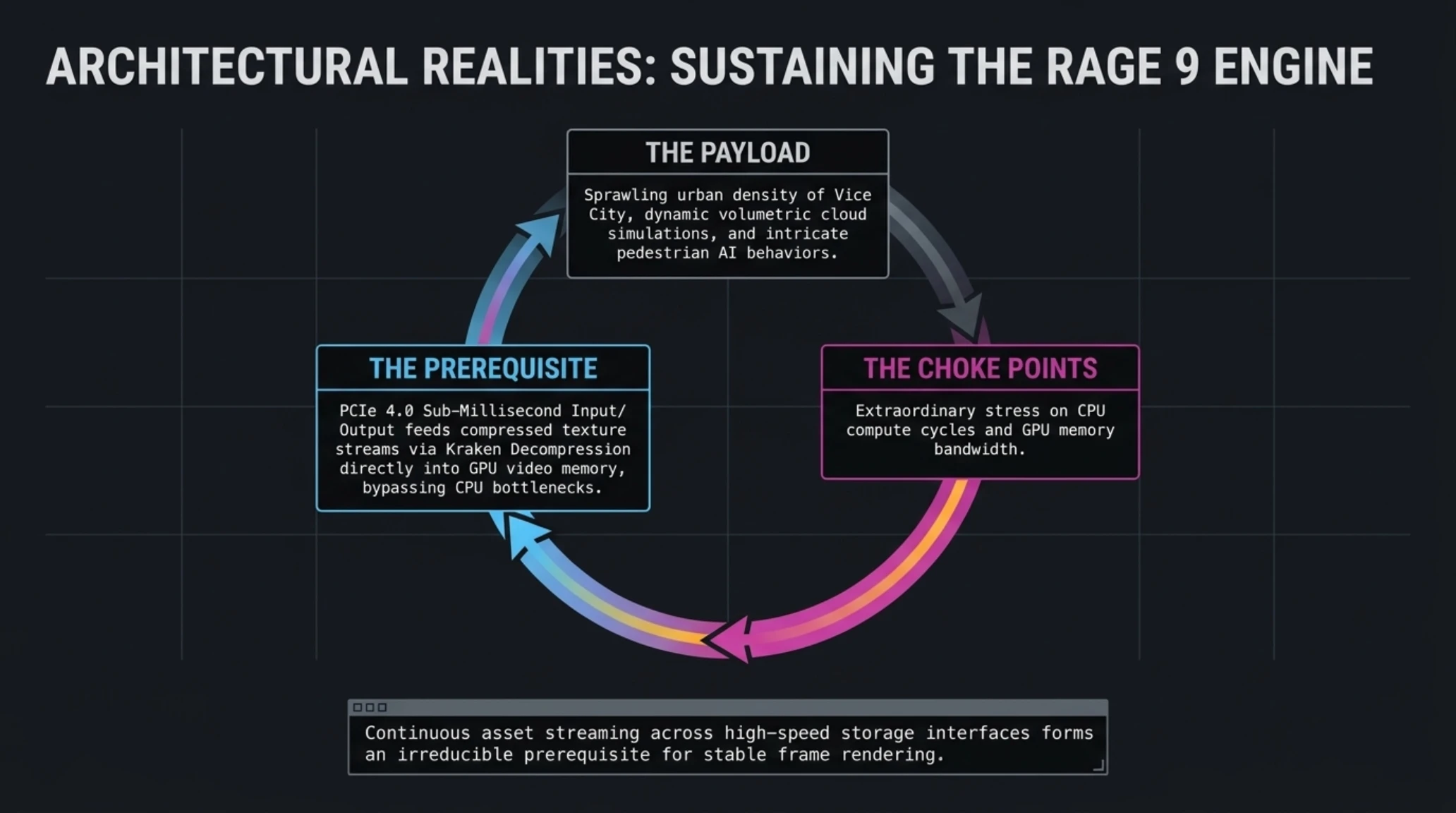
The technical ambition of the RAGE 9 engine demands immense throughput from underlying system hardware. The sprawling urban density of Vice City, coupled with dynamic volumetric cloud simulations and intricate pedestrian AI behaviors, places extraordinary stress on both CPU compute cycles and GPU memory bandwidth. For the first time in an open-world sandbox, continuous asset streaming across high-speed PCIe 4.0 storage interfaces forms an irreducible prerequisite for stable frame rendering.
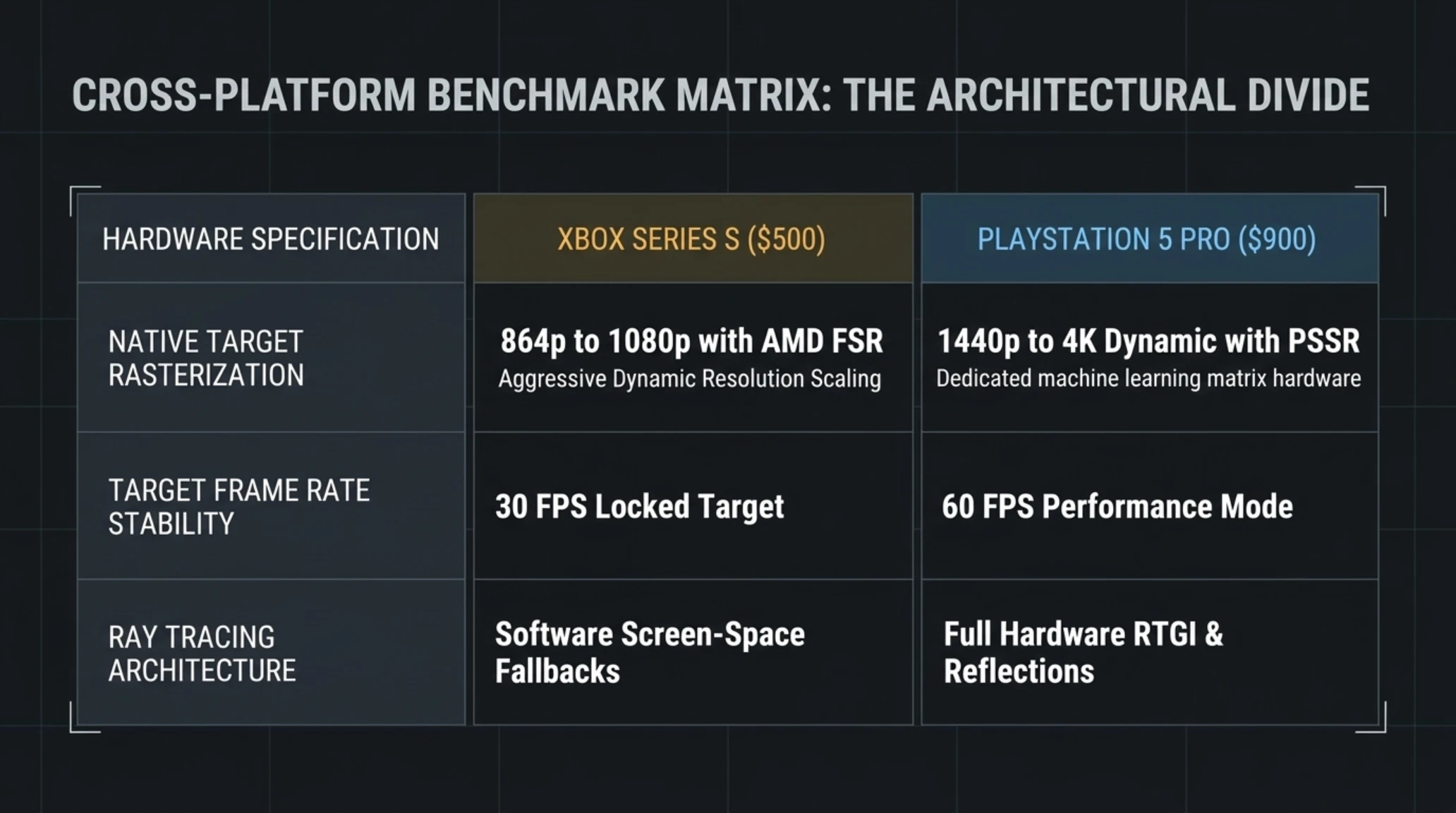
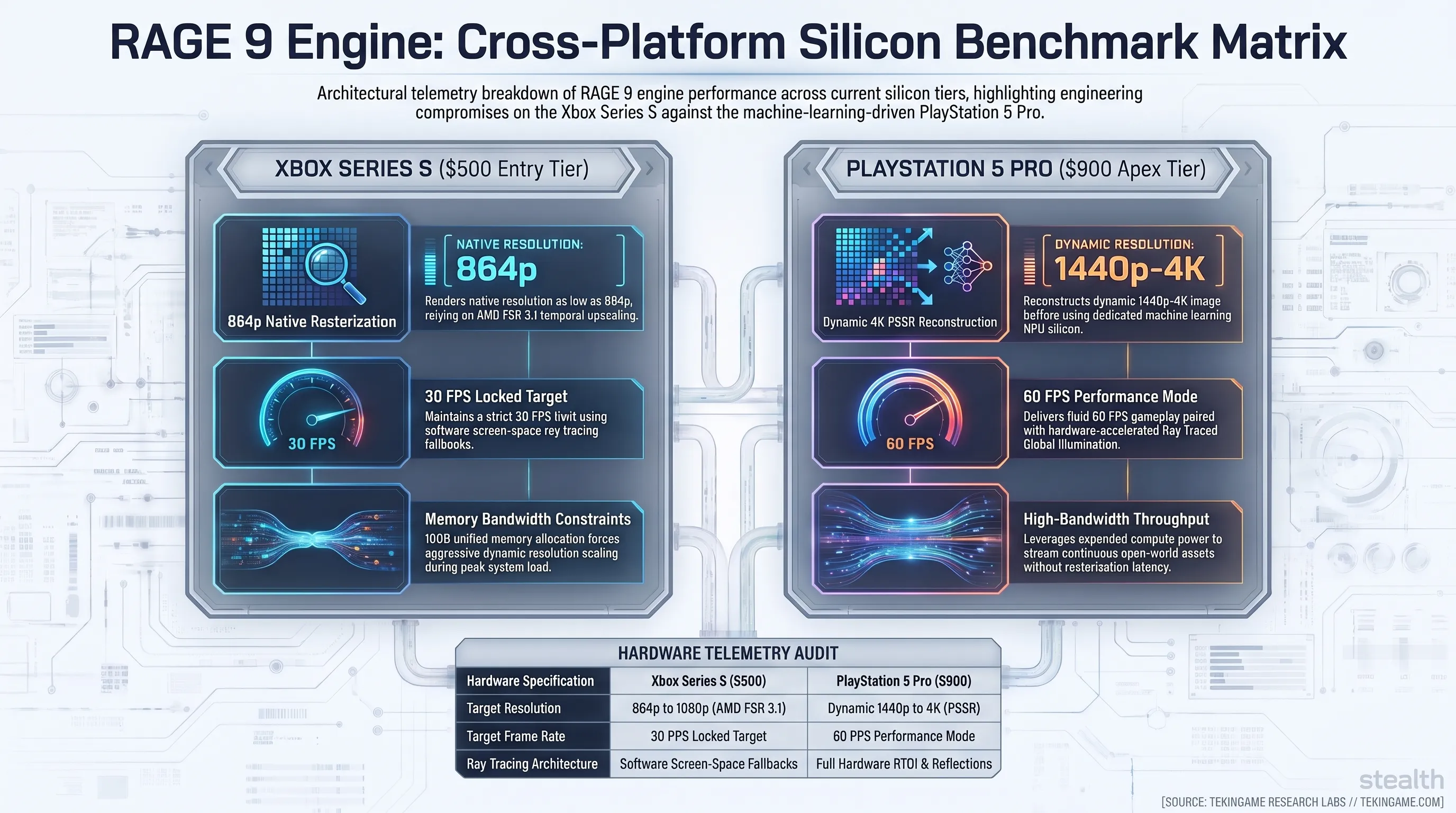
The entry point of this hardware ecosystem, Microsoft's Xbox Series S, faces acute engineering bottlenecks. Armed with only 10GB of unified memory (with just 8GB operating at full 224 GB/s bandwidth) and a 4-teraflop RDNA 2 GPU, the compact console must employ aggressive Dynamic Resolution Scaling (DRS). Developer telemetry indicates that the Series S renders native rasterization passes as low as 864p during complex vehicle intersections, leveraging AMD FSR 3.1 temporal upscaling to output at 1080p. While gameplay mechanics remain functionally identical, high-frequency graphical fidelity including puddles, neon reflections, and foliage density suffers noticeable degradation.
In contrast, the standard PlayStation 5 and Xbox Series X leverage 10.28 and 12 teraflops of compute to maintain a dynamic 1440p target, scaling temporal buffers to 4K at a locked 30 frames per second in Quality Mode. However, the architectural pinnacle of this launch is indisputably the PlayStation 5 Pro. Featuring dedicated machine learning matrix hardware and Sony's proprietary PlayStation Spectral Super Resolution (PSSR), the console delivers hardware-accelerated Ray Traced Global Illumination (RTGI) while targeting a fluid 60 frames per second.
Benchmark Matrix & Technical Performance Dashboard
| Hardware Specification | Xbox Series S ($500) | PlayStation 5 Pro ($900) |
|---|---|---|
| Native Target Rasterization | 864p to 1080p with AMD FSR | 1440p to 4K Dynamic with PSSR |
| Target Frame Rate Stability | 30 FPS Locked Target | 60 FPS Performance Mode |
| Ray Tracing Architecture | Software Screen-Space Fallbacks | Full Hardware RTGI & Reflections |
Tekin Engineering Jargon Buster
Evaluating the PS5 Pro Value Proposition; Is the $200 Delta Warranted?
Determining whether the $900 investment in a PlayStation 5 Pro configuration is justified depends entirely on the player's display environment and graphical fidelity standards. For enthusiasts operating high-end 4K OLED or QD-OLED displays equipped with 120Hz refresh rates and Variable Refresh Rate (VRR) capabilities, the PS5 Pro delivers tangible rendering dividends. The reduction in temporal ghosting around fast-moving sports cars, combined with clean ray-traced water reflections across the Vice City coastline, justifies the premium for visual purists.
However, for mainstream gamers connected to standard 1080p or budget 4K displays, the base PlayStation 5 (or a certified refurbished unit at $500) represents the superior price-to-performance equilibrium. The underlying world simulation, AI crowd behaviors, physics interactions, and narrative progression remain completely uniform across all hardware revisions.
Financial Telemetry and the Macroeconomics of AAA Publishing in 2026
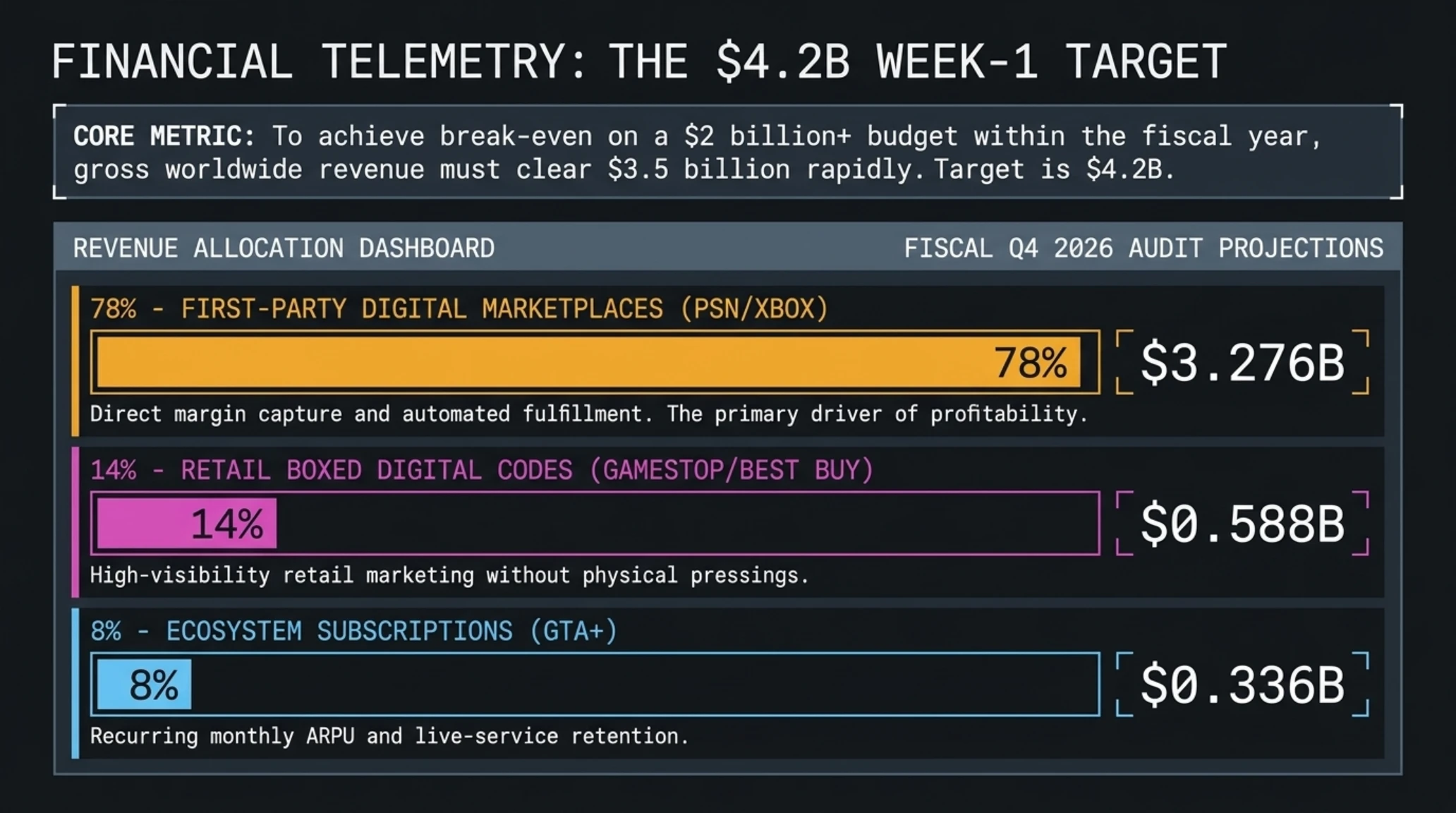
The unprecedented retail pricing of Grand Theft Auto VI is not an isolated pricing experiment; it reflects systemic pressures confronting modern interactive entertainment. With total production and marketing expenditures surpassing $2 billion over a decade of continuous development, Take-Two Interactive faces immense pressure from Wall Street to maximize early revenue yield. To achieve initial break-even milestones within the current fiscal year, the title must generate north of $3.5 billion in gross worldwide revenue a target achievable only by expanding digital store distribution and driving adoption of premium tiers.
Market research from Circana demonstrates that digital platforms (PlayStation Network and Xbox Live Marketplace) now command over 78% of all console software revenues across North America and Europe. This systemic transition has enabled publishers to recover nearly the entirety of the 30% margin traditionally surrendered to physical retailers and logistics intermediaries. However, the accompanying infrastructure costs specifically bandwidth provisioning for global content delivery networks (CDNs) have introduced substantial operational overhead.
📚 Classified & Related Dossiers in TekinGame
If you wish to explore beyond this report and delve into cybernetic frontiers and autonomous AI architectures, do not miss these three exclusive deep-dives in the Tekin Garage:
Financial Telemetry Dashboard & Revenue Allocation
| Revenue Channel Segment | Share of Gross Receipts | Strategic Publisher Value |
|---|---|---|
| First-Party Digital Marketplaces (PSN / Xbox) | 78% Gross Allocation | Direct margin capture and automated fulfillment |
| Retail Boxed Digital Codes (GameStop / Best Buy) | 14% Gross Allocation | High-visibility retail marketing without physical pressings |
| Ecosystem Subscriptions (GTA+) | 8% Gross Allocation | Recurring monthly ARPU and live-service retention |
The 201GB Storage Crisis; Navigating NVMe Allocation and Preload Deadlines
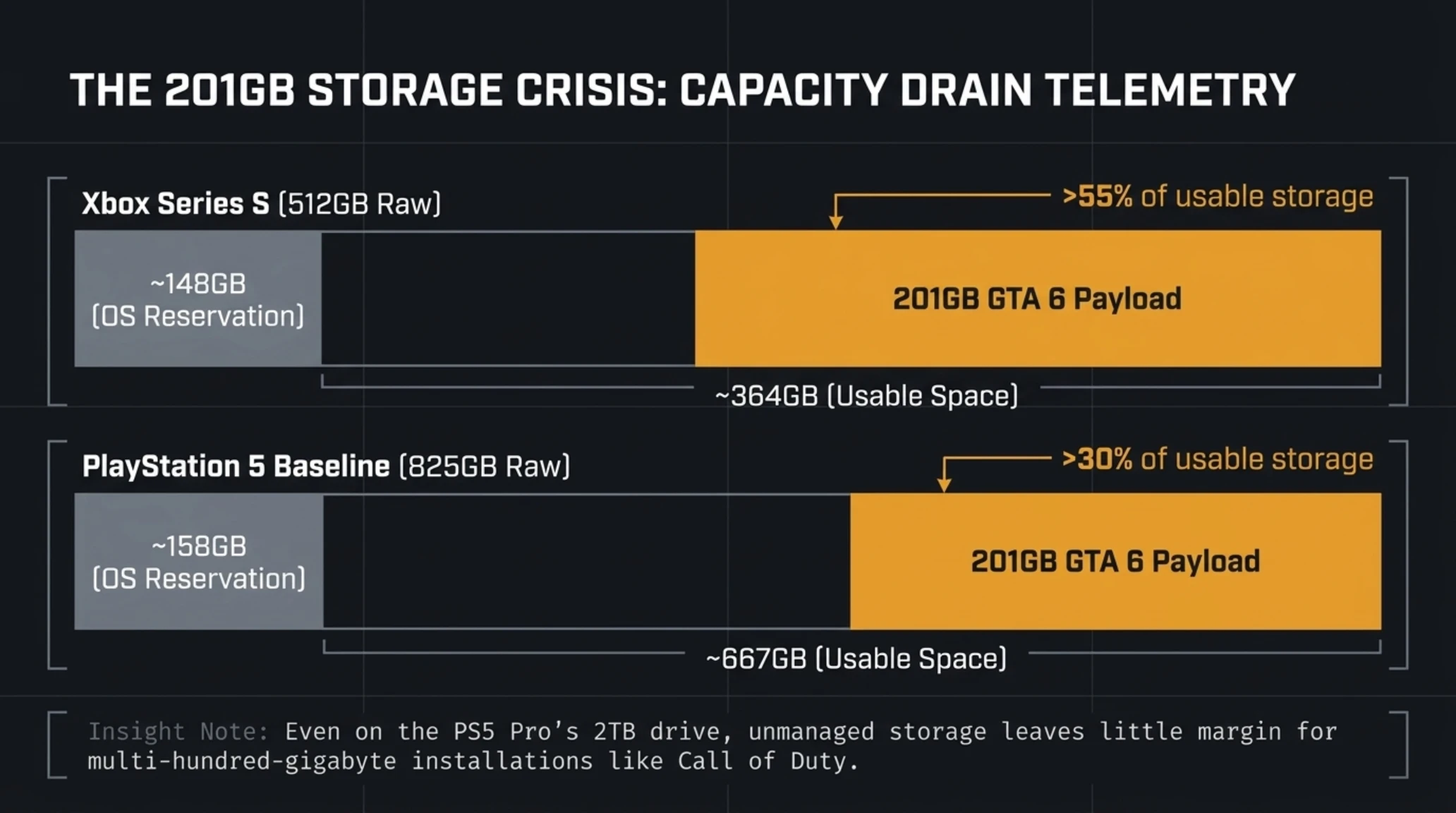
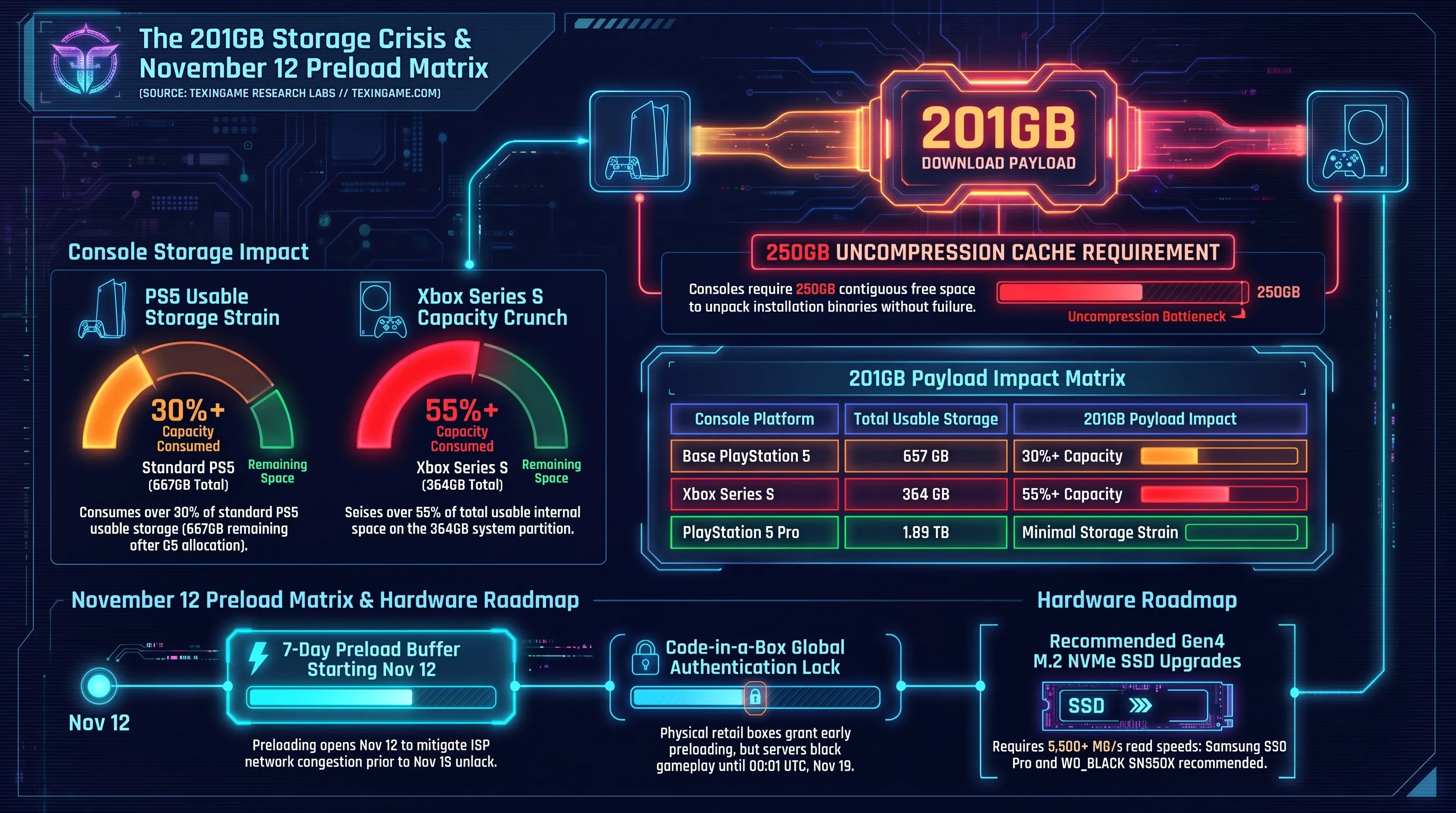
The confirmed 201GB download package represents a severe technical hurdle for ninth-generation internal storage. A critical audit of usable drive capacity reveals the extent of this constraint:
- Baseline PlayStation 5 (825GB Raw): Operating system reservations leave approximately 667GB of usable storage. Installing GTA 6 consumes more than 30% of total available capacity in a single operation.
- Standard Xbox Series S (512GB Raw): System partitions leave roughly 364GB of free space. GTA 6 commandeers over 55% of the machine's entire operational storage.
- PlayStation 5 Pro (2TB Drive): Even with 1.89TB usable space, contemporary multi-hundred-gigabyte installations like Call of Duty leave little margin for unmanaged storage.
To mitigate nationwide ISP congestion and reduce server strain, Rockstar Games has scheduled global preloading to commence on November 12, 2026. This seven-day buffer is critical for users navigating broadband caps and peak-hour throttling. To prevent installation failures caused by temporary uncompression caching, consoles require at least 250GB of free space before the download can initiate. Upgrading internal storage with an M.2 PCIe 4.0 NVMe SSD delivering at least 5,500 MB/s sequential read throughput (such as the Samsung 990 Pro or WD_BLACK SN850X) is highly recommended for multi-game libraries.
Event Timeline | Evolution of Software Pricing & Storage Demands
| Chronological Milestone | Hardware & Pricing Reality | Strategic Impact on the Ecosystem |
|---|---|---|
| September 2013 | GTA V Debuts at $60 MSRP | Shipped across two dual-layer physical discs; established online dominance. |
| November 2020 | Generation 9 Hardware Launches ($299 / $499) | Solid-state storage standardized; promise of long-term component discounting. |
| 2024 to 2025 | AI Data Center Silicon Allocation Surge | Global DRAM/NAND supply diverted to enterprise clusters; console inflation begins. |
| November 2026 | GTA 6 Launches Amid $900 Hardware | Total elimination of physical media, $80-$100 software, and 201GB footprints. |
Consumer Sentiment and Market Adoption Dynamics
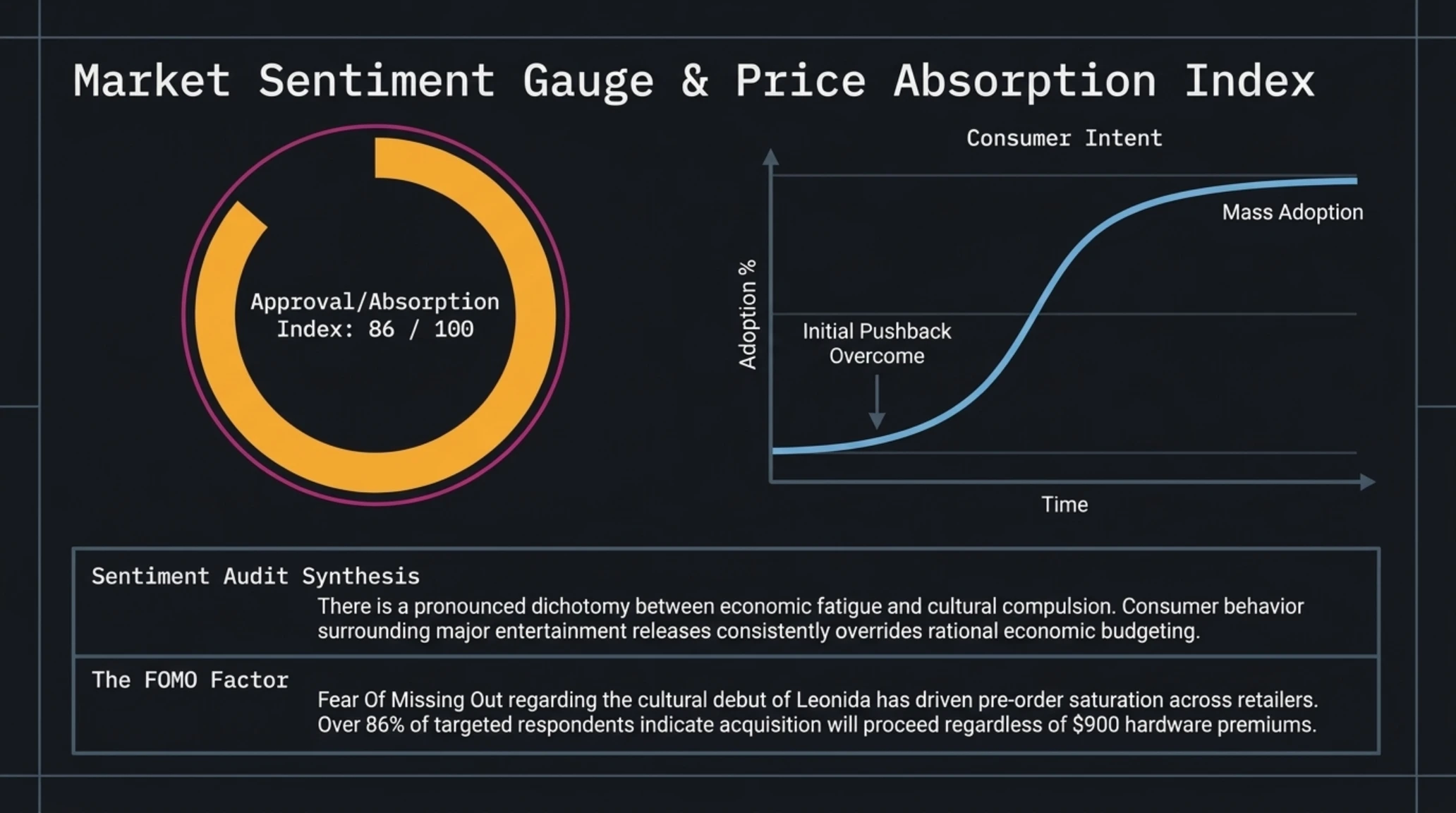
Public sentiment surrounding the $900 hardware threshold exhibits a pronounced dichotomy between economic fatigue and cultural compulsion. While online discourse frequently laments the demise of physical game ownership and the erosion of consumer pricing protections, commercial indicators point toward record-shattering transaction volume. Consumer behavior around major entertainment releases consistently overrides rational economic budgeting.
This phenomenon has insulated Sony and Microsoft from significant consumer backlash. Market tracking demonstrates that the Fear Of Missing Out (FOMO) surrounding the cultural debut of Leonida has driven pre-order saturation across all major retailers. Consumers are actively reallocating discretionary holiday spending, sacrificing alternative purchases to guarantee day-one participation in the world event.
Market Sentiment Gauge & S-Curve Adoption Trajectory
Sentiment Audit: Despite vocal friction regarding $900 hardware ceilings, the consumer adoption curve has passed its inflection point. Over 86% of targeted respondents indicate that hardware acquisition will proceed regardless of pricing premiums.
Five-Axis Hardware Evaluation and Architectural Telemetry
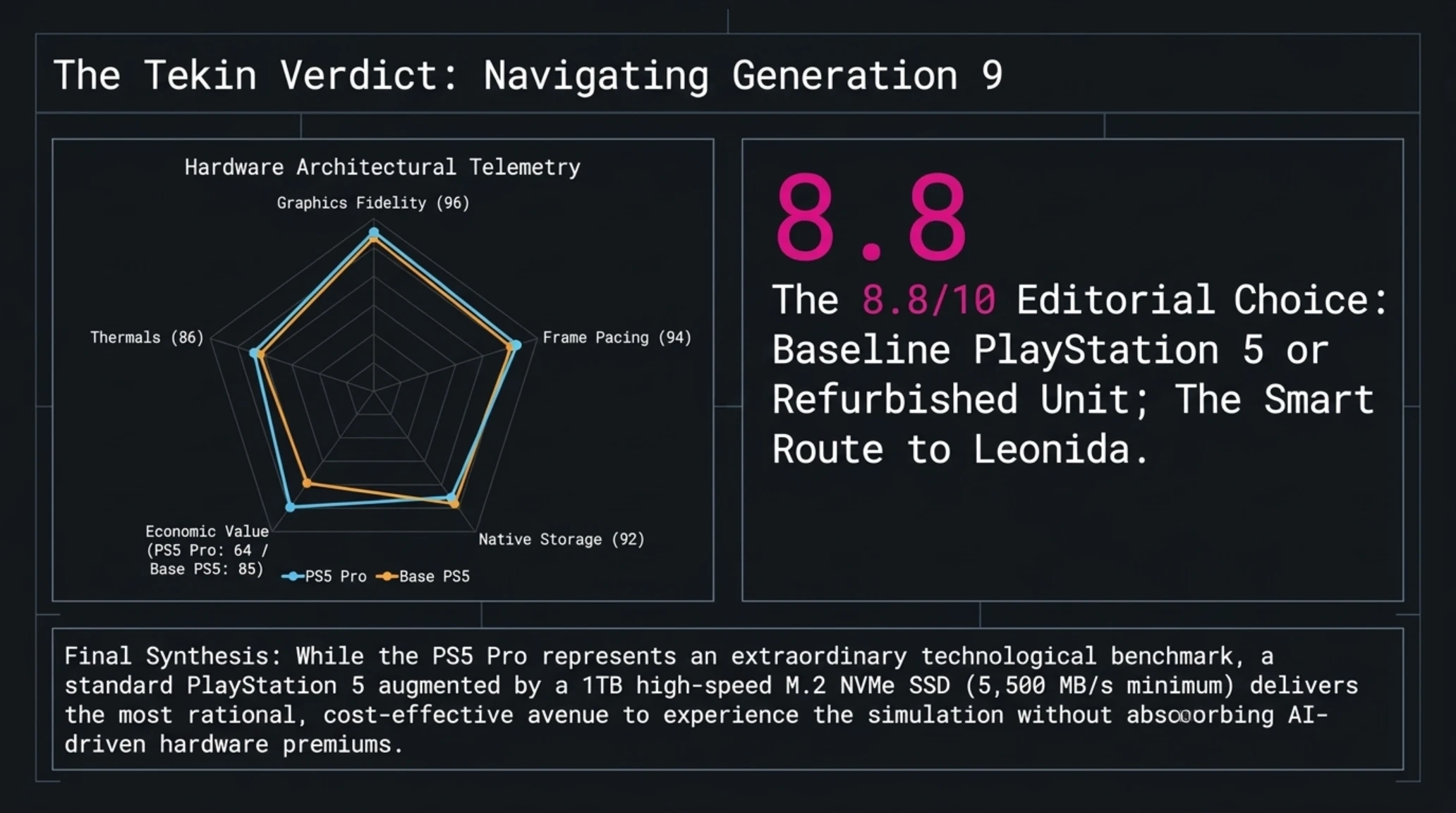
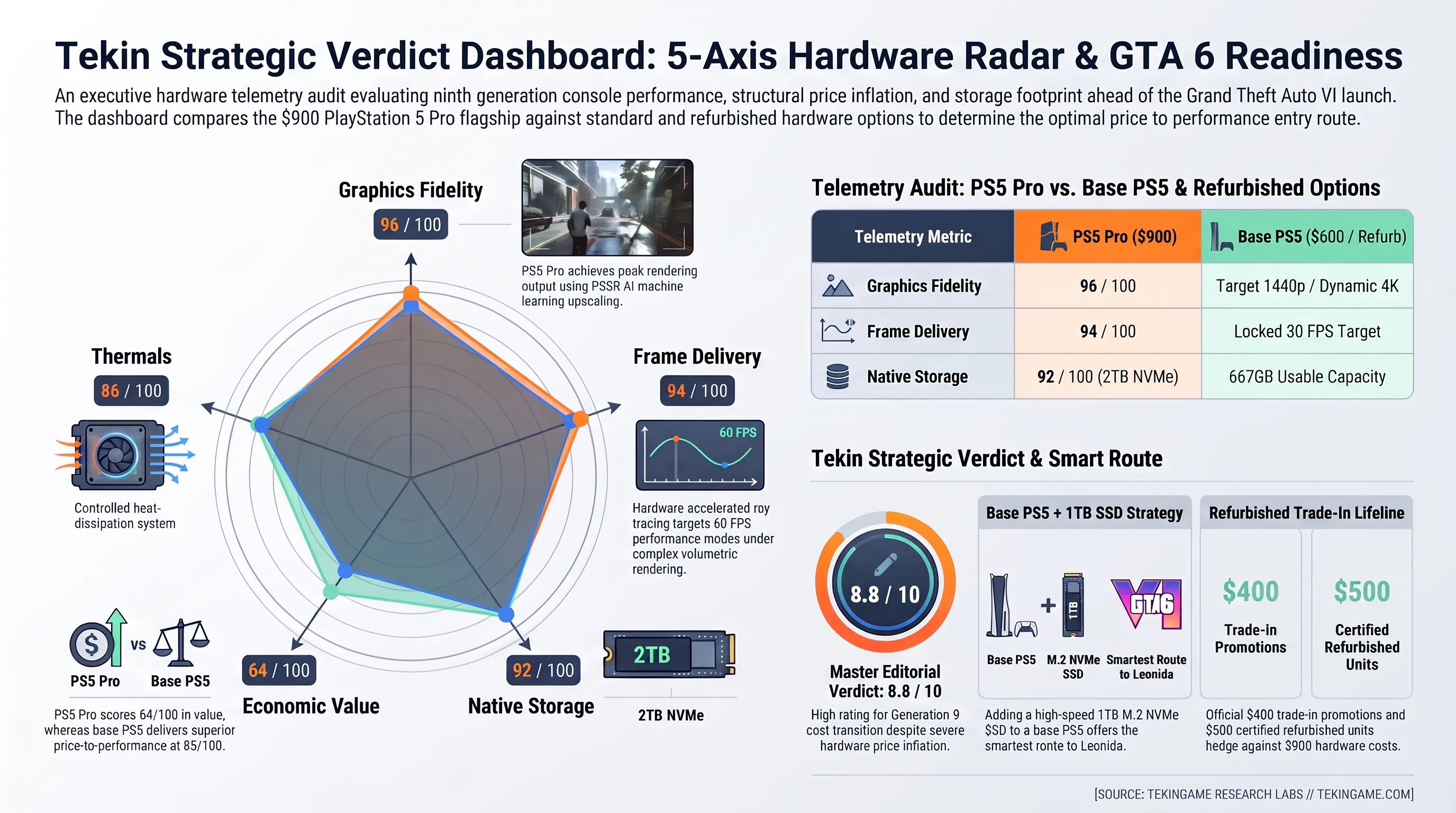
To provide definitive clarity for prospective hardware buyers evaluating current options, the Tekin Engineering desk conducted a rigorous five-axis audit comparing the flagship PlayStation 5 Pro configuration against the baseline PlayStation 5. The evaluation weighs raw compute throughput, frame delivery consistency under peak volumetric rendering, thermal dissipation efficiency, cost-per-frame economic value, and storage headroom.
Five-Axis Hardware Performance & Architectural Radar
Telemetry Synthesis: While the PlayStation 5 Pro achieves clear dominance across fidelity, temporal frame pacing, and out-of-the-box storage headroom, the baseline PlayStation 5 claims a decisive victory in price-to-performance efficiency (85 versus 64).
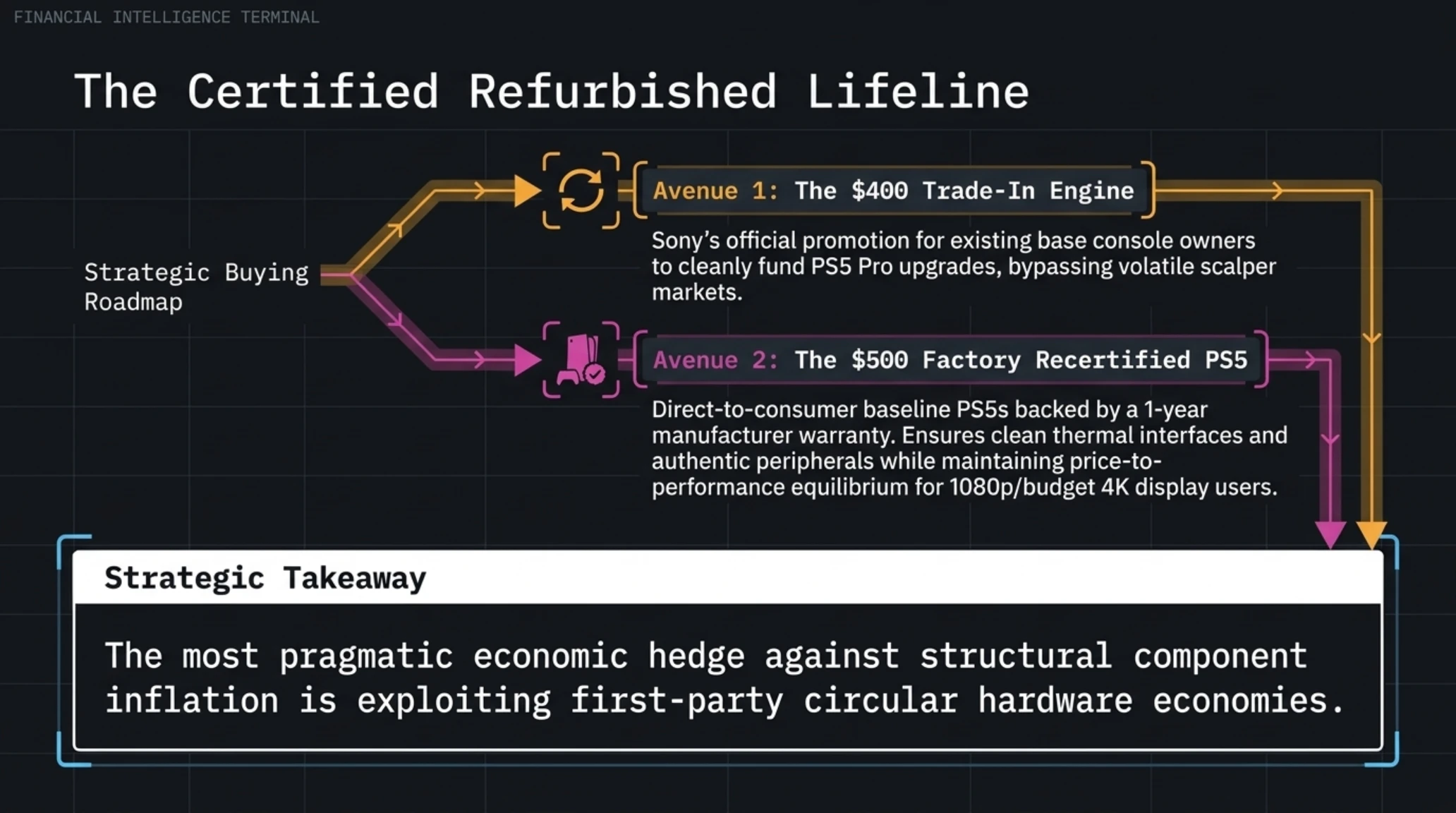
Strategic Buying Roadmap for Global Consumers
Navigating this compressed hardware cycle requires tactical purchasing discipline. To optimize capital outlay without sacrificing launch-day participation, consumers should prioritize three strategic avenues:
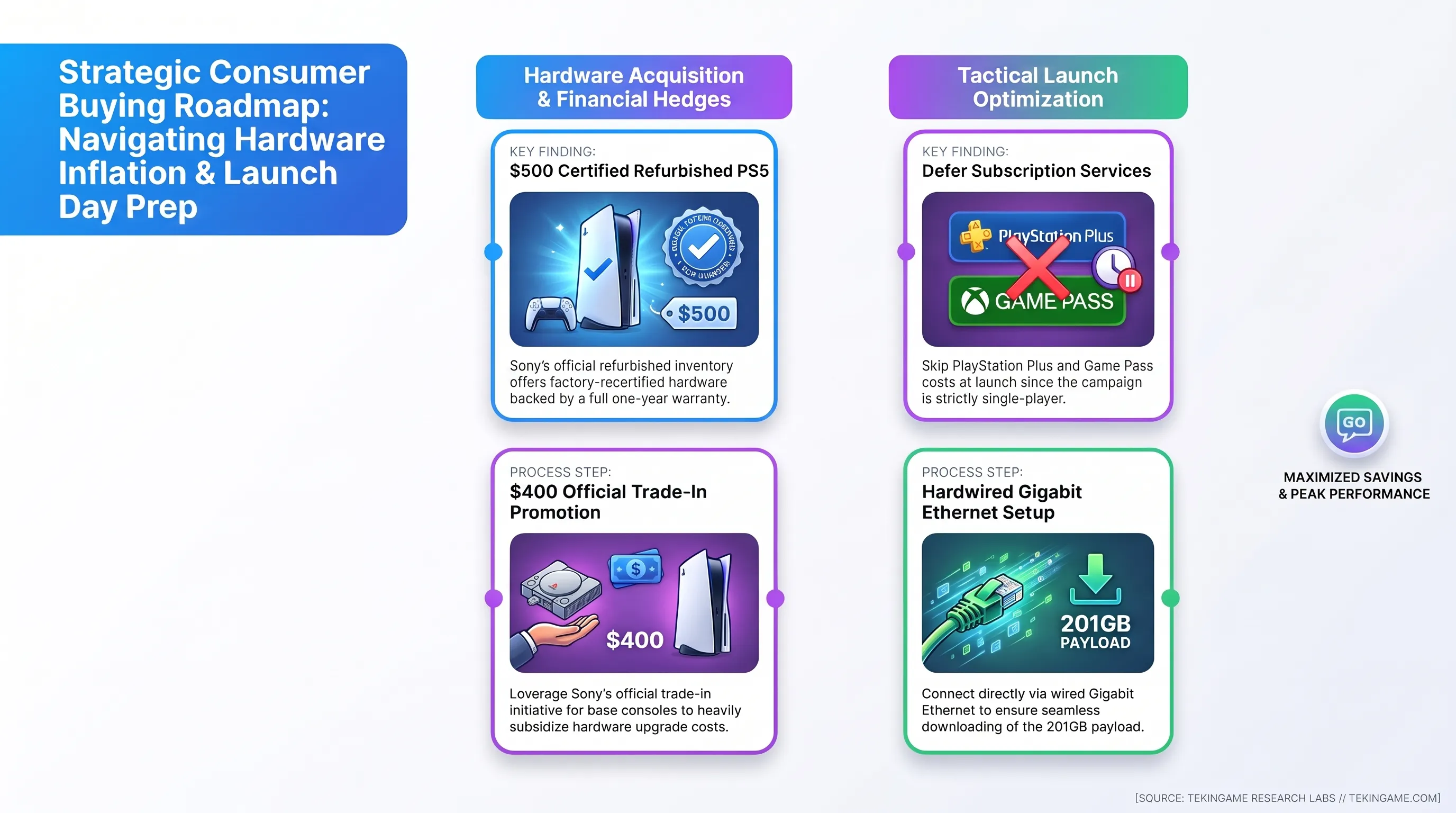
- 1. Exploit First-Party Certified Refurbished Channels: Sony's direct-to-consumer certified refurbished hardware program offers factory-recertified PlayStation 5 systems for $500, backed by a full one-year manufacturer warranty. Simultaneously, their $400 trade-in promotion for existing console owners provides a viable mechanism to fund Pro upgrades. Bypassing scalper-inflated secondary markets in favor of official manufacturer inventory protects against counterfeit peripherals and worn thermal interfaces.
- 2. Preload Preparation and Bandwidth Optimization: The 201GB installation payload will strain regional transit providers during peak hours. Users should connect consoles via hardwired Gigabit Ethernet connections rather than 5GHz Wi-Fi, verify that automated background downloads are enabled under system power settings, and ensure that at least 250GB of contiguous solid-state space is cleared prior to November 12.
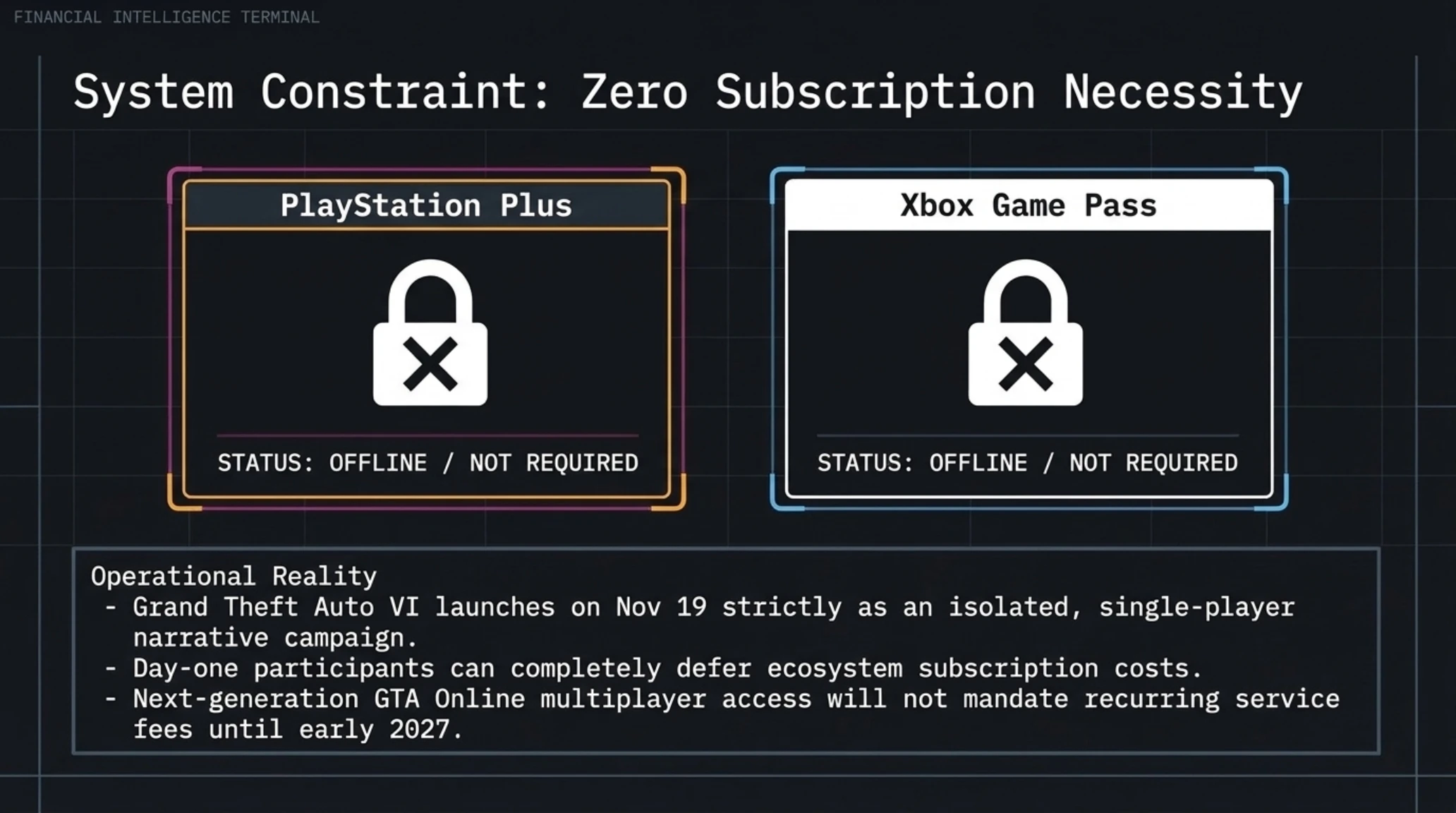
- 3. Avoid Unnecessary Service Subscriptions at Launch: Because Grand Theft Auto VI is strictly a single-player narrative campaign on November 19, players do not need active PlayStation Plus or Xbox Game Pass tiers. The expected launch of the next-generation GTA Online in early 2027 will eventually mandate multiplayer access, but day-one participants can defer subscription costs entirely.
- Exploits the full bandwidth of ninth-generation PCIe NVMe architecture, removing disc seek latency.
- Hardware-accelerated PSSR machine learning on PS5 Pro delivers near-native 4K at stable framerates.
- Eliminates physical disc scratching, shipping logistics delays, and retail stock shortages.
- Guarantees instantaneous global unlock at 00:01 UTC on November 19, 2026.
- Historically unprecedented console hardware price inflation ($500 to $900) driven by AI silicon hoarding.
- Massive 201GB footprint consumes between 25% and 55% of total usable internal console storage.
- Permanent extinction of pre-owned game reselling and physical peer-to-peer game sharing.
Editorial Verdict & Primary Source Documentation
Baseline PlayStation 5 or Refurbished Unit; The Smart Route to Leonida
While the PlayStation 5 Pro represents an extraordinary technological benchmark, a standard PlayStation 5 augmented by a 1TB high-speed M.2 SSD delivers the most rational, cost-effective avenue to experience the game of the decade without absorbing inflated hardware premiums.
- GameSpot: GTA 6 Buying Guide: Sticker Shock and Console Hardware Realities
- IGN: Sony $400 Trade-In Program and Refurbished Console Strategy
- Circana Analytics: State of the Console Gaming Market and Digital Transition Report 2026
- Rockstar Games: Official Preload Schedule and Technical File Size Specifications
Frequently Asked Technical & Purchasing Questions
Do I need an active PlayStation Plus or Xbox Game Pass subscription to play GTA 6 at launch?
No. Grand Theft Auto VI launches on November 19, 2026, exclusively as a single-player story campaign. The multiplayer GTA Online ecosystem is scheduled for release in early 2027. You do not need any paid subscription service to complete the story.
Does buying a physical code-in-a-box copy on November 12 let me play before digital purchasers?
No. Retail stores will stock boxes containing download codes starting November 12 strictly to facilitate preloading the 201GB installation. Rockstar servers will maintain a global encryption lock until 00:01 UTC on November 19.
How much free storage space must I clear before downloading the game?
While the compressed package is 201GB, the system uncompression cache requires at least 250GB of contiguous free storage on your internal SSD or expanded M.2 drive to successfully complete installation.
Will GTA 6 release on PC or Nintendo Switch 2 on November 19?
No. The game launches exclusively on PlayStation 5, PlayStation 5 Pro, and Xbox Series X/S. A dedicated PC port is targeted for early 2027, while no release for Nintendo Switch 2 has been confirmed by Take-Two Interactive.
What distinguishes the $80 standard edition from the $100 Ultimate Edition?
The $80 edition includes the complete standalone game. The $100 Ultimate Edition adds exclusive vintage Vice City cosmetic vehicles, one complimentary month of GTA+ membership, and access to exclusive in-game retail stores unavailable in the standard edition.
Which M.2 NVMe SSD offers the best performance-to-price ratio for the PS5?
PCIe 4.0 drives delivering at least 7,000 MB/s sequential read throughput with an integrated heatsink specifically the Samsung 990 Pro and Western Digital Black SN850X provide optimal thermal dissipation and exceed Sony interface requirements.
Additional Gallery: Tekin Guide: GTA 6 Price Shock, $900 Consoles & 201GB Storage