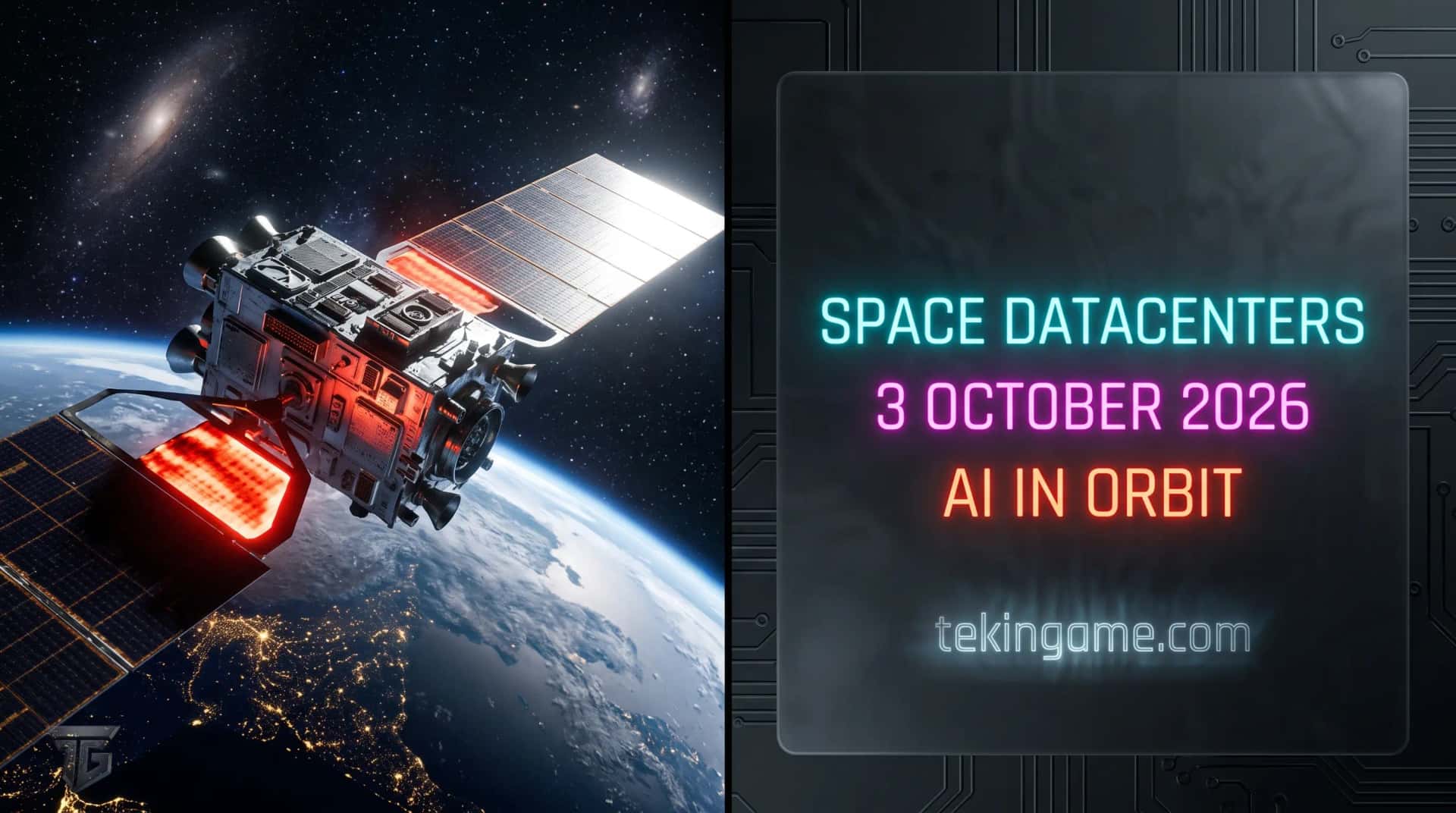
Executive Briefing: Google Project Suncatcher & Orbital AI Supercomputing
An exhaustive technical and macroeconomic analysis of Google's Project Suncatcher, testing Trillium TPUs in low Earth orbit with Planet Labs, and the physics/financial necessity of 1,800 SpaceX Starship launches to make space data centers viable by 2035.
- 🎮Experimental Deployment- Google launches 4 Trillium TPUs (v6e, 4nm TSMC) into SSO aboard a Planet Labs satellite to validate orbital AI inference.
- 🎧Launch Economics- Deploying 1 GW of orbital compute requires 1,800 Starship flights, driving launch costs down to $200/kg via Wright's Law.
- 🚀Thermodynamic Reality- In vacuum, dissipating 100 MW of TPU heat at 80°C via Stefan-Boltzmann infrared radiation requires over 250,000 square meters of radiators.
- 🗡️Constant Solar Flux- Sun-synchronous orbits harvest 1,361 W/m² perpetual solar flux without nighttime blackout or battery storage requirements.
- 📰Radiation Mitigation- Microscopic 4nm finFET gates suffer severe SEUs from cosmic rays, countered by triple modular redundancy and software voting.
- ⚔️Optical Interconnects- Vacuum laser cross-links bypass underground fiber optic index penalties, moving data 30% faster than transoceanic cables.
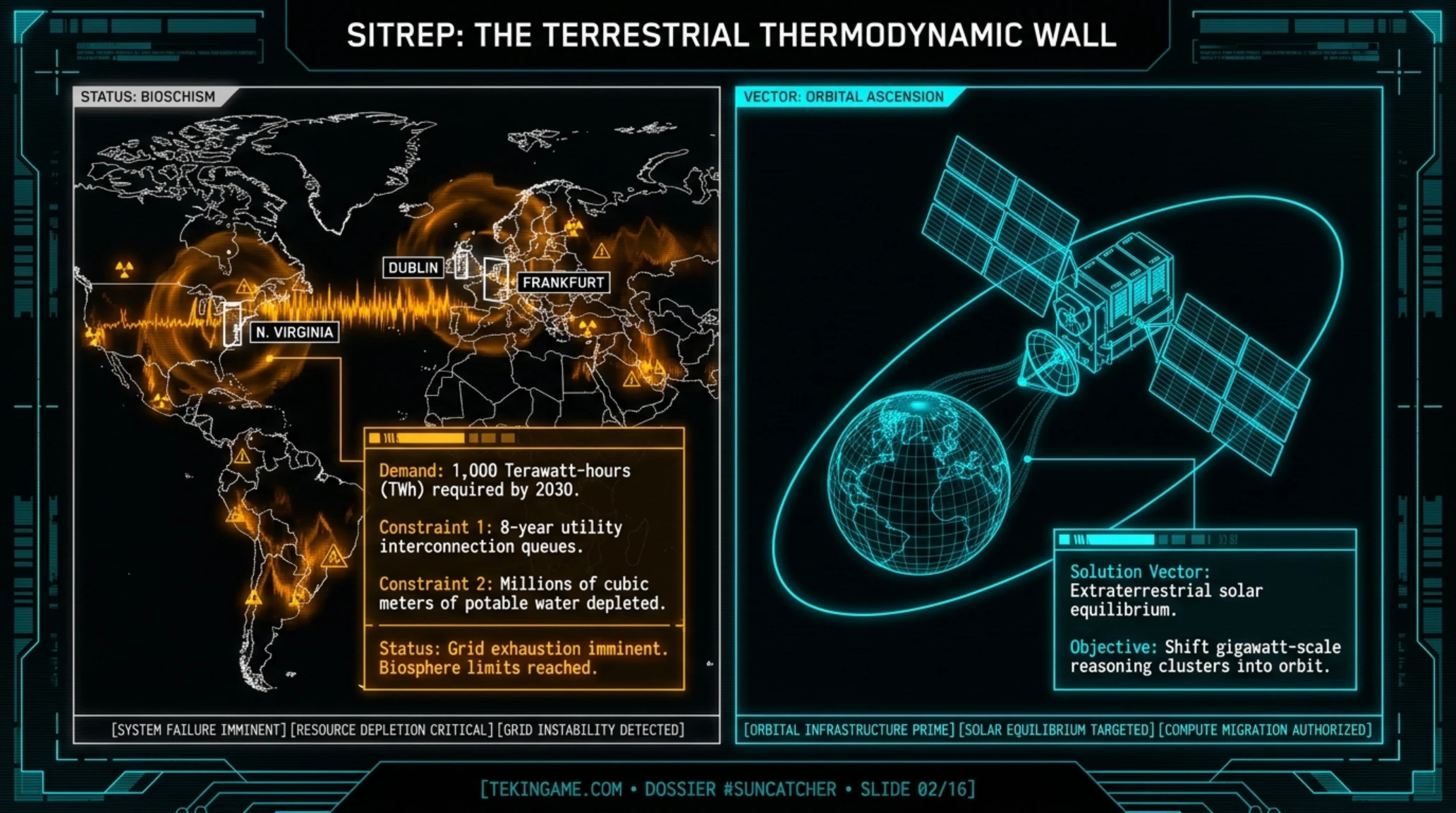
The global infrastructure supporting generative artificial intelligence has slammed into an unyielding thermodynamic and geopolitical wall. On Earth, frontier hyperscalers—led by Google, Microsoft, Amazon, and Meta—are aggressively cannibalizing sovereign electrical grids, locking down nuclear power plant outputs, and depleting millions of cubic meters of potable municipal water to cool gigawatt-scale data campuses. With transmission interconnection queues stretching past eight years in Northern Virginia, Dublin, and Frankfurt, Silicon Valley's computing roadmap faces an unprecedented ceiling: the terrestrial biosphere cannot sustainably supply the 1,000 terawatt-hours of clean electricity demanded by next-generation reasoning clusters by the close of the decade.
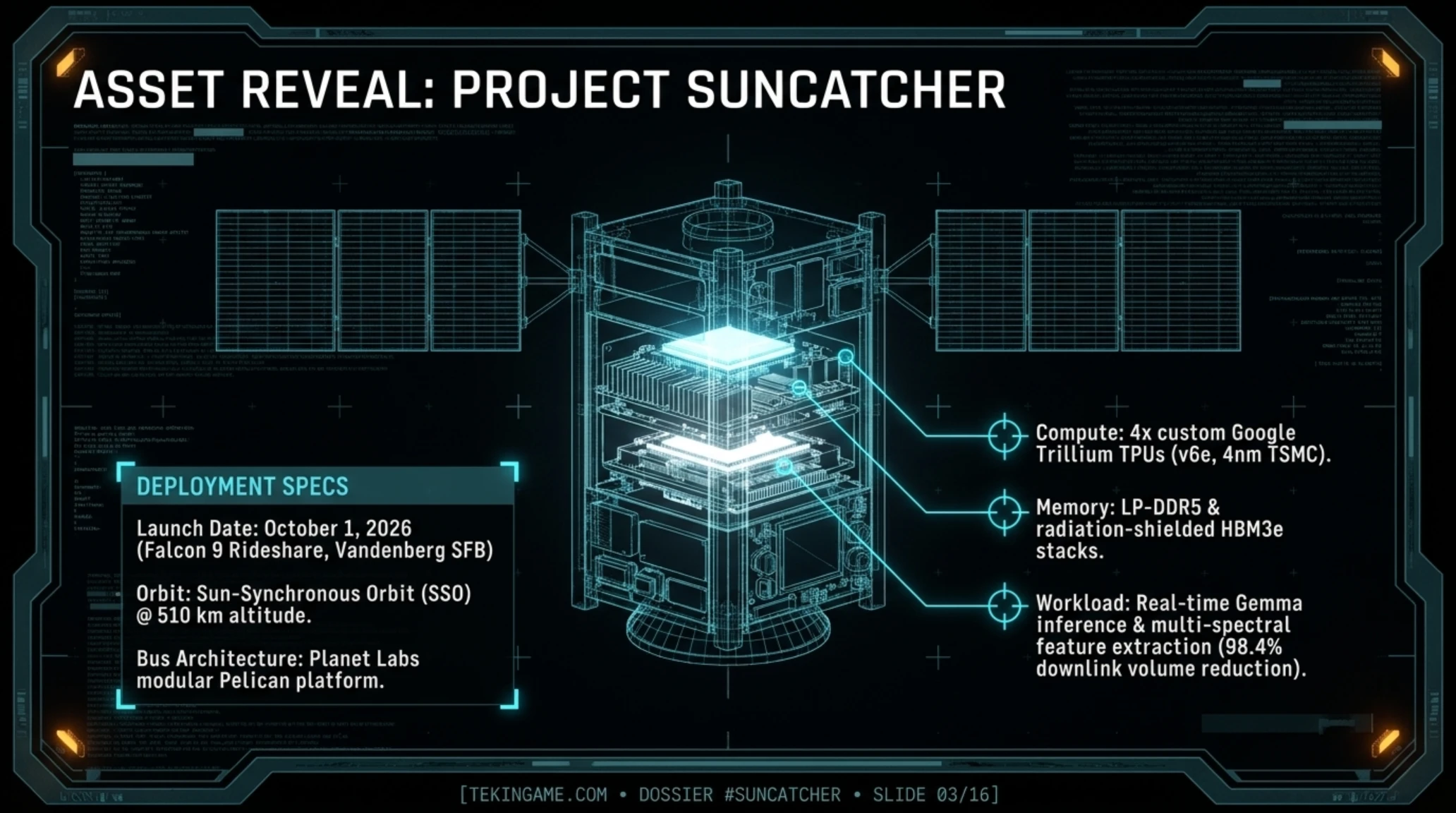
In response to this existential constraint, Google Cloud and Google DeepMind have quietly executed an audacious counter-maneuver. On October 1, 2026, an experimental satellite roughly the dimensions of a commercial refrigerator was deployed into Sun-Synchronous Orbit (SSO) at an altitude of 510 kilometers via a rideshare payload aboard a Falcon 9 rocket from Vandenberg Space Force Base. Developed in secret partnership with Earth-imaging pioneer Planet Labs, the mission—internally christened Project Suncatcher—represents humanity's first empirical validation of advanced enterprise AI tensor accelerators operating in the harsh vacuum and radiation environment of low Earth orbit (LEO).
Project Suncatcher is not a whimsical public relations stunt; it is the opening salvo in a multi-billion-dollar race to build autonomous orbital data centers. Equipped with four customized 4nm Google Trillium TPUs (Tensor Processing Units v6e) mated to high-density LP-DDR5 and radiation-shielded HBM3e stacks, the craft has successfully executed burst inference workloads on Google's lightweight open weights model, Gemma. Yet behind the celebratory headlines lies a staggering industrial reality: according to Google's proprietary aerospace economic models, transitioning orbital compute from a boutique laboratory curiosity to an economically viable 10-gigawatt constellation will require no fewer than 1,800 dedicated launches of SpaceX's heavy-lift Starship rocket over the next decade.
Key Strategic Findings
- Orbital Validation: First functional in-orbit demonstration of 4nm Google Trillium v6e TPUs running local autonomous AI inference on Planet Labs high-resolution orbital imagery.
- Wright's Law Dependency: Economic parity with terrestrial cloud centers demands a 20% cumulative production learning curve, driving Starship launch costs down to $200/kg across 1,800 missions.
- Vacuum Thermodynamics: The total absence of atmospheric convection forces reliance on Stefan-Boltzmann infrared radiation, requiring sprawling ammonia loop heat pipes.
- Solar Advantage: At low Earth orbit altitudes, the solar constant remains unattenuated at an intense 1,361 Watts per square meter, eliminating the need for massive battery banks.
- Radiation Mitigation: Microscopic 4nm finFET gates suffer severe Single Event Upsets (SEUs) from cosmic galactic rays, countered by triple modular redundancy and software voting.
- Zero-Latency Optical Interconnects: Vacuum laser cross-links bypass underground fiber optic index penalties, moving data 30% faster than transoceanic cables.
Project Suncatcher Unveiled: Inside Google and Planet Labs' Orbital TPU Architecture
To grasp the engineering audacity of Project Suncatcher, one must look deep beneath the carbon-fiber micro-meteorite shield of the satellite bus. Terrestrial enterprise servers are delicate, monolithic architectures designed for pristine, climate-controlled cleanrooms where ambient temperatures are pinned precisely between 18°C and 22°C, relative humidity is strictly maintained, and heavy copper heat pipes paired with industrial blowers pump away hundreds of watts per socket. Transplanting modern cutting-edge 4nm semiconductor technology into the vacuum of low Earth orbit represents an environment hostile to every fundamental property of classical computer engineering.
The satellite bus, engineered by Planet Labs utilizing their flight-proven modular Pelican platform, integrates an isolated computational payload bay containing four Trillium TPU v6e dies. These chips, fabricated on TSMC's enhanced 4-nanometer node, were structurally modified by Google's custom hardware engineering division. Unlike terrestrial Trillium racks that utilize massive multi-kilowatt direct-to-chip liquid cooling manifolds, the orbital Suncatcher package is encapsulated in a structural aluminum-beryllium conduction block that channels thermal energy directly into deployable capillary-driven loop heat pipes (LHPs).
During its initial telemetry passes over Ground Station Alpha in Svalbard, Norway, the payload demonstrated successful end-to-end execution of multi-spectral image processing pipelines. Instead of downlinking raw gigabytes of uncompressed Earth observation imagery across heavily congested S-band and Ka-band radio frequencies—a bottleneck that has historically plagued commercial satellite constellations—the on-board Trillium accelerators ingest raw sensor frames directly from Planet Labs' optical instruments. The chips execute quantized convolutional feature extraction and Gemma-based object detection directly on-orbit, reducing downlinked telemetry payload volume by over 98.4% by beaming down only actionable geospatial intelligence and vector embeddings.
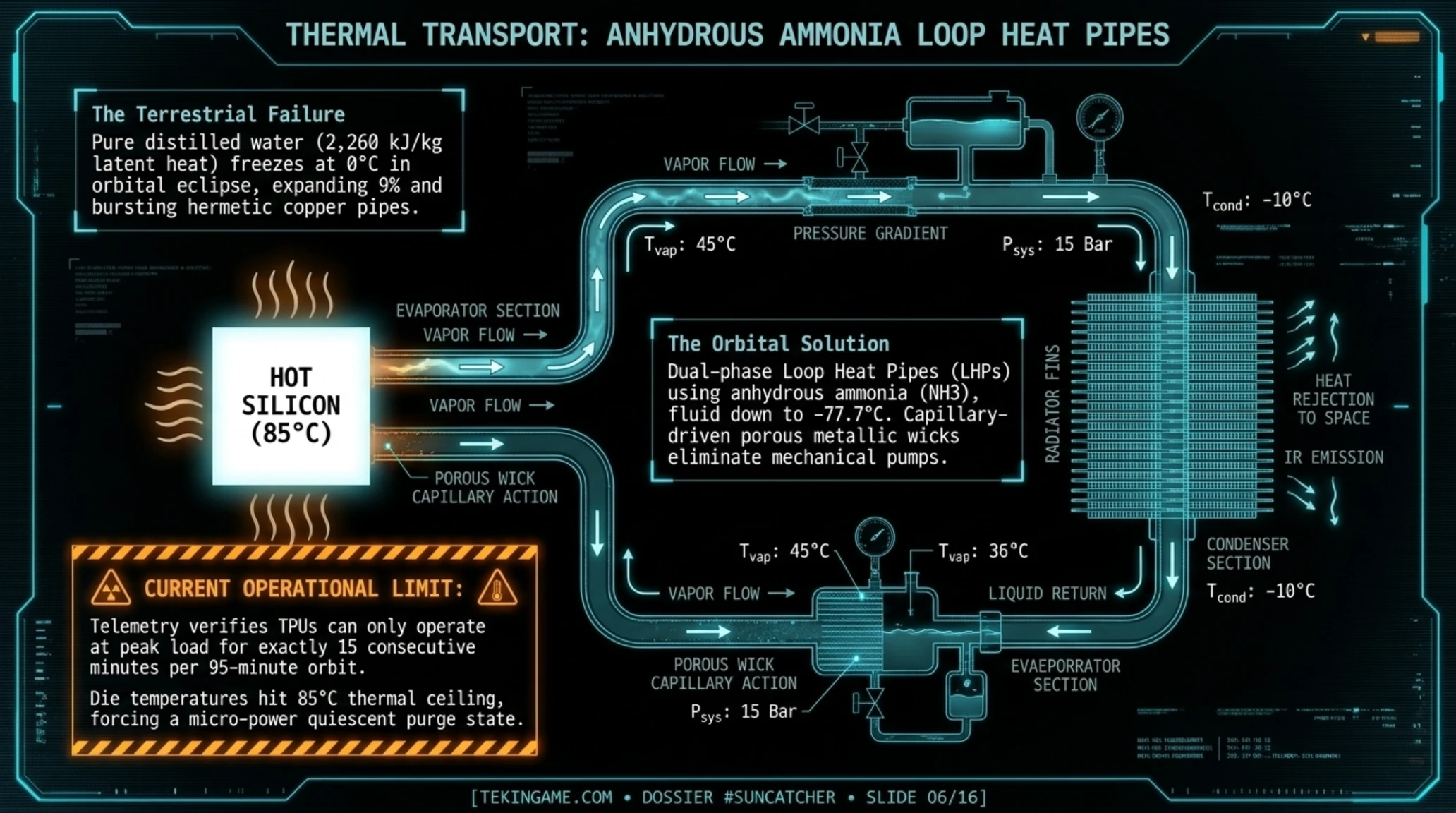
However, the mission telemetry reveals a severe operational constraint: the Trillium TPUs can only operate at peak computational load for precisely 15 consecutive minutes during each 95-minute orbit. Beyond this 15-minute window, internal silicon die temperatures approach the critical 85°C thermal ceiling, forcing Google's autonomous firmware to throttle the processors into a micro-power quiescent state while the radiator panels slowly bleed heat into deep space. This operational duty cycle underscores the paramount bottleneck of extraterrestrial computing: moving and rejecting thermal energy in a medium completely devoid of air.
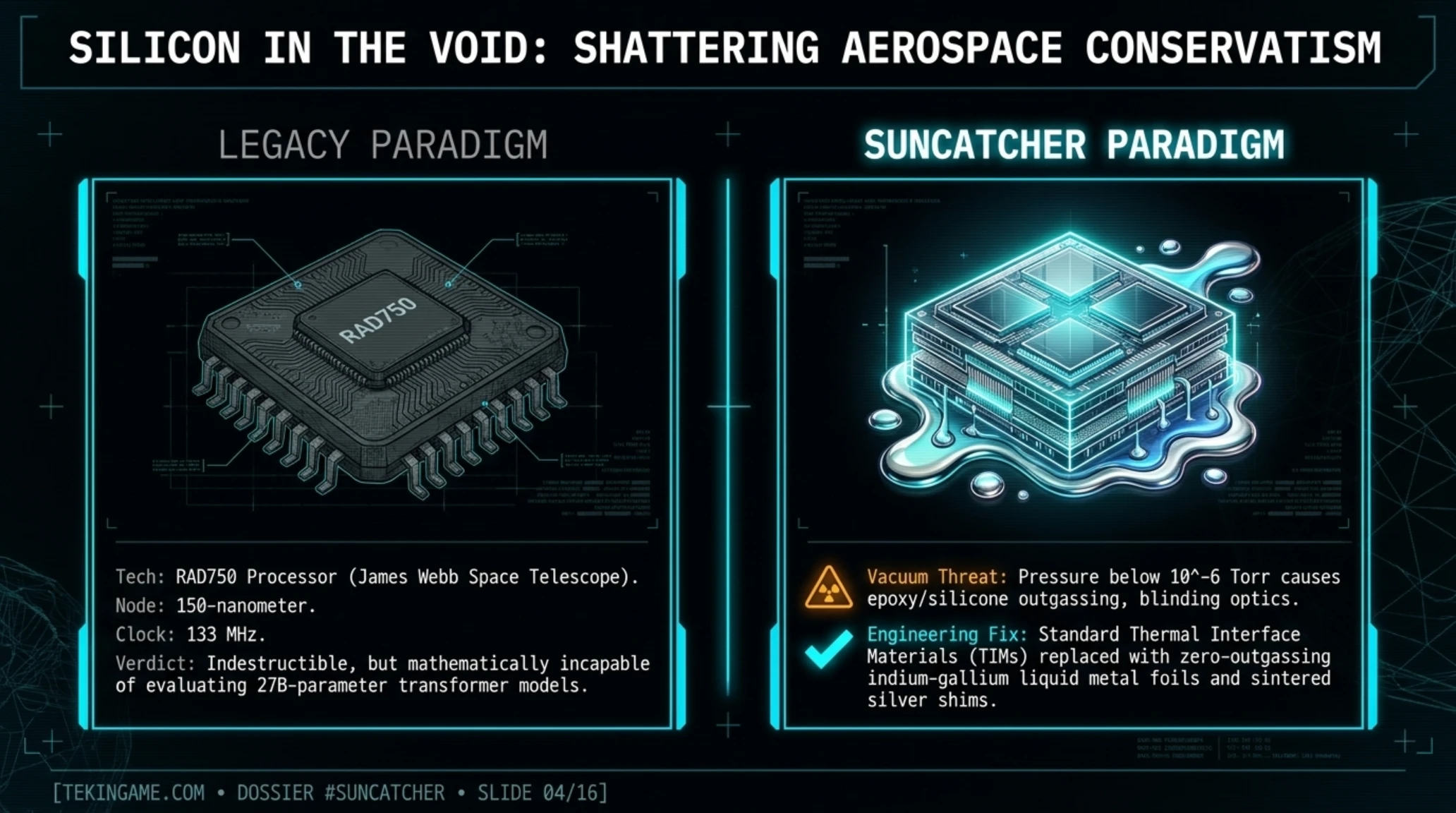
To contextualize the monumental paradigm shift represented by Project Suncatcher, one must appreciate the technological chasm between legacy space-qualified avionics and cutting-edge artificial intelligence silicon. For over six decades, the aerospace industry operated under extreme conservatism: missions to Mars, Jupiter, and low Earth orbit relied on microprocessors featuring lithography nodes frozen in the 1990s. The Apollo Guidance Computer possessed a clock speed of 2.048 MHz; the Space Shuttle's AP-101 general-purpose computers operated at just over 1 million operations per second; and even the state-of-the-art James Webb Space Telescope executes its primary instrument commands on a RAD750 processor built on a 150-nanometer process node at 133 MHz. These legacy chips are practically indestructible against cosmic radiation, but attempting to run a 27-billion-parameter multimodal transformer model on a 133 MHz processor would require several weeks to generate a single sentence.
Google's mission architecture obliterates this conservatism by directly transplanting TSMC's 4-nanometer enterprise tensor silicon into the void of space. However, doing so required solving the perilous phenomenon of material outgassing in high vacuum. Standard commercial server components utilize epoxy resins, electrolytic capacitors, and silicone thermal pastes that spontaneously vaporize and boil when exposed to pressures below $10^{-6}$ Torr. This outgassed vapor condenses upon delicate satellite camera optics, star trackers, and solar cell glass, permanently blinding the spacecraft. Google and Planet Labs replaced all standard commercial thermal interface materials (TIMs) with specialized indium-gallium liquid metal foils and sintered silver nanoparticle thermal shims that exhibit zero outgassing across thousands of thermal cycles.

The Industrial Economics of Wright's Law: Why Orbit Demands 1,800 Starship Launches
To evaluate whether space-based artificial intelligence is a viable commercial horizon or an engineering folly, one must abandon Silicon Valley software abstractions and calculate the brutal macroeconomic metrics of aerospace mass-fraction economics. In terrestrial data center development, the capital expenditure (CapEx) breakdown is dominated by semiconductor accelerators (approximately 60-70% of total cluster cost) followed by civil land acquisition, high-voltage substations, and mechanical cooling towers. In orbit, the economic calculus undergoes a violent inversion: launch logistics alone historically comprise over 80% of the entire asset lifecycle budget.
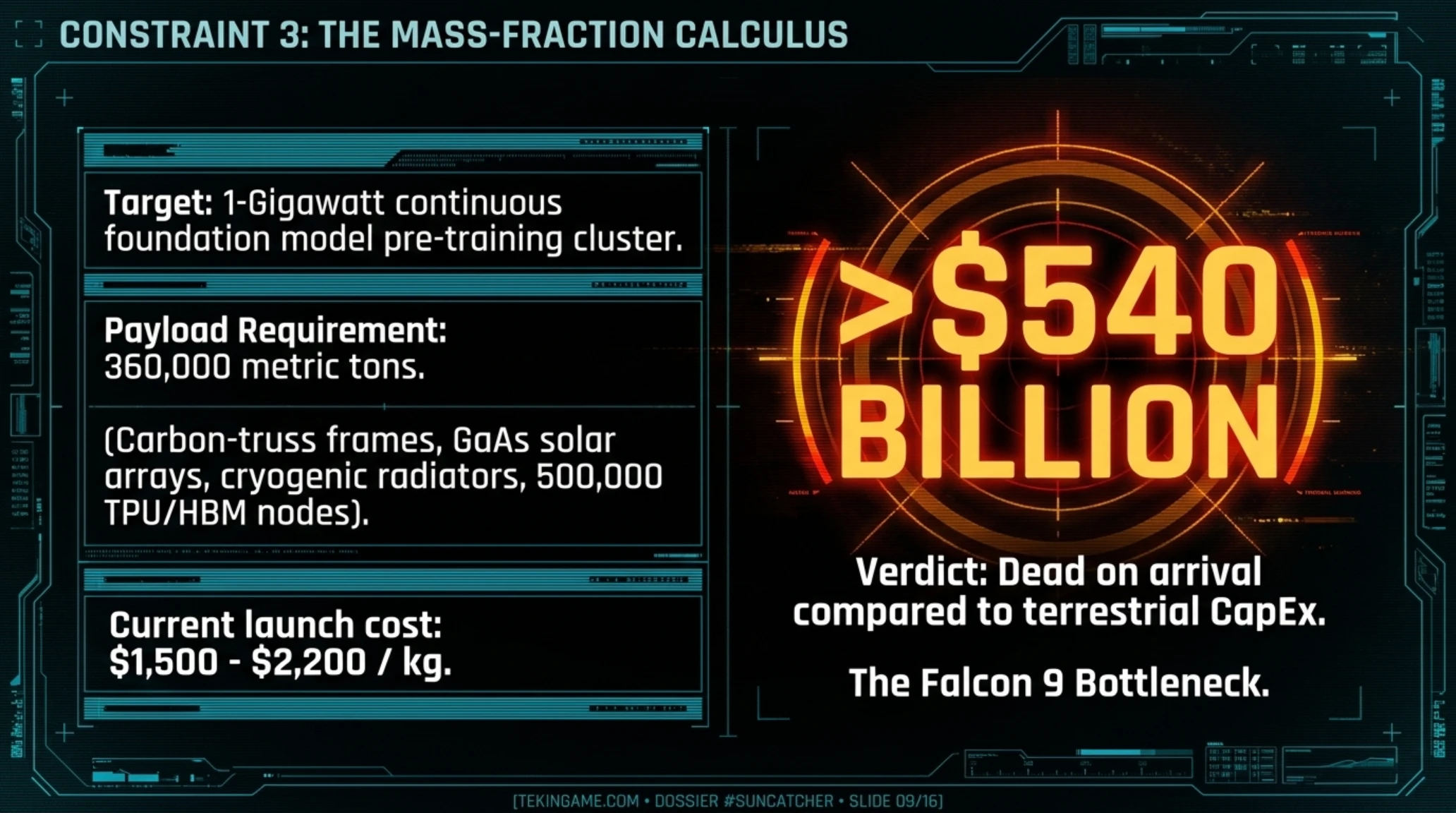
According to comprehensive techno-economic white papers formulated by Google's infrastructure research division, achieving a meaningful orbital compute footprint—defined as a 1-Gigawatt continuous compute cluster capable of running global foundation model pre-training and real-time reasoning—requires lifting an estimated 360,000 metric tons of hardware into low Earth orbit. This colossal mass budget encompasses structural carbon-truss frameworks, ultra-thin high-efficiency gallium-arsenide (GaAs) solar arrays, high-voltage power conditioning units, cryogenic loop radiators, optical inter-satellite laser transceivers, and approximately 500,000 custom TPU/HBM nodes.

Under current commercial launch rates utilizing the partially reusable Falcon 9, launch costs hover between $1,500 and $2,200 per kilogram delivered to low Earth orbit. At these rates, lifting 360,000 metric tons into orbit would command a catastrophic launch bill exceeding $540 billion—a figure that completely renders space computing dead on arrival compared to terrestrial construction costs. However, Google's strategic horizon is anchored entirely upon the transformative promise of Wright's Law applied to SpaceX's fully reusable Starship architecture.
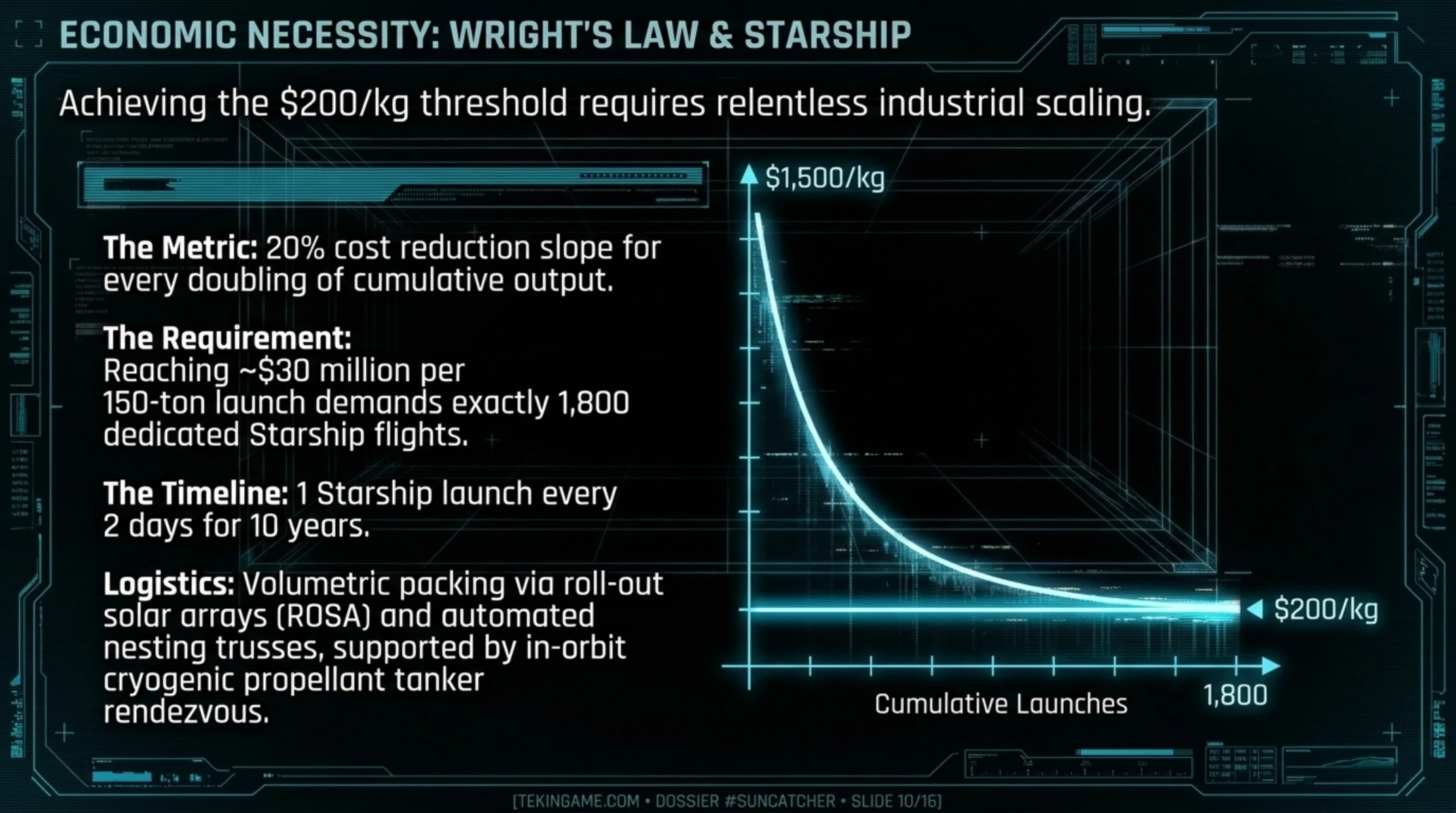
Wright's Law dictates that for every doubling of cumulative manufacturing and operational output, unit production costs drop at a predictable, fixed percentage rate (the learning rate). In commercial aerospace launch cadence, SpaceX has historically exhibited an aggressive 20% cost reduction slope. For Starship to drive launch costs down from its initial commercial test pricing to the targeted economic threshold of $200 per kilogram (or roughly $30 million per 150-ton launch), the flight cadence must scale relentlessly. Google's quantitative models indicate that achieving this threshold requires exactly 1,800 dedicated Starship launches over a ten-year deployment horizon—equivalent to launching a Starship every two days for a decade.
Macroeconomic & Capital Expenditure Analysis: Terrestrial vs Orbital Compute Paradigms (2026-2035)
| Cost & Operational Metric | Terrestrial Hyperscale Data Center (1 GW) | Orbital Suncatcher Constellation (1 GW at $1,500/kg) | Mature Starship Orbital Constellation (1 GW at $200/kg) |
|---|---|---|---|
| Initial Facility & Hardware CapEx | $12.5 Billion (Land, Buildings, Racks, TPUs) | $38.0 Billion (Space-hardened ASICs, Solar, Radiators) | $24.0 Billion (Mass-manufactured Satellite Nodes) |
| Launch & Insertion Logistics Cost | $0 (Ground Transport Only) | $540.0 Billion (Commercially Prohibitive) | $72.0 Billion (1,800 Starship Missions at Scale) |
| Primary Energy Source & Cost | Utility Power Grid ($0.07 - $0.14 / kWh) | Direct Continuous Solar Flux ($0.00 / kWh) | Direct Continuous Solar Flux ($0.00 / kWh) |
| Water Consumption per Gigawatt-Year | 15 to 25 Million Cubic Meters (Evaporative Towers) | Zero (Absolute Closed-Loop Radiative Dissipation) | Zero (Absolute Closed-Loop Radiative Dissipation) |
| Interconnection & Permitting Lead Time | 6 to 8 Years (Grid Interconnection Queues) | 12 to 18 Months (Launch License & Orbital Filing) | Continuous Rolling Deployment (Days per Flight) |
| Operational Lifespan & Deprecation | 10 to 15 Years (Building), 3-5 Years (Silicon) | 3 to 5 Years (Accelerated Radiation Wear) | 5 to 7 Years (On-orbit Modular Robotic Replacement) |
The Relentless Solar Advantage: 1,361 W/m² Constant Flux vs Terrestrial Land/Grid Exhaustion
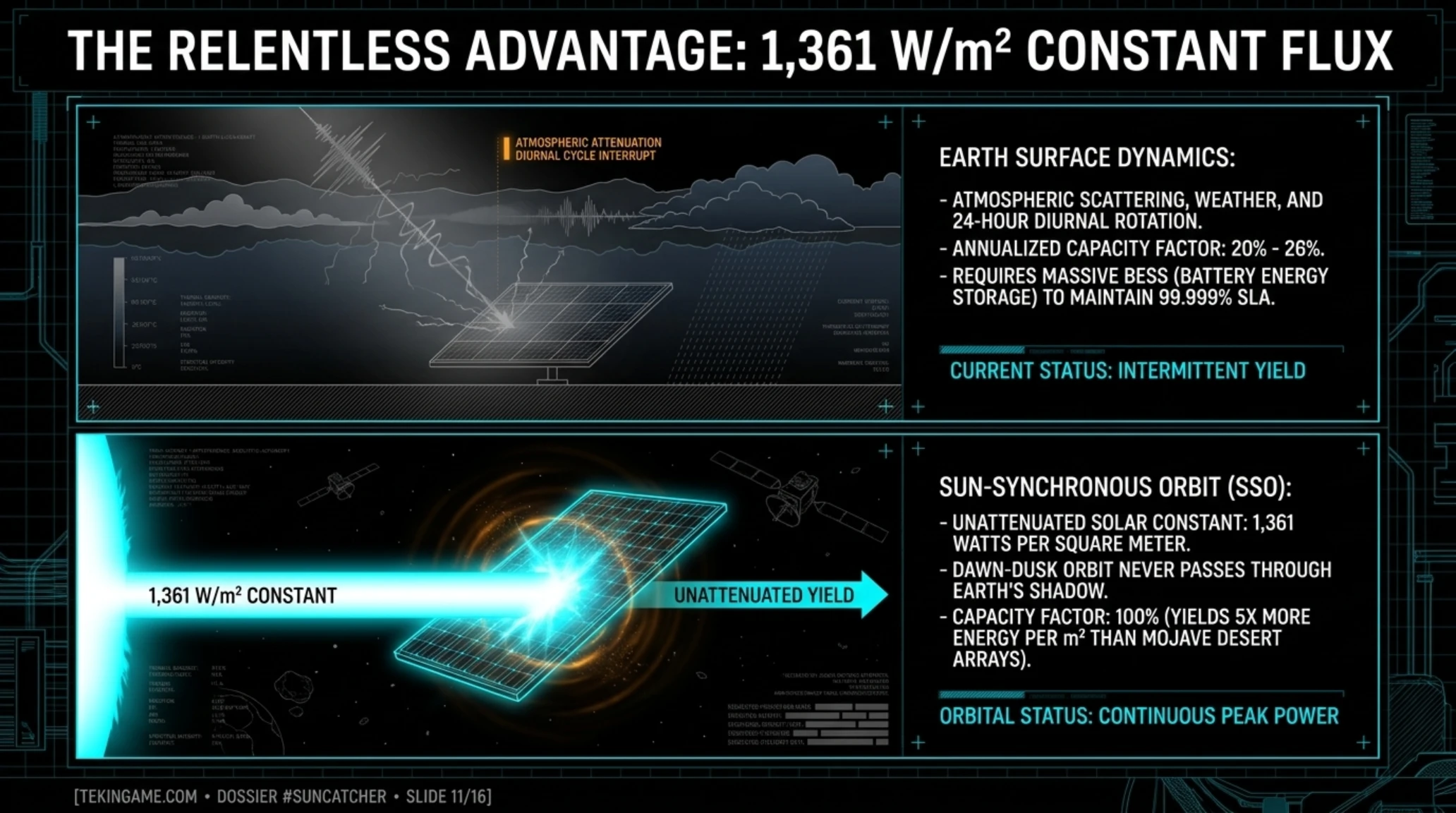
Why would hyperscalers even consider shouldering the multi-billion-dollar logistical complexity of 1,800 rocket launches? The answer lies in the physics of extraterrestrial energy density. On the surface of planet Earth, solar power generation is an intermittent, heavily compromised resource. Solar radiation must traverse tens of kilometers of atmosphere, suffering Rayleigh scattering, aerosol absorption, cloud cover, and seasonal variations. Furthermore, the inescapable diurnal rotation of the Earth cuts surface insolation to zero for roughly half of every 24-hour cycle. As a consequence, terrestrial utility-scale solar farms exhibit an annualized capacity factor of merely 20% to 26%, necessitating monstrous battery energy storage systems (BESS) or fossil peaker plants to maintain the 99.999% uptime demanded by enterprise cloud service level agreements.
Above the Earth's atmosphere, the fundamental physics change dramatically. At low Earth orbit altitudes, the solar constant remains unattenuated at an intense 1,361 Watts per square meter ($1,361 \text{ W/m}^2$). By placing data center satellites into a carefully engineered Sun-Synchronous dawn-dusk orbit (an orbital plane that permanently tracks along the Earth's twilight terminator line), the solar collectors are bathed in 100% continuous, perpetual sunlight without ever passing through the Earth's shadow. This translates into a capacity factor of 100%, yielding nearly five times more electrical energy per square meter of photovoltaic silicon compared to the best terrestrial installations in the Mojave Desert or the Arabian Peninsula.
This unlimited, un-metered solar flux bypasses the most toxic political and economic bottleneck currently strangling Silicon Valley: utility interconnection approvals. Hyperscalers are presently paying massive premiums to procure dedicated nuclear energy and custom hardware architectures, a dynamic we previously examined in our definitive guide on NVIDIA CUDA lock-in migration to custom ASICs and the macroeconomic fallout documented in the enterprise AI token pricing crisis and cloud power shortages. In orbit, there are no utility monopolies, no environmental impact lawsuits from suburban municipalities, and zero local water table depletion.
Furthermore, evaluating Starship's logistics through the lens of Wright's Law requires dissecting the twin bottlenecks of launch mass fraction and volumetric fairing density. A standard Starship payload bay possesses an internal usable volume of approximately 1,000 cubic meters. However, satellite components such as deployable solar wings, sprawling ammonia heat pipes, and micro-meteorite Whipple bumpers are intrinsically low-density, high-volume payloads (often dubbed "volume-limited" rather than "mass-limited" cargo). Packing 150 to 200 metric tons of payload into a single Starship requires revolutionary mechanical origami: automated nesting trusses, tensioned carbon-nanotube masts that deploy like motorized tape measures, and folded roll-out solar arrays (ROSA) similar to those tested on the International Space Station.
Additionally, placing a 1-Gigawatt constellation into Sun-Synchronous or higher Medium Earth Orbit (MEO) requires orbital propellant transfer. A fully loaded Starship reaching low Earth orbit exhausts nearly all of its internal liquid methane and liquid oxygen propellants merely overcoming Earth's gravity well. To boost heavy orbital compute modules to higher, more stable altitudes where atmospheric drag does not require continuous propellant re-boosts, SpaceX must master orbital cryogenic tanker rendezvous. Each dedicated compute payload launch will likely necessitate two to three auxiliary tanker flights to top off the spacecraft's propellant tanks—further cementing the imperative of reaching an industrial cadence of hundreds of launches per year.
The Lethal Vacuum Thermodynamics: Dissipating Megawatts via Stefan-Boltzmann Radiation
The single most seductive and catastrophic misconception regarding outer space is that it is "freezing cold," leading casual observers to assume that cooling hot silicon in orbit is trivial. While it is true that the cosmic microwave background temperature of deep space hovers at a frigid 2.7 Kelvin (-270.45°C), this thermal metric is practically meaningless for an engineer attempting to cool a dense cluster of enterprise microprocessors. Temperature is a statistical measurement of the average kinetic energy of physical molecules. In the hard vacuum of low Earth orbit, particle density drops to virtually zero; there are no atmospheric gas molecules to collide with a heat sink, absorb kinetic energy, and drift away.
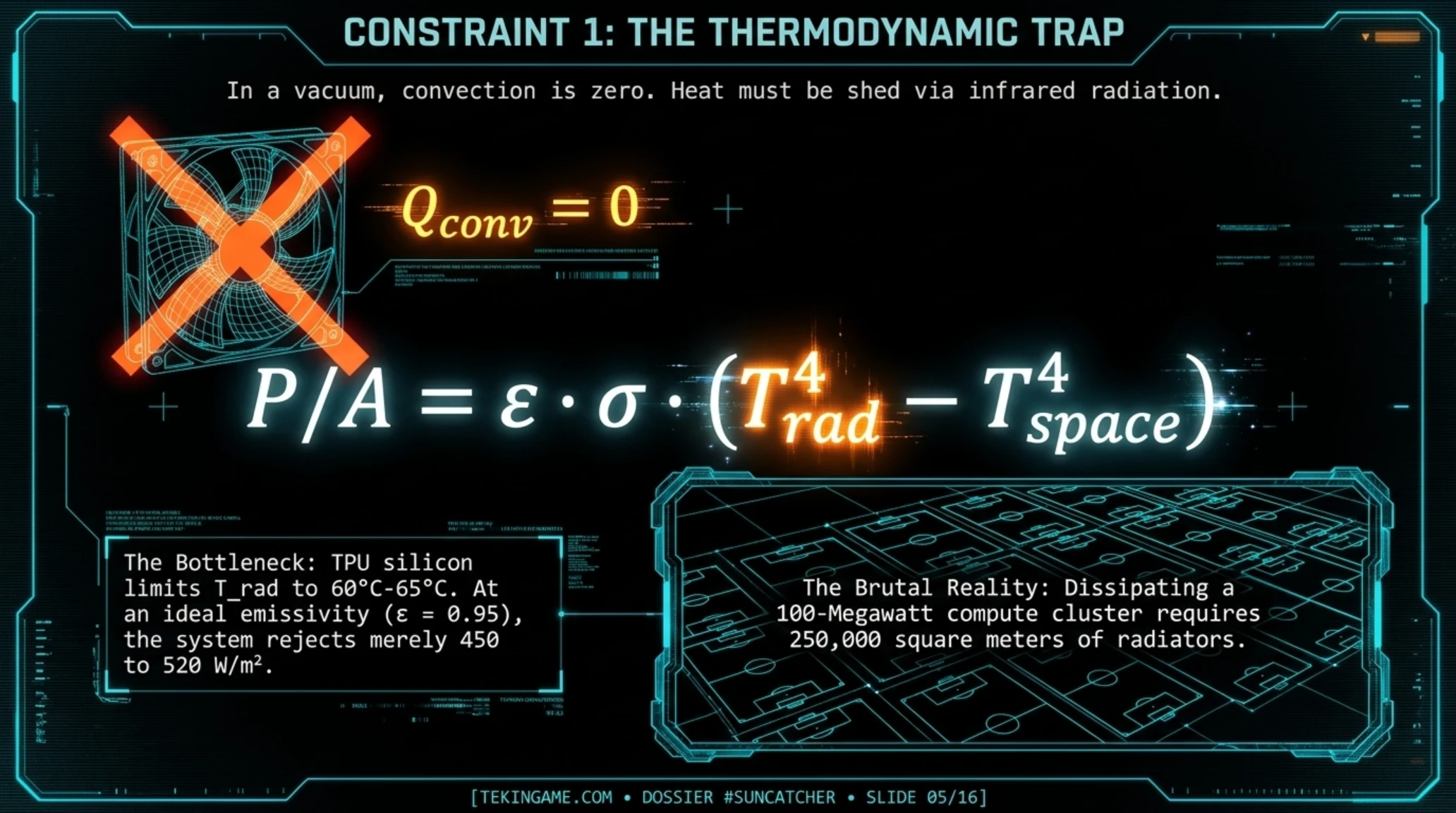
Consequently, the primary cooling mechanisms that sustain terrestrial data centers—convective heat transfer ($Q_{\text{conv}} = 0$) and atmospheric evaporative cooling—are completely non-existent in the vacuum of space. The only physical mechanism permitted by the laws of nature to shed thermal waste into the cosmos is electromagnetic thermal radiation in the infrared spectrum, governed strictly by the Stefan-Boltzmann Law:
$$\frac{P}{A} = \epsilon \cdot \sigma \cdot (T_{\text{rad}}^4 - T_{\text{space}}^4)$$
Where $\sigma$ represents the Stefan-Boltzmann constant ($5.67 \times 10^{-8} \text{ W}/(\text{m}^2 \cdot \text{K}^4)$), $\epsilon$ is the surface emissivity of the radiator material, $T_{\text{rad}}$ is the absolute temperature of the radiating surface in Kelvin, and $T_{\text{space}}$ is the deep-space radiation sink temperature. The fatal engineering bottleneck emerges from the exponent of four ($T^4$) coupled with the delicate thermal operational envelope of commercial silicon. While a rocket engine or a nuclear thermal core can radiate heat with supreme efficiency at 1,500 Kelvin ($1,227^\circ\text{C}$), Google's Trillium TPUs experience catastrophic dielectric breakdown and electromigration failure if their semiconductor junctions exceed 85°C (358.15 Kelvin).
When factoring in conductive thermal resistance between the TPU silicon dies, the vapor chambers, and the circulating heat transfer fluid, an orbital radiator's outer surface can realistically operate at no more than 60°C to 65°C (approximately 335 Kelvin). At this modest temperature, even an idealized radiator with an extraordinary emissivity coefficient of $\epsilon = 0.95$ can reject merely 450 to 520 Watts per square meter into open space. Therefore, dissipating the thermal waste of a modest 100-Megawatt orbital compute cluster requires an unfathomable radiating surface area exceeding 220,000 to 250,000 square meters—the spatial footprint of approximately 35 standard FIFA football pitches. Launching, unfolding, structurally stiffening, and fluid-pressurizing such colossal structures without micro-meteorite punctures represents one of the most demanding mechanical engineering feats in human history.
To overcome this radiative bottleneck within the compact envelope of Project Suncatcher, aerospace thermal architects at Google and Planet Labs developed dual-phase Loop Heat Pipes (LHPs) featuring capillary-driven porous metallic wicks. High-purity anhydrous ammonia vaporizes at the microchannel cold plates directly bonded to the TPU silicon, surges through flexible stainless-steel vapor lines under capillary pressure without requiring failure-prone mechanical pumps, condenses within deployable graphene-coated radiator fins, and passively wicks back to the evaporator core. Nevertheless, until deployable multi-acre radiator technologies mature, orbital TPUs remain restricted to burst-mode operational profiles.

📚 Classified & Related Dossiers in TekinGame
If you wish to explore beyond this report and delve into cybernetic frontiers and autonomous AI architectures, do not miss these three exclusive deep-dives in the Tekin Garage:
Physical Orbital Hazards vs Deep-Tech Engineering Countermeasures (Space Specs Matrix)
| Orbital Environmental Stressor | Physical Silicon Failure Mechanism | Google & Planet Labs Engineering Mitigation | Technology Readiness Level (TRL) |
|---|---|---|---|
| Total Convection Absence in Vacuum | Instantaneous thermal accumulation and solder reflow melting | Capillary Loop Heat Pipes, graphene IR radiators, 15-min burst cycles | TRL 5 (Validated in Relevant Orbital Environment) |
| Galactic Cosmic Rays & Solar Flares | Single Event Upsets (SEU bit-flips) and destructive Latch-up | Triple Modular Redundancy (TMR), ECC-SECDED, software majority voting | TRL 7 (Subsystem Prototype Flight Proven) |
| Atomic Oxygen (AO) Surface Erosion | Rapid photochemical degradation of optical sensors and radiator coats | Protective siloxane and amorphous Silicon Dioxide (SiO2) nanocoatings | TRL 8 (Actual System Flight Qualified) |
| Extreme Orbital Thermal Cycling | Mechanical fatigue, solder joint micro-cracking, structural warp | Sun-synchronous dawn-dusk constant illumination orbits | TRL 9 (Flight Proven Through Successful Missions) |
| Hypervelocity Debris (Kessler Cascade) | Catastrophic puncture of coolant loops and structural bus rupture | Multi-layered Nextel/Kevlar Whipple shields, automated xenon thruster burns | TRL 6 (System Prototype Demonstrated in Orbit) |
Radiation Hardening in 4nm FinFET Silicon: Cosmic Rays, Bit-Flips, and Latent Degradation
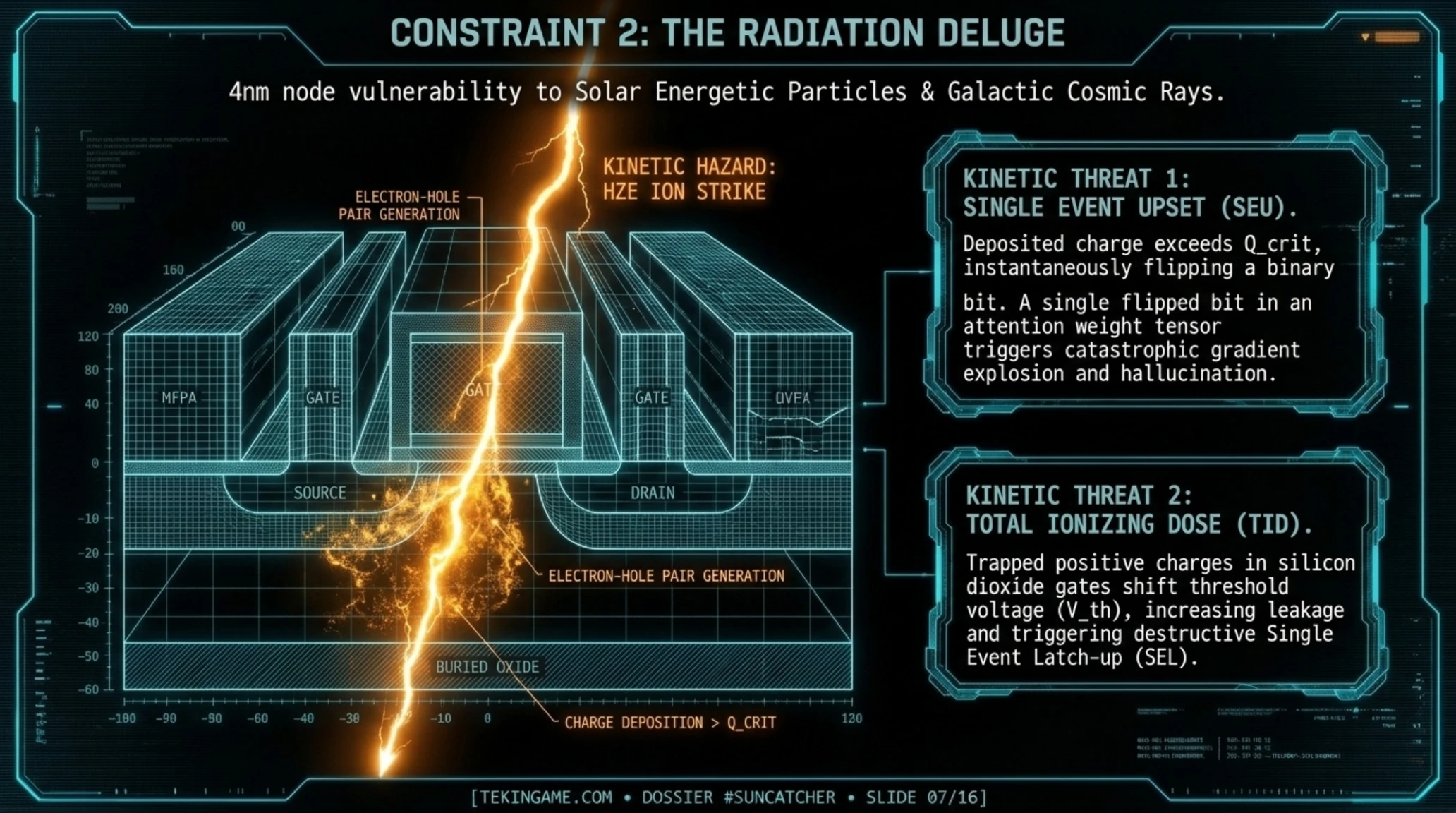
Beyond the thermodynamic wall lies a lethal electromagnetic bombardment. Within the Earth's atmosphere, organic life and commercial electronics are shielded from energetic space weather by the planet's thick magnetosphere and atmospheric absorption column, which collectively absorb the vast majority of high-energy solar energetic particles (SEPs) and galactic cosmic rays (GCRs). In low Earth orbit—and particularly at orbital inclinations exceeding 50 degrees or passing through the South Atlantic Anomaly (SAA)—spacecraft are subjected to a continuous deluge of relativistic protons, alpha particles, and heavy iron nuclei (HZE ions).
For decades, aerospace and defense contractors navigated this hazard by relying exclusively on antiquated, radiation-hardened microprocessors fabricated on massive 150nm or 250nm silicon-on-insulator (SOI) process nodes (such as the venerable BAE RAD750). While practically immune to radiation-induced damage, these processors operate at clock speeds of just 133 MHz and possess negligible arithmetic throughput—millions of times too slow to evaluate modern multi-billion-parameter foundation models. Deploying frontier generative AI in orbit mandates utilizing commercial cutting-edge 4nm FinFET or 3nm Gate-All-Around (GAA) nodes, which possess gate oxide thicknesses measured in a mere handful of atomic layers.
When an energetic heavy ion punches through a 4nm SRAM cell or an HBM3e high-bandwidth memory silicon interposer, it deposits a localized track of electron-hole pairs along its ionization trajectory. If the deposited electrical charge exceeds the critical switching charge of the transistor ($Q_{\text{crit}}$), the stored binary bit instantaneously flips—a catastrophic fault known as a Single Event Upset (SEU). In traditional scientific computing, a bit-flip might cause a numerical anomaly; in large language model pre-training or autoregressive token generation, a single flipped bit in an attention weight tensor can propagate numerical instability across subsequent layers, triggering catastrophic gradient explosion and producing totally incoherent hallucinations.
- Completely circumvents terrestrial electrical grid exhaustion and multi-year utility queue delays
- Harvests unattenuated 1,361 W/m² perpetual solar flux without nighttime interruptions or battery losses
- Eliminates industrial freshwater consumption and municipal wastewater contamination entirely
- Enables real-time orbital intelligence processing at the edge, reducing downlink bandwidth bottlenecks by 98%
- Astrophysical launch barrier requiring 1,800 Starship flights to achieve economic parity with ground campuses
- Enormous radiator surface area requirements (250,000 m² per 100 MW) due to Stefan-Boltzmann vacuum limits
- Accelerated silicon wear and high SEU bit-flip failure rates induced by cosmic radiation
- Heightened collision hazards in congested LEO altitudes accelerating the risk of runaway Kessler syndrome
In analyzing the internal heat transport inside the satellite bus, Google's engineers encountered the extreme limits of single-phase conductive thermodynamics. In a terrestrial server rack, copper heat pipes utilize pure distilled water as a working fluid because water possesses an exceptionally high latent heat of vaporization ($2,260 \text{ kJ/kg}$). However, in the extraterrestrial orbital regime, water is a disastrous working fluid: if the satellite experiences an unforeseen power interruption or orbital orientation failure while passing behind the Earth, the water inside the thin copper heat pipes will freeze solid at 0°C, expanding by 9% and bursting the hermetic piping. Upon reactivation, the processors would instantaneously burn out. Google and Planet Labs circumvented this by deploying specialized anhydrous ammonia ($NH_3$), which maintains its fluid phase down to -77.7°C, ensuring that even under severe spacecraft safe-mode thermal excursions, the fluid loop will never freeze, rupture, or compromise the integrity of the TPU cold plates.
On the electrical and silicon failure front, cosmic radiation introduces subtle and insidious degradation beyond simple bit-flips. Prolonged exposure to solar cosmic rays causes Total Ionizing Dose (TID) accumulation within the silicon dioxide gate dielectrics of the 4nm FinFET transistors. Over months of bombardment, trapped positive charges accumulate within the insulator layer, steadily shifting the threshold voltage ($V_{th}$) of the transistors. This threshold shift increases parasitic leakage current, degrades switching speed, and eventually triggers destructive Single Event Latch-up (SEL)—a condition where parasitic bipolar transistors within the CMOS structure create a direct short-circuit between power and ground, permanently frying the chip. Google's autonomous telemetry continuously monitors leakage current across each individual Trillium compute cluster, dynamically raising supply voltage and re-calibrating clock frequency domains to compensate for semiconductor degradation in real time.

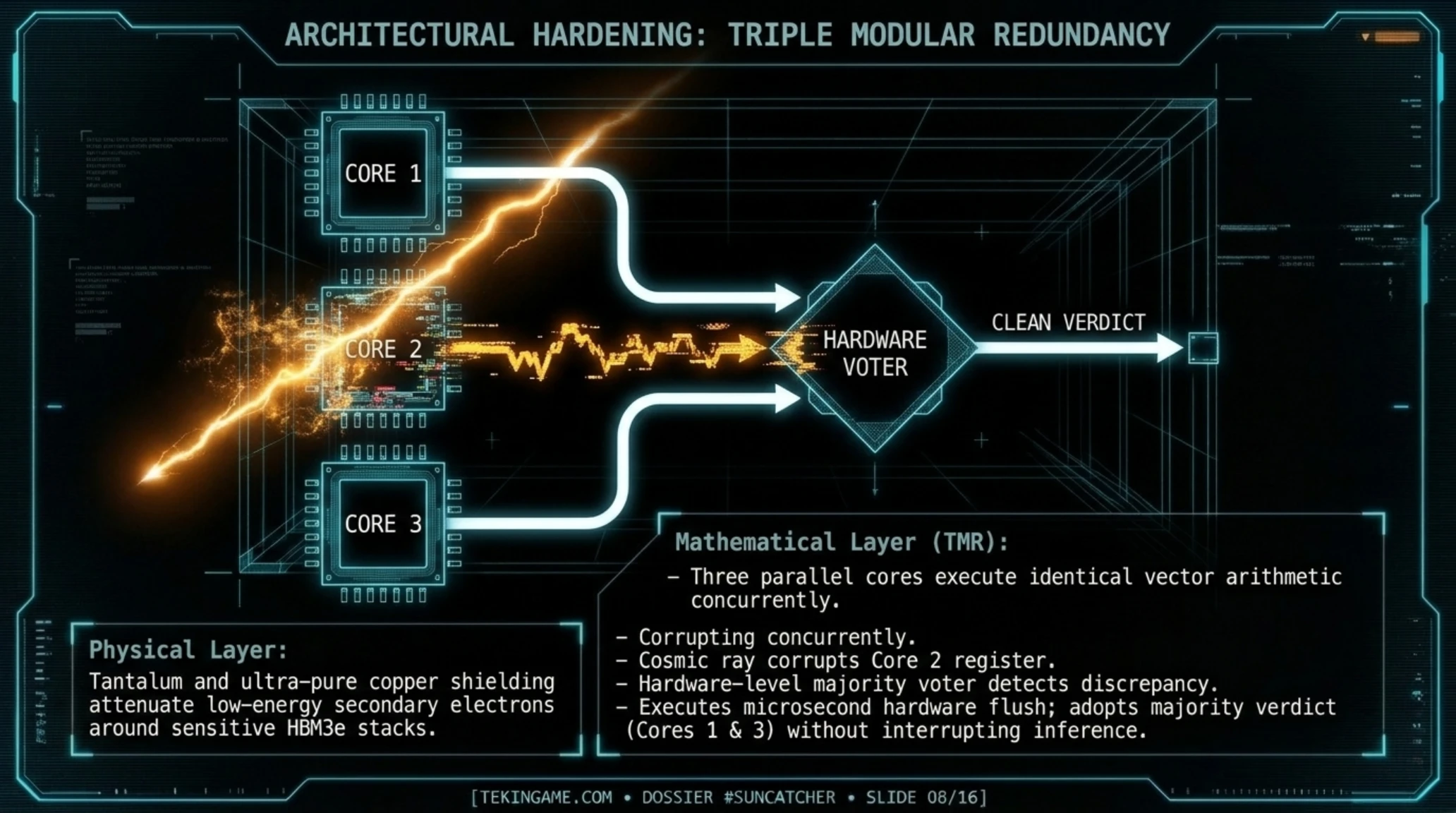
To operate commercial TSMC 4nm silicon without suffering mission loss, Google's Suncatcher payload implements a multi-tiered defense matrix combining physical, architectural, and mathematical fault tolerance. Physically, sensitive memory stacks are encased in thin tantalum and ultra-pure copper shielding to attenuate low-energy secondary electrons. Architecturally, Google utilizes Triple Modular Redundancy (TMR) coupled with hardware-level majority voters on all mission-critical instruction buses: three parallel cores execute identical vector arithmetic concurrently, and if a cosmic ray corrupts a register in Core 2, the system automatically detects the discrepancy, executes a microsecond hardware flush, and adopts the majority verdict of Cores 1 and 3 without interrupting model inference.
Orbital Optical Mesh Networks: Beating the Speed of Light in Glass and Dodging Kessler Cascades
An isolated supercomputing satellite in space is of limited utility unless it can communicate with terrestrial ground stations and neighboring computational nodes at scale. Terrestrial hyperscale data campuses rely on dense fabrics of multi-terabit single-mode optical fibers linking individual server chassis within microseconds. In orbit, trailing physical fiber cables between free-flying satellites separated by hundreds of kilometers is an impossibility. Orbital clusters must therefore forge a dynamic, self-healing constellation fabric utilizing Optical Intersatellite Laser Links (OISL).
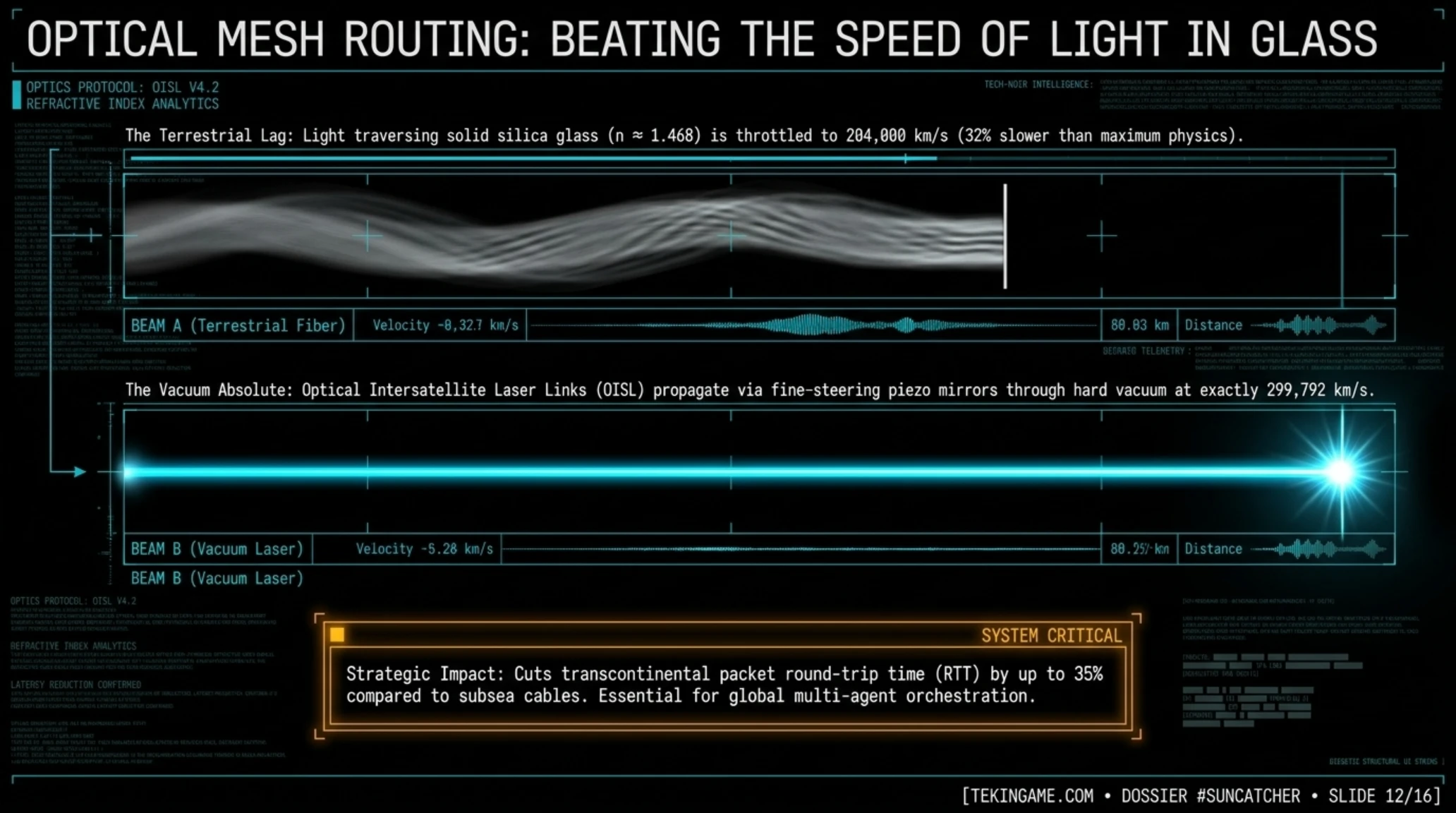
Remarkably, orbital laser routing unlocks a profound fundamental advantage over terrestrial telecommunications infrastructure: the pure physics of photon propagation velocity. In terrestrial fiber-optic networks, light travels through solid silica glass, which possesses a refractive index of approximately $n \approx 1.468$. This physical medium slows the velocity of light down to roughly 204,000 kilometers per second—nearly 32% slower than its theoretical speed limit in a vacuum. Above the atmosphere, laser beams emitted by fine-steering piezo mirrors propagate through the absolute vacuum of space at the uninhibited speed of light: exactly 299,792 kilometers per second.
Consequently, transmitting multi-gigabyte foundation model parameter updates between orbital compute nodes, or routing financial market inference data from London to Tokyo via a low-Earth-orbit optical laser mesh, cuts transcontinental packet round-trip time (RTT) by up to 35% compared to the fastest subsea transatlantic and transpacific submarine fiber cables. This distributed synchronization architecture mirrors the agentic operational frameworks detailed in our deep-dive analysis on TrueForge enterprise multi-agent execution orchestration.
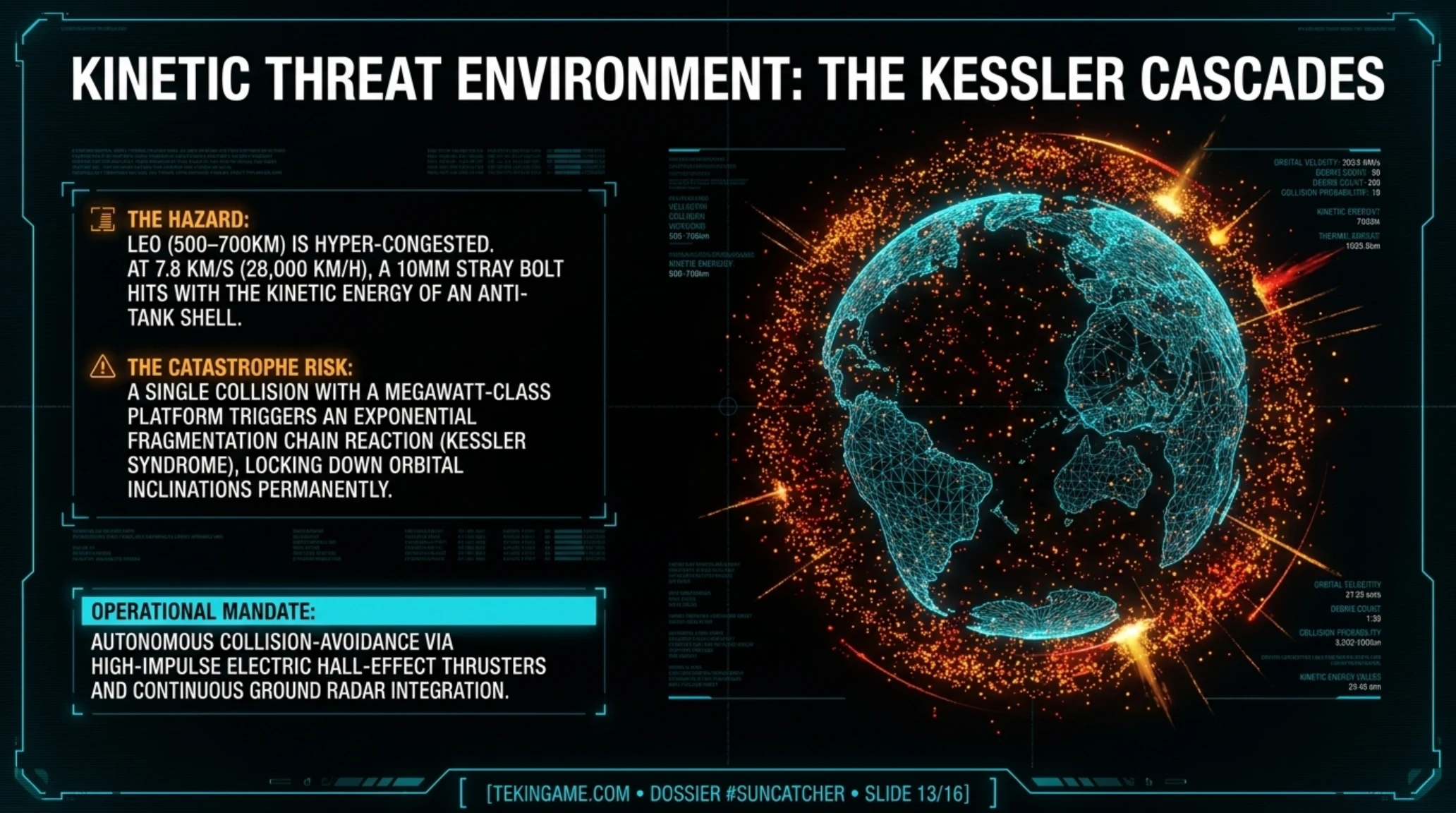
However, this dense web of orbital compute nodes must survive the escalating geopolitical and kinetic peril of Kessler Syndrome. Low Earth orbit between 500 and 700 kilometers altitude is increasingly congested with tens of thousands of commercial satellites, spent upper rocket stages, and hypervelocity orbital shrapnel. At orbital velocities exceeding 7.8 kilometers per second (over 28,000 km/h), a fleck of paint or a stray 10-millimeter bolt possesses the kinetic energy of an anti-tank artillery shell. A single catastrophic collision involving a megawatt-class compute platform could trigger an exponential chain reaction of fragmentations, rendering critical orbital inclinations permanently impassable. Securing orbital data centers demands continuous integration with ground radar tracking networks, automated collision-avoidance burns powered by high-impulse electric Hall-effect thrusters, and autonomous end-of-life de-orbit systems.

Big Tech Orbital Hegemony: Google Suncatcher vs Amazon Kuiper vs Starlink Compute Nodes
The successful deployment of Project Suncatcher marks the end of an era where space was purely an observational and telecommunications domain. We are now witnessing the opening moves of a titanic geopolitical and industrial struggle: the race among Big Tech hyperscalers to colonize low Earth orbit as the premier execution layer for artificial general intelligence. Just as corporate empires in the nineteenth century fought to secure coal depots along maritime trade routes, modern sovereign tech monopolies are aggressively staking claims to orbital slots, radio frequency spectrum, and launch vehicle manifests.
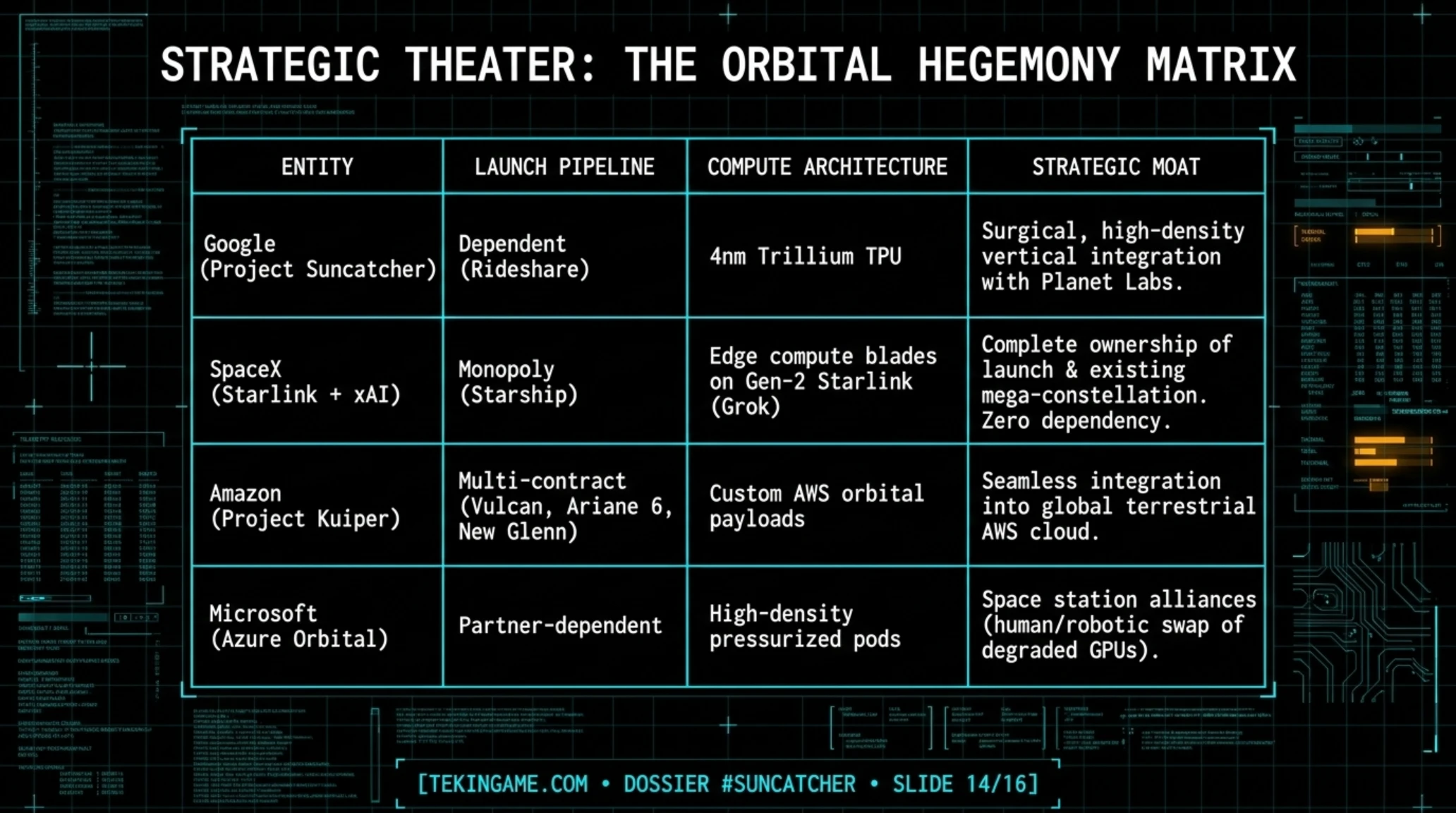
Google's strategic posture is defined by surgical, high-density vertical integration. By pairing its proprietary 4nm Trillium TPU architectures with Planet Labs' established constellation infrastructure, Google aims to establish an unassailable monopoly over real-time orbital geospatial reasoning. But Google does not operate in a vacuum. SpaceX, under the unified leadership of Elon Musk, holds an overwhelming structural advantage: complete ownership of the launch pipeline via Starship, coupled with the existing mega-constellation of Starlink satellites. SpaceX has already begun testing localized edge compute blades integrated into its Gen-2 Starlink buses, creating an immediate, pre-existing constellation capable of hosting xAI's Grok inference models directly on-orbit with zero external launch provider dependencies.
Concurrently, Amazon is aggressively advancing its Project Kuiper mega-constellation. Backed by multi-billion-dollar launch procurement contracts across United Launch Alliance (Vulcan Centaur), Arianespace (Ariane 6), and Jeff Bezos's Blue Origin (New Glenn), Amazon Web Services (AWS) is designing orbital compute payloads tailored to integrate seamlessly into its global cloud infrastructure. While Microsoft previously explored extreme environmental isolation through its undersea Project Natick, Azure Orbital is currently forging alliances with commercial space station developers, seeking to deploy high-density compute pods inside pressurized orbital habitats where human or robotic technicians can physically swap degraded GPU modules.

The 2035 Horizon: Megawatt Space Constellations and In-Orbit Robotic Servicing
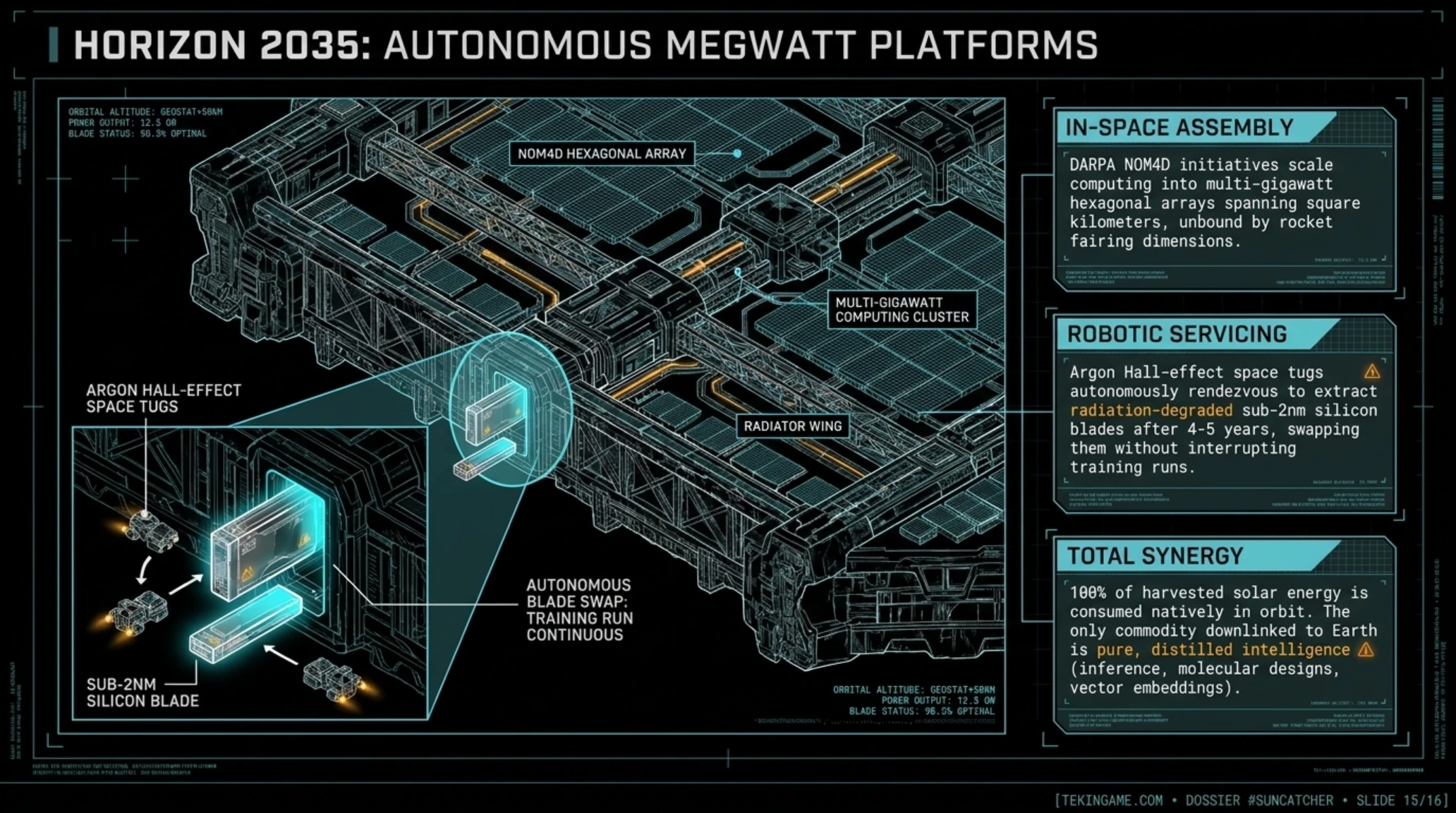
Looking outward toward 2035, the architecture of orbital data centers will inevitably diverge from today's monolithic, single-satellite buses. Prototype missions like Project Suncatcher are constrained by the physical fairing dimensions and payload envelopes of contemporary launch vehicles. The second phase of orbital computing will be characterized by in-space robotic manufacturing and autonomous on-orbit assembly. Supported by advanced aerospace initiatives such as DARPA's NOM4D (Novel Materials for Earth and Orbit) and commercial robotic arms, future orbital data centers will be constructed modularly in orbit as sprawling, multi-gigawatt hexagonal space platforms spanning several square kilometers.
In this mature operational paradigm, automated space tugs propelled by high-thrust argon Hall-effect thrusters will rendezvous with modular server chassis, autonomously extracting silicon accelerator blades that have suffered cumulative radiation lattice displacement damage after four to five years of operational service. Replacement compute modules, mass-manufactured on Earth utilizing the latest sub-2nm process nodes, will be ferried to orbit via routine Starship cargo runs and slotted into the station's cryogenic cooling manifolds by autonomous multi-axis robotic end-effectors without interrupting running training jobs.
Furthermore, the convergence of orbital solar power transmission and space compute creates a profound synergy: rather than converting solar energy into microwave beams and downlinking it to lossy terrestrial receiving rectennas on Earth, orbital supercomputers consume 100% of the harvested photons directly at the source. The only commodity returned to the surface of the Earth is pure, distilled informational value: processed inference outputs, optimized biochemical molecular designs, and compressed vector embeddings streamed through high-throughput optical ground terminals.

Strategic Conclusion: The Inevitable Migration of Frontier Intelligence
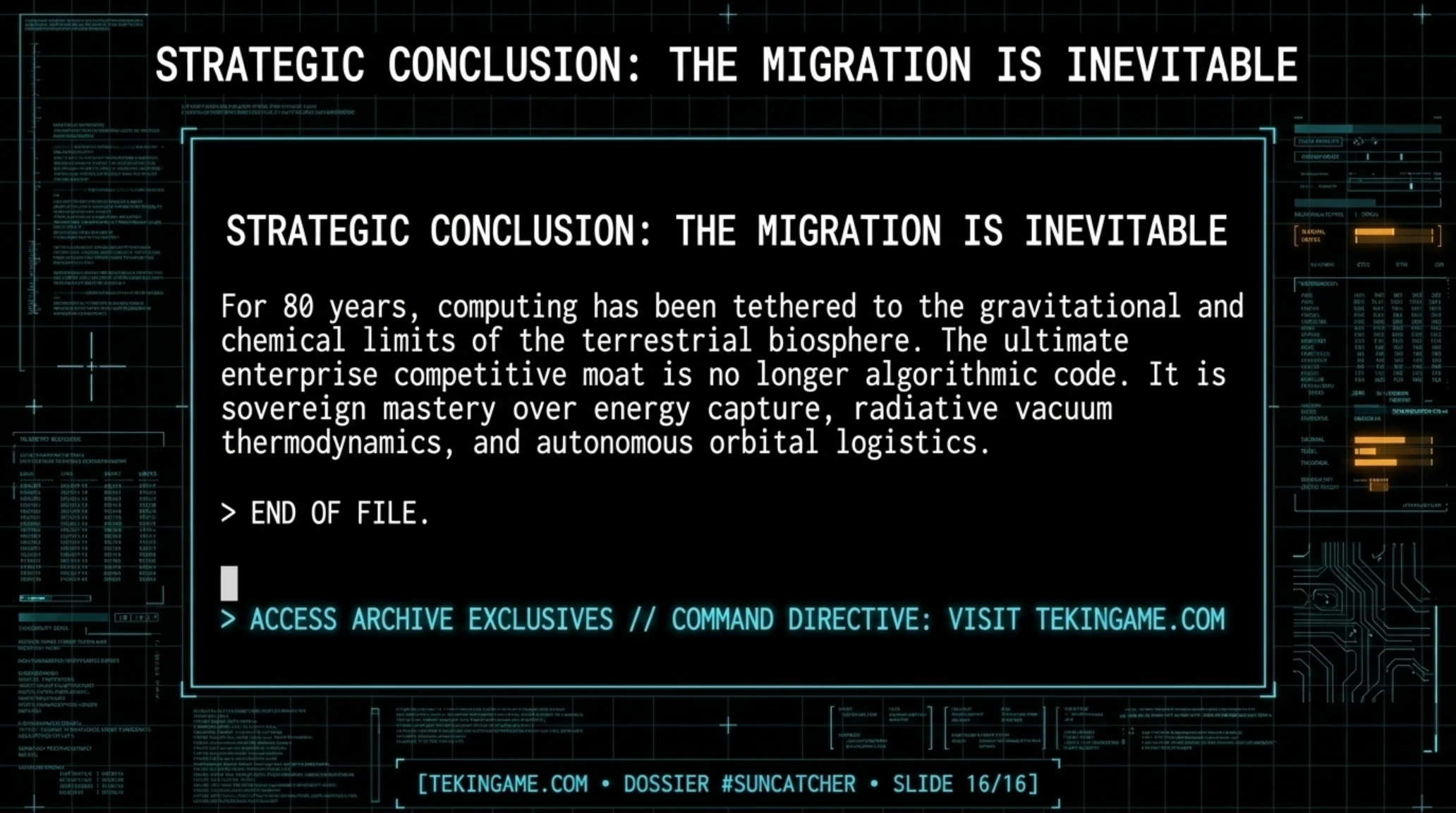
Google's Project Suncatcher represents a critical historical inflection point in the evolution of human computing. For eighty years, since the activation of ENIAC in 1945, humanity's computational infrastructure has been strictly tethered to the gravitational well, atmospheric chemistry, and geographic boundaries of the terrestrial biosphere. But as artificial intelligence ascends from simple statistical pattern matching to continent-scale synthetic reasoning, the physical footprint of computing has grown too massive for our home planet to comfortably endure without grave environmental and infrastructural compromise.
The journey to orbital computing is fraught with unprecedented physical hazards: the unyielding mathematical limits of Stefan-Boltzmann infrared cooling in a vacuum, the destructive impact of galactic cosmic rays on microscopic FinFET semiconductor gates, and the logistical titan of 1,800 Starship launches demanded by Wright's Law. Yet, history demonstrates that whenever technological demand collides with physical limits, capital and engineering inevitably bulldoze the barrier. By 2035, looking up into the night sky will not merely reveal distant stars; it will reveal the shimmering, sunlit arrays of orbital server constellations—the brilliant, silent minds of a truly spacefaring civilization—an enduring monument to humanity's unquenchable quest to transcend physical planetary constraints through engineering courage.
Frequently Asked Questions
Verified Sources & Technical Documentation
This analysis is grounded in verified mission data, peer-reviewed astrophysical thermodynamics, and commercial aerospace telemetry:
- Google Cloud & DeepMind Hardware Systems: Custom Trillium TPU v6e Architectural Whitepaper
- Planet Labs Aerospace Telemetry: Edge Computing in Sun-Synchronous Orbit Missions
- Nature Astronomy: Radiative Thermal Limits of High-Density Electronics in Low Earth Orbit
- SpaceX Starship Payload User's Guide & Launch Cadence Projections (2026-2035)
- IEEE Micro: Radiation-Induced Single Event Upsets in Sub-5nm Semiconductor Geometries
- NASA Small Spacecraft Technology State of the Art: Deployable Radiators and Two-Phase Thermal Loops
Additional Gallery: Tekin Analysis: Google's Project Suncatcher & Why Space Data Centers Demand 1,800 Starships