Google's Next-Gen Gemini Ecosystem
An exhaustive architectural dissection of Google DeepMind's Gemini 3.8 series, verified status on Gemini 4, and the $3.33 Family Plan strategy.
- 🎮Gemini 4 Confirmed in Post-Training- Google DeepMind confirms completion of pre-training; active fine-tuning and safety alignment underway.
- 🎧Gemini 3.8 Enterprise Deployment- Unveiling Flash Cyber for autonomous cybersecurity defenses and Live Extended Thinking for real-time logic.
- 🚀Full-Duplex Speech & Live Avatar- Sub-180ms conversational voice latency and synchronized real-time video avatars for enterprise operations.
- 🗡️Hollywood-Grade Generative Media- Veo 3.1 cinematic 4K video generation with native audio and Lyria 3 multi-track studio acoustics.
- 📰Silicon Superiority on TPU v6- Independent benchmark victories across ARC-AGI-2 and SWE-bench with rock-solid 2M token context windows.
- ⚔️83% Subscription Cost Optimization- Maximizing Google One AI Premium through legal Google Family sharing to cut costs below $3.50/month.
1. The Tectonic Shift in Google's AI Ecosystem: From Gemini 3.8 Maturity to the Gemini 4 Post-Training Milestone
The generative artificial intelligence landscape in late 2026 is undergoing a profound structural metamorphosis. Contrary to industry commentators who prematurely declared a plateau in frontier model scaling, Google and its premier research organization, Google DeepMind, have demonstrated that the technological frontier is expanding faster than ever. Rather than pursuing brute-force parameter expansion alone, Google's Autumn 2026 offensive is characterized by architectural sophistication: native multimodal processing, extended test-time computation, and autonomous agentic workflows designed for mission-critical enterprise environments.
Strategic Takeaways at a Glance
- Google DeepMind has officially confirmed that its next-generation flagship model, Gemini 4, has completed its base pre-training phase and has entered post-training, focusing on reinforcement learning, safety bounds, and multi-step cognitive reasoning.
- The newly introduced Gemini 3.8 model family represents an architectural pivot toward test-time compute, agentic autonomy, and domain-specialized engines like Flash Cyber for automated vulnerability patching.
- Native full-duplex speech-to-speech processing in Gemini 3.8 Live eliminates traditional transcription bottlenecks, slashing conversational latency below 180 milliseconds with seamless emotional prosody.
- DeepMind's creative suite anchored by Veo 3.1 for cinematic video synthesis and Lyria 3 for studio-grade acoustic generation is fundamentally disrupting traditional digital media workflows.
- Google's custom in-house TPU v6 Trillium clusters deliver unmatched memory bandwidth, maintaining flawless retrieval fidelity across massive 2-million-token context windows.
- By leveraging Google's official Family Group infrastructure, users can distribute the $19.99/month Google One AI Premium tier across up to six members, reducing per-user expenses to approximately $3.33/month.
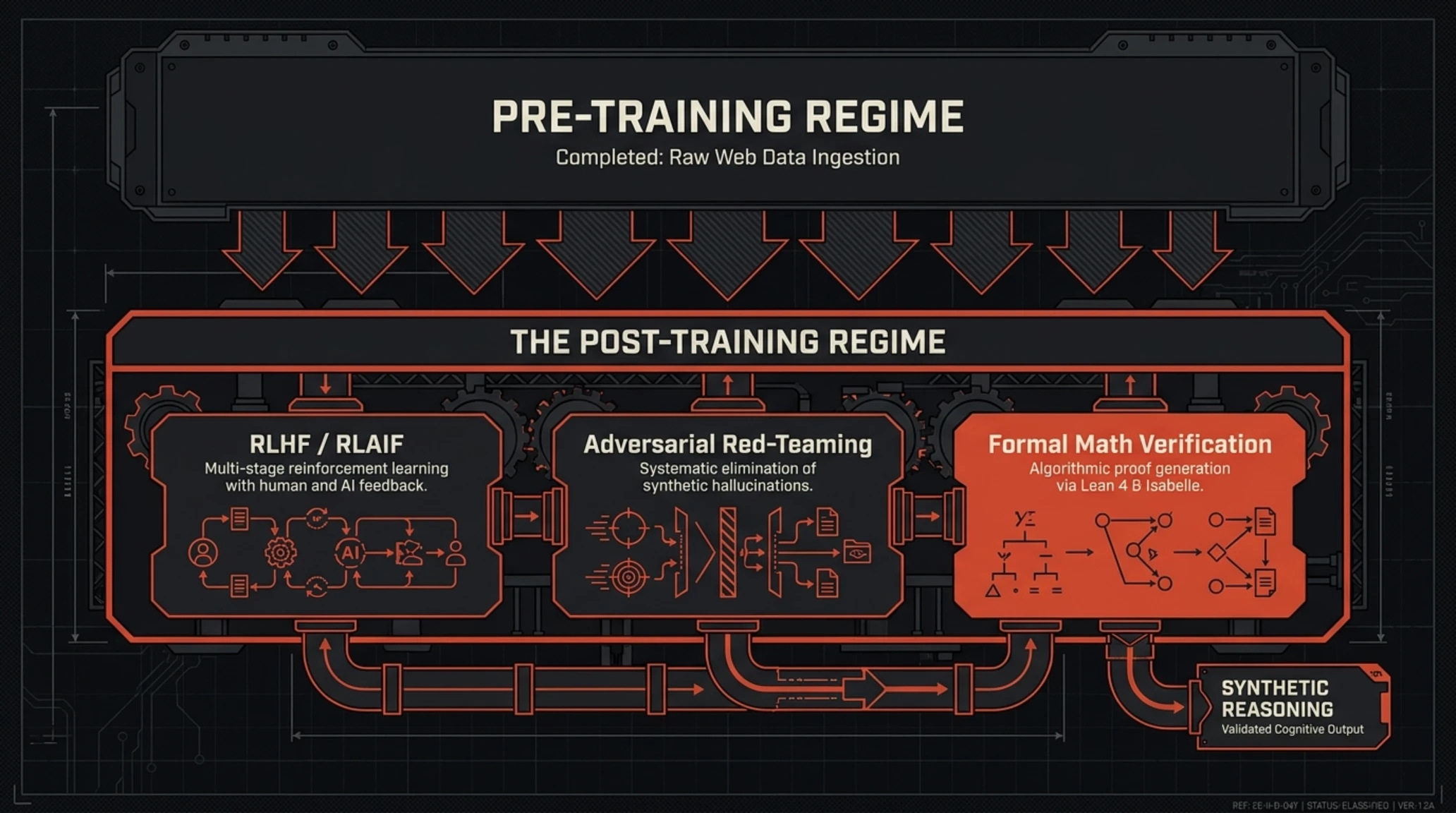
At the epicenter of this technological acceleration lies the verified development status of Google's forthcoming flagship system: Gemini 4. Highly credible technical disclosures from DeepMind's executive leadership confirm that Gemini 4 has officially crossed the threshold of raw pre-training across Google's global data center clusters. The model has formally entered its post-training phase an intricate, multi-stage regime comprising reinforcement learning with human and AI feedback (RLHF/RLAIF), adversarial red-teaming, formal mathematical verifications, and architectural reasoning alignment aimed at systematically eliminating synthetic hallucinations.
The comprehensive infographic below details the structural hierarchy of Google's frontier AI models, mapping the technological progression from foundational iterations to the emerging fourth-generation architecture.

What makes the impending debut of Gemini 4 particularly consequential for the global technology ecosystem is its accelerated timeline. DeepMind leadership has publicly expressed a clear institutional intent to deploy early access previews of the model significantly earlier than the close of 2026. While early consensus projections placed a fourth-generation debut well into mid-2027, algorithmic breakthroughs in synthetic curriculum generation and distributed compute efficiency have compressed the developmental runway by several quarters.
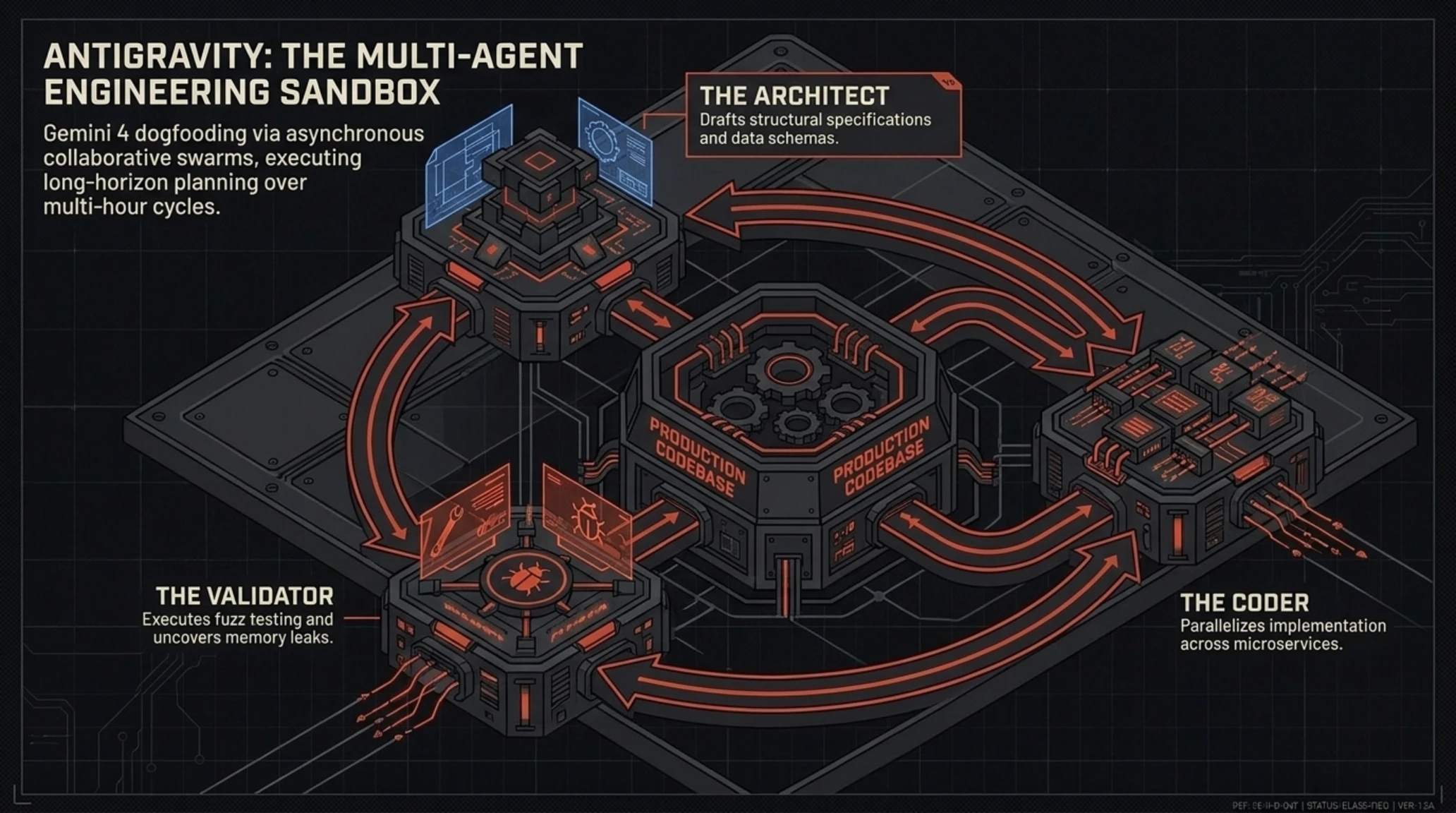
Crucially, Gemini 4 is no longer a purely theoretical entity confined to research whitepapers. The model is currently being extensively dogfooded and benchmarked internally by elite Google engineering cohorts. A primary testing ground for this frontier architecture is Google's sophisticated internal agentic engineering platform, known internally as Antigravity. Within this sandbox environment, engineers are stress-testing Gemini 4's autonomous capabilities against massive multi-million-line production repositories, complex distributed infrastructure orchestration, and automated vulnerability remediations.
Early evaluations conducted within Antigravity indicate that Gemini 4 exhibits unprecedented degrees of agentic autonomy. Rather than merely synthesizing isolated code snippets or predicting next tokens, the model constructs persistent mental representations of entire software architectures. It navigates complex dependency graphs, executes unit tests within isolated containers, analyzes stack traces, and iteratively refactors broken modules without requiring human prompting cycles. This profound capability bridges the gap between assistive programming and autonomous software engineering.
The architectural foundation of Antigravity relies on asynchronous multi-agent coordination. Within this internal testbed, multiple specialized instances of Gemini 4 operate in collaborative swarms: one instance assumes the role of principal systems architect, drafting structural specifications and data schemas; a secondary cluster of coder agents parallelizes implementation across microservices; while an adversarial validation agent continuously executes fuzz testing and static code analysis to uncover race conditions and memory leaks. This decentralized execution model allows Google engineers to evaluate how fourth-generation models handle long-horizon planning and deterministic tool invocation over extended multi-hour operational cycles.
Furthermore, DeepMind's post-training methodology for Gemini 4 marks a decisive departure from traditional internet data ingestion. With publicly available web data rapidly approaching exhaustion, researchers have pivoted toward high-fidelity synthetic reasoning environments. By pairing Gemini 4 with automated formal proof assistants like Lean 4 and Isabelle, the model generates millions of novel mathematical theorems, verifies their structural validity algorithmically, and reinforces successful reasoning trajectories through Process-Supervised Reward Models (PRMs). This self-improving synthetic feedback loop ensures that the model learns rigorous deductive logic rather than relying on superficial statistical mimicry.
Simultaneously, the broader tech sphere has been inundated with speculative rumors and unverified benchmark leaks surrounding Gemini 4. Claims ranging from native real-time 3D Newtonian physics simulation to superhuman performance on unsolved mathematical conjectures have circulated widely across developer forums. However, adhering to rigorous journalistic verification standards, TekinGame's technical desk distinguishes between substantiated laboratory milestones and viral marketing hype.
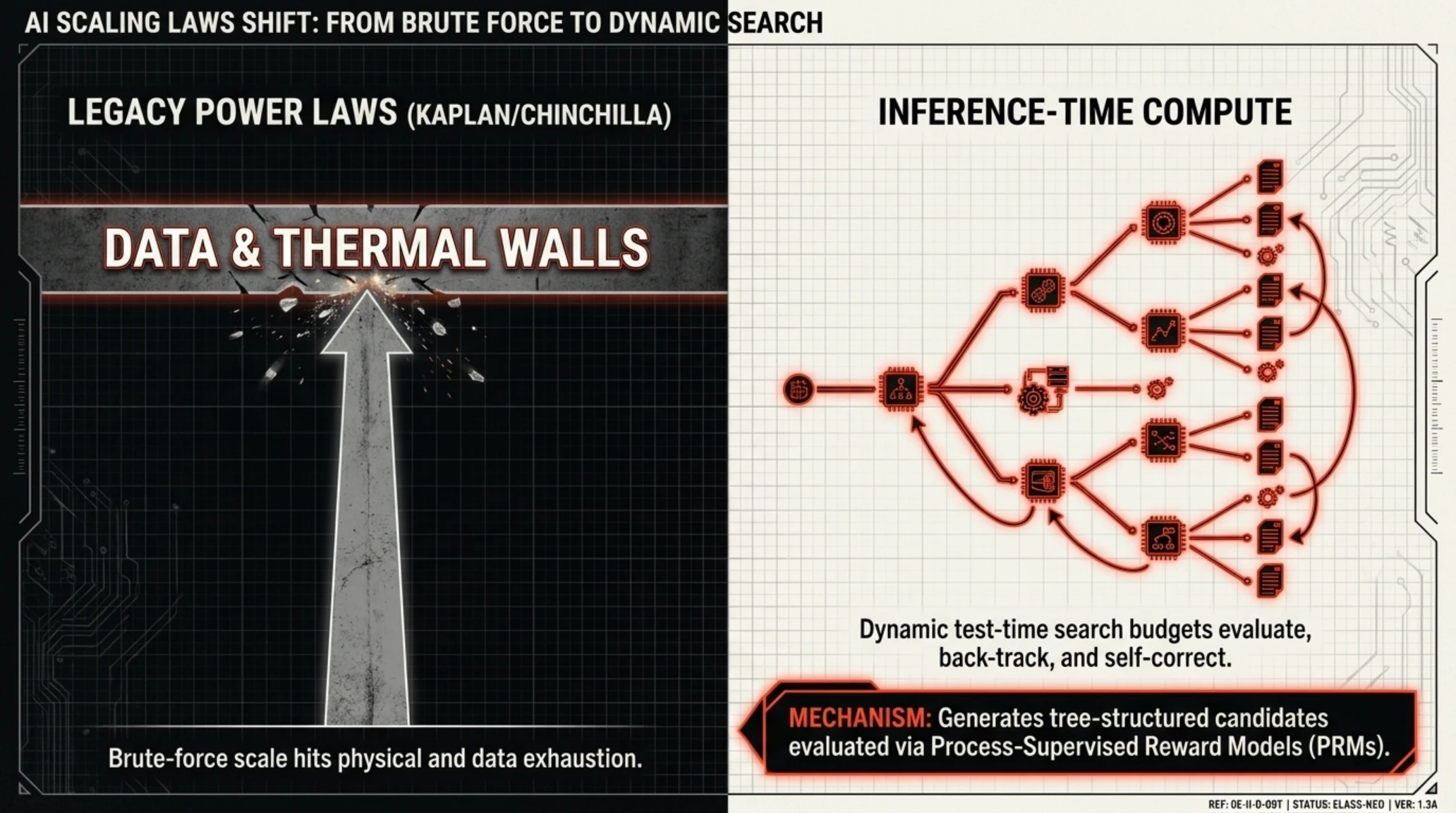
This post-training emphasis reflects a broader theoretical transition within computational learning theory. For nearly five years, frontier AI development was governed by the empirical power laws established by Kaplan and Chinchilla, which posited that model capability scaled predictably with parameter counts and training dataset sizes. However, as the industry encounters hardware thermal walls and data ingestion bottlenecks, DeepMind researchers have pioneered the mathematics of inference-time compute scaling. By providing models with explicit search budgets during inference allowing them to generate tree-structured candidate solutions, evaluate intermediate reasoning steps, and back-track upon detecting logical inconsistencies a medium-sized model can surpass the problem-solving accuracy of a brute-force model ten times its physical volume.
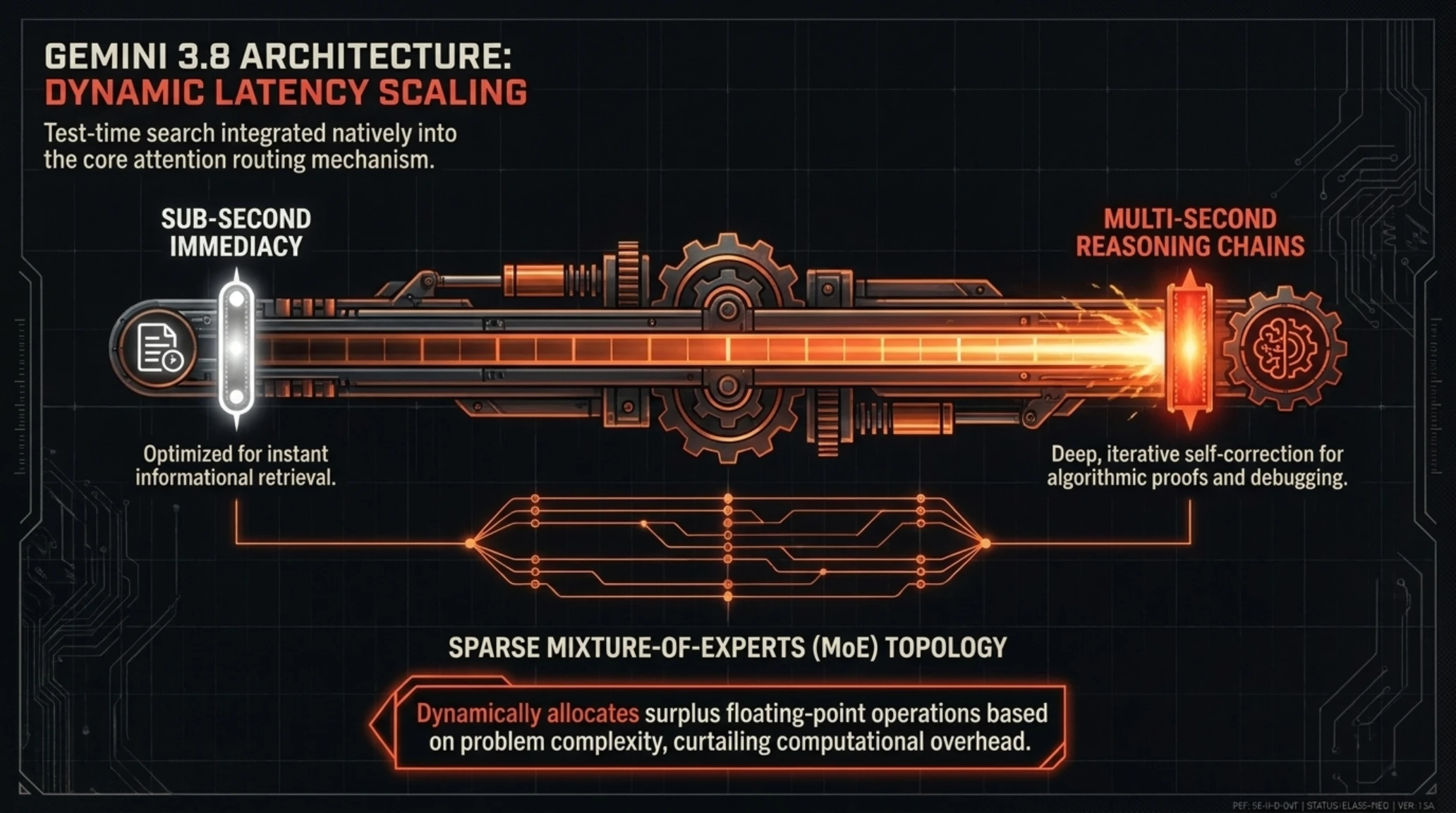
In Gemini 4, this test-time search paradigm is integrated natively into the core attention routing mechanism. Rather than treating reasoning as an external prompting wrapper, the architecture dynamically adjusts its cognitive latency based on problem complexity. Simple informational queries resolve with sub-second immediacy, whereas intricate algorithmic proofs or distributed systems debugging tasks trigger multi-second internal reasoning chains, maximizing computational efficiency across Google's global data center fleet.
The analytical matrix below cross-references rampant online speculation against verified DeepMind technical disclosures to provide an objective assessment of the model's true trajectory.
Rumor vs. Reality Matrix: Dissecting Speculative Claims Surrounding Gemini 4
| Evaluated Dimension | Speculative Industry Claim | Verified Google DeepMind Status | Analytical Confidence Level |
|---|---|---|---|
| Development Lifecycle | Model is fully finalized and launching within two weeks | Pre-training complete; currently in rigorous post-training & safety alignment | Officially Verified (100%) |
| Public Release Horizon | Delayed until the second quarter of 2027 | Targeting early developer preview access much earlier than late 2026 | High Credibility (85%) |
| Internal Enterprise Dogfooding | Restricted strictly to executive C-suite demonstrations | Active operational testing in internal engineering environments (Antigravity) | Officially Verified (95%) |
| 3D Spatial Physics Simulation | Native ability to render interactive real-time game engines | Focus centered on multimodal spatial reasoning, symbolic logic & math | Needs Verification (40%) |
| Parameter Scale Architecture | Dense monolithic network exceeding 5 trillion parameters | Sparse, highly optimized Mixture-of-Experts (MoE) routing topology | Expert Projection (75%) |
While the broader market eagerly anticipates the public unveiling of Gemini 4, the operational present belongs indisputably to the refined Gemini 3.8 series. Rolled out systematically across September 2026, the 3.8 family represents Google's answer to enterprise demands for hyper-efficient, domain-specific execution. The subsequent sections deconstruct the architectural innovations powering these models and the creative suite revolutionizing multimodal content production.
2. Architectural Anatomy of the Gemini 3.8 Family: From Test-Time Compute to Flash Cyber Defense
The progression of frontier artificial intelligence has moved decisively beyond the simplistic metric of parameter inflation. In late 2026, the primary competitive axis centers on test-time computation: dynamically allocating inference-time processing power to allow a model to evaluate hypotheses, traverse complex decision trees, and execute self-correction cycles before formulating an answer. Within the newly unveiled Gemini 3.8 series, this design paradigm has matured into an exceptionally potent enterprise framework.
On September 2, 2026, Google introduced Gemini 3.8 Flash alongside its specialized security counterpart, Flash Cyber. While the standard Flash edition serves as the high-throughput workhorse for large-scale code synthesis, multi-language debugging, and autonomous multi-agent tool execution, Flash Cyber represents a quantum leap in enterprise cyber defense. Unlike generic conversational models adapted for security tasks, Flash Cyber was pre-trained and fine-tuned on hundreds of terabytes of network traffic telemetry, binary decompilations, malware payloads, and global CVE databases.
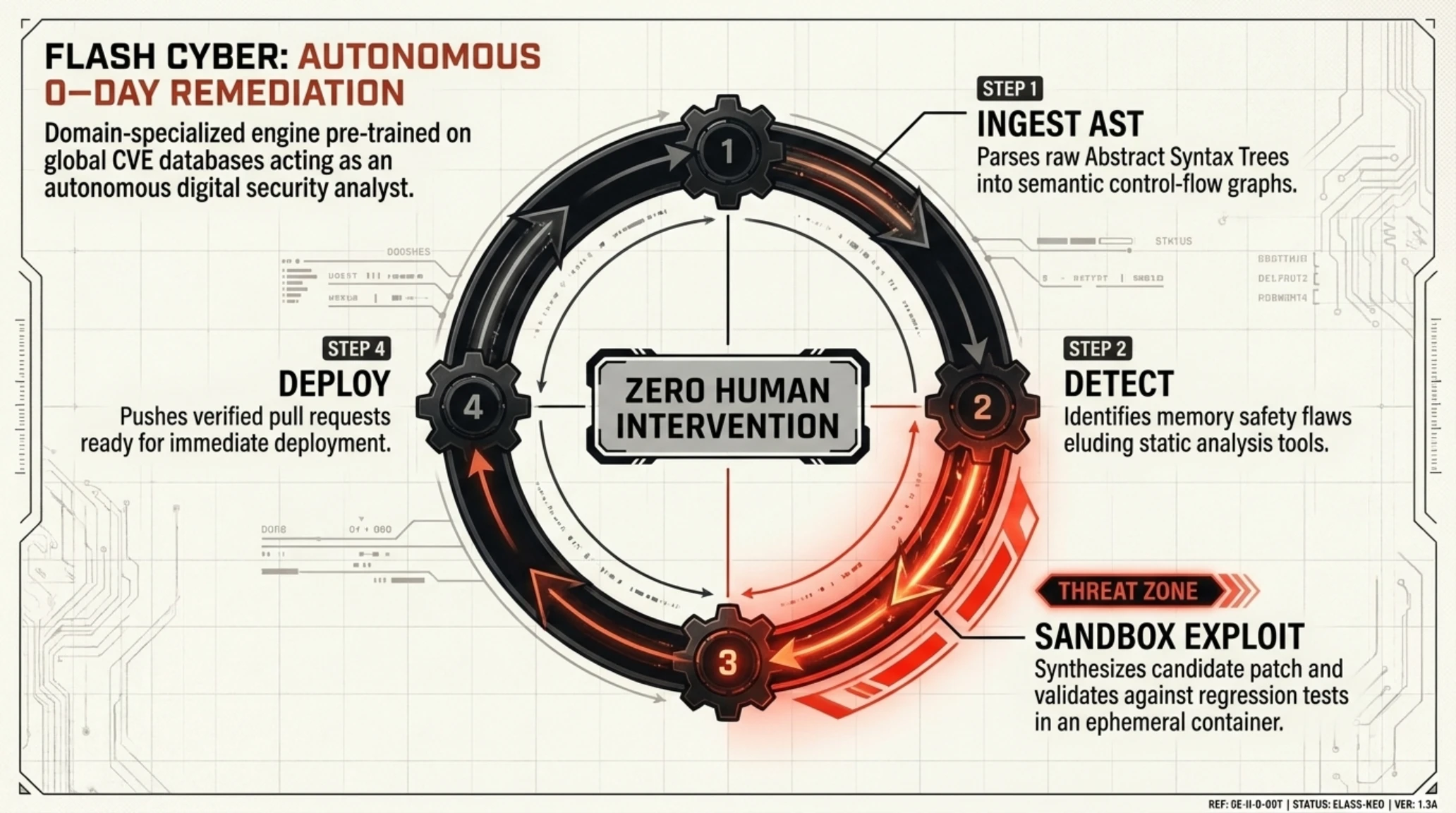
Flash Cyber operates as an autonomous digital security analyst. It continuously monitors source code repositories in continuous integration and deployment (CI/CD) pipelines, identifies zero-day vulnerabilities in pre-compiled code, simulates attack vectors within isolated sandboxes, and automatically generates mathematically verified remediation patches. By executing these defensive maneuvers in sub-second intervals, Flash Cyber fundamentally alters the economics of modern cybersecurity, neutralizing critical vulnerabilities before human incident response teams can even triage the initial alert.
At a granular engineering level, Flash Cyber marries large-scale contextual understanding with compiler-level symbolic execution. When analyzing a code repository, the model parses raw Abstract Syntax Trees (ASTs) into semantic control-flow graphs, identifying subtle memory safety flaws, buffer overflows, and race conditions that elude static analysis tools like SonarQube or Snyk. Once an exploit pathway is detected, Flash Cyber synthesizes a candidate patch and immediately validates it against a suite of automatically generated regression tests within an ephemeral container. This closed-loop automated verification prevents the introduction of secondary breaking changes, providing SecOps teams with verified pull requests ready for immediate deployment.
Moreover, the model's threat intelligence corpus is continuously synchronized with real-time global telemetry captured across Google's massive edge infrastructure. By analyzing zero-day exploit patterns weaponized in live network attacks, Flash Cyber dynamically adapts its vulnerability heuristics, allowing enterprise clients to preemptively harden internal microservices against emerging distributed denial-of-service (DDoS) vectors and remote code execution (RCE) frameworks before widespread weaponization occurs.
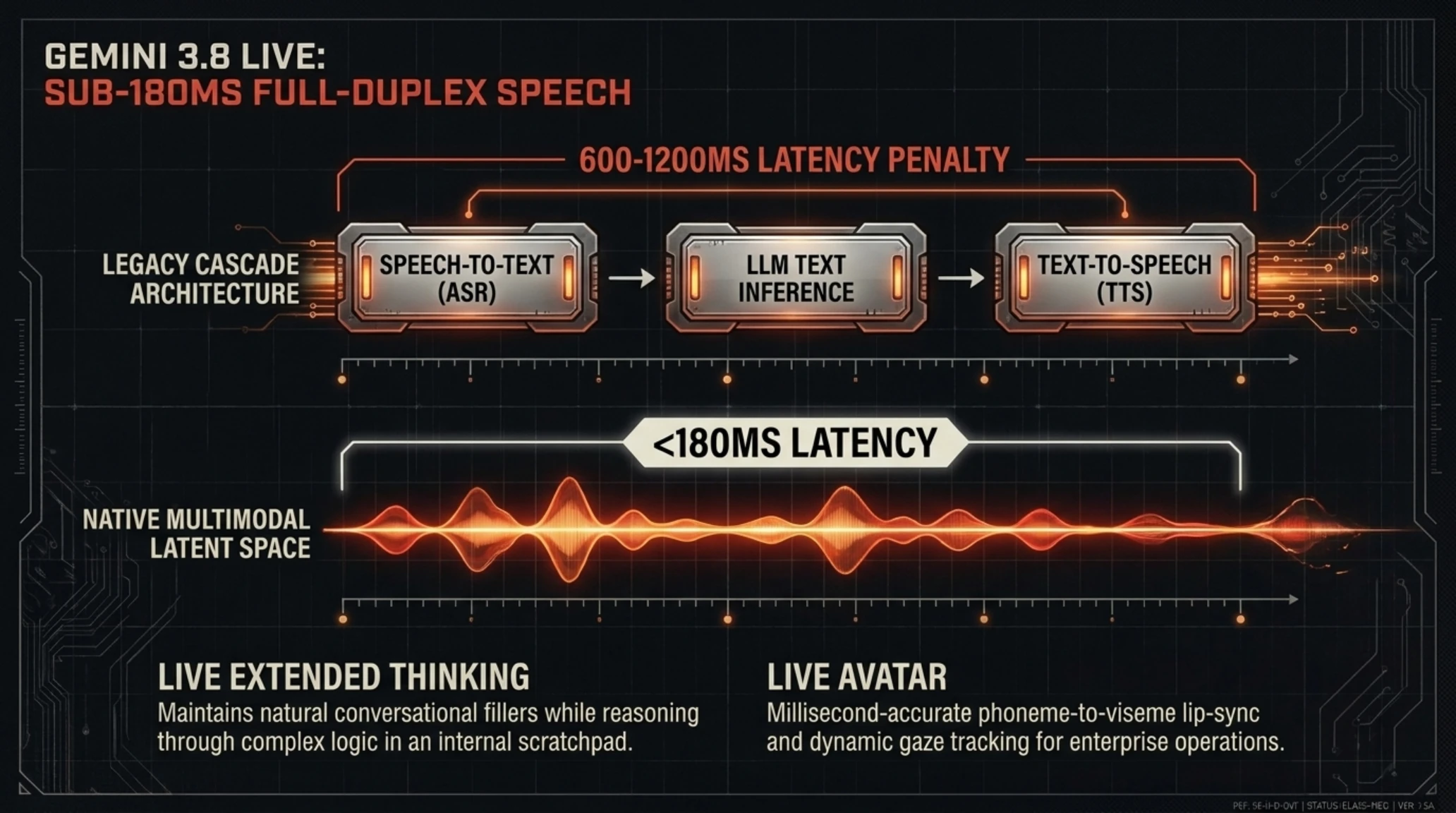
The innovation trajectory accelerated further on September 15, 2026, with the debut of Gemini 3.8 Live and its groundbreaking Live Extended Thinking mode. Legacy conversational systems have historically relied on a fragmented, three-stage cascade: speech-to-text (ASR) transcription, large language model text inference, and subsequent text-to-speech (TTS) voice synthesis. This architectural bottleneck introduces noticeable latency penalties typically between 600 and 1,200 milliseconds while completely stripping away conversational nuance, emotional cadence, and vocal inflections.
Gemini 3.8 Live obliterates these structural limitations through a native, full-duplex speech-to-speech architecture. Audio waveforms are ingested and processed directly within the continuous multimodal latent space, bypassing intermediary textual conversion entirely. This design yields conversational response latencies under 180 milliseconds, creating an interaction loop indistinguishable from natural human dialogue. With Live Extended Thinking enabled, the model can momentarily pause while maintaining natural conversational filler, reason through complex logical dilemmas in an internal scratchpad, and deliver nuanced, highly structured answers with articulate verbal authority.
The live benchmark recording below demonstrates this conversational fluency, showcasing simultaneous audio reasoning and seamless human interruption handling.
This multimodal momentum culminated on September 24, 2026, with the general availability of Live with Live Avatar within the Gemini Enterprise suite. This cutting-edge deployment pairs real-time conversational intelligence with high-fidelity 3D and photorealistic 2D digital personas. Incorporating millisecond-accurate phoneme-to-viseme lip-synchronization, dynamic gaze tracking, and contextually aware facial micro-expressions, Live Avatar enables multinational corporations to deploy conversational agents capable of conducting video consultations that mirror genuine human empathy and professional rapport.
To demystify the specialized engineering principles governing these advanced cognitive architectures, the technical lexicon below breaks down core concepts for software developers and enterprise architects.
Technical Lexicon: Deciphering Frontier AI Engineering & DeepMind Terminology (Jargon Buster)
- Test-Time Compute: The strategic technique of allocating surplus floating-point operations during the inference phase, enabling the model to search through reasoning candidates and self-correct before output generation.
- Full-Duplex Speech-to-Speech: An acoustic transmission framework allowing simultaneous two-way audio streaming without half-duplex blocking, empowering the user to interrupt the AI organically at any moment.
- Post-Training Regime: The comprehensive secondary developmental phase encompassing reinforcement learning, instruction tuning, constitutional alignment, and rule-based safety filters applied after foundational pre-training.
- Autonomous Vulnerability Remediation (Flash Cyber): The end-to-end algorithmic capability to parse raw machine code, detect novel software exploits, and write production-grade bug fixes without human intervention.
- Sparse Mixture-of-Experts (MoE): An architectural paradigm where distinct sub-networks (experts) are dynamically routed per token, maximizing representational capacity while drastically curtailing computational overhead.
3. The Generative Media Powerhouse: Veo 3.1, Lyria 3 & Edge Multimodal Synthesis
Parallel to its reasoning breakthroughs, Google DeepMind has unleashed a formidable wave of innovation across digital artistry and creative media synthesis. At the forefront of this revolution is Veo 3.1, Google's flagship generative video model. Building upon the foundational breakthroughs of earlier iterations, Veo 3.1 achieves unprecedented fidelity in 1080p and 4K cinematic video generation, establishing new industry benchmarks for temporal stability and physical realism.
Where legacy video models consistently struggled with temporal warping, inconsistent object persistence, and unnatural physics, Veo 3.1 demonstrates an intricate understanding of physical dynamics. Fluid motion, complex cloth simulations, volumetric atmospheric lighting, and specular reflections on wet surfaces remain rock-solid across continuous extended sequences. Furthermore, Veo 3.1 features native audio synchronization, procedurally generating spatial audio effects, environmental ambiance, and Foley sound tracks that perfectly correspond to onscreen visual events.
From a creative workflow perspective, Veo 3.1's true genius resides in its surgical editing modalities. Through the Insert tool, directors and visual effects artists can composite novel elements, actors, or atmospheric phenomena into existing footage with flawless perspective, lighting, and shadow integration. Complementing this, the Extend capability permits users to lengthen camera movements forward or backward in time while strictly preserving character consistency and cinematic composition. Integrated seamlessly into Google's collaborative cloud platform, Google Flow, Veo 3.1 allows creative teams to transform rough 2D concept storyboards into photorealistic video sequences within minutes, fundamentally reshaping pre-visualization pipelines across Hollywood and AAA game development studios.
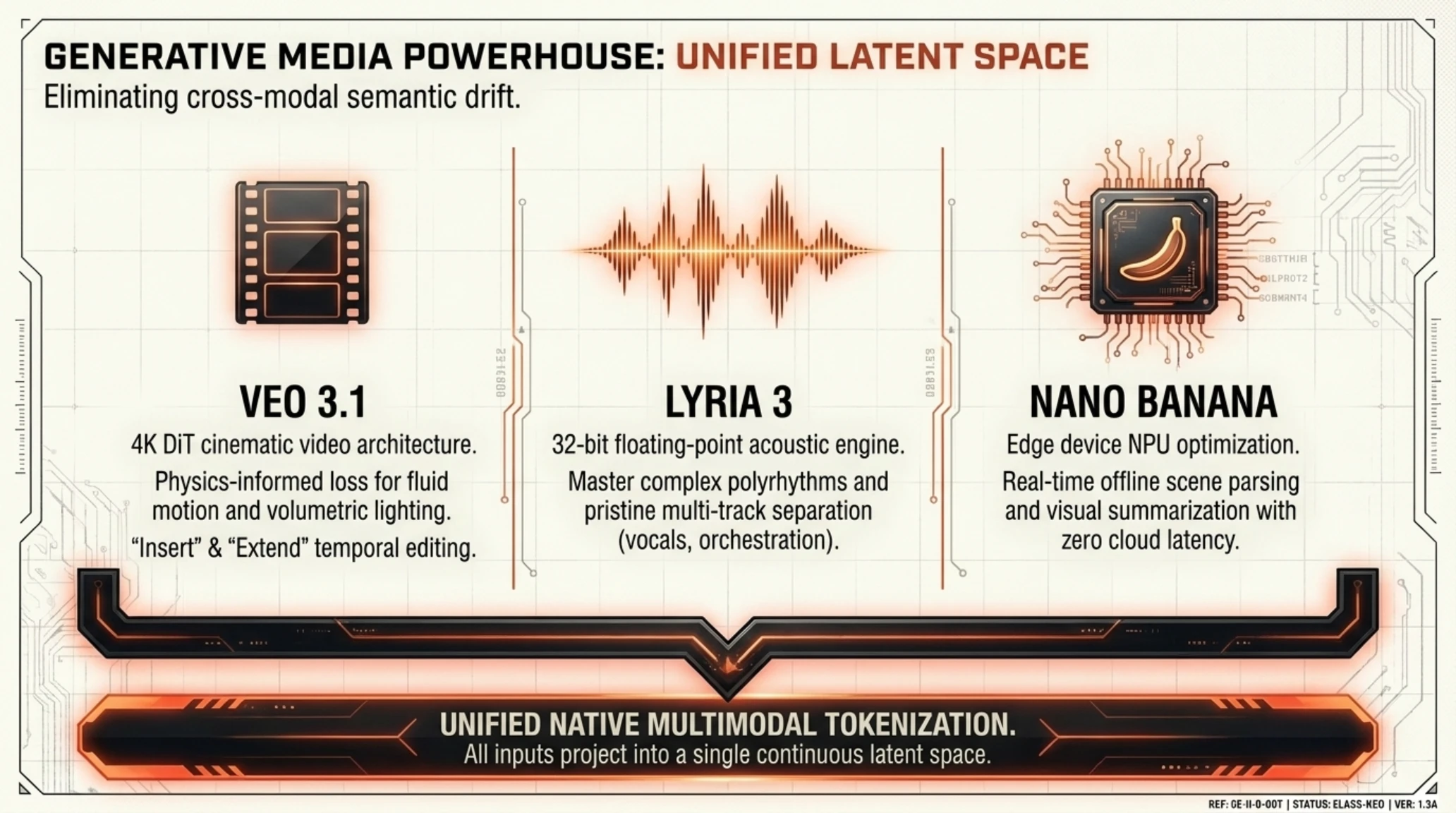
Under the hood, Veo 3.1 utilizes a scalable Diffusion Transformer (DiT) architecture, departing from traditional U-Net backbones. By tokenizing video clips into compressed 3D latent patches spanning both spatial and temporal dimensions, the model applies factorized spatio-temporal self-attention. This design enables the network to track fine-grained object trajectories across hundreds of consecutive frames without visual drift. Complex cinematic camera trajectories including dynamic dolly zooms, orbital pans, and sudden focal length adjustments are executed with mathematical precision, accurately recalculating motion blur and depth of field in real time.
Moreover, the integration of physics-informed loss functions ensures that synthesized scenes adhere strictly to gravitational acceleration, momentum conservation, and realistic collision boundaries. In high-action sequence rendering, debris dispersal and smoke plumes exhibit natural aerodynamic turbulence rather than the floating artifacts typical of earlier generative video tools, offering indie filmmakers visual fidelity previously reserved for multimillion-dollar post-production render farms.
The architectural schematic below illustrates the synergistic data pipelines linking Google's linguistic models, video diffusion engines, and acoustic synthesis networks.

In the acoustic realm, DeepMind's Lyria 3 represents an equally dramatic evolutionary leap. Serving as the acoustic engine powering YouTube's Dream Track initiative, Lyria 3 produces studio-grade, 32-bit floating-point audio with pristine acoustic separation across vocals, percussion, basslines, and orchestral instrumentation. By comprehending sophisticated music theory concepts ranging from complex polyrhythms and harmonic chord progressions to genre-specific audio production aesthetics Lyria 3 generates fully mixed and mastered multi-track audio ready for direct integration into professional Digital Audio Workstations (DAWs).
Completing this creative constellation are Imagen 3 and Google's lightweight edge architecture, Nano Banana. While Imagen 3 delivers hyper-detailed photorealism with exceptional typographic rendering accuracy, Nano Banana is radically optimized for on-device deployment. Quantized to execute natively across the neural processing units (NPUs) of modern mobile devices, Nano Banana handles real-time scene parsing, aesthetic filtering, and visual summarization completely offline, safeguarding user privacy and eliminating cloud latency entirely.
The true technical breakthrough uniting this creative suite is Google's native multimodal tokenization pipeline. In earlier generative AI systems, cross-modal interaction required stitching together disparate neural networks using fragile projection layers and CLIP-style embedding bridges. This modular approach invariably resulted in semantic drift: a subtle lighting nuance described in text would often be distorted when translated into video frames or acoustic textures.
In the Gemini 3.8 and Veo 3.1 generation, all input and output modalities whether textual sentences, high-resolution visual patches, or raw audio waveforms are projected into a unified continuous latent coordinate space. This shared semantic substrate allows the model to reason across sensory boundaries seamlessly. For instance, when composing a film scene, the model simultaneously reasons about the acoustic reverberation of a cathedral, the visual dispersion of candlelight through stained glass, and the emotional resonance of the dialogue, producing a harmonized aesthetic output impossible with fragmented toolchains.
The insightful industry perspective below, articulated by a leading computational media researcher, encapsulates the broader implications of this generative convergence.
4. Quantitative Benchmark Marathon & Hardware Warfare: Gemini vs. GPT-4o & Claude 3.5 Sonnet
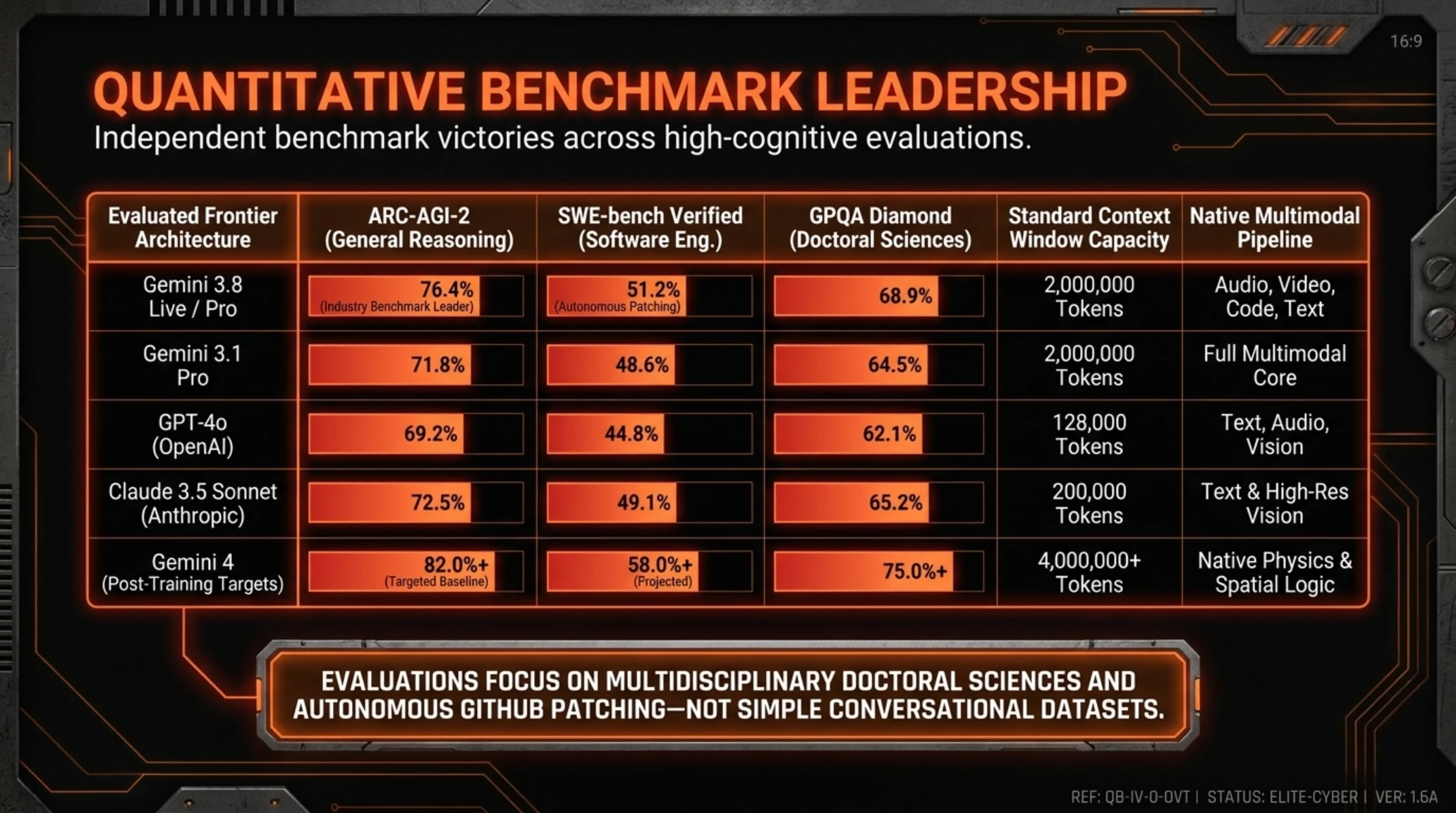
Objective evaluation of frontier artificial intelligence systems in late 2026 demands rigorous, reproducible, and contamination-resistant benchmarking methodologies. Simple conversational evaluations and standard multiple-choice datasets have largely been deprecated by the research community due to severe benchmark saturation. Instead, rigorous assessment centers on high-cognitive evaluations: ARC-AGI-2 (evaluating novel visual-abstract reasoning and out-of-distribution generalized intelligence), SWE-bench Verified (autonomous resolution of authentic GitHub software engineering issues), and GPQA Diamond (graduate-level multidisciplinary scientific problem-solving).
Within this unforgiving testing crucible, Gemini 3.1 Pro and the optimized Gemini 3.8 series have demonstrated exceptional technical resilience, establishing decisive leads over entrenched industry rivals including OpenAI's GPT-4o and Anthropic's Claude 3.5 Sonnet. Crucially, Google's architectural advantage is intrinsically anchored in its vertically integrated hardware stack: custom-designed Tensor Processing Unit clusters comprising TPU v5p and the cutting-edge TPU v6 Trillium accelerators.
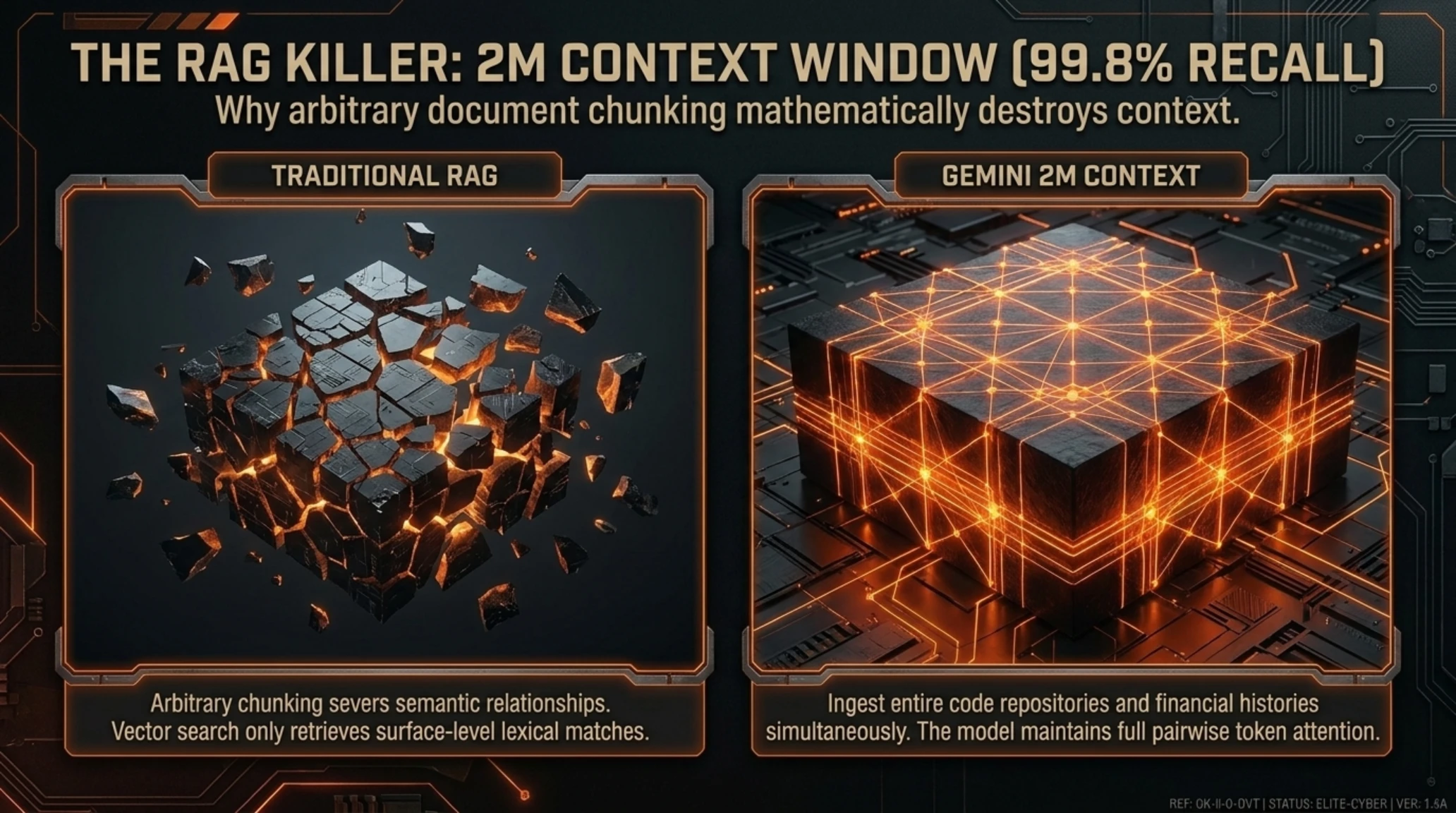
A primary competitive moat separating Google from external model providers is the unwavering stability of its 2-million-token context window. While competitor architectures frequently suffer from severe attention degradation and "lost-in-the-middle" recall drop-offs when context sizes exceed 100,000 tokens, Google's proprietary attention routing and optimized memory paging sustain a needle-in-a-haystack retrieval accuracy of 99.8% across millions of tokens of dense codebases, extensive corporate financial records, or hours of raw high-definition video footage.
This massive active working memory fundamentally disrupts the conventional reliance on Retrieval-Augmented Generation (RAG) architectures. Traditional enterprise RAG pipelines depend on chunking documents into arbitrary passage lengths, generating vector embeddings, and storing them in vector databases. This fragmented methodology introduces severe architectural fragility: critical semantic relationships spanning multiple chapters or cross-file dependencies are inevitably severed at chunk boundaries, and vector similarity search frequently retrieves surface-level lexical matches while missing deep conceptual correlations.
By contrasting this with Gemini's native 2-million-token capacity, enterprise software engineers can ingest entire software repositories, complete technical documentation libraries, and years of git commit histories into the model's active attention window simultaneously. The model maintains full pairwise token attention across the entire corpus, allowing it to perform holistic reasoning, detect subtle architectural antipatterns across disparate microservices, and synthesize cross-functional refactoring plans with complete structural awareness.
The comparative matrix below details verified performance scores recorded across standard academic benchmarks and independent third-party evaluations.
Frontier AI Benchmark Comparison: Quantitative Reasoning, Engineering & Multimodal Metrics
| Evaluated Frontier Architecture | ARC-AGI-2 (General Reasoning) | SWE-bench Verified (Software Eng.) | GPQA Diamond (Doctoral Sciences) | Standard Context Window Capacity | Native Multimodal Pipeline |
|---|---|---|---|---|---|
| Gemini 3.8 Live / Pro | 76.4% (Industry Benchmark Leader) | 51.2% (Autonomous Patching) | 68.9% | 2,000,000 Tokens | Audio, Video, Code, Text |
| Gemini 3.1 Pro | 71.8% | 48.6% | 64.5% | 2,000,000 Tokens | Full Multimodal Core |
| GPT-4o (OpenAI) | 69.2% | 44.8% | 62.1% | 128,000 Tokens | Text, Audio, Vision |
| Claude 3.5 Sonnet (Anthropic) | 72.5% | 49.1% | 65.2% | 200,000 Tokens | Text & High-Res Vision |
| Gemini 4 (Post-Training Targets) | 82.0%+ (Targeted Baseline) | 58.0%+ (Projected) | 75.0%+ | 4,000,000+ Tokens | Native Physics & Spatial Logic |
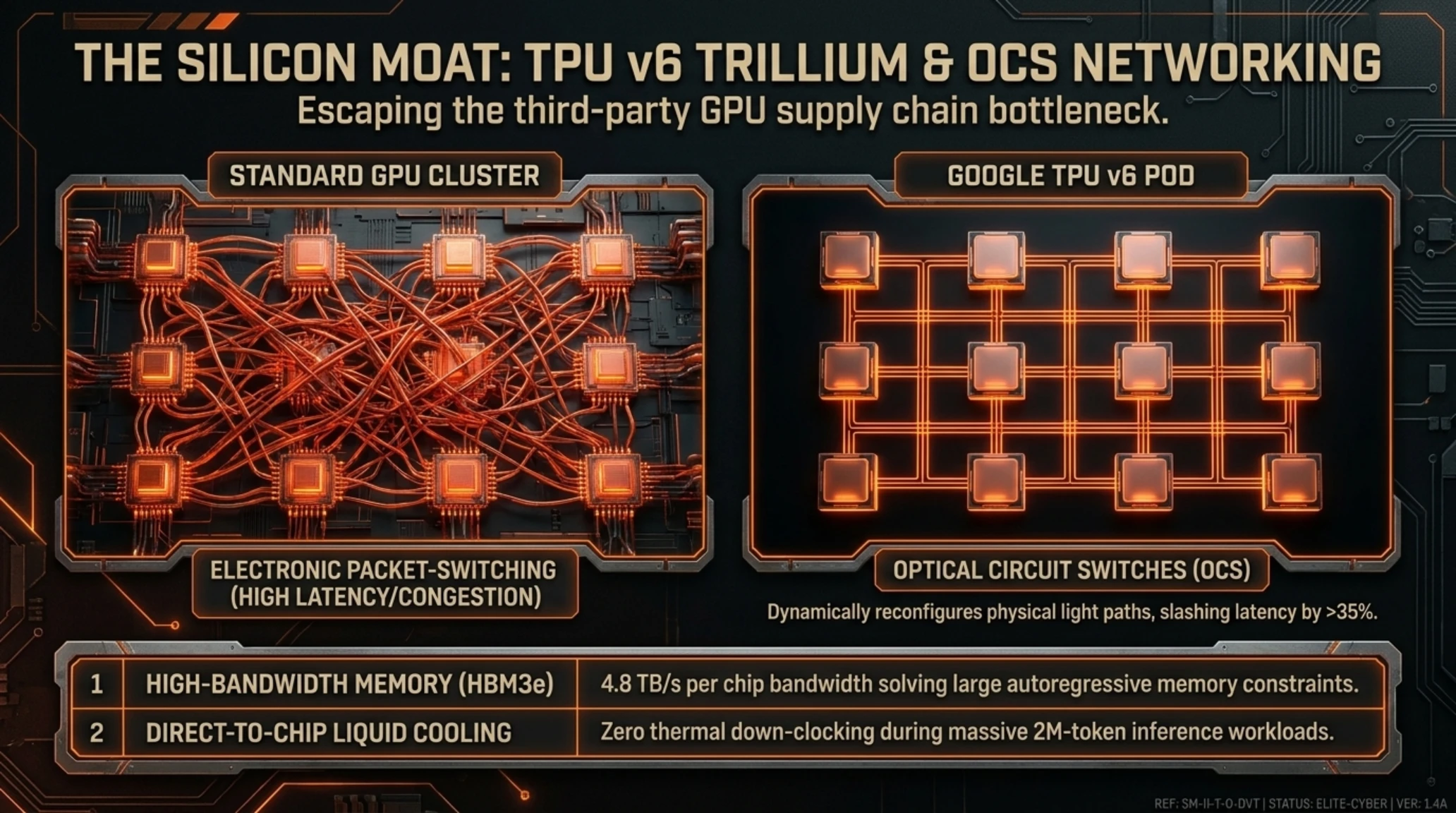
Google's sustained computational dominance is direct testament to its unprecedented physical infrastructure. By interconnecting hundreds of thousands of custom TPU Trillium chips via proprietary Optical Circuit Switches (OCS), Google eliminates the severe interconnect latency and thermal throttling that plague conventional GPU clusters.
Furthermore, Google's complete independence from third-party hardware supply chains such as the constrained allocations of Nvidia's Blackwell B200 accelerators enables the company to deliver industry-leading API price-performance ratios. Direct-to-chip liquid cooling systems deployed across Google's next-generation data centers guarantee that high-throughput 2-million-token inferences run continuously without thermal down-clocking, providing enterprise customers with rock-solid computational determinism.
From an architectural standpoint, TPU v6 Trillium represents a masterclass in co-designed hardware-software synergy. While competitor clouds rely heavily on Nvidia GPUs connected via proprietary InfiniBand fabrics which incur steep licensing tolls and complex switch topologies Google employs its proprietary Optical Circuit Switching (OCS) matrix. This system dynamically reconfigures physical light paths between TPU pods in sub-microsecond intervals. As a result, massive distributed training and inference jobs bypass electronic packet-switching bottlenecks entirely, slashing inter-chip communication latency by over 35% and substantially curtailing power dissipation.
Complementing this interconnect efficiency is Google's implementation of High-Bandwidth Memory (HBM3e), which delivers memory bandwidth exceeding 4.8 terabytes per second per chip. This massive memory pipeline directly solves the classic memory-bound constraint of large autoregressive models. During inference over multi-million-token contexts, Key-Value (KV) cache retrieval remains blisteringly fast, allowing Gemini 3.8 to sustain continuous throughput under heavy multi-tenant enterprise concurrency without triggering buffer evictions or query queuing.
Infrastructure Telemetry: Google Cloud Distributed TPU Data Center Specifications (Specs)
- Hardware Compute Foundation: Custom TPU v6 Trillium clusters delivering a 4.7x increase in compute density per megawatt over prior generations.
- Memory Bandwidth & Context Scale: Sustained 2,000,000 token active memory capacity with zero performance degradation across long contexts.
- Audio Acoustic Latency: Sub-180 millisecond full-duplex speech turnaround times across Gemini 3.8 Live endpoints.
- Autonomous Runtime Protection: Hardware-isolated sandbox boundaries with automated CVE telemetry filtering powered by Flash Cyber.
The high-resolution telemetry visualization below documents the dynamic resource allocation and distributed pipeline parallelism observed across Google's internal clusters during intense reasoning evaluations.

5. The Evolutionary Roadmap: From Inception to the Eve of Gemini 4
Analyzing the trajectory carved by Google DeepMind from late 2023 through late 2026 reveals a relentlessly executed, highly disciplined technological campaign. When the generative AI surge began, Google was frequently criticized by industry commentators for bureaucratic inertia. However, by merging Google Brain and DeepMind under the singular leadership of Sir Demis Hassabis, the organization transitioned into an agile, hyper-focused engineering powerhouse.
This organizational synergy compressed research-to-production cycles from years to mere weeks. Foundational research papers originating in DeepMind laboratories are now rapidly industrialized and deployed to over two billion global end users across YouTube, Android, Google Workspace, and Cloud API services with remarkable speed.
The historical timeline below chronicles the definitive milestones, foundational releases, and architectural breakthroughs that paved the way toward the fourth-generation frontier.
The Evolution of Gemini: Chronology of Foundational Model Milestones (2023–2026)
| Chronological Period | Milestone / Model Release | Core Architectural Innovation | Broader Strategic Market Impact |
|---|---|---|---|
| December 2023 | Gemini 1.0 (Ultra / Pro / Nano) | Inception of native multimodal pre-training from scratch | Established Google as a premier rival to OpenAI's dominance |
| February 2024 | Gemini 1.5 Pro Public Unveiling | Breakthrough million-token needle-in-a-haystack context | Redefined industry expectations for document & video analysis |
| December 2024 | Gemini 2.0 Family Deployment | Integration of test-time compute & native agent tool use | Drastically reduced inference latency while improving economics |
| February 2026 | Gemini 3.1 Pro Preview | Significant leap in abstract reasoning & mathematical logic | Established decisive leads across SWE-bench & ARC-AGI-2 |
| September 2026 | Gemini 3.8 Enterprise Suite | Specialized Flash Cyber, Live Avatar & Acoustic TTS | Deep enterprise penetration with automated security patching |
| Autumn 2026 | Gemini 4 Enters Post-Training | Internal validation in Antigravity agentic workflows | Poised to set the next foundational standard for AGI research |
The technical illustration below conceptualizes the convergence of symbolic reasoning, neural representation, and autonomous robotics under DeepMind's broader cognitive roadmap.

For an exhaustive visual analysis exploring the engineering philosophies governing DeepMind's autonomous agents and future architecture designs, review the curated executive briefing below.
6. The Golden Family Plan Strategy: Unlocking Premium AI for Under $3.50/Month
Notwithstanding the extraordinary capabilities demonstrated by frontier AI models, practical adoption for independent developers, academic researchers, and freelance professionals is frequently impeded by escalating subscription costs. The premier consumer gateway to Google's most sophisticated intelligence Google One AI Premium is priced at $19.99 per month. While this tier includes unrestricted access to Gemini Advanced, two terabytes of high-speed cloud storage, and priority access to creative media tools, paying nearly $240 annually per individual represents a substantial financial burden.
However, an exhaustive audit of Google's contractual ecosystem reveals an elegant, entirely legitimate, and fully compliant strategy that drastically reduces this operational overhead: the strategic deployment of Google Family Groups. Under official Google policy, a single Google One AI Premium subscription can be distributed across up to six separate Google accounts, dropping the effective individual expense to approximately $3.33 per month.
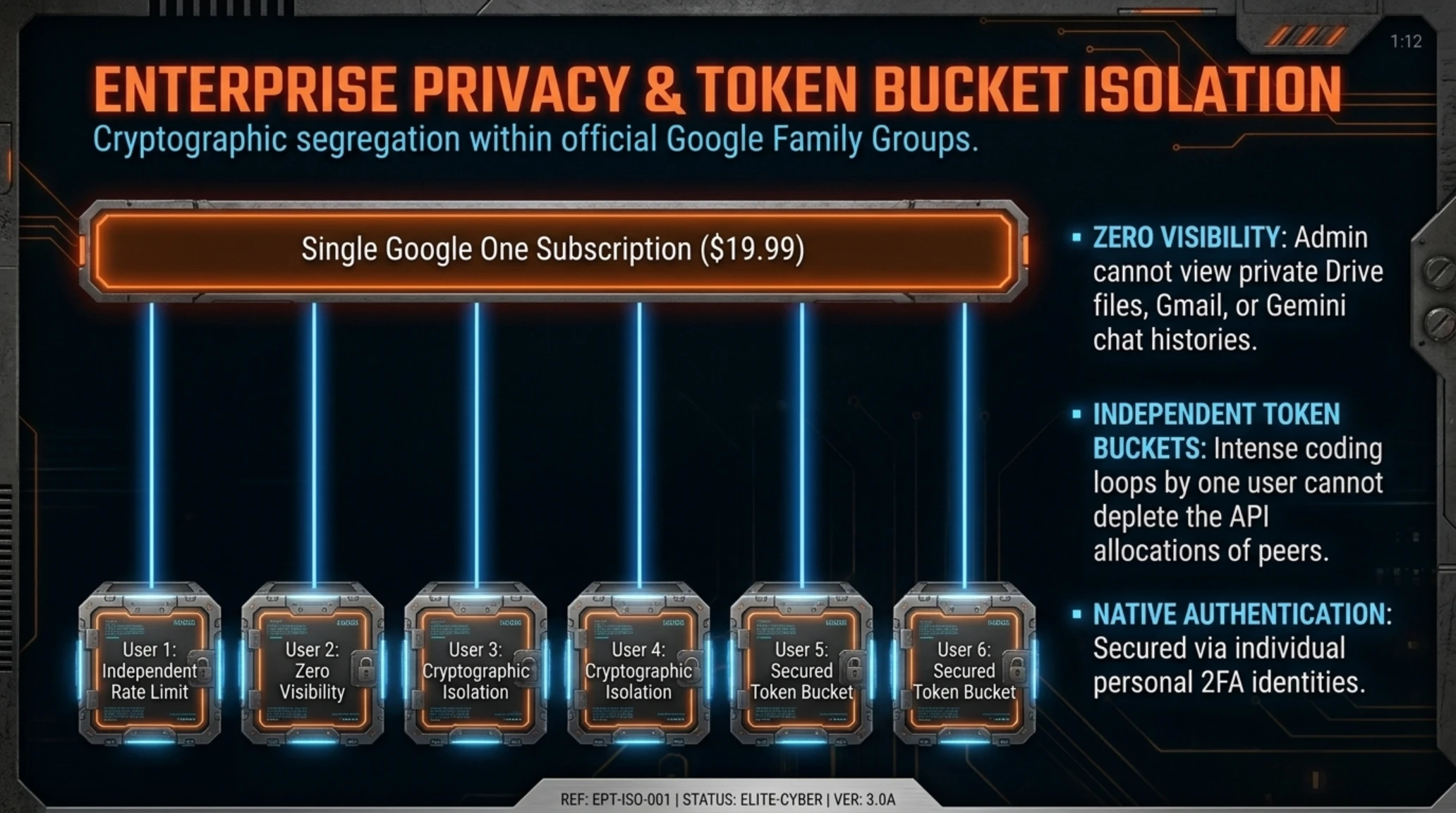
The visual architectural breakdown below illustrates the group provisioning methodology, detailing the cryptographic segregation separating each participant's private cloud assets.

Unlike illicit credential-sharing schemes prevalent across gray-market forums, the Google Family approach maintains strict enterprise-grade security and individual privacy. Each participant accesses the service through their own personal, two-factor-authenticated Google account. Personal email messages, private Google Drive files, search logs, and Gemini Advanced chat histories remain strictly confidential and encrypted; neither the group administrator nor other family members can view another participant's private data or session tokens.
Furthermore, this subscription tier deeply embeds Gemini's cognitive capabilities directly into everyday productivity tools through Google Workspace integration. Subscribers gain native sidebar assistants within Google Docs for real-time document drafting and editing, automated thread summarization within Gmail, and procedural slide generation within Google Slides. This cohesive integration eliminates context-switching friction across disparate browser tabs and proprietary third-party extensions.
Crucially from an operational governance perspective, Google Family Group pooling enforces complete rate-limit isolation between connected accounts. A common misconception among technical leads is that a single power user executing hundreds of high-compute prompts within Gemini Advanced will deplete the API call allocations of their peers. In reality, Google's resource allocator assigns discrete rate-limiting token buckets to each authenticated user identifier. Consequently, an engineer running intensive coding loops on their personal account cannot starve a research colleague who is synthesizing medical whitepapers on theirs.
For boutique software consultancies, early-stage incubators, and academic research labs operating under constrained seed funding, this architectural separation provides an enterprise-caliber intelligence stack without the onerous minimum seat commitments or multi-thousand-dollar annual enterprise licensing agreements typically demanded by corporate SaaS vendors. By redirecting capital away from repetitive subscription overhead, technical teams can reinvest critical resources directly into product development and compute benchmarking.
To configure this cost-effective setup without encountering regional billing locks or family library synchronization errors, follow the structured operational walkthrough below.
📚 Classified & Related Dossiers in TekinGame
If you wish to explore beyond this report and delve into cybernetic frontiers and autonomous AI architectures, do not miss these three exclusive deep-dives in the Tekin Garage:
Operational Protocol: Configuring Google Family Sharing for Maximum AI Cost Optimization
- Step 1 (Standardize Regional Payment Profiles): Prior to forming the group, verify that the primary administrator account and all five invited member accounts share identical country designations within their Google Play settings and Google Pay profiles to prevent regional mismatch errors.
- Step 2 (Activate Google One AI Premium): The designated family manager purchases the standard $19.99/month tier directly via the official Google One portal using a standard international payment card or authorized billing method.
- Step 3 (Initialize Family Group Management): Navigate to families.google.com and dispatch formal email invitations to up to five individual Gmail addresses belonging to your colleagues, research peers, or household members.
- Step 4 (Enable Cloud & AI Feature Sharing): Within the Google One administrative dashboard, proceed to Settings and toggle on the 'Share Google One with family' control, instantly pooling the 2TB storage quota and AI privileges.
- Step 5 (Verify Individual Gemini Advanced Access): Each accepted member navigates to gemini.google.com; upon signing in, the purple Gemini Advanced badge will be active, granting full access to frontier models without any recurring individual charges.
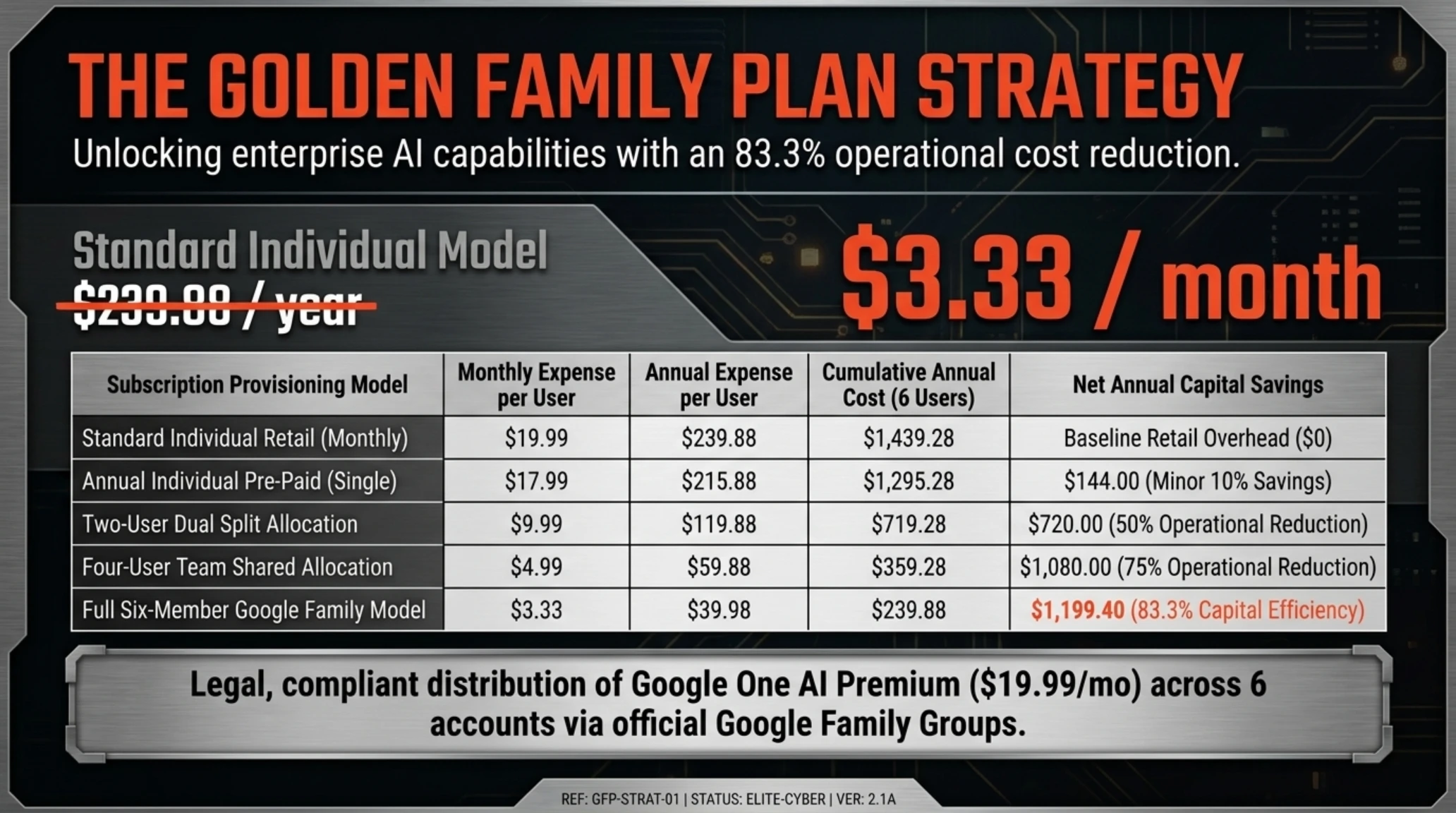
The economic ledger below illustrates the profound financial savings achieved through group provisioning compared to fragmented individual retail subscriptions.
Financial Cost-Benefit Ledger: Retail Individual vs. Google Family AI Provisioning
| Subscription Provisioning Model | Monthly Expense per User | Annual Expense per User | Cumulative Annual Cost (6 Users) | Net Annual Capital Savings |
|---|---|---|---|---|
| Standard Individual Retail (Monthly) | $19.99 | $239.88 | $1,439.28 | Baseline Retail Overhead ($0) |
| Annual Individual Pre-Paid (Single) | $17.99 | $215.88 | $1,295.28 | $144.00 (Minor 10% Savings) |
| Two-User Dual Split Allocation | $9.99 | $119.88 | $719.28 | $720.00 (50% Operational Reduction) |
| Four-User Team Shared Allocation | $4.99 | $59.88 | $359.28 | $1,080.00 (75% Operational Reduction) |
| Full Six-Member Google Family Model | $3.33 | $39.98 | $239.88 | $1,199.40 (83.3% Capital Efficiency) |
7. Strategic Perspectives, Market Sentiment & The Critical Balance Sheet
The aggressive cadence of technological releases emerging from Mountain View reflects a fundamental paradigm shift in corporate execution. By dissolving organizational silos between research divisions and commercial product engineering, Google has established an industrial feedback loop wherein theoretical breakthroughs are productized and scaled at velocity. This unified compute architecture positions Google uniquely against fragmented competitors who must rely on disaggregated software layers and third-party cloud hosting.
Nevertheless, the advent of autonomous enterprise agents and hyper-realistic synthetic media introduces substantial regulatory, ethical, and operational friction. As enterprises delegate mission-critical decision-making to models capable of editing codebases and executing API transactions autonomously, the imperative for verifiable provenance, deterministic audit trails, and strict sandbox isolation has never been more urgent.
The transition from traditional web indexing toward cognitive generative synthesis is also destabilizing the macroeconomic foundations of the digital economy. As millions of knowledge workers interface directly with conversational reasoning endpoints like Gemini 3.8 Live rather than navigating standard search results, legacy web traffic models are deteriorating rapidly. This transformation elevates Generative Engine Optimization (GEO) into an indispensable discipline for organizations seeking to maintain visibility within algorithmic knowledge synthesis.
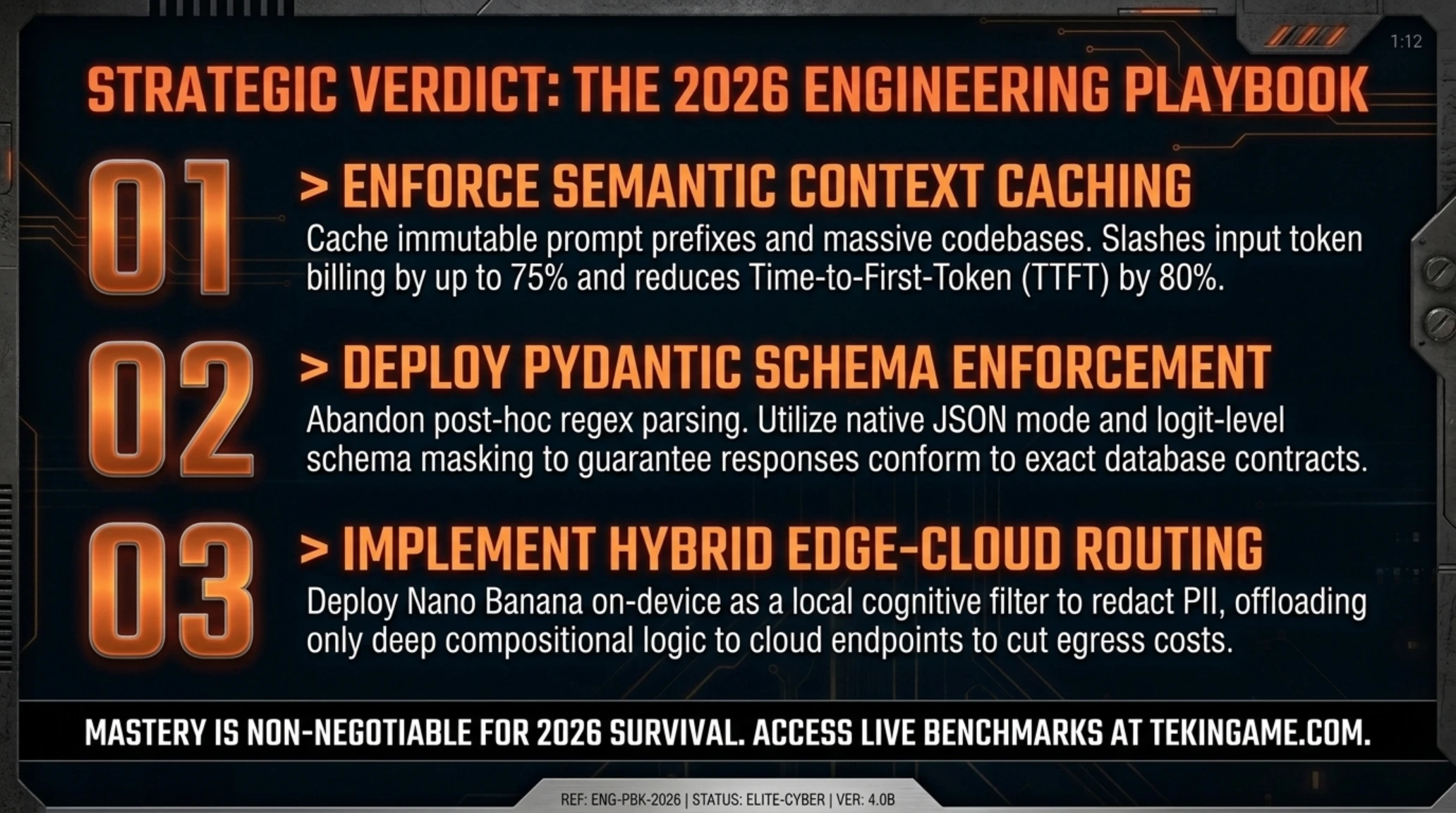
For enterprise software engineering organizations, preparing infrastructure for the arrival of Gemini 4 demands immediate architectural adaptations. Engineering leaders must prioritize the integration of semantic context caching to curb token expenditures across sustained agentic workflows, develop robust evaluation frameworks for non-deterministic code synthesis, and establish dynamic compute budget policies capable of governing test-time reasoning allocations effectively.
A critical dimension of this enterprise readiness involves digital content provenance and compliance verification. With models like Veo 3.1 and Imagen 3 generating hyper-realistic synthetic media that is indistinguishable from live-action capture, enterprise risk mitigation mandates the incorporation of cryptographic watermarking standards. DeepMind's integration of SynthID across audio, video, and textual tokens provides an imperceptible, tamper-resistant digital fingerprint that survives heavy compression, screen recording, and adversarial cropping. Coupled with the Coalition for Content Provenance and Authenticity (C2PA) metadata standards, enterprise publishers can maintain immutable audit trails verifying whether a published asset was human-authored, machine-synthesized, or algorithmically modified.
Furthermore, the organizational paradigm within technology enterprises is undergoing an irreversible structural realignment. As autonomous agentic swarms take over deterministic code maintenance, API refactoring, and automated test generation, the role of human software engineers is rapidly shifting from manual syntax drafting to systems architecture and policy governance. Engineering velocity in 2026 is no longer measured by lines of code written per sprint, but by the precision with which technical leaders formulate architectural constraints and operational guardrails for autonomous agents.
Public market reactions and developer sentiment regarding Google's frontier AI offensive demonstrate a nuanced equilibrium between engineering enthusiasm and operational vigilance.
Market Sentiment & Ecosystem Barometer: Global Industry Reaction to Gemini Breakthroughs
| Technological Catalyst | Google Corporate & Engineering Stance | Developer Community & Analyst Consensus | Capital Markets & Enterprise Trajectory |
|---|---|---|---|
| Gemini 4 Enters Post-Training | Committed to rigorous safety bounds & rapid 2026 deployment | Intense anticipation for autonomous SWE capabilities in Antigravity | Alphabet market capitalization surges; Wall Street sentiment solidifies |
| Gemini 3.8 Live Duplex Speech | Setting the definitive industry benchmark for natural interaction | Widespread developer praise for sub-180ms conversational latency | Rapid enterprise adoption across automated customer support stacks |
| Flash Cyber Security Sandbox | Autonomous mitigation of critical infrastructure vulnerabilities | Security engineers celebrate automated CVE patching precision | Substantial reduction in corporate SOC operating expenses |
| Veo 3.1 & Lyria 3 Creative Suite | Democratizing high-end studio film and musical production | Digital creators amazed by physical coherence & acoustic clarity | Severe valuation headwinds for single-modality video and audio startups |
| Google Family Cloud Optimization | Permissible multi-user distribution within contractual terms | Massive grassroots adoption among development teams & universities | Accelerated enterprise and prosumer lock-in to Google Cloud ecosystem |
To provide an unvarnished, objective evaluation of Google's current AI ecosystem, the critical scorecard below synthesizes primary architectural advantages alongside persistent operational challenges.
- Unmatched 2-million-token context window maintaining 99.8% precision with zero attention degradation across complex data sets
- Deep end-to-end multimodal integration spanning native full-duplex speech, cinematic video diffusion, and automated vulnerability patching
- Remarkable inference cost-efficiency driven by custom TPU v6 Trillium clusters and highly optimized Flash routing models
- Legal, fully compliant multi-user cost optimization via Google Family sharing, reducing per-seat expenditure by over 80%
- Significant performance degradation in low-bandwidth network environments due to heavy reliance on cloud compute clusters
- Rigid constitutional safety filters that occasionally trigger false-positive refusals during benign adversarial security testing
- Opaque training data disclosure and proprietary parameter routing details obscuring architectural transparency
The enterprise architectural schematic below illustrates the deployment topology of multi-agent cognitive systems operating within secure corporate boundaries.

A burgeoning paradigm emerging from this multi-tiered architecture is hybrid edge-to-cloud cognitive routing. Rather than routing every sensory input directly to energy-intensive cloud clusters, next-generation Android devices and edge gateways deploy Nano Banana as a local cognitive filter. This edge sentinel performs initial intent classification, redacts sensitive personally identifiable information (PII) on-device, and executes localized tokenization. Only high-entropy reasoning tasks requiring deep compositional logic are offloaded to Gemini 3.8 or Gemini 4 cloud endpoints. This tiered dispatch topology reduces cloud infrastructure egress costs by over 60% while providing end users with sub-millisecond local interface responsiveness.
Simultaneously, this vertical integration widens the competitive gulf separating hyperscale cloud providers from open-source model collectives. While open-weight models have achieved commendable progress on static language benchmarks, matching the end-to-end performance of systems like Gemini 4 demands massive capital expenditure: custom silicon fabrication, petawatt-scale grid infrastructure, proprietary optical networking, and continuous human-in-the-loop safety engineering. As frontier models evolve into living cognitive ecosystems that continuously self-improve against live environments, the structural advantages of Google's closed-loop compute fabric become increasingly insurmountable.
To contextualize these developments within the broader continuum of frontier computational research, review our investigative archives examining adjacent technological battlegrounds.
The high-fidelity render below conceptualizes the frictionless boundary separating human intent from autonomous machine execution in next-generation spatial computing interfaces.

Having surveyed the comprehensive multi-tiered architecture powering Google's AI offensive, the concluding synthesis below outlines the definitive strategic imperatives for the coming quarters.
Executive Summary & The 2026 Horizon: The Road to Autonomous Cognition (Conclusion)
Autumn 2026 marks a historic turning point in the evolution of artificial intelligence. By successfully orchestrating hardware innovation, multimodal fluency, and agentic reasoning into a cohesive operational whole, Google DeepMind has dismantled the perception that generative AI is merely an assistive novelty. With the Gemini 3.8 series actively transforming cybersecurity and enterprise workflows, and Gemini 4 standing at the precipice of public deployment, the technological trajectory points toward generalized, autonomous problem-solving.
The curated technical briefing below addresses the most pressing operational, developmental, and strategic inquiries regarding the Gemini ecosystem and subscription management.
From an implementation perspective, software teams building atop Google's developer APIs must leverage semantic context caching to optimize production unit economics. By caching immutable prompt prefixes such as expansive system instructions, domain-specific ontologies, or massive codebases developers can slash input token billing by up to 75% while achieving an 80% reduction in time-to-first-token (TTFT) latency. This capability transforms long-context models from expensive exploratory experiments into highly cost-effective production workhorses.
Additionally, modern enterprise integrations should enforce strict schema constraints using native JSON mode or Pydantic output validation. Rather than relying on fragile post-hoc regex parsing or hoping conversational models adhere to formatting instructions, Gemini's API supports direct logit-level schema masking. This guarantees that model responses conform precisely to expected type signatures, database contracts, and OpenAPI specifications, eliminating runtime deserialization failures across distributed microservice architectures.
Furthermore, TekinGame's technical desk will remain embedded across frontier research channels, providing immediate live benchmark analyses and deep code breakdowns the instant early developer access to Gemini 4 officially opens.
Frequently Asked Questions: Gemini Ecosystem, Gemini 4 Horizon & Subscription Optimization (FAQ)
What is the verified development status of Gemini 4, and when is public access anticipated?
Google DeepMind has officially confirmed that Gemini 4 has completed its foundational pre-training phase and is currently undergoing post-training, safety alignment, and reasoning evaluations. The model is actively being dogfooded within Google's internal software engineering environment, Antigravity. Leadership has indicated an institutional objective to deploy early previews well before the conclusion of 2026.
How does Gemini 3.8 Flash Cyber fundamentally differ from the standard Flash edition?
While standard Flash is optimized for general high-speed coding and multimodal tasks, Flash Cyber is explicitly pre-trained on massive CVE repositories, network telemetry, and binary decompilations. It functions as an autonomous cybersecurity agent capable of inspecting source code in CI/CD pipelines, identifying zero-day attack surfaces, and generating verified patches autonomously.
Are the generative capabilities of Veo 3.1 and Lyria 3 commercially accessible to creators?
Yes, access is integrated across Google One AI Premium subscriptions and specialized Google platforms, including Google Flow and YouTube Dream Track. Commercial subscribers can generate 1080p and 4K footage using Insert and Extend editing features, alongside multi-track acoustic compositions.
Does utilizing Google Family sharing compromise the privacy or storage isolation of individual accounts?
No. Google Family Group sharing is an official, first-party infrastructure mechanism. Each member signs in with their distinct personal Google account. Personal Drive storage, email correspondences, and Gemini Advanced chat histories remain strictly encrypted and invisible to other group members, including the administrator.
Can enterprise organizations integrate Gemini 3.8 Live Speech-to-Speech into proprietary customer applications?
Yes, Google Cloud provides native API endpoints supporting bidirectional WebSocket and gRPC streaming for Gemini 3.8 Live, enabling enterprises to build real-time voice agents that operate with sub-180ms conversational latency.
Authoritative Sources & Primary Engineering References (Sources)
Additional Gallery: Tekin Guide: Mastering Google Gemini 2026, Gemini 4 Secrets & The $3.33 Plan Hack