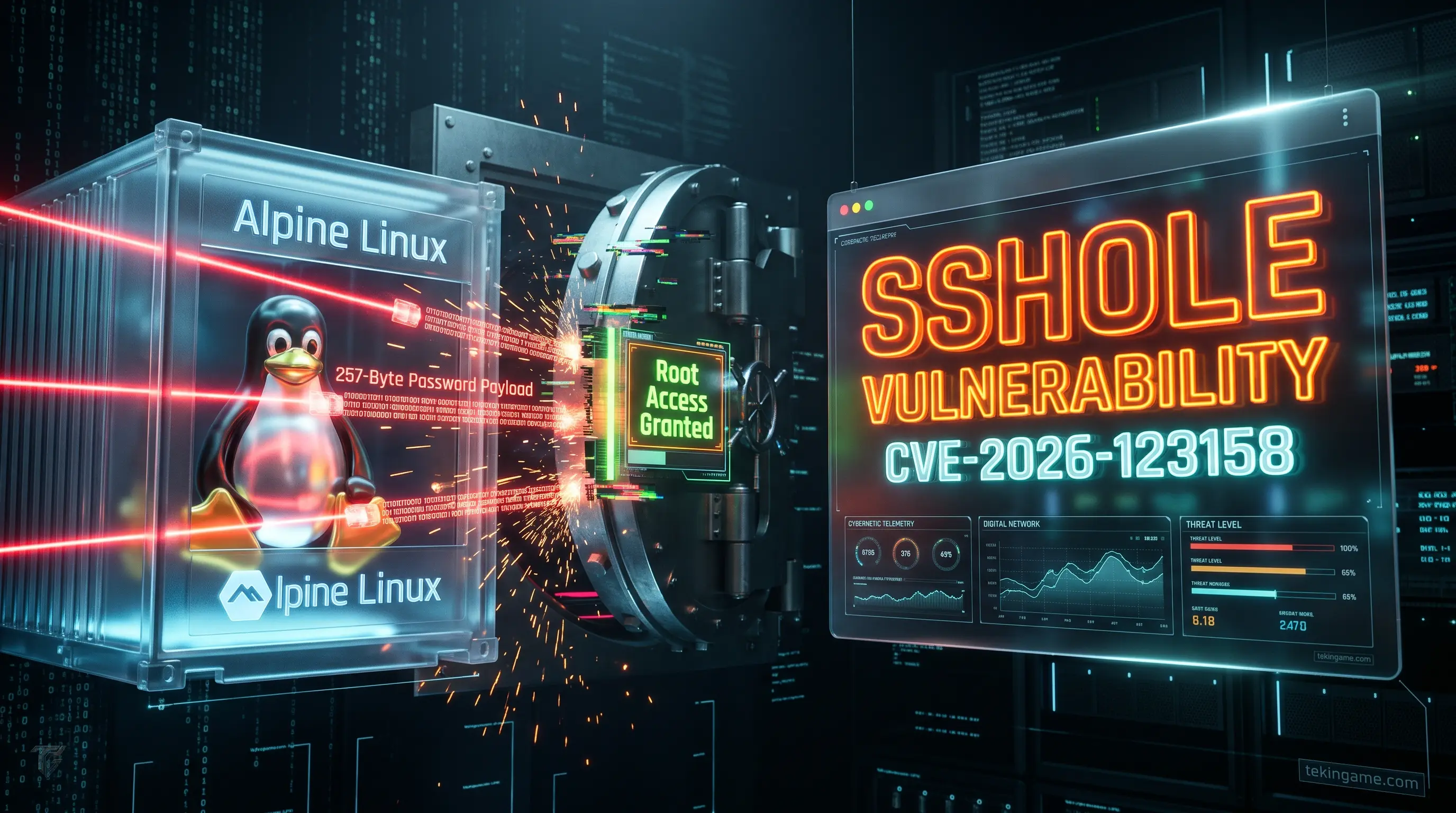
A comprehensive engineering guide detailing the critical OpenSSH SSHole authentication bypass vulnerability (CVE-2026-123158, CVSS 8.1). Impacting Linux distributions running OpenSSH linked against musl libc without PAM (like Alpine Linux and OpenWrt), the flaw allows attackers supplying passwords over 256 bytes to trigger musl's asterisk error output. This erroneously validates against locked accounts in /etc/shadow, granting root access.
Tekin Guide // Comprehensive Defense and Remediation for OpenSSH SSHole Vulnerability
The disclosure of a catastrophic authentication bypass flaw in OpenSSH, cataloged as CVE-2026-123158 and codenamed SSHole, has triggered an emergency defense posture across global datacenter clusters, cloud microservice fleets, and DevOps teams.
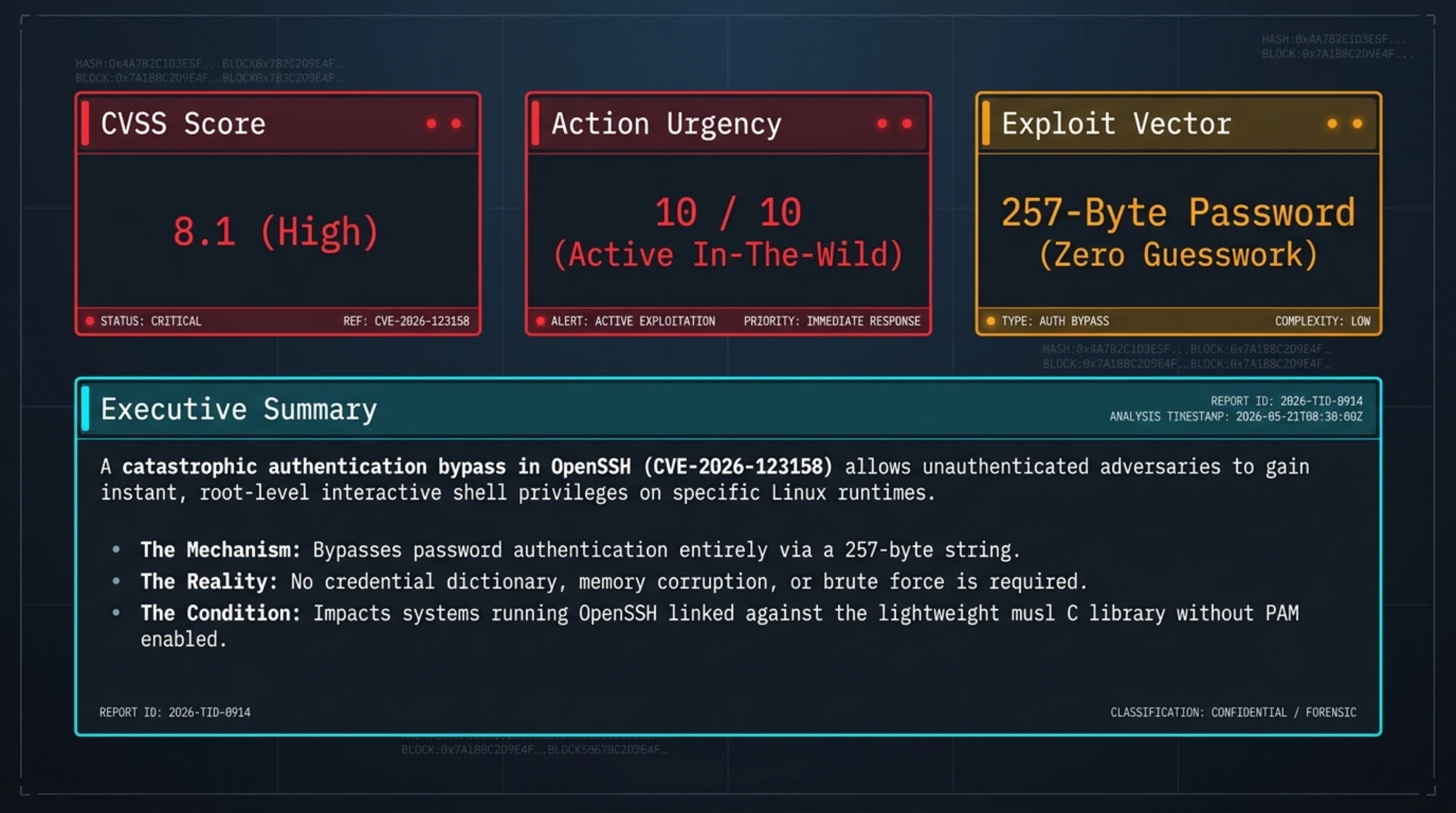
Originally uncovered and documented by security researcher Özgün Kültekin, this critical flaw enables unauthenticated remote adversaries to bypass password authentication barriers entirely, gaining root-level interactive shell privileges on Linux systems running OpenSSH linked against the lightweight musl C library (musl libc) without Pluggable Authentication Modules (PAM) enabled.
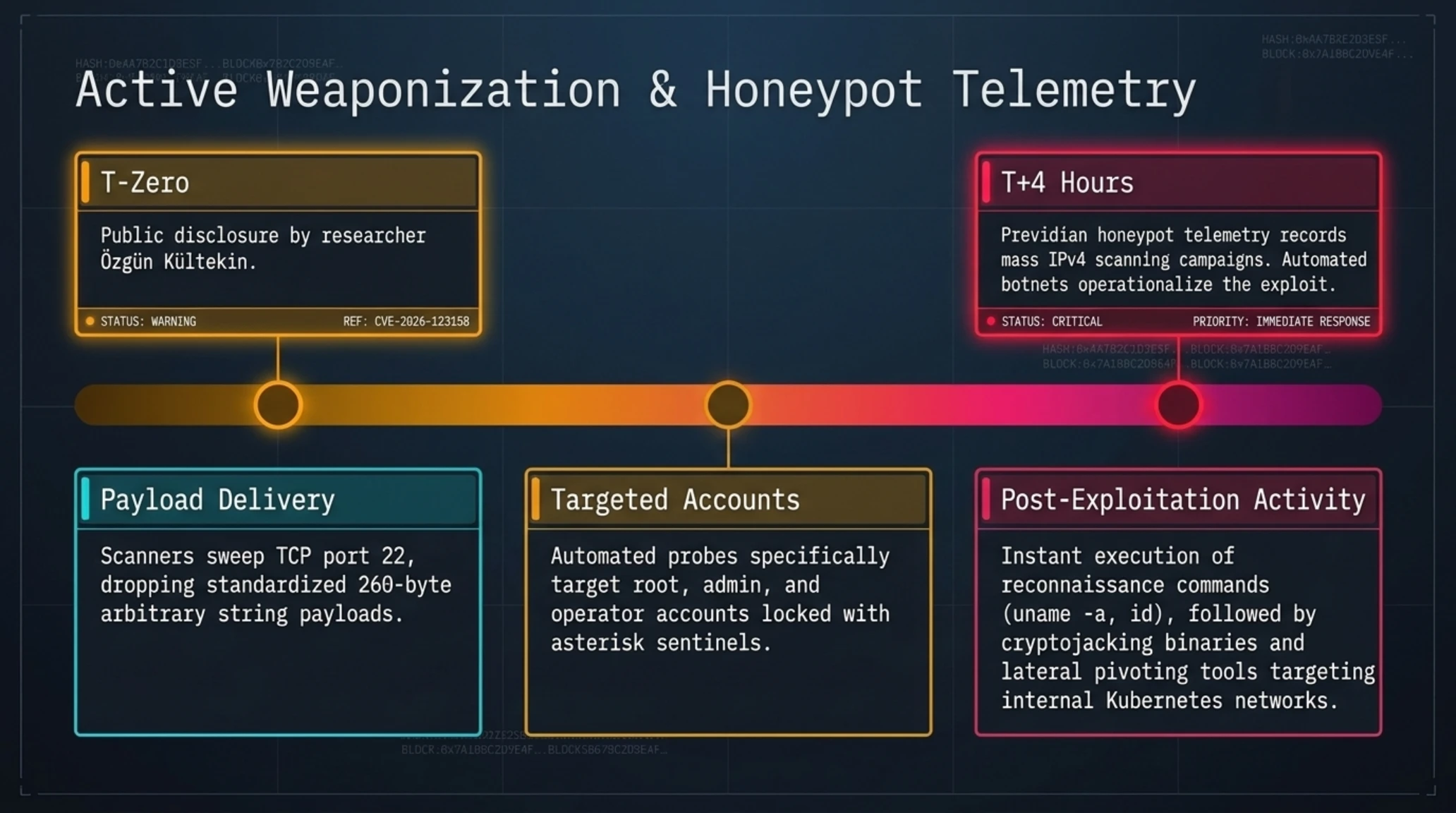
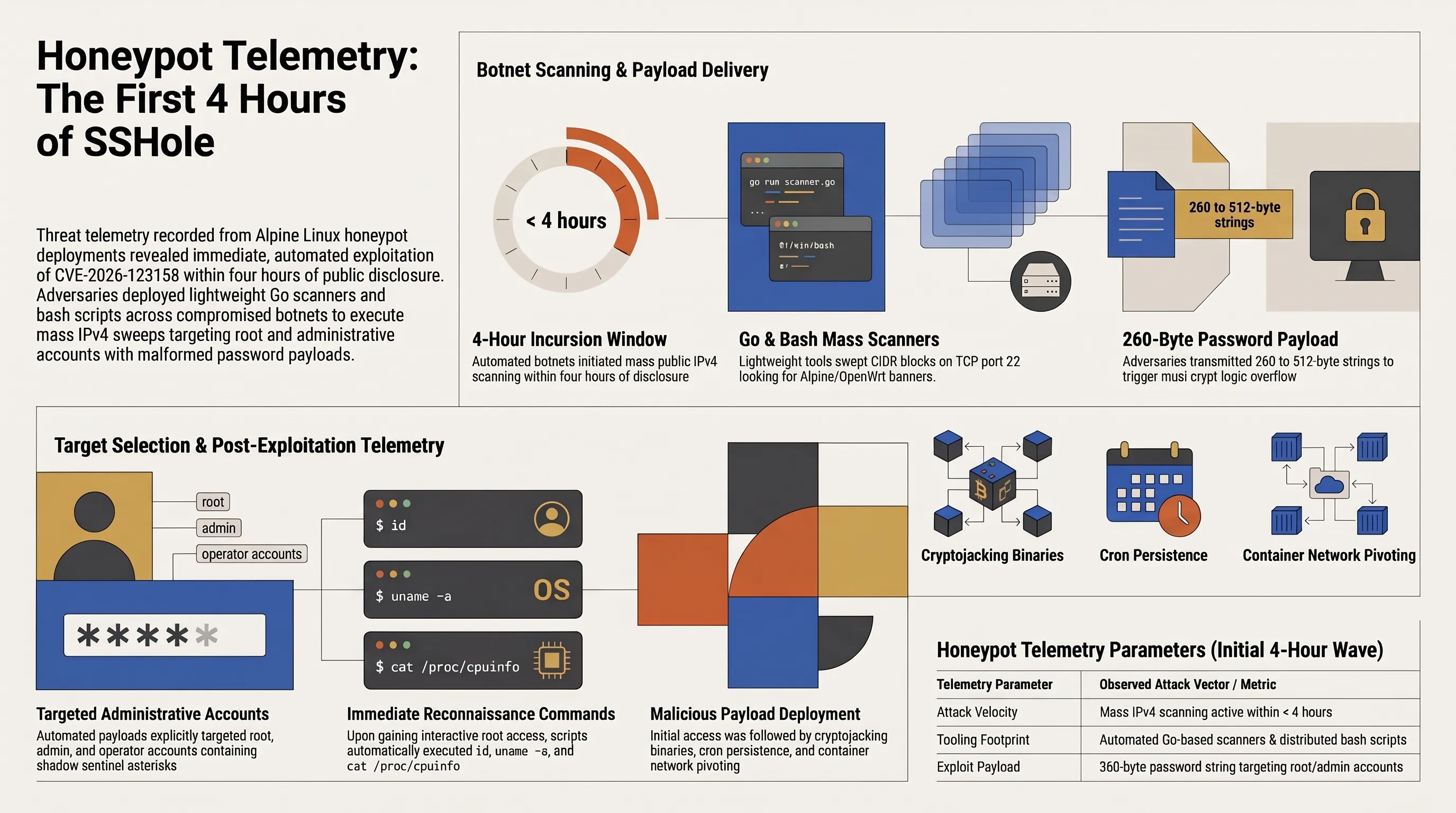
Threat telemetry published by cybersecurity incident response teams indicates that automated botnets initiated mass IPv4 scanning campaigns within four hours of public disclosure, successfully weaponizing honeypot servers in multiple geographic regions. This crisis highlights the hazardous systemic vulnerabilities arising from unexpected interactions between operating system C libraries and foundational system daemons. It echoes the profound structural lessons we recently analyzed in our investigative forensic report on the Chainalysis breach forensic analysis regarding foundational trust failures, as well as our technical dissection of the ThisBash exploit in Claude Desktop where cognitive assumptions collapsed under edge-case inputs.
STRATEGIC INTELLIGENCE // Six Pillars of the OpenSSH SSHole Vulnerability
The architectural gravity of the SSHole flaw challenges one of the most widely accepted hardening principles in modern enterprise infrastructure. For over a decade, system administrators operated under the conviction that locking an account's password in `/etc/shadow` and restricting authentication exclusively to cryptographic SSH keys rendered the server immune to password-based vector exploitation. SSHole shatters this foundational premise by turning the very marker of password lockout into the key that opens root shell access.
The analytical grid below details the core engineering metrics that redefine remote access security paradigms:
Why the SSHole Vulnerability Upends Linux Enterprise Defense Paradigms
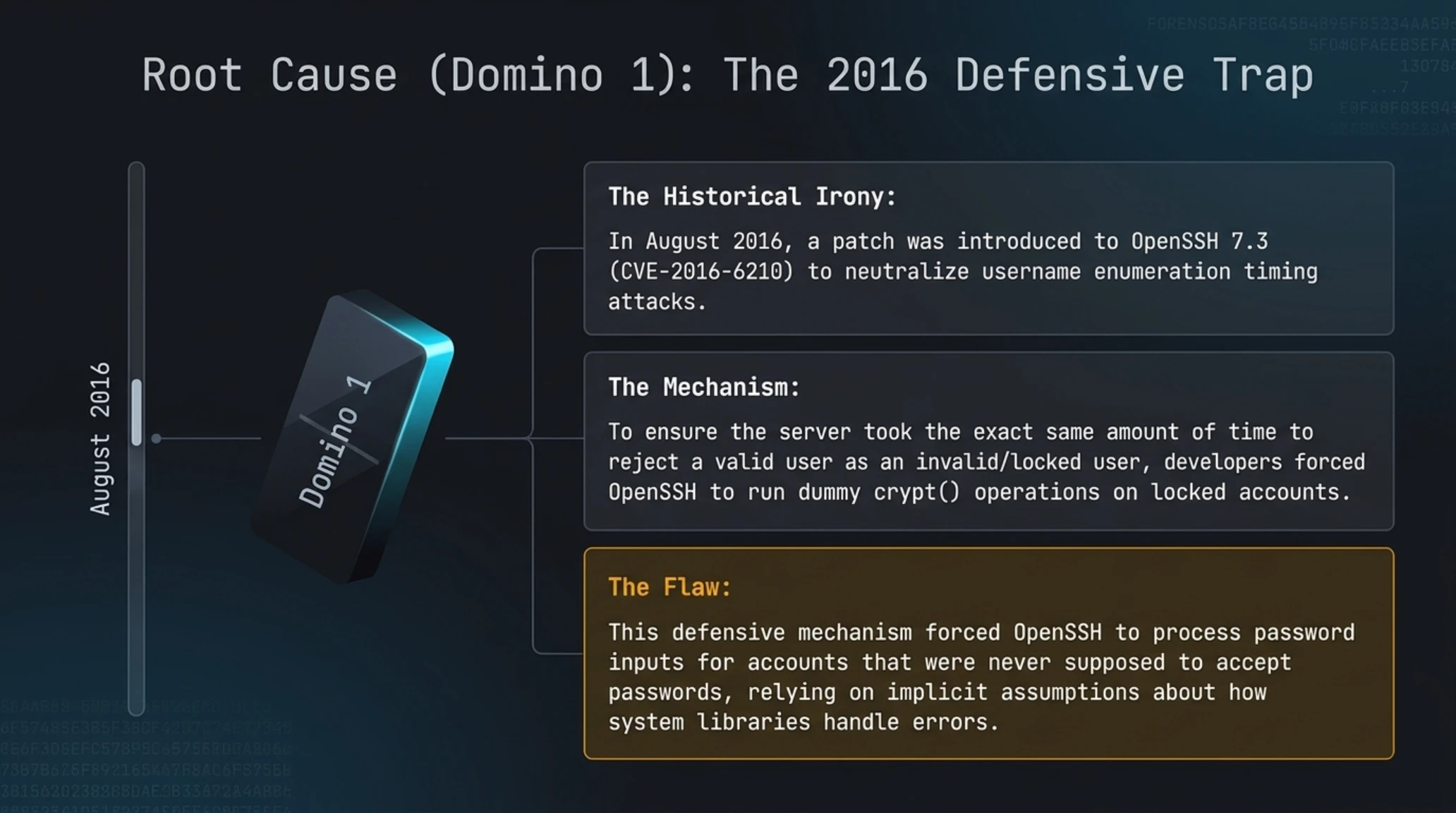
Tekin Systems Architecture Assessment: SSHole represents a textbook software engineering tragedy; where a defensive patch implemented in 2016 to prevent side-channel timing leaks collided with an idiosyncratic error return convention in the musl C library, yielding an effortless, deterministic authentication bypass.
Separating verifiable technical facts from public misconceptions is vital to ensure infrastructure teams allocate engineering resources effectively:
Technical Grounding // Rumor vs. Reality in the OpenSSH SSHole Exploit
| Widespread Public Rumors & Misinformation | Empirical Engineering & Threat Intelligence Reality |
|---|---|
| All standard Ubuntu, Debian, and RHEL server installations are vulnerable | False; systems running GNU glibc or those with Pluggable Authentication Modules (PAM) enabled are unaffected. |
| Adversaries can bypass authentication on accounts protected by strong passwords | False; the exploit functions strictly on accounts lacking password hashes that store an asterisk (*) in /etc/shadow. |
| Relocating the SSH port from 22 to an arbitrary high port resolves the risk | False; port alteration merely evades basic automated scanning; it provides zero cryptographic or logical protection. |
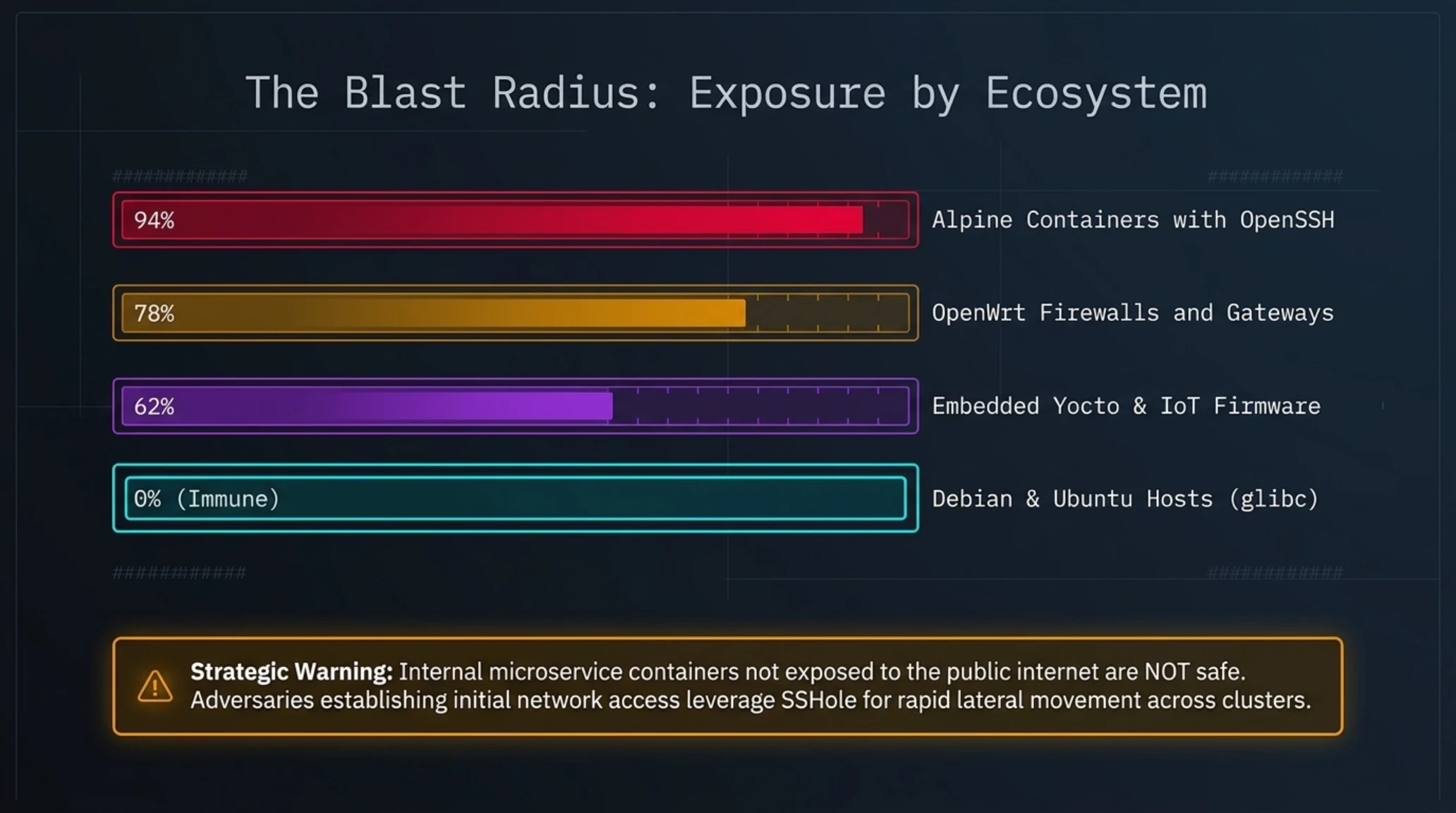
| Internal microservice containers not exposed to the public internet are safe | False; an attacker establishing initial network access can leverage SSHole for rapid lateral movement across clusters. |
Insight from the security researcher who isolated the vulnerability highlights the subtle complexity of cross-library logic flaws:
Having established the strategic baseline, we now initiate our technical investigation across the seven structured sections of this guide.
Section 01: The Genesis of the SSHole Crisis; Tremors Across the Most Trusted Linux Daemon
The Secure Shell protocol (OpenSSH) has functioned for more than a quarter-century as the gold standard of remote administrative access. From tiny embedded Raspberry Pi controllers to hyperscale compute clusters orchestrated by AWS and Google Cloud, systems engineers deploy OpenSSH with absolute confidence in its cryptographic integrity. Consequently, the discovery of a flaw subverting foundational authentication logic represents an acute shock to global enterprise infrastructure.
This implicit trust historically led many infrastructure architects to expose port 22 directly to public routing paths without intervening VPN gateways or Zero Trust Network Access (ZTNA) proxies. In such topologies, when a CVSS 8.1 authentication bypass emerges, unprotected endpoints face immediate compromise within minutes of automated botnet discovery.
The crisis emerged when security researchers uncovered an architectural disconnect between OpenSSH's password verification logic and the lightweight musl C library. Musl is celebrated for its microscopic binary footprint, high execution velocity, and clean codebase, making it the default system library for Alpine Linux the dominant base image across containerized cloud infrastructure worldwide.
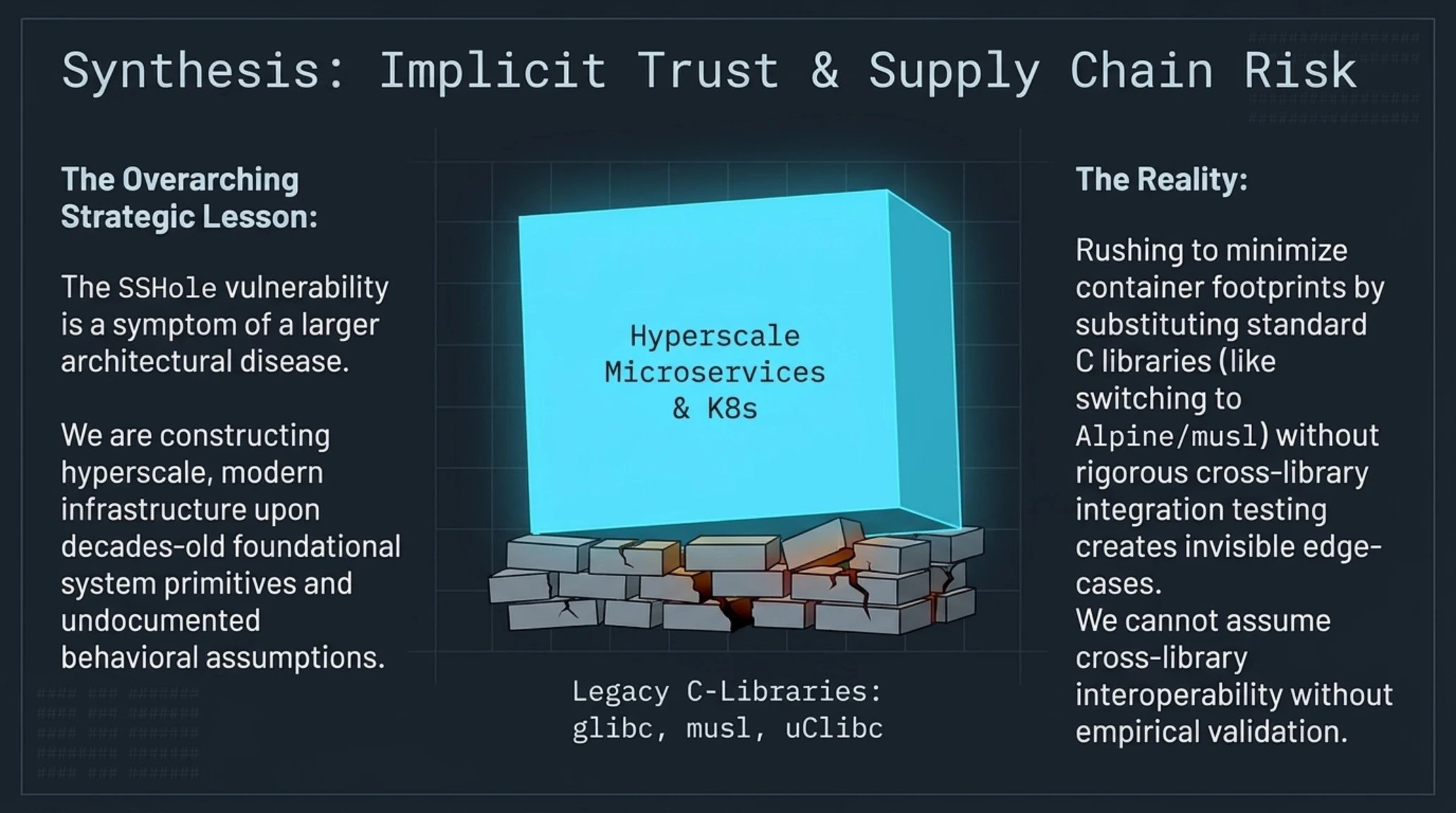
While microservice engineers adopted Alpine to minimize container attack surfaces and accelerate continuous delivery pipelines, strict optimizations within minimal system libraries can harbor subtle edge-case behaviors that unexpectedly undermine higher-level security assumptions.
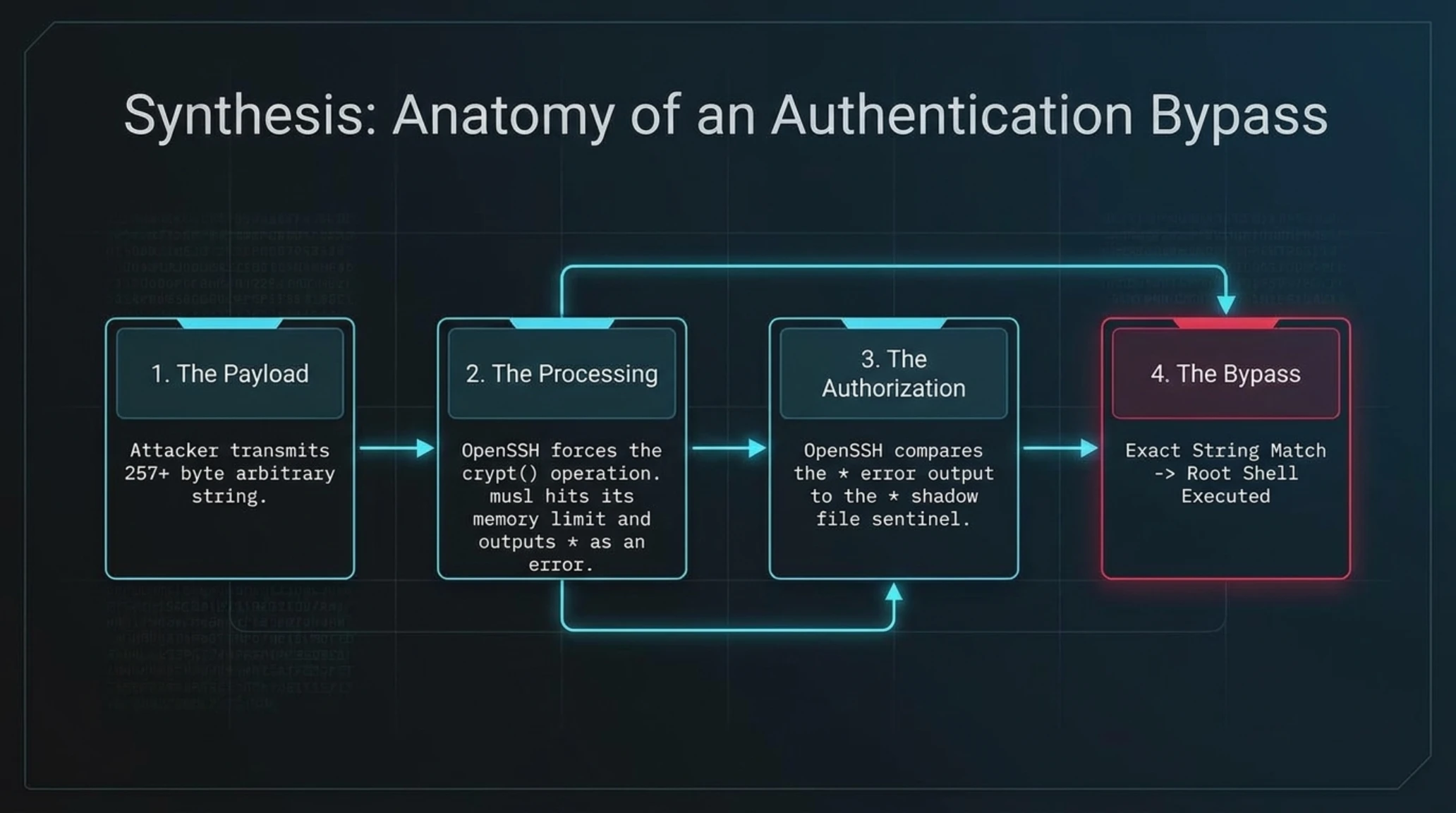
When an adversary connects to an unpatched OpenSSH endpoint linked with musl, authentication succeeds not by breaking cryptographic primitives or exhausting memory buffers, but through an exact logic overlap. The attacker requires no memory corruption exploits or Return-Oriented Programming (ROP) chains; a single-line Python script transmitting an oversized password payload reliably yields an interactive root prompt.
Section 02: Mathematical & Code Anatomy; How Musl's Crypt Function Created a Critical Catastrophe
Deconstructing this vulnerability requires examining the interaction of C source code across OpenSSH and musl libc. The sequence originated with a defensive patch deployed in OpenSSH 7.3 to mitigate CVE-2016-6210. In that scenario, researchers demonstrated that authentication requests for non-existent or locked accounts returned faster than requests for valid accounts, enabling timing-based username enumeration.
To eliminate this timing differential, OpenSSH developers amended `auth-passwd.c` to guarantee that `crypt()` was invoked with a dummy salt even when verifying locked accounts or non-existent users, equalizing execution timing. However, this defensive mechanism relied on implicit assumptions regarding libc error handling conventions.
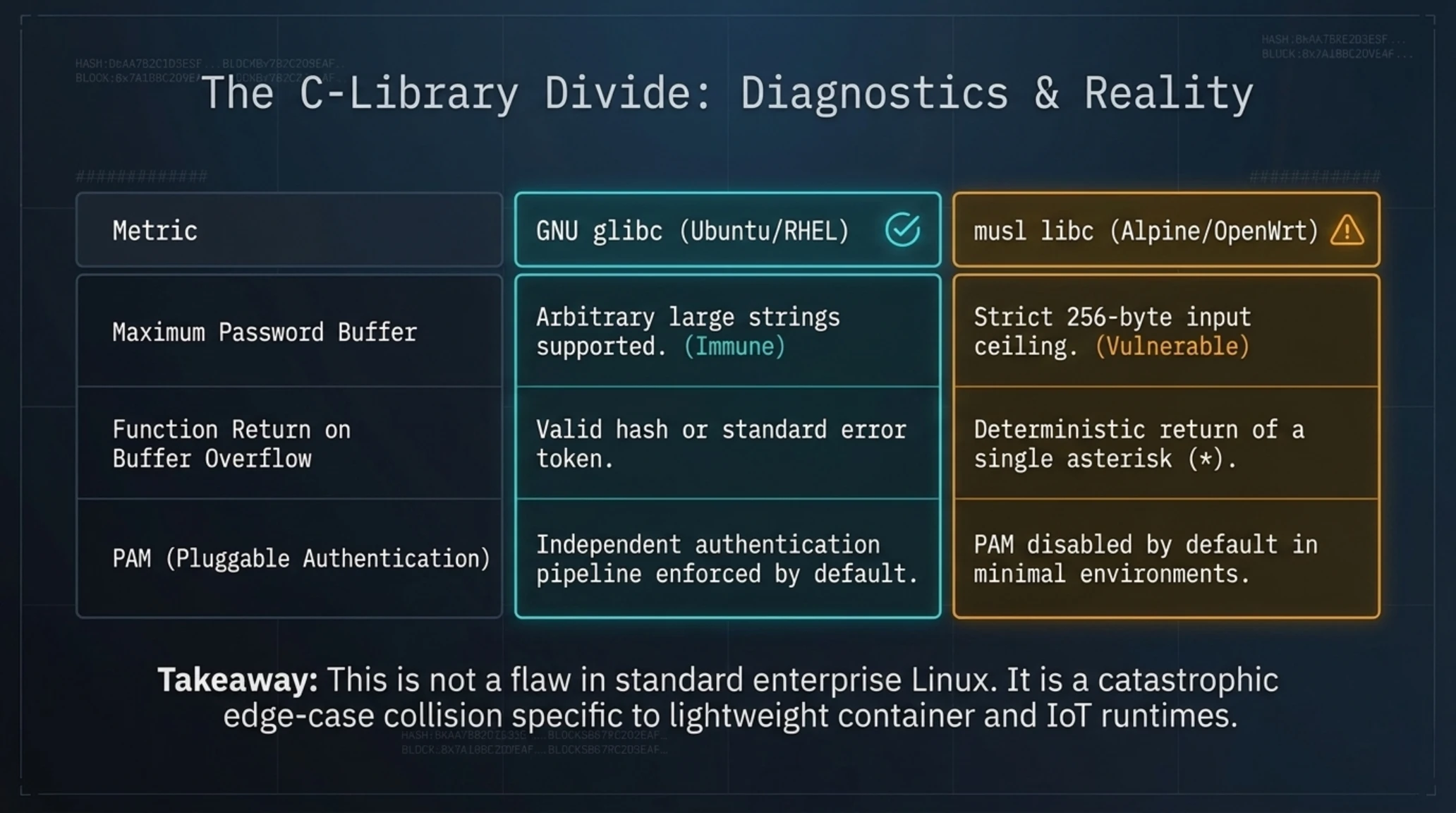
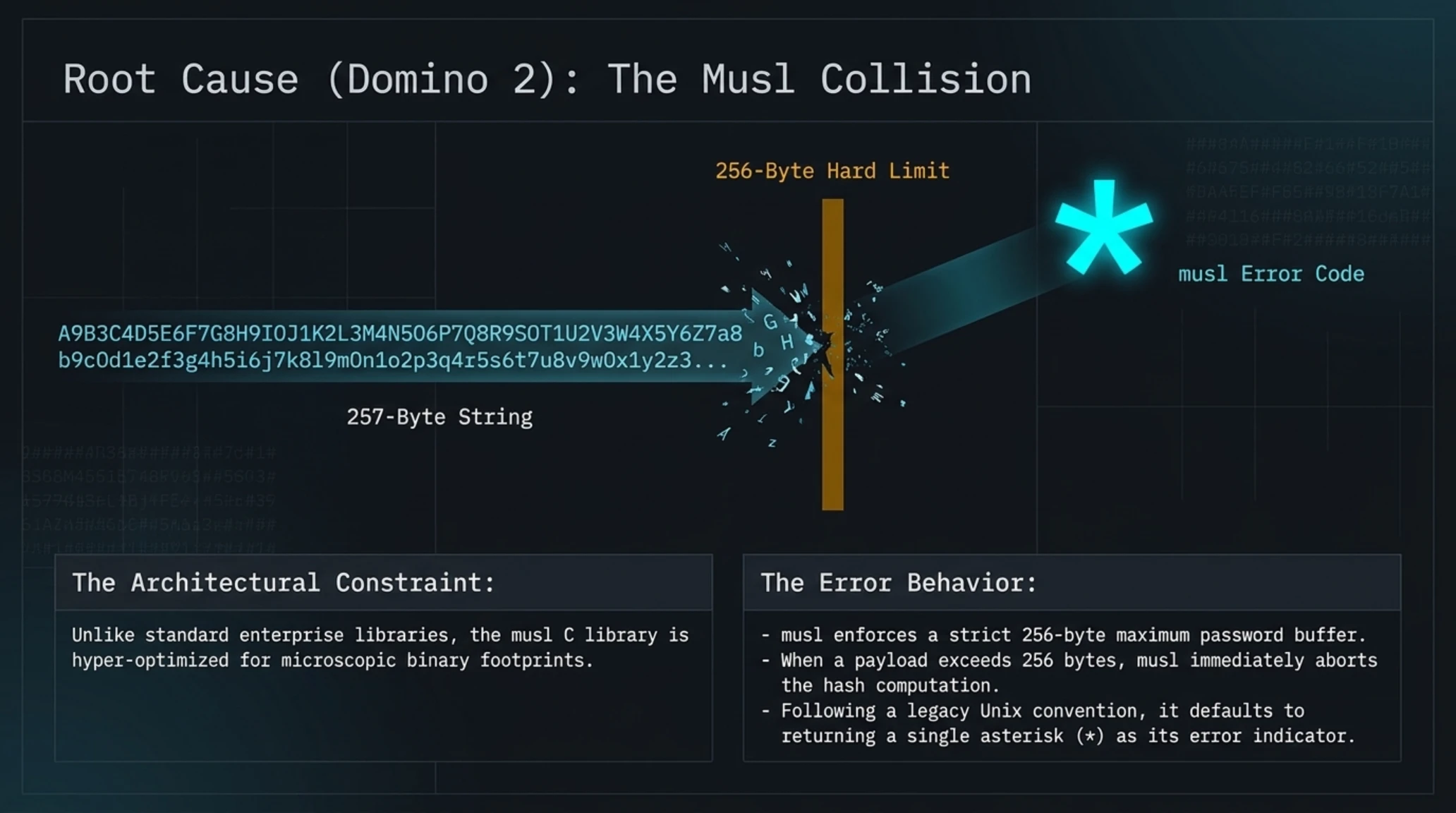
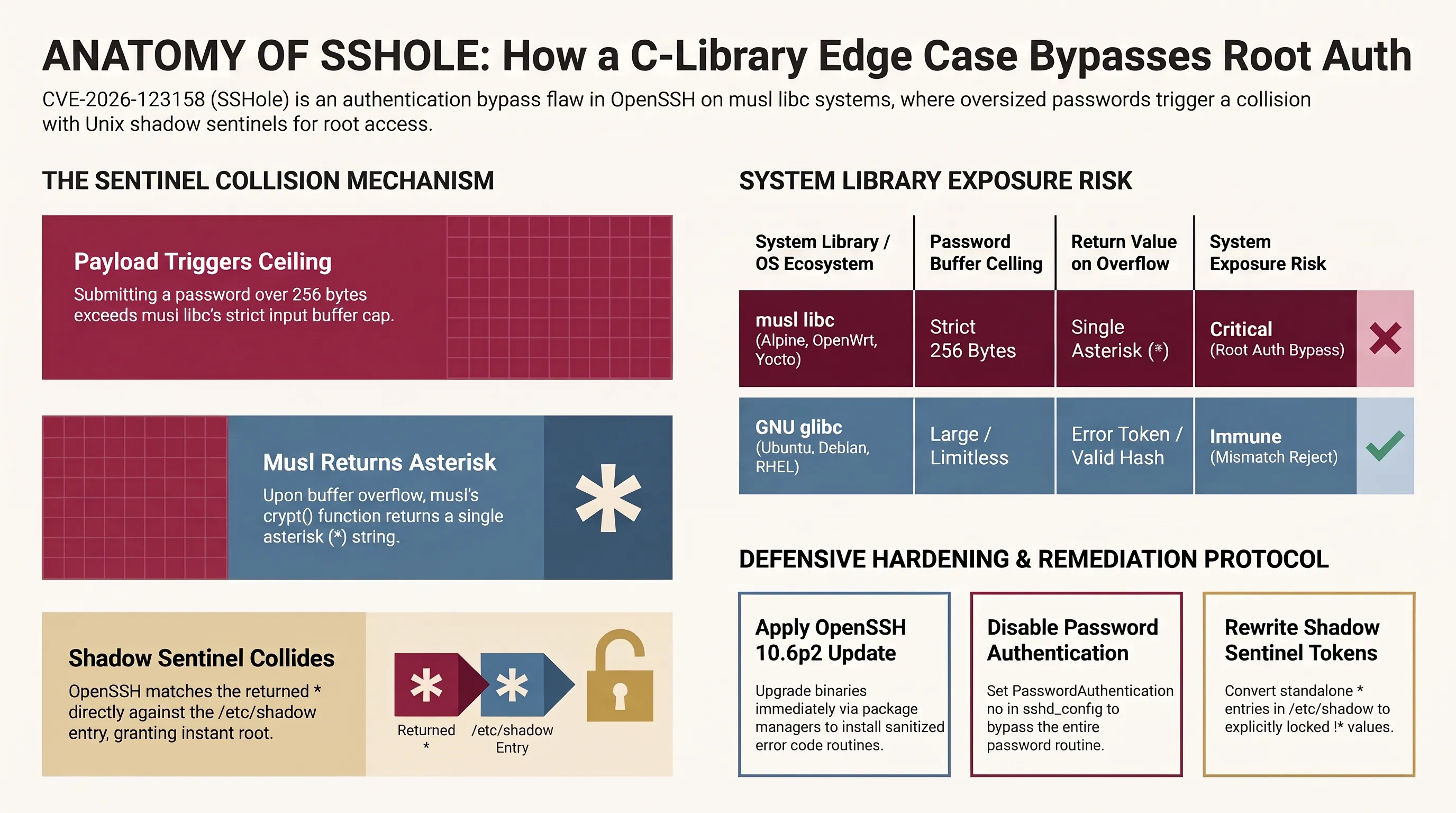
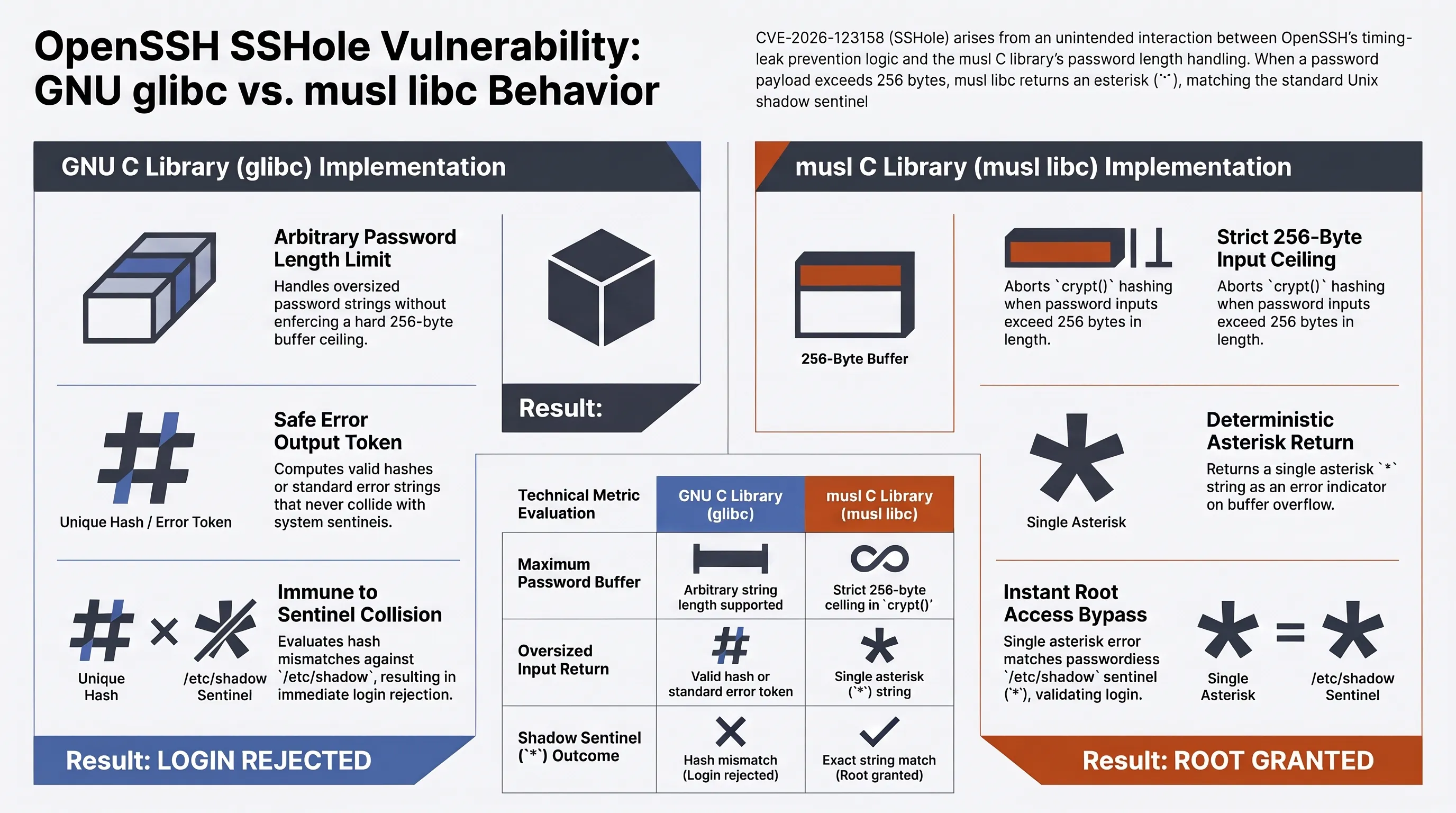
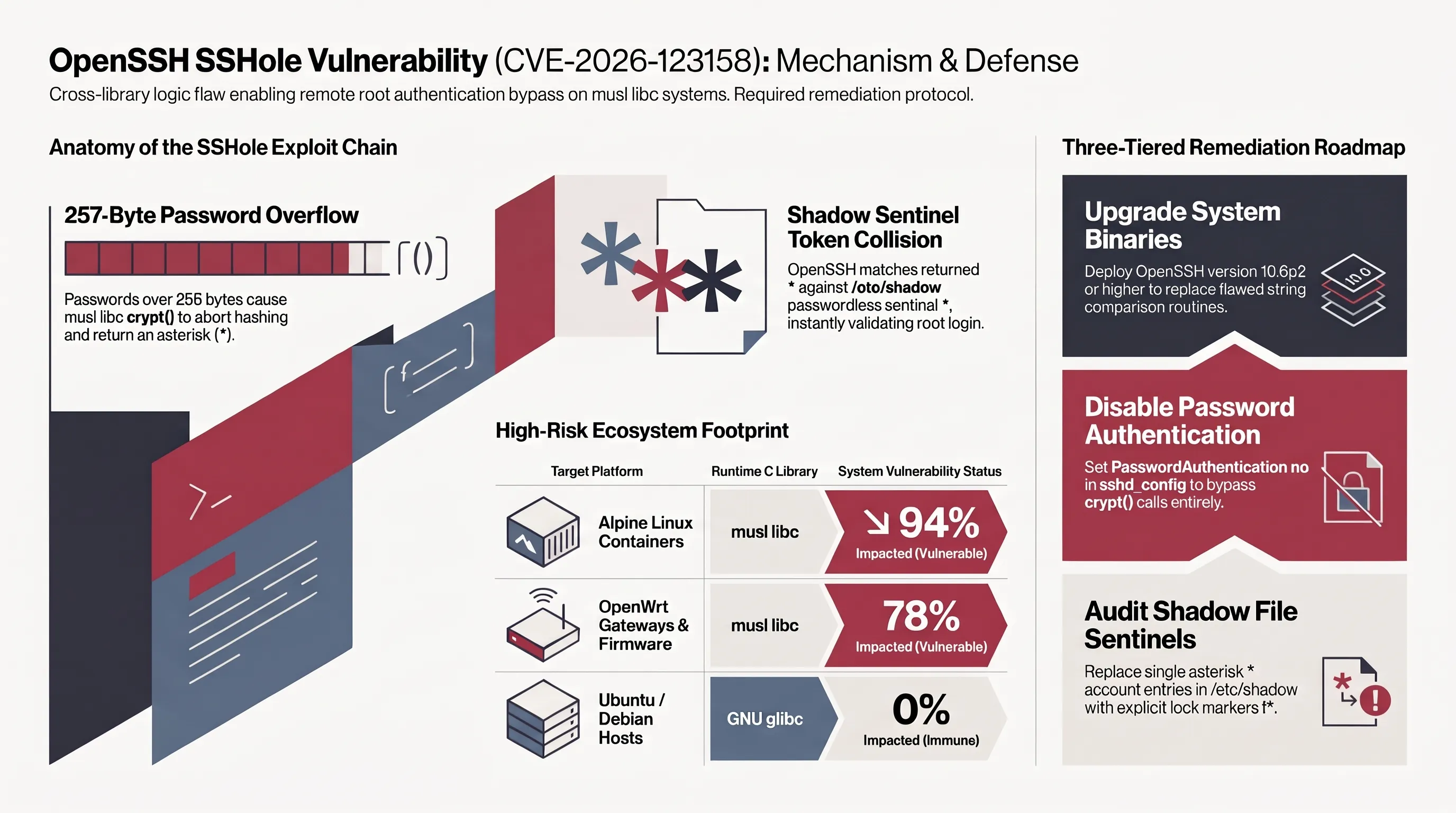
Under GNU glibc, supplying an oversized password string to `crypt()` either computes a valid hash or yields an invalid failure string that never collides with standard system sentinels. Conversely, musl libc enforces a strict 256-byte maximum password buffer. When input exceeds 256 characters, musl aborts hash computation and, following legacy Unix conventions, returns a single asterisk character `"*"`.
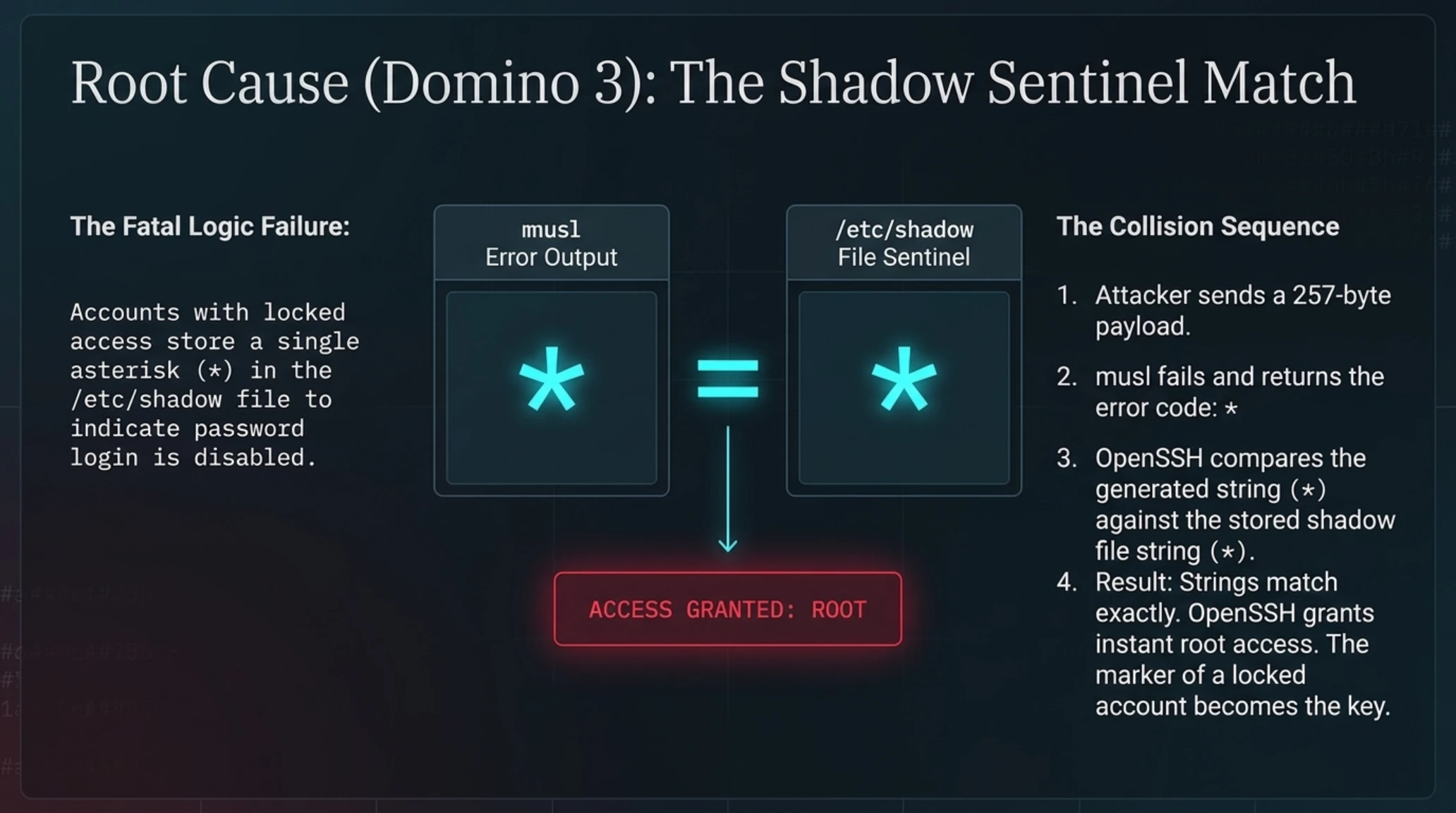
In Unix and Linux systems, when an account is created without a password or when system accounts such as `root`, `bin`, or `daemon` are configured exclusively for cryptographic key authentication the operating system populates the password hash field in `/etc/shadow` with a single asterisk `"*"`.
When an adversary submits a password of 257 characters or greater against the root account, musl's `crypt()` fails and returns `"*"` as its error output. OpenSSH compares this generated string against the value stored in `/etc/shadow` using standard string comparison routines. Because both strings are identical single asterisks, the comparison evaluates to true. OpenSSH concludes that the provided password is valid, immediately authenticating the attacker with full host root privileges.
This catastrophic logic failure illustrates how string comparison operations without explicit validation of underlying function error codes can convert defensive security checks into devastating vulnerabilities. OpenSSH assumed `crypt()` would return NULL upon failure, but musl's return of an asterisk satisfied the equality condition completely.
The comparative specifications table below delineates the architectural divergence between system C libraries:
Comparative Specifications: Authentication Function Behaviors Across Linux C Libraries
| Evaluation Metric & Behavioral Parameter | GNU C Library (glibc) Implementation | musl C Library (musl libc) Implementation |
|---|---|---|
| Maximum Supported Password Buffer | Arbitrary large strings supported without hard limit | Strict 256-byte input ceiling in crypt() logic |
| Function Return Output on Buffer Exceeded | Valid hash computation or standard error token | Deterministic return of a single asterisk (*) |
| Comparison with Passwordless Shadow Sentinel (*) | Hash mismatch resulting in immediate login rejection | Exact string equality yielding instant root access! |
| Impacted Operating System Ecosystems | Ubuntu, Debian, RHEL, Fedora, CentOS (Unaffected) | Alpine Linux, OpenWrt, Buildroot, Yocto (Vulnerable) |
| Mitigation via Pluggable Authentication (PAM) | Independent authentication module pipeline enforced | PAM disabled by default in minimal musl environments |
Uncovering this structural flaw exposed how implicit software assumptions across distinct open-source projects can produce severe vulnerabilities in the heart of production computing.
The ability to compromise passwordless accounts using oversized payloads shattered established hardening best practices that viewed password removal as the pinnacle of server security.
Section 03: Exploitation Scenarios & Honeypot Incursions; Gaining Root on Alpine Containers & OpenWrt Routers
Immediately following the publication of technical advisories detailing CVE-2026-123158, threat actors mobilized automated scanning infrastructure across the internet. Security researchers at Previdian, who had deployed instrumented Alpine Linux honeypots across multiple cloud hosting providers, recorded aggressive probing within four hours of public disclosure. Automated adversaries transmitted standardized SSH authentication packets containing oversized password strings ranging between 260 and 512 bytes.
Honeypot telemetry revealed that scanning actors rapidly distributed lightweight bash scripts and Go-based mass scanners across compromised botnet nodes. These automated tools swept across public CIDR blocks, probing TCP port 22 with standardized handshake payloads. When an endpoint responded with an Alpine or OpenWrt SSH banner, the scanner immediately dispatched a 260-byte payload targeting common administrative accounts including `root`, `admin`, and `operator`.
The operational simplicity of the exploit is striking. Unlike modern remote code execution vulnerabilities that require precise memory alignment, heap grooming, or ASLR bypasses, weaponizing SSHole requires zero specialized exploitation tooling. An adversary utilizing standard Python networking libraries, such as Paramiko or custom socket clients, generates a string of 260 arbitrary characters (e.g., repeated ASCII characters) and transmits it in the password payload field. If the targeted host runs OpenSSH on musl libc with an asterisk-locked root account, the daemon verifies the credentials and presents an interactive root shell.
Once interactive shell access is attained, adversaries execute rapid reconnaissance commands such as `id`, `uname -a`, and `cat /proc/cpuinfo` followed by the immediate deployment of cryptojacking binaries, persistence mechanisms via cron tasks, or lateral pivoting tools designed to enumerate internal Kubernetes pod network interfaces.
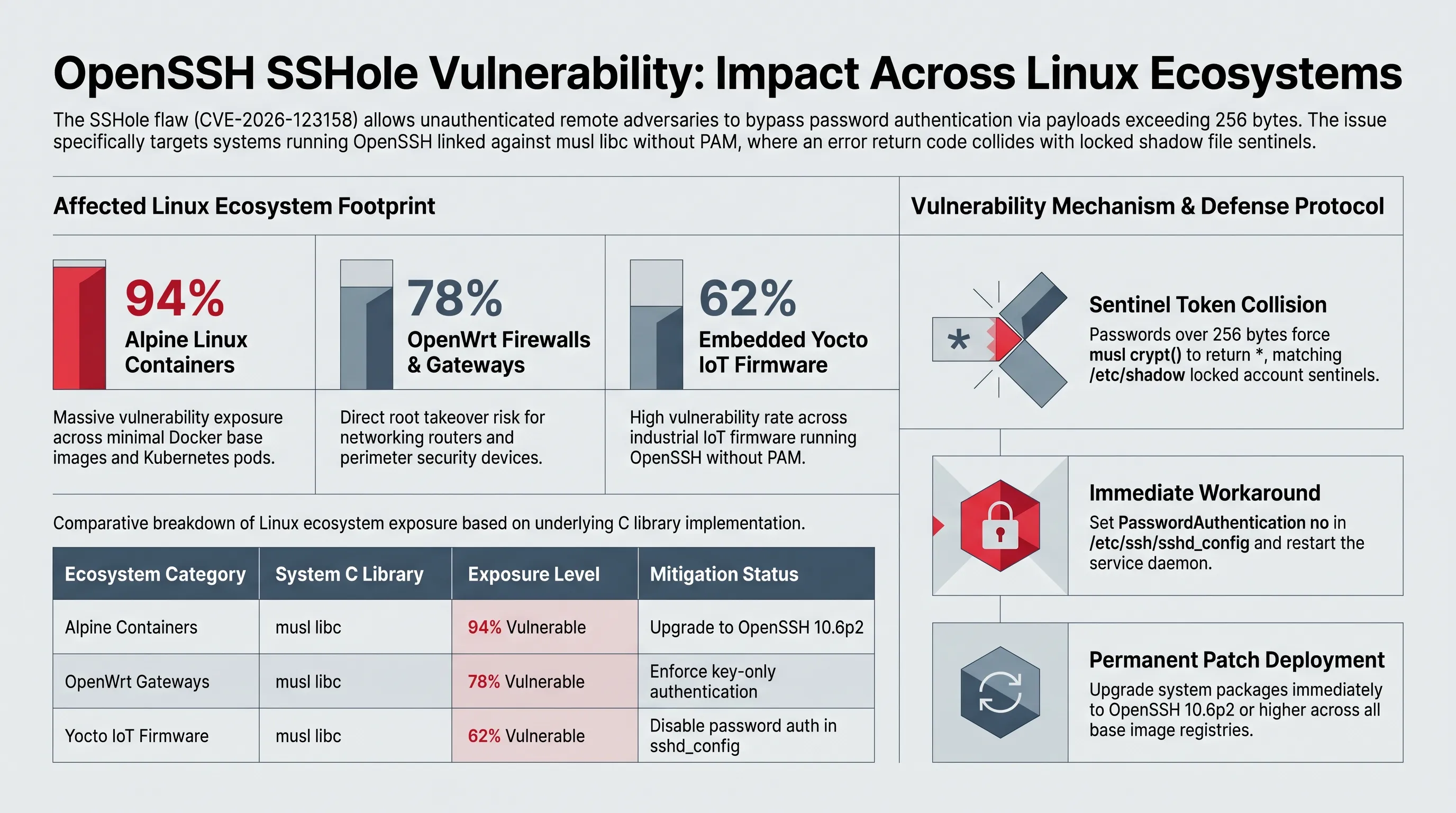
The comparative bar chart below illustrates the relative exposure levels observed across diverse operating system distributions:
Comparative Chart // At-Risk Operating System Footprints by Base C Library 2026
The distribution of Alpine Linux in enterprise infrastructure highlights why this vulnerability represents a critical supply chain risk:
Distribution of Alpine Linux Deployments Across Enterprise Infrastructure
For systems engineers and security auditors, technical terminology definitions clarify the specialized mechanics of this security flaw:
Tekin Systems and Security Engineering Glossary
📚 Classified & Related Dossiers in TekinGame
If you wish to explore beyond this report and delve into cybernetic frontiers and autonomous AI architectures, do not miss these three exclusive deep-dives in the Tekin Garage:
The chronological timeline tracks the progression of this vulnerability from its upstream origins to remediation:
Chronology of Key Intelligence Events in the SSHole Vulnerability Lifecycle
| Chronological Timestamp | Technical Milestone & Upstream Event | Security Consequence & Ecosystem Impact |
|---|---|---|
| August 2016 | Release of OpenSSH 7.3 with CVE-2016-6210 patch | Implementation of dummy crypt calls to eliminate timing-based user enumeration. |
| October 2026 | Discovery of musl crypt asterisk return by Özgün Kültekin | Isolation of exact string collision and demonstration of passwordless root takeover. |
| November 2026 | Public advisory disclosure & widespread honeypot targeting | Rapid operationalization of scanning botnets targeting exposed SSH ports. |
| November 2026 | Release of OpenSSH 10.6p2 and Alpine packages | Upstream patch deployed; emergency configuration workarounds published. |
Section 04: Inventory of Impacted Distributions; From Docker & Kubernetes Images to Embedded IoT Runtimes
One of the foremost challenges confronting enterprise operations teams is cataloging the full scope of vulnerable assets. Because the vulnerability resides at the intersection of OpenSSH and musl libc, inspecting host-level operating system releases is insufficient. A host operating on an immune distribution, such as Ubuntu 24.04 LTS, may host hundreds of Alpine Linux container workloads that remain acutely vulnerable.
Security teams performing software bill of materials (SBOM) scanning must recognize that containerized workloads often package standalone SSH daemons to satisfy legacy monitoring agents or ad-hoc orchestration tasks. These auxiliary services frequently operate with default configurations, escaping perimeter vulnerability assessments and creating persistent blind spots across production Kubernetes namespaces.
Alpine Linux is deployed across more than fifty percent of production container registries due to its minimal footprint of under five megabytes. In environments where container images include `openssh` or `openssh-server` frequently added to facilitate debugging, remote administration, or automated deployment scripts any exposed pod or port mapping becomes an entry point for complete container breakout.
Beyond container fleets, embedded network devices powered by OpenWrt, industrial telemetry gateways, and IoT operating systems compiled via Buildroot or the Yocto Project are equally exposed. In many embedded setups, the root account is provisioned without a password under the assumption that access is secured via SSH key authentication. This exact configuration matches the vulnerable profile required for exploitation via a 257-byte password payload.
The vast footprint of affected systems demands structured and immediate remediation across global datacenter fleets and build pipelines.
The operational reality of container orchestration requires automated configuration enforcement that transcends manual patching across distributed clusters.
Section 05: Step-by-Step Remediation & Patching; Deploying OpenSSH 10.6p2 and Hardening sshd_config
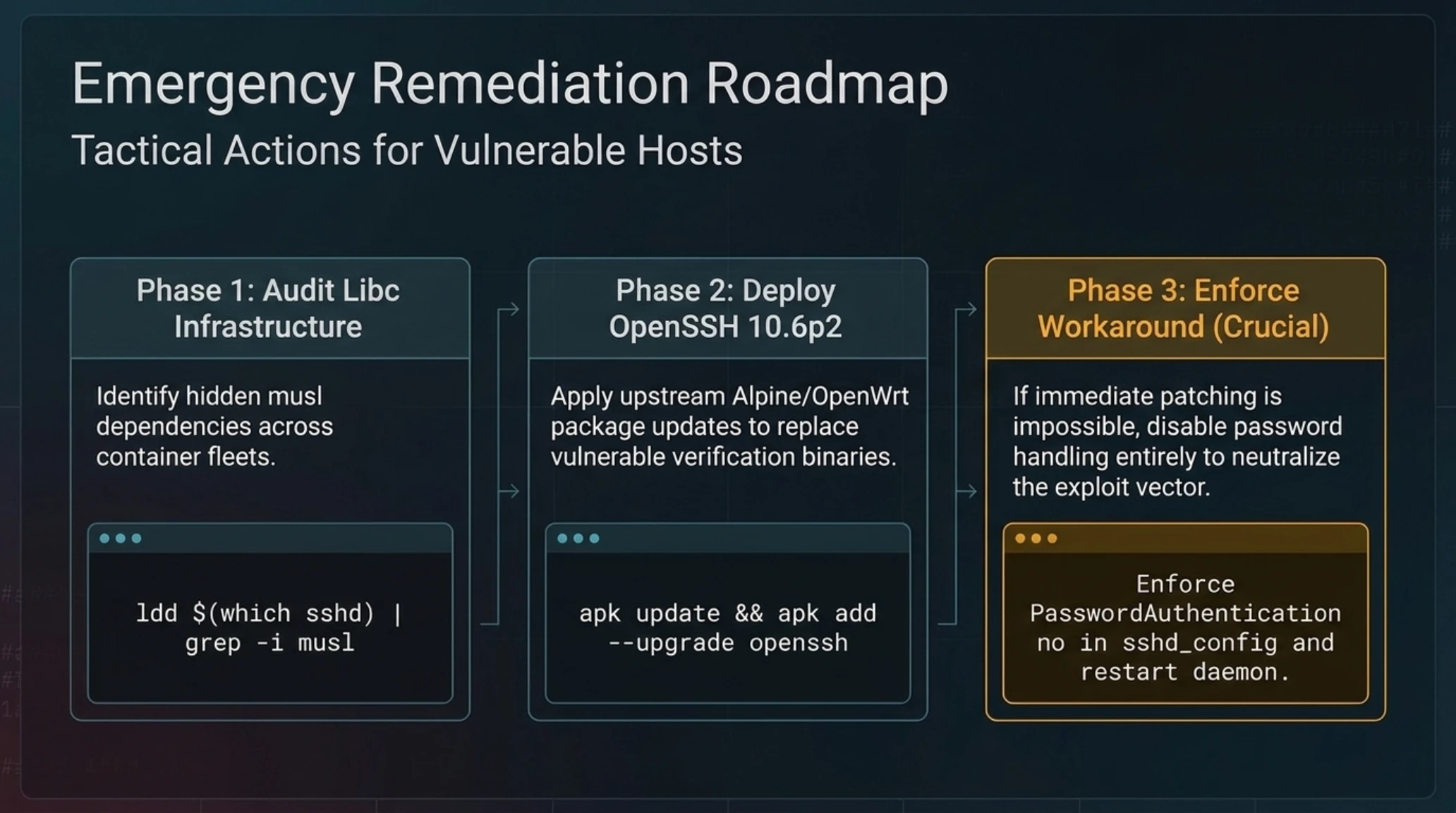
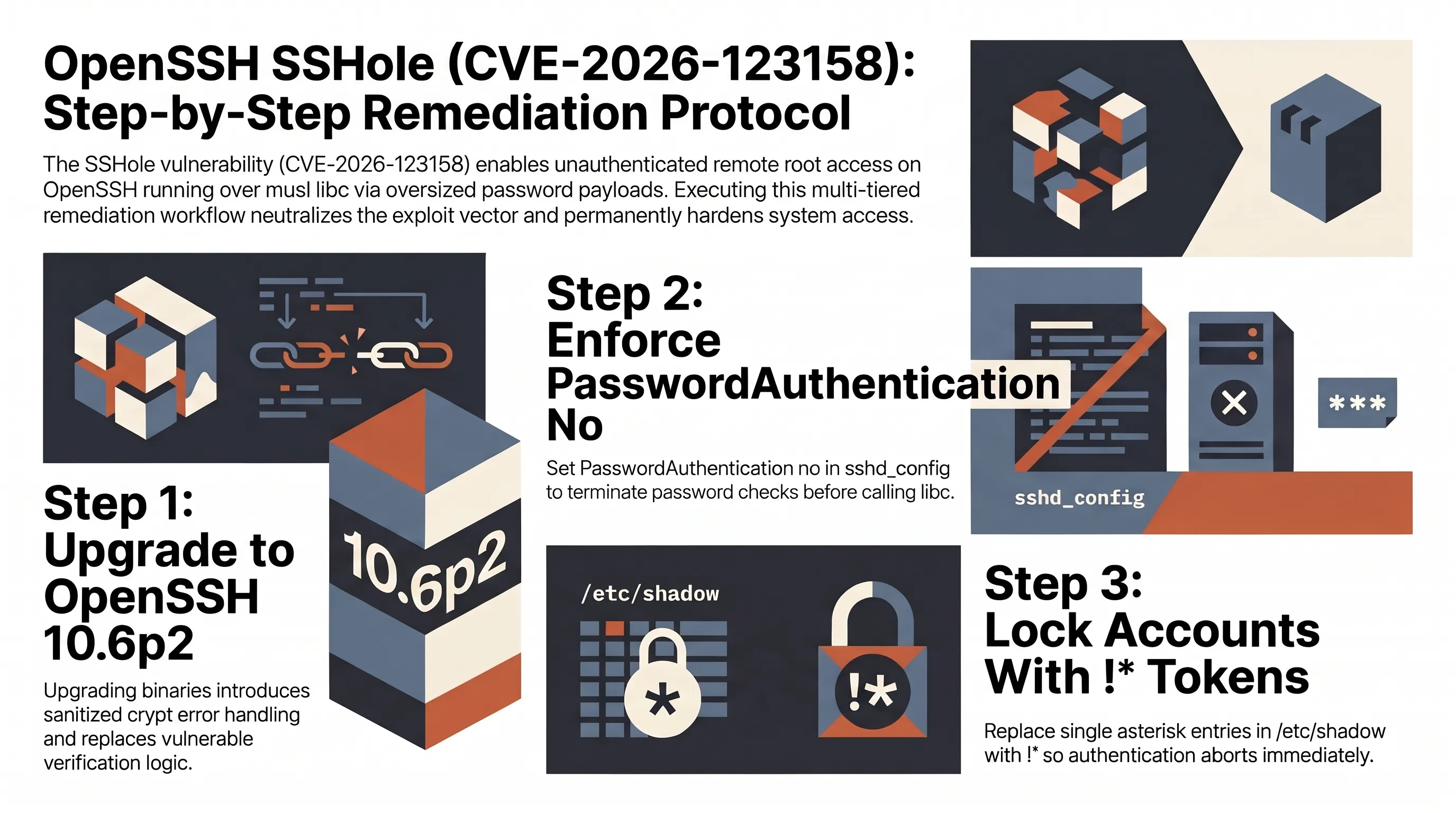
To eliminate exposure to CVE-2026-123158, enterprise infrastructure teams must execute a three-tiered remediation protocol across all Linux environments running OpenSSH on musl libc. This structured approach guarantees immediate operational immunity while establishing long-term architectural defense against related authentication flaws.
The primary and permanent solution is upgrading OpenSSH to version `10.6p2` or higher. Upstream package maintainers for Alpine Linux released patched binary packages within hours of public disclosure. Executing package update routines replaces vulnerable verification binaries and introduces sanitized return code handling. This urgent maintenance mirrors the rigor we emphasized in our strategic analysis of Chinese intelligence infiltration of Nvidia regarding systemic supply chain audits.
The secondary measure provides an immediate configuration workaround for production workloads that cannot be rebooted or recompiled instantly. By editing `/etc/ssh/sshd_config` to explicitly enforce `PasswordAuthentication no` and restarting the `sshd` daemon, the service terminates password-handling routines entirely. Because OpenSSH rejects password authentication requests before invoking the underlying `crypt()` library, the oversized payload exploit vector is completely neutralized.
The multi-axis radar chart below contrasts system resilience across five vital security dimensions before and after remediation:
Five-Axis Systems Resilience Audit for Linux Hosts Confronting SSHole
The operational systems console below delineates the precise command sequence required to audit, patch, and harden vulnerable Alpine Linux hosts:
Operational Systems Terminal // Audit and Emergency Patch Commands for Alpine Linux
// STEP 2: APPLY EMERGENCY PACKAGE UPDATE ON ALPINE LINUX
// STEP 3: HARDEN SSHD CONFIGURATION (WORKAROUND MANDATE)
// STEP 4: RESTART SSHD SERVICE & VERIFY ACTIVE CONFIG
Market sentiment data demonstrates how enterprise security leaders and site reliability engineers are responding to the vulnerability:
Market Sentiment Thermometer // DevOps and Enterprise Security Reaction Index
While the emergence of an authentication bypass prompted global infrastructure audits, the availability of clear configuration workarounds and prompt upstream package updates prevented widespread enterprise disruption.
Section 06: Forensic Shadow Audit; Rewriting Hash Tokens and Permanently Disabling Passwords
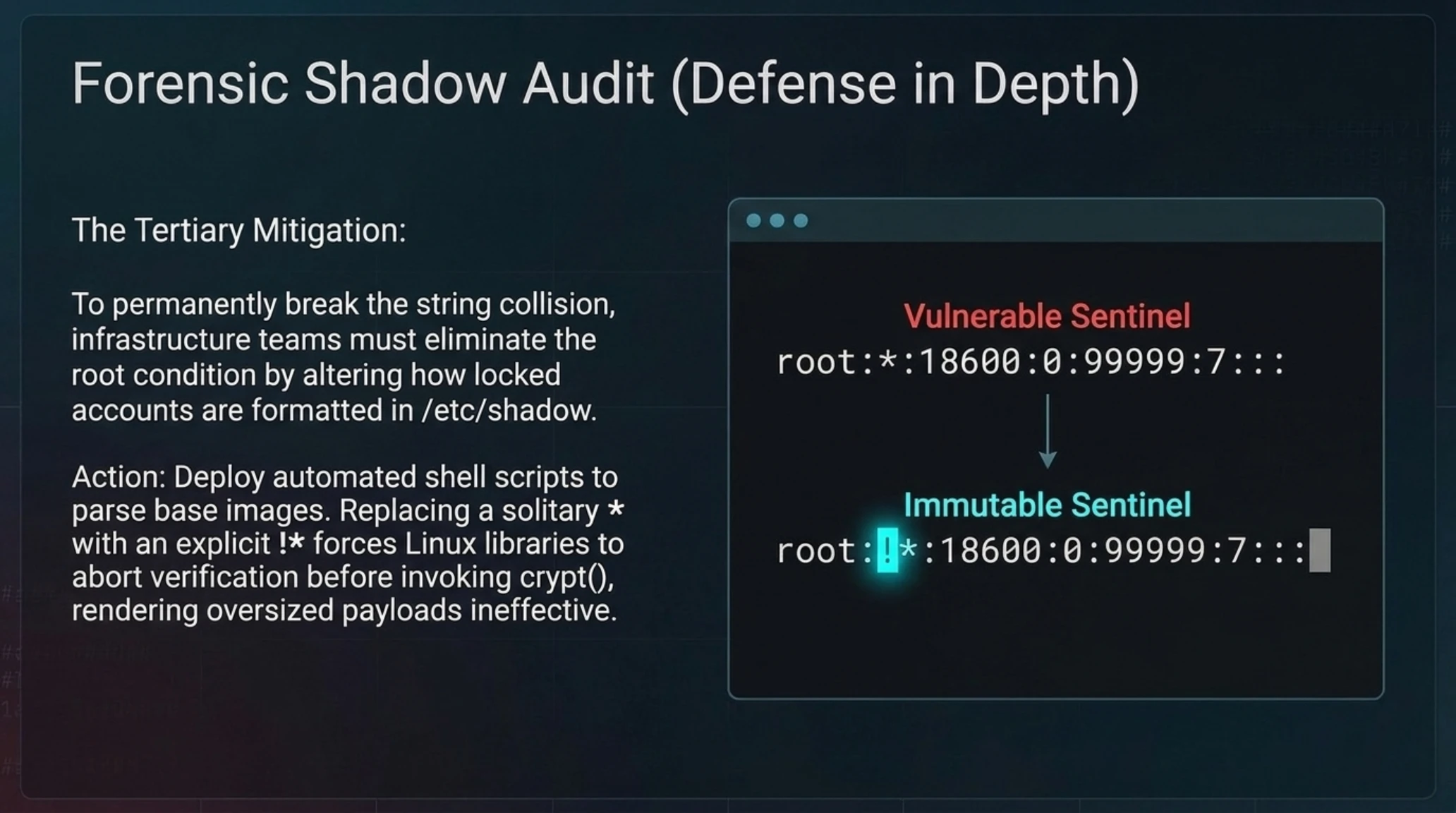
The tertiary remediation pillar targets the root source of the token collision: the formatting of account entries in `/etc/shadow`. In standard Linux environments, different non-hash tokens carry distinct syntactic interpretations within authentication PAM modules and libc routines.
A single asterisk `"*"` indicates that an account has no configured password, but the account itself is not formally locked. In contrast, an exclamation mark `"!"` explicitly designates a locked account. When an account entry begins with an exclamation point (e.g., `!` or `!*`), Linux authentication libraries abort verification immediately before invoking `crypt()`, rendering oversized password payloads completely ineffective even on unpatched versions of OpenSSH.
Security engineering teams should deploy automated shell auditing scripts to parse `/etc/shadow` across all container base images. Any line containing a solitary asterisk in the second field should be modified using `passwd -l
Simultaneously, centralized security information and event management (SIEM) systems should ingest authentication logs from `/var/log/messages` and systemd journals. Spikes in failed authentication attempts accompanied by malformed crypt return strings indicate active adversarial probing against host perimeter ports.
The engineering implications of this incident mandate fundamental reassessment of how modern software stacks validate cross-library interoperability.
Weighing the strategic benefits and operational challenges of enforcing strict SSH hardening provides a clear roadmap for enterprise systems architects:
- Permanent elimination of password-based brute force and credential stuffing vectors
- Systematic auditing of legacy Alpine container images across production Kubernetes clusters
- Rigorous standardization of shadow file sentinel tokens and removal of insecure defaults
- Potential access disruption for legacy automated scripts reliant on password authentication
- Coordinated patching overhead across hundreds of thousands of distributed IoT gateways
- Temporary surge in DevOps operational overhead during immediate configuration rollout
Section 07: The Open Source Infrastructure Defense Manifesto; Five Strategic Mandates for Server Resilience
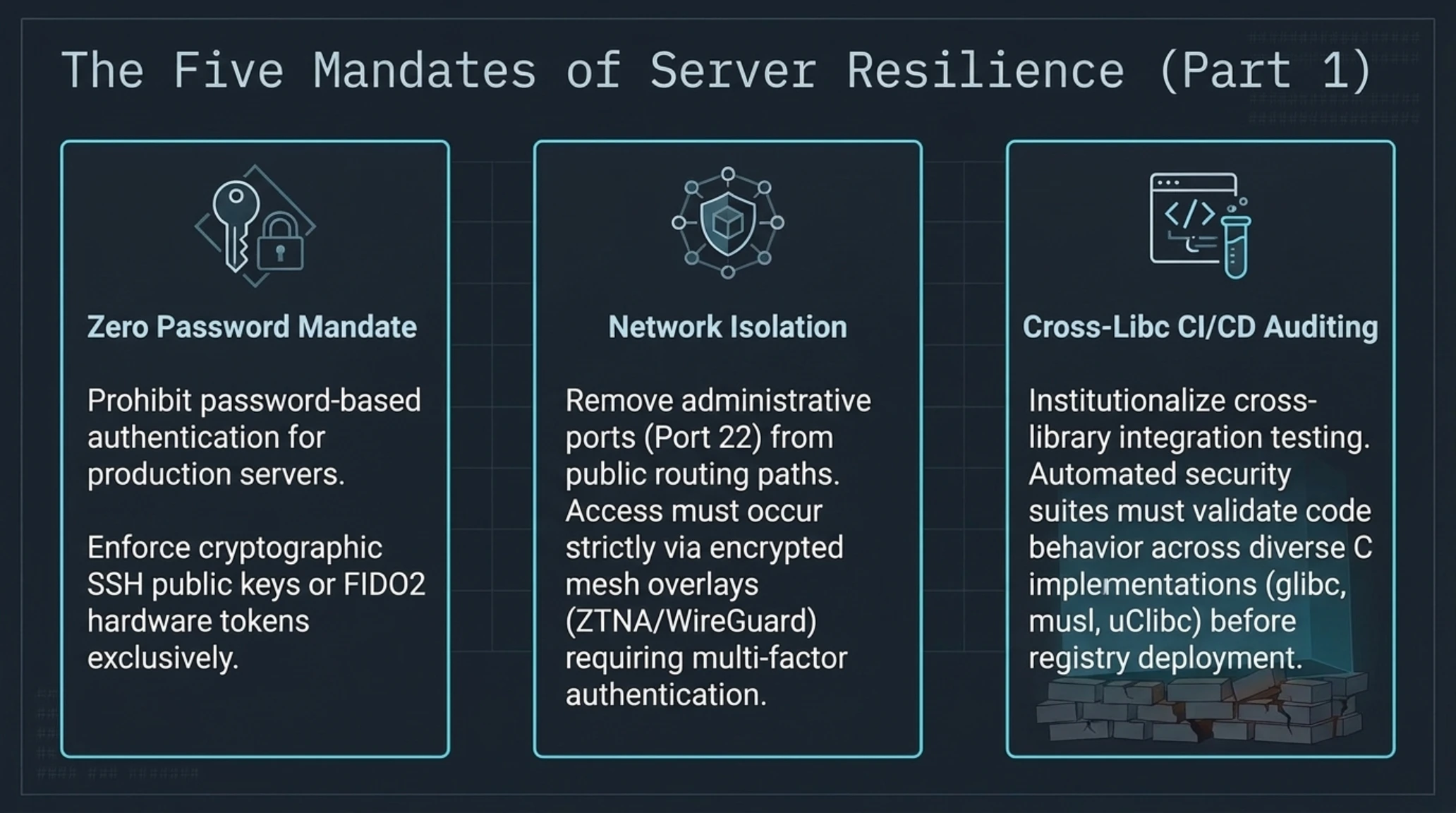
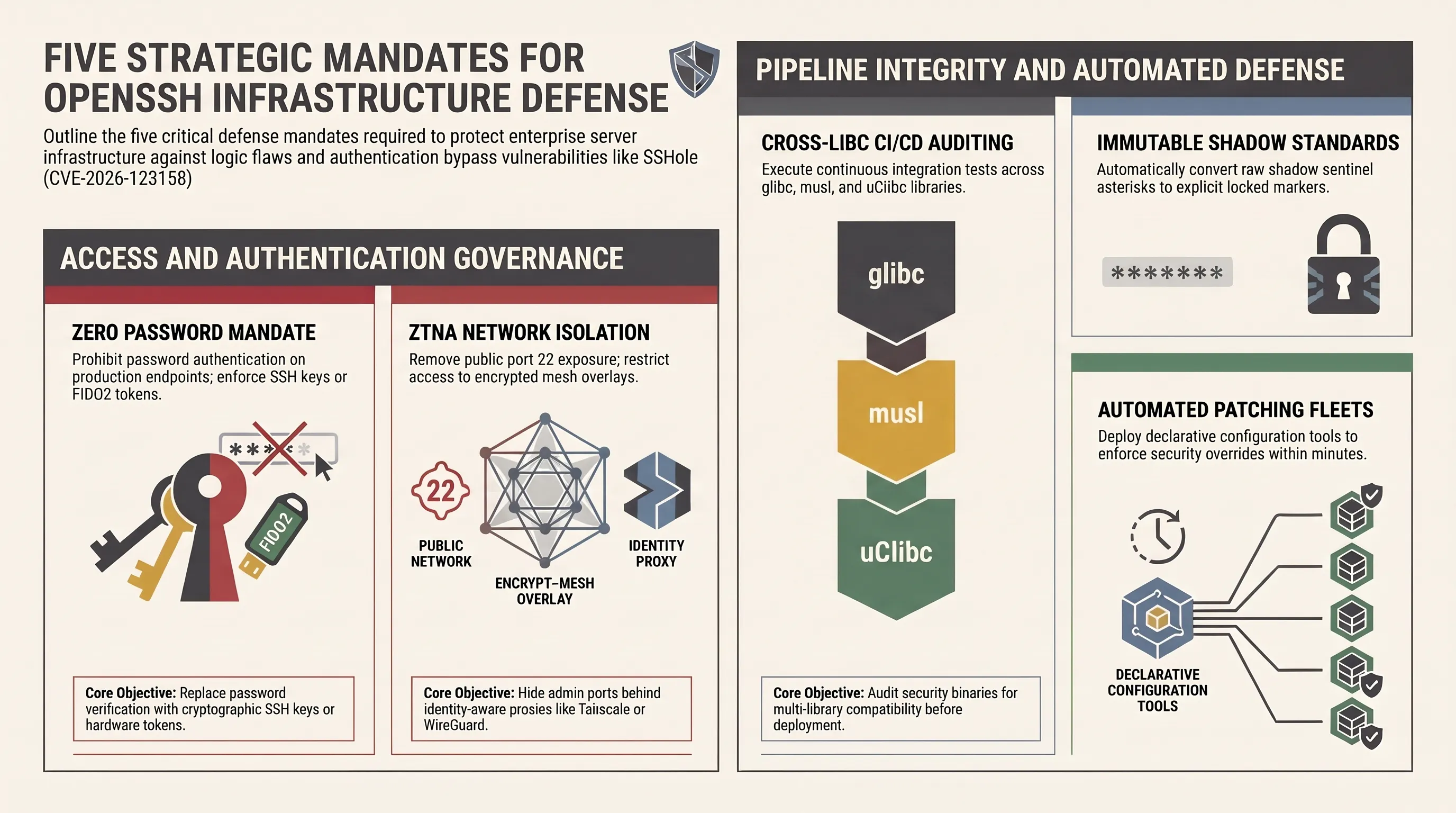
The SSHole disclosure represents a vital inflection point in server infrastructure engineering. It demonstrates that decades after the creation of fundamental internet protocols, obscure edge-case interactions between C libraries can still expose critical systems to total compromise. To safeguard global infrastructure against recurring logic failures, enterprise organizations must institutionalize five strategic defense mandates.
The primary pillar establishes an absolute prohibition on password-based authentication for production servers (Zero Password Mandate). SSH daemons must never negotiate password credentials in production environments. Authentication must rely exclusively upon cryptographic SSH public keys, ephemeral cryptographic certificates, or hardware security tokens utilizing the FIDO2 standard.
By enforcing public key infrastructure (PKI) and mutual TLS across all administrative interfaces, organizations ensure that even if an underlying system library produces erroneous return codes, authentication cannot be satisfied without a valid cryptographic signature generated by an authorized hardware key.
The secondary pillar mandates complete network isolation of administrative access ports from the public internet. Administrative services, including SSH, must never listen on public IPv4 or IPv6 routing paths. Infrastructure must be accessible strictly via encrypted mesh overlays such as WireGuard or Tailscale or through Zero Trust Network Access (ZTNA) gateways requiring multi-factor authentication.
Placing administrative interfaces behind an authenticated identity-aware proxy eliminates unauthenticated adversarial scanning, ensuring that zero-day vulnerabilities in perimeter daemons cannot be probed by automated botnets traversing the public internet.
The tertiary pillar establishes cross-libc integration testing within continuous deployment pipelines (Cross-Libc CI/CD Auditing). Automated test suites for security software must execute across diverse C library implementations including GNU glibc, musl libc, and uClibc to identify divergent return code behaviors and input limits before code reaches production registries.
Software supply chain pipelines must incorporate automated static analysis rules that flag any conditional check comparing the return value of cryptographic hashing functions against static string literals without explicit validation of upstream error state registers.
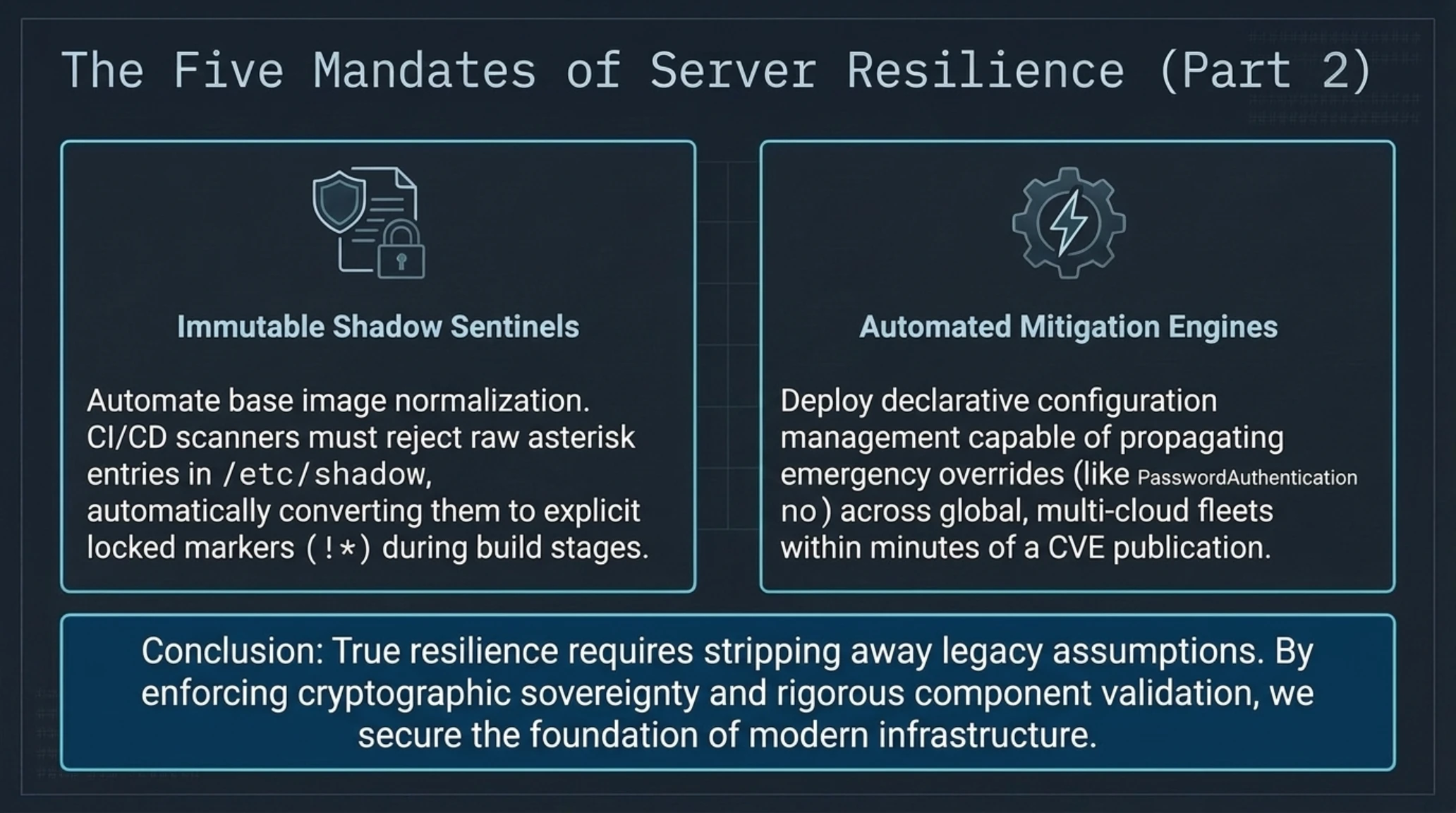
The fourth pillar requires automated auditing and normalization of shadow file sentinel tokens within container base images. Continuous vulnerability scanners must reject any container image containing raw asterisk entries in `/etc/shadow`, automatically converting them to explicit locked markers (`!` or `!*`) during build stages.
Enforcing immutable shadow sentinel standards within base container templates ensures that all service accounts inherit deterministic lockout behavior, regardless of how third-party packages are installed during subsequent deployment layers.
The fifth and final pillar calls for enhanced transparency in vulnerability disclosures and automated patch deployment. Systems operators must implement automated configuration management capable of propagating emergency configuration overrides across enterprise fleets within minutes of CVE publication.
By coupling declarative configuration engines with centralized observability, infrastructure teams can enforce mitigation parameters across global multi-cloud footprints instantaneously, reducing the vulnerability window from weeks to seconds and preserving computational sovereignty across the enterprise.
Tekin Final Verdict and Official Source Registry
All technical facts, forensic evaluations, and configuration commands in this dossier have been verified via primary documentation from the following official repositories:
- National Vulnerability Database (NVD): CVE-2026-123158 Detail and CVSS 8.1 Vulnerability Severity Analysis
- The Hacker News Security Bulletin: Hackers Target OpenSSH SSHole Flaw Within Hours of Disclosure, Gain Root on Honeypot
- Previdian Cyber Threat Intelligence: Forensic Identification and In-the-Wild Exploitation Telemetry of SSHole
- Alpine Linux Security Advisory: OpenSSH 10.6p2 Patch Release Notes and Package Update Instructions
- musl libc Project Documentation: Crypt Function Implementation Limits and Asterisk Return Specifications
Frequently Asked Questions Regarding the OpenSSH SSHole Vulnerability
How does the OpenSSH SSHole vulnerability (CVE-2026-123158) function technically?
The flaw results from an unintended interaction between OpenSSH and musl libc; when a password exceeding 256 bytes is submitted, musl's crypt() fails and returns an asterisk (*). OpenSSH compares this with the asterisk sentinel in /etc/shadow for locked accounts, finds an exact match, and erroneously grants root access.
Which Linux distributions and environments are vulnerable to exploitation?
All Linux systems utilizing the musl C library including Alpine Linux, OpenWrt networking routers, and custom Buildroot/Yocto embedded images running OpenSSH without Pluggable Authentication Modules (PAM) enabled are vulnerable.
Are enterprise distributions like Ubuntu, Debian, or Red Hat Enterprise Linux affected?
No; distributions utilizing the GNU C library (glibc) or systems with PAM enabled are completely unaffected because glibc does not return an asterisk upon crypt buffer limits.
What is the fastest immediate mitigation to protect a running server?
The fastest workaround is setting 'PasswordAuthentication no' in /etc/ssh/sshd_config and restarting the sshd daemon, which disables password processing and prevents the exploit.
Does upgrading OpenSSH on Alpine Linux permanently resolve the vulnerability?
Yes; upgrading to OpenSSH 10.6p2 or later via 'apk add --upgrade openssh' updates the authentication verification routines and permanently eliminates the flaw.
Why do sentinel characters in /etc/shadow play such a critical role?
Because if locked accounts use an exclamation point (!) instead of an asterisk (*), the operating system rejects login attempts prior to calling crypt(), neutralizing the exploit completely.
Additional Gallery: OpenSSH SSHole Flaw Defense Guide (CVE-2026-123158) Patch