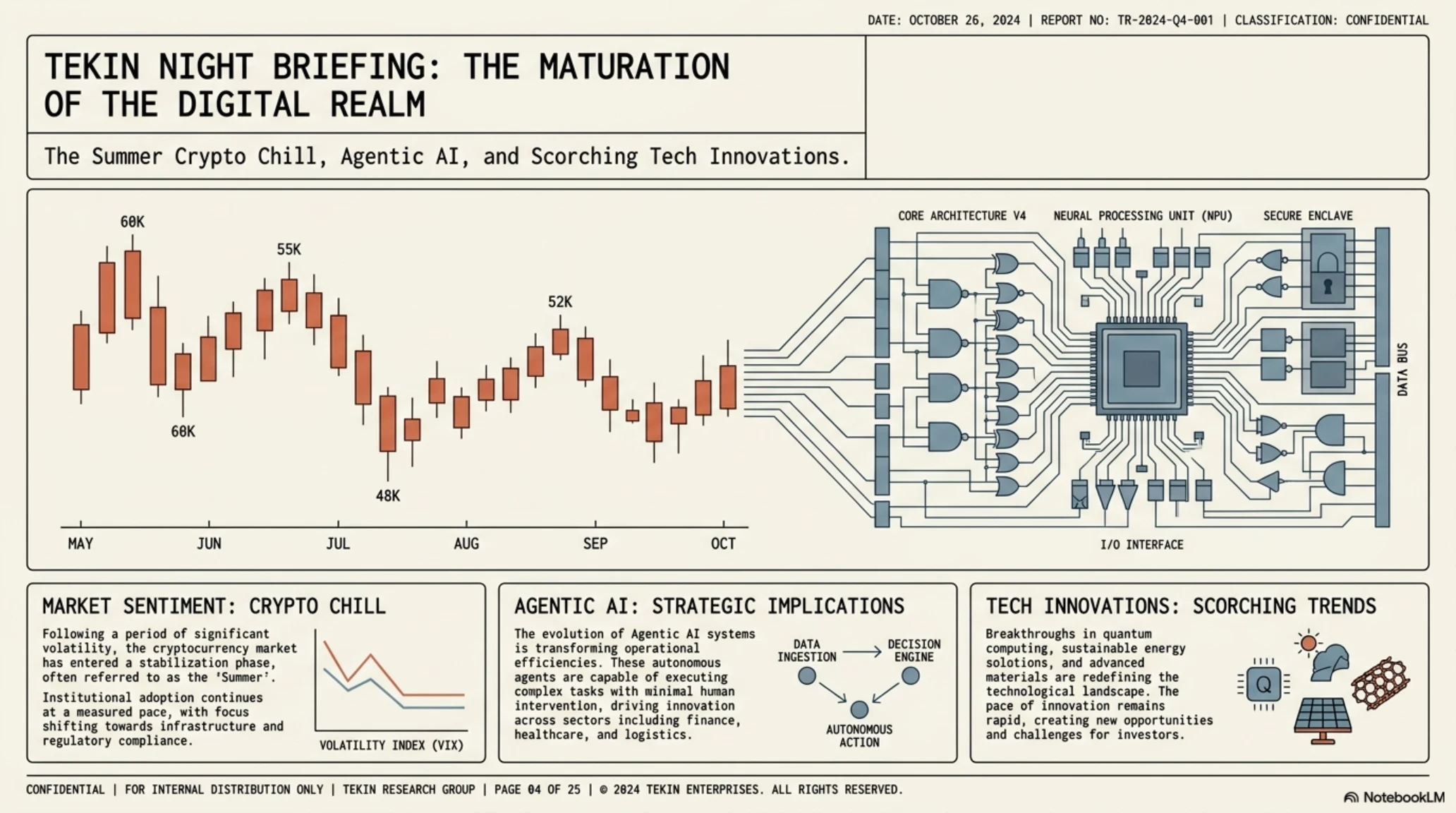
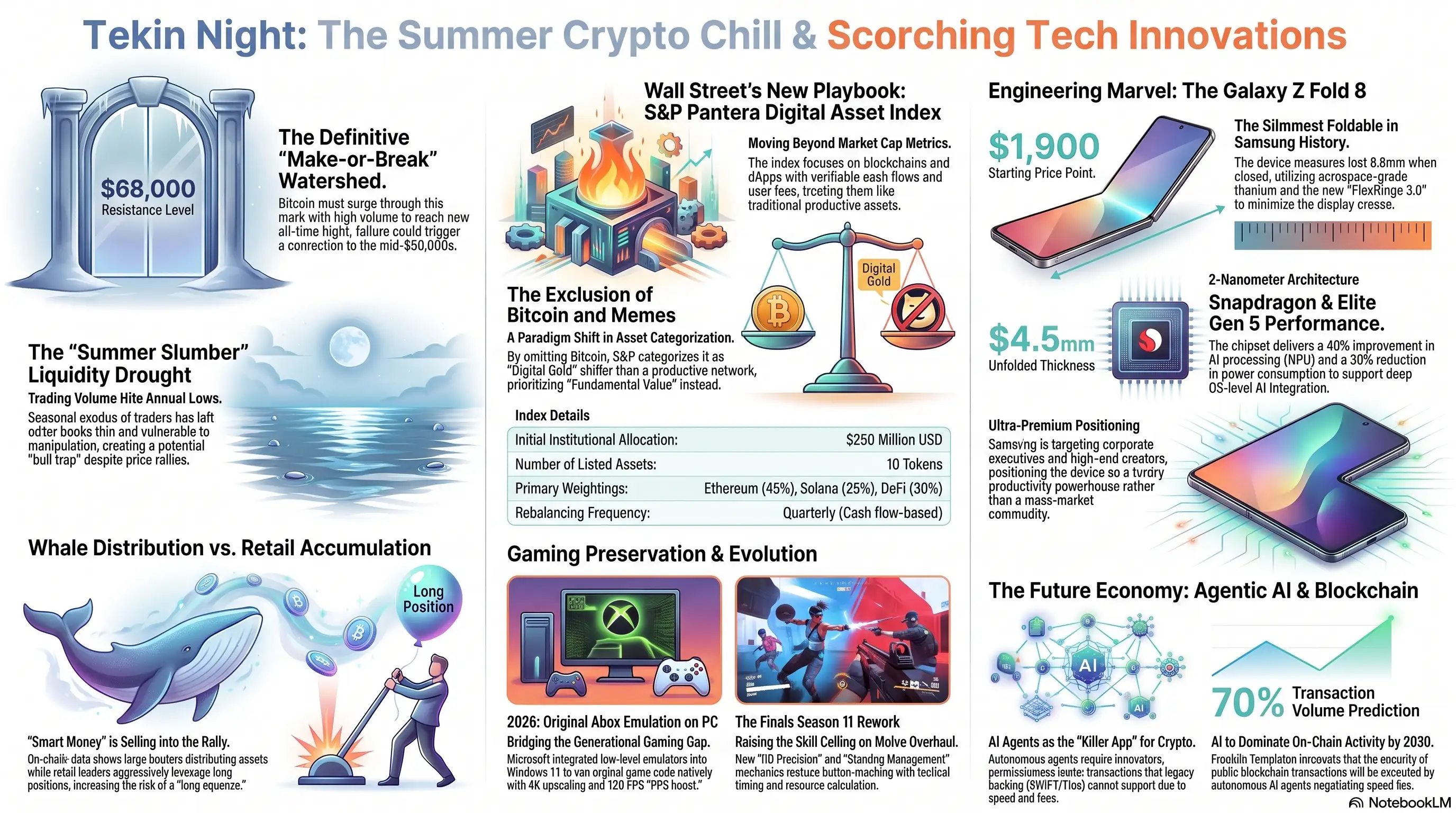
The July 23 edition of Tekin Night offers a deep dive into six major stories. Bitcoin struggles with summer liquidity droughts despite testing $68K, while Wall Street's new S&P Pantera index explicitly excludes it. Samsung unveiled its thinnest foldable ever, the Galaxy Z Fold 8. Microsoft brought original Xbox backward compatibility to PC. Furthermore, Agentic AI is identified as blockchain's ultimate catalyst, and The Finals Season 11 drastically overhauled its melee combat system.
Tekin Night Thursday, July 23: The Summer Crypto Chill and Scorching Tech Innovations
Welcome to another deep-dive edition of Tekin Night. Tonight, we unpack the perplexing stagnation in Bitcoin trading volumes despite a price rally, explore Wall Street's new criteria for digital assets, and analyze the engineering marvels shaping our technological future.
- 🎮Bitcoin Trading Volume- Testing the crucial $68K resistance amid an unprecedented summer liquidity drought.
- 🎧S&P Digital Asset Index- A new Wall Street benchmark explicitly excluding Bitcoin and meme tokens.
- 🚀Galaxy Z Fold 8 Launch- Samsung reclaims the foldable throne with an impossibly thin 4.5mm design.
- 🗡️Xbox Classics on PC- Microsoft bridges the generational gap by bringing original Xbox titles to Windows.
- 📰Agentic AI Economics- Franklin Templeton identifies autonomous AI as the ultimate catalyst for blockchain.
- 🎮The Finals Season 11- A radical melee combat rework and a breathtaking zero-gravity space map.
Bitcoin at the Crossroads: Piercing $68K Amidst a Summer Slumber
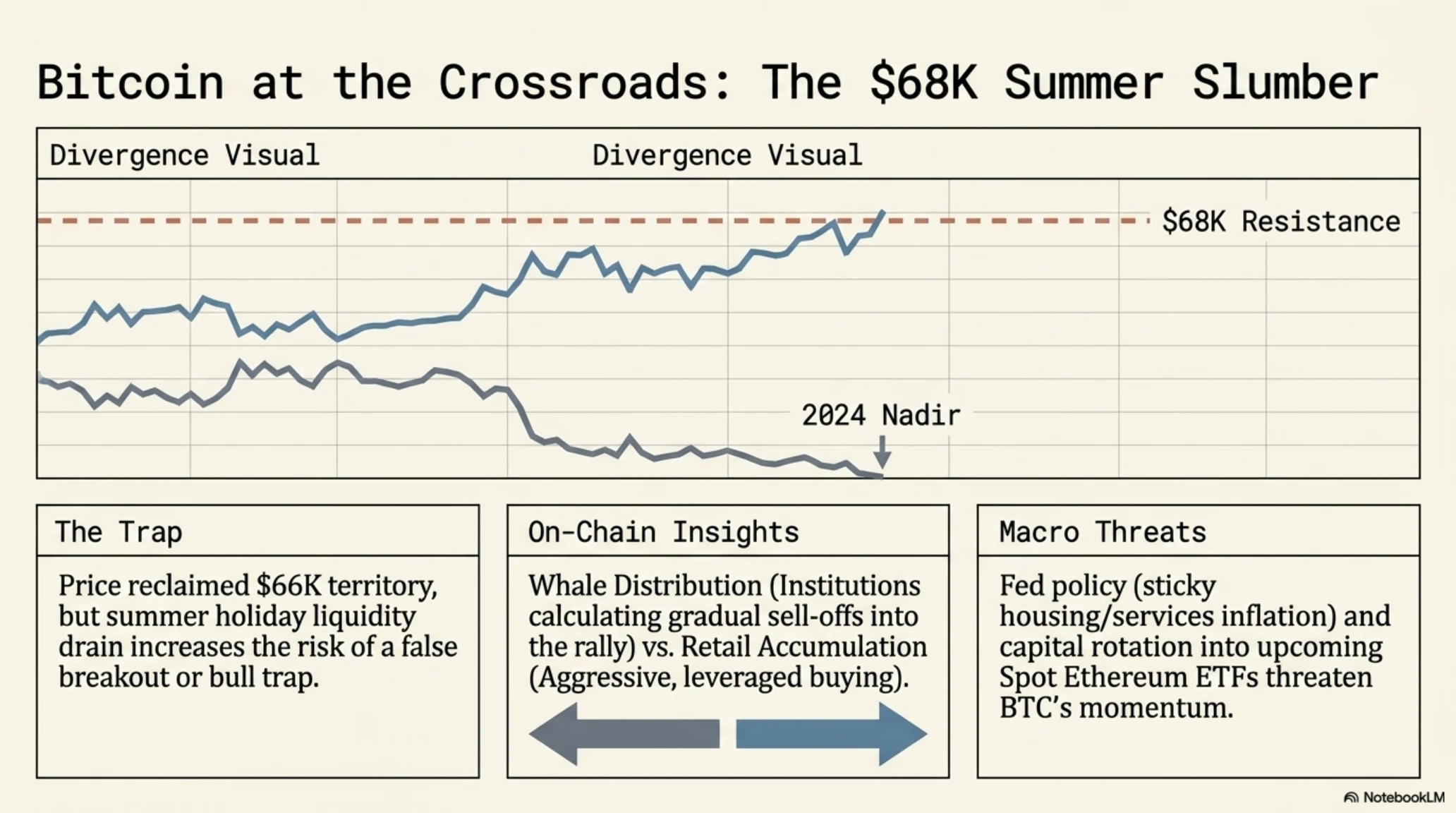
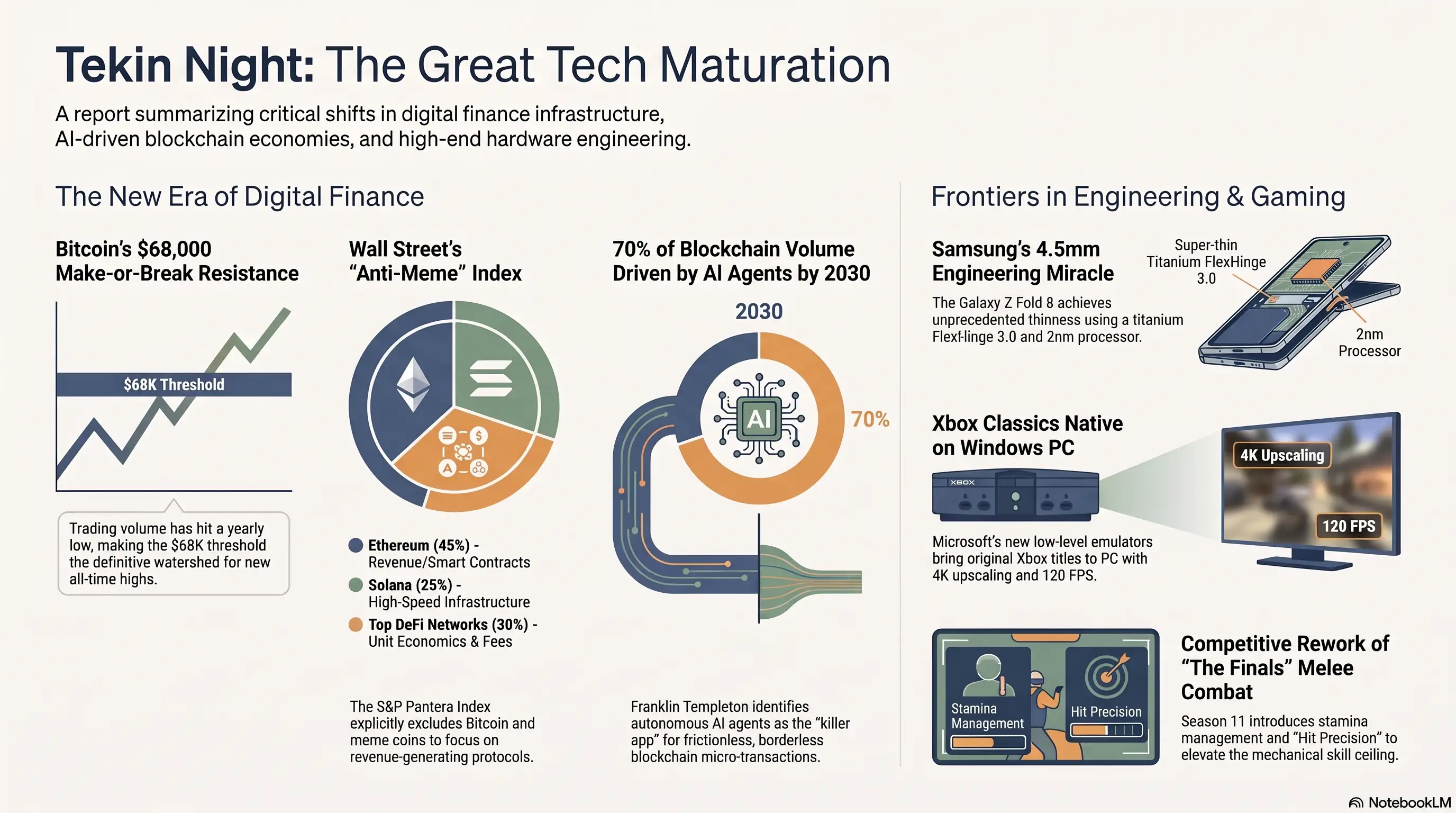
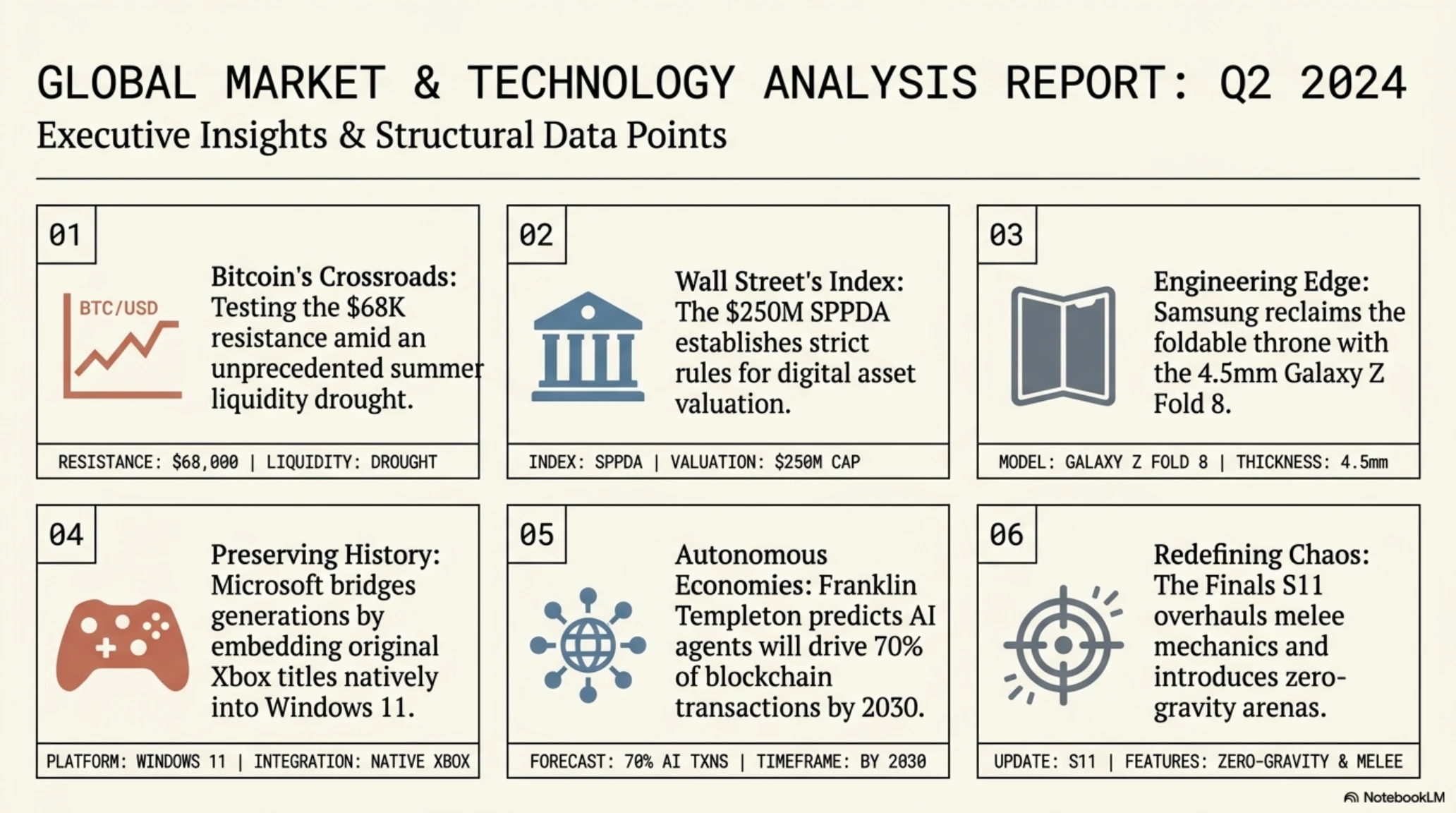
The cryptocurrency market has witnessed a notable, albeit cautious, price appreciation over the past few days. Bitcoin (BTC) successfully breached the psychological barrier of $66,000, achieving its highest valuation in a month. However, this upward trajectory is accompanied by a deeply concerning paradox that has macroeconomic analysts and technical traders on high alert: trading volume has plummeted to its lowest level of the entire calendar year. In the traditional vernacular of financial markets, a price rally that lacks the foundational support of high trading volume is frequently interpreted as a "weak" movement, or more ominously, a potential "bull trap." This stark reduction in market participation is largely attributed to the seasonal "Summer Slumber," a period characterized by a significant exodus of institutional and retail traders in the Northern Hemisphere for summer holidays. During this period, liquidity on major centralized exchanges (CEXs) such as Binance and Coinbase evaporates, leaving order books remarkably thin and highly susceptible to manipulation by large market actors who can move prices with relatively little capital deployment.
Technical analysts have firmly established the $68,000 mark as the definitive make-or-break watershed for the world's premier cryptocurrency. If Bitcoin can muster the momentum to break through this formidable resistance zone with a sudden, confirmed surge in trading volume and subsequently establish it as a new support level, the macroeconomic pathway toward discovering new all-time highs (ATH) in the fourth quarter of the year appears highly plausible. Conversely, a failure to shatter this ceiling could precipitate a severe price correction, potentially dragging the asset back down to the mid-$50,000 consolidation channel, wiping out weeks of gradual gains. An intensive review of On-chain data reveals a nuanced and somewhat troubling narrative: "whales" (large-scale investors holding significant amounts of Bitcoin) are engaging in a calculated, gradual distribution of their assets into the rally, deliberately selling into the buying pressure created by smaller investors. Meanwhile, retail traders continue to accumulate aggressively, heavily leveraging their positions in anticipation of a definitive breakout, effectively creating a perilous imbalance in the market structure.
The broader macroeconomic landscape continues to exert a profound and often volatile influence on this delicate equilibrium. The United States Federal Reserve remains ambiguous, transmitting contradictory signals regarding the precise timeline for anticipated interest rate cuts. Inflation, while significantly down from its generational peak, remains stubbornly "sticky" in key sectors like housing and services, placing Federal Reserve Chairman Jerome Powell in a precarious position. Given that Bitcoin is fundamentally categorized by institutional investors as a "risk-on" asset, any indication of prolonged hawkish monetary policy (keeping rates "higher for longer") or unexpected delays in rate reductions could inject substantial selling pressure into the market. Furthermore, the imminent approval and commencement of trading for several Spot Ethereum Exchange-Traded Funds (ETFs) across global markets introduce a massive new dynamic. This landmark event could trigger a capital rotation, redirecting vital liquidity away from Bitcoin and toward Ethereum and the broader altcoin ecosystem, thereby artificially capping Bitcoin's immediate growth potential and reducing its overall market dominance.
Key Takeaways Box
- Bitcoin has reclaimed the $66K territory, yet trading volume sits at a 2026 nadir.
- The $68,000 resistance level is widely recognized as the pivotal 'make-or-break' juncture.
- The seasonal 'Summer Slumber' has severely depleted liquidity, increasing the risk of false breakouts.
- On-chain analytics suggest a ongoing distribution phase by institutional 'whales'.
- Federal Reserve monetary policy remains the ultimate arbiter of medium-term crypto trajectories.
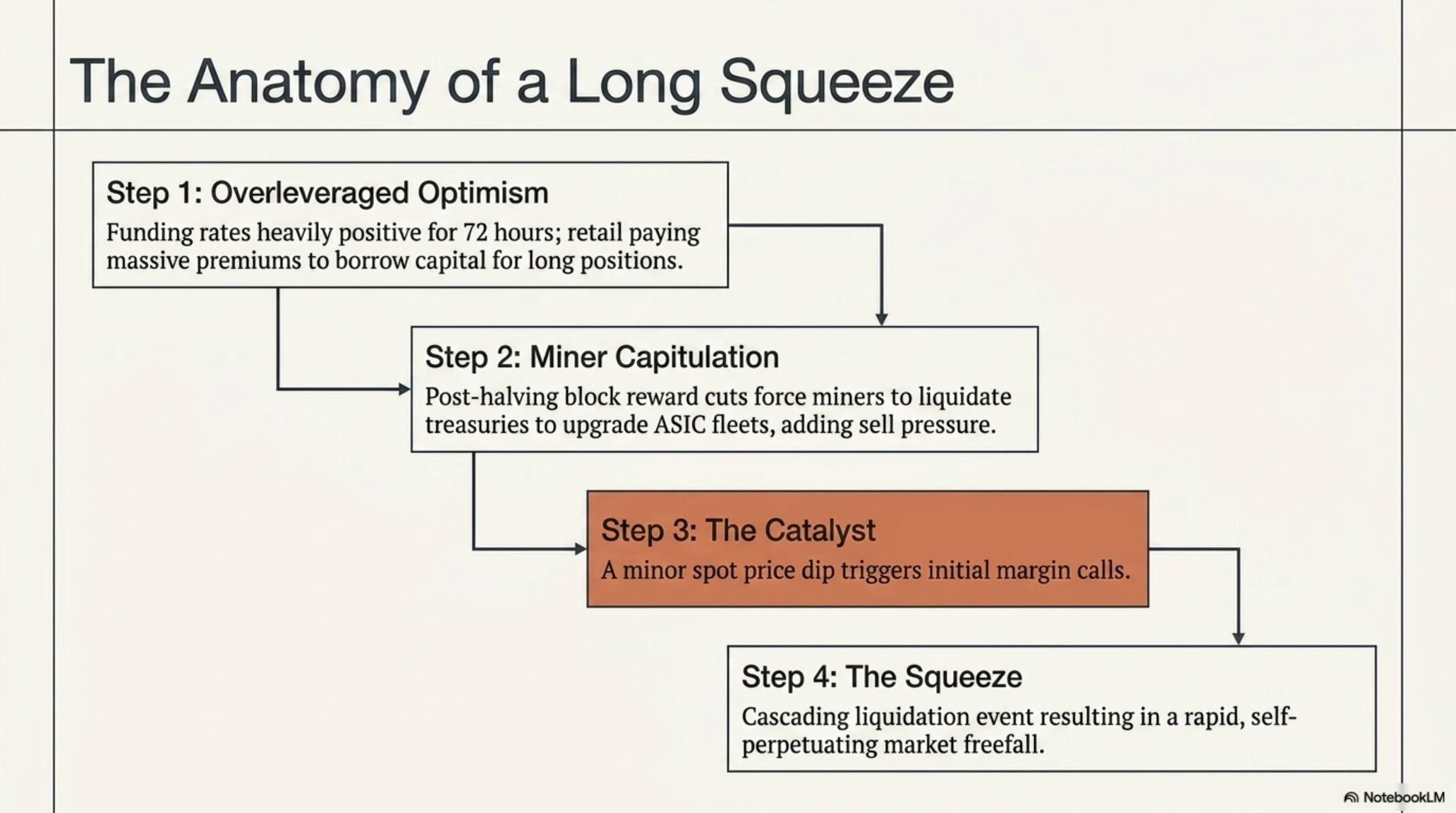
Beyond macroeconomic pressures, the internal structure of the cryptocurrency derivatives market is flashing stark warning signs. Funding rates across major global exchanges have skewed heavily positive over the past 72 hours. This indicates an overwhelming consensus among derivative traders who are aggressively opening highly leveraged long positions, effectively paying a premium to borrow capital and bet on further price increases. This acute imbalance creates a precarious market environment highly susceptible to a "long squeeze"—a cascading liquidation event where even a minor, temporary dip in the spot price triggers forced closures of these leveraged positions, resulting in a rapid, self-perpetuating market freefall. Simultaneously, Bitcoin miners, facing reduced block rewards following the recent Halving event, are capitulating and liquidating substantial portions of their treasuries to cover escalating operational costs and upgrade their ASIC fleets, further compounding the downward pressure.
Market Sentiment
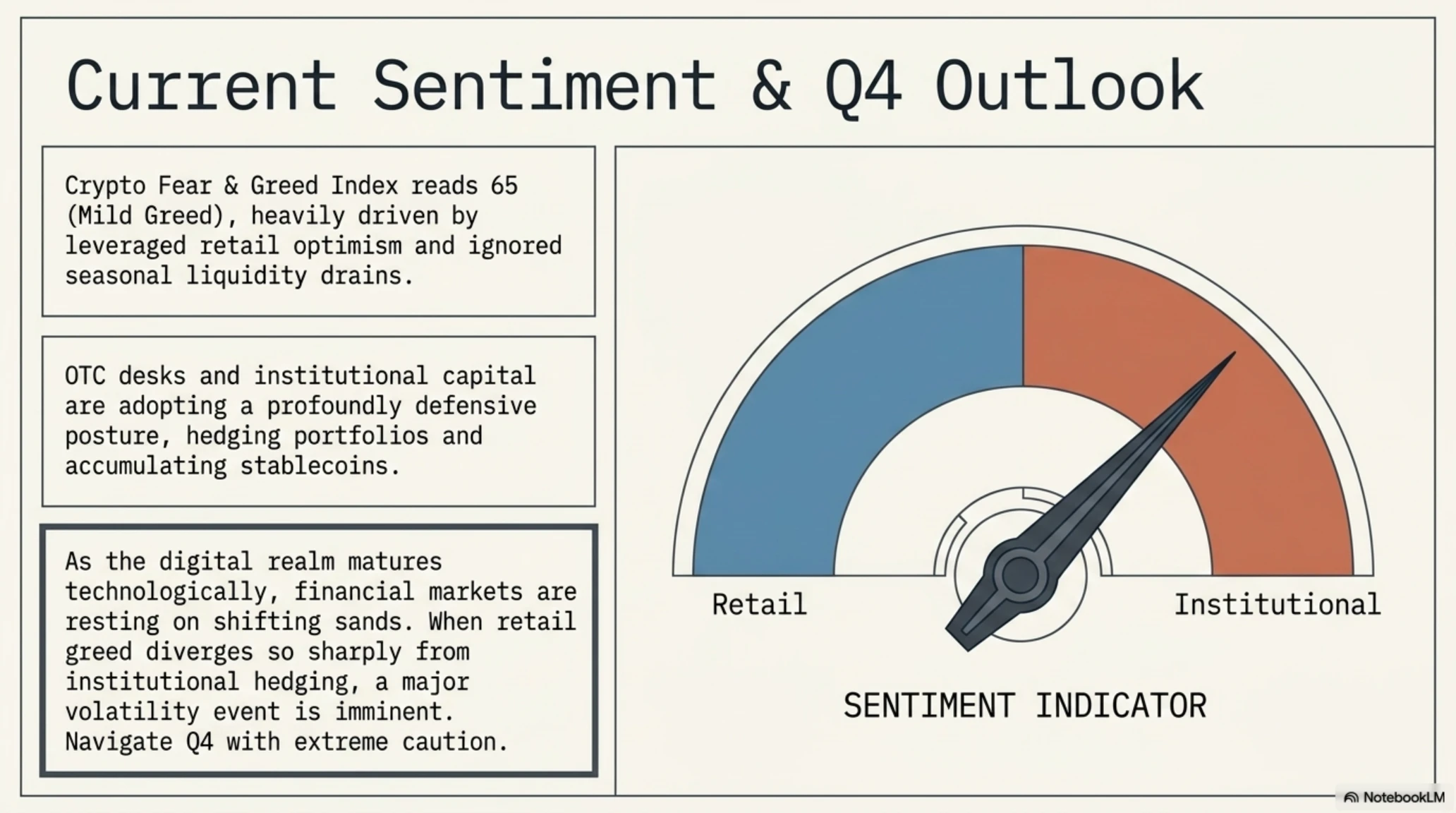
The widely followed Crypto Fear & Greed Index is currently hovering around 65, indicating a state of 'Mild Greed' among the general retail populace. However, institutional sentiment dashboards, which track large-scale capital flows and OTC (Over-The-Counter) desk activity, reveal a starkly contrasting picture. Smart money is adopting a profoundly defensive posture, accumulating stablecoins and hedging their portfolios against a potential macroeconomic shock. When retail greed diverges so sharply from institutional caution, a major volatility event is usually imminent.
Wall Street's Strict New Rules: The S&P Pantera Digital Asset Index
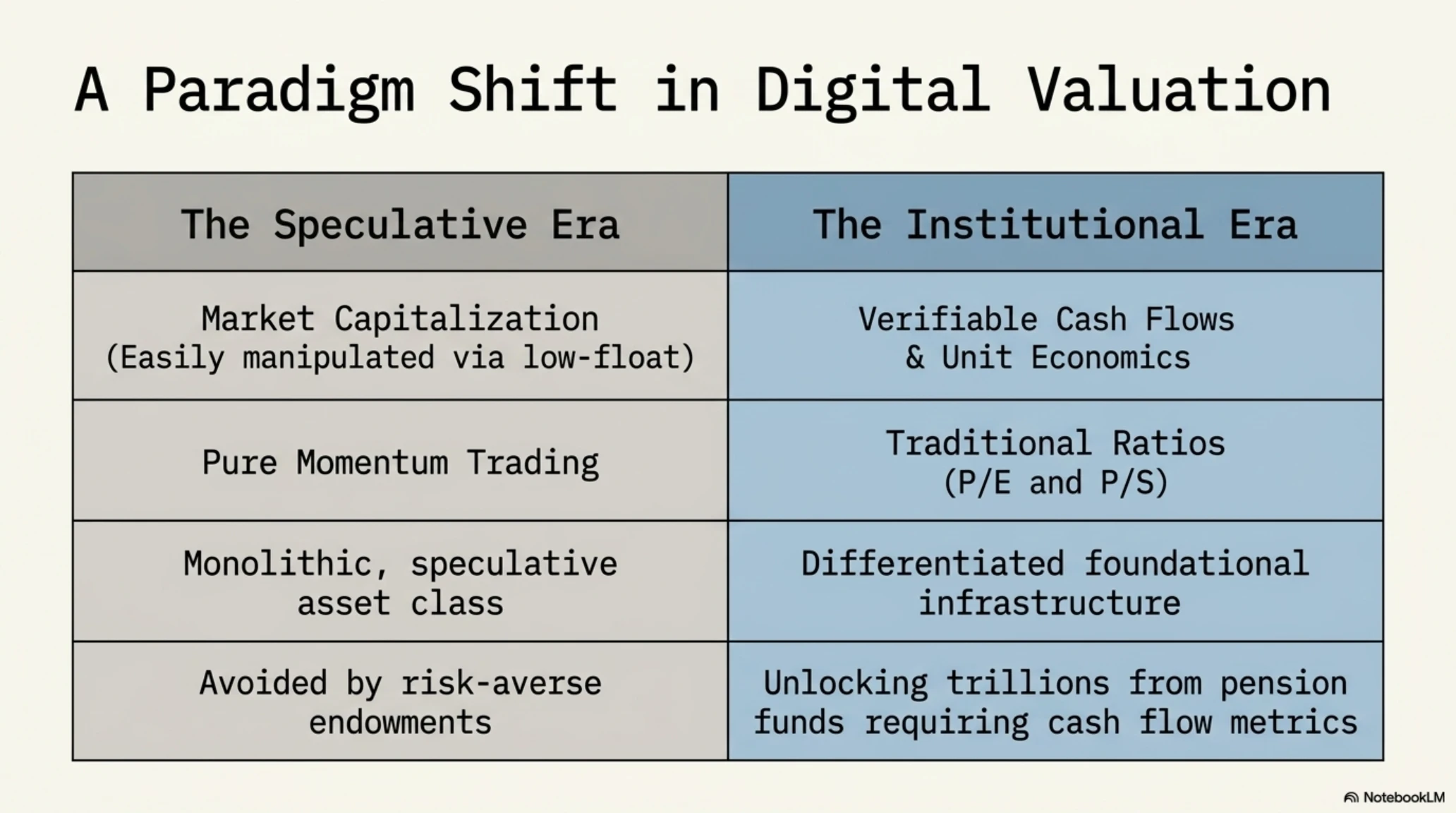
While the cryptocurrency spot market navigates the treacherous waters of summer volatility, Wall Street is methodically laying the foundational infrastructure for the long-term institutionalization of digital assets. In a landmark collaboration that bridges traditional finance with decentralized technology, S&P Global and the prominent venture capital firm Pantera Capital have officially launched the "S&P Pantera Digital Asset Index" (SPPDA). This innovative index represents a fundamental paradigm shift in how traditional financial institutions evaluate, categorize, and ultimately invest in the digital economy. Historically, Wall Street viewed the entire crypto sector as a monolithic, highly speculative asset class. Now, they are actively segregating structurally sound networks from the broader noise.
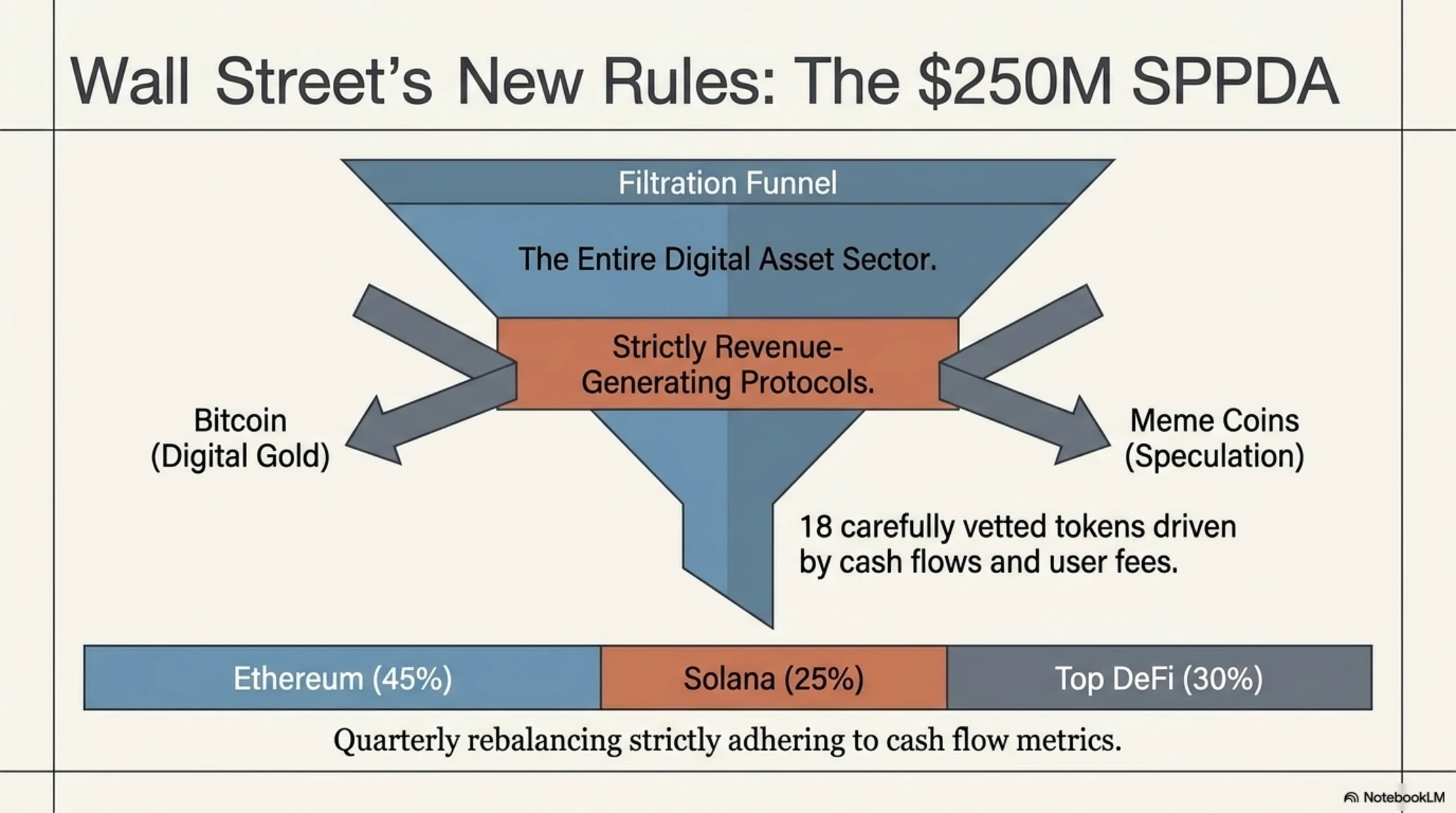
The most striking and widely debated characteristic of the SPPDA is its unprecedented exclusionary criteria: the index explicitly omits Bitcoin—the largest and most famous digital asset—as well as the entirety of the highly speculative meme coin sector from its portfolio. Rather than relying on the traditional, often misleading metric of raw Market Capitalization (which can be easily manipulated by low-float, high-valuation tokens), the SPPDA adopts a rigorously "rules-based" methodology that closely mirrors the sophisticated valuation frameworks utilized in traditional equity markets. The index's exclusive focus is directed toward "revenue-generating protocols"—specifically, blockchains and decentralized applications (dApps) that demonstrate verifiable, consistent cash flows, robust unit economics, and actual fees paid by active users for utility.
Upon its launch, the index is comprised of 18 carefully vetted tokens, with Ethereum, Solana, and foundational Decentralized Finance (DeFi) networks carrying the most significant weightings. By actively excluding Bitcoin—which S&P analysts increasingly categorize purely as a digital store of value, a "digital gold," or a stateless currency, rather than a productive, revenue-generating network—the index attempts to establish a precise, quantifiable benchmark for "Fundamental Value" within the crypto ecosystem. This sophisticated approach empowers institutional portfolio managers to evaluate digital tokens using traditional financial ratios, such as the Price-to-Earnings (P/E) Ratio or Price-to-Sales (P/S) Ratio, facilitating a deeper, more analytical investment thesis that transcends pure momentum trading.
Financial Stats Table
| Metric | Index Details |
|---|---|
| Initial Institutional Allocation | $250 Million USD |
| Number of Listed Assets | 18 Tokens (Strictly Revenue-Generating) |
| Primary Network Weightings | Ethereum (45%), Solana (25%), Top DeFi (30%) |
| Portfolio Rebalancing Frequency | Quarterly (Strict adherence to cash flow metrics) |
Critics of the new index vehemently argue that deliberately ignoring Bitcoin, which consistently commands over half of the entire cryptocurrency market's total valuation, renders the index an incomplete and potentially misleading representation of the digital ecosystem's overall health. They contend that Bitcoin acts as the base settlement layer and the ultimate reserve asset for the entire industry. Nevertheless, Pantera Capital steadfastly maintains that the long-term future of cryptocurrency does not reside in pure speculation or passive hoarding, but rather in robust protocols that generate tangible, quantifiable utility for the digital economy. The SPPDA is highly likely to serve as the foundational architecture for a new wave of specialized, thematic ETFs that filter assets not merely by size, but by proven profitability and sustainable blockchain revenue generation.
Why It Matters
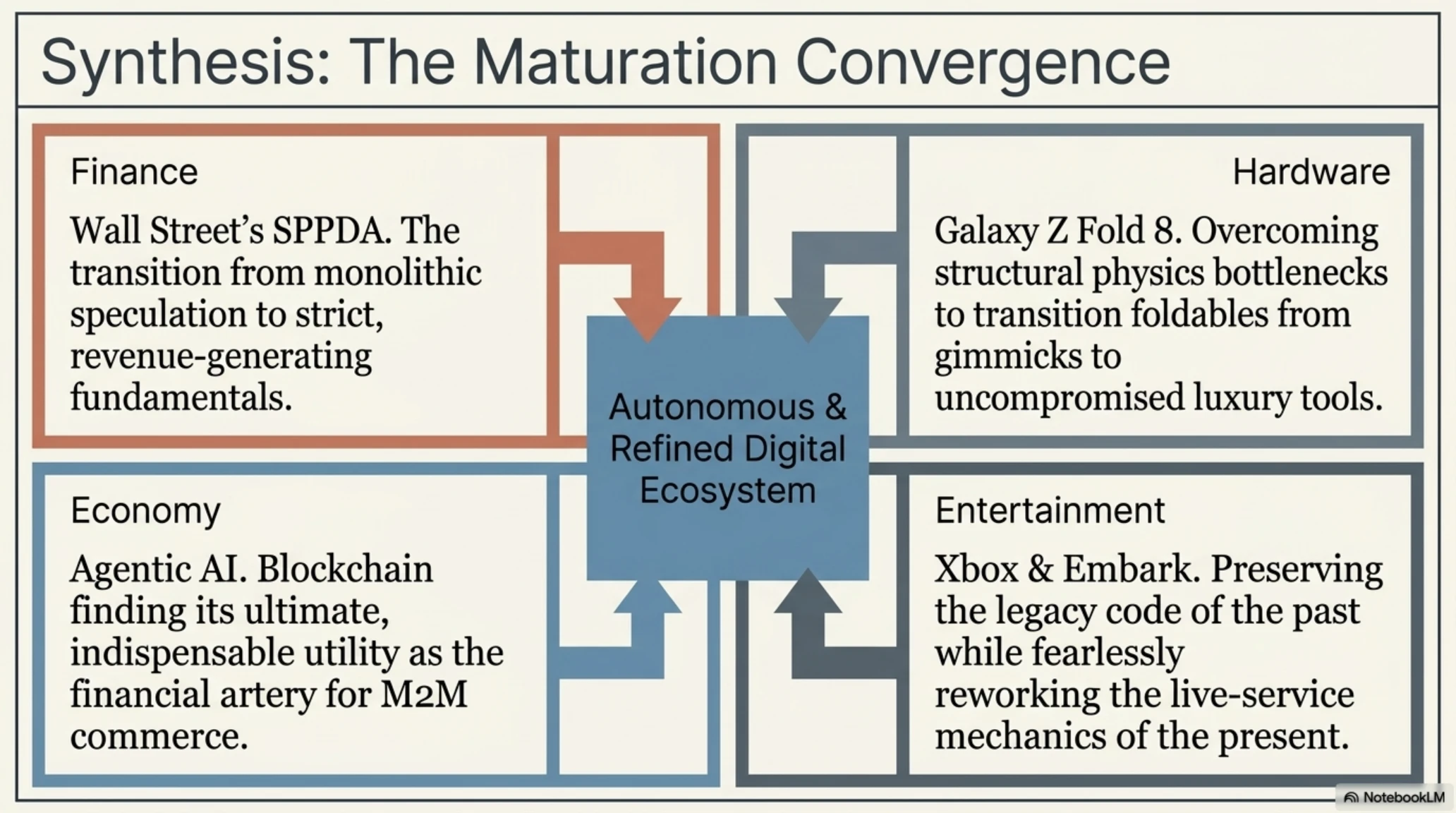
The introduction of the SPPDA marks a crucial maturation point for the digital asset market. Wall Street no longer views cryptocurrency as a monolithic, undifferentiated asset class. The explicit segregation between store-of-value networks (like Bitcoin) and foundational, revenue-generating infrastructure protocols (like Ethereum) clears the regulatory and analytical pathways for more sophisticated investment products, potentially unlocking trillions of dollars in capital from risk-averse pension funds and endowments that strictly require cash flow metrics to justify capital deployment.
Engineering at the Edge of Physics: An Intimate Look at the Galaxy Z Fold 8
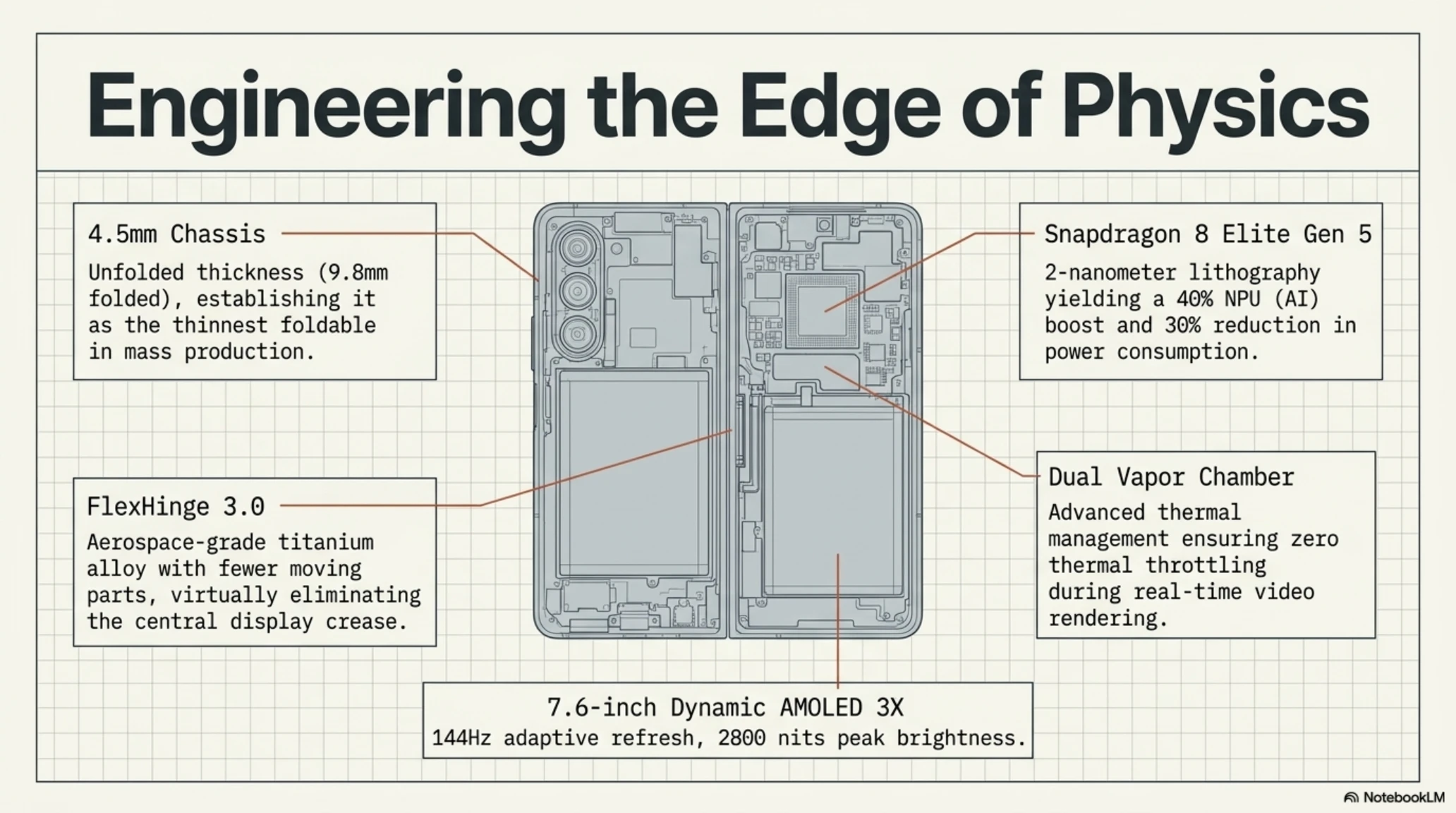
At the highly anticipated Galaxy Unpacked event in London, Samsung emphatically reasserted its dominance over the premium smartphone sector with the global unveiling of the Galaxy Z Fold 8, cementing its position as the undisputed sovereign of the foldable market. This device is far more than a routine, iterative annual upgrade; it represents a profound maturation in industrial design and the triumphant overcoming of persistent engineering bottlenecks that have plagued the foldable form factor since its inception. The most spectacular achievement of this generation is the astonishing reduction in the device's physical footprint. The Galaxy Z Fold 8 measures an incredibly svelte 4.5 millimeters when unfolded and a highly manageable 9.8 millimeters when closed, establishing it not only as the thinnest foldable in Samsung's history but also as one of the slimmest smart devices currently in mass production globally. Achieving these dimensions while still housing high-capacity batteries, sophisticated camera arrays, and an elite processor is nothing short of a metallurgical and architectural miracle.
Achieving this unprecedented slimness without compromising the structural integrity or durability of the device required a complete reimagining of the internal architecture, most notably through the deployment of a revolutionary new hinge mechanism forged from aerospace-grade titanium alloy. This component, which Samsung engineers have dubbed the "FlexHinge 3.0," utilizes significantly fewer moving parts and features a completely redesigned stress-distribution mechanism designed to render the dreaded central crease on the internal display virtually imperceptible to the naked eye. In earlier iterations, the display crease was a major point of contention for consumers, often distorting media playback and interfering with stylus input. Furthermore, the dimensional ratios of the displays have undergone a highly requested, user-centric overhaul. The exterior cover screen now boasts a 5.5-inch diagonal with a substantially wider, more natural aspect ratio, transforming one-handed typing and quick interactions into an experience virtually indistinguishable from a traditional, non-folding smartphone. The expansive internal display has been upgraded to a 7.6-inch Dynamic AMOLED 3X panel, featuring a buttery-smooth 144Hz adaptive refresh rate for unparalleled fluidity in multitasking and gaming.
The beating heart of this engineering marvel is the extraordinarily powerful Snapdragon 8 Elite Gen 5 processor. Fabricated utilizing bleeding-edge 2-nanometer lithography, this bespoke chipset delivers a staggering 40% improvement in dedicated artificial intelligence processing (NPU) capabilities and a 30% reduction in overall power consumption compared to its immediate predecessor. This massive processing upgrade is absolutely vital to support the extensive suite of native Galaxy AI features, which have now been deeply, inextricably integrated into the core operating system, transforming the device from a mere communication tool into a proactive, autonomous digital assistant. Recognizing the thermal demands of such a powerful chipset housed in an ultra-thin chassis, Samsung has also implemented a novel dual Vapor Chamber cooling system, guaranteeing that the device sustains peak performance without thermal throttling during intense gaming sessions or complex computational tasks like real-time video rendering.
Specs Box
| Component / Feature | Technical Details |
|---|---|
| Internal Display | 7.6-inch Dynamic AMOLED 3X (144Hz Adaptive, 2800 nits peak) |
| Exterior Display | 5.5-inch, Wider Aspect Ratio (120Hz) |
| Processor (SoC) | Snapdragon 8 Elite Gen 5 (2-nanometer architecture) |
| Device Thickness | 4.5mm (Unfolded) / 9.8mm (Folded) |
| Starting Price | $1,900 USD (Base 512GB Storage Model) |
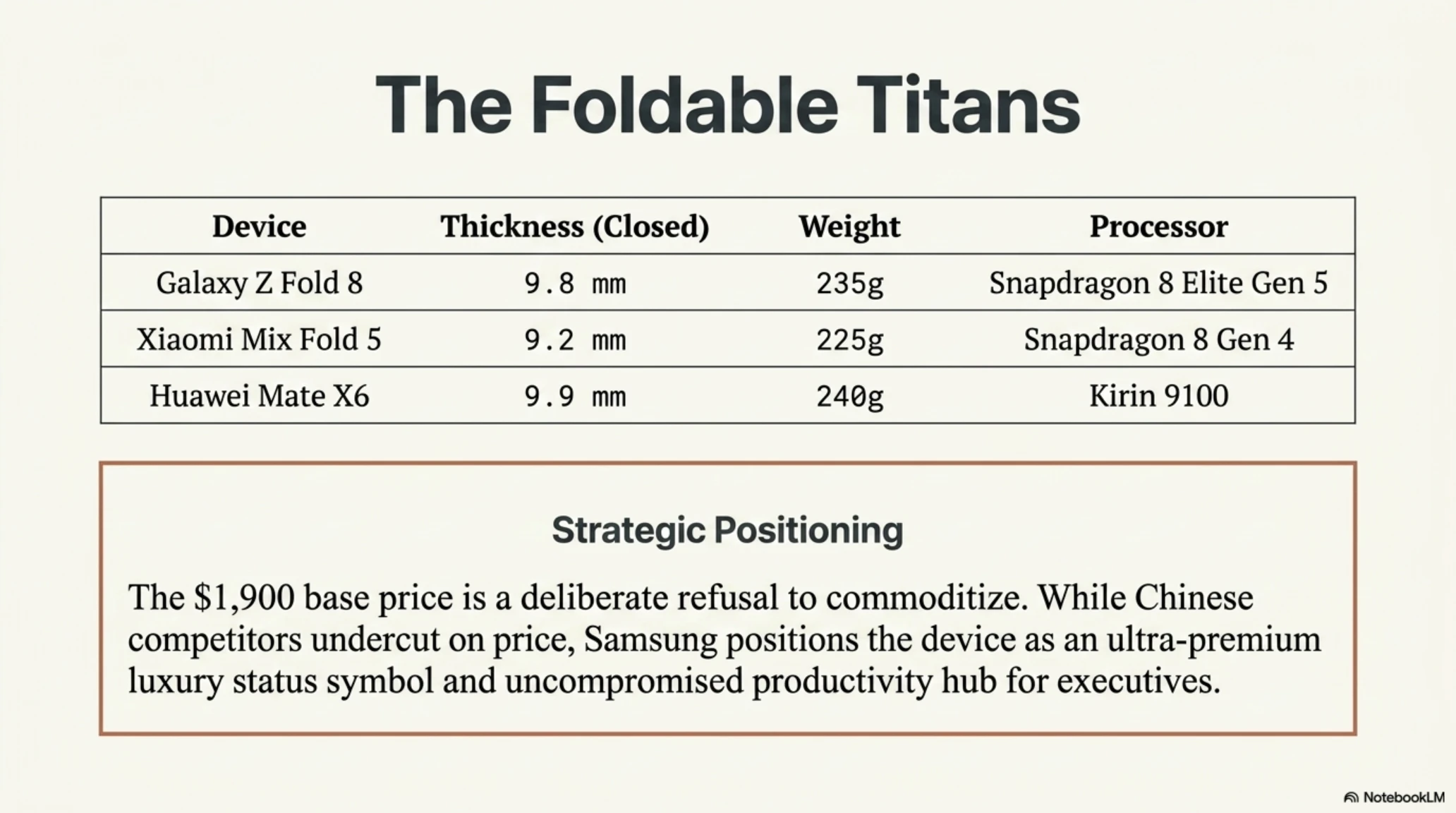
However, pioneering technology at the absolute vanguard of innovation never comes cheaply. The Galaxy Z Fold 8 will hit the market with a staggering starting price of $1,900, firmly positioning it in the ultra-premium, highest pricing tier of consumer electronics. This aggressive pricing strategy clearly indicates that Samsung does not currently intend to commoditize foldables for the mass market, despite the increasing competition from aggressive Chinese manufacturers who are aggressively undercutting Samsung on price. Instead, the company is deliberately positioning them as luxurious status symbols and ultimate productivity powerhouses tailored for corporate executives, high-end content creators, and affluent technology enthusiasts who demand the absolute bleeding edge of mobile capability. Samsung's primary competitive advantage is no longer just hardware; it is the incredibly refined, multitasking-optimized software ecosystem that their competitors have yet to successfully replicate.
Comparison Tables: The Foldable Titans
| Device Model | Thickness (Closed) | Weight | Processor (SoC) |
|---|---|---|---|
| Galaxy Z Fold 8 | 9.8 mm | 235 grams | Snapdragon 8 Elite Gen 5 |
| Xiaomi Mix Fold 5 | 9.2 mm | 225 grams | Snapdragon 8 Gen 4 |
| Huawei Mate X6 | 9.9 mm | 240 grams | Kirin 9100 |
The camera array on the Z Fold 8 has also received a substantial and necessary upgrade, although it understandably does not quite match the raw optical specifications of the photography-focused Galaxy S26 Ultra due to extreme physical space constraints within the ultra-thin chassis. The primary 50-megapixel sensor is now equipped with advanced anti-reflective lens coatings and heavily leverages the new NPU's AI algorithms to dramatically enhance computational photography, particularly in extreme low-light environments (Nightography). Furthermore, the 5x optical telephoto lens has been entirely re-engineered to capture significantly sharper portrait imagery at vast distances. Yet, what truly differentiates the Z Fold 8 is its exclusive software capabilities designed specifically for "Flex Mode." This functionality has now been vastly expanded to support a wider array of third-party applications, enabling revolutionary features such as seamless, real-time bidirectional translation (utilizing both the inner and outer displays simultaneously to facilitate seamless cross-lingual communication) with unprecedented speed and grammatical accuracy.
Jargon Buster
Vapor Chamber: An advanced, highly efficient thermal management system utilized in high-performance electronics. It consists of a flat, hermetically sealed chamber containing a minute quantity of liquid coolant. As the processor generates heat, the liquid vaporizes, absorbs the thermal energy, travels to cooler extremities of the chamber, and condenses back into a liquid, dissipating heat far more effectively than traditional solid copper heat pipes.
2-Nanometer Lithography: Refers to the microscopic size of the individual transistors etched onto the silicon microchip. A smaller nanometer measurement means transistors are packed more densely, significantly reducing the distance electrical signals must travel. This results in an exponential increase in processing power and a drastic reduction in battery consumption.
Bridging the Generational Divide: Classic Xbox Titles Arrive on PC
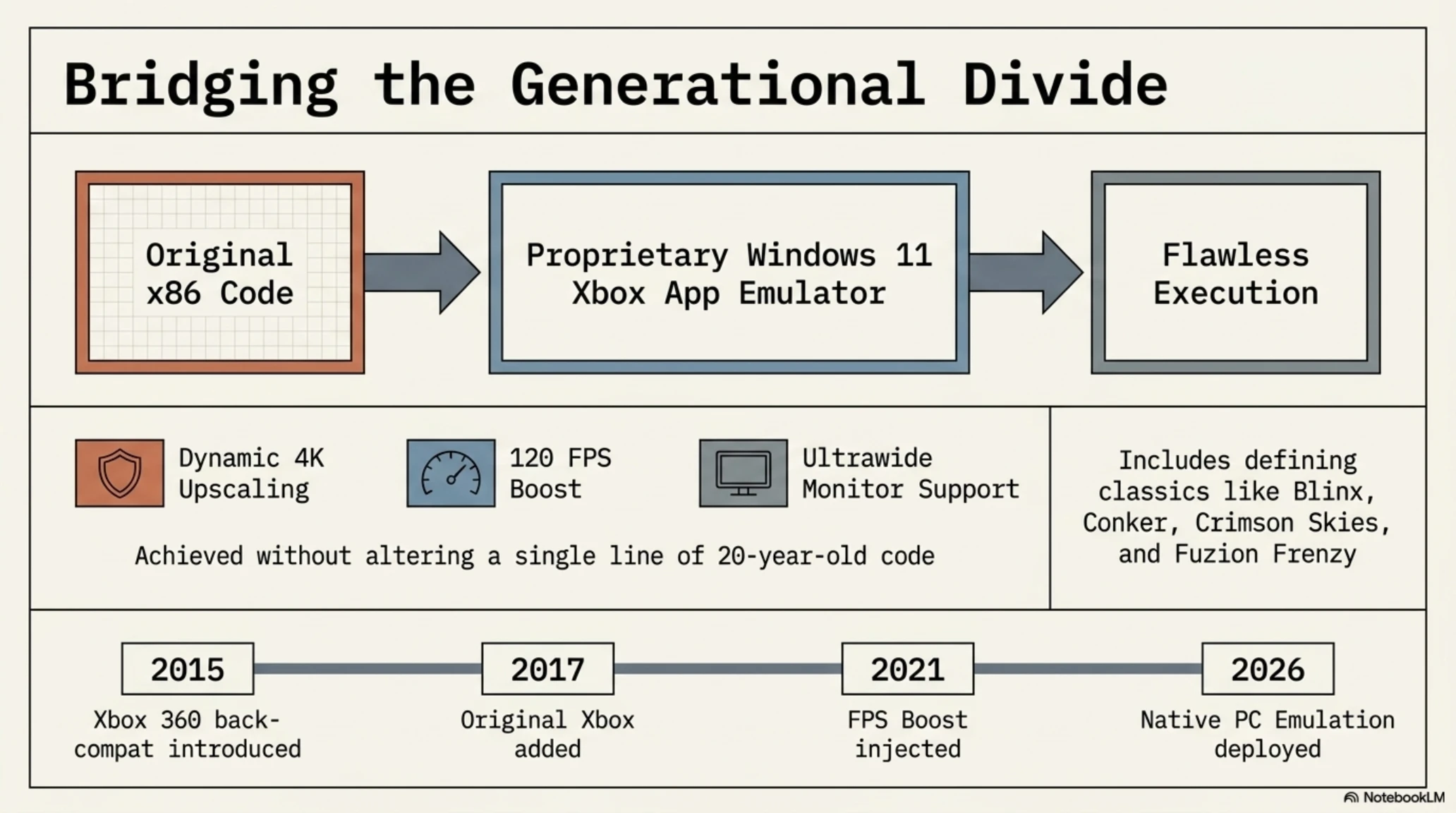
In a momentous announcement that has sparked a wave of profound nostalgia and widespread critical acclaim throughout the global gaming community, Microsoft has finally expanded its highly successful backward compatibility program for original Xbox titles to the personal computer (PC) platform. This strategic initiative, which has been fervently requested by dedicated fans and preservationists for years, has now materialized, marking a significant milestone in the ongoing, industry-wide effort toward comprehensive video game preservation. In the inaugural phase of this ambitious rollout, four iconic, genre-defining classic titles—Blinx: The Time Sweeper, Conker: Live & Reloaded, Crimson Skies: High Road to Revenge, and the ultimate party game Fuzion Frenzy—have been made universally accessible via the PC Game Pass subscription service and the native Xbox application for Windows 11. These titles are not merely relics; they are foundational pillars that established core gameplay loops still utilized in modern AAA productions today.
The execution of these legacy titles on the modern Windows operating system is a far cry from a simple, rudimentary software port. Microsoft's advanced engineering teams have deployed highly sophisticated, low-level emulators that have been seamlessly and inextricably integrated directly into the core architecture of the Xbox app. These proprietary emulators allow the original, unadulterated game code—which was written over two decades ago specifically for the highly customized x86 architecture of the original Xbox console—to execute natively and flawlessly on modern, multi-core desktop processors without the latency, audio desynchronization, or graphical glitches typically associated with community-developed, third-party emulation software. Furthermore, Microsoft has unilaterally applied automated visual enhancements across the board; these include upscaling the rendering resolution to pristine 4K, implementing "FPS Boost" to double or even quadruple the original frame rates (pushing 30 FPS classics to a buttery smooth 120 FPS), and injecting native support for contemporary ultrawide monitors, all achieved dynamically without altering a single line of the original game code.
Timeline Table: The Evolution of Xbox Game Preservation
| Year | Key Milestone |
|---|---|
| 2015 | Microsoft astonishingly introduces Backward Compatibility for Xbox 360 titles on the Xbox One console, shocking the industry. |
| 2017 | The program expands to include the very first generation of Original Xbox games, breathing life into a forgotten era. |
| 2021 | Introduction of the revolutionary 'FPS Boost' feature, dynamically increasing frame rates for legacy titles without developer intervention. |
| 2026 | Official deployment of the Xbox emulation layer to Windows PCs, bringing Original Xbox games to desktop users globally. |
This calculated strategic maneuver further unifies the increasingly expansive Xbox ecosystem. Microsoft's overarching "Play Anywhere" philosophy now transcends not only the physical hardware boundaries separating the traditional living room console from the desktop computer, but it also effectively obliterates the temporal boundaries dividing distinct generations of gaming history. Phil Spencer, CEO of Microsoft Gaming, has consistently and vocally championed the critical importance of preserving legacy interactive media, viewing games not merely as disposable entertainment products, but as culturally significant art forms that deserve to be archived and experienced by future generations. This decisive action unequivocally demonstrates that Microsoft is willing to allocate substantial engineering resources and financial capital to manifest this vision, even in instances where the immediate, direct financial profitability may appear negligible compared to the development of modern blockbuster titles.
Smart History Tags: Microsoft's Service-First Pivot
To fully understand this move, we must look back at Microsoft's strategic pivot in 2015. Under Phil Spencer's leadership, Microsoft transitioned away from a purely hardware-centric business model (selling consoles) toward a service-oriented ecosystem (Game Pass). By decoupling the games from the specific plastic box beneath the television, Microsoft has essentially transformed Xbox into a ubiquitous software platform. The addition of Original Xbox games to the PC ecosystem is the ultimate culmination of this strategy: it proves that the platform is eternal, regardless of the underlying hardware.
Industry analysts widely anticipate that this inaugural catalog will expand rapidly and aggressively in the coming months, potentially encompassing hundreds of titles from the original Xbox library. This proactive, preservation-first approach stands in stark, highly publicized contrast to the strategies employed by competing entities such as Nintendo, which often prefers to remaster classic titles and resell them at premium price points, or restrict access entirely behind cloud-based subscription services that suffer from inherent latency, input lag, and video compression issues. The immensely active PC modding community has already embraced this announcement with profound enthusiasm, immediately beginning the development of sophisticated tools designed to inject high-resolution textures, ray-tracing wrappers, and further modernize the visual fidelity of these beloved classic experiences, ensuring they continue to thrive for decades to come.
Agentic AI: The Ultimate Savior and Killer App for Blockchain?
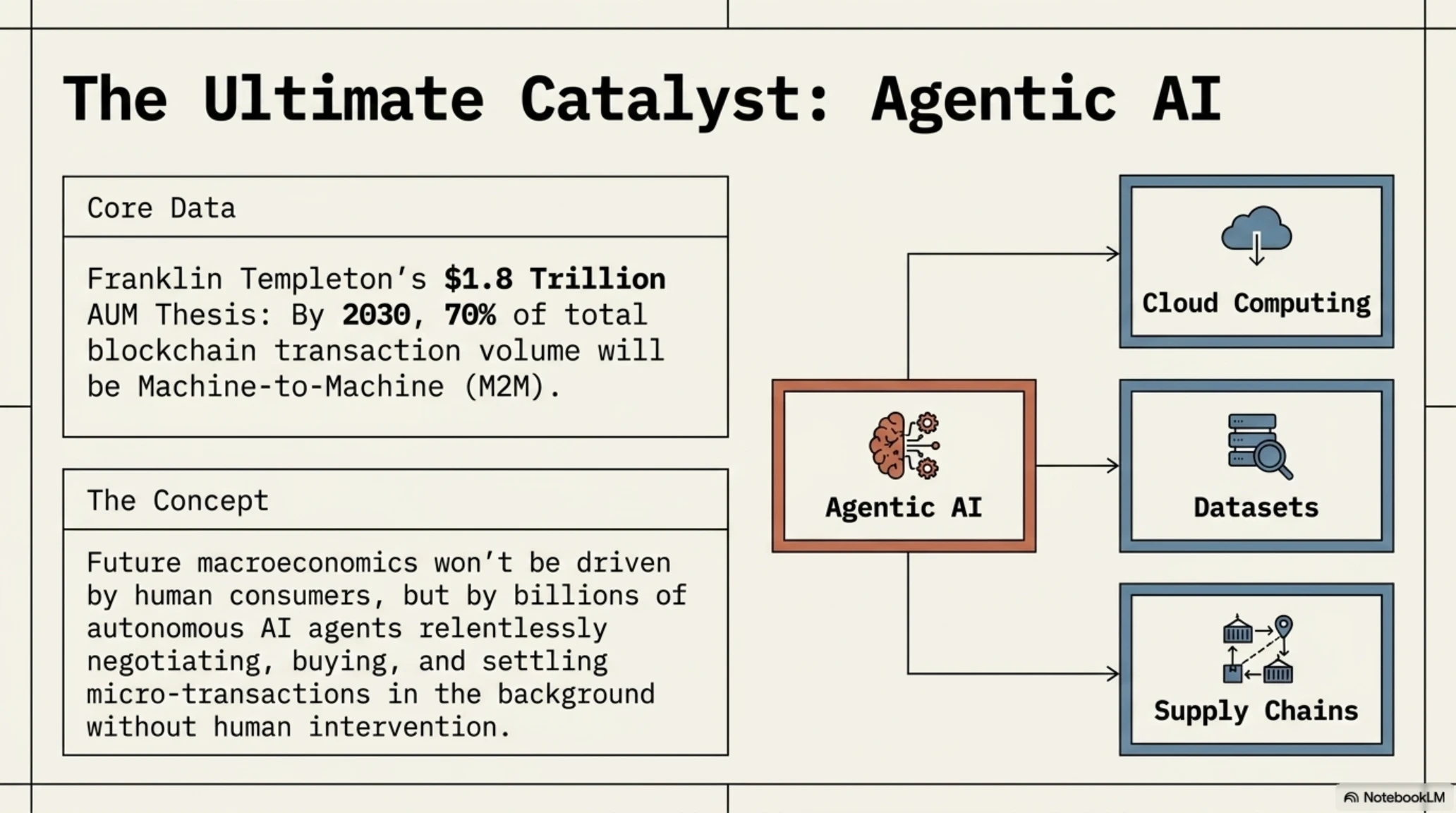
Operating at the bleeding-edge intersection of the decade's two most transformative and disruptive technologies, the global asset management titan Franklin Templeton—overseeing an unfathomable $1.8 trillion in assets under management (AUM)—has issued a remarkably bold prediction: "Agentic AI" (autonomous artificial intelligence agents) will ultimately prove to be the elusive "Killer Use Case" that the blockchain and cryptocurrency industry has been desperately searching for since its inception. In an exhaustively detailed, highly technical research report disseminated to institutional clients this week, Franklin Templeton's analysts construct a compelling argument that the macroeconomy of the near future will not be driven by human consumers casually browsing e-commerce platforms, but rather by billions of high-frequency, machine-to-machine (M2M) transactions orchestrated entirely by autonomous AI agents operating continuously in the background.
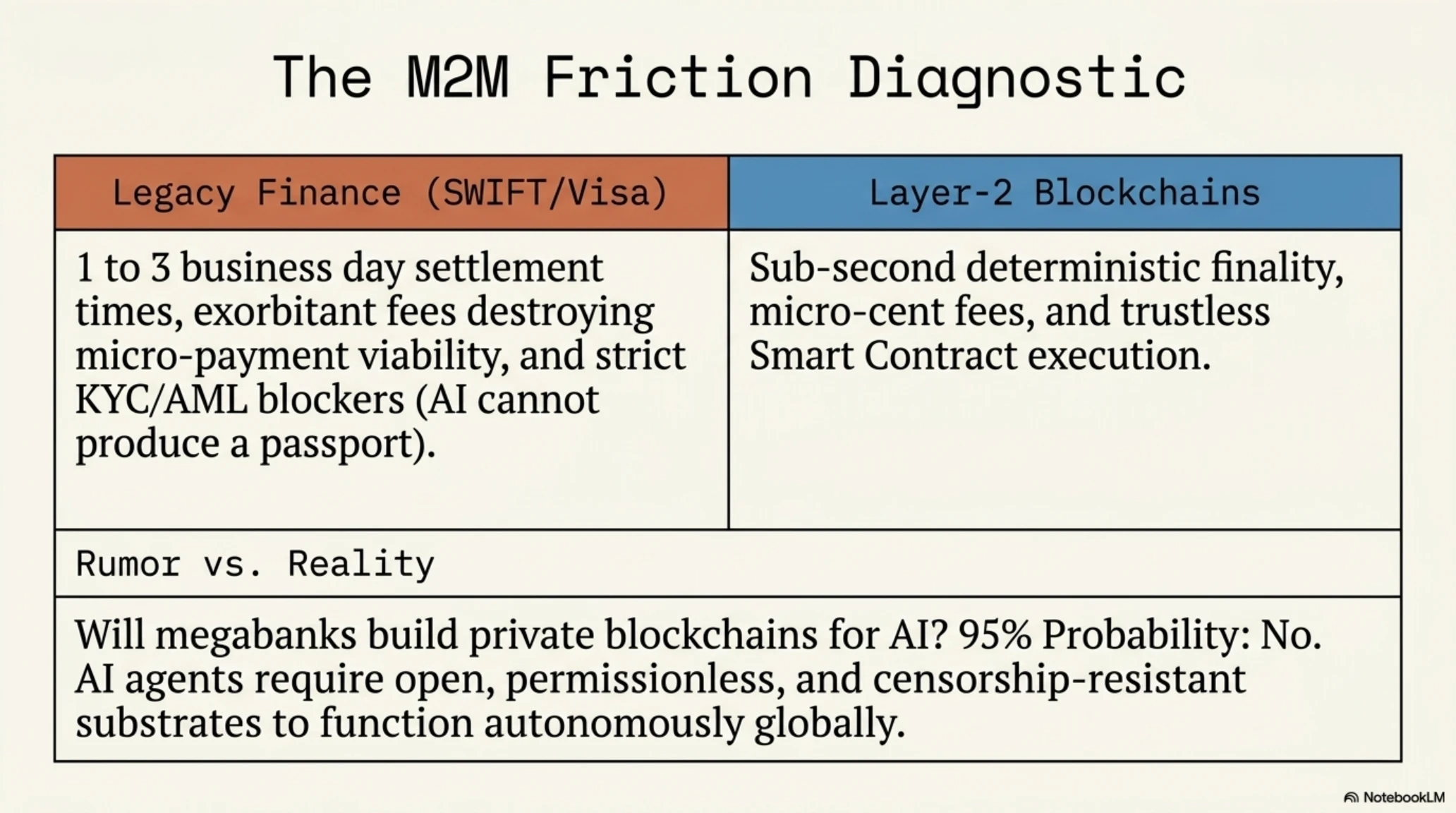
The foundational logic supporting this paradigm-shifting thesis is exceptionally robust. For autonomous AI agents to operate effectively and execute complex tasks in the real world—such as negotiating cloud computing resources, purchasing proprietary datasets on the fly, or managing complex global supply chain logistics—they fundamentally require the ability to execute instantaneous, permissionless micro-transactions across geographical and political borders. The legacy financial infrastructure, primarily dominated by centralized entities like Visa, Mastercard, and the antiquated SWIFT banking system, is catastrophically ill-equipped for this impending volume of machine-driven commerce. These traditional networks are notoriously slow, burdened by exorbitant transaction fees that make micro-payments economically unviable, and paralyzed by dense regulatory friction and KYC/AML requirements that an AI simply cannot fulfill. The settlement of a standard international bank transfer can languish for 1 to 3 business days, a timeframe that is completely unacceptable for an AI agent that may require the immediate purchase of thousands of disparate API accesses within a single millisecond.
Rumor vs. Reality Meter
The Rumor: Traditional megabanks (like JPMorgan or Goldman Sachs) are rapidly developing proprietary, private blockchains that will entirely bypass public networks like Ethereum, capturing the entirety of the Agentic AI transaction volume.
The Reality (95% Probability): Highly Unlikely. While massive financial institutions are undeniably experimenting with private ledger technology, the inherently closed, permissioned, and centralized nature of these systems fundamentally contradicts the operational requirements of decentralized, autonomous AI agents. AI agents require an open, censorship-resistant, and universally accessible substrate to transact globally without seeking prior authorization. Only public, decentralized blockchains can provide this environment.
Conversely, modern Layer-2 blockchain networks, which boast near-zero transaction fees and sub-second deterministic finality, provide the perfect, frictionless financial substrate for this emerging machine economy. Furthermore, the inherent programmability of Smart Contracts empowers AI agents to autonomously execute incredibly complex, multi-party financial agreements trustlessly, eliminating the need for human intermediaries, slow legal frameworks, or costly escrow services. Franklin Templeton provocatively forecasts that by the year 2030, an astounding 70% of the total transaction volume traversing public blockchain networks will be generated and executed not by human users, but by autonomous AI agents. This monumental shift in network utility would categorically transform the narrative surrounding cryptocurrency, moving it away from a speculative casino and establishing it as the critical, invisible infrastructure powering the next industrial revolution.
- Velocity and Cost: Blockchain networks facilitate the instantaneous, micro-cent settlements required by high-frequency AI agents.
- Borderless Operations: AI agents can transact globally without the bureaucratic nightmare of establishing traditional corporate bank accounts in multiple jurisdictions.
- Deterministic Execution: Smart contracts perfectly complement the autonomous, strictly programmed nature of AI agents, ensuring absolute compliance without intermediaries.
- Regulatory Ambiguity: Global lawmakers have yet to establish clear, comprehensive frameworks determining the legal liability and taxation requirements for autonomous machine transactions.
- Catastrophic Security Risks: If a highly autonomous AI agent is compromised by malicious actors, it possesses the capability to drain massive digital asset treasuries in milliseconds.
This unprecedented convergence of technologies possesses the genuine potential to radically restructure the internet's economic architecture. Envision a scenario where a specialized AI agent, tasked with managing the complex supply chain of a global manufacturing firm, autonomously scans the global commodities market for the optimal price on raw materials, relentlessly negotiates with the AI agents representing international suppliers, finalizes a binding smart contract, and immediately executes the payment utilizing cryptographic stablecoins. This profound vision effectively fundamentally alters the valuation models for infrastructural blockchain networks like Ethereum and Solana, transitioning their perception from highly speculative, retail-driven casinos to the vital, indispensable financial arteries of tomorrow's autonomous digital economy.
Redefining Chaos: The Finals Season 11 and the New Galactic Frontier
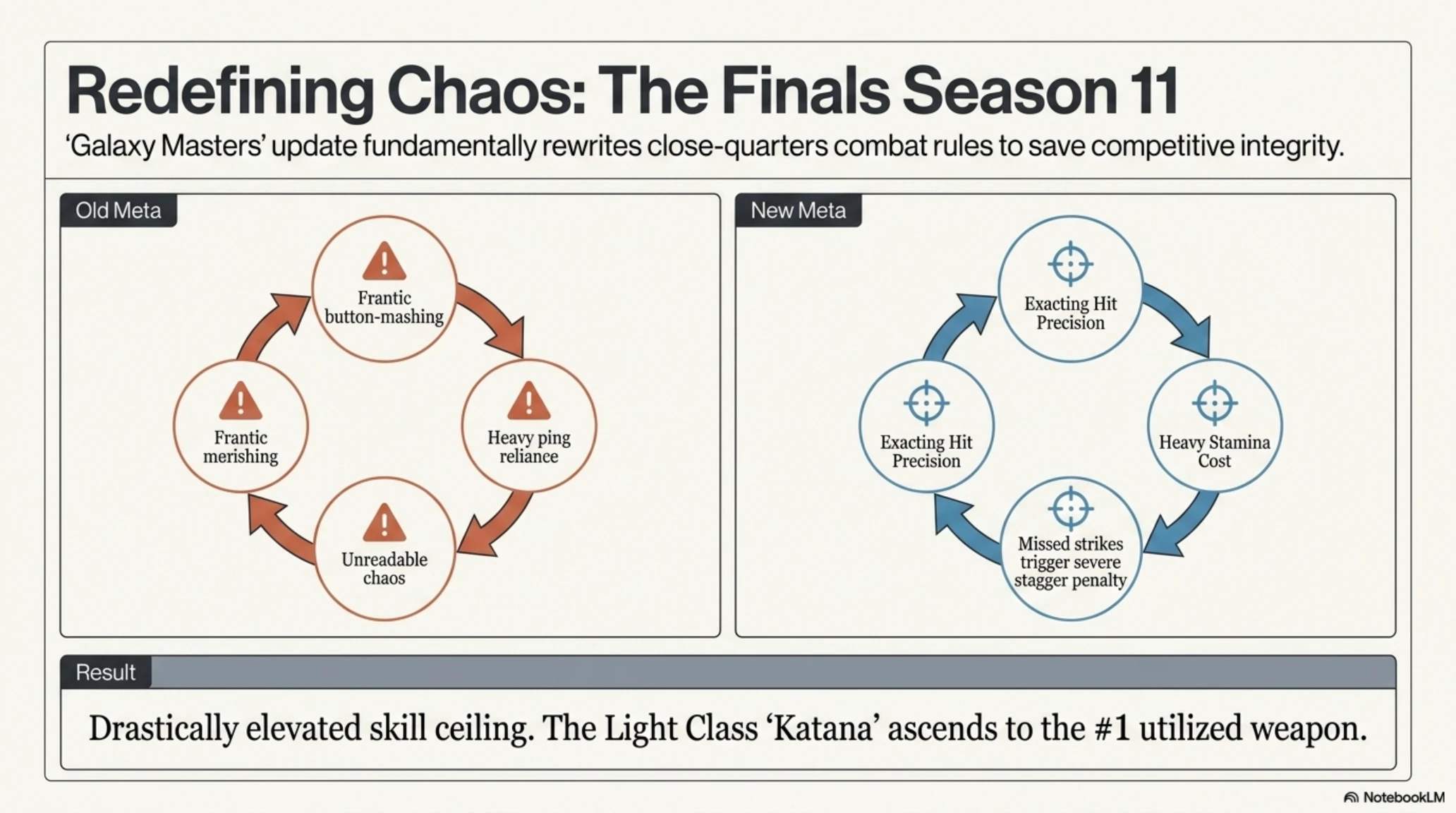
Embark Studios has once again demonstrated its unparalleled mastery over the competitive first-person shooter genre, fundamentally rewriting the rules of engagement with the highly anticipated launch of Season 11 for their blockbuster title, The Finals. Branded "Galaxy Masters," this expansive seasonal update is far removed from a superficial collection of cosmetic additions or minor weapon balancing; rather, it represents a profound, systemic overhaul of the game's core mechanical loops that will completely alter competitive strategies at the highest echelons of play. In an industry where live-service games frequently stagnate due to repetitive content drops, Embark's willingness to tear down and rebuild fundamental mechanics is both refreshing and audacious. The most consequential and widely discussed alteration introduced in this season is the total, ground-up rework of the close-quarters melee combat system—a specific aspect of the game that had increasingly become a point of intense frustration and heated debate among the professional player base.
Throughout previous seasons, engaging in close-quarters combat utilizing melee weapons often devolved into chaotic, unreadable encounters that relied more heavily on serendipity, ping advantage, and frantic button-mashing than calculated skill. Recognizing this critical flaw that threatened the game's competitive integrity, Embark has decisively implemented highly sophisticated mechanics centered around "Hit Precision" and "Stamina Management." In the current meta, players can no longer indiscriminately swing swords or sledgehammers while rushing opponents without severe consequences. Every single strike now demands immaculate timing, spatial awareness, and resource management. Heavy, devastating attacks consume massive portions of the player's stamina bar; crucially, if these heavy attacks miss their intended target, the player is left momentarily staggered, locked in a recovery animation, and exceptionally vulnerable to rapid counter-attacks. This systemic change has injected a phenomenal layer of tactical depth and risk-reward calculation to both the Light and Heavy classes that historically favored melee-centric loadouts, effectively elevating the skill ceiling to unprecedented heights.
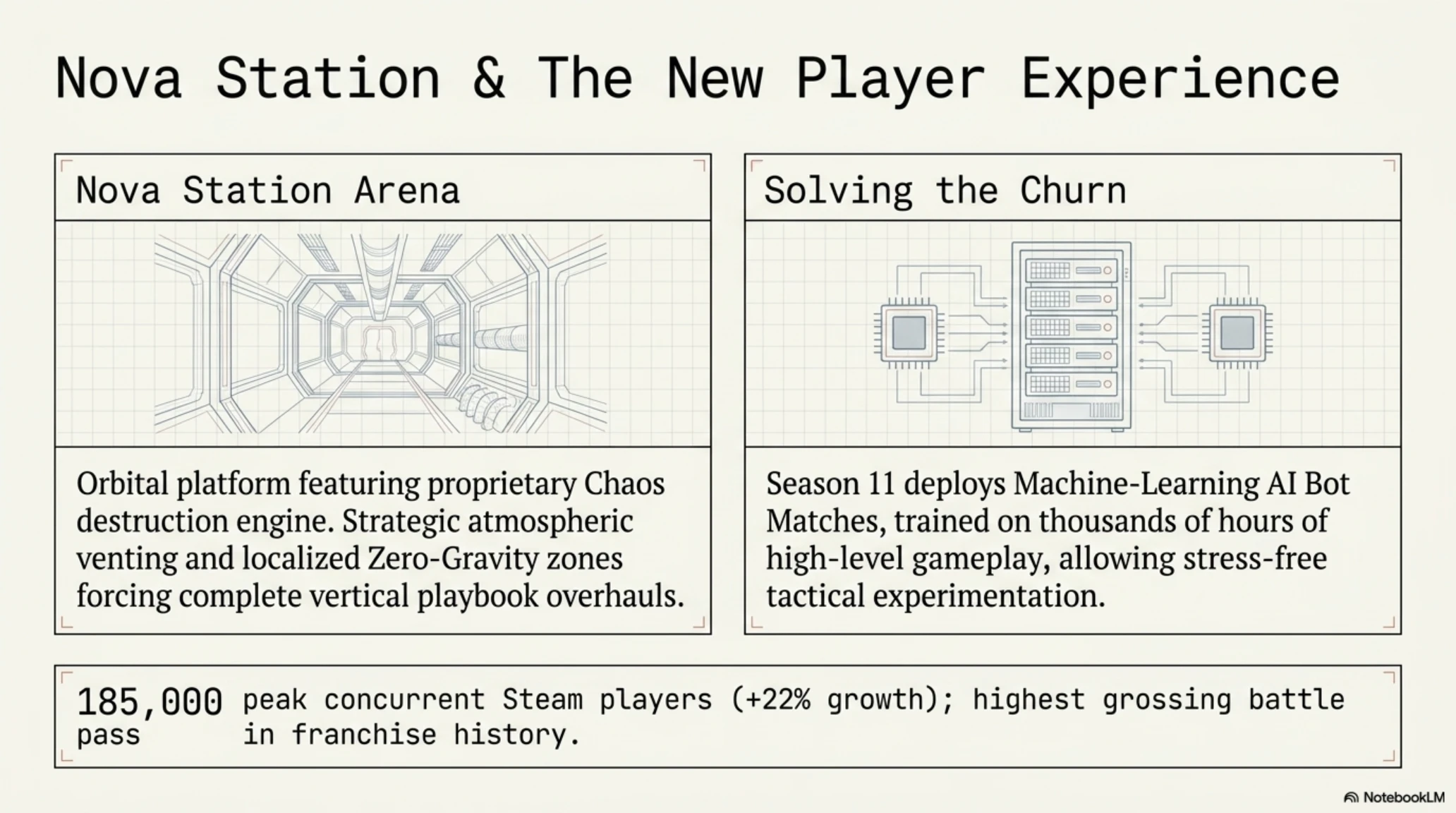
Complementing the sweeping gameplay adjustments is the introduction of a breathtaking, visually stunning new arena appropriately named "Nova Station." Situated on a sprawling orbital platform dynamically rotating above Earth, this map introduces unprecedented environmental destruction mechanics that leverage the unique, futuristic setting. The proprietary Chaos destruction engine has been pushed to its absolute limits. Players can strategically obliterate sections of the station's reinforced exterior hull, violently venting atmospheric pressure and jettisoning unsuspecting enemies into the deadly vacuum of space. Furthermore, the arena features distinct, localized "Zero-Gravity" zones that players can utilize to execute spectacular acrobatic maneuvers, unpredictable flanking routes, and devastating aerial bombardments. The extreme verticality and multi-tiered design of Nova Station compel coordinated teams to completely abandon established playbooks and devise entirely new offensive and defensive strategies, forcing them to utilize mobility gadgets like the Jump Pad and Zipline with far greater strategic intent.
Statistics Box: Player Demographics & Game Economy
| Metric | Current Status (Season 11) | Delta vs. Previous Season |
|---|---|---|
| Peak Concurrent Players (Steam) | 185,000 Users | +22% Growth |
| Most Selected Class | Medium Build | Unchanged |
| Highest Utilization Melee Weapon | The Katana (Light Class) | Ascended to Rank #1 |
| Battle Pass Monetization | Highest Grossing in Franchise History | +35% Revenue Increase |
Crucially, the development team has also proactively addressed what was universally considered the most significant barrier to entry for the franchise: the New Player Experience (NPE). The Finals, characterized by its blistering pace, complex destruction physics, and unforgiving time-to-kill, has historically presented a brutally steep learning curve for novices, leading to high churn rates during a player's first few hours. Season 11 confronts this issue head-on with the introduction of highly requested "Bot Matches" and a vastly expanded, interactive training module. This robust system allows players to comprehensively test weapon mechanics, experiment with utility gadgets, and practice intricate destruction strategies in a stress-free environment against surprisingly competent, AI-controlled opponents before subjecting themselves to the rigorous crucible of Ranked matchmaking. The AI driving these bots has been trained using machine learning on thousands of hours of high-level gameplay, ensuring they provide a realistic and challenging training experience.
Tekin Analysis Box
Embark Studios' decision to fundamentally rework the core melee system was a massive gamble, but one that has paid off handsomely. In today's hyper-competitive shooter market, failing to address the fundamental grievances of your core community is a death sentence. By simultaneously lowering the barrier to entry (via Bot Matches) and raising the mechanical skill ceiling (via the Melee Rework), Embark has executed a masterclass in live-service management. This delicate balance of catering to casuals while appeasing the hardcore competitive scene is the holy grail of multiplayer game design, and The Finals has just secured its longevity for years to come.
The immediate reaction from the deeply passionate community regarding the "Galaxy Masters" update has been overwhelmingly positive, a rare consensus in the modern gaming landscape. The meticulous rework of the melee system has successfully mitigated long-standing complaints regarding combat imbalance, while the visually spectacular new arena has injected a much-needed breath of fresh air into the standard map rotation. Embark Studios has definitively proven that they possess the creative courage to implement massive, high-risk alterations to their core product, a bold operational philosophy that continues to secure The Finals' enviable position at the absolute pinnacle of the hyper-competitive, notoriously saturated Free-to-Play shooter market.
Conclusion / Final Thoughts Box
From Bitcoin's desperate struggle to reclaim its momentum to Samsung's astonishing hardware engineering with the Galaxy Z Fold 8, and from the preservation of gaming history via Xbox to the breathtaking vision of an AI-driven blockchain economy, tonight's news highlights a profound maturation across the technological spectrum. The distinct boundaries separating hardware, software, and artificial intelligence are rapidly dissolving, paving the way for a fully autonomous digital economy. Amidst this macroeconomic shift, the gaming industry, propelled by fearless innovations like those seen in The Finals Season 11, continues to prove that it remains the ultimate proving ground and primary driver for the adoption of cutting-edge interactive technology.
Frequently Asked Questions
Why is Bitcoin's trading volume low despite the price rally?
This is attributed to the 'Summer Slumber', a seasonal period characterized by a significant exodus of institutional and retail traders for summer holidays, evaporating market liquidity.
Why does the new S&P Pantera Digital Asset Index exclude Bitcoin?
The index adopts a rules-based methodology focusing exclusively on 'revenue-generating protocols' with actual cash flows, categorizing Bitcoin merely as a digital store of value.
How thin is the Samsung Galaxy Z Fold 8?
It is an engineering marvel measuring just 4.5 millimeters when unfolded and 9.8 millimeters when closed, making it Samsung's thinnest foldable ever.
Which classic Xbox games did Microsoft bring to PC?
The inaugural phase includes four iconic titles: Blinx: The Time Sweeper, Conker: Live & Reloaded, Crimson Skies: High Road to Revenge, and Fuzion Frenzy.
According to Franklin Templeton, what is blockchain's killer use case?
They identify 'Agentic AI' as the ultimate catalyst, as autonomous AI agents require fast, permissionless, and borderless micro-transactions to function effectively.
What is the most significant gameplay change in The Finals Season 11?
The most consequential alteration is a total, ground-up rework of the close-quarters melee combat system, introducing mechanics centered around hit precision and stamina management.
Sources Box
- CoinDesk: Bitcoin Rally Faces Key Test at $68,000 Amid Summer Slumber
- Pantera Capital: Introducing the S&P Pantera Digital Asset Index
- Android Authority: Samsung Galaxy Z Fold 8 - Specs, Features, and Price
- Xbox News: Original Xbox Backward Compatibility Arrives on PC
- Decrypt: Franklin Templeton Identifies Agentic AI as Crypto's 'Killer Use Case'
- The Finals Official Website: Season 11 'Galaxy Masters' Patch Notes
- Gaming Trend: Comprehensive Breakdown of The Finals Season 11 Update
Additional Gallery: Tekin Night Thursday July 23: Summer Crypto Chill and Scorching Tech Innovations