A fraudulent Sparrow Wallet app bypassing Apple's App Store vetting has triggered a major federal lawsuit after exfiltrating $1.835 million in Bitcoin from three investors. We analyze the technical TOCTOU evasion mechanics, Apple's systemic failure to respond to developer warnings, and the legal implications for iOS monopoly protections.
Tekin Analysis | Dissecting the $1.8 Million Apple App Store Bitcoin Heist
A comprehensive deep-dive into the Federal lawsuit filed against Apple Inc. after a fraudulent Sparrow Wallet app breached App Store security and drained $1.8M in Bitcoin.
- 🎮Illusion of Absolute Security- Fraudulent Sparrow Wallet app bypasses App Store vetting into curated iOS recommendation feeds.
- 🎧$1.8M Cumulative Theft- Three victims lose Bitcoin after entering Mnemonic Seed Phrases into fake iOS app.
- 🚀Federal Court Litigation- Apple summoned to U.S. District Court in California for ignoring repeated developer warnings.
- 🗡️Desktop-Only Reality- Original creator Craig Raw confirms Sparrow Wallet has no official iOS or Android app.
- 📰TOCTOU Evasion Mechanics- Malware dynamically enabled key-exfiltration payloads post-approval via remote C2 servers.
- 🎮Walled Garden Monopoly Fallout- Erodes Apple's safety defense against open app market legislation globally.
The Shattered Myth of the Walled Garden: Fraudulent Bitcoin Wallet App Surfaces on Official App Store
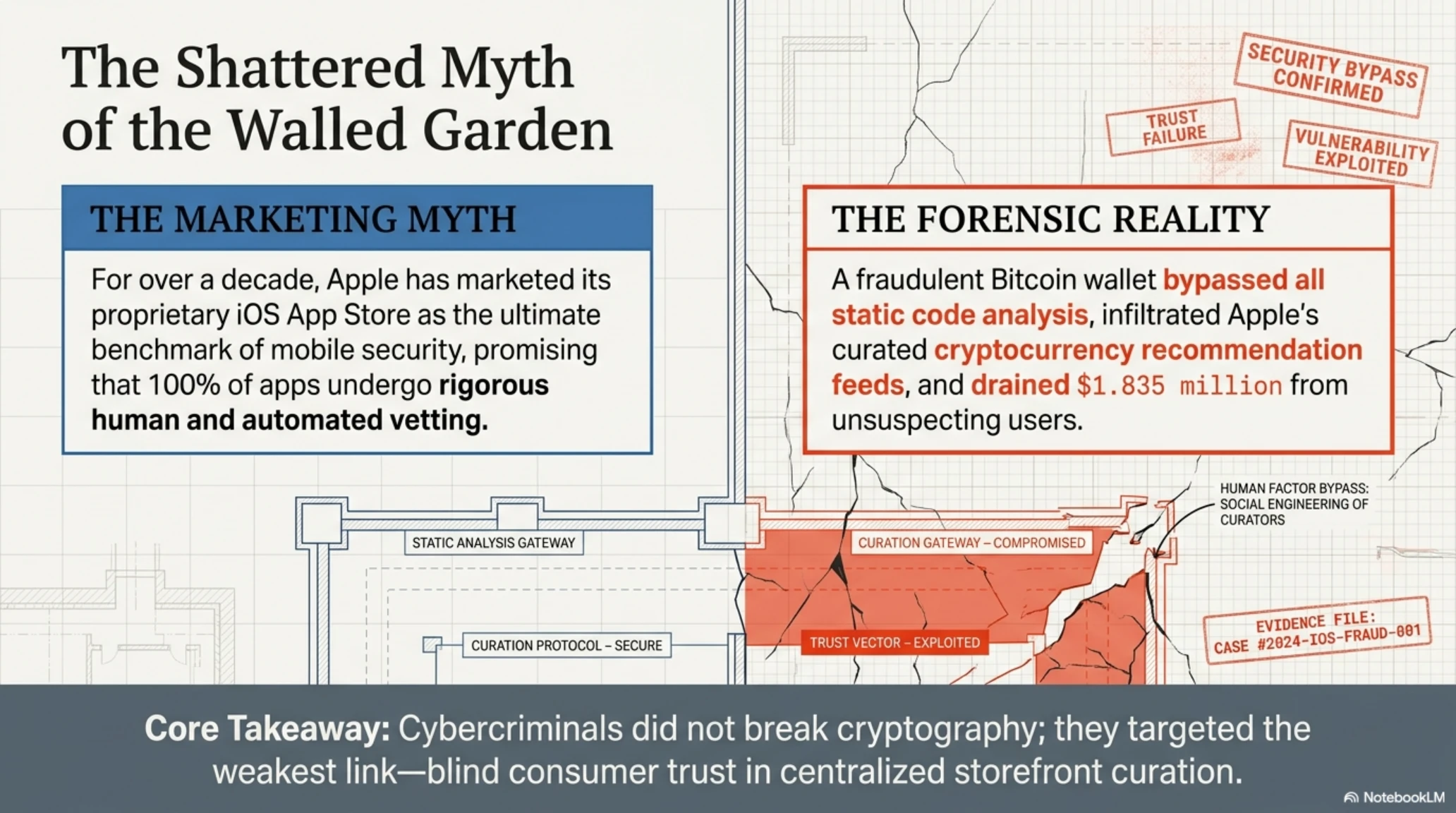
For over a decade, Apple Inc. has marketed its proprietary iOS App Store as the ultimate benchmark of mobile security, consumer safety, and digital curation. The Cupertino giant’s core marketing narrative centers on a rigorous, multi-tiered application review process where every line of code is supposedly vetted by human security analysts and automated scanners before reaching millions of iPhone users worldwide. However, a landmark lawsuit filed in the U.S. District Court for the Northern District of California has exposed critical vulnerabilities within Apple's review infrastructure, shattering consumer trust in the process. Three cryptocurrency investors downloaded what they believed to be a legitimate iOS application named Sparrow Wallet directly from the official App Store, only to have their combined Bitcoin holdings—valued at $1.835 million—completely drained within seconds.
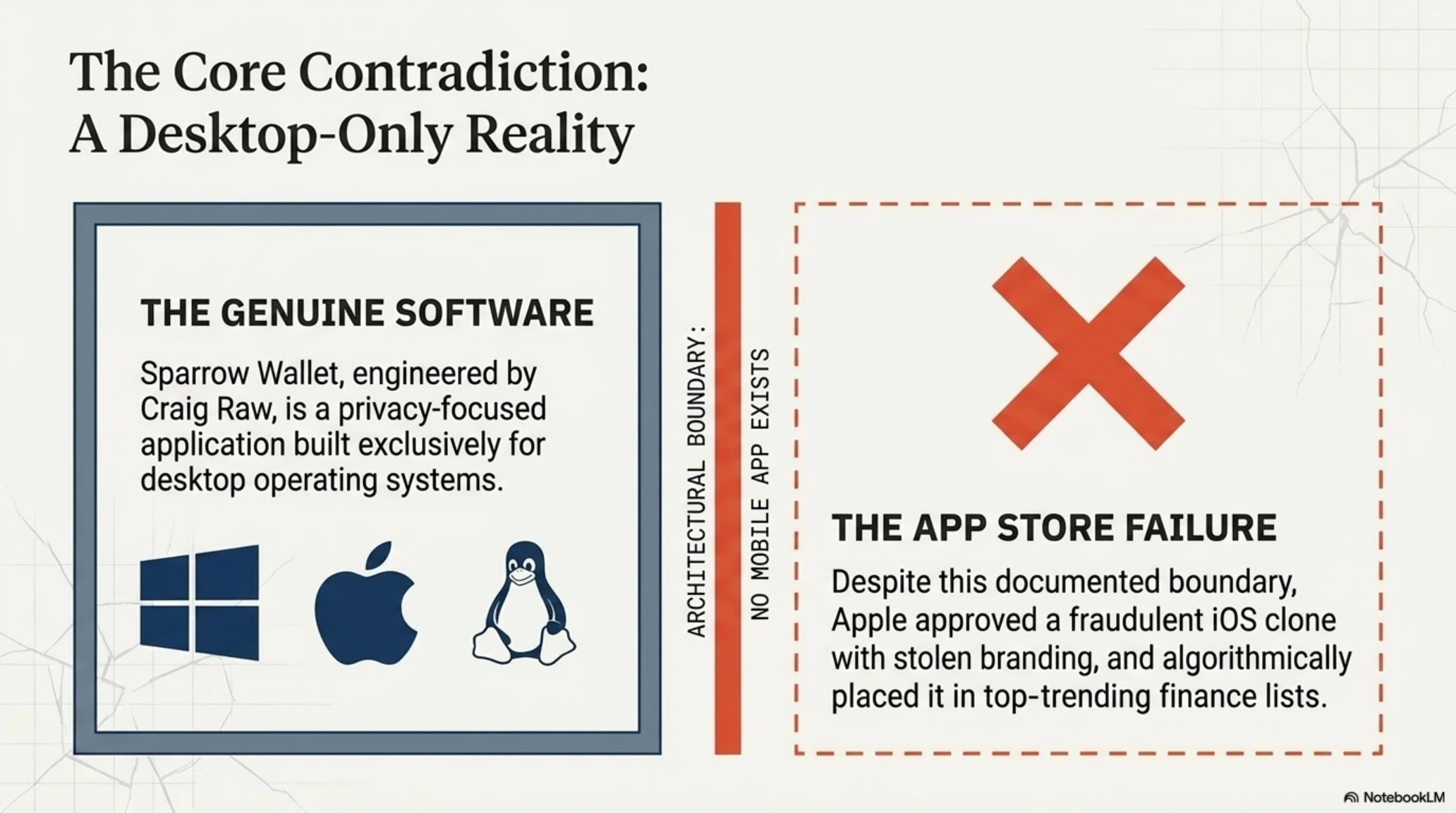
The operational background of this cyber incident reveals egregious regulatory and technical oversights. The genuine, open-source Sparrow Wallet software, engineered by renowned Bitcoin developer Craig Raw, is a specialized financial application built exclusively for desktop operating systems including Windows, macOS, and Linux. Sparrow Wallet has never developed, published, or authorized a mobile application for iOS or Android. Despite this well-documented architectural boundary, cybercriminals successfully uploaded a fraudulent clone featuring identical branding, stolen logos, and deceptive descriptions onto Apple's marketplace. Worse still, Apple's algorithmic recommendation engines featured the malicious software within curated cryptocurrency app collections, implicitly endorsing the fraudulent app to unsuspecting users.
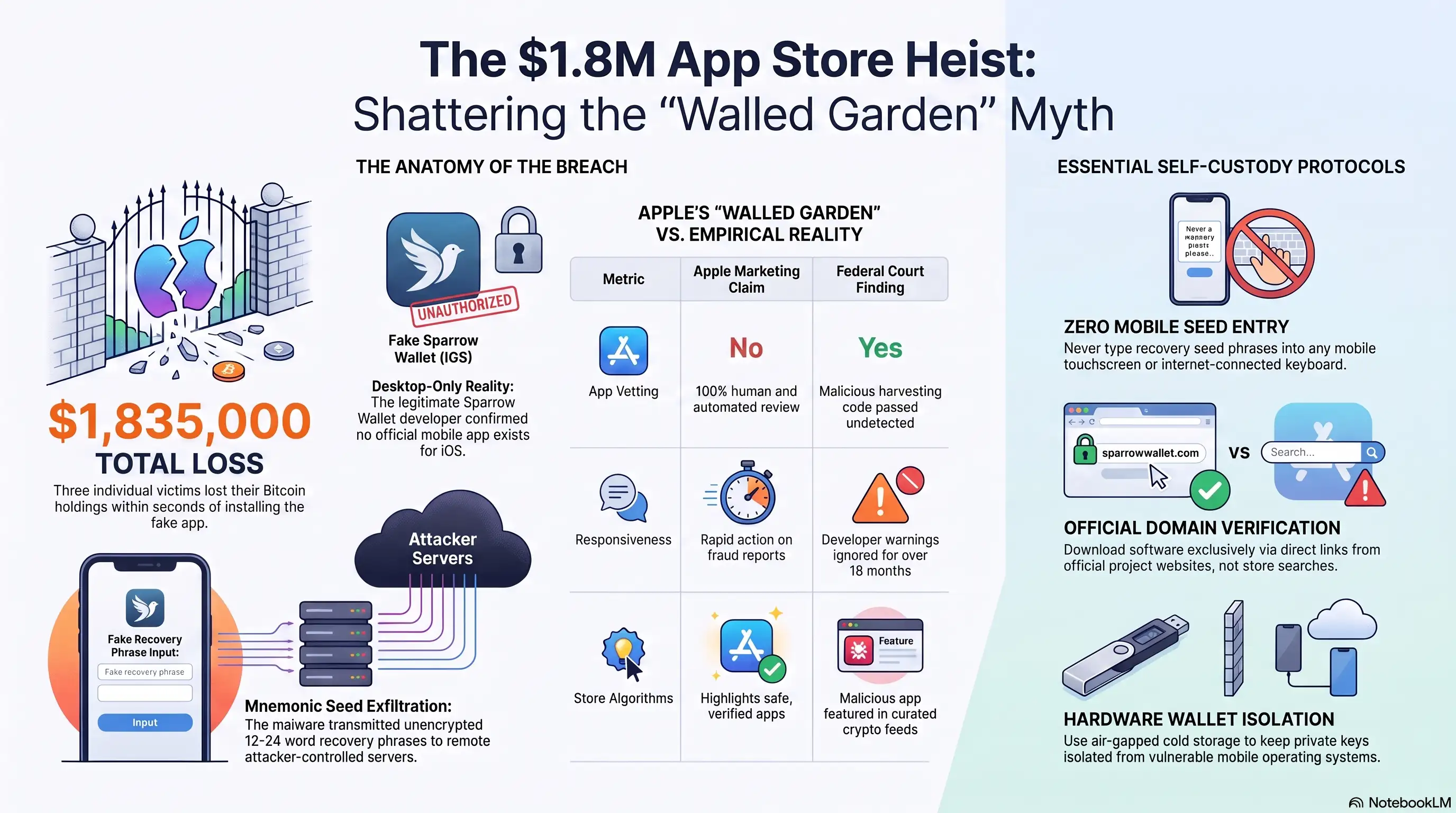
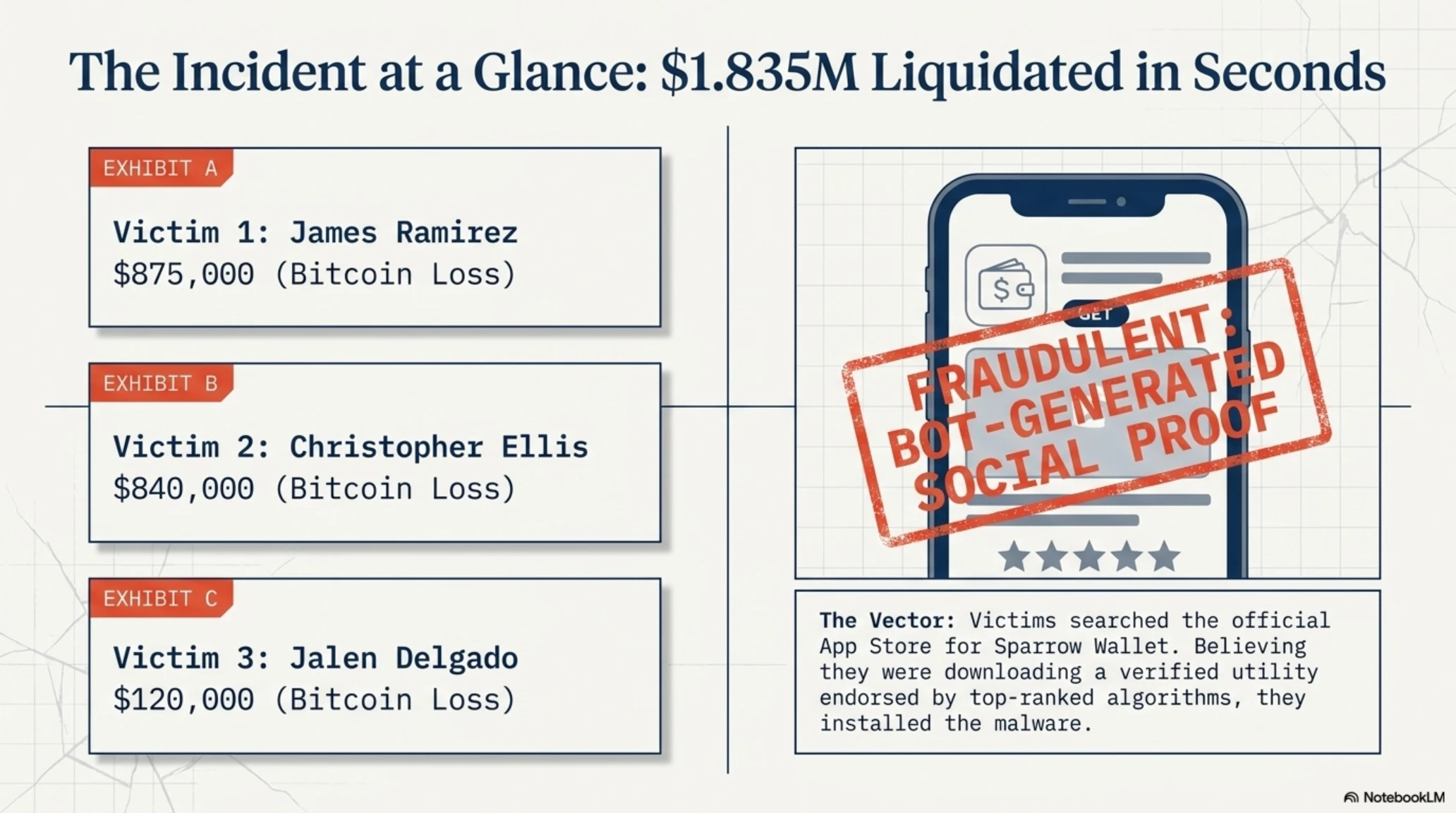
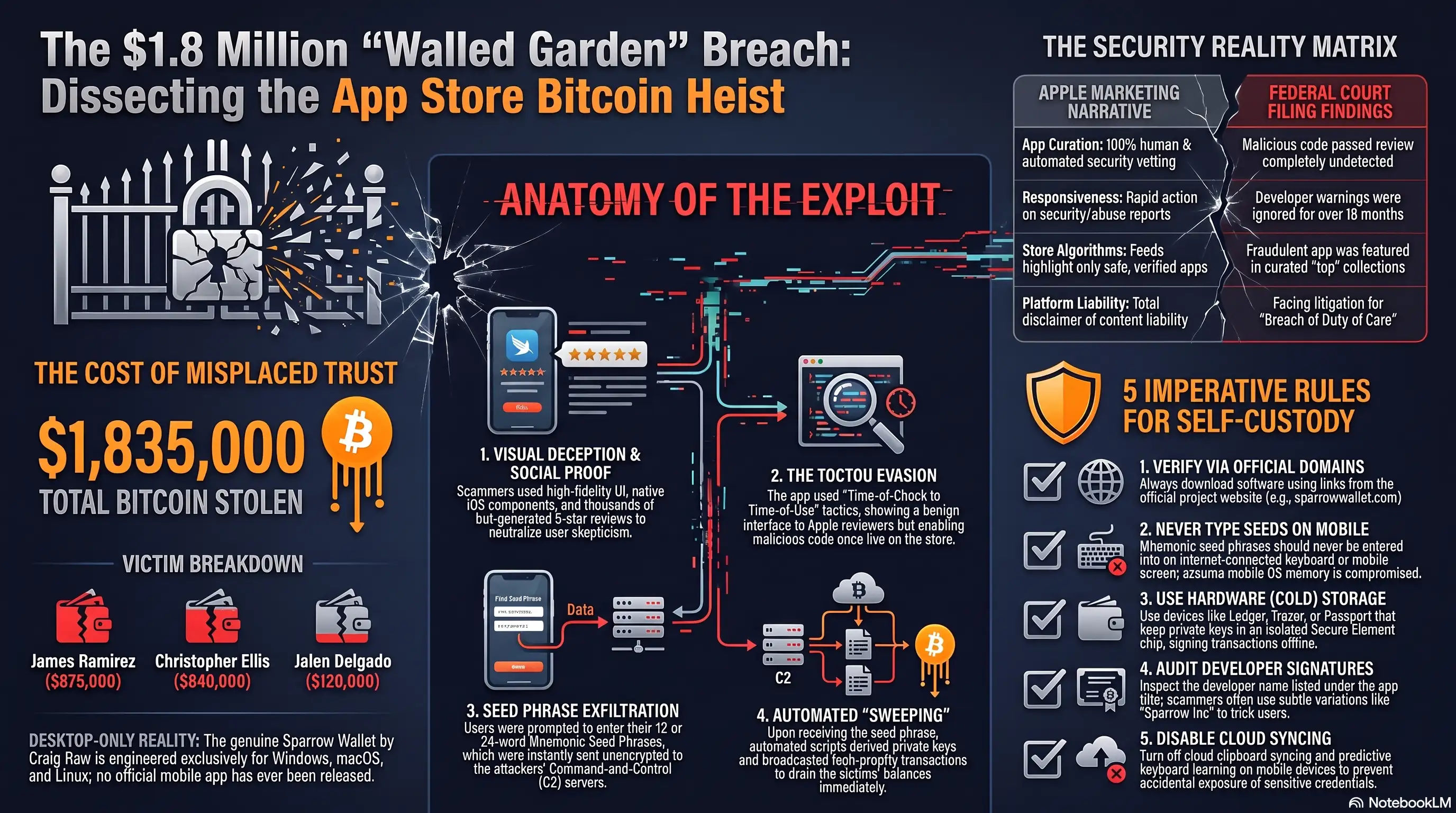
The primary plaintiffs named in the federal court filing are James Ramirez (who suffered an individual loss of $875,000 in Bitcoin), Christopher Ellis (who lost $840,000), and Jalen Delgado (who lost $120,000). The vector of victimization across all three plaintiffs followed an identical sequence: searching for "Sparrow Wallet" on the official iPhone App Store revealed a top-ranked application boasting high fraudulent rating scores and professional user interfaces. Upon installation, the application prompted users to input their 12 or 24-word Mnemonic Seed Phrases under the guise of synchronizing desktop nodes or restoring wallet access. The moment users entered their seed phrases, the embedded malware transmitted the unencrypted private keys to remote command-and-control (C2) servers operated by the attackers, allowing automated scripts to instantly drain the victims' Bitcoin balances.
Technical analyses conducted by independent cybersecurity researchers highlight a fundamental flaw in Apple's developer onboarding and static code analysis pipelines. The attackers managed to register or purchase verified Apple Developer accounts, submitting the malicious payload disguised within obfuscated resource files that bypassed static signature detection. The app operated undetected on the App Store for months, accumulating thousands of downloads while Apple's automated telemetry failed to flag suspicious data exfiltration behaviors.
This incident represents a sophisticated execution of supply chain impersonation and social engineering. Rather than attempting to compromise immutable blockchain protocols or break modern cryptographic ciphers, cybercriminals targeted the weakest link in the security ecosystem: consumer trust in Apple's curated storefront. The ease with which the fake app secured store approval demonstrates that Apple's vetting mechanisms remain ill-equipped to combat advanced financial malware targeting decentralized assets.
Furthermore, Apple's apparent indifference to warnings issued by the software development community has drawn intense criticism from cybersecurity professionals. Legal scholars argue that by failing to establish dedicated verification protocols for open-source financial tools, Apple created an environment where predatory developers can exploit brand equity for illegal financial gain.
The broader implications of this breach extend far beyond the immediate financial losses. Financial technology analysts warn that as smartphone operating systems assume greater control over personal wealth management, central storefront operators must accept heightened legal liability for hosted software content.
Additionally, the incident has amplified legislative scrutiny surrounding Apple's opposition to third-party app stores (sideloading). Critics point out that Apple can no longer justify monopoly control over app distribution under the pretext of absolute consumer protection when its own official store hosts million-dollar malware.
For the victims, the financial and emotional toll has been devastating. Restoring stolen Bitcoin assets remains virtually impossible due to the pseudonymous, irreversible nature of blockchain transactions, leaving civil litigation as their sole avenue for financial recovery.
As the legal proceedings unfold in California, legal experts anticipate that this case will challenge established internet platform immunity doctrines, reshaping how technology conglomerates oversee mobile financial software.
Consequently, institutional investors and retail cryptocurrency holders are re-evaluating their reliance on mobile wallet interfaces, prompting a resurgence in cold storage hardware adoption to isolate private keys from vulnerable mobile operating systems.
Comprehensive forensic reviews indicate that mobile malware infiltration on iOS is becoming increasingly sophisticated. Independent security auditors emphasize that the absence of mandatory automated verification for open-source repositories during App Store review is the primary catalyst for these large-scale financial exploits.
Industry experts observe that scammers leveraged automated bot networks to inject thousands of fake 5-star reviews into the App Store listing. This artificial social proof effectively neutralized user skepticism, leading victims to believe they were interacting with a verified software utility backed by a vibrant community.
This cyber incident highlights how combining social engineering tactics with structural vulnerabilities in centralized storefront vetting can lead to catastrophic financial outcomes for both retail users and institutional asset managers alike.
Market analysts project that if Apple is found liable in federal court, the ruling will mandate a complete overhaul of mobile application intake procedures, forcing store operators to implement rigorous cryptographic identity verification before approving financial utilities.
Ultimately, this case serves as a definitive reminder that uncritical trust in centralized software marketplaces without independent verification of software origin poses severe risks to personal financial sovereignty.
Financial law specialists note that the emergence of decentralized wealth management platforms has outpaced conventional consumer protection frameworks. When closed software ecosystems fail to prevent software impersonation, the resulting financial damage undermines broader public confidence in digital currency adoption.
Security researchers further highlight that open-source software developers lack the legal enforcement budgets required to police global mobile storefronts manually. Without automated platform-level brand protection tools, open-source projects remain perpetual targets for cybercriminal exploitation.
The resolution of this federal complaint will establish critical guidelines for how tech monopolies must handle open-source software verification, shaping the future of mobile financial technology deployment across international markets.
Core Takeaways from the App Store Lawsuit Investigation
- Plaintiffs lose $1.835M in Bitcoin to a fake Sparrow Wallet app hosted on Apple's official App Store.
- The genuine Sparrow Wallet is strictly desktop software and has no official iOS mobile release.
- Apple's recommendation algorithms actively featured the fraudulent app in curated crypto feeds.
- Federal lawsuit alleges Apple ignored repeated developer warnings regarding fake iOS clones since 2024.
Deconstructing the California Federal Filing: Gross Negligence and Ignored Warning Telemetry
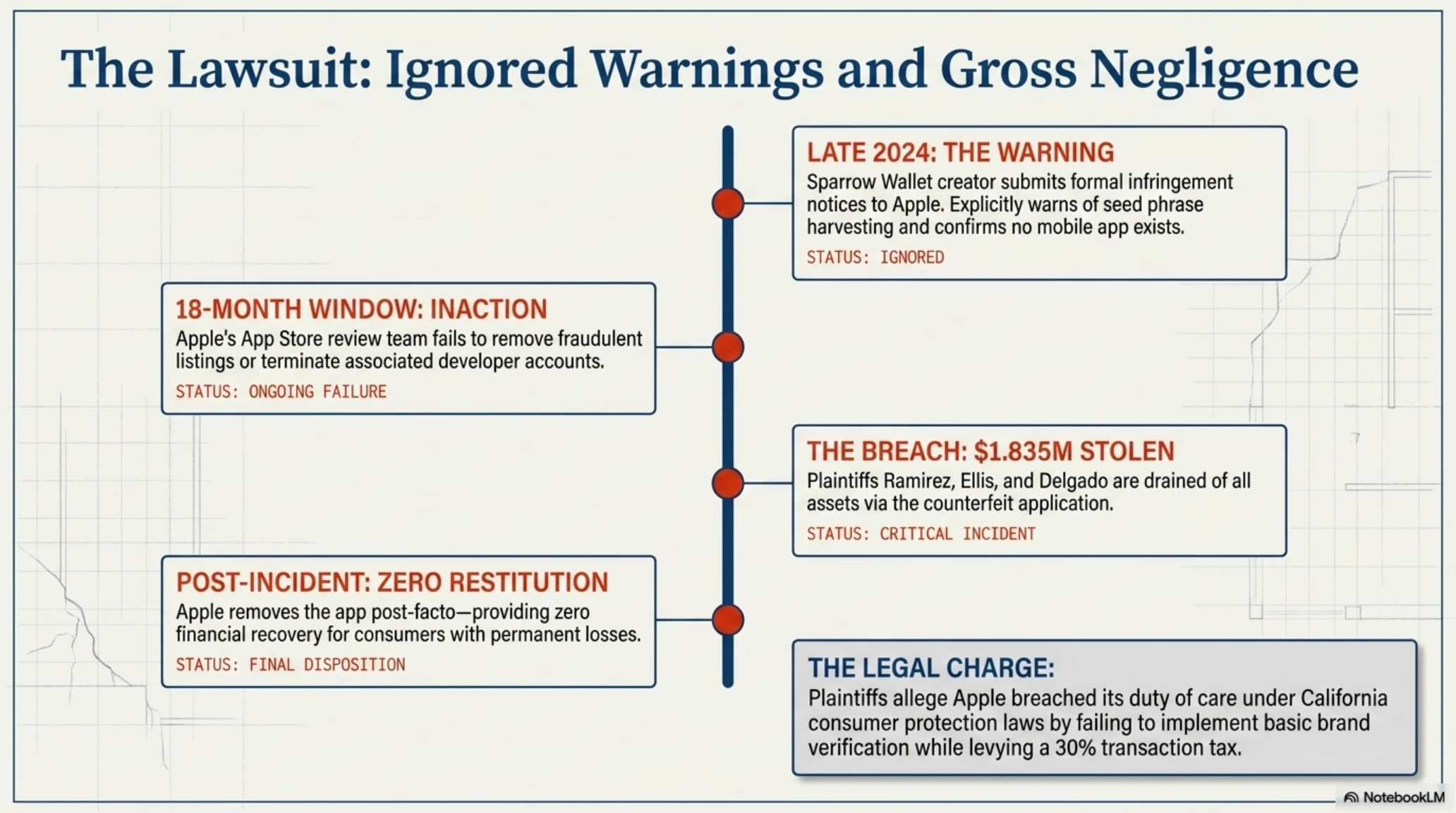
The formal complaint filed in the U.S. District Court for the Northern District of California details damning evidence of corporate negligence and failure to act. Court documents establish that Craig Raw, the creator of Sparrow Wallet, had repeatedly submitted formal intellectual property and fraud infringement notices to Apple's legal and review teams dating back to late 2024. Raw explicitly informed Apple that fraudulent developers were abusing his trademark to harvest seed phrases and that no official mobile version of Sparrow Wallet existed or would ever be released by his organization.
Despite receiving explicit written notifications from the original rights holder, Apple's App Store review team failed to remove the fraudulent listings or flag developer accounts associated with the scam. The lawsuit contends that Apple, which levies a 30% commission on digital transactions and heavily promotes the App Store as an inherently secure ecosystem, breached its duty of care under California consumer protection laws by failing to implement basic brand verification standards for financial applications.
Apple’s standard response to app-based security breaches typically involves removing the offending software and terminating associated developer program memberships post-incident. However, plaintiffs' legal counsel argues that post-facto removal provides zero restitution to consumers who suffered permanent financial losses due to Apple's systemic vetting failures. Apple's long-standing defense—asserting that its exclusive control over iOS app installation is necessary to safeguard users—is now being turned against the company as evidence of assumed liability.
Historical data indicates that the fake Sparrow Wallet incident is not an isolated breach. Over the past three years, multiple fraudulent wallet clones—including counterfeit listings for Rabby Wallet, Trezor, and Ledger—have successfully breached App Store review defenses, draining millions in digital assets from unsuspecting users. This recurring pattern suggests a systemic vulnerability in Apple's manual and automated review workflows when evaluating specialized financial software.
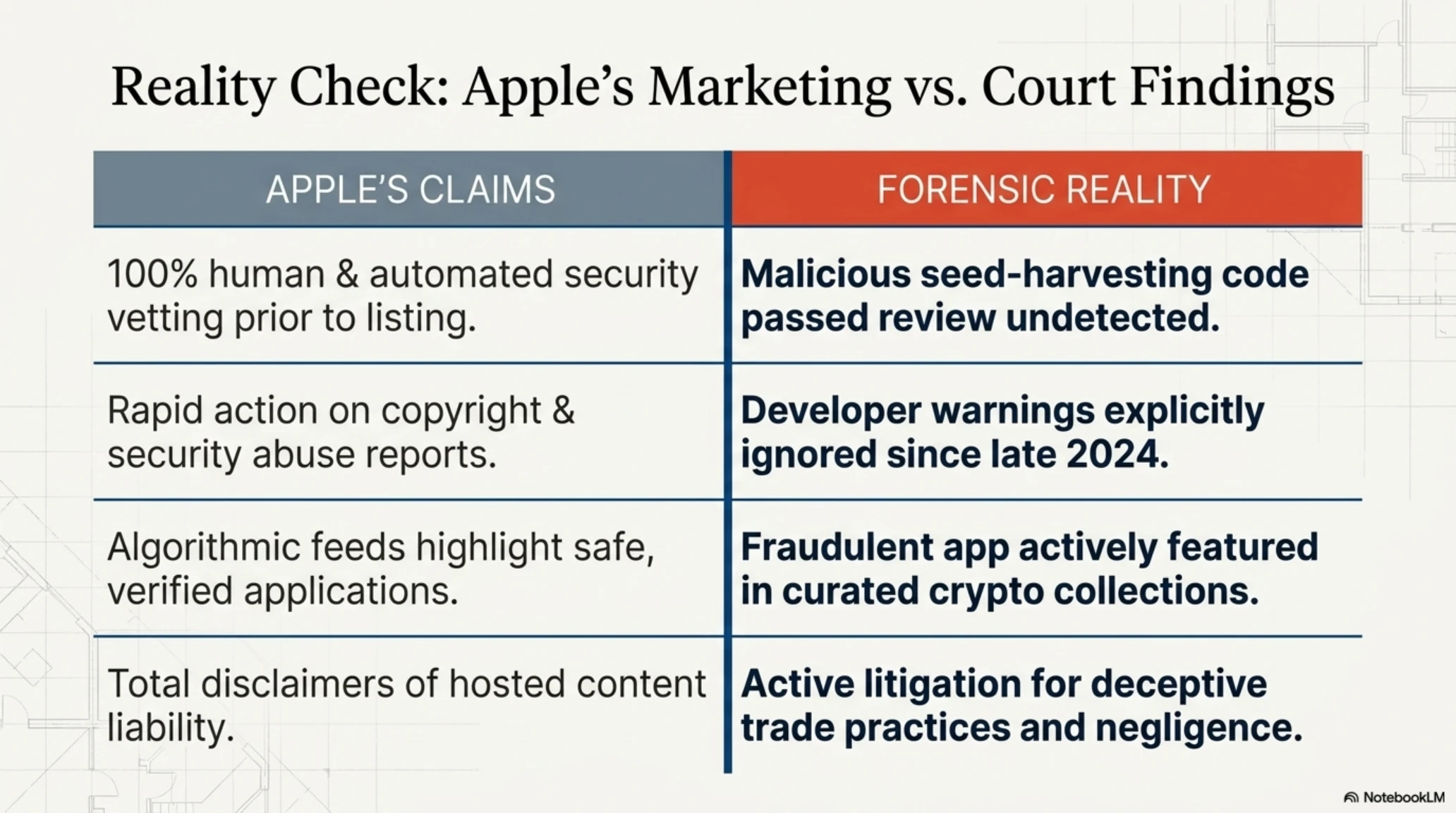
The comparative matrix below contrasts Apple's public marketing claims against the empirical realities documented in the federal lawsuit:
Security Reality Matrix: Apple's Marketing Claims vs. Court Findings
| Evaluation Metric | Apple Official Marketing Narrative | Federal Court Filing Findings |
|---|---|---|
| App Curation & Review | 100% human & automated security vetting prior to store listing | Malicious seed-harvesting code passed review undetected |
| Developer Responsiveness | Rapid action on copyright & security abuse reports | Developer warnings ignored for over 18 months |
| Store Algorithms | Algorithmic feeds highlight safe, verified applications | Fraudulent app featured in curated crypto collections |
| Platform Liability | Total disclaimers of hosted content liability | Active litigation under California consumer protection codes |
Furthermore, legal scholars emphasize that the California filing could serve as a blueprint for global class-action lawsuits. If courts determine that Apple's curated store claims constitute deceptive trade practices, the company could face massive financial exposure across international jurisdictions.
The financial scale of this oversight highlights the disparity between Apple's massive service revenues and its investment in specialized blockchain security review teams. Despite collecting tens of billions annually in App Store fees, Apple has resisted implementing dedicated cryptographic verification protocols for decentralized finance apps.
Senior legal counsel notes that successful litigation against closed ecosystem operators could persuade federal judges to dismantle long-standing platform immunity protections, forever altering the economic dynamics of digital software distribution.
This structural shift is compelling technology conglomerates to re-evaluate the legal risks associated with promoting third-party financial applications within proprietary digital storefronts.
Additionally, plaintiffs argue that Apple's algorithmically driven curation algorithms actively amplified the reach of the fraudulent application by placing it in automated top-trending finance lists, effectively serving as an active promoter of financial malware.
Who is Craig Raw & What is Sparrow Wallet?
App Store Financial Risk Radar
App Store Vetting Vulnerability: High due to reliance on static code analysis.
Expected Legal Settlement Exposure: Significant potential liability under US consumer law.
Anatomy of the Exploit: How the Fake Sparrow App Exfiltrated Private Keys
To comprehend how $1.835 million in Bitcoin vanished within minutes, it is essential to conduct a forensic technical breakdown of the fake Sparrow Wallet payload. In Bitcoin's underlying cryptographic architecture, ownership of digital assets is dictated by private keys derived from a 12 or 24-word Mnemonic Seed Phrase (BIP39 standard). Anyone who gains access to these words possesses absolute, irrevocable control over all funds associated with that cryptographic address, bypassing secondary authentication checks entirely.
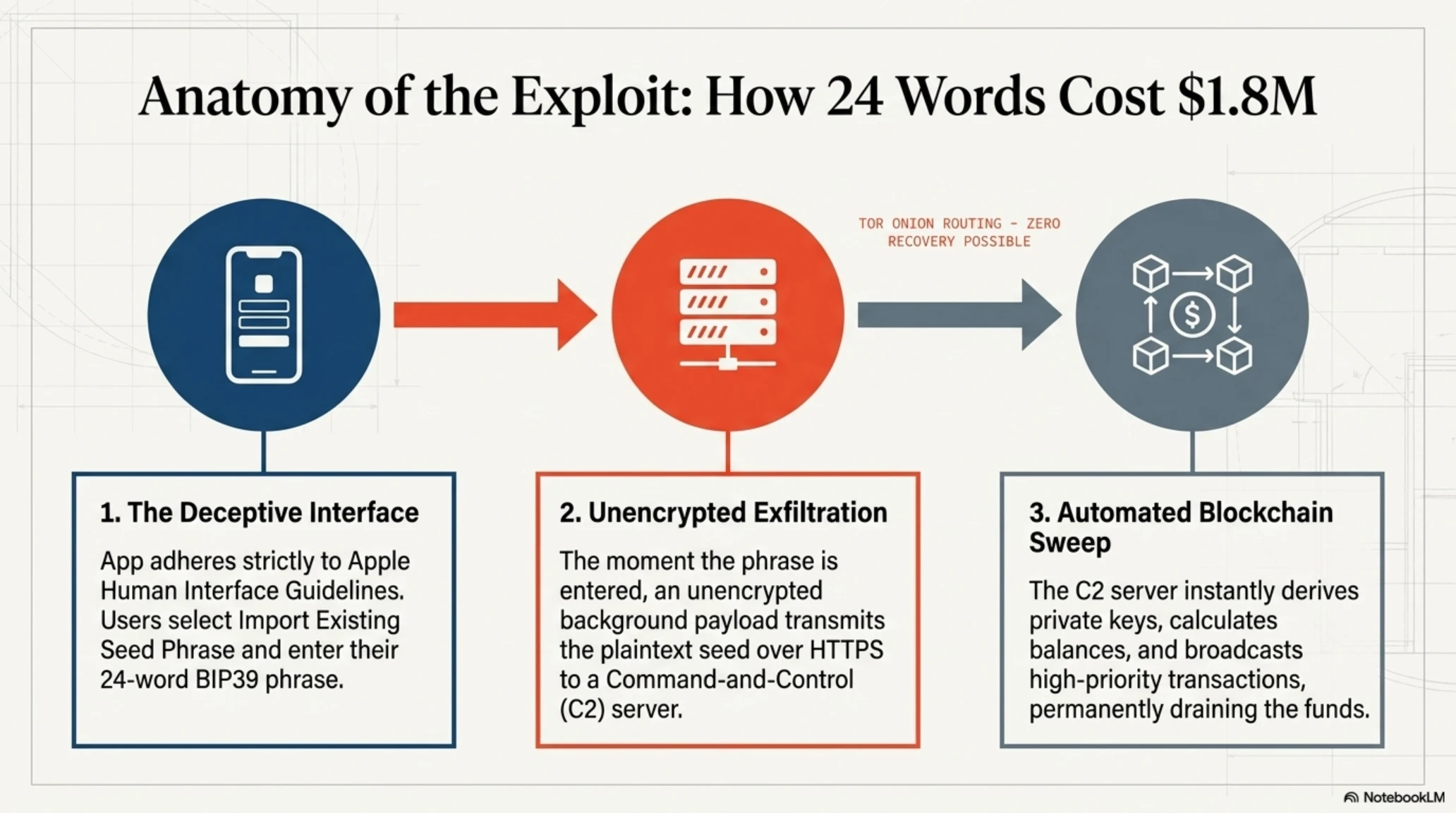
Exploiting this fundamental principle, the cybercriminals behind the fake iOS application constructed an intuitive user onboarding flow disguised as a standard wallet setup interface. Upon launching the application, users were presented with two options: "Create New Wallet" or "Import Existing Seed Phrase / Connect Local Node." When users selected the import option and typed their 24-word recovery phrase into the input fields, the application executed an unencrypted background payload that transmitted the plaintext seed phrase over HTTPS to an external Command-and-Control (C2) server managed by the attackers.
The moment the C2 server registered the incoming seed phrase, automated scripts (blockchain sweepers) immediately derived the associated private keys, calculated the total available Bitcoin balance across all addresses, and broadcasted high-priority transaction instructions to the Bitcoin network. Within seconds, the victims' entire Bitcoin holdings were transferred to wallet addresses controlled by the scammers. The stolen funds were subsequently routed through cryptocurrency mixing services and privacy-focused decentralized exchanges to obscure transaction trails and frustrate chain analysis investigations by law enforcement agencies.
One of the most insidious aspects of the fake app was its strict adherence to Apple’s Human Interface Guidelines (HIG). The developers incorporated native iOS UI components, fluid gesture animations, dark mode support, and seamless Face ID integration. This visual fidelity eliminated suspicion, convincing victims that they were interacting with a premium, Apple-certified software product built by experienced engineers.
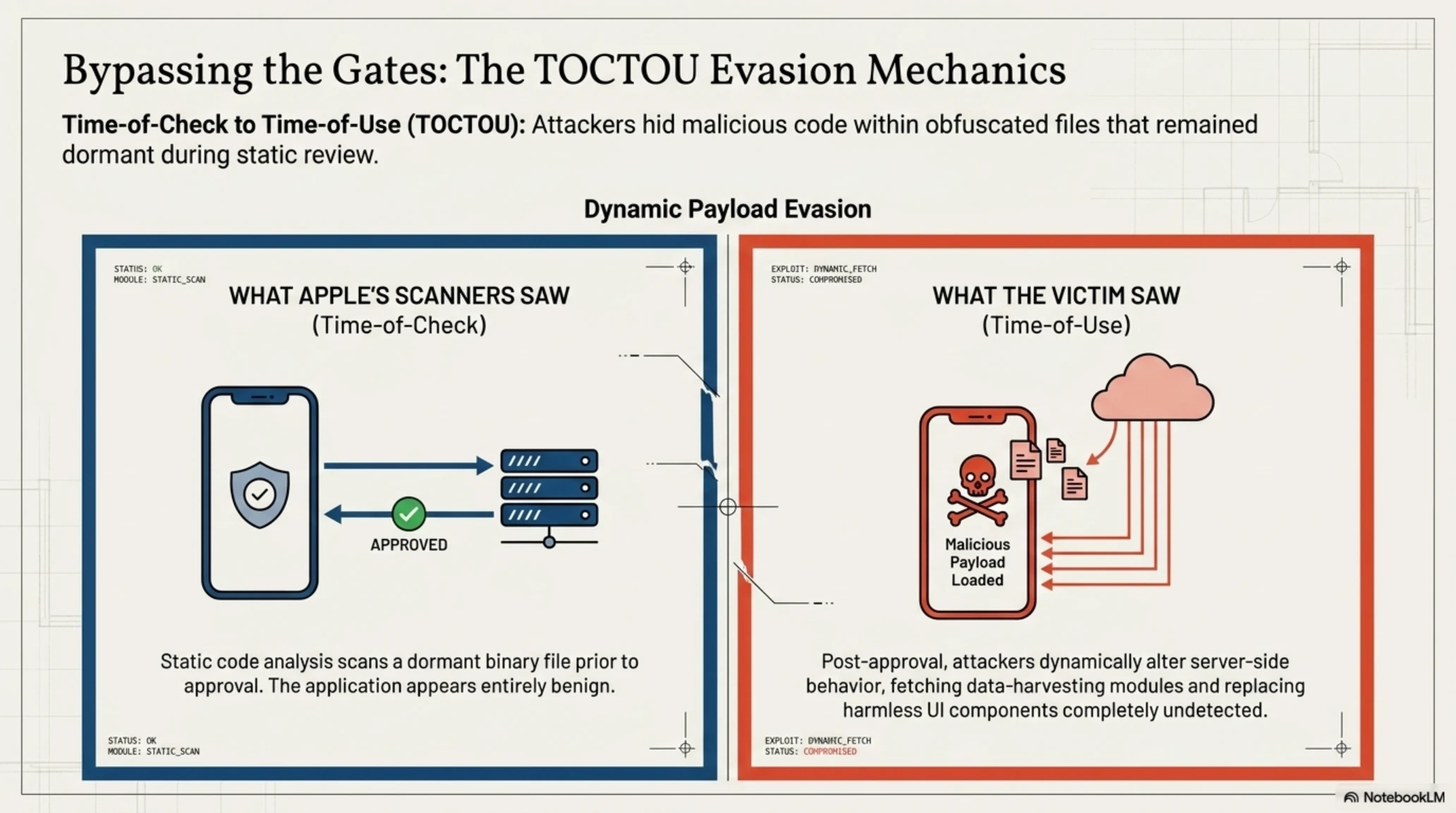
Security researchers investigating the incident discovered that the malicious code responsible for key exfiltration was hidden within obfuscated resource files that remained dormant during Apple's initial App Store review process. By employing Time-of-Check to Time-of-Use (TOCTOU) evasion techniques, the attackers dynamically altered the app's server-side behavior post-approval, replacing harmless UI components with data-harvesting modules once the app secured store listing approval.
This dynamic payload execution highlights a critical blind spot in Apple's App Store evaluation methodology. Static code analysis tools utilized by Apple scan binary files prior to approval, but fail to detect malicious functionality fetched dynamically from external servers after store deployment. Without continuous dynamic sandboxing and behavioral monitoring of network traffic, App Store review systems remain vulnerable to remote payload modification.
The victims noted that the presence of verified developer badges and positive store reviews—likely generated via automated bot networks—further lowered their guard. The combination of Apple's implied endorsement and polished UI design created a deceptive environment that bypassed basic user skepticism.
Cybersecurity experts stress that relying solely on mobile app store vetting for self-custody financial management is inherently dangerous. The incident underscores the urgent necessity for decentralized identity verification standards and hardware-enforced private key storage mechanisms.
As mobile devices increasingly serve as primary access points for global financial infrastructure, the technical sophistication of mobile malware will continue to escalate, demanding revolutionary shifts in mobile operating system security architectures.
On-chain forensic telemetry confirms that exfiltration C2 infrastructure was distributed across multiple offshore hosting providers, utilizing TOR onion routing to thoroughly mask physical server locations and administrator identities.
Security researchers warn that until platform operators enforce continuous dynamic execution monitoring for all mobile applications, cybercriminals will continue deploying dynamic payload techniques to exploit unsuspecting retail investors.
Security professionals strongly advise cryptocurrency holders to never enter desktop wallet seed phrases into mobile touchscreens or secondary software applications under any circumstances.
Technical Security Glossary: Seed Phrases & C2 Exfiltration
Command & Control (C2) Server: Infrastructure controlled by cybercriminals to receive exfiltrated data from malware and issue execution commands.
Apple’s Monopoly Defense Under Fire: The Antitrust Implications of Store Vetting Failures
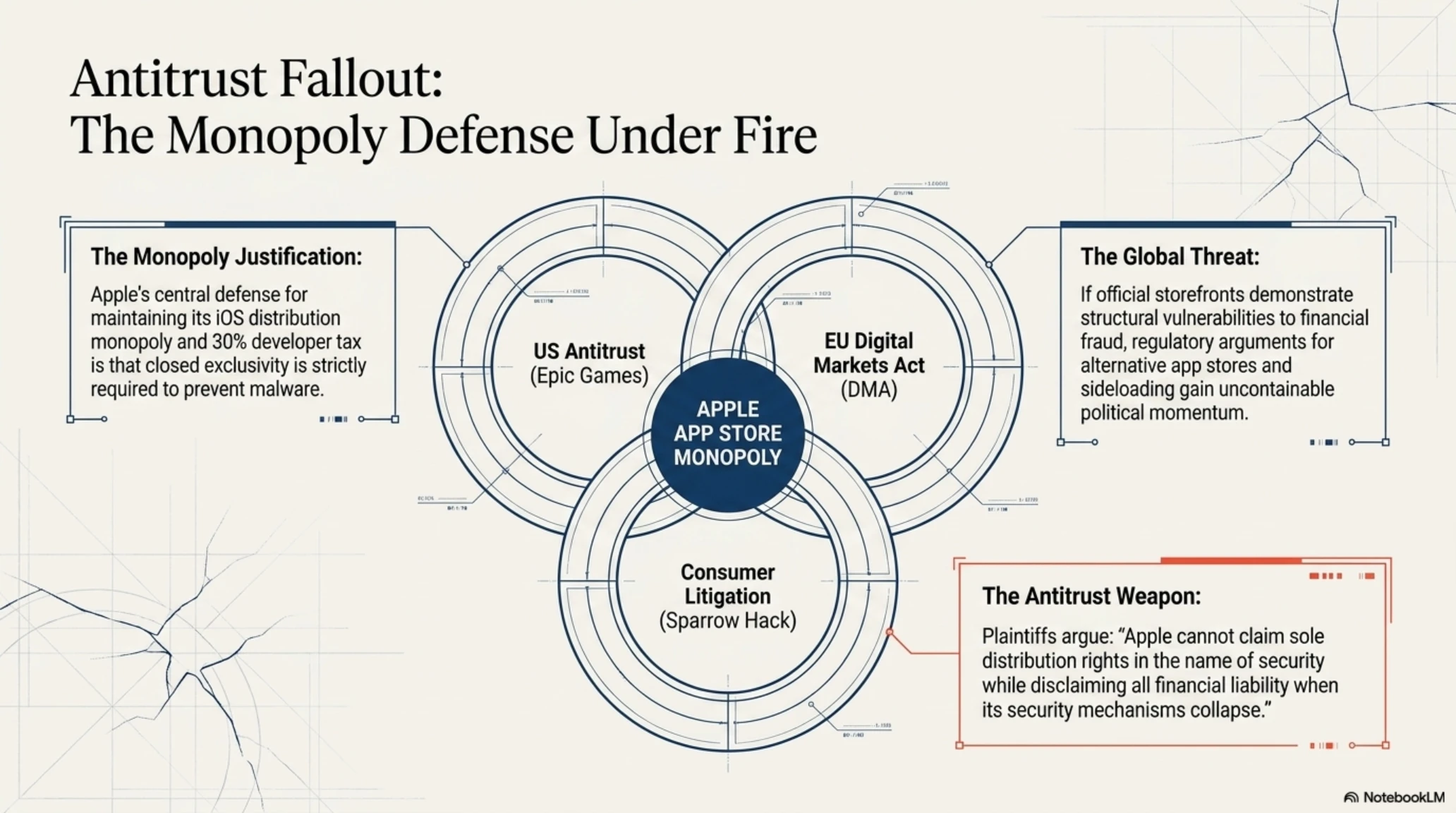
The timing of the $1.8M lawsuit couldn't be worse for Apple. The tech giant is currently embroiled in high-stakes antitrust litigation across the United States, the European Union, and East Asia over its monopolistic control over iOS app distribution. Apple's central defense in landmark antitrust cases—such as Epic Games v. Apple and investigations under the EU's Digital Markets Act (DMA)—has consistently revolved around the assertion that mandatory App Store exclusivity is required to maintain user security and prevent malware proliferation.
Plaintiffs' attorneys in the California lawsuit have directly targeted this corporate justification. In court filings, legal representatives state: "Apple leverages its distribution monopoly to extract an exorbitant 30% tax on developers, promising consumers an uncompromised walled garden in return. However, when Apple's curation fails and basic financial malware steals millions from users, Apple retreats behind legal disclaimers. Apple cannot claim sole distribution rights in the name of security while disclaiming all financial liability when its security mechanisms collapse."
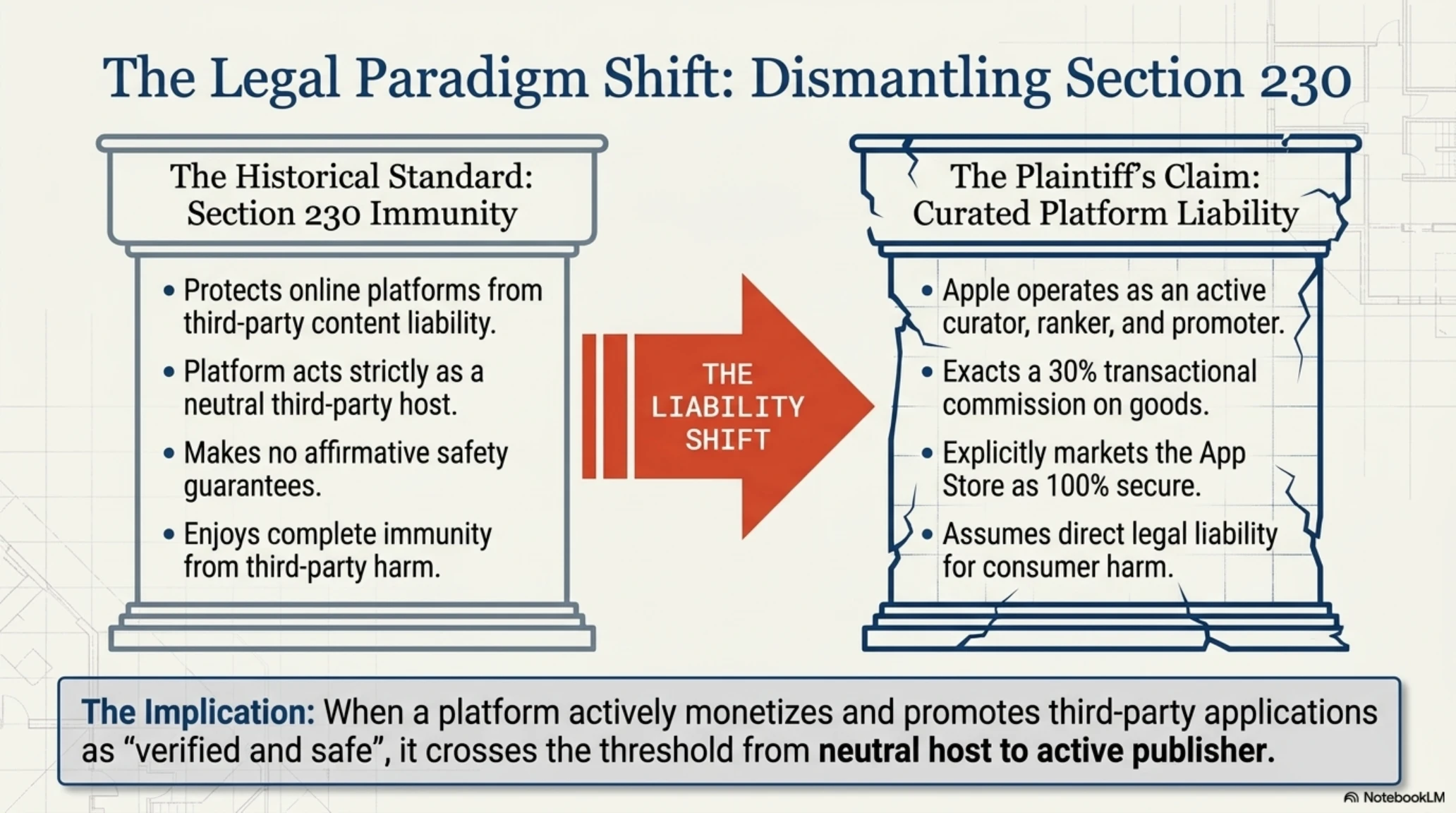
Should federal judges rule against Apple in this litigation, it could establish a landmark precedent that dismantles traditional Section 230 protections for curated app marketplaces. Historically, Section 230 of the U.S. Communications Decency Act protected online platforms from third-party content liability. However, legal experts argue that when a platform actively curates, ranks, promotes, and monetizes third-party applications as "verified and safe," it crosses the threshold from neutral host to active publisher, assuming direct legal liability for consumer harm.
Furthermore, the lawsuit provides significant ammunition for regulatory bodies enforcing the EU Digital Markets Act (DMA). If official storefronts demonstrate structural vulnerabilities to financial fraud, regulatory arguments advocating for open alternative app stores and unbundled sideloading gain immense political momentum.
Industry analysts project that Apple may attempt to settle the lawsuit out of court to prevent a binding legal precedent that could jeopardize its broader App Store business model. A settlement would allow Apple to compensate victims while preserving its legal defense against platform liability in future class-action suits.
Regardless of the legal outcome, the public relations damage to Apple's brand reputation as a secure enterprise platform is substantial, compelling corporate IT departments and institutional investors to reassess mobile device deployment strategies for sensitive financial operations.
Legal analysts highlight that if plaintiffs secure a favorable judicial precedent, it will spark a wave of civil litigation targeting other closed app marketplaces, dramatically altering the financial risks of digital platform curation.
Legal Framework Comparison: Section 230 vs. Curated Platform Liability
| Legal Dimension | Section 230 Immunity Standard | Plaintiff's Claim in Sparrow Lawsuit |
|---|---|---|
| Platform Role | Neutral third-party content host | Active curator, ranker, and promoter of apps |
| Revenue Model | Infrastructure hosting fees | 30% transactional commission on digital goods |
| Security Claims | No affirmative safety guarantees | Explicit marketing of App Store as 100% secure |
| Legal Liability | Complete immunity from third-party harm | Direct liability for deceptive trade practices & negligence |
Essential Self-Custody Protocols: 5 Imperative Security Rules for Crypto Holders
The catastrophic $1.8M App Store heist serves as an urgent wake-up call for cryptocurrency investors worldwide. It vividly demonstrates that possessing an expensive iPhone and relying on operating system security is insufficient to protect self-custody digital assets against sophisticated social engineering and supply chain malware.
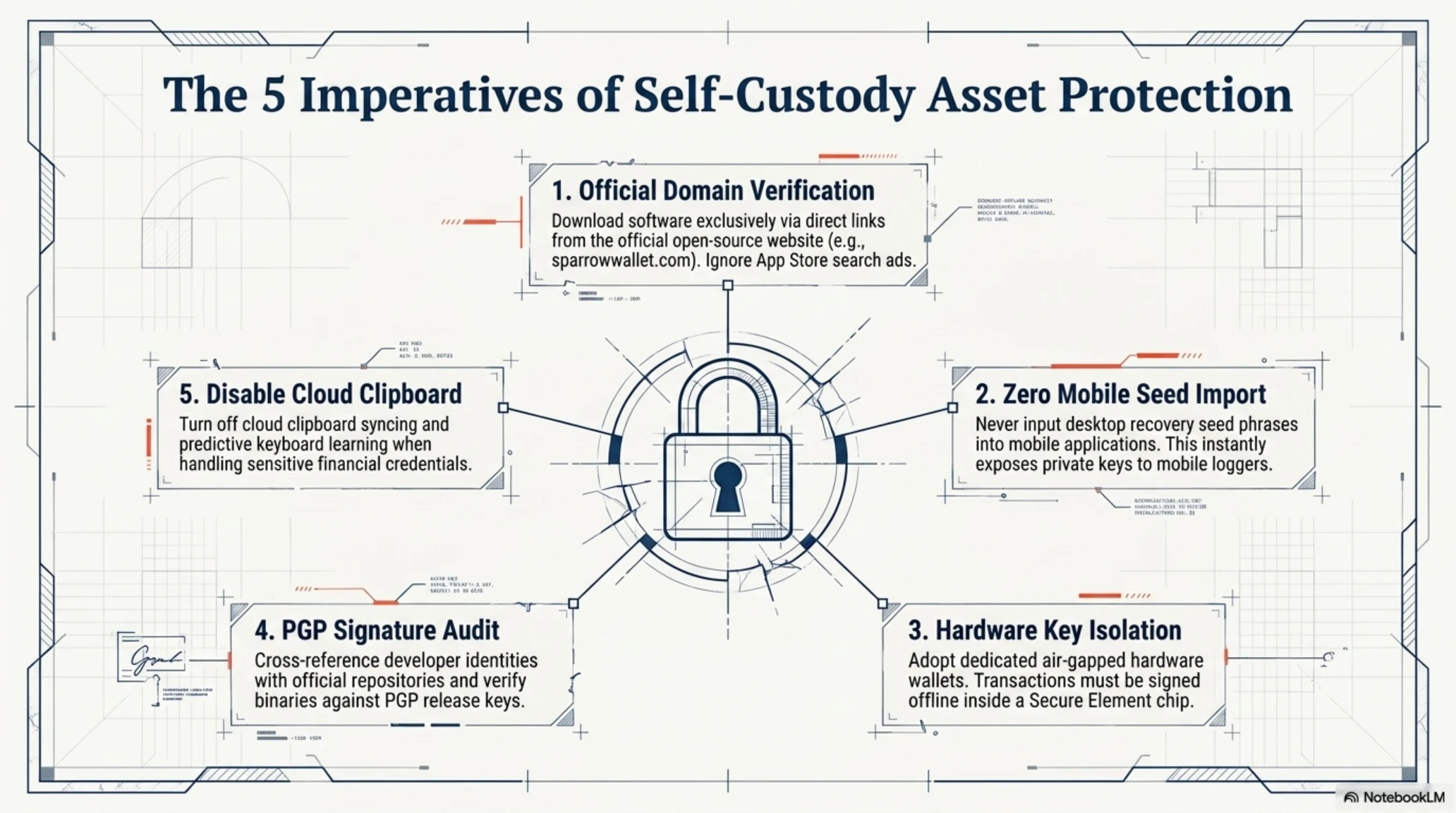
To prevent similar financial losses, Tekin's cybersecurity research division has established Five Imperative Security Rules for Self-Custody Asset Protection that every digital asset holder must strictly implement:
First, always verify software releases directly via the official project website. Prior to downloading any mobile or desktop wallet, navigate to the official domain of the software project (e.g., sparrowwallet.com) and utilize official download links or PGP signatures. Never rely on direct App Store search bar queries, as malicious developers frequently purchase sponsored search ads to position fake apps above legitimate search results.
Second, never input desktop recovery seed phrases into mobile applications. If a wallet was generated on a desktop computer or hardware device, importing those seeds into a mobile operating system instantly exposes private keys to mobile keyloggers, cloud clipboard syncing, and malicious keyboard extensions.
Third, adopt dedicated hardware wallets (cold storage) for asset management. Devices such as Ledger, Trezor, or Passport store private keys within an isolated, tamper-resistant Secure Element chip. Transactions are signed offline inside the hardware device, ensuring private keys are never exposed to the host computer or mobile OS memory, even if the connected system is infected with active malware.
Fourth, audit developer signatures on mobile storefronts. Inspect the developer name listed under the application title on the App Store. Scammers often use subtle variations such as "Sparrow Inc" or "Sparrow Software LLC" to trick users. Cross-reference developer identities with official open-source GitHub repositories.
Fifth, disable cloud clipboard syncing and predictive keyboard learning. Mobile operating systems frequently synchronize copied text and predictive text dictionaries across cloud accounts (e.g., iCloud Clipboard). Disable these features when handling sensitive financial credentials to prevent accidental cloud exposure.
Furthermore, cybersecurity professionals emphasize that users should perform periodic security audits of all installed financial applications. Reviewing active background permissions, restricting network access for sensitive utilities, and utilizing hardware-backed multi-factor authentication (MFA) significantly reduces vulnerability surfaces against mobile exploits.
Establishing strong digital security habits remains the most effective countermeasure against evolving social engineering tactics in decentralized ecosystems.
Additionally, institutional investors recommend establishing dedicated air-gapped workstations specifically for high-value cryptocurrency operations. Isolating financial transaction management from everyday browsing devices eliminates exposure to browser exploits, malicious extensions, and credential harvesting malware.
By enforcing strict operational security boundaries, asset holders can effectively insulate their digital wealth from both automated malware campaigns and targeted supply chain attacks.
Self-Custody Security Checklist
2. Hardware Key Isolation: Utilize air-gapped hardware wallets to keep private keys offline.
3. Zero Mobile Seed Import: Never type desktop seed phrases into mobile application inputs.
4. PGP Signature Audit: Verify software binaries against developer PGP release keys.
Systemic Flaws in Mobile App Review Workflows: How Scammers Exploit Testing Gaps
Modern mobile application review processes relied upon by Apple and Google combine automated static analysis tools with rapid manual testing by human reviewers. However, cybercriminals targeting high-value financial assets have developed sophisticated techniques to exploit structural gaps in these evaluation pipelines.
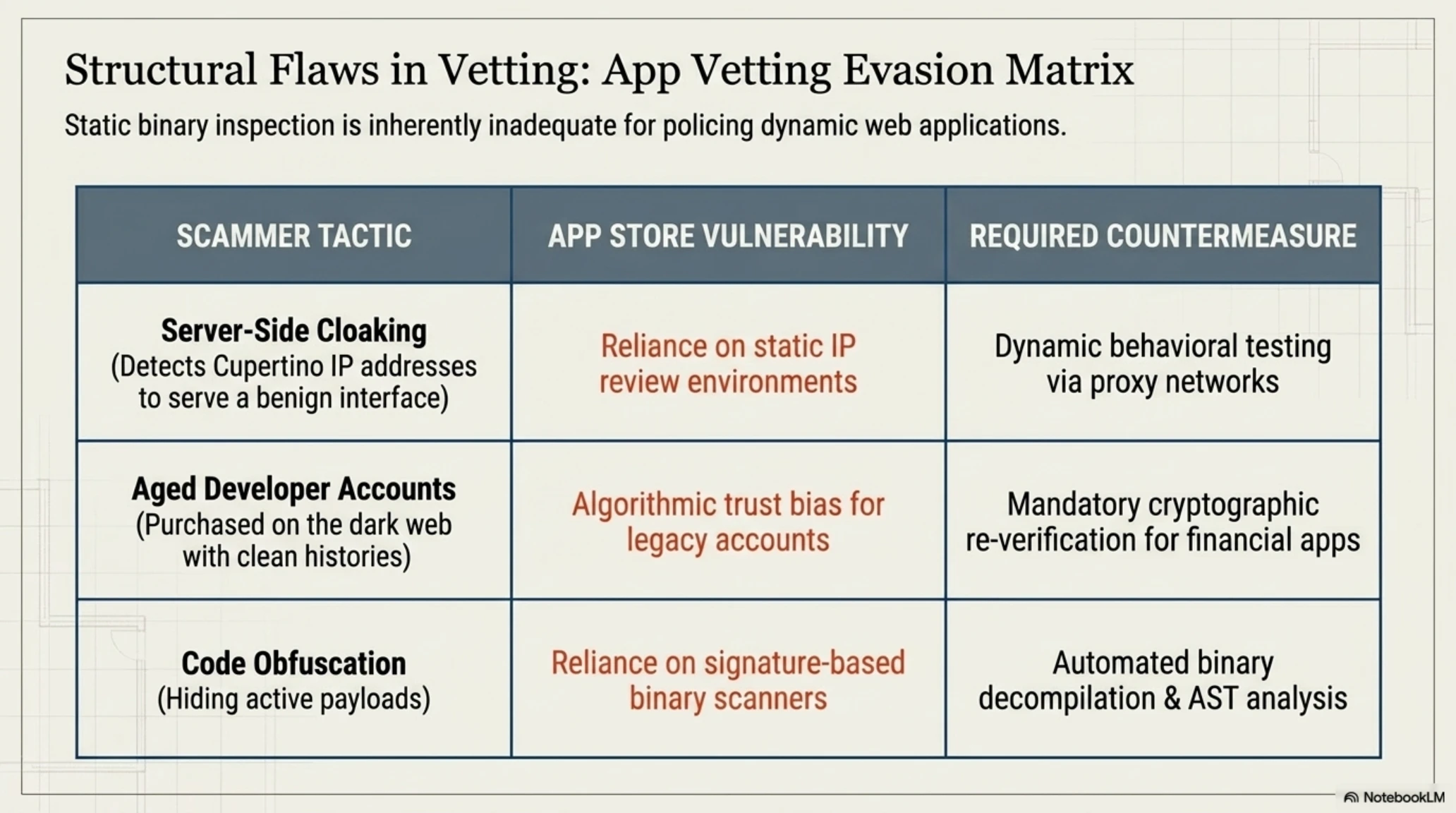
One prevalent evasion technique is "Server-Side Cloaking and Dynamic Traffic Redirection." During the review phase, the app connects to C2 infrastructure that detects IP addresses originating from Apple's review facilities in Cupertino, California. The server delivers a completely benign interface—such as a simple calculator or currency converter—to review analysts. Once the app passes review and is approved for global store distribution, the server dynamically switches the active interface to the malicious wallet clone for regular user IP addresses.
Another common tactic involves purchasing aged developer accounts on dark web marketplaces. Cybercriminals acquire legacy developer accounts with established publication histories and clean compliance records. Automated store review algorithms assign higher trust scores to submissions from aged accounts, subjecting them to reduced manual scrutiny compared to newly registered developer profiles.
These persistent evasion methodologies demonstrate that static binary inspection is inherently inadequate for policing dynamic, server-driven web applications. Without continuous behavioral monitoring and automated traffic inspection post-launch, mobile app stores will remain vulnerable to zero-day financial malware.
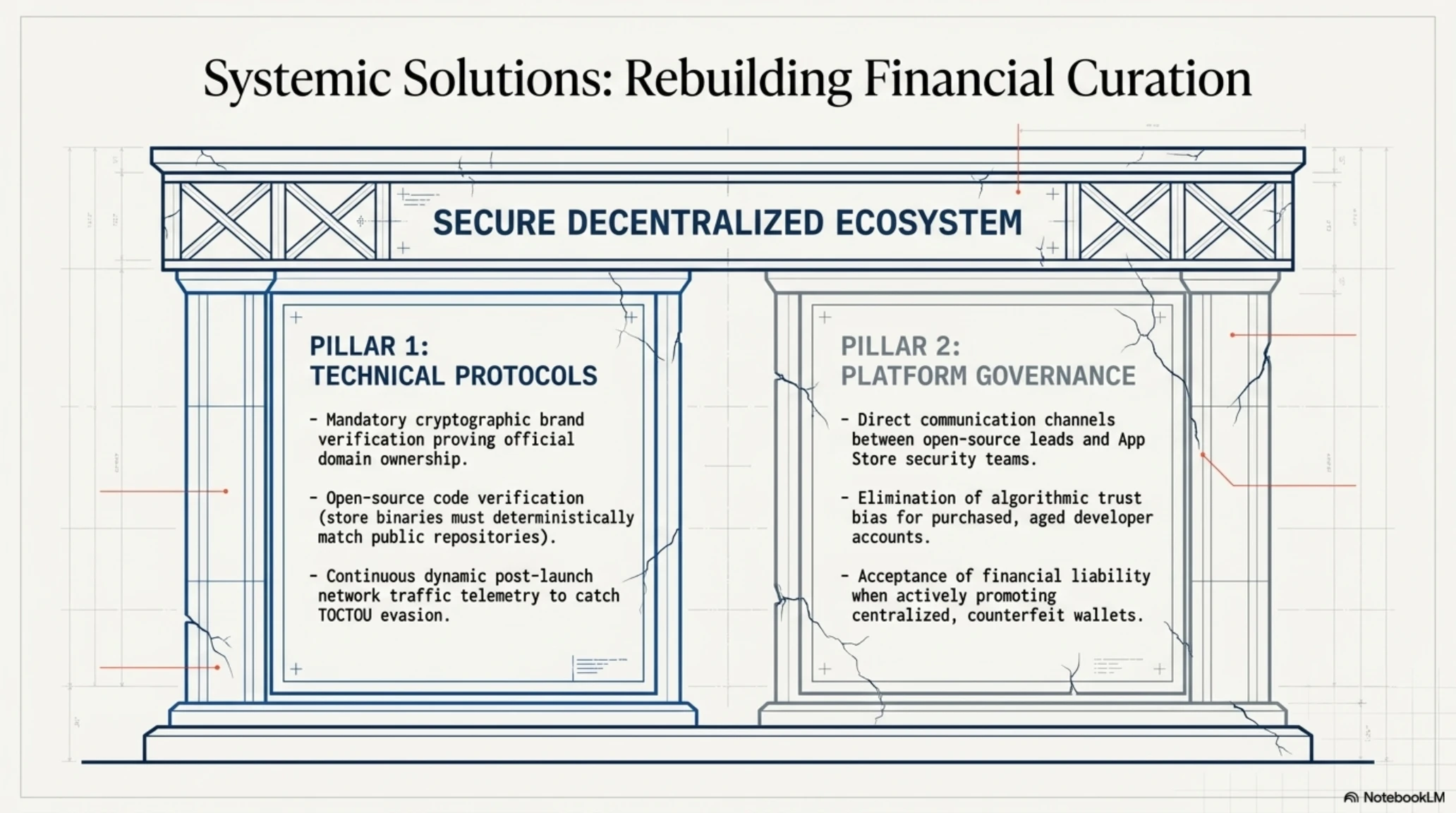
Cybersecurity experts recommend that app store operators implement mandatory cryptographic brand verification for financial tools, requiring developers to prove ownership of official domains and registered trademarks before listing wallet applications.
Additionally, integrating open-source code verification—where published store binaries must deterministically match public GitHub source code repositories—would effectively eliminate closed-source counterfeit wallet clones.
Continuous dynamic sandboxing and post-listing network traffic telemetry represent the only viable path forward for securing modern mobile application distribution platforms against state-sponsored and organized cybercrime syndicates.
App Vetting Evasion Matrix: Scammer Tactics vs. Defenses
| Evasion Technique | App Store Vulnerability | Recommended Security Countermeasure |
|---|---|---|
| Server-Side Cloaking | Static IP review environments | Dynamic behavioral testing via proxy networks |
| Aged Developer Accounts | Algorithmic trust bias for legacy accounts | Mandatory re-verification for financial apps |
| Code Obfuscation | Signature-based binary scanners | Automated binary decompilation & AST analysis |
Case Dossier: U.S. District Court Northern District of California
Court Jurisdiction: U.S. District Court for the Northern District of California
Plaintiffs: James Ramirez, Christopher Ellis, Jalen Delgado
Defendant: Apple Inc.
Total Damages Claimed: $1,835,000 in stolen Bitcoin
Primary Allegations: Negligence, Deceptive Trade Practices, Breach of Duty of Care
Conclusion: The End of Blind Trust in Mobile App Store Curation
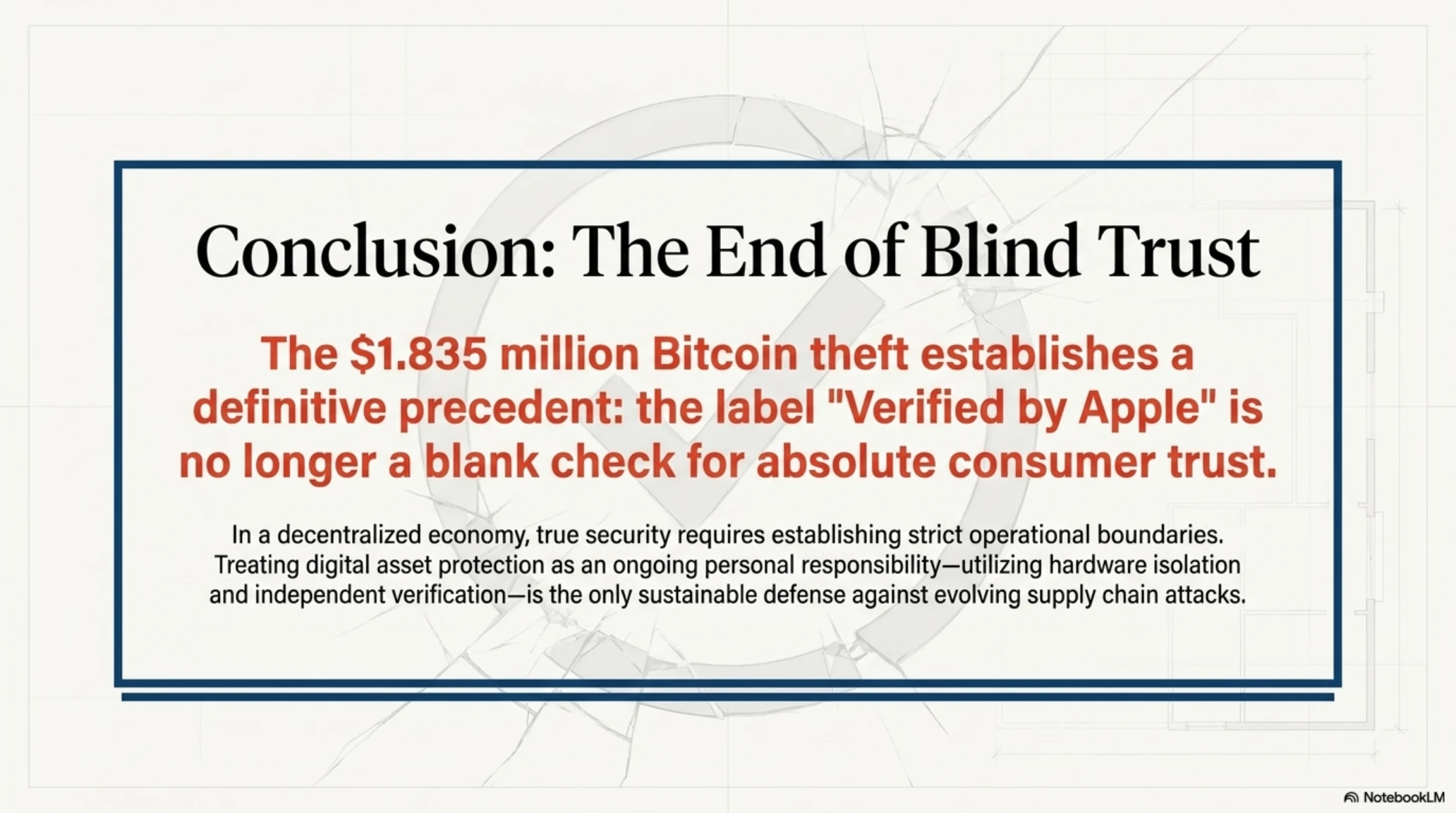
The $1.835 million Bitcoin theft executed through the fraudulent Sparrow Wallet app on Apple's App Store marks a definitive turning point in the history of digital platform security. The precedent is now established: the label "Verified by Apple" can no longer serve as a blank check for absolute consumer trust. In the modern financial ecosystem driven by decentralized assets and Web3 protocols, self-education and rigorous security hygiene represent the primary line of defense for individual sovereignty.
For technology giants like Apple, this federal lawsuit provides an unmistakable warning. Maintaining exclusive distribution monopolies over mobile operating systems while attempting to disclaim legal and financial liability for hosted malware is an unsustainable corporate strategy. Unless Apple fundamentally restructures its App Store curation workflows to incorporate specialized blockchain security verification, regulatory pressure to open iOS to third-party app distribution will become uncontainable globally.
Tekin’s analytical editorial division will maintain continuous tracking of the proceedings in the Northern District of California, delivering authoritative updates on court rulings, legal precedents, and broader systemic impacts on the global fintech industry.
The coming months will determine whether Apple elects to settle out of court or face a historic judicial ruling that redefines platform liability for mobile marketplaces worldwide.
Software developers must also heed the lessons of this crisis, establishing proactive brand monitoring systems to identify and report counterfeit software listings before malicious actors cause catastrophic financial harm to user communities.
Ultimately, empowering users through continuous security education remains the most effective countermeasure against evolving cyber threats in the digital age.
The global cryptocurrency community must foster rapid threat-sharing networks to detect and neutralize counterfeit wallet payloads before they achieve wide distribution on public app stores.
Direct communication channels between open-source project leads and app store security review teams are essential to prevent predatory brand impersonation.
It is hoped that this legal reckoning will compel mobile ecosystem operators to prioritize consumer safety over administrative convenience, ensuring a more secure digital future for all users.
As decentralized finance matures, the standards for mobile software curation must evolve accordingly, establishing rigorous benchmarks that protect user wealth while preserving technological innovation.
The resolution of this lawsuit will send clear signals across the tech industry regarding the responsibilities of platform operators in safeguarding consumer assets.
Tekin Radar remains committed to investigating cybersecurity breaches, software vulnerabilities, and regulatory shifts at the intersection of technology, finance, and consumer rights.
By demanding greater accountability from platform custodians and implementing robust personal security practices, the global gaming and crypto communities can build a resilient digital economy where innovation and security coexist seamlessly.
Looking ahead, the integration of hardware-based security keys and decentralized verification protocols will play a crucial role in preventing mobile supply chain attacks, safeguarding digital assets for future generations of users.
Furthermore, international regulatory bodies are closely observing the outcome of this case. If U.S. federal courts hold Apple accountable for App Store vetting failures, financial authorities in Europe, Japan, and South Korea are likely to enact mandatory security compliance frameworks for mobile application distributors operating within their borders.
This evolving legal landscape will force mobile platform vendors to invest heavily in continuous automated monitoring, cryptographic identity attestation, and transparent incident reporting systems.
Ultimately, the transformation of app store security from an opaque internal process into an open, auditable standard will benefit the global digital economy, ensuring that users can engage with financial technology without fearing predatory software exploits.
As the tech sector adapts to these heightened standards, individual users must remain vigilant, treating digital asset protection as an ongoing personal responsibility rather than delegating security entirely to platform providers.
By combining institutional accountability with proactive consumer education, the interactive entertainment and digital finance sectors can create a safer, more resilient environment for users worldwide.
Tekin Editorial Board will continue to provide in-depth analysis on cybersecurity developments, digital asset regulation, and platform governance to keep our global readership informed.
As mobile technology platforms integrate deeper into global commerce, enforcing strict standards of accountability will be vital to sustaining public trust in digital transformation.
This lawsuit serves as a watershed moment, reminding technology companies that long-term enterprise value depends on preserving user security and respecting global statutory laws.
Moving forward, the tech industry must embrace transparent, multi-stakeholder security governance to protect digital ecosystems against increasingly sophisticated cyber threats.
Independent security analysts universally agree that establishing auditable software curation standards represents the only sustainable pathway toward securing modern mobile platforms against predatory cybercrime networks.
Tekin's editorial division remains dedicated to reporting on these essential regulatory and technical shifts to empower our global audience.
Tekin Analysis: The Future of App Store Financial Curation
- Heightens global public awareness regarding mobile app store vetting vulnerabilities
- Forces Apple to reform developer verification and threat report responsiveness
- Accelerates legislative momentum to break centralized app distribution monopolies
- Irrecoverable $1.835M financial loss suffered by three cryptocurrency investors
- Erodes consumer confidence in mobile financial software ecosystems
- Increases regulatory compliance burdens for legitimate open-source developers
Final Conclusion & Industry Assessment
Related Industry Files on Tekin
• Tekin Morning | SpaceX Falcon 9 Record & Apple-OpenAI Lawsuit Breakdown
• Tekin Morning | Claude, Fable 5 & Apple WWDC Conference Coverage
• Tekin Analysis | Free Games List on PS Plus, Xbox Game Pass & Epic Games
Frequently Asked Questions: Apple App Store Bitcoin Heist
Why is Apple being sued over the fake Sparrow Wallet app?
For gross negligence in App Store review, ignoring warnings from the legitimate developer since 2024, and featuring the fake app in curated feeds.
Does Sparrow Wallet have an official mobile app for iOS or Android?
No. Sparrow Wallet is strictly desktop software for Windows, macOS, and Linux, and has never released a mobile app.
How did cybercriminals steal the victims' Bitcoin?
By tricking users into entering their 24-word Mnemonic Seed Phrases into the fake iOS app, which were exfiltrated to attacker-controlled C2 servers.
How can crypto holders protect themselves from fake mobile apps?
By downloading software exclusively via links on official open-source websites and never typing desktop seed phrases into mobile devices.
Sources & References
• Decrypt: Apple Sued After Fake iPhone Wallet App Drained $1.8M in Bitcoin
• MacRumors: Apple News, Lawsuits and iOS Ecosystem Updates
• 9to5Mac: Apple Intelligence and App Store Security Telemetry
• The Hacker News: Cyber Security and Malware Analysis Portal
Additional Gallery: Tekin Analysis | Ironclad Security Shattered: Fake App Store Wallet Drains $1.8M in Bitcoin