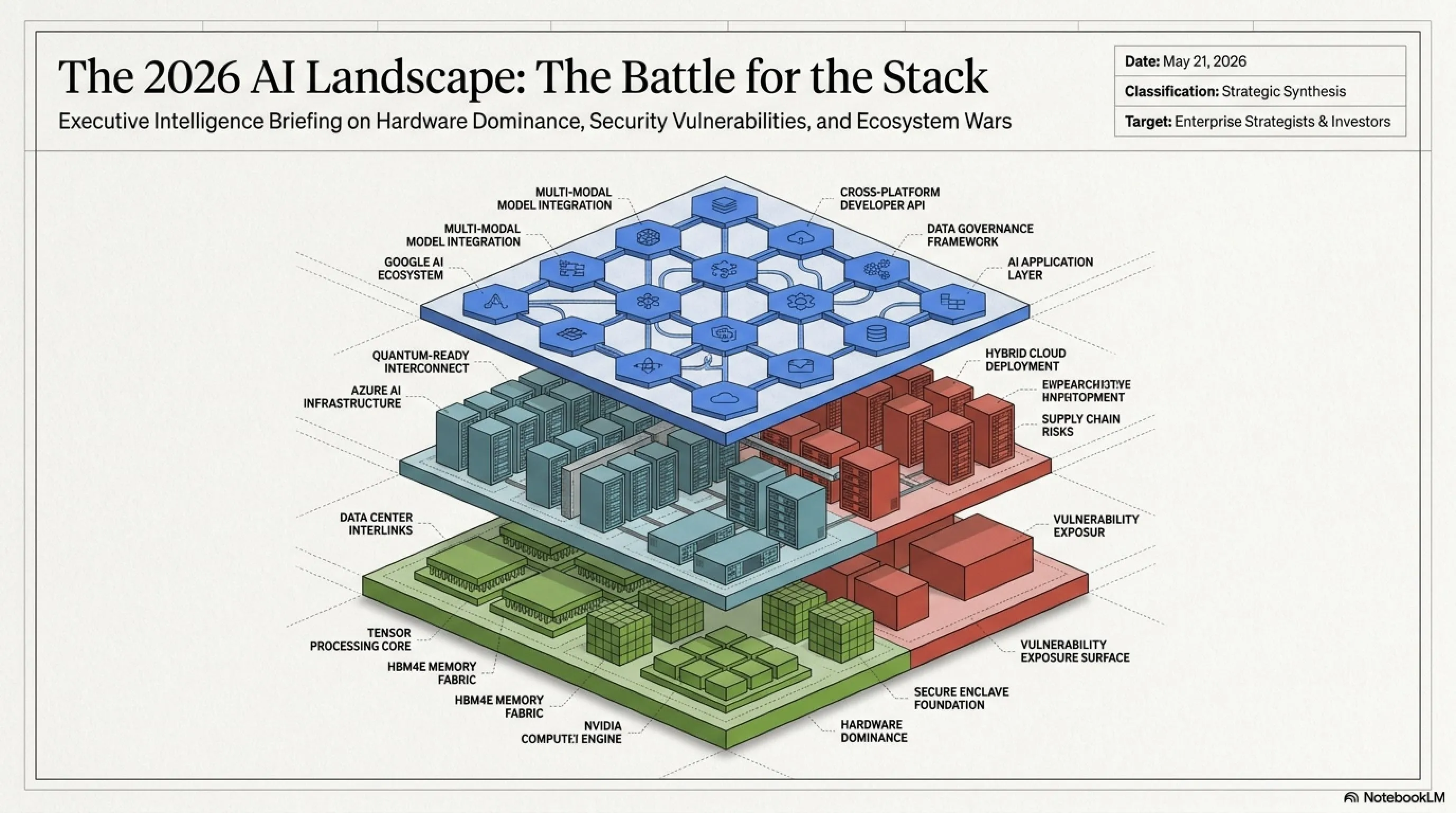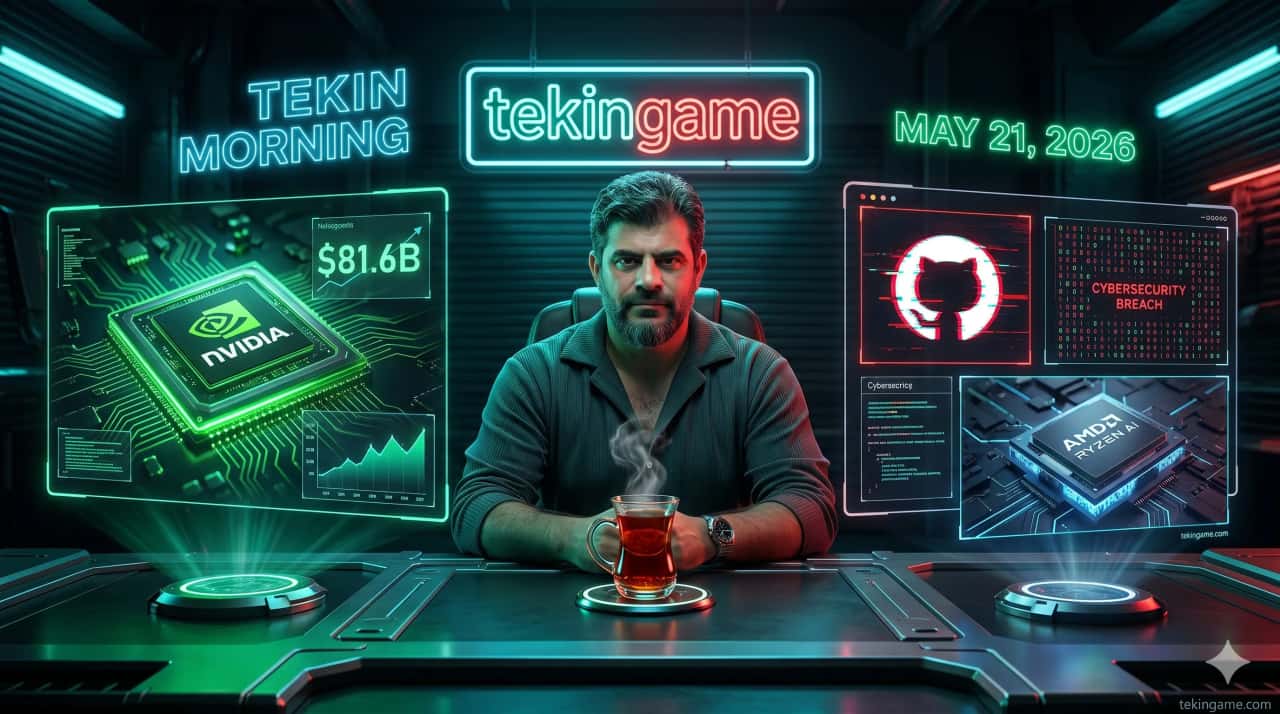
In the May 21, 2026 Tekin Morning briefing, we dissect six explosive tech stories. We analyze Nvidia's historic $81.6B revenue breaking all records, a massive GitHub supply chain hack compromising 3,800 repositories, and AMD's bold $3,999 Ryzen AI Halo PC launch. Furthermore, we explore Microsoft's new open-source AI security tools (RAMPART and Clarity), Google's Gemini 3.5 Flash and Android XR glasses from I/O, and the new Apple Handoff-like "Continue On" feature coming to Android 17.
🌅 Welcome to Tekin Morning - May 21, 2026
Good morning, tech enthusiasts! Today we're bringing you 6 explosive stories from the world of technology. From Nvidia's historic $81.6 billion revenue and $43 billion startup investment spree, to GitHub's devastating breach with 3,800 internal repositories stolen, AMD's $3,999 challenger to NVIDIA's dominance, Microsoft's open-source AI security tools, Google I/O 2026's massive announcements, and Android's shameless clone of Apple's Handoff feature!
⚡ Today's Headlines:
💰 Nvidia: Record $81.6B revenue + $43B startup investment portfolio
🔴 GitHub: Breached by TeamPCP, 3,800 internal repos stolen
🔵 AMD: Ryzen AI Halo PC at $3,999 challenges NVIDIA DGX Spark
🛡️ Microsoft: Open-sources RAMPART & Clarity for AI agent security
🤖 Google I/O 2026: Gemini 3.5 Flash, Android XR & Omni revolution
📱 Android 17: Continue On feature clones Apple's Handoff
☕ Grab your coffee and get ready for a comprehensive journey through today's tech landscape!
💰 Nvidia: Historic Record with $81.6B Revenue and Massive $43B Startup Investment Strategy
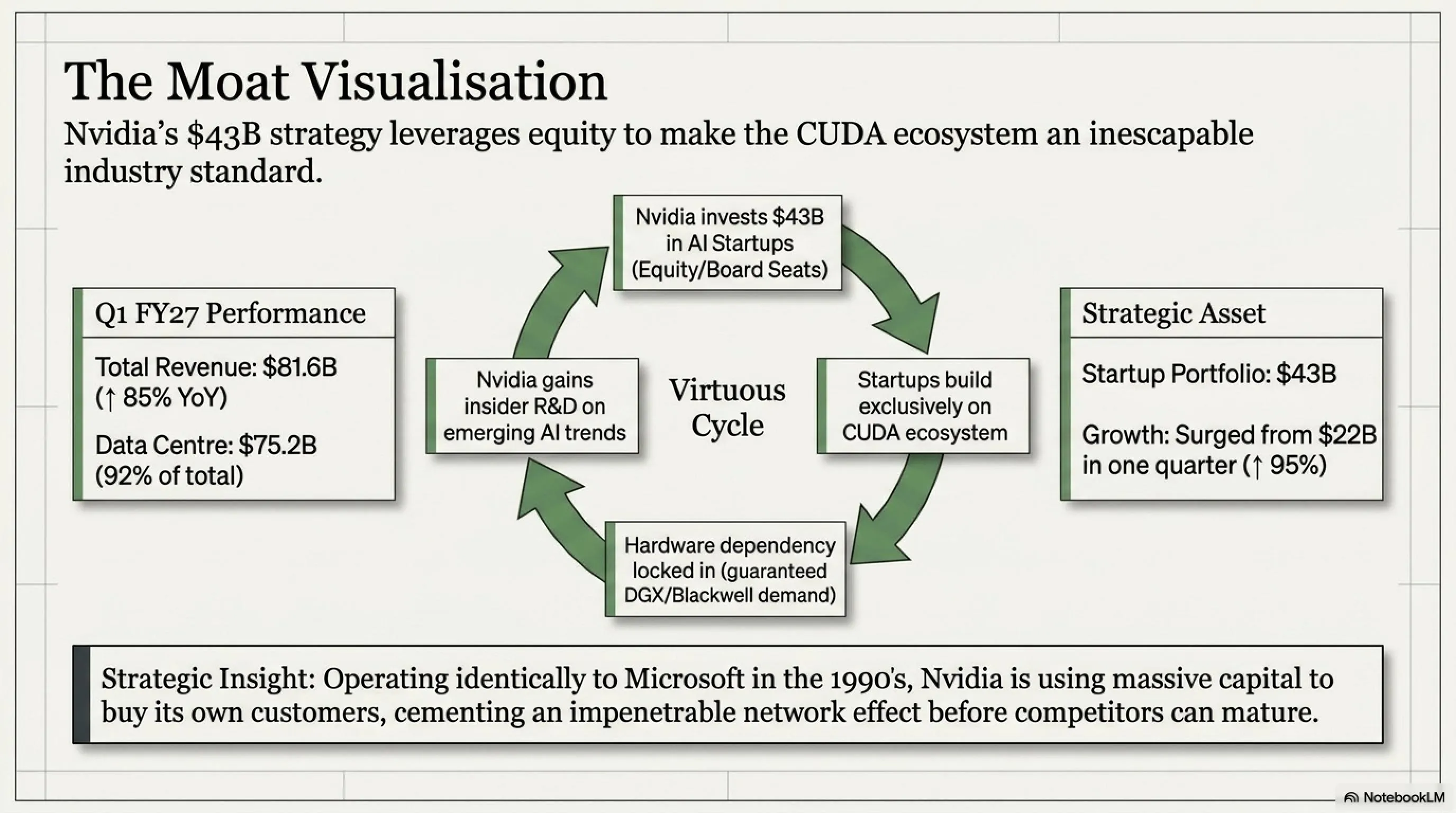
On May 20, 2026, after market close, Nvidia announced yet another historic quarter, reporting financial results for Q1 fiscal year 2027 (ending April 26, 2026). The chipmaking giant brought in a staggering $81.6 billion in revenue over those three months - up 20% from the previous quarter and an astronomical 85% year-over-year. This figure handily beat Wall Street's expectations of $78.9 billion, demonstrating that demand for Nvidia's AI chips remains at unprecedented levels despite growing competition and market saturation concerns.
The data center segment, which has become Nvidia's crown jewel, generated a record $75.2 billion in revenue - representing 92% of total revenue and up 92% year-over-year. This explosive growth is driven by insatiable demand from hyperscalers (Amazon, Microsoft, Google), cloud providers, and AI model makers who are racing to build out infrastructure for the next generation of artificial intelligence applications. Nvidia's Blackwell architecture, which CEO Jensen Huang described as being "everywhere," has been adopted by every major player in the AI ecosystem.
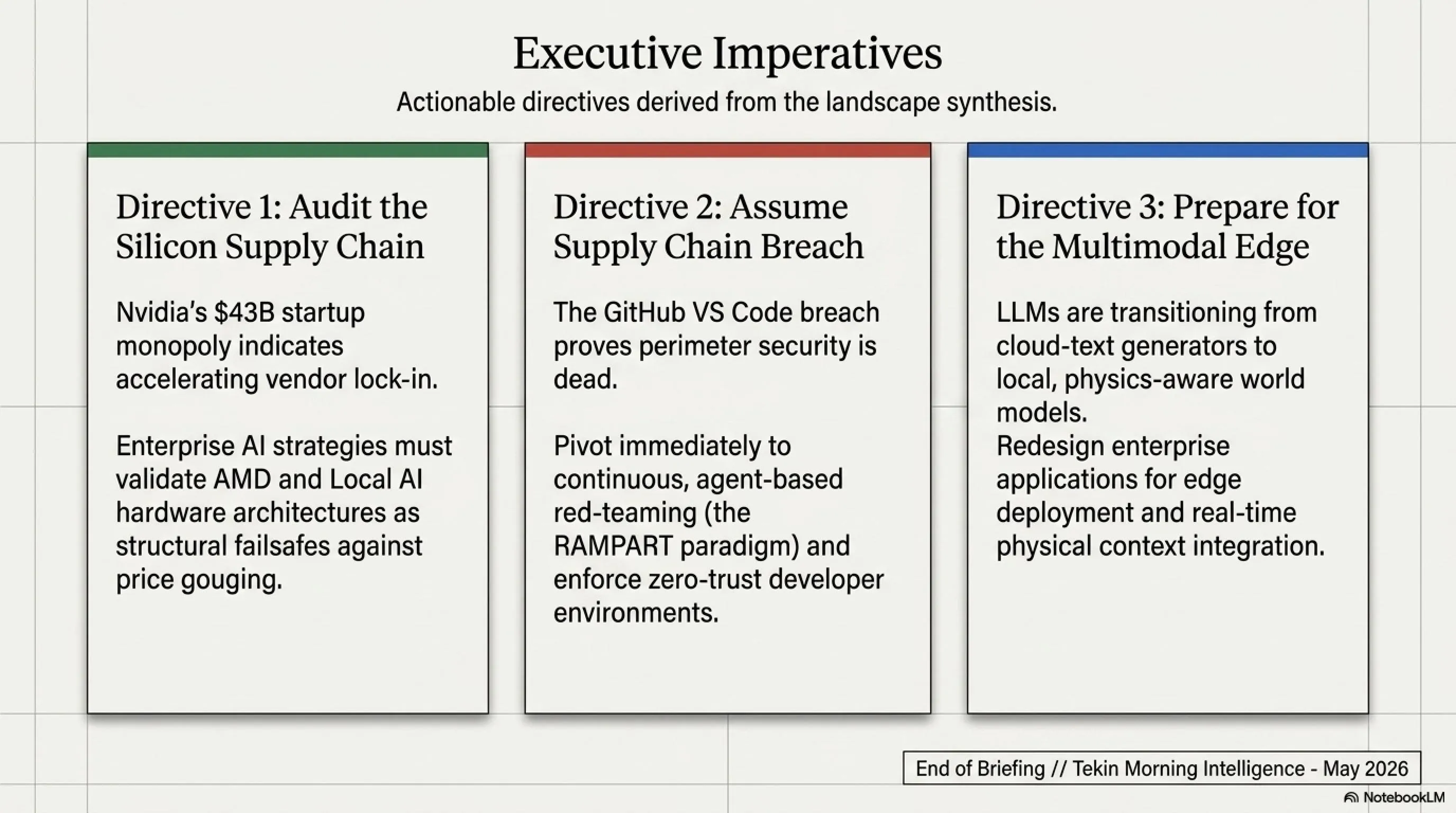
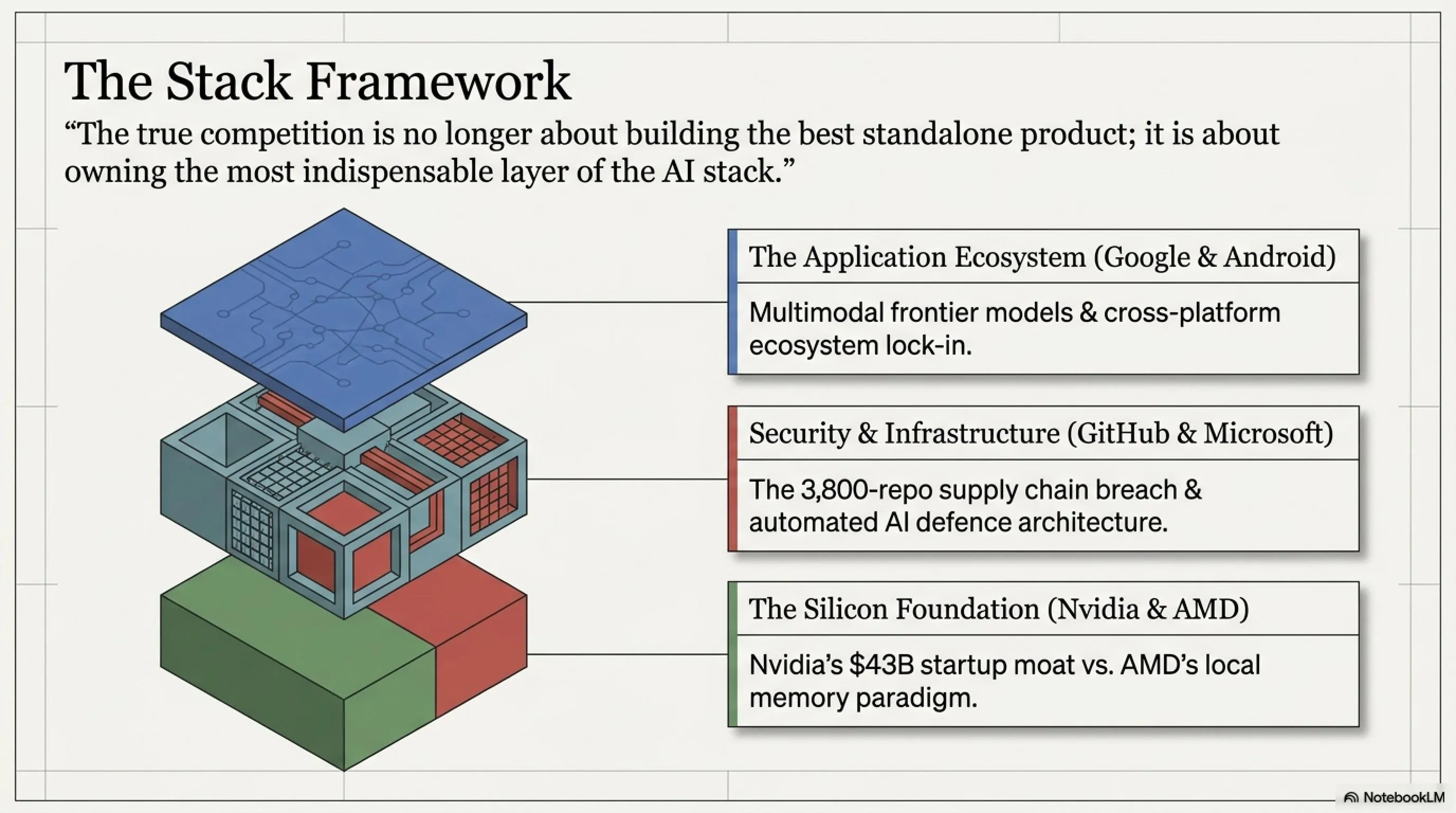
But the most surprising revelation in Nvidia's earnings report wasn't the revenue figures - it was the disclosure of the company's massive and rapidly growing investment portfolio in private startups. According to the financial filings, Nvidia's holdings in privately held companies (listed as "non-marketable equity securities") nearly doubled in a single quarter, surging from $22 billion in January to $43 billion by April. This dramatic increase was driven primarily by $18.5 billion in new purchases during the quarter - a 28x increase compared to the previous quarter's $649 million in acquisitions.
📊 Nvidia Q1 FY2027 Key Metrics
The Strategic Implications of Nvidia's $43B Investment Portfolio
Nvidia's $43 billion investment portfolio represents far more than just financial diversification - it's a calculated strategy to cement the company's dominance across the entire AI ecosystem. By taking equity stakes in companies that use its chips, Nvidia creates a virtuous cycle: these startups become dependent on Nvidia's hardware, driving demand for GPUs, while Nvidia gains insider knowledge of emerging AI trends and applications. This approach mirrors Microsoft's strategy in the 1990s with Windows, but operates at a much larger scale and faster pace.
The investment portfolio notably doesn't include Nvidia's stakes in publicly traded companies like Corning and IREN, nor does it reflect future commitments that haven't closed yet. Most significantly, it doesn't fully account for Nvidia's $30 billion commitment to OpenAI announced in February 2026, though the precise structure of that deal remains undisclosed. During the earnings call, CEO Jensen Huang also highlighted a major upcoming buildout with Anthropic, stating: "The amount of capacity we're going to bring online for Anthropic this year and next year is going to be quite significant. Our coverage for Anthropic had been largely zero until this."
This aggressive investment strategy serves multiple purposes. First, it locks in demand for Nvidia's chips by ensuring that the most promising AI startups are financially tied to the company. Second, it gives Nvidia unprecedented visibility into the future direction of AI development, allowing the company to design chips that meet real-world needs rather than speculative requirements. Third, it creates significant barriers to entry for competitors like AMD and Intel, who lack both the financial resources and the ecosystem relationships to replicate this strategy. Fourth, it positions Nvidia to capture value not just from selling chips, but from the success of the entire AI industry.
🔍 Tekin Analysis: Nvidia's Vertical Integration Strategy
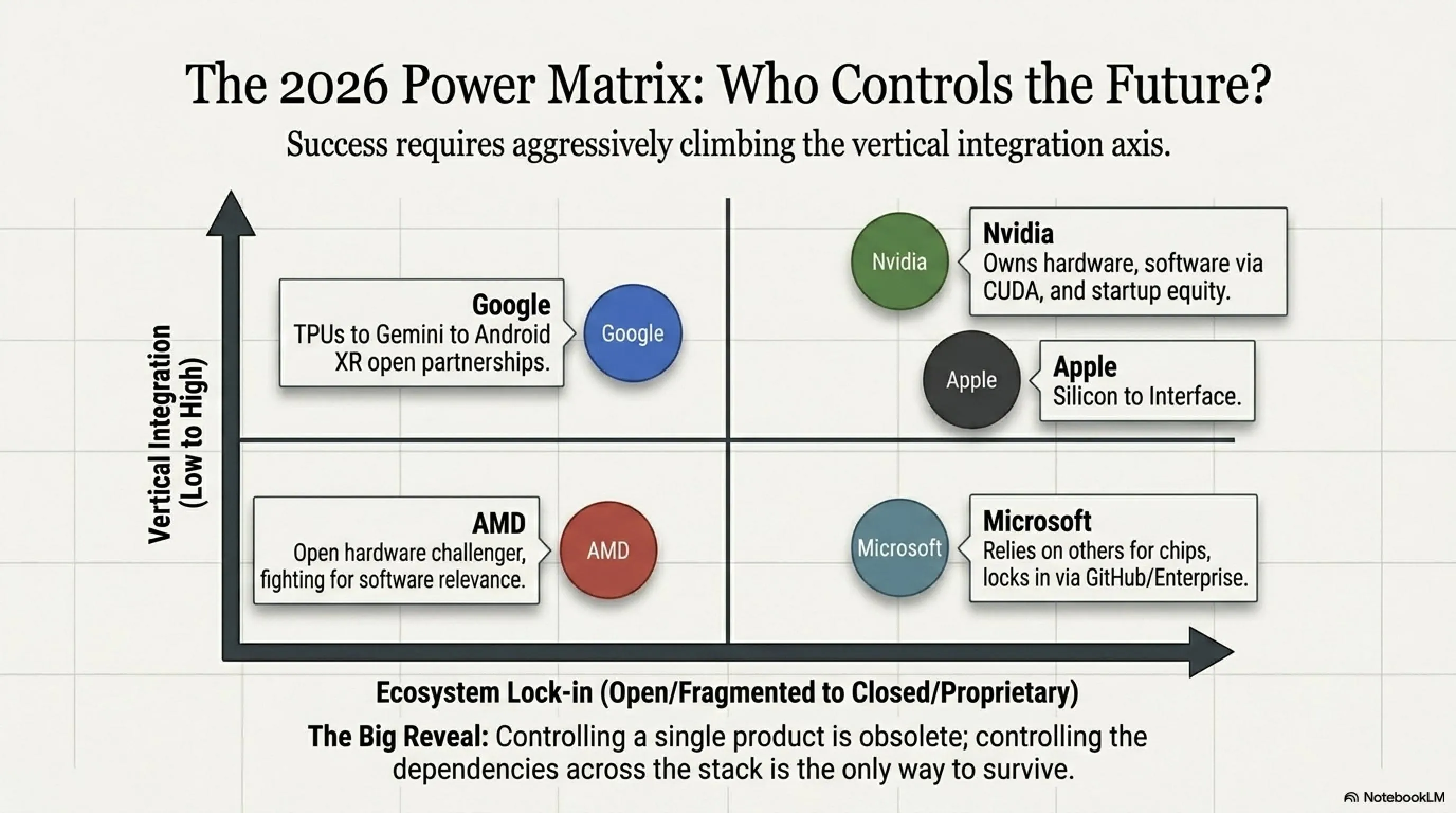
Nvidia's $43 billion investment portfolio isn't just about financial returns - it's about building an impenetrable moat around its AI empire. By investing in companies across the entire AI stack (from infrastructure providers to application developers), Nvidia ensures that its CUDA ecosystem remains the de facto standard for AI development. This creates a powerful network effect: the more companies build on Nvidia's platform, the more valuable the platform becomes, which attracts even more developers and startups.
Compare this to Intel's missed opportunity in mobile computing. Intel had the technology and resources to dominate smartphone chips but failed to build the ecosystem partnerships that would have made its architecture the standard. Nvidia is determined not to repeat that mistake. By taking equity stakes in the most promising AI startups, Nvidia gains board seats, strategic influence, and early access to emerging use cases that inform its chip roadmap.
What This Means for Investors: Nvidia's investment strategy suggests the company expects AI infrastructure spending to remain elevated for years to come. The $43 billion portfolio represents a bet that today's AI startups will become tomorrow's tech giants - and that Nvidia will profit both from selling them chips and from their eventual IPOs or acquisitions. However, this strategy also concentrates risk: if the AI bubble bursts, Nvidia could face significant write-downs on these investments.
Revenue Growth Deceleration: A Cause for Concern?
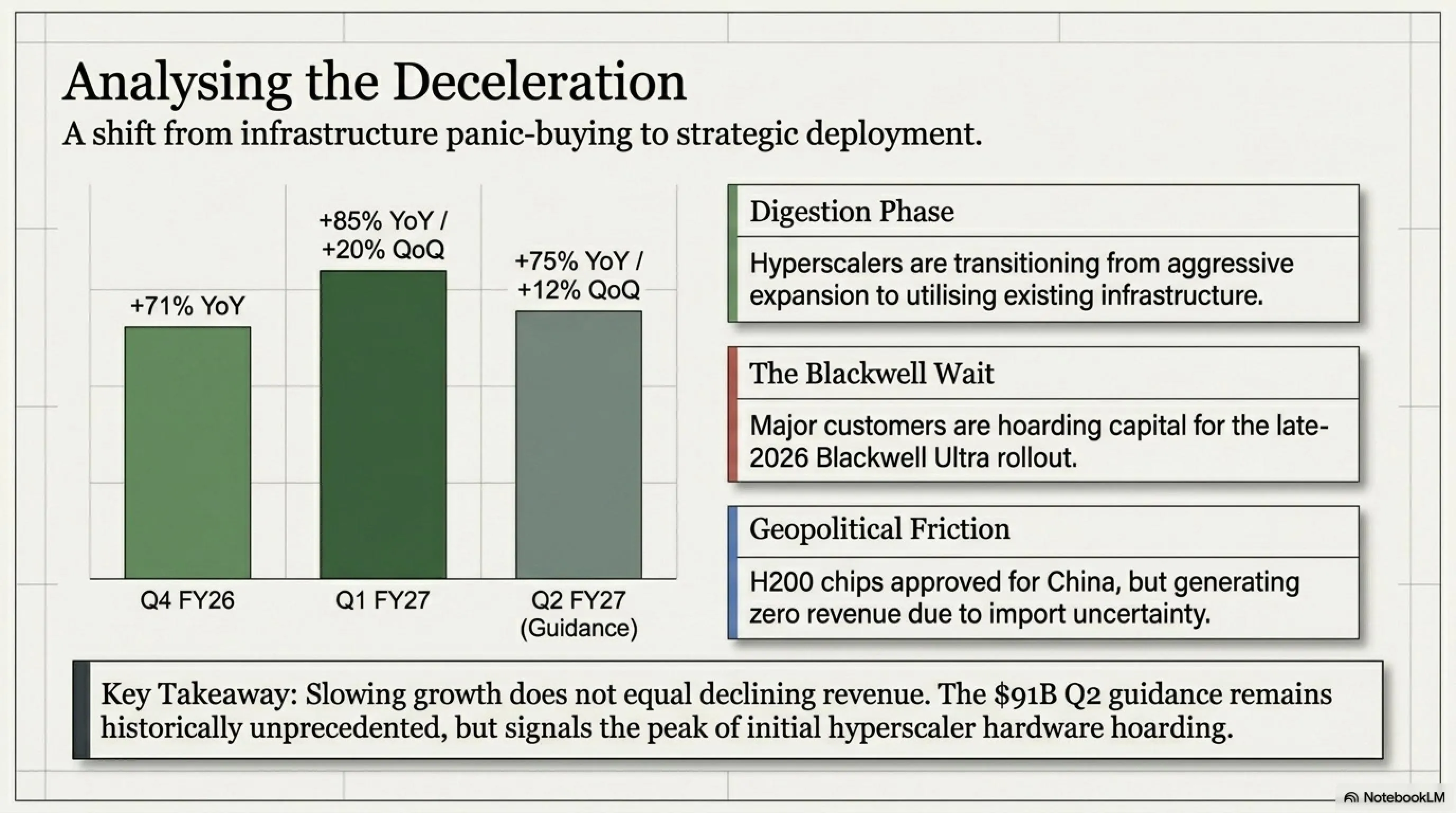
Despite the record-breaking quarter, Nvidia's guidance for Q2 suggests that revenue growth is beginning to moderate. The company forecasts approximately $91 billion in revenue for the next quarter, representing 12% sequential growth - a significant deceleration from the 20% growth achieved in Q1. While $91 billion is still an astronomical figure that exceeds analyst expectations, the slowing growth rate has raised questions about whether we're approaching peak AI infrastructure spending.
Several factors could explain this deceleration. First, many large tech companies have already made massive investments in AI infrastructure over the past two years and may be entering a digestion phase where they focus on utilizing existing capacity rather than expanding it. Second, some customers may be waiting for the full rollout of Blackwell Ultra chips, expected in late 2026, before making their next major purchases. Third, competitive pressure from AMD's MI300 series and Intel's Gaudi 3 chips is beginning to materialize, potentially capturing some market share at the margins.
CFO Colette Kress addressed concerns about Chinese exports during the earnings call, noting that while H200 chips have been approved for U.S. export to China, "we have yet to generate any revenue, and we are uncertain whether any imports will be allowed into [China]." This suggests that geopolitical tensions continue to limit Nvidia's addressable market, though the company's dominance in other regions more than compensates for this constraint.
💡 Important Note: Slowing growth doesn't mean declining revenue! Nvidia is still growing rapidly, just at a slower rate. This is natural as the revenue base becomes larger - maintaining 85% year-over-year growth on an $80+ billion quarterly run rate would be unprecedented in tech history. The key question is whether this deceleration continues or stabilizes.
🔴 GitHub Breached: TeamPCP Hackers Steal 3,800 Internal Repositories via Poisoned VS Code Extension
In one of the most significant security incidents of 2026, GitHub (owned by Microsoft) confirmed on May 20 that it had fallen victim to a sophisticated supply chain attack that resulted in unauthorized access to its internal repositories. The notorious hacking group TeamPCP - responsible for a series of recent supply chain attacks targeting open-source packages - claimed responsibility for the breach and listed GitHub's source code and internal organizations for sale on a cybercrime forum with an asking price of at least $50,000.
GitHub officially confirmed that approximately 3,800 internal repositories were exfiltrated in the attack. In a statement, the company said: "While we currently have no evidence of impact to customer information stored outside of GitHub's internal repositories (such as our customers' enterprises, organizations, and repositories), we are closely monitoring our infrastructure for follow-on activity." The company emphasized that it would notify customers through established incident response channels if any impact is discovered.
Attack Vector: Poisoned VS Code Extension
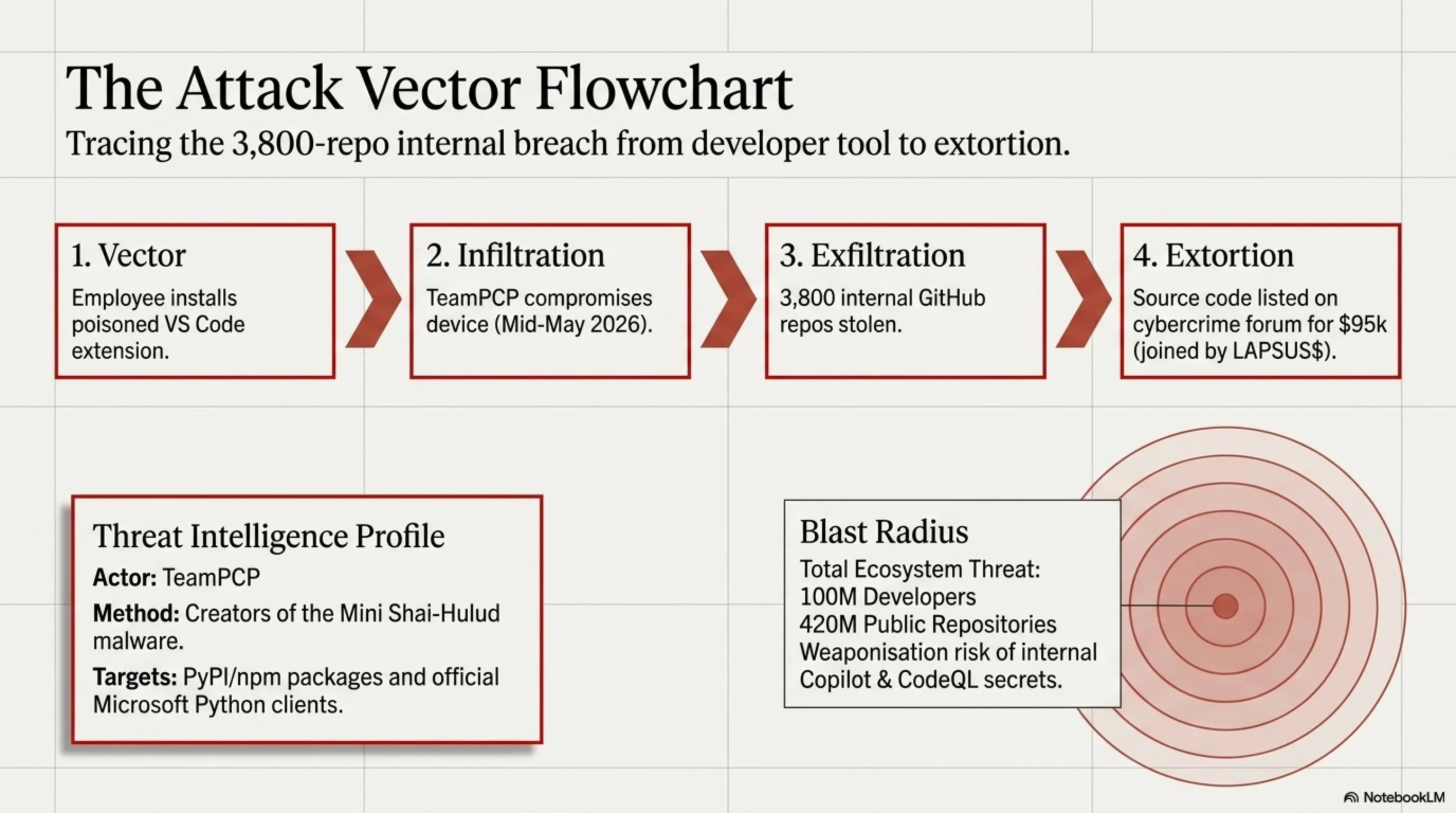
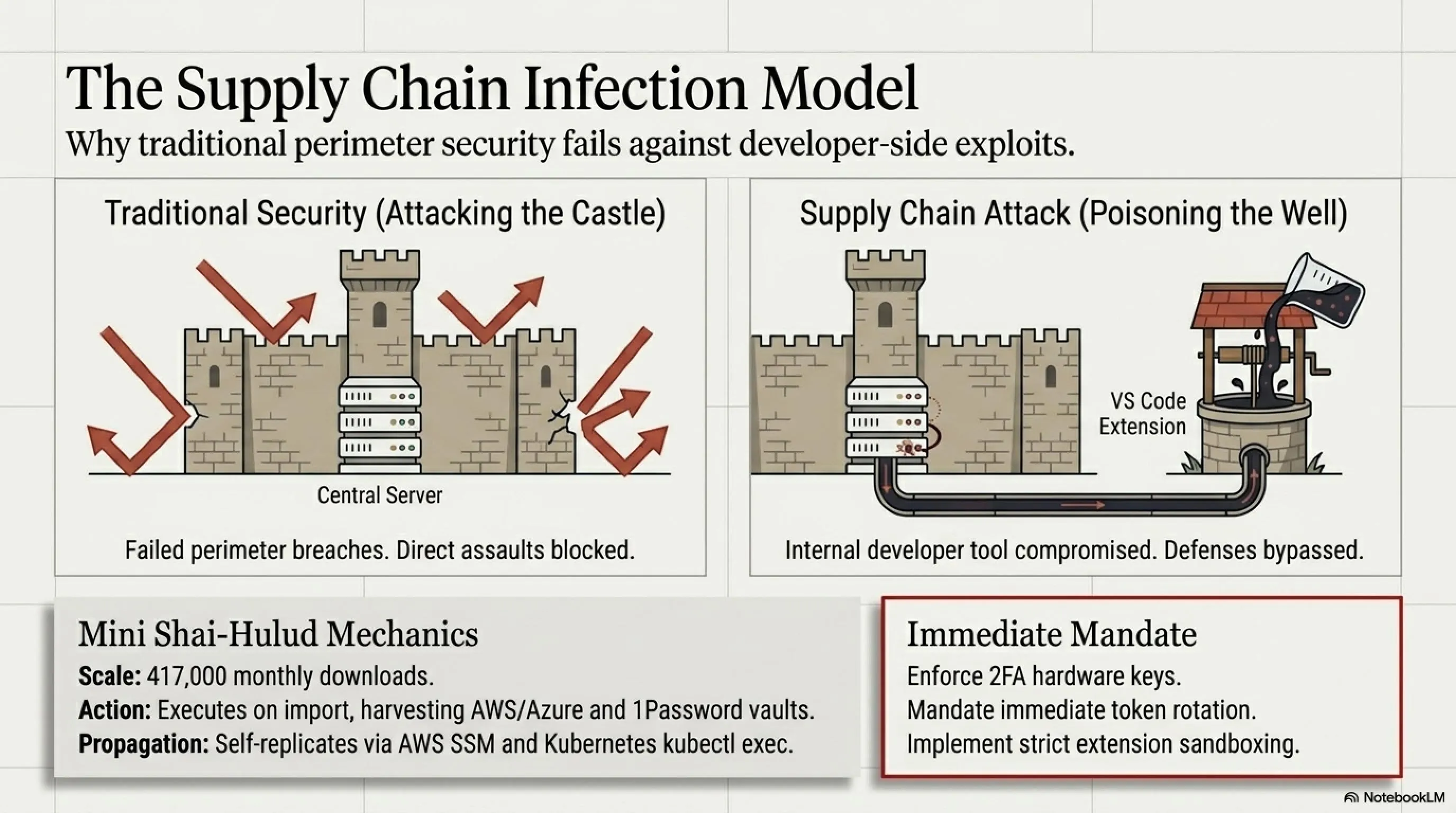
In a follow-up disclosure on X (formerly Twitter), GitHub revealed that the breach originated from a compromised employee device that had installed a malicious Microsoft Visual Studio Code extension. This represents a classic supply chain attack technique where adversaries target developer tools rather than directly attacking production systems. By compromising a single developer's workstation, the attackers gained access to GitHub's internal code repositories, deployment scripts, and configuration files.
Upon detecting the intrusion, GitHub immediately initiated risk mitigation measures, rotating all critical secrets and prioritizing high-impact credentials. The company stated: "Our current assessment is that the activity involved exfiltration of GitHub-internal repositories only. The attacker's current claims of ~3,800 repositories are directionally consistent with our investigation so far." While GitHub did not disclose the specific VS Code extension involved, security researchers noted that the Nx Console extension had recently suffered a similar compromise.
⚠️ Timeline of the GitHub Breach
| Date | Event |
|---|---|
| Early May 2026 | GitHub employee installs poisoned VS Code extension |
| May 15-18, 2026 | TeamPCP compromises employee device and steals credentials |
| May 18-19, 2026 | Exfiltration of 3,800 GitHub internal repositories |
| May 20, 2026 (AM) | TeamPCP lists GitHub source code for sale on cybercrime forum |
| May 20, 2026 (PM) | GitHub officially confirms the breach |
| May 20, 2026 (Night) | LAPSUS$ joins TeamPCP, raising price to $95,000 |
TeamPCP: The Supply Chain Attack Specialists
TeamPCP has emerged as one of the most prolific and dangerous threat actors in the supply chain attack landscape. The group is responsible for creating and distributing the Mini Shai-Hulud self-replicating malware, which spreads through poisoned packages in PyPI, npm, and other package registries. In recent weeks, TeamPCP has compromised legitimate packages including guardrails-ai and durabletask (an official Microsoft Python client).
The Mini Shai-Hulud malware is a sophisticated infostealer capable of harvesting credentials from major cloud providers (AWS, Azure, GCP), password managers (1Password, Bitwarden), and developer tools. The malware also features self-propagation capabilities, spreading through AWS SSM to other EC2 instances or via kubectl exec in Kubernetes environments. According to security researchers, the malware is downloaded approximately 417,000 times per month and executes automatically upon import with no visible signs of compromise.
🔍 Tekin Analysis: Why the GitHub Breach Is So Dangerous
The GitHub breach isn't just another security incident - it's a strategic threat to the entire global software ecosystem. GitHub hosts over 100 million developers and 420 million repositories. If hackers have access to GitHub's internal source code, they can discover zero-day vulnerabilities and use them for widespread attacks. The 3,800 internal repositories likely contain sensitive information including GitHub's security architecture, internal tools, and code related to GitHub Actions, Copilot, CodeQL, and Dependabot.
This information could enable attackers to design sophisticated attacks that target not just GitHub, but millions of open-source projects that depend on it. The breach also highlights a fundamental vulnerability in the developer tools ecosystem: VS Code extensions have become a prime attack vector because they run with elevated privileges and have access to sensitive data. Microsoft needs to implement stronger vetting processes for extensions, including mandatory code reviews and runtime sandboxing.
What Developers Should Do Now: Immediately rotate all GitHub tokens and passwords. Enable two-factor authentication (2FA) with hardware keys if possible. Review your installed VS Code extensions and remove any that aren't essential. Never commit secrets directly to repositories - use GitHub Secrets or HashiCorp Vault. Implement code scanning tools like Dependabot and Snyk to detect vulnerabilities. Most importantly, assume that any code in public repositories could be compromised and implement defense-in-depth strategies.
🔵 AMD Ryzen AI Halo PC: The $3,999 NVIDIA Challenger with 192GB Unified Memory
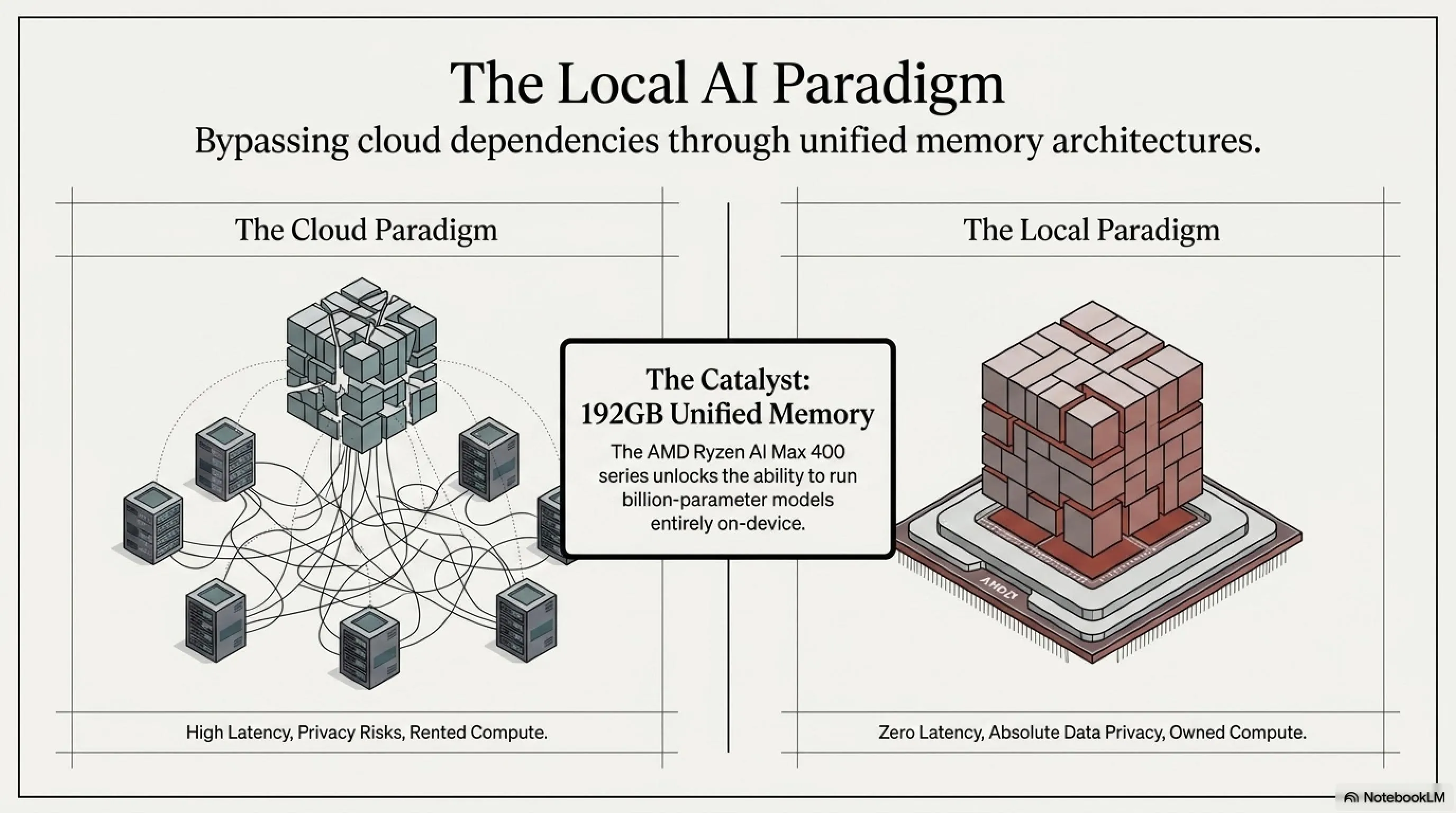
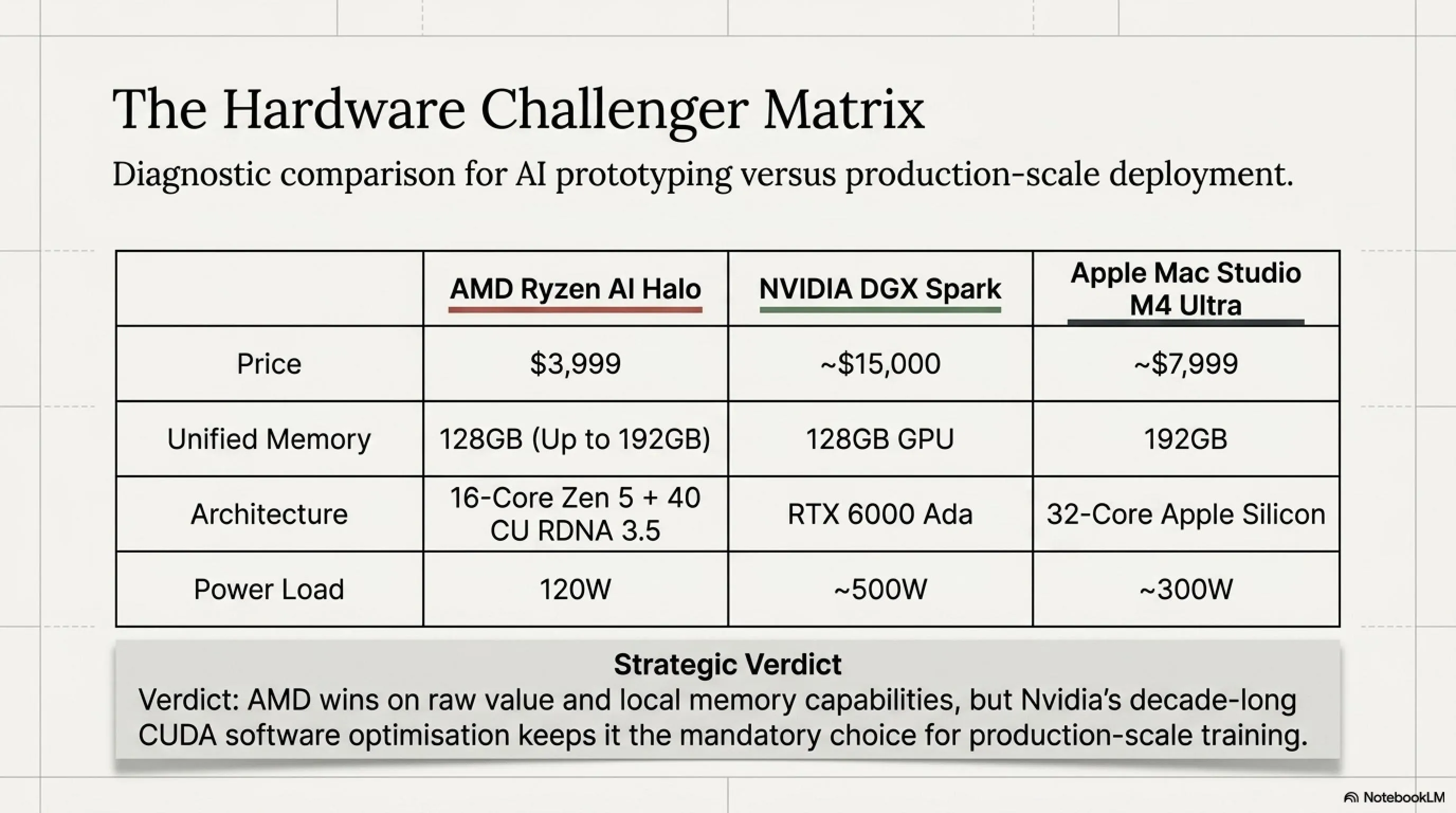
On May 21, 2026, AMD announced pricing and availability details for its Ryzen AI Halo PC - a Mac Mini-sized system designed for heavy AI workloads. First unveiled at CES 2026, the system will launch with a starting price of $3,999 and pre-orders will open in June 2026. AMD is positioning this product as a direct competitor to NVIDIA's DGX Spark (which costs around $15,000), offering a more affordable entry point for AI developers and researchers who want to run large language models locally without relying on cloud services.
The Ryzen AI Halo PC is powered by the Ryzen AI Max+ 395 processor (codenamed Strix Halo) and packs impressive specifications into a compact 5.9" × 5.9" × 1.7" (150 × 150 × 43mm) form factor. The system features 16 CPU cores based on the Zen 5 architecture, a 40-compute-unit integrated GPU based on RDNA 3.5, and an NPU based on XDNA 2. The base configuration includes 128GB of unified memory and a 2TB NVMe Gen 4 SSD, all powered by a 120W TDP design that emphasizes energy efficiency.
⚙️ AMD Ryzen AI Halo PC Technical Specifications
Ryzen AI Max 400: Next-Gen with 192GB Memory
In addition to the base model, AMD also unveiled the Ryzen AI Max 400 series (codenamed Gorgon Halo), scheduled for release in late 2026. These chips represent a minor refresh of the Strix Halo family, using Zen 5 CPU cores and RDNA 3.5 GPU cores alongside an XDNA 2 NPU. The flagship Ryzen AI Max+ Pro 495 features a 100MHz clock speed bump over the Ryzen AI Max+ 395, allowing it to boost up to 5.2 GHz.
The most significant feature of the Ryzen AI Max 400 series is support for 192GB of unified memory. This amount of memory enables AI developers to run larger language models locally without needing cloud connectivity. For comparison, the MacBook Pro with M4 Max chip maxes out at 128GB of unified memory, and NVIDIA's DGX Spark ships with 128GB of GPU memory. The ability to run models with billions of parameters entirely on-device opens up new possibilities for privacy-sensitive applications and offline AI development.
🔍 Tekin Analysis: Can AMD Break Nvidia's Stranglehold?
The Ryzen AI Halo PC represents AMD's boldest challenge to Nvidia's AI dominance yet, but can it actually succeed? The answer is nuanced. On price, AMD is the clear winner - at $3,999 versus $15,000 for NVIDIA DGX Spark, the value proposition is compelling. The 192GB unified memory is also a significant advantage for running large language models locally. However, Nvidia still leads decisively in software and ecosystem maturity.
CUDA, cuDNN, TensorRT, and other Nvidia tools have been optimized for over a decade, and most AI frameworks (PyTorch, TensorFlow, JAX) are built with Nvidia in mind. AMD's ROCm has improved significantly, but it still lags in compatibility and performance. For specific use cases like developing and testing smaller AI models, the Ryzen AI Halo could be excellent. But for training large models at production scale, Nvidia remains the first choice for most organizations.
The Real Competition: AMD's true competition isn't just Nvidia - it's also Apple's M-series chips and custom AI accelerators from Google (TPU), Amazon (Trainium), and Microsoft (Maia). The AI hardware market is fragmenting, with each major cloud provider building its own silicon to reduce dependence on Nvidia. AMD's challenge is to position itself as the best alternative for companies that want Nvidia-class performance without Nvidia prices or lock-in.
🛡️ Microsoft Open-Sources RAMPART and Clarity: Security Tools for AI Agents
On May 20, 2026, Microsoft unveiled two new open-source tools called RAMPART and Clarity designed to help developers better test the security of artificial intelligence (AI) agents during the development process. These tools arrive at a critical moment when the use of AI agents - autonomous AI systems that can perform complex tasks without human supervision - is rapidly accelerating, and security concerns are growing proportionally.
RAMPART: Continuous Security Testing Framework
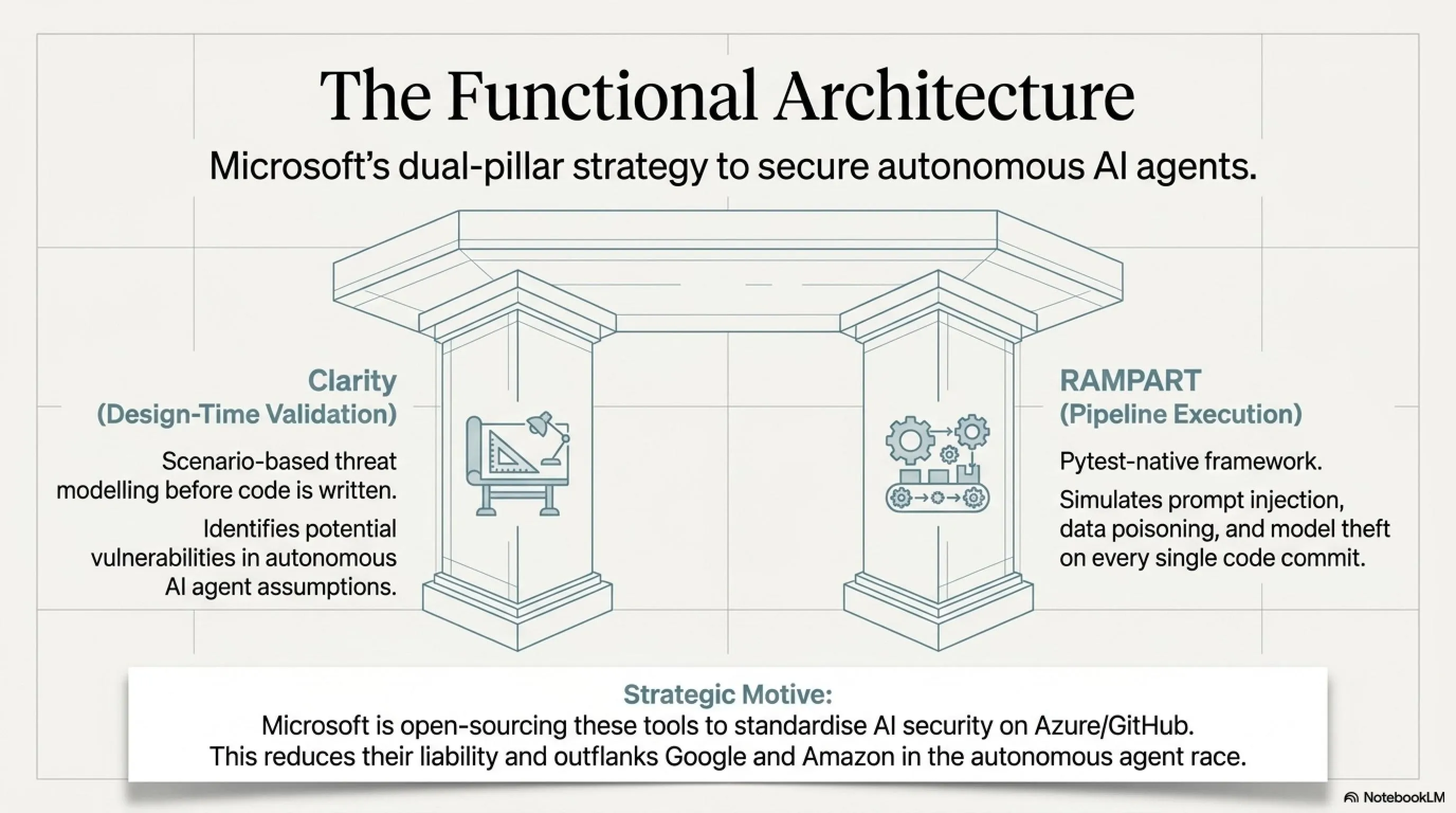
RAMPART (Risk Assessment and Measurement Platform for Agentic Red Teaming) is a Pytest-native security testing framework that embeds AI red-teaming techniques into the development workflow. Instead of relying on one-time security reviews, RAMPART enables teams to create repeatable tests that simulate both normal and adversarial scenarios, including attacks like prompt injection, data poisoning, and model theft.
The tool allows developers to continuously check the safety of AI agents as they build and update them. RAMPART integrates seamlessly with CI/CD pipelines, running automated security tests with every code commit. This means that any new vulnerabilities introduced during development are immediately detected, rather than discovered months later in production. The framework supports custom test scenarios and can be extended to cover organization-specific security requirements.
Clarity: Design-Time Security Validation
Clarity complements RAMPART by helping developers validate AI agent design assumptions before implementation begins. The tool uses a scenario-based approach that enables teams to analyze different use cases and identify potential weaknesses early in the development cycle. By thinking through security threats during the design phase, teams can build more secure systems from the ground up rather than retrofitting security after the fact.
These tools address the top risks identified by OWASP (Open Web Application Security Project) for AI agents, including prompt injection, data poisoning, model theft, denial of service, and supply chain vulnerabilities. Microsoft's decision to open-source both tools reflects a broader industry recognition that AI security is a shared challenge requiring collaborative solutions rather than proprietary approaches.
🔐 Key Features of RAMPART and Clarity
RAMPART
- Pytest-native framework
- Repeatable security tests
- CI/CD integration
- Prompt injection simulation
- Automated testing on every commit
Clarity
- Design assumption validation
- Pre-implementation threat analysis
- Scenario-based approach
- Potential weakness identification
- Risk mitigation strategies
🔍 Tekin Analysis: Why Microsoft Open-Sourced These Tools
Microsoft's decision to open-source RAMPART and Clarity is a shrewd strategic move. First, by providing free security tools, Microsoft positions itself as a responsible AI leader and builds trust with the developer community. Second, by standardizing security testing methodologies, Microsoft ensures that AI agents built on Azure and GitHub are more secure from the start, reducing the company's liability exposure.
Third, this move helps Microsoft stay ahead of Google and Amazon in the AI agent race. Both competitors are also developing AI agents, but neither has released comprehensive security tools like RAMPART and Clarity. Fourth, by open-sourcing these tools, Microsoft benefits from the open-source community - developers worldwide can report bugs, add features, and improve the tools, creating a virtuous cycle of continuous improvement.
🤖 Google I/O 2026: Gemini 3.5 Flash, Android XR, and the AI Revolution
Google's annual developer conference, I/O 2026, took place on May 19-20 and delivered a tidal wave of new Gemini-powered features across Google's biggest products and services. The nearly two-hour keynote was packed with product announcements and feature reveals that demonstrate Google's transformation into an AI-first company. From advanced language models to smart glasses, Google showed it's not backing down in the fierce competition with OpenAI, Microsoft, and Anthropic.
Gemini 3.5 Flash: Faster, Smarter, More Powerful
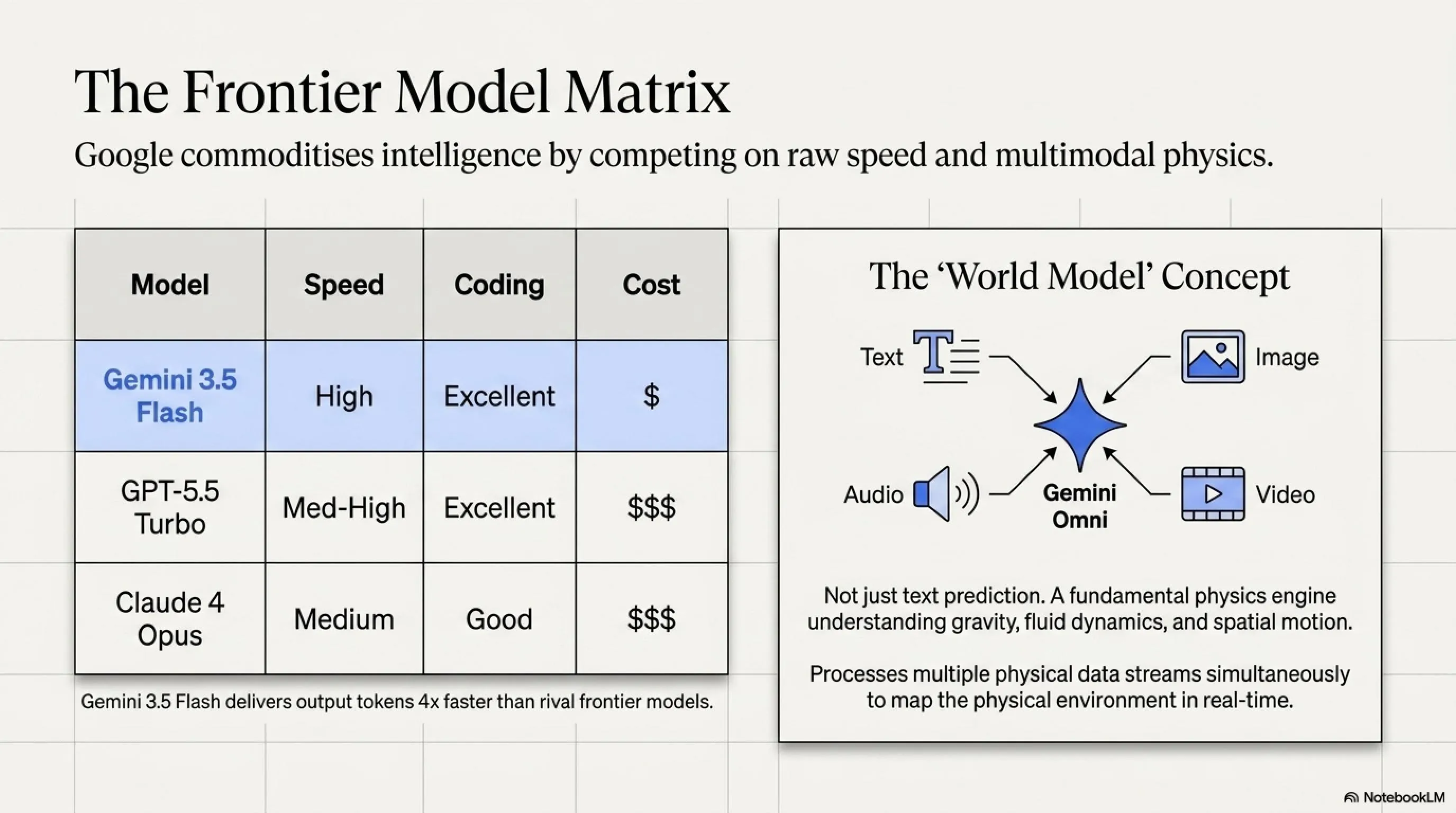
The centerpiece of Google I/O 2026 was the unveiling of Gemini 3.5 Flash - an advanced language model that combines frontier intelligence with the ability to perform agentic tasks. According to Google, Gemini 3.5 Flash surpasses Gemini 3.1 Pro in coding, agentic, and multimodal benchmarks while maintaining the cost and speed characteristics of the Flash series - delivering output tokens 4x faster than other frontier models.
Beyond Gemini 3.5 Flash, Google also introduced Gemini Omni - a next-generation AI system described as a powerful "world model" designed to understand and generate content across multiple formats. Demis Hassabis, CEO of Google DeepMind, described Gemini Omni as a major step forward in the journey toward artificial general intelligence (AGI). Unlike standard AI video generators that rely primarily on text prompts, Gemini Omni can process text, images, audio, and video references together to create more lifelike outputs.
Google claims the model has a deeper understanding of real-world physics concepts such as motion, gravity, fluid dynamics, and energy interactions, helping it produce more natural-looking visual content. The first release in the lineup, Gemini Omni Flash, is now becoming available for Google AI Plus, Pro, and Ultra subscribers through the Gemini app and Google Flow. Google is also integrating the model into YouTube Shorts and YouTube Create.
⚡ Advanced Language Model Comparison (May 2026)
| Model | Speed | Coding | Price |
|---|---|---|---|
| Gemini 3.5 Flash | ⚡⚡⚡⚡ | Excellent | $$$ |
| GPT-5.5 Turbo | ⚡⚡⚡ | Excellent | $$$$ |
| Claude 4 Opus | ⚡⚡ | Good | $$$$$ |
| Gemini 3.1 Pro | ⚡⚡⚡ | Good | $$$$ |
Android XR: Smart Glasses in Partnership with Samsung
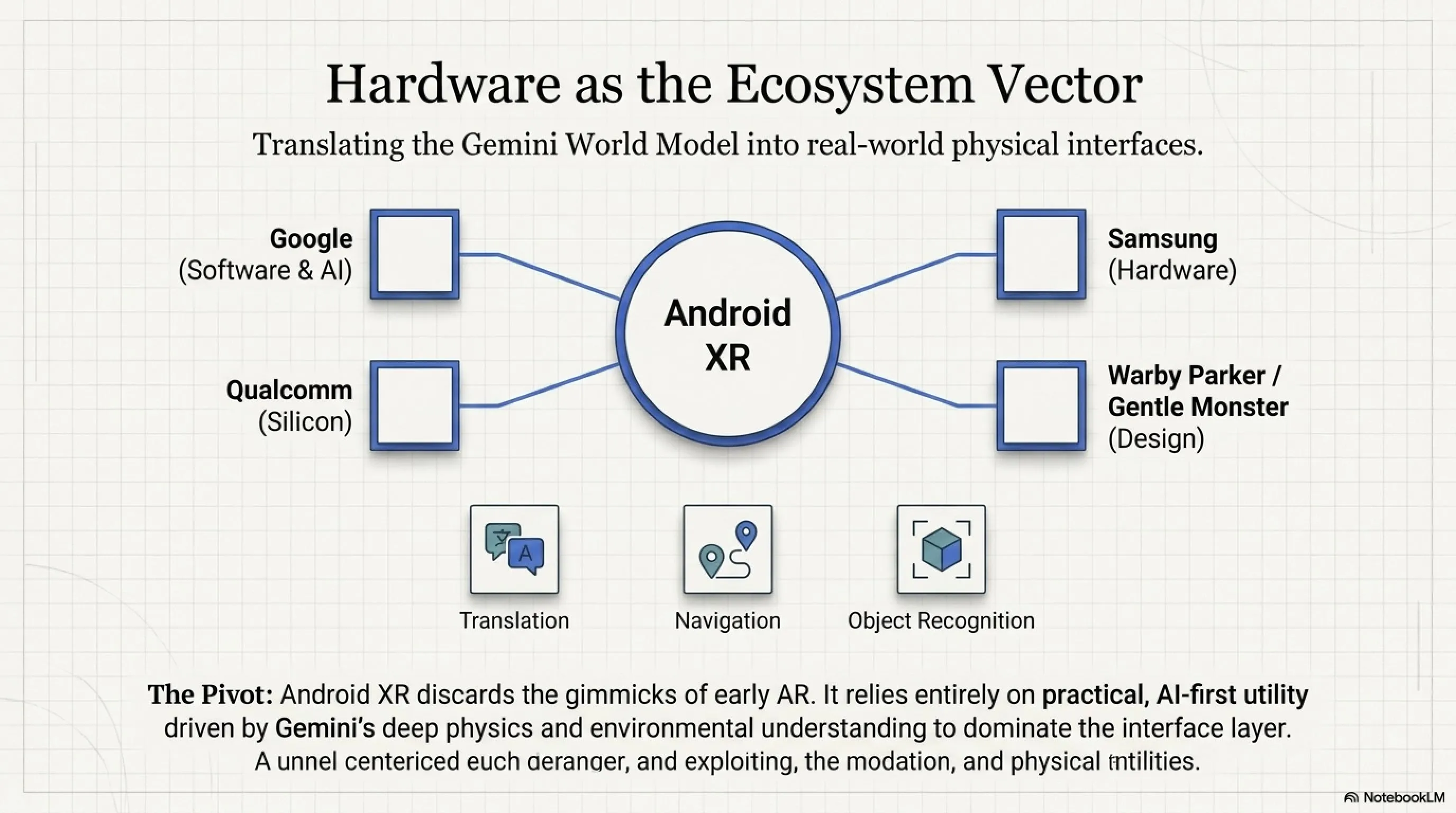
Another major announcement at Google I/O 2026 was the unveiling of Android XR - a new platform for augmented reality (AR) and virtual reality (VR) devices. In partnership with Samsung and Qualcomm, Google introduced new smart glasses scheduled to launch in fall 2026. These glasses will be available with frames from Warby Parker and Gentle Monster, and will leverage Gemini to deliver intelligent experiences.
Unlike previous AR products that largely failed (such as Google Glass), Android XR is designed with a focus on practical applications and deep integration with the Android ecosystem. Users will be able to use these glasses for live translation, navigation guidance, object recognition, and even video calls - all powered by Gemini. The glasses represent Google's bet that AI-first wearables can succeed where earlier attempts failed, by providing genuinely useful functionality rather than gimmicky features.
Other Major Google I/O 2026 Announcements
- Google Search with AI: Deeper Gemini integration in search results, with more concise and accurate answers
- Google Flow: A new AI-powered workflow management tool that helps users automate complex tasks
- YouTube Shorts with Gemini Omni: New tools for AI-assisted video content creation
- Antigravity 2.0: Next-generation AI coding assistant powered by Gemini 3.5 Flash
- Google Workspace: Gemini integration across Gmail, Docs, Sheets, and other productivity tools
📱 Android 17: Continue On Feature - Shameless Clone of Apple's Handoff
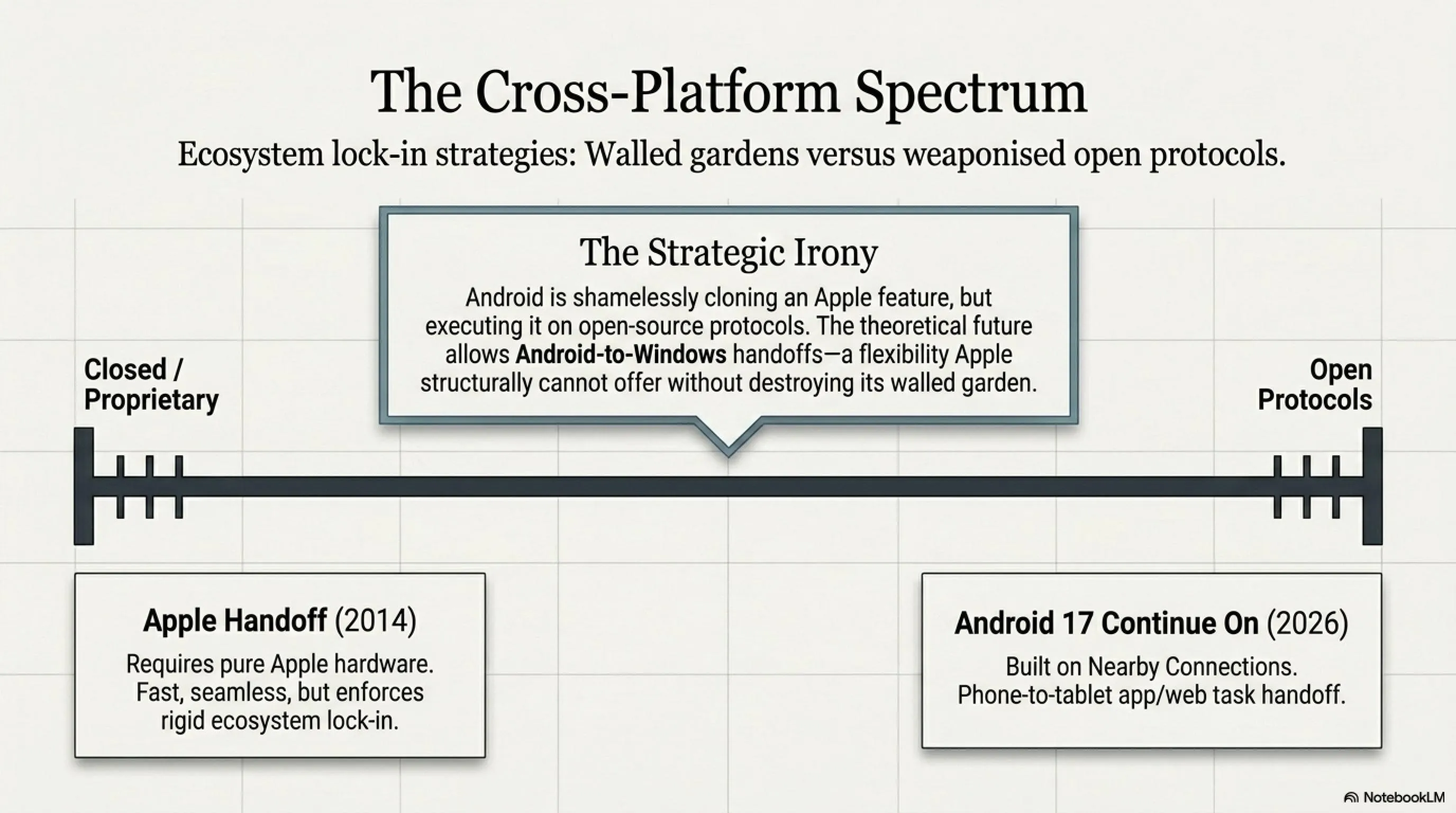
During the "What's new in Android" session at Google I/O 2026, Google unveiled a new feature called Continue On in Android 17 that enables users to start an Android app on one device and then transition to another device in their Android ecosystem, continuing the user journey they started. This feature is clearly inspired by Apple's Handoff - a capability that has existed in the Apple ecosystem since 2014.
Continue On allows users to start activities like browsing Chrome or editing Google Docs on one device and continue on another device connected to the same Google account. Activities from your Android device appear in other devices' docks with a "Handoff Suggestion" label. At launch, the feature will only work from phone to tablet, but Google has promised to add support for other devices in the future.
⚖️ Comparison: Continue On vs Handoff
| Feature | Android Continue On | Apple Handoff |
|---|---|---|
| Launch Year | 2026 | 2014 |
| Supported Devices | Phone → Tablet (initially) | All Apple devices |
| App-to-Web Support | ✅ Yes | ✅ Yes |
| Speed | Slower but more flexible | Faster |
| Compatibility | Android only | Apple only |
Google announced that Android 17 supports both app-to-app and app-to-web handoffs. Developers can choose their preferred task management platform on each device. For example, the Continue On feature can hand off a task from the Gmail app on a phone to the Gmail web experience on a tablet. This feature will be available for developers in Android 17 RC1 (Release Candidate 1).
🔍 Tekin Analysis: Copying or Innovation?
Android's copying of Apple's Handoff is controversial, but it's actually a natural trend in the tech industry. Apple itself has copied many Android features (such as widgets, grouped notifications, and App Library). What matters is what value Continue On creates for Android users. Technically, Continue On uses the Nearby Connections protocol, which is open-source and can work with non-Android devices as well.
This means that in the future, we might be able to hand off a task from an Android phone to a Windows laptop or even an iOS device. This level of openness is something Apple will never offer. For specific use cases like users who have multiple Android devices (such as a Samsung phone and Xiaomi tablet), Continue On could be very useful. However, the feature requires internet connectivity and Google account synchronization.
📝 Mid-Article Summary: A Look at Today's Top 6 Stories
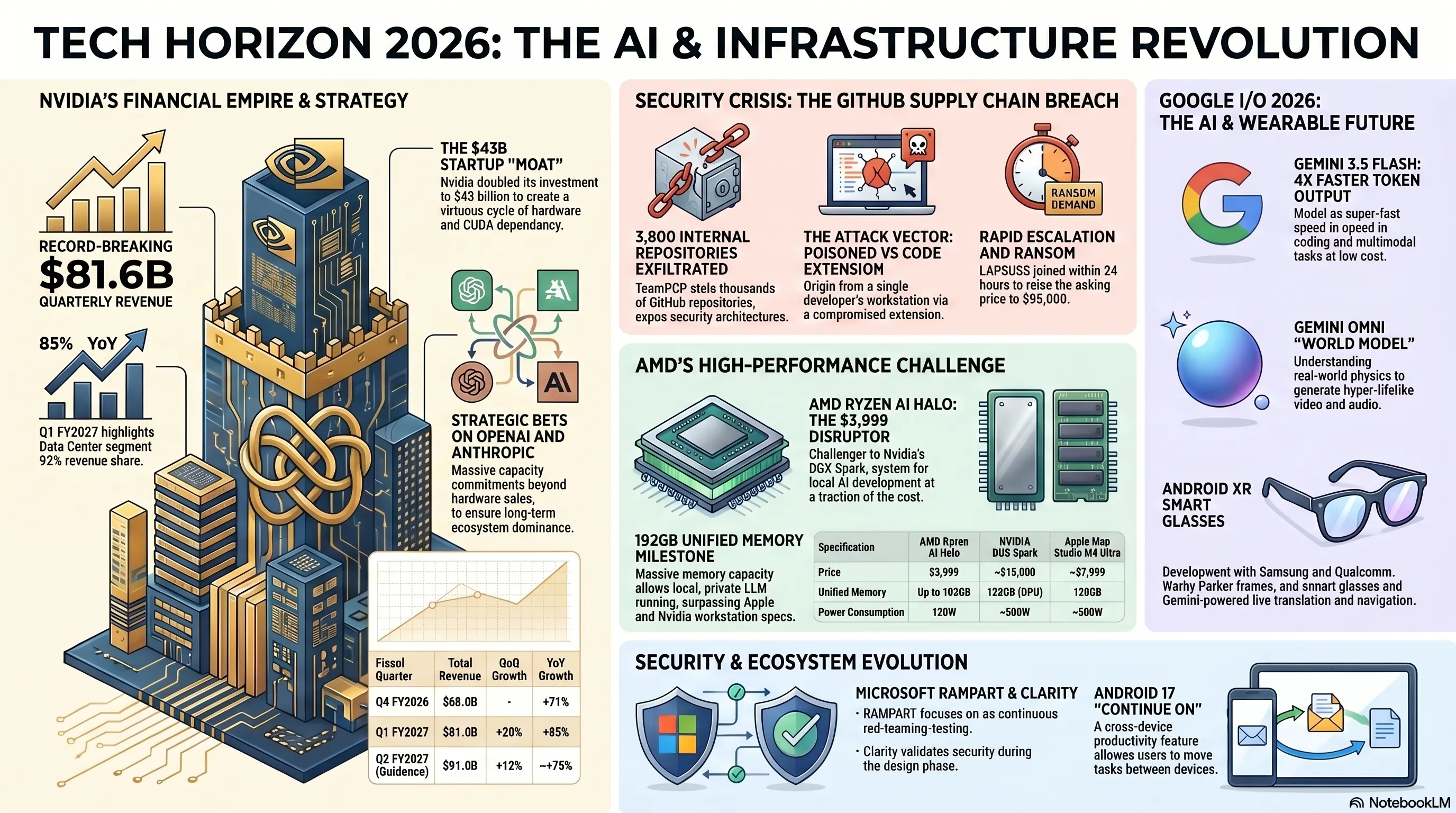
Today we witnessed 6 major tech stories that each shape the industry's future in different ways. Nvidia's record $81.6 billion revenue and $43 billion startup investment portfolio demonstrates its continued dominance in the AI chip market. GitHub's breach with 3,800 internal repositories stolen reminds us that software supply chain security is a serious challenge that even the biggest companies face.
AMD's Ryzen AI Halo PC at $3,999 attempts to provide an affordable alternative to expensive Nvidia products. Microsoft's open-source RAMPART and Clarity tools show the company takes AI agent security seriously. Google's I/O 2026 with Gemini 3.5 Flash and Android XR announced that it hasn't fallen behind in the race against OpenAI and Microsoft. And finally, Android 17's Continue On feature showed that copying competitors remains a valid strategy in the tech industry!
💭 Final Thoughts: Who Controls the Future of Technology?
Today's news paints a clear picture of the tech industry's future. Nvidia, with its massive investments in startups, is building an AI empire that extends far beyond chip sales. The company controls not just hardware, but a complete ecosystem of software, tools, and strategic partners. This level of vertical integration could allow Nvidia to remain dominant for decades to come.
The GitHub attack is a bitter reminder that no system is completely secure. Even the world's largest tech companies can fall victim to sophisticated supply chain attacks. This incident should be a wake-up call for all developers and companies to prioritize security - not as an afterthought, but as a fundamental part of the development process.
The competition between AMD and Nvidia, Microsoft and Google, and Android and iOS shows that the tech industry remains dynamic and competitive. This competition is good for consumers - prices come down, innovation accelerates, and more options become available. But this competition can also lead to ecosystem fragmentation, where users are forced to choose between platforms and can't easily move between them.
Ultimately, the future of technology belongs to companies that can innovate faster, be more secure, and better align with users' real needs. Nvidia, Google, Microsoft, and AMD are all on this path, but only time will tell which ones emerge as the ultimate winners.
❓ Can Nvidia maintain its AI market dominance forever?
Nvidia's AI market dominance is unprecedented, but history shows that no monopoly lasts forever. IBM in the 1980s, Microsoft in the 1990s, and Google in the 2000s all seemed unbeatable in their time. Nvidia's main challenges include: 1) Increasing competition from AMD, Intel, and even major tech companies building custom chips (like Google TPU and Amazon Trainium), 2) Dependence on TSMC for manufacturing, which is a strategic weakness, 3) Regulatory and antitrust pressures that may increase in the future. However, with its $43 billion investment portfolio and strong CUDA ecosystem, Nvidia will remain in a strong position for at least the next 5-10 years.
❓ How can I protect my projects from GitHub-like attacks?
To protect your projects from supply chain attacks similar to the GitHub breach, take these actions: 1) Enable two-factor authentication (2FA) for all GitHub, npm, PyPI, and other service accounts, 2) Use SSH keys with passphrases instead of access tokens, 3) Security audit third-party extensions and packages before installation - especially VS Code extensions, 4) Use tools like Dependabot and Snyk for automatic vulnerability scanning, 5) Never commit sensitive credentials directly to code - use GitHub Secrets or HashiCorp Vault, 6) Limit repository access and follow the principle of least privilege, 7) Regularly review access logs and identify suspicious activity.
❓ What's the difference between RAMPART and traditional security testing tools?
RAMPART differs from traditional security testing tools in several key ways. First, RAMPART is specifically designed for AI Agents, not traditional web or mobile applications. This means it can identify AI-specific threats like prompt injection, data poisoning, and model theft. Second, RAMPART is a Pytest-based framework that easily integrates into CI/CD pipelines and runs automated tests on every commit. Third, RAMPART uses a continuous red-teaming approach, not one-time tests. This means security is continuously checked throughout the development cycle. Fourth, RAMPART is open-source and community-supported, while many traditional security testing tools are proprietary and expensive. Overall, RAMPART is designed for the new world of AI Agents, while traditional tools are optimized for classic applications.
❓ Will Android's Continue On work with iOS devices?
Currently, Continue On only works between Android devices and is not compatible with iOS devices. This limitation is primarily due to Apple's closed policies that don't allow third-party apps to access low-level system APIs. However, Continue On uses the Nearby Connections protocol, which is open-source and could theoretically work with any device that supports this protocol. If Apple decides to support Nearby Connections (unlikely), or if Google builds an iOS app that enables this feature, cross-platform compatibility might be possible in the future. But given the fierce competition between Google and Apple, this probability is very low in the short term. For users who want to move between Android and iOS, the best option is to use cloud services like Google Drive, Dropbox, or Microsoft OneDrive.
❓ Is AMD Ryzen AI Halo a better value than NVIDIA DGX Spark?
For price-conscious buyers, AMD Ryzen AI Halo offers significantly better value at $3,999 versus $15,000 for NVIDIA DGX Spark. The 192GB unified memory is also a major advantage for running large language models locally. However, "value" depends on your specific use case. If you're developing and testing smaller AI models, prototyping applications, or learning AI development, the Ryzen AI Halo is excellent. But if you're training large models at production scale, Nvidia's superior software ecosystem (CUDA, cuDNN, TensorRT) and better framework support (PyTorch, TensorFlow) make it worth the premium for many organizations. The DGX Spark also includes enterprise support and optimized configurations that justify part of the price difference. For individual developers and small teams, AMD offers better value. For large enterprises with mission-critical AI workloads, Nvidia remains the safer choice despite the higher cost.
📚 Sources and References
Primary Sources: TechCrunch, The Hacker News, Engadget, 9to5Google, 9to5Mac, Tom's Hardware, SecurityWeek, The Verge, Microsoft Security Blog, CyberScoop, CNBC, Fortune, Yahoo Finance, Business Insider, The Register, Android Police, TechRadar, Financial Express
Research and Analysis: Tekin Editorial Team - May 21, 2026
Note: All information in this article has been gathered from credible and reliable sources and verified for accuracy. For more information, please refer to the original source links.
🌐 Stay Connected With Us
For the latest tech, gaming, and gadget news, follow us on social media:
📸 Instagram 🆔 Telegram Arabia 🆔 Telegram Global 🆔 Telegram Iran 💬 Direct Contact 📧 majid@tekingame.comTekin Game - Your companion in the world of technology 🚀
🌐 Stay Connected With Us 🎮✨
For the latest tech, gaming, and gadget news, follow us on our official social media channels:
Supplementary Image Gallery: 🌅 Tekin Morning May 21: Nvidia's $81.6B Record, GitHub Hacked & AMD's $4K PC