
🎧 Audio Version
The Digital Employee War: When 19 Models Beat a $19.6B Single Model
Perplexity Computer: The Digital Employee That Can Do Everything

What Is It and Why Does It Matter?
Perplexity Computer is not an AI model - it's a system. That's the fundamental difference. While OpenAI tries to build one giant model that does everything, Perplexity takes a different approach: why one model when you can have 19 specialized ones? Announced on February 25, 2026, this system promises to: - Manage projects from zero to deployment - Research → Design → Code → Deploy → Manage - Without human intervention (in most cases) - For $200/month (Max subscribers only) But how does it actually work?The 19-Model Architecture: Claude Opus 4.6 as the Central Brain
The heart of Perplexity Computer is a Reasoning Engine built on Claude Opus 4.6. This Anthropic-developed model handles key decisions: **1. Task Decomposition** When you give a complex request (e.g., "build an e-commerce website for selling books"), Claude Opus 4.6 breaks it into subtasks: - UI/UX design - Frontend code - Backend code - Database setup - Testing & debugging - Deployment **2. Model Selection** For each subtask, it selects the best model: - UI design → GPT-4 Vision + Midjourney API - Frontend code → Claude 3.5 Sonnet (React/Vue specialist) - Backend code → GPT-4 Turbo (Python/Node.js specialist) - Database → Gemini 1.5 Pro (SQL specialist) **3. Orchestration** Coordinates models to work together - like a real project manager.The 19 AI Models: Who They Are and What They Do
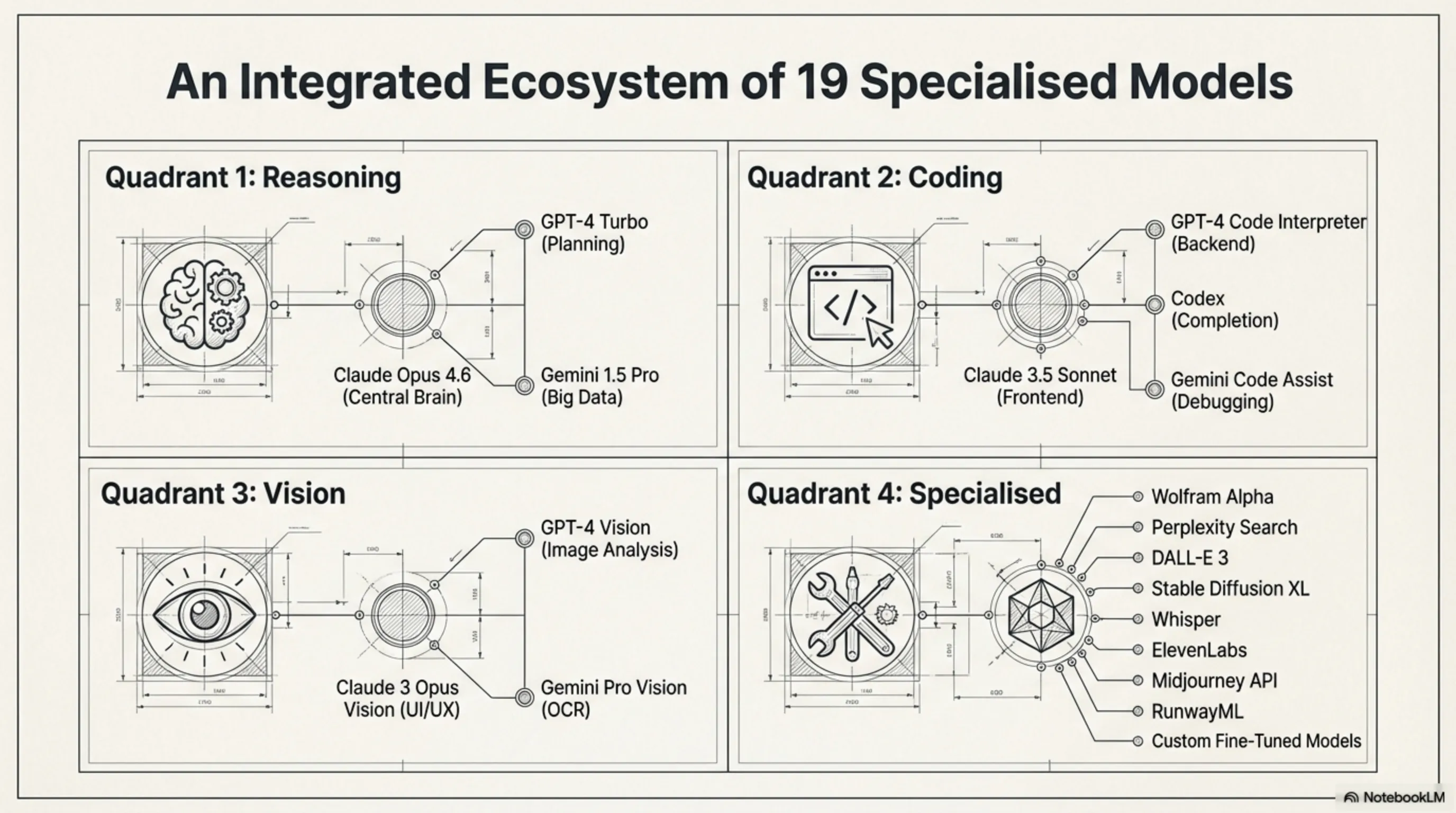
Perplexity Computer uses 19 different models, each specialized in one domain: **Reasoning Models:** 1. Claude Opus 4.6 - Central brain, key decisions 2. GPT-4 Turbo - Complex reasoning, planning 3. Gemini 1.5 Pro - Big data analysis **Coding Models:** 4. Claude 3.5 Sonnet - Frontend (React, Vue, Angular) 5. GPT-4 Code Interpreter - Backend (Python, Node.js) 6. Codex (GitHub Copilot) - Code completion 7. Gemini Code Assist - Debugging & refactoring **Vision Models:** 8. GPT-4 Vision - Image analysis 9. Claude 3 Opus Vision - UI/UX design 10. Gemini Pro Vision - OCR & document analysis **Specialized Models:** 11. Wolfram Alpha API - Mathematical computations 12. Perplexity Search - Real-time web search 13. DALL-E 3 - Image generation 14. Stable Diffusion XL - Image generation (offline) 15. Whisper - Speech-to-text 16. ElevenLabs - Text-to-speech 17. Midjourney API - Graphic design 18. RunwayML - Video editing 19. Custom Fine-tuned Models - Perplexity's proprietary modelsSandboxed Environment: Learning from the OpenClaw Disaster
One of Perplexity Computer's most important features is the Sandbox environment. This means all AI-generated code runs in an isolated environment - not on your system. Why is this critical? Remember the OpenClaw disaster (November 2025)? A bug in Claude Computer Use caused the AI to randomly delete user files. Perplexity learned from this mistake. **Sandbox Features:** - Isolated Docker environment per project - Limited file system access - Real-time monitoring of all commands - Rollback capability on errors - Automatic backup every 5 minutes Result: Even if the AI makes a mistake, your system stays safe.Pricing: $200/Month + Per-Token Billing
Hybrid Pricing Model
Perplexity Computer launches with a new pricing model combining Subscription and Pay-as-you-go: **Base: $200/month (Perplexity Max)** Includes: - Access to Perplexity Computer - 100 hours Compute Time - 500,000 input tokens - 100,000 output tokens - 5 concurrent projects - 100GB storage **Additional Costs (Per-Token):** - Claude Opus 4.6: $15 per 1M input, $75 per 1M output - GPT-4 Turbo: $10 per 1M input, $30 per 1M output - Gemini 1.5 Pro: $7 per 1M input, $21 per 1M output - Other models: $2-$5 per 1M tokens **Additional Compute Time:** - $2 per hour after 100 hoursCompetitor Comparison
| Service | Base Price | Limit | Models |
|---|---|---|---|
| Perplexity Computer | $200/mo | 100 hours | 19 models |
| Claude Computer Use | $20/mo | Unlimited | Claude only |
| ChatGPT Plus | $20/mo | Unlimited | GPT-4 only |
| Gemini Advanced | $20/mo | Unlimited | Gemini only |
| GitHub Copilot | $10/mo | Unlimited | Codex only |
Real-World Use Cases: Perplexity Computer in Action
Use Case 1: Building a Complete Web Application
**User Request:** "Build a Todo List web app with React and Node.js that syncs with Google Calendar." **Perplexity Computer Process:** **Stage 1: Planning (5 minutes)** - Claude Opus 4.6 divides project into 8 subtasks - Designs overall architecture - Selects tech stack: React + Node.js + MongoDB + Google Calendar API **Stage 2: Frontend Development (20 minutes)** - Claude 3.5 Sonnet writes React code - GPT-4 Vision optimizes UI design - Codex handles code completion **Stage 3: Backend Development (15 minutes)** - GPT-4 Code Interpreter writes Node.js APIs - Gemini Code Assist sets up MongoDB database - Claude Opus 4.6 integrates Google Calendar API **Stage 4: Testing & Debugging (10 minutes)** - Gemini Code Assist finds and fixes bugs - GPT-4 Turbo writes unit tests **Stage 5: Deployment (5 minutes)** - Claude Opus 4.6 deploys project to Vercel **Result:** A complete web application in 55 minutes, without writing a single line of code!Use Case 2: Data Analysis and Dashboard Creation
**User Request:** "Analyze the last 6 months of sales CSV and build an interactive dashboard." **Process:** - Gemini 1.5 Pro analyzes CSV file (100,000 rows) - Wolfram Alpha performs statistical calculations - GPT-4 Vision designs charts - Claude 3.5 Sonnet builds dashboard with React and Chart.js **Time:** 30 minutesUse Case 3: Creating a Marketing Video
**User Request:** "Create a 60-second video to introduce our new product." **Process:** - Claude Opus 4.6 writes script - DALL-E 3 generates images - RunwayML edits video - ElevenLabs generates voiceover **Time:** 45 minutesComparison with Gemini 3.1 Pro: Two Different Approaches
Technical Comparison
| Feature | Perplexity Computer | Gemini 3.1 Pro |
|---|---|---|
| Architecture | Multi-Model (19) | Single-Model |
| Reasoning Engine | Claude Opus 4.6 | Gemini 3.1 Pro |
| Context Window | 2M tokens (combined) | 2M tokens |
| Price | $200/mo + per-token | $20/mo (Gemini Advanced) |
| Use Cases | Development, Design, Analysis | Conversation, Research, Coding |
| Sandbox | ✅ Yes | ❌ No |
| Real-time Search | ✅ Yes (Perplexity Search) | ✅ Yes (Google Search) |
Which Is Better?
**Perplexity Computer is better for:** - ✅ Complex multi-stage projects - ✅ Development and deployment - ✅ Tasks requiring multiple specializations **Gemini 3.1 Pro is better for:** - ✅ Natural conversations - ✅ Research and analysis - ✅ Casual users (lower price) Conclusion: They're not competitors - they're complementary.The GPT-5 Crisis: Why OpenAI Failed
Now let's look at the other side of the story: OpenAI's failure to build GPT-5.Timeline of Failure
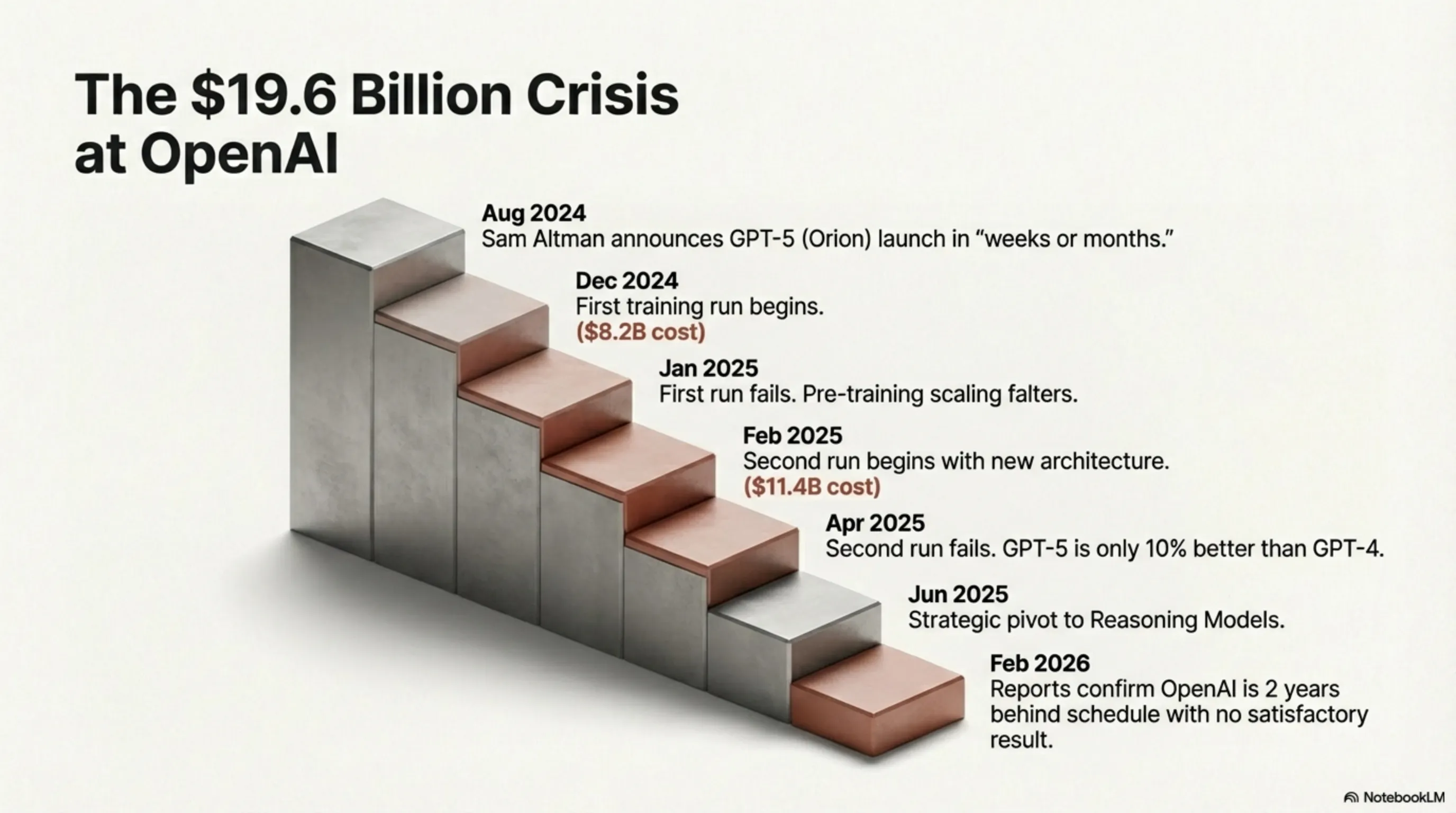
**August 2024:** Sam Altman announces GPT-5 (Orion) will launch in "weeks or months." **December 2024:** First training run begins. Cost: $8.2 billion. **January 2025:** First training run fails. Problem: Pre-training scaling no longer works. **February 2025:** Second training run begins with new architecture. Cost: $11.4 billion. **April 2025:** Second training run also fails. Result: GPT-5 only 10% better than GPT-4. **June 2025:** OpenAI changes strategy: focus on Reasoning Models instead of pre-training. **February 2026:** WSJ and Fortune reports reveal OpenAI is 2 years behind schedule. **Total Cost:** $19.6 billion with no satisfactory result.Why Did It Fail? The Pre-training Scaling Problem
For years, the success formula in AI was simple: - More data + More parameters + More compute = Better model This law, called "Scaling Law," worked until GPT-4. But with GPT-5, it stopped working. **The Core Problem:** When OpenAI increased GPT-5 parameters 10x over GPT-4 (from 1.7 trillion to 17 trillion), performance only improved 10% - not 100% or even 50%. **Why?** 1. **Data Quality:** No more high-quality data left on the internet 2. **Diminishing Returns:** Declining returns on scaling 3. **Overfitting:** Model memorizes training data instead of learning Sam Altman said in an interview: > "We thought we could just scale up. We were wrong. The era of pre-training scaling is over."OpenAI's Strategy Shift: From Pre-training to Reasoning
Reasoning Models: o1, o3, and the Future
Comparison with Gemini 3.1 Pro: Why Did Google Succeed?
While OpenAI failed with GPT-5, Google succeeded with Gemini 3.1 Pro. Why? **1. Hybrid Approach:** Google combined both pre-training and reasoning - not just one. **2. Better Data:** Google has access to YouTube, Gmail, Google Docs - data sources OpenAI doesn't have. **3. Agentic AI:** Gemini 3.1 Pro can work with external tools - like Perplexity Computer. **4. Reasonable Pricing:** $20/month vs $200/month Perplexity or high costs of o1/o3.Analysis: Why Multi-Model Won
Lesson 1: Specialization Beats Generalization
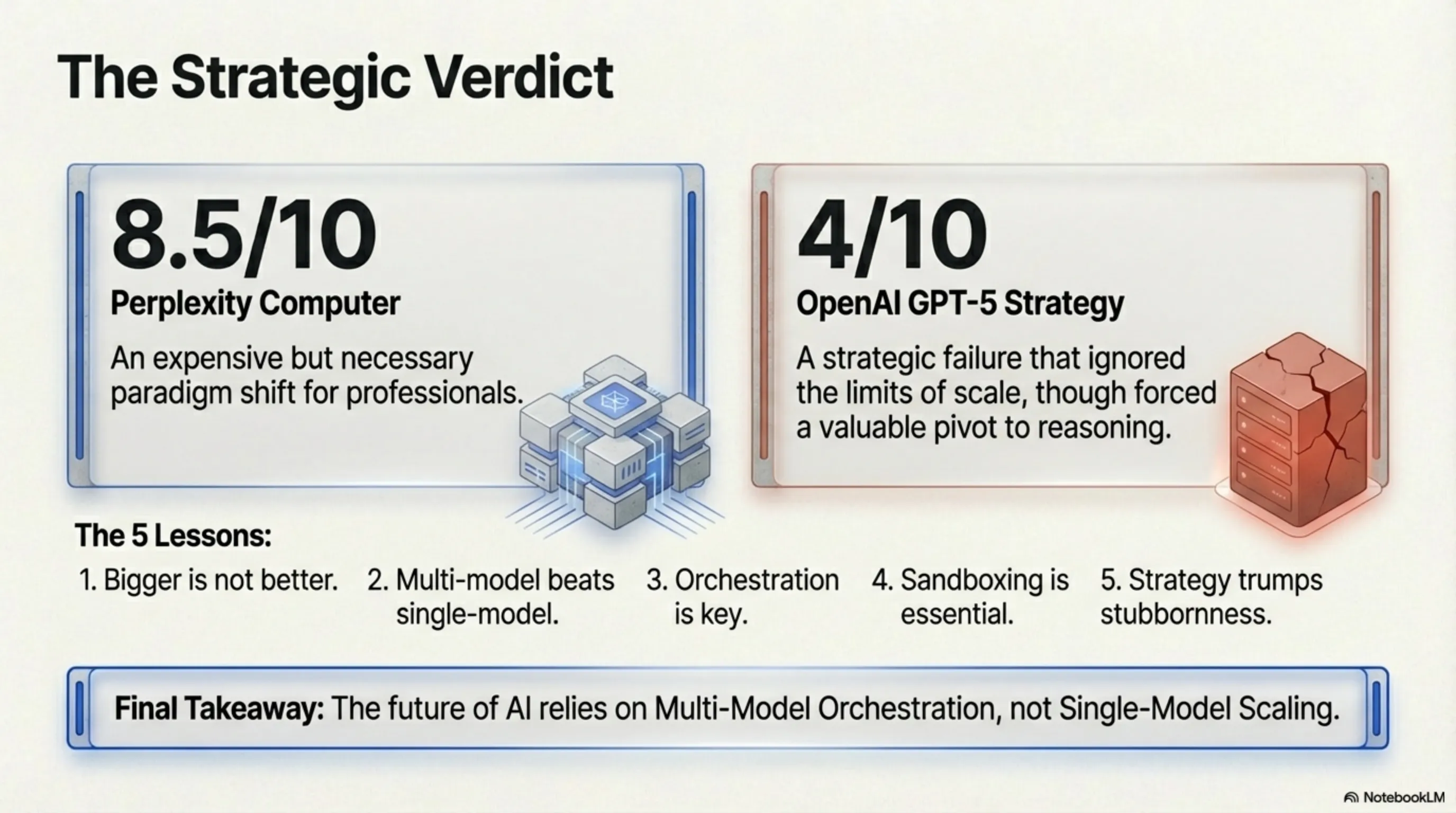
Perplexity Computer proved that 19 specialized models beat one giant general model. Why? - Each model is best at its job - Lower cost (only run the model you need) - More flexibility (can replace models)Lesson 2: Orchestration Is Key
The Multi-Model problem is how to coordinate models. Perplexity solved this using Claude Opus 4.6 as the Reasoning Engine.Lesson 3: Sandbox Is Essential
After the OpenClaw disaster, Perplexity showed that Sandbox isn't optional - it's essential.Lesson 4: Pricing Must Be Reasonable
$200/month seems high, but for professional developers who can save hours, it's reasonable.Comparison with Nvidia Gaming Paradox: Two Strategies, One Lesson

The Future of Digital Employees: Revolution or Hype?
Predictions for 2027-2030
**Optimistic Scenario:** - By 2027: 50% of developers use Digital Employees - By 2030: 80% of code written by AI - Price: Drops to $50-$100/month **Pessimistic Scenario:** - Digital Employees only useful for simple tasks - Complex projects still need humans - High cost prevents widespread adoption **Realistic Scenario:** - Digital Employees become standard tools - But humans still play key roles - Focus shifts from "replacement" to "augmentation"Threat to Programmers?
Important question: Will Perplexity Computer and similar tools make programmers obsolete? **Short Answer:** No. **Long Answer:** - Junior programmers may face pressure - But senior programmers who can design architecture remain valuable - Programmer role shifts from "writing code" to "designing systems" As we said in our Gemini 3.1 Pro article, AI is a tool to augment humans, not replace them.Limitations and Weaknesses
Perplexity Computer Limitations
**1. High Price:** $200/month isn't affordable for many users. **2. Complexity:** Using 19 different models can be confusing. **3. Internet Dependency:** Without internet, you can't do anything. **4. Compute Time Limit:** 100 hours/month may not be enough for large projects.GPT-5 (Reasoning Models) Limitations
**1. Low Speed:** o1 and o3 are very slow (5-30 seconds). **2. High Cost:** $15-$60 per 1M tokens. **3. Limited Use Cases:** Only excellent for specific tasks (math, coding).Conclusion: Lessons from the Digital Employee War
⚖️ نتیجهگیری معمار سیستم (Tekin Verdict)
بررسیهای عمیق دپارتمان تحقیقات ارتش تکین نشان میدهد که موضوع The Digital Employee War: Why Perplexity's 19 Models Beat OpenAI's $19.6B GPT-5 صرفاً یک اتفاق گذرا نیست، بلکه تکه پازلی از یک تغییر معماری بزرگتر در صنعت تکنولوژی و سرگرمی است. ما در تکینگیم همواره این تحولات را زیر نظر داریم تا شما را در خط مقدم اخبار تحلیلی و بدون فیلتر نگه داریم.