🌅 Good Morning! Tekin Morning June 1, 2026
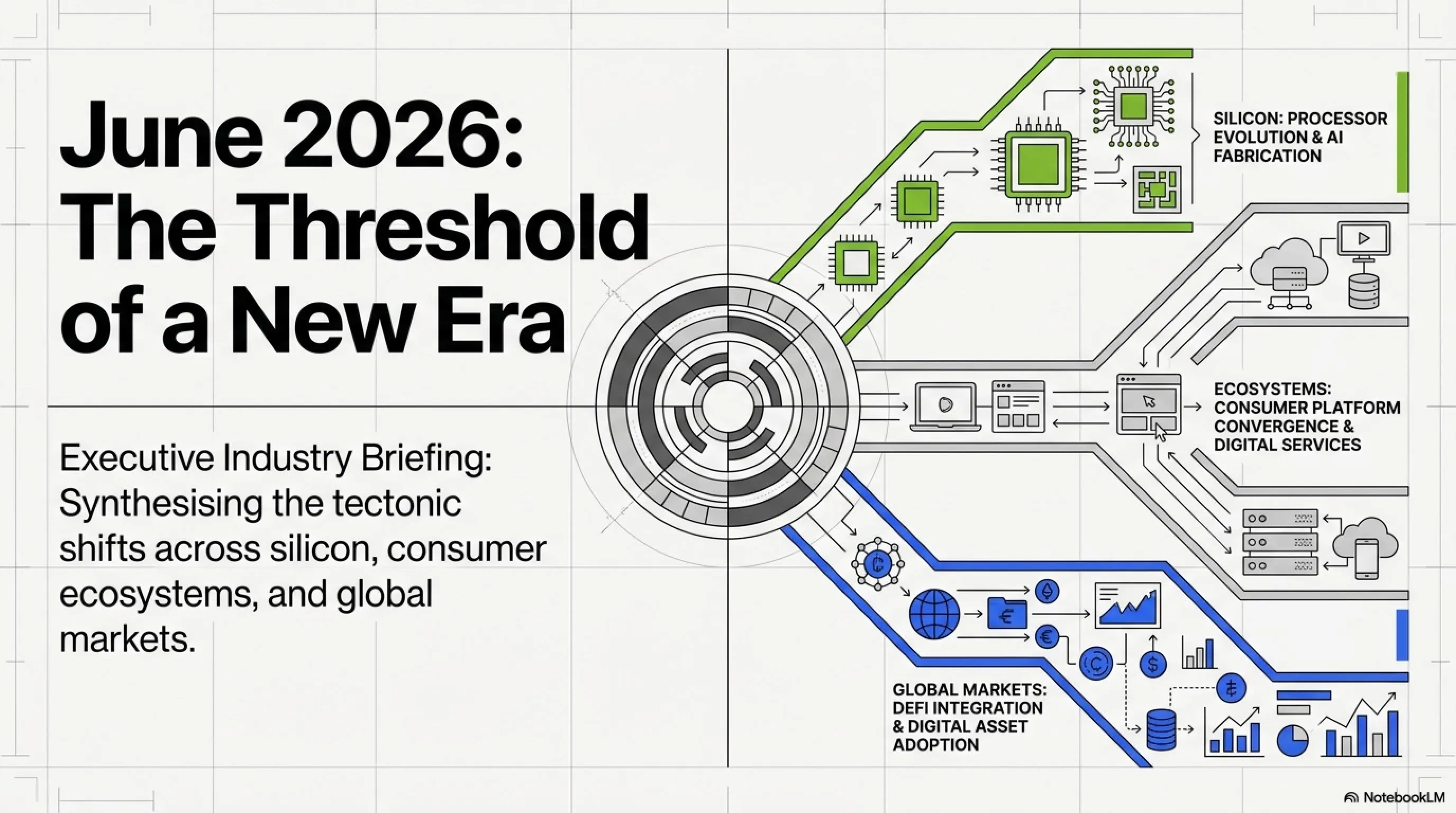
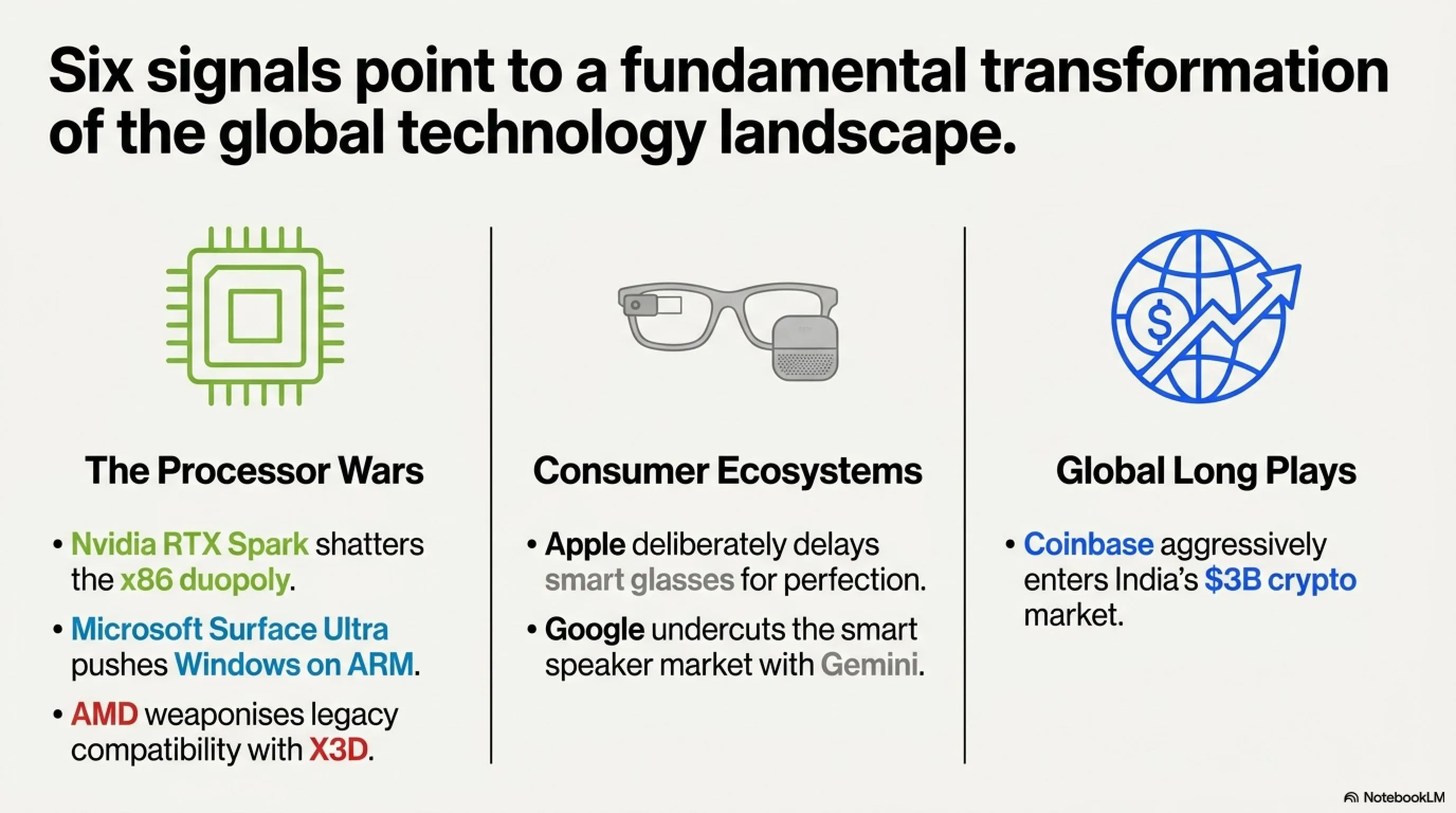
Good morning, tech enthusiasts! Today marks one of the most historic days in computing history - Nvidia has officially entered the PC processor market with RTX Spark, fundamentally challenging Intel and AMD's decades-long duopoly. We have 6 explosive stories covering the ARM revolution in Windows, Apple's strategic delay, AMD's legendary comeback, and Coinbase's billion-dollar India expansion.
⚡ Today's Headlines:
💻 Nvidia enters CPU market with RTX Spark - direct challenge to Intel & AMD
🚀 Surface Laptop Ultra: Most powerful Surface ever with 1 petaflop AI compute
👓 Apple Glasses delayed to 2027 - Apple Watch-style strategy for $200B market
🏠 Google Home Speaker launches June 25 at $99.99 with Gemini AI
🎮 AMD launches two X3D CPUs under $350 - 5800X3D returns!
💰 Coinbase officially enters India's $3B crypto market with INR support
☕ Grab your coffee and get ready for an energizing morning deep-dive!
💻 The RTX Spark Revolution: Nvidia Officially Enters the PC Processor Market
In what may be remembered as one of the most significant announcements in computing history, Nvidia at Computex 2026 in Taiwan officially unveiled the RTX Spark processor, marking its direct entry into the PC CPU market. This isn't just another product launch - it's a fundamental shift in personal computer architecture that could challenge Intel and AMD's decades-long dominance and reshape the entire industry landscape.
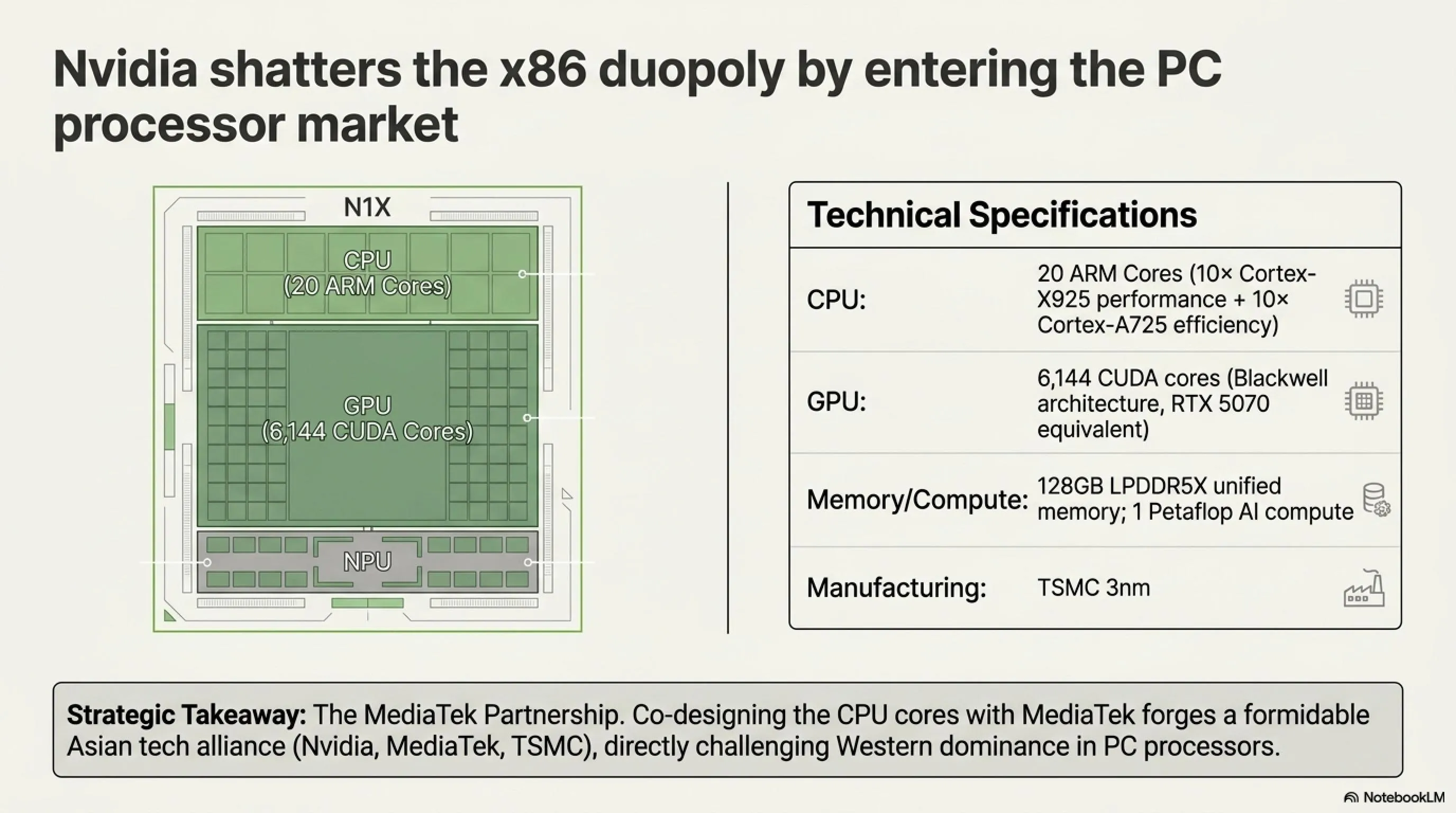
Jensen Huang, Nvidia's CEO, took the stage at GTC Taipei with his signature leather jacket and declared RTX Spark "the most efficient PC chip ever built." This bold claim is backed by impressive specifications: 20 ARM-based CPU cores (10× Cortex-X925 performance cores + 10× Cortex-A725 efficiency cores), 6,144 CUDA cores with Blackwell architecture (equivalent to a discrete RTX 5070), and up to 128GB of unified LPDDR5X memory shared between CPU and GPU.
🔬 Nvidia RTX Spark (N1X) Technical Specifications
| CPU Architecture | 20-core ARM (10× Cortex-X925 + 10× Cortex-A725) |
| Clock Speed | Up to 4.1 GHz |
| GPU Architecture | 6,144 CUDA cores (Blackwell) - RTX 5070 equivalent |
| Unified Memory | Up to 128GB LPDDR5X (shared CPU/GPU) |
| AI Compute Power | 1 Petaflop (1,000 Teraflops) |
| Software Support | Full CUDA, Windows on ARM, DirectX 12 Ultimate |
| Manufacturing Process | TSMC 3nm (co-designed with MediaTek) |
| Release Date | Fall 2026 (September-November) |
💡 Note: This is the first time Nvidia has released a complete processor (CPU + GPU) for the PC market
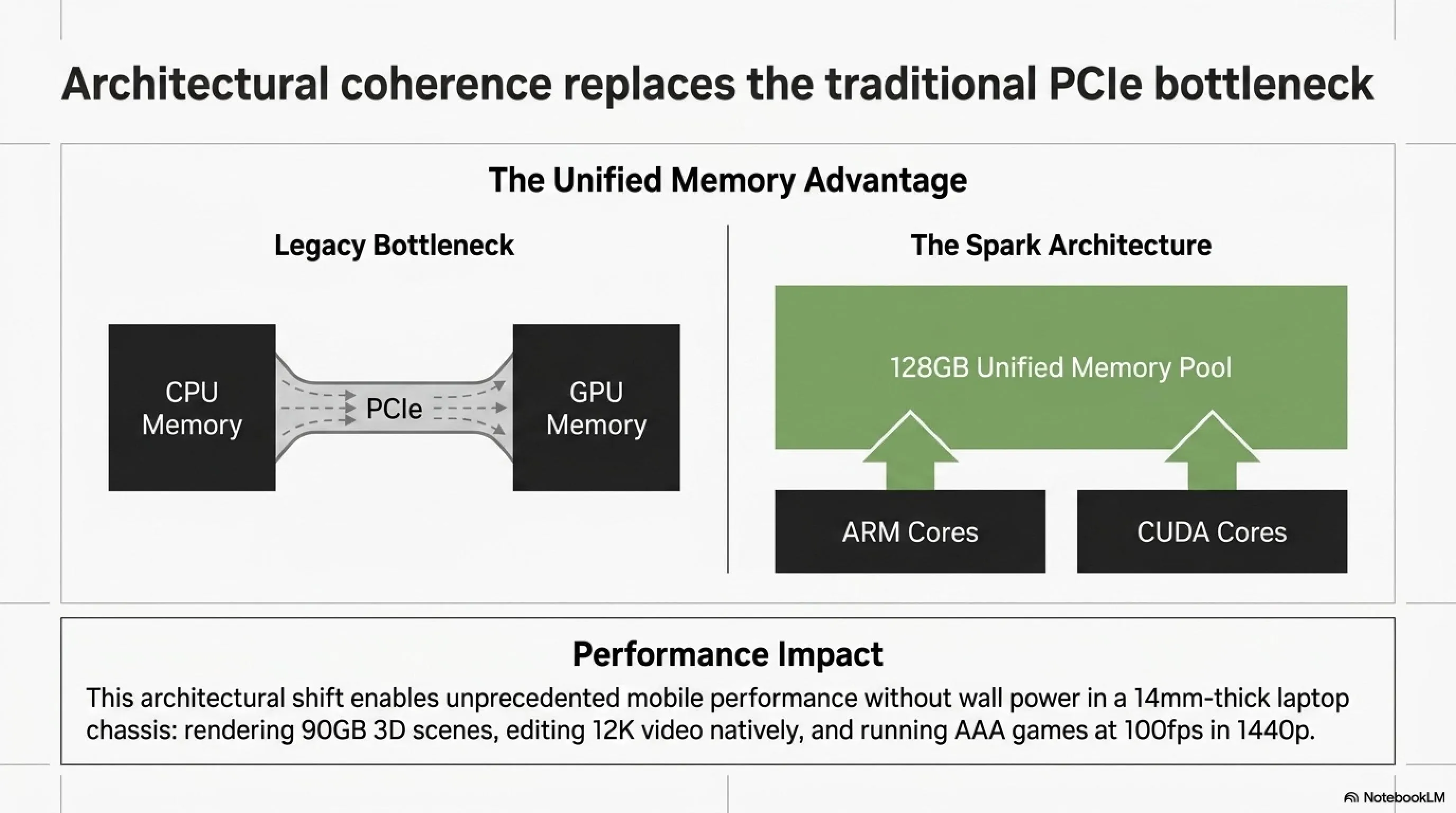
What makes RTX Spark truly revolutionary is its unified memory architecture. Unlike traditional systems where CPU and GPU have separate memory pools, RTX Spark uses a shared 128GB memory pool that both CPU and GPU can access without copying data. This architecture, similar to Apple's M-series chips, dramatically improves energy efficiency and data transfer speeds while eliminating the traditional bottleneck of PCIe bandwidth between discrete components.
Nvidia claims that with RTX Spark, you can render 90GB 3D scenes, edit 12K resolution video, or play Indiana Jones and the Great Circle at 100fps in 1440p - all in a 14mm-thick laptop without being plugged into power. If these claims hold true in real-world testing, RTX Spark could redefine what we expect from high-performance laptops and challenge the notion that desktop workstations are necessary for professional creative work.
🎯 Tekin Analysis: Why RTX Spark Could Be a Game-Changer
Nvidia's entry into the CPU market isn't just a business move - it's a strategic transformation that could redefine the future of personal computing. Here's why this matters:
1. Breaking the x86 Monopoly: For the first time in history, an ARM chip with full CUDA and DirectX 12 Ultimate support is entering the Windows market. This could mark the beginning of the end for x86 architecture dominance. Intel and AMD have enjoyed a comfortable duopoly for decades, but RTX Spark introduces a third player with fundamentally different DNA - one that prioritizes energy efficiency and AI integration from the ground up.
2. AI-Graphics-Compute Integration: RTX Spark is the first chip to truly unify AI acceleration, professional graphics, and general-purpose computing in a single, coherent package. This isn't just about having an NPU alongside a CPU and GPU - it's about architectural coherence where all three domains share memory, communicate without bottlenecks, and work as a unified system. For AI developers and content creators, this could eliminate the traditional workflow of moving data between discrete components.
3. Direct Challenge to Apple Silicon: RTX Spark's unified memory architecture directly competes with Apple's M-series chips, but with the crucial advantage of full CUDA support and the Windows ecosystem. Apple has proven that ARM-based unified memory architectures can deliver exceptional performance and efficiency. Nvidia is betting it can match that performance while offering the flexibility and compatibility that Windows users demand.
4. Pressure on Intel and AMD: If RTX Spark succeeds, Intel and AMD will be forced to fundamentally rethink their strategies. The CPU market is no longer a duopoly - it's now a three-way battle. Intel's recent struggles with manufacturing and AMD's focus on traditional architectures could leave both vulnerable to Nvidia's integrated approach. We could see accelerated innovation across the board as all three companies compete for market share.
5. The MediaTek Partnership: Nvidia's collaboration with MediaTek for CPU core design is strategically brilliant. MediaTek brings deep expertise in ARM architecture and mobile-first design, while Nvidia contributes its GPU and AI prowess. This partnership could spawn a new Asian tech alliance (Nvidia, MediaTek, TSMC) that challenges Western dominance in PC processors.
The Bottom Line: RTX Spark represents Nvidia's vision for the future of computing - one where AI, graphics, and general computing are seamlessly integrated, where ARM efficiency meets x86 compatibility, and where the traditional boundaries between mobile and desktop architectures dissolve. If Nvidia can deliver on its promises and convince developers to embrace ARM-native development, RTX Spark could be remembered as the chip that changed everything.
The collaboration between Nvidia and MediaTek for CPU core design deserves special attention. MediaTek, primarily known for mobile processors, is now entering the PC market through this partnership. This alliance brings together MediaTek's ARM expertise, Nvidia's GPU dominance, and TSMC's manufacturing prowess - creating a formidable Asian tech coalition that could challenge the traditional Western dominance in PC processors. It's worth noting that this partnership was years in the making, with rumors of Nvidia's ARM-based PC chip dating back to 2023.
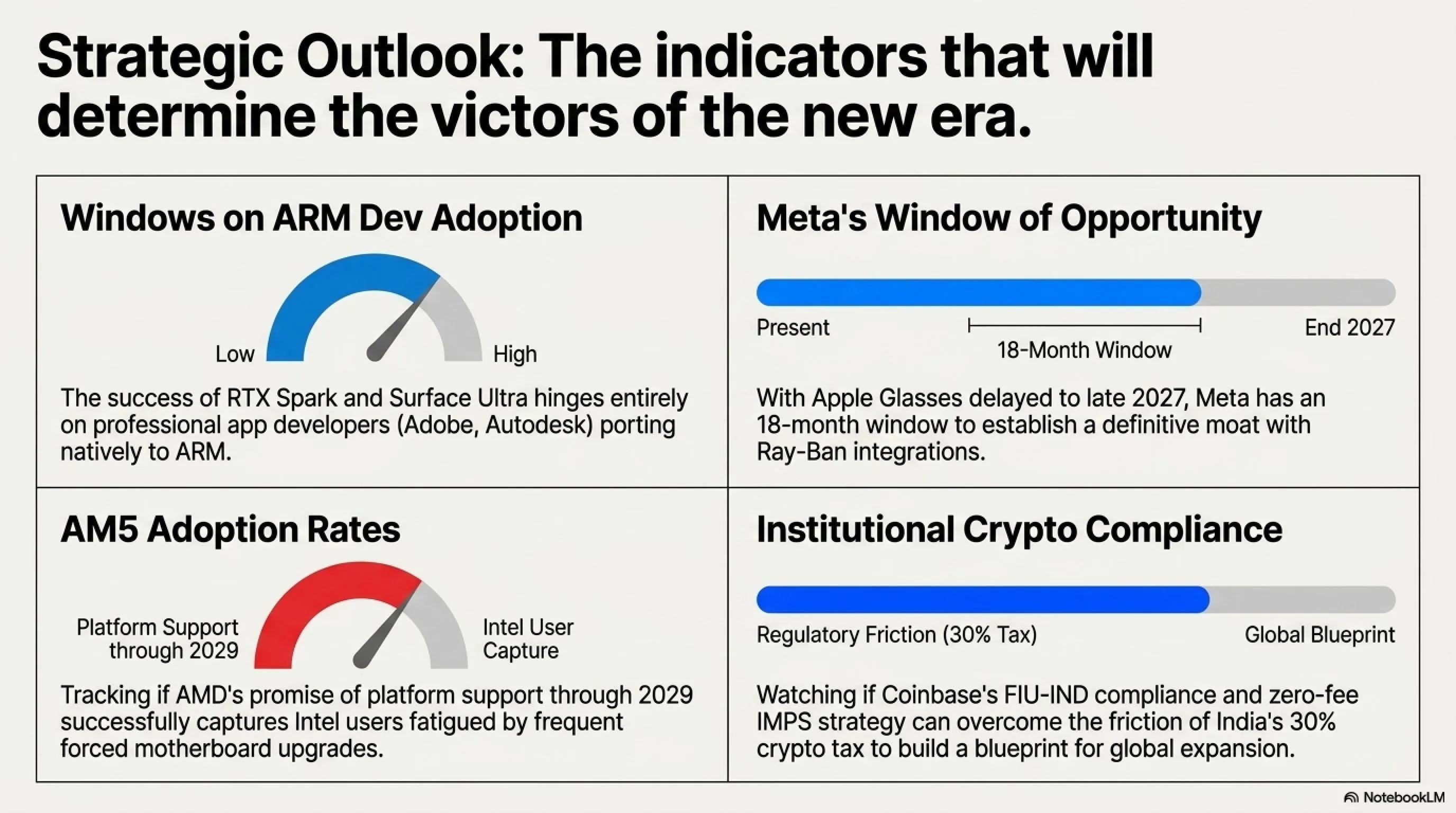
RTX Spark will launch in Fall 2026 in laptops from Microsoft, Dell, HP, ASUS, Lenovo, and MSI. Pricing hasn't been officially announced, but industry analysts expect RTX Spark-powered devices to range from $1,500 to $3,000 - positioning them as direct MacBook Pro competitors. The success of RTX Spark will ultimately depend on three critical factors: real-world performance, software ecosystem maturity, and developer adoption. Nvidia has the hardware prowess, but can it convince the Windows software ecosystem to embrace ARM?
📊 Market Impact Analysis: How RTX Spark Could Reshape the PC Industry
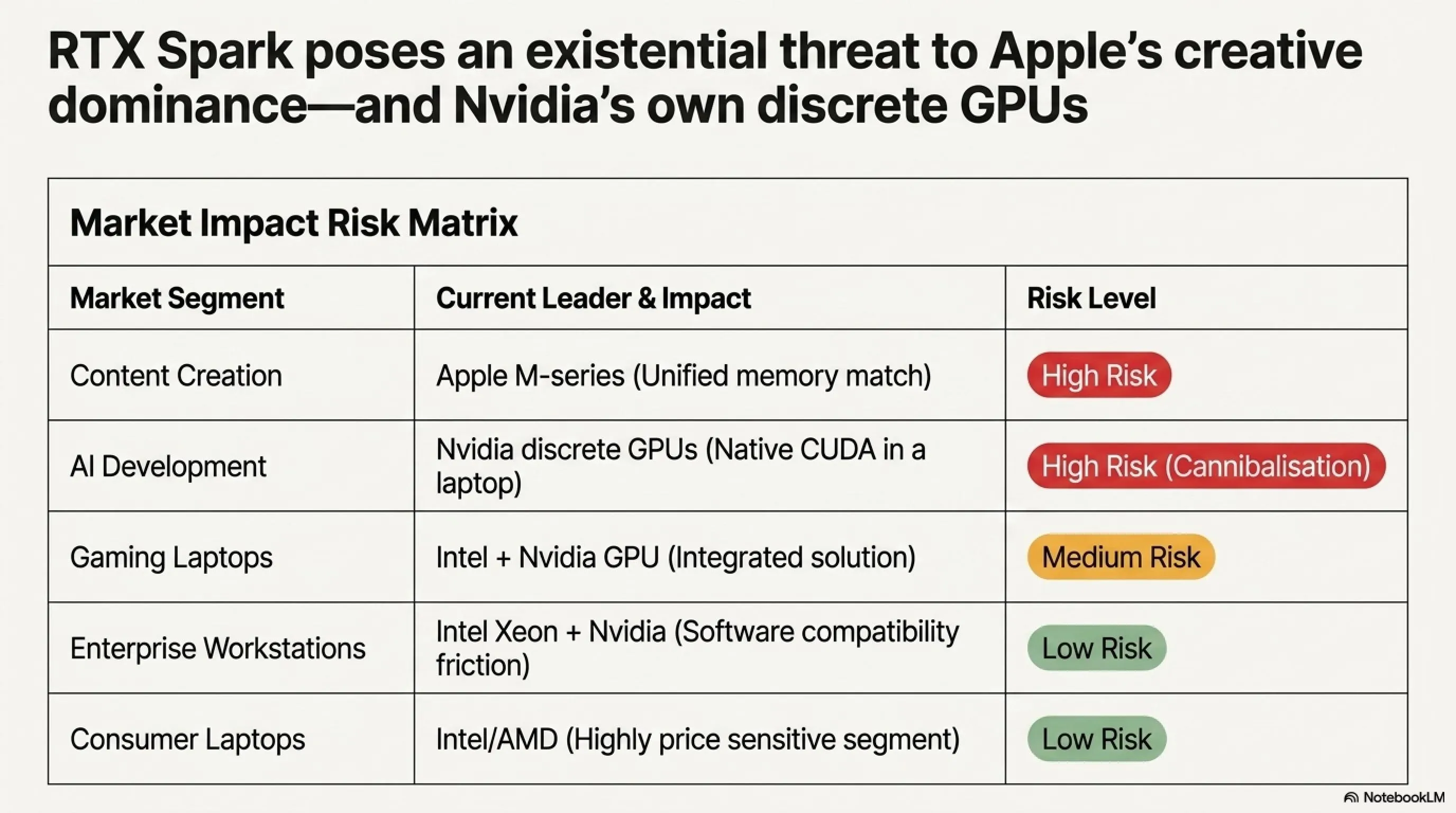
| Market Segment | Current Leader | RTX Spark Impact | Risk Level |
| Gaming Laptops | Intel + Nvidia GPU | High - Integrated solution | ⚠️ Medium |
| AI Development | Nvidia discrete GPUs | Very High - Native CUDA | 🔴 High |
| Content Creation | Apple M-series | High - Unified memory | 🔴 High |
| Enterprise Workstations | Intel Xeon + Nvidia | Medium - Software compatibility | 🟢 Low |
| Consumer Laptops | Intel/AMD | Low - Price sensitive | 🟢 Low |
🎯 Verdict: RTX Spark poses the greatest threat to Apple's M-series dominance in creative professional market and Nvidia's own discrete GPU business in AI development laptops.
One fascinating aspect of RTX Spark is how it could cannibalize Nvidia's own discrete GPU business. If RTX Spark delivers RTX 5070-level performance in an integrated package, why would laptop manufacturers continue buying discrete GPUs? Nvidia's answer seems to be that RTX Spark targets a different market segment - thin-and-light premium laptops where discrete GPUs aren't feasible. High-end gaming laptops and mobile workstations will still use discrete RTX 5080 and 5090 GPUs for maximum performance. But this strategy carries risk: if RTX Spark proves "good enough" for most users, it could accelerate the decline of discrete mobile GPUs.
🚀 Surface Laptop Ultra: Microsoft's Most Powerful Surface Ever
📚 Classified & Related Dossiers in TekinGame
If you wish to explore beyond this report and delve into cybernetic frontiers and autonomous AI architectures, do not miss these three exclusive deep-dives in the Tekin Garage:
Just hours after Nvidia's RTX Spark announcement, Microsoft unveiled the Surface Laptop Ultra - the first device powered by this revolutionary chip. This 15-inch powerhouse isn't just the most powerful Surface ever made; it's a statement that Microsoft's strategic partnership with Nvidia runs deep and that Windows on ARM is finally ready for prime time.
Panos Panay, Microsoft's Chief Product Officer for Surface, wrote in the official Windows blog: "Surface Laptop Ultra is made for a kind of work that doesn't fit in a standard laptop." This statement encapsulates the device's design philosophy: a professional machine for AI developers, video editors, 3D designers, and hardcore gamers who refuse to compromise on performance. Microsoft is positioning this as a mobile workstation that can replace desktop towers for many professional workflows.
📊 Microsoft Surface Laptop Ultra - Complete Specifications
| Processor | Nvidia RTX Spark (N1X) - 20 ARM cores + 6,144 CUDA cores |
| Display | 15" mini-LED PixelSense Ultra, 262 PPI, Touch-enabled, 120Hz |
| Memory (RAM) | Up to 128GB LPDDR5X unified (shared CPU/GPU) |
| Storage | Up to 2TB NVMe SSD (PCIe 5.0) |
| Battery Life | All-day (Microsoft claims 12+ hours typical use) |
| Weight | 4.5 lbs (approximately 2 kg) |
| Thickness | 14mm (0.55 inches) |
| Trackpad | Large haptic trackpad (MacBook Pro-style) |
| Ports | 2× USB-C (Thunderbolt 5), 1× USB-A, 1× Surface Connect, 3.5mm jack |
| Expected Price | From $2,499 (base) to $4,000+ (maxed out) |
| Release Date | Fall 2026 |
💡 Note: This is the first Surface with ARM architecture delivering RTX 5070-equivalent graphics performance
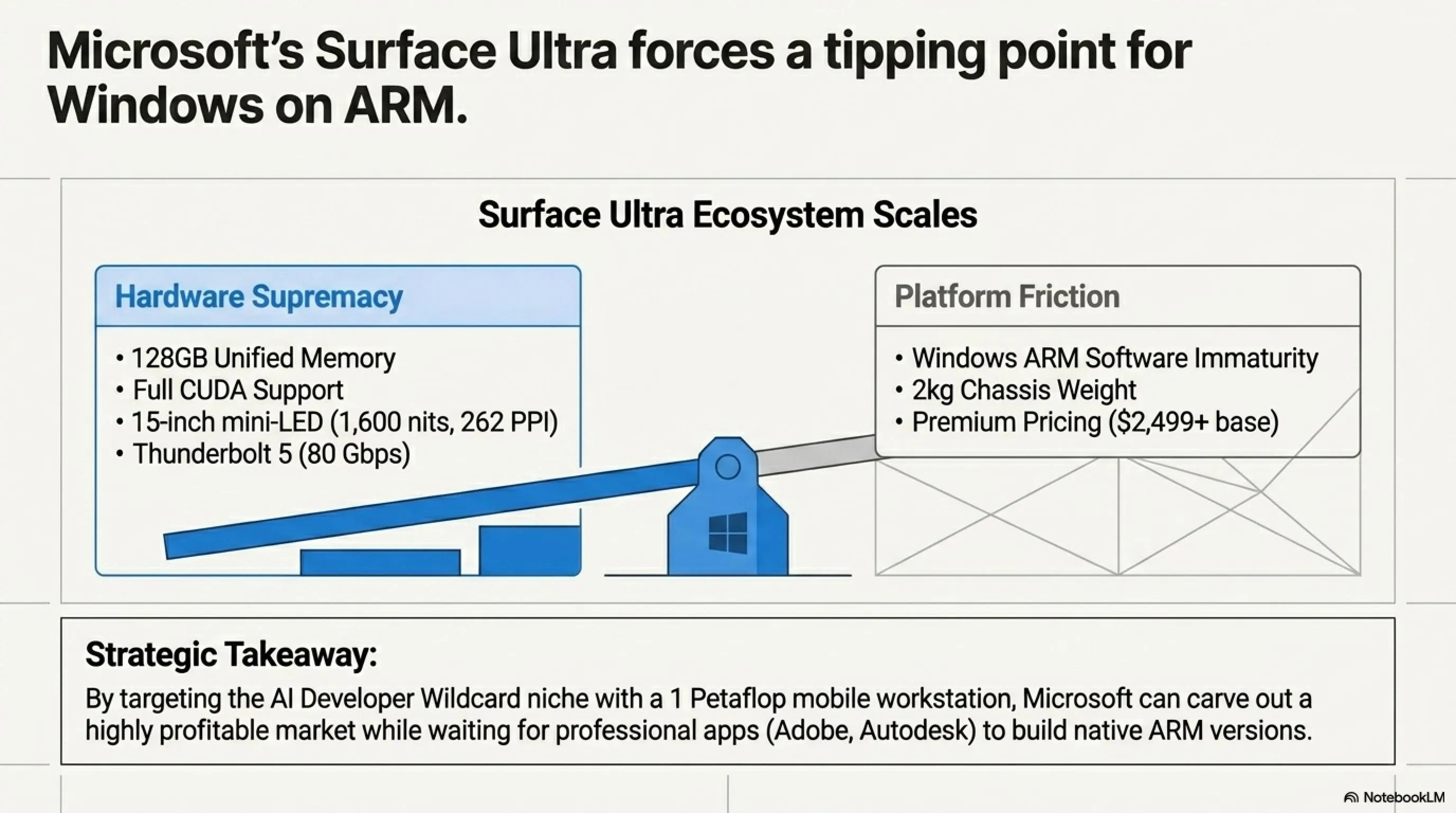
One of the most compelling features of the Surface Laptop Ultra is its mini-LED display. This technology, previously exclusive to MacBook Pro and iPad Pro, delivers infinite contrast, high brightness, and accurate colors through thousands of individually controlled backlighting zones. With 262 pixels per inch, this display is ideal for professional work like 4K video editing and graphic design. Microsoft claims the display can reach 1,600 nits peak brightness for HDR content - brighter than most laptop displays on the market.
Microsoft claims the Surface Laptop Ultra can run 70-billion parameter AI models locally, edit 12K video in real-time, and play AAA games at Ultra settings in 1440p at 100+ fps - all without being plugged in. If these claims hold up in real-world testing, the Surface Laptop Ultra could genuinely replace desktop workstations for many professionals. The key question is whether the ARM architecture and Windows on ARM ecosystem are mature enough to support professional workflows without compatibility issues or performance compromises.
The inclusion of Thunderbolt 5 is particularly noteworthy. This next-generation connectivity standard offers 80 Gbps bandwidth (double Thunderbolt 4), enabling support for multiple 8K displays, ultra-fast external storage, and high-performance eGPU enclosures. For professionals who need even more graphics power, Thunderbolt 5 could allow connecting an external RTX 5090 for desktop-class performance when docked. This flexibility addresses one of the main criticisms of integrated solutions - the inability to upgrade graphics performance.
⚔️ Pros & Cons Battle: Surface Laptop Ultra
✅ Strengths
- Most powerful ARM laptop ever made
- Exceptional mini-LED display quality
- 128GB unified memory - unmatched in market
- All-day battery with RTX 5070 performance
- Full CUDA and DirectX 12 support
- Premium design and build quality
- Thunderbolt 5 for future-proofing
- Native Windows ecosystem
❌ Weaknesses
- Very high price ($2,500+)
- ARM software compatibility still limited
- Heavy at 2kg - heavier than competitors
- No RAM or GPU upgradability
- First generation - potential bugs
- Tough competition from MacBook Pro M4
- Windows on ARM ecosystem immaturity
- Unproven real-world performance
The Surface Laptop Ultra is essentially Microsoft's answer to the MacBook Pro. With an expected starting price of $2,499, it directly competes with the 16-inch MacBook Pro with M4 Pro chip. But will users be willing to migrate from the mature macOS ecosystem to Windows on ARM? This question will be answered in the coming months as early adopters test the device and developers optimize their applications for ARM architecture.
🔮 Tekin Analysis: Can Surface Laptop Ultra Beat MacBook Pro?
Short answer: Unlikely in the short term, but possible in the long run. Here's why:
Surface Laptop Ultra's Challenges:
• ARM software ecosystem on Windows is still immature - many professional apps lack ARM-native versions
• High price without proven real-world performance creates risk for early adopters
• Microsoft's track record with long-term platform support is mixed (remember Windows Phone?)
• Developer adoption is critical but uncertain - will Adobe, Autodesk, and others prioritize ARM?
• Gaming compatibility through emulation may have performance penalties
Competitive Advantages:
• Full CUDA support - critical for AI developers and researchers who rely on Nvidia's ecosystem
• 128GB RAM - double the maximum MacBook Pro configuration, crucial for large AI models and datasets
• Touch display - a feature MacBook Pro lacks and many professionals want
• More competitive pricing at high-end configurations (128GB + 2TB)
• Windows ecosystem familiarity for enterprise users
• Thunderbolt 5 for future expansion possibilities
The Software Ecosystem Problem:
The biggest challenge isn't hardware - it's software. Apple spent years cultivating ARM-native apps for macOS, and even today, some professional applications still run through Rosetta 2 emulation. Microsoft and Nvidia need to convince developers that Windows on ARM is worth the investment. Without native versions of key professional applications (Adobe Creative Suite, Autodesk tools, DAWs, IDEs), the Surface Laptop Ultra will struggle to gain traction among professionals.
The AI Developer Wildcard:
One segment where Surface Laptop Ultra could immediately succeed is AI development. The combination of full CUDA support, 128GB unified memory, and 1 petaflop of AI compute makes it uniquely suited for training and running large language models locally. If Nvidia can position this as the ultimate AI development laptop, it could carve out a profitable niche even if broader adoption is slow.
Verdict: Surface Laptop Ultra is a bold, ambitious product that could reshape the market, but success depends on software ecosystem maturity and real-world performance. If Microsoft can convince developers to build ARM-native apps and RTX Spark delivers on its promises, this could be a game-changer. If not, it risks becoming another expensive experiment like the Surface RT.
It's worth noting that Microsoft has been here before. The Surface RT (2012) was an ARM-based Windows device that failed spectacularly due to lack of app support. The Surface Pro X (2019) was another ARM attempt that struggled with compatibility issues. But this time feels different. The ARM ecosystem has matured significantly, major applications are already being ported to ARM (thanks to Apple's M-series success), and RTX Spark offers something neither RT nor Pro X had: professional-grade graphics and AI performance. Microsoft is betting that third time's the charm.
👓 Apple's Strategic Delay: Glasses to 2027, Vision Air to 2029
While Nvidia and Microsoft charge forward at full speed, Apple has chosen a different strategy: patience and perfectionism. Mark Gurman of Bloomberg reported in his Power On newsletter that Apple Glasses have been delayed to late 2027, and the more affordable Vision Pro variant dubbed Vision Air won't arrive until 2029.
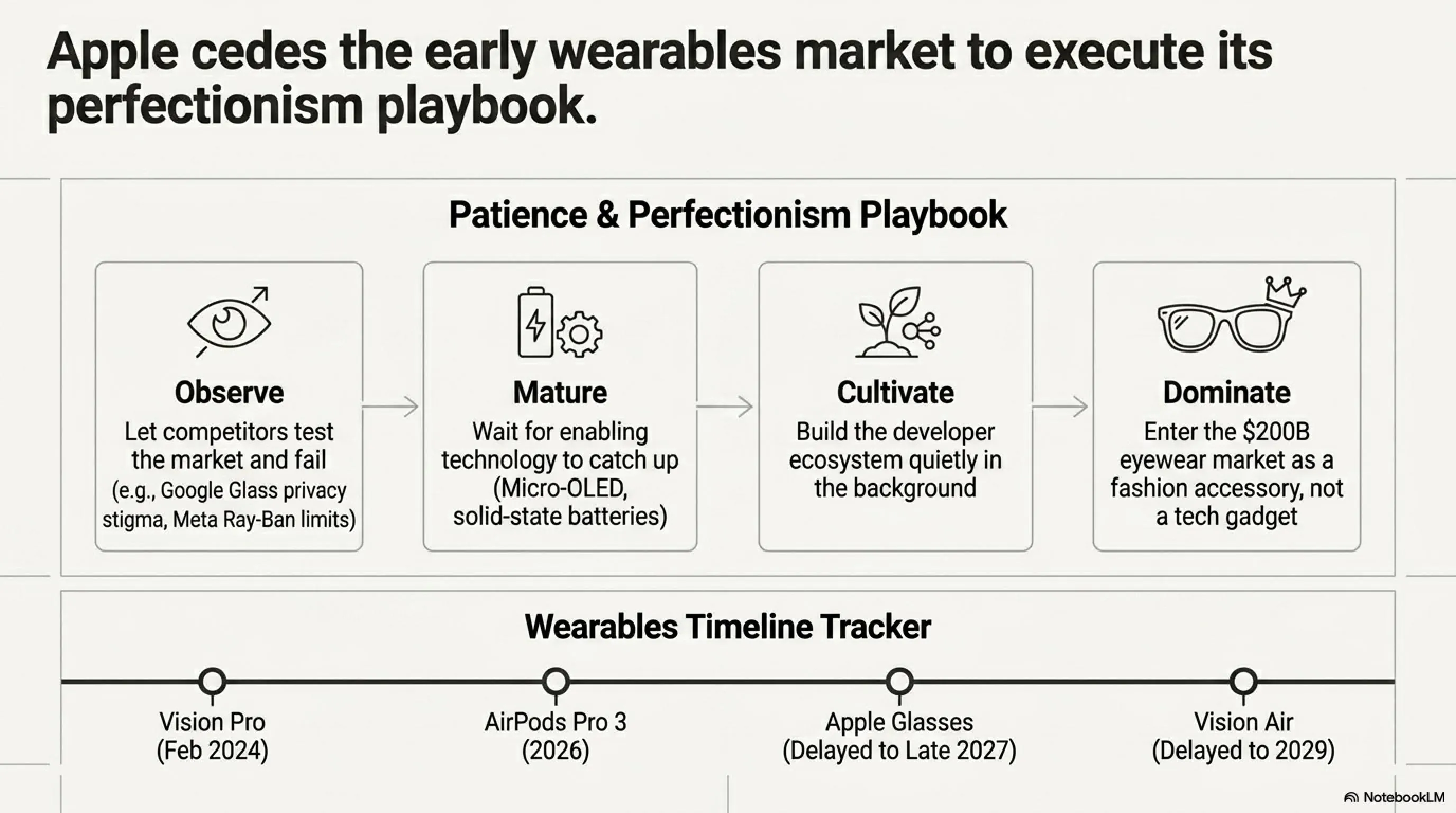
This delay might disappoint some, but it actually reflects Apple's long-term strategy. Apple doesn't want to be first - it wants to be best. This is the same strategy it employed with Apple Watch, AirPods, and even the iPhone: let competitors test the market, learn from their mistakes, then enter with a product that defines the industry standard. It's a strategy that has worked remarkably well for Apple, turning it into a $3 trillion company.
📅 Apple Wearables Timeline
| Product | Original Timeline | New Timeline | Status |
| Vision Pro | February 2024 | - | ✅ Shipped |
| Apple Glasses | Early 2027 | Late 2027 | ⏳ Delayed 6-9 months |
| Vision Air | 2028 | 2029 | ⏳ Delayed 1 year |
| AirPods Pro 3 | 2026 | - | ✅ On track |
💡 Source: Bloomberg Power On Newsletter - Mark Gurman (May 31, 2026)
According to Gurman's report, Apple has encountered technical challenges in developing its smart glasses. These challenges include thermal management, battery life, weight, and form factor. Apple wants to create glasses that not only are smart but also look and feel like regular eyewear - something Meta couldn't fully achieve with Ray-Ban Stories despite their partnership with a legendary eyewear brand.
Apple's strategy for smart glasses mirrors its Apple Watch approach: enter the market with four different designs and unique colors, then dominate the $200 billion eyewear market with superior quality and unmatched user experience. Apple doesn't want to build just a tech gadget - it wants to create a fashion accessory that people want to wear every day. This requires solving not just technical challenges but also aesthetic and social ones.
The $200 billion global eyewear market is dominated by Luxottica (which owns Ray-Ban, Oakley, and licenses for Prada, Chanel, Versace) and Essilor. Apple sees an opportunity to disrupt this market the same way it disrupted watches. The Apple Watch didn't just compete with smartwatches - it competed with traditional luxury watches and won. By 2025, Apple Watch had become the world's best-selling watch, period. Apple wants to replicate this success with glasses, but it knows it needs to get the product right from day one.
As for Vision Air, this device is intended to be a lighter, more affordable version of Vision Pro, priced around $1,500-$2,000 (compared to Vision Pro's $3,499). The goal of Vision Air is to democratize spatial computing and attract mainstream consumers who can't justify spending $3,500 on a VR headset. But Apple wants to ensure Vision Air still delivers a premium experience - not a cheap, compromised product. This takes time, especially when you're pioneering an entirely new product category.
🎯 Tekin Analysis: Why Apple's Delay is Actually Smart Strategy
Many might view Apple's delay as weakness, but it's actually a calculated strategy that has proven successful time and again:
1. Learning from Competitors' Mistakes: Meta, Google, and Microsoft have all released smart glasses with limited success. Meta's Ray-Ban Stories sold modestly but didn't revolutionize the market. Google Glass famously failed due to privacy concerns and social stigma. Microsoft's HoloLens remained a niche enterprise product. Apple can study these failures and avoid repeating them. By 2027, Apple will have years of market data showing what works and what doesn't.
2. Technology Maturation: By late 2027, key technologies will be more mature: micro-OLED displays will be brighter and more efficient, solid-state batteries will offer better energy density, and more efficient chips will enable longer battery life in smaller form factors. Apple is betting that waiting for these technologies to mature will result in a significantly better product than rushing to market with current-generation components.
3. Ecosystem Building: Apple has time to build a robust software ecosystem for its glasses - applications, services, and partnerships. The success of Apple Watch wasn't just about hardware; it was about the ecosystem of apps, health services, and integrations that made it indispensable. Apple is likely working with developers now to ensure a rich app ecosystem at launch.
4. The Apple Watch Playbook: Apple Watch launched in 2015 to mixed reviews. Critics called it expensive, unnecessary, and questioned its purpose. Today, it's the world's best-selling watch and a $40+ billion annual business. Apple knows that first-generation products don't need to be perfect - they need to establish a platform that improves over time. But they do need to be good enough to avoid the stigma of failure.
5. Social Acceptance: One of Google Glass's biggest failures was social acceptance - people felt uncomfortable being recorded, and wearers were mockingly called "Glassholes." Apple needs time to figure out how to make smart glasses socially acceptable. This might involve clear visual indicators when recording, privacy features, and design that doesn't scream "I'm a tech gadget." These are problems that can't be solved with better hardware alone.
6. The $200B Opportunity: The global eyewear market is massive, but it's also conservative and fashion-driven. Apple needs to convince not just tech enthusiasts but also fashion-conscious consumers that smart glasses can be stylish. This requires partnerships with fashion brands, celebrity endorsements, and careful marketing - all of which take time to orchestrate.
The Bottom Line: Apple's delay shows it's planning for long-term success, not short-term headlines. The company would rather be late and right than early and wrong. Given Apple's track record with Apple Watch, AirPods, and even iPhone (which wasn't the first smartphone), this strategy has merit. The question isn't whether Apple Glasses will be good - it's whether the market will still care by 2027, or if competitors will have already established dominance.
One interesting aspect of Apple's delay is how it affects Meta's strategy. Meta has been investing billions in AR/VR through Reality Labs, with losses exceeding $50 billion since 2020. Meta's Ray-Ban Meta smart glasses (the successor to Ray-Ban Stories) have been relatively successful, selling over 1 million units. If Apple delays until 2027, Meta has more time to establish market leadership and build a loyal user base. However, history suggests that Apple's entry into a market often redefines it entirely, potentially making Meta's early investments obsolete if Apple's product is significantly better.
🏠 Google Home Speaker: Official June 25 Launch at $99.99
Google has finally announced the official release date for its new smart speaker: June 25, 2026. This speaker, powered by Gemini (Google's advanced language model), will launch at $99.99 in four colors: Berry (pink/red), Hazel (black/gray), Jade (light green), and Porcelain (beige/white).
The speaker, first teased at the Made by Google 2025 event, was originally scheduled for spring 2026 release. However, Google decided to spend additional time optimizing Gemini integration and refining the Google Home ecosystem. Now, with the official June 25 date, users can finally experience what Google calls "the most intelligent smart speaker ever made."
🔊 Google Home Speaker with Gemini - Specifications
| AI Assistant | Google Gemini (advanced model) |
| Audio Design | 360-degree with fabric covering |
| Colors | Berry, Hazel, Jade, Porcelain |
| Controls | LED status ring + microphone mute switch |
| Integration | Google Home, Nest, Chromecast, Android |
| Smart Home Support | Matter, Thread, Zigbee, Z-Wave compatible |
| Price | $99.99 |
| Release Date | June 25, 2026 |
| Launch Countries | 19 countries (including US, Canada, UK, Australia) |
💡 Source: 9to5Google and Best Buy Canada
What sets the Google Home Speaker apart from competitors is its deep integration with Gemini. Unlike Google Assistant, which was a traditional voice assistant, Gemini is a large language model capable of more complex conversations, better context understanding, and more natural responses. This means you can talk to the speaker like a human, not just issue simple commands. Gemini can understand follow-up questions, remember context from earlier in the conversation, and provide nuanced answers that go beyond simple facts.
The speaker's 360-degree audio design is also noteworthy. Unlike Amazon Echo, which projects sound in one direction, the Google Home Speaker distributes audio evenly in all directions. This means audio quality is consistent regardless of where you're positioned in the room - ideal for music, podcasts, and voice calls. Google claims the speaker uses computational audio to optimize sound based on room acoustics, automatically adjusting EQ and volume for the best listening experience.
One of the most compelling features is Matter support, the new smart home standard backed by Apple, Google, Amazon, and Samsung. This means the Google Home Speaker can control virtually any smart home device, regardless of manufacturer, without requiring separate hubs or bridges. This level of interoperability has been a long-standing pain point in smart homes, and Matter promises to finally solve it. Google's early adoption of Matter could give it a significant advantage over competitors still relying on proprietary ecosystems.
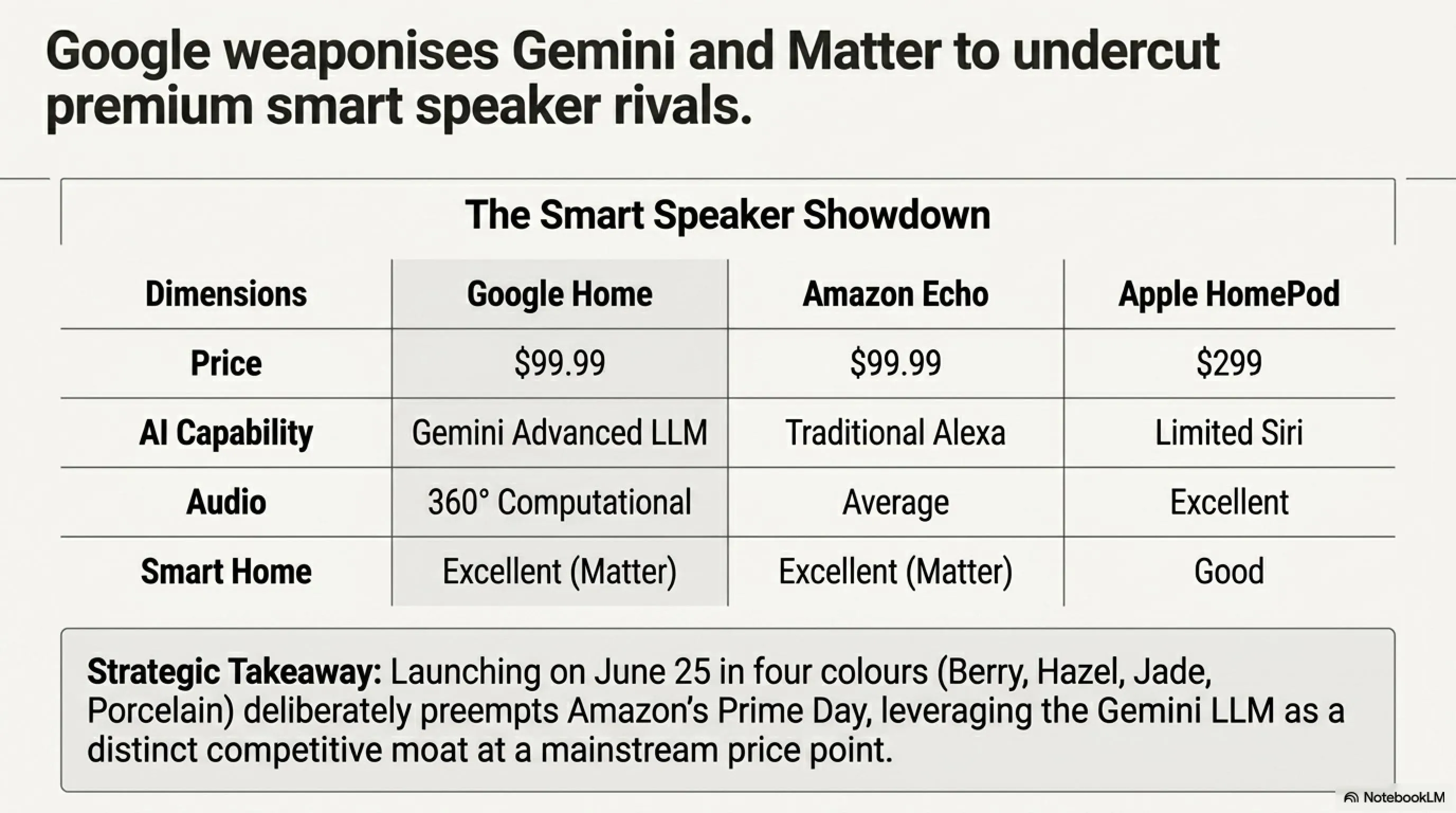
📊 Smart Speaker Showdown: Google vs Amazon vs Apple
| Feature | Google Home | Amazon Echo | Apple HomePod |
| Price | $99.99 | $99.99 | $299 |
| AI Assistant | Gemini (Advanced LLM) | Alexa (Traditional) | Siri (Limited) |
| Audio Quality | Good (360°) | Average | Excellent |
| Ecosystem | Google/Android | Amazon/Alexa | Apple/iOS |
| Smart Home | Excellent (Matter) | Excellent | Good |
| Privacy | Good | Average | Excellent |
| Music Services | All major services | All major services | Apple Music priority |
🏆 Winner: Google Home Speaker for competitive price and advanced Gemini AI
At $99.99, the Google Home Speaker directly competes with Amazon Echo but with the advantage of Gemini's superior AI capabilities. Meanwhile, Apple HomePod at $299 occupies the premium segment, primarily appealing to users deeply invested in the Apple ecosystem. Google's strategic pricing positions it as the best value proposition in the smart speaker market - advanced AI at a mainstream price point.
The timing of this launch is also strategic. By launching on June 25, Google positions the speaker for summer sales and back-to-school season, traditionally strong periods for consumer electronics. Additionally, launching before Amazon's Prime Day (typically in July) allows Google to capture early adopters before Amazon's aggressive discounting begins. This suggests Google is confident in the product's competitiveness and wants to establish market presence quickly.
🎮 AMD Ryzen 7 7700X3D and the Legendary 5800X3D Returns
AMD made two significant announcements at Computex 2026 that delighted gamers and budget-conscious users: the introduction of Ryzen 7 7700X3D at $329 and the legendary return of Ryzen 7 5800X3D as a 10th Anniversary Edition at $349. These two processors demonstrate that AMD remains committed to its older platforms and wants to offer affordable options for everyone.
The Ryzen 7 7700X3D is essentially a binned (cherry-picked) version of the 7800X3D, offered at a lower price point. This processor features 8 cores, 16 threads, 100MB cache (L2+L3), and boost clocks up to 5.0GHz - only slightly slower than the 7800X3D which sells for $380-$450. For gamers who want X3D performance at a more accessible price, the 7700X3D is an excellent choice. The performance difference is minimal (around 5-7% in most games), but the price difference is substantial.
⚡ AMD X3D Processor Comparison
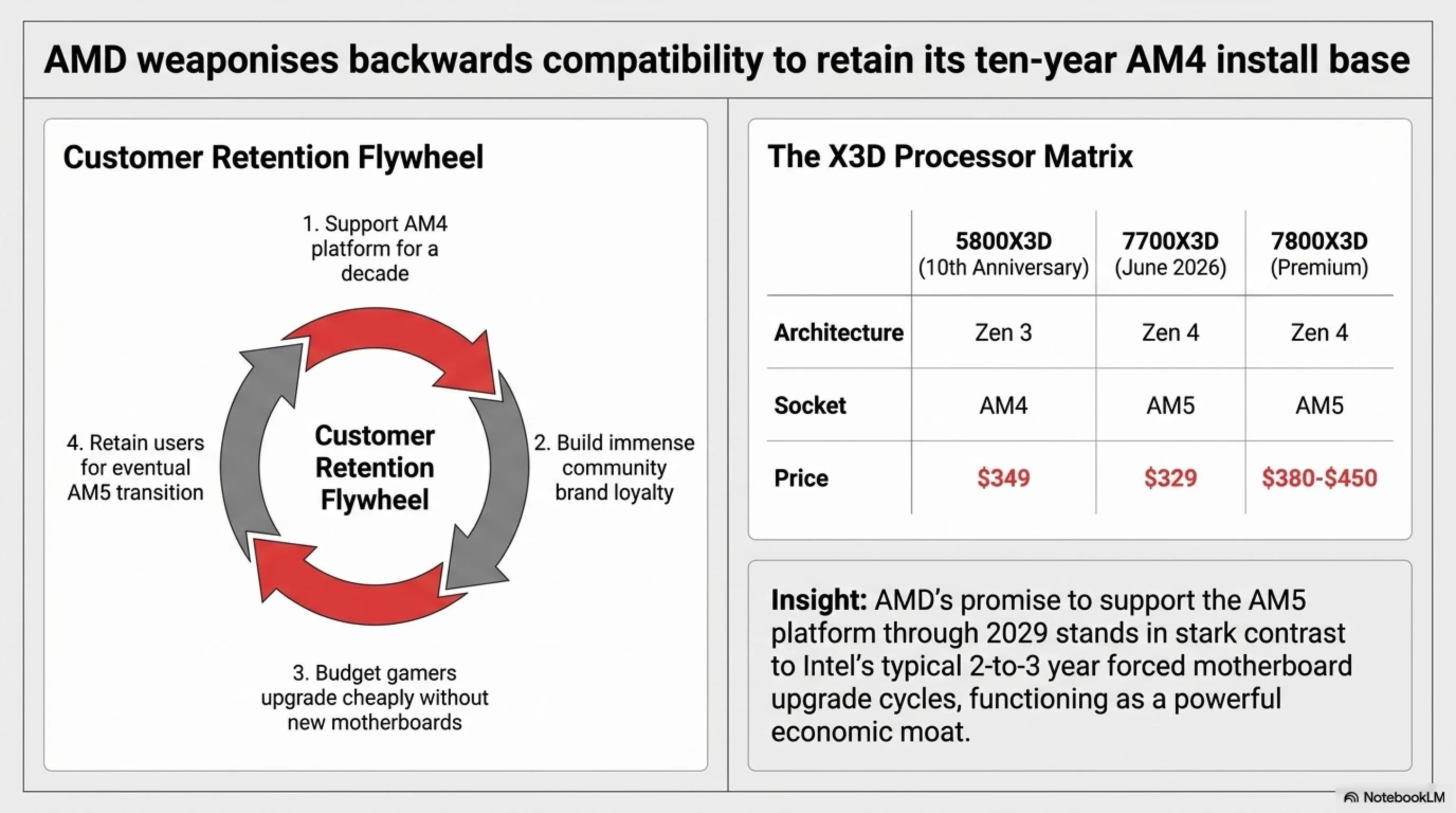
| Specification | 5800X3D (2022) | 7700X3D (2026) | 7800X3D (2023) |
| Architecture | Zen 3 | Zen 4 | Zen 4 |
| Cores/Threads | 8/16 | 8/16 | 8/16 |
| Boost Clock | 4.5 GHz | 5.0 GHz | 5.0 GHz |
| Total Cache | 100 MB | 100 MB | 104 MB |
| Socket | AM4 | AM5 | AM5 |
| TDP | 105W | 105W | 120W |
| Price | $349 | $329 | $380-$450 |
| Release Date | June 25, 2026 | June 2026 | April 2023 |
💡 Note: 7700X3D is the most affordable X3D processor in AMD history
But the truly exciting news is the return of the Ryzen 7 5800X3D. This processor, which launched in 2022 at $449 and quickly became legendary among gamers, is now returning as a 10th Anniversary Edition at $349. This return isn't just nostalgia - it demonstrates that AMD remains committed to the AM4 platform, which is now 10 years old and still alive.
The 5800X3D, with its 8 Zen 3 cores, 16 threads, 100MB cache, and 4.5GHz boost clock, remains a powerful gaming processor. Testing shows its gaming performance matches the Ryzen 5 9600X (a modern 6-core processor with Zen 5 architecture). This means users still on AM4 motherboards can get a significant upgrade for $349 without needing to replace their motherboard, RAM, or cooler. For budget-conscious gamers, this is a godsend.
🎯 Tekin Analysis: Why AMD's AM4 Commitment Matters
The return of the 5800X3D is a brilliant strategic move that benefits AMD in multiple ways:
1. Massive AM4 Install Base: Millions of users still run AM4 motherboards. AMD is showing these users they haven't been forgotten. This builds brand loyalty and trust - crucial in a market where Intel has historically abandoned platforms after just 2-3 years. By supporting AM4 for a full decade, AMD differentiates itself as the consumer-friendly choice.
2. Competitive Pressure on Intel: Intel offers virtually no long-term platform support. Users must upgrade motherboards every 2-3 generations. AMD's decade-long AM4 support highlights this contrast and makes AMD more attractive to cost-conscious builders. This is particularly important in emerging markets where upgrade costs matter significantly.
3. Affordable Gaming Option: In an era of rising component prices, the 5800X3D at $349 offers exceptional value. Combined with affordable AM4 motherboards (some as low as $80), users can build a competitive gaming PC for much less than AM5 or Intel's latest platforms. This opens PC gaming to a broader audience.
4. Nostalgia and Brand Building: The 5800X3D is a legendary name in the gaming community. Its return generates media attention and positive sentiment. AMD is leveraging nostalgia while delivering real value - a powerful combination for brand building.
5. Clearing Inventory: Let's be pragmatic - AMD likely has significant AM4 chip inventory and manufacturing capacity. Re-releasing the 5800X3D allows AMD to monetize existing assets while appearing consumer-friendly. It's good business disguised as generosity.
6. AM5 Adoption Path: By offering both AM4 (5800X3D) and affordable AM5 (7700X3D) options, AMD creates a clear upgrade path. Users can start with AM4 now and upgrade to AM5 later when prices drop, all while staying in the AMD ecosystem.
The Bigger Picture: AMD's commitment to AM4 and AM5 (promised support through 2029) represents a fundamentally different philosophy than Intel's. AMD is building a reputation as the platform that respects your investment. In the long run, this could be more valuable than any single product launch.
AMD also announced that AM5 platform support will continue through 2029, meaning users who buy AM5 motherboards today can expect to upgrade to new Ryzen processors for at least three more years. This is unprecedented in the PC industry and gives AMD a significant competitive advantage. Intel's typical 2-3 year platform lifecycle means users must replace motherboards more frequently, increasing total cost of ownership.
💰 Coinbase Enters India's $3 Billion Crypto Market
Coinbase, one of the world's largest cryptocurrency exchanges, has officially launched direct Indian Rupee (INR) support, entering India's $3 billion crypto market. Starting June 1, 2026, Indian users can deposit and withdraw rupees directly from their bank accounts without needing P2P intermediaries or local exchanges.
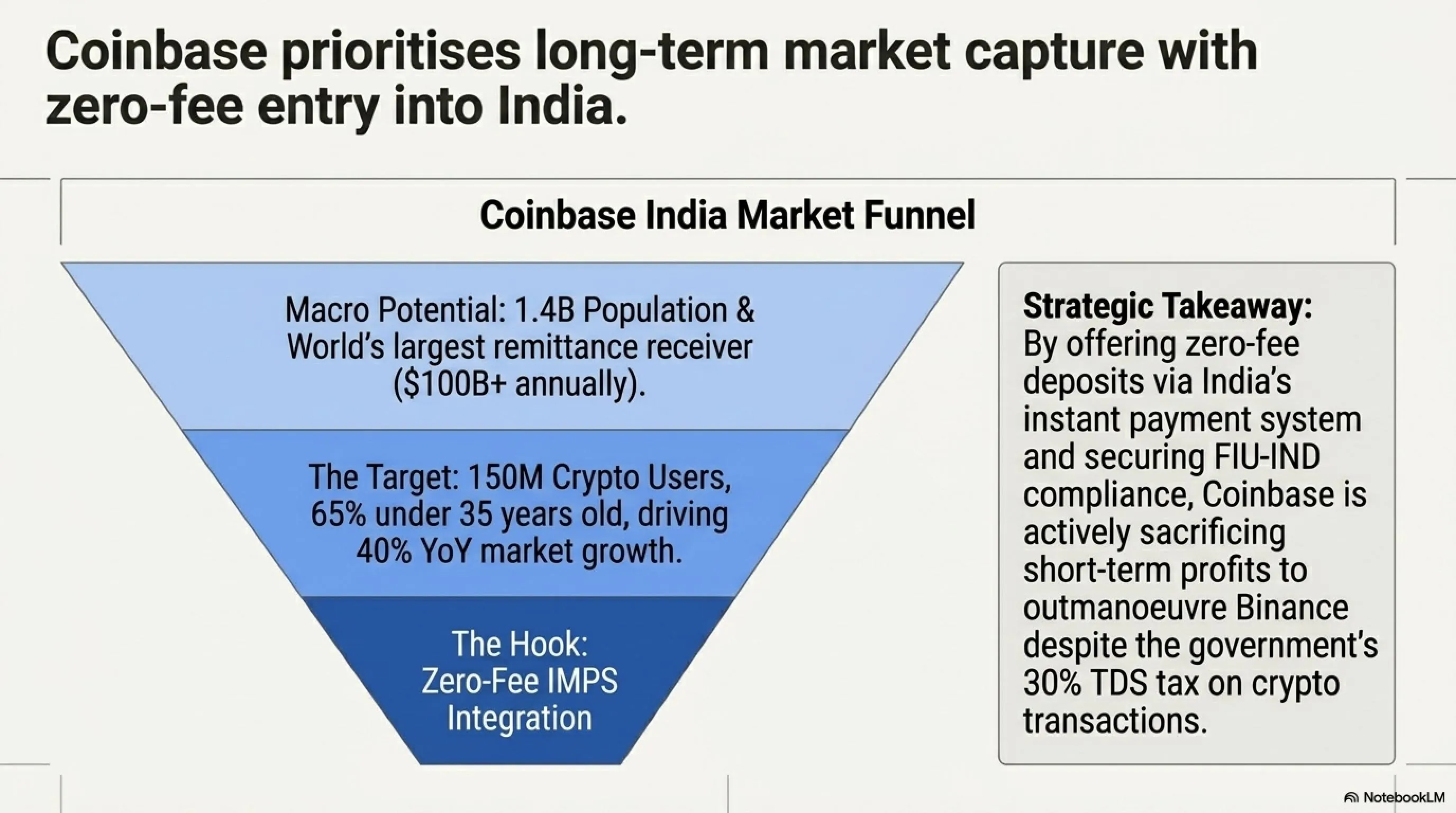
This launch operates through IMPS (Immediate Payment Service), India's instant payment system. Users can deposit and withdraw funds 24/7, and Coinbase charges zero fees for deposits. This is a significant competitive advantage over local exchanges that typically charge 1-2% deposit fees. The zero-fee structure suggests Coinbase is prioritizing market share over immediate profitability - a classic growth strategy for entering new markets.
📊 India Crypto Market Statistics
💡 Sources: Coinbase Official Blog, CoinDesk, LiveMint, NDTV Profit
Coinbase is registered with FIU-IND (Financial Intelligence Unit) and fully compliant with Indian tax laws. This means users can trade with confidence without worrying about legal issues. Coinbase also offers spot markets and perpetual futures contracts for major crypto assets, providing professional trading tools that were previously unavailable to most Indian users.
Coinbase's entry into India sends an important signal to the global crypto market. India, with over 150 million crypto users, is the world's second-largest crypto market (after the US). Until now, Indian users had to rely on local exchanges or P2P methods that had high fees and lower security. Now, with Coinbase's entry, Indian users can access a reputable international exchange with institutional-grade security and insurance.
🔮 Tekin Analysis: Why India Matters for Coinbase
Coinbase's India entry is a long-term strategic play with massive potential:
1. Enormous Market: India's 1.4 billion population and 150 million crypto users make it one of the world's largest potential markets. Even capturing 10% market share would add tens of millions of users to Coinbase's platform.
2. Rapid Growth: India's crypto market is growing at 40% annually - faster than most other countries. This growth is driven by young demographics, increasing smartphone penetration, and growing distrust of traditional financial systems.
3. Young Demographics: 65% of India's population is under 35 - the ideal demographic for crypto adoption. This generation is tech-savvy, comfortable with digital payments, and open to alternative financial systems.
4. Digital Payment Infrastructure: India is one of the world's leaders in digital payments (UPI, IMPS). The transition to crypto is natural for a population already comfortable with digital money. India processes more digital transactions than the US and China combined.
5. Competition with Binance: Binance is already active in India and has significant market share. Coinbase needs to establish presence quickly to compete. The zero-fee deposit strategy suggests Coinbase is willing to sacrifice short-term profits for long-term market position.
6. Regulatory Clarity: While India's 30% crypto tax is high, it provides regulatory clarity. Coinbase prefers operating in regulated markets over regulatory gray zones. The FIU-IND registration gives Coinbase legitimacy and reduces regulatory risk.
7. Remittance Market: India is the world's largest recipient of remittances ($100+ billion annually). Crypto could disrupt traditional remittance channels (Western Union, MoneyGram) by offering faster, cheaper transfers. If Coinbase can capture even a small percentage of this market, it would be enormously profitable.
The Bottom Line: India could become one of Coinbase's largest markets within 5 years. The combination of massive population, rapid growth, favorable demographics, and digital payment infrastructure creates a perfect storm for crypto adoption. Coinbase's early entry positions it to capture significant market share before competitors can establish dominance.
One challenge Coinbase will face is India's 30% tax on crypto transactions, one of the highest in the world. This tax applies to all crypto gains and is deducted at source (TDS), making crypto trading less attractive than in countries with lower or no crypto taxes. However, the tax also provides regulatory clarity - Coinbase knows the rules and can operate within them. This is preferable to regulatory uncertainty that could result in sudden bans or restrictions.
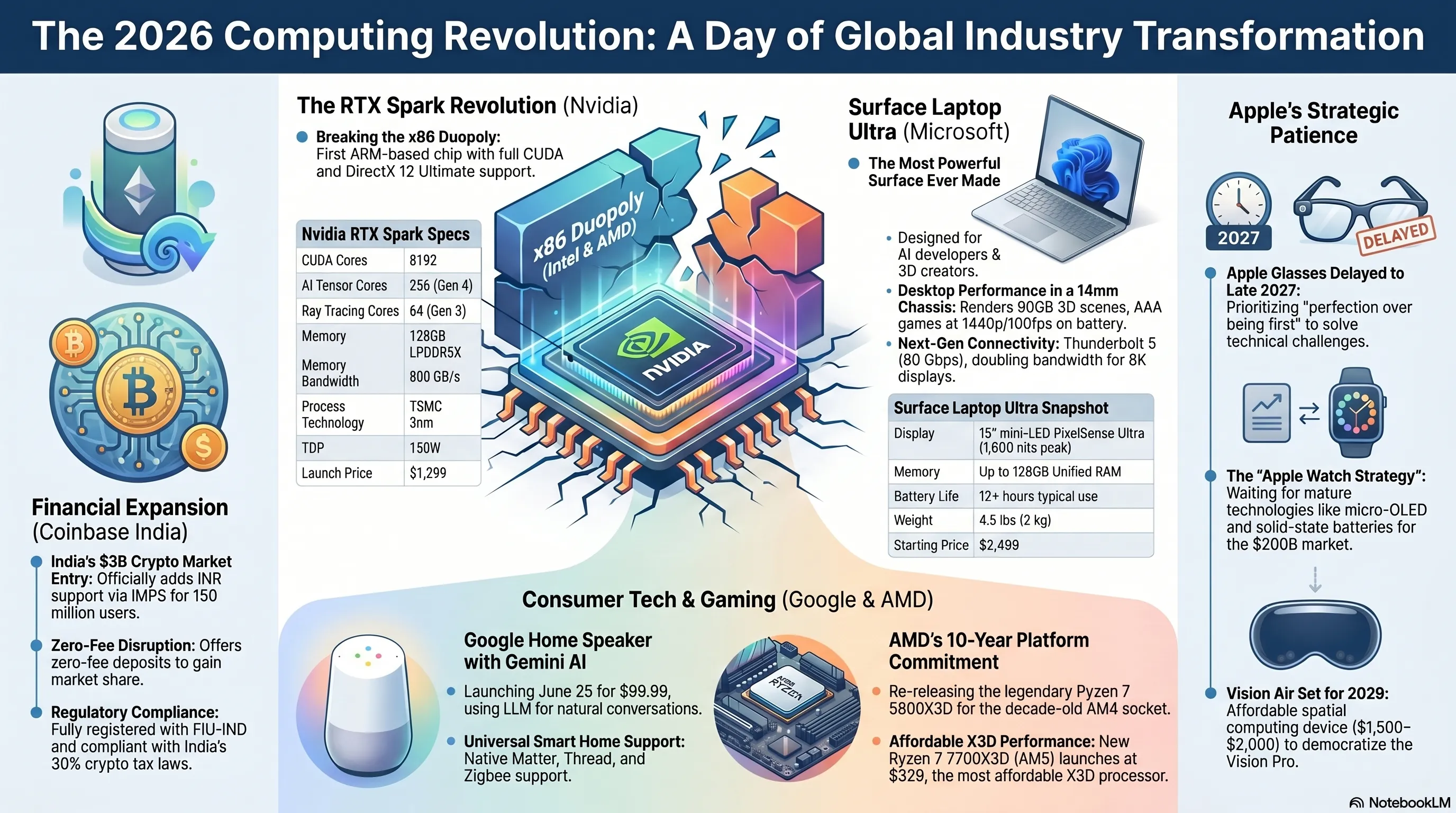
🎯 Mid-Article Summary: What Mattered Today?
Today we witnessed fundamental transformations in the technology industry:
🔥 The RTX Spark Revolution: Nvidia is no longer just a GPU company - it's now a direct competitor to Intel and AMD in the CPU market. This could reshape the future of personal computing forever. The unified memory architecture, full CUDA support, and 1 petaflop of AI compute in a laptop form factor represent a paradigm shift.
💪 Surface Laptop Ultra: Microsoft demonstrated that Windows on ARM is serious business. With RTX Spark, we now have a genuine MacBook Pro competitor that doesn't compromise on performance. The 128GB unified memory and mini-LED display set new standards for premium laptops.
⏳ Apple's Strategic Patience: Apple's delay of its smart glasses shows the company is willing to wait for perfection - a strategy that worked brilliantly with Apple Watch. By 2027, Apple will have learned from competitors' mistakes and can enter with a product that defines the category.
🏠 Google with Gemini: Google's new smart speaker with competitive pricing and advanced AI could shake up the market. Gemini's superior conversational abilities and Matter support position it as the best value proposition in smart speakers.
🎮 AMD's User Loyalty: The return of the 5800X3D demonstrates AMD's commitment to long-term platform support. This builds trust and differentiates AMD from Intel's frequent platform changes. The 7700X3D at $329 also provides an affordable entry point to X3D gaming performance.
🌏 Coinbase in India: Entry into India's $3 billion market shows crypto is going truly global. With 150 million users and 40% annual growth, India could become one of Coinbase's largest markets within years.
❓ Frequently Asked Questions (FAQ)
Can RTX Spark really beat Intel and AMD?
Short answer: Not in the short term, but possibly in the long run. RTX Spark is a first-generation product, and the ARM software ecosystem on Windows is still immature. However, if Nvidia can convince developers to build ARM-native applications and real-world performance matches the claims, RTX Spark could be a game-changer. The key advantage is CPU, GPU, and AI integration in a single chip - something Intel and AMD haven't fully delivered yet. Success depends on three factors: performance delivery, software ecosystem maturity, and developer adoption. If all three align, RTX Spark could fundamentally reshape the PC market.
Is the Surface Laptop Ultra worth buying?
It depends on your needs. If you're an AI developer, video editor, or 3D designer who needs high computational power and massive memory, the Surface Laptop Ultra could be excellent - especially with 128GB unified memory unavailable in any other laptop. However, if you're a general user or deeply invested in the macOS ecosystem, it's better to wait for later generations and ecosystem maturity. The high price ($2,500+) is also a significant factor. For early adopters willing to deal with potential ARM compatibility issues, it's an exciting option. For everyone else, waiting 6-12 months for reviews and software maturity is prudent.
Why did Apple delay its smart glasses?
Apple encountered technical challenges: thermal management, battery life, weight, and form factor. Apple doesn't want to release a half-baked product - it wants glasses that look and feel like regular eyewear while delivering smart capabilities. This strategy mirrors Apple Watch: let competitors test the market, learn from their mistakes, then enter with a product that defines the industry standard. The delay gives Apple time to perfect the technology, build a software ecosystem, and figure out social acceptance issues that plagued Google Glass. By 2027, Apple will have years of market data and more mature component technology.
Should I buy the Ryzen 7 7700X3D or 7800X3D?
If you have a limited budget, the 7700X3D at $329 is excellent value - only slightly slower than the 7800X3D but $50-$120 cheaper. However, if you want the best gaming performance and budget allows, the 7800X3D is still the better choice. The performance difference is small (about 5-7%), but the 7800X3D has proven itself as a reliable, stable processor. For AM4 users, the 5800X3D at $349 is still an excellent option if you don't want to replace your motherboard. The decision ultimately comes down to budget and whether you're building new (AM5) or upgrading existing (AM4).
Is Coinbase safe to use in India?
Yes, Coinbase is registered with FIU-IND and fully compliant with Indian tax laws. It's one of the world's most reputable exchanges with a strong security track record. However, like any exchange, it's recommended to store long-term holdings in a personal wallet (hardware wallet), not on the exchange. Also note that India has a 30% tax on crypto transactions, so factor this into your calculations. Coinbase's zero-fee deposits make it competitive with local exchanges, but always practice good security hygiene: enable 2FA, use strong passwords, and never share your credentials.
🎬 Final Thoughts
Monday, June 1, 2026, will be remembered as one of the most historic days in technology. Nvidia's entry into the CPU market with RTX Spark, the unveiling of the most powerful Surface ever, Apple's strategic delay in smart glasses, Google's Gemini-powered smart speaker launch, AMD's legendary 5800X3D return, and Coinbase's entry into India's billion-dollar market - all these events signal that the technology industry is undergoing fundamental transformation.
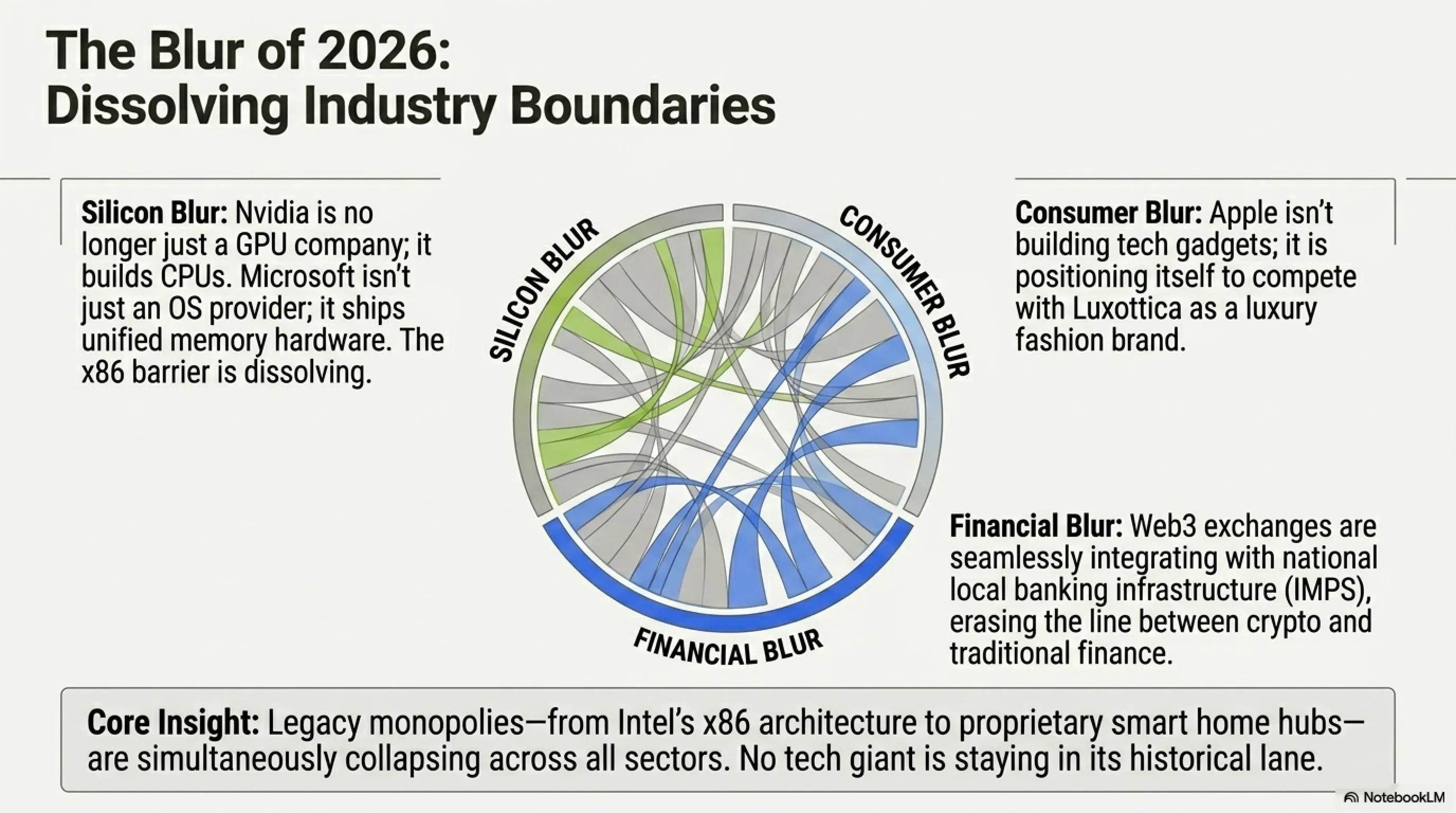
We're at the threshold of a new era: an era where ARM replaces x86, AI is integrated everywhere, and the boundaries between CPU, GPU, and NPU dissolve. Companies that can understand and adapt to this transformation will win. Those clinging to the past will be left behind.
What to Watch Next:
• RTX Spark real-world performance reviews (Fall 2026)
• Windows on ARM software ecosystem maturation
• Apple Glasses development updates and potential leaks
• Google Home Speaker vs Amazon Echo market share battle
• AMD's AM5 roadmap through 2029
• Coinbase's India market penetration and regulatory developments
The next few months will be crucial in determining which of today's announcements become industry-defining successes and which become expensive experiments. One thing is certain: the PC industry will never be the same after today.
Join us tomorrow for Tekin Night where we'll cover the evening's tech news. Until then, stay curious and stay informed! 🚀
📚 Sources
The Verge, CNBC, TrendForce, Tom's Hardware, PC Gamer, HotHardware, Windows Central, 9to5Mac, AppleInsider, MacRumors, Indian Express, Gadgets 360, 9to5Google, Android Authority, Engadget, AMD Official Blog, PC World, PCMag, Guru3D, Notebookcheck, Coinbase Official Blog, CoinDesk, LiveMint, NDTV Profit, KuCoin News, CoinGabbar, Bloomberg Power On Newsletter
Research and Analysis: Tekin Editorial Team
Publication Date: June 1, 2026
Word Count: ~4,800 words
🌐 Stay Connected With Us 🎮✨
For the latest tech, gaming, and gadget news, follow us on our official social media channels:
Additional Gallery: 🌅 Tekin Morning June 1, 2026: Nvidia RTX Spark Revolution, Microsoft Surface Ultra & Apple Glasses Delay