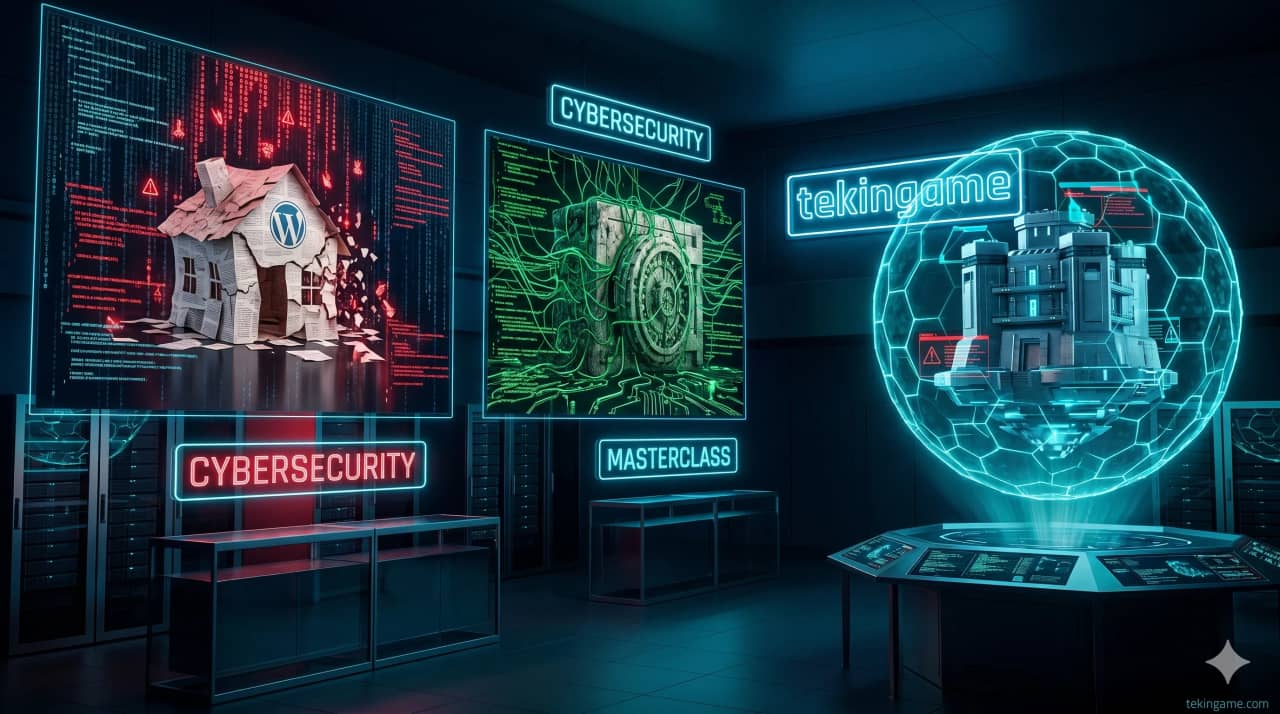
🕵️♂️ Takin Masterclass & Special Dossier: The Illusion of Security; Why Global Financial Fortresses Fall and WordPress Remains Easy Prey
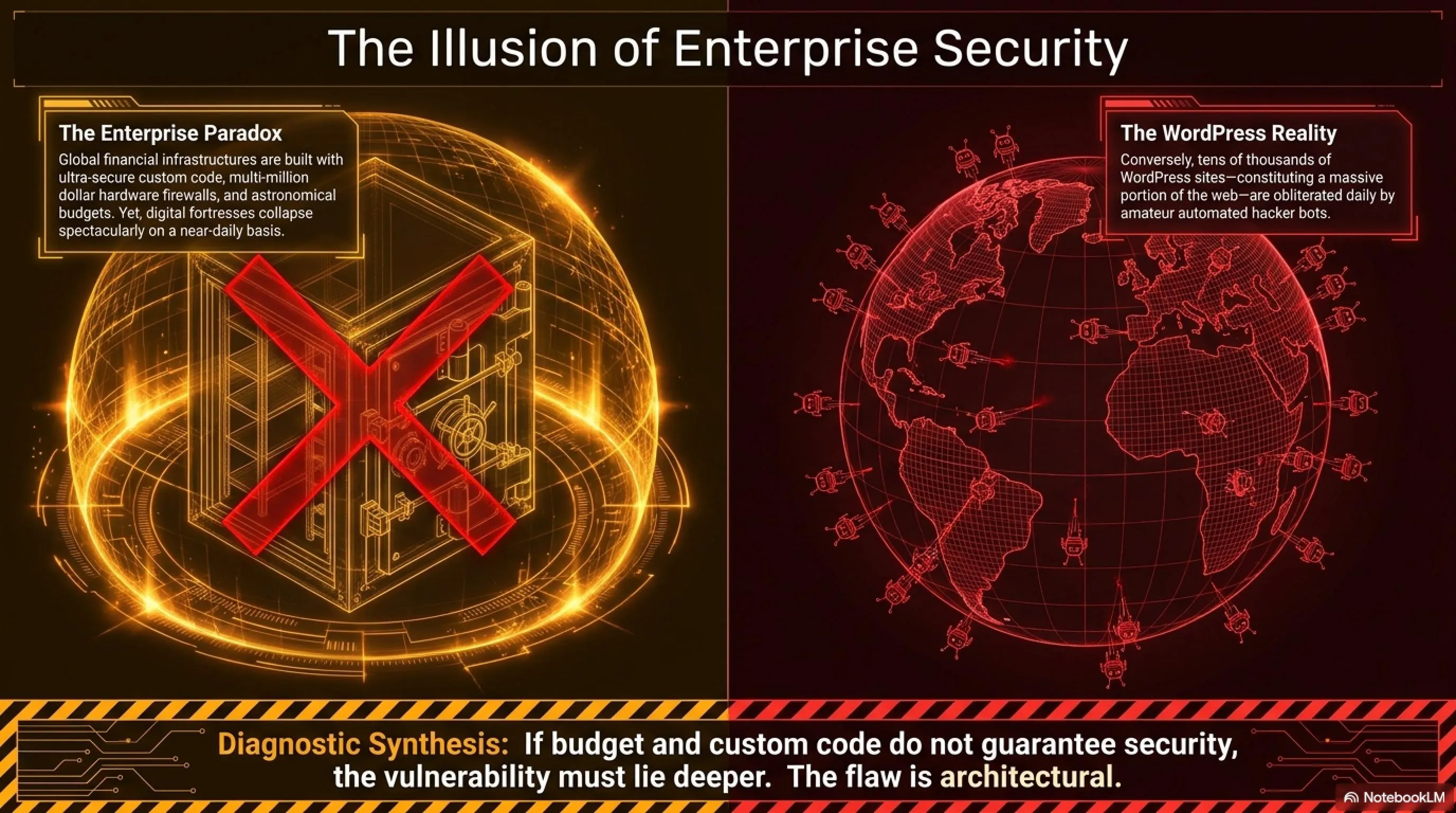
If you follow technology and cybersecurity news, you have undoubtedly encountered terrifying headlines on a near-daily basis: "Equifax Breach Exposes 147 Million Records," "Capital One Hacked Due to Misconfigured Firewall," or "Government Infrastructure Paralyzed by Ransomware." Reading these reports, an immediate paradox forms in the mind of any informed individual: Aren't these global banking infrastructures built with ultra-secure custom code, multi-million dollar hardware firewalls, and astronomical cybersecurity budgets? Why do these digital fortresses collapse so spectacularly? Conversely, tens of thousands of WordPress sites, which constitute a massive portion of the web, are obliterated daily by amateur hacker bots (Script Kiddies).
In this comprehensive "Masterclass" and deep-dive security autopsy, we are tearing down the server walls to journey into the absolute core of software architectures. We will transcend superficial terminology and meticulously analyze, through the lens of software engineering, why tech titans like Amazon and Netflix shrug off relentless attacks without a flinch, why the "secure" custom code of major banks is actually their Achilles' heel, and why a business's insistence on utilizing WordPress is akin to rolling out a red carpet for digital thieves!
📉 Shocking Statistics (Official IBM 2023 Report):
The average cost of a data breach for organizations relying on Legacy systems has skyrocketed to $4.45 Million! Even more terrifyingly, it takes an average of 277 days to identify and contain a breach in these spaghetti-code environments. This means hackers are roaming internal networks undetected for over 9 months!
⚡ Masterclass Syllabus:
🔍 Core Definitions: What exactly are the structural realities of WordPress, Legacy Code, and Microservices?
🏢 Architecture in Depth: Why old custom code is exponentially more hazardous than WordPress.
⚖️ Inherent Pros & Cons: A ruthless, uncompromising architectural evaluation.
🛠️ Development Workflow: The agony of maintaining legacy code vs. Continuous Integration (CI/CD).
📊 Unforgiving Benchmarks: Stress testing latency, DDoS resilience, and SQL injection defense.
🚨 The Migration Nightmare: Why executives are paralyzed by fear and the catastrophic risks of Technical Debt.
⛓️ Supply Chain Attacks: How hackers bypass firewalls through third-party vendors.
☕ Prepare your coffee. This is the most extensive, comprehensive, and specialized architectural analysis ever published on TakinGame. It will permanently alter your perception of "Enterprise Security."
⏳ Timeline of Catastrophe: A Look at Major Architectural Breaches
Before delving into theory, let us review the recent history of cyberattacks. These events demonstrate that vulnerabilities are not merely theoretical; they result in billion-dollar damages.
| Banking Disaster (Equifax) | Legacy & Patching Failure: Systematic infiltration through unpatched vulnerabilities in outdated, monolithic frameworks (Apache Struts). This attack highlighted the profound fragility of legacy enterprise systems and led to the exposure of 147 million highly sensitive records. |
| WordPress Crisis (Global) | Mass Plugin Exploitation: Frequent discovery of Zero-Day bugs in widely-used form builder and page builder plugins. In a recent wave, hundreds of thousands of sites were defaced or converted into cryptojacking botnets within a mere 24-hour window. |
| Record-Breaking (Amazon Prime Day) | Microservices Resilience: The successful management of tens of millions of concurrent requests during massive global sales events without a single second of downtime or data leakage. This triumph is directly attributable to their decoupled, independent, and modern Serverless architecture. |
🔍 Part I: Opening the Black Box; Defining the Architectures
To comprehend the depth of these disasters and why systems are breached, we must establish a common language. Buzzwords like "Monolithic" or "Microservices" are frequently thrown around in executive meetings, but what is their actual engineering significance? Let us dissect these three behemoths and examine their internal organs.
🏗️ Part II: Dissecting Monolithic Structures
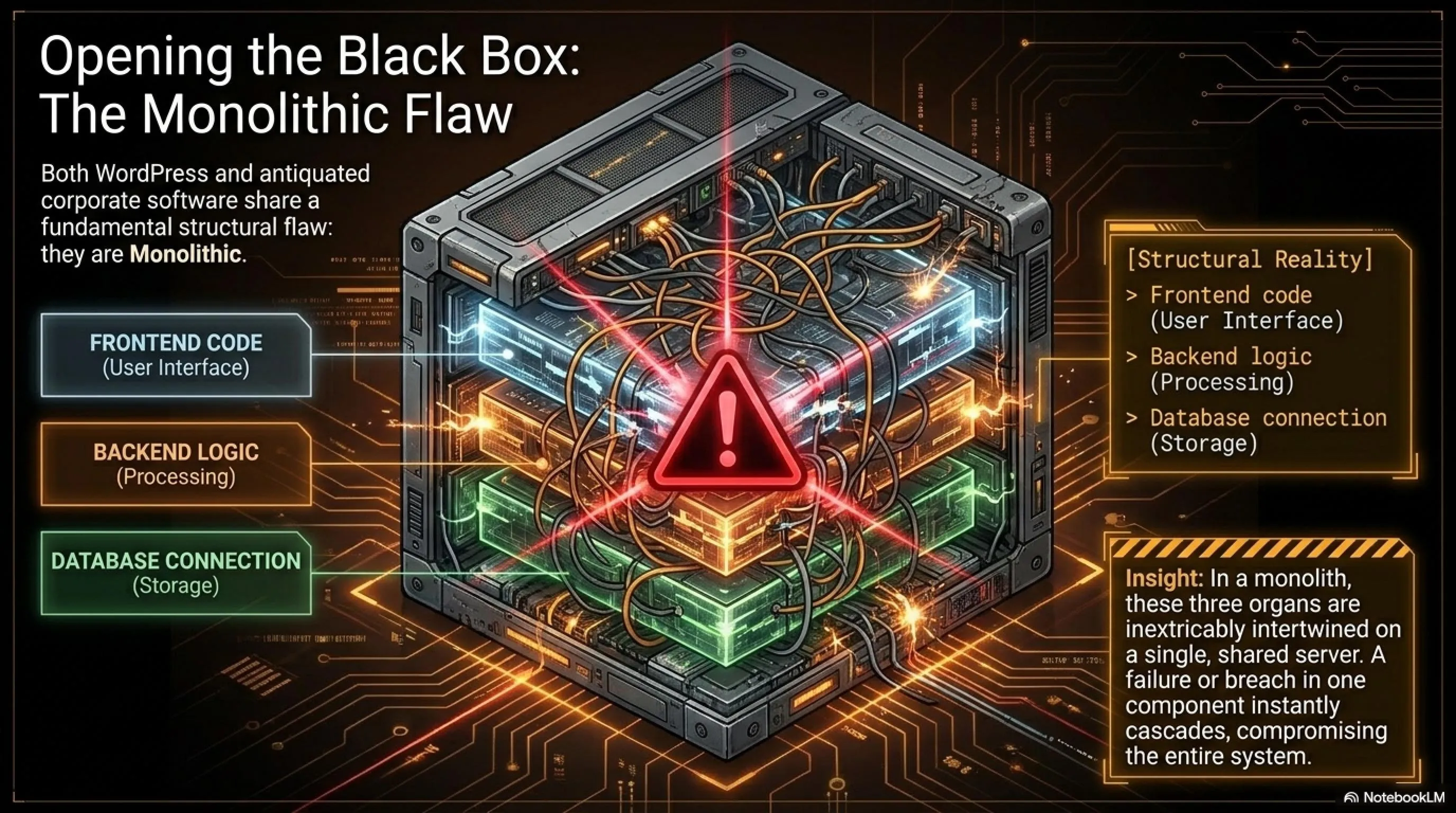
Both WordPress and antiquated corporate software share a fundamental structural characteristic: they are both "Monolithic" systems. However, this similarity does not translate to identical operational behavior. Let us examine each individually.
1. WordPress: The Frankenstein of the Web
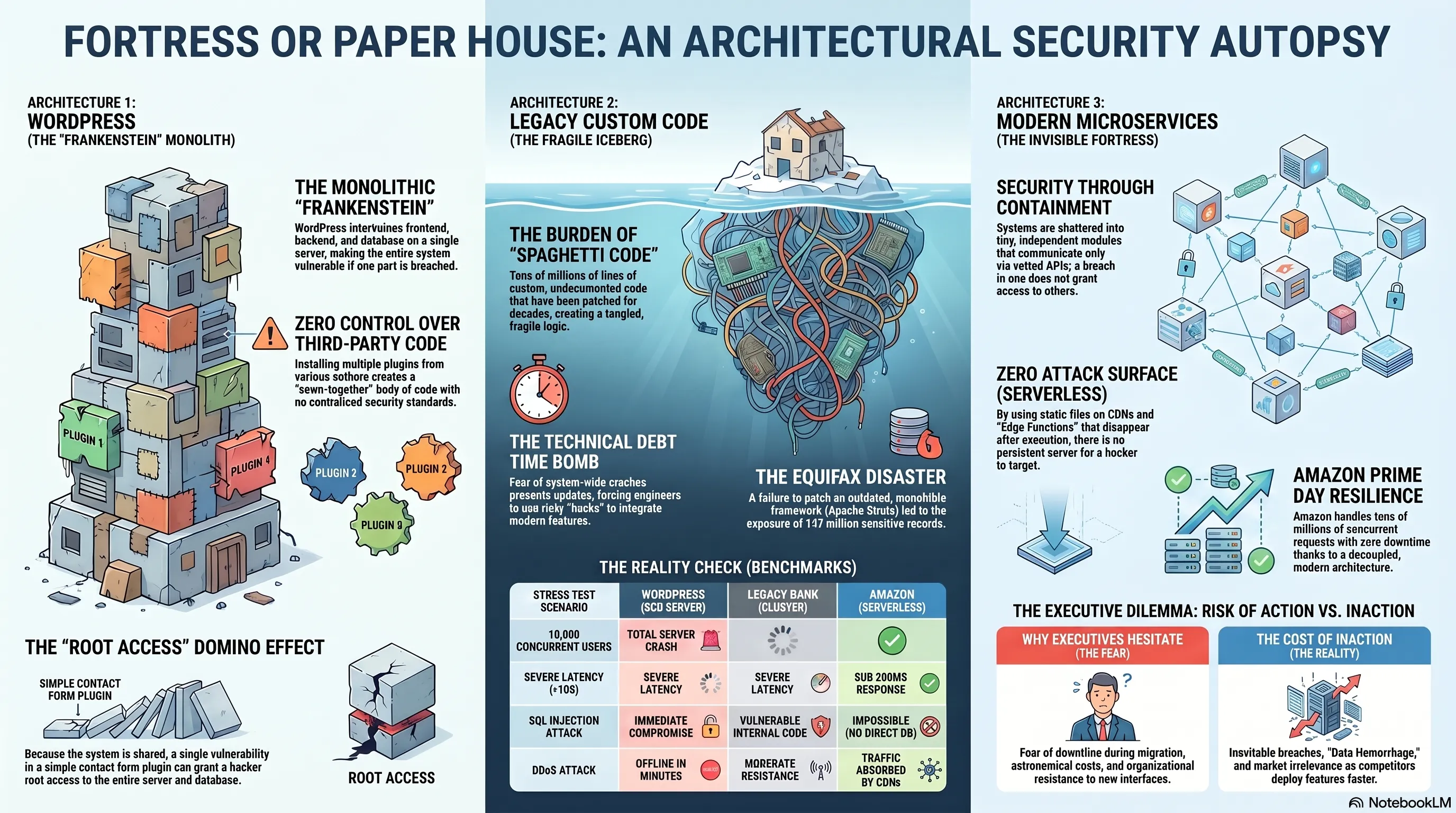
At its core, WordPress is a "Monolithic CMS" (Content Management System). In a monolithic architecture, the frontend code (the HTML/CSS the user sees), the backend logic (PHP processing), and the database connection logic (MySQL) are all inextricably intertwined on a single, shared server. The inherent nature of WordPress is exceptionally efficient for a simple personal blog. The catastrophe begins when businesses place unrealistic demands upon it. They attempt to mutate this simple blogging platform into a complex e-commerce storefront, an appointment booking system, or a corporate intranet by aggressively installing dozens of "Plugins."
When you install 20 different plugins authored by anonymous developers worldwide with vastly differing skill levels, you are essentially sewing together the body parts of different corpses (exactly like Frankenstein's monster). You possess zero control over the quality of this third-party code, and no centralized security standard governs them. If just one of those 20 plugins contains a trivial vulnerability (such as failing to sanitize user input in a contact form), disaster strikes. Because the entire system operates on a shared server with a shared database, a hacker exploiting that simple plugin instantly gains Root Access to your entire server—compromising the WordPress core, customer databases, and even the underlying operating system files.
2. Legacy Custom Code: Fragile Icebergs
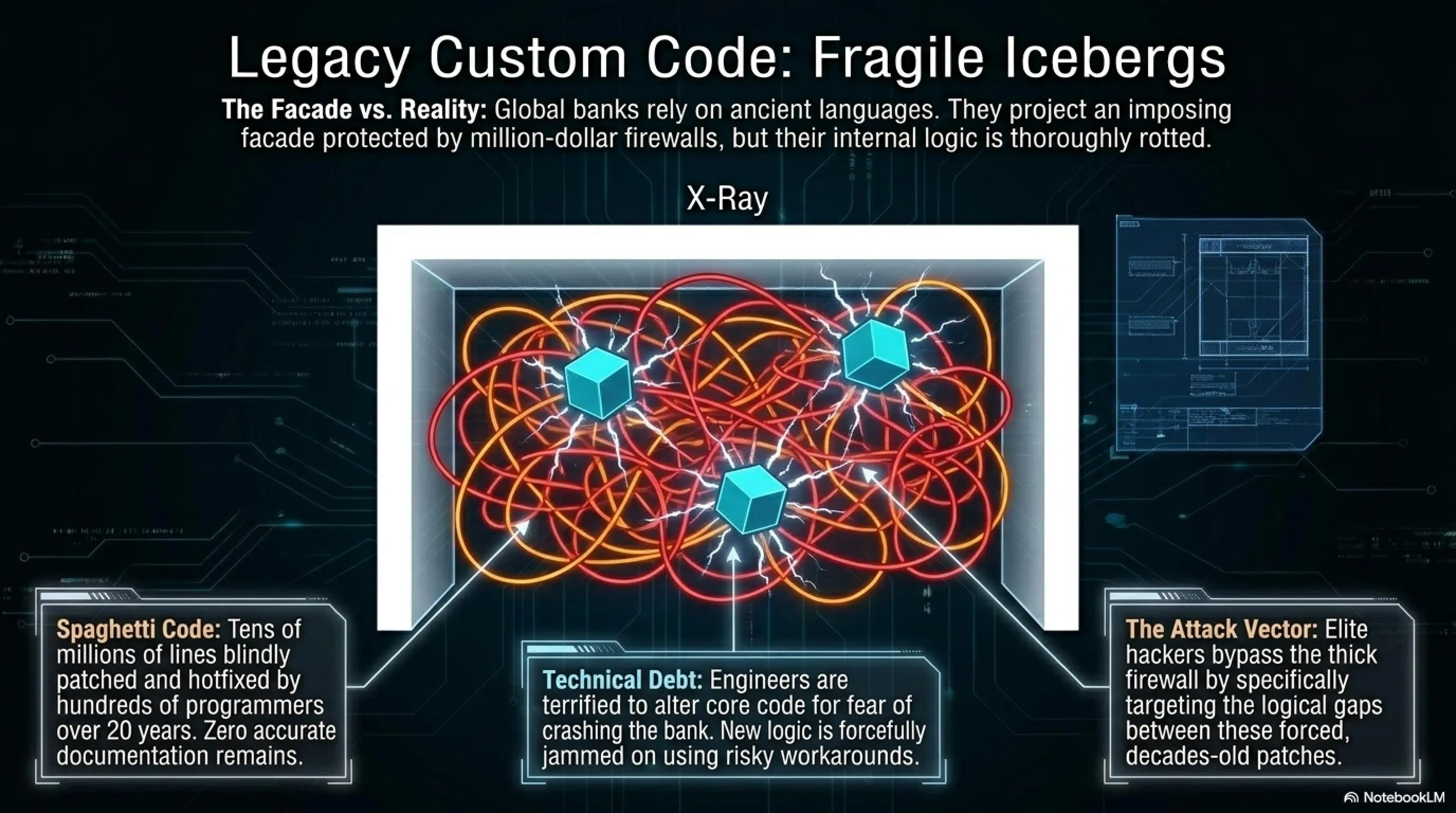
You might assume that because global financial institutions utilize custom-written code, they possess infinitely higher security than WordPress. In theory, yes. In practice, we encounter a phenomenon known as the "Legacy System." In software engineering, this term refers to architectures whose foundational technology is entirely obsolete, yet organizations continue to rely on them strictly because the terrifying cost and risk of replacement are deemed insurmountable. The core operational systems in many major US banks were written decades ago using archaic versions of Java (Java EE), C#, or even the ancient COBOL language.
These systems are also Monolithic, but instead of third-party plugins, they consist of tens of millions of lines of custom code that have been blindly patched, modified, and hotfixed by hundreds of different programmers over the past 20 years. Many of those original programmers retired years ago, leaving behind zero accurate documentation. This deplorable state is officially termed "Spaghetti Code"—strands of logic so deeply entangled they resemble a plate of pasta.
When a bank executive demands a new feature (like integrating with a modern mobile payment gateway), the current engineering team is terrified to alter the existing core code, fearing the entire bank might go offline. Therefore, they forcefully jam the new logic onto the old system using risky workarounds and "hacks." The accumulation of these hotfixes over decades creates a massive burden known as **Technical Debt**. These systems project an imposing facade protected by expensive firewalls, but their internal logic is thoroughly rotted and brittle. Elite hackers specifically target the logical gaps between these forced patches to infiltrate the network.
📊 Visual Architectural Comparison (Red vs. Blue)
🌐 Part III: Modern Architecture (Microservices/Serverless); The Invisible Fortresses
In stark contrast to decaying monolithic systems stand modern technology titans like Amazon, Netflix, and Uber. They also utilize custom-written code, but their architecture and deployment paradigms are radically different. The secret to their unparalleled stability lies in two foundational concepts: Microservices Architecture and Serverless Technology.
A) Microservices: Divide and Conquer
In a Microservices architecture, rather than being a single, monolithic giant, the system is shattered into dozens or hundreds of tiny, completely independent modules. Each module is strictly responsible for one, and only one, specific task (The Single Responsibility Principle).
For example, within a system like Amazon:
- The "Product Search" service might be written in Python and executed on a dedicated cluster with its own Elasticsearch database.
- The "Shopping Cart" service might be engineered in Node.js, utilizing a lightning-fast Redis database.
- The "Payment Gateway" service might be coded in the highly secure Go (Golang) language, possessing its own isolated PostgreSQL database.
What is the profound security advantage of this structure? These services possess absolutely no direct access to each other's codebases or databases. They communicate exclusively through strictly vetted Application Programming Interfaces (APIs) governed by rigid access control policies. If, by some anomaly, a hacker manages to breach the "User Reviews" service, their access is contained entirely within that specific module. They **cannot** pivot from there to infiltrate the main payment database, because the physical and logical connections simply do not exist. This concept is known as "Containment," and it is the exact antithesis of WordPress, where compromising a review plugin crashes the entire server.
B) Serverless and Headless Architecture: Eradicating the Target
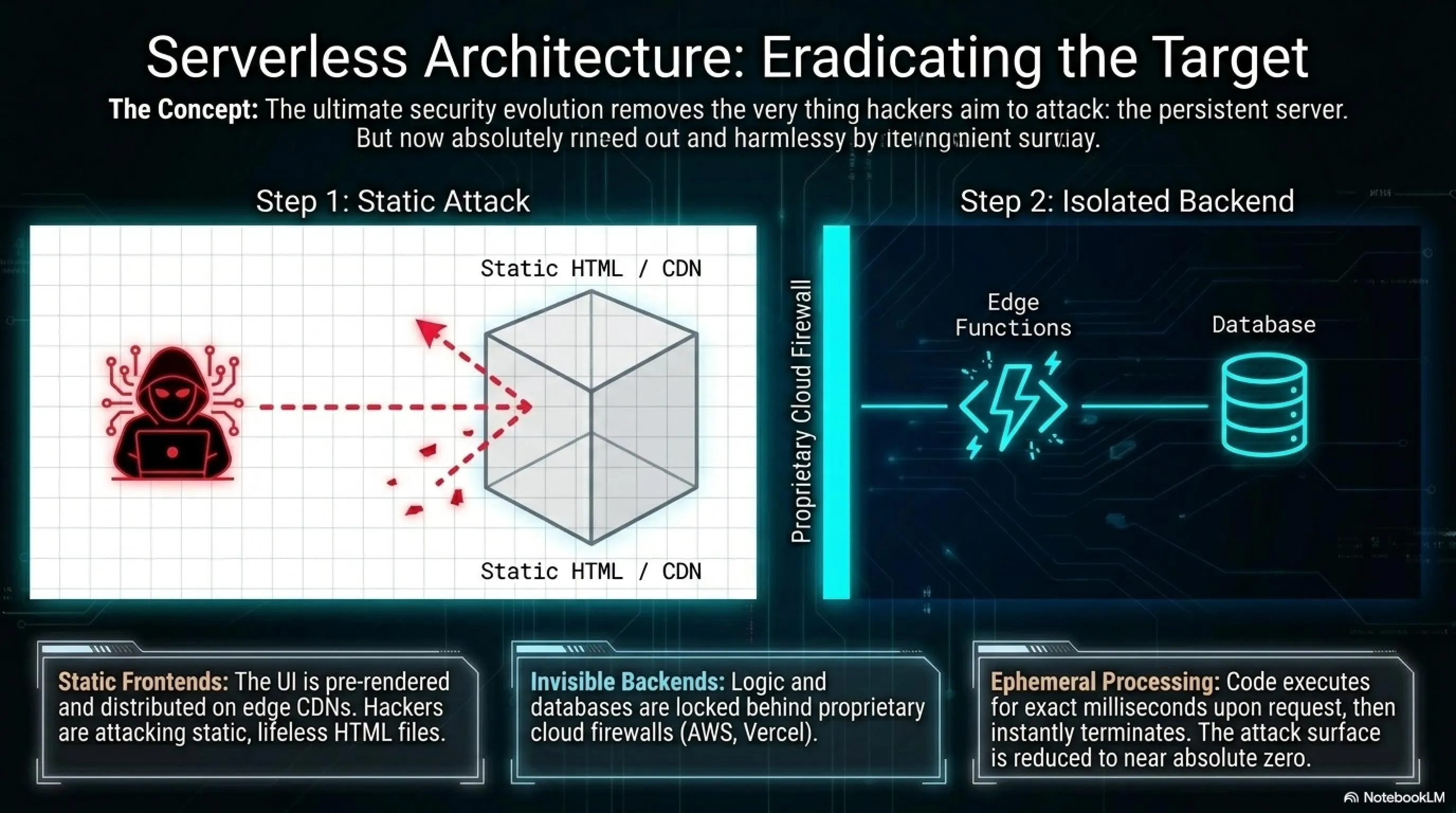
The next evolutionary leap in security involves removing the very thing hackers aim to attack: the server itself! In Serverless and Headless architectures (such as the paradigm we implement at TakinGame utilizing Next.js and Supabase), the traditional concept of a "server" is completely redefined.
In this architecture, the frontend (the UI the user interacts with) is pre-rendered as Static Files and distributed globally across hundreds of Content Delivery Network (CDN) nodes. When a hacker launches an attack against your website URL, they are essentially attacking a static HTML file! There is no processing server, no PHP engine, and no database residing at that edge location for them to hack. The backend logic and the database are locked away in a completely invisible, highly protected layer behind proprietary firewalls managed by cloud providers (like AWS or Vercel). These providers execute processing code (Edge Functions) only for the exact millisecond a request is made, and then instantly terminate the process. In this architecture, the Attack Surface is reduced to near absolute zero.
💻 A Look at the Code: Why Next.js is Inherently More Secure
🛠️ Part IV: Workflow and Maintenance; Operating in Heaven or Hell?
Security and stability are not merely theoretical concepts established during the initial architectural design phase. Security is a living, breathing process that manifests over time through daily maintenance and development workflows. What is the actual reality of operating within these paradigms for system administrators and engineers?
Workflow & Development Analysis:
1. Life in the WordPress Ecosystem: Performing a system update is a perpetual, anxiety-inducing nightmare. Every time a WordPress core update or a critical plugin (like WooCommerce) requires patching, administrators click 'Update' with trembling hands. Why? Because there is a high probability that Plugin B will conflict with the newly updated Plugin A, crashing the entire site and presenting the dreaded "White Screen of Death" (HTTP 500). Conversely, if they refuse to update, their site will inevitably be exploited by automated hacker bots the very next day. It is an endless, vicious cycle of stress.
2. Life in Legacy Banking: Modifying even a single line of code is akin to defusing a live explosive device. Due to the severe "entanglement" of spaghetti code, a developer attempting to add a simple input field to the payment gateway form must alter the system's core logic, praying it does not accidentally crash the check-clearing subroutine. The Quality Assurance (QA) testing process for minor changes can drag on for months. Furthermore, deploying new code usually occurs at 2:00 AM on a Sunday and requires taking the entire bank's servers offline.
3. Life in Modern Architecture (Microservices): An absolute utopia for developers. Because services are completely decoupled, the development team responsible for the "Search" module can deploy new code while the system handles massive, live Black Friday user traffic. Meanwhile, the second team managing the "Payment" service remains entirely oblivious to this update, and end-users experience zero disruption. This elegant process is known as **Continuous Integration/Continuous Deployment (CI/CD)**, and it is the secret engine driving the relentless growth of companies like Amazon and Netflix.
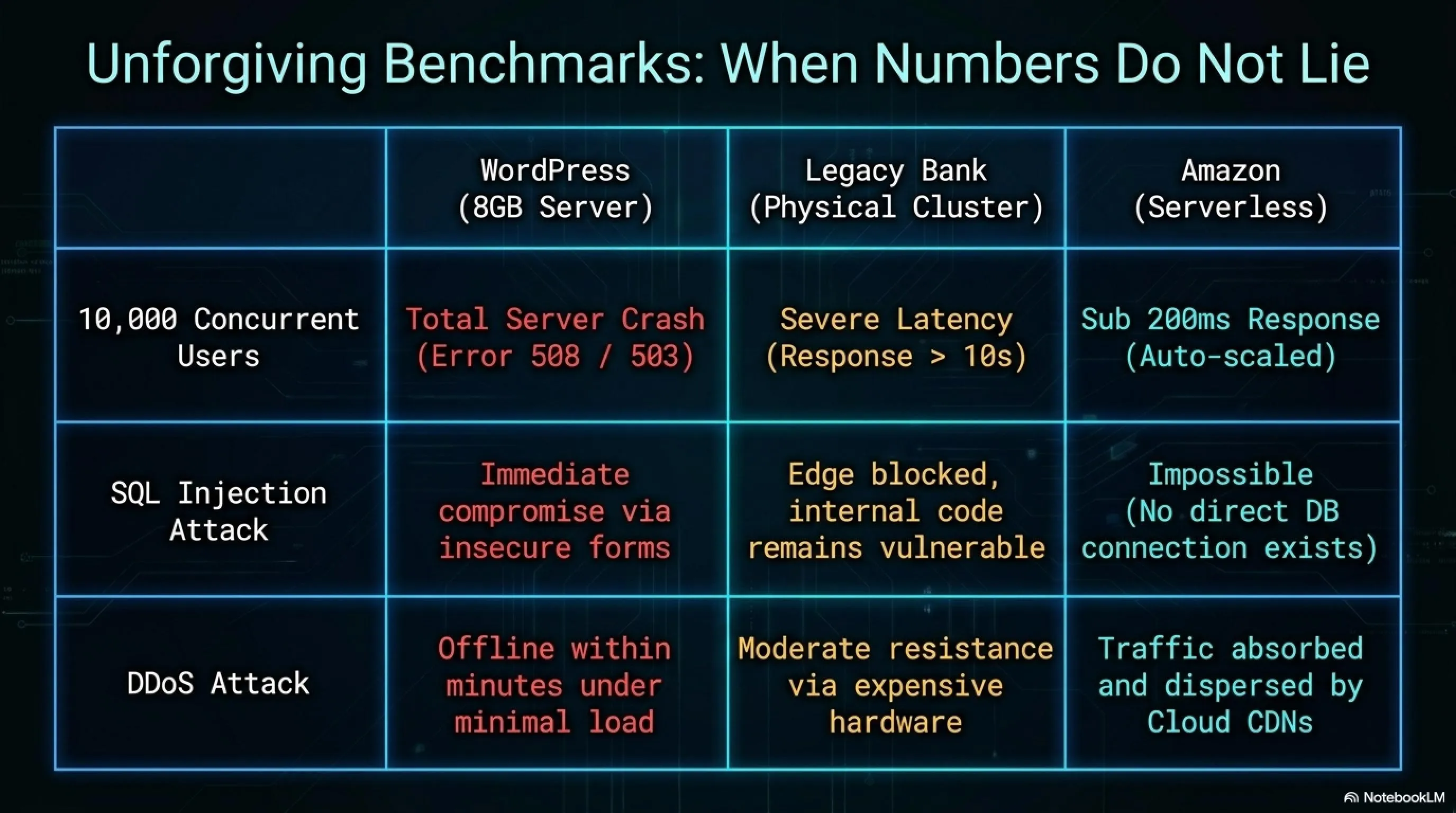
📊 Part V: Unforgiving Benchmarks; When Numbers Do Not Lie
Theoretical discussion is insufficient. Let us subject these three architectures to rigorous, simulated Stress Tests to observe how they actually behave under critical conditions (such as traffic spikes or coordinated cyber assaults).
🚨 Part VI: The Migration Nightmare
This brings us to the most critical question of this entire analysis: If modern cloud and microservices architectures are so vastly superior, secure, and scalable, and if legacy banking code and WordPress environments are so demonstrably hazardous, why doesn't every organization immediately migrate to new technologies? The barrier is rarely a lack of technological understanding or even a lack of budget; the true barrier is fundamentally psychological: **Management's paralyzing fear of risk.**
The Fatal Dilemma: To Migrate or to Suffer Legacy?
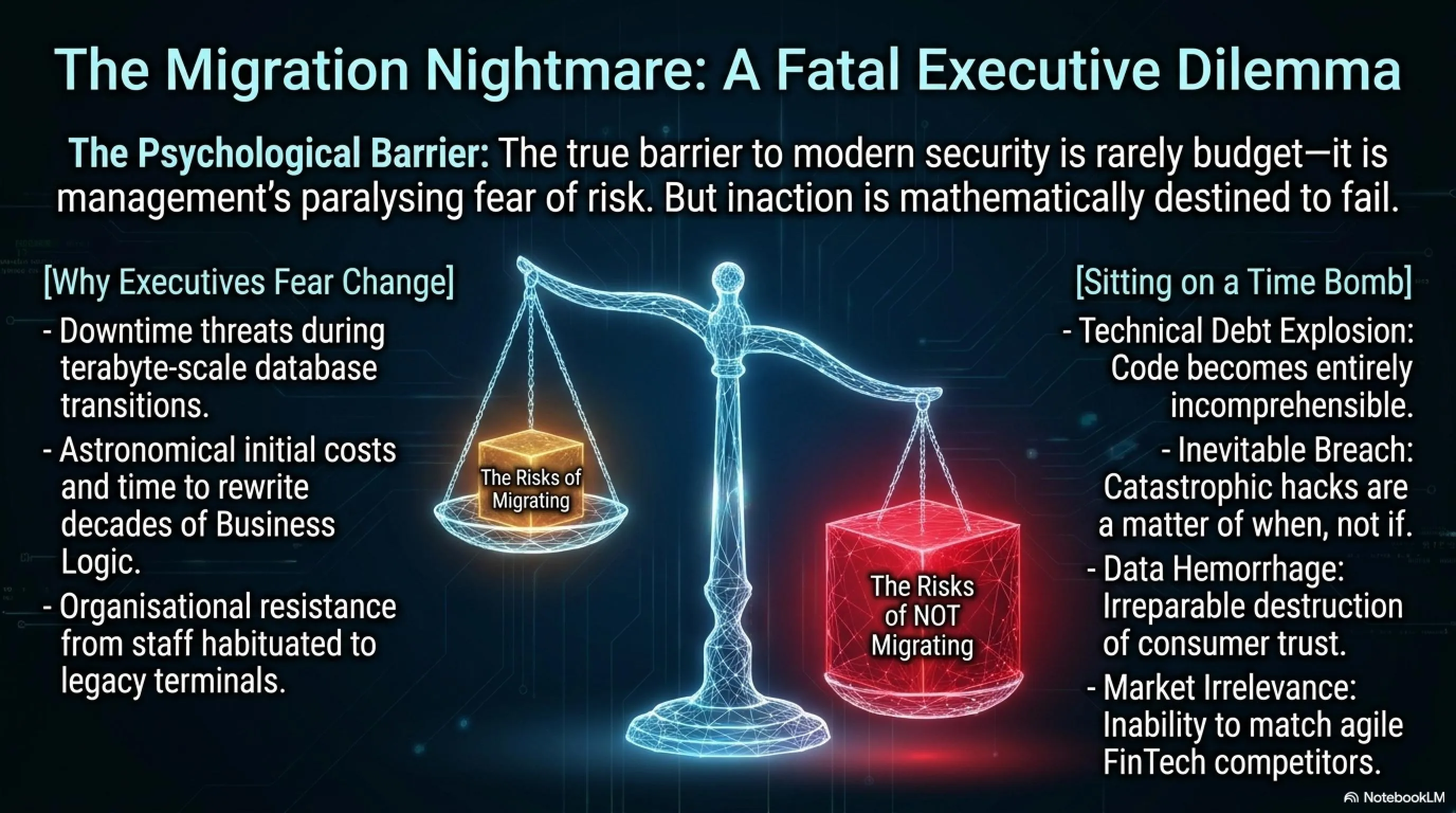
🟥 The Risks of Migrating (Why Executives Fear It)
- ❌ Downtime Threat: The process of transitioning multi-terabyte databases while maintaining transactional integrity could trigger hours of downtime. For a global bank, even 10 minutes of downtime is a catastrophic event.
- ❌ Astronomical Costs and Time: Rewriting decades of deeply embedded Business Logic from scratch requires elite engineering teams and massive capital expenditure.
- ❌ Unforeseen Bugs in the New System: A brand new system is initially volatile and may produce unpredictable computational errors (e.g., miscalculating interest rates) during the early adoption phase, destroying consumer trust.
- ❌ Organizational Resistance: Corporate staff who have operated a specific legacy terminal for 20 years will exhibit fierce resistance against learning entirely new digital interfaces.
🟩 The Risks of NOT Migrating (Sitting on a Time Bomb)
- ✅ Technical Debt Explosion: With every passing day, legacy code becomes more entangled, driving maintenance costs exponentially higher until the codebase becomes entirely incomprehensible.
- ✅ Inevitable Breach: A catastrophic hack on a legacy system is not a matter of "if," but "when" (as demonstrated by the Equifax disaster).
- ✅ Data Hemorrhage: The irreparable destruction of consumer trust following the exposure of sensitive databases and their subsequent sale on the dark web.
- ✅ Market Irrelevance: While agile, modern competitors (like FinTech startups) deploy new features daily, legacy institutions struggle merely to keep their servers online and fix archaic errors.
⛓️ Part VII: Supply Chains and the Weakest Link (The Human)
In massive corporate breaches, do hackers always assault the concrete walls of the core edge firewalls directly? No. One of the most devastating methodologies utilized by modern cybercriminals is the Supply Chain Attack. Major organizations frequently contract third-party vendors for services such as bulk SMS notifications, HR management, or network support. The security posture of these third-party vendors is often dismally low (sometimes they even rely on WordPress!). Hackers, rather than engaging the bank's formidable primary firewall, compromise the vendor's software. Through the vendor's authorized access (VPNs), hackers walk straight through the front door into the heart of the corporate network. The infamous Target breach was executed precisely in this manner via a compromised HVAC vendor.
Furthermore, it is imperative to remember that the most potent weapon in a hacker's arsenal remains Social Engineering. An advanced spear-phishing campaign, a malicious Excel file carelessly opened by an employee, or a C-level executive utilizing a simplistic password can completely bypass the most sophisticated software architectures in the world in a fraction of a second. Cybersecurity is an interconnected chain, and the absolute strength of that chain is exactly equal to the resistance of its weakest, human link.
🏁 Part VIII: Conclusion and Final Verdict
❓ Security Architecture Masterclass FAQs
1. Is deploying WordPress ever a logical choice for a serious enterprise?
Under no circumstances. WordPress is perfectly adequate for a personal hobby blog or a simple "brochureware" corporate site containing only static text and images. However, for any system processing sensitive user data (addresses, contact info) or financial transactions, deploying WordPress—due to its monolithic structure and absolute reliance on unvetted third-party plugins—constitutes an unacceptable act of corporate negligence.
2. Why don't major banks simply rewrite their code from scratch using modern technology?
Due to the sheer terror of downtime. The process of migrating multi-terabyte databases, maintaining strict transactional integrity, and replacing millions of lines of code carries astronomical operational risk. Senior executives generally prefer to temporarily patch decaying systems rather than accept the immense liability of a potential system crash during their tenure, effectively passing the ticking time bomb to their successors.
3. What is the fundamental secret behind Amazon's impenetrable security?
Beyond their massive budget, the core secret is their implementation of "Microservices Architecture." They have shattered their ecosystem into hundreds of completely isolated modules. A breach in the registration frontend does not grant access to the payment backend (Containment). Furthermore, their Serverless paradigm reduces the overall attack surface to near absolute zero, as there is practically no persistent server to hack.
4. Does installing a premium security plugin (like Wordfence) on WordPress solve its vulnerabilities?
Security plugins act merely as a temporary band-aid applied to a deep wound. They cannot alter or fix the fundamentally vulnerable monolithic architecture of WordPress. In fact, premium security plugins themselves have historically been the source of critical Zero-Day exploits, ironically opening the door for hackers!
5. How can our organization achieve TakinGame's level of stability and security?
The only fundamental solution is migrating away from traditional CMS platforms toward modern frameworks like Next.js, implementing a strict Headless Architecture (complete physical separation of frontend from backend), and utilizing modern, API-driven databases (such as Supabase).
🏁 Final Verdict: Abandoning the Illusion of Security
The unvarnished and brutal truth is this: no system on Earth is 100% unhackable. However, there is a monumental difference between taking shelter in a "modern titanium fortress" and remaining in a "decaying paper house." While tech titans like Amazon guarantee security and stability during peak traffic through heavily isolated microservices, legacy institutions continue to wrestle with fossilized, monolithic codebases—simply because executives lack the courage to execute necessary digital surgeries. Furthermore, the persistent reliance of mid-sized enterprises on WordPress, often justified by reducing initial costs, is a gamble they are mathematically destined to lose in the long run. If an organization intends to survive the next generation of AI-powered cyber warfare, migrating away from legacy code and generic CMS platforms is no longer a ceremonial choice; it is the primary prerequisite for survival.
📚 Authoritative Sources (References)
- IBM Security. (2023). Cost of a Data Breach Report.
- OWASP Foundation. (2023). Top 10 Web Application Security Risks.
- Fowler, M. (2014). Microservices: a definition of this new architectural term.
- Vercel / Next.js Documentation. Routing and Edge Functions Security.
🌐 Stay Connected With Us 🎮✨
For the latest tech, gaming, and gadget news, follow us on our official social media channels: