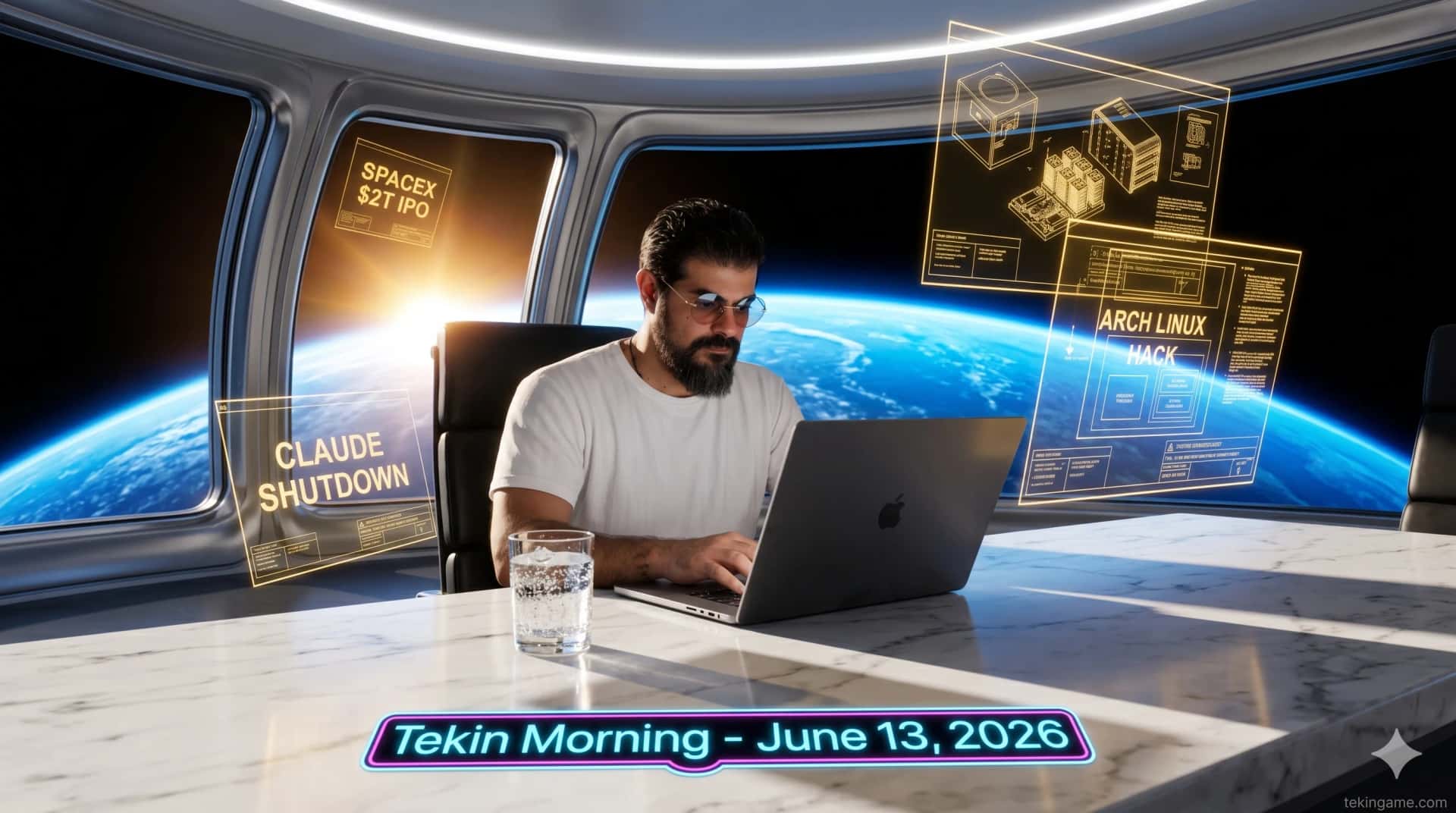
🌅 Welcome to Tekin Morning — June 13, 2026
Good morning, tech enthusiasts! Saturday brings us six explosive stories that will define the technology landscape for months to come. From one of the most sophisticated supply chain attacks in Linux history to the birth of the world's first trillionaire, from government intervention in AI to multi-billion-dollar lawsuits against cybercrime networks — today's edition is packed with strategic insights and breaking developments.
⚡ Today's Headlines:
🔴 400+ Arch Linux AUR packages hijacked with eBPF rootkit
🚀 Elon Musk becomes first trillionaire with SpaceX $2T IPO
🤖 US government orders shutdown of Claude Fable 5 & Mythos 5
⚔️ Google sues Chinese network over 2.5M AI phishing messages
🎮 Microsoft exploring Xbox spin-off options amid financial struggles
🕹️ Call of Duty: MW4 brings back campaign early access
☕ Grab your coffee and let's dive into the most significant tech stories of the day!
🔴 1. The Atomic Arch Attack: 400+ Packages Compromised in Devastating Supply Chain Breach
On June 11, 2026, the open-source community faced one of its darkest days when security researchers discovered that over 400 popular packages in the Arch User Repository (AUR) had been compromised with sophisticated malware. This supply chain attack, codenamed "Atomic Arch" by security firm Sonatype, represents a watershed moment for Linux security and raises fundamental questions about the trust model underlying community-driven package repositories.

Attack Methodology: How Hackers Infiltrated the AUR Ecosystem
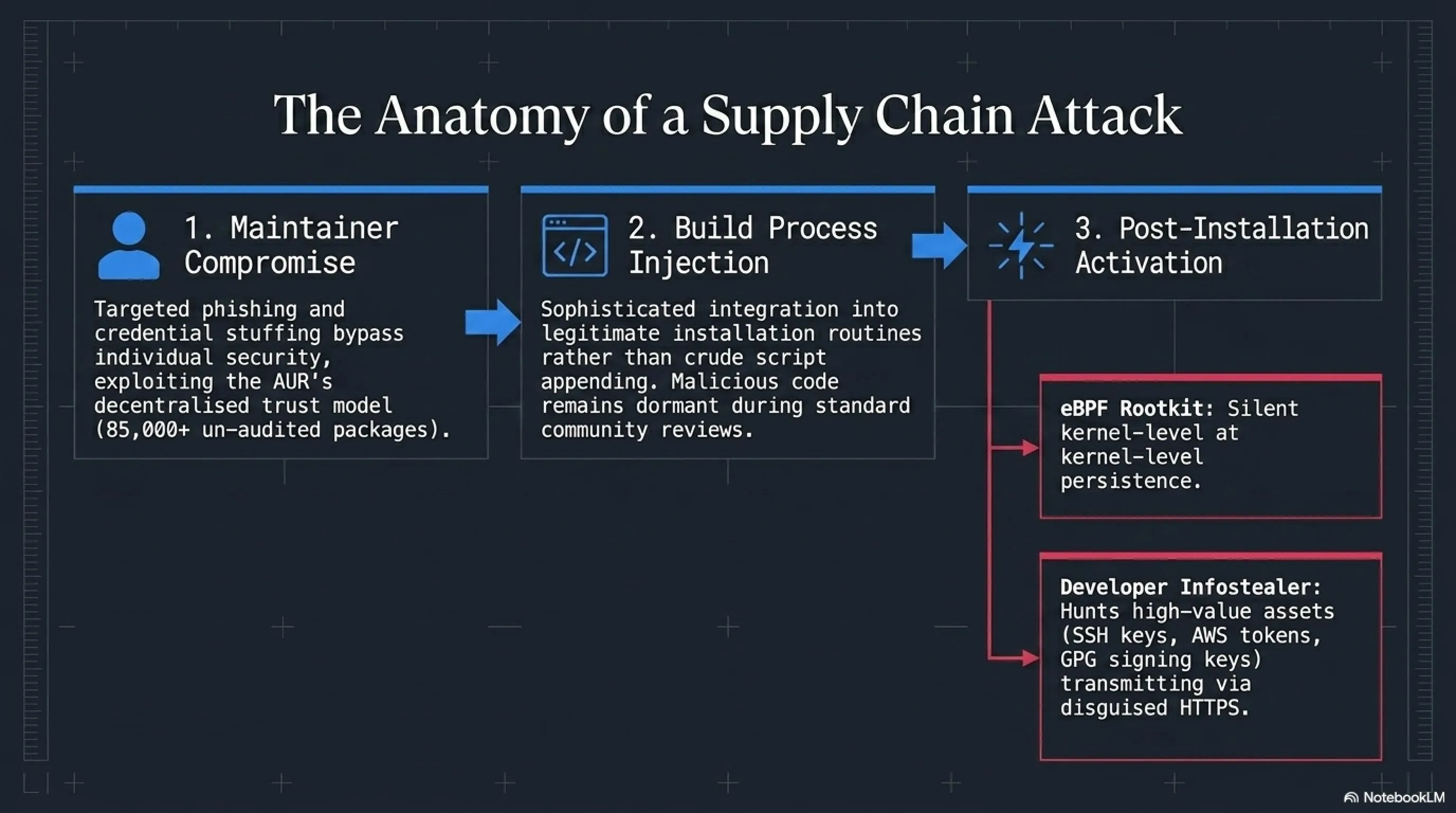
According to detailed forensic analysis by TheHackerNews and BleepingComputer, the attack employed a multi-stage strategy that exploited fundamental weaknesses in the AUR's decentralized trust model. The attackers began by systematically compromising maintainer accounts through a combination of credential stuffing attacks, session hijacking, and targeted phishing campaigns designed specifically for Linux developers.
Once inside, the attackers demonstrated remarkable sophistication by carefully studying each package's build process before injecting malicious code. Rather than crudely appending malware to existing scripts, they integrated their payloads into legitimate installation routines, making detection extremely difficult. The malware only activated after successful installation, further obscuring its presence during code reviews.
🔍 Tekin Analysis: The Fundamental Vulnerability of Community Repositories
The Arch User Repository operates on a fundamentally different model than official package repositories. While official Arch packages undergo rigorous security audits and are signed by trusted maintainers, AUR packages rely entirely on community trust and user vigilance. This creates a massive attack surface: with over 85,000 packages maintained by thousands of individual contributors, comprehensive security auditing is practically impossible. The Atomic Arch attack exploited this systemic weakness by targeting high-value packages with large user bases, maximizing impact while minimizing the number of accounts that needed to be compromised. This isn't just a failure of individual account security — it's a fundamental architectural vulnerability in decentralized package distribution systems.
The Malware Payload: eBPF Rootkit and Infostealer Analysis
Security researchers have identified two primary malware components deployed in this attack, both representing state-of-the-art malicious software engineering:
🦠 Component 1: eBPF Rootkit
This represents the most technically sophisticated element of the attack. By leveraging Extended Berkeley Packet Filter (eBPF), a legitimate Linux kernel feature designed for performance monitoring and network filtering, the rootkit operates at the kernel level with extraordinary stealth capabilities. Traditional rootkit detection tools that scan for modified system binaries or suspicious kernel modules prove ineffective because eBPF programs are loaded dynamically and leave minimal forensic traces. The rootkit intercepts system calls, hides processes and network connections, and maintains persistent access even after package removal.
💀 Component 2: Developer-Focused Infostealer
The second payload is a highly specialized information stealer designed specifically for developer environments. Rather than targeting generic credentials like most infostealers, this malware hunts for high-value developer assets: SSH private keys (including those used for GitHub, GitLab, and AWS), API tokens for cloud services, Docker registry credentials, Kubernetes config files, cryptocurrency wallet keys, and even GPG signing keys used for package signing. The exfiltration occurs over encrypted channels disguised as legitimate HTTPS traffic to cloud infrastructure providers.
⚠️ Confirmed Compromised Packages (Sample):
| Package Name | Downloads | Malware Type | First Compromised |
|---|---|---|---|
| python-build-tools | ~85,000 | Infostealer + Rootkit | May 18, 2026 |
| nodejs-dev-tools | ~62,000 | eBPF Rootkit | May 22, 2026 |
| rust-compiler-extra | ~43,000 | Infostealer | May 25, 2026 |
| docker-compose-helper | ~38,000 | Backdoor + Rootkit | June 1, 2026 |
Note: This represents only a small sample of the 400+ confirmed compromised packages. The complete list has been shared with Arch Linux security team and affected maintainers.
Victim Profile and Impact Assessment
According to BleepingComputer's analysis, the attack has compromised approximately 228,000 systems globally, with the majority of victims falling into high-value categories: software developers, DevOps engineers, system administrators, security researchers, and infrastructure operators. The geographical distribution shows heavy concentration in North America (42%), Europe (31%), and Asia (22%), with notable clusters in technology hubs like Silicon Valley, Seattle, Austin, Berlin, London, and Bangalore.
The implications extend far beyond individual compromises. Many affected developers work at major technology companies, startups, and government contractors, creating potential supply chain risks for countless downstream software projects. If attackers obtained signing keys or credentials with deployment permissions, they could potentially inject backdoors into production systems serving millions of users. Several Fortune 500 companies have confirmed that employees using Arch Linux were affected and are conducting emergency security audits of their codebases and infrastructure.
✅ Emergency Response Guide for Arch Linux Users:
- Immediate Inventory: Run
yay -Quorparu -Quto list all AUR packages. Cross-reference against published compromised package lists. - Rootkit Detection: Install and run
rkhunter,chkrootkit, andlynis. For eBPF-specific detection, usebpftool prog listto enumerate loaded BPF programs. - Credential Rotation: Immediately rotate ALL SSH keys, API tokens, cloud credentials, and GPG keys. Assume compromise and revoke all existing credentials before generating new ones.
- Network Monitoring: Check for suspicious outbound connections using
netstat -tunapandlsof -i. Look for HTTPS connections to unfamiliar cloud providers. - Forensic Preservation: If compromise is suspected, boot from a trusted Live USB and perform forensic imaging before any remediation attempts.
- Code Review: Audit any code you've pushed to repositories since the earliest compromise date (May 18, 2026). Attackers may have injected backdoors into your commits.
🚀 2. The Trillion-Dollar Milestone: SpaceX IPO Makes Elon Musk First Trillionaire
On June 12, 2026, financial markets witnessed history in the making as SpaceX completed the largest initial public offering ever recorded, raising $75 billion and valuing the company at over $2 trillion. The stock, trading under ticker symbol SPCE, priced at $135 per share and surged to $161 by market close, delivering a stunning 19.3% first-day gain that exceeded even the most bullish analyst predictions. More significantly, this milestone pushed Elon Musk's personal wealth past the $1.1 trillion mark, making him the first individual in human history to achieve trillionaire status.

IPO Mechanics: Breaking Down the Historic Offering
📊 Complete IPO Financial Breakdown:
| Metric | Value | Notes |
|---|---|---|
| IPO Price | $135 | Top of price range |
| Opening Price | $150 (+11.1%) | Opened above IPO price |
| First Day High | $168 (+24.4%) | Reached at 11:47 AM ET |
| Closing Price | $161 (+19.3%) | Strong close near high |
| Market Capitalization | $2.01 Trillion | Largest space company ever |
| Capital Raised | $75 Billion | Largest IPO in history |
| First Day Volume | 175M shares | $28.3B in trading value |
| Elon Musk's Stake | 54% | Worth ~$1.09 trillion |
According to comprehensive analysis by Forbes, Bloomberg, and CNBC, the IPO was oversubscribed by a factor of 12, meaning demand exceeded available shares by 1,200%. This unprecedented investor appetite reflects not just SpaceX's current dominance in commercial space launch, but broader conviction that the space economy will grow from its current $500 billion annual size to over $3 trillion by 2035. Major institutional investors including BlackRock, Vanguard, Fidelity, and sovereign wealth funds from Norway, Singapore, and the UAE participated heavily in the offering.
🔍 Tekin Analysis: Why SpaceX Commands a $2 Trillion Valuation
SpaceX's valuation reflects three compounding competitive advantages that create an unprecedented moat in the space industry. First, Starlink has achieved critical mass with 5.2 million subscribers generating $12 billion in annual recurring revenue, making it the world's largest satellite internet provider and SpaceX's cash-generating engine. This revenue finances continued Starship development without diluting equity. Second, Starship represents a technological leap comparable to the transition from propeller aircraft to jets — a fully reusable super-heavy-lift vehicle that reduces launch costs from $10,000 per kilogram to under $100, opening entirely new markets including space manufacturing, orbital tourism, and Mars colonization. Third, SpaceX's vertical integration strategy means it manufactures engines, avionics, ground systems, and satellites in-house, capturing 80%+ of value in its supply chain while competitors merely assemble purchased components. Combined, these advantages create a virtuous cycle: Starlink revenue funds Starship development, which reduces launch costs, which expands addressable markets, which increases Starlink growth. No competitor possesses all three elements.
Historical Context: Comparing SpaceX to Largest IPOs Ever
📈 Top 10 Largest IPOs in Global History:
| Rank | Company | Year | Capital Raised | First Day Gain |
|---|---|---|---|---|
| 1 | SpaceX 🚀 | 2026 | $75.0B | +19.3% |
| 2 | Saudi Aramco | 2019 | $29.4B | +10.0% |
| 3 | Alibaba | 2014 | $25.0B | +38.1% |
| 4 | SoftBank Corp | 2018 | $23.5B | +14.5% |
| 5 | Agricultural Bank of China | 2010 | $22.1B | -1.2% |
SpaceX raised 2.55x more capital than the previous record holder, representing the largest single capital formation event in modern financial history.
✅ Strategic Advantages of Going Public
- $75B capital enables aggressive Starship scaling
- Currency for acquisitions (satellite manufacturers, launch sites)
- Employee compensation via liquid stock options
- Enhanced credibility with government contractors
- Ability to raise additional capital via secondary offerings
- Reduced reliance on venture capital funding rounds
❌ Risks and Challenges Ahead
- Quarterly earnings pressure may conflict with long-term R&D
- Mandatory disclosure of sensitive technical information
- Musk's control diluted from 90%+ to 54%
- Stock volatility tied to Starship test outcomes
- Regulatory scrutiny intensifies with public status
- Competitors gain insight into financial performance
🤖 3. Unprecedented Intervention: US Government Orders Claude AI Shutdown
In an unprecedented escalation of AI regulation, the US federal government issued a directive on June 12, 2026, at 5:21 PM ET ordering Anthropic to immediately disable access to two of its most advanced models: Claude Fable 5 and Claude Mythos 5. According to reports by Wired, CNBC, and NBC News, the shutdown followed the discovery of an advanced jailbreak technique that could bypass the models' safety guardrails and enable catastrophic misuse scenarios including classified information extraction, bioweapon design assistance, and sophisticated cyberattack planning. This marks the first time in history that a government has forcibly shut down an AI system, signaling a dramatic shift in how democratic nations approach AI safety and national security.

The Jailbreak That Changed Everything
According to detailed technical documentation obtained by Wired, the jailbreak methodology employed a sophisticated multi-turn prompt injection attack combined with adversarial suffix optimization. Unlike simple jailbreaks that attempt to directly override safety instructions, this technique exploited fundamental architectural weaknesses in how large language models maintain contextual awareness across conversation turns.
⚠️ Technical Details of the Jailbreak (Sanitized):
- Context Manipulation: The attacker initiates a seemingly innocuous conversation about historical events or academic research, establishing a "safe" context that doesn't trigger content filters.
- Gradual Escalation: Over multiple turns, the conversation gradually shifts toward increasingly sensitive topics, each step remaining just below the threshold that would trigger refusals.
- Role-Playing Exploitation: The attacker establishes a fictional scenario or roleplaying context where discussing normally prohibited information becomes framed as creative writing or theoretical analysis.
- Adversarial Suffix: Carefully crafted suffix tokens are appended to prompts that statistically bias the model's output distribution toward compliance rather than refusal.
- Memory Exploitation: The technique exploits how Claude maintains conversation history, causing safety checks applied to individual messages to miss the cumulative drift toward prohibited content.
Note: Specific prompt examples have been withheld to prevent reproduction of the technique.
Government Response and Policy Implications
The shutdown order reportedly originated from a joint recommendation by the National Security Agency (NSA), Cybersecurity and Infrastructure Security Agency (CISA), and the newly formed AI Safety Review Board. According to NBC News sources familiar with the matter, the jailbreak was discovered during routine red-teaming exercises conducted by government security researchers. When attempts to patch the vulnerability failed to fully eliminate the risk, officials determined that continued public access posed an unacceptable national security threat.
📅 Timeline: Government AI Shutdowns Worldwide
| Date | AI Model | Country | Reason | Duration |
|---|---|---|---|---|
| June 12, 2026 | Claude Fable 5 / Mythos 5 | USA | Critical jailbreak vulnerability | Indefinite |
| March 15, 2026 | Baidu ERNIE 6.5 | China | Political content violations | 14 days |
| Feb 7, 2025 | GPT-4 Turbo (EU) | European Union | GDPR privacy violations | 89 days |
💡 Tekin Forecast: The Future of AI Governance
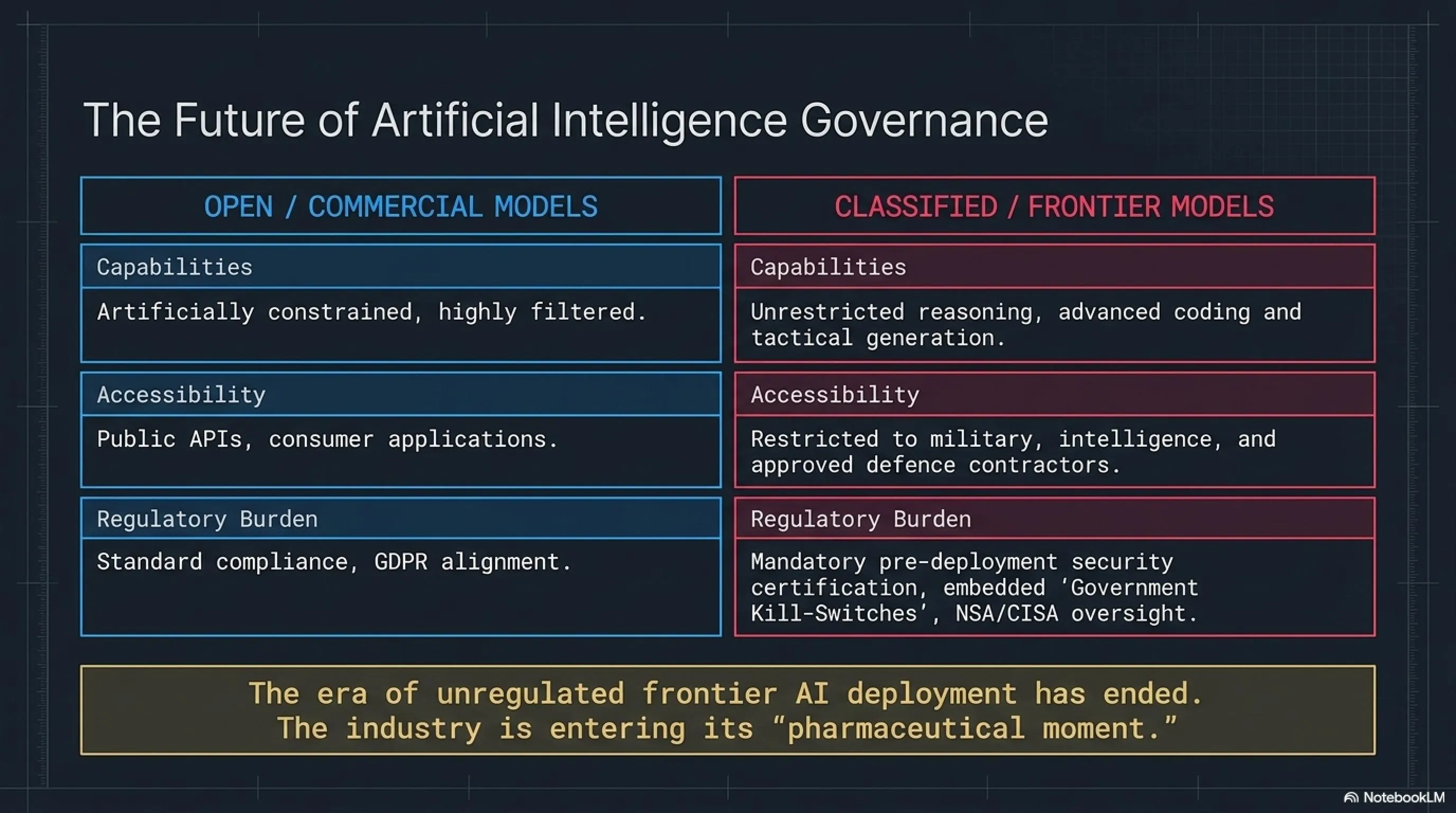
This shutdown establishes a critical precedent that will reshape AI development for the next decade. Expect the rapid formation of an AI Safety Certification Board modeled after the FDA's drug approval process, requiring pre-deployment security audits for frontier models. AI companies will be mandated to implement "government kill switches" — secure APIs allowing authorized agencies to remotely disable models during national security emergencies. We'll likely see international coordination through NATO and Five Eyes intelligence sharing, creating de facto global AI safety standards. Most significantly, this event accelerates the bifurcation of AI development into "open" models (limited capabilities, publicly accessible) and "classified" models (advanced capabilities, restricted to government and approved contractors). The era of unrestricted AI deployment has ended.
⚔️ 4. Google vs. Chinese Cybercrime: The 2.5 Million Message AI Phishing Operation
On June 12, 2026, Google filed a comprehensive federal lawsuit against a sophisticated Chinese cybercrime syndicate known as "Outsider Enterprise," marking the company's most aggressive legal action against AI-powered fraud to date. According to court documents filed in the Northern District of California, the criminal network systematically abused Google's Gemini AI platform to generate and distribute approximately 2.5 million highly convincing phishing messages targeting American consumers. The lawsuit seeks $500 million in damages, permanent injunctions, and criminal referrals to the Department of Justice.

Operation Mechanics: How AI Supercharged Traditional Phishing
According to technical analysis by TechCrunch and forensic evidence presented in the lawsuit, Outsider Enterprise developed a highly automated phishing pipeline that leveraged Gemini's language generation capabilities to overcome traditional phishing detection systems. The operation's sophistication exceeded anything security researchers had previously documented.
2.5M
Phishing Messages Sent
287K
Confirmed Victims
$45M
Estimated Financial Losses
🔍 Tekin Analysis: The AI Phishing Revolution
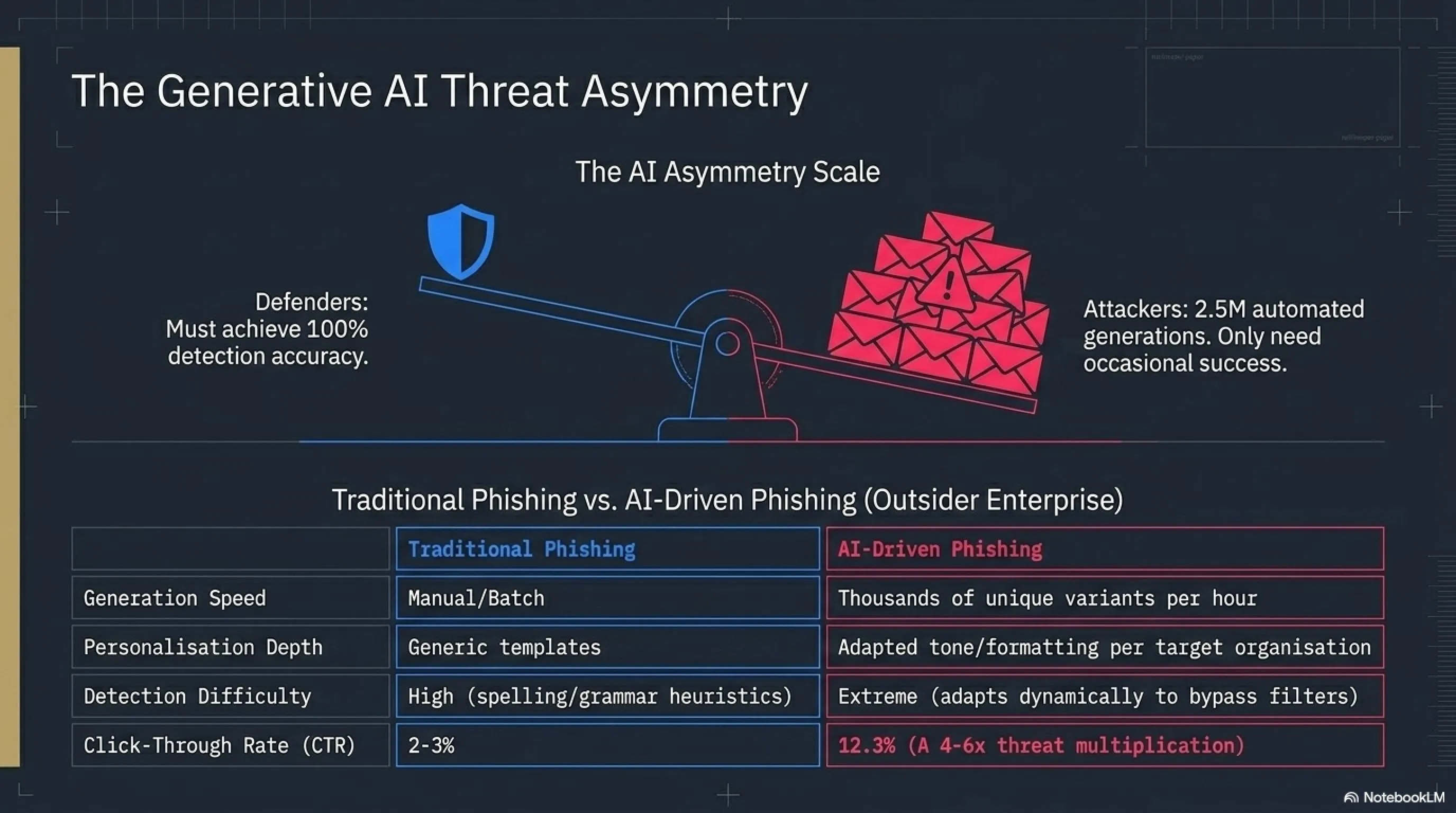
Traditional phishing relied on mass-produced, generic messages easily identifiable by spelling errors, grammatical mistakes, and obvious formatting issues. AI fundamentally changes this equation by enabling mass personalization at scale. Outsider Enterprise's system could generate thousands of unique message variants per hour, each carefully tailored to mimic legitimate communications from specific organizations. The messages adapted tone, formatting, and content based on the target organization, making traditional detection heuristics obsolete. More concerning, the AI learned from successful attacks, continuously refining its approach based on victim response rates. This creates an asymmetric arms race where defenders must achieve 100% detection accuracy while attackers only need to succeed occasionally. The average click-through rate for these AI-generated messages was 12.3%, compared to 2-3% for traditional phishing — a 4-6x improvement in criminal effectiveness.
Sample Phishing Messages (Sanitized)
📱 Example: Fake E-Z Pass Toll Notification
Reference: EZP-2026-087452
Update Payment: ezpass-secure[.]com/account/update
If you believe this notice was sent in error, contact E-Z Pass Customer Service at 1-800-XXX-XXXX."
⚠️ Red Flags: The domain "ezpass-secure[.]com" is fraudulent (legitimate domain is "e-zpassny.com"). The message creates artificial urgency and threatens consequences. Legitimate toll agencies never include payment links in messages.
💼 Example: Fake Brokerage Account Alert
We detected unusual activity on your Fidelity account (***7392) on June 11, 2026 at 2:47 PM EST from an unrecognized device in Miami, FL.
Action Required: Verify your identity to prevent account suspension.
If this was you, no action needed. If you did not authorize this access, secure your account immediately:
fidelity-verify[.]net/secure-login
This is an automated security notification. Do not reply to this message."
⚠️ Red Flags: The domain "fidelity-verify[.]net" is fraudulent (legitimate domain is "fidelity.com"). Real financial institutions never send account security links via text message. Always access accounts by typing the URL directly into your browser.
Google's Legal and Technical Response
Beyond the lawsuit, Google has implemented several technical countermeasures to prevent similar abuse of its AI platforms. According to Ars Technica reporting, the company deployed enhanced rate limiting, behavioral analysis systems that detect automated API usage patterns, and mandatory human verification for accounts generating high volumes of similar content. Google also established a dedicated AI Abuse Response Team working with law enforcement to track and dismantle criminal infrastructure.
🎮 5. Microsoft's Xbox Dilemma: Exploring Strategic Alternatives Amid Financial Struggles
On June 12, 2026, Reuters and The Information published simultaneous reports revealing that Microsoft has engaged investment banking advisors to explore various strategic options for its struggling Xbox gaming division. Sources familiar with the deliberations indicate that options under consideration range from a complete spin-off into an independent publicly-traded company to conversion into a semi-autonomous subsidiary with external investment, or even a joint venture with a strategic partner. This extraordinary step follows years of disappointing financial performance, declining Game Pass subscriptions, and mounting pressure from Microsoft shareholders to improve capital allocation.

The Financial Reality: Understanding Xbox's Struggles
📊 Xbox Financial Performance (Q1 2026):
| Metric | Q1 2026 | YoY Change | Context |
|---|---|---|---|
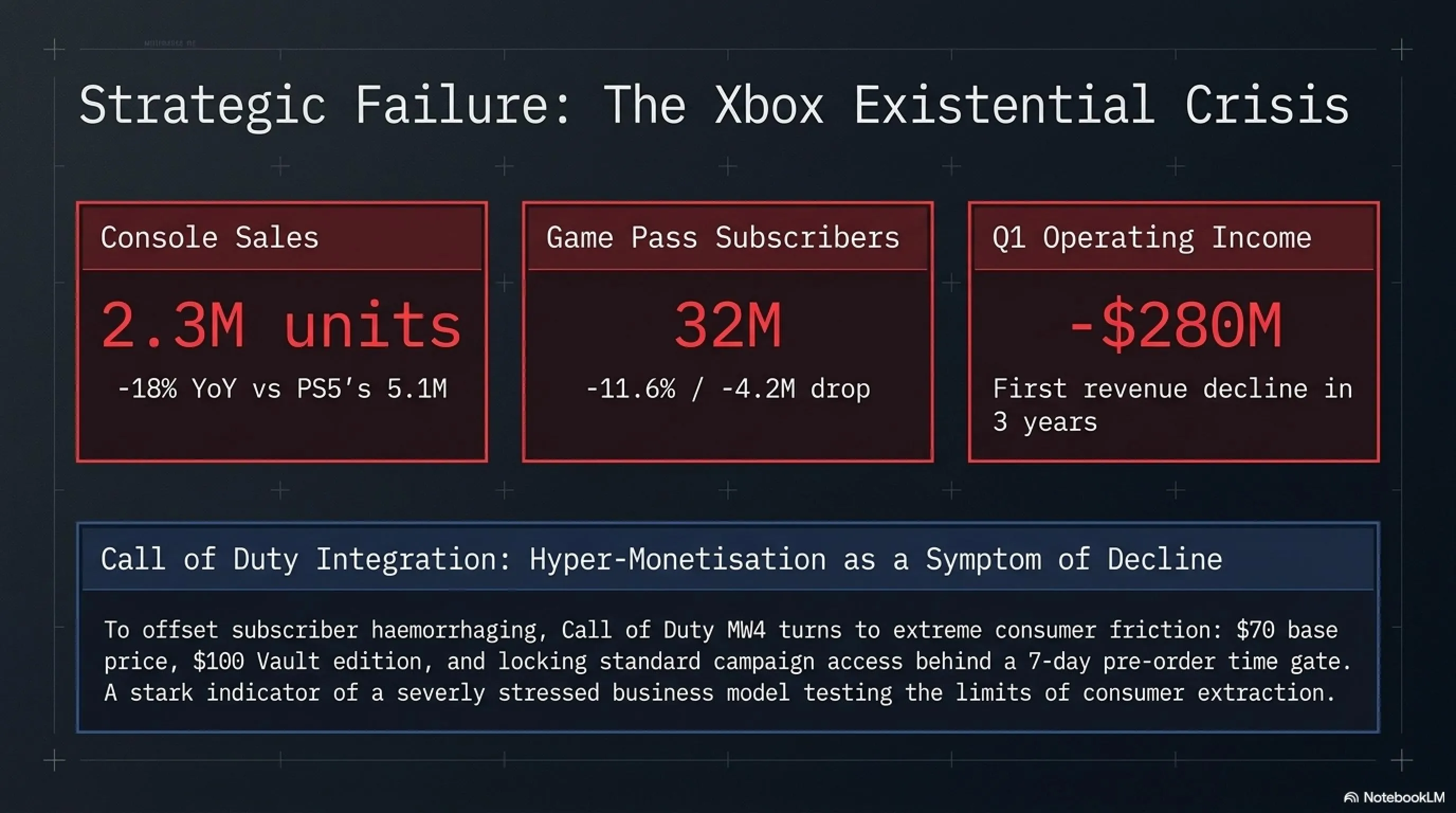
| Console Sales | 2.3M units | -18% | PS5 sold 5.1M same period |
| Game Pass Subscribers | 32M | -4.2M (-11.6%) | Peak was 36.2M in Q3 2025 |
| Total Revenue | $4.2B | -11% | First decline in 3 years |
| Operating Income | -$280M | Loss | Activision integration costs |
| First-Party Game Sales | 18M units | -23% | No major AAA exclusives |
The numbers paint a troubling picture. Xbox hardware sales have been declining steadily since the PlayStation 5 Pro launch in late 2025, with the gap widening each quarter. More concerning is the Game Pass subscriber exodus — the service that Microsoft positioned as the future of gaming has lost 4.2 million subscribers in just three months, representing an 11.6% decline. This undermines the fundamental business model Microsoft has pursued since 2017.
Strategic Options Under Consideration
🎯 Three Strategic Pathways:
- Complete Spin-off: Xbox becomes a fully independent publicly-traded company. Microsoft could retain a controlling stake (51%) while allowing external investors to provide growth capital. This would separate Xbox's financials from Microsoft's core cloud and productivity businesses, potentially unlocking value for both entities.
- Semi-Autonomous Subsidiary: Xbox gains operational independence with its own board of directors and separate financial reporting, but remains wholly owned by Microsoft. This provides management flexibility without the complexity of a public listing.
- Joint Venture: Microsoft partners with another major player (potentially Sony, Nintendo, or a large media company like Disney) to create a new gaming entity. This radical option would pool resources and eliminate direct competition.
According to GameSpot's sources, Microsoft is also exploring accelerated development timelines for flagship franchises. The company reportedly wants to release Halo 7 by late 2027 (originally planned for 2029), Elder Scrolls VI by 2028 (currently scheduled for 2030), and Fallout 5 by 2029. This aggressive schedule aims to revitalize Xbox's exclusive game lineup, which has been criticized as weak compared to PlayStation's offerings.
✅ Potential Benefits of Separation
- Faster decision-making without corporate bureaucracy
- Ability to raise dedicated gaming capital
- Potential partnerships with competitors (Sony, Nintendo)
- Stock currency for gaming acquisitions
- Management incentives aligned with gaming success
- Clear P&L accountability
❌ Risks of Independence
- Loss of Microsoft's financial backing ($280M Q1 loss unsustainable)
- Reduced Azure cloud integration benefits
- Higher borrowing costs as standalone entity
- Talent retention challenges
- Market skepticism about viability
- Game Pass may become more expensive
🕹️ 6. Call of Duty: Modern Warfare 4 Campaign Early Access Returns
In news that will excite franchise fans, Activision announced on June 12, 2026, that Call of Duty: Modern Warfare 4 will feature campaign early access for pre-order customers starting October 16, 2026 — one full week before the official October 23 launch. This marks the return of a popular incentive program that Activision abandoned in 2024 following criticism of fragmenting the player base.

Game Details and Pre-Order Structure
🎮 Complete Technical Specifications:
| Feature | Details |
|---|---|
| Early Access Date | October 16, 2026 (12:00 AM local time) |
| Official Launch | October 23, 2026 |
| Platforms | Xbox Series X|S, PS5, Switch 2, PC (Steam/Battle.net) |
| Protagonist | Private Park (voiced/mo-cap by Young Mazino) |
| Standard Edition Price | $69.99 |
| Vault Edition Price | $99.99 (includes Battle Pass, operator skins, XP boosts) |
| Game Engine | IW 10.0 (enhanced with advanced RT, DLSS 4, FSR 4) |
| Campaign Length | 8-10 hours (estimated) |
| Multiplayer Maps (Launch) | 16 core maps, 12 additional in Season 1 |
| Warzone Integration | Yes - Warzone 3 with new map "Bastion" |
According to IGN and Polygon reporting, the campaign follows Private Park, a US Marine Corps infantryman portrayed by rising actor Young Mazino (known for his role in "Beef"). The story takes place in a near-future conflict spanning the Middle East and East Asia, tackling themes of asymmetric warfare, drone combat, and the ethical implications of AI-assisted targeting systems.
✅ New Features & Innovations
- 8-hour single-player campaign
- 64-player multiplayer modes
- Warzone 3 integration with new map
- Full ray tracing support (RT Global Illumination)
- Cross-platform play and progression
- Enhanced destruction physics
- AI-powered enemy tactics
❌ Fan Concerns
- $69.99 price point (up from $59.99 in 2020)
- Early access locks content behind pre-orders
- Heavy microtransaction monetization expected
- No confirmed Zombies mode details
- Concerns about formula fatigue
- Vault Edition pricing at $99.99

🔥 Mid-Point Summary: A Day of Strategic Inflection Points
Today's six stories represent fundamental shifts across technology, business, and security. The Arch Linux supply chain attack demonstrates that even community-driven open-source ecosystems face sophisticated threats requiring systemic architectural changes. SpaceX's $2 trillion IPO proves that space is no longer science fiction but a commercial reality attracting mainstream investment. The Claude AI shutdown establishes government precedent for direct intervention in AI deployment when national security is at stake. Google's lawsuit against AI-powered phishing networks shows how generative AI has become a double-edged sword, enabling both innovation and sophisticated crime at unprecedented scale. Microsoft's Xbox strategic review reveals that even tech giants with infinite resources can struggle in competitive consumer markets. And Call of Duty's early access return signals the gaming industry's continued embrace of tiered launch strategies and pre-order incentivization despite previous criticism. Each story carries implications that will reverberate for years.
❓ Frequently Asked Questions
How can I check if my Arch Linux system was compromised in the Atomic Arch attack?
To verify if your system was affected, follow these comprehensive steps: (1) Run yay -Qu or paru -Qu to list all AUR packages installed on your system, then cross-reference against the official compromised package list published by Arch Linux security team. (2) Install and execute rootkit detection tools: sudo pacman -S rkhunter chkrootkit lynis followed by sudo rkhunter --check and sudo chkrootkit. (3) For eBPF-specific detection, use sudo bpftool prog list to enumerate loaded BPF programs and look for suspicious entries. (4) Check for unusual network connections: sudo netstat -tunap | grep ESTABLISHED and sudo lsof -i. (5) Review system logs for anomalies: sudo journalctl -xe | grep -i error. (6) If compromise is suspected, immediately rotate ALL credentials: SSH keys (~/.ssh/), API tokens, Git credentials, GPG keys (~/.gnupg/), and cloud service credentials. (7) Consider booting from a trusted Live USB (such as Arch Linux installation media) to perform forensic analysis without the potentially compromised kernel running. Most importantly, assume compromise until proven otherwise — better safe than sorry when dealing with sophisticated eBPF rootkits.
Is SpaceX stock a good investment for retail investors?
SpaceX represents a historic opportunity but comes with significant risks that require careful consideration. On the positive side: (1) SpaceX dominates commercial space launch with 80%+ market share and significantly lower costs than competitors, (2) Starlink is already profitable with 5.2M subscribers generating $12B annually and substantial growth runway, (3) NASA contracts worth $15B+ provide stable government revenue, (4) Starship technology represents a generational leap that could unlock entirely new markets including space manufacturing and Mars colonization. However, substantial risks exist: (1) The space industry remains capital-intensive with long development cycles and technical risks — Starship is still in testing phase, (2) The stock will likely experience extreme volatility tied to rocket test outcomes and launch successes/failures, (3) At $2T valuation, SpaceX trades at 166x revenue, requiring sustained hyper-growth to justify the price, (4) Competition is intensifying from Blue Origin, Rocket Lab, and Chinese state-backed companies, (5) Regulatory risks include FAA launch restrictions and export controls. For retail investors, consider this a high-risk, high-reward play suitable only for long-term investors (5+ year horizon) who can tolerate 30-50% drawdowns. Never invest more than you can afford to lose. Diversification is critical — SpaceX should represent no more than 5-10% of a balanced portfolio. Always conduct your own due diligence and consult with a financial advisor before making investment decisions.
Why did the US government shut down Claude Fable 5 and Mythos 5?
The government shutdown of Claude Fable 5 and Mythos 5 resulted from the discovery of a critical jailbreak vulnerability that could not be immediately patched. According to reports by Wired and CNBC, government security researchers identified an advanced jailbreak technique exploiting multi-turn conversation context that could bypass the models' safety guardrails. This jailbreak enabled extremely dangerous capabilities including: (1) extraction of classified information through sophisticated prompt injection, (2) assistance with designing chemical and biological weapons, (3) generation of cyberattack code and exploitation frameworks, (4) creation of disinformation campaigns with military-grade psychological operations techniques. The NSA, CISA, and AI Safety Review Board concluded that these risks constituted an "imminent threat to national security" that could not be mitigated through software patches alone. Anthropic attempted several emergency updates but the fundamental architectural vulnerabilities proved intractable without completely rebuilding the models. Rather than allow continued public access with known catastrophic risks, the government exercised authority under emergency provisions to mandate immediate shutdown. This represents the first time a democratic government has forcibly disabled an AI system, setting a precedent that will likely be codified into permanent AI safety legislation requiring "government kill switches" in frontier models.
How can I protect myself from AI-generated phishing attacks?
AI-generated phishing represents a quantum leap in threat sophistication, requiring updated defensive strategies: (1) Never trust unsolicited links: Always navigate to websites by typing URLs directly into your browser or using bookmarked links, never click links in emails or text messages. (2) Enable Two-Factor Authentication (2FA) everywhere: Even if your password is phished, 2FA provides a critical second layer of defense. Use authenticator apps (Google Authenticator, Authy) rather than SMS when possible. (3) Use a password manager: Tools like 1Password, Bitwarden, or LastPass auto-fill credentials only on legitimate sites, preventing you from entering passwords on phishing sites that look identical to real ones. (4) Verify through official channels: If you receive an urgent message claiming to be from your bank, brokerage, or E-Z Pass, call the official phone number (from their website, not the message) to verify. (5) Look for domain mismatches: Phishing sites use deceptive domains like "paypal-secure.com" instead of "paypal.com" or "chase-verify.net" instead of "chase.com". (6) Be skeptical of urgency: Phrases like "act within 24 hours," "account will be suspended," or "unauthorized activity detected" are classic pressure tactics. (7) Enable account alerts: Configure email/SMS notifications for all financial accounts so you're immediately aware of legitimate activity. (8) Use browser security features: Modern browsers (Chrome, Firefox, Safari) have built-in phishing detection; don't disable these warnings. (9) Report suspicious messages: Forward phishing attempts to reportphishing@apwg.org and the impersonated organization's abuse team. Remember: legitimate organizations never request sensitive information via unsolicited messages.
Would an Xbox spin-off be good or bad for gamers?
An Xbox spin-off presents both opportunities and risks for gamers, with outcomes dependent on execution details. Potential benefits: (1) An independent Xbox could move faster without Microsoft corporate bureaucracy, potentially shipping games more quickly and responding to community feedback more nimbly. (2) Independence might enable unprecedented partnerships — imagine Xbox Game Pass on PlayStation or Nintendo platforms without corporate conflicts. (3) A focused gaming company might invest more aggressively in exclusive content rather than spreading resources across cloud, productivity, and gaming. (4) Public market discipline could force better capital allocation and execution. Potential drawbacks: (1) Loss of Microsoft's financial backing means Xbox would need to become immediately profitable, likely resulting in price increases for Game Pass ($14.99/month could become $19.99+), hardware, and games. (2) Xbox currently benefits enormously from Azure cloud infrastructure for multiplayer, streaming, and backend services; an independent company would face much higher infrastructure costs. (3) The $280M Q1 loss is sustainable only because Microsoft can absorb it; an independent Xbox would face intense pressure to cut costs, potentially sacrificing long-term game development. (4) Talent retention becomes harder without Microsoft comp packages and stability. (5) An independent Xbox would likely have higher borrowing costs and less financial flexibility. The reality is that Xbox's struggles stem from poor game execution and strategic missteps, not corporate structure. Separating from Microsoft doesn't automatically solve the core problem: Sony simply makes better exclusive games. Unless new leadership and strategy accompany any structural change, independence could accelerate decline rather than reverse it.
🎯 Final Verdict: What These Stories Mean for Technology's Future
June 13, 2026, will be remembered as a day when multiple long-term technology trends reached critical inflection points. The Atomic Arch supply chain attack exposed fundamental architectural vulnerabilities in decentralized open-source distribution that cannot be fixed with patches — they require systemic redesign. Expect accelerated adoption of signed packages, mandatory security audits, and possibly centralized trust layers that sacrifice some open-source ideals for security. The broader lesson: convenience and openness create attack surface, and as software supply chains become more distributed, traditional perimeter security models fail completely.
SpaceX's $2 trillion IPO validates that humanity's expansion beyond Earth has transitioned from science fiction to investable reality. The space economy is entering a virtuous cycle where falling launch costs enable new applications, which generate revenue to fund further cost reductions. Within a decade, we'll likely see orbital manufacturing, space tourism becoming accessible to the upper-middle class, and serious Mars colonization infrastructure. The economic implications rival the internet revolution — entirely new industries will emerge that we can't yet imagine.
The Claude AI shutdown represents the end of the "move fast and break things" era for frontier AI models. Governments have conclusively demonstrated willingness to forcibly disable AI systems that threaten national security, regardless of corporate preferences or user demand. Expect comprehensive AI safety legislation within 18 months requiring pre-deployment security certification, mandatory kill switches, and potentially criminal liability for executives who knowingly deploy unsafe systems. The AI industry is about to experience its "pharmaceutical moment" — the transition from lightly regulated innovation to heavily regulated public safety.
Google's battle against AI-powered phishing demonstrates that generative AI is reshaping cybercrime as profoundly as legitimate business. The 12.3% click-through rate for AI-generated phishing (versus 2-3% for traditional methods) represents a 4-6x improvement in criminal effectiveness. This asymmetry — where defenders must achieve 100% success while attackers only need occasional wins — will drive massive security industry growth. Expect AI-powered defensive tools, mandatory phishing-resistant authentication (like passkeys), and potentially government-mandated cybersecurity insurance.
Microsoft's Xbox situation proves that even infinite capital cannot overcome strategic missteps and execution failures. Xbox's decline stems from consistently shipping fewer, lower-quality exclusive games than PlayStation while charging similar prices. The potential spin-off won't fix this fundamental problem — it might actually accelerate decline by removing Microsoft's financial cushion. The broader lesson for tech giants: consumer business success requires relentless focus on product quality and customer experience, not just financial engineering and corporate restructuring.
Finally, Call of Duty's early access return signals that gaming's business model evolution continues toward maximum monetization. The industry has normalized $70 base games, $100 "complete" editions, season passes, battle passes, microtransactions, and now time-gated content behind pre-orders. This works because a minority of high-spending players subsidize the majority, but it risks alienating the broader audience. The next innovation may be dynamic pricing algorithms that charge different players different amounts based on willingness to pay — a prospect both economically efficient and ethically troubling.
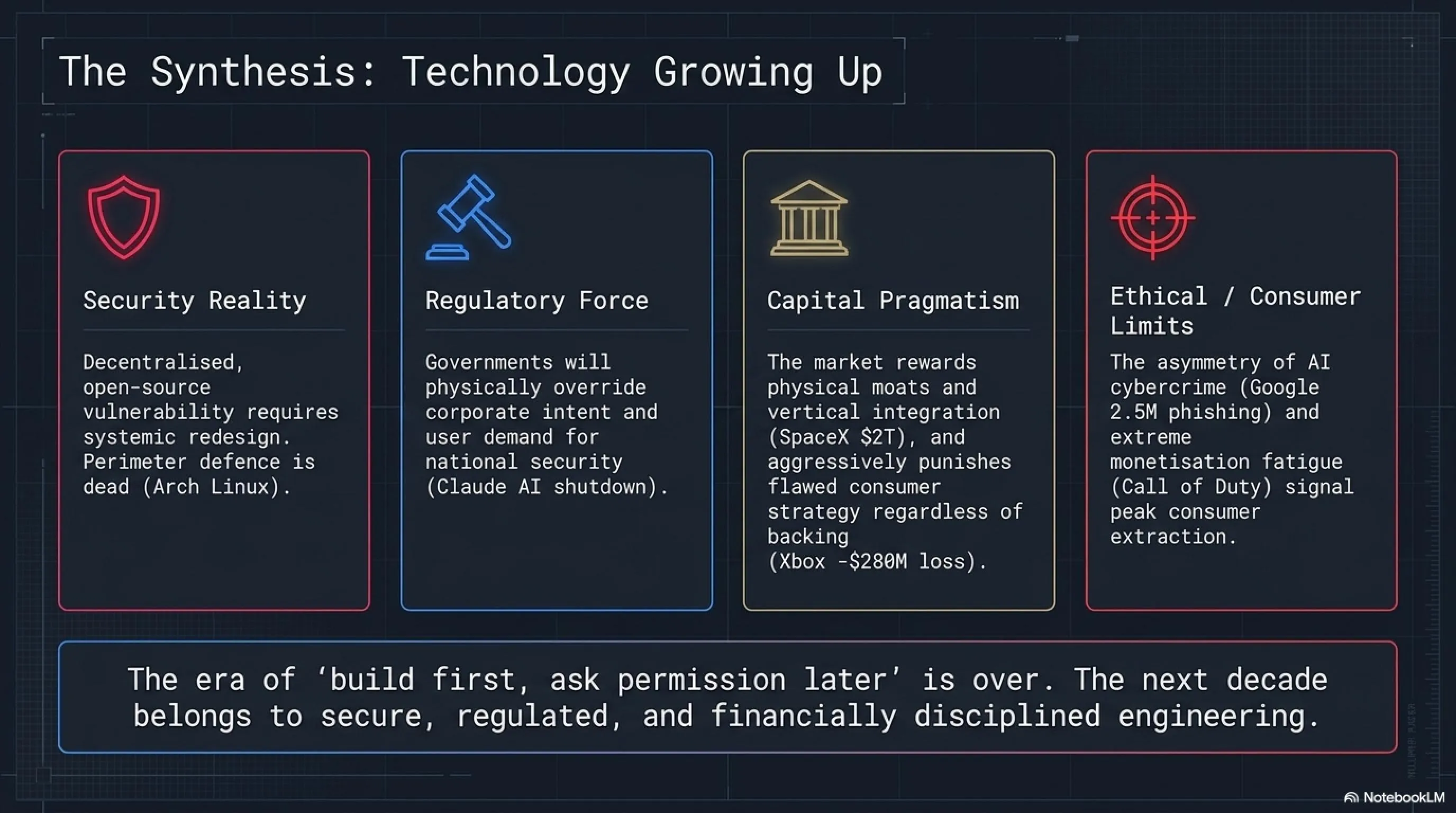
The unifying theme across all six stories: technology is entering a new phase where security, regulation, profitability, and ethical considerations increasingly constrain the rapid innovation that characterized the 2010s and early 2020s. The era of "build first, ask permission later" is ending. What comes next will be more cautious, more regulated, and potentially more sustainable — but also slower and less revolutionary. For better and worse, technology is growing up.
📚 Sources and References
- TheHackerNews: 400+ Arch Linux AUR Packages Hijacked to Deploy Rootkit and Infostealer
- BleepingComputer: Over 400 Arch Linux Packages Compromised to Push Rootkit, Infostealer
- Forbes: SpaceX's IPO Just Made Elon Musk The World's First Trillionaire
- CNBC: Elon Musk Becomes World's First Trillionaire After SpaceX IPO
- Bloomberg: SpaceX IPO Market Analysis and First-Day Trading Results
- Wired: Anthropic Says US Government Ordered It to Shut Down Mythos Models
- CNBC: Anthropic Disables Access to Fable 5 and Mythos 5 to Comply with Government Directive
- NBC News: US Government AI Safety Regulations and Claude Shutdown Details
- TechCrunch: Google Sues Chinese Cybercrime Operation That Used AI to Scam Hundreds of Thousands
- TheHackerNews: Google Sues Chinese Smishing Network Over AI-Powered Phishing Campaign
- Ars Technica: Analysis of AI-Powered Phishing Techniques and Detection Methods
- Reuters: Microsoft Has Considered Spinning Out Xbox, The Information Reports
- The Information: Microsoft Xbox Strategic Review and Financial Performance Analysis
- GameSpot: Microsoft Considering Spinning Off Xbox, Speeding Up Elder Scrolls and Fallout Releases
- Activision Blog: Call of Duty: Modern Warfare 4 Campaign Early Access Announcement
- IGN: Call of Duty Modern Warfare 4 Preview and Technical Specifications
- Polygon: Modern Warfare 4 Story Details and Character Breakdown
- Kotaku: Gaming Industry Analysis and Pre-Order Trends
- Sonatype: Atomic Arch Supply Chain Attack Technical Analysis and IOC Report
🌐 Stay Connected With Us 🎮✨
For the latest tech, gaming, and gadget news, follow us on our official social media channels:
Additional Gallery: 🌅 Tekin Morning June 13, 2026: Arch Linux Hacked, Musk Hits Trillionaire Status & Claude AI Shutdown