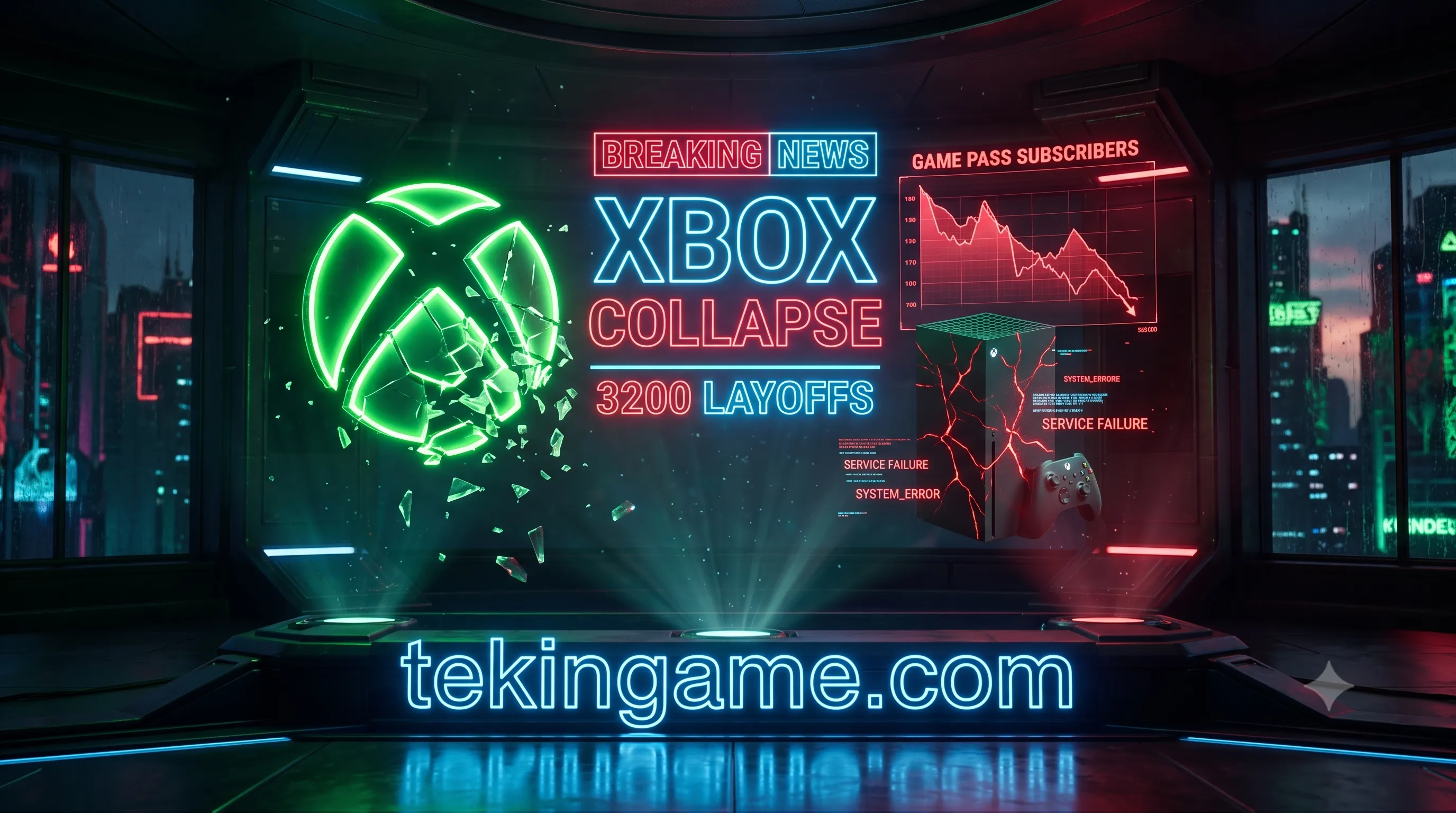
The Great Xbox Collapse: How 30M Subscribers Instead of 77M Triggered a 3,200-Person Bloodbath
- 🎮3,200 Layoffs- 20% of Xbox workforce over next 12 months
- 🎧Game Pass Failure- 30M users instead of 77M target
- 🚀id Software: 50% Cut- Legendary Doom maker slashed in half
- 🗡️Obsidian: 25% Cut- 60-70 experienced developers laid off
When the Empire Fell to Its Knees
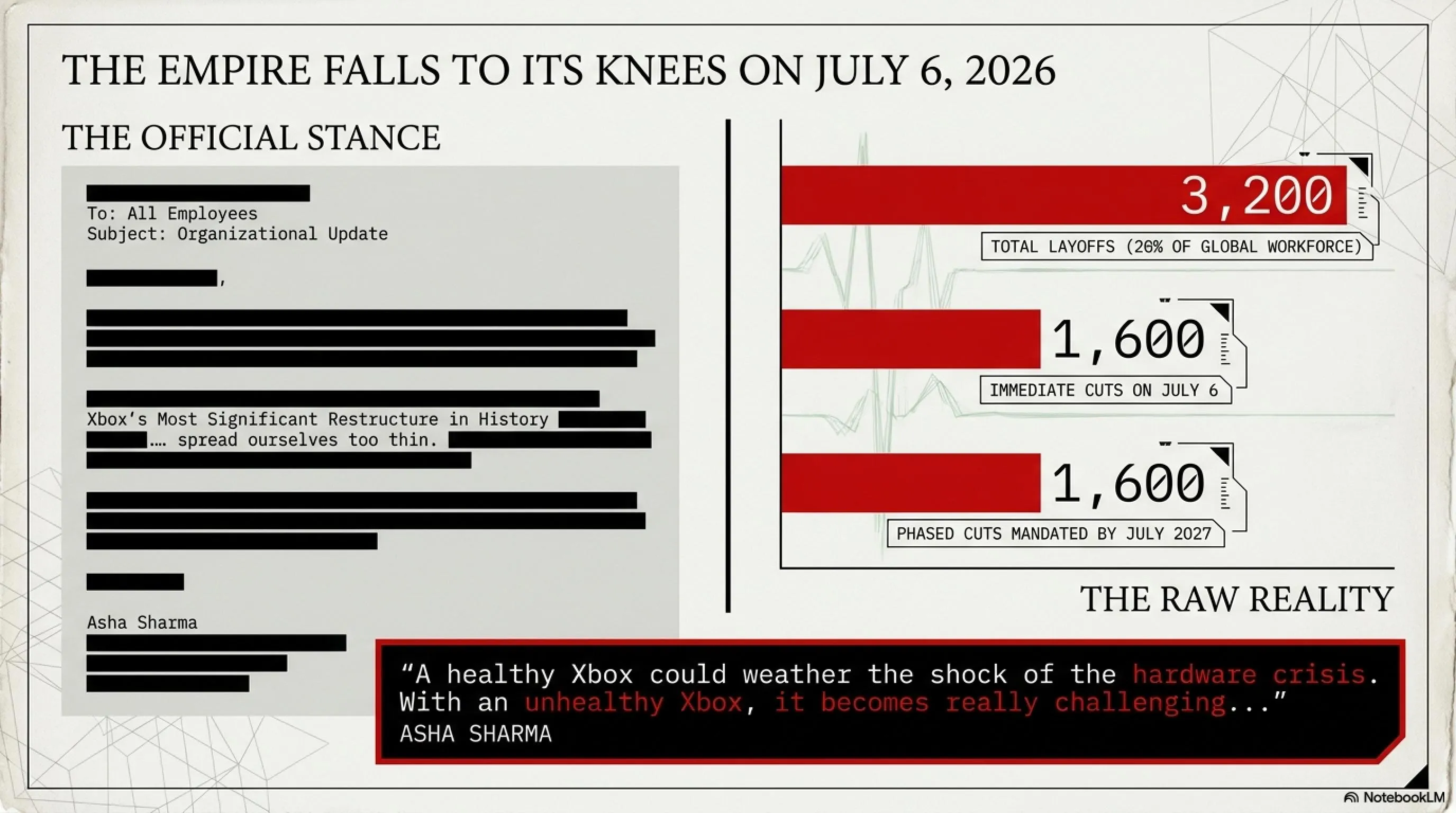
Remember July 6, 2026. The day Asha Sharma, Xbox's newly appointed CEO, sent an email to staff with the headline "Xbox's Most Significant Restructure in History." Behind that diplomatic phrasing lurked a bitter reality: Microsoft had decided to eliminate 20 percent of Xbox's workforce over the next 12 months. That's 3,200 people. That's legendary studios like id Software cut in half. That's Obsidian losing a quarter of its developers.
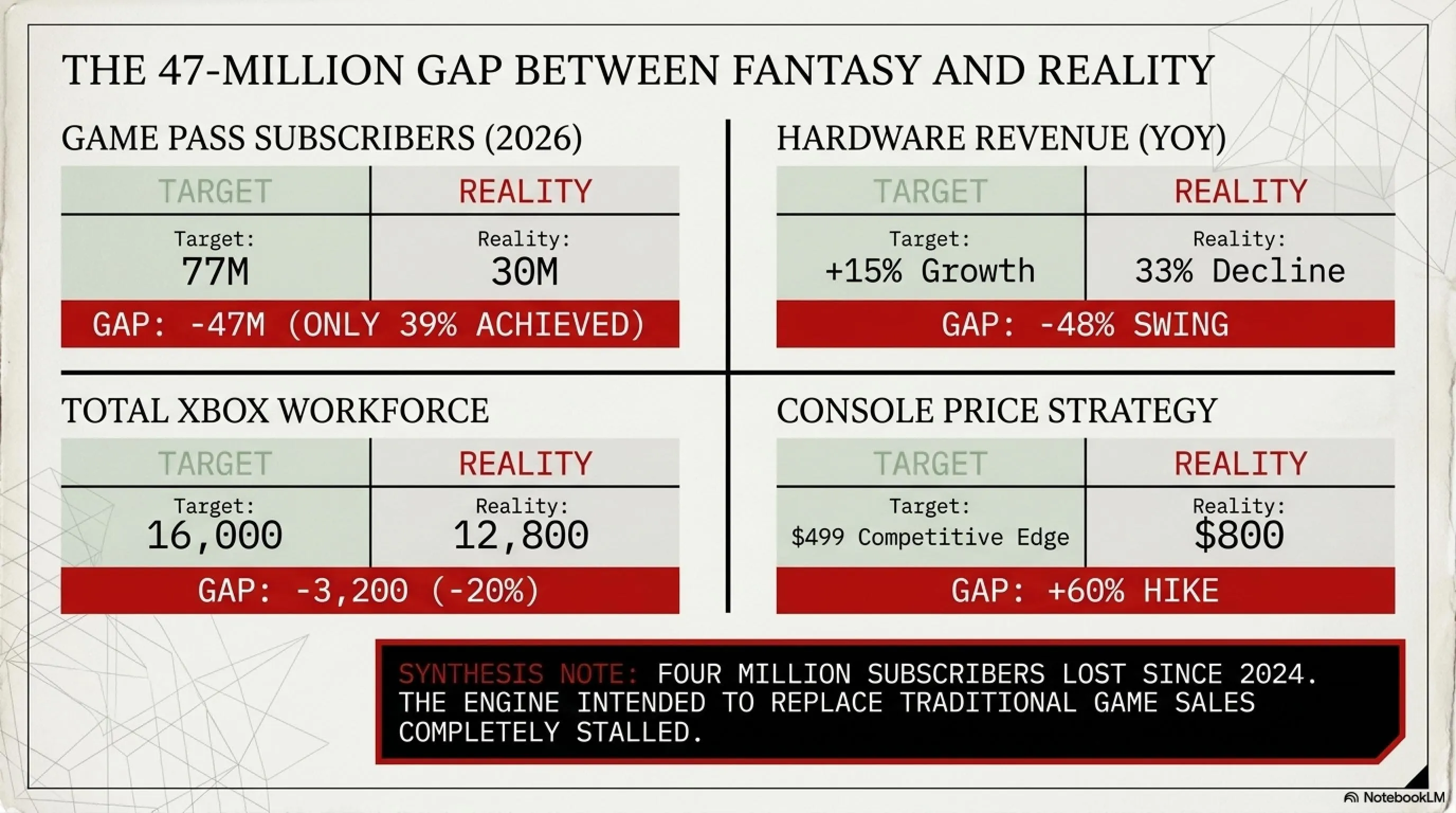
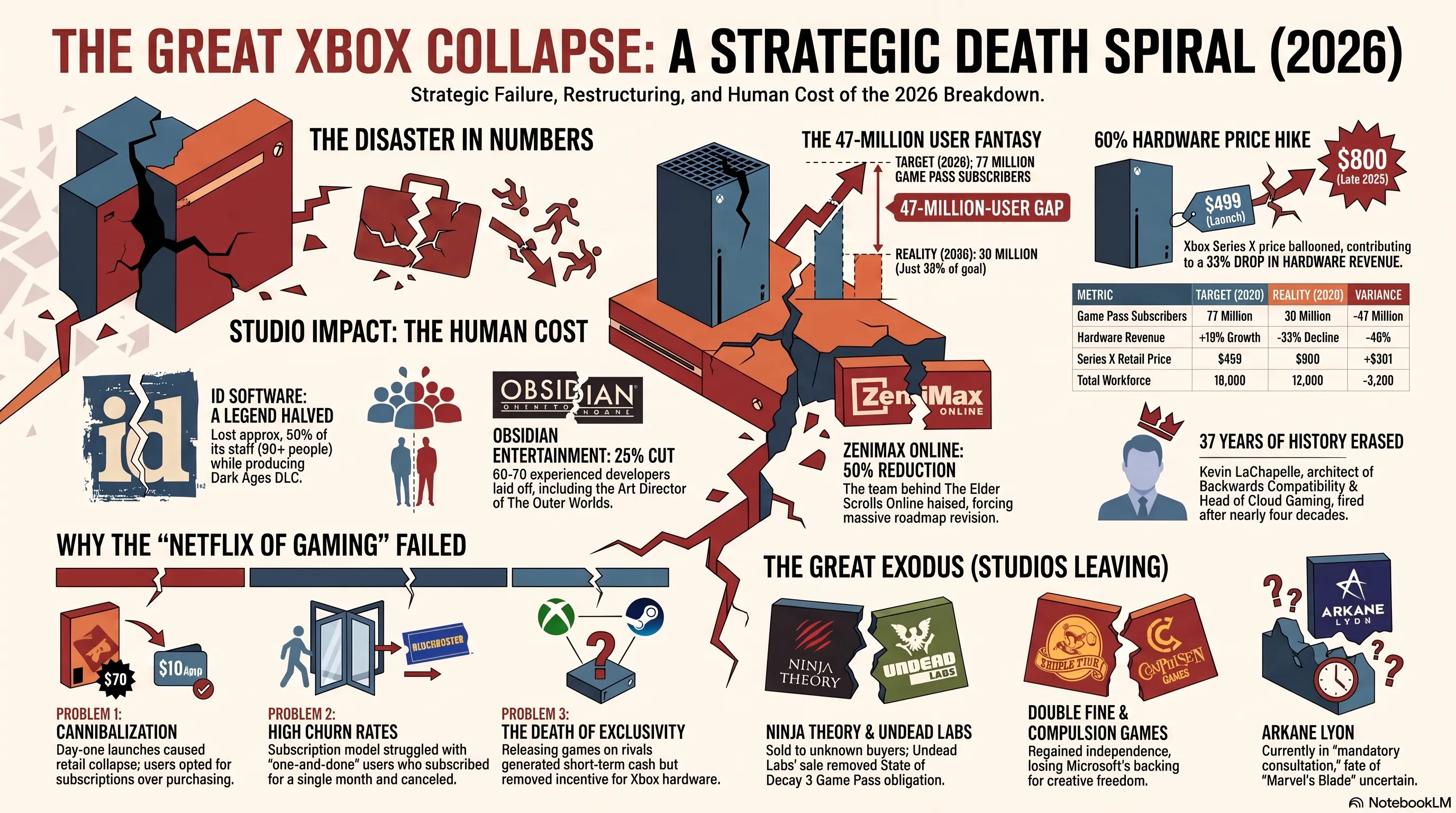
But why? The answer boils down to one number: 30 million. That's Game Pass's current subscriber count. Microsoft expected it to hit 77 million by the end of 2026. The 47-million gap between reality and fantasy is what pushed Xbox to the edge of the cliff.
At a Glance: What Happened?
- 1,600 people immediately laid off on July 6, another 1,600 by July 2027
- Game Pass has only 30M subscribers (target: 77M by 2026)
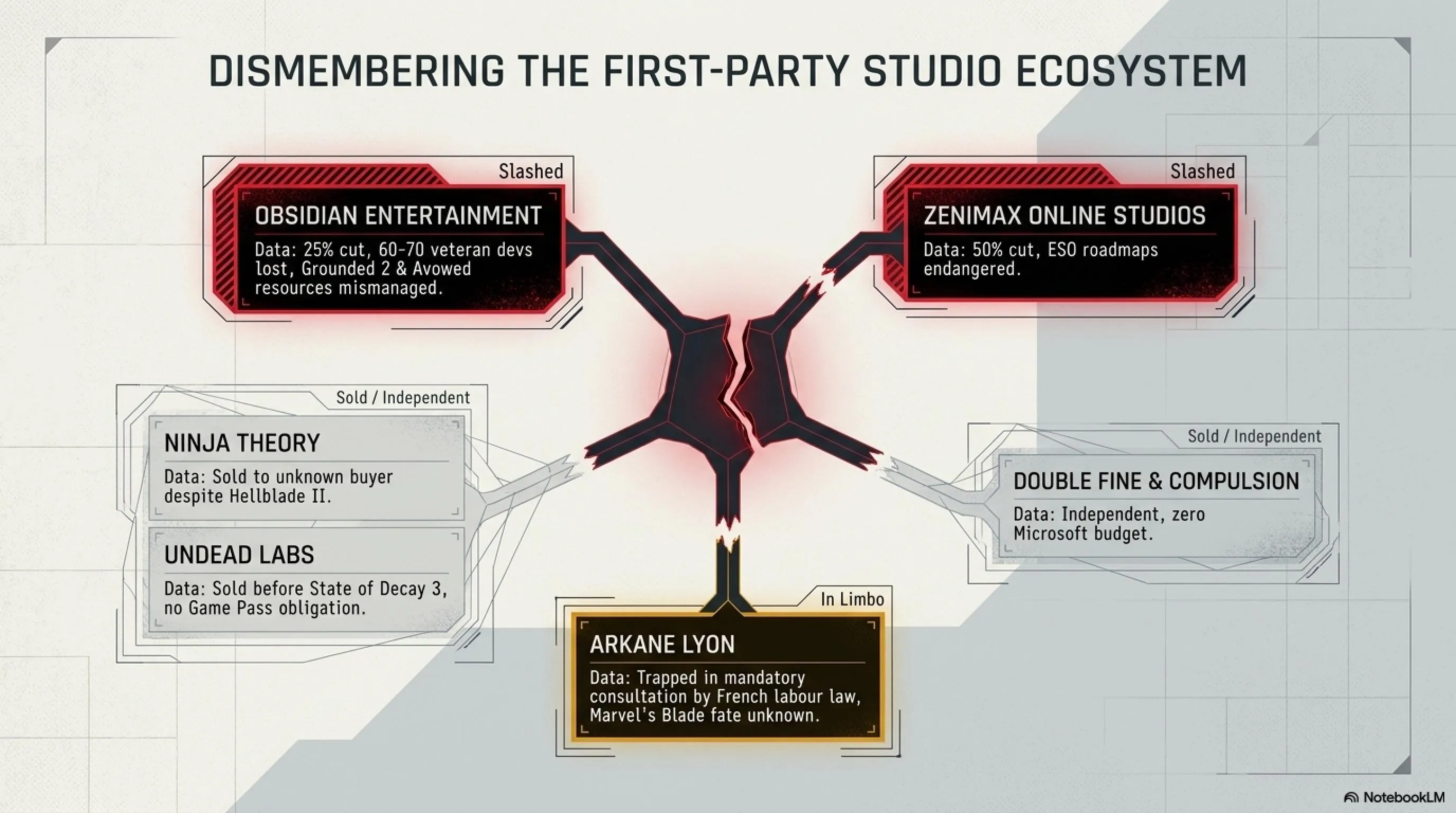
- Ninja Theory and Undead Labs sold to unknown buyers
- Double Fine and Compulsion went independent again
- Arkane Lyon in mandatory consultation (French labor law)
- id Software lost ~50% of staff (90+ people)
- Obsidian cut by 25% (60-70 people)
- ZeniMax Online Studios (ESO) halved
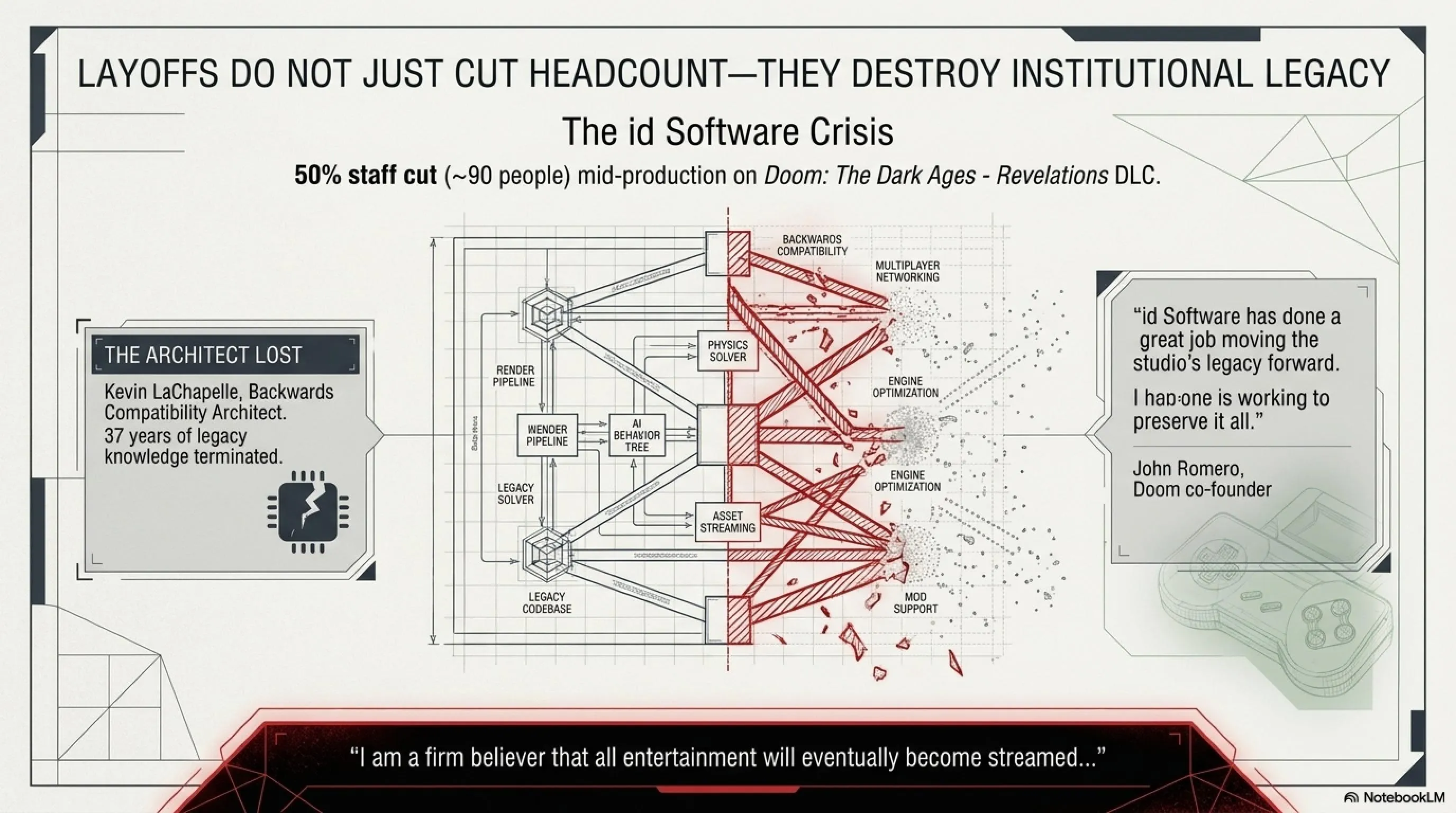
- Kevin LaChapelle (Backwards Compatibility architect) fired after 37 years
- Hardware revenue down 33%
The Starting Point: When Strategy Became Catastrophe
To understand this disaster, we need to go back to 2020. That's when Phil Spencer and his team decided to transform Xbox from a console into an "ecosystem." Game Pass was supposed to be the Netflix of gaming. But where did it go wrong? The same place Netflix struggled: insufficient exclusive content, and people weren't willing to pay for something they could get elsewhere.
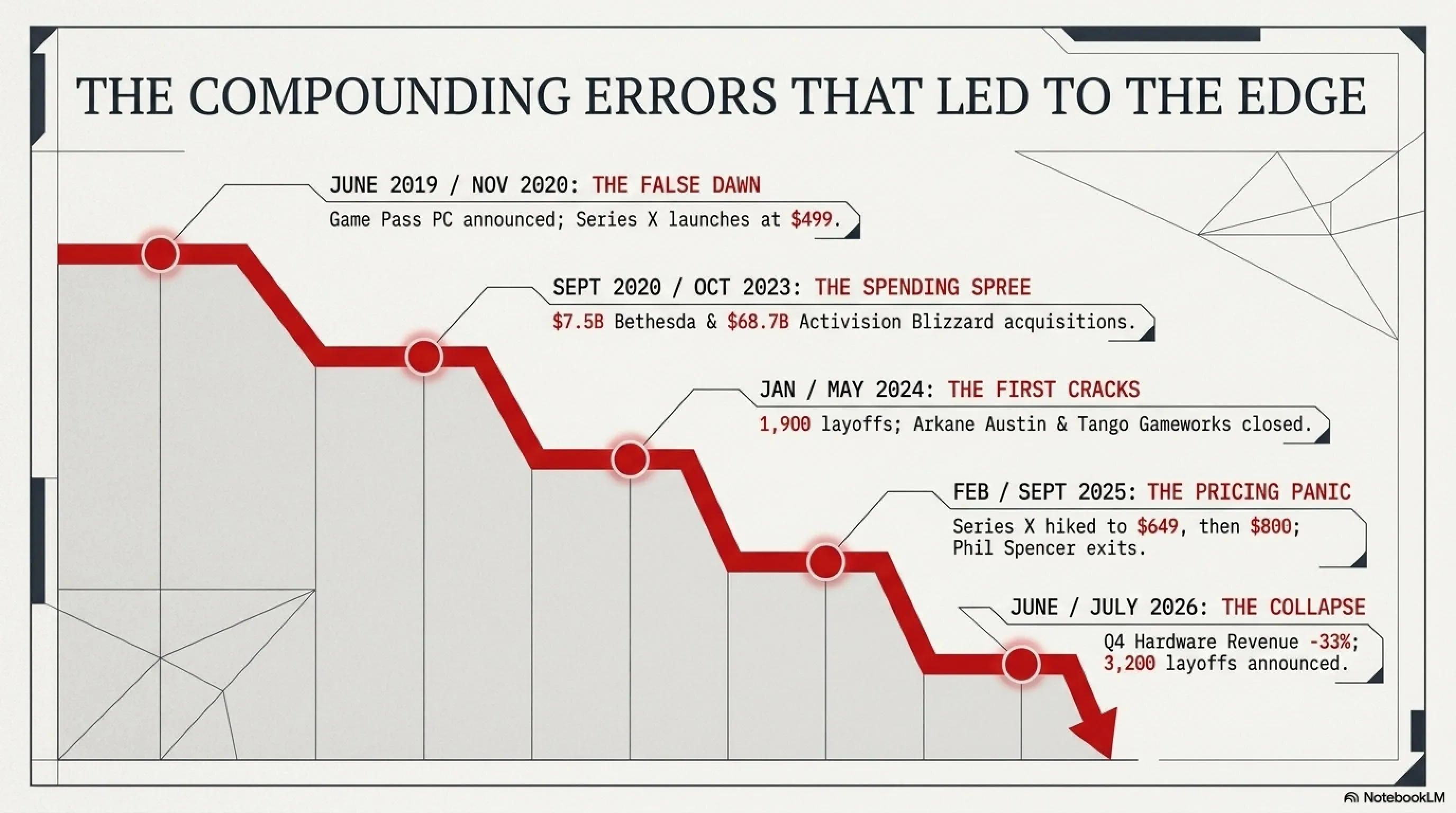
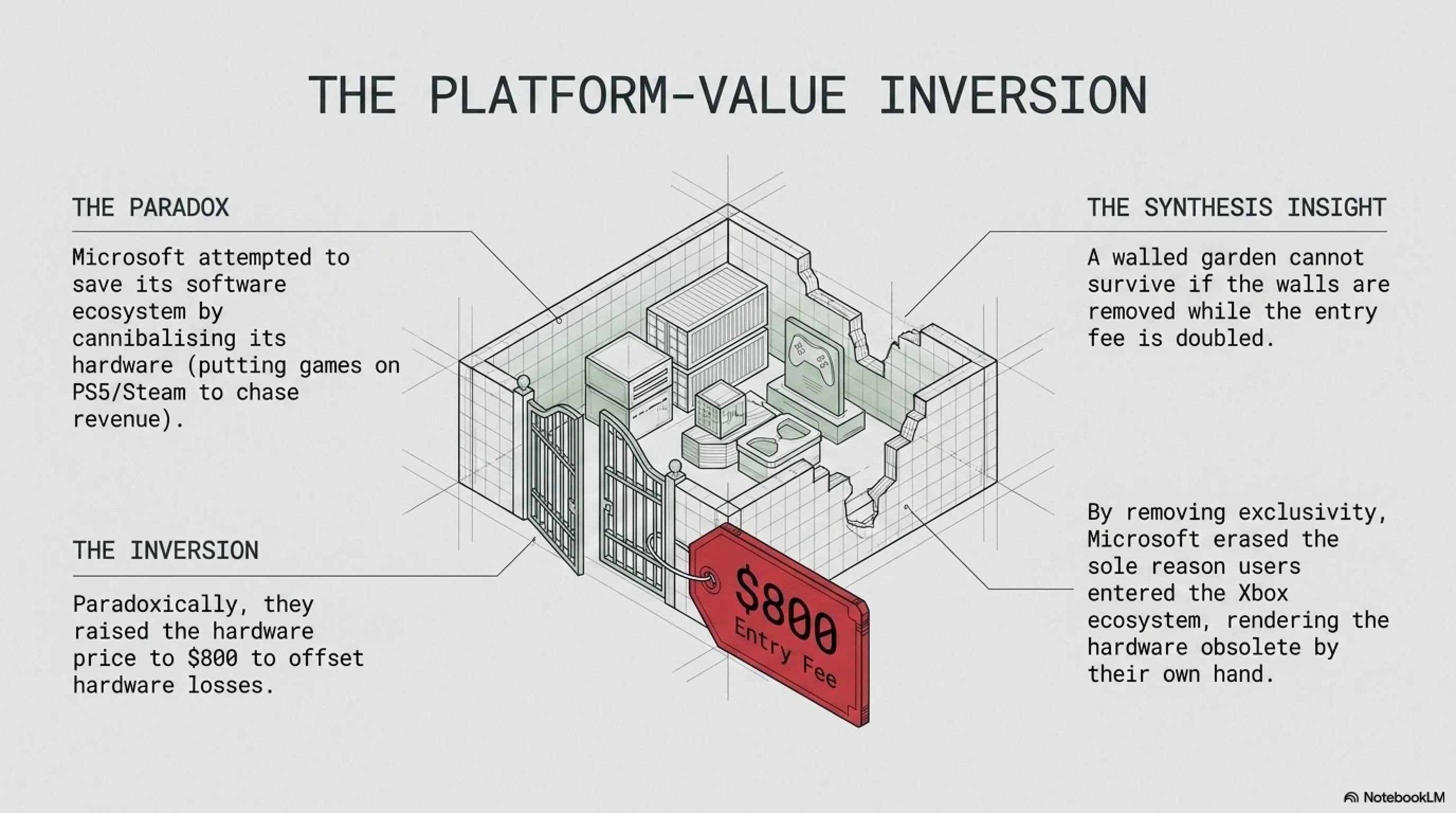
Microsoft spent billions acquiring studios: Bethesda for $7.5 billion, Activision Blizzard for $68.7 billion. These studios were meant to be Game Pass's engine. But nothing happened. Why? Because Microsoft made one massive strategic error: it released these studios' games on PlayStation and Steam too, chasing short-term revenue. The result? People no longer had a reason to buy Xbox or subscribe to Game Pass.
What is Game Pass and Why Did It Fail?
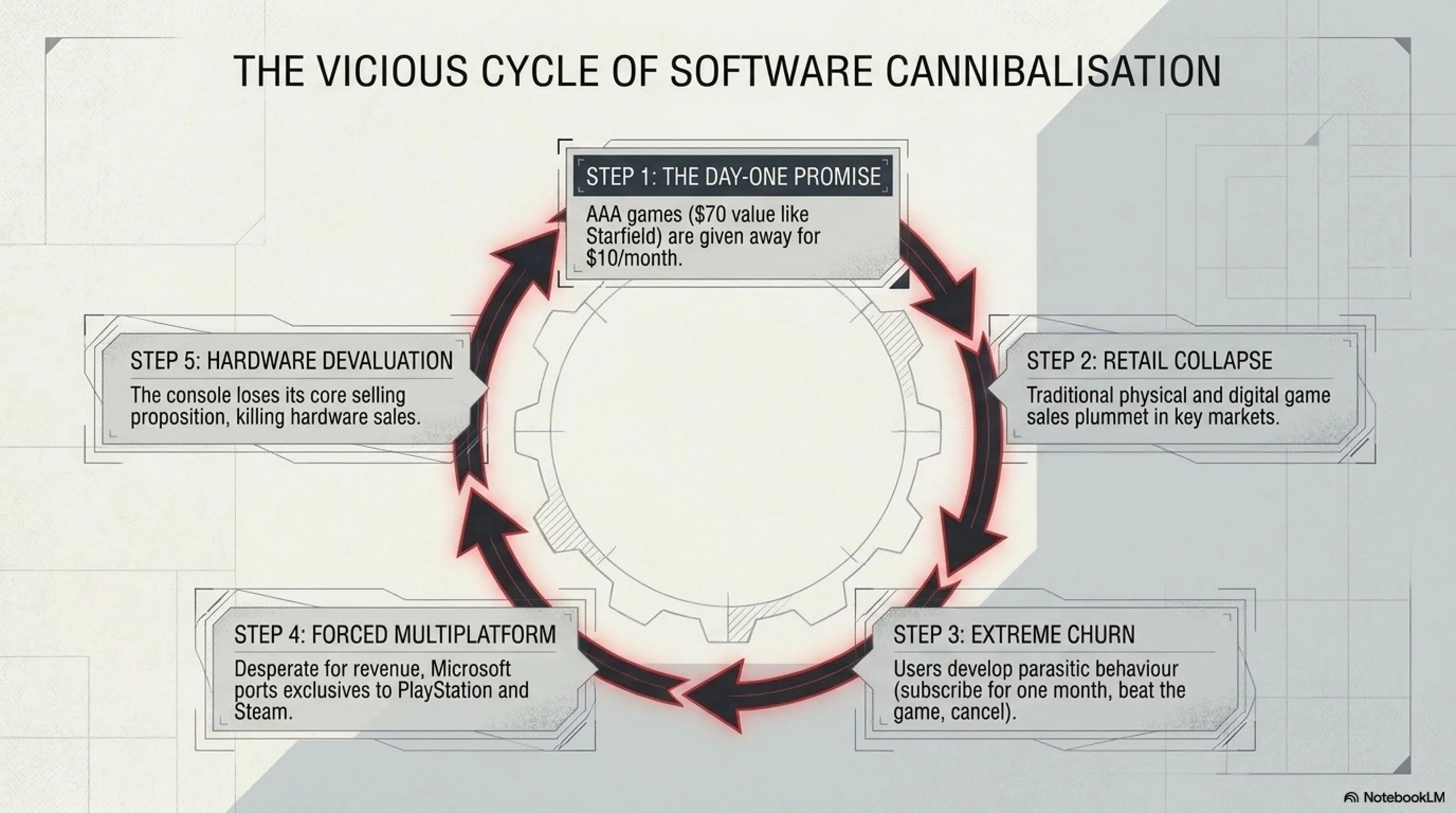
1. Cannibalization: Users stopped buying games, just waited for them to hit Game Pass.
2. No Exclusivity: Xbox games were also on PlayStation/Steam.
3. High Churn Rate: People subscribed for one month, played, then canceled.
The Numbers That Don't Lie
Let's speak in the language of numbers, because numbers never lie. The Wall Street Journal revealed that Microsoft's internal documents predicted Game Pass would reach 77 million subscribers by the end of 2026. Today's reality? Just 30 million. That means Microsoft has achieved only 39 percent of its target.
The Disaster in Numbers
| Metric | Target | Reality | Gap |
|---|---|---|---|
| Game Pass Subscribers 2026 | 77M | 30M | -47M |
| Hardware Revenue (YoY change) | +15% | -33% | -48% |
| Total Xbox Workforce | 16,000 | 12,800 | -3,200 (-20%) |
| Xbox Series X Price (launch) | $499 | $800 | +60% |
But that's just the beginning. Xbox hardware revenue dropped 33 percent in Microsoft's latest financial report. This is while the Xbox Series X price jumped from $499 at launch to $800 today. That's a 60 percent price increase. So Microsoft couldn't maintain sales even with a 60% price hike. People just aren't buying Xbox anymore.
The Studios That Became Victims
But reality is more bitter than numbers. Behind every statistic are people whose lives changed overnight. Let's look at the studios that took the hardest hits.
id Software: The Fall of a Legend
id Software, the studio that created Doom, Quake, and Wolfenstein, took one of the worst hits. According to Game Developer, around 50 percent of the studio's staff were laid off. That's over 90 people. The studio was in the middle of launching the massive Doom: The Dark Ages - Revelations DLC, but now has to do it with half the team.
John Romero, one of id Software's co-founders and the original creator of Doom, wrote on Twitter: "My heart's with all of you. id Software has done a great job moving the studio's legacy forward. I hope someone is working to preserve it all." That last sentence is particularly meaningful. Romero is worried that with these massive layoffs, the institutional knowledge and technical history of id Software will be lost forever.
id Software: Profile of a Legend
Notable Games: Doom (1993), Quake (1996), Wolfenstein 3D (1992), Doom 2016, Doom Eternal
Technical Innovation: The id Tech engine became the foundation for many AAA games
Acquired by Bethesda: 2009
Acquired by Microsoft: 2021 (with Bethesda, $7.5 billion)
Current Status: Approximately 50% staff laid off, Doom: The Dark Ages DLC in production
Obsidian Entertainment: A Quarter of the Team Gone
Obsidian, the studio behind Fallout: New Vegas, The Outer Worlds, and Avowed, lost 25 percent of its workforce. According to Kotaku, between 60 and 70 people were laid off, many of them experienced specialists who had worked at the studio for over a decade. This includes the Art Director of The Outer Worlds and the studio's sole recruiter.
Interestingly, Obsidian released three major games in 2025: Avowed, The Outer Worlds 2, and Grounded 2 (Early Access). Josh Sawyer, the studio's design director, had previously said this "triple release" was the result of "poor planning and resource mismanagement." Now Obsidian must continue producing Grounded 2 DLC and The Outer Worlds 2 DLC with 75 percent of its team, and the studio's long-term plans are completely unclear.
ZeniMax Online Studios: Half the Elder Scrolls Online Team
ZeniMax Online Studios, creators of The Elder Scrolls Online, also saw approximately 50 percent cuts. This studio runs one of the most successful current MMOs, but now must revise previous roadmaps with half the team. ESO players worry that future content will be lower quality or delayed.
Timeline of Disaster: How Did We Get Here?
| Date | Event |
|---|---|
| June 2019 | Game Pass announced for PC |
| Sept 2020 | Bethesda acquisition ($7.5B) - id, Obsidian, Arkane |
| Nov 2020 | Xbox Series X/S launch at $499/$299 |
| Oct 2023 | Activision Blizzard acquisition ($68.7B) |
| Jan 2024 | First layoff wave: 1,900 from Xbox/ABK |
| May 2024 | Closure of Arkane Austin, Tango Gameworks, Alpha Dog |
| Feb 2025 | Xbox Series X price increase to $649 (+30%) |
| March 2025 | Phil Spencer steps down, Asha Sharma becomes CEO |
| Sept 2025 | Second Xbox Series X price increase to $800 (+60%) |
| June 2026 | Q4 Financial Report: Hardware Revenue -33% |
| July 6, 2026 | 3,200 layoffs announced (20%) + sale/independence of 5 studios |
The Studios That Left
But layoffs are only part of the story. Microsoft decided to divest from five smaller studios, either through sale or independence.
Ninja Theory: Sold to Unknown Buyer
Ninja Theory, creators of Hellblade: Senua's Sacrifice and Hellblade II: Senua's Saga, was sold to an unknown buyer. The studio was acquired by Microsoft in 2018 and was meant to be one of Xbox's narrative flagships. But Hellblade II, despite good reviews, had weak sales and couldn't grow Game Pass. Now Ninja Theory is independent again, but without Microsoft's financial support or access to Xbox's internal technologies.
Undead Labs: Sold Before State of Decay 3 Launch
Undead Labs, creators of the State of Decay series, was also sold. Interestingly, State of Decay 3 was showcased just one month ago at Xbox Games Showcase with a 2027 release date and a promise to launch on Game Pass. But now, according to Game File, the Undead Labs sale contract contains no "Xbox-controlling terms," meaning the new owner has no obligation to release State of Decay 3 on Game Pass.
Double Fine and Compulsion: Independent Again
Double Fine (Psychonauts) and Compulsion Games (We Happy Few) also went independent. These two studios had been acquired by Microsoft, but are now free again. Of course, "freedom" here has a bitter meaning: no budget, no publisher, and no Microsoft support network.
Arkane Lyon: In Mandatory Consultation (French Labor Law)
Arkane Lyon, the studio behind Dishonored and Deathloop, is in an unusual situation. Due to French labor laws, Microsoft can't make unilateral decisions. The studio is now in a "mandatory consultation period" during which worker representatives and management must decide the studio's future. Marvel's Blade, which the studio is developing, has an uncertain fate.
📚 Classified & Related Dossiers in TekinGame
If you wish to explore beyond this report and delve into cybernetic frontiers and autonomous AI architectures, do not miss these three exclusive deep-dives in the Tekin Garage:
Why Did Game Pass Fail? Deep Analysis
Now that we've seen what happened, it's time to ask: why? Why did a strategy that seemed logical on paper turn into such a catastrophe in practice? The answer lies in several key factors.

Problem One: Cannibalization, or Eating Your Own Children
When Microsoft announced all first-party games would launch day one on Game Pass, it created a massive problem: why would anyone pay $70 for Starfield when they could play it for $10 a month? The result? Game sales collapsed. Starfield, which was supposed to be a blockbuster, had extremely low physical sales in key markets like the UK because everyone played it on Game Pass.
But the problem got worse: Game Pass users developed problematic behavioral patterns. Many would only subscribe for one month, play, and cancel. Game Pass's churn rate was extremely high, and Microsoft couldn't retain users long-term.
Problem Two: Multiplatform Strategy That Backfired
Microsoft decided to release its games on PlayStation and Steam to boost short-term revenue. Games like Hi-Fi Rush, Pentiment, Sea of Thieves, and even Indiana Jones and the Great Circle launched on PlayStation. The result? No more reason to buy Xbox. Why would anyone pay $800 for Xbox when they could play the same games on PlayStation 5 or their own PC?
Why This Matters: Impact on the Gaming Industry
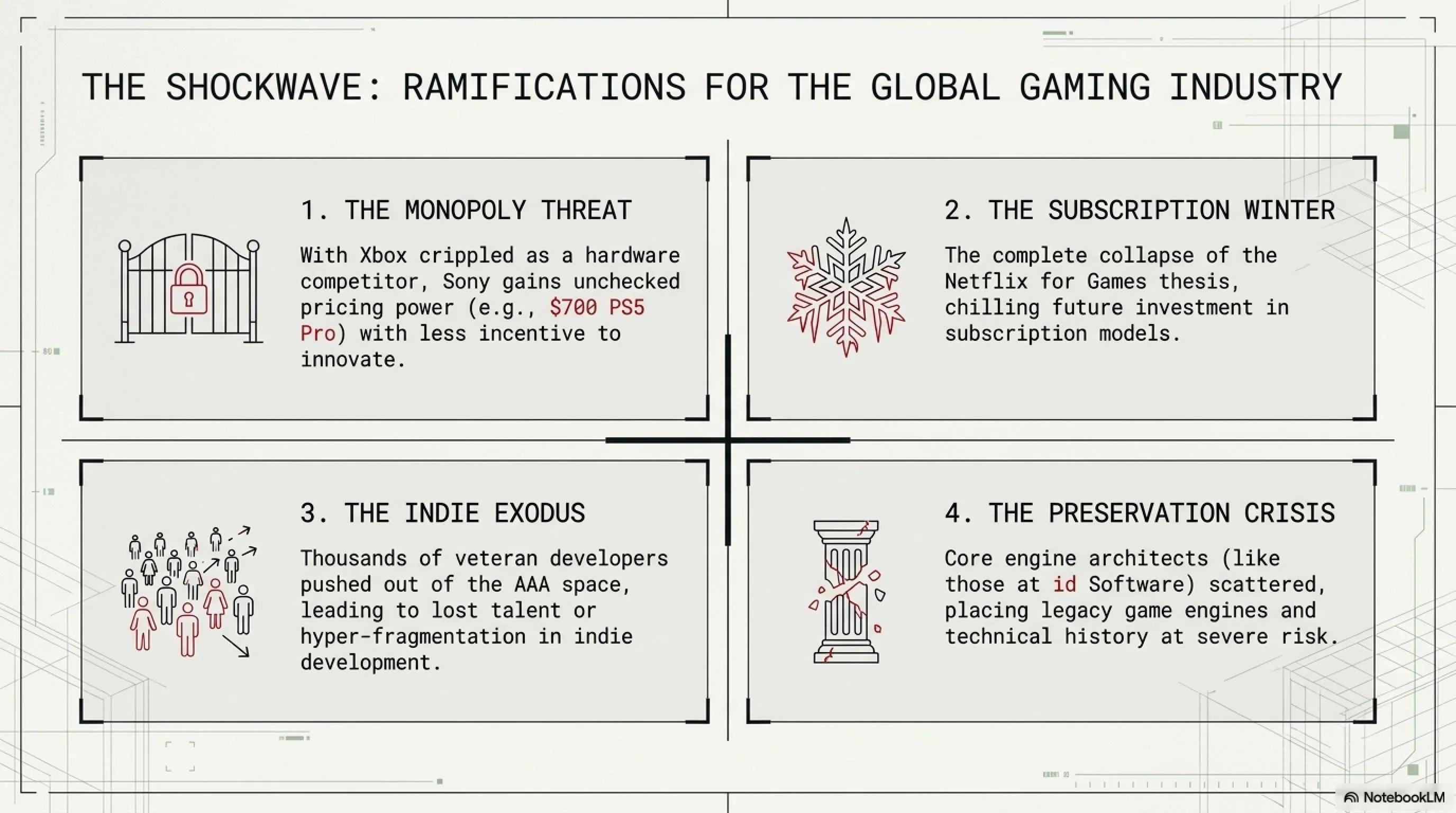
1. End of Subscription Model? If Xbox with all its resources couldn't make Game Pass successful, is the Netflix model for gaming even viable?
2. Less Competition: With Xbox weakening, Sony gains more monopoly power and can raise prices (like the $700 PS5 Pro).
3. Future of Indie Studios: Mass layoffs mean hundreds of experienced developers are now unemployed. Some will form new indie studios, but many will leave the industry.
4. Game Preservation: With technical teams at id Software and ZeniMax laid off, institutional knowledge about legacy engines and classic games is being lost.
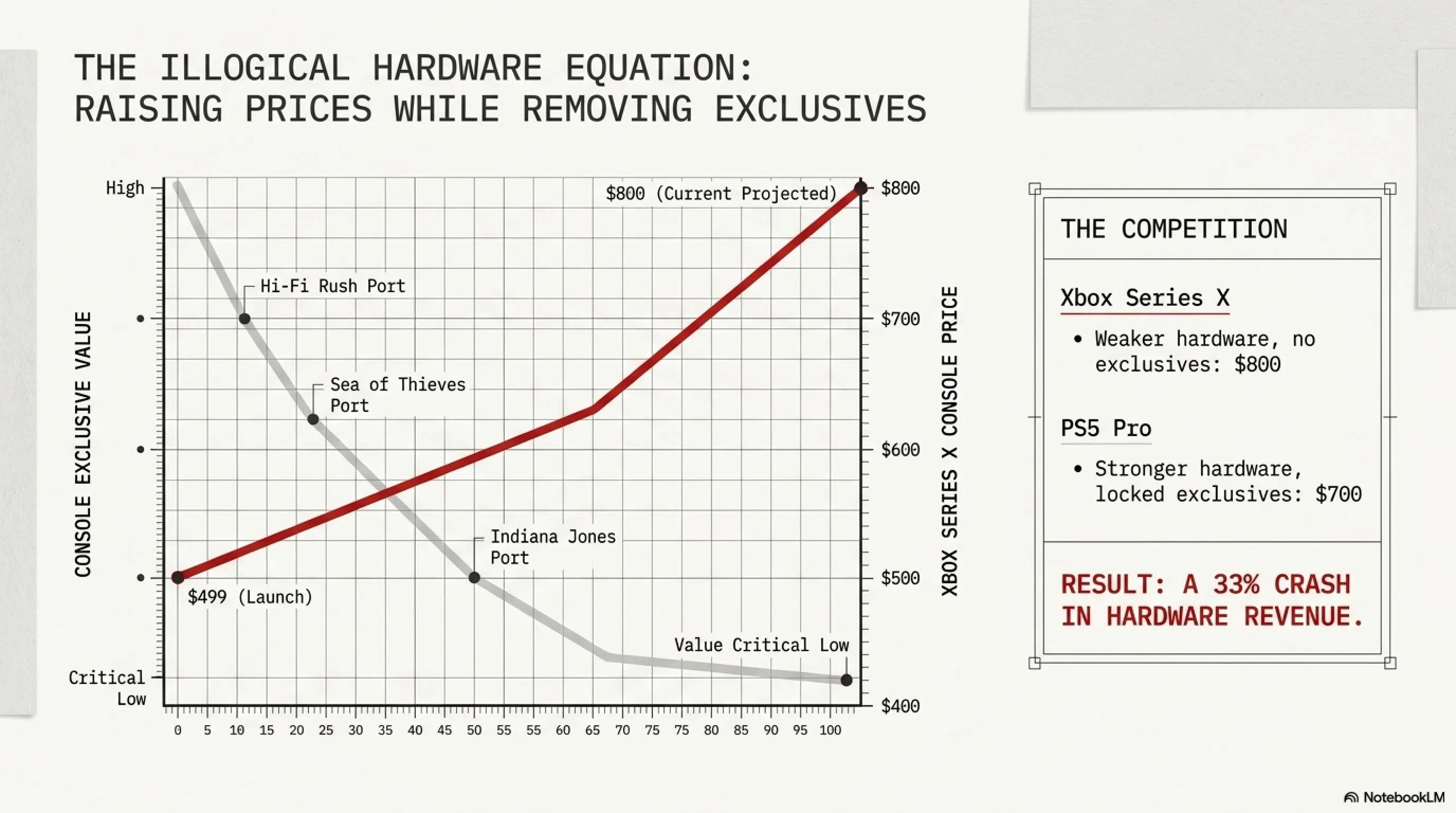
Problem Three: Illogical Hardware Pricing
Xbox Series X was $499 at launch. Now it's $800. This 60 percent increase happened while PlayStation 5 was still $500 (disc model). Even PS5 Pro with all its extra power is $700. That means Xbox Series X, with less power, became more expensive than its stronger competitor. Result? Hardware sales collapsed, and Microsoft couldn't compensate for declining sales with price increases.
Target vs Reality: Two Parallel Worlds
| What Microsoft Expected | What Actually Happened |
|---|---|
| 77M Game Pass subscribers by 2026 | 30M subscribers (only 39% of target) |
| 100M subscribers by 2030 | At current rate, won't even hit 40M |
| 15% Hardware revenue growth | 33% Hardware revenue decline |
| Competitive $499 price | $800 price (more than PS5 Pro) |
| Strong Xbox exclusives | All games also on PlayStation/Steam |
| Creative, powerful studios | id Software halved, Obsidian quartered, 5 studios gone |
Xbox's Future: 1 Billion People Per Day?
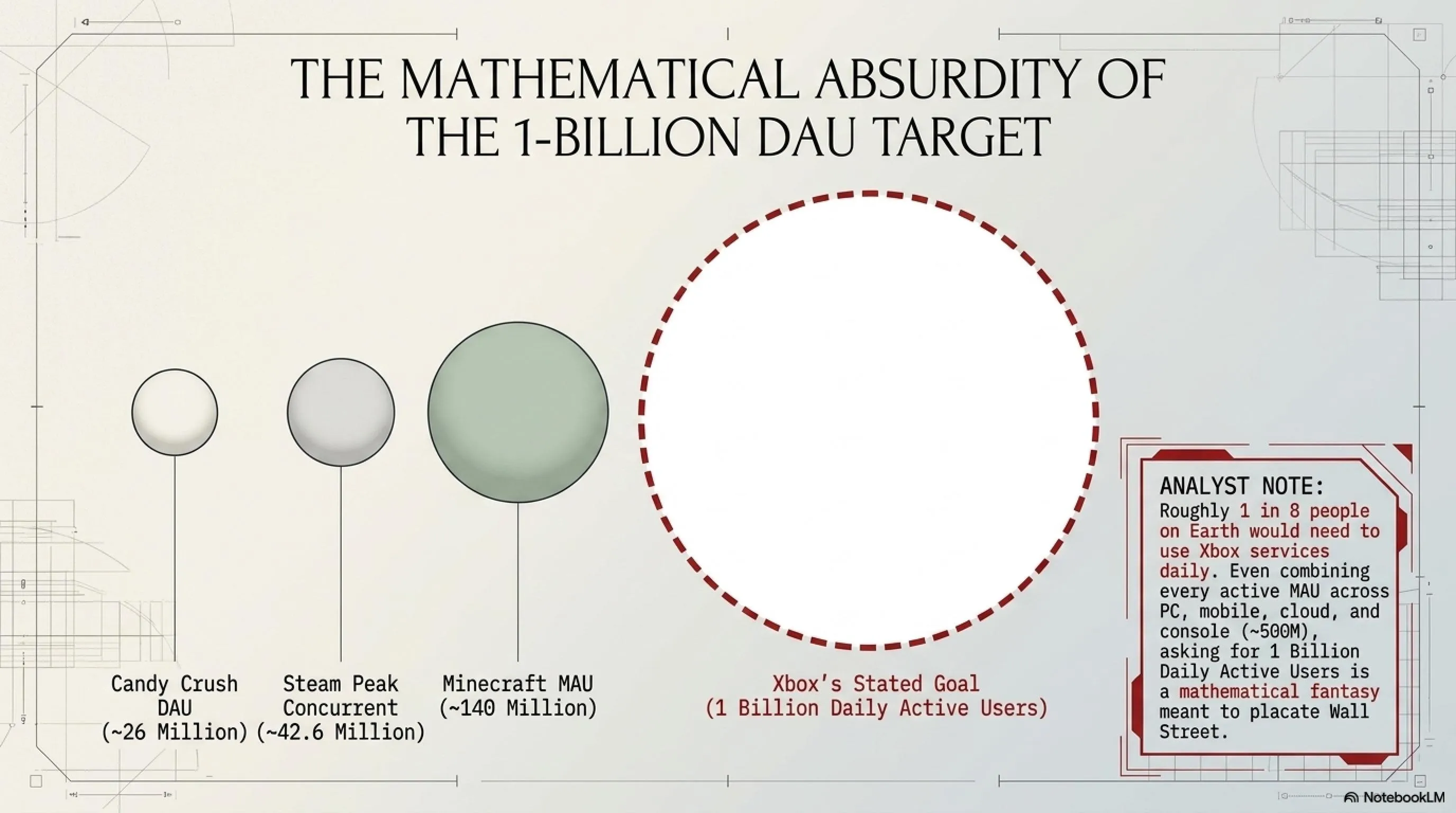
In the same layoff announcement email, Asha Sharma declared a strange goal: "I want Xbox to be one of the few companies that entertains more than a billion people each day." This number is so large that roughly one in every eight people on Earth would need to use Xbox services daily.
But how? Xbox currently has, at best, 500 million monthly active users (MAU) across PC, console, mobile, and cloud. To reach 1 billion daily active users (DAU), Microsoft would need double the current users, all active every day. This is while Steam, the largest PC gaming platform, has a record of 42.6 million concurrent users. Xbox wants 23 times that number daily.
The reality is that Sharma is sending a message to Wall Street: Xbox is no longer a console, it's an ecosystem. But this repositioning changes nothing: Game Pass has failed, Hardware is dying, and studios have been destroyed.
Microsoft's Decisions: Analysis of Pros and Cons
Now that we've seen the full picture, let's look objectively: which decisions were right and which were wrong?
- Focusing on major franchises like Minecraft and Call of Duty makes sense
- Selling smaller studios instead of closing them gives them a chance to survive
- Multiplatform strategy generates more revenue long-term
- Reducing management layers enables faster decision-making
- Investing in cloud gaming still has potential
- Laying off 20% of staff means losing institutional knowledge
- Halving id Software right before new Doom DLC is catastrophic
- Selling Undead Labs before State of Decay 3 breaks trust
- Increasing Hardware price to $800 was illogical
- Game Pass failure means billions in wasted investment
- Multiplatform strategy killed Xbox
Bitter Lessons for the Gaming Industry
Xbox's collapse isn't just a catastrophe for Microsoft, but a turning point for the entire industry. What lessons can we learn from this failure?
Lesson One: The Subscription Model Doesn't Work for Gaming
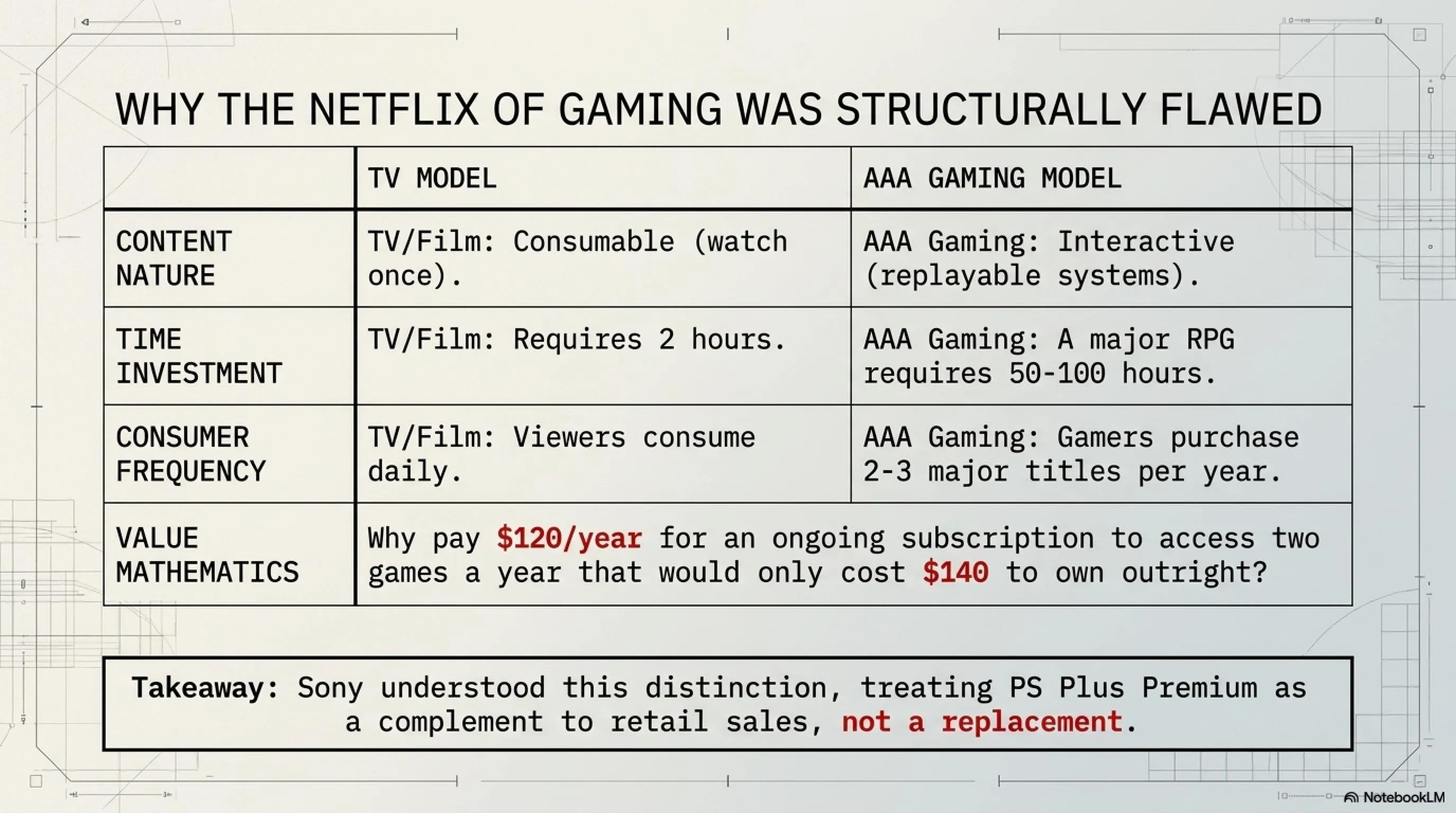
The biggest lesson is that the Netflix model simply doesn't succeed for games. Why? Because movies and shows are consumable content: you watch once and you're done. But games are interactive content: a big game can take 50-100 hours, and many people only buy 2-3 games per year. So why pay $120 per year ($10 × 12 months) for Game Pass when they only want 2 games that cost $140 to buy?
Sony learned this lesson earlier and never positioned PlayStation Plus Premium as a replacement for traditional sales, but as a complement. Result? Sony remains profitable and its games sell excellently.
Lesson Two: Exclusives Still Matter
Microsoft thought it could generate more revenue by releasing its games on all platforms. But it forgot one thing: exclusives are the reason to buy a console. People buy PlayStation because they want to play God of War, Spider-Man, and The Last of Us. People buy Switch because Mario, Zelda, and Pokemon are only there. But why buy Xbox when the same games are on PC and PlayStation?
Lesson Three: Buying Studios Isn't Enough, You Must Know How to Manage Them
Microsoft spent $76.2 billion acquiring Bethesda and Activision, but couldn't manage these studios properly. Instead of giving studios creative freedom, it forced them to release first-party games day one on Game Pass, which reduced incentive to build quality games. Why? Because sales no longer mattered, only Game Pass user count mattered.
Tekin Analysis: Will Xbox Survive?
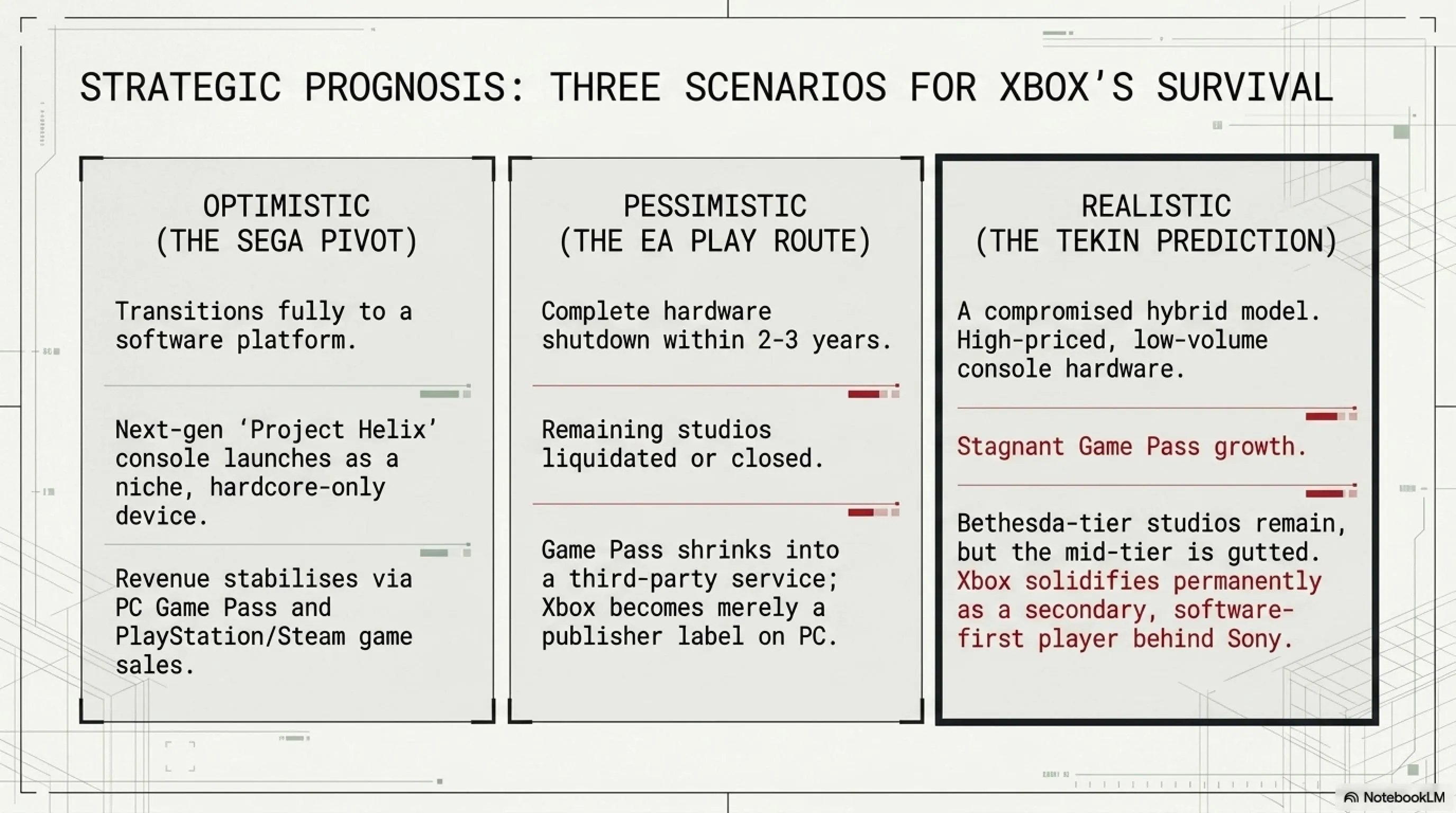
Xbox becomes a software platform. Project Helix console (next-gen) launches but only for hardcore fans. Most revenue comes from PC Game Pass, Cloud Gaming, and game sales on PlayStation/Steam. Microsoft becomes like SEGA: from console maker to game maker.
Pessimistic Scenario:
Xbox completely shuts down within 2-3 years. Microsoft sells or closes all remaining studios. Game Pass becomes a third-party service like EA Play. The only thing remaining is the Xbox brand name on PC game labels.
Realistic Scenario (Tekin Prediction):
Xbox becomes a hybrid. Console launches but at high price with low sales. Game Pass continues but with very slow growth. Most games release on all platforms. Big studios like Bethesda stay, but smaller ones are sold or closed. Xbox is no longer a serious competitor to PlayStation, but a secondary player.
Industry Reaction: From Support to Criticism
Industry reaction to this disaster has been wide-ranging. John Romero, creator of Doom, emotionally wrote: "My heart's with all of you." Josh Sawyer from Obsidian, Matt Booty who was head of Xbox Game Studios himself, and dozens of other developers supported laid-off colleagues on Twitter and LinkedIn.
But critics weren't lacking either. Many called this "restructuring" the result of strategic mismanagement. One industry analyst told GameSpot: "This is catastrophic mismanagement. Microsoft spent billions acquiring studios, then destroyed them. This isn't just a business failure, but a human tragedy."
FAQ: Everything About Xbox's Collapse
Frequently Asked Questions
Why did Microsoft lay off so many people?
The main reason is Game Pass strategy failure. Microsoft expected to reach 77 million subscribers by 2026, but only has 30 million. This 47-million gap means billions in lost revenue. Also, Xbox hardware revenue has declined 33%.
Which studios were hit hardest?
id Software lost about 50% of staff (90+ people), Obsidian 25% (60-70 people), and ZeniMax Online Studios approximately half. Also, Ninja Theory and Undead Labs were sold, Double Fine and Compulsion went independent, and Arkane Lyon is in mandatory consultation.
Will State of Decay 3 launch on Game Pass?
Unclear. According to Game File, the Undead Labs sale contract has no Xbox-controlling terms, meaning the new owner has no obligation to release on Game Pass.
Will Xbox release a new console?
Yes, Project Helix (next-gen Xbox) is in development, but will likely be very expensive and may not even have a disc drive. Microsoft is exploring a disc-to-digital program allowing users to transfer their physical library to next-gen.
How many subscribers does Game Pass have?
Currently about 30 million subscribers, which is 4 million fewer than in 2024. Microsoft expected this number to hit 77 million by 2026.
Why was Kevin LaChapelle laid off?
LaChapelle, architect of the beloved Backwards Compatibility feature and head of Xbox Cloud Gaming, with 37 years at Microsoft, was one of the layoff victims. The exact reason is unclear, but likely part of reducing senior management layers.
Is Doom: The Dark Ages - Revelations DLC still releasing?
Yes, the DLC launched today (July 7), but with half the original team. The future of the Doom franchise is uncertain.
Is Marvel's Blade still in development?
Unclear. Arkane Lyon is in mandatory consultation and the studio and game's future is shrouded in uncertainty.
Sources and References
Sources
• Polygon - Xbox Game Pass subscriber numbers have fallen massively short
• IGN - Xbox Boss Asha Sharma Announces 3,200 Layoffs
• The Verge - Xbox's 'reset': all the news about Microsoft's looming layoffs
• GameSpot - Obsidian Hit Hard By Xbox Layoffs, With 25% Of Devs Cut
• Windows Central - How is id Software supposed to keep making DOOM after Xbox laid off half?
• CBS News - Microsoft to cut more than 3,000 jobs from ailing Xbox unit
• Ars Technica - The incredible shrinking Xbox: Five studios, 3,200 employees let go
Additional Gallery: 🚨 The Great Xbox Collapse: How 30M Subscribers Triggered a 3,200-Person Bloodbath