Tekin Analysis | The Vision Pro Collapse: Apple's $3.5B Lesson from Meta
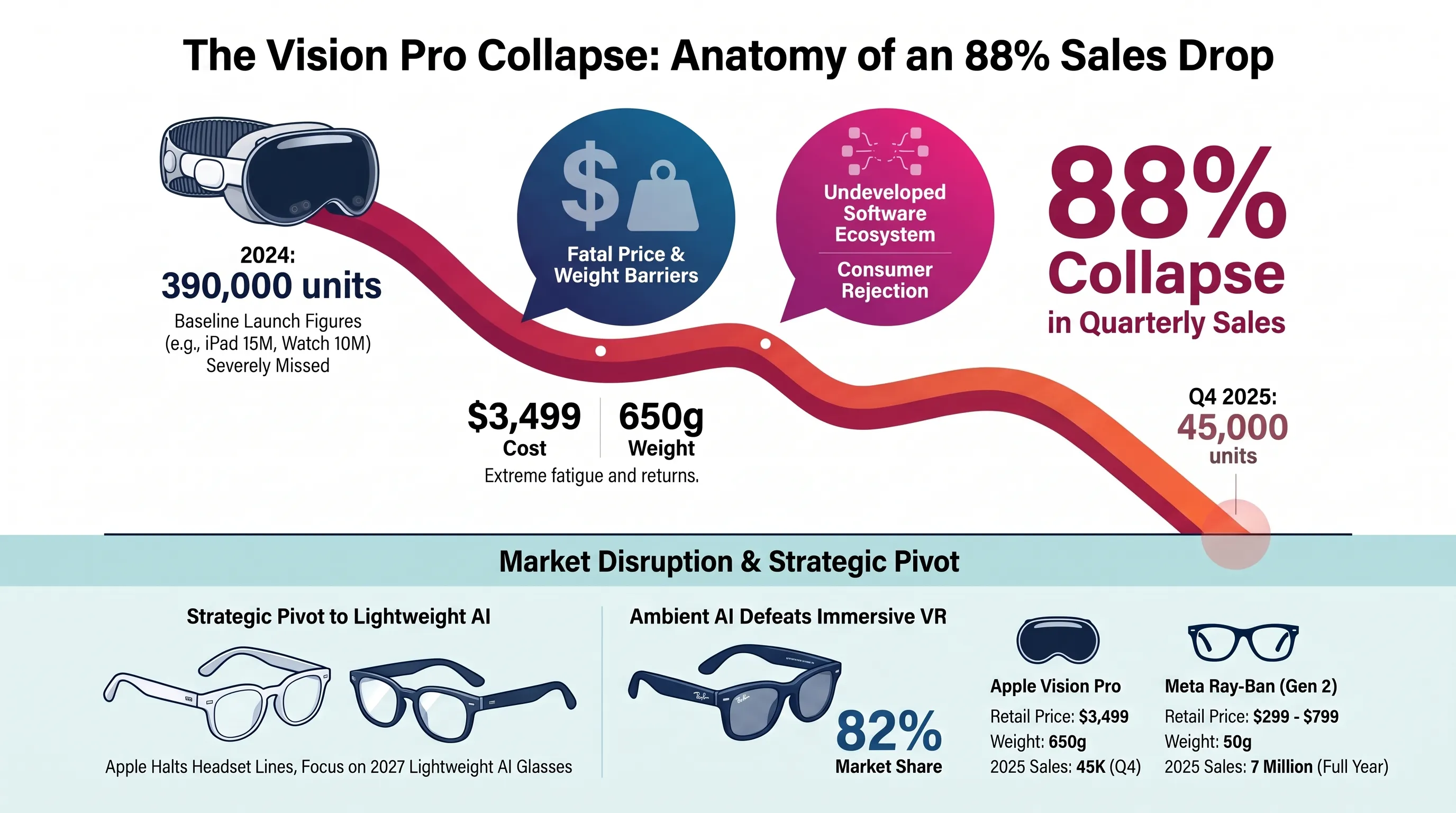
When Apple unveiled the Vision Pro at $3,499 in June 2023, Tim Cook hailed it as "the beginning of the era of Spatial Computing." Less than three years later, the device has become one of the most glaring failures in Apple's prestigious history. Sales plummeted from an already underperforming 390,000 units in 2024 to a disastrous 45,000 units in Q4 2025 an 88% collapse that sent shockwaves through the tech industry.
Consequently, Apple has not only halted the Vision Pro's production lines but also canceled its cheaper successor. Instead, they have redirected all R&D resources toward lightweight AI smart glasses the exact product category Meta successfully dominated alongside Ray-Ban, capturing 82% of the market. This isn't just the story of a failed product launch; it is the definitive death of the Metaverse, the end of the immersive computing dream, and a $3.5 billion lesson Apple learned the hard way.
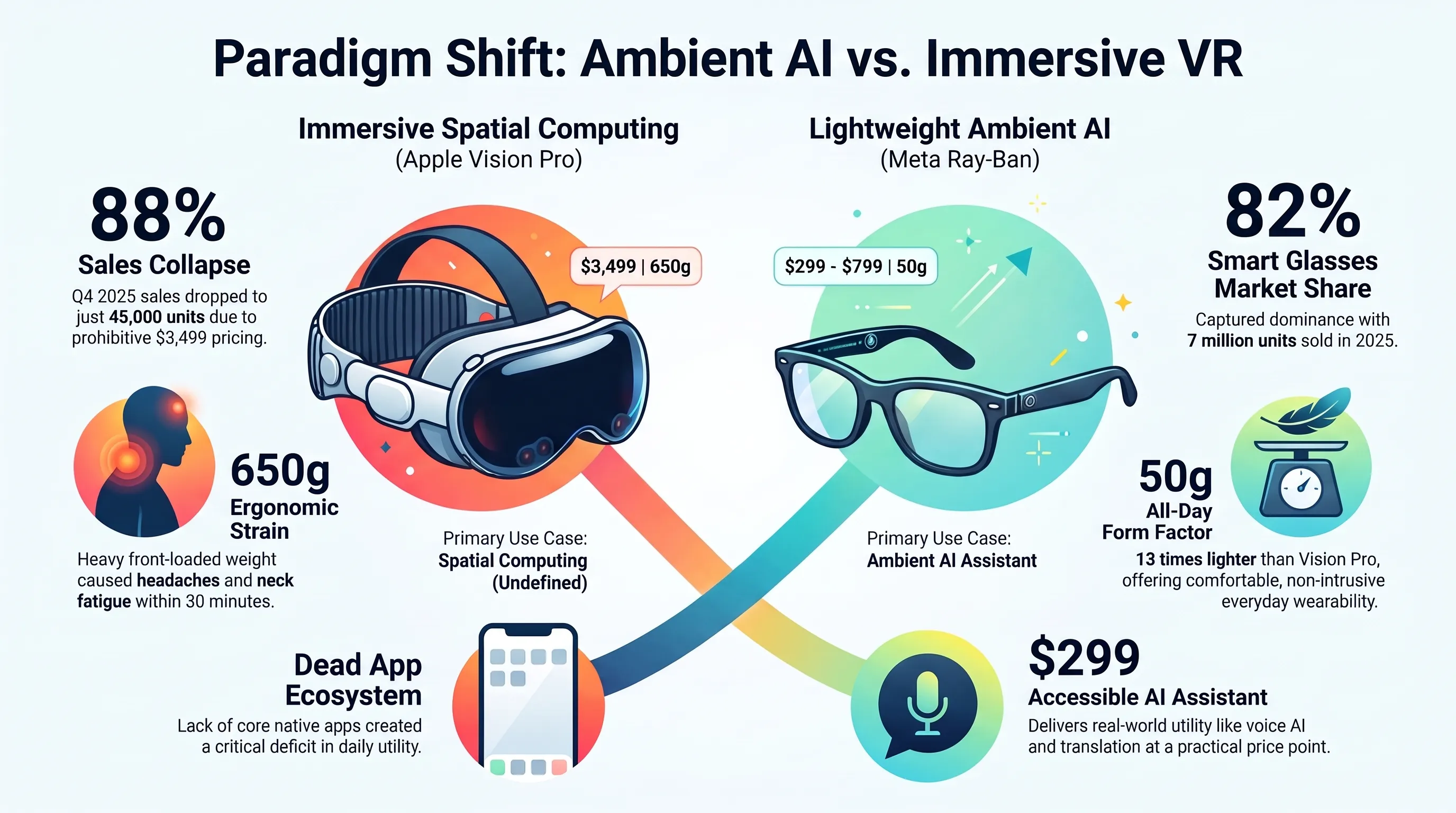
Strategic Evaluation & Key Takeaways at a Glance
The Free Fall: When 390K Becomes 45K
The numbers paint a brutal picture. Vision Pro sold roughly 390,000 units in 2024, which was already 35% below Apple's initial internal target of 600,000 units. But the true catastrophe hit in Q4 2025 when sales flatlined at a mere 45,000 units.
To put this disaster into perspective, compare it with other foundational Apple products. The original iPhone in 2007 despite its limitations sold 6.1 million units. The original iPad in 2010 moved about 15 million units. Even the original Apple Watch in 2015 pushed over 10 million units. The Vision Pro does not even come close to Apple's weakest historical launches. Why did a product backed by years of R&D, featuring the world's most advanced micro-OLED displays and M-series silicon, fail so profoundly?
The $3,499 Price Tag: When Premium Becomes Prohibitive
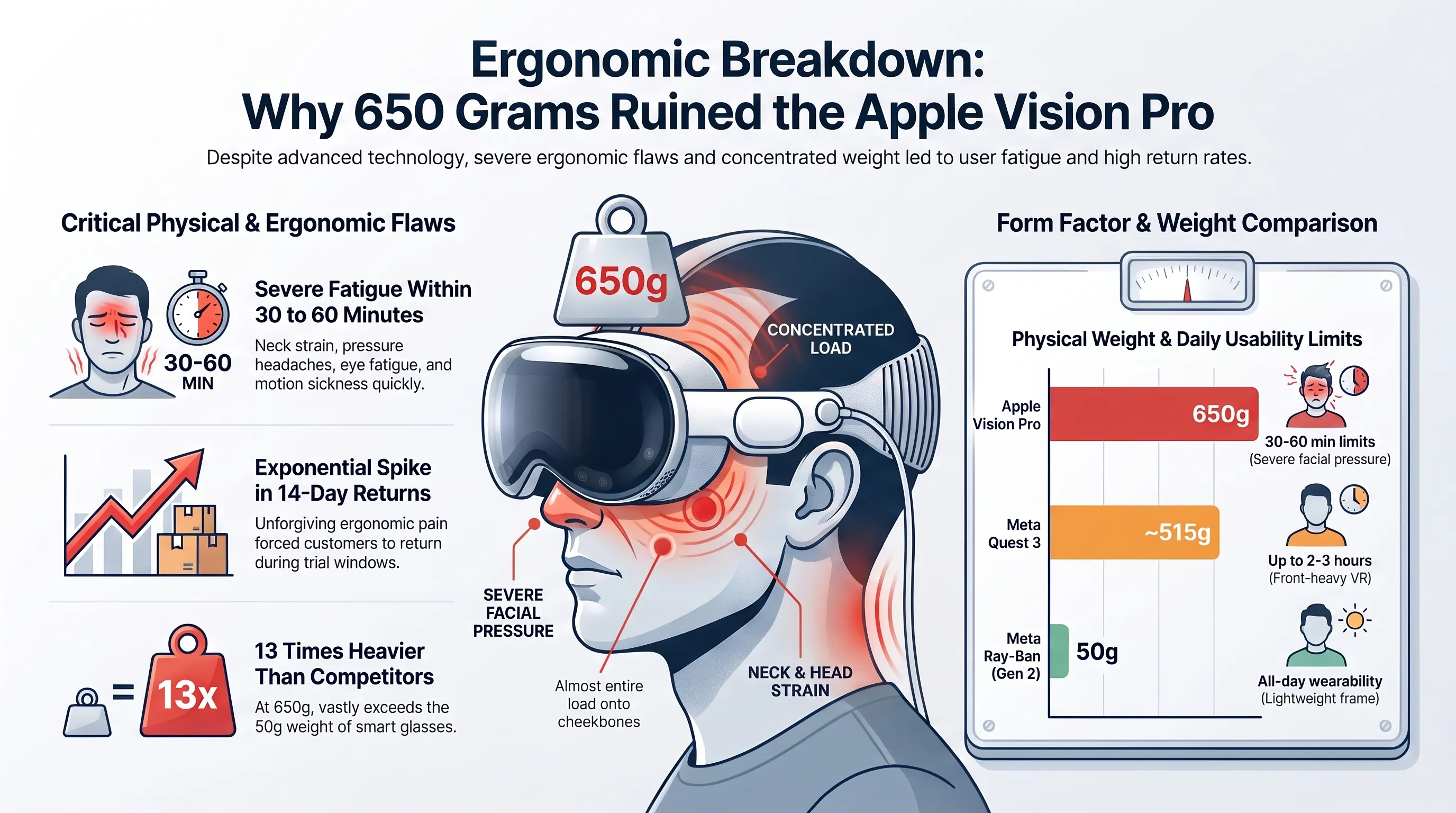
Apple has consistently utilized a premium pricing strategy. iPhones command higher margins than Androids; MacBooks cost more than their Windows counterparts. However, consumers willingly pay the "Apple Tax" because they receive tangible value: superior design, a seamless ecosystem, and daily utility. With the Vision Pro, the $3,499 sticker price crossed the boundary from "premium" to "prohibitive."
This price is exactly 10x higher than the Meta Quest 3 ($349). It exceeds the cost of a 14-inch MacBook Pro powered by the M3 Pro chip. It equates to three iPhone 16 Pro Max units. And for what return? Consumers were asked to pay $3,500 for a device restricted by a 2-hour battery life (tethered to a cumbersome external pack), an anemic library of 2,500 apps, and absolutely no defined "killer use case" for either enterprise or entertainment.
Market Landscape Comparison Matrix | Apple vs. Meta
| Feature / Metric | Apple Vision Pro | Meta Ray-Ban (Gen 2) | Meta Quest 3 |
|---|---|---|---|
| Retail Price | $3,499 USD | $299 - $799 USD | $349 USD |
| Device Weight | 650g | ~50g | 515g |
| Battery Life | 2 to 3 hours (External pack) | All-day battery | 2 to 3 hours |
| 2025 Sales Volume | 45K units (Q4) | 7 Million units (Full year) | 1.7 Million units (Full year) |
| Market Share | Less than 5% | 82% (Smart Glasses) | ~15% (VR Headsets) |
| Primary Use Case | Spatial Computing (Undefined) | Ambient AI Assistant | Gaming / VR |
650 Grams of Weight: When Technology Becomes Torture
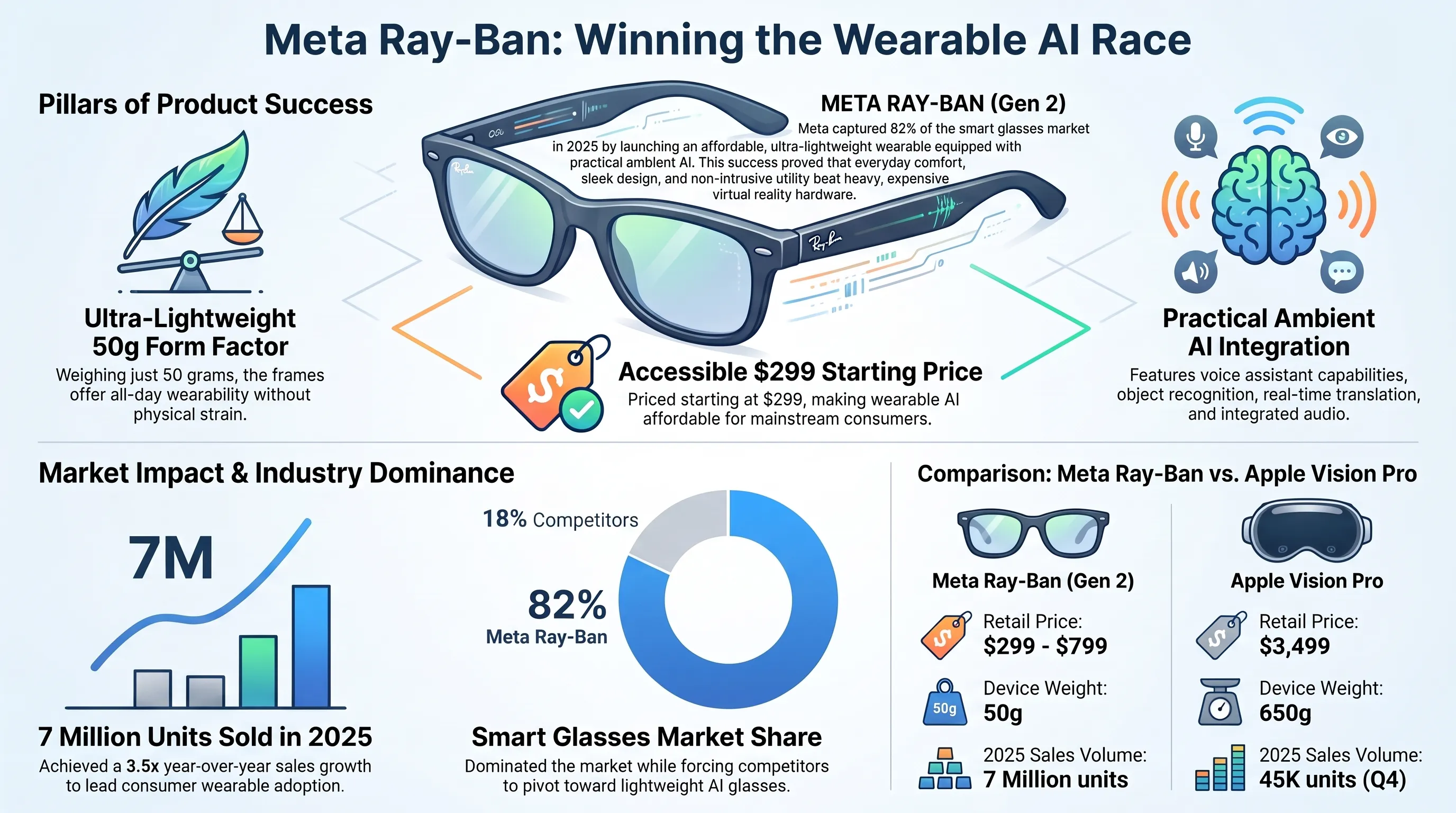
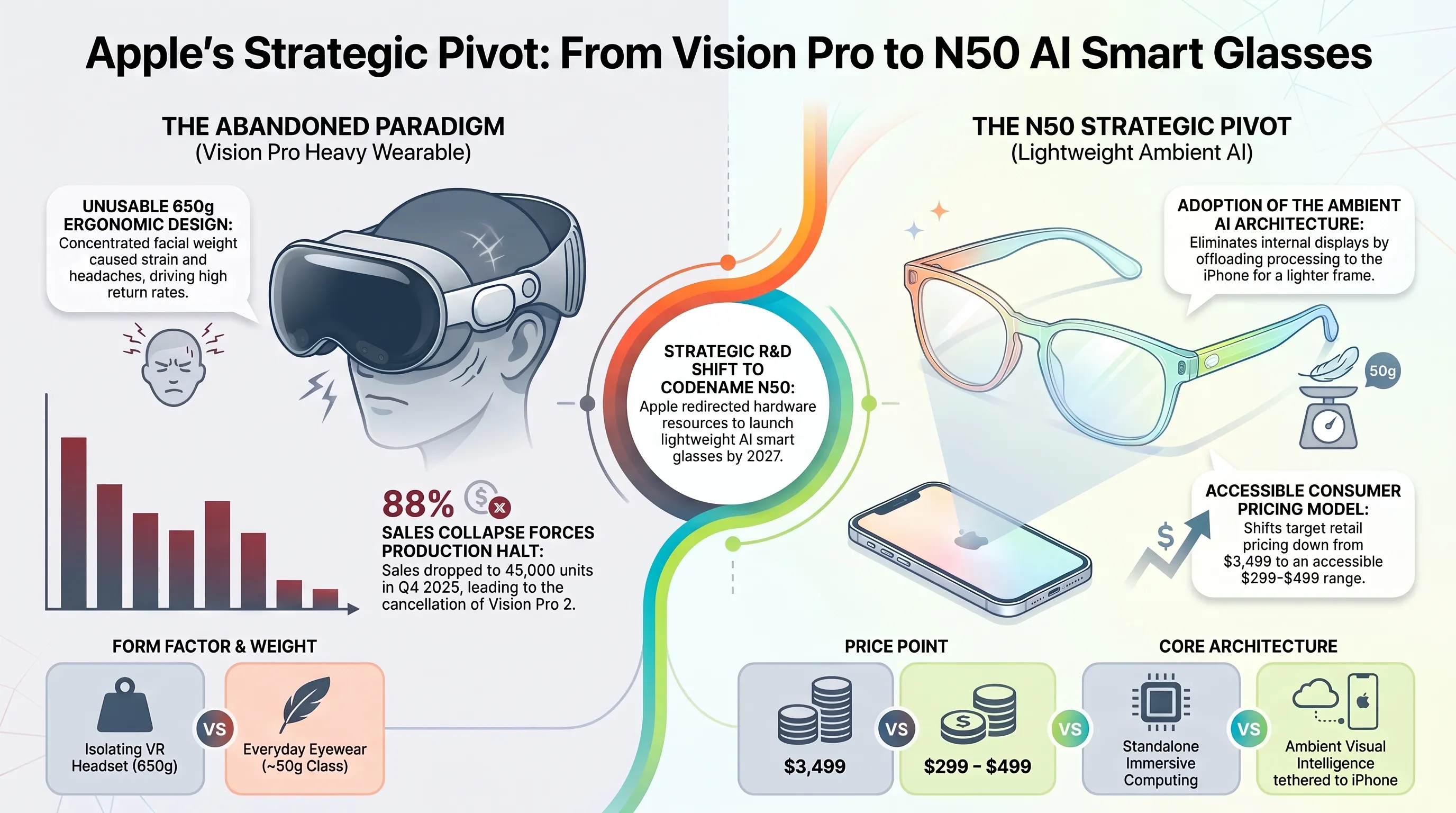
If the prohibitive price was the first barrier, the physical weight was the killing blow. At 650 grams (1.4 pounds), the Vision Pro is one of the heaviest headsets on the market. However, the raw weight was only half the issue; the primary engineering failure was the disastrous weight distribution, which focused almost the entirety of the load onto the user's face and cheekbones.
The ergonomic result was severe. Users reported neck and shoulder strain, intense pressure-induced headaches, extreme eye fatigue (including burst blood vessels), and motion sickness after just 30 to 60 minutes of use. Consequently, the return rate during Apple's 14-day window spiked exponentially.
Contrast this with Meta's Ray-Ban glasses. Weighing in at just 50 grams 13 times lighter than the Vision Pro they can be worn comfortably all day. Apple attempted to mitigate the issue with alternative straps like the Dual Loop Band, but physics remains unforgiving: you cannot strap 650 grams of glass and aluminum to the front of a human face comfortably.
Dead Ecosystem: When Even Apple Doesn't Build Apps
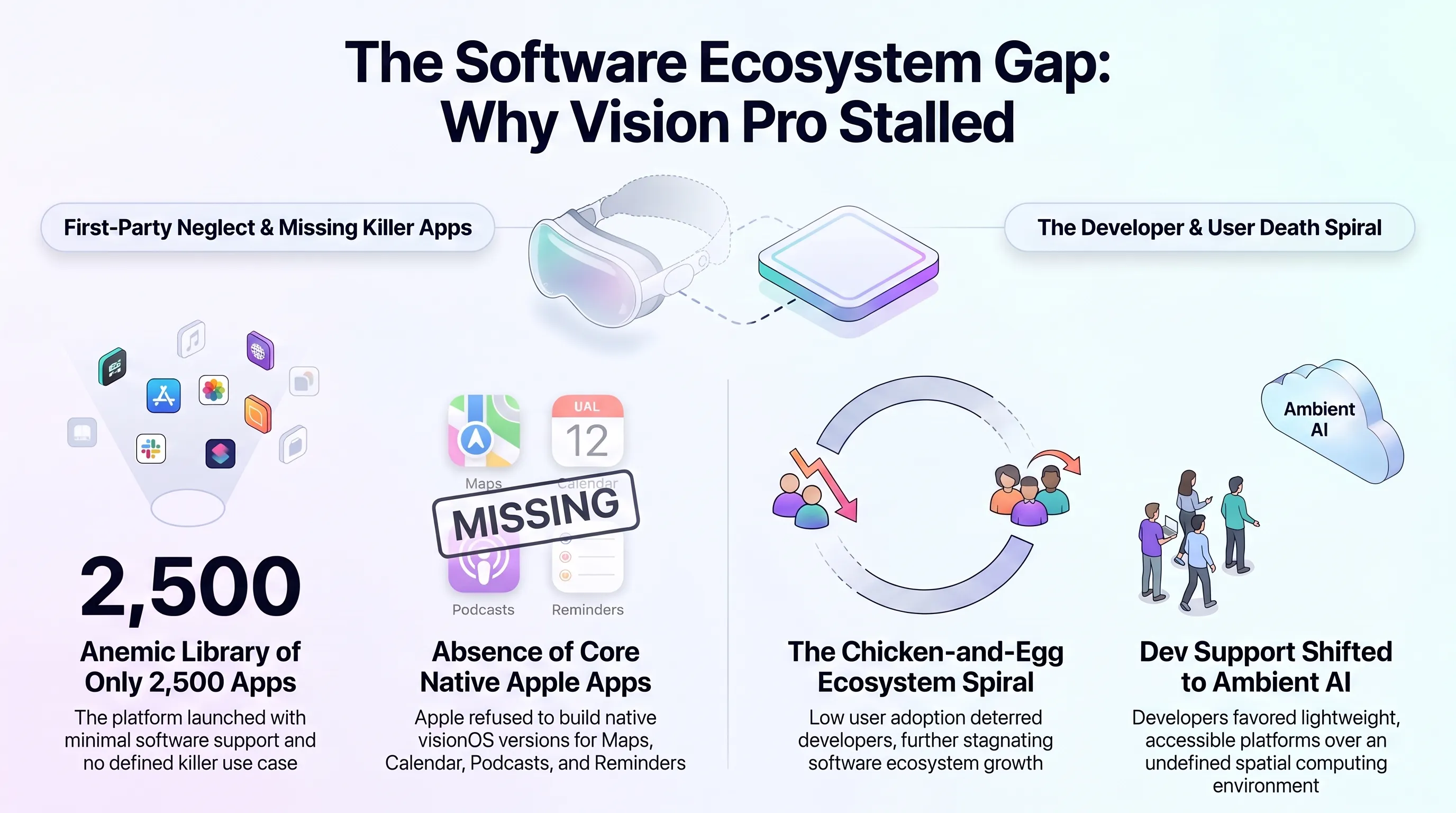
Perhaps the most baffling aspect of the Vision Pro’s collapse was Apple’s apparent lack of faith in its own platform. By mid-2024, the headset hosted a meager 2,500 apps. The real tragedy, however, was that Apple refused to build native visionOS versions for its own core ecosystem apps, including Maps, Calendar, Podcasts, Reminders, and Voice Memos.
When the creator of a $3,499 "future of computing" device refuses to optimize its own basic utility apps, the message sent to third-party developers is devastating. It triggered a classic chicken-and-egg death spiral: consumers refused to buy the hardware due to a lack of software, developers refused to code due to a lack of users, and Apple refused to invest further due to dismal sales.
5-Axis Radar Comparison: Wearable Form Factor Success Metrics
5-Axis Radar Analysis: While Apple undeniably led in raw technological innovation (displays and eye-tracking), Meta's Ray-Ban crushed the Vision Pro across every metric vital for commercial success: Price, Daily Comfort, Social Acceptance, and possessing a Clear Use Case.
📚 Classified & Related Dossiers in TekinGame
If you wish to explore beyond this report and delve into cybernetic frontiers and autonomous AI architectures, do not miss these three exclusive deep-dives in the Tekin Garage:
Meta's Revenge: When Ray-Ban Defeats Apple
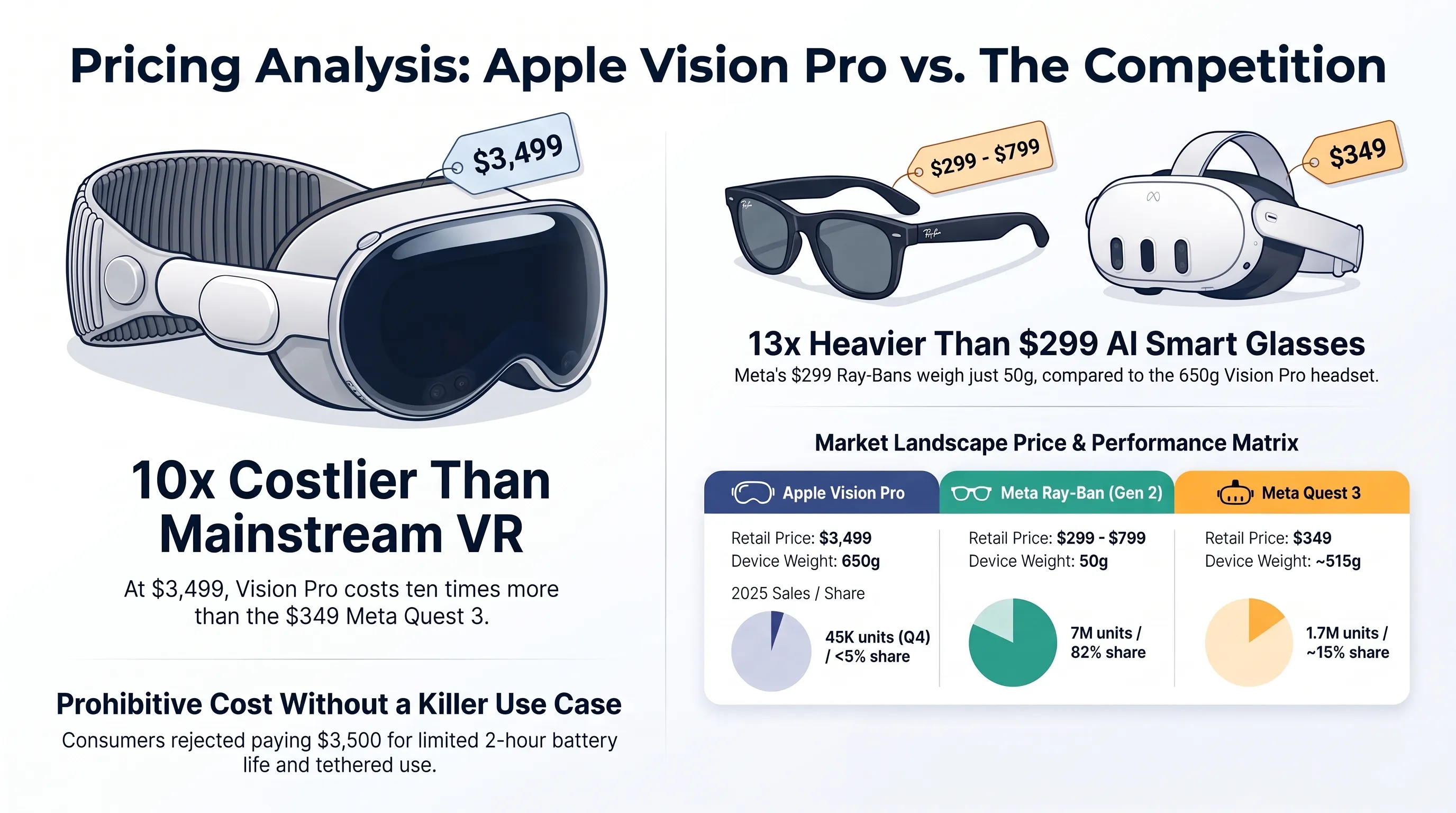
While the Vision Pro was collapsing, Meta was making history. Selling 7 million units of its Ray-Ban smart glasses in 2025 (a 3.5x YoY growth), Meta aggressively captured 82% of the smart glasses market. The strategy was devastatingly effective: launch the right product, at the right time, with the right price.
Meta realized that consumers do not want to be isolated inside bulky virtual reality helmets. They desire a smart assistant that integrates seamlessly into the real world. Ray-Ban delivers exactly this: a built-in camera, an intelligent AI Assistant for translation and object recognition, and integrated audio all housed within a stylish, 50-gram frame that doesn't make the user look like a sci-fi cyborg in public.
Death of the Metaverse and Apple's Pivot to AI Glasses
The simultaneous failures of the Vision Pro and Meta's Quest Pro confirm a harsh reality: the Metaverse concept arrived at least a decade too early. Billions of R&D dollars burned away proving that society simply refuses to strap heavy, isolating displays to their faces for prolonged computing tasks.
In a historic move in late 2025, Apple officially canceled the Vision Pro 2 (codename N100) and aggressively pivoted its hardware division toward AI smart glasses (codename N50). Set for a 2027 launch, Apple’s new strategy explicitly mirrors Meta’s playbook: ditch the heavy internal displays, rely on the iPhone for processing, integrate Visual Intelligence via external cameras, and target an accessible $299-$499 price point.
Tekin Technical Jargon Buster
Conclusion: The $3.5 Billion Lesson
The Vision Pro collapse serves as one of the most expensive lessons in modern tech history. The company that revolutionized the smartphone and the smartwatch proved that even the giants can miscalculate the market. The core takeaways are clear: form factor and daily comfort trump raw display resolution; prohibitive pricing without a killer app guarantees failure; and society is not ready for the Metaverse.
The era of heavy, immersive VR computing has ended. The era of lightweight, practical Ambient AI has begun. Apple is scrambling to catch up, but for the first time in a decade, Meta is holding the dominant high ground.
- Apple's swift recognition of failure and intelligent pivot toward developing lightweight AI smart glasses by 2027.
- The monumental triumph of Meta's Ray-Ban glasses, shifting the industry successfully toward Ambient AI.
- The definitive end of the Metaverse hype cycle, preventing further billions from being wasted on isolating VR hardware.
- The humiliating 88% collapse in Vision Pro sales, plummeting to just 45,000 units by Q4 2025.
- The torturous 650g form factor and astronomical $3,499 price tag that alienated Apple's core consumer base.
- A stagnant ecosystem where Apple fundamentally failed to support its own flagship device with native core apps.
Final Editorial Verdict & Official Reference Sources
The Death of the Metaverse and the Rise of Ambient AI
The Vision Pro proved that raw technological power cannot compensate for a fundamentally flawed, uncomfortable, and prohibitively expensive form factor.
Frequently Asked Questions & Technical Analysis
How badly did the Apple Vision Pro fail in sales?
Sales plummeted from 390,000 units in 2024 to a catastrophic 45,000 units in Q4 2025, marking an 88% collapse that drastically underperformed compared to Apple's historical product launches.
What were the core reasons for the Vision Pro's failure?
The three fatal flaws were a prohibitive $3,499 price tag, a torturous 650g form factor that caused severe headaches and neck pain, and a stagnant app ecosystem lacking basic native Apple applications.
Why were Meta's Ray-Ban glasses so successful?
Meta delivered exactly what consumers wanted: an affordable ($299), lightweight (50g) Ambient AI assistant integrated seamlessly into a socially acceptable, everyday wearable form factor.
What is the 'Dead Ecosystem' issue regarding the Vision Pro?
Apple failed to build native visionOS versions for its own foundational apps like Maps, Calendar, and Podcasts. This lack of internal support discouraged third-party developers from investing in the platform.
What is Apple's new strategy following the Vision Pro collapse?
Apple officially canceled the Vision Pro line and pivoted its R&D resources entirely toward 'Ambient AI.' They are now developing lightweight AI smart glasses (codename N50) slated for a 2027 release.