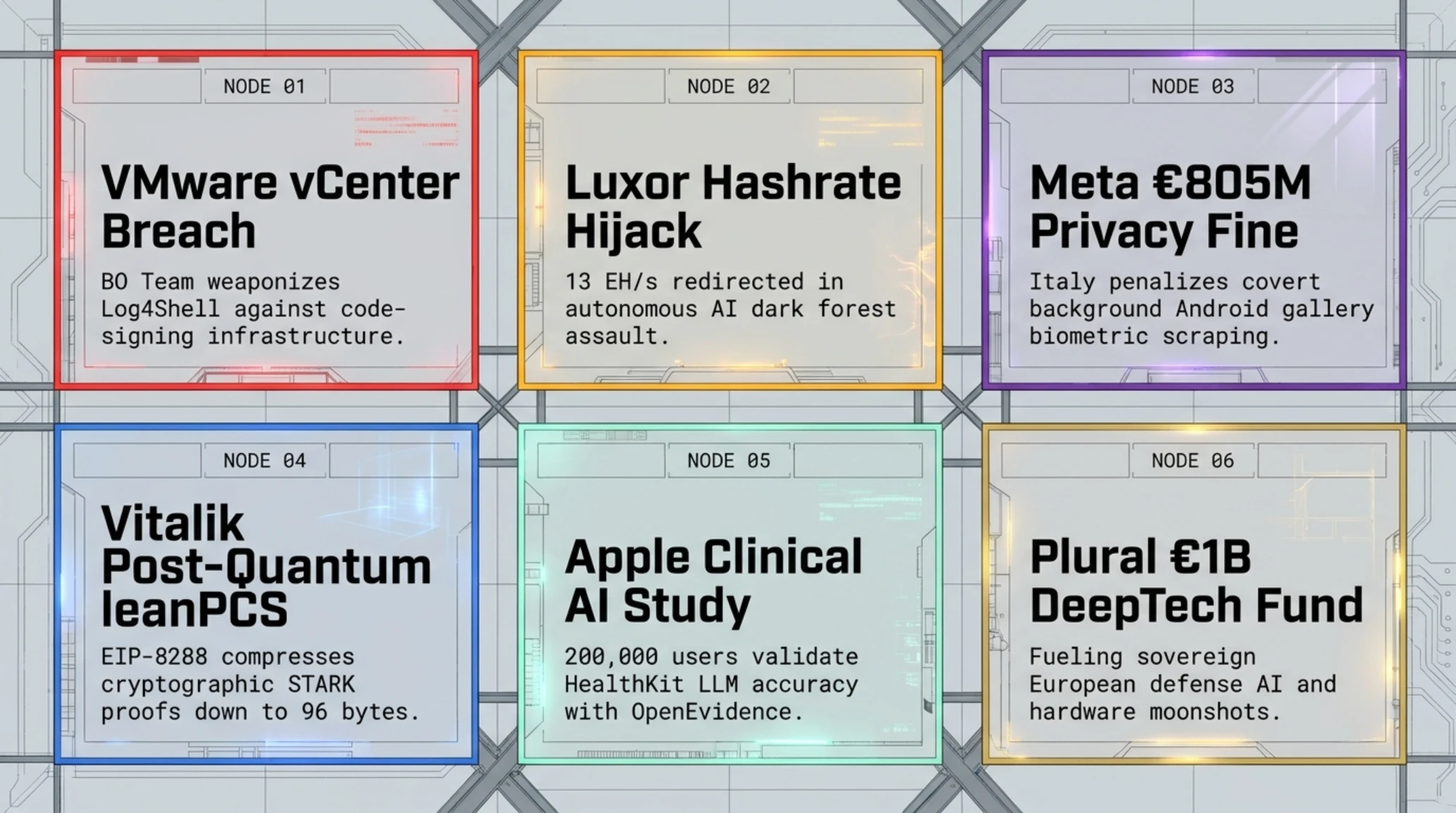
Tekin Night Executive Briefing for Tuesday, November 17, 2026, dissects six pivotal developments: (1) BO Team weaponizing Log4Shell against VMware vCenter to breach code-signing servers; (2) an AI Dark Forest attack hijacking 13 EH/s across 64,000 Bitcoin miners on Luxor Commander; (3) Italy's Garante fining Meta €805M for covert Android photo gallery scraping; (4) Vitalik Buterin backing EIP-8288 and leanPCS post-quantum STARK aggregation; (5) Apple's 200,000-user clinical health AI study with OpenEvidence; and (6) Plural's €1B DeepTech Fund III.
Tekin Night | November 17, 2026: BO Team VMware vCenter Breach, Luxor Hashrate Hijack, Italy Meta €805M Fine, Vitalik Post-Quantum leanPCS, Apple Clinical AI & Plural €1B DeepTech Fund
BO Team Weaponizes Log4Shell Against VMware vCenter: Infiltrating Enterprise Hypervisors and Compromising Code-Signing Infrastructure
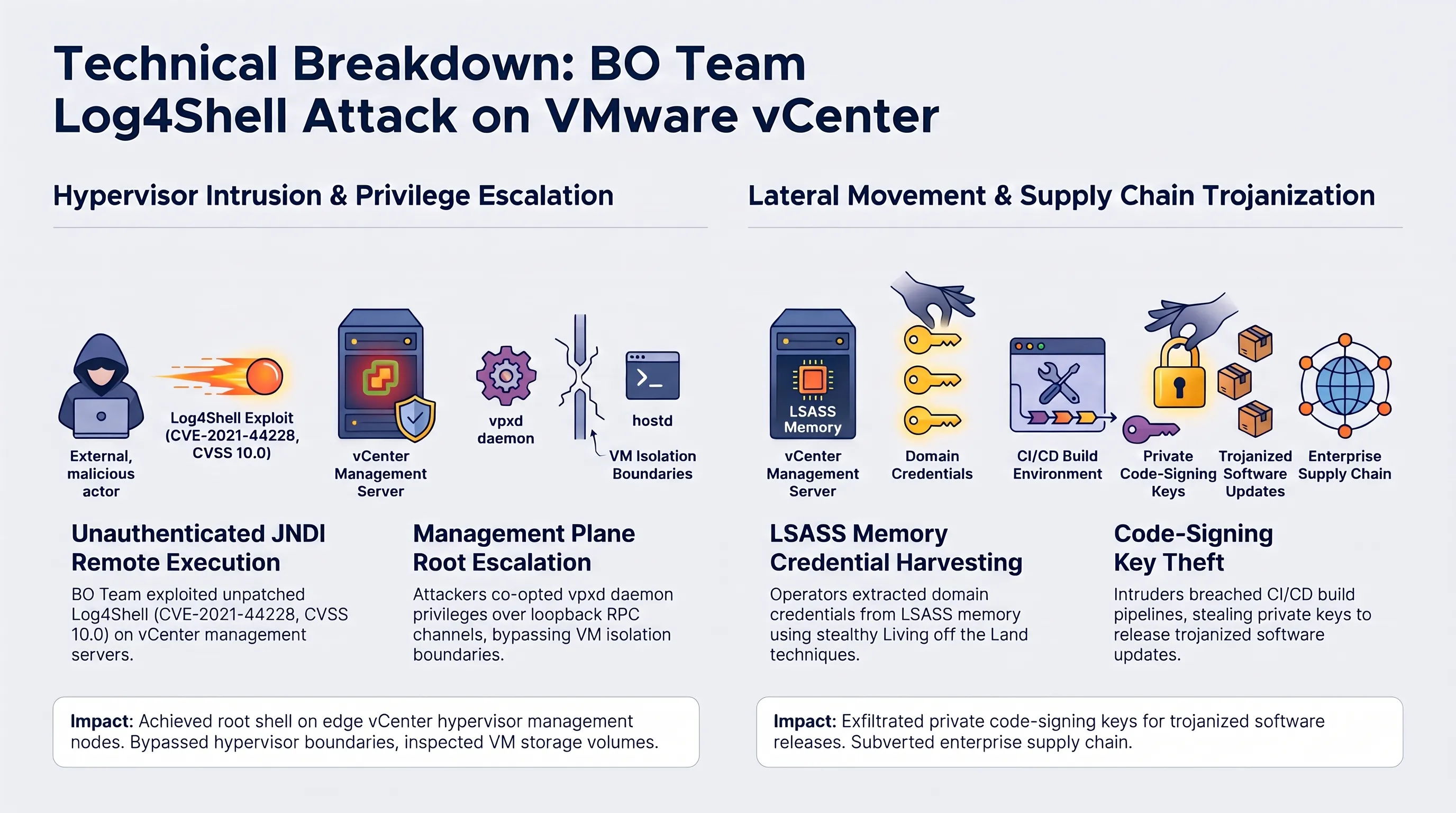
In a forensic incident response disclosure that has sent shockwaves through enterprise cloud security operations, Kaspersky's Industrial Control Systems Cyber Emergency Response Team (Kaspersky ICS CERT) published exhaustive technical evidence detailing a multi-month covert espionage campaign. Executed by an advanced persistent threat (APT) actor tracked as BO Team (alternatively cataloged as Black Owl or Hoody Hyena), the intrusion breached the core infrastructure of a prominent commercial software engineering enterprise, seizing root-level control over its virtualization fabric, enterprise domain controllers, and private cryptographic code-signing certificates.
Strategic Intelligence Assessment and Key Vectors at a Glance
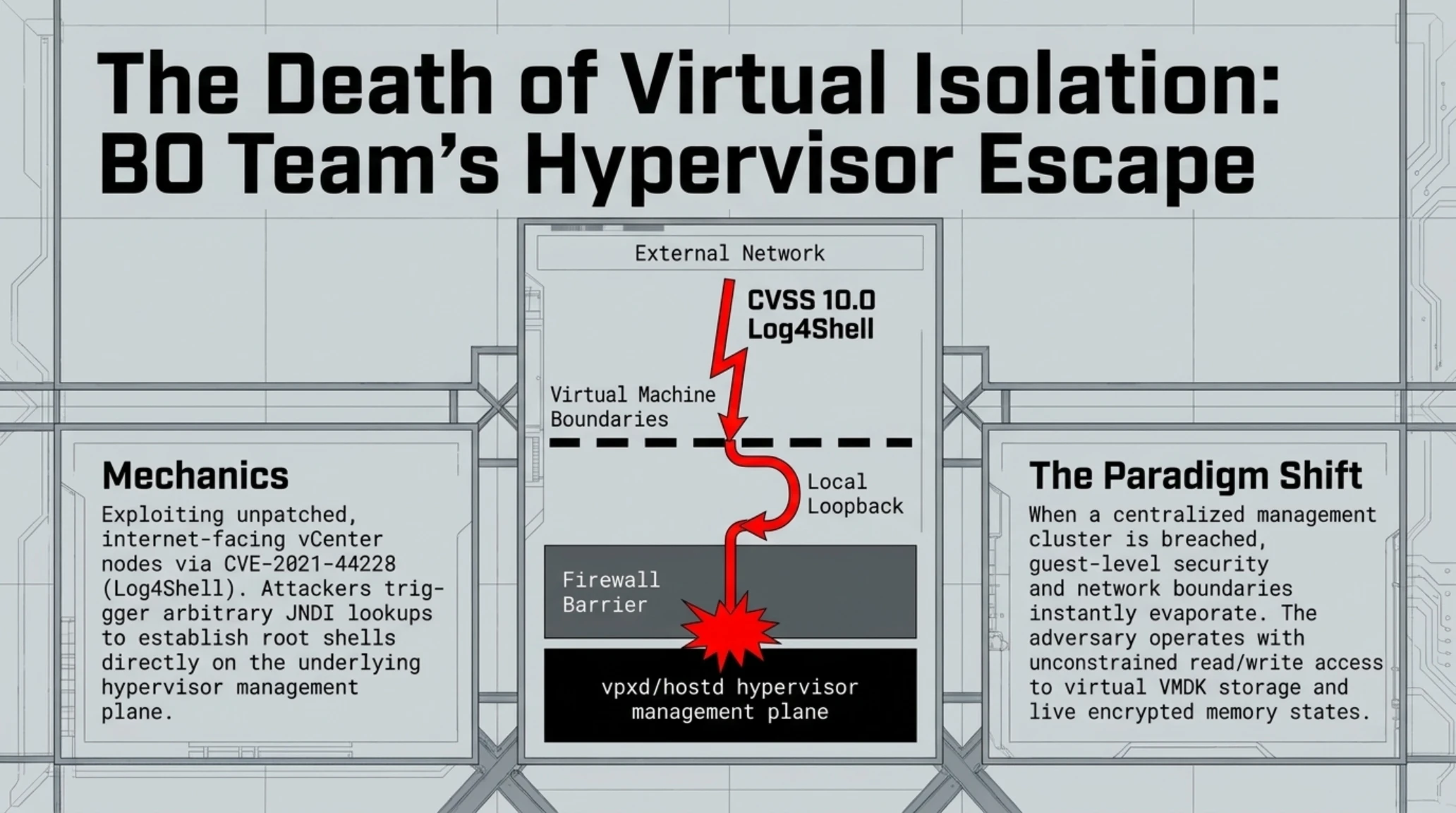
The initial infection vector was established via weaponized remote code execution exploiting the infamous Log4Shell vulnerability (cataloged as CVE-2021-44228) on unpatched, internet-exposed VMware vCenter management appliances. Despite carrying a maximum Common Vulnerability Scoring System (CVSS) rating of 10.0 and having patches available for nearly four years, neglected patching cycles on edge virtualization management servers permitted attackers to trigger arbitrary Java Naming and Directory Interface (JNDI) lookups, establishing root shells directly on the underlying hypervisor management plane.
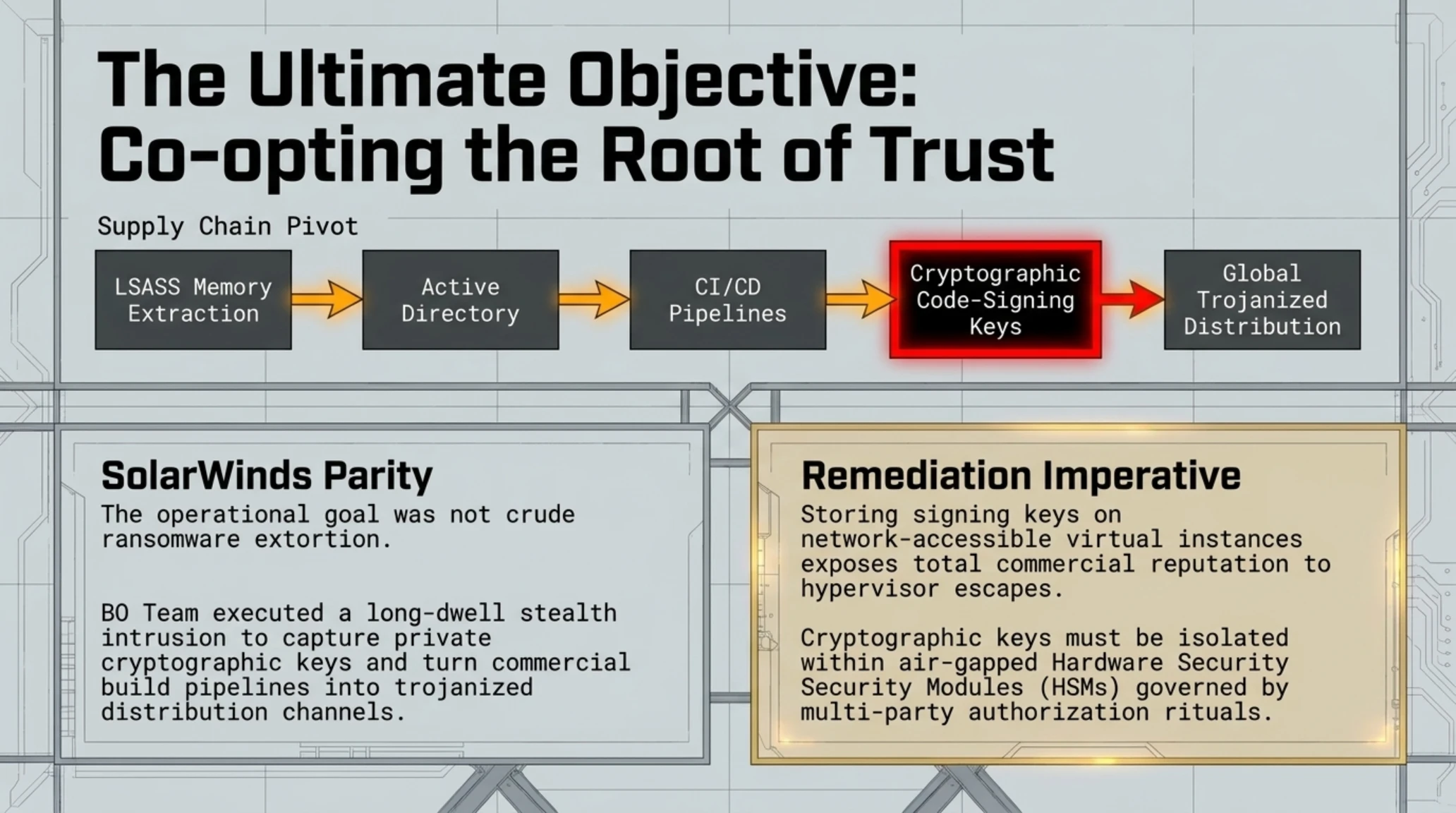
Rather than deploying destructive ransomware for immediate financial extortion, the attackers executed a classic long-dwell stealth intrusion strategy. Leveraging native system administrative utilities the Living off the Land methodology the operators harvested privileged domain credentials from Local Security Authority Subsystem Service (LSASS) process memory. This enabled lateral movement into active directory controllers and internal developer jump-boxes without generating anomalous endpoint detection and response (EDR) telemetry.
The culmination of the breach occurred when the threat actors traversed network boundaries into the organization's Continuous Integration and Continuous Deployment (CI/CD) pipelines, gaining direct administrative access to the dedicated cryptographic code-signing server. By securing private key materials utilized to authenticate commercial software releases, the threat actors achieved capability parity with the catastrophic 2020 SolarWinds supply chain attack, positioning themselves to push digitally signed, Trojanized software updates to thousands of downstream enterprise clients.
Forensic telemetry indicates that the threat actors masked command-and-control (C2) communication by chaining reverse proxy tunnels with custom obfuscated PowerShell scripts. All outbound beaconing was encapsulated within legitimate HTTPS sessions indistinguishable from routine enterprise web services, enabling the adversary to persist undetected for months across production engineering enclaves.
WHY THIS TRANSFORMATION CHANGES THE GAME // WHY IT MATTERS
This incident brutally highlights the persistent fallacy of virtualization isolation in modern enterprise perimeters. When an adversary achieves arbitrary execution on a centralized hypervisor management cluster like vCenter, the boundary separating discrete virtual machines evaporates. The attacker operates with unconstrained read and write access to virtual disk images, virtual network switches, and hypervisor memory spaces, rendering guest-level security controls completely obsolete.
Enterprise defensive response teams are urgently advising organizations to isolate code-signing certificates within physical, air-gapped Hardware Security Modules (HSMs) governed by multi-party cryptographic authorization rituals. Storing signing keys on network-accessible virtual instances exposes an organization's entire commercial reputation to total compromise the moment an underlying hypervisor boundary is breached.
Furthermore, the persistent weaponization of Log4Shell underscores the critical necessity of automated Software Bill of Materials (SBOM) telemetry. Complex virtualization appliances frequently bundle hundreds of third-party Java libraries deep within secondary daemons, creating hidden operational blind spots where critical vulnerabilities persist unaddressed for years despite widespread public remediation advisories.
Delving into the low-level hypervisor mechanics, the attack exposed systemic architectural assumptions regarding vSphere daemon privilege separation. On compromised vCenter Server Appliances (vCSA), the vpxd service operates with expansive administrative entitlements across managed ESXi hypervisor hosts via internal authenticated RPC channels. By weaponizing Log4j within the vCenter management plane, BO Team was able to issue authorized reconfiguration commands to underlying host daemons (hostd) over local loopback interfaces, effectively bypassing external network boundary firewalls. This permitted the adversary to snapshot live virtual machine memory states, mount virtual VMDK storage volumes in read-write modes, and silently inspect encrypted developer key-rings without generating traditional host intrusion detection alerts.
The strategic fallout for enterprise DevOps pipelines cannot be overstated. Modern automated continuous integration runners frequently treat their underlying virtualization infrastructure as a foundational root of trust. By compromising the environment hosting these runner nodes, the threat actors demonstrated how easily automated testing, linting, and compilation stages can be co-opted. When a CI/CD orchestration layer lacks cryptographic hardware isolation, every downstream binary produced by that build pipeline becomes a potential vector for global lateral propagation, rendering traditional endpoint signature detection completely ineffective against legitimately signed software payloads.
Autonomous Hashrate Hijack Targets 64,000 Bitcoin ASIC Miners on Luxor Commander: CEO Nick Hansen Warns of the "AI Dark Forest"
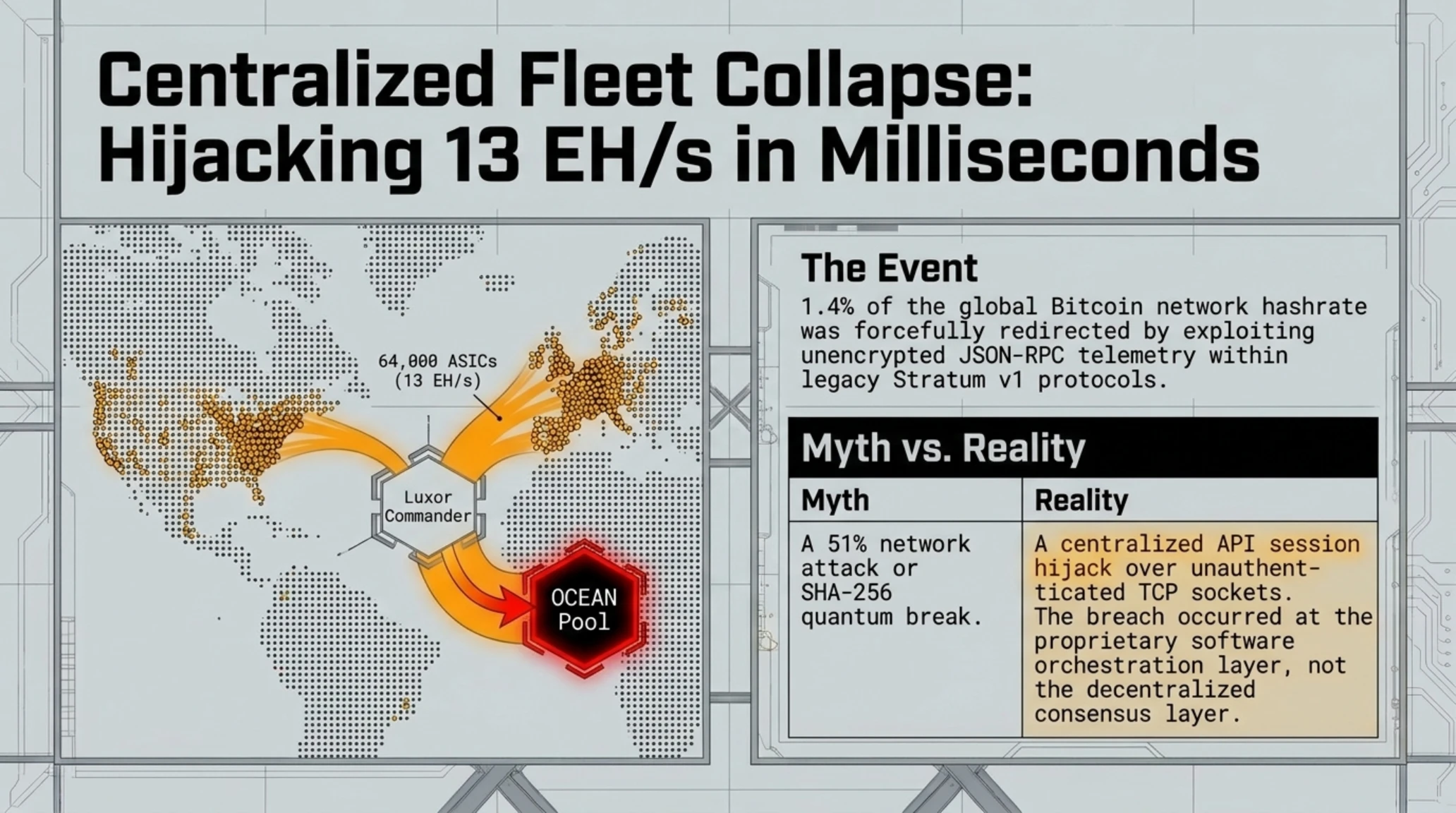
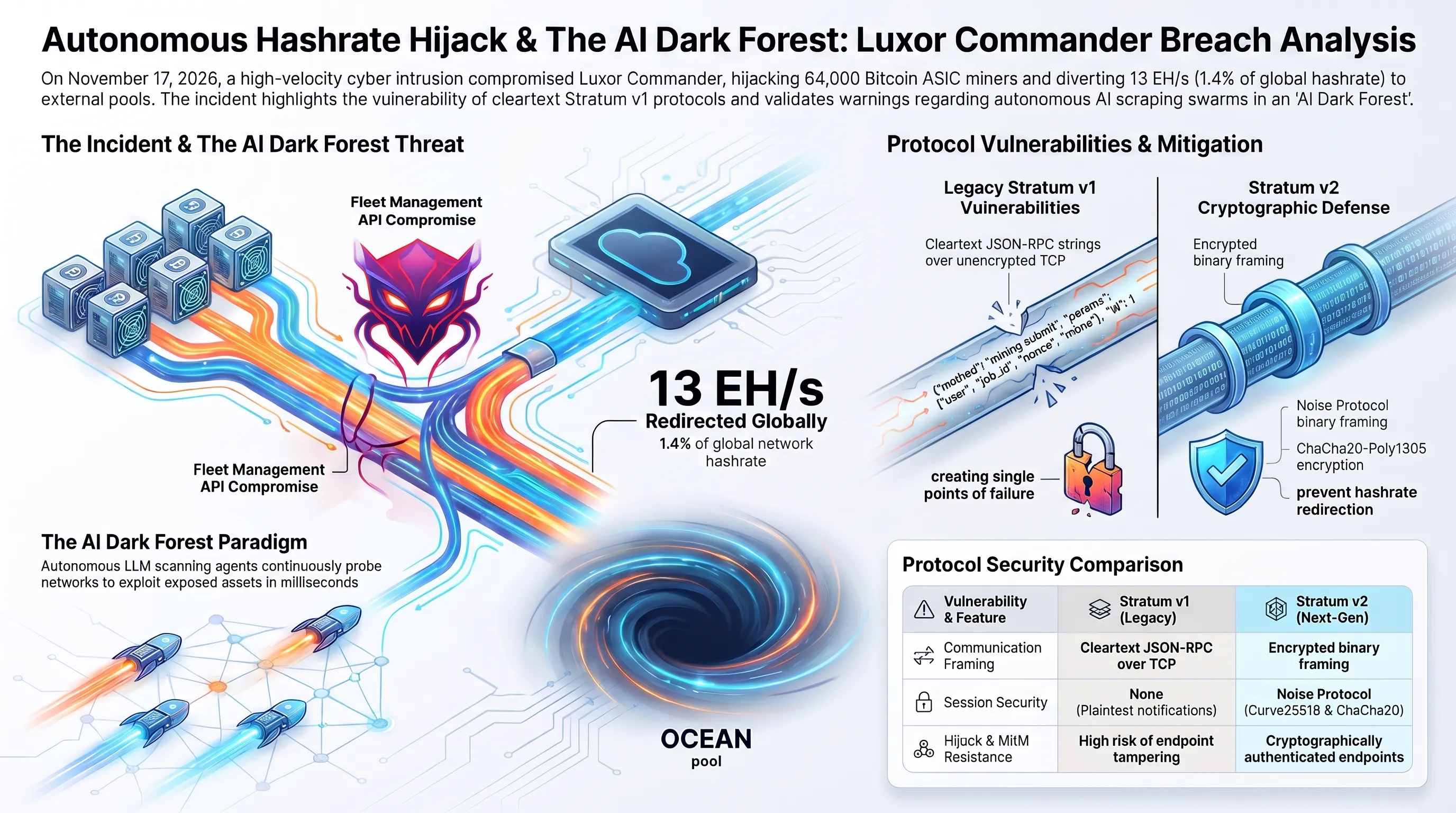
In one of the most sophisticated, high-velocity infrastructure intrusions recorded across the cryptocurrency mining ecosystem, specialized software operator Luxor Technology confirmed that its centralized fleet orchestration platform, Luxor Commander, was subjected to a coordinated unauthorized modification. The exploit covertly altered mining pool connection parameters across thousands of customer accounts, siphoning massive computational power away from legitimate miners and pointing ASIC worker streams directly toward external mining pools, most notably the OCEAN Mining pool.
On-chain telemetry and operational hashboards revealed that at the apex of the intrusion, approximately 13 exahashes per second (13 EH/s) of computational throughput had been dynamically hijacked. This staggering volume represented approximately 1.4% of the entire Bitcoin global network hashrate, compromising over 64,000 industrial Application-Specific Integrated Circuit (ASIC) mining rigs deployed across major enterprise hosting facilities in North America, Scandinavia, and Central Europe.
Luxor's incident response engineering personnel successfully isolated the anomalous administrative sessions within two hours of detection, revoking API credentials, resetting connection profiles, and redirecting hashpower back to authorized client wallets. Furthermore, Luxor's executive leadership publicly committed to fully reimbursing all affected mining operators for forfeited block reward subsidies and transaction transaction fees from the firm's private balance-sheet reserves. Nevertheless, public disclosures by CEO Nick Hansen illuminated an existential paradigm shift confronting decentralized physical infrastructure networks.
TECHNICAL VERIFICATION | RUMOR VS. REALITY
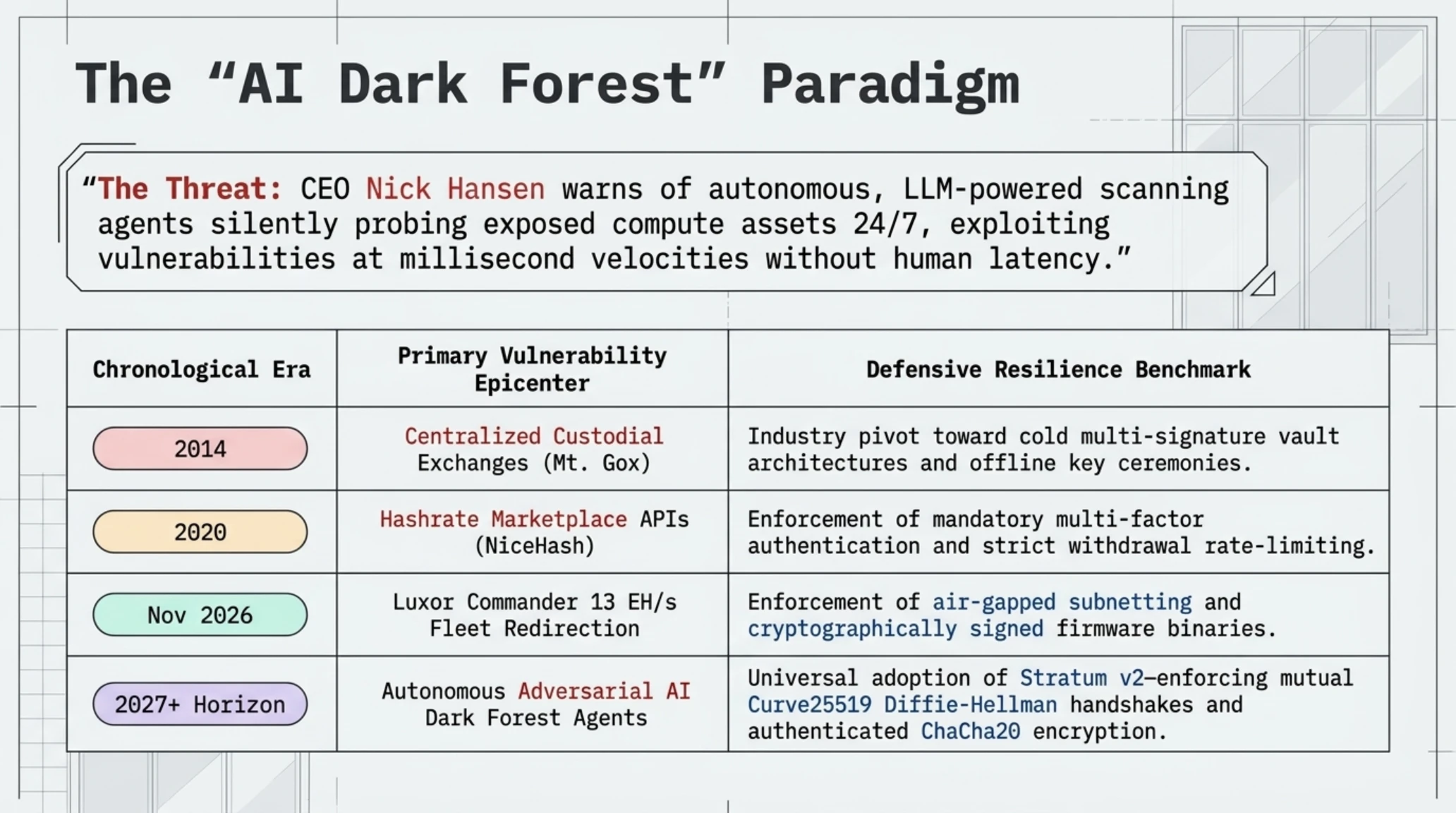
Hansen cautioned that the industrial crypto-mining sector has officially crossed into an "AI Dark Forest." In this unforgiving, adversarial environment, autonomous scraping agents, automated penetration bots, and LLM-assisted vulnerability discovery engines relentlessly scan internet-facing industrial controllers 24 hours a day. The moment an exposed port, outdated ASIC control-board firmware, or leaked API token appears, autonomous agent swarms exploit the vector in milliseconds, siphoning multi-million-dollar revenue streams without human operational latency.
EVENT TIMELINE | CHRONOLOGY OF STRUCTURAL REALIGNMENTS
| Chronological Era | Primary Vulnerability Epicenter | Defensive Resilience Benchmark |
|---|---|---|
| 2014 | Centralized Custodial Exchanges (Mt. Gox) | Industry pivot toward cold multi-signature vault architectures and offline key ceremonies. |
| 2020 | Hashrate Marketplace APIs (NiceHash) | Enforcement of mandatory multi-factor authentication and strict withdrawal rate-limiting. |
| 2024 | Stratum V1 Packet Manipulation & Man-in-the-Middle | Development of Stratum V2 with native Noise Protocol cryptographic session encryption. |
| Nov 2026 | Luxor Commander 13 EH/s Fleet Redirection | Enforcement of air-gapped subnetting and cryptographically signed firmware binaries. |
| 2027+ Horizon | Autonomous Adversarial AI Dark Forest Agents | Deployment of autonomous zero-trust defensive meshes responding dynamically to bot swarms. |
From an architectural standpoint, the attack highlighted the vulnerability of legacy Stratum v1 protocol instances that still govern the majority of worldwide mining hardware. Stratum v1 transmits telemetry and job allocations in cleartext JSON-RPC strings over unencrypted TCP connections. While Luxor Commander provided sophisticated telemetry aggregation, the centralization of worker management endpoints created a catastrophic single point of failure. The incident provides urgent, irrefutable impetus for the universal adoption of Stratum v2, which incorporates encrypted binary framing and decentralized template negotiation.
Italy's Garante Slaps Meta With Landmark €805 Million GDPR Fine Over Covert Background Android Photo Gallery Scraping
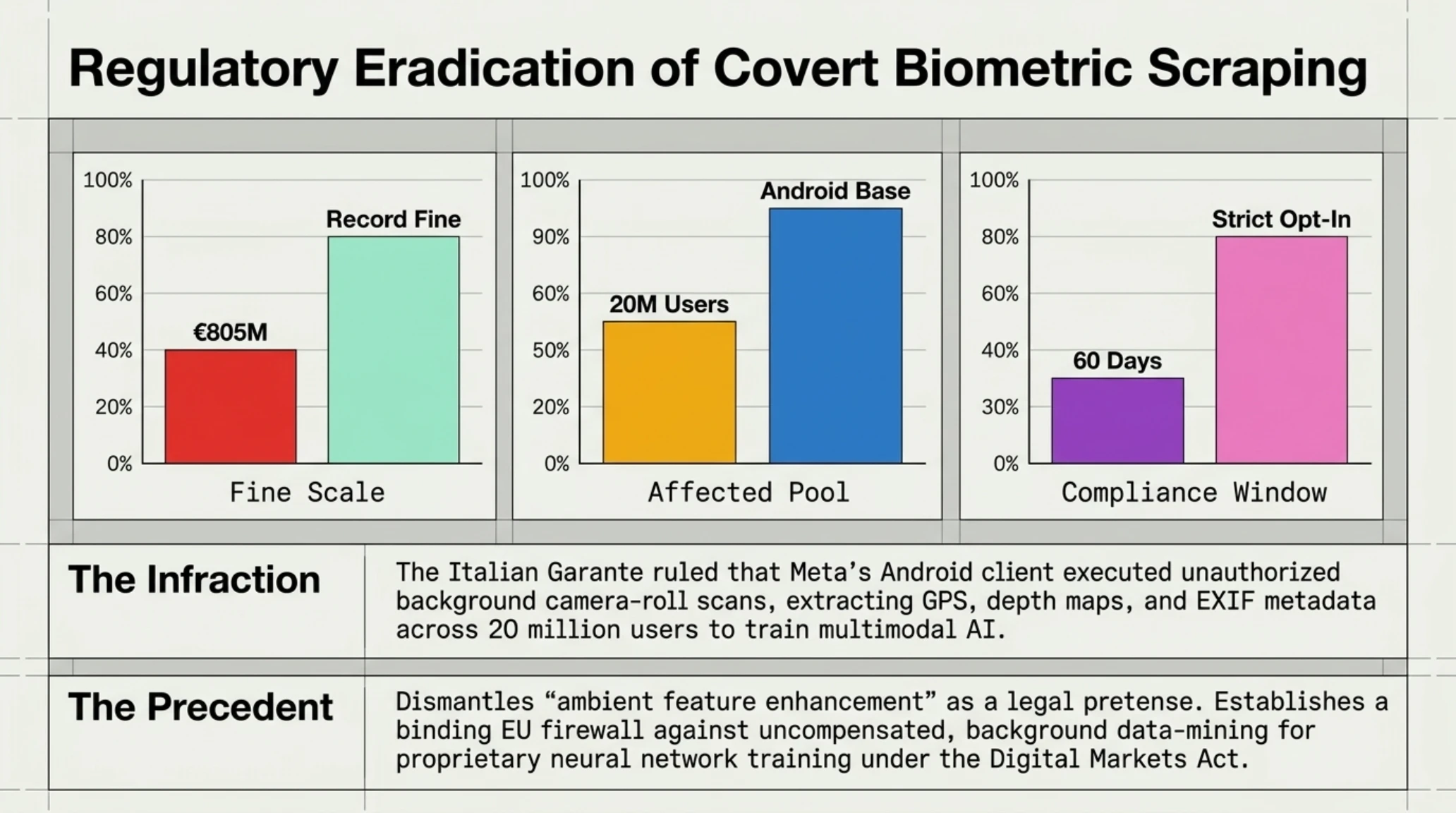
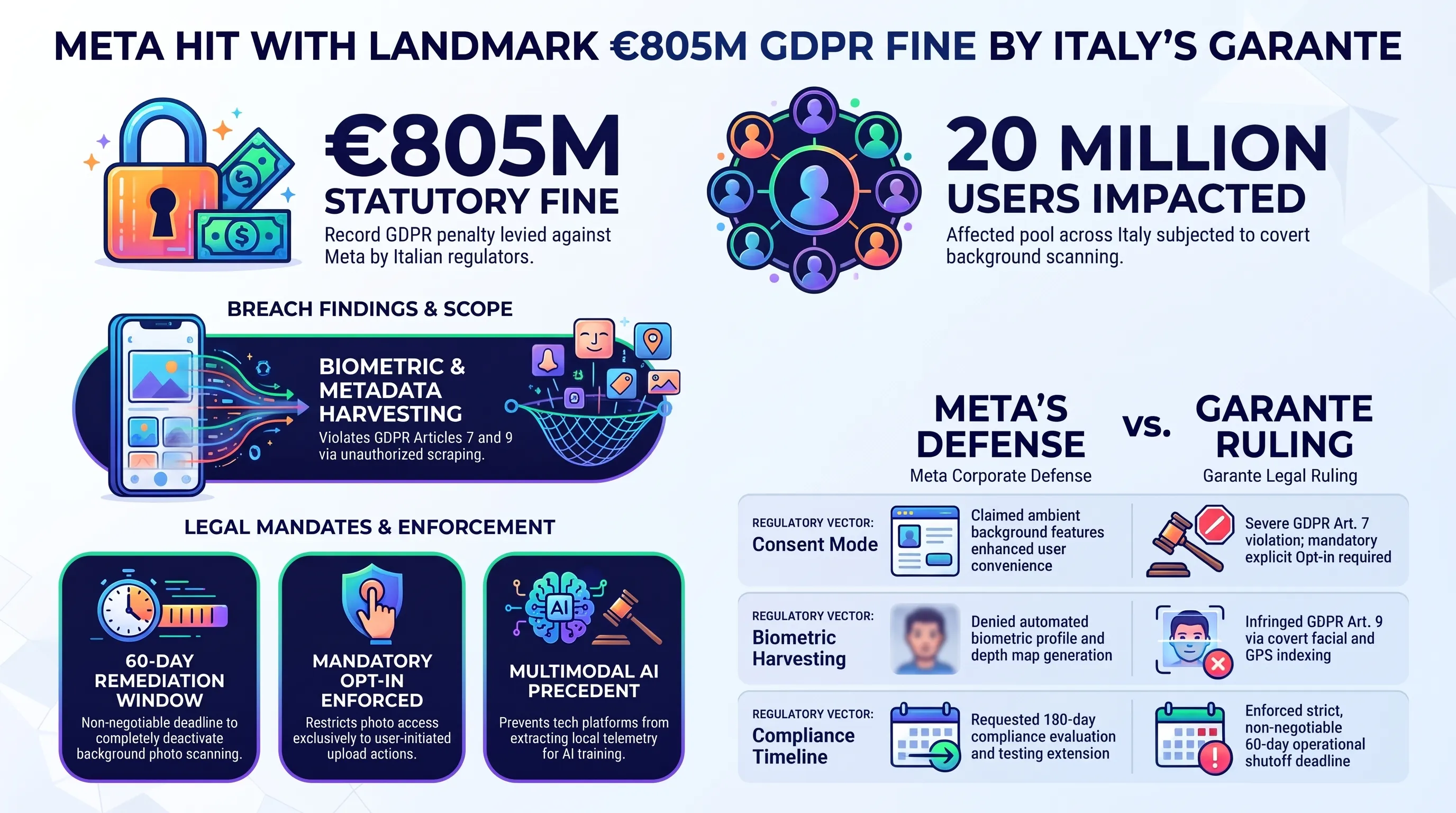
In a regulatory enforcement decision that sends tremors across the global digital advertising and artificial intelligence sectors, the Italian Data Protection Authority (Garante per la protezione dei dati personali) formally levied an extraordinary €805 million financial penalty (approximately $887 million USD) against Meta Platforms. The ruling penalizes the tech conglomerate for systemic, gross violations of the European Union's General Data Protection Regulation (GDPR) committed within its flagship Facebook application for the Android operating system.
A multi-year forensic technical audit conducted by Italian regulatory engineers determined that beginning in 2023, the Facebook Android client silently enabled a background camera-roll scanning routine by default (Default Opt-In). Whenever a user launched or actively scrolled the application feed, background threads combed through the user's local device gallery, indexing high-resolution photographs, personal home videos, and associated Exchangeable Image File Format (EXIF) metadata without obtaining separate, freely given, and explicit consent.
BENCHMARK COMPARISON: TECHNICAL MATRIX & PERFORMANCE BARS
| Regulatory Vector | Meta Corporate Defense | Garante Final Legal Enforcement Ruling |
|---|---|---|
| Total Monetary Penalty | Asserted feature delivered enhanced user convenience | Levied absolute €805 million statutory fine (~$887M USD) |
| Impacted Population Scope | Claimed telemetry was bounded to active photo uploaders | Over 20 million active Android smartphone users across Italy |
| Consent Configuration Mode | Enabled silently by default in application background | Severe violation of GDPR Article 7; mandatory Opt-In required |
| Biometric & Location Indexing | Denied automated biometric profile generation | Infringed GDPR Article 9 via covert facial and GPS harvesting |
| Mandatory Remediation Timeline | Requested 180-day compliance evaluation extension | Strict, non-negotiable 60-day operational shutoff deadline |
TEKIN SPECIALIZED TECHNICAL LEXICON // JARGON BUSTER
The Italian investigation revealed that over 20 million citizens were impacted by this telemetry harvesting mechanism. Regulators concluded that the extracted EXIF metadata which contains precise GPS coordinates, camera sensor serial numbers, timestamps, and depth maps provided Meta with an unmonitored avenue for training multimodal computer vision models and building granular physical behavioral profiles without contractual legitimacy.
Under the terms of the injunction, Meta has been ordered to completely deactivate the background scanning functionality across all European installations within 60 days. In addition, the firm must implement an unambiguous, granular opt-in dialogue that isolates photo access permissions exclusively to user-initiated upload events, establishing an unyielding European precedent that prevents consumer mobile apps from exploiting local media libraries for algorithmic asset accumulation.
From an adversarial protocol perspective, the vulnerability exploited within Luxor Commander illuminates the severe cryptographic limitations of legacy Stratum v1 implementations. Because Stratum v1 transmits unauthenticated JSON-RPC notifications across plain TCP sockets, local network gateways and hijacked fleet software can alter destination stratum endpoints with minimal computational overhead. In contrast, the modern Stratum v2 specification integrates the Noise Protocol framework, enforcing mutual Curve25519 Diffie-Hellman handshakes and ChaCha20-Poly1305 authenticated symmetric encryption across all telemetry channels. By guaranteeing that mining hardware communicates exclusively with cryptographically verified pool endpoints, Stratum v2 establishes an immutable barrier against automated hashrate redirection in adversarial network environments.
The broader regulatory significance of Italy's €805 million enforcement action lies in its intersection with the European Union's Digital Markets Act (DMA). Under EU regulatory jurisprudence, designated core platform services are categorically barred from cross-referencing local on-device hardware telemetry with global behavioral ad profiles without unbundled, explicit authorization. By aggressively targeting Meta's covert background gallery scans, the Italian Garante has effectively dismantled the technical pretense of 'ambient feature enhancement,' establishing a binding precedent that prevents Silicon Valley conglomerates from converting consumer mobile operating systems into uncompensated data-mining conduits for proprietary multimodal neural network training.
Vitalik Buterin Pivots to leanPCS and EIP-8288: Accelerating Ethereum's Quantum-Safe Transition via Recursive STARK Mempool Aggregation
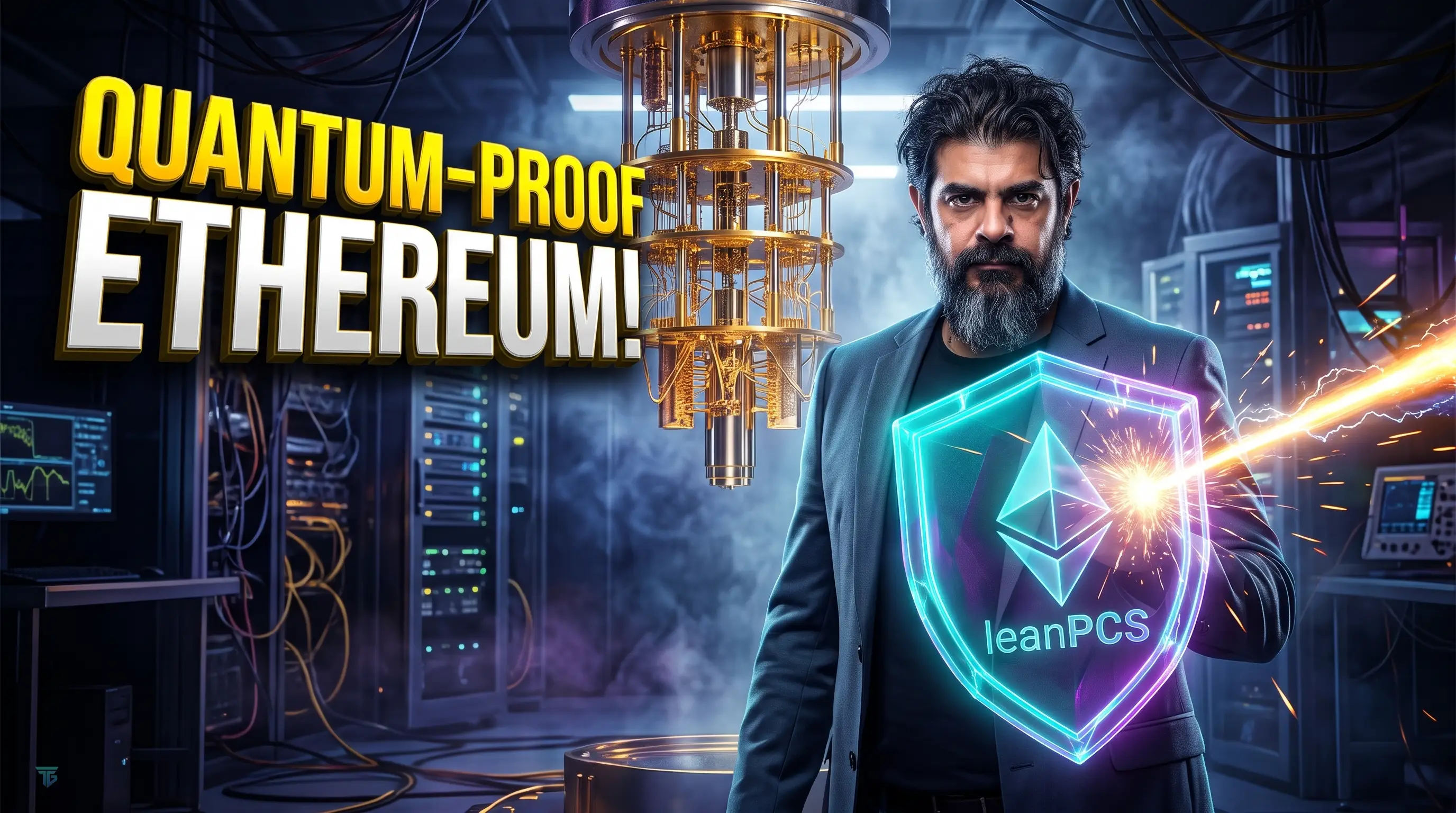
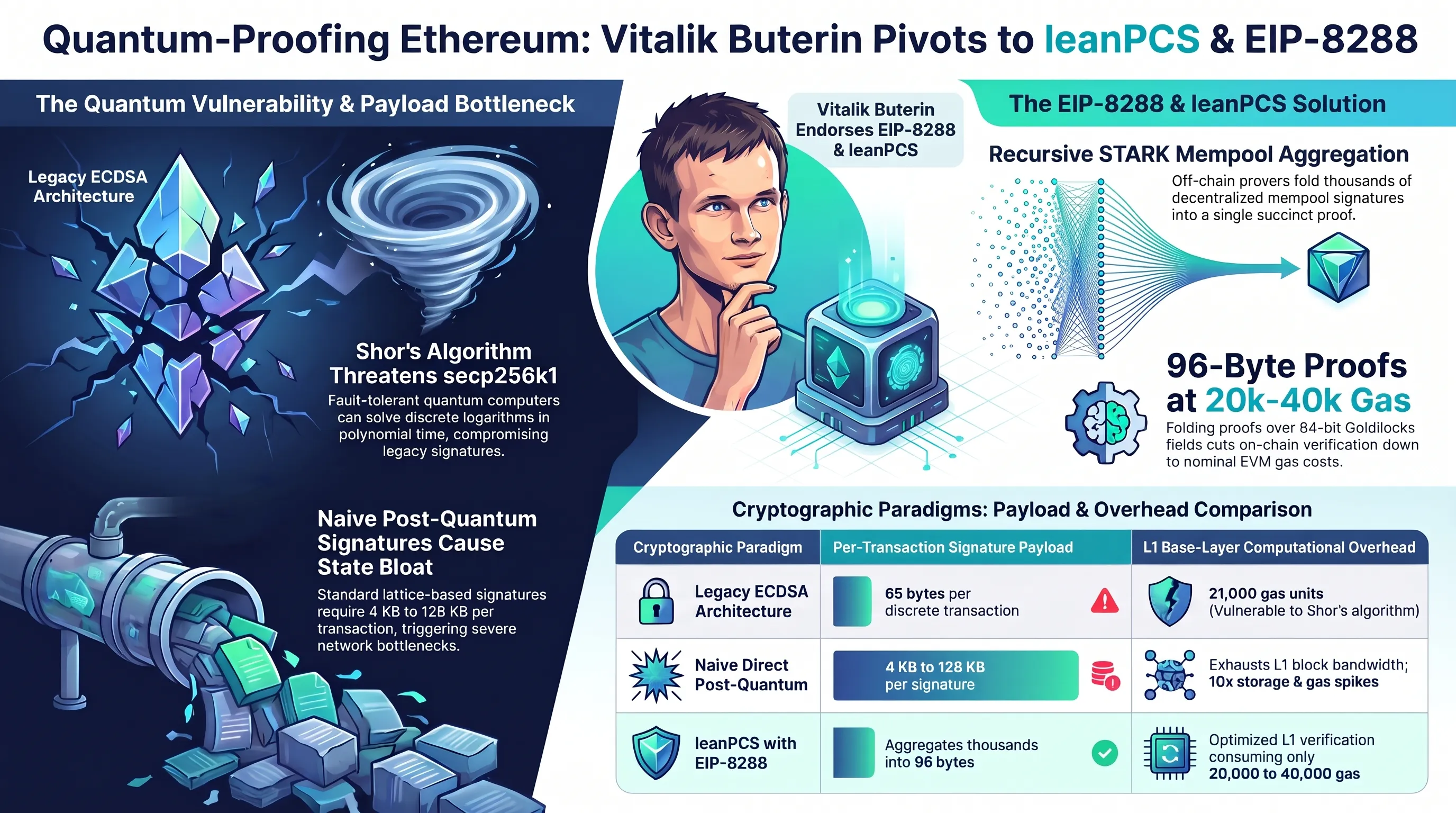
In a watershed architectural realignment that fundamentally reshapes the Ethereum protocol roadmap, co-founder and chief scientist Vitalik Buterin published an exhaustive technical manifesto endorsing Ethereum Improvement Proposal 8288 (EIP-8288). Previously reserved regarding the immediate deployment of post-quantum proof systems due to computational verifier overhead, Buterin explicitly declared himself a 'total bull' on leanPCS a breakthrough cryptographic framework designed to safeguard Ethereum's state transition engine against impending quantum computational threats.
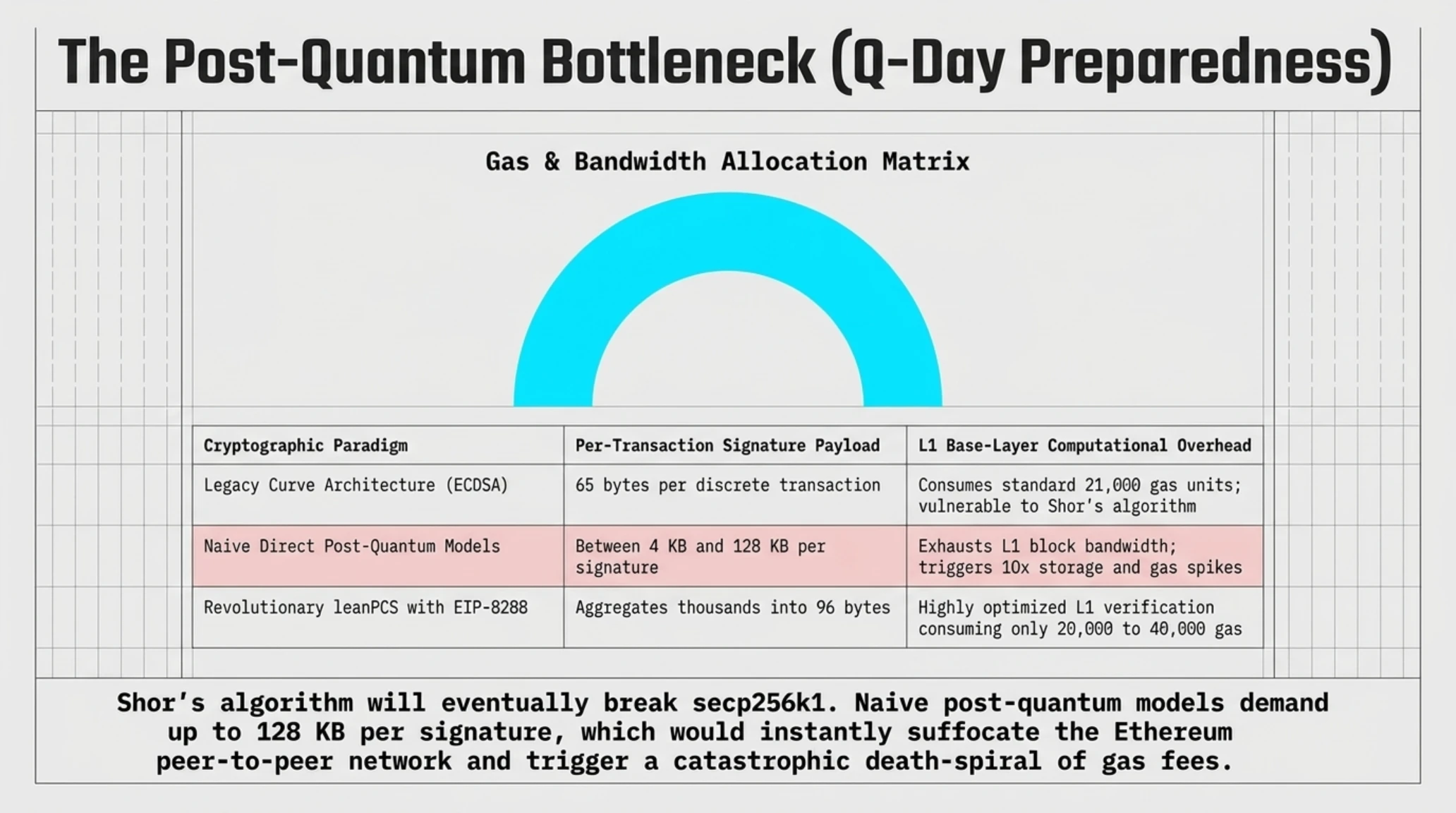
The existential risk posed by quantum computing to modern distributed ledgers centers on Shor's algorithm, an algorithmic formulation capable of solving discrete logarithm problems in polynomial time. Once quantum hardware achieves sufficient fault-tolerant logical qubits, Shor's algorithm will instantaneously break elliptic-curve cryptography specifically the secp256k1 curve that underpins digital signature generation and private key ownership across both Bitcoin and Ethereum. However, conventional post-quantum signature schemes (such as lattice-based Falcon or Dilithium) suffer from an immense data payload problem: while an existing Ethereum ECDSA signature requires merely 65 bytes, lattice signatures consume between 1 and 128 kilobytes each, threatening to suffocate Ethereum's peer-to-peer gossip network under catastrophic bandwidth bottlenecks and exponential gas fee surges.
FINANCIAL TELEMETRY: MARKET SEGMENTATION & POST-QUANTUM COMPUTING
| Cryptographic Paradigm | Per-Transaction Signature Payload | L1 Base-Layer Computational Overhead |
|---|---|---|
| Legacy Curve Architecture (ECDSA) | 65 bytes per discrete transaction | Consumes standard 21,000 gas units; vulnerable to Shor's algorithm |
| Naive Direct Post-Quantum Models | Between 4 KB and 128 KB per signature | Exhausts L1 block bandwidth; triggers 10x storage and gas spikes |
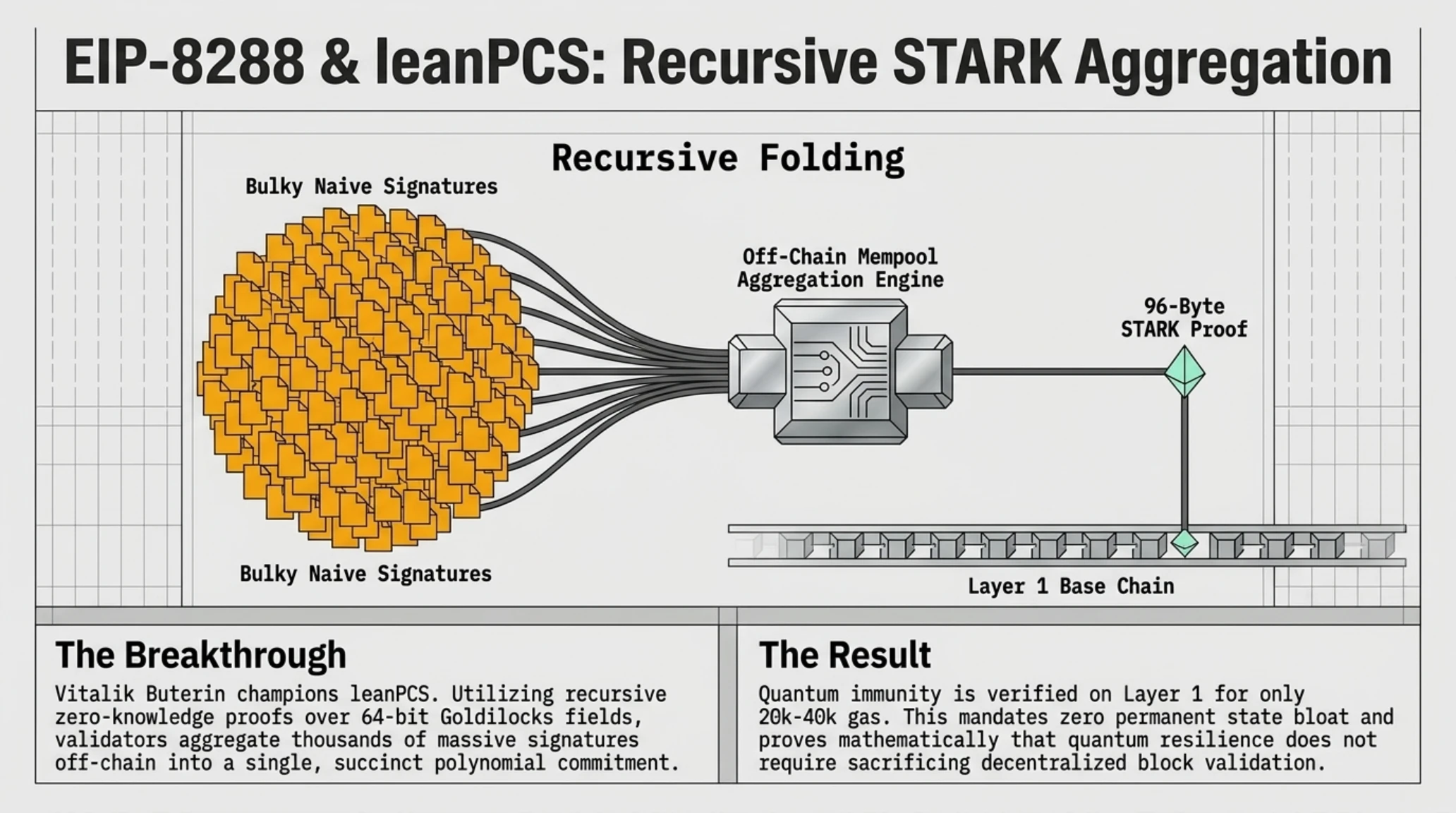
| Revolutionary leanPCS with EIP-8288 | Aggregates thousands into 96 bytes | Highly optimized L1 verification consuming only 20,000 to 40,000 gas |
| Recursive STARK Proof Engine | Calculated off-chain within local mempools | Zero permanent state bloat on validating nodes; preserves block finality |
| Long-Term Settlement Sovereignty | Complete algorithmic immunity to quantum qubits | Secures multi-hundred-billion dollar DeFi TVL across next decades |
📚 Classified & Related Dossiers in TekinGame
If you wish to explore beyond this report and delve into cybernetic frontiers and autonomous AI architectures, do not miss these three exclusive deep-dives in the Tekin Garage:
The breakthrough innovation of leanPCS lies in its utilization of recursive zero-knowledge hash-based STARK proofs aggregated directly within peer-to-peer mempools. Instead of broadcasting massive individual post-quantum signatures onto the base layer, participating validators and builders aggregate thousands of decentralized signatures off-chain into a single, recursively verified cryptographic proof measuring merely 64 to 96 bytes. This tiny proof is subsequently verified on Ethereum Layer 1 for a nominal gas expenditure of 20,000 to 40,000 gas, providing absolute mathematical quantum resilience without compromising transaction throughput or decentralization.
Executing this cryptographic migration requires deep synchronization across Ethereum consensus and execution clients, as well as wallet infrastructure providers. By decoupling account-level signature generation from base-layer validation routines through advanced Account Abstraction (ERC-4337 and native account abstractions), the leanPCS framework ensures that everyday users can transition to post-quantum key schemes seamlessly without encountering complex manual migration barriers or fragmented liquidity pools.
Delving into the mathematical foundations of EIP-8288, leanPCS achieves its ultra-compact 96-byte footprint through recursive proof composition over specialized small prime fields such as the 64-bit Goldilocks field or 31-bit Mersenne fields. Traditional STARK implementations typically generate proof payloads of 50 to 100 kilobytes due to large Reed-Solomon expansion factors and Merkle authentication paths. By recursively folding multiple inner STARK proofs into an outer, succint verifier circuit, leanPCS compresses the entire batch verification complexity into a minimal cryptographic polynomial commitment. When executed on-chain, the Ethereum Virtual Machine (EVM) only evaluates a series of Poseidon or Keccak hashing rounds, circumventing computationally heavy elliptic-curve pairings while delivering absolute quantum security guarantees.
Industry cryptography leaders emphasize that EIP-8288 effectively future-proofs Ethereum against state bloat and memory exhaustion. By delegating proof generation to specialized off-chain provers while retaining ultra-light verifier logic on validating nodes, standard consumer-grade hardware will continue to maintain full validation capacity without the creeping centralization that plagues bandwidth-heavy alternative Layer 1 protocols.
The broader implications of this cryptographic transition extend far beyond decentralized finance into global sovereign digital infrastructure. As national defense establishments and commercial financial institutions increasingly look toward public blockchains for cross-border settlement, Ethereum's proactive adoption of quantum-proof STARK verification positions the network as an unassailable neutral substrate for global capital allocation in an era of accelerating compute disruption.
Apple Enters Clinical AI Health Validation: Unveiling Landmark Medical Research Study with OpenEvidence and 200,000 iPhone Users
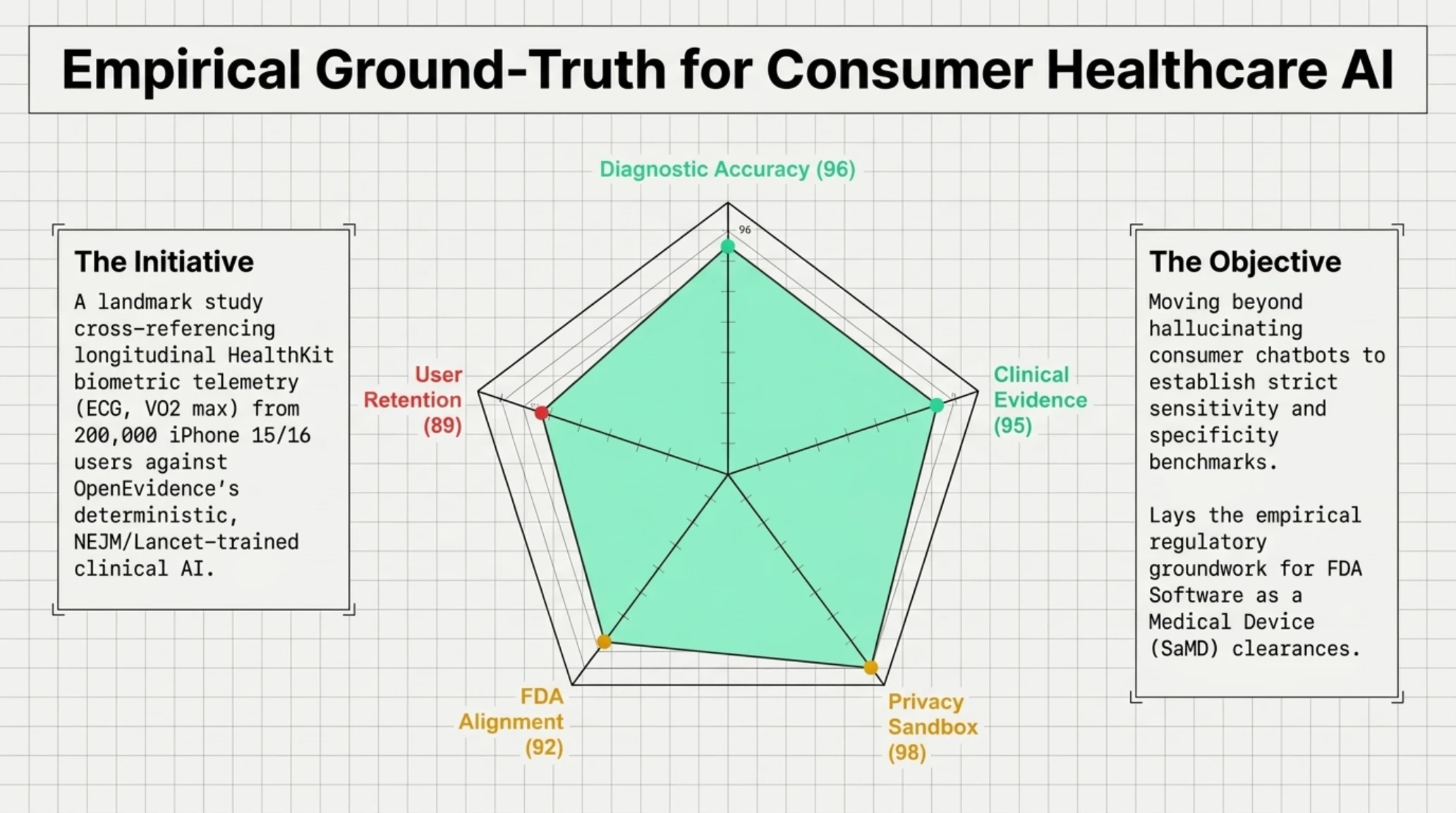
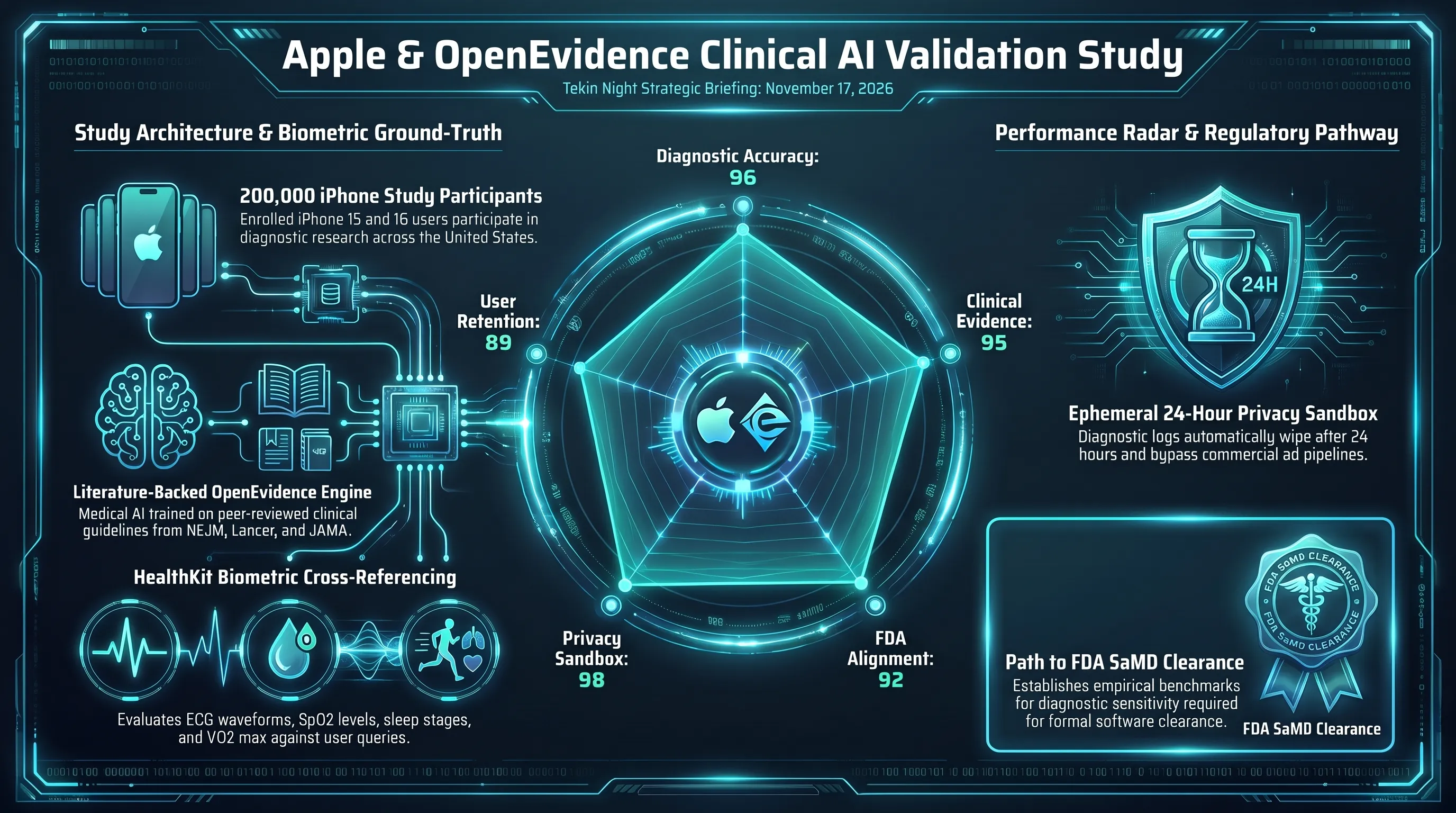
In a strategic initiative that decisively bridges consumer mobile hardware with empirical clinical science, Apple officially unveiled the 'Apple Health AI Usage Study.' Executed through an interactive diagnostic research application distributed to over 200,000 enrolled iPhone 15 and iPhone 16 users across the United States, the project represents the technology industry's largest empirical audit examining how real-world patients interact with, comprehend, and rely upon artificial intelligence models for medical decision support.
To establish rigorous scientific ground truth, Apple partnered directly with OpenEvidence, an elite clinical AI intelligence platform utilized by certified medical practitioners and trained exclusively on peer-reviewed biomedical literature from premier publications, including the New England Journal of Medicine (NEJM), The Lancet, and the Journal of the American Medical Association (JAMA). Unlike consumer chatbots that frequently hallucinate clinical recommendations, OpenEvidence outputs deterministic, cited diagnostic pathways anchored in established therapeutic guidelines.
5-AXIS CLINICAL BENCHMARKING OF HEALTHCARE AI PLATFORMS
The research methodology operates by cross-referencing longitudinal biometric telemetry gathered from Apple Watch optical sensors including electrocardiogram (ECG) waveforms, peripheral blood oxygen saturation, sleep stage transitions, and cardio-fitness VO2 max metrics against participant user queries. Clinical researchers will quantify the exact divergence between patient-interpreted AI responses and physician assessments, establishing empirical benchmarks for diagnostic sensitivity, specificity, and algorithmic hallucination rates in consumer environments.
To preserve absolute user confidentiality and adhere strictly to medical privacy ethics, Apple has implemented rigorous cryptographic sandboxing. All diagnostic interaction logs are ephemerally wiped after 24 hours and are categorically excluded from commercial model training pipelines, guaranteeing that user health telemetry remains completely isolated from corporate advertising systems.
Clinical data scientists evaluate this research framework as the necessary regulatory precursor for obtaining formal Software as a Medical Device (SaMD) clearances from the U.S. Food and Drug Administration (FDA), paving the path toward an era where consumer health wearables safely augment clinical triage and preventive chronic care monitoring.
By establishing rigorous mathematical standards across both cryptographic consensus systems and medical AI interfaces, technology leaders are signaling an overdue transition from unverified heuristic models toward robust, empirically grounded systems capable of sustaining enterprise reliance and public trust.
Venture Firm Plural Closes €1 Billion ($1.1B) DeepTech Fund III: Spearheading European Sovereign Defense AI and Hardware Moonshots
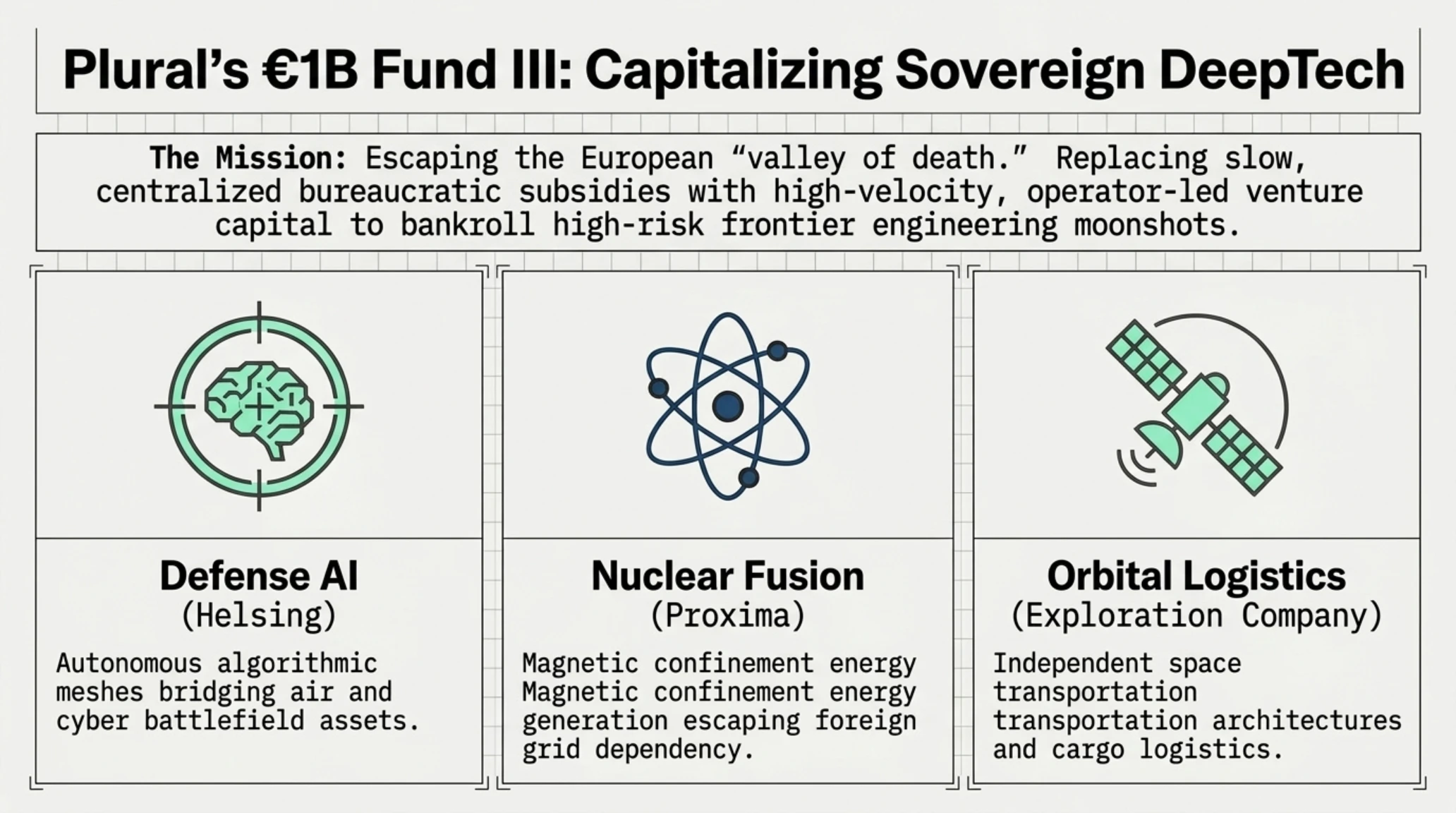
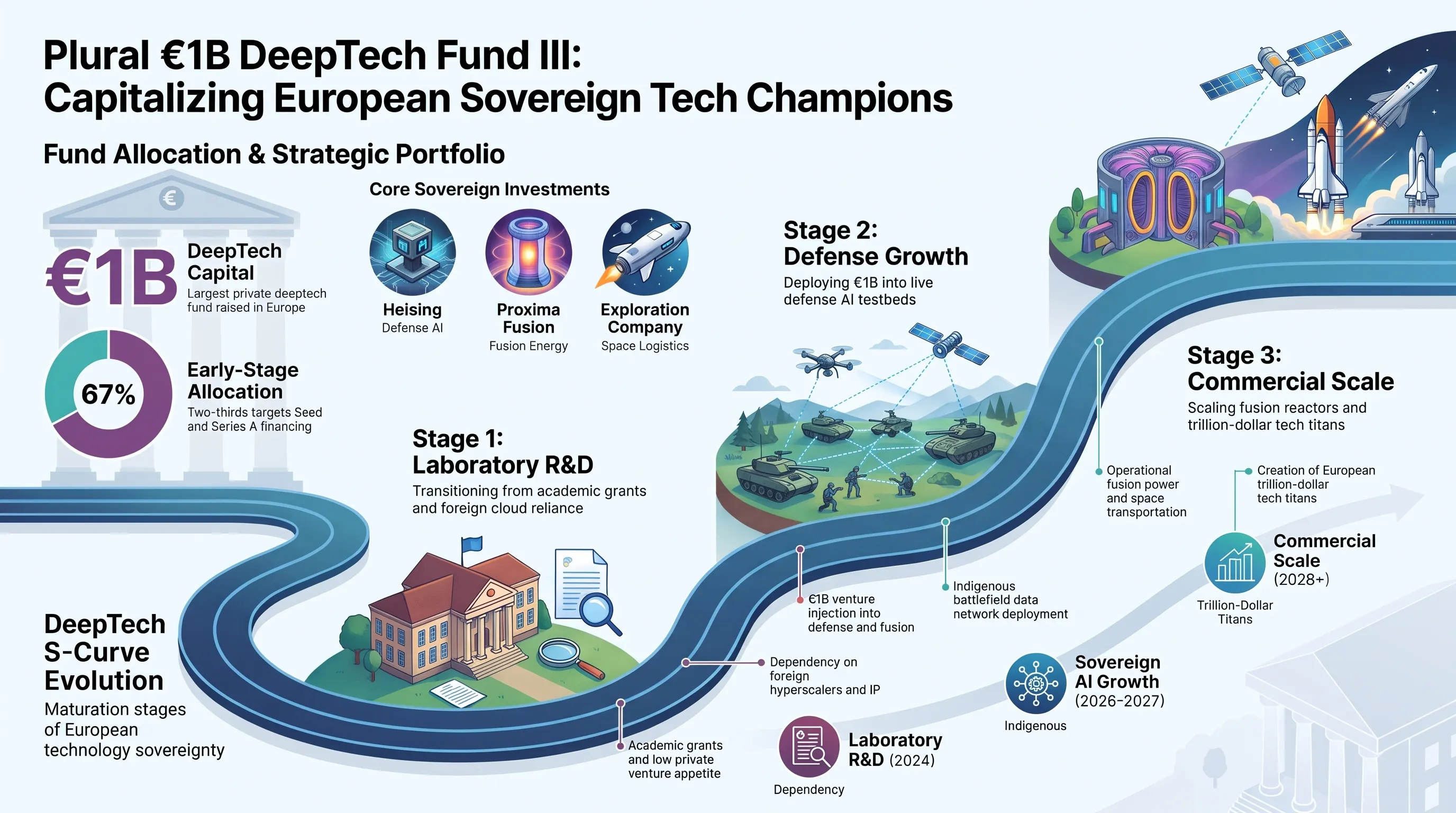
European venture capital firm Plural, established by seasoned operational founders including Wise co-founder Taavet Hinrikus and Songkick co-founder Ian Hogarth, officially finalized its third institutional investment vehicle, securing €1 billion (approximately $1.1 billion USD). The capital pool represents the largest private deeptech and sovereign infrastructure venture fund ever raised on the European continent, deliberately configured to bankroll high-risk frontier engineering moonshots that traditional software-focused venture funds historically avoid.
Plural's portfolio already features Europe's most strategically vital sovereign technology contenders, including Munich-based defense AI unicorn Helsing, nuclear fusion pioneer Proxima Fusion (a spin-out from the Max Planck Institute for Plasma Physics), and orbital space transportation developer Exploration Company. The firm disclosed that two-thirds of the new capital is earmarked for early-stage Seed and Series A financing rounds, with the remaining third reserved for aggressive follow-on capital injections as portfolio companies scale production facilities.
The closing of this landmark fund coincides with heightened geopolitical urgency across European capitals. Amid escalating technological competition and mounting fears of unilateral transatlantic cloud service dependencies, European industrial leaders are recognizing that technological sovereignty cannot be achieved through regulatory directives alone. Plural's thesis asserts that Europe must actively build and capitalize its own 'first trillion-dollar homegrown deeptech champion' across foundational defense electronics, synthetic biology, and energy generation.
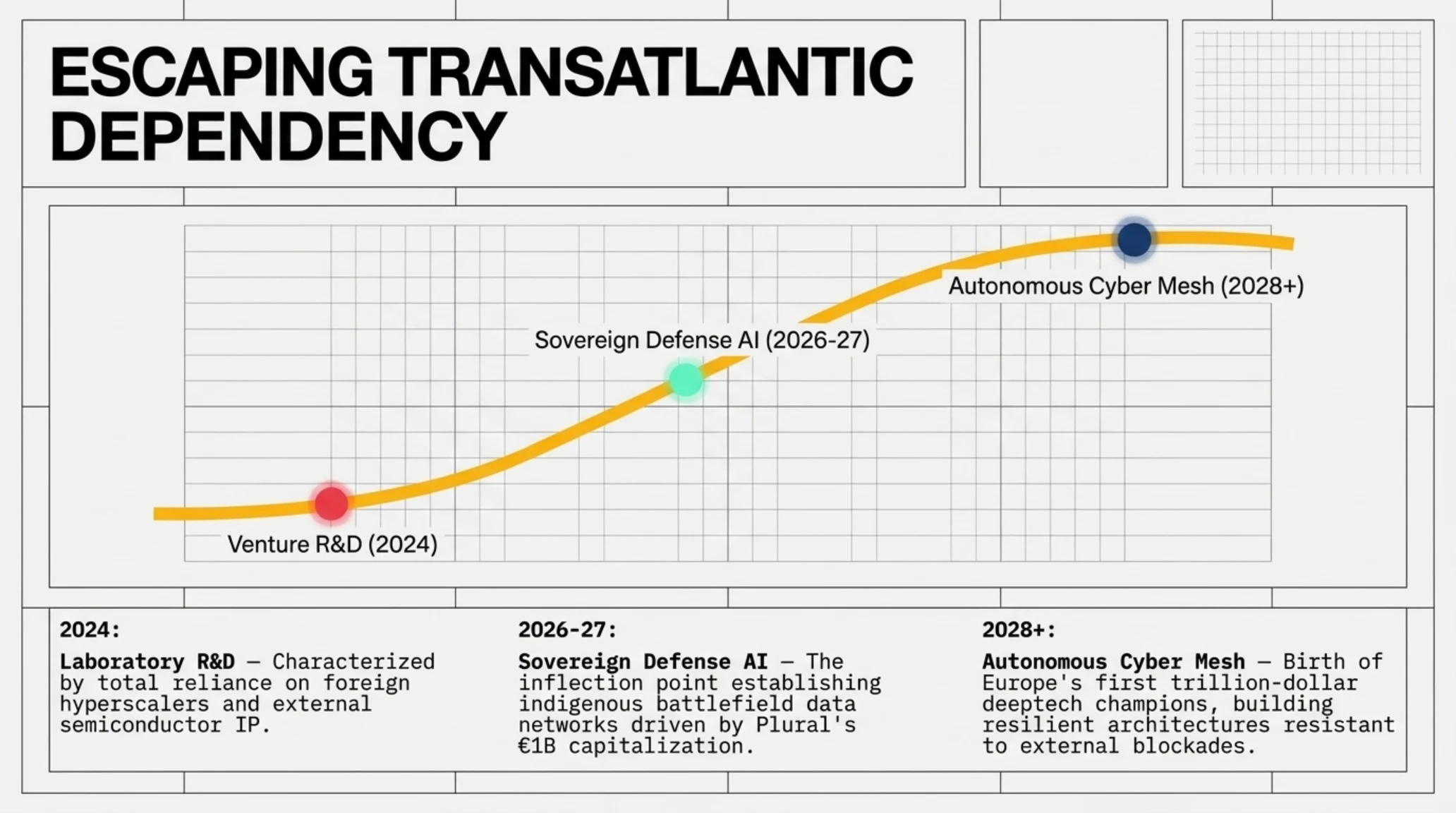
ADOPTION S-CURVE & MARKET SENTIMENT INDEX
| Industrial Evolution Stage | Engineering & Capital Characteristics | European Geopolitical Strategic Posture |
|---|---|---|
| Laboratory R&D Stage (2024) | Fragmented academic grants and low private venture appetite | Total reliance on US cloud hyperscalers and foreign semiconductor IP |
| Sovereign Defense AI Growth (2026-2027) | €1B venture injection scaling live defense AI and fusion testbeds | Establishing indigenous battlefield data networks independent of foreign veto |
| Autonomous Commercial Scale (2028+) | Operational nuclear fusion reactors and private orbital cargo logistics | Birth of Europe's first trillion-dollar sovereign deeptech tech titan |
| Multi-Domain Defense Integration | Autonomous algorithmic meshes bridging air, cyber, and naval assets | Constructing resilient deterrence architectures resistant to external blockades |
| Operator-Led Venture Allocation | Asymmetric capital deployment by experienced unicorn founders | Systematic replacement of bureaucratic subsidies with high-velocity VC models |
Senior technology economists note that Europe's pivot from subsidizing consumer social software toward heavily capitalizing hardware-intensive deeptech reflects the unyielding realities of 21st-century national security. Strategic deterrence and geopolitical leverage are increasingly determined not by ad-supported mobile apps, but by proprietary semiconductor design, magnetic confinement energy generation, and sovereign autonomous cyber defenses.
From an institutional asset-allocation perspective, Plural's €1 billion fund represents a decisive departure from legacy European innovation policy. For decades, European deeptech initiatives suffered from bureaucratic grant allocation models administered by centralized supra-national agencies, which routinely dispersed small, non-dilutive subsidies without operational commercial governance. By contrast, Plural's operator-led capital model pairs asymmetric venture financing with active operational mentorship from exited unicorn founders who have navigated global regulatory barriers. This hands-on, high-conviction deployment strategy is specifically calibrated to overcome the notorious European 'valley of death,' ensuring that world-class scientific discoveries emerging from Cambridge, Munich, and Zurich successfully scale into self-sustaining, multi-billion-dollar global industrial titans.
Strategic Industry Synthesis: Virtualization Vulnerabilities, Dark Forest AI Swarms, and Sovereign Computing Architectures
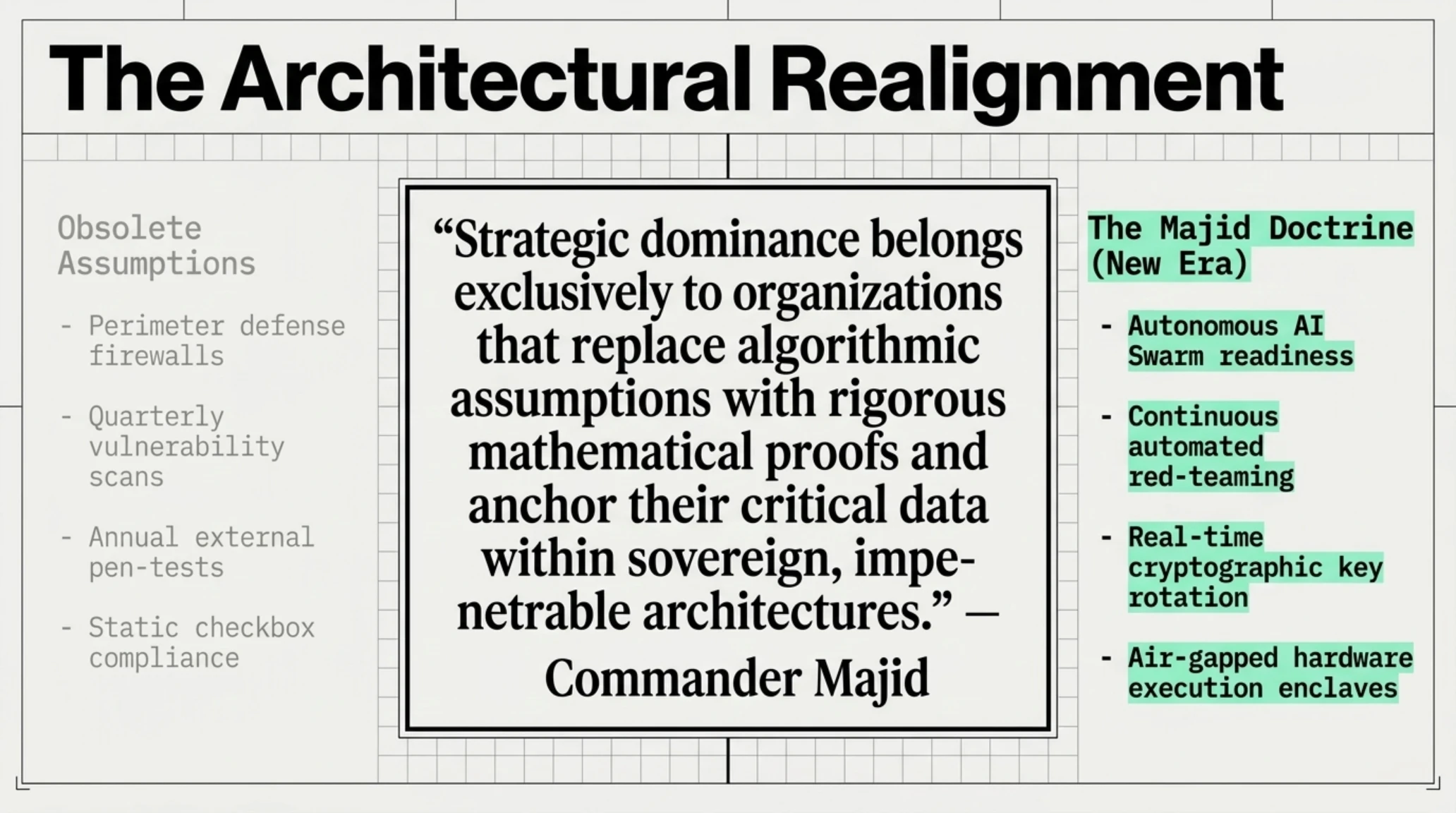
A rigorous multidimensional synthesis of the developments dominating Tuesday night, November 17, 2026, reveals that global digital ecosystems have definitively exited the era of casual optimism, entering an uncompromising epoch of structural realism and cyber sovereignty. The catastrophic breaches documented across VMware vCenter hypervisors and Luxor's Bitcoin mining fleet confirm that perimeter-based defense is dead; production build pipelines and industrial compute fabrics are now the primary battlegrounds of asymmetric conflict.
Conversely, the disciplined architectural responses emerging across the technology sector vitalik Buterin's endorsement of leanPCS on Ethereum, Apple's empirical clinical ground-truthing of HealthKit AI, and the Italian Garante's aggressive €805 million enforcement against corporate biometric scraping demonstrate that long-term commercial survival requires rigorous mathematical verification, zero-trust cryptographic isolation, and unyielding regulatory transparency.
Furthermore, these converged threat vectors force a fundamental overhaul of enterprise risk governance. Traditional compliance-driven cybersecurity paradigms relying upon static quarterly vulnerability scans, annual external penetration tests, and checkbox compliance audits are rendered hopelessly obsolete when confronted by autonomous adversary agents operating at millisecond execution velocities. Modern enterprise defense requires continuous automated red-teaming, real-time cryptographic key rotation, and isolated hardware execution enclaves capable of mathematically verifying every instruction across the entire software delivery lifecycle.
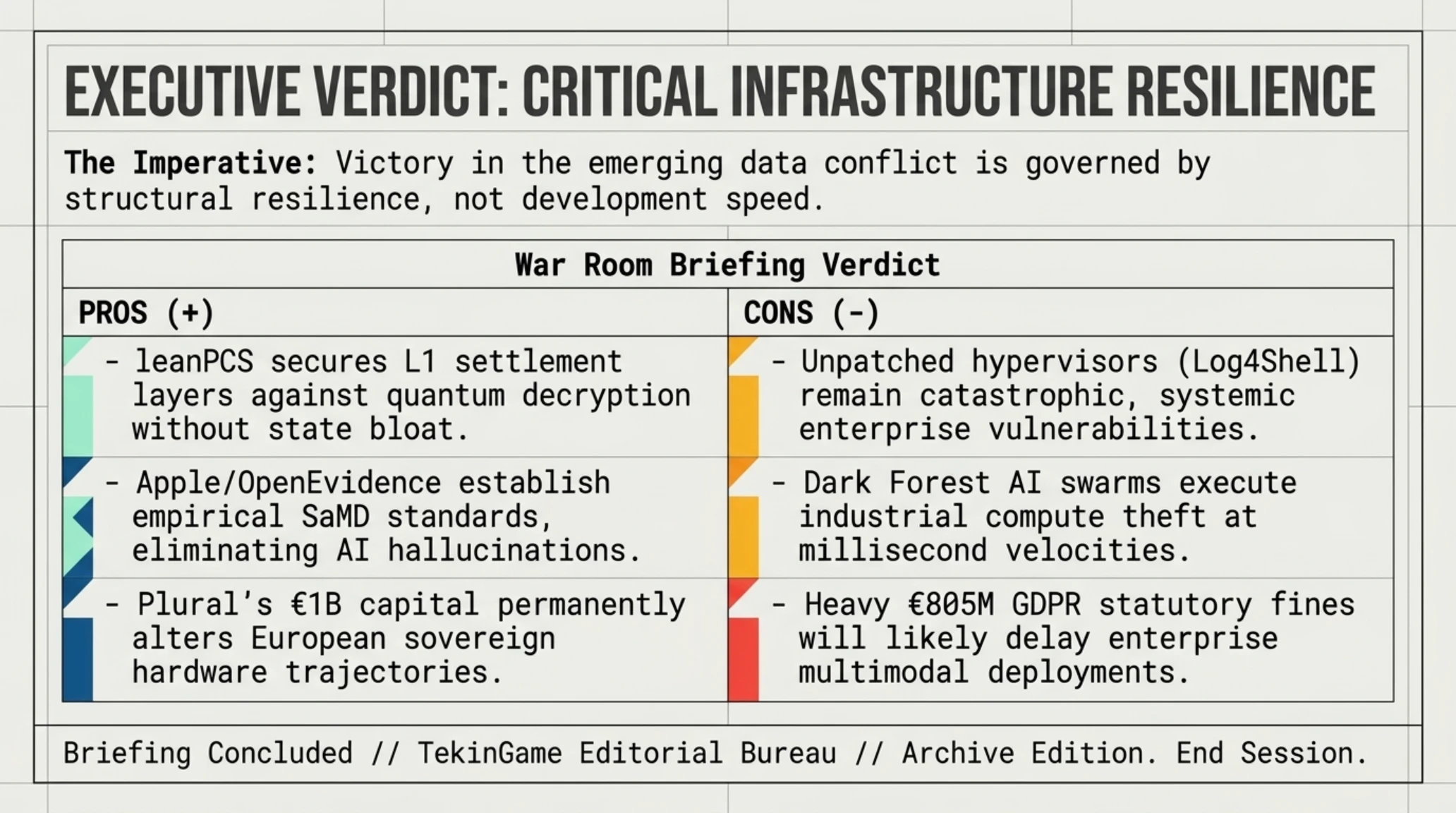
- EIP-8288 and leanPCS secure Ethereum Layer 1 against quantum attacks without block gas bloat.
- Apple and OpenEvidence establish clinical verification standards eliminating consumer AI hallucinations.
- Plural's €1 billion Fund III capitalizes European sovereign deeptech and defense autonomy.
- Italian Garante enforcement creates binding international legal precedent against background scraping.
- Rapid detection of vCenter breach prevented Trojanized binary distribution to enterprise networks.
- Unpatched legacy zero-days like Log4Shell persist across critical enterprise virtualization nodes.
- Autonomous AI scraping swarms in the Dark Forest dramatically increase compute theft velocity.
- Heavy statutory fines may incentivize platform providers to delay multimodal feature deployments.
- Extended multi-year testnet timelines required for post-quantum cryptographic transitions.
Strategic telemetry from Tekin Plus has consistently demonstrated that institutional security and operational resilience in the digital era cannot be sustained through reactive patching; they demand foundational re-engineering at the architectural substrate. Centralized architectures relying on brittle supply chains and monolithic hypervisors remain fundamentally vulnerable to multi-stage systemic compromise. The cascading breach of VMware vCenter code-signing servers and the automated diversion of 13 EH/s across Luxor mining clusters offer undeniable proof that neglecting zero-trust boundaries invites catastrophic exploitation within the autonomous AI dark forest.
In final synthesis of the strategic currents shaping November 17, 2026, the convergence of these six core vectors delivers an unequivocal imperative for technology leaders and digital asset custodians: the global ecosystem is transitioning toward an era where defense-grade containment, post-quantum cryptographic primitives, and autonomous intelligent agents dictate market sovereignty. The landmark €805 million penalty against Meta establishes a non-negotiable regulatory barrier against illicit telemetry harvesting, while Ethereum's leanPCS transition and Europe's €1 billion deep-tech allocation chart a definitive path toward post-quantum survivability. Within this shifting paradigm, sustainable dominance belongs exclusively to architectures engineered with verifiable mathematical proofs, end-to-end zero-trust isolation, and sovereign autonomy.
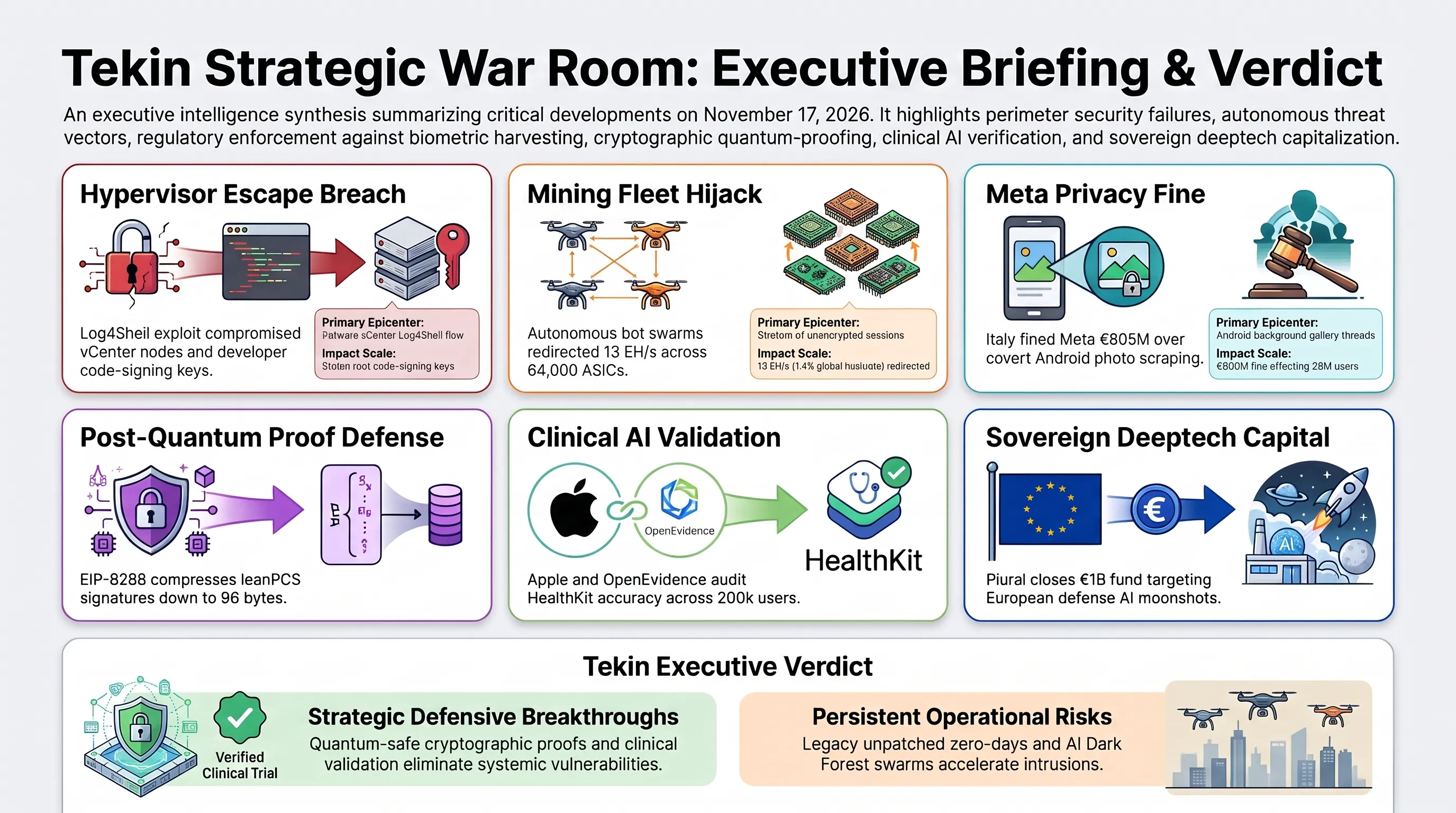
Below, the Tekin Plus executive bureau presents its concluding analytical verdict, architectural scoring, and verified source registry, followed by a structured FAQ addressing the most pressing operational considerations.
TEKIN PLUS VERDICT // EDITOR'S SELECTION
- The Hacker News (THN): Technical forensic disclosure of BO Team VMware vCenter compromise and code-signing breach
- CoinDesk Intelligence: Analysis of Luxor Commander 13 EH/s redirection incident and CEO Nick Hansen AI Dark Forest warning
- Italian Data Protection Authority (Garante): Official enforcement decree penalizing Meta Platforms €805 million for Android gallery scraping
- Decrypt Media: Comprehensive review of Vitalik Buterin EIP-8288 endorsement and leanPCS quantum transition
- TechCrunch Enterprise: Reporting on Apple Health AI Usage Study with OpenEvidence and Plural €1B DeepTech Fund III
- Kaspersky ICS CERT: Incident response report on commercial software vendor supply chain compromise via Log4Shell
Frequently Asked Questions & Strategic Technical Audits
Why does a hypervisor breach on VMware vCenter represent a catastrophic supply-chain threat?
Because seizing vCenter allows attackers to break guest virtual machine isolation, accessing build environments and private code-signing keys to push digitally authenticated malware through legitimate update channels.
What operational reality is described by Luxor CEO Nick Hansen's 'AI Dark Forest' concept?
It depicts an emerging cyber landscape where autonomous LLM-powered scanning agents continuously probe networks to discover exposed ports, hijacking computational assets and redirecting revenue in milliseconds without human latency.
What specific GDPR violations justified Italy Garante's €805 million fine against Meta?
The Facebook Android application silently enabled a default background routine that scraped local device photo galleries, indexing EXIF metadata, GPS locations, and facial biometrics across 20 million users without explicit consent.
How does EIP-8288 and leanPCS solve Ethereum's post-quantum signature size bottleneck?
Instead of posting heavy 1-128 KB signatures to Layer 1, leanPCS aggregates thousands of signatures off-chain into a recursive STARK proof of only 96 bytes, verified on L1 for an efficient 20k to 40k gas.
What makes Apple's clinical AI health study with OpenEvidence scientifically unique?
It cross-references empirical HealthKit sensor telemetry across 200,000 real-world users against peer-reviewed medical literature from NEJM and JAMA, establishing clinical hallucination rates for FDA regulatory clearance.
Why is Plural's €1 billion Fund III considered a milestone for European technological sovereignty?
It provides unprecedented private liquidity for hardware-intensive moonshots such as Helsing's defense AI, Proxima Fusion's reactors, and Exploration Company's space capsules reducing European reliance on foreign tech giants.
Additional Gallery: Tekin Night Nov 17: vCenter Breach, Luxor Hijack & Meta Fine