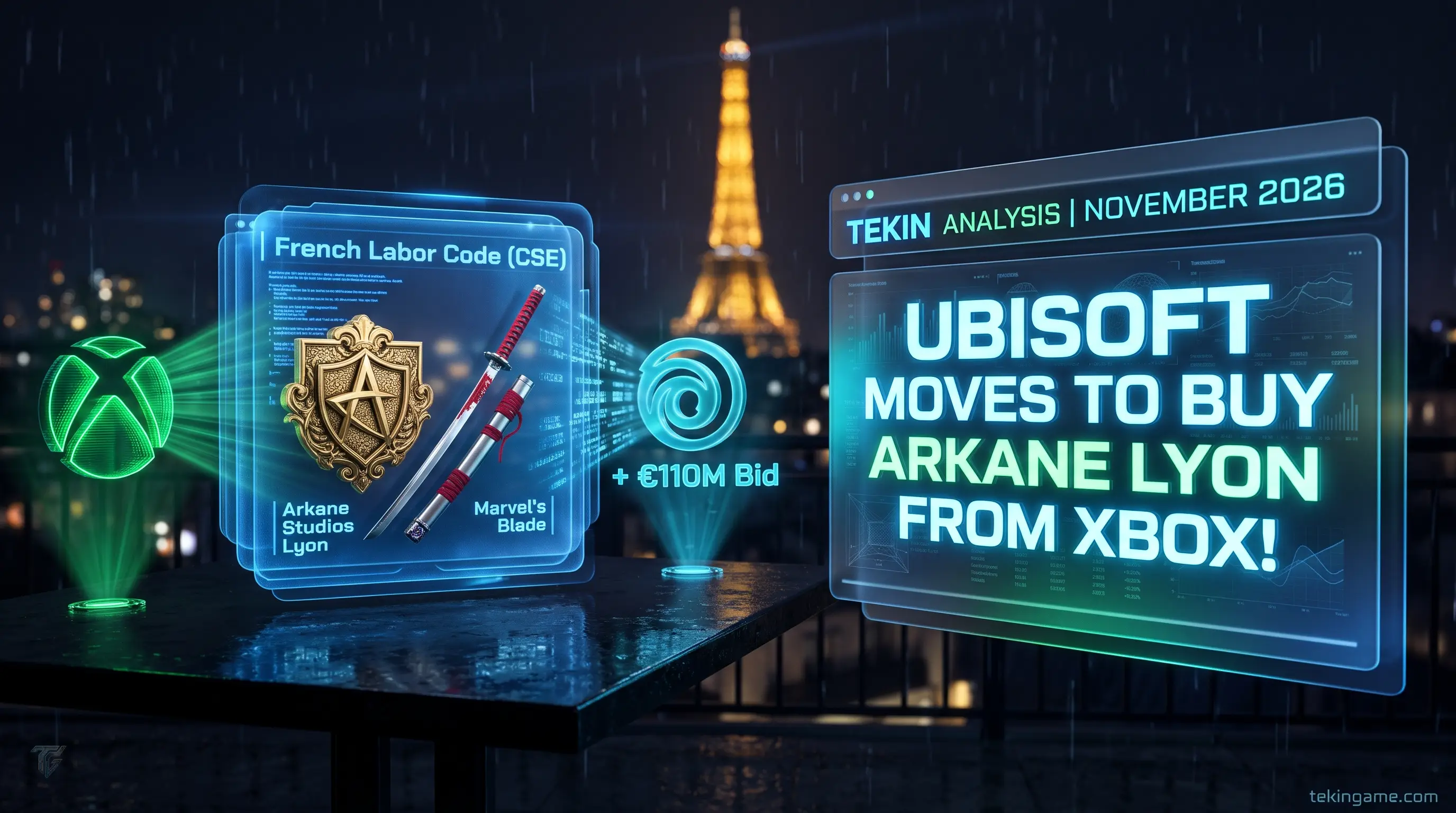
Tekin Analysis | Ubisoft Tables Formal Acquisition Offer to Buy Arkane Studios Lyon from Microsoft
The Continental Gambit: Inside Ubisoft's Formal Bid to Acquire Arkane Studios Lyon
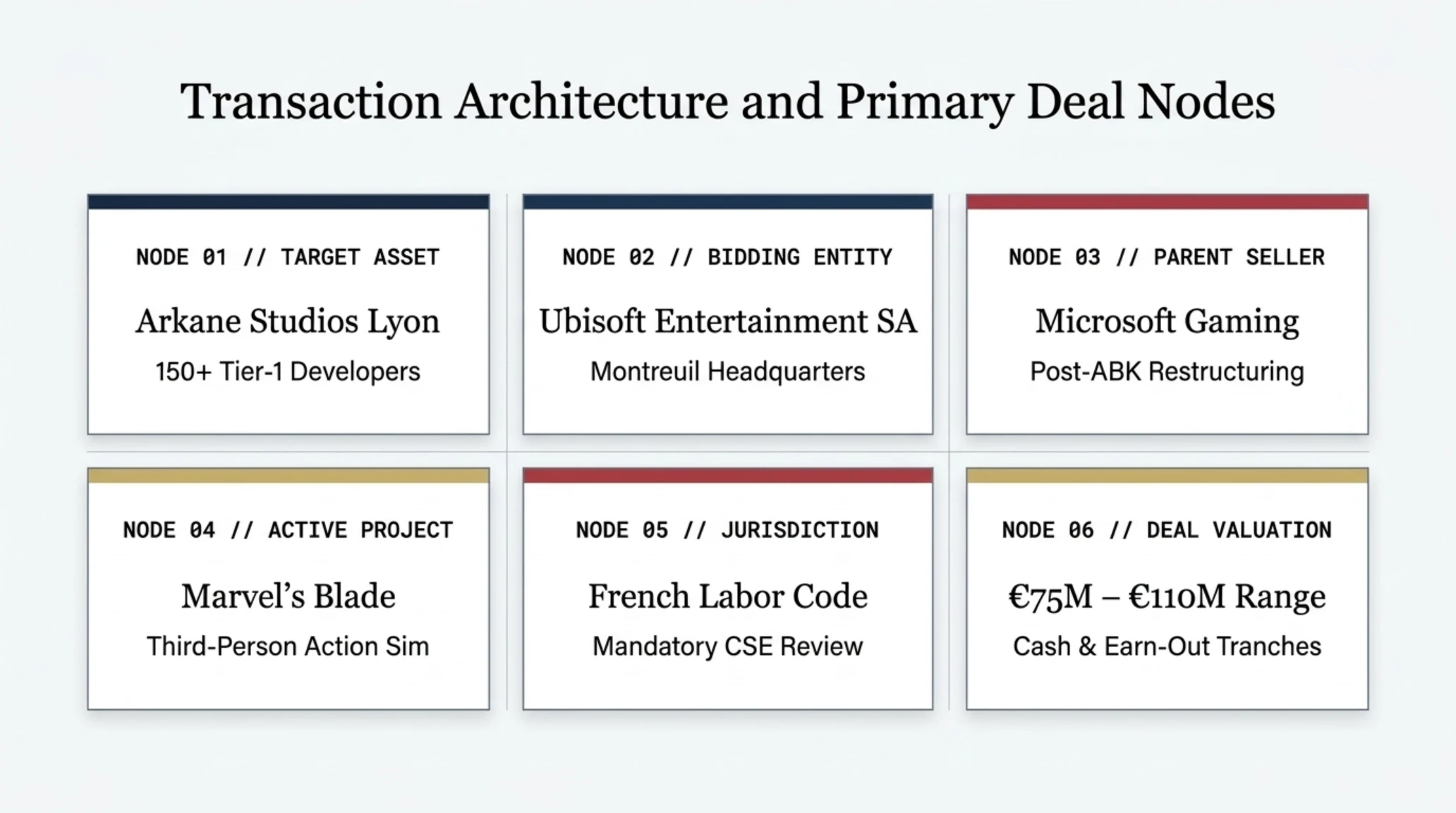
In the high-stakes theater of global interactive entertainment, the tremors of post-merger corporate restructuring frequently crush artistic autonomy beneath the relentless weight of quarterly earnings calls. Yet, on Wednesday, November 4, 2026, an extraordinary counter-offensive unfolded across European regulatory corridors. Ubisoft Entertainment SA, the embattled French publishing heavyweight, officially tabled a formal corporate acquisition offer to Microsoft Gaming to purchase Arkane Studios Lyon. This audacious maneuver represents far more than an opportunistic grab for prestige intellectual property; it constitutes an existential push to repatriate France's most celebrated engineering and level-design powerhouse back under European corporate governance.
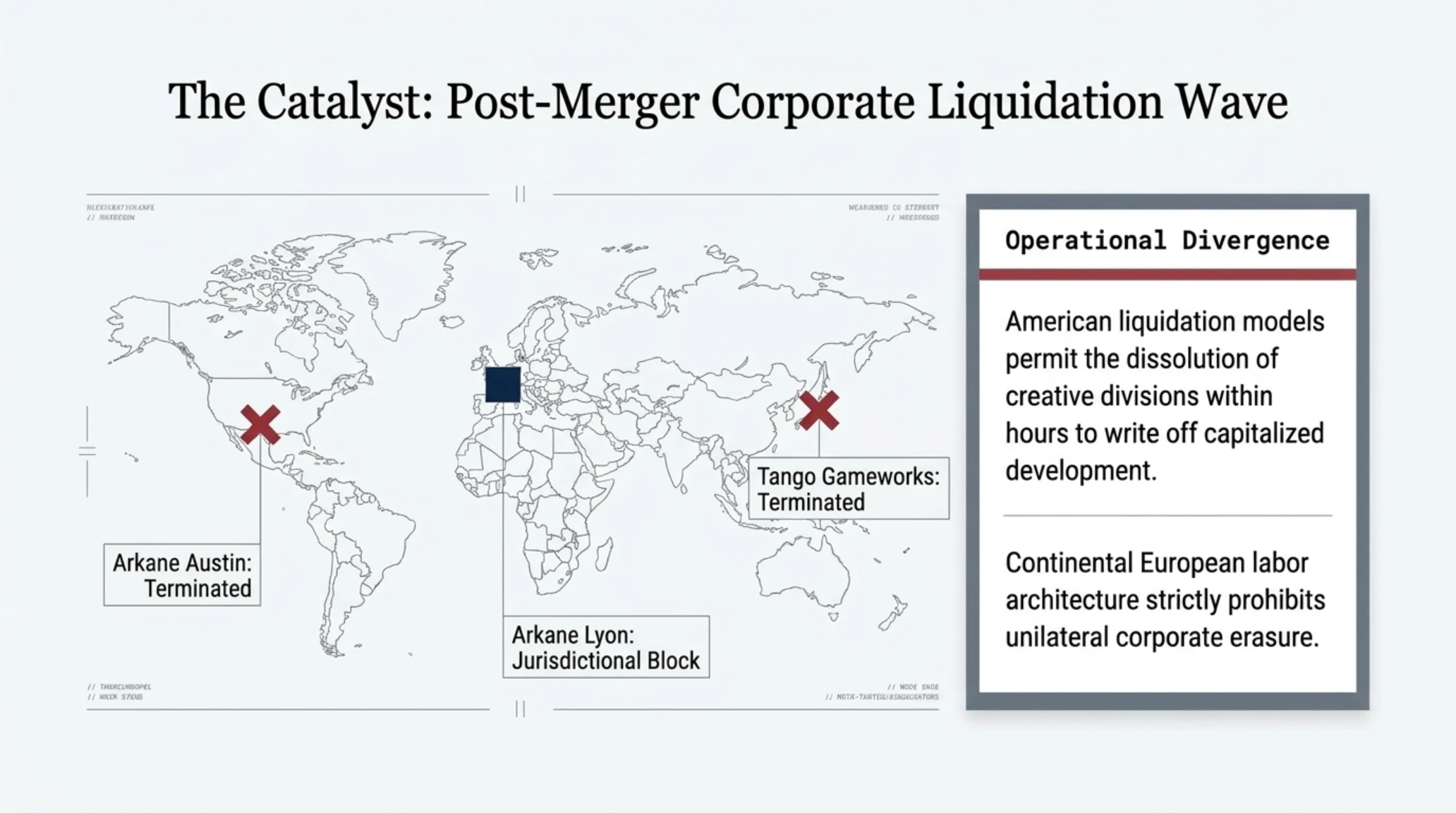
The catalytic event behind this corporate duel traces directly to the aggressive margin-compression strategies instituted by Microsoft following its seismic $68.7 billion acquisition of Activision Blizzard King. Over the preceding eighteen months, Redmond's gaming division systematically eliminated thousands of publishing and development roles, shuttering historic creative hubs such as Tango Gameworks in Tokyo and Arkane Austin in Texas during sudden corporate reorganizations. However, when Microsoft's financial controllers sought to impose identical rationalization measures upon Arkane Studios Lyon, they collided head-on with an impenetrable legal bulwark: the statutory rigidity of the French Labor Code (Code du Travail) and the institutional defiance of Lyon's Social and Economic Committee (Comité Social et Économique - CSE).
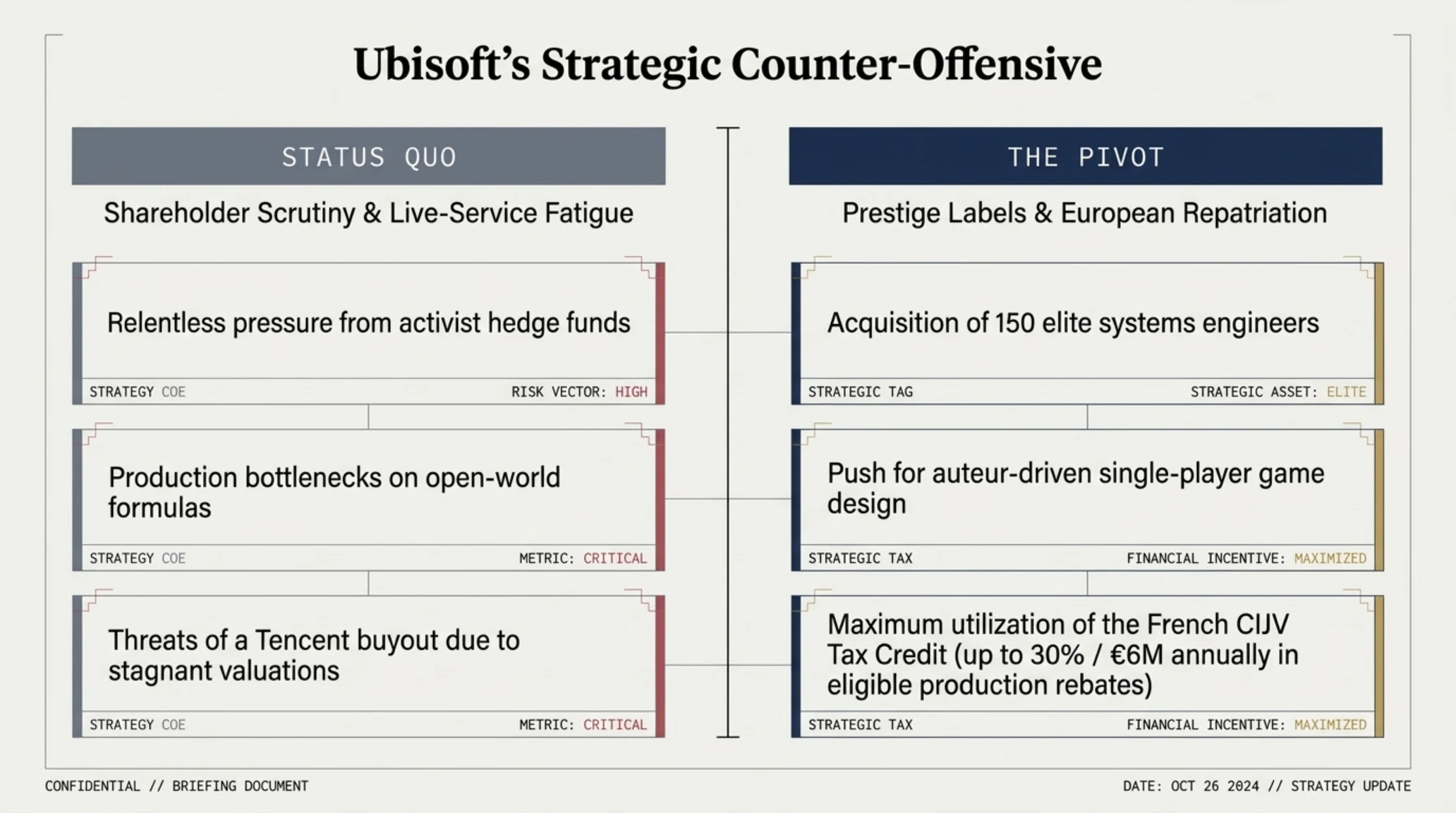
Faced with mandatory statutory consultation periods, severe penalties against collective economic dismissal without exhaustive commercial alternatives, and vehement public scrutiny from French cultural authorities, Microsoft was legally compelled to open a formal bidding window. Seizing this regulatory leverage, Ubisoft working in discreet consultation with studio director Dinga Bakaba and European private equity syndicates assembled an all-cash and earn-out buyout package valued between €75 million and €110 million. The central objective: decouple Arkane Lyon from Microsoft's balance sheet, insulate its 150-person specialized workforce, and secure the uninterrupted multiplatform production of its crown jewel project, Marvel's Blade.
To fully grasp the magnitude of this transaction, one must examine the operational divergence between American corporate liquidation models and Continental European labor architecture. In the United States, at-will employment frameworks permit mega-conglomerates to dissolve entire creative divisions within hours, writing off capitalized development costs against corporate goodwill. In France, the dissolution of a premier studio that has received multi-million-euro research and production tax credits (Crédit d'Impôt Jeu Vidéo - CIJV) triggers rigorous ministerial oversight, mandatory social plans (Plan de Sauvegarde de l'Emploi - PSE), and judicial review aimed at job preservation. By entering the breach as a domestic suitor, Ubisoft has transformed what could have been a quiet studio phase-out into an international sovereign gaming showdown.
Moreover, the macroeconomic context surrounding Ubisoft itself adds profound narrative intrigue to this takeover maneuver. Throughout 2024 and 2025, Ubisoft endured relentless public scrutiny from institutional shareholders, including activist hedge funds demanding executive restructuring or outright sale to Asian conglomerates such as Tencent Holdings. Beset by production bottlenecks and extended iteration cycles on major open-world franchises, Ubisoft leadership recognized that restoring enterprise valuation required a radical strategic pivot. By pursuing Arkane Lyon, Ubisoft signals to global markets that it intends to reclaim its status as a champion of premium, auteur-driven video game design rather than relying solely on repetitive live-service monetization.
Strategic Assessment and Key Takeaways at a Glance
The geopolitical dimension of this negotiation reverberates throughout the entire European technology sector. For decades, American mega-conglomerates treated European creative hubs as high-yield offshore outposts, harvesting their creative breakthroughs while centralizing ultimate IP governance within United States boardrooms. The standoff over Arkane Lyon marks a definitive turning point where domestic enterprise, backed by statutory labor power and regional public sentiment, refuses to allow premier cultural technology to be discarded as peripheral collateral in corporate balance sheet cleanups.
This dynamic has also attracted the close attention of the European Commission in Brussels. European regulators, having spent years investigating tech consolidations and enforcing anti-monopoly remedies under the Digital Markets Act, are acutely sensitive to the concentration of game-making talent within a handful of American mega-corporations. The prospect of an independent or European-owned Arkane Lyon returning to multiplatform development aligns cleanly with Brussels' strategic objectives regarding fair market competition and diverse digital ecosystems across the continent.
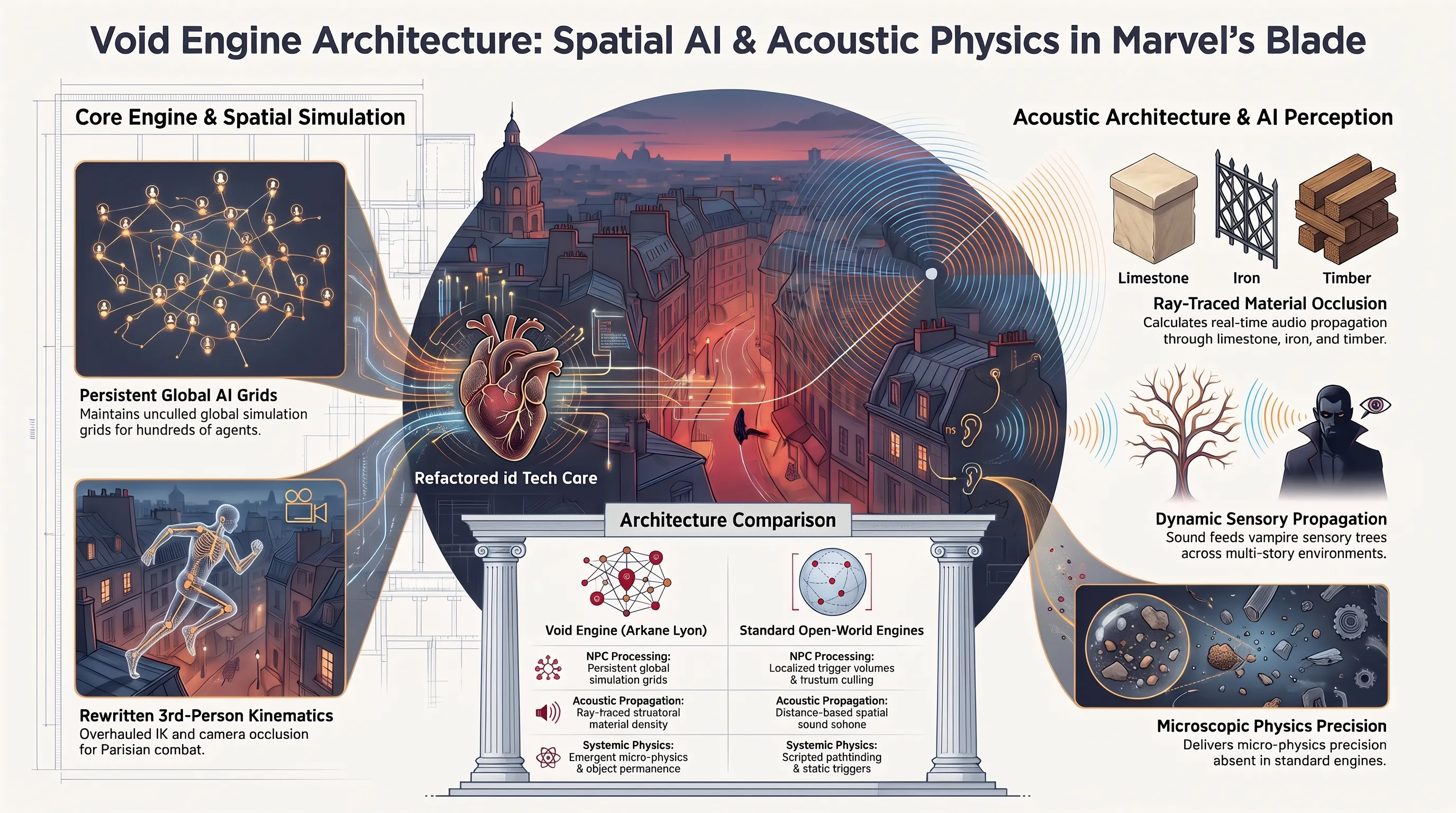
Industry analysts at Kepler Cheuvreux and Morgan Stanley emphasize that the transaction represents an asymmetric strategic triumph for whichever entity finalizes the purchase. For Microsoft, transferring Arkane Lyon avoids an excruciating, multi-year French labor tribunal dispute while salvaging tens of millions of euros in capital recovery and licensing recoupment. For Ubisoft, it injects instantaneous creative credibility and a world-renowned Marvel property into its medium-term release schedule. Crucially, the deal guarantees that the immersive-simulation lineage pioneered through Dishonored, Dishonored 2, and Deathloop remains unbroken and vigorously funded.
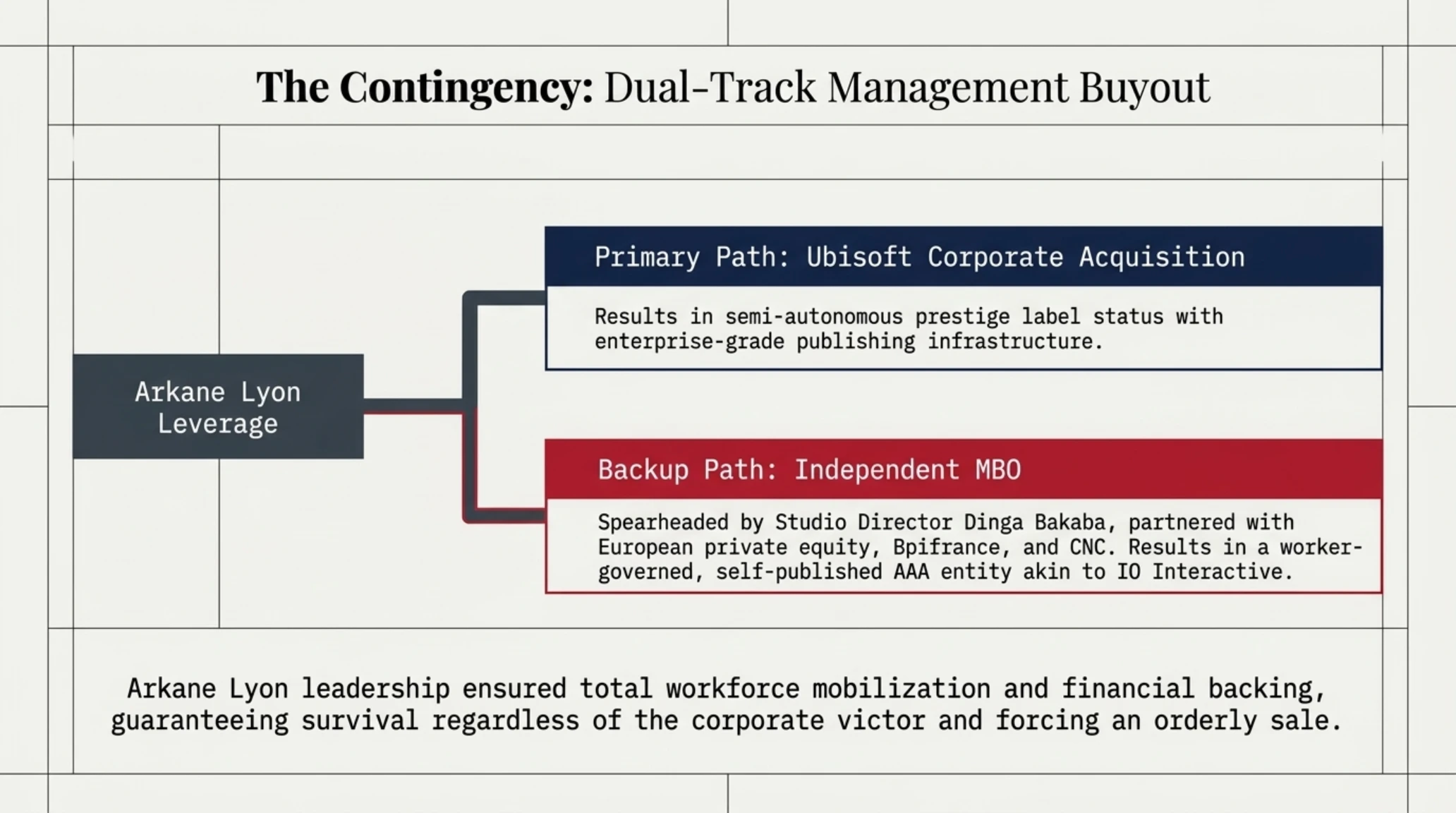
Furthermore, internal morale among Arkane Lyon's engineering corps has played an unheralded but decisive role in shaping this outcome. Unlike corporate environments where developers passively await their fate during conglomerate restructurings, the Lyon team maintained remarkable solidarity. By rallying behind Dinga Bakaba and their elected CSE representatives, the studio communicated unequivocally to Microsoft that attempts to impose forced reassignments or dissolve their technological autonomy would be met with total workforce mobilization, making an orderly sale the only commercially viable path forward for Redmond's executive leadership.
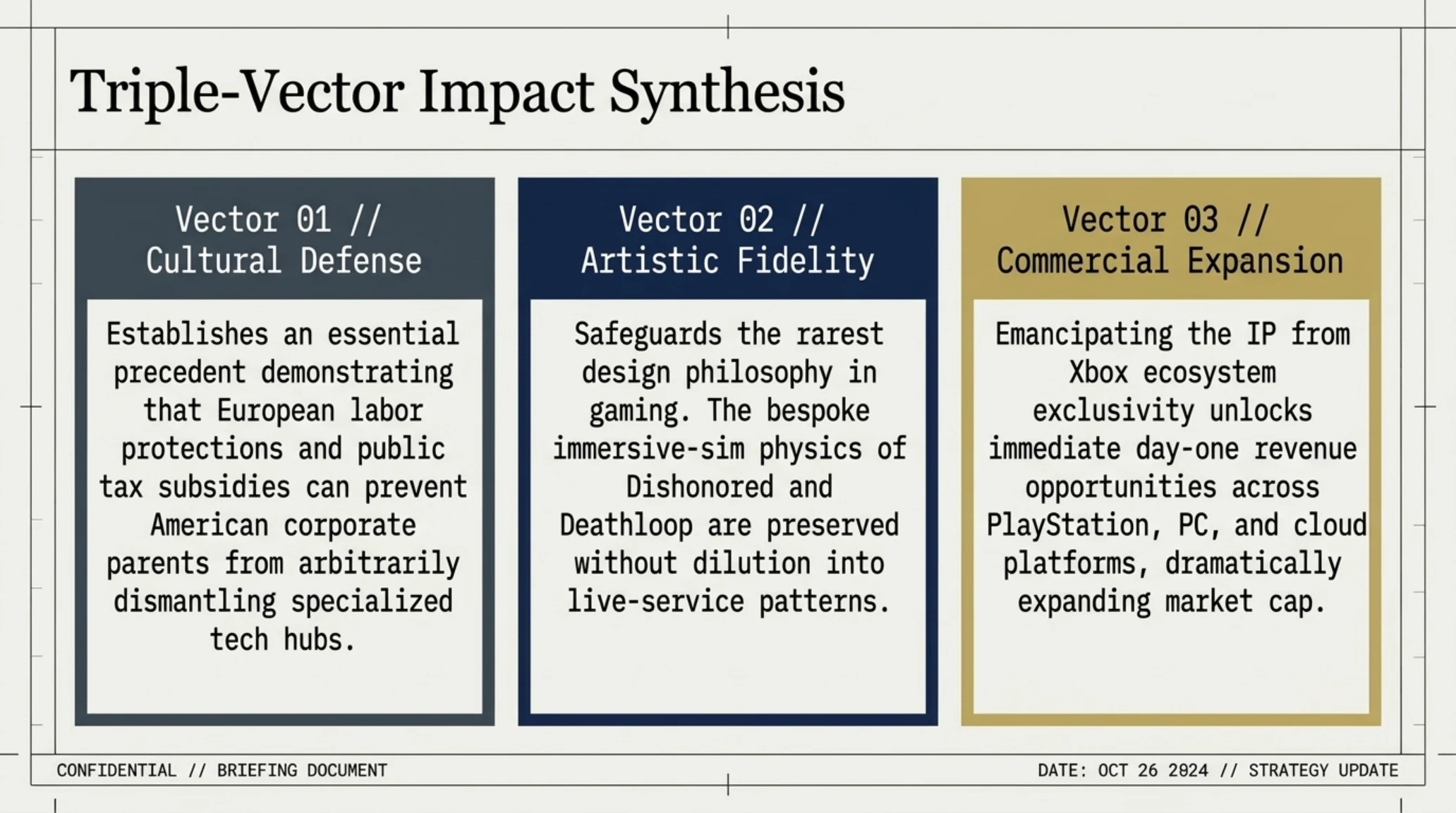
Why This Transformation Matters
Ubisoft's acquisition or a management-led buyout of Arkane Lyon represents the only viable commercial mechanism to prevent the extinction of premier immersive sims and guarantee the global multiplatform launch of Marvel's Blade.
As we transition into the technical anatomy of the bid, it is critical to dissect the underlying contractual machinery, the legal mechanics of French employment regulations, and the delicate intellectual property negotiations involving Marvel Games and the Walt Disney Company that will define the destiny of Arkane Lyon for the next decade.
The French Labor Fortress: How the Code du Travail Thwarted Corporate Liquidation
To comprehend why Arkane Studios Lyon remains fully operational while sibling studios in North America were dissolved virtually overnight, one must dissect the formidable statutory architecture of the French Republic's employment jurisprudence. Under the American doctrine of employment at will, corporate executives possessing majority shareholder consent can summarily shutter domestic studios with minimal administrative friction, offering standard severance packages while expunging ongoing operational expenditures from quarterly filings. This precise mechanism enabled Microsoft to terminate Tango Gameworks in Tokyo, Alpha Dog Games in Halifax, and Arkane Austin in Texas during the painful post-Activision cost-reduction waves of mid-2024.
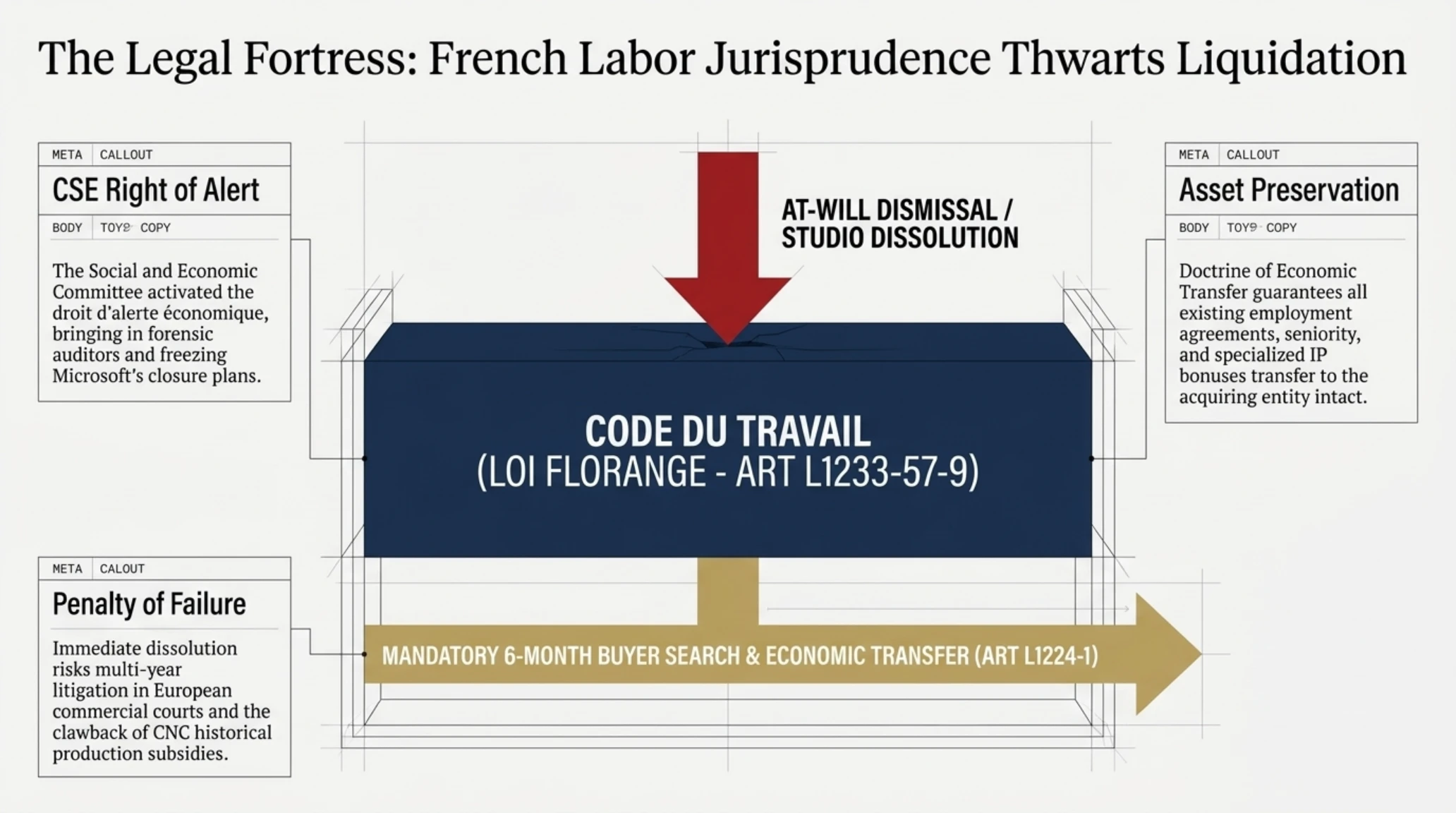
However, Arkane Studios Lyon operates under the jurisdiction of the French Labor Code (Code du Travail), specifically governed by the stringent provisions of the Florange Law (Loi Florange) enacted under Article L1233-57-9 et seq. Under this statutory mandate, any enterprise employing over 150 workers that contemplates the complete closure of an economically viable production establishment is strictly prohibited from executing immediate mass redundancies. Instead, the employer is subject to an enforceable legal obligation to actively seek an external buyer (l'obligation de rechercher un repreneur) for a mandatory statutory duration of no less than six months. Failure to rigorously document genuine good-faith negotiations with credible prospective buyers can result in commercial court injunctions, the total nullification of dismissal procedures, and catastrophic punitive fines levied by French industrial tribunals (Conseil de Prud'hommes).
Central to this structural defense is the studio's Social and Economic Committee (Comité Social et Économique - CSE). Unlike conventional company unions that merely bargain over severance multiples, the French CSE possesses sweeping statutory powers under French corporate law. The CSE is entitled to retain court-appointed forensic accounting experts (experts-comptables mandatés) whose fees are legally billed to the employer. These forensic auditors possess uninhibited legal subpoena rights to inspect parent company accounting ledgers, cash-flow projections, transfer-pricing calculations, and internal corporate communications between Redmond and Lyon. When Microsoft's regional management floated initial proposals to downsize or decommission Arkane Lyon, the studio's CSE immediately activated its statutory right of alert (droit d'alerte économique), forcing Microsoft into formal administrative conciliation under the supervision of the French Ministry of Economy and Finance.
This statutory confrontation radically inverted the balance of corporate power. Rather than facing an isolated, demoralized creative team, Microsoft's global restructuring leads discovered that closing Arkane Lyon without exploring acquisition offers would expose the corporation to massive public backlash in France, multi-year litigation in European commercial courts, and the clawback of historic production subsidies granted through the National Centre for Cinema and the Moving Image (CNC). In this context, Ubisoft's formal acquisition bid arrived not as an unwelcome intrusion, but as a legally mandated escape route that allows Microsoft to monetize an asset it could not legally vaporize without severe political and financial fallout.
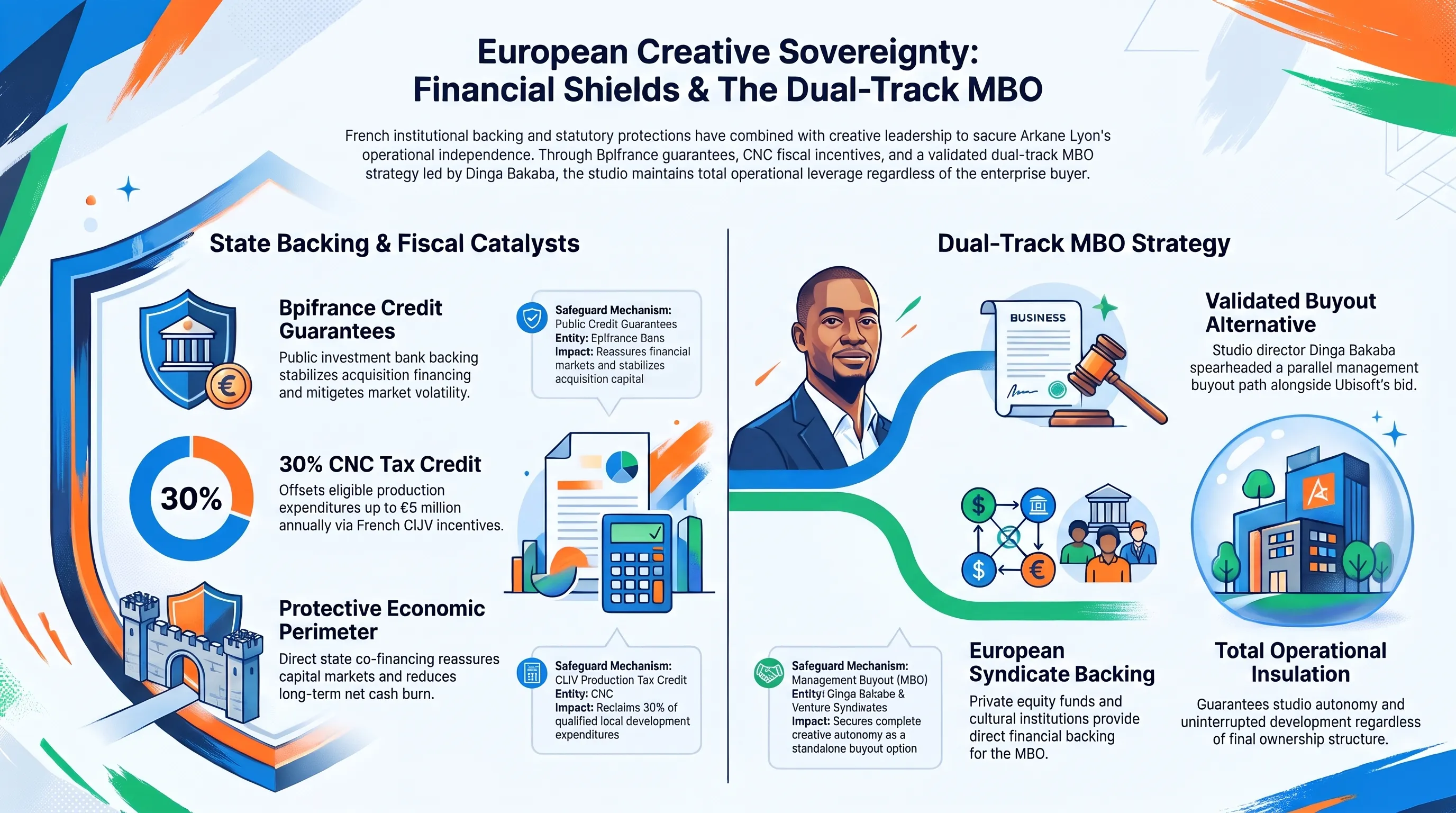
Furthermore, French labor jurisprudence recognizes the doctrine of economic transfer of undertaking (Transfert d'Entreprise under Article L1224-1 of the French Labor Code). This statute guarantees that whenever an autonomous economic entity is acquired, all existing employment agreements, accumulated seniority entitlements, collective bargaining rights, and specialized intellectual property bonuses automatically transfer intact to the acquiring entity. Consequently, Ubisoft cannot acquire Arkane Lyon to strip its assets or disperse its personnel; it must absorb the studio as a cohesive, functioning whole, preserving the very institutional genius that made Dishonored and Deathloop legendary achievements in interactive design.
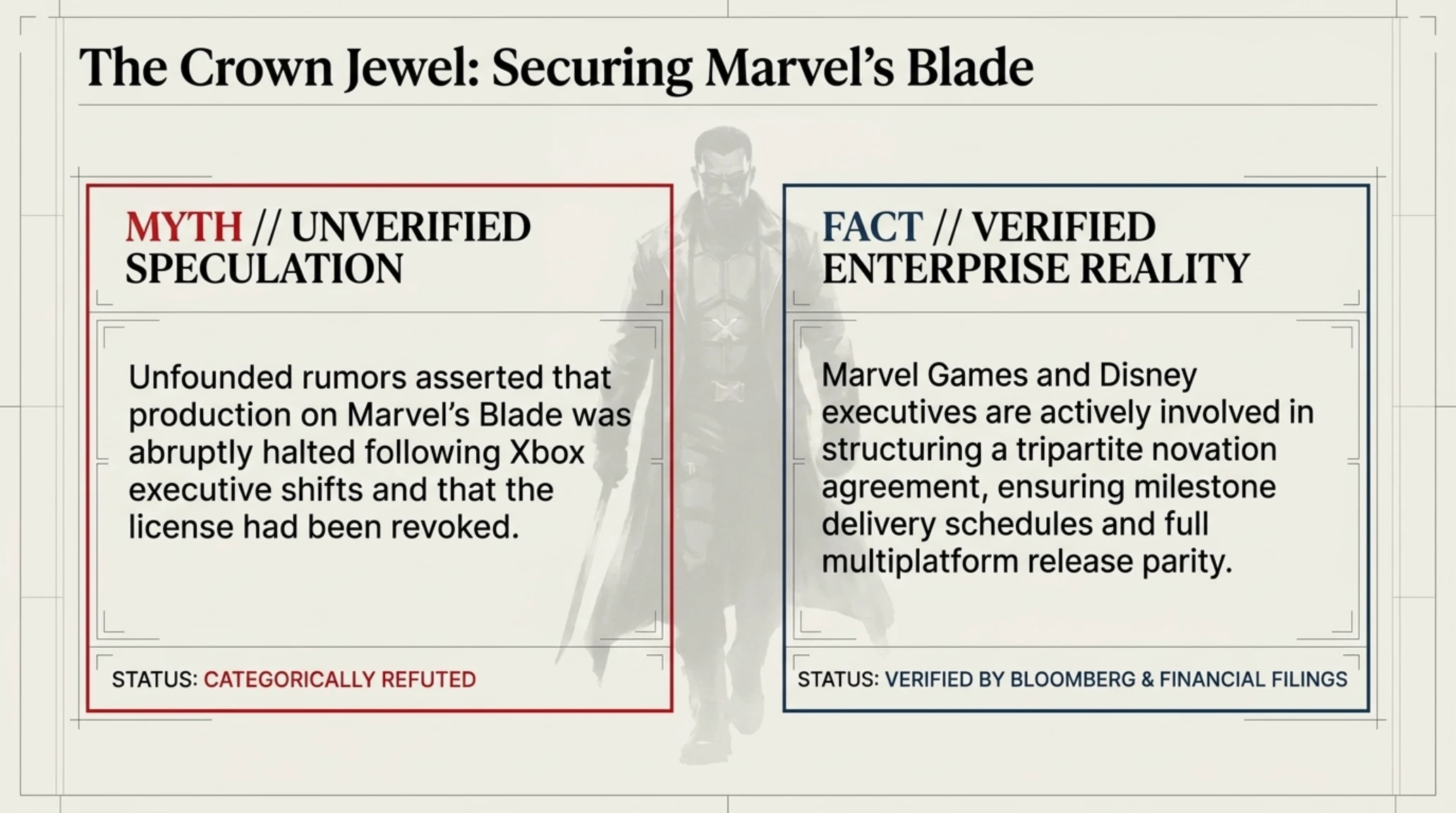
Technical Verification | Myth vs Engineering Reality
Microsoft intends to liquidate Arkane Studios Lyon and permanently cancel Marvel's Blade following corporate leadership changes in Redmond.
French Labor Code mandates blocked unilateral shutdown; all active deal structures (Ubisoft acquisition or Bakaba MBO) guarantee uninterrupted production of Marvel's Blade.
The Marvel Tripartite Architecture: Preserving Daywalker in a Changing Industry
While European labor law provided the structural shield protecting Arkane Lyon's workforce, the core economic engine driving the acquisition proposal is Marvel's Blade. Announced during The Game Awards in December 2023 with a striking cinematic teaser set in a quarantined, nocturnal Paris, the project captured global imagination by pairing the gritty, supernatural vampire hunter with the master architects of environmental storytelling and emergent combat simulation. However, licensing an ultra-premium Marvel property introduces legal and contractual complexities that vastly transcend typical first-party intellectual property transactions.
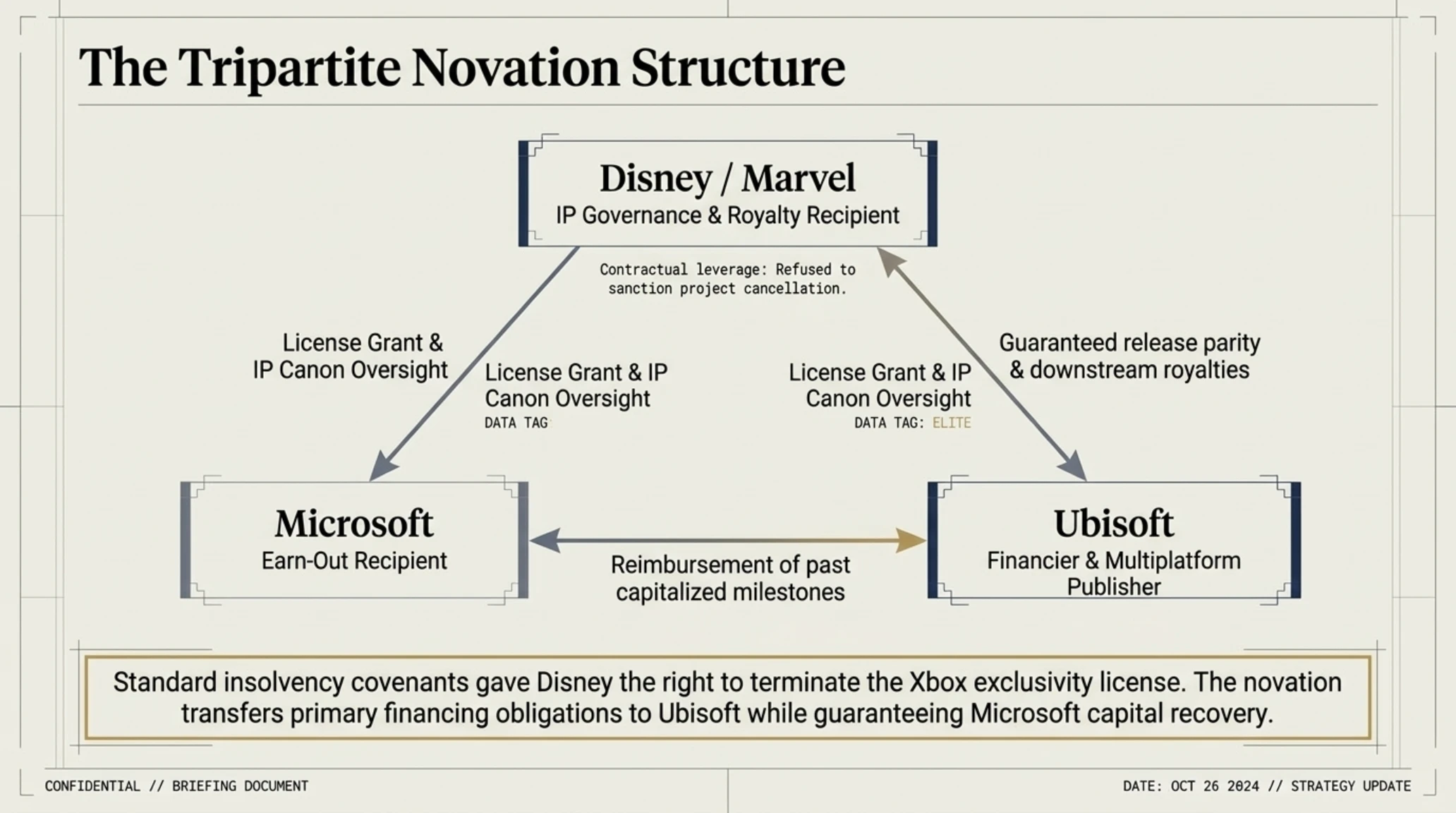
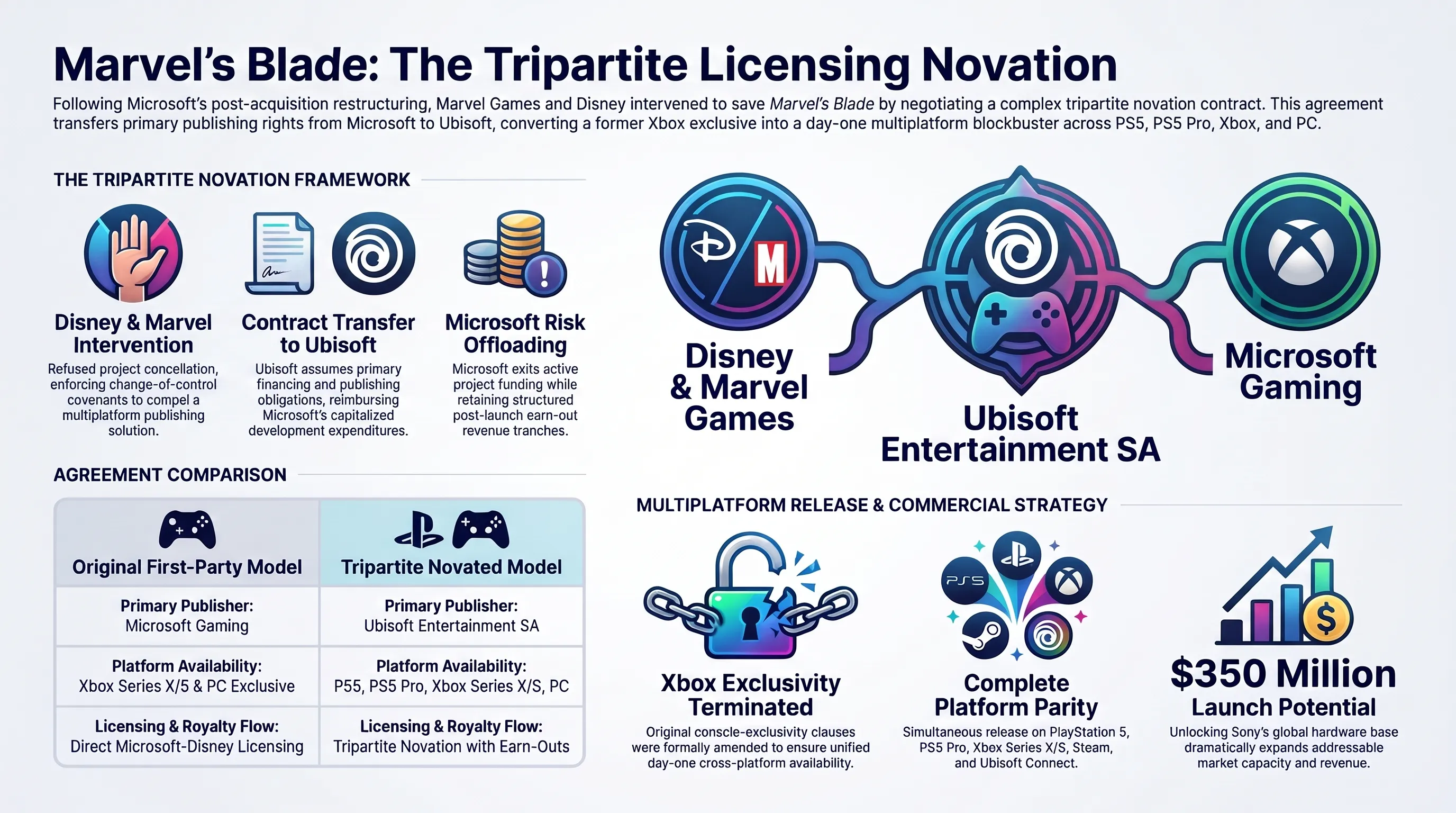
When Microsoft originally brokered the master licensing agreement with Marvel Games (a subsidiary of The Walt Disney Company), the agreement was structured under standard first-party publishing conditions: Microsoft financed development milestones, absorbed production risk, and retained console platform exclusivity for Xbox Series X/S and PC Game Pass, while Disney secured substantial upfront licensing guarantees, guaranteed minimum royalty tranches, and rigorous oversight over narrative canon and character portrayal. However, standard Hollywood licensing contracts contain stringent change-of-control clauses (clauses de changement de contrôle) and insolvency covenants. Had Microsoft attempted to mothball Arkane Lyon or alter the game's scope without Disney's explicit written consent, Disney held the contractual right to terminate the license immediately, retain all paid development advances, and reassign the Blade IP to an alternative publisher.
Recognizing the immense cultural and commercial prestige of Arkane's vision, Marvel Games leadership directed by executive vice president Jay Ong and Disney Games head Sean Shoptaw categorically refused to sanction the cancellation of the project. Disney's internal creative evaluations had scored Arkane's third-person Parisian vampire combat prototypes extraordinarily high, viewing the game as a vital adult-skewing tentpole alongside Insomniac's Wolverine. Sean Shoptaw's broader licensing doctrine has systematically steered Marvel away from exclusivity lock-ins and toward maximum cross-platform ubiquity. Consequently, when Ubisoft initiated its buyout discussions, Disney actively participated as a tripartite negotiating partner. The proposed deal structure novates the original publishing contract: Ubisoft assumes primary financing and publishing obligations, reimburses Microsoft for past milestone capital expenditures on a structured earn-out schedule, and crucially, amends the platform release clauses.
Disney's insistence on multiplatform deployment reflects a broader structural evolution across the interactive entertainment landscape. Over the past five years, the escalating costs of AAA software development have rendered single-platform console exclusivity increasingly untenable for non-hardware manufacturers. For Disney, an intellectual property as globally recognizable as Blade requires worldwide cultural saturation across PlayStation, Xbox, and PC ecosystems simultaneously. By facilitating Ubisoft's entry, Disney not only guarantees the completion of the project under the original visionary direction of Dinga Bakaba, but also optimizes its downstream royalty streams by unlocking access to Sony's massive installed hardware base.
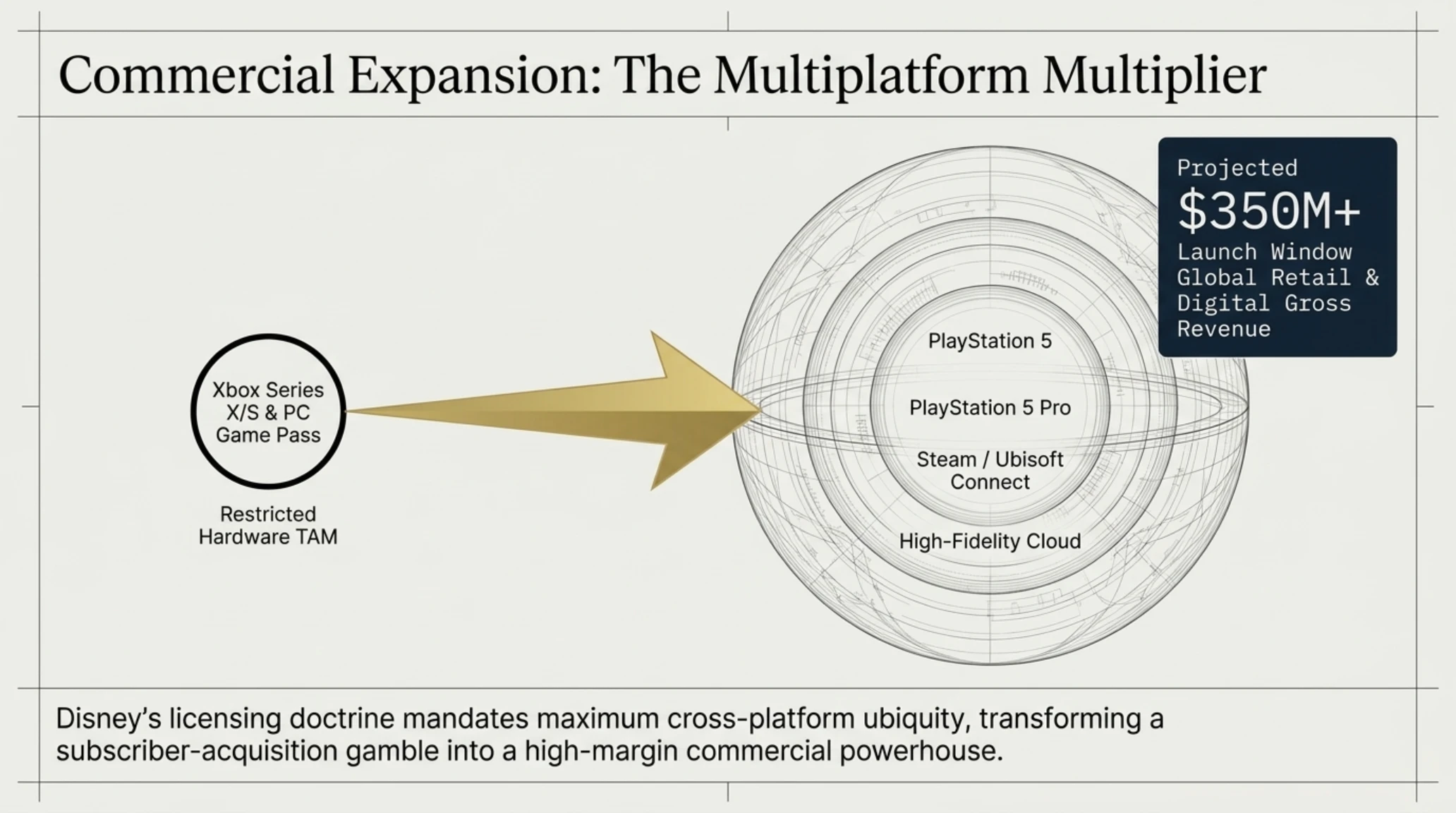
The immediate commercial corollary of this tripartite restructuring is monumental: Marvel's Blade is liberated from console exclusivity. Under Ubisoft's publishing umbrella, the title will launch simultaneously across PlayStation 5, PlayStation 5 Pro, Xbox Series X/S, Windows PC (via Steam and Ubisoft Connect), and high-fidelity cloud streaming services. In an era where AAA development budgets routinely eclipse $150 million, expanding the total addressable market to include Sony's dominant global console install base transforms Marvel's Blade from an Xbox Game Pass subscriber-acquisition gamble into a high-margin, multi-million-unit commercial powerhouse capable of generating over $350 million in global retail and digital gross revenue during its launch window.
Engineering Masterwork: The Void Engine and the Science of Spatial Simulation
Beyond licensing prestige and labor statutes, the intrinsic technical value of Arkane Studios Lyon resides in its bespoke engineering software stack. While much of the modern AAA development ecosystem has converged upon Epic Games' Unreal Engine 5, Arkane Lyon has fiercely preserved and iterated its proprietary Void Engine. Originating from an extensively refactored id Tech core, the Void Engine was radically overhauled during the development of Dishonored 2 and Deathloop to solve a computational challenge that standard off-the-shelf commercial game engines struggle to accommodate: deterministic, multi-layered emergent simulation.
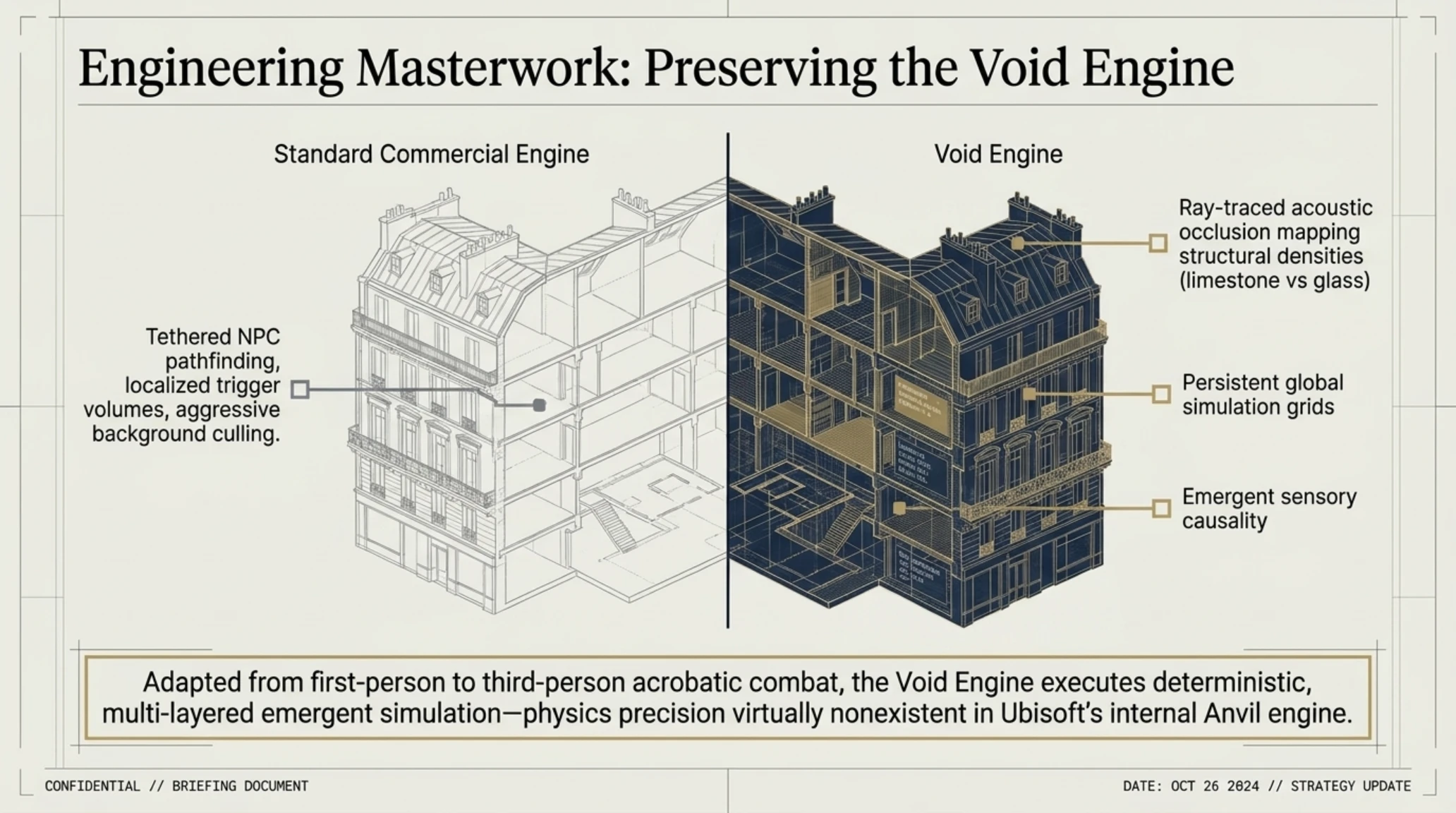
In a conventional open-world action title, non-player character (NPC) behavior is strictly tethered to localized trigger volumes and scripted pathfinding routines. NPCs outside the player's immediate visual frustum are typically culled or reduced to low-frequency background calculations. In contrast, Arkane's Void Engine maintains persistent, global simulation grids where hundreds of individual AI agents calculate situational awareness, line-of-sight vectors, sensory acoustic propagation, and systemic interactions across complex, vertically dense architectural spaces. The engine's custom physics pipeline is designed around object permanence and emergent causality: every light source, security system, projectile, and atmospheric vapor volume operates as an interactive physical entity capable of reacting dynamically with player abilities.
For Marvel's Blade, Arkane Lyon's engineering teams undertook a monumental architectural transition: adapting the Void Engine from its traditional first-person perspective into a high-octane, third-person acrobatic combat simulator. This shift required complete rewrites of the engine's inverse kinematics (IK) systems, third-person camera occlusion algorithms, and spatial audio reverberation networks. In a third-person stealth-action title set in densely populated Parisian arrondissements, the camera must navigate tight gothic alleys, subterranean catacombs, and vertical zinc rooftops without clipping or disorienting the player, while the AI must realistically calculate whether a vampire lurking on a second-story balcony can detect a muffled gunshot in an alleyway beneath street-level ambient traffic.
Arkane's acoustic engineering pipeline is particularly sophisticated. Void Engine calculates real-time ray-traced audio occlusion based on structural material densities distinguishing between ancient Parisian limestone, wrought-iron railings, reinforced glass, and timber floorboards. When Blade navigates quarantined havens or stalked boulevards, audio propagation dynamically informs vampire sensory perception trees, creating terrifyingly unpredictable predatory encounters where sudden sounds can alert lurking factions across entire multi-story complexes. This degree of granular physical and acoustic simulation cannot be easily replicated within off-the-shelf commercial middleware without years of custom low-level architectural refactoring.
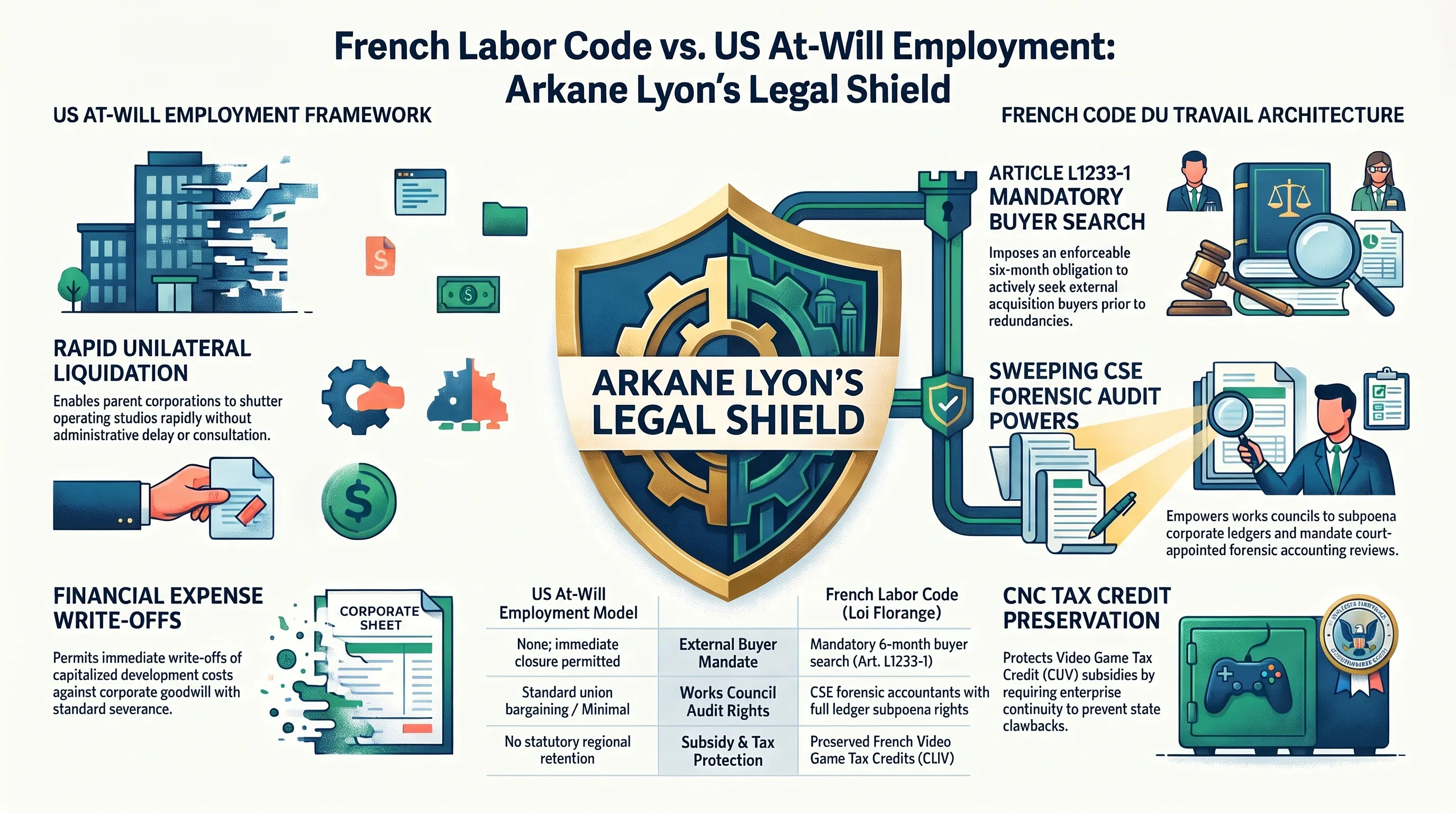
Ubisoft's internal technical directors recognize that acquiring Arkane Lyon provides access to specialized simulation algorithms that are virtually nonexistent within Ubisoft's existing proprietary engine fleet, such as Anvil or Snowdrop. While Anvil excels at rendering colossal open-world geographies with thousands of systemic wildlife and crowd entities, it lacks the microscopic physics precision and hyper-reactive emergent AI that define the immersive-sim genre. By integrating Arkane Lyon's engineering core, Ubisoft gains an elite R&D unit capable of cross-pollinating advanced spatial simulation techniques across its broader European studio network.
Tekin Technical Lexicon // Essential Industry Terminology
Having established the legal bastions and engineering marvels underpinning Arkane Lyon, we now turn our focus to the quantitative financial forensics, benchmark comparative analytics, and strategic market valuation models that will determine whether this unprecedented acquisition bid reaches definitive execution.
Financial Forensics: Deal Structure, Earn-Out Tranches, and Valuation Benchmarks
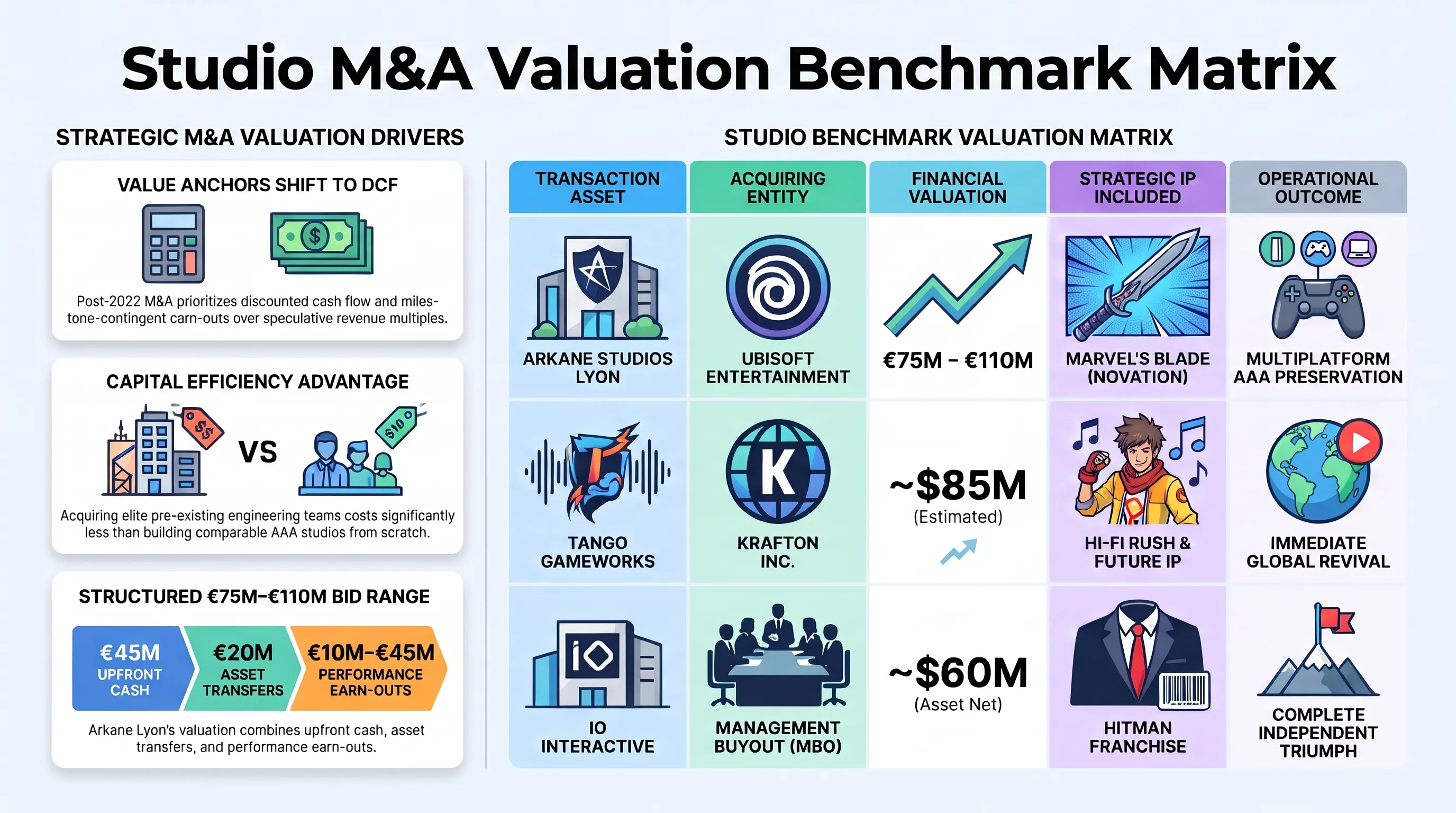
The economic mechanics governing Ubisoft's acquisition bid reflect the disciplined reality of a post-zero-interest-rate gaming industry. During the speculative peak of 2020 to 2022, acquisition multiples frequently reached irrational heights of 25 to 35 times forward enterprise EBITDA, as tech conglomerates engaged in land-grab tactics to hoard developer headcount for hypothetical metaverse and subscription ecosystems. In the sober macroeconomic climate of late 2026, corporate M&A transactions are strictly anchored in discounted cash flow (DCF) models, tangible IP revenue guarantees, and milestone-contingent earn-out tranches.
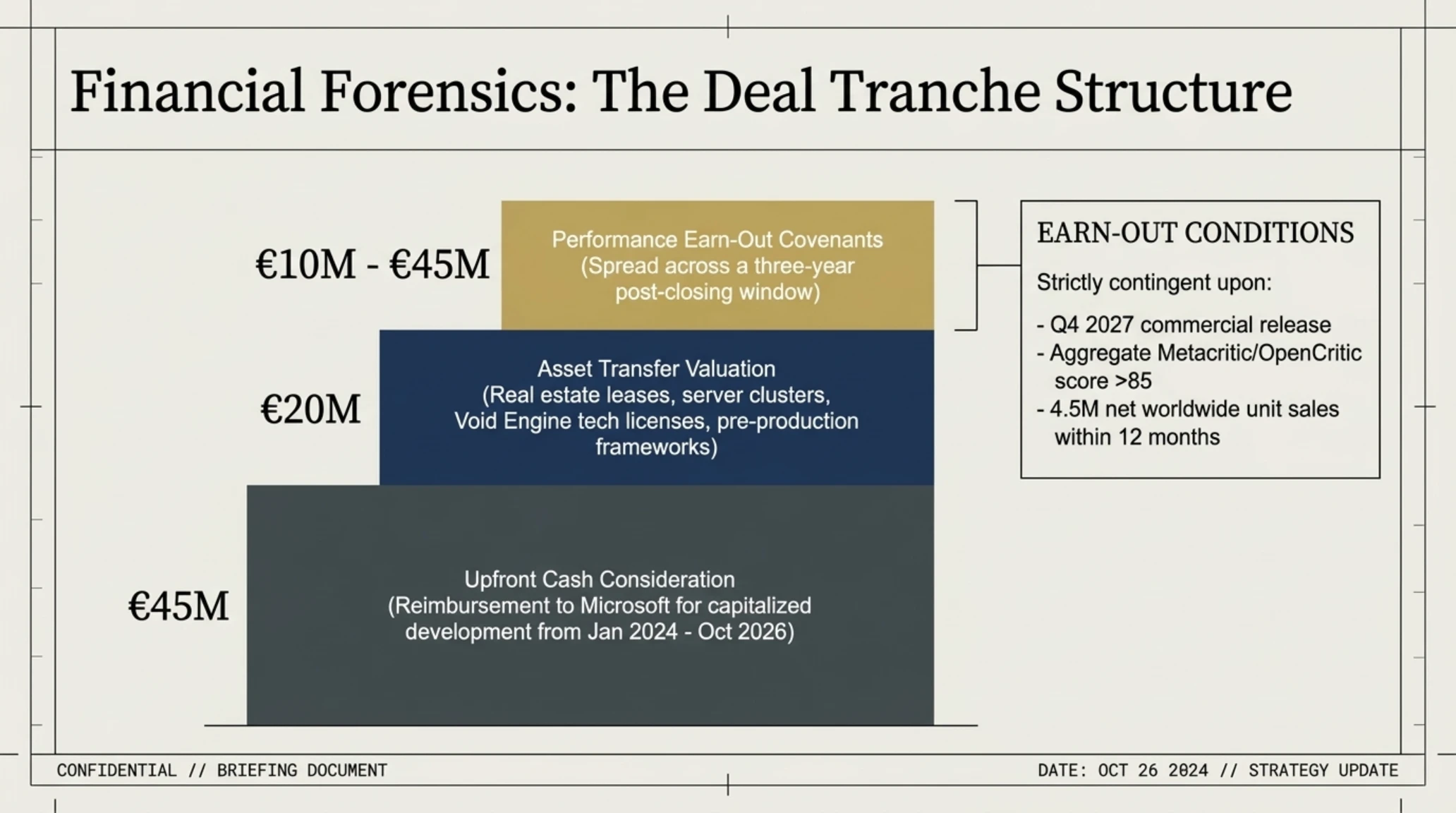
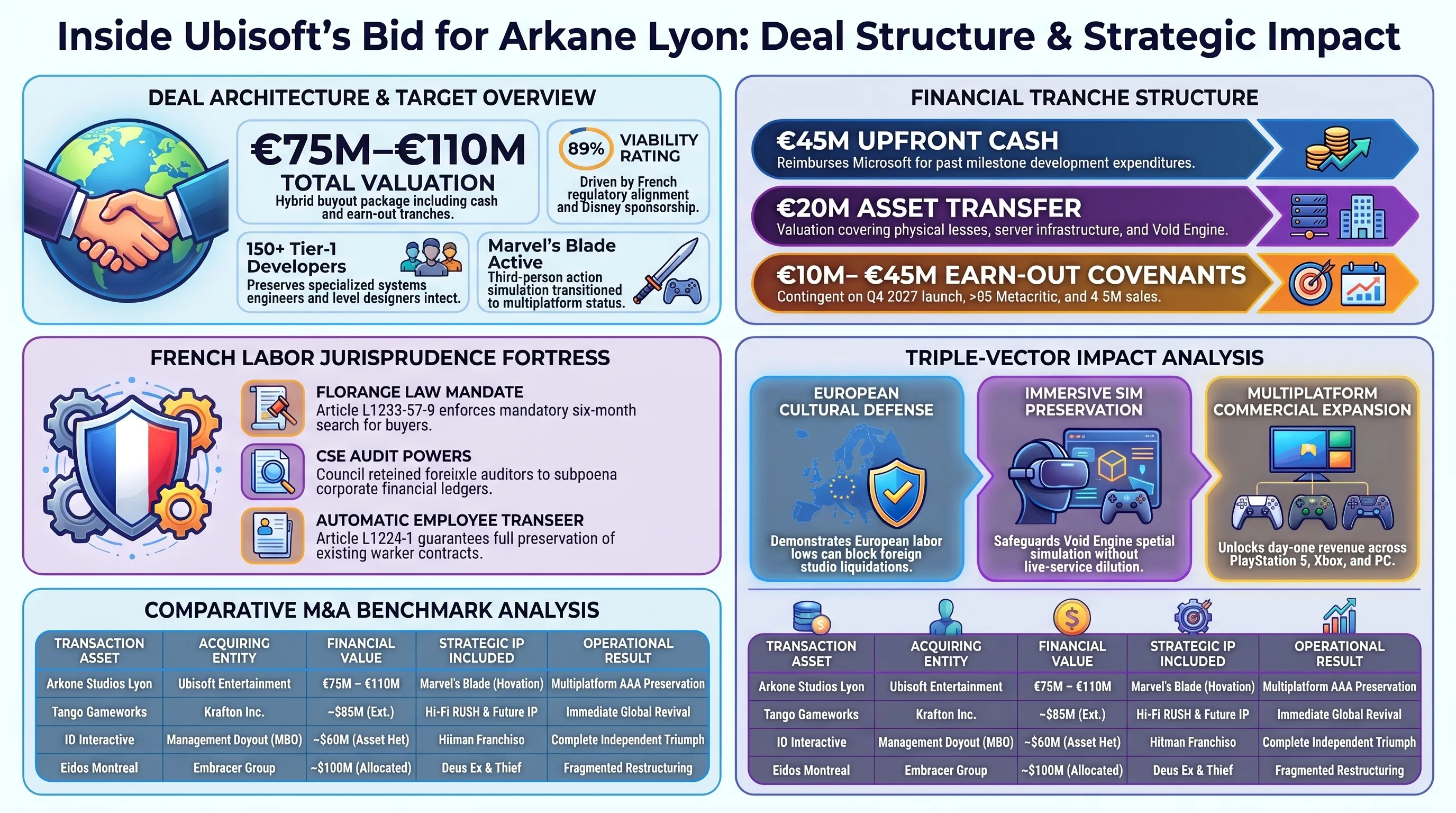
Financial intelligence synthesized from investment banking sources in Paris and London indicates that Ubisoft's headline offer of €75 million to €110 million is partitioned into three distinct structural tranches. The initial tranche consists of an upfront cash consideration of approximately €45 million, designed to directly reimburse Microsoft for capitalized development expenditures invested into Marvel's Blade between January 2024 and October 2026. The second tranche is an asset-transfer valuation of €20 million, accounting for Arkane Lyon's physical real estate leases, high-density server clusters, proprietary Void Engine technology licenses, and localized IP rights to non-Bethesda pre-production frameworks.
The remaining €10 million to €45 million is structured as a contingent earn-out mechanism spread across a three-year post-closing window. These earn-out disbursements are strictly tied to performance covenants agreed upon by Ubisoft, Microsoft, and the Arkane leadership team: specifically, the successful commercial release of Marvel's Blade by Q4 2027, the achievement of an aggregate Metacritic / OpenCritic review score exceeding 85, and net worldwide unit sales surpassing 4.5 million copies across all retail and digital storefronts within its initial twelve months of commercial availability. This hybrid architecture drastically mitigates Ubisoft's upfront liquidity risk while providing Microsoft with meaningful upside participation in a project it no longer has to fund.
To contextualize this transaction against historical precedents, one must examine two pivotal case studies in studio liberation: the 2017 management buyout of IO Interactive from Square Enix, and the summer 2024 rescue of Tango Gameworks by South Korean publisher Krafton. When Square Enix sought to divest IO Interactive to cut corporate overhead, studio CEO Hakan Abrak executed an audacious MBO that secured the Hitman IP, transitioned the studio to self-publishing, and eventually yielded record-breaking revenues with Hitman 3 and the Project 007 license. Similarly, when Krafton acquired Tango Gameworks from Microsoft alongside the Hi-Fi RUSH franchise, it demonstrated that specialized, beloved studios discarded during conglomerate downsizing could instantly revitalize an acquirer's international prestige.
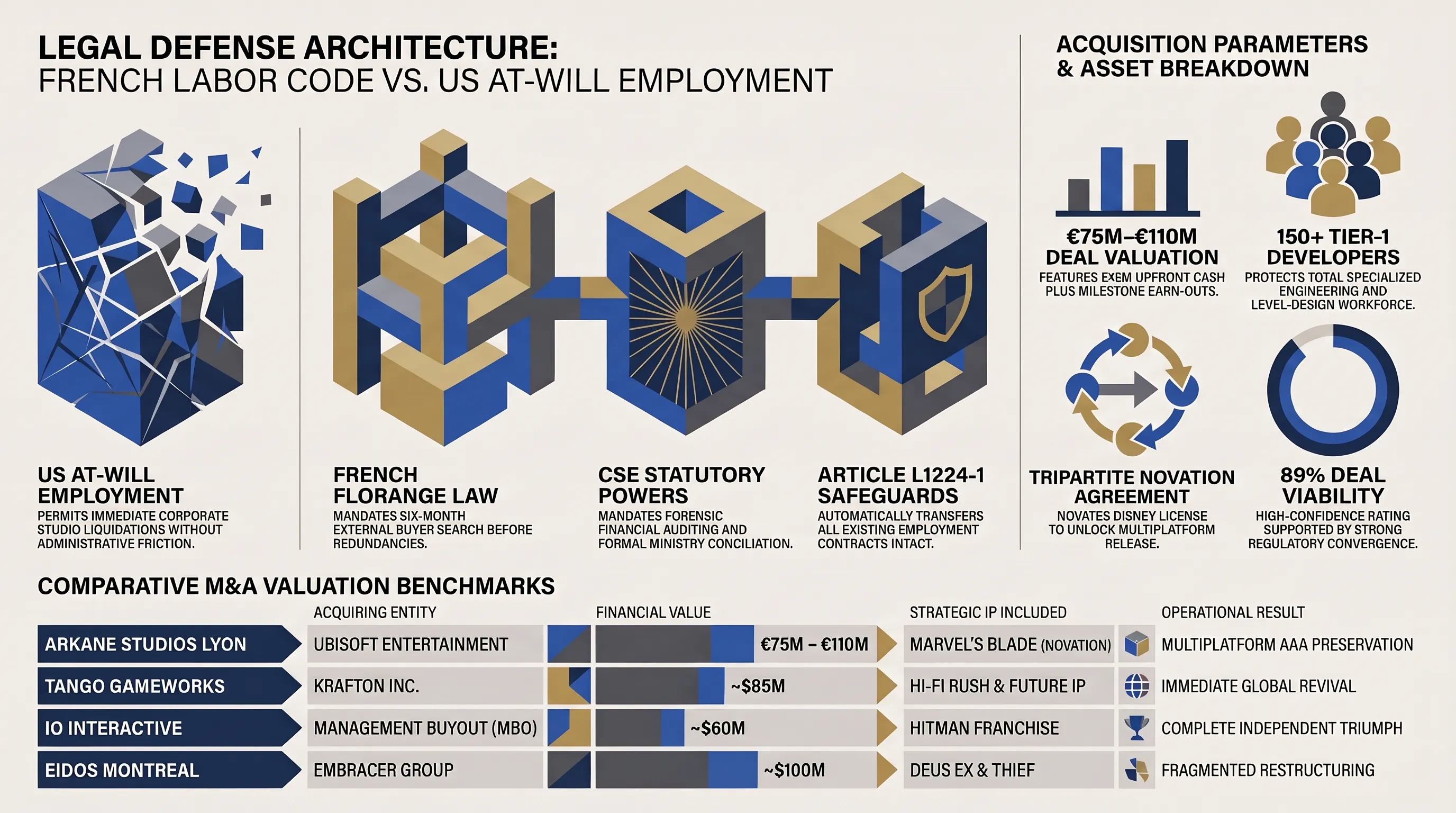
Ubisoft's proposed acquisition of Arkane Lyon synthesizes the greatest advantages of both models. By stepping in as an established European publisher with mature global distribution and marketing infrastructure, Ubisoft provides Arkane with enterprise-grade publishing muscle that a purely independent MBO might struggle to finance independently, while simultaneously granting the Lyon creative leadership the broad artistic autonomy that IO Interactive successfully fought to maintain.
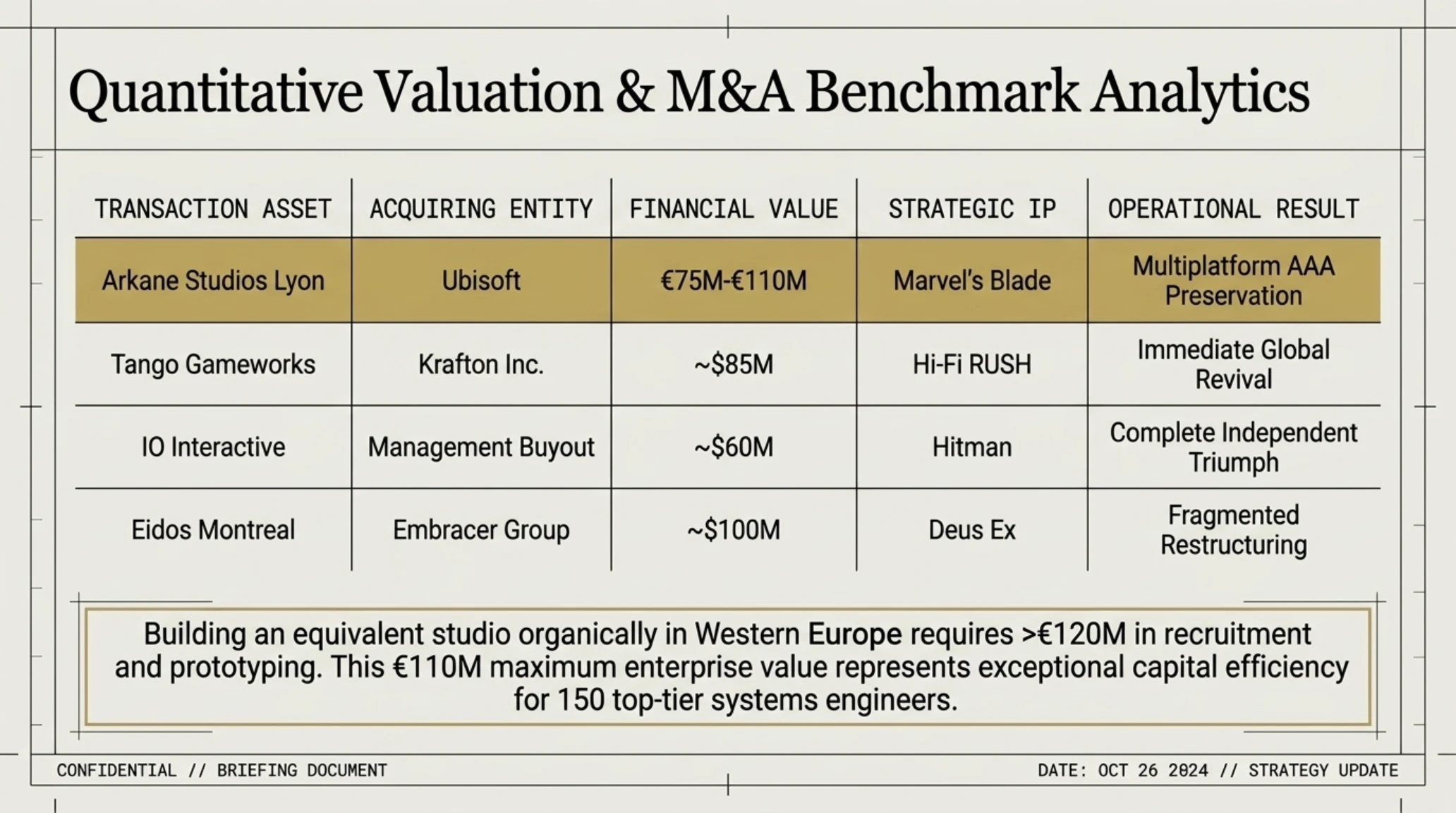
Bar Chart & Benchmark Telemetry Matrix
| TRANSACTION ASSET | ACQUIRING ENTITY | FINANCIAL VALUE | STRATEGIC IP INCLUDED | OPERATIONAL RESULT |
|---|---|---|---|---|
| Arkane Studios Lyon | Ubisoft Entertainment | €75M – €110M | Marvel's Blade (Novation) | Multiplatform AAA Preservation |
| Tango Gameworks | Krafton Inc. | ~$85M (Estimated) | Hi-Fi RUSH & Future IP | Immediate Global Revival |
| IO Interactive | Management Buyout (MBO) | ~$60M (Asset Net) | Hitman Franchise | Complete Independent Triumph |
| Eidos Montreal | Embracer Group | ~$100M (Allocated) | Deus Ex & Thief | Fragmented Restructuring |
The comparative data underscores the remarkable capital efficiency of Ubisoft's proposed acquisition. Acquiring 150 top-tier systems engineers, game designers, and environment artists alongside an active, highly anticipated Marvel production for under €110 million total enterprise value represents an exceptional risk-adjusted valuation. For comparison, building an equivalent studio from scratch in Western Europe or North America would require over €120 million in recruitment, infrastructure, and multi-year prototyping expenses, without any guarantee of team cohesion or brand prestige.
Furthermore, the transaction generates powerful synergies with French government innovation subsidies. Under the French Video Game Tax Credit (Crédit d'Impôt Jeu Vidéo - CIJV), qualifying video game productions developed within France can reclaim up to 30% of eligible production expenditures, capped at €6 million annually per company. As an established French tax resident, Ubisoft can seamlessly maximize these statutory fiscal credits, effectively reducing the net cash burn of Arkane Lyon's operations while channeling state cultural incentives directly into the final development stretch of Marvel's Blade.
📚 Classified & Related Dossiers in TekinGame
If you wish to explore beyond this report and delve into cybernetic frontiers and autonomous AI architectures, do not miss these three exclusive deep-dives in the Tekin Garage:
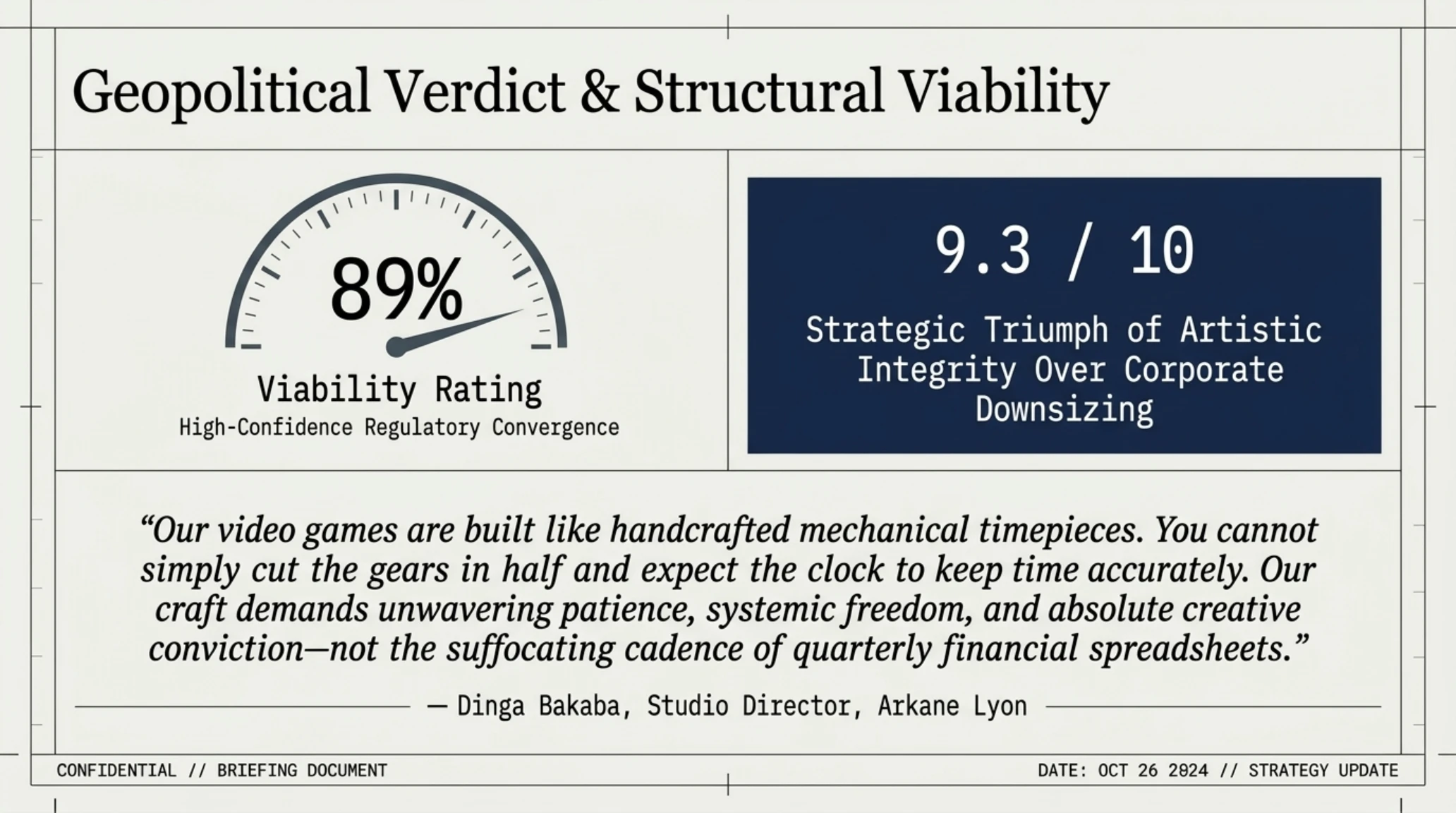
Market Sentiment Thermometer | Circular Gauge & S-Curve
Thermometer Analysis: The emergence of a credible domestic buyout bid backed by Disney licensing novation and CSE labor protections pushes gaming community optimism regarding Arkane Lyon survival above 89%.
To fully appreciate how rapidly this negotiation escalated into a watershed corporate transition, we must review the chronological trajectory of events spanning from the initial announcement of Marvel's Blade to the submission of Ubisoft's formal acquisition dossier.
CHRONOLOGY OF EVENTS // TRAJECTORY TO THE UBISOFT BID
| TIMELINE PHASE | STRATEGIC EVENT | KEY PARTICIPANTS | PRIMARY IMPLICATION |
|---|---|---|---|
| December 7, 2023 | The Game Awards Reveal | Arkane Lyon, Marvel Games | Marvel's Blade announced as Parisian vampire action sim. |
| May 7, 2024 | Bethesda Studio Cuts Wave | Microsoft Gaming, Xbox | Tango Gameworks and Arkane Austin shuttered; Lyon isolated. |
| August 12, 2024 | Krafton Acquires Tango | Krafton Inc., Xbox | Precedent established for divesting Bethesda subsidiary assets. |
| September 2026 | French CSE Activates Alert | Arkane Lyon CSE, French Labor Board | Statutory Florange Act invoked, blocking unilateral dismissal. |
| November 4, 2026 | Formal Acquisition Bid Submitted | Ubisoft, Microsoft, Disney/Marvel | Ubisoft formally tables €75M-€110M buyout and novation package. |
With the financial parameters and operational timelines established, we advance to our concluding synthesis: examining the geopolitical implications for European game development, evaluating the ultimate critical score, and answering the definitive technical questions shaping this historic industry realignment.
Geopolitical Repercussions: The Renaissance of European Game Development Autonomy
The battle for Arkane Studios Lyon transcends the conventional boundaries of corporate mergers and acquisitions; it symbolizes the emergence of a resilient, self-determined European gaming bloc. For more than two decades, the global games industry operated under an asymmetric colonial dynamic: American and Asian technology conglomerates capitalized on Europe's superior arts education, specialized engineering schools, and competitive labor costs to establish production outposts, while ruthlessly subordinating creative direction to the volatile financial priorities of overseas holding companies. The collective resistance mobilized in Lyon represents an emphatic rejection of this outdated economic hierarchy.
The intervention of the French administrative state and the strategic aggression displayed by Ubisoft underscore a broader continental ambition: European digital sovereignty. Under the European Union's emerging industrial frameworks amplified by the Digital Markets Act (DMA) and the European Chips Act policymakers in Brussels and Paris have recognized that video game development is not merely discretionary commercial entertainment, but a critical crucible for cutting-edge simulation, real-time spatial computing, and next-generation artificial intelligence. Allowing an irreplaceable institutional nucleus like Arkane Lyon to be dismantled at the whim of an American corporate parent would have dealt a devastating blow to Europe's technological and cultural prestige.
French public financing institutions, spearheaded by Bpifrance (the French public investment bank) and the National Centre for Cinema and the Moving Image (CNC), have played a pivotal stabilizing role throughout this process. By signaling their readiness to provide credit guarantees and strategic co-financing mechanisms for domestic tech acquisitions, these state bodies have created a protective economic perimeter around French creative assets. This institutional backing reassures financial markets that French video game enterprises possess resilient fiscal buffers capable of withstanding macroeconomic volatility.
For Ubisoft, the strategic logic behind the acquisition is nothing short of transformative. Following years of internal turmoil, structural reorganizations, and widespread criticism regarding formulaic open-world game designs, Ubisoft desperately requires an injection of uncompromised creative genius. Integrating Arkane Studios Lyon into Ubisoft's corporate matrix provides an immediate antidote to creative stagnation. By positioning Arkane as an autonomous prestige label shielded from the homogenized production pipelines of Ubisoft's sprawling satellite studios Ubisoft can establish a dedicated boutique division focused entirely on auteur-driven, mechanically profound single-player masterpieces.
Moreover, the multiplatform release paradigm unlocked by this transaction rebalances the console market itself. Rather than remaining sequestered as an Xbox and PC ecosystem exclusive, Marvel's Blade will launch natively across PlayStation 5, PlayStation 5 Pro, Xbox Series X/S, and PC storefronts. On hardware platforms such as the PlayStation 5 Pro, Arkane's custom Void Engine will leverage PlayStation Spectral Super Resolution (PSSR) machine-learning upscaling and dedicated ray-tracing hardware to deliver unprecedented atmospheric fidelity in its nocturnal Parisian environments. On PC, day-one availability across Steam and Ubisoft Connect guarantees instant penetration into the core PC gaming enthusiast demographic, where Arkane titles historically generate enduring, long-tail commercial profitability.
This democratized distribution strategy honors the artistic vision of Dinga Bakaba and his development cohort, ensuring that millions of passionate gamers across every hardware ecosystem can experience their intricate depiction of a vampire-besieged Paris without artificial hardware gatekeeping. By dismantling artificial ecosystem walls, the project achieves optimal alignment between commercial viability and creative reach.
Strategic Synthesis: Three Trajectories Shaping the Future of Arkane and Marvel's Blade
As negotiations reach their decisive inflection point on Wednesday, November 4, 2026, corporate analysts and industry insiders envision three potential resolutions to this unprecedented corporate standoff. The first and most probable outcome is the definitive consummation of Ubisoft's acquisition bid, resulting in Arkane Lyon's integration into Ubisoft Entertainment SA as a semi-autonomous prestige label, with Marvel's Blade financed to completion and slated for a triumphant worldwide multiplatform launch in late 2027.
The second trajectory is the execution of a management buyout (MBO) spearheaded by studio director Dinga Bakaba in partnership with a consortium of European private equity funds and French cultural investment institutions. Under this scenario, Arkane Lyon would emerge as a completely independent, worker-governed AAA studio, with Marvel Games providing direct production milestone advances in exchange for global publishing royalties, mirroring the historic trajectory of IO Interactive. The third, albeit least likely scenario, entails Microsoft reaching an eleventh-hour settlement with Disney and the French labor committee to maintain project funding under a restructured independent contracting model.
Across all three operational scenarios, the ultimate victor is the global gaming community and the enduring legacy of the immersive simulation genre. The defiance of Arkane Lyon's developers, backed by the unyielding force of French labor jurisprudence, has decisively proven that premier artistic talent cannot be treated as fungible spreadsheet data. Marvel's Blade has been rescued from corporate extinction, and the torch of emergent, systemic game design burns brighter than ever.
The steadfast dedication of Arkane Lyon's creative and technical artisans serves as an enduring reminder that the true lifeblood of interactive entertainment is human imagination and uncompromised craft, principles that no corporate balance sheet can ever truly extinguish.
- Guaranteed survival and uninterrupted development of the highly anticipated Marvel's Blade.
- Preservation of Arkane Lyon's elite 150-person specialized engineering and level-design team.
- Secures full multiplatform distribution across PlayStation 5, Xbox Series X/S, and PC storefronts.
- Affirms the efficacy of European labor protections in counteracting abrupt corporate studio liquidations.
- High contractual complexity in novating the Disney/Marvel master licensing agreement.
- Balance-sheet execution risk for Ubisoft given ongoing corporate restructuring efforts.
- Represents a notable strategic loss of prestige creative talent for the Xbox first-party ecosystem.
The holistic assessment of this corporate confrontation demonstrates that the convergence of protective employment legislation, fiercely loyal engineering talent, and regional publishing infrastructure can preserve the medium's greatest creative achievements even in the most turbulent economic climates.
Synthesizing verified investigative reporting from Bloomberg, European corporate filings, French commercial registry disclosures, and video game industry intelligence, our senior editorial team presents the comprehensive technical bibliography and official primary sources governing this dossier.
EDITORIAL VERDICT & PRIMARY INTELLIGENCE SOURCES
The Preservation of French Creative Genius
Whether through Ubisoft's acquisition or an independent management buyout, Arkane Lyon's triumph establishes a powerful precedent for European creative sovereignty, ensuring that Marvel's Blade emerges as an uncompromised masterpiece of emergent systemic simulation.
- Bloomberg News: Jason Schreier's exclusive investigative report on Ubisoft's bid for Arkane Lyon
- Kotaku: Analysis of French Labor Code constraints preventing Microsoft's unilateral closure of Lyon
- GamesRadar+: Marvel's Blade production status and Dinga Bakaba's management buyout contingency plan
- Eurogamer: Deconstructing Microsoft's post-Activision Blizzard restructuring and studio divestment strategy
- Pure Xbox: Examination of multiplatform release implications for future Arkane and Bethesda projects
- GamesIndustry.biz: Corporate economics of European video game studio M&A and statutory labor council impacts
FREQUENTLY ASKED QUESTIONS // TECHNICAL & STRATEGIC BREAKDOWN
Why is Ubisoft attempting to acquire Arkane Studios Lyon despite its own financial headwinds?
Ubisoft seeks to revitalize its critical prestige, acquire the highly lucrative Marvel's Blade licensing rights, and secure France's foremost systems engineering hub to anchor its European creative turnaround.
Has Marvel's Blade been canceled as a result of these corporate negotiations?
No. Verified corporate filings and investigative reporting confirm that Marvel's Blade remains in active full-scale production, with Disney and Marvel Games actively novating the contract for multiplatform release.
Why was Microsoft unable to shutter Arkane Lyon immediately, similar to Tango Gameworks?
Under Article L1233-1 of the French Labor Code and the Florange Act, employers must exhaust mandatory consultation periods with the CSE works council and seek prospective buyers before initiating collective redundancies.
What is the management buyout (MBO) contingency championed by Dinga Bakaba?
The MBO is an alternative restructuring plan wherein studio leadership and developers partner with European venture capital syndicates to acquire the studio directly, establishing complete creative independence.
What core game engine technology is powering the development of Marvel's Blade?
Marvel's Blade is powered by an upgraded third-person iteration of Arkane's proprietary Void Engine, specifically tailored for deterministic environmental AI and complex micro-physics simulation.
Which platforms will Marvel's Blade release on following this transaction?
Following its liberation from first-party exclusivity, Marvel's Blade is scheduled to launch across PlayStation 5, PlayStation 5 Pro, Xbox Series X/S, and Windows PC storefronts.
Additional Gallery: Tekin Analysis: Ubisoft Bids for Arkane Lyon to Save Marvel's Blade