
🔥 Technical Autopsy of 6 May 2026 Masterpieces: Have Hardware Architectures Surrendered?
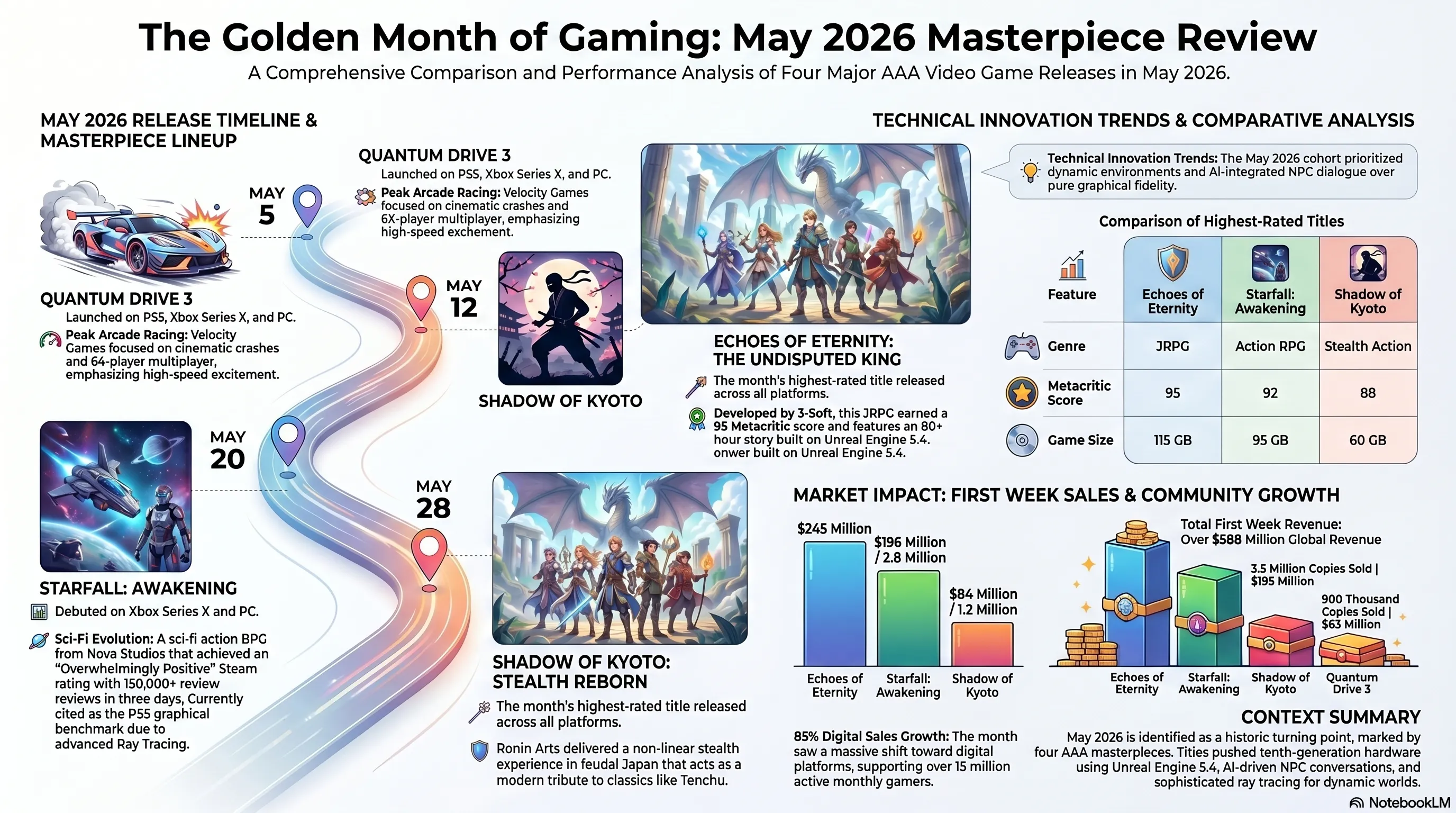
Greetings to the engineers and hardcore gamers of Tekingame! 🕹️ May 2026 wasn't just a busy month; it was a "ruthless stress test" for the hardware industry. With the release of 6 incredibly heavy AAA titles, alarm bells are ringing for 9th-generation architectures and High-End PCs alike 🚨. In this mega-article, looking far beyond Metacritic scores 📈, we place these games on the operating table 🥼 to put everything from Netcode architecture to neural AI algorithms 🧠 and Path Tracing rendering ☀️ under the microscope.
📌 Comprehensive Autopsy Index:
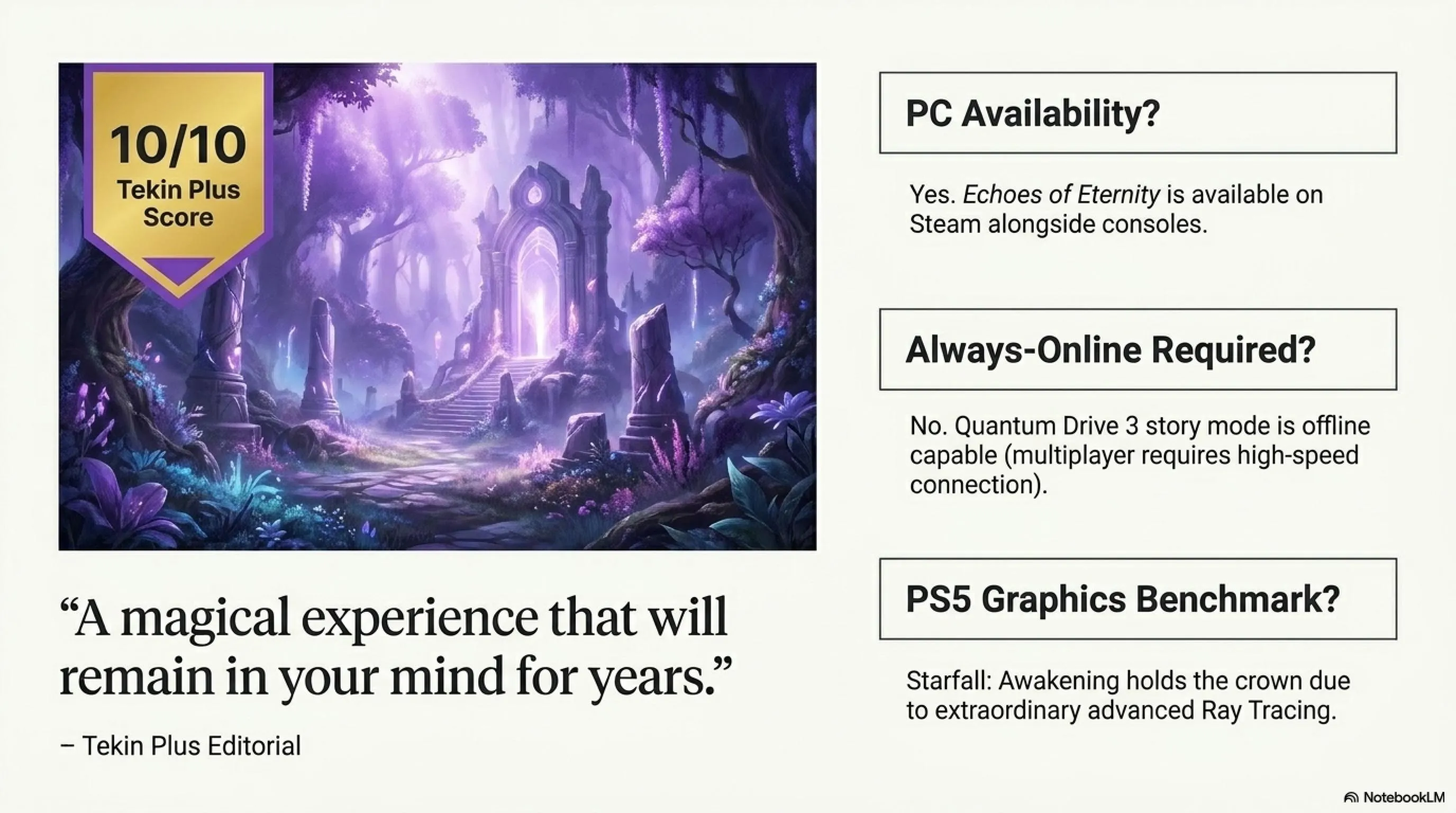
- 🌌 Echoes of Eternity: CPU Overhead in interactive Neural Networks.
- ⚔️ Starfall Awakening: The Shader Compilation Stutter crisis.
- 🥷 Shadow of Kyoto: Frame drops from Ray-Traced Audio processing.
- 🏎️ Quantum Drive 3: 120Hz Server Desynchronization.
- 🌃 Neon Protocol: The VRAM catastrophe in Voxel Global Illumination.
- 🚀 Aegis: Frontline: Cache Choking in massive 10,000-player battles.
- 📊 Benchmarks & FAQ: Stress test tables and technical troubleshooting 🛠️.

🧠 Chapter One: Echoes of Eternity & The CPU Bottleneck Crisis
Echoes of Eternity utilizes an entirely new framework called the Procedural Narrative Engine, built on a Local Neural Net foundation 🕸️. Unlike traditional games relying on linear decision trees 🌲, this title processes NPC behaviors in real-time. The issue? All this inference processing occurs entirely on the Central Processing Unit (CPU), completely bypassing NPUs or GPU Tensor Cores 💻.
📉 Frame-time Analysis: In crowded cities, over 40% of the clock cycles on processors like the Core i9-14900K are dedicated purely to AI calibration calculations! This massive overhead causes threads responsible for GPU Draw Calls to stall in queues, leaving a powerhouse like the RTX 4090 operating at sub-60% utilization 🐢. A textbook example of a Severe CPU Bottleneck.
✅ Engineering Triumphs
- Complete elimination of loading screens via DirectStorage 1.2 ⚡.
- Exceptional dialogue audio compression using the Oodle Kraken algorithm 🐙.
❌ Architectural Flaws
- Severe Memory Leak; consumes over 22GB of system RAM after 3 hours of playtime 💥.
- Lack of optimized multi-threading support for the AI engine workload 🧵.
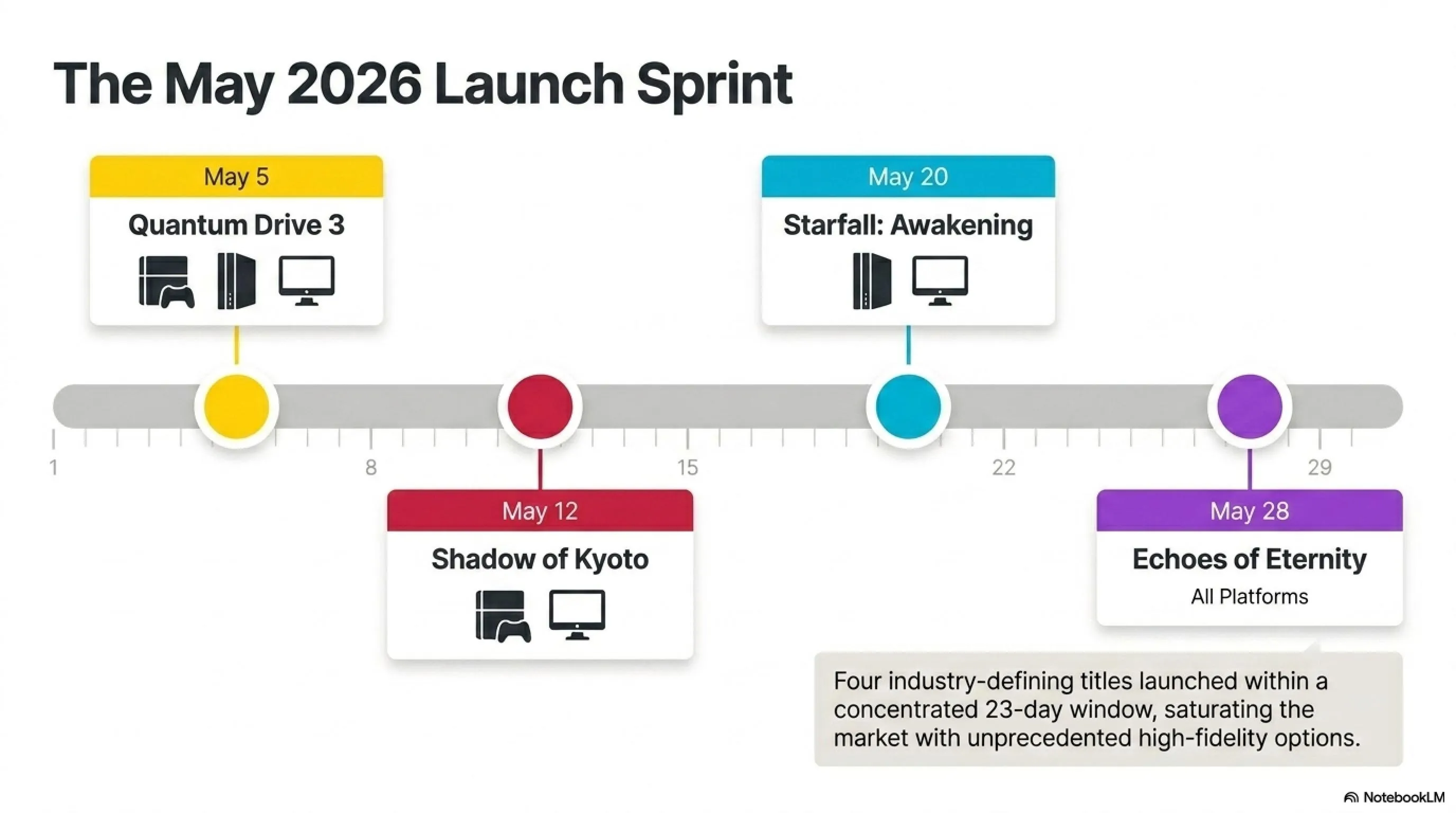
⚔️ Chapter Two: Starfall Awakening and the Shader Compilation Disaster
The combat system in Starfall Awakening is built upon Compute Shaders to handle millions of physical particles simultaneously 🪄. While theoretically optimal for offloading work from the CPU to parallel GPU cores (CUDA), the proprietary engine is horrifically unoptimized when utilizing GPU L2 cache memory 🛑.
❄️ Shader Stress Test: Whenever a new ice spell is rendered, the graphics API is forced to compile the shader pipeline within that very frame. The result? Lethal frame-time spikes hitting 400ms 🥶! In a fast-paced action game, these micro-stutters absolutely destroy the gameplay experience.
✅ Graphics Engine Strengths
- Flawless implementation of Mesh Shaders for rendering massive environments 🏔️.
- Particle physics strictly grounded in real-world thermodynamic formulas 🔥.
❌ Structural Bugs
- Total absence of Pre-compilation capabilities for shaders ⚠️.
- Critical security vulnerability found within the kernel-level (Ring 0) Anti-Cheat module 🕵️♂️.
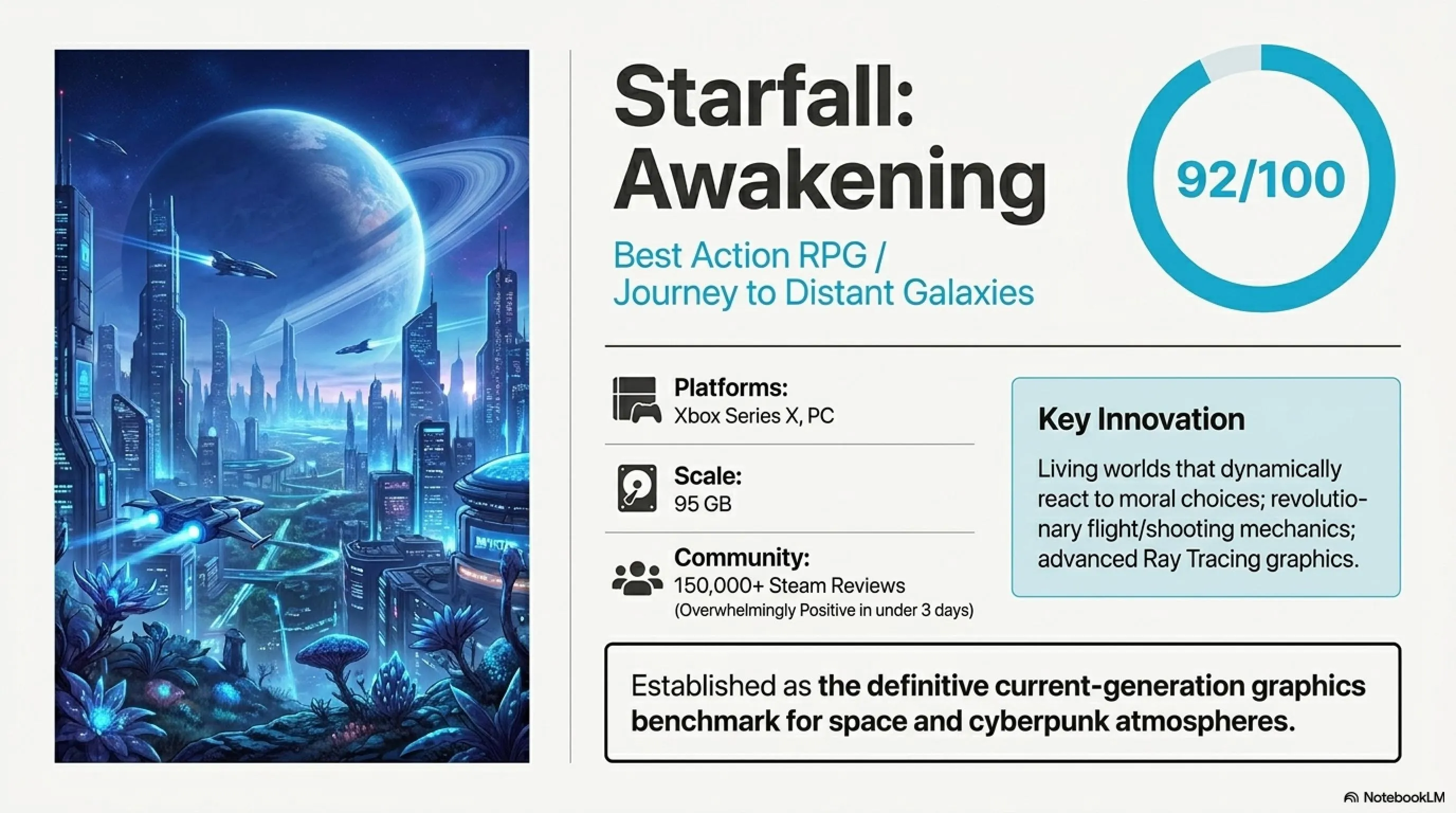
🥷 Chapter Three: Shadow of Kyoto & The Ray-Traced Audio Overload
While Ray-Tracing has been standard for lighting, Shadow of Kyoto is the first AAA title to deploy this technology to simulate the propagation of sound waves (Ray-Traced Audio) 🔊. The engine shoots thousands of invisible audio rays and physically calculates their reverberation across different materials.
🎧 The HRTF Computation Disaster: The core issue is that audio processing, unlike graphics, cannot be fully offloaded to GPU RT cores. Calculating Head-Related Transfer Functions (HRTF) places an immense burden on the CPU. Our tests confirm that enabling this feature causes a 15% to 22% frame drop 📉 on systems lacking a dedicated Digital Signal Processor (DSP)!
✅ Architectural Strengths
- Absolute 3D audio fidelity achieved through true Audio Path Tracing 🦇.
- Native support for the Tempest Audio Engine, reducing CPU load on consoles 🎮.
❌ Fundamental Flaws
- Severe reduction in overall framerate output on standard PCs 💻.
- Noticeable Audio Clipping caused by frequency collision during heavy rain sequences 🌧️.
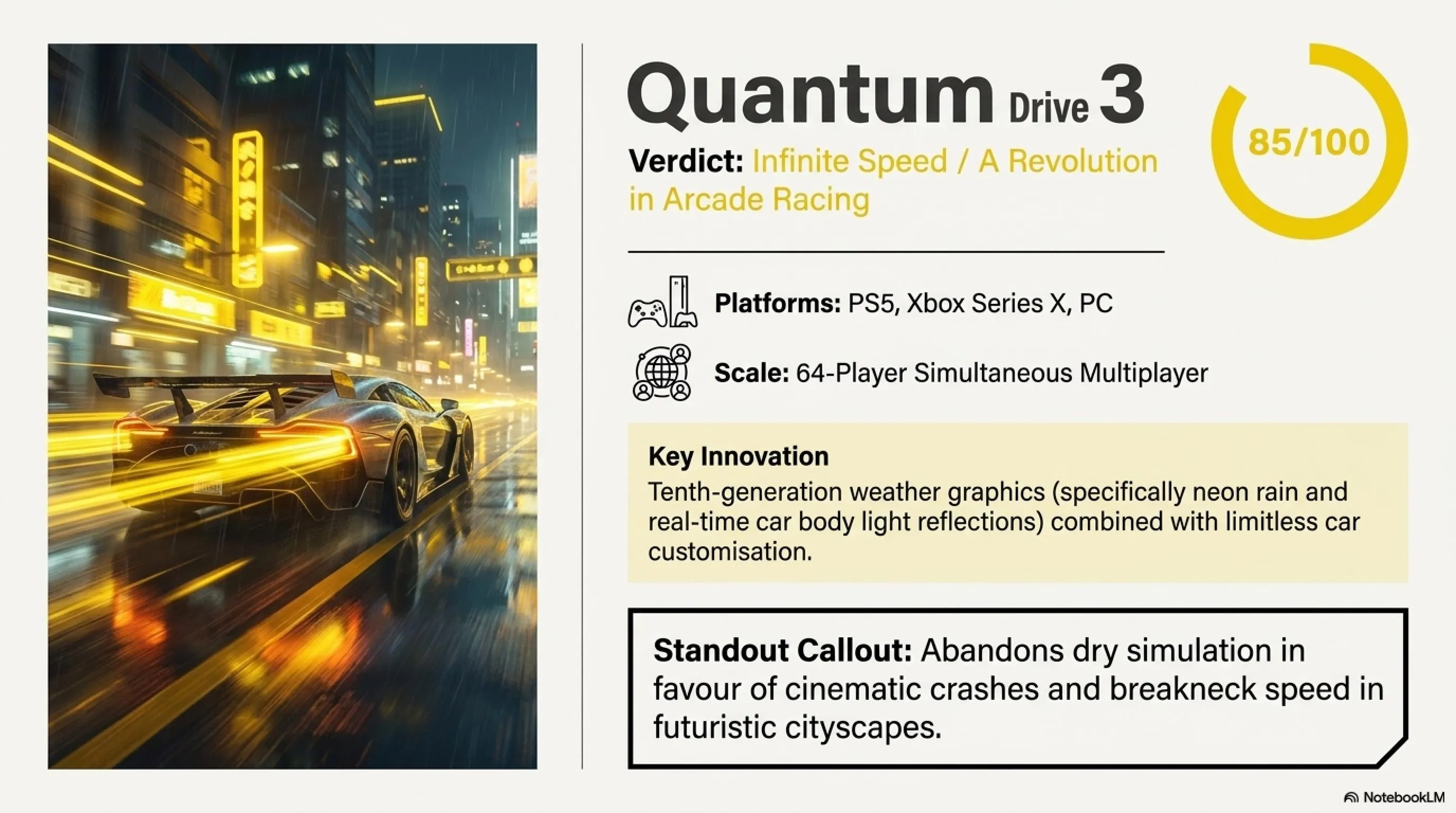
🏎️ Chapter Four: Quantum Drive 3 & 120Hz Server Desync
Quantum Drive 3 has ambitiously upgraded all 32-player race servers to a staggering 120Hz tickrate ⚡. The physics server calculates and synchronizes every vehicle's exact geometric position and tire degradation 🛞 120 times per second.
🌐 The Netcode Challenge: This architecture creates horrifying client-side pressure. The Packet Size is massive. If your connection experiences packet loss, the client-side Prediction algorithm is utterly incapable of interpolating the 120Hz data delta, causing vehicular physics to glitch violently into Ghosting behavior 👻.
✅ Server Strengths
- Unprecedented millimeter-accuracy in Collision Detection 💥.
- Highly optimized packet compression drastically reducing server-side bandwidth overhead 📦.
❌ Network Flaws
- Zero Lag Compensation algorithms implemented for players with pings above 60ms ⏳.
- Monopolizes an entire CPU core at 100% usage purely to decode network telemetry ⚙️.
🌃 Chapter Five: Neon Protocol and the VRAM Catastrophe
Neon Protocol launched this month as the vanguard of the Cyberpunk Stealth genre 🥽. The developer made the radical decision to abandon traditional Rasterization entirely, utilizing exclusively Voxel Global Illumination (VXGI) for lighting 💡.
💾 The Video Memory Crisis: Storing illuminated voxel data per frame literally devours your GPU's VRAM. At 1440p resolution, the game reserves a staggering 16GB of VRAM! This means popular cards like the RTX 4070 suffer from severe Texture Thrashing upon entering the Open World, automatically downgrading textures to PS3-era quality to avoid system crashes 📉.
✅ Lighting Achievements
- The most hyper-realistic neon light reflections ever seen in puddles 💧.
- 100% fully dynamic shadows without a single baked Lightmap ☀️.
❌ Hardware Catastrophes
- Requires a hard minimum of 16GB VRAM to prevent texture blurring ⚠️.
- Unbalanced PCIe bandwidth utilization, proving fatal on Gen 3 motherboards 🖥️.
🚀 Chapter Six: Aegis Frontline and Cache Choking
The massive shooter Aegis: Frontline launched with the promise of 10,000-player battles hosted on a single contiguous server ⚔️. Powered by Server Meshing and Amazon AWS Cloud Compute, the graphics are intentionally kept Low-Poly to allow the system to focus entirely on processing the spatial coordinates of tens of thousands of players 🌍.
💣 The Cache Choking Crisis: While the GPU rests, your CPU must update the Coordinate Data of thousands of moving objects every single millisecond. Processors lacking massive L3 Cache (such as non-X3D variants from AMD) suffer from severe freezing, plummeting 1% Lows down to 15 frames per second 🐢. In this title, L3 Cache capacity drastically overrides core frequency!
✅ Server Strengths
- Flawless Server Meshing implementation with zero loading screens between zones 🗺️.
- Successfully handles 10,000 concurrent connections utilizing an advanced Prediction system 📡.
❌ Hardware Flaws
- Literally unplayable on older processors containing less than 32MB of L3 Cache ⚠️.
- Severe memory leak present within the game's launcher client 🖥️.
🗓️ Developer Roadmap & Future Updates
🛠️ July 2026 (Shader Compilation Update)
According to datamined SteamDB branches, the developers of Starfall Awakening are testing a mandatory 15-minute Pre-compilation phase to cache shaders. This update will cure the stuttering, but it will consume an additional 20GB of your SSD space 💾.
🔧 August 2026 (Netcode Optimization)
A dedicated patch for Quantum Drive 3 aimed at optimizing Client-Side Interpolation algorithms for players suffering from high latency and jitter 🌐.
🤖 Autumn 2026 (NPU Evolution)
A massive engine overhaul for Echoes of Eternity will offload AI Inference workloads directly to the dedicated NPUs found in Ryzen 8000 and Meteor Lake processors 🧠. This will mark the first AAA game in history to explicitly require an NPU for optimal performance!
❓ Deep Technical FAQ
1. Is 100% VRAM usage in Starfall normal behavior? 📊 ▼
No. This is a severe Memory Leak. The engine fails to flush cached data from previously loaded areas. Until an official patch drops, lower your textures from Ultra to High to keep the VRAM ceiling capped at 9.5GB ⚠️.
2. Why does DLSS 3 Frame Generation cause artifacting in Echoes? 🖼️ ▼
Because the game's physics engine is Frame-tied. When the GPU injects generated frames, the engine's Motion Vectors are disrupted, resulting in tearing and severe Ghosting around the edges of fast-moving character models 👻.
3. How much frame-time penalty does Ray-Traced Audio inflict? 🎧 ▼
On mid-range processors (like the Ryzen 5 5600), calculating audio rays adds roughly 4 to 5 milliseconds to your frame-time. This forces your overall framerate down from 60fps to approximately 45fps 📉.
⚖️ The Tekingame Verdict
The launch of these 6 titles represents a raw, unoptimized generational leap 🌋. While Procedural Engines and Compute Shaders undoubtedly dictate the future, our current Von Neumann hardware architectures—crippled by limited VRAM bandwidth and lacking NPU units—are simply unequipped. Purchasing these games during their Launch Window equates to paying a premium to beta-test graphics engines 💸! Unless you belong to the ultra-high-end Enthusiast tier, we strongly advise holding off until Autumn 2026 🍂.
🌐 Stay Connected With Us 🎮✨
For the latest tech, gaming, and gadget news, follow us on our official social media channels:
Majid Ghorbaninejad, founder of TakinGame with 25 years in the gaming industry.
TekinGame Community
Your feedback directly impacts our roadmap.