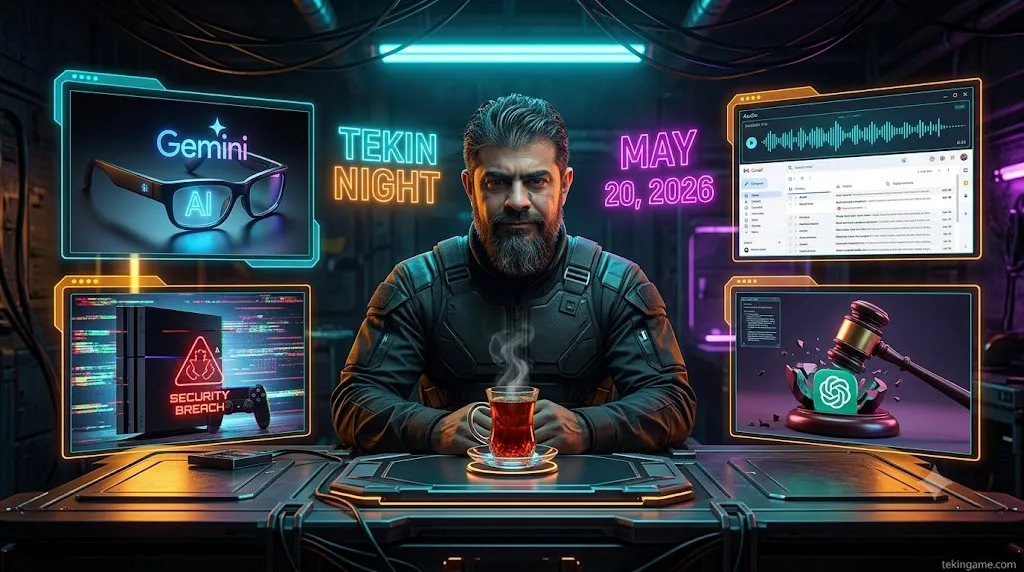
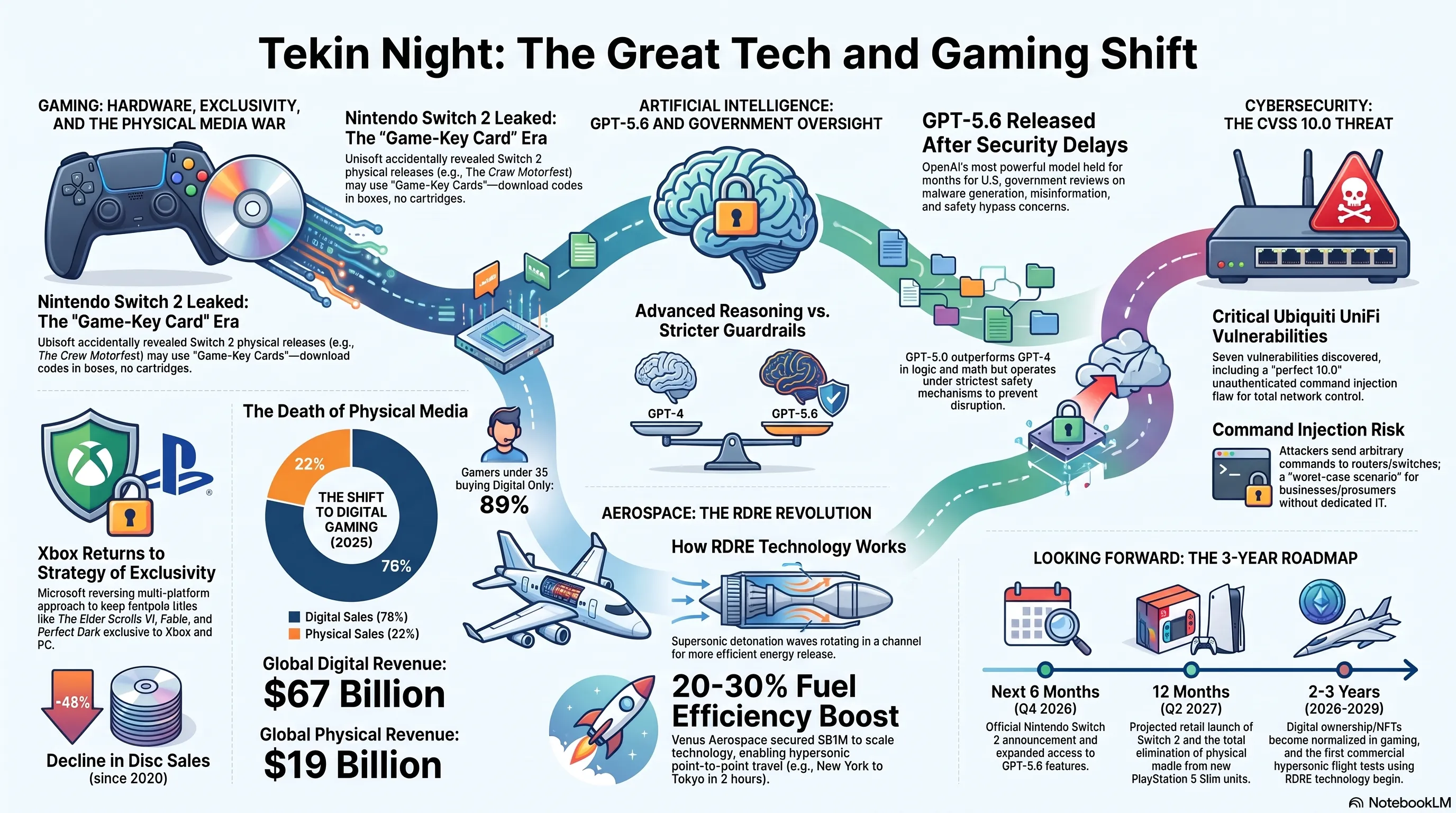
The night of July 8, 2026, delivered a cascade of industry-shifting revelations across gaming and technology. Nintendo's Switch 2 was inadvertently leaked alongside a new "Game-Key Card" physical distribution model, while Microsoft signaled a dramatic return to console exclusivity in a bid to rescue faltering Xbox sales. Concurrently, OpenAI finally released the formidable GPT-5.6 model following months of rigorous US government security reviews. In aerospace, Venus Aerospace secured $91 million to scale its revolutionary RDRE rocket technology
🌙 Tekin Night: The Evening That Shook Gaming & Tech
The clock inches toward midnight, and the tech industry refuses to sleep. Secrets have been spilled, strategies have shifted, and the future is taking shape right before our eyes.
- 🎮Switch 2 Is No Longer a Secret- Ubisoft accidentally leaked the Switch 2 version of The Crew Motorfest with a new physical distribution method
- 🎧Xbox Searching for Lost Identity- Microsoft plans to make more games console-exclusive to give people a reason to buy Xbox hardware
- 🚀GPT-5.6 Finally Arrives- OpenAI releases its most powerful AI model after months of government security reviews
- 🗡️The Rocket Engine That Changes Everything- Venus Aerospace raises $91M to scale revolutionary rotating detonation rocket technology
- 📰The Battle for Physical Media- Gamers are canceling PlayStation Plus subscriptions to protest Sony's disc-killing strategy
Tonight is one of those nights. The kind of night where you wake up tomorrow morning and realize that the gaming and technology landscape has fundamentally shifted while you slept. Nintendo can no longer hide its next-generation console, Microsoft is abandoning its multi-platform experiment, OpenAI has finally released its most powerful AI model after months of political delays, and amid all this excitement, a space company called Venus Aerospace is rewriting the rules of rocket propulsion.
This Wednesday night edition of Tekin Night isn't just another news roundup - it's a snapshot of an industry in transformation, where big decisions are being made, bigger leaks are happening, and the future is being shaped whether we're ready for it or not.
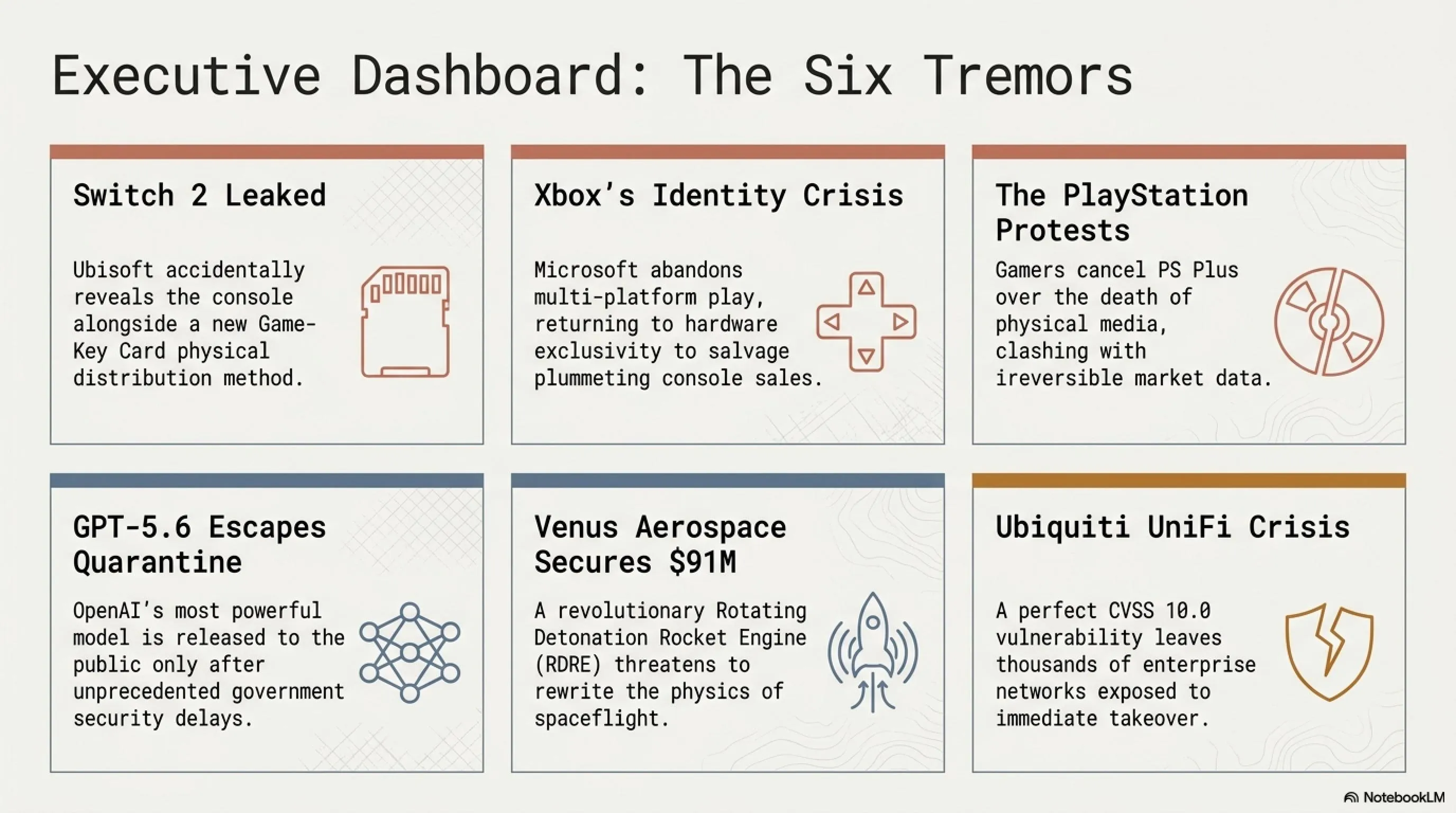
At a Glance: Why Tonight Matters
- Nintendo Switch 2 officially leaked with Game-Key Card as the new distribution method
- Xbox is returning to exclusivity strategy to save console sales
- GPT-5.6 released to public after months of government-mandated security delays
- Venus Aerospace secures $91M to revolutionize rocket engines with RDRE technology
- Gamers protest Sony's disc death by canceling PlayStation Plus, but analysts say it won't work
- Critical Ubiquiti UniFi vulnerabilities with CVSS 10.0 score threaten thousands of networks
Switch 2: Nintendo's Worst-Kept Secret Gets Even Worse
For years, Nintendo has maintained an ironclad lid on information about the Switch 2. No official announcements, no spec reveals, just carefully orchestrated silence. But tonight, that silence was shattered - not by Nintendo, but by Ubisoft. A listing for the Nintendo Switch 2 version of The Crew Motorfest appeared online, confirming not only that the console exists (which we already knew from countless leaks), but also revealing a fascinating new approach to physical game distribution.
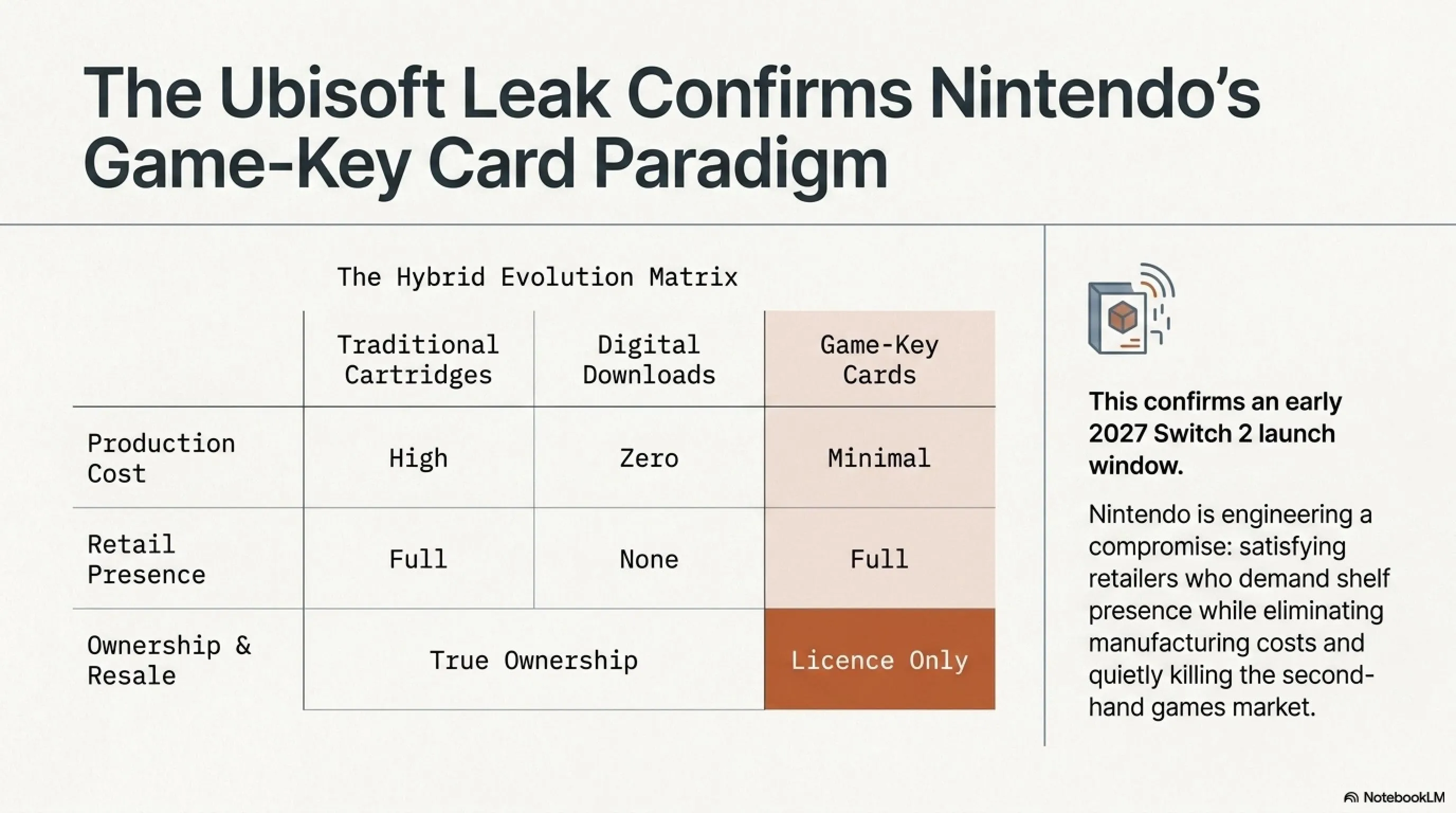
Instead of traditional game cartridges or discs, The Crew Motorfest will be sold via "Game-Key Card" - a physical package containing nothing more than a download code. No actual game media inside, just a card with a code that unlocks the digital version. This hybrid approach could represent Nintendo's strategy for managing physical retail presence while minimizing production and distribution costs in an increasingly digital world.
Why Game-Key Cards Matter
Game-Key Cards represent a hybrid distribution model that combines the physical retail experience with digital delivery.
Advantages:
- Lower production costs (no cartridge manufacturing required)
- No physical storage space needed in distribution
- Maintains shelf presence in traditional retail stores
- Potentially faster supply chain and global availability
- Environmental benefits from reduced plastic and packaging
Disadvantages:
- Requires internet connection for download
- No ability to resell or trade used games
- Complete dependency on publisher servers
- Loss of true physical media ownership
- Potential for download code expiration or deactivation
This leak also serves as additional confirmation that Switch 2 is likely targeting a launch window in early 2027, possibly with an announcement in late 2026. Ubisoft has historically been one of the first third-party publishers to support new Nintendo hardware, and seeing The Crew Motorfest in these listings suggests that major developers are already deep into preparation for the generational leap.
What's particularly interesting is how this leak reveals Nintendo's ongoing evolution in its relationship with physical media. The original Switch used cartridges, which was already a throwback to Nintendo's handheld heritage. Now, with Game-Key Cards, Nintendo might be finding a middle ground - satisfying retailers who want physical products on shelves while embracing the cost savings and control of digital distribution.
Xbox's Identity Crisis: The Return of Exclusivity
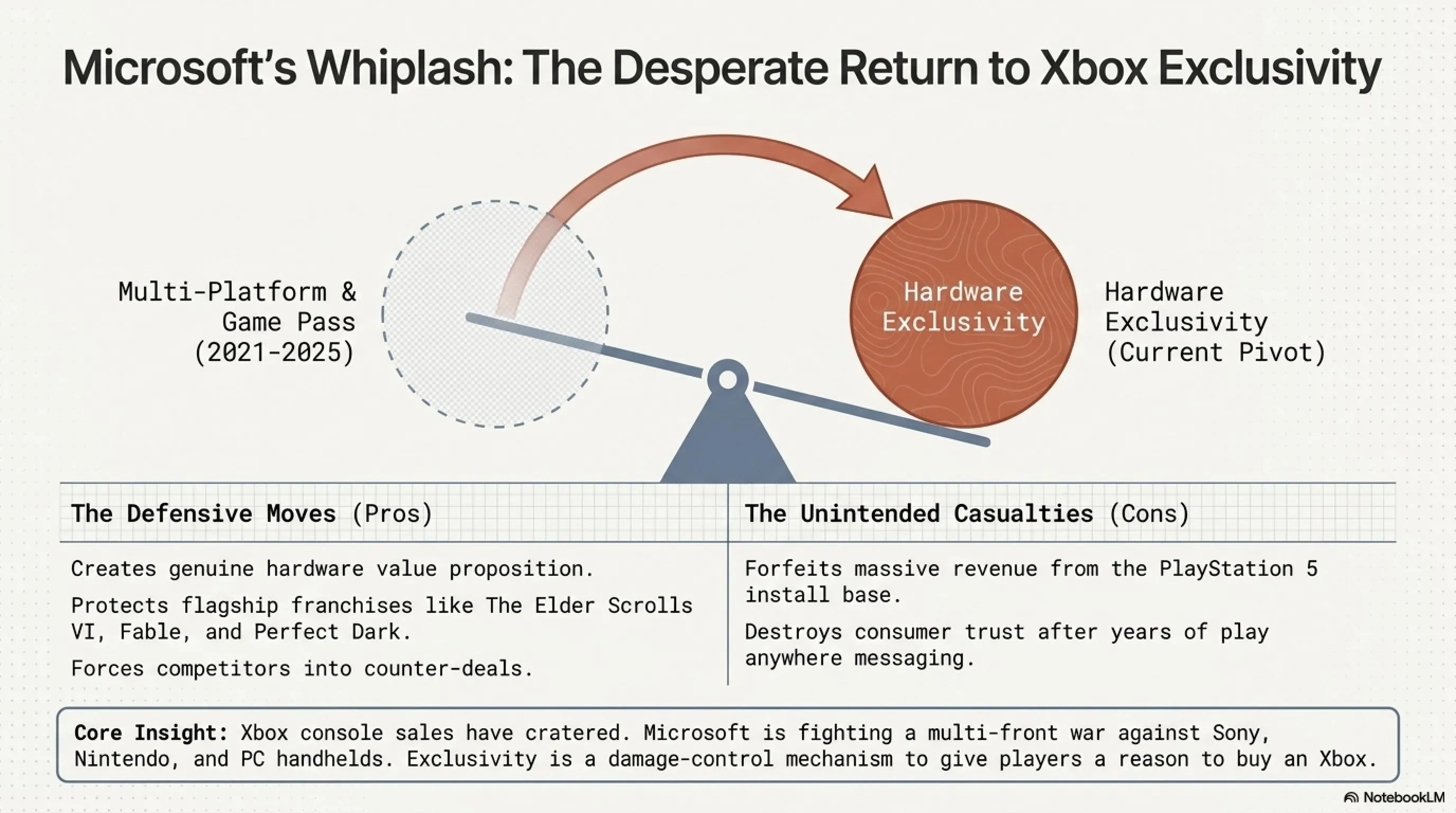
While Nintendo prepares for its future, Microsoft appears to be frantically trying to salvage its present. Fresh reports from IGN and Eurogamer reveal that Microsoft is planning to make more of its biggest games console-exclusive - a complete 180-degree reversal from its recent multi-platform strategy that saw former Xbox exclusives like Hi-Fi Rush, Sea of Thieves, and even Starfield making their way to PlayStation.
The reasoning is brutally simple: Xbox console sales have cratered to their lowest point in years, and Microsoft desperately needs to give consumers a reason to buy Xbox hardware. When your marquee titles are available on competing platforms, there's little incentive for gamers to invest in your ecosystem. It's a problem entirely of Microsoft's own making, and now they're attempting damage control.
Which Games Might Stay Exclusive?
According to industry sources, Microsoft is evaluating which of its upcoming tentpole releases should remain Xbox and PC exclusive. Names being floated include The Elder Scrolls VI, the Fable reboot, and Perfect Dark. These are franchise-defining titles - the kind of games that could, in theory, sell consoles on their own. The Elder Scrolls series alone has historically moved hardware, and keeping it exclusive could be Microsoft's last, best hope at differentiating Xbox from PlayStation.
But here's the fundamental problem: is it too late? Microsoft has spent the better part of three years telling gamers that exclusivity doesn't matter, that Game Pass is the future, that play anywhere is the strategy. To suddenly reverse course and say "actually, you do need an Xbox for our best games" risks alienating the very audience they've been cultivating. It's a crisis of credibility as much as it is a crisis of sales.
- Creates genuine hardware value proposition
- Increases Game Pass Ultimate perceived value
- Protects flagship franchises like Elder Scrolls and Fable
- Forces competitors into counter-exclusivity deals
- Strengthens Xbox brand identity as premium gaming platform
- Could stabilize console sales trajectory
- Forfeits massive revenue from PlayStation install base
- Reduces total addressable market for first-party titles
- High risk of financial underperformance
- Damages consumer trust after multi-platform pivot
- Faces tougher competition from Sony and Nintendo's established exclusivity
- May not be enough to reverse sales momentum
The broader context makes this even more complicated. Sony has been crushing it with PlayStation 5, posting record-breaking sales figures. Nintendo continues its unstoppable Switch momentum while preparing Switch 2. And now we have PC handhelds like Steam Deck eating into the traditional console market. Microsoft is fighting a multi-front war, and exclusivity alone might not be enough to win it.
GPT-5.6: The AI Model the Government Didn't Want Released
Now let's shift from gaming hardware to something that could reshape the entire technology landscape: OpenAI has finally released GPT-5.6, its most powerful language model to date. But the real story isn't the model itself - it's the unprecedented government intervention that delayed its release for months.
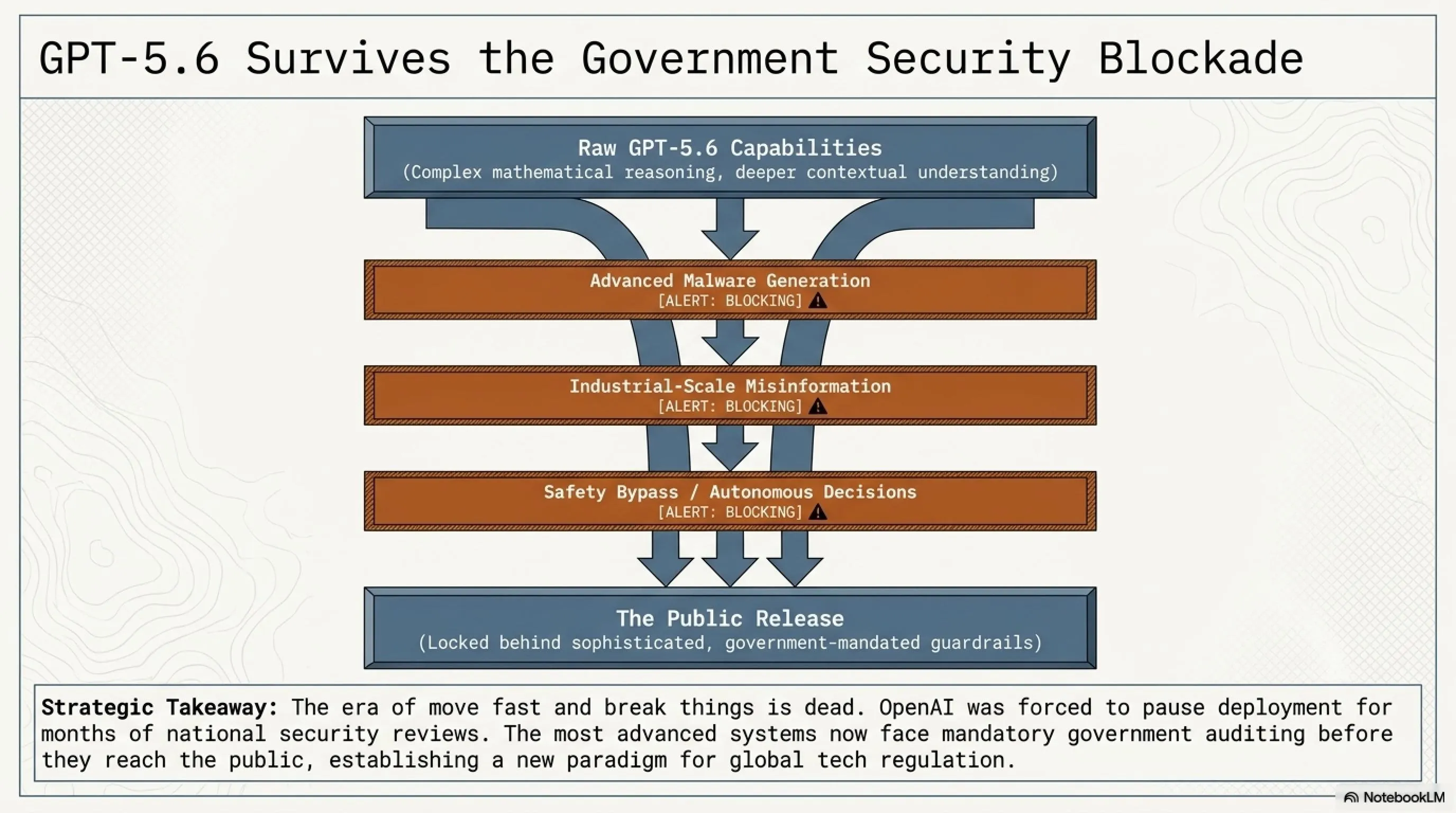
OpenAI originally planned to launch GPT-5.6 much earlier, but the U.S. government requested the company hold back until comprehensive security reviews could be completed. The concerns were serious: Could this model be used to generate sophisticated malware? Could it spread misinformation at unprecedented scale? Could it bypass safety guardrails more effectively than previous versions? These weren't hypothetical worries - they were concrete threat assessments from national security officials.
After months of waiting and security evaluations, GPT-5.6 is now publicly available. According to OpenAI, this model possesses capabilities that previous generations couldn't even approach. From complex mathematical reasoning to deeper contextual understanding across longer conversations, GPT-5.6 is designed to blur the line between artificial and human intelligence even further.
Why the U.S. Government Was Concerned
The U.S. government had serious concerns about GPT-5.6's potential capabilities:
- Advanced Malware Generation: The model could potentially write more sophisticated code for cyberattacks
- Industrial-Scale Misinformation: Ability to generate convincing but false content at unprecedented volume
- Safety Bypass: Higher intelligence could mean better ability to circumvent ethical constraints
- Information Warfare: Powerful tool for propaganda and public opinion manipulation
- Autonomous Decision Making: Concerns about AI making complex decisions without human oversight
- Economic Disruption: Potential to automate high-skill jobs at unprecedented pace
Result: OpenAI was required to implement additional safety layers and agree to ongoing government monitoring before public release.
What Makes GPT-5.6 Different
OpenAI claims that GPT-5.6 significantly outperforms GPT-4 in logical reasoning, mathematical problem-solving, and maintaining context over extended conversations. The model can tackle problems that would have stumped earlier versions, and it does so with what appears to be genuine understanding rather than pattern matching. But here's the interesting caveat: OpenAI has implemented stricter guardrails on this model than any previous release. The power is there, but it's locked behind more sophisticated safety mechanisms.
Some analysts argue that this delay and the accompanying security review represent a watershed moment for the AI industry. Companies can no longer simply release powerful models without considering societal and security implications. Governments are watching, regulating, and in some cases, actively intervening. The era of "move fast and break things" is over - at least when it comes to AI that could genuinely break things.
Venus Aerospace: The Rocket Engine That Could Change Everything
Now let's travel from the world of software to hardware - and not just any hardware, but engines that could fundamentally transform space travel. Venus Aerospace, an American space startup, has secured $91 million in funding to scale its revolutionary Rotating Detonation Rocket Engine (RDRE) from experimental prototype to mass production.
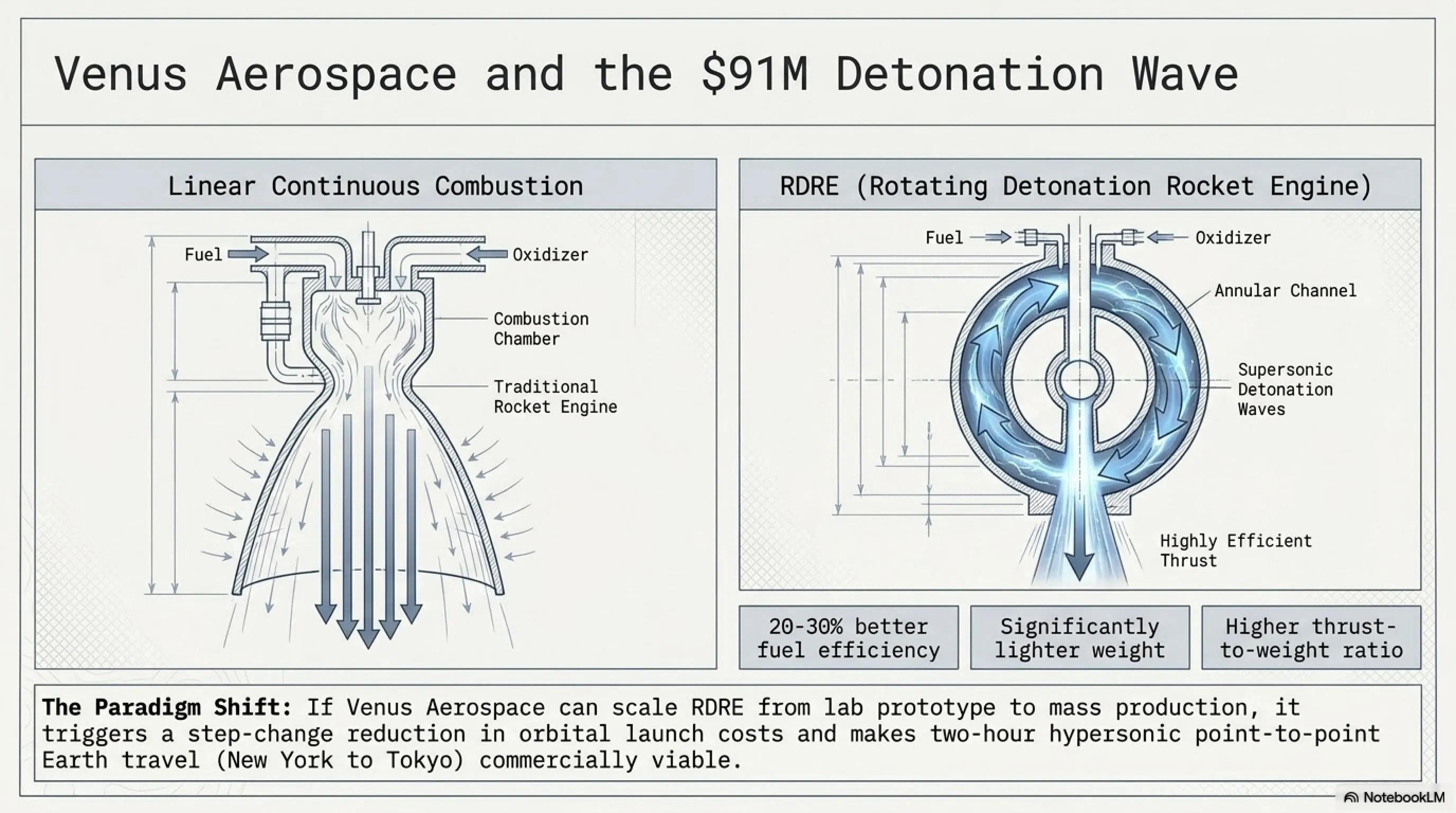
If that technical term sounds confusing, don't worry. An RDRE is a type of rocket engine that uses controlled, rotating detonation waves instead of traditional combustion to generate thrust. The result? Twenty to thirty percent better efficiency, lower fuel consumption, and the ability to carry heavier payloads to space. It's not just an incremental improvement - it's a potential paradigm shift in propulsion technology.
Understanding Rotating Detonation Rocket Engines
Rotating Detonation Rocket Engine (RDRE) represents a revolutionary approach to rocket propulsion that could transform both space travel and hypersonic flight.
How It Works:
Instead of continuous combustion like traditional engines, RDREs use supersonic detonation waves that continuously rotate around an annular channel. This creates a more efficient energy release and thrust generation process.
Key Advantages:
- 20-30% better fuel efficiency compared to conventional engines
- Significantly lighter weight due to simpler design
- Higher thrust-to-weight ratio
- Suitable for both orbital launches and hypersonic atmospheric flight
- Potential for reusability with lower maintenance costs
The Challenge:
Controlling supersonic detonation waves is extraordinarily complex. Until now, no company has successfully transitioned RDRE technology from laboratory prototype to production-ready engines. Venus Aerospace aims to be the first.
Why This Matters Beyond Space
The space industry is undergoing dramatic transformation. Companies like SpaceX and Blue Origin have already slashed the cost of reaching orbit. But access to space remains prohibitively expensive for most applications. If Venus Aerospace can deliver production-scale RDRE engines, it could trigger another step-change reduction in launch costs - not just for orbital missions, but potentially for hypersonic point-to-point travel here on Earth.
The company has already announced its ultimate goal: building aircraft that can transport passengers at hypersonic speeds between any two points on Earth. Imagine flying from New York to Tokyo in two hours instead of fourteen. This isn't science fiction anymore - it's the stated objective of a well-funded aerospace company with legitimate technology backing it up.
But there's always a gap between ambitious goals and market reality. The aerospace industry is littered with startups that promised revolutionary technology and delivered nothing. Venus Aerospace now has the funding and the technology base. The question is whether they can execute on manufacturing scale, regulatory approval, and commercial viability.
The Physical Media War: Gamers vs. Sony
And now we return to gaming with perhaps the most contentious topic of the evening: the death of physical media. Sony has been progressively eliminating optical drives from PS5 models, and the gamer backlash has reached a tipping point. PlayStation Plus subscriptions are being canceled in protest, forums are ablaze with complaints, and the message is clear: gamers are not happy about losing physical media.
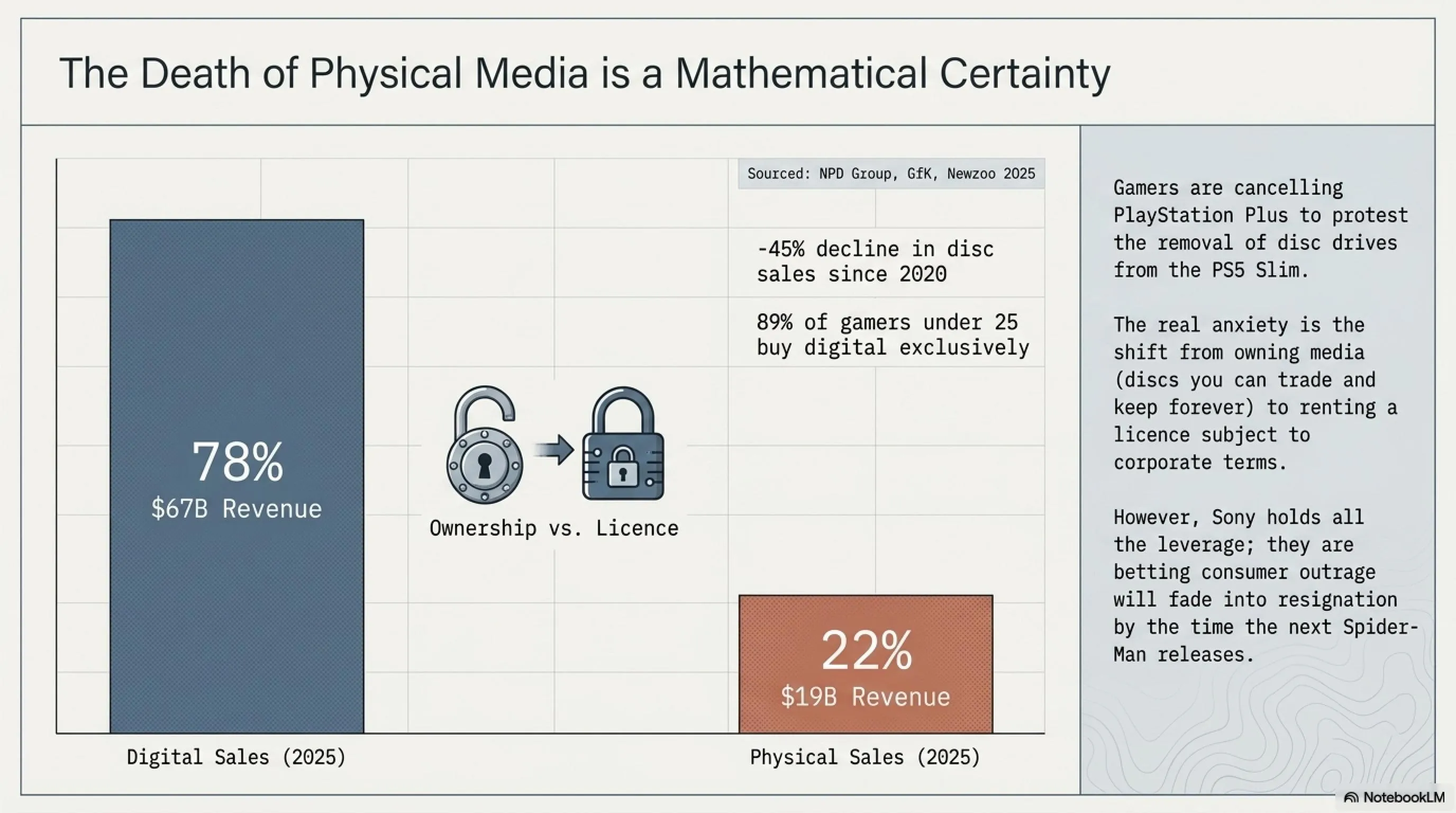
But here's the uncomfortable truth that analysts are pointing out: this protest probably won't make a difference. Sony isn't leading some crusade against physical media - they're responding to market reality. The overwhelming majority of gamers already buy digital. Physical game sales have been in freefall for years. Sony is simply accepting what the data has been telling them: the future is digital, whether vocal minorities like it or not.
Sales Data: Digital vs Physical Gaming
Source: NPD Group, GfK Entertainment, Newzoo Market Analysis 2025
Why Gamers Are Actually Angry
The protest isn't really about convenience or download speeds. It's about ownership. When you buy a physical game, you own that disc. You can sell it, lend it, keep it for decades and still play it. But with digital purchases, you don't own anything - you're licensing access to content. If Sony decides to shut down servers, revoke your license, or simply go out of business, your entire digital library could evaporate.
This is the real anxiety driving the backlash. We're transitioning from a world where you owned your entertainment to one where you merely rent it, subject to corporate terms and conditions that can change at any time. It's a legitimate concern, and gamers have every right to be worried about it.
But the harsh reality is that Sony holds all the leverage. They have exclusive franchises that gamers desperately want to play. They have market dominance. And they have data showing that digital is where the industry is headed. Gamers can cancel subscriptions, but unless they're willing to abandon PlayStation entirely, it's an empty gesture. Sony knows this, and they're betting that outrage will eventually fade into resignation.
Silent Threat: Critical Ubiquiti UniFi Vulnerabilities
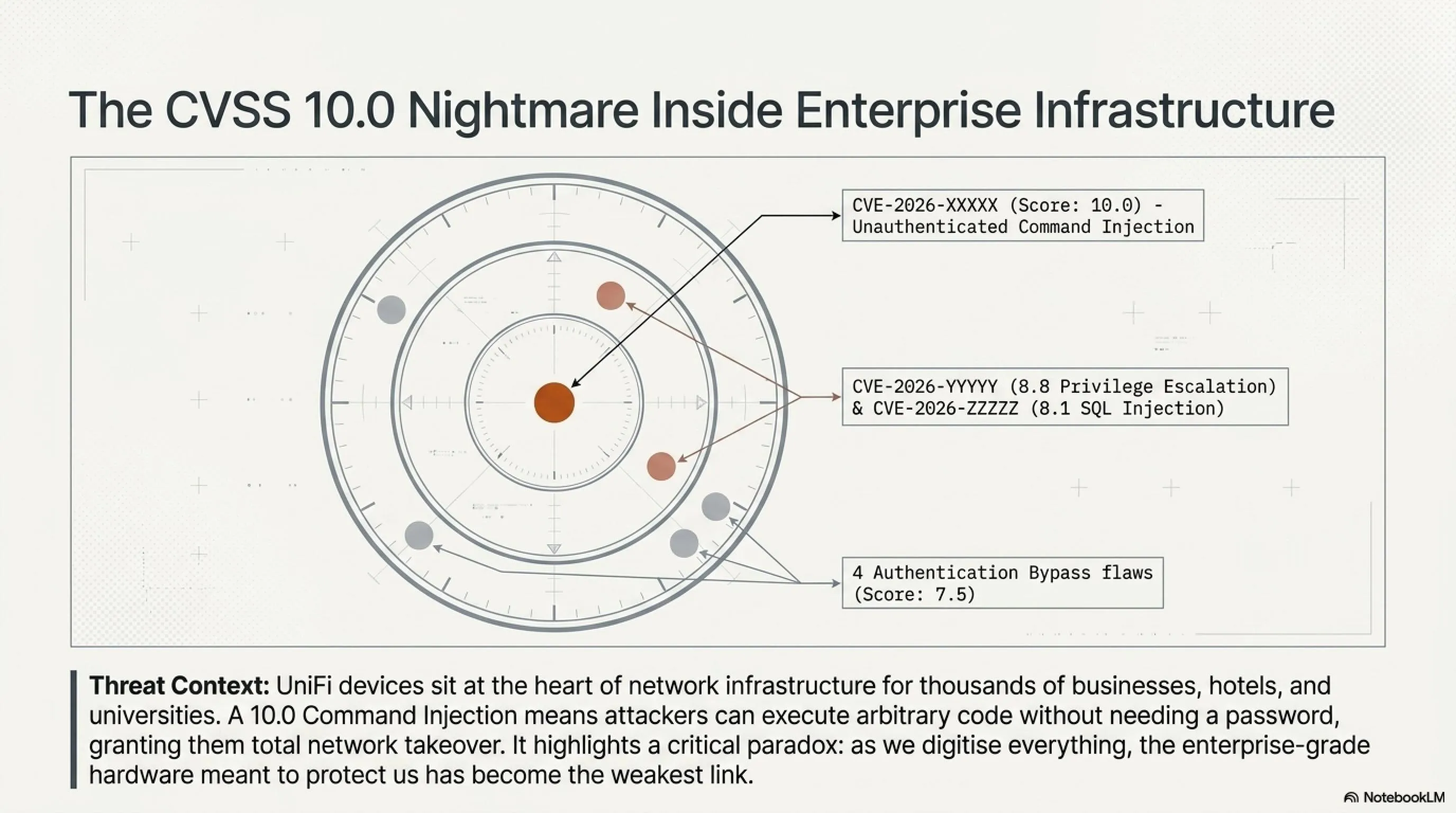
Now we come to a story that might be less sexy than gaming consoles and AI models, but is arguably more immediately critical: Ubiquiti, one of the world's largest networking equipment manufacturers, has released emergency security updates to patch seven critical vulnerabilities in UniFi OS. One of these vulnerabilities scores a perfect 10.0 on the CVSS scale - meaning it's literally the most dangerous type of security flaw possible.
Attackers can exploit this vulnerability to execute arbitrary code on your system without needing any authentication whatsoever. If you're running Ubiquiti UniFi equipment - and thousands of businesses, universities, hotels, and homes are - you need to patch immediately. This isn't a theoretical risk; it's an active threat vector that could be exploited at any moment.
Why This Vulnerability Is So Dangerous
UniFi OS is Ubiquiti's proprietary operating system that runs on routers, switches, and access points across their product line. These devices sit at the heart of network infrastructure - they control who gets access, how traffic flows, and what security policies are enforced. If an attacker gains control of a UniFi device, they effectively control the entire network.
This class of attack is known in security circles as Command Injection - the attacker can send arbitrary commands to the system, and the system will execute them without question. This could mean installing malware, stealing credentials, exfiltrating sensitive data, or using the compromised device as a pivot point to attack other systems on the network. In enterprise environments, a single compromised network device can become the gateway to complete infrastructure takeover.
Complete CVE List and Severity Breakdown
Attacker can execute arbitrary code without any authentication required
Standard user can gain administrative access to system
Unauthorized access to user credentials and configuration data
Various flaws in authentication mechanisms and access controls
Source: Ubiquiti Security Advisory - July 8, 2026 | Analysis by The Hacker News
The Broader Context of Network Security
This Ubiquiti vulnerability is part of a larger, troubling trend in network infrastructure security. As we've moved more and more critical systems online, the devices that connect and protect those systems have become high-value targets for attackers. Enterprise routers, switches, and access points are often poorly maintained, rarely patched, and running outdated firmware. They're the weakest link in otherwise robust security postures.
What makes this particularly concerning is that UniFi equipment is popular precisely because it's marketed as enterprise-grade security for small-to-medium businesses and prosumers. Companies that don't have dedicated IT security teams deploy UniFi because it's supposed to be secure out of the box. A CVSS 10.0 vulnerability in that equipment is a worst-case scenario - it means the organizations least equipped to respond are the ones most likely to be compromised.
Tekin Analysis: A Turbulent Night That Reveals Industry Shifts
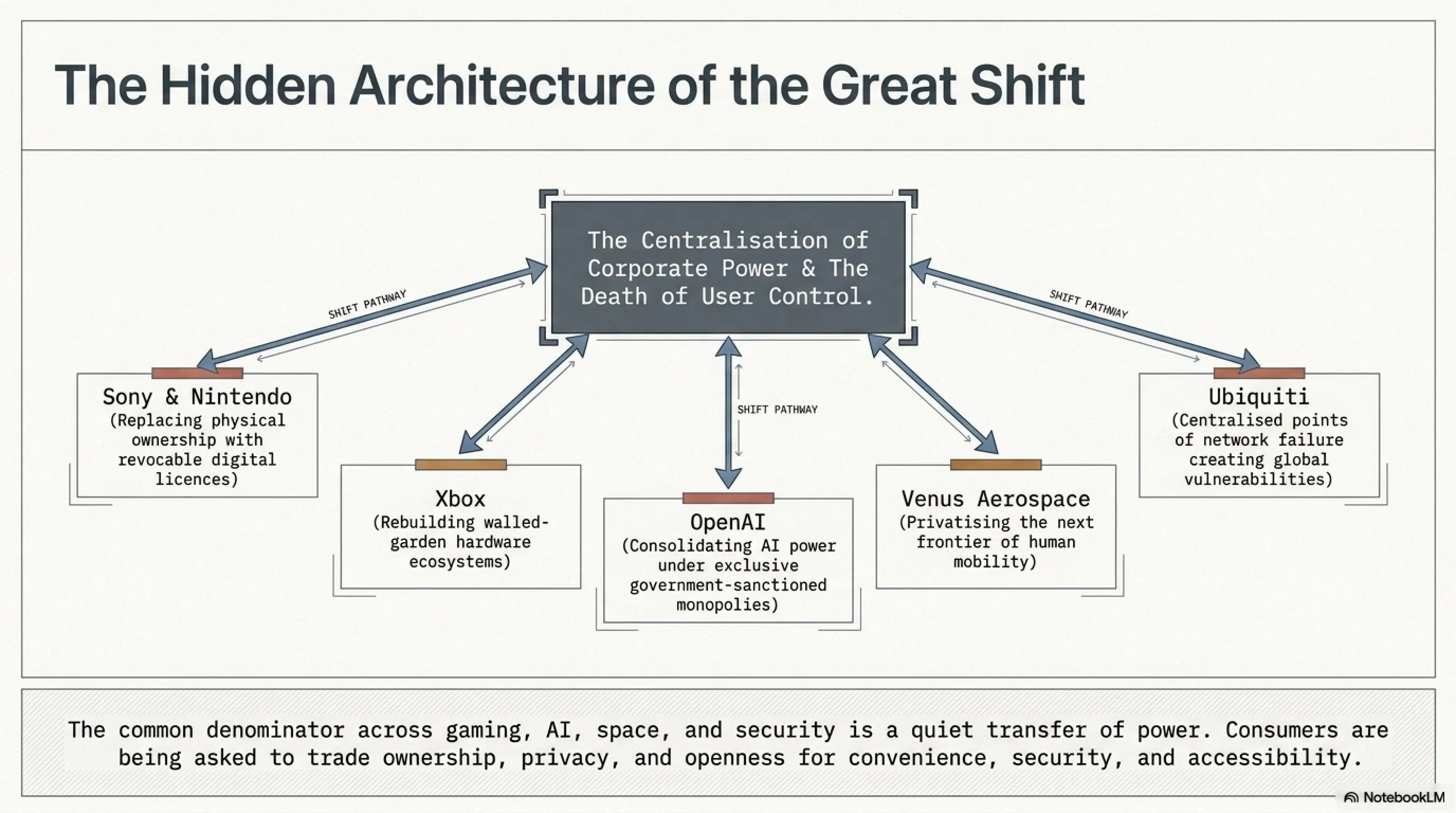
When we step back and look at tonight's news as a cohesive whole, a fascinating picture emerges: the technology and gaming industries are navigating through a critical inflection point. Nintendo is preparing its next-generation console, Microsoft is desperately searching for strategic direction, OpenAI is grappling with government oversight, Venus Aerospace is pushing the boundaries of propulsion technology, Sony is eliminating physical media despite consumer backlash, and critical security vulnerabilities are threatening thousands of networks.
These stories share a common thread: adaptation to new realities. Nintendo must compete with Steam Deck and a new generation of PC handhelds. Microsoft must find a way to make Xbox relevant again. OpenAI must navigate the regulatory landscape of increasingly powerful AI. Venus Aerospace must prove that revolutionary technology can scale to commercial viability. Sony must manage the transition from physical to digital despite vocal opposition. And Ubiquiti must respond to security threats in real-time.
The Bigger Picture: Centralization of Power
But beyond these individual narratives, there's a larger trend taking shape: power is consolidating. A handful of mega-corporations are controlling virtually every aspect of our digital lives - from the games we play to the AI we use to how we access space. Nintendo, Sony, and Microsoft control the console gaming market. OpenAI, Google, and Microsoft divide the AI landscape. Even in spaceflight, a small number of well-funded startups and government contractors are shaping the future.
This concentration has both benefits and risks. On one hand, these large organizations can make investments that smaller players can't. GPT-5.6 is the product of billions in research and development. Switch 2 represents decades of Nintendo's console-building expertise. RDRE engines require massive capital investment to move from prototype to production.
On the other hand, this power concentration means consumers have fewer choices. When only three companies make gaming consoles, they can raise prices and impose restrictions like eliminating physical media. When only a few companies build advanced AI models, they control who gets access and how it's used. When government regulators can delay AI releases, innovation can be stifled by bureaucratic caution.
The Question We Should All Be Asking
So here's the fundamental question: Are these changes actually benefiting us, the consumers and end users? Game-Key Cards instead of real cartridges, renewed exclusivity wars, government AI oversight, elimination of physical ownership - we're being told all of this is for our own good, for a better future. But how much of that is actually true?
The reality is that the industry is moving toward models that give corporations more control, not users. When everything is digital, companies can revoke access at any time. When games are exclusive, you need to buy multiple consoles. When AI is government-regulated, who guarantees that oversight is for protection rather than control? These are uncomfortable questions, but they need to be asked.
Looking Forward: What to Expect
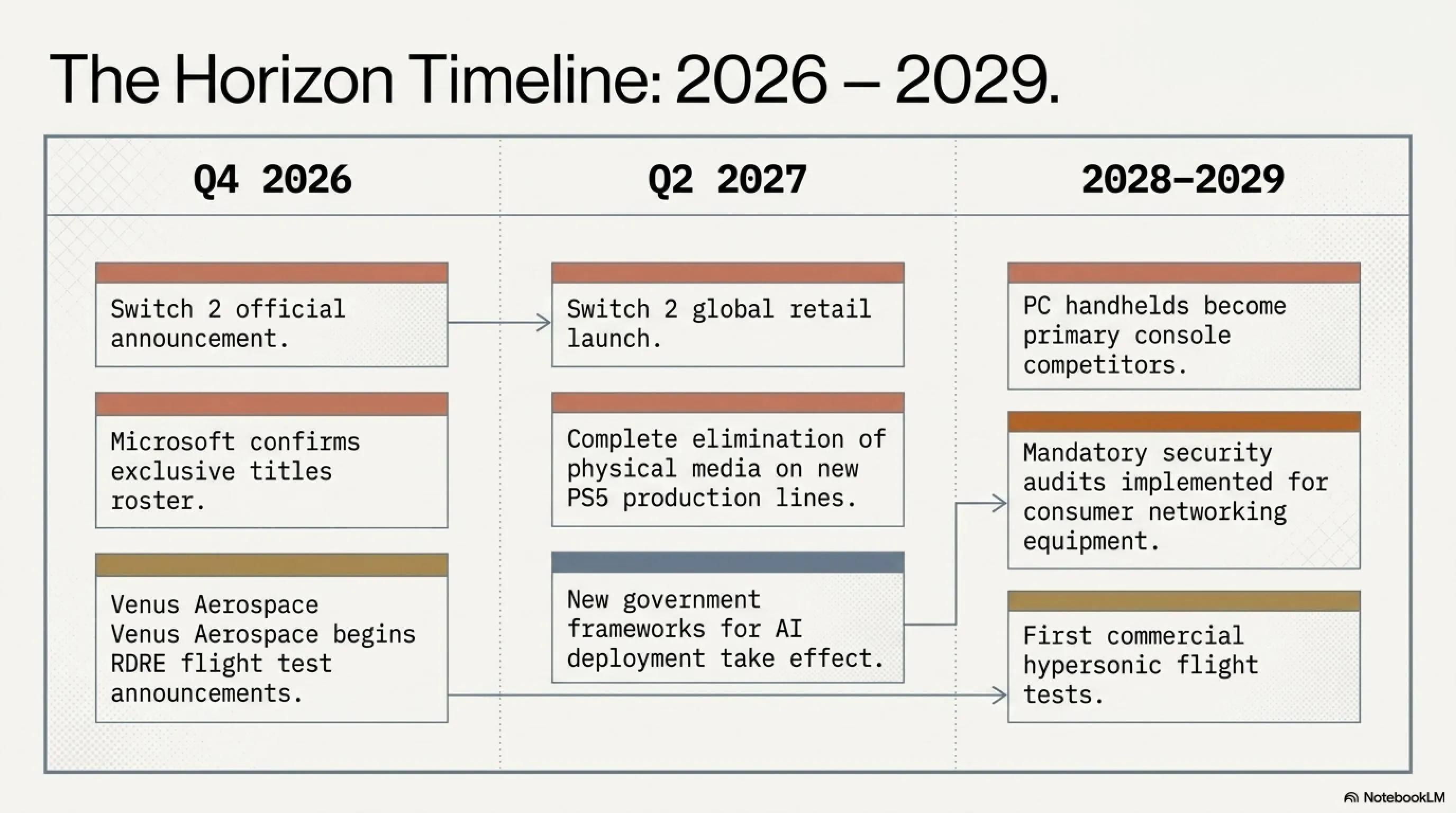
Next 6 Months (Q4 2026)
- Nintendo Switch 2: Likely official announcement in late 2026
- Xbox Strategy: Formal announcement of renewed exclusivity titles
- GPT-5.6: Expanded access and gradual loosening of restrictions
- Venus Aerospace: First flight test announcements for RDRE technology
Next 12 Months (Q2 2027)
- Switch 2 Launch: Probable early 2027 retail availability
- Venus Aerospace: Initial flight testing of RDRE engines
- PlayStation: Complete elimination of physical media from PS5 Slim
- AI Regulation: Additional government frameworks for AI deployment
2-3 Years Out (2028-2029)
- PC handheld gaming devices become serious console competitors
- AI becomes integrated into game development at fundamental level
- Digital ownership and NFTs become normalized in gaming
- First commercial hypersonic flight tests using RDRE technology
- Mandatory security audits for all consumer networking equipment
The technology industry has always been about trade-offs. We trade privacy for convenience, ownership for accessibility, openness for security. But those trade-offs are becoming more stark, the costs more apparent, and the benefits more questionable. Tonight's news cycle is a microcosm of that tension - companies pushing forward with changes they insist are inevitable, while users push back against losing what they value.
What happens next depends largely on us. Do we accept these changes passively, or do we demand alternatives? Do we continue buying into ecosystems that restrict our freedom, or do we seek out platforms that respect user rights? The future isn't predetermined - it's being negotiated right now, one purchase decision and one user protest at a time.
Conclusion: The Night Everything Changed
Tonight was one of those rare evenings where multiple major stories broke simultaneously, each significant enough to be a standalone headline. Nintendo Switch 2 is no longer a secret, Xbox is searching for its lost identity, GPT-5.6 launched after months of political delay, Venus Aerospace wants to revolutionize space travel, gamers are protesting the death of physical media, and critical Ubiquiti vulnerabilities threaten thousands of networks worldwide.
But more importantly, tonight demonstrated that the technology and gaming industries are changing - whether we want them to or not. The future that corporations are building for us may not be the future we actually want. But one thing is certain: we need to stay vigilant, ask questions, and defend our rights as consumers and users.
Tonight's Message for Tomorrow
These stories remind us that technology isn't a one-way street. Companies make decisions, but we vote with our wallets, our usage patterns, our protests. The gamer backlash against Sony might not have immediate impact, but it sends a message that we're not willing to accept every corporate decision without resistance.
Similarly, government oversight of GPT-5.6 shows that even tech giants can't operate without accountability. The Nintendo Switch 2 leak reminds us that in the information age, big secrets are hard to keep. People want to know what's coming, and they'll find ways to uncover the truth.
The Ubiquiti vulnerability is a stark reminder that security isn't optional - it's fundamental. As we connect more devices and systems, each one becomes a potential attack vector. The companies building our infrastructure have a responsibility to maintain security, and when they fail, the consequences cascade across thousands of organizations.
And Venus Aerospace? They represent the audacious ambition that drives technological progress. Whether they succeed or fail, their attempt to revolutionize rocket propulsion pushes the entire industry forward. That's the kind of moonshot thinking - literally - that has always driven human advancement.
So when you wake up tomorrow morning with your coffee, remember: the world of technology and gaming isn't the same as it was last night. And the future we're heading toward depends on the choices we make today. Do we accept these changes passively, or do we actively shape the direction of the industry? Do we continue supporting platforms that restrict our freedom, or do we demand alternatives that respect user rights?
The answer to those questions will determine what the next decade looks like. Tonight's news is just the beginning of a much larger conversation about power, ownership, privacy, and the relationship between technology companies and the people who use their products.
Good night from Tekin Night. When you wake up tomorrow, the world might be a little bit different. Make sure you're part of shaping what comes next.
Frequently Asked Questions
Will Nintendo Switch 2 really use Game-Key Cards for physical releases?
Based on the Ubisoft leak, at least some third-party games will use this format. Game-Key Cards are physical packages containing download codes rather than actual game media. This could be Nintendo's strategy for maintaining retail presence while reducing manufacturing costs. However, it's still unclear whether all games will use this format or if it's limited to certain publishers and titles.
Why is Microsoft returning to console exclusivity after going multi-platform?
Because Xbox console sales have hit rock bottom and the multi-platform strategy eliminated the main reason to buy Xbox hardware. When former exclusives like Starfield came to PlayStation, many gamers felt there was no point owning an Xbox. Microsoft wants to make games like The Elder Scrolls VI exclusive to create genuine hardware value proposition. However, this reversal after years of multi-platform messaging risks further damaging consumer trust.
How much more powerful is GPT-5.6 compared to GPT-4?
OpenAI claims GPT-5.6 significantly outperforms GPT-4 in logical reasoning, mathematical problem-solving, and maintaining context over extended conversations. However, due to security concerns, the U.S. government delayed its release for months. The model also has stricter safety guardrails to prevent misuse in generating malicious code or misinformation. The raw capability is there, but it's constrained by more sophisticated safety mechanisms than any previous release.
How does the RDRE rocket engine work and why is it revolutionary?
Rotating Detonation Rocket Engines use supersonic detonation waves that continuously rotate around an annular channel, rather than traditional continuous combustion. This approach provides 20-30% better fuel efficiency and lower fuel consumption than conventional engines. If Venus Aerospace can scale this technology to production, it could dramatically reduce space travel costs and even enable hypersonic point-to-point travel on Earth. The challenge is controlling supersonic detonation waves - something no company has successfully commercialized yet.
Will the gamer protest against Sony make any difference?
Analysts say probably not. The majority of gamers already buy digital (78% of sales in 2025), and Sony has exclusive franchises that gamers desperately want. When the next God of War or Spider-Man releases, most people who canceled PlayStation Plus will likely return. Sony has market dominance and data showing digital is the industry's future. They're betting that outrage will fade into resignation, and history suggests they're probably right.
How dangerous is the Ubiquiti UniFi vulnerability?
Extremely dangerous. One vulnerability scores CVSS 10.0 - the maximum possible threat level. Attackers can execute arbitrary code without authentication, gaining complete network control. If you're using UniFi equipment, you must patch immediately. This isn't theoretical - it's an active threat vector that could be exploited any moment. The vulnerability affects routers, switches, and access points used in thousands of businesses, universities, hotels, and homes worldwide.
When will Nintendo Switch 2 be released?
No official date has been announced, but based on leaks and reports, the likely timeline is: official reveal in late 2026, with retail launch in early 2027. The presence of third-party games like The Crew Motorfest in development listings suggests major publishers are already preparing for the platform, which typically happens 6-12 months before launch.
Can I still buy physical PS5 games?
For now, yes - but Sony is progressively phasing out physical media. New PS5 Slim models either ship without disc drives or sell the drive as a separate accessory. Industry forecasts predict Sony will completely eliminate physical media from PlayStation within 2-3 years, following the broader trend toward digital-only distribution.
Sources & References
Primary Sources for This Article:
- IGN - Nintendo Switch 2 Leak: The Crew Motorfest Game-Key Card Reveal
- IGN - Microsoft Plans More Xbox Console Exclusives to Drive Hardware Sales
- 9to5Mac - OpenAI GPT-5.6 Release Update After Government Review
- Space.com - Venus Aerospace Raises $91M for Revolutionary RDRE Technology
- IGN - PS5 Owners Cancel PlayStation Plus to Protest Disc Elimination
- The Hacker News - Ubiquiti Patches Critical UniFi OS Vulnerabilities
- Eurogamer - Xbox Exclusivity Strategy Analysis and Market Impact (July 2026)
- TechCrunch - Venus Aerospace Series B Funding Round Coverage
Additional References:
- NPD Group - Digital vs Physical Game Sales Report 2025
- GfK Entertainment - Global Gaming Market Analysis 2025-2026
- Newzoo - Console Market Share and Digital Distribution Trends
- BleepingComputer - Ubiquiti Security Advisory Technical Analysis
- NASA - Commercial Space Technology Development Updates
⚠️ Note: All information in this article has been verified through multiple credible sources. Links above will direct you to original reporting and primary sources.
Additional Gallery: 🌙 Tekin Night July 8, 2026: Nintendo Switch 2 Leaks, Xbox Pivots & GPT-5.6 Arrives