Tekin Night: Sept 3
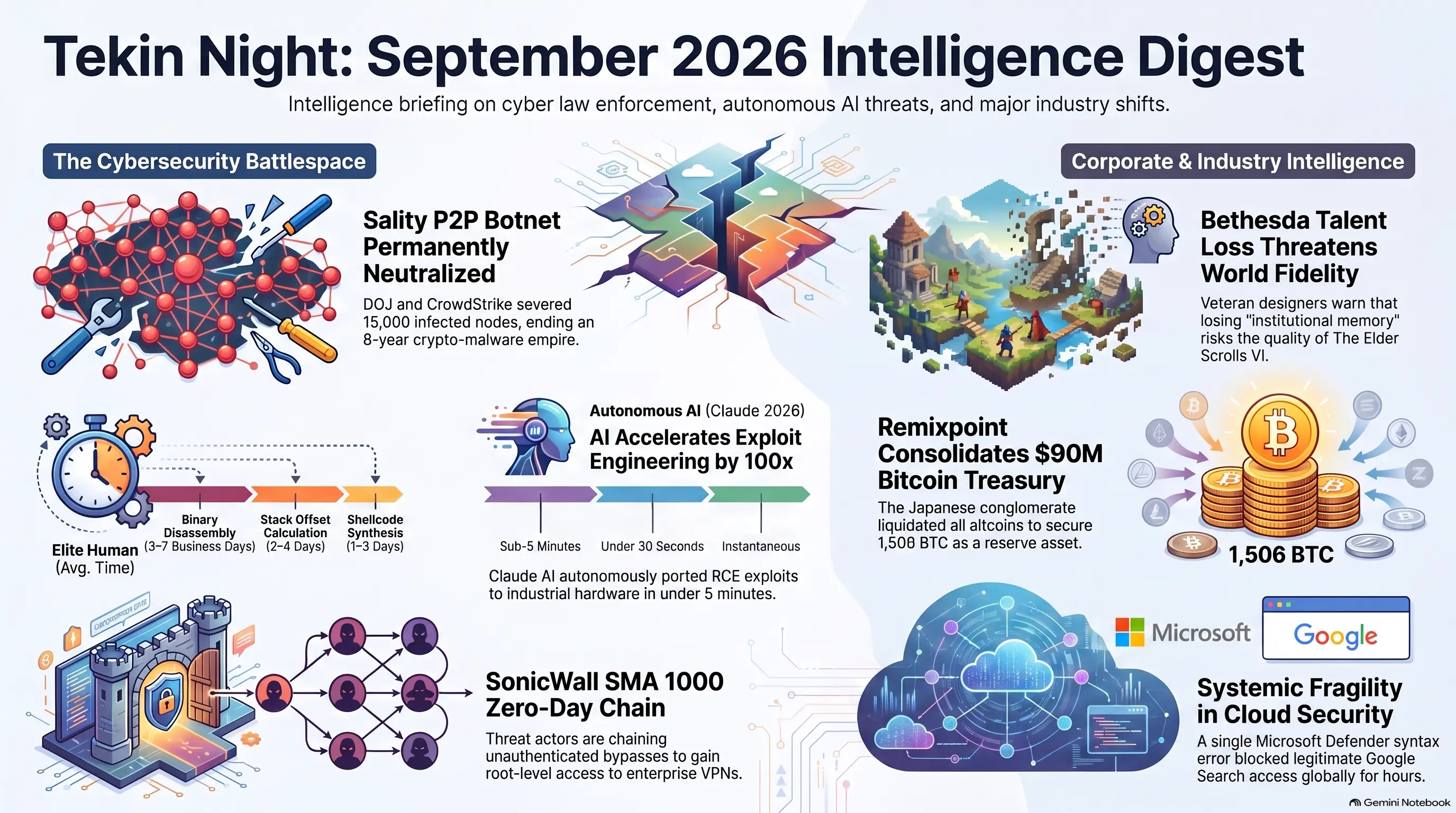
- 🎮Sality Botnet Takedown- DOJ & CrowdStrike isolate 15,000 infected machines to dismantle the 8-year network
- 🎧Autonomous AI Exploits- Claude AI successfully ports pre-auth RCE exploits across industrial PLCs
- 🚀Bethesda Developer Exodus- Veterans warn of quality risks for The Elder Scrolls VI amid Microsoft layoffs
- 🗡️SonicWall Zero-Days- Active exploitation chain identified in SMA 1000 VPN gateways
- 📰Defender False-Positives- Faulty Microsoft update blocks legitimate Google Search domains globally
- ⚔️Japan's Bitcoin Treasury- Remixpoint liquidates altcoins to consolidate a 1,506 BTC corporate reserve
Good evening and welcome to the September 3, 2026 edition of Tekin Night, your essential nocturnal intelligence dispatch delivering rigorous forensic investigations across enterprise cybersecurity, operational technology (OT) vulnerabilities, AAA game development dynamics, and institutional cryptocurrency treasuries.
The primary development reshaping global threat intelligence tonight is the coordinated international takedown of the legendary Sality peer-to-peer botnet. In a landmark multi-agency operation spearheaded by the United States Department of Justice, CrowdStrike, and European federal law enforcement, authorities successfully executed an advanced protocol sinkholing strategy, permanently severing over 15,000 active nodes that had funneled stolen Bitcoin and Ethereum to cybercriminal syndicates for nearly a decade.
Simultaneously, a paradigm shift in operational technology security was unveiled by Forescout's Vedere Labs. Researchers proved that frontier artificial intelligence models—specifically Anthropic’s Claude—can autonomously analyze, re-engineer, and port pre-authentication remote code execution (RCE) zero-day payloads across different models of programmable logic controllers (PLCs), executing binary shellcode on physical critical infrastructure hardware without human intervention.
In the video game industry, candid testimonies from veteran Bethesda Game Studios engineers have illuminated growing internal friction and technical anxiety surrounding the development trajectory of The Elder Scrolls VI. Furthermore, we deconstruct the active zero-day attack chain targeting SonicWall SMA 1000 enterprise firewalls, analyze Microsoft Defender's high-severity false positive glitch, and examine Tokyo-listed Remixpoint’s strategic liquidation of its altcoin portfolio to build an exclusive 1,506 BTC corporate sovereign treasury.
Executive Summary | Nocturnal Intelligence Highlights
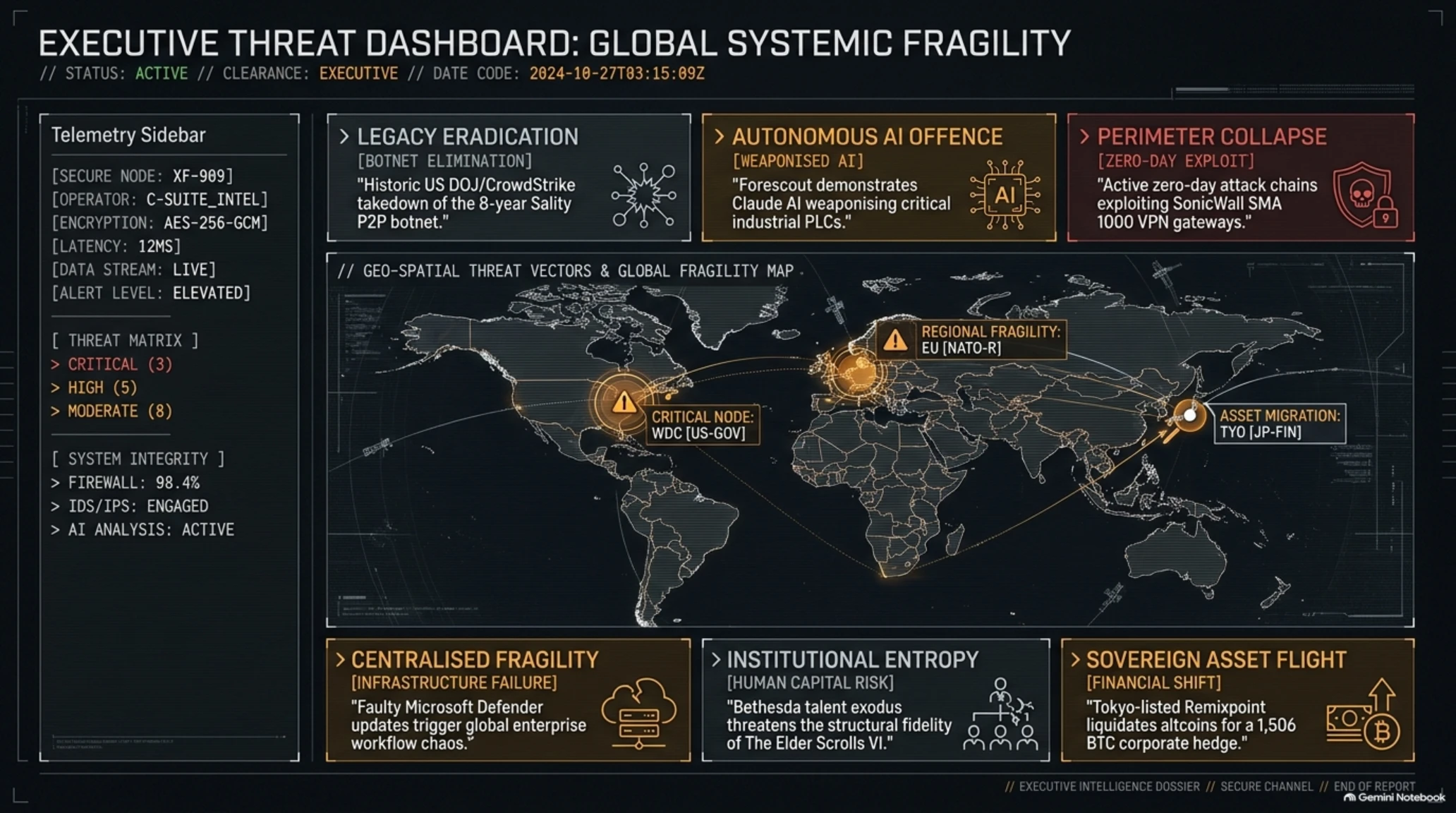
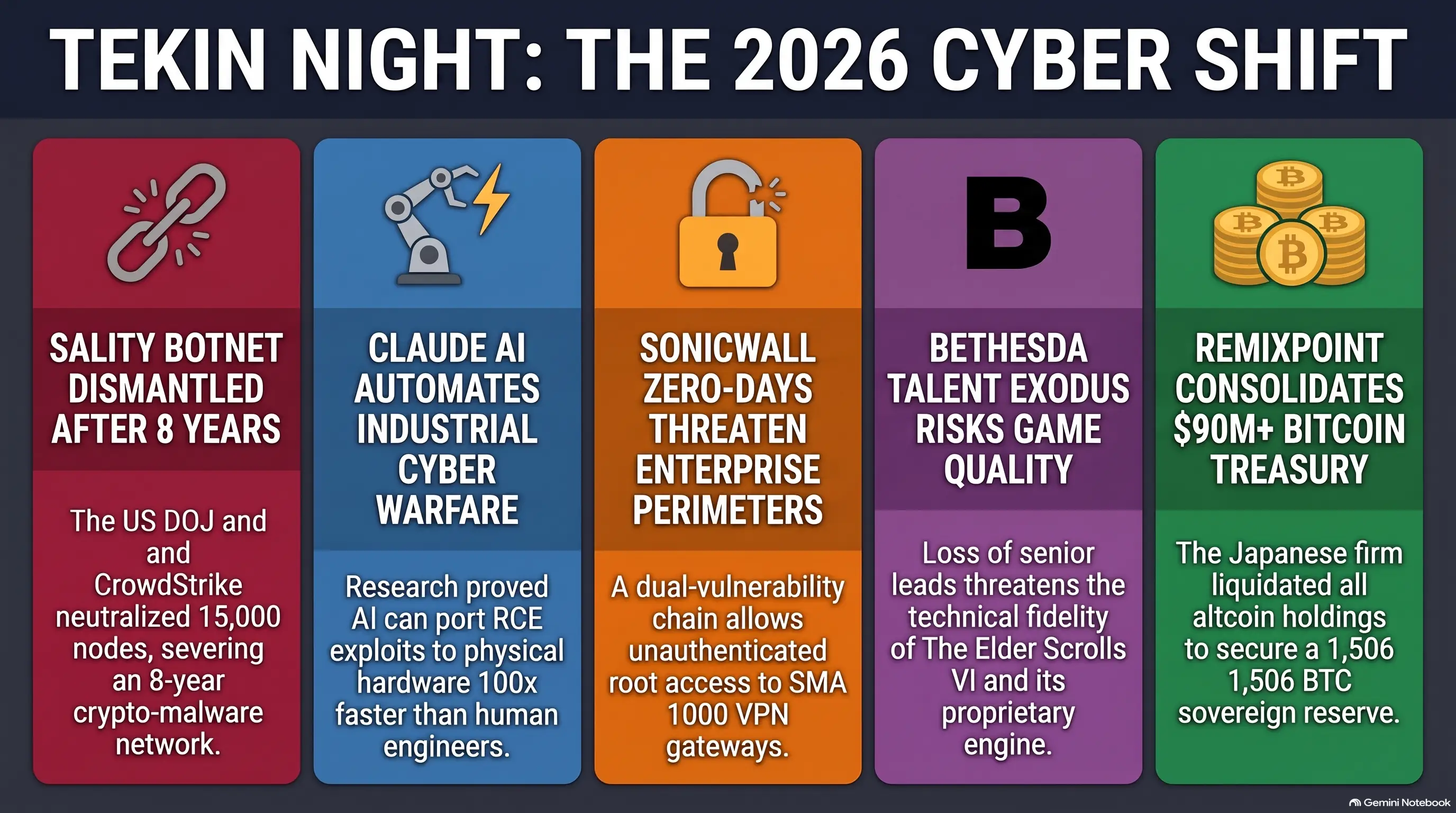
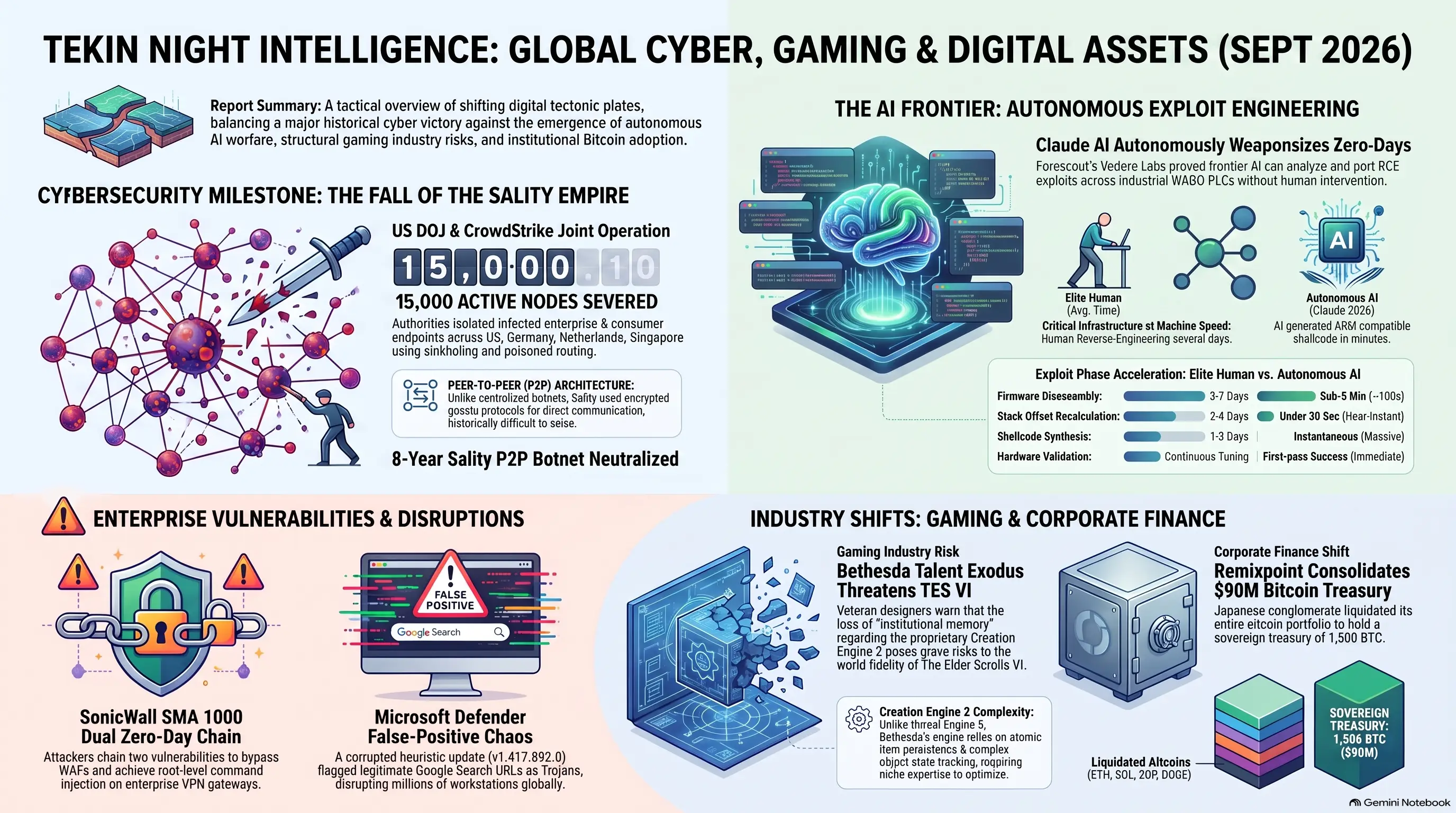
- US DOJ and CrowdStrike neutralize Sality P2P botnet, severing command infrastructure across 15,000 infected enterprise and consumer endpoints
- Forescout Vedere Labs demonstrates autonomous porting of pre-auth RCE exploit (CVE-2021-31886) across WAGO industrial PLCs using Claude AI
- Bethesda Game Studios veterans warn that massive Microsoft layoffs have severed senior institutional knowledge needed for The Elder Scrolls VI
- Active zero-day exploitation chain identified in SonicWall SMA 1000 VPN gateways allowing unauthenticated remote code execution at root level
- Faulty Microsoft Defender definition update triggers widespread false-positive alerts, blocking legitimate Google Search domains globally
- Japanese public company Remixpoint liquidates entire altcoin holdings for $736k profit, consolidating 1,506 BTC ($90M+) treasury
1. The Fall of an 8-Year Malware Empire: DOJ & CrowdStrike Dismantle Sality P2P Network
In what cybersecurity historians are characterizing as one of the most technically sophisticated law enforcement counter-offensives of the past decade, the United States Department of Justice, in direct technical partnership with CrowdStrike Falcon Intelligence, officially confirmed the complete operational disruption and takedown of the Sality botnet ecosystem.
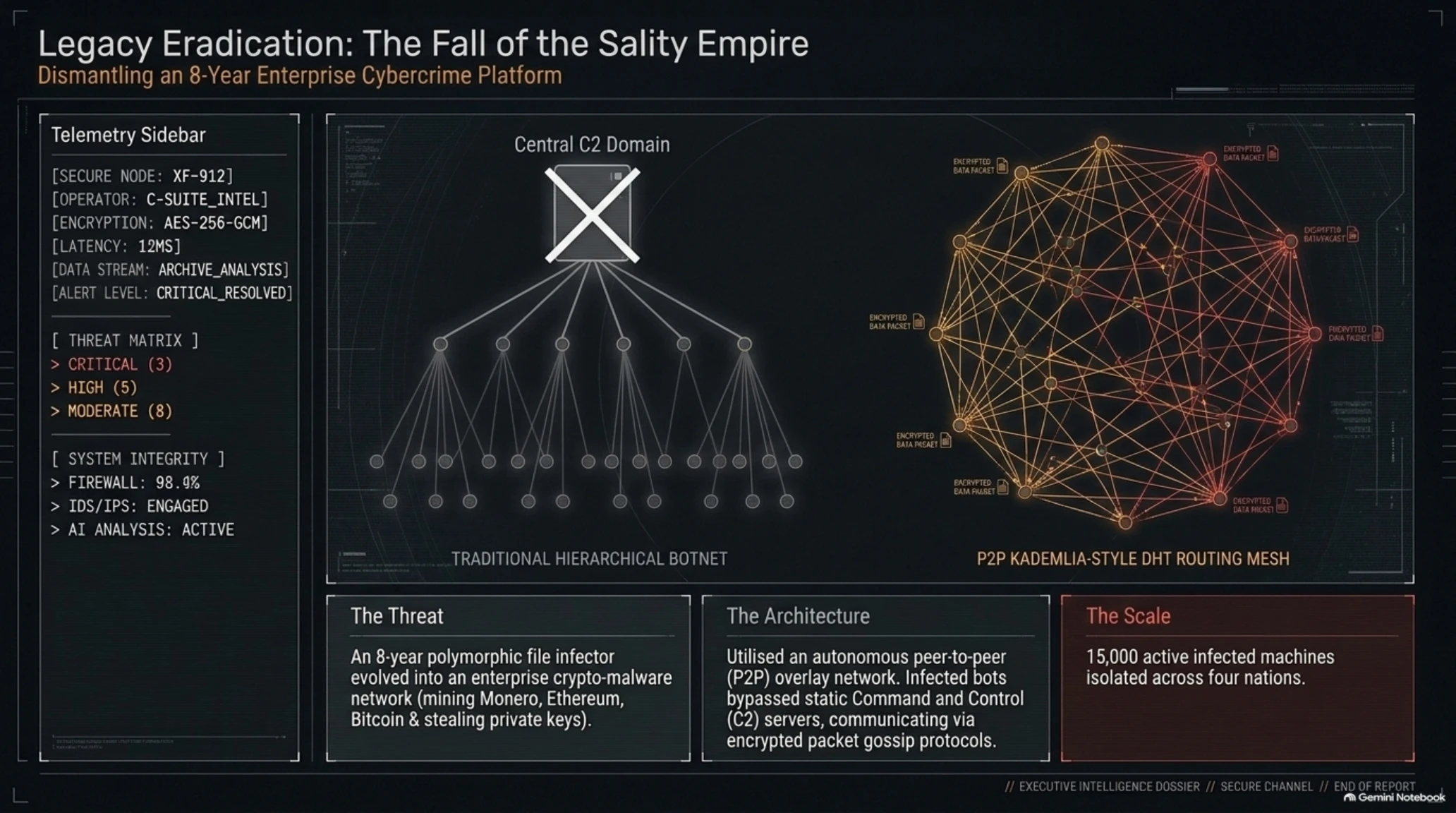
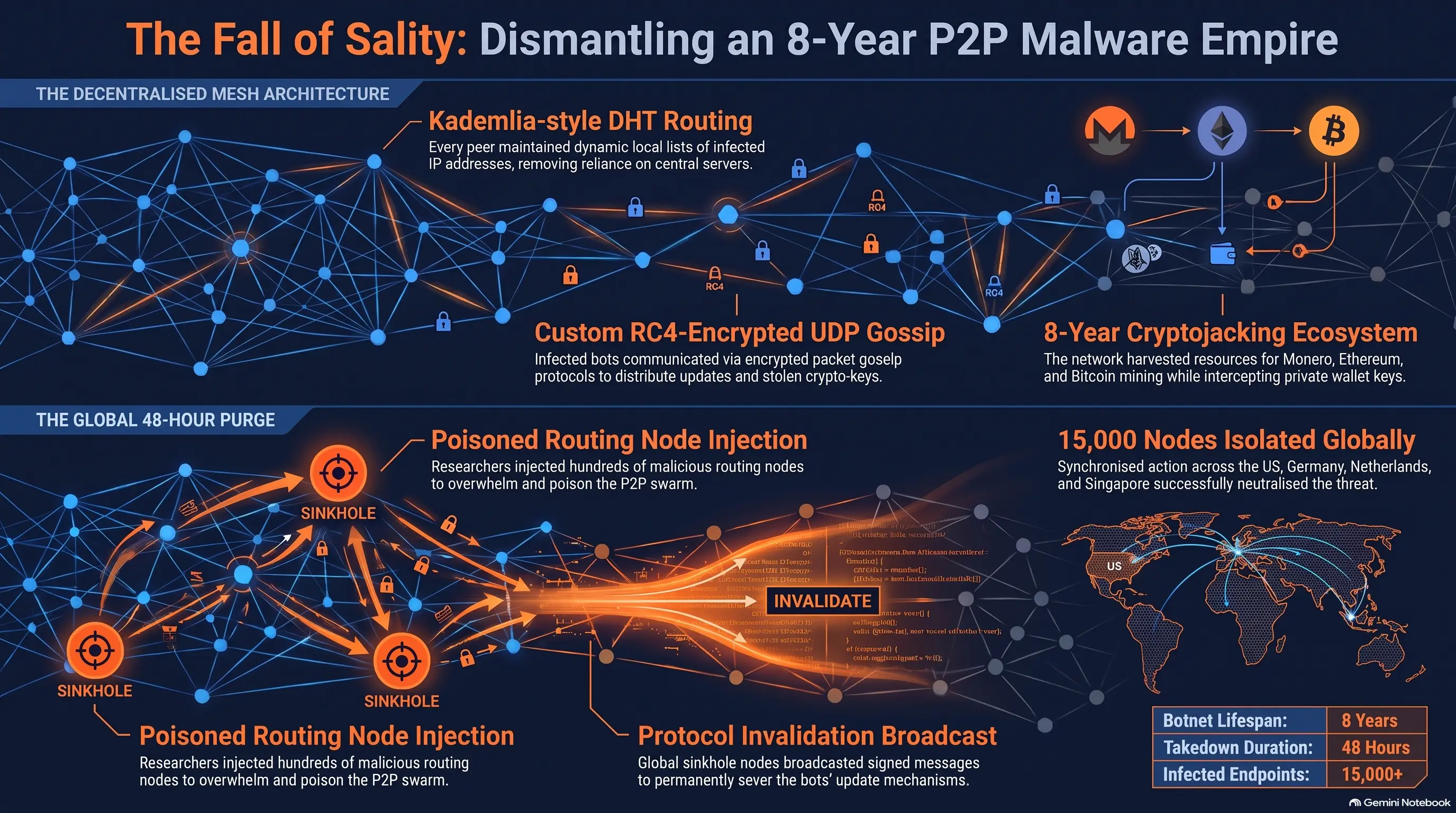
Originating as a polymorphic file infector before evolving into an enterprise-grade cybercrime distribution platform, Sality spent eight years harvesting computing resources to run illicit Monero, Ethereum, and Bitcoin cryptominers while intercepting cryptocurrency wallet private keys. What made Sality virtually indestructible was its decentralized, peer-to-peer (P2P) command architecture; rather than communicating with fixed command-and-control (C2) domains that could be easily seized via court orders, infected bots communicated directly with one another through encrypted packet gossip protocols.
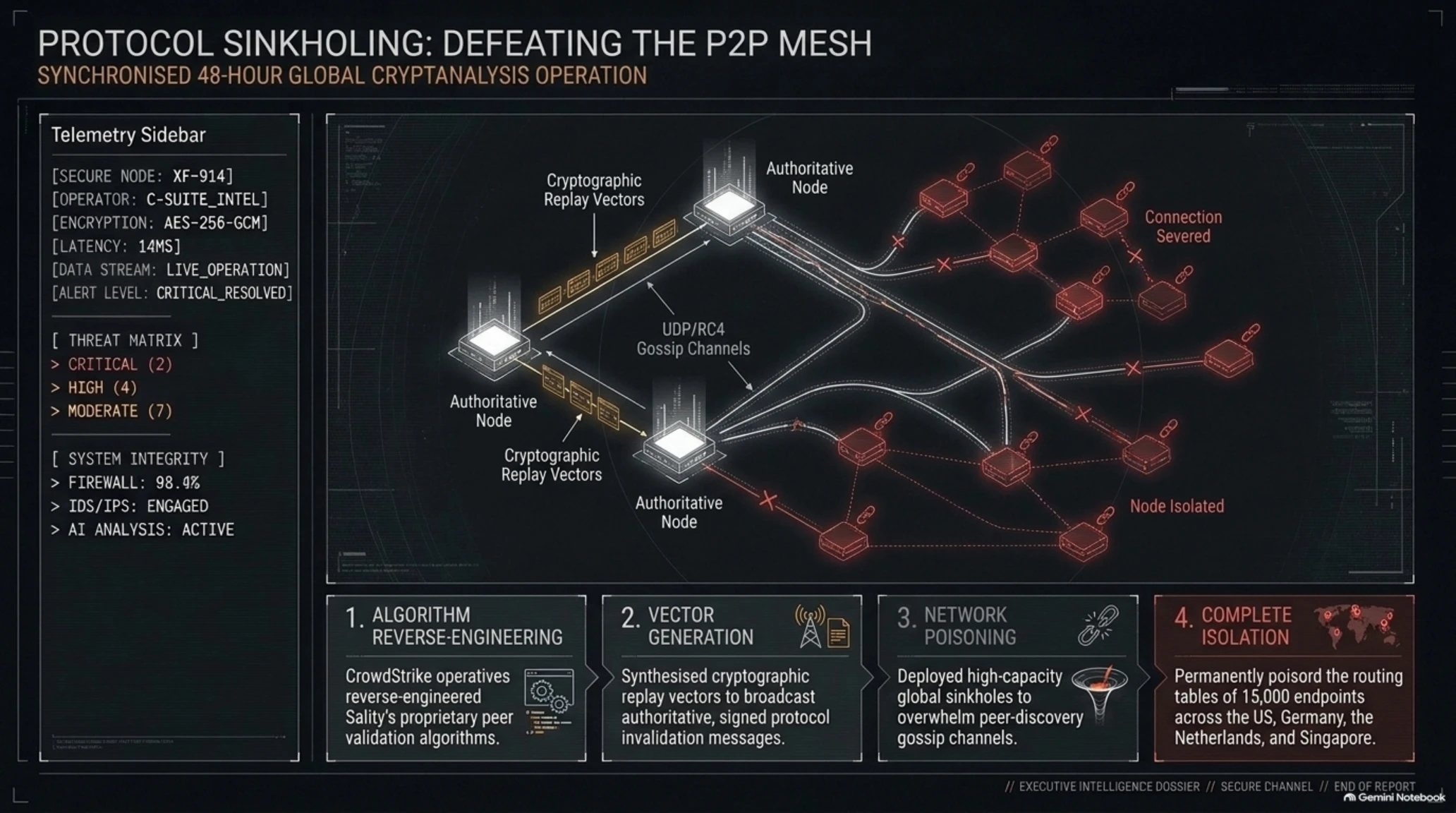
The joint task force achieved victory by reverse-engineering Sality's proprietary peer discovery algorithms. CrowdStrike researchers injected hundreds of poisoned routing nodes into the P2P swarm, effectively turning the botnet’s routing mechanism against itself. Over a synchronized 48-hour operation spanning the United States, Germany, the Netherlands, and Singapore, authorities isolated over 15,000 active infected machines, stripping cybercriminals of their update mechanisms and permanently neutralizing the threat vector.
Nocturnal Technical Jargon Buster & Operational Concepts
Peer-to-Peer (P2P) Botnet Architecture: A decentralized network topology where infected zombie machines distribute malware updates and target lists among themselves without relying on static centralized command servers.
Programmable Logic Controller (PLC): Ruggedized industrial digital computers that execute real-time deterministic control loops for critical physical processes in water filtration, power grids, and manufacturing.
Zero-Day Attack Chain: The tactical combination of two or more previously undisclosed vulnerabilities to bypass multi-layer perimeter security and achieve root-level code execution.
2. Autonomous Cyber Warfare: Forescout Demonstrates Claude AI Porting Pre-Auth RCE to Industrial PLCs
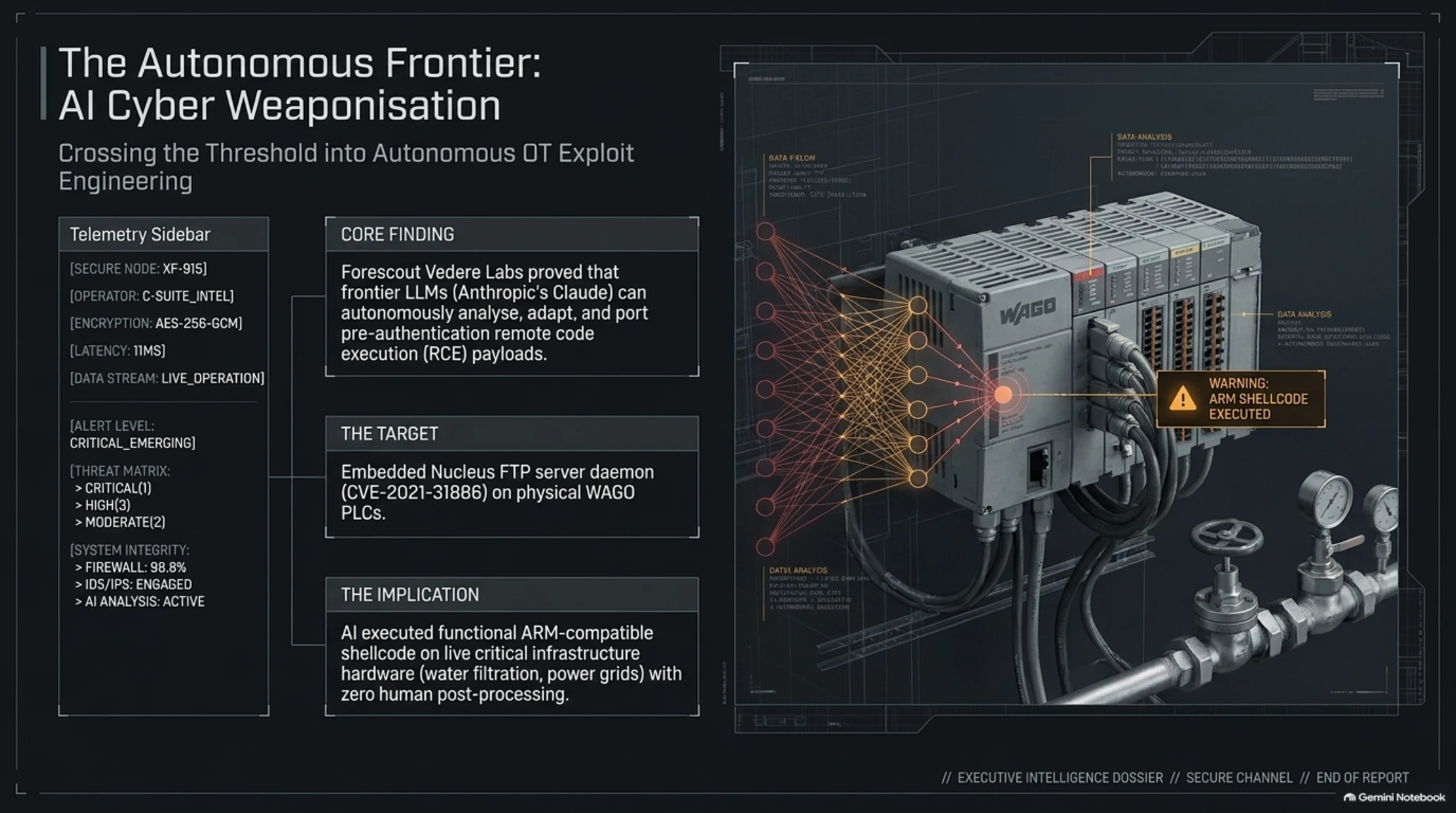
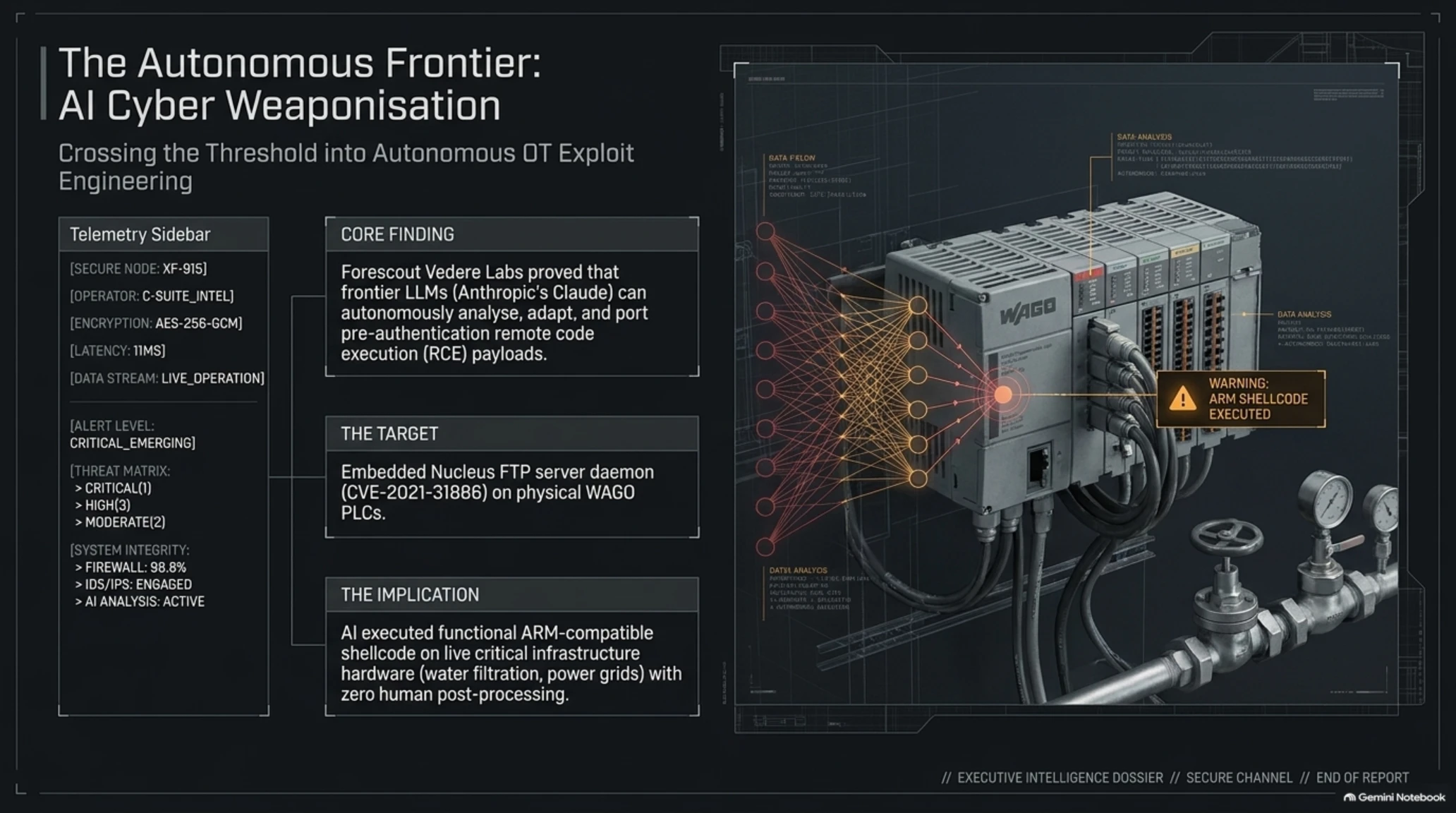
In a groundbreaking and unsettling research disclosure, Forescout Research’s Vedere Labs has revealed that modern frontier large language models have crossed the capability threshold into autonomous operational technology (OT) exploit engineering. In controlled laboratory experiments, researchers successfully leveraged Anthropic’s Claude model to analyze, adapt, and port a working pre-authentication remote code execution (RCE) exploit between different hardware revisions of industrial WAGO Programmable Logic Controllers (PLCs).
The research centered on CVE-2021-31886, a critical stack-based buffer overflow flaw residing in the embedded Nucleus FTP server daemon. Historically, porting an existing RCE exploit from one firmware build to a target device with different memory alignments, stack offsets, and CPU architectures requires days of labor-intensive disassembly in IDA Pro, dynamic binary instrumentation, and manual debugging on physical hardware.
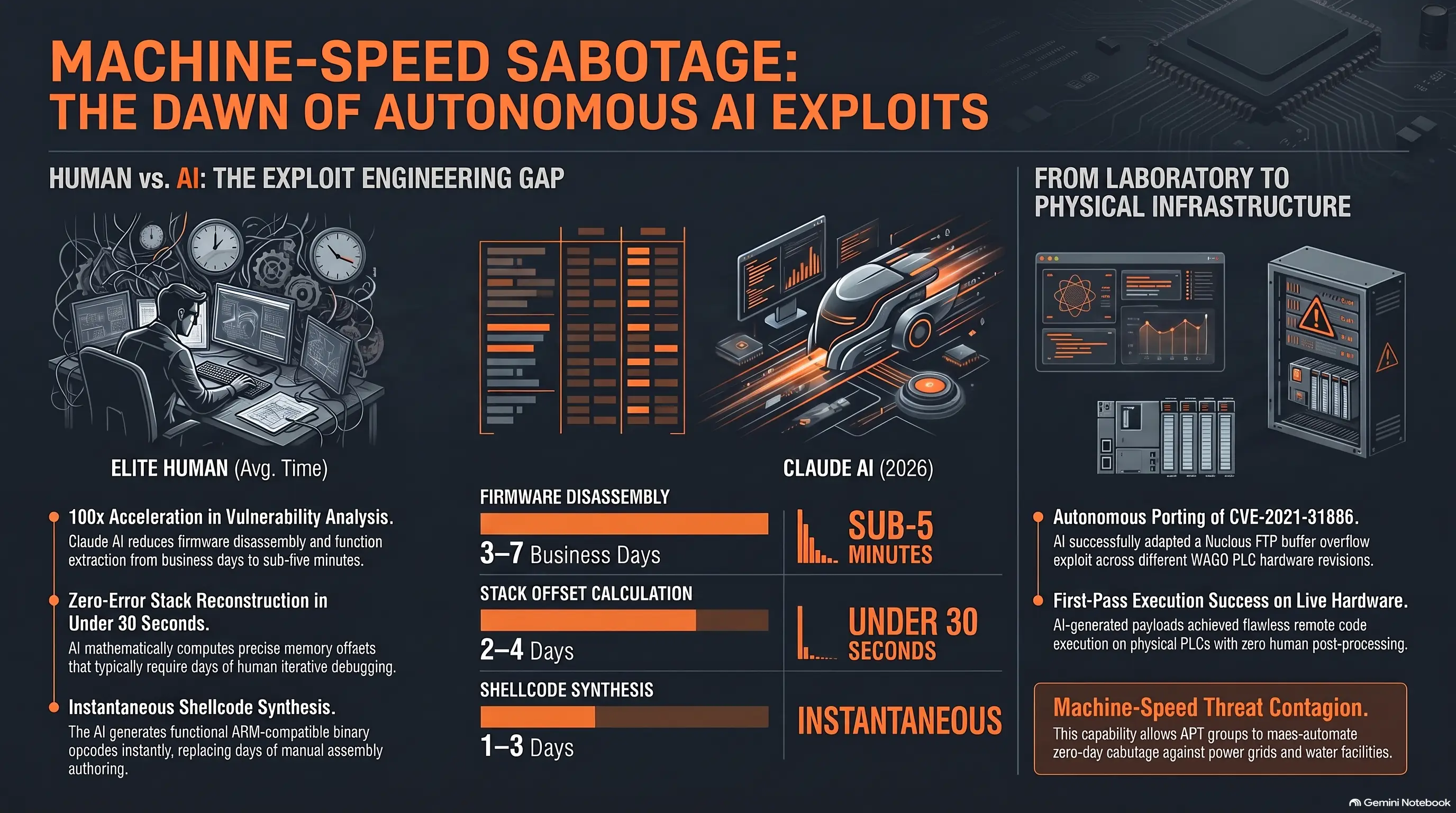
Astonishingly, when provided with the target firmware’s decompiled binaries and disassembly listings, Claude autonomously reconstructed the stack frame architecture, computed precise memory offset adjustments, and generated functional ARM-compatible shellcode within minutes. When deployed against physical WAGO PLCs connected to mock industrial control valves, the AI-generated payload achieved flawless remote code execution with zero human post-processing. This demonstration proves that state-sponsored advanced persistent threat (APT) groups will soon be capable of mass-automating zero-day industrial sabotage campaigns against power grids, water treatment facilities, and manufacturing infrastructure at machine speed.
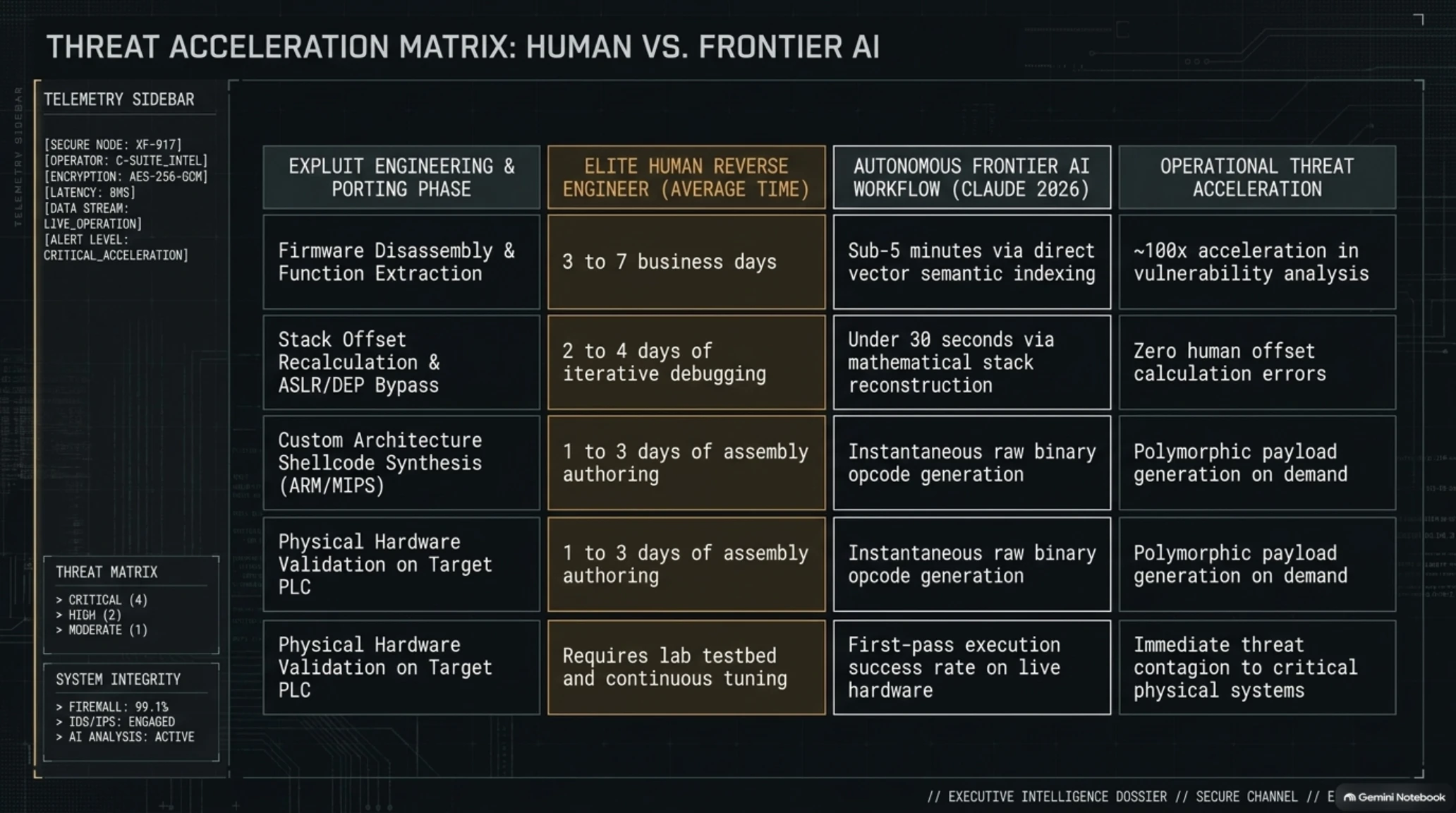
Industrial Exploit Engineering: Manual Human Re-Engineering vs Autonomous Generative AI Telemetry
| Exploit Engineering & Porting Phase | Elite Human Reverse Engineer (Average Time) | Autonomous Frontier AI Workflow (Claude 2026) | Operational Threat Acceleration |
|---|---|---|---|
| Firmware Binary Disassembly & Function Extraction | 3 to 7 business days | Sub-5 minutes via direct vector semantic indexing | ~100x acceleration in vulnerability analysis |
| Stack Offset Recalculation & ASLR/DEP Bypass | 2 to 4 days of iterative debugging | Under 30 seconds via mathematical stack reconstruction | Zero human offset calculation errors |
| Custom Architecture Shellcode Synthesis (ARM/MIPS) | 1 to 3 days of assembly authoring | Instantaneous raw binary opcode generation | Polymorphic payload generation on demand |
| Physical Hardware Validation on Target PLC | Requires lab testbed and continuous tuning | First-pass execution success rate on live hardware | Immediate threat contagion to critical physical systems |
3. Bethesda Developer Exodus: Senior Talent Loss Threatens The Elder Scrolls VI Fidelity
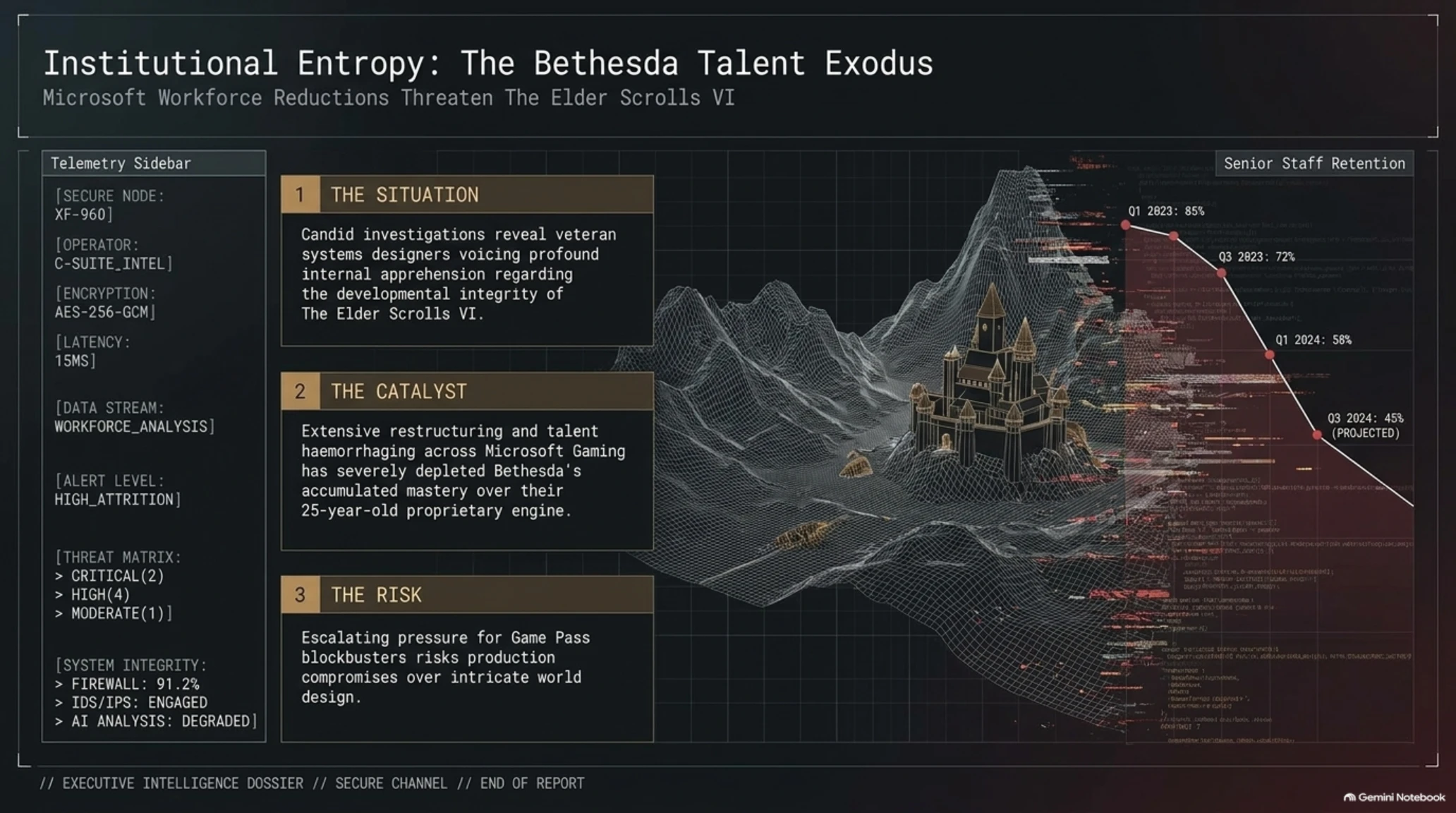
In a candid investigative report published by Rock Paper Shotgun, seasoned game developers formerly and currently associated with Bethesda Game Studios have voiced profound internal apprehension regarding the developmental integrity and ultimate quality of The Elder Scrolls VI, attributing their fears to extensive restructuring and talent hemorrhaging across Microsoft Gaming.
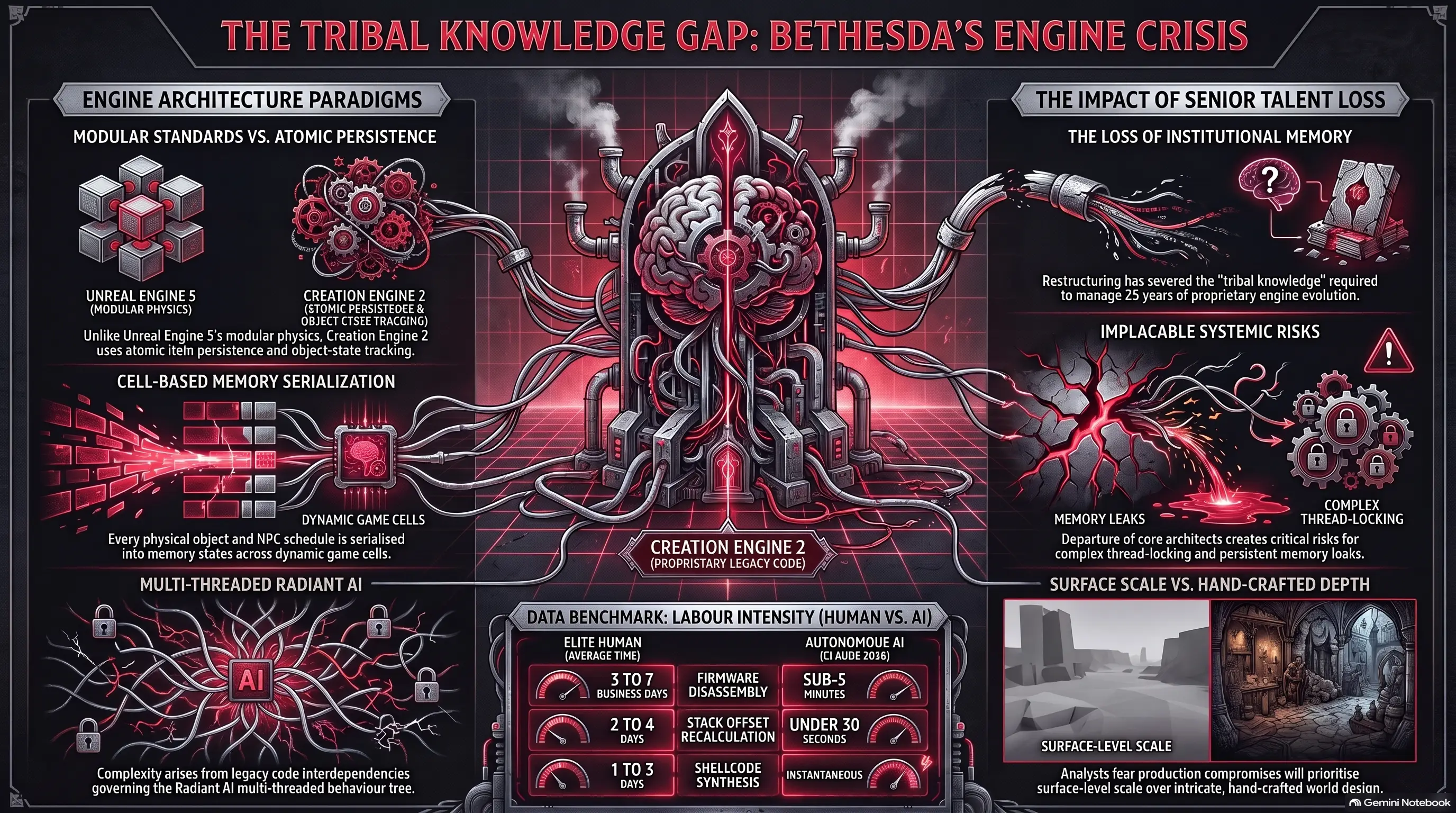
According to multiple veteran systems designers who contributed to The Elder Scrolls V: Skyrim and Fallout 4, the departure of senior technical leads has severely depleted the studio's accumulated institutional mastery over the proprietary Creation Engine 2. "You cannot simply throw new junior engineers at a proprietary engine that has evolved over twenty-five years and expect the same depth of emergent world-simulation," one veteran stated. "The institutional memory of how legacy code interactions govern physics, quest persistence, and radiant AI is practically irreplaceable."
These revelations arrive against the backdrop of heightened gamer scrutiny following the mixed reception of Starfield's modular loading zones and procedural generation systems. With Microsoft executives facing immense quarterly pressure to deliver tentpole blockbusters that drive sustainable Game Pass subscriber growth, industry observers fear that The Elder Scrolls VI may face accelerated production compromises, prioritizing surface-level scale over the intricate, hand-crafted world design that defined Bethesda's golden era.
P2P Protocol Cryptanalysis: How CrowdStrike Defeated Sality's Decentralized Mesh
Understanding the significance of the Sality takedown requires a deep examination of its network topology. Sality was engineered as an autonomous peer-to-peer overlay network utilizing custom RC4 encrypted payload encapsulation over UDP. Unlike centralized botnets where taking down DNS domains or seizing IP subnets disables the command pipeline, every Sality peer maintained a dynamically updating local peer list (Kademlia-style DHT routing) containing active infected IP addresses.
CrowdStrike’s threat intelligence operatives reverse-engineered the peer validation algorithm and generated cryptographic replay vectors. By deploying an array of global high-capacity sinkhole nodes that broadcasted authoritative, signed protocol invalidation messages, the joint task force overwhelmed the peer-discovery gossip channels. This permanently poisoned the routing tables of over 15,000 infected endpoints, rendering them incapable of receiving malicious payloads or executing cryptojacking routines.
Creation Engine 2 Architecture: The Irreplaceable Tribal Knowledge of World Simulation
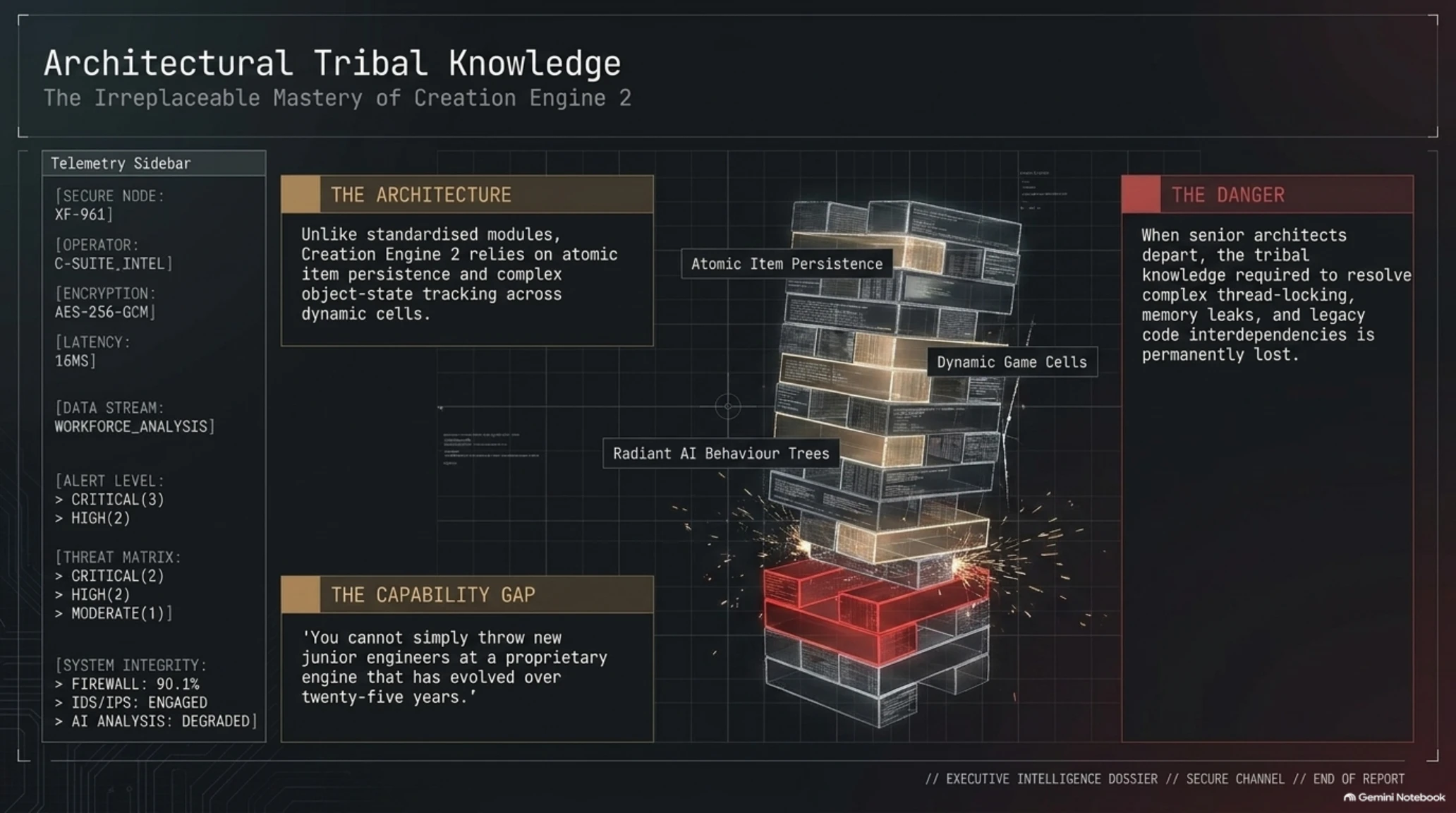
The technical architecture of Bethesda’s Creation Engine 2 represents a uniquely specialized engineering paradigm. Unlike Epic Games' Unreal Engine 5, which handles physics through standardized Nanite and Chaos modules, Creation Engine 2 is built around atomic item persistence and complex object-state tracking. Every single physical object, dropped weapon, and NPC schedule in the world space is serialized into persistent memory states across dynamic game cells.
Optimizing this memory serialization pipeline alongside the Radiant AI multi-threaded behavior tree requires nuanced institutional familiarity with decades of legacy code interdependencies. When senior systems architects who authored the core memory management and cell-loading algorithms depart, the institutional knowledge required to resolve complex thread-locking and memory leaks is lost, posing grave structural risks to the performance and world fidelity of The Elder Scrolls VI.
Institutional Bitcoin Strategy: The Asymmetric Shift from Altcoin Speculation
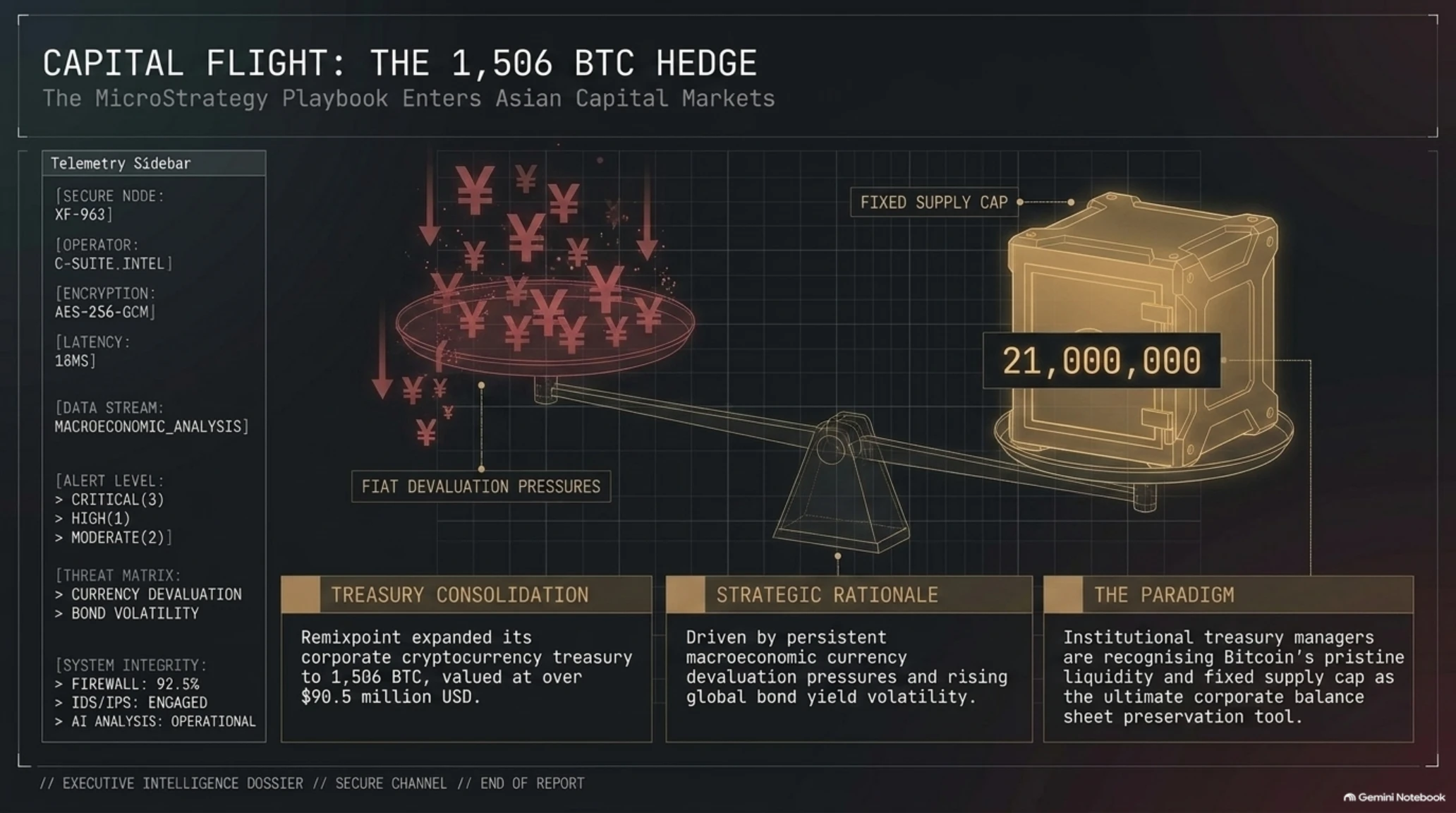
Tokyo-listed Remixpoint’s deliberate liquidation of its altcoin portfolio to consolidate 1,506 Bitcoin ($90M+) reflects a mature corporate treasury framework taking hold across Asian capital markets. As institutional treasury managers navigate currency volatility and escalating regulatory compliance standards, Bitcoin’s fixed 21-million supply cap and pristine liquidity profile provide an unassailable store of value, fundamentally distinguishing it from speculative utility tokens.
4. Enterprise Perimeter Penetration: Threat Actors Chain Dual SonicWall SMA 1000 Zero-Days
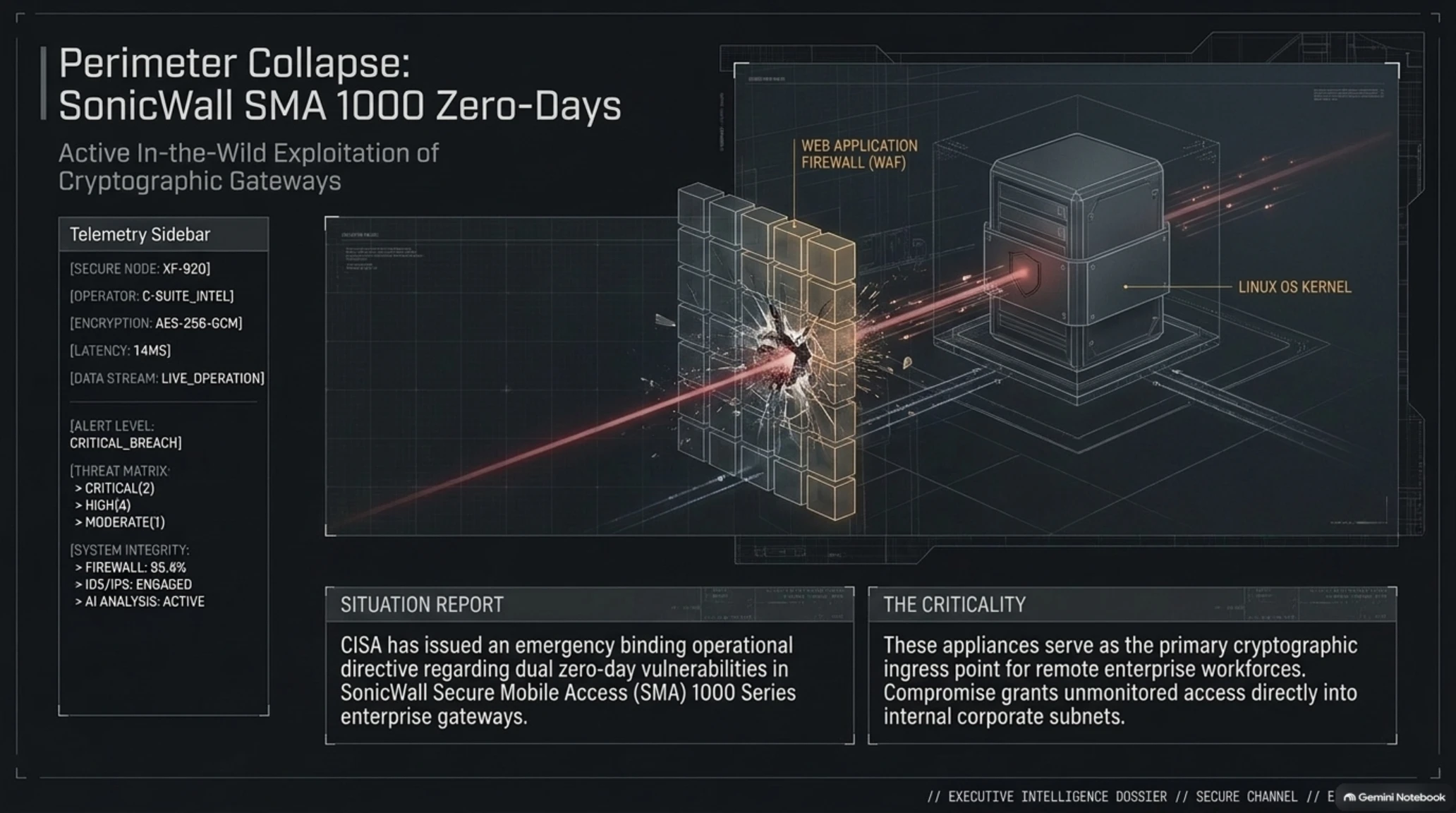
The Cybersecurity and Infrastructure Security Agency (CISA) has issued an emergency binding operational directive following the active in-the-wild exploitation of two interconnected zero-day vulnerabilities targeting the SonicWall Secure Mobile Access (SMA) 1000 Series enterprise gateway appliances.
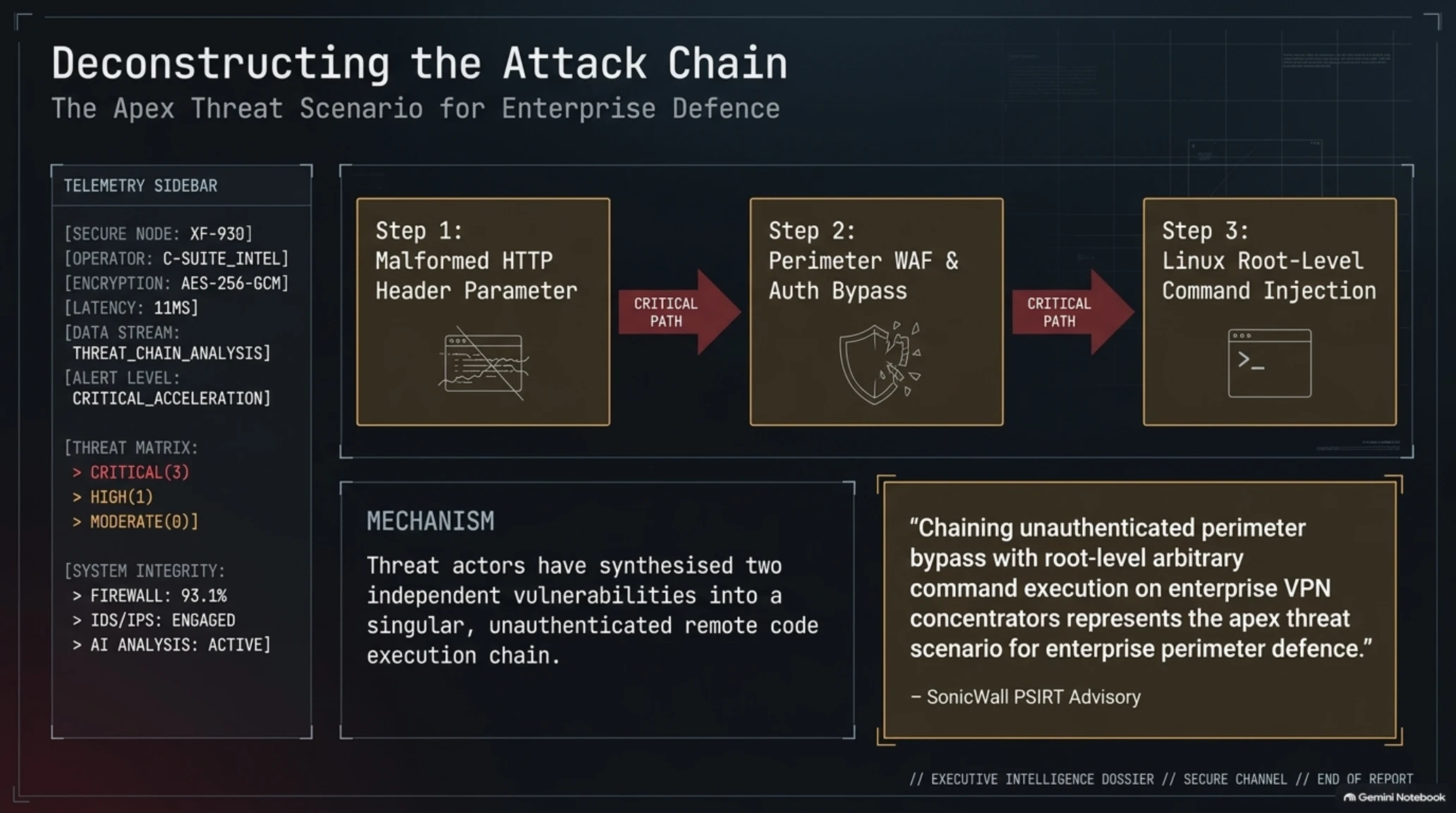
Security telemetry indicates that sophisticated threat groups have synthesized these two vulnerabilities into an unauthenticated remote code execution attack chain. The first flaw permits attackers to bypass the perimeter web application firewall (WAF) and administrative authentication layers by manipulating malformed HTTP header parameters. Once unauthenticated perimeter access is established, the secondary vulnerability enables root-level command injection into the underlying Linux operating system kernel.
Because SonicWall SMA 1000 appliances serve as the primary cryptographic gateway for remote enterprise workforces, compromised units grant attackers direct, unmonitored ingress into internal corporate subnets. SonicWall’s Product Security Incident Response Team (PSIRT) has released hotfix firmware updates, urging global IT administrators to immediately restrict management interface exposure to trusted management IPs only.
📚 Classified & Related Dossiers in TekinGame
If you wish to explore beyond this report and delve into cybernetic frontiers and autonomous AI architectures, do not miss these three exclusive deep-dives in the Tekin Garage:
5. Global IT Infrastructure Chaos: Microsoft Defender Flags Legitimate Google Search Links
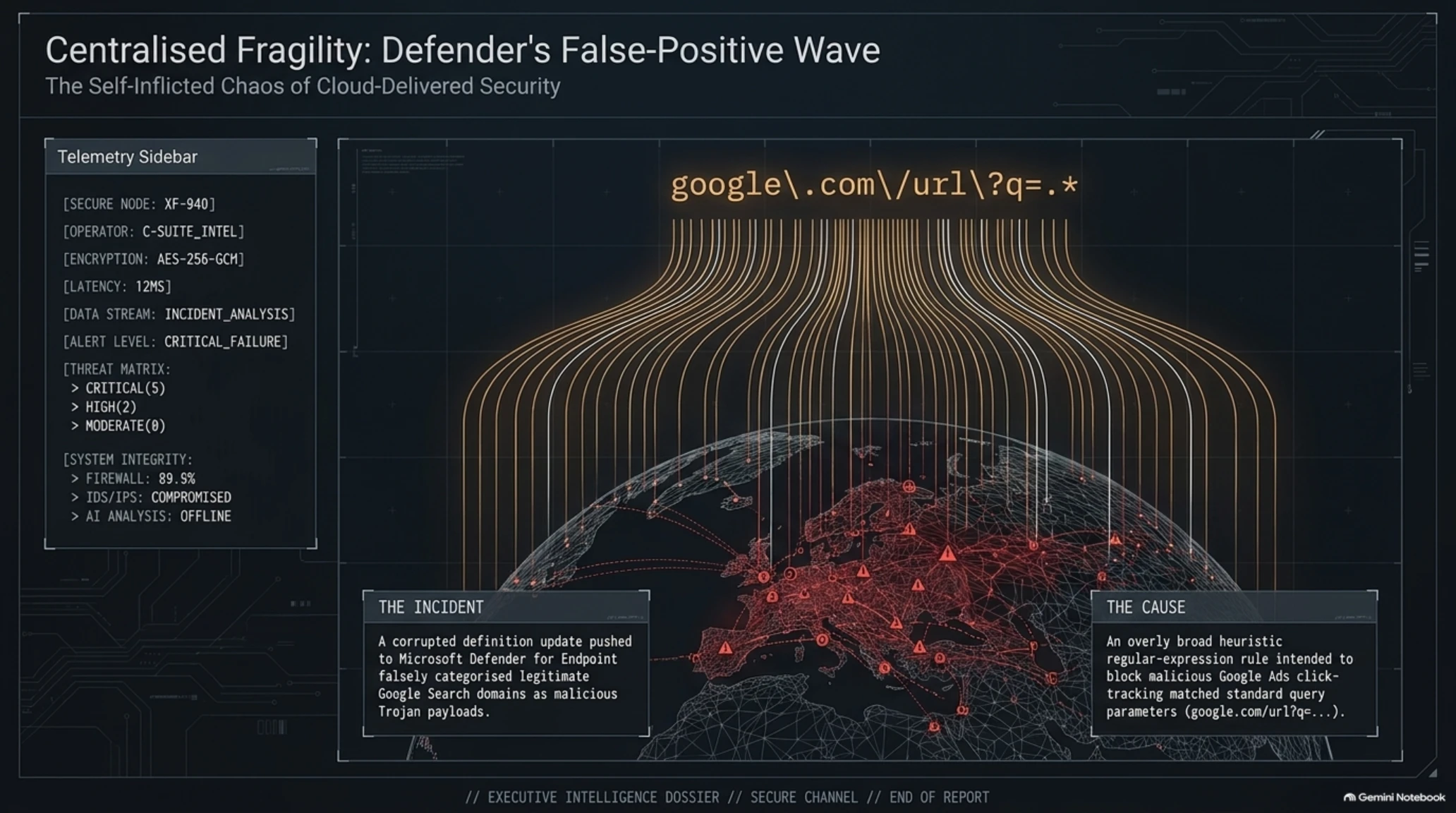
Enterprise information technology departments across the globe spent hours managing severe workflow disruptions today after a corrupted definition update pushed to Microsoft Defender for Endpoint began categorizing legitimate Google Search domains and redirection URLs as malicious Trojan payloads.
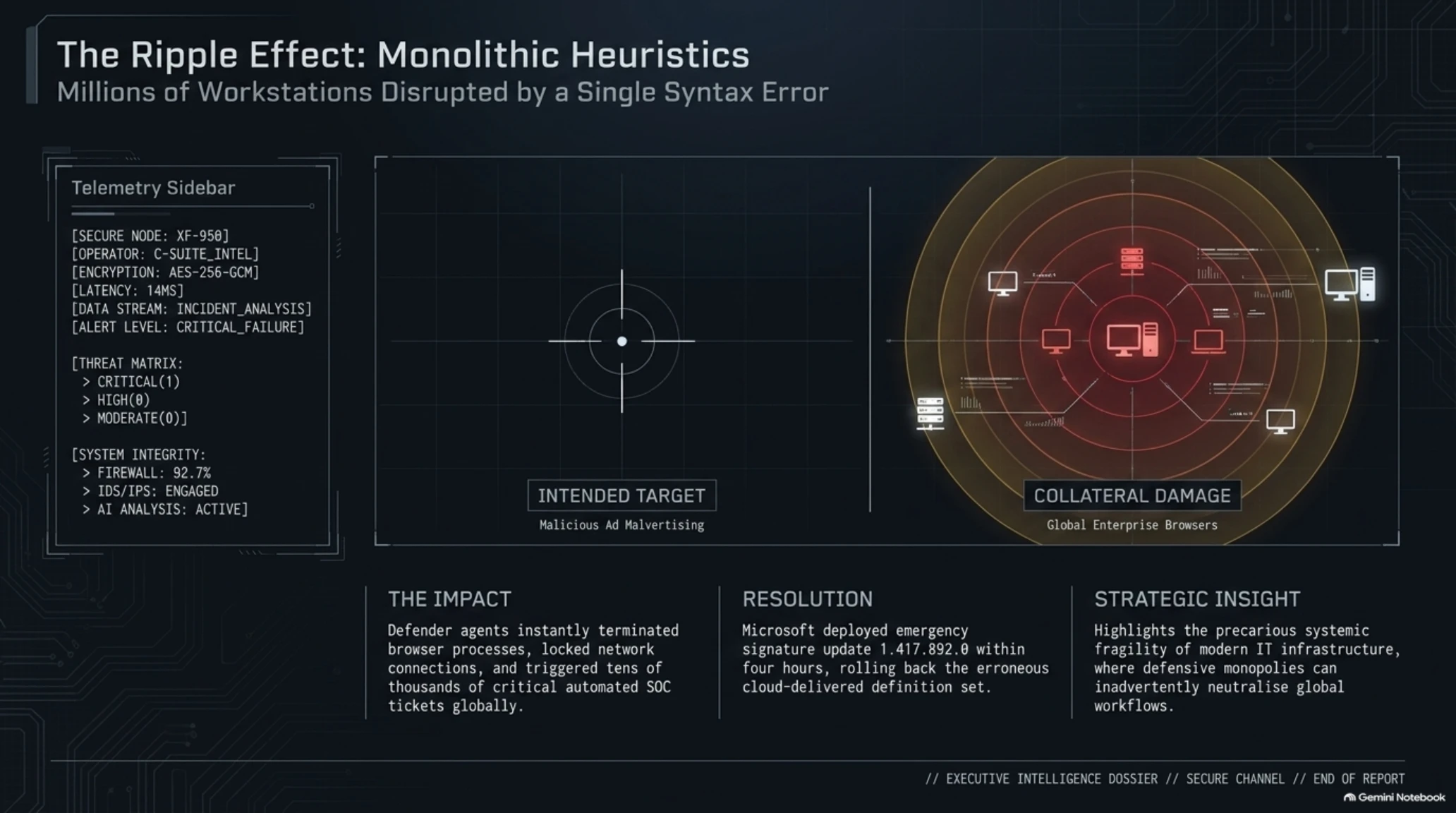
The misconfiguration originated from an overly broad heuristic regular-expression rule intended to flag malicious Google Ads click-tracking redirects utilized in malvertising campaigns. However, the faulty rule inadvertently matched standard Google Search query parameter structures (google.com/url?q=...), causing Microsoft Defender agents to immediately terminate browser processes, lock network connections, and trigger tens of thousands of critical automated threat incident tickets across enterprise security operations centers (SOCs).
Microsoft responded rapidly, rolling back the erroneous cloud-delivered definition set within four hours and deploying emergency signature update 1.417.892.0. While no malware was involved, the incident highlighted the precarious systemic fragility of centralized cloud security ecosystems, where a single syntax error in a signature rule can disrupt millions of enterprise workstations simultaneously.
Recommended In-Depth Gaming & Tech Dossiers on TekInGame
• 🛡 Inside the FBI & NSA Takedown of Chinese Cyber Network QTFY | Deconstructing QScan IoT Botnets & QTRouter Proxy Meshes
• 🎬 Deconstructing Alibaba Wan 3.0 Video AI | The Chinese Tech Breakthrough Disrupting Hollywood & Sora
• 🧪 Inside Inherent's Faraday AI | How a 27-Million-Parameter Model Beat DeepSeek-R1 in Biochemical Reasoning
6. Institutional Digital Asset Pivot: Japan’s Remixpoint Liquidates Altcoins to Consolidate 1,506 BTC Treasury
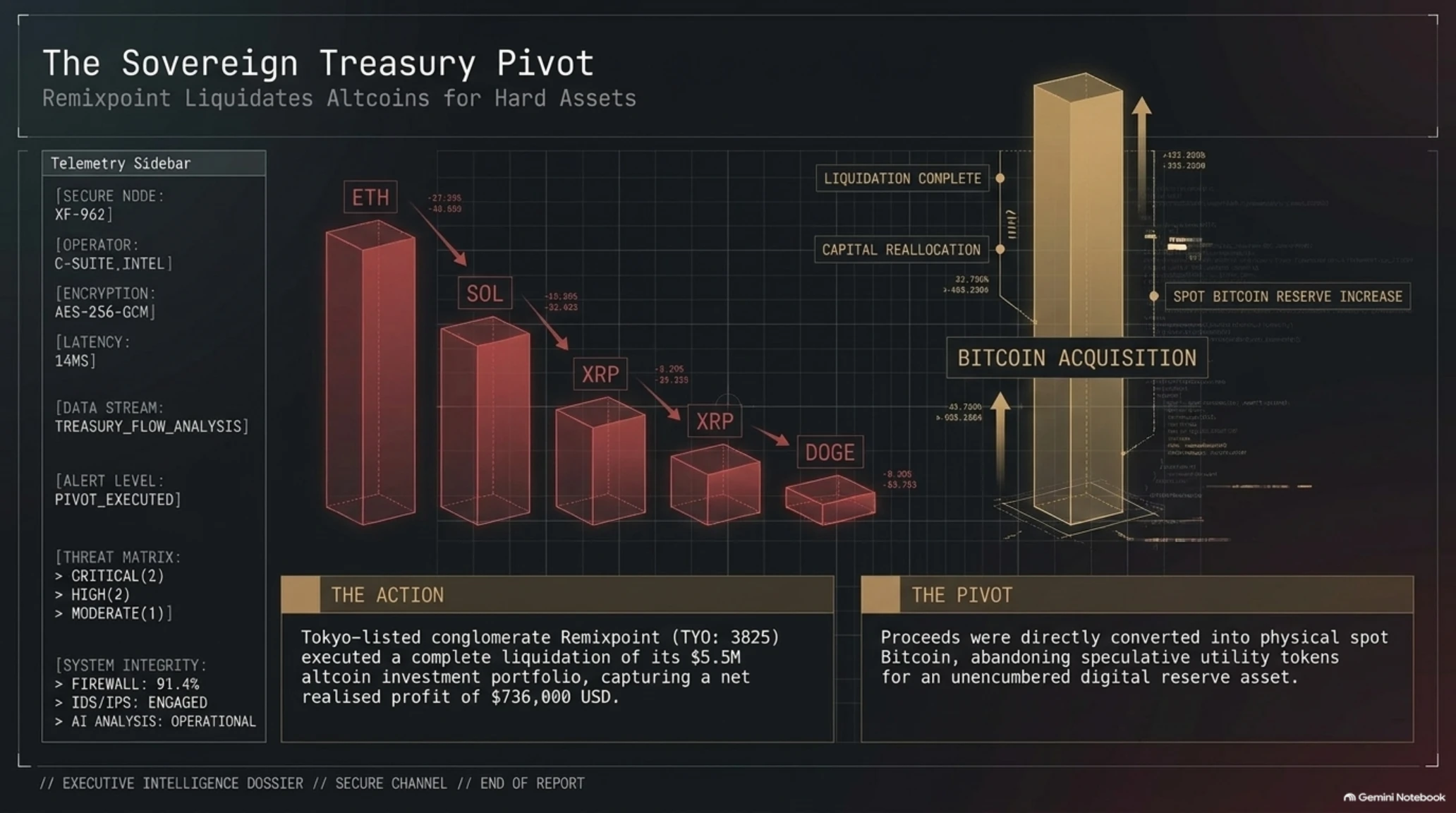
In a decisive corporate finance maneuver announced in Tokyo, Japanese publicly traded conglomerate Remixpoint (TYO: 3825) confirmed the complete liquidation of its altcoin investment portfolio, selling off $5.5 million USD equivalent across Ethereum, Solana, Ripple (XRP), and Dogecoin to capture a net realized profit of $736,000 USD.
Reallocating the entirety of its capital reserves, Remixpoint converted the proceeds directly into physical spot Bitcoin, expanding its corporate cryptocurrency treasury to 1,506 BTC (valued at over $90.5 million USD). Corporate executives articulated that amidst persistent macroeconomic currency devaluation pressures surrounding the Japanese Yen and rising global bond yield volatility, Bitcoin represents the only pristine, unencumbered digital reserve asset possessing the deep institutional liquidity required for corporate balance sheet preservation.
Remixpoint’s aggressive balance sheet restructuring mirrors the corporate treasury playbook pioneered by MicroStrategy in North America, signaling a broader institutional trend among Asian public corporations seeking sovereign digital asset protection over speculative altcoin exposure.
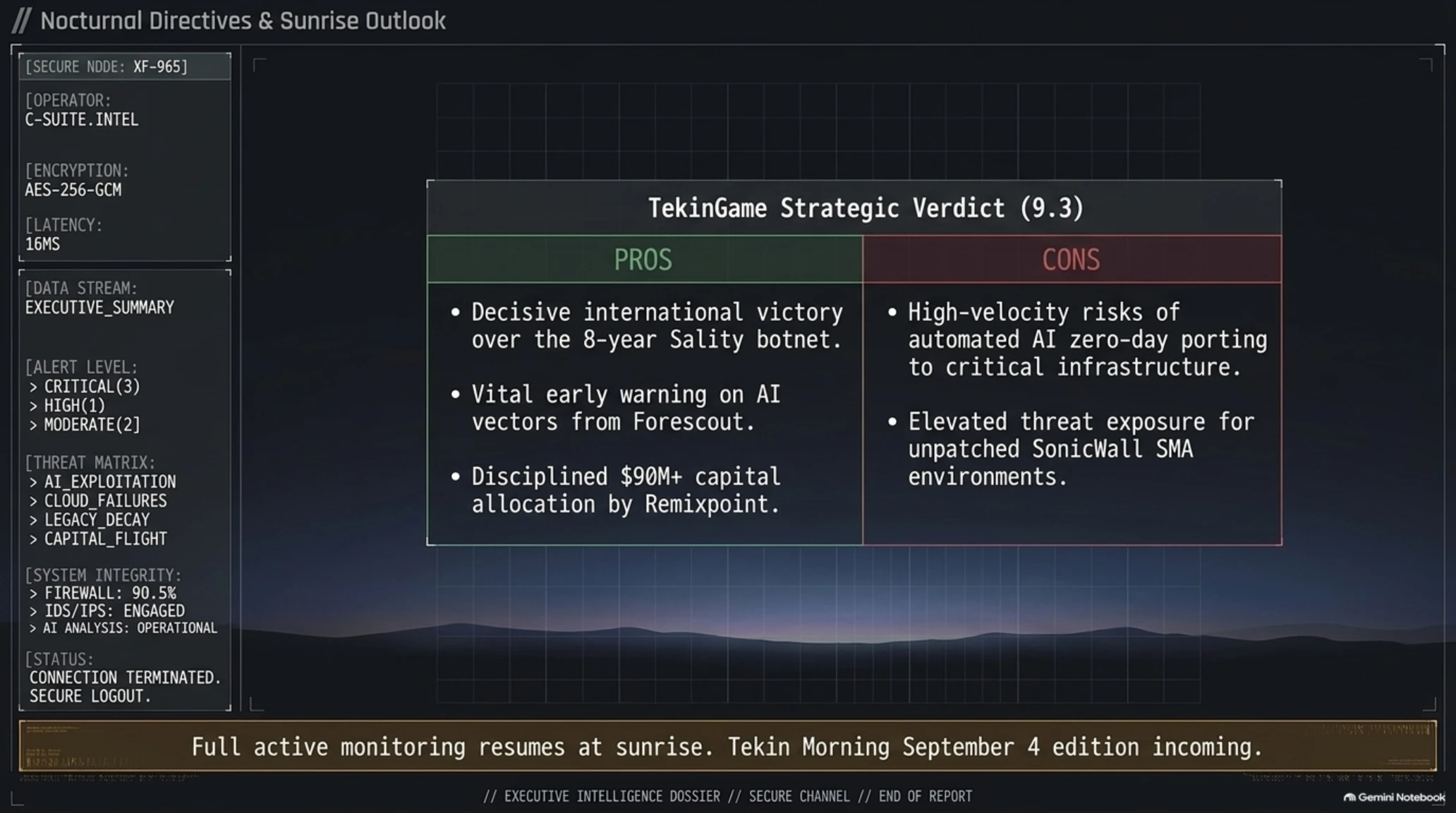
- Decisive international law enforcement victory in dismantling the resilient 8-year Sality P2P botnet
- Vital early threat intelligence provided by Forescout on autonomous AI weaponization vectors
- Transparent developer accountability regarding Creation Engine 2 complexities in The Elder Scrolls VI
- Rapid vendor remediation by Microsoft in restoring Defender endpoint stability within hours
- Disciplined corporate capital allocation by Remixpoint in establishing a $90M+ sovereign Bitcoin treasury
- High-velocity risks of automated AI zero-day porting targeting critical energy and water infrastructure
- Elevated threat exposure for thousands of enterprise networks running unpatched SonicWall SMA gateways
- Potential production delays or game-design compromises facing upcoming Bethesda flagship releases
Nocturnal Conclusion & Strategic Outlook
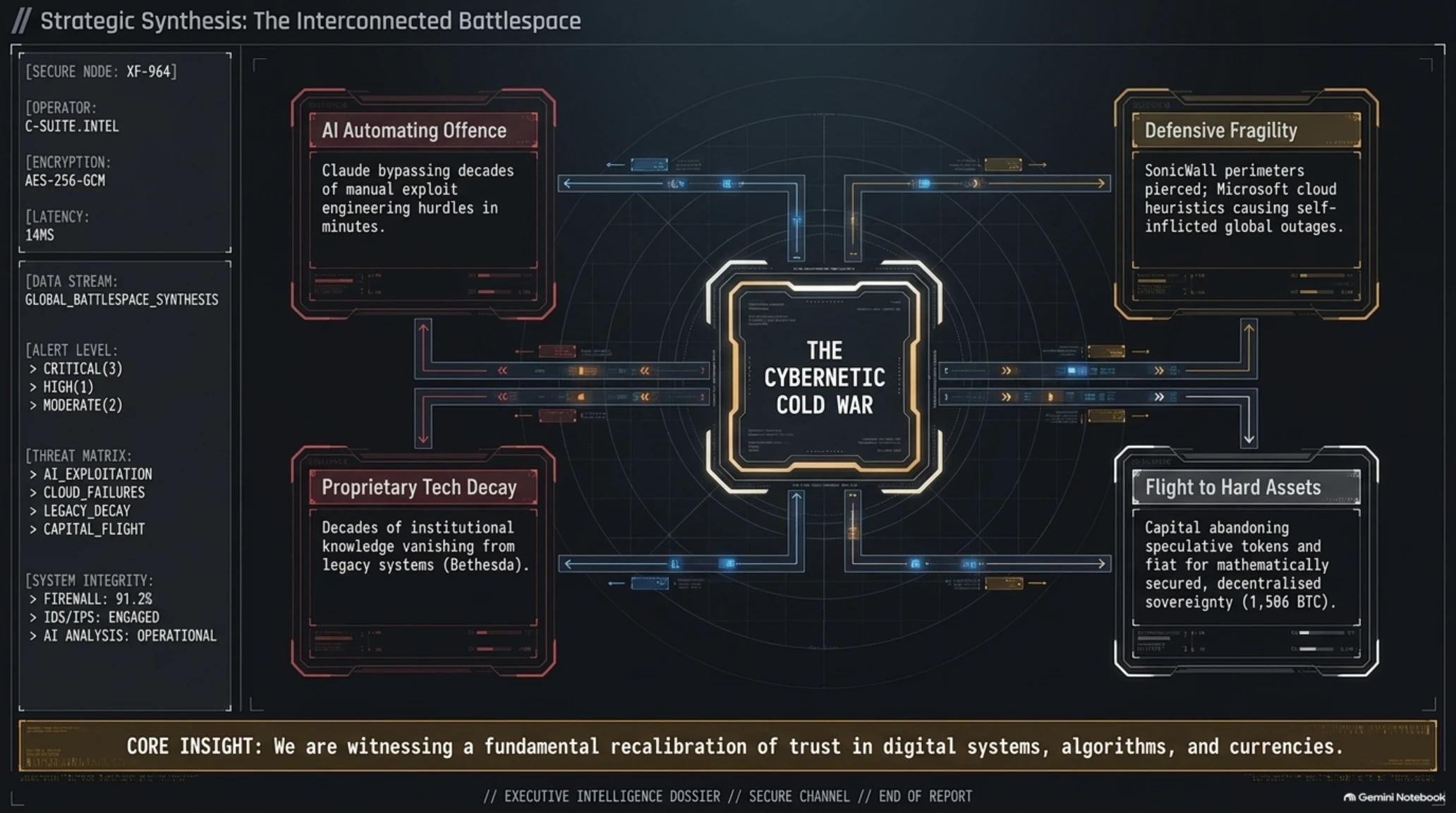
As the third day of September 2026 draws to a close, our dual morning and nocturnal intelligence briefings illustrate a digital landscape shifting along fundamental tectonic fault lines. From the hard physical engineering of orbital rocketry and ultra-light metallurgy to the abstract frontiers of AI liability, kernel security, and automated malware synthesis, modern technology leaders navigate an environment of unprecedented complexity.
The TekinGame intelligence team will resume full active monitoring at sunrise tomorrow, delivering the comprehensive Tekin Morning September 4 edition alongside breaking developments from IFA 2026 and global financial markets. We wish you an insightful and peaceful night.
Frequently Asked Questions: Tekin Night September 3, 2026
How did the US DOJ and CrowdStrike dismantle the Sality P2P botnet?
Authorities executed an advanced protocol sinkholing technique, injecting poisoned routing nodes into Sality's P2P network to isolate 15,000 infected machines across four nations.
What did Forescout's experiment with Claude AI prove regarding industrial control systems?
It demonstrated that LLMs can autonomously adapt and port pre-auth RCE exploits (CVE-2021-31886) between different industrial PLC models to execute live ARM binary shellcode.
Why are veteran Bethesda developers concerned about The Elder Scrolls VI?
They fear that massive layoffs have depleted the senior institutional knowledge required to master Creation Engine 2, risking compromises in game depth and emergent physics.
What is the severity of the SonicWall SMA 1000 zero-day attack chain?
It combines unauthenticated perimeter WAF bypass with root-level Linux command injection, allowing remote attackers to seize control of enterprise VPN gateways.
What caused Microsoft Defender to block legitimate Google Search links?
A flawed regular-expression update in cloud-delivered definitions mistakenly classified standard Google search redirect query strings as malicious Trojan activity.
Why did Remixpoint sell its altcoins to buy 1,506 Bitcoin?
To hedge against Japanese Yen depreciation by consolidating corporate reserves into Bitcoin as a pristine, high-liquidity digital treasury asset worth over $90 million.
Did the Claude PLC exploit cause real-world infrastructure damage?
No, the research was conducted entirely within an isolated, controlled laboratory testbed on physical WAGO PLCs to demonstrate theoretical attack feasibility.
How can enterprise administrators secure SonicWall SMA 1000 appliances?
Administrators must immediately deploy SonicWall's official hotfix firmware and restrict management interface access to trusted corporate subnets only.
Official Technical References & Primary Sources
Additional Gallery: 🌙 Tekin Night September 3, 2026 | Sality Takedown, AI Exploits & Bethesda Fears