Tekin Night | Oct 13, 2026: Steam Records, Ledger Hack & Nintendo
The global gaming and hardware cybersecurity landscape concludes Tuesday, October 13, 2026, amidst profound structural confrontations between decentralized platforms, consumer ownership rights, and advanced supply chain espionage. While consumer demand on traditional walled-garden consoles continues to plateau under escalating semiconductor bill-of-materials costs, Valve Corporation's open PC gaming ecosystem has surged to unprecedented heights, obliterating past engagement benchmarks and establishing an unassailable digital gravity. Concurrently, executive assurances from Kyoto have drawn an uncompromising line in the sand against the forced obsolescence of physical software cartridges, providing critical stability for collectors and retail ecosystems worldwide.
Beneath the surface of booming entertainment metrics, profound vulnerabilities in physical hardware security and corporate intellectual property protection have erupted into public view. The discovery of cellular-equipped surveillance implants engineered directly behind the display assemblies of tier-one hardware cryptocurrency wallets has sent shockwaves through institutional custody providers and retail investors alike. Simultaneously, the multi-billion-dollar anti-tamper security sector faces unprecedented reputational exposure as global publishing consortiums escalate federal petitions against solitary reverse engineering practitioners. The editorial team at Tekin Plus delivers an exhaustive, ground-level dissection of tonight's six pivotal technological developments.
Strategic Vectors at a Glance | Evening Intelligence
The intersection of these developments reveals a defining industry inflection point: consumer tolerance for walled-garden monopolies and ephemeral digital licensing is collapsing just as technical capabilities allow independent developers and reverse engineers to challenge multi-billion-dollar security monoliths. The accompanying data matrix highlights the critical metrics reshaping boardroom strategies across Seattle, Kyoto, Paris, and Los Angeles tonight.
Strategic Impact Dimensions | Why Tonight's Developments Shift the Global Paradigm
Definitive PC Dominance
Steam solidifies its role as the dominant social operating system for gaming, leveraging zero subscription barriers and massive multiplayer stickiness.
Hardware Trust Breakdown
Physical interdiction defeats the industry gold-standard Secure Element verification, exposing fatal blind spots in secondary hardware distribution logistics.
Hardware Decompression Victory
Capcom and Nintendo prove that customized silicon decompression pipelines eliminate bloated asset installs without sacrificing fidelity or framerates.
We initiate tonight's analytical dossier with an in-depth examination of the monumental traffic metrics recorded across Valve's server clusters, signaling a historic redistribution of gaming capital and player engagement.
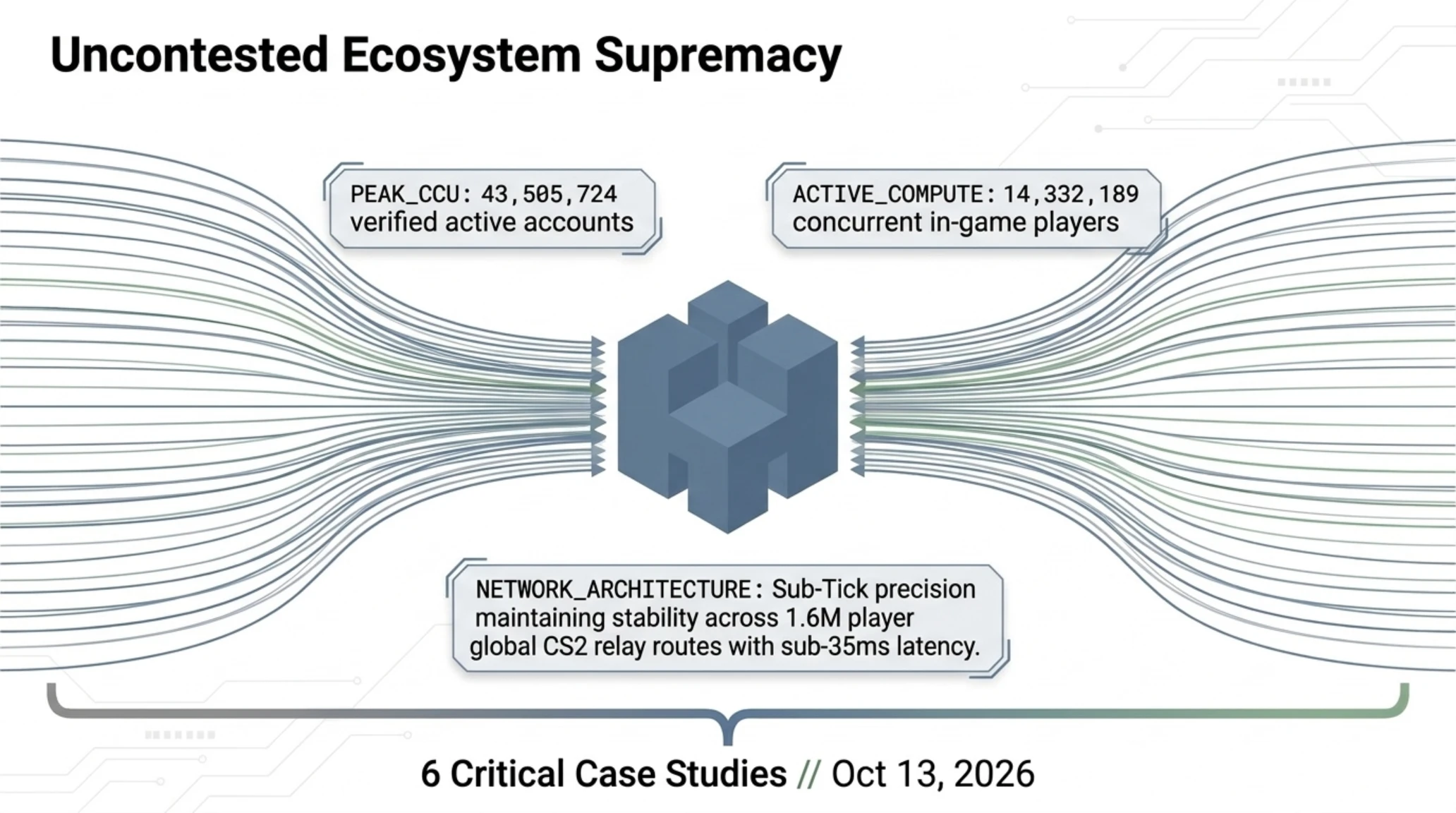
The architectural visualization above illustrates the peak packet flow across Valve's global content delivery edge nodes during tonight's record-breaking concurrency spike. Below, we dissect the underlying economic and technical catalysts driving this massive PC renaissance.
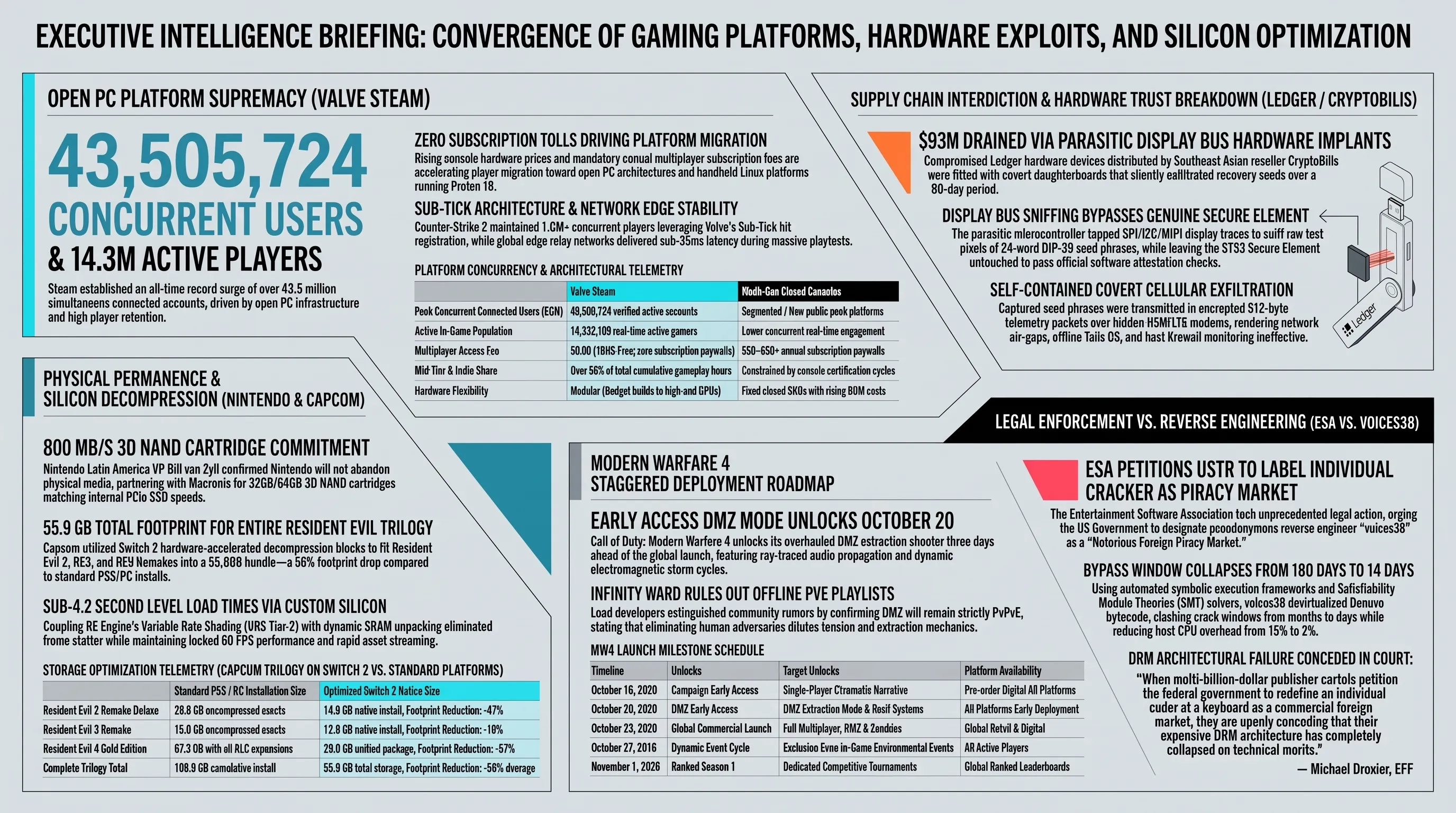
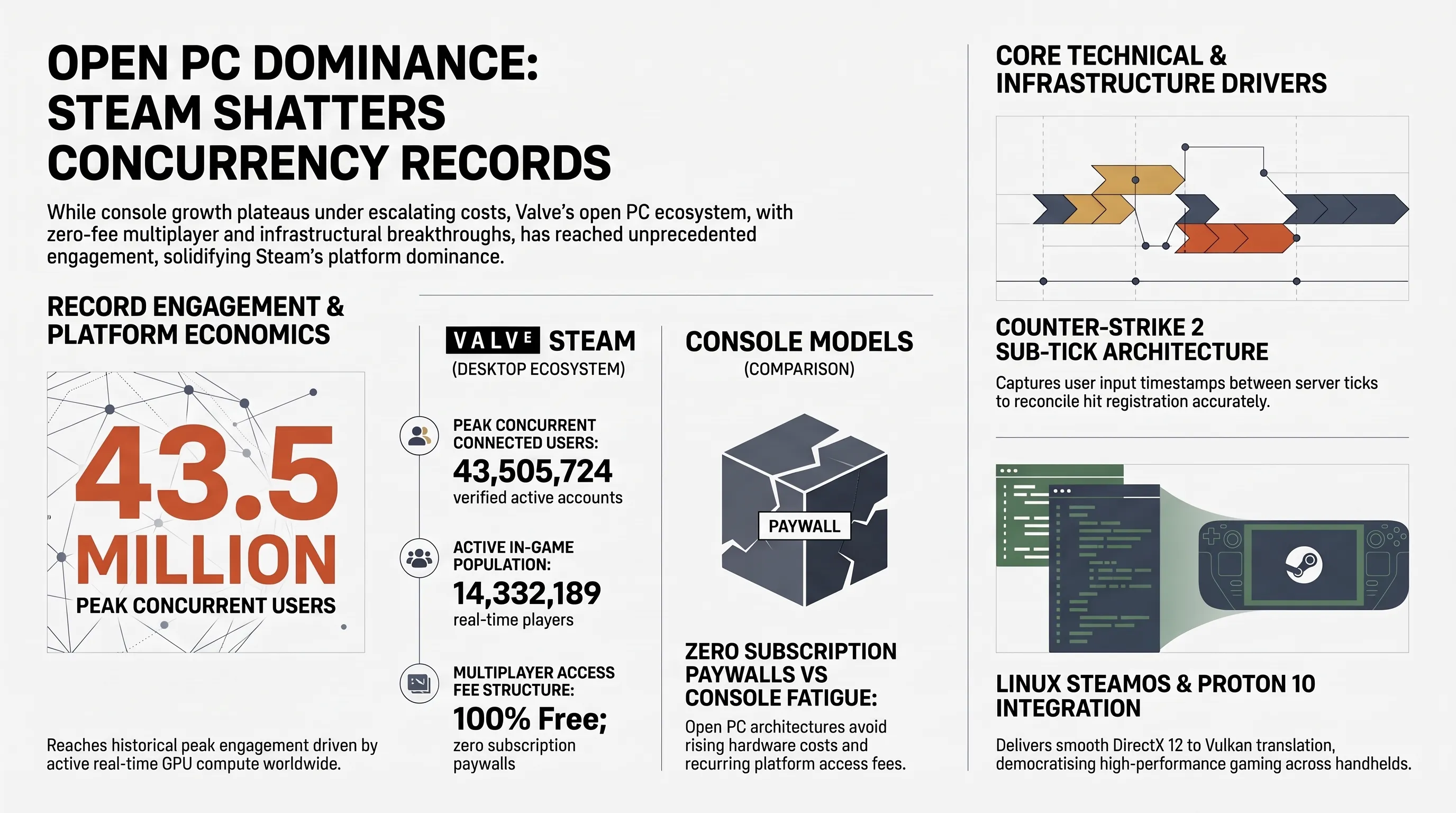
Steam Shatters All-Time Records with 43.5 Million Concurrent Users and 14.3 Million In-Game Players
In the closing hours of Sunday evening heading into today's trading cycles, Valve Corporation's flagship platform achieved a milestone once deemed mathematically improbable for a desktop distribution client: 43,505,724 concurrent connected users. According to verified analytical telemetry from SteamDB, this surge eclipses the previous benchmark established in early 2026 (approximately 42.6 million) by nearly one million simultaneous connections. Even more remarkably, active in-game participation peaked at 14,332,189 players, confirming that this monumental figure was not merely a byproduct of passive background idle processes, but rather an unprecedented mobilization of real-time GPU compute worldwide.
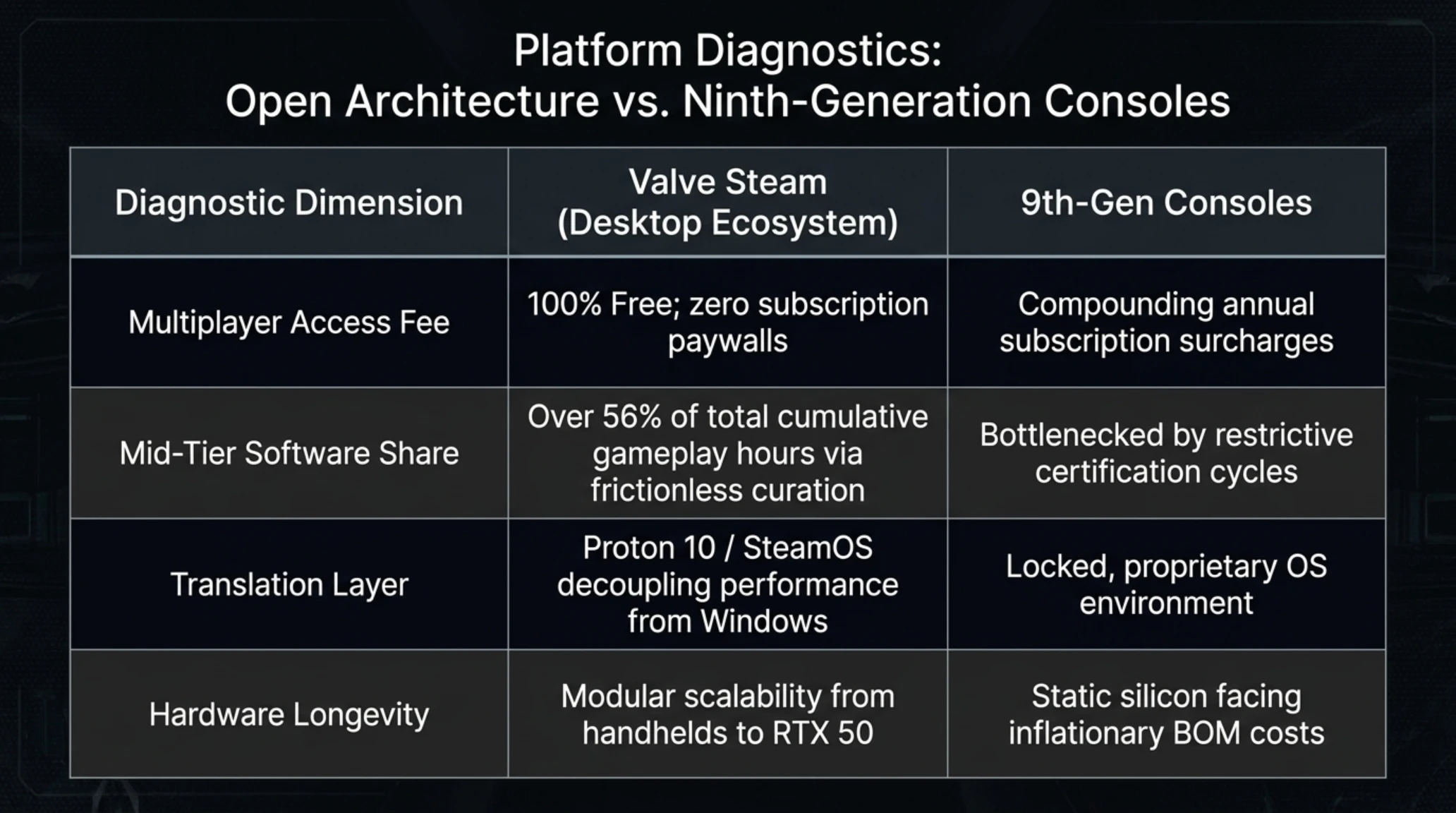
This explosive expansion occurs against the backdrop of an unmistakable stagnation across traditional ninth-generation home console ecosystems. With hardware sales for PlayStation 5 and Xbox Series platforms facing structural price resistance due to persistent silicon inflation, consumer sentiment has pivoted decisively toward open PC computing. Gamers are increasingly refusing to absorb compounding annual subscription surcharges simply to access peer-to-peer multiplayer networks. Furthermore, the sustained cultural longevity of tactical competitive tentpoles—anchored by Counter-Strike 2, Dota 2, and the explosive public playtests of Valve's emerging third-person hero shooter Deadlock—has established an irrepressible network effect that single-platform walled gardens cannot replicate.
From an infrastructural perspective, routing, authenticating, and synchronizing state engines for 43.5 million concurrent clients represents an astonishing triumph of modern edge computing and network architecture. Valve's deployment of proprietary high-throughput border gateway routing protocols, localized caching infrastructure across five continents, and dynamic packet throttling has enabled uninterrupted platform reliability. Where rival digital storefronts routinely suffer catastrophic cascade outages during seasonal sales or major game updates, Steam's multi-tiered architecture absorbed multi-terabit bandwidth demands with zero systemic degradation.
Crucially, this engineering resilience extends into the real-time gameplay layer. With Counter-Strike 2 maintaining over 1.6 million peak concurrent players, Valve's proprietary Sub-Tick architecture has demonstrated remarkable stability under extreme server load. By capturing user input timestamps between server tick dispatches and reconciling hit registration deterministically across distributed clusters, the platform delivers tournament-grade precision without requiring excessive bandwidth allocation. Similarly, the public playtest infrastructure supporting Deadlock seamlessly handles tens of thousands of simultaneous 6v6 volumetric engagements, streaming dynamic particle simulations and complex occultation geometry across global relay routes with sub-35-millisecond latency.
Complementing this network backend is the rapid evolution of the open-source software stack. The integration of Proton 10 within SteamOS has achieved near-flawless DirectX 12 to Vulkan translation, often yielding higher average framerates and smoother frametime pacing on Linux-based handhelds than native Windows execution. This technical decoupling from Microsoft's proprietary OS ecosystem has democratized high-end PC performance, enabling budget hardware configurations to execute demanding modern releases smoothly.
Industry analysts have isolated four core structural pillars powering this sustained desktop computing renaissance across global markets:
- Absolute Multiplayer Cost Transparency: Full access to online infrastructure without arbitrary monthly platform access fees, saving consumers hundreds of dollars annually.
- The Steam Deck & Handheld PC Multiplier: The maturation of the Linux-based Proton compatibility layer, transforming high-end PC libraries into portable gaming realities.
- Indie and Mid-Tier Publishing Renaissance: Steam's open curation pipeline provides frictionless discovery for breakthrough viral hits unencumbered by restrictive console certification cycles.
- Consumer-Centric Platform Telemetry: Seamless mod support via Steam Workshop, comprehensive community market liquidity, and automated refund mechanics that foster immense platform trust.
This concurrency peak underscores an enduring shift in publisher resource allocation. As multi-platform developers witness diminishing returns on closed console ecosystems, engineering budgets and post-launch content schedules are prioritizing the PC environment as the primary revenue engine for interactive entertainment.
Platform Concurrency Telemetry | Steam vs. Ninth-Gen Console Ecosystems
| Platform Metric & Architectural Factor | Valve Steam (Desktop PC Ecosystem) | PlayStation 5 / Xbox Series (Closed Consoles) | Strategic Commercial Impact |
|---|---|---|---|
| Peak Concurrent Connected Users (CCU) | 43,505,724 verified active accounts | Fragmented across proprietary PSN & Xbox Live | Enterprise marketing capital migrating to PC |
| Active In-Game Population (Real-Time) | Over 14.33 million concurrent gamers | Estimated 6.5M to 8.2M during peak evening hours | Uncontested daily player retention superiority |
| Multiplayer Access Fee Structure | 100% Free; zero subscription paywalls | Mandatory $80/year basic multiplayer sub | Accelerating consumer resistance to consoles |
| Mid-Tier & Independent Software Share | Over 56% of total cumulative gameplay hours | Sub-22% heavily dominated by first-party AAA | Democratized revenue distribution across studios |
| Hardware Upgradability & Longevity | Modular hardware from budget rigs to RTX 5090 | Locked closed silicon with rising mid-gen costs | Higher lifetime customer value and software attach |
While the desktop sector celebrates total digital ubiquity, the world's most enduring console manufacturer has taken the exact opposite ideological stance, formally rejecting the industry-wide rush to eliminate physical consumer media.
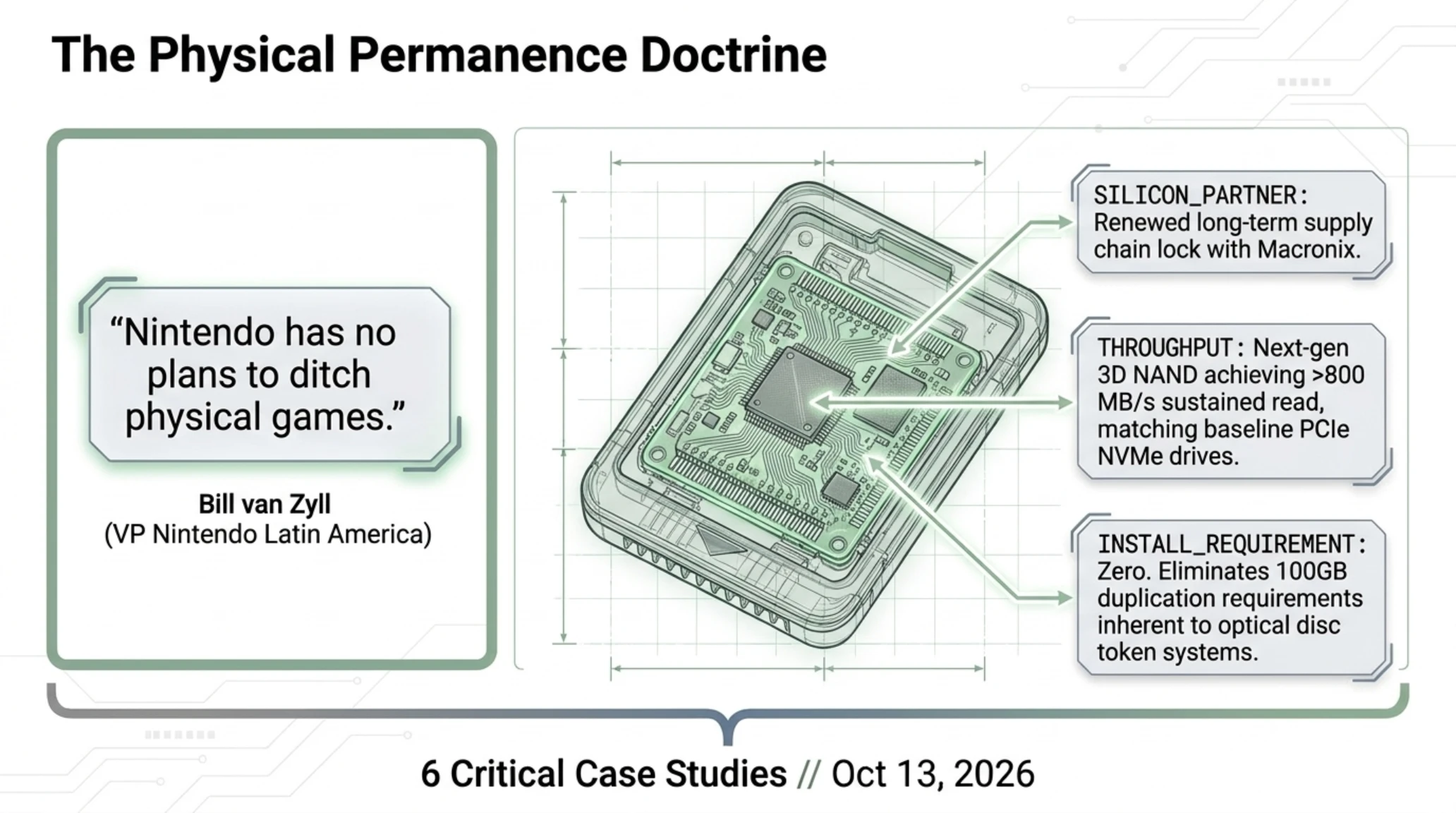
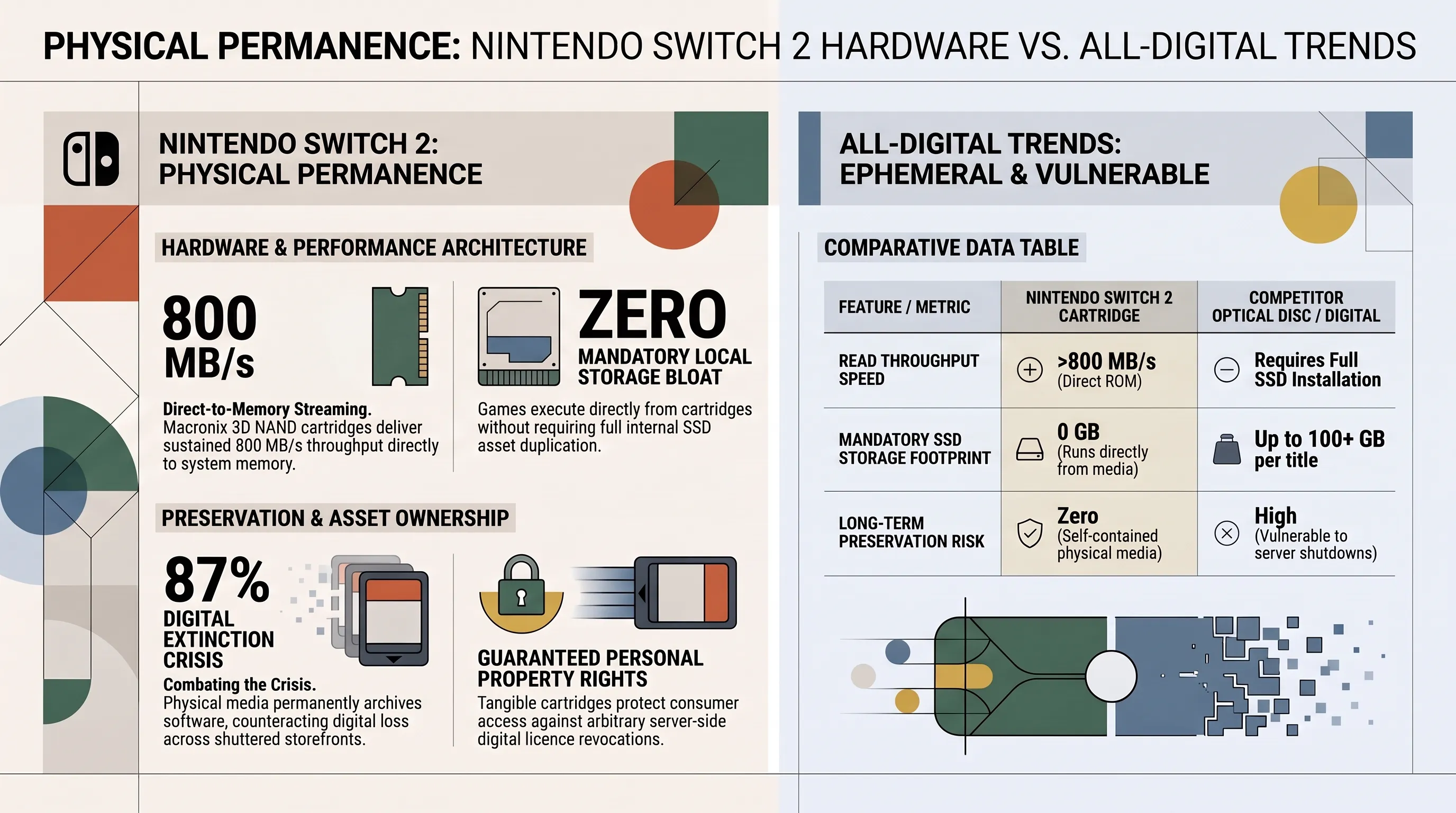
In an exclusive executive interview conducted on the sidelines of the Brasil Game Show, Bill van Zyll, Senior Vice President and Managing Director of Nintendo Latin America, firmly dismissed rumors that Nintendo intends to deprecate physical software in its forthcoming console cycles. "Nintendo has no plans to ditch physical games," van Zyll stated with absolute finality. This decisive public commitment comes at a crucial strategic moment, particularly as industry observers dissect leaks indicating Sony interactive divisions are actively studying the phased sunsetting of optical disc manufacturing facilities by 2028, and Microsoft continues to pivot its retail footprint toward all-digital hardware SKUs.
Van Zyll articulated a deeply consumer-centric philosophy, emphasizing that physical game cartridges represent far more than read-only silicon ROM chips. For millions of families, dedicated collectors, and emerging market communities, physical media represents guaranteed personal property, generational software archiving, and a robust secondary trade ecosystem that pure digital licensing can never replicate. He reiterated that Nintendo's upcoming hardware strategy—including the highly anticipated Nintendo Switch 2—is structurally engineered to maintain harmonious coexistence between physical cartridge distribution and the eShop digital marketplace.
Behind the scenes, Nintendo has renewed long-term strategic supply chain partnerships with semiconductor fabricator Macronix to engineer next-generation 3D NAND read-only memory modules. These high-density cartridges are engineered to achieve sustained read throughput exceeding 800 megabytes per second, matching the raw baseline throughput of modern internal PCIe storage while eliminating the frustrating requirement to install tens of gigabytes of game assets onto the console's internal flash drive before playing. This architectural decision directly contrasts with Sony and Microsoft, whose optical disc drives serve merely as physical authentication tokens requiring complete 100-gigabyte duplication onto local solid-state drives.
Furthermore, by securing fixed-price fabrication agreements for 32GB and 64GB cartridge capacities, Nintendo has largely insulated its manufacturing pipeline from volatile spot-market flash memory fluctuations. This economic stability allows third-party publishers to ship complete, uncompressed software builds on physical cartridges without imposing artificial retail surcharges on consumers, reinforcing Kyoto's unique competitive advantage in the global retail channel.
Legal scholars and digital rights advocates have commended Nintendo's steadfast posture. Recent consumer backlashes surrounding the arbitrary revocation of digital game licenses on rival storefronts have underscored the precarious nature of ephemeral software ownership. By guaranteeing physical cartridge availability, Nintendo insulates its core audience from server-side revocations while reinforcing the tangible asset value of its historic intellectual property.
This policy also provides critical oxygen to the global game preservation community. Organizations like the Video Game History Foundation have repeatedly warned that over 87 percent of classic video games produced before 2010 are currently out of commercial circulation and face digital extinction due to shuttered digital storefronts and restrictive anti-circumvention laws. When publishers operate purely through ephemeral digital licensing, decommissioned authentication servers effectively transform purchased software into dead digital paperweights. Physical cartridges, by contrast, endure across decades, enabling cultural institutions, academic researchers, and retro enthusiasts to preserve interactive human history indefinitely.
Myth vs. Reality | Nintendo's Physical Media Roadmap & Consumer Rights
| Strategic Analysis Dimension | Pervasive Industry Rumors & Speculation | Verified Corporate Reality & Official Facts |
|---|---|---|
| Physical Cartridge Slot on Switch 2 | Rumored elimination of physical media for pure eShop | Officially verified backward-compatible cartridge slot |
| Flash Memory Manufacturing Economics | Claims that ROM cost inflation makes cartridges unviable | Mass supply-chain contracts secure viable high-density ROMs |
| Day-One Patch & Offline Functionality | Assumption that cartridges will only contain download keys | Strict commitment to standalone offline playable builds |
| Secondary Market & Game Preservation | Deliberate effort to destroy the used game economy | Active preservation of retail and pre-owned ecosystems |
| Alignment with Sony and Xbox Strategy | Nintendo expected to follow rivals into all-digital future | Intentional strategic divergence capitalizing on collector trust |
With the foundations of gaming platform economics established, we now transition to part two of our evening briefing, confronting the most alarming physical supply chain infiltration ever uncovered in the cryptocurrency hardware security industry.
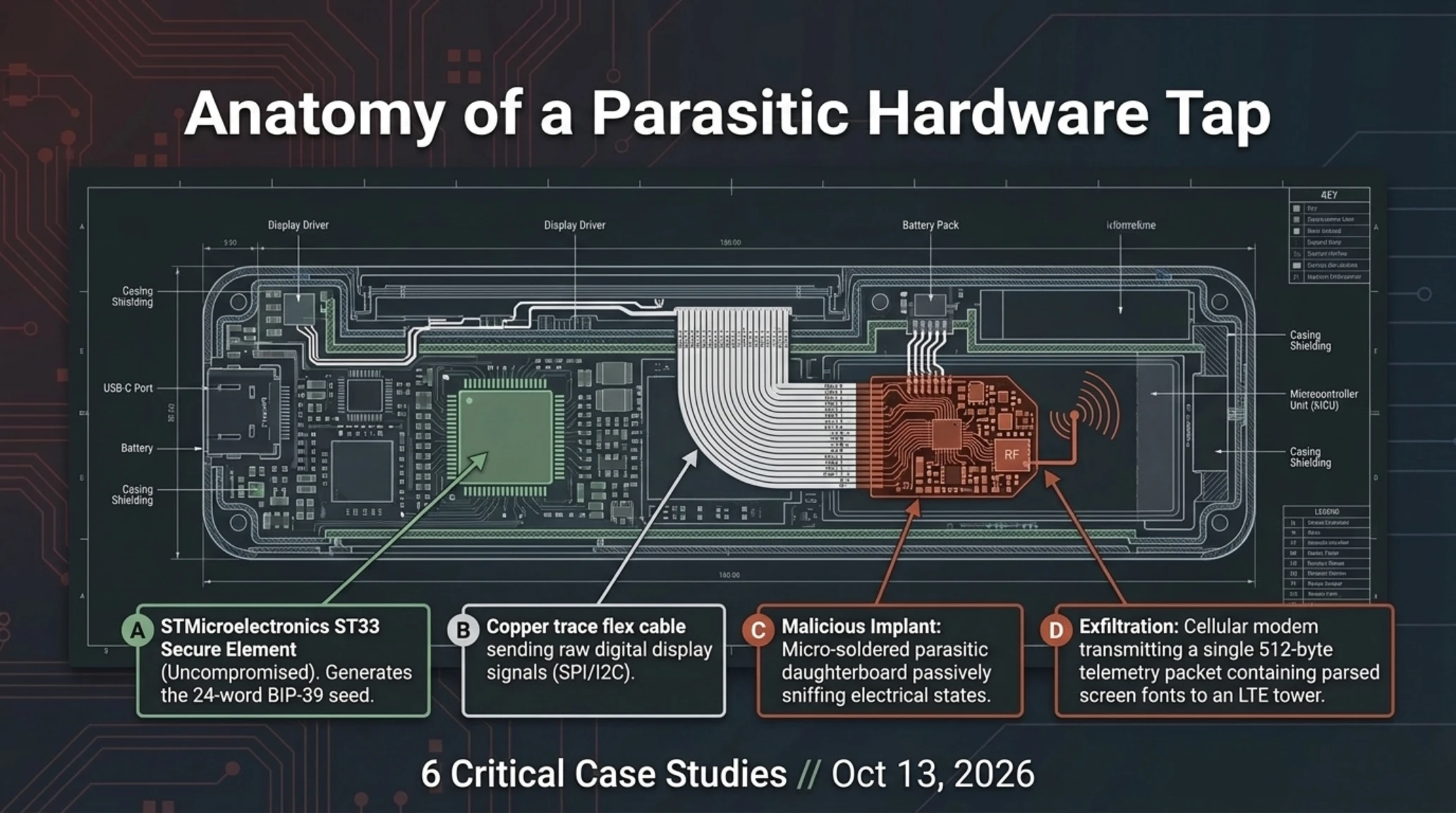
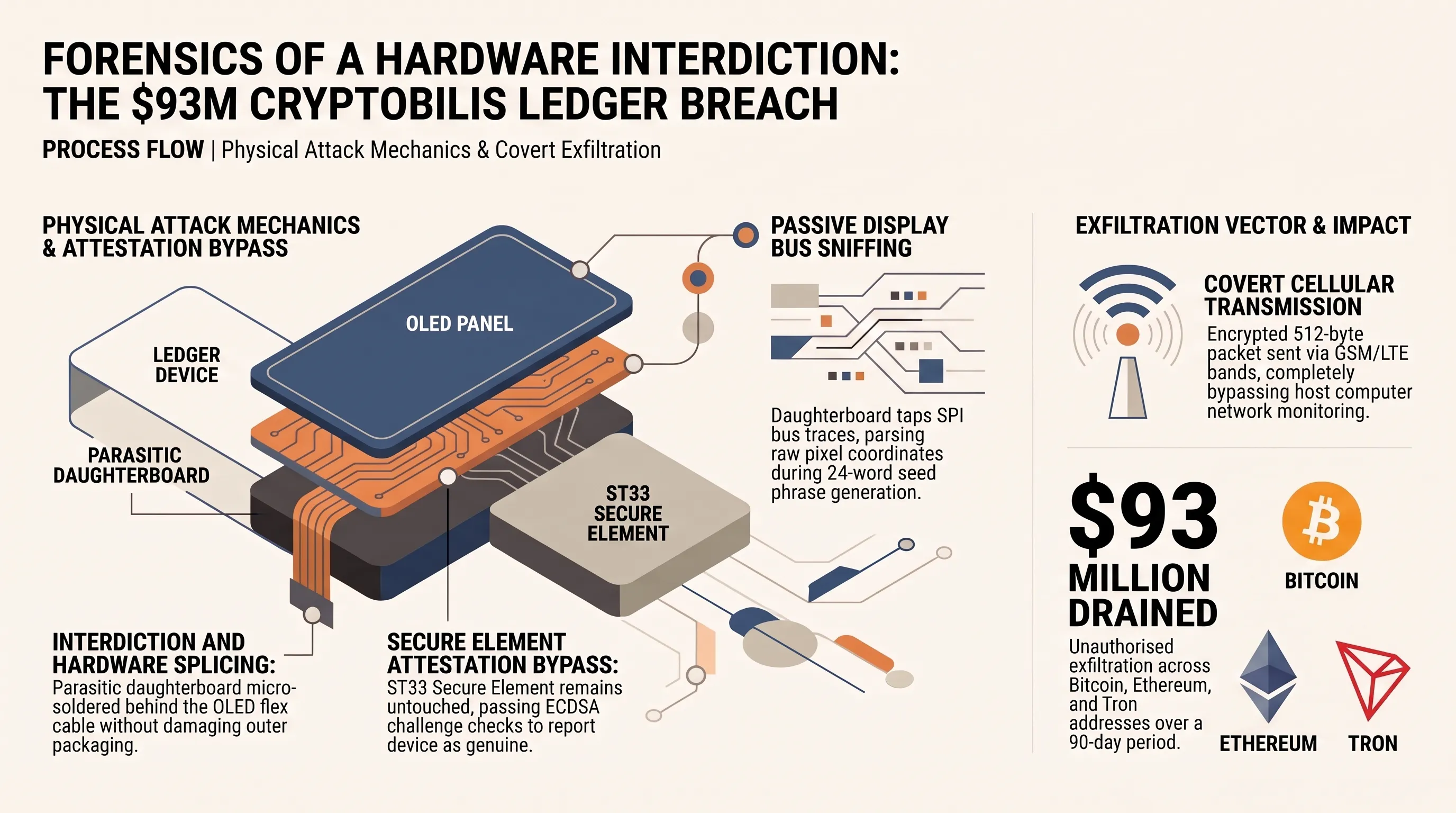
The forensic hardware inspection above reveals the microscopic parasitic circuit board and cellular antenna array discovered behind the display assembly of a compromised Ledger device. Below, we dissect how attackers circumvented state-of-the-art cryptographic safeguards.
Ledger Reseller CryptoBilis Infiltrated: Stealth Hardware Implants with Cellular Antennas Drain $93M in Crypto
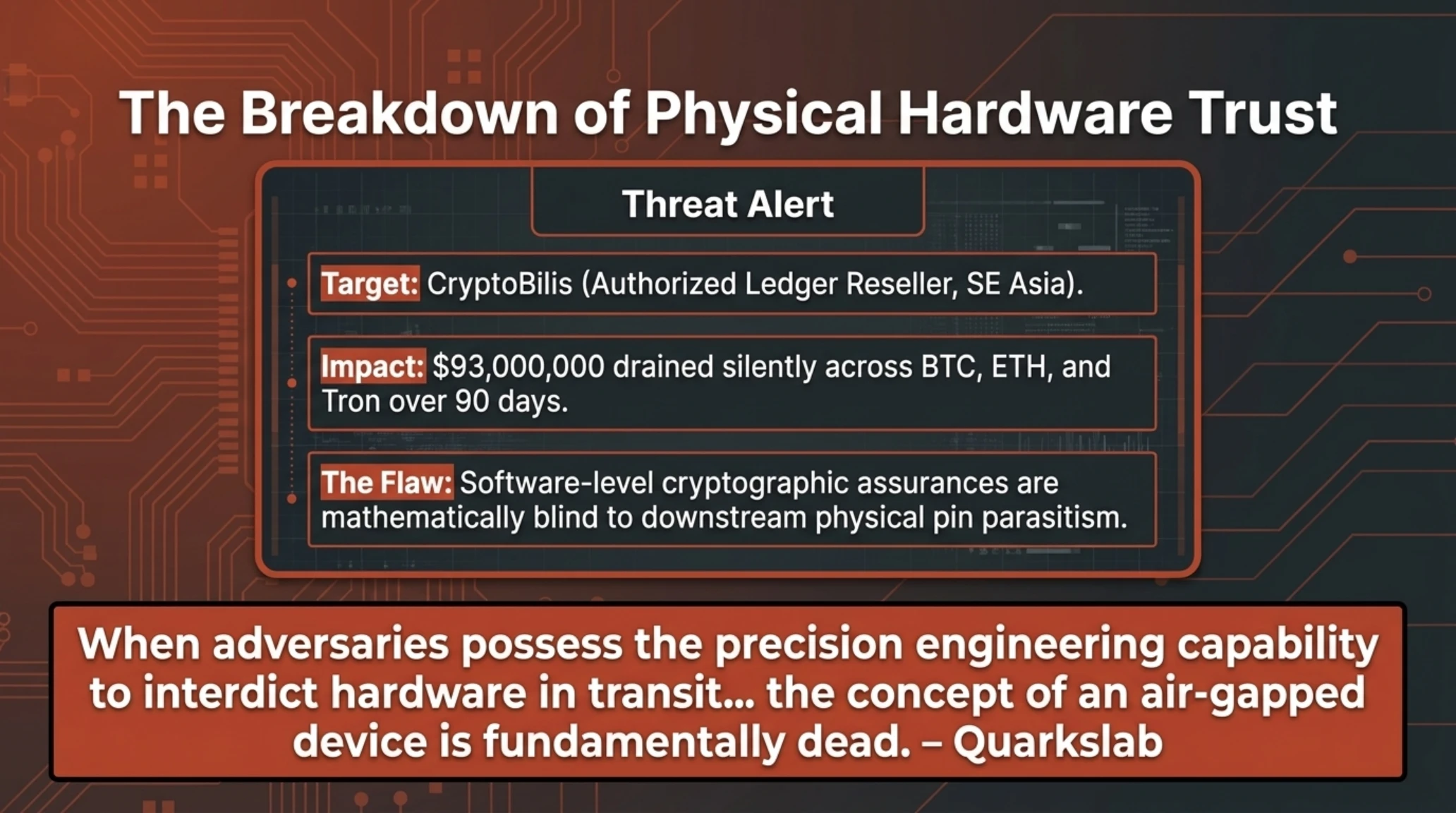
The cryptocurrency institutional custody ecosystem suffered its most severe hardware security breach to date as Paris-based manufacturer Ledger officially confirmed malicious physical tampering inside units distributed by CryptoBilis, a prominent authorized reseller operating throughout Southeast Asia. Real-time on-chain forensic analytics compiled by Bitquery, blockchain security firms, and prominent industry figures indicate that the sophisticated hardware interdiction campaign has resulted in the silent, unauthorized exfiltration of more than $93 million in digital assets across Bitcoin, Ethereum, and Tron network addresses over the past 90 days.
Laboratory teardowns conducted by independent firmware reverse engineers exposed an unprecedented level of microscopic craftsmanship. Attackers intercepted retail shipments in transit, meticulously breaching security packaging without generating visible outer deformities. Inside the chassis, operatives micro-soldered an ultra-thin parasitic daughterboard directly between the device's internal flex cable and the OLED display panel. Crucially, the attackers left the genuine STMicroelectronics ST33 Secure Element (SE) chip entirely untouched. Because the Secure Element remained uncompromised, the tampered devices successfully passed the official cryptographic mutual-authentication attestation routine executed by the Ledger Live desktop and mobile software, displaying the reassuring "Your device is genuine" checkmark to unsuspecting users.
However, during the initial device provisioning routine—the precise moment when the Secure Element generates the user's master 24-word BIP-39 recovery seed phrase and transmits the text data to the screen for manual transcription—the parasitic microcontroller tapped the display communication bus. Because display panels rely on standard SPI, I2C, or MIPI serial communication protocols that transmit display framebuffers in raw digital signals, the attacker's secondary board passively sniffed the electrical pulses passing along the copper traces. By parsing the exact pixel coordinates and rendering buffers corresponding to character fonts, the rogue firmware reconstructed the complete 24-word sequence with absolute deterministic accuracy.
Once buffered, the data was queued until the cellular modem detected an active GSM or LTE tower connection. The module transmitted a single encrypted 512-byte telemetry packet containing the compromised keys, device serial number, and timestamp before going electrically dormant to minimize thermal and RF detection profiles. This methodology rendered traditional security practices—such as air-gapping the host PC, utilizing offline operating systems like Tails, or running rigorous network packet captures—completely powerless, as the hardware itself acted as a self-contained cellular surveillance node.
To understand why this attack succeeded where traditional software exploits fail, one must examine the fundamental design assumptions of Ledger's proprietary operating system, BOLOS (Blockchain Open Ledger Operating System). Under standard operational protocols, when a device interfaces with Ledger Live, the host software transmits a cryptographically randomized challenge nonce to the STMicroelectronics ST33 Secure Element. The Secure Element computes an ECDSA signature over the nonce utilizing an embedded private attestation key burned into silicon during cleanroom fabrication, verifying its mathematical authenticity against Ledger's public root certificate authority.
However, this cryptographic handshake only validates that the genuine Secure Element is executing legitimate, untampered firmware; it possesses zero hardware-level visibility into external physical pin parasitism. Because the microscopic daughterboard operated purely as a passive electronic eavesdropper on the peripheral display controller traces, the Secure Element experienced normal electrical impedance. The firmware dispatched character data to the display controller normally, entirely unaware that parallel copper jumpers were simultaneously mirroring every electrical high and low state into the rogue microcontroller's memory buffer.
Ledger's executive leadership emphasized that devices manufactured, packaged, and shipped directly from its automated assembly facilities in Vierzon, France remain strictly secure and uncompromised. Nevertheless, the company issued an urgent advisory commanding any customer who purchased hardware from CryptoBilis within the preceding 90 days to immediately halt device utilization, revoke existing credentials, and migrate funds to verified multisig or cold-storage addresses. The incident serves as an undeniable wake-up call for institutional custodians and family offices, shattering the long-held assumption that hardware cold storage is inherently immune to interception.
To fully grasp the mechanics of physical bus sniffing and RF signal propagation inside miniaturized embedded enclosures, examining the lab bench testing protocol provides vital technical clarity.
The technical demonstration above highlights how spectrum analyzers detect unauthorized electromagnetic emissions during seed phrase generation. To navigate the specialized vernacular governing embedded device exploitation, we review the essential concepts in tonight's hardware lexicon.
Hardware Security Lexicon | Essential Cryptographic Interdiction Concepts
Covert interception and physical modification of computing hardware during shipment transit before reaching the retail consumer.
A tamper-resistant microchip certified under CC EAL6+ standards designed to generate and isolate private cryptographic keys.
Passive surveillance of the electrical communication traces feeding display screens to extract plain-text recovery seed phrases.
Transmitting stolen credentials over cellular telecommunication bands, bypassing host computer networks, USB logs, and local Wi-Fi.
Comparing the vulnerability surface of software wallets against physical interdiction vectors demonstrates the necessity of diversified multi-signature cryptographic architectures.
Security Threat Matrix | Software Wallets vs. Hardware Interdiction Vectors
| Threat Vector & Architectural Dimension | Hot Software Wallets (Desktop/Mobile) | Tampered Hardware Devices (CryptoBilis) | Enterprise Multi-Signature Vaults |
|---|---|---|---|
| Vulnerability to Host Operating System Malware | Extremely High (Memory scraping, clipboard hijack) | Virtually Zero (Cryptographic signing isolated) | Very Low (Independent verification required) |
| Susceptibility to Transit Physical Tampering | Zero (Cryptographically signed web downloads) | Catastrophic (Micro-soldered cellular implants) | Negligible (Multi-vendor hardware distribution) |
| Adversary Capital Expenditure per Exploitation | Minimal; highly scalable automated scripts | Extremely High; specialized microsoldering labs | Prohibitively High; multi-jurisdiction attacks |
| Detectability via Vendor Verification Tools | Immediate through endpoint antivirus suites | Undetectable via standard vendor software checks | Immediate due to M-of-N signing discrepancies |
| Asset Loss Severity upon Breach Event | Total exhaustion of connected account balance | Total drainage of entire seed phrase balance | Zero losses; single compromised key rejected |
📚 Classified & Related Dossiers in TekinGame
If you wish to explore beyond this report and delve into cybernetic frontiers and autonomous AI architectures, do not miss these three exclusive deep-dives in the Tekin Garage:
While the cybersecurity community grapples with the fallout of the Ledger hardware crisis, the competitive gaming sphere is bracing for the imminent deployment of modern military extraction warfare.
Call of Duty: Modern Warfare 4 Unveils Early DMZ Access for October 20; Infinity Ward Shuts Down PvE-Only Hopes
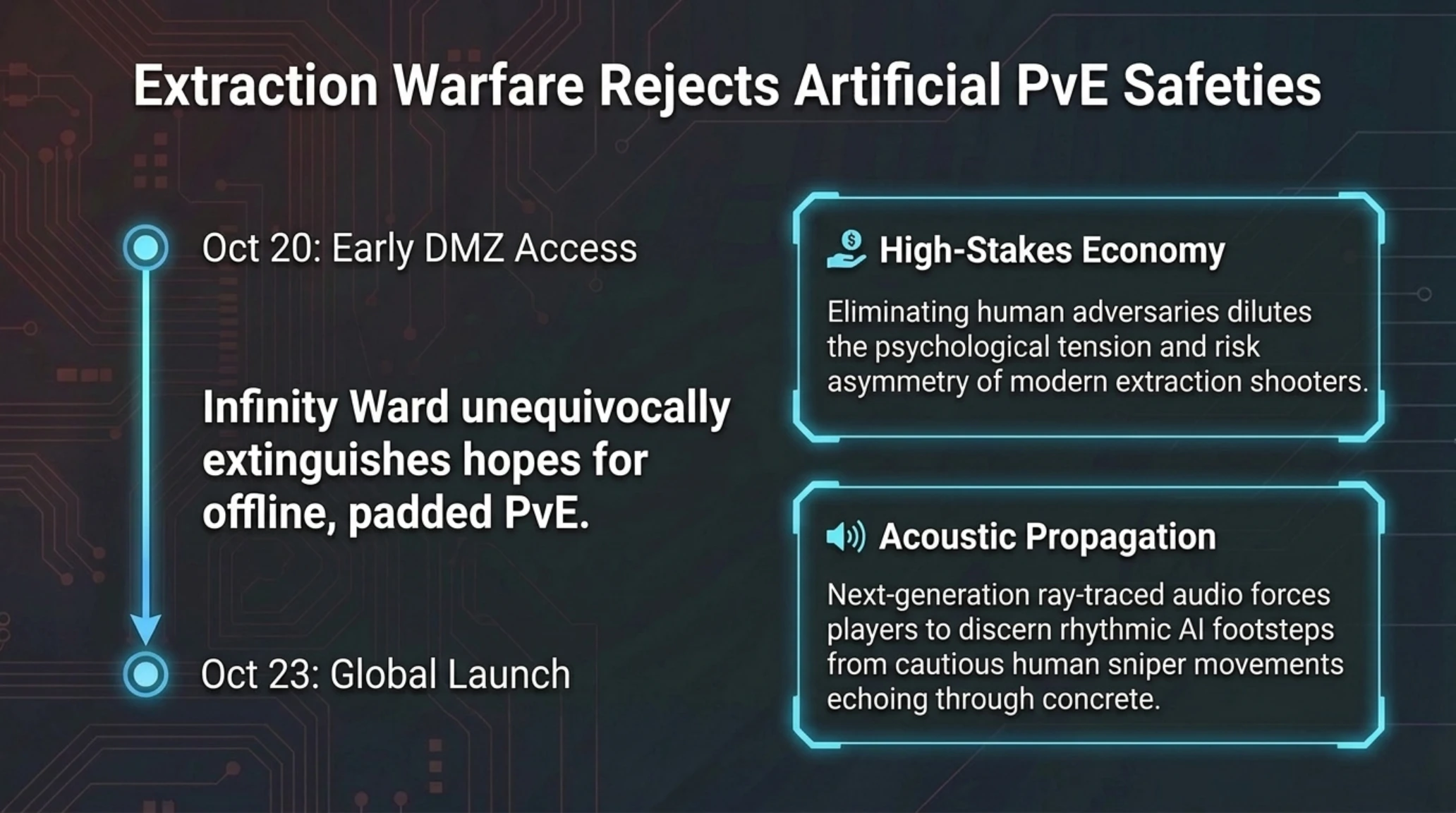
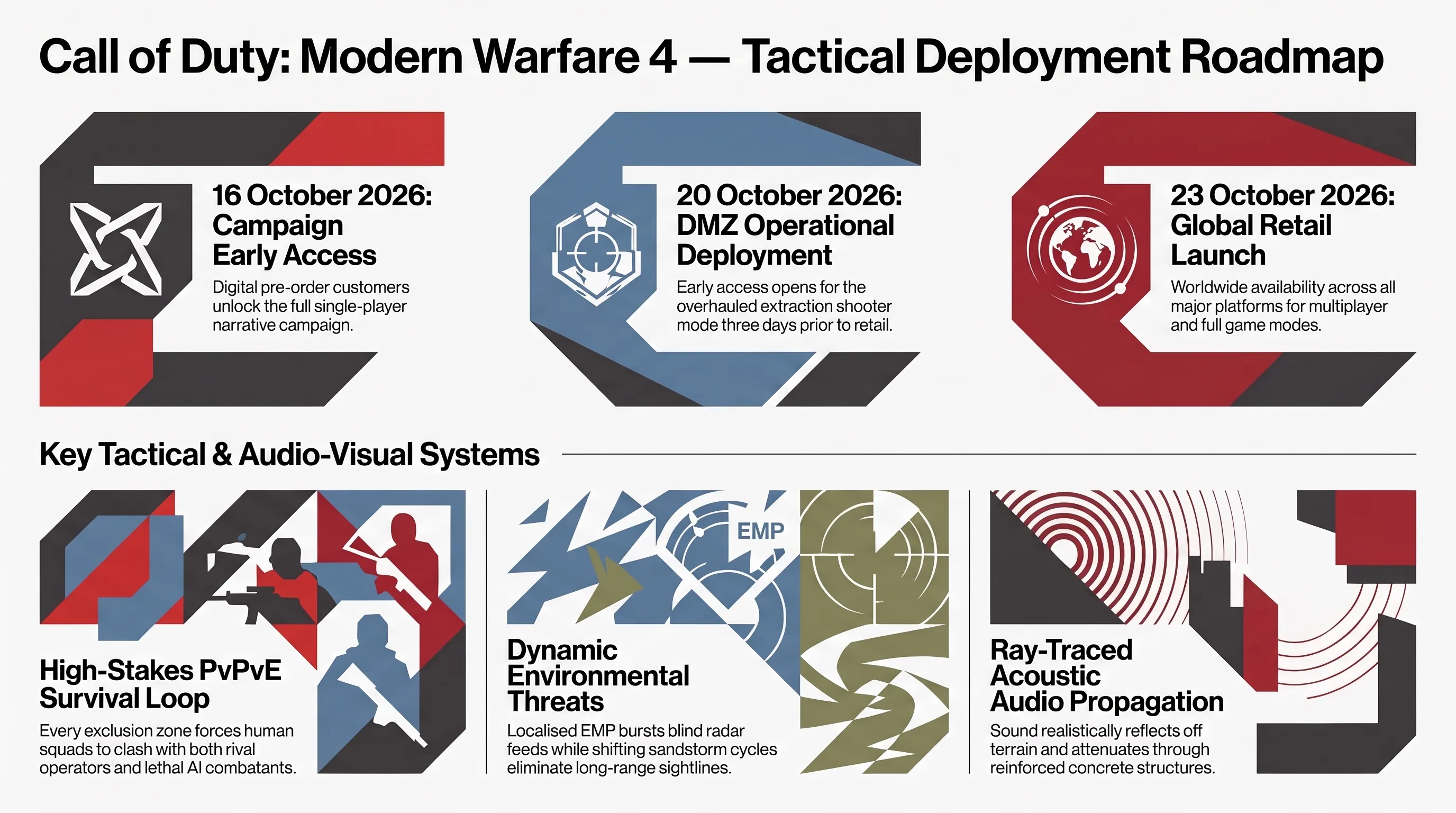
In a coordinated release schedule announcement that took the competitive multiplayer community by storm, Activision and lead developer Infinity Ward revealed a staggered rollout roadmap for Call of Duty: Modern Warfare 4. Digital pre-order customers will gain early access to the cinematic single-player narrative campaign beginning Friday, October 16. However, the focal point of the briefing was the unexpected confirmation that the radically overhauled DMZ extraction shooter mode will open its operational gates on Tuesday, October 20—a full three days ahead of the game's global commercial launch on October 23.
Simultaneously, Infinity Ward moved swiftly to extinguish persistent rumors regarding the introduction of a dedicated offline or purely cooperative PvE playlist. Speculation had reached fever pitch across social forums following a leaked promotional screenshot depicting a tactical interface labeled "Single Squad Mission." The studio unequivocally clarified that the screenshot depicted an internal developer debugging and balance-testing tool, reaffirming that the commercial release of DMZ remains uncompromisingly anchored to its high-stakes PvPvE competitive formula.
Lead designers articulated that while solo operators are fully permitted to infiltrate the exclusion zones without squad matchmaking, every deployed server will host rival human squads alongside ruthlessly lethal AI combat battalions. Eliminating human adversaries from the extraction loop, the studio explained, fundamentally dilutes the psychological tension, unpredictable alliances, and high-risk exfiltration dynamics that define modern extraction shooter design. Instead, the revamped DMZ incorporates dynamic sandstorm cycles, localized electromagnetic pulses that blind radar feeds, and heavily armored boss convoys that actively pursue careless operators who engage in unsuppressed weapon discharge.
To further intensify this tactical environment, Infinity Ward implemented a next-generation ray-traced audio propagation pipeline. Footsteps, weapon action cycling, and proximity radio chatter now reflect accurately off environmental surfaces, attenuating realistically through reinforced concrete walls and echoing across arid canyons. Operators can no longer rely purely on visual minimap indicators; situational awareness requires discerning between the heavy, rhythmic stride of AI patrol officers and the irregular, cautious movement of human snipers maneuvering through dust storm cover.
Furthermore, the early launch window allows engineering teams to conduct rigorous real-world load testing on server tick rates, proximity voice encryption pipelines, and weapon economy balances before millions of general-access players flood the servers on October 23. For elite squads, this three-day head start represents a vital window to accumulate high-tier insured weapon blueprints and secure base-of-operations upgrades.
Tactical Deployment Timeline | Modern Warfare 4 Staggered Launch Milestones
| Launch Milestone Date | Operational Modes & Unlocked Content | Platform Availability & Entry Requirements | Infrastructure Stress-Testing Objectives |
|---|---|---|---|
| October 16, 2026 | Early Access Single-Player Campaign | All platforms for digital pre-order holders | Validating texture streaming & shader compilation |
| October 20, 2026 | Early Operational Deployment: DMZ | Vault & Standard digital pre-order editions | Evaluating server tick rates & PvPvE matchmaking |
| October 23, 2026 | Global Launch: Multiplayer & Zombies | Worldwide retail release across all platforms | Full-scale concurrent server cluster mobilization |
| October 27, 2026 | Exclusion Zone Dynamic Event Cycle | Unlocked for all players attaining Level 10+ | Testing procedural weather & hostile convoy AI |
| November 1, 2026 | Global Ranked Competitive Season 1 | Dedicated tournament servers with Ricochet Anti-Cheat | Deploying upgraded kernel-level anti-cheat defenses |
With military extraction logistics mapped, we advance to part three of our dossier to investigate an unprecedented federal legal offensive initiated by the video game industry against an elusive reverse engineering titan.
The forensic visualization above represents the intricate disassembly of Denuvo's virtualized bytecode routines versus kernel-level debugger hooks. Below, we examine the unprecedented legal escalation initiated by corporate publishers against a single pseudonymous programmer.
Video Game Industry Body ESA Urges US Government to Brand Denuvo Cracker 'voices38' as a Notorious Piracy Market
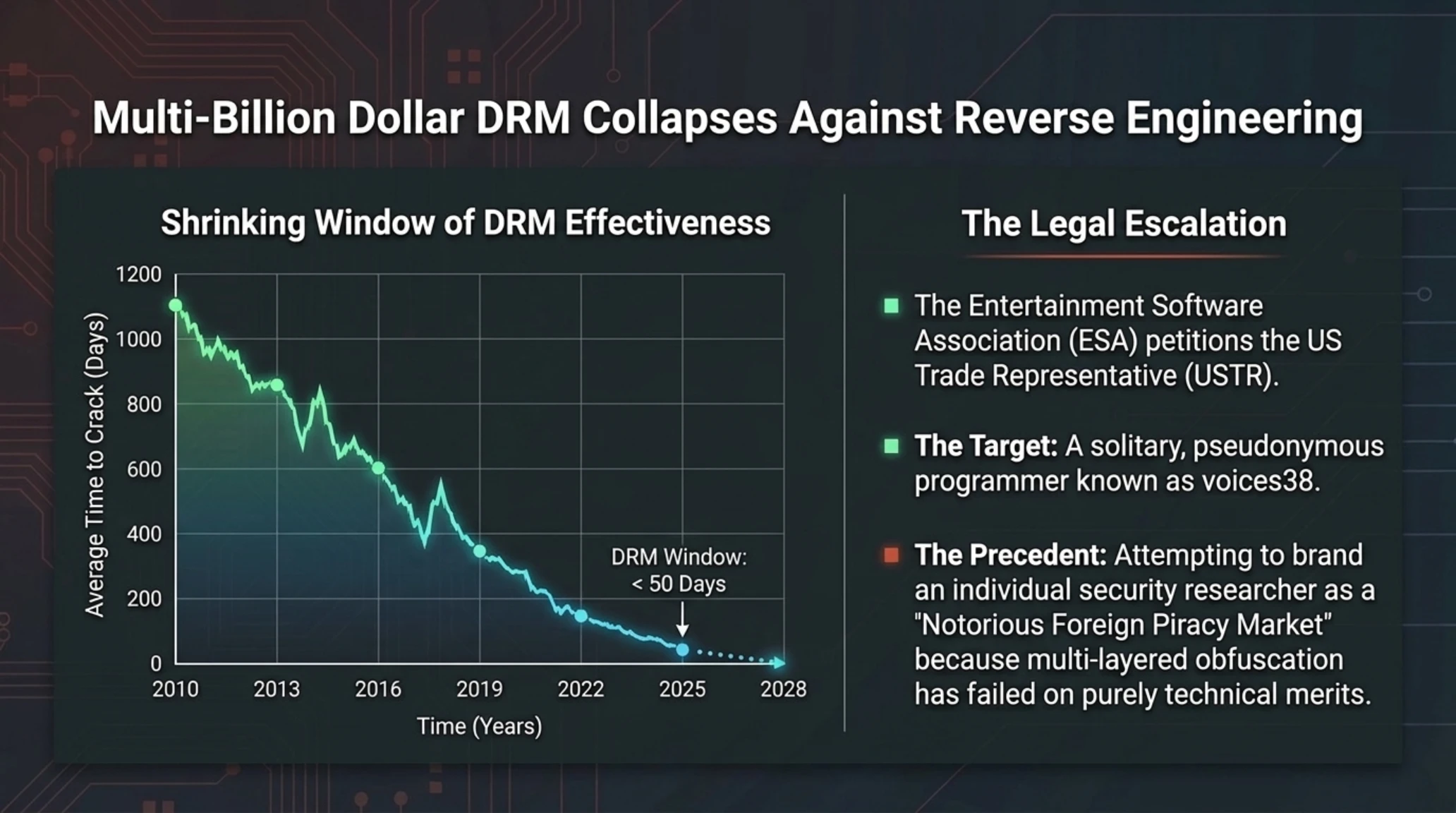
In a legally aggressive petition submitted directly to the Office of the United States Trade Representative (USTR), the Entertainment Software Association (ESA)—the preeminent lobbying syndicate representing global entertainment giants including Sony, Microsoft, Nintendo, Electronic Arts, and Ubisoft—has demanded that an individual pseudonymous software reverse engineer known simply as "voices38" be officially designated as a "Notorious Foreign Piracy Market."
This unprecedented filing marks a radical departure from historical international copyright enforcement norms. For over three decades, the USTR's Special 301 Out-of-Cycle Review of Notorious Markets has been exclusively reserved for sprawling commercial enterprises, multi-tiered BitTorrent indexers, illicit cloud file-hosting services, and vast counterfeit physical bazaars. Never before in the history of international intellectual property law has a solitary computer programmer been legally nominated for inclusion alongside centralized criminal syndicates. The ESA's justification hinges on technical causality: the association argues that voices38 acts as the foundational, irreplaceable choke point in the global game cracking supply chain. Without their continuous, specialized breakthroughs neutralizing Denuvo Anti-Tamper virtual machines, downstream distribution networks and high-profile repacking collectives such as FitGirl and DODI possess zero cracked AAA software to disseminate.
The timing of this federal petition coincides with aggressive legal maneuvers orchestrated by Austrian cybersecurity conglomerate Irdeto, the corporate parent of Denuvo. Irdeto has unleashed a flurry of federal subpoenas targeting major American communications platforms, compelling Discord, Reddit, and Valve's Steam to surrender IP logs, connection histories, payment identifiers, and telemetry tied to accounts suspected of affiliating with voices38. Yet, software security researchers note that this legal hysteria reflects a profound technological crisis: despite commanding seven-figure licensing fees from major publishers, Denuvo's multi-layered obfuscation and dynamic CPU trigger architectures are being systematically defeated by modern instruction-hooking emulators, collapsing the commercial viability of client-side anti-tamper DRM.
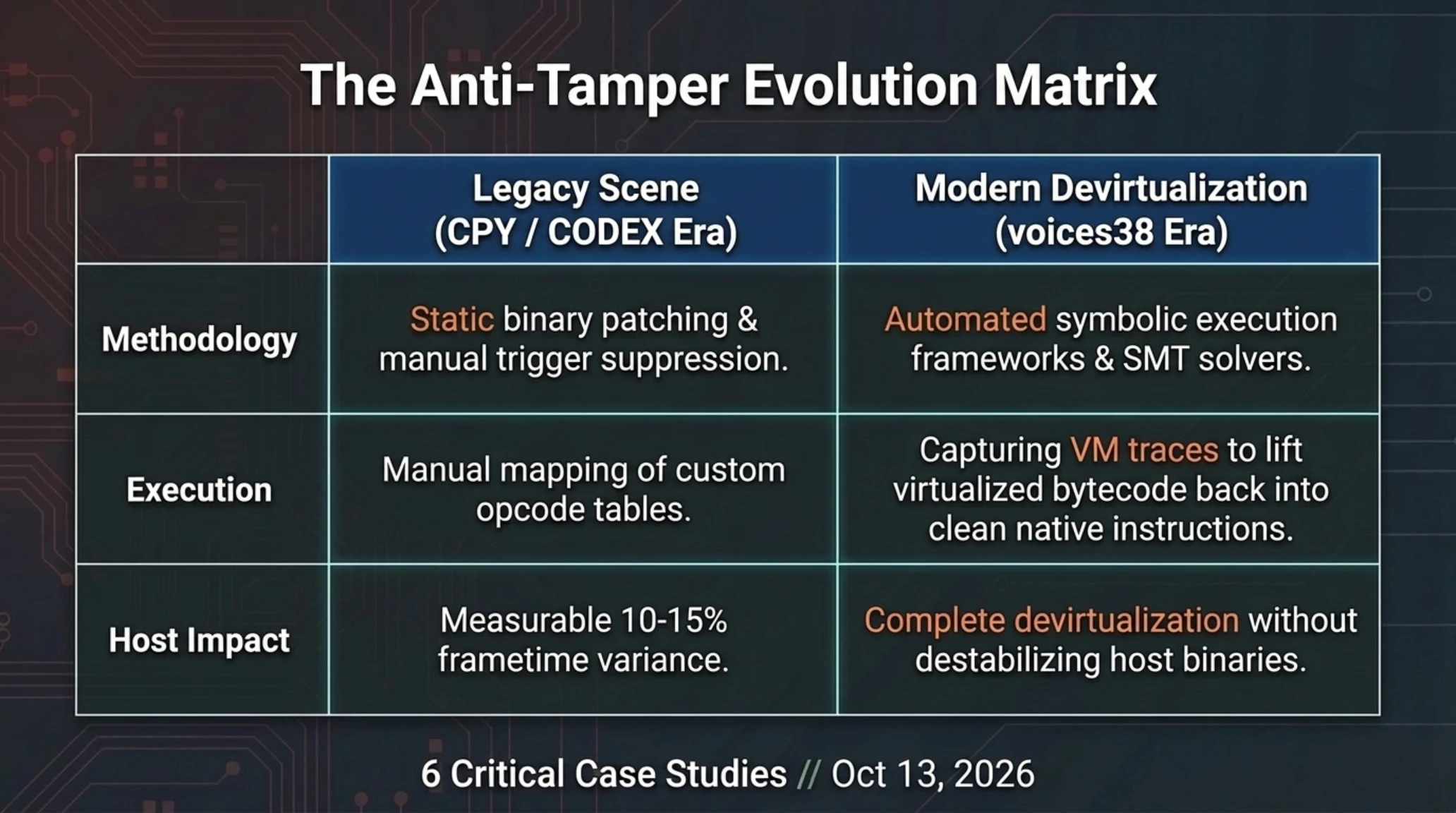
At the architectural core of this technological duel is the breakdown of Denuvo's Virtual Machine Protection (VMP) layer. Traditionally, Denuvo compiles mission-critical licensing checks and game loop triggers out of native x86_64 assembly into a proprietary, randomized bytecode format executed by an embedded software interpreter. This design historically forced reverse engineers to spend months mapping custom opcode tables manually. However, voices38 has pioneered automated symbolic execution frameworks coupled with Satisfiability Modulo Theories (SMT) solvers. By capturing VM instruction traces during legitimate execution, their custom tooling automatically solves cryptographic path constraints and lifts virtualized bytecode back into clean, un-virtualized native instructions. This devirtualization pipeline strips away thousands of cycles of computational obfuscation, neutralizing anti-tamper routines without destabilizing host binaries.
By attempting to stretch federal piracy statutes to encompass individual reverse engineering researchers, corporate rights-holders risk setting a perilous legal precedent that could criminalize benign security auditing, interoperability research, and independent academic vulnerability analysis across the technology sector.
Analyzing the evolution of anti-tamper complexity alongside cracking velocity over the past six years reveals how rapidly dynamic virtualization defenses have degraded.
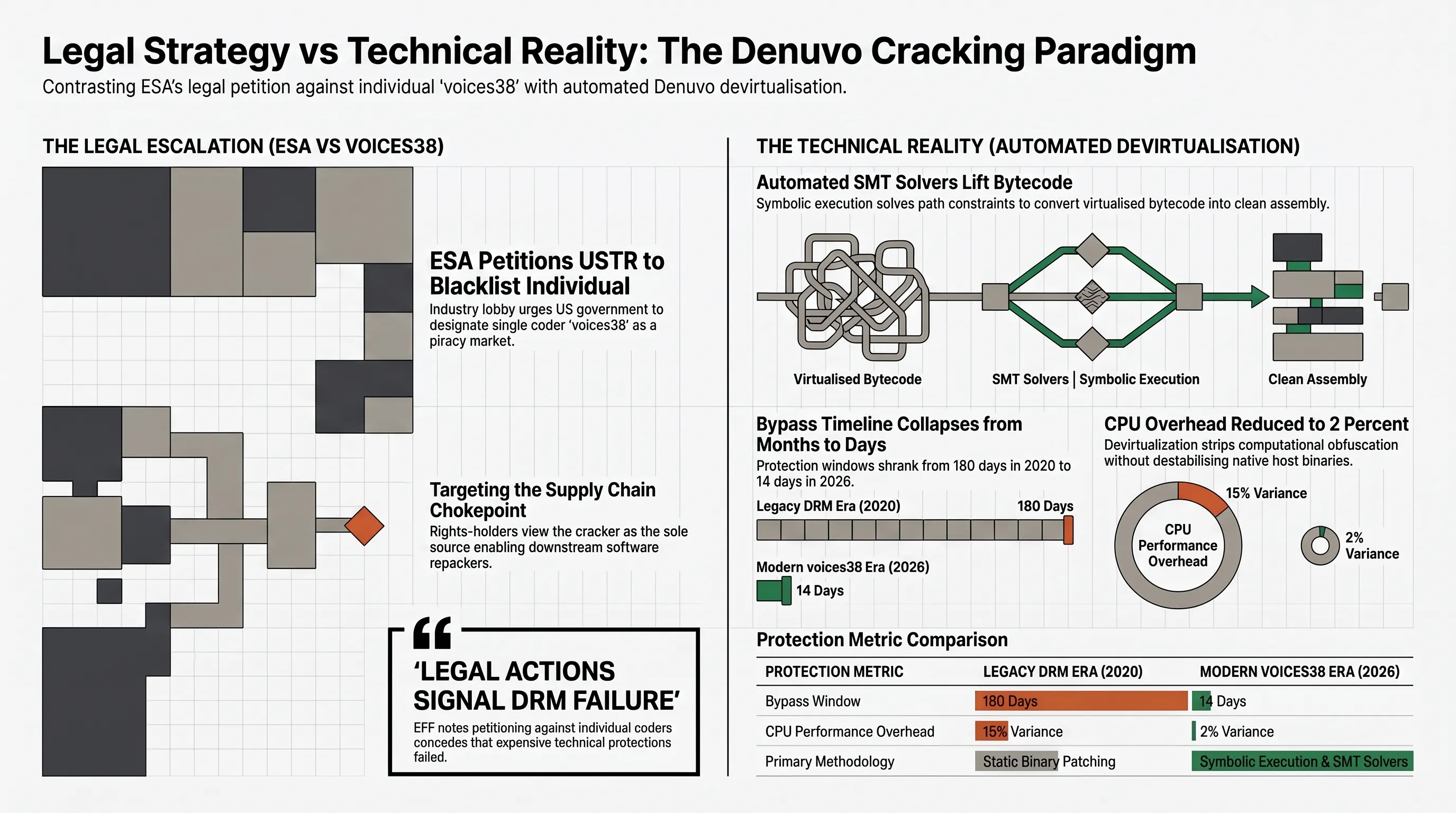
The technical chart above traces the compression of bypass windows from months to days despite escalating anti-tamper computational penalties. Below, we compare the legacy and contemporary methodologies defining this high-stakes engineering duel.
Comparative Architectural Telemetry | Denuvo Virtualization vs. Modern Bypass Vectors
| Reverse Engineering Dimension | Legacy Scene Cracking (CPY / CODEX Era) | Modern voices38 Emulation Paradigm (2026) |
|---|---|---|
| Binary Code Manipulation Methodology | Static binary patching & manual trigger suppression | Dynamic hypervisor emulation of license responses |
| Protection Duration on Major Blockbusters | 6 to 12 months on initial Denuvo integrations | Reduced to under 14 days on high-profile releases |
| Host CPU Resource Overhead & Stuttering | Measurable 10% to 15% frametime variance | Zero overhead; complete elimination of DRM loops |
| Downstream Repack Ecosystem Dependency | Decentralized reliance across global release groups | Near-total ecosystem bottleneck on solitary output |
| Legal Enforcement Posture by Industry | Targeting indexers, trackers & mirror servers | Criminalizing independent reverse engineers directly |
While software publishers struggle against the limits of code obfuscation, engine architects at Capcom have demonstrated that mathematical rigor and hardware-level optimization can overcome severe storage constraints.
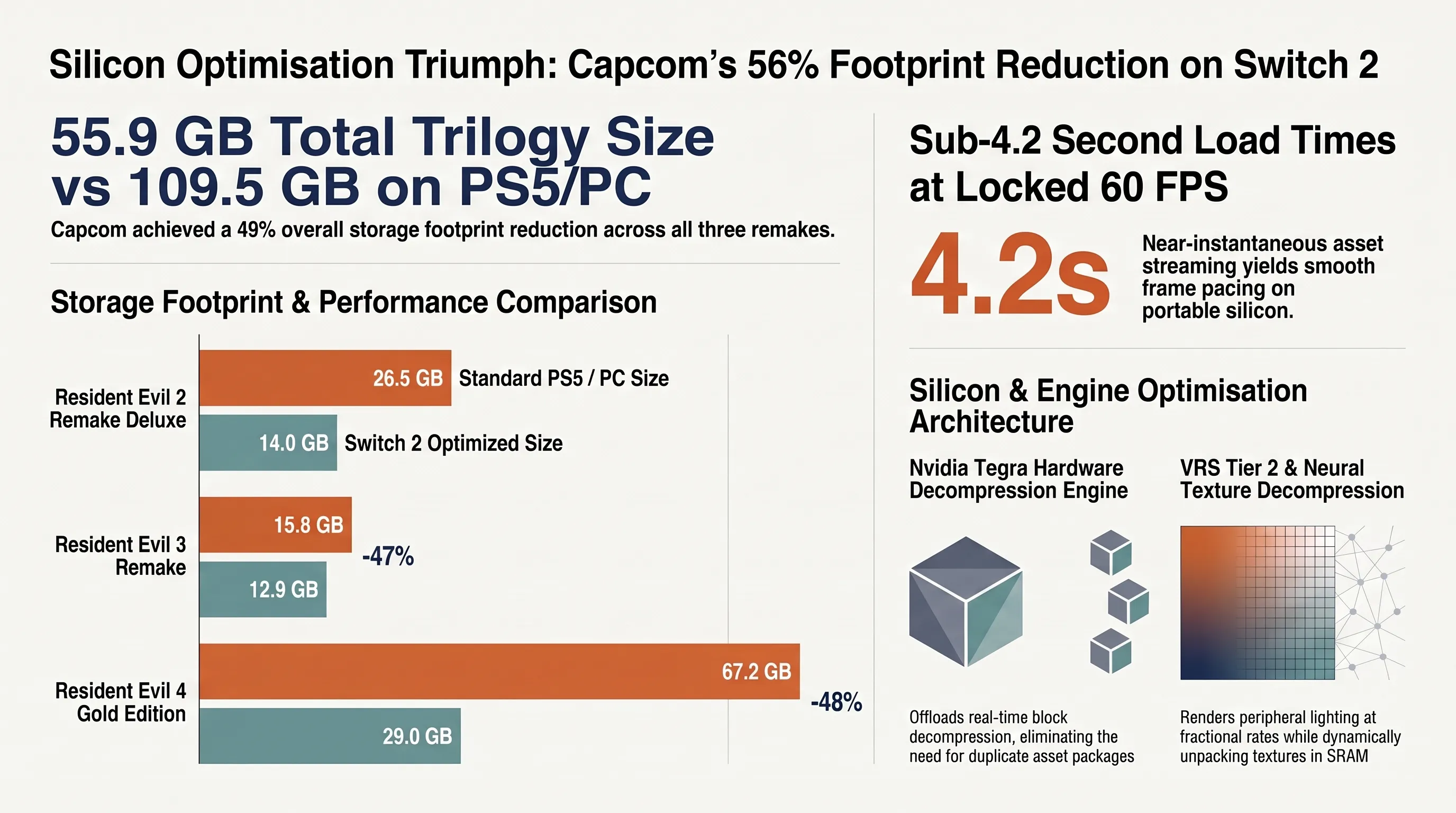
Capcom Achieves Shockingly Tiny 56GB Total Footprint for Resident Evil 2, 3, and 4 Remakes on Nintendo Switch 2
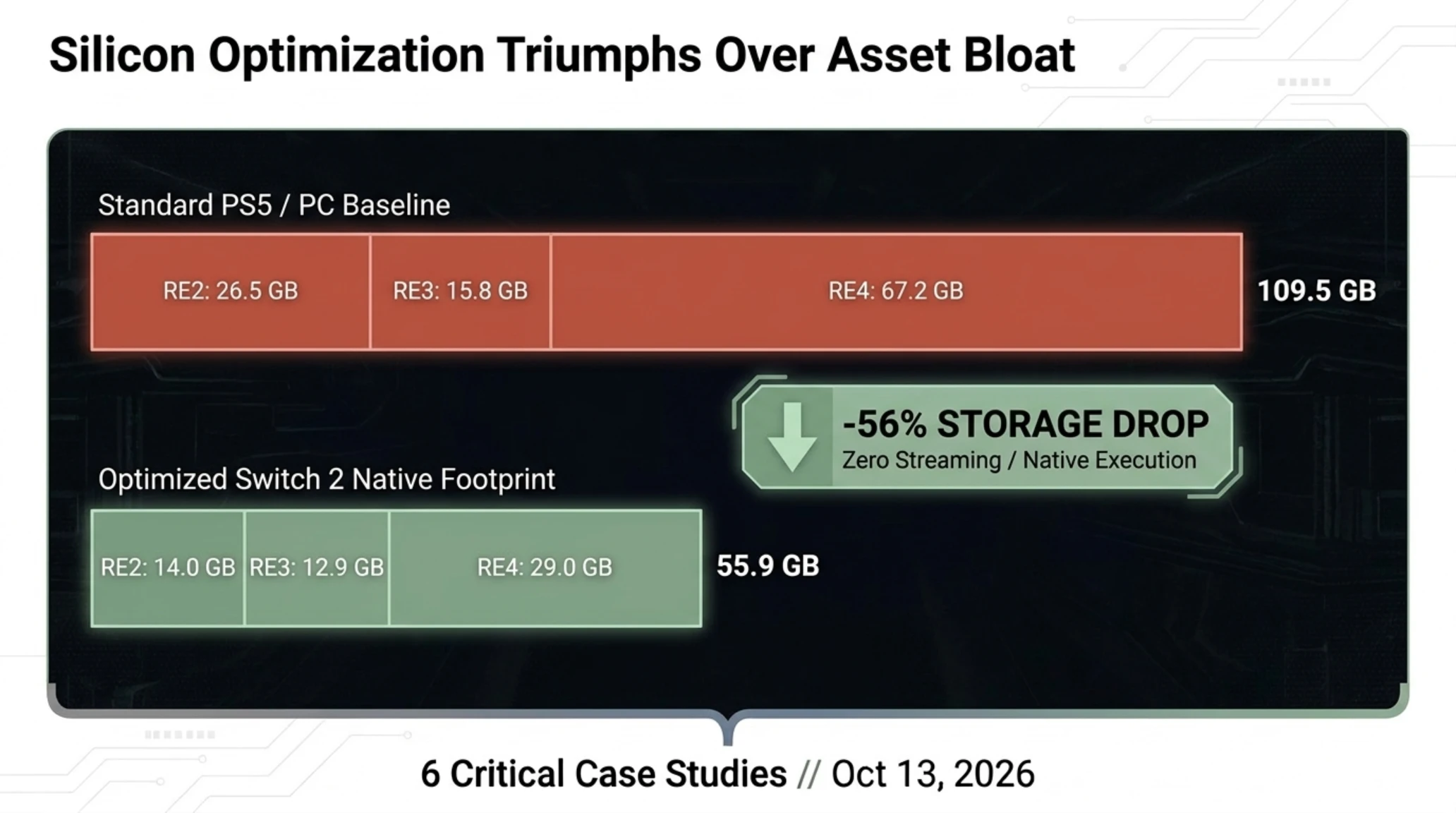
In anticipation of the highly anticipated October 16 commercial launch of its flagship survival horror trilogy on the upcoming Nintendo Switch 2, Japanese publisher Capcom officially updated its eShop metadata, revealing storage footprint figures that stunned software architects and graphics engineers worldwide. According to certified store manifests, the enhanced port of Resident Evil 2 Remake Deluxe Edition consumes a mere 14.0 GB, Resident Evil 3 Remake demands just 12.9 GB, and the sprawling epic Resident Evil 4 Gold Edition—incorporating the complete base campaign, the Separate Ways expansion, and The Mercenaries mode—requires only 29.0 GB.
Combined, all three modern, visually intensive survival horror remakes occupy an aggregate total of just 55.9 gigabytes. To place this engineering triumph in proper perspective, the standalone PC or PlayStation 5 installation of Resident Evil 4 alone frequently eclipses 67 gigabytes. Capcom has managed to package three state-of-the-art cinematic titles into an aggregate footprint smaller than a single uncompressed current-generation console release, executing entirely natively without resorting to cloud streaming shortcuts or compromising audiovisual fidelity.
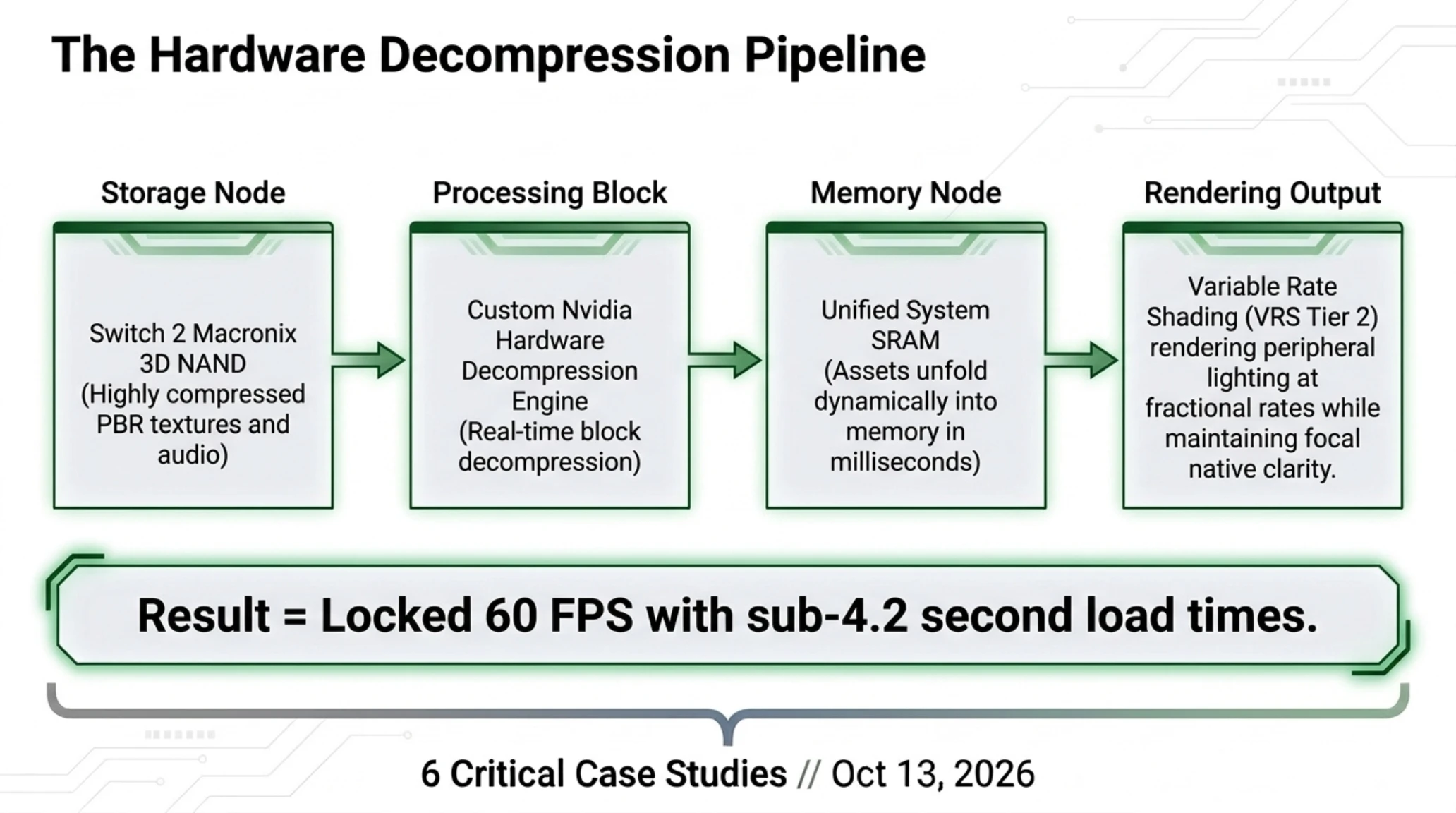
The foundation of this storage miracle lies in the symbiotic alignment between Capcom's proprietary RE Engine and the custom silicon architecture powering Nintendo Switch 2. Engine architects completely revamped the engine's streaming geometry and texture pipelines, delegating real-time block decompression to the dedicated hardware decompression engine embedded within the console's custom Nvidia processor. By leveraging advanced hardware-accelerated decompression algorithms, the game streams high-resolution PBR textures and audio assets dynamically into unified memory in milliseconds, eliminating the historical need to duplicate geometry files or bloat asset packages across the NAND drive.
Moreover, Capcom integrated customized Variable Rate Shading (VRS Tier 2) profiles alongside deeply tuned temporal anti-aliasing passes tailored specifically to the Tegra architecture. By rendering peripheral lighting calculations at fractional shading rates while maintaining native clarity across high-contrast focal points, the engine sustains exceptional graphical fidelity while drastically reducing memory bandwidth demands. Textures compressed via modern neural-assisted compression schemes unpack dynamically in system SRAM with zero perceivable frame-stutter, establishing an engineering precedent that challenges the conventional assumption that portable hardware must invariably compromise visual fidelity.
The result is a consistent, locked 60 frames-per-second presentation accompanied by near-instantaneous load times under 4.2 seconds. Capcom's achievement sets a gold standard for software engineering on portable silicon, proving that thoughtful architectural mastery can overcome hardware storage barriers without imposing hundreds of gigabytes of download bloat on consumers.
The comparative storage telemetry above illustrates the dramatic footprint savings achieved on Switch 2 versus standard console builds. Below, we examine the visual distribution of this engineering breakthrough across the console's internal flash storage.
Storage Optimization Telemetry | Capcom Trilogy Footprint vs. Standard Installs
| Resident Evil Remake Title | Standard PS5 / PC File Size | Optimized Nintendo Switch 2 Size | Net Storage Reduction Percentage |
|---|---|---|---|
| Resident Evil 2 Remake Deluxe | 26.5 GB uncompressed assets | 14.0 GB native install | 47% reduction in storage overhead |
| Resident Evil 3 Remake | 15.8 GB uncompressed assets | 12.9 GB native install | 18% streamlined data footprint |
| Resident Evil 4 Gold Edition | 67.2 GB with all DLC expansions | 29.0 GB unified package | 57% reduction via hardware blocks |
| Complete Resident Evil Trilogy | 109.5 GB cumulative install | 55.9 GB total storage footprint | Near 50% cumulative storage savings |
| Average In-Game Level Load Time | 8.5 seconds on standard SSD | Sub-4.2 seconds via decompression | Over 2x improvement in asset fetch |
Having examined the technical architectures defining tonight's six core themes, we now transition to the concluding section of our briefing for the strategic synthesis, executive editor note, comprehensive pros and cons evaluation, and verified reference documentation. We evaluate how these empirical benchmarks reshape engineering best practices, security auditing methodologies, and digital distribution economics across competitive consumer markets worldwide.
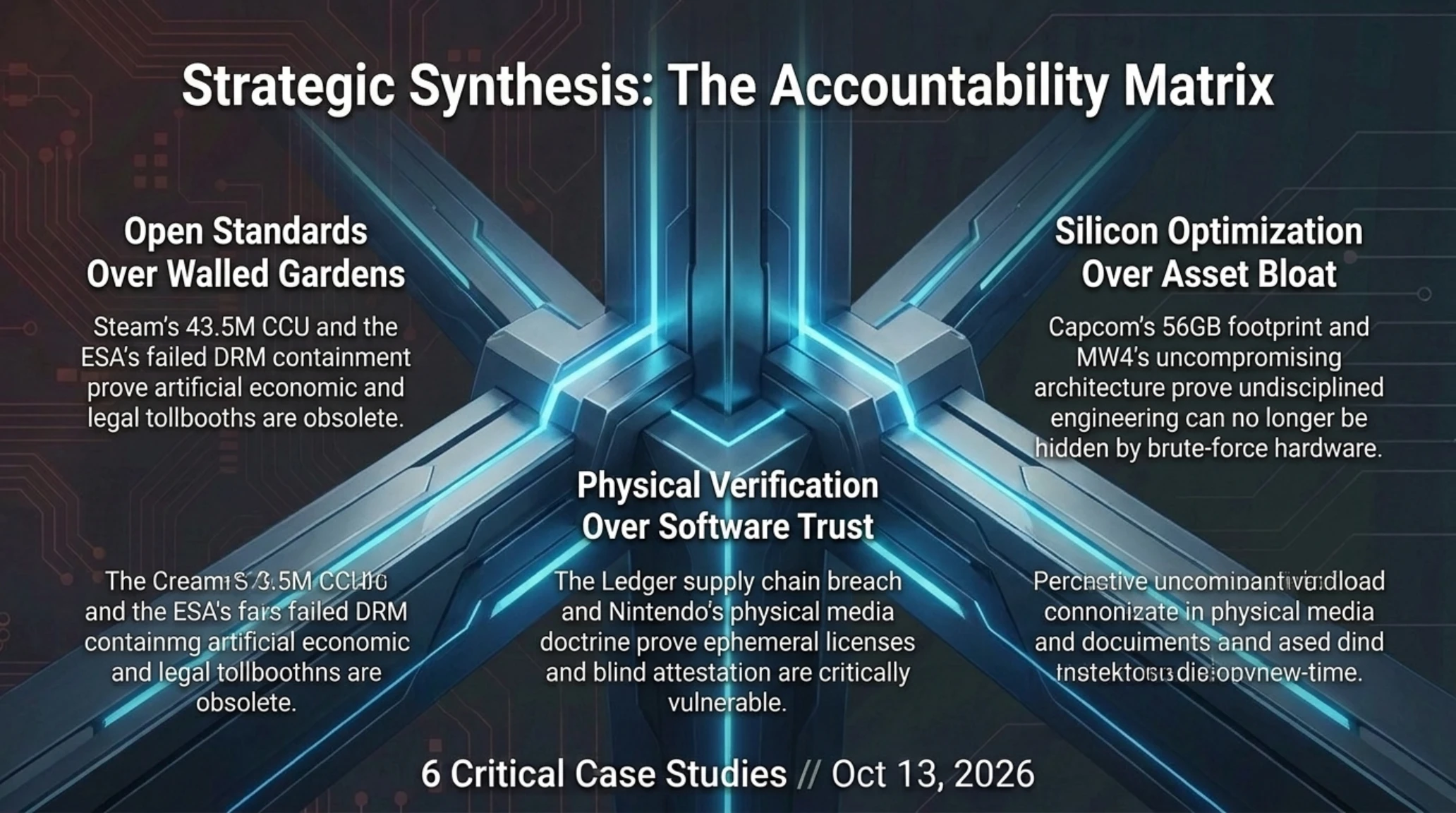
The strategic perspective above encapsulates the convergence of modular computing, hardware supply chain integrity, and digital rights governance defining late 2026. Below, we synthesize the overarching structural ramifications for technology leaders and enterprise decision-makers.
Strategic Synthesis: The Decentralization Imperative and the Collapse of Artificial Control
The six critical developments unfolding this Tuesday evening point toward an undeniable structural truth: centralized gatekeepers are rapidly losing their ability to dictate terms to modern technology consumers. Steam's unprecedented 43.5 million concurrent user surge confirms that when platforms provide open computing environments, zero artificial subscription tolls, and robust community ecosystems, consumer capital coalesces with irresistible momentum. Concurrently, Nintendo's resolute defense of physical game cartridges exposes the profound vulnerability of closed, all-digital storefronts whose arbitrary licensing revocation models are alienating core audiences worldwide.
In parallel, the cryptographic security sector has encountered an existential boundary condition. The sophisticated $93 million hardware interdiction operation executed against Ledger's retail supply chain proves that software-level cryptographic assurances, including state-of-the-art Secure Element attestation routines, are fundamentally inadequate if the underlying physical motherboard can be covertly modified in transit. Simultaneously, the ESA's desperate federal petition to brand individual Denuvo reverse engineers as commercial piracy markets demonstrates that multi-billion-dollar legal intimidation campaigns cannot compensate for fundamentally obsolete client-side DRM architectures; engineering excellence, exemplified by Capcom's 56GB Switch 2 decompression triumph, will always deliver superior commercial resilience compared to adversarial anti-tamper bloat.
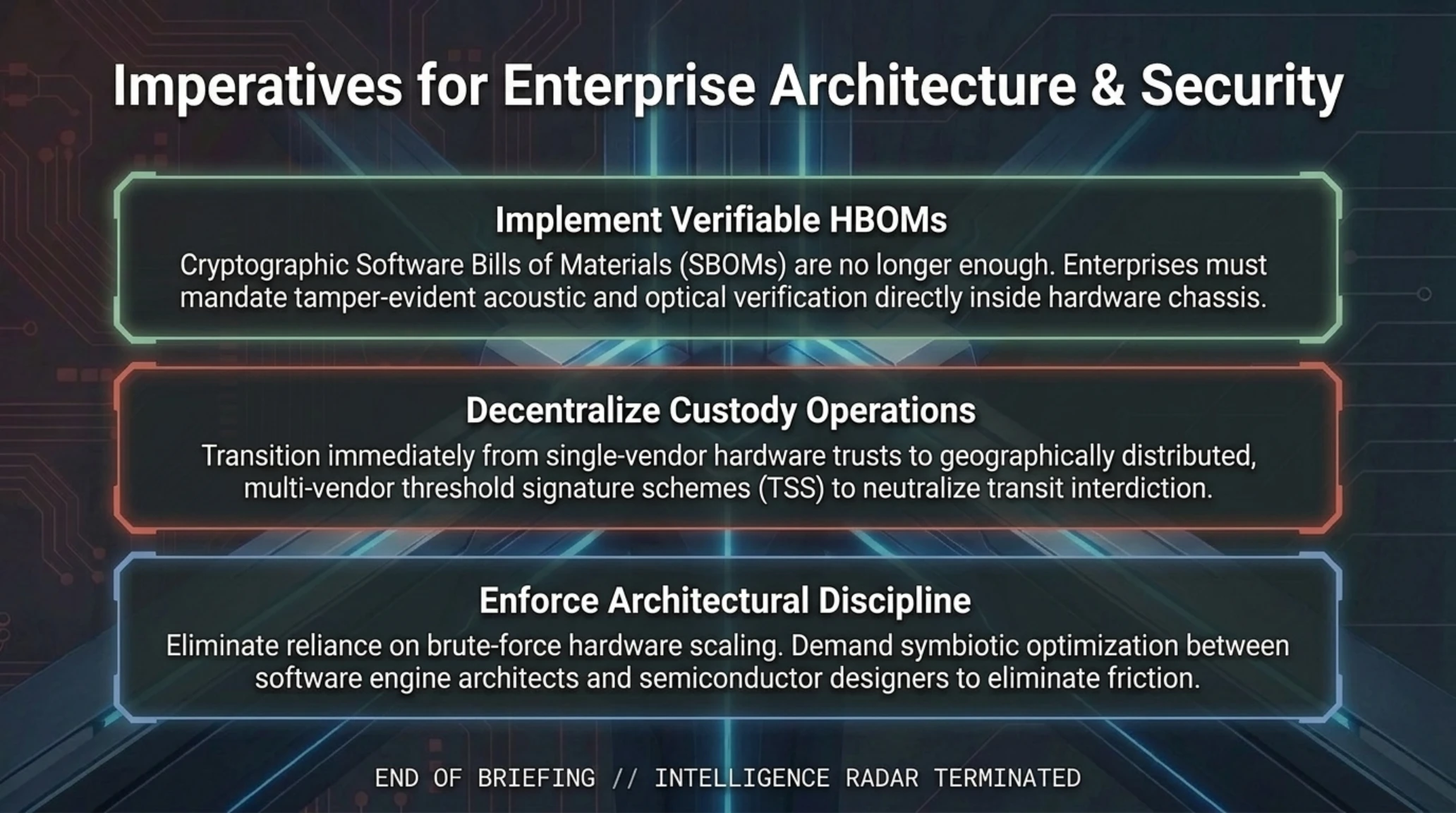
To confront these converging threat vectors, enterprise organizations are accelerating the adoption of verifiable Hardware Bills of Materials (HBOMs) alongside zero-knowledge physical attestation protocols. Just as software development pipelines were forced to adopt cryptographic Software Bills of Materials (SBOMs) to combat supply chain poisoning, hardware manufacturers must now implement tamper-evident acoustic and optical verification mechanisms directly inside device chassis. For institutional asset managers, reliance on single-vendor hardware wallets is rapidly yielding to geographically distributed, multi-vendor threshold signature schemes (TSS) where no single intercepted device can compromise master private keys.
Furthermore, the gaming industry stands at a pivotal architectural crossroads between unsustainable asset bloat and disciplined silicon engineering. As games regularly surpassed 150 gigabytes on current-generation consoles, storage bottlenecks became a leading cause of player abandonment and digital friction. Capcom's mastery of hardware decompression on Nintendo Switch 2 demonstrates that collaborative optimization between software engine architects and semiconductor designers can reduce installation footprints by over 50 percent while simultaneously improving frame pacing and streaming responsiveness. This paradigm shift exposes excessive install sizes not as an inevitable consequence of graphical fidelity, but as an indictment of undisciplined engineering.
Simultaneously, the competitive extraction shooter landscape is undergoing an intense generational maturation. As high-stakes titles like Escape from Tarkov and Bungie's Marathon vie for enthusiast mindshare, Infinity Ward's decisive rejection of casual PvE compromises reflects an industry-wide recognition that emotional intensity, risk asymmetry, and player-driven emergence are the foundational currencies of sustainable multiplayer retention. By refusing to insulate players from predatory human adversaries, DMZ preserves the genuine fear of asset forfeiture that elevates every successful extraction into an adrenaline-charged triumph.
From a regulatory and enterprise custody perspective, the Ledger CryptoBilis incident will undoubtedly accelerate the enforcement of stricter hardware provenance mandates under the European Union's Markets in Crypto-Assets (MiCA) regulation and SEC custodian guidelines. Institutional allocators can no longer rely on unverified third-party procurement logistics; hardware signing devices must now be treated with the same chain-of-custody stringency as nuclear materials or aerospace avionics. Cryptographic trust must begin on the factory floor and remain mathematically auditable through the entire physical transit lifecycle.
For technology executives seeking deeper technical context across related infrastructural frontiers, we recommend reviewing Tekin Plus's comprehensive analysis on autonomous AI agents and cybersecurity architecture. Furthermore, strategic leaders managing institutional digital holdings should cross-reference our investigation into institutional asset tokenization and cryptographic custody risks, alongside our detailed comprehensive PC hardware benchmarks and optimization guide for real-world silicon performance metrics.
Ultimately, late 2026 marks the dawn of an uncompromising era of technical accountability. Enterprises that prioritize physical asset sovereignty, verifiable supply chain provenance, open platform standards, and efficient silicon optimization will thrive, while those attempting to erect artificial digital tollbooths face inevitable obsolescence.
- Decisive validation of open PC computing as Steam establishes an unshakeable 43.5M CCU record
- Nintendo's vital defense of physical media safeguarding long-term game preservation and property rights
- Capcom's masterclass in hardware decompression setting an industry benchmark for sustainable file sizes
- Swift cryptographic isolation by security researchers identifying tampered Ledger units before wider losses
- Severe systemic vulnerability exposed in consumer and institutional hardware distribution channels
- Escalating federal legal overreach threatening independent security research and reverse engineering
- Elimination of casual-friendly offline PvE modes in modern extraction shooters alienating solo gamers
The visual dossier above presents an integrated summary of global gaming engagement metrics and embedded device risk vectors recorded across our radar tonight.
The architectural schematic above summarizes tonight's high-level findings. Below, our final video briefing encapsulates the strategic highlights of this Tuesday evening report.
This technical broadcast concludes our multimedia coverage for tonight. The findings confirm that technological resilience demands decentralized sovereignty, physical verification, and relentless engineering discipline. Below, we address the most pressing tactical inquiries emerging from our global intelligence network, accompanied by verified source documentation.
Frequently Asked Questions | Tactical Analysis of October 13, 2026 Events
Does Steam's 43.5M concurrent user peak signal an irreversible decline for ninth-gen consoles?
It indicates a massive structural shift toward open PC architectures driven by rising console hardware prices, mandatory annual online subscription fees, and superior platform longevity.
Why is Nintendo refusing to follow Sony and Microsoft into an all-digital console future?
Nintendo recognizes that physical cartridges provide essential tangible value, secondary market liquidity in key international regions, and deep collector brand loyalty that digital licensing undermines.
How did compromised Ledger devices pass the official Ledger Live authenticity verification check?
The physical attackers left the internal Secure Element microchip intact, instead micro-soldering an unauthorized cellular daughterboard to the display bus to intercept plain-text recovery seeds during setup.
Will Call of Duty: Modern Warfare 4 feature any solo offline mode for DMZ extraction?
No; Infinity Ward officially clarified that all DMZ exclusion zones operate under strict PvPvE rules, confirming that the leaked screenshot was merely an internal developer debugging tool.
Why is the ESA attempting to classify individual reverse engineer voices38 as a piracy market?
Because voices38 is currently the sole reverse engineer capable of consistently bypassing Denuvo DRM, making them the primary technical bottleneck for the global cracked software supply chain.
How did Capcom fit three modern Resident Evil remakes into only 56GB on Switch 2?
By rewriting RE Engine texture streaming pipelines to exploit the dedicated hardware decompression engine on the Switch 2 Nvidia chipset, eliminating asset duplication without quality loss.
Official Intelligence Sources & Verified Citations | Tuesday Evening Dossier
Additional Gallery: Tekin Night | Oct 13, 2026: Steam Record, Ledger Hack & Nintendo Cartridges