
🌙 Welcome to Tekin Night May 28, 2026
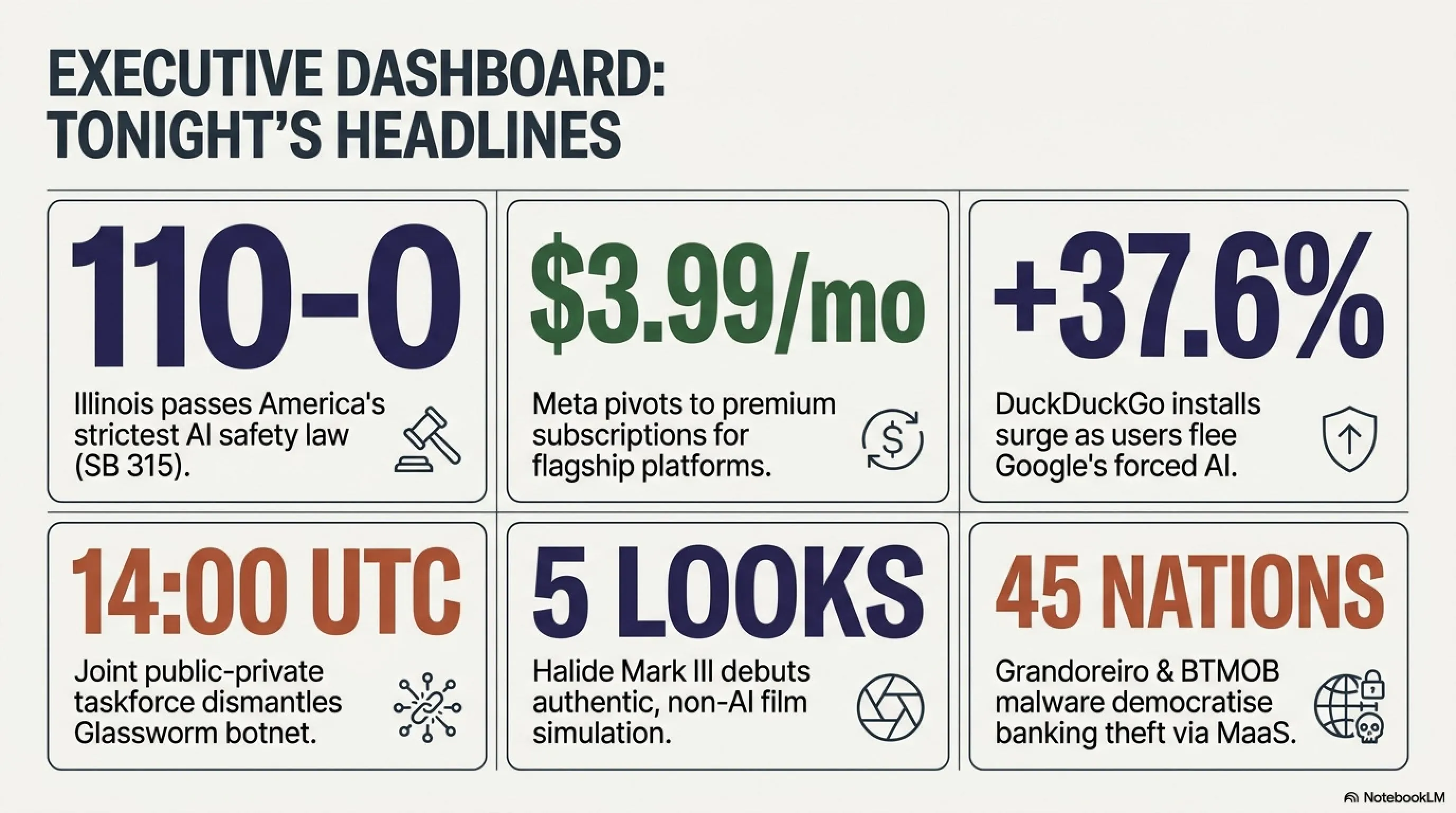
Good evening, tech enthusiasts! Tonight we bring you six historic and transformative stories from the world of technology. From Illinois passing groundbreaking AI safety legislation to Meta's subscription revolution, from the great Google exodus to the dismantling of dangerous botnets - everything you need to know in this comprehensive report.
⚡ Tonight's Headlines:
⚖️ Illinois passes America's strongest AI safety law
💰 Meta launches paid subscriptions for Facebook, Instagram & WhatsApp
🦆 DuckDuckGo surges 30% as users flee Google's AI features
🛡️ CrowdStrike and Google dismantle Glassworm botnet
📸 Halide Mark III debuts with Hollywood film simulation
🚨 Grandoreiro and BTMOB malware target Europe and Latin America
🌃 Grab your evening beverage and join us for a deep dive into tonight's top tech stories!
⚖️ Illinois Leads the Nation: Passing America's Strongest AI Safety Law
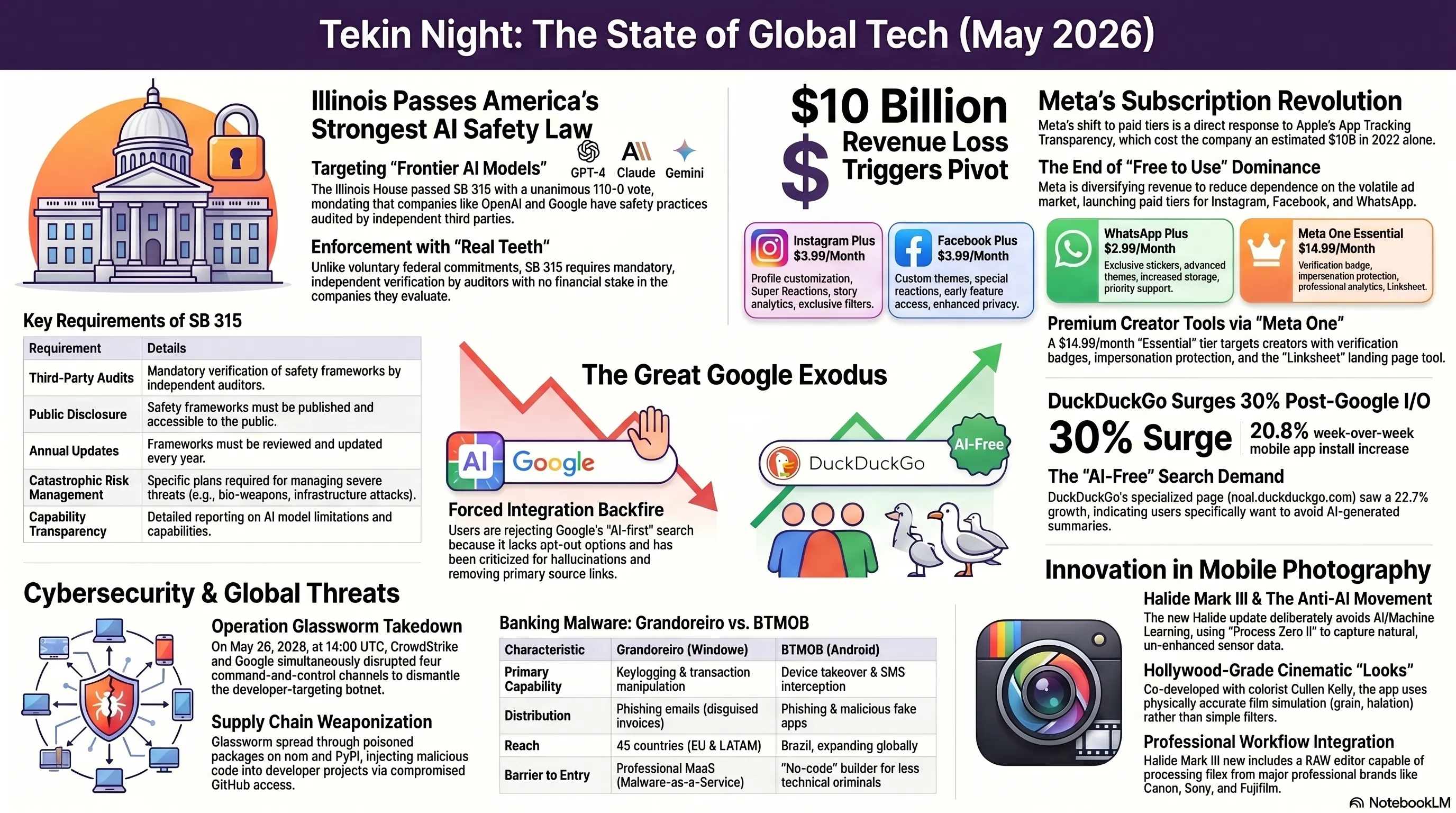
In a historic move that could set the template for AI regulation across the United States, the Illinois House of Representatives passed comprehensive AI safety legislation on Wednesday, May 27, 2026, with a unanimous 110-0 vote. The bill, officially designated as SB 315 and titled the "Artificial Intelligence Safety Measures Act," represents the most stringent AI safety requirements enacted by any U.S. state to date, requiring frontier AI companies like OpenAI, Anthropic, Google DeepMind, and other developers of advanced models to have their safety practices audited by independent third parties.
Governor JB Pritzker, a strong proponent of the legislation, has publicly committed to signing the bill into law, stating that "Illinois is leading the nation in holding Big Tech accountable." The bill, which previously passed the Illinois Senate on May 21 with overwhelming bipartisan support, now awaits the governor's signature and is expected to be enacted into law within weeks. This legislation mirrors similar provisions in California and New York but goes further by mandating third-party verification—a mechanism that many experts consider the "real teeth" of the law.
📋 Key Requirements of SB 315
| Requirement | Details |
|---|---|
| Third-Party Audits | Companies must have safety frameworks verified by independent auditors |
| Public Disclosure | Safety frameworks must be publicly published and accessible |
| Annual Updates | Frameworks must be reviewed and updated annually |
| Catastrophic Risk Management | Specific framework for managing severe and catastrophic risks |
| Capability Transparency | Detailed reporting on AI model capabilities and limitations |
The legislation specifically targets "frontier AI models"—systems that represent the cutting edge of artificial intelligence capabilities and pose potential risks at scale. These include large language models like GPT-4, Claude, and Gemini, as well as advanced image generation systems and multimodal AI platforms. The law requires companies developing these systems to create, publish, and annually update comprehensive plans addressing how they will identify, assess, and mitigate severe or catastrophic risks from their AI models.
What makes Illinois's approach particularly significant is the mandatory third-party audit requirement. Unlike voluntary self-regulation frameworks that many tech companies prefer, SB 315 requires independent verification by qualified auditors who have no financial stake in the companies they're evaluating. This creates an accountability mechanism similar to financial audits in the corporate world, where external verification provides assurance to stakeholders and the public.
🔍 Tekin Analysis: Why This Law Matters Globally
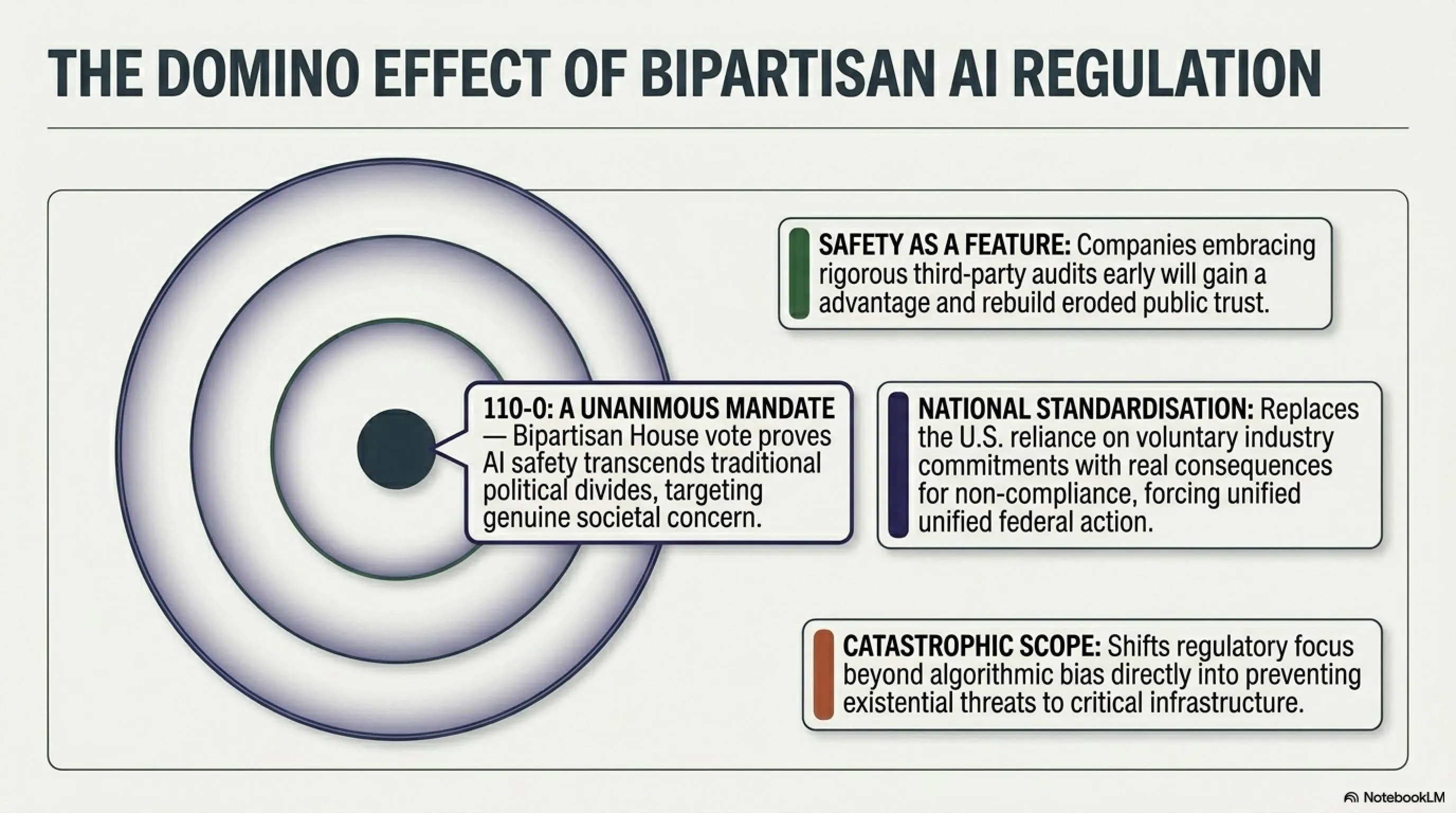
Illinois's AI safety law represents a pivotal moment in the global conversation about AI regulation. While the European Union has been working on comprehensive AI legislation through the AI Act, and China has implemented its own AI regulations, the United States has largely relied on voluntary industry commitments. SB 315 changes that dynamic by establishing enforceable requirements with real consequences for non-compliance.
The unanimous bipartisan support—110-0 in the House—is particularly noteworthy in today's polarized political environment. This suggests that AI safety transcends traditional political divides and reflects genuine concern about the technology's potential risks. The bill's passage could trigger a domino effect, with other states adopting similar legislation and potentially forcing federal action to create a unified national framework.
For AI companies, this law presents both challenges and opportunities. While compliance will require investment in safety infrastructure and third-party audits, it also provides a clear framework for responsible development. Companies that embrace these standards early may gain competitive advantages as safety becomes a key differentiator in the market. Moreover, demonstrating compliance with rigorous safety standards could help rebuild public trust in AI technology, which has been eroded by concerns about bias, misinformation, and potential misuse.
The law's focus on "catastrophic risks" is particularly important. This includes scenarios like AI systems being used to develop biological weapons, conduct large-scale cyberattacks, or manipulate critical infrastructure. By requiring companies to explicitly plan for and mitigate these extreme scenarios, Illinois is acknowledging that AI safety isn't just about preventing algorithmic bias or protecting privacy—it's about ensuring that these powerful systems don't pose existential threats to society.
💰 Meta's Subscription Revolution: Facebook Plus, Instagram Plus & WhatsApp Plus Launch Globally
Meta is fundamentally reshaping its business model with the global launch of paid subscription tiers across its three flagship platforms. Instagram Plus and Facebook Plus are now available at $3.99 per month each, while WhatsApp Plus is priced at $2.99 monthly. These subscriptions, which began rolling out globally on May 27, 2026, offer a suite of premium features that have never been available in the free versions, marking Meta's most significant push into subscription revenue since the launch of Meta Verified in 2023.
The subscription offerings include advanced profile customization options, exclusive "Super Reactions" that go beyond standard emoji responses, detailed story insights and analytics, early access to new features before they roll out to free users, and enhanced privacy controls. For Instagram Plus specifically, subscribers gain access to exclusive filters and effects, the ability to schedule posts directly within the app, and advanced analytics showing detailed demographic information about their audience and engagement patterns.
💎 Meta Subscription Tiers Comparison
| Subscription | Price/Month | Key Features |
|---|---|---|
| Instagram Plus | $3.99 | Profile customization, Super Reactions, story analytics, exclusive filters |
| Facebook Plus | $3.99 | Custom themes, special reactions, early feature access, enhanced privacy |
| WhatsApp Plus | $2.99 | Exclusive stickers, advanced themes, increased storage, priority support |
| Meta One Essential | $14.99 | Verification badge, impersonation protection, professional analytics, Linksheet |
Beyond the individual platform subscriptions, Meta is introducing Meta One Essential, a premium tier priced at $14.99 per month specifically designed for creators and businesses. This tier includes a verified badge that helps establish authenticity, impersonation protection that actively monitors for fake accounts using your name or likeness, comprehensive analytics that provide deep insights into audience behavior and content performance, and Linksheet—a feature that allows users to create a customizable landing page linking to their various online profiles and websites across different platforms.
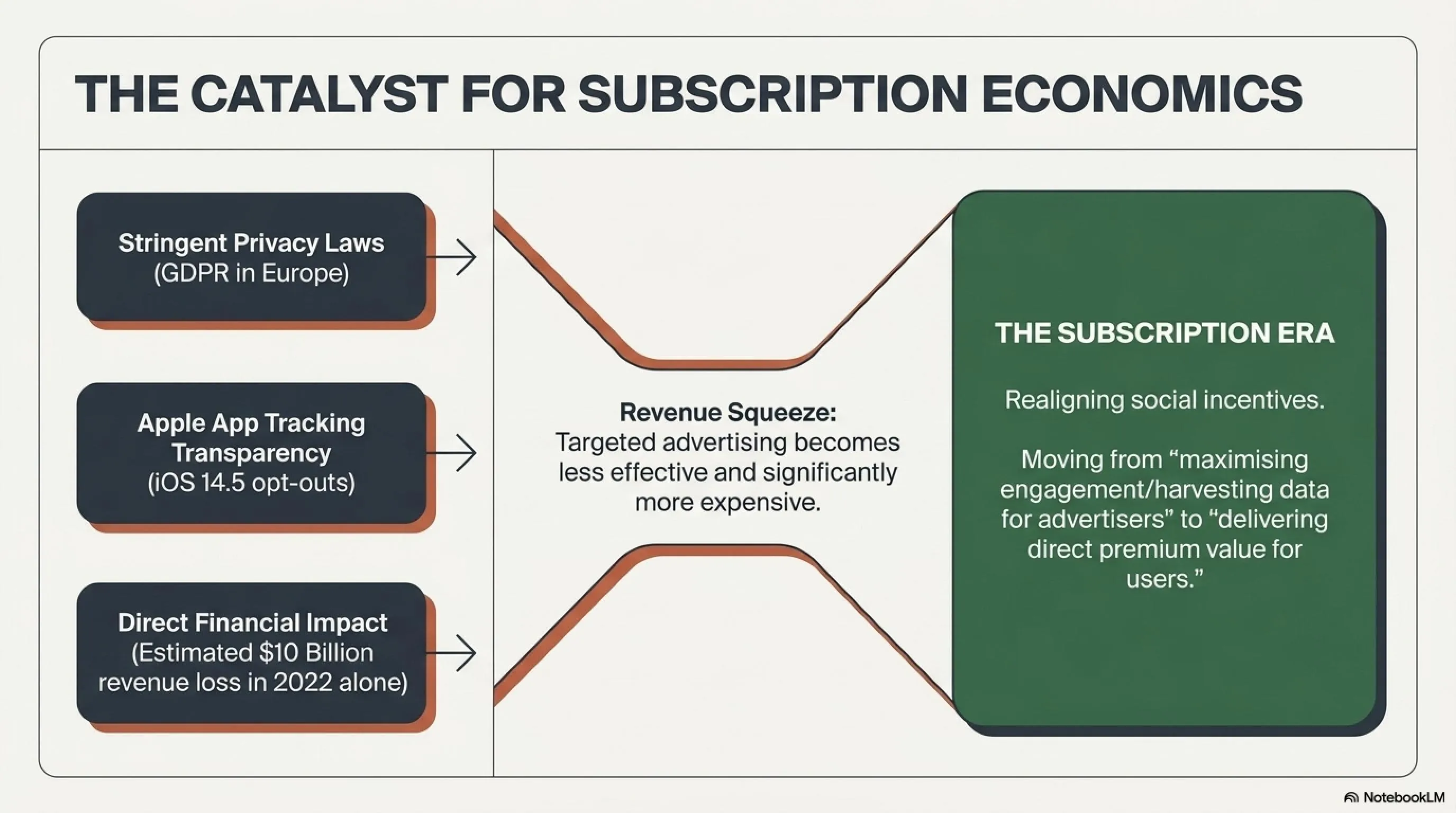
This strategic pivot toward subscription revenue represents Meta's response to multiple pressures facing its traditional advertising-based business model. Privacy regulations like GDPR in Europe and evolving data protection laws in the United States have made targeted advertising less effective and more expensive to implement. Apple's App Tracking Transparency framework, introduced in iOS 14.5, dealt a significant blow to Meta's advertising effectiveness by allowing users to opt out of cross-app tracking. The company estimated this change cost them approximately $10 billion in revenue in 2022 alone, and the impact continues to compound.
✅ Advantages of Meta's Subscription Strategy
- Revenue diversification reduces dependence on volatile advertising market
- Direct relationship with paying customers creates more predictable revenue streams
- Premium features provide genuine value to power users and creators
- Competitive pricing compared to other digital subscription services
- Ability to test new features with committed user base before wider rollout
- Potential to improve platform quality as paying users demand better experiences
⚠️ Challenges and Concerns
- Risk of creating two-tier social networks with unequal experiences
- Potential to move currently free features behind paywalls over time
- User resistance to paying for previously free services
- Competition from established subscription platforms like YouTube Premium and Twitter/X Premium
- May alienate users in developing markets where $3.99/month is significant
- Could accelerate user migration to alternative platforms
🔍 Tekin Analysis: The Subscription Economy Comes to Social Media
Meta's subscription launch represents a fundamental shift in how social media platforms think about monetization. For over a decade, the dominant model has been "free to use, paid by advertisers." This model created platforms with billions of users but also led to problematic incentives—maximizing engagement at any cost, harvesting user data for targeting, and prioritizing advertiser interests over user experience.
The subscription model potentially realigns these incentives. When users pay directly, platforms must deliver value to retain them. This could lead to better content moderation, fewer algorithmic manipulations designed to maximize time-on-platform, and more respect for user privacy. However, there's also a risk that Meta will pursue a "worst of both worlds" approach—continuing to show ads to free users while also extracting subscription revenue from premium users.
The pricing strategy is particularly interesting. At $3.99 per month, Instagram Plus and Facebook Plus are positioned below YouTube Premium ($13.99/month) and Twitter/X Premium ($8/month for basic, $16/month for Premium+), making them accessible to a broader audience. WhatsApp Plus at $2.99 is especially competitive given WhatsApp's dominance in international markets. Meta One Essential at $14.99 targets the creator economy, competing directly with platforms like Patreon and Substack.
For Meta's business, even modest subscription adoption could be transformative. With 3 billion monthly active users across its platforms, if just 5% convert to paid subscriptions at an average of $4/month, that's $7.2 billion in annual recurring revenue—with much higher margins than advertising. This doesn't replace advertising revenue but provides a crucial hedge against regulatory and technological disruptions to the ad business.
🦆 The Great Google Exodus: DuckDuckGo Surges 30% as Users Reject AI-First Search
In a dramatic user revolt against Google's aggressive AI integration, privacy-focused search engine DuckDuckGo has experienced explosive growth, with mobile app installs in the United States surging an average of 20.8% week-over-week in the seven days following Google's May 19 I/O conference announcements. The growth peaked at an astonishing 37.6% on May 26, with iOS users leading the charge—iPhone and iPad installs grew an average of 33% and peaked at nearly 70% on May 25.
The catalyst for this migration was Google's unveiling of its most significant Search overhaul in decades. At Google I/O, the company announced that AI Overviews—AI-generated summaries that appear at the top of search results—would become the default experience for all users, with no option to disable them. Google also introduced a more seamless "AI Mode" that allows users to ask follow-up questions within AI Overviews, essentially transforming Search from a link directory into an AI conversation interface.
📊 DuckDuckGo Growth Statistics Post-Google I/O
| Platform | Average Growth | Peak Growth | Peak Date |
|---|---|---|---|
| US Total | +20.8% | +37.6% | May 26 |
| iOS (iPhone/iPad) | +33% | +69.9% | May 25 |
| noai.duckduckgo.com | +22.7% | +27.7% | May 24 |
Perhaps most tellingly, DuckDuckGo's specialized noai.duckduckgo.com page—which disables all AI features by default—saw average week-over-week growth of 22.7%, peaking at 27.7% on May 24. This demonstrates that a significant portion of users aren't just looking for a Google alternative; they specifically want to avoid AI in their search results altogether. The message is clear: many users prefer traditional search results—a list of links to authoritative sources—over AI-generated summaries that may contain errors or lack proper attribution.
DuckDuckGo CEO Gabriel Weinberg commented on the surge, stating: "Google is force-feeding AI with no way to opt out. People are voting with their downloads." This sentiment resonates with a growing chorus of criticism from power users, researchers, and journalists who rely on search engines for accurate information and primary sources. AI Overviews, while impressive in their ability to synthesize information, have been criticized for occasionally providing incorrect information, lacking proper citations, and making it harder to access the original sources.
🔍 Tekin Analysis: Why Users Are Fleeing Google's AI Search
Google's decision to make AI Overviews mandatory represents a fundamental misunderstanding of how different user segments use search. For casual queries like "what's the weather" or "how tall is the Eiffel Tower," AI summaries work well. But for research, fact-checking, technical troubleshooting, or any task requiring verification of sources, AI Overviews create friction rather than reducing it.
The problem is compounded by AI hallucinations—instances where the AI confidently presents false information as fact. While Google has implemented safeguards, the system still occasionally generates incorrect summaries, and because these appear at the top of results with Google's implicit endorsement, users may trust them more than they should. Professional researchers, journalists, and academics have been particularly vocal about this issue, as their work requires tracing information back to primary sources.
There's also a broader philosophical issue at play. Google's AI-first approach positions the search engine as an answer machine rather than a discovery tool. This fundamentally changes the relationship between users and information. Instead of exploring multiple perspectives and sources, users receive a single AI-synthesized answer. This may be efficient, but it reduces serendipitous discovery and makes it harder to develop critical thinking skills about information quality.
DuckDuckGo's surge demonstrates that there's significant demand for traditional search experiences. The company's privacy-first approach, combined with its commitment to providing straightforward link-based results, appeals to users who feel overwhelmed by AI integration. The success of noai.duckduckgo.com specifically shows that "AI fatigue" is real—after being bombarded with AI features in every product, some users are actively seeking AI-free alternatives.
For Google, this exodus should be a wake-up call. While DuckDuckGo's market share remains small compared to Google's dominance, the velocity of growth is concerning. If Google loses its reputation as the most reliable search engine, particularly among power users and opinion leaders, it could face a long-term erosion of trust that's difficult to rebuild. The company should consider offering a genuine opt-out for AI Overviews, allowing users to choose their preferred search experience.
🛡️ Operation Glassworm Takedown: CrowdStrike and Google Dismantle Developer-Targeting Botnet
In a coordinated cybersecurity operation that demonstrates the power of public-private collaboration, CrowdStrike's Counter Adversary Operations team, working alongside Google and the Shadowserver Foundation, executed a simultaneous takedown of the Glassworm botnet on May 26, 2026, at 14:00 UTC. This sophisticated, self-propagating malware had been targeting software developers through the open-source supply chain since early 2025, representing one of the most insidious threats to the software development ecosystem in recent years.
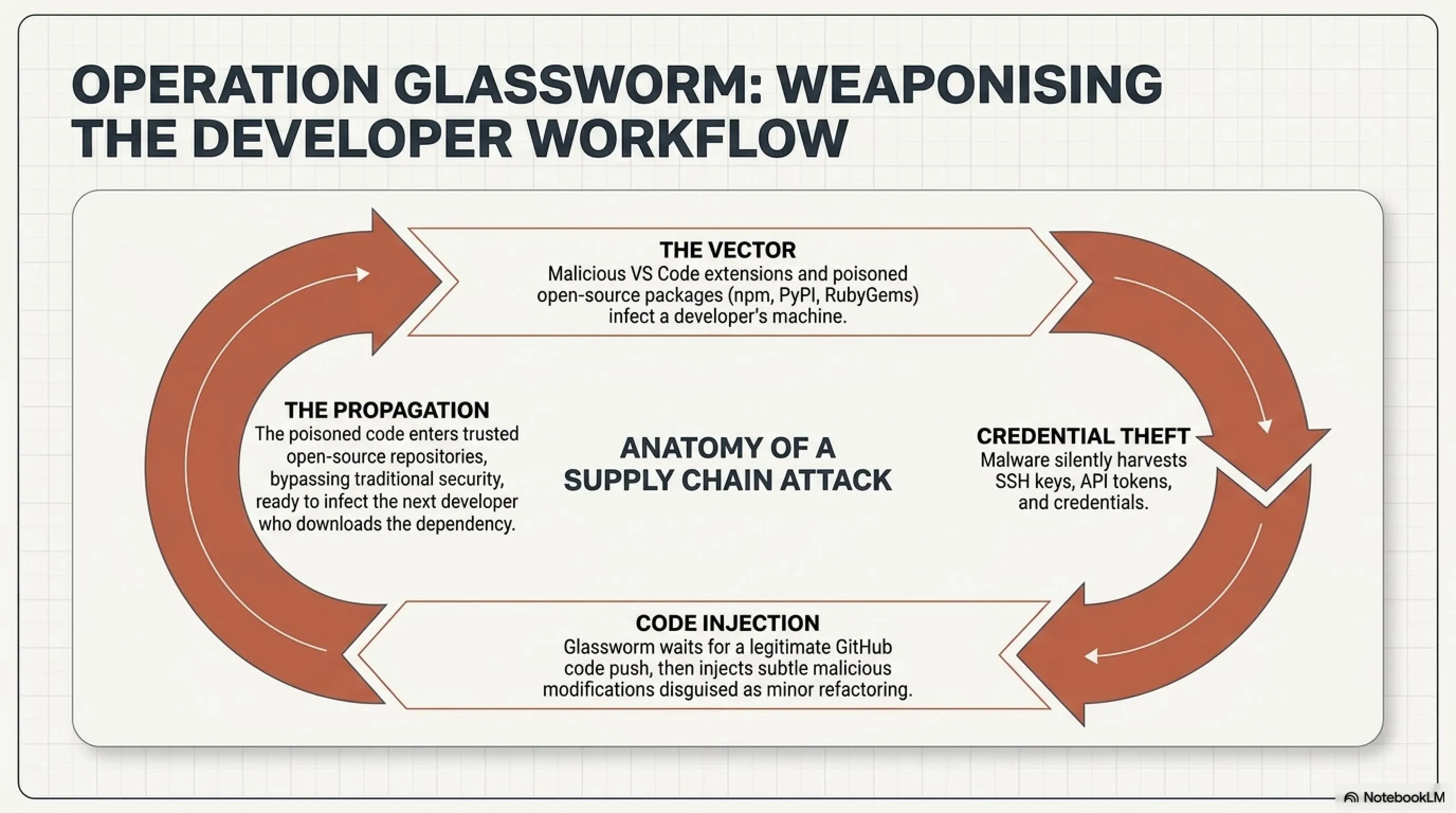
Glassworm was not your typical botnet. Rather than targeting end users or corporate networks directly, it weaponized the tools and workflows that developers trust most. The malware spread through poisoned software packages in popular repositories like npm, PyPI, and RubyGems, as well as through malicious Visual Studio Code extensions. Once a developer's machine was infected, Glassworm would steal credentials, inject malicious code into the developer's projects, and use their GitHub access to spread to other repositories—creating a self-perpetuating cycle of infection.
⚠️ Glassworm Botnet Technical Profile
| Characteristic | Details |
|---|---|
| Threat Type | Self-propagating worm + credential stealer |
| Primary Target | Open-source software developers |
| Distribution Method | Poisoned packages, malicious VS Code extensions |
| Infected Repositories | Hundreds of GitHub repositories |
| C2 Channels | 4 channels (all simultaneously disrupted) |
| Active Period | Early 2025 to May 26, 2026 |
| Global Reach | Worldwide, targeting all major development ecosystems |
The sophistication of Glassworm lay in its understanding of developer workflows. It would wait for developers to push code to GitHub, then inject subtle malicious modifications that were difficult to spot in code reviews. These modifications often appeared as legitimate dependencies or minor refactoring, making them blend in with normal development activity. The malware also stole SSH keys, API tokens, and other credentials, giving attackers persistent access to development infrastructure even after the initial infection was cleaned.
The takedown operation required precise coordination. CrowdStrike's team identified all four command-and-control servers that Glassworm used to receive instructions and exfiltrate data. Working with Google (which provided threat intelligence from its security systems) and Shadowserver (which coordinated with international law enforcement and hosting providers), the team executed a simultaneous disruption at exactly 14:00 UTC on May 26. This prevented the botnet operators from shifting to backup infrastructure or warning other infected systems.
🔍 Tekin Analysis: The New Paradigm of Supply Chain Attacks
Glassworm represents a paradigm shift in cyberattacks. As one CrowdStrike official stated: "Adversaries are no longer just targeting products, they're targeting the developers who build them." This approach is devastatingly effective because it exploits the trust relationships inherent in software development. When a trusted developer's account pushes malicious code, it bypasses many security controls that would catch external attacks.
The open-source ecosystem, while incredibly valuable for innovation and collaboration, is particularly vulnerable to these attacks. Package managers like npm, PyPI, and RubyGems host millions of packages, and it's impossible to manually review every update. Automated security scanning helps, but sophisticated attackers can craft malicious code that evades detection. The SolarWinds attack of 2020 demonstrated the potential impact of supply chain compromises; Glassworm shows that these techniques are now being deployed at scale by botnet operators.
For developers, this threat requires a fundamental rethinking of security practices. Key recommendations include: implementing mandatory two-factor authentication for all code repositories, using hardware security keys rather than SMS-based 2FA, regularly auditing dependencies and removing unused packages, implementing code signing and verification workflows, using separate development environments for different projects to limit lateral movement, and enabling GitHub's Dependabot and similar tools that alert to known vulnerabilities in dependencies.
The successful takedown of Glassworm demonstrates the importance of collaboration between private security firms, tech companies, and nonprofit organizations. CrowdStrike provided the threat intelligence and coordination, Google contributed its vast security infrastructure and data, and Shadowserver facilitated international cooperation. This model of public-private partnership should be expanded to address other supply chain threats.
📝 Mid-Article Summary
We've covered three major stories so far: Illinois's historic AI safety law that sets new standards for frontier AI companies, Meta's subscription revolution that could reshape social media business models, and the dramatic user exodus from Google to DuckDuckGo as users reject forced AI integration. We've also examined the successful takedown of the Glassworm botnet, which targeted the software supply chain. Next, we'll explore innovation in mobile photography and emerging malware threats targeting banking systems across two continents.
📸 Halide Mark III: Revolutionizing Mobile Photography with Hollywood Film Simulation
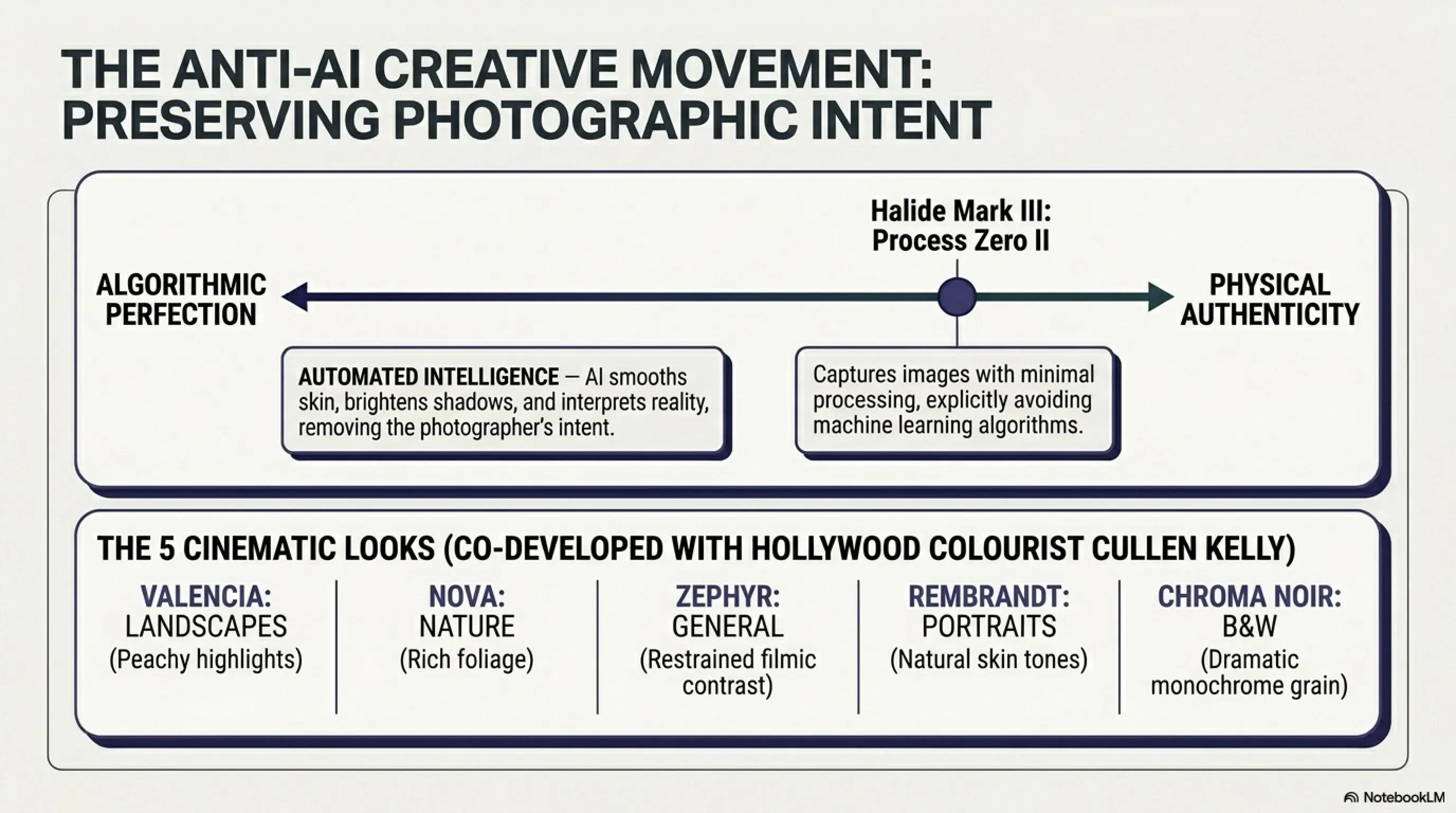
Lux Camera, the company behind one of the most popular professional camera apps for iPhone, has released Halide Mark III, the third generation of its flagship application. Available as of May 27, 2026, this major update introduces a revolutionary film simulation engine and a collection of five cinematic "Looks" co-developed with Cullen Kelly, a renowned Hollywood colorist whose work has shaped the visual aesthetic of major films and television productions.
The most compelling feature of Halide Mark III is its Looks system, which represents a fundamental departure from the simple filter presets found in most camera apps. These are not Instagram-style filters that merely adjust saturation and contrast; they are physically accurate film simulation processes that replicate the characteristics of actual analog film stocks. Each Look incorporates elements like film grain, halation (the glow around bright light sources characteristic of film), and color science derived from real photographic processes.
🎨 Halide Mark III's Five Cinematic Looks
| Look Name | Best For | Characteristics |
|---|---|---|
| Valencia | Landscapes & Cityscapes | Saturated colors, tight contrast, smooth peachy highlights |
| Nova | Natural Landscapes | Exceptional color, tight contrast, peachy highlights, rich foliage |
| Zephyr | General Purpose | Subtle and restrained, filmic contrast, rich skin tones |
| Rembrandt | Portraits | Portrait lighting, natural skin tones, flattering contrast |
| Chroma Noir | Black & White | High contrast, extra film grain, dramatic monochrome |
Beyond the Looks system, Halide Mark III introduces a completely redesigned built-in photo editor that represents a significant expansion of the app's capabilities. This editor can process RAW files not just from iPhones, but from professional cameras including Canon, Nikon, Sony, Fujifilm, and other major brands. This unexpected feature transforms Halide from purely an iPhone camera app into a comprehensive mobile photography workflow tool that can handle images from any source.
The editor includes professional-grade tools for adjusting exposure, contrast, highlights, shadows, and color temperature, all optimized for touch interfaces. Users can apply Looks to any RAW file, not just photos taken within Halide, making it possible to give professional camera images the same cinematic treatment. All Looks support HDR (High Dynamic Range), ensuring that photos display with full highlight and shadow detail on modern iPhone displays that support HDR content.
Halide Mark III also updates Process Zero II, the app's computational photography engine that deliberately avoids AI and machine learning algorithms. While Apple and other smartphone manufacturers increasingly rely on AI to "enhance" photos—often resulting in over-processed images that look artificial—Process Zero II takes the opposite approach. It captures images with minimal processing, preserving the natural characteristics of the iPhone's camera sensor while adding only physically accurate film-like qualities through the Looks system.
🔍 Tekin Analysis: The Anti-AI Photography Movement
Halide Mark III arrives at a fascinating moment in mobile photography. As smartphone manufacturers race to add more AI-powered computational photography features—automatically removing unwanted objects, enhancing faces, and "improving" scenes—a counter-movement is emerging among photographers who want more control and authenticity in their images. Halide represents the vanguard of this "anti-AI" photography philosophy.
The problem with AI-enhanced photography isn't that it produces bad images—often they look impressive at first glance. The issue is loss of authenticity and photographer intent. When your phone automatically smooths skin, brightens shadows, and adjusts colors based on what an algorithm thinks looks good, you're no longer capturing reality; you're capturing an AI's interpretation of reality. For documentary photographers, photojournalists, and artists who want their images to reflect their vision rather than an algorithm's preferences, this is unacceptable.
Halide's approach—using physically accurate film simulation rather than AI enhancement—offers a middle ground. Film stocks have always had distinctive looks; photographers chose Kodak Portra for portraits or Fuji Velvia for landscapes because of their specific color characteristics. Halide's Looks replicate this tradition in the digital realm, giving photographers creative control through the choice of film simulation while maintaining the authenticity of the captured scene.
The collaboration with Cullen Kelly, a Hollywood colorist, is particularly significant. Color grading in cinema is an art form that shapes the emotional tone of films. By bringing this expertise to mobile photography, Halide elevates the iPhone camera from a consumer device to a serious creative tool. The fact that the app can now process RAW files from professional cameras further blurs the line between mobile and traditional photography workflows.
For photographers who value control, authenticity, and artistic intent over algorithmic "perfection," Halide Mark III represents an important alternative to the AI-first approach dominating the industry. As with DuckDuckGo's success in search, Halide's growth suggests there's significant demand for tools that prioritize user control over automated "intelligence."
🚨 Dual Banking Malware Threat: Grandoreiro and BTMOB Target Europe and Latin America
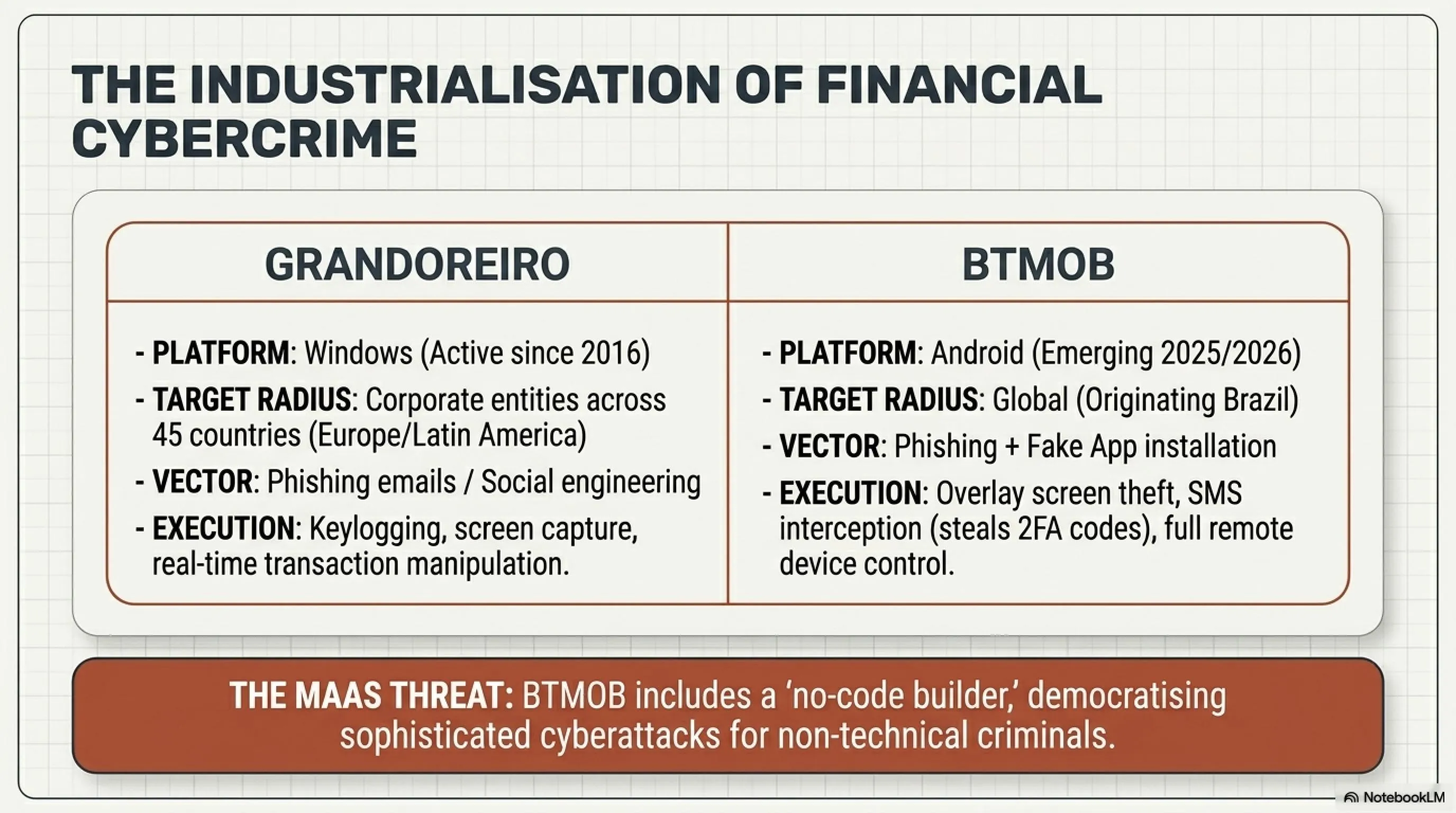
In our final story tonight, we examine two simultaneous banking malware campaigns that are targeting Windows and Android users across Europe and Latin America. Grandoreiro, a veteran banking trojan active since 2016, and BTMOB, a newer Android Remote Access Trojan (RAT) with a no-code builder tool, represent the evolving sophistication of financially motivated cybercrime and the democratization of attack tools that make sophisticated attacks accessible to less technical criminals.
Grandoreiro is a highly sophisticated banking malware capable of stealing credentials associated with thousands of financial institutions across 45 countries and territories. Originally developed by Brazilian cybercriminals, it has evolved significantly over its eight-year lifespan, adding new capabilities and expanding its geographic reach. The malware is typically distributed through phishing emails that use social engineering to trick recipients into clicking malicious links or downloading infected attachments disguised as legitimate documents, invoices, or shipping notifications.
⚠️ Grandoreiro vs BTMOB: Comparative Analysis
| Characteristic | Grandoreiro | BTMOB |
|---|---|---|
| Platform | Windows | Android |
| Type | Banking Trojan | Remote Access Trojan (RAT) |
| First Observed | 2016 | 2025 |
| Target Regions | 45 countries (Europe, Latin America) | Brazil and expanding globally |
| Distribution | Phishing emails | Phishing + fake apps |
| Business Model | Malware-as-a-Service (MaaS) | MaaS with no-code builder |
| Key Capability | Keylogging, screen capture, transaction manipulation | Full device control, SMS interception, overlay attacks |
Once installed, Grandoreiro operates with devastating effectiveness. It can log keystrokes to capture usernames and passwords, take screenshots of banking sessions, manipulate banking transactions in real-time by altering recipient account numbers or transfer amounts, display fake banking pages that overlay legitimate sites to steal credentials, and disable security software to avoid detection. The malware specifically targets corporate entities and high-value individual accounts, making it particularly dangerous for businesses that conduct online banking.
BTMOB represents a newer but equally concerning threat. This Android RAT, while not yet detected in high volumes, poses a significant danger due to its accessibility and capabilities. The malware is distributed with a no-code builder tool that allows cybercriminals with minimal technical skills to create custom versions of the malware tailored to specific targets or regions. This "democratization" of cybercrime tools significantly lowers the barrier to entry for would-be attackers.
BTMOB's capabilities are comprehensive and alarming. Once installed on an Android device, it can intercept SMS messages (including two-factor authentication codes), display overlay screens on top of legitimate banking apps to steal credentials, remotely control the device to perform unauthorized transactions, access and exfiltrate contacts, photos, and other personal data, and record phone calls and ambient audio. The combination of phishing-led delivery, ready-made app-building tooling, and device takeover capabilities makes BTMOB a threat that extends well beyond Brazil or Latin America.
🛡️ Tekin Analysis: Protection Strategies for Banking Malware
The simultaneous campaigns of Grandoreiro and BTMOB highlight the persistent and evolving nature of financially motivated cybercrime. Both malware families operate as Malware-as-a-Service (MaaS), meaning that the developers rent access to their tools to other criminals, creating a scalable business model that has proven highly profitable and difficult to disrupt.
For individuals and businesses, protection requires a multi-layered approach. First and foremost is security awareness training—the vast majority of banking malware infections begin with phishing emails or messages. Users must be trained to recognize suspicious communications, verify sender identities before clicking links, and never download attachments from unknown sources. For businesses, regular security awareness training should be mandatory for all employees who handle financial transactions.
Technical controls are equally important. Install and maintain reputable antivirus/anti-malware software on all devices. Enable two-factor authentication (2FA) for all banking and financial accounts, preferably using authenticator apps or hardware tokens rather than SMS. Keep operating systems and applications updated with the latest security patches. For Android users, only install apps from the official Google Play Store and carefully review app permissions before installation. For Windows users, enable Windows Defender and keep it updated, or use enterprise-grade endpoint protection for business environments.
Financial institutions also have a role to play. Banks should implement behavioral analytics to detect unusual transaction patterns, require additional verification for high-value or unusual transactions, provide clear guidance to customers about phishing threats, and offer secure communication channels for customers to verify suspicious messages. The combination of user awareness, technical controls, and institutional safeguards provides the best defense against these sophisticated threats.
💭 Final Thoughts
Thursday night, May 28, 2026, will be remembered as a pivotal moment in technology history. Illinois's passage of America's strongest AI safety law demonstrates that meaningful regulation of frontier technologies is possible with bipartisan support. The unanimous 110-0 vote suggests that AI safety transcends political divisions and reflects genuine societal concern about the technology's potential risks. This law could trigger a cascade of similar legislation across other states and potentially force federal action to create unified national standards.
Meta's subscription launch represents a fundamental shift in social media business models. After nearly two decades of "free to use, paid by advertisers," major platforms are finally diversifying their revenue streams. This could realign incentives toward user satisfaction rather than engagement maximization, though the risk of creating two-tier social networks with unequal experiences remains a concern. The success or failure of these subscriptions will be closely watched by every social media company considering similar moves.
The dramatic user exodus from Google to DuckDuckGo sends a clear message: users want choice in how they interact with technology. Google's decision to make AI Overviews mandatory, with no opt-out option, has backfired spectacularly. The 30% surge in DuckDuckGo installs, particularly the strong growth of the noai.duckduckgo.com page, demonstrates that "AI fatigue" is real and that many users prefer traditional search experiences. Google should take this as a wake-up call and offer genuine choice rather than forced AI integration.
The successful takedown of the Glassworm botnet showcases the power of public-private collaboration in cybersecurity. CrowdStrike, Google, and Shadowserver's coordinated operation demonstrates that when security firms, tech companies, and nonprofit organizations work together, they can effectively combat sophisticated threats. This model should be expanded to address other supply chain attacks that target the software development ecosystem.
Halide Mark III's anti-AI approach to mobile photography represents an important counter-movement to the industry's rush to add AI to everything. By focusing on physically accurate film simulation and giving photographers control over their images, Halide demonstrates that innovation doesn't always mean adding more algorithms. Sometimes, the best path forward is giving users more control and respecting their creative intent.
Finally, the ongoing threats from Grandoreiro and BTMOB remind us that cybersecurity is a continuous battle requiring constant vigilance. The evolution of these malware families into Malware-as-a-Service platforms has democratized cybercrime, making sophisticated attacks accessible to less technical criminals. Protection requires a combination of user awareness, technical controls, and institutional safeguards—no single solution is sufficient.
❓ Will Illinois's AI safety law stifle innovation?
No, SB 315 is designed to balance safety with innovation. The requirement for third-party audits and public safety frameworks actually helps companies identify and manage risks earlier in the development process. Experience from California and New York shows that such regulations don't inhibit innovation; instead, they build public trust in AI technologies, which is essential for long-term industry growth. Companies that embrace these standards early may gain competitive advantages as safety becomes a key market differentiator.
💰 Are Meta's subscriptions worth the cost?
It depends on your usage patterns. For casual users who primarily use these platforms to stay in touch with friends and family, the free versions remain fully functional and adequate. However, for power users, content creators, and businesses, the premium features offer genuine value. Instagram Plus's advanced analytics and scheduling tools, Facebook Plus's custom themes and early feature access, and Meta One Essential's verification badge and professional analytics justify the cost for users who depend on these platforms for their work or personal brand. At $3.99-$14.99 per month, the pricing is competitive with other digital subscriptions.
🦆 Is DuckDuckGo really a viable Google alternative?
For many everyday searches, yes. DuckDuckGo provides excellent results for general queries, news, shopping, and research while respecting your privacy. However, Google still excels in certain areas like local search, personalized results based on your history, and integration with other Google services. The best approach for many users is to use DuckDuckGo as their default search engine for general queries and privacy-sensitive searches, while occasionally switching to Google for specialized needs. The noai.duckduckgo.com page is particularly valuable for users who want to completely avoid AI features in their search results.
🛡️ How can I protect myself from banking malware like Grandoreiro and BTMOB?
Protection requires multiple layers of defense. First, be extremely cautious with emails and messages—never click suspicious links or download attachments from unknown senders. Always verify the sender's identity through a separate communication channel before taking action. Second, use strong technical controls: install reputable antivirus software and keep it updated, enable two-factor authentication (preferably with authenticator apps or hardware tokens, not SMS) for all financial accounts, keep your operating system and applications updated with the latest security patches, and only install apps from official stores (Google Play, Apple App Store). Third, monitor your financial accounts regularly for unauthorized transactions and report suspicious activity immediately. For Android users, carefully review app permissions before installation—banking apps should never need access to your camera, microphone, or contacts.
📸 Is Halide Mark III suitable for photography beginners?
Yes and no. Halide Mark III offers professional-grade tools that may be overwhelming for complete beginners, but the Looks system makes it accessible to everyone. You can simply select a Look (like Valencia for landscapes or Rembrandt for portraits) and shoot without needing deep technical knowledge. The app will apply the cinematic film simulation automatically. However, to fully leverage Halide's capabilities—manual focus, exposure control, RAW capture, and the built-in editor—you'll need to invest time in learning photography fundamentals. For beginners who want to learn, Halide is an excellent educational tool because it gives you full control and helps you understand how different settings affect your images. The app's interface is well-designed with helpful tooltips and guides.
📚 Sources
Primary Sources: Wired, The Verge, TechCrunch, The Hacker News, Mashable, CrowdStrike Blog, NBC News, Business Insider, Engadget, 9to5Mac, MacRumors, InfoSecurity Magazine, Computer Weekly, SecurityWeek, Cybersecurity Dive, The Register, TechRadar, PC Gamer, Tom's Guide, Thurrott.com
Research and Analysis: Tekin Editorial Team
Publication Date: May 28, 2026
🌐 Stay Connected With Us 🎮✨
For the latest tech, gaming, and gadget news, follow us on our official social media channels: